UNDERSTANDING THE TROUBLES
HISTORICAL ORIGINS OF THE TROUBLES
Early Ireland, from Strongbow to the Famine
Early 20th Century: Irish Independence and Partition
Late 1960s: Demonstrations Turn Violent
1970s-1980s: Height of the Conflict
1990s: Negotiations and Agreement
AFTER THE TROUBLES: RECONCILIATION
Visitors to the Emerald Isle often have questions about the “Troubles”—the period of deep unrest, violence, and sectarian strife that plagued Northern Ireland from the late 1960s to 1998. Thankfully, the 1998 Good Friday Agreement appears to have created a durable peace. But the legacy of the Troubles, and the long road to peace, still reverberates.
While often simplistically framed as a battle of “Catholics versus Protestants,” the Troubles ultimately had far more to do with cultural influence and political dominance than religion. The driving question of the Troubles was simply this: Should Northern Ireland stay part of the United Kingdom or become part of the Republic of Ireland? That question pitted mainly Catholic Nationalists and hardline Republicans against mainly Protestant Unionists and hardline Loyalists in a turbulent battle for control.
Understanding the Troubles and its centuries-old causes remains key to fully appreciating the story of Ireland; many of the Irish people you meet (especially in Northern Ireland) have strong opinions that they’ll be eager to share.
It’s challenging to explain a piece of history as complicated as the Troubles. This chapter attempts to provide a concise, factual, evenhanded recounting of the major events before, during, and after the Troubles. It’s intended not as the final word, but as a starting point.
HISTORICAL ORIGINS OF THE TROUBLES
Early Ireland, from Strongbow to the Famine
If you had to boil the origin of the Troubles down to its essence, it would be this: The indigenous, Celtic, Catholic Irish had the poor luck to be located next door to big, powerful, and (after 1534) Protestant Britain. The Catholic Irish versus the Protestant English and Scots is the dynamic that has shaped much of Irish history.
When did this all begin? Some sources say the late 12th century, when a deposed Irish clan leader sought assistance from the Anglo-Normans—Norsemen from northern France who’d conquered England a century and a half earlier. The Anglo-Norman warlord Strongbow came to the chieftain’s rescue and ended up marrying his daughter, Aoife, becoming next in line to the Irish throne of Leinster. This prompted England’s King Henry II to sail for Ireland and force its leaders (including Strongbow) to pledge fealty to the throne. (For more on this story, see here.)
Starting around 1600, after English authorities had put down a series of Irish rebellions, an estimated 25,000 Protestant settlers from England and Scotland were strategically “planted” in Catholic Ireland (mostly in the north) to help assimilate the island into the British economy. These Protestant settlers laid claim to the most fertile land while displacing many Catholic Irish. By 1620, the dominant English powerbase in London felt entitled to collectively call both islands the “British Isles” on maps (a geographic label that still irritates Irish Nationalists, who prefer the term “Celtic Isles,” “Atlantic Archipelago”...or simply “Britain and Ireland”).
In 1641, the Irish rebelled, kicking off 11 years of warfare between Catholics and Protestants (called the Irish Confederate Wars, or the Eleven Years’ War). Both sides saw thousands of casualties, including the Portadown Massacre of about a hundred Protestant settlers, which stoked fear and anger in England.
Seeking retribution for Portadown, the rabidly anti-Catholic Oliver Cromwell—having just brought the English Civil Wars to an end—came to Ireland in 1649. He seized some 11 million acres of farmland from Irish Catholic landowners and banished them to the rocky lands west of the River Shannon—essentially dismantling Ireland’s Catholic landowning class. (For more on Cromwell, see here.)
With England’s Civil Wars over and its monarchy restored, in 1688, the largely Protestant Parliament deposed Catholic King James II and imported a new Dutch-born, Protestant king, William III (a.k.a. William of Orange). In the summer of 1690, the forces of these two rival royals met on a battlefield just outside Dublin. At the Battle of the Boyne, William of Orange’s army (supported by England and the Protestant kings of Europe) soundly defeated the forces of King James II (supported by the Catholic Irish and France). To this day, many Unionists and Loyalists call themselves “Orangemen” and “Williamites,” and wave orange banners as they celebrate the Battle of the Boyne each July 12 with parades and bonfires. (For more on the Battle of the Boyne, including visiting the actual battlefield and museum, see here.)
Under English rule, the Catholic Irish held strong to their Gaelic culture on their ever-diminishing, boggy, rocky farms—even as Dublin thrived (as Britain’s second-largest city and the seat of the Irish Parliament). The Irish continued to press for independence, but in 1801, the Act of Union abolished the Irish Parliament, moved all power (and Irish members of Parliament) to London, and declared that Ireland was but one part of a United Kingdom.
By this time, absentee landlords from Britain owned much of the good farming land, and Irish peasants worked it, subsisting almost exclusively on a diet of potatoes (as the grain they grew was exported to England). The Great Potato Famine (1845-1849) was unthinkably devastating, causing the Irish population to decline by more than one-third (one million died of starvation or disease, and two million emigrated to North America, Australia, and New Zealand). Britain did little to aid its suffering Irish subjects, causing resentment that persists to this day. (For more on the famine, see here.)
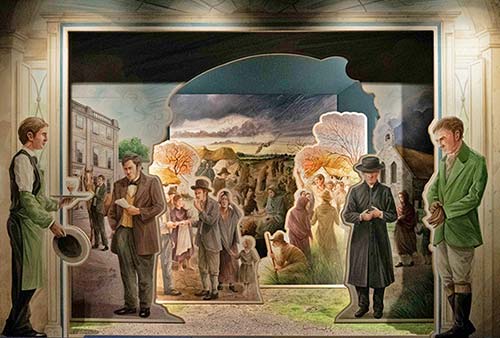
By the dawn of the 20th century, with the trauma of the famine looming large in their collective memory, the Irish were determined to set a new course.
Early 20th Century: Irish Independence and Partition
By the dawn of the 20th century, it became ever clearer that the sparse Protestant population could no longer control the entire island. When Irish separatists staged the Easter Rising of 1916, proclaiming Ireland to be an independent republic, British forces brutally subdued the uprising and executed its leaders. For many Irish, this was the last straw, and public opinion swung toward fighting for total independence (“home rule”). The separatist Sinn Féin party (meaning “We Ourselves”) won a huge victory in the United Kingdom’s 1918 general election. These new members of Parliament refused to take their seats at Westminster in London. Instead they created an Irish Parliament in Dublin—considered illegal and illegitimate by Britain. The Irish Republican Army (IRA) prepared to fight. But this time Irish rebels turned to guerrilla tactics, ambushing policemen—seen as the eyes and ears of British control—and leading to Ireland’s War of Independence in 1919.
This pivotal year means vastly different things to Northern Ireland’s two communities. When you say “1776” to most Americans, it means revolution and independence from tyranny. But when you say “1916” to someone in Northern Ireland, the response depends on who’s talking.
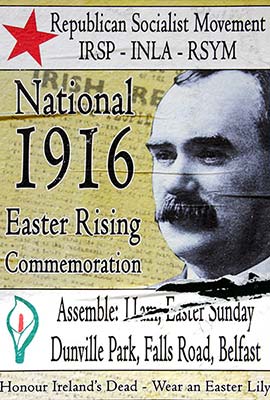
To Nationalists (who are usually Catholic), “1916” brings to mind the Easter Rising—which took place in Dublin in April of that year and was the beginning of the end of 750 years of British rule for most of Ireland. Some Nationalist murals still use images of Dublin’s rebel headquarters or martyred leaders like Patrick Pearse and James Connolly. To this community, 1916 emphasizes their proud Gaelic identity, their willingness to fight to preserve it, and their stubborn anti-British attitude.
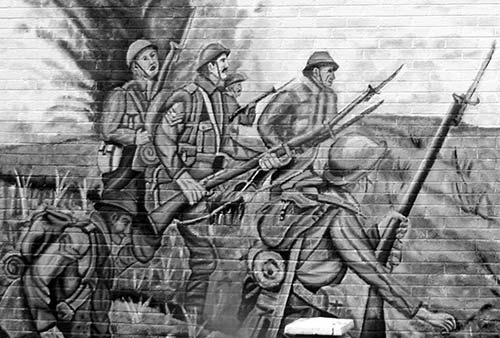
To Unionists (who are usually Protestant), “1916” means the brutal WWI Battle of the Somme in France, which began that July. (For more on the Somme, visit the Somme Museum in Bangor.) Although both Catholic and Protestant soldiers died in this long and costly battle, the first wave of young men who went over the top were the sons of proud Ulster Unionists. The Unionists hoped this blood sacrifice would prove their loyalty to the Crown—and assure that the British would never let them be gobbled up by an Irish Nationalist state (a possible scenario just before the Great War’s outbreak). You’ll see Tommies heroically climbing out of their trenches in some of Belfast’s Unionist murals. For the Unionists, 1916 is synonymous with devout, almost righteously divine, Britishness.
The ugly war gradually sapped Britain’s willingness to deal with its troublesome next-door colony. They agreed to peace talks in 1921, culminating in the Anglo-Irish Treaty, which partitioned the island: It gave 26 of the island’s 32 counties a parliament and relative autonomy, creating the mostly Catholic Irish Free State, and granted an option to the mostly Protestant Northern Ireland: either join the Irish Free State or remain part of the United Kingdom.
Furious disagreement within Ireland (and between its leaders, Michael Collins and Éamon de Valera) about this compromise devolved into a bloody, bitter Civil War (1922-1923). Former allies and friends took up arms against each other, as the hardline IRA fought to reject the deal and keep fighting for a fully independent and unpartitioned Ireland.
But pro-treaty forces prevailed. The result: The 26 counties of the Irish Free State would be ruled from Dublin with dominion status in the British Commonwealth (similar to Canada’s level of sovereignty). In 1949, those counties left the Commonwealth altogether and became the Republic of Ireland, severing all political ties with Britain.
Meanwhile, the six remaining northeastern counties—the only ones with a Protestant majority, who considered themselves British—chose not to join the Irish Free State and remained Northern Ireland, part of the UK. But within Northern Ireland was a large, disaffected Irish (mostly Catholic) minority who felt marginalized by the drawing of the new international border.
This sentiment was represented by the IRA, which, having lost the Civil War, went underground to continue their efforts to unite all 32 of Ireland’s counties in one Irish nation (so their political goals were “Nationalist”). Their political opponents were the “Unionists”—Protestant British eager to defend the union with Britain, who were primarily led by the long-established Orange Order.
During World War II, the Republic stayed neutral while Northern Ireland enthusiastically supported the Allied cause—winning a spot close to London’s heart. Derry (a.k.a. Londonderry) became an essential Allied convoy port, while Belfast lost more than 900 civilians during four German Luftwaffe bombing raids in 1941.
After the war, the split between the two Irelands seemed permanent, and Britain invested heavily in Northern Ireland to bring it solidly into the UK fold. Although Northern Ireland was primarily Protestant, Catholics were a sizable 35 percent of the population—enough to demand attention when they agitated against perceived anti-Catholic discrimination.
And it was this power imbalance that led to the Troubles, the conflict that ravaged Northern Ireland and captured global headlines from the late 1960s to the late 1990s.
Sectarian areas in Northern Ireland are still rich with symbols from both sides of the Troubles.
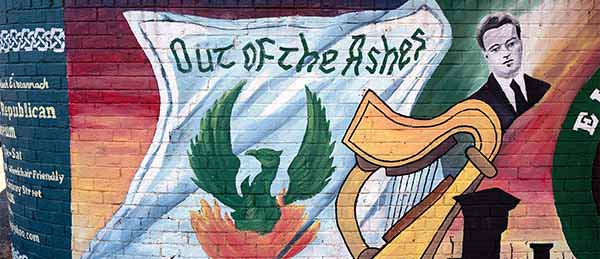
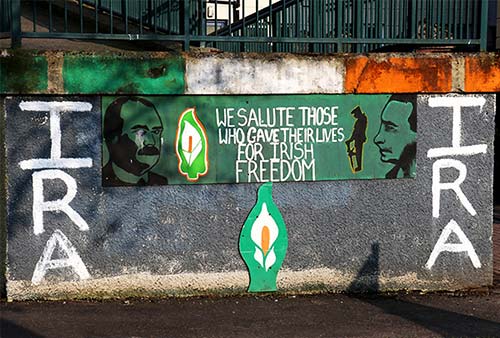
For Catholics/Nationalists/Republicans, the dominant color is green. You”ll also see the Irish tricolor flag (green, white, and orange) and other symbols of Ireland: harps, shamrocks, and so on. A phoenix represents how the IRA arose from the ashes of West Belfast violence.
On the Protestant/Unionist/Loyalist side, Union Jacks (or any red, white, and blue combinations) are everywhere. Orange is the dominant Unionist color—in honor of the Protestant King William of Orange, who defeated the Catholic King James II in the Battle of the Boyne. (You’ll also see portraits of William of Orange and other Protestant-friendly historical figures, such as Oliver Cromwell.) Symbols of the Windsors (Queen Elizabeth II, King Charles III) demonstrate Unionist fealty to the crown. In Unionist communities, giant bonfires are built to celebrate the Battle of the Boyne each July 12—you may see them building those pyres beforehand, or the ashes after they’ve burned.
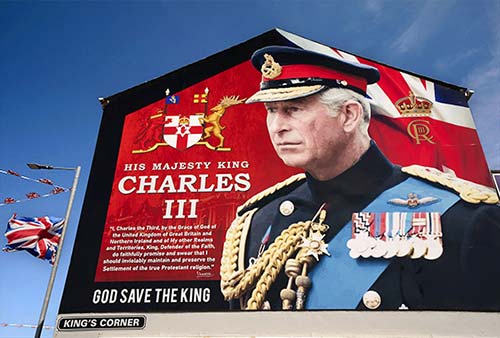
Many murals have a militaristic bent. On the Catholic side, that’s the Irish Republican Army (IRA; also known as the Provos). On the Protestant side, the Loyalists are the paramilitary answer to the IRA—you’ll see markings for various groups, especially the Ulster Volunteer Force (UVF), the Ulster Defense Association (UDA), and the Ulster Freedom Fighters (UFF). Although guerrilla combatants usually didn’t wear uniforms, they’re often portrayed in uniform wearing a balaclava mask. And, of course, you’ll see guns—lots and lots of guns.
Even similar symbols are interpreted differently. In the UK—and in Unionist territory—a symbol for victims of war is the red poppy (because poppies are the first flowers to grow on a battlefield after the smoke clears). Nationalists have a similar idea, but a different flower: the white lily, representing the Easter Rising.
The red hand of Ulster (described in the sidebar on here) is a rare symbol embraced by both communities (to an extent). However, the flag of Ulster is different: The Nationalist version is a red cross on a yellow field, with the red hand in the middle. On the Unionist version, the field is white, there’s a crown over the hand, and it’s surrounded by a six-point star, for the six counties of Northern Ireland. (Historically, Ulster—one of Ireland’s four provinces—had nine counties, not six. But Northern Ireland didn’t want the three counties where Catholics outnumbered Protestants. Therefore, for Unionists, Ulster is six counties; for Nationalists, it’s nine.)
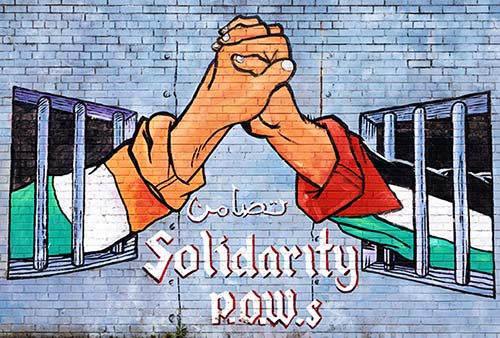
You’ll also see each group invoke “kindred spirits” in conflicts that they see as similar. For Nationalists, that”s often Black Americans of the Civil Rights Movement, or Palestinians in Gaza and the West Bank (watch for the red, green, and black Palestinian flag). Meanwhile, some Unionists embrace the Israeli flag.
And there are lots of hyper-local symbols, too: In Belfast, you might see references to the fires on Bombay Street; in Derry, there’s a whole vocabulary of imagery relating to Bloody Sunday (including a white handkerchief, and “We Shall Overcome”—sung by the protesters just before the shooting began).
All of this symbolism can be complicated. But the more you know about it, the better you can read the stories behind the Troubles.
THE TROUBLES
Late 1960s: Demonstrations Turn Violent
Partly inspired by Martin Luther King, Jr. and the Civil Rights Movement in America, in the late 1960s the Catholic minority in Northern Ireland began a nonviolent struggle to end discrimination, advocating for better jobs and housing. Extremists polarized issues, and once-peaceful demonstrations slowly grew more violent.
Unionists were afraid that if the island became one nation, the relatively poor Republic of Ireland would drag down the comparatively affluent north. They also feared losing political power to a Catholic majority. (One Unionist battle cry: “Home Rule is Rome Rule.”)
In 1966, on the 50th anniversary of the Easter Rising, a group of Republicans bombed Nelson’s Column in Dublin. In response, Loyalists on Belfast’s Shankill Road mobilized the Ulster Volunteer Force, or UVF, and began bombing and shooting Republicans. Meanwhile, Irish Nationalists organized into a nonviolent civil rights movement, which was met with violence. When the movement went ahead with an illegal march on October 5, 1968, which began at the Derry train station in Unionist territory, protesters were beaten by police—an event broadcast on national TV.
Things boiled over in the summer of 1969. The Battle of the Bogside (August 12-14), in Derry, began with a Loyalist march near the (Republican) Bogside, which turned into a three-day riot. In West Belfast, on the night of August 15, Loyalists burned Catholic homes on Bombay Street, resulting in the death of a teenager.
1970s-1980s: Height of the Conflict
After the riots, the population of West Belfast separated into sectarian areas: the Catholics along Falls Road, and the Protestants along Shankill Road. Similar divisions rippled through other communities across Northern Ireland.
These events spurred the British Army to send in troops (called Operation Banner). Their role, initially a peacekeeping one, gradually evolved into acting as muscle for the Unionist government. By September, they were at work erecting a “peace wall” in Belfast to separate warring factions. Similar walls were eventually built in other communities, as well. (In Belfast, you can tour the sectarian neighborhoods of Falls Road and Shankill Road, and see the still-standing peace wall; see here.)
The conflict continued to escalate, with bombings becoming increasingly more commonplace. On January 30, 1972, British forces opened fire on a peaceful protest in Derry’s Bogside, and 14 protesters were killed. (Much later, in 2010, the British government’s Saville Report acknowledged that the victims were innocent.) This event, known as Bloody Sunday, galvanized people on both sides, and radicalized many formerly moderate Nationalists. (For a detailed accounting of Bloody Sunday, see here.)
A new, more violent IRA emerged: the Provisional Irish Republican Army—a.k.a. the Provos, which became known simply as the IRA. By year’s end, more than 500 people had died, as combatants moved from petrol bombs to guns. The worst phase of the Troubles had begun, with violence peaking from about 1972 to 1976.
Throughout this era, Northern Ireland was essentially a police state overseen by the British Army, which erected checkpoints and security barriers across the country. You might have to repeatedly show identification and explain where you were going, just to walk from one end of town to another. To subdue riots, the British employed tear gas and supposedly “nonlethal” rubber bullets (which killed 17 people).
Republican paramilitary forces—especially the IRA—followed a strategy that had brought them success during the War of Independence: wearing down the enemy with shocking bombings of military, political, and civilian targets. Designed to maximize fear and gain media attention, the bombings killed and injured many innocent bystanders. It was the IRA’s goal to make Northern Ireland too expensive to continue to protect and govern from London.
In response, Loyalist paramilitary forces (such as the UVF, UDA, and UFF) struck back by targeting known or suspected members of the IRA and other Republicans, as well as Catholic civilians, who were killed at random in retaliation for IRA actions.
Both groups expanded their attacks beyond the borders of Northern Ireland. The IRA and other Republican forces carried out bombings from London to Birmingham and from Manchester to Yorkshire. In 1979, Earl Mountbatten, Queen Elizabeth II’s second cousin, was assassinated when the IRA bombed his vacation yacht. In 1984, an IRA bomb blew out a chunk of a Brighton hotel where Prime Minister Margaret Thatcher was sleeping. Prime Minister John Major survived a mortar attack at 10 Downing Street in 1991. Meanwhile, Loyalist paramilitary forces bombed targets in the Republic of Ireland (including a 1974 attack on Dublin and County Monaghan that killed 34), sowing fear there.
The majority of people in Northern Ireland—regardless of their affiliation—were simply civilians, wishing only to live their lives and raise their families in peace. Catholics faced discrimination, harassment, and worse by the local government and police, the British military, and Loyalist paramilitary groups. And Protestants lived in fear of IRA bombings and other acts of violence. As guerilla military actions on both sides escalated gruesomely, many began to lose hope—in some cases, driving them to acts of desperation that only worsened the situation.
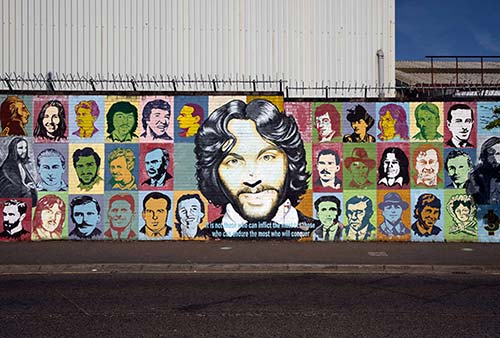
In 1981, IRA prisoner Bobby Sands and several other inmates at cell block H of Maze Prison outside Belfast staged a hunger strike to protest being treated as terrorists rather than political prisoners. Sands, arrested following a bombing and gunfight, was sentenced to 14 years for possessing a firearm. During the hunger strike, Sands ran for and was elected to the British Parliament; ultimately, he and nine other strikers starved themselves to death, becoming martyrs for the Republican cause. But Sands also inspired the IRA to see the potential value of political engagement, which they had long avoided.
1990s: Negotiations and Agreement
It’s difficult to pinpoint a specific turning point in the Troubles. But, gradually through the 1990s—with the growth of the UK economy and the weakening of the Catholic Church’s authority—the Republic of Ireland’s influence grew less threatening to the Unionists. A ceasefire in 1994, while not lasting, demonstrated that peace could be possible.
In 1995, US President Bill Clinton appointed a peace envoy, George Mitchell, to work with both British and Irish authorities. In November, President Clinton visited Northern Ireland to demonstrate his resolve. He stayed at Belfast’s Europa Hotel, went to both Falls Road and Shankill Road, and delivered a rousing speech in front of Derry’s Guildhall. Many locals cite this event as a turning point; weary of the constant violence, they desperately wanted someone to broker a lasting peace.
John Hume, a Nationalist leader from Derry, and David Trimble, from the Ulster Unionist Party of Northern Ireland, worked together to find common ground. Finally, on April 10, 1998, both sides signed on to peace accords—called the Good Friday Agreement by Nationalists, or the Belfast Agreement by Unionists. Power in Northern Ireland would be shared between the two sides, and the agreement also created ties between the governments of Northern Ireland and the Republic of Ireland. In separate referenda, the voters of both entities approved the agreement, which went into effect on December 2, 1999. (Hume and Trimble shared the Nobel Peace Prize in 1998.)
While this set a template for peace, the violence trickled on. In August 1998, a Republican bomb in Omagh killed 29 people. But over time, the agreement took hold. The Troubles saw its final casualties in 2001.
In the end, the Troubles claimed the lives of over 3,500 people, and wounded more than 10 times that number. About 60 percent of the deaths were caused by Republican paramilitary groups, with the rest caused by Loyalist paramilitary and the British Army. It’s estimated that more than half of the dead were civilians.
AFTER THE TROUBLES: RECONCILIATION
The Good Friday Agreement mandated the release of political prisoners on both sides in 2000—a controversial, highly emotional event that felt like a turning point to many (even as others resented the freeing of enemies who’d killed or hurt their loved ones).
In 2005, the IRA formally announced an end to its armed campaign, promising to use peaceful, democratic means to advance its cause; the next year, the British Army dismantled surveillance towers in Northern Ireland’s cities. Another watershed year was 2007, when Britain granted full power to the popularly elected Northern Ireland Assembly. That same year, the British Army formally ended its 38-year-long Operation Banner campaign (withdrawing 90 percent of its forces by year’s end).
In 2010, the peace process was jolted forward by a surprisingly forthright apology by then-British Prime Minister David Cameron. This was prompted by the Saville Report—the results of an investigation conducted by the UK government as part of the Good Friday Agreement. It found that the Bloody Sunday slayings in Derry were unjustified and the victims innocent—vindication for the victims’ families, who had fought since 1972 to clear their loved ones’ names.
Peace in Northern Ireland faced another hurdle when the UK voted to leave the European Union in the 2016 Brexit vote. The Good Friday Agreement had assumed there’d be open borders between Northern Ireland and the Republic. Since the Republic of Ireland was still an EU member, the EU/UK border would now run through the north of the island. The debate over whether Ireland should have a new “hard border” (with trade tariffs and border controls between EU and UK zones) brought worries that it could re-ignite the Troubles. In the end, however, a compromise was reached to permit continued free movement within Ireland, without border checks—a sign that peace may be more durable than some have feared.
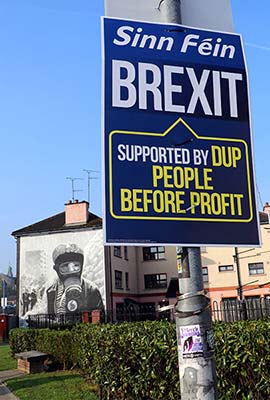
Demographic shifts are also bringing change. In the 2021 census, for the first time, Catholics outnumbered Protestants in Northern Ireland. And economically, the situation has flipped: It’s now the Republic of Ireland that has the island’s stronger economy, bolstered by close ties to the EU. The Brexit vote (in which 55 percent of Northern Ireland voted to remain in the EU) raised new questions—perhaps a bit pie-in-the-sky—about the potential of an Irish reunification. (The Good Friday Agreement allows Northern Ireland to leave the UK through referendum.)
Today, peace walls still stand in many places (including West Belfast). But those walls are now older than most of the people who live near them (as one local described it, they’re now simply “part of the furniture”). Many younger residents react to the Troubles, the walls, all of it, with indifference. They may still avoid the “other side of the wall,” but not because of anger or mistrust—rather, mostly from force of habit.
Locals are far from aligned in how they think about the Troubles. On a recent visit, one person told me that the peace walls across Northern Ireland were slated for removal, while another insisted they will never come down. The reality is likely somewhere in the middle.
And even as the most hateful murals are painted over, some members of the older generation cling to bitter memories. A small, aging group of unemployed sectarian warriors still wages war (even if that “war” is now one of threatening words and attitudes rather than weapons).
Another challenge is how to commemorate the Troubles, and mourn the lost, without re-inflaming trauma. When one person’s freedom fighter is another person’s terrorist, even the simple act of mourning “heroes” and “victims” can be fraught. Increasingly, museums, exhibits, and memorials across Northern Ireland attempt to focus on a fact-based dual-narrative approach to the main events, while avoiding the temptation to relitigate old battles and play the blame game.
On the political stage, the emergence of the Alliance Party—hoping to span the differences between Unionists and Nationalists—is an encouraging sign. They’ve enjoyed some success by focusing on improving lives rather than fighting old battles. Predominantly led by visionary women, they’re supported by parents, the LGBTQ+ community, and others seeking a peaceful, more inclusive future.
Grappling with the Troubles can add a powerful and perspective-broadening element to your visit to Ireland. In a land where people love to talk and share their opinions, you’ll meet plenty of locals who will fill in the details I’ve missed. To ensure you’re getting the full picture, talk to as many as possible—from all sides of the issue.