NORTHERN IRELAND
Map: Northern Ireland Politics
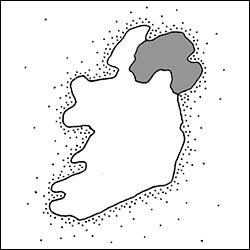
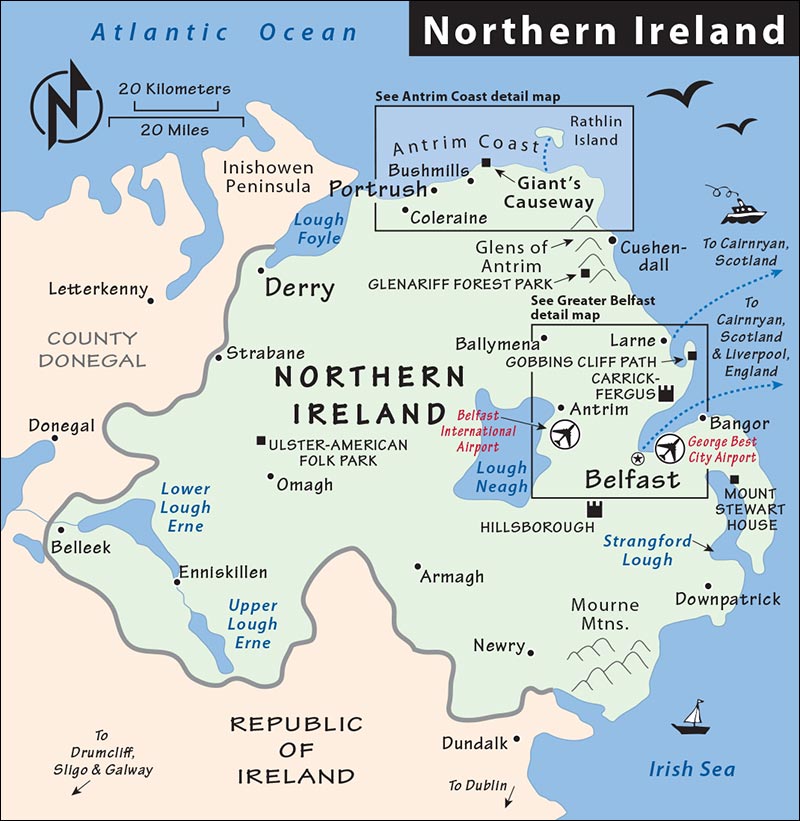
Northern Ireland is a different country than the Republic—both politically (it’s part of the United Kingdom) and culturally (a combination of Irish, Scottish, and English influences). Occupying the northern one-sixth of the island of Ireland, it’s only about 12 miles from Scotland at the narrowest point of the North Channel, and bordered on the south and west by the Republic. While not as popular among tourists as its neighbor to the south, Northern Ireland offers plenty to see and do...and to learn.
When you leave the Republic and enter Northern Ireland, you are crossing an international border. While the border itself is largely invisible, with no passport checks, there are important differences: Rather than euros, Northern Ireland issues its own Ulster pound (which, like the Scottish pound, is fully interchangeable with the English pound). Price differences create a lively daily shopping trade for those living near the border. Some establishments there may take euros, but at a lousy exchange rate. Keep any euros for your return to the Republic and get pounds from an ATM inside Northern Ireland instead. And, since Ulster pounds are considered undesirable in Britain, if you’re heading there next, it’s best to change your Ulster pounds into English ones (free at any bank in the UK).
But some differences between Northern Ireland and the Republic are disappearing: Following the Republic’s lead, Northern Ireland legalized same-sex marriage and decriminalized abortion in 2019 (also bringing its legislation more in line with rest of the United Kingdom).
Northern Ireland has emerged from the dark shadow of the decades-long political strife and violence known as the Troubles, which engulfed life here from the late 1960s to 1998 (for more on this challenging period, see the Understanding the Troubles chapter—essential reading if you’re going to Northern Ireland).
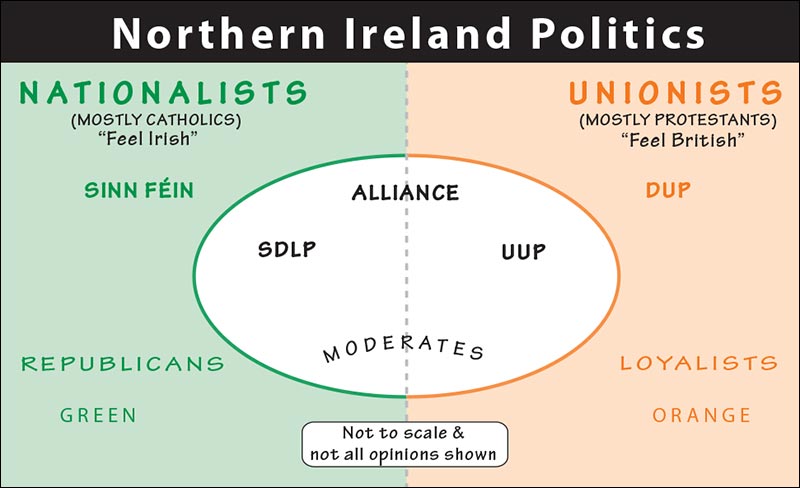
It’s important for visitors to Northern Ireland to understand the ways in which its population is segregated along political, religious, and cultural lines. Very roughly speaking, the eastern seaboard is more Unionist, Protestant, and of English-Scottish heritage, while the south and west (bordering the Republic of Ireland) tend to be Nationalist, Catholic, and of indigenous Irish descent. Cities are often clearly divided between neighborhoods of one group or the other. Early in life, locals learn to identify the highly symbolic (and highly charged) colors, jewelry, sports jerseys, music, names, accents, and vocabulary that distinguish the cultural groups.
When locals spot you with a map and a lost look on your face, they’re likely to ask, “Wot yer lookin fer?” in their distinctive Northern accent. They’re not suspicious of you, but trying to help you find your way. They may even “giggle” (Google) it for you.
For travelers of a certain generation, Belfast may still carry connotations of sectarian violence. But these days, statistically, you’re safer in this northern Irish capital than in many major cities of the UK or the US. Just don’t seek out spit-and-sawdust pubs in working-class neighborhoods and spew simplistic opinions about sensitive local topics. Tourists notice lingering tension mainly during the “marching season” (Easter-Aug), culminating on July 12—“the Twelfth”—when proud Protestant Unionist Orangemen march to celebrate their Britishness (often through staunchly Nationalist Catholic neighborhoods—it’s still good advice to lie low if you stumble onto any big Orange parades).
Official Name: Northern Ireland (pronounced “Norn Iron” by locals). Some call it Ulster (although historically that term also included three counties that today lie on the Republic’s side of the border), while others label it the Six Counties.
Size: 5,400 square miles (about the size of Connecticut), constituting a sixth of the island. With 1.8 million people, it’s the smallest of the four United Kingdom countries (the others are England, Wales, and Scotland).
Geography: Northern Ireland is shaped roughly like a doughnut, with the UK’s largest lake in the middle (Lough Neagh, 150 square miles and a prime eel fishery). Gently rolling hills of green grass rise to the 2,800-foot Slieve Donard. The weather is temperate, cloudy, moist, windy, and hard to predict.
Latitude and Longitude: 54°N and 5°W (as far north as parts of the Alaskan panhandle).
Biggest Cities: Belfast, the capital, has 345,000 residents. Two-thirds of a million people—nearly one in three Northern Irish—inhabit the greater Belfast area. Derry (called Londonderry by Unionists) is the “second city,” with 110,000 people.
Economy: Northern Ireland’s economy is more closely tied to the UK than to the Republic of Ireland, and is subsidized by the UK. Traditional agriculture (potatoes and grain) is fading fast, but Northern Ireland remains a major producer of sheep, cows, and grass seed. Modern software and communications companies are replacing traditional manufacturing. Once-proud shipyards are rusty relics, and the linen industry is now threadbare.
Government: Northern Ireland is not a self-governing nation, but is part of the UK, ruled from London by King Charles III and the British prime minister, and represented by 18 elected Members of Parliament. For 50 years (1922-1972), Northern Ireland was granted a great deal of autonomy and self-governance, known as “Home Rule.” Today some decisions are delegated to a National Assembly (90-seat Parliament), but political logjams often render it ineffective.
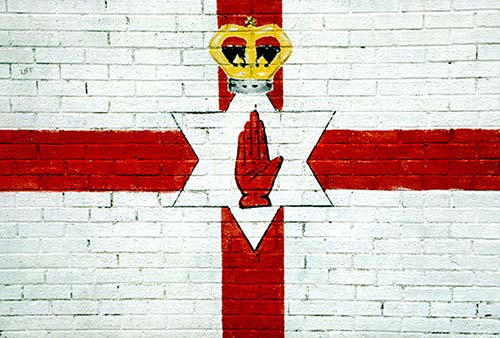
Flag: The official flag of Northern Ireland is the Union flag of the UK. But you’ll also see the green, white, and orange Irish tricolor (waved by Nationalists) and the Northern Irish flag (white with a red cross and a red hand at its center), which is used by Unionists (see “The Red Hand of Ulster” sidebar on here).
One of Northern Ireland’s most valuable assets is its industrious people, many of whom over time emigrated to the US—especially the Scots-Irish. These ethnic Scots took land leases in Northern Ireland in the 16th and 17th centuries, but in Ireland, Presbyterian Scots did not enjoy the same rights as the Anglican English. And so, beginning in the early 18th century, the Scots-Irish left for America in droves. They played a crucial role in our nation’s early history. They were signers of our Declaration of Independence, more than a dozen of our presidents (think tough-as-nails “Old Hickory” Andrew Jackson), and the ancestors of Davy Crockett and Mark Twain.
In fact, there’s a surprisingly strong connection between Ulster and the American South. Many Scots-Irish settled in the Appalachian Mountains, where they went on to fight fiercely in the American Revolution, even as they forged a new mountain culture. Appalachian hallmarks from moonshine and buttermilk to quilting and bluegrass (which unmistakably echoes traditional Irish music) have Scots-Irish roots. Even the word “hillbilly” comes from William of Orange, whose supporters were called “Williamites” or “Billy Boys.”
Northern Irish workers have a proclivity for making things that go. They’ve produced far-reaching inventions like Dunlop’s first inflatable tire. The Shorts aircraft factory (in Belfast) built the Wright Brothers’ first aircraft for commercial sale and the world’s first vertical takeoff jet. The Titanic was the only flop of Northern Ireland’s otherwise successful shipbuilding industry. The once-futuristic DeLorean sports car was made in Belfast.
Notable people from Northern Ireland include musicians Van Morrison and James Galway, and actors Liam Neeson, Roma Downey, Ciarán Hinds, Colin Farrell, and Kenneth Branagh. Northern Ireland also produced Christian intellectual and writer C. S. Lewis, Victorian physicist Lord Kelvin, engineer Harry Ferguson (inventor of the modern farm tractor and first four-wheel-drive Formula One car), and soccer-star playboy George Best—who once famously remarked, “I spent most of my money on liquor and women...and the rest I wasted.”
As in the Republic, sports are big. Northern-born golfers Rory McIlroy, Graeme McDowell, and Darren Clarke have won a fistful of majors, filling local hearts with pride. With close ties to Scotland, many Northern Irish fans follow the exploits of Glasgow soccer teams—but which team you root for betrays which side of the tracks you come from. Those who cheer for Glasgow Celtic (green and white) are Nationalist and Catholic; those waving banners for the Glasgow Rangers (blue with red trim) are Unionist and Protestant. To maintain peace, some pubs post signs on their doors banning patrons from wearing sports jerseys. Now sport teams with no sectarian history are popular, such as the Belfast Giants ice hockey team—a hit with both communities.
You may hear Northern Ireland referred to as Ulster—the traditional name of Ireland’s ancient northernmost province. When the Republic of Ireland became independent in 1922, six of the nine counties of Ulster elected to form Northern Ireland, while three counties joined the Republic.
The mostly Protestant Unionist majority—and the more hardline, working-class Loyalists—want to remain part of the UK. Among political parties, the Ulster Unionist Party (UUP) historically has represented moderate Unionist views (Nobel Peace Prize co-winner David Trimble led the UUP from 1995 to 2005); the Democratic Unionist Party (DUP) has taken a harder stance in defense of Unionism. The Ulster Volunteer Force (UVF), the Ulster Freedom Fighters (UFF), and the Ulster Defense Association (UDA) are Loyalist paramilitary organizations: All three are labeled “proscribed groups” by the UK’s 2000 Terrorism Act.
The mostly Catholic Nationalist minority—and the more hardline, working-class Republicans—want a united and independent Ireland ruled from Dublin. The Social Democratic Labor Party (SDLP), founded by Nobel Peace Prize co-winner John Hume, represents moderate Nationalist views. Sinn Féin takes a harder stance in defense of Nationalism. The Irish Republican Army (IRA) is the now-disarmed paramilitary organization historically linked with Sinn Féin. The centrist Alliance Party wants to bridge the gap between Unionists and Nationalists.
The long-simmering struggle to settle Northern Ireland’s national identity precipitated the Troubles, the violent, three-decade conflict (late 1960s-1998) between Unionist and Nationalist factions. For insight into the complexity of the Troubles, take the time to read this book’s Understanding the Troubles chapter. The 90-minute documentary Voices from the Grave also provides an excellent overview (easy to find on YouTube), or check out the University of Ulster’s informative and evenhanded Conflict Archive at CAIN.Ulster.ac.uk.
Northern Ireland is affordable, the roads are great, and it’s small enough to get a real feel for the place even on a short visit. Fishers flock to the labyrinth of lakes in County Fermanagh, hikers seek out County Antrim coastal crags, and those of Scots-Irish descent explore their ancestral farmlands (some of the best agricultural land on the island). Today, more tourists than ever are venturing north to Belfast and Derry, and cruise-ship crowds disembark in Belfast to board charter buses that fan out to visit the Giant’s Causeway and Old Bushmills Distillery.
As you travel through Northern Ireland today, you’ll encounter a fascinating country with a complicated, often tragic history—and a brightening future.