BELFAST
Map: Belfast’s Titanic Quarter
Map: Queen’s Quarter (South Belfast)
Map: Central Belfast Hotels & Restaurants
Palaces and Gardens near Belfast
Along the Coast, North of Belfast
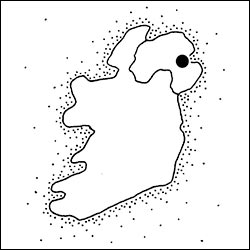
Northern Ireland’s capital, always overshadowed by Dublin, is a classic second city. A century ago, it was an industrial boomtown, proud of its linen mills and shipbuilding (the Titanic was born in Belfast...along with many other ships that didn’t sink). But as the world’s economy evolved through the 20th century, Belfast hit hard economic times—worsened by the Troubles, which made Belfast synonymous with sectarian strife.
Today, peace and prosperity are the status quo, and the Troubles are an ever more distant memory. As if catching up with the Republic’s Celtic Tiger, this fine, rejuvenated city is again booming—this time, not with industrial shipyards but with glittering architecture and an energetic commercial metabolism. This transformation is best embodied by the Titanic Belfast Museum—a world-class, state-of-the-art exhibition that now anchors an entire new quarter of town.
Some tensions still simmer from the challenging times of the Troubles, and working-class Catholics and Protestants tend to live in separate parts of town. But people from all walks of Belfast life congregate, work, eat, and play in the thriving city center. Increasingly, postsectarian political parties—focused on improving people’s lives rather than rehashing old grudges—are gaining support. Aggressive sectarian murals are being repainted with scenes celebrating heritage and pride. It feels like a new morning in Belfast.
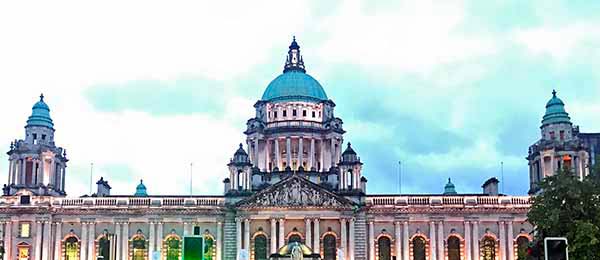
And visitors quickly learn that there’s more to Belfast than the Titanic and the Troubles. At the heart of downtown is the landmark City Hall, whose green copper dome dominates the town center. A bustling covered market, St. George’s, is lively with artisan crafts and food stalls. The thriving Queen’s Quarter (university area) and maze-like Cathedral Quarter (colorful pubs, eateries, and nightlife) bubble with street life.
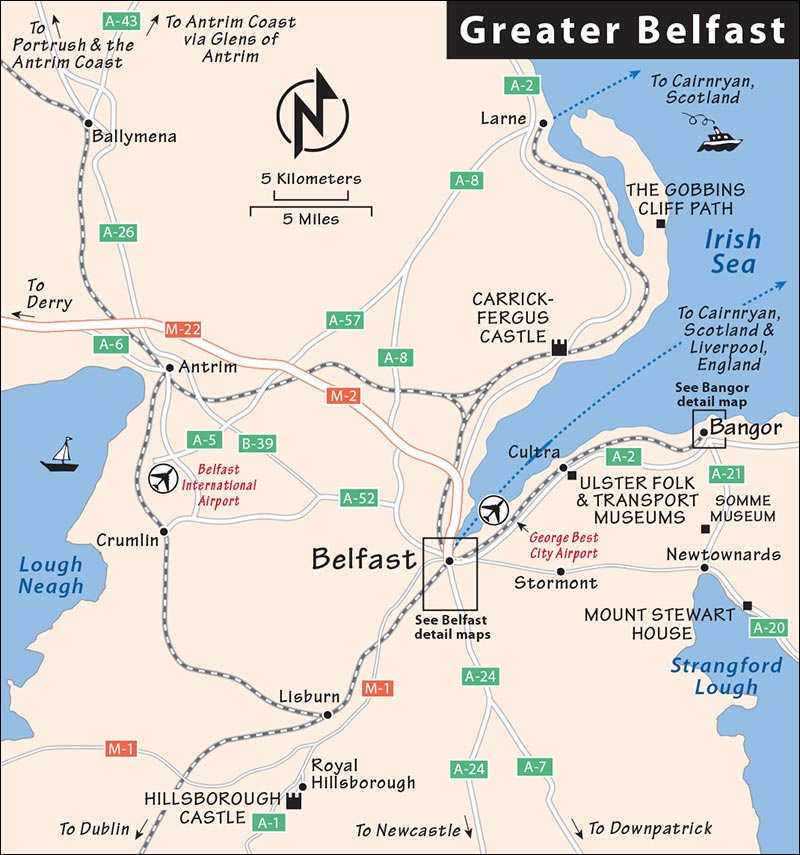
Within a short drive of the city is a variety of other worthwhile sights. To the north and east are folk and transport museums at Cultra, the fine seaside town of Bangor (well connected to downtown by train, and a good home base for drivers wanting to avoid big-city traffic), and the lush gardens and quirky manor at Mount Stewart House. To the south is Hillsborough Castle, the Northern Ireland residence of the royal Windsor family. And to the northwest, roughly along the coastal route to the Antrim Coast, are moody Carrickfergus Castle and the dramatic Gobbins Cliff Path.
PLANNING YOUR TIME
Belfast can easily fill two days (or more) of satisfying sightseeing. On day one, focus on the town center and Titanic Quarter. On day two, explore the sectarian neighborhoods and the lovely university Queen’s Quarter, linger in the city’s many museums, and consider side-tripping to your choice of nearby sights, such as the Ulster Folk Museum, Ulster Transport Museum, or Bangor.
With even more time—or on your way into and out of Belfast—you’ll find plenty of worthwhile attractions within about a half-hour’s drive (manor homes, castles, gardens, and hikes; listed in the “Near Belfast” section, later). Each one merits a few hours, and drivers who plan wisely can visit their choice en route to other destinations.
Day Trip from Dublin to Belfast: If you’re home-basing in Dublin, consider the express one-day plan outlined below. A long day trip from Dublin to Belfast is one of the most interesting days you could have anywhere in Ireland, and it’s just a two-hour train ride away. This ambitious, jam-packed plan works on any day but Sunday, when trains don’t run as early or late:
| 7:35 | Catch the train from Dublin’s Connolly Station |
| 9:45 | Arrive at Belfast’s Lanyon Place/Central Station |
| 10:00 | Follow my self-guided Belfast City Center Walk |
| 12:00 | Lunch |
| 13:00 | Take my Titanic Quarter Walk and visit the Titanic Belfast Museum |
| 16:00 | Tour the sectarian neighborhoods in West Belfast |
| 18:30 | Dinner back in the city center |
| 20:05 | Catch the train back to Dublin |
Orientation to Belfast
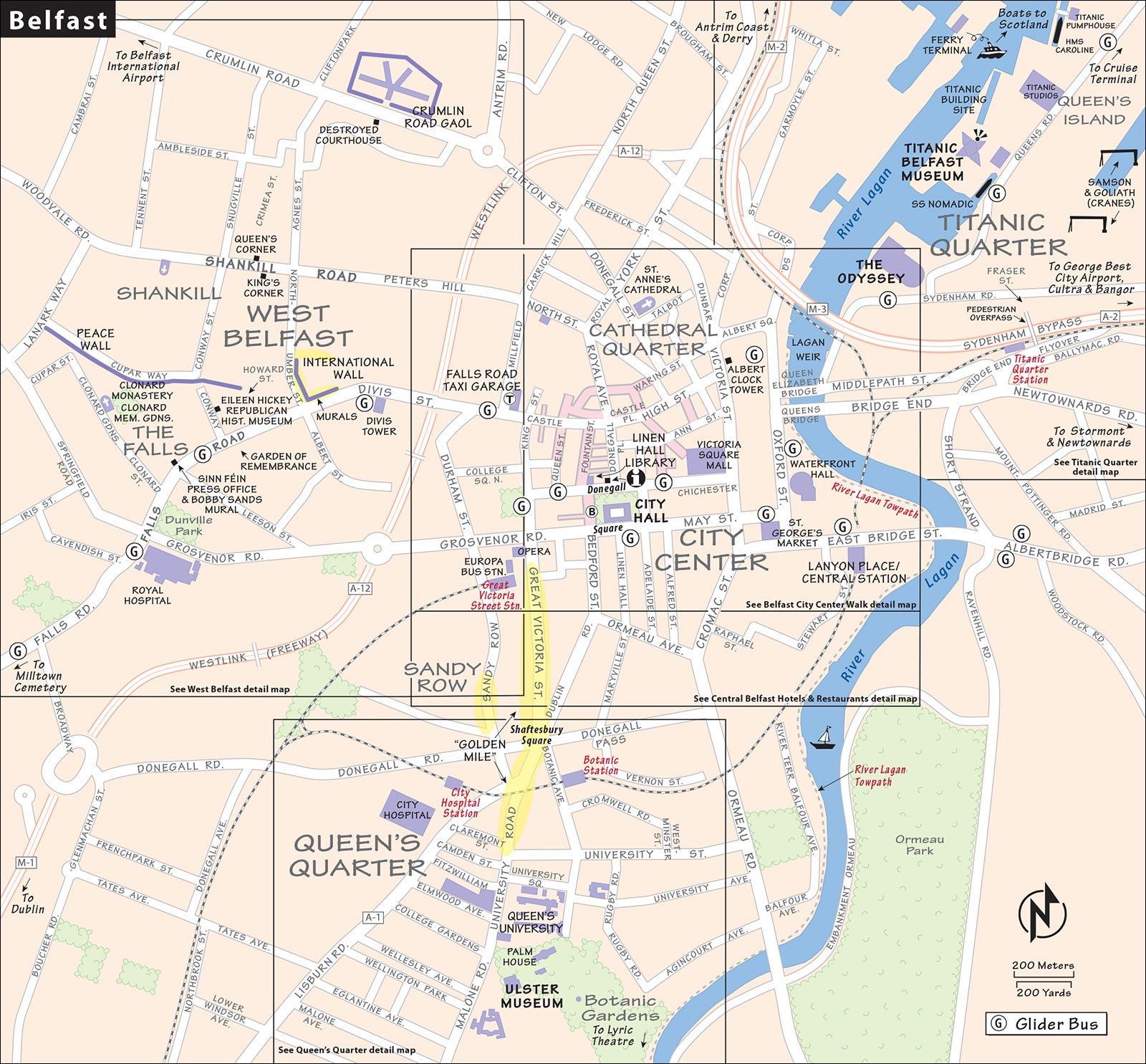
Belfast (pop. 345,000, with 670,000 in greater Belfast), located at the mouth of the River Lagan, is flat and spread out. But most of what you’ll want to see is a long walk or short ride from City Hall. When planning, think of Belfast as having four sightseeing zones:
Central Belfast: The walkable city center has a dozen or so mostly minor sights that are never crowded (and many are free). City Hall, on Donegall Square, marks the very heart of the city. From here, pedestrian shopping areas sprawl north to the Cathedral Quarter—with great restaurants, pubs, and a lively night scene.
Titanic Quarter: The northeast bank of the River Lagan—a short walk from the Cathedral Quarter—is dominated by the Titanic Belfast Museum, but there’s much more here, including a wonderful riverside stroll with a string of sightseeing stops along the way.
West Belfast: The working-class, sectarian neighborhoods along Falls Road (Catholic) and Shankill Road (Protestant), while walkable, are much easier to appreciate with a tour.
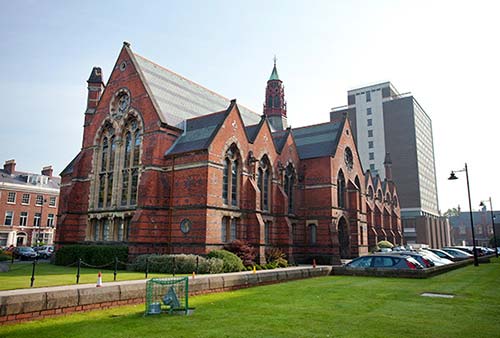
Queen’s Quarter (South Belfast): This upscale neighborhood, around Queen’s University Belfast, is home to the fine Ulster Museum and Botanic Gardens. While lighter on sightseeing, it’s an appealing home base, with cozy guesthouses, good eateries, and more of a neighborhood feel—all connected to the center by fast, frequent buses.
TOURIST INFORMATION
The modern TI (look for Visit Belfast sign) faces City Hall and has a courteous staff; inside is also a Translink bus and rail desk (Mon-Sat 9:00-17:30, stays open slightly later June-Sept, Sun 11:00-16:00 year-round; 9 Donegall Square North, +44 28 9024 6609, https://visitbelfast.com). Pick up a free copy of the Belfast City & Region Guide, which lists all the sightseeing and evening entertainment options.
ARRIVAL IN BELFAST
By Train: Belfast’s modern, modest Lanyon Place/Central Station sits along the river, several blocks east of City Hall on the edge of the city center. If you exit straight out the main entry and turn left, you can walk to City Hall in about 15 minutes. If you turn right about 50 yards, you’ll find the bus stop for the Glider #G1, which goes to City Hall (runs every 8 minutes or so, free with any train or bus ticket). Or, while still inside the station’s main doors, you can head downstairs to reach the taxi pickup point on the lower level. Use the freephone to request a taxi, give them your name, then wait with the mob until a driver shows up and shouts for you. Figure about £6-8 to Donegall Square or the Titanic Belfast Museum, or £10-12 to my accommodation listings south of the university.
Slower commuter trains—cheap and easy—arc through the city, and are most useful for day-trippers riding into Belfast from Bangor. Besides the main station, stops include Great Victoria Street Station (most central, near City Hall and most hotels), Titanic Quarter Station (relatively close to the Titanic Belfast Museum—though not particularly handy), and Botanic Station (close to the university, Botanic Gardens, and Queen’s Quarter accommodations).
By Bus: Most intercity buses use the Europa Bus Centre (sometimes marked as “Glengall Street” on schedules), which is attached to the Great Victoria Street train station. From this transit hub, you can walk through the Great Northern Mall to pop out on Great Victoria Street—right next to the Europa Hotel and at the start of my self-guided walk. You can also catch buses along Great Victoria Street to the Queen’s Quarter accommodations neighborhood.
Note that the city is building a brand-new Grand Central Bus Station, just a block or so to the west, which may open in 2025.
By Car: Driving in Belfast is a pain. Avoid it if possible. Street parking in the city center is geared for short stops, often with a one-hour maximum on weekdays (can be free evenings and on Sun).
By Plane: For information on Belfast’s airports, see the “Belfast Connections” section on here.
HELPFUL HINTS
Belfast Visitor Pass: This combines a local dayLink transit pass (see “Getting Around Belfast”) with minor discounts on various sights and tours (including the Titanic Belfast Museum—see the complete list at www.visitblfast.com [URL inactive]). It could save some money for sightseers who are riding lots of buses (£6.50/1 day, £12/2 days, £15.50/3 days; buy at the TI, any train station, or online at www.translink.co.uk/belfast-visitor-pass).
Market: On Friday, Saturday, and Sunday, the Victorian confines of St. George’s Market are a commotion of commerce and a people-watching delight (see here).
Shopping Mall: Victoria Square is a glitzy American-style mall where you can find whatever you need (1 Victoria Square, three blocks east of City Hall, https://victoriasquare.com).
Laundry: There are two options in the Queen’s Quarter: Globe Launderers, near Shaftesbury Square north of the university, has both self-serve and drop-off service (Mon-Fri 9:00-18:00, Sat until 17:00, Sun 12:00-16:00, 39 Botanic Avenue, +44 28 9024 3956). Whistle Cleaners is south of the university (drop-off service, Mon-Sat 9:00-17:00, closed Sun, 160 Lisburn Road, at intersection with Eglantine Avenue, +44 28 9038 1297). For locations, see the “Queen’s Quarter” map, later.
Cruise-Ship Schedules: Even if you’re not on a cruise, it can be useful to know when ships are arriving to avoid crowds at important sights (especially the Titanic Belfast Museum). You can find the schedule at Cruise-Belfast.co.uk.
GETTING AROUND BELFAST
If you line up your sightseeing logically, you can do most of this flat city on foot. But for farther-flung sights—or if you’re staying in the Queen’s Quarter—public transit can be useful.
By Public Transportation
Translink operates Belfast’s local transit system (their handy office inside the TI answers questions and sells passes and tickets; +44 28 9066 6630, www.translink.co.uk). There are commuter trains and two different types of buses: standard, pink Metro buses (handy for connecting to the Queen’s Quarter neighborhood); and the sleek, purple “tram-on-wheels” called the Glider (line #G1 connects East and West Belfast; line #G2 connects the city center to the Titanic Quarter).
Tickets: For Metro buses, you can just tap your credit card to pay as you board (first ride of the day is £2.20, second ride £1.50, and all further rides are free—thanks to a £3.70 daily cap). For the Glider, you must buy tickets at machines before you board (£1.70/ride within the city center).
Everything is covered by the day passes. The £4.70 dayLink pass covers downtown Belfast as far out as the Ulster Folk Museum and Ulster Transport Museum in Cultra, and George Best City Airport, but not as far as the international airport or Bangor. Buy it at the TI, on board Metro buses, or at Glider ticket machines. (For a small additional charge, the Belfast Visitor Pass covers the same area and adds some sightseeing discounts—see “Helpful Hints,” earlier.)
If you’re going beyond this central area, or if you’re staying longer, you may want to invest in the iLink smartcard: The Zone 2 version adds Bangor and Carrickfergus Castle (£10.50/day, £40/week), Zone 3 includes Belfast’s distant international airport (£14/day, £53/week), and Zone 4 gets you anywhere in Northern Ireland, including Portrush and Derry (£17.50/day, £62.50/week). You can buy these at major train and bus stations or at the TI, but not on board.
Without a pass, if you’re traveling by train from Belfast to only one destination—Carrickfergus Castle, Cultra, or Bangor—a “day return” ticket is cheaper than two one-way tickets.
By Taxi
Taxis are reasonable and easy. You can flag one down, ask your restaurant or hotel to call one for you, or order one yourself through either Value Cabs (+44 28 9080 9080) or fonaCAB (+44 28 9033 3333). Both companies have mobile apps that make it easy to summon a ride. (Note that while Uber operates here, it isn’t widely used—so you may have to wait longer for your ride.)
Tours in Belfast
Beyond the tours listed below, I highly recommend visiting the sectarian neighborhoods in West Belfast on a taxi or walking tour (see here).
ON FOOT
Belfast’s history is more interesting than its actual sights and its people are really fun to get to know. A guided walk makes a lot of sense here. In fact, you could take several, as each would be filled with entertaining insights on different angles of the city (and tours are relatively cheap).
Walking Tours
Free tours are actually “pay what you think it’s worth” tours, led by locals who spin a good yarn while sharing the basics of the city. These tours take a couple hours and leave from in front of City Hall, across from the TI (daily in season at 11:00 and 14:30, just show up, www.belfastfreewalkingtour.com).
Experience Belfast Tours runs a 2.5-hour Troubles tour that includes City Hall, the Cathedral Quarter, and the Linen Hall Library, plus the River Lagan and Belfast’s city center murals (£20, daily at 10:00, meets in front of the City Hall main gate facing Donegall Square North, +44 77 7164 0746, https://experiencebelfast.com).
Belfast Hidden Tours offers walking tours on the Troubles, Irish whiskey, and more. Find out about current offerings online (+44 79 7189 5746, www.belfasthiddentours.com).
Food Tours
Taste & Tour offers a palate-pleasing array of tours covering food, beer, wine, and whiskey. Tours are generally small, include five stops, and are lots of fun. The general “Belfast Food Tour” runs Friday and Saturday only and books up well in advance (£65, 4 hours, +44 28 9045 7723, https://tasteandtour.co.uk).
Local Guides
Susie Millar is a sharp former BBC TV reporter with family connections to the Titanic tragedy (3-hour tour-£30/person, +44 78 5271 6655, www.titanictours-belfast.co.uk).
Lynn Corken is another knowledgeable and flexible Jill-of-all-guiding-trades, with a passion for her hometown, politics, history, and Van Morrison (on foot or with her car, £150/half-day, £300/day, +44 77 7910 2448, lynncorken@hotmail.co.uk).
Lolly Spence, a former BBC producer, offers walking, hiking, cycling, and driving tours specializing in C.S. Lewis, Game of Thrones, Ulster-Scots, and local history (£200/half-day, £300/full day, more for driving, +44 79 0098 8886, lspence@hiddenulstertours.com).
Dee Morgan grew up on Falls Road and can tailor your tour to history, food, politics, or music (£200/half-day, info@deetoursireland.com).
ON WHEELS
▲Hop-On, Hop-Off Bus Tours
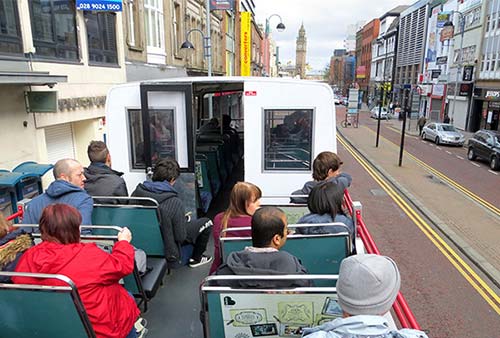
With worthwhile sights scattered across a wide area, Belfast is well suited for a hop-on, hop-off bus tour. And for those with a modest appetite for Troubles history, riding one of these through the sectarian neighborhoods of West Belfast may be plenty. Two different hop-on, hop-off buses loop around Belfast, but tickets can be used interchangeably, so you can ride any open-top bus (£20/1 day, £25/2 days; book online or pay on bus): City Sightseeing (+44 28 9032 1321, https://belfastcitysightseeing.com) and City Tours (+44 28 9032 1912, https://citytoursbelfast.com).
Countryside Bus Tours
McComb’s offers several big bus tours, day-tripping out of Belfast to distant points; these are especially useful for reaching the Giant’s Causeway. Two different all-day tours include that stunning sight: The classic Giant’s Causeway Tour also includes quick photo stops at Carrickfergus Castle and Dunluce Castle, while the Game of Thrones Tour visits many filming sites for the hit TV series (£30 for either tour, other options on their website, book ahead, +44 28 9031 5333, www.mccombscoaches.com).
Bike Tours
Belfast City Bikes offers a three-hour city tour (£35) and a four-hour Bike and Brew tour that cycles out to Hilden Brewery for lunch and beer sampling (£55; for either tour reserve ahead via phone or email, +44 77 8049 6969, https://belfastcitybiketours.com, info@belfastcitybiketours.com).
Walks in Belfast
1 Great Victoria Street: Urban Belfast
10 Northern Ireland War Memorial
11 Discover Ulster-Scots Centre
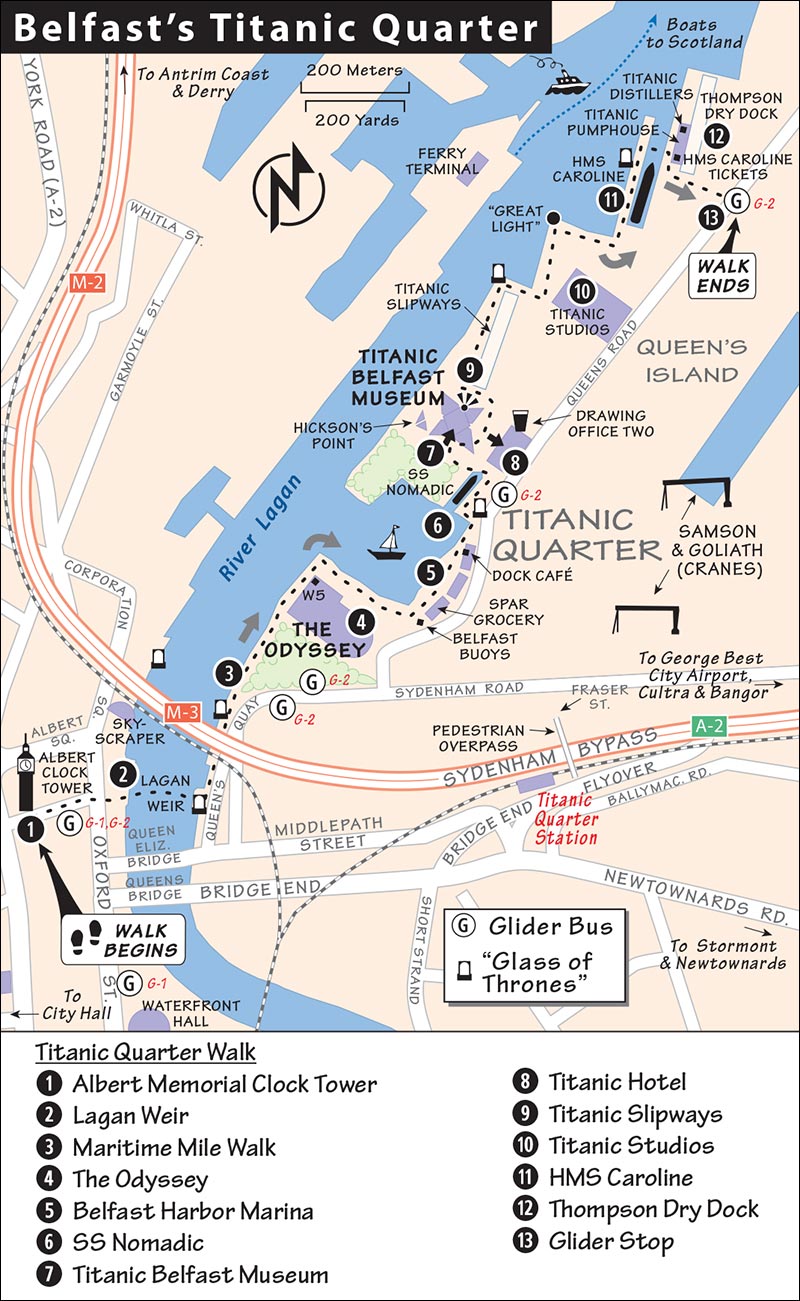
Map: Belfast’s Titanic Quarter
11 HMS Caroline
These two walks—which can easily be linked into one long ramble— connect much of central Belfast’s most compelling sightseeing. The Belfast City Center Walk focuses on the modern heart of the city, including Great Victoria Street, City Hall, and the entertaining Cathedral Quarter. The Titanic Quarter Walk crosses the river to take in the burgeoning scene around the Titanic Belfast Museum. Each walk could take about an hour, if you don’t enter any sights. But in both cases, there are lots of chances to dip inside and explore (especially the Titanic Belfast Museum, which deserves plenty of time). If you enter everything along the way, these walks could fill the better part of a day.
BELFAST CITY CENTER WALK
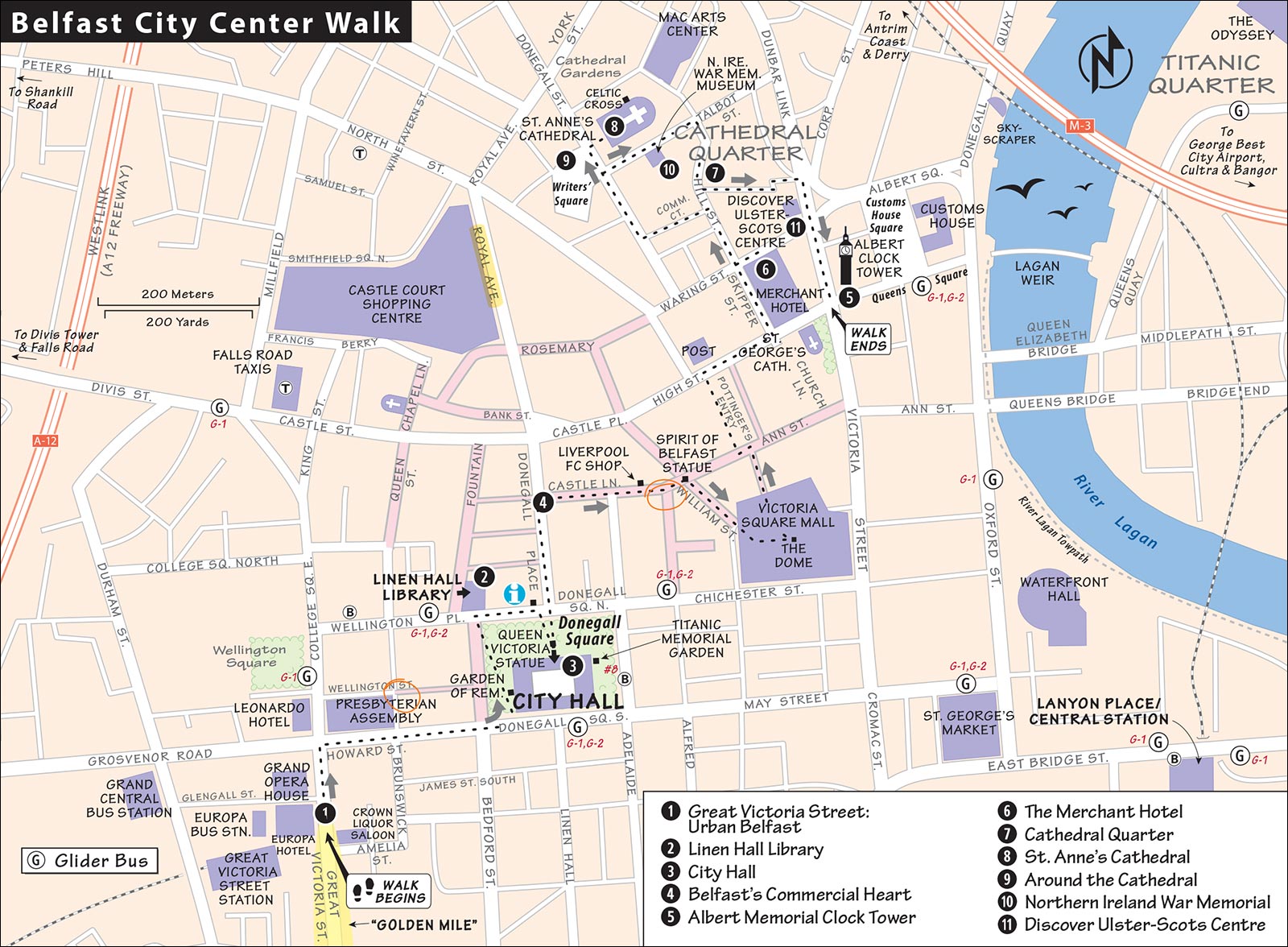
This walk, worth ▲▲, helps you get to know the heart of today’s Belfast: the urban canyon of Great Victoria Street, the genteel City Hall and its surrounding square, the pedestrianized shopping and entertainment zone of the Cathedral Quarter, and lots of vivid, colorful slices of Belfast life along the way.
If you’re in a rush, you could skip Great Victoria Street and head straight to City Hall.
1 Great Victoria Street: Urban Belfast
We’ll start by getting oriented to the busy corridor that rumbles through the heart of Belfast: Great Victoria Street.
• The walk begins in front of Europa Hotel, which stands on top of the Europa Bus Centre, the Great Victoria Street train station, and the Great Northern Mall; if arriving from the B&B neighborhood in the Queen’s Quarter, you can ride the bus to the Great Northern Mall stop.
The 12-story Europa Hotel looks like a standard-issue, big-city hotel. But it’s had an epic history since opening in 1971—including owning a reputation, for a time, as the “most-bombed hotel in the world.” The sectarian neighborhoods of West Belfast begin just a short walk behind the hotel, and over two decades, the hotel was bombed so many times (one popular estimate sets the total at 33) that they simply boarded up shattered windows rather than replacing them (giving it the nickname “Hardboard Hotel”). In one week alone, in 1971, two different bombs had to be defused in its lobby. President Bill Clinton stayed here (booking more than 100 rooms for his entourage) in 1995, a visit many locals look back on as paving the way for the 1998 Good Friday Agreement. (The hotel still has a Clinton Suite for visiting dignitaries.) Since the last bomb went off in 1993, the Europa has settled into a more typical big-hotel routine (documented in the mid-2000s in a BBC show called Lobby Lives). To learn more, step inside the lobby and look to the left for a small exhibit about the history of the place.
South of here, Great Victoria Street is nicknamed the Golden Mile for the concentration of pubs and entertainment venues that stretch from here to Queen’s University. (These establishments first sprang up during the Troubles, when the city center was cordoned off for security.) More recently, this area has been eclipsed by the tight lanes of the Cathedral Quarter (which we’ll walk through later).
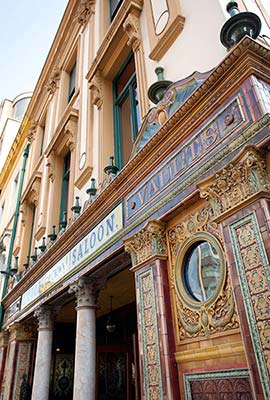
Use the crosswalk directly in front of the hotel to reach the ultimate gin joint: The Crown Liquor Saloon. Step inside. Built in 1849 (when Catholic Ireland was suffering through the Great Potato Famine), its mahogany, glass, and marble interior is a trip back into the days of Queen Victoria. Wander through and appreciate the snugs—booths designed to provide a little privacy for un-Victorian behavior. Upstairs, the recommended Crown Dining Room serves pub grub and is decorated with historic photos.
Leaving The Crown, turn right and walk north along Great Victoria Street. Across the street, you’ll see the extravagantly Victorian, red-brick facade of the Grand Opera House—originally built in 1895, bombed and rebuilt in 1991, and bombed and rebuilt again in 1993. Most of the performances here aren’t operas but brassy West End-style musicals. Drop by the box office to see what’s on.
At the end of the block, you’re facing the Presbyterian Assembly Building—a fine example of Scottish Baronial architecture. While we think of the Irish and the English as the major demographic groups of Belfast and Northern Ireland, don’t overlook the third part of the cultural mix: Ulster has strong cultural connections to Scotland, just a short boat ride across the North Channel, and many of the “British” people of Northern Ireland are Scots. Presbyterianism has its roots in the Church of Scotland, which broke away from the Church of England in 1560. If you’re curious to learn more, this church has a welcoming little visitor exhibition (entrance a few steps down Great Victoria Street) that tells the story of the Presbyterians in Northern Ireland. They were discriminated against (like the Roman Catholics) because they also refused to embrace the High Church approach to Christianity as dictated by the Anglican Church (free, Mon-Fri 9:30-17:00, closed Sat-Sun).
• As you face the Presbyterian Assembly, turn right on Howard Street and follow it two blocks. You’ll soon run into the back corner of Belfast’s grand City Hall. Turn left and walk until you reach the bus-packed cross-street called Wellington Place. Carry on through the crosswalk, and you’ll be facing the entrance of the building at #17. (Engraved in the ornate stone entryway over the door, look for the hand of Ulster; for more on its meaning, see the sidebar on here.)
2 Linen Hall Library
This 200-year-old library welcomes guests. Sometimes called “Ulster’s attic,” the library takes pride in being a neutral space for anyone trying to make sense of the borders and boundaries influencing Northern Ireland.
Cost and Hours: Free, Mon-Fri 9:30-17:30, closed Sat-Sun, 17 Donegall Square North, +44 28 9032 1707, www.linenhall.com.
Visiting the Library: Entering, head up the stairs to the upper floor. On your left is an inviting café, and in the stacks behind you are cozy reading nooks that overlook the urban bustle outside.
Carry on straight ahead from the top of the stairs to find a modern annex at the back of the building. Look up and down the atrium here for an impressive historical collection of political posters—some quite provocative—running the full gamut of opinions in this extremely opinionated city. Go up and down the stairs of this “vertical gallery” as you like, taking in all the symbolism, anger, humor, and hope.
When you’re finished, go back out to Wellington Place. There are two ways to leave the building: You can either head back out the way you came, down the main staircase; or you can work your way to the ground floor of the annex in back (to see all the posters, top to bottom). Exiting from here, just turn left, then left again, and you’re back where you began.
• Back on Wellington Place, turn left and continue with City Hall on your right. You’ll pass the TI, which also has a Translink desk inside (handy for sorting out public transit options).
Farther along, across the street, you’ll see the gate where you can enter the park that surrounds...
3 City Hall
This grand structure’s 173-foot-tall copper dome dominates Donegall Square at the center of town. Built between 1898 and 1906, with its statue of Queen Victoria scowling down Belfast’s main drag and the Neoclassical dome looming behind her, City Hall is a stirring sight—worth ▲▲.
• Step into the fenced park. Before entering the building, check out some of the landmarks around you.
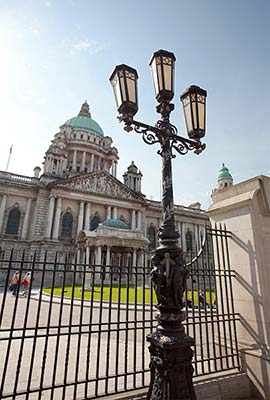
City Hall Grounds: On a sunny day, the lawn surrounding City Hall is packed with people out lounging, just enjoying their city (gates open daily until 19:00).
The front yard of City Hall is littered with statues of historic figures. Take a close look at the Queen Victoria monument (front and center). It celebrates the industrial might of Belfast: shipping, linen (the woman with the bobbin), and education (the student). Around the left side of the queen, look for the small, round monument commemorating Bill Clinton’s pivotal 1995 visit to Belfast. The four men who flank Queen Victoria—at either end of the park—are former lord mayors of Belfast.
Around the building to the right (as you face Queen Victoria) is the Garden of Remembrance—a sobering reminder of how Belfast was a springboard for the European battlefront in World War II. The arcing colonnade at the far end shows off a monument dedicated by General Dwight D. Eisenhower in 1945 to the more than 100,000 US troops who were stationed in Northern Ireland.
On the opposite side of City Hall—to the left as you face it—you’ll find the thought-provoking Titanic Memorial Garden.
• Go through the door in the middle of the building (immediately behind Victoria) to get...
Inside City Hall: Step into the grand atrium and gaze up at the underside of that dome. Just past the reception desk on the left, you can enter a free and worthwhile 16-room visitor exhibit covering the history of the building and local government, language, culture, industry, wars, and turmoil. A poignant, bright-white Reflection Space records the experiences of Belfast residents whose lives were impacted by the Troubles and its violence. The Belfast Hall of Fame features local celebrities, from scientists and writers to sports stars and musicians (free, open Mon-Fri 9:30-17:00, Sat-Sun from 10:00, last entry one hour before closing).
Down the hall to the left—past the exhibition—is the recommended Bobbin Café, with drinks and light meals.
To learn more about the building itself, you can join a free 50-minute tour of City Hall (typically offered 4/day, check schedule and book a spot at www.belfastcity.gov.uk/cityhall, +44 28 9032 0202).
• Go back outside and through the fence to the busy street. Directly across the street begins...
4 Belfast’s Commercial Heart
With your back to City Hall, follow Queen Victoria’s gaze down the shopping street called Donegall Place. Victoria would recognize the fine 19th-century brick buildings—built in the Scottish Baronial style when the Scots dominated Belfast. But she’d be amazed by the changes since then. As a key shipbuilding and industrial port, Belfast was bombed by the Germans in World War II. (On the worst night of bombing, more than 900 died.) And, with the Troubles stalling the economy in the last decades of the 20th century, little was built. Since the arrival of peace in 1998—and government investment to subsidize that peace—the 21st century has been one big building boom.
Walk straight down Donegall Place past the eight stylized sails (tall, curved, brownish pillars on the right). These celebrate the great ships built in Belfast for the White Star Line (including the Titanic).
At the sail for the Celtic, cruise to the right down Castle Lane. This is the busker zone, alive with street music on nice days. On the left, after a couple of short blocks, watch for the official fan store for the Liverpool Football Club. Though there are Irish and Northern Irish soccer teams, locals typically choose a team to support in the higher-caliber English Premier League. Liverpool, just across the North Channel, has a large Irish population and a history of success, so about a third of Irish sports lovers are die-hard LFC fans.
Straight ahead past that shop is the striking, modern Spirit of Belfast statue (a.k.a. the “Onion Rings”). The “spirit” is that of industry—specifically linen and shipbuilding (light and strong, like the statue). The spirit could also be the resilience of this city with its complicated history.
Turn right at the statue and head down William Street. Soon you’ll enter the gigantic, modern, indoor/outdoor Victoria Square shopping center—which has become a city hub for shopping, dining, entertainment, and just hanging out.
If you’d like a sky-high view of Belfast before moving on, go to the elevator tower in the very middle of the shopping center, under the towering glass dome. Ride the elevator to level 3—the Dome observation deck at the very top. From here, you can enjoy sweeping, 360-degree views over all of Belfast and its architectural mix of new and old (free, daily 10:00-18:00).
Exit the shopping center from the “upper ground” level toward the lovely pedestrianized thoroughfare called Ann Street. Turn left along Ann Street, then immediately watch on the right side for the covered passage marked Pottinger’s Entry. Follow this atmospheric lane, passing the venerable, recommended Morning Star pub and dining room, and then a mix of shops ranging from humble to upscale—gym, bookmakers, piercing studio, barber, posh café.
• You’ll emerge at the other end onto busy High Street. Turn right and follow this for about a block. Pause at the corner just past the parking garage (the pedestrian-only Church Lane stretches to your right). Looking straight ahead, you can’t miss the...
5 Albert Memorial Clock Tower
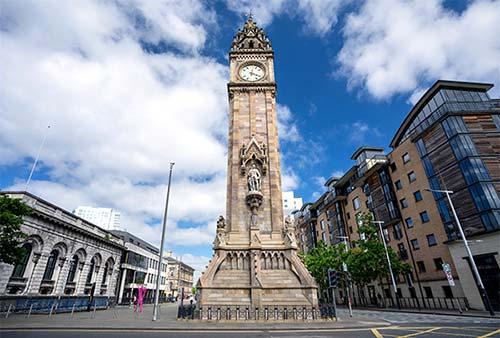
Belfast’s “Little Big Ben” was finished in 1869 to honor Queen Victoria’s beloved Prince Albert, who died in 1861. It sits on the birthplace of the city, where Belfast was founded over a thousand years ago on a little river that later became High Street. (The little river still runs under the street.) The tower famously leans (as it was built on an unstable riverbank), and locals say Albert looks like he’s ready to leap to safety when the tower finally falls. The tower also marks the start of the Titanic Quarter Walk (see later). For now, we’ll loop through the Cathedral Quarter before circling back here; but if you’re in a rush, you can skip out now and head for the Titanic Quarter.
• Cross High Street one block before you get to Albert, then continue straight up Skipper Street. After one block, turn right on Waring Street; a half-block down on your right is the grand entrance to...
6 The Merchant Hotel
One of the finest buildings in town, built in the mid-1800s, this was once the headquarters of the Ulster Bank. Back in those days, banks were designed with over-the-top extravagance to give their aristocratic clientele confidence. In modern times, banking has changed, and all over Britain such dazzling mansions of finance have been vacated and often turned into fancy restaurants.
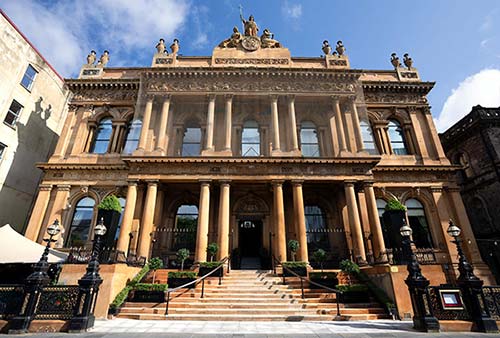
You’re welcome to poke around. Head up the grand staircase and through the door into the Great Room restaurant—under a grand dome and the largest chandelier in Ireland. People dress up for the ritual of afternoon tea here (see “Eating in Belfast,” later). All the way around the other side of the building (facing High Street), the hotel’s Bert’s Jazz Bar is famous for its cocktails.
• Exiting the hotel the way you came in, head down the stairs, turn left, and backtrack a half-block. Then turn right and continue as you were going on Skipper Street—which is now called Hill Street. You’re now in the thriving dining and nightlife zone called the...
7 Cathedral Quarter
This quickly rejuvenating district is busy with shoppers by day and clubbers by night. And, being the oldest part of Belfast, it’s full of history. Before World War I, this was the whiskey warehouse district—at a time when the Belfast region produced about half of all Irish whiskey.
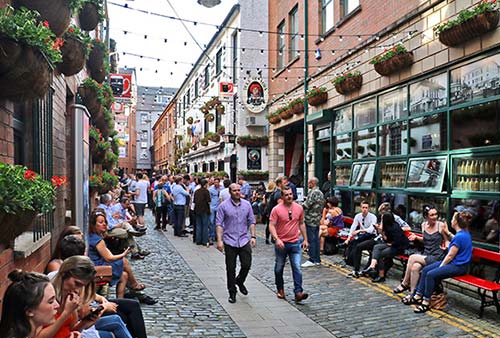
While today’s Cathedral District has a few minor sights, the big attraction is its nightlife—restaurants, clubs, and pubs. The epicenter of this zone is one long block up Hill Street, where it meets the lane called Commercial Court. Poke around into nearby breezeways. As you explore, you’ll find a maze of narrow streets, pubs named for the colorful characters that gave the city its many legends, and creative street-art murals that hint at the artistic spirit and still-feisty edginess of Belfast.
When you’re ready to continue to our next stop, turn left on Commercial Court—surrounded by tables for the popular, recommended Duke of York pub. Reaching Donegall Street, turn right and carry on another couple of short blocks (passing a popular music venue, the John Hewitt—named for a 20th-century Ulster poet).
• Soon you’ll reach...
8 St. Anne’s Cathedral
Also known as Belfast Cathedral, this Anglican church was built in the early 1900s, at the peak of Belfast’s industrial power. Its mosaics and stained glass are colorful and modern. The structure was nearly destroyed by a Luftwaffe bomb in 1941. Today, the sleek Spire of Hope (added in 2007) is a 130-foot-tall witness to God’s love of Belfast. Goofy nicknames are an Irish passion: This spire has been dubbed “The Rod to God” and “The Giant Receipt Spike.”
Cost and Hours: £2.50 entry fee, £6 includes audioguide or a tour with a volunteer steward if one’s available; Mon-Sat 10:30-16:00, Sun 13:00-15:00, last entry 45 minutes before closing; Sun service at 11:00 and evensong at 15:30; Donegall Street, +44 28 9032 8332, www.belfastcathedral.org.
Visiting the Cathedral: You can see most of the interior with a sweep of the head from near the door, for free. To see more details, it’s worth paying the modest admission fee. Everything is well described by information panels.
The beautiful, Neo-Romanesque space has fine mosaics (such as in the chapels in the back, near the main door)—especially the one depicting St. Patrick arriving in Ireland.
On the right aisle, about midway between the transept and the back of the church, look for the tomb of Lord Edward Carson, the fervent Unionist attorney who put Oscar Wilde behind bars—and whose Machiavellian political maneuverings ensured the creation of Northern Ireland in 1921.
Also on this wall, closer to the main altar, is the Titanic Pall, a beautiful tapestry dating from 2012, the 100th anniversary of the sinking. On an inky black and blue background (representing the icy sea), a giant white cross consists of countless smaller crosses—representing the staggering loss of 1,517 lives.
Look directly above the main altar and you’ll see the bottom of the stainless steel Spire of Hope, which rises above the building. The soft, silty mud underground couldn’t support the weight of a bell tower or spire when the church was built, but the modern lightweight spire fits the bill.
The right (south) transept holds the Chapel of Unity—preaching an ecumenical approach to worship (sensible in this community of vying faiths). And the left (north) transept has the Regimental Chapel, honoring the Royal Irish Rangers.
• Before leaving this area, take a look at some interesting features...
9 Around the Cathedral
Directly in front of the cathedral is the gritty Writers’ Square, a rare public plaza in the dense Cathedral Quarter. Locals are attempting to protect this square from Tribeca Belfast, a commercial project to redevelop some of the surrounding streets. (“Tribeca” here stands for “TRIangle BEside the CAthedral.”) Even here in Belfast, a city that seems to specialize in reinventing itself, locals aren’t always eager to give up their traditions.
Around the left side of the church are the Cathedral Gardens; from this park, you’ll get a much better view of the cathedral’s distinctive metallic spire, as well as the “tallest Celtic cross in Ireland” that holds up the left transept.
A block behind the cathedral is an art gallery and performance space called The MAC (Metropolitan Arts Center). There’s always something happening here; for the latest, see TheMacLive.com.
• Now head around the right side of the cathedral—the opposite side from Cathedral Gardens. Halfway down Talbot Street, on the right, look for the small...
10 Northern Ireland War Memorial
This one-room sanctuary/memorial/museum is dedicated to the lives lived and lost in this corner of the UK during World War II. The centerpiece is a memorial to those who died for Belfast. The hodgepodge of endearing exhibits covers the American troops based here during the war; the damage done by multiple German bombing raids during the Blitz; and the nearly 120,000 Northern Irish women who made ammunition, uniforms, and parachutes and served as nurses and administrators.
Cost and Hours: Free, Mon-Fri 10:00-16:30, Sat 12:00-16:00, closed Sun, 21 Talbot Street, +44 28 9032 0392, www.niwarmemorial.org.
• We’re going to circle back now, toward the Albert Memorial Clock Tower. Along the way is one more (free) sight.
Continue the rest of the way down Talbot Street and turn right on funky Hill Street. Follow this for a block, turn left down Gordon Street, then turn right on busy Victoria Street to find the entrance to...
11 Discover Ulster-Scots Centre
This bright and inviting gallery is designed to promote Ulster-Scots heritage. The historic province of Ulster and Scotland are just 13 miles apart, and this exhibit feels almost like propaganda, asserting that prehistoric Scots migrated from northeastern Ireland—thus, the cultures are rightfully intertwined. Exhibits also drill home the impact of Ulstermen and women in America—“Transatlantic kinfolk”—and then, in turn, the impact of American Ulster-Scots on our world: from Amelia Earhart and Eleanor Roosevelt; to Mark Twain, Edgar Allan Poe, and John Steinbeck; to Jimmy Stewart, John Wayne, and Patsy Cline; to Dolly Parton, Rosa Parks, and a long list of US presidents (including LBJ, Nixon, Reagan, Clinton, both Bushes, and Barack Obama). If your heritage is Scots-Irish (as they became known in America), this is a good place to begin your genealogy research.
Cost and Hours: Free, Mon-Fri 10:00-16:00, closed Sat-Sun, 1 Victoria Street, +44 28 9043 6710, https://discoverulsterscots.com.
• Just beyond on Victoria Street, you can already spot the Albert Memorial Clock Tower that we saw earlier. This marks the end of this walk...and the start of the Titanic Quarter Walk (next). To dive right in, carry on to the clock. Or, to head back toward City Hall, continue along Victoria Street past the tower; soon, on your right (at the yellow canopy), you’ll see a side entrance to the Victoria Square mall we walked through earlier—offering a handy shortcut back to the center of town.
TITANIC QUARTER WALK
This walk takes you from Belfast’s city center to its single best sight: the Titanic Belfast Museum. Many travelers simply make a beeline to the museum. But the riverside strip of land surrounding it is peppered with modern architecture, public art, and opportunities to learn more about the city’s history. If you have time, take this one-hour self-guided walk from the Albert Memorial Clock to the museum and beyond. The Glider #G2 from City Hall makes stops all along the way, including at the Titanic Belfast Museum and the HMS Caroline (roughly 2/hour; check schedules before heading to the stop). After the museum, you can head back to town or continue to the HMS Caroline.
• Belfast’s leaning 1 Albert Memorial Clock Tower marks the start of this walk (for more about the clock tower, see here). From there, head for the River Lagan, where you’ll find the...
2 Lagan Weir
The first step in rejuvenating a derelict riverfront is to tame the river, get rid of the tides, and build modern embankments. The star of that major investment is the Lagan Weir, the people-friendly gateway to the Titanic Quarter. Built in 1994, the weir is made up of four large pier houses and five giant gates that divide freshwater from saltwater and control the river’s flow—no more flooding. The giant salmon sculpture is covered in words and images related to Belfast’s history.
Now walk across the weir on the curving pedestrian footbridge (added in 2015). Notice how much lower the water is on the saltwater side of the weir (depending on the tide). Looking downstream, on the right, a popular riverside walk goes scenically inland from here 14 miles along the old tow path.
3 Maritime Mile Walk
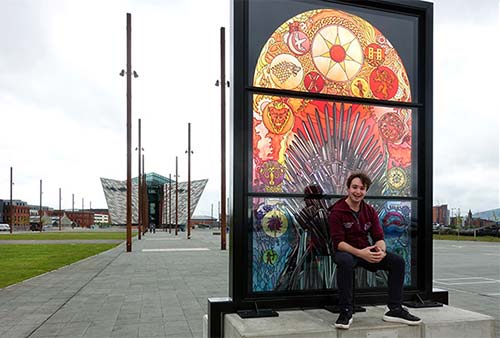
This parklike promenade laces together several sights along the riverbank. As you walk, keep an eye out for six stained-glass panels featuring scenes from Game of Thrones (this series of public art is called, you guessed it, Glass of Thrones). You’ll find one at the end of the weir. Much of the HBO series was filmed inside a giant studio we’ll see (from a distance) later on this walk. The people of Belfast are proud of their association with this global hit...which, like the Titanic, has goosed tourism.
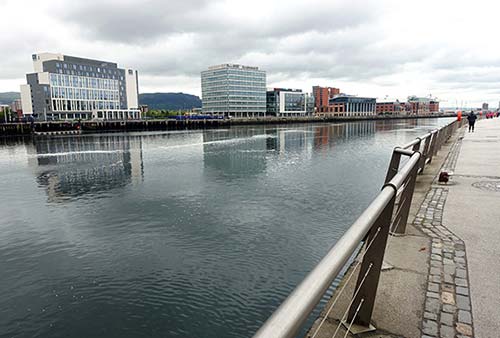
The promenade is also lined with historic photo plaques that tell the story of this industrial river. The opposite side of the river was busy with trade (importing and exporting), and this side was all about shipbuilding.
Continue along the embankment. Once you pass below the M-3 highway overpass, you’ll get glimpses (to the right) of the city’s iconic and giant yellow cranes. The big H&W stands for Harland & Wolff, Belfast’s once-mighty shipyard, but locals just call them Samson and Goliath. (In 2019, the last 130 employees of Harland & Wolff saw their once-proud company file for bankruptcy.) It may seem strange for a city to embrace industrial cranes as a symbol, like Paris’ Eiffel Tower or Seattle’s Space Needle—but you’ll see these cranes proudly represented everywhere in Belfast.
• Continue walking until you reach the Odyssey arena complex.
4 The Odyssey
This huge millennium-project complex offers restaurants, a bowling alley, a 12-screen cinema, and—at the far (north) end of the complex—the W5 science center with interactive, educational exhibits for kids. Where else can you play a harp with laser-light strings? The “W5” stands for “who, what, when, where, and why” (https://w5online.co.uk).
There’s also the 12,000-seat SSE Odyssey Arena, where the Belfast Giants professional hockey team skates. The arena is all about boosting nonsectarian sports (like hockey) rather than traditionally Unionist (cricket, rugby, soccer) or Nationalist (hurling, Gaelic football) sports that amp up anger between the groups here. Under one giant roof, the entire city gets together—Unionists and Nationalists alike—and roots for the same team (matches are generally late Sept-mid-April on weekends, www.belfastgiants.com).
• Keep going straight ahead, in front of—or, if you like, through the interior of—the Odyssey. At its far end, turn inland and you’ll quickly reach the 5 Belfast Harbor Marina with shops and condos. On the corner are three huge buoys (buoy is pronounced “boy” in Britain). “The Belfast Buoys” (fondly called Tom, Dick, and Harry here) are described on info boards.
At the far end of the arc of shops, find the Dock Café, a welcoming, convivial, and homey spot. Volunteer-run by local churches, its mission is to celebrate tolerance in a neutral space, where neighbors of all traditions and backgrounds can meet. The coffee and cakes are wonderful, and you famously pay whatever you like at the donation box (or donate digitally; Mon-Sat 11:00-16:00, possibly later in summer, closed Sun). You’re welcome to bring in a picnic from the adjacent Spar grocery store. Browsing the café’s exhibits and displays and talking with its volunteers just makes you feel good here in a city with such a difficult story.
Another good (but for-profit) café, called the Paper Cup, lurks around the corner from the Dock.
• Cross the bridge, passing another Glass of Thrones (this one features the White Walkers). Ahead looms the superstar of the Titanic Quarter, the Titanic Belfast Museum, with its striking white-and-gray building—as tall as the mighty ship itself. As you approach, you’ll pass a big ship that was just the tender (shuttle dinghy) for the Titanic.
6 SS Nomadic
This ship once ferried passengers between the dock and the Titanic. Sitting in the dry dock where it was built, it’s restored to appear as it was in 1912 when it shuttled Benjamin Guggenheim, John Jacob Astor, Molly Brown, and Kate Winslet to that fateful voyage. Entry is included with a Titanic Belfast Museum ticket, and it’s worth a quick walk-through to appreciate the trappings of the age (for more detail on the interior, see “Sights in Belfast,” later).
• Approaching the museum building, you’ll see a giant, rusted-metal TITANIC cutout along the sidewalk in front. Directly to the left of the museum is Hickson’s Point, a small building that was originally a chapel, built to provide a space for reflection for visitors to the Titanic exhibit. That was expecting a bit much from the tourists—no one used it, and now it’s a pub.
Now’s a good time to tour the 7 Titanic Belfast Museum (see listing under “Sights in Belfast,” later).
When you’re done in the museum, cross the street (inland, away from the river) and go left to find the entrance to the...
8 Titanic Hotel
Housed in the former Harland & Wolff shipyard headquarters, this new hotel was permitted on condition that the public be allowed to wander through its historic spaces—so you can feel entirely free to walk around. For 150 years, many of the largest and finest ships in the world were designed in this building’s Drawing Offices—wide-open, brightly lit rooms under huge skylights for maximum legibility.
Ask at the reception desk about the Art and Heritage Trail map, which provides a mini tour of the hotel. You’ll see an elegant presentation room and the well-lit central Drawing Office Two, where the plans for the Titanic were drawn (now a $$$ pub and a fine place for food or a drink). The hall that runs behind these grand rooms leads to the private offices of some of the executives—also open to the public, unless they’re being used for private events. Titanic aficionados and maritime design geeks love this place.
• Head back toward the river, circling around the right side of the museum. Stand immediately below the museum and look out at the place where the Titanic was actually built.
9 Titanic Slipways
The vast concrete lot stretching along the river is the historic site (slipways) where the Titanic was built and launched. A big, stylized map in the pavement shows the route of the Titanic’s one and only voyage. The brown benches are long and short—set up in dots and dashes to represent the Morse code distress transmissions sent on that fateful day. Just beyond two dashes, a few steps to the left, find (in the pavement) the symbolic steel tip of the ship; stand there looking out. This was where the bow was; the lampposts (stretching 300 yards before you) mark the size of the ship built here.
• You’ve seen the most worthwhile parts of the Titanic Quarter; feel free to head back to the center of town from here. But to explore some more, stick with me: Walk straight ahead toward the water, to what would have been the stern of the Titanic.
10 Titanic Studios
The giant warehouse-like building to your right was once the shipyard’s Paint Hall and is now Titanic Studios (not open to the public)—the soundstage where much of Game of Thrones was filmed. Continue past another Glass of Thrones, this one featuring the Iron Throne.
Following the waterfront path, you’ll eventually reach the Great Light, a lighthouse optic moved here from a 1920s lighthouse on a nearby island (lit up at night). The info board enthralls lighthouse fans.
• Continue walking along the promenade. On the right, you’ll reach the...
11 HMS Caroline
This WWI battleship, which fought in the 1916 Battle of Jutland, is one of only three surviving Royal Navy ships from that war, and well worth exploring (see listing, later). During World War II and later, the Caroline served as a headquarters and training ship until being decommissioned in 2011—the second-oldest ship in the Royal Navy’s service.
• The building that houses the HMS Caroline office overlooks (in back) the...
12 Thompson Dry Dock
This is the massive dry dock where the Titanic last rested on dry land. The Edwardian pump house filled the dry dock with water—and emptied it—in record time (26 million gallons in one hour). Slipways rolled new hulls down a slope into the water, where they were then towed to a dry dock. It’s here that the final outfitting was completed, adding extra weight before the final watertight launch.
These days, that pump house is home to the Titanic Distillers. In addition to tours and tastings of their distilling operations (£25), they also lead one-hour tours of the dry dock (£10). Or you can check out their $ café, which has outdoor tables overlooking the dry dock (daily 10:00-17:00, +44 28 9099 2992, www.titanicdistillers.com). Otherwise, barriers will keep you at a distance from the dock itself.
• Behind the dry dock, you can walk out to the street and cross it to find a 13 Glider stop. From here, the #G2 runs back to City Hall, retracing much of what you just walked past with nice views of cranes and harbor action as you glide.
Sights in Belfast
SECTARIAN NEIGHBORHOODS IN WEST BELFAST
Touring the Sectarian Neighborhoods
Tours Favoring One Perspective
Sights in the Sectarian Neighborhoods
Falls Road (Catholic/Nationalist/Republican Side)
Shankill Road Area (Protestant/Unionist/Loyalist Side)
Elsewhere in Belfast: Sandy Row
The Queen’s Quarter (South Belfast)
Map: Queen’s Quarter (South Belfast)
▲Ulster Folk Museum and Ulster Transport Museum
Most of the sights in central Belfast are described in my self-guided Belfast City Center Walk, earlier. Beyond that core are the Titanic Quarter (including the city’s single best attraction, the Titanic Belfast Museum); the sectarian neighborhoods, mostly in West Belfast; and some other worthwhile sights, both in the city and just beyond its boundaries.
TITANIC QUARTER
These two attractions are about a 10-minute walk apart and best done as part of my Titanic Quarter Walk, earlier.
▲▲▲Titanic Belfast Museum
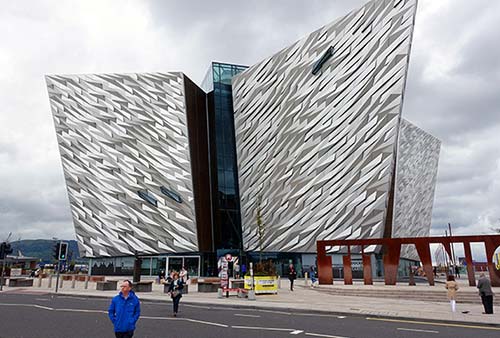
This £97 million attraction stands right next to the original slipways where the Titanic was built. Creative displays tell the tale of the ocean liner, heralded as the largest man-made moving object of its time. The museum boldly re-creates various aspects of the world’s most famous boat since Noah’s Ark—from its design and construction to its lavish maiden voyage, from its tragic sinking to its powerful legacy. The museum also tells the proud story of Belfast the boomtown.
Cost and Hours: £25, includes entry to SS Nomadic; daily 9:00-18:00, June-Aug until 19:00, Nov-March 10:00-17:00, shorter hours for SS Nomadic, last entry 1 hour 40 minutes before closing; audioguide-£4, but you get plenty of info without it; +44 28 9076 6399, www.titanicbelfast.com.
Ticket and Crowd-Beating Tips: Because crowds are largely dictated by cruise-ship arrivals, busy and quiet times can be hard to predict (though it’s typically less crowded early or late in the day). It’s busiest on holidays and weekends, especially during summer (June-Aug); at these times, it’s wise to book a few days in advance. After booking online, you’ll need to collect your tickets on arrival (find a machine). If you arrive without a ticket and find long lines, try booking a ticket online while waiting.
Getting There: From the Albert Memorial Clock Tower at the edge of the Cathedral Quarter, it’s a 20-minute walk: Follow my Titanic Quarter Walk (described earlier). From Donegall Square, you can take the Glider bus (#G2, 2-4/hour). A taxi from the city center costs about £7-8.
Tours: The one-hour Discovery Tour explains the striking architecture of the Titanic Belfast Museum building and the adjacent slipways where the ship was built (£15, book ahead, typically runs 12:00 and 14:00, often more in peak season).
Eating: The ground floor includes a $ Galley Express (sandwich café) as well as $$ The Pantry (cafeteria-style, with salads and hot food). Choices nearby include the upscale $$$ Drawing Office Two pub, occupying the rooms where the ill-fated vessel was designed (across the lane in the Titanic Hotel), and the $ Dock Café, a church-run community center serving pay-what-you-like cake and coffee.
Visiting the Museum: The ambitious, blocky, glittering architecture of the Titanic Belfast Museum is a landmark on the city’s skyline. Six stories tall, it’s clad in more than 3,000 sun- (or cloud-) reflecting aluminum panels. Its four corners represent the bows of the many ships that were built in these yards during the industrial golden age of Belfast.
You’ll follow a one-way route through the exhibit’s dozen or so galleries, on six floors. Helpful “crew” (museum staff) are posted throughout to answer questions.
The museum sets the stage on level 1 (Boomtown Belfast), explaining the growth of Belfast through linen mills and other industries. Eventually the city became a global powerhouse in shipbuilding thanks to Harland & Wolff, the company behind the Titanic.
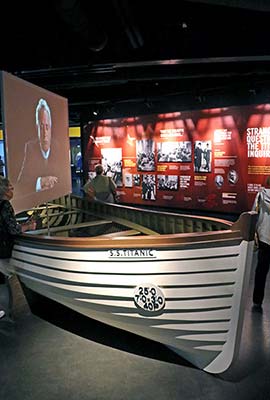
Farther along, exhibits explain the complex process of constructing and launching a ship of this magnitude. You’ll see photos from the giant drafting halls inside today’s Titanic Hotel, across the street.
You’ll take the elevator up to floor 4, where the “shipyard ride” is a fun (if cheesy) five-minute gondola ride through a series of stories and videos that attempts to capture what it was like to be a worker building the ship (you may want to skip it if there’s a line).
Continuing on, the shipyard exhibit features a model layout of the massive shipyard; it’s situated in a room with a big window overlooking the actual construction site (which you can visit after leaving the building—described on here). Next, you’ll get a sense for what it would have been like to be a Titanic passenger, with displays about the opulence on board and re-creations of cabins from the very humble to top-end. A 3D fly-through tour of the ship floats from the engine room and third class (bottom) to the dining room, then up the grand staircase into first class and the navigation bridge (top).
In the recounting of the disaster, you’ll hear voices of survivors and read the Morse code transmissions sent after the ship hit the iceberg.
The sinking was followed by a media frenzy and an inquiry; the Never Again exhibit outlines how the event sparked investigations, reforms, and a raft of new laws—many still in place—to ensure that such a tragedy would never be repeated. (Because of the Titanic, modern cruise ships have enough lifeboats for every passenger, and lifeboat drills are legally mandated.)
In the Ballard’s Quest section, you’ll learn how an American explorer finally located the wreck of the Titanic on September 1, 1985. (Only later was it revealed that his search was partly funded by the US Navy, which was hoping he might also locate some misplaced submarines.)
Next you’ll enter the Ship of Dreams hall, where a 25-foot-long model of the ship, illuminated with thousands of LED lights, slowly revolves from the ceiling in a conceptual reimagining of the sinking. Individual lights blink out slowly, suggesting the tragic loss of so much life, while plaintive violin music plays. Below the ship, you can see a few scant artifacts that were actually on board: Wallace Hartley’s violin, a flask, a cane, miscellaneous letters, and deck chairs.
Finally, The Lasting Legacy outlines how the Titanic has loomed large ever since in pop culture...including a certain Oscar-winning movie. There’s even a mock-up of the ship’s bow, where you can pose for your very own Leo-and-Kate, “I’m the king of the world!” moment.
And what do the people of Belfast have to say about the ship they built that sank on her first voyage? “She was OK when she left.”
SS Nomadic: After you’re done, you can use your ticket to visit the SS Nomadic, moored across from the entrance to the museum. While most famous for its (very brief) stint as a tender boat to the Titanic, the Nomadic spent most of its useful life in Cherbourg, then as a restaurant ship in Paris and as a troop transport during World War II. Worth ▲ for nautical types, it gives you a taste of what it was like on the mother ship, with some decor similarities and first- and second-class areas. It’s well described, but there’s not much to see.
▲HMS Caroline
Launched in 1914, the HMS Caroline is the sole surviving ship of the largest naval battle in history: World War I’s Battle of Jutland in the North Sea, in which German naval forces tried, and failed, to break a British blockade. Despite being the bloodiest day in British naval history, it’s regarded as a victory over the German navy, which was disabled for three months and never challenged Britain again. Locals nicknamed the Caroline the “HMS Never Budge” because she’s been moored here for decades—she finally was converted into a museum in 2016. While the experience is thrilling for sailors and history buffs, and it’s fun to scramble around the old ship, it’s tricky to fully appreciate without a solid handle on World War I military history.
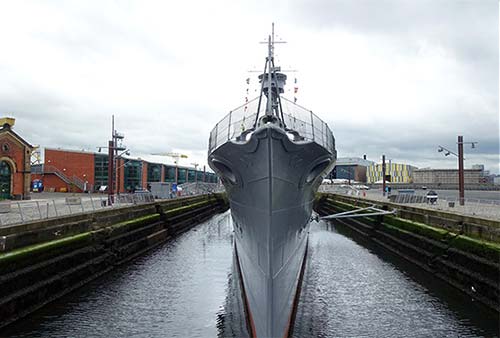
Cost and Hours: £11, includes audioguide, July-Sept daily 10:00-17:00, Oct-June closed Mon-Tue, last entry one hour before closing; for tickets, walk around the ship (inland) to the adjacent building—the old pump house for the Thompson Dry Dock; Alexandra Dock, Queen’s Road, www.nmrn.org.uk.
Visiting the Ship: The one-way route starts with a dry exhibit about World War I history. Then you’ll enter the actual ship, restored as if time stopped in 1916. The 11-minute Jutland Experience video dramatizes the battle, capturing the sense of desperation. You’ll tour the crew quarters, mess hall, washrooms, and captain’s quarters (dinner is still on the table)—all with good interactive exhibits. You’re free to explore, from the torpedo exhibit to the thunderous engine room. There’s also an onboard café.
SECTARIAN NEIGHBORHOODS IN WEST BELFAST
A slowly rejuvenating section of gritty West Belfast is home to two sectarian communities, living parallel lives along parallel roads on either side of a “peace wall”: the Unionists/Loyalists (Protestants) along Shankill Road and the Nationalists/Republicans (Catholics) along Falls Road. For those with a healthy interest in recent history, investing some time learning firsthand about Northern Ireland’s sectarian struggles—in the very streets where much of that history played out—is worth ▲▲▲. Officially, the Troubles ended with the Good Friday Agreement in 1998; spending some time in these neighborhoods allows you to see just how things have changed—and how, for some residents, they have not.
A visit to this area demands a healthy understanding of how the Troubles came to be. For starters, read the “Belfast’s Sectarian Neighborhoods” sidebar in this chapter. For more context, turn to the Understanding the Troubles chapter (which also contains a primer on the highly charged symbolism of the era).
Touring the Sectarian Neighborhoods
While you could easily and safely walk through these districts on your own, I find it more meaningful to hear firsthand, personal perspectives (and, often, strong opinions) from a guide. And if taking a tour, you have several options: by car, by bus, or on foot.
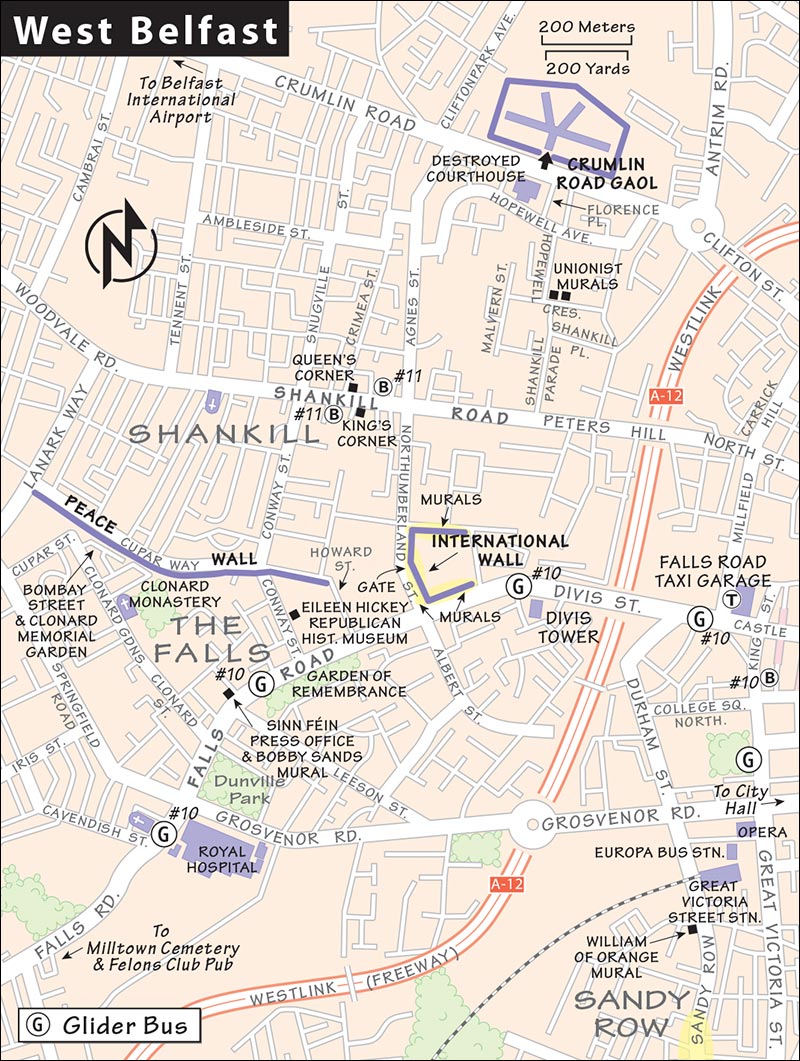
On Your Own: The sectarian neighborhoods are just west of central Belfast—a quick taxi or bus ride away. Glider bus #G1 and Metro buses (routes starting with #10) run along Falls Road, with stops near many of the sights mentioned there. (You can also take a shared black cab along Falls Road, though this practice is becoming less common; see “Falls Road Taxi Service,” later.) To reach the Shankill Road area, take a Metro bus starting with #11. But simply hailing a conventional taxi or Uber is also handy for getting to, and between, these far-flung sights.
If you can’t get out to West Belfast, consider a quick stop on Sandy Row, a smaller Unionist/Loyalist area that’s closer to the Europa Hotel and the city center (described later).
With a Tour: Tours in this area vary drastically, and much of your experience comes down to the guide. Some are thoughtful and wise, balancing personal stories with a desire to be evenhanded in explaining the nuances of a complex and tragic history. Others are troubled and traumatized people with a personal axe to grind, a taste for unsubstantiated conspiracy theories, and precarious ties to objective reality. And most are somewhere in between.
Because those on the Nationalist/Catholic side of the conflict were easy to be seen as oppressed underdogs, it’s tempting to be swayed by their perspective—and many tours lean heavily in that direction. Perhaps that’s fine, but you’re getting just one side of the story. Personally, I’d rather seek a more balanced approach by going with a company that either strives to be impartial or provides both perspectives.
Balanced Tours
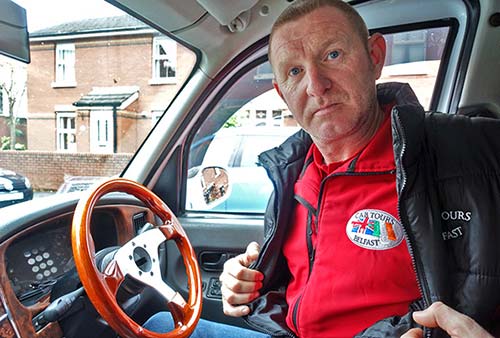
Cab Tours Belfast: This group of driver/guides from both communities has teamed up and is committed to giving unbiased tours. Perhaps the best all-around choice for understanding the full complexity of these sights, their “Belfast Murals Tour” covers both neighborhoods and is a fascinating 90 minutes (£50 for two people, tours run regularly daily—check schedule and book online, includes pickup/drop-off at City Hall or hotels in the center, +44 77 1364 0647, https://cabtoursbelfast.com).
Belfast Political Tours: This company offers both guided walks and private taxi tours called “Conflicting Stories,” in which former combatants from each side have an opportunity to show and tell their story. You’ll actually switch guides midway through the tour—a Nationalist/Republican for Falls Road sights, and then a Unionist/Loyalist for Shankill Road sights—so, rather than a single point of view, you get a dual narrative. You can do this as either a taxi tour (£125, 2.25 hours) or a walking tour (£23, 3 hours, most days at 14:30; book ahead, +44 73 9358 5531, www.belfastpoliticaltour.com).
Hop-On, Hop-Off Bus Tours: For a quick look at this area—with a slow drive past some murals and along the peace wall—it’s good to know that West Belfast is included on Belfast’s hop-on, hop-off bus tours (described on here). Many casual visitors find that these bus tours offer an evenhanded, informative, and efficient look at these neighborhoods.
Tours Favoring One Perspective
These tours are plenty informative and, largely because they’re more pointed, can be more engaging emotionally. Just keep in mind that there’s another side to the story.
Falls Road Taxi Tours: This scene is dominated by an old-school outfit called Belfast Taxis CIC (formerly West Belfast Taxi Association, or WBTA). Originally created as a way to employ men from the Falls Road area (including some who had been released from prison during the Troubles), this organization has a strongly Catholic—even Republican—point of view. They’re based in the multistory parking garage at the intersection of Castle and King streets (35a King Street), at the edge of the Cathedral Quarter (a 15-minute walk northwest of City Hall). On the ground floor, a passenger terminal connects travelers with old black cabs—and the only Irish-language signs in downtown Belfast.
If you want a private tour in a black cab, ask the dispatcher if a cab driver can take you on a 90-minute tour to show you the sights—mainly on the Nationalist side, but also with a foray into the Unionist area (£60 for 1-3 people, £15 per additional person, can also be booked online, +44 28 9031 5777 or +44 78 9271 6660, www.taxitrax.com).
They also run a shared black cab service along Falls Road, past Sinn Féin headquarters and lots of murals, to the Milltown Cemetery. This service began during the Troubles, when public buses stopped running along here (they were too easy to hijack and use as barriers). City buses have long since returned, and these days, this black cab service is used mainly by locals and a few curious travelers (£1.50/ride, runs about 2-4/hour during busy times; stop by the garage to see if you can hop in a cab out along Falls Road, or try flagging one down if you see there’s space inside).
Walking Tours: Coiste Irish Political Tours offers the Catholic community perspective on a three-hour Falls Road Mural walking tour. Led by Republicans who were once political prisoners, the tours visit murals, gardens of remembrance, and peace walls. Afterward, you’re invited for a complimentary glass of Guinness at the Felons Club Pub—run by Republican ex-prisoners (£12; Tue, Thu, and Sat-Sun at 10:00; a £15 version, offered less frequently, also goes to the Shankill Road area; best to book in advance, +44 28 9020 0770, www.coiste.ie).
Sights in the Sectarian Neighborhoods
In these neighborhoods you’ll see political symbolism (Irish tricolor flags or Union Jacks, plus a whole host of other charged symbols), memorials to those lost in the Troubles, and, most notably, vivid murals painted on West Belfast row houses. The end of a row house is a big, flat, blank canvas, ready-made for a big political mural—and there are lots of them.
Murals began popping up back in the 1970s, first as reflections of political points of view, but over time becoming more explicit expressions of support for paramilitary activities. Nowadays, with more peaceful times, the character of the murals has been slowly changing (with some government funding) from aggressively political messages to more positive ones. Paramilitary themes are gradually being covered over with images of pride in each neighborhood’s culture. For example, the Titanic was built primarily by Protestant workers and is often seen in their neighborhood murals—reflecting their industrious work ethic. And in the Catholic neighborhoods, you’ll see more murals depicting mythological heroes from the days before the English came. These still reflect the values of the people living in each area, but far less provocatively.
I’ve organized the following sights roughly south to north, and if you’re exploring this area on foot, here is a good way to do it: Begin along Falls Road (Nationalist/Republican), then pass through the International Wall (part of the peace wall) up to Shankill Road (Unionist/Loyalist). Finally, work your way through some Unionist residential areas to see more murals, before ending at Crumlin Road Gaol.
Falls Road (Catholic/Nationalist/Republican Side)
The main drag of the Catholic area is Falls Road, which rumbles southwest from the edge of central Belfast (at the garage at the end of Castle Street, where the black cabs are based). Notice that the road signs are in two languages—with Irish first. For a quick look at sights in this area (all within a short stroll or drive), begin at the Sinn Féin Press Office (nearest Glider stop: Clonard), maybe head to Bombay Street, and wind up at the International Wall. With more time, you can go all the way out Falls Road to Milltown Cemetery (skippable for casual visitors).
Sinn Féin Press Office: Along the heart of Falls Road, at #51, is the press center for the hardline Republican party, Sinn Féin. While the press office is not open to the public, the adjacent bookstore (with an intriguing gift shop) is welcoming and worth a look. Page through books featuring color photos of the political murals that decorated neighborhood buildings. Money raised here supports the families of deceased IRA members. Around the corner, on the side of the same building, is a big and bright mural remembering Bobby Sands—a leader of the Irish Republican Army who famously led a hunger strike in prison with fellow inmates in 1981, eventually starving himself to death to raise awareness of the Republican concerns.
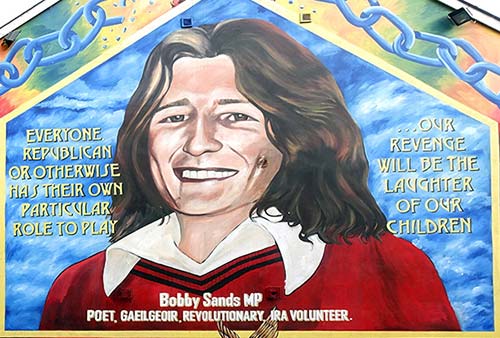
Eileen Hickey Republican History Museum: This volunteer-run museum, tucked in a residential complex a short walk away, has a clear mission: “For Republican history to be told by Republicans. To educate our youth so they may understand why Republicans fought, died, and spent many years in prison for their beliefs.” This unforgettable collection features real (if unapologetically biased) history shown and told by people who played a part in it (free, Tue-Sat 10:00-14:00, closed Sun-Mon, two blocks from Sinn Féin Press Office at 5 Conway Place, +44 28 9024 0504, https://eileenhickeymuseum.com).
Garden of Remembrance: Right along a busy stretch of Falls Road, this sober site honors the many local Republicans killed in the Troubles—from IRA fighters to civilians. Informative, emotionally charged plaques tell the story, in both English and Gaelic. It’s always festooned with fresh bouquets of green, white, and orange flowers. Overhead, a mural (under machine guns) features a map of the area, marked with Troubles-era landmarks and the faces of some of those who died.
Bombay Street and Clonard Martyrs Memorial Garden: About a 10-minute walk from the Sinn Féin Press Office, tucked on the Catholic side of the peace wall, is the location of one of the Troubles’ most dramatic flare-ups. On August 15, 1969, Loyalists set fire to the Catholic homes and a monastery on this street. In the violence, a Republican teenager was killed. The burning of this Catholic street led to the “sorting out” of the communities and the building of a peace wall. Further burning of Catholic areas in Belfast led to the creation of the Provisional Irish Republican Army (also known as the Provos, or later, simply as the IRA)—which, it’s said, rose from the ashes of Bombay Street; that’s why you’ll see a phoenix motif throughout these Republican areas. (This conflagration was dramatized in Kenneth Branagh’s 2021 film Belfast, about his own childhood in these sectarian neighborhoods.) Today Bombay Street is nicely rebuilt, along with a peaceful memorial garden against the wall listing both fighters and civilians who were killed by the British. On the list, most names are preceded by VOL.—indicating that they volunteered to fight. But a few are preceded by FIAN., meaning that they were too young to volunteer.
Nearby, Clonard Monastery is another important location for the Troubles. In the early days, this Catholic church found itself on the front line of the violence. But later, it evolved into a place of peacemaking. This church established a line of communication with a Protestant church on the other side of the peace wall, and even played host to secret negotiations between the two sides. Despite its battle-hardened location, the church is beautiful, inside and out.
Milltown Cemetery: This burial site for Republican martyrs can be a pilgrimage for some. You’ll walk past all the Gaelic crosses down to the far right-hand corner (closest to the highway), where little green railings set apart the IRA Roll of Honor from the thousands of other graves. These martyrs are treated like fallen soldiers. Notice the memorial to Bobby Sands and nine other hunger strikers. They starved themselves to death in the nearby Maze Prison in 1981, protesting for political prisoner status as opposed to terrorist criminal treatment (the prison closed in 2000). The cemetery is a long 35-minute walk from the Sinn Féin Press Office; you’re better off taking a Falls Road taxi or the #G1 Glider to the Falls Park stop (cemetery open daily 9:00-16:00, 546 Falls Road).
Peace Walls
Throughout the Troubles, Belfast resorted to physical barriers—“peace walls”—to separate the sectarian neighborhoods. Meant to be temporary, these barriers stay up largely because of old fears among the communities on both sides.
Main Peace Wall: A gloomy, corrugated barrier runs a block or so north of Falls Road (along Cupar Way), separating the Catholics from the Protestants in the Shankill Road area. The most prominent of Belfast’s peace walls, this one has five gates that are still shut in the evenings. On the Protestant side of the wall is a long stretch featuring colorful street art, both hateful and hopeful; Sharpie-wielding tourists add their own messages of peace and hope.
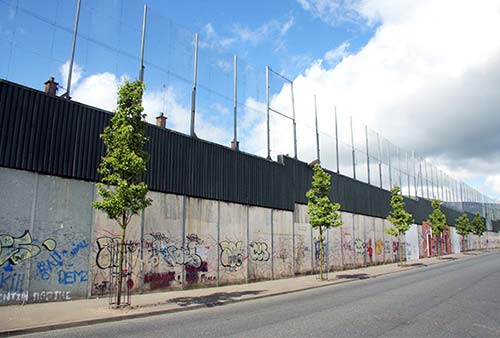
The first wall here was cement and 20 feet high; it was later extended another 10 feet by a solid metal addition, and then another 15 feet with a metal screen. Seemingly high enough now to deter a projectile being lobbed over, this is one of many such walls erected in Belfast during the Troubles.
A pensive stroll along the wall challenges assumptions. On the one hand, a wall like this seems an obvious failure—using a blunt instrument to solve a complicated problem. On the other hand, for the people living on either side—especially those who remember the frightening time before the wall was built—it provides a sense of security. Many messages scrawled on the wall say something along the lines of, “Just let go of the past.” But in a place like West Belfast, emotions run deep; loss devastates and memories persist.
International Wall: At the intersection of Falls Road and Northumberland Street, you’ll encounter the most interesting stretch of barrier, the colorful International Wall, a two-block-long series of political murals that draw parallels with struggles and sectarian strife in every corner of the globe. The two sides are separated by a hefty gate.
Do a slow walk past the murals on the Republican side and notice some themes. Some murals pay tribute to Republican heroes (including Bobby Sands and his fellow hunger strikers), while others demonstrate solidarity with oppressed groups in other countries: the Palestinians in Israel, the Tamil Tigers in Sri Lanka, and Kurdish leader Abdullah Öcalan in Turkey. The biggest mural—right next to the first gate—features Black Americans who have been involved in the crusade for civil rights, from Frederick Douglass to Rosa Parks and Martin Luther King Jr., and from Muhammad Ali to Barack Obama.
Walking through the heavily fortified gates that flank “no-man’s-land,” you’ll pass a giant mural that says “IMAGINE”—evoking the peace-loving anthem from John Lennon—with a collage of photos and quotes suggesting optimism about a long-term solution for West Belfast.
Then, crossing to the Loyalist side, you come to similar murals with a different spin. While the red, black, and green of Palestine dominated on the other side, here you’ll see blue-and-white Stars of David for Israel. Another mural celebrates the members of the British Commonwealth—India, Australia, South Africa, Canada, New Zealand, and the Ulster Division, a division of Ulster men who took up arms for the British Army during World War I.
Northumberland Road connects the International Wall with the Shankill Road area, described below—just head straight north a few blocks.
Shankill Road Area (Protestant/Unionist/Loyalist Side)
In most regards, Shankill Road feels the same as any High Street in a British city. But as you walk down the main part of this strip (around Agnes/Northumberland and Conway streets), you’ll see emotionally charged murals, memorials to people killed, and lots of red, white, and blue. Also watch for the fields where bonfires are built, with piles of wood awaiting the next July 12, or Orangemen’s Day—when Protestants commemorate King William of Orange’s victory over Catholic King James II in the 1690 Battle of the Boyne (and when Catholics choose to leave town on vacation).
Queen’s Corner and King’s Corner: Along the most colorful stretch of Shankill Road, at the intersection with Crimea Street (a place called Queen’s Corner), look for the gigantic mural (including children’s art) honoring Queen Elizabeth II. This was originally painted to honor the queen on her Platinum Jubilee in the summer of 2022, only to be modified just a few months later to commemorate her death.
Across the street and a few steps back toward downtown (at King’s Corner), you’ll see a giant mural of Elizabeth’s son and successor, King Charles III. This went up very quickly in 2022 to honor the new king, who’s celebrated more fervently in this Unionist stronghold than perhaps anywhere in his realm. Immediately to the right, a mural proudly declares “We Will Not Have Home Rule”—in other words, we prefer to be ruled from afar, by His Majesty, rather than from Dublin.
Just a block west from King’s Corner, you’ll see a memorial to “ordinary people, extraordinary roles”—three local men who died near this spot for the Loyalist cause. Across the street, along the storefront for the betting office, notice the tartan mural to the Scottish Brigade of the Ulster Volunteer Force. The UVF was a Loyalist paramilitary group, essentially the counterpart to the IRA. A plaque lists “The Battalion of the Dead”—dozens of combatants who died in the Troubles.
“Top Gun” McKeag and Women’s Quilt Corner: About a 10-minute walk north of Shankill Road, you’ll find a fascinating little corner in a residential zone with two Unionist/Loyalist murals with distinctly different messages. To find them, head north from Shankill Road a few blocks on Shankill Parade, to the corner of Malvern Place and Hopewell Crescent.
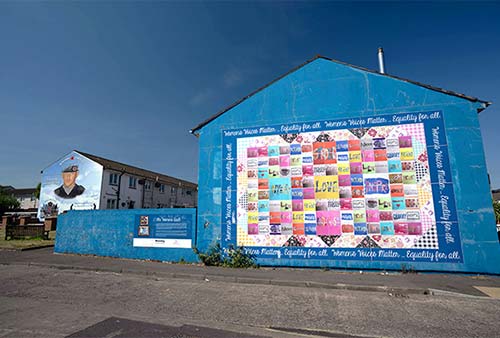
The dominant mural here celebrates Stevie “Top Gun” McKeag, a commander for the Ulster Defense Association (UDA). His face floats in the clouds, as if an angel—but to Nationalists, he’s a mass murderer who gained his reputation and nickname because of how many combatant (and civilian) Catholics he executed. The flags of the UK, Ulster, and Scotland fly on the flagpoles, and provocative messages are plastered on nearby walls. On the shorter wall to the left, notice how the gun barrel of the masked shooter seems to follow you wherever you go.
This is one of the most provocative murals in Belfast. And, as a direct response, on the building immediately to the right, you’ll find another blue-hued mural with a pointedly different perspective. The Women’s Quilt is a patchwork of positive messages from women in this community: “Love,” “Friend,” “Caring,” “Hope,” and so on. The border around the quilt reads, “Women’s voices matter...equality for all.”
As striking a contrast as these two murals are, what’s even more notable are the murals you don’t see anymore. On the short wall just to the left of the Women’s Quilt is a small reproduction of a gruesome Grim Reaper mural that this one replaced. And, to the right of the Women’s Quilt, you’ll see some newer buildings that quite intentionally don’t have the blank flat ends that traditionally provided a canvas for murals (hateful or otherwise). And finally, turning 180 degrees and looking far across the field, you’ll see a house end that’s painted entirely black. This covers up a former mural of Protestant hero King William of Orange; the wall has, so far, been left blank. For many locals, this is considerable progress.
To reach the next sight, Crumlin Road Gaol, head up Hopewell Crescent, then jog slightly left to continue straight up Florence Place, along the fence surrounding a derelict courthouse. Turn left on the busy road, and across the street you’ll see the entrance.
Crumlin Road Gaol
This Victorian-era jail was kept busy from 1846 to 1996 incarcerating people—men, women, and even children. Its purpose: to control the angry indigenous Irish. Exhibits and re-creations now provide a look at how the prison was run, who was held here, and what life was like for the prisoners. While the history here is real and important, today it’s run as a tacky “experience” that trivializes the stories—where tourists goofily pose in stocks at a site of mass incarceration and execution. And, if you’re mainly interested in the Troubles, you may be disappointed; the focus is on the Victorian era.
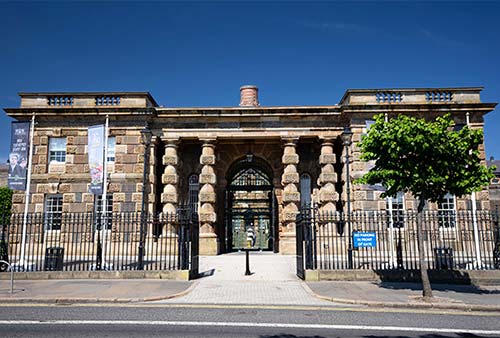
Cost and Hours: £14.50, daily 10:00-18:00—or until 18:30 on Fri-Sat in summer, last entry two hours before closing; coffee stand, pub, +44 28 9074 1500, www.crumlinroadgaol.com.
Getting There: The jail is at 53 Crumlin Road, a half-mile north of Shankill Road. From the city center, it’s not well served by buses; it’s easiest to take a taxi.
Visiting the Jail: After an orientation film, visitors follow a one-way route through the prison. You’ll get a look at the tunnel that connected the jail to the (now abandoned) courthouse across the street (the tunnel reduced the odds of prisoners escaping). Then you’ll enter the Circle, the central area from which the four cell wings spoke out. Along the way, you’ll meet holograms of the prison warder and governor, who tell about prison life and operations.
From the Circle, you’ll stroll down C Wing, which now holds re-creations of various cells (from 1846, the 1970/1980s, and a child prisoner’s cell), and also models of other spaces (officials’ offices, kitchen, bathroom). Other cells host video exhibits covering topics such as prisoner accounts and artwork, executions, and hard labor in Victorian times. In the Troubles exhibit, a simple but effective animated video details the entire history of Northern Ireland’s sectarian divide.
Finally, you’ll head outside for a loop around the prison wall to see where executed prisoners were buried in unmarked graves. The visit ends with a look at a Westland Wessex helicopter and the role of the British army and RAF at the jail.
Elsewhere in Belfast: Sandy Row
To the southwest of City Hall, Sandy Row is a Protestant working-class street (just behind the Europa Hotel) that offers an easy way to get a dose of a sectarian neighborhood. From the Europa Hotel, walk a block down Glengall Street, then turn left and walk for 10 minutes. A stop in a Unionist memorabilia shop, a pub, or one of the many cheap eateries here may give you an opportunity to talk to a local. Along the way you’ll see murals filled with Unionist symbolism—such as the mural of William of Orange’s victory over the Catholic King James II in the Battle of the Boyne (at the northern end of Sandy Row at the corner with Linfield Road).
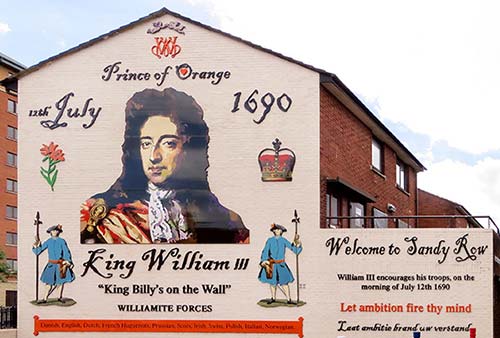
MORE SIGHTS IN BELFAST
East of Donegall Square
▲St. George’s Market
This was once the largest covered produce market in Ireland. Today the farmers are gone and everyone else, it seems, has moved in. Three days a week (Fri 8:00-14:00, Sat 9:00-15:00, Sun 10:00-15:00), St. George’s Market becomes a thriving arts, crafts, and flea market. With a diverse array of street food, produce, and homemade goodies, it’s a fun place to assemble a lunch—though it’s not quite the foodie mecca you might be dreaming of (five blocks east of City Hall, at the corner of Oxford and East Bridge streets, www.belfastcity.gov.uk/stgeorgesmarket).
The Queen’s Quarter (South Belfast)
This appealing neighborhood surrounds the prestigious Queen’s University—whose red-brick main building, along University Avenue south of Shaftesbury Square, is worth a look in itself. Located directly across the street, One Elmwood is the state-of-the-art student union (opened in 2022); it’s fun to dip inside to observe the inviting hangout spaces, a student store that sells food, a coffee shop, a pub, and a rooftop garden.
North of the university, Botanic Avenue (near the train station of the same name) is a delightful area to shop (the No Alibis bookshop at #83 is a classic independent bookseller), or to find a drink or a meal at a variety of affordable, student-oriented places.
And to the south, you’ll find the enticing Botanic Gardens—the backyard of Queen’s University (free and open daily until dusk, www.belfastcity.gov.uk/parks). On a sunny day, you couldn’t imagine a more relaxing park setting. On a cold day, step into the Tropical Ravine for a jungle of heat and humidity, or take a quick walk through the Palm House. Within the gardens, you’ll find the Ulster Museum (described next); at the southern tip of the greenbelt is the Lyric Theatre (see “Nightlife in Belfast,” later).
▲Ulster Museum
This is Belfast’s most venerable museum. It offers an earnest and occasionally thought-provoking look at Northern Ireland, with a cross-section of exhibits on art, natural sciences, and history.
Cost and Hours: Free, donation suggested; Tue-Sun 10:00-17:00, closed Mon; café, south of downtown, in the Botanic Gardens on Stranmillis Road, +44 28 9044 0000, www.nationalmuseumsni.org.
Visiting the Museum: Exhibits in this five-floor museum start on the top floor and spiral down through various topics. The top two floors are dedicated to art, the next floor down covers the natural sciences, and the final two focus on history, with the Troubles covered at the end.
Begin by riding the elevator to level 5, where wicker sculptures of Game of Thrones dragons (by a local basketmaker) hang high in the atrium. Then proceed into the Gallery of Applied Art, with beautifully crafted fine crystal, china, porcelain, jewelry, fashion of the 1920s, and pottery—much of it made in Ireland. Several painting galleries focus on Irish artists from the late 1800s to today. There are also good temporary exhibits.
In the nature collection, dinosaur skeletons lurk, stuffed wildlife plays possum, and geology rocks. You’ll see land and sea creatures big and small, old and new, and rare and common. Displays illustrate the geological formation of the island of Ireland, starting 600 million years ago, and trace how the Ice Age affected the local landscape.
Next the museum focuses on civilizations, with exhibits and artifacts spanning the centuries, from the Bronze Age to the Middle Ages. Don’t miss the room dedicated to the mummy of a woman from Thebes, who lies in a glass case in the center. An interesting exhibit on the Spanish Armada tells the story of the Girona, which was shipwrecked off the Antrim Coast north of Belfast in 1588. Soggy bits of gold, silver, leather, and wood salvaged from the Girona are now on display.
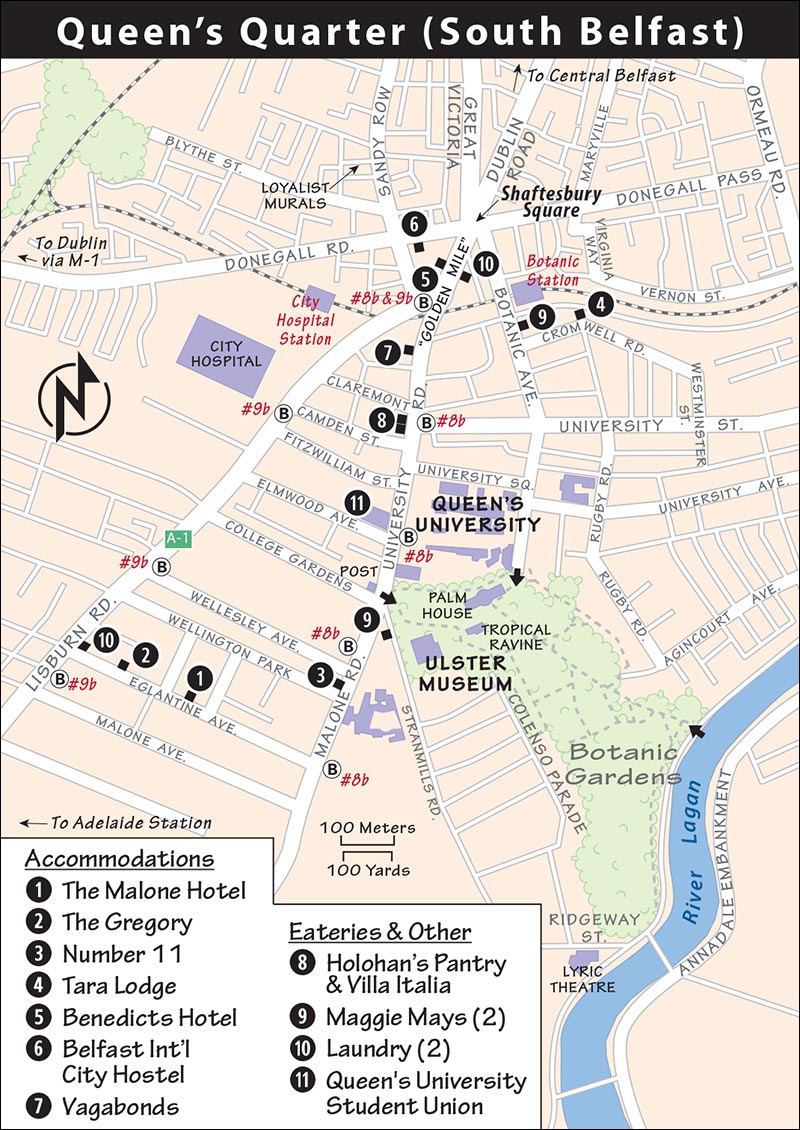
An exhibit on Inclusive Global History reevaluates this esteemed collection through the modern lens of decolonization—updating explanations about faraway cultures (such as a giant canoe from the Solomon Islands) by seeking input from local cultural experts, rather than presenting everything from an Anglocentric perspective.
Step down into the delicately worded history section. A highlight is the wall covered with antique text. On the left is the Ulster Covenant (1912), signed in blood by Unionist Protestants to resist incorporation into an independent Irish state. On the right is the Irish Proclamation of the Republic (1916), dear to Nationalist Catholic hearts as the moral compass of the Easter Rising. Compare the passion of these opposing points of view.
All over Northern Ireland, you’ll notice a curious symbol: a red hand facing you as if swearing a pledge or telling you to halt. You’ll spot it above Belfast’s Linen Hall Library door, in the wrought-iron fences of the Merchant Hotel, on old-fashioned clothes wringers (in the Ulster Folk Museum at Cultra), above the front door of a bank in Bangor, in the shape of a flowerbed at Mount Stewart House, in Loyalist paramilitary murals, on shield emblems in the gates of Republican memorials, and even on the flag of Northern Ireland (the white flag with the red cross of St. George). It’s known as the Red Hand of Ulster—and it is one of the few emblems used by both communities in Northern Ireland.
Nationalists display a red hand on a yellow shield as a symbol of the ancient province of Ulster. It was the official crest of the once-dominant O’Neill clan (who fought tooth and nail against English rule) and today signifies resistance to British rule in these communities.
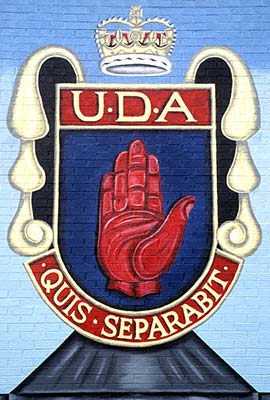
But you’ll more often see the red hand in Unionist areas. They see it as a potent symbol of the political entity of Northern Ireland. The Ulster Volunteer Force chose it for their symbol in 1913 and embedded it in the center of the Northern Irish flag upon partition of the island in 1921. You may see the red hand clenched as a fist in Loyalist murals. One Loyalist paramilitary group even named itself the Red Hand Commandos.
The origin of the red hand is a mythological tale of two rival clans that raced by boat to claim a far shore. The first clan leader to touch the shore would win it for his people. Everyone aboard both vessels strained mightily at their oars, near exhaustion as they approached the shore. Finally, in desperation, the chieftain leader of the slower boat whipped out his sword and lopped off his right hand...which he then flung onto the shore, thus winning the coveted land. Moral of the story? The fearless folk of Ulster will do whatever it takes to get the job done.
Then continue through the coverage of the Troubles and beyond as this museum strives for balanced and thought-provoking reflections. For many visitors, this is the most useful and enlightening part of the museum.
On the Outskirts
These museums are just a 15-minute train ride from the city center.
▲Ulster Folk Museum and Ulster Transport Museum
A sprawling 180-acre complex is home to two fine museums: the Ulster Folk Museum and the Ulster Transport Museum. The complex straddles the road and rail line at Cultra, midway between Bangor and Belfast (8 miles east of town). The museums are well done, if a little dated, and mainly geared for locals; they’re worth your while if you have a special interest.
Cost and Hours: Each museum is £11.50 for adults, £7 for kids ages 5 and up, family tickets available, online booking available but generally not necessary except for busy Bank Holiday weekends; Tue-Sun 10:00-17:00; Oct-Feb Tue-Fri 10:00-16:00, Sat-Sun from 11:00; closed Mon year-round; last entry one hour before closing; +44 28 9042 8428, www.nationalmuseumsni.org.
Getting There: From Belfast, it’s a roughly £15 taxi journey or 15-minute drive (free parking at both museums). By public transport, the train is easy and reliable (2/hour, 15 minutes, from any Belfast train station or from Bangor, get off at Cultra). From the Cultra station, it’s just a few minutes’ walk to the Transport Museum or a 15-minute walk uphill to the Folk Museum.
Planning Your Time: Plan to spend a couple of hours at each museum (a half-day total if seeing both). Consider the weather and plan accordingly. While the Transport Museum is mostly indoors, the Folk Museum is primarily outdoors and can involve lots of walking, with buildings spread across a hillside.
Ulster Folk Museum: Featuring 34 reconstructed buildings from all over the nine counties of Ulster, this open-air museum showcases the region’s traditional lifestyles. First you can wander through the old town, dropping in at a church, print shop, schoolhouse, silent movie theater, bank, pub, and so on. There’s also a tearoom in town that serves pastries and light lunches. From “town,” you can head into the country to nip into cottages, farmhouses, and mills. Some houses are warmed by a wonderful peat fire. Friendly attendants are stationed throughout. You might meet the blacksmith, carpenter, or basket weaver; talking to them can bring the experience to life.
Ulster Transport Museum: This fine museum takes you through the history of various modes of transportation and features many models of old trains, trolleys, carts, cars, and more.
Most of the museum is contained in three connected warehouse-like buildings. It starts with the Rail Gallery, where you’ll enter onto a mezzanine above a world of model train cars. Descend a ramp to explore the history of trains and the Northern Ireland rail system while wandering among old train carriages.
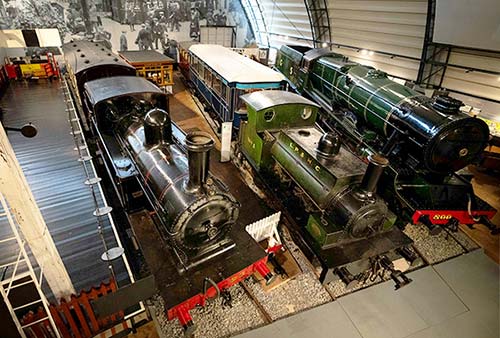
The middle building holds the Titanica exhibit, which concisely covers the tale of the Titanic, from its inception in the shipyards of Belfast to its demise in the North Atlantic Ocean.
Next is the Road Transport Gallery, with an array of trolleys, trams, double-decker buses, horse-drawn carriages, and other types of street transport. The car section covers more than a century of automobiles—everything from the Ford Model T to the bubble car (Beetles and Minis) to the “Cortina Culture” of the 1960s.
A separate building (down a long path) hosts the Land, Sea, and Sky Galleries, with an exhibit on carriages, caravans, the two-wheeled cart, and surfing. It also houses the Museum of Innovation, which celebrates local ties to world-changing scientific breakthroughs; the portable defibrillator, Dunlop tires, and the pneumatic tube all originated here. Those nostalgic for the 1980s will appreciate an exhibit on how the controversial automobile designer John DeLorean opened a factory in a suburb of Belfast to produce the DeLorean DMC-12.
Nightlife in Belfast
Theater
Located beside the River Lagan (near Queen’s University), the Lyric Theatre is a Belfast institution. Rebuilt in 2011, it represents the cultural rejuvenation of the city—the building was partially funded by donations from actors such as Liam Neeson, Kenneth Branagh, and Meryl Streep. (You’ll find giant portraits of great Irish actors in the lobby.) It’s a good place to see quality local productions in two venues—the main theater, which seats about 400, and the smaller Naughton Studio for about 150 (55 Ridgeway Street, +44 28 9038 1081, https://lyrictheatre.co.uk).
The Grand Opera House, right downtown and described on here, mainly features big musicals (2-4 Great Victoria Street, +44 28 9024 1919, www.goh.co.uk).
Traditional Music and Dance
Belfast Story features former Riverdance musicians and dancers in an energetic hour-long performance celebrating the people, poetry, and music of Belfast (+44 79 7189 5746, www.belfasthiddentours.com).
Musical Pub Tour
The Belfast Traditional Music Trail is led by two local musicians. You’ll walk to two or three fun venues in the Cathedral Quarter, where they play and explain traditional Irish music. It’s a great intro to Belfast’s pulsing Irish music scene (£20, book in advance and confirm meeting place, Sat at 15:00, 2.5 hours, +44 28 9028 8818, www.belfasttradtrail.com).
▲▲Live Music
A great way to connect with the people and culture of Belfast is over a beer in a pub. These places all add live music to the mix, making for an even cheerier atmosphere. Check pub websites to see what’s on when you’re in town.
Kelly’s Cellars, once a rebel hangout (see plaque above door), still has a gritty Irish feel. It’s 300 years old and has a great fun-loving energy inside, a lively terrace, and Irish stew that’s served until it runs out—plus pizza on weekends (live music nightly; tends to be trad during the week, anything goes on weekend evenings; in nice weather, especially on weekends, there’s often music outside about 15:00-18:00; 32 Bank Street, +44 28 9024 6058, https://kellyscellars.co.uk).
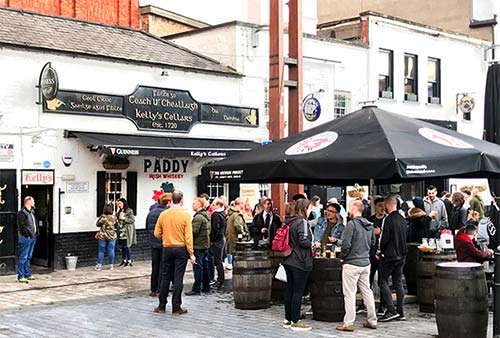
Madden’s Bar is wonderfully characteristic, with a local crowd and trad music every night (no food, 2 blocks from Kelly’s Cellars at 74 Berry Street, +44 28 9024 4114).
The John Hewitt is committed to the local arts scene—giving both musicians and artists a platform. They don’t serve food but they do dish up live music almost nightly (beer garden out back, 51 Donegall Street, +44 28 9023 3768, https://boundarybrewing.coop).
The Duke of York is noisy for both eyes and ears—jammed with vintage mirrors and memorabilia, it feels like a drunken lamps-and-lighting store. To crank up the volume even more, they have live music nightly. It’s on Commercial Court, the noisiest and most trendy/touristy street for nightlife in Belfast (7 Commercial Court, +44 28 9024 1062, https://dukeofyorkbelfast.com).
The Points Whiskey and Alehouse is an authentic Belfast pub, famed for its music—trad and Irish rock nightly (most weeknights from 22:30, Fri-Sun from 16:30) near the Europa Hotel at 44 Dublin Road, +44 28 9099 4124, www.pointsbelfast.com).
Bert’s Jazz Bar, on the busy side of the Merchant Hotel (facing High Street—the opposite end from the main entrance), is good if you’re in the mood for a cocktail in a plush, velvety Art Deco lounge with live jazz (16 Skipper Street, +44 28 9026 2713, check schedule at www.themerchanthotel.com).
Sleeping in Belfast
Central Belfast is big, loud, and bustling by day but can feel deserted at night. For lodgings, downtown is dominated by big, industrial-strength (and pricey) hotels...no cozy B&Bs to be had. For quieter, smaller, and more affordable alternatives, check out the Queen’s University area (later in this section) or the nearby seaside town of Bangor (at the end of the chapter).
BIG HOTELS IN CENTRAL BELFAST
There are plenty of big chain hotels downtown—all of them impersonal and expensive, often on grubby urban streets, but very central. The first two hotels listed below are landmark splurges, and the last is a tempting option for Titanic fans. In between are some more affordable options. To locate these hotels (except the last one), see the “Central Belfast Hotels & Restaurants” map on here.
$$$$ Europa Hotel is as much a famous landmark (described on here) as a nice place to stay—fancy, comfortable, and central, with four stars and 272 rooms. Modern yet elegant, this place is the choice of visiting diplomats and casual tourists alike (air-con, elevator, Great Victoria Street, +44 28 9027 1066, www.hastingshotels.com, res@eur.hastingshotels.com).
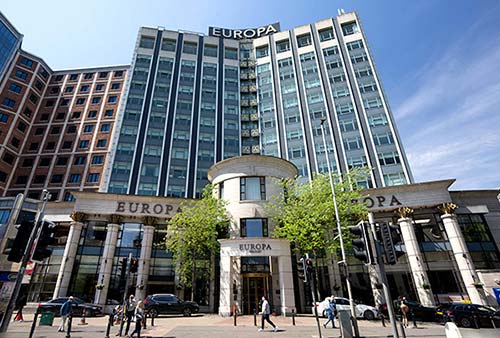
$$$$ Fitzwilliam Hotel, on the other side of the Opera House from the Europa, does one better—with five stars, 146 rooms, and an even plusher high-end experience...and higher prices (air-con, elevator, valet parking, fitness suite, bar, restaurant, 1 Great Victoria Street, +44 28 9044 2080, www.fitzwilliamhotelbelfast.com, enq@fitzwilliamhotelbelfast.com).
Other Big Hotels Downtown: For plenty of beds with all the modern conveniences in a central location, good options include $$$ Maldron Hotel Belfast City (237 rooms, 20 Brunswick Street, +44 28 9600 1680, www.maldronhotelbelfastcity.com), $$$ Leonardo Hotel Belfast (270 rooms, just up from the Europa and Fitzwilliam on Great Victoria Street—technically on Fisherwick Place, +44 28 9053 3500, www.leonardohotels.co.uk), and $$$$ Grand Central Hotel Belfast (300 rooms, 9 Bedford Street, +44 28 9023 1066, www.grandcentralhotelbelfast.com); there are also nearby branches of Hampton Inn, Holiday Inn, and Ibis.
In the Titanic Quarter: The $$$$ Titanic Hotel is the ultimate splurge for those fascinated by Belfast’s most famous ship. The name is not just a gimmick: This hotel—just across the street from the Titanic Belfast Museum—fills the building that housed the offices of the team that designed and built the most unsinkable boat ever to sink (read the description on here). It has 119 rooms and plush spaces that feel so grand and historic that a steady flow of visitors wanders through just to soak it in. The location puts you a good distance from city-center restaurants and lacks the neighborhood charm of the Queen’s Quarter, but this can be an unforgettable splurge for a Titanic-themed visit (air-con, elevator, Queen’s Road, +44 28 9508 2000, www.titanichotelbelfast.com, info@titanichotelbelfast.com). For location, see the “Belfast’s Titanic Quarter” map on here.
QUEEN’S QUARTER (SOUTH BELFAST)
To locate these hotels, see the “Queen’s Quarter (South Belfast)” map on here. To get to the center from this area, any #8 Metro bus (#8a, #8b, etc.) heads up Malone Road, and any #9 bus heads up the nearly parallel Lisburn Road; on either route, the Wellington Square stop is just a short block from City Hall (about a 10-to-15-minute ride, depending on traffic; these run about every 10 minutes but frequency drops on weekends). To get to this area from downtown, catch those same buses along the east side of City Hall (Donegall Square East stop). A taxi between City Hall and the Queen’s Quarter costs about £8. The Botanic train station (for commuter trains) is handy.
South of Queen’s University
Many of Belfast’s quieter and less expensive accommodations are in a comfortable, leafy neighborhood just south of Queen’s University (near the Ulster Museum).
$$$$ The Malone Hotel, by far the classiest of the big-hotel listings in this neighborhood, provides slick, business-class comfort in 119 spacious rooms on a quiet street (air-con, elevator, restaurant and bar, parking, 60 Eglantine Avenue, +44 28 9038 8000, www.themalonehotel.com, info@themalonehotel.com).
$$ The Gregory, by the Warren Collection, ages gracefully in a stately red-brick Victorian house behind a green lawn. Located on a quiet street, with 17 rooms decorated in soft colors, this place feels like an escape from the city (family rooms, free parking, easy self-check-in, optional breakfast is at nearby diner, 30 Eglantine Ave, +44 28 9099 5121, www.warrencollection.com, info@warrencollection.com).
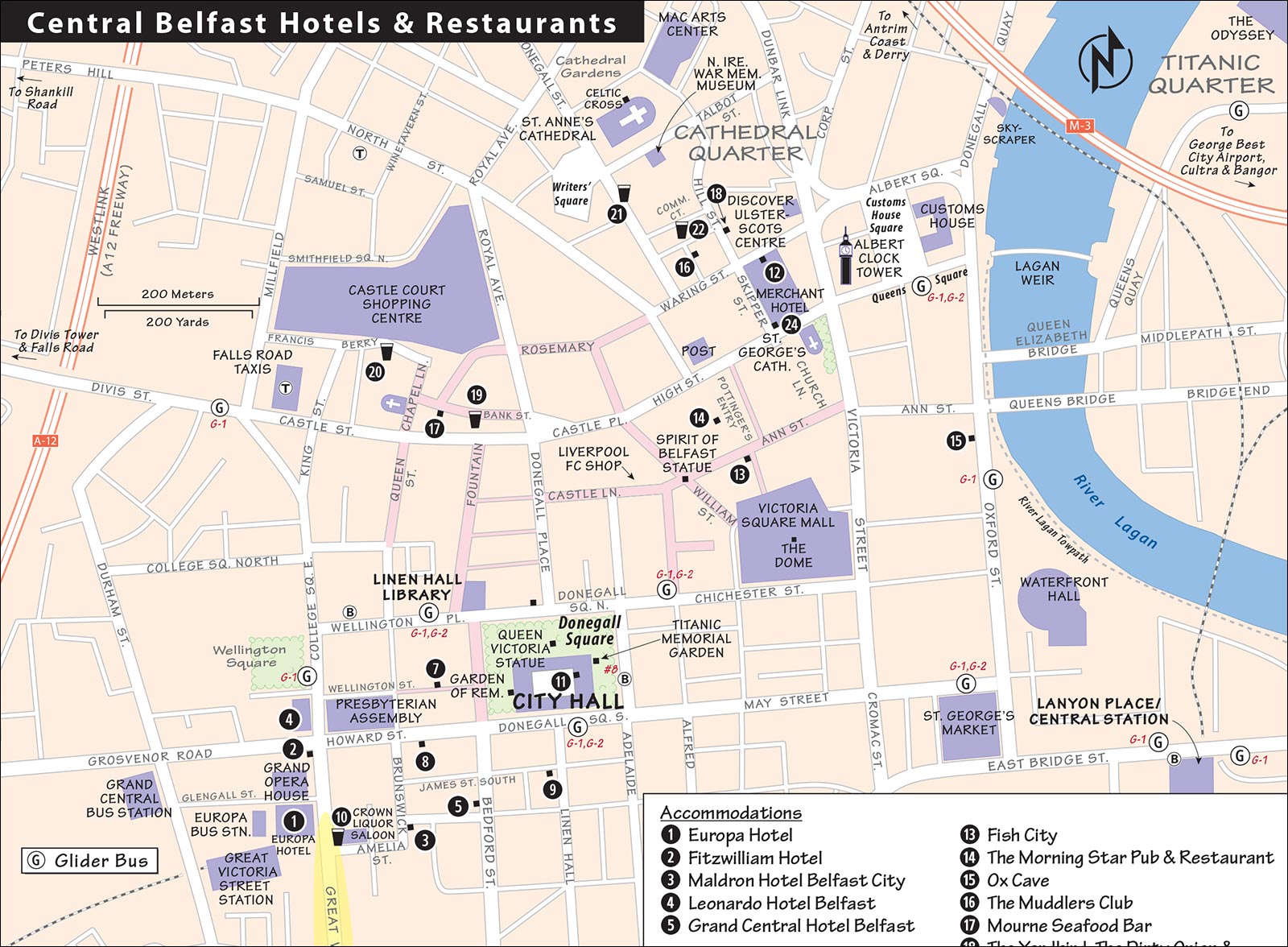
$$ Number 11 is in the same hotel family as the Gregory (the Warren Collection) but has a more modern urban vibe. Housed in a four-story Victorian townhouse on the main road near the university, the 12 rooms have beautifully tiled bathrooms and techy accents, such as touch-sensor mirrors. This hotel is typically unstaffed, so plan on self-check-in (family rooms, 11 Malone Road; same contact info as above).
North of Queen’s University, near Shaftesbury Square
These places are slightly closer to downtown.
$$$ Tara Lodge is a friendly and tidy option, with 34 rooms on a quiet street just a block off the bustling, entertaining Botanic Avenue, and near the Botanic train station (elevator, family rooms, 36 Cromwell Road, +44 28 9059 0900, www.taralodge.com, info@taralodge.com).
$$$ Benedicts Hotel has 32 rooms over two floors in a good location at the northern fringe of the Queen’s University district. Its popular bar is a maze of polished wood and can be loud on weekend nights (includes breakfast if you book direct, elevator, 7 Bradbury Place, +44 28 9059 1999, www.benedictshotel.co.uk, info@benedictshotel.co.uk).
¢ Belfast International City Hostel, big and creatively run, provides the best value among Belfast’s hostels. It’s near Botanic Station, in the heart of the lively university district, and has 24-hour reception. Paul, the manager, is a veritable TI, with a passion for his work (private rooms available, £5 cash key deposit taken, pay breakfast available at café, 22 Donegall Road, +44 28 9031 5435, www.hini.org.uk, info@hini.org.uk).
¢ Vagabonds, a backpackers hostel, has traditional dorm beds as well as 10 private rooms (twins and doubles) with shared bathrooms just north of the university (includes breakfast, pay laundry, baggage storage, self-serve kitchen, 9 University Road, www.vagabondsbelfast.com, info@vagabondbelfast.com).
Eating in Belfast
CENTRAL BELFAST
For locations, see the “Central Belfast Hotels & Restaurant” map.
Quality Meals near City Hall
$$$$ The Ginger Bistro serves a smart local crowd Irish/Asian cuisine with special attention to vegetarian and fish dishes. The casual front is for walk-ins, and the quieter, more romantic back is for those with reservations (Wed-Thu dinner only, Fri-Sat lunch and dinner, closed Sun-Tue, 68 Great Victoria Street, +44 28 9024 4421, www.gingerbistro.com).
$$$ Yügo, trendy but unpretentious, serves up Asian fusion food and creative cocktails. The small dining room is tight with a dozen tables; eating at the bar gets you a fun view of the open kitchen. Their small plates—including vegetarian options—are good for sharing (Tue dinner only, Wed-Sat lunch and dinner, closed Sun-Mon, 3 Wellington Street, +44 28 9694 7265, https://yugobelfast.com).
$$$$ Deanes Love Fish and Deanes Meatlocker are side-by-side sister eateries run by the powerhouse restaurateur Michael Deane, whose Michelin-star restaurant is next door. Each has a confident, impersonal vibe with good food in a classy atmosphere. I prefer Deanes Love Fish, with its minimalist, nautical feel (Tue-Wed lunch only, Thu-Sat lunch and dinner, closed Sun-Mon). The Meatlocker is more for red meat and romance (Tue lunch only, Wed-Sat lunch and dinner, closed Sun-Mon; both are one block from City Hall at 28 Howard Street, +44 28 9033 1134, www.michaeldeane.co.uk).
Other Options Near City Hall
$$$$ Coco Restaurant is a spacious place with a quirky sense of style, serving reliably tasty modern Irish and Continental dishes. They have a handy “pre-theatre” menu on some nights, and a special menu for Sunday lunch (Wed-Fri lunch and dinner, Sat dinner only, Sun lunch only, closed Mon-Tue, a block behind City Hall at 7 Linen Hall Street, +44 28 9031 1150, https://cocobelfast.com, Tim).
$$ Crown Liquor Saloon and Dining Room is a dazzling gin palace on every sightseer’s list. The ground-floor pub is a mesmerizing mishmash of mosaics and shareable snugs (booths—best to reserve), topped with a smoky tin ceiling. The dining room upstairs is similarly elegant but much quieter. Both serve the same pub grub, but upstairs seating comes with table service (daily, across from the Europa Hotel at 46 Great Victoria Street, +44 28 9024 3187, www.nicholsonspubs.co.uk).
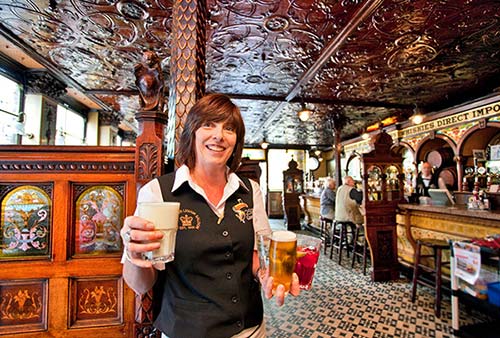
Cheap Lunch Inside City Hall: $ The Bobbin Café is a good and cheery little cafeteria serving soups, sandwiches, and hot dishes. They are a nonprofit and employ people with learning disabilities (daily for lunch until 17:00, +44 28 9050 2068).
Cathedral Quarter and Nearby
See the “Central Belfast Hotels & Restaurants” map for locations.
$$$$ The Great Room at the Merchant Hotel presents its afternoon tea in an expensive ritual. You’ll enjoy velvety Victorian splendor under an opulent dome with piano accompaniment. Sit under the biggest chandelier in Northern Ireland as you dine in the great hall of a former bank headquarters. If you’ve got a little money to burn, dress up and indulge (£42.50/person, daily, reservations smart—especially on weekends, 16 Skipper Street, +44 28 9026 7963, www.themerchanthotel.com). They also do a dinner service of modern Irish/French cuisine.
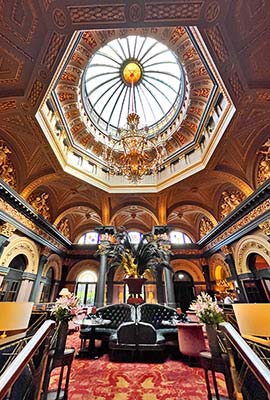
$$$$ Fish City is a fine spot for its sustainably sourced, quality seafood dishes and attentive service. It has three dining spaces (one downstairs and two up), each with a different nautical vibe. The outdoor terrace, which spills onto a pedestrian street, is a delight on nice days. They host live music on weekend evenings in summer (daily, 33 Ann Street, +44 28 9023 1000, Grace).
$$$ The Morning Star is a well-worn, once-elegant eatery with a characteristic pub on the ground floor (serving a hearty and cheap lunch carvery Mon-Sat) and a low-energy dining hall upstairs—all with the same menu. It has a good reputation for solid food in a historic pub (daily, down an alley just off High Street at 17 Pottinger’s Entry, +44 28 9023 5986).
$$$ Ox Cave is a sleek and mod place with aproned French elegance. The owners of the adjacent Michelin-starred Ox restaurant designed it to entertain diners with wine and cheese as they wait for their table. But you could settle in here to make a meal from their charcuterie, cheese, small plates, and exciting wines (Wed-Sat dinner only, closed Sun-Tue, 3 Oxford Street, +44 28 9023 2567, https://oxbelfast.com/ox-cave).
$$$$ The Muddlers Club, a trendy, industrial-mod place, has an open kitchen and a fun format: a single, six-course set menu of international-style dishes that changes daily. Their wine-pairing option makes the tasting menu even better. Eating here is expensive, but it’s a memorable slice of Belfast; be sure to book ahead (Wed-Thu dinner only, Fri-Sat lunch and dinner, closed Sun-Tue, 1 Warehouse Lane, off Waring Street, +44 28 9031 3199, https://themuddlersclubbelfast.com).
$$$ Mourne Seafood Bar is my choice for seafood in an elegant setting with a fun staff and smart clientele. It’s run by a marine biologist and a great chef—no gimmicks, just top-quality seafood. Reservations are smart (Tue-Sat lunch and dinner, Sun lunch only, closed Mon, 34 Bank Street, +44 28 9024 8544, www.mourneseafood.com). As it’s next to Kelly’s Cellars (described earlier, under “Nightlife in Belfast”), consider dining here before enjoying the music next door.
$ The Yardbird, rough and spacious, is housed in an open-beam attic. Their specialty is chicken (rotisserie and other), but they also have ribs and vegetarian options (daily, 3 Hill Street, +44 28 9024 3712). The Dirty Onion (downstairs) is a popular pub that spills suds and live music into its packed outer courtyard (you can bring in takeaway from the Yardbird). The Second Fiddle bar is off the courtyard.
QUEEN’S QUARTER (SOUTH BELFAST)
For locations, see the “Queen’s Quarter (South Belfast)” map on here.
$$ Holohan’s Pantry is like eating in a wealthy grandma’s dining room. It’s small, with an inviting and nostalgic menu of Irish dishes—both classic (including boxty) and modern. The chef has a passion for seasonal ingredients (Tue-Sat lunch and dinner, Sun lunch only, closed Mon, reservations smart, 43 University Road, +44 28 9029 1103, www.holohanspantry.co.uk).
$$ Villa Italia packs in crowds hungry for linguini and bistecca. Huge and family-friendly, with checkered tablecloths and a wood-beamed ceiling draped with grape leaves, it’s a little bit of Italy in Belfast (Mon-Sat dinner only, Sun lunch and dinner, reservations smart, 39 University Road, +44 28 9032 8356, www.villaitaliarestaurant.co.uk).
$ Maggie Mays serves hearty, simple, affordable meals in a tight and cheery little bistro room. There are two locations near Queen’s University, including one block south of Botanic Station (50 Botanic Avenue, +44 28 9032 2662) and near the Botanic Gardens (2 Malone Road, +44 28 9066 8515; both daily). There’s also a branch in central Belfast (44 Castle Street).
Belfast Connections
BY TRAIN OR BUS
For schedules and prices for trains and buses in Northern Ireland, check with Translink (+44 28 9066 6630, www.translink.co.uk). Note that service is less frequent on Sundays.
From Belfast by Train to: Dublin (8/day, 2 hours), Derry (10/day, 2.5 hours), Larne (hourly, 1 hour), Portrush (hourly, 1.5 hours, transfer in Coleraine), Bangor (2/hour, 30 minutes).
By Bus to: Portrush (12/day, 2 hours; scenic-coast route, 2.5 hours), Derry (hourly, 2 hours), Dublin (hourly, most via Dublin Airport, 3 hours), Galway (every 2 hours, 5 hours, change in Dublin), Glasgow (3/day, 6 hours), Edinburgh (1/day, some direct, most with change, 7-8 hours). The Europa Bus Centre is on Glengall Street, behind the Europa Hotel.
BY PLANE
Belfast has two airports. George Best Belfast City Airport (code: BHD, www.belfastcityairport.com) is a 10-minute, £10 taxi ride from town (near the docks) or a £2.20 ride on the Airport Express bus #600 (3/hour from Europa Bus Centre). Meanwhile, Belfast International Airport (code: BFS, www.belfastairport.com) is 18 miles west of town—an £8.50 ride on the Airport Express bus #300 (3/hour from Europa Bus Centre).
It’s also simple and affordable to get to Belfast directly from Dublin Airport. The Aircoach express bus #705X runs in each direction, stopping at both Dublin Airport terminals and in downtown Belfast near the Europa Bus Centre, on Glengall Street (near the Europa Hotel and Great Victoria Street Station; about £14, runs every 1-2 hours, 2-hour ride, +44 28 9033 0655, www.aircoach.ie). Translink also runs a bus (#X1) from Dublin Airport direct to Belfast (£16, cheaper if you prebook online, about hourly, www.translink.co.uk). For Dublin Airport details, see here.
If you’re headed for Edinburgh or Glasgow, flying is generally better than taking the ferry (slow and not that scenic), as it’s a fairly cheap, short trip.
BY FERRY
Stena Line ferries connect Ireland with Scotland and England (+44 3447 707 070, www.stenaline.co.uk). The P&O Ferry makes the run to Scotland from Larne, 20 miles north of Belfast (+44 1 304 448 888, www.poferries.com).
To Scotland: You can sail between Belfast and Cairnryan, Scotland, on the Stena Line ferry. A Rail Link coach connects the Cairnryan port to Ayr, where you’ll catch a train to Glasgow Central station (6/day, 2.5 hours by ferry plus 2.5 hours by bus and train). The P&O Ferry goes from Larne to Cairnryan (7/day, 2 hours), with bus or rail connections from there to Glasgow and Edinburgh. There are hourly trains between Belfast and Larne (1-hour trip).
To England: Stena Line ferries sail from Belfast to Liverpool (generally 2/day, 8 hours, arrives in port of Birkenhead—10 minutes from Liverpool).
BY CRUISE SHIP
Belfast has become the busiest cruise port in all of Ireland. While cruises are often seen as a headache in already touristy places elsewhere in Ireland (such as Cobh and Dublin—which doesn’t even allow cruises to arrive within the city limits anymore), the people of Belfast, so long overlooked by mainstream tourism, are largely happy at this influx of visitors to their underappreciated city.
Most cruise ships dock at the northeastern end of Belfast Harbor, about five miles from the city center, well past the Titanic Quarter. Shuttle buses (free or for a fee, depending on your cruise line) meet arriving cruises and take passengers to the TI or City Hall, in the very center of Belfast. A taxi into town should cost about £10-12.
Near Belfast
Just beyond the boundaries of Belfast lie several worthwhile side trips and one handy home base. Bangor, a 30-to-40-minute train ride from downtown Belfast, has a seaside charm and is a fine place to overnight for those who prefer smaller towns. Also near Belfast are two grand palaces with lush gardens—one royal, the other aristocratic—each less than a half-hour drive away: Hillsborough Castle and Mount Stewart House. And on the coast north of Belfast, you’ll find a pair of rugged sights: stout Carrickfergus Castle and the Gobbins Cliff Path.
Bangor
To stay in a laid-back seaside hometown—with more comfort per pound—sleep 12 miles east of Belfast in Bangor. With elegant old homes facing its spruced-up harbor and not even a hint of urban grit, Bangor is a good choice for travelers who prefer a small town, for drivers who’d rather not deal with city traffic and parking headaches, and for those who find Belfast booked up by occasional conventions and conferences. Bangor has some warm and welcoming B&Bs, good restaurants, and is an easy commute by train to central Belfast.
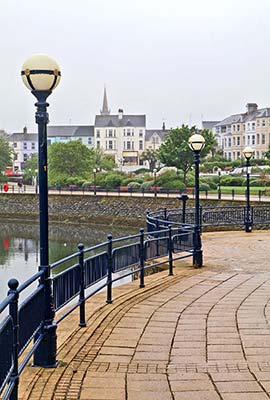
Formerly a Victorian resort and seaside escape from the big city nearby, Bangor now has a sleepy residential feel. It has a few low-key sights and attractions of its own, but its biggest appeal (especially on a sunny day) is its waterfront ambience. If riding between Belfast and Bangor by train, it’s easy to hop off at Cultra to visit the Ulster Folk Museum and Ulster Transport Museum (described earlier).
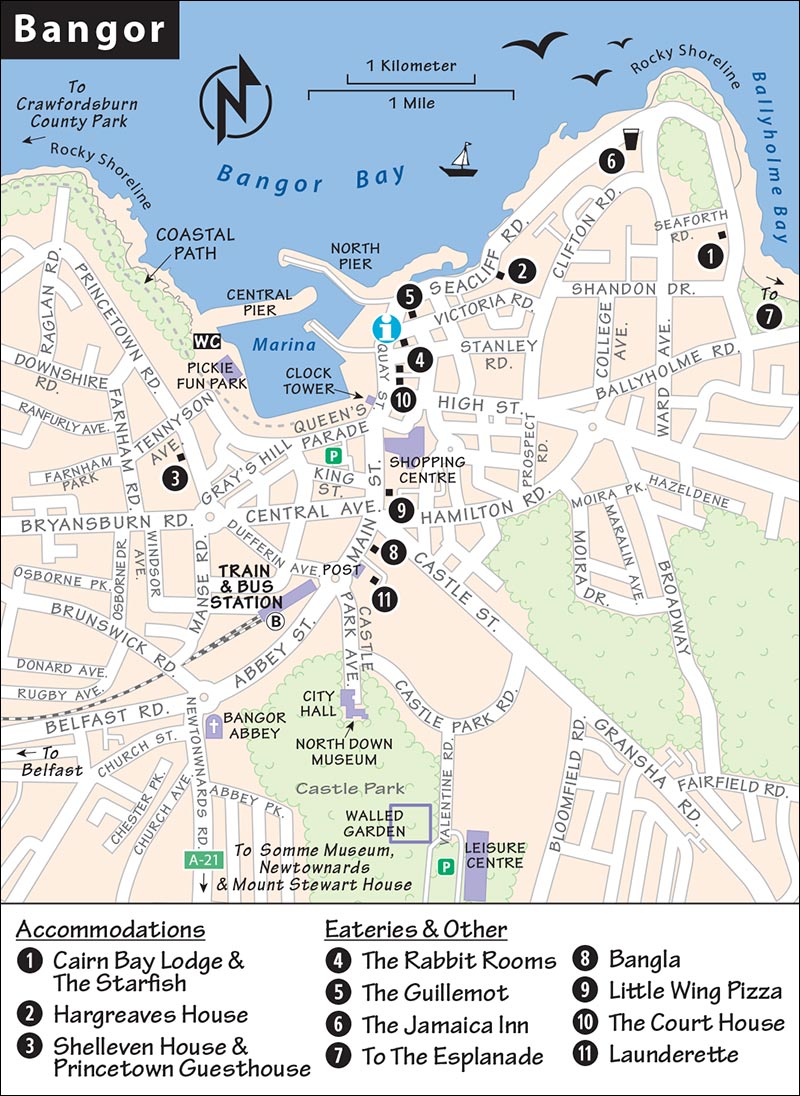
GETTING THERE
Twice-hourly trains connect Bangor to various stations in Belfast—most useful are Lanyon Place/Central, Great Victoria Street, and Botanic (near Queen’s University). The trip takes 30-40 minutes (£7.50 for a same-day round-trip). When heading to Bangor, ride the train to the end of the line (don’t get off at Bangor West). The journey, which travels along the lovely waterfront for much of the way, gives you a good close-up look at the giant Belfast harbor cranes, Samson and Goliath.
In Bangor, the train station sits at the top of Main Street, which leads gently downhill to the harborfront in a 10-minute walk (just head straight out the front door). If heading to the B&Bs on Princetown Road, take the first (steep) left downhill on Dufferin Avenue. A few more sights are on the hilly land called Castle Park, just to the right as you exit the station.
Orientation to Bangor
Tourist Information: Bangor’s TI is in a stone tower house (from 1637) on the harborfront (Mon-Fri 9:15-17:00, Sat from 10:00, closed Sun, 34 Quay Street, +44 28 9127 0069, www.visitardsandnorthdown.com).
Helpful Hints: You’ll find Laundry Chute at 2 Market Street, a block east of the train station, behind the post office—easiest access is from Main Street and up Market Street (Mon-Fri 9:00-17:00, Sat until 14:00, closed Sun, +44 28 9146 5900). For a taxi, try Kare Cabs (+44 28 9145 6777) or Bangor Cabs (+44 28 9145 6456).
August Festival: Bangor becomes a magnet for music and arts lovers in August, when its Open House Festival takes over the town with performances and general revelry (free Sunday concerts in Ward Park through July and Aug, most other events are in Aug, full schedule and tickets at www.openhousefestival.com).
Sights in Bangor
For sightseeing, your time is better spent in Belfast. But if you have time to linger in Bangor, here are a few ideas.
Castle Park
This hilly green zone, up near the train station at the top of Main Street, has a variety of attractions. The modest North Down Museum covers local history, from monastic days to Viking raids to Victorian splendor (free, closed Mon, www.andculture.org.uk). Bangor Castle itself is closed to the public, but its fine and tranquil walled garden is open to the public and a delightful place to relax and perhaps enjoy a drink (at the garden café) or have a picnic (daily in summer until 20:00, closes earlier off-season). The entrance to the garden faces the giant parking lot for Bangor Aurora Leisure Centre, with a giant swimming pool, gym, exercise classes, events for kids, and much more (daily, www.bangoraurora.com).
Along the Harbor
Bangor’s charming marina has a variety of attractions. Right near the middle of the harbor is a wonderful arts complex called The Court House. Originally built as a bank in 1866 and later repurposed as a courthouse, it recently was handed over to a local arts charity, meticulously restored, and transformed into a cultural center. With three venues on two floors, plus a yard out back, it hosts frequent events—ranging from music (trad sessions on Saturdays) to spoken word, comedy, and film. Check out what’s on while you’re in town (most events are Wed-Sun, trad music Sat 15:00-18:00, 16 Quay Street, www.courthousebangor.com).
To the right as you face the harbor (east) is the North Pier; at its tip, you’ll find a mosaic honoring a portion of the D-Day fleet that rendezvoused offshore in 1944, far from Nazi reconnaissance aircraft.
On the opposite (west) side of the marina, little kids may enjoy the Pickie Fun Park, with paddleboat swan rides and miniature golf (www.pickiefunpark.com).
▲Walking the Coastal Path
Perhaps the best attraction in town, this lovely trail leads west out of town from the marina. A pleasant, level, three-mile walk along the water leads you to Crawfordsburn Country Park in the suburb of Helen’s Bay. Hidden in the trees above Helen’s Bay beach is Grey Point Fort, with its two WWI artillery bunkers guarding the shore. Allow 1.5 hours each way as you share the easy-to-follow and mostly paved trail with local joggers and dog walkers.
Ballyholme Bay
This lovely, broad, arcing bay—just east of Bangor’s city-center marina—is quieter and even more charming. It has the town beach and some fine restaurants (see “Eating in Bangor,” later). On a sunny day, consider strolling (or driving) east around the headland from the marina to stretch your legs and maybe grab a drink or a bite.
Somme Museum
A 15-minute drive or bus ride south from Bangor is this sight, of interest exclusively to history buffs. World War I’s trench warfare was a meat grinder. More British soldiers died in the last year of that war than in all of World War II. Northern Ireland’s men were not spared—especially during the bloody Battle of the Somme in France, starting in July 1916 (see the “1916” sidebar on here). Among the Allied forces was the British Army’s 36th Ulster Division, which drew heavily from this loyal heartland of Northern Ireland. The 36th Ulster Division suffered brutal losses at the Battle of the Somme—of the 760 men recruited from the Shankill Road area in Belfast, only 10 percent survived. Museum exhibits portray the battle experience through a mix of military artifacts, photos, historical newsreels, and life-size figures posed in trench warfare re-creations. To fully appreciate the sight, it’s essential to take the one-hour guided tour (£9, open limited hours—often in summer only—so check opening times and tour schedule carefully on the website before making the trip; 3 miles south of Bangor just off A-21 at 233 Bangor Road, +44 28 9182 3202, www.sommeassociation.com).
Sleeping in Bangor
The accommodations below are a longish walk or a quick taxi ride from the train station. For drivers, all have easy parking on-site (or free street parking nearby).
ALONG THE WATERFRONT
These options, a 15-to-20-minute walk from the station, face the water (ask about a view room, or enjoy the lounge and/or outdoor areas).
$$$ Cairn Bay Lodge, facing Ballyholme Bay, is bright, cheery, and conscientiously run by Chris and Jenny. The nine eclectic rooms are stylish, with mod-nautical decor and clever touches. Their appealing café (The Starfish, closed Sun-Mon) has inviting tables out on the lawn (family rooms, beauty salon, 278 Seacliff Road, +44 28 9146 7636, www.cairnbaylodge.com, info@cairnbaylodge.com).
$$ Hargreaves House, a homey Victorian waterfront refuge with three cozy, refurbished rooms, is Bangor’s best value, run by ever-helpful Pauline with assistance from Ambrose (RS%—use code “HHRS,” ocean views, 78 Seacliff Road, +44 28 9146 4071, mobile +44 79 8058 5047, www.hargreaveshouse.com, info@hargreaveshouse.com).
B&BS ON PRINCETOWN ROAD
These lodgings are a few doors apart on a quiet street just downhill from the train station; upper-floor rooms in both have (distant) views over the harbor.
$$$ Shelleven House is a well-kept, stately place with 13 prim rooms (RS%, family rooms, parking, 61 Princetown Road, +44 28 9127 1777, www.shellevenhouse.com, info@shellevenhouse.com, Sue and Paul Toner).
$$ Princetown Guesthouse, a few doors down, is a simpler choice with 10 rooms run by Gavin and Sonia—who’s proud of her creative and healthy breakfasts. They’re also teachers, and they regularly host English students (family rooms, 51 Princetown Road, +44 28 9122 9017, www.princetownguesthouse.com, princetownguesthouse@gmail.com).
Eating in Bangor
Most restaurants in town stop seating early—typically about 20:30.
WATERFRONT OPTIONS
Especially in good weather, it’s worth considering one of the many places facing the sea.
$$ The Rabbit Rooms, right along the harbor, serves hearty Irish food to local crowds, with live music after the dinner service on weekends. An upstairs dining room opens when they’re busy, and the outdoor seating captures the afternoon sun (daily, 33 Quay Street, +44 28 9146 7699).
$$ The Guillemot, at the top corner of the harbor, has two side-by-side eateries: The café has a menu of enticing meals; the deli is a great place to browse for a top-end picnic or to grab soup or a sandwich (both open daily until 17:00, 2 and 6 Seacliff Road, +44 28 9146 2037, www.theguillemot.com).
$$ The Jamaica Inn offers pleasant pub grub and a breezy waterfront terrace. It’s right on the point between the harbor and Ballyholme Bay, with unobstructed sea views (daily, 188 Seacliff Road, +44 28 9147 1610).
If heading around to Ballyholme Bay, consider a drink or meal with a view. $$ The Starfish, a breakfast and lunch café at the recommended Cairn Bay Lodge, has healthy fare and endless views (closed Sun-Mon, indoor/outdoor seating, 278 Seacliff Road). Right in the middle of the bay is $$$ The Esplanade, popular with locals for its good pub grub on a view terrace (daily, 12 Ballyholme Esplanade, www.esplanadebangor.com).
ON MAIN STREET, NEAR THE TRAIN STATION
These options are in the upper part of town, away from the water.
$$$ Bangla serves award-winning Indian cuisine with attentive service and a good-value early-bird option (daily, 115 Main Street, +44 28 9127 1272, www.banglabangor.co.uk).
$ Little Wing Pizza is a friendly joint serving tasty pizza, pasta, and salads. Grab your food to go and munch by the marina. It’s also one of the few places in town that serve food later at night (daily until 22:00, 37 Main Street, +44 28 9147 2777).
Palaces and Gardens near Belfast
The eastern fringe of Northern Ireland is populated mostly by people who consider themselves true-blue British citizens with a history of loyalty to the Crown that goes back more than 400 years. For the best possible taste of that (without crossing the North Channel), consider visiting two sights: Hillsborough Castle, the British royal family’s official residence in Northern Ireland, and Mount Stewart House, a fine example of a 19th-century aristocratic residence. Both are within a 30-minute drive of Belfast (in different directions). If you’re trying to choose between them, Mount Stewart House is, in its own way, more impressive; it’s easier to visit; and it has more engaging gardens. Hillsborough Castle’s main advantage is that regal connection: royal palace completists and fans of King Charles III and the Windsors will find this an obvious choice.
Getting There: While public transportation is possible (ask at the TI or check www.translink.co.uk), these sights are better suited for drivers. If you adore stately old homes and fine gardens, you could combine them in a single day of driving. For locations, see the “Greater Belfast” map, earlier.
▲Mount Stewart House
No manor house in Ireland better illuminates the affluent lifestyle of the Protestant ascendancy than this lush estate. For castle and garden aficionados, it’s quirky and endearing enough to warrant ▲▲. After the defeat of James II (the last Catholic king of England) at the Battle of the Boyne in 1690, the Protestant monarchy was in control—and the privileged status of landowners of the same faith was assured. In the 1700s, Ireland’s many Catholic rebellions seemed finally to be squashed, so Anglican landlords felt safe flaunting their wealth in manor houses surrounded by utterly perfect gardens. The Mount Stewart House in particular was designed to dazzle—as it still does today. Perched on Strangford Lough at this far corner of the Emerald Isle, it feels both remote and oddly tropical—with verdant, borderline-overgrown gardens that give it a special charm. And the house itself is jammed with fascinating details and quirky personalities, all eagerly explained by lovable docents posted in each room.
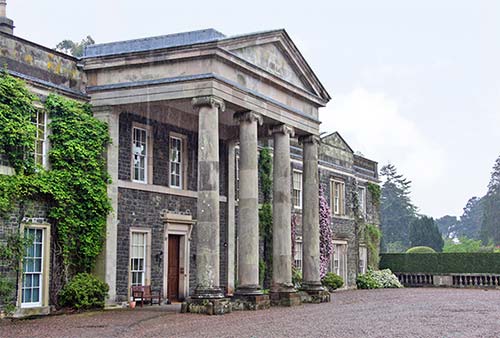
Cost and Hours: £13 includes house and gardens; house open daily 11:00-17:00, gardens from 10:00, Nov-mid-March until 16:00; 15 miles east of Belfast and 8 miles south of Bangor, just off the waterfront A-20 road; +44 28 4278 8387, www.nationaltrust.org.uk.
Visiting the House: From the parking lot, it’s an easy five-minute walk to the entrance pavilion (if you plan to explore the grounds, ask here for a trail map); on the way, you’ll pass a garage showing off the Londonderry State Coach—an ornate horse carriage.
In the manor house, you’ll glimpse the cushy life led by the Marquess of Londonderry and his heirs over the past three centuries. The clan was made fabulously wealthy by the linen trade in County Donegal (Londonderry was that area’s port). In a small room near the entrance, an exhibit introduces the family—especially Charles and Edith, the seventh generation, who renovated the house and gardens in the 1920s.
The main entry hall is a stunner, with a black-and-white checkerboard tile floor, marble columns, classical statues, and a balcony with a domed ceiling and a fine chandelier. From here, you’ll pass through a variety of sumptuous rooms, each with wonderful details. In the breakfast room, see the children’s table in the corner...just like Thanksgiving dinner. In the study, notice how the big window shutters are painted with faux bookshelves to match the real ones. In the dining room, you’ll see the original yellow seats occupied by the rears of European heads of state, brought back from the Congress of Vienna after Napoleon’s 1815 defeat. (The marquess, then a major player in Britain’s foreign policy, helped arrange those pivotal talks, which redrew the map of Europe for a century.)
Then head up the grand staircase. You can’t miss the gigantic painting of Hambletonian, a prizewinning racehorse, by famed equestrian painter George Stubbs. (Be sure to get the full story on that one from the docents.) The bedrooms facing the sunny side of the house—and the Italian Garden outside—are named for places in Italy, while the rooms on the cooler side of the house are named for northern European cities.
Afterward, wander the expansive manicured gardens that wrap around the house. The fantasy life of parasol-toting, upper-crust Victorian society seems to ooze from every viewpoint. At the far end of the Sunken Garden, in the Shamrock Garden, look for the hedge that has been shaped into an Irish harp; on the ground just in front is a flowerbed shaped like the Red Hand of Ulster. Continuing behind the house, into the Italian and Spanish Gardens, you’ll spot fanciful sculptures of extinct dodo birds and orangutans holding vases on their heads.
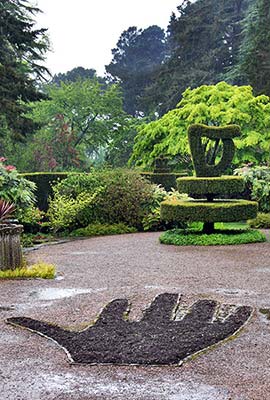
If you have more time, follow the approximately one-mile Lake Walk, which loops deeper into the property; there you’ll see the lake itself, where swans glide serenely among the lily pads, as well as the family burial ground, a red squirrel hide, and a walled rose garden. If you have even more time, consider hiking to the Temple of the Winds, a small banqueting house overlooking the lough.
▲Hillsborough Castle and Gardens
When the British monarch and royal family visit Northern Ireland, they stay at Hillsborough Castle—so, in a sense, for King Charles and Queen Camilla, this is the “Irish Balmoral.” Deceptively small, but with a dazzlingly decorated interior (jammed with items from the royal collection), the castle perches at the top of a sprawling garden and parkland just a 20-minute drive outside Belfast, snuggled up against the charming village of Hillsborough (or, ahem, “Royal Hillsborough,” as it’s formally known). Visitors can ramble the manicured grounds on their own but must join a guided tour to see the castle interior, with impressive state rooms, some fine works of art, and lots of family portraits. While less intimate, charming, and user-friendly than Mount Stewart House, it’s enchanting for those who love all things royal.
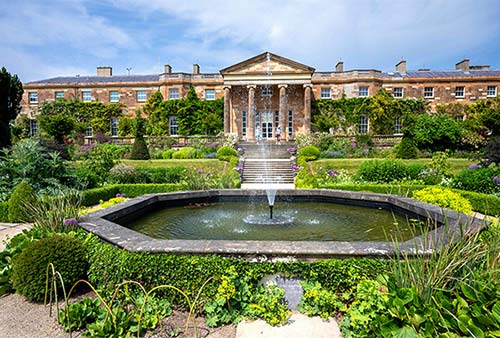
Cost and Hours: Castle tour and gardens—£20.20, gardens only—£10; castle tours run April-Sept Wed-Sun 11:00-15:00 (closed Mon-Tue), Oct Sat-Sun only 11:00-14:00—these are first and last tour times, no tours Nov-March; gardens open April-Sept Wed-Sun 10:00-18:00, Oct until 17:00, off-season until 16:00, closed Mon-Tue year-round, last entry one hour before closing; www.hrp.org.uk/hillsborough-castle.
Advance Reservations: You can wander the gardens at any time, but to visit the interior you must join a 45-minute guided tour—best to reserve ahead online at busy times, especially on summer weekends. If you are touring the castle, plan to arrive on-site about 30 minutes before your entry slot to allow enough time to reach the castle entrance from the car park (you’ll walk through the gardens to get there).
Getting There: Drivers should head south from Belfast on the A-1 highway, and about 12 miles out of town, watch for the well-signed exit to Hillsborough Castle’s free parking lot—it’s just off the highway. (You can also enter through the castle’s back door, directly from Hillsborough village, but parking there is tight.) By public transportation, you can ride bus #238 from Belfast (direction: Newry) and get off at the Hillsborough War Memorial stop; from there, it’s a short walk up the hill through the village to the castle’s back entrance.
Eating: Both the visitors center near the car park and the former stable behind the palace have cafés. But even better, at the end of your visit, slip out the back gate to find yourself at the top of the main street of the village of Royal Hillsborough—a charming place in its own right. Consider dipping into a pub or a café for a bite, before reentering the grounds and hiking back down to your car.
Background: Built in the 18th century by local bigwig Wills Hill (who hobnobbed with the likes of Ben Franklin and King George III), the house became the official residence of the royal family after the partition of Ireland in 1921. It’s also the home of the UK official who oversees Northern Ireland—originally called the “governor,” now the secretary of state. The house has hosted many important dignitaries and events over the years, such as the 1985 signing of the Anglo-Irish Agreement (in which Margaret Thatcher granted the Republic some input into Northern Ireland’s government). In 2014, the castle was opened to the public.
Visiting the Castle: From the visitors center along the highway, you’ll hike uphill, through the walled garden and woods, then along a yew-lined path to the house.
The castle tour is led by a docent who speaks fondly of the royal family, as if they’re old friends (they probably are). You’ll be led through prim, meticulously decorated state rooms with fascinating details—such as wood walls and window frames painted to look exactly like stone; tiny portraits of more than 40 kings and queens, going back centuries; and a dining-room table set for a state function. You’ll learn why pineapples were an important symbol of prestige (and why you still find many hidden in the decor), and how a former owner of the castle purchased, then relocated, an entire village so that its main street would no longer rumble past his front windows. The highlight is the cozy and inviting drawing room, with plush sofas and loads of Windsor family portraits—where the royals actually hang out when they’re in town.
The most interesting gardens are immediately behind the place, framing off the stately structure with flowers and fountains. If you have time, you can explore the sprawling landscape to your heart’s content (using the free handout map to discover landmarks, including an old Quaker burial ground).
Behind the castle is a former stable yard with temporary exhibits.
Along the Coast, North of Belfast
These two sights lie just north of the city, along the coast. If you are taking the scenic coastal route to the Antrim Coast, you’ll drive right past these. For locations, see the “Greater Belfast” map, earlier.
Carrickfergus Castle
Built during the Norman invasion of the late 1100s, this historic castle stands sentry on the shore of Belfast Lough. William of Orange landed near here in 1690 at the start of his Irish campaign against deposed King James II. In 1778, the American privateer ship Ranger (the first ever to fly the Stars and Stripes), under the command of John Paul Jones, defeated the HMS Drake just up the coast. These days the castle is a very handsome, mostly empty shell. While it’s a classic castle—and easy to reach from the city—exhibits are sparse and geared for kids. Other than examining the few old-school displays, there’s little to do beyond wandering the yard, climbing up to the wall-top railing to keep watch over the lough, and peering out over the cannons at the views.
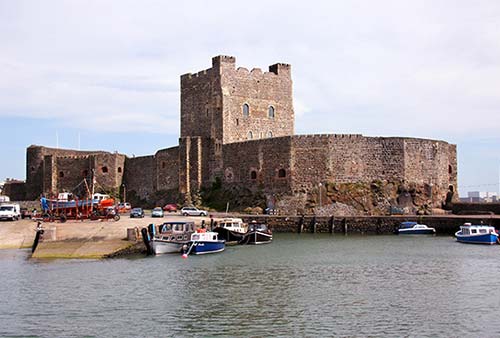
Cost and Hours: £6, Tue-Sun 9:30-17:00, closed Mon, closes earlier Oct-March, +44 28 9335 1273, www.discovernorthernireland.com.
Getting There: By train or by car, it’s about 20 minutes from central Belfast. Take the train toward Larne, get off at Carrickfergus, turn left as you exit the train station, and walk straight downhill for five minutes—all the way to the waterfront—passing under the arch of the old town wall. You can’t miss the castle on your right. Drivers will zip right past the castle along the A-2 coastal road; just look for nearby parking in town.
▲The Gobbins Cliff Path
The Gobbins Cliff Path is an Edwardian-era adventure, replete with birds, beautiful scenery, and occasional rogue waves. Located 20 miles northeast of Belfast, beyond Carrickfergus, this complex path—a mix of tunnel bridges, railings, and steps carved, hammered, or fastened to the cliff—was first opened in 1902, designed to boost tourism. Once popular, it fell into disrepair during World War II and was closed for decades. The recently reinforced path (which, to spoil all the turn-of-the-century fun, now requires helmets and guides) takes two to three hours to hike; it’s awkward and steep in places but not terribly strenuous. You may spot puffins, cormorants, and kittiwakes in nesting areas along the way.
Cost and Hours: £20, visitors center open daily 8:30-17:00, required guided hikes generally run 1-2/hour from 9:30 or 10:00 until 14:30 (weather permitting), book in advance as tours can fill up, path closed Jan-Feb, +44 28 9337 2318, 68 Middle Road, Islandmagee, www.thegobbinscliffpath.com.
Getting There: By car, take A-2 from Belfast to Larne, turn right on B-90, and follow signs to Islandmagee and The Gobbins. Without a car, you can take a train from the Great Victoria Street Station toward Larne. Get off at Ballycarry; the visitors center is a 20-minute signposted walk from there. You can also ride a train (on the Larne line) to Ballycarry, then walk 20 minutes; or take bus #256 to Larne, transfer to bus #170b to Ballystrudder, and walk 15 minutes. Confirm schedules on Translink.co.uk; allow at least 1.5-2 hours if taking public transit.