Sights in Dublin
CENTRAL DUBLIN, SOUTH OF THE LIFFEY
▲▲Trinity College Campus Tour (a.k.a. “Trinity Trails”)
▲▲▲Book of Kells at Trinity College
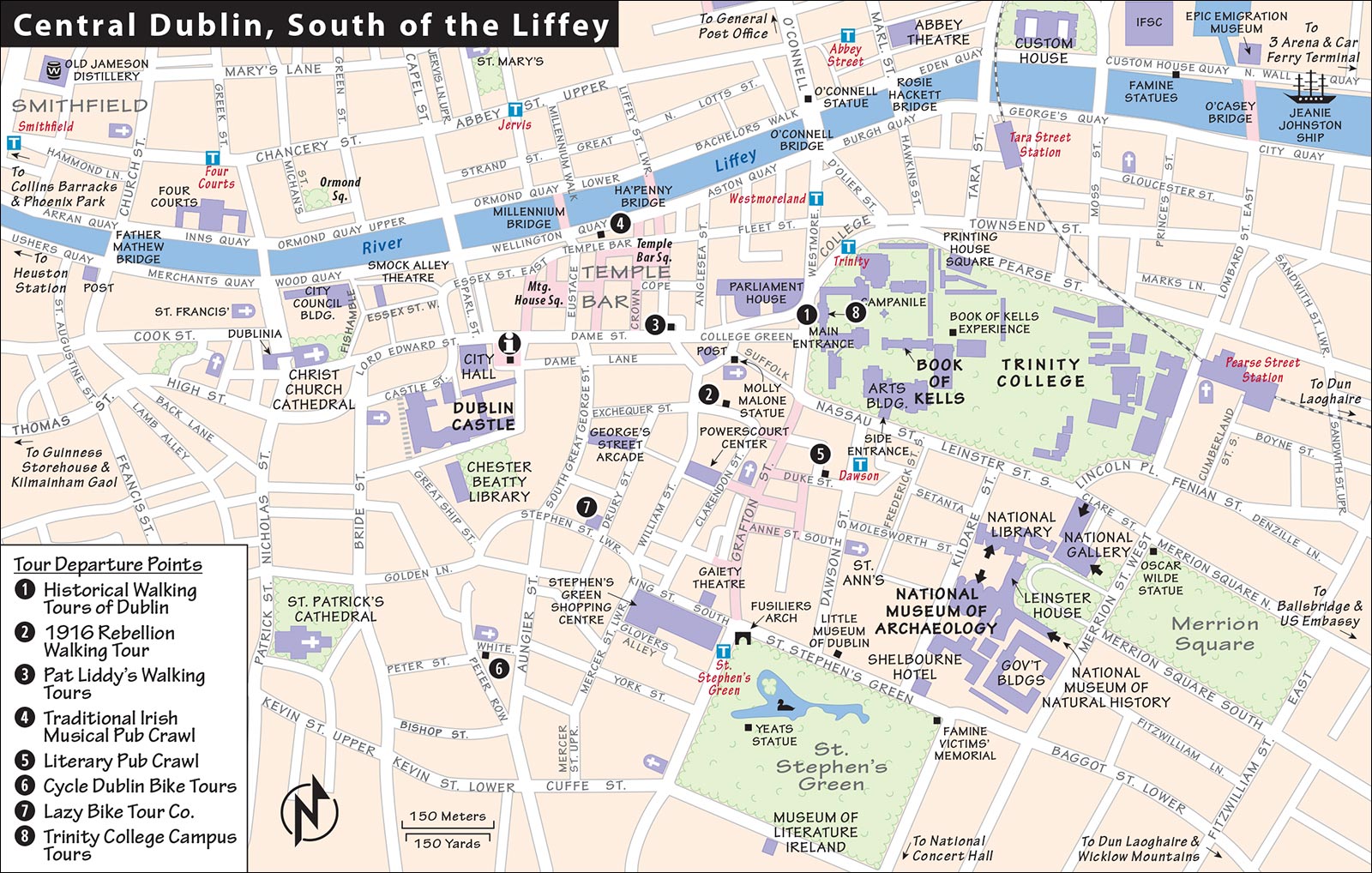
Map: Central Dublin, South of the Liffey
National Museums South of Trinity College
▲▲National Museum of Archaeology
Map: National Museum of Archaeology
National Museum of Natural History
Other Sights South of Trinity College
▲Museum of Literature Ireland (MoLI)
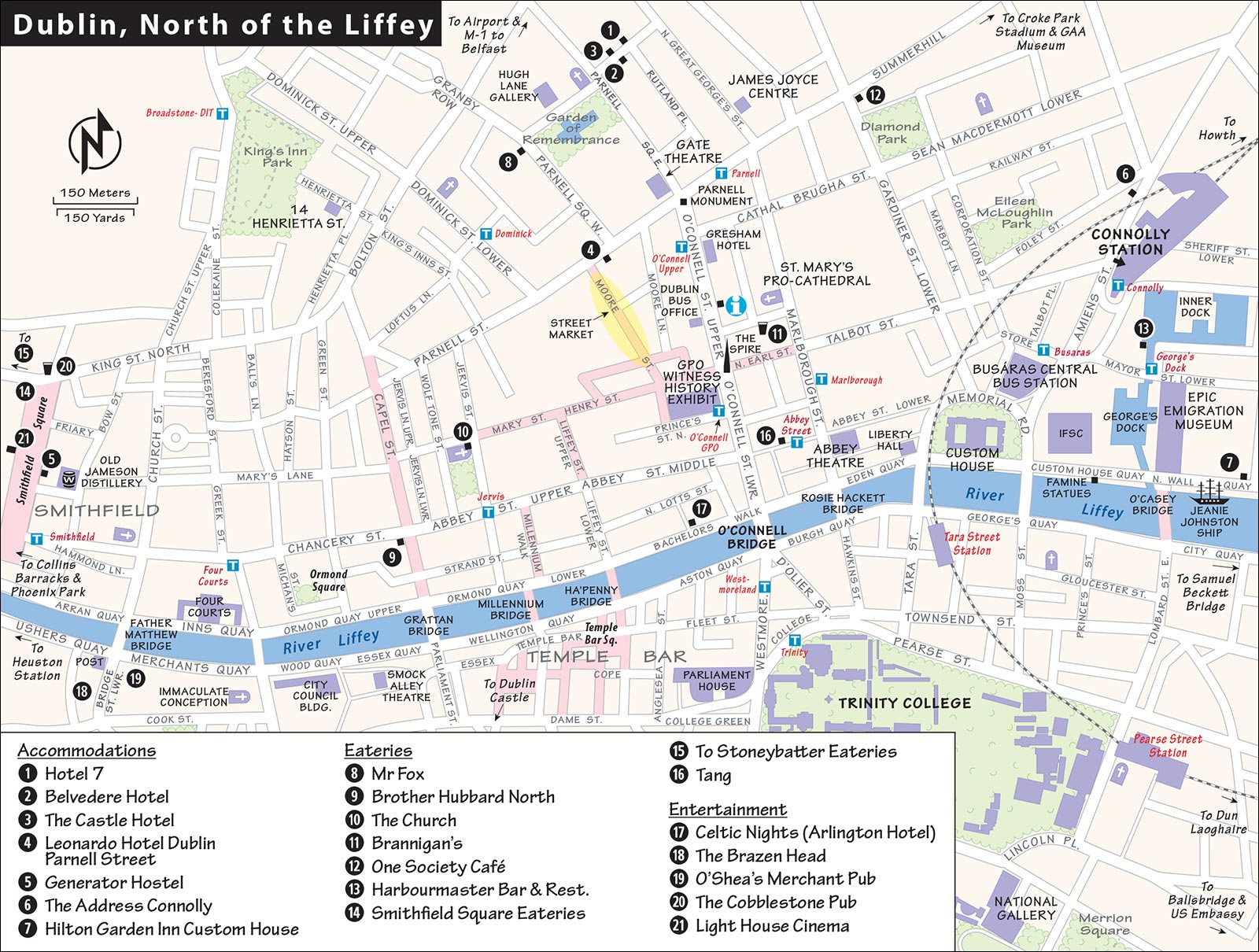
Map: Dublin, North of the Liffey
On the Liffey, East of O’Connell Street
▲▲EPIC: The Irish Emigration Museum
In Smithfield, West of O’Connell Street
Whiskey Distilleries in The Liberties
▲National Museum of Decorative Arts and History
▲Gaelic Athletic Association Museum at Croke Park Stadium
For information on Dublin’s City Hall as well as additional detail on many of the sights described below, see my Dublin City Walk, earlier, or  download my free audio tour.
CENTRAL DUBLIN, SOUTH OF THE LIFFEY
Trinity College
Ireland’s most prestigious college, Trinity originally admitted only rich Protestant men. Women were admitted in 1904, and Catholics—though allowed entrance to the school much earlier—were given formal permission by the Catholic Church to study at Trinity in the 1970s (before that, they risked mortal sin). Today, more than half of Trinity’s 18,000 students are women, and there are Catholic, Jewish, and Muslim student societies on campus. (The college chapel, facing the main square of campus, is decidedly nondenominational.) Notice that on campus, the official blue-and-white signs are bilingual—and Irish comes first.
There are two worthwhile experiences here: a tour of the campus and the Book of Kells exhibit in the library.
▲▲Trinity College Campus Tour (a.k.a. “Trinity Trails”)
These outstanding 45-minute tours, mostly led by students, are an efficient and enjoyable use of your time. In addition to the major landmarks, you’ll go deeper into the campus and see sights such as the Museum Building, elaborately decorated inside and out; the theater, modeled after a prehistoric Irish crannog house; and the grassy pitches—one for rugby, the other for cricket—that stretch toward the eastern end of campus, with its many science facilities. Along the way, your guide presents tales of past and present student life and traditions, notable alumni, a bit of campus gossip, and a ghost story or two. The tour ends at the entrance to the Book of Kells—so it’s smart to book them together (easy to do on their website). After booking, you’re given a time to meet your guide at the Campanile, right in the heart of campus. You can also pay €5 to do a similar tour on your own using an app—but it’s worth the money to have a live guide.
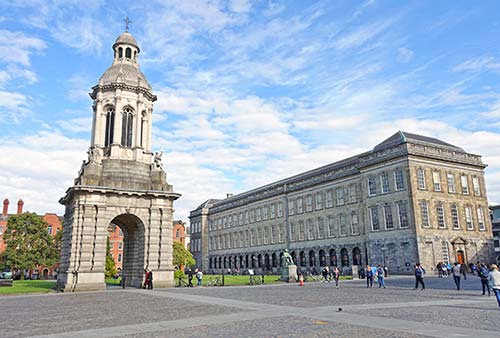
Cost and Hours: €16; tours run 3-6/day, first tour sometime between 8:30 and 10:00, last tour generally at 16:00—check schedule and book online, no tours on Sun in off-season; www.visittrinity.ie/trinity-trails.
▲▲▲Book of Kells at Trinity College
The Book of Kells—a 1,200-year-old manuscript of the four gospels—was elaborately inked and meticulously illustrated by faithful monks. Combining Christian symbols and pagan styles, it’s a snapshot of medieval Ireland in transition. Arguably the finest piece of art from the early Middle Ages (once called the Dark Ages), the Book of Kells shows that monastic life in this far fringe of Europe was far from dark. Your visit to the Book of Kells includes the stunning Old Library—a grand wood-grained hall lined with books and busts of great writers, and a Book of Kells multimedia experience. Taken together, this experience rates as one of Dublin’s best.
Expect Changes: The Old Library and its contents are being restored, book by book—and the library is slated to close for several years beginning in late 2025. (While the library is closed, the Book of Kells will be displayed in Trinity College’s Printing House Square, and the Book of Kells Experience will remain open.) See the official website for the latest.
Cost and Hours: €25, buy timed-entry ticket online in advance (or risk not getting in); Mon-Sat 8:30-19:00, Sun 9:30-18:30, shorter hours off-season; download helpful self-guided audio tour to your phone before your visit (bring earbuds); +353 1 896 2320, www.visittrinity.ie/book-of-kells.
Background: The Book of Kells was a labor of love created by dedicated Irish monks cloistered on the remote Scottish island of Iona. They slaughtered 185 calves, soaked the skins in lime, scraped off the hair, and dried the skins into a cream-colored writing surface called vellum. Only then could the tonsured monks pick up their swan-quill pens and get to work.
The project may have been underway in 806 when Vikings savagely pillaged and burned Iona, killing 68 monks. The survivors fled to the Abbey of Kells (near Dublin). Scholars debate exactly where the book was produced: It could have been made entirely at Iona or at Kells, or started in Iona and finished at Kells.
For eight centuries, the glorious gospel sat regally atop the high altar of the church at Kells, where the priest would read from it during special Masses. In 1654, as Cromwell’s puritanical rule settled in, the book was smuggled to Dublin for safety. Here at Trinity College, it was first displayed to the public in the mid-1800s. In 1953, the book got its current covers and was bound into four separate volumes.
Visiting the Book of Kells: Your visit has three stages: 1) an exhibit on the making of the Book of Kells, including poster-sized reproductions of its pages (your best look at the book’s detail); 2) the Treasury, a darkened room containing the Book of Kells itself and other, less ornate contemporaneous volumes; and, upstairs, 3) the Old Library (called the Long Room), containing a precious collection of 16th- to 18th-century books and historical objects.
The Exhibit: The Turning Darkness into Light exhibit puts the illuminated manuscript in its historical and cultural context. This is important, as it prepares you to see the original Book of Kells in the treasury. Keep an eye out for two small screens (flanking the door to the book itself) that show the ancient art of bookbinding and the exacting care that went into transcribing the monk-uscripts. They vividly depict the skill and patience needed for the monks’ work.
When you’re ready, head through the door marked Treasury to see the book itself.
The Book: The Book of Kells contains the four gospels of the Bible (usually, just one is on display at any given time; the specific pages on view are changed every few weeks). Altogether, the manuscript is 680 pages long (or 340 “folios,” the equivalent of one sheet, front and back). The Latin calligraphy—all in capital letters—follows ruled lines, forming neat horizontal bars across the page. Sentences end with a “period” of three dots.
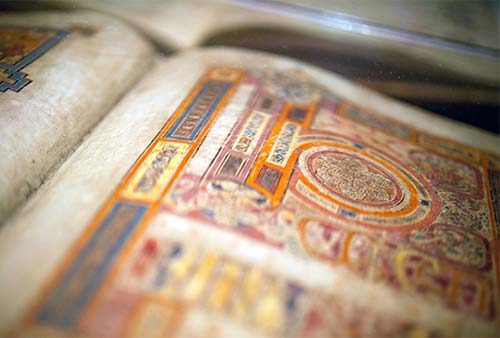
The text is elaborately decorated—of the hundreds of pages, only two are without illustration. Each gospel begins with a full-page depiction of an Evangelist and his symbol: Matthew (angel), Mark (lion), Luke (ox), and John (eagle). The apostles pose stiffly, like Byzantine-style icons, with almond-shaped eyes and symmetrically creased robes. Squint at the amazing detail. The true beauty lies in the intricate designs that surround the figures.
The colorful book employs blue, purple, red, pink, green, and yellow pigments—but no gold leaf. Letters and borders are braided together. On most pages, the initial letters are big and flowery, like in a children’s fairy-tale book.
Notice how the playful monks might cross a “t” with a fish, form an “h” from a spindly-legged man, or make an “e” out of a coiled snake. Animals crouch between sentences. It’s a jungle of intricate designs, inhabited by tiny creatures both real and fanciful.
Scholars think three main artists created the book: the “goldsmith” (who did the filigree-style designs), the “illustrator” (who specialized in animals and grotesques), and the “portrait painter” (who did the Evangelists and Mary).
The Old Library: The Long Room, the 200-foot-long main chamber of the Old Library (from 1732), is stacked to its towering ceiling with books. Lining the room are about 40 marble busts of famous writers, philosophers, and scholars (Shakespeare, Plato, Jonathan Swift). For centuries, the busts represented only men—until 2022, when four women were finally added (near the middle of the hall).
Among the displays here, you’ll find one of a dozen surviving original copies of the 1916 Proclamation of the Irish Republic. Patrick Pearse read out its words at Dublin’s General Post Office on April 24, 1916, starting the Easter Rising that led to Irish independence. Notice the inclusive opening phrase (“Irishmen and Irishwomen”) and the seven signatories (each of whom was later executed).
Another national icon is the oldest surviving Irish harp, from the 15th century. (While often called the Brian Boru harp, it was crafted 400 years after the death of that Irish king.) The brass pins on its oak and willow frame once held 29 strings. In Celtic days, poets—highly influential with kings and druid priests—wandered the land, uniting the people with songs and stories. The harp’s inspirational effect on Gaelic culture was so strong that Queen Elizabeth I (1558-1603) ordered Irish harpists to be hung and their instruments smashed. Even today, the love of music here is so intense that Ireland is the only country with a musical instrument as its national symbol. You’ll see this harp’s likeness on the back of Irish euro coins, on government documents, and on every pint of Guinness—though attentive beer lovers may notice that the Guinness harp is reversed from the Irish one (and the Guinness one came first).
Stairs near the end of the Old Library lead down to the gift shop and exit.
Book of Kells Experience: This 360-degree immersive show illuminates the library restoration and shows the Book of Kells in high-tech detail. You’ll find it in a giant red box in New Square, just beyond the right end of the Old Library.
National Museums South of Trinity College
A number of national museums cluster just south of Trinity College near Leinster House, once the home of the Duke of Leinster and now hosting the Irish Dáil (parliament) and Seanad (senate).
▲▲National Museum of Archaeology
Showing off the treasures of Ireland from the Stone Age to modern times, this branch of the National Museum is itself a national treasure. The soggy marshes and peat bogs of Ireland have proven perfect for preserving old objects. You’ll see 4,000-year-old gold jewelry, 2,000-year-old bog mummies, 1,000-year-old Viking swords, and the collection’s superstar: the exquisitely wrought Tara Brooch. Visit here to get an introduction to the rest of Ireland’s historic attractions; you’ll find a reconstructed passage tomb like the one at Newgrange, Celtic art like the Book of Kells, Viking objects from Dublin, a model of the Hill of Tara, and a sacred cross from the Cong Abbey. Hit the highlights of my tour, then browse the exhibits at will, all well described throughout.
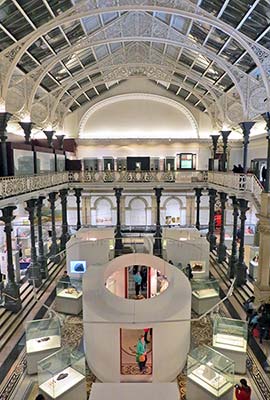
Cost and Hours: Free, €5 suggested donation; Tue-Sat 10:00-17:00, Sun-Mon from 13:00; between Trinity College and St. Stephen’s Green on Kildare Street, +353 1 677 7444, www.museum.ie.
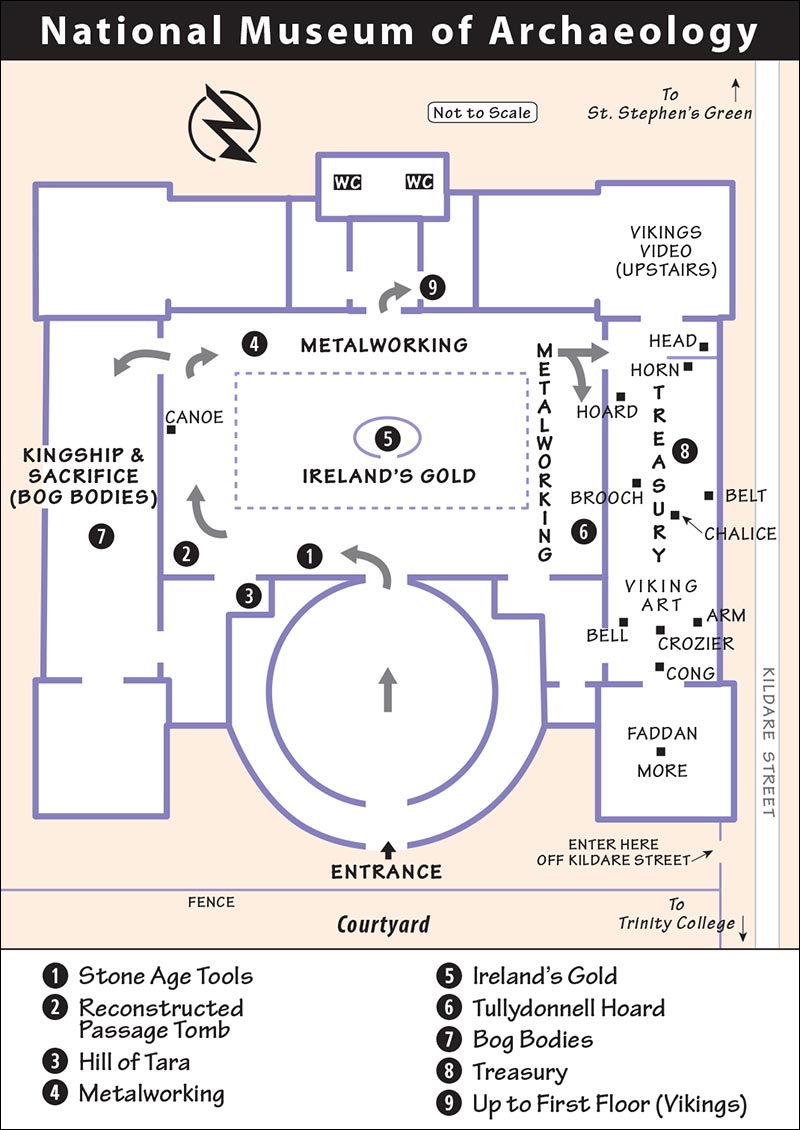
 Self-Guided Tour: Enter under the grand rotunda and head straight into the main hall. Get oriented: In the center (down four steps) are displays of prehistoric gold jewelry. To the left are the bog bodies, to the right is the Treasury room, and upstairs is the Viking world.
• Let’s start at the very beginning. From the main hall, turn left (without going down the stairs) and look for the...
1 Stone Age Tools: Glass cases hold flint and stone ax-heads and arrowheads (7000 BC). Ireland’s first inhabitants—hunters and fishers who came from today’s Scotland—used these tools. These early people also left behind standing stones (dolmens) and passage tombs.
• At the corner of the room, you’ll see a...
2 Reconstructed Passage Tomb: This is a typical tomb circa 3000 BC—a mound-shaped, heavy stone structure, covered with smaller rocks, with a passage leading into a central burial chamber where the deceased’s ashes were interred. The vast passage tombs at Newgrange and Knowth are similar, but many times bigger.
• In the smaller room to the left of the passage tomb is a gallery devoted to the...
3 Hill of Tara: The famous passage-tomb burial site at Tara, known as the Mound of the Hostages, was used for more than 1,500 years as a place to inter human remains. The cases in this side gallery display some of the many exceptional Neolithic and Bronze Age finds uncovered at the site.
Over the millennia, the mound became the very symbol of Irish heritage. This is where Ireland’s kings claimed their power, where St. Patrick preached his deal-clinching sermon, and where, in 1843, Daniel O’Connell rallied Irish patriots to demand their independence from Britain (see illustration in the small poster on the left wall).
• Back in the big room, jog left, then walk straight along the length of a 50-foot-long dugout canoe, from centuries before Christ and pickled in a bog. Then turn right.
4 The Evolution of Metalworking: Around 2500 BC, Ireland discovered how to make metal—mining ore, smelting it in furnaces, and casting or hammering it into shapes. The rest is prehistory. You’ll travel through the Bronze Age (ax-heads from 2000 BC) and Iron Age (500 BC) as you examine assorted spears, shields, swords, and war horns. The cauldrons made for everyday cooking were also used ceremonially to prepare elaborate ritual feasts for friends and symbolic offerings for the gods.
• The most impressive metal objects are four steps down in the center of the hall. Visit the square room at the left end of the lowest level.
5 Ireland’s Gold: Ireland had only modest gold deposits, mainly gathered by prehistoric people panning for small nuggets and dust in the rivers. But the jewelry they left, some of it more than 4,000 years old, is exquisite. The earliest fashion choice was a broad necklace hammered flat (a lunula, so called for its crescent-moon shape). This might be worn with accompanying earrings and sun-disc brooches. The Gleninsheen Collar (c. 700 BC) was found in 1932 by a farmer in one of the characteristic limestone crevices of the Burren region of County Clare. It’s thought that this valuable status symbol was hidden there during a time of conflict, then forgotten (or its owner killed); an offering to a pagan god would more likely have been left in a body of water (the portal to the underworld).
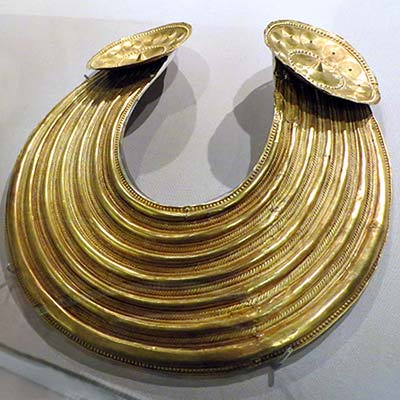
Later Bronze Age jewelry was cast from clay molds into bracelets and unique “dress fasteners” that you’d slip into buttonholes to secure a cloak. Some of these gold objects may have been gifts to fertility gods, offered by burying them in marshy bogs.
• Back up the stairs, in the corner near the main entry, look for the 6 Tullydonnell Hoard, discovered in Donegal in 2018. The four heavy gold rings, from about 1000 BC, weigh about two pounds each and are very plain. They likely were just a way to store one’s wealth in the days before someone thought of coins and banks.
Return to the long dugout canoe to enter the Kinship & Sacrifice room containing...
7 Bog Bodies: When the Celts arrived in Ireland (c. 500 BC-AD 500), they brought with them a mysterious practice: They brutally murdered sacrificial slaves or prisoners and buried them in bogs. Four bodies (each in its own tiny theater with a description outside)—shriveled and leathery, but remarkably preserved—have been dug up from around the Celtic world. Some features are still intact enough to make them disturbing to view.
For example, Clonycavan Man (in the second room) is from Ireland. One summer day around 200 BC, this twenty-something man was hacked to death with an ax and disemboweled. In his time, he stood 5'9" and had a Mohawk-style haircut, poofed up with pine-resin hair product imported from France. Today you can still see traces of his hair. Only his upper body survived; the lower part may have been lost in the threshing machine that unearthed him in 2003.
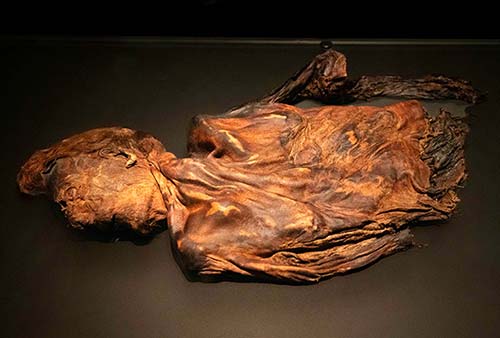
Why were these people killed? It appears to have been a form of ritual human sacrifice of high-status people. Some may have been enemy chiefs or political rivals. The sacrifices could have been offerings to the gods to ensure rich harvests and good luck. Other items (now on display) were buried along with them—gold bracelets, royal cloaks, finely wrought cauldrons, and leather garments.
• Head across the main room again to enter the...
8 Treasury: Irish metalworking is legendary, and this room holds 1,500 years of exquisite treasures. Working from one end of the long room to the other, you’ll journey from the world of the pagan Celts to the coming of Christianity, explore the stylistic impact of the Viking invasions (9th-12th century), and consider the resurgence of ecclesiastical metalworking (11th-12th century).
Pagan-Era Art: The carved stone head of a mysterious pagan god greets you (#19, circa AD 100). The god’s three faces express the different aspects of his stony personality. This abstract style—typical of Celtic art—would be at home in a modern art museum. A bronze horn (#17, behind the nearby panel; first century BC) is the kind of curved war trumpet that Celts blasted to freak out the Roman legions on the Continent (the Romans never invaded Ireland). The fine objects of the Broighter Hoard (#15, across the hall; first century BC) include a king’s golden collar decorated in textbook Celtic style, with interlaced vines inhabited by stylized faces. The tiny boat was an offering to the sea god. The coconut-shell-shaped bowl symbolized a cauldron. By custom, the cauldron held food as a constant offering to Danu, the Celtic mother goddess, whose mythical palace was at Brú na Bóinne.
Early-Christian Objects: Christianity officially entered Ireland in the fifth century (when St. Patrick converted the pagan king), but Celtic legends and art continued well into the Christian era. You’ll see various crosses, portable shrines (reliquaries) containing holy relics, and chalices decorated with Celtic motifs. The Belt Shrine (#32, along the left wall)—a circular metal casing that held a saint’s leather belt—was thought to have magical properties. When placed around someone’s waist, it could heal the wearer or force him or her to tell the truth.
The Ardagh Chalice (#30, middle of hall) and the nearby Silver Paten (#31, just to the left) were used during Communion to hold blessed wine and bread. Get close to admire the elaborate workmanship. The main bowl of the chalice is gilded bronze, with a contrasting band of intricately patterned gold filigree. It’s studded with colorful glass, amber, and enamels. Mirrors below the display case show that even the underside of the chalice was decorated. When the priest grabbed the chalice by its two handles and tipped it to his lips, the base could be admired by God.
Tara Brooch: A wealthy eighth-century Celtic man fastened his cloak at the shoulder with this elaborate ring-shaped brooch (#29, on the right), its seven-inch stickpin tilted rakishly upward. Made of cast and gilded silver, it’s ornamented with fine, exquisitely filigreed gold panels and studded with amber, enamel, and colored glass. The motifs include Celtic spirals, snakes, and stylized faces, but the symbolism is neither overtly pagan nor Christian—it’s art for art’s sake. Despite its name, the brooch probably has no connection to the Hill of Tara. In display cases nearby, you’ll see other similar (but less impressive) brooches from the same period—some iron, some bronze, and one in pure gold. In the designs of this elaborate metalwork you can see the Celtic aesthetics that inspired the illuminations of the Book of Kells.
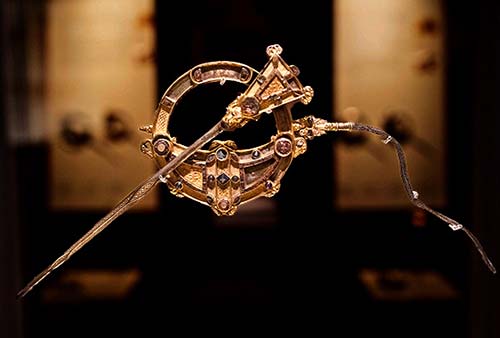
Viking Art Styles: Vikings invaded Dublin around AD 840. As Vikings did, they raped and pillaged. But they also opened Ireland to a vast and cosmopolitan trading empire, from which they imported hordes of silver. Viking influence shows up in the decorative style of reliquaries like the Lismore Crozier (#43, near the end of the hall on the left; it’s in the shape of a bishop’s ceremonial shepherd’s crook) and the Shrine of St. Lachtin’s Arm (raised in an Irish-power salute). The impressive Bell of St. Patrick (#24, across the hall on the right) was supposedly owned by Ireland’s patron saint. After his death, it was encased within a beautifully worked shrine (displayed above) and kept safe by a single family, who passed it down from generation to generation for 800 years.
Cross of Cong: “By this cross is covered the cross on which the Creator of the world suffered.” Running along the sides of the cross (#44, very end of hall), a Latin inscription tells us that it once held a sacred relic, a tiny splinter of the True Cross on which Jesus was crucified. That piece of wood (now lost) had been given in 1123 to the Irish high king, who commissioned this reliquary to preserve the splinter (it would have been placed right in the center, visible through the large piece of rock crystal). Every Christmas and Easter, the cross was fitted onto a staff and paraded through the abbey at Cong, then placed on the altar for High Mass. The extraordinarily detailed decoration features gold filigree interspersed with colored glass, enamel, and (now missing) precious stones. Though fully Christian, the cross has Celtic-style filigree patterning and Viking-style animal heads (notice how they grip the cross in their jaws).
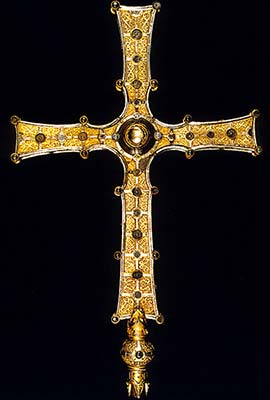
Before leaving the Treasury, enter the room behind the Cross of Cong and check out the Faddan More Psalter—a (pretty beat-up) manuscript of the Book of Psalms from the same era as the Book of Kells.
• Now head up to the first floor to the Viking world. Start in the long hall directly above the Treasury, with the informative 25-minute video on the Viking influence on Irish culture.
9 Viking Ireland (c. 800-1150): Dublin was born as a Viking town. Sometime in the ninth century, Scandinavian warriors rowed their longships up the River Liffey and made camp on the south bank, around the location of today’s Dublin Castle and Christ Church Cathedral. Over the next two centuries, they built “Dubh linn” (“black pool” in Irish) into an important trading post, slave market, metalworking center, and the first true city in Ireland. (See a model of Dublin showing a recently excavated area near Kilmainham Gaol.)
The state-of-the-art Viking boats worked equally well in the open ocean and shallow rivers, and were perfect for stealth invasions and far-ranging trading. Soon, provincial Dublin was connected with the wider world—Scotland, England, northern Europe, and even Asia. The museum’s displays of swords and spears make it clear that, yes, the Vikings were fierce warriors. But you’ll also see that they were respected merchants (standardized weights and coins), herders and craftsmen (leather shoes and bags), fashion-conscious (bone combs and jewelry), fun-loving (board games), and literate (runic alphabet). What you won’t see are horned helmets, which, despite the stereotype, are not Viking. By 1050, the pagan Vikings had intermarried with the locals, become Christian, and were melting into Irish society.
• With time and interest, you could explore the...
Rest of the Museum: You’ll find exhibits dedicated to medieval Ireland, with items from daily life (ploughs, cauldrons), trade (coins, pottery), and religion (crucifixes, saints). The Egyptian room has coffins, shabtis, and canopic jars—but no mummies.
National Gallery of Ireland
Big and modern, but with a collection that’s underwhelming for a national gallery, this museum features a wide range of works by European masters, as well as Irish painters and frequent special exhibits (which are often better than the permanent collection).
Cost and Hours: Free, some special exhibits cost extra; Sun-Mon 11:00-17:30, Tue-Sat 9:15-17:30, Thu until 20:30; café, Merrion Square West, +353 1 661 5133, www.nationalgallery.ie.
Tours: Take advantage of the free audio descriptions of select paintings in the gallery (stream them on your phone; bring earbuds). There are also free 45-minute guided tours (usually Sat-Sun, occasionally on weekdays—check online or at main information desk for times).
Visiting the Museum: The museum is huge, with several interconnected wings, and challenging to navigate; pick up a floor plan as you enter. There are two entrances—from Clare Street (modern entry into the Millennium Wing, where the shop and café are), and the original Merrion Square entrance, where we’ll start. From here, you’ll enter near a series of ground-floor rooms devoted to Irish painting. Perhaps the most iconic Irish work you’ll see—in the grand, chandeliered Shaw Room (to the left as you enter the museum)—is the huge, melodramatic depiction of the Marriage of Strongbow and Aiofe by Daniel Maclise (c. 1854). It captures the chaotic union of Norman and Irish interests that signaled the start of English domination of Ireland 850 years ago. Notice how the defeated Irish writhe and lament in the bright light of the foreground, while the scheming Norman warlords skulk in the dimly lit middle ground. The ruins of conquered Waterford smolder at the back.
Explore the rest of the Irish collection. Room 14 (near the entry desk) is devoted to the works of Jack B. Yeats (brother of the famous poet).
Then head into the rest of the museum. Lesser works by great European masters are on floor 2. Seek out the rare Vermeer in Room 38 (one of only 30-some known works by the Dutch artist): Woman Writing a Letter, with Her Maid (c. 1670). While the noblewoman is distracted, her maid glances out the window, momentarily lost in happy thoughts. There’s also a classic Caravaggio (master of chiaroscuro and dramatic lighting): The Taking of Christ (c. 1602, in Room 25). In the modern Millennium wing (floor 1, Rooms 1-5), you’ll find works by big-name Modernists, including Picasso’s Still Life with Mandolin (1924), Cézanne’s Life in the Fields (1876-1877), and small works by Renoir, Monet, Van Gogh, and others.
National Museum of Natural History
Nicknamed “the dead zoo” by Dubliners, this cramped collection of stuffed exotic animals comes across like the locker room on Noah’s Ark. But if you’re into beaks, bones, bugs, and boars, this Victorian relic is for you—and it’s small, free, and quick and easy to see. Standing tall above a sea of taxidermy are the regal skeletons of two giant Irish deer from the last Ice Age.
Cost and Hours: Free, Tue-Sat 10:00-17:00, Sun-Mon from 13:00, Merrion Square West, +353 1 677 7444, www.museum.ie.
National Library of Ireland
Literature holds a lofty place in the Irish psyche. To feel the pulse of Ireland’s most influential poet, visit the W. B. Yeats exhibit in the library basement. The artifacts flesh out the very human passions of this poet and playwright, with samples of his handwritten manuscripts and surprisingly interesting mini documentaries of the times he lived in. (To access the rest of the library, including the reading rooms and family history research room, you need to apply for a membership, a.k.a. a Reader’s Ticket.)
Cost and Hours: Free; exhibit open daily 9:30-17:00, Tue-Wed until 19:00, different hours for Reader’s Ticket access—check online; +353 1 603 0200, facing the National Museum of Archaeology entrance at 2 Kildare Street, www.nli.ie.
Other Sights South of Trinity College
The Museum of Literature Ireland and the Little Museum of Dublin are on opposite sides of St. Stephen’s Green. Merrion Square is farther east.
▲Museum of Literature Ireland (MoLI)
Facing the south side of St. Stephen’s Green, the Museum of Literature Ireland (MoLI) celebrates famous Irish writers and introduces contemporary ones. Exhibits inhabit three levels of a 1765 Georgian building, once the home of the Catholic University of Ireland (the predecessor to University College Dublin). While devoted to Irish literature generally, the museum is especially heavy on James Joyce, who attended school in this building. (In fact, the acronym “MoLI” is a play on Molly Bloom—one of the protagonists of Ulysses.)
Cost and Hours: €13.50, Tue-Sun 10:00-18:00, closed Mon, last entry one hour before closing, admission includes one-hour guided tour—departs about hourly, gardens, café, 86 St. Stephen’s Green, +353 1 716 5900, https://moli.ie.
Visiting the Museum: The slick, modern exhibit fills several floors, focusing on the state of Irish writing during the early part of the 20th century (a particularly complex time in Irish history). On the ground floor, one exhibit explores the flowing language of Joyce’s Finnegans Wake, while another displays a model of Dublin, marking spots featured in his books and a timeline of his life. Upstairs exhibits highlight other Irish writers and Dublin’s literary connections to Edinburgh, Scotland. On the top floor is a treasure trove of Joyce’s handwritten notebooks, and—the museum’s prize piece—what they call “Copy No. 1” of Ulysses, the very first issue of the first printing that rolled off the press. There’s also a fine garden out back, delightful to wander and ponder the staggering contribution of this little island to global literature.
Little Museum of Dublin
Located on the north side of St. Stephen’s Green, this endearing, pint-sized museum—just five rooms in a Georgian mansion from 1776—is a creative labor of love focusing on recent Irish history and pop culture. Volunteers have covered its walls with historic bits and pieces of Dublin history, all donated by locals.
Cost and Hours: €15 includes 30-minute tour, book online in advance during busy times, daily 10:00-17:00, tours depart 1-2/hour, last tour at 16:00, 15 St. Stephen’s Green, +353 1 661 1000, www.littlemuseum.ie.
Visiting the Museum: Your visit includes an entertaining 30-minute talk through two rooms covering 20th-century Dublin history. You can explore the rest of the museum on your own, with exhibits on Georgian Dublin, Irish rock ’n’ roll (great for U2 fans), and a rotating exhibit. Memorabilia ranges from historic letters written by Irish nationalists Éamon de Valera and Michael Collins to mementos of John F. Kennedy’s 1963 Dublin visit and Muhammad Ali’s 1972 fight against Al Lewis in Croke Park.
Park Tours: Little Museum also offers “Green Mile” tours of St. Stephen’s Green, across the street (€15, schedule varies—see website, book online in advance).
Merrion Square
Laid out in 1762, this square just east of the National Gallery is ringed by elegant Georgian houses decorated with fine doors—a Dublin trademark. The park, once the exclusive domain of the residents (among them, Daniel O’Connell at #58 and W. B. Yeats at #82), is now a delightful public escape and ideal for a picnic. Oscar Wilde, lounging wittily on a boulder in the northwest corner (nearest the town center) and surrounded by pillars etched with his clever quotes, provides a fun photo op.
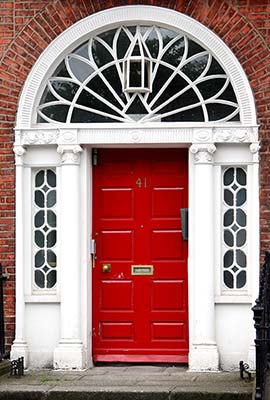
Dublin Castle and Nearby
▲Dublin Castle
Built on the spot of Dublin’s first Viking fortress, this castle was the seat of English rule in Ireland for 700 years. Located where the Poddle and Liffey rivers flowed together, making a black pool (dubh linn in Irish), Dublin Castle was the official residence of the viceroy who implemented the will of British royalty. What you see today is the stately Georgian version, built in the late 17th and 18th centuries on top of the old medieval castle (little of which can still be recognized beyond one remaining round turret). In this stirring setting, the Brits handed power over to Michael Collins and the Irish in 1922, as stipulated by the Anglo-Irish Treaty. Today, the castle is used for fancy state dinners, charity functions, and presidential inaugurations.
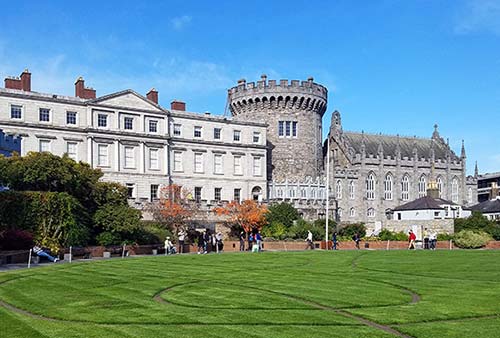
If visiting on your own, you can walk through the lavish state apartments of this most English of Irish palaces. With a tour, you also get a look at the Chapel Royal and the medieval undercroft, where you’ll see the foundations of the old English tower (from 1204), original Viking defenses, and the best remaining chunk of the 13th-century town wall.
Dublin in the 1700s, grown rich from a lucrative cloth trade, was one of Europe’s most cultured and sophisticated cities. The buildings were decorated in the Georgian style still visible today, and the city’s Protestant elite shuttled between here and London, bridging the Anglo-Irish cultural gap. Jonathan Swift was the era’s greatest Anglo-Irish writer—a brilliant satirist and author of Gulliver’s Travels (1726). He was also dean of St. Patrick’s Cathedral (1713-1745) and one of the city’s eminent citizens.
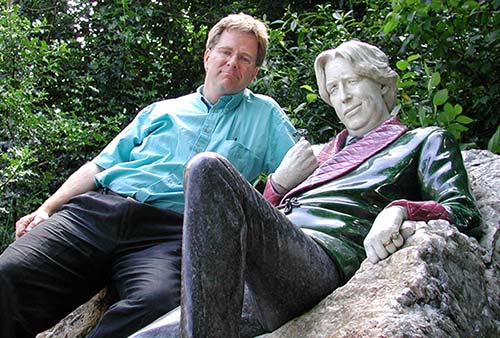
Around the turn of the 20th century, Dublin produced some of the world’s great modern writers. Bram Stoker was the creator of Dracula. Oscar Wilde penned The Picture of Dorian Gray and a clutch of fine plays. George Bernard Shaw wrote Pygmalion, Major Barbara, Man and Superman, and a host of other dramas. William Butler Yeats was a prolific poet and playwright of Irish themes. And James Joyce whipped up a masterpiece called Ulysses, not to mention Dubliners and Finnegans Wake.
To dip your toe into the occasionally unfathomable depths of classic Irish lit, drop by the tiny Sweny’s Pharmacy for one of its readings from Ulysses or other works by Joyce. This shrine for devotees of Joyce is a time capsule, looking just as the writer described it in his novel more than a hundred years ago. The text is passed around for all to read a section aloud. Even if you don’t understand its obscure local references, appreciate the rhythm of its stream-of-consciousness verbal flow…and buy a bar of lemon soap on your way out (check schedule at www.sweny.ie, sometimes read in other languages, 1 Lincoln Place between Trinity College and Merrion Square).
Cost and Hours: Visiting the courtyard is free (and described on here of my Dublin City Walk), €12 for one-hour guided tour, €8 to visit on your own (state apartments only); daily 9:45-17:15; tours—about 8/day, first and last tours generally at 10:00 and 16:00; sporadically closed for private events, tickets sold under portico opposite clock tower, +353 1 645 8813, www.dublincastle.ie.
▲▲Chester Beatty Library
This library—located in the gardens of Dublin Castle—is an exquisite, delightfully displayed collection of rare ancient manuscripts and beautifully illustrated books from around the world, plus a few odd curios. These treasures were bequeathed by Alfred Chester Beatty (1875-1968), a rich American mining magnate who traveled widely, collected 66,000 objects assiduously, and retired in Ireland.
Cost and Hours: Free, €5 suggested donation; Mon-Sat 9:45-17:30, Wed until 20:00, Sun from 12:00, Nov-Feb closed Mon; download free audioguide app; free one-hour guided tours on Wed, Sat, and Sun; recommended Silk Road Café, lockers, +353 1 407 0750, www.cbl.ie.
Getting There: It’s tucked behind Dublin Castle—as you face the castle’s entry ramp, circle around the left side to find the library and gardens across the street.
Visiting the Museum: The museum is on three floors, with the café and shop on the ground floor. Before exploring, watch the 10-minute film about Beatty. Then head upstairs to see the treasures he left to his adopted country.
I’ve described the exhibits starting two floors up, on the second floor. Note that exhibits rotate, so some of the items I mention may not be on display.
Sacred Traditions Gallery (Second Floor): This space is dedicated to sacred texts, illuminated manuscripts, and miniature paintings from around the world. The doors swing open, and you’re greeted by a video highlighting a diverse array of religious rites—a Christian wedding, Muslims kneeling for prayer, whirling dervishes, and so on. The left side of the gallery is dedicated to Christianity, in the center is Islam, and to the right is East Asian religions.
Christianity: Go to the left end of the first hall. In the 1930s, Beatty acquired 1,800-year-old Early Christian Biblical Papyri, which had recently been unearthed in Egypt. The Indiana Jones-like discovery of these Old and New Testament texts instantly bumped scholars’ knowledge of the early Bible up a notch. Written in Greek on papyrus more than a century before previously known documents, these are some of the oldest versions of these texts in existence. Unlike most early-Christian texts, the manuscripts were not rolled up in a scroll but bound in a book form called a “codex.” On display you may see pages from a third-century Gospel of Luke or the Gospel of John (c. AD 150-200). Jesus died around AD 33, and his words weren’t recorded until decades later. Most early manuscripts date from the fourth century, so these pages are about as close to the source as you can get.
Among the rarest of the discoveries were the Letters (Epistles) of Paul. The Beatty has a near-complete collection (112 pages) of Saint Paul’s letters (AD 180-200)—though only a few, if any, of these precious and incredibly fragile items are on display. Paul, a Roman citizen (c. AD 5-67), was the apostle most responsible for spreading Christianity beyond Palestine. Originally, Paul reviled Christians. But after a mystical experience, he went on to travel the known world, preaching the Good News in sophisticated Athens and the greatest city in the world, Rome, where he died a martyr to the cause. Along the way, he kept in touch with Christian congregations in cities like Corinth, Ephesus, and Rome with these letters.
Other items you may see include gloriously illustrated medieval Bibles and prayer books, such as an intricate, colorful, gold-speckled Book of Hours (1408).
Islam: Muslims believe that the angel Gabriel visited Muhammad (c. 570-632), instructing him to write down his heavenly visions in a book—the Quran. You’ll see Qurans with elaborate calligraphy and other sacred Islamic texts, some of which are beautifully illustrated. Find the rare illuminated manuscript of the biography of Muhammad (c. 1595), produced in Istanbul for an Ottoman sultan.
East Asian Religions: Various statues of Buddha, along with Chinese and Japanese Buddhist scrolls, attest to the pervasive influence of this wise man. Buddha was born in India, but his philosophy spread to China, Japan, and Tibet (see the mandalas). You’ll also see writings from India, the land of a million gods and the cradle of Buddhism, Hinduism, Sikhism, and Jainism.
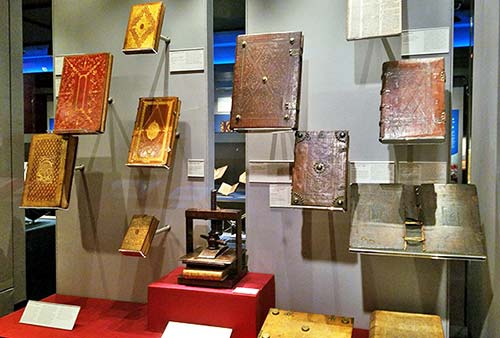
Arts of the Book (First Floor): The focus here is on the many forms a “book” can take—from the earliest clay tablets and papyrus scrolls, to parchment scrolls and bound codices, to medieval monks’ wondrous illustrations, to the advent of printing and bookbinding. To the left is a section on Europe, the center is dedicated to Islam, and the Far East is covered in the area to the right.
Europe: Start with the cases on Egyptian and other ancient writings. Look for various papyrus scrolls (c. 300-100 BC)—some covered in hieroglyphs. For example, you may see a scroll from the Book of the Dead depicting a pharaoh on his throne presiding over a soul’s judgment in the afterlife. The jackal-headed god Anubis holds a scale, weighing the heart of a dead woman to see if it’s light enough for her to level up to the next phase of eternity. Another case shows off small cuneiform tablets and cylinder seals from as far back as 2500 BC. These objects from ancient Mesopotamia are older than the pyramids and represent the very birth of writing.
This section also includes displays illustrating the evolution of bookbinding and printing. The collection shows off some of the earliest surviving bindings, as well as diverse bindings through the centuries. The printing press with movable type was perfected by Johannes Gutenberg in Germany around 1450. The printed sheets were folded, sewn together, and wrapped in a cover. With the engraving process, beautiful illustrations could also be reproduced on a mass scale. Until the 20th century, it was common for a book buyer to acquire the printed sheets and then select a lavish custom-made cover. Beatty had a special interest in northern European prints, especially the work of German Albrecht Dürer, one of the earliest artists to use printing (both woodcut and engraving) to tell a story. The library usually displays several Dürer prints.
Islamic World: Books and folios from the rich Persian culture include many secular texts, such as scientific texts and poetry. Some are richly illustrated and have elaborate calligraphy (in Arabic, Persian, or Turkish).
Imperial works from Ottoman Turkey and paintings from 17th-century Mughal India show how later Muslim dynasties continued the tradition of book art.
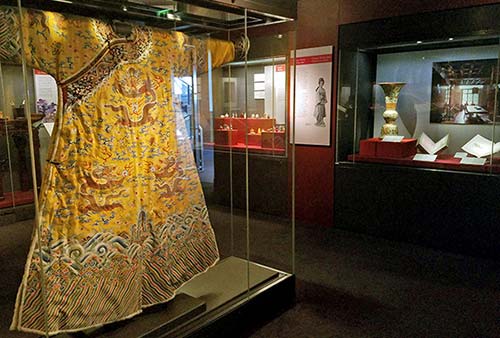
Far East: This section highlights albums, scrolls, and decorative arts from China, Japan, and southeast Asia. From Japan, look for religious scrolls and eye-catching woodblock prints. From China, you might see a silk dragon robe of an emperor from the Qing dynasty (1644-1911), ornate snuff bottles, and rare jade books. The Qianlong emperor (r. 1736-1795)—a poet and arts patron—welcomed European Jesuits to his court and commissioned a huge collection of books, including some carved from jade. You also may see one of the few surviving volumes of a 16th-century copy of the Yongle Encyclopedia. Originally produced in the early 15th century, the encyclopedia was commissioned by the Yongle emperor to copy and collect all knowledge—from religion and philosophy to science and history—in one place.
Nearby: While here, if the weather’s fine, take a few moments to stroll around the castle gardens just outside the library’s door.
▲Temple Bar
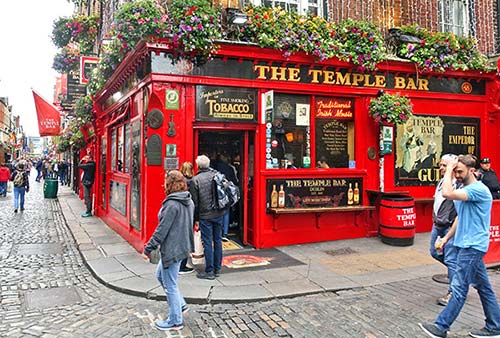
This much-promoted area on the south bank of the Liffey (northeast of Dublin Castle) fills the cobbled streets between Dame Street and the river. It’s a thriving hub with shops, eateries, theaters, galleries, and pubs with live music. But it’s also grotesquely touristy, jammed with drunk and rambunctious people who come here from all over the world to party. If you want to check it out before the scene gets too rowdy, go in the day or the early evening. (For a more detailed description of this area, see here of my Dublin City Walk. For suggestions on eating and listening to music here, see here and here.)
Dublin’s Cathedrals Area
Because of Dublin’s English past (particularly Henry VIII’s Reformation, and the dissolution of the Catholic monasteries in both Ireland and England in 1539), the city’s top two churches are no longer Catholic. Christ Church Cathedral and nearby St. Patrick’s Cathedral are both Church of Ireland (Anglican). In the late 19th century, the cathedrals underwent extensive restoration. The rich Guinness brewery family paid to try to make St. Patrick’s Cathedral outshine Christ Church—whose patrons were a rival family of wealthy whiskey barons.
▲Christ Church Cathedral
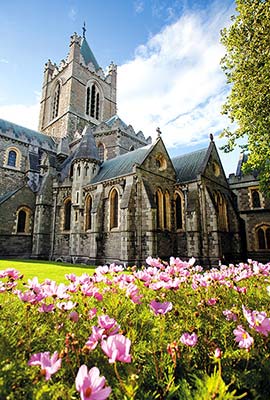
Occupying the same site as the first wooden church built on this spot by the Christianized Viking chieftain Sitric Silkenbeard (c. 1030), the present structure is a mix of periods: Norman and Gothic, but mostly Victorian Neo-Gothic from the 1870s. While lightweight by European cathedral standards, the Victorian redo is pleasant, cheery, and airy.
Cost and Hours: €10.50, includes audioguide and crypt exhibition, €21 combo-ticket with Dublinia (described next); Mon-Sat 10:00-18:00, Sun 13:00-15:00 & 16:30-18:00, last entry 45 minutes before closing; occasional closures for special events; +353 1 677 8099, www.christchurchcathedral.ie.
Church Services and Evensong: There’s a full Anglican service Sun at 11:00, and the public is welcome to a 35-minute evensong service, sung by the esteemed Christ Church choir (Tue and Thu at 18:00, Sun at 15:30).
Connecting Dublinia to the Cathedral: Note that if visiting both sights, you should do Dublinia first—the exit from that exhibit (on the top floor) puts you onto a stone skybridge that leads directly to the entry of Christ Church Cathedral (doesn’t work in the other direction).
Visiting the Cathedral: Entering, take in the Victorian faux-medieval features. The cathedral’s hallmark is the motif in the floor tiles of foxes dressed as pilgrims—nicknamed the “foxy friars.” Walking down the nave, watch on your right for the tomb of Strongbow, the Norman warlord who helped conquer Ireland, leading to centuries of British domination. (While he was buried here in 1176, this stone is an anatomically distorted, well-worn, 14th-century replacement.) Then approach the choir—the enclosed space in front of the altar—with a stone-carved screen and (inside) the giant wood-carved seat for the archbishop. To the left in the apse, a chapel contains the heart of St. Laurence, Dublin’s patron saint. Circling around in the cathedral’s far-right corner, they’ve consolidated all surviving medieval tiles into the floor of a single chapel.
From the south (right) transept, stairs lead down into the crypt—considered the oldest structure in town. Running the entire length of the church (with a forest of stout supporting columns), it’s filled with historic odds and ends (and a WC). Various treasury items include a copy of the Magna Carta, 300-year-old stocks for punishing sinners, and (tucked between sweatshirt stands in the shop area) a mummified cat and rat—which were found sealed inside the organ’s pipes.
Dublinia
This exhibit, which highlights Dublin’s Viking and medieval past, is a hit with youngsters. It’s cheesy—with lots of mannequins and sound effects—but meaty enough for adults as well.
Cost and Hours: €15, €21 combo-ticket with Christ Church Cathedral; daily 10:00-18:00, last entry one hour before closing; ticket includes 45-minute walking tour of medieval city surrounding the museum—daily at 11:00; top-floor coffee shop, across from Christ Church Cathedral, +353 1 679 4611, www.dublinia.ie.
Visiting the Exhibits: The displays are laid out on three floors. The ground floor focuses on Viking Dublin, explaining life aboard a Viking ship and inside a Viking house. A Viking skeleton, excavated in 2003, slumbers in a glass case. Viking traders introduced urban life and commerce to Ireland—but kids may be more interested in their gory weaponry and the grunting Viking in the WC. This floor—and this chapter of history—ends with a giant statue of Strongbow, marking the arrival of British rule.
The second floor reveals day-to-day life in medieval Dublin, from merchant life to the town fair to nasty diseases, including leprosy and the plague. Like so much of Europe at that time (1347-1349), Ireland lost one-third of its population to the Black Death. The huge scale model of Dublin circa 1500 is well done, and the “Dublin Fair” adds a little lightness and entertainment to this gloomy period.
The top floor features information about the area’s archaeological excavations and a virtual fly-through of medieval Dublin. From this floor, you can climb 96 stairs to the top of St. Michael’s Tower for so-so views of Dublin, or exit across the skybridge to Christ Church Cathedral.
▲St. Patrick’s Cathedral
This Anglican cathedral—in fact, the National Cathedral of the Church of Ireland—is a thoughtful learning experience as well as a living church. The first church here was Catholic, supposedly built on the site where St. Patrick baptized local pagan converts. While the core of the Gothic structure you see today was built in the 13th century, most of today’s stonework is 19th century. The building passed into the hands of the Anglican Church in the 16th century, after the Reformation. A century later, Oliver Cromwell’s puritanical Calvinist troops—who considered the Anglicans to be little more than Catholics without a pope—stabled their horses here as a sign of disrespect. These days, the church’s fine interior, with a variety of interesting sights, welcomes visitors.
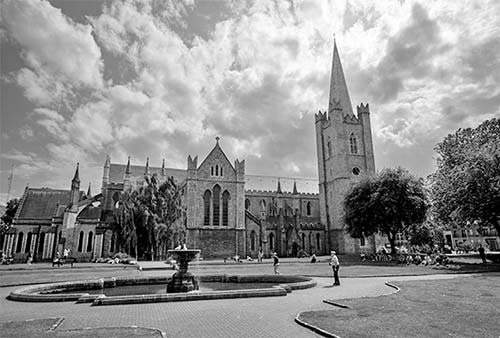
Cost and Hours: €8, includes audioguide; Mon-Fri 9:30-17:00, Sat-Sun 9:00-18:00 except closed during Sun worship 10:30-13:00 & 14:30-16:30, shorter hours in off-season; free guided tours Mon-Fri at 10:30 and 14:30, possibly more—ask at front desk; at the intersection of Patrick Street and Kevin Street Upper, www.stpatrickscathedral.ie.
Evensong and Matins: You’ll get chills listening to the local “choir of angels,” who fill the wood-carved choir area with evensong music (typically Mon-Fri at 17:30 and Sun at 15:15—but schedule can vary, especially in summer, when guest choirs perform; confirm on the church website, under Worship/Music Lists). Early risers might also consider attending the 20-minute Matins service, sung each morning of the school term by local students (none in mid-June-Aug); this starts promptly at 9:00, so arrive a bit before then.
Visiting the Cathedral: Entering through the side door, turn right and walk to the far end of the nave—just inside the main entrance—then turn around and look toward the front of the church. On your right is an elaborate monument to the powerful Boyd family. Notice how it’s designed like a “family tree”—with ancestors up above, and descendants kneeling below.
Standing in the center of the nave, take in this glorious space. It feels like an Irish version of Westminster Abbey, with venerable tombs and memorials to great Irish figures everywhere. The fine Victorian glass is from a Guinness-funded restoration in the 1870s.
Go to the first freestanding pillar on the right. At its base is the fenced-in, diamond-shaped tomb marker of the Dublin-born writer Jonathan Swift (author of Gulliver’s Travels), who was dean of the cathedral from 1713 to 1745. On the wall just behind this pillar, look for the bust of Swift. Over the doorway next to the bust is Swift’s cutting, self-penned epitaph (in Latin). This reads: “Here lies the body of Jonathan Swift... Where savage indignation can no longer lacerate his heart.” The display case over your left shoulder contains a few more pieces of Swift memorabilia, including his chalice, his death mask, and a bronze cast of his skull.
Cross to the other side of the nave for items relating to St. Patrick, both at the bases of pillars. Near the shop is a giant stone that was found covering an ancient well in the nearby St. Patrick’s Park. Could this have been the place where the saint baptized converts? At the base of the next pillar is a small modern sculpture showing one version of what the saint might have looked like. (We don’t know for sure.) St. Patrick is also featured in the stained glass of the west window (over the main door).
Along the wall behind the St. Patrick artifacts—in fact, all up and down the nave—are many more monuments to prominent people of the Anglican faith. If you’re interested in this history, you’ll likely recognize many names here.
Make your way farther up the nave. Just before the wooden pews, turn left and look for a large, thousand-year-old grave marker. Continue into the left (north) transept, which is dominated by the Tree of Remembrance; you’re invited to fill out a “leaf” for the tree’s branches in honor of someone lost to conflict. Overhead are regimental flags of the British army, colors slowly fading, in remembrance of soldiers lost. Nearby, look for the impressive marble spiral staircase—surrounded by columns—that leads up to the loft of one of Ireland’s largest organs.
Now loop around the ambulatory. Directly behind the altar, in the apse, the serene and harmonious Lady Chapel is designated for silent reflection.
Keep going around the other side of the ambulatory—returning to the nave—and on the way, dip into the gorgeously wood-carved choir (the space directly in front of the altar). Circling back to the right (south) transept, you’ll find a “Discovery Space” about the cathedral’s history.
Nearby: In good weather, stroll and enjoy St. Patrick’s Park, the delightful green space that abuts the cathedral.
NORTH OF THE LIFFEY
On and near O’Connell Street
O’Connell Street, lined with statues of leading Irishmen, is the historic artery north of the river. It’s covered by the second half of my Dublin City Walk, earlier. After you’re oriented with the walk, consider the following sights.
▲GPO Witness History Exhibit
During the 1916 Easter Rising, Irish nationalists took over buildings in Dublin, including the General Post Office (GPO), which became the rebel headquarters. Initial euphoria led to chaotic street battles and ended with the grim realization among the insurgents that surrender was the best option—trusting that their martyrdom would inspire the country to rise more effectively in the future. (It did.) This engaging exhibit—in the basement of the working post office—is primarily focused on that pivotal Easter week. Additional exhibitions cover the related Irish War of Independence and the Irish Civil War.
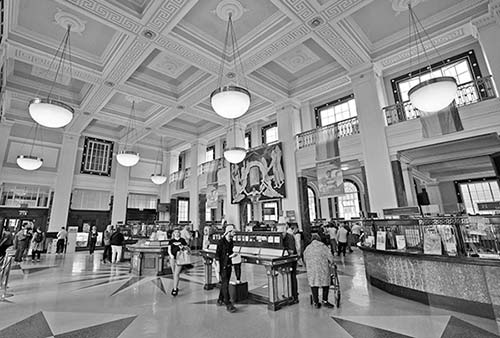
Cost and Hours: €15, includes audioguide; Tue-Sat 10:00-17:00, closed Sun-Mon, last entry one hour before closing; café, +353 1 872 1916, www.gpowitnesshistory.ie.
Background: For European nations preoccupied with World War I, the Easter Rising may have seemed a sideshow—but it was critical to Irish nationalists. Almost every Irish generation for the preceding 125 years had launched doomed insurrections against the British. But this one had a lasting effect, although it may not have seemed so in its immediate wake—a couple of weeks later, the patriot leaders who held their ground at the post office were executed in Kilmainham Gaol. However, those deaths shifted public sympathies seismically. After seven centuries of dominance, the British were on a slippery slope leading to eventual independence for its nearest and oldest colony.
Visiting the Exhibit: The hardworking exhibit has a few interesting artifacts and lots of videos, photos, and earnest ways to tell the story. The information is a bit dry, but it helps stoke some goosebumps to remember that the events outlined here took place in this very building.
At the outset, visitors meet the major political players of circa-1900 Dublin: Unionists, Home Rulers (wanting to stay in the UK, but with more Irish autonomy), and Republicans—along with Suffragists and Socialists, each with their own agendas. Overall, the museum features a fairly balanced view of the rebellion, including the less popular realities (like the lack of widespread support at the beginning of the movement and the civilians who died in the crossfire).
In the theater, watch the 17-minute widescreen video, “Fire and Steel”—a reenactment of the events that took place at different locations around the city that week. At the interactive map stations, you can zoom in and out of various Dublin neighborhoods for a day-by-day account of what was going on around the city. In video presentations, historians give their take on how the rebellion came about, and how it affected Irish history.
At the end of the exhibit, near the stairs, don’t miss the small section about Thomas Francis Meagher, a member of the Young Irelander movement in favor of separation from Britain who ended up in the US governing the Montana territory (see here for more).
Hugh Lane Gallery
This well-described exhibit of art from the 1870s onward includes a sampling of Impressionist masterpieces from the gallery’s founding collection, once owned by Sir Hugh Lane, an Irish art dealer. Genteel and bite-size, the museum holds a well-known Monet painting (Waterloo Bridge, 1900), the reconstructed studio of Dublin-born modern artist Francis Bacon, and a few select works by Irish artists.
Cost and Hours: Free; Tue-Thu 9:45-18:00, Fri-Sat until 17:00, Sun 11:00-17:00, closed Mon; in the Dublin City Gallery on Parnell Square North, +353 1 222 5550, www.hughlane.ie.
North of O’Connell Street
The streets that radiate beyond the spine of O’Connell Street are lined with classic Dublin townhouses-turned-tenements. These two sights are both within about a 10-minute walk of the Spire, in different directions.
▲▲14 Henrietta Street
This four-story, 18th-century Georgian house, once an affluent mansion, had morphed into a cramped, impoverished, multifamily hovel by the 20th century. Now a museum—with visits only by a guided tour—it displays period architecture and furnishings, and explains tenement life and urban poverty in Dublin. With the help of photos and videos, your tour guide tells the story of the house and its times. This excellent sight provides a peek behind the facades of the countless Georgian townhouses that typify Dublin—illuminating life in two very different eras (wealthy and decadent, then poor and overcrowded).
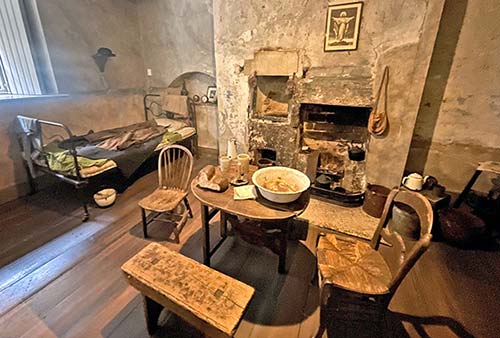
Cost and Hours: €10, visit by 75-minute guided tour only, at busy times book online in advance or take your chances; tours generally depart hourly Wed-Sun 10:00-16:00 (last tour time), closed Mon-Tue; 14 Henrietta Street, +353 1 524 0383, www.14henriettastreet.ie. They also offer a 1.5-hour Georgian walking tour around the neighborhood (€10, about 3/week, see website for times and to book ahead).
Background: Henrietta Street isn’t just a “typical” example of Dublin’s Georgian townhouses; it was the first such street, innovating an approach to housing that came to define the city. At the time, Ireland’s landed gentry lived in Dublin from about October through March, to socialize and to be close to the parliament. In those days, Henrietta Street was the most exclusive enclave in Dublin, bringing balanced architectural order to this first Georgian-style lane on the rapidly expanding north side of the Liffey. Living luxuriously here, under ornate ceilings and warmed by fancy fireplaces, these privileged elites were unknowingly surrounding themselves with unhealthy choices: lead in the paint, arsenic in the wallpaper, and mercury in their makeup.
After the Act of Union in 1801—which dissolved the Irish parliament—the rich and politically well-connected moved to London, abandoning their Dublin homes. By the 1860s and 1870s, as Dublin’s population boomed, developers subdivided these houses into much smaller (and increasingly overcrowded) apartments, sharing a single staircase and entryway—the definition of a “tenement.” By 1911, this house—designed for just one wealthy family (and their servants)—held more than 100 people, split between 17 families sharing two toilets. And Henrietta Street, once a paragon of the good life, was crammed with nearly 1,000 residents.
It’s little wonder that Dublin’s squalid tenements were the breeding ground for the socialist Irish Citizen Army militia of James Connolly, who fought fiercely in the 1916 Easter Rising. Rosie Hackett lived here at #14; the most famous woman in Connolly’s army, she was a cofounder of the Irish Women Workers Union. Her name today adorns one of the bridges across the Liffey.
Visiting the House: The tour covers several floors of the house, introducing you first to the genteel Georgian era when it was originally built, then transitioning into the later period, when it was transformed into a tenement.
The tour starts on the first floor up, or piano nobile (“noble floor”)—the showcase, high-ceilinged floor where guests were entertained during the building’s heyday. Visitors learn about the aristocratic Molesworth family, who were the first occupants in the 1740s, and see a bedroom with a Georgian bed.
To transition into the next phase, visitors step into the stairwell that connected the many tiny apartments that were burrowed out of this huge space. The stairwell is still (faintly) painted in the red and blue colors that were typical of Dublin tenements. From here, you see an exhibit about how children played among this tight-knit community and, back downstairs, walk through a re-creation of the meager furnishings of an early-1900s flat.
James Joyce Centre
Only aficionados of James Joyce’s work will want to visit this modest museum, three floors of a Georgian house in the part of town where he grew up (and set many scenes from Ulysses). Among the exhibits, a re-creation of the cramped and cluttered apartment where Joyce wrote Ulysses evokes his struggles with poverty and criticism as he forged his own path. Along the staircases, see portraits of Joyce and his wife, Nora Barnacle. In a tiny back courtyard, you can see the original door from 7 Eccles Street, the address of Leopold Bloom. The center also features temporary exhibits on Joyce’s life and works, and his enormous influence on subsequent writers. For more on Joyce, see the sidebar.
Cost and Hours: €7, Mon-Sat 10:00-17:00, Sun from 12:00, closed Mon in winter, 35 North Great George’s Street, +353 1 878 8547, www.jamesjoyce.ie. Ask about walking tours of Joyce sights around Dublin.
On the Liffey, East of O’Connell Street
▲▲EPIC: The Irish Emigration Museum
Telling the story of the Irish diaspora, this high-tech, interactive museum celebrates how this little island has had an oversized impact on the world. While the museum has few actual artifacts, this is an entertaining and educational experience. “EPIC” stands for “Every Person Is Connected.”
Cost and Hours: €21, cheaper online, combo-ticket with Jeanie Johnston Tall Ship available (must visit ship first); daily 10:00-18:45, last entry at 17:00; download audioguide for free or pay €2 to rent on-site, in the CHQ building on Custom House Quay (at the modern pedestrian bridge a few steps from the famine statues along the riverfront), +353 1 906 0861, www.epicchq.com.
Visiting the Museum: The sprawling, subterranean museum fills the wine vaults of an iron-framed warehouse from the 1820s. Its 20 themed galleries feature videos, touchscreens, interactive tables, quizzes, and more to explain the forces that propelled so many Irish around the globe.
It’s organized into four broad sections. Journey outlines the ways that Irish people decided to leave and made their way off the island (including a poignant memorial showing several centuries of transportation options, from old wind-powered ships to modern jetliners). Motivation considers the reasons why so many Irish people felt the need to make a life elsewhere (ranging from poverty and religious persecution to a search for new opportunities and a community to belong to). Influence celebrates the staggering number of people of Irish descent who had a big impact on our planet (from sports, innovation, and political leadership; to infamous criminals like Billy the Kid and Typhoid Mary; to music, literature, and food and drink). Celebration, featuring clips from St. Patrick’s Day parades around the world, demonstrates how even after leaving Ireland, many emigrants—and their descendants—continue to feel connected to the Emerald Isle.
A recurring theme is highlighting individuals of Irish descent and trumpeting their achievements—everyone from labor agitator Mother Jones and Caribbean pirate Anne Bonny, to Australian bush bandit Ned Kelly and musical Chicago police chief Francis O’Neill. While JFK—the first Irish Catholic president—is something of an Irish icon, more than 20 US presidents have had Irish ancestry. In fact, you may stumble over how liberally EPIC applies the “Irish ancestry” label, and whether Kurt Cobain’s, Mariah Carey’s, or Rihanna’s “Irish-ness” was truly integral to their artistic journey. That said, it’s fascinating to think how many accomplished people came from this modest hunk of land.
Genealogy Help: The Irish Family History Centre on the ground floor—which hides at the back of the shop—can help you research your Irish roots via in-person or online consultations (€60/30 minutes, €110/hour, €155/1.5 hours, book ahead online—ideally at least 24-48 hours in advance, daily 10:30-17:30, +353 1 905 9216, www.irishfamilyhistorycentre.com).
Nearby: Looking downstream, notice the modern Samuel Beckett Bridge—named for the poet and playwright famous for Waiting for Godot, and shaped like an old Irish harp, as designed by Santiago Calatrava. The areas north and south of this bridge have been rejuvenated over the last few decades with strikingly modern buildings: on the north bank, with Dublin’s contemporary convention center; and just inland from the south bank, with developments such as Google’s European headquarters. Between here and there, you’ll spot the masts of the Jeanie Johnston Tall Ship (see next). A visit here ties in well with the area’s emigration theme.
Before leaving the area, wander 50 yards up the River Liffey toward the city to contemplate the skeletal sculptures of the city’s evocative Famine Memorial. From this spot, the “National Famine Way” stretches 100 miles to Stokestown, with the country’s archive of that agonizing time—replicating the journey that 1,490 starving people made, by foot, to escape poverty and seek a better life (the museum at the other end of this walk is described on here).
▲Jeanie Johnston Tall Ship
Docked on the River Liffey, this seagoing sailing ship is a replica of a legendary Irish “famine ship.” The original Jeanie Johnston embarked on 16 eight-week transatlantic crossings, carrying more than 2,500 Irish emigrants (about 200 per voyage) to their new lives in America and Canada in the decade after the Great Potato Famine of the 1840s. While many barely seaworthy hulks were known as “coffin ships,” the people who boarded the Jeanie Johnston were lucky: The ship was Irish owned and crewed, with a humanitarian captain and even a doctor on board, and not one life was lost. Your tour guide will introduce you to the ship’s main characters and help illuminate day-to-day life aboard a cramped tall ship 160 years ago.
Cost and Hours: €14, combo-ticket with EPIC available, visits by 50-minute tour only, book in advance online; tours depart every 30 minutes daily 10:00-16:30, no tours at 13:00, shorter hours and fewer tours in winter; on the north bank of the Liffey just east of Sean O’Casey Bridge, +353 1 473 0111, www.jeaniejohnston.ie.
In Smithfield, West of O’Connell Street
Old Jameson Distillery
Whiskey fans enjoy visiting the old distillery. Your ticket includes a 45-minute tour covering the history of the distillery, the process of making whiskey, a tasting, and a drink. Unfortunately, the “distillery” feels corporate, overpriced, and put together for tourists. The Bushmills tour in Northern Ireland (in a working factory, see here), the Midleton tour near Cork (in the huge original factory, here), and the intimate Dingle Distillery tour (at a smaller craft distillery, here) are better experiences...but this is handy for whiskey lovers who aren’t going to those places.
Cost and Hours: €26-30 for guided tour, tours generally run daily every 15-30 minutes—check schedule and prebook on their website, specialty tours and tastings available—check online for offerings, Bow Street, +353 1 807 2355, www.jamesonwhiskey.com.
Nearby: The gentrified neighborhood called Smithfield is also home to the best hostel lodging in town (The Generator), the Light House art-film cinema, The Cobblestone (Dublin’s most authentic traditional-music pub—see here), lots of chain eateries, and a Fresh market for groceries. All are on the long Smithfield Square, just uphill from the Smithfield stop on the red Luas tram.
Just a five-minute walk from the top of Smithfield is the extremely hip, fun-to-browse Stoneybatter neighborhood—a great place to hang out, window-shop, or have a meal (see here).
OUTER DUBLIN
For sight locations, see the “Dublin” map on here.
▲▲▲Kilmainham Gaol
Opened in 1796 as Dublin’s county jail and a debtors’ prison, Kilmainham was considered a model in its day. But soon it became horrendously overcrowded—and many of those locked up here were political prisoners who defied British rule. On a guided tour that’s as much about Ireland’s fight for independence as it is about the prison itself, you’ll learn about the appalling conditions prisoners faced here, and hear stories of several individuals whose sacrifice helped inspire others to join their cause. There’s also an informative museum to provide even more insight (free and open even to those who don’t take a tour).
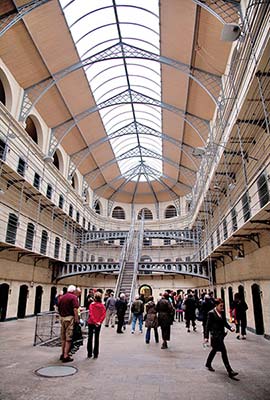
Cost and Hours: €8, visit by one-hour guided tour only; open daily, first tour usually at 9:30, last tour at 16:30—or at 17:15 in summer (July-Aug), shorter hours off-season; +353 1 453 5984, www.kilmainhamgaolmuseum.ie.
Advance Tickets Recommended: Book online at least a few days in advance to guarantee a spot on a tour. If you want to buy a same-day ticket, check their website shortly after 9:00, which is when they release returned tickets. You can try just showing up, but you may get turned away. If you can’t get on a tour, the museum is free to visit on your own (but the experience is far better with the tour).
Getting There: Hop-on, hop-off buses stop near here. Public buses #60 and #69 stop right in front of the museum, and a number of other buses get you within a five-minute walk. The closest Luas tram stop is Suir Road. From there, it’s a 10-minute, level walk north, crossing over the Grand Canal, to the jail.
Connecting Kilmainham Gaol and Guinness: Kilmainham Gaol and the Guinness Storehouse are both located west of the old center and can be linked by a 20-minute walk, a five-minute taxi ride, or public bus #13, #G1, or #G2. (To ride the bus from the jail to the Guinness Storehouse, leave the prison and take three rights—going over a bridge but crossing no streets—to reach the bus stop.)
Background: The Kilmainham Gaol was a terrible place to do time. And yet, during the Great Potato Famine, some people got arrested intentionally so that they’d have a place to sleep and at least one meal per day. Mixed in with this general population were political prisoners who dared to defy British rule. Many national heroes who fought for Irish independence were held or executed here, including leaders of the rebellions of 1798, 1803, 1848, 1867, and—most significantly—1916. James Connolly, unable to stand in front of the firing squad because of a gangrenous ankle, was brought here by ambulance and tied to a chair to be shot sitting down. National heroes Robert Emmett and Charles Stewart Parnell each did time here, as did a woman named Constance Markievicz, who fought in the Easter Rising (see the sidebar). The last prisoner to be held in the jail was Éamon de Valera, who later became president of Ireland. He was released on July 16, 1924, the day Kilmainham was finally shut down. The buildings, virtually in ruins, were restored in the 1960s and opened as a museum in 1966.
Visiting the Jail: Your tour starts in the prison’s Catholic chapel with some background and history. From there, your guide leads you through the dark and claustrophobic West Wing (the oldest part of the jail) and explains how these 5-by-10-foot cells—designed to house one prisoner—soon came to hold five at a time, stacked on top of each other, with even more sleeping in the corridor. In the 1916 wing are cells labeled with the names of the Easter Rising’s leaders, who were held here only until they could be executed. As a counterpoint, you’ll see the spacious cell of Charles Stewart Parnell, who was allowed to order in meals and negotiated what came to be known as the “Kilmainham Treaty” with the British prime minister in this very room.
The tour then moves into the open and light-filled Victorian East Wing, with its panopticon design that allowed a guard to watch all prisoners at once. Finally, your guide leads you through the exercise yard and into the Stonebreakers’ Yard, where hard labor was performed and executions took place. These executions in large part inspired the Irish people in the wake of the Easter Rising to rise up and support the War of Independence a few years later.
After the tour, you can explore the museum. The first floor focuses on Victorian prison design, offering a glimpse into crime in 19th-century Dublin and the life of a prisoner. Upstairs is a political history exhibit, focusing on Ireland’s fight for independence. Don’t miss the dimly lit “Last Words 1916” hall, which displays the stirring final letters that patriots sent to loved ones hours before facing the firing squad. The top floor has a small exhibit on the restoration of the prison and its transformation into a museum, plus temporary exhibits.
Nearby: Across the street from the jail—through the turreted entrance tower—the Irish Museum of Modern Art (IMMA) is set in a pretty green park and free to visit (www.imma.ie).
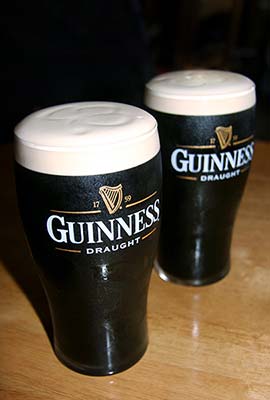
▲Guinness Storehouse
A visit to the Guinness Storehouse is, for many, a pilgrimage. (For Guinness devotees, it’s worth at least ▲▲.) Arthur Guinness began brewing the renowned stout here in 1759, and by 1868 it was the biggest brewery in the world. Today, the sprawling complex fills several city blocks (64 acres busy brewing 1.5 million pints a day).
More than one million visitors each year are welcomed to the towering storehouse, where the vibe is glitzy entertainment. Don’t look for conveyor belts of beer bottles being stamped with bottle caps. Rather than a brewery tour, this is a Disneyland for beer lovers—huge crowds, high-decibel music, and dreamy TV beer ads on big screens.
Cost and Hours: €26/30 for exhibition and a drink in the Gravity Bar (higher prices Thu-Sun); even pricier tickets add extra tastings and experiences—see website for options; Mon-Thu 10:00-19:00, Fri-Sat 9:30-20:00, Sun 9:30-19:00, shorter hours off-season, last entry two hours before closing, last beer served 45 minutes before closing; entrance is midblock on Market Street South, +353 1 408 4800, www.guinness-storehouse.com.
Advance Tickets Recommended: The brewery is popular with cruise-ship excursions, making an advance ticket the only smart way to visit. Book your timed-entry slot early or late in the day to avoid the mobs.
Getting There: Ride the hop-on, hop-off bus (it stops near the site), or take bus #13 or #123 from Dame Street and O’Connell Street. The St. James’ Hospital Luas tram stop on the red line is a 15-minute walk west of the Storehouse. To get between here and the jail, see “Connecting Kilmainham Gaol and Guinness,” under the Kilmainham Gaol listing earlier.
Eating: There are several eateries at the brewery. There’s an easy to-go $ café on the second floor, but most options are on the fifth floor: another self-service $ café, modern Irish food at $$ 1837 Bar & Brasserie, and simpler fare at $ Arthur’s Bar.
Visiting the Brewery: Enter the brewery on Market Street South. The exhibit fills the old fermentation plant, used from 1902 through 1988, and reopened with a modern annex in 2000 as a towering shrine to the Guinness tradition. Step into the middle of the ground floor and look up. A tall, beer-glass-shaped glass atrium—14 million pints big (that’s about 10 days’ worth of production) soars seven stories upward past floors of exhibitions to the skylight. Then look down at Arthur’s original 9,000-year lease, enshrined under Plexiglas in the floor. At £45 per year, it was quite a bargain.
From here, begin the self-guided tour and wind your way up to the top of the building. First the exhibit covers the four humble ingredients of Guinness: barley, water (which, they stress, comes not from the Liffey but from springs in the Wicklow Mountains), yeast (see the “safe” filled with Arthur’s special yeast), and hops. The tour goes on to talk a bit about Arthur and his family, followed by a step-by-step explanation of the meticulous production process: roasting, milling, malting, boiling, fermentation, maturation, and packaging. One exhibit is dedicated to cooperage, the making of wooden barrels (with 1954 film clips showing master kegmakers working at their now virtually extinct trade).
The second floor has the tasting rooms (you may have to wait in line to get in). In the White Room, you’re introduced to using your five senses to appreciate the perfect porter. Then, in the Velvet Chamber, you’re taught how to taste it from a leprechaun-sized beer glass. (Tip: If you drink the head right off the top, it’s too bitter; better to nuzzle in for the dark beer beneath...creating a trademark Guinness moustache.)
The third floor features Guinness’ iconic vintage advertising. You can pose with giant 3-D models of various spokes-animals from across the years (ostrich, seal, turtle, kangaroo), and, of course, that lovable policeman. My Goodness, my Guinness!
The fourth floor is for special experiences (at an extra cost), such as learning how to pull the perfect beer at the “Guinness Academy” or getting your image printed on a head of beer, at “The Stoutie.” The fifth floor has some eateries.
Finally, the top-floor Gravity Bar provides visitors with a commanding 360-degree view of Dublin—with vistas all the way to the sea—and an included pint of the beloved stout.
Claiming Your Beer: Your admission includes a ticket for a beer. Most people opt to enjoy this with grand views over Dublin in the crowded, high-energy, top-floor Gravity Bar. Among your choices are basic stout (4.2%), Hop House 13 (5%, a hoppy lager), and nonalcoholic. If you prefer a less-crowded experience—or want to try a different beer—you can instead show your ticket at Arthur’s Bar on the fifth floor, which has additional options that may include extra stout (4.1%, carbonated), West Indies Porter (6%, toffee flavor, 1801 recipe), or Open Gate Citra IPA (5%). For an extra charge, you can sample a Guinness cocktail, such as a Black Velvet (Prosecco and Guinness).
Whiskey Distilleries in The Liberties
Irish whiskey is undergoing a revival, and several craft distilleries have opened their doors for tours, tastings, and special experiences. The heart of the new whiskey wave is in The Liberties, the brewing and distilling center of Dublin during the 19th century. While Guinness survived, the distilleries all closed in the 20th century and only now are coming back to life. The first two are located just a couple of minutes from the Guinness Storehouse; Teeling is closer to the center of town (see “Dublin” map on here for locations). All are typically open daily; check distillery websites for tour schedules and to book ahead.
Roe & Co Whiskey Distillery, from the company that owns Guinness, is named for and located on the site of one of the 19th-century pioneers of Irish whiskey, George Roe & Co. They offer two 45-minute tours—one focused on cocktails, the other on blending—followed by time in their bar (92 James’s Street, www.roeandcowhiskey.com).
Just down the street is Pearse Lyons, named after its founder, an Irishman who made his fortune in Kentucky bourbons, among other things. Tours go through a graveyard and into a renovated 12th-century church, where the bar and distillery equipment are housed (121 James’s Street, +353 1 691 6000, www.pearselyonsdistillery.com).
About a 10-minute walk from Guinness toward the city center is Teeling Distillery, whose opening in 2015 helped kick off Dublin’s whiskey revival. Various tours offer different levels of tastings (13 Newmarket, +353 1 531 0888, www.teelingdistillery.com).
▲National Museum of Decorative Arts and History
This branch of the National Museum occupies the huge, 18th-century stone Collins Barracks just across the river from the Guinness complex. In addition to being housed in one of Dublin’s most imposing buildings, it’s two museums in one: a military history collection and a decorative arts collection, both extensive and well presented. While it doesn’t merit a significant detour for most, it’s free and worth checking out if you have an interest in these topics.
Cost and Hours: Free; Tue-Sat 10:00-17:00, Sun-Mon from 13:00; on north side of the River Liffey in Collins Barracks on Benburb Street, roughly across the river from Guinness factory, Luas red line: Museum stop; +353 1 677 7444, www.museum.ie.
Visiting the Museum: From the entrance, climb the stairs and take your pick: Head left for the military museum, or right for decorative arts.
The military museum, with a permanent exhibit called “Soldiers & Chiefs,” covers the Irish at war both at home and abroad since 1550 (including the American Civil War). The final rooms offer Ireland’s best coverage of the painful birth of this nation. Guns, flags, and personal letters help illustrate the 1916 Easter Rising, the War of Independence against Britain, and Ireland’s Civil War.
The decorative arts collection is even more extensive, filling several floors. It kicks off with a “Curator’s Choice” section, offering a once-over-lightly look at what you’ll find throughout the collection: Irish dress, furniture, weapons, silver, and other domestic baubles from the past 700 years. From there, wind your way through the exhibits, which include a coin and currency collection, jewelry, Irish country furniture, Asian art, and much more. One highlight (on the top floor) introduces you to Eileen Gray, an early-20th-century pioneer of the Modernist style who studied human anatomy to create more ergonomic furniture.
A third part of the museum, worth a quick look, is the historic Asgard, a 51-foot yacht used by its owner, Erskine Childers, to smuggle guns to arm Irish rebels in the 1916 Easter Rising. You’ll find the boat 50 yards across a small parking lot in a well-marked separate building.
▲Gaelic Athletic Association Museum at Croke Park Stadium
This museum, at Croke Park Stadium in northeast Dublin, offers a high-tech, interactive introduction to Ireland’s favorite games. The GAA, founded in 1884, was created to foster the development of Gaelic sports, specifically Gaelic football and hurling, and to exclude English sports such as cricket and rugby (see sidebar). An expression of the Irish cultural awakening, the GAA played an important part in the fight for independence. Relive the greatest moments in hurling and Irish-football history. Then get involved: Pick up a stick and try hurling, kick a football, and test your speed and balance. A 15-minute film (played on request) gives you a “Sunday at the stadium” experience. It’s also fun to take in an actual hurling or football match (see below).
Cost and Hours: €9; Mon-Sat 9:30-17:00, Sun from 10:00, may be closed on some Sat-Sun if there’s a match—check ahead; +353 1 819 2300, www.crokepark.ie/gaa-museum.
Getting There: Croke Park is located on the north bank of the Royal Canal, about 10 blocks north of the Connolly train station. The museum is located under the stands at the stadium (enter from St. Joseph’s Avenue off Clonliffe Road). From the city center, it’s about a 30-minute walk. Or you can take bus #40 or a taxi.
Tours: The €16 Stadium Tour is worth it for rabid fans who want a glimpse of the huge stadium and locker rooms (80 minutes). The €22 rooftop Skyline Tour offers views 17 stories above the field from lofty catwalks (1.5 hours). Both tours include museum entry and run several times daily (fewer tours on match days); see the website for times and to book.

Watching Hurling or Football: Seeing a match in person at Croke Park, surrounded by incredibly spirited Irish fans, is a fun experience. Hurling is fast and rough: like airborne hockey with no injury time-outs. Gaelic football resembles a rugged form of soccer; you can carry the ball, but must bounce or kick it every three steps. Matches are held most Saturday or Sunday afternoons in summer (May-Aug), culminating in the hugely popular all-Ireland finals on Sunday afternoons in August. Choose a county to support, buy their colors to wear or wave, scream yourself hoarse, and you’ll be a temporary local (tickets around €20-55, buy in advance at www.gaa.ie, no on-site ticket sales).
The Gaelic Athletic Association (GAA) has long been a powerhouse in Ireland. The national pastimes of Gaelic football and hurling pack stadiums all over the country. When you consider that 82,000 people—paying about €25 each—stuff Dublin’s Croke Park Stadium and that all the athletes are strictly amateur, you might wonder, “Where does all the money go?”
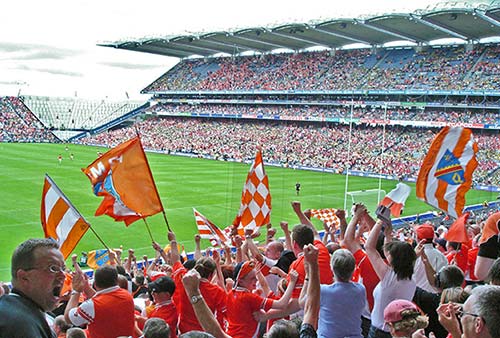
Ireland has a long tradition of using the revenue generated by these huge events to promote Gaelic athletics and Gaelic culture in a grassroots and neighborhood way. So, while the players (many of whom are schoolteachers whose jobs allow for evenings and summers free) participate only for the glory of their various counties, the money generated is funding children’s leagues, school coaches, small-town athletic facilities, and traditional arts, music, and dance—as well as the building and maintenance of giant stadiums such as Croke Park.
Sports here have a deep emotional connection as a heartfelt expression of Irish identity. There was a time when membership in the GAA was denied to anyone who also attended “foreign games,” defined as rugby, soccer, or cricket. If the Brits played it, it was viewed as cultural poison. So intractable was this rule that in 1938, Douglas Hyde (then president of Ireland) was kicked out of the GAA for attending an international soccer match. (The rule was abolished in 1971 with the advent of TV sports.)
In 1921, during the War of Independence, IRA leader Michael Collins orchestrated the simultaneous assassination of a dozen British intelligence agents around Dublin in a single morning. The same day, the Black and Tans retaliated. These grizzled British WWI veterans, clad in black police coats and tan surplus army pants, had been sent to Ireland to stamp out the rebels. Knowing Croke Park would be full of Irish nationalists, they entered the packed stadium during a Gaelic football match and fired into the stands, killing 13 spectators as well as a Tipperary player.
Today Croke Park’s “Hill 16” grandstands are built on rubble dumped here after the 1916 Easter Rising; it’s literally sacred ground. And the Hogan stands are named after the murdered player from Tipperary. Queen Elizabeth II visited the stadium during her historic visit in 2011. Her warm interest in the stadium and in the institution of the GAA did much to heal old wounds.
Glasnevin Cemetery
This is the final resting place for Ireland’s most passionate patriots, writers, politicians, and assorted personalities. What Père Lachaise is to Paris, Glasnevin is to Dublin. Here you’ll find the graves of Michael Collins, Charles Stewart Parnell, teenage rebel and martyr Kevin Barry (of patriot song fame), and Daniel O’Connell, whose crypt lies beneath a commemorative tower (recently renovated and climbable). A tall wall and a half-dozen watchtowers, used to deter grave robbers, surround the cemetery’s 124 leafy acres. The adjacent visitors center offers more exploration, including an exhibition on the famous figures buried at Glasnevin and an overview of the cemetery’s history. The visitors center also runs guided cemetery tours. You can pay to climb 198 steps to the top of the O’Connell Tower for views over the cemetery and to Dublin.
Cost and Hours: Cemetery—free, gates open daily 9:00-17:00; visitors center exhibition—€6, open from 10:00; tower climb—€9; tours on a variety of topics cost €13—check schedule and book online; café, +353 1 882 6550, www.dctrust.ie/experience-glasnevin.html.
Getting There: It’s two miles north of the city center, along Finglas Road—take bus #40 or #140 from the GPO on O’Connell Street.
Shopping in Dublin
Smaller shops are open roughly Monday-Saturday 10:00-18:00, with shorter hours or possibly closures on Sunday. Department stores generally have longer hours. For locations of most of these places, see the map on here.
Department Stores: The dominant department store in Dublin (and Ireland) is Dunnes, where you can buy everything from groceries to underwear to alcohol. Some Dunnes branches are grocery stores only; department stores are at the Stephen’s Green Shopping Centre (near St. Stephen’s Green) and a couple of blocks west of O’Connell Street (48 Henry Street, www.dunnesstores.com).
Irish Crafts and Design: Dublin has a number of good shops for browsing locally made goods. Kilkenny Design, across from Trinity College, focuses on Irish designers, including clothing, jewelry, home goods, and artwork (6 Nassau Street, lively café upstairs, www.kilkennydesign.com).
Avoca is a mini department store loaded with quality Irish crafts and food. They weave their own woolens at their mill in Wicklow, and they are a fine place to look for scarves and blankets (11 Suffolk Street, www.avoca.com).
Powerscourt Center occupies a Georgian house and elegant courtyard near Grafton Street. Shops are a mix of local retailers and international chains selling jewelry, clothing, housewares, paper goods, and local Irish arts and crafts (59 William Street South, www.powerscourtcentre.ie).
The Irish Design Shop offers an array of Ireland-made products, including cookbooks, art, ceramics, soaps, blankets, scarves, and jewelry (41 Drury Street, www.irishdesignshop.com). Nearby are a couple of design shops selling mostly international brands but also some locally made items: Industry & Co (41a/b Drury Street, www.industryandco.com) and Designist (68 South Great George’s Street, www.designist.ie).
Jewelry: Pendants, earrings, and other pieces featuring shamrocks, Celtic knots, and the Tree of Life are ubiquitous in Dublin. Also popular is the traditional Claddagh ring that symbolizes love, loyalty, and friendship (most popular in Galway, where the ring originated). There are plenty of stores in town selling Celtic jewelry, but a quality place for tasteful designs in a range of prices and materials is Weir & Sons (96 Grafton Street, www.weirandsons.ie).
For more contemporary pieces, browse The Collective, which highlights 30 or so independent jewelry designers, many of whom are Irish (24 Drury Street, www.thecollectivedublin.ie).
Bookstores: With its rich literary history, Dublin is a fun place to shop for books. South of the Liffey, try Dubray Books on Grafton Street (at #36, www.dubraybooks.ie); Hodges Figgis, founded in 1768 and mentioned in Ulysses (now run by Waterstones, 56 Dawson Street, www.waterstones.com/bookshops/hodges-figgis); and the Gutter Bookshop, a fine independent seller that champions Irish writers (Cow’s Lane in Temple Bar, www.gutterbookshop.com). North of the Liffey, you’ll find Eason’s (5 minutes north of the O’Connell Bridge at 40 O’Connell Street Lower, www.easons.com; they also have other branches around town).
Shopping Areas
If you’re in the mood to browse, try the following streets and neighborhoods.
Central Dublin (South of the Liffey): Pedestrianized Grafton Street is lined with international chain stores and a few local shops. Near Grafton are shopping centers (Powerscourt Center—described above—and Stephen’s Green Shopping Centre), arcades (George’s Street Arcade between Great George’s and Drury Streets), and shopping streets (Drury Street—good artisan and design shops—and Francis Street, creaking with antiques).
Nassau Street, facing the side of Trinity College, is home to the popular Kilkenny Shop (described above) and lots of touristy stores.
Temple Bar, the big nightlife spot, is worth a browse for art, jewelry, books, and gift shops. One enjoyable stretch is Essex Street, a wee lane tucked just below busy Dame Street; it’s lined with fun boutiques (including Design Lane, Scout, and Tamp & Stitch) and Gutter Books (recommended above). On Saturdays, a couple of markets—one for food and another for books—set up shop in Temple Bar. For details on this area, see here of my Dublin City Walk.
North of the Liffey: Dublin’s top department stores are on Henry Street (pedestrian-only, off O’Connell Street).
Millennium Walk, a trendy lane stretching two blocks north from the River Liffey to Abbey Street, is filled with restaurants, shops, and coffee bars. It’s easy to miss—look for the south entry at the pedestrian Millennium Bridge, or the north entry at the Jervis Street Luas stop.
Entertainment in Dublin
Ireland has produced some of the finest writers in the English and Irish languages, and Dublin houses some of Europe’s best theaters. Though the city was the site of the first performance of Handel’s Messiah (1742), these days Dublin is famous for the rock bands that have started here: U2, Thin Lizzy, Sinéad O’Connor, and Bob Geldof’s band the Boomtown Rats.
Theater
To find out what’s on, check each venue’s website, ask at the TI, or check out VisitDublin.com/whats-on.
Big Venues: Abbey Theatre is Ireland’s national theater, founded by W. B. Yeats in 1904 to preserve Irish culture during British rule. Besides plays, they also do backstage and walking tours (26 Lower Abbey Street, just north of the Liffey, +353 1 878 7222, www.abbeytheatre.ie). Gate Theatre does foreign plays as well as Irish classics (Cavendish Row, near the Garden of Remembrance at the top of O’Connell Street, +353 1 874 4045, www.gatetheatre.ie). The Gaiety Theatre offers a wide range of quality productions (King Street South, near St. Stephen’s Green, +353 1 679 5622, www.gaietytheatre.ie). The Bord Gáis Energy Theatre (pronounced “Board-GOSH”), in a futuristic building, is Dublin’s slickest venue (Grand Canal Square, 20-minute walk east of Trinity College, +353 1 677 7999, www.bordgaisenergytheatre.ie).
Smaller Theaters in and near Temple Bar: Less commercial plays can be seen at the intimate little Smock Alley Theatre, with seating surrounding a tiny stage, in a space on the site of the city’s first theater—from 1662 (6 Lower Exchange Street, on the western fringe of Temple Bar, +353 1 677 0014, www.smockalley.com). There are also some smaller, funkier venues in Temple Bar, including The New Theatre (in the back of an alt bookstore, 43 Essex Street East, www.thenewtheatre.com) and the Project Arts Centre next door (39 Essex Street East, www.projectartscentre.ie).
Music, Dance, and Film
The 3 Arena, sited on what was once a dock railway terminus (easy Luas red line access), is considered one of the country’s top live-music venues. Residents call it by its geographic nickname: The Point (East Link Bridge, +353 1 819 8888, http://3arena.ie).
The National Concert Hall supports a varied performance schedule, including the National Symphony Orchestra (off St. Stephen’s Green at Earlsfort Terrace, +353 1 417 0077, www.nch.ie).
Celtic Nights combines traditional music and dancing into a big-stage, high-energy, family-friendly, Irish variety show. This touristy dinner act hits all the clichés, from Riverdance-style choreography to fun fiddling and comedic craic. It comes with a traditional three-course dinner and lots of audience participation (€47, nightly show at 20:00 or 20:30—arrive by around 19:00, on the north bank of the Liffey by the O’Connell Bridge at the Arlington Hotel, 23 Bachelors Walk—see map on here, +353 1 804 9100, www.celticnights.com).
The Irish Film Institute, bordering Meeting House Square in Temple Bar, shows a variety of art-house flicks. A bohemian crowd relaxes in its bar/café, awaiting the next film (main entry at 6 Eustace Street, www.irishfilm.ie).
Storytelling Dinner
The Stag’s Head, a Victorian-era pub, hosts “An Evening of Irish Folklore and Fairies,” an hour and a half of soulful history and fascinating mythology. Soaking up a pint while enjoying engaging Irish storytelling is a fine way to kick off your evening (€23, food and drinks extra, generally Tue and Thu at 17:00, reservations required, 1 Dame Court—see the map on here for location, +353 1 218 8555, https://irishfolktours.com).
Pubs and Live Traditional Music
James Joyce once said it would be a good puzzle to try to walk across Dublin without passing a pub. Live music at a pub is a ▲▲▲ experience. The tunes typically start most nights around 21:00; on weekends, especially Sundays, there also may be music in the afternoon. Check each venue’s website to see their schedule. For guided pub crawls (focusing on either Irish literature or music), see “Tours in Dublin,” near the beginning of this chapter. Unless otherwise noted, for locations of the venues described below, see the “Dublin Restaurants South of the Liffey” map on here.
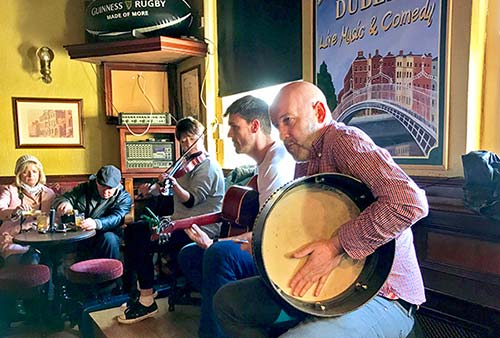
Temple Bar and Nearby
The Temple Bar area thrives with music—traditional, jazz, and rock. Pricier than the rest of Dublin and extremely touristy, it’s a wild scene where party animals enjoy mixing beer and music. The noise, pushy crowds, and inflated prices have driven most Dubliners away. It’s craziest on summer weekend nights, holidays, and nights after big sporting events let out. Women in funky hats, part of loud “hen” (bachelorette) parties, promenade down the main drag as drunken dudes shout from pub doorways to get their attention. In the most touristy zone around Temple Bar Square, the bars are cartoons of an Irish pub, looking like they board leprechauns upstairs. The only real Irish people you’ll see are the ones playing the music, serving the beer, and keeping the rowdies at bay at the doorway.
To get a taste of this scene, wander the crowded streets and follow your ears to music that appeals. One place worth checking is Gogarty’s Pub, with a better reputation than most for trad. The pub’s namesake, Oliver St. John Gogarty, was an acquaintance of James Joyce and the inspiration for the character Buck Mulligan, who opens Ulysses—look for statues of Joyce and Gogarty around the side of the building (at corner of Fleet and Anglesea, +353 1 671 1822, www.gogartys.ie).
Near Temple Bar: It’s a shame how many tourists get sucked into the crass whirlpool of Temple Bar when several better pubs for traditional music are so close by. The pubs below have longer histories, tangled floor plans, a fun-loving energy, and a passion for trad.
Darkey Kelly’s Bar is a big, fun-loving place with live music nightly. The traditional folk-music vibe here is more sing-along than hard drinking, and the pub grub is good (daily, west end of Temple Bar, near Christ Church Cathedral at 19 Fishamble Street, +353 83 346 4682, https://darkeykellys.ie).
Two more wonderful, classic pubs are about a 10-minute walk west along the river from the heart of Temple Bar, facing each other across the street, near the Father Matthew Bridge (see the map on here). The Brazen Head, which claims to be the oldest pub in Dublin, is a hit for an early dinner and late live music, with good food, several atmospheric rooms, and a courtyard perfect for balmy evenings (daily, 20 Lower Bridge Street, +353 1 679 5186, www.brazenhead.com). O’Shea’s Merchant Pub, across the street, is encrusted with memories of County Kerry football heroes. It’s likely to be less crowded when other places are jammed, and popular with locals who come for the live traditional music nightly. The front half is a restaurant, the toe-tapping magic is in the back (daily, enter at 12 Lower Bridge Street, +353 1 679 3797, www.themerchanttemplebar.com [URL inactive]).
In Smithfield, North of the Liffey
The Cobblestone Pub, at the top of Smithfield Square, offers Dublin’s least glitzy and most rewarding traditional-music scene. While a bit farther from most accommodations, it’s worth the trip. The walls, covered with photos of honored trad musicians, set the tone. Music is revered here, as reflected in the understated sign: “Listening area, please respect musicians” (trad-music sessions weeknights from about 19:00, weekends from about 14:00; 100 yards uphill from Old Jameson Distillery’s brick chimney tower at 77 King Street North—for location see the map on here, +353 1 872 1799, www.cobblestonepub.ie). It’s easiest by taxi, or you can ride the red Luas tram to the Smithfield stop. The Cobblestone also combines well with a stroll or dinner in the Stoneybatter neighborhood, a few minutes’ walk to the west (described later, under “Eating in Dublin”).
Southeast of St. Stephen’s Green
Down the axis of Merrion Row and Baggot Street Lower, you’ll find three venerable pubs (within a block of each other) filled with an after-work crowd blowing off steam. The first one is great for music; all are great for beer lovers. For locations, see the map on here.
O’Donoghue’s was famously the home pub of the Dubliners, for decades one of Ireland’s premier traditional Irish-music groups. The pub still offers a happy scene and nightly music—trad, folk, and more. The main pub is crowded and convivial, while the semi-outdoor yard along the side is more spacious (15 Merrion Row, +353 1 660 7194, www.odonoghues.ie).
Doheny & Nesbitt is a photogenic choice, with wonderful woodwork and cozy conversational alcoves—and it has great pub grub (5 Baggot Street Lower, +353 1 676 2945, www.dohenyandnesbitts.ie).
Toner’s, a well-varnished 200-year-old pub, has a classic snug in front and a sprawling beer garden out back, mostly to accommodate smokers (139 Baggot Street Lower, +353 1 676 3090, www.tonerspub.ie).
Microbrews and Whiskey near Trinity College
These pubs—one specializing in microbrews, the other in whiskey and other distillates—are for discerning drinkers (no live music). They sit next to each other facing the side of Trinity College. See the map on here for locations.
Tapped has a good selection of microbrews—both their own brand, Porterhouse, and rotating taps (consider a flight)—and an inviting and varied food menu (tacos, burgers, pizzas). It’s not as sloppy as Temple Bar, but still loud and with a fun energy (daily, 47 Nassau Street, +353 1 679 9204, www.tappeddublin.com).
Distilled Whiskey Bar features hundreds of whiskeys from Ireland, Scotland, and North America, plus rums, gins, and tequilas. The ceiling is lined with staves inscribed with the names of investors who’ve bought a barrel and are waiting years for it to age. Tasting flights are available for novice to connoisseur palates (Wed-Sun from 16:00, closed Mon-Tue, 44 Nassau Street, +353 1 677 4180).
Sleeping in Dublin
Choosing the right neighborhood in Dublin is as important as choosing the right hotel. All my recommended accommodations are in safe areas convenient to sightseeing.
Central Dublin is popular, loud, and expensive. You’ll find big, practical, central places just south of the river, near Christ Church Cathedral, Trinity College, and St. Stephen’s Green. For classy accommodations in a quieter, more residential neighborhood, stay a bit farther out, southeast of St. Stephen’s Green. North of the river are additional reliable options in an urban area well served by Luas trams (but less personal and with less genteel Dublin character). If you prefer small towns, consider sleeping instead in Dun Laoghaire, an easy half-hour DART train ride away (see the end of this chapter).
Dublin is expensive; it’s next to impossible to find a sleepable double for less than about €200 per night. As elsewhere in Ireland, I rank accommodations from $ budget to $$$$ splurge—but here in the capital, virtually everything is at the top end. Prices may be slightly lower Monday through Thursday and from November through February. Hotels raise their prices and are packed on rugby weekends (about four per year), during the all-Ireland Gaelic football and hurling finals (Sundays in August), and during summer rock concerts. For some travelers, short-term, Airbnb-type rentals can be a good alternative; search for places in my recommended hotel neighborhoods. Or, for a hip and charming neighborhood a bit farther out, consider Stoneybatter (described on here).
Book your Dublin accommodations well in advance, especially if you’ll be traveling during peak season (June-August), weekends any time of year, or if your trip coincides with a major holiday or festival (see the appendix).
For more details on reservations, short-term rentals, and more, see the “Sleeping” section in the Practicalities chapter.
SOUTH OF THE LIFFEY
Central Dublin, North of St. Stephen’s Green
These accommodations are in the lively streets between rowdy Temple Bar, Trinity College, and St. Stephen’s Green. Staying here, most of the city’s attractions and restaurants are easily walkable.
$$$$ Trinity Townhouse feels classy and sophisticated, with fine, quiet lodging in 31 rooms split between Georgian townhouses on either side of South Frederick Street, just south of Trinity College (air-con, three floors with no elevator, 29 South Frederick Street, +353 1 617 0900, www.trinitytownhousehotel.ie, reception@trinitytownhouse.ie).
$$$$ Brooks Hotel is a fine choice for great service, tending 98 plush rooms, which can come with some street noise. Extras include a bar with homemade goodies; a lavish residents’ lounge in the basement with wood paneling, paintings, and cozy furniture; and a 26-seat cinema (air-con, elevator, Drury Street, +353 1 670 4000, www.brookshotel.ie, reservations@brookshotel.ie).
$$$$ Wren Urban Nest is tucked on a dreary urban alley, surrounded by yet apart from the bustle of Temple Bar and Dame Street. This solidly built tower houses 137 efficient, compact, high-tech rooms, and is as quiet as you could hope for in this central location. The place feels both stylish and organic—with lots of reclaimed wood and wicker accents—from the woody cellar restaurant to the rooms, which come in two types: tight “snug” rooms and slightly bigger “cozy” rooms (air-con, elevator, St. Andrews Lane, +353 1 223 4555, www.wrenhotel.ie, frontoffice@wrenhotel.ie).
$$$$ Buswells Hotel, one of the city’s oldest, is a pleasant Georgian-style haven with 67 rooms (elevator to some rooms, between Trinity College and St. Stephen’s Green at 23 Molesworth Street, facing the National Museum of Archaeology, +353 1 614 6500, www.buswells.ie, info@buswells.ie).
$$$ Trinity College opens its 700 student-housing dorm rooms to the public in summer (June-mid-Aug). There are en suite rooms as well as rooms within apartments with a shared kitchen, living room, and bathroom—good for families or groups (make sure to book rooms for the city-center campus, not the suburban Dartry location; rooms in the newer dorm—with modern amenities—are pricier than the traditional “heritage” buildings; +353 1 896 1177, www.visittrinity.ie/stay, reservations@tcd.ie).
Near Christ Church Cathedral
$$$$ Leonardo Hotel Dublin Christ Church, part of a no-nonsense, American-style hotel chain, is central and offers business-class comfort in 182 identical rooms. If “ye olde” is getting old—and you don’t mind big tour groups—this is a good option. Request a room far from the noisy elevator (air-con, elevator, Christ Church Place, opposite Christ Church Cathedral, +353 1 454 0000, www.leonardohotels.co.uk, cci_operations@leonardohotels.com). If staying here, consider eating breakfast at one of the small cafés nearby (see “Eating in Dublin,” later).
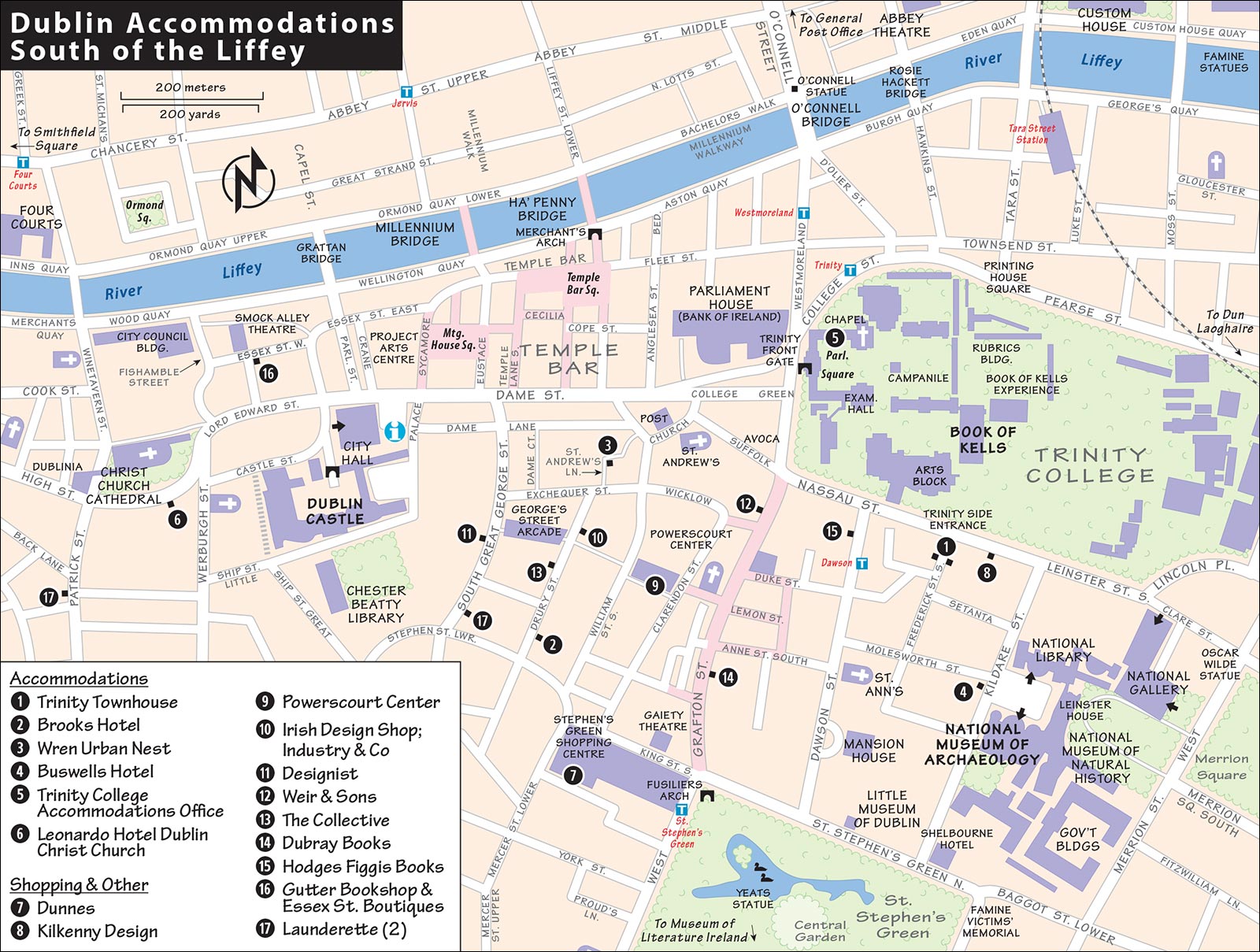
South of St. Stephen’s Green
The area south of Dublin’s big and beautiful park feels more residential. Several of these choices are close to the Grand Canal, Dublin’s urban waterway, which sports a lovely narrow greenbelt of trees and lily pads, ideal for a pleasant stroll or run. The downside is that you’re about a 10- to 20-minute walk from the city center. Buses and taxis make things easier.
$$$$ Number 31 is a hidden gem reached via nondescript Leeson Close (a lane off Leeson Street Lower). Its understated elegance is top-notch, with seven rooms in a former coach house and 15 rooms in an adjacent Georgian house; the two buildings are connected by a quiet little garden. Guests appreciate the special touches (such as a sunken living room with occasional peat fires) and outstanding breakfasts served in a classy glass atrium (family room, limited parking, 31 Leeson Close, +353 1 676 5011, www.number31.ie, stay@number31.ie).
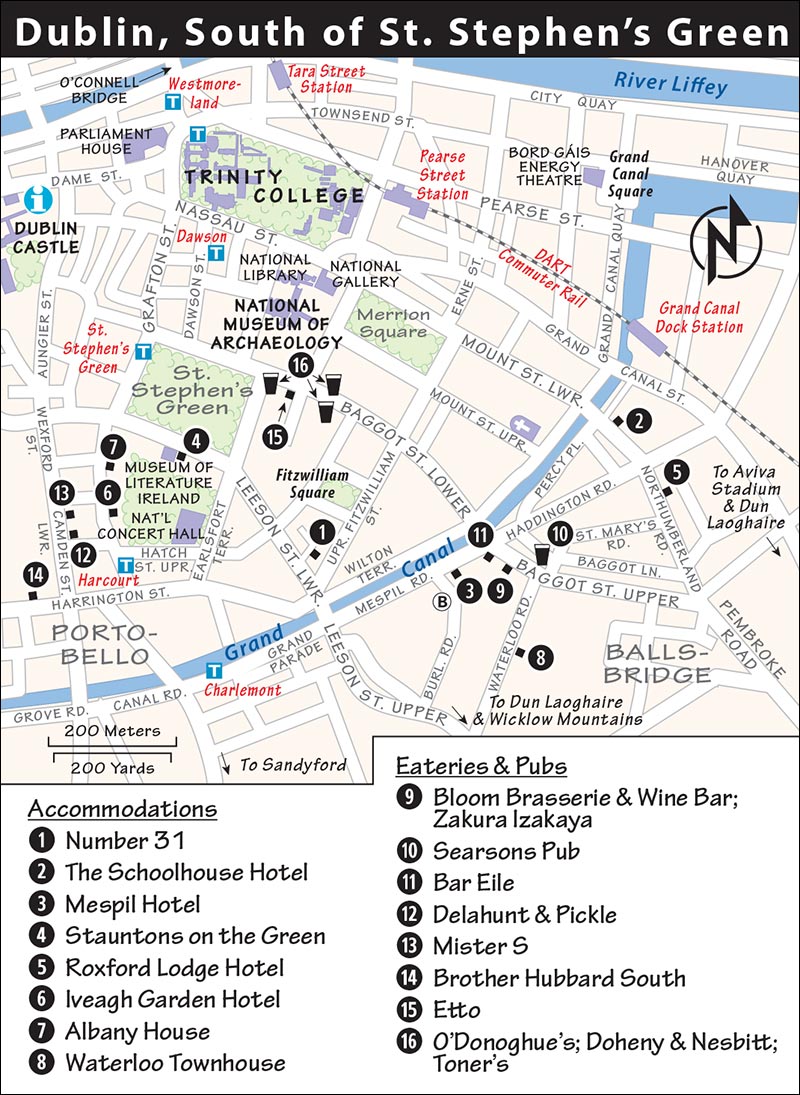
$$$$ The Schoolhouse Hotel taught as many as 300 students in its heyday (1861-1969) and was in the middle of the street fight that was the 1916 Easter Rising. Now the beautiful brick building is a serene hideout with 31 rooms and a fine restaurant. Book early—this popular place fills up (air-con, elevator, 2 Northumberland Road, +353 1 667 5014, www.schoolhouse.ie, reservations@schoolhouse.ie).
$$$$ Mespil Hotel is a huge, modern, business-class hotel renting 259 four-star rooms with all the comforts. It’s a solid value for this location—just around the corner from several great eateries and facing the charming Grand Canal—and a predictably comfortable Dublin home base (air-con, elevator; small first-come, first-served free parking, 50 Mespil Road, +353 1 488 4600, www.mespilhotel.com, mespil@leehotels.com).
$$$$ Stauntons on the Green, next door to the Museum of Literature Ireland, is posh and sophisticated, with 53 rooms in three Georgian buildings, attentive service, and high prices (some rooms with air-con, 83 St. Stephen’s Green South, +353 1 478 2300, www.stauntonsonthegreen.ie, info@stauntonsonthegreen.ie).
$$$$ Roxford Lodge Hotel, a bit farther out, is a well-managed place with 24 tastefully decorated rooms (a few with hot tubs and saunas—by request). The executive suite is honeymoon-worthy (family room, air-con, elevator, limited pay parking, 46 Northumberland Road, +353 1 668 8572, www.roxfordlodge.ie, reservations@roxfordlodge.ie).
$$$$ Iveagh Garden Hotel feels modern and professional, with 145 rooms—the quieter ones, in back, overlook the namesake gardens a short walk south of St. Stephen’s Green (air-con, elevator, bistro with terrace, 72 Harcourt Street, +353 1 568 5500, www.iveaghgardenhotel.ie, info@igh.ie).
$$$$ Albany House, a lesser value, feels classic and a bit dated. Its 57 rooms come with high ceilings, Georgian ambience, and some stairs. Ask for a quieter room in back, away from the streetcar noise (one block south of St. Stephen’s Green at 84 Harcourt Street, +353 1 475 1092, www.albanyhousedublin.com, info@albanyhousedublin.com).
$$$ Waterloo Townhouse, a more affordable option, stands proudly Georgian on a quiet residential street with 19 comfortable rooms on four floors and a pleasant back garden (no breakfast, family rooms, elevator, parking, 8 Waterloo Road, +353 1 660 1888, www.waterlootownhouse.ie, info@waterlootownhouse.ie).
NORTH OF THE LIFFEY
To locate these hotels, see the map on here.
Near Parnell Square
A swanky neighborhood 250 years ago, this is now workaday Dublin with a steady urban hum, made accessible by Luas trams. These are a short walk from the top of O’Connell Street. None of these have parking on-site, but all of them have a deal with a nearby garage.
$$$$ Hotel 7 spruces up an old Georgian property with 51 dark, modern rooms that are refined and stylish. It’s worth the comparatively high price for this side of town (air-con, elevator, restaurant, 7 Gardiner Row, +353 1 873 7777, www.hotel7dublin.com, info@hotel7dublin.com).
$$$$ Belvedere Hotel, run by the same group as Hotel 7 (described above), feels bigger and more impersonal (it hosts Irish dance concerts on the ground floor). The 124 business-class rooms are classy and dimly lit (air-con, elevator, restaurant, Great Denmark Street, +353 1 873 7700, www.belvederehotel.ie, reservations@belvederehotel.ie).
$$$$ The Castle Hotel is a formerly grand but still-comfortable Georgian establishment embedded in the urban canyons a half-block east of the Garden of Remembrance. It has 148 aging but pleasant rooms and the friendly Castle Vaults pub with live music in its basement (family rooms, elevator, Great Denmark Street, +353 1 874 6949, www.castle-hotel.ie, info@castle-hotel.ie).
$$$$ Leonardo Hotel Dublin Parnell Street has 253 predictably soulless but modern and relatively affordable rooms just a block west from the north end of O’Connell Street (air-con, elevator, +353 1 878 4900, www.leonardohotels.ie, parnellstreet@leonardohotels.com).
On Smithfield Square
¢ Generator Hostel provides Dublin’s best hostel experience in a clean and stylishly renovated building that was once part of the Jameson Distillery property. The huge 570-bed complex leaves most other hostels looking tired and patched together (private rooms available, at the base of Jameson Distillery chimney observation tower, +353 1 901 0222, www.staygenerator.com).
Near Connolly Station and the River Liffey
$$$$ The Address Connolly lies conveniently across the street from Connolly Station, with 278 lush, modern rooms. Although the rail tracks run directly behind it, most of the rooms are effectively soundproofed; still, it’s wise to request a quiet one (air-con, elevator, spa, gym, restaurant, Amiens Street, +353 1 836 3136, www.theaddressconnolly.com, connolly@theaddresscollective.com).
$$$$ Hilton Garden Inn Custom House, facing the River Liffey at the edge of the rejuvenated Docklands financial district, has 324 large, modern rooms. The location has little character—with a busy road rumbling past the front door—and is less convenient to the city-center sights, but it’s a reliable option (air-con, elevator, tucked between the EPIC Museum and the Jeanie Johnston Tall Ship at 1 Custom House Quay, +353 1 854 1543, www.dublincustomhouse.hgi.com).
Eating in Dublin
While you can get decent pub grub on just about any corner, cosmopolitan Dublin is a wonderful place to branch out and find something more interesting and higher-end. These days, “going local” means going international.
I rank restaurants from $ budget to $$$$ splurge. For more advice on eating in Ireland, including ordering, tipping, and Irish cuisine and beverages, see the “Eating” section of the Practicalities chapter.
Dublin also offers a number of dining-plus-entertainment options, including the Celtic Nights dinner show and the storytelling dinner (listed earlier, under “Entertainment in Dublin”), and a dinner-show version of the Traditional Irish Musical Pub Crawl (listed under “Tours in Dublin,” near the beginning of this chapter).
CENTRAL DUBLIN, SOUTH OF THE LIFFEY
There’s a world of fine options in the city center, immediately south of the Liffey. The Temple Bar area (described at the end of this section) is a magnet for tourists, but it suffers from low quality and high prices.
Memorable Sit-Down Restaurants
$$$$ Library Street is small, classy, and satisfying. Tucked behind the recommended Trinity Townhouse hotel, it fills one room under skylights with lively music and very little pretense. The cuisine is eclectic international, with a punch of Middle Eastern flavors and lots of chargrilled meats and vegetables—and it’s all delicious. Portions are generous and designed to share, making this a good value despite its seemingly high prices. Reservations are essential (dinner only, closed Mon, 101 Setanta Place—a few steps off Frederick Street South, +353 1 617 0999, www.librarystreet.ie).
$$$$ The Pig’s Ear fills a small and simple, dark-wood-and-candles dining hall. A steep stairway climb above Nassau Street, it overlooks the Trinity College green and wows diners with its updated Irish cuisine (fixed-price meals, dinner only, closed Sun-Mon, 4 Nassau Street, +353 1 670 3865, www.thepigsear.ie).
$$$$ Etto, just off St. Stephen’s Green, is a small restaurant with tight seating, high volume, and a fun energy. The enticing menu is a fusion of Italian and Irish. I enjoy the view from the bar—consider reserving a spot there. It’s conveniently close to several recommended accommodations and pubs (Mon-Wed dinner only, Thu-Sat lunch and dinner, closed Sun, 2 blocks east of St. Stephen’s Green, 18 Merrion Row—see map on here, +353 1 678 8872, www.etto.ie).
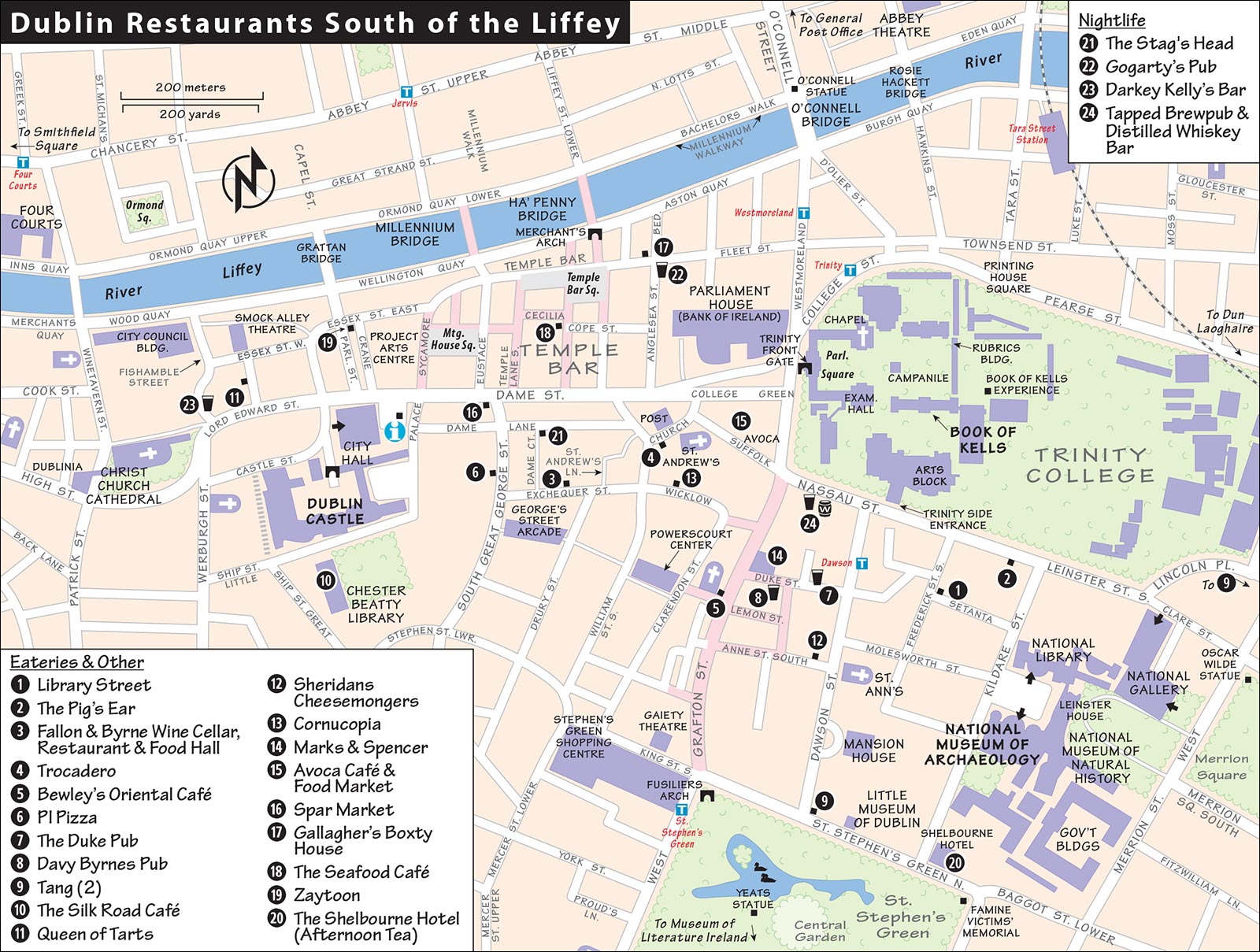
Fallon & Byrne, big and centrally located in the heart of Dublin, has a variety of eateries under one roof—including some surprisingly fine options for a sit-down meal. Their $ food hall has gourmet grocery items, plus counters with main dishes, desserts, and cheese and charcuterie. From there, you hike down the stairs to a spacious and welcoming $$ wine cellar, with a casual mix of regular and bar-top tables. The wine-friendly menu is international and modern, with tempting pastas, meat-and-cheese boards, and a fine selection of wine. Your server can give you good wine advice. Or climb the stairs to the dressier $$$ restaurant—with appealing turn-of-the-century decor, white tablecloths, and modern Irish dishes (including early-bird specials). It’s smart to reserve ahead for a meal in either place (daily, +353 1 472 1000, 11 Exchequer Street, www.fallonandbyrne.com).
$$$$ Trocadero is an old-school fixture serving beefy European and modern Irish cuisine to Dubliners interested in a slow, romantic meal. The dressy, red-velvet interior is draped with photos of local actors (dinner only, closed Mon, 4 St. Andrew Street, +353 1 677 5545, www.trocadero.ie, Robert).
$$ Bewley’s Oriental Café is a grand, venerable eatery, centrally located on Grafton Street. Good-value brunch items are offered all day in a wonderful human bustle that epitomizes urban Dublin. Check out the fine Harry Clarke stained-glass windows (against the back wall), fun lunch theater (upstairs), and snack-worthy baked treats (at the takeaway counter around the corner; daily, 78 Grafton Street, +353 1 564 0900). To see what’s on at the lunch theater, see www.bewleyscafetheatre.com (performances Mon-Sat at 13:00, arrive at 12:45 to settle in and order before the performance begins, +353 86 878 4001).
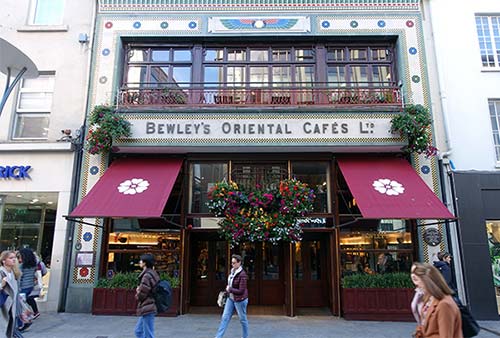
$ PI Pizza is a hit for its short list of wood-fired, thin-crust Naples-style pizza in a simple, industrial interior. It’s mod, fun, and affordable; the chef is passionate about quality ingredients (daily, 83 South Great George’s Street, second location in Temple Bar, www.pipizzas.ie).
Classic Pub Grub: $$ The Duke and Davy Byrnes, both on Duke Street, serve reliable pub food and are favorites of literature fans whose heroes (James Joyce, Brendan Behan, and Patrick Kavanagh) frequented them. Davy Byrnes feels like a pub-meets-brasserie, with more refined meals, but still affordable. In Ulysses, Leopold Bloom ate lunch here—the gorgonzola sandwich on brown bread is still on the menu (at #21, +353 1 677 5217). Meanwhile, The Duke has your classic Irish pub ambience and basic food (at #8, +353 1 679 9553).
Fast, Easy, Affordable Lunches
These city-center places are good for a quick, healthy lunch. Note that only a few of these places are open for dinner (noted in the listing).
$ Tang serves up delicious Middle Eastern flatbread sandwiches, plus healthy salads (closed Sun; locations at 23c Dawson Street—a few steps north of St. Stephen’s Green; 9a Abbey Street Lower—just off O’Connell Street, north of the Liffey; and 2 Cumberland Street South, east of Trinity College).
$$ The Silk Road Café, at the Chester Beatty Library, serves an enticing selection of Middle Eastern and Mediterranean cuisine, including good vegetarian dishes (daily, tucked behind Dublin Castle, +353 1 407 0770). While you’re there, be sure to pop into the amazing (free) library (see listing earlier, under “Sights in Dublin”).
$ Queen of Tarts, with nice outdoor seating a short walk beyond the Temple Bar chaos (and near Christ Church Cathedral), does yummy breakfasts, light soup-and-salad lunches, sandwiches, and wonderful pastries (daily until 17:30, on the charming, stepped Cow’s Lane just off Dame Street, +353 1 633 4681).
$$ Sheridans Cheesemongers isn’t a restaurant but a shop—stocked with the most fragrant, most enticing Irish cheeses around. Stop in to sample a few and buy a wedge or two for a picnic or a snack. They also sell sliced deli meats and handy premade cheese-and-charcuterie “grazing boards” (closed Sun, 11 Anne Street South, +353 1 679 3143).
$ Cornucopia is a small, proudly vegetarian (“98% vegan”), counter-service place two blocks off Grafton. It’s friendly and youthful, with hearty breakfasts, lunches, and dinner specials, and easy seating (daily until 21:00, 19 Wicklow Street, +353 1 677 7583).
Department Store Eateries: $$ Marks & Spencer department store has a third-floor, rooftop café with outdoor seating overlooking Grafton Street (daily until 19:00, 20 Grafton Street). The Avoca department store has good, casual food options: The $$ Avoca Café, on the second floor, is a cheery eatery thriving with smart local shoppers. They serve healthy foodie plates and great salads. The $ Avoca Food Market, in the basement, sells fresh, ready-made food, including salads, sandwiches, and appealing baked goodies, plus a roast chicken window (limited seating—best for takeaway; daily, 11 Suffolk Street, +353 1 677 4215).
Picnic Fixings: Department stores with fancy grocery sections also generally have what picnickers need. Try Dunnes (with several locations) or Marks & Spencer (20 Grafton Street, mentioned above). Spar Market is extremely central—right along Dame Street, with big windows overlooking the bustle—and open 24/7 (notice they actually have no front door...it’s literally always open; coffee counter, deli with sandwiches and fried items, easy seating; corner of Dame Street and South Great George’s Street, +353 1 633 9070).
$ Good Dublin Chain Eateries: Dublin has several reliably good local chains, with branches all over the city, where you can get a filling, affordable, efficient meal. Keep an eye out for Sprout & Co and Chopped (salads), Boojum (Chipotle-like burritos), Umi (fresh-made falafel), and Zaytoon (Persian, doner and shish kebab wraps; see listing later).
Temple Bar
Temple Bar, overrun with tourists, is lined with sloppy eateries charging a premium for their location. With some wonderful (and better-value) options just a few minutes’ walk farther from the river—and described above—eating in Temple Bar just isn’t appealing. But if you must, the following places are more distinctive and worth seeking out.
$$$ Gallagher’s Boxty House, with creaky floorboards and old Dublin ambience, serves stews and corned beef, but the specialty is boxty, the generally bland-tasting Irish potato pancake filled and rolled with various meats, veggies, and sauces (dinner reservations wise, daily, 20 Temple Bar, +353 1 677 2762).
$$$ The Seafood Café, perched quietly just a few steps above the Temple Bar chaos, serves a short menu of good-quality Irish oysters and fresh seafood dishes (daily, 11 Sprangers Yard, +353 1 515 3717).
$ Zaytoon, part of a local chain, makes doner and shish kebab wraps to order. It’s affordable and handy for a bite in the heart of Temple Bar (daily, 15 Parliament Street, +353 1 677 3595).
Afternoon Tea
$$$$ The Shelbourne Hotel has been a Dublin landmark since 1824, built to attract genteel patrons and Dublin’s upper-crust socialites. “Fur coat and no knickers” schlubs can sample the aristocratic good life by enjoying the tradition of afternoon tea in the hotel’s Lord Mayor’s Lounge (no shorts, tank tops, or T-shirts). The menu is a swirl of finger sandwiches, buttermilk scones, clotted cream, strawberry jam, ginger loaf, and fine coffee...as well as 20-plus varieties of tea (1.75-hour seatings daily at 12:00, 14:30, and 17:00; reservations smart, especially on weekends; 27 St. Stephen’s Green, +353 1 663 4500, www.theshelbourne.com).
South of St. Stephen’s Green, near the Grand Canal
These places are within a long block of one another in the residential Grand Canal neighborhood. This area, southeast of St. Stephen’s Green (just walk straight out Baggot Street Lower until you cross the canal at Mespil Road), feels comfortably workaday with fewer tourists. For locations, see the map on here. Nearby, you’ll also find handy branches of Boojum (burritos) and Umi (falafel).
$$$$ Bloom Brasserie & Wine Bar fills its cellar with a woody, candlelit ambience and beautifully presented dishes based on locally sourced meats and seafood. The menu, modern Irish meets France, changes with the seasons (daily, 11 Baggot Street Upper, +353 1 668 7170).
$$ Searsons Pub, a sprawling neighborhood favorite, is known for its lamb, roast meat, and fish specials, with an open kitchen, classy-for-a-sports-bar energy, and friendly service. If there’s a horse race or rugby match on, it’ll be on the screens here (it’s located near the rugby stadium and a betting office). You can escape the clamor out back on the patio (daily, 42 Baggot Street Upper, +353 1 660 0330).
$$ Zakura Izakaya is a Japanese place with rice dishes, noodles, and sushi. Part of a small local chain, it’s cozy and tight, with efficient service (daily, 7 Baggot Street Upper, +353 1 563 8000).
$$ Bar Eile, an otherwise nondescript dive pub, serves an enticing and flavorful menu of Afro-Caribbean soul food—jerk chicken, oxtail stew, and so on (closed Mon, 1 Baggot Street Upper).
Portobello, on or near Camden Street
The neighborhood called Portobello stretches southwest of St. Stephen’s Green, on the north side of the Grand Canal. Like the Stoneybatter neighborhood north of the Liffey that I describe later, this area is hip and away from the tourist crush, though a bit more gritty-urban and less charming than Stoneybatter. But they are handy to more of my recommended hotels (especially the ones south of St. Stephen’s Green). For locations, see the map on here.
$$$$ Delahunt, the top choice for elegant dining in this neighborhood, fills a long and narrow circa-1906 grocery store (mentioned in Joyce’s Ulysses). It surrounds its diners with original brass and varnished trappings, and elegant privacy partitions. The waitstaff is friendly and the cuisine—Irish with international influences—is a delight. Dinner is a set five-course menu (Tue-Thu dinner only, Fri-Sat lunch and dinner, closed Sun-Mon, 39 Camden Street Lower, +353 1 598 4880, www.delahunt.ie).
$$ Mister S fills its narrow, dimly lit interior with the aroma of rich wood smoke...as you walk down Camden Street, you’ll smell it before you see it. Up a flight of stairs in the back of the space—as if on an elevated stage—aproned chefs stoke the fire and grill and smoke giant hunks of meat to tender perfection. The menu lists a variety of locally sourced meats, plus equally delicious starters, sides, and desserts. It’s a casual, easygoing place, with rock music on the soundtrack and a carnivorous clientele. Book ahead (Tue-Thu dinner only, Fri-Sat lunch and dinner, closed Sun-Mon, 32 Camden Street Lower, +353 1 683 5555, www.misters.ie).
$$$$ Pickle is the place for upmarket Indian cuisine at high prices. Reservations are recommended (Wed-Fri lunch and dinner, Sat-Sun dinner only, closed Mon-Tue, 43 Camden Street Lower, +353 1 555 7755, www.picklerestaurant.com).
$$ Brother Hubbard South is a cool café with top-end sandwiches, delectable pastries (including outstanding cinnamon rolls), and other tasty brunch and lunch dishes (daily, 46 Harrington Street, +353 1 441 1112, www.brotherhubbard.ie). They have other locations around Dublin, including one on the north side of the river (described later).
NORTH OF THE LIFFEY
For locations, see the map on here.
$$$$ Mr Fox is an elegant and serene little basement operation serving a creative, locally sourced multicourse menu that changes monthly. In summers, they open up an outdoor terrace. Reservations are smart—especially on weekends (Tue-Fri dinner only, Sat lunch and dinner, closed Sun-Mon, behind the Garden of Remembrance at 38 Parnell Square West, +353 1 874 7778, www.mrfox.ie).
$$ Brother Hubbard North is another handy outpost of this local chain for high-quality pastries, lunches, and brunches (see description earlier). On weekends (Thu-Sat), they’re also open for dinner, with a Middle Eastern menu (a short walk north of the Grattan Bridge at 153 Capel Street North, +353 1 441 1112, www.brotherhubbard.ie). The takeout shop, next door, is handy for picking up coffee and a smaller assortment of to-go options.
$$$ The Church is a trendy bar/restaurant/beer garden housed in the former St. Mary’s Church (which hosted the baptism of Irish rebel Wolfe Tone and the marriage of brewing legend Arthur Guinness). Diners can sit in the choir balcony (with a huge pipe organ) or the ground-floor nave, dominated by a long bar. On warm summer nights, the outdoor terrace is packed. Eating here is more about the scene than the cuisine (daily, corner of St. Mary’s and Jervis Streets, +353 1 828 0102, www.thechurch.ie).
$ Brannigan’s is an inviting family-run traditional pub—it’s been a “beer emporium since 1854.” Its location, roughly halfway between the Gate and Abbey theaters, makes it convenient for theatergoers and those exploring O’Connell Street (cheap grub, daily, 9 Cathedral Street, 50 yards from the Spire, +353 1 874 0137).
$ One Society Café goes for “tasty, healthy, simple” in an unpretentious little space a few blocks east of the Parnell Monument. It’s a good, casual place for inventive brunch food and unique specialty pizzas and pastas (Wed-Fri lunch and dinner, Sat-Sun dinner only, closed Mon-Tue, 1 Gardiner Street Lower, +353 1 537 5261, www.onesociety.ie).
North Quay Docklands Area (between EPIC Museum and Connolly Station)
This district on the north quay of the River Liffey was a derelict dockland until the late 1980s, when it was transformed into a financial and tech center. This is a handy spot to hang out if you’re nearby, touring the EPIC Museum or using Connolly train station.
$$ Harbourmaster Bar and Restaurant occupies the building that once oversaw the ebb and flow of cargo on the surrounding docks. It’s a fun place serving good pub grub and higher-end Irish food in a pub on one end and a more peaceful restaurant on the other (closed Sun, Custom House Dock at George’s Dock—look for the little brick building with a clock tower, +353 1 670 1688, www.harbourmaster.ie).
Stoneybatter (North of the Liffey)
This fun-to-browse neighborhood sits just a short walk off the top of Smithfield Square (near Old Jameson Distillery). While Smithfield Square itself has mostly chain restaurants, Stoneybatter feels locally owned. It’s a charming slice of village Dublin, with narrow storefronts and colorful cottages—and becoming quite trendy, with indie bookstores and boutiques, cafés known for their brunch, a variety of global eateries (Thai, Chinese, Indian), and other great restaurants. Stoneybatter is fun to explore by day, though sleepy at night, when most of its shops are closed. Below I’ve listed one “destination” restaurant and some popular cafés, but it’s also just as fine to come and window-shop. See the map on here for locations.
Getting There: Ride the red Luas tram to the Smithfield stop, then walk about five minutes to the top of Smithfield Square. At the top, hook left, then bear right and uphill about five minutes more to Manor Street—the main spine of Stoneybatter.
$$ Grano anchors this neighborhood and is reason enough to visit. This Italian-owned osteria offers a short menu of mostly classic Italian dishes, as well as a few using local Irish ingredients. Portions are generous, and it’s an excellent value for the quality. The decor is rustic Italian village, but with class, and the service is cheery. Reservations are essential (Tue-Fri dinner only, Sat-Sun lunch and dinner, closed Mon, 5 Norseman Court on Manor Street, +353 1 538 2003, www.grano.ie).
$$ L. Mulligan Grocer, across the street, is a gastropub filling a former grocery store, with a focus on seasonal local ingredients and Irish craft beers on draft (Thu-Fri dinner only, Sat-Sun lunch and dinner, closed Mon-Wed, 18 Stoneybatter, +353 1 670 9889, www.lmulligangrocer.com).
Brunch: Two cafés with a loyal local following are $ Slice, with all-day brunch plus some tasty lunch options (Tue-Sun until 17:00, closed Mon, 56 Manor Place, +353 1 445 6100, www.asliceofcake.ie); and $ Social Fabric, in a former post office, which serves mostly brunch-type dishes (daily until 16:00, 34 Stoneybatter, +353 87 915 8864). It’s smart to book ahead for either one, especially on weekends.
Dublin Connections
BY PLANE
Dublin Airport has two terminals located an easily walkable 100 yards apart (code: DUB, www.dublinairport.com). There is no TI at the airport.
Linking the Airport and City Center
By Bus: You have two main choices—Dublin Express or Aircoach. Both pick up directly in front of arrivals, at ground level, at both terminals. To decide which line works best for your accommodations, check route maps online, or look at the route boards at the stops at the airport (if no one is at the kiosk, ask the driver). Prices for both buses are about €8-10, depending on where you’re headed; you can typically get a slight discount if you prebook online.
Dublin Express: There are two routes. Bus #782 runs along the River Liffey, and includes stops near O’Connell Bridge, Temple Bar, Christ Church, Heuston Station, and Smithfield (runs nearly ’round the clock). Bus #784 links the airport to stops near Merrion Square and Trinity College (runs about 5:00-23:00). Both routes depart at least every 30 minutes, and rides take 35-50 minutes (+353 1 903 9508, www.dublinexpress.ie).
Aircoach: Bus #700 generally runs a north-south route that follows O’Connell Street down to O’Connell Bridge and St. Stephen’s Green (4/hour, fewer late night, runs about 6:00-01:30, +353 1 844 7118, www.aircoach.ie). Aircoach also runs a bus between Dublin Airport and Belfast (see the Belfast chapter).
By Taxi: Taxis from the airport into Dublin cost €35-40, depending on traffic. Just get in line and tell the dispatcher where you’re going. If there’s a long wait, you could use the FreeNow or Uber app to summon a taxi; however, you’ll have to walk across the street, through the parking garage, and out the other side to reach the pick-up point.
BY TRAIN OR BUS
The frequencies listed below are for Monday-Saturday (fewer departures on Sunday).
By Train from Dublin’s Heuston Station to: Galway (8/day, 3 hours), Westport (5/day, 3.25 hours), Cork (about hourly, 2.5 hours; from here, you can bus or taxi to Kinsale or Cobh), Tralee (every two hours, most change in Mallow but one direct evening train, 4 hours; from here you can bus to Dingle). Info: IrishRail.ie.
By Train from Dublin’s Connolly Station to: Rosslare (3-4/day, 3 hours), Portrush (7/day, 5 hours, transfer in Belfast or Coleraine). The Dublin-Belfast train connects the capitals in two hours at 90 mph (8/day). Northern Ireland train info: Translink.co.uk.
By Bus to: Trim (almost hourly, 1 hour), Galway (hourly, 3.5 hours; faster on CityLink—hourly, 2.5 hours, +353 91 564 164, www.citylink.ie), Westport (6/day, 6 hours), Limerick (7/day, 3.5 hours), Tralee (7/day, 6 hours), Dingle (4/day, 8.5 hours, transfer at Limerick and Tralee). Nearly all buses within the Republic are operated by Bus Éireann, the national carrier (www.buseireann.ie), plus a few operated by the related Expressway (www.expressway.ie).
Heading to Northern Ireland, you’ll likely go with Translink (www.translink.co.uk), most of which stop at Dublin Airport en route: Belfast (#X1, 2.5 hours), Derry (#X3 or #X4 depending on the route, 4.5 hours).
BY CAR
It’s best to avoid driving in hectic downtown Dublin. If you plan to drive in Ireland, save your car rental for the countryside. Consider renting a car at the airport, where you’ll find all the standard car-rental agencies with longer hours than those in the city and easier access to the M-50 outerbelt. If renting in town and heading to the south, the Hertz office on Baggot Street lets you hop on Northumberland Road and get out of town quickly while avoiding heavy urban traffic (www.hertz.ie).
Toll Roads: When picking up your car, be clear on how you’re going to pay for tolls. Drivers renting a car at Dublin Airport and heading for the countryside can bypass the worst of the big-city traffic by taking the M-50 ring road south or west. To cover the toll, the M-50 uses an automatic tolling system called eFlow. Your rental may come with an eFlow tag, in which case the toll is simply deducted from your credit card. If not, you’ll have to go online after driving on the M-50 to pay the toll yourself (www.eflow.ie [URL inactive]). For more on tolling in Ireland, see here.
CONNECTING IRELAND AND BRITAIN
If heading to the island of Great Britain—especially to London—flying is quick, easy, and typically affordable; however, ferries can work well for reaching rural Wales or Scotland.
Flights: Ryanair and Aer Lingus are the predominant discount carriers, but note that their London-bound flights often land at Luton or Stansted, airports located some distance from the city center.
Ferries: Begin by checking www.tfwrail.wales/ticket-types/sailrail, which deals with several companies and has fares low enough to compete with cheap airlines. Irish Ferries (+353 818 300 400, www.irishferries.com) and Stena Line (+353 1 907 5555, www.stenaline.ie) combine to make about eight daily crossings between Dublin Port (two miles east of O’Connell Bridge) and Holyhead, Wales. Most trips take 3.5 hours, but Irish Ferries offers a twice-daily fast boat that makes the trip in just over 2 hours. Since these boats can fill up on summer weekends, book well ahead during the peak period.
Dun Laoghaire
On one end of Dublin Bay’s crescent-shaped shoreline, the small seaside town of Dun Laoghaire (dun LEERY) offers a fine main street and some James Joyce history (including the martello tower where the opening scene of Ulysses is set, now a museum). These can be worth a half-day for those seeking a break from Dublin.
Dun Laoghaire also has good accommodations for those who want a quieter lodging alternative and don’t mind a commute to their Dublin sightseeing. It’s easy to reach on the DART commuter rail (about 30 minutes from central Dublin); it’s also the main entry point for cruise ships to the Dublin area.
The Dun Laoghaire harbor, seven miles south of Dublin, was strategic enough to merit a line of martello towers, built in 1804 to defend against an expected Napoleonic invasion. By the mid-19th century, massive breakwaters were completed to protect the huge harbor. Ferries once sailed regularly from here to Wales (75 miles away), and the first train line in Ireland connected the terminal with Dublin. With those ferries now gone, Dun Laoghaire is much quieter. More recently, the town has found a new purpose as a cruise port (with a quarter of a million arrivals in 2023).
GETTING TO DUN LAOGHAIRE
It’s easy to get to Dun Laoghaire via DART and Aircoach; in a pinch, figure about €40 by taxi from central Dublin, or €50-60 from the airport. Taxis line up along Marine Road, a block up from the TI.
By DART Commuter Train
The DART commuter train connects to Dublin in 30 minutes (see here for details). If you’re coming from Dublin, catch a DART train marked Bray or Greystones and get off at either the Dun Laoghaire or Sandycove & Glasthule stop (see the map for the best option for your destination). I’ve included a self-guided tour for the short train ride from Dublin to Dun Laoghaire (see below). To head from Dun Laoghaire to Dublin, catch a train marked Howth and get off at the central Tara Street Station (or, for onward train connections north, ride one stop farther to Connolly Station).
Self-Guided Train Tour to Dun Laoghaire: As you zip between Dublin and Dun Laoghaire on the DART, here are a few things you’ll pass. Sit on the left (water side) for the best views.
Crossing the river out of central Dublin, the train passes the Grand Canal Dock development—also known as “Silicon Docks”—with modern office buildings. Ireland’s “Celtic Tiger” economy, which began in the mid-1990s, has made it an attractive place for businesses to set up shop. And with the United Kingdom’s departure from the European Union, Dublin has become an even more attractive hub for business—English-speaking and still tied closely to the EU. From here, the Grand Canal (an old industrial canal, now a pleasant park) curls in a ring around central Dublin.
Next, before the Landsdowne Road stop, towers the tubular, futuristic Aviva Stadium. Opened in 2010, Ireland’s second-biggest stadium holds more than 50,000 spectators, who come here to watch the Irish national rugby and soccer teams compete. It’s also a venue for huge concerts: AC/DC, the Eagles, and Taylor Swift have all performed here.
As the train continues, you’ll see the cranes of the Port of Dublin hovering in the distance. The Sandymount stop serves a posh residential beachside community—with, thanks to this train, a very easy commute into the city.
From here, the train runs down along the waterline (or, at low tide, a mudflat). Enjoy the coastal views for the next few stops; you can already see Dun Laoghaire on the horizon. After Seapoint, enjoy an up-close view of a popular beach.
As you pass a protected harbor bobbing with boats, your stop is next: Hop off at the Dun Laoghaire stop for a stroll through the center of town. Or, for closer access to the coastline and the James Joyce Museum, consider staying on one more stop to Sandycove & Glasthule. One efficient plan for day-trippers is to get off at Dun Laoghaire, explore your way through town and along the coast, then return from Sandycove & Glasthule.
By Bus from the Airport
Aircoach bus #703 makes it easy to connect Dun Laoghaire and Dublin Airport (€11 if you buy online, runs every two hours, one-hour ride, see map for stop locations, +353 1 844 7118, www.aircoach.ie).
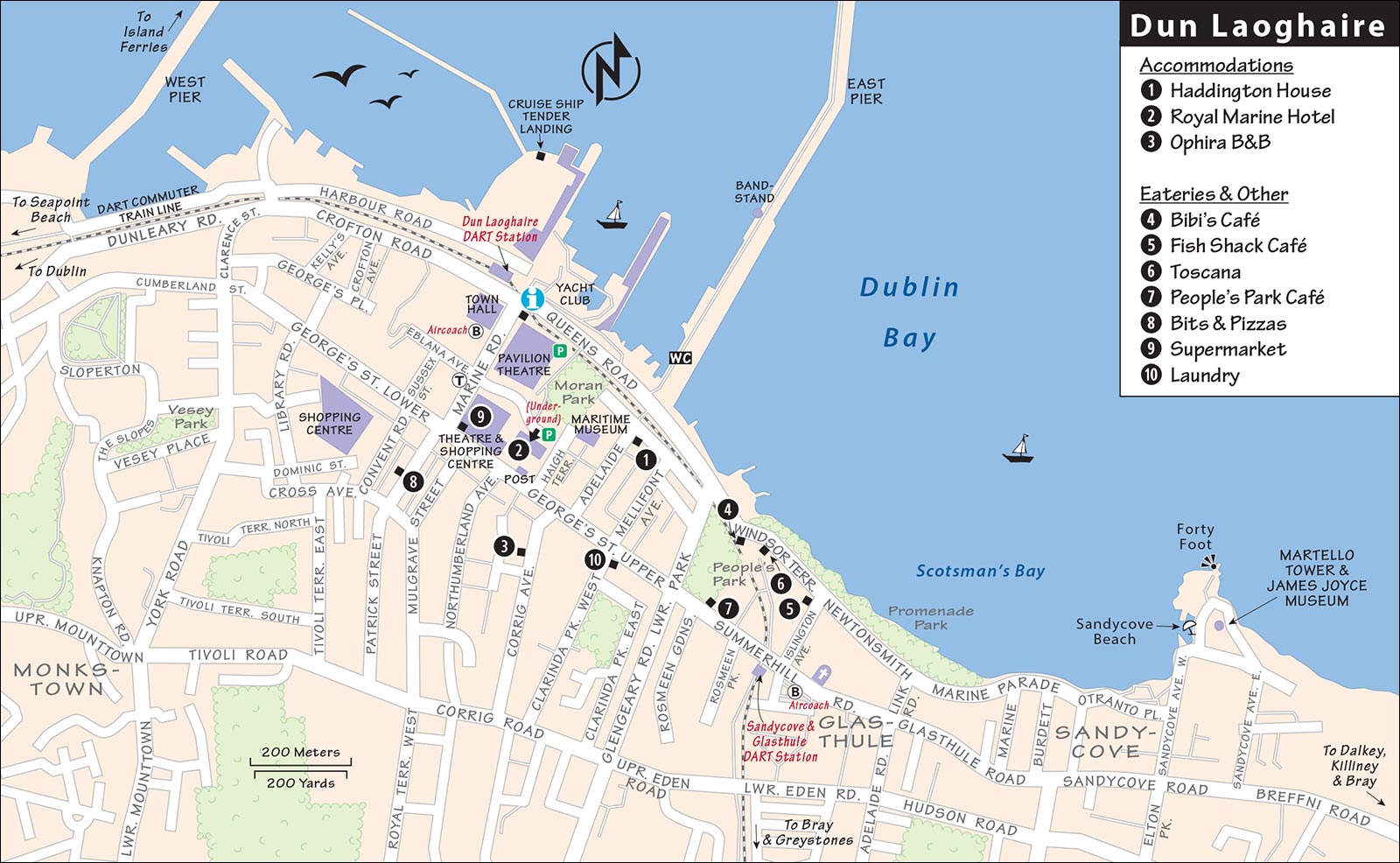
By Car
Parking: Drivers can leave their cars in Dun Laoghaire and sightsee Dublin by DART. Ask at your hotel or B&B for advice. One handy option is the Pavilion Car Park under the Pavilion Theatre, just downhill from the train station near the water (access facing bay from Queens Road, deals for prebooking online, +353 1 883 9833, www.parkrite.ie). Note that street parking is limited to three hours (except on Sundays, when it’s unlimited and free).
By Boat
For a slow and scenic approach to Dun Laoghaire, consider Dublin Bay Cruises, which does a loop connecting Dublin, Dun Laoghaire, and Howth (+353 1 901 1757, www.dublinbaycruises.com).
Dun Laoghaire serves as the cruise ship hub for the Dublin area. Passengers are tendered to the pier near the TI, an easy walk to the DART station—with its handy, fast, and frequent trains into Dublin.
Orientation to Dun Laoghaire
Dun Laoghaire (pop. 26,000) has a coastline defined by its nearly mile-long breakwaters—reaching like two muscular arms into the Irish Sea. The breakwaters are popular for strollers, bikers, birdwatchers, and fishermen.
Tourist Information: The TI fills a kiosk in the plaza next to the Pavilion Theatre, a couple minutes’ walk from the train station (exiting the station, turn left and walk toward the water on Crofton Road; daily 10:00-13:30 & 14:30-17:00, shorter hours off-season, +353 1 280 6964, www.dlrtourism.ie).
Helpful Hints: For laundry, try Park Laundry (full service only, closed Sun, 47a George’s Street Upper, +353 1 551 8977). The Pavilion Theatre offers performances in the center of town (+353 1 231 2929, www.paviliontheatre.ie). For the best views, hike out to the lighthouse at the end of the East Pier or climb the tight stairs to the top of the stubby martello tower at Sandycove (also the James Joyce Museum, described later).
Sights in Dun Laoghaire
Town Center Stroll
For an enjoyable and concise look at the town, consider this plan: From the TI, walk two blocks uphill on Marine Road to George’s Street—Dun Laoghaire’s main drag, with a nice commercial bustle, wide sidewalks, and limited traffic. Here you’ll find some colorful shops and a few recommended eateries.
If you follow this to the left (southeast) a few blocks, you’ll reach the People’s Park, a delightful Victorian-era green space with gurgling fountains, monuments, a playground, WCs, and a recommended café; it’s especially enjoyable to linger here on a nice day.
Walk down to the bottom of the park, to the water. From here, turn right and follow the park along Scotsman’s Bay. The genteel, waterfront neighborhood you’re enjoying is called Glasthule. Looking offshore, the peninsula that looks like an island is the town of Howth.
You can follow this lovely seaside path along the pebbly coastline as far as you like. In about 15 minutes, you’ll reach the tidy and popular little beach called Sandycove. Kids of all ages enjoy swimming at this safe, sandy little cove bordered by rounded rocks.
Just above the beach, you can’t miss the stout, round martello tower that perches on the point. This houses the James Joyce Museum (described next). At the tip of the point that extends past the tower is a much more rugged, rocky beach called the Forty Foot—beloved by hardy swimmers, but challenging for novices (a concrete pad has steps leading directly into the rough-and-tumble sea).
From here, you can head back the way you came to the Dun Laoghaire DART station—continuing along the water to pass the East Pier and the National Maritime Museum. Or, for a quicker return to Dublin, you can turn inland about halfway (up Islington Avenue) to reach the Sandycove & Glasthule DART station.
▲James Joyce Tower and Museum
This squat martello tower at Sandycove was one of 26 fortifications, all along the coast, originally built to repel a possible Napoleonic invasion. But it became famous chiefly because of its association with James Joyce. The museum’s round exhibition space is filled with literary memorabilia. For a fine view, climb the claustrophobic, two-story spiral stairwell sealed inside the thick wall to reach the rooftop cannon mount.
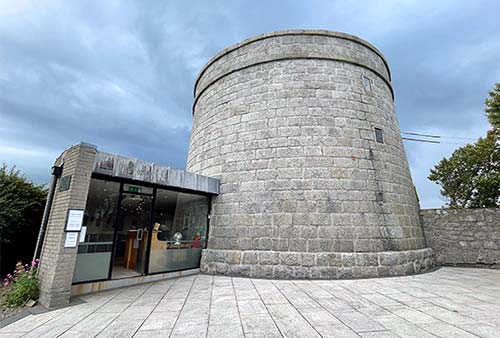
Cost and Hours: Free, Tue-Sun 10:00-16:00, closed Mon, the museum is run by volunteers—call ahead to be sure it’s open, +353 1 280 9265, www.joycetower.ie.
Visiting the Museum: On the ground floor, enjoy chatting with the docents about Joyce, then peruse the exhibits: literary artifacts, old photographs (including several of Joyce’s wife, Nora Barnacle), a rare first edition of Ulysses (specifically, print #819), and Joyce’s death mask. Up a few stairs, find several items belonging to Joyce, including his guitar, vest, cane, and traveling trunk, plus the original plaster cast of his death mask.
Next, climb a tight flight of stairs and step into the austere, circular “gloomy domed livingroom” where a young Joyce crashed for six nights with his “frenemy,” Oliver St. John Gogarty, and a third man named Samuel Trench. Gogarty and Joyce frequently butted heads, and on September 14, 1904, an argument escalated when Trench began shooting at saucepans that hung over Joyce’s bed. This distressing event was a turning point in literary history: It convinced Joyce—who’d returned home from school in Paris to care for his ailing mother—that he was fed up with Ireland, once and for all. That day, he decided to move to the Continent—and that evening, he asked Nora Barnacle, whom he’d only been dating for a short time, to come with him. (She replied, “yes I said yes I will Yes”...or something to that effect.) A month later, they were gone. Joyce spent the next two decades moving around a Europe that was wracked by World War I, living in poverty, and slowly writing his magnum opus, Ulysses. And in that novel’s opening scene, Gogarty became the model for the first character mentioned in the book, in this very room: “Stately, plump Buck Mulligan came from the stairhead, bearing a bowl of lather on which a mirror and a razor lay crossed.” Standing here is enough to give English majors goosebumps, if not palpitations.
Take 20 more steep stairs up to the top of the tower for views over Dun Laoghaire and Dublin Bay.
National Maritime Museum of Ireland
At this quirky sight, maritime exhibits fill a former church with model steamships, brass fittings, accounts of dramatic sinkings and heroic rescue attempts, a “radio room” that thrills hams, and a huge lighthouse optic (lamp lens) installed where the altar once stood. Don’t miss the upper gallery, with more exhibits. Landlubbers may find it underwhelming.
Cost and Hours: €8, daily 11:00-17:00, Haigh Terrace, +353 1 214 3964, www.mariner.ie.
Sleeping in Dun Laoghaire
These places lie between the Dun Laoghaire and Sandycove & Glasthule DART stations.
$$$$ Haddington House rents 40 rooms a block behind the Maritime Museum, with a terrace overlooking the waterfront and a cozy parlor that becomes an elegant cocktail bar in the evening (air-con, elevator, free parking, some rooms with sea views, no kids under 12, bike rental, 9 Haddington Terrace, +353 1 280 1810, http://haddingtonhouse.ie, rooms@haddingtonhouse.ie).
$$$$ The Royal Marine Hotel is a grand relic from the 1860s, when this town was Ireland’s primary ferry port. Facing a park with distant sea views, its 228 rooms ooze Old World charm, though it’s a bit pretentious and stuffy (family rooms, air-con, elevator, ground-floor pub, on Marine Road, +353 1 230 0030, www.royalmarine.ie, reservations@royalmarine.ie).
$ Ophira B&B is a historic house with four comfortably creaky rooms run by active diver-hiker-biker John O’Connor and his wife, Cathy. They may be retiring soon, but if open, this is a great value (family room, parking, 10 Corrig Avenue, +353 1 280 0997, www.ophira.ie, johnandcathy@ophira.ie).
Eating in Dun Laoghaire
Along the Waterfront, in Glasthule: Called simply “the village” locally, Glasthule is just down the street from the Sandycove & Glasthule DART station and has an array of fun, hardworking little restaurants. These three places line up, just a few steps apart, facing Scotsman’s Bay on the stroll-worthy waterfront. $ Bibi’s Café, an outpost of a trendy Dublin café, faces the water just below the People’s Park. Welcoming and cozy, they serve great coffee and delicious brunches, lunches, and pastries (daily, no dinner, 2 Windsor Terrace, www.bibis.ie). $$ Fish Shack Café serves fresh fish dishes to beachcombers (closed Mon, takeout available, 1 Martello Terrace, +353 1 284 4555). $$$ Toscana is a popular little cubbyhole, serving hearty Italian dishes and pizza. Reserve for dinner (early-bird specials, daily, 5 Windsor Terrace, +353 1 230 0890, www.toscana.ie).
In People’s Park: $$$ People’s Park Café fills a lovely glassed-in pagoda (daily, Summerhill Road, +353 86 152 8383, www.peoplesparkcafe.ie).
On George’s Street: Dun Laoghaire’s main drag is a good place to browse for a meal. It has plenty of reasonably priced eateries and pubs, including many with live music. Just off George’s Street, $$ Bits & Pizzas is a good bet for families (daily, 15 Patrick Street, +353 1 284 2411).
Groceries: For picnic shopping, try the Super Valu under the Dun Laoghaire Shopping Centre, at the corner of Marine Road and George’s Street Upper (daily).