DUBLIN
Map: Dublin Walk Part 1: South of the Liffey
Map: Dublin Walk Part 2: O’Connell Street & Irish Heroes
Map: Central Dublin, South of the Liffey
Map: National Museum of Archaeology
Map: Dublin, North of the Liffey
Map: Dublin Accommodations South of the Liffey
Map: Dublin, South of St. Stephen’s Green
CENTRAL DUBLIN, SOUTH OF THE LIFFEY
Map: Dublin Restaurants South of the Liffey
CONNECTING IRELAND AND BRITAIN
With reminders of its stirring history and rich culture on every corner, Ireland’s capital and largest city is a sightseer’s delight. Boasting a people-friendly cityscape, the remarkable Book of Kells at Trinity College, a patriotic jail, excellent museums of archaeology and literary treasures, and a thriving pub scene awash in Celtic music, storytelling, and Guinness, Dublin punches above its weight in arts, entertainment, food, and fun.
Founded as a Viking trading settlement in the ninth century, Dublin grew to be a center of wealth and commerce, second only to London in the British Empire. As the seat of English rule in Ireland for over 700 years, Dublin was the heart of the “civilized” Anglo-Irish area (eastern Ireland) known as “the Pale.” Anything “beyond the Pale” was considered uncultured and almost barbaric...purely Irish.
The golden age of English Dublin was the 18th century. The British Empire was on a roll, and the city was right there with it. Largely rebuilt during this Georgian era (1714-1830), Dublin became elegant and cultured.
The tide turned in the 19th century. In 1801, the parliament of Ireland was folded into the parliament of the United Kingdom, causing many Dublin elites to decamp to London. Then tragedy struck with the Great Potato Famine (1845-1849), which killed a million people and sent two million more across the seas (for the full story, read the sidebar on here).
The devastating consequences of the famine further degraded Ireland’s relationship with Britain. This tension culminated in the Easter Rising of 1916, followed by a successful guerrilla war of independence and Ireland’s tragic civil war that left many of its grand streets in ruins.
A century later, Dublin has emerged as a leading city of business and a bulwark of the European Union on the British Isles. While bullet-pocked buildings and dramatic statues keep memories of Ireland’s struggle for independence alive, today’s Dublin is lively, friendly, and extremely accessible. The city’s economy is booming, with a forest of cranes sweeping over sparkling new construction blocks. Dubliners are energetic and helpful, and visitors enjoy a big-town cultural scene with a small-town smile.
PLANNING YOUR TIME
While you could easily spend much longer here, for most Ireland vacations, Dublin merits three nights and two days. Here’s how I would fill two days in Dublin:
Day 1
| 9:00 | Follow my “Dublin City Walk” through the center of town, including a visit to the GPO Witness History Museum (at the General Post Office on O’Connell Street) |
| 13:00 | Lunch |
| 15:00 | Visit your choice of great sights—the best include EPIC: The Irish Emigration Museum, Chester Beatty Library, and 14 Henrietta Street |
| Evening | Do the Traditional Irish Musical Pub Crawl, the Literary Pub Crawl, or other evening show |
Day 2
| 9:00 | Tour Trinity College campus followed by a visit to the Book of Kells exhibit (book in advance) |
| 11:00 | Visit the National Museum of Archaeology |
| 13:00 | Lunch |
| 14:00 | For more Irish history, visit Kilmainham Gaol (and then, if you like, the Guinness Storehouse—book both in advance); or circle back to sights you didn’t get to yesterday |
| Evening | Linger over dinner at one of Dublin’s fine restaurants, or enjoy some live music at a pub |
With More Time
If you have more than two days, Dublin will fill it. Add more sights or consider a side trip to the seaside suburb of Dun Laoghaire—or some of the destinations in the Near Dublin chapter (Brú na Bóinne is the most impressive).
Orientation to Dublin
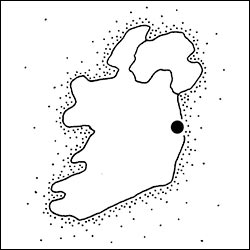
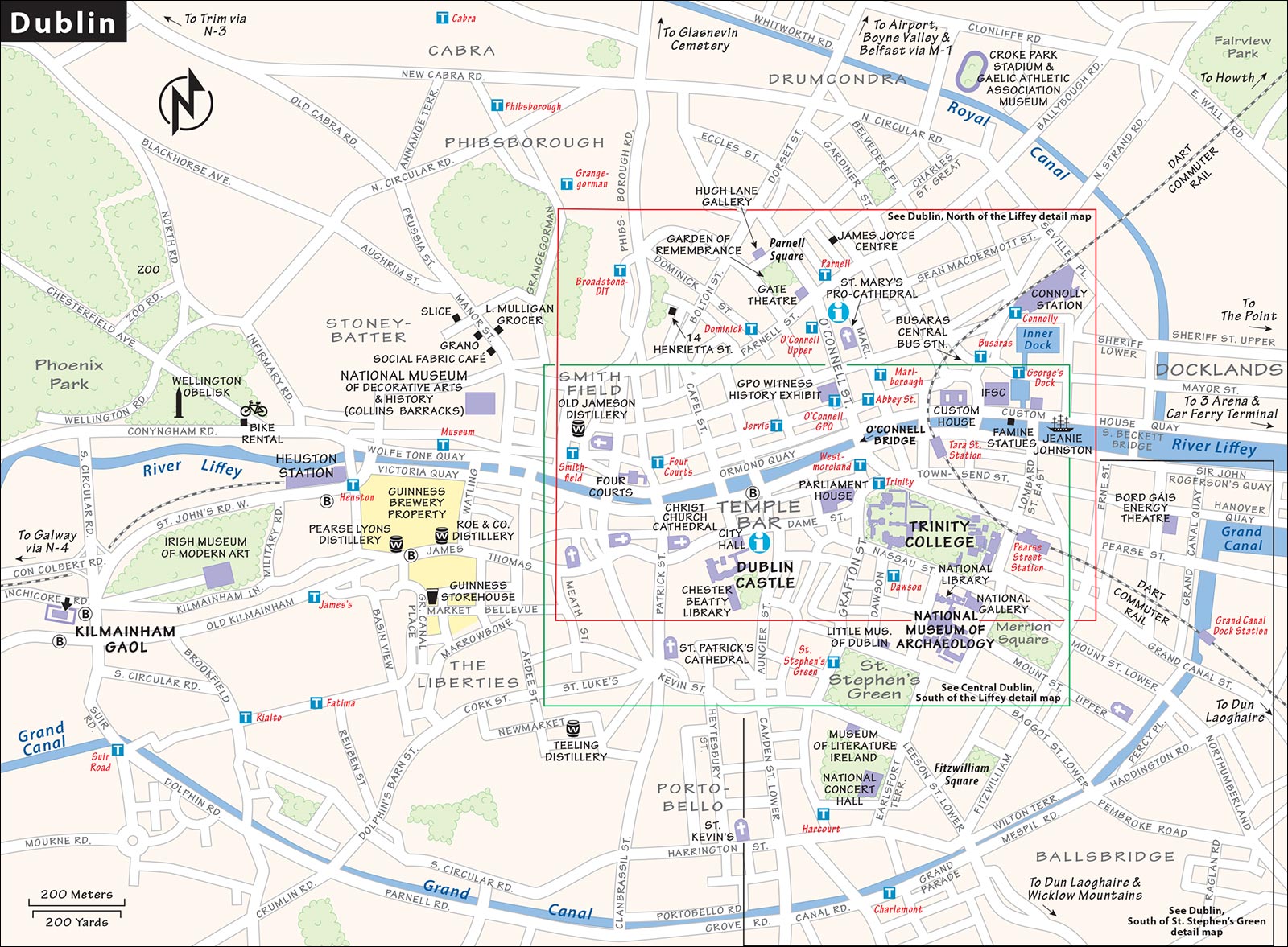
Greater Dublin sprawls with about 1.3 million people—about a third of the country’s population. But the center of tourist interest is a fairly compact triangle between the Spire on O’Connell Street, St. Stephen’s Green, and Christ Church Cathedral. Within or near this area, you’ll find Trinity College (Book of Kells), a cluster of major museums (including the National Museum of Archaeology), busy and pedestrianized Grafton Street, Temple Bar (touristy nightlife center), Dublin Castle, and the departure points for most city tours. A few additional great sights (such as 14 Henrietta Street) are a short walk outside this central zone. Only two major sights are better by taxi, bus, or tram: Kilmainham Gaol and the Guinness Storehouse (both in the same direction and easy to combine).
The River Liffey cuts the town neatly in two. Broadly speaking, the “city center”—more genteel-feeling, with Trinity College and a thriving commercial zone—is on the south bank, while the area north of the Liffey is rougher and in transition. Other than a quick stroll along O’Connell Street, visitors generally spend most of their time south of the Liffey.
As you explore, be aware that many long Dublin streets change names every few blocks, including the wide main axis that cuts north/south through the tourist center. North from O’Connell Bridge, it’s called O’Connell Street; south of the bridge, it becomes Westmoreland, passes Trinity College, and becomes the pedestrian-only Grafton Street to St. Stephen’s Green.
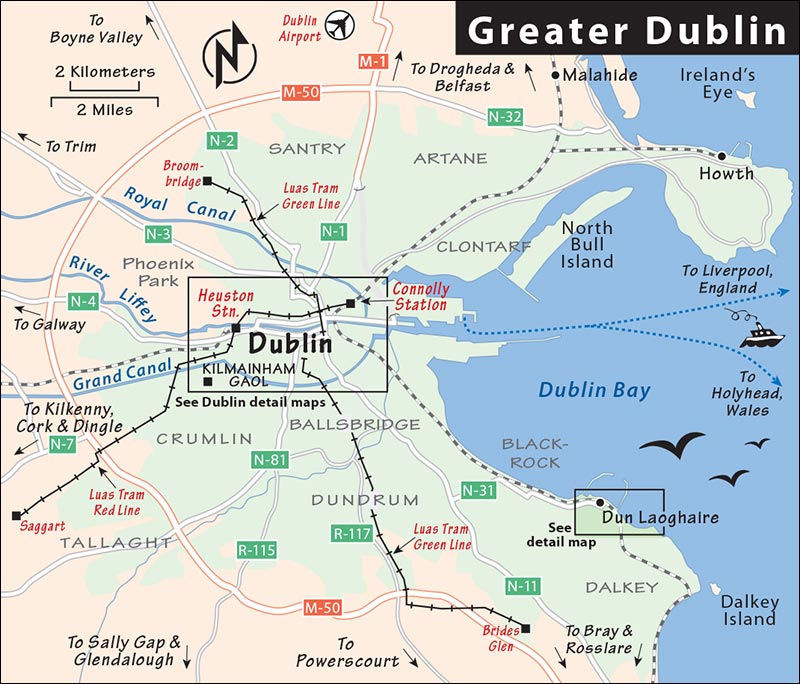
Dun Laoghaire, a coastal suburb south of the city center, can be a good smaller-town, home-base alternative (though accommodations are nearly as expensive as in Dublin). It’s an easy, 30-minute commuter train ride from central Dublin.
TOURIST INFORMATION
Dublin’s main TI covers the city and all of Ireland (on Barnardo Square next to City Hall, near Dublin Castle). A smaller TI is north of the Liffey, on O’Connell Street, just past the Spire (both branches open Mon-Sat 9:00-17:00, Sun in summer only 10:30-15:00—otherwise closed Sun, www.visitdublin.com). Beware of private agencies masquerading as “Tourist Information” points, especially on O’Connell Street. Their advice is biased, aiming to sell you tours and collect commissions.
Sightseeing Passes: The GoCity pass covers a variety of attractions—but requires hitting lots of expensive sights in a short time period to get your money’s worth. Do the arithmetic to decide if it’s worthwhile (All-Inclusive Pass—€84/1 day, €114/2 days, and so on; Explorer Pass—€74/3 sights, €99/4 sights, and so on; www.gocity.com/dublin). Note that if you have the Heritage Card for Ireland, it covers two Dublin sights (Kilmainham Gaol and Dublin Castle; see here).
ARRIVAL IN DUBLIN
By Train: Dublin has two train stations; both have ATMs, WCs, and lots of shops, but no baggage storage.
Heuston Station, on the west end of town, serves west and southwest Ireland. Exit straight out the front door to find bus stops and a Luas tram stop. You can buy a Leap Visitor Card (described under “Transit Cards,” later) at the Mullins shop inside the station. Nearby baggage storage is at Tipperary House B&B (7 Parkgate Street, across the river to the left—hidden beside the huge Ashling Hotel visible from station, 5-minute walk from station, +353 1 679 5317, www.tipperaryhousedublin.com).
Connolly Station, closer to the center, serves the north (including Belfast), northwest, and Rosslare. Longer-distance trains use tracks 2, 3, and 4, which terminate in the main hall; tracks 1, 5, 6, and 7—which are used by trains that are passing through, including the commuter DART trains—are set farther back (give yourself a few extra minutes to find your train—just follow the signs). To reach the Luas tram, exit through the main door and escalate down. The nearest baggage storage is across the street from the station at an internet/shipping/call shop (16 Amiens Street, +353 1 537 7413).
If you’re changing trains in Dublin, you may also change train stations. For example, to go from Belfast to Kilkenny you’ll arrive at Connolly Station, then transfer to Heuston Station to catch the Kilkenny train. The two stations are best connected by the red line of the Luas tram system (20-minute ride; see “Getting Around Dublin,” later).
By Bus: Bus Éireann, Ireland’s national bus company, uses the Busáras Central Bus Station (pronounced bu-SAUR-us), a gigantic glass box located one block south of Connolly Station. Numbered doors lead to the bus platforms; WCs are downstairs. Get tickets from machines on the opposite side of the cavernous hall (better yet, book online). The Luas tram is immediately behind the building: Exit through the door marked 15, turn right, and cross the street.
By Car: Avoid driving in downtown Dublin—traffic can be terrible, and parking is expensive. If you must park in central Dublin, a good option is Q-Park Christ Church, on Werburgh Street behind Jurys Inn Christ Church (+353 1 634 9805, www.q-park.ie). For more on driving, including Dublin’s toll road, see “Dublin Connections” on here.
By Plane or Ferry: For details on Dublin’s airport, UK ferries, and more, see “Dublin Connections” on here.
HELPFUL HINTS
Book Ahead: Book in advance for the Book of Kells at Trinity College, the Guinness Storehouse, and Kilmainham Gaol; at busy times, it’s also wise to reserve at 14 Henrietta Street and the Little Museum of Dublin. If your heart’s set on any evening activity, tour, or fine meal, reservations are a must.
Pickpockets: Dublin is not immune to this scourge. Be on guard—use a money belt and carefully zip things up.
Festivals: St. Patrick’s Day is a four-day March extravaganza in Dublin (www.stpatricksday.ie). June 16 is Bloomsday, dedicated to James Joyce’s Ulysses; the city is packed with dramatic readings and English majors in Edwardian costume (www.jamesjoyce.ie). Book hotels ahead during festivals and for any weekend (see more advice in the “Sleeping in Dublin” section).
Mass in Latin: The Roman Catholic Mass is said in Latin daily at St. Kevin’s Church (Mon-Fri at 8:00, Sat at 9:00, Sun at 9:00 and 10:30, corner of Harrington and Synge, about 6 blocks south of St. Patrick’s Cathedral, www.latinmassdublin.ie).
Laundry: Ask your hotelier for the nearest laundry. For full-service laundry, try Krystal Dry Cleaners, a block southwest of Christ Church Cathedral on Patrick Street (Mon-Sat 8:00-19:00, Sun 12:00-17:00, +353 1 454 6864, www.krystaldrycleaners.com). The All-American Launderette offers both self- and full-service options (Mon-Sat 8:30-19:00, closed Sun, 40 South Great George’s Street, +353 1 677 2779, www.allamericanlaunderette.com). For locations, see the map on here.
Bike Rental: Just inside Phoenix Park’s main entrance is Phoenix Park Bikes—a great place to start a low-stress ride into the huge, bike-friendly park (e-bikes available, open daily, north of the Liffey on Chesterfield Avenue, +353 1 679 8290, www.phoenixparkbikes.com). For location, see the “Dublin” map on here.
GETTING AROUND DUBLIN
You’ll do most of Dublin on foot, but public transportation makes things easier (especially in the rain). The bus system can be useful, but it’s not very user-friendly, and a twisty street plan and peak-hour congestion can make it excruciatingly slow. The trams, while crowded, are slick and simple. Taxis are affordable and abundant. With a little planning, sightseers can make excellent use of a two-day hop-on, hop-off bus ticket to link the best sights (listed later, under “Tours in Dublin”).
By Public Transportation
There are three basic types of city transit: buses, trams (called Luas), and commuter trains (including the DART). Dublin doesn’t make it easy to buy tickets for individual rides—especially for the bus, which requires cash payment in exact change. (There’s a ticket-buying app, but it doesn’t work well.) If planning to ride public transit often, it’s worth getting a transit card that can be used on buses, trams, and commuter trains.
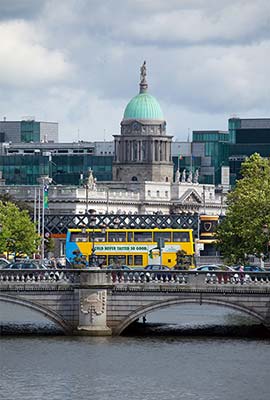
Buses: Public buses, many of them double-decker, cover the city thoroughly, but beware that they’re perennially delayed—don’t trust online schedules or trip planners. Most lines start at the four quays (riverfront streets) that are nearest O’Connell Bridge. If you’re away from the center, nearly any bus takes you back downtown. Some bus stops are “request only,” so when you see your bus coming, flag it down. Board through the front door and tell the driver where you’re going so they can determine the fare (€1.70-3, price depends on the number of stops). When exiting the bus, use the center doors. The Dublin Bus office has free route maps and sells all types of transit cards (Mon-Fri 9:00-17:30, closed Sat-Sun, 59 Upper O’Connell Street, +353 1 873 4222, www.dublinbus.ie [URL inactive]).
Luas Trams: The city’s straightforward tram system has two main lines: red and green. The red line is most useful for tourists, with an east-west section connecting the Heuston and Connolly train stations (a 20-minute ride apart) at opposite edges of the central zone. In between, handy stops (from east to west) include Busáras, Abbey Street (near O’Connell Street), Smithfield, and Museum. Useful north-south green line stops are at St. Stephen’s Green, Trinity College, and both ends of O’Connell Street. The lines don’t intersect: The closest transfer point is a 100-yard walk between the red-line Abbey Street stop and the green-line General Post Office (GPO) stop on O’Connell Street. Monitors at boarding platforms display the time and end destination of the next tram; make sure you’re on the right platform for the direction you want to go. Before you hop on the tram, buy tickets at the machine or tap your Leap card (€1.70 for a ride in Zone 1, which covers all the major sights; pay by cash or credit card, both lines run about every 10 minutes—more frequent during peak times; until 24:45, www.luas.ie).
DART Commuter Trains: Speedy commuter trains run along the coast, connecting Dublin with suburban Dun Laoghaire (3-6/hour). Think of the DART line as a giant “C” that serves coastal suburbs from Bray and Greystones in the south. You can use a Leap card, or buy individual tickets at machines (€2.65, €5 for same-day round-trip, fares may be a bit higher depending on destination). DART: IrishRail.ie.
Transit Cards: The Leap Card is a physical card you can use to pay a slightly discounted rate on transit rides (tap the card both to enter and to exit—payments are deducted for each trip). These cards are sold at TIs, newsstands, markets, and train station ticket machines citywide—look for the leaping-frog logo (www.leapcard.ie). You’ll pay a €5 deposit for the card itself; add as much credit as you think you’ll need and top up as needed at the ticket machines in any DART station. Prices are capped: You’ll pay no more than €5.60 per day on buses, or €8 if using both buses and trams.
The Leap Visitor Card is handy only if you’re taking lots of transit—especially for those staying a DART ride away (in Dun Laoghaire, for example). It covers unlimited travel on Dublin’s buses (including to and from the airport), DART, and Luas trams. The catch is that it’s sold in only a few locations: at the airport, the two train stations, the Dublin Bus office on Upper O’Connell Street, and a few other outlets (see list on their website; €8/1 day, €16/3 days, €32/7 days, each “day” equals 24 hours from first use, http://about.leapcard.ie/leap-visitor-card).
If you’ll be taking a hop-on, hop-off bus tour and using lots of public transit, consider the Do Dublin Freedom Ticket (€48, includes a 72-hour Leap Visitor Card and the Do Dublin bus described later, book in advance online, www.dodublin.ie).
By Taxi or Uber
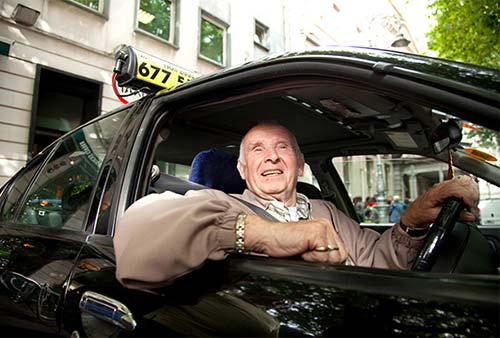
Taxis are everywhere and easy to hail. You can also ask your hotelier to order a taxi for you. Cabbies are generally honest and friendly, though taxis that wait at highly trafficked tourist sights may try to gouge you (legitimate cabs start at about €3.50). Most in-city rides should run about €10-15.
In Dublin, ride-hailing apps FreeNow (more widely used) and Uber both simply hail standard taxis, and not all drivers use them, so you may get a quicker response by hailing or calling a cab directly.
Tours in Dublin
While Dublin’s physical treasures are lackluster by European standards, the city has a fine story to tell and people with a natural knack for telling it. It’s a good town for walking tours, with lots of options.
 To sightsee on your own, download my free two-part Dublin City Walk audio tour. For Trinity College campus tours, worth ▲▲, see here.
Walking Tours
▲▲Historical Walking Tours of Dublin
This two-hour walk, led by history grads, is your best introduction to Dublin’s basic historic strip (including Trinity College, Parliament House, Dublin Castle, Christ Church Cathedral, Grafton Street, and St. Stephen’s Green). Guides tell the story of the city, from its Viking origins to the present, including the roots of Ireland’s struggle with Britain. You’ll stand in front of buildings that aren’t much to look at but give your guide lots to talk about (€19, RS%—€2 off, request discount by email before booking online; daily at 11:00, May-Sept also at 15:00, Nov-March Fri-Sun only; departs from Henry Grattan statue opposite Trinity College front gate, private tours available, +353 87 688 9412, www.historicaltours.ie, info@historicaltours.ie).
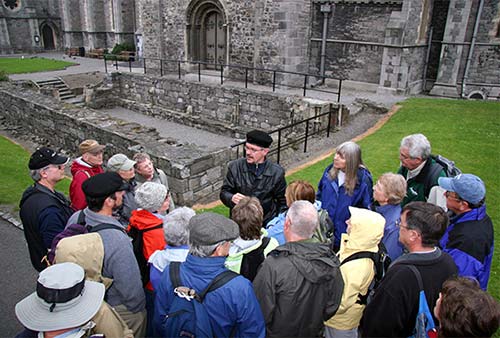
1916 Rebellion Walking Tour
This two-hour walk breathes gritty life into the most turbulent year in modern Irish history, when idealistic Irish rebels launched the Easter Rising—eventually leading to independence from Britain. Lorcan Collins (author, historian, and host of the Revolutionary Ireland podcast) and his guides are passionate about their subject (€19, RS%—€2 off, email to request discount; March-Oct Mon-Sat at 11:30, Sun at 13:00; Nov-Feb Sat-Sun only; departs from International Bar at 23 Wicklow Street, +353 86 858 3847, www.1916rising.com, Lorcan@1916rising.com).
Pat Liddy’s Walking Tours
Pat Liddy, a top local historian, has a crew of guides who lead an assortment of informal 2.5-hour walks of Dublin. The “Highlights and Hidden Corners” tour is a good introductory route, covering areas both south and north of the river (€25, RS%—20 percent off with code “RSTEVES23,” reserve in advance; April-Oct daily at 10:15, also runs Mon-Sat at 14:15 in summer; off-season Mon, Wed, Fri, and Sat at 10:15; meet at Tree of Gold sculpture in Central Plaza on Dame Street, +353 1 832 9406, +353 87 905 2480, www.walkingtours.ie, info@walkingtours.ie). Pat’s guides are also available for private tours (starting at €245/half-day).
Pub Crawls
▲▲Traditional Irish Musical Pub Crawl
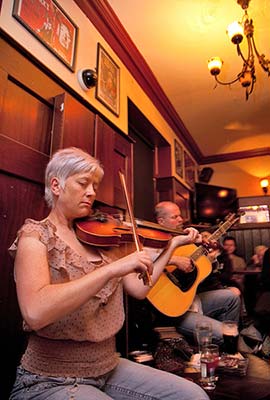
This entertaining tour visits the upstairs rooms of three pubs. There, you’ll listen to two musicians talk about, play, and sing traditional Irish music. While having only two musicians makes the music a bit thin (Irish music aficionados will say you’re better off just finding a good session), the evening—though touristy—provides a real education in traditional Irish music. The musicians clearly enjoy introducing rookies to their art and are very good at it (and really funny). In the summer, this 2.5-hour tour frequently sells out, so book ahead online (€19, RS%—use code “RSIRISH” online, beer extra, several tours a week at 19:30—check website for schedule, maximum 65 people, meet at Ha’Penny Bridge Inn, 42 Wellington Quay, Temple Bar, +353 1 475 8345, www.musicalpubcrawl.com). They also offer a dinner-show version with more music and Irish dancing (€55, starts at 17:30).
Dublin Literary Pub Crawl
Two actors take 40 or so tourists on a walk, stopping at four pubs, and with clever bantering craic (fun and conversation) introduce the language of James Joyce, Seán O’Casey, and W. B. Yeats. The two-hour tour is punctuated with 20-minute pub breaks (free time to drink and socialize). This is an easygoing excuse to drink beer in busy pubs, meet other travelers, and get a dose of witty Irish lit (€16, daily at 19:30, Nov-March Thu-Sun only; best to book ahead, especially in summer; meet upstairs in the Duke Pub—off Grafton on Duke Street, +353 87 263 0270, www.dublinpubcrawl.com, info@dublinpubcrawl.com). Their once-a-week morning Literary Talk includes readings, anecdotes, and stories about Irish wordsmiths (€15, Mondays at 10:30 at Duke Pub, must book in advance).
Food Tours
Fab Food Trails Dublin
For a 2.5-hour, six-stop edible education in Irish food, consider this food tour. With a small group (maximum 12 people), you’ll visit a cheesemonger, maybe try some fancy meats with wine, go to a bakery, hit the produce market, or slurp an oyster, all with the good craic of your food-loving guide (€80, RS%—10 percent off with code “RSteves,” book in advance, April-Oct Thu-Sat at 10:00, Sat only in off-season, meeting point varies, www.fabfoodtrails.ie, bookings@fabfoodtrails.ie).
Local Guides
With so much fascinating history and such a rich tradition of storytelling, it’s no wonder there are plenty of smart and entertaining Dublin historians who work as private guides and are eager to tailor a tour to your interests. In addition to the ones I’ve listed, the guides at Pat Liddy’s Walking Tours can be booked privately (see earlier).
Witty Dara McCarthy will proudly show you around his hometown—when he’s not leading one of my Rick Steves’ Ireland tours (€150/2.5 hours, +353 87 291 6798, dara@daramccarthy.com).
Suzanne Cole is a charming and smart guide (€150/2.5 hours, +353 87 225 1262, suza.cole@gmail.com).
Jack Walsh is a local actor who’s both high-minded and soft-spoken (€210/half-day, +353 87 228 1570, walshjack135@gmail.com).
Mary Mannix offers a city highlights or custom walking tour along with a warm Irish welcome (€300/half-day, +353 87 245 9529, marymannixq@gmail.com).
BY BUS
▲Hop-On, Hop-Off Bus Tours
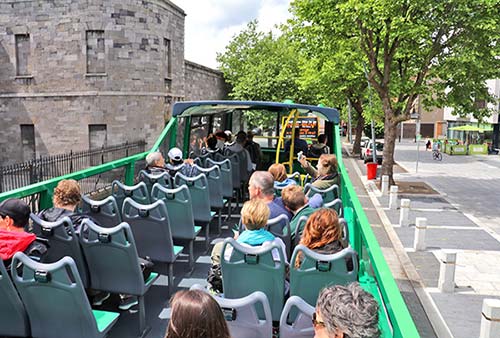
Dublin works well for a hop-on, hop-off bus tour, which is a good way to orient yourself on arrival. Three companies with open-top double-deckers do similar 1.5-hour circuits of the city with about 25 stops, all for a similar price (around €30/24 hours, €35-40/48 hours). With running commentary (either live or recorded), buses run frequently enough that you can use them for efficient sightseeing (stops include the far-flung Guinness Storehouse, Kilmainham Gaol, and Phoenix Park).
Do Dublin, with green buses run by the local transit authority, includes free entry into the Little Museum of Dublin; they also do a Ghostbus tour for kids (www.dodublin.ie). Other options—part of big international chains—are Big Bus Tours (maroon-and-cream buses, www.bigbustours.com) and CitySightseeing Dublin (red buses, www.hoponhopoffdublin.ie).
BY BIKE
Cycle Dublin Bike Tours
Pedal across this flat city on a fun 2.5-hour guided tour that covers points of interest and history on both sides of the river (€30, daily at 10:30, private tours available, meet at 2 Whitefriar Place, +353 86 252 6578, https://cycledublinbiketours.ie).
Lazy Bike Tour Company
For a less strenuous option, you can grab a bright orange e-bike and matching vest, and buzz along on a guided tour that covers sights from Dublin Castle to Kilmainham Gaol. Tours start in Temple Bar and last two hours (€40, tours at 10:00 and 14:00, daily in summer, Fri-Sun in off-season, book ahead, meet at Drury Street Car Park (Bike Park), +353 1 443 3671, www.lazybiketours.com).
Dublin City Walk
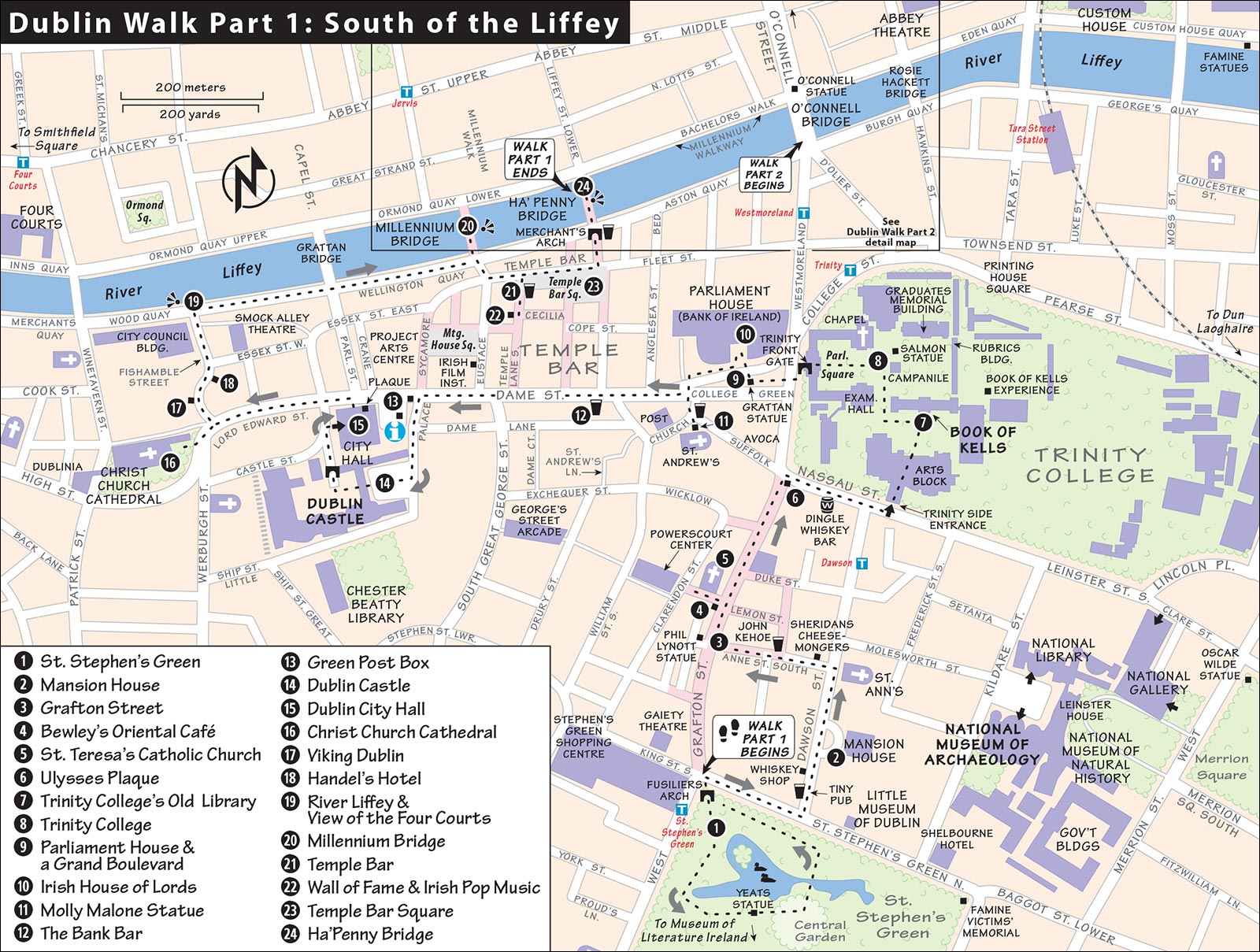
Map: Dublin Walk Part 1: South of the Liffey
5 St. Teresa’s Catholic Church
7 Trinity College’s Old Library
9 Parliament House and a Grand Boulevard
12 The Bank Bar
19 River Liffey and View of the Four Courts
21 Temple Bar
22 Wall of Fame and Irish Pop Music
PART 2: O’CONNELL STREET AND IRISH HEROES
2 O’Connell Street and Historic Highlights
Map: Dublin Walk Part 2: O’Connell Street & Irish Heroes
7 Charles Stewart Parnell Monument
This two-part self-guided walk covers the basic sights in the center of town. It can be done as a light, fast-paced overview in about two hours. Or you can use it to lace together many of the city’s top sights. It’s long, but easy to do in two sections (south and north of the Liffey); the second part is much quicker than the first.
Take this walk at the beginning of your Dublin visit to get the lay of the land—geographically, culturally, and historically. As several of the stops and passageways along the route are closed after dark, this walk is best during normal business hours. (Doing it after-hours works, but you’ll need to skip a few stops.)
Download my free two-part Dublin City Walk audio tour.
PART 1: SOUTH OF THE LIFFEY
• Start at the southernmost end of Grafton Street, where the city’s thriving pedestrian boulevard meets its most beloved park. Stand before the big arch.
1 St. Stephen’s Green
This city park, worth ▲, was originally a medieval commons—a space for grazing livestock. The park got its start in 1664, when the city leased some of the land as building lots, and each tenant was obligated to plant six trees.
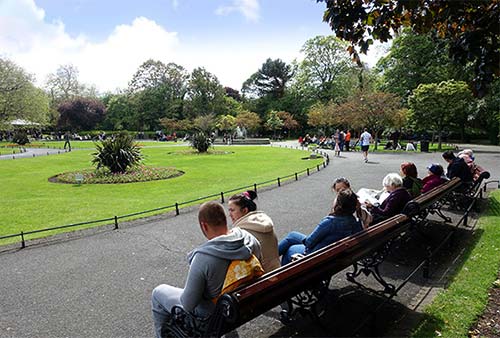
Gradually the green was surrounded with fine Georgian buildings, and access was limited to those affluent residents. (“Georgian” is British for Neoclassical, named for the period from 1714 to 1830 when four consecutive King Georges occupied the British throne.) Those were the glory days, when Dublin, both wealthy and powerful, was the number-two city in Britain, and squares and boulevards built in the Georgian style gave the city an air of grandeur. In 1880, the park was opened to the public, and today it provides a grassy refuge for all Dubliners.
The gateway before you is the Fusiliers Arch. It commemorates Irishmen who died fighting in the British Army in the Boer War (against Dutch settlers in South Africa, 1899-1902). Under the curve of the arch, see the names of those who lost their lives. In Dublin’s crushingly impoverished tenements of the time, one of the few ways for a young man without means to improve his lot would be to join the army (regular meals, proper clothing, and a chance to “see the world”). You can read a little of the Irish struggle into the names: Captains were Protestant elites with English names, and grunts were Catholic with Irish names. Many more grunts died.
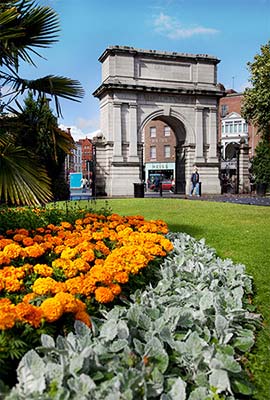
Two decades later, Ireland was embroiled in its own battles against Britain, and sentiments had evolved. With Irishmen fighting to end centuries of English domination, locals considered the Fusiliers Arch to be a memorial to those who fought for Britain—and began referring to it as “Traitors Arch.” A key Dublin battleground during the 1916 Easter Rising was in and around this park. Step around to the east (street) side of the arch and look up to see bullet marks scarring the memorial.
During the short-lived Easter Rising revolt, a group of passionate Irish rebels—a mishmash of romantic poets, teachers, aristocratic ladies, and slum dwellers—dug trenches in the park, believing they were creating fortified positions. They hadn’t figured on veteran British troops placing snipers atop the nearby Shelbourne Hotel (with a bird’s-eye view into the trenches). The park is dotted with reminders of the long Irish struggle against the British, like the memorial stone honoring Irish rebel O’Donovan Rossa (a few steps into the park past the arch). An oration at his funeral in 1915 was a catalyst that helped galvanize the rebels who would rise in 1916.
Take a quick walk into the park: Turn right and stroll a couple hundred yards around the lake counterclockwise. (Find a park map on a post to orient yourself.) Walk past the palm trees (imported from China, they are the only palm that can grow on the Emerald Isle). As you round the lake, look for a rocky knoll in the trees. Hiding there, on a terrace that’s popular for outdoor plays and weddings, is a modern, abstracted monument to W. B. Yeats (by Henry Moore).
Walking across the terrace and then down, you come to the central garden, packed at sunny lunchtimes with Dublin office workers. On a pleasant afternoon, this open space is a wonderful world apart from the big city. With romantic gazebos, duck-filled ponds, and relaxed people, today the park seems to celebrate Irish freedom.
From the central garden, continue circling the lake, hooking left over a bridge and back to the arch. The ducks you see are a traditional part of the scene. Generations of Dubliners treasure memories of coming here on Sundays as little kids to feed them. (Lately bully seagulls and pigeons are muscling into duck country.)
• Returning to where you began, then exiting through the big arch, you’re facing busy, pedestrianized Grafton Street (we’ll go down it later). Across the street on the left, the big white building is the Stephen’s Green Shopping Centre, under a soaring Victorian roof with lots of genteel frills.
To continue our walk, we’ll make a swing around the block to the right: Cross the street (watch for trams) and head right to the first corner, then go left, down Dawson Street.
You can just make out the Dawson Lounge (a.k.a. the “tiniest pub in Dublin,” on the left at #25; good gelato on the ground floor). Next door (#27), the Celtic Whiskey Shop is a reminder that in recent years Ireland has exported more whiskey than Scotland. To find out why, and maybe score a free sample, drop in.
Farther along, the big, white Georgian building across the street is the...
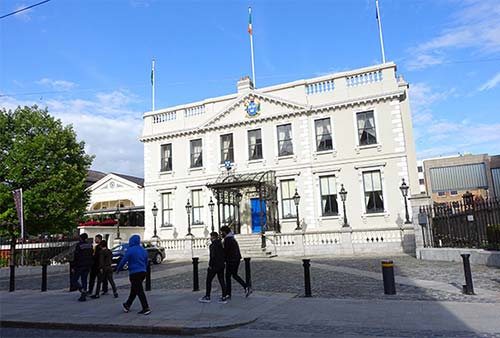
2 Mansion House
Built in 1710, this is where Dublin’s Lord Mayor lives. The building played roles in both of Ireland’s wars.
In 1918, Ireland elected its representatives to the British parliament—and chose mostly separatist members of the Sinn Féin (“Ourselves”) party. The Sinn Féin parliamentarians refused to take their seats at Westminster in London. Instead, in January 1919, they created their own Irish parliament (the Dáil Éireann) and met here, in an annex behind the Mansion House. The establishment of this rogue parliament in defiance of British rule kicked off the Irish War of Independence.
Three years later, they’d thrown off British rule, but found themselves at odds over the terms of the Anglo-Irish Treaty to end the war. Unable to agree, those opposed to ratification—led by Dáil Éireann president Éamon de Valera—marched out of parliament in protest. Within a few months, their festering disagreements ignited into the tragic Irish Civil War, eventually won by the pro-treaty forces of Michael Collins.
• Continue down Dawson Street to the corner of Anne Street South. On the right is the Neo-Romanesque (late 19th century) St. Ann’s Church, the Anglican church where Irish author Oscar Wilde was baptized and Bram Stoker (of Dracula fame) was married.
Turn left onto Anne Street South and walk two blocks toward Grafton Street, past a line of busy independent retailers—including the recommended Sheridans Cheesemongers.
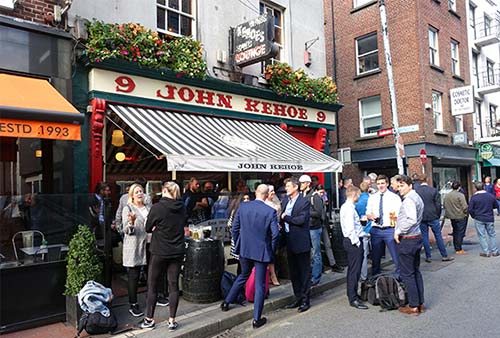
At the next corner is a popular pub, John Kehoe. Customers typically spill into the street with their beloved pints in hand. (Technically, it’s illegal to drink on the street, but this rule is selectively enforced.) This legacy pub is part of the Dublin landscape: Dubliners often refer to landmark pubs rather than street names when giving directions.
Stop and enjoy the scene when you reach the busy, pedestrian boulevard.
3 Grafton Street
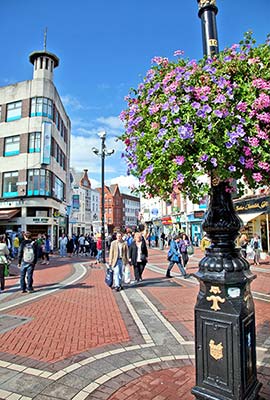
Grafton Street is Dublin’s most desirable retail address. It was pedestrianized in 1983, much to the consternation of local retailers—who were soon pleased to discover that business improved without all the traffic. Ireland’s Celtic Tiger economic boom (1995-2007) gave the country Europe’s hottest economy and a thriving tech sector. Business was so good that retail rents skyrocketed, which drove away small shops. Today Grafton Street is filled with mostly international retailers and a surging torrent of shoppers.
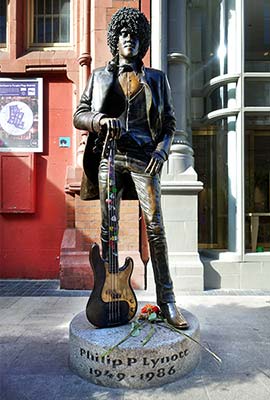
We’ll stroll the boulevard to the right in a moment. But first, go directly across Grafton to Harry Street: A half-block up on the right, you’ll find a hairy rock star. This life-sized bronze statue with bass guitar, picks wedged behind the strings as fan tributes, is Phil Lynott, Ireland’s first hard-rock star. He lived a short, fast life and is remembered for his band Thin Lizzy (of “The Boys Are Back in Town” fame). You could build an entire Dublin walk around its many popular musicians and rock stars...but I won’t.
Imagine if our American patriot ancestors had fought our Revolutionary War and our Civil War back to back—over a span of seven chaotic years—and then appreciate the remarkable resilience of the Irish people. Here’s a summary of what happened when.
Easter Rising, 1916: A nationalist militia called the Volunteers (led by Patrick Pearse) and the socialist Irish Citizen Army (led by James Connolly) join forces in the Easter Rising, a week-long rebellion against British rule that is quickly defeated. The uprising is unpopular with most Irish, who are unhappy with the destruction in Dublin and preoccupied with the “Great War” on the Continent. But when 16 rebel leaders (including Pearse and Connolly) are executed, Irish public opinion reverses as sympathy grows for the martyrs and the cause of Irish independence.
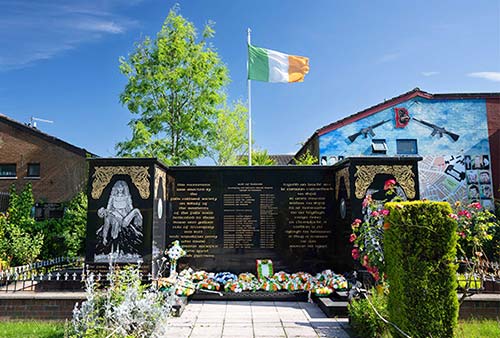
Two important rebel leaders escape execution. Brooklyn-born Éamon de Valera is spared because of his American passport (the British don’t want to anger a potential WWI ally). Michael Collins, a low-ranking rebel officer who fought in the Rising at the General Post Office, is sent to prison, where he refines urban guerrilla strategies. After his release, he blossoms as the rebels’ military and intelligence leader in the power vacuum that followed the executions.
General Election, 1918: World War I ends and a general election is held in Ireland (the first in which women can vote). Promising to withdraw from the British parliament and declare an Irish republic, the nationalist Sinn Féin party wins 73 out of 79 seats. Only 4 of 32 counties vote to maintain the Union with Britain (all 4 lie in today’s Northern Ireland). Rather than take their seats in London, Sinn Féin representatives abstain from participating in a government they see as foreign occupiers.
War of Independence, 1919: On January 19, the abstaining Sinn Féin members set up a rebel government in Dublin called Dáil Éireann. On the same day, the first shots of the Irish War of Independence are fired as rebels begin ambushing police barracks, which are seen as an extension of British rule. De Valera is elected by the Dáil to lead the rebels, with Collins as his deputy. Collins’ web of spies infiltrates British intelligence at Dublin Castle. The Volunteers rename themselves the Irish Republican Army; meanwhile, the British beef up their military presence in Ireland by sending in tough WWI vets, the Black and Tans. A bloody and very personal war ensues.
Anglo-Irish Treaty, 1921: Having endured the slaughter of World War I, the British tire of the extended bloodshed in Ireland and begin negotiations with the rebels. De Valera leads rebel negotiations, but then entrusts them to Collins (a clever politician, De Valera sees that whoever signs a treaty will be blamed for its compromises). Understanding the tricky position he’s in, Collins signs the Anglo-Irish Treaty in December 1921, lamenting that in doing so he has signed his “own death warrant.”
The Dáil narrowly ratifies the treaty, which ends the war and allows for the establishment of an independent dominion, the Irish Free State. But Collins’ followers are unable to convince De Valera’s supporters that the treaty’s compromises are a stepping-stone to later full independence. De Valera and his anti-treaty disciples resign in protest. Arthur Griffith, founder of Sinn Féin, assumes the presidential post.
Irish Civil War, 1922-1923: In June 1922, the anti-treaty forces, holed up in the Four Courts building in Dublin, are fired upon by Collins and his pro-treaty forces—thus igniting the Irish Civil War. The British want the treaty to stand and even supply Collins with cannons, meanwhile threatening to reenter Ireland if the anti-treaty forces aren’t put down.
In August 1922, Griffith dies of stress-induced illness, and Collins is assassinated 10 days later. Nevertheless, the pro-treaty forces prevail, as they are backed by popular opinion and better (British-supplied) military equipment. By April 1923, the remaining IRA forces dump (or stash) their arms, ending the civil war...but many bitter IRA vets vow to carry on the fight. De Valera distances himself from the IRA and becomes the dominant Irish political leader for the next 40 years.
• Return to Grafton Street, take a left, and join the river of pedestrians. Stop 50 yards down at the venerable café on the left...
4 Bewley’s Oriental Café
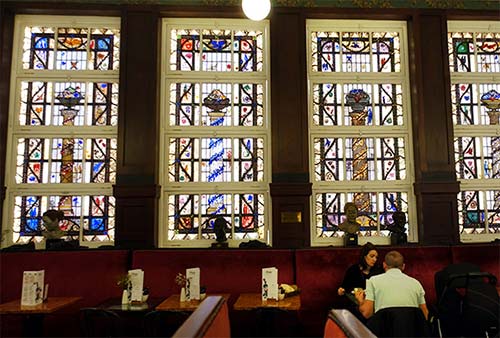
Bewley’s is a Dublin tradition that your Irish great-grandfather would remember for its well-priced comfort food. The facade is done in an ornate neo-Egyptian, Art Deco style (built after the excitement of the discovery of King Tut’s tomb in 1922). Approach it as if visiting an art gallery filled with people eating. Walk to the very back of the ground floor (or go up to the balcony on the left) to view its famous stained-glass windows by artist Harry Clarke (1881-1931). For Clarke, famous for decorating churches with his exquisite windows, this is a rare secular commission, celebrating the four classical orders of column design. A fine Irish craftsman/artist, Clarke first learned his trade from his father, a stained-glass painter, and was part of the Irish Arts and Crafts movement. You’re free to wander upstairs (if open) for more Bewley art. (For more about the restaurant, see here.)
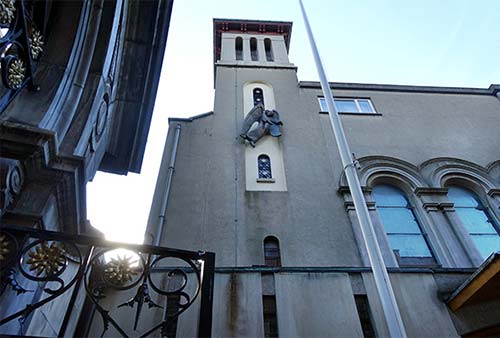
• A couple of steps farther down Grafton, turn left on the narrow lane called Johnson’s Court. About 50 feet down, through the ornate archway on the right, find a peaceful church.
5 St. Teresa’s Catholic Church
Tucked away as if hiding, St. Teresa’s was built in 1792—one of the first Catholic churches allowed in Ireland after the gradual relaxing of the Penal Laws passed by the Protestant parliament (1691-1760) to regulate Catholics.
For a century, Catholics and their clergy were forced to practice their religion secretly, celebrating Mass at hidden rural “Mass rock” altars. But by the 1790s, the British government felt secure enough to allow some Catholic churches to be built again. They also wanted to appease the Irish—who could have been getting ideas as they observed Catholic France beheading its monarchs. Catholics were allowed to worship in actual churches as long as they kept a low profile.
Daniel O’Connell (1775-1847), an enlightened member of parliament, campaigned for Catholic equality and held political meetings at St. Teresa’s. He brought down the last of those Penal Laws in 1829 by championing the Catholic right to vote. (We’ll learn more about O’Connell later on this walk.)
• Now stroll down Grafton Street. As you make your way, take a moment to enjoy a local busker or chat at a street stall with a salt-of-the-earth woman selling flowers (these are mother-daughter hand-me-down businesses). Step out of the flow of humanity to glance up the side streets. Commercial as this street is, it has standards—notice that the arches are not golden at McDonald’s.
At the end of the pedestrianized section of Grafton Street, at the right corner, find a brass plaque in the pavement in front of the Starbucks.
6 Ulysses Plaque
The little brass plaque on the ground, rubbed shiny by foot traffic, marks a spot mentioned in James Joyce’s most famous novel, Ulysses. (For more on Joyce, his work, and the women in his life, see the sidebar on here.) Passionate literature fans know that Joyce’s revolutionary, stream-of-consciousness work unfolds as a single day in the life of Leopold Bloom—June 16, 1904. Joyce meticulously re-created very real locations from 1904 Dublin—chemist shop, pub, bathhouse, beach, brothel, and so on—many of which are marked with plaques like this one. Each June 16, Dublin celebrates “Bloomsday,” as visiting scholars and enthusiasts wearing boater hats and period Edwardian garb wish each other a happy Bloomsday and quote passages from Joyce. (Even at other times, there are frequent public readings from the novel; see here.)
• Turn right and go a block on busy Nassau Street, passing a recommended brewpub, then a whiskey bar (with hundreds of whiskeys on its shelves—an art form in itself). At the next corner, on the opposite (leafy) side of Nassau Street, is a side entrance to Trinity College. Follow the stream of students into the modern bunker-like Arts Building. (Note that on Sat-Sun after 18:00, the campus may be closed. In that case, hook around to the left, to reach the university’s front gate.)
Walk through the hall, exit the building down the ramp, and pop out into a grassy courtyard. Straight ahead and on the right, the grand, gray three-story building is...
7 Trinity College’s Old Library
The college’s Old Library houses the Book of Kells, a medieval masterpiece of calligraphy and illustration. The ground floor contains the 1,200-year-old book (containing the gospels of Matthew, Mark, Luke, and John); the top floor is a venerable world of varnished wooden shelves giving a dignified home to a precious collection of reference books and artifacts, including an original copy of the 1916 Proclamation of the Irish Republic, which announced Ireland’s dramatic split with Britain. (For more on seeing the book, see here.)
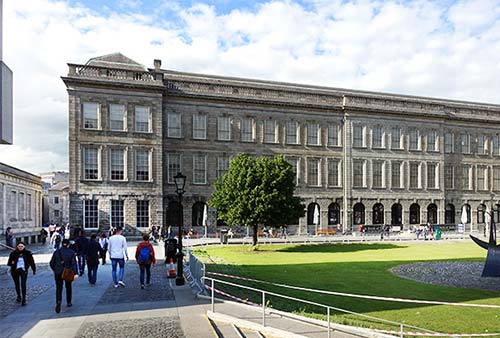
The red box in the square beyond the right end of the library (New Square) houses a high-tech exhibit called The Book of Kells Experience. Starting in late 2025, the Old Library is slated to close for renovation, so for a while, this will become the hub for visitors.
• Go around to the left of the Old Library to enter a larger and even grander square. Walk to the center, where the smooth paths intersect, and face the Campanile (bell tower).
8 Trinity College
You’re standing on Parliament Square, in the heart of Ireland’s oldest seat of learning, founded in 1592 by Queen Elizabeth to set the ill-disciplined Irish on the straight and righteous path to Protestant learning. These cobblestones were trod by the likes of Trinity graduates Jonathan Swift, Oscar Wilde, Bram Stoker, and Samuel Beckett. (You’re surrounded by dorms and administration. The actual classrooms are mostly elsewhere.)
Before there was a university here, there was a monastery. Ruins of old monastery buildings lie just underfoot, and an estimated 40 monks are buried deep beneath the lawn behind the Campanile. When Henry VIII separated from the Catholic Church, the monks were evicted...and his daughter Elizabeth had this prime real estate for her university.
Behind the graceful Campanile—at the far end of the grassy lawn—are the red-brick Rubrics, the oldest remaining buildings on campus (c. 1712). Their facades sport a faintly Dutch look, due to their construction soon after the reign of Dutch-born King William III of Orange. He took the British throne jointly with his English wife/cousin Mary II, bringing Dutch architecture into vogue for a generation. Later, the gray, stony style of the Georgian and Victorian eras—which dominate the rest of the campus—caught on.
Fifty feet to the left of the Campanile is a white-marble statue of a seated man, grinning down on us from his pedestal. He’s George Salmon, a mathematician, theologian, and provost in the late 1890s, who said women would enter Trinity over his dead body. Coincidentally, days after he died in 1904, the first women were admitted to Trinity College.
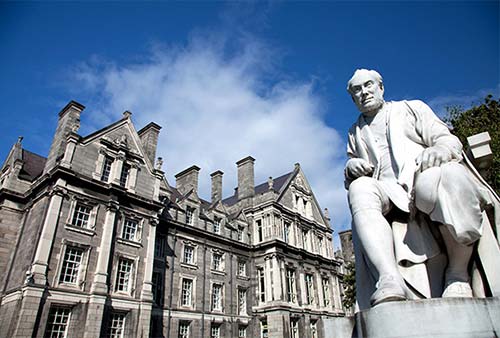
Beyond Salmon on the left is the Graduates Memorial Building, which is devoted mainly to debating societies that follow the age-old tradition of arguing productively.
Trinity remains one of the world’s great universities—and would be greater if not for the financial challenges of attracting top professors. Money raised by the hordes of tourists seeing the Book of Kells goes to support the cash-strapped university. And the college has put on a charm offensive to attract wealthy international students, as the full tuition they pay subsidizes less-wealthy Irish students.
Now turn 180 degrees to face the front gate of the college. To your right and left stand two identically majestic buildings, each with four Corinthian columns. To your right is the college chapel, and to the left is the examination hall. During final exams, there tends to be a lot of student traffic between the two buildings, nicknamed “heaven and hell.”
• Exit the campus through the front gatehouse, across hexagonal wooden pavers intended to dampen the sound of horse hooves. Inside the gatehouse, pretend you’re a student—look at the posters to catch up on news, sports, rooms for rent, and plays and concerts.
Exiting the college, you’ll emerge at one of the most chaotic intersections in Dublin. Cross the street carefully to the traffic island at the bottom of the busy boulevard and stand before a statue of the guy who first cooked potatoes au Grattan (or an 18th-century member of the Irish House of Commons—you decide).
9 Parliament House and a Grand Boulevard
The long street stretching straight in front of you is College Green, which becomes Dame Street, and then Lord Edward Street as it reaches Christ Church Cathedral, a half-mile away (and we’re about to walk the entire thing). For simplicity, I’ll just refer to it as “the boulevard.”
Roughly 250 years ago, this spot marked the start of Dublin’s version of a “Royal Mile,” where the parliament, castle, university, and big banks all converged in their full glory. Logically, this spot in front of parliament was also where serious protests took place. “No taxation without representation” was a rebel rallying cry against Britain here, just as it was in America’s 13 colonies.
The grand building with a rounded colonnade is the Parliament House (now home to the Bank of Ireland). The Irish House of Commons and House of Lords met here until the 1801 Act of Union abolished the Irish parliament, moving its members to Westminster in London. Thus began Dublin’s slow, century-long decay, from important British hub to largely impoverished, tenement-ridden backwater.
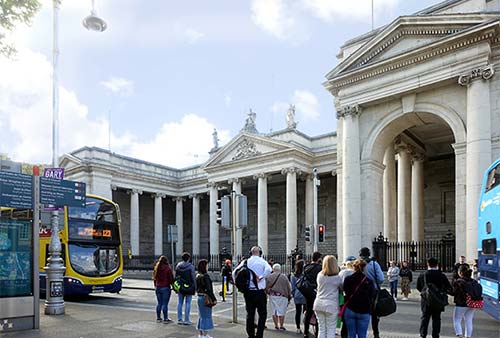
• The original House of Lords survives in the bank. Drop in to see it, if it’s open.
10 Irish House of Lords
Erected in 1733 on the same model as the Houses of Parliament in London, this was the first purpose-built bicameral parliament. The House of Commons was eventually gutted, but the smaller House of Lords survived unaltered. Inside are tapestries celebrating Protestant victories over the indigenous and Catholic Irish, busts of British kings and admirals, and a fireplace carved of Irish oak. A big ceremonial silver mace represented the authority of the British monarch; nothing that occurred in this chamber was valid without the monarch’s symbolic presence. A painting shows the appearance of the once-adjacent but now-gone House of Commons.
• Leaving the bank, turn right and walk a short block up the boulevard, and take your first left (cross over at the Starbucks), onto Church Lane. Go one block to an old church with a statue out front of a buxom maiden pushing a cart of wicker baskets.
11 Molly Malone Statue
You may know that Dublin’s unofficial theme song is “Molly Malone”—now let’s meet the woman commemorated in the tune. The area around the Molly Malone statue (from 1988) is a popular hangout for street musicians—and for tourists wanting a photo with the iconic gal. She pauses cooperatively “in Dublin’s fair city, where the girls are so pretty,” to offer you “cockles and mussels, alive, alive-o” from her cart. (Tour guides created some bogus legend about good luck or good sex...and now tourists dutifully line up to help shine her bosom.)
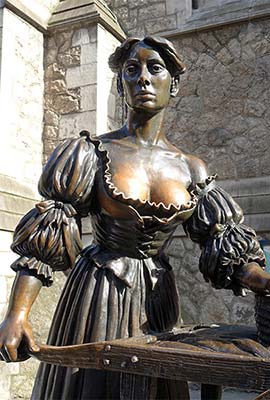
The church was St. Andrew’s, once a place of worship frequented by nearby members of parliament. Enjoy its 19th-century Neo-Gothic stonework. Now decommissioned, its future is as a high-end food hall.
Across the street is O’Neill’s pub, with a sloppy and noisy wonderland of cozy alcoves scattered over three floors. Just for fun, enter on the right and work your way through its labyrinthine interior, eventually exiting on the left. The O’Neill family has had a pub at this intersection for over 300 years and has benefited from its strategic location: It lies directly between the church and parliament, with the power brokers of the time being regular patrons.
• Return to the main boulevard, turn left, and continue a few doors to a very fancy bank (on the left, with a red sandstone facade, brass details, and showy banners) that’s now a very fancy pub. Step just inside to be wowed.
12 The Bank Bar
Built in 1894, The Bank Bar staggers visitors with its Victorian opulence. Back then, banks had to impress elite clients to assure them the bank was financially solid. Today, Dublin’s banks have vacated such palaces for modern offices, and many ornate former bank interiors—like this one—now dazzle diners.
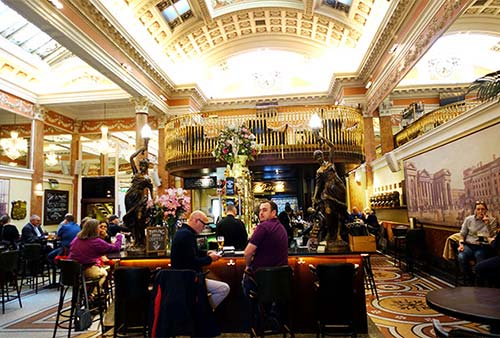
Even if you’re not eating or drinking here, you’re welcome to stand just inside the door for a look. The stained-glass ceiling still sparkles. The many mirrors make the space seem larger, and the ornate floor tiles and crow’s-nest balcony catch the eye. In a case by the door, a faithful replica of the Book of Kells is under glass. A stately painting of the Custom House (surrounded by the ships so vital to Dublin’s economy) fills the wall on the left. And on the right is a painting of Parliament House. The paintings face each other as pillars of society: commerce and governance. In the back-right corner are seven male busts: the seven patriot signers of the 1916 Proclamation of Irish Independence, martyrs for the Irish Republic—all executed at Kilmainham Gaol. (The basement restrooms are flanked by four old bank vaults.)
• Exit the bar, turn left, and walk a couple of minutes (two long blocks) until you see a green post box (in front of the TI).
13 Green Post Box
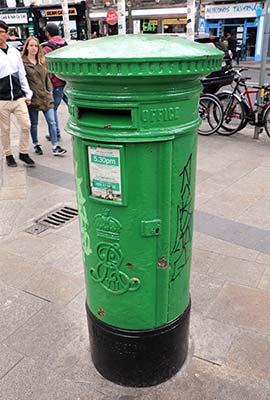
An innocent-looking, round green postal box stands sentry in a small sidewalk plaza. Like all Irish post boxes, it’s Irish green. But look closely at the elaborate monogram at knee height. It’s an ornate “E” for “Edward,” woven with “R” for “Rex” (Latin for “king”)—indicating that this box dates from just before World War I, during the reign of King Edward VII (son of Victoria)—who reigned over Ireland as part of the United Kingdom of Great Britain and Ireland. Once royal red, after Ireland won its independence it was more practical to just paint the post boxes Irish green and call it good, rather than replace them. In 1922, this box, with its high-profile location at the entry to the grounds of Dublin Castle, was the first to be painted green. If a Royalist were to scratch the paint to show some underlying red, it would be repainted green before you could say Guy Fawkes. Notice that Dublin’s many double-decker buses are similar: Rather than London red, they’re a variety of green, yellow, and blue.
• Ahead is City Hall. But first we’ll take a short detour: Go up the short street above the green post box and under the stone arch. Then, watch on the right for the uphill entrance to the grand courtyard of...
14 Dublin Castle
While Dublin Castle today shows only scant remains of its medieval architecture, it was the center of English power for 700 years, from its initial construction in 1204 (under bad King John of Magna Carta fame) until Britain handed the reins back to the Irish in 1922. Standing in the courtyard, you can imagine the ugliness of the British-Irish situation. Notice the statue of justice above the gate—pointedly without her blindfold and admiring her sword. As Dubliners say, “There she stands, above her station, with her face to the palace and her arse to the nation.”
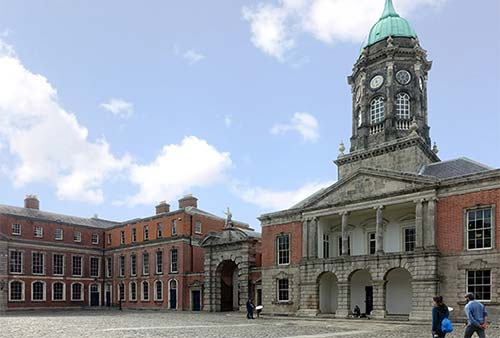
Today, Dublin Castle is a prime example of a Georgian palace and the location for ceremonial affairs of state. The castle’s grand state rooms are open to the public (see here). They’re working on retrofitting the stout, round Record Tower—the oldest surviving part of the castle (from the early 13th century)—with an elevator and turning it into a new visitor attraction; for the latest, ask at the castle ticket desk.
Before moving on, consider a quick detour to see the castle gardens and a remarkable collection of antique manuscript at the Chester Beatty Library (described on here). To get there, head back down the ramp the way you came, then curve right around the back of the castle, and look for the library on your left.
• When you’re ready to proceed with our walk, leave the castle courtyard through the gate just left of the clock tower, then cross the little footbridge. On your right, facing the busy boulevard, is the stately City Hall—worth a visit to see its interior.
15 Dublin City Hall
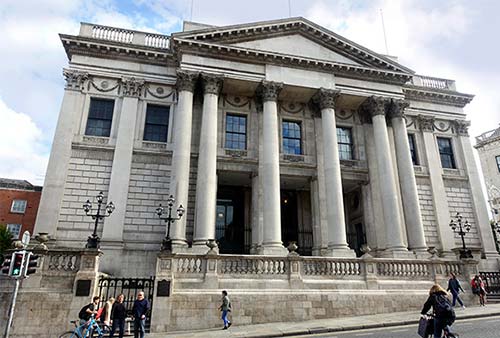
Dublin’s impressive City Hall, worth ▲, started life in 1779 as the Royal Exchange, where Irish and British currencies were exchanged and where merchants gathered to discuss trading affairs. It’s a splendid example of the Georgian style then very popular in Britain. It became City Hall in 1852 and was the site of the first fatalities of the 1916 Easter Rising, when Irish rebels occupied it to control the main gate to Dublin Castle. If it’s open, step inside to feel the prosperity and confidence of Dublin in her glory days.
Cost and Hours: Free, Mon-Fri 10:00-16:00, closed Sat-Sun.
Visiting City Hall: The dramatic main-floor rotunda—with its grand Caesar-like statue of the great orator Daniel O’Connell (the city’s first Catholic mayor, 1841)—was inspired by the Pantheon in Rome. (They get more rain here, so the oculus—the opening in the ceiling—is covered.) About halfway up, under the clock, a cycle of heroic paintings tells the city’s history in a rare example of Arts and Crafts artwork from 1919. It was here, under the rotunda, that the body of Irish rebel leader Michael Collins lay in state after his assassination in 1922. On the floor, a Latin inscription translates to “Obedient citizens make a happy city.”
• Leave City Hall through the Dame Street exit, and take the stairs on your right. Halfway down, look on the wall for a bronze plaque establishing the British Imperial system of inches, feet, and yards (and miles)—which, thanks to our colonial heritage, the United States is saddled with. Find the Paris Metre—Ireland now uses the metric system.
Now turn left on Dame Street and continue uphill on the big boulevard to the church tower in the distance. Enter the churchyard and walk past the downtrodden person sleeping on the bench. But wait...are those nail holes in his feet? It’s a thought-provoking statue called Homeless Jesus by the Canadian artist Timothy Schmalz.
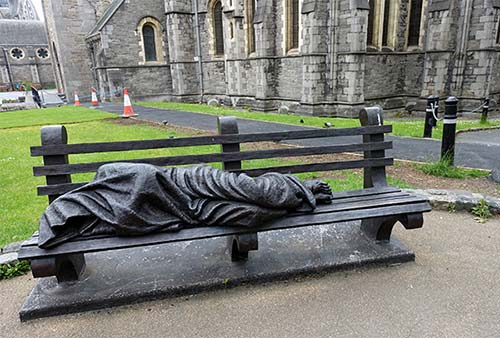
16 Christ Church Cathedral
The cathedral in front of you, worth ▲, is one of the oldest places of worship in Dublin. What you see today is an extensively renovated Neo-Gothic structure dating from the 1870s, but its underground crypt goes back to 1172. An even earlier Viking-era church stood here back in the 1030s. Just beyond the Homeless Jesus statue, an excavation contains the low-lying ruins of a small 12th-century church building. The stones you see on the exterior of the southern transept (above the excavation site) are 12th-century Romanesque—one of the few original features not disturbed by later restorations (for details on visiting the church, see here).
• Leave the churchyard as you entered, turn left, and walk a few steps down Fishamble Street to the blocky concrete sign reading Dublin City Council. At your feet in the pavement is a marker celebrating some ancient history.
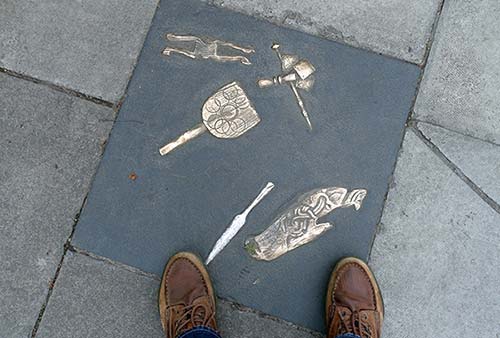
17 Viking Dublin
You’re standing on the site of Dublin’s first Viking settlement, established in the mid-ninth century, with Fishamble Street as its fish market. When the foundations for the huge bunker-like modern offices of the Dublin City Council were dug in 1978, an intact Viking settlement was exposed. A treasure trove of artifacts was uncovered, carefully excavated, and catalogued by eager archaeologists. More than a million objects were found (the best are in the National Museum of Archaeology). Even so, researchers were allowed only a short time to dig before the office building that stands here was erected, effectively burying the rest of the settlement under the pavement. Public protests were vehement and vocal, but to no avail. In an ironic twist, Dublin’s citizens must come here to get planning permission to build. Sidewalk plaques (there are 18 scattered around) based on photos from the dig remind all who pass of what was found—and lost.
• Walk farther downhill, passing Darkey Kelly’s, a recommended pub with music nightly. At the end of the block, you’ll see...
18 Handel’s Hotel
This hotel is named for the composer of the Messiah (with its beloved “Hallelujah Chorus”)—notice that their bar is called Messiah. The first public performance of this iconic oratorio took place in 1742 in a nearby music hall. Peek through the gate to the left of the hotel to see the remains of a surviving theater wall and a statue—a naked and fit Handel stands like a pillar saint atop organ pipes. Every year, on the April 13 anniversary of that premiere, this humble street fills with a full orchestra and 120 choral singers to perform the Messiah for the public.
• Continue walking down Fishamble all the way to the river.
19 River Liffey and View of the Four Courts
Look left. Across the river in the distance is a grand building with a green domed roof. This is the Four Courts, finished in 1802 and housing Ireland’s Supreme Court. It was once the archive for irreplaceable birth and land records. When the Irish Civil War broke out in 1922, Irish nationalists opposed to British dominion occupied the building. Forces supporting the 1921 Anglo-Irish Treaty—led by Michael Collins—were left no alternative but to root them out with British-supplied artillery (the first shots of that tragic brother-against-brother conflict). The artillery onslaught resulted in the accidental detonation of rebel ammo in the Four Courts, sparking an intense fire that destroyed seven centuries of genealogical and historical records.
• Turn right and walk downstream to the second bridge, the pedestrian-only Millennium Bridge. Walk halfway out to survey the scene.
20 Millennium Bridge
From here, the Liffey flows three miles to empty into the Irish Sea. Bordered on both sides by quays (the old English word for “wharf”), today the river is empty of vessels and contained by its concrete embankments. But it was once wider, with muddy banks, wooden piers, and sailing ships. After Vikings sailed their longboats down the Liffey in the ninth century, they built a ship harbor here, and for centuries afterward, the riverfront was the pumping heart of Dublin’s commerce. The Liffey is a salty river, with high and low tides. Before the 1600s, boats could come this far upriver to the medieval port area. But with more bridges and bigger ships, the port moved farther and farther downstream. Today it’s at the mouth of the river, three miles away.
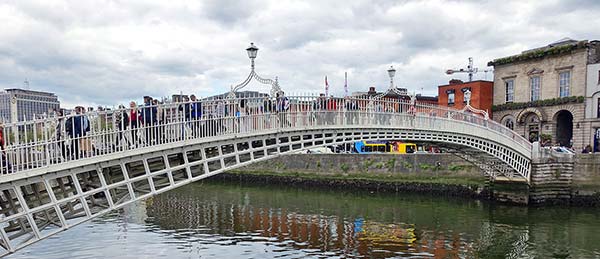
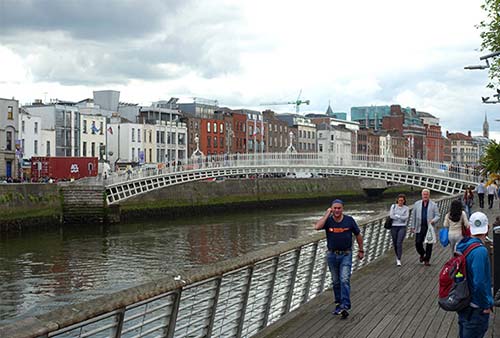
Look downstream at the next bridge, the pedestrian-only Ha’Penny Bridge, a Dublin landmark since 1816. Its graceful cast-iron arch is a celebration of the emerging bridge engineering made possible by the Industrial Revolution. It’s officially the “Wellington Bridge,” named for Arthur Wellesley, the first duke of Wellington, who was born in Ireland, beat Napoleon at Waterloo, and became a British prime minister. (The heroic duke—worried that his Irish birth would be seen as lower class by British blue bloods—once quipped in Parliament, “Just because one is born in a stable does not make him a horse.” Irish emancipator Daniel O’Connell retorted, “Yes, but it could make you an ass.”) But these days, everyone uses the bridge’s nickname, recalling a time when people paid half a penny (“ha’penny”) to cross it rather than ride a ferry across the river—the only other option in the early 1800s.
We’ll cross that bridge when we come to it. But first, let’s head to the Temple Bar district, which stretches along the south bank of the river from here past the Ha’Penny Bridge.
• Go a block inland from the river. At Essex Street East (and the Norsemen Pub), wander left into the heart of Dublin’s infamous party district, known as...
21 Temple Bar
Three hundred years ago, this was the city waterfront, where tall sailing ships offloaded their goods (a “bar” was a loading dock along the river, and the Temples were a dominant merchant family). Eventually, the city grew eastward, filling in tidal mudflats, to create the docklands of modern Dublin. Once a thriving Georgian center of craftsmen and merchants, this neighborhood fell on hard times in the 20th century. Ensuing low rents attracted students and artists, giving the area a funky flair.
Inspired by thriving bohemian cultural centers such as Paris’ Left Bank and New York City’s Greenwich Village, in 1991 Dublin scuttled a plan to demolish this neighborhood (filled with drugs, prostitutes, and decay) to build a bus station. Instead, the city imported quaint cobbles, gave tax breaks to entertainment businesses, and created a raucous party zone. The resulting tourist crowds and inflated beer prices drove away the locals long ago. It can be an absolute spectacle in the evening, when it bursts with revelers. But even if you’re just gawking, don’t miss the opportunity to wander through this human circus. (For more on Temple Bar, see here of the “Entertainment in Dublin” section.)
On the first corner slouches a pub called The Temple Bar. While it looks venerable, it’s only 25 years old, built to cash in on the district’s rising popularity as a nightspot. It encapsulates the commercialism of the tourists’ Temple Bar. Venture in and sample the scene.
You wouldn’t know it by looking at Temple Bar, but since 2001 consumption of alcohol is down almost 20 percent in Ireland. In 2018, Guinness launched its first nonalcoholic beer—perhaps thinking young people don’t have as much time for hangovers. Coffee shops (Starbucks and its clones) are everywhere. A Dublin company called The Virgin Mary specializes in nonalcoholic cocktails. While Irish pubs are in vogue around the world, here on the Emerald Isle, a thousand pubs have closed in the last decade.
• From The Temple Bar pub, side-trip right a block, up Temple Lane South, and stop at the corner of Cecilia Street.
22 Wall of Fame and Irish Pop Music
The windows of the three-story, red “Wall of Fame” on your right are filled with photos of contemporary Irish musicians (Bob Geldof, Phil Lynott, Sinéad O’Connor, U2, the Cranberries, and others). It marks the location of the Irish Rock ’n’ Roll Museum—worth a visit for rock fans interested in seeing studio space and vintage mixing boards used by famous acts (visit by €20 guided tour only, drop in or check their website for tour times, www.irishrocknrollmuseum.com).
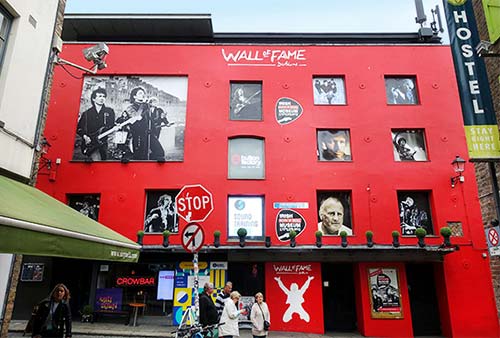
Behind you, above the now-closed Claddagh Records, the modest third floor once held studios where U2 laid down some of their earliest recordings.
• Return to the main street and turn right into...
23 Temple Bar Square
This square is the geographic heart of the Temple Bar district and a favorite haunt of street musicians (also hosts a Saturday book market). The quaint-looking pubs that front it are re-creations built in the early 2000s, when the area became so popular that pubs could sell the most expensive pints in town. Stand here on a Saturday night and you’ll see how this party zone got its reputation for rowdy noise and drunken antics.
• Walk along the square, then turn left up the narrow lane called Merchant’s Arch, toward the river and 24 Ha’Penny Bridge. Walk to the midway point of the bridge and consider Part 1 of this walk finished.
You’re very near the starting point of the second half of this walk, which heads up O’Connell Street. To get there, continue across the bridge to the north bank, turn right, and walk to the O’Connell Bridge via the wooden riverside Millennial Walkway.
PART 2: O’CONNELL STREET AND IRISH HEROES
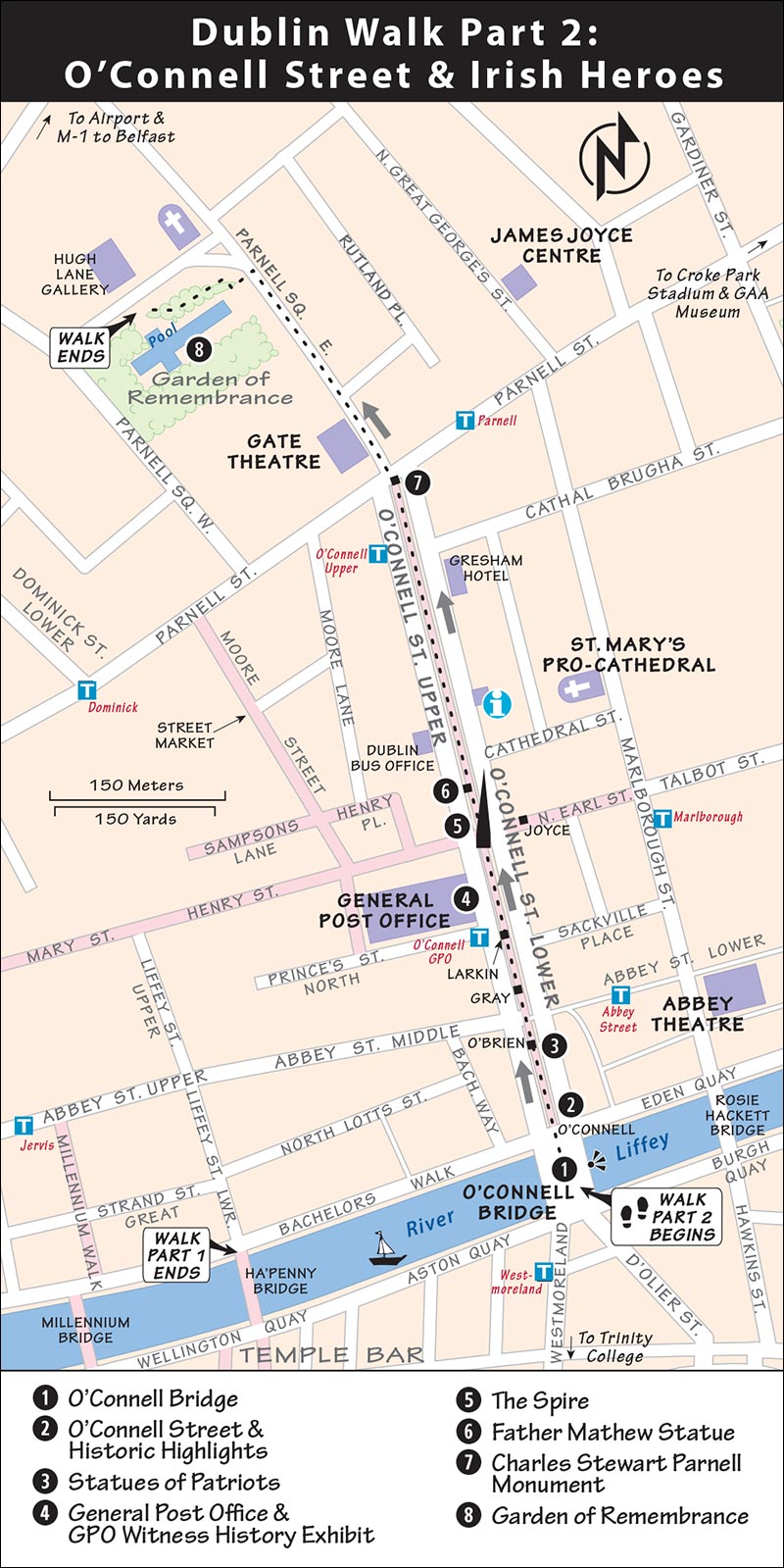
This part of our Dublin walk features a series of sights and monuments recalling Ireland’s long fight for independence. Much shorter than the first part, it takes less than 30 minutes. It’s a straight line through the heart of urban Dublin from the O’Connell Bridge up O’Connell Street to the Garden of Remembrance, a memorial park dedicated to the “terrible beauty” of this freedom-loving island.
1 O’Connell Bridge
This bridge—actually wider than it is long—spans the River Liffey, which historically has divided the wealthy, cultivated south side of town from the working-class north side. While there’s plenty of culture on the north bank, even today the suburbs (a couple of miles north of the Liffey) are considered rougher and less safe. Dubliners joke that “Northsiders” are known as “the accused,” while “Southsiders” are addressed as “your honor.”
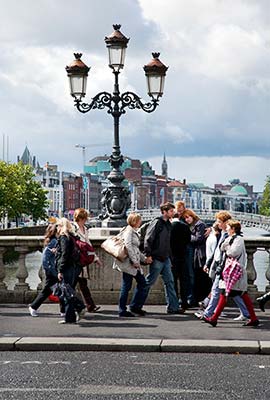
From the bridge, look downstream. Modern Dublin is developing before you. During the Celtic Tiger boom, the Irish subsidized and revitalized this formerly dreary quarter. While the “Tiger” died with the Great Recession of 2008-2009, Dublin’s economy is booming again—as illustrated by the forest of cranes marking building sites in the east end of town, as well as the redevelopment of Upper O’Connell Street (which you’ll see later on this walk).
2 O’Connell Street and Historic Highlights
Turn and look up the broad and grand O’Connell Street, leading from O’Connell Bridge through the heart of urban Dublin. Since the 1740s, the street has been a 45-yard-wide promenade, and once the first O’Connell Bridge connected it to the Trinity College side of town in 1794, it became Dublin’s main drag. It’s named after Daniel O’Connell, Dublin’s first Catholic mayor—we’ll meet him in a moment.
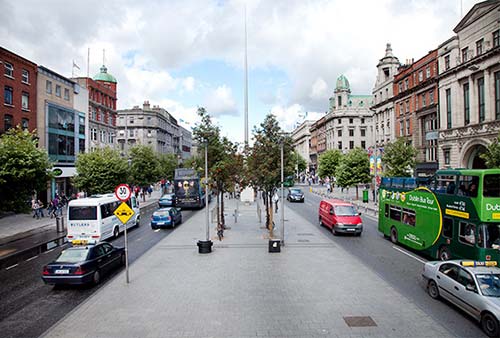
These days, the city has made the street (worth ▲▲) more pedestrian-friendly, and a tram line runs alongside the median. Though filled with touristy fast-food joints and souvenir shops, O’Connell Street echoes with history. The median is dotted with statues remembering great figures from Ireland’s past—particularly the century (1830-1930) when Ireland rediscovered its roots and won its independence.
• Now head north up O’Connell Street, walking on the wide, tree-lined median strip toward the giant spike in the sky. Along the way, you’ll see statues honoring great Irishmen (starting with the man for whom the street is named).
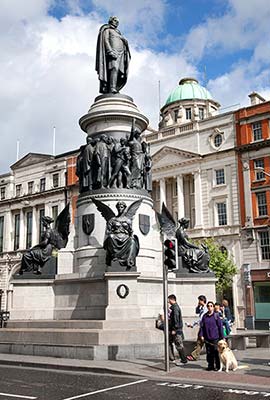
3 Statues of Patriots
Daniel O’Connell (1775-1847) was known as The Liberator for founding the Catholic Association, a political group that demanded Irish Catholic rights in the British parliament. Having personally witnessed the violence of the French Revolution in 1789, O’Connell chose peaceful, legal means to achieve his ends. A charismatic speaker, he organized thousands of nonviolent protestors into “monster meetings,” whose sheer size intimidated the British authorities. O’Connell went on to become the first Catholic mayor of Dublin (1841-1842). Below his statue (commissioned in 1880), Lady Ireland, chains broken around her feet, points to the great emancipator (holding articles of emancipation). The many bullet holes date from the 1916 Easter Rising.
• Walk about 70 yards down the median.
William Smith O’Brien (1803-1864) was O’Connell’s contemporary and the leader of the nationalist Young Ireland Movement. He was more willing to use force to achieve Irish self-determination. After a failed uprising in Tipperary, he was imprisoned and sentenced to death in 1848, but then exiled to Australia.
• Cross the tram tracks to the next statue.
Sir John Gray (1816-1875) was one of Daniel O’Connell’s strongest supporters and advocated for the repeal of union with Britain. He was also responsible for bringing safe drinking water to Dublin, overcoming cholera and other waterborne diseases that had plagued the city.
• Head about 70 yards farther, after the tram stop.
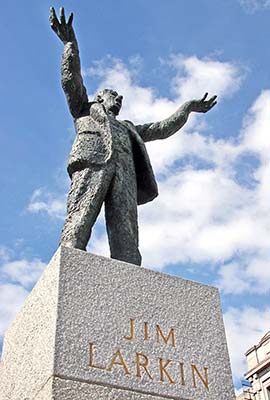
James Larkin (1876-1947), arms outstretched, was the founder of the Irish Transport and General Workers Union. His attempts to relieve tenement poverty through more humane work conditions earned him love from the downtrodden and enmity from the one percent of his day. The general strike he called in 1913 is considered by many to be the first shot in the War of Independence. Larkin was arrested on this spot for trying to make a speech during the seven-month Dublin Lockout. A protest over that arrest degenerated into a riot, police brutality, and several fatalities.
• On your left, just past Larkin, is the...
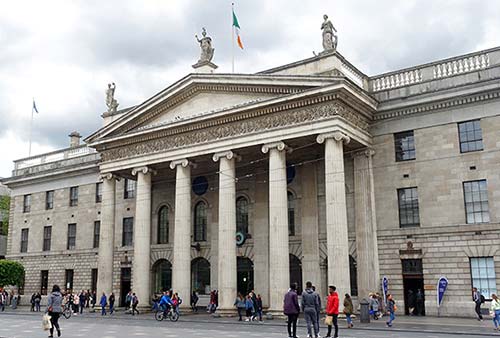
4 General Post Office (GPO)
This is not just any post office. It was from here that the nationalist activist Patrick Pearse read the Proclamation of Irish Independence in 1916, kicking off the Easter Rising. On Easter Monday 1916, the building itself became the rebel headquarters and the scene of a bloody five-day siege—a kind of Irish Alamo. The post office was particularly strategic because it housed the telegraph nerve center for the entire country. Its pillars are still pockmarked with bullet holes. On the right as you enter, the engaging GPO Witness History exhibit brings the dramatic history of this important building to life (for details, see here).
• At the intersection of O’Connell and Henry streets, marvel up at...
5 The Spire
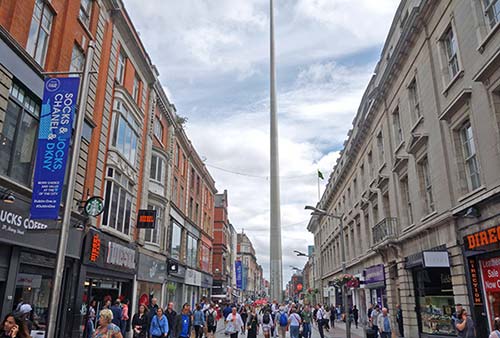
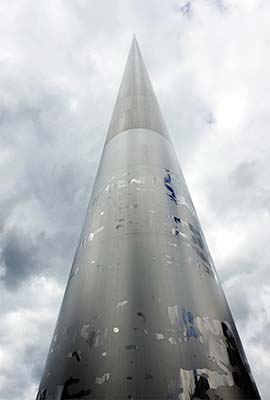
There used to be a tall column at this intersection, crowned by a statue of the British hero of Trafalgar, Admiral Horatio Nelson. It was blown up in 1966—the IRA’s contribution to the local celebration of the Easter Rising’s 50th anniversary. The spot is now occupied by a sculpture called the Spire: 398 feet of stainless steel. While it trumpets rejuvenation on its side of the river, it’s a memorial to nothing and has no real meaning. Dubliners call it the tallest waste of €5 million in all of Europe. Its nickname? Take your pick: the Stiletto in the Ghetto, the Stiffy on the Liffey, the Pole in the Hole, or the Poker near the Croker (after nearby Croke Park). The “erection at the intersection” was built for the millennium, but Dublin was only able to get it up in 2004. Before leaving, have fun standing close and looking way up.
Now glance down the street to your right (North Earl Street). Standing there is a statue of another, very different Irish hero: author James Joyce, who grew up in the streets near here. The street he’s standing on leads downhill to the former red light district, which he called Nighttown but most Dubliners called Monto (for Montgomery Street). In Ulysses, Joyce wrote about his protagonists—Leopold Bloom and Stephen Dedalus—carousing here late at night...informed by Joyce’s own, real-life experiences. While a great artist, Joyce was deeply flawed. Perhaps that’s why Dubliners have nicknamed this statue of him, leaning on his cane, “the Prick with the Stick.”
• A few steps farther up O’Connell Street is a statue of...
6 Father Mathew
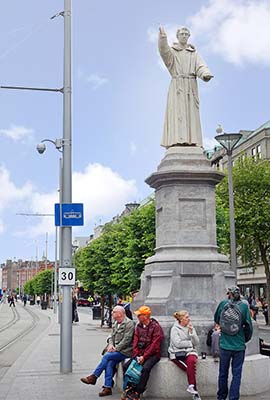
A leader of the temperance movement of the 1830s, Father Theobald Mathew was responsible, some historians claim, for enough Irish peasants staying sober to enable Daniel O’Connell to organize them into a political force. By 1844, over half the adult population of Ireland had signed his total abstinence pledge. Then the onset of the Great Potato Famine diffused his efforts and sent thousands to their graves or onto emigration ships. Desperation drove Ireland back to whiskey.
• Over the next few years, the district ahead on the left will undergo a massive revitalization (if funding holds up). The fancy Gresham Hotel (on the right), a good place for an elegant tea or beer, recalls travel to Dublin in the gilded Victorian age.
Standing boldly at the top of O’Connell Street is the...
7 Charles Stewart Parnell Monument
Ringing the monument are the names of the four ancient provinces of Ireland and all 32 Irish counties (north and south, since this was erected before Irish partition). The monument honors Charles Stewart Parnell (1846-1891), the member of parliament who nearly won Home Rule for Ireland in the 1880s (and who served time at Kilmainham Gaol for his nationalist activities). A Cambridge-educated Protestant of landed-gentry stock, Parnell envisioned a modern, free Irish nation of Catholics as a secular democracy. The Irish people, who remembered their grandparents’ harsh evictions during the Great Potato Famine, came to love Parnell (despite his privileged birth) for his tireless work to secure fair rents and land tenure. Momentum seemed to be on his side. With the British prime minister of the time, William Gladstone, favoring a similar form of Home Rule, it looked as if Ireland was on its way toward independence as a Commonwealth nation, similar to Canada or Australia.
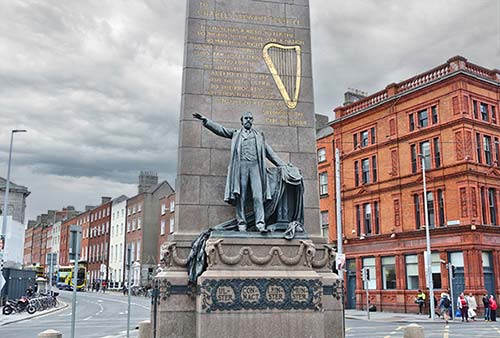
Then a scandal broke around Parnell’s relationship with the wife of a fellow parliament member. The press—egged on by powerful Catholic bishops (who didn’t want a secular, free Irish state)—battered away at the scandal until finally Parnell was driven from office. Wracked with exhaustion and only in his mid-40s, Parnell died brokenhearted. (Sex scandals have a persistent way of shaping history.)
After that, Ireland became mired in the conflicts of the 20th century: an awkward independence (1921) featuring a divided island, a bloody civil war, and sectarian violence for decades afterward. Now, for three decades, peace has prevailed on this troubled isle.
• Continue uphill, straight up Parnell Square East. At the Gate Theatre (on the left), actors Orson Welles, Geraldine Fitzgerald, and James Mason had their professional stage debuts. One block up, on the left, is the...
8 Garden of Remembrance
Honoring the victims of the 1916 Easter Rising, this memorial garden marks the spot where the rebel leaders were held before being transferred to Kilmainham Gaol.
Cost and Hours: Free, gates open daily 9:00-17:00, Oct-March 10:00-16:00. Even when it’s closed, you can see everything (from afar) from outside. There’s another view around the right side, looking down.
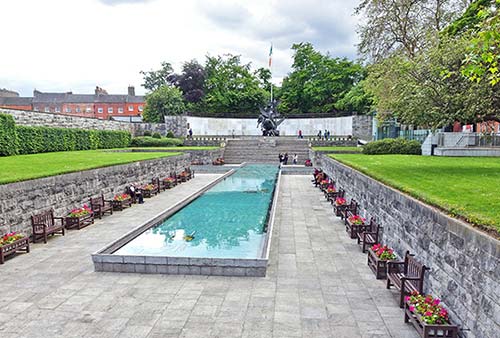
Visiting the Garden: The park was dedicated in 1966 on the 50th anniversary of the revolt that ultimately led to Irish independence. The bottom of the cross-shaped pool is a mosaic of Celtic weapons, symbolic of how the early Irish proclaimed peace by breaking their weapons and throwing them into a lake or river. In the statue (beyond the pool, under the flag), four siblings morph into swans, referring to the Children of Lir of Irish mythology. W. B. Yeats’ poem “Easter, 1916” describes the transformation—“a terrible beauty is born”—as independent Ireland enters a new, if uncertain, age. The Irish flag flies above: green for Catholics, orange for Protestants, and white for the hope that they can live together in peace.
One of modern Ireland’s most stirring moments occurred here in May 2011, when Queen Elizabeth II made this the first stop on her historic visit to the Republic—the first by a reigning British monarch in 100 years. She laid a wreath at the statue under the Irish flag and bowed her head in silence out of respect for the Irish rebels who had fought and died trying to gain freedom from her United Kingdom. This was a hugely cathartic moment for both nations.
• Your walk is over. To get back to the center, just hop on your skateboard—it’s downhill all the way to the river (or grab any tram from the Parnell Street stop—they all go to Trinity College).