DERRY
No city in Ireland connects the kaleidoscope of historical dots more colorfully than Derry. From a leafy monastic hamlet to a Viking-pillaged port, from a cannonball-battered siege survivor to an Industrial Revolution sweatshop, from an essential WWII naval base to a wrenching flashpoint of sectarian Troubles...Derry has seen it all.
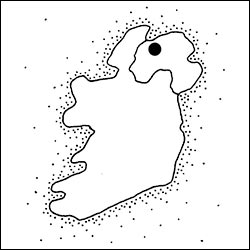
Though Belfast is the capital of Northern Ireland, Derry has a more diverse history, a prettier setting, and was a vibrant city back when Belfast was just a mudflat. With less than half of Belfast’s population (110,000), Derry can feel more welcoming and manageable to visitors.
When Ireland was being divvied up in the early 20th century, the River Foyle was the logical border between Northern Ireland and the Republic. But, for sentimental and economic reasons, Northern Ireland kept Derry, which is otherwise on the Republic’s side of the river. Consequently, this predominantly Catholic Nationalist city, governed by Protestant Unionists, was much contested throughout the Troubles. To this day, the population remains somewhat divided: The city center (or Foyleside) is mainly Catholic Nationalist, while across the river, the Waterside is mostly Protestant Unionist.
While most of its population and its city council call this place “Derry,” some maps, road signs, and all UK train schedules use “Londonderry”—the name on its 1662 royal charter and the one favored by Unionists. I once asked a Northern Ireland rail employee for a ticket to Derry; he replied that there was no such place, but he would gladly sell me one to Londonderry. I’ll call it Derry in this book since that’s what the majority of the city’s inhabitants do.
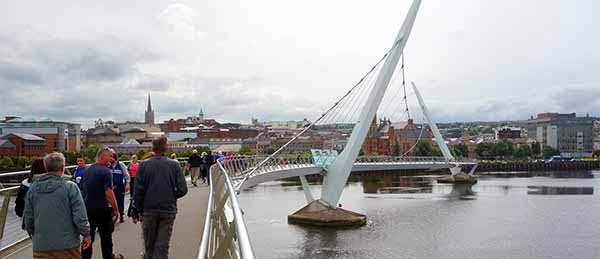
The 21st century has brought refreshing changes, and it feels like a new day in Derry. In 2011, a curvy new pedestrian bridge across the River Foyle was dubbed the Peace Bridge for how it links the two parts of town (and their factions). Just across that bridge, the once foreboding British military barracks at Ebrington Square are being redeveloped into a thriving people zone. And the sitcom Derry Girls, featuring cheeky young inhabitants of the city in the 1990s, is introducing a whole new generation to a lighter side of Derry.
While it’s worth grappling with its weighty past, it’s also surprisingly easy to simply enjoy Derry: Wandering its thriving embankments, bridges, streets, and walls, you’ll be glad you came to this underrated city.
PLANNING YOUR TIME
Whether you’re day-tripping or just passing through, it takes a few hours to see the essential Derry sights: Visit the Tower Museum, catch some views from the town wall, and follow my self-guided tour through the murals of the Bogside. But an overnight in Derry lets you settle in for a more complete experience of the city.
Derry also works well as a home base for side-tripping: It’s just an hour from here to the gorgeous Antrim Coast, and Derry is a natural springboard for a scenic driving loop through County Donegal (just over the border in the Republic; see here).
Orientation to Derry
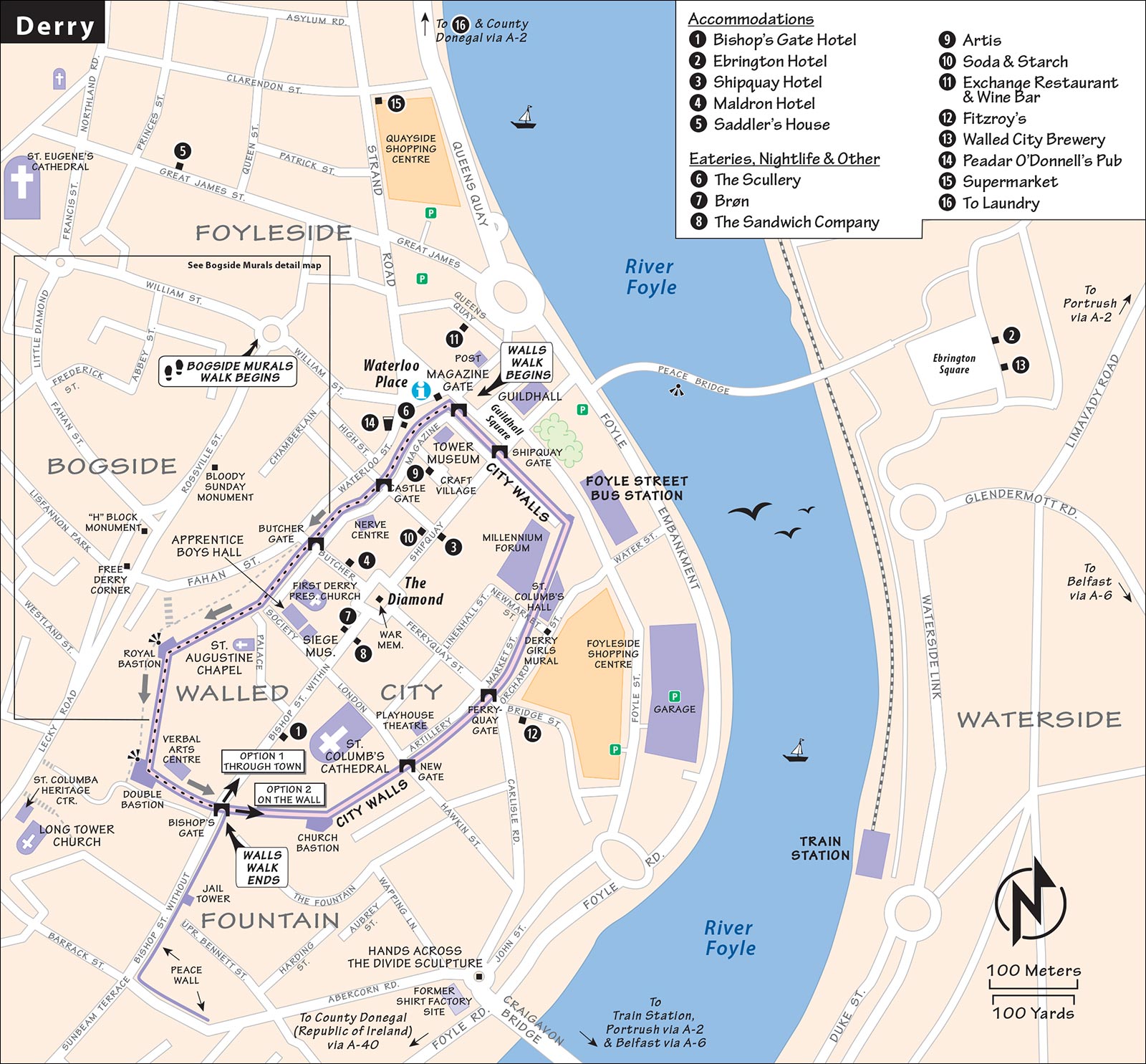
The River Foyle flows north, slicing Derry into eastern and western chunks. The old town walls and almost all worthwhile sights are on the west side—called Foyleside (or, sometimes, Cityside). The train station and Ebrington Square—at the far end of the Peace Bridge—are the main reasons to cross over to Waterside, on the east side.
In the town center, Waterloo Place (with the TI) and the adjoining Guildhall Square, just outside the north corner of the old city walls, are the pedestrian hubs of activity. The Strand Road area extending north from Waterloo Place makes a comfortable home base, with recommended lodgings and restaurants within a block or two. The Diamond (main square) and its War Memorial statue mark the heart of the old city within the walls.
Historical Orientation: This is a city where a little historical orientation goes a long way. Derry witnessed two pivotal events that you’ll hear about often during your visit. First, in 1688-1689, Protestants loyal to King William of Orange withstood a siege by the Catholic forces of King James II. This event is still proudly recalled by Unionists. Then, during the Troubles, Derry’s Bogside was the site of clashes with local authorities—most notably the Bloody Sunday massacre of 1972, which left 14 protesters dead. For Nationalists, this is Derry’s defining event. For the full story, read the “Derry’s History” sidebar. And before you visit, study up on the Troubles with this book’s Understanding the Troubles chapter.
TOURIST INFORMATION
The TI, on Waterloo Place, is a hub for all things Derry. In addition to answering questions and selling tickets for walking tours, it has WCs, luggage lockers, small exhibits for getting to know the town, and even a brief film about the time Amelia Earhart accidentally landed in a field near Derry (Mon-Fri 9:00-18:00, Sat-Sun 10:00-17:00, closes earlier off-season, 1 Waterloo Place, +44 28 7126 7284, www.visitderry.com).
The Visit Derry Pass, sold by the TI, will likely only save you a few pounds if you’re sightseeing like crazy (though it does include both walking tours listed under “Tours in Derry,” and a few museums).
ARRIVAL IN DERRY
By Train: Derry’s end-of-the-line train station—called the North West Transport Hub—is situated right next to the river, across from the walled city center, filling a recently restored historic structure. Leaving the platform, walk straight ahead to the station’s front door, then turn right and look to the bus shelters across the street. Each arriving train is greeted by a bus to Foyle Street Bus Station on the west side of town, a couple of minutes’ walk south of Guildhall Square (free with a train ticket). Taxis are also standing by (figure a £5 taxi ride to Guildhall Square). For getting to the station, the same bus leaves Foyle Street Bus Station 15 minutes before each departing train. There’s no luggage storage at either the train or bus station, but the TI has lockers.
By Bus: All intercity buses stop at the centrally located Foyle Street Bus Station, just down the street from Guildhall Square.
By Car: The Foyleside parking garage by the Foyleside shopping center is handy for day-trippers (pay parking, check closing hours when you park). Another handy spot is the pay-and-display lot next to the Guildhall. If staying overnight, ask about parking at your B&B, or try the parking garage at the Quayside shopping center (48 Strand Road; purchase overnight tickets from security desk in car park on arrival).
HELPFUL HINTS
Festive Derry: The city puts on plenty of special events to keep visitors entertained. May brings the City of Derry Jazz and Big Band Festival (www.cityofderryjazzfestival.com). In summer (late June), it’s the Foyle Maritime Festival (www.foylemaritime.com), which is sometimes coordinated with an around-the-world yacht race. And in late October, Derry is famous for its Halloween festivities (www.derryhalloween.com).
Laundry: Bubbles has drop-off service—bring it in the morning, pick up later that day (Mon-Fri 9:00-17:00, Sat until 16:00, closed Sun, 141 Strand Road, +44 28 7136 3366).
Taxi: Try City Cabs (+44 28 7126 4466) or Foyle Taxi (+44 28 7127 9999).
Tours in Derry
Walking Tours
McCrossan’s City Tours leads insightful hour-long walks, giving a rounded view of the city’s history. Tours depart from 11 Carlisle Road, just below Ferryquay Gate (£6; daily at 10:00, 12:00, 14:00, and 16:00; +44 28 7127 1996 or +44 77 1293 7997, www.discovernorthernireland.com, derrycitytours@icloud.com). They also offer food tours, Derry Girls tours, and “spooky” tours.
Bogside History Tours offers walks led by Bogside residents who lost loved ones in the tragic events of Bloody Sunday (£10, daily at 11:00 and 13:00, departs from in front of the Guildhall, +44 77 3145 0088, www.bogsidehistorytours.com, paul@bogsidehistorytours.com). Tour guides also offer various taxi tours (£45/hour, call or email for options).
Walks in Derry
Though peaceful, cheery, and welcoming today, Derry’s history is stamped by decades of conflict. These two self-guided walks (less than an hour each) explore two tumultuous eras in the town’s story. The Walls Walk, starting on the old city walls and ending at the Anglican cathedral, focuses on Derry’s early days. The Bogside Murals Walk guides you to the city’s compelling murals, which document the time of the Troubles. These walks, each worth ▲▲, can be done separately or linked, depending on your time.
WALLS WALK
Squatting determinedly in the city center, the old city walls of Derry (built 1613-1618 and still intact, except for wider gates to handle modern vehicles) hold an almost mythic place in Irish history.
It was here in 1688 that a group of brave apprentice boys, some of whom had been shipped to Derry as orphans after the Great Fire of London in 1666, made their stand. They slammed the city gates shut in the face of the approaching Catholic forces of deposed King James II. With this act, the boys galvanized the city’s indecisive Protestant defenders inside the walls.
Months of negotiations and a grinding 105-day siege followed, during which a third of the 20,000 refugees and defenders crammed into the city perished. The siege was finally broken in 1689, when supply ships broke through a boom stretched across the River Foyle. The sacrifice and defiant survival of the city turned the tide in favor of newly crowned Protestant King William of Orange, who arrived in Ireland soon after and defeated James at the pivotal Battle of the Boyne.
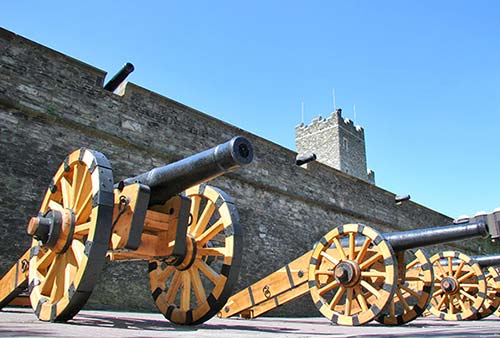
To fully appreciate the walls, take a walk on top of them (free, open from dawn to dusk). Almost 20 feet high and at least as thick, the walls form a mile-long oval loop. The most interesting section is the half-circuit facing the Bogside, starting at Magazine Gate (stairs face the Tower Museum Derry, inside the walls) and finishing at Bishop’s Gate. (From there, it’s just a short walk to the start of the Bogside Murals Walk.)
• We’ll enter the walls at Magazine Gate. To find the stairs up, face the TI, turn left, then go right through the gate in the wall (with the Tower Museum ahead of you). Just through the gate, look to the right for the stairs up. Once atop the walls, head left.
Walk the wall as it heads uphill, snaking along the earth’s contours. In the row of buildings on the left (about 80 yards from where you started), you’ll see an arch entry into the Craft Village (marked #13, next to the red entrance to Foyle Books)—an alley lined with a cluster of cute shops and cafés that showcase the economic rejuvenation of Derry. This atmospheric passage—loaded with good restaurants, and showing off a mural celebrating the women who powered Derry’s shirt factories—is worth exploring later on (you can enter it from near the bottom of the main street).
• After crossing over Butcher Gate, stop in front of the grand building with the four columns to view the...
First Derry Presbyterian Church: This impressive-looking building is the second church to occupy this site. The first was built by Queen Mary in the 1690s to thank the Presbyterian community for standing by their Anglican brethren during the dark days of the famous siege. That church was later torn down to make room for today’s stately Neoclassical, red sandstone church (finished in 1780). Over the next 200 years, time took its toll on the structure, which was eventually closed due to dry rot and Republican fire bombings. But in 2011, the renovated church reopened to a chorus of cross-community approval (yet one more sign of the slow reconciliation taking place in Derry). The Blue Coat School exhibit behind the church highlights the important role of Presbyterians in local history (free but donations appreciated, May-Sept Wed-Fri 11:00-16:00, closed Oct-April).
• Just up the block, look for a large, grand-looking stone building. This is the...
Apprentice Boys Memorial Hall: Built in 1873, this houses the private lodge and meeting rooms of an all-male Protestant organization. The group is dedicated to the memory of the original 13 apprentice boys who rallied the town during the 1688 siege. Each year, on the Saturday closest to the August 12 anniversary, the modern-day Apprentice Boys Society celebrates the end of the siege with a controversial march atop the walls. These walls are considered sacred ground for devout Unionists, who claim that many who died during the famous siege were buried within the battered walls.
The Siege Museum stands behind the hall, giving a narrow-focus Unionist view of the siege (£5, Mon-Sat 10:00-17:00, closed Sun, last entry one hour before closing, 18 Society Street, www.thesiegemuseum.org). This is one of two “dueling” museums in town that offer starkly different perspectives; the other is the fiercely Republican Museum of Free Derry in the Bogside (described on the Bogside Murals Walk, later). Both are interesting, but they’re as much propaganda as history; visiting both is a good way to fully appreciate the dynamics of this complicated city.
Next, you’ll pass a large, square pedestal on the right, atop Royal Bastion. It once supported a column in honor of Governor George Walker, the commander of the defenders during the siege. In 1972, the IRA blew up the column, which had 105 steps to the top (one for each day of the siege). An adjacent plaque shows a photo of the column before it was destroyed.
• Opposite the empty pedestal is the small Anglican...
St. Augustine Chapel: Set in a pretty graveyard, this Anglican chapel is where some believe the original sixth-century monastery of St. Columba stood. The quaint grounds are open to visitors (Mon-Sat 11:00-15:00, closed Sun except for worship). In Victorian times, this stretch of the walls was a fashionable promenade walk.
As you walk farther along the wall, you’ll pass a long wall (on the left)—all that’s left of a former British Army base, which stood here until 2006. Two 50-foot towers used to loom out of it, bristling with cameras and listening devices. Soldiers built them here for a bird’s-eye view of the once-turbulent Catholic Bogside district below. The towers’ dismantlement—as well as the removal of most of the British Army from Northern Ireland—is another positive sign in cautiously optimistic Derry. The walls of this former army base now contain a parking lot.
Once an island in the River Foyle, Derry (from doire, Irish for “oak grove”) was chosen by St. Columba (St. Colmcille) around AD 546 for a monastic settlement. He later banished himself to the island of Iona in Scotland out of remorse for sparking a bloody battle over the rights to a holy manuscript that he had secretly copied.
A thousand years later, the English defeated the last Ulster-based Gaelic chieftains in the Battle of Kinsale (1601) and began the “plantation” of Ulster with loyal Protestant subjects imported from Scotland and England. The native Irish were displaced to less desirable lands, sowing seeds of resentment that would persist for centuries.
A dozen wealthy London guilds (grocers, haberdashers, tailors, and others) took on Derry as an investment in the early 17th century and changed its name to “Londonderry.” They built the last great walled city in Ireland to protect their investment from the surrounding (and hostile) Irish. The walls proved their worth in 1688-1689, when the town’s Protestant defenders, loyal to King William of Orange, withstood a prolonged siege by the forces of Catholic King James II. “No surrender” is still a passionate rallying cry among Ulster Unionists determined to remain in the UK.
The town became a major port of emigration to the New World in the early 1800s. Then, when the Industrial Revolution provided a steam-powered sewing factory, the city developed a thriving shirt-making industry. The factories here employed mostly Catholic women who flocked in from rural County Donegal (the original “Derry Girls,” celebrated by a mural at the entrance to the Craft Village). Although Belfast grew larger and wealthier, Unionists tightened their grip on Londonderry and its walls.
In 1921, local Unionists insisted that the city be included in Northern Ireland when the province was partitioned from the new Irish Free State (later to become the Republic of Ireland). A bit of gerrymandering (with three lightly populated Unionist districts outvoting two densely populated Nationalist districts) ensured that the Protestant minority maintained control of the city, despite its Catholic majority.
During World War II, Derry was a key escort base for US convoys headed for Britain, and 60 German U-boats were ordered to surrender here at the end of the war. After the war, poor Catholics—unable to find housing—took over the abandoned military barracks, with multiple families living in each dwelling. Only homeowners were allowed to vote, and the Unionist minority, which controlled city government, was not eager to build more housing that would tip the voting balance away from them. Over the years, sectarian pressures gradually built—until they reached the boiling point. The ugly events of Bloody Sunday on January 30, 1972, brought worldwide attention to the Troubles (see the “Bloody Sunday” sidebar on here).
Today, life has stabilized in Derry, and the population has increased by 25 percent over the last 30 years. The 1998 Good Friday Agreement made significant progress toward peace, and the British Army withdrew 90 percent of its troops in mid-2007. With a population that is more than 70 percent Catholic, the city has agreed to alternate Nationalist and Unionist mayors. There’s a spirit of cautious optimism in Derry, once the epicenter of bombs and bloody conflicts in the 1960s and 1970s.
The city continues to work on building a happier image. The old wall—with all its troubled imagery and once nicknamed “the noose”—is now called “the necklace.” And locals embrace the TV show Derry Girls, which they feel captures their knack for greeting life with good humor. With its complicated history, you’re damned if you do and damned if you don’t when it comes to calling it Derry (pro-Catholic, Nationalist) or Londonderry (pro-Protestant, Unionist). Some call it Derry/Londonderry or Londonderry/Derry. Others just say “Slashtown.” And the tourist board calls it “legend-Derry.”
Stop at the Double Bastion fortified platform that occupies this corner of the city walls. The old cannon is nicknamed “Roaring Meg” for the fury of its firing during the siege.
From here, you can see across the Bogside to the not-so-far-away hills of County Donegal in the Republic. Derry was once an island, but as the River Foyle gradually changed its course, the area you see below the wall began to drain. Over time, and especially after the Great Potato Famine, Catholic peasants from rural Donegal began to move into Derry to find work during the Industrial Revolution. They settled on this least desirable land...on the soggy bog side of the city. From this vantage point, survey the Bogside, with its political murals.
Directly below and to the right are Free Derry Corner and Rossville Street, where the tragic events of Bloody Sunday took place. Down on the left is the 18th-century Long Tower Catholic church, named after the monk-built round tower that once stood in the area (see listing under “Sights in Derry,” later).
• Head to the grand brick building behind you. This is the...
Verbal Arts Centre: A former Presbyterian school, this center promotes the development of local literary arts in the form of poetry, drama, writing, and storytelling. Drop in or check the events schedule online (www.verbalartscentre.co.uk).
• Go another 50 yards around the corner to reach...
Bishop’s Gate: From here, look up Bishop Street Within (inside the walls). This was the site of another British Army surveillance tower. Placed just inside the town walls, it overlooked the neighborhood until 2006. Now look in the other direction to see Bishop Street Without (outside the walls). You’ll spot a modern wall topped by a high mesh fence, running along the left side of Bishop Street Without.
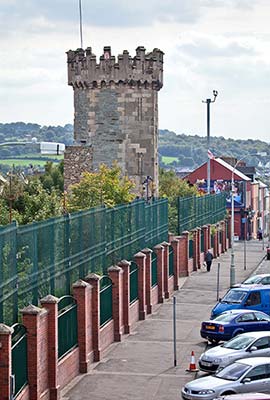
This is a so-called peace wall, built to ensure the security of the Protestant enclave living behind it in Derry’s Fountain neighborhood. When the Troubles reignited over 50 years ago, 20,000 Protestants lived on this side of the river. This small housing development of 1,000 people is all that remains of that proud community today. The rest have chosen to move across the river to the mostly Protestant Waterside district. The stone tower halfway down the peace wall is all that remains of the old jail that briefly held doomed rebels after a 1798 revolt against the British.
• The main part of our walk is over. To return to Guildhall Square and the TI in 10 or 15 minutes, you can either head back through town or stay on the wall. Before heading back, you could first go down the hill here to see the Long Tower Church (or you can easily add it to the end of the Bogside Murals Walk). Use the “Derry” map to locate the sights mentioned below.
Option 1, Walk Through Town: Descend from the wall at Bishop’s Gate and walk through the middle of the walled town on Bishop Street Within. As you go along, you’ll pass or be near several points of interest: the courthouse (heavily fortified in this Troubled town); the high-end Bishops Gate Hotel; St. Colomb’s Cathedral; the tidy square called The Diamond, at the very center of the walled city; the steep and colorful Shipquay Street; and the Craft Village (dip into the doorway at #17). You’ll eventually pop out through the hole in the wall, back where you began.
Option 2, Stay on the Wall: Keep on circling around the wall after Bishops Gate; as you go, you’ll pass or see: St. Columb’s Cathedral and its evocative courtyard (a gate in the wall allows direct access), a Unionist political mural reading Londonderry West Bank—Loyalists Still Under Siege—No Surrender (down on the right; this small corner of town has a stronger Unionist presence), the glass dome topping the Foyleside Shopping Centre, the Derry Girls mural, and the stately St. Columb’s Hall entertainment venue. Near the hall, the wall drops down to—then below—the modern street level; just keep going, passing the Millennium Forum on your left and the Foyle Street Bus Station on your right. Soon the wall hooks left, and you’ll be back at the Tower Museum and TI.
• From the TI, the start of the Bogside Murals Walk is just five minutes away: As you face the TI, turn right and walk straight ahead on William Street to the roundabout where it meets Rossville Street—and the beginning of the walk.
BOGSIDE MURALS WALK
The Catholic Bogside area was the tinderbox of the modern Troubles in Northern Ireland. Bloody Sunday, a terrible confrontation that occurred over 50 years ago, sparked a sectarian inferno...and the ashes have not yet fully cooled. The events are memorialized in about a dozen murals painted on the ends of residential flats along a 200-yard stretch of Rossville Street and Lecky Road, giving visitors to the Bogside an accessible glimpse of this community’s passionate perception of those events. These days, the neighborhood feels a bit gritty, but it’s quiet and safe.
Getting There: You can reach the murals in just a few minutes’ walk from Waterloo Place via William Street. (They are also accessible from the old city walls at Butcher Gate via the long set of stairs extending below Fahan Street on the grassy hillside, or by the stairs leading down from the Long Tower Church.)
The Artists: Two brothers, Tom and William Kelly, along with their childhood friend Kevin Hasson, are known as the Bogside Artists. They grew up in the Bogside and witnessed the tragic events that took place there, which led them to begin painting the murals in 1994. Tom Kelly gained a reputation as a “heritage mural” painter, specializing in scenes of life in the old days. In a surprising and hopeful development, Tom was later invited into Derry’s Protestant Fountain neighborhood to work with a youth club on three proud heritage murals that were painted over paramilitary graffiti.
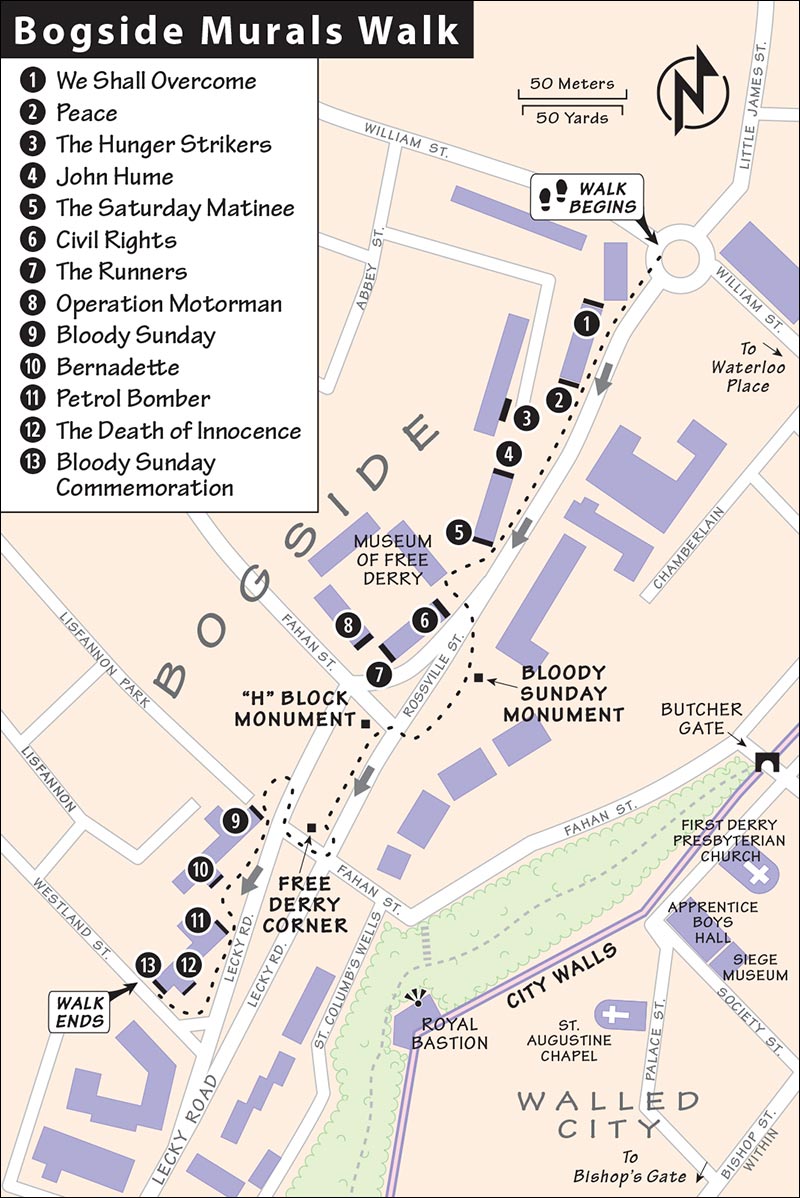
The Murals: Start out at the roundabout intersection of Rossville and William streets.
The Bogside murals face different directions and some are partially hidden by buildings; follow my directions and use this chapter’s map to locate each one. Plan on walking three long blocks along Rossville Street (which becomes Lecky Road) to see them all. Residents are used to visitors and don’t mind if you photograph the murals. Local motorists are uncommonly courteous with allowing visitors to cross the busy street. (Even so...be cautious when crossing.)
From William Street, walk south along the right side of Rossville Street toward Free Derry Corner. The murals will all be on your right.
The first mural you’ll see, facing you at the end of the first long building on your right-hand side, is a handkerchief with the message 1 We Shall Overcome—a reminder that the peaceful protests here in the late 1960s and early 1970s were inspired by the American Civil Rights Movement. Protesters borrowed not only the spirit and symbols of that movement, but even its songs. The handkerchief recalls a detail from Bloody Sunday, when Father Edward Daly waved a handkerchief like a white flag as he attempted to seek medical care for a young protester who’d been shot.
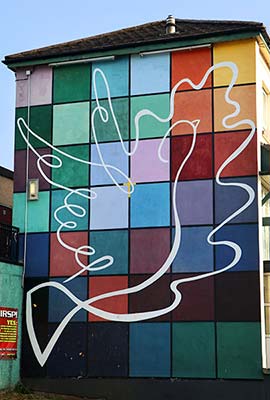
Farther along, at the opposite end of the same long building (over your right shoulder), look for the colorful 2 Peace, showing the silhouette of a dove in flight (left side of mural) and an oak leaf (right side of mural), both created from a single ribbon. A peace campaign asked Derry city schoolchildren to write suggestions for positive peacetime images; their words inspired this artwork. The dove is a traditional symbol of peace, and the oak leaf is a traditional symbol of Derry—recognized by both communities. The dove flies from the sad blue of the past toward the warm yellow of the future.
3 The Hunger Strikers features two Derry-born participants from the 1981 Maze Prison hunger strike, as well as (above them) their mothers, who sacrificed and supported them in their fatal decision (10 strikers died). The prison was closed after the release of all prisoners (both Unionist and Nationalist) in 2000.
Smaller and easy to miss (above a ramp with banisters) is 4 John Hume. It’s actually a collection of four faces (clockwise from upper left): Nationalist leader John Hume, Martin Luther King Jr., Nelson Mandela, and Mother Teresa. (One theme you’ll notice is the Nationalists aligning themselves with respected advocates for the dispossessed and marginalized from around the world.) The Brooklyn Bridge in the middle symbolizes the long-term bridges of understanding that the work of these four Nobel Peace Prize-winning activists created.
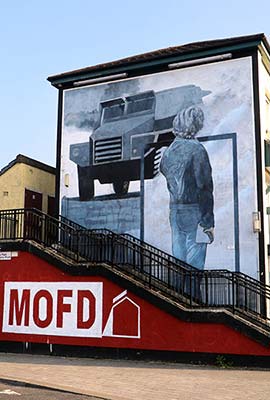
At the opposite end of the same building, look for 5 The Saturday Matinee, which depicts an outgunned but undaunted local youth behind a screen shield. He holds a stone, ready to throw, while a British armored vehicle approaches (echoing the famous Tiananmen Square photo of the lone Chinese man facing a tank). Why Saturday Matinee? It’s because the weekend was the best time for locals to engage in a little “recreational rioting” by “having a go at” the army; people were off work and youths were out of school. The “MOFD” at the bottom of this mural stands for the nearby Museum of Free Derry.
Facing that mural is 6 Civil Rights, showing a marching Derry crowd carrying an antisectarian banner. It dates from the days when Martin Luther King Jr.’s successful nonviolent marches were being seen worldwide on TV, creating a dramatic, global ripple effect—and giving this long-suffering community a powerful new voice.
Have you noticed the red, black, white, and green flag of Palestine? Palestinians and Catholic residents of Northern Ireland see similarities in their struggles: Both are indigenous people dealing with the persistent realities of sharing what they consider their rightful homeland with more powerful settlers planted there for political reasons.
In the building behind this mural, you’ll find the intense Museum of Free Derry (£8, Mon-Sat 10:00-16:00, June-Sept also open Sun, 55 Glenfada Park, +44 28 7136 0880, www.museumoffreederry.org). Photos, shirts with bullet holes, and a video documentary convey Bogside residents’ experiences during the worst of the Troubles from an unapologetically Nationalist point of view.
Walk along the rusted-copper facade of the museum to its far end. Etched into the wall is the pattern of a sound wave—in this case, that of the protesters singing “We Shall Overcome” in the moments before the massacre.
At the far end of the museum’s outdoor wall (high up on the second floor of an adjacent residential building) is a copy of a famous painting by Francisco Goya depicting another massacre—this one in Spain—called the Third of May 1808. This reproduction draws a stark parallel to the local events that occurred here. Below and to the left of the painting (next to a gated alley) are two large bullet holes in the wall, inflicted on Bloody Sunday and preserved behind glass.
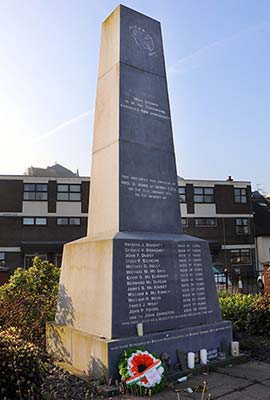
Cross over to the other side of Rossville Street to see the Bloody Sunday Monument. This small, fenced-off stone obelisk lists the names of those who died that day, most within 50 yards of this spot. Take a look at the map pedestal by the monument, which shows how a rubble barricade was erected to block the street. A 10-story housing project called Rossville Flats stood here in those days. After peaceful protests failed (with Bloody Sunday being the watershed event), Nationalist youths became more aggressive. British troops were wary of being hit by Molotov cocktails thrown from the rooftop of the housing project.
Inspired by civil rights marches in America in the mid-1960s, and the Prague Spring uprising and Paris student strikes of 1968, civil rights groups began to protest in Northern Ireland around the same time. Initially, their goals were to gain better housing, secure fair voting rights, and end employment discrimination for Catholics in Northern Ireland. Tensions mounted, and clashes with the predominantly Protestant Royal Ulster Constabulary police force became frequent. In 1969, following a three-day conflict known as the Battle of the Bogside, the British Army was called in to keep the peace.
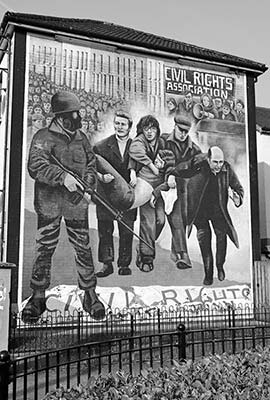
On January 30, 1972, about 10,000 people protesting internment without trial held an illegal march sponsored by the Northern Ireland Civil Rights Association. British Army barricades kept them from the center of Derry, so they marched through the Bogside neighborhood.
That afternoon, some youths rioted on the fringe of the march. An elite parachute regiment had orders to move in and make arrests in the Rossville Street area. Shooting broke out, and after 25 minutes, 13 marchers were dead and 13 were wounded (one of the wounded later died). The soldiers claimed they came under attack from gunfire and nail bombs. The marchers said the army shot indiscriminately at unarmed civilians.
The clash, called Bloody Sunday, uncorked pent-up frustration as moderate Catholic Nationalists morphed into staunch Republicans overnight and released a flood of fresh IRA volunteers. An investigation at the time exonerated the soldiers, but the relatives of the victims called it a whitewash and insisted on their innocence.
In 1998, then-British Prime Minister Tony Blair promised a new inquiry, which became the longest and most expensive in British legal history. In 2010, a 12-year investigation—the Saville Report—determined that the Bloody Sunday civil rights protesters were innocent and called the deaths of 14 protesters unjustified. That same year, in a dramatic speech in the House of Commons, Britain’s prime minister at the time, David Cameron, apologized to the people of Derry. “What happened on Bloody Sunday was both unjustified and unjustifiable. It was wrong,” he declared. Cheers rang out in Derry’s Guildhall Square, where thousands had gathered to watch the televised speech. After 38 years, Northern Ireland’s bloodiest wound could begin to heal.
Carry on about 100 yards, then cross the street again—this time to the grassy median strip that runs down the middle of Rossville Street. At this end stands a granite letter H inscribed with the names of the IRA hunger strikers who died (and how many days they starved) in the H-block of Maze Prison.
From here, as you look back across at the corner of Fahan Street, you get a good view of two murals. In 7 The Runners (right), four rioting youths flee tear gas deployed by the British Army to disperse hostile crowds. More than 1,000 canisters were used during the Battle of the Bogside. Meanwhile, in 8 Operation Motorman (left), a soldier wields a sledgehammer to break through a house door, depicting the massive push by the British Army to open up the Bogside’s barricaded “no-go” areas that the IRA had controlled for three years (1969-1972).
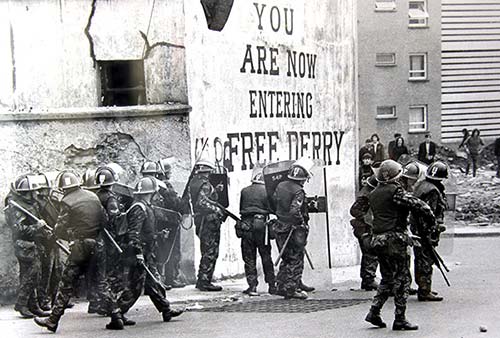
Walk down to the other end of the median strip, passing a monument to the IRA (with names listed on a Roll of Honor and a Roll of Remembrance). Passing a small olive tree planted in solidarity with the Palestinians, you reach the famous white wall of Free Derry Corner, which announces “You are now entering Free Derry” (imitating a similarly defiant slogan of the time in once-isolated West Berlin). This was the gabled end of a string of houses that stood here 50 years ago. During the Troubles, it became a traditional meeting place for speakers to address crowds. A portion of this mural changes from time to time, calling attention to injustice suffered by kindred spirits around the world (the plight of Palestinians is a common theme).
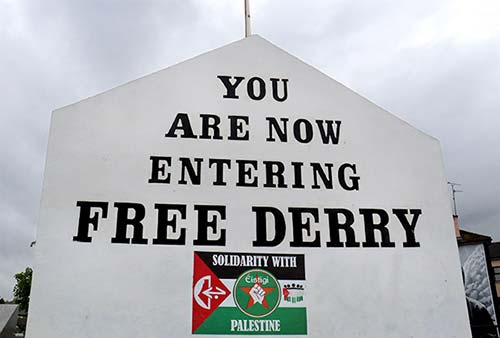
Cross back to the right side of the street (now Lecky Road) to see 9 Bloody Sunday, in which a small group of men carry a body from that ill-fated march. It’s based on a famous photo taken that day of Father Edward Daly. Hunched over, he waves a white handkerchief to request safe passage in order to evacuate a mortally wounded protester. The bloodstained civil rights banner was inserted under the soldier’s feet for extra emphasis. After Bloody Sunday, the previously marginal IRA suddenly found itself swamped with bitterly determined young recruits.
The dramatic and emotional murals of Northern Ireland will likely be one of your trip’s most enduring travel memories. During the 19th century, Protestant neighborhoods hung flags and streamers each July to commemorate the victory of King William of Orange at the Battle of the Boyne in 1690. Modern murals evolved from these colorful annual displays. With the advent of industrial paints, temporary seasonal displays became permanent territorial statements.
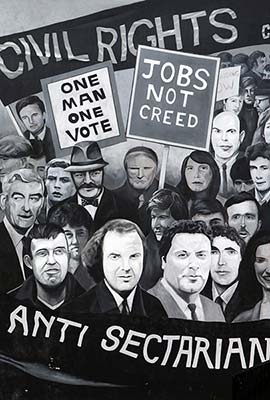
Unionist murals were created during the extended Home Rule political debate that eventually led to the partitioning of the island in 1921 and the creation of Northern Ireland. Murals that expressed opposing views in Nationalist Catholic neighborhoods were outlawed. The ban remained until the eruption of the modern Troubles, when staunchly Nationalist Catholic communities isolated themselves behind barricades, eluding state control and gaining freedom to express their pent-up passions. In Derry, this form of symbolic, cultural, and ideological resistance first appeared in 1969 with the simple “You are now entering Free Derry” message that you’ll still see painted on the surviving gable wall at Free Derry Corner.
Found mostly in working-class neighborhoods of Belfast and Derry, today’s political murals have become a dynamic form of popular culture. They blur the line between art and propaganda, giving visitors a striking glimpse of each community’s history, identity, and values.
Farther along—basically behind the Free Derry wall—is a mural called 10 Bernadette. The woman with the megaphone is Bernadette Devlin McAliskey, an outspoken civil rights leader, who, at age 21, became the youngest elected member of British Parliament. Behind her kneels a female supporter, banging a trash-can lid against the street in a traditional expression of protest in Nationalist neighborhoods. Trash-can lids were also used to warn neighbors of the approach of British patrols.
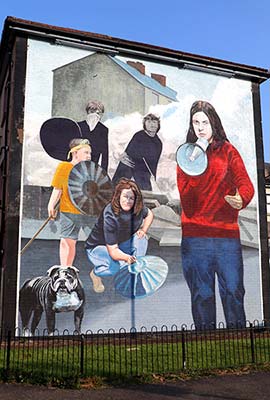
11 Petrol Bomber, showing a teen wearing an army-surplus gas mask, captures the three-day Battle of the Bogside in 1969, when locals barricaded their community from the Unionist police. (This event spurred the British to mobilize the army.) Though the main figure’s face is obscured by the mask, his body clearly communicates the resolve of an oppressed people. In the background, the long-gone Rossville Flats housing project still looms, with an Irish tricolor flag flying from its top.
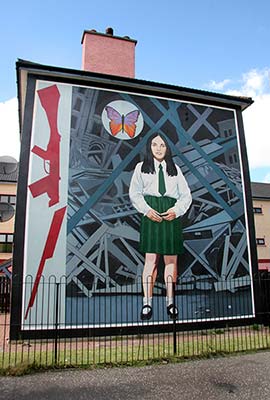
Carry on another 50 yards. In 12 The Death of Innocence, a young girl stands in front of bomb wreckage. She is Annette McGavigan, a 14-year-old who was killed on this corner by crossfire in 1971. She was the 100th fatality of the Troubles, which eventually took more than 3,000 lives. (She was also a cousin of one of the artists.) The broken gun beside her points to the ground, signifying that it’s no longer being wielded. The large butterfly above her shoulder symbolizes the hope for peace. For years, the artists left the butterfly an empty silhouette until they felt confident that the peace process had succeeded. They finally filled in the butterfly with optimistic colors in the summer of 2006.
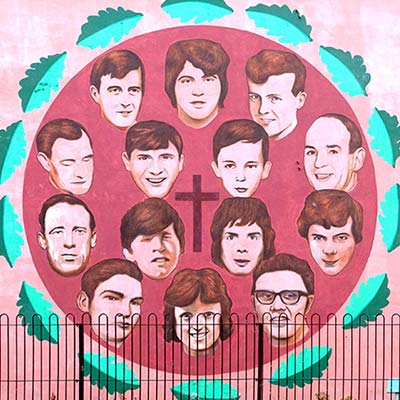
Finally, around the corner, you’ll see a circle of male faces. This mural, painted in 1997 to observe the 25th anniversary of the tragedy, is called 13 Bloody Sunday Commemoration and shows the 14 victims. They are surrounded by a ring of 14 oak leaves—the symbol of Derry. When relatives of the dead learned that the three Bogside Artists were beginning to paint this mural, many came forward to loan the artists precious photos of their loved ones, so they could be more accurately depicted.
While these murals preserve the struggles of the late 20th century, today is a new day in Derry and in Northern Ireland. The delicate peace forged by the 1998 Good Friday Agreement appears to be holding, and most people here look more to the future than to the past. In 2010, the British apology for the Bloody Sunday shootings was a huge step forward. Former Nationalist leader John Hume (who shared the 1998 Nobel Peace Prize with then-Unionist leader David Trimble) once borrowed a quote from Gandhi to explain his nonviolent approach to the peace process: “An eye for an eye leaves everyone blind.”
Our walk is over. You can head back to the center of town the way you came. Or, if you’d like to visit the Long Tower Church, it’s just up the hill beyond the last of these murals.
Sights in Derry
IN AND NEAR THE WALLED CITY
These sights are all either inside, or just outside of, the walled city center.
▲Tower Museum Derry
This well-organized museum tells Derry’s story from a skillfully unbiased viewpoint, sorting out some of the tangled history of Northern Ireland’s Troubles. While low-tech and a bit dated, it’s intelligent and insightful. Occupying a modern reconstruction of a fortified medieval tower-house that belonged to the local O’Doherty clan, it provides an excellent introduction to the city. It also features a collection of items from a Spanish Armada shipwreck discovered near here.
Cost and Hours: £4, daily 9:00-17:30, last entry at 16:00, Union Hall Place, +44 28 7137 2411, www.towermuseumcollections.com.
Visiting the Museum: The museum is divided into three sections: temporary exhibits and the Story of Derry on the ground floor, and the Spanish Armada on the four floors of the tower.
Walking through the temporary exhibits (just beyond the ticket desk) and down the tunnel, you’ll reach the Story of Derry, which begins with the city’s monastic origins 1,500 years ago before moving through pivotal events, such as the 1688-1689 siege, and unexpected blips, like Amelia Earhart’s 1932 emergency landing in a field near Derry while flying across the Atlantic. Soon the exhibit moves into the Troubles. Scan the displays of paramilitary paraphernalia in the hallway lined with colored curbstones—red, white, and blue Union Jack colors for Unionists, and the green, white, and orange Irish tricolor for Nationalists. The exhibit ends with a dated, but still relevant and thought-provoking 15-minute film—offering an evenhanded local perspective on the tragic events of the modern sectarian conflict, giving you a better handle on what makes this unique city tick.
Circling back to the ticket desk, ride the elevator up to level 5 and step out onto the top of the building, with views over the city. Then wind your way down through a few floors of the Spanish Armada exhibits, filled with items taken from the wreck of La Trinidad Valencera. The ship sank off the coast of Donegal in 1588 in fierce storms nicknamed the “Protestant Winds,” during which a third of the Armada’s ships were lost off the coasts of Ireland and Scotland. Survivors who made it ashore were hunted and killed by English soldiers. But a small number made it to Dunluce Castle (see here), where the sympathetic lord, who was no friend of the English, smuggled them to Scotland and eventual freedom in France. You’ll learn about the history of the Armada, see how archaeologists discovered the ship, and walk among cases displaying items recovered from the wreck.
▲Guildhall
This Neo-Gothic building, complete with clock tower, is the ceremonial seat of city government and the main landmark around which Derry spins. Inside the hall are the Council Chamber, party offices, and an assembly hall featuring stained-glass windows showing scenes from Derry history.
Cost and Hours: Free, Mon-Fri 9:00-20:00, Sat-Sun until 18:00, last entry one hour before closing, free and clean WCs on ground floor, +44 28 7137 6510, www.derrystrabane.com/guildhall.
Background: The Guildhall first opened in 1890 on reclaimed lands that were once the mudflats of the River Foyle. Destroyed by fire and rebuilt in 1913, it was massively damaged by IRA bombs in 1972. In an ironic twist—reflecting the complexity of life here in Derry—Gerry Doherty, one of those convicted of the bombings, was elected as a member of the Derry City Council a dozen years later.
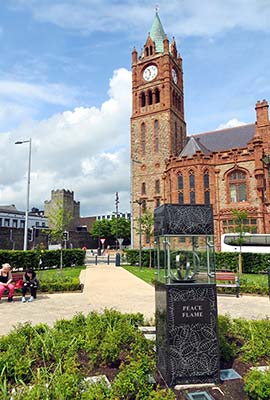
Visiting the Hall: Step inside. To the right of the reception desk, the Ulster Plantation exhibition is worth a visit. Then head upstairs and step into the cavernous grand assembly hall, and take in all the details. A mighty pipe organ fills much of the far wall. It’s lonely and loves to be played (if you’d like to give it a go, just ask a guard).
Along the upstairs hallway, look for the collection of three peace prizes won by Derry native John Hume, the primary architect of the Good Friday Agreement: the Nobel Peace Prize, as well as prizes named for MLK and Ghandi. Hume is the only person to have won all three, and upon being presented his Nobel, he accepted it on behalf of the people of Ireland. When he passed away in 2020, he made good on this dedication and bequeathed all three prizes to the city, to be displayed here.
On the back terrace, facing the river, you’ll find locals lunching at the pleasant Guild Café. And across the street is the modest but heartfelt Peace Park, with hopeful, nonsectarian children’s quotes on tiles that line the path.
▲Craft Village
This delightful passage, cutting between Shipquay Street and the inside of the city wall, may be the most enjoyable hundred yards in Derry. A cozy, atmospheric lane with shops, eateries, and fun public art, it provides an escape from the bustle of the city.
Enter the passage through the bright-blue storefront near the bottom of the main street, just a block or so above Guildhall Square (at 14 Shipquay Street). Entering the series of courtyards and lanes, look left for a wonderful mural celebrating the thousands of women who worked sewing machines at Derry’s shirt-making factories (the biggest was Tillie & Henderson). These original “Derry Girls” powered the economy, often serving as the primary breadwinner in the family, and held the fabric of the town’s society together. Overhead is a mural featuring a giant sewing machine. And if you scour the walls of this courtyard, you’ll find a completely different, much smaller piece of public art: the tiny heads of the Derry Girls.
Farther in, simply enjoy strolling the brick lanes of the Craft Village. You’ll find a variety of shops (many operated by local artists and artisans) as well as some great places to eat (see “Eating in Derry,” later).
St. Columb’s Cathedral
Marked by the tall spire inside the walls, this Anglican cathedral, built from 1628 to 1633, was the first Protestant cathedral built in Britain after the Reformation. In a style called Planter’s Gothic, it was financed by the same London companies that backed the Protestant plantation of Londonderry. St. Columb’s played an important part in the defense of the city during the 1689 siege. During that time, cannons were mounted on its roof, and the original spire was scavenged for lead to melt into cannon shot.
Cost and Hours: £2 donation, Wed-Sat 10:00-15:00, closed Sun-Tue, likely closed to visitors Oct-March, +44 28 7126 7313, www.stcolumbscathedral.org.
Visiting the Cathedral: Before you enter, bear left and walk over to the Siege Heroes’ Mound at the end of the churchyard closest to the town wall. Underneath this grassy dome is a mass grave of some of those who died during the siege.
Circle around to the opposite side of the building. In the cathedral entryway, you’ll find a hollow cannonball that was lobbed into the city—it contained the besiegers’ surrender terms. Inside, along the nave, hangs a musty collection of battle flags and Union Jacks that once inspired troops during the siege, the Crimean War, and World War II.
An American flag hung among them until a few years ago, when its gradual deterioration prompted its current storage under glass (viewable in wooden case to right of front altar—fourth drawer from top). It’s from the time when the first GIs to enter the European theater in World War II were based in Northern Ireland.
To the left of the front altar is a seven-minute video covering the cathedral’s history. Check out the small chapter-house museum in the back of the church to see the huge original locks of the gates of Derry and more relics of the siege.
Long Tower Church
Built below the walls on the hillside above the Bogside, this modest-looking church is worth a visit for its stunning high altar. The name comes from a stone monastic round tower that stood here for centuries but was dismantled and used for building materials in the 1600s.
Cost and Hours: Free, generally open Mon-Sat 8:30-20:30, Sun 7:30-18:00, +44 28 7126 2301, www.longtowerchurch.org.
Visiting the Church: Long Tower Church, the oldest Catholic church in Derry, was finished in 1786, during a time of enlightened relations between the city’s two religious communities. Protestant Bishop Hervey gave a generous-for-the-time £200 donation and had the four Corinthian columns shipped in from Naples to frame the Neo-Renaissance altar.
Outside, walk behind the church and face the Bogside to find a simple shrine hidden beneath a hawthorn tree. It marks the spot where outlawed Masses were secretly held before this church was built, during the Penal Law period of the early 1700s. Through the Penal Laws, the English attempted to weaken Catholicism’s influence by banishing priests and forbidding Catholics from buying land, attending school, voting, and holding office.
Nearby: The adjacent St. Columba Heritage Centre fleshes out the life of Derry’s patron saint and founding father (£5, includes audioguide, open mid-Feb-Dec Mon-Fri 10:30-15:00, other times by appointment only; +44 28 7136 8491, www.stcolumbaheritage.com).
Derry Girls Mural
The most-photographed mural in Derry, refreshingly, is not about the Troubles. Instead, it’s an homage to the sitcom that’s helping put the city on a different map in the 21st century. Derry Girls was created by Derry native Lisa McGee, who re-created the fractured but lovable city of her teen years (near the end of the Troubles). Mixing colorful characters, teen angst, 1990s music, a pinch of Troubles drama, and ample gallows humor, it cleverly captures this town’s spunky spirit. Originally produced by Britain’s Channel 4, Derry Girls soon found a global audience on Netflix. You’ll find this mural of Michelle, Erin, Orla, Clare, and (ugh) James—worth ▲▲▲ for fans—on the back wall of Badgers Bar on Orchard Street, across from the Foyleside Shopping Centre and just downhill from the Ferryquay Gate (see “Derry” map for location).
NEAR THE RIVER
▲Peace Bridge Stroll to Ebrington Square
Stroll across the architecturally fetching Peace Bridge for great views over the river toward the city center (best at sunset). The €14 million pedestrian Peace Bridge opened in 2011, linking neighborhoods long divided by the river (Catholic Nationalists on the west bank and Protestant Unionists on the east bank).
On the far side from the old city walls, the former Ebrington Barracks British Army base (1841-2003) has been redeveloped as Ebrington Square, a hub for dining (with the recommended Walled City Brewery) and entertainment (hosting outdoor concerts in the summer). This shift is a big deal, as it makes this patch of land—firmly on the Unionist side of town, and in a location that was associated with British occupation—a gathering place for all members of the community, not to mention visitors (www.yourebrington.com). There’s also a big hotel and plans for a swanky new history museum.
Hands Across the Divide
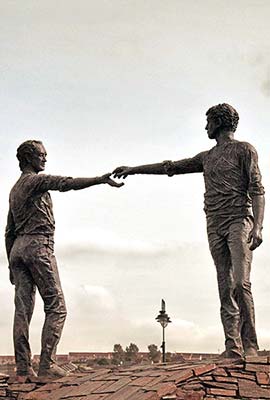
Designed by local teacher Maurice Harron, this powerful metal sculpture of two figures extending their hands to each other was inspired by the growing hope for peace and reconciliation in Northern Ireland (located at roundabout at west end of Craigavon Bridge).
The Tillie and Henderson shirt factory (opened in 1857 and burned down in 2003) once stood on the banks of the river beside the bridge, looming over the figures. In its heyday, Derry’s shirt industry employed more than 18,000 workers (90 percent of whom were women) in sweathouses typical of the human toll of the Industrial Revolution. Karl Marx mentioned this factory in Das Kapital as an example of women’s transition from domestic to industrial work lives.
Nightlife in Derry
The Millennium Forum is a modern venue that reflects the city’s revived investment in local culture, concerts, and plays (inside city walls on Newmarket Street near Ferryquay Gate, +44 28 7126 4455, www.millenniumforum.co.uk [URL inactive]).
St. Columb’s Hall, just outside the city walls (facing the Foyleside Shopping Centre), is a grand old venue offering occasional concerts and events (Orchard Street, +44 28 7126 2880, www.saintcolumbshall.com).
The Nerve Centre is an arts center offering various educational programs, and occasional art-house films and live concerts (just inside city walls at 7 Magazine Street, near Butcher Gate, +44 28 7126 0562, www.nervecentre.org).
The Playhouse Theatre is an intimate venue for plays, music, and readings (inside walls on Artillery Street, between New Gate and Ferryquay Gate, +44 28 7126 8027, www.derryplayhouse.co.uk).
To mingle with Derry’s friendly conversational residents, try Peadar O’Donnell’s pub on Waterloo Street for the city’s best nightly traditional music sessions (music often starts late—around 23:00, earlier on weekends, 53 Waterloo Street, +44 28 7137 2318).
Sleeping in Derry
$$$$ Bishop’s Gate Hotel is Derry’s top lodging option...and priced that way. This former gentlemen’s club, once frequented by Winston Churchill, has 31 rooms that ooze cushy refinement (elevator, gym, good restaurant, fine bar, 24 Bishop Street, +44 28 7114 0300, www.bishopsgatehotelderry.com, sales@bishopsgatehotelderry.com). They also rent several apartments nearby.
$$$$ Ebrington Hotel, just across the Peace Bridge from the walled city center, is a new complex with 180 rooms in the heart of the up-and-coming Ebrington Square area (elevator, spa, Ebrington Square, +44 28 7122 0700, www.theebringtonhotel.com, sales@theebrington.com).
$$$ The Shipquay Hotel, in a former bank building that dates to 1895, rents 21 handsome rooms, some with wall views. The Lock & Quay cocktail bar and a restaurant occupy the ground floor (elevator, 15 Shipquay Street, +44 28 7126 7266, www.shipquayhotel.com, info@shipquayhotel.com).
$$ Maldron Hotel features 93 modern, bright, and large rooms, some overlooking the city walls and Bogside. It also has a restaurant, bar, and 20 private basement parking spaces (family rooms, elevator, gym, sauna, laundry service, Butcher Street, +44 28 7137 1000, www.maldronhotelderry.com, reservations.derry@maldronhotels.com).
$ Saddler’s House, run by Joan and Peter Pyne, is a Victorian townhouse with seven rooms located in an urban neighborhood a couple of blocks beyond the Guildhall. Their muscular bulldog Bruno provides lovable comic relief (laundry service, 36 Great James Street, +44 28 7126 9691, www.thesaddlershouse.com, saddlershouse@btinternet.com). They also offer townhouse rentals inside the walls.
Eating in Derry
LUNCH CAFÉS
There are several appealing options for grabbing coffee, breakfast, or lunch in the old city center. All are open only until late afternoon (typically around 16:00 or 17:00).
$ The Scullery, around the corner from the TI, has a tempting assortment of breakfast and lunch dishes, and outdoor tables at the bottom of a characteristic curving street (daily, 48 Waterloo Street, +44 28 7122 9081).
$$ Brøn is a trendy-feeling place along the main drag through town, with a short menu of modern comfort-food dishes (daily, dinner some weekends, 5 Bishop Street Within, +44 7308 338 538).
$$ The Sandwich Company is a cheap and easy lunch counter and coffee shop just off The Diamond, in the very center of the walled old town—across the street from Brøn (daily, 6 Bishop Street Within, +44 28 7137 2500).
OTHER RESTAURANTS
In the Craft Village: It’s worth browsing the Craft Village courtyard for a good restaurant with cozy ambience. $$$$ Artis is one of the best-regarded places in town. Prizewinning chef Phelim O’Hagan creates high-quality, thoughtfully composed meals from local ingredients (Wed-Thu dinner only, Fri-Sat lunch and dinner, closed Sun-Tue, +44 28 7137 1635, www.artisatcraftvillagederry.com). $$$ Soda & Starch emphasizes local, seasonal foods. The straightforward interior spills out into the atmospheric courtyard (closed Sun-Tue, +44 28 7116 5229, www.sodaandstarch.com).
$$$ Exchange Restaurant and Wine Bar is big, boisterous, convivial, and sophisticated for this price range. They offer hearty lunches and quality dinners with flair, in a central location facing the river behind Waterloo Place. It’s named for the old-time telephone exchange—notice the black-and-white illustrations near the bar (daily, Sun dinner only, Queen’s Quay, +44 28 7127 3990, www.exchangerestaurant.com).
$$$ Fitzroy’s, a family-run bistro tucked below Ferryquay Gate and stacked with locals, serves good, basic, unpretentious lunches and dinners (daily, 2 Bridge Street, +44 28 7126 6211, www.fitzroysrestaurant.com).
Supermarket: There’s a handy Tesco in the center of the city (corner of Strand Road and Clarendon Street).
ACROSS THE RIVER
$$$ Walled City Brewery, across the Peace Bridge on the rejuvenated Ebrington Square, has a list of about 10 creative microbrews—some of them cleverly named for quirky details of Derry’s history. The elevated gastropub cuisine is pricey and delicious—far better than typical pub grub. The interior is pleasant, but on a nice day, it’s hard to beat the sun-bathed picnic tables out front (Mon-Thu dinner only, Fri-Sun lunch and dinner, 70 Ebrington Square, +44 28 7134 3336, www.walledcitybrewery.com).
Derry Connections
From Derry, it’s an hour’s drive to Portrush. If you’re using public transportation, remember that the Zone 4 iLink smartcard covers all trains and buses in Northern Ireland (see here). Keep in mind that some bus and train schedules, road signs, and maps may say “Londonderry” or “L’Derry” instead of “Derry.”
From Derry by Train to: Portrush (hourly, 1.5 hours, usually change in Coleraine), Belfast (hourly, 2 hours), Dublin (6/day, 4 hours, change in Belfast).
By Bus to: Galway (6/day, 5.5 hours), Westport (3/day, 6 hours, bus #64 to Knock Airport or Charleston then bus #440 to Westport), Portrush (5/day, 1.5 hours, change in Coleraine), Belfast (hourly, 2 hours), Dublin (hourly, 4 hours). Buses to the Republic are typically run by Bus Éireann; the rest are run by Translink. Both operate out of the Foyle Street Bus Station. Translink also runs a bus direct to Dublin Airport (#X3 or #X4, 8/day, 4.5 hours).
Near Derry
▲▲Ulster American Folk Park
This museum, scattered through a wonderfully scenic and walkable rural forest, explores the experiences of the many Irish who left their homeland during the hard times of the 18th century. Lovingly presented and staffed by costumed guides eager to tell their stories, it’s two experiences in one: a thoughtful indoor museum examining the immigration of Ulster natives to America; and a sprawling, walk-through open-air museum re-creating the life experiences of these immigrants on both sides of the Atlantic. It’s a 45-minute drive from Derry but for those interested in this chapter of Irish and American history, it’s worth the trek...and for descendants of Ulster Americans, it might just be worth ▲▲▲.
Cost and Hours: £11.50, Tue-Sun 10:00-17:00, shorter hours in winter, closed Mon year-round; last entry one hour before closing—but give it at least 2-3 hours; cafeteria and picnic area, 2 Mellon Road, Omagh, +44 28 8224 3292, www.nationalmuseumsni.org.
Getting There: The folk park is in Omagh, 48 kilometers (30 miles) south of Derry on A-5—about a 45-minute drive. There’s ample free parking on-site.
Background: Between 1700 and 1900, a staggering two million people left Ulster to make a new life in North America. The promise of a better life in a new world was so enticing that chain migration became common, with successive members of a family following their relatives to America. Children were raised learning more about American history and geography than Irish. Visiting here, you’ll gain insight into the origins of the tough Scots-Irish—think Davy Crockett (his people were from Derry) and Andrew Jackson (Carrickfergus roots)—who later shaped America’s westward migration. In fact, this museum was partly funded by the Mellon family (the business moguls who co-founded Carnegie Mellon University); their ancestors once lived in one of the houses you’ll walk through.
Visiting the Park: Your visit starts with the excellent museum, which sets the stage for the outdoor exhibits. You’ll learn about three families in particular (Mellon, Campbell, Hughes) and follow the story of the typical Ulster immigrant to the US: traveling by horse cart, train, and finally ship across the Atlantic to build a new life in a new world.
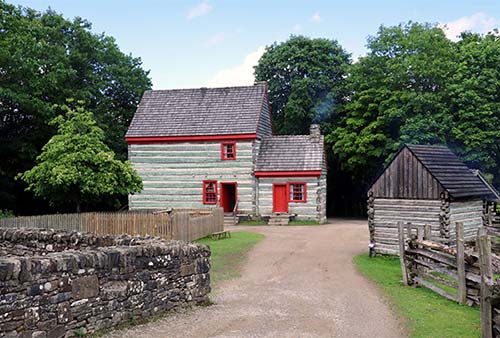
Then you’ll head outside and explore three parts of the park (following the numbers posted on the buildings and the corresponding map): the Old World, the Journey, and the New World. Stationed throughout the old buildings are chatty docents who just can’t wait to tell you about the potato bread, the schoolhouse, the general store, and whatever else might spark your curiosity.
Early on in The Old World section, cross the road to find the Mellon House. The only building that’s still in its original location, this was the actual house where Thomas Mellon was born. At age five, he emigrated with his family to Pennsylvania; the business success of his son Andrew would make the Mellon name synonymous with the American Dream.
You’ll walk through a row of storefronts on a typical Ulster street before entering The Journey—where you’ll go below and above decks on a typical ship, the Brig Union, that would have transported emigrants across the Atlantic in the 1810s. As the museum map poignantly describes, “Some would have been met by faces they thought they would never see again... Others set out alone—disappearing into the crowd and a vast new continent.”
You’ll exit into The New World—specifically, a commercial “American Street” modeled after Baltimore. Leaving town, you’ll quickly be immersed in the rural world where many Ulster Americans first settled in the US. Notice the many differences: Homes are made not of plaster and thatch, but of wood and shingle. From the chimneys billows wood smoke rather than peat smoke. Instead of chickens scratching in the yard, turkeys gobble-gobble. By the end of your visit—at a home built not of wood, but of actual bricks—you’ll feel like you’ve been on quite the journey yourself.
Nearby: The adjacent Mellon Centre for Migration Studies is handy for genealogy searches (Tue-Fri 10:00-16:00, Sat from 11:00, closed Sun-Mon, +44 28 8225 6315, www.mellonmigrationcentre.com).
County Donegal Sights
Even though over an international border—in the Republic of Ireland—several sights in County Donegal are within easy striking distance of Derry for those with a car. The evocative Grianan Aileach Ring Fort—worth ▲—is barely 15 minutes outside central Derry. And within an hour’s drive of Derry you can easily reach Newmills Corn and Flax Mills and Glenveagh Castle and National Park (worth ▲). See the County Donegal and the Northwest chapter for details.