GALWAY
NEAR THE BOTTOM OF THE LATIN QUARTER
SIMPLER PLACES NEAR EYRE SQUARE
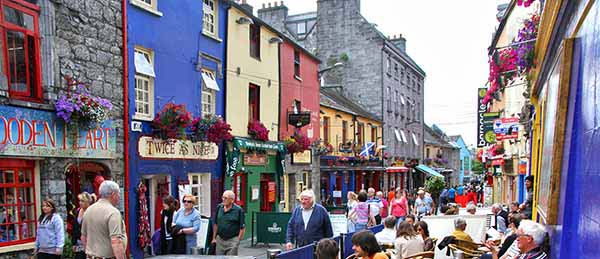
Galway offers the most easily accessible slice of Ireland’s west coast. It’s also Ireland’s most international city: One out of every four residents was born outside of Ireland. With 85,000 people, this is Galway County’s main city, a lively university town, and the region’s industrial and administrative center. As it’s near the traditional regions of Connemara, the Burren, and the Aran Islands, it’s also a gateway to these Gaelic cultural preserves.
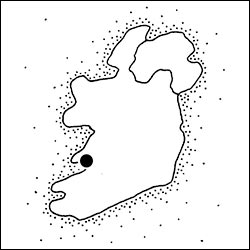
Ideally positioned on a large, placid bay, Galway is centrally located for trade with all other points on the west coast, as well as beyond to continental Europe. Though the city has a long and interesting history, precious little from old Galway survives—and what does is built into the local limestone and looks like modern stone construction.
What Galway lacks in sights it makes up for in ambience. Spend an afternoon just wandering its medieval streets, with their delightful mix of colorful facades, labyrinthine pubs, weather-resistant street musicians, and steamy eateries. Galway also offers tourists plenty of traditional music, easy train connections to Dublin, and a convenient jumping-off point for a visit to the Aran Islands. After dark, blustery Galway heats up, with a fine theater and pub-and-restaurant scene that attracts even Dubliners. Visitors mix with old-timers and students as the traditional music goes round and round.
PLANNING YOUR TIME
Galway is a handy hub for nearby side trips (especially to the Aran Islands, making it worth two nights). Its own sights can be seen in just a few hours. The real joy of Galway is in its street- and traditional-music scene. On your first night, stroll from Eyre Square through old Galway, seeking out a pub with music. On the next day, visit the Aran Island of Inishmore, or consider day trips to the Burren and Cliffs of Moher, or the Connemara region, all doable by car or with a bus tour. At night, return to Galway to enjoy another music-filled evening.
Note for Drivers: Instead of day-tripping, you can visit a number of these sights on the way into or out of Galway. If you’re driving north from Dingle to Galway, you can visit the Cliffs of Moher and the Burren en route (see here for route tips). And if you’re heading north from Galway, you can tour Connemara on the way (see here for a plan).
Orientation to Galway
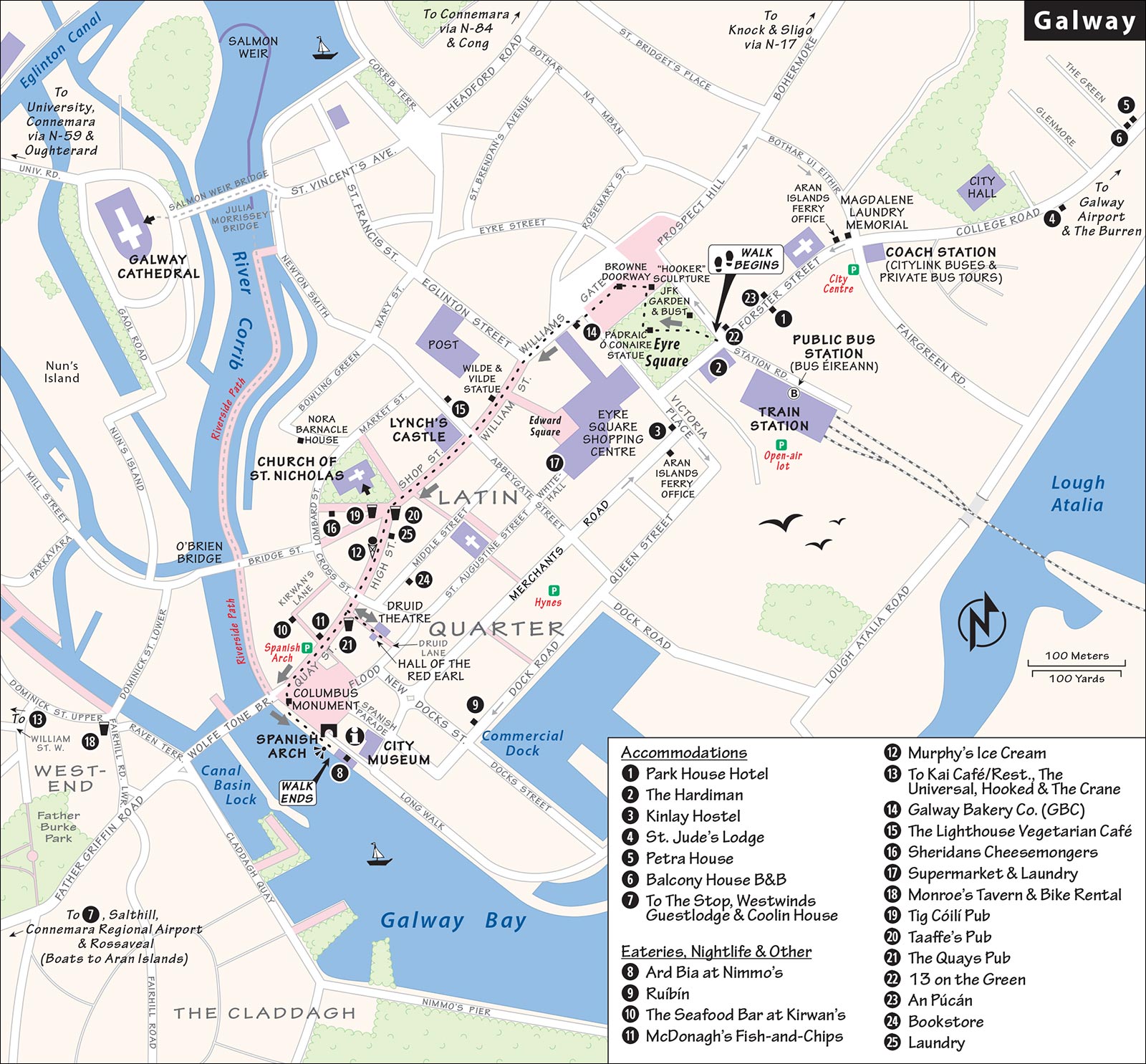
The center of Galway is Eyre (pronounced “air”) Square. The lively old town—or Latin Quarter—lies between Eyre Square and the river. From Eyre Square, Williams Gate leads a pedestrian parade right through the old town (changing street names several times) to Wolfe Tone Bridge. Nearly everything you’ll see and do is within a few minutes’ walk of this spine.
TOURIST INFORMATION
The well-organized TI is in the City Museum next to the Spanish Arch (daily 9:00-17:00, closed Sun Oct-May, www.discoverireland.ie).
ARRIVAL IN GALWAY
By Public Transportation: The train and public bus station (a hub for Bus Éireann buses) butt up against the Hardiman Hotel, a huge gray railroad hotel that dominates Eyre Square. From the bus stalls, or as you leave the train station, just follow the little driveway out and you’ll run right into the square.
Confusingly, a different “coach station” handles privately owned coaches, including Citylink buses from Dublin and Dublin’s airport, as well as regional day-tour buses. The coach station is one long block to the north of the train station. Arriving here, walk out the front door and turn right, then turn left and follow busy Forster Street to Eyre Square.
By Car: Drivers staying overnight at one of my recommended B&Bs can park there for free (each has a small lot in front). Day-trippers have a variety of centrally located garages to choose from. The Spanish Arch garage (right at Wolf Tone Bridge, next to the Leonardo Hotel) is super-central, but the interior is very tight; you may prefer to park a couple of blocks over, at the more user-friendly Hynes garage (enter from either Dock Road or Merchants Road). There’s also handy parking close to Eyre Square, including the open-air Station Road lot behind the train station, or the City Centre garage across from the coach station. Otherwise, for a short visit, look for pay-and-display street parking.
HELPFUL HINTS
Crowd Control: Expect huge crowds—and much higher prices—during the Galway Arts Festival (mid-late July, www.galwayartsfestival.com) and Galway Oyster Festival (late Sept, www.galwayoysterfest.com). The Galway Races are heaven for lovers of horse racing and hell for everyone else (summer races in late July-early Aug, fall races in mid-Sept and late Oct, https://galwayraces.com); prices double for food and lodging, and simple evening strolls feel like punt returns.
Markets: On Saturdays and Sundays, a fun market clusters around the Church of St. Nicholas (all day, best 9:00-14:00; may also be open Wed-Fri in summer).
Bookstore: Labyrinthine Charlie Byrne’s is considered one of the best bookstores in the country (Mon-Sat 9:00-18:00, Sun from 12:00, Middle Street, +353 91 561 766, www.charliebyrne.ie).
Laundry: You have two full-service drop-off options. Shannon Dry Cleaners is on floor 0 of the Eyre Square Centre mall (near the Dunnes at the Whitehall entrance, next-day service, Mon-Sat 9:00-14:00 & 15:00-18:00, closed Sun, +353 87 357 9946). Bee Green is very central, sharing a little courtyard off the main drag with the Kings Head Bistro (Mon-Fri 9:00-17:00, Sat until 16:00, closed Sun, enter courtyard at High Street 17, +353 91 539 678).
Bike Rental: West Ireland Cycling rents bikes to tool around flat Galway town or farther afield. Consider a pleasant ride out to the end of Salthill’s beachfront promenade and back (daily 9:30-18:00, smart to reserve ahead, near Monroe’s Tavern at Bridgewater Court, +353 87 176 8480, www.westirelandcycling.com).
Taxi: Give Big-O-Taxis a try (+353 91 585 858).
Tours in Galway
Hop-On, Hop-Off City Bus Tours
City Sightseeing does a guided, one-hour double-decker bus tour from the top of Eyre Square (the Williams Gate side). While this offers a handy overview, frequency can be sparse, and Galway’s best areas—its winding medieval back streets—can be seen only on foot (€16, www.galwaycitytour.com).
Guides and Walking Tours
Tours are often flexible in their start time and location—call ahead to confirm.
Liam Silke comes from one of Galway’s oldest families and leads insightful tours (€95 for 1-9 people, +353 86 348 0958, liamsilke@gmail.com).
Great Guides of Galway offers historical walking tours incorporating legends and the lore of the Lynch family, one of the medieval merchant “Tribes of Galway” (€12, 1.5 hours, departs from steps of the Galway City Museum, Mon-Fri at 15:30 and 17:00, reserve in advance on their website, +353 86 727 4888, www.greatguidesofgalway.com, greatguidesofgalway@hotmail.com).
Food Tours
Galway Food Tours offers 3-hour strolls that let you graze along Galway’s “culinary hotspots,” including the marketplace. Stops run the gamut from sushi to doughnuts, with traditional yet creative options in between (daytime tour-€80, evening-€160, check schedule online and reserve in advance, +353 86 733 2885, www.galwayfoodtours.com, info@galwayfoodtours.ie).
Excursions from Galway
Good day-trip options from Galway include the Aran Islands, the Burren and Cliffs of Moher, and the Connemara region.
Galway Tour Company runs bus tours all over the region, including to the Burren, Cliffs of Moher, and Connemara, as well as a boat-and-bus tour of Inisheer and the Cliffs of Moher (office located at the Kinlay Hostel on Merchants Road just off Eyre Square, +353 91 566 566, www.galwaytourcompany.com, info@galwaytourcompany.com). If Galway Tour Company is booked, try the similar Lally Tours (+353 91 562 905, www.lallytours.com).
For details on ferries to the Aran Island of Inishmore from Rossaveal (20 miles from Galway) or direct from Galway’s City Docks, see the next chapter.
Galway Walk
This easy downhill stroll—from Eyre Square along the pedestrian (and tourist) spine of old Galway to the River Corrib—takes you past most of the essential sights in town in less than an hour and helps you get your bearings in this fun-to-explore town.
• Let’s begin on Galway’s grassy main square. Make your way to Eyre Square and begin in the southeast corner—the corner closest to the train and bus stations and the giant Hardiman Hotel.
Eyre Square
On a sunny day, parklike Eyre Square is filled with people just hanging out. In the Middle Ages, it was a field right outside the town wall. The square is named for the mayor who gave the land to the city in 1710.
The gigantic, boxy gray building that looms up at the bottom of the square is The Hardiman. Since 1845, it has been Galway’s landmark hotel (originally called the Great Southern), marking the end of the Dublin-Galway train line and the beginning of Galway.
Turn your back on The Hardiman and follow the broad path through the park. Just 50 yards up from the corner, watch on your right for the entrance to a nicely landscaped little garden area, called John F. Kennedy Park—established in memory of the Irish American president’s 1963 speech here a few months before he was assassinated. A JFK bust near the kids’ play area commemorates the place where he “became a freeman of Galway Borough.” (On that visit, he also slept at The Hardiman.) For more on this famous visit, see the “JFK in Ireland” sidebar on here. Though Kennedy is celebrated as America’s first Irish Catholic president, several US presidents were descended from Protestant Ulster stock.
Continue up the main path through the park. On your left, in the middle of the park, look for the beloved statue of author Pádraic Ó Conaire (1882-1928), seated and taking notes on his lap. At a time when the long-suppressed Irish language was asserting its worthiness, Ó Conaire made a point to write stories in Gaelic. Considered the first significant modern writer in the Irish language, he wrote simply and clearly, making his works easier to understand for the many readers who were learning their ancestral language for the first time.
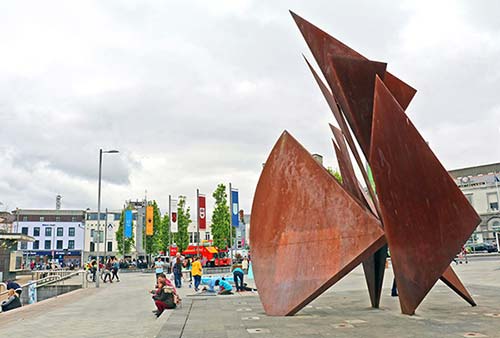
Walk up a few steps to the rust-colored “Hooker” sculpture, built in 1984 to celebrate the 500th anniversary of the incorporation of the city. The sails represent Galway’s square-rigged fishing ships (called “hookers”) and the vessels that made Galway a trading center so long ago.
Just to the left is the Browne Doorway. Originally from a 1627 fortified townhouse, this monument is a reminder of the 14 “Tribes of Galway” that once ruled the town (Lynch’s Castle, nearby, gives you a feel for an intact townhouse). Each of these Norman merchant families had a town castle—much like the towers that characterize the towns of Italy, with their feuding noble families. So little survives of medieval Galway that the town makes a huge deal of any remaining window or crest. Each of the 14 colorful flags lining the west end of the square represents a different founding tribe.
• From the top of Eyre Square, as you face the Browne Doorway, turn left and walk down Williams Gate—a street named for the old main gate of the Norman town wall that once stood here. From here to the river, we’ll be walking the main drag through...
Galway’s Latin Quarter
After one block, the busy street you’re on swings to the right. Keep going to enter the pedestrian zone. You’ve started down the main spine of medieval Galway, which changes names several times (to William, Shop, High, and Quay streets) as it leads downhill to the River Corrib.
A half-block down on the right, look for the seated statue of the witty Irish author Oscar Wilde chatting with Estonian writer Eduard Vilde. This statue—a replica of an original in Tartu, Estonia—is a bit random; apparently, the Estonians were chuffed about the similarity of the two writers’ names, and eager to put their literary figure on equal footing with the likes of Oscar Wilde. There’s no evidence that these two even met (but it’s a fun photo op).
Immediately behind the statue, Lazlo Jewellers has a big advertisement for the Claddagh ring, with two hands holding a heart that wears a crown. The heart represents love, the crown is loyalty, and the hands are friendship. If the ring is worn with the tip of the heart pointing in, it signifies that the wearer is in a relationship. However, if the tip of the heart points out, it means the wearer is available.
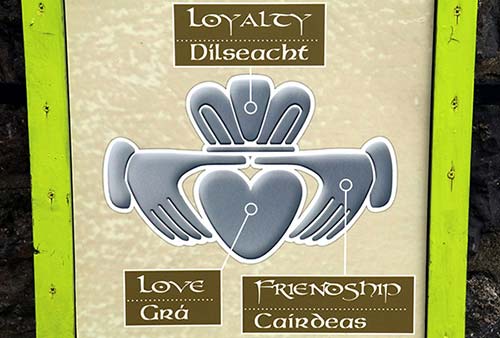
Now keep going along Galway’s tourist slalom. Busy with street musicians and packed with shoppers, this feels like Galway’s answer to Dublin’s Grafton Street...with the bulk of the entire city’s tourists and tourist traps.
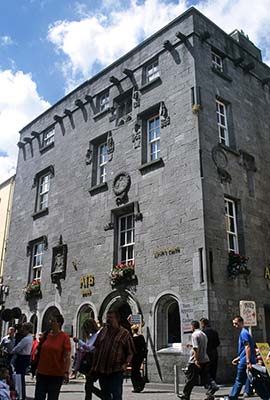
• At the end of the block, on the next corner, watch for a bold limestone “town castle” (now a bank) on your right.
Lynch’s Castle, Galway’s best late-15th-century fortified townhouse, was the home of the Lynch family—the most powerful of the town’s 14 “tribes”—and the only one of their mansions to survive. More than 80 of the mayors who ruled Galway in the 16th and 17th centuries were from the Lynch family. If it’s open, pop in through the most decoratively carved door to see an old hearth and a little exhibit on the building’s history.
• Continuing another block downhill, you’ll veer a half-block to the right off the main pedestrian flow, to the big church.
The Collegiate Church of St. Nicholas, the finest medieval building in town (1320), is dedicated to St. Nicholas of Myra, the patron saint of sailors. Columbus is said to have worshipped here in 1477, undoubtedly contemplating a scary voyage. Its interior is littered with obscure bits of town history—fine windows, historic tombs, lots of limestone—all described in a handy flier (enter around the left side, €5 suggested donation, Tue-Sat 10:00-16:00, closed Sun-Mon). This atmospheric venue also hosts occasional concerts (ask as you enter).
An open-air market surrounds the church most Saturdays and Sundays (and maybe also Wed-Fri in summer).
• Returning to the pedestrian mall, carry on downhill, bearing left to stay on High Street. Notice all the fun, narrow lanes branching off this main drag...tempting to explore later, after we finish our walk. A couple of blocks down, watch for The Quays pub on your left.
The Quays pub was once owned by “Humanity Dick,” an 18th-century member of Parliament who was the original animal-rights activist. His efforts led to the world’s first conviction for cruelty to animals in 1822. It’s worth a peek inside for its lively interior. Out front, seated on a bench, is a statue known as the “Galway Girl.” This was placed here in 2022 by the pub to add even more character to this already characteristic street, and immediately became a popular photo op.
While this is a non-specific “Galway girl,” it’s a reminder that one young woman from Galway became a major figure in the literary world: Nora Barnacle, who was born here in 1884, later moved to Dublin, met and married James Joyce, and was his confidant and supporter throughout his literary career. Penelope Bloom, one of the main characters in Joyce’s Ulysses, is based on this girl from Galway. (Fans can check out Nora Barnacle’s House, sporadically open behind the Church of St. Nicholas.)
• Head down the lane just before the pub, about 50 yards, to the big glass windows on the right.
A big glass wall shows the excavation site of the Hall of the Red Earl. Wall diagrams and storyboards explain that these are the dusty foundations of Galway’s oldest building, once the 13th-century hall of the Norman lord Richard de Burgo (free, closed Sun).
Across the lane is the Druid Theatre. This 100-seat venue offers top-notch contemporary Irish theater. Although the theater company is away on tour more often than not, it’s worth checking their schedule online or dropping by to see if anything’s playing tonight (Chapel Lane, +353 91 568 660, www.druid.ie).
• Backtrack to the main pedestrian street, turn left, walk to its end, and use the crosswalk to cross the busy street. Turn right and walk toward the Wolfe Tone Bridge, where you’ll find two gray stone monuments (each about as tall as you are). Above the bridge, a sign says Welcome to Galway’s Westend—luring you across the river, to the city’s foodie hotspot. But before you go exploring, let’s check out some sights along the...
River Corrib
• Stand between the two stone monuments.
The Columbus Monument, closest to the bridge, was given to Galway by the people of Genoa, Italy, to celebrate the 1477 visit here of Christopher Columbus—Cristoforo Colombo in Italian. (That acknowledgment, from an Italian town so proud and protective of its favorite son, helps to substantiate the famous explorer’s legendary visit.) The other memorial is dedicated to sailors lost at sea.
Across the street, on the other side of the bridge (looking upstream), notice the first of many canals that course through town. Canals multiplied in this city (once called the “Venice of Ireland”) to power more watermills. A pleasant riverside path follows the canal north to Galway Cathedral—described later, under “Sights in Galway.” You can almost see its giant dome upstream from here.
• Don’t cross the bridge to the Westend quite yet. Instead, stroll downstream along the embankment to the old fortified arch.
Overlooking the River Corrib, the Spanish Arch is the best remaining chunk of the old city wall. A reminder of Galway’s former importance in trade, the arch (c. 1584) is the place where Spanish ships would unload their cargo (primarily wine).
• Walk through the arch and take an immediate right. Go past the stone steps to the far corner of the embankment over the river.
Enjoy this river scene. On either side is a park—a constant party on sunny days. (It’s ideal for a picnic of fish-and-chips from the recommended McDonagh’s chippy, near the end of the pedestrian mall.)
Across the river is a modern housing project, which replaced a picturesque fishing village known as the Claddagh in the 1930s. The Claddagh was an Irish-speaking enclave with a strong tradition of independence—and open sewers. The gaggle of thatched cottages functioned as an independent community with its own “king” until the early 1900s, when it was torn down for health reasons. (This area is the namesake of those distinctive rings you see sold all over town.)
Survey the harbor. A few of Galway’s famous square-rigged “hooker” fishing ships are often tied up and on display. Called “hookers” for their method of fishing with multiple hooks on a single line, these sturdy yet graceful boats were later used to transport turf from Connemara, until improved roads and electric heat made them obsolete. Beyond that, a huge park of reclaimed land is popular with the local kids for Irish football and hurling. From there, a promenade leads to the nearby resort town of Salthill.
• Our walk is finished. Just behind the Spanish Arch is a stony riverside warehouse called Nimmo’s that contains the recommended Ard Bia, one of the best restaurants in town. And just beyond that (see the name towering overhead) is the City Museum (described in “More Sights in Galway”), with the TI inside.
More Sights in Galway
The city’s best sights are the twisting streets of its medieval quarter—all described in the walk above. With more time, consider the following.
City Museum
Fragments of old Galway are kept in this good, modern museum. Its centerpiece, suspended in the atrium, is an intact Galway “hooker” fishing boat hanging from the ceiling.
Cost and Hours: Free, Tue-Sat 10:00-17:00, closed Sun-Mon, +353 91 532 460, www.galwaycitymuseum.ie.
Visiting the Museum: The ground floor houses archaeological exhibits: prehistoric and ancient Galway-related treasures such as medieval pottery, Iron Age ax heads, and Bronze Age thingamajigs. Up on the first floor is “Keepers of the Gael,” an exhibit on the culture and traditions of the Gaelic people. Further exhibits shed light on Galway’s role in the Irish struggle for independence in the early 1900s. From the exhibits explaining the “hooker” ship heritage, stairs up to the second floor are lined with photos from the Claddagh district—the old fishing quarter—before it was razed and rebuilt; at the top of the stairs, you can compare a model of the original Claddagh with sweeping views over the real thing today. Also on the second floor, you’ll find a pop-up gallery of changing exhibits, and a section on “sea science” (oceanography).
Corrib Riverside Path and Salmon Weir Bridge
A lovely riverside pedestrian path runs along the east side of the River Corrib. To follow a particularly pretty stretch of the river, walk the path north from the Wolfe Tone Bridge along a series of embankment parks to the Galway Cathedral (described next). To reach the cathedral, you can cross the river via the Julia Morrissey Bridge—a slick, modern footbridge that opened in 2022 (it’s named for a local Galway hero of the Easter Rising).
Parallel to the Julia Morrissey Bridge (and directly in front of the cathedral’s entrance) is the Salmon Weir Bridge—once the local “bridge of sighs.” It led from the courthouse (opposite the church) to the prison (torn down to build the cathedral). Today, the bridge provides a fun view of the fishing action. Salmon run up this river most of the summer (look for them). Fishermen, who wear waders and carry walking sticks to withstand the strong current, book long in advance to get half-day appointments for a casting spot.
▲Galway Cathedral
Opened by American Cardinal Cushing in 1965, this is one of the last great stone churches built in Europe. The interior is a treat, and is well worth a short, scenic, riverside stroll from the city center.
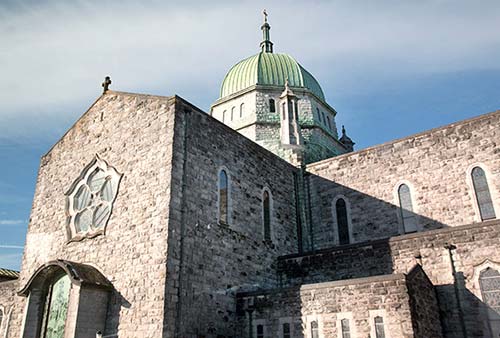
Cost and Hours: €3 donation suggested, open to visitors daily 8:30-18:30 except during Mass, bulletins at doorway list Masses and concerts, located at the Salmon Weir Bridge, +353 91 563 577.
Getting There: It’s about a 10-minute walk north of the Latin Quarter, reached on an enjoyable stroll along the riverside path starting at the Wolfe Tone Bridge (see above).
Visiting the Cathedral: You’ll enter this huge, hulking building through the left transept—facing the Salmon Weir Bridge. Inside are mahogany pews set on green Connemara marble floors under a Canadian cedar ceiling. The acoustically correct cedar enhances the church’s fine pipe organ.
Step into the little chapel just to the left of the entrance. The carving above is from the old St. Nicholas church. Explore the modern stained glass. In this same chapel, find the Irish Holy Family—with Mary knitting and Jesus offering Joseph a cup of tea (third window from the front).
Then cross to the right transept; over the door is a particularly creative window depicting the Last Supper—find the 12 apostles.
Now walk up the nave, toward the giant rose window and organ loft at the back of the church. Mid-nave, pause and do a slow 180-degree spin...just to take it all in. When this place is packed, two thousand worshippers sit on three sides facing the central altar. A Dublin woman carved the 14 larger-than-life stations of the cross that ring the church.
From the 18th to the late 20th century, Catholic religious orders ran at least a half-dozen “Magdalene laundries” in Ireland to incarcerate “fallen” women (those who had become pregnant out of wedlock, victims of sexual abuse, orphans, and others), often imprisoning them for life.
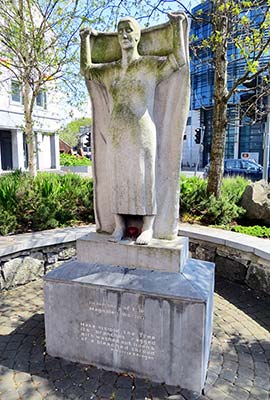
On the corner of Forster Street across from Galway’s coach station, the modest, easy-to-miss Final Journey statue depicts a woman lifting a veil from her head, memorializing the women who worked as virtual slaves in these laundries.
This statue is on the site of the Convent of Mercy laundry, which opened in 1824 with a capacity of 110, and closed in 1984 with 18 inmates remaining. It’s estimated that 30,000 women passed through the Magdalene laundry system. Survivors claim that they were held against their will, forced to work without pay, and physically abused…and their children were sold for adoption. The Irish government apologized in 2013 for turning a blind eye to the mistreatment of these women, but has resisted compensating victims.
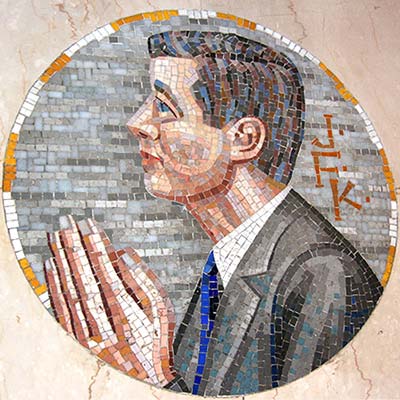
Finally, step into the chapel immediately to the left of the altar (just before the transept where you entered). On the wall is a giant mosaic of Christ’s resurrection. Take a closer look at the profiled face in a circular frame, below and to the right of Christ—the one looking up while praying with clasped hands. It’s JFK, nearly a saint in Irish eyes at the time this cathedral was built. The other medallion honors Pádraig Pearse, a leader of the 1916 Easter Rising who was executed at Kilmainham Gaol.
OUTER GALWAY
▲Salthill
This small resort town packs pubs, nightclubs, a splashy water park, amusement centers, and a fairground up against a fine, mile-long beach promenade (Ireland’s longest). Watch for local power walkers “kicking the wall” when they reach the western end of the promenade to emphasize that they’ve gone the entire distance. For beach time, a relaxing sunset stroll, late-night traditional music, or later-night nightclub action, Salthill hops.
At the Atlantaquaria Aquarium, which features native Irish aquatic life and some Amazonian species, kids can sometimes help feed the fish (and naughty kids are fed to piranhas). They can cuddle the crustaceans anytime (€14, kids-€9; daily 10:00-17:00, until 18:00 July-Aug and weekends, shorter weekday hours off-season and closed Mon-Tue in winter; check feeding schedule at the reception desk, last entry 45 minutes before closing; The Promenade, +353 91 585 100, www.nationalaquarium.ie).
Getting There: To get to Salthill, catch bus #401 from Eyre Square in front of the AIB bank, next to the Hardiman (3-4/hour).
Nightlife in Galway
▲Traditional Irish Music
Galway, like Dingle and Doolin, is a mecca for good Irish music (nightly 21:00-23:30). But unlike Dingle and Doolin, this is a university town, and many pubs are often overrun with noisy students. Still, your chances of landing a seat close to a churning band surrounded by new Irish friends are good any evening of the year. Touristy and student pubs are found and filled along the main drag from Eyre Square down to the river, and continue across Wolfe Tone Bridge.
Across the Bridge: Several pubs just over the river, in the Westend, frequently feature traditional music. The Crane is the most reliable place for trad sessions, with live music nightly from about 21:30 in two areas: the cozy pub downstairs, or the larger upstairs. Weekend afternoon sessions are also offered, as are one-off performances at other times (2 Sea Road, +353 91 587 419, www.thecranebar.com). Bigger and more prominent, but less traditional, Monroe’s Tavern features a variety of live music (Dominick Street, +353 91 583 397, www.monroes.ie).
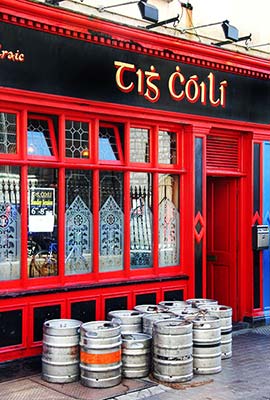
On the Main Drag: This strip can feel a bit like Dublin’s Temple Bar, with overserved tourists young and old jamming the already-crowded pubs and spilling out onto the sidewalk (sometimes literally). You may find this scene off-putting...or fun. Places here are largely interchangeable—it works fine to just follow your ears—but good options typically include Tig Cóilí (with perhaps Galway’s best trad sessions), which typically has music afternoons and evenings (intersection of Main Guard Street and High Street, +353 91 561 294, www.tigchoiligalway.com); Taaffe’s (Shop Street, across from Church of St. Nicholas, +353 91 564 066); and The Quays (right along the main drag above the river on Quay Street, +353 91 568 347, http://quaysgalway.ie).
On Forster Street: Running east from the train-station corner of Eyre Square, this street is lined with big hotels. The pubs here cater to higher-end tourists rather than scrubby students, making them a more sedate and accessible place to seek out music. Wander along and keep your ears perked. A good option on the corner facing the park is 13 on the Green (trad sessions Mon-Tue nights, 13 Eyre Square, +353 91 562 224, www.13onthegreen.ie). An Púcán, a few doors down, has music nightly—a mix of traditional and modern (11 Forster Street, +353 91 376 561, www.anpucan.ie).
Trad on the Prom
This fine, traditional, music-and-dance troupe was started by Galway-born performers, who returned home after years of touring with Riverdance and the Chieftains. Their show—so popular that it’s lasted for more than a decade—is a great way to enjoy live step dancing and accomplished musicians in a fairly intimate venue (from €32, mid-May-Sept only, shows at 20:30 on Tue, Thu, and Sun—call to confirm, and best to reserve ahead online; at Leisureland Theatre beside Salthill Park, 30-minute walk west of town along the Salthill promenade or short ride on bus #401 from Eyre Square; www.tradontheprom.com).
Sleeping in Galway
There are three price tiers for most beds in Galway: off-season, high season (Easter-Oct—the basis for the price rankings below), and charge-what-you-like festival and race weekends. As a general rule, in this party town, prices are higher on Friday and Saturday nights.
Note: With easy train access from Dublin, Galway is a popular weekend destination for rambunctious stag and hen parties. If you want a good night’s sleep on a Friday or Saturday, steer clear of hotels with bars downstairs or nearby; instead, opt for a smaller B&B or guesthouse (I list a few, including a couple outside of town).
HOTELS
$$$$ Park House Hotel, a plush, business-class hotel, offers the best value for a fancy place. Ideally located a block from the train station and Eyre Square, it has 99 spacious rooms and all the comforts you’d expect (book direct for packages that include breakfast and parking, elevator, pay parking, great restaurant, helpful staff, Forster Street, +353 91 564 924, www.parkhousehotel.ie, reservations@parkhousehotel.ie).
$$$$ The Hardiman, filled with palatial Old World elegance and 103 rooms, is a classic and venerable railroad hotel—located right next to Galway’s train terminus. While historic (dating to 1845), today it has all the modern comforts (elevator, air-con in some rooms, at the bottom of Eyre Square, +353 91 564 041, www.thehardiman.ie, info@thehardiman.ie). For more on the hotel’s history, see my Galway Walk, earlier.
¢ Kinlay Hostel is a well-run place just 100 yards from the bus and train stations, with 224 beds in clean and simple rooms, including 10 doubles/twins. Easygoing people of any age feel welcome here, but if you want a double, book well ahead—several months in advance for weekends (private rooms available, elevator, baggage storage, laundry service, on Merchants Road just off Eyre Square, +353 91 565 244, www.kinlaygalway.ie, info@kinlaygalway.ie).
B&BS ON FORSTER STREET
These B&Bs are homey, reasonably priced, have parking, and are about a 10-minute walk from Eyre Square (from the train or bus stations, walk up Forster Street, which turns into College Road). They’re calmer than the rowdy weekend scene at bigger hotels in the city center. However, each of these faces busy College Road—light sleepers should request a room facing the back.
$$$ St. Jude’s Lodge is a bigger, less characterful, but professionally run small hotel with 20 tidy rooms slightly closer to the town center (24 College Road, +353 91 569 100, www.galwayguesthouses.ie, stjudes@galwayguesthouses.ie).
$$ Petra House is one of Galway’s best B&Bs. Owners Paul and Amy Holland have a long background in hospitality, and their professionalism shows. Their house is a peaceful brick building with nine fresh, homey, and lovingly maintained rooms. A stay is topped off with breakfasts I look forward to (family rooms, elegant sitting room, 29 College Road, +353 91 566 580, mobile +353 85 271 7938, www.petrahousegalway.net, info@petrahousegalway.net).
$$ Balcony House B&B rents eight pleasant, large rooms (family rooms, 27 College Road, +353 91 563 438). Teresa Coyne is the mellow lady of the house.
IN THE WESTEND
The Westend, across the river from the Latin Quarter, offers convenient proximity to the trendy dining and nightlife action, and is closer to the heart of the Latin Quarter than the Forster Street B&Bs listed above. And if you’d like to check out Salthill, you’re halfway there.
$$$ The Stop, while pricey, feels a notch above other B&Bs in town, with its sleek, sophisticated-urbanite decor (including works of local artists in the common rooms). Its 10 rooms are well managed by Russell (parking, 38 Father Griffin Road, +353 91 586 736, www.thestopgalway.com, thestopbandb@gmail.com).
B&BS IN SALTHILL
These options are in the beach-holiday community of Salthill. The first is a 15-minute walk west of town (beyond the Claddagh), while the second is a 30-minute walk. Both are an easy ride on bus #401.
$$$ Westwinds Guestlodge is airy and spacious, with eight rooms, some with sea views. Shauna Quiqley is your amiable hostess, and you may meet Zach the dog at breakfast (parking, 5 Ocean Wave, +353 91 520 223, mobile +353 87 239 6398, www.westwindsguestlodge.com, westwindsgalway@gmail.com).
$$ Coolin House has three comfy rooms in a modern home with all the standard amenities (cash only, family room, parking, 11 Seamount, Threadneedle Road, +353 91 523 411, mobile +353 87 750 3124, www.coolinhousesalthill.com, coolinhouse@eircom.net, Marion Coyne).
Eating in Galway
This college town is filled with colorful, inexpensive eateries. People everywhere seem to be enjoying their food. While there are countless scruffy eateries along the main pedestrian lane, you’ll eat better by getting a few blocks away from the tourist hordes.
NEAR THE BOTTOM OF THE LATIN QUARTER
These places are all within a short walk of where Galway’s Latin Quarter hits the river.
$$$ Ard Bia at Nimmo’s fills an old stone warehouse behind the Spanish Arch. It’s rustically elegant, with beautifully presented dishes from a farm-to-table menu. If roast heirloom carrots, pickled rhubarb, beetroot risotto, and pan-roasted baby squid sound good, you’re in luck (daily for lunch, Wed-Sun for dinner, next to the Spanish Arch along the river at Long Walk Street, +353 91 561 114, www.ardbia.com, run by Aoibheann—pronounced “eee-van”).
$$$ Ruíbín, in a historic house right on the harbor, is a well-regarded local choice for creative fusion cuisine. They serve small plates and craft cocktails in the bar downstairs, while upstairs is a proper restaurant (where reservations are recommended). Wherever you sit, you’ll find seafood, meat, and veggie options melding flavors from Asia, the Mediterranean, and Latin America (closed Sun, 1 Docks Road, +353 91 563 830, https://ruibin.ie).
$$$ The Seafood Bar at Kirwan’s is a good place in the touristy center for quality seafood as well as a few meat and veggie offerings in a romantic setting (closed Sun, Kirwan’s Lane, +353 91 568 266, www.kirwanslane.ie).
$ McDonagh’s Fish-and-Chips is a favorite among residents. It’s fast, cheap, and open long hours (daily, at the bottom of the Latin Quarter at 22 Quay Street). If ordering oysters, remember Galway oysters are in season September through April, and Pacific oysters are best May through August.
Dessert: For ice cream, try Murphy’s, the Dingle-based chain that’s sweeping Ireland (daily, 12 High Street).
IN THE WESTEND
Just across the river from the Latin Quarter, Galway’s Westend is less touristy, a bit more coarse and authentic, and worth exploring. Cross the Wolfe Tone Bridge, bear right, and wander—most of the action here is along the Dominick Street-William Street corridor. Not strictly “trendy,” it’s an eclectic mix of traditional pubs (including The Crane, a great place for trad sessions—see “Nightlife,” earlier), student dive bars, casinos, betting parlors, basic eateries, and a few destination foodie restaurants tucked in between.
$$$$ Kai Café and Restaurant is a stylish little place with a candlelit, stone-and-hardwood ambience run by David and Jess Murphy. A café at lunch and a restaurant at dinner (when reservations are required), it serves quirky, contemporary Irish cuisine combining local flavors with international savvy. Chef Jess (who’s from New Zealand—kai means “food” in Māori) changes the menu daily, uses organic ingredients, and always serves a good vegetarian dish (closed Sun-Mon, 20 Sea Road, +353 91 526 003, www.kairestaurant.ie).
$$$ The Universal gastropub is a hit with Galway foodies. This feels more like a food-lover’s pub with an open kitchen, stools at the bar, and eight little tables. You’ll share small plates of creative, ingredient-driven cuisine, with lots of craft beers on tap (dinner only, closed Mon, 9 William Street West, +353 91 728 271).
$$ Hooked is an upmarket chippy promising a “so-fishticated” experience. A giant mermaid mural adorns the side of the building, and inside you’ll find a mix of kitschy-nautical and trendy-white-subway-tile décor. This popular spot features a variety of local fish and seafood in a casual, cheery environment. Reservations are wise—or you can order takeout (Tue-Thu dinner only, Fri-Sun lunch and dinner, closed Mon, 65 Henry Street, +353 91 581 752, www.hookedgalway.ie).
SIMPLER PLACES NEAR EYRE SQUARE
$$ Galway Bakery Company (GBC) is a popular, basic place for a quick Irish meal: breakfast, roast of the day, fish of the day, and straightforward lunches (breakfast and lunch only, daily, 7 Williams Gate, near Eyre Square, +353 91 563 087 www.gbcgalway.com).
$$ The Lighthouse Vegetarian Café is a calm and cozy little vegetarian haven with creative, well-presented plates and fresh-baked goods, just steps behind Lynch’s Castle (breakfast and lunch only, closed Sun, 8 Abbeygate Street Upper, +353 91 568 706, www.lighthousecafe.ie).
$$ Sheridans Cheesemongers, the original location for a now Ireland-wide chain, has a well-stocked cheese and cold cuts shop near the Church of St. Nicholas—handy for a top-end picnic. Or head upstairs to the wine bar for a drink and a light meal (shop closed Mon; wine bar afternoons and evenings only, closed Sun-Mon; 14-16 Churchyard Street, +353 91 564 832, https://sheridanscheesemongers.com).
Supermarket: Dunnes is tucked in the very central Eyre Square Shopping Centre (daily, supermarket in basement). Lots of smaller grocery shops are scattered throughout town.
OUTSIDE GALWAY
If you have a car, consider a Dunguaire Castle medieval banquet in Kinvarra, a 30-minute drive south of Galway (for details, see here). You can fit the banquet in very efficiently when you’re driving into Galway (B&Bs can accommodate late arrivals if you arrange ahead).
Galway Connections
From Galway by Train to: Dublin (nearly hourly, 2.5 hours), Limerick (6/day, 2 hours), Ennis (5/day, 1.5 hours). For Belfast, Tralee, and Rosslare, you’ll change in or near Dublin. Train info: +353 91 561 444, www.irishrail.ie.
By Bus to: Dublin (hourly, 3.5 hours; also see Citylink, later), Kilkenny (3/day, 5 hours), Cork (hourly, 4.5 hours), Ennis (hourly, 1.5 hours), Shannon Airport (hourly, 2 hours), Cliffs of Moher (8/day in summer, some with change in Ennis, 2 hours), Doolin (5/day, 1.5 hours), Limerick (hourly, 2 hours), Dingle (5/day, 6 hours), Tralee (8/day, 4 hours), Westport (6/day, 2-4 hours), Rosslare (2/day, 8 hours), Belfast (every 2 hours, 6 hours, change in Dublin), Derry (6/day, 5.5 hours). Bus info: +353 91 562 000, www.buseireann.ie.
Citylink runs cheap and fast bus service from the coach station to Dublin (arriving at Bachelor’s Walk, a block from Tara Street DART station; hourly, 2.5 hours), Dublin Airport (hourly, 3 hours), and Cork Airport (6/day, 4 hours). Bus info: +353 91 564 164, www.citylink.ie.
By Car: For ideas on driving from Galway to Derry in Northern Ireland, see the Connemara & Westport chapter for a suggested scenic drive route through Connemara, and the Donegal & the Northwest chapter for some worthwhile stops farther north (near and in Donegal).