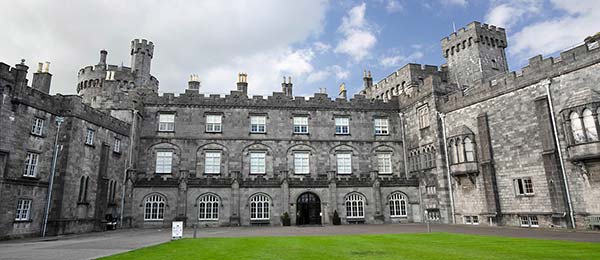
KILKENNY & WATERFORD
Map: Kilkenny Hotels & Restaurants
More Sights in Southeast Ireland
Southeast Ireland, an easy two-hour drive from Dublin, often gets skipped by travelers heading to the remote and romantic west coast. But if you have time to spare, this region warrants some attention. Kilkenny, with one of Ireland’s finest castles and a rich medieval history, maintains a workaday, livable vibe despite the tourists. Nearby Waterford is bigger and less appealing for an overnight but provides an enjoyable few hours of sightseeing, from its famous crystal factory demonstrations to a group of thoughtfully presented museums ringing its cathedral.
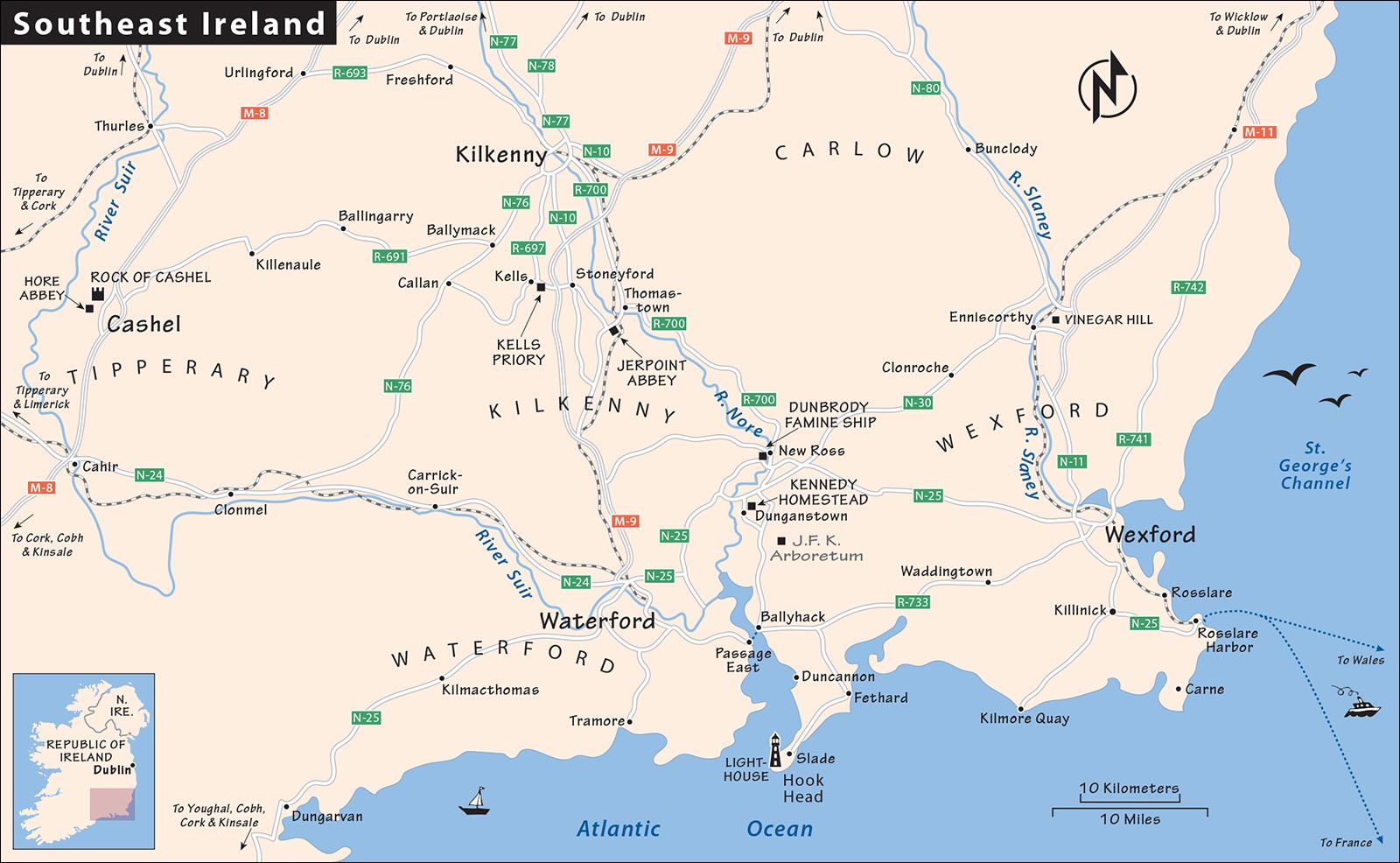
The countryside between and near these towns has quite a few worthwhile sights; you could spend a day or two just tooling around counties Kilkenny and Wexford to see evocative ruined abbeys, a poignant replica “famine ship,” a famous lighthouse, or the ancestral home of the Kennedy clan.
Southeast Ireland also comes with a weighty history peopled with Vikings, Anglo-Norman invaders, Oliver Cromwell’s Puritan army, and many other players (see the “Vikings, Anglo-Normans, and Cromwell” sidebar). Visitors find a greater depth and density of historical sightseeing here than just about anywhere else outside Dublin.
PLANNING YOUR TIME
Kilkenny, Waterford, and the sights in the surrounding countryside can fill two or three days—though those tight on time can hit the highlights in a day. For instance, drivers connecting Dublin with Kinsale can get an early start, stop in Kilkenny for lunch and a little sightseeing, then tour the Rock of Cashel (see next chapter) before arriving late in Kinsale.
Southeast Ireland has a strong history of trading from its sheltered ports facing England. The Vikings—who arrived in 819—established many of the region’s ports. The first, called Vandrafjord (Safe Harbor), was located at the gateway to an extensive river network, and from there, raiders could sail and row deep into a countryside with no towns, just scattered monastic settlements and small gatherings of clans—ideal pickings for the Vikings. Later, after they turned to profiteering, the Vikings established trade routes from Vandrafjord—Ireland’s first permanent town, eventually known as Waterford.
About 200 years later came the Vikings’ cousins, the Normans—Norsemen who had settled in northern France. Their leader, William the Conqueror, had successfully invaded England in 1066 at the Battle of Hastings. (These French-speaking Normans in England were called Anglo-Normans—a phrase you’ll hear frequently here.)
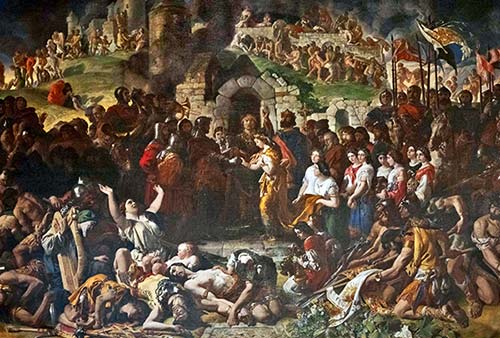
In 1167, Dermot MacMurrough, king of Leinster (encompassing much of southeast Ireland) was deposed. In desperation, he called on the Anglo-Normans for help. The warlord Richard de Clare—history knows him as Strongbow—came to the rescue from England...and never left. In 1170, Strongbow married MacMurrough’s daughter Aoife at Waterford’s Christ Church Cathedral, giving him a claim to the throne of Leinster. (This pivotal event in Irish history is the subject of one of the country’s most famous paintings, which hangs in Dublin’s National Gallery.)
Strongbow’s rise to power was so rapid that England’s King Henry II grew worried about a rival kingdom blossoming on his flank. He quickly gathered his navy and sailed over to remind Strongbow who was in charge and to intimidate Irish clan leaders into swearing loyalty to the crown. These key events cemented Anglo-Norman rule over this part of Ireland, beginning a period of English rule that persists in Northern Ireland to this day.
Once established in Ireland, the industrious Anglo-Normans cranked up their dominant culture and shoved the locals aside. With more efficient farming techniques, trading savvy and connections, and advanced military technology, they dominated urban life. Kilkenny blossomed during this time and was essentially a French-speaking, Anglo-Norman town in Ireland, with little to do with the Irish. To this day, the area just outside the former town wall is called Irishtown.
Throughout the region, you’ll still see evidence of Norman (French) roots in its high concentration of family names with old Norman prefixes: De Berg, De Lacy, Devereux; Fitzgilbert, Fitzsimmons, Fitzgerald; and so on.
While Anglo-Normans generally controlled the towns, trade, and politics of the region, Irish landowners remained significant players. That is, until another invader from England arrived in 1649, the viciously anti-Catholic Oliver Cromwell, who’d just beheaded the English king. Cromwell stripped Catholic (read: Irish) aristocrats of their land, granting it to his troops, and destroyed any town still loyal to the dead king. Waterford was the only Irish town to withstand Cromwell’s siege. (For more on Cromwell, see the sidebar later in this chapter.)
The upshot of this complicated history is that, in this corner of Ireland, the Irish for centuries had very little influence over their fate.
Kilkenny is this area’s best home base and its most enjoyable sight. It’s worth at least a half-day, but can easily fill one day. Follow my Kilkenny Walk along the Medieval Mile main drag, and join a guided tour of the impressive castle that dominates the town. Other good activities include touring the Rothe House and Garden (a well-preserved merchant house), visiting the Famine Experience (a memorial located within a mall built on the site of a former workhouse), strolling along the river, or doing a tour and beer tasting at Smithwick’s. Enjoy dinner at one of Kilkenny’s fine restaurants and cap the day with some live pub music.
Waterford is closer to more sights than Kilkenny but less inviting as a home base. It’s better as a side-trip from Kilkenny (easy 45-minute drive) for a half- or full day of sightseeing: Join a Waterford Crystal factory tour and take your pick of the museums around the cathedral. Ideally, aim to be at the crystal factory early or late to avoid the midday bus-tour crowds. To feel the pulse of contemporary Waterford, hang out on Barronstrand Street, the town’s pedestrian artery.
Other Southeast Ireland Sights: Between Kilkenny and Waterford are several worthwhile sights. The two easiest stop-offs are the ruined Cistercian Jerpoint Abbey and the even grander rubble of Kells Priory. Both are within 20 minutes of Kilkenny, and both are evocative, but they are redundant; if you’re tight on time, pick one. Kells Priory is open 24/7 and can be a nice way to round out a long day trip from Kilkenny. Also consider visits to two historic sights in County Wexford: the Dunbrody Famine Ship and the Kennedy Homestead (both about 45 minutes south of Kilkenny and 30 minutes north of Waterford). Another County Wexford sight, Hook Lighthouse, is farther afield (one-plus hour from Waterford) and best left to those lingering longer in the area.
Day Trip from Kilkenny to Waterford/Southeast Ireland Sights: If you want to pack in the maximum on a day trip from Kilkenny, consider this plan, which squeezes in the area’s highlights:
Kilkenny
The country’s loveliest inland city—2014 winner of Ireland’s Tidy Town award—Kilkenny gives you a feel for salt-of-the-earth Ireland. The town earned its nickname, Marble City, because of its locally quarried stone (actually black limestone, not marble). You can see white seashells fossilized within the black stone steps around town.
While a midsize town today (pop. 26,000), Kilkenny has a big history—especially during the Middle Ages. Back then, Kilkenny was a thriving walled Anglo-Norman market town, topped with a giant castle and bristling with church steeples. It was even the capital of Ireland for a short spell in the turbulent 1640s. Other Irish towns can’t quite claim such a colorful and concentrated window into feudal times.
Kilkenny has a castle with one of Ireland’s more interesting interiors, several fine churches, insightful museums, the historic former Smithwick’s brewery, a poignant reminder of the Great Potato Famine, lush parks, and riverfront walks. There’s plenty for visitors to learn and enjoy.
Orientation to Kilkenny
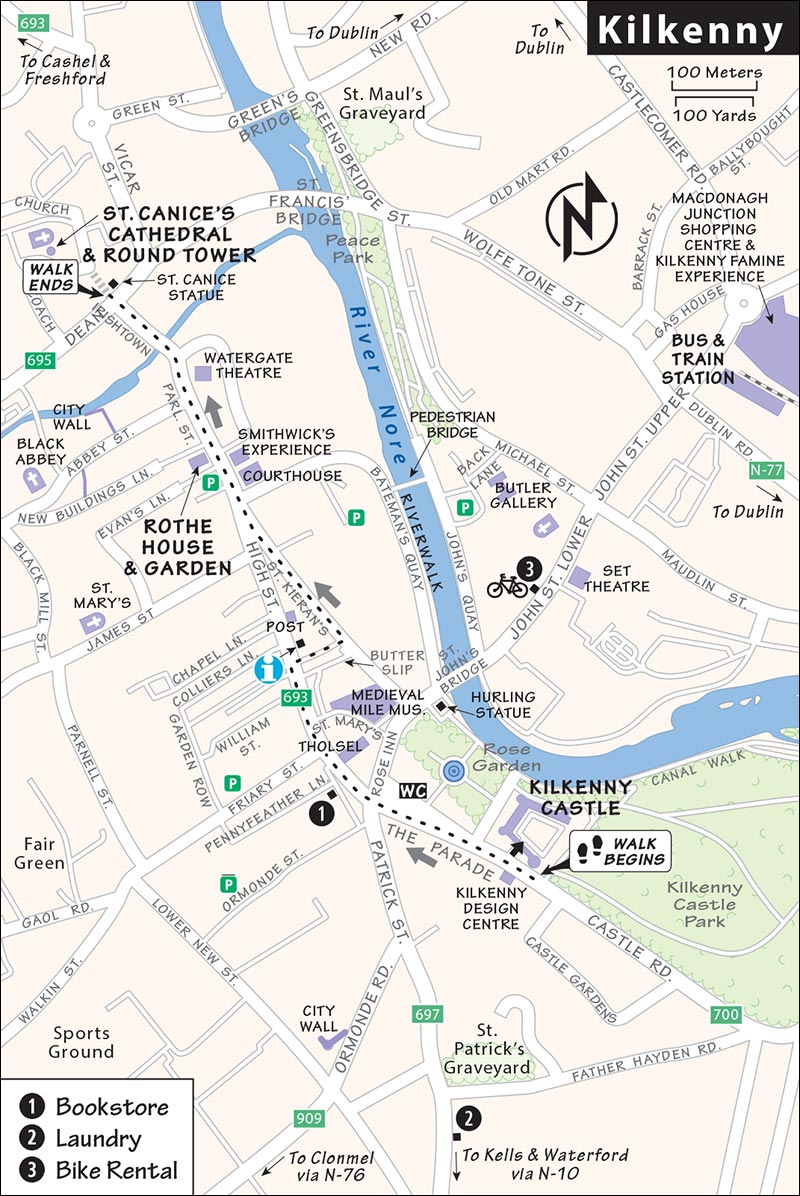
Kilkenny Castle and St. Canice’s Cathedral stand like historic bookends on the higgledy-piggledy streets known as the Medieval Mile, with nearly all of Kilkenny’s sights lined up in-between. Once the spine of the stoutly walled old town, the Medieval Mile is actually less than a mile and can be easily walked end-to-end in about 15 minutes, with gently uphill and downhill stretches.
Even locals mostly ignore the far side of the river (they call it The Continent), where you’ll find pleasant streets, the train and bus stations, and a big shopping mall with a fascinating Great Potato Famine exhibit. The two sides of town meet at John’s Bridge, where all of Kilkenny’s roads seem to converge.
TOURIST INFORMATION
The TI is smack-dab in the center at 79 High Street (daily 9:00-17:00, shorter hours and closed Sun off-season, +353 15 741 990, www.discoverireland.ie).
ARRIVAL IN KILKENNY
The main train/bus station, called Kilkenny-MacDonagh, is on the north side of the river, a few short blocks from the town center (15 minutes on foot). The station is right next to the MacDonagh Junction Shopping Centre, with the fascinating Kilkenny Famine Experience inside; consider visiting on your way in or out of town.
Drivers can look for street parking or use the central Market Yard lot behind Kyteler’s Inn (entry off Bateman’s Quay). For longer stays, you’ll find two multistory parking garages handy to the center: on Ormonde Street and at Market Cross Shopping Centre (Parliament Street). If staying overnight, get advice from your accommodations; most provide or validate parking.
HELPFUL HINTS
Market: The square in front of Kilkenny Castle hosts a friendly produce, cheese, and crafts market on Thursday (8:00-14:30).
Bookstore: The Book Centre, right in the heart of town, is a great place to hang out on a rainy day (Mon-Sat 9:00-18:00, Sun 13:00-17:00, 10 High Street, +353 56 776 2177).
Laundry: The full-service Laundry Basket is just uphill from the main part of town (Mon-Fri 10:00-16:00, Sat 10:00-13:00, closed Sun, 21 Patrick Street, +353 56 777 0355).
Bike Rental: Kilkenny Cycling has bikes and e-bikes, provides maps, and offers tours and route advice—see listing below (reserve in advance, office behind The Wine Centre shop at 15 John Street, +353 86 895 4961, www.kilkennycyclingtours.com).
Tours in Kilkenny
Walking Tours
The people of Kilkenny love telling the story of their town. For a straightforward town walk, go with Pat Tynan and his staff (€20, 1.25 hours, daily in high season at 11:00 and 14:00, book ahead, +353 87 265 1745, www.kilkennywalkingtours.ie), or take the tour offered through the Medieval Mile Museum (€15, 1 hour, includes museum admission; see “Sights in Kilkenny,” later). Shenanigans Walk mixes town history with comedy and magic (www.shenaniganswalks.ie). For other options, including ghost walks, ask at the TI.
Local Guides
For more than 40 years, Frank Kavanagh helped visitors appreciate Kilkenny Castle. These days, he’s available for custom walks of the town and castle. He also offers handy full- or half-day driving tours to destinations as far away as Cashel, Waterford, Wexford, and Cork (€220/half-day, €300/full day, gas and lunch extra, available Feb-Nov, advance booking essential, +353 86 839 2468, fkav1948@gmail.com).
Amanda Pitcairn runs scholarly tours focusing on medieval Kilkenny and the daily life of its inhabitants—witchcraft and skullduggery included. Ask about her connection to mutineers from the HMS Bounty (€20/person, €15/person for groups of 4-6, +353 87 277 6107, www.touchthepastireland.com [URL inactive]).
Bike Tours
At Kilkenny Cycling, Jason and Ronan offer a two-hour “easy-paced” guided tour (€27.50), which takes in a half-dozen of the town’s best sights, including Kilkenny Castle, Rothe House and Garden, and St. Canice’s Cathedral (usually departs at 10:00 and 14:00, also at 19:00 May-Sept). Ask about the recommended four-hour unguided “bike-and-hike” route, which includes a six-mile ride to Bennettsbridge, then a pretty hike back along the river (they’ll explain where to leave the bikes). There’s also a €20 Medieval Mile cycling treasure hunt for history buffs (RS%, see “Bike Rental,” earlier, for contact info).
▲Hurling Tour
Kilkenny is a hurling mecca. Run by PJ Lanigan, The Kilkenny Way walking tour includes visits to a hurling pub/museum and the stadium where the Kilkenny Cats play. You’ll learn about the long history and rules of this lightning-fast field game, and also get a chance to play as you figure out how to balance your sliotar—and how to pronounce it (€30 for two-hour tour, includes pub meal; Mon-Fri at 12:00, sometimes on weekends, reserve ahead; leaves from Legends Hurling Bar, 28 Rose Inn Street—for location see the “Kilkenny Hotels & Restaurants” map later, +353 56 772 1718, www.thekilkennyway.com).
Kilkenny Walk
This orientation walk, worth ▲▲, connects nearly all of the town’s best sightseeing and offers a historical framework on which to hang your Kilkenny experience. It follows the main street—the Medieval Mile—between the castle at one end of town and St. Canice’s Cathedral at the other (see the “Kilkenny” map earlier to follow the route). Allow about 45 minutes, not including sightseeing stops (many sights are described in greater detail under “Sights in Kilkenny”).
• Begin in front of...
Kilkenny Castle
This imposing Windsor-style castle, capping the highest hill of the town center, dominates Kilkenny and its history. The structure today is an architectural jumble, pieced together from bits and bobs of various eras over the centuries. The Anglo-Norman conqueror Strongbow built the original fortress here in the late 12th century for his son-in-law, William Marshal, the 1st Earl of Pembroke (1146-1219)—a highly placed knight and advisor to King Henry II of England.
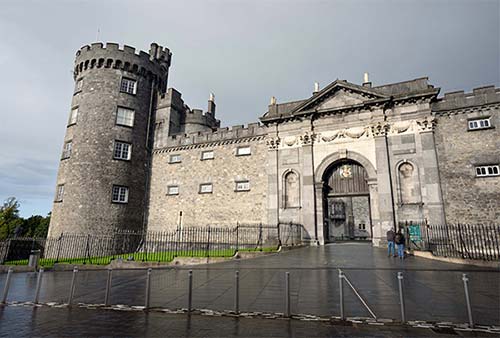
Marshal was not Irish, but Anglo-Norman—a relatively recent arrival from Normandy by way of England, who had little attachment to Irish ways and saw this land as an opportunity to build a city with imported know-how. Marshal took advantage of Kilkenny’s strategic position on the River Nore to power its woolen mills and develop its trading capacity. He populated the town with skilled workers mainly from France and Flanders; the local Irish lived mostly outside the walls. (Of the town’s 10 leading families, nine were Anglo-Norman...and only one was Irish.) This Kilkenny of the 1200s sets the stage for the aptly named Medieval Mile—the main drag of Marshal’s walled city. By the end of his long life, Marshal had advised five different kings of England, signed the Magna Carta, and died a Knight Templar.
Touring the castle is a great way to begin your town visit (see listing later under “Sights in Kilkenny”).
Directly across the street from the castle, the Kilkenny Design Centre sprawls through an impressive complex of old servants’ quarters and stables. The shops are fun to browse, and there’s also a food hall (daily, www.kilkennydesign.com).
With your back to the castle, begin to stroll down the broad, pedestrianized plaza called The Parade. But don’t go too far—first, slip through the gate just below the castle (on your right) to step into its geometrical rose garden, shaped like a Celtic cross.
• Continuing down The Parade, as it widens, you’ll pass some public WCs, then come to a busy cross-street. Jog slightly left, then continue straight up...
High Street
This main road through old Kilkenny, lined with workaday shops, cafés, and pubs, is a delight to stroll. While many of the storefronts look relatively modern, everything you see is grafted onto a medieval foundation of sturdy stone buildings that have lined this street at least since the 1400s.
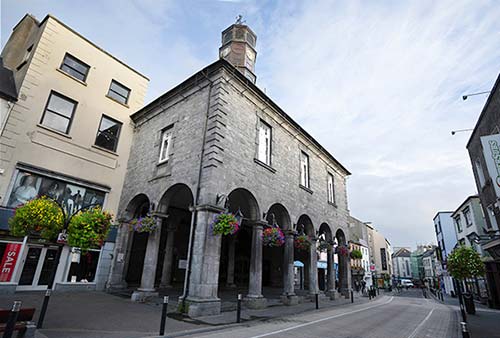
Two blocks along, you can’t miss the stout, gray arcaded building sticking out into High Street. The Tholsel (Hall of Taxes) is where, dating back to the 16th century, townspeople came to pay their taxes. This version, from 1761, has a copper-clad bell tower. Immediately behind the Tholsel, the Medieval Mile Museum fills the former St. Mary’s Church with exhibits that try hard to illustrate this city’s Middle Ages (see listing later).
Carrying on, notice that, all along High Street, the narrow cross-streets on the left, going uphill to gates in the former town wall, are called “lanes,” while those on the right, stretching down to the river harbor, are “slips.” Horses would actually pull boats (on chains) up out of the water onto these narrow laneways.
A few storefronts past the Tholsel, make your way down the narrow, covered lane marked Butter Slip. Designed to minimize sunlight, this passageway was the working street of butter makers—who preferred cooler temperatures. Nowadays atmospheric Butter Slip is filled with enticing shops and eateries (including the recommended restaurants Petronella and Butcher).
•You’ll pop out on...
St. Kieran’s Street
High Street, above and behind you, was built around the 1400s. But this street came first—likely around the 1200s, just as Kilkenny was being established. This street was even closer to the river, which is just on the other side of the modern Dunnes Stores. To this day, the businesses along here are funkier, a little cruder, and more characteristic than the ones up above.
The spot where you’re standing, at the base of the Butter Slip stairs, is the site of the first known witch burning in the British Isles, in 1324. The tale involves Alice Kyteler, a Flemish woman who worked in moneylending. The already well-to-do Kyteler married a series of rich men, each of whom died under mysterious circumstances (and always after she’d disinherited each spouse’s children)—making her wealthier and wealthier. She drew the attention of the local bishop, who succeeded in having her convicted of witchcraft and sentenced to be burned at the stake.
Except...it was not Alice Kyteler who perished here. The bishop directed the townspeople to set up a giant pyre, only to discover that Alice had somehow escaped. (Exactly what became of her, nobody knows.) In order to feed the crowd’s bloodlust, the bishop went to Alice Kyteler’s pub and arrested her loyal servant, Petronella de Meath, as an accomplice...and so it was poor Petronella who died here on that November day.
Turn left. Soon, on the right, is Kytelers Inn, the namesake and former home of the condemned Alice Kyteler (notice the sign: “Est. 1324”). It made sense for a woman to run an inn, because in the Middle Ages, only monks and women could brew beer (which was considered “cooking” and therefore women’s work). The black cat on the sign—a symbol of witchcraft—has become associated with Kilkenny in general. The local hurling team are called the Cats, and residents are sometimes referred to as “the cats of Kilkenny.” Near the end of the pub building, notice the half-door burrowed into the ground—showing how the street level along here has risen several feet since Alice first opened her pub. Today this pub is owned not by the heirs of Alice Kyteler, but by direct descendants of Charles Dickens.
• Continuing straight ahead, soon the street bends uphill.
More Medieval Mile
We’re back on Kilkenny’s main drag, now called Parliament Street. From here to the end of the street, we’ll pass several more landmarks.
First, if you’d like to see the finest Catholic church in Kilkenny, backtrack south a few doors to James Street (marked by colorful storefronts); it leads uphill to St. Mary’s Cathedral (not to be confused with St. Mary’s Church, home of the Medieval Mile Museum). The Gothic revival building, with a landmark tower and a graceful, soaring interior, is worth a look.
Otherwise, continue north up Parliament Street to Kilkenny’s courthouse, a hulking stone building set back from the street on the right. Medieval in appearance, it has a dark history. In the Middle Ages, criminals were punished in the square between the courthouse and the street. The cell windows are right at street level, as public humiliation was part of the punishment. The darkest times for this building—and for all of Kilkenny—came with Oliver Cromwell’s invasion in 1649 (see “The Curse of Cromwell” sidebar, later). In Kilkenny, Cromwell’s right-hand man, Daniel Axtell, ruthlessly imposed a series of penal laws against local townspeople. He drove the 10 leading families into exile (including the Grace clan that originally owned a private residence on this site—locals still call it “Grace’s House”). Records show that during the Cromwell terror some 6,500 people were executed by hanging them above the building’s central door.
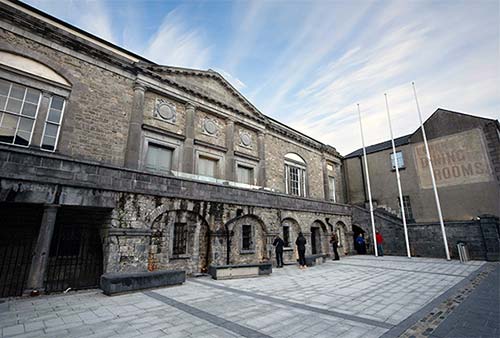
For a cheerier landmark, the building next door is where Smithwicks ale got its start in 1710. The distinctive red ale was brewed right here until 2013. Now, with all production consolidated in Dublin, this former factory offers tours...with a pint at the end, of course. Even if you don’t take the tour, detour down the cobbled lane for a peek inside the industrial courtyard (for details, see listing later).
Across the street from Smithwicks is the most intact and authentic medieval building on the Medieval Mile: Rothe House and Garden, named for another of those 10 leading families. Stretching far back from this narrow housefront, a series of buildings leads to a painstakingly re-created medieval garden. Of the museums in town offering insight into the Middle Ages, this is the one most worth touring (see listing later).
One short block beyond the Rothe House, Abbey Street (on the left) leads up toward yet another landmark Kilkenny church, the Black Abbey. Founded by Dominicans in 1225, the current structure was restored in the 19th century; unlike soaring St. Mary’s, this church is dark, stony, and atmospheric. But the best reason to wander up Abbey Street is to go under an original 13th-century gate and see a chunk of the medieval wall that once surrounded the Anglo-Norman trading town.
Back on Parliament Street, just past the Watergate Theatre, you’ll cross over a stream, a sign that we’ve left the old walled town. In fact, the street sign indicates that you’ve crossed into Irishtown—a reminder that medieval Kilkenny was the domain of Anglo-Normans, not the Irish.
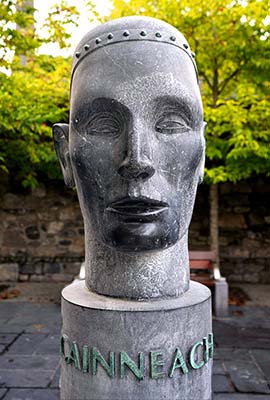
• To finish our story—and our walk—continue one more short block, then cross the busy street. On the right, at the base of the stairs, look for the giant bronze head in the small plaza.
Cainneach (St. Canice) Statue: Long before Oliver Cromwell and Daniel Axtell, long before Flemish traders and witch burnings and the Anglo-Normans, Ireland in the late sixth century was slowly being converted to Christianity. One of the final holdouts was Kilkenny, and some of the last druid leaders holed up on the hilltop just above you. St. Canice gathered an army, marched on this place, and conquered them. Today, the church on top of the hill still bears his name, as does the entire town and county: Kil-Kenny (or Cill Chainnigh in Gaelic) means “Church of Canice.” One of the so-called Twelve Apostles of Ireland who converted the island in the wake of St. Patrick, the well-traveled St. Canice is also the patron saint of shipwrecks.
• If you’d like to tour the Cathedral of St. Canice (see listing later)—and climb its well-preserved round tower—head up the stairs alongside the plaza. Or simply wander back along the Medieval Mile, dipping into any sights of interest. The city is yours to explore.
Sights in Kilkenny
ALONG THE MEDIEVAL MILE
I’ve listed these city-center sights in the order you’ll reach them as you walk down the Medieval Mile from the castle.
▲▲Kilkenny Castle
Dominating the town, this castle is one of the oldest continuously occupied buildings in Ireland. Over about 800 years, it’s been built, rebuilt, and enlarged; what you see today is a Victorian-era remodel of a 13th-century fortress. The castle once had four sides, but Oliver Cromwell’s army knocked down one wall, leaving it in a roughly “U” shape. The open side stretches out toward a vast park.
Cost and Hours: €8, or €12 with one-hour tour; daily 9:15-17:30, shorter hours Oct-March, last entrance one hour before closing, last tour at 16:15; +353 56 770 4100, www.kilkennycastle.ie.
Tours: It’s worth paying extra for the one-hour guided tour; these depart about hourly (schedule posted at entrance). You’ll get the complete story behind the castle and the family associated with it, and have access to a few areas off-limits to the general public.
The scariest bogeyman in Irish history was Oliver Cromwell. In 1649, he led Parliamentary forces to victory in the English Civil War and had King Charles I beheaded. Assuming the title of Lord Protector, he created a commonwealth, instead of a kingdom. Cromwell then turned his attention to Ireland, determined to root out the last royalists loyal to the English monarchy and to punish the Irish for the 1641 massacre of Protestant settlers.
Cromwell was rabidly anti-Catholic. Driven by his Puritan Calvinist beliefs, he claimed a divine right to do God’s work and viewed all Catholics as complicit in the Protestant deaths. Even Protestant Anglicans (the faith founded by Henry VIII a century before) were looked on with suspicion as “Catholics without a pope.” Cromwell’s army of 12,000 soldiers had God on their side and Ireland in their musket sights.
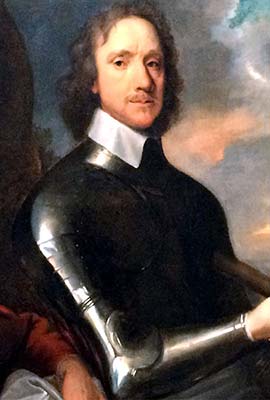
Cromwell and his army landed in Dublin on August 15, 1649, and marched north to Drogheda. In a bloody three-day siege, his soldiers massacred almost all of the town’s 3,000 people. A handful of lucky survivors silently slipped into the River Boyne and played dead, floating downstream to safety. Cromwell then turned south to Wexford, where his army killed 3,000-some civilians and Irish troops. Few garrison towns resisted after that, and Cromwell brought most of Ireland under English control in less than a year.
Catholic landowners were forced to give up their land or face execution, and about 11 million acres of productive land was handed over to Cromwell’s soldiers as payment for service. In “exchange,” these Catholics got unfertile ground west of the River Shannon, initiating a forced mass migration that essentially destroyed Ireland’s Catholic landowning class. Some Catholics were allowed to stay on as tenants, providing labor for their new English masters.
When Cromwell died in 1658, his less dynamic son took over, and the English began to miss their monarchy. In 1660, Parliament invited Charles I’s son, Charles II, back from exile in France, and the monarchy was restored. Soon after, Cromwell’s body was dug up, hung, and beheaded. His head was stuck on a pike and displayed in front of London’s Parliament for 20 years. (Curiously, a heroic statue of him stands there today.)
In Ireland, the legacy of Cromwell was devastating and long-lasting. Most Irish Catholics never regained their land. And for the next 250 years Ireland struggled on—effectively powerless under English government.
Background: Strongbow erected the first fortress on this site, and his son-in-law William Marshal redesigned it as a castle—but the only name worth remembering at Kilkenny Castle today is Butler—the Anglo-Norman aristocratic family who lived here from the late 14th century, two centuries after Strongbow and Marshal. The Butler clan seems to be connected to just about everyone: The second duke was a patron of Jonathan Swift, while the 10th earl was buddies with King Edward VI (son of Henry VIII). The “B” in W. B. Yeats stands for “Butler,” and even Americans Buffalo Bill Cody and Annie Oakley trace their lineages to the Butlers. Throughout the castle, you’ll see portraits of the many generations of Butlers who gradually built this castle as they left their mark on Kilkenny and Ireland.
Visiting the Castle: At the castle gate, buy your ticket, turn right in the courtyard, and head into the base of the turret. Here you’ll find the continuously running 12-minute video explaining how the wooden fort built here by Strongbow in 1172 evolved into a stony château. The current version is a hodgepodge of architectural styles that drives purists crazy; it’s dominant look is Scottish Baronial, modeled after Windsor Castle.
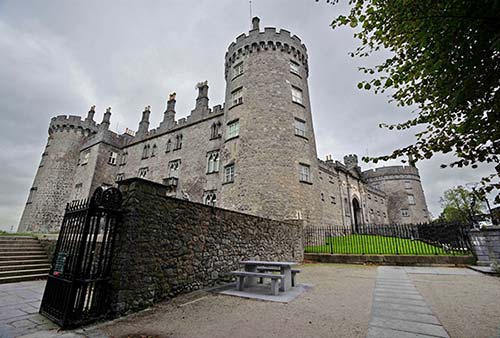
Cross diagonally back through the courtyard and enter the castle interior. Here you can begin a self-guided loop through the castle (most rooms have posted descriptions), or meet up with your guided tour. You’ll wind your way up through several finely decorated, meticulously restored rooms that show off the history and wealth of the Butler clan.
On the main floor is Georgian decor. In the drawing room, restorers have re-created the original chinoiserie-style wallpaper that was the rage in the early 18th century. The former smoking-and-billiards room was later transformed into the state dining room. In the entrance hall, with a stone checkerboard floor, appreciate the gigantic antlers from a great Irish elk, dredged up from a nearby bog.
Heading up the grand mahogany staircase, you’ll step into a round turret room where the wood paneling boxing in the windows illustrates just how thick the walls are. Also in this room are some exquisite Flemish tapestries from the 1640s. Farther along, the library is cozy with bookshelves and sofas, while the drawing room makes you wish you could settle in, relax, and enjoy the life aristocratic.
On the top floor, you’ll pass through a series of former bedrooms, including a nursery outfitted with the latest in Georgian and Victorian toys, cradles, and highchairs. The lavish blue bedroom with the sleigh-style bed was redecorated specifically for a royal visit.
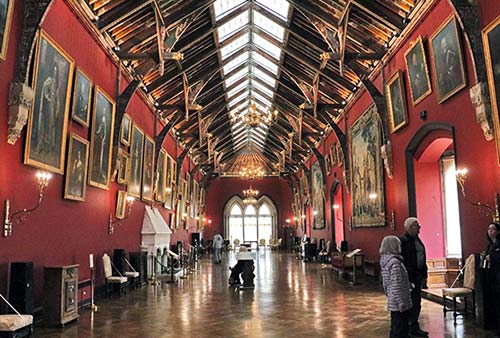
From here, descend the elaborate Moorish staircase and step into the castle’s highlight: the stunning Picture Gallery, under a French Gothic revival hammerbeam ceiling from the 1850s. Those rafters were hand-painted by a former clergyman turned artist, John Hungerford Pollen, with colorful Pre-Raphaelite and quasi-medieval motifs. The portraits on these walls put you face-to-face with the wealthy Butler family ghosts.
The Ros Tapestry: There may be one more attraction at the castle: the contemporary Ros Tapestry series. Each of these 15 beautiful, hand-embroidered, intricately detailed panels illustrates an important event in this region’s Norman history. Inspired by Normandy’s famous Bayeux Tapestry, it’s been lovingly stitched by more than 150 volunteers throughout Ireland (they’ve been working since 2002). The panels have been on loan to Kilkenny Castle while a permanent home is under construction in New Ross, in County Wexford (for the latest, see www.rostapestry.ie). If still on display at the castle, it’s well worth lingering over these fine panels.
Medieval Mile Museum
Filling the 13th-century St. Mary’s Church, this museum strains to bring meaning to Kilkenny’s medieval story. The artifacts are sparse, and the story is more vivid out in the streets and in the Rothe House. Still, this is a good rainy-day activity to round out your town sightseeing experience. You’ll see ceremonial swords, ornately carved tomb lids, and neatly penned 800-year-old civic records. An exhibit of the skeletons of three medieval people, excavated from the church grounds in 2016, speculates on who they might have been, and what their lives might have been like. The site itself has an interesting history—this is where the famous witch trial of Alice Kyteler took place in 1324 (see here). The evocative graveyard out back whispers the righteous claims to heaven of the rich donors who built this medieval town.
Cost and Hours: €9, or €13 with 45-minute tour; daily 9:30-16:30, closed Tue-Wed in winter; museum tours daily at 10:00, 14:00, and 15:00; 2 Mary’s Lane, just off High Street—find it down the narrow “slip” lanes behind the Tholsel, +353 56 781 7022, www.medievalmilemuseum.ie.
Town Walk: The museum offers a good one-hour walking tour of the Medieval Mile—a fine value, as it also includes museum admission (€15; daily at 11:00, Sat-Sun only off-season). They also tour the church graveyard daily at 15:00 (€12).
Smithwick’s Experience Kilkenny
Smithwick’s reddish ale was born in Kilkenny...and has been my favorite Irish beer since my first visit to Ireland. Founded in 1710, Smithwick’s (pronounced “smitticks”; the Irish, who have no W in their alphabet, simply ignore that letter) is older than Guinness (but now owned by the same parent company). No longer a working brewery, the building now houses a visitors center. Corporate-sponsored tours—which last an hour and include a pint at the end—focus on the historic origins of the tasty ale, first brewed by the monks of St. Francis Abbey (the 14th-century ruins of the abbey lie adjacent to the site). In the days of the monks, beer was safer and healthier than local water sources, which were often contaminated. I’ll drink to that.
Cost and Hours: €20-22, higher prices for peak times, tours generally run daily 11:00-17:00 (last tour time), tours depart every 20 to 30 minutes in peak season; shorter hours and fewer tours in winter; 44 Parliament Street, +353 56 778 6377, www.smithwicksexperience.com.
▲Rothe House and Garden
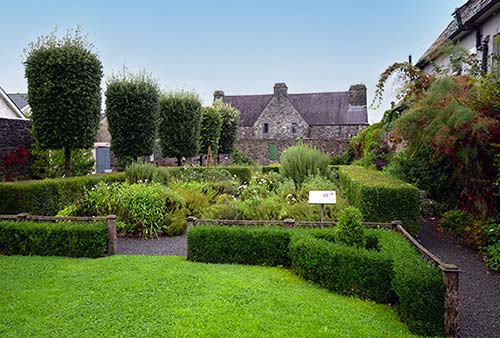
This well-preserved merchant’s house is the crown jewel of Kilkenny’s medieval architecture. Filling a long skinny plot stretching back from the main road, the house expanded around interior courtyards as the prosperous Rothe family grew in the early 1600s. At the back is a meticulously restored medieval garden. The museum’s somewhat dusty hodgepodge of exhibits gives a glimpse of life here in late Elizabethan and early Stuart times; it’s more interesting with a guided tour.
Cost and Hours: €8.50, or €10 with a tour (2/day, check schedule online); daily 10:00-18:00, Oct-March shorter hours and closed Mon; Parliament Street, +353 56 772 2893, www.rothehouse.com.
Visiting the House and Garden: After buying your ticket, cross through the first courtyard and climb up the wooden staircase to the street-facing main house. At the top floor (in the Lanigan Room), ogle the beefy but graceful timberwork supporting the roof, which uses wooden dowels instead of nails. From here, follow the one-way route and work your way back through the entire complex and its exhibits, including a costume collection and curiosities unearthed on-site. The gorgeous walled medieval garden—considered a real luxury in its time—features heritage varieties of flowers, fruits, and vegetables.
The Rothe family eventually lost the house when Oliver Cromwell confiscated the properties of Catholic landowners. In the late 1800s, the building housed the Gaelic League, devoted to the rejuvenation of Irish culture through preservation of the Irish language and promotion of native Irish sports (such as hurling). Thomas MacDonagh, one of the future leaders of the 1916 Easter Rising, taught here.
St. Canice’s Cathedral
This 13th-century cathedral is early English Gothic, rich with stained glass, medieval carvings, and floors paved in history—all under a wood-frame, hammerbeam ceiling. Along the left side of the church, check out the model of the old walled town in its 1642 heyday. (Notice how the long, skinny plots extend far back from the housefronts of the main street.) Up near the altar is a small but beautiful carved-wood choir. Out front, the 100-foot-tall round tower, built as part of a long-gone pre-Norman church, recalls the need for a watchtower, treasury, and refuge. The steep and thrilling ladder-climb to the top (7 floors and 121 steps) affords a grand view of the town and countryside.
Cost and Hours: Cathedral—€6.50, tower—€5.50, combo-ticket—€11; Mon-Sat 9:00-18:00, Sun from 13:00, Oct-April shorter hours and closed Sun; +353 56 776 4971, www.stcanicescathedral.com.
ALONG OR ACROSS THE RIVER
▲River Stroll
In good weather, consider going for a stroll along the river. A paved promenade runs alongside the castle, and in the opposite direction there’s a beautifully landscaped riverwalk, including a particularly fine stretch called Abbey Quarter. A handy footbridge crosses the river toward the Butler Gallery (described next).
Right at John’s Bridge (on the castle side of the river) is a big statue of three fiercely competitive young men engaged in a hurling match. County Kilkenny and neighboring County Tipperary are blood sporting rivals on the hurling field, with the lion’s share of national championships split between them. (Kilkenny locals are quick to point out that their 34 championships top all Irish counties.) Watch for kids heading home from school, carrying hurleys (ash-wood sticks with broad, flat ends) and dressed in their local colors (black and yellow, like bumblebees; Tipperary wears blue and gold).
Butler Gallery
This modest but well-presented gallery occupies a modernized almshouse originally built in the early 1800s for destitute servants. It showcases painting, photography, and other works by Irish artists from the 20th and 21st centuries. The main floor displays temporary exhibits, while upstairs you’ll find the permanent collection of artists who have a connection to Kilkenny (including Paul Henry, Mildred Anne Butler, and Jack Yeats). The most extensive section is devoted to local 20th-century artist Tony O’Malley and his Canadian wife, Jane O’Malley, who were part of an artist collective in St. Ives (in England’s Cornwall). While most appealing for art lovers, it’s a good rainy-day option for anyone.
Cost and Hours: Free; Tue-Sat 10:00-17:00, Thu until 20:00, Sun from 11:00, closed Mon; John’s Quay, +353 56 776 1106, www.butlergallery.ie.
▲Kilkenny Famine Experience
This audiovisual experience about the famine is housed inside a mall that was built on the site of a former workhouse. Wanting to respect and remember the powerful heritage of the site, the mall has marked important locations in workhouse history with nine memorial stations, which can be toured using a free audio/videoguide (about 50 minutes). It’s a hidden gem, worth ▲▲ for those interested in Ireland’s Great Potato Famine, or for anyone curious to see how modernity and history can be thoughtfully reconciled. To fully appreciate this sight, before visiting, read the Great Potato Famine sidebar on here.
Cost and Hours: Free, audio/videoguides available Mon-Fri 9:00-13:00 & 14:00-17:00, Sat-Sun 12:00-16:00; tour desk in the middle of the mall, near the entrance to the food court (top of the escalators—follow signs to Start Point); 10-minute walk from the city center, across the river on Old Dublin Road, immediately behind the train station; www.kilkennyfamineexperience.com.
Background: The sprawling, super-modern MacDonagh Junction Shopping Centre was built around the remains of what was once Ireland’s fifth-biggest workhouse—a hulking complex of stony buildings where desperate, destitute people were sheltered and fed in exchange for grueling physical labor. Originally designed for 1,800 workers when it opened in 1841, at its peak the Kilkenny Union Workhouse held up to 4,000 men, women, boys, and girls, driven here by the Great Potato Famine and forced to live and work in horrifying conditions.
Eventually converted to a hospital and finally closed in 1942, the massive building sat empty for decades until the county decided to redevelop it as a shopping mall. Construction excavation unexpectedly unearthed an unconsecrated burial ground of 967 unidentified people, interred here after church graveyards ran out of room during the height of the famine. The discovered remains were carefully exhumed and studied to better understand the effects of mass starvation, then reinterred in what is now a memorial garden.
Visiting the Memorial: The self-guided audiovisual tour is thoughtful, frank, well produced, and perhaps Ireland’s most engaging, if unusual, opportunity to learn more about this terrible chapter. The tour is built around the experiences of two young boys who turned to the workhouse after being abandoned by their parents. It’s a bit jarring to walk into the Workhouse Square Food Court, formerly an exercise yard for workhouse residents and now home to a Starbucks and a playground. On another hallway, a TK Maxx and an H&M overlook the site of the former burial ground. It’s a fascinating case study in how a community can continue to respect a place of past horrors, remembering what happened here while also moving on with life.
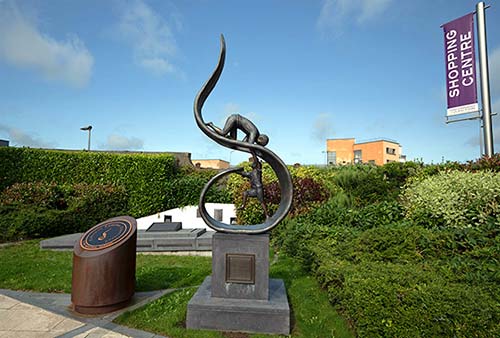
The final stop of the tour is the Famine Memorial Garden, located outside the complex, at the main entrance facing the busy roundabout. In a special project intended to keep all the workhouse inmates in living memory, a memorial plinth in the garden is etched with the fingerprints of historians, researchers, and members of the local community—each set paired to one of the famine victims as an act of reconnection.
Nightlife in Kilkenny
Pubs and Traditional Music Sessions
Kilkenny has its fair share of atmospheric pubs, many of which have lively traditional music sessions. A fun pub crawl could link all of these places with 20 minutes of walking (30 minutes crawling). Check the nightly pub trad session schedules as you explore town during the day; music typically begins around 21:30.
Pubs with Music: Starting at the north end of town and working south, Cleere’s Bar is a friendly throwback with surprisingly good pub grub served until 20:00. They host a variety of musical acts, but Mondays are usually for trad (28 Parliament Street, www.cleeres.com). Bollard’s Bar, an unpretentious landmark at the north end of St. Kieran’s Street, is a good bet for lively traditional music sessions (most likely Fri-Sat). Or sit out front under the awning and enjoy a pint as Kilkenny’s humanity flows past you. Just down the same street is Kytelers Inn, with a stony facade and medieval witch-haunted cellar (music most nights, 27 St. Kieran’s Street, www.kytelersinn.com). You can saunter over John’s Bridge to check out the tunes at Matt the Miller’s, with its multilevel, dark-wood interior (music most nights, next to bridge on John Street across the river from the castle, www.mattthemillers.com).
Unique Historic Pub: The Hole in the Wall is a tiny, restored Elizabethan tavern (c. 1582) hidden down an alley (capacity 15-20, mostly standing). Charmingly eccentric owner Michael Conway—cardiologist by day and historian/playwright/actor/barman by night—presides over the speakeasy-like space as a labor of love. (Ask him about Brazilian snakes.) His sporadic music sessions (which mostly take place in the slightly larger, but equally creaky, timber-beamed upstairs hall) can’t be pigeonholed. But when they’re on, they are usually an uninhibited, go-for-broke thump-a-thon (he plays bass drum). Spontaneous but always entertaining, Conway conducts sing-alongs of Irish classics that include helpful lyrics and explanations of Irish idioms (unpredictable hours but typically Thu-Fri from 18:00, Sat-Sun from 14:00, sometimes also weeknights, look for the alley beside Bourkes shop at 17 High Street, +353 87 807 5650, www.holeinthewall.ie).
Theater
The Watergate Theatre houses live plays and other performances in its 300-seat space (Parliament Street, +353 56 776 1674, www.watergatetheatre.ie). The Set Theatre, adjacent to sprawling Langtons Hotel, is a fine, modern, 250-seat music venue attracting top-notch Irish acts (John Street, +353 56 776 1728, www.set.ie).
Sleeping in Kilkenny
Kilkenny has two exceptional midrange options to try first: one in town (Butler Court), and the other deep in the countryside (Lawcus Farm). Both are run with a personal touch and provide a great value.
Note: Thanks to its easy train access from Dublin, Kilkenny is a popular weekend destination for loud and rowdy stag and hen (bachelor and bachelorette) parties (especially Fri-Sat nights). For quiet at night, avoid hotels with bars downstairs or nearby, and stick with smaller B&Bs, guesthouses, or rural lodging. Except for the Zuni, my recommendations should be free of these disturbances.
IN THE CENTER
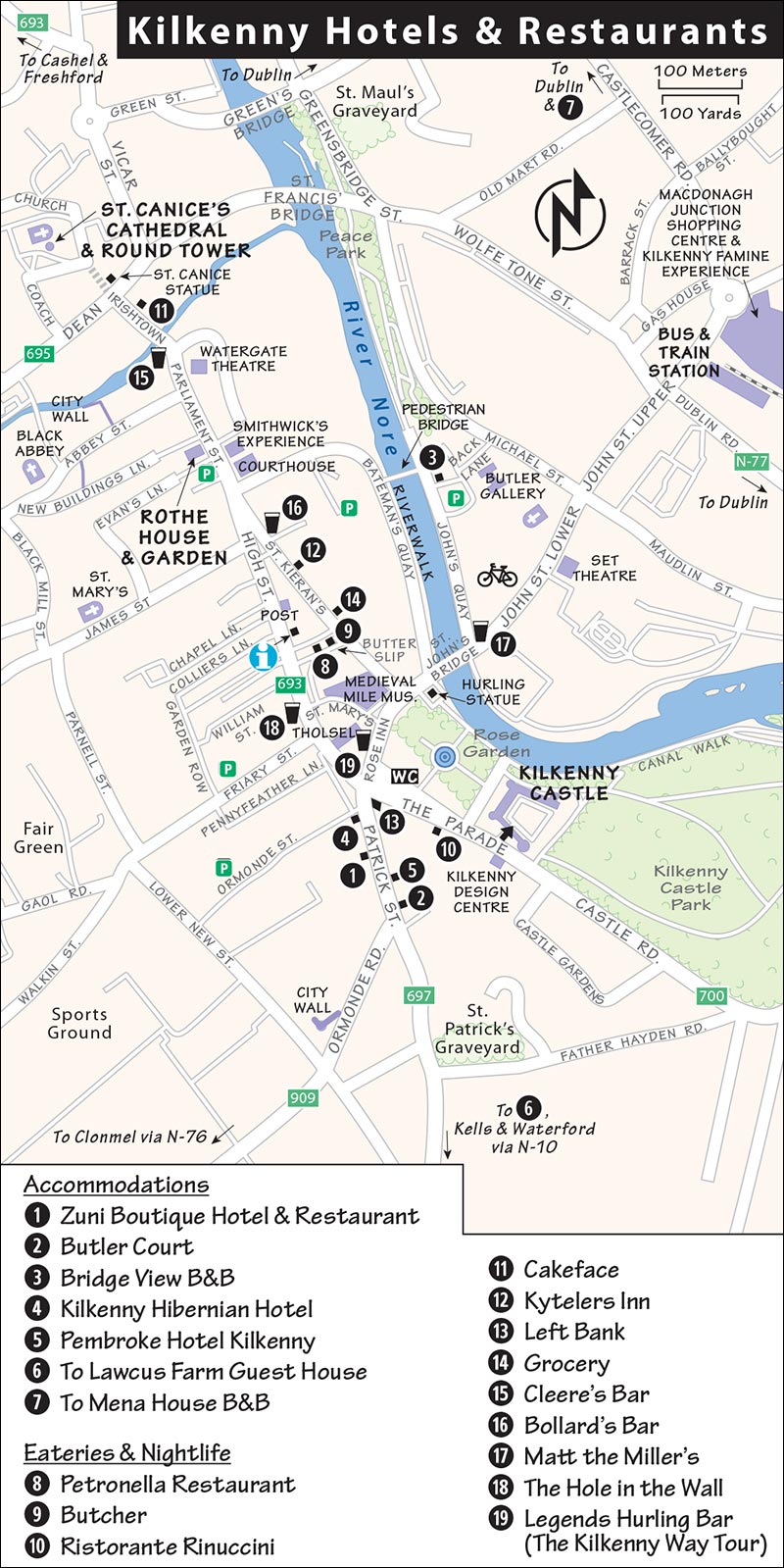
$$$$ Zuni Boutique Hotel, above a fashionable restaurant, has 13 boutique-chic rooms sporting colorfully angular furnishings (ask about special package deals, parking in back, 26 Patrick Street, +353 56 772 3999, www.zuni.ie, info@zuni.ie).
$$ Butler Court is Kilkenny’s best lodging value. Ever-helpful Yvonne and John offer 10 modern, spacious rooms behind the beige, flag-draped archway (continental breakfast in room, parking nearby, 14 Patrick Street, +353 56 776 1178, www.butlercourt.com, info@butlercourt.com).
$$ Bridge View B&B is traditional, simple, and nicely located, with six rooms facing the river near a handy footbridge into the town center. While a bit faded and nothing fancy, it’s a solid budget option (8 Johns Quay, +353 56 772 2401, www.bridgeviewbedandbreakfast.com [URL inactive], bookings@bridgeviewbedandbreakfast.com, Eimer).
Other Central Hotels: In addition to my listings above, several high-end hotels line Patrick Street; while they can be pricey when it’s busy, you can try checking for a deal in slower times: Try Kilkenny Hibernian Hotel (www.kilkennyhibernianhotel.com) or Pembroke Hotel Kilkenny (www.pembrokekilkenny.com).
FARTHER OUT
$$ Lawcus Farm Guest House is a quirky, seductive confection of rural comfort 10 miles south of Kilkenny between Kells Priory and the village of Stoneyford. Hosts Mark and Ann Marie are big personalities who will make you feel like old friends at their rustic Irish country getaway. Mark, an inventive craftsman, renovated the original house and built the rest—mostly with salvaged and reclaimed materials. A menagerie of friendly pets and farm animals shares the tasteful 20-acre property straddling the River Kings; walking paths make the grounds fun to explore. Ask about the tiny secluded tree house (family rooms, cash only, 2-night minimum, +353 86 603 1667 or +353 87 291 1056, www.lawcusfarmguesthouse.com, lawcusfarm@hotmail.com). To reach the farm, go south from Kilkenny on N-10, which becomes R-713 after crossing over the M-9 motorway. Just as you enter the village of Stoneyford, turn right onto L-1023. Go 500 yards down that lane and watch for a brown sign directing you to turn right into a 100-yard-long gravel driveway.
$$ Mena House B&B is a traditional, good-value option quietly nestled a mile north of town. Behind its Tudor-style facade you’ll find seven large, spotless rooms, well kept by hostess Katherine. It’s about a 15-minute walk from the center and easy for drivers (family rooms, cash only, parking, located roughly across from the Newpark Hotel and just south of the Kilkenny Golf Club on Castlecomer Road, +353 56 776 5362, www.menahousebandb.com, info@menahousebandb.com).
Eating in Kilkenny
$$ Petronella Restaurant, named for the local servant who was burned as a witch, warms its medieval surroundings with dependable traditional entrées and a welcoming vibe dished out by jovial Frank. As this place is very popular, reserve ahead (closed Sun-Mon, on Butter Slip just below High Street, +353 56 776 1899, www.petronella.ie).
$$$ Butcher, modern and industrial, is owned by a local farmer, Mark Williams, as a showcase for his beef. In addition to burgers, beef Bourguignon, and steaks, you’ll find chicken, fish, tasty starters, and desserts. It all adds up to a delicious, memorable, and mod meal in ye olde Kilkenny (dinner only, closed Mon-Tue, on Butter Slip off High Street, +353 56 779 0655, www.butcherrestaurant.ie).
$$$$ Ristorante Rinuccini serves classy, romantic, candlelit Italian meals in an elegant space facing the castle. It’s refined and respected, and worth reserving ahead (early-bird specials, daily, 1 The Parade, +353 56 776 1575, www.rinuccini.com).
$$$ Zuni Restaurant is a stylish splurge offering local ingredients prepared with international know-how. They have a classy craft-cocktail bar in front and a refined dining room in back. Reservations are wise for dinner on weekends (daily, 26 Patrick Street, +353 56 772 3999, www.zuni.ie).
$ Cakeface is a hip, modern café at the top end of High Street (just before St. Canice’s Cathedral). They serve good coffee, daily sandwiches and soups, and delicately constructed desserts (daily until 17:00, 16 Irishtown, +353 56 773 9971).
$$ Kytelers Inn is a touristy yet reliable classic, serving decent pub grub in an elaborate timber-and-stone atmosphere with a heated and covered beer garden out back. Visit their fun 14th-century cellar—the original space from back in the day of Alice Kyteler, who narrowly escaped being burned as a witch in 1324 (daily, 27 St. Kieran’s Street, +353 56 772 1064).
$$$ Left Bank is a dimly lit, three-story multichambered maze of creaky-floored conviviality with a Parisian-bordello atmosphere and a fun patio out back. This gastropub, located smack-dab in the center of town, has better-than-average fare. But come early—its top-floor nightclub heaves with stag/hen party bedlam until late on weekends (daily, 1 The Parade, +353 56 775 0016, www.leftbank.ie).
Grocery Store: Dunnes Stores has a huge supermarket (daily, a few doors down from Kytelers Inn on St. Kieran’s Street).
Kilkenny Connections
From Kilkenny by Train to: Dublin (6/day, 1.5 hours), Waterford (6/day, 35 minutes). Train info: www.irishrail.ie.
By Bus to: Dublin (8/day, 2 hours), Waterford (Dublin Coach every 2 hours, 40 minutes, www.dublincoach.ie), Galway (2/day, change in Athlone, 5 hours). Bus info: www.buseireann.ie.
Waterford
The oldest city in Ireland, Waterford was once more important than Dublin, although, these days, most tourists associate the town with its famous crystal. In fact, Waterford offers both fine sights that celebrate its rich history and a chance to tour the crystal factory.
That said, Waterford is a plain, workaday, gritty-in-places city of 45,000, with fewer leprechauns per capita than most of this book’s destinations. The city has done a beautiful job of restoring the snazzy museum quarter surrounding Christ Church Cathedral, with the Waterford Crystal Visitor Centre just across the street. Beyond this area, however, Waterford has more than its share of litter, vape shops, discount stores, and betting parlors.
For these reasons, rather than sleeping in Waterford, I suggest staying in Kilkenny (more charming and with a better range of accommodations, restaurants, and music pubs) and side-tripping here (just 45 minutes on an easy highway) for some targeted sightseeing. Once in Waterford, everything you’ll want to see is within about a 10-minute walk.
Orientation to Waterford
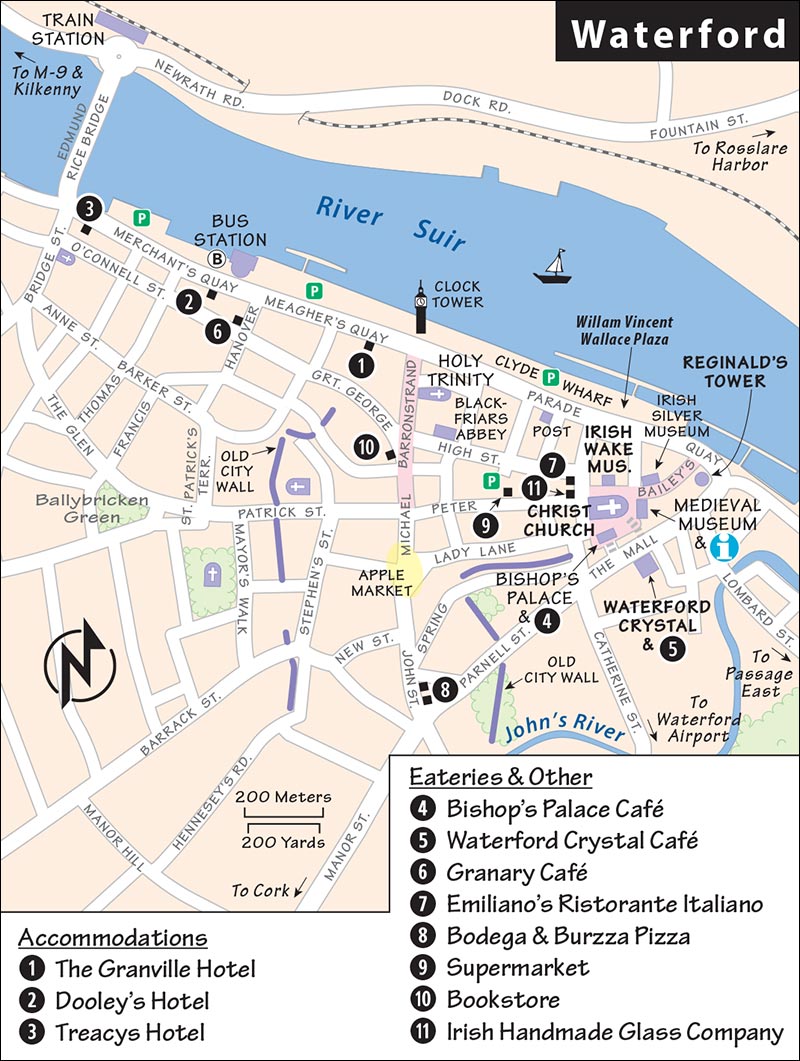
Waterford’s main drag runs along its harbor. But virtually everything of interest—the Waterford Crystal Visitor Centre and recommended museums—is concentrated within the four-block area surrounding Christ Church Cathedral. A few blocks away, a Victorian clock tower on the waterfront marks the start of Barronstrand Street, which runs two blocks inland to the town square (passing the Cathedral of the Holy Trinity), then continues to the lively Apple Market dining and drinking zone.
TOURIST INFORMATION
Waterford lacks a bricks-and-mortar TI, but visitors can find basic tourist information at VisitWaterford.com (consider downloading their “story trails” app for a self-guided tour of the city’s most famous sights). In summer, a desk inside the Medieval Museum hands out maps and brochures, and answers questions (same hours as museum—see later).
ARRIVAL IN WATERFORD
Drivers coming from Kilkenny cross Rice Bridge, then turn left along the waterfront, which is lined with lots of pricey but convenient pay parking lots. For a quick visit, drive all the way to the end of this strip and park as close as you can to Reginald’s Tower (ideally, try for the Clyde Wharf car park).
The train station is just across Rice Bridge from town. The bus station is along the embankment, right in the heart of the city.
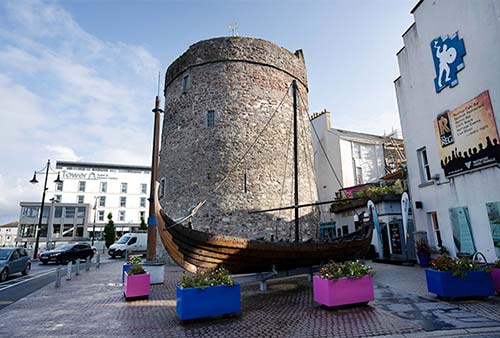
Getting Oriented: Here’s an easy way to get oriented to the city’s compact core upon your arrival. Find your way to Reginald’s Tower on the river embankment, with a Viking ship parked out front. From there, head up Bailey’s New Street, just to the right of the tower and boat. After passing a ruined church, at the top of the street, veer left into the square surrounding Christ Church Cathedral (you’re at the back of the church). The Medieval Museum, Silver Museum, and Wake Museum ring the square. The Bishop’s Palace is next to the Medieval Museum (just out of view), and the Waterford Crystal Visitor Center is just down the stairs (by the Medieval Museum) and across the busy road from the palace.
HELPFUL HINTS
Bookstore: The multilevel Book Centre, facing the leafy main square on Barronstrand Street in the heart of town, is a fun browse and has a cozy café on an upstairs balcony (Mon-Sat 9:00-18:00, Sun 13:00-17:00, 25 Barronstrand Street, +353 51 873 823).
Historic Walking Tour: Jack Burtchaell and his partners lead entertaining, informative, hour-long, historical town walks (worth ▲▲) that go from the recommended Granville Hotel on Meagher’s Quay to the Waterford Crystal Visitor Centre, giving you a good handle on the story of Waterford. They meet at the Granville every day at 12:00 and 14:00 (just show up, pay €10 at the end, mid-March-mid-Oct only, +353 51 873 711, www.jackswalkingtours.com).
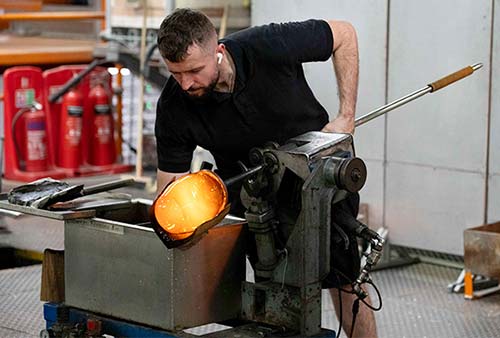
Glass Souvenirs: At the Irish Handmade Glass Company, artisans trained at the old Waterford Crystal factory work right in front of you, fashioning lovely functional pieces as well as jewelry and decorative items (Mon-Fri 9:00-17:00, Sat 11:00-17:00, closed Sun, near Christ Church Cathedral—behind the Kite Design Studio storefront at 11 Henrietta Street, +353 51 858 914, www.theirishhandmadeglasscompany.com).
Sights in Waterford
Town sightseeing comes in two big chunks: crystal...and everything else.
WATERFORD CRYSTAL
▲▲Waterford Crystal Visitor Centre
With a tradition dating back to 1783 (absent about 100 years, from the late 1840s famine until the post-WWII boom), Waterford was once the largest—and is still among the most respected—glassworks in the world. The economic downturn of 2008 shattered the market for luxury items like crystal, forcing the huge Waterford Crystal factory outside town to close. American investors bought the company and opened a new, scaled-down factory in the town center (and later sold it to a Finnish company for a handsome profit). While 70 percent of Waterford Crystal is now manufactured in Slovenia, several glass craftspeople still reside here and create custom pieces for special-order customers. The efficient, informative one-hour tour of this hardworking little factory is a joy. You’re welcome to interact with the craftspeople.
Cost and Hours: Tours cost €17 and depart every 30 minutes (cheaper online); daily 9:30-18:00, last tour at 16:15; shorter hours off-season with last tour at 15:15, Nov-Feb no tours Sat-Sun; shop open longer hours; on The Mall, one block south of Reginald’s Tower; +353 51 317 000, www.waterfordvisitorcentre.com. Large tour groups descend midday, so try to visit right when they open or later in the afternoon.
Visiting the Factory: The tour begins with a bit of history and a look at an impressive six-foot-tall crystal grandfather clock. You’ll learn how, after it was revived following World War II, Waterford Crystal was a joint venture between the Irish and Czechs (whose Bohemian crystal is also regarded as top quality). In fact, it was a Czech, Miroslav Havel, who designed Waterford’s trademark Lismore pattern.
Next, your guide will take you into the factory to meet the craftspeople in their element. You’ll see the workshops where wooden molds are handmade for custom creations and the blowing department, where glassblowers spin glowing blobs of molten crystal into exquisite shapes. Watch closely as the glassblower puts a thumb over the opening between breaths to keep the heat and pressure inside the blob constant.
Heavy molten crystal has an intentionally high lead content (it’s what distinguishes fine crystal from common glassware). A cooling-off stage allows the crystal to set. From the finishing and quality department, you’ll head to the marking department, where designs are precisely marked on each piece, and the cutting department, where glasscutters deftly cradle the fragile creations against diamond-edged cutting wheels. Watch as the skilled cutters muscle rough unfinished pieces—weighing as much as bowling balls—and cut intricate patterns. The crystal vases and bowls may look light and delicate, but hold an unfinished piece (with its lead-enhanced heft) and you’ll gain a new appreciation for the strength, touch, and hand-eye coordination of the glasscutters. The tour ends in the sculpting and engraving departments, where those finishing touches make each item unique.
Afterward, visit the glittering salesroom, surrounded by hard-to-pack but easy-to-ship temptations. Take a look at the copies of famous sports trophies (they make backups of their most important commissions, just in case).
MUSEUM QUARTER
A variety of good museums surround Christ Church Cathedral, and three of them manage to trace a thousand years of the Waterford story: Reginald’s Tower (the Viking age), the Medieval Museum (Middle Ages), and the Bishop’s Palace (1700s to the present). Still other museums here have a specific focus: silver, clocks, and the history of death.
Sightseeing Pass: The Freedom of Waterford Pass (€20) covers the Medieval Museum, Bishop’s Palace, Irish Museum of Time, Irish Silver Museum, and Christ Church Cathedral. It also includes a worthwhile 45-minute, mostly outdoor walking tour of what’s called the Viking Triangle—the city’s historic core (3/day, departs from Medieval Museum). For more on the pass and these sights, see WaterfordTreasures.com.
Reginald’s Tower
This oldest part of the oldest town in Ireland is named after Regnall, the first (Norwegian) Viking leader of Waterford, who built a fortified oaken tower here in AD 914 and later invaded Jorvik (York, England). The stone Norman tower you see today, from the late 1100s, replaced the wooden one and was once the most important corner of the town wall. The tower is Ireland’s oldest intact building and the first made with mortar. Visitors can climb 56 chunky spiral stone stairs to the tower’s top and view Viking artifacts, including some items found in burials. Next to the tower is a replica of a c. 1050 Viking boat—christened Vandrafjord, which is what the Vikings called their original settlement here. The nearby statue is of Waterford favorite son Thomas Francis Meagher (see the sidebar).
Cost and Hours: €5, daily 9:30-17:30, off-season closed Mon-Tue, +353 51 304 220, www.heritageireland.ie.
Waterford’s favorite son had a short but amazing life. The son of the town’s mayor, Meagher joined Daniel O’Connell’s nonviolent movement to repeal the Act of Union with Britain. Impatient with the slow-moving political process of constant compromise, Meagher joined the radical Young Irelander movement, which advocated separation from Britain by force of arms. An inspiring and fiery speaker nicknamed “Meagher of the Sword,” he went to France in 1848 and returned with the first Irish tricolor flag—a gift from the French that represented the Catholics (green), the Protestants (orange), and peaceful coexistence between the two (white).
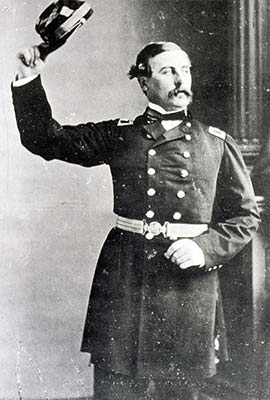
Involved in the failed Rebellion of 1948, Meagher was supposed to hang, but his sentence was commuted to life in prison in Tasmania. In 1852, Meagher escaped Tasmania via an American whaling ship and sailed to New York, where he eventually became a lawyer and started an Irish newspaper. After a trip to Nicaragua (to study the feasibility of building a canal or railway across the isthmus), he returned to New York to fight in the American Civil War. Meagher was made a Union general, raised a regiment of Irish immigrants, and famously led them into battle at Antietam and Fredericksburg. After the war, he became the first governor of the Montana territory. At age 44, Thomas Francis Meagher fell off a riverboat one night and drowned in the Missouri River. Sheer accident, foul play, or careless drunkenness? Nobody knows for sure—but his body was never found.
To learn more about this little-known but fascinating Irish leader, Timothy Egan’s The Immortal Irishman (2016) offers a vivid account of the contrasting events and locales in Meagher’s life.
Medieval Museum
This slick, modern museum focuses on life in Waterford from the Norman invasion of the late 1100s to the Williamite English triumph of the late 1600s. On three floors, the museum uses a combination of colorful dioramas, giant explanations, films, and artifacts to revive this murky history. Take advantage of the good audio/videoguide or join an included tour of the museum highlights (tours depart hourly).
Cost and Hours: €10, includes audio/videoguide and tour, covered by Freedom of Waterford Pass; daily 10:00-18:00, Sept-May Mon-Fri 9:15-17:00, Sat from 10:00, Sun from 11:00, last entry one hour before closing; +353 51 304 500, www.waterfordtreasures.com.
Visiting the Museum: The main exhibits fill two upper floors (each with an informative film about city history). First, ride the elevator to the top floor, which covers The Port City. Get oriented at the 1374 town model, then peruse the Great Charter Roll of 1372, compiled to reinforce Waterford’s claim to a monopoly of the lucrative wine-import trade. The rest of the room features colorful dioramas and artifacts from the Middle Ages.
Head one floor down to the second main exhibit, The Art of Devotion, featuring the only complete surviving set of medieval vestments in northern Europe. These priestly vestments were produced in Medici Florence, decorated in affluent Bruges, and shipped to conflicted Waterford. Known as cloth-of-gold vestments, they were hidden under a flagstone in the floor of Christ Church Cathedral during a siege—thus preserving them to be rediscovered 123 years later.
Before leaving, you can descend under the modern building into two medieval chambers: a 13th-century choristers’ hall and a wine cellar from the 1400s that belonged to Waterford’s mayor, himself a wine merchant.
Bishop’s Palace
Housed in the former mansion (built 1743) of the local Protestant bishop (with his Christ Church Cathedral looming right behind it), this museum sweeps through the history of Waterford since 1700 and contains the world’s largest collection of old Waterford glass. The refined interior hints at the privileged lifestyle of the holy resident. You’ll work your way through three floors of dusty rooms with lots of artifacts, which are made far more interesting by the entertaining 45-minute tour, led by actors in period dress (tours typically depart at :20 past each hour).
Cost and Hours: €10, includes tour, covered by Freedom of Waterford Pass, same hours and contact info as Medieval Museum.
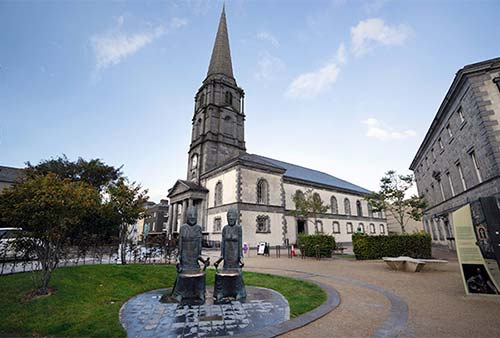
Nearby: Outside (to the left of the palace as you face the front door) are two very tall metal chair sculptures morphing into male and female figures. They’re meant to be Norman warrior Strongbow and Irish princess Aoife, with Christ Church Cathedral—the site of their pivotal 1170 wedding—in the background.
Christ Church Cathedral
The centerpiece of the museum quarter is this 18th-century Protestant cathedral—the third church to stand here. The Georgian interior is austere, but two earlier details are worth a look: an old column and perhaps Ireland’s most famous tomb.
Entering the church, just before the organ loft, on the right is an exposed Gothic column six feet below today’s floor level, a remnant from an earlier church where the Norman conqueror Strongbow was married (see “Waterford’s History,” earlier in this chapter). Directly opposite the column is the macabre tomb of 15th-century mayor James Rice, who requested that his decomposed remains be dug up one year after his death (1482) and used to model his likeness, now seen on the tomb’s lid...complete with worms, frogs, and a famous epitaph: “I am what you are going to be, and I was what you are...pray for me.”
Cost and Hours: Free, donation requested; Mon-Sat 10:00-17:00, off-season until 16:00, closed Sun except for services; free WCs, tours available on request, www.christchurchwaterford.com.
▲Irish Wake Museum
This small museum offers deep historical insight into Irish beliefs and customs surrounding death. In this country with such a traumatic history, people are unusually frank and open about mortality. Here, you’ll begin to understand why. Pensive, candid, and almost academic in its approach, the museum is not to everyone’s taste, but it engages the thoughtful traveler. It can be visited only on a 50-minute tour.
Cost and Hours: €11, includes €1 donation to local hospice organization; Mon-Fri 9:00-17:00, Sat from 10:00, Sun from 11:00, tours depart at the top of each hour, last tour one hour before closing; Cathedral Square—as you face the cathedral entrance, it’s around the left side, www.waterfordtreasures.com.
Visiting the Museum: The museum fills an old almshouse, where destitute people close to death were housed and fed, in return for praying for their patrons’ eternal souls. The visit starts with a dryly informative 15-minute film tracing Irish traditions around death and wakes. Then a costumed guide leads you through three floors of exhibits exploring that history in greater depth, including more video clips and lots of local artifacts (a miniature coffin to hold human ashes; lockets containing a hair from each of a family’s departed children; stork-shaped umbilical cord scissors). On the top floor, a traditional Irish wake is re-created, right down to the rigid corpse in the bed, covered mirrors, open windows, and lots of drink. By the end of the tour, you’ll have a new appreciation, and maybe admiration, for the Irish knack for grappling with the inevitability of death.
Other Museums
Two nearby museums are worth dipping into only if you’ve already invested in the Freedom of Waterford Pass (otherwise, they’re €5 apiece; roughly the same hours as the Medieval Museum). The Irish Silver Museum has a few rooms of display cases jammed to the gills with silverwork items. In one small room, you can watch a jeweler at work (next to the Medieval Museum on Cathedral Square). The Irish Museum of Time fills two floors of a former Methodist church with timepieces big and small—from giant grandfather “longcase” clocks to small pocket watches (a short walk downhill toward the waterfront on Greyfriar’s).
URBAN WATERFORD
To dive into the urban heart of Waterford, follow the waterfront to the stubby three-story Victorian clock tower that marks the middle of the harbor. From here, you can walk up Barronstrand Street, which separates the medieval town (on your left, with the river behind you) from the 18th-century city (on your right). You’ll soon reach the Cathedral of the Holy Trinity, then the pedestrian-friendly town square. A river once flowed here—part of the town’s natural defenses just outside the old wall.
Cathedral of the Holy Trinity
The year is 1793. With Catholic France (30 million) threatening Protestant Britain (8 million) on one side, and Catholic Ireland (6 million) stirring things up on the other, English King George III was stuck between a rock and a hard place. He had just lost the American colonies a decade before and looked vulnerable. To lessen Irish resentment, the king granted Ireland the Irish Relief Act, which, among other things, allowed the Irish to build Catholic churches and worship publicly for the first time since the penal laws forbade them a hundred years earlier. Allowed new freedom, the Irish built this interesting cathedral in 1796. It’s Ireland’s first Catholic post-Reformation church and its only Baroque church. Inside, it feels closer to Naples than Dublin. The building was funded by wealthy Irish wine merchants who were flourishing in Cádiz, Spain. Among its treasures are 10 Waterford crystal chandeliers.
Cost and Hours: Free, daily 8:00-19:00.
Sleeping in Waterford
Waterford is a working-class city, and virtually no cheap-and-cheery accommodations survive. Instead, here are three big, venerable hotels that face the water.
$$$$ The Granville Hotel is Waterford’s best and most historic hotel, grandly overlooking the center of the harborfront. The place is plush, from its Old World lounges to its 98 well-tended rooms (elevator, air-con in some rooms, Meagher’s Quay, +353 51 305 555, www.granvillehotel.ie, stay@granville-hotel.ie).
$$$ Dooley’s Hotel is a modern, family-run place on the harbor with 113 big rooms (elevator, Merchants Quay, +353 51 873 531, www.dooleys-hotel.ie, hotel@dooleys-hotel.ie).
$$ Treacys Hotel—family-run and modern—is also on the waterfront, close to the Rice Bridge, with 163 pleasant, earth-toned rooms (elevator, 1 Merchants Quay, +353 51 877 222, www.treacyshotelwaterford.com, res@thwaterford.com).
Eating in Waterford
NEAR THE MUSEUM QUARTER
For an easy and good lunch close to the sights, consider the $$ Bishop’s Palace Café, with a big and inviting patio in the heart of the museum quarter, or the $ Waterford Crystal Café, next to the ticket desk. Or seek out one of the options below.
$ Granary Café occupies the bottom floor of an old stone warehouse facing the waterfront (café on back side, away from traffic). It’s a soup/salad/sandwich cafeteria that tries harder than most (closed Sun, Hanover Street, +353 51 854 428).
$$$ Emiliano’s Ristorante Italiano is the most romantic place in town, hidden on a tiny lane behind Reginald’s Tower. They serve a great selection of tasty pasta dishes and fine wines (dinner only, closed Mon-Tue, 21 High Street, +353 51 820 333).
Supermarket: The best grocery option is Dunnes in the City Square Shopping Centre, a block from Christ Church Cathedral (daily).
THE APPLE MARKET
If you follow bustling, pedestrianized Barronstrand Street up from the waterfront through the heart of urban Waterford, in five minutes you’ll reach a cluster of bars and eateries under a covered square called the Apple Market (www.theapplemarket.ie). Waterford’s top entertainment district is lively day and (especially) night, with plenty of eateries to choose from. From the canopy, John Street continues south, where you’ll find the first two great choices a one-minute walk away.
$$ Bodega is my favorite wine bar, laid-back with a warm-glow Mediterranean atmosphere. Their lamb sliders get raves (Wed-Sat dinner only, Sun lunch and dinner, closed Mon-Tue, 54 John Street, +353 51 844 177).
$$ Burzza Pizza, right next door and under the same ownership as Bodega, serves not only pizza but also “real” hamburgers (Wed-Fri dinner only, Sat-Sun lunch and dinner, closed Mon-Tue, 53 John Street, +353 51 844 969).
Waterford Connections
From Waterford by Train to: Dublin (8/day, 2.5 hours), Kilkenny (6/day, 45 minutes). Train info: www.irishrail.ie.
By Bus to: Cork (almost hourly, 2 hours), Kilkenny (2/day, 1 hour), Rosslare (6/day, 1.5 hours), Wexford (7/day, 1 hour). Waterford bus station info: +353 51 879 000. Bus info: www.buseireann.ie.
More Sights in Southeast Ireland
The fast M-9 motorway links Kilkenny and Waterford in 45 minutes. But if you venture off that spine, you’ll reach several worthwhile stops. For locations, see the “Southeast Ireland” map, near the beginning of this chapter.
STONY RUINS JUST SOUTH OF KILKENNY
Jerpoint Abbey and Kells Priory are both about a 15- to 20-minute drive south of Kilkenny (a short distance off the main road). For many visitors, seeing both medieval structures isn’t necessary. If you’re choosing between them, Jerpoint Abbey is more intact (including some fine surviving carvings) and has easier access, while Kells Priory, bigger and more impressive, is in a more striking natural setting (on a slope above a river). Jerpoint Abbey has a strict opening schedule, but Kells Priory is always open—you can check it out late in the long hours of summer daylight.
▲Jerpoint Abbey
Evocative abbey ruins dot the Irish landscape, but few are as well presented as the Cistercian Jerpoint Abbey (founded in 1180). Its claim to fame are the unique stone carvings on the sides of tombs and on the columns of the cloister arcade. If you visit only one abbey in Ireland, make it this one. Ideally, try to join a guided tour (which run sporadically); in the hands of unusually well-versed hosts, the place comes alive with insights into the monastic culture that imprinted Ireland 850 years ago. Without the tour, this place can seem like a cold, rigid ruin. To learn some background before you visit, read the “Ireland’s Cistercian Abbeys” sidebar.
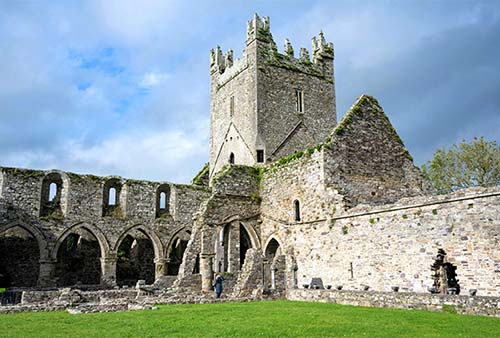
Cost and Hours: €5; daily 9:00-17:30, shorter hours Oct-Easter, closed Dec-mid-March, last entry one hour before closing; +353 56 772 4623, www.heritageireland.ie.
Getting There: It’s located about 11 miles (17 km) south of Kilkenny or 2 miles (3 km) south of Thomastown, beside R-700.
Visiting the Abbey: Check out the minimal exhibits in the visitors center, then head out to the ruins. You’ll walk through a little graveyard and enter the foundations of the ruined church. Step into the middle of the nave. On your left rises a tall surviving steeple, standing over the main altar area. Straight ahead is a grassy yard surrounded by the cloister arcade, with detailed carvings around its arches. Along the left side of the cloister (stretching beyond the tower) are some fairly intact ruins of the dormitory and chapter house. Straight ahead, on the opposite side of the cloister, were the refectory and kitchen. And to the right—outside the walled complex—was the home of the lay brothers, who kept the abbey complex running.
Now head down the nave to the transept (directly under the tower). In this area, you’ll see finely carved tombs elevated above the gravel floor. The finest one, in the alcove to the left of the main altar, depicts saints and apostles.
In the right transept, stairs lead up to the second story for higher views over the abbey grounds. Back down on ground level are rooms exhibiting a small collection of stone fragments and a slideshow video.
Before leaving, do a slow stroll around the entire cloister, examining those carvings one by one. Let each one tell you its story.
▲Kells Priory
This place is a wonderful, lonely gem. Locals claim that the massive religious complex of Kells Priory (more than 3 acres) is the largest monastic site in Europe. It’s an isolated, deserted ruin that begs a curious wander. By the way, don’t confuse this Kells with the identically named town farther north in County Meath (that’s the Kells that produced the famous Book of Kells, now housed in Trinity College Library in Dublin).
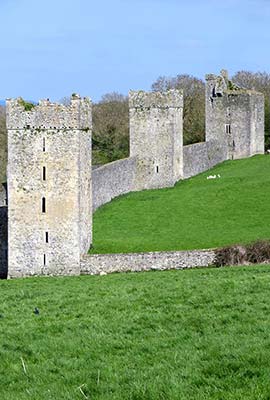
Cost and Hours: Free, always open.
Getting There: Kells Priory is about 9 miles (15 km) south of Kilkenny or 6 miles (10 km) west of Jerpoint Abbey, just off the R-697 road. From Jerpoint Abbey, turn left, then take your first right through the village of Stoneyford. At the end of the village, turn left at the sign for Kells Priory.
The main parking lot sits next to a church, on a slope above the south side of the ruins. This is a good place to pull over for a quick overview photo stop. But to explore the ruins themselves, I prefer to park beside the River Kings on the north side of Kells Priory: Drive down into the village, turn right, cross the pretty stone bridge over the river, then turn right onto the L-5067 road. Drive about 100 yards past the first mill (with a craft shop in an adjacent building); when you come to the second, giant mill (mostly abandoned, marked with a Kells Priory Loop Walk sign), park in the gravel lot in front.
Background: Founded in 1193 by Norman soldiers of fortune with Augustinian monks in tow, this priory grew into the intimidating structure that locals today call “the seven castles.” These “castles,” however, were actually Norman tower houses connected by a wall that enclosed the religious functions within. The most dramatic 75-year period of the site’s history took place between 1252 and 1327, when it was attacked and burned three times.
Visiting Kells Priory: From the parking lot on the north side, stroll past the mill’s rusty waterwheel and enjoy the wander downstream for the remaining 100 yards along the riverside path, then cross the footbridge. It’s a photogenic approach to the priory ruins.
Inside the walls, the site is divided into two main areas: First, you’ll come to a tangled medieval maze of rock walls—the remnants of a cloister, a church, cellars, a medieval dormitory, and a graveyard. Beyond that (uphill) is a huge interior common grazing area (larger than a football field) dominated by the encircling tower houses. These grazing lands were circled with five towers and a wall to protect livestock. Go for a stroll through these stony ruins, contemplating the hard-fought history of Ireland...a place where even sturdy stone fortresses eventually become rubble.
HISTORIC SIGHTS IN COUNTY WEXFORD
These two County Wexford sights are not directly on the way between Kilkenny and Waterford, but both can be worth a detour. The Dunbrody Famine Ship in New Ross gives a sense of what 50 days on a “coffin ship” with dreams of “Americay” must have been like. And the Kennedy Homestead is a pilgrimage site for JFK fans or anyone nostalgic for the days of America’s own Camelot. These two sights—located about 15 minutes from each other—are about 45 minutes southeast of Kilkenny and 30 minutes northeast of Waterford.
▲▲Dunbrody Famine Ship
Permanently moored on a river in the port of New Ross, this ship is a re-creation of the vessels that sailed to America full of hungry Irish emigrants. The modest museum and riveting, mandatory guided tour of the Dunbrody—including the cramped quarters below decks—offer perhaps the best opportunity in Ireland to appreciate the difficult journey an estimated one to two million Irish emigrants to North America endured in the decade or so following the outbreak of the Great Potato Famine (c. 1845-1855).
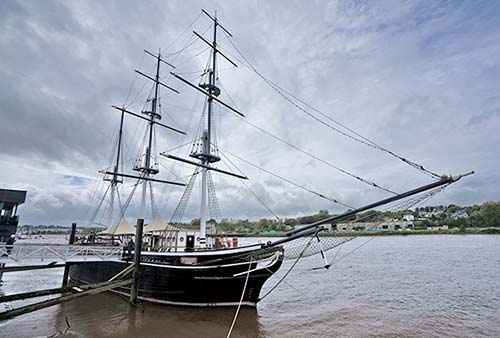
Cost and Hours: €14, daily 9:00-18:00, Oct-March 10:00-17:00, 45-minute tours go every hour, last tour starts one hour before closing, upstairs lunch café with nice views of the ship, +353 51 425 239, www.dunbrody.com. There’s ample pay parking in the big riverside lot right next to the ship.
Background: The Dunbrody is a full-scale reconstruction of a 19th-century three-masted bark built in Quebec in 1845. It’s typical of the cargo vessels that originally sailed, empty, to America to pick up goods; during the Great Potato Famine, ship owners found that they could make a little money on the westward voyage too. Landowners were happy to pay to “export” their starving laborers to the New World, where they could be put to work clearing land for cattle grazing. Up to 300 passengers undertook each transatlantic voyage—which lasted four to six weeks for those going to the United States, or up to eight weeks to Canada. On board, large families camped out on bunks no bigger than a king-size mattress.
Commonly, boats like this would arrive in North America with about 80 percent of their original human cargo (in the worst cases, only 50 percent). Those who succumbed to “famine fever” (often typhus or cholera) were dumped overboard, which is why the worst vessels were referred to as coffin ships. The Dunbrody was better managed than some; when disease broke out, the sick were separated from the healthy, even if it meant displacing first-class passengers. Even so, the Dunbrody typically arrived with at least a few fewer souls than when it departed.
For more on the Great Potato Famine, see the sidebar on here.
Visiting the Ship: Your visit begins with a five-minute film on the life Irish emigrants were leaving behind, followed by coverage about the building of the vessel. The night before a family departed for the New World, their community would throw an “American wake” to say goodbye to loved ones they’d likely never see again.
An excellent guide then takes you on board the ship. Up on the main deck, you’ll learn how the handful of first-class passengers could be outside whenever they pleased, while steerage passengers, who lived below decks, were allowed to emerge for only 30 minutes each day. Below decks, you’ll see the living conditions for passengers, including the incredibly crowded bunks where entire families endured the crossing. While down there, you’ll bump into a costumed steerage passenger, who tells vivid tales about life onboard.
Back on land, you’ll get a glimpse of the new life Irish immigrants would encounter in Savannah, Georgia. Most arrived filthy (try skipping a shower for 50 days), illiterate, penniless, and speaking only Irish. The Irish America Hall of Fame (in the visitors center) commemorates the contributions Irish men and women have made to US history—from JFK and Walt Disney, to Spencer Tracy and Grace Kelly, to Ronald Reagan and Hillary Rodham Clinton.
Nearby: The wonderful Ros Tapestry, long located in the town of New Ross, has been on loan to Kilkenny Castle for the last few years during construction of a planned new home. This brand-new Norman Centre, near the Dunbrody, may be completed in 2025, at the very earliest. If the tapestry is back in New Ross, it’s well worth seeing; ask at the Dunbrody ticket desk whether it has returned. (You can read a description of the Ros Tapestry on here.)
▲Kennedy Homestead
Patrick Joseph Kennedy, President John F. Kennedy’s great-grandfather, left Ireland in 1848. JFK and his entourage visited here in June 1963, a few months before he was assassinated. It’s still a private home, but the Kennedys who stayed in Ireland have built a modern museum next door to tell the story of their illustrious transatlantic clan. For Kennedy pilgrims, it’s a loving shrine, and for history lovers, it’s a great story.
Cost and Hours: €10, daily 9:30-17:30, +353 51 388 264, www.kennedyhomestead.ie.
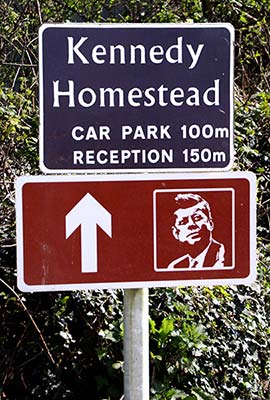
Getting There: It’s 4 miles (6 km) south of New Ross near Dunganstown. Coming from New Ross, head south on R-733; at the big roundabout outside town, near the highway entrance, follow signs for Dunganstown, Kennedy Homestead, and L-4026. From here, just follow brown signs with JFK’s face, down a long one-lane road, and park behind the modern visitors center.
Visiting the Homestead: You’ll likely be greeted by Patrick Kennedy—JFK, RFK, and Teddy’s third cousin once removed—who’d love to show you around. Inside the modern museum is a fascinating exhibition on the Kennedys’ Irish heritage, the various family members who made a big impact in the USA, and JFK’s brief presidential visit here. JFK’s assassin denied him the opportunity for a promised return visit. But his widow, Jackie, made sure that his Irish relatives received some of his precious memorabilia: the rosary beads that were in his pocket when he was shot and his commander-in-chief dog tags. Both are on display here.
Outside, a little barnyard is the site of the original settlement (and the house where the Kennedys still live). You can see the actual, humble gate that Patrick Kennedy left through when he began his long journey to America in 1848. Ninety-nine years later, his great-grandson—then a young G.I.—showed up at this same gate for a visit. And 16 years after that, JFK returned triumphantly as the president of the United States.
From the courtyard, step into the long stable with knickknacks and photos of that visit. A sitting area with an old-fashioned TV shows clips of JFK chatting with his relatives before being whisked away by helicopter to continue his triumphant tour of the country. On the upper level, look for the old bench-style car seat (with furniture legs added by Kennedy’s second cousin). This was the nicest seat in the homestead’s modest home, where the eminent visitor sat to take tea.
Nearby: Don’t confuse the Kennedy Homestead with the nearby JFK Arboretum—a huge park with 4,500 species of trees. It’s nice if you like trees and plants, but there’s no Kennedy history there.
SOUTH OF WATERFORD
This sight is located at the southern tip of the Hook Peninsula and takes about an hour (or more) to reach from Waterford.
▲Hook Lighthouse
This claims to be the oldest operating lighthouse in Europe. According to legend, St. Dubhan arrived in the fifth century and discovered the bodies of shipwrecked sailors. Dismayed, he and his followers began tending a fire on the headland to warn future mariners. What you see today is essentially a structure from the 12th century, built by the Normans, who first landed five miles up the east coast (at Baginbun Head, in 1169). They established Waterford Harbor—a commercial beachhead for the rich Irish countryside they intended to conquer. This beacon assured them safe access.
Today’s lighthouse is 110 feet tall and looks modern on the outside. (It was automated in 1996, and its light can be seen for 23 miles out to sea.) But, except for its modern light, it’s actually 800 years old, built following a plan inspired by the lighthouse of Alexandria in Egypt—one of the seven wonders of the ancient world. Since it’s a working lighthouse, it can be toured only with a guide.
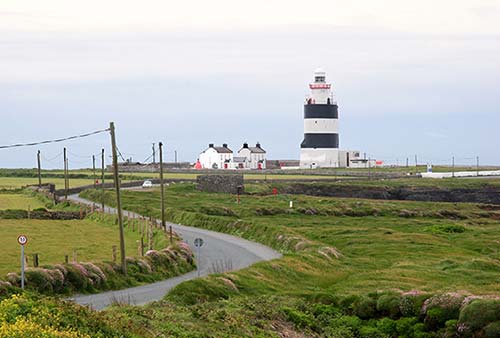
Cost and Hours: Fine 45-minute tours cost €12 and depart every 30 minutes; open daily 9:30-17:00, summer until 18:00; +353 51 397 055, www.hookheritage.ie.
Getting There: The lighthouse can be a bit tricky to find. But if you follow the brown Hook Scenic Route signs south of Ballyhack and remind yourself that you’re on a gradually narrowing peninsula with the lighthouse at the southern tip, you’ll be funneled straight there (more or less).
If connecting Waterford to Hook Head, use the car-ferry shortcut from Passage East to Ballyhack. Buy a round-trip and save your receipt for the return journey (€13 round-trip, €9 one-way, 5-minute crossing; runs continuously Mon-Sat 7:00-21:00, Sun from 9:30; Sept-May daily until 20:00, www.passageferry.ie). To reach the ferry from Waterford, take Lombard Street (near Reginald’s Tower) south, and follow it all the way to Passage East (it becomes R-683).
Visiting the Lighthouse: As you view the black-stained, ribbed, vaulted ceilings and stout, 10-foot-thick walls, you can almost feel the presence of the Cistercian monks who tended this coal-burning beacon for the Normans. Climbing 115 steps through four levels rewards you with a breezy, salt-air view from the top.
Oliver Cromwell passed through here to secure the English claim to this area (see “The Curse of Cromwell” sidebar, earlier). He considered his two options and declared he’d take strategic Waterford “by Hook or by Crooke.” Hook is the long peninsula with the lighthouse. Crooke is a little village on the other side, just south of Passage East.
There’s a decent café featuring local fare and a shop with fliers explaining other sights on the peninsula. Kids at heart can’t resist climbing out on the rugged rocky tip of the windy Hook Head.