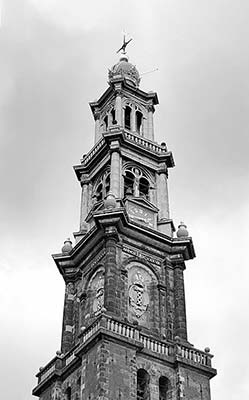
NETHERLANDS HISTORY
ROMANS AND INVASIONS (AD 1-1300)
BOOMING TRADE TOWNS (1300-1500)
PROTESTANTS VS. CATHOLICS, FREEDOM FIGHTERS VS. SPANISH RULERS (1500s)
HOLLAND’S GOLDEN AGE. . . AND FALL (1600s)
WAVES OF GERMANS, HIPPIES, AND IMMIGRANTS (1900s)
THE NETHERLANDS TODAY (2000-present)
Born from the mud of a river delta that spills into the North Sea, the Dutch provinces united to become a global force of hardy seafarers, clever merchants, and freethinkers.
ROMANS AND INVASIONS (AD 1-1300)
When Rome fell (c. 400), the Low Countries shattered into a patchwork of local dukedoms that were ravaged by Viking raids. It was a poor, agricultural, and feudal landscape ruled loosely by the Counts of Holland. Holland’s first major city was Utrecht—a former Roman fort that became a crossroads of trade and bulwark of Christianity.
Around 1250, fishermen in Amsterdam built a dike (dam) where the Amstel River flowed into the North Sea, creating a prime trading port. Soon the town gained independence and trading privileges from the local count and bishop.
Sights
• Amsterdam: Dam Square and Amsterdam Museum exhibits
• Haarlem: Grote Markt
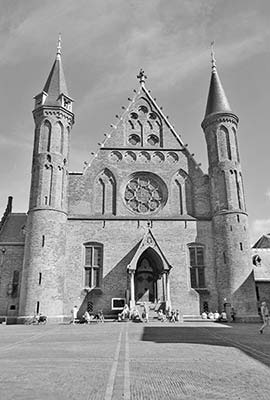
• The Hague: Ridderzaal and Binnenhof (see photo)
BOOMING TRADE TOWNS (1300-1500)
Amsterdam became a bustling little port, trading its signature salt-cured herring for German beer, all financed with a budding capitalism: banking, loans, and speculation in stock and futures. The city attracted religious pilgrims when a communion wafer mysteriously survived a fire and subsequently caused a rash of miraculous healings. But Amsterdam was only one among several trade towns in this land of businessmen—Haarlem, Delft, Edam. By 1500, it was Leiden that was the region’s biggest city.
Politically, the Netherlands was ruled by the cultured empire of the Dukes of Burgundy (centered in the southern provinces—today’s Belgium).
Tiny Holland’s future changed forever in the year 1492, when Columbus’ voyage hinted at the potential wealth awaiting hardy seafarers...like the Dutch.
Sights
• Amsterdam: Old Church (Oude Kerk) and New Church (Nieuwe Kerk)
• Amsterdam: Mint Tower (from the original city wall) and wooden house at Begijnhof 34
• Haarlem: Grote Kerk
• Delft: New Church (Nieuwe Kerk)
PROTESTANTS VS. CATHOLICS, FREEDOM FIGHTERS VS. SPANISH RULERS (1500s)
Thanks to royal marriages, the Low Countries were ruled from afar by the very Catholic Habsburg family in Spain. Meanwhile, Protestantism was spreading. In 1566, angry Protestants rose up against Spain and Catholicism, vandalizing Catholic churches (“iconoclasm”) and deposing Spanish governors. William of Orange rallied the Dutch, becoming the father of his country and establishing his family—and their heraldic color—as national institutions. (The current king is distantly descended from William.) When Spain sent troops to restore order and brutally punish the rebel-heretics, it kicked off the Eighty Years’ War, also known as the Dutch War of Independence (1568-1648).
During the war, the Dutch stood strong in the brave Alamo-like stand in the siege of Haarlem (1572-1573). In 1574, they flooded South Holland and sailed flat-bottomed ships against the Spanish to save Leiden. When the thriving (Belgian) city of Antwerp fell to Spanish troops (1585), Antwerp’s best and brightest fled to the Netherlands. Other refugees of religious persecution, including Calvinists and Anabaptists, found a home in tolerant Amsterdam. The influx of talented immigrants would spur the coming “golden age.”
Within a few years, most Spanish troops were driven south into Belgium. Belgium remained under Spanish control while Holland’s towns and nobles formed a Protestant military alliance (the United Provinces) to keep the Spaniards at bay.
Sights
• Amsterdam and Delft: “New” churches stripped bare of decoration during the iconoclasm
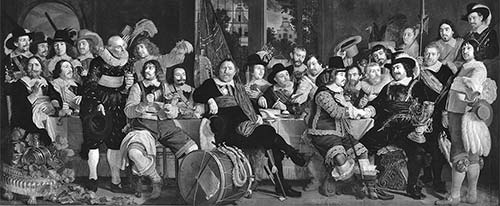
• Amsterdam: Civic Guard portraits at Amsterdam Museum
• Haarlem: Mementos of the Siege of Haarlem at Grote Kerk
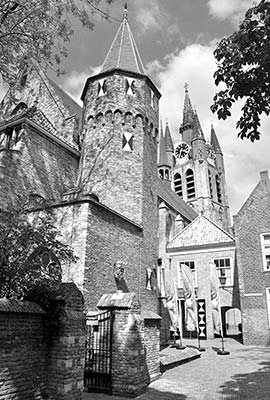
• Delft: Prinsenhof (see photo, earlier) and Tomb of William of Orange
HOLLAND’S GOLDEN AGE. . . AND FALL (1600s)
By 1600, Holland gained its independence from the Habsburgs (officially in 1648) and emerged stronger and more energized than ever. When England defeated the Spanish Armada (navy, in 1588), Spain’s monopoly on overseas trade was broken and Holland was poised to leap in.
Amsterdam invented the global economy, as its sailors plied the open seas and established trade routes to the far reaches of the planet. (Henry Hudson sailed up America’s Hudson River to what would become New Amsterdam.) The government-subsidized Dutch East and West India Companies employed brute force to establish colonies all over the world. The Dutch people’s nautical and capitalist skills—and their knack for exploiting the resources and human labor of faraway lands—made Amsterdam, with a population of 100,000, the world’s wealthiest city. It was home to the painter Rembrandt, philosopher René (“I think, therefore I am”) Descartes, plus many different religious sects and a bustling Jewish Quarter.
The good times were not confined to Amsterdam. Delft was a thriving market town of textiles and export beer, and home to painter Vermeer and microscope-maker Van Leeuwenhoek. In Haarlem, Frans Hals painted humanist portraits. Leiden’s prestigious university welcomed scholars, and the tolerant town welcomed the persecuted Pilgrims (Protestants from England), who would eventually leave (in 1620) for the New World.
Of course, this was a “golden age” only for a privileged few. Much of the Netherlands’ wealth came from its overseas holdings, where Dutch traders exerted control over human lives and natural resources with an iron fist. The Dutch were also key players in the transatlantic trade of enslaved people (see the sidebar, above).
In 1648, the Eighty Years’ War officially ended, and the United Provinces (today’s Netherlands) was now an independent and prosperous republic.
Even at Holland’s golden age peak (c. 1650), forces were at work that would eventually drag it down. In 1637, after several years of insanely lucrative trade in tulip bulbs (“tulip mania”), the market crashed. As the century progressed, the harbors of Edam and Marken began silting up.
Holland was overtaken by the rise of the new superpowers on the block—England and France. In 1652, Holland went to war with England over control of the seas, the first of three wars that would sap Holland’s wealth. In 1689, Holland’s stadholder—William III of Orange—was invited by England’s Parliament to rule (with his wife Mary) as King William III of England. Meanwhile, Louis XIV of France invaded Holland, getting within 15 miles of Amsterdam before being stopped when the citizens opened the Amstel locks and flooded the city. By century’s end, France and England controlled the seas and Holland was drained by costly wars.
Sights
• Amsterdam: Rijksmuseum (Rembrandt, Hals, Vermeer, Steen)
• Amsterdam: Old townhouses and gables in Jordaan neighborhood and Red Light District
• Amsterdam: Begijnhof, Royal Palace, Westerkerk, and Rembrandt’s House
• Amsterdam: World Museum (for a thoughtful look at Dutch colonialism)
• Haarlem: Frans Hals Museum
• Edam: Grote Kerk
• Hoorn: Period rooms at Westfries Museum
• Leiden: American Pilgrim and Lakenhal museums
• The Hague: Mauritshuis Royal Picture Gallery (Vermeer, Rembrandt, Rubens)
ELEGANT DECLINE (1700s)
The Dutch survived as bankers, small manufacturers, and craftsmen in luxury goods—but on a small scale fitting their geographical size. They cruised along on exploited wealth from their colonies in the East Indies and Suriname. Delft continued to crank out Delftware, but the quality declined.
The Netherlands hit rock bottom in 1795, when French troops occupied the Low Countries (1795-1815) and Napoleon Bonaparte proclaimed his brother, Louis Napoleon, to be King of Holland.
Sights
• Amsterdam: Our Lord in the Attic Museum (hidden church), Willet-Holthuysen House, and Jewish Museum synagogue
• Amsterdam: Royal Palace
• Amsterdam and Haarlem: Indonesian foods from the colonial era
• Delft: Royal Delft Museum
REVIVAL (1800s)
After Napoleon’s defeat, Europe’s nobles decided that the Low Countries should be a monarchy, ruled jointly by a Dutch prince, who became King William I. (Today’s King Willem-Alexander is descended from him.) When Belgian patriots revolted against the Dutch-born king and formed their own nation, the two countries—the Netherlands and Belgium—officially split. The Netherlands soon became a constitutional monarchy with a parliament.
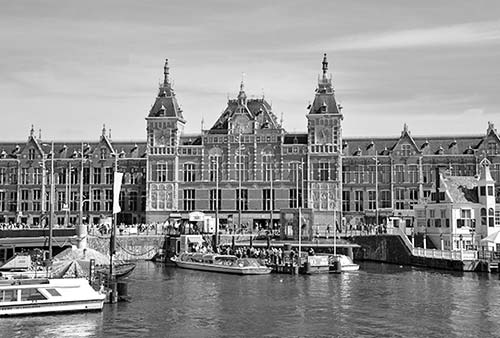
Though slow to join the Industrial Revolution, Holland picked up speed by century’s end. In 1876, the North Sea Canal opened after 52 years of construction, revitalizing Amsterdam’s port. In the next decade, the city built Centraal station, the Rijksmuseum, and Concertgebouw, and hosted a World Exhibition (1883) that attracted three million visitors. Progressive thinkers questioned the country’s repressive colonial tradition in the East Indies.
Sights
• Amsterdam: Centraal station (see photo), Rijksmuseum, Stadsschouwburg theater, Concertgebouw music hall, and Magna Plaza
• Amsterdam: Van Gogh Museum
WAVES OF GERMANS, HIPPIES, AND IMMIGRANTS (1900s)
The 20th century started off badly, with World War I, though neutral Holland was spared the worst of it.
In 1932, the Dutch Zuiderzee dike was completed, creating many square miles of reclaimed land (including today’s Flevoland). On the downside, the project closed off access to the North Sea, reducing once-thriving harbor towns like Enkhuizen and Marken to cutesy time-passed villages.
In World War II, Holland suffered a brutal occupation by Nazi Germany. Queen Wilhelmina (1880-1962) fled to England and Anne Frank went into hiding. Of the 140,000 Dutch Jews, 102,000 were killed. Rotterdam was utterly destroyed by German bombs. After the war, the city was ultimately rebuilt in a modern style and became Europe’s busiest port.
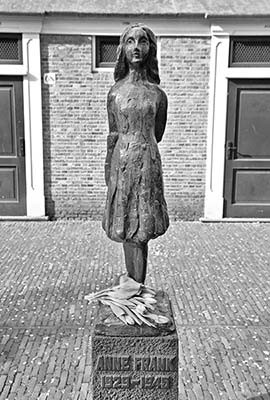
In Amsterdam, postwar prosperity and a tolerant atmosphere in the 1960s and 1970s made it a global magnet for hippies...and your co-authors.
From the 1950s through the 1980s, hundreds of thousands of new arrivals from former colonies (especially Indonesia and Suriname) increased Amsterdam’s population and changed its demographics, in some cases causing friction with established residents.
Holland continued its eternal battle with the sea. Major floods killed almost 2,000 people (in 1953) and caused a billion dollars in damage (in 1995), prompting more dams and storm barriers. Facing global warming, the “Low Countries”—with much of their territory below sea level—kept a close watch on rising seas.
The Netherlands was an active participant in the international community. In 1957, it helped found the Common Market and joined the Benelux economic union (in 1960). In 1992, it joined 11 other countries in signing the Treaty of Maastricht (in southern Holland) to become founding members of the European Union. The Hague became home to the world court.
Sights
• Amsterdam: Beurs (Stock Exchange), Tuschinski Theater, and National Monument on Dam Square
• Amsterdam: Anne Frank House, Jewish Museum, and Dutch Resistance Museum
• Amsterdam: Heineken Experience, rock-and-roll clubs Paradiso and Melkweg, and the “Stopera” opera house
• Haarlem: Corrie ten Boom House
• Enkhuizen: Zuiderzee Museum
• Flevoland: Schokland Museum
• The Hague: Peace Palace
• Rotterdam: Striking modern architecture (Centraal station, Cube Houses, skyscraper zone)
THE NETHERLANDS TODAY (2000-present)
In the early 2000s, the assassinations of Pim Fortuyn and Theo van Gogh caused a backlash against immigration from Muslim countries and a move to the right (see sidebar). The country is still feeling varied pressures from its growing and diversifying population, including housing shortages.
Overtourism is a concern, especially where sex work and soft drugs are an issue. The mayor of Amsterdam has proposed a plan to move sex workers out of the Red Light District and has threatened to ban foreign tourists from cannabis cafés. Maastricht and other southern Dutch cities have restricted marijuana purchases to Dutch citizens only. In an effort to tamp down illicit-drug activity, the national government is experimenting with the legal production and supply of cannabis—just as some US states have.
In 2013, King Willem-Alexander (b. 1967) became ruler of the Netherlands, the first male on the Dutch throne in 123 years (and likely be the last, for a while: His heir apparent is his daughter, Catharina-Amalia). Increasingly, general-election results are revealing a growing nationalist sentiment and challenging assumptions about the famous “progressivism” of the Dutch. The rise of the center-right People’s Party for Freedom and Democracy (VVD) has been eclipsed by the far-right, populist Party for Freedom (PVV)—which held the most seats in the House of Representatives as of the 2023 elections.
Even as the political pendulum swings, the Netherlands remains peaceful, prosperous, and largely forward-thinking—waiting for you to arrive and make your own history.
Sights
• Amsterdam: Metro, EYE Filmmuseum, A’DAM Tower, and Muziekgebouw performance hall
• Rotterdam: Centraal station and Market Hall
For more on Dutch history, consider Europe 101: History & Art for the Traveler, written by Rick Steves and Gene Openshaw (available at www.ricksteves.com).