HOORN, ENKHUIZEN & THE HISTORIC TRIANGLE
Two towns in North Holland, each conveniently located on the same speedy train line, make this side trip from Amsterdam a great day out: Hoorn, with its Westfries Museum (may be closed for renovation), offers the best look I’ve seen at golden age Dutch East India Company heritage. And Enkhuizen has the Zuiderzee Museum, Holland’s most complete and interactive open-air folk museum for traditional Dutch culture. For a lazier day, take the Historic Triangle loop, which combines the two towns with countryside scenery via steam train, vintage boat, and modern-day train.
PLANNING YOUR TIME
From Amsterdam, twice-hourly trains connect both towns easily (Amsterdam to Hoorn: 30 minutes, Hoorn to Enkhuizen: 25 minutes, Enkhuizen to Amsterdam: 1 hour). Each town is easy to explore on foot and can keep you busy for a good three to four hours of sightseeing. It’s possible to see both Hoorn and the open-air museum in one long day on your own.
In Hoorn, visit the Westfries Museum (or, if not yet reopened after an extended renovation, its temporary “Story of Hoorn” multimedia exhibit in the former town hall). Afterwards, wander the town and enjoy its harbor (allow a few hours for Hoorn).
The Enkhuizen Zuiderzee Museum merits at least three hours, plus a little time in the sweet little town.
The Historic Triangle loop—a combination steam train, 1920s-era ship, and regular train circuit from Hoorn—gives you a fun and memorable look at the countryside. However, the loop trip doesn’t leave you enough time to fully appreciate the sights in both Hoorn and the Enkhuizen Zuiderzee Museum (with more time, you could add an overnight stop and spread the trip over two days). If you’re contemplating the Historic Triangle, read that section carefully and confirm schedules before committing, as it requires a bit more planning.
Hoorn
Hoorn, with 75,000 people, is big enough that it has 21st-century urban problems and unsightly sprawl. Even its old core is now a construction zone, including a multiyear renovation of the town’s jewel, the Westfries Museum. But on the side streets of Hoorn, you go back in time and find yourself surrounded by the facades and cobbles of a day when New York City was called New Amsterdam and the Dutch really were masters. With a major harbor, Hoorn was a prosperous trade center during Holland’s golden age in the 1600s. The town’s merchant ships sailed to exotic corners of the globe to stuff their holds with precious commodities. Hoorn was the birthplace of Jan Pieterszoon Coen, an officer of the Dutch East India Company. Another local boy, Willem Schouten, sailed around South America’s stormy southernmost point in 1616 and named it after his hometown—Kaap Hoorn (Cape Horn).
Arrival in Hoorn: The Hoorn train station is about a half-mile from the old center. It takes about 20 minutes to walk to the main square: Head south down Veemarkt (the diagonal street with trees in the median), turn right on Gedempte Turfhaven (which becomes Breed), then take a left on Grote Noord—the big, bustling main commercial drag. Follow Grote Noord straight to Roode Steen, the main square (where you’ll find the Westfries Museum).
Sights in Hoorn
Grote Noord
Stroll the bustling main drag of Hoorn just to feel the pulse of the city today. You’ll pass Koepel Kerk on the right, with a big dome indicating that it’s the Catholic church. Stepping inside you see a church filled with statues, colored glass, and decoration—definitely not Protestant.
▲De Roode Steen
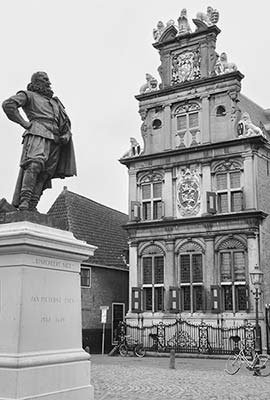
Hoorn’s small main square, literally “The Red Stone,” is named for the blood that once flowed from the gallows here. It was a tough heritage. The statue in the center is of Jan Pieterszoon Coen, an officer of the Dutch East India Company and the ruthless governor-general of the Dutch East Indies (present-day Indonesia) in the early 1600s. He was so cruel to people in lands the Dutch colonized that honoring the mean sonofabitch with this statue has become controversial. Read the plaque for all the gory details. The old building with the brightly colored facade is the Westfries Museum (described next). Opposite it is the delightful weigh house (Waag) sporting a unicorn, the symbol of the city. Dating from the 1600s, today this building houses a popular café and restaurant, d’Oude Waegh, serving traditional dishes and providing a great place to just sip a drink and enjoy the scene at the center of Hoorn.
▲▲Westfries Museum
This museum takes the art and heritage of the Rijksmuseum and the Dutch Masters and puts it in the context of a real town and golden age community. Lavish period rooms feature actual artifacts of the age, and the building that houses the museum is perfectly suited for its task, with a distinctive, ornate facade—but since it dates from the 1630s, it’s currently undergoing major renovations and will likely be closed during your visit (scheduled to reopen around 2026; check www.westfriesmuseum.nl for updates and information). During the museum’s closure, you can visit the “Story of Hoorn” multimedia show about the town’s history; it’s on view in the former town hall at Nieuwstraat 23 (€7.50, includes access to town walking tour with audioguide on your mobile device, Tue-Sun 11:00-16:00, closed Mon).
Hoorn Harbor
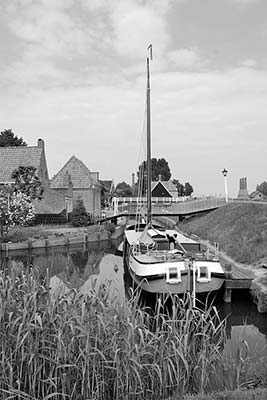
The town harbor, ringed by leaning golden age merchants’ houses and still guarded by an ancient tower, is an evocative scene. The old locks, once they were shut, protected the fleet from changing tides. That was before the Zuiderzee was controlled and made into a vast lake with the 1932 completion of a big dike, the Afsluitdijk. The great merchant ships are gone, replaced by seaworthy recreational boats. But under the tower, the charming statues of three boys still gaze out to sea, dreaming of salty adventures back when the Zuiderzee really was a sea and great ships sailed from here for the East Indies.
Museum of the 20th Century (Museum van de 20e Eeuw)
A former prison by the harbor has been reimagined to include a hotel, restaurant, and this fun museum that celebrates artifacts and pop culture from the not-distant past. It makes for a good rainy-day destination.
Cost and Hours: €10, includes English audioguide; Mon-Fri 10:00-17:00, Sat-Sun from 12:00; Krententuin 24, +31 229 214 001, www.museumhoorn.nl.
Museum Stoomtram
Train enthusiasts will enjoy the steam-train museum at the Hoorn station. Just across the tracks are an old-time station, a workshop where steam trains are maintained, and the departure point for a historical steam-train journey (14 miles each way to Medemblik and back; €16 one-way, 1.25-hour trip; €26.95 round-trip, www.stoomtram.nl). This ride is part of the Historic Triangle loop (described later). Note the museum is only open on days when the train is running.
Hoorn Connections
From the main train station, trains zip back to Amsterdam (2/hour, 30 minutes) or on to Enkhuizen (2/hour, 25 minutes).
To Enkhuizen: The direct train is the quickest way to reach Enkhuizen if you’re trying to squeeze maximum sightseeing into one day. But another option is via the sleepy loop trip called the Historic Triangle: Take a steam train to Medemblik, then a vintage boat to Enkhuizen. While this takes much longer than the direct train (and connections run far less frequently), it’s a relaxing way to soak up the Dutch scenery.
Enkhuizen Zuiderzee Museum
When the huge Zuiderzee (ZOW-der-zay) inlet was diked off and made into a lake in 1932, age-old Dutch lifestyles were in danger of disappearing. To preserve the traditional culture of the communities along the bay, the open-air Zuiderzee Museum, worth ▲▲, came into being. (For more on the Dutch land reclamation projects that closed off the Zuiderzee, see here.)
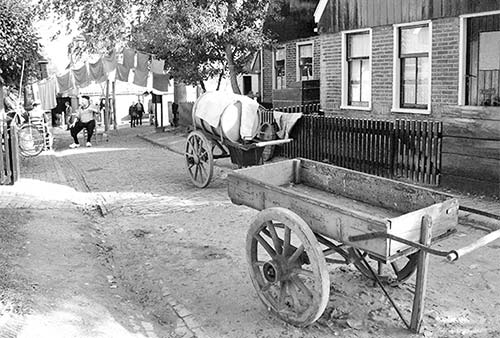
The museum’s original buildings were collected from around the Zuiderzee. You’ll meet people who do a convincing job of role-playing no-nonsense 1905 villagers. You’re welcome to take their picture, but they won’t smile—no one said, “Have a nice day,” back then. Children enjoy trying out old-time games, playing at the dress-up chest, and making sailing ships out of old wooden shoes. Scattered throughout the grounds are historic images of Zuiderzee children and posts where kids can listen to audio of kids describing events in their day-to-day lives.
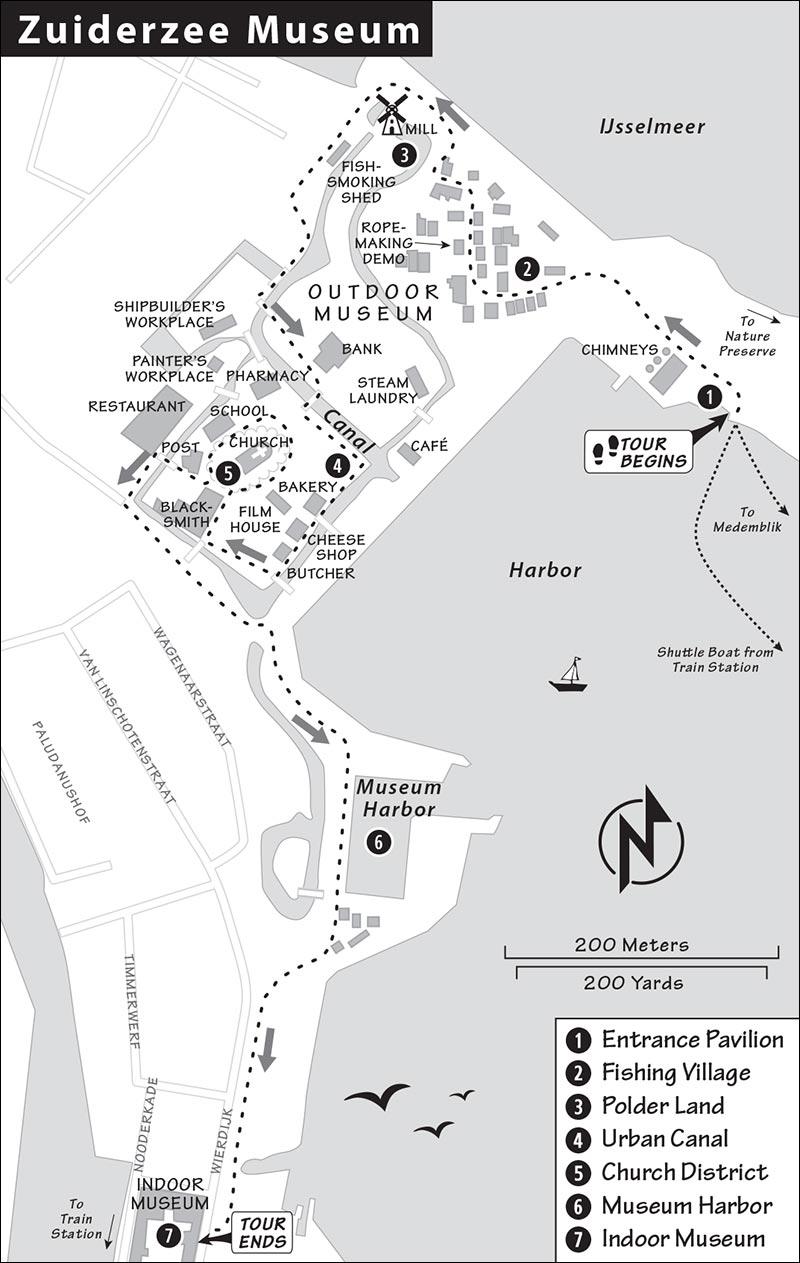
The museum is in Enkhuizen, a sleepy town of about 20,000 that was once a mighty harbor home to the Dutch merchant fleet. Towns like Enkhuizen were hit hard by the great reclamation projects that tamed the sea, landlocked once-vital ports, and destroyed hearty fishing traditions by turning the fertile sea into a big freshwater lake. The modern age left it behind, and today only holiday yachts and sailboats berth here. From Enkhuizen, a 17-mile dike, the Houtribdijk (route N-307), stretches east toward Lelystad in Flevoland, disappearing into the lake called IJsselmeer.
Tourist Office: In the small square to the right of the train station, a helpful TI sells tickets to the museum, allowing visitors to hop on the shuttle boat just next to the office and skip the 15-minute walk (daily 8:00-17:00, closed Nov-March, +31 228 313 164).
GETTING THERE
Whether you’re arriving by train from Amsterdam (2/hour, 1 hour) or Hoorn (2/hour, 25 minutes), it’s a 15-minute walk from Enkhuizen’s train station to the museum (follow signs for Zuiderzeemuseum), or you can buy a museum ticket at the TI and take the shuttle boat (details below).
If you’re taking the Historic Triangle trip, you’ll arrive by boat from Medemblik and dock directly at the museum. Drivers can park for free at the train station and then take the shuttle boat or walk to the museum.
Museum Shuttle Boat: A shuttle boat circles counterclockwise between the train station and the museum (free with museum ticket, 3/hour, 20-minute circuit).
ORIENTATION TO ZUIDERZEE MUSEUM
Cost: €19.50, €13 for kids 4-12, free for kids under 4, family ticket available. Tickets are sold online, at the town TI, near the dock of the outdoor museum, and in the indoor museum.
Hours: Daily 10:00-17:00, outdoor museum closed Nov-March.
Information: +31 228 351 111, www.zuiderzeemuseum.nl.
Sightseeing Strategies: The museum has two entrances. To visit in the same direction as my self-guided tour, take the boat from the train station, start with the outdoor museum, visit the indoor museum, then walk through town back to the station. To do it the other way, walk from the train station along the harbor, start with the indoor museum, tour the outdoor museum, and then catch the boat back to the Enkhuizen train station (last boat at 17:30).
 SELF-GUIDED TOUR
The Zuiderzee Museum is a delight to explore, with something for all the senses—smell the wood fires and tanning vats, savor a bite of aged cheese and old-fashioned licorice, watch a windmill turn, hold a lump of coal, and catch the sound of wooden clogs on a brick road. Follow this tour, but don’t be afraid to poke into houses and backyards (the curious get a lot more out of this experience). While I’ve listed stops here starting from the entrance pavilion by the shuttle boat dock, you can easily do it the other way around (just turn this book upside down). The museum has two sections: the outdoor part (Buitenmuseum) with more than 140 historic buildings from around the Zuiderzee relocated right here and, 200 yards away, the indoor museum (Binnenmuseum), filling a fine old merchant’s home and warehouse. Regardless of which direction you go, the museum is laid out in a nice meandering flow with one section leading to the next.
1 Entrance Pavilion: As you disembark the shuttle boat, a nature preserve lies to the right. Head to the left and look for a QR code to see a digital map to get oriented to the museum.
The museum is organized by section (e.g., the Church District). Every building has a little plaque with a brief English description and a map showing the building’s original location in the Zuiderzee region.
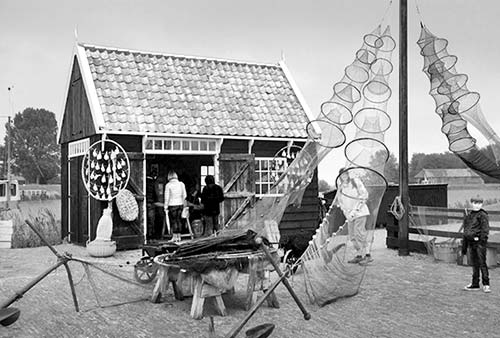
2 Fishing Village: The first section is the fishing village. Fun-to-explore homes and locals in period costumes populate the ramshackle village street from Urk—once a remote island across the Zuiderzee, now high and dry with a seemingly oversized fishing fleet. Just around the corner, you may be able to catch a rope-making demonstration.
3 Polder Land: Head to the polder area, near the windmill. Windmills harness the power of the wind to turn Archimedes’ screws, which, by rotating in a tube, pump water up over a dike and into the sea—continuing to drain reclaimed polder land. (Try it.) Nearby are vats used to cure fish and a smokehouse where you can buy a tasty seafood snack.
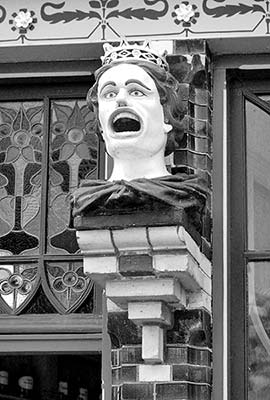
4 Urban Canal: Circle around to the urban canal zone, lined with shops—such as a bakery and a cheese shop where 15,000 clumps of Gouda could be aged. Don’t miss the pharmacy (marked Apotheke De Groote Gaper, under the queen with her mouth hanging open); ask if they stock any opium. Past the counter where the pharmacist weighs out little bottles of camphor, you’ll find a room full of open-mouthed giant heads. Traditionally, Dutch pharmacies were marked by a head with a gaping mouth (opening wide to say “aaaah” for the doctor, or for taking a pill). As you curl around along the little canal, you’ll pop into a rich sailor’s home from the 18th century and find other trades represented, such as a barber and a sailmaker.
5 Church District: Next, head into the church district, surrounding a reconstructed church dating from the 15th century. Because local builders were more familiar with boats than buildings, standing inside this church feels like being under an overturned boat (a common feeling in many Dutch village churches). Around the church are more shops, including the blacksmith and the fascinating cooper shop, where you can watch barrels being made. Don’t miss the schoolhouse, with two period classrooms: one from 1905 and another from 1930. Just across the canal from the church area is a big € cafeteria-style restaurant, with indoor and outdoor seating.
6 Museum Harbor: Now walk toward the cute, enclosed harbor, filled with Zuiderzee watercraft from ages past (just beyond it is a modern harbor, filled with pleasure boats). The little cluster of houses just beyond the harbor is based on the island village of Marken.
7 Indoor Museum: As you exit the outdoor museum, turn left, cross the street, and walk two blocks, watching for the museum on your right. The indoor exhibitions put a personal, contemporary touch on the villages. Be sure to pick up the included audioguide on your way in.
A large collection of historic Zuiderzee boats fills the entrance hall. Notice that many of the boats have big, flat fins on the sides. Because the Zuiderzee could be very shallow, these boats didn’t have a keel; the fins could be extended down into the water to provide more stability. Next, move on to the “Sea of Stories,” an interactive look at how the region’s people work hard, let loose in the bars and at the fair, and preserve traditions. The audioguide helps it all come alive. Watch for your chance to try on traditional costumes or ride a merry-go-round horse.
Returning to Amsterdam: From the indoor museum, it’s a scenic 15-minute walk, mostly along the water, through the bricks-and-canals town to the Enkhuizen train station: Exit the indoor museum to the right, follow the wall, and cross three canal bridges (watching for Station directional signs). If you finish the visit on the east end, hop on a shuttle boat to ride back to the train station (last boat at 17:30).
The Historic Triangle
This three-part journey designed for tourists makes for an interesting trip out from Hoorn (or from Amsterdam, connecting via Hoorn). If you’re more interested in steam trains, the pastoral countryside, and a little IJsselmeer cruise than the museums in Hoorn or Enkhuizen, it’s a great way to spend a day.
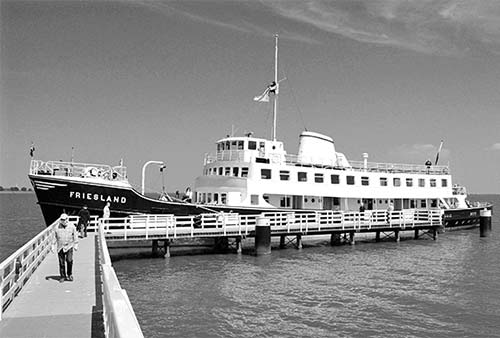
De Historische Driehoek, as it’s called in Dutch, consists of a steam train from Hoorn to Medemblik, followed by a cruise from Medemblik on the 1920s-era boat MS Friesland to Enkhuizen, stopping at the Zuiderzee Museum. There you can catch a regular train from Enkhuizen back to Hoorn or your accommodations in Haarlem, Amsterdam, or elsewhere.
The schedule can be frustrating, as most days there’s just one steam-train departure from Hoorn connecting to one daily boat at Medemblik. This means you leave Hoorn without time to visit the Westfries Museum, and you arrive in Enkhuizen without enough time to do the Zuiderzee Museum properly before it closes. (With more time, you could overnight in Hoorn and/or Enkhuizen.) Note that the train and the boat occasionally don’t run on Mondays.
Cost: €26.95 for combo-ticket covering stream train and vintage boat, www.stoomtram.nl; €5.50 for train from Enkhuizen to Hoorn, www.ns.nl.
Sample Schedule: 9:19—Train from Amsterdam to Hoorn; 9:51—Arrive in Hoorn; 10:40—Take steam train from Hoorn; 12:00—Arrive in Medemblik; 13:20—Boat sails from Medemblik; 14:50—Boat arrives at Zuiderzee Museum in Enkhuizen; 14:50-17:00—Enjoy Zuiderzee Museum; 17:00-18:00—Free time in Enkhuizen; 18:09—Catch the train to Amsterdam, arriving at 19:11. Confirm all times carefully before setting out.
STEAM TRAIN FROM HOORN TO MEDEMBLIK
The train departs from the Museum Stoomtram historical depot behind the main train station (across the tracks from the main arrivals hall; described earlier, under “Sights in Hoorn”).
After you choose a seat inside the train, you can get up and walk around. The best views are standing on the train balcony at the very back of the train. You’ll feel like a whistle-stop presidential candidate as the train plods through the Dutch countryside.
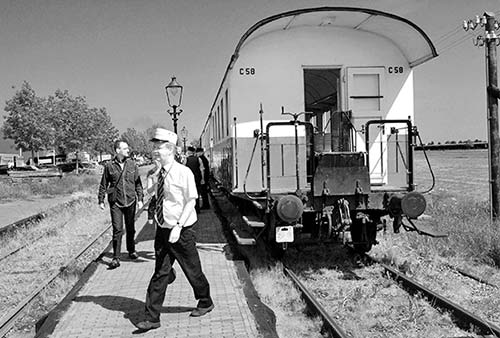
Enjoy the purely Dutch scenery on this serene, old-fashioned joyride. Count sheep. Moo at cows. Watch horses playfully run alongside the train. Look for ducks in the canals and pheasants in the fields. Go ahead, order the poffertjes (puffy mini-pancakes). If you see Dutch kids waving to the train from their backyards, wave back. The modern white windmills in the distance jolt you back into the 21st century, just in time to arrive at...
MEDEMBLIK
If connecting the steam train with the vintage boat ride, you’ll have about an hour in this pleasant town before boarding the boat (confirm the exact departure time at station). One of the oldest ports in the area, it has a Hanseatic League heritage and characteristic lanes and fortified buildings huddled around its old harbor. Medemblik has three main sights (all closed Mon): a bakery museum, the Kasteel Radboud (former castle, now a fortified mansion), and the Stoommachine Museum (an old pump station turned steam-engine museum just outside of town). Exit the station and bear left, then right, to walk up the main drag—a pretty market street lined with cafés, bakeries, shops, and postcard stands. If you’re hungry, you could grab a quick sandwich at an outdoor café, but you likely won’t have time for a full meal. Basic food is available on the boat.
Shortcut Back to Hoorn: If you skip the boat trip, you can ride back to Hoorn on the steam train or catch the bus (bus #139, at least hourly, 40 minutes, around €5, use contactless card). There’s no direct overland connection from Medemblik to Enkhuizen—if you miss the boat, you’ll have to take the bus back to Hoorn, then the train or bus from there to Enkhuizen.
BOAT FROM MEDEMBLIK TO ENKHUIZEN
Catch the MS Friesland to Enkhuizen just over the dike from the Medemblik station (you’ll see the boat moored there as your train pulls in, €13.25 one-way ticket, info-www.msfriesland.nl, then follow e-ticket link to buy on www.stoomtram.nl). It’s a 1.5-hour putter along the coast to the Zuiderzee Museum in Enkhuizen. You can grab a bite in the boat’s surprisingly comfortable dining room. If you’ve brought a picnic, grab a wicker chair and enjoy the peaceful, windswept deck. Kids can safely run around on the open spaces of the top deck or play wooden board games in the lounge. In good weather, you’ll pass small pleasure craft—little sailboats and windsurfers—close enough to shake hands.