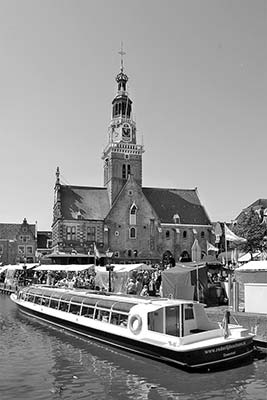
ALKMAAR AND ZAANSE SCHANS
Two handy day trips line up north of Amsterdam: Alkmaar is a famous cheesemaking town with a charming square and a bustling cheese market; Zaanse Schans, while the least interesting of Holland’s open-air museums, is also its most convenient—offering a taste of traditional life a stone’s throw from the capital. Consider combining the two destinations for a full day of sightseeing, ideally on a day when Alkmaar’s festive cheese market enlivens the town.
Alkmaar
Alkmaar is Holland’s cheese capital (and, perhaps, the unofficial capital of high cholesterol). In addition to being an all-around delightful city, Alkmaar has a rich history and a zesty cheese-loving spirit. And though it’s enjoyable to visit any time, it’s most colorful, lively, and crowded during its bustling Friday-morning cheese market (late March-Sept). On your train ride here, you can study up by reading the “Dutch Cheeses” sidebar on here.
Orientation to Alkmaar
Once a stoutly walled city, Alkmaar (pop. 95,000) now has a tidy Old Town laced with canals. The main square, Waagplein, is named for Alkmaar’s cheese weighing. The mighty Weigh House, containing the TI and Cheese Museum, is at one end of the square, and the Beer Museum is at the other. (Think of it as Holland’s Wisconsin.) From this area, the main pedestrian drag, Langestraat, leads visitors to the Grote Kerk and Stedelijk Museum.
Tourist Information: Alkmaar’s TI, in the old Weigh House, sells a town walking-tour brochure (Mon-Sat 9:30-17:00, Sun 11:30-16:30, Waagplein 2, +31 72 511 4284, www.visitalkmaar.com).
The Museumkaart sightseeing pass (a potentially worthwhile purchase for those visiting Amsterdam—see here) covers entry to Alkmaar’s Cheese Museum, Beer Museum, and Stedelijk Museum.
Arrival in Alkmaar: From the train station, it’s a 15-minute walk to the town center. Exit the station to the right and veer left with the arterial down Stationsweg, then turn left (onto Scharlo) when the street dead-ends. Soon you’ll cross a canal and see the big church (Grote Kerk), with the modern library and Stedelijk Museum to the left. From the church, walk straight up the main pedestrian street (Langestraat). When you reach the next canal, turn left and walk one more block to the main square and TI.
Sights in Alkmaar
▲▲Cheese Market (Kaasmarkt)
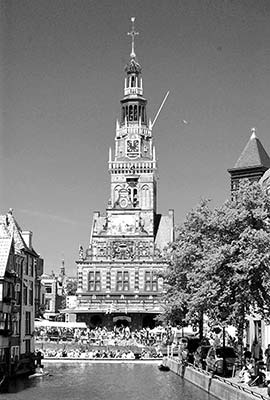
Tellingly, Alkmaar’s biggest building isn’t the church or the Town Hall but the richly decorated Weigh House (Waaggebouw), used since the 16th century for weighing cheese. (It was converted from an old chapel.) The right to weigh, sell, and tax cheese is what put Alkmaar on the map in the Middle Ages, and it’s still what the town celebrates today.
Think about the udder importance of cheese to this culture—wheying the fact that it has long kept the Dutch economy moo-ving. If you travel through the Dutch countryside, you’ll pass endless fields filled with cows, which are more reliable producers than crops in this marshy landscape. Because cheese offers similar nutritional value to milk but lasts much longer without refrigeration, it was a staple on long sea voyages—and Holland was the first country to export it. Today the Netherlands remains among the world’s biggest cheese exporters.
There’s no better time to sample a sliver of this proud wedge of Dutch culture than during Alkmaar’s cheese market, which reenacts the spectacle of buying and selling cheese on Fridays in spring and summer (late March-Sept 10:00-13:00) and Tuesday evenings in July and August (19:00-21:00; www.kaasmarkt.nl).
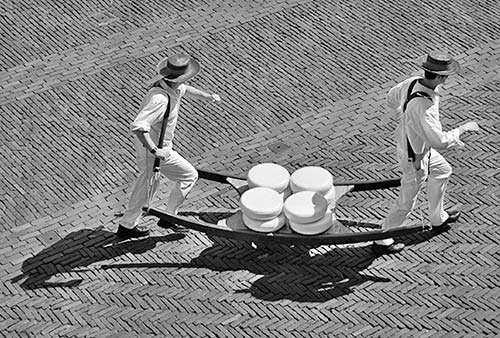
To start the festivities, cheesemakers line up their giant orange wheels in neat rows on the square. Prospective buyers examine and sample the cheeses and make their selections. Then the cheese is sold off with much fanfare, as an emcee narrates the action (in Dutch and English). To close the deal, costumed cheese carriers run the giant wheels back and forth to the Weigh House just as they have for centuries: They load a wheel onto a “cheese-barrow”—kind of a wooden stretcher—then sling each end over their shoulders on ropes and run it to and fro. The cheese carriers’ guild has four “fraternities” of seven carriers each: red, yellow, blue, and green (with color-coded hats, cheese-barrows, and scales). There is one “cheese father,” who wears an orange hat, enforces the strict rules, and levies fines on carriers who show up late or drink beer before carrying cheese (which is strictly forbidden).
On cheese-market days, the town erupts in a carnival atmosphere, becoming one big street fair with festive entertainers and vendors selling souvenirs, snacks...and, of course, cheese. It can get crowded—especially midmorning—and even the Cheese Museum (described next) is packed, yet its windows allow great unobstructed views of the action below.
▲Cheese Museum (Het Hollands Kaasmuseum)
This is probably the Netherlands’ best cheese museum...and in this country, that’s saying something. With displays on two floors above the TI in the Weigh House, the museum explains both traditional and modern methods of cheesemaking. You’ll learn that as the economy evolved, cheesemaking went from being the labor of farmers’ wives to that of factory workers. The museum also has old equipment (much of it still used for today’s cheese market), such as big scales, wagons, cheese-barrows, and (upstairs) old presses for squeezing the last bit of whey out of the cheese molds. Ask for an English showing of the eight-minute movie that traces the history and traditions of Alkmaar cheesemaking, including how to pronounce Gouda in Dutch. (Think “how-da.”) Multimedia displays and exhibits include English descriptions, and kids will enjoy the scavenger hunt; ask for it at the entrance.
Cost and Hours: €6.50; Mon-Sat 10:00-16:00, Sun from 12:00; longer hours on cheese market days; enter TI at Waagplein 2 and walk upstairs to museum, +31 72 515 5516, www.kaasmuseum.nl.
National Beer Museum De Boom (Nationaal Biermuseum De Boom)
This museum in a former brewery covers beer production across the centuries—from the days of barrels to the earliest bottling plants to the craft beers of today. The 1700s-era replica bar has sand on the floor, from a time when men were men and didn’t have to aim into a spittoon. An exhibit highlights brewers from the Alkmaar area, and a map guides you on a historic brewery walk through the old city. If you’re not a beer lover or a backyard brewer, I’d skip it.
Cost and Hours: €9.50, tastings extra; Thu-Sat 12:00-17:00, closed Sun-Wed; across Waagplein from Weigh House at Houttil 1, +31 72 511 3801, www.biermuseum.nl.
Grote Kerk
Alkmaar’s 500-year-old “Great Church” is similar to others in Holland (such as Haarlem’s and Delft’s). Visit if you want to see a typically austere Dutch interior.
Cost and Hours: Free; generally Tue-Sun 11:00-17:00, closed Mon; closed off-season to sightseers. The church hosts frequent concerts and other events (for schedules, call +31 72 514 0707 or see www.grotekerk-alkmaar.nl).
Stedelijk Museum Alkmaar
The Stedelijk, which has its primary collection in Amsterdam, also runs this worthwhile branch in little Alkmaar (next to Grote Kerk). The museum has two parts: a permanent collection about the history of Alkmaar and the Dutch golden age, and a space for temporary exhibits. There are several excellent short movies in the town history section, enlivened by props and sound effects (ask to see it in English). But the rest of the history exhibit—with stiff group portraits, other paintings, and artifacts from the town’s illustrious past—is only in Dutch and difficult for tourists to appreciate. You can also see works of the Bergen School, the Dutch version of Expressionism (1915-1925). Visit here only if the temporary exhibit intrigues you.
Cost and Hours: €16; Tue-Sun 11:00-17:00, closed Mon; Canadaplein 1, +31 72 548 9789, www.stedelijkmuseumalkmaar.nl.
Alkmaar Connections
Alkmaar is connected by frequent fast trains to Amsterdam (4/hour, 40 minutes). However, these trains do not stop at the Zaanse Schans museum. To visit the Zaanse Schans museum on your way back to Amsterdam, take a train from Alkmaar to Uitgeest or Zaandam (2/hour), where you can transfer to a slower regional train (check connection times; they can be very tight) to Zaandijk Zaanse Schans (about 40 minutes total). On busy days, the info desk in the tunnel of the Alkmaar train station hands out schedules for this connection.
Zaanse Schans Open-Air Museum
This re-created 17th-century town puts Dutch culture—from cheesemaking to wooden-shoe carving—on a lazy Susan. Located on the Zaan River in the town of Zaandijk, the museum is devoted to the traditional lifestyles along the Zaan—once lined with hundreds of windmills used for every imaginable purpose and today heavily industrialized (including a giant corporate chocolate factory). In the 1960s, houses from around the region were transplanted here to preserve traditional culture. Many of the exhibits are run by quirky locals who’ve found their niche in life and do it with gusto.
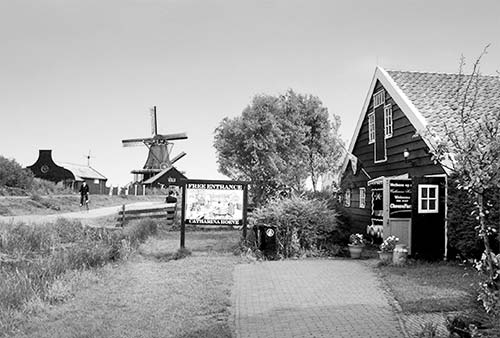
Zaanse Schans (ZAHN-zeh shahns), a hodgepodge of loosely related attractions in a pretty park with old houses, feels less like a museum than Arnhem’s or Enkhuizen’s open-air museums. And since each attraction charges a separate entry fee (and those that are free are either selling or promoting something), it also feels more crassly commercial...You’ll be nickel-and-dimed for your cultural education. But it’s undeniably handy—just 15 minutes by train (plus a 15-minute walk) from downtown Amsterdam. Two of the attractions here—the Zaanse Time Museum and the tourable working windmills—are unique and genuinely interesting (and worth ▲). Because it’s the easiest one-stop look at the Netherlands’ traditional culture, Zaanse Schans is often flooded through midday by busloads of tour groups. To avoid the hordes, come late.
GETTING THERE
By Public Transportation: From Amsterdam Centraal, catch a Sprinter train to Zaandijk Zaanse Schans (4/hour, 15 minutes). From the station, it’s a 15-minute walk to the museum (well-marked, just follow the signs...and the other tourists). Go through the underpass and exit straight ahead, then continue straight until the road forks. (If this area seems surprisingly sweet-smelling for an industrial district, thank the chocolate factory.) From the fork, follow Zaanse Schans signs. Turn left, then right across the river, which puts you at the “back entrance” to the park, near the Time Museum. (If coming from Alkmaar, you can reach Zaandijk Zaanse Schans by train, but it requires a transfer—see “Alkmaar Connections,” earlier.)
You can also take bus #391 from Amsterdam, which departs from the Noorderpark Metro stop (4/hour, 40 minutes).
By Car: From Amsterdam, take A-8 (direction: Zaanstad/Purmerend), turn off at Purmerend A-7, then follow signs to Zaanse Schans (€15 for parking, discount with the Zaanse Schans Card, explained below).
ORIENTATION TO ZAANSE SCHANS
Cost: Entry to the grounds is free, though that may change by your visit; check www.dezaanseschans.nl for updates. Some sights charge admission (see prices under each listing). If you’ll be seeing the main Zaans Museum, the Windmill Museum, Weaver’s House, Zaanse Time Museum, and at least one windmill, you might save a little money with the €29.50 Zaanse Schans Card (also includes discounts on parking and at some shops and cafés). The Museumkaart covers every sight here except the windmills.
Hours: The grounds are open all the time because people actually live here. During the spring and summer (April-Sept), most building interiors are open daily 9:00-17:00 (though some are closed Mon, and individual opening and closing times can vary). After about 16:30, things can get quiet. In the off-season (Oct-March), hours can be shorter, and some attractions close on weekdays; check www.dezaanseschans.nl for details.
Information and Services: The visitors center, located in the Zaans Museum building, has a good, inexpensive map of the grounds. Ask if any events are scheduled for the day you visit (daily 9:00-17:00, lockers, café, pay WCs, +31 75 681 0000, www.dezaanseschans.nl).
Boat Tours: A “Windmillhopper” boat cruise offers a chance to see the village from the water (€11, 25 minutes, departures every half-hour Wed-Mon 10:30-17:30, closed Tue and in off-season, +31 61 697 6430, www.windmillhopper.nl).
SIGHTS AT ZAANSE SCHANS
I’ve arranged these sights in order from the train station. Drivers should park at the Zaans Museum and visit these in reverse order, or walk five minutes to the Time Museum and begin there.
▲Zaanse Time Museum (Museum Zaanse Tijd)
More interesting than it sounds, this collection is brought to life by its curator—clock enthusiast Pier van Leeuwen—and other volunteers. Although Pier has officially retired, he can often be found at the museum. If so, he may show you around, lovingly describing his favorite pieces. (If he’s not there, he can still introduce you to seven centuries’ worth of timepieces, virtually, in several videos that you can watch by scanning QR codes.) The collection aims to show the sweep of Dutch clock history. Its highlights include a bulky, crank-wound turret clock from around 1520. Back then, the length of an “hour” wasn’t fixed—there were simply 12 of them between sunrise and sunset, so the clock’s weights could be adjusted to modify the length of an hour at different times of year. Also look for two of the world’s four surviving original 17th-century pendulum clocks, which allowed for more precision in timekeeping, and appreciate the fine craftsmanship of the Zaans clocks (one clock is wound by being pushed up on a rack, rather than by pulling a chain) and Amsterdam clocks.
Cost and Hours: €12, daily 10:00-17:00, +31 75 617 9769, www.zaansetijd.nl.
• Next door is the...
Albert Heijn Grocery “Museum” (Museumwinkel)
Little more than a thinly veiled advertisement for the Dutch supermarket chain, this replica grocery store from the 1880s re-creates the first shop run by Albert Heijn. The scant exhibits lead you to a room promoting Heijn coffee.
Cost and Hours: Free, get English description sheet; Tue-Sun 11:00-16:00, closed Mon; off-season Sat-Sun only; +31 75 670 5657, https://albertheijnerfgoed.nl.
• A few doors up the street is the recommended D’Swarte Walvis restaurant. Just beyond is the dock for the Windmillhopper boat tours (described above), a lovely view of the windmills, and a shop selling some goods produced by them, ranging from spices to paint dyes to paper. The little village area across from the boat landing also has fun shops, including an adorable curiosity shop that’s a pack rat’s heaven. You’ll also find the very modest...
Bakery Museum (Bakkerijmuseum)
Follow your nose to see a small display of old bakery equipment (including cookie molds). Borrow the English descriptions to navigate the slapdash exhibit, then consider a snack in the cozy front room.
Cost and Hours: Free to enter museum, various treats available—most around €3; Tue-Sun 9:30-18:00, closed Mon; off-season daily 9:30-17:00; +31 6 2412 3970.
• Now head for the...
▲Windmill Museum (Molenmuseum) and Windmills (Molens)
The very industrious Zaan region is typified by hardworking windmills, which you’ll still see everywhere (though in far fewer numbers than in centuries past). Mills are built with sturdy oak-timber frames to withstand the constant tension of movement. To catch the desired amount of wind, millers—like expert sailors—know just how much to unfurl the sails. When the direction of the wind shifts, the miller turns the cap of the building, which weighs several tons, to face the breeze. The Windmill Museum, at the far end of the many mills here, immerses you in four centuries of social and economic context before turning you loose to explore them. From the museum’s top floor you can orient yourself with an excellent view across the landscape. (If you don’t have time for the museum, simply visit the mills that interest you.)
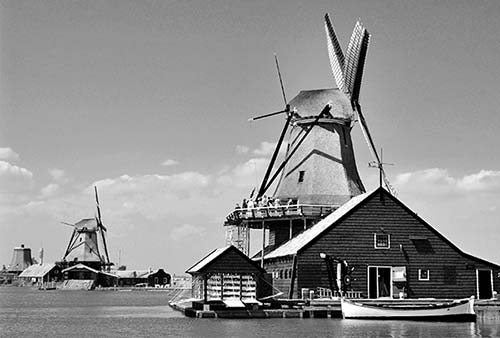
Cost and Hours: Museum-€12, €22 combo-ticket includes visit to two mills, otherwise €6 per mill; museum open daily 10:00-17:00, off-season from 12:00; mill hours vary—check website for details; Kalverringdijk 30, +31 75 621 5148, www.zaanschemolen.nl.
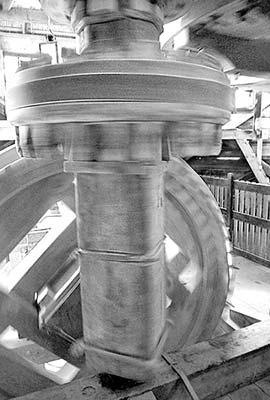
Visiting the Windmills: Each mill has its own purpose. De Kat (“The Cat”) grinds dyes. Watch its gigantic millstones rolling over the colored dust again and again, as wooden chutes keep it on its path. Climb the steep steps (practically a ladder) for a closer look at the wooden gears and the fine views out over the museum grounds. De Zoeker (“The Seeker”) crushes oil from seeds and nuts, a drop at a time—up to an incredible 100 quarts per day. De Huisman (“The Houseman”) grinds spices and fills the air with wonderful scents. Try to visit a mill that’s spinning—you’ll see more action inside. And though these structures appear graceful, and even whimsical from the outside, on a windy day you can experience their awesome power by getting up close to their grinding gears.
• After exploring the windmills, cross the little canal to the big...
De Catharina Hoeve Cheese Farm (Kaasmakerij)
Essentially a giant cheese shop, this is worthwhile only if you catch one of their presentations. A movie shows how cheese is made, and periodically a costumed Dutch maiden explains the process in person and dispenses samples...followed by a confident sales pitch.
Cost and Hours: Free entry, daily 9:00-18:00, off-season until 17:00, +31 75 621 5820, https://henriwillig.com.
• Walk past the mini-windmill to the...
Weaver’s House (Wevershuis)
Inside this small house you will be taken through the weaving process by energetic volunteers who show you how families lived and worked among the looms in the 18th century.
Cost and Hours: €3, daily 10:00-17:00.
• Then walk to another shopping zone, which includes the...
Wooden Shoe Workshop (Klompenmakerij)
More engaging than the park’s other free attractions, this shoe store features a well-presented (though congested) display of clogs from different regions of the Netherlands. You’ll see how clogs were adapted for various purposes, including wooden clogs with boot-like leather to the knee, frilly decorative bridal clogs, high-heel clogs, roller-skate clogs, and spiky clogs for ice fishing. Have a seat at the end of the narrow entry hall to catch the live demonstration that sends wood chips flying as a machine carves a shoe. Your visit ends—where else?—in the vast clog shop.
Cost and Hours: Free entry, daily 8:00-18:00, off-season until 17:00, +31 75 617 7121, www.woodenshoes.nl.
• Nearby is the recommended De Kraai restaurant, and just across the big parking lot is our final stop, the...
▲Zaans Museum and Verkade Pavilion
This museum, with a modern structure that evokes both the hull of a ship and the curved body of a whale, is the focal point of the complex.
Cost and Hours: €14.50, includes good audioguide, daily 10:00-17:00, +31 75 681 0000, www.zaansmuseum.nl.
Visiting the Museum: The museum houses the visitors center, as well as interactive displays and an exhibit hall that explains Holland’s industrial past and present and how this region has been shaped by its wind and water. Temporary exhibits can be an especially good way to learn how the Zaan River corridor is changing as city dwellers seek life in the suburbs and former factories become flats, cafés, and yoga studios.
The other half of the building is given over to Verkade, a beloved Dutch brand of candies and cookies (translations here use the British term “biscuit”). The pavilion is essentially a very slick version of several other “museums” around the park—thinly disguised branding opportunities for major Dutch companies. Nonetheless, this re-created factory is a fun treat, especially if they are giving out free samples. Look for well-written explanations and clever computer-based games. Don’t miss your chance to make like Lucy and Ethel and see how many virtual bonbons you can pick off a speeding conveyor belt and pack into a box—my score: 1,253.
EATING AT ZAANSE SCHANS
Walking from the train station into town, across from the windmill before crossing the bridge, you’ll pass a handful of restaurants and a SPAR supermarket with picnic options (daily, Guisweg 9). Once you cross the bridge into the sightseeing village you’ll find these places:
€€ Restaurant de Kraai, across from the Wooden Shoe Workshop, is a cafeteria-style eatery offering traditional sweet and savory pancakes, plus sandwiches and salads (daily 9:00-18:00, on slow days may close earlier, indoor and outdoor seating, +31 75 615 6403).
€€€ D’Swarte Walvis (“The Black Whale”) has an all-day menu with everything from soup, sandwiches, and Dutch tapas to pricier main plates. Typically, the inside is packed at lunch. There is also outdoor seating that’s shared with their takeout counter that serves more casual fare (daily, +31 75 616 5629, www.dewalvis.nl).