UTRECHT
The Netherlands’ crossroads city, Utrecht has a thriving old center with unique and inviting canalside embankments, the towering remains of a half-ruined church, a variety of fun museums (including the country’s best railroad museum and a quirky collection of music-making machines), and a huge student population to keep things humming. Bigger and more bustling than Haarlem, Delft, or Leiden, but still exuding a small-town warmth along its gorgeous canalfront wharves, Utrecht feels at once packed with weighty history, and yet also fun to explore.
PLANNING YOUR TIME
Utrecht is a quick side trip from Amsterdam (30 minutes by train). You can see the downtown highlights in an easy 1.5-hour stroll, following my self-guided walk. With more time, dip into some museums or climb the cathedral tower. The excellent Railway Museum, a bit farther out (but still an easy walk or a train ride from Utrecht Centraal station), is also worth a visit and could fill several hours.
Because it’s on the same train line as Arnhem, it’s tempting to combine a peek at Utrecht with a visit to Arnhem—but to fit everything in takes careful planning (see the previous chapter for suggestions).
Orientation to Utrecht
With about 330,000 inhabitants, Utrecht (OO-treht) is the Netherlands’ fourth-biggest city (after Amsterdam, Rotterdam, and The Hague). But it feels quite a bit smaller than those cities, thanks to its relatively compact central zone. Most of the sights are contained within or just outside the harp-shaped old town (Binnenstad)—which takes about 15 minutes to traverse on foot from end to end. This central zone is ringed by a moat (singel)—much of it now covered over with a ring road—and crisscrossed by two main canals, the Oudegracht (old canal) and Nieuwegracht (new canal).
TOURIST INFORMATION
The main TI is tucked into a corner off Cathedral (Dom) Square; look for colorful flags and Winkel van Utrecht above the entrance. You can get tower tickets inside (TI open daily 10:00-17:00, Domplein 9, +31 30 236 0004, www.visit-utrecht.com). The Utrecht Info Counter within Hoog Catharijne—the train station shopping mall—is also helpful (Tue-Sat 10:00-18:00, Sun-Mon from 12:00).
Sightseeing Pass: The Museumkaart sightseeing pass (see here) covers entry to the Railway Museum, Musical Clock Museum, Catharijne Convent Museum, University Museum, Centraal Museum, and botanical gardens.
ARRIVAL IN UTRECHT
At Utrecht’s Centraal train station, you’ll find pay WCs above tracks 20-21 on the station’s main level and lockers (credit cards only) two floors above tracks 18-19, next to Bar Beton. The train station and Hoog Catharijne shopping mall are basically one large building. My self-guided walk starts from your train platform and leads you into town.
Utrecht Walk
This lazy, one-mile tour loops you from the train station into town, along Utrecht’s most scenic canals, past a few of its worthwhile museums, and to its landmark cathedral tower. From there, you can head back to the station, or proceed across town to visit the excellent Railway Museum (adding about a half-mile of walking each way). The basic loop takes about 1.5 hours, not including sightseeing stops; to add the Railway Museum, figure another three hours (including two hours at the museum).
• Step off your train into Utrecht. Find a quiet corner in the busy terminal to read the following before making your way into town.
1 Centraal Station
Situated in the middle of the Netherlands, Utrecht is the country’s primary transportation hub—with its biggest and busiest train station, the headquarters of the Dutch Railway, and the national rail museum (across town).
Built in the 1970s, the train station was wrapped inside a gigantic American-style shopping mall called Hoog Catharijne. While the station/mall succeeded in jump-starting a flagging economy, it was the opposite of user-friendly: The maze of shops made arriving visitors feel like overwhelmed toddlers lost in a shopping mall in Anytown, USA. Inside and out, architecture like this earned its name: brutalist.
But city planners have completely revamped the station area. They’ve also built a state-of-the-art convention center (behind the tracks), as well as the TivoliVredenburg music center, which you may be able to see (along with a reopened canal) on the left as you cross over the busy highway on the glassed-in concourse.
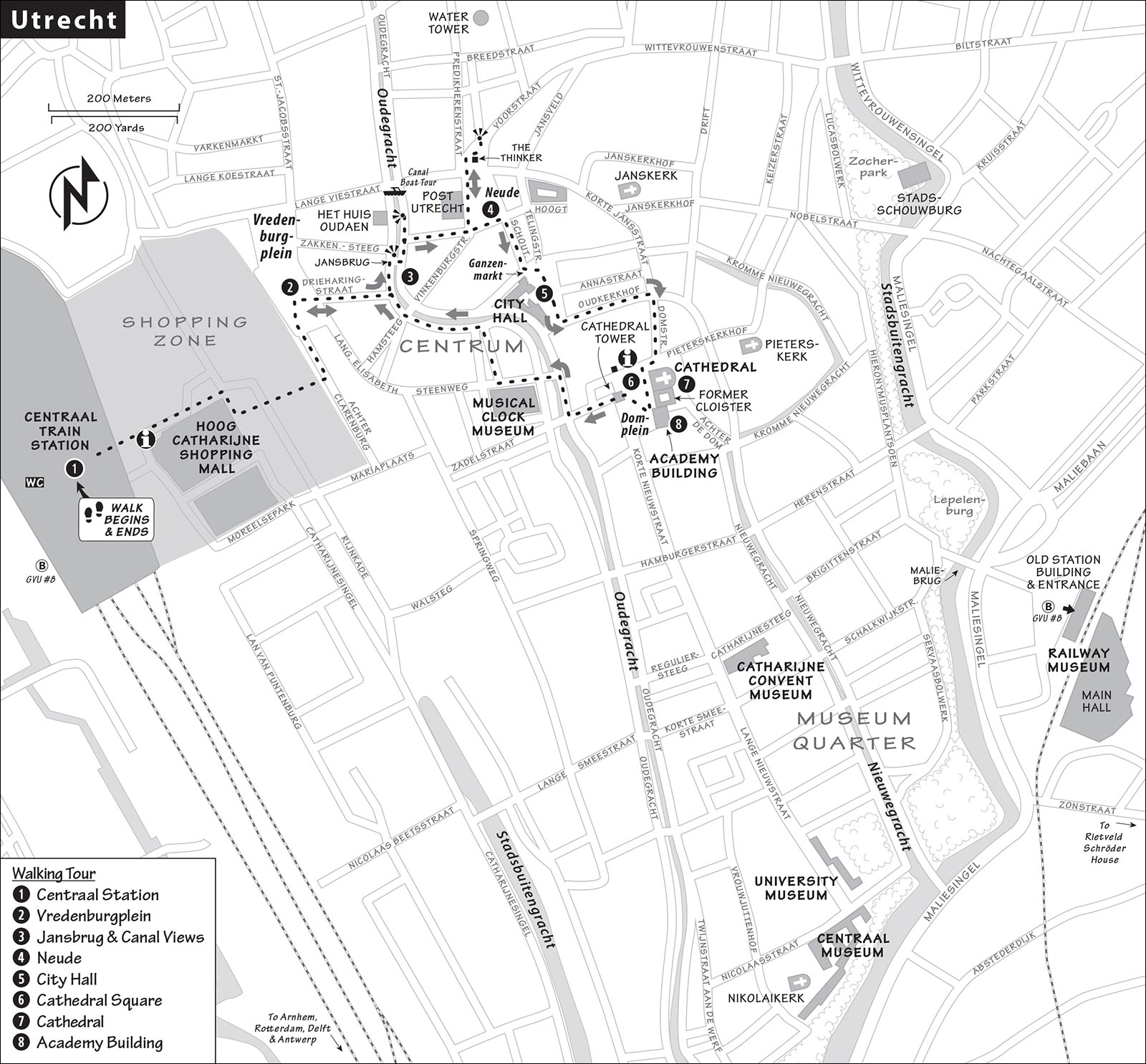
• Exit the train station through the shopping mall, following signs to Vredenburgplein. When you leave the mall, turn left onto the pedestrian street named Achter Clarenburg. You’ll emerge at the square called...
2 Vredenburgplein
This historic market square (one of many in this trade crossroads) is still busy with an outdoor market every Wednesday, Friday, and Saturday. It’s named for a long-gone-but-not-forgotten, deeply despised symbol of outsiders meddling in Utrecht’s business. The original Vredenburg (ironically called “Peace Castle”) was built by the Holy Roman Emperor Charles V after he annexed Utrecht. It kept the peace not by watching for invaders from the outside, but by keeping close tabs on the would-be enemies who lived inside the walls. Worse, during the Eighty Years’ War, the castle was taken over by invading Spanish forces who trained their cannons on the town’s own people.
After the siege was broken, the city wanted to keep the castle intact for its own defense...but people power took over. Trijn van Leemput led a cadre of local women who climbed up onto the fort and—in a dramatic event that looms large in local folklore—started pulling bricks off the structure, inspiring their fellow townspeople to literally tear the building apart. (For a peek at the castle’s foundation, curious archaeologists can duck into the bicycle parking garage at the left end of the square.)
• Now cut across the middle of the square and find the lane called Drieharingstraat. This street—crammed with café tables—offers one of many good opportunities in Utrecht to have a drink, snack, or meal. Follow it to the main canal, called Oudegracht. Turn left along the embankment, then head halfway across the first bridge you come to (Jansbrug) and survey the scene.
3 Jansbrug and Canal Views
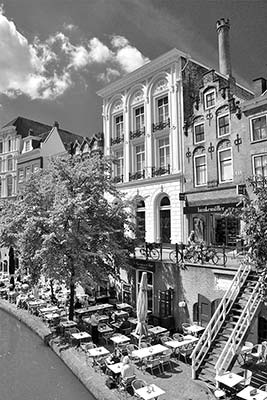
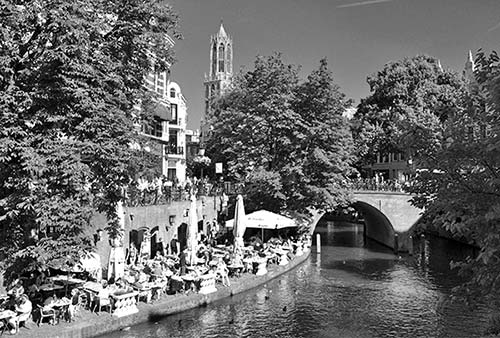
While Dutch cities have no shortage of canals, Utrecht’s are unique for their double-decker design: an upper walkway, lively with pedestrians and cyclists jostling in front of pretty townhouses, and a lower wharf (kaden), which was once the industrial zone where goods could be loaded off ships and directly into those houses’ cellars. In the 1940s, these warehouses (no longer connected to the mansions above) were repurposed as restaurants and cafés. Today the canal itself allows only leisure traffic (including touristy canal cruises and rental paddleboats), plus a few hardworking service barges: Look for the garbage-collection boat and the red-and-white, city-operated “beer boats” that deliver kegs.
• Let’s head down for a better look. Continue the rest of the way across the bridge, turn left, and take the first set of steps down to the wharf.
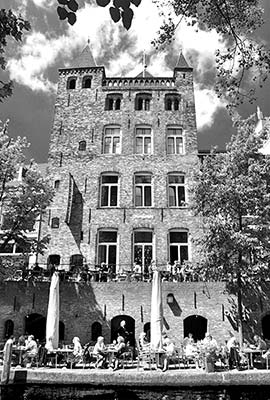
Look up across the canal, at the house marked Het Huis Oudaen, dating from around 1300. This is a typical, ritzy canal house (sometimes called “city castles”) from Utrecht’s trading heyday. Scanning the building from left to right, identify the four parts: The tallest, skinny, turreted structure on the far left is the stair house (used for reaching the upper stories); next is the main house (with huge windows to let in maximum light and to show off residents’ wealth); then, tucked on the right side, comes the shorter “side house” (where the cheapskate owners lived in the winter, since it was smaller and less expensive to heat); and finally, on the embankment down below, the warehouse cellars. This building was rebuilt after it was destroyed during the Spaniards’ Vredenburg siege in 1577; the cannonballs embedded in the wall commemorate that dark history. Later, in the 18th century, the building became a home for seniors—notice the elderly couple decorating the stone entryway of the side house.
Before heading back up, look around and enjoy the canal’s-eye view. While the walls rising up from the canals are uniform, you can gauge at a glance how wide each house is by the distance between the nose-high drainpipes that flank each foundation. Looking up to street level, notice the fine details carved into the square stone bases (called “corbels”) of the wrought-iron lampposts. Each one of the 300-plus corbels in the city center is different, carved by local stonecutters. These whimsical sculptures may relate to the history of a nearby building or may simply be biblical or mythological scenes.
• Retrace your steps back to street level. At the top of the stairs, notice that the big building at the start of Drakenburgstraat is another typical canal house (now a shop). Canal cruises depart from the bridge a block farther up the canal.
Now head up Drakenburgstraat. Emerging into the big square, wade through hundreds of café tables to the middle.
4 Neude
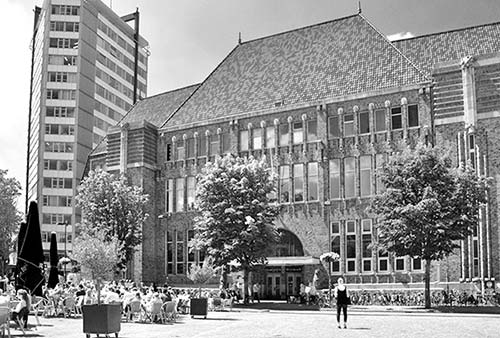
This square is one of Utrecht’s main gathering points. The hulking building on your left as you entered the square is Post Utrecht, the former post office, now a sleek public library (bibliotheek) and café combo. The Dutch are extremely early adopters of new technology—and quick to abandon old ways. In 2011, the Dutch mail system closed many of its post offices and was privatized. (These days, you’ll see some bright orange PostNL storefront service centers, though much postal business has moved online or into small businesses.) The changes left a big question mark for historic old buildings like this one, which is considered an important landmark of the architectural transition from the ornamented Jugendstil/Art Nouveau of the 1920s to the straightforward functionalism of the 1930s (a period collectively called the “Amsterdam School”). Step inside to peek at its far more impressive interior—with a swooping, parabolic roofline of shimmering yellow brick.
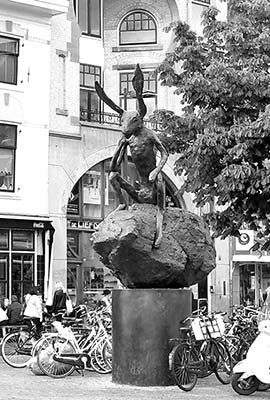
Past the end of the bibliotheek, just across the busy road, look for the sculpture of The Thinker as a hare, by Welsh sculptor Barry Flanagan. Behind the sculpture, walk up Voorstraat one short block to Predikherenstraat. Between the buildings to the left, look for a classic old water tower. These were built in cities throughout the Netherlands in the late 19th century, when scientists realized the importance of clean water in protecting public health.
• Head back to the far end of Neude square and walk down Schoutenstraat. You’ll emerge into a square called Ganzenmarkt (also labeled Korte Minrebroederstraat), dominated by the eclectic facade of...
5 City Hall
Utrecht’s seat of government is an architectural hodgepodge. It started out as several linked townhouses; later, in the 19th century, they slapped the stern Neoclassical facade on the front. More recently, in the early 2000s, renowned Catalan architect Enric Miralles added the modern extension. Notice that he left a jarring gap (the glass corridor) for future growth. Miralles’ choices have been controversial on aesthetic grounds—although this is the main entrance of the building, it feels unfinished.
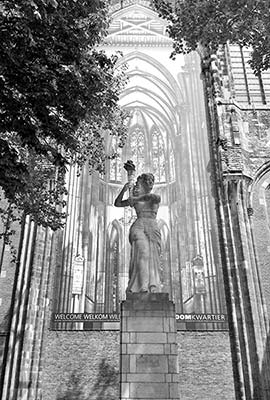
• Walk to the far end of the square and turn left, following the pleasant, shop-lined Oudkerkhof, with lots of youthful boutiques and creative stores. At the end of the street, turn right down Domstraat and head for those flying buttresses. Reaching the church, turn right and circle around to the square. Stand directly between the church and the tall tower. (If you’re weary, take a seat on one of the pebble-style benches near the base of the WWII monument.)
6 Cathedral Square (Domplein)
Standing right here a few hundred years ago, you’d be in the middle of a massive cathedral’s nave.
Several churches have stood on this spot, each marked today by a faint footprint of gray stones in the pavement. In the late seventh century, the English missionary Willibrord built a chapel dedicated to St. Martin on this square. It was later replaced by a Romanesque version, then by a gigantic French-style Gothic structure, which was completed in the early 16th century. At the time of its completion, St. Martin’s Cathedral was the biggest church in the Netherlands. But money ran out near the end of construction, causing the builders to skimp on the nave: Rather than weight-supporting flying buttresses (like the ones you just saw supporting the apse), it had a simple, flat wooden roof. On the hot summer evening of August 1, 1674, a violent tornado ripped through Utrecht, collapsing the nave of the church around where you’re standing now. Trying to salvage what they could of the hulking building, the townspeople sealed off the transept—enclosing a new, much smaller church—and let the jumble of ruins sit here for a century and a half, finally clearing out the rubble to create this square in 1826. Noticing how the outline of the nave is still visible in the wall of the surviving church, mentally resurrect what a mighty house of worship this once was.
Look up at the cathedral tower—368 feet tall, with 465 steps to the top, it’s still the tallest one in the Netherlands. The open-work structure allows stiff breezes to blow right through, creating less wind resistance—and, some believe, preventing it from being toppled with the rest of the church. The carillon halfway up plays cheery jingles every quarter-hour, all day (and night), every day.
7 Cathedral (Domkerk)
You have three options for visiting the cathedral: Climb the tower, tour the interior of the modern-day church (entrance to the right as you face the building), and descend underground to see the fragments of earlier church structures embedded below the square (buy tickets a few doors to the right of the TI).
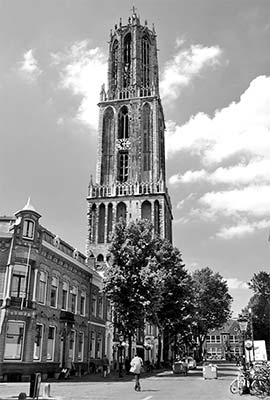
Cathedral Tower Climb: You can climb the tower (Domtoren) with a one-hour escorted tour (€13.50, buy tickets at the TI across the square; daily 10:00-17:00; +31 30 236 0010, www.domtoren.nl; tours in Dutch and English).
Pick up your ticket and meet your guide at the TI (free lockers for day bags). Your guide will lead you over to the tower and up, up, up to the top (465 steps, no elevator). Each level has history exhibits. Just over halfway up, you’ll get up close to the giant bells. It’s another 80 feet to the viewpoint near the top. From here, more than 300 feet above the square, you can clearly see the outline of the once-massive cathedral—and pretty much everything else in Utrecht.
Cathedral Interior: The interior is free to visit but a €2 donation is suggested (Mon-Fri 10:00-17:00, Sat until 15:15, Sun 12:30-17:00, shorter hours off-season; audioguide-€3, www.domkerk.nl).
Step inside the truncated church. The organ marks the point from which the nave once stretched much farther—all the way to the tower, now outside. Buried at the main altar isn’t a saint, but an admiral and war hero, Willem Joseph Baron van Gendt.
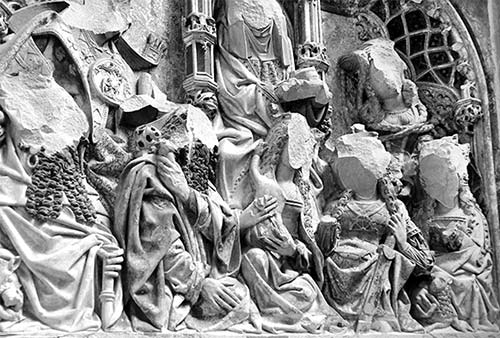
In the small chapel on the right as you face the main altar, find the poignant statues whose faces were ripped off from the 1560s through the 1580s. While originally Catholic, like many Dutch churches this became Protestant following the Reformation. But unlike in other churches, you can actually see the damaging effects of the iconoclasts that sought to destructively unclutter the worshippers’ communion with God. The next chapel farther back has more such disfigured statues. These statues were later covered over by a wall and only rediscovered in the 20th century.
DOMunder (Underground Church Foundations): The DOMunder experience lets you wander among giant old pillars in a subterranean visitors center 15 feet below the square (€14, daily 10:00-17:00, check website for tour times, www.domunder.nl).
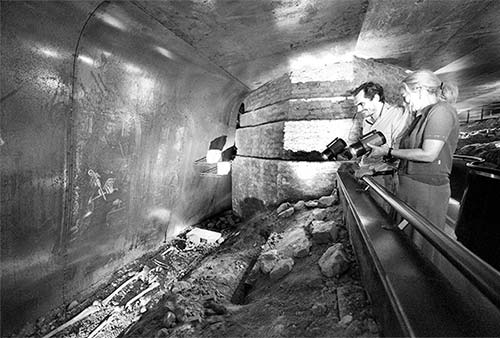
The tour starts in the TI (across from the cathedral) with a talk and video presentation as the guide explains the history of the many churches that have stood here. Afterward, you enter the underground space through the rusted entrance in the middle of the square, and then follow the one-way route through the interactive exhibition. Point your innovative audioguide flashlight at items scattered around the ruins to hear about them on your headphones. This is a fun tour for kids and a good rainy-day activity.
• Facing the cathedral, head right, to the frilly building in the corner of the square.
8 Academy Building (Academiegebouw)
Originally the cathedral’s chapterhouse, after the Reformation this gorgeous building became the center of Utrecht University. The Netherlands’ biggest university—with an enrollment of about 30,000—U.U. is also one of its oldest (founded in 1636). These days, the science faculties are neatly segregated at a modern campus called De Uithof, which was built on reclaimed polder land just east of town in the 1970s. But law and humanities are still in the city center, and students of all stripes still hang out downtown.
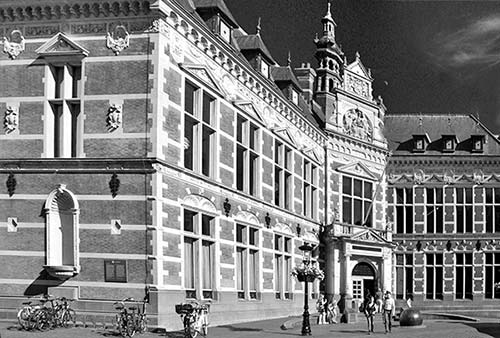
In the 19th century, architects celebrated the university’s 250th birthday by dressing up this building with a stunning Neo-Renaissance facade. U.U.’s symbol is the shining sun, represented both by the vivid sculpture on the gable above the main door (with the red-and-white crest of Utrecht) and by the giant sphere in the pavement in front. The building is usually open; if so, peek inside.
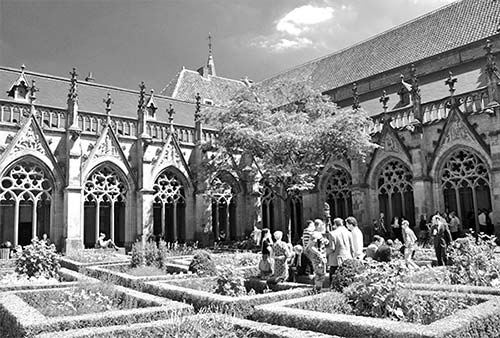
Facing the building, look for the ornately carved stone Gothic gateway just to the left. Step inside to enjoy a harmonious and peaceful space—the former cloister of the church, today used for special events for students. (A café surveying this serene scene can be accessed through the cathedral.) The carved triangles over the arches depict scenes from the life of the cathedral’s namesake, St. Martin.
Leaving the cloister, look left down Korte Nieuwstraat. This street leads several blocks south through town to Utrecht’s museum quarter—worth exploring if you have extra time. Among the city’s fine museums are the Centraal Museum (displaying art, design, fashion, and city history exhibits in a former monastery), the Catharijne Convent Museum (filling a medieval convent with religious art), and the University Museum (with a fine botanical garden and hands-on science exhibits for all ages). Architecture students make a pilgrimage to the Rietveld Schröder House, a famous Piet Mondrian-style single-family house in the suburbs just outside the center. For more details on any of these, ask at the TI.
The Nieuwegracht, a peaceful and scenic canal with the same double-decker construction as the Oudegracht, parallels Korte Nieuwstraat one block to the left. The Railway Museum is a pleasant 15-minute walk from the Academy Building: Head down Korte Nieuwstraat and make the second left onto Hamburgerstraat, which becomes Herenstraat, and leads you to a park that traces the former city wall and moat. The museum is through the park and to the right.
• Or, if you’re ready to move on, you can head...
Back to the Train Station
From Cathedral Square, go through the big tunnel at the base of the tower. In one block, you’ll emerge at the main canal, Oudegracht. Turn right and wander, simply enjoying the people-watching (but watch for cyclists, who recklessly whiz along this embankment). After one short block, you’ll reach a square covering the canal. At the far end of this, turn left up Hanengeschrei, which becomes Steenweg. The entrance for the Musical Clock Museum (described later) is on the left.
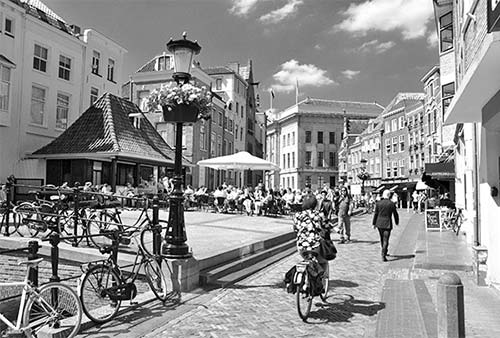
You can follow the busy Steenweg shopping street all the way back to the station (it becomes Lange Elisabethstraat partway along). Or, for a more scenic stroll, turn right up the street just after the clock museum (Massegast), then turn left along the canal to follow Oudegracht for a few short-but-scenic blocks; just turn left on Drieharingstraat to return to the station.
Sights in Utrecht
▲▲Railway Museum (Spoorwegmuseum)
The most interesting sight in town is Holland’s biggest and best display of all things locomotive. It’s full of vintage engines and cars (including the Dutch royal family’s official train), model railways, and re-creations of historic scenes. Although primarily designed for Dutch families (with spotty English translations), it’s easy for anyone to appreciate and particularly fun for kids. Even the most train-blasé will want to spend at least two hours here.
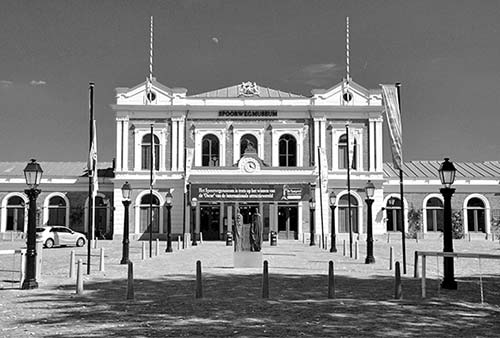
Cost and Hours: €19.50, free for kids 3 and under; Tue-Sun 10:00-17:00, closed Mon; at east edge of town in the old-fashioned Maliebaan train station, +31 30 230 6206, www.spoorwegmuseum.nl.
Getting There: From downtown (and the end of my self-guided walk), it’s an easy 15-minute walk—see directions earlier. Another option is to take the train from Utrecht Centraal (runs about hourly on weekdays—confirm schedule for “Utrecht Maliebaan”; typically does not run Sat-Sun; 20 minutes, €2.60 one-way). While this sounds romantic, and the pokey spur route looks at slice-of-life Utrecht, the ride takes about the same amount of time as the pleasant walk through town. (However, the train can be a nice option for a sweat-free return to Centraal station—and your connecting train.) GVU bus #8 from Centraal station (direction: Stadsschouwburg) also runs to the museum (get off at the Maliebaan stop).
Visiting the Museum: The ambitious, well-presented museum combines a remarkable collection of old train cars with a modest, Disney-style amusement park. You’ll enter the fully restored Maliebaan train station, which evokes the genteel early days of rail travel (c. 1874), and buy your ticket (which includes a map and high-quality booklet describing what you’ll see). Cross the train tracks (passing the royal train, which is usually parked here) to reach the main hall and get oriented to the different areas.
The main hall, called World 4, is filled with historic locomotives and carriages. You’ll experience an interactive exhibit combining the images and sounds of 10 iconic trains to tell the history of rail transport. Along the right side of the hall are several more engaging attractions: the Steel Monsters roller coaster for kids; an Orient Express exhibit with an original carriage from the train line that once connected Western Europe to Istanbul (as well as a small theater presenting a live show in Dutch several times a day—read the translations in your booklet beforehand); and a lavishly re-created mining village from 19th-century England (with a replica of the world’s oldest passenger train car, from 1829).
Outside is a picnic area, a mini railroad that kids enjoy riding, and the prizewinning Trial by Fire ride—a jostling simulator of a harrowing steampunk train ride, narrated by the late Dutch actor Rutger Hauer (in Dutch—but the ride is still fun). Be sure to explore the sprawling grounds, which include a giant playground, an enormous turntable for locomotives, an old shunting yard (used to supply steam locomotives), a thought-provoking exhibit on the use of railway cars in World War II and the Holocaust, and temporary exhibits.
Musical Clock Museum (Museum Speelklok)
This fun museum fills the cavernous hall of a former church with a fascinating array of self-playing instruments: musical clocks, calliopes, and street organs in all their clicking, clanking, and tooting glory. On the main floor, several soundproof rooms house hulking calliopes and player pianos, while upstairs in the gallery, smaller pieces overlook the former nave. Everything is explained in English and some items are hands-on. For the best experience, make a point to join the 40-minute included tour.
Cost and Hours: €15.50 includes tour; Tue-Sun 10:00-17:00, closed Mon except public holidays, tours depart at :30 past each hour, last tour at 15:30; well-signed 10-minute walk from station, located on busy shopping street in city center at Steenweg 6, +31 30 231 2789, www.museumspeelklok.nl.
Utrecht Connections
Utrecht is the crossroads of the Netherlands, with major lines running north to Amsterdam (6/hour, 30 minutes), where you can connect to Haarlem (7/hour, 50 minutes total); northwest to Leiden (6/hour, 45 minutes), where you can transfer to The Hague (4/hour, 70 minutes total); southeast to Rotterdam (4/hour, 40 minutes), where you can connect to Delft (1 hour total; slower direct trains also available) and Antwerp, Belgium (2 hours total); and east to Arnhem (6/hour, 40 minutes).