HAARLEM
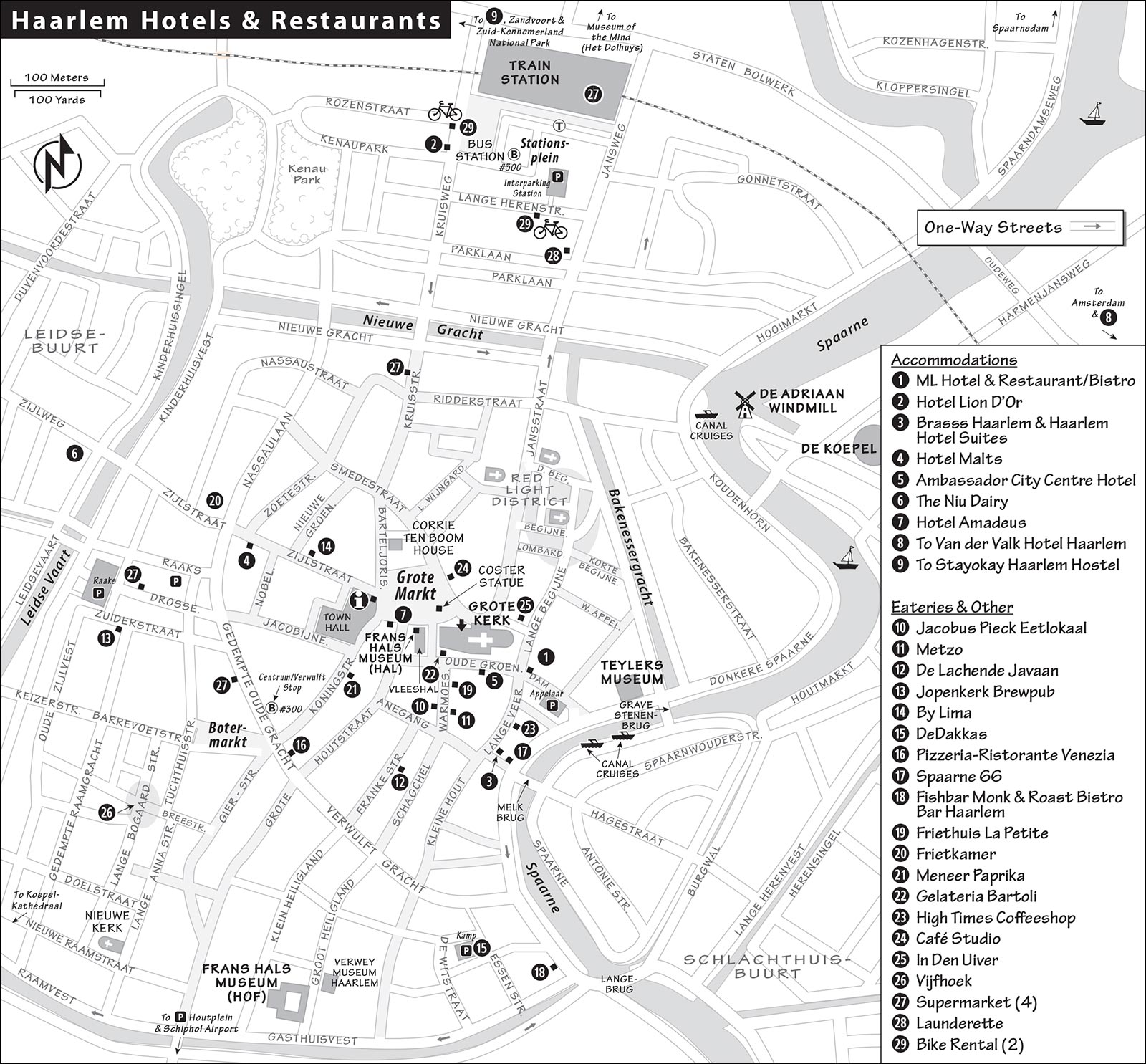
Map: Haarlem Hotels & Restaurants
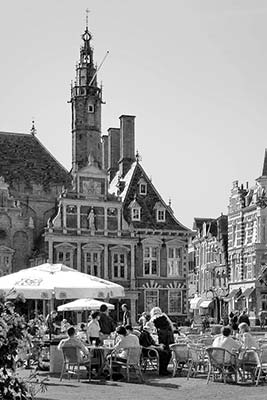
A golden age kind of town, cute and cozy Haarlem is quintessentially Dutch. With small-town warmth and easy access to Amsterdam or Schiphol Airport (20-30 minutes by train), it makes a good home base. It’s a bit less romantic than Amsterdam (lacking the many canals and footbridges)—but it’s also much more user-friendly, making it a good choice as a “soft landing” after a long flight or simply as a break from intense Amsterdam.
In the heart of Haarlem, the Gothic Grote Kerk, or Great Church, towers over the market square (Grote Markt). To uncover more of Haarlem’s sights, head down the narrow, characteristic lanes—dodging speeding cyclists as you go. The top museum in town features the work of its most famous son, portrait-artist Frans Hals. The Corrie ten Boom House relates the inspirational story of a family that courageously hid Jews from the Nazis. And the Teylers Museum is like a museum of museums—a time-warp to an authentic 18th-century collection of science and art treasures, plus access to the adjacent home of the museum’s socially conscious founder. There’s even a windmill that you can clamber around inside. And if it’s a sunny day, head to the beach at nearby Zandvoort or just go for a pedal through the polderland.
Orientation to Haarlem
Haarlem, with about 170,000 inhabitants and growing, still feels like a small town. At its eastern edge, the city gate—no longer needed as fortification—welcomes all into Haarlem’s old center. Bustling Haarlem gave America’s Harlem its name back when New York was New Amsterdam, a Dutch colony. For centuries, Haarlem has been a market town, buzzing with shoppers heading home with fresh bouquets.
Enjoy the big market on Saturday, when the town’s atmospheric main square bustles like a Brueghel painting, with cheese, fish, flowers, and families. Make yourself at home; buy some flowers to brighten your hotel room.
TOURIST INFORMATION
Haarlem’s TI (VVV), in the Town Hall building on Grote Markt, is friendlier, more helpful, and less crowded than Amsterdam’s, so ask your Amsterdam questions here (Mon-Sat 10:00-17:00, Sun 11:00-15:00 except closed Sun Oct-March, shorter hours off-season and when it’s quiet, +31 23 531 7325, www.visithaarlem.com).
Next door to the TI is the free Anno Haarlem exhibit, a humble yet thoughtful introduction to Haarlem with a short film about the evolution of local industry, art, and architecture. Sincere volunteers are eager to answer your questions about the town’s history (limited hours, generally Wed-Sat 11:00-16:00, closed Sun-Tue).
ARRIVAL IN HAARLEM
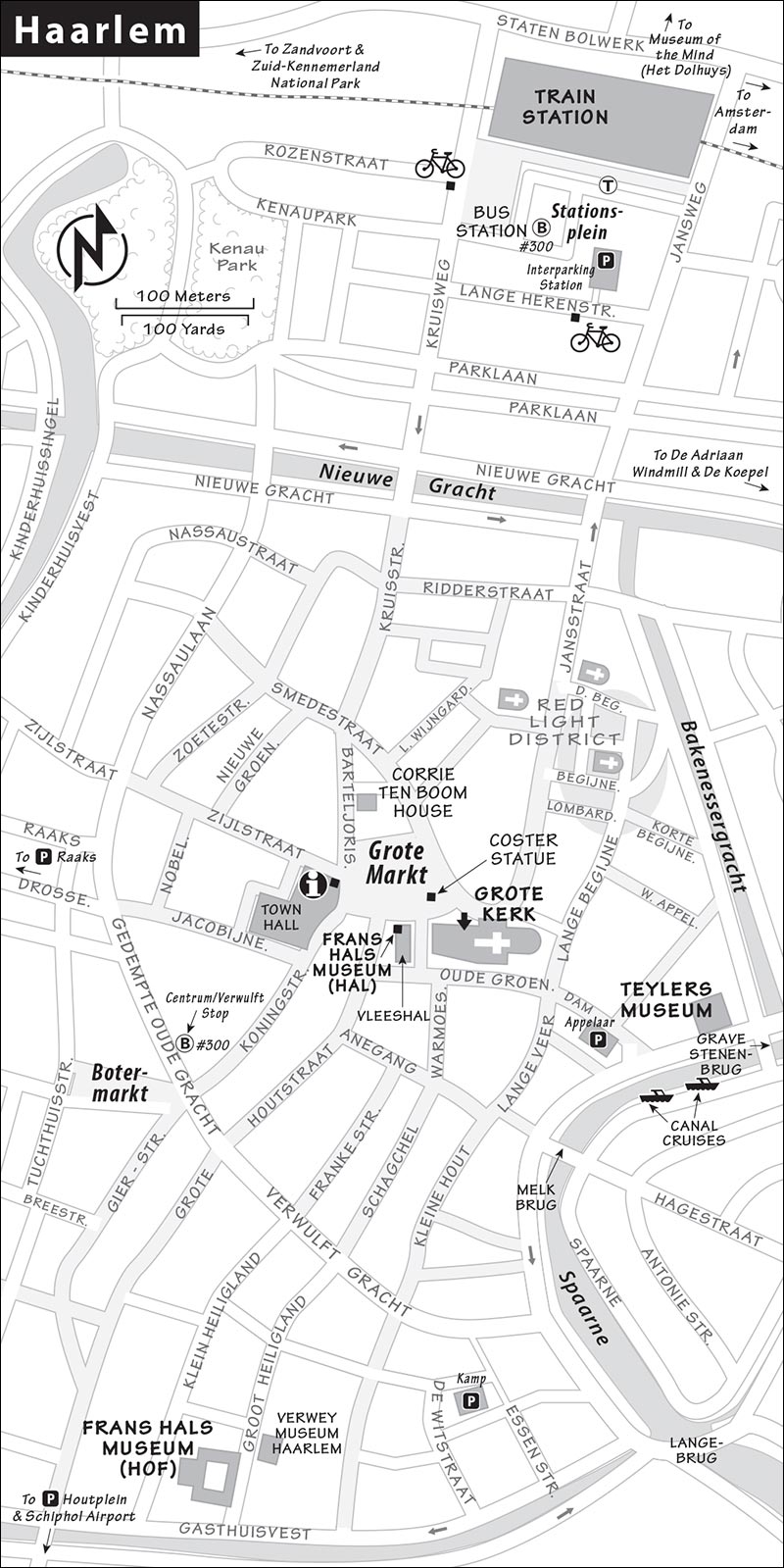
By Train: Lockers are available at the station at the very end of platform 3A (the far-left end of the middle platform, as you face the main hall; pay by card only). The WCs are at the opposite end of platform 5. Two parallel streets flank the train station: Kruisweg and Jansweg. Head up either one and you’ll reach the town square and church in about 10 minutes. If you need help, ask someone to point you toward Grote Markt (Market Square). If you’re arriving by train from Amsterdam, see the “Amsterdam to Haarlem Train Tour” later in this chapter for a description of sights you’ll see along the way.
By Bus: Buses from Schiphol Airport stop at the train station and in the center (Centrum/Verwulft stop, a short walk south of Grote Markt).
By Car: Street parking is expensive; several central garages are more affordable (www.parkeren-haarlem.nl): Try Parkeergarage Kamp at the southern end of Gedempte Oude Gracht (the main thoroughfare), Parkeergarage Raaks at the western edge of town (just inside the canal), and Parkeergarage Houtplein near the Frans Hals Museum’s main building (Hof). The most central is the Parkeergarage Appelaar, near the Teylers Museum; it’s also the most expensive. The Interparking garage near the train station is operated by a different company and cheaper if you prebook online (www.parkerencentrumhaarlem.nl).
By Plane: For details on getting from Schiphol Airport to Haarlem, see the end of this chapter.
HELPFUL HINTS
Blue Monday and Early Closures: Most sights are closed on Monday, except the Grote Kerk, De Adriaan Windmill, and Verwey Museum Haarlem. The Corrie ten Boom House is closed on Sunday and Monday, and closes at 15:30 the rest of the week.
Sightseeing Tips: The Museumkaart discount card covers entry to Haarlem’s Frans Hals Museum, Museum Haarlem, Teylers Museum, and the Museum of the Mind (potentially worthwhile for those also visiting Amsterdam, www.museumkaart.nl).
Laundry: Just south of the train depot, Wascentre Het Station has self-service and full-service options (daily 9:00-18:00, Jansweg 32—see the map on here).
Bike Rental: Two good bike-rental options are near the train station. Both charge similar rates, have a range of bikes, and are open long hours daily (more in good weather, less in bad weather): Green Bikes, on the right as you exit into the big plaza in front of the station (Kruisweg 30, +31 23 751 6512, www.greenbikes.nl), and Rent a Bike Haarlem, tucked around behind the big parking garage in front of the station (Lange Herenstraat 36, +31 23 542 1195, www.rentabikehaarlem.nl).
Taxi: Taxis are pricey; figure no less than €10 for even a short ride in town. Uber may be marginally cheaper.
Canal Cruise: Several companies do lazy cruises on Haarlem’s canal; in high season, it’s smart to prebook online to ensure a seat. Two companies depart from across the canal from Teylers Museum. Smidtje Canal Cruises, the bigger outfit, does a scenic 50-minute loop through and around Haarlem in both covered and open boats. The captain may provide some commentary in Dutch and a bit of English, or you may be given an audioguide, but either way the trip is more relaxing than informative (€21, departs every half-hour daily 11:00-16:00, no cruises Nov-March, Spaarne 11a, +31 23 535 7723, www.smidtjecanalcruises.nl). Haarlem Canal Tours, run by Jeroen, is a smaller, friendlier, more intimate option, using an open 12-person boat (€18, 1.25 hours, generally departs every 1.5 hours Tue-Sun 11:30-17:30, may not run in bad weather or off-season, Spaarne 17, www.haarlemcanaltours.com). Luxe Sloepen Haarlem departs from the base of De Adriaan Windmill, with knowledgeable skippers who offer interesting commentary in excellent English. Its open sloops seat up to 30 people (€21.50, 50 minutes, departs top of the hour daily 11:00-18:00, Papentorenvest 1, +31 27 375 050, www.luxesloepenhaarlem.nl).
Grote Markt Spin Tour
Haarlem’s ▲▲ Grote Markt (Market Square), where 10 streets converge, is the town’s delightful centerpiece...as it has been for 700 years. To enjoy a coffee or beer here, simmering in Dutch good living, is a quintessential European experience. Observe. Sit and gaze at the church, appreciating essentially the same scene that Dutch artists captured centuries ago in oil paintings that now hang in museums.
Until the 1990s, trolleys ran through the square and cars were parked everywhere. But now it’s a pedestrian zone, with market stalls filling the square on Saturdays and café tables dominating on other days.
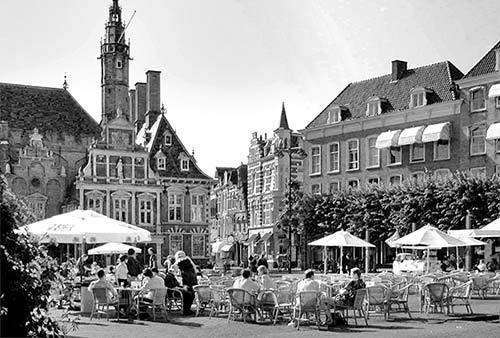
This is a fun place to build a picnic with Haarlem finger foods and enjoy great seating on the square. Look for pickled herring (takeaway stand on the square in good weather), local cheese (Gouda and Edam—tasty shop a block away on Grote Houtstraat), french fries with mayonnaise (there’s a decent fries place behind the church on Warmoesstraat), and, in the summer, stroopwafels (waffles with built-in syrup, best when warmed up) and poffertjes (puffy mini-doughnuts, cooked on the spot and sprinkled with powdered sugar). As you enjoy a snack, take this simple spin tour.
• Overseeing the square is the...
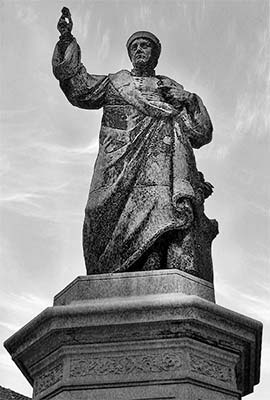
L. J. Coster Statue: Forty years before Gutenberg invented movable type, this man carved the letter A out of wood, dropped it into some wet sand, and saw the imprint it left. He got the idea of making movable type out of wood (and later, he may have tried using lead). For Haarlemmers, that was good enough, and they credit their man Coster with inventing modern printing. In the statue, Coster (c. 1370-1440) holds up a block of movable type and points to himself, saying, “I made this.” How much Coster did is uncertain, but Gutenberg trumped him by building a printing press, casting type in metal, and pounding out the Bible.
• Coster is facing the...
Town Hall: Whereas most of medieval Europe was ruled by kings, dukes, and barons, Haarlem has been largely self-governing since 1425. This building—built from a royal hunting lodge in the mid-1200s, then rebuilt after a 1351 fire—has served as Haarlem’s Town Hall since about 1400. The facade dates from 1630.
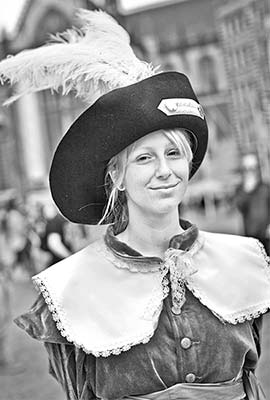
Parts of Haarlem still look like they did four centuries ago, when the city was a bustling commercial center rivaling Amsterdam. It’s easy to imagine local merchants and their wives dressed in black with ruff collars, promenading on Grote Markt.
Back then, the town was a port on the large Haarlemmer Lake, with the North Sea only about five miles away. As well as being the tulip capital of the country, Haarlem was a manufacturing center, producing wool, silk, lace, damask cloth, furniture, smoking pipes (along with cheap, locally grown tobacco), and mass quantities of beer. Haarlemmers were notorious consumers of beer—it was a popular breakfast drink, and the average person drank six pints a day.
In 1585, the city got an influx of wealthy merchants when Spanish troops invaded the culturally rich city of Antwerp, driving Protestants and Jews north. Even when hardline, moralistic Calvinists dominated Haarlem’s politics, the city remained culturally and religiously diverse.
In the 1700s, Haarlem’s economy declined, along with that of the rest of the Netherlands. In the succeeding centuries, industry—printing, textiles, ship building—once again made the city an economic force.
The town drunk used to hang out on the bench in front of the Town Hall, where he’d expose himself to newlyweds coming down the stairs. Rather than arresting the man, the townspeople simply moved the bench. This is a characteristically Dutch solution: pragmatic, deceptively simple, and effective.
• Spin to the left. The fancy-gabled building just to the right of the church is the...
Meat Market (Vleeshal): This fine Flemish Renaissance building is the old meat hall (1603), built by the rich butchers’ and leatherworkers’ guilds. The meat market was on the ground floor, the leather was upstairs, and the cellar was filled with ice to preserve the meat. It’s decorated with carved bits of early advertising—sheep and cows for sale. Today, rather than meat, the hall displays modern art as part of the Frans Hals Museum’s secondary “Hal” location (described later, under “Sights in Haarlem”) and bits of the town’s past in its cellar-level Archaeology Museum (closed Mon-Tue, www.archeologischmuseumhaarlem.nl).
Sights in Haarlem
▲▲St. Bavo Church (Grote Kerk)
▲▲Frans Hals Museum (Frans Halsmuseum)
Red Lights amid the Arts District
Zuid-Kennemerland National Park
Amsterdam to Haarlem Train Tour
ON GROTE MARKT
▲▲St. Bavo Church (Grote Kerk)
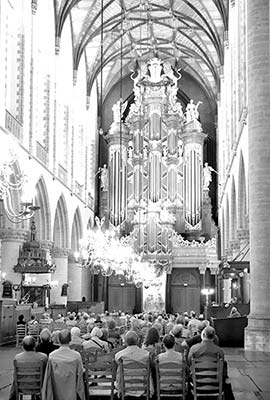
Haarlem’s impressive St. Bavo Church is better known here as the Grote Kerk—the Great Church. One of the most famous landmarks in the Netherlands, it’s visible from miles around, rising above the flat plain that surrounds it. This 15th-century Gothic church is worth a look, if only to see Holland’s greatest pipe organ (from 1738, 100 feet high). The organ, which fills the west end, seems to steal the show from the altar; its more than 5,000 pipes impressed both Handel and Mozart. But the interior is also packed with other details that speak volumes about Haarlem history, making it a delight to explore. Allow about 45 minutes for this self-guided tour.
Cost and Hours: €4; Mon-Sat 10:00-17:00, closed Sun to tourists; Sun service at 10:00 (May-Oct) and 19:00 (June-Sept); Grote Markt 22, +31 23 553 2040, www.bavo.nl. WCs are inside, just past the ticket desk.
Tours: Mixed-language tours with English are offered Sat at 14:00 and possibly more often with demand (€7, includes church entry). See the website for occasional organ tours in summer and fall (€5, typically Sat at 14:00).
Concerts: Consider attending even just part of a concert to hear Holland’s greatest pipe organ (€4; mid-May-mid-Oct Tue at 20:00, plus July-Aug Thu at 16:00; bring a sweater—the church isn’t heated). They also do brief “lunch concerts” on summer Saturdays (at 13:15, 30 minutes, free with cathedral entry).
Background: After a fire destroyed the old church, the Grote Kerk was built over a 150-year period (c. 1390-1540) in the late-Gothic style of red-and-gray brick, topped with a slate-covered wood roof and a stacked tower bearing a golden crown and a rooster weathervane.
Originally Catholic, the church was named after St. Bavo (Baaf in Dutch)—a nobleman from Ghent who frequented seventh-century red-light districts during his youth. After his wife’s death, Bavo converted to Christianity, became a monk, moved out of his castle, and took up residence in a hollow tree, where he spent his days fasting and praying. In the late 1500s, St. Bavo Church became Protestant (Dutch Reformed) along with much of the country. From then on, the anti-saint Protestants simply called it Grote Kerk. (Much later, starting in 1895, local Catholics built the huge Cathedral of St. Bavo, often called the KoepelKathedraal, on the outskirts of downtown—giving this small town two gigantic churches with similar names.)
 Self-Guided Tour
Before entering, take a few minutes to walk around the exterior of this incredible building. Notice the rough buttress anchors, which were never needed. Money ran out, and the planned stone ceiling (which would have required these buttresses) was replaced by a lighter wooden one. Some windows are bricked up because the organ fills the wall.
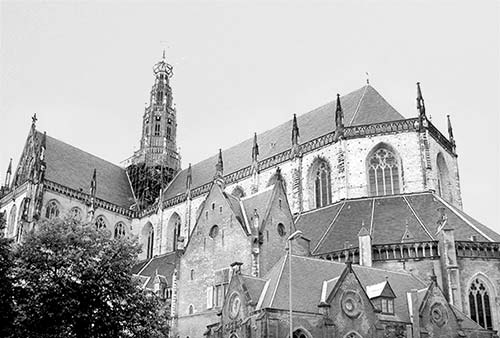
The original stone tower crowned the church from 1522 until 1530, when the church began sinking under its weight. The tower was removed and replaced by the lighter, lead-covered wood version you see today. (The frugal Dutch recycled the old tower, using it to cap the Bakenesser church, a short walk away.)
Because the tower was used as a lookout by Napoleon, it was classified as part of the town’s defense. As a result, the tower (but not the rest of the church) became city property; since Haarlem’s citizens own it, they must help pay to maintain it.
The base of the church is encrusted, barnacle-like, with shops—selling jewelry, souvenirs, haircuts, gelato, and artwork in the colonnaded former fish market—hearkening back to medieval times, when religion and commerce were more intertwined. The little shops here have long been church-owned, rented out to bring in a little cash.
During the day, a machine plays music on the bells of the Grote Kerk’s carillon (live carillonneurs play occasionally). If you’re in Haarlem at night, you’ll hear the carillon chiming a simple “de dong, de dong” (“Don’t worry, be happy”) starting at 21:00 for a full half-hour. In days gone by, this warned citizens that the city gates would soon close for the night—and during the Covid-19 pandemic, the bells rang an hour early to signal the city’s curfew.
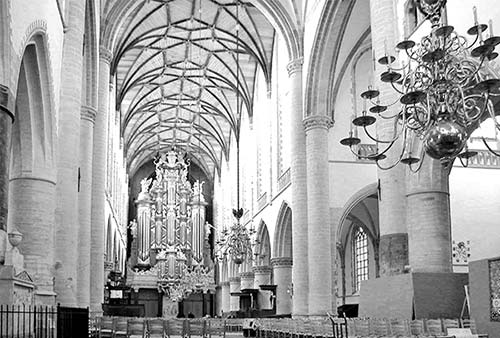
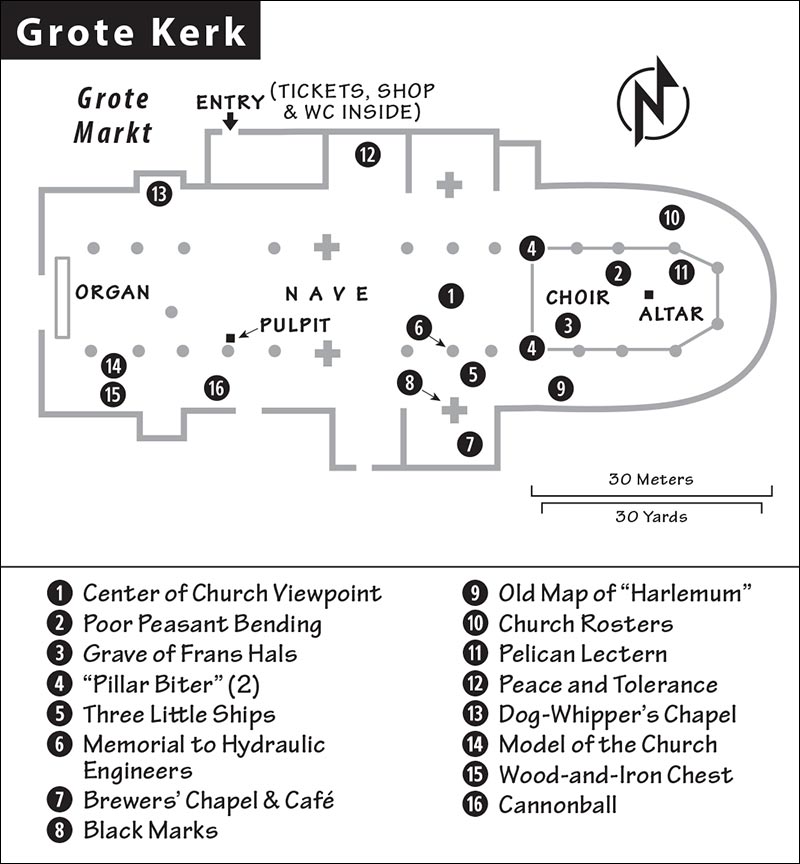
• Enter the church on the Grote Markt side, near the north transept (look for the small Entrée sign). Walk to the center of the church—where the nave crosses the transept—and take it all in.
1 Center of Church Viewpoint
Simple white walls, a black floor, a brown ceiling, and a mahogany-colored organ make this spacious church feel vast, light, and airy. Considering it was built over a span of 150 years, its architecture is surprisingly homogenous. Originally, much of the interior was painted in bright patterns, similar to the carpet-like frescoes on some columns near the center of the church. But in 1566, Protestant extremists stripped the church of its graven images and ornate Catholic trappings, leaving it relatively stark, with minimal decoration. They whitewashed everything. The few frescoes you see today were restored in the 1980s.
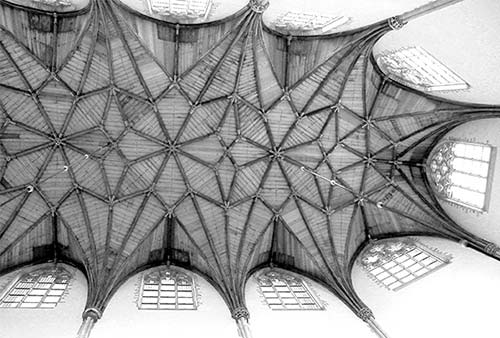
Look up to see the fan-vaulted cedar ceiling from 1530. Look down to see tombstones paving the floor. And look midway up the walls to catch squatting characters supporting the pilasters. The three-story organ fills the west wall.
• Turn left and walk to the candle-lined, fence-like brass barrier. Look into an enclosed area of wooden benches and the altar, known as...
The Choir
After the church’s foundation was laid, the choir was built first and used for worship for more than a century while the rest of the building was completed.
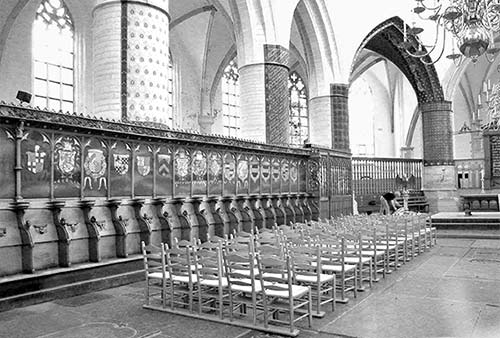
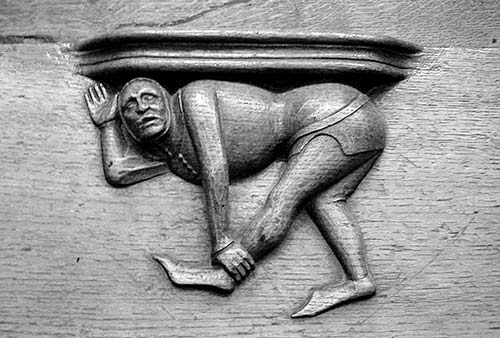
Today, the brass-and-wood barrier keeps tourists from entering the most sacred area, just as peasants were kept out in medieval times. While the commoners had to stand during services, local big shots got to perch their heinies on the little ledges (called misericords, carved in 1512) of the wooden stalls that line the choir; the eighth stall along the left side shows a 2 poor peasant bending over to bear a rich guy’s bum on his back. The stalls are also decorated with the coats of arms of noble families, whose second sons traditionally became priests.
The choir’s floor holds a simple slab marked with a lantern—the 3 grave of Frans Hals (just right of center, marked Graf van Frans Hals), Haarlem’s own master artist of the golden age. When he was a child, Hals’ family moved to Haarlem, and he lived and worked here all his life, worshipping in the Grote Kerk. A friend of mayors and preachers, he chronicled middle-class citizens and tavern life, producing hundreds of masterpieces...and 10 kids.
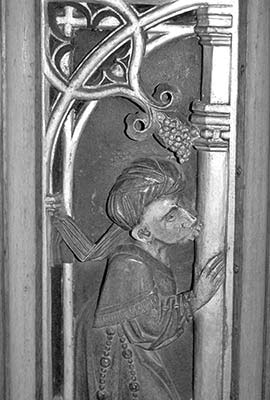
At both ends of the brass barrier, look for the knee-level carvings of the 4 “pillar biter.” The man, on the right, wears pointy Dutch overshoes, while the woman, on the left, is draped in a dress and a fashionable turban; both wear rosary beads from their belts. The message of these carvings, aimed at those who were “more Catholic than even the pope,” was this: Don’t go overboard on devotion.
More than a thousand wealthy people are buried under the church’s pavement stones. Only those with piles of money to give to the church could be buried in a way that gave them an advantage in the salvation derby. But even though the dead bodies were embalmed, they stunk. Imagine being a peasant sitting here, trying to think about God...and thinking only of the stench of well-fed bodies rotting below. This is where the phrase “stinking rich” was born.
• To your right (as you face the choir), are three huge columns. Suspended between two of them are...
5 Three Little Ships
Sailing under the red-white-and-blue Dutch flag and the flag of a rearing lion, ships like these helped make Holland the world’s number-one sea-trading nation in the 1600s.
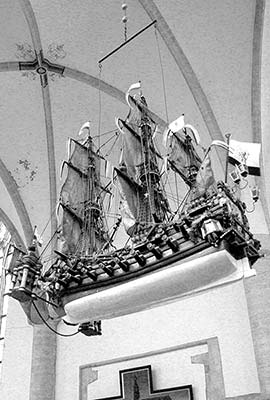
The biggest model ship of the three is a frigate. These fast, heavily armed, three-masted, fully rigged ships rode shotgun for merchant vessels, protecting them from pirates in their two-year journey to the Far East and back. This one has a flat-bottomed hull, necessary to ply Amsterdam’s shallow harbor. It could fire a 21-gun salute from each side, and extra cannons on the poop deck and forecastle made it more powerful than the average frigate. The keel has an iron saw, a Dutch military specialty for slicing through the chains that commonly blocked harbors (see the chain between two towers near the bow).
At the base of the next column down, just to the right, is a 6 memorial to hydraulic engineers Christiaan Brunings and Frederik Willem Conrad. The marble relief shows Neptune in his water chariot. In the low-lying Holland of the 1800s, when flooding could mean life or death, hydraulic engineers were heroes, specifically the two commemorated here.
• Behind the columns, set into the wall of the church, is the...
7 Brewers’ Chapel (Brouwerskapel)
This chapel, with its humble café, marks the long and short of the city’s 750-year history—literally. 8 Black marks on the right side of the chapel’s central pillar show the height of Haarlem’s shortest citizen, 33-inch-high Simon Paap, who supposedly died in a dwarf-tossing incident, and—wow!—8-foot-8-inch-tall Daniel Cajanus.
On the wall to the left of the café—facing the nave, and farther toward the apse—hangs an 9 old map of “Harlemum.” It shows the walled city in 1688, with ramparts and a moat. Surrounding panels showcase Haarlem’s 750-year history. The lower-left panel shows the 1572-1573 Siege of Haarlem, as brave Haarlem women join their menfolk in battle—bombs exploding around them—to fight off invading Spanish troops.
The lower-right panel shows knights kneeling before a king in the 12th century, while in the distance, ships sail right along the city walls. Up until the 1840s, when it was drained and reclaimed, there was a large lake (the Haarlemmermeer) standing between Haarlem and Amsterdam. The Grote Kerk, when viewed by distant travelers, seemed to float like a stately ship on the lake, as seen in the landscape along the bottom of the map.
• From here, turn left and circle the church counterclockwise, heading around the altar. Just after rounding the bend, on the outer wall, you’ll see the first of many lists of prominent church members. The fifth 10 roster on the right, from 1736, has mesmerizingly ornate calligraphy. Opposite these lists, inside the choir, is the...
11 Pelican Lectern
According to medieval lore, pelicans are so attentive to their chicks that mothers, when necessary, feed their young with their own blood. Because of this myth, the pelican became a symbol of Christ’s self-sacrifice. This lectern from 1499 has a brass bird that looks just like other symbolic pelicans—shown stabbing itself with its own beak—except for one important difference: It looks like an eagle. Apparently, its creator had never come across an actual pelican.
• Carry on past the end of the choir. In the right (north) transept, look up to see the church’s newest stained-glass window...
12 Peace and Tolerance
This vibrant window, designed by artist Michel van Overbeeke, was dedicated in 2008. A cloak of red roses amid a cosmic blue swirl is meant to promote religious harmony while still hinting at traditional Christian themes. (Read the interpretive panel for more of the story.) The window stands in sharp contrast to several small relief statues—in a niche on the right-hand wall to the right of a white bust—with beheaded bodies and defaced faces. These commemorate victims of the 1566 Iconoclastic Fury, when angry Protestant extremists vandalized Dutch Catholic churches (as this once was).
About 40 yards farther on, past the entrance, the shallow niche on the right is the 13 Dog-Whipper’s Chapel. In a sculpted relief (top of column at left end of chapel, above eye level), an angry man whips an angry dog while striding over another angry dog’s head. Back when churches served as rainy-day marketplaces, this man’s responsibility was to keep Haarlem’s dogs out of the church.
• Next up, you can’t miss...
The Organ
Even when silent, this organ impresses. Finished in 1738 by Amsterdam’s Christian Muller, it features a mahogany-colored casing with tin pipes and gold trim, studded with statues of musicians and an eight-piece combo of angels. Lions on the top hold Haarlem’s coat of arms—a sword, surrounded by stars, over a banner reading Vicit Vim Virtus (“Virtue Conquers Violence”). There are larger pipe organs in the world, but this is one of the best.
With three keyboards, a forest of pedals, and 65 stops (the knobs on either side of the keyboards), this magnificent organ produces an awesome majesty of sound. Picture 10-year-old Mozart at the controls of this sound machine. In 1766, he played Haarlem at the tail end of his triumphant, three-year whirlwind tour of Europe. He’d just returned from London, where he met J. C. Bach, the youngest son of Johann Sebastian Bach (1685-1750), the grandfather of organ music. Mozart had recently written several pieces inspired by Bach, and he may have tried them out here.
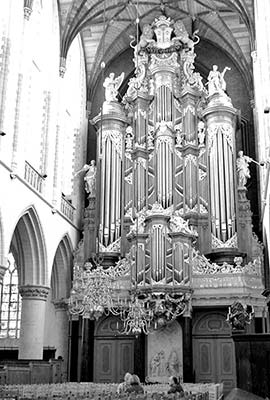
“Hal-le-lu-jah!” That famous four-note riff may have echoed around the church when Handel played here in 1740, the year before his famous Messiah oratorio debuted. The 20th-century organist/humanitarian Albert Schweitzer also performed here.
The organist sits unseen amid the pipes, behind the section that juts out at the bottom. While the bellows generate pressurized air, the organist presses a key, which opens a valve, admitting forced air through a pipe and out its narrow opening, producing a tone. An eight-foot-long pipe plays middle C. A four-foot-long pipe plays C exactly one octave up. A 20-foot pipe rumbles the rafters. With 5,068 pipes ranging from more than 20 feet tall to just a few inches, this organ can cover eight octaves (a piano plays seven), and each key can play a variety of sounds. By pulling one of the stops (such as “flute” or “trumpet”), the organist can channel the air into certain sets of pipes tuned to play together to mimic other instruments. For maximum power, you “pull out all the stops.”
• Cross in front of the organ and look left to find the glass box holding a...
14 Model of the Church
A hundred times smaller than the church itself, this model still took a thousand work-hours to build. See if you can spot the matchsticks, washers, screens, glue, wire, and paper clips used to make it.
Turn around and look to the right to find a 15 wood-and-iron chest that served as a safe for the church’s cash and precious documents—such as those papers granting the power to sell forgiveness.
Now head back up the nave. On the far side of the green-gated chapel, on your right, look for the 16 cannonball in the wall: Duck! Placed here in 1573, this cannonball commemorates the city’s finest hour: the Siege of Haarlem.
In the winter of 1572-1573, Holland rebelled against its Spanish oppressors. Haarlem proclaimed its alliance with William of Orange (and thus, independence from Spain). In response, the angry Spanish governor—camped in Amsterdam—laid siege to Haarlem. The winter was cold, food ran low, and the city was bombarded by Spanish cannons. Inside huddled 4,000 cold, hungry Calvinists. At one point, the city’s women even joined the men on the barricades, brandishing kitchen knives.
But Spain had blockaded Haarlem’s lake, and by June 12, 1573, the city had to surrender. The Spanish rounded up 1,500 men (three-quarters of Haarlem’s able-bodied male population) and executed them.
Still, Haarlem’s brave seven-month stand against overwhelming odds became a kind of Dutch Alamo, inspiring their countrymen to fight on. Following Haarlem’s valiant lead, other Dutch towns rebelled, including Amsterdam. Though Holland and Spain would skirmish for another five decades, the battles soon moved southward, and Spanish troops would never again seriously penetrate the country’s borders.
• Circle back to the transept, then turn left across the wood floor into the nave, approaching the organ. On your left, look for the impressive wooden...
Pulpit
Elaborately carved from oak in 1679, the pulpit is topped with a tower-shaped roof. Brass handrails snake down the staircase—serpents fleeing the word of God. In this simply decorated Protestant church, the pulpit is perhaps the most ornate element, directing worshippers’ eyes to the speaker. During the Reformation, Protestants changed the worship service. As teaching became more important than ritual, the pulpit was given a higher profile.
• Our tour is complete. Go in peace.
NEAR GROTE MARKT
▲Corrie ten Boom House
Haarlem was home to the Ten Boom family, who, from this house, created a safe haven for Jews during World War II. This museum gives the other half of the Anne Frank story—the point of view of those who risked their lives to hide Dutch Jews during the Nazi occupation. The family’s story was popularized by Corrie ten Boom’s inspirational 1971 book (and 1975 movie), The Hiding Place.
Access to the Ten Boom House is by tour only and reservations are essential, especially since space is quite limited and visitors can only attend a tour in their own language. The gentle and loving one-hour tour comes with evangelizing that some may find uncomfortable.
Cost and Hours: Free, but donations accepted; several tours daily Tue-Sat in English, check website for times; closed Sun-Mon year-round; 50 yards north of Grote Markt at Barteljorisstraat 19—wait in the little side street at the door; +31 23 531 0823, www.corrietenboom.com.
Reservations: Tours are limited to 12 people and fill up quickly. Reserve a spot several months in advance on the website.
Background: The clock shop was the Ten Boom family business. The elderly father and his two daughters—Corrie and Betsie, both in their 50s—lived above the store and in the brick building attached in back (along Schoutensteeg alley). Corrie’s bedroom was on the top floor at the back. This room was tiny to start with, but then the family built a second, secret room (less than a yard deep) at the very back—“the hiding place,” where they could hide six Jews at a time. Devoutly Christian, the family had a long tradition of tolerance, having hosted prayer meetings here in their home for both Jews and Christians for generations.
The Gestapo, tipped off that the family was harboring Jews, burst into the Ten Boom house on February 28, 1944. Finding a suspicious number of ration coupons, the Nazis arrested the family but failed to find the four Jews and two resistance fighters in the hiding place. The six fugitives hid for 47 hours in the cramped space before they were set free by police officers who were secretly members of the Dutch underground. Corrie’s father and sister died while in prison, but Corrie survived the Ravensbrück concentration camp to tell her story in her memoir.
Visiting the Museum: Your tour starts with a compelling account of Corrie’s life as you sit surrounded by family photos in the Ten Boom living room. Next you visit Corrie’s bedroom, site of the hiding place. Tour members stand inside as the guide explains what happened on the night the Gestapo came—and why they never discovered the fugitives. In all, the family saved about 800 Jews and resistance fighters. The tour ends with exhibits on the Nazi occupation and Corrie’s postwar work, and a talk about the Christian faith.
▲▲Teylers Museum
Famous as the oldest museum in the Netherlands, Teylers is a time-warp experience, filled with all sorts of fun curios for science buffs—fossils, minerals, primitive electronic gadgetry, and examples of 18th- and 19th-century technology—plus two painting galleries. This unique sight feels like a “museum of a museum.” They’re serious about authenticity: The presentation is perfectly preserved, right down to the original labels. Excellent temporary exhibits and the newly restored home of the museum’s benefactor make this one of Haarlem’s most interesting sights.
Cost and Hours: €16.50, includes excellent audioguide; Tue-Sun 10:00-17:00, closed Mon; Spaarne 16, +31 23 516 0960, www.teylersmuseum.nl. The museum’s modern € café has good prices and faces a delightful garden.
Background: Pieter Teyler van der Hulst was a wealthy merchant who willed his estate (worth the equivalent of €80 million today) to a foundation whose mission was to “create and maintain a museum to stimulate art and science.” The museum opened in 1784, six years after Teyler’s death. The last of his bequest was finally spent in 1983—and now it’s a national museum.
Visiting the Museum: Pick up the essential audioguide and the helpful map, which illustrates an efficient route through the collection. From the entrance, you’ll carry on straight ahead through three galleries with dusty wood-and-glass display cases (the first two with fossils, the third with early scientific instruments). From here you step into the museum’s centerpiece, the Oval Room—a temple of science and learning. Peruse the displays in here; look for the “highest point in Europe” (the very top of Mont Blanc, Europe’s highest peak in the French Alps, hacked off and brought here to Europe’s lowest country).
To the left sprawls the home of Pieter Teyler, a string of rooms spread over two floors, lavishly and lovingly decorated as they were when he lived here. (Don’t miss the miniature house that details how the place looked on the day he died.) And to the right from the Oval Room are the coin collection and two lovely painting galleries, where works are hung above and below each other, floor-to-ceiling, in the old style. While there are no world-famous works in here, the curators are especially proud of The Garden by Jacobus van Looy (an Impressionist-inspired field of red flowers) and The Drummer Girl by Isaac Israels.
Just beyond is a modern extension featuring innovative temporary exhibits and the fine café. On your way out, add your name to the guest book, which goes back to before Napoleon’s visit here.
SOUTH OF GROTE MARKT
▲▲Frans Hals Museum (Frans Halsmuseum)
Haarlem is the hometown of Frans Hals (c. 1582-1666), the foremost portrait painter of the 17th-century Dutch golden age. This bold humanist painted everyday people in their warts-and-all glory. He was a forerunner of Impressionist brushwork, a master of composition, and an articulate visual spokesman for his generation.
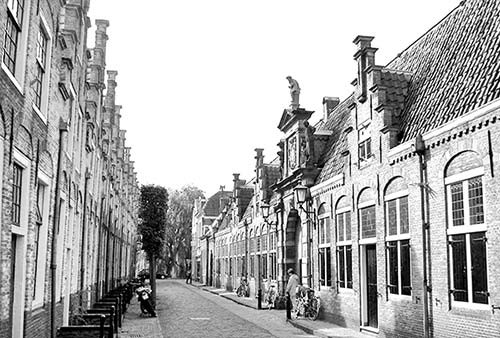
Your ticket covers the museum’s two locations: the main building (“Hof”) described here and the smaller building (“Hal”) a short walk away. The refreshing main museum displays many of Hals’ greatest paintings and works by other Dutch masters. You’ll stand eye-to-eye with life-size, lifelike portraits of Haarlem’s citizens: brewers, preachers, workers, bureaucrats, and housewives. Take a close look at the people who built Holland in its heyday and then watched it start to fade.
Cost and Hours: €17.50 covers both Frans Hals buildings; both open Tue-Sun 11:00-17:00 (may open later on Sun), closed Mon; main building (“Hof”) is a five-minute walk from Grote Markt at Groot Heiligland 62, secondary building (“Hal”) is at Grote Markt 16; +31 23 511 5775, www.franshalsmuseum.nl.
Hof Versus Hal: While this tour focuses on the museum’s main “Hof” exhibit, the museum’s secondary location, Frans Hals “Hal,” is worth a look for its changing exhibitions of modern art influenced by Hals’ themes and techniques.
Cuisine Art: In the main building, the € Frans Hals Museum Café serves sandwiches and other simple food (Tue-Fri 10:00-16:30, Sat-Sun 10:30-16:30).
Self-Guided Tour of Frans Hals Hof
My one-hour tour covers the main Frans Hals building (“Hof”). Here, Frans Hals’ paintings are just one part of the collection. The museum fancies itself as the museum of the Dutch golden age, offering you the rare opportunity to enjoy 17th-century art in a 17th-century building, together with art from the more recent past and present.
Frans Hals’ masterpieces are usually in Room 14 (and nearby rooms), but the other paintings rotate, so the order of artworks on my self-guided tour may vary. (For example, you may find the Portrait of Jacobus Zaffius in Room 2 rather than the hallway before the Civic Guard paintings.) Ask a staff member if you can’t locate something. If you’re using this book to navigate the collection, note that many of the photos in this section are details of the larger works. The entire museum is thoughtfully described in English.
Introduction and Rooms 1-11
Your visit begins with an insightful 15-minute audiovisual show introducing the artist and his works. From here, you’ll circle around to the core of the collection, which is roughly on the opposite side of the complex. Well-described exhibits unfold as the rectangular museum wraps around a peaceful central courtyard. The building’s layout makes sense when you realize it was built as subsidized housing for poor old men (in 1610).
• Exiting the film, go straight ahead to enter the main exhibit. Turn right and begin to circle rooms 1-11, around the courtyard, in a counterclockwise order. (Rooms 1 through 5 are not shown on the map in this chapter.)
When you reach the far end of the complex, you should see a big sign pointing you to the right, into Room 14—labeled Frans Hals: All Civic Guard Pieces. You’ll know you’ve arrived in the right place when you find yourself well-guarded by canvases full of companies of uniformed men. We’ll start with the men in the bright-red sashes, which is over your right shoulder as you enter this room.
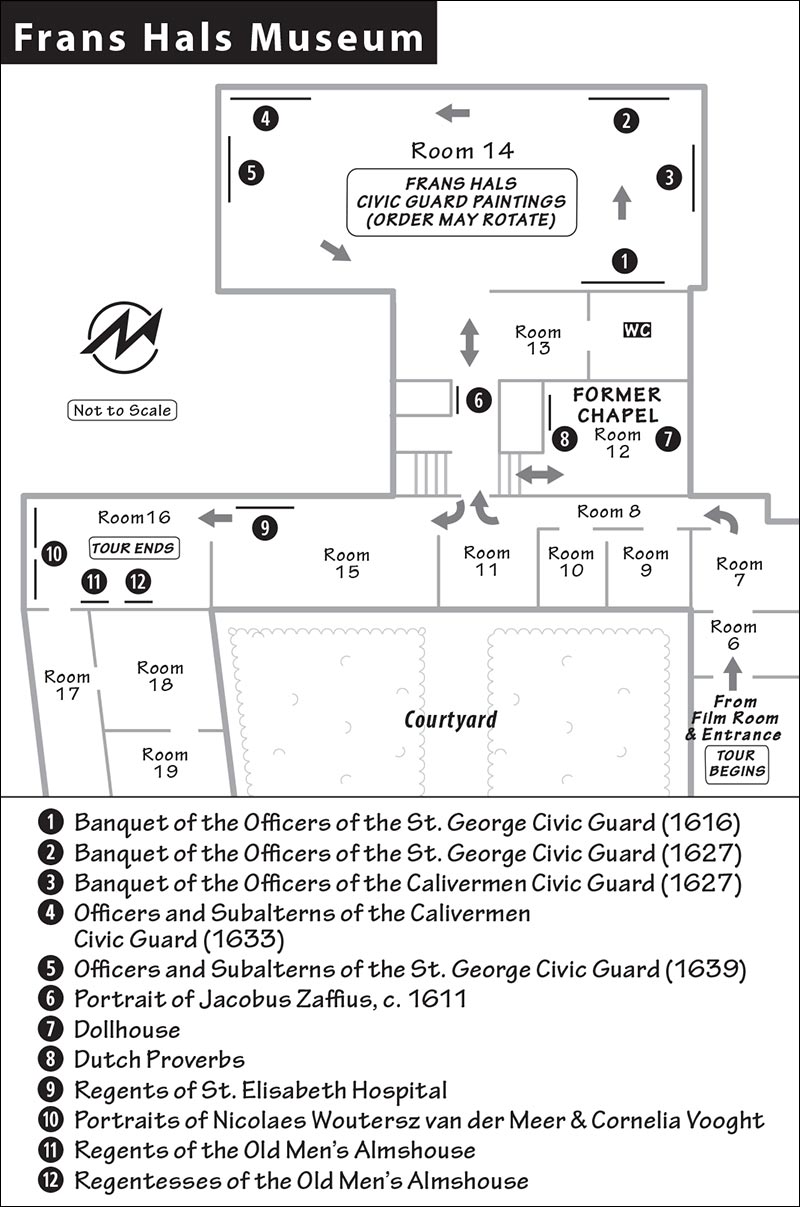
1 Banquet of the Officers of the St. George Civic Guard, 1616
In 1616, tiny Holland was the richest country on earth, and these Haarlem men are enjoying the fruits of their labor. The bright-red sashes, the jaunty poses, the smiles, the rich food, the sweeping tilt of the flags...the exuberant spirit of the Dutch golden age. These weekend warriors have finished their ceremonial parade through town and hung their weapons on the wall, and now they sit down for a relaxed, post-show party.
The man in the middle (next to the flag bearer, facing us) is about to carve the chicken when the meal is interrupted. It’s us, arriving late through the back door, and heads turn to greet us. Rosy-cheeked Nicolaes Woutersz van der Meer (see his portrait later on this tour), hand on hip, turns around with a friendly look, while the man to the right, the colonel in charge, waves us in. Frans Hals knew these men well as friends and colleagues, since he himself was a lifelong member of this Civic Guard company.
This band of brothers is united by common gestures—two men have hands on hips, three turn their palms up, two plant their hands downward, three clutch wine glasses. But mostly, they’re joined by the uniform sashes. The red sashes slant both left and right, perfectly forming opposing diagonals.
With this painting, Frans Hals broke the mold of stuffy group portraits. He relegates the traditional symbolic weapons to the shelf (upper right) and breaks up the traditional chorus line of soldiers by placing the men naturally around a table. Van der Meer sticks his elbow in our faces (another Hals trademark) to define a distinct foreground, while the flag bearer stakes out the middle ground, and a window at the back opens up to a distant, airy background.
Then Hals sets the scene in motion. One guy (third from the left) leans over to tell a joke to his friend. The dashing young flag-bearer in the middle turns back to listen to the bald-headed man. An ensign (standing, right side) enters and doffs his cap to Captain Van der Meer. And then we barge in, interrupting the banquet, but welcomed as one of the boys.
• On the facing wall, look for...
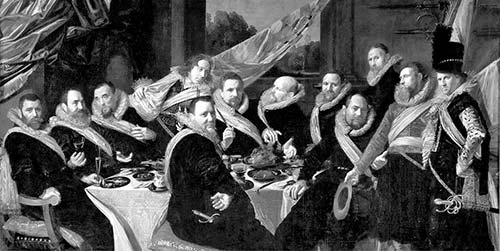
2 Banquet of the Officers of the St. George Civic Guard, 1627
A decade later, Hals painted the same militia again. Familiar faces appear (Captain Van der Meer is in the upper left), but most of the old men have been replaced by a crop of younger, battle-tested officers. These men had recently seen action in the Battle of Breda (1625), fighting for Dutch independence from Spain. The man in the center—facing us and turning his empty glass down to show he needs a refill—was a well-known Haarlem pub owner. (Find him again, in the same tan coat with blue sash, in the 1639 painting described later.)
The banquet looks spontaneous, but the men’s poses were carefully planned. Hals painted the bodies first, then brought in the men one by one for their portraits. As colorful as these Civic Guard paintings appear, much of the canvas is black, white, or gray. Van Gogh marveled at Hals’ ability to capture “27 shades of black.”
• On the wall between these two canvases is...
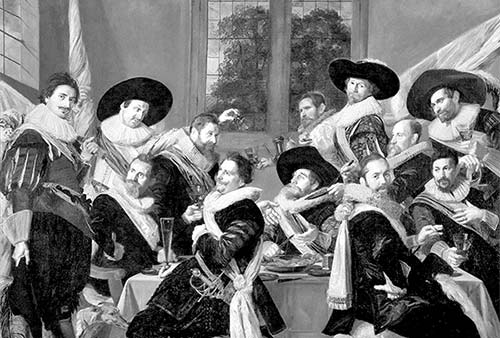
3 Banquet of the Officers of the Calivermen Civic Guard, 1627
The men are bunched into two symmetrical groups, left and right, with a window in the back. The figures form a Y, with a tilted flag marking the right diagonal (echoed by several tilted ruffs), and a slanting row of heads forming the left diagonal (echoed by several slanting sashes). The diagonals meet at the back of the table, marking the center of the composition, where the two groups of men exchange food, drink, and meaningful eye contact.
• Now move on to the wall on the left (straight ahead from where you came in). The canvas to the far left is...
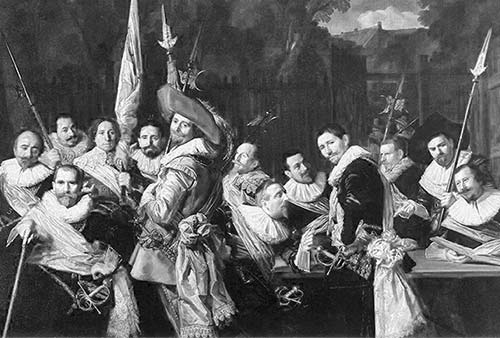
4 The Officers and Subalterns of the Calivermen Civic Guard, 1633
Six years later, Hals painted many of these same men gathered around an outdoor table. The horizontal row of faces is punctuated by three men standing sideways, elbows out. Again, the men are united by sashes that slant in (generally) the same direction and by repeated gestures—hands on hips, hands on hearts, and so on.
• On the wall to the left, look for...
5 The Officers and Subalterns of the St. George Civic Guard, 1639
When 57-year-old Frans Hals painted this, his last Civic Guard portrait, he included himself among his St. George buddies. (Find Frans in the upper left, second from left, under the faint gray number 19.)
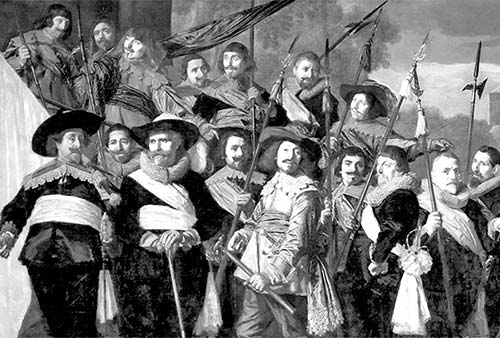
As he got older, Hals refined and simplified his group-portrait style, using quieter colors, the classic two horizontal rows of soldiers, and the traditional symbolic weapons.
A decade after this was painted, Holland officially ended its war with Spain (Treaty of Munster, 1648), the Civic Guards lost their military purpose, businessmen preferred portraits showing themselves as elegant gentlemen rather than crusty soldiers, and the tradition of Civic Guard group portraits quickly died.
• Now head out of Room 14. As you exit, immediately to your right is the small...
6 Portrait of Jacobus Zaffius, c. 1611
Arr-r-r-r-rh! This fierce, intense, rough-hewn man is not a pirate, but a priest, the rogue leader of an outlawed religion in Haarlem—Catholicism. In the 1600s, Haarlem was a Protestant town in the midst of a war against Catholic Spain, and local Catholics were guilty by association. But Zaffius refused to be silenced. He turns to glare and snarl at the Protestant town fathers. He was so personally imposing that the city tolerated his outspokenness.
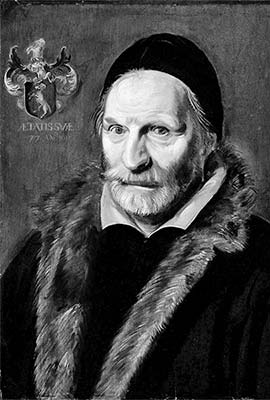
The face jumps out from a background of neutral gray-brown-black. His features are alive—head turning, mouth twisting, face wrinkling up, beard bristling. Hals captures him in action, using a slow shutter speed. The rough brushstrokes of the fur coat and beard suggest the blur of motion of this agitated individual. This is Frans Hals’ first known portrait, painted when he—a late starter in the art world—was nearly 30.
• Proceed a few steps, then go up the short staircase on your left into a...
Former Chapel
At the far end of this room is a fancy 7 dollhouse (poppenhuis), the hobby of the lady of the house. Handmade by the finest local craftsmen, this delicately crafted dollhouse offers a glimpse of wealthy 18th-century living.
The real treasure of this room is on the facing wall: It’s Pieter Brueghel the Younger’s 8 Dutch Proverbs (Nederlandse Spreekwoorden). Dating from 1625, this fun painting contains more than 90 charming Dutch scenes representing different folk sayings; 25 of these are labeled in English on the panel in front. True to form, this piece of Dutch art isn’t preachy religious art or political propaganda; rather, it shares the simple, decent morals of these hardworking people.
• From here, head back out into the series of rooms that ring the courtyard. Turn right into Room 15. On the right wall, at the far end (near the next door), look for...
9 Regents of St. Elisabeth Hospital, 1641
These aren’t the Dutch Masters cigar boys, though it looks like Rembrandt’s famous (and later) Wardens of the Amsterdam Drapers Guild (described in the Amsterdam Rijksmuseum Tour chapter). It’s a board meeting, where five men in black hats and black suits with lace collars and cuffs—the Dutch power suit of the day—sit around a table in a brown room.
Pretty boring stuff, but Hals was hired to paint their portraits, and he does his best. Behind the suits, he captures five distinct men. The man on the far left is pondering the universe or raising a belch. The man on the right looks like the classic Dutch poster boy, with moustache, goatee, ruddy cheeks, and long hair. The guy second from left is nearly clean-shaven. Hals links these unique faces with one of his trademark techniques—similar poses and gestures. The burping man and the goateed man are a mirror image of the same pose—leaning on the table, hand on chest. Several have cupped hands; several have hands laid flat, or on their chests, or on the table. And the one guy keeps working on that burp.
• Proceed into Room 16, with the rest of the paintings on our tour. Begin with the two matching canvases straight ahead, at the far end of the hall as you enter.
10 Portraits of Nicolaes Woutersz van der Meer and His Wife, Cornelia Vooght, 1631
Hals knew Nicolaes van der Meer, a fellow Civic Guard lodge member, personally. Van der Meer was a brewer, an important post in a city where average beer consumption was six pints a day per person (man, woman, and child). He was also the mayor, so his pose is official and dignified, larger than life-size. But the face is pure Dutch golden age—red-cheeked and healthy, confident and intelligent, his even gaze tinged with wisdom. This mayor kept a steady hand on the tiller of Haarlem’s ship of state.
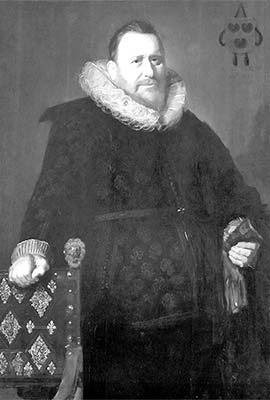
The face is the focus of this otherwise messy painting. The ruffled collar is a tangle of simple, figure-eight swirls of white paint; the brocaded coat is a patchwork of white lines; and the lace cuffs are a few broad outlines. But out of the rough brushwork and somber background, Van der Meer’s crystal-clear eyes meet ours. The finely etched crow’s-feet around his eyes suggest that Hals had seen this imposing man break into a warm smile. Hey, I’d vote for him as my mayor.
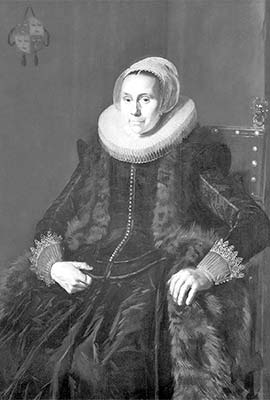
The companion painting shows Van der Meer’s companion, his wife, Cornelia. Husband-and-wife portraits were hung together—notice that they share the same background, and the two figures turn in toward each other. Married couples in 17th-century Holland divvied up the work—men ran the business, women ran the home—and prided themselves on their mutual independence. (Even today, in the progressive Netherlands, fewer women join the workforce than in many other industrial nations.) Cornelia’s body is as imposing as her husband’s, with big, manly hands and a practical, slightly suspicious look. The intricate work in her ruff collar tells us that Hals certainly could sweat the details when it suited his purpose.
• Now turn to another painting in the room, which shows...
11 Regents of the Old Men’s Almshouse, 1664
These men look tired. So was Holland. So was Hals. At 82, Hals, despite years of success, was poor and dependent on the charity of the city, which granted him a small pension.
He was hired to paint the board of directors of the Old Men’s Almshouse, located here in the building that now houses the Frans Hals Museum. Though Hals himself never lived in the almshouse, he fully understood what it was to be penniless.
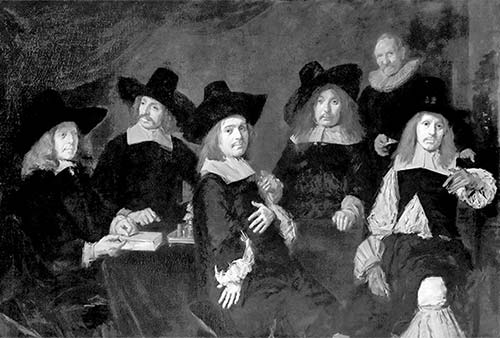
The portrait is unflattering, drained of color. Somber men dressed in black peer out of a shadowy room. These men were trying to administer a dwindling budget to house and feed an aging population. Holland’s golden age was losing its luster.
The style is nearly Impressionistic—collars, cuffs, and gloves rendered with a few messy brushstrokes of paint. Hands and faces are a patchwork of light and dark splotches. Despite the sketchiness, each face captures the man’s essence.
Historians speculate that this unflattering portrait was Hals’ revenge on tightwad benefactors, but the fact is that the regents were satisfied with their portrait. By the way, the man just to the right of center isn’t drunk, but suffering from facial paralysis. To the end, Hals respected unvarnished reality.
• In the same room you’ll find...
12 Regentesses of the Old Men’s Almshouse, 1664
These women ran the women’s wing of the almshouse, located across the street. Except for a little rouge on the women’s pale faces, this canvas is almost a study in gray and black, as Hals pared his palette down to the bare essentials. The faces are subtle variations on old age. Only the woman on the right resolutely returns our gaze.
The man who painted this was old, poor, out of fashion, in failing health, perhaps bitter, and dying. In contrast with the lively group scenes of Hals’ youth, these individuals stand forever isolated. They don’t look at one another, each lost in her own thoughts, perhaps contemplating mortality (or stifling belches). Their only link is the tenuous, slanting line formed by their hands, leading to the servant who enters the room with a mysterious message.
Could that message be...death? Or just that this tour is over?
OTHER MUSEUMS AND SIGHTS
Verwey Museum Haarlem
This small museum, across the street from the Frans Hals Museum’s main building, begins with a large-scale model of Haarlem in 1822, when its fortifications were still intact, explained by a 10-minute sound-and-light show (narrated in English on the audioguide). From there, you can wander through rooms that tell the history of Haarlem. Check the website for changing exhibitions that look at the city through a contemporary lens.
Cost and Hours: Overpriced at €12.50, includes audioguide; Tue-Sat 11:00-17:00, Sun-Mon from 12:00; Groot Heiligland 47, +31 23 542 2427, www.verweymuseumhaarlem.nl.
Red Lights amid the Arts District
Just northeast of the Grote Kerk, Haarlem’s performing arts scene percolates along Lange Begijnestraat, where the Phil concert hall and Schurr complex offer music, film, theater, and family-friendly activities. Just north of there, you’ll find a tiny district of legal prostitution, the businesses timelessly marked by red lights. Turn right onto Korte Begijnestraat to glimpse the windowless entrance to an establishment at #27, where a large sign prohibits weapons, booze, drugs, underage clients, or fighting (and a small QR code links to more information on the business within). Back on Lange Begijnestraat, just before a little church, you may see someone selling her wares in the windows of the ’t Poortje (“office park”), which charges admission to enter (no senior or student discounts). As you wander through this area, remember that the people here probably have the same reservations about sex work that your own community back home does; they just find it practical not to criminalize it and drive it underground, but instead to regulate it and keep the practice as safe as possible.
▲De Adriaan Windmill
Haarlem’s windmill, located just a 10-minute walk from the train station or Teylers Museum, welcomes visitors with a short video, a little museum, and fine town views. The windmill may look old, but it’s a replica from 2002 (the original windmill burned down in 1932). Be prepared for steep stairs that are more like ladders—if you get vertigo, skip it.
Cost and Hours: €7.50, €3.50 for ages 5-12; Tue-Thu 13:00-16:30, Sat-Sun from 10:30; Papentorenvest 1, +31 23 545 0259, www.molenadriaan.nl.
More Sights in Haarlem
This city has more than its share of things to see. In addition to the items listed above, those with a special interest may enjoy some of these options:
Almshouses (Hofje): These small courtyards, dotted around the town center (and marked on local maps), were places where widowed women could live affordably and where people still live today. Consider ducking into a few. Among the most notable: Hofje van Bakenes (Wijde Appelaarsteeg 11F, oldest in the Netherlands, from 1395) and Teylers Hofje (Koudenhorn 64, built by the same friends of Pieter Teyler who founded the museum named for him).
Catholic Cathedral: Haarlem’s Grote Kerk began as a Catholic church before it was taken over by Protestants. Not forgetting this fact, Catholics built an even bigger church just southwest of the town center. The huge KoepelKathedraal (a.k.a. Basilica of St. Bavo) is one of the largest churches built in the 20th century (consecrated in 1898, completed in 1930). Its eclectic, historicist style ranges from Neo-Romanesque and Neo-Gothic, to the Jugendstil dome, to Moorish-inspired flourishes. You can climb the nearly 200-foot-tall tower, visit the vast interior (featuring works from more than 60 artists), and tour the church museum (Leidsevaart 146, www.koepelkathedraal.nl).
Museum of the Mind (Museum van de Geest): This former mental asylum and quarantine facility is now filled with provocative exhibits probing the hard-to-define notion of the mind. The interactive audioguide is “narrated” by the 700-year-old building, offering multiple options to either give the museum a quick spin or take a deep dive into the mysteries and evolving perceptions of mental health. A good café gives you a chance to pause and ponder what you’ve seen (€20, €15 for ages 13-26; Wed-Sun 11:00-17:00, Schotersingel 2, +31 23 541 0670, www.museumvandegeest.nl).
De Koepel (“The Dome”): Opened as a prison in 1902, this evolving social-enterprise complex was part of a wave of Dutch prison closures in the 2010s. It now includes several cafes, a multiplex cinema, an escape room (cheeky!), some exhibits on the building’s past life, and even a college campus. The modern movie theater is especially enticing with its comfy seats and extensive drink and snack options—and in Holland, films are typically screened in their original language with Dutch subtitles, so you’ll find several options in English (long hours daily, Koepelplein 1, general info at www.dekoepel.com, film listings at www.filmkoepel.nl).
Near Haarlem
Zandvoort
For a quick and easy look at the windy coastline in a shell lover’s Shangri-la, visit the beach burg of Zandvoort, just 10 minutes away from Haarlem. This pretty, manicured resort has plenty of cafés, ice-cream parlors, Vlaamse friet stands, restaurants, and boutiques. Just beyond the town is the vast and sandy beach, lined with cafés and rentable chairs. Above it all is a pedestrian promenade and a line of high-rise hotels. South of the main beach, sunbathers work on all-over tans. Come to Zandvoort if the weather’s hot and you want a taste of the sea and sun, if you want to see how Dutch and German holidaymakers have fun, or if you just want an excuse for a long bike ride from Haarlem (www.vvvzandvoort.nl).
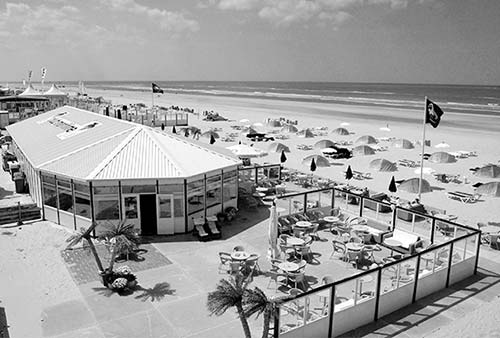
Getting There: It’s easy to reach by train, and the station is just around the corner from the beach (2/hour from Haarlem, 10 minutes; 2/hour from Amsterdam, 30 minutes). By bike, it’s a breezy 45-minute ride from Haarlem, heading west and following road signs for Bloemendaal, then Zandvoort.
Zuid-Kennemerland National Park
This wild, 15-square-mile polderland—with forests and sand dunes—sprawls just northwest of Haarlem all the way to the North Sea. On a nice day, it’s a popular place for a bike ride, long walk, or even a dip in a pond. If you’d like to get out of town, ask at the Haarlem TI for ideas on how to enjoy this natural zone that’s right at the city’s doorstep.
Amsterdam to Haarlem Train Tour
Since you’ll probably take the train from Amsterdam to Haarlem, here’s an out-the-window tour to keep you entertained while you travel. Departing from Amsterdam, grab a seat on the right (with your back to Amsterdam, top deck if possible). Everything is on the right unless I say it’s on the left.
You’re riding the oldest train line in Holland. Leaving Amsterdam, you’ll see the cranes and ships of its harbor—sizable, but nothing like Europe’s biggest in nearby Rotterdam.
On your left, a few minutes out of Amsterdam, you should be able to see an old windmill (you can visit a similar one in Haarlem). In front of it, the little garden plots and cottages are escapes for big-city people who probably don’t even have a balcony.
Coming into the Sloterdijk station (where trains connect for Amsterdam’s Schiphol Airport), you’ll see huge office buildings, such as Dutch telecom giant KPN. These sprouted after the station made commuting easy. On the horizon, sleek and modern windmills whirl.
Passing through a forest and by some houseboats, you enter a polder—an area of land reclaimed from the sea. This is part of an ecologically sound farm zone, run without chemicals. Cows, pigs, and chickens run free—they’re not raised in cages.
At the little train station in Halfweg-Zwanenburg—so named because it’s halfway between Amsterdam and Haarlem—you’ll pass two gleaming cylindrical buildings with diamond-shaped windows, part of a former sugar factory. These giant silos are now included in a development called Sugar City, with events space and an outlet mall.
Continuing past Halfweg, notice that the terrain flattens out even more and the train tracks run along a dike—providing a raised foundation less susceptible to flooding. The transportation system generally keeps running even in bad weather. Looking out at another dike in the distance (visible on clear days), consider that you’re in the most densely populated country in mainland Europe.
The big telecom tower marks the next train station, Haarlem-Spaarnwoude, in front of a giant IKEA. Just after that, on the right, find a big beige-and-white building. This is the mint, where currency is printed (top security, no advertising). This has long been a family business—see the name: Joh. Enschedé.
As the train slows down, you pass a giant, silvery structure on the left (the Netherlands’ biggest train-car maintenance facility) and enter Haarlem. Keep looking left. The domed building is a prison, built in 1901 and still in use. The De Adriaan Windmill you see was rebuilt in 2002, after the original burned down (the windmill is open for visits—see listing earlier).
When you cross the Spaarne River, you’ll see the great church spire of the Grote Kerk towering over Haarlem, as it has since medieval times, back when a fortified wall circled the town. Notice the white version of the same spire capping the smaller church (between the prison and the big church): This was the original sandstone steeple that stood atop the big church. However, structural problems forced its move to another church, and a new spire was built for the big church.
Exit the train into one of Holland’s oldest stations, adorned with Art Nouveau decor from 1908. Welcome to Haarlem.
Sleeping in Haarlem
Haarlem is most crowded in April (particularly on Easter weekend, during the annual flower parade, and on King’s Day), and in May, July, and August (especially during Haarlem’s jazz festival in August; see a list of holidays at www.ricksteves.com/europe/festivals). Some hotels lack an elevator, but your host will be happy to help with luggage.
IN THE CENTER
Hotels and B&Bs
€€€ ML Hotel faces the back of the Grote Kerk. Modern yet elegant, it’s located in a renovated 300-year-old building with a grand staircase. With bare floors, comfy high-quality beds, and minimalist touches in its 17 rooms, what it lacks in warmth it makes up for in style. Many rooms have church views, and the double-paned windows help keep down the noise. There’s also a bustling bistro and bar and the recommended ML Restaurant (breakfast extra, family rooms, air-con, Klokhuisplein 9, +31 23 512 3910, www.mlinhaarlem.nl).
€€€ Hotel Lion D’Or is a 55-room business hotel with all the professional comforts and pleasingly posh decor. It’s conveniently located across from the train station amid some popular local restaurants, but just a bit farther from the town center than some of the other hotels I recommend (RS%, air-con, Kruisweg 34, +31 23 532 1750, www.hotelliondor.nl, reservations@hotelliondor.nl, friendly Dirk Pauw).
€€€ Brasss Haarlem rents 14 upscale suites in a turn-of-the-century building once home to Haarlem’s first department store. Each cushy room has an open-floor plan, some with a see-through bathroom (in-room espresso machine and complimentary minibar beverages, room-service breakfast is extra, air-con, lavish honeymoon suites, Korte Veerstraat 3, +31 23 542 7804, www.brasss-hotelsuites.nl, info@brasss-hotelsuites.nl).
€€ Haarlem Hotel Suites, run by Brasss Haarlem, offers 24 cozy, apartment-style units, some with terraces, spread across several buildings. Each has a kitchen and a few have a loft bedroom (no elevator, stairs for most, check-in at Brasss Haarlem, www.haarlem-hotelsuites.nl, info@haarlem-hotelsuites.nl).
€€ Hotel Malts rents 14 modern, bright, and fresh rooms in a central location for a good price. Owners Henk and Annemarie personably share a wealth of Haarlem knowledge (and an annotated map) with each guest. Free coffee, tea, and fruit is available all day, and breakfast is a convivial experience and an education in Dutch ways (stairs and no elevator, Zijlstraat 58, +31 23 551 2385, www.maltshotel.nl, info@maltshotel.nl).
€€ Ambassador City Centre Hotel, with 104 straightforward rooms, is located just behind the Grote Kerk. It has dated public spaces, but the rooms feel fresher. If you’re willing to trade some street noise for church views, ask for a room in the front (breakfast extra, family rooms, elevator plus some stairs, Oude Groenmarkt 20, +31 23 512 5300, www.ambassadorcitycentrehotel.nl, info@haarlem.com).
€ The Niu Dairy is a sleek, chic hotel just outside the western edge of the old center, a 10-minute walk from Grote Markt. Although part of a German chain, the decor in its 84 modern rooms is distinctly Dutch. The lobby doubles as a breakfast buffet and a bar (breakfast extra, Zijlsingel 1, +31 23 206 2230, the.niu.de, dairy@the.niu.de).
€ Hotel Amadeus, on Grote Markt, has 15 small, basic rooms that still manage to charm. Front rooms with views of the square are noisy, while the back rooms are relatively quiet. Breakfast is served in a trendy restaurant overlooking the main square—a great place to watch the town greet a new day (Grote Markt 10—from the square it’s a steep climb to the lounge, check-in at ground-floor restaurant where there’s an elevator accessible during open hours, otherwise expect lots of stairs, +31 23 532 4230, www.amadeus-hotel.com, info@vesterhaarlem.com).
NEAR HAARLEM
€€ Van der Valk Hotel Haarlem, with 315 modern rooms, is sterile but a good value for drivers. It sits in an industrial zone a 20-minute walk from the center, on the road to the airport (breakfast extra, elevator, free parking, restaurant, Toekanweg 2, +31 23 536 7500, www.hotelhaarlem.nl, haarlem@valk.com). Bus #300 conveniently connects the hotel with the train station, Grote Markt, and the airport (every 10 minutes, stop: Europaweg).
¢ Stayokay Haarlem Hostel, with all the youth-hostel comforts, also has some simple doubles (Jan Gijzenpad 3, two miles from Haarlem station—take bus #2 from station, direction: Haarlem-Noord; or a 10-minute walk from Santpoort Zuid train station, +31 23 537 3793, www.stayokay.com/haarlem, haarlem@stayokay.com).
Eating in Haarlem
Haarlem is a surprise culinary hot spot. Several eateries in town are starred or recommended by Michelin, and competition is fierce. This means simple, old-fashioned, affordable Dutch-style eateries are on the outs, prices tend to be high, and style all too often trumps substance. (Locals explain that, outside of the popular summer season, high-end restaurants help attract Dutch day trippers—and their much-needed money.) Assuming you’re not coming to Haarlem for fine dining, I’ve focused my listing on midrange places offering variety and good value, with a few nicer and simpler options mixed in, too.
€€ Jacobus Pieck Eetlokaal is popular with locals for its fine-value “global cuisine,” good salads, and unpretentious flair. Sit in the peaceful garden courtyard, at a sidewalk table, or in the cozy interior. The Oriental Peak Salad is a perennial favorite, and the dish of the day (dagschotel) always sells out (great sandwiches at lunch, closed Sun-Mon, Warmoesstraat 18, behind church, +31 23 532 6144).
€€€ Metzo, across the street, is a bit more upscale, with welcoming staff and a short menu of Dutch/Mediterranean/international plates. The outdoor seating is appealing, and the interior—spread across several levels under stylish wicker chandeliers—is cozy when the weather’s bad (daily, Warmoesstraat 21, +31 23 532 2398).
€€€ De Lachende Javaan (“The Laughing Javanese”) is a long-established Indonesian place for dinner on a quiet back street not far from the main square. There’s no outdoor seating, but the interior has Javanese decor and a lively energy. The rijsttafel is a memorable if pricey experience (reservations recommended, closed Mon, Frankestraat 27, +31 23 532 8792, www.delachendejavaan.com). For tips on Indonesian food and enjoying a rijsttafel, see the sidebar on here.
Trendy Brewpub: The Jopen brewery has converted a church into a flashy, popular gastropub called € Jopenkerk. With 20 brews on tap, sometimes including a Hoppenbier from a 1501 recipe, this is a beer lover’s mecca. A café menu has budget pub grub—burgers, salads, and quiche. The more elegant menu for the upstairs restaurant is available in the pub as well (brewpub daily, restaurant Wed-Sat dinner only; Gedempte Voldersgracht 2, +31 23 533 4114).
Vegetarian Cafés: A short block off the Grote Markt, €€ By Lima has some of Haarlem’s most appealing outdoor seating that’s not right on the main square. This health-conscious eatery features breakfast all day, open-faced sandwiches (think variations on avocado toast), fresh juices, coffee drinks, desserts, and other tasty fare, all in a momentum-shattering location (daily until 18:00, Zijlstraat 65, +31 23 785 3564). A few blocks from the Frans Hals Museum, €€€ DeDakkas may be Haarlem’s best sunset perch, set atop the Kamp parking garage, with super views from its glassy indoor dining room and an expansive terrace. The menu features creative vegetarian fare and a fish dish or two (reservations smart, daily, De Witstraat 1A, +31 23 574 9526, www.dedakkas.nl).
Pizza: There are plenty of tempting, trendy pizza spots in town. For simple value, I like €€ Pizzeria-Ristorante Venezia, run for nearly three decades by the same Italian family from Bari. Locals appreciate its remote-ish location a couple of long blocks off the main drag, where it’s easier to avoid the crowds of tourists and day trippers downtown. Sit outdoors for quality people-watching, or indoors at a well-worn table (daily 13:00-23:00, Verwulft 7, +31 23 531 7753).
Dressy Splurge: At €€€€ Restaurant ML, chef Mark Gratama serves chichi French-fusion cuisine in an elegant and modern dining room below the ML Hotel. This Michelin-starred restaurant offers four- to eight-course tasting menus starting at €79, as well as à la carte dining (reservations necessary, dinner only, closed Sun-Mon, Klokhuisplein 9, +31 23 534 5343, www.restaurant-ml.nl). They also have a more affordable €€ bistro serving lunch and dinner daily, indoors or out.
ON THE SPAARNE RIVER CANAL
When the weather is fine, it’s tempting to enjoy an outdoor table overlooking Haarlem’s canal.
€€€ Spaarne 66 is close to the heart of town, just around the corner from the end of the Lange Veerstraat restaurant strip. It has good local dishes of meat and fish, a classy old-meets-modern interior accented in gold, and lots of outdoor tables sprawling along the prettiest stretch of canal (long hours daily, Spaarne 66, +31 23 551 3800).
Two more places, which share the same owners, sit side by side a few minutes’ walk south along the canal. €€€ Fishbar Monk is the best place in town for seafood, with “snack,” small, and large plates. It has a nicely tiled interior with an actual fish counter at the back, as well as ample outdoor seating (Mon-Fri 17:00-late, Sat-Sun from 12:00, Turfmarkt 20, +31 23 727 1266). Next door, €€€ Roast Bistro Bar Haarlem adds “turf” to the “surf” with grilled meats—specializing in rotisserie chicken (daily 16:00-late, Turfmarkt 26, +31 23 844 2271).
BUDGET OPTIONS
Fries: A couple of places near Grote Markt sell old-fashioned, fresh Flemish-style fries with various sauces. The closest choice is Friethuis La Petite, behind the church (Tue-Sun until 19:00, closed Mon, Warmoesstraat 3). The purist’s choice, Frietkamer, is just a short walk to the west (Tue-Wed 16:00-20:00, Thu-Sun from 12:00, closed Mon, Zijlstraat 31).
For Families: Tucked in a fun toy-store setting, the little café at €€ Meneer Paprika (“Mr. Pepper”) offers snacks and sandwiches, an inviting play area, and rental bikes with child seats available (café open Mon-Sat 9:00-17:00, Sun from 10:00, shop usually open one hour later than café, a block off Grote Markt at Koningstraat 19, +31 23 202 3268, www.meneerpaprika.nl).
Ice Cream: Local favorite Gelateria Bartoli, on the south side of the church, has both classic Italian and Dutch-inspired flavors (daily, often closed Mon off-season, closed entirely in Nov and Feb).
Haarlem is a laid-back place for observing the Dutch approach to recreational marijuana. The town is dotted with about a dozen coffeeshops, where pot is sold and smoked by relaxed, noncriminal types. These easygoing coffeeshops are more welcoming than they may initially seem—bartenders understand that Yankee travelers might feel a bit out of their element and are happy to answer questions.

If you don’t like the smell of pot, avoid places sporting wildly painted walls; plants in the windows; or Rastafarian yellow, red, and green. High Times, with a living-room ambience and loaner bongs, is inviting and particularly friendly to American visitors. Smokers choose from 14 varieties of joints in racks behind the bar (neatly prepacked in trademarked “Joint Packs,” long hours daily, Lange Veerstraat 47, www.coffeeshophightimes.nl).
Supermarkets: With three handy locations, Albert Heijn is open daily. One is in the train station, another is at Kruisstraat 10, and their largest store is near the river and recommended Jopenkerk pub at Drossestraat 11. The DekaMarkt is a few blocks west of Grote Markt (daily, Gedempte Oudegracht 54).
Nightlife in Haarlem
Haarlem’s evening scene is great. Consider four basic zones: Grote Markt (in the shadow of the Grote Kerk), Lange Veerstraat, Botermarkt, and Vijfhoek. If you want more high-powered nightlife, Amsterdam is just 20 minutes away by train.
Grote Markt is lined with trendy bars that seem made for nursing a drink—Café Studio is generally the hot spot for a drink here (at Grote Markt 25); I’d also duck into the dark interior of In Den Uiver (near the Grote Kerk entry at Riviervischmarkt 13, occasional live jazz).
Lange Veerstraat (behind the Grote Kerk) is colorful and bordered with lively spots.
Botermarkt (connected to Grote Markt by Koningstraat street) is more convivial and local, as it’s less central and away from the tourists—or try the nearby Jopenkerk brewpub (described earlier).
Charming Vijfhoek (Five Corners, named for the five lanes that converge here) is the cutest corner in town. Although it has only one pub (with plenty of drinks, bar snacks, a relaxed crowd, and good indoor or outdoor seating), this quaint zone is fun to wander in the evening. Also worth exploring is the area from Vijfhoek to the New Church (Nieuwe Kerk), a couple of blocks away.
Haarlem Connections
If you take the train from Amsterdam to Haarlem, see the “Amsterdam to Haarlem Train Tour” (earlier, under “Sights in Haarlem”) for a train-window tour of the countryside.
From Haarlem by Train to: Zandvoort (2/hour, 10 minutes), Amsterdam (8/hour, 20 minutes), Leiden (6/hour, 20 minutes), The Hague/Den Haag (4/hour, 40 minutes), Delft (2/hour, 40 minutes), Rotterdam (4/hour, 1 hour, more with transfer), Utrecht (4/hour, 50 minutes, transfer in Amsterdam), Hoorn (2/hour, 70 minutes, more with change in Amsterdam Sloterdijk), Alkmaar (2/hour, 40 minutes), Brussels (hourly, 3.25 hours, transfer in Amsterdam or Rotterdam), Bruges/Brugge (hourly, 4 hours, 2-3 changes—avoid Eurostar connections if traveling with a rail pass).
By Bus to Aalsmeer: Connexxion bus #340 connects Haarlem to Aalsmeer’s town center, where you can take bus #357 to the flower auction (4/hour, 1 hour, see “Getting There” on here).
To Keukenhof: The Keukenhof Express bus #850 combo-ticket takes you from the Haarlem train station to the garden entrance and includes admission (1/hour, 45 minutes). Bus #50 goes to Lisse, a 15-minute walk from the park entrance (4/hour, 1 hour).
To Schiphol Airport: Your best option is bus #300 (departs every 10 minutes or so, takes 40 minutes, €6.50, card only). For most of the trip, this bus travels on its own limited-access roadway—what transit wonks call a “busway.” To catch the bus from the middle of Haarlem, head to the Centrum/Verwulft stop, a few blocks south of the Grote Markt. Or, to catch this bus from Haarlem’s train station, look for the “K” bus stop, where it pulls up to the curb in front of the station rather than out in the big lot. You can also get to the airport by train (6/hour, 30-40 minutes, transfer at Leiden or Amsterdam-Sloterdijk station) or taxi (about €40).