LEIDEN
Leiden (LIE-den) is the Oxford of Holland. Its prestigious university imbues the town with an upscale aura—and with 20,000 students, who keep otherwise hoity-toity Leiden firmly rooted on the ground. As an academic center, the birthplace of Rembrandt, and the final European home of the Pilgrims before they set sail for America, Leiden has many claims to fame. But perhaps most enticing of all is that it’s simply a pleasant, relatively low-key Dutch city that’s easy to get to, fun to explore...and happens to have more than its fair share of great sights and museums.
PLANNING YOUR TIME
Often-overlooked Leiden is tucked between Amsterdam and The Hague on Holland’s busy north-south rail line. If you have only a few hours to spare, hop out at the station, throw your bag in a locker, and follow my self-guided walk in this chapter. The pretty and historic core can be appreciated in a two-hour stroll; with more time, you can dip into some of Leiden’s fascinating museums. Note that the American Pilgrim Museum is closed Sunday through Wednesday, and the Windmill and Lakenhal museums are closed Monday. Market days are Wednesday and Saturday (bigger).
Orientation to Leiden
With about 120,000 residents, Leiden is slightly smaller than Haarlem but bigger than Delft. The neatly oblong old center is lassoed by its former moat (singel), and the two branches of the Rhine River merge at its center—creating an inviting network of canals big and small. The train station sits at its northwestern corner, a short walk from the town center.
Tourist Information: The TI is a block in front of the station (on the right; Mon-Fri 8:00-18:00, Sat 10:00-16:00, Sun 11:00-15:00; Stationsweg 26, +31 71 516 6000, www.visitleiden.nl).
Arrival in Leiden: Leiden’s manageable Centraal train station has lockers (up the escalator just inside the main entrance, by tracks 1 and 2; credit card only) and WCs on the main floor between tracks 4 and 5. To rent a bike, exit out the main doors and turn immediately left (look for the Oldenburger shop, long hours daily; www.olden-burger.nl). To reach the center of town—narrated by my self-guided walk—exit out the main doors and proceed straight down Stationsweg for five minutes.
Helpful Hints: Marike Hoogduin-Berkhout is an art historian and excellent local guide who leads custom-designed private tours of Leiden, The Hague, Amsterdam, Haarlem, and Delft. She specializes in museums and also offers tours through the countryside by bike, boat, or car (€295 for 4 hours, +31 65 377 3808, www.marikeculturaltours.nl, info@marikeculturaltours.nl). Canal boat tours are available (see “Sights in Leiden”). The Museumkaart sightseeing pass (see here) covers entry to Leiden’s Rijksmuseum Boerhaave, Windmill Museum, and Lakenhal Museum.
Leiden Walk
1 Singel
6 St. Peter’s Church Square (Pieterskerkhof)
7 Gerecht
10 Burcht
12 Hoogstraat and Back to the Station
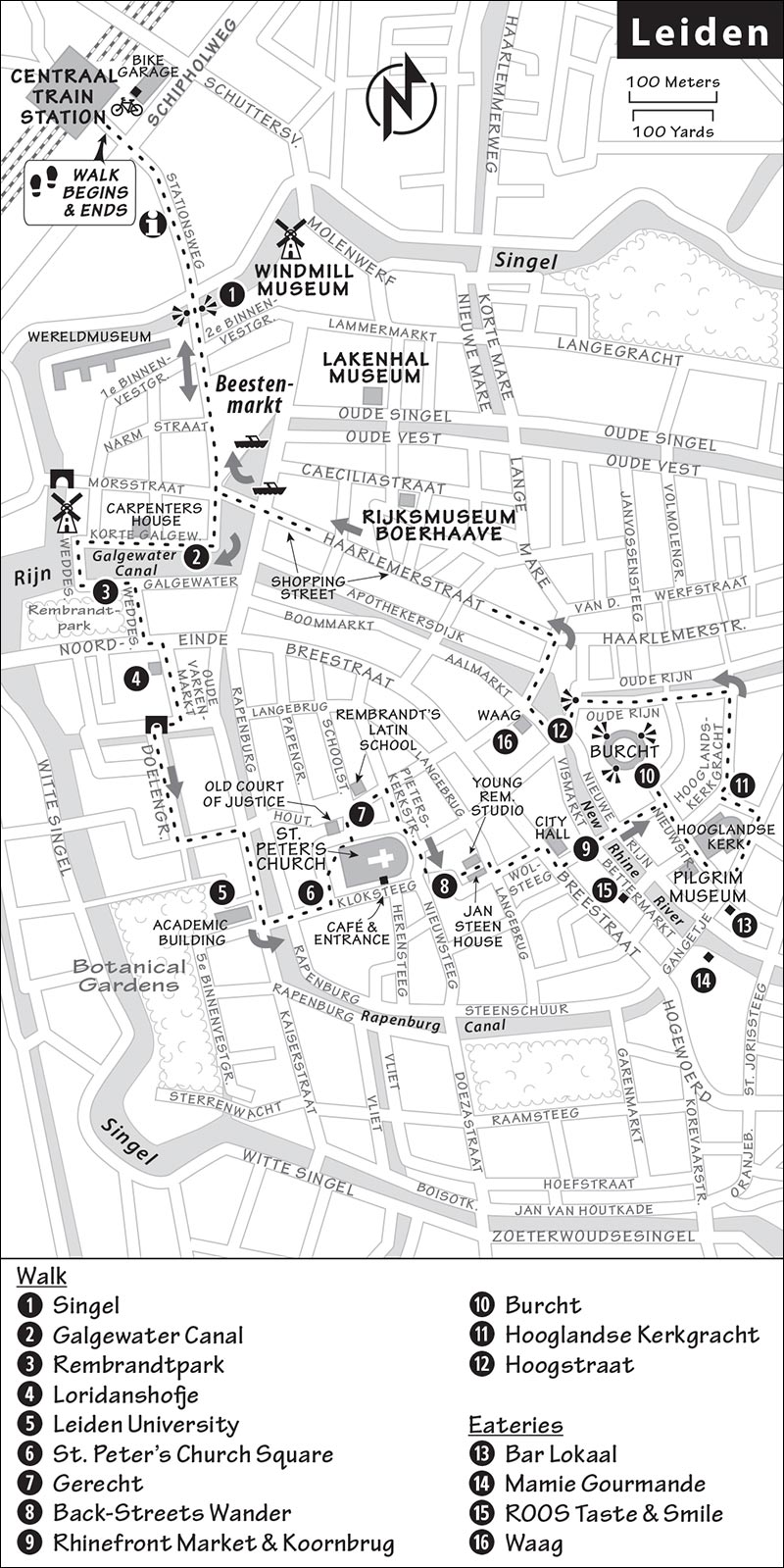
This two-mile self-guided walk begins at Centraal train station, curls through the center of the city to reveal its university and Rembrandt connections, climbs up to Leiden’s historic castle, then loops right back to where you started. I’d give it about two hours at a leisurely pace, not counting any sightseeing stops.
• Walk out the front door of the train station. Pause in the plaza and take in today’s Netherlands: a bike garage on the left (with taxi stand on top) and a Lego-style world of modern office buildings and condos all around.
Head down Stationsweg, which bends to the right. You’ll pass the TI on your right, and a block later, reach a bridge. Find a spot on the left side of the bridge and look out over the canal known as...
1 Singel
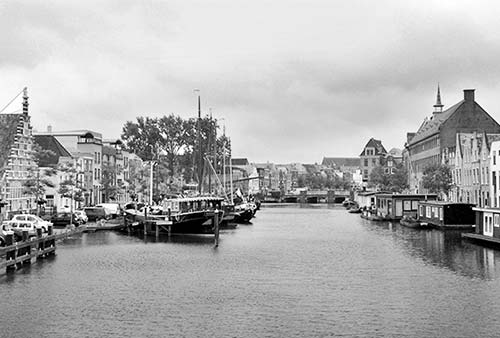
Like many Dutch towns, historically Leiden was surrounded by a singel (moat). But Leiden’s is unusually well preserved. Much of the moat was built in the late 16th and early 17th centuries—after the Spanish siege, when Leiden was booming. The jagged zigzags of its serrated city wall and moat are still evident in the city’s footprint (see map).
Originally the moat ran in front of a fortified wall. That wall is long gone, but the windmill in the distance suggests how tall it was. The higher a windmill is situated, the better it’s able to capture the wind—so, logically, windmills were often built on top of the town walls. This one is a “platform mill” (stellingmolen)—the miller lived in the house below and could rotate only the windmill’s head (with the wings) to face the wind. After our walk, you can climb up there to tour the fascinating Windmill Museum that fills its many funhouse floors (described later, under “Sights in Leiden”).
Turn around to face the opposite direction. On the riverbank to your left is the Leiden branch of the Wereldmuseum, with exhibits on world cultures; their display of art from the former Dutch East Indies colony (present-day Indonesia) is especially good. This is one of several major museums in this small town. As the Netherlands’ traditional seat of learning, Leiden seems to have more than its share of culture.
• Continue straight across the bridge. After another block, you’ll reach the market square called Beestenmarkt (where animals—beesten—were traditionally traded). Continue to the end of the square. The big bridge on the left leads to Haarlemmerstraat, the city’s main shopping drag and a good place to browse for lunch (we’ll return this way later, after our walk). In the opposite direction, the similarly shop-lined Morsstraat leads to the Morspoort gate. Canal cruises leave from the little house at the top of the bridge.
For now, pass up these temptations and keep going straight along the canal. When you hit the wider canal, turn right and walk toward the windmill along...
2 Galgewater Canal
“Gallows Water” is (morbidly) named for the field at the far end of the canal, where the corpses of executed criminals were put on public display to bully people into compliance many centuries ago.
Stroll along the canal. On your left, notice the fine collection of historic houseboats from the 1880s through the 1920s. The older ships’ big, pivoting fins, called swords, can be dropped from the sides when necessary to stabilize the boats and allow more nimble navigation of inland Holland’s shallow waters. Locals still live in these, paying about €200,000 for their cramped, if waterfront, “property.” Look for their mailboxes near the dock.
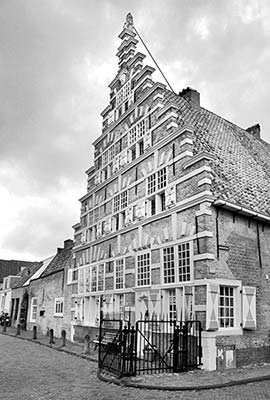
After one block, look for the tall “Carpenters House” building on the right (at #21, just after the little lane). Appreciate this quintessentially Dutch house: stripes of red and white bricks, shutters with the town colors of red and white, and a classic stepped-gable design. Built in 1612 as Leiden was booming, this building housed architects, carpenters, and bricklayers who were hard at work expanding the city. Since 1988, it has been a subsidized housing complex for local seniors—who must navigate a very old building with no elevators. Walk a few steps past the front door and discreetly duck through the gate into the garden courtyard to see how the crenellated facade hides a much larger complex.
Continuing along the canal, you’ll reach another windmill. A different style than the one we saw earlier, this 1987 replica of a 1619 original is a “post mill” (standerdmolen), which means that the entire structure rotates on its base. On Saturdays, you may be able to go inside to see the gears.
Turn left at the windmill and cross the bridge (pedestrians on the left, bikes on the right). Notice the poem written high on the wall on your right—one of over a hundred such verses scrawled on buildings all over highly literate Leiden. While this one’s in the local Frisian dialect, others are in English.
• Once across the bridge, continue straight a few more steps down Weddesteeg and pause at the pebbled square.
3 Rembrandtpark
Leiden’s favorite son was born in 1606 in a house that faced this square (find the plaque on the modern building that replaced that one). Rembrandt van Rijn was the son of a miller who operated a windmill “on the Rhine” (as the name implies; you can faintly see the brick footprint of the rampart upon which the mill stood—it’s by the boat-rental place on the right side of the square, now covered with plants). His family owned a lot of property and was well-to-do enough to send young Rembrandt to Latin school (like today’s prep schools) and later to Leiden University. Rembrandt enrolled at Leiden U. but never actually attended any classes—even at age 14, he was only interested in painting. At age 17, he decided that he’d make more money in Amsterdam than here...and with that, he was gone. (For more on his life and career, see here.)
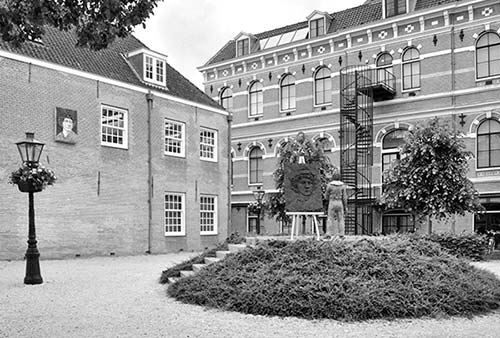
On the little mound in the pebbled park, a life-size statue of a young Rembrandt appreciates his later self-portrait. Leiden savors the idea that this world-famous artist spent his formative years right here. Exploring town today, imagine li’l Rembrandt poking his way through Leiden’s tight courtyards and zipping across its tranquil canals, finding inspiration for his later artistic life.
• Continue down Weddesteeg, then turn left at the cross-street (Noordeinde). After one block, turn right down the wide, tree-lined Oude Varkenmarkt (“Old Pig Market”). In the middle of the long, brick building near the start of this street (on the right, across from #10), check to see if the door under the yellow arch is unlocked. If it’s open, go inside. (Don’t be shy, but do be discreet.)
4 Loridanshofje
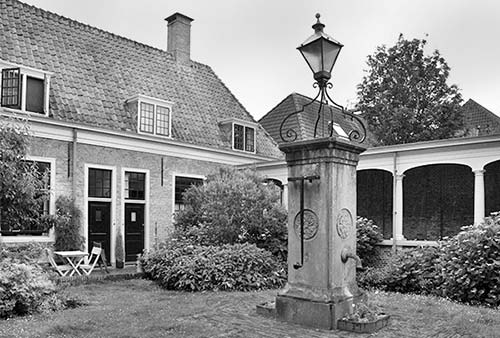
Leiden has 35 hofjes—residential courtyards—like this one. Similar to a begijnhof, this was a building funded by wealthy, churchgoing donors to house poor people in exchange for prayer. Today, many hofjes are used for student housing. The layout of this one is typical: 12 houses (symbolic of the 12 Apostles) in a U shape, ringing a central courtyard with a well in the middle and a covered gallery on the far side. We’ll pass through another hofje later on this walk (a TI brochure locates all of them). These are public property, but remember that people do live in them (notice the mailboxes and bikes in the entryway)—so please keep a low profile.
• Keep going down Oude Varkenmarkt. You’ll pop out at a canal crossroads. Continue straight, under the St. George Gate (Sint Jorispoort, from 1645, marking the former headquarters of the local civic guard—like the gang in Rembrandt’s Night Watch). The two red crossed keys on the gate are Leiden’s city symbols (locals joke, “One key is St. Peter’s, and the other is a spare.”) Continue straight along the lily-padded canal, with a social-housing project on your right. Turn left over the next bridge (under the brick arch). You’re surrounded by modern university facilities. Continue one block along Doelensteeg. At #9 on the left is a fancy door leading to another quaint and peaceful hofje.
The lane continues to a wide canal called Rapenburg, with some of the finest homes in Leiden. Turn right and walk along the canal toward the next bridge. But before you reach that bridge, duck through the black iron gate of the big, stately, striped-brick building on your right.
5 Leiden University
William of Orange founded the Netherlands’ first university in Leiden in 1575. Albert Einstein taught here, and its students have included philosopher René Descartes, painter Jan Steen, novelist Henry Fielding, US President John Quincy Adams, scientist Enrico Fermi, and filmmaker Paul Verhoeven, as well as multiple Dutch prime ministers and several Dutch monarchs (including former Queen Beatrix and the current king, Willem-Alexander). Today, one in every six Leiden residents is a student. There’s no unified campus; instead, students live scattered around the city center (including at hofjes like the ones we saw earlier). Because Delft is home to the technical university, and Leiden U. has more of a liberal-arts bent, locals half-joke that male students ride the train in from Delft to find a wife in Leiden.
As you stand in the entry courtyard, the big building on your left is the main Academic Building (Academiegebouw). This former nunnery was repurposed after the Reformation and now hosts university events (not open to visitors—but you can peek through the windows).
Straight ahead at the end of the corridor, step out into the impressive botanical gardens. This historic complex was founded in the 1590s—back when understanding plant life went hand-in-hand with the medical sciences. They say that a Flemish professor, recently returned from a trip to Turkey, planted the first tulip bulb in Dutch soil right here. Scientists like those at Leiden University found that tulips thrive in Holland, and before long...tulip mania. You can enjoy nice views for free from the entry, but those who pay admission can explore the sprawling grounds, with an extensive collection of Japanese plants, a fine rose garden, and a complex of restored old greenhouses (€8.50, buy ticket and enter on the right, daily 9:00-18:00, 10:00-17:00 Nov-March; inviting café inside, www.hortusleiden.nl).
• Head back out to the big Rapenburg canal, turn right, continue to the bridge at the corner, and cross it. Café Barrera, with tables spilling onto the bridge, may tempt you for a break if you didn’t already take one at the botanical garden—or keep going straight up charming Kloksteeg. In one block, you emerge at...
6 St. Peter’s Church Square (Pieterskerkhof)
The huge church itself is worth a peek, though it isn’t an active church—it’s used mostly for events and concerts (€4, daily 11:00-18:00, entrance on the far end through a little café, pick up extensive English info sheets). For American visitors, this site is most significant for its role in Pilgrim history. In 1609, a large community of Pilgrims fled religious persecution in England, coming first to Amsterdam, then settling here in Leiden, concentrated in the square around this church.
The building on the right, at #21 (an almshouse marked Anno 1683), was the site of the home and church of John Robinson, the Pilgrims’ minister. You can push open the door and pop in. Directly across the street, giant plaques embedded in the rounded corner of the church explain some Pilgrim history, and a modern marker notes how several US presidents had Pilgrim ancestors.
The Pilgrims were forced to thread a theological needle: While extremely rigid in their faith, they needed a relatively tolerant, progressive social context to thrive. When Holland’s truce with Spain expired, the Pilgrims feared that the peace they found here wasn’t to last. In the summer of 1620, they set out for the New World.
Leiden residents feel proud of their connection to American history. While at sea, the Pilgrims outlined rules for their planned society, the Mayflower Compact (which later influenced the US Constitution). Many of its tenets were inspired by the tolerant policies of William of Orange, which the Pilgrims became familiar with here. And the American Thanksgiving—celebrated in the autumn by the Pilgrims and their new Native American neighbors—seems partly inspired by the “Relief of Leiden” ceremonial meal that takes place here each October 3. For more about the Pilgrims, see here.
• Circle clockwise around the left side of the church. About 20 steps after rounding the bend, take a left up the narrow lane called Muskadelsteeg to...
7 Gerecht
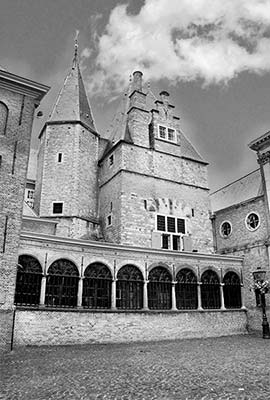
This tranquil, leafy square—whose name literally means “Justice”—is dominated by a large, turreted building that housed the 17th-century prison and court of justice. Parts of the building are much older—from the 12th century—and the justice meted out here was medieval in every sense. Prisoners would be put to work: men dyeing cloth, women spinning wool. Many were tortured and executed right on this square. They’d be drawn and quartered, or their bones crushed on a wheel. Then their corpses were taken out to display at the park at the end of the “Gallows Water” (Galgewater) we saw earlier.
At the opposite corner of the square from the justice tower, find the stepped-gabled house (with the tallest, fanciest, and most tilted facade) at the start of the tiny lane called Schoolsteeg. This building was the young Rembrandt’s Latin school (so we’ve basically been retracing his daily walk from his home to school). The windows display bits of Rembrandt history. The first window also has a box painted on the glass and a camera inside; if you hold a pose with your face framed by the box for 10 seconds, you can go online later to find your portrait as a Rembrandt-style “etching.”
• Head past the house up Lokhorststraat, turning right down Pieterskerkstraat. This takes you past the apse of St. Peter’s Church. Notice the houses that huddle up against the apse; the church rented out these houses as a source of income. Just around the back end is a café, which serves as the entrance to the church if you care to visit.
At the far end of the church, in the corner across from the café/entrance (on your left, just behind the single tree), is a small doorway leading into a tiny brick lane. Go there.
8 Back-Streets Wander
This lane leads into another adorable, whitewashed courtyard. Push the door and enter St. Peter’s hofje. Rather than students, these four homes house seniors. Continue through the far end of the hofje, then angle left through the grass yard and up the lane. You’ll end up at the street called Langebrug.
Just to your right, at #93, is what was once a residence of the painter Jan Steen. Imagine this street when it was still a canal with broad and busy sidewalks on either side.
Now turn left—three doors down at #89—to the Young Rembrandt Studio. This is a classy gift shop with a well-produced film in the back that tells the story of the young artist and his friends. Well worth a restful and informative seven-minute sit, it’s narrated by his (very proud) first teacher from the Latin school we saw earlier, Jacob van Swanenburgh, who lived in this building (free—ask for English showing as you enter; Tue-Sun 12:00-17:00, closed Mon).
Back where you entered this street, turn left to continue straight up the little lane called Wolsteeg. You’ll emerge at the busy and aptly named Breestraat (“Broadway”)—busy with buses, bikes, and taxis. You’re face-to-face with Leiden’s late-16th-century City Hall, whose carillon tower jangles happy tunes on the quarter hour.
• Cross Breestraat (carefully) and jog a bit to the right to curl around the side of City Hall (following Koornbrugsteeg). You’ll run into...
9 Rhinefront Market
This is the New Rhine (Nieuwe Rijn), which meets up with the Old Rhine (Oude Rijn) about a hundred yards to your left—we’ll be there later. From here, the Rhine River heads to the North Sea. While we’ve passed a few smaller market squares (basically wide streets) on this walk, Leiden lacked the “Grote Markt” (Great Market) of some Dutch towns, like Haarlem or Delft. So merchants would simply unload their wares at the wide wharf along this river—today made even wider with restaurant-table-loaded barges.
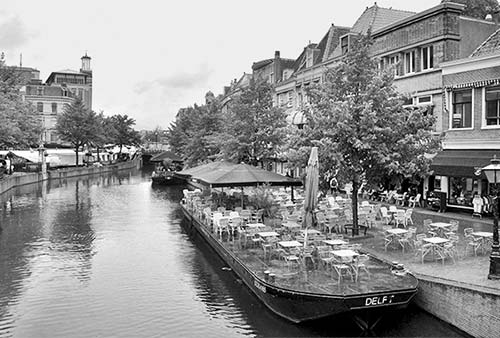
Koornbrug—the covered “Corn Bridge”—was built in 1825 to provide grain merchants protection from the rain. Leiden still hosts a thriving market here: Saturday is the big market day, while Wednesday hosts a smaller assortment. This area is fun to explore and browse for a meal; I’ve recommended some options within a two-minute walk under “Eating in Leiden,” later.
• Head across the covered Koornbrug and proceed straight up Burgsteeg (lined with nice shops—kitchenware, home decor, and so on). You’ll dead-end at Nieuwstraat. Turn left through the gate, cut through the café courtyard, and head up the steep stairs to the...
10 Burcht
Let me guess—huffing and puffing, are we? This climb could be a rude awakening if you’ve gotten used to the near-total lack of hills here in the Netherlands. The artificial mound, built in the eighth or ninth century, is part of a system of castle construction called “motte and bailey”—that is, a fort (bailey) sitting upon a mound (motte). A castle has stood here since around 1150—first made of wood, later of stone. Climbing up into today’s version, you enter what feels like an empty shell. But there was never a big fortress here—just a walled courtyard where residents could safely set up tents in times of siege. And their siege resistance relied upon the well you see in the middle of the courtyard, which is still attached via a network of pipes to a wellhead down on the market canal. Climb up to the top of the wall and stroll all the way around for 360-degree views over Leiden, with key landmarks identified by orientation boards. Examining the wall you’re standing on, notice the porous gray stone, which formed part of the original wall and was scavenged from Roman ruins.
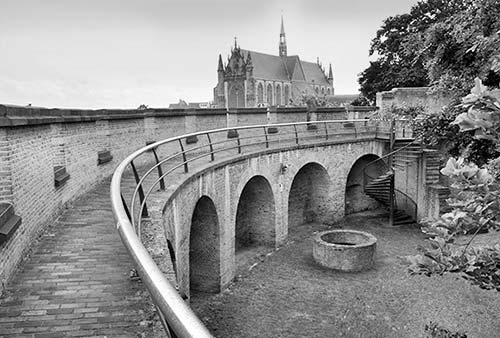
• From the top of the stairs, looking back the way you came up, note the towering Gothic Hooglandse Kerk (Highlands Church). Now get down from the wall, backtrack through the gate, and walk straight along Nieuwstraat toward the church. About halfway along the side of the church, on the corner of Beschuitsteeg, is the oldest house in town. This is home to the unique and excellent American Pilgrim Museum (highly recommended, but open only Thu-Sat afternoons; for details, see “Sights in Leiden,” later). But any time of day you can peer into the windows to see a slice of 17th-century local life.
Consider stepping into the Hooglandse Kerk’s vast, whitewashed interior (free) for a chance to walk over the tombstones of “the stinking rich” and see the clock mechanism from 1609 (just left of door).
Circle three-quarters of the way around the church. Turn right when you get to the wide, tree-lined, boulevard-like street called...
11 Hooglandse Kerkgracht
This gracefully arcing strip passes (on the left) the beautiful building that once housed the Holy Ghost Orphanage (Heilige Geest of Arme Wees en Kinderhuis). Notice the colorful but wretched orphans topping the ceremonial gateway. Step into its courtyard to appreciate the enormous scale of this building, which—from the 16th century until 1961—housed up to 700 orphans at once. (While the locals provided these kids shelter, they also worked them hard in an age long before child-labor laws.)
Directly across the street from the orphanage is the stern 17th-century brick facade of a Lutheran church, which for 200 years hid behind a row of houses (now torn down to open up land for its front yard). Back then, Lutherans—like any nonconformist, non-Calvinist Christian denomination—were allowed to worship, but it had to be out of sight.
Leaving the orphanage, turn left and head to the canal, with its green bridge dating from 1867. It’s a counterbalance bridge, calibrated so a single person could pull the chain and open it for tall boats heading up the Old Rhine.
At the canal, don’t cross the bridge. Instead, head left about 100 yards up the Old Rhine—passing the footbridge—to the Fish Bridge (a wide brick bridge over the New Rhine). From the crest of the bridge, turn left, then cross another bridge and go to the right. You’ll pass (on your left) a big department store. At its far end is the entrance to a bike garage, provided free by the city to lessen congestion. Look around and imagine, with this population density, if every bike were a car—chaos.
Just beyond that, the fancy gray Neoclassical Waag building dates from the mid-17th century. Once a customs house where merchants would weigh their goods (in the relief above the door, notice the burly stevedores doing some heavy lifting), it’s now a café. Step inside to peek at surviving bits of the original business, such as the huge scales to weigh everything sold in the market. In back of the café, the fine arcade was once the butter market. It’s tempting to celebrate the end of your town walk here with some coffee and apple pie, or, perhaps, some bitterballen with a beer.
12 Hoogstraat and Back to the Station
When you’re ready to head back to the station, cross the modern Waaghoofdbrug footbridge. Continue up one block (to the Neoclassical Catholic church), where you can turn left and wander the lively Haarlemmerstraat pedestrian shopping zone. After just a few short blocks, you could detour a block to the right to visit the Rijksmuseum Boerhaave, with its bizarre and fascinating collection of historical science exhibits. The Lakenhal Museum (master painters) is a few blocks farther north. Otherwise, continue straight ahead until you hit the canal. From here, you could turn right to walk up to the Windmill Museum, or you could continue over the bridge, turn right along the side of Beestenmarkt, and retrace your steps back to where you started: the train station.
Sights in Leiden
▲▲American Pilgrim Museum
Worth ▲▲▲ for historians, this quirky and engaging sight is Leiden’s hidden treasure. Dr. Jeremy Bangs, an American historian, filled the oldest house in Leiden (from the late 1360s, including the original fireplace and floors) with an eclectic collection of historical items. No Pilgrims actually lived here, but the collection offers an intriguing glimpse at early-17th-century lifestyles. This isn’t just a “museum”—it’s a curated experience that still bears the imprint of Bangs, who died in 2023. Be careful as you explore the house’s two delightfully creaky rooms—many items are as fragile as they are priceless, and there are essentially no barriers between you and the collection.
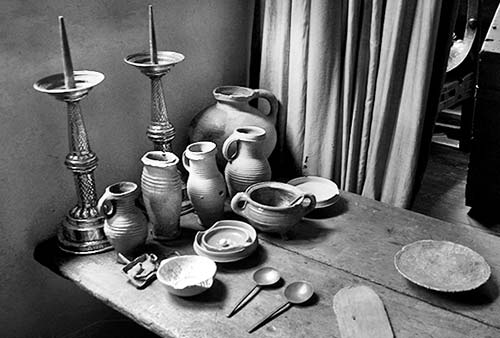
Cost and Hours: €9.50; Thu-Sat 13:00-17:00, closed Sun-Wed; Beschuitsteeg 9, +31 6 2726 4651, www.leidenamericanpilgrimmuseum.org.
▲Rijksmuseum Boerhaave
Fun, fascinating, and appropriate for this very academic town, the modern, well-presented Boerhaave museum traces the evolution of science with many interactive exhibits, all of them well described in English.
Cost and Hours: €15, daily 10:00-17:00, Lange Sint Agnietenstraat 10, +31 71 751 9999, www.rijksmuseumboerhaave.nl.
Visiting the Museum: You’ll begin at the replica of an old operating theater—a reminder that Leiden’s university was one of the first places where human corpses were dissected to understand how they functioned. A seven-minute audiovisual introduction plays on a loop (for the English soundtrack, make your way upstairs, put on the headphones, and look down toward the gurney).
Then follow the one-way, loosely chronological loop through the exhibit, focusing on medical science but also including astronomy and other disciplines. You’ll learn how Holland’s (and Leiden’s) golden age was a time of enlightenment, learning, and study. The medical-science section is particularly engaging—with antique doctors’ tools and the gruesome, larger-than-life anatomical models of Dr. Louis Auzoux. You’ll also see some priceless collections of old scientific equipment; noticing the ornate decorations, you’ll appreciate how these precious instruments offered credibility and prestige to scientific pursuits. Downstairs is a variety of hands-on areas, including a fun garden with a water playground for kids (and a café for their parents).
▲Windmill Museum (Molenmuseum De Valk)
Worth ▲▲ for fit engineers, this is a fun chance to climb—steeply and claustrophobically—through the guts of a huge, working windmill (named De Valk—“The Falcon”). You’ll begin by walking through the miller’s house on the ground floor, then climb up to view an excellent 10-minute film about Dutch windmills. As you work your way up, up, up through the cramped structure (with ladder-like stairs), you can browse exhibits at each level about the Netherlands’ tradition for harnessing the wind’s power, including lots of model windmills. At the top, you’ll enjoy fine views over the rooftops of Leiden.
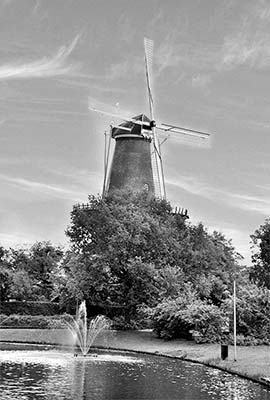
Cost and Hours: €6; Tue-Sat 10:00-17:00, Sun from 13:00, closed Mon; Molenwerf 1, +31 71 516 5353, www.molenmuseumdevalk.nl.
▲Lakenhal Museum (Museum De Lakenhal)
Leiden’s leading museum features art treasures from the 16th century to the present, as well as a fine collection of local history. The Dutch Masters collection excites art lovers, but the museum may be of less interest to casual museumgoers.
Cost and Hours: €16, Tue-Sun 10:00-17:00, closed Mon, Oude Singel 32, +31 71 516 5360, www.lakenhal.nl.
Visiting the Museum: The ground floor has temporary exhibits, as well as the museum’s highlight—the Dutch Masters collection. Entering through the door marked Hartereltzaal into Room 3, you’re surrounded by altarpieces. Straight ahead is an exquisitely detailed Last Judgment triptych (three-part altarpiece) by local engraver and painter Lucas van Leyden. Painted in 1527 and originally displayed in St. Peter’s Church, its bright colors and energy-charged composition represent the arrival of the Renaissance in the Low Countries.
Turn right to continue into Room 4 (“Leiden as the Cradle of Dutch Painting”). Here you’ll find works by Rembrandt. On the left wall, see Spectacles-Seller (from 1623), one of his earliest compositions; with its poorly painted hands, awkward profile, and clashing colors, it lacks the mastery of his later Amsterdam heyday. Also in this room are works by Jan Lievens (Rembrandt-like portraits) and Jan van Goyen (Turner-esque seascapes).
Proceed into the long, narrow, darkened Room 5. Rembrandt’s pupil Gerrit Dou kicked off a school called the Leiden Fijnschilders, which specialized in small, extremely detailed scenes with a strong light/dark contrast—a fine collection of which is displayed here.
Finally, in Room 6 (“Public and Private”), look on the left wall as you enter for works by Jan Steen. Merry Couple (1650), depicting a man playfully throwing himself at a smiling woman, is loaded with sexually charged symbolism. (Next to that, as an antidote, is the far more sedate A Couple Reading the Bible.)
There’s more to see upstairs. On the first floor are historical rooms, including an explanation of the prized laken cloth produced in Leiden that brought the city wealth and fame. This museum fills the cloth hall (lakenhal) used to store this precious cargo.
On the second floor is an exhibit about the Spanish Siege of Leiden. Here you can’t miss the large painting illustrating how Mayor Pieter van der Werf offered to sacrifice his left arm during the siege so the starving people of Leiden could eat (keeping his right arm intact to defend the town with his sword). They declined...but appreciated the gesture. Just to the left is Erwin Olaf’s modern (2011), giant-scale photograph, using real models from Leiden, showing his interpretation of that gruesome era. An adjoining wing on this floor features modern art.
Canal Boat Tours
For a relaxing hour on the water with lovely views, hop on one of the canal tours that leaves regularly from the Beestenmarkt, a couple of blocks from the train station. Boats are open or covered, depending on the weather.
Cost and Hours: €12, both of these operators run daily—Bootjes en Broodjes has live commentary from the skipper in Dutch and English (www.bootjesenbroodjes.nl) and Rederij Rembrandt offers recorded narration in English (www.rederijrembrandt.nl).
Eating in Leiden
These listings are focused on lunch places in the center, mostly clustered around the New Rhine (Nieuwe Rijn)—conveniently situated near the end of the self-guided walk.
€€ Bar Lokaal, kitty-corner from the giant Hooglandse Kerk (Highlands Church), feels like an idyllic neighborhood hangout, with an inviting atmosphere inside and out. They offer a tempting menu of tasty dishes—flatbreads, croquettes, shakshuka, and so on—plus good coffee and treats (Hartesteeg 13, +31 71 888 4949).
€ Mamie Gourmande is a French bakery selling takeaway sandwiches, baguettes, and croissants; they also run a traiteur next door, with salads, charcuterie, and prepared meals (closed Sun, Gangetje 14, +31 71 532 6198).
€€ ROOS Taste & Smile is yet another hip, inviting café that serves sandwiches and salads, with cozy indoor seating or tables out on a river barge (Botermarkt 12, +31 71 785 1294).
€€ Waag, in the old customs house, feels bigger and less characteristic than the others listed here. It’s industrial-sized and features a grand old interior, plus lots of prime tables out in the huge terrace overlooking the river. Their lunch menu includes burgers, sandwiches, and the like (Aalmarkt 21, +31 71 740 0300).
Leiden Connections
Trains depart from Leiden at least every 15 minutes and head north to Haarlem (20 minutes) and Amsterdam (40 minutes), and south to The Hague (15 minutes), Delft (20 minutes), and Rotterdam (35 minutes). There are also two direct trains each hour to Utrecht (45 minutes). With a change in Roosendaal or Rotterdam, you can also reach Antwerp (about 2 hours) and Brussels (3 hours, some require additional change in Antwerp; both are faster with transfer to pricey Eurostar train in Rotterdam). For Ghent or Bruges, transfer in Antwerp.
Bus #854 (Keukenhof Express) links Leiden to Keukenhof (4/hour, 30 minutes).