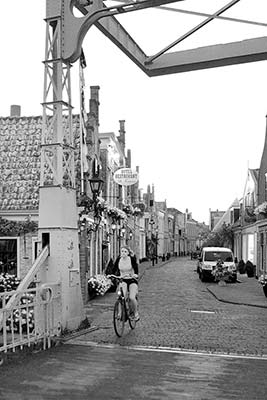
EDAM, VOLENDAM & MARKEN
The aptly named region of Waterland (VAH-ter-lahnd), just north of Amsterdam on the west shore of the IJsselmeer, is laced with canals and sprinkled with picturesque villages. Two in particular—the homey, red-brick, cheesemaking village of Edam and the trapped-in-a-time-warp fishing hamlet of Marken—offer visitors an enticing peek at rural Holland. To travel between the two towns, you’ll pass through the touristy waterfront town of Volendam.
If choosing just one Waterland town, make it Edam—and consider spending the night. (If you prefer sleepy small towns to bustling cities, Edam is a tempting home base: It’s just a 30-minute bus ride from Amsterdam, with pleasant hotels for half the price.) Because of its charm and its proximity to Amsterdam, this region is popular. But if you’d like to get a taste of traditional Dutch living, it’s worth joining the crowds.
PLANNING YOUR TIME
The most efficient way to see this area is as a one-day loop trip by public transportation from Amsterdam (or Haarlem); to have enough time for the whole loop, get started by 10:00. Take a bus from Amsterdam to Edam. After enjoying Edam, continue by bus to Volendam for a stroll and to catch the passenger-only boat across to Marken. Leave Edam by around 14:00 (13:00 on Sun) to have a little time to poke around Volendam and to be able to reach Marken before its museum and shops close (around 17:00; 16:00 on Sunday). Explore salty Marken before taking the bus back to Amsterdam.
Sightseeing Tips: The Museumkaart sightseeing pass (described in the Sights in Amsterdam chapter) covers entry to the Edam Museum, the Voldendams Museum, and Marken’s Marker Museum. If you have an I Amsterdam City Card, it covers the Marken Express boat (but none of the museums).
GETTING AROUND
Buses between Amsterdam and Waterland destinations depart from Amsterdam’s Noord Metro station. Within Amsterdam, ride Metro line #52 to the end-of-the-line Noord station. At Noord, head downstairs and look for the electronic board indicating where to catch departing buses. Find your platform: A on one side, B on the other; for C, head out either door and circle around to the road in front of the station. For specifics on the bus to Edam, see “Getting There,” later.
Throughout your Waterland day, you can pay for buses as you go by tapping in and out with your credit card. If you’re doing the full loop, you’ll save a bit with the €12.50 Waterland/Go Dutch day ticket, sold by the EBS bus company (covers all regional buses between Amsterdam and Hoorn, including this entire trip, www.localbus.nl). You can buy this pass at the GVB office in the Amsterdam Noord Metro station (near the exit toward the A platforms) or at the OV Service & Tickets shop at the back of Amsterdam Centraal station.
Edam
This adorable cheesemaking village, worth ▲▲, is sweet but not saccharine and just 30 minutes by bus from Amsterdam. It’s mostly the terrain of day-trippers, who can mob the place on summer weekends. For the ultimate in cuteness and peace, make your home in tiny Edam (AY-dahm) and stay overnight.
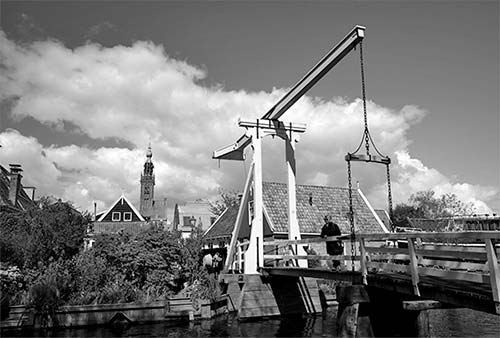
Although Edam is known today for cheese (including a weekly cheese market in summer), it was once an industrious shipyard and port. But having a canal to the sea caused such severe flooding in town—cracking walls and spilling water into homes—that one frustrated resident even built a floating cellar (which you can visit in what’s now Edam’s oldest house). To stop the flooding, the harbor was closed off with locked gates. Eventually the harbor silted up, forcing the decline of the shipbuilding trade. Cheesemaking kept things going for a while, but as that industry declined as well, Edam became trapped in a time warp...wonderfully well preserved and ready for your visit.
GETTING THERE
Edam is connected by frequent EBS buses to Amsterdam Noord Metro station (for details on navigating that station, see “Getting Around,” earlier). A variety of buses, following slightly different routes, make this trip (including #110, #112, #314, and #316). Just check the electronic board at Amsterdam Noord and hop on whichever one is departing first. Ride about 30 minutes, and get off at the “Edam Busstation” stop.
In summer only (July-Aug), bus #800 connects Amsterdam Centraal station directly to Edam and Volendam (2/hour).
For onward connections to Volendam, see “Edam Connections,” later.
Orientation to Edam
Edam is a small town (pop. 7,300)—you can see it all in a lazy 30-minute stroll. It’s so nice, though, that you may be tempted to stay longer. Dam Square (Damplein), with the City Hall and its TI, is right along the big canal called Spui; most of what’s worth seeing is within a few minutes’ walk of here. The main church (Grote Kerk), less than a 10-minute walk to the north, defines the outer edge of Edam.
Tourist Information: The TI, often staffed by helpful volunteers, is in City Hall on Dam Square (daily 11:00-16:00, closed Mon off-season, WC just outside, +31 299 315 125, www.vvvedamvolendam.nl).
Arrival in Edam: Edam’s “Busstation”—just a line of bus stops with no ticket office—is an easy and scenic five-minute walk from Dam Square and the TI.
HELPFUL HINTS
Cheese Market: On Wednesday mornings from early July through mid-August, farmers bring their cheese by boat and horse to the center of town, where it’s weighed and traded by Edamers in traditional garb. Villagers carry little, yellow Edam cheeses—small rounds with flat sides—on traditional suspended sleds. You, along with piles of other tourists, can meet the cheese traders and local farmers (Wed 10:30-13:30, www.kaasmarktedam.nl). During the rest of the year, a much more modest market takes place on Wednesday mornings, with only a few food stalls and other vendors, and none of the cheesy fanfare.
Bike Rental: Ronald Schot is on a sleepy street in the center (tandems and e-bikes available, Tue-Fri 8:30-18:00, Sat until 16:00, Sun-Mon by appointment only, Grote Kerkstraat 9, +31 299 372 155, www.ronaldschot.nl).
Edam Walk
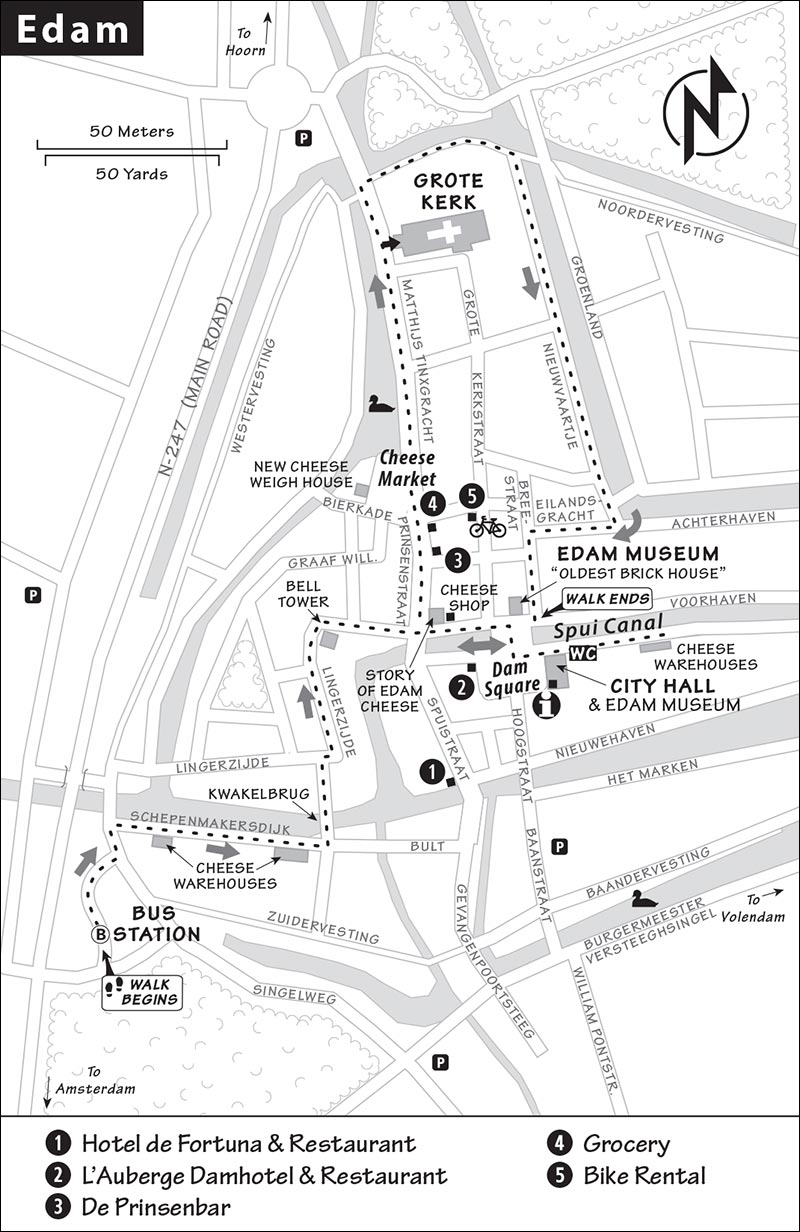
This leisurely stroll, rated ▲, connects everything worth seeing while letting you enjoy Edam’s storybook lanes and canals in less than 30 minutes (takes a little longer with sightseeing stops). Begin at the bus station and parking lot south of the town center.
• From the bus lot, turn right at the canal (following the Centrum sign) and walk along the water on the lane called...
Schepenmakersdijk: Meaning “Shipbuilders’ Dike,” this name evokes Edam’s history. Situated on a swampy bog at the edge of the Zuiderzee (now the IJsselmeer), the town was established around 1230 when a dam was built on the IJe (“AY-yuh”) River. This gave the town its name: E-Dam (“AY-dahm”). In this trading post, locals built ships, fished for herring, and made cheese—which by the 16th century had become Edam’s primary industry.
Walk about 30 yards from the start of the lane to the cheese warehouse (at #16A), which is recognizable by its “floating” door on the second floor. This design (which you’ll see in cheese warehouses all over town) allows little wheels of Edam cheese to be loaded in and out to ripen on the upper floor, in addition to the main floor. While walking, look across the canal to appreciate the lush gardens behind the mansions that belonged to Edam’s fabulously wealthy mayors back when this was a boomtown; the two pavilions by the water were teahouses. Across the canal from the second of these, on your right, you’ll see two more cheese warehouses (at #2) with those same “floating” doors.
You’ll soon reach a unique white counterbalance bridge just wide enough for two people—the Kwakelbrug. Looking right as you cross, you’ll likely see some big moored barges. Historically, vessels often ran aground at this part of the canal, earning it the nickname Boerenverdriet (“Farmers’ Lament”).
• After crossing the bridge, continue on Lingerzijde lane, filled with characteristic brick houses. Straight ahead, you’ll see the striking gray and gold bell tower.
Bell Tower and Cheese Museum: As you get closer to the tower, you’ll see that it feels far too big; behind it, a gravel lot marks the footprint of the much larger church that once stood here. The church was demolished in 1882, but the city kept the tower and the carillon, which still plays.
Hook right around the bell tower and continue up the lovely brick street. At the next corner is the Story of Edam Cheese. This fine little museum covers the history of Edam cheesemaking (described later, under “Sights in Edam”). Next door is the museum’s attached cheese shop (with the Kaasspeciaalzaak Henri Willig sign). Dip in here to take advantage of the generous free samples—you can stick a toothpick in about two dozen different tiny cubes of cheese.
• You’ve now reached the main canal, the Spui (rhymes with “cow”). Walk along the canal, and take a right to cross the big, humplike brick bridge that goes over it (marking the very center of town). You’ll wind up at...
Dam Square (Damplein): Look around here to get oriented. City Hall proudly towers over the small square (it’s to the right as you face the canal). Built in 1737 by a pupil of the architect who designed Amsterdam’s Centraal station and the Rijksmuseum, today the building houses the TI and part of the Edam Museum. Across the square is the former Butter Market building, which is now adorned with a Tuscan-style arcade and houses a recommended hotel and restaurant, L’Auberge Damhotel.
Now look back across the canal to find the crooked facade of the Steenen Coopmanshuys. This building, from 1530, is Edam’s oldest brick house; today it serves as the main branch of the Edam Museum, with a classic old interior and a cellar that literally floats on the high water table (see listing later, under “Sights in Edam”).
For a quick look at some particularly fine former cheese warehouses, continue walking along the canal, past the WC entrance, to the three big buildings at the end of the first block—at #131, #129, and #127. The last of these now houses a fragrant sourdough bakery, allowing you the chance to step inside and see the interior of one of these warehouses (Bakhuis de Koophandel; they sell bread and cheese for a picnic, but not sandwiches or other prepared food).
• Return to Dam Square and the brick bridge, and cross back over the canal. Turn left, and backtrack one block to the cheese shop and Story of Edam Cheese museum. Turn right up Prinsenstraat, and walk a couple of short blocks to the...
Cheese Market: This small square, officially called Nieuwenhuizenplein, is known to locals as Kaasmarkt—“cheese market.” Back in the day, small dairies would bring their Edam cheese here in order for it to be officially weighed, taxed, and sold.
You can’t miss the New Cheese Weigh House (Nieuw Kaaswaag) on the left—the building with the cheese frieze on top and the giant scale inside. It’s typically open through the high season and hosts another branch of the Henri Willig cheese shop...with yet more samples. While you taste, you can see some of the traditional items used to make Edam cheese, including the clever cheese press: Curds would be pressed into little molds that resemble wooden buckets, the molds stacked on top of one another, and the whole stack squeezed together to press out the last little bit of whey. The resulting rounds would be soaked in brine for two days, rubbed with linseed oil, and placed on wooden shelves to mature. Finally, they were dipped in wax: yellow for cheese sold domestically and red for export.
Why produce cheese? Because the surrounding countryside was too soggy to grow wheat, locals raised cows. In 1526, as expanded polder land allowed even more grazing (and cheese), Edam was granted the original cheese weigh house. (This version is the “new” one, from 1778.) Because it traveled well, Edam cheese became popular with traders, who spread it around the globe. But it wasn’t all curds and whey; by the 1920s the industry had changed, as smaller producers had merged into bigger ones and traders were buying direct. Edam’s cheese market officially closed in 1922...except on summer Wednesdays, when those old ways are re-created in this square. The statue in front of the weigh house vividly illustrates the custom of carrying cheeses neatly stacked on a sled-like carrier, suspended from workers’ shoulders.
• Continue straight past the cheese market square, along the canal toward...
Grote Kerk: The tower of Edam’s giant church looms straight ahead. As you walk toward it, notice the dreamy gardens of a former begijnhof (residence for widows), across the canal. Once you reach the church entrance, head inside for a look, if it’s open (see listing later, under “Sights in Edam”).
If you keep going north beyond the church, you’ll run into a canal marking the end of town; beyond here are only farm fields. This shows how small and contained little Edam is—and how little it developed (unlike Amsterdam) due to its declining fortunes.
• To head back to the center of town, you could retrace your steps. Or consider this scenic route to view some...
Canalside Farms: Just past Grote Kerk, turn right onto Noordervesting, along the canal. Walk along the side of the church, past the graveyard. Just before the next bridge, turn right to walk down the canalside lane Nieuwvaartje. Strolling along here, you’ll get a look at the farms that produced Edam cheese within the city walls.
On both sides of the canal are typical farmhouses with wooden, triangular tops. The farmer’s family lived on the middle floor, sandwiched between the hayloft in the upper story and the farm animals in the lower story, providing natural heat and insulation. Notice one example, #8 on the right, which is adorned with colorful illustrations. Standing among these farmhouses, it’s easy to imagine how vital the town’s canals once were for the operation of these farms, with barges carrying cows and hay to and fro.
Where the canal jogs left—at Eilandsgracht—turn right. After one block, turn left onto Breestraat. You’re just across the canal from Dam Square again. From here, you can make your way back to the bus station. But first...More cheese samples, anyone?
Sights in Edam
The following sights are all connected on my “Edam Walk,” above.
▲Story of Edam Cheese
Local cheesemaker and entrepreneur Henri Willig, who seems to own every cheese shop in town, created this little venture to get people into his well-stocked shop. And yet it’s much better than it has any right to be. The included audioguide covers the story of cheesemaking in Edam, along with lots of real town history. While the whole exhibit is—forgive me—quite cheesy, it’s also genuinely informative.
Cost and Hours: €8, includes audioguide, Mon-Fri 9:00-17:00, Sat-Sun 9:30-16:30, Spui 9, +31 299 783 230, www.thestoryofedamcheese.com.
Visiting the Museum: Your visit begins with a timeline of Edam cheese, then continues to a series of videos on how this local specialty is made. (You can even try your hand at milking a cow.) The exhibit makes the case (repeatedly) that this might just be “the most famous cheese in the world”—with convincing examples of how Edam has become a part of many distant cultures. A video provides a lesson on how to prepare and appreciate Edam cheese, and at the end, you can look into an aging room with row upon row of those yellow, round cheeses. The visit ends in the adjacent Henri Willig cheese shop, with endless little samples.
▲Edam Museum
The town museum has two parts. By far the more interesting section is the Steenen Coopmanshuys—the oldest brick house in town, boasting an interior crammed with interesting artifacts and a floating cellar (across the bridge from Dam Square). Your ticket also covers two rooms of exhibits upstairs in the City Hall. You can buy tickets at either location.
Cost and Hours: €6; Tue-Sun 10:00-16:30, closed Mon; off-season oldest house open Sat-Sun only and City Hall branch closed; Dam Square 8, +31 299 372 644, www.edamsmuseum.nl.
Visiting the Old House: This 400-year-old historical home offers a fun peek at what all these old canal houses once looked like inside. Exhibits on the town’s history and how people lived are invigorated with recorded commentary available on your phone (scan the QR codes posted throughout).
The most interesting feature is directly across from the entrance: Crouch into the low-ceilinged central room, find the stairs, and crouch even lower to peek (or climb) down into the floating cellar, designed to accommodate changes in water level without destabilizing the building. This space is essentially a giant stone tub floating on the water table. You can even hear water sloshing around in the narrow channel around the perimeter of the cellar. If you go downstairs and stand inside the cellar, you might get seasick.
Back at the ticket desk, head up one very tight spiral staircase to find a couple of tiny, cramped bedrooms with cupboard beds. The other equally tight spiral staircase (near the entrance door) leads to two larger upper floors, where you can actually stand up straight. On the first floor, near where you entered, the classic town map shows how Edam would have been a mighty sight in 1698. Also on display are models and paintings of ships, antique furniture, and temporary exhibits. You may see some drawings and etchings by artist Wynand Otto Jan Nieuwenkamp (1874-1950), who lived in Edam for a decade. Before leaving, pause at the ticket desk to appreciate the collection of locally produced Fris art pottery—simple, colorful, practical, everyday tableware.
City Hall Exhibits: Your museum ticket also covers two rooms of exhibits, upstairs from the TI. One is a historic room from the 1730s with portraits, a cheese press, and model ships. Across the way is a larger room with special exhibits that change each year. This branch of the museum is mostly skippable, but if you have a ticket, it can be worth a peek.
▲Grote Kerk
Perched on the edge of town, the “Great Church” feels surprisingly huge for tiny Edam. Like other fine churches in Holland, it was built around 1500, then gutted by iconoclasts during the tumult that came with the Reformation; it’s been Dutch Reform since 1566.
Cost and Hours: Free but donations appreciated, daily 13:30-17:00—also open Wed mornings in summer on cheese market days, until 16:00 in shoulder season, closed in winter, www.grotekerkedam.nl.
Visiting the Church: The church’s vast interior is covered by a ceiling constructed just like a stone vault—but built of wood, because heavier stone would have made the building sink into the wet ground. Look up: The wooden catwalks are original. You can walk all the way to the front end of the church, into the choir area. Near the pulpit, find the “cabinet organ,” dating from 1640, which is interesting for the big painted side panels that can swing around like shutters to cover it. Many 19th-century Dutch homes had a cabinet organ that was cleverly disguised to evade a tax on organs. Use your phone to scan the posted QR codes for more on the church’s interior, including some good background on the stained-glass windows. In the back-right corner of the church (near the entrance) is a sweet little café and a side room that shows a video of scenes around town, including the cheese market.
Sleeping in Edam
These two hotels are both distinctive and classy. For cheaper rooms in private homes, check Vvvedamvolendam.nl or ask at the TI.
€€ Hotel de Fortuna is a canalside wonderland with flowers and the sounds of ducks and other birds. It offers steep stairs and 23 low-ceilinged rooms in a cozy collection of five ancient buildings in the old center of Edam. A fine value, it’s been run by the Dekker family since 1972 (family room, Spuistraat 3, +31 299 371 671, www.fortuna-edam.nl, fortuna@fortuna-edam.nl).
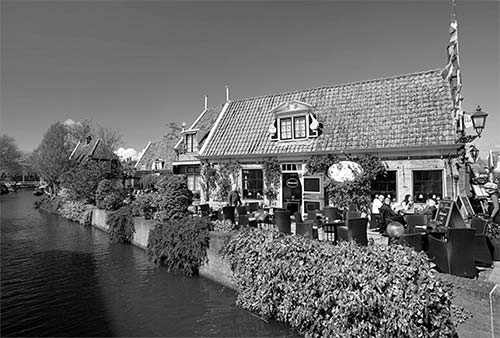
€€ L’Auberge Damhotel, centrally located on a canal across the street from City Hall, has 11 overpriced rooms with over-the-top plush decor (reception at the hotel restaurant bar, family rooms, air-con, Keizersgracht 1, +31 299 371 766, www.damhotel.nl, info@damhotel.nl).
Eating in Edam
Considering how close it is to Amsterdam, coming to Edam for a romantic dinner in the countryside and then heading back to your hotel in the big city can be a fine plan. Several tourist-friendly eateries are within a block or two of Dam Square. One handy choice is L’Auberge Damhotel (in the recommended hotel listed above), which dominates the main square with outdoor seating. There are two dining options: The terrace and part of the interior is a €€ brasserie with an affordable à la carte menu (including pancakes and sandwiches until 18:00). Inside, the dressy €€€ dining room, under heavy wood beams, has multicourse meals and higher prices (both open long hours daily).
€€€ Hotel de Fortuna, in one of my recommended hotels, has a lovely restaurant, with a romantic dining room and seating in a gorgeous garden alongside a picturesque canal and drawbridge (daily).
€€ De Prinsenbar offers a variety of ways to taste Edam cheese (as well as other regional cheeses) in a pub setting with darts and stay-awhile stools. Their café and terrace are good for a light lunch or a midday snack (Mon-Fri dinner only, Sat-Sun lunch and dinner, Prinsenstraat 8, +31 299 372 911).
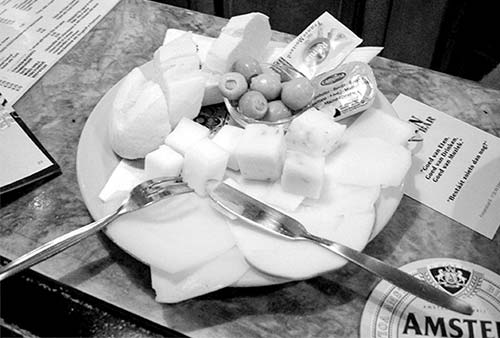
Picnics: Stock up on the essentials at Gerard Visser, a simple grocery two doors down from De Prinsenbar that also sells premade meals (closed Sun-Mon, Prinsenstraat 12, +31 299 371 753).
Edam Connections
For bus connections with Amsterdam, see “Getting There,” earlier.
By Bus to Volendam on the “Waterland Loop”: Buses #110, #314 (slightly faster), #316, and #800 (summer only) zip you from Edam to Volendam in about 10 minutes (2/hour, direction: Amsterdam Noord). Hop off at the Volendam Centrum stop. On a nice day, you could even walk the two miles from Edam to Volendam’s harbor (about 45 minutes).
Volendam
Compared to the other two Waterland towns, Volendam (FOLL-eh-dahm) is bigger, tackier, and not as cute. Once a major fishing center, Volendam lost this main industry when the Zuiderzee became the IJsselmeer. Nowadays, it’s holidaymakers (especially Dutch ones) that are the catch of the day. Most of the town feels functional and workaday, while the harbor area (where the boat to Marken departs) has a summer-boardwalk vibe—with junk-food stands, kitschy amusements, and countless outdoor tables positioned to catch all available sun. This is the Dutch answer to Coney Island; locals bring their kids here to dress up in “traditional” garb and have their picture taken holding up a whole herring. While not worth lingering in, Volendam merits a quick look as you pass through—if only to stop in at the fun town museum and briefly stroll along the lively dike-top walkway that stretches along a shimmering bay.
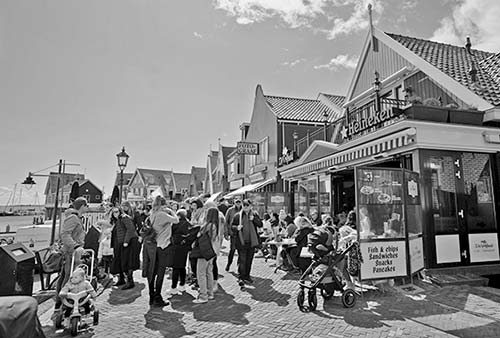
Orientation to Volendam: If arriving by bus from Edam, get off at the Volendam Centrum stop. The museum and TI share a building a half-block from the bus stop, in the modern part of town—look for the building with the miniature windmills out front (Zeestraat 37, +31 299 363 747, www.vvvedamvolendam.nl). For the boat to Marken, walk straight from the bus stop and museum area along Zeestraat until you run into the harbor, then turn left and walk along the dike.
Visiting Volendam: The town’s lone sight is the Volendams Museum. Its hokey but charming little collection oozes local pride, with displays of traditional costumes, replica house and shop interiors, scenes from village life, and nostalgic old grainy black-and-white movies that are worth watching even if you don’t speak Dutch. The museum’s highlight is the Cigarband House, where a local artist glued 11 million cigar bands to big boards to create giant images—from Dutch windmills to Venice to a sour-looking Statue of Liberty (daily, Zeestraat 41, +31 299 369 258, www.volendamsmuseum.nl).
Volendam’s touristy waterfront promenade has a lively boardwalk appeal and is lined with souvenir shops, indoor/outdoor eateries, and Dutch clichés. The walls inside Hotel Spaander (eight houses down from the northern end of the harbor, on the right) are decorated with paintings by starving artists who slept or ate there. Don’t miss the maze of sleepy residential courtyards below sea level just behind the promenade, with an adorable dollhouse charm and fewer crowds.
Volendam Connections: The “Marken Express” boat connects Volendam with Marken in 30 minutes (€10 one-way, €16 round-trip, cheaper online, bring your bike for €2 extra each way; summer—daily about 9:45-19:00, departures every 45 minutes, up to 2/hour at very busy times; off-season—shorter hours, departs every 1.5 hours or by appointment only; check website for daily departure times, leaves from northern corner of harbor, no outside food allowed on board, +31 299 363 331, www.markenexpress.nl).
Marken
Famous as one of the Netherlands’ most traditional fishing communities, Marken is a time-passed hamlet in a bottle—once virtually abandoned, now revived but kept alive solely as a tourist attraction.
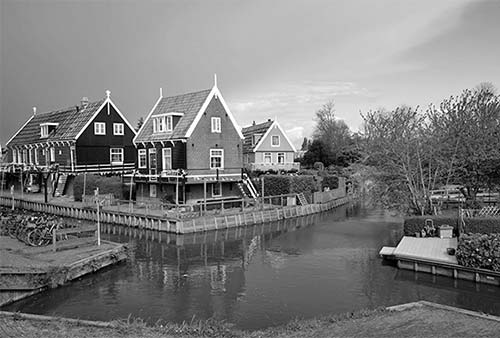
This island town once had a harbor for whaling and herring fishing, but when the Zuiderzee began to silt up in the late 17th century, it became more and more difficult to eke out a living here, and many people from Marken fled to easier conditions on the mainland. When the Zuiderzee was diked off in 1932 to become a giant freshwater lake (the IJsselmeer), it forced saltwater fishermen to adapt or find a new calling (which most did). Marken became a virtual ghost town. But in 1957, a long causeway was constructed from the mainland to the island hamlet, providing easy access for visitors—who today come in droves to walk its tiny lanes and marvel at its rustic, time-capsule cuteness. While Edam was wealthy, with stately brick townhomes, Marken was simple and poor, its houses built mainly of wood.
VISITING MARKEN
The village has two districts connected by counterweight bridges: the colorful Havenbuurt (“Harbor Neighborhood”) and the charming Kerkbuurt (“Church Neighborhood”). The famously conservative village, which is historically both very religious and royalist, named its bridges after Dutch queens. A seasonal TI is in a shed halfway along the waterfront (turn left off the boat and walk less than 100 yards).
Arriving by boat, first wander through the Havenbuurt, then head for the Kerkbuurt. As you explore, notice the unique architecture, adapted to survive challenging conditions. Because the tides could be so temperamental, Marken’s houses tend to huddle together on manmade hills called werven. Homes in lower locations were built on pilings to keep them high and dry. After the Zuiderzee was diked and tamed, the pilings were boxed in to create basements. Traditional Marken homes, while dull and black-tarred outside, are painted a cheerful yellow and blue inside.
Harbor Neighborhood (Havenbuurt): The delightful harbor dates to 1837. At its peak in 1890, the fishing fleet here boasted about 200 vessels. But when the big flood of 1916 spurred construction of the massive dike 50 miles north of here, the saltwater fishing industry dried up. It’s fun to stroll from one end of the harbor to the other. At the far end, where the Volendam boat arrives, there is a row of waterfront eateries with outdoor tables; a cluster of snack stands is mid-harbor. Enjoy some kibbeling (local fish-and-chips), or see if the poffertjes (mini-pancakes) stand is open.
• To head to the upper part of town (about a 10-minute walk), head up the path at the far corner of the village. This leads to one of the town’s drawbridges (Wilhelmina Brug); after crossing this, bear left and make your way up to the church steeple.
Church Neighborhood (Kerkbuurt): First you’ll reach the town’s church; if it’s open, peek in (typically open in season Mon-Sat 10:00-17:00, closed Sun). In this very Protestant town (unlike Volendam, which is Catholic), the church posts a list of pastors next to the altar that goes back in an unbroken line to 1579, when the Reformation came.
Next to the church is a tidy square. Just up the street behind it is the town’s main attraction—the modest Marker Museum. The museum is in a traditional old house, and the exhibit celebrates the 16th-century costumes (hand-sewn and still worn for special events) and traditional lifestyles of the people of Marken. It contains hand-carved items, model boats, paintings of locals, and life-size dioramas of village life. As you enter, ask for an English showing of the good eight-minute movie (€3, Mon-Sat 10:00-17:00, Sun 12:00-16:00, shorter hours off-season, +31 299 601 904, www.markermuseum.nl).
After touring the museum, duck down some of the back streets. Land is tight on Marken...and so are its lanes. They may appear private, but they actually are public and you’re welcome to explore them.
Other Sights in Marken: Between the harborfront and the parking lot/bus stop (just after crossing the Juliana Brug drawbridge), you’ll pass Marken’s raised cemetery. Open the black iron gates and step in. Because of the very limited land (so high and dry), plots are shared. That’s why the graves are marked with numbers rather than names. With more time, you can walk (about 40 minutes) out to the lighthouse, picturesquely situated at the far end of the island at the tip of a sandy spit.
At the back end of town, just before the parking lot/bus stop and next to the Beatrix Brug bridge, is a wooden-shoe factory that’s just a touristy shop...unless a bus tour stops by, when workers will spring into action and demonstrate the traditional way to carve a pair of shoes.
MARKEN CONNECTIONS
If taking the bus back to Amsterdam, follow signs from anywhere in town leading you to the bus stop. Signs will have the P (for parking) and the icon of a bus. The parking lot is just beyond the wooden-shoe factory (described above); at the left end are the bus stops.
Bus #111 (marked for Zaandam via Amsterdam Noord) connects Marken with Amsterdam’s Noord Metro station (2/hour, 30 minutes). The journey back to Amsterdam is along a scenic causeway that takes you under majestic modern windmills along a four-mile spit. Bikers have their own lane running along the top of the dike. You’ll notice lots of cows and sheep but no fences separating the farms. As the animals can’t pole-vault, the canals keep them from roaming.