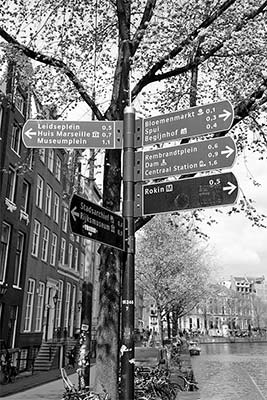
ORIENTATION TO AMSTERDAM
The bird’s-eye view of Amsterdam still looks much like it did in the 1600s—the Dutch golden age—when it was the world’s richest city, an international sea-trading port, and the cradle of capitalism. Wealthy, democratic burghers built a city upon millions of pilings, creating a wonderland of canals lined with trees and townhouses topped with fancy gables. Immigrants, Jews, outcasts, and political rebels were drawn here by its relatively tolerant atmosphere, while painters such as young Rembrandt captured that atmosphere on canvas.
Back on the ground, the contemporary city is a world apart. Today’s Amsterdam is a progressive place of nearly a million people and almost as many bikes. It’s a city of good living, cozy cafés, great art, street-corner jazz, stately history, and a spirit of live and let live.
Amsterdam, a bold experiment in freedom, may box your Puritan ears. For centuries, the city has taken a pragmatic approach to things other places try to forbid. Traditionally, the city attracted sailors and traders away from home, and found it was profitable to allow them to have a little fun. In the 1960s, Amsterdam became a magnet for Europe’s hippies, and it continues to be a world capital of alternative lifestyles. Prostitution is allowed in the Red Light District, while citywide, “smartshops” sell psychedelic drugs and marijuana is openly sold and smoked. The Dutch aren’t necessarily more tolerant or decadent than the rest of us—just pragmatic and looking for smart solutions.
Amsterdam also offers the Netherlands’ best people-watching—a sightseeing experience in itself. The Dutch are a handsome and healthy people, and among the world’s tallest. They’re also open and honest—I think of them as refreshingly blunt—and they like to laugh. As connoisseurs of world culture, they appreciate Rembrandt paintings, Indonesian food, and the latest French film—but with an un-snooty, blue-jeans attitude.
Today, Amsterdam’s citizens and city leaders are grappling with the right balance of freedom and sanity—to live for today yet be smart for tomorrow. And they’re struggling with overtourism: Amsterdam attracts an amazing 20 million visitors each year. Concerned about the flood of people—and the kitschy cheese shops, chocolate shops, and souvenir stands sprouting up to serve them—Amsterdam’s leaders are working to protect its livability for locals. They’ve voted to ban new hotels (a new hotel can open only if another one closes), hike up the tourist tax, and bar cruise ships from the city center (and limit the number of river cruises). City officials often decline to renew the licenses of shops that cater mostly to tourists. To spread visitors around, the country’s tourism board actively promotes alternative Dutch destinations like Rotterdam and Delft.
But I love Amsterdam, even with its crowds. Approach Amsterdam as an ethnologist observing a strange culture. Walk away from the glitz. Raise your gaze above the commotion at street level. It’s still possible to find a place where carillons chime quaintly from spires towering above coffeeshops where young professionals go to smoke pot. Take it all in, then pause to watch the clouds blow past stately old gables—and see the golden age reflected in a quiet canal.
AMSTERDAM: A VERBAL MAP
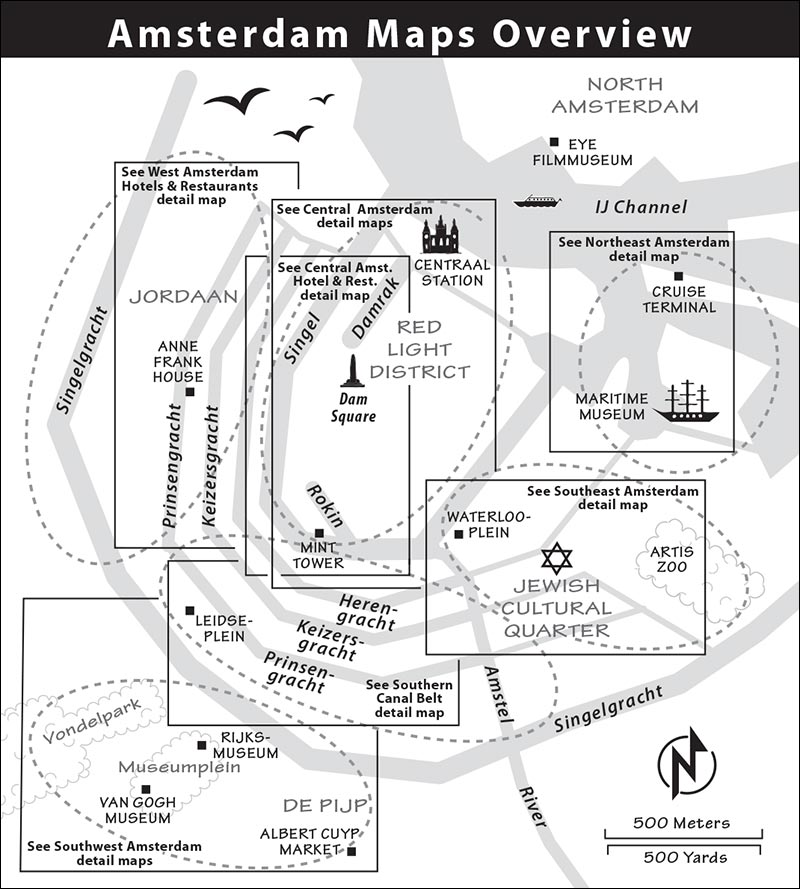
Amsterdam’s Centraal station, on the northern edge of the city, is your starting point, with the TI, nearby bike rental, and trams branching out to all points. The street called Damrak is the main north-south axis, connecting Centraal station with Dam Square (people-watching and hangout center) and its Royal Palace. From this main street, the city spreads out like a fan, with 90 islands, hundreds of bridges, and a series of concentric canals (called the Canal Belt, or Grachtengordel). Amsterdam’s major sights are all within walking distance of Dam Square.
To the east of Damrak is the oldest part of the city (today’s Red Light District), and to the west is the newer part, where you’ll find the Anne Frank House and the peaceful Jordaan neighborhood. Leidseplein nightlife and the Rijks and Van Gogh museums cluster at the southern edge of the city center. To the southeast, the giant Waterlooplein (with Rembrandt’s House, a Metro station, and a flea market) marks the start of Amsterdam’s Jewish Cultural Quarter, with a series of museums and monuments tracing the story of Dutch Jews.
AMSTERDAM BY NEIGHBORHOOD
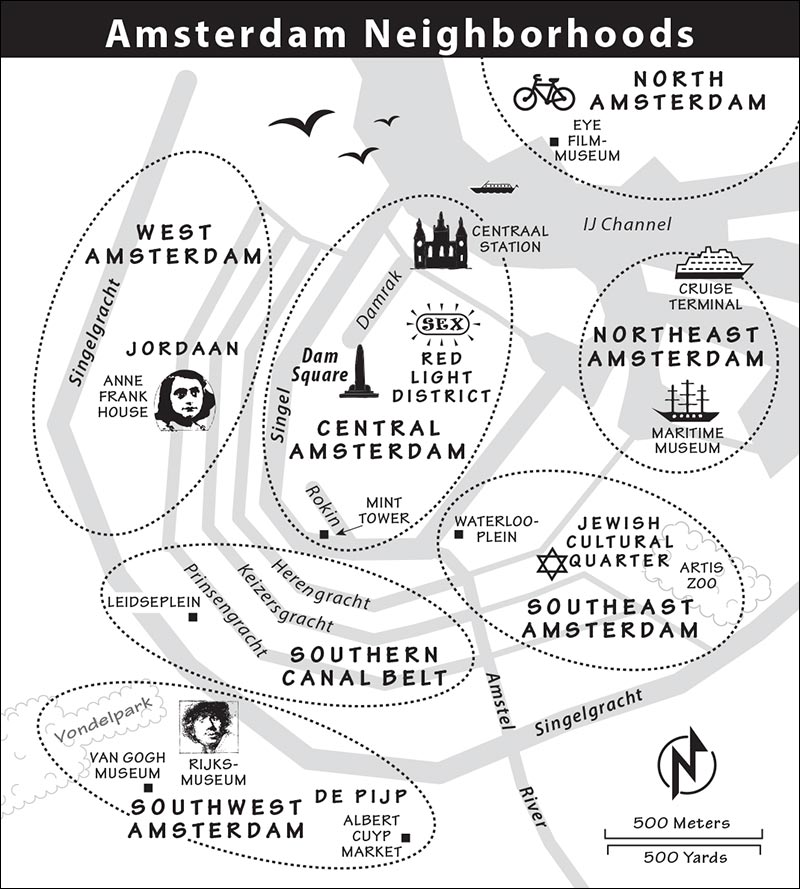
Amsterdam can feel like a big, sprawling city, but its major sights cluster in convenient zones. Grouping your sightseeing, walks, dining, and shopping thoughtfully can save you time.
Central Amsterdam—the historic core—runs from Centraal station south along Damrak, passing through two major city squares (Dam and Spui) and ending at the Mint Tower. The central spine of streets (Damrak, Kalverstraat, Rokin) has some of the city’s main department, chain, and tourist stores. Underfoot, the north-south Metro line #52 serves as a kind of underground Damrak, extending miles in both directions. Flanking Damrak to the east is the Red Light District and the modern waterfront around the train station.
West Amsterdam lies west of Damrak—from Dam Square to the Anne Frank House. This pleasant area is famous for its four grand canals—named Singel (the original moat), Herengracht (Gentleman’s Canal), Keizersgracht (Emperor’s Canal), and Prinsengracht (Prince’s Canal)—that circle the historic core. West Amsterdam has tree-lined canals fronted by gabled mansions, the boutique shopping district known as the Nine Little Streets, and many of my recommended accommodations and restaurants. Farther west is the quieter, cozier Jordaan neighborhood, which is good for a stroll, though it’s mostly residential. And to the north is the old “Haarlem dike” (Haarlemmerstraat and Haarlemmerdijk), a trendy, youthful zone for shopping and eating.
The Southern Canal Belt—where those four grand canals loop south of the historic core—is spacious and dotted sparsely with a few intimate museums, art galleries, and antique shops. Lively Leidseplein anchors the southwest corner, and rowdy Rembrandtplein, the northeast.
Southwest Amsterdam is defined by two main features: museums and a city park. The city’s major art museums (Rijksmuseum, Van Gogh, and Stedelijk) and other sights cluster together on an expansive square, Museumplein. The museums are a short walk from Vondelpark, Amsterdam’s “central park.” And just to the east, the workaday De Pijp neighborhood has the bustling Albert Cuyp Market. While it’s less central to stay in Southwest Amsterdam, I’ve recommended accommodations that are a quick, convenient walk to the area’s tram lines.
Southeast Amsterdam contains the Jewish Cultural Quarter, with historic synagogues and modern museums. A park-dotted area called the Plantage is home to the Dutch Resistance Museum, National Holocaust Museum, a zoo, and a botanical garden. Additional sights can be found around the square known as Waterlooplein (Rembrandt’s House and a flea market). The short but appealing street called Staalstraat, which connects this area with Rokin in the center, is a delightful place to browse trendy shops.
Northeast Amsterdam, a nondescript, modern zone, has the Netherlands Maritime Museum, Amsterdam’s Central Library (with a view café), and a children’s science museum (NEMO).
North Amsterdam sits across the very wide IJ (pronounced “eye”) waterway, a free public ferry ride from behind Centraal station. Formerly a sleepy residential zone, this area has seen a flurry of new construction: Buiksloterweg has modern, touristy attractions (EYE Filmmuseum, A’DAM Tower) and is a good jumping-off point for a countryside bike ride, and the NDSM area fills a gritty former shipyard with street art, hip eateries, and nightlife.
PLANNING YOUR TIME
Amsterdam is worth a full day of sightseeing on even the busiest itinerary. And though the city has a couple of must-see museums, its best attraction is its own carefree ambience. The city’s a joy on foot—and a breezier and faster delight by bike. For a good walking overview, lace together my three walking tours, all of which can be connected by Dam Square ( I’ve also recorded them as free audio tours). They can be done in rapid succession—Amsterdam City Walk, Red Light District Walk, and Jordaan Walk—in as little as four hours...or take your time.
Note that tickets for the Van Gogh Museum, the Rijksmuseum, and the Anne Frank House must all be reserved online well in advance (see those chapters for details).
Amsterdam in One Day
| 9:00 | Follow my self-guided Amsterdam City Walk, which takes you from the train station to Spui, with stops at Dam Square, the peaceful Begijnhof, and the flower market. Consider breaking up the walk with a relaxing canal cruise. |
| 14:00 | Visit Amsterdam’s two great art museums, located side by side: the Van Gogh Museum and the Rijksmuseum. |
| 19:00 | Wander the Jordaan neighborhood, enjoying dinner by a canal or on a quiet, cobbled street. |
| 21:30 | Stroll the Red Light District for some of Europe’s most fascinating window-shopping. |
Amsterdam in Two or More Days
Day 1
| 9:00 | Follow my self-guided Amsterdam City Walk, leading from the train station to Spui, via the quiet Begijnhof and the flower market. |
| 13:00 | Visit Amsterdam’s two outstanding art museums, located next to each other: the Van Gogh Museum and the Rijksmuseum. |
| 18:00 | Dinner. |
| 20:00 | Stroll the Red Light District for some memorable window-shopping. |
Day 2
Day 3
Use this day to browse your choice of Amsterdam’s more than 50 museums, such as Our Lord in the Attic, Royal Palace, Stedelijk, Pipe, and Houseboat (see the Sights in Amsterdam chapter for more ideas). Or visit the nearby town of Haarlem, only 20 minutes away by train. Consider heading (by free public ferry) to North Amsterdam’s hip and funky NDSM area for dinner.
Day 4
Visit Delft. Or side-trip by train to an open-air museum; choose among folk museums at Enkhuizen and Zaandijk (Zaanse Schans Museum), or Arnhem’s Netherlands Open-Air Museum.
With More Time
Plenty more destinations await you in the Netherlands.
Amsterdam Overview
TOURIST INFORMATION
Amsterdam’s only TI, located on Centraal station’s north/river-facing side (follow signs for IJ-zijde), is called the “I Amsterdam Store”—but it’s an official TI. It’s generally crowded and sometimes inefficient, but staff are helpful. They sell a good city map (skip the free version), plus the I Amsterdam City Guide and Uitkrant magazine, both with entertainment listings (daily 9:00-19:00, off-season until 18:00, +31 20 702 6000, www.iamsterdam.com).
ARRIVAL IN AMSTERDAM
By Train
The portal connecting Amsterdam to the world is its aptly named Centraal station (Amsterdam Centraal). The Dutch have spent vast sums to renovate this century-old station, and work is ongoing.
The station has two sides: Its “front” south-facing classic facade opens up toward Damrak and the city center (and the start of my Amsterdam City Walk). The north side—called the IJhal because it faces the IJ waterway—is a bustling mall of shops and services that looks more like a modern airport terminal (follow signs toward IJ-zijde). The two sides are connected by a series of tunnels for passengers (access controlled by turnstiles) and a main corridor for the general public, called the IJpassage (lined with high-end shops). You’ll use this passage to get between the station front (where trams fan out into the city center) and the IJ-side station back (with bus and ferry connections). At either end, you’ll find escalators down to the Metro.
Front (City) Side: Trains arrive on a level above the station. Go down the stairs or the escalator (at the “A” end of the platform) and follow signs to Centrum to reach the main exit toward the city center. Just inside the main doors, you can escalate down to the Metro. Immediately in front of the station, you’ll find tram stops on either side (handy trams #2 and #12 leave from the stop to your right). Straight ahead is Damrak street, leading to Dam Square (a 10-minute walk away).
Back (Channel) Side: This modern side of the station runs parallel to the IJ waterway. Along here, you’ll find several services: The TI (look for the I Amsterdam Store); the OV Tickets and Service office (with info and tickets for local transit and domestic and international trains); a shop called Service Point (with phone accessories, mail services, and printing); WCs; a pharmacy; and lots of shops and restaurants. Buses depart from the upper level above the IJhal; the Metro is down below (look for stairs, escalators, and elevators). Stepping outside (and carefully crossing the bike lanes), you’ll quickly reach the IJ embankment. Free ferries depart from the left/west end, and taxis wait just inland from the ferries.
Services near the Platforms: Within the turnstiles, luggage lockers are in the east tunnel, under the “B” end of the platforms (open long hours daily, can fill up on busy summer weekends). Platform 2 (at train level) is lined with eateries, including the tall, venerable, 1920s-style First Class Grand Café.
Getting into Town: To get from the station to points in town, you can walk, take a tram, hop on a rental bike, or catch a taxi. For more specifics on each option, see the “Getting Around Amsterdam” section, later.
Exiting the station through the main doors (Centrum), you’re in the heart of the city. To follow my Amsterdam City Walk through the heart of town, just walk straight ahead down Damrak. To the right of the station lie the postcard-perfect neighborhoods of West Amsterdam; some of my recommended hotels are within walking distance.
Taxis are behind the station on the northwest side (at the far-left end of the IJhal). They’re pricey but can be worth it when dealing with baggage, jet lag, and trying to find your hotel.
Trams are easy and you can pay with your contactless credit card (see the “Amsterdam by Tram” sidebar for a route rundown). Be aware that if you need to buy individual tickets or a multi-ride pass, there are only a few places to do it in or near the station (not available on board): at machines in the underground Metro stations; in the OV Tickets and Service office (IJhal, see above); or in the old white building with a red roof, immediately across the street from the station’s main entrance (look for the GVB Tram Bus Metro Ferry sign). Ticket machines (marked Tickets Tram Bus Metro) may be near the station exits...or hard to find (or missing altogether) due to ongoing construction.
By Plane
For details on arriving in Amsterdam by plane, and linking Schiphol Airport to downtown Amsterdam, see the Amsterdam Connections chapter.
HELPFUL HINTS
Book Ahead: Amsterdam’s huge tourist crowds all want to see three museums: the Anne Frank House, Van Gogh Museum, and Rijksmuseum. You must buy tickets for these sights online far in advance (you’ll pick an entry time for each; for details, see each museum’s chapter in this book). You should have no problems with ticket lines at the city’s other museums. It’s also smart to book ahead for dinner at better restaurants (easy to do online).
Theft Alert: Tourists are considered naive and rich, and the city has more than its share of hungry thieves—especially in the train station, on trams, in and near crowded museums, at places of drunkenness, and at many hostels. Wear your money belt. If you’ll be out late high or drunk, leave all valuables in your hotel. Blitzed tourists are easy targets for petty theft. Sadly, it’s best to be suspect of anyone who’s weirdly helpful.
Street Smarts: Beware of silent transportation—trams, electric mopeds, and bicycles—when walking around town. Don’t walk on tram tracks or pink/maroon bicycle paths. Before you step off a sidewalk, double-check both directions to make sure all’s clear.
Festivals: Every year, King’s Day (Koningsdag, April 27) and Pride in Amsterdam (celebrating equality for LGBTQ+ folks, late July-early Aug) bring big crowds, fuller hotels, and inflated room prices. SAIL Amsterdam, a festival featuring tall ships and other historic boats, is held every five years (www.sail.nl).
Resources for LGBTQ+ Travelers: A short walk from Centraal station down Spuistraat is GAYtic, a gay-focused TI located within Gays & Gadgets, a souvenir and fetish-gear shop (Tue-Sun 12:00-19:00, closed Mon, Spuistraat 44, +31 20 330 1461, www.gaysandgadgets.com). Pink Point, in a kiosk outside Westerkerk and next to the Homomonument, is less of a resource but has advice about nightlife (usually daily 12:00-18:00, +31 20 428 1070, https://pinkpoint.nl).
Language Barrier: This is one of the easiest places in the non-English-speaking world for an English speaker. Most young or well-educated Dutch people speak English. Nearly all signs and services are offered in two languages: Dutch and “non-Dutch” (i.e., English).
Money: You’ll need a contactless credit card or payment app on your phone for mostly cash-free Amsterdam. If you do need cash, you’ll get better rates at a bank ATM; major Dutch banks include ABN AMRO, ING, and Rabobank. Yellow Geldmaat ATMs also offer good rates (to find the nearest one, use the location guide at www.geldmaat.nl). Avoid ATMs operated by Travelex and other for-profit companies.
English Bookstores: For fiction and guidebooks, try the American Book Center at Spui 12, right on the square (+31 20 625 5537). The huge and helpful Scheltema, with lots of English novels, guidebooks, and maps, is near Dam Square at Rokin 9 (+31 20 523 1481). Waterstones Booksellers, a UK chain, also sells British newspapers (near Spui at 152 Kalverstraat, +31 20 638 3821).
Maps: Given the city’s maze of streets and canals, a good map is essential. Google Maps work well here, including walking directions and real-time public transit info. Many hotels hand out adequate paper maps, and the TI sells a better one for cheap. To upgrade to something even better, I like the Carto Studio Centrumkaart Amsterdam.
Pharmacy: DA (Dienstdoende Apotheek) sells basic toiletries and has a pharmacy counter in the back (Leidsestraat 74 near where it meets Prinsengracht, +31 20 422 0210). Near Dam Square, there’s BENU Apotheek (Damstraat 2, +31 20 624 4331).
Laundry: Try Clean Brothers Wasserette in the Jordaan (self-service daily 8:00-21:00; drop-off available Mon-Thu 9:00-16:00, Fri-Sat 10:00-16:00, ready in an hour, no drop-off Sun; Westerstraat 26, one block from Prinsengracht; +31 20 627 9888) or Powders, near Leidseplein (self-service daily 8:00-22:00; drop-off available Mon-Fri 10:00-17:00, no drop-off Sat-Sun; Kerkstraat 56, one block south of Leidsestraat; +31 6 1080 1859).
Best Views: Although sea-level Amsterdam is notoriously horizontal, there are a few high points where you can get the big picture. Perhaps the most satisfying are right in the town center: the Blue Restaurant Amsterdam, the cafeteria at the top of the Kalver Passage Mall (see here); or the towers of the Westerkerk (next to the Anne Frank House) or the Old Church (Oude Kerk, in the Red Light District). Farther afield, there are good views from the top-floor view cafeteria at the Central Library (Openbare Bibliotheek Amsterdam or OBA, Oosterdokskade 143); a few doors down, at the rooftop LuminAir cocktail lounge (on the 11th floor of the DoubleTree by Hilton Hotel); or nearby, on the rooftop terrace at the NEMO science museum. Across the river in North Amsterdam, the pricey A’DAM Tower has an observation deck.
Scamming Stoners: Around town, delis and bakeries sell marijuana “space cakes” to tourists hoping to get high. But they’re just CBD cakes with no psychoactive THC—and if you get high on that, it’s all in your mind.
GETTING AROUND AMSTERDAM
Amsterdam is big, and you’ll find the trams handy. The longest walk a tourist should take is about 45 minutes (1.5 miles) from Centraal station to the Rijksmuseum. When you’re on foot, be extremely vigilant for silent but potentially painful bikes, trams, and crotch-high bollards.
By Tram, Bus, and Metro
Amsterdam’s public-transit system (GVB) includes trams, buses, an underground Metro, and free commuter ferries. For a map of the system, see the back of this book.
Information: Bring your transit questions to the OV Service and Tickets office, along the IJhal at the back (north/river) side of Centraal station. This is a handy spot to buy multi-ride tickets; there are also domestic and international ticket offices (local transit desk open Mon-Fri 9:00-18:00, Sat-Sun until 17:00; domestic and international desks open much longer; +31 307 515 155).
The GVB website has a journey planner, route map, and ticket information (www.gvb.nl). Google Maps is also helpful for figuring out your transit options. For destinations outside Amsterdam, NS—the Dutch national railway—has a good website and app (www.ns.nl). And the 9292 app offers a journey planner and online tickets.
Paying for Transit
Contactless Payment (OVpay): For individual rides on trams, buses, or Metro (and second-class, domestic train travel anywhere in the Netherlands), the easiest way to pay is with a “contactless” (“tap-to-pay”) credit card or payment app (described on here).
Whether you’re riding a stop or two, or going all the way from Amsterdam to Rotterdam, it works the same: At tram, bus, or Metro turnstiles, tap your credit card on the scanner to “check in” and again when you disembark to “check out.” It will beep and flash a green light after a successful scan. Your card will be charged based on the duration of the ride; most brief journeys in the city center are less than €2.
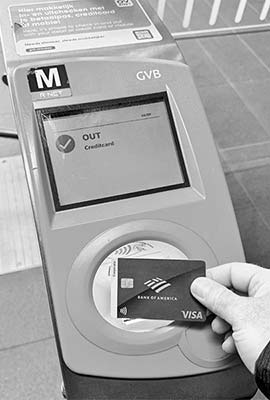
While this system works well overall, be aware of a few potential pitfalls:
As the announcements constantly remind you: “Don’t forget to check out!” If you forget, you could be charged for a longer journey.
Amsterdam becomes much easier to wrap your brain around when you master the two main tram corridors—north-south and south-east. See the transportation map in the back of this book for a visual aid. Here’s a quick overview:
As if made for the sightseer, trams #2 (direction: Nieuw Sloten) and #12 (direction: Amsteldijk) travel north-south, connecting Centraal station, Dam Square, many of my recommended hotels, and Leidseplein. Both trams then continue beyond Leidseplein to Museumplein (the stop for the Rijksmuseum and Van Gogh Museum). The entire ride takes about 15 minutes, with trams zipping by every few minutes.
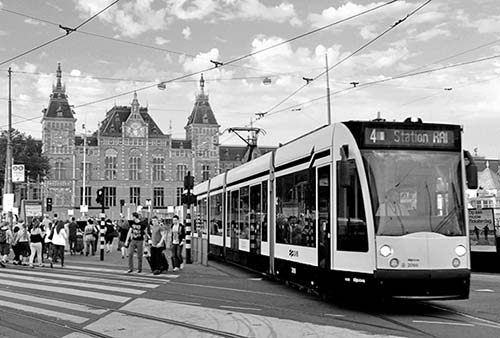
Tram #14 runs south-east, connecting Centraal station to Rembrandtplein, Waterlooplein, the Jewish Cultural Quarter, and Alexanderplein.
To get to the Anne Frank House and the Jordaan, take tram #13 or #17 from Centraal station (or Dam Square) to Westermarkt, a block from the museum and the Jordaan neighborhood.
Use these trams to lace together your sightseeing. Most trams pass through Dam Square. At any time you can simply hop out, cross the street, and catch a tram heading back to your starting point.
Starting at the train station and heading south, here are the stops and landmarks you’ll pass:
Centraal Station: As this is the beginning of both lines, any tram #2 or #12 that you catch here is headed in the right direction. This tram stop puts you near the Red Light District, Damrak (the beginning of my self-guided Amsterdam City Walk), and all your transportation options (trains, airport connections, city buses, other trams, Metro, bike rental, ferry across the IJ).
Nieuwezijds Kolk: There is nothing of interest nearby.
Dam: You’ll roll by the back side of the towering New Church and Royal Palace (on your left). Nearby: Dam Square, Anne Frank House, and starting point for two of my self-guided walks—Jordaan and Red Light District.
Paleisstraat: This stop, which comes up quickly, is a good one to use for the Nine Little Streets shopping zone. After this stop, the tram passes through a square called Spui. Pronounced “spow” (rhymes with cow), this word means “spew,” where water was once pushed away over a dike.
Koningsplein: This handy stop offers the closest access to the Mint Tower, flower market, and Begijnhof; it’s also the closest tram stop to the Rokin Metro stop, a five-minute walk east. Carrying on, the tram crosses four canals: Singel, Heren, Keizers, and Prinsen (the Southern Canal Belt).
Keizersgracht: Here the street fills with people and gets so narrow that trams share one set of rails, and bikers are required to walk their bikes. This is the vibrant shopping district of modern Amsterdam.
Prinsengracht: You’ll roll past more shops and more pedestrians.
Leidseplein: This is the tourists’ nightlife center, with edgy nightclubs, the famous Bulldog Coffeeshop (marijuana), and the venerable city theater (Stadsschouwburg).
Museumplein: Here is the popular Museumplein park, Rijksmuseum, Van Gogh Museum, Stedelijk Museum, House of Bols, and Coster Diamonds.
Leaving Centraal station you’ll go south and then east, passing:
Dam Square: At this major hub, you’ll roll past the front of the Royal Palace and through Dam Square itself. Nearby: the New Church, Anne Frank House, and starting point for my Jordaan and Red Light District self-guided walks.
Rokin: This stop is next to the Metro stop of the same name. Get off here for several key sights in the city center: the Begijnhof, Mint Tower and flower market, and Spui area; it’s also a short walk west from here to the Nine Little Streets shopping zone.
Rembrandtplein: One of the city’s top nightlife spots, this is a good place to hop off for the Tuschinski Theater and the Willet-Holthuysen Museum.
Waterlooplein: This large square perched on the edge of the historic Jewish Cultural Quarter is close to Rembrandt’s House, Gassan Diamonds, Blawbrug (“Blue Bridge”), and the Waterlooplein flea market.
Mr. Visserplein: This busy intersection, named after Louis Ernst Visser, a president of the Dutch Supreme Court who protested Jewish oppression during WWII German occupation, is a handy stop for the Jewish Museum and Portuguese Synagogue.
Artis: Hop out here for the National Holocaust Museum, Dutch Resistance Museum, Artis Royal Zoo, and De Hortus Botanical Garden.
Alexanderplein: A grand gate that was part of the old city wall graces this intersection, convenient to the World Museum.
Be careful not to accidentally check in twice while boarding, which renders the transaction invalid. (If you hold your card close to the sensor for too long, it might check you in, then out again, eliciting an error message.)
Every passenger needs their own payment method. This can be tricky for a family traveling with kids; the simplest solution is to equip each member of your party with their own card or payment app. Otherwise, you can buy individual tickets or passes (see “Tickets and Passes,” next; for more guidance, see the Amsterdam with Children chapter).
To dig into more details on this system, or if you encounter problems, see www.gvb.nl/ovpay.
Tickets and Passes: For most visitors taking occasional tram or Metro rides, the tap-to-pay system described above is the easiest and least expensive choice. Paper tickets and passes are available but more costly and cumbersome.
A single ticket—good for up to one hour on the tram, bus, and Metro—costs €3.40 (which, for a short ride, can be twice as much as you’ll pay by tapping your card). Tickets are not sold on board, and machines (marked Tickets Tram Bus Metro) can be hard to find (easier in Metro stations). Other options are to buy tickets with the 9292 app, at the OV Service and Tickets office at Centraal station, or at the GVB ticket office in the old, white building immediately in front of the station.
A multi-ride pass, good for unlimited city transit, is worth considering only if you plan on riding lots and lots of trams (€9/24 hours, €15/48 hours, €21/72 hours, and so on up to one week). There are also passes that cover both the tram-bus-Metro system and train rides in the Netherlands. Yet another option is to invest €7.50 in a reloadable transit card called an OV-chipkaart. Designed for locals, these are rarely worthwhile for visitors (but if you’d like to learn more, see www.ov-chipkaart.nl [URL inactive]).
Other Options: The I Amsterdam City Card, a sightseeing pass, also covers all tram, bus, and Metro travel within Amsterdam (see “Sightseeing Passes” on here). If you’ll be taking lots of transit in town, you might consider the Amsterdam Travel Ticket (which covers transit plus the train to and from Schiphol Airport) or the Amsterdam & Region Travel Ticket (which also covers trains and buses to nearby destinations). Get the details on these options at Iamsterdam.com.
Riding Trams, Metro, and Ferries
Trams: Board the tram at any door not marked with a red/white “do not enter” sticker—typically at the front and the back of the tram. Tap to check in and out (see “Contactless Payment,” earlier). To open the rear door when you reach your stop, press the green button on a pole near the exit. Don’t try to exit through the front door—it’s not allowed.
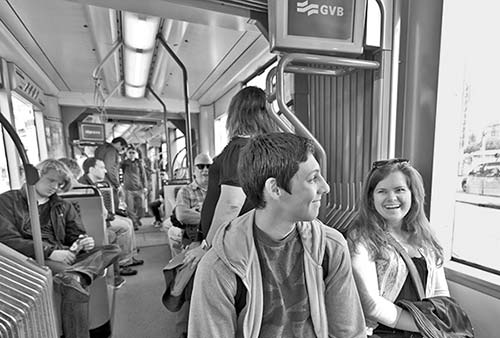
If you get lost in Amsterdam, remember that most of the city’s trams eventually take you back to Centraal station, and nearly all drivers and conductors speak English. See the “Amsterdam by Tram” sidebar for details on handy routes.
Metro: While tourists mainly stick to trams, the Metro can be ideal for certain journeys. Yes, you’ll miss the views. But you’ll also miss the traffic, stoplights, and congestion—it’s remarkably speedy. To pay, just tap to check in and out at the turnstiles as you enter and exit (see “Contactless Payment,” earlier).
Most useful is the north-south M52 line, which runs through the middle of the city center. This line has a stop immediately below Centraal station. From here, it heads north (direction: Noord) just two stops to Noord, the end of the line (where you’ll catch buses for many day trips, including Edam). Or you can ride the Metro south (direction: Zuid) through the middle of the tourist’s Amsterdam. It stops at Rokin, in the heart of the city (exit the station toward Dam, to the north, or toward Spui, to the south), then continues to Vijzelgracht (on the Southern Canal Belt, next to the Heineken Experience, also relatively close to the Rijks and Van Gogh museums), then De Pijp (with the delightful Albert Cuyp Market—exit toward Albert Cuypstraat), then Europaplein (by the Amsterdam RAI convention center, with buses to Keukenhof), and finally Zuid (“South,” the end of the line).
Metro lines 51, 53, and 54 offer useful stops for tourists on their overlapping route: at Centraal Station, Nieuwmarkt (on the eastern edge of the Red Light District), and Waterlooplein (near Rembrandt’s House and the Jewish Cultural Quarter).
Ferries: A variety of free ferries depart from behind Centraal station and cross the IJ waterway to reach sights in North Amsterdam.
By Bike
You’ll get around town by bike faster than you can by taxi. Everyone—bank managers, students, pizza-delivery workers, and police—uses bikes. It’s by far the smartest way to travel in a city where 40 percent of all traffic rolls on two wheels. On my last visit, I rented a bike for five days, chained it to the rack outside my hotel at night, and enjoyed wonderful mobility. I highly encourage this for anyone who wants to get maximum fun per hour in Amsterdam. One-speed bikes, with “brrringing” bells and foot brakes, rent for about €10 per day (cheaper for longer periods). Some hotels rent their own, or they can refer you to the nearest spot. If you don’t like the bike you’re given, it’s fine to ask for a better one. At better bike shops, you can upgrade to an e-bike for higher prices (€20-40/day). Some places require an ID and/or a credit-card number as a deposit.
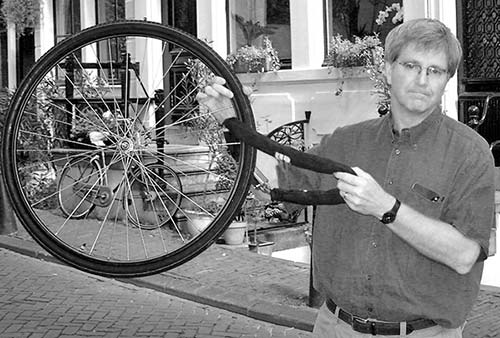
Bike thieves are bold and brazen in Amsterdam. Bikes come with two locks and stern instructions to use both. The wimpy ones go through the spokes, whereas the industrial-strength chains are meant to be wrapped around the actual body of the bike and through the front wheel, then connected to something stronger than any human. (Note the steel bike-hitching racks sticking up all around town, called “staples.”) Follow your rental agency’s locking directions diligently. Once, I used both locks, but my chain wasn’t around the main bar of my bike’s body. In the morning, I found only my front tire (still safely chained to the metal fence). If you’re sloppy, it’s an expensive mistake and one that any “included” theft insurance won’t cover.
Rental Shops: Star Bikes Rental has cheap rates, long hours, and inconspicuous black bikes. They’re happy to arrange an after-hours drop-off if you give them your credit-card number and prepay (daily; walk east from behind Centraal station along De Ruijterkade to #143, +31 20 620 3215, www.starbikesrental.com).
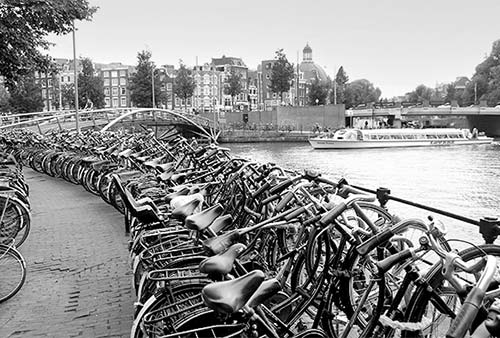
Frédéric Rent-a-Bike, a 10-minute walk from Centraal station, has quality bikes and helpful staff (RS%—10 percent off, use discount code “RICKSTEVES” when reserving online; daily, after-hours drop-off available; Binnen Wieringerstraat 23, +31 20 624 5509, www.frederic.nl, Marne).
MacBike is a larger outfit with an efficient outlet at Centraal station; cheaper foot-brake bikes are available at its Oosterdok, Vondelpark, and Waterlooplein locations (free rental with I Amsterdam City Card; free helmets, daily, at east end of station—on the left as you exit; +31 20 624 8391, www.macbike.nl). MacBike sells several cheap pamphlets outlining bike tours with a variety of themes in and around Amsterdam.
Biking Tips: No one here wears a helmet. They do, however, ride cautiously, and so should you: Use arm signals, follow the bike-only traffic signals, stay in the obvious and omnipresent bike lanes, and yield to traffic on the right. Fear oncoming trams and tram tracks. Carefully cross tram tracks at a perpendicular angle to avoid catching your tire in the rut. Police ticket cyclists just as they do drivers: Obey all traffic signals and walk your bike through pedestrian zones (fines are reportedly €150). Texting while biking can get you an expensive ticket...if you’re not in an accident first. Google Maps helpfully includes bicycles as a mode of transportation for the Netherlands. For bike tours, see “Tours in Amsterdam: By Bike,” later.
By Boat
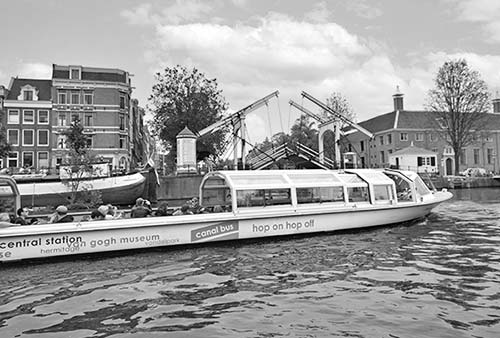
While boats are mainly used for canal tours (see “Tours in Amsterdam,” later), CitySightseeing operates a hop-on, hop-off service, allowing you to use their boats to connect your sightseeing—getting on and off at will (8 stops, €27.50/24 hours, €35/48 hours; skip combo-tickets with their bus tours—not very useful in this city; www.citysightseeingamsterdam.nl).
If you’re a confident boater, consider renting a serious vessel. Sloep Delen Boat Rental has a fleet of 12-seater boats with silent electric motors. Locals book online and use a smartphone to unlock their boat; for tourists it’s smart to call and pay an attendant who will meet you at the dock, give you a little map and suggestions, and set you free (€70/hour for up to 12 people, minimum 2 hours, €150 deposit, pick up at Elandsgracht 150 or Mauritskade 3, +31 20 419 1007, https://sloepdelen.nl).
By Taxi and Uber
For short rides, Amsterdam is a bad town for taxis, which must take circuitous routes through winding, traffic-filled streets. They’re expensive, might be slow to arrive, and you can often get where you’re going faster by walking, biking, or taking trams. For these reasons, I use taxis less in Amsterdam than in just about any other city in Europe. The city’s taxis have a drop charge (€3.36), after which it’s €2.47 per kilometer. You can wave them down, find a taxi stand, call for one (+31 20 777 7777), book online (www.tcataxi.nl), or use an app (Taxi Amsterdam “TaxiTCA”). Legally, all taxis are required to have meters, and accept cash or credit cards.
Uber works in Amsterdam like in the US (pricing based on demand, often somewhat cheaper than a taxi; rides within the city center are typically €10-20, or about €30-40 from the airport into downtown).
By Car
If you’ve got a car, park it: All you’ll find are frustrating one-way streets, terrible parking, and meter readers with a passion for booting cars parked incorrectly. In fact, the city actively discourages car traffic in the historic center by making things as difficult as possible for drivers. You’ll typically pay €60 or more a day to park safely in a central garage (though you may be able to find cheaper options by booking in advance online; try www.q-park.nl). If you must bring a car to Amsterdam, you can save money and avoid driving headaches by leaving it at one of the city’s supervised suburban park-and-ride lots (follow P&R signs from freeway, around €10/24 hours, includes discounted transit into city center for up to five people, 4-day maximum).
Tours in Amsterdam
To sightsee on your own, download my free audio tours that complement my self-guided Amsterdam City, Red Light District, and Jordaan walks. Some companies offer a discount when you show this book (indicated in these listings with the abbreviation “RS%”).
BY BOAT
▲▲Canal Boat Cruises
It’s a delightful experience to get out on the water and see Amsterdam from canal level—offering a different perspective on this unique city (and a welcome break from dodging bikes). You have three basic options: big, glassed-in, old-school tourist barges that seat about 75; smaller open boats (with a canopy in bad weather), seating about 8-12, with a more casual approach; or hiring your own boat and skipper for a custom cruise. Any of these options can provide an enjoyable introduction to the city. Some people prefer to cruise at night, when the bridges are illuminated. For a compromise, aim for a trip around sunset—so you can see the city both by daylight (to more easily appreciate the monuments) as well as twilight (with romantic twinkle lights and street lamps).
Big, Traditional Tour Boats
These long, low, tourist-laden boats leave continually from several docks around town for a relaxing, if uninspiring, one-hour introduction to the city (with stiff recorded commentary). Three dominant, interchangeable companies offer a standard cruise for €20-25/person (cheaper online). Boats depart frequently (2-4/hour) daily from about 10:00 until 17:00, though some run earlier or later; service is reduced off-season. While I find this option less appealing than the smaller boats, it is covered by the I Amsterdam City Card (good for one cruise from certain companies).
Stromma has three departure points: immediately in front of Centraal station; Damrak Pier 5, just 100 yards farther down the main drag; and in front of the Rijksmuseum (+31 20 217 0501, www.stromma.nl). Lovers has traffic-cone-orange boats that depart right in front of Centraal station (+31 20 530 1090, www.lovers.nl [URL inactive]). And Blue Boat Company departs from two touristy locations at the southern edge of the center, in opposite directions from the Rijksmuseum: across from the Heineken Experience at Stadhouderskade 550; and across from the Hard Rock Café at Stadhouderskade 501, near Vondelpark. They also have an evening cruise that includes the Red Light District (+31 20 679 1370, www.blueboat.nl).
Smaller, Quirkier Canal Boat Tours
A variety of small boat companies provide a lighthearted alternative to the big barges. These tend to be more youthful, come with live and loose narration, encourage drinking and snacking, and are simply lots of fun. Their smaller size allows them to access quieter canals that the biggies can’t. This option is only slightly more expensive than the big boats, generally around €25-35 for a 1.5-hour cruise. As these companies can come and go, search for options on travel review sites or ask your hotelier for recommendations. Here are a few companies worth considering:
Amsterdam Boat Adventures is a great all-around choice, with comfortable boats, good skippers more interested in solid information than crass jokes, and a relaxed ambience without veering into being a “party” boat. They’re professional and fun, though the departure point is less central (near the H’ART Museum in southeast Amsterdam at Nieuwe Keizersgracht 1, +31 6 4846 4743, www.amsterdamboatadventures.com).
Those Dam Boat Guys is more casual and designed to be entertaining, with a “pirate ship” vibe, wisecracking expat guides who might crack off-color jokes, and a higher likelihood of passengers lighting up en route (handy departure location near the Anne Frank House at Keizersgracht 96, +31 20 210 1669, www.thosedamboatguys.com).
Other options include Voyage Amsterdam (elegant cream-and-wood boats, depart from Keizersgracht 384, www.voyageamsterdam.com); Captain Dave’s (a smaller outfit that uses an enclosed 1928 saloon boat, departs from Prinsengracht 397, www.captaindaveamsterdam.com); and Flagship (more upscale but guiding can be hit-or-miss, several departure points including near the Anne Frank House, www.flagshipamsterdam.com).
Friendship Amsterdam Boat Tours is slightly cheaper and something of a compromise between the big, traditional option and the casual, smaller choices—bigger boats (seating about 40) and a shorter tour (departs from Oudezijds Voorburgwal 230 in the Red Light District, +31 20 334 4774, www.friendshipamsterdam.com).
Private Canal Cruises
Many companies—including many of the above small-boat operators—can be hired for private outings. While pricey, a group might find this well worthwhile (figure €250-300/hour for up to 10 people).
Canoe Tours near Amsterdam
For some exercise and an intimate dose of the polder country and village life, consider the Wetlands Safari five-hour tour. Majel Tromp, a friendly villager who speaks great English, will meet you at the Noord Metro station at 10:00. From there, you’ll catch a 5-minute public bus, stop for coffee, then embark on a 3.5-hour canoe trip with several stops, tour a village by canoe, munch an included canalside picnic lunch, and finally canoe and bus back to Amsterdam’s Noord station by 15:00 (€78, €52 for kids 7-16, RS%-€5 off—use discount code “RICK” when reserving online; 2-3 people/canoe, 2-8 people/tour; tours run May-Sept Wed, Fri, and Sat; reservations required, +31 6 5355 2669, www.wetlandssafari.nl, info@wetlandssafari.nl). There’s also a two-hour “fresh air” tour (€33, Thu and Sun year-round) and a four-hour sunset tour (€65, Thu and Sun, summer only).
ON FOOT
Food Tours
Amsterdam has many competing food tours, generally focusing on one neighborhood. A typical food tour will make six or eight stops in 3-4 hours and costs €100-110. They hit all the edible clichés (including pancakes or poffertjes, cheese, herring, Indonesian and/or Surinamese, apple pie, and Dutch gin) and come with fun commentary and the chance to meet local merchants. The most popular neighborhoods are De Pijp (for a more authentic and trendy experience and an international market scene) and the Jordaan (which fits the typical visitor’s image of Amsterdam). These companies have small groups (of about 8-10 people), allowing them to patronize smaller restaurants.
I enjoyed Amsterdam Food Tours, which offers both a standard food walk and a version that adds a small-boat trip at the end (+31 6 1542 8120, www.amsterdamfoodtours.com, Thijs van Royen).
Hungry Birds is a women-run company with tours that are thoughtful, casual, and informative; it feels like grazing through a fun neighborhood with an interesting local friend. Tour options include De Pijp and East Amsterdam, both less touristy than the central areas (+31 6 1929 6774, www.hungrybirds.nl, Esther-Hanna).
Free City Walk
As in many European cities, a variety of companies “employ” native English-speaking students to give irreverent and entertaining two-hour walks (using the same “free tour, ask for tips, sell their other tours” formula popular elsewhere). While most guides lack a local’s deep understanding of Dutch culture, they’re high-energy, entertaining, and can provide a once-over-lightly orientation to the city (lacking the substance of this book’s self-guided walks and tours, or a more serious local guide). While billed as “free,” you’ll pay a small amount (typically €1-3) to cover service fees and required taxes, and tips are expected (because otherwise, the guides don’t get paid). The dominant outfit is the Europe-wide New Europe Tours (www.neweuropetours.eu), but there are homegrown alternatives, including FreeDam Tours (www.freedamtours.com) and Free Walking Tours Amsterdam (www.freewalkingtoursamsterdam.com).
Private Guides
Mark Law, a knowledgeable guide who has clearly found his niche, is insightful and fun to spend time with. Along with his That Dam Guide partners, Mark offers an array of creative programs both in Amsterdam and in the countryside. On his website, you can watch past livestreams of Mark virtually exploring Amsterdam and environs (€75/hour, minimum 3 hours, +31 627 269 604, www.thatdamguide.com, mark@thatdamguide.com).
Dennis Gerrits is like a personal host who wants you to get the most out of your visit. His customized tours of Amsterdam and its surrounding cities and countryside can be by foot, private boat, or car. He’s happy to help with reservations and planning and enjoys booking a video call in advance to design the right plan (from €50/hour, +31 6 3840 2919, www.lovemycitytours.com, dennis@lovemycitytours.com).
Larae Malooly will tailor a private tour to your interests, weaving in themes such as Renaissance architecture, Jewish heritage, and even local food, and will pick you up from your hotel or a convenient spot in town (€205/up to 4 people for 4-hour Amsterdam tour, book at www.amsterdamsel.com).
Toms Travel Tours offers custom-designed private tours. Amsterdam native Tom van der Leij has assembled 20+ local, multilingual, and specialized guides who lead tours in Amsterdam, the Dutch countryside, and Belgium (€285/3 hours, +31 6 2653 4331, www.tomstraveltours.com, reservations@tomstraveltours.com).
For more options, try the Around Friends guide-finding service. A brainchild of recommended guide Dennis Gerrits, this service uses a brief questionnaire to pair you with guides who suit your style (from a pool of about 20), and offers video introductions for each (www.aroundfriends.com).
BY BIKE
Guided Bike Tours
Yellow Bike Guided Tours offers city bike tours of either two hours (€29.50, daily at 11:00 and 13:30) or three hours (with a 20-minute break, €35, daily at 13:30). They also offer a four-hour, 15-mile tour along the dikes and green pastures of the countryside (€39.50, 30-minute lunch break, lunch not included, Fri-Sun at 10:00). All tours leave from Nieuwezijds Kolk 29, three blocks from Centraal station (reservations smart, +31 20 620 6940, www.yellowbike.nl).
Do-It-Yourself Bike Tour of Amsterdam
A day enjoying the bridges, bike lanes, and sleepy, off-the-beaten-path canals on your own bike is an essential Amsterdam experience. The real joys of Europe’s best-preserved 17th-century city are the countless intimate glimpses it offers: laid-back locals sunning on their porches under elegant gables, rusted bikes that look as if they’ve been lashed to the same lamppost since the 1970s, wasted hedonists planted on canalside benches, and happy sailors permanently moored but still manning the deck.
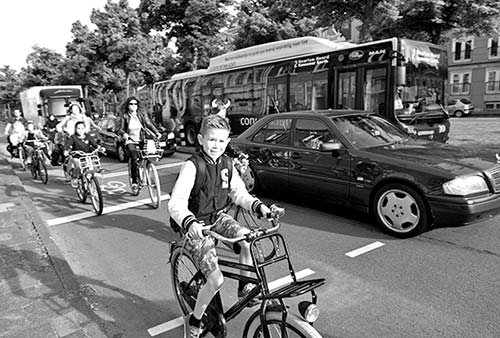
For a good day trip, rent a bike at or near Centraal station (see “Getting Around—By Bike,” earlier). Head west down Haarlemmerstraat, working your wide-eyed way down Prinsengracht and detouring through the small, gentrified streets of the Jordaan neighborhood before popping out at the Westerkerk under the tallest spire in the city.
Pedal south to the lush and peaceful Vondelpark, then cut back through the center of town (Leidseplein to the Mint Tower, along Rokin street to Dam Square). From there, cruise the Red Light District, following Oudezijds Voorburgwal past the Old Church (Oude Kerk) to Zeedijk street, and return to the train station.
Taking Bikes Across the Harbor on a Free Ferry
To escape into the countryside, take your bike on the free ferry behind Centraal station. In five minutes, Amsterdam is gone, and you’re rolling through your very own Dutch painting. For details on this ride, see here.