THE HAGUE
Den Haag
The Dutch constitution may identify Amsterdam as the official “capital,” but The Hague has been the Netherlands’ seat of government since 1588. It’s home both to the country’s parliament and to the International Court of Justice (at the tourable Peace Palace), where nations try to settle their disputes without bloodshed.
From a sightseeing perspective, The Hague is a one-trick pony...and it’s a fine trick. The excellent Mauritshuis museum boasts perhaps the Netherlands’ best collection of homegrown art outside of the Rijksmuseum, including its masterpiece, Vermeer’s Girl with a Pearl Earring. There’s also a fine museum dedicated to the crowd-pleasing modern Dutch artist M. C. Escher, as well as a few other sights to fill out a day.
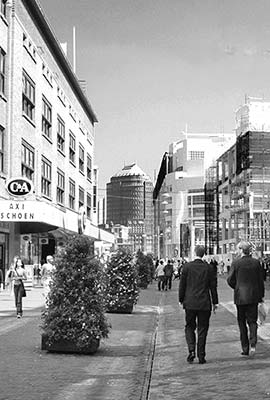
But beyond those attractions, The Hague’s appeal diminishes quickly—given its sterile, upscale, businesslike vibe. I’d come for the museums, then head on to more purely enjoyable destinations. Fortunately, The Hague is a particularly easy half-day side trip from Delft—so close it’s practically a neighborhood of this city.
Orientation to The Hague
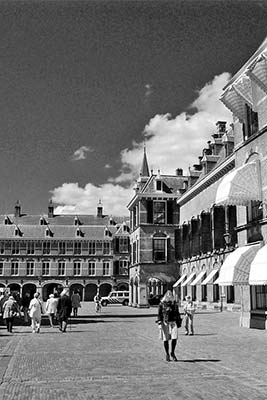
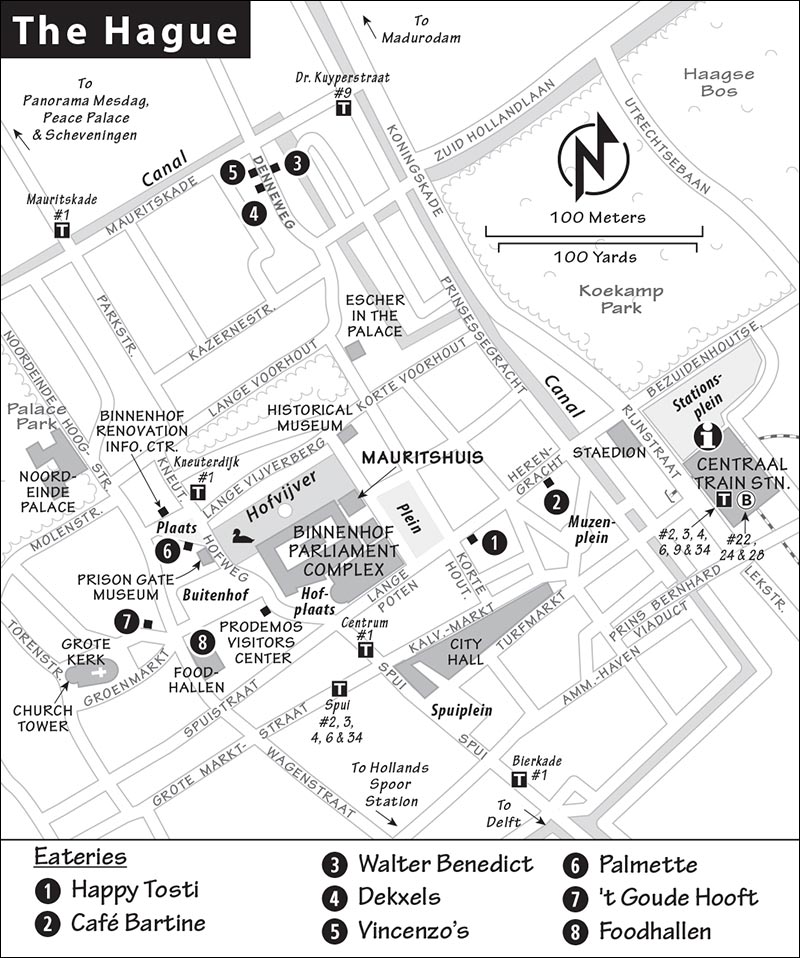
Though it has a half-million residents (being the Netherlands’ third-largest city), The Hague feels manageable for a sightseer. The Mauritshuis museum and Binnenhof parliament complex (the latter likely closed for renovation when you visit) are at the center of town on the lovely lake called Hofvijver. The major sights in The Hague are well signed—just look for the black-and-gold directional arrows.
TOURIST INFORMATION
The TI is inside The Hague’s Centraal station behind the stairs in front of tracks 10-12—look for signs directing you to VVV Tourist Information. Unless you arrive at the station, it’s not worth a special trip (Mon-Fri 10:00-18:00, Sat-Sun until 17:00, Spui 68, WhatsApp +31 6 5537 6853, www.denhaag.com).
Sightseeing Pass: The Museumkaart sightseeing pass (see here) covers entry to The Hague’s Mauritshuis museum, Prison Gate Museum, Panorama Mesdag, and Historical Museum.
ARRIVAL IN THE HAGUE
By Tram: Handy tram #1 clatters in 30 minutes from Delft to the very heart of The Hague. Get off at the Centrum stop—right in the middle of The Hague’s busy urban zone, on a wide street called Spui. Across the street to the left sprawls a bustling but charmless shopping zone. To find the Mauritshuis museum, walk a few steps straight ahead up Spui, turn right on Lange Poten, and follow it to the café-lined square called Plein. Exit the square at the far-left corner; the Mauritshuis and Binnenhof (parliament, likely closed for renovation) are just around the bend.
By Train: If coming from other parts of the country, your train may stop either at Centraal station (also “CS” or “Den Haag CS”) or Hollands Spoor (“HS” or “Den Haag HS,” used by more international trains). If you have a choice, Centraal station has the TI and is closer to the tourist area, though it still requires a walk or tram ride to the main sights. (From Delft, the train to The Hague’s Centraal station takes half as long as the tram but requires more walking, so it’s basically a wash.)
At Centraal station, stairs in front of tracks 10-12 lead downstairs to WCs and lockers; the TI is just beyond the stairs, on the main level. It takes about 15 minutes to walk to the Mauritshuis and other major sights: Exit straight out the door beyond the TI (marked Centrum/Museumquartier), turn left, and walk toward the big, hulking building labeled Staedion. Circle around the right side of this building and carry on across a canal as the street you’re on becomes tree-lined Herengracht; follow this as it becomes the pedestrian-only Korte Poten and takes you to the lovely square called Plein, in the heart of the museum action. To shave a little time off the walk, you could take a tram from the train station’s upper level (above the intercity tracks); ride tram #2, #3, #4, #6, or #34 one stop to Spui.
If arriving at the Hollands Spoor station, it’s easiest to walk out in front of the station and take tram #1 (direction: Scheveningen Noorderstrand) to the Centrum stop, described above.
GETTING AROUND THE HAGUE
Most sights are within walking distance of the Centrum tram stop or Centraal station. For more distant sights or to avoid a walk, The Hague has an efficient public transit system (www.htm.nl). The easiest and cheapest way to pay for a single ride is by tapping on and off with your credit card. The price varies according to the distance traveled; a bus or tram ride from the train station to the center, or from the center to the Peace Palace or even the beach, won’t cost more than €3. If you will be taking several trips, consider buying a two-hour ticket (€4.50 for unlimited transfers) or a day ticket (€8). Buy from bus drivers, from machines on buses and trams, or online.
Sights in The Hague
MUSEUMS IN THE CITY CENTER
These attractions are all within a 10-minute walk of the Hofvijver—the pretty lake in the heart of town, anchored by the Binnenhof parliament complex.
▲▲Mauritshuis
One of the Netherlands’ best art museums, the Mauritshuis features Dutch golden age art, including top-notch pieces by Vermeer (his famous Girl with a Pearl Earring lives here), Rembrandt, Rubens, and many others. This so-called mini-Rijksmuseum is more intimate and less overwhelming than its bigger cousin in Amsterdam. It’s well worth a visit.
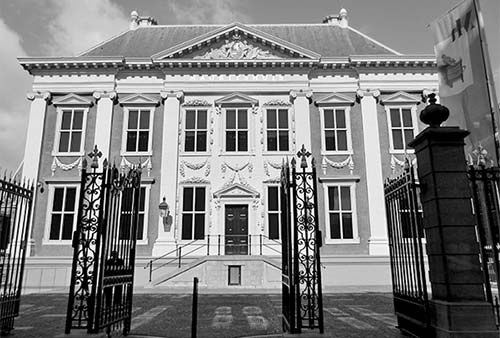
Cost and Hours: €19.50, Tue-Sun 10:00-18:00, Mon from 13:00, free coat-and-small-bag check; Plein 29—to get here from the Centrum tram stop or Centraal station, see “Arrival in The Hague,” earlier; +31 70 302 3456, www.mauritshuis.nl.
Tours: The museum has a good, free audioguide for your phone; either download the Mauritshuis app in advance or use the museum’s Wi-Fi when you arrive.
Visitor Services: In the entrance and ticketing area, you’ll find a bag-and-coat-check desk; straight ahead is the shop and, up a flight of stairs, temporary exhibits and the museum’s good €€ brasserie, with salads, sandwiches, and a few hot dishes.
Visiting the Museum: The entrance to the permanent collection is to the left as you enter the main door. From here, climb up two flights of stairs. The collection is displayed on two floors: “Floor 1” (actually the third floor) has just a few highlights and can be skipped if you’re in a rush. “Floor 2” (actually the fourth) is packed with masterpieces.
• On Floor 1, begin in Room 2, with portraits of wealthy patrons by Peter Paul Rubens and his protege, Anthony van Dyck. Continue into...
Room 3: The touching scene in Peter Paul Rubens’ Old Woman and a Boy with Candles (c. 1616-1617) features an elderly woman passing her light to the boy—encouraging him to enjoy life in a way that she perhaps hasn’t. Her serene smile suggests her hope that he won’t have the same regrets she does. Rubens was an early Dutch adopter of the ultrarealism practiced by the Italian painter Caravaggio.
• Carry on through Rooms 4, 5, 6, and 7—where you’ll find Hans Holbein the Younger’s Portrait of Robert Cheseman (1533), the chief falconer of England’s King Henry VIII. Complete your circuit in Room 8, then head up the stairs to Floor 2. Turn right into...
Room 9: One of Rembrandt’s most famous works, The Anatomy Lesson of Dr. Nicolaes Tulp (1632) made him a star in the Amsterdam art scene. This physician really did dissect a human cadaver, once each year, to better understand the miracle of our anatomy...for example, how muscles and tendons allow a hand to open and close (as he’s demonstrating here). Surgeons huddled close to learn, and the public was also invited—making this quite the spectacle. Notice the artist’s uniquely engaging version of a (typically dull) group portrait—inquisitive faces lean in, hanging on the doctor’s every word, and each surgeon’s face carries a different expression. The cadaver resembles a notorious criminal of the day.
• Continue into...
Room 10: This room displays several paintings Rembrandt made late in his life. Portrait of an Elderly Man (1667), painted when Rembrandt was 61, is not typical of the artist’s portraits, which generally depict carefully arranged aristocrats. (It was the income earned painting such formal portraits that provided the main source of Rembrandt’s income for most of his life.) In contrast, the subject of this portrait sits in a relaxed pose, clothing loose and hat at a tilt. Most likely, the man in this painting was a friend of Rembrandt’s, rather than someone who commissioned an official portrait. Homer (1663) also depicts an old man, in this case, the famous Greek poet, who dictates a poem to a scribe. The scribe is no longer visible, since that portion of the painting was damaged by fire. (You can still see the remaining two fingers, pen, and paper of the scribe in the lower right.)
Nearby, Rembrandt departs from stereotypical 17th-century portraiture with Two African Men (1661), featuring a pair who may have been brothers. It’s also possible that these men were neighbors of the artist, who lived near a small community of free Blacks in Amsterdam. Rembrandt Self-Portrait (1669) is the last of more than 80 self-portraits he painted throughout his life. It’s typical of his style: The clothes are painted lightly, but the face is caked on, built up by layer after layer of paint, carefully slathered on by the master. In the self-portrait, we see a man beaten down by life: The artist was bankrupt and had lost both loves of his life and his only child. Rembrandt would be dead within a year. (For more on Rembrandt, see here.)
This room features several more portraits, including three by Haarlem native Frans Hals, whose subjects look resplendent in lace and ruffs.
• Circle around through Room 11 to...
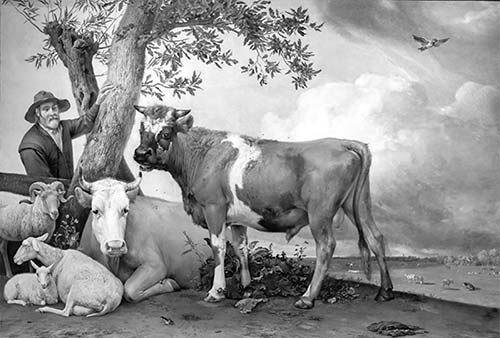
Room 12: Would it surprise you to know that this giant bovine portrait was, at one time, one of the Mauritshuis’ most beloved works? Paulus Potter’s The Bull (1647) elevates livestock to high art—celebrating this bull as if he’s a ruff-collared aristocrat. Big, dreamy, brown eyes...mouth open as if to speak knowledgeably...legs spread, contrapposto, to balance his weight dynamically: This could be a member of the royal family, or a famous merchant. (Remember this pose: craning his neck slightly and glancing over his shoulder. We’ll see a similar one soon.) The cow, goat, sheep—even the farmer—are an afterthought to the painting’s star. And that’s why this painting made such an impact: It was a revolutionary example of naturalism, elevating the mundane natural world into the realm of high art and beauty. There’s even a perfectly formed patty of manure in the foreground.
• Carry on through Room 13 until you reach...
Room 14: This room displays two very small paintings that deserve special scrutiny.
First, on the left between the windows is Carel Fabritius’ The Goldfinch (c. 1654), made famous by Donna Tartt’s 2013 novel of the same title. This luminous, simple painting shows a pet goldfinch perched on its feeder, shackled by a slender chain. Fabritius was Rembrandt’s pupil and Vermeer’s teacher, and this painting shows traces of both masters’ styles. Get close to see how the artist rendered the wing by painting bold yellow strokes over the black and then scratching the paint off with the back of his brush.
Next to the door into the next room, Jan Steen’s Girl Eating Oysters (c. 1658-1660) displays a seemingly innocent scene. But this still life combined with a portrait—on the smallest canvas Steen ever painted—is loaded with 17th-century sexual innuendo. Oysters were considered a powerful aphrodisiac, and behind the subject, peeking through the curtains, we can see a bed. The girl’s impish grin suggests that she’s got more than shellfish on her mind.
• Ready? For the museum’s highlight, continue into...
Room 15: Sometimes called “the Dutch Mona Lisa” for its enigmatic qualities, Vermeer’s Girl with a Pearl Earring (c. 1665) became a sensation in our times as the subject of a popular book and film. This is a “tronie”—a type of picture in which the painter’s goal is not to depict an individual person but to capture a mood or character by focusing on the expression of the subject. In fact, we don’t even know who this mysterious girl is. Wearing a blue turban and with a gigantic pearl dangling from her earlobe, she glances over her shoulder and catches the viewer’s gaze expectantly, maybe even seductively. Vermeer’s portrayal subtly implies a much more complicated story than we’ll ever know. The artist was a master of color and of suggesting shape with light—look closely and you’ll see that the famous pearl is essentially formed by two simple brushstrokes. (For more on Vermeer, see here.) By the way, does this pose seem familiar? It’s Potter’s The Bull.

On the opposite wall, find Vermeer’s View of Delft (c. 1660-1661). If this were a photograph, it’d be a bad one—you’d want to wait for the clouds to pass to snap another one with the entire scene bathed in light. But Vermeer, an expert at capturing light effects on canvas, uses the cloudy/sunny contrast to his advantage, illuminating the foreground and the distant, inner part of town instead of the more predictable middle ground. This makes your eye probe deep into the canvas, subconsciously immersing you in Vermeer’s world.
• Finish up in...
Room 16: In this large hall, which is also the top landing of the staircase, look on one of the partitions near the windows to find a small, circular masterpiece that you would not want to miss before leaving. Frans Hals’ lovable Laughing Boy (c. 1625) depicts an exuberant scamp grinning widely despite his decaying teeth and rat’s-nest hair. Like Girl with a Pearl Earring, this is another tronie, less about the subject than about what he’s doing: laughing spontaneously. (For more on Hals, see here.)
And Lots More: These paintings are just the beginning. Now that you’ve blitzed the highlights, dig in (perhaps using the audioguide) to find works by Jan Brueghel the Elder (a painting of the Garden of Eden, done jointly with Rubens), Hans Holbein the Younger (a portrait of one of Henry VIII’s wives), Anthony van Dyck, Hans Memling, and many other famous painters.
Nearby: Just beyond the Mauritshuis, you may be able to step through the fancy gateway to explore the interlocking courtyards of the Binnenhof parliament complex (described next; may be closed during renovation). Both structures sit alongside the lake called Hofvijver; if you have time and nice weather, it’s enjoyable to stroll the nicely manicured, tree-lined trail all the way around. As you do the spin, you’ll pass various other museums, described later in this section (and noted on “The Hague” map earlier in this chapter).
Binnenhof Parliament Complex
The castle-like Binnenhof complex, overlooking the Hofvijver lake right in the center of The Hague, is the seat of Dutch political power. The prime minister’s office is here, and it’s also the meeting place of the two-house parliament, or Staten-Generaal. The power resides in the directly elected Second Chamber (a.k.a. House of Representatives), whereas the mostly figurehead First Chamber (a.k.a. Senate, but more like the UK’s House of Lords) meets once weekly to harrumph their approval.
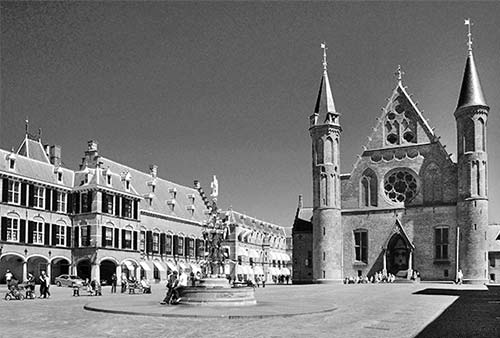
The complex is undergoing an ambitious, multiyear renovation. Certain sections may still be open to visitors; if you can get to the inner courtyard—surrounded by orange-and-white-striped awnings—you’ll find a golden fountain depicting Queen Beatrix (who ruled until 2013), a reminder that the respectful Dutch parliamentarians govern with the monarch’s symbolic approval. Dominating the middle of the complex is the historic Knights’ Hall (Ridderzaal), where the two houses meet jointly on special occasions.
Tours: If you’re curious to learn more, ProDemos runs tours of whatever parts of the Binnenhof are currently open—including, likely, the modern, temporary facility where the Dutch House of Representatives meets during renovation (for details and to book, see www.prodemos.nl; their visitors center is next to Café Brasserie Dudok at Hofweg 1, +31 70 757 0200).
Information Center: For excellent displays about the long (800-year) history of the Binnenhof complex, as well as its current renovation, visit this information center just across the square from the Prison Gate Museum (see next listing). English explanations are provided, and helpful staff members may even take you around and tell you more. Downstairs in the late-medieval cellar is a variety of interesting archaeological finds (free, Wed-Sat 10:00-16:00, Sun from 12:00, closed Mon-Tue, Plaats 22, www.binnenhofrenovatie.nl).
Prison Gate Museum (Gevangenpoort)
This torture museum, in a 13th-century gatehouse that once protected a castle on the site of today’s parliament, shows you the medieval mind at its worst. You’ll get the full story on crime and punishment from 1420 to 1823. You can wander around by yourself with an audioguide; live 45-minute English tours are offered on Saturdays and Sundays at 13:00 (€5, reserve on the website during busy times).
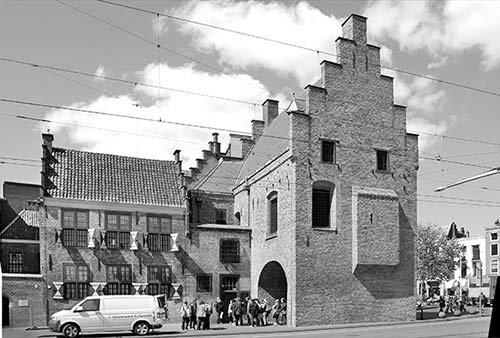
Cost and Hours: €15, Tue-Fri 10:00-17:00, Sat-Sun from 11:00, Mon from 12:00, closed Mon off-season, across from parliament at Buitenhof 33, +31 70 346 0861, www.gevangenpoort.nl.
Panorama Mesdag
For an overpriced look at the 19th century’s attempt at virtual reality, stand in the center of this 360-degree painting of nearby Scheveningen in the 1880s, with a 3-D, sandy-beach foreground. As you experience this nostalgic attraction, ponder that this sort of “art immersion” experience was once mind-blowingly cutting-edge.
Cost and Hours: €16, Tue-Sun 10:00-17:00, closed Mon, free digital audioguide for your phone, Zeestraat 65, a few blocks north of the Binnenhof parliament complex, +31 70 310 6665, www.panorama-mesdag.nl.
▲Escher in the Palace (Escher in Het Paleis)
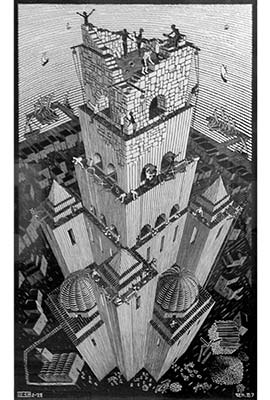
Celebrating Dutch optical illusionist M. C. Escher (1898-1972), this thoughtful exhibit is crowd-pleasing, supremely engaging, and deeper than you might expect...much like the artist’s works. While the many Escher woodcuts and other works are a delight to scrutinize, the building itself—the former winter palace of Queen Mother Emma of the Dutch royal family, with far-out chandeliers by Dutch artist Hans van Bentem—is also worth a look.
Cost and Hours: €12.50, Tue-Sun 11:00-17:00, closed Mon, mandatory free bag check in basement, free digital audioguide for your phone, Lange Voorhout 74, +31 70 427 7730, www.escherinhetpaleis.nl.
Visiting the Museum: Escher may not be considered a “serious artist” by art-world elites, but the exhibit does an admirable job of challenging that assumption. It traces both the artist’s life and his artistic evolution.
As a young man, Escher fell in love with Italy, and his perspective-driven works of everything from jagged coastlines to St. Peter’s Basilica built a foundation that served him well later in life. The rise of Mussolini’s fascism led to Escher’s departure with his family and an itinerant period, as he moved from place to place before finally settling in the Dutch town of Baarn.
Here Escher synthesized his various artistic obsessions: perspective, reflections, metamorphoses, impossible architecture, and tessellations (infinitely repeating patterns of tiles, which he became obsessed with after visiting the Alhambra in Granada). The exhibit covers each of these in turn, culminating in Escher’s later works, which ambitiously mixed-and-matched his many artistic tricks. In this phase of his life, Escher transitioned from literal landscapes of his beloved Italy to what have been termed “mindscapes”—fantastical, impossible worlds. One of his “metamorphosis” works is mounted in a giant circle, allowing you to walk around it and see how it truly is an infinite loop. (It works in both directions.)
Along the way, you can watch a 20-minute film about the artist. The top floor features kid-friendly displays that let you step right into an Escher engraving—but Escher is one of those artists who encourages anyone to be a kid at heart.
Nearby: The delightful, restaurant-lined Denneweg—described later, under “Eating in The Hague”—begins just outside the museum’s front door and is worth a wander: Just exit to the right and stroll.
Historical Museum of The Hague (Haagshistorischmuseum)
This museum’s eclectic collection includes landscapes of The Hague in its golden age, portraits of its movers and shakers, dollhouses, tile panels, and the well-preserved tongue and finger of a 17th-century murderer.
Cost and Hours: €15, Tue-Fri 10:00-17:00, Sat-Sun from 11:00, closed Mon, across the lake from parliament at Korte Vijverberg 7, +31 70 364 6940, www.haagshistorischmuseum.nl.
OUTSIDE THE CITY CENTER
The following sights lie north of the main tourist zone. Though worthwhile for the thorough sightseer, they take more effort to reach than the previous sights.
▲Peace Palace (Vredespaleis)
The palace houses the International Court of Justice and the Permanent Court of Arbitration. These two Peace Palace courts attempt to reach amicable settlements for international disagreements, such as border disputes. While the judicial process is interesting, the building itself is the big draw. A gift from American industrialist Andrew Carnegie, it’s filled with opulent decorations (donated by grateful nations who found diplomatic peace here), from exquisite Japanese tapestries, to a Hungarian tile fountain, to French inlay floors.
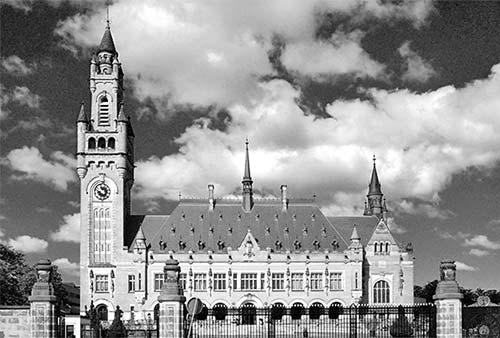
A free visitors center offers modest multimedia exhibits about the building and international courts. There’s also a persuasive video about the history of the Peace Palace and the role of international law. You’ll learn how modern nations attempt to resolve their disputes here instead of on the battlefield. Tours generally run on summer weekends only and primarily cover the grounds; interior tours are less frequent.
Cost and Hours: Visitors center—free, Wed-Sun 12:00-17:00, closed Mon-Tue, free digital audioguide for your phone, Carnegieplein 2, +31 70 302 4242, www.vredespaleis.nl.
Getting There: Take tram #1 directly from Delft (or from the Centrum stop near the Mauritshuis and Binnenhof in The Hague) and get off at the Vredespaleis stop (right in front of the palace). From The Hague’s Centraal station, you can take bus #24 (direction: Den Haag Kijkduin) or bus #28 (direction: Den Haag Zuiderstrand) and get off at Vredespaleis.
Tours: Because of the busy schedule of the Peace Palace’s important work, tours are typically limited to summer weekends (Sat-Sun). Most tours focus on the gardens and grounds without entering the building itself (“Around the Palace”-€12.50). Occasional “In the Palace” tours include the judicial chambers and grandly decorated halls (€16.50). Check Vredespaleis.nl for the complete schedule and to book in advance. Be sure to bring your passport. It’s also possible to attend a hearing (conducted in English or French) of the International Court of Justice; see icj-cij.org for details.
Scheveningen
This Dutch Coney Island, with its broad sandy beach, is at its liveliest on sunny summer afternoons (but is dead when the weather cools). Its biggest appeal is watching urbanites from all over South Holland enjoy a day at the seashore. Dominating the scene is the long double-decker pleasure pier, with shops down below, a boardwalk up top, and a bungee-jumping pavilion at the far end. A café-lined promenade stretches along the sand.
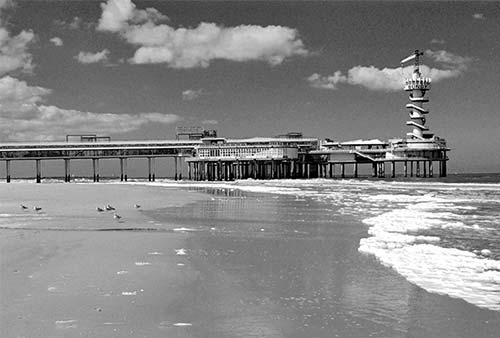
By the way, if you can’t pronounce this tongue-twisting name (roughly SKHEH-veh-ning-ehn), you’re not alone. In World War II, Dutch soldiers would quiz suspicious-looking visitors on how to pronounce this name as a test to determine who was Dutch-born and ferret out potential German spies. (This is the textbook example of an insider passphrase, known as a “shibboleth.”)
Getting There: Take northbound tram #1 from Delft or from the Centrum stop in The Hague, or tram #9 from The Hague’s Centraal station. Get out at Kurhaus (one stop before the end of the line) and follow signs for Boulevard/Strand and Pier.
Madurodam
This mini-Holland amusement park, with miniature city buildings that make you feel like Godzilla, is fun for kids.
Cost and Hours: €24.50, €2 cheaper online; open daily in summer 9:00-18:00, shorter hours off-season, last entry one hour before closing; George Maduroplein 1, tram #9 or bus #22 from Centraal station, +31 70 416 2400, www.madurodam.nl.
Eating in The Hague
Assuming that you’re here for lunch, I’ve focused my listings on eateries close to the sights. Unless otherwise noted, these places are open every day for lunch.
Plein and Nearby: The delightful, convivial, leafy square called Plein—just in front of the Mauritshuis—is the no-brainer choice for an enjoyable lunch between sightseeing stops on a nice day. Survey menus and views and pick anywhere that appeals. If you’d like more options, follow the street called Korte Poten, which becomes Herengracht, as it exits the square and heads northeast.
Just a few steps off the square, €€ Happy Tosti serves tasty grilled sandwiches (and has a mission to employ people with occupational disabilities; Korte Poten 5). Carrying on a couple of blocks, you’ll reach €€ Café Bartine, a trendy, upscale-feeling café with quality coffee and good lunches on a leafy street with outdoor tables (Herengracht 11).
Denneweg: Easily the most enjoyable street in The Hague for a stroll, this historic strip—just north of the Escher in the Palace museum—is the answer to the question, “Where did all of The Hague’s charm go?” The street is lined with midrise brick buildings, cafés, pubs, global-cuisine restaurants, and intriguing shops. Near the end of the street, €€ Walter Benedict (at #69A) serves all-day breakfast plus some lunch dishes. Across the street, hip €€ Dekxels (at #130) and €€€ Vincenzo’s (at #134, closed Mon-Tue)—revered for its Italian cuisine—are dinner-only.
West of the Lake: Two squares—one big, the other small—are just west across the busy street from the Hofvijver lake. Of the two, the triangular-shaped Plaats has the most tempting eateries, including the French-style café €€€ Palmette (at #27).
From here you can venture deeper into the congested streets of the city center. All roads seem to lead to the five-point intersection called Groenmarkt. Here you’ll find €€€ ‘t Goude Hooft, the city’s oldest inn, which today has loads of al fresco tables positioned to catch the sun and watch The Hague’s bustle (at Dagelijkse Groenmarkt 13).
Just to the south, Foodhallen—The Hague’s much smaller version of Amsterdam’s multicultural food circus—has about a dozen food counters, ranging from Italian, Mexican, and Spanish to dim sum, sushi, and Vietnamese (daily 12:00-22:00, Haagsche Bluf).
The Hague Connections
From Centraal Station by Train: Delft (6/hour, 15 minutes), Leiden (6/hour, 15 minutes), Rotterdam (6/hour, 30 minutes), Amsterdam (4/hour, 50 minutes, more with transfer), Haarlem (4/hour, 40 minutes), Arnhem (4/hour, 1.5 hours, transfer in Utrecht). Note that many of these trains also stop at the Hollands Spoor station (see next).
From Hollands Spoor Station by Train: Trains leave approximately twice hourly for Belgium. The IC connections, which change in Breda, are much more affordable than those that transfer to Eurostar in Rotterdam. From here it’s about 1.5-2 hours to Antwerp and 2.5 hours to Brussels; with additional changes, it’s about 3-4 hours to Ghent or Bruges.
By Tram to Delft: Take tram #1 from any stop (6/hour, direction: Delft Tanthof, about 30 minutes). To reach the Markt in Delft, get off at the Prinsenhof stop (just past the windmill a little north of the Markt). The tram also stops at Delft’s train station.