DELFT
SOUTH OF THE MARKT, CLOSER TO THE TRAIN STATION
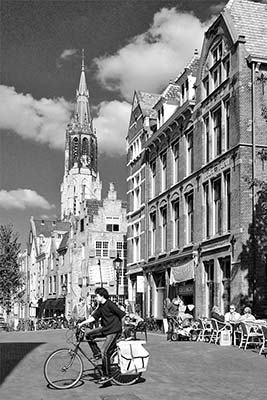
Peaceful as a Vermeer painting and as lovely as its porcelain, Delft has a special soul. It feels like an idyllic mini-Amsterdam...urban Holland with training wheels. Enjoy this typically Dutch, “I could live here” town best by simply wandering around, munching stroopwafels, people-watching, and daydreaming on the canal bridges. If you’re eager for some sightseeing, visit a pair of churches, learn more about favorite son Vermeer, or tour the famous porcelain factory.
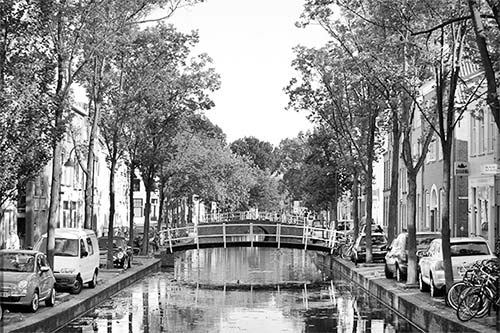
Think of Delft as an alternative to Haarlem: a low-key, midsized city with fast and easy connections to big cities (Rotterdam or The Hague). Laced with tranquil and picturesque canals, Delft would easily win the cuteness contest. If you love Vermeer’s quiet, exquisite paintings, you understand why it’s said that the painter’s muse was his hometown of Delft.
PLANNING YOUR TIME
Delft works wonderfully as a side trip by train from Amsterdam (one hour) or Haarlem (40 minutes), or as an overnight stop. If you spend the night anywhere in the Netherlands outside the capital, make it Delft.
Strategically located along the train line between Amsterdam and Belgium, Delft is within very easy side-tripping distance of The Hague (30 minutes by tram or 15 minutes by train), Rotterdam (15 minutes by train), and Leiden (20 minutes by train)—and its canalside charm makes it a far more pleasant place to stay than the bustling cities.
Whether side-tripping or home-basing, for a busy day of contrasts, visit both Delft and one of its big neighboring cities. In the morning, take in The Hague’s impressive Mauritshuis collection (with a world-famous Vermeer); Rotterdam’s modern architecture, busy harbor, and urban vibrancy; or smaller Leiden’s Rembrandt and Pilgrim sights. Then continue to Delft to visit its churches, Vermeer Center, and Royal Delft Museum and factory (closes at 17:00)...or to simply mellow out by a canal.
Orientation to Delft
Squeezed between the two giant cities of Rotterdam and The Hague, Delft feels much smaller than its population of 100,000. Locals describe Delft as a “small town.”
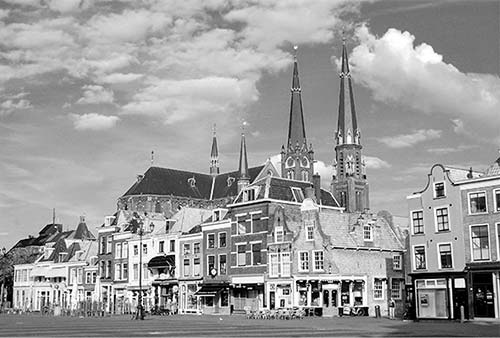
Nearly everything of interest (except the porcelain factory) is contained within Delft’s almost perfectly oval, canal-laced historic core. The vast Markt (Market Square), with the tall and skinny spire of the New Church, marks the center of the Old Town. A couple of blocks to the southeast is the lively, restaurant-lined Beestenmarkt. You can walk from one end of the Old Town to the other in about 15 minutes.
TOURIST INFORMATION
The TI is next to the train station in the modern Huis van Delft complex on Houttuinen street (Sun-Mon 10:00-16:00, Tue-Sat until 17:00, shorter hours Oct-March; +31 15 215 4052, www.indelft.nl). If you’d like to take the city’s little electric shuttle from the train station to the Royal Delft Museum (see listing later), the TI can call it for you.
ARRIVAL IN DELFT
By Train: Delft’s oversized, futuristic train station opened in 2015. Track 1 typically serves northbound trains (toward The Hague, Leiden, Haarlem, and Amsterdam), while track 2 serves southbound trains (Rotterdam, Belgium). From the platform, follow signs to Stationshal to surface. As you emerge from the turnstiles and carry on straight ahead, you’ll find lockers to the left just before the exit doors.
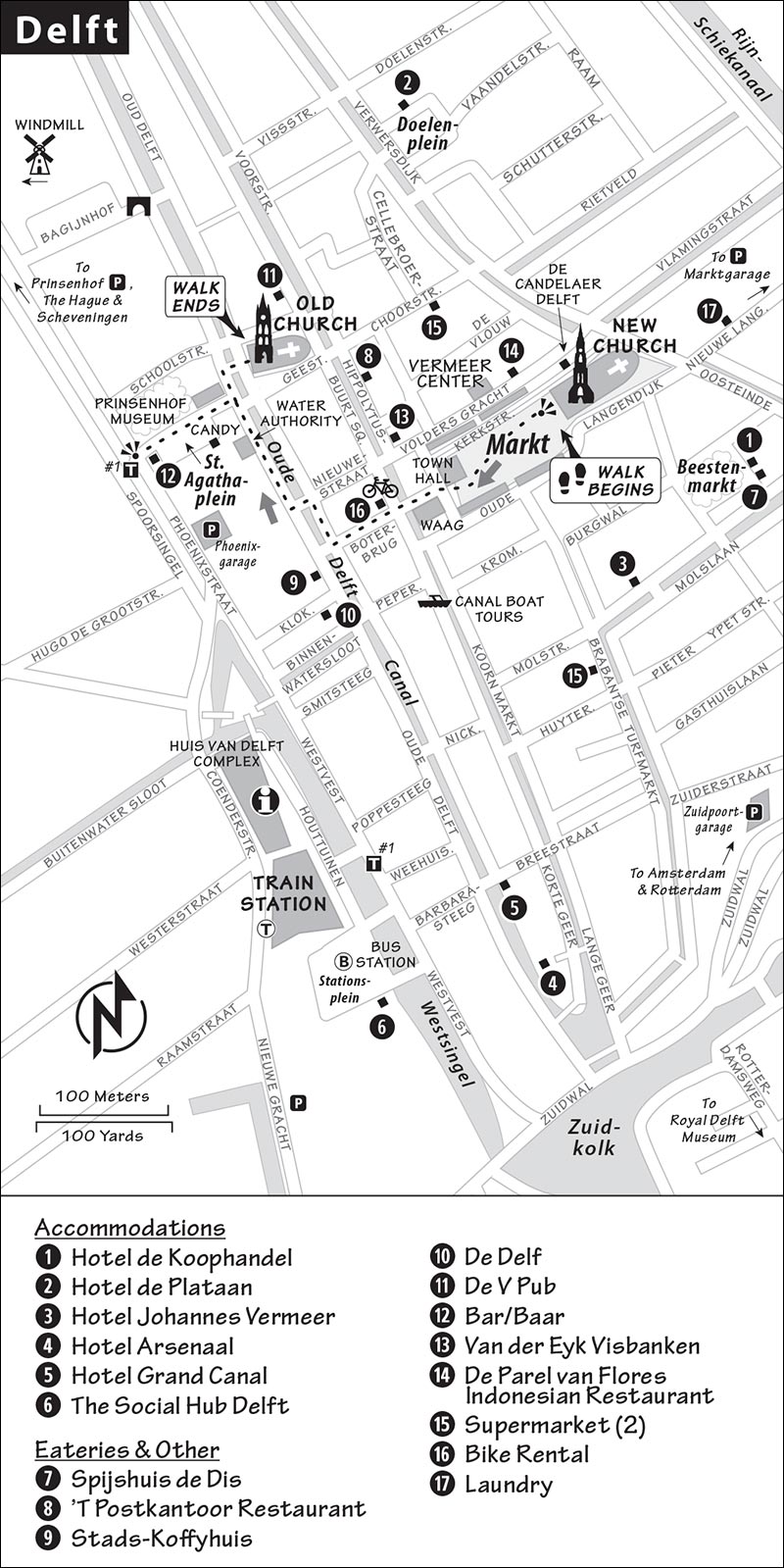
To reach the Old Town—a 10-to-15-minute walk—exit through those doors and walk with the canal on your right, passing the slick, modern Huis van Delft complex (and the TI) on your left. When you reach the bridges, use them to turn right across the canal, then carry on straight along Binnenwatersloot, a pretty canal with streets on both sides that lead toward the tall, pointy tower of the New Church on the Markt. You’ll run into the Oude Delft canal. My first few recommended hotels are within a short walk of here.
To instead reach accommodations in the southern part of town, turn right at the top of the station’s escalators, exit through those doors, cross the canal by the tram stop, and follow the map.
If you’re in Delft just for the famous Royal Delft Museum and porcelain factory, it’s a nice 15-minute walk along the canal, or you can take the Delft City Shuttle for €5 (see the “Royal Delft Museum” listing, later, for details). You can also take bus #40 from the south side of the station, but it takes about as long as it does to walk (direction: Rotterdam, weekdays only, 2/hour, 10 minutes, get off at the Jaffalaan stop and walk 5 minutes).
By Car: Drivers take Delft exit #9 off the A-13 expressway. Don’t attempt to park within the Old Town; that’s only allowed with a permit. Instead, use one of three parking garages that ring the Old Town—Marktgarage (east end, at Willem Naghelstraat 1), Prinsenhofgarage (northwest end, near the windmill at Kampveldweg 3), or Zuidpoortgarage (south end, at Zuidwal 14). They’re each about equidistant from the Markt, https://parkerendelft.com. A fourth garage, Phoenixgarage (west end, at Phoenixstraat 29), is marginally closer but nearly double the cost.
HELPFUL HINTS
Sightseeing Tips: The Museumkaart sightseeing pass covers entry to the Royal Delft Museum and the Prinsenhof Museum (the latter may be closed for renovation when you visit) and offers a discount at the Vermeer Center (potentially worthwhile for those also visiting Amsterdam, www.museumkaart.nl).
Markets: Delft adds to its considerable charms with a selection of markets on Thursdays and Saturdays. On Thursdays, you’ll find a huge general market with fish, cheese, fruits, and vegetables on the Markt, and flowers along Brabantse Turfmarkt and Burgwal. On Saturdays, look for a general market with flowers on Brabantse Turfmarkt and Burgwal (with frantic discounting of soon-to-be-worthless flowers at the end of the day), and antiques on and near Hippolytusbuurt, behind Town Hall.
Laundry: For fast and affordable full-service laundering, Rein-Tex is just off the Markt, beyond the New Church (self- and same-day service; Mon-Fri 9:30-17:30, Sat until 17:00, closed Sun; Nieuwe Langendijk 4a, +31 15 214 5439).
Supermarkets: Two well-stocked Albert Heijn supermarkets are in the city center. One is north of the Markt at Choorstraat 35; the other is a short walk south of the Markt, along a canal at Brabantse 41 (Mon-Sat 8:00-22:00, Sun 9:00-20:00).
Bike Rental: Delft—a low-impact mini-Amsterdam with pretty canals and very little car traffic—is an easy place to ride a bike, but you won’t need one to reach most sights. Still, if you just enjoy biking, want to explore the countryside, or even pedal to The Hague or Rotterdam, it’s an option. Halfords rents bikes behind the Town Hall at the bottom of the Markt (closed Sun-Mon, Wijnhaven 17, +31 15 213 8558).
Tours in Delft
Walking Tours
The TI offers occasional walking tours in Dutch and English (ask for details). They also sell self-guided walking-tour brochures to see Delft on your own—both a general one and a “Vermeer Trail” version. Or follow my Delft Old Town Walk detailed below.
Canal Boat
Rondvaart Delft boats depart from along Koornmarkt canal—look for the sales kiosk. They offer a 45-minute boat tour of the Old Town (€12.50, March-Oct daily on the hour 11:00-16:00, +31 15 212 6385, www.rondvaartdelft.nl). The company also rents paddleboats (€15/hour) and provides transport to the Royal Dutch Delftware Manufactory (€23.25 includes admission, daily departures at 11:00, 12:00, 13:00, and 14:00, 2.5-3 hours round-trip).
Hop-On, Hop-Off Bus
The quirky Delft City Shuttle uses golf cart-like vehicles fitting about six people to connect the city center to suburban sights—most notably the Royal Delft Museum (€5 day ticket, April-Oct daily 10:00-17:00, Nov-March usually weekends only 11:00-16:00, runs with demand—the TI, the Royal Delft store on the Markt, the Royal Delft Museum, and some hotels can call one for you, www.delftcityshuttle.nl).
Delft Old Town Walk
Lace together many of Delft’s sights with this pleasant 30-minute stroll through the heart of town (allow more time if you go inside the sights along the way—all described in more detail under “Sights in Delft”). The proud churches, spires, and memorials attest to Delft’s once-bustling economy during the golden age of the 1600s. But this walk also meanders past the placid canals, windmills, and pockets of greenery of the postcard village that Delft has become.
• Stand in the center of Delft’s market square—the Markt—and face the towering New Church.
The Markt
This is clearly a city with a rich history and a wealthy past. Its look today was defined in 1536, when lightning struck the spire of the New Church (Nieuwe Kerk; described in detail later in this chapter), starting a fire that destroyed two-thirds of the town. While all the buildings that ring the square have cellars dating from before the fire, what you see aboveground made of brick was built after 1536.
Delft recovered well from the fire. In the 17th century, its golden age, this was a thriving market town, with an economy stoked by textiles and breweries. (With 200 breweries, the city exported 80 percent of its beer.) Then, in the 18th century, the economy collapsed. Without the infrastructure of a trading city—there’s no river, local harbor, or major roads—Delft was left behind. It became a sleeping-beauty town, cocooned in an intact medieval structure, awaiting awakening.
The square has never really been renovated, perhaps because it must always be ready, on a day’s notice, to host a royal funeral. In 1584, William I of Orange (b. 1533), leader of the Dutch revolt against Spain, was assassinated in Delft. Under normal circumstances, he would have been buried in his family’s hometown of Breda, but the Spanish had occupied the city. So William was laid to rest in Delft, and to this day, the House of Orange—the Dutch royal family—buries its nobility in the New Church (if you pay to visit the interior, you’ll see his elaborate tomb inside).
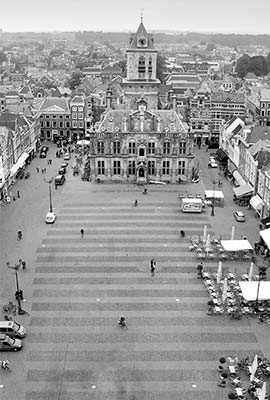
The statue dominating the square in front of the New Church honors Hugo Grotius. Born in Delft in 1583, Grotius was the first to establish international rules of the sea, putting forth the idea that all the oceans were free-trade territory, open to every nation. That didn’t go over so well with the rival English, who claimed dominion over all the sea around Britain. The controversy went on for nearly a century, during which the two nations fought a two-year war over it. (The eventual agreement—the sea within the range of a cannonball fired from your shore is yours; any waters beyond that are open to all nations—forms the basis for today’s maritime laws.)
Part of Delft’s economic heritage is in printing. At #57 (above the Subway sandwich shop), a Bible on the building’s upstairs corner recalls the first printed Dutch Bible, produced here in 1477.
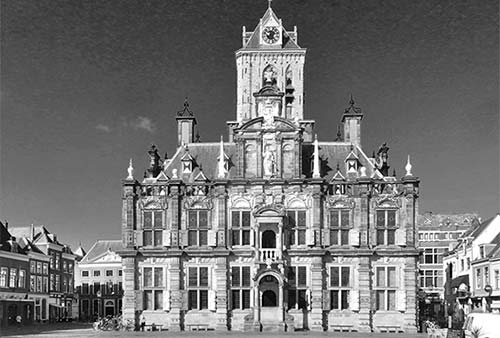
Opposite the New Church stands the Town Hall, rebuilt in 1620 in the Renaissance style after a fire. It’s a law court, with Lady Justice and her scales prominently positioned on the facade. Of the 17 states in the Spanish Netherlands, seven seceded and created the Dutch Republic—the United Provinces of the Netherlands. Holland was one of these; above Lady J, look for the coat of arms with the red lion. The independent Netherlands were dominated by Holland (which contained Amsterdam and drove 85 percent of the country’s economy). The lower banner (under the stone canopy, above the door) is Delft’s—it features a canal, which is what “Delft” means.
• Walk around behind the left side of the Town Hall. The building with the Greek-style pediment roof decorated with a set of scales, facing the back of the Town Hall, is known as...
The Waag
The city’s medieval trading center, the Waag, was the weighing or customs house, with workspaces for goldsmiths and silversmiths upstairs. Step inside (now a fun bar/restaurant) to see its huge timbers and part of the massive old scales. At the end of the street (far to the right of the Waag—marked de centrale) is the Vleeshal, or meat market—decorated with cow heads above its doors. Fish was traded in the Visbanken (left of the meat market).
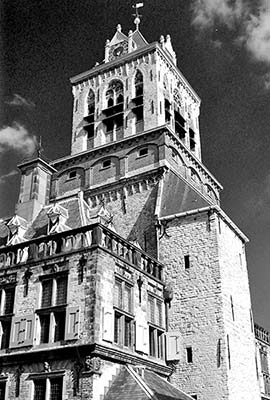
The sturdy tower around which the Town Hall is built was originally a prison. For security, the prison needed to be built of weighty stone—a potential problem in this naturally marshy place. The builders chose this spot, on a clay foundation, as the best place for the structure. It just made sense that the county seat—Delft—would be here, too.
• With your back to the Town Hall, walk down Waagsteeg lane, a narrow alley to the right of the Waag. Cross a small canal bridge and arrive at...
Boterbrug
Look back over the little bridge you just crossed (Waagbrug). At the back side of the Waag, down below, is the water gate where produce was off-loaded from boats to be weighed and taxed.
Watch out for bikes (good advice everywhere in Delft), and continue walking straight down Boterbrug (literally “Butter Bridge”), a wide street that once was the approach canal (now covered over) to the customs house. Merchants knew the drill for all their goods: Before you traded, first you weighed, then you paid. During Spanish rule, taxation got so out of hand that the Dutch revolted—much as high British taxes angered American colonists during the same period.
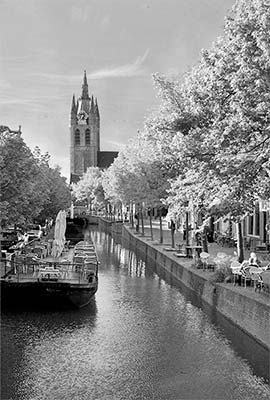
Boterbrug leads one block to the 11th-century Oude Delft canal, the town’s first and major trading canal. On the black iron fence on the corner, facing the canal, is a memorial plaque to Antonie van Leeuwenhoek (1632-1723), who invented an early microscope and then used it to discover bacteria. He’s buried in the Old Church, visible in the distance (to the right; look for the tilting spire).
• Turn right and walk toward the Old Church alongside the...
Oude Delft Canal
In the past, boats passing the town used this waterway. Barges are now allowed to line the canal from April through September. Historically, barges like these brought in the goods and produce that fueled Delft’s economy—but today they provide the city’s restaurants with sunny outdoor tables, fueling the new economy...tourism. For dining suggestions, see “Eating in Delft,” later.
• Walking toward the church, cross left over the first bridge (Nieuwstraat—though it may not be signed), turn right, and continue to the ornate facade at #167.
This building is the headquarters of the water authority (Geemeenlandshuis), responsible for keeping waterways dredged and managing water levels in towns and polders (lowlands). The colorful coats of arms of the various 17th-century water-authority directors decorate the exterior wall.
Water levels are a big deal here. Turn around and look at the yardstick across the canal; the red NAP marking—“normal Amsterdam point”—is the average sea level in Amsterdam. The wide-open Dutch countryside plots reclaimed from the sea, known as polders, are generally three yards below this point. According to the NAP, we’re above sea level and the canal is below, so we’re standing on what was an island.
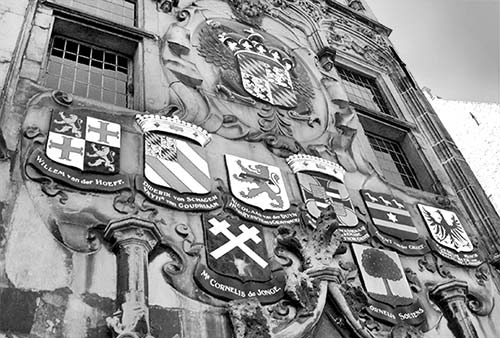
• Keep walking along this side of the canal. Across from the Old Church, under the trees, find the photo cube (rotate and learn) recalling the painter Vermeer, who’s buried in the church. Turn left from the photo cube and church, and walk under a brick arch into a tiny, covered brick lane (look for the Museum Prinsenhof Delft sign above the arch). You’ll pop out into a very long, wide courtyard called the...
Prinsenhof
This was once the convent of St. Agatha. William of Orange took refuge here after the king of Spain put a bounty on his head in 1580 for his role in the revolt of the Netherlands. Figuring the convent was a safe place in a safe city, William stayed here until 1584, when an assassin finally killed him (for more about William, see here). Today this building houses the Prinsenhof Museum (likely closed for renovation), with exhibits on William of Orange—including the chance to see the bullet holes from his assassin’s gun, still embedded in the wall—and other facets of Delft history (for details, see the “Prinsenhof Museum” listing later in this chapter).
• In the middle of the square, on the right, step into the tranquil green park, an old monastic herb garden (free, daily 11:00-17:00).
The statue here honors William, considered the founder of the Netherlands. When the provinces broke away from Spain, they also broke from the Roman Catholic Church. The Dutch became “reformed” and dissolved the Catholic convents and monasteries (like the complex of buildings surrounding you now). Although they had declared their freedom in 1579, a treaty ending the war for Dutch independence (which formally established their freedom) didn’t come until 1648.
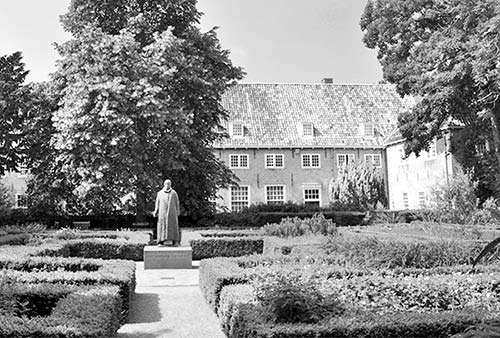
Back out in the main courtyard, notice the three blue-and-white lampposts; these were made in Delft’s Chinese sister city and serve as reminders of the 400-year relationship between porcelain makers in China and Delft. The only color that could survive the extremely hot fire of the Chinese porcelain technique was blue, and that’s the color of Delftware.
In the far-left corner, you’ll see the Winkeltje Kouwenhoven old-timey candy shop, where sweets are still made the traditional way.
• Leave the park opposite where you entered; this takes you to the noisy real world and...
Phoenixstraat
You’ve arrived at the edge of the Old Town. Far to the left is the glassy, modern train station; between here and there is the Huis van Delft, a futuristic housing development that’s also home to the TI. And to the right you’ll see a tower and windmill. Twenty such structures once stood on the 11th-century city wall. The windmills, which ground the city’s grain, date back to the 13th century. Tram line #1 heads (right) along Phoenixstraat (past the windmill) to The Hague and the beach at Scheveningen.
• Turn around and finish this walk by retracing your steps through the Prinsenhof to the Old Church (with the tilting spire).
Old Church (Oude Kerk)
The Old Church is smaller and less impressive (inside and out) than the New Church. For 150 years, its spire was the tallest in Delft; it leans because it’s built on an unstable foundation, over a filled-in canal. (For details on the interior, see the “Old Church” listing under “Sights in Delft.”)
At the end of the short canal bridge in front of the Old Church is a statue of Geertruyt van Oosten (1330-1358), a particularly devout nun whose deep faith is meant to inspire worshippers. Supposedly Geertruyt was so moved by the power of Christ that she began to lactate during the Christmas season, and the stigmata (Crucifixion wounds) appeared on her hands and feet during the Easter season.
While I’ve never been that moved by a mere town walk, taking a moment to enjoy the sheer beauty of Delft that surrounds you is mightily impressive in its own way.
Sights in Delft
IN THE OLD TOWN
Markt (Market Square)
The historic center of Delft, the rectangular Markt is bookended by the 14th-century New Church at one end (with a statue of legal scholar Hugo Grotius out front) and the 15th-century Town Hall at the other. The Markt is bordered by characteristic buildings—a mix of shops, cafés, and homes. For more on the Markt, see its description in the Delft Old Town Walk, earlier.
▲New Church (Nieuwe Kerk)
Delft has two grand churches that hold tombs of prominent local residents. The can’t-miss-it New Church rockets up from the Markt: It’s the needle around which Delft spins and has the most important tombs of Dutch royalty. The more modest Old Church (described later) sits along a canal a few blocks away. Both are covered by the same ticket; when you buy it, be sure to pick up the well-explained, illustrated brochure, which locates and describes points of interest in both churches.
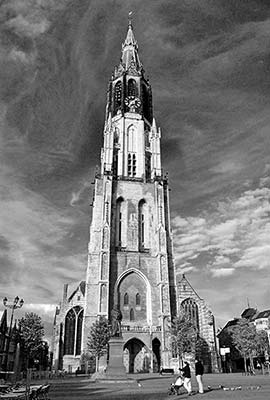
Cost and Hours: €8.50 for both churches, €13 covers both churches and New Church tower, €6 tower only; both churches open Mon-Sat 10:00-17:00, shorter hours Nov-Jan, closed to tourists Sun year-round, last tower entrance one hour before closing, tower can close in bad weather; +31 15 212 3025, www.oudeennieuwekerkdelft.nl.
Visiting the New Church: The giant, Gothic New Church boldly presides over the town from its prominent position overlooking the Markt. Inside are buried the beloved Dutch ruler William I of Orange and the Dutch royalty that succeeded him.
Construction on the New Church, with its Late Gothic lines, began in 1393 and took 100 years to complete. The stone tower you see today houses a carillon, which locals proudly consider the Stradivarius of carillons. Its chimes, played on request by the town bell ringer, are in demand by couples getting married at Town Hall.
The church has been through a lot. It was devastated by a fire in 1536 and ransacked by iconoclasts in the 1560s. The first “reformed” service was held here in 1572. After a nearby gunpowder depot exploded and ruined its windows in 1654, the church was rebuilt, giving it the look you see today. Until 1829, city leaders were buried under the floor stones. Because of the “stinking rich” problem of the stench of decaying bodies wafting into the church, only royals have been buried here since then. The chandeliers, produced in 1981 in traditional 17th-century style, marked the 600th birthday of the church.
Head inside and walk all the way down the nave to the altar area. The church has rolled out the orange carpet to lead you past displays and videos to the ornate, canopied tomb of William of Orange, which dominates the choir area at the far end of the church. William I was the founder of the House of Orange, the dynasty that still (in name) rules the Netherlands. It was William who rallied the Dutch to begin their revolt against the Spanish Habsburg rulers: That’s why he’s considered the father of the country. This monument to his greatness features two representations of William: one of white marble, reclining peacefully, and a strong, armored king in bronze, sitting royally. The sweet dog reclining at William’s feet symbolizes loyalty. Above the pooch, the angel of Fame blows a trumpet (notice that this whole bronze statue is supported by just one slender ankle). At the corners of his monument are female statues representing Liberty, Justice, Religion, and Fortitude. Unfortunately, all these fine virtues could not save William from being gunned down by an assassin’s bullet right here in Delft. The assassin had hoped to collect a reward offered by Spanish King Philip II for killing William of Orange (but instead the assassin was caught, tortured, and executed).
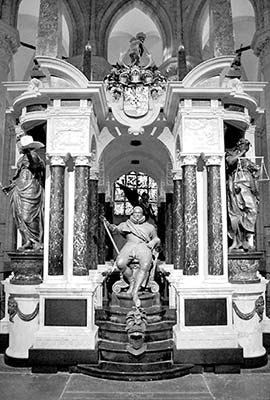
Most of William I’s descendants of the House of Orange are also buried in this church. A few paces in front of William (near the transept), a large stone slab marks the entrance to the sprawling underground labyrinth that holds crates of Oranges. (The crypt is strictly off-limits for anyone unrelated.) In the transept, look for TV monitors showing the last few royal burials here.
Besides ruling Holland, the Orange family once owned the independent principality of Orange in the south of France. The royal family’s official color is—what else?—orange, which is why today’s Dutch wear orange to soccer matches and consider it their national color (despite having a flag that’s red, white, and blue).
If you want to work off your pannenkoeken, you can climb the New Church’s tower (three levels and 376 steps in a very narrow staircase). This is a particularly dizzying tower climb, one of Europe’s more dramatic. On a clear day you can see the towers of The Hague and, in the other direction, Rotterdam.
• From the New Church, cross the square and walk a few blocks up pretty Hippolytusbuurt street (or follow my Delft Old Town Walk) to find the smaller Old Church.
▲Old Church (Oude Kerk)
The Old Church, with its leaning spire, is Dutch Reformed (English service Sun at 12:30). It has been around for a long time and feels more lived-in than the New Church.
Cost and Hours: Same as the New Church (see earlier).
Visiting the Church: The names of its ministers, going back to 1572, fill the wall on your right as you enter. Nearby, the wooden canopied pulpit—which dates from 1548—is considered one of the finest in the Netherlands, thanks to the fine carvings on its sides, which demonstrate a mastery of perspective.
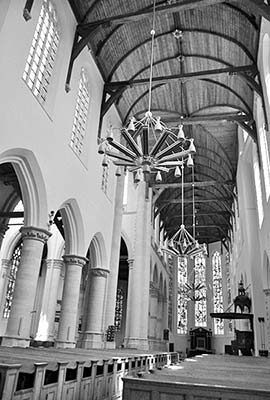
The church interior is sober and clean because of iconoclastic riots, in 1566 and 1572, that made a violent point of destroying all hints of Roman Catholicism and its imagery. Follow the contemporary box-shaped displays to learn about the church’s history and the town heroes buried underneath the stone floor. The Old Church holds the tombs of three local boys done good: an admiral, Piet Hein (in the center nave at the front), who during the Eighty Years’ War captured a Spanish silver fleet and became the subject of a popular children’s song; microscope inventor Antonie van Leeuwenhoek (the tall, pyramid-shaped monument set into a wall at the very back of the left nave); and the painter Johannes Vermeer. Vermeer’s actual tombstone is just a simple stone plaque in the floor (toward the front of the left nave). The grander Vermeer monument, installed in 2007 (also in the floor, in the left transept across from the pulpit), is a reflection of his greater popularity now than in previous generations.
▲Vermeer Center (Vermeercentrum)
Although it doesn’t have any Vermeer originals, this intelligent exhibit does a good job of tracing the career and unique creative mind of Delft’s favorite resident. Try to visit before you see the originals in The Hague.
Cost and Hours: €12, includes essential audioguide, daily 10:00-17:00, a block from the Markt—through the gap where Vermeer’s house used to be—at Voldersgracht 21, +31 15 213 8588, www.vermeerdelft.nl.
Visiting the Museum: Begin in the basement, where a short, good movie (shown alternately in English and Dutch) orients you to Vermeer and his ties to Delft. Then view copies of all 37 known Vermeer paintings, arranged chronologically and accompanied by interesting commentary and informative displays that add context. On the middle floor, a mock-up of Vermeer’s studio thoughtfully analyzes and explains some of the painter’s techniques, including his dazzling use of perspective and how he represented light. This floor also features an exhibit and a brief film about the restoration of Woman in Blue Reading a Letter. Finally, the top floor hosts an exhibit explaining the hidden symbols of love found in many of Vermeer’s paintings.
Prinsenhof Museum
This former convent where William of Orange sought refuge and was ultimately assassinated is now a museum focusing on the life of that great statesman. (At the base of the stairs, the two bullet holes from his assassination are visible in the wall.) It also displays a fine collection of blue Delftware and a spirited exhibit about Dutch innovation. The museum will likely be closed for renovation when you visit. When open, it may be interesting to historians but underwhelming to the layperson. Check the website for updates (Agathaplein 1, +31 15 260 2358, www.prinsenhof-delft.nl).
Across the courtyard, the Prinzenkwartier building houses temporary exhibits, art galleries, and a café.
DELFTWARE
The Markt is jammed with shops selling blue-and-white porcelain characteristic of Delft, much of it made not here but in China. To find true hand-painted Delftware, look for a bottle symbol (for Royal Delft) or a candle symbol (for De Candelaer; see both listings below). Royal Delft has a large shop on the Markt at #62, right next to the New Church (open daily 10:00-18:00). To delve deeper, consider visiting the centrally located De Candelaer Delft workshop (easiest), or head to the edge of town to tour the famous Royal Delft Museum.
De Candelaer Delft Workshop
The workshop of fourth-generation Delftware potter Steffan Delfos faces the left side of the New Church. You’re welcome to walk to the back of the store to view the workshop where Steffan makes the ceramic biscuit; nearby are tables where painters create designs. Once painted, the pieces go back to Steffan for firing in a kiln, the final step of the process. Up front, browse the pieces for sale and find the display case of photos of all four generations working in the craft—Steffan’s son may pick up the art one day (free, Mon-Sat 9:30-17:00, closed Sun except during April-May tulip season at Keukenhof, Kerkstraat 13A, +31 15 213 1848, www.candelaer.nl).
Royal Delft Museum
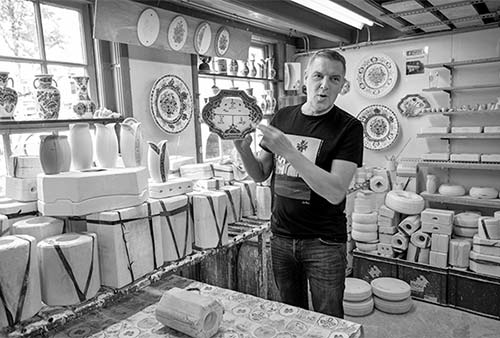
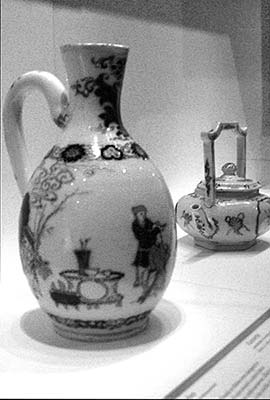
The Delft Blue earthenware made at this factory (known as the Koninklijke Porceleyne Fles in Dutch) is famous worldwide, making this the biggest tourist attraction in town. The Dutch East India Company, partly headquartered in Delft, imported many exotic goods from the Far East, including Chinese porcelain. The Chinese designs (including flowers and peacocks) were copied by many local potters. More than three centuries later, their descendants are still going strong, and you can see them at work in this factory—the only one left of an original 32. (To earn the “Royal” designation in the Netherlands, a company must be at least 100 years old—and this one began operating in 1653.) While some may think this is just an excuse to shop for Delftware, it’s a worthwhile stop for those who enjoy porcelain.
Delft Blue earthenware is made from a soupy mix of clay and water. (The clay is mainly imported from England and Germany; below-sea-level Holland only has “dirty clay,” used to make bricks.) To make plates, the glop is rotated on a spinning disk until it looks like a traditional Dutch pancake. This “pancake” is then placed in a plate mold, where a design is pressed into it.
To make vases, pitchers, cups, and figurines, the liquid clay is poured into hollow plaster molds. These porous molds work like sponges, sucking the water out of the clay to leave a layer of dry clay along the mold walls. Once the interior walls have reached the correct thickness, the excess clay within is poured off and recycled.
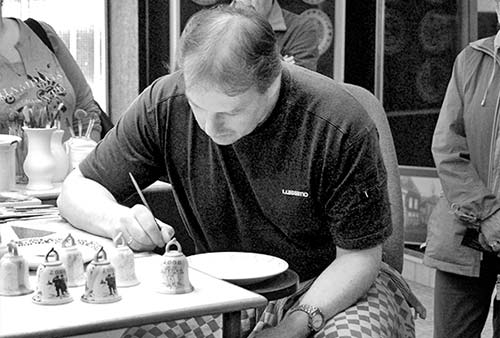
After the clay object is removed from the mold and allowed to dry completely, it’s fired in the kiln for several hours, turning from gray to white. The pottery removed from the kiln is called “biscuit.” Next, painters trace or freehand traditional decorations with sable-hair pencils onto the biscuit pottery; these are then painted with a black paint containing cobalt and copper oxide. The biscuit immediately soaks up the paint, making it a very unforgiving medium for mistakes.
Finally, the objects are dipped into an opaque white glaze and then fired a second time. A chemical reaction transforms the black paint into the famous Delft Blue, and the white glaze melts into a translucent, glass-like outer layer.
Cost and Hours: €15, includes audioguide; daily 9:30-17:00; a €€ café serves lunch; Rotterdamsweg 196, +31 15 251 2030, https://museum.royaldelft.com.
Getting There from the Old Town: The Delft City Shuttle (a golf cart) goes from the Markt and a few hotels to the museum several times a day, with demand; or, for a more scenic approach, you can take a Rondvaart Delft canal boat (for details on both, see “Tours in Delft,” earlier). You can also take a taxi (about €15).
To go on foot (20 minutes), exit the Markt by the building at #57 with the Bible up above and the Subway below (mentioned in the Delft Old Town Walk, earlier). Follow this street (Jacob Gerritstraat) as it widens and becomes Brabantse Turfmarkt, where the canal begins on the left. Continue along the canal, passing a few bridges and a side canal, until the path and the canal turn right. Here cross the little bridge to the left instead, go through the underpass, then cross the drawbridge over the big canal (you’ll see a sign for Royal Delft). Turn right after the bridge, then left on the next street (Rotterdamseweg—where you’ll see another Royal Delft sign), then walk several blocks through a pretty residential neighborhood. At the busy street (Jaffalaan), a big glass-and-concrete technical school will be on your left and the (much smaller) museum on your right.
Getting There from the Train Station: The Delft City Shuttle also stops at the train station (the TI can tell you when, or call it for you). On weekdays you can also take bus #40—though walking is as quick or quicker (see “Arrival in Delft,” earlier). To walk, take any exit from the station and find the red bike/pedestrian path along the canal. Walk with the canal on your left until you reach the swing bridge that opens to let boats through. Cross the bridge, continue along the sidewalk next to the bike path, and follow signs to Royal Delft: At the next busy intersection, where you see the big glass-and-concrete technical school, turn right to find the museum entrance.
Visiting the Museum: Displays and videos take you through the history of Royal Delft (with its ties to the rulers of Holland), as well as the production process. You’ll also see the company’s priceless collection. Along with tableware and vases, there are gorgeous pictures made from tiles (including a life-size replica of Rembrandt’s The Night Watch that took two artists a year to paint) and architectural elements such as walls, banisters, and garden gates. In the courtyard is the prize-winning mock cloister created for the Paris Exposition of 1900. Each column was made with a different design in order to show potential customers what they could order.
But the real highlight is the chance to see the process in action. You’ll walk through part of the factory, past work stations and racks upon racks of unfired and finished pieces. Take some time to watch artisans paint designs on the fired pottery “biscuit”—and feel free to stop and chat with them.
The tour ends in the gift shop. For bargain hunters, the factory store offers “seconds” with slight blemishes for 25 percent off. The clerks can also ship items or prepare VAT refund documents for you.
Sleeping in Delft
Delft has a limited array of accommodations, and most are in creaky old canalside buildings rather than modern, cookie-cutter ones. That means more character and lower prices. If I mention there’s no elevator, expect some steep stairs.
NEAR THE MARKT
These options are the most centrally located, within a short walk of the main square.
€€ Hotel de Koophandel has 25 painting-over-the-bed rooms right on the charming, lively, tree-and-restaurant-lined Beestenmarkt. Request either a view room on the square (with reasonably well-soundproofed windows), or a quieter room in the back (reception closed 23:00-7:00, no elevator, Beestenmarkt 30, +31 15 214 2302, www.hoteldekoophandel.nl, info@hoteldekoophandel.nl, helpful Irma).
€ Hotel de Plataan, enthusiastically run by a family, has an imaginative spirit and artistic flair. Its ground floor is a big, high-ceilinged, inviting bar and restaurant facing a lively, leafy square that’s filled with al fresco tables in good weather. About half of its 29 rooms are larger and dramatically themed, with outlandish decor—it’s worth paying the extra charge to stay in these exotic settings (family rooms; the square can get noisy, especially on weekends—request a quieter back room; air-con in some rooms, limited parking, Doelenplein 10, +31 15 212 6046, www.hoteldeplataan.nl, info@hoteldeplataan.nl).
€ Hotel Johannes Vermeer, somewhat impersonally run, owns a fine location in an old cigar factory facing a canal with a garden courtyard in the back. Some of the 30 nondescript rooms have canal views, and the public spaces are particularly inviting—from the stay-a-while lobby/bar/breakfast room, to the cozy inner courtyard, to the roof deck with views of neighboring church spires (family rooms, air-con, no elevator, Molslaan 20, +31 15 212 6466, www.hotelvermeer.nl, info@hotelvermeer.nl).
SOUTH OF THE MARKT, CLOSER TO THE TRAIN STATION
These choices are at the southern edge of the old center (or, in the case of the final listing, just outside it). While a bit farther from the heart of town—figure a 10- or 15-minute stroll to the Markt—they are much handier for train travelers.
€€€ Hotel Arsenaal is the town splurge: a bold business-class hotel filling a grand old brick building. Originally a 17th-century warehouse for the Dutch East India Company, the building later became a prison for the Dutch who collaborated with the Nazis, and finally an army museum. Now it houses 63 crisp, comfortable, modern rooms and a sprawling, atmospheric ground-floor lounge with gigantic beams. The hotel does an admirable job of mixing its history with modern touches and comfort (air-con, limited pay parking—reserve ahead, Korte Geer 1, +31 15 205 2090, www.hotelarsenaal.com, receptie@hotelarsenaal.nl).
€ Hotel Grand Canal has 18 tidy, efficient rooms, all facing a canal in a sleepy part of town. It feels a bit more modern and uncluttered compared to other Delft options (family rooms, no elevator, some rates include breakfast, Breestraat 1, +31 15 215 7133, www.grandcanal.nl, info@grandcanal.nl).
€ The Social Hub Delft, part of an innovative Europe-wide chain, houses students as well as travelers. Rooms on the upper floors come with grand views over Delft’s rooftops and steeples. Guests and residents alike share the big, sleek ground-floor lounge, plus a gym and laundry facilities. It’s a good choice for the young or young-at-heart (air-con, some rates include breakfast, Van Leeuwenhoekpark 1, +31 15 200 1323, www.thesocialhub.co/delft, delft@thesocialhub.co). The hotel sits just south of the train station, facing an Ibis Styles hotel (the other option for those seeking modern predictability in this ye olde town, www.ibisstylesdelftcity.nl).
Eating in Delft
As Delft is a university town, lively, affordable, and quality eateries abound. Most places have outdoor seating, sometimes on an inviting square (try Beestenmarkt) or on a little barge floating in the canal out front.
Delft’s giant Markt, under the looming tower of the New Church, is a scenic spot for a meal. Most of the places around here are interchangeable, but some good options with outdoor seating can be found behind the Town Hall, across the square from the church.
FINE DINING
€€€ Spijshuis de Dis is driven by the creative energy of chef Jan Boheemen, who cooks Dutch with attitude. With an open kitchen, inviting menu, friendly service, top-end beer (local craft or Belgian Westmalle), and great food (including lots of veggie options), the entire experience is a joy. Choose between a characteristic interior or out on a lively square shared with other restaurants. Reservations are smart (Tue-Sat dinner only, closed Sun-Mon, Beestenmarkt 36, +31 15 213 1782, www.spijshuisdedis.com).
€€€ ’T Postkantoor Restaurant fills the big old post office with a rollicking energy. It has a fun and convivial vibe both in its spacious wood-and-brick living room—decked out with sofas and old carpets—and a big back courtyard, plus a few sidewalk tables. They have an eclectic international menu and local beer on tap. Consider the enticing prix-fixe dinner—which also comes in a vegetarian version (long hours daily, Hippolytusbuurt 14, +31 15 750 3243).
MIDRANGE AND BUDGET CHOICES
€€ Stads-Koffyhuis is a local institution that’s won prizes for its sandwiches (see the trophies above the counter); they also serve panini and Dutch pancakes with various sweet and savory toppings. This is a great spot for an affordable bite, either in the country-cozy interior or out on a canal barge (Mon-Sat 9:00-17:00, Sun 11:00-16:00, may stay open later in busy times, just down the canal from the Old Church at Oude Delft 133, +31 15 212 4625).
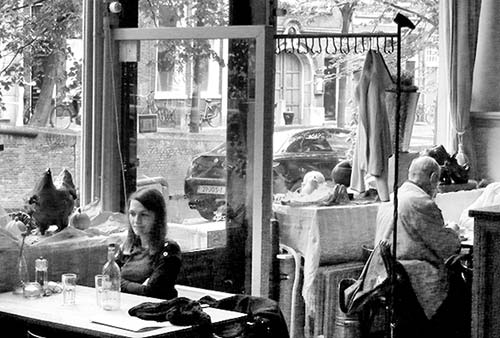
€€ De Delf, run by the same owners as Stads-Koffyhuis, serves a variety of delicious burgers (including portobello), salads, and meat and vegan dishes on wooden platters that are ideal for sharing. The atmosphere inside is very convivial, but in summer you can also dine out on the canal barge in front (open Wed-Sun for dinner, Sat lunch and dinner, closed Mon-Tue, Oude Delft 113, +31 15 212 4563).
€€ De V is a lively pub with a dark, cozy ambience and a local following loyal to its straightforward and well-priced food—from ribs and burgers to French and Asian. Sit in the crowded area near the bar, elbow your way up top to the glassed-in patio, or enjoy one of the few tables on a barge on the canal (daily 16:00 until late, just past the Old Church along the canal at Voorstraat 9, +31 15 214 0916).
€€ Bar/Baar is a fresh, airy bar and café with tables through the courtyard outside the Prinsenhof Museum (in the same building as the Prinzenkwartier gallery). They serve soups, sandwiches, and salads for lunch and drinks and snacks in the evening; in busy times, they may also do dinners (Tue-Sun generally 11:00-19:00, closed Mon, may also close Tue-Wed off-season, Agathaplein 4, +31 6 3391 8668).
€ Van der Eyk Visbanken, overlooking a canal a few steps from the bottom of the Markt (look for the long awning), is the handiest place in town to sample the Dutch delicacy of herring. The long display case shows off a variety of options: deep-fried, raw, smoked, or in a sandwich. This place is fun for its scenic setting and for the chance to see all your options spread out before you. Pick what you like, then choke it down at one of the stand-up counters (Tue-Sat 9:00-18:00, closed Sun-Mon, Cameretten 2, +31 15 361 2014).
€€ De Parel van Flores Indonesian Restaurant is a humble, homey, and family-run little place serving pure Indonesian fare. They have rijsttafel in different sizes and prices so you can order according to hunger levels. The decor is super-basic wood paneling...come here for the food, not the ambience (Tue-Sat dinner only, closed Sun-Mon, just off main square at Voldersgracht 31, +31 15 213 0946).
Delft Connections
BY PUBLIC TRANSPORTATION
From Delft to Rotterdam: Trains run every 15 minutes for the 15-minute journey to Rotterdam Centraal station.
From Delft to The Hague: It’s easy and cheap to travel to The Hague by train or tram. While the train may seem faster, the tram is more convenient.
Tram #1 leaves from in front of the Delft train station—or, closer to the town center, in front of the Prinsenhof courtyard—and clatters through residential neighborhoods to The Hague (stopping at the center, the Peace Palace, and the beach). This connection is frequent, comes with nice urban scenery, and delivers you right into the center of The Hague’s tourist zone (cheapest to simply tap your credit card when you get on and off; or pay €4.50 for a 2-hour ticket with unlimited transfers on trams and buses or get a day pass for €8, buy either ticket from machine on board or online; or consider the €15.50 Zuid-Holland Tourist Day Ticket, covering all of south Holland, https://touristdaytickets.com).
Trams run about 6/hour (direction: Scheveningen Noorderstrand; get off after about 30 minutes at The Hague’s Centrum stop for the major sights, including the Mauritshuis). You can continue on this tram directly to the Peace Palace (Vredespaleis stop, about 5 minutes beyond Centrum stop) or go all the way to the beach at Scheveningen (Kurhaus stop, about 15 minutes beyond Centrum stop). Note that this tram does not stop at The Hague’s Centraal station—for that, take the train (see next).
Regular trains depart from Delft’s station for The Hague (6/hour, 15 minutes, IC and “Sprinter” both work). Get off at The Hague’s Centraal station (CS), not the Hollands Spoor station (HS). Note that The Hague’s Centraal station is a 15-minute walk or a 5-minute tram ride to reach the tourist zone (for details, see “Arrival in The Hague” on here).
For more information on trams and buses, use the Netherlands’ slick public-transit site, 9292.nl.
From Delft by Train to: Amsterdam’s Centraal station (2/hour, 1 hour, more with transfer), Haarlem (2/hour, 40 minutes), Leiden (4/hour, 20 minutes), Utrecht (4/hour, 1 hour, change in Rotterdam), Arnhem (4/hour, 2 hours, transfer in The Hague or Rotterdam, then Utrecht), Antwerp (2/hour, 1.5 hours, change in Rotterdam), Brussels (2/hour, 2.5 hours, change in Rotterdam), Ghent (hourly, 3 hours, change in Rotterdam and Antwerp), Bruges (hourly, 3 hours, change in Rotterdam, Antwerp, and Ghent).