ENTERTAINMENT IN AMSTERDAM
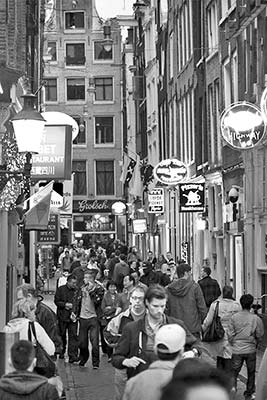
Many Amsterdam hotels serve breakfast until 11:00 because so many people—visitors and locals—live for nighttime in this city.
On summer evenings, people flock to the main squares for drinks at outdoor tables. Leidseplein is the liveliest square, surrounded by theaters, restaurants, and nightclubs. The slightly quieter Rembrandtplein (with adjoining Thorbeckeplein and nearby Reguliersdwarsstraat) is the center of gay clubs and nightlife. Spui features a full city block of bars. And Nieuwmarkt, on the east edge of the Red Light District, is a bit rough but probably the least touristy.
The Red Light District (particularly Oudezijds Achterburgwal) is less sleazy in the early evening, and almost carnival-like as the neon lights come on and the streets fill with tourists. But it starts to feel scuzzy after about 22:30 ( see the Red Light District Walk chapter).
The brown cafés recommended on here are ideal after-hours hangouts. Peruse those listings for pre- or post-dinner drink ideas. For a fancier cocktail scene with a view, the LuminAir sits atop the DoubleTree by Hilton Hotel, a five-minute walk east of Centraal station. Its 11th-floor perch, open roof terrace, and chic interior offer a distinctly different vibe (daily until late, Oosterdoksstraat 4, +31 20 530 0875, www.luminairamsterdam.com).
INFORMATION
The TI’s website, Iamsterdam.com, has good English listings for upcoming events (select “What’s on”). Newsstands sell the I Amsterdam City Guide and Dutch newspapers (Thu editions generally list events). The monthly culture magazine Uitkrant is printed in Dutch, but it’s not hard to figure out dates, times, and locations of events on its calendar (available at the TI, bars, and bookstores).
MUSIC
You’ll find classical music at the Concertgebouw (free 12:30 lunch concerts on Wed except in July and Aug, mandatory tickets available a week in advance on website; at far south end of Museumplein, +31 900 671 8345, www.concertgebouw.nl). For chamber music and contemporary works, visit the Muziekgebouw aan ’t IJ, a mod concert hall on the waterfront, near the train station (Piet Heinkade 1, +31 20 788 2000, www.muziekgebouw.nl). For opera and dance, try the opera house in the Stopera building (Amstel 3, +31 20 625 5455, www.operaballet.nl). In the summer, Vondelpark hosts open-air concerts.
Three of Amsterdam’s historic churches have extensive music programs. The Westerkerk has free lunchtime organ recitals most Wednesdays at 13:00 (no recitals in Jan; check website to confirm schedule), plus an annual Bach organ-concert cycle in August (Prinsengracht 281, +31 20 624 7766, www.westerkerk.nl). The New Church offers organ concerts on some Tuesday evenings (€12.50, check website to confirm schedule, Dam Square, +31 20 626 8168, www.nieuwekerk.nl). The Red Light District’s Old Church (Oude Kerk) hosts occasional concerts, listed on their website (Oudekerksplein 23, +31 20 625 8284, https://oudekerk.nl).
Jazz has a long tradition at the Bimhuis nightclub, now housed in a black box jutting out from the Muziekgebouw performance hall, right on the waterfront. Its great bar has citywide views and is open to the public after concerts (Piet Heinkade 3, +31 20 788 2150, www.bimhuis.com).
The nearby town of Haarlem offers pipe-organ concerts on Tuesday evenings in summer at its 15th-century church, the Grote Kerk (€4, at 20:00 mid-May-mid-Oct, additional concerts Thu at 16:00 July-Aug, www.bavo.nl).
COUNTERCULTURE HISTORY
If you’re a child of the 1970s, you may have a warm spot for Melkweg and Paradiso—the granddaddies of Amsterdam clubs. Today, the beat goes on at these two rock-music (and hip-hop) clubs, just off Leidseplein.
Paradiso was once the church of a former prison complex that was taken over by squatters (artists and musicians) in the 1960s. The city allowed it because of the creative work the squatters contributed to local culture. But, not surprisingly, the scene attracted drug users. The first pot-selling coffeeshops were here at Paradiso, which was also the venue for rising (and falling) counterculture stars. Today they still present big-name acts you might recognize...if you’re younger than me (Weteringschans 6, +31 20 626 4521, www.paradiso.nl).
Melkweg has a similar history going back to the 1960s and offers a comparable lineup to Paradiso’s (Lijnbaansgracht 234a, +31 20 531 8181, www.melkweg.nl).
COMEDY
Boom Chicago, an R-rated comedy improv act, was started more than 25 years ago by a group of Americans on a graduation tour. They have been entertaining tourists and locals ever since, and some of their alumni (Seth Meyers, Jason Sudeikis, Jordan Peele) have gone on to great fame among stateside comedy fans. The two-hour English-only show is a series of rude, clever, and high-energy sketches mixed with improv games, all offering a raucous look at both Dutch culture and local tourism. The big, boxy, 300-seat Rozentheater has small tables for drinks. If you need a break from museums and canal boat tours, this might be the ticket (€23-28, evening shows Wed-Sun—check schedule and buy tickets on their website, no shows Mon-Tue; ticket office open Wed-Fri from 18:00, Sat-Sun from 12:00; in the Jordaan a couple of long blocks past Westerkerk at Rozengracht 117, +31 20 217 0400, www.boomchicago.nl).
THEATER
Amsterdam is one of the world centers for experimental live theater (much of it in English). Many theaters cluster around the street called the Nes, which stretches south from Dam Square, paralleling the wide street named Rokin. Along here you’ll find theaters big and small, as well as cafés and eateries catering to the pre- and post-theater crowd. Most of the shows are oriented to Dutch audiences, but some are in English (or work in any language). You can browse the offerings on the theaters’ websites: Vlaams Cultuurhuis de Brakke Grond (at #45, creative and artistic performances from cutting-edge Flanders/Belgium, www.brakkegrond.nl), Frascati (at #63, off-Broadway-style experimental theater by mostly Dutch artists, www.frascatitheater.nl), and Tobacco Theater (at #75, concerts and shows in an industrial space, www.tobacco.nl).
MOVIES
In the Netherlands, most movies are subtitled, so English-only speakers have plenty of cinematic options. It’s not unusual for movies at many cinemas to be sold out—consider buying tickets during the day. Catch modern movies in the 1920s setting of the classic Tuschinski Theater (between Muntplein and Rembrandtplein, described on here). Seats are pricey, but the experience is more than a movie.
The splashy EYE Filmmuseum Netherlands, across the water from Centraal station, is another memorable place to see a movie (described on here).
MUSEUMS
Several museums stay open late. The Anne Frank House is open until 22:00 (requires timed-entry ticket purchased in advance).
The Hash, Marijuana, and Hemp Museum is open daily until 22:00. And the Erotic Museum and Red Light Secrets Museum of Prostitution stay open until at least 22:00.
IN-LINE SKATING AFTER DARK
Amsterdammers get their skating fix every Friday night in Vondelpark. Huge groups don in-line skates and meet at the round bench near the Vondel Pavilion (around 20:30, www.fridaynightskate.com). Anyone can join in. Ask your hotelier about the nearest place to rent skates, or try SkateDokter, though it’s 1.5 miles north of the park (€10/day, valid ID for deposit; Mon-Fri 10:00-17:30, Sat until 17:00, closed Sun; Jan van Galenstraat 133, +31 20 260 0055, www.skatedokter.nl).