SMOKING
The Dutch Approach to Marijuana
Marijuana Laws and “Coffeeshops”
The Dutch have a long (and complicated) relationship with smoking, whether marijuana or tobacco. This chapter considers Dutch tobacco habits, explains current Dutch laws regarding marijuana, and offers advice both on how marijuana-selling “coffeeshops” work and which ones in Amsterdam may be worth a visit.
TOBACCO
More than a quarter of Dutch people smoke tobacco. Holland has a long tradition as a smoking culture, being among the first to import the tobacco plant from the New World. (For a history of smoking, visit the fascinating Amsterdam Pipe Museum, described on here.)
Tobacco shops, such as the House of Hajenius (described on here), glorify the habit, yet the Dutch people are among the healthiest in the world. Tanned, trim, firm, sixty-something Dutch people sip their beer, take a drag, and ask me why Americans murder themselves with Big Macs.
Still, the Dutch version of the Surgeon General is speaking out loud and clear about the health risks of smoking. Warning stickers bigger than America’s are required on cigarette packs, and some of them are almost comically blunt—for example, “Smoking will make you impotent...and then you die.”
Since 2008, a Dutch law has outlawed smoking tobacco almost everywhere indoors: trains, hotel rooms, restaurants, bars...and even marijuana-dealing coffeeshops.
MARIJUANA (A.K.A. CANNABIS)
Decades after its use was decriminalized in the Netherlands, marijuana causes about as much excitement here as a bottle of beer. The Dutch experiment in legalizing pot—while cracking down on hard drugs—has inspired many other places to follow suit with their own policies: Marijuana is now legal or decriminalized in several US states and cities; in Canada; and (since summer 2024) in neighboring Germany, as well as several other European countries—including Belgium, Spain, and Italy.
And yet, old associations die hard; perhaps because Amsterdam was for so long the poster child of tolerated marijuana, it still has a certain cachet among pot-smoking travelers....even those who can now light up legally back home. And for tourists from lands where lighting up is still illegal, the open use of marijuana here can feel somewhat disturbing, exhilaratingly liberating...or maybe just normal.
The Dutch Approach to Marijuana
To some visitors, the Netherlands can seem frighteningly comfortable with—even nonchalant about—drug use. But the Dutch are well aware of the problems associated with drugs, especially the more addictive hard drugs. (The Dutch word for addiction is “enslavement.”) Any drug-related behavior that may affect others is taken seriously. Drive under the influence of anything and you’re toast. Because of their wide-reaching social costs, heroin and cocaine are strictly illegal in the Netherlands, and the police stringently enforce laws prohibiting their sale and use.
The Dutch are not even necessarily pro-marijuana; most people here simply believe that outlawing marijuana creates more problems than it solves—and statistics indicate they may be right. No one here would say that smoking pot was healthy. It’s a drug. It can be dangerous, and it can be abused. But the Dutch have chosen to allow marijuana’s responsible adult use as a civil liberty, and treat its abuse as a health-care and education challenge rather than a crime.
Most Dutch believe that America’s long-standing “War on Drugs” is based on fear, misinformation, and electoral politics. After several decades of not arresting pot smokers, the Dutch can point to studies showing that they smoke less than the European average—and fewer than half as many Dutch smoke pot, per capita, as Americans do. (My Dutch friends also enjoy pointing out that, while three recent US presidents admitted or implied that they had smoked marijuana, no Dutch prime minister ever has.) The Dutch have found that strict regulation of the soft-drug trade has helped minimize many of the problems associated with it, such as street crime, gang warfare, and hard-drug use.
So what am I? Pro-marijuana? Let’s put it this way: I agree with the Dutch people, who remind me that a society must either allow some room for drug use on the less harmful end of the spectrum...or build more prisons. About 575,000 Americans are arrested every year for simple possession of marijuana. While a wide variety of Americans smoke pot, the people prosecuted for possessing it are disproportionately poor and/or Black or Latino.
Dutch pot smokers complain that the generation that ran naked on acid around Amsterdam’s Vondelpark during the ’60s is now threatening the Netherlands’ well-established, regulated marijuana trade. Responding to international pressure and conservatives in rural and small-town Holland, the federal government has cracked down on coffeeshops. While they’re still allowed to sell marijuana, many aspects of these businesses’ operations exist in a legal limbo, with certain restrictions usually going unenforced—until now.
Some neighboring countries (such as France) complain that it’s too easy for citizens to make drug runs across the border. In response, some Dutch border towns implemented a “weed pass” system, allowing pot sales only to ID-toting Dutch citizens. But the independent-minded Dutch (especially young people) don’t want to be registered as pot users, so in those towns they’re buying it on the street—rekindling the black market and, many fear, the crime and social problems associated with it.
In general, Amsterdam city leaders recognize that legalized marijuana and the Red Light District’s prostitution have become part of the city’s brand. But as Amsterdam grapples with overtourism—and seeks ways to cap the number of visitors—it’s easy to target pot and prostitution pilgrims, who tend to spend less money and cause more problems than some other tourists. That’s partly why you may increasingly hear about crackdowns on both the sex trade and the drug trade in Amsterdam.
Many Amsterdammers want to keep both but get rid of the accompanying sleaze. Amsterdam values the pragmatic wisdom of its progressive policies and is bucking the federal shift to the right. Locals don’t want shady people pushing drugs in dark alleys; they’d rather see marijuana sold in regulated shops. (That’s also why the city is looking into options for relocating the sex trade to a purpose-built facility on the outskirts of the city—keeping prostitution legal and available for locals but making it less accessible to tourists.)
The future is uncertain. Coffeeshop licenses are not being renewed in some neighborhoods—the number of coffeeshops in Amsterdam has fallen from a peak of more than 700 (in the mid-1990s) to about 160 today. And, as more and more international visitors are able to light up legally at home, visiting a coffeeshop isn’t the draw it used to be. In the face of new restrictions and a dwindling clientele, coffeeshops are on their best behavior and are being very careful to nurture good relations with their neighbors.
If you’d like to learn more about marijuana (and don’t feel like Googling “Rick Steves marijuana”), drop by the Hash, Marijuana, and Hemp Museum (located on Oudezijds Achterburgwal street—see here). Amsterdam’s Cannabis College is another good resource for learning more (www.cannabiscollege.com). Back home, if you’d like to support an outfit dedicated to taking the crime out of pot, read up on the National Organization for the Reform of Marijuana Laws (www.norml.org).
Marijuana Laws and “Coffeeshops”
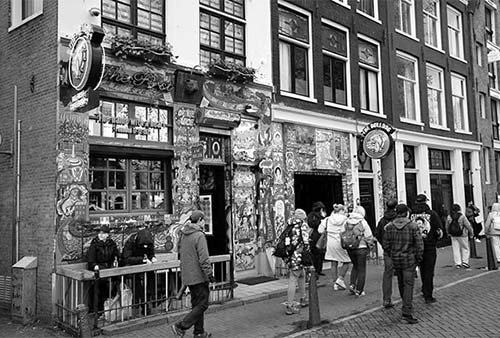
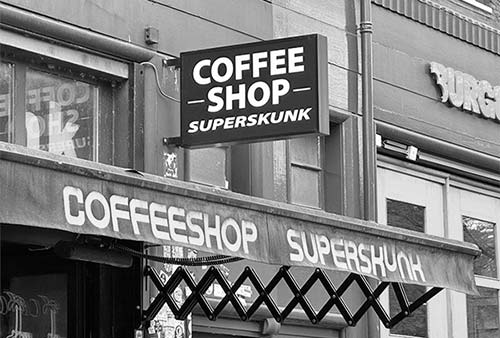
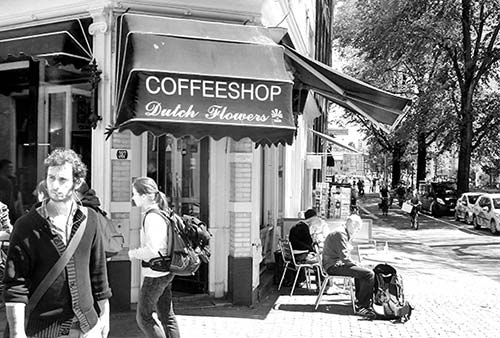
Throughout the Netherlands, you’ll see “coffeeshops”—cafés selling marijuana, with display cases showing various joints or baggies for sale.
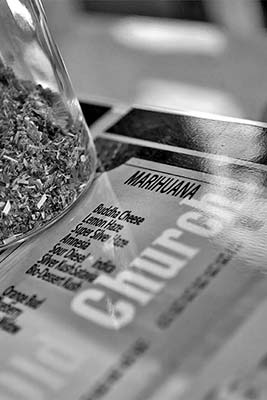
Rules and Regulations: The retail sale of marijuana is not officially legal (or even decriminalized) but “tolerated.” The marketplace is strictly regulated, and proceeds are taxed. The minimum age for purchase is 18, and coffeeshops can sell up to five grams of marijuana per person per day. It’s illegal for these shops (or anyone) to advertise marijuana. In fact, in many places, the prospective customer must take the initiative and ask to see the menu of products for sale.
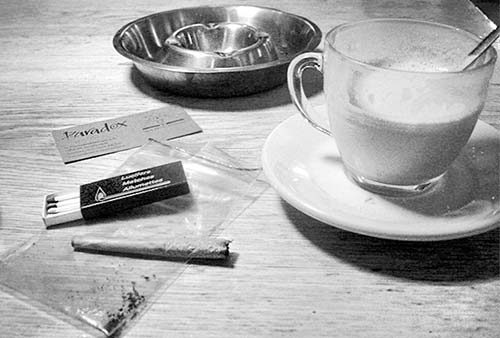
Shops sell marijuana and hashish both in pre-rolled joints and in little baggies. Joints are generally sold individually (€4-5, depending on whether it’s hash with tobacco, marijuana with tobacco, or pure marijuana), though some places sell only small packs of three or four joints. Baggies generally contain a gram and go for €8-15. The better pot, though costlier, can be a better value, as it takes a smaller quantity to get high—and it’s a better high. But if you want to take it easy, as a general rule, cheaper is milder.
Each coffeeshop is allowed to keep an inventory of about a pound of pot in stock: The tax authorities don’t want to see more than this on the books at the end of each accounting cycle, and a shop can lose its license if its inventory exceeds this amount. A popular shop—whose supply must be replenished five or six times a day—simply must put up with the hassle of constantly taking small deliveries. A shop can sell a ton of pot with no legal problems, as long as it maintains that tiny stock and just refills it as needed. The reason? Authorities want shops to stay small and not become export bases (to neighboring countries with stricter laws).
Smoking Tips: Shops have loaner bongs and inhalers, and dispense rolling papers like toothpicks. While it’s good style to ask first, if you’re a paying customer (e.g., you buy a cup of coffee), you can generally pop into any coffeeshop and light up a joint, even if you didn’t buy your pot there.
Tourists who haven’t smoked pot since their college days are famous for overindulging in Amsterdam. Coffeeshop baristas nickname tourists about to pass out “Whitey”—the color their faces turn just before they hit the floor. They warn Americans (who aren’t used to the strength of the local stuff) to try a lighter leaf. If you do overdo it, the key is to eat or drink something sweet to avoid getting sick. Cola is a good fast fix, and coffeeshop staff keep sugar tablets handy. They also recommend trying to walk it off.
Don’t ever buy pot on the street in Amsterdam. Well-established coffeeshops are considered much safer, and coffeeshop owners have an interest in keeping their trade safe and healthy. They’re also generally very patient in explaining the varieties available.
Types of Cannabis: The Dutch sell several forms of cannabis: They smoke both hashish (an extract of the cannabis plant) and the leaf of the plant (which they call “marihuana” or “grass”). While each shop has different brands, it’s all derived from two types of marijuana plant: Cannabis indica and Cannabis sativa. Indica gets you a stoned, heavy, mellow, “couch-weed” high—more often used for medical purposes. Sativa is light, fun, uplifting, and more psychedelic. Sativa makes you giggle.
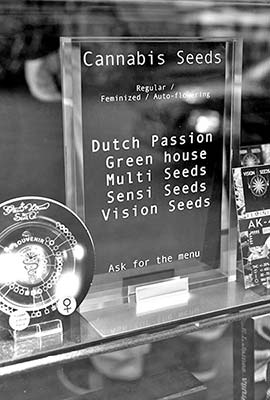
While the hash is mostly imported from Morocco, most of the marijuana sold in Dutch coffeeshops is grown locally, as coffeeshops find it’s safer to deal with Dutch-grown plants than to import marijuana (the EU prohibits any international drug trade). Technological advances have made it easier to cultivate exotic strains. You may see joints described as if they’d come from overseas—e.g., “Thai”—and indeed the strain in that joint may have originated elsewhere, but it’s still Dutch-grown. “Netherlands weed” is refined, like wine. Most shops get their inventory from the pot equivalent of local home- or microbrewers. Shops with better “boutique suppliers” develop a reputation for having better-quality weed. (These are the places that proudly display a decal announcing them as winners at Amsterdam’s annual Cannabis Cup Awards.)
Tobacco and Marijuana: While most American pot smokers like their joints made purely of marijuana, the Dutch (like most Europeans) are accustomed to mixing tobacco with marijuana. Pre-rolled marijuana joints are sold either pure, with tobacco, or with a nontobacco “hamburger helper” herb mix. Any place that caters to Americans will have joints without tobacco, but you have to ask specifically for a “pure” joint.
Back in the 1970s, most “pot smokers” here smoked hash, which needs to be mixed with something else (like tobacco) to light up. Today, more Dutch prefer “herbal cannabis”—the marijuana bud common in the US—but they still keep the familiar tobacco in their joints. Tobacco-mixed joints also go back to hippie days, when pot was expensive and it was simply wasteful to pass around a pure marijuana joint. Mixing in tobacco allowed poor hippies to be generous without going broke. And since the Dutch don’t dry and cure their marijuana, it’s simply hard to smoke without tobacco.
The Netherlands’ indoor-smoking ban pertains to tobacco smoke, not pot smoke. It might seem strange to an American, but these days, if a coffeeshop is busted, it can be for tobacco. Coffeeshops with a few outdoor seats have a huge advantage, as their customers can light up outside. Shops without the outdoor option are in for an extra challenge, as many local smokers would rather get their weed to go than smoke it without tobacco at their neighborhood coffeeshop.
COFFEESHOPS IN AMSTERDAM
Most of downtown Amsterdam’s coffeeshops feel grungy and foreboding to American travelers who aren’t part of the youth-hostel crowd. The neighborhood places (and those in small towns around the countryside) feel more inviting. I’ve listed a few places with a more pub-like ambience for Americans wanting to go local, but within reason. Most purchases are in cash.
West Amsterdam
For locations, see the map on here.
Paradox is the most gezellig (cozy) coffeeshop I’ve found—a mellow, graceful place. Wiljan and Sieb are patient with descriptions and happy to walk you through all your options. The music is easy and the neighborhood is charming (daily 11:00-20:00, loaner bongs, games, two blocks from Anne Frank House at Eerste Bloemdwarsstraat 2, +31 20 623 5639).
La Tertulia is a sweet little mother-and-daughter-run coffeeshop with pastel decor and a cheery terrarium atmosphere. You can sit at outdoor tables, and they also serve light food and fresh juices (Tue-Sat 11:00-19:00, closed Sun-Mon, sandwiches, brownies, games, Prinsengracht 312).
Central Amsterdam
For locations, see the map on here.
Siberië Coffeeshop is a short walk from Centraal station but feels cozy, with a friendly canalside ambience. Clean, big, and bright, it has the vibe of a mellow Starbucks, hosts the occasional astrology reading, and is proud that all its pot is “lab tested” (daily until late, helpful staff, Brouwersgracht 11, +31 20 623 5909).
The Original Dampkring is a rough-and-ready constant party where whoever picks the tunes believes music from the 1960s and ’70s is still hip. It’s a high-profile, busy place, filled with a young clientele, but the owners still take the time to explain what they offer. Scenes from the movie Ocean’s Twelve were filmed here (daily until late, close to Spui at Handboogstraat 29, +31 20 638 0705).
Strain Hunters Coffeeshop, conveniently located near Spui Square on Singel canal, has an inviting and friendly vibe with a couple of tables overlooking the canal that are perfect for enjoying the late-afternoon sunshine. Their walls are entertaining: decorated with photos of the celebrities who’ve smoked here, videos about how they scour the world for natural strains to import and grow in the Netherlands, and their many Cannabis Cup trophies (daily until late, on the corner of Heisteeg and Singel at Singel 387, +31 20 624 7624).
Throughout Amsterdam
The Bulldog Café is Amsterdam’s high-profile, leading touristy chain of coffeeshops. These establishments are young but welcoming, with reliable selections. They’re pretty comfortable for green tourists wanting to just hang out for a while. The flagship branch, in a former police station right on Leidseplein, is very handy, offering alcohol upstairs, pot downstairs, and fun outdoor seating on a heated patio. It’s the rare place where you can have a beer while you smoke and watch the world skateboard by (daily until late, Leidseplein 17—see map on here, +31 20 625 6278). Their original café still sits on the canal near the Old Church in the Red Light District (and is a stop on my self-guided walk through that neighborhood—see here).