VAN GOGH MUSEUM TOUR
PARIS, MARCH 1886-FEBRUARY 1888
AUVERS-SUR-OISE, MAY-JULY 1890
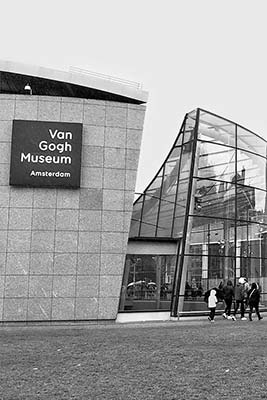
The Van Gogh Museum (we say “van GO,” the Dutch say “van hock”) is a cultural high even for those not into art. Located near the Rijksmuseum, the museum houses the 200 paintings owned by Vincent’s younger brother, Theo. It’s a user-friendly stroll through the work and life of one enigmatic man. If you like brightly colored landscapes in the Post-Impressionist style, you’ll like this museum. If you enjoy finding deeper meaning in works of art, you’ll really love it. The mix of Van Gogh’s creative genius, his tumultuous life, and the traveler’s perspective makes this museum as much a walk with Vincent as with his art.
Orientation
Cost: €22 timed-entry ticket, free for kids under 18.
Hours: Daily 9:00-18:00, some Fri until 21:00, shorter hours mid-Oct-Feb.
Information: +31 20 570 5200, www.vangoghmuseum.com.
Advance Tickets Required: To assure you’ll get in (and avoid a wait), buy timed-entry tickets in advance at www.vangoghmuseum.com. For busy periods, it’s smart to book a few weeks in advance, as the museum can sell out. If your preferred dates aren’t available, try checking back—cancellations are released on a continual basis. (On weekdays around 17:00, blocks of unsold tickets are released for the next day—a good time to check, if you’re in a pinch.) Even with a Museumkaart, you must reserve a time slot in advance. Same-day tickets are usually unavailable.
When to Go: To avoid crowds, aim for the earliest entry time slot you can secure. Midmornings are the most crowded.
Getting There: It’s the big, modern, gray-and-beige place on Museumplein a few blocks behind the Rijksmuseum; visitors enter via a glass pavilion, then cross underground to the collection. From Centraal station, catch tram #2 or #12 to the Museumplein stop.
Getting In: Pass through security into the glass pavilion, and take the escalator down to the entrance hall. Here you’ll find an info desk, bag check, audioguide rental, QR codes to access a floor plan, and WCs. Across the atrium from the main escalator is a gallery with excellent temporary exhibits (included in your ticket). This is also where you’ll find the first of several gift shops. A bookstore with several good, basic Van Gogh guidebooks is on level 3, near where you finish your visit.
To reach the main collection, follow Permanent Exhibit signs and go up another escalator.
Tours: The 45-minute audioguide (€3.75) provides insightful commentary on Van Gogh’s paintings and his technique, along with related quotes from Vincent himself. There’s also a kids’ audioguide (€2 for kids 13-17, free for kids 12 and under). If there’s a line to rent audioguides in the entrance hall, an additional rental desk is on level 0, in the shop across from where the exhibit begins.
Length of This Tour: Allow one hour.
Baggage Check: Free and mandatory.
Cuisine Art: In the entrance hall is a coffee/pastry stand; for a meal, escalate up toward the permanent exhibit and look for the cafeteria-style €€ café on your right. For more recommendations in the Museumplein area, see the Eating in Amsterdam chapter.
OVERVIEW
The collection is laid out roughly chronologically, tracing the changes in Vincent van Gogh’s life and styles. You’ll start on level 0, where self-portraits introduce you to the artist. Level 1 has his early paintings, level 2 focuses on the man and his contemporaries, and level 3 has his final works. But be flexible: Curators move the paintings around to illustrate various themes.
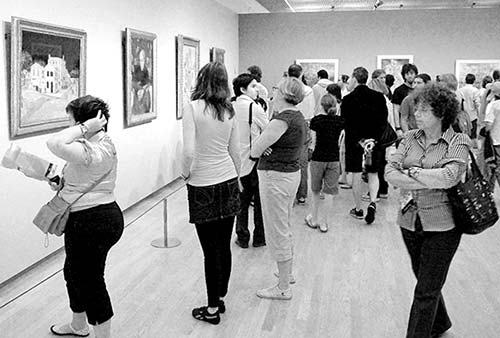
The paintings span five periods of Van Gogh’s life—spent in the Netherlands, Paris, Arles, St-Rémy, and Auvers-sur-Oise. Some background on Vincent’s star-crossed life makes the museum even better, so I’ve included doses of biographical material. (The unattributed quotations in this chapter are all Vincent’s own words.) I’ve highlighted specific paintings that give a snapshot of a particular period in the artist’s life. But, as you tour, don’t bother so much about finding exact paintings. Read Van Gogh’s story, and watch his style unfold.
Art Beyond Van Gogh: While this tour describes only paintings by Van Gogh, scattered throughout the museum are works by fellow painters—those who influenced Van Gogh and those who were influenced by him: Academy painters and their smooth-surfaced canvases, Impressionists Claude Monet and Camille Pissarro, and fellow Post-Impressionists Paul Gauguin, Paul Cézanne, and Henri de Toulouse-Lautrec.
The Tour Begins
• From the entrance hall, make your way up an escalator to the permanent collection, arriving on level 0.
Your tour starts in a section called Face to Face with Van Gogh, displaying a series of self-portraits. (Some of these are described later, under “Impressionism,” for better chronological flow; consider finding these and reading about them now.) The various depictions show him with his distinctive red beard, wearing his painter’s straw hat, standing at his easel, and smoking a pipe—always with intense-looking eyes. He was in his mid-30s, a working artist in his prime. But he hadn’t always been a painter. Peruse the timeline and historical photographs in this room to learn how Van Gogh got to this point.
VINCENT VAN GOGH, 1853-1890
I am a man of passions...
You could see Vincent van Gogh’s canvases as a series of suicide notes—or as the record of a life full of beauty...perhaps too full of beauty. He attacked life with a passion, experiencing highs and lows more intensely than the average person. The beauty of the world overwhelmed him; its ugliness struck him as only another dimension of beauty. He tried to absorb the full spectrum of experience, good and bad, and channel it onto a canvas. The frustration of this overwhelming task drove him to madness. If all this is a bit overstated—and I guess it is—it’s an attempt to show the emotional impact that Van Gogh’s works have had on many people, me included.
Vincent, a pastor’s son from a small Dutch town, started working at age 16 as a clerk for an art dealer. But his two interests, art and religion, distracted him from his dreary work, and after several years, he was fired.
The next 10 years were a collage of dead ends as he traveled northern Europe pursuing one path after another. He launched into each project with incredible energy, then became disillusioned and moved on to something else: teacher at a boarding school, assistant preacher, bookstore apprentice, preacher again, theology student, English student, literature student, art student. He bounced around England, France, Belgium, and the Netherlands. He fell in love but was rejected for someone more respectable. He quarreled with his family and was estranged. He lived with a prostitute and her daughter, offending the few friends he had. Finally, in his late 20s, worn out, flat broke, and in poor health, he returned to his family in Nuenen and made peace. He then started to paint.
• Ascend to level 1. Start with a display (called Rural Life) showing the kind of art Van Gogh was drawn to—paintings of hardscrabble workers with their simple dignity. Then work clockwise around the floor and follow the stages of Vincent’s life, from roughly 1880 to 1889. The first room shows his stark, dark early work.
Just a reminder: Don’t stress over finding the specific paintings I mention. Let the paintings in this room (called Painter of Peasant Life) capture the overall mood of Van Gogh’s life at the time.
THE NETHERLANDS, 1880-1885
Peasants, Poverty, and Religion
These dark, gray-brown canvases show us the hard, plain existence of the people and town of Nuenen in the rural southern Netherlands. Van Gogh painted these during the years when he was living with his parents while struggling to make it as an artist. He painted the town’s simple buildings, bare or autumnal trees, and overcast skies—a world where it seems spring will never arrive. What warmth there is comes from the sturdy, gentle people themselves.
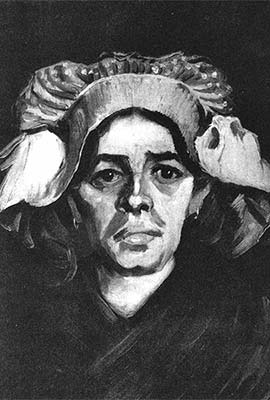
The style is crude—Van Gogh couldn’t draw very well and would never become a great technician. The paint is laid on thick, as though painted with Nuenen mud. The main subject is almost always dead center, with little or no background, so there’s a claustrophobic feeling. We are unable to see anything but the immediate surroundings.
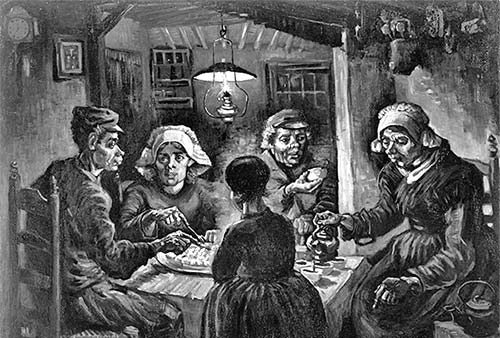
The Potato Eaters, 1885
Those that prefer to see the peasants in their Sunday-best may do as they like. I personally am convinced I get better results by painting them in their roughness... If a peasant picture smells of bacon, smoke, potato steam—all right, that’s healthy.
In a dark, cramped room lit only by a dim lamp, poor workers help themselves to a steaming plate of potatoes. They’ve earned it. Their hands are gnarly, their faces kind. Vincent deliberately wanted the canvas to be potato-colored.
He had dabbled as an artist during his wandering years, sketching things around him and taking a few art classes, but it wasn’t until age 29 that Vincent painted his first oil canvas. He soon threw himself into it with abandon.
He painted the poor working peasants. He knew them well, having worked as a lay minister among peasants and miners. He joined them at work in the mines, taught their children, and even gave away his own few possessions to help them. The church authorities finally dismissed him for “excessive zeal,” but he came away understanding the poor’s harsh existence and the dignity with which they bore it.
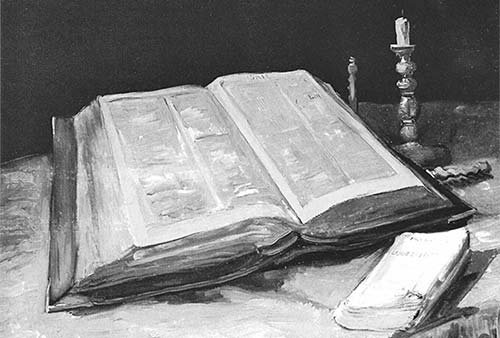
Still Life with Bible, 1885
I have a terrible need of—shall I say the word?—religion. Then I go out and paint the stars.
The Bible and Émile Zola’s La Joie de Vivre—these two books dominated Van Gogh’s life. In his art he tried to fuse his religious upbringing with his love of the world’s beauty. He lusted after life with a religious fervor. The burned-out candle tells us of the recent death of his father. The Bible is open to Isaiah 53: “He was despised and rejected of men, a man of sorrows...”
• Back near the start of this room, find...
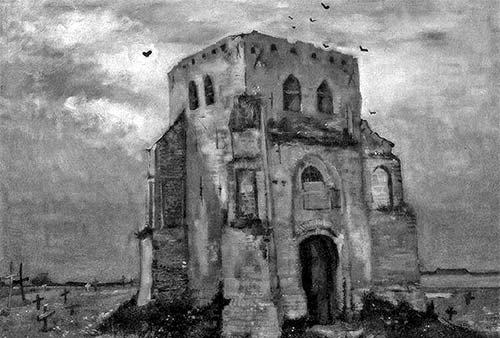
The Old Church Tower at Nuenen, a.k.a. The Peasants’ Churchyard, 1885
The crows circle above the local cemetery of Nuenen. Soon after his father’s death, Vincent—in poor health and depressed—moved briefly to Antwerp. He then decided to visit his younger brother Theo, an art dealer living in Paris, the art capital of the world. Theo’s support—financial and emotional—allowed Vincent to spend the rest of his short life painting.
Vincent moved from rural, religious, poor Holland to Paris, the City of Light. Vincent van Gone.
• Continue to the room titled New Perspectives, with work he did in Paris. You’ll likely see paintings by Impressionist masters like Monet and Gauguin hanging alongside Van Gogh’s own Impressionist-style works.
PARIS, MARCH 1886-FEBRUARY 1888
Impressionism
The sun begins to break through, lighting up everything he paints. His canvases are more colorful and the landscapes more spacious, with plenty of open sky, giving a feeling of exhilaration after the closed, dark world of Nuenen.
Paris of the 1880s was the world’s cultural capital. Vincent moved in with Theo in the bohemian neighborhood of Montmartre, just up the hill from the Moulin Rouge. In the cafés and bars, Vincent met the revolutionary Impressionists. He became friends with other struggling young painters, such as Paul Gauguin and Henri de Toulouse-Lautrec. His health improved. He became more sociable, had an affair with an older woman, and was generally happy. He signed up to study under a well-known classical teacher but quit after only a few classes. He couldn’t afford to hire models, so he roamed the streets, sketch pad in hand, and learned from his Impressionist friends.
The Impressionists emphasized getting out of the stuffy studio and setting up canvases outside on the street or in the countryside to paint the play of sunlight off the trees, buildings, and water.
As you see in this room, at first, Vincent copied from the Impressionist masters. He painted garden scenes like Claude Monet, café snapshots like Edgar Degas, “block prints” like the Japanese masters, and self-portraits like...nobody else.
• Remember, you probably already saw these first two portraits on display earlier. The final portrait (“with Felt Hat”) is likely displayed in this room.
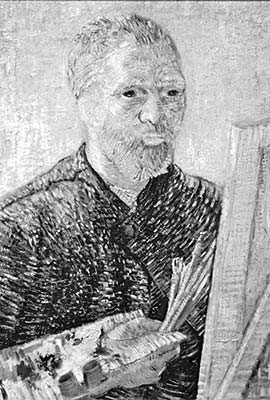
Self-Portrait as a Painter, 1887-1888
I am now living with my brother Vincent, who is studying the art of painting with indefatigable zeal.
—Theo van Gogh to a friend
Here, the budding young artist proudly displays his new palette full of bright colors, trying his hand at the Impressionist technique of building a scene using dabs of different-colored paint. A whole new world of art—and life—opened up to him in Paris. Inspired by his fellow Dutchman Rembrandt, Vincent would explore himself through self-portraits for the rest of his life.
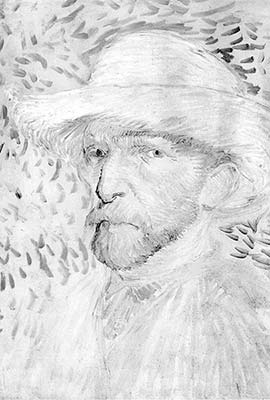
Self-Portrait with Straw Hat, 1887
You wouldn’t recognize Vincent, he has changed so much... The doctor says that he is now perfectly fit again. He is making tremendous strides with his work... He is also far livelier than he used to be and is popular with people.
—Theo van Gogh to their mother
In Paris, Vincent learned the Impressionist painting technique. The shimmering effect comes from placing dabs of different colors side by side on the canvas. At a distance, the two colors blend in the eye of the viewer to become a single color. Here, Vincent uses separate strokes of blue, yellow, green, and red to create a brown beard—but a brown that throbs with excitement.
Red Cabbages and Onions, 1887
Vincent quickly developed his own style: thicker paint; broad, swirling brushstrokes; and brighter, clashing colors that make even inanimate objects seem to pulsate with life. The many different colors are supposed to blend together, but you’d have to back up to Belgium to make these colors resolve into focus.
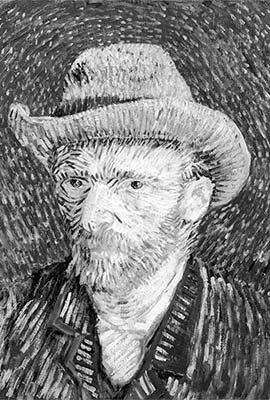
Self-Portrait with Gray Felt Hat, 1887
He has painted one or two portraits which have turned out well, but he insists on working for nothing. It is a pity that he shows no desire to earn some money because he could easily do so here. But you can’t change people.
—Theo van Gogh to their mother
Despite his new sociability, Vincent never quite fit in with his Impressionist friends. As he developed into a good painter, he became anxious to strike out on his own. He thought the social life of the big city was distracting him from serious work. And he’d been drinking too much absinthe, which alienated him from Theo. In this painting, his face screams out from a swirling background of molecular activity. He wanted peace and quiet, a place where he could throw himself into his work completely. He headed for the sunny south of France.
• Passing works by Van Gogh’s contemporaries, travel to the far end of the room (labeled Artistic Flourishing), where you finally reach...
ARLES, FEBRUARY 1888-MAY 1889
Sunlight, Beauty, and Madness
Winter was just turning to spring when Vincent arrived in Arles, near the French Riviera. After the dreary Paris winter, the colors of springtime overwhelmed him. The blossoming trees and colorful fields inspired him to paint canvas after canvas, drenched in sunlight. He was drawn to the ordinary people in Arles—old women, his postman—and painted their portraits.
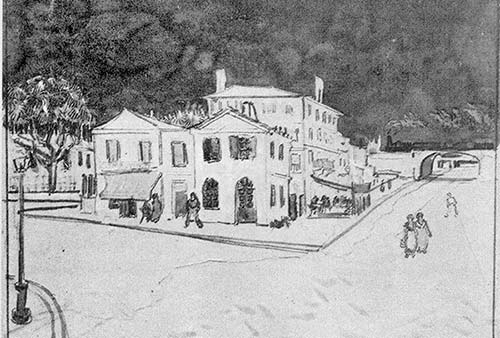
The Yellow House, a.k.a. The Street, 1888
It is my intention...to go temporarily to the South, where there is even more color, even more sun.
Vincent rented this house with the green shutters. (He ate at the pink café next door.) Look at that blue sky! He painted in a frenzy, working feverishly to try and take it all in. For the next nine months, he produced an explosion of canvases, working very quickly when the mood possessed him. His unique style evolved beyond Impressionism—thicker paint, stronger outlines, brighter colors (often applied straight from the paint tube), and swirling brushwork that makes inanimate objects pulse and vibrate with life.
If you don’t see this painting here, look for it soon, up on level 2.
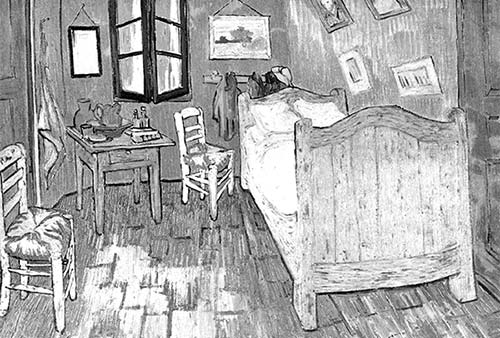
The Bedroom, 1888
I am a man of passions, capable of and subject to doing more or less foolish things—which I happen to regret, more or less, afterwards.
Vincent was alone, a Dutchman in Provence. And that had its downside. Vincent swung from flurries of ecstatic activity to bouts of great loneliness. Like anyone traveling alone, he experienced those high highs and low lows. This narrow, trapezoid-shaped, single-room apartment (less than 200 square feet) must have seemed like a prison cell at times. (Psychologists have pointed out that most everything in this painting comes in pairs—two chairs, two paintings, a double bed squeezed down to a single—indicating his desire for a mate. Hmm.)
He invited his friend Paul Gauguin to join him, envisioning a sort of artists’ colony in Arles. He spent months preparing a room upstairs for Gauguin’s arrival. He painted Sunflowers to brighten up the place.
Sunflowers, 1889
The worse I get along with people, the more I learn to have faith in Nature and concentrate on her.
Vincent saw sunflowers as his signature subject, and he painted a half-dozen versions of them, each a study in intense yellow. He said he wanted the colors to shine “like stained glass.” If he signed the work (look on the vase), it means he was proud of it.
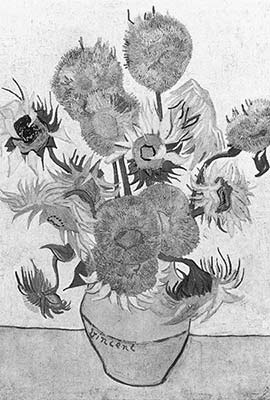
Even a simple work like these sunflowers bursts with life. Different people see different things in Sunflowers. Is it a happy painting, or is it a melancholy one? Take your own emotional temperature and see.
The Sower, 1888
A dark, silhouetted figure sows seeds in the burning sun. It’s late in the day. The heat from the sun, the source of all life, radiates out in thick swirls of paint. The sower must be a hopeful man, because the field looks slanted and barren. Someday, he thinks, the seeds he’s planting will grow into something great, like the tree that slashes diagonally across the scene—tough and craggy, but with small, optimistic blossoms.
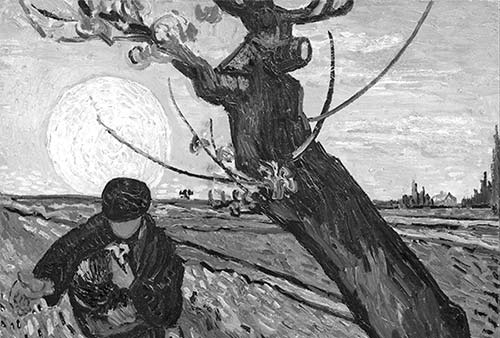
In his younger years, Vincent had worked in Belgium sowing the Christian gospel in a harsh environment (see Mark 4:1-9). Now in Arles, ignited by the sun, he cast his artistic seeds to the wind, hoping.
Gauguin’s Chair, 1888
Empty chairs—there are many of them, there will be even more, and sooner or later, there will be nothing but empty chairs.
Gauguin arrived. At first, he and Vincent got along great. They journeyed to the countryside and set up their easels, working side by side and critiquing each other’s paintings. At night, they hit the bars, carousing and talking into the night.
But then things went sour. They clashed over art, life, and their prickly personalities. On Christmas Eve 1888, Vincent went ballistic. Enraged during an alcohol-fueled argument, he pulled out a razor and waved it in Gauguin’s face. Gauguin took the hint and quickly left town. Vincent was horrified at himself. In a fit of remorse, he mutilated his own ear and presented it to a prostitute.
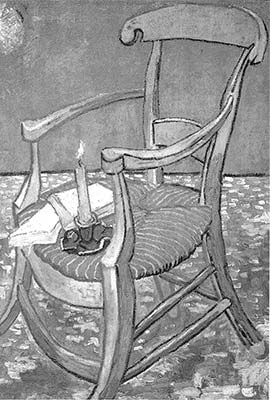
The people of Arles grew alarmed about the “madman” in their midst. A doctor diagnosed “acute mania with hallucinations,” and the local vicar talked Vincent into admitting himself to a peaceful mental hospital in the countryside around the quiet town of St-Rémy. Vincent wrote to Theo: “Temporarily I wish to remain shut up, as much for my own peace of mind as for other people’s.”
• Ascend to level 2, titled Van Gogh’s Friends and Family. This floor is less about Van Gogh’s paintings than about his relationships and his artistic process. The displays help deepen your understanding of the man as he approached the last, tumultuous years of his life. You’ll even see some of the many handwritten letters that Vincent and Theo exchanged—providing an invaluable historical record of the artist’s ups and downs.
To see his final paintings, continue up to level 3, titled Painting Against All Odds.
ST-RÉMY, MAY 1889-MAY 1890
The Mental Hospital
In the mental hospital, Vincent kept painting whenever he was well enough. He often couldn’t go out, so he copied from books, making his own distinctive versions of works by Rembrandt, Delacroix, Millet, and others.
At first, the peace and quiet of the asylum did Vincent good, and his health improved. Occasionally, he was allowed outside to paint the gardens and landscapes. Meanwhile, the paintings he had been sending to Theo began to attract attention in Paris for the first time. A woman in Brussels bought one of his canvases—the only painting he ever sold during his lifetime. (By contrast, in 2022, Orchard with Cypresses fetched more than $115 million).
At St-Rémy, we see a change from bright, happy landscapes to more introspective subjects. The colors are less bright and more surreal, the brushwork even more furious. The neat dots of paint characteristic of the Impressionist style now become bigger and thicker. The strong outlines of figures are twisted and tortured.
The Garden of Saint Paul’s Hospital, a.k.a. Leaf Fall, 1889
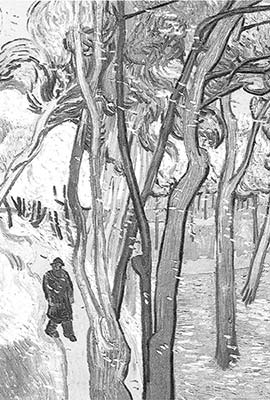
A traveler going to a destination that does not exist...
The stark brown trees are blown by the wind. A solitary figure (Vincent?) winds along a narrow, snaky path as the wind blows leaves on him. The colors are surreal—blue, green, and red tree trunks with heavy black outlines. A road runs away from us, heading nowhere.
The Sheaf Binder, after Millet, 1889
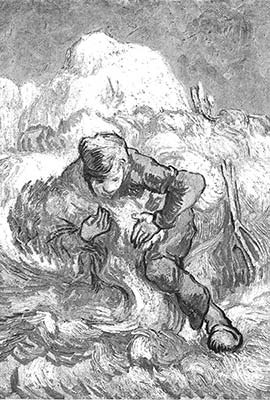
I want to paint men and women with that something of the eternal which the halo used to symbolize...
Vincent’s compassion for honest laborers remained constant following his work with Belgian miners. These sturdy folk, with their curving bodies, wrestle as one with their curving wheat. The world Vincent sees is charged from within by spiritual fires, twisting and turning matter into energy, and vice versa.
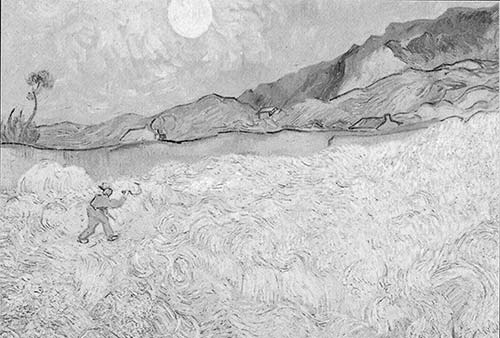
Wheat Field with a Reaper, 1889
I have been working hard and fast in the last few days. This is how I try to express how desperately fast things pass in modern life.
The harvest is here. The time is short. There’s much work to be done. A lone reaper works uphill, scything through a swirling wheat field, cutting slender paths of calm. Vincent saw the reaper—a figure of impending death—as the flip side of the sower.
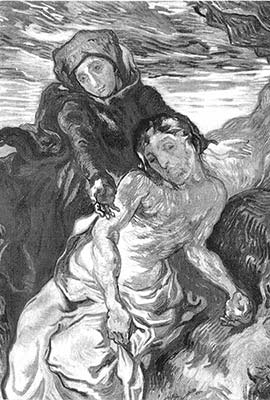
Pietà, after Delacroix, 1889
It’s evening after a thunderstorm. Jesus has been crucified, and the corpse lies at the mouth of a tomb. Mary, whipped by the cold wind, holds her empty arms out in despair and confusion. She is the tender mother who receives us all in death, as though saying, “My child, you’ve been away so long—rest in my arms.” Christ has a Vincent-esque red beard.
• Your visit concludes with Vincent’s final paintings.
AUVERS-SUR-OISE, MAY-JULY 1890
The bird looks through the bars at the overcast sky where a thunderstorm is gathering, and inwardly he rebels against his fate. ‘I am caged, I am caged, and you tell me I have everything I need! Oh! I beg you, give me liberty, that I may be a bird like other birds.’ A certain idle man resembles this idle bird...
Though Van Gogh wished to be free of the mental hospital, his illness would not relent. During these spells, he lost all sense of his own actions. He couldn’t paint, the one thing he felt driven to do. He wrote to Theo, “My surroundings here begin to weigh on me more than I can say—I need air. I feel overwhelmed by boredom and grief.”
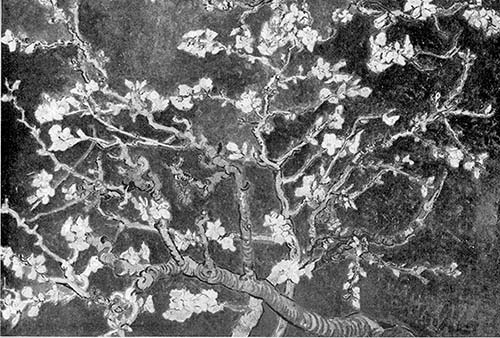
Almond Blossom, 1890
Vincent moved north to Auvers, a small town near Paris where he could stay under a doctor-friend’s supervision. On the way there, he visited Theo. Theo’s wife had just had a baby, whom they named Vincent. Brother Vincent showed up with this painting under his arm as a birthday gift. Theo’s wife later recalled, “I had expected a sick man, but here was a sturdy, broad-shouldered man with a healthy color, a smile on his face, and a very resolute appearance.”
In his new surroundings, he continued painting, averaging a canvas a day, but was interrupted by spells that swung from boredom to paranoia. His letters to Theo were generally optimistic, but he worried that he’d soon succumb completely to insanity and never paint again.
• Vincent’s final landscapes are walls of bright, thick paint. Nature is charged from within with a swirling energy.
Wheat Field with Crows, 1890
Since my illness, loneliness takes hold of me in the fields... This new attack...came on me in the fields, on a windy day, when I was busy painting.
On July 27, 1890, Vincent left his room, walked out to a nearby field, and put a bullet through his chest. He stumbled back to his room, where he died two days later, with Theo by his side.
This is one of the last paintings Vincent finished. We can try to search the wreckage of his life for the black box explaining what happened, but there’s not much there. His life was sad and tragic, but the record he left is one not of sadness, but of beauty—intense beauty.
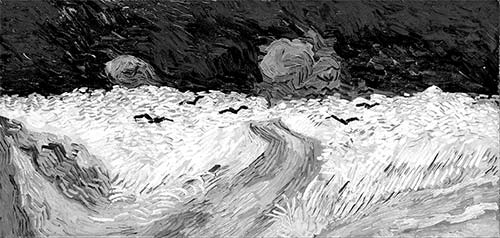
The windblown wheat field is a nest of restless energy. Scenes like this must have overwhelmed Vincent with their incredible beauty—too much, too fast, with no release. The sky is stormy and dark blue, almost nighttime, barely lit by two suns boiling through the deep ocean of blue. The road starts nowhere, leads nowhere, disappearing into the burning wheat field. Above all of this swirling beauty fly the crows, the dark ghosts that had hovered over his life since the cemetery in Nuenen.