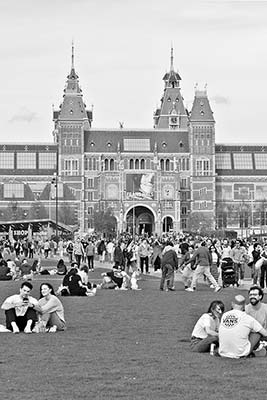
RIJKSMUSEUM TOUR
At Amsterdam’s Rijksmuseum (“Rijks” rhymes with “bikes”), Holland’s golden age shines with the best collection anywhere of the Dutch Masters—from Vermeer’s quiet domestic scenes and Steen’s raucous family meals to Hals’ snapshot portraits and Rembrandt’s moody brilliance.
The 17th century saw the Netherlands at the pinnacle of its power. The Dutch had won their independence from Spain, trade and shipping boomed, wealth poured in, the people were understandably proud, and the arts flourished. This era was later dubbed the Dutch golden age. With no church bigwigs or royalty around to commission big canvases in the Protestant Dutch Republic, artists had to find different patrons—and they discovered the upper-middle-class businessmen who fueled Holland’s capitalist economy. Artists painted their portraits and decorated their homes with pretty still lifes and unpreachy, slice-of-life art.
This delightful museum offers one of the most exciting and enjoyable art experiences in Europe. As if in homage to Dutch art and history, the Rijksmuseum lets you linger over a vast array of objects and paintings, appreciating the beauty of everyday things.
Orientation
Cost: €22.50 timed-entry ticket, free for kids under 18.
Hours: Daily 9:00-17:00.
Information: +31 20 674 7047, www.rijksmuseum.nl.
Advance Tickets Recommended: Purchase timed-entry tickets online in advance at www.rijksmuseum.nl. You must book an entry time even with a sightseeing pass. Although limited walk-up tickets may be available, I recommend buying ahead; at busy times, booking a few weeks ahead is wise.
Avoiding Crowds/Lines: Even with timed tickets, the museum is always crowded. Crowds are worst mid-morning. Plan your visit for either first thing in the morning or later in the day to avoid tour groups.
Getting There: From Centraal station, catch tram #2 or #12 to the Museumplein stop. You’ll enter the museum from inside the arched passage that cuts under the building at its center (watch out for bikes). There are two parallel entrances, across the bike lanes from each other; they are the same, but one may be busier with school groups. Take your pick. Even if you have a ticket, you may have to wait in a short, fast-moving line to get in. If you have prebooked a guided tour (see next), you can skip to the front of the line.
Tours: The museum’s free app offers tours, maps, and other useful info (bring your own headphones). There may also be an audioguide for rent (€6.50). Daily guided tours in English (€7.50) can sell out weeks in advance; it’s smart to prebook with your ticket. In some rooms, you can borrow giant annotated diagrams of important paintings to interpret the many fine details.
Length of This Tour: Allow 1.5 hours.
Baggage Check: Leave your bag at the free checkroom in the Atrium.
Cuisine Art: The €€ Grand Café, serving meals along with drinks and sweets, is in the Atrium, above the shop. The Philips Wing has a coffee-and-pastry café on the ground floor. The fine-dining €€€€ RIJKS Restaurant, with a Michelin star, is upstairs in the Philips Wing.
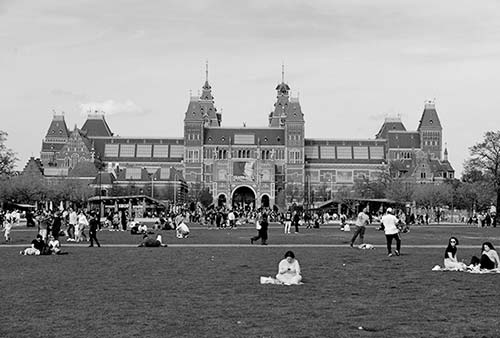
Outside in the garden (no ticket required) is a summertime espresso bar—a great place to relax amidst the box hedges, flowers, and fountains. Nearby on Museumplein, you’ll find the €€ Cobra Café (with lots of indoor and outdoor seating, a straightforward lunch menu, and fast service), several take-out stands, and (at the far end, near the Stedelijk Museum) an Albert Heijn grocery. There are good soup-and-sandwich shops on lovely Nieuwe Spiegelstraat, a pleasant antiques-shopping street just a couple of blocks in front of the museum (see here).
Museumplein and nearby Vondelpark are both perfect for a picnic. For locations, see the map on here.
Starring: Rembrandt van Rijn, Frans Hals, Johannes Vermeer, Jan Steen, and many interesting artifacts of the golden age.
OVERVIEW
Dutch art is meant to be enjoyed, not studied. It’s straightforward, meat-and-potatoes art for the common people. The Dutch love the beauty of mundane things painted realistically and with exquisite detail. So set your cerebral cortex on “low” and let this art pass straight from the eyes to the heart, with minimal detours.
The Tour Begins
Entering the building, you’ll descend into the lower-level Atrium, which houses all the visitor services: info desk, baggage check (garderobe), café, gift shop, and WCs.
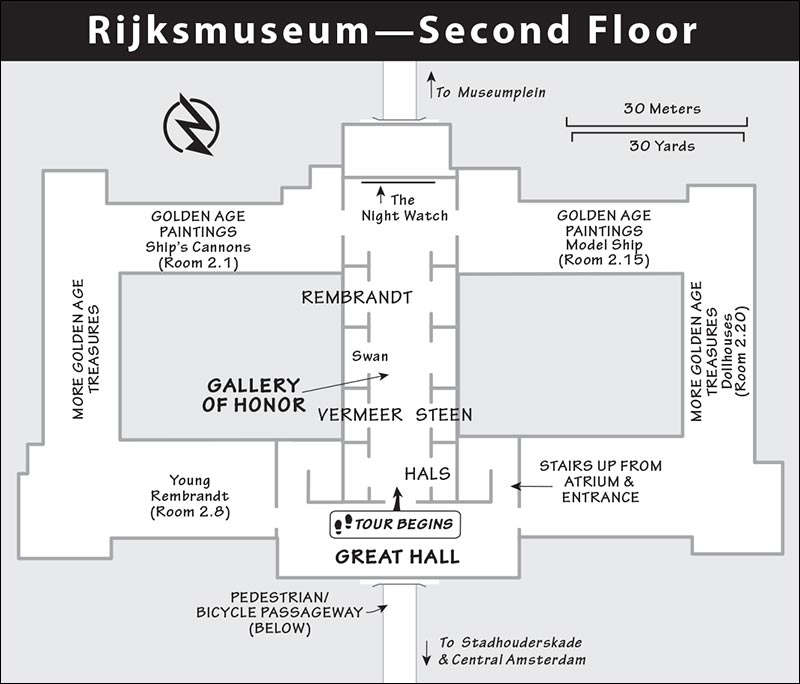
• After showing your ticket (and perhaps downloading the museum app or renting a multimedia guide), follow The Collection signs (and the crowds) up the stairway to the top (second) floor, where you emerge into the...
GREAT HALL
With its stained-glass windows depicting great artists and thinkers, vaulted ceiling, and murals of golden age explorers, this space feels like a cathedral to Holland’s middle-class merchants. Gaze through the glass doors down the long adjoining hall to the far end, with the “altarpiece” of this cathedral—Rembrandt’s The Night Watch.
• Now, follow the flow of the crowds toward it, into the...
GALLERY OF HONOR
This grand space was purpose-built to hold the Greatest Hits of the Golden Age by the era’s biggest rock stars: Hals, Vermeer, Steen, and Rembrandt. The best of the era’s portraits, still lifes, landscapes, and slice-of-life “genre scenes” give us a close-up look at daily life in this happy, affluent era. The smaller rooms surrounding the gallery hold more treasures of the golden age.
• In the first alcove to the right is the work of...
Frans Hals
Frans Hals (c. 1582-1666) was the premier golden age portrait painter. Merchants hired him the way we’d hire a wedding photographer. With a few quick strokes, Hals captured not only the features, but also the personality.
A Militiaman Holding a Berkemeyer, a.k.a. The Merry Drinker, c. 1628-1630
You’re greeted by a jovial man in a black hat, capturing the earthy, exuberant spirit of the Dutch golden age. Notice the details—the happy red face of the man offering us a berkemeyer drinking glass, the sparkle in his eyes, the lacy collar, the decorative belt buckle, and so on.
Now move in closer. All these meticulous details are accomplished with a few thick, messy brushstrokes. The beard is a tangle of brown worms, the belt buckle a yellow blur. His hand is a study in smudges. Even the expressive face is created with a few well-chosen patches of color. Unlike Dutch still-life scenes, this canvas is meant to be viewed from a distance, where the colors and brushstrokes blend together.
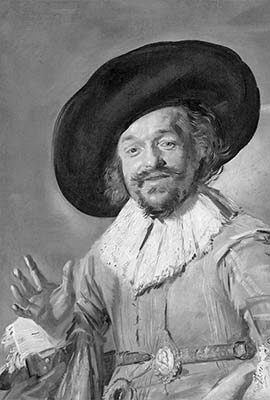
Rather than posing his subjects, making them stand for hours saying “cheese,” Hals tried to catch them at a candid moment. He often painted common people, fishermen, and barflies such as this one. He had to work quickly to capture the serendipity of the moment. Hals used a stop-action technique, freezing the man in mid-gesture, with the rough brushwork creating a blur that suggests the man is still moving.
Two centuries later, the Impressionists learned from Hals’ scruffy brushwork. In the Van Gogh Museum, you’ll see how Van Gogh painted, say, a brown beard by using thick dabs of green, yellow, and red that blend at a distance to make brown.
Portrait of a Couple, Probably Isaac Abrahamsz Massa and Beatrix van der Laen, c. 1622
This likely wedding portrait of a chubby, pleasant merchant and his bride sums up the story of the Dutch golden age. Because this overseas trader was away from home for years at a time on business, Hals makes a special effort to point out his patron’s commitment to marriage. Isaac pledges allegiance to his wife, putting his hand on his heart. Beatrix’s wedding ring is prominently displayed dead center between them (on her right-hand forefinger, Protestant-style). The vine clinging to a tree is a symbol of man’s support and woman’s dependence. And in the distance at right, in the classical love garden, are other happy couples strolling arm in arm amid peacocks, a symbol of fertility.
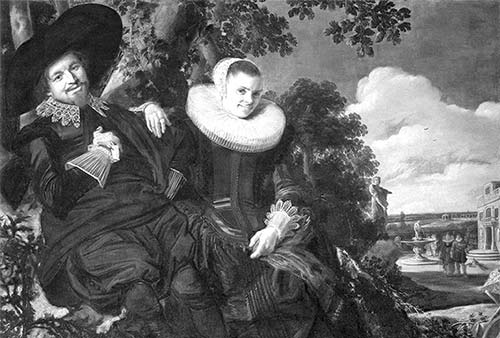
In earlier times, marriage portraits put the man and wife in separate canvases, staring out grimly. Hals’ jolly side-by-side couple reflects a societal shift from marriage as business partnership to an arrangement that’s more friendly and intimate.
Hals didn’t need symbolism to tell us that these two are prepared for their long-distance relationship—they seem relaxed together, but each looks at us directly, with a strong, individual identity. Good as gold, these are the type of people who propelled this soggy little country into its glorious golden age.
• In the next alcove, and across the hall on the left, are the small-scale canvases of...
Johannes Vermeer
Vermeer (1632-1675) is the master of tranquility and stillness. He creates a clear and silent pool that is a world in itself. Most of his canvases show interiors of Dutch homes, where Dutch women engage in everyday activities, lit by a side window.
Vermeer’s father, an art dealer, gave Johannes a passion for painting. Late in the artist’s career, with Holland drained by wars against England, the demand for art and luxuries went sour, forcing Vermeer to downsize—he sold his big home, packed up his wife and 14 children, and moved in with his mother-in-law. He died two years later, and his works fell into centuries of obscurity.
The Rijksmuseum has the best collection of Vermeers in the world—four of them. (There are only some 34 in captivity.) But each is a small jewel worth lingering over.
You’re sitting at home late one night, and it’s perfectly calm. Not a sound, very peaceful. And then...the refrigerator motor turns off, and it’s really quiet.
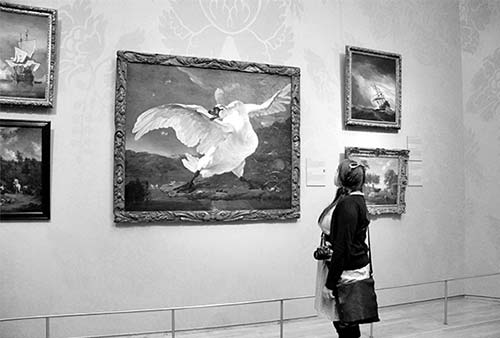
Dutch art is really quiet art. It silences our busy world, so that every sound, every motion is noticeable. You can hear cows tearing off grass 50 yards away. Dutch art is still. It slows our fast-lane world, so we notice the motion of birds. We notice how the cold night air makes the stars sharp. We notice that the undersides of leaves and cats are always a lighter shade than the tops. Dutch art stills the world so we can hear our own heartbeat and reflect upon that most noble muscle that, without thinking, gives us life.
To see how subtle Dutch art is, realize that one of the museum’s most exciting, dramatic, emotional, and extravagant Dutch paintings is probably The Threatened Swan (in the Gallery of Honor). It’s quite a contrast to the rape scenes and visions of heaven of Italian Baroque paintings from the same time period.
The Milkmaid, c. 1660
It’s so quiet you can practically hear the milk pouring into the bowl.
Vermeer brings out the beauty in everyday things. The subject is ordinary—a kitchen maid—but you could look for hours at the tiny details and rich color tones. These are everyday objects, but they glow in a diffused light: the crunchy crust, the hanging basket, even the rusty nail in the wall with its tiny shadow. Vermeer had a unique ability with surface texture, to show how things feel when you touch them.
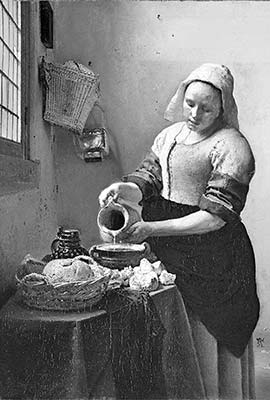
The maid is alive with Vermeer’s distinctive yellow and blue—the colors of many traditional Dutch homes—against a white backdrop. She is content, solid, and sturdy, performing this simple task as if it’s the most important thing in the world. Her full arms are built with patches of reflected light. Vermeer squares off a little world in itself (framed by the table in the foreground, the wall in back, the window to the left, and the footstool at right), then fills this space with objects for our perusal.
Woman Reading a Letter, c. 1663
Notice how Vermeer’s placid scenes often have an air of mystery. The woman is reading a letter. From whom? A lover? A father on a two-year business trip to the East Indies? Not even taking time to sit down, she reads intently, with parted lips and a bowed head. It must be important. (She looks pregnant, adding to the mystery, but that may just be the cut of her clothes.)
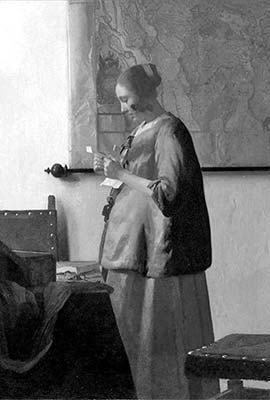
Again, Vermeer has framed a moment of everyday life. But within this small world are hints of a wider, wilder world—the light coming from the left is obviously from a large window, giving us a whiff of the life going on outside. The map hangs prominently, reminding us of travel, and perhaps of where the letter is from.
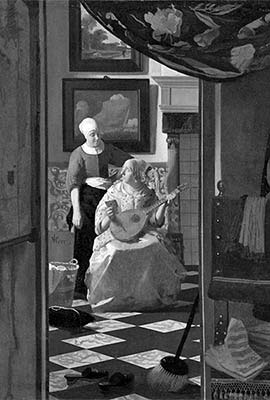
The Love Letter, c. 1669-1670
There’s a similar theme here. The curtain parts, and we see through the doorway into a dollhouse world, then through the seascape on the back wall to the wide ocean. A woman is playing a lute when she’s interrupted by a servant bringing a letter. The mysterious letter stops the music, intruding like a pebble dropped into the pool of Vermeer’s quiet world. The floor tiles create a strong 3-D perspective that sucks us straight into the center of the painting—the woman’s heart.
View of Houses in Delft, a.k.a. The Little Street, c. 1658
Vermeer was born in the picturesque town of Delft, grew up near its Market Square, and set a number of his paintings there. This may be the view from his front door.
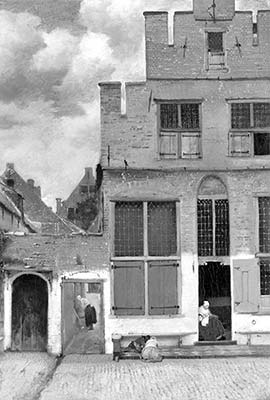
The details in the painting actually aren’t very detailed—the cobblestone street doesn’t have a single individual stone in it. But Vermeer shows us the beautiful interplay of colored rectangles on the buildings. Our eye moves back and forth from shutter to gable to window...and then from front to back, as we notice the woman deep in the alleyway.
• In the alcove across the way are some rollicking paintings by...
Jan Steen
Not everyone could afford a masterpiece, but even poorer people wanted works of art for their homes (like a landscape from Sears for over the sofa). Jan Steen (c. 1625-1679, pronounced “yahn stain”), the Norman Rockwell of his day, painted humorous scenes from the lives of the lower classes. As a tavern owner, he observed society firsthand.
• In this alcove, find the following works...
The Feast of St. Nicholas, 1665-1668
It’s Christmas time, and the kids have been given their gifts, including a little girl who got a doll. The mother says, “Let me see it,” but the girl turns away playfully. Everyone is happy except the boy, who’s crying. His Christmas present is only a branch in his shoe—like coal in your stocking, the gift for bad boys. His sister gloats and passes it around. The kids laugh at him. But wait—it turns out the family is just playing a trick. In the background, the grandmother beckons to him, saying, “Look, I have your real present in here.” Out of the limelight, but smack in the middle, sits the father providing ballast to this family scene and clearly enjoying his children’s pleasure.
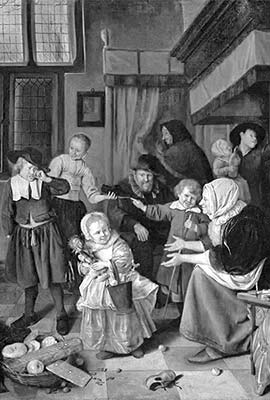
Steen has frozen the moment, sliced off a piece, and laid it on a canvas. He’s told a story with a past, a present, and a future. These are real people in a real scene.
Steen’s fun art reminds us that museums aren’t mausoleums.
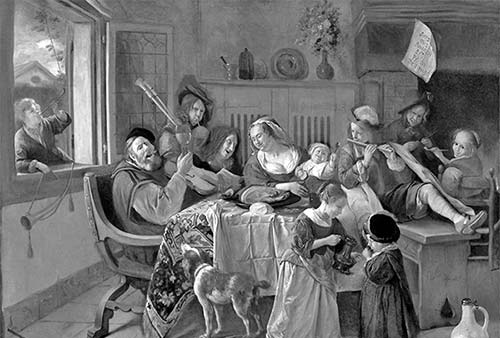
The Merry Family, 1668
This family—three generations living happily under one roof—is eating, drinking, and singing like there’s no tomorrow. The broken eggshells and scattered cookware symbolize waste and extravagance. The neglected proverb tacked to the fireplace reminds us that children will follow in the footsteps of their parents. The father in this jolly scene is very drunk—ready to topple over—while in the foreground his mischievous daughter is feeding her brother wine straight from the flask. Mom and Grandma join the artist himself (playing the bagpipes) in a lively sing-along, but the child learning to smoke would rather follow Dad’s lead.
Though not as well-known as Vermeer, Hals, or Rembrandt, several women master painters are worth seeking out.
The most celebrated female Dutch golden age painter is Judith Leyster (b. 1609), the first female master painter in the Netherlands and one of the two women admitted in the 17th century to Haarlem’s prestigious Guild of St. Luke. Centuries before “equal work for equal pay” became a slogan, Leyster commanded the same rates for her work as male guildmembers and had her own workshop and pupils.
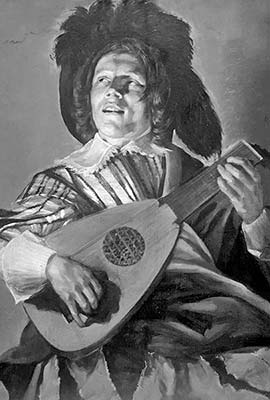
Next to Jan Steen’s The Merry Family, you’ll see Leyster’s The Serenade (1629), depicting a lute player in a furry black hat. Sharp contrasts of light and dark echo Rembrandt’s technique. This painting was formerly attributed to Frans Hals—perhaps understandably, since like Hals, Leyster used loose, rough brushstrokes and painted ordinary people in midaction doing everyday things. The similarities continue in Leyster’s The Merry Drinker (1629), displayed next to Hals’ A Militiaman Holding a Berkemeyer—also known as The Merry Drinker.
Rachel Ruysch (b. 1664), daughter of a botany professor, was famous for her detailed floral still lifes (look for Still Life with Flowers in a Glass Vase), while Flemish painter Clara Peeters (b. 1594) gained acclaim for the exquisite textures of her still lifes (find her Still Life with Fish, Sea, Food and Flowers).
Dutch golden age families were notoriously lenient with their kids. Even today, the Dutch describe a rowdy family as a “Jan Steen household.”
Adolf and Catharina Croeser, a.k.a. The Burgomaster of Delft and His Daughter, 1655
Steen’s well-dressed burgher sits on his front porch, when a poor woman and child approach to beg, putting him squarely between the horns of a moral dilemma. On the one hand, we see his rich home, well-dressed daughter, and a vase of flowers—a symbol that his money came from morally suspect capitalism (the kind that produced the folly of 1637’s “tulip mania”). On the other hand, there are his poor fellow citizens and the church steeple, reminding him of his Christian duty. The man’s daughter avoids the confrontation. Will the burgher set the right Christian example? This moral dilemma perplexed many nouveau-riche Dutch Calvinists of Steen’s day.
This early painting by Steen demonstrates his mastery of several popular genres: portrait, still life (the flowers and fabrics), cityscape, and moral instruction.
• You’re getting closer to the iconic Night Watch, but first you’ll find other works by...
Rembrandt van Rijn
Rembrandt van Rijn (1606-1669) is the greatest of all Dutch painters. Whereas most painters specialized in one field—portraits, landscapes, still lifes—Rembrandt excelled in them all.
The son of a Leiden miller who owned a waterwheel on the Rhine (“van Rijn”), Rembrandt took Amsterdam by storm with his famous painting The Anatomy Lesson of Dr. Nicolaes Tulp (1632, currently in The Hague’s Mauritshuis Royal Picture Gallery). The commissions poured in for official portraits, and he was soon wealthy and married (1634) to Saskia van Uylenburgh. They moved to an expensive home in the Jewish Quarter (today’s Rembrandt House Museum) and decorated it with their collection of art and exotic furniture. His portraits were dutifully detailed, but other paintings explored strong contrasts of light and dark, with dramatic composition.
In 1642, Saskia died, and Rembrandt’s fortunes changed, as the public’s taste shifted and commissions dried up. In 1649, he hired an 18-year-old model named Hendrickje Stoffels, and she soon moved in with him and gave birth to their daughter.
Holland’s war with England (1652-1654) devastated the art market, and Rembrandt’s free-spending ways forced him to declare bankruptcy (1656)—the ultimate humiliation in success-oriented Amsterdam. The commissions came more slowly. The money ran out. His mother died. He had to auction off his paintings and furniture to pay debts. He moved out of his fine house to a cheaper place on Rozengracht. His bitter losses added a new wisdom to his work.
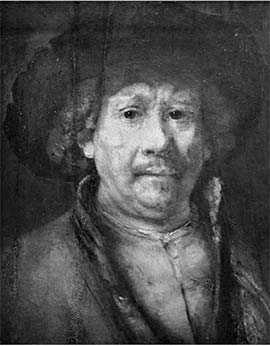
In his last years, Rembrandt’s greatest works were his self-portraits, showing a tired, wrinkled man stoically enduring life’s misfortunes. Rembrandt piled on layers of paint and glaze to capture increasingly subtle effects. In 1668, his lone surviving son, Titus, died, and Rembrandt passed away the next year. His death effectively marked the end of the Dutch golden age.
• In the fourth alcove on the left, look for these two works...
Isaac and Rebecca, a.k.a. The Jewish Bride, c. 1665-1669
The man gently draws the woman toward him. She’s comfortable enough with him to sink into thought, and she reaches up unconsciously to return the gentle touch. They’re young but wizened. This uncommissioned portrait (its subjects remain unknown) is a truly human look at the relationship between two people in love. They form a protective pyramid of love amid a gloomy background. The touching hands form the center of this somewhat sad but peaceful work. Van Gogh said that “Rembrandt alone has that tenderness—the heartbroken tenderness.”
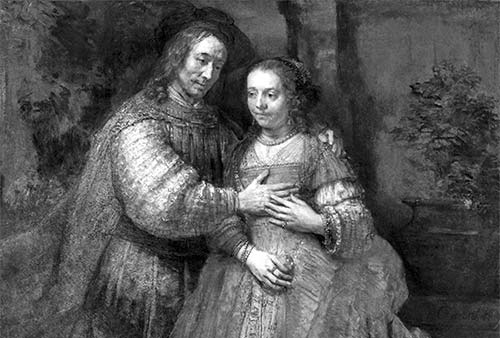
Rembrandt was a master of oil painting. In his later years, he rendered details with a messier, more Impressionistic style. The red-brown-gold of the couple’s clothes is a patchwork of oil laid on thick with a palette knife.
The Wardens of the Amsterdam Drapers Guild, a.k.a. The Syndics, 1662
Rembrandt could paint an official group portrait better than anyone. In the painting made famous by Dutch Masters cigars, he catches the Drapers Guild in a natural but dignified pose (dignified, at least, until the guy on the left sits on his friend’s lap).
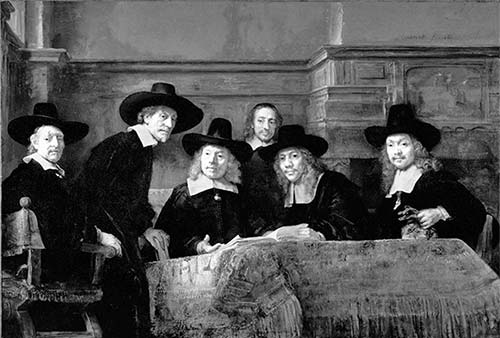
It’s a business meeting, and they’re all dressed in black with black hats—the standard power suit of the Dutch golden age. They gather around a table examining the company’s books. Suddenly, someone (us) walks in, and they look up. It’s as natural as a snapshot, though X-rays show Rembrandt made many changes in posing them perfectly.
The figures are “framed” by the table beneath them and the top of the wood paneling above their heads, making a three-part composition that brings this band of colleagues together. Even in this simple portrait, we feel we can read the guild members’ personalities in their faces. (If the table in the painting looks like it’s sloping a bit unnaturally, lie on the floor to view it at Rembrandt’s intended angle.)
• At the far end of the Gallery of Honor is the museum’s star masterpiece. The best viewing spot is to the right of center—the angle Rembrandt had in mind when he designed it.
The Night Watch, a.k.a. The Militia Company of Captain Frans Banninck Cocq, 1642
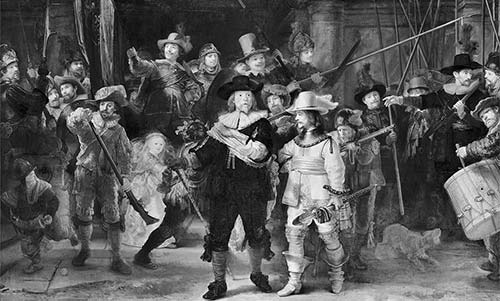
This is Rembrandt’s most famous—though not necessarily greatest—painting. It’s displayed behind glass and is being carefully studied by conservators as they determine the best way to combat deterioration.
Created in 1642, when Rembrandt was 36, The Night Watch was one of his most important commissions: a group portrait of a company of Amsterdam’s Civic Guards to hang in their meeting hall.
It’s an action shot. With flags waving and drums beating, the guardsmen (who, by the 1640s, were really only an honorary militia of rich bigwigs) spill onto the street from under an arch in the back. It’s “all for one and one for all” as they rush to Amsterdam’s rescue. The soldiers grab lances and load their muskets. In the center, the commander (in black, with a red sash) strides forward energetically with a hand gesture that seems to say, “What are we waiting for? Let’s move out!” His lieutenant focuses on his every order.
Rembrandt caught the optimistic spirit of Holland in the 1600s. Its war of independence from Spain was heading to victory and the economy was booming. These guardsmen on the move epitomize the proud, independent, upwardly mobile Dutch.
I cannot tell you why men and women of the Dutch golden age found these fanlike collars attractive, but they certainly were all the rage here and elsewhere in Europe. It started in Spain in the 1540s, but the style really took off with a marvelous discovery in 1565: starch. Within decades, Europe’s wealthy merchant class was wearing nine-inch collars made from 18 yards of material.
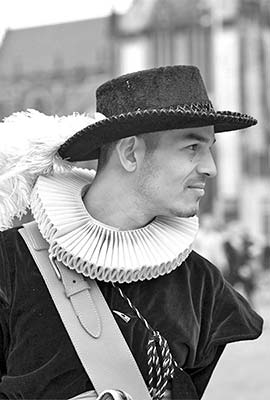
The ruffs were detachable and made from a long, pleated strip of linen set into a neck (or wrist) band. You tied it in front with strings. Big ones required that you wear a wire frame underneath for support. There were various types—the “cartwheel” was the biggest, a “double ruff” had two layers of pleats, and a “cabbage” was somewhat asymmetrical.
Ruffs required elaborate maintenance. First, you washed and starched the linen. While the cloth was still wet, hot metal pokers were painstakingly inserted into the folds to form the characteristic figure-eight pattern. The ruffs were stored in special round boxes to hold their shape.
For about a century, Europeans loved the ruff, but by 1630, Holland had come to its senses, and the fad faded.
Why is The Night Watch so famous? Compare it with other, less famous group portraits nearby, where every face is visible and everyone is well-lit, flat, and flashbulb-perfect. These people paid good money to have their mugs preserved for posterity, and they wanted it right up front. Other group portraits may be colorful, dignified works by a master...but not quite masterpieces.
By contrast, Rembrandt rousted the Civic Guards off their fat duffs. By adding movement and depth to an otherwise static scene, he took posers and turned them into warriors. He turned a simple portrait into great art.
OK, some Night Watch scuttlebutt: First off, “night watch” is a misnomer. It’s a daytime scene, but over the years, as the preserving varnish darkened and layers of dirt built up, the sun set on this painting, and it got its popular title. When the painting was moved to a smaller room, the sides were lopped off (and the pieces lost), putting the two main characters in the center and causing the work to become more static than intended. During World War II, the painting was rolled up and hidden for five years. In 1975, a madman attacked the painting, slicing the captain’s legs, and in 1990, it was sprayed with acid (it was skillfully restored after both incidents).
The Night Watch, contrary to popular myth, was a smashing success in its day. However, there are elements in it that show why Rembrandt fell out of favor as a portrait painter. He seemed to spend as much time painting the dwarf and the mysterious glowing girl with a chicken (the very appropriate mascot of this “militia” of shopkeepers) as he did the faces of his employers.
Rembrandt’s life darkened long before his Night Watch did. This work marks the peak of Rembrandt’s popularity...and the beginning of his fall from grace. He continued to paint masterpieces. Free from the dictates of employers whose taste was in their mouths, he painted what he wanted, how he wanted it. Rembrandt goes beyond mere craftsmanship to probe into, and draw life from, the deepest wells of the human soul.
• Backtrack a few steps to the Gallery of Honor’s last alcove to find Rembrandt’s...
Self-Portrait as the Apostle Paul, 1661
Rembrandt’s many self-portraits show us the evolution of a great painter’s style, as well as the progress of a genius’s life. For Rembrandt, the two were intertwined.
In this somber, late self-portrait, the man is 55 but he looks 70. With a lined forehead, a bulbous nose, and messy hair, he peers out from under several coats of glazing, holding old, wrinkled pages. His look is...skeptical? Weary? Resigned to life’s misfortunes? Or amused? He seems to have an almost Einstein-ian twinkle in his eye...even if his tongue isn’t sticking out. (He’s looking at us, but not just at us—remember that a self-portrait is done staring into a mirror.)
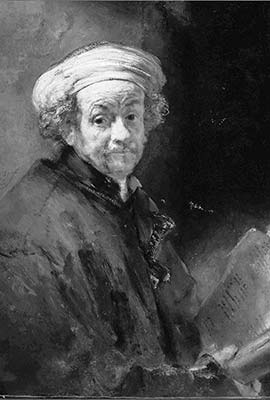
This man has seen it all—success, love, money, fatherhood, loss, poverty, death. He took these experiences and wove them into his art. Rembrandt died poor and misunderstood, but he remained very much his own man to the end.
More Golden Age Treasures
You’ll find more Rembrandts in Room 2.8, located a half-dozen rooms to the left of The Night Watch. As you journey there, you’ll get snapshots of the golden age. There are cannons, guns, and proud soldiers that enforced Holland’s global sea trade (Room 2.1). Holland’s newfound wealth is evidenced by paintings of sumptuous nudes (also Room 2.1, second half), and then—turning left in room 2.3—carved wood furnishings (2.4), family portraits (in many rooms), and the sheer joie de vivre of Hendrick Avercamp’s famous Winter Landscape with Ice Skaters (2.6; borrow the labeled diagram to pick out the delightful details).
• Turn left into Room 2.8, which is dedicated to a promising artist who arrived in Amsterdam at the peak of the golden age. Begin by finding the tiny portrait on the right wall—smaller than a sheet of paper.
The Young Rembrandt
Self-Portrait, c. 1628
Here we see the young small-town boy about to launch himself into whatever life has to offer. Rembrandt was a precocious kid. His father, a miller, insisted that he become a lawyer. His mother hoped he’d be a preacher. Rembrandt combined the secular and religious worlds by becoming an artist, someone who can hint at the spiritual by showing us the beauty of the created world.
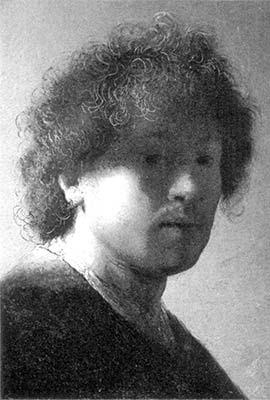
He moved to Amsterdam and entered the highly competitive art world. Amsterdam was a booming town and, like today, a hip and cosmopolitan city. Rembrandt portrays himself at age 22 as being divided—half in light, half hidden by hair and shadows—open-eyed, but wary of an uncertain future. Rembrandt’s paintings are often light and dark, both in color and in subject, exploring the “darker” side of human experience.
• To the left, look for...
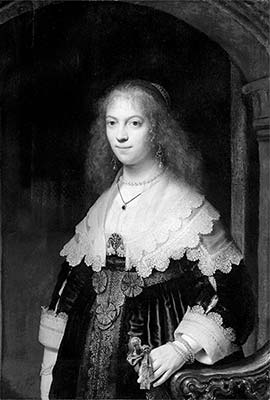
Portrait of a Woman, Possibly Maria Trip, 1639
This debutante daughter of a wealthy citizen is shy and reserved—maybe a bit awkward in her new dress and adult role, but still self-assured. When he chose to, Rembrandt could dash off a commissioned portrait like nobody’s business. The details are immaculate—the lace and shiny satin, the pearls behind the veil, the subtle face and hands. Rembrandt gives us not just a person, but a personality.
Look at the red rings around her eyes, a detail a lesser painter would have airbrushed out. Rembrandt takes this feature, unique to her, and uses it as a setting for her luminous, jewel-like eyes. Without being prettified, she’s beautiful.
• Back near the entrance to this room, find...
Young Woman in Fantasy Costume, Possibly Saskia, 1633
It didn’t take long for Amsterdam to recognize Rembrandt’s great talent. Everyone wanted a portrait done by the young master, and he became wealthy and famous. He fell in love with and married the rich, beautiful, and cultured Saskia, who is thought to be the sitter for this painting. (It’s considered a “fantasy” because she’s dressed in clothing from centuries before her day.)
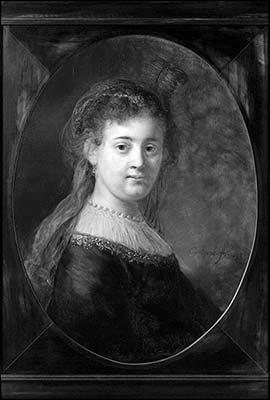
By all accounts, the two were enormously happy, entertaining friends, decorating their house with fine furniture, raising a family, and living the high life. In this painting, Saskia’s face literally glows, and a dash of white paint puts a sparkle in her eye. Barely 30 years old, Rembrandt was the most successful painter in Holland. He had it all.
• And finally, look for...
Jeremiah Lamenting the Destruction of Jerusalem, 1630
The Babylonians have sacked and burned Jerusalem, but Rembrandt leaves the pyrotechnics (in the murky background at left) to Spielberg and the big screen. Instead, he tells the story of Israel’s destruction in the face of the prophet who predicted the disaster. Jeremiah slumps in defeat, deep in thought, confused and despondent, trying to understand why this evil had to happen. Rembrandt turns his floodlight of truth on the prophet’s deeply lined forehead.
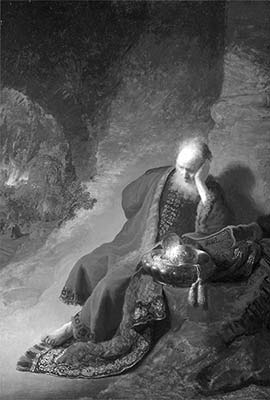
Rembrandt wasn’t satisfied to crank out portraits of fat merchants in frilly bibs, no matter what they paid him. He wanted to experiment, trying new techniques and more probing subjects. Many of his paintings weren’t commissioned and were never even intended for sale. His subjects could be brooding and melancholy, a bit dark for the public’s taste. His technique set him apart—you can recognize a Rembrandt canvas by his play of light and dark. Most of his paintings are a deep brown tone, with only a few bright spots glowing from the darkness. This allowed Rembrandt to highlight the details he thought most important and to express moody emotions.
Light has a primal appeal to humans. (Dig deep into your DNA and remember the time when fire was not tamed. Light! In the middle of the night! This miracle separated us from our fellow animals.) Rembrandt strikes at that instinctive level.
• Finish your tour with another painting at the far end of Room 2.8. It’s a large group portrait by Bartholomeus van der Helst, called...
The Banquet at the Crossbowmen’s Guild, 1648
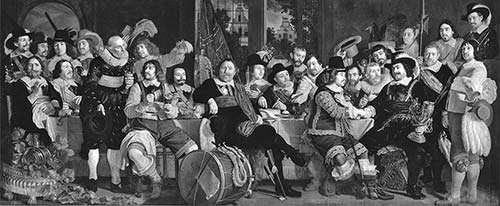
This colorful portrait of several dozen Amsterdammers was painted to celebrate Holland’s new era of peace after its war with Spain. Though shown in military uniforms, these men were really captains of industry—shipbuilders, seamen, salesmen, spice tasters, bankers, and venture capitalists—all part of the complex economic web that planned and financed overseas trade. With bright colors and down-to-earth realism, this group portrait captures the prosperity and can-do spirit of the Dutch golden age.
THE REST OF THE RIJKS
The museum is most famous for the paintings you’ve just seen. But with a collection of 8,000 works—detailing Dutch history from 1200 to the present—the Rijks offers much, much more.
Level 2: The second floor is home to more golden age artifacts. Keep circling the floor counterclockwise (through Rooms 2.9, 2.10, and so on) to return to the stained-glass Great Hall. Proceed straight ahead to pass through Rooms 2.28, 2.27, etc., keeping an eye out for a stunning collection of blue-and-white Delftware (in Room 2.22). There are dollhouses (poppenhuizen, Room 2.20); a fine old multilevel library (Room 2.16, through the glass doors); and a giant wooden model of a 74-gun Dutch man-of-war that would have escorted convoys of merchant ships loaded with wealth (Room 2.15). Complete your circuit at The Night Watch and a final stroll back through the Gallery of Honor.
Level 1: There’s a Van Gogh self-portrait in Room 1.18 (from the Great Hall, go back downstairs the way you came to floor 1 and turn left). Vincent had just arrived in Paris, bought himself a new felt hat, and portrayed himself with the bright thick brushstrokes that would become his signature. A few rooms farther on, fans of Napoleonic history will enjoy the epic-scale painting of the Battle of Waterloo (Room 1.12).
Level 0: This has everything from women’s fashion (Room 0.9) to more Delftware (0.7). The Asian Pavilion shows off objects from the East Indies—a former Dutch colony—as well as items from India, Japan, Korea, and China. The bronze dancing Shiva (Shiva Nataraja, in Room 1 of the pavilion) is considered one of the best in the world. Nearby, the Philips Wing hosts temporary exhibits and photography.
Level 3: Finally, you could ride the elevator up to the top floor for exhibits from the 20th century, including an airplane. This brings you right up to the present—with prosperous Amsterdam enjoying yet another golden age.