RED LIGHT DISTRICT WALK
4 Elements of Nature Smartshop
8 Prostitution Information Center (PIC)
10 Oudezijds Voorburgwal and Pill Bridge
11 Our Lord in the Attic Museum
13 Old Harbor
14 Zeedijk
17 Prostitute-Owned Windows and Bananenbar
19 Red Light Secrets Museum of Prostitution
21 Hemp Gallery
22 Hash, Marijuana, and Hemp Museum
Amsterdam’s oldest neighborhood has hosted the world’s oldest profession since the Middle Ages. Today, prostitution and public marijuana use thrive here, creating a spectacle that’s unique in all of Europe.
The Red Light District lies between Damrak and Nieuwmarkt. On our walk, we’ll see history, sleaze, and cheese: prostitutes in windows, drunks in doorways, cruising packs of foreign twenty-somethings, cannabis being enjoyed, and sex for sale.
The sex trade runs the gamut from sex shops selling porn and accessories to blue video arcades, from glitzy nightclub sex shows featuring strippers and sex acts to the real deal—prostitutes in bras, thongs, and high heels, standing in window displays, offering their bodies—and it’s all legal.
Not for Everyone: The Red Light District seems to have something to offend everyone. Whether it’s in-your-face images of graphic sex, exploited immigrant women, whips and chains, passed-out drug addicts, the pungent smells of pot smoke and urine, or just the shameless commercialism of it all, it’s not everyone’s cup of tea. And though I encourage people to expand their horizons—that’s a great thing about travel—it’s also perfectly OK to say, “No, thank you.”
Orientation
Length of This Walk: Allow two hours.
Photography: Consider leaving your phone or camera in your bag. Don’t take photos of women in windows—even with an inconspicuous phone camera—or a snarly bouncer may appear from out of nowhere to forcibly rip it from your hands. In this district, taking even seemingly harmless photos of ordinary people is frowned upon by privacy-loving locals. On the other hand, taking photos of landmarks like the Old Church and wide shots of distant red lights from the bridges is certainly OK. Remember that a camera or phone makes a prime target in this high-theft area.
When to Go: The best times to visit are afternoons and early evenings. Mornings are dead, but are also when you see more passed-out-drunk-in-a-doorway scenes. Avoid late nights (after about 22:00), when the tourists disappear and the area gets creepy. Earlier in the evening, the streets start filling with tourists and the atmosphere feels safe, even festive.
Safety: The neighborhood is slowly gentrifying, with trendy restaurants and boutiques, and there are plenty of police on horseback keeping things orderly and plenty of other out-of-town tourists. But there are also plenty of rowdy drunks, drug-pushing lowlifes, con artists, and pickpockets. Assume any fight or commotion is a ploy to distract innocent victims who are about to lose their wallets. As always, wear your money belt, zip up your valuables, and keep a low profile.
Old Church (Oude Kerk): €13.50, Mon-Sat 10:00-18:00, Sun 13:00-17:30; 167-step tower climb may be possible—ask at the church or check www.oudekerk.nl for the latest.
Prostitution Information Center (PIC): Wed-Sat 12:00-17:00, closed Sun-Tue, +31 20 420 7328, www.pic-amsterdam.com.
Tours: While guided tours are not allowed in the Red Light District, the Prostitution Information Center gives educational “Walk & Talk” tours several times a week (€25, Wed-Sat at 17:00, +31 20 420 7328, for details and to sign up visit www.pic-amsterdam.com). The “tour” begins with a talk in their shop. Next, they give you a proposed self-guided walking route. Afterward, there’s a follow-up meeting for Q&A with a sex worker back in their office.
 To listen to this chapter’s self-guided walk, download my free Red Light District audio tour.
Our Lord in the Attic Museum: €16.50, Mon-Sat 10:00-18:00, Sun from 13:00, www.opsolder.nl.
Erotic Museum: €8, daily 11:00-24:00.
Red Light Secrets Museum of Prostitution: €14.50, Sun-Thu 11:00-22:00, Fri-Sat until 23:00, last entry 45 minutes before closing, www.redlightsecrets.com.
Hemp Gallery and Hash, Marijuana, and Hemp Museum: €12, includes audioguide, daily 10:00-22:00.
OVERVIEW
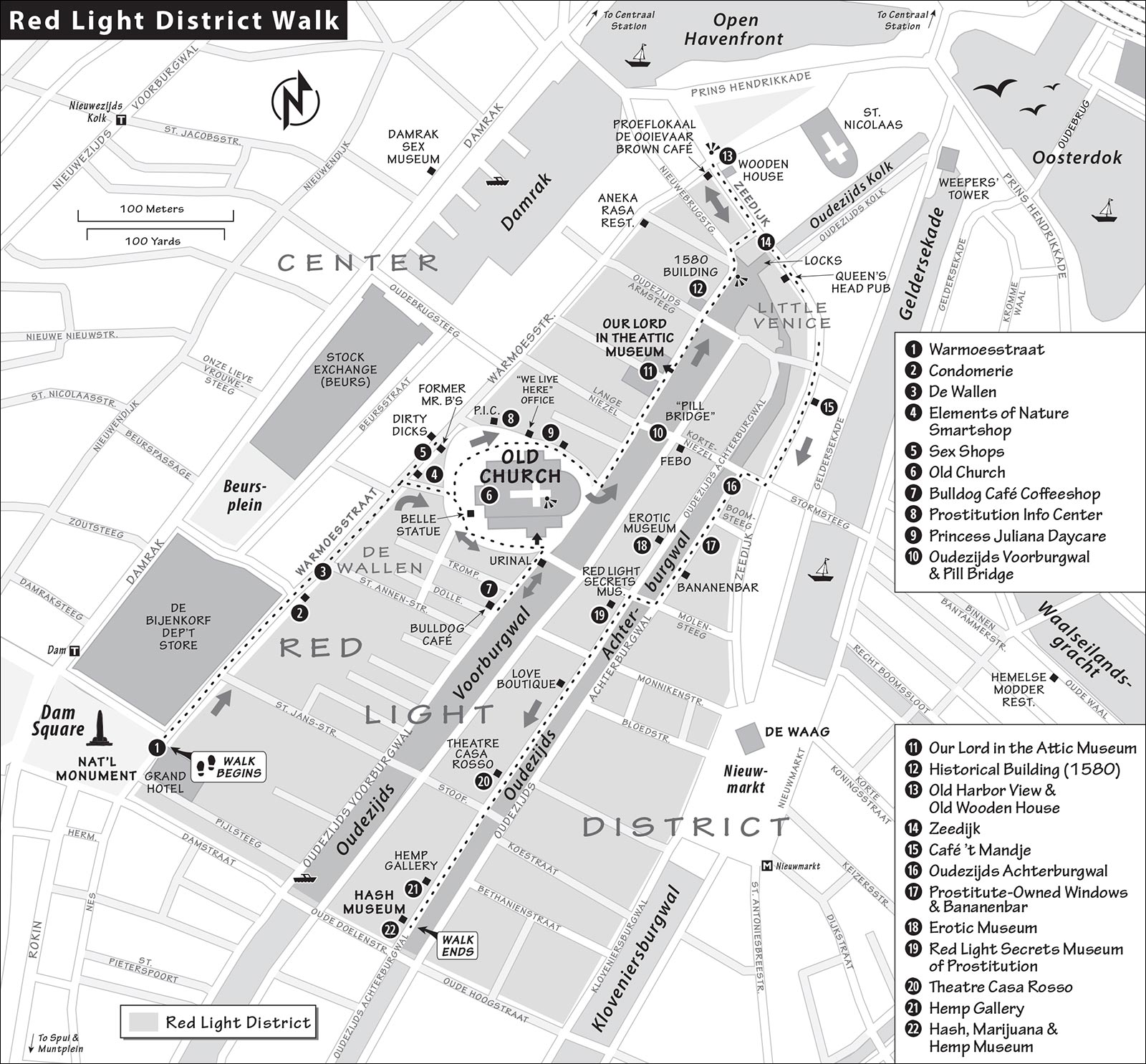
You’ll walk a big, long loop through the heart of De Wallen (the official name of the district): north on Warmoesstraat, past the Old Church, up Oudezijds Voorburgwal street; hook around on Zeedijk street; and return south on Oudezijds Achterburgwal street, ending two blocks from Dam Square.
The Walk Begins
• Start at the east end of Dam Square—the opposite end from the giant Royal Palace—behind the big, white obelisk. Face the fancy Grand Hotel Krasnapolsky, and turn left to walk up the long, narrow, mostly traffic-free street called...
1 Warmoesstraat
You’re walking along one of the city’s oldest streets. It’s the traditional border of the neighborhood tourists call the Red Light District.
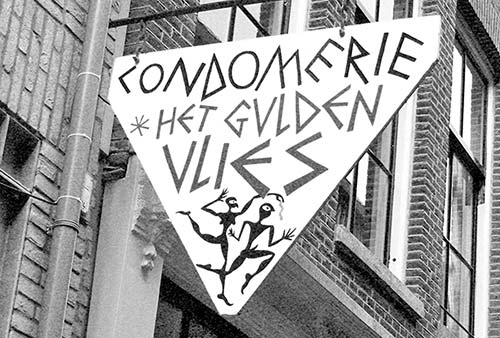
• Our first stop is the small shop with the large, yellow triangle sign, about 100 yards down on the right at #141.
2 Condomerie
Located at the entrance to the Red Light District, this is the perfect place to get prepared. Besides selling an amazing variety of condoms, this shop has a knack for entertainment and works to make its front-window display appropriate to the season. Pop in and look around.
• From here, pass the two little street barricades with cute red lights around them and enter the traffic-free world of...
3 De Wallen
Amsterdammers call this area De Wallen (“The Walls”), after the old retaining walls that once stood here. It’s the oldest part of town, with the oldest church. It grew up between the harbor and Dam Square, where the city was born. Amsterdam was a port town, located where the river met the sea. The city traded in all kinds of goods and services, including things popular with sailors and businessmen away from home—like sex and drugs.
As you get deeper into the neighborhood, you’ll see that the area attracts many out-of-towners, especially Brits. They catch cheap flights here for “stag” (bachelor) parties or just a wild weekend—and the money-savvy Dutch accommodate them with Irish pubs and football matches on TVs in the bars. According to legend, Quentin Tarantino holed up at the Winston Hotel for three months in 1993 to write Pulp Fiction (you’ll pass it on your right, at #129—now a youth hostel).
Pause at the intersection with a small street called Wijde Kerksteeg, which leads to the Old Church. Standing here, you may see gay-pride flags in rainbow colors or S&M bars. Also notice the security cameras and modern lighting. Freedom reigns in this quarter—under the watchful eye of the neighborhood police department.
• Continue down Warmoesstraat a few more steps. At #97 (on the right) is the...
4 Elements of Nature Smartshop
This “smartshop” is a little grocery store of mind-bending “natural” ingredients. Like the city’s other smartshops, it’s a clean, well-lit, fully professional retail outlet that sells powerful drugs, many of which are illegal in America. Products are clearly marked with prices, brief descriptions, ingredients, and effects. The knowledgeable salespeople can give you more information on their “100 percent natural products that play with the human senses.”
Their “natural” drugs include harmless nutrition boosters (such as royal jelly), harmful but familiar tobacco, and herbal versions of popular dance-club drugs (such as herbal Ecstasy). Marijuana seeds, however, are the big sellers. You’ll also see mind-bending “magic” truffles, a trend that caught on after the EU forbade the retailing of hallucinogenic mushrooms. (Truffles grow underground—so they’re technically not mushrooms.)
Still, my fellow travelers, caveat emptor! We’ve grown used to thinking, “If it’s legal, it must be safe. If it’s not, I’ll sue.” Though perfectly legal and aboveboard in the Netherlands, some of these substances can cause powerful, often unpleasant reactions.
• Continue a bit farther down Warmoesstraat, to an area filled with...
5 Sex Shops
A few steps down Warmoesstraat, at #89 (also on the right), was Mr. B’s Leather and Rubber Land. It’s now Jamin, a tourist-gouging bulk candy store. Yes, things are changing—but DD (Dirty Dicks) across the street at #86 is still in business. Notice the very low-profile entrances to several men-only leather bars, with their black doors and windows. These places come with a bar, a dance floor, and a dark back room. (I guess that’s one reason to get a glow-in-the-dark condom at Condomerie.)
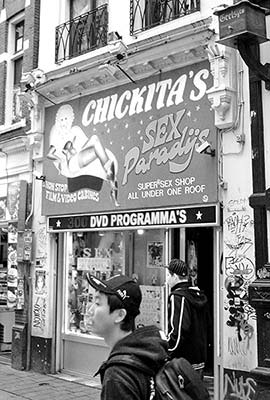
Throughout the district, various sex-shop retail outlets deal in erotic paraphernalia (dildos, S&M starter kits, kinky magazines) and offer video booths with porn films, charging by the minute. While Amsterdam is notorious for its Red Light District, even small Dutch towns often have a sex shop and a brothel to satisfy their citizens’ needs.
• Backtrack a few steps to the intersection and head down Wijde Kerksteeg to the Old Church. Pause at the base of the impressive tower.
6 Old Church (Oude Kerk)
As the name implies, this was the medieval city’s original church. Returning from a long sea voyage, sailors of yore would spy the steeple of the Old Church on the horizon and know they were home. Having returned safely, they’d come here to give thanks to St. Nicholas—the patron saint of this church, of seafarers, of Christmas, and of the city of Amsterdam.
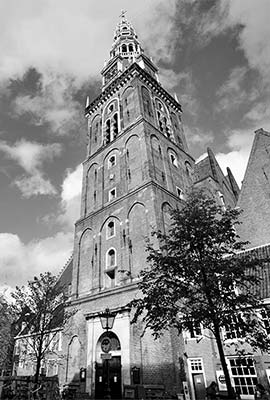
Church construction began in the early 1200s—starting with a humble wooden chapel that expanded into a stone structure by the time it was consecrated in 1306. Additional construction happened in fits and starts for the next 200 years—as is apparent in the building’s many gangly parts. Then, in the 15th century, Amsterdam built the New Church (Nieuwe Kerk) on Dam Square. But the Old Church still had the tallest spire, the biggest organ, and the most side altars, and it remained the city’s center of activity, bustling inside and out with merchants and street markets.
The tower is 290 feet high, with an octagonal steeple atop a bell tower (you may be able to pay to climb to the top). This tower served as the model for many other Dutch steeples. The carillon has 47 bells, which can chime mechanically or be played by one of Amsterdam’s three official carillonneurs.
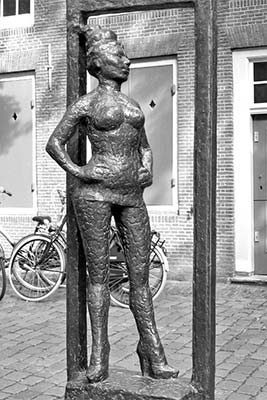
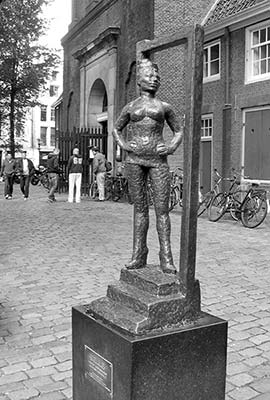
To head inside, walk around the right side of the church to find the entrance. As you walk, keep an eye out for a statue dedicated to the Unknown Prostitute. She’s nicknamed Belle, and the statue honors “sex workers around the world.” Between there and the door to the church, you might trip over a bronze breast sculpted into the cobbles, being groped by bronze hands.
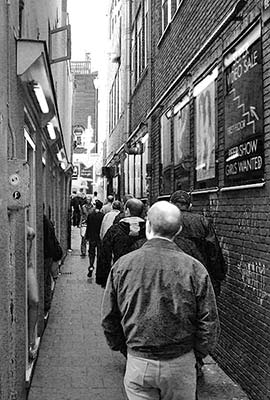
Today nearly a thousand prostitutes work in the Red Light District, sharing about 200 windows...and a very long history.
The port city of Amsterdam always had sailors in need of entertainment—and as far back as the 1400s, there were prostitutes walking with red lanterns and working mostly in the inns of De Wallen. With the piety of the Reformation (late 1500s), there was a brief attempt to suppress the sex trade. But by the 1600s, a thousand prostitutes were working here, and sexually transmitted disease ran rampant—many customers enjoyed brief encounters, then paid with their lives.
With the age of Napoleon (early 1800s) came a pragmatic form of legal prostitution intended to fight STDs. Sex workers were required to have permits and submit to twice-weekly checkups to certify they were disease-free. By mid-century, effective (rubber) condoms were readily available. Prostitution boomed, with an estimated 3,000 sex workers here.
Widespread prostitution was targeted by the more moralistic Victorian Age. But creative tolerance eventually prevailed, and by about 1900, streetwalkers had been replaced by the “window prostitution” we see today, limited to specific districts.
In recent times, prostitution has been seen more as a practical problem than a moral one. It’s often linked to disease, human trafficking, organized crime...and rowdy, drunken tourists, injuring themselves and others late at night. To remove the criminal element, prostitution was officially legalized in 2000, and in 2007 city leaders introduced Project 1012 (named for De Wallen’s postal code)—an attempt to normalize the trade. Prostitution is now considered just another profession, with rules, regulations, and taxes.
But city leaders continue cutting back on the legal sex trade in De Wallen. One street that was once lined with red lights (Dollebegijnensteeg, next to the Bulldog Café Coffeeshop) lost its permits and is now deserted. An ambitious proposal would relocate sex workers to a giant, futuristic facility on the outskirts of the city, removing tourism from the equation while allowing workers to continue seeing Dutch clients. But Dutch NIMBYs don’t want the new facility close to their homes, and supporters of legal prostitution in Amsterdam say the plan marginalizes sex workers. Will the red lights of the Red Light District become a thing of the past? Stay tuned.
Church Interior: While the church is historic, the interior doesn’t offer much to see other than hundreds of gravestones in the floor (the most famous is for Rembrandt’s wife, Saskia). Its starkness stems from the religious wars of the 16th century: Protestants gutted this Catholic church, smashing windows and removing politically incorrect statues they considered “graven images.” (Strict Calvinists at one point even removed the organ as a senseless luxury, until they found they couldn’t stay on key singing hymns without it.) Atop the brass choir screen, an inscription (’t misbruyk in Godes...) commemorates the iconoclasm: “The false practices introduced into God’s church were undone here in 1578.”
The church, permanently stripped of “pope-ish” decoration, was transformed from Catholic to Dutch Reformed, “St. Nicholas” was dropped from the name, and it became known by the nickname everyone called it anyway—the Old Church. Nowadays, the church is the holy needle around which the unholy Red Light District spins.
Back Outside: Attached to the church like barnacles are small buildings. These were originally used as homes for priests, church offices, or rental units. The house to the right of the entrance is now a delightful café (de Koffie Schenkerij).
The dark-metal structure over by the canal is a public urinal. It offers juuust enough privacy. This one gets a lot of use. City trucks circulate around town on a regular basis, suds-ing it down.
Consider that, on average, about 12 people drown in Amsterdam every year. When found, most of them turn out to be men with their zippers down. It’s not hard to imagine the scene: Some guy is drunk as a skunk at 3 a.m., goes to the edge of the canal to take a pee...and falls in. If you wonder why there are only urinals—not public WCs for women—it’s because they very rarely find women floating in the canal. There’s that Dutch pragmatism again. That may be changing though: A coalition of women and people who use wheelchairs are pressing Amsterdam to build more public WCs for those who pee sitting down.
• From the urinal, turn right and go a half-block south along the canal toward the...
7 Bulldog Café Coffeeshop
The Bulldog claims to be Amsterdam’s very first marijuana coffeeshop, established here in 1975. Now there’s a chain of Bulldogs around the city.
As coffeeshops go, the Bulldog is considered pretty touristy, catering to a young crowd. (Older connoisseurs often seek out smaller places with better-quality pot.) The staff is unintimidating, though, and timid first-timers are guided through the process. Step in and snoop around. As long as you don’t take photos, you’re welcome. Check out the menu. Ask the budtender any questions. Climb down the stairs to the basement coffeeshop where a door leads back out into the street.
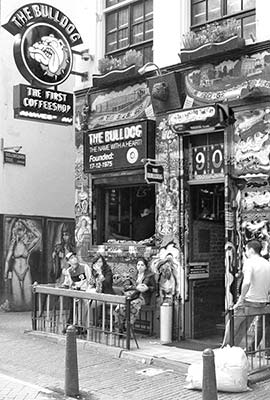
The political winds regarding cannabis are always shifting. Some Dutch leaders propose forbidding sales to nonresidents, hoping to discourage European drug dealers from driving over the Dutch border to buy large quantities of pot to sell illegally in their home countries. However, such a law would be devastating for businesses that depend on out-of-towners, so many Amsterdam politicians favor keeping pot legal—for the sake of business and to prevent legal cannabis sales from moving back to the black market. When neighboring Germany voted to legalize marijuana in 2024, the situation became even more complicated—and it’s still being sorted out. For more on the pragmatic Dutch approach to pot and how coffeeshops work, see the Smoking chapter.
• Head back to the Old Church and circle it clockwise. Around the far side, at Enge Kerksteeg 3, is the...
8 Prostitution Information Center (PIC)
This center (a nonprofit run by donations) exists to demystify prostitution, giving visitors matter-of-fact information on how the trade works and what it’s like to be a sex worker. It doles out pamphlets, books, condoms, T-shirts, and other offbeat souvenirs, and offers self-guided “Walk & Talk” tours (see “Orientation,” earlier, for details). They have a map showing exactly where prostitution is legal, and sell a small, frank booklet answering the most common questions tourists have about Amsterdam’s Red Light District. The center also offers a one-to-one workshop, for women only, on what it’s like to be a sex worker in Amsterdam (book in advance).
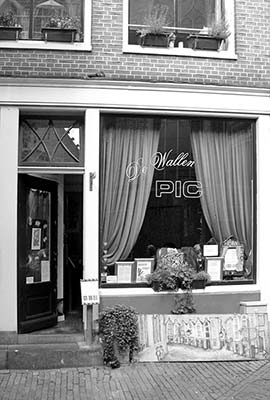
Next door to the left is a room-rental office (#3, Kamerverhuurbedrijf). Prostitutes come here to rent window space and bedrooms to use for their work. The office also sells work supplies—condoms by the case, toilet tissue, and lubricants. This office does not arrange sex. The women who rent space from this business are self-employed and negotiate directly with their customers.
In return for their rental fees, prostitutes get security. The rental office provides constant video surveillance. (You may see small cameras and orange alarm lights above many windows.) If prostitutes encounter trouble, they press a buzzer that swiftly calls a burly bouncer or the police. While the area may look rough, aside from tricky pickpockets these streets are actually pretty safe.
To the right of the PIC, at #30A, notice the sign that says “We Live Here”—a reminder that De Wallen is also a residential neighborhood, and that visitors should behave themselves accordingly. At certain times, you’re invited to go inside and chat with some locals about what it’s like to live tucked among the sex workers and gawking tourists (Thu-Sat 11:00-16:00, closed Sun-Wed, www.welivehereamsterdam.nl).
• Continue circling clockwise around the church and find the brick building on the left at Oudekerksplein 8. This is the...
9 Princess Juliana Daycare
Ordinary citizens go about their daily lives in residential De Wallen, and that includes needing someplace to send their kids. The Princess Juliana Daycare is for newborns to four-year-olds. It was built in the 1970s, when the idea was to mix all dimensions of society together, absorbing the seedy into the decent. I don’t know about you, but this location would be a tough sell where I come from.
• Turn left at the canal and continue north along...
10 Oudezijds Voorburgwal and Pill Bridge
Pause at “Pill Bridge” and enjoy the canal and all the old buildings with their charming gables. Back in the 1970s, this bridge was nicknamed for the retail items sold by the seedy guys who used to hang out here. Thanks to smart and pragmatic public policy, the Dutch have made great gains in fighting hard-drug addiction. And now this neighborhood is a pleasant place for a photo op.
• Just past the bridge, at Oudezijds Voorburgwal 38, is one of the city’s most worthwhile museums.
The system is simple. A customer browses around. A prostitute catches his eye. If the prostitute is interested in his business (prostitutes are selective for their own safety), she winks him over. They talk at the door as she explains her price and what she has to offer. A price is agreed on and paid in advance. A typical visit costs €50 for a promised 20 minutes. The customer goes in. The prostitute draws the curtain. Where do they actually do it? The rooms look tiny from the street, but these are just display windows. There’s a bigger room behind or upstairs that comes with a bed, a sink, and not much else (or so I’ve heard). The average time for a visit: about 10 minutes.
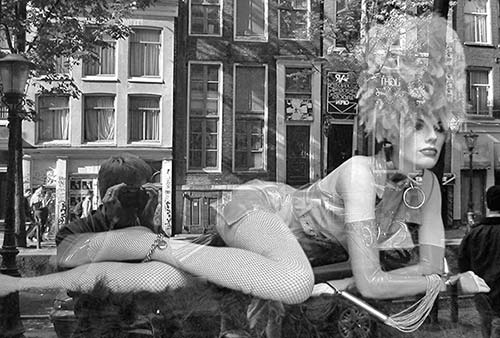
Are there male prostitutes? Well—anything you might want is available somewhere in the Red Light District. But a 1990s experiment to put male prostitutes in windows didn’t stand up. Today male prostitutes solicit work mostly online and in clubs. The district does, however, have some transgender prostitutes working in windows.
The prostitutes here are self-employed—renting space and running their own businesses. They usually work four-to-eight-hour shifts. A good spot costs about €100 for a day shift and €180 for an evening. Prostitutes are required to keep their premises hygienic, make sure their clients use condoms, and avoid minors.
While the hope here is that sex workers are smartly regulated small-businesspeople, in reality the line between victim and entrepreneur is not always clear. Although some women choose sex work as a lucrative career, others (some say most) are forced into it by circumstance—poverty, drug addiction, abusive men, and immigration scams. After the fall of the Iron Curtain, many Eastern Europeans flocked here, and Russian and Eastern European crime syndicates muscled in. Many sex workers are forced to work by pimps who use their children back home as hostages. A recent trend is women from Bulgaria and Romania coming to the Netherlands with the same goal as guest workers in other countries: to work hard long enough to return home and set up their family financially.
Popular sex workers can make about €1,000 a day. The law, not pimps, protects them, and they fill out tax returns. As shocking as legalized prostitution may seem to some, it’s a good example of a pragmatic Dutch solution to an age-old dilemma.
11 Our Lord in the Attic Museum
With its triangular gable, this building looks like just another townhouse. But inside, it holds a secret—a small, lavishly decorated place of worship hidden in the attic. Although Amsterdam has long been known for its tolerance, back in the 16th and 17th centuries there was one group they kept in the closet—Catholics. ( For more, see the Our Lord in the Attic Museum Tour chapter.)
As we stroll up the canal, remember that this neighborhood is Amsterdam’s oldest. It sits on formerly marshy land that was reclaimed by diking off the sea’s tidal surge. That location gave Amsterdam’s merchants easy access to both river trade and the North Sea. By the 1500s, Amsterdam was booming.
• Facing the next bridge, on your left at #14, is an old brick building with red shutters.
12 Historical Building
This building dates from that very era—around 1580. At the time of its construction, Amsterdam’s citizens were rising up in revolt to throw out their Spanish rulers. Now free to govern themselves, a group of energetic businessmen turned the city into a sea-trading hub. By 1600, brave Dutch sailors were traveling as far as Africa, America, and Asia. They returned with shiploads of exotic goods to sell to the rest of Europe.
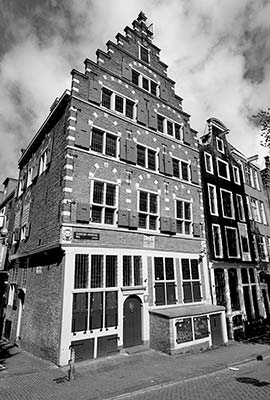
Next to the red door, notice the label: “Leger des Heils”—that’s “Salvation Army.” There was a time when this was a bastion of compassion and hope for the desperate people who littered these streets. By the canal is a statue of Major Alida Bosshardt—a Salvation Army officer who worked tirelessly in the Red Light District in the mid-20th century.
The part of the canal we’re walking along now is known as “Little Venice” (a term used Europe-wide for any charming neighborhood with canalside houses). Houses rise directly from the water here, with no quays or streets. Like Venice, the city was built in a marshy delta area on millions of pilings. And, like Venice, it grew rich on sea trade.
Notice the handsome gable stones embedded in the wall at the end of the canal. There are hundreds of these still in place around town. They served one of several functions: to make a religious statement, act as an ad for a business, show off a noble family seal, or give an address a nickname so people could find your house before there were street numbers.
• Continue straight up a small inclined lane called Sint Olofssteeg. You’re ascending the protective sea dike (Zeedijk), which, until the 1930s when the broader sea was tamed, prevented this neighborhood from being inundated by North Sea tidal surges. At the top, turn left and walk along the street called Zeedijk. Go about 100 yards to the end of the block. On the right, at #1, you’ll pass an old wooden house that was once a tavern at the water’s edge.
Just beyond, Zeedijk opens up to an...
13 Old Harbor
As you survey the urban scene of today’s Damrak and Centraal station, imagine the scene as it looked in the 1600s. What today is mostly concrete was once the city’s harbor. Oceangoing ships sailed in and out of the harbor through an opening located where the train station sits now (on reclaimed land).
This was a bustling port. Amsterdam became home to the Dutch East India Company, the world’s first multinational corporation. Goods from all over the world flowed into the harbor, where cargo was then transferred to smaller river-trade boats that sailed up the Amstel to Europe’s interior. The city grew wealthier and larger, expanding beyond De Wallen to new neighborhoods to the west and south. In its golden age, this blend of overseas trade and canal-borne commerce helped Amsterdam become known as the “warehouse of the world” and perhaps the wealthiest city on Earth.
Picture a ship tying up in the harbor. The crew has just returned home from a two-year voyage to Bali. They’re bringing home fabulous riches—crates and crates of spices, coffee, and silk. Sailors are celebrating their homecoming, spilling onto Zeedijk. Here they’ll be greeted by swinging ladies swinging red lanterns. Their first stop might be nearby St. Olaf’s chapel to say a prayer of thanks—or perhaps they’ll head straight to this tavern at Zeedijk 1 and drop anchor for a good Dutch beer. Ahh-hh!
• But our journey continues. Backtrack along the same street, to the crest of a bridge, on...
14 Zeedijk
You’re standing atop the historic dike, at about sea level. From here you can look down at the canalside lanes and see how Amsterdam is below sea level. The waterway below you is part of the city’s system of locks: Once upon a time, each day a worker would open up the locks and the tide would flush out the city’s canals.
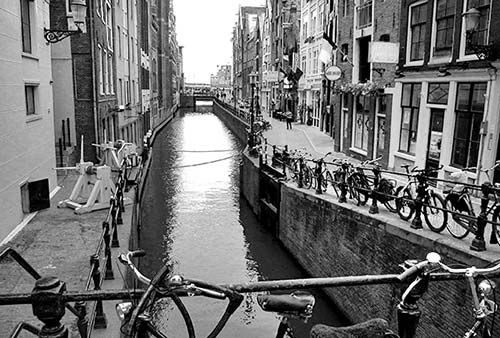
In the early 1600s, this neighborhood was thriving with overseas trade. But Amsterdam would soon lose its maritime supremacy to England and France, and by midcentury, its trading ships and economy had been destroyed by wars with these rivals. The city remained culturally vibrant, and banking flourished. But with less shipping, De Wallen never really recovered.
As you continue down Zeedijk and around the bend, you can see that the area has maintained its colorful character. Residents enjoy a mix of international restaurants—Thai, Portuguese, and Argentinian, for example—and bars like the Queen’s Head (at #20, on the right, with its various rainbow flags) that draw a gay clientele.
Back in the 1960s, Amsterdam was the world capital of experimental lifestyles, a wide-open city of sex and drugs. But by the 1970s, that idealism had soured, and Zeedijk had become unbelievably sleazy. When I made my first trip here, this street was nicknamed “Heroin Alley.” Thousands of hard-drug addicts wandered the neighborhood and squatted in old buildings. “Pill Bridge” (which we passed earlier) became “Needle Bridge.” It was a scene with little else besides sex, hard drugs, and wandering lonely souls. The area was a no-man’s-land of junkies fighting among themselves, and the police just kept their distance.
But locals longed to take back this historic corner of their city and got to work. First, they legalized marijuana and allowed “coffeeshops” to sell small quantities. Then they cracked down on hard drugs—heroin, cocaine, and pills. Almost overnight, the illicit-drug trade dropped dramatically. Dealers got stiff sentences. Addicts got treatment. Decades later, the policy seems to have worked. Pot smoking has not gone up, hard-drug use is down, and for a time, Zeedijk belonged to the people of Amsterdam once again—only to be taken over by tourists. Today there’s a push to remind visitors that, yes, real people live here.
• Pause at #63, on the left.
15 Café ’t Mandje
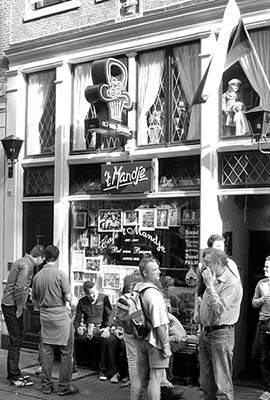
This is one of Europe’s first gay bars. It opened in 1927, closed in 1985, and is now a working bar once again. It stands as a memorial to the woman who ran it during its heyday in the 1950s and ’60s: Bet van Beeren, “Queen of Zeedijk.” Bet was a lesbian, and her bar became an LGBTQ hangout (back before many knew what all those letters stood for). It still is, though all are welcome. If you go inside for a drink, you’ll enjoy a tiny interior crammed with photos and memorabilia. Bet was the original Zee-dyke—you might see a picture of her decked out in leather, cruising the streets on her motorcycle. Neckties hang from the ceiling, a reminder of Bet’s tradition of scissoring off customers’ ties.
• This tour veers right at the next intersection (near #80), back into the heart of the Red Light District. For a quick detour, however, you could continue straight ahead for a peek into the local Chinatown. Otherwise, make the next right and head a few steps down narrow Korte Stormsteeg street, back to the canalside red lights. Then go left, walking along the left side of the canal.
16 Oudezijds Achterburgwal
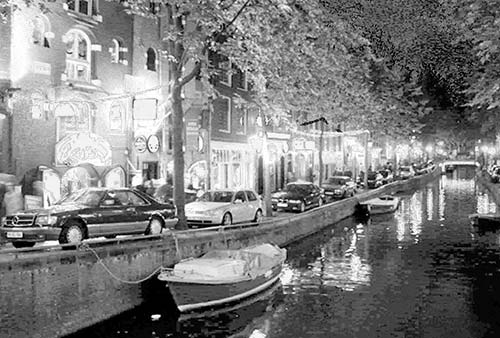
We’re back in the quirky glow of the Red Light District. This beautiful, tree-lined canal is the heart of this neighborhood’s nightlife, playing host to most of the main nightclubs. Stand here for a second and take it all in. The street is lined with ladies in windows, sex shops, sex museums, strip clubs, and theaters where sex acts are performed before live audiences. By the way, even here, where it seems “anything goes,” things are under strict control. At the bridge, notice the sign that says Geen alcohol op straat—a reminder that drinking out in the street can cost you a €100 fine. Public urination (Wildplassen) will run you €140.
• Remember: Don’t take any pictures, and watch for pickpockets if crowds jostle together. Start making your way down the street’s left-hand side. After about 30 yards, pause at the small alleyway called Boomsteeg.
17 Prostitute-Owned Windows and Bananenbar
Many of the prostitution windows near here (such as at Oudezijds #17, #19, and #27, and along Boomsteeg) are run by a cooperative of entrepreneurial prostitutes called Red Light Offices Boomsteeg. You may see their for-rent signs, seeking prostitutes who want to rent a window space. These women have banded together to create nice rooms for their clients and good working conditions for themselves, such as a lounge for sex workers between shifts.
Continue a few yards ahead, to #37. This popular nightclub (“Banana Bar”) is a strip club with a-peel: For a stiff fee, you get admission for an hour, drinks included. Undressed ladies perch on the bar and serve the drinks. Touching is not allowed, but you can order a banana and the lady will serve it to you, any way you like. For a full description, step into the lobby.
• A few yards farther along, at Molensteeg, cross the bridge to head to the other side of Oudezijds Achterburgwal. Once across the bridge, we’ll turn left. But first, pause and look to the right. At #54 is the...
18 Erotic Museum
“Wot a rip-off!” said a drunk British lout to his mates as he emerged from the Erotic Museum. If it’s graphic sex you seek, this is not the place. To put it bluntly, this museum is not very good (the Damrak Sex Museum described on here is better).
This museum, however, does offer a peek at some of the sex services found in the Red Light District. Besides the self-pleasuring bicycle girl in the lobby, displays include reconstructions of a prostitute’s chambers, sex-shop windows, and videos of nightclub sex shows (on the third floor). There’s also the S&M room, where S-mannequins torment M-mannequins for their mutual pleasure.
• From the bridge, turn left and walk south along Oudezijds Achterburgwal. At #60H is the...
19 Red Light Secrets Museum of Prostitution
Though overpriced, this museum is an earnest and mildly educational behind-the-scenes look at the work done by those women in the window. You’ll walk through a typical (tiny) room where prostitutes stand at the window, and a typical (tiny) back room with a bed and sink where the dirty deed takes place. There’s a cheesy hot-tub room for the high rollers, a display of S&M paraphernalia, and several videos about daily life for prostitutes. Perhaps most thought provoking: a video giving you the point of view of a sex worker as browsers check you out. The place is small, and a visit takes about as long as a typical session with a prostitute.
Farther down Oudezijds Achterburgwal (at #78) is The Love Boutique. Part lingerie store, part soft-core sex shop, this place caters to all your sensual needs.
• Continuing south, you’ll pass two Casa Rosso franchises a block apart. The larger, second one—with baby elephants lining the sidewalk out front—is...
20 Theatre Casa Rosso
This is the Red Light District’s best-known nightclub for live sex shows. Unlike some strip clubs that draw you in to rip you off with hidden charges, the Casa Rosso is a legitimate operation. Audience members pay a single price that includes drinks and a show. Evening performances feature strippers, but the main event is naked performers on stage engaging in sex acts—some simulated, some completely real (€65 includes drinks, nightly until 2:00 in the morning).
As you continue south along the canal, you gotta wonder, “Why does Amsterdam embrace prostitution and drugs?” It’s not that the Dutch are more liberal in their attitudes. They’re simply more pragmatic. They’ve found that when the sex trade goes underground, you get pimps, mobsters, and the spread of STDs. When marijuana is illegal, you get drug dealers, gangs, and violent turf wars. Their solution is to minimize problems through strict regulation.
• But enough about sex. Let’s talk about drugs. (Don’t worry, our walk is nearly over.) Along the next block, you’ll find two cannabis-related establishments, starting at #130.
21 Hemp Gallery
One ticket admits you to both the Hemp Gallery and the Hash, Marijuana, and Hemp Museum (described next). The gallery focuses mainly on extolling the wonders of industrial hemp, and isn’t as meaty as the small, earnestly educational museum. If you have the patience to read its thorough displays, you’ll learn plenty about how valuable cannabis was to Holland during its golden age. The leafy green plant was grown on large plantations. The fibrous stalks (hemp) were made into rope and canvas for ships, and even used to make clothing and lace. Without hemp, Henry Hudson would never have made it out of the harbor.
• Next is our last stop at #148, the...
22 Hash, Marijuana, and Hemp Museum
This museum treats marijuana like it deserves scholarly study. The exhibits are quite extensive and interesting.
Certain strains of the cannabis plant—particularly mature females of the species sativa and indica—contain the psychoactive alkaloid tetrahydrocannabinol (THC) that makes you high. The buds, flowers, and leaves (marijuana) can be dried and smoked. The brown sap/resin/pitch that oozes out of the leaves (hashish, a.k.a. hash) can also be dried and smoked. Both produce effects ranging from euphoria to paranoia to the munchies.
Throughout history, various peoples have used cannabis as a sacred ritual drug—from ancient Scythians and Hindus to modern Nepalis and Afghans. Modern Rastafarians, following a Bible-based religion centered in Jamaica, smoke cannabis. To worship, they get high, bob to reggae music, and praise God. They love the Bible verse (Genesis 1:11-12) that says God created “every herb” and called them all “good.” All over Amsterdam, you’ll see the Rastafarian colors: green, gold, and red, mon.
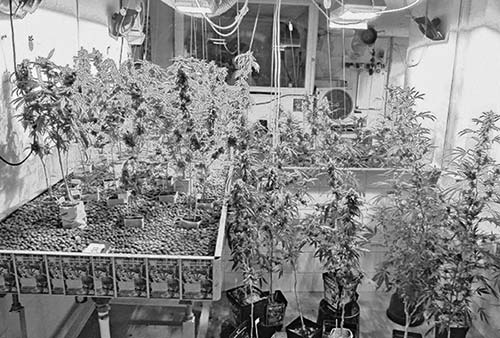
The museum’s highlight is the flowering room, where you look through windows at live cannabis plants in bloom. At a certain stage they’re “sexed” to weed out the boring males and “selected” to produce the most powerful strains.
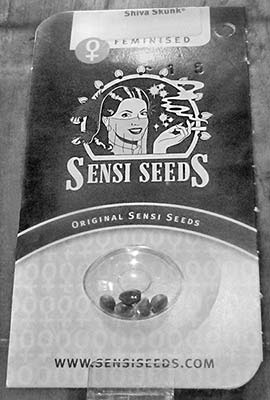
At the museum’s exit you’ll pass through the Sensi Seed Bank Store, which sells weed seeds, how-to books, and knickknacks geared to growers.
• We’ve reached the end of our tour. Dam Square is just two blocks away. Continue a few steps farther up the canal to the big and busy Oude Doelen street. Look right, and you’ll see the Royal Palace on Dam Square.
Congratulations
We’ve seen a lot—from sex workers to drug pushers to the ghosts of pioneer lesbians to politically active heads with green thumbs. We’ve talked a bit of history, a little politics, and a lot of sleaze. Congratulations. You’ve survived. Now, go back to your hotel and take a shower.