SIGHTS IN AMSTERDAM
CENTRAL AMSTERDAM, NEAR DAM SQUARE
▲Royal Palace (Koninklijk Huis)
RED LIGHT DISTRICT (DE WALLEN)
▲▲Our Lord in the Attic Museum
Houseboat Museum (Woonbootmuseum)
Museum of the Canals (Grachtenmuseum)
Willet-Holthuysen House (Huis Willet-Holthuisen)
▲▲▲Rijksmuseum
House of Bols: Cocktail & Genever Experience
▲Rembrandt’s House (Museum Het Rembrandthuis)
The Jewish Cultural Quarter (Joods Cultureel Kwartier)
▲▲Portuguese Synagogue (Esnoga)
▲Dutch Holocaust Memorial of Names (Holocaust Namenmonument Nederland)
▲▲National Holocaust Museum (Nationaal Holocaustmuseum)
Dutch Theater (Hollandsche Schouwburg)
▲▲Dutch Resistance Museum (Verzetsmuseum)
World Museum Amsterdam (Wereldmuseum Amsterdam)
NEMO (National Center for Science and Technology)
▲Netherlands Maritime Museum (Nederlands Scheepvaartmuseum)
NORTH AMSTERDAM (Amsterdam-Noord)
Bike Ride from Buiksloterweg into the Polderland
While all the commotion is over Amsterdam’s top three museums (the Anne Frank House, Van Gogh Museum, and Rijksmuseum), don’t underestimate the more than 50 others. One of Amsterdam’s delights is that it has perhaps more small specialty museums than any other city its size. From houseboats to sex, from marijuana to Old Masters, from a curiously fascinating collection of old pipes to one of Europe’s most poignant Holocaust exhibits, you can find a museum to suit your interests.
I’ve organized sights by neighborhood for handy sightseeing. In this chapter, some of Amsterdam’s most important sights have the shortest listings and are marked with a  . That’s because they are covered in much more depth in one of the self-guided walks or tours in this book. A
  means the walk or tour is available as a free audio tour (via my Rick Steves Audio Europe app—see here).
Sightseeing Strategies
ADVANCE TICKETS
Buy timed-entry tickets online in advance for Amsterdam’s three most popular museums: the Anne Frank House (tickets released six weeks in advance, every Tuesday at 10:00 Amsterdam time), Van Gogh Museum (reserve a few weeks in advance for busy times), and Rijksmuseum (higher-capacity, but still wise to book a few weeks ahead).
Always book directly on the sight’s official website. You’ll select your preferred date and entry time (usually with a 30-minute window to enter), then make the purchase with your credit card. Once you’ve booked, you’ll receive an email—usually with a QR code—that acts as your digital ticket. When you get to the sight at your designated time, pull up the digital ticket on your phone, scan it, and walk right in.
PLANNING A THREE-MUSEUM DAY
The Rijksmuseum, Van Gogh Museum, and Stedelijk Museum are all in the Museumplein area. To see them all in a single day, there are two good strategies to keep in mind when buying timed-entry tickets in advance.
One approach is to see the museums chronologically, in historical order: First, take in the Old Masters at the Rijks, then Impressionism at the Van Gogh, and finish with modern art at the Stedelijk.
But if you’re in town during the busy season, you can avoid crowds by following this plan: See the Van Gogh Museum right when it opens at 9:00, then visit the less-congested Stedelijk. From there, you could wander over to De Pijp to check out (and graze through) the Albert Cuyp Market, or have lunch near Museumplein and take in some extra other nearby sights—such as Coster Diamonds (see here) and the House of Bols (see here). Finally, hit the Rijksmuseum after 14:00, when crowds there begin to subside.
SIGHTSEEING PASSES
Tally the cost of the covered sights you plan visit to determine if these passes are worthwhile for you. Note that even with a pass, you still must make an online reservation for sights that require them; you can make a reservation online before you receive your pass, but you’ll need to present the pass with your reservation at the sight.
I Amsterdam City Card: If you’ll use lots of public transportation and plan to pack in tons of sights, this pass might save a few euros. It provides free or discounted entry to many sights in and around Amsterdam (but not the Anne Frank House or Van Gogh Museum). It also includes a canal cruise, bike rental, and transit pass (€60/24 hours, €85/48 hours, €100/72 hours, download the app to purchase or buy at the I Amsterdam Store at the back of Centraal station, www.iamsterdam.com).
Museumkaart: This sightseeing pass might save you a little money, but you can use it at only five sights out of the 450 sights it covers all over the country (€75, valid 31 days, full details and list of covered sights at www.museumkaart.nl).
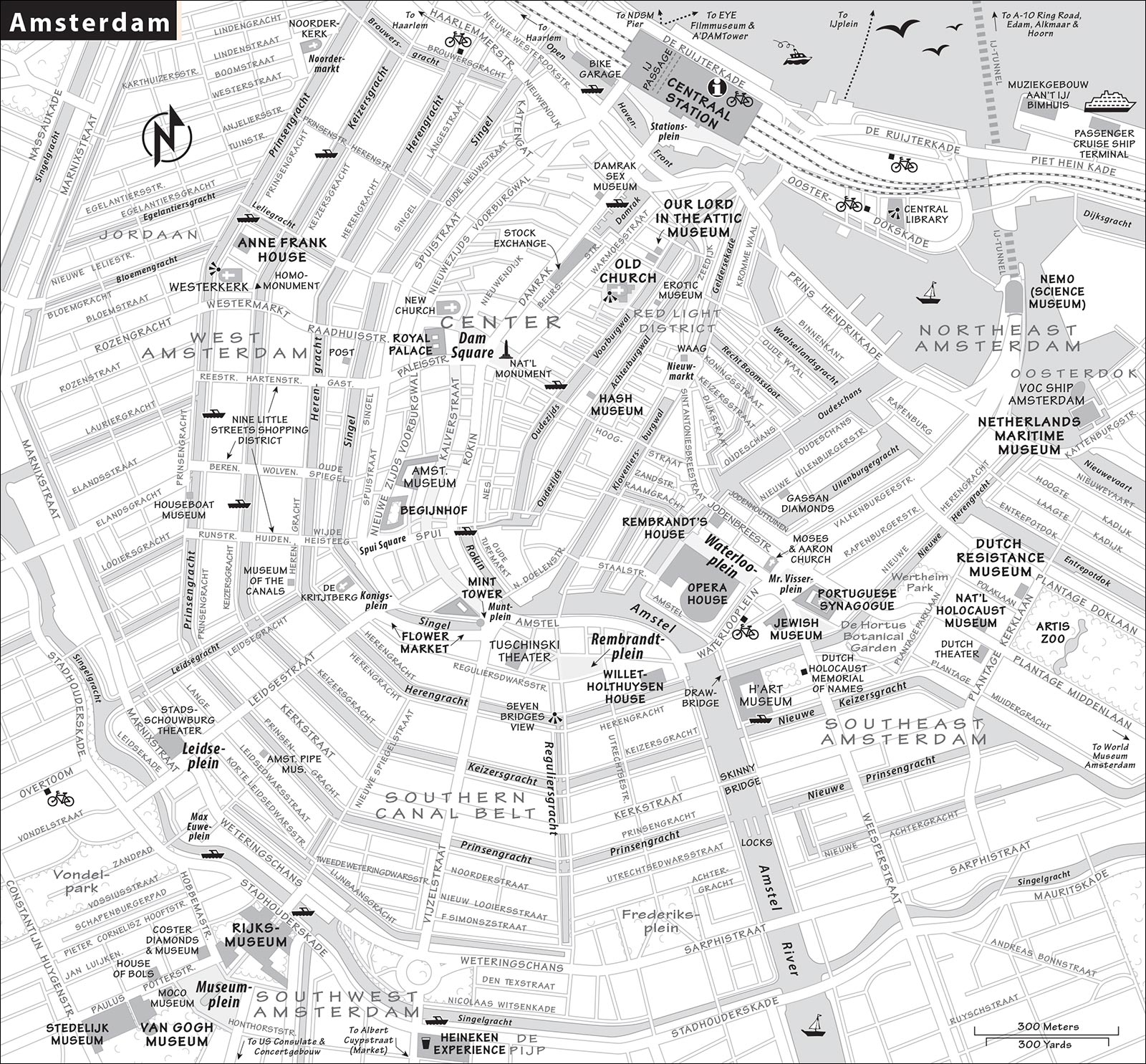
CENTRAL AMSTERDAM, NEAR DAM SQUARE
Connect the following sights with my Amsterdam City Walk chapter and audio tour.
▲Royal Palace (Koninklijk Huis)
This palace was built as a lavish City Hall (1648-1655), when Holland was a proud new republic and Amsterdam was the richest city on the planet—awash in profit from trade. The building became a “Royal Palace” when Napoleon installed his brother Louis as king (1806). After Napoleon’s fall, it continued as a royal residence for the Dutch royal family, the House of Orange. Today, it’s one of King Willem-Alexander’s official residences, with a single impressive floor open to the public. Visitors can gawk at a grand hall and stroll about 20 lavishly decorated rooms full of chandeliers, paintings, statues, and furniture that reflect Amsterdam’s former status as the center of global trade. Use my following mini-tour to see the highlights; supplement it with the included audioguide.
Cost and Hours: €12.50, daily 10:00-17:00 but hours can vary for official ceremonies—check website, +31 20 522 6161, www.paleisamsterdam.nl.
 Self-Guided Tour: Start in the vast, white Citizens’ Hall. It’s the palace’s highlight—120 feet by 60 feet by 90 feet, and lit by eight big chandeliers. At the far end, a statue of Atlas holds the globe of the world, and the ceiling painting shows Lady Amsterdam triumphant amid the clouds of heaven. On the floor, inlaid maps show what the Dutch considered the known world circa 1750 (back when the West Coast of the US was still being explored by Europeans). The hall is used today to host foreign dignitaries and for royal family wedding receptions. From this central hall, you tour the palace counterclockwise.
Directly ahead (under Atlas) is the opulently draped-and-chandeliered Throne Room. Like all the palace’s rooms, this has elements from the three layers of the palace’s history. Originally, it was the courthouse where self-governing citizens doled out justice (and couples were wed in the arcaded area to the right). In the early 1800s, Louis Bonaparte issued dictates from his throne in front of the fireplace to the left. (The painting over the mantle shows the original law-giver, Moses, with the Ten Commandments.) These days the chamber is a reception room for the ruling-as-entertainment Orange family.
Continue into the Small Reception Room. Get acquainted with the interior decor Louis introduced to the entire building—the so-called Empire Style. The curtains are heavy, the carpet has geometric patterns, and each room has a color-coordinated theme. The furniture is high-polished mahogany with upholstery featuring laurel wreaths and torches, and brass highlights. Chairs have arched backs, armrests, and tapered legs.
▲▲▲Anne Frank House Young Anne’s hideaway during the Nazi occupation. Hours: Daily 9:00-22:00.
▲▲▲Rijksmuseum Best collection anywhere of the Dutch Masters—Rembrandt, Hals, Vermeer, and Steen—in a spectacular setting. Hours: Daily 9:00-17:00.
▲▲▲Van Gogh Museum More than 200 paintings by the angst-ridden artist. Hours: Daily 9:00-18:00, some Fri until 21:00, shorter hours mid-Oct-Feb.
▲▲Red Light District The world’s oldest profession in the city’s oldest neighborhood. Hours: Best from noon into the evening; avoid late at night. 
▲▲Our Lord in the Attic Museum Catholic church hidden in the attic of a 17th-century merchant’s house. Hours: Mon-Sat 10:00-18:00, Sun from 13:00.
▲▲Stedelijk Museum One of the Netherlands’ top modern-art museum. Hours: Daily 10:00-18:00.
▲▲Portuguese Synagogue Beloved synagogue that serves today’s Jewish community. Hours: Sun-Fri 10:00-17:00, closes earlier Dec-Jan and Fri off-season, closed Sat year-round.
▲▲National Holocaust Museum Powerful, modern exhibit displayed in a former teacher training school. Hours: Daily 10:00-17:00.
▲▲Dutch Resistance Museum History of the Dutch struggle against the Nazis. Hours: Mon-Fri 10:00-17:00, Sat-Sun from 11:00.
▲Royal Palace Lavish City Hall that takes you back to the golden age of the 17th century. Hours: Daily 10:00-17:00 when not closed for official ceremonies.
▲Begijnhof Quiet residential courtyard lined with picturesque houses. Hours: Daily 9:30-18:00.
▲Amsterdam Pipe Museum A collection of pipes from around the globe, displayed in a 17th-century canal house. Hours: Mon-Sat 12:00-18:00, closed Sun.
▲Hash, Marijuana, and Hemp Museum All the dope, from history and science to memorabilia. Hours: Daily 10:00-22:00.
▲Rembrandt’s House The master’s reconstructed studios, office, and bedroom. Hours: Daily 10:00-18:00.
▲H’ART Museum Temporary home of Amsterdam Museum city history collection; also hosts exhibits from Centre Pompidou in Paris, British Museum in London, and Smithsonian American Art Museum in Washington, DC. Hours: Daily 10:00-17:00.
▲Jewish Museum Exhibits on Judaism and culture. Hours: Daily 10:00-17:00.
▲Dutch Holocaust Memorial of Names Brick walls bearing names of Dutch dead. Hours: Daily 8:00-21:00, Oct-Feb until 20:00.
▲Netherlands Maritime Museum Rich seafaring story of the Netherlands, told with vivid artifacts. Hours: Daily 10:00-17:00.
Exit into the South Gallery and take your first right into the Chamber of the Mistress of the Robes of the Royal Household. Originally the place where bureaucrats administered the city budget, this space was later a tax office, then a lavish bedroom for Louis’ court, and more recently the childhood bedroom of the beloved Queen Beatrix.
Cross the gallery (past the Royal Apartment) to the Treasury Ordinary Room, which was Louis’ personal bedroom. (We’ll see his actual bed later.)
You pass through a couple of Burgomasters’ Chambers where the city council met. Paintings (by Rembrandt’s pupils) show righteous Romans after whom golden age Amsterdammers modeled themselves.
Pause in the narrow Balcony Chamber and take in the view outside, overlooking Dam Square. In olden times, the town crier or mayor made big pronouncements from here (note the trumpeting angels overhead), and the execution scaffold was set up nearby. These days, the small balcony outside is where today’s royals give speeches, wave to TV cameras, and blow kisses to the adoring crowds.
Next is the Execution Chamber, with a portrait of WWII-era Queen Wilhelmina. The Mozes Hall (where the council once met) has appropriate decoration: the 36 coats-of-arms of the Netherlands’ nobles and a huge painting of Moses with his council of 70 elders.
Farther along, gaze into the Orphans’ Chamber, which now displays Louis’ canopied bed. The Salon of the English Quarter is where Rembrandt officially went bankrupt. Back in the spacious Citizens’ Hall—a testament to Amsterdam’s greatness through the ages—head down the stairs to find one final room: the Tribunal. Here judges announced the type of death sentence handed down to the condemned: broken on the wheel, strangulation, or the most honorable—beheading.
New Church (Nieuwe Kerk)
This giant church stands overlooking Dam Square, next to the Royal Palace. Barely newer than the Red Light District’s “Old” Church, its 15th-century sanctuary has an intentionally spare interior, its decoration removed by 16th-century iconoclastic Protestants seeking to unclutter their communion with God. This is where many Dutch royal weddings and all inaugurations take place. The church hosts periodic organ concerts and a religious music festival in June.
Cost and Hours: Price varies depending on current exhibits, daily 11:00-18:00, +31 20 626 8168, www.nieuwekerk.nl.
See here of the Amsterdam City Walk chapter.
▲▲Amsterdam Museum
Amsterdam’s excellent city history museum is closed while its permanent building undergoes renovation until at least 2027 (likely later). During this closure, you can see many of its highlights at the H’ART Museum in Southeast Amsterdam (see here). Also closed is the Amsterdam Gallery (formerly known as the “Civic Guards Gallery”), the museum’s public corridor lined with group portraits of Amsterdam citizens from the golden age to now.
▲Begijnhof
Stepping into this tiny, idyllic courtyard in the city center, you escape into the charm of old Amsterdam. (Please be considerate of the people who live around the courtyard, and don’t photograph the residents or their homes.) Notice house #34, a 500-year-old wooden structure (rare, since repeated fires taught city fathers a trick called brick). Peek into the hidden Catholic church (Mass daily at 9:00), dating from the time when post-Reformation Dutch Catholics couldn’t worship in public. It’s opposite the English Reformed church, where the Pilgrims may have worshipped while waiting for their voyage to the New World—marked by a plaque near the door.
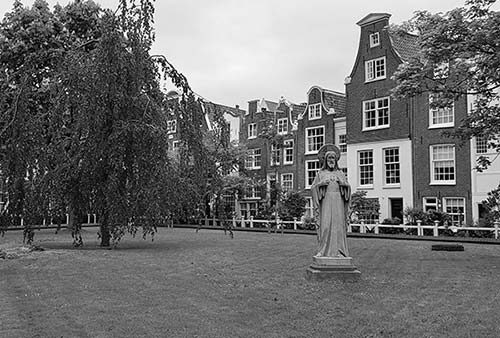
Cost and Hours: Free, only 50 people allowed in at a time, daily 9:30-18:00; on Begijnensteeg lane, just off Kalverstraat between #130 and #132; read the info board at the entrance for the Begijnhof’s history.
See here of the Amsterdam City Walk chapter.
RED LIGHT DISTRICT (DE WALLEN)
Between Damrak and Nieuwmarkt, this neighborhood is one of Amsterdam’s oldest and has hosted prostitutes since 1200. While the main sight here is the neighborhood itself—peopled by sex workers, clients, revelers, and looky-loos—there are also two historic churches and a handful of museums dedicated to sex and other vices.
▲▲Red Light District Walk
Europe’s most popular ladies of the night tease and tempt here, as they have for centuries, in about 200 display-case windows around Oudezijds Achterburgwal and Oudezijds Voorburgwal, surrounding the Old Church (Oude Kerk). Prostitution is entirely legal in the Netherlands, and the sex workers here are generally entrepreneurs who rent space and run their own businesses (and fill out tax returns). Drunks and druggies make the streets uncomfortable late at night after the gawking tourists clear out (about 22:00), but it’s a fascinating walk earlier in the evening.
See the Red Light District Walk chapter and download my free Red Light District audio tour.
Sex Museums
Amsterdam has three sex museums: two in the Red Light District and another one nearby, a block in front of Centraal station on Damrak street. While visiting one can be called sightseeing, visiting more than that is harder to explain. The one on Damrak is the cheapest and most interesting. Here’s a comparison:
The Damrak Sex Museum tells the story of pornography from Roman times through 1960. Every sexual deviation is revealed in various displays. The museum includes early French pornographic photos; memorabilia from Europe, India, and Asia; a Marilyn Monroe tribute; and some S&M displays (€6, daily 10:00-18:00, Damrak 18, a block in front of Centraal station, +31 20 622 8376).
The Erotic Museum in the Red Light District is five floors of uninspired paintings, videos, old photos, and sculpture (€8, daily 11:00-24:00, along the canal at Oudezijds Achterburgwal 54, +31 20 624 7303, www.erotisch-museum.nl; see the Red Light District Walk chapter).
Red Light Secrets Museum of Prostitution is a pricey look at the world’s oldest profession. If you’re wondering what it’s like to sit in those red booths, watch the video taken from a sex worker’s perspective as “johns” check you out. The exhibit is much smaller than the others (€14.50; Sun-Thu 11:00-22:00, Fri-Sat until 23:00, last entry 45 minutes before closing; Oudezijds Achterburgwal 60, +31 20 846 7020, www.redlightsecrets.com; see the Red Light District Walk chapter).
Old Church (Oude Kerk)
This 14th-century landmark—Amsterdam’s oldest building and the needle around which the Red Light District spins—has served as a reassuring welcome-home symbol to sailors, a refuge to the downtrodden, an ideological battlefield of the Counter-Reformation, and, today, a tourist sight with a dull interior that serves as a space for temporary contemporary art exhibits.
Cost and Hours: €13.50, Mon-Sat 10:00-18:00, Sun 13:00-17:30, +31 20 625 8284, www.oudekerk.nl.
Tower: The church’s climbable tower (167 steps) affords a sweeping view over Amsterdam, and can likely be visited only with a 30-minute guided tour. While this has been closed in recent years, it may reopen; ask at the church or check online for details.
See the Red Light District Walk chapter.
Marijuana Sights
Two related establishments cluster together along a canal in the Red Light District. The Hash, Marijuana, and Hemp Museum, worth ▲, is the more worthwhile; it shares a ticket with the less substantial Hemp Gallery.
Cost and Hours: Museum and gallery-€12, includes audioguide, daily 10:00-22:00, Oudezijds Achterburgwal 148, +31 20 624 8926, www.hashmuseum.com.
For more on these sights, see the Red Light District Walk chapter. For the dope on Dutch dope, see the Smoking chapter.
▲▲Our Lord in the Attic Museum
Although Amsterdam has long been known for its tolerant attitudes, 16th-century politics forced Dutch Catholics to worship discreetly for a few hundred years. At this museum at the northern edge of the Red Light District you’ll find a fascinating, hidden Catholic church filling the attic of three 17th-century merchants’ houses. Seek out the silver collection and other exhibits of daily life from 300 years ago.
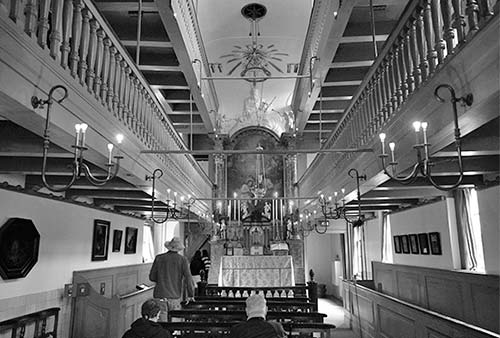
Cost and Hours: €16.50, includes audioguide; Mon-Sat 10:00-18:00, Sun from 13:00; near Centraal station at Oudezijds Voorburgwal 38, +31 20 624 6604, www.opsolder.nl.
See the Our Lord in the Attic Museum Tour chapter.
WEST AMSTERDAM
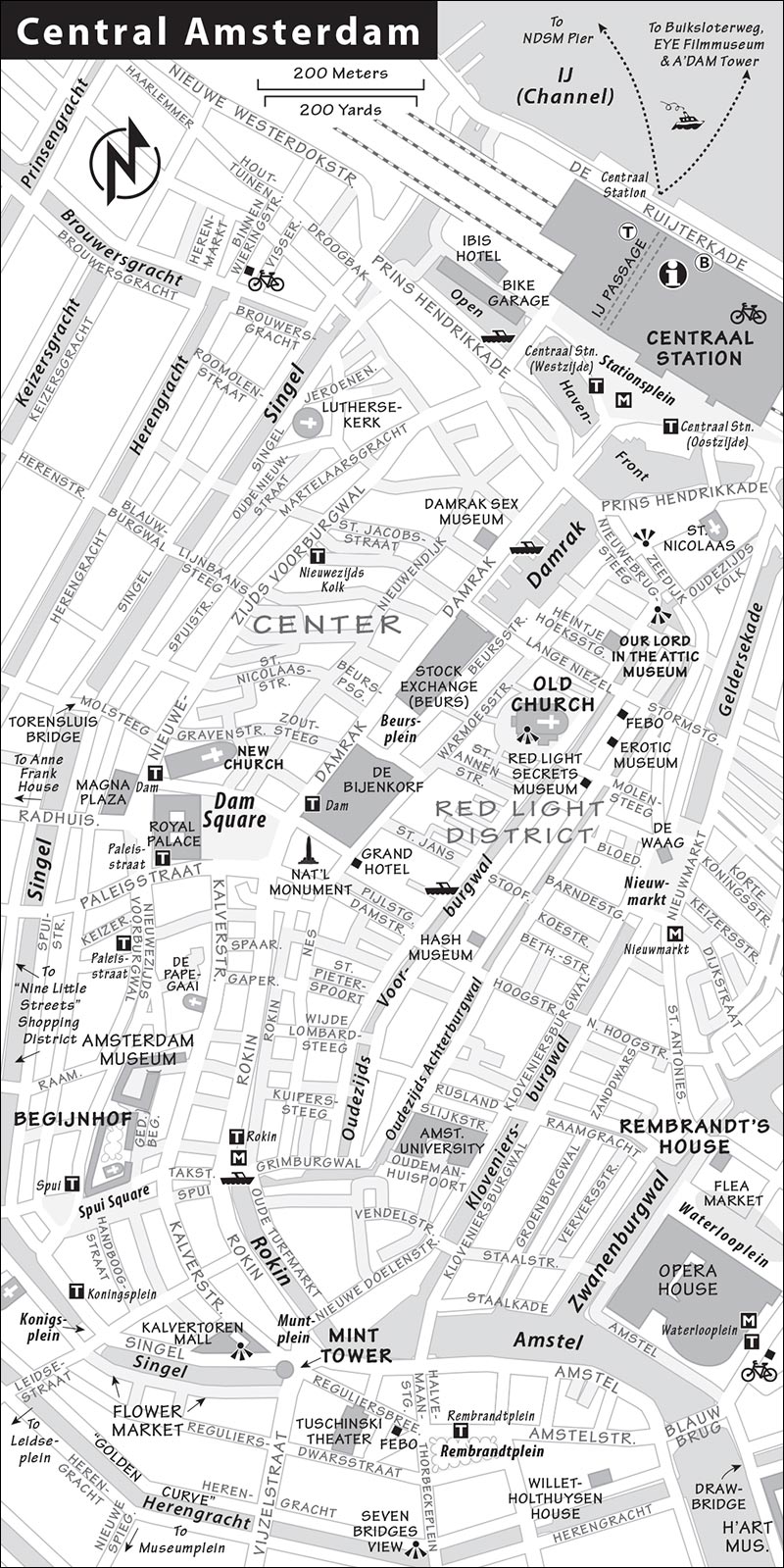
The mostly residential neighborhood around many of these sights is described in the Jordaan Walk chapter and audio tour. For locations, see the “Amsterdam” map near the beginning of this chapter.
▲▲▲Anne Frank House
A pilgrimage for many, this house offers a fascinating look at the hideaway of young Anne during the Nazi occupation of the Netherlands. Anne, her parents, an older sister, and four others spent a little more than two years in a “Secret Annex” behind her father’s business. While in hiding, the teenaged Anne kept a diary chronicling her experience. Acting on a tip, the Nazis arrested the group in August 1944 and deported them to concentration camps farther east. Anne and her sister died of typhus in March 1945, only weeks before their camp was liberated. Of the eight inhabitants of the Secret Annex, only Anne’s father, Otto Frank, survived. He returned to Amsterdam and arranged for his daughter’s diary to be published in 1947. It was followed by many translations, a play, and a movie.
The thoughtfully designed exhibit offers thorough coverage of the Frank family and the others, the non-Jews who aided them, Anne’s diary, and the Holocaust. You’ll shuffle through the hinged bookcase and walk through the Secret Annex itself—seeing the very rooms they hid in, hearing the Westerkerk bells chime.
Cost and Hours: €16, must book timed-entry ticket online in advance, €7 for kids 10-17, €1 for kids under 10, includes excellent audioguide; €23 with 30-minute introduction in English; daily 9:00-22:00; no tickets sold onsite—tickets go on sale each Tuesday for visits six weeks later; don’t wait to book, as once it’s sold out, it’s impossible to get tickets; cloakroom for coats and small bags, no large bags allowed inside; tram #13 or #17 to Westermarkt, then a one-block walk to Prinsengracht 267; +31 20 556 7105, www.annefrank.org.
See the Anne Frank House Tour chapter.
Houseboat Museum (Woonbootmuseum)
In the 1930s, modern cargo ships came into widespread use—making small, sail-powered cargo boats obsolete. In danger of extinction, these vessels found new life as houseboats lining the canals of Amsterdam. Today, 2,500 such boats—their cargo holds turned into comfortable living rooms—are called home. For a peek into this gezellig (cozy) world, visit this tiny museum aboard the Hendrika Maria, built in 1914. She was a working boat (timber, sand, gravel) before becoming a painter’s studio, and finally a residence in 1967. The space feels lived-in because it was—all the way until 1982. It’s decorated in swingin’ ‘70s style, and well described by the included audioguide. Enjoy checking out all the details—tidy galley, beds tucked in every corner, surprisingly roomy living room—and imagine what it might have been like to live here.
Cost and Hours: €7.50; daily 10:00-17:00, on Prinsengracht, opposite #296 facing Elandsgracht, +31 6 4289 3868, www.houseboatmuseum.nl.
Westerkerk
Towering over the Anne Frank House, this landmark Protestant church has an appropriately barren interior, Rembrandt’s body buried somewhere under the pews, and Amsterdam’s tallest steeple. Built in the early 1600s, after the Reformation, it’s very Dutch Reformed—plain, white walls, no statues, no stained glass—with the focus on the pulpit. This is the church that Anne Frank would gaze at out of her hiding-place window...the church bells reminded her of the world outside.
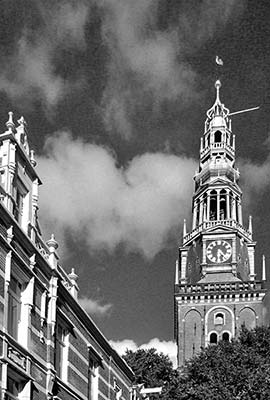
Cost and Hours: Free church entry, donation requested; generally Mon-Fri 11:00-15:00, closed Sat-Sun, Prinsengracht 281, +31 20 624 7766, www.westerkerk.nl. You can hear the organ played during free concerts most Wednesdays at 13:00 (check website for schedule).
Tower: The recently restored tower may be climbable with a guided tour—ask at the church or check their website for hours. It’s 185 steps up to the carillon and grand city views.
For more about the Westerkerk, inside and out, see the Jordaan Walk chapter.
Museum of the Canals (Grachtenmuseum)
This museum tells the story of Amsterdam’s evolution of canals, streets, and buildings using creative video projections and 3-D displays. It’s a bit dry, but informative—worth ▲ for historians, architects, and urban engineers. You’ll visit the main exhibit on a one-way, room-by-room, audioguided tour, with a series of short films that tell the story (40 minutes total).
Cost and Hours: €16.50, Tue-Sun 10:00-17:00, Mon from 12:00, Herrengracht 386, +31 20 4211 656, www.hetgrachtenhuis.nl.
Visiting the Museum: Located in a 17th-century canal house built for the director of the Dutch West India Company, the museum has two ground floor rooms restored in Empire style, which often feature temporary exhibits. The back garden, open only in summer, is a quiet oasis.
Head upstairs and make your way through the five-room exhibit. The first room sets the stage: a booming city desperate for more space. In the next room, local bigwigs debate their options. Then you’ll see models of 10 buildings under construction, illustrating how the entire Canal Belt was built upon a forest of pilings. The next room features a cutaway “dollhouse” of this building; look through its windows to see how urban life evolved over the centuries. Wrapping around the room are diagrams of other townhouses, with “peepholes” offering glimpses of historical photos. The final room, with a large model of the Canal Belt expansion, completes the story of how this aquatic boomtown became an engineering marvel that continues to amaze visitors today.
SOUTHERN CANAL BELT
The ring of canals south of the historic core hosts a few small museums and some of the city’s best nightlife.
▲Leidseplein
Brimming with cafés and tourist traps, this people-watching mecca is an impromptu stage for street artists, accordionists, jugglers, and unicyclists. It’s particularly bustling on sunny afternoons. After dark, it’s a vibrant tourists’ nightclub center. Nearby Lange Leidsedwarsstraat, which runs one block north, is lined with midrange, tourist-friendly eateries, from Italian to Greek to Indonesian.
▲Amsterdam Pipe Museum
This small museum holds 300 years of pipes in a canal house from 1670. (It’s almost worth admission just to see the inside of one of these elegant homes.) Thanks to the dizzyingly wide variety of pipes from around the globe, and the insightful commentary by the on-site docents, this is much more than a “museum of pipes”—it’s almost a history and ethnography museum. In a city full of tacky tourist come-ons, this little sight is thoughtful, intimate, and very classy.
Cost and Hours: €15, Mon-Sat 12:00-18:00, closed Sun, +31 20 421 1779, just off Leidsestraat at Prinsengracht 488, www.pipemuseum.nl.
Visiting the Museum: Enter through the street-level shop, which is almost interesting enough to be a museum itself. It sells new and antique pipes, various smoking curiosities, and scholarly books written by the shop’s owner. If you want more, pay to enter the museum and a volunteer docent will accompany you upstairs through a tour of smoking history. You begin with pre-Columbian terra-cotta pipes (from the discoverers of tobacco, dating from around 500 BC), followed by plenty of intricately carved Victorian smoking paraphernalia—long-stemmed Dutch pipes (the Dutch were the first importers of tobacco), meerschaum pipes (made from a soft white mineral), pipes carved into portraits, and so on. Ask questions—your guide is happy to explain why the opium pipes have their bowls in the center of the stem, why some white clay pipes are a foot long, or why shisha smoke is sucked through a long tube.
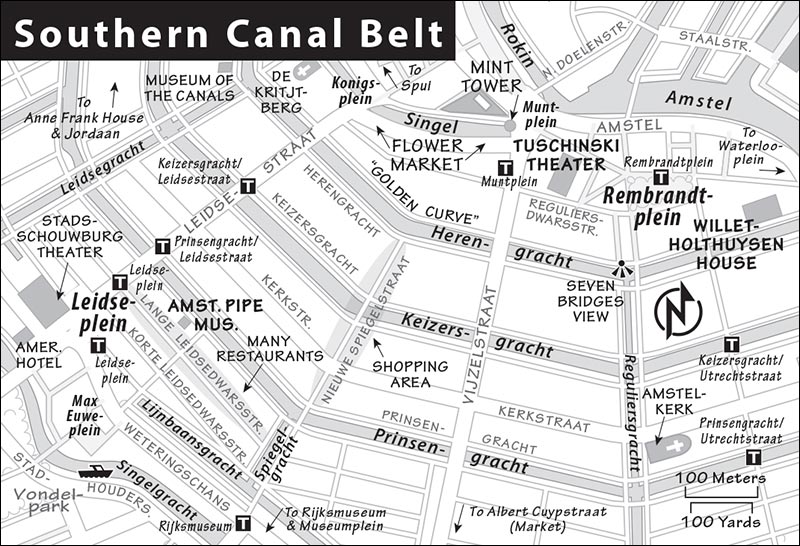
Rembrandtplein
One of the city’s premier nightlife spots is the leafy Rembrandtplein (and the adjoining Thorbeckeplein). Several dance clubs keep the area lively into the wee hours. Utrechtsestraat is lined with upscale shops and restaurants. Nearby Reguliersdwarsstraat (a street one block south of Rembrandtplein) is a center for gay and lesbian nightclubs.
Tuschinski Theater
This old movie palace from the 1920s, just a half-block from Rembrandtplein down Reguliersbreestraat, glitters inside and out. Still a working cinema, it’s a delightful place to see first-run movies (almost always in their original language—usually English—with Dutch subtitles; some kids’ movies are dubbed in Dutch—look for “NL” in the listings). For cinephiles and fans of Art Deco and Art Nouveau, it’s worth ▲.
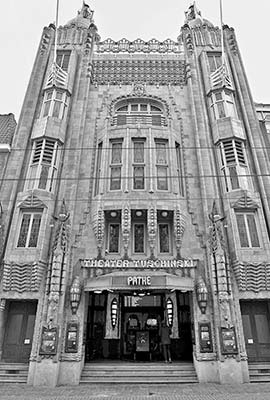
The exterior is an interesting hybrid of styles, forcing the round peg of Art Nouveau into the square hole of Art Deco. The stone-and-tile facade features stripped-down, functional Art Deco squares and rectangles, but is ornamented with Art Nouveau elements—Tiffany-style windows, garlands, curvy iron lamps, Egyptian pharaohs, and exotic gold lettering over the door.
Inside (lobby is free), the sumptuous decor features fancy carpets, slinky fixtures, and semi-abstract designs. Grab a seat in the lobby and watch the ceiling morph. To get into the main hall inside, come in the morning and take the excellent 30-minute self-guided audio tour with evocative tales of the theater’s glamorous past. Otherwise access is limited to movie-goers.
Cost and Hours: Free to enter lobby area, open long hours daily; €11.50 audioguide tour available only in the morning—usually starting at 9:30, last departure around 10:30; Reguliersbreestraat 26, www.pathe.nl/bioscoop/tuschinski).
Willet-Holthuysen House (Huis Willet-Holthuisen)
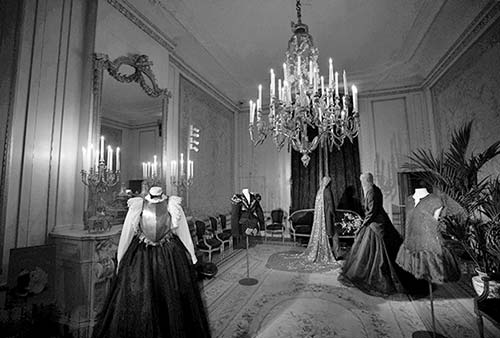
This 1687 townhouse is a must for devotees of Hummel-topped sugar bowls and Louis XVI-style wainscoting. For others, it’s a pleasant look inside a typical (rich) home with much of the original furniture and decor. The included audioguide tells the whole story...but it’s equally enjoyable to forget the history and just browse through a dozen rooms of beautiful saccharine objects from the 19th century. These old rooms are sometimes enlivened by temporary exhibits.
Cost and Hours: €12.50, daily 10:00-17:00; tram #4 or #14 to Rembrandtplein—it’s a 2-minute walk southeast to Herengracht 605, +31 20 523 1822, www.willetholthuysen.nl.
Visiting the Museum: Upon entering (through the servants’ door under the grand entry), notice the photos of the owners during the house’s heyday in the 1860s. In 1861, the wealthy heiress Louise Holthuysen and the art-collecting bon vivant Abraham Willet got married and became joined at the hyphen, then set out to make their home the social hub of Amsterdam. When the widow Louise died in 1895, she bequeathed the house to the city, along with its candelabras, snuff boxes, and puppy paintings.
Near where you enter, in the kitchen, picture the couple’s servants—before electricity and running water—heating the kettle at the fireplace or filtering rainwater.
Continue to the first floor, where the Willet-Holthuysens entertained. Several rooms are decorated in the Louis XVI style, featuring chairs with straight, tapering legs (not the heavy, curving, animal-claw feet of earlier styles). You’ll see blue, yellow, and purple-themed rooms; wainscoting (“wallpaper” covering only part of the walls); and mythological paintings on the ceiling. Paintings introduce you to Louise and Abraham’s artistic tastes, from still lifes to scenes of happy French peasants and nobles frolicking in the countryside.
The gilded ballroom (labeled Saloon) is the house’s most impressive space. Imagine Louise, Abraham, and 22 guests mingling here. Then they’d retire to the dining room laid out with its 275-piece Meissen porcelain tableware set, or chat in the blue “gentlemen’s room” by the canal. In the garden room, they sipped tea while gazing out at symmetrically curved hedges and classical statues.
The top-floor bedroom is furnished with a canopy bed, matching oak washstand, makeup table, and elegant-yet-functional chamber pot. In other rooms, you can see Louise’s favorite art and Abraham’s book collection, and trace the couple’s travels. In the cozy antiques room, you can look out, through leaded glass, over the fine gardens.
SOUTHWEST AMSTERDAM
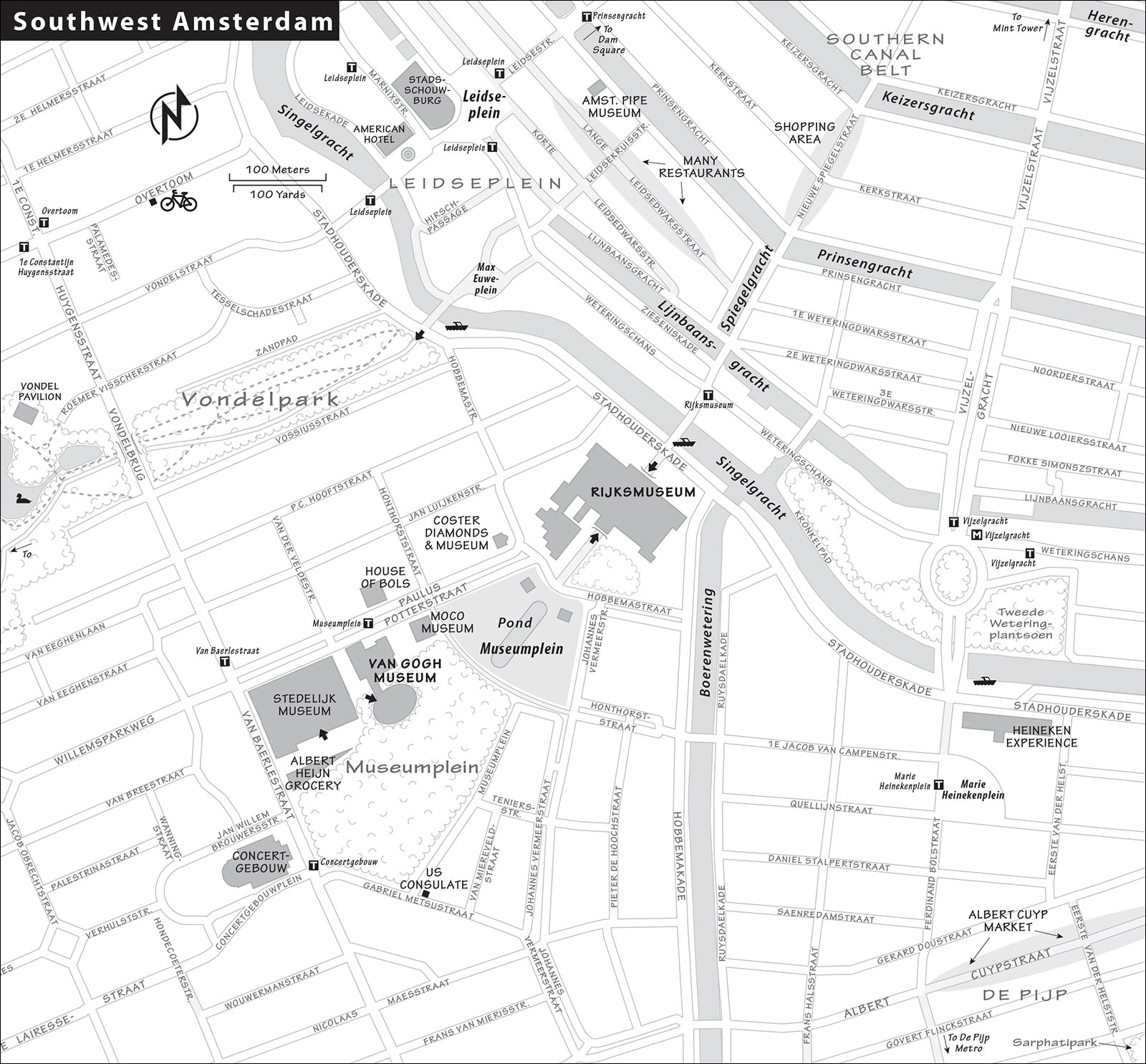
The city’s major art museums—Rijks, Van Gogh, and Stedelijk—are centered around the square called Museumplein and a short walk from Amsterdam’s urban oasis, Vondelpark. The Albert Cuyp Market buzzes just to the east, in the De Pijp neighborhood.
▲Museumplein
Bordered by the Rijks, Van Gogh, and Stedelijk museums, and the Concertgebouw (classical music hall), this park-like square is interesting even to art haters. Amsterdam’s best acoustics are found in the bike-and-pedestrian passage underneath the Rijksmuseum, where street musicians perform everything from chamber music to Mongolian throat singing. The Rijksmuseum itself is surrounded by neatly manicured gardens that are free to enter, offering generous benches, pretty flowers, gurgling fountains, and even an espresso window.
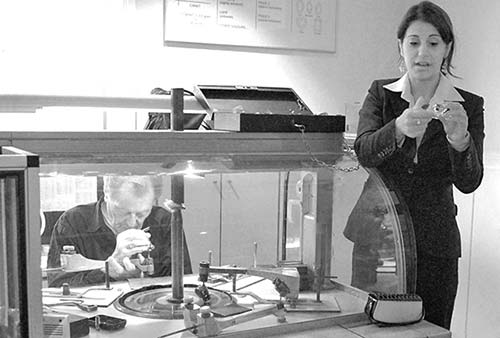
Nearby, filling a labyrinth of interconnected townhouses, Coster Diamonds is a handy place to see a diamond-cutting and -polishing demo (free, frequent, and interesting 30-minute tours followed by sales pitch, popular with tour groups, prices marked up to include tour-guide kickbacks, or you can pay €22.50 for a one-hour “Royal Experience” in a private showroom; daily 9:00-17:00, Paulus Potterstraat 2, +31 20 305 5555, https://royalcoster.com). The end of the tour leads you straight into their Diamond Museum, which is worthwhile only for those who feel the need to see even more diamonds (€12.50, daily 9:00-17:00, +31 20 305 5300, www.diamondmuseum.com). The tour at Gassan Diamonds is also free and better (see here), but Coster is convenient to Museumplein.
Between the Rijks and Van Gogh museums, you’ll see yet another art venue in an old villa with vivid-pink banners: the Moco Museum (short for “Modern Contemporary Museum”). This style-forward private venture hosts exhibitions of big-name artists such as Banksy, Yayoi Kusama, and Jean-Michel Basquiat (overpriced at €25, cheaper online, exhibits vary in quality, daily 9:00-20:00, www.mocomuseum.com).
▲▲▲Rijksmuseum
Built to house the nation’s great art, the Rijksmuseum (RIKES-moo-zay-oom) owns several thousand paintings, including an incomparable collection of 17th-century Dutch Masters: Rembrandt, Vermeer, Hals, and Steen. Its vast collection also includes interesting artifacts—such as furniture—that help bring the golden age to life.
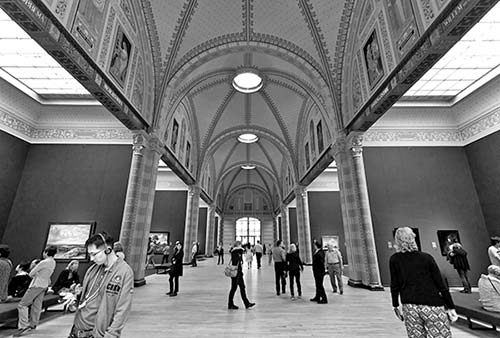
Cost and Hours: €22.50 for timed-entry ticket—best to reserve online in advance, free for kids under 18; daily 9:00-17:00; audioguide-€6.50, guided tour-€7.50, free app with tours (bring headphones); tram #2 or #12 to Museumplein; +31 20 674 7047, www.rijksmuseum.nl. The entrance is off the passageway that tunnels right through the center of the building.
See the Rijksmuseum Tour chapter.
▲▲▲Van Gogh Museum
This remarkable museum features works by the troubled Dutch artist whose art seemed to mirror his life. Vincent, who took his own life in 1890 at age 37, is best known for sunny, Post-Impressionist canvases that vibrate and pulse with vitality. The museum’s 200 paintings—which offer a virtual stroll through the artist’s work and life—were owned by Theo, Vincent’s younger, art-dealer brother. Highlights include Sunflowers, The Bedroom, The Potato Eaters, and many brooding self-portraits. Mixed among the Van Goghs are works that influenced him, from Monet and Pissarro to Gauguin, Cézanne, and Toulouse-Lautrec. The worthwhile audioguide includes insightful commentaries and quotes from Vincent himself. Temporary exhibits fill the exhibition wing down the escalator from the ground-floor lobby.
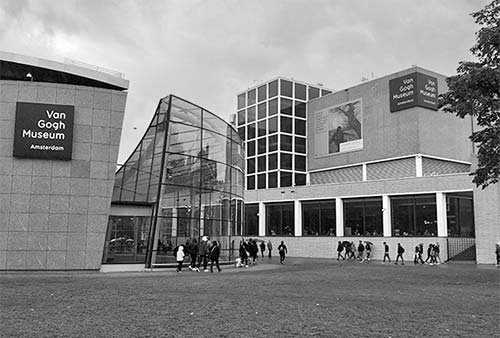
Cost and Hours: €22 for timed-entry ticket—must reserve online a few weeks in advance, free for kids under 18; daily 9:00-18:00, some Fri until 21:00, shorter hours mid-Oct-Feb; audioguide-€3.75, kids’ audioguide-€2; Paulus Potterstraat 7, tram #2 or #12 to Museumplein, +31 20 570 5200, www.vangoghmuseum.com.
See the Van Gogh Museum Tour chapter.
▲▲Stedelijk Museum
One of the Netherlands’ top modern-art museums is filled with a permanent collection of 20th-century classics as well as far-out, refreshing, cutting-edge temporary exhibits.
Cost and Hours: €22.50, more for special exhibits, daily 10:00-18:00, top-notch gift shop, Museumplein 10, tram #2 or #12 to Museumplein, +31 20 573 2911, www.stedelijk.nl [URL inactive]. The fine included audioguide covers both permanent and temporary exhibits.
Buying Tickets: There are no in-person ticket desks—buy a ticket online and scan the QR code at the entrance. You can do this on your phone when you arrive, but you might as well book ahead so you can walk right in (you need select only the date—not a specific time).
Eating: The museum has a full-service, ground-floor €€ restaurant with outdoor seating. On weekends, there’s also a simple € café upstairs (sandwiches, salads, pastries). Or visit the supermarket up the street and picnic in the park.
Visiting the Museum: Before entering, notice the architecture of the modern entrance—aptly nicknamed “the bathtub.”
Once inside, scan the QR code to access a map; the layout is always in flux. There are always temporary exhibits, and even the “permanent” collection changes frequently. Pick up the good audioguide (or access it on your phone). This is a museum for exploring...so let yourself go.
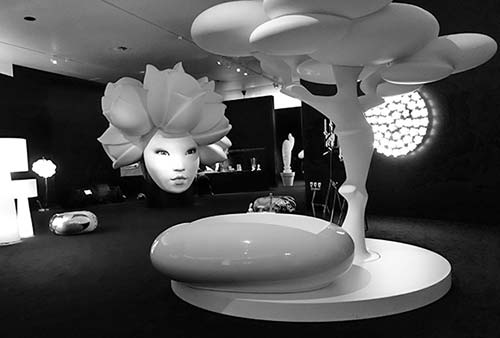
Don’t expect a tidy art-history lesson; the curators enjoy challenging, confronting, and confounding visitors. Broadly speaking, the permanent exhibit is organized into three areas: until 1950 on the main floor; and then, upstairs, sections on 1950-1980 and 1980 to the present. The main-floor exhibit is organized roughly chronologically, with historical context in each room. The upstairs sections are more thematic.
As if to set the tone up front, the first room of the main exhibit features two large walls hung with a pastiche of canvases, juxtaposing works by huge names (Van Gogh, Chagall, Cézanne, Pollock) with lesser-known Dutch artists.
From there, you’ll see works from the first half of the 20th century. In one room, the biggest names (Picasso, Matisse, Kandinsky) are tucked in a corner, sharing the space with artists from non-European backgrounds—as the curators interrogate the interplay of colonialism and modern art.
Reaching 1950, you’ll head upstairs to tour the two remaining permanent galleries. The section on 1950-1980 explores a bewildering variety of themes, such as female perspectives in the 1960s; mass consumption and recycled materials; extreme minimalism (mostly white canvases); “hybrid identities” as artists became increasingly international (such as a Jewish woman who fled Hitler to a new life in the UK; or a Surinamese-born artist who emigrated to Amsterdam); rabble-rousing protest posters; and how the space age and the Japanese aesthetic impacted international tastes.
Moving into the contemporary section (1980-present), the very nature of “art” is in question. Here you’ll find everyday “found” objects presented as high art, installations, “happenings,” and interactive technology (lights, video, gizmos) to dazzle the eye and tickle your wonderbone. Themes from global terrorism to Wall Street greed to environmentalism conclude the narrative that begins across Museumplein at the Rijksmuseum, bringing that narrative up to our present day.
House of Bols: Cocktail & Genever Experience
This leading Dutch distillery runs a slick, pricey little museum/marketing opportunity across the street from the Van Gogh Museum. If you feel like a good stiff drink after your museum-going, it’s ideal. The “experience” is a self-guided walk through what is essentially an ad for Bols—“four hundred years of working on the art of mixing and blending...a celebration of gin”—with some fun sniffing opportunities and a drink at a modern, mirrored-out cocktail bar for a finale. The line of bottles with 36 different scents (with their IDs hidden until you guess) is fascinating. Your ticket includes one gin cocktail with a talkative expert, plus a “mystery shot.” It’s fun to watch your bartender mix up the cocktail of your dreams based on what you learned during your sniffing.
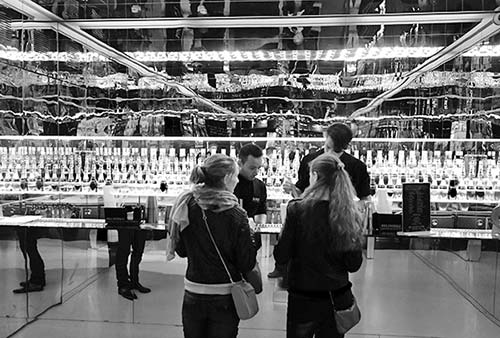
Cost and Hours: €17.50; daily 13:00-18:30, Fri-Sat until 21:00; must be 18, Paulus Potterstraat 14, +31 20 570 8575, www.houseofbols.com.
Heineken Experience
This famous brewery, having moved its operations to the suburbs, has converted its old headquarters into a slick-yet-cheesy beerfest—complete with a video-surround beer-making simulation in which visitors are brewed and bottled. The self-guided “experience” also includes photo ops that put you inside Heineken logos and labels, and no small amount of hype about the Heineken family and the quality of their beer. It can be a fun trip—like visiting a beer lover’s amusement park—if you can ignore the fact that you’re essentially paying for 90 minutes of advertising. Note that this place is a huge hit with twentysomething travelers and is especially busy on Saturdays.
Cost and Hours: €23 for timed-entry ticket—buy online or at kiosk in lobby, includes two drinks; daily 10:30-19:30, Fri-Sun until 21:00, longer hours July-Aug, last entry 2.25 hours before closing; Metro line #52 to Vijzelgracht or an easy walk from the Rijksmuseum, Stadhouderskade 78; +31 20 721 5300, www.heinekenexperience.com.
De Pijp
This former working-class residential neighborhood (behind the Heineken Experience)—once notorious as a slum—has emerged as a fun, colorful district nicknamed the “Latin Quarter of Amsterdam.” Its spine is Albert Cuypstraat, a street taken over by the vibrant Albert Cuyp Market, a long, sprawling produce/flea market packed with food stalls, intriguing wares, and interesting people six days a week (quieter on Sun). The best excuse to visit is for a meal (see the Eating in Amsterdam chapter for details).
▲Vondelpark
This huge, lively city park is popular with the Dutch—families with little kids, romantic couples, strolling seniors, and hipsters sharing blankets and beers. It’s a favored venue for free summer concerts. On a sunny afternoon, it’s a hedonistic scene that seems to say, “Parents...relax.”
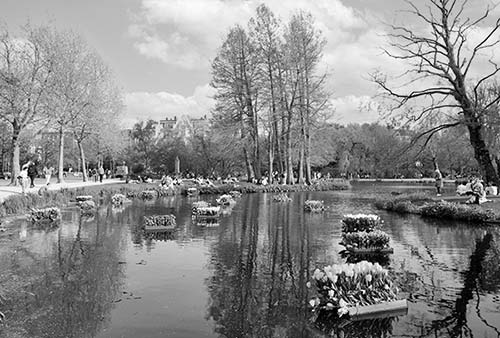
Visiting Vondelpark: Most visitors enter the park at its eastern end, through the gate facing the lively Leidseplein area (with several handy trams stopping nearby). From there, a long, narrow green belt tethers the real Amsterdam to the main part of the park: a series of grassy expanses, forested areas, and water features, all connected by footpaths and bike lanes, and speckled with appealing al fresco eateries (‘T Blauwe Theehuis is a delightful spot to nurse a drink; see here). Allow at least 30 minutes to walk end-to-end. It’s even more rewarding by bike; just do long loops to your heart’s content. A short walk beyond the far end of the park, you can hop on tram #2 at Amstelveenseweg and zip back to the center.
SOUTHEAST AMSTERDAM
This part of the city—the historic Jewish Quarter and surroundings—is packed with sightseeing choices that could easily fill a day. This is an ideal place to gain a deeper understanding for Amsterdam’s Jewish heritage and its tragic decimation under Nazi occupation.
Getting There: From the Mint Tower, it’s a 10-minute stroll along the pleasant shopping street called Staalstraat. From Centraal station, take tram #14 or the Metro to Waterlooplein.
On and Near Waterlooplein
Waterlooplein
This square, famous for its flea market, is a good place to get your bearings. The gigantic building that dominates the square is known to Amsterdammers as the “Stopera,” as it’s the combo City Hall (stadhuis) and opera.
From the tram stop, cross halfway over the bridge with the fancy lampposts. The Blauwbrug (“Blue Bridge”) is a modest, modern version of Paris’ Pont Alexandre III. The bridge crosses the Amstel River, which is channeled from this point to form the city’s canals.
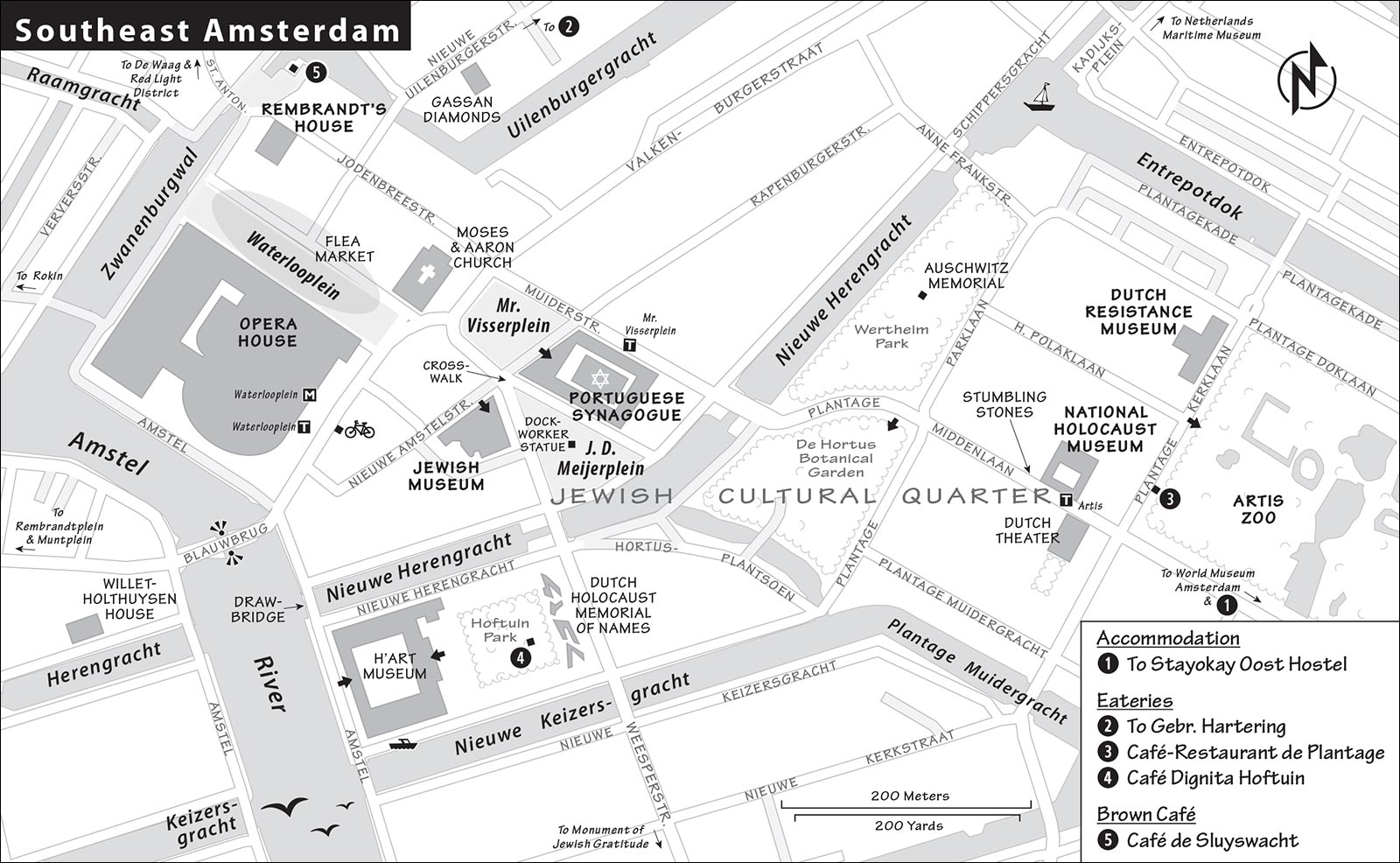
Scan clockwise. Behind the curved modern facade of the Stopera is the Waterlooplein flea market; in the streets just beyond are Rembrandt’s House and Gassan Diamonds. To the right of the Stopera are the twin gray steeples of the Moses and Aaron Church, which sits roughly in the center of the former Jewish Quarter. Nearby are the Jewish Museum and Portuguese Synagogue.
Continue panning to the right. That cute little drawbridge, while not famous, is certainly photogenic. (Its traditional counterbalance design is so effective that even a child can lift the bridge.) Crossing the Amstel upstream is one of the city’s romantic spots, the Magere Brug (“Skinny Bridge”). A block away is the city’s best look at a Dutch golden age mansion, the Willet-Holthuysen House (described earlier, with the Southern Canal Belt sights).
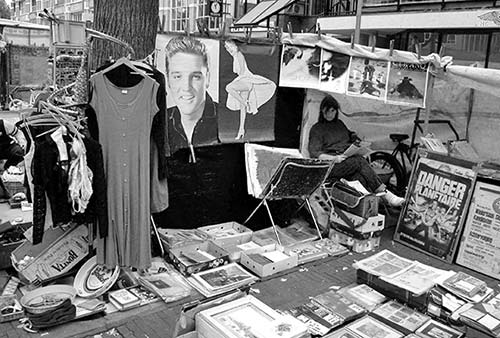
Waterlooplein Flea Market
For more than a hundred years, the Jewish Quarter flea market has raged daily except Sunday. The long, narrow park is filled with stalls selling cheap clothes, hippie stuff, old records, tourist knickknacks, and garage-sale junk.
▲Rembrandt’s House (Museum Het Rembrandthuis)
A middle-aged Rembrandt lived here from 1639—when his popularity and success were reaching a fever pitch—until 1658, when he was facing severe financial woes...slowly dwindling down to obscurity and bankruptcy. Seeing Rembrandt’s bedroom, office, studio, and other rooms with the good audioguide brings his story to life. Additional exhibits offer deeper insights, and etching and printmaking demonstrations make the lessons more vital. Other than some etchings, you won’t see many works by Rembrandt; for that, visit the Rijksmuseum. Instead, the museum paints a portrait of the artist himself.
Cost and Hours: €20, daily 10:00-18:00, etching and paint-making demonstrations almost hourly between 11:00 and 15:00, fewer crowds (but fewer demos) early and late in the day, Jodenbreestraat 4, +31 20 520 0400, www.rembrandthuis.nl.
Visiting Rembrandt’s House: When you buy your ticket, ask when the next etching or painting demonstration is scheduled. Head downstairs to the mandatory bag check, pick up the excellent and included audioguide, and begin your visit.
The reconstructed house is filled with period objects (not his actual belongings) that re-create what Rembrandt owned, according to his bankruptcy inventory of 1656. Tight spiral stairs make your visit a one-way circuit.
Start down below, in the well-equipped kitchen, then head up the first staircase, and turn left. The former entrance hall—the anteroom and side room—are covered floor-to-ceiling with old paintings. None are by Rembrandt (some are by pupils), but they illustrate how Rembrandt displayed art to potential buyers in these rooms. Across the landing, the salon has a box bed like the one Rembrandt would have slept in. Also look for the tiny office tucked under the stairs, where Rembrandt handled his paperwork and bookkeeping (not very well, it turns out). The modern room offers a timeline of Rembrandt’s life, putting his time in this home into a larger context.
Head up a few more steps. At the landing between floors is a small exhibit of his original etchings.
Carry on upstairs to the next level, and turn right. The art cabinet room is filled with a mishmash of curios collected by this eccentric genius—shells, books, classical busts, stuffed crocodiles, and a Baroque-era jackalope. (His appetite for collecting expensive doodads also turned out to be bad news for his long-term finances.) Across the hall, in the large studio, imagine Rembrandt at work in the well-lighted room where he created The Night Watch, The Portrait of Maria Trip, and numerous self-portraits (now at the Rijksmuseum).
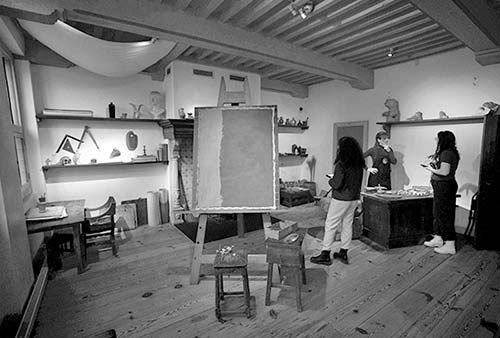
Up on the next floor, a printer can explain the etching process (drawing in soft wax on a metal plate that’s then dipped in acid, inked up, and printed). The small studio is where Rembrandt taught his students, often three at a time (notice the partitions creating individual workspaces by the windows).
Upstairs in the attic, you’ll learn how this chapter of Rembrandt’s life came to a close: During the 19 years he lived here, his beloved wife Saskia passed away and he faced increasing financial troubles. He’d gone from a young, brash artist with a promising career to a sad, aging man with more money troubles than fame. At the age of 52, with his partner Hendrickje Stoffels and a young daughter to support, Rembrandt had to sell everything (including this house) and move into a humble rented apartment. You’ll see the book that documented the sale of his estate—providing an invaluable historical record of how he lived.
From here, you’ll spiral down through the adjacent modern building, passing temporary exhibits on your way to the exit.
Nearby: Enjoy a scenic drink or snack at the historic black-brick Café de Sluyswacht, across the street (see here).
Gassan Diamonds
Many shops in this “city of diamonds” offer tours where you’ll see experts behind magnifying glasses polishing the facets of precious diamonds, then a visit a salesroom to see (and perhaps buy) a mighty shiny yet very tiny souvenir.
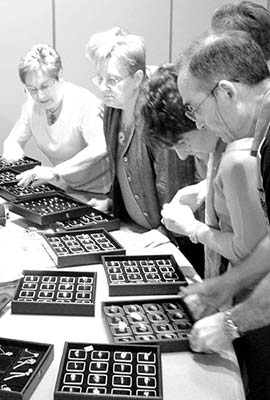
The handy and professional Gassan Diamonds facility fills a huge warehouse one block from Rembrandt’s House. A visit here plops you into the big-tour-group fray (notice how each tour group has a color-coded sticker so they know which guide gets the commission). You’ll get a sticker, join a free 30-minute tour to see a polisher at work, and hear a general explanation of the process. Then you’ll have an opportunity to sit down and have color and clarity described and illustrated with diamonds ranging in value from €100 to €50,000 (daily 9:45-16:45—these are first and last tour times, Nieuwe Uilenburgerstraat 173, +31 20 622 5333, www.gassan.com, handy WC). Another company, Coster, offers diamond demos near the Rijksmuseum (described on here).
▲H’ART Museum
Across the wide Nieuwe Herrengracht canal from Waterlooplein, this large complex features rotating temporary exhibits from three esteemed museums: the Centre Pompidou in Paris, the British Museum in London, and the Smithsonian American Art Museum in Washington, DC. In addition, it hosts the Museum of Mind, with avant-garde “outsider” art. And finally, it’s the temporary home (at least through 2027) to the excellent collection from the Amsterdam Museum. Of these collections, the Amsterdam Museum is well worth a visit for city history; the others may also be worthwhile—check the website to see what’s on display.
Cost and Hours: Amsterdam Museum exhibit-€18, other collections have their own entry fees, combo-ticket for everything is usually around €35; daily 10:00-17:00, mandatory and free bag check, café, Amstel 51, recorded info +31 20 530 7488, www.hartmuseum.nl.
Visiting the Amsterdam Museum Exhibit: Until this museum’s permanent home in the city center reopens, consider touring its temporary home in this sleek, modern space. The main hall—called “Amsterdam Panorama”—shows off highlights from the permanent collection, starting with the oldest known painting of Amsterdam (a bird’s-eye view, from 1538). The included audioguide helps tell the chronological story as you survey historic cityscapes, portraits of ruff-collared bigwigs, ships at sea, and other artifacts (statues, a china cabinet, a grandfather clock that still ticks and tocks). The rest of the space features good temporary exhibits delving into other topics of Amsterdam history.
Nearby: The powerful Dutch Holocaust Memorial of Names, described later, is very close to this museum and worth seeing while you’re nearby. In the park between the museum and the memorial is the excellent, recommended Café Dignita Hoftuin (see here).
De Hortus Botanical Garden
This is a unique oasis of tranquility within the city (no mobile phones are allowed, because “our collection of plants is a precious community—treat it with respect”). One of the oldest botanical gardens in the world, it dates from 1638, when medicinal herbs were grown here. Today, among its 6,000 kinds of plants—most of which were collected by the Dutch East India Company in the 17th and 18th centuries—you’ll find medicinal herbs and cacti. You’ll also find several greenhouses (including one with a fluttery butterfly house, a hit with all ages). The largest is the “Three Climate Greenhouse,” featuring desert, subtropical, and tropical sections. This giant building was recently refurbished from the inside out, converting it into the first carbon-neutral greenhouse in the Netherlands. Much of the garden is described in English: “A Dutch merchant snuck a coffee plant out of Ethiopia, which ended up in this garden in 1706. This first coffee plant in Europe was the literal granddaddy of the coffee cultures of Brazil—long the world’s biggest coffee producer.”
Cost and Hours: €13.50, daily 10:00-17:00, tram #14 to Mr. Visserplein, Plantage Middenlaan 2A, +31 20 625 9021, www.dehortus.nl. The inviting Orangery Café serves tapas.
The Jewish Cultural Quarter (Joods Cultureel Kwartier)
This area, starting on Waterlooplein and spreading across the canal to the southeast, features several riveting, moving, and educational sights. I’ve organized these sights with walking directions, connecting the locations to tell the story from the arrival of the earliest Jewish émigrés to Amsterdam, to the horrors of the Holocaust, to the poignant commemorations of the present day. The outstanding Dutch Resistance Museum—which ties in historically and thematically with the Jewish sights—is also in this area.
• Start on the southern edge of Waterlooplein, with two important sights side-by-side. To kick off your visit to this area with a “wow,” begin at the...
▲▲Portuguese Synagogue (Esnoga)
This 17th century synagogue—still used by a local Jewish congregation—provides a strong foundation for your exploration of the Jewish Cultural Quarter. Its giant hall evokes the powerful history of this area, and the surrounding buildings offer insightful glimpses into various aspects of the Dutch Jewish experience.
Cost and Hours: €22 combo-ticket includes Jewish Museum, €32 version adds the National Holocaust Museum, cheaper online; May-Aug Sun-Fri 10:00-17:00, closes earlier Dec-Jan and Fri off-season, closed Sat year-round; Mr. Visserplein 3, https://jck.nl.
In 1940, one in ten Amsterdammers was Jewish, and most lived in the neighborhood behind Waterlooplein. While not immune from discrimination, Jewish traders had long been relatively welcome in a city that cared more about business than religion. In the late 1500s, many Sephardic Jews from Spain and Portugal emmigrated here, fleeing persecution. (The philosopher Baruch Spinoza’s ancestors were among them.) In the 1630s, Yiddish-speaking Eastern European Jews (Ashkenazi) poured in. By 1700, the Jewish Quarter was a bustling, multicultural world, with more people speaking Portuguese, German, and Yiddish than Dutch.

Despite their large numbers, for several centuries Jews were not first-class citizens. They needed the city’s permission to settle here, and they couldn’t hold public office (but then, neither could Catholics under Calvinist rule). Still, the Jewish Quarter was not a ghetto per se, as the segregation wasn’t forced and Jews faced no special taxes.
In 1796, Amsterdam’s Jews were given full citizenship. In exchange, they were required to learn the Dutch language and submit to the city’s legal system. Over the next century or so, the Jewish culture began assimilating into the Dutch.
In 1940, Nazi Germany occupied the Netherlands. On February 22, 1941, the Nazis began rounding up Jews and shipping them to camps in Eastern Europe. By war’s end, an estimated 102,000 of the country’s 140,000 Jews had died.
Today, about 15,000 Jews live in Amsterdam, and what remains of the Jewish Quarter is integrated into the modern city. The Jewish Museum shows several synagogues—including the impressive Portuguese Synagogue—and nearby are some powerful sights relating to the Holocaust (the National Holocaust Museum and Dutch Theater). For more information on Amsterdam’s many Jewish sights, see https://jck.nl.
Visiting the Portuguese Synagogue: This grand structure brings together both old and new—a historic synagogue that today serves a revived Jewish community. It was built in 1675 (when Catholics were worshipping underground) to house a community of Sephardic (Iberian) Jews who fled persecution. At the time, it was the world’s largest. The building survived World War II, though its congregation barely did. On May 9, 1945, what was left of Amsterdam’s Jewish community gathered in this synagogue—for the first time since the Holocaust had begun—to begin to commemorate the dead.
Buy your ticket, cross through the courtyard, and step inside. The synagogue is majestic in its simplicity—a spacious place of worship with four Ionic columns supporting a wooden roof. There’s no electric lighting, only candles and windows. Find the main features: the platform where the cantor presides (the tebáh or bema, near the back), the wood-columned niche (or ark) at the far end for the Torah, the two ceremonial sofas for VIPs, the special pew (middle of left wall) for important visitors, the upstairs balconies for women, and the wood canopy where weddings take place (chuppah, far right corner). There might even be sand under your feet, which (may) symbolize the Israelites’ sojourn through the desert.
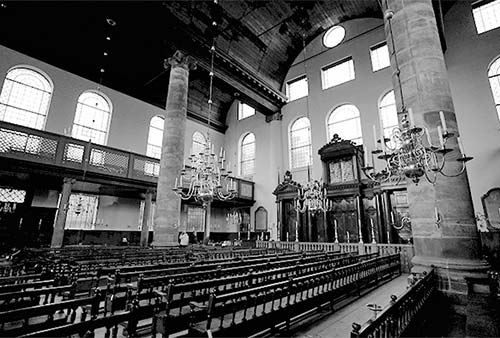
Back outside, do a counterclockwise loop around the central building and explore the rest of the synagogue complex. Many other rooms ring the outer walls. (Any unlocked door is yours for the visiting.) First, just to the right of where you entered the complex, stairs lead down to the treasure chambers, containing precious Torah scrolls, ceremonial objects, textiles, and rare books, plus a narrated slideshow on the history of this beloved synagogue. Continuing around, you’ll find the Winter Synagogue (used when it was too cold in that vast main space) and ma’amad (meeting hall); around the back, the entrance and stairs up to the main synagogue’s women’s gallery; the candle-storage room; the ritual bath, where women purify after menstruation; and, back near the office, the rabbinate (rabbi’s office) and mourning room (for funerals).
Nearby: The synagogue is ringed with names that have significance in local Jewish history. The big, gravelly square alongside the synagogue is named for Jonas Daniël Meijer (1780-1834), a Dutch Jew who studied law and became the first Jewish attorney in the Netherlands, and who advocated for increased Jewish rights. The statue on the square—a stoic man in a hardhat—depicts not Meijer, but The Dockworker—specifically, the (non-Jewish) Dutch dockworkers and other laborers who staged nationwide strikes in February 1941, in response to the Nazis’ first round of Jewish deportations. And the square immediately in front of the synagogue, Mr. Visserplein, honors Lodewijk Ernst Visser (1871-1942). The head of the Dutch Supreme Court—and with some Jewish ancestry himself—Visser used his clout to advocate for the rights of Dutch Jews in the early days of Nazi occupation. The Nazis threatened him with deportation, but he died of natural causes before they could arrest him.
• Next, carry on to the Jewish Museum. As you exit the Portuguese Synagogue, look to the left and you’ll see it directly across busy Weesperstraat. Use the nearby crosswalk to traverse the tram tracks and head inside.
▲Jewish Museum (Joods Museum)
This museum tells the story of the Netherlands’ Jews through three centuries. It offers a good introduction (or review) about Judaism, and Jewish customs and religious traditions. Originally opened in 1932, the Jewish Museum was forced to close during the Nazi years. It reopened after the war, and recent renovations have joined four historic former synagogues together to form the museum’s single modern complex.
Cost and Hours: €22 combo-ticket includes Portuguese Synagogue, €32 version adds the National Holocaust Museum, €8 for kids 13-17, €6 for kids 6-12, free for kids under 6; cheaper online; daily 10:00-17:00; free audioguide, children’s museum, Jonas Daniël Meijerplein 2, tram #14 to Mr. Visserplein, +31 20 531 0310, https://jck.nl. The museum’s modern, minimalist, kosher €€ café—in the basement—serves Jewish specialties.
Visiting the Museum: Start downstairs and follow signs for Religion to make your way to the impressive Great Synagogue. Have a seat, surrounded by religious objects, and picture it during its prime (1671-1943). The vast hall would be full for services—men downstairs, women above in the gallery. On the east wall (to the right, the symbolic direction of Jerusalem) is the ark—the alcove where they keep the scrolls of the Torah (the Jewish scriptures, comprising the first five books of the Old Testament of the Bible). The rabbi and other men, wearing thigh-length prayer shawls, would approach the ark and carry the Torah to the raised platform in the center of the room (called the tebáh or bema). After unwrapping it from its drapery and silver cap, a man would use a yad (ceremonial pointer) to follow along while singing the text aloud.
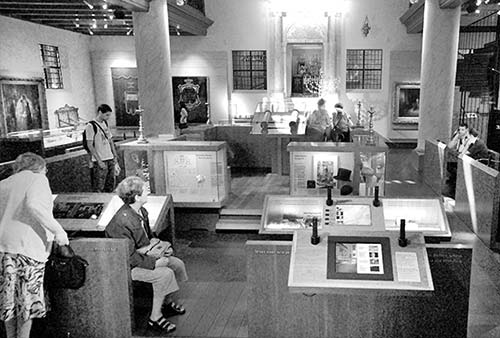
Displays (well described in English) around the room explain Jewish customs, from birth (circumcision) to puberty (the bar/bat mitzvah, celebrating the entry into adulthood) to Passover celebrations to marriage—culminating in the groom stomping on a glass while everyone shouts “Mazel tov!”
A synagogue is a place of public worship, where Jews gather to pray, sing, and read from the Torah. Most synagogues have similar features, though they vary depending on the congregation.
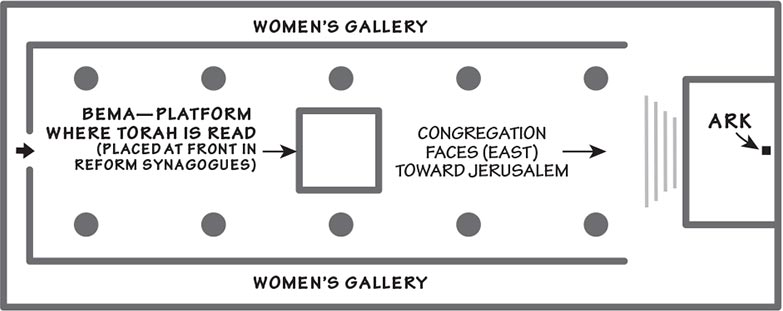
The synagogue generally faces toward Jerusalem. At the east end is an alcove called the ark, which holds the Torah. These scriptures (the first five books of the Old Testament) are written in Hebrew on scrolls wrapped in luxuriant cloth. The other main element of the synagogue is the bema (or tebáh), a platform from which the Torah is read aloud. In traditional Orthodox synagogues, the bema is near the center of the hall, and the reader stands facing the same direction as the congregation. (In other branches of Judaism, the bema is at the front, and the reader faces the worshippers.) Orthodox synagogues have separate worship areas for men and women, usually with women in the balcony.
The synagogue walls might be decorated with elaborate patterns of vines or geometric designs, but never statues of people (as that might be considered idol worship). A lamp above the ark is always kept lit, as it was in the ancient temple of Jerusalem. Candelabras called menorahs also recall the temple. Other common symbols are the two tablets of the Ten Commandments given to Moses, or a Star of David, representing the Jewish king’s shield.
At a typical service, the congregation arrives at the start of Sabbath (Friday evening). As a sign of respect toward God, men don yarmulkes (small round caps). As the cantor leads songs and prayers, worshippers follow along in a book of weekly readings. At the heart of the service, everyone stands as the Torah is ceremoniously paraded, unwrapped, and placed on the bema. Someone—the rabbi, the cantor, or a congregant—reads the words aloud. The rabbi (“teacher”) might give a commentary on the Torah passage.
Next, head up the spiral staircase to the women’s gallery, with exhibits tracing the history of Amsterdam’s Jews from 1600 to 1900. This was a golden age when Amsterdam and its Jewish population thrived in relative harmony.
Cross over the glass skybridge into the former New Synagogue, now featuring exhibits about the 20th century. Circle the room clockwise to see it chronologically: first, the flourishing community of 60,000—businessmen, intellectuals, civic leaders, and entertainers. Then comes the grim era of the Nazi occupation, when Jews were rounded up and deported. Everyone had to decide whether to stay, to hide, or to flee. The community was decimated. Personal artifacts—chairs, clothes—tell the devastating history in a very real way. While this provides a solid overview, the National Holocaust Museum delves much more deeply into this topic.
Head back downstairs to the café and exit. Before leaving, notice the good children’s museum (which you can enter from the main hall). Here you’ll find lively videos and a series of hands-on areas designed to teach kids about the rich tapestry of Jewish culture.
• From here, several more sights lie a short walk to the south, across the Nieuwe Herrengracht.
▲Dutch Holocaust Memorial of Names (Holocaust Namenmonument Nederland)
Opened in 2021, this somber labyrinth of walls was designed by Daniel Libeskind in the shape of four Hebrew letters that mean “In memory of.” It’s made of 102,000 bricks, each with the name, date of birth, and age at death of a Dutch victim who was killed by the Nazis. To remember and give dignity to these people—as well as 220 Sinti and Roma victims—this memorial encourages visitors to walk thoughtfully through and ponder the humanity of this tragic time. Look for Anne Frank (Annelies Frank 12.6.1929-15 jaar), and when you do, notice how many Franks were lost with her. Any name on a brick here would have known hundreds of others on other bricks (free, daily 8:00-21:00, Oct-Feb until 20:00, behind the Jewish Museum on Weesperstraat).
Nearby: The Monument of Jewish Gratitude (Monument van Joodse Erkentelijkheid) once stood where the Memorial of Names is now, but was relocated a few blocks south on Weesperplein. Soon after the Holocaust, in 1950, Amsterdam’s remaining Jewish community—under pressure from local authorities—erected it to recognize the many non-Jewish Dutch people who risked their own well-being to hide and protect Jews. Over time, the memorial became controversial: It ignored Jewish victims and glossed over the many Dutch who collaborated with the Nazis (or looked the other way).
▲▲National Holocaust Museum (Nationaal Holocaustmuseum)
Opened in 2024, this powerful museum tells the harrowing story of Dutch Jews during World War II. It fills a former teacher training school; at the nursery school next door, Jewish children were held, separated from their parents while awaiting deportation. The sobering site itself is moving, and the story eloquently told in its permanent exhibit—with ample artifacts and documentation—is chilling.
Cost and Hours: €22, €32 combo-ticket with National Jewish Museum and Portuguese Synagogue, cheaper online; daily 10:00-17:00; Plantage Middenlaan 27, tram #14 to Artis, https://jck.nl. As this is a relatively new sight, it may book up in advance; check the website a few days before your visit and buy ahead if necessary.
Visiting the Museum: As you enter, pick up the included audioguide, which greatly deepens your appreciation of the powerful site and exhibits.
First, explore the building itself, walking around the ground floor’s circular floor plan (turn right and follow signs for The Building, 1940-1945). A small, wrenching exhibit explains that this Reformed teacher-training college—and specifically, “the Crèche” (the nursery school) located just next door—became the final Amsterdam address for Jewish children awaiting deportation. Chilling photographs show cheerful, curious kids who were later executed by Nazis, and interview footage shows some of the survivors, as adults, recounting what little they recalled from their traumatic childhoods. From here, walk through the temporary exhibit hall and out the far end to see the tunnel that was used to secretly move some children to safety. Ultimately, 600 children were rescued—but only by going into hiding and disavowing their Jewish heritage. In the central courtyard, notice the evocative monument of a ladder leading up into an attic door—commemorating the non-Jewish Dutch people who helped Jews hide from certain death.
The creaky wooden staircase (near the tunnel) leads up to the permanent exhibition, The Netherlands and the Shoah. Beginning on the second floor, follow the one-way, chronological route, using your audioguide to glean powerful details—along with gruesome photographs, grainy footage, and lots of artifacts. Personal belongings of the victims—clothing, books, toys, a violin, a toolbox, a camera—tell stories of one of the 102,000 Dutch Jews who were lost forever.
You’ll learn about Jewish life here before the war, with some 140,000 Dutch Jews, plus 20,000 of “partial Jewish” background, who were later joined by some 19,000 more—who emigrated from Germany after the Nazis took over in 1933 (including Anne Frank’s family). You’ll witness Hitler’s rise to power; the Nazi occupation of the Netherlands; the impossible choice that faced local Jews (turn yourself in, flee, or hide?); and the gradual, draconian rollout of “Jewish laws” that severely restricted victims’ lives and created social isolation. The exhibit doesn’t turn a blind eye to Dutch collaborators, including the 25,000 local boys who volunteered for the Waffen-SS.
Throughout Amsterdam, including along Plantage Middenlaan in front of the National Holocaust Museum, keep an eye out for small brass plaques embedded in the sidewalk, embossed with names and other information. Called “stumbling stones” (struikelstenen), these mark the former residences of Jews who were murdered during the Holocaust. Each one begins with Hier woonde (“Here lived”), followed by their name, birth year (geb.), and information and dates relating their final fate: geïnterneerd (interned); gedeporteerd (deported—often uit Westerbork, via Westerbork transit camp); and murdered (vermoord). The final line is the place where they perished, ranging from Amsterdam to Auschwitz. In some cases, members of the same family died in different places—as was the case with Anne Frank’s family. You’ll find stumbling stones all over the city—not just in the Jewish Cultural Quarter. The whole point is for contemporary people to stumble over them randomly, and take a moment to reflect. Along this street, look for struikelstenen in front of #23 and #25 (not far from the tram stop).
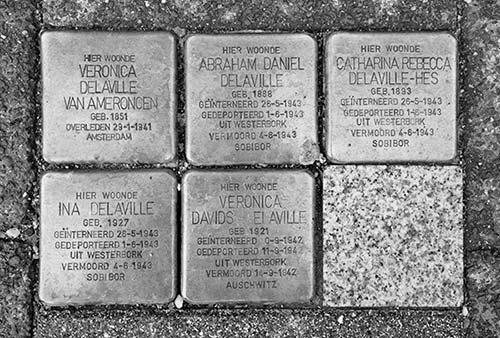
The first train from the Netherlands to Auschwitz-Birkenau departed on July 15, 1942—and upon arrival, Heinrich Himmler himself greeted its passengers. So began the wholesale deportation of Dutch Jews; ultimately 75 percent were deported (the highest percentage of any European country). Those who remained went into hiding; of the estimated 28,000 who hid, 16,000 survived. (Of the eight who hid in the Secret Annex near the Westerkerk—including four Franks—only one survived.)
Head down to the first floor to finish the exhibit. Westerbork was originally created by the Jewish community as a refugee camp for Jews fleeing Nazi Germany. But in 1942, the Nazis converted it into a transit camp for the purpose of transporting Jews to death camps farther east. From July 1942 through September 1944, each Tuesday an eastbound train would depart from Westerbork. For tens of thousands of Dutch Jews, this became the last place they set foot in the Netherlands.
Out of that prewar population of about 140,000 Jews, approximately 30,000 survived (5,200 returned from camps; the rest had hidden successfully throughout the war). But even those who survived faced a challenging postwar reality. In many cases, their possessions had been stolen, and other families had moved into their homes. The exhibit ponders the difficult task of “rehumanization” after such a harrowing experience. Disillusioned by life here, many left; between 1950 and the 1980s, an estimated 9,800 Dutch Jews moved to Israel, while others emigrated to the US, Canada, and Australia. The exhibit concludes by tracing how Judaism in the Netherlands has reclaimed its heritage, with the gradual creation of memorials and museums to document what happened here...including this one.
• Across the street is the...
Dutch Theater (Hollandsche Schouwburg)
Once a lively 800-seat theater in the Jewish neighborhood and today a moving memorial, this building was used as an assembly hall for local Jews destined for Nazi concentration camps. Over the course of the occupation, an estimated 70,000 Jews passed through here. From the tram stop out front—still in use today—a steady stream of Dutch Jews boarded a tram that took them to Centraal station, the first step of a long journey that, for most, ended in their brutal demise. Today, the ruins of the theater are a moving monument—worth seeing before or after your visit to the National Holocaust Museum across the street.
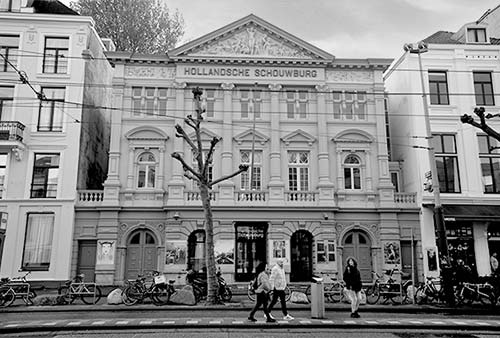
Cost and Hours: Free, donation requested, daily 10:00-17:00, Plantage Middenlaan 24, +31 20 531 0380, https://jck.nl.
Visiting the Memorial: In the entryway, on the left you’ll see a short film about the site (borrow an audioguide for the soundtrack). Then, step out into the courtyard that fills the site of the former theater. Along the walls are photos and names of some of the many Dutch Jews who passed through here on the way to Nazi death camps. At the end of the space, surrounded by the rubble of brick walls, stands a tall memorial tower. Behind that is a reflective, grassy garden, with a poignant memorial: a tree with fallen leaves.
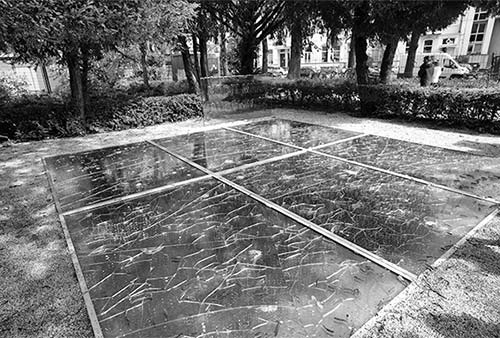
Nearby: A block away in Wertheim Park is the Auschwitz Memorial, with shattered mirror panes embedded in the ground, inspired by a victim’s poem referring to the broken sky of his world and declaring the motto NOOIT MEER (“Never Again”). While modest compared to some of the newer Holocaust commemorations in this neighborhood, it’s worth a look if you’re nearby.
▲▲Dutch Resistance Museum (Verzetsmuseum)
This impressive museum explains how the Dutch resisted (or collaborated with) their Nazi occupiers from 1940 to 1945. Riveting first-person accounts of 100 individuals, featured in snapshot profiles throughout the exhibit, describe what it was like to go underground, strike, starve, or return from the camps. You’ll see propaganda movie clips, study forged ID cards under a magnifying glass, and read about ingenious efforts—big and small—to hide local Jews from the Germans and undermine the Nazi regime. While the masses crowd the Anne Frank House, this museum (which I find just as impactful, with less emotional resonance but a sharper focus on the complicated history) is never busy. Take full advantage of the included audioguide for maximum understanding.
Cost and Hours: €16, €8.50 for kids 7-17, free for kids under 7; Mon-Fri 10:00-17:00, Sat-Sun from 11:00, children’s section, mandatory bag check, tram #14 to Artis, Plantage Kerklaan 61, +31 20 620 2535, www.verzetsmuseum.org.
Visiting the Museum: Using your audioguide, you’ll follow the one-way route through six periods—each with a short introductory video. There are plenty of screens and interactive exhibits. Along the way, you’re presented with a timeless moral dilemma: Is it better to collaborate with a wicked system to effect small-scale change—or to resist outright, even if your efforts are doomed to fail? You’ll learn why some parts of Dutch society opted for the former, and others for the latter.
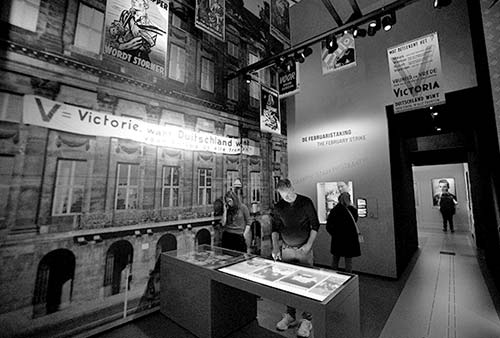
Admirably, the museum doesn’t shy away from the less heroic side of the story. It unflinchingly tells of Dutch collaborators, including Anton Mussert, who led the Nazi-like local NSB, and was later sentenced to death for his crimes; and the 25,000 young Dutch men who volunteered to serve in Hitler’s Waffen-SS. After the war, at least 120,000 Dutch collaborators were arrested. Most of the population became actively anti-Nazi only after Dutch gentiles—not just Jews—were deported to forced-labor camps.
You’ll get a sense of life in the Netherlands before the Nazis: Rich and poor, living peaceful and upright lives, ignoring the rise of fascism around them. Then—bam—it’s May 1940, as Hitler invades the Netherlands, destroys Rotterdam, drives Queen Wilhelmina into exile, and—in four short days of fighting—hammers home the message that resistance is futile. The Germans install local Dutch Nazis in power.
For most Dutch people, life goes on much as before. Then, in February 1941, Nazis start rounding up Jews from the neighborhood, killing nine protesters. Amsterdammers respond by shutting down the trams, schools, and businesses in a massive two-day strike.
With the introduction of hateful “Jewish Laws”—including the requirement to wear a yellow Star of David—each Dutch Jew had to decide: Report to authorities, hide, or flee the country? (While these topics are represented well, they’re covered in greater depth at the nearby National Holocaust Museum.)
You’ll see many other examples of Nazi oppression, affecting not only Dutch Jews. Everyone was forced to carry ID cards. Nazi propaganda posters hung everywhere. Goods were rationed. Movies had Aryan-race themes, as Hitler hoped to invite the Dutch into a “Germanic Brotherhood.”
The Dutch people fought back, in small ways and big. Vandals turned Nazi V-for-Victory posters into W-for-Wilhelmina. Preachers gave pointed anti-Nazi sermons and schoolkids told “Kraut” jokes. Farmers organized a milk strike. Brave resisters forged documents. They hid forbidden radios under floorboards and Jewish people inside closets. Printers secretly cranked out underground newspapers (such as Het Parool, which became a major daily paper).
When the Nazis lost Stalingrad, they were desperate for labor. They began compelling Dutch people to relocate to Germany as workers, and some 300,000 Dutch POWs from the initial invasion were conscripted for the Nazi war effort. The April-May strikes of 1943 were ruthlessly put down by the authorities; hundreds were killed, either during the protests or in later retaliation. As the war progressed, the armed Dutch Resistance became bolder and more violent, killing German occupiers and Dutch collaborators.
In September 1944, the Allies liberated Antwerp and the Netherlands started celebrating (“Mad Tuesday”)...too soon. A rail strike, designed to cut off military supplies to the front and finish off the Germans, infuriated the Nazi overlords. They punished the Dutch by cutting off rations, plunging West Holland into the “Hunger Winter” of 1944 to 1945, during which 20,000 died.
Finally, it’s springtime. The Allies liberate the country, and at war’s end, the Dutch flag flies again, and Nazi helmets are turned into Dutch bedpans. The exhibit concludes with a look at the consequences of the war—including the independence of Indonesia, after a four-year struggle against Dutch forces.
The museum also has an impressive, thoughtful children’s section, which introduces visitors to kids from four very different backgrounds and sectors of society, then follows them through the course of the war. Like the rest of the museum, it refuses to gloss over the hard truths and impossible decisions of a nation at war.
Farther South
World Museum Amsterdam (Wereldmuseum Amsterdam)
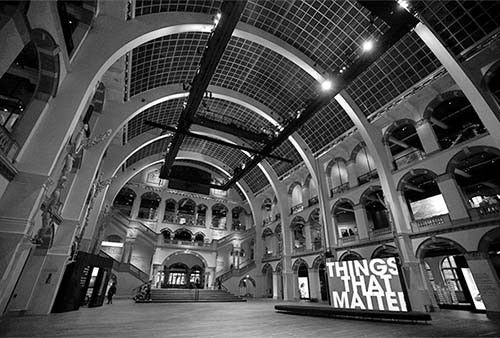
The Dutch have a complicated relationship with the sins of their colonial past. The unbridled opulence and optimism of this city’s golden age was largely bankrolled by exploiting the resources and people of distant colonies. Dutch sea traders were also made wealthy by their role in the transatlantic trade of enslaved people. While this ethnographic museum is designed primarily for Dutch people to confront their own history, it’s fascinating to anyone, and well worth at least ▲ for those who are curious about this (until recently, largely untold) aspect of the Netherlands’ history. While cynics might dismiss it as the “Woke Museum,” the World Museum shines a light on topics that some may prefer to forget, in a way that’s thoughtful, meticulously documented, and designed to challenge assumptions. If visiting here makes you uncomfortable...ask yourself why.
Cost and Hours: €17.50, €9 for kids 6-18, free for kids 5 and under; daily 10:00-17:00, closed Mon off-season; tram #14 to Alexanderplein or 15-minute walk south of Jewish Cultural Quarter, Linnaeusstraat 2, +31 20 568 8200, https://amsterdam.wereldmuseum.nl.
Visiting the Museum: For important historical context before you visit, read “The Netherlands’ Colonial Legacy” sidebar in the Netherlands History chapter.
From the ticket office (with lockers and WCs), head up into the vast atrium. This grand building was purpose-built a century ago to house and study items brought here from Dutch colonies. Since then, those colonies have gained their independence, and the Dutch attitude about this period has evolved. The collection was revamped to align with more enlightened thinking about colonialism, and in 2023 was finally rechristened as the “World Museum” (one branch of a Netherlands-wide group).
The ground floor hosts “long-term temporary” exhibits, while the second floor features shorter-term temporary exhibits.
The main exhibit, called “Our Colonial Inheritance,” is up on the first floor: Walk to the far end of the atrium, turn right up the stairs, and circle the collection clockwise. It begins with a series of interviews with Dutch people of color, many with ancestral origins in former colonies, who are asked to ponder their place in today’s Netherlands. You’ll learn how the Netherlands, while thought of as progressive, retains an undercurrent of racism—embodied by the Dutch Santa Claus sidekick, Zwarte Piet (“Black Pete”), usually performed by a white man in blackface. (In a recent poll, more than half of Dutch respondents continue to support Zwarte Piet’s traditional appearance.)
From there, the collection explores various aspects of Dutch traders’ aggression on the far sides of the globe—from Indonesia, to Suriname and the Caribbean, to Africa—while displaying artifacts with thoughtful explanations and important historical context. You’ll learn how Dutch trade disseminated certain products, such as cassava, which was indigenous to South America but spread far and wide through transatlantic trade to become a staple of cooking in parts of Africa and Asia (much like how tomatoes, potatoes, and tobacco originated in the Americas but became mainstays across Europe). Paintings from the era—designed to present a romanticized view of “the Tropics” to the Dutch back home—show gauzy, bucolic, idealized views of humble farmers happily tending an exotic land. Shuffled among all this history are contemporary works of art—meditations on similar themes that reinterpret this troubled past from a modern perspective.
Further exhibits probe topics such as racism; language (Dutch, indigenous languages, and various creoles that were created when people from the far ends of the earth were forced to live in the same place—another byproduct of colonialism), religion (including how Christianity, imported by the Dutch, supplanted or merged with indigenous beliefs); and the eventual independence of Dutch colonies (Indonesia in 1949 after a bloody war; Suriname in 1975, through more diplomatic means)—and the resulting influx of people from those places to the Netherlands. The exhibit ends with a celebration of the many ways that these post-colonial Dutch citizens have woven their own cultures into the greater fabric of the Netherlands—often through music, clothing, and cuisine.
Completing your visit, try to see this place through Dutch eyes. Ask yourself: Is Amsterdam’s golden age something to look back upon with pride, with shame, or with some of both?
NORTHEAST AMSTERDAM
NEMO (National Center for Science and Technology)
This kid-friendly science museum is a city landmark. Its distinctive copper-green building, jutting up from the water like a sinking ship, has prompted critics to nickname it the Titanic. Designed by Italian architect Renzo Piano (known for Paris’ Pompidou Center and Berlin’s Sony Center complex on Potsdamer Platz), the building’s shape reflects its nautical surroundings as well as the curve of the underwater tunnel it straddles.
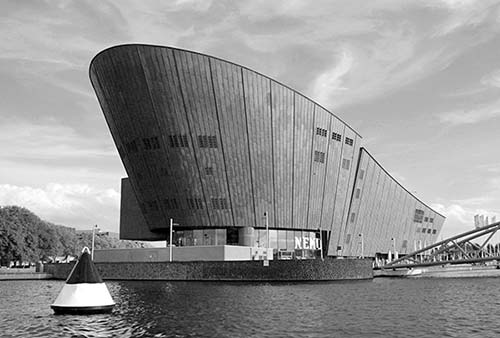
Several floors feature permanent and rotating exhibits that allow kids (and adults) to explore topics such as light, sound, and gravity, and to play with bubbles or topple giant dominoes. Head to their laboratory to do simple experiments, or check out the “Life in the Universe” exhibit.
Up top is a restaurant with a great city view, as well as a sloping terrace that becomes a popular “beach” in summer, complete with lounge chairs and a lively bar. On the second floor is a café with drinks and pastries.
Cost and Hours: €17.50, free for kids 3 and under; daily 10:00-17:30, closed Mon off-season; +31 20 531 3233, www.nemosciencemuseum.nl. The roof terrace—open until 20:00 in the summer—is generally free.
Getting There: It’s above the entrance to the IJ tunnel at Oosterdok 2. From Centraal station, you can walk there in 15 minutes, or take bus #22 to the Kadijksplein stop.
Nearby: Consider stopping in the Central Library (Openbare Bibliotheek Amsterdam—look for the OBA sign), across a footbridge north of NEMO. Its cafeteria, € Babel, has good-value meals and rooftop views (https://babel.amsterdam).
▲Netherlands Maritime Museum (Nederlands Scheepvaartmuseum)
This huge, slick, and kid-friendly collection of model ships, maps, and sea-battle paintings fills the 300-year-old Dutch Navy Arsenal (cleverly located a little way from the city center, as this was where they stored the gunpowder). A highlight is a chance to explore below the decks of a replica tall-masted ship and gaze at a royal barge. Given the Dutch seafaring heritage, this is an appropriately important and impressive place.
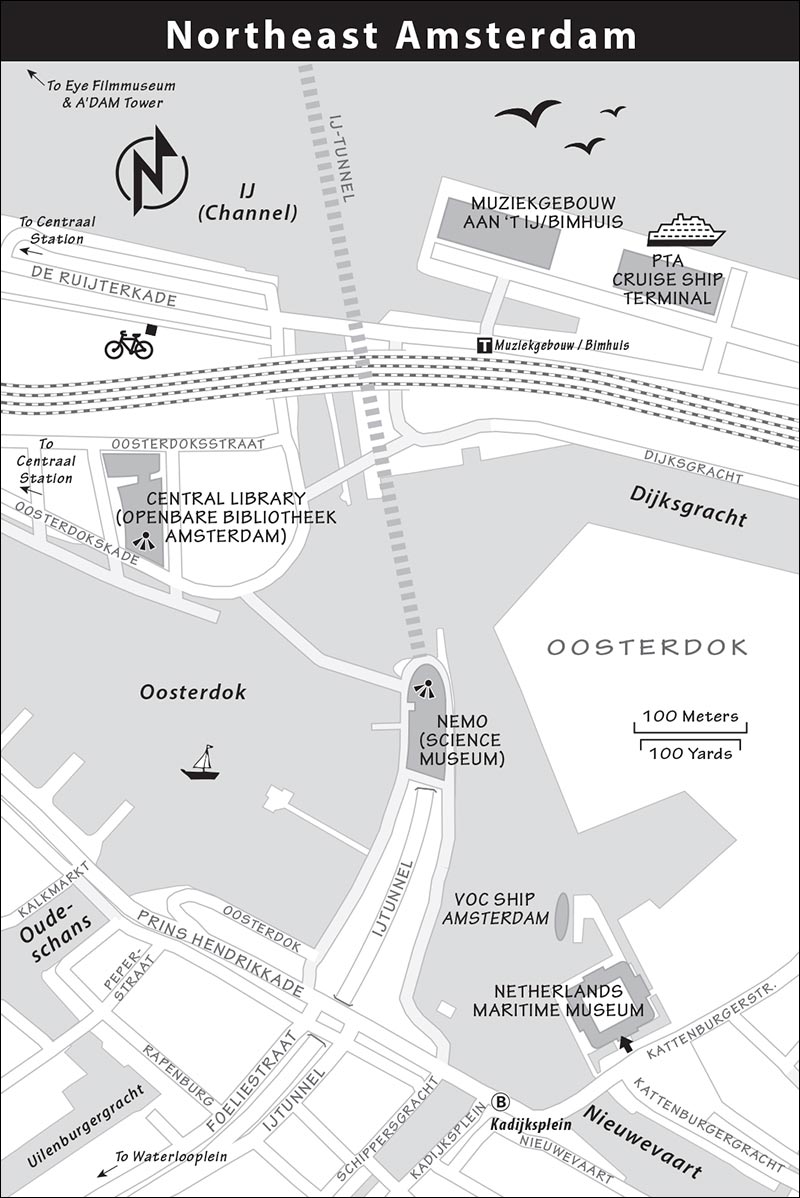
Cost and Hours: €18.50, free for kids 12 and under, includes audioguide; daily 10:00-17:00; bus #22 to Kattenburgerplein 1, +31 20 523 2222, www.hetscheepvaartmuseum.com.
Visiting the Museum: Start your tour in the central courtyard. From here, you can explore the buildings in any order you choose.
The east (oost) wing’s level 1 kicks off with yacht models through the ages, from early warships to today’s luxury vessels. Note that the display case groups the boats by type—round-bottomed, square-sterned, keel, etc. There’s also an impressive selection of maps, beginning with Amsterdam from the mid-1500s and showing the territories and “discoveries” made by Dutch sailors, from Brazil to Indonesia. You’ll also find a hall of “curiosities” brought here from those faraway lands. One section is devoted to the six Solebay tapestries (1685-1688), commissioned by the Dutch king to commemorate what he perceived as a victory in a fateful battle against the British Navy. (You’ll see two of the six.) Up on level 2, you’ll find ship decorations—beautiful women, fearsome monsters, and a variety of other mastheads that adorned the prows of ships; descriptions explain their symbolic meaning for superstitious sailors. Nearby is a gallery of navigational instruments. A variety of tools for measuring latitude and longitude includes everything from astrolabes—cross-shaped devices used to measure the angle between the horizon and the sun—to steering compasses from the 19th century.
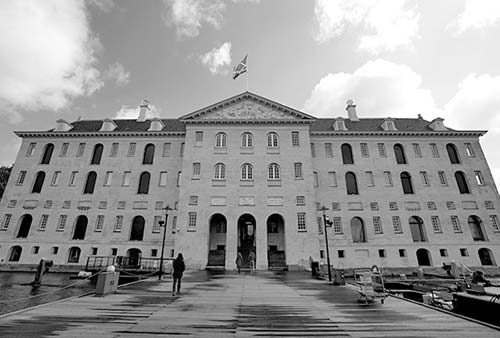
In the west wing, level 1 is mostly kid-oriented and interactive, with a “Doris the Diver” exhibit. In the section devoted to whales, you’ll learn how, from the 17th to 19th centuries, the Dutch hunted some 40,000 whales, and you’ll see tools used for whaling (such as huge saws used to cut through the ice). Up on level 2 is a debate-style look at the dichotomy of Amsterdam, serving as both an industrial port and as a livable city.
In the north (noord) wing, begin in the main gallery on the ground level, called “Republic at Sea.” Pause at the first big painting—The Battle of Gibraltar, 25 April 1607—which shows the Dutch navy’s crowning moment. In this battle, 26 Dutch ships routed the seemingly invincible Spanish force. Virtually all the ships in the painting fly the three-color Dutch flag. That’s because the Spanish fleet has already been sunk, killing thousands. The painting depicts the infamous mopping-up procedure. The Dutch are lowering their lifeboats to save the Spaniards—or, as other historians say, to finish them off. The rest of this gallery illustrates the Netherlands’ maritime history through paintings. Upstairs are temporary exhibits.
Before exiting the north wing, head through the back door down to the colorful replica ship Amsterdam moored behind the building. This type of ship (called an East Indiaman) had its heyday during the 17th and 18th centuries, sailing for the Dutch East India Company (see the abbreviation VOC—for Vereenigde Oost-Indische Compagnie—on insignias throughout the boat). Wander the decks, including the galley and the saloon, then duck your head and check out the captain and surgeon’s quarters. Climb down into the hold to see the ship’s essentials: bread, cheese, and gunpowder. On the main deck, a wraparound film presents views of 17th-century Amsterdam, based on a painting by Reiner Nooms.
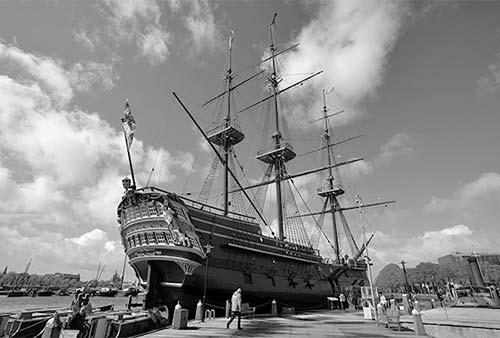
The Royal Barge—in the building signed De Koningssloep—is no replica. Built for King William I in the early 19th century, this gaudy boat was a symbol of the might of the House of Orange after the chaos of the French Revolution and Napoleonic Wars. Last used in 1962 by Queen Juliana and Prince Bernhard for their silver wedding anniversary, the Royal Barge is still seaworthy.
NORTH AMSTERDAM (Amsterdam-Noord)
Beyond the scope of many tourists’ radar, Amsterdam-Noord (the sprawling swath of the city across the IJ) feels a world away from the 17th-century canals in the historic center. This area has seen a rash of recent development: As Amsterdam expands beyond its constrained natural footprint, it’s growing in this direction. On a short visit, this area is skippable. But with more time, you can enjoy a little pocket of touristy attractions, go for a bike ride through some nearby polderland and villages, or check out a trendy dining and entertainment district.
Orientation: Two districts are easy to reach on a free ferry from Centraal station. In good weather, it can be fun to take a bike on the ferry, either to connect these two areas or to go for a longer ride along some dreamy canals, windmills, and villages (described below).
The Buiksloterweg area, immediately across the harbor, is a strange combination of stark and touristy; it’s most interesting as the starting point for a bike trip through the polderland—an easy escape from the frenzied bike paths of Amsterdam’s core.
The NDSM area, a little farther by ferry (but still easy) has a completely different feel: This former zone of heavy industry is today a mix of sparkling new development and crumbling old buildings filled with modern eateries. The two areas are a very dull 45-minute walk apart, through industrial blight and suburban sprawl; if connecting them, do it by bike or by taxi/Uber.
Getting There: Ferries are right behind Centraal station. Boats fill up quickly with commuters on foot and bike—just join the crowd. Ferries from the first few docks, labeled F3 and Buiksloterweg, go straight to the A’DAM Tower and EYE Filmmuseum area (a 3-minute ride). Ferries from the last dock, labeled F4 and NDSM, run about every 15-20 minutes to the former shipyards and hipster zone (a 15-minute ride).
Two Metro stops serve Amsterdam Noord (Noorderpark and Noord), but ferries are easier, more convenient, and more enjoyable.
Buiksloterweg Sights
Just across a bridge from the ferry landing at Buiksloterweg, you’ll reach a cluster of tourist attractions that are more style than substance. While these don’t rank very high on the scale of Amsterdam sightseeing, they can be a fun excuse for the quick ferry ride over. (Or just stroll through the free areas of the EYE Filmmuseum, then ride back.)
EYE Filmmuseum: Although it’s been eclipsed by a forest of other high-rises, when it opened in 2012, this striking building heralded the gentrification of the north side of the IJ (its name is a play on the Dutch pronunciation of “IJ”). It’s free to explore the interior, including a gallery of film posters, a shop, a café with outdoor seating, and a giant interior staircase that you can sit on. The modest permanent exhibit, downstairs, features some old cameras and projectors, a room playing 360 degrees of film clips, and the chance to have some fun with a green screen. Four theaters play mostly art films in their original language (free to enter building, open long hours daily; temporary exhibits—€15, open daily 10:00-19:00; movies—€12.50, check schedule online; +31 20 589 1400, www.eyefilm.nl).
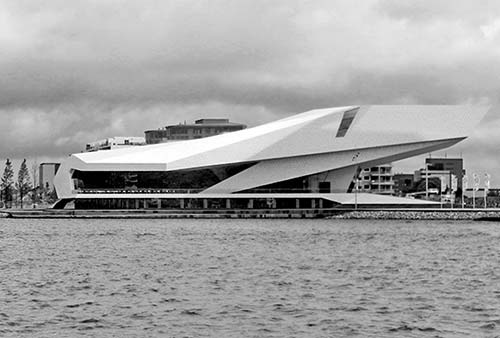
A’DAM Tower: Towering over the EYE Filmmuseum, this high-rise building is topped with an oversized observation deck offering 360-degree views of the city, along with a cocktail bar, “Europe’s highest swing” over the IJ, a virtual-reality rollercoaster ride, and other amusements (€18.50 for observation deck, €10.50 for kids 4-12, cheaper online; other activities cost extra, daily 10:00-22:00, Overhoeksplein 1, www.adamtoren.nl).
This Is Holland: Next door to A’DAM Tower is an expensive rip-off of the Disney Soarin’ ride—a nine-minute simulated flight around the Netherlands, with sights, smells, wind, and mist (€27, €19.50 for kids 4-12, cheaper online, daily 10:00-22:00, www.thisisholland.com).
Bike Ride from Buiksloterweg into the Polderland
The most appealing reason to ride the ferry to Buiksloterweg is to access the nearby countryside for a peaceful bike ride. Bring a bike on the ferry to Buiksloterweg or rent one on arrival: Coming off the boat, angle left and look on the lower level of the split-level building just before the bridge to find TIP Amsterdam-Noord. This office rents bikes at affordable rates, and generously dispenses free maps and tips (Mon-Sat until 17:00, Sun until 13:00, maybe later in summer, must return bikes before closing time, IJpromenade 2, +31 6 1399 8675, www.bikerentalamsterdamnorth.nl).
Here are a few options; use a bike map or Google Maps to fill in the details:
The easiest choice is simply to pedal to the Krijtmolen d’Admiraal windmill, just under two miles from the ferry dock. The ferry docks right next to the North Holland Canal (Noordhollandsch Kanaal), which provides a handy spine for your ride. Simply roll off the boat and keep the canal on your right (jogging briefly inland soon after you depart, then returning to the canal). This is an easy round-trip in less than 30 minutes.
To go farther afield, pedal through the polderland to the east. Depending how much time you have, navigate to one or more of the villages of Zunderdorp, Ransdorp, and Durgerdam. (Allow three hours for the full loop.)
Start out by biking to the windmill, then backtrack slightly to cross the North Holland Canal at the Buiksloterdraaibrug. Follow that same canal, up the other side, then veer off into the countryside, navigating your way through fields to the first of the villages, Zunderdorp. From there, you could start heading back: Cut south across the countryside and back through civilization, where Café ‘t Sluisje offers a fine break overlooking the water. Cycle past the elm and ash forest called Vliegenbos on your return to the North Holland Canal (cross at the Willem I Locks) and the ferry dock.
The other option from Zunderdorp—if the weather’s great and you feel like a longer ride—is to keep going through the polderland to Ransdorp, with a tower you can climb for the views (summer weekends only). Beyond Ransdorp, you can ride to Holysloot, with a café filling an old schoolhouse. But the quicker way back is through the village of Durgerdam. On your return from Durgerdam, you can get a look at the Oranjesluizen (Orange Locks), which control the flow between the IJ and the IJsselmeer. However far you go, aim to return by way of Café ‘t Sluisje and Vliegenbos (described earlier).
NDSM
To experience post-industrial blight brightened by street art, sprawling rickety-chic restaurants, and a hipster aesthetic, ride the longer ferry from behind Centraal station to the area called NDSM. Short for “Nederlandsche Dok en Scheepsbouw Maatschappij,” this former dock and shipbuilding area still feels industrial, aside from the slick new high-rise condos that poke up in front of the ferry.
The ferry ride itself offers a fun peek at the fifth-biggest harbor in Europe (nearby Rotterdam is number one), old wheat silos now renovated into upscale condos, and the shoreline of Amsterdam-Noord. The ferry deposits you in what looks like an industrial wasteland—although in nice weather, it’s also jammed with happy young Amsterdammers...and very few tourists.
For a little sightseeing, as you step off the dock, look ahead and to the right for either a rainbow-painted arch or a giant mural of Anne Frank, in the distance. This marks the STRAAT Museum, a former industrial hall that’s now a showcase for street art—inside and out (€19.50, Tue-Sun 10:00-17:00, Mon from 12:00, NDSM-Plein 1, +31 20 370 9630, www.straatmuseum.com).
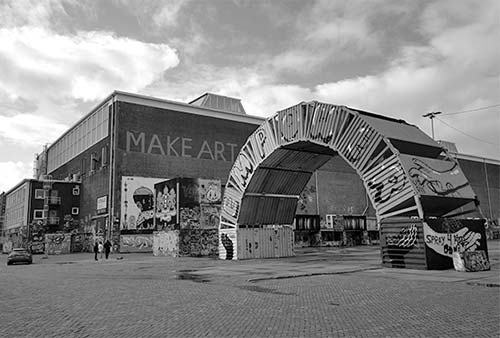
Amsterdammers come to this area to get away from the prim, compact, regimented streets of the city center; to enjoy wide-open (cracked-concrete-and-rusted-metal) spaces; to linger over the sunset; and to eat well. For some suggestions on having a meal here, see the Eating in Amsterdam chapter.