AMSTERDAM & THE NETHERLANDS
The Netherlands’ Top Destinations
Map: The Netherlands’ Top Destinations
Map: 12 Days in the Netherlands
Rick’s Free Video Clips and Audio Tours
Wherever you roam, you’ll find the Netherlands to be an eye-opener. Behind its placid exterior, it’s a complex mix of modern technology, honored traditions, farmed countryside, outrageous architecture, and no-nonsense, globally minded people.
Amsterdam is the tourist draw with the Netherlands’ most historic sights and museums, but it also has inviting neighborhoods, with leafy canals, chiming carillons, quaint shops, and friendly eateries. Beyond Amsterdam, you’ll discover the hidden charms of Haarlem, where a market bustles around its historic church. The Hague has Vermeer paintings in its top-notch museums, while peaceful Delft is a Vermeer painting come to life. The country is bursting with delightful towns—Edam, Alkmaar, Hoorn, and more—as well as open-air museums.
Though many refer to the entire country as “Holland,” North Holland and South Holland are merely the largest of the 12 provinces that make up the Netherlands. In Holland’s 17th-century golden age, Dutch traders sailed the seas in search of exotic goods, creating a colonial empire and a global economy. Tiny Holland was a world power—politically, economically, and culturally—with more great artists per square mile than any other country.
Today, the Netherlands is Europe’s most densely populated country and also one of its wealthiest and best organized. In 1944, the neighboring countries of Belgium, the Netherlands, and Luxembourg became the nucleus of a united Europe when they joined to form the Benelux economic union.
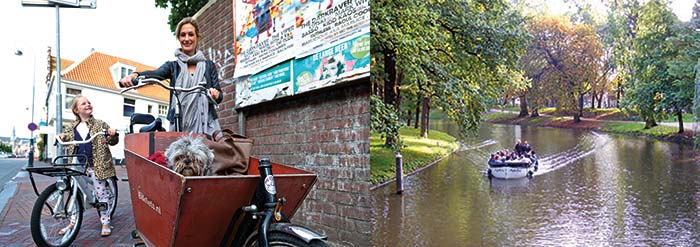
Bikes and boats are popular modes of transportation for good reason in this small, flat, canal-crossed country.
The average income in the Netherlands is higher than in the United States. Though less than 10 percent of the labor force is in agriculture, over 50 percent of the land is cultivated: If you venture outside of Amsterdam, you’ll travel through vast fields of barley, wheat, sugar beets, potatoes, and flowers.
Much of the flat Dutch landscape was reclaimed from the sea, producing several Dutch icons in the process: Windmills and canals drained the land. Wooden shoes (klompen) allowed farmers to walk across soggy low-lying fields known as polders. (The shoes also float—making them easy to find should they come off in high water.) Tulips and other flowers grew well in the sandy soil near dunes.
The Netherlands’ flat land also makes it a biker’s dream. The Dutch, who average four bikes per family, have put small bike roads (with their own traffic lights) beside nearly every major highway. You can rent bikes at most train stations and drop them off at most others. And you can take bikes on trains (outside of rush hour) for less than €10 per day. But bikes can make things tricky for those on foot. You might expect the right-of-way pecking order to favor pedestrians, then bikes, then cars. Not so. In practice, you should assume it’s bikes first...then everyone else. Be alert at all times for bikes—especially when stepping into the street.
The Dutch call their country Nederland, meaning “lowland.” The Netherlands occupies the delta near the mouth of three of Europe’s large rivers, including the Rhine. In medieval times, inhabitants built a system of earthen dikes to protect their land from flooding caused by tides and storm surges. The story of the little Dutch boy who saves the country—by sticking his finger in a leaking dike—summed up the country’s precarious situation. (Many Americans know this story from the popular 19th-century novel Hans Brinker: or, The Silver Skates—but few Dutch people have ever heard of it.)
In 1953, severe floods breached the old dikes, killing 1,800 and requiring a major overhaul of the system. Today’s 350 miles of dikes and levees are high-tech, with electronic sensors to monitor water levels. Dutch experts traveled to Louisiana after Hurricane Katrina to share their expertise with US officials after levee failure caused massive flooding. And after Hurricane Sandy, American hydrology experts began looking to the Netherlands for models of how to protect against flooding.
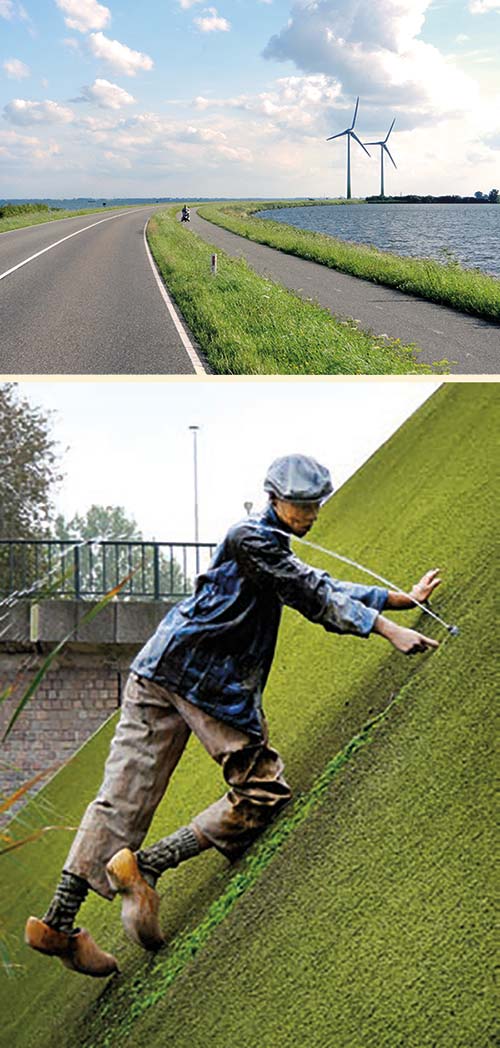
The powerful dikes, which can look as simple as a raised road, keep the land from being reclaimed by the sea. The story of the heroic Dutch boy who plugged a dike to save his country was invented in an 1865 book by the American author Mary Mapes Dodge.
Much of the land of the Netherlands was reclaimed from the sea, rivers, and lakes, thanks to the country’s iconic windmills. After diking off large tracts of land below sea level, the Dutch used windmills to harness wind energy to lift the water up out of the enclosed area, divert it into canals, and drain the land. They cultivated hardy plants that removed salt from the soil, slowly turning marshy estuaries into fertile farmland. The windmills later served a second purpose for farmers by turning stone wheels to grind their grain.
The trifecta of Dutch reclamation technology is dikes, windmills...and canals. Picturesque waterways, big and small, course through both cities and the countryside. While we use the all-purpose term “canal,” the Dutch recognize several variations, which can be helpful as you navigate place names: singel is a former moat, gracht is a dug-out waterway, kanal is for shipping, and sloot is a drainage canal (usually in the countryside). A sluis is a lock (or sluice).
The country’s last major reclamation project created a new province, Flevoland, that was drained, dried, and populated within the last 100 years (see the Flevoland chapter for the whole story).
Today, Dutch reclamation projects are essentially finished. As the world’s climate changes and sea levels rise, the Dutch are now focusing more on resources to upgrade their dikes and bulk up their beaches to hold back the sea. They also continue to innovate, building floatable homes and greenhouses (which rise with the tides) and relocating dikes farther back from the rivers to create wider floodplains.
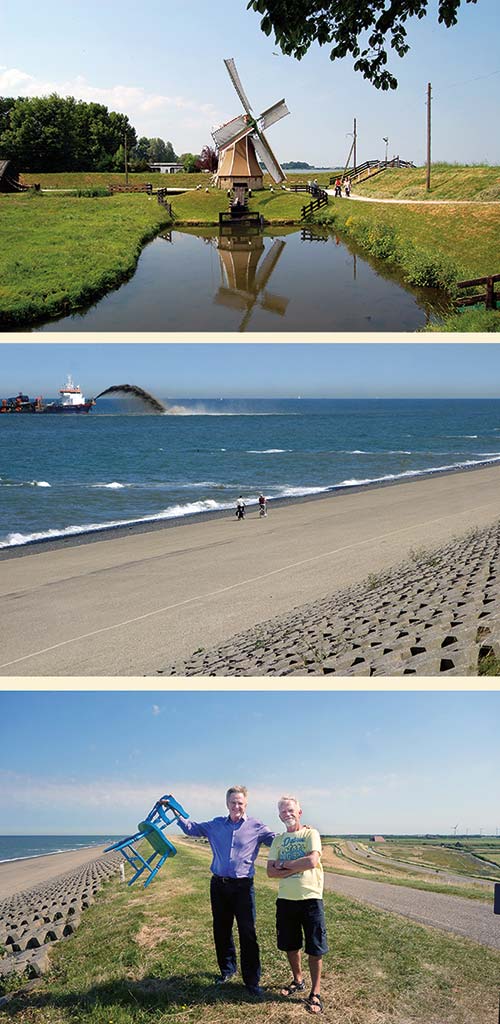
Spinning windmills (like this one at Enkhuizen) drain marshy lowlands. Boats dredge up silt to maintain the shoreline. The land is so flat, the Dutch like to joke that if you stand on a chair, you can see the whole country.
All this technological tinkering with nature—past and present—has brought about a popular local saying: “God made the Earth, but the Dutch made Holland.”
The Dutch generally speak English, pride themselves on their frankness, and like to split the bill. Thriftiness, efficiency, and a dislike of wastefulness are longstanding Dutch traits. Traditionally, Dutch cities have been open-minded, loose, and liberal (to attract sailors in the days of Henry Hudson). And today, Amsterdam is a capital of largely progressive policies—a city where they believe that society has to make a choice: tolerate alternative lifestyles or build more prisons. Coffeeshops sell marijuana (and sometimes cappuccinos), and prostitutes pose in government-licensed windows. The city is surprisingly diverse, housing many expats and immigrants—a trend that, unfortunately, has resulted in tension in recent years. The Netherlands in general, and Amsterdam in particular, is gay-friendly. Some of the biggest festivals and parades on the social calendar celebrate the LGBTQ+ community.
Although it expresses itself in a sometimes-jarring acceptance of drugs and sex, the Dutch passion for tolerance has deep historical roots: For generations, this part of Europe was a particularly fierce battleground between the Roman Catholic Church (backed primarily by Spain) and Reformation-era Protestants (Dutch nationalists). The Eighty Years’ War and other conflicts flamed religious intolerance. But afterward, the reaction against the Spanish Inquisition and the wealth of the golden age brought a new era of acceptance. Today—especially after the Nazi occupation’s persecution of Jews and other minorities—the Dutch are determined to live and let live.
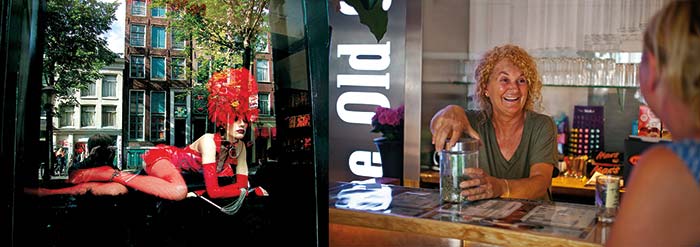
Prostitution (advertised in Amsterdam’s Red Light District) and marijuana (sold in coffeeshops) are legal and regulated.
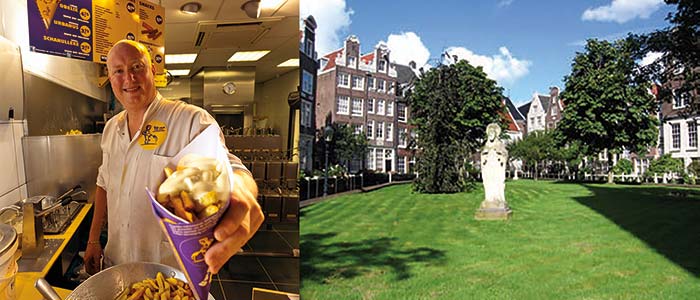
French fries (friets) are served with mayonnaise. The Begijnhof’s courtyard is a peaceful oasis in downtown Amsterdam.
Another facet of this philosophy is Dutch humility. A popular saying here is, “The tree that grows the tallest gets blown by the strongest wind.” While the Dutch have an affinity for Americans, they don’t always quite know how to take our proud individualism.
This book presents the best of Amsterdam and the Netherlands—its great cities, small towns, fine food, rich history, and sensuous art. You’ll experience both the quaintness of the countryside as well as the modern vibrancy of the Netherlands’ forward-thinking urban centers.
Along the way, you’ll meet intriguing people who will show you how to swallow a pickled herring, paddle a canoe through polder waterways, or slice off a hunk of cheese from a giant wheel. Rattling your bike over cobbles, past a line of gabled houses reflected in a mirror-smooth canal—everything is so...Dutch! It’s as if the tourist clichés of the region—whirring windmills, Dutch Masters, canal rides, dike hikes, and tulips—all come to life in the Netherlands.
The Netherlands’ Top Destinations
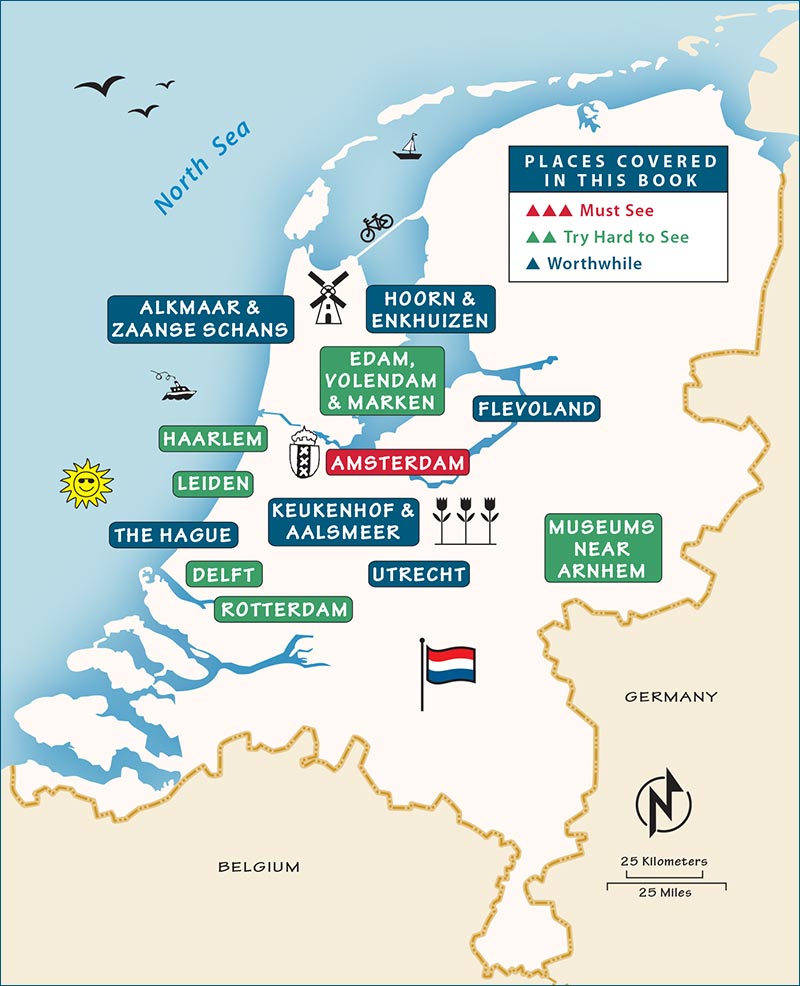
Wauw! There’s so much to see in the Netherlands. To help you decide where and how to spend your time, this overview categorizes the country’s top destinations into home-base cities and day trips. I’ve ranked each and suggested a minimum amount of time to allow. Much of the country is an easy day trip from whichever home base you choose.
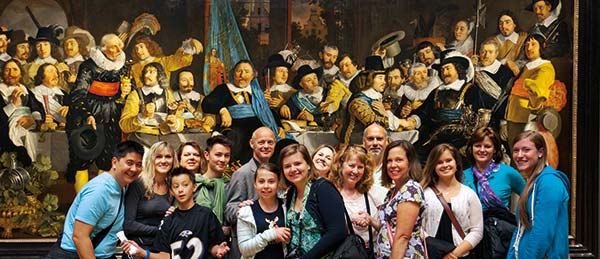
BEST HOME BASES
If you stay in one of these three cities for your whole trip, be sure to visit the other two on day trips.
▲▲▲Amsterdam (allow 2-4 days)
The dynamic capital, with golden age architecture lining shimmering canals, boasts magnificent museums, from the venerable Rijksmuseum (with Dutch Masters) to Van Gogh’s colorful collection to the thought-provoking Anne Frank House. The city has a lively food scene, diverse nightlife, marijuana-selling “coffeshops,” and an eye-opening Red Light District, along with bustling streets and markets...and bikes everywhere.
▲▲Haarlem (1 day)
The cozy town, with its grand market square, huge church, and stately architecture, was home to artist Frans Hals and author Corrie ten Boom (who hid Jews from the Nazis, as described in The Hiding Place). Just 20 minutes from Amsterdam and 10 minutes from the beach at Zandvoort, Haarlem is conveniently central yet invitingly small.
▲▲Delft (1 day)
The picturesque, canal-laced hometown of Vermeer (hosting a fine Vermeer Center but not his art) and Delft Blue porcelain (with a tourable factory) has a tranquil vibe. Delft makes a mellow home base for day-tripping to nearby cities: While one hour by train from Amsterdam, Delft is only 15-30 minutes from Leiden (a delightful university town), The Hague (which does have Vermeers), and Rotterdam (with avant-garde architecture).
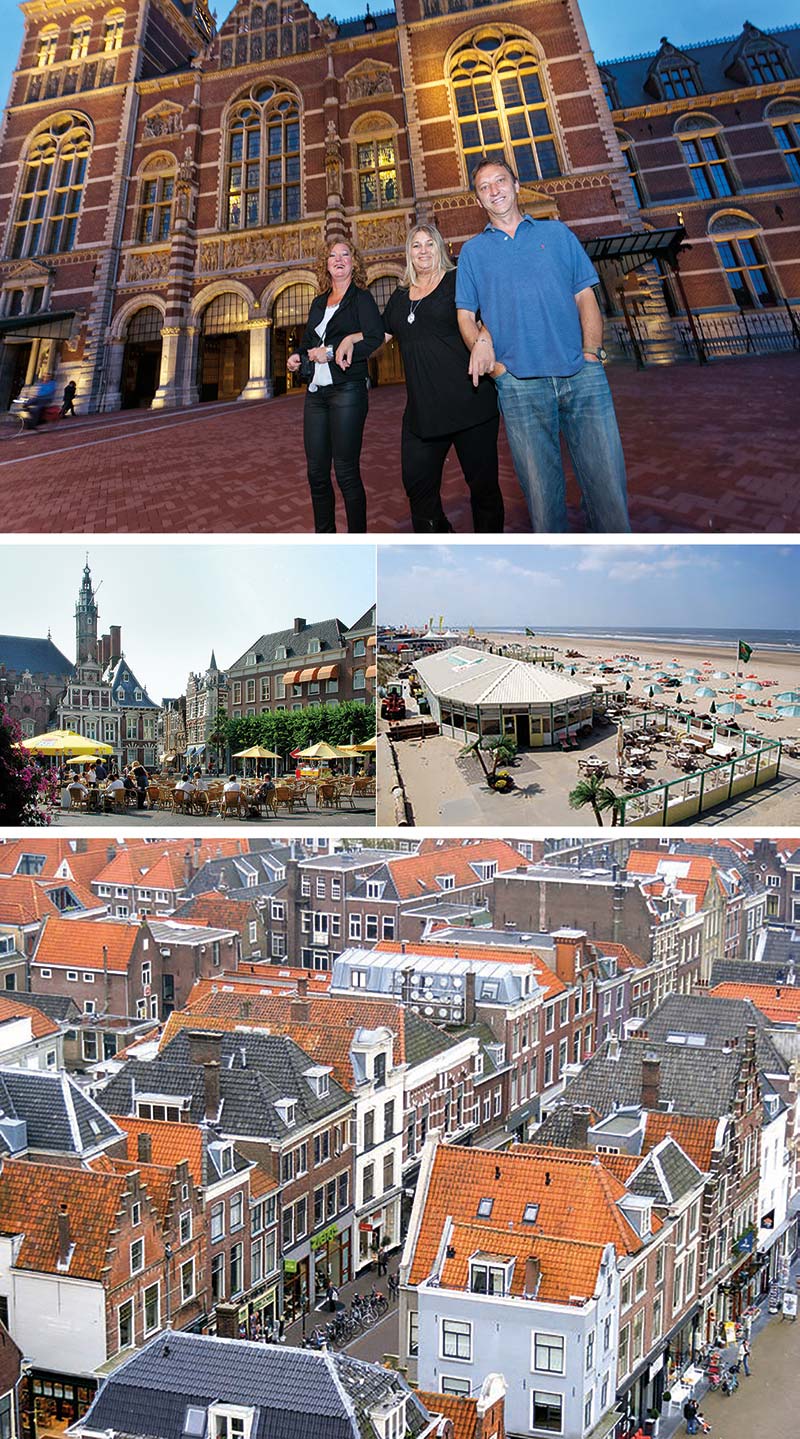
Photo fun inside (opposite) and outside the Rijksmuseum; Zandvoort’s wide beach; bird’s-eye view of Delft; Haarlem’s sunny square
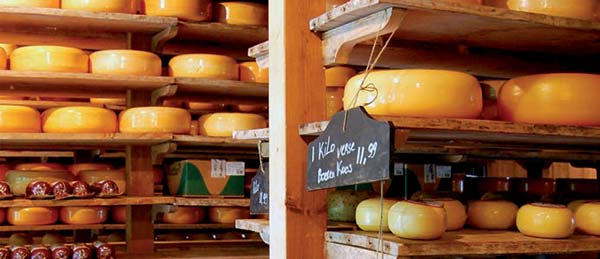
BEST DAY TRIPS
North of Amsterdam
▲Alkmaar and Zaanse Schans (half-day each)
Little Alkmaar is hugely popular on Friday mornings for its cheese market, when big orange rounds of cheese are sampled and sold with flair (late March through Sept). Nearby Zaanse Schans is a touristy, re-created 17th-century Dutch town, with windmills and old-time shops. You can combine both destinations on a day trip, best on Fridays.
▲▲Edam, Volendam, and Marken (1 day)
The postcard-perfect region of Waterland harbors the adorable village of Edam (with endearing museums, a big church, and a cheese market on summer Wednesdays), the tourist depot of Volendam (with a promenade and quirky museum), and the fascinating former fishing hamlet of Marken. You can see all three in a day, but with less time, focus on little Edam.
▲Hoorn and Enkhuizen (1 day)
This time-warp duo—the golden age merchant’s town of Hoorn and the charming village of Enkhuizen, with an open-air museum on Zuiderzee culture—makes a good day trip. Take public transit or the slower, scenic Historic Triangle loop (including rides on a boat, steam train, and modern train).
▲Flevoland (1 day, worthwhile only for drivers)
The country’s newest province, reclaimed from the sea, looks modern and plain except for Schokland. This former fishing village is now surrounded by dry land, with a museum describing the reclamation project, the region’s history, and the villagers’ lifestyle.
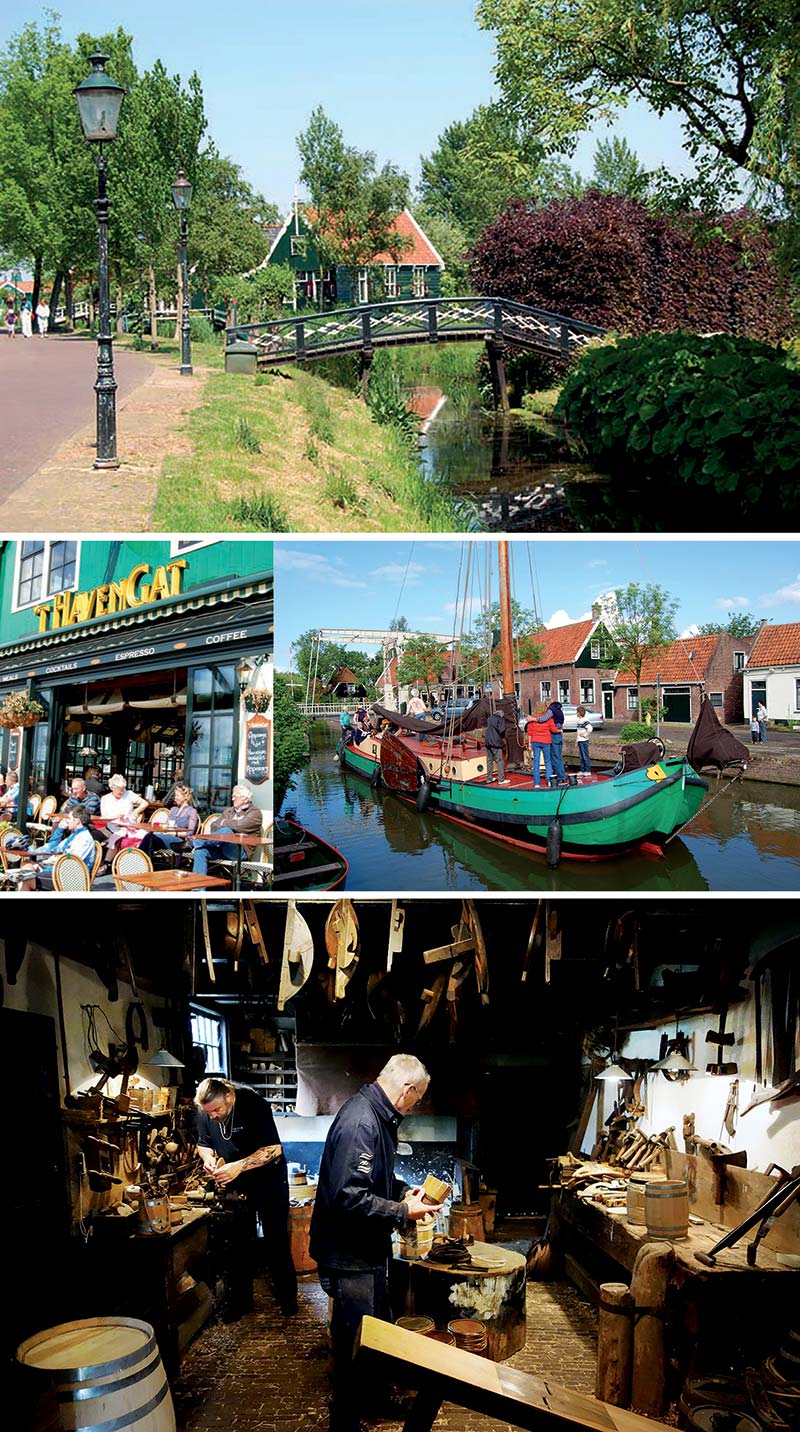
Cheese for sale (opposite); re-created village at Zaanse Schans; barging past Edam; artisans at Enkhuizen’s open-air museum; a café in Volendam
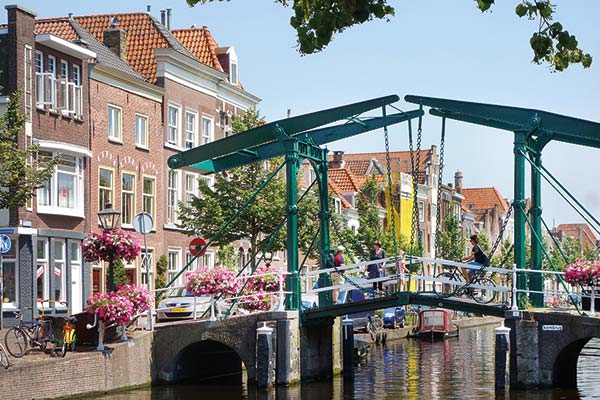
South of Amsterdam
▲Keukenhof and Aalsmeer (half-day each)
Holland has two flower-power destinations. Keukenhof, a huge beautifully landscaped garden park, blooms with millions of colorful tulips in springtime. Near the airport, Aalsmeer Flower Auction fills a giant warehouse with fresh flowers, allowing you to observe the business behind the beauty year-round.
▲▲Leiden (half-day)
This historic, charming university town was Rembrandt’s hometown before he moved to Amsterdam, and the Pilgrims’ last stop before they sailed to Plymouth Rock.
▲The Hague (half-day to 1 day)
This governmental town has an excellent art museum (Mauritshuis) showcasing the Dutch golden age, a Peace Palace with international courts, and the nearby beach resort of Scheveningen, with its amusement pier, boardwalk, and promenade.
▲▲Rotterdam (half-day to 1 day)
Europe’s busiest port, Rotterdam, has soaring skyscrapers, pedestrian malls, a futuristic market hall, and a 21st-century buzz. Built new after being flattened by WWII bombs, this modern city is the opposite of quaint, offering a well-rounded look at the Netherlands today.
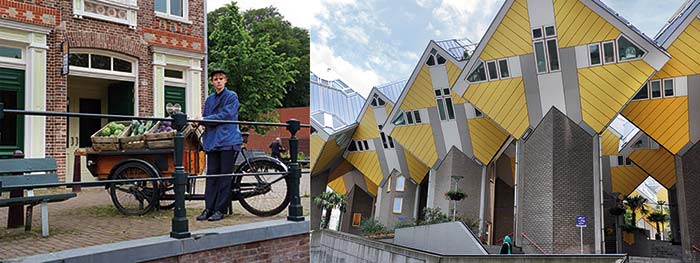
East of Amsterdam
▲Utrecht (half-day)
This bustling university city has the country’s largest old town, best railway museum, and a fun musical museum, plus a climbable church tower for a view of it all. Utrecht can be done as a day trip, or it’s an easy stop between Amsterdam and Arnhem.
▲▲Museums near Arnhem (1 day)
Near Arnhem are two Dutch treats—the worthwhile Netherlands Open-Air Museum and the excellent Kröller-Müller Museum, with a world-class collection of Van Gogh masterpieces, set in the middle of a forested park. To avoid rushing your visit, consider overnighting in Otterlo, near the park.
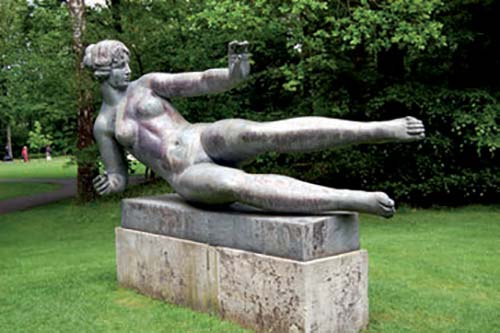
Balancing act at the Kröller-Müller Museum’s sculpture park
Planning Your Trip
To plan your trip, you’ll need to design your itinerary—choosing where and when to go, how you’ll travel, and how many days to spend at each destination. For general advice on sightseeing, accommodations, restaurants, and more, see the Practicalities chapter.
DESIGNING AN ITINERARY
As you read this book and learn your options...
Choose your top destinations.
My recommended itinerary (on here) gives you an idea of how much you can reasonably see in 12 days, but you can adapt it to fit your own interests and time frame.
Amsterdam is on everyone’s list for good reason: world-class museums, eclectic food, golden age architecture, street life, canal boats, markets, and entertainment. You could easily spend a week here. And if you like big cities, you’ll enjoy Rotterdam and The Hague, too. Hobbits seek out quaint villages, such as Edam or Hoorn.
Historians focus on Amsterdam (Dutch golden age, Dutch Resistance and the Holocaust during World War II, and more) and Leiden (pilgrim lore). To visit the Dutch past, head for one of the Netherlands’ open-air museums: Zaanse Schans (touristy and closest to Amsterdam), the less touristy Enkhuizen, and the farthest but most authentic, near Arnhem.
Art lovers are drawn to Amsterdam and The Hague. For modern art (beyond Amsterdam’s Van Gogh Museum), two great choices are the Stedelijk in Amsterdam and the impressive Kröller-Müller Museum, set in a forest near Arnhem, where cyclists pedal free bikes through the woods.
If you like colorful markets, the Dutch won’t disappoint, whether it’s cheese (Alkmaar and Edam), flowers (Keukenhof and more), food and clothing (Haarlem), or everything (Amsterdam’s street markets).
Photographers are happy wherever they go.
Decide when to go.
Although Amsterdam can be plagued by crowds in summer (June-Aug), it’s still a good time to visit, given the long days, lively festivals, and generally sunny weather (rarely too hot for comfort, extremely long hours of daylight).
Amsterdam can also be busy—and hotel prices even higher—in late March, April, and May, when the tulip fields are flowering in full glory. Fall comes with lighter crowds, though seasonal conferences can drive up prices in September. Both spring and fall have generally mild weather, but be prepared for rainy and cold spells.
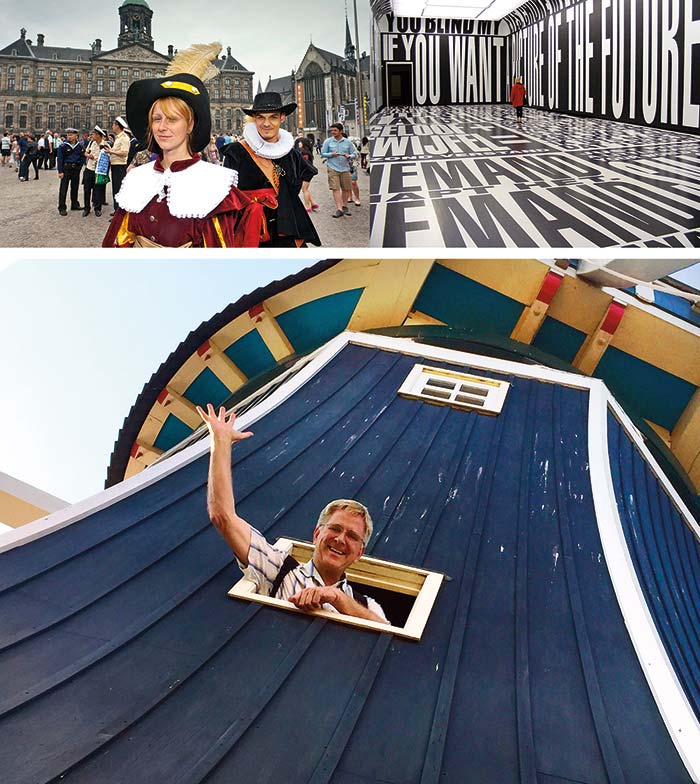
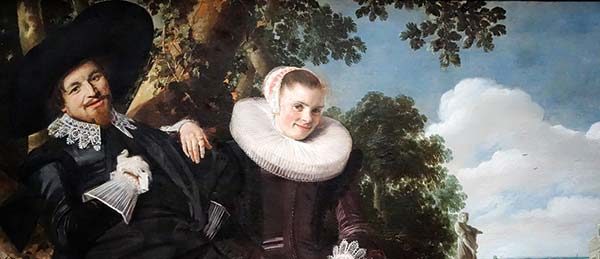
Golden age art by Frans Hals (opposite); costumed street performer; modern art at the Stedelijk; Rick in a windmill
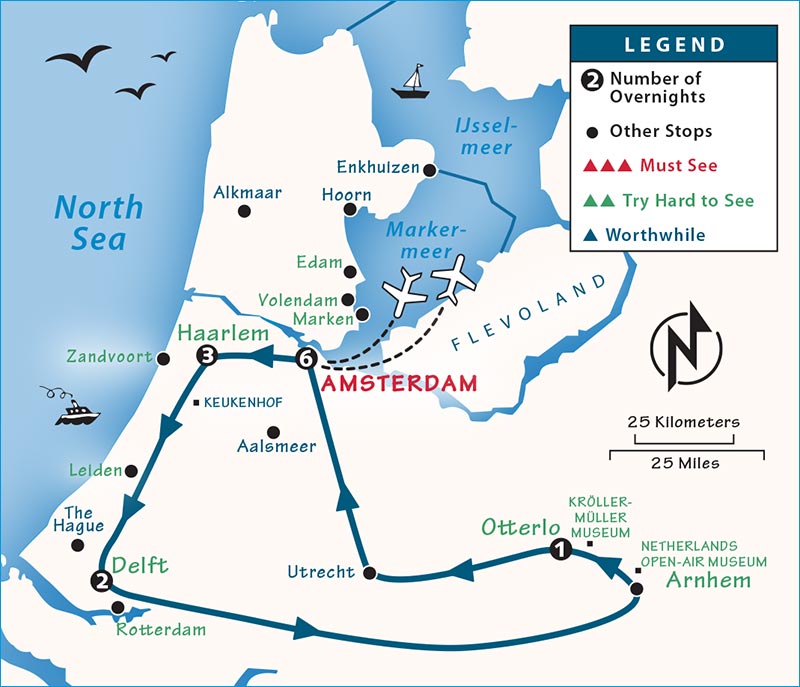
For an in-depth Netherlands experience, overnight in several places and use public transit. Start in small-town Haarlem (an ideal jet-lag pillow) and save big-city Amsterdam for your trip finale.
| Day | Plan | Sleep |
| 1 | Arrive in Amsterdam, head to Haarlem | Haarlem |
| 2 | Sightsee Haarlem | Haarlem |
| 3 | Day trip (e.g., Keukenhof in spring; Alkmaar if Friday; Aalsmeer, Leiden, or Zandvoort) | Haarlem |
| 4 | Head to Delft and sightsee | Delft |
| 5 | Day-trip to Rotterdam and/or The Hague (or add another day for more time in both) | Delft |
| 6 | From Delft, head to Arnhem, visit the Netherlands Open-Air Museum, end in Otterlo | Otterlo |
| 7 | Visit the Kröller-Müller Museum (near Arnhem), head to Utrecht to sightsee, end in Amsterdam | Amsterdam |
| 8 | Sightsee Amsterdam | Amsterdam |
| 9 | Amsterdam | Amsterdam |
| 10 | Amsterdam | Amsterdam |
| 11 | Day trip (e.g., Edam/Volendam/Marken) | Amsterdam |
| 12 | Day trip (Hoorn and Enkhuizen) | Amsterdam |
| 13 | Fly home or enjoy more of Europe |
With less time: Focus on Amsterdam, Delft, and Haarlem (skipping Arnhem/Otterlo), plus another destination that interests you most. For simplicity, stay in one home base.
If you’ll be staying in two or three home bases, here are the most time-efficient day trips:
From Amsterdam: Edam/Volendam/Marken, Hoorn/Enkhuizen, Zaanse Schans, Utrecht, and museums near Arnhem
From Haarlem: Delft, Keukenhof, Leiden, and Zandvoort
Similarly efficient from Amsterdam or Haarlem: Alkmaar, Aalsmeer, Leiden, The Hague, and Rotterdam
From Delft: Leiden, Rotterdam, and The Hague
Winter (from late October through mid-March) is cold and wet. It’s fine for visiting Amsterdam, but smaller towns and countryside sights feel dreary and lifeless. Most sights and many tourist information offices keep shorter hours, and some tourist activities vanish altogether.
Connect the dots.
Link your destinations into a logical route. Decide if you’ll travel by car or public transportation, or a combination.
Trains run frequently between major cities and are the easiest way to reach nearly any Dutch destination. A few destinations are best by bus. A car is useless in cities but essential to visit Flevoland and can be an efficient way to visit other rural and small-town sights (including the Kröller-Müller Museum near Arnhem).
Begin your search for transatlantic flights (likely to Amsterdam) at Google Flights. If you stick to the Netherlands, you’re never farther than two hours from Amsterdam’s Schiphol Airport.
For travel beyond the Netherlands, check train schedules at Bahn.com and budget flights within Europe at Skyscanner.com (but keep in mind air travel’s larger carbon footprint).
Write out a day-by-day itinerary.
Figure out how many destinations you can comfortably fit in your time frame. Don’t overdo it—few travelers wish they’d hurried more. Allow enough time per stop (see estimates in “The Netherlands’ Top Destinations,” earlier).
Choose a home base (or two or three): Amsterdam is liveliest and noisiest, and accommodations are extremely expensive. Haarlem is small-town manageable, though noisy on weekends. Delft is the most tranquil but the least central. To save on lodgings, it’s worth considering staying outside of Amsterdam and zipping in by train for your sightseeing.
The Netherlands is a day-tripper’s dream. Nearly everything lies within an hour of Amsterdam, thanks to the country’s excellent transportation system. That said, a few day-trip destinations are closer and quicker from Haarlem or Delft (generally saving 30-60 minutes round-trip; see suggestions on the previous page).
No matter where you’re based, keep these tips in mind:
When visiting market towns, it’s worth braving the crowds to go on market day. Take sight closures into account; avoid visiting a town on the day your must-see sight is closed.
Check if any holidays or festivals fall during your trip—these attract crowds, drive up prices, and can close sights (for the latest, visit www.holland.com). Note major sights where advance tickets are required (or recommended), and consider whether you’ll want to buy a museum pass.
Give yourself some slack. Every trip, and every traveler, needs downtime for doing laundry, picnic shopping, people-watching, and so on. Pace yourself. Assume you will return.
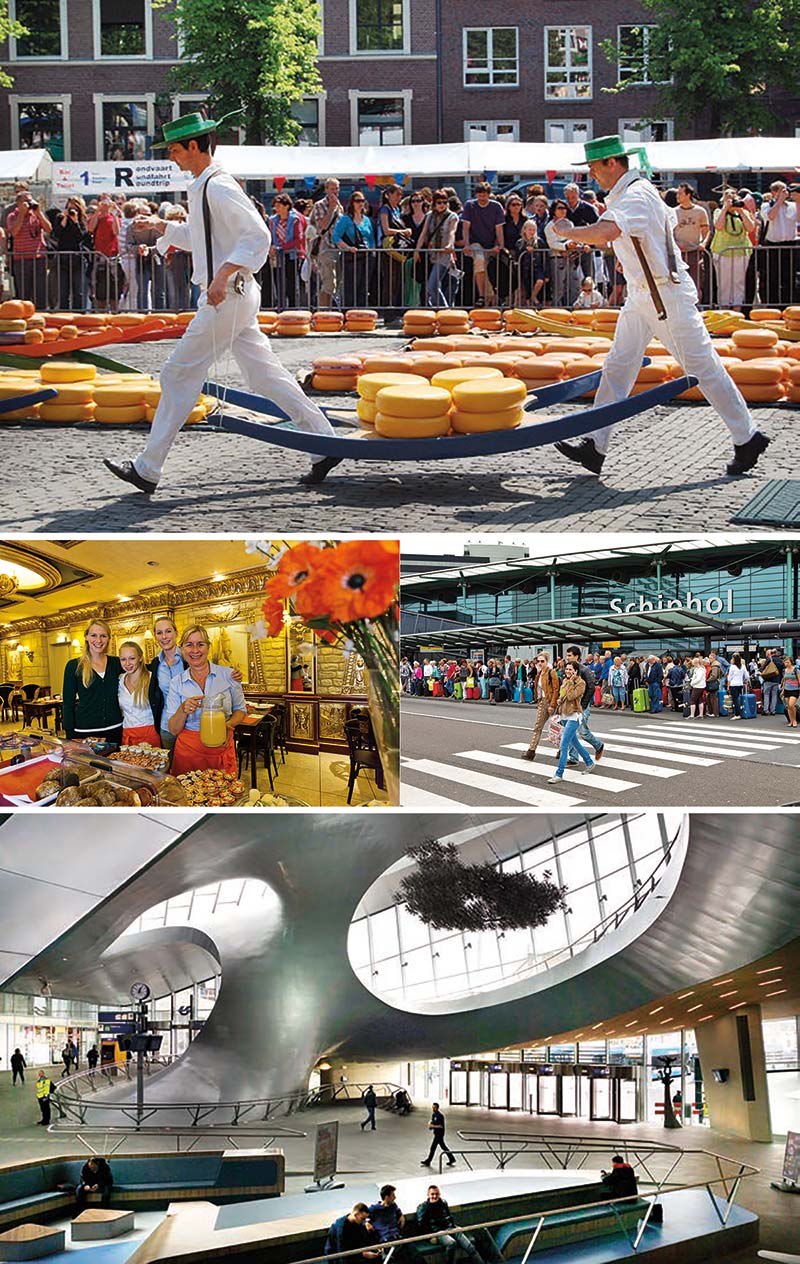
Alkmaar’s photogenic cheese market on Friday; Amsterdam’s easy-to-navigate Schiphol Airport; Arnhem’s futuristic train station; breakfast with friendly service
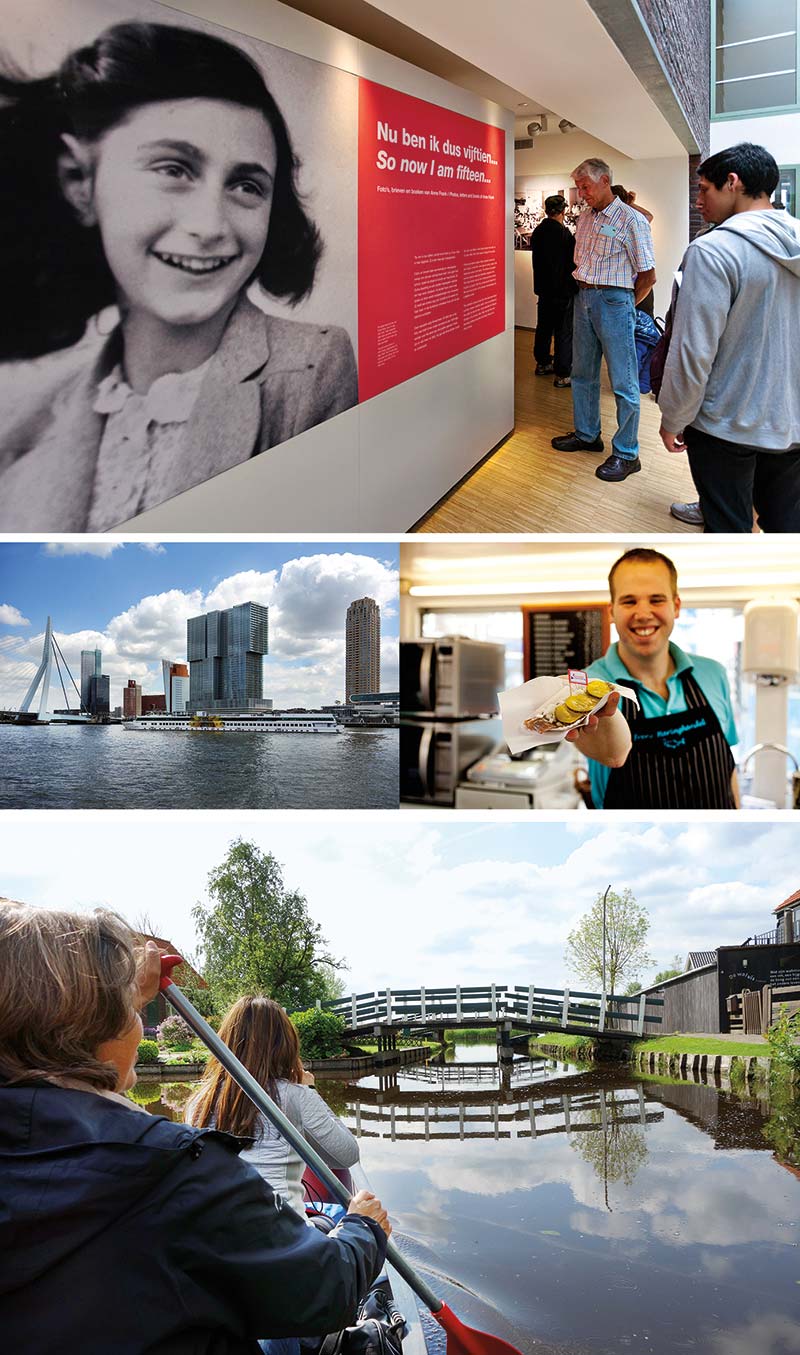
Amsterdam’s Anne Frank House; herring with pickles; boat tour of the wetlands; Rotterdam’s modern harbor
Run a reality check on your dream trip. You’ll have major transportation costs in addition to daily expenses.
Flight: A round-trip flight from the US to Amsterdam costs about $900-1,500, depending on where you fly from and when.
Public Transportation: For a 12-day trip, figure on spending about $150 for trams, buses, and trains.
Car Rental: Allow roughly $350-500 per week (booked well in advance), not including tolls, gas, parking, and insurance.
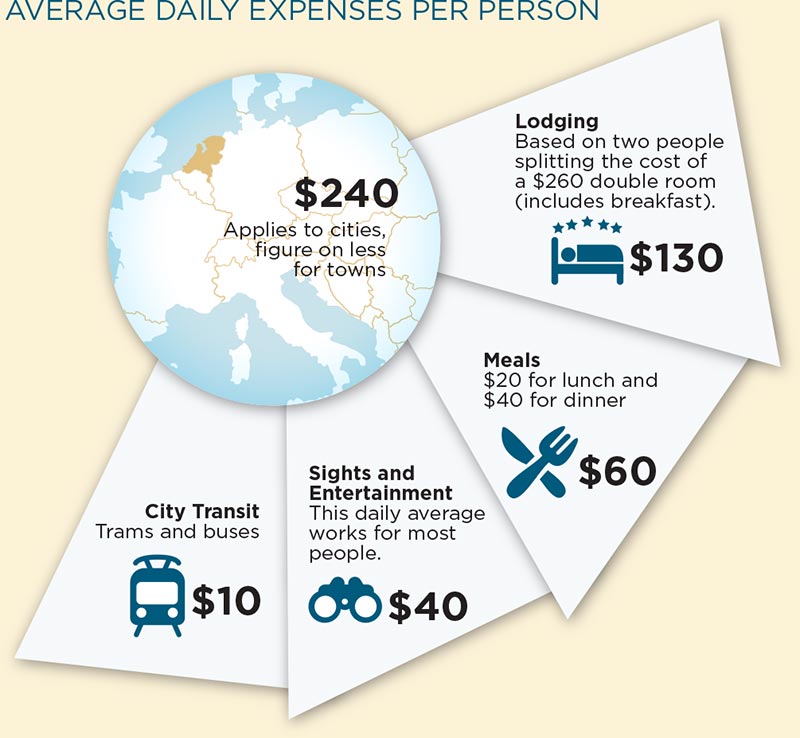
To cut your daily expenses, take advantage of the deals you’ll find throughout the Netherlands and mentioned in this book.
Avid sightseers may save money by buying a sightseeing pass. If you don’t get a pass, visit only the sights you most want to see and seek out free sights and experiences (people-watching counts).
Some businesses—especially hotels and walking tour companies—offer discounts to my readers (look for the RS% symbol in this book).
Accommodations in central Amsterdam are very expensive; consider staying on the city’s outskirts or even in a nearby town (such as Haarlem, Leiden, Edam, or Delft) and commuting into Amsterdam. B&Bs and Airbnb are heavily restricted, so there are few choices, but if you get an early start, these can provide a decent value.
Reserve your rooms directly with the hotel or B&B. Some places offer a discount if you pay in cash and/or stay four or more nights (check online or ask). Anyone can sleep cheaply in hostels (most have private rooms).
It’s no hardship to eat inexpensively in the Netherlands. You can get tasty, affordable meals at cafés, cafeterias, bars, food stands, delis, and bakeries (which often sell sandwiches). Cultivate the art of picnicking in atmospheric settings.
When you splurge, choose an experience you’ll always remember, such as a canalside meal, a food tour, or a guided canoe trip. Minimize souvenir shopping; focus instead on collecting wonderful memories.
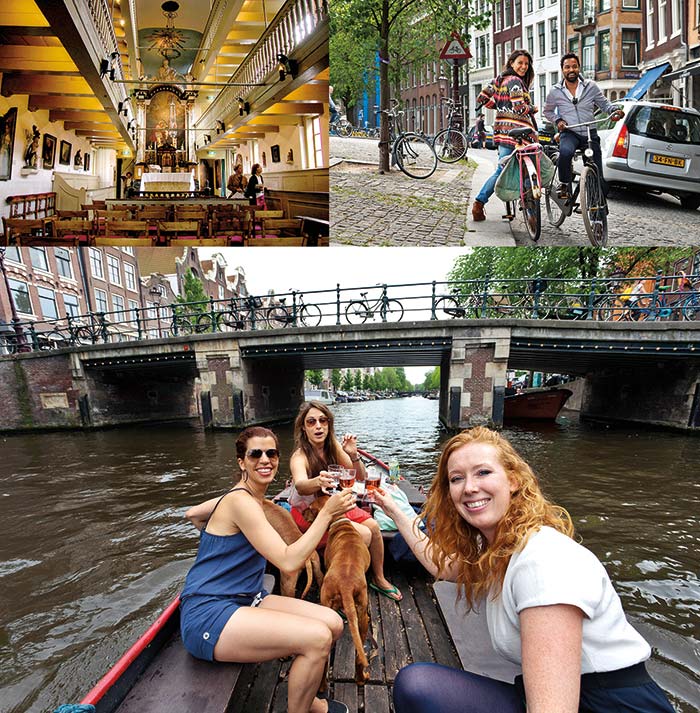
Our Lord in the Attic’s hidden Catholic church; cyclists in Amsterdam (where bikes often outnumber cars); cruising the canals
BEFORE YOU GO
You’ll have a smoother trip if you tackle a few things ahead of time. For more details on these topics, see the Practicalities chapter and RickSteves.com, which has helpful travel-tip articles and videos.
Make sure your travel documents are valid. If your passport is due to expire within six months of your ticketed date of return, you need to renew it. Allow 12 weeks or more to renew or get a passport. Be aware of any entry requirements; you may need to register with the European Travel Information and Authorization System (ETIAS) before you travel (quick and easy process; check https://travel-europe.europa.eu/etias_en). Get passport and country-specific travel info at Travel.State.gov.
Arrange your transportation. Book your international flights. Overall, Google Flights is the best place to start your search. Figure out your transportation options in the Netherlands: For most people, it makes sense to travel by train.
If traveling beyond the Netherlands, consider buying train tickets (often discounted if purchased in advance), getting a rail pass (normally must be purchased outside Europe), renting a car, or booking cheap European flights. (You can wing the car rental or European flights once you’re in Europe, but it may cost more.)
Book rooms well in advance, especially if your trip falls during peak season (summer) or any major holidays or festivals.
Reserve ahead for key sights, meals, and experiences. At some Amsterdam sights—the Rijksmuseum, Van Gogh Museum, and Anne Frank House—advance reservations are required. Because tickets sell out quickly for the Anne Frank House, buy them when they go on sale, six weeks in advance. It’s also smart to reserve ahead for fine dining restaurants—my favorites book up—and book ahead for experiences such as a food tour or hiring a local guide.
Consider travel insurance. Compare the cost of insurance to the cost of your potential loss. Understand what protections your credit card might offer and whether your existing insurance (health, homeowners, or renters) covers you and your possessions overseas.
Manage your money. “Tap-to-pay” or “contactless” cards have all but replaced cash. For transportation everywhere in the Netherlands, you’ll need a contactless card (or a payment app on your phone or smartwatch) to “check in” and “check out.” Having one card or payment option per person will save time and hassle. You may need your credit card’s PIN for some purchases—request it if you don’t have one.
Use your smartphone smartly. Sign up for an international service plan, or plan to rely on Wi-Fi. Download any apps you’ll want on the road, such as maps, translators, and Rick Steves Audio Europe (see sidebar).
Pack light. You’ll walk with your luggage more than you think. I travel for weeks with a single carry-on bag and a day pack. Use the packing checklist in the appendix as a guide.
Rick Steves Audio Europe, a free app, makes it easy to download my audio tours and radio interviews and listen to them offline as you travel. For this book, the app includes audio tours of my Amsterdam City Walk, Jordaan Walk, and Red Light District Walk (look for the  ) and many interviews relating to the Netherlands from my public radio show. Scan the QR code to find it in your app store or visit RickSteves.com/AudioEurope.


Rick Steves Classroom Europe, a powerful tool for teachers, is also useful for travelers. This video library contains about 600 short clips excerpted from my public television series. Enjoy these videos as you sort through options for your trip and to better understand what you’ll see in Europe. Check it out at Classroom.RickSteves.com.

Travel Smart
If you have a positive attitude, equip yourself with good information (this book), and expect to travel smart, you will.
Read—and reread—this book. To have an “A” trip, be an “A” student. Note opening hours of sights, closed days, crowd-beating tips, and whether reservations are required or advisable. Check the latest at RickSteves.com/update.
Be your own tour guide. As you travel, get up-to-date info on sights, reserve tickets and tours, reconfirm hotels, and check transit connections. Upon arrival in a new town, lay the groundwork for a smooth departure; confirm the train, bus, or road you’ll take when you leave.
Outsmart thieves. Pickpockets abound in crowded places—especially where tourists congregate. Treat commotions as smokescreens for theft. Take common-sense precautions with your valuables, especially credit cards and cash (store them securely). Don’t set phones or other important items down on counters or café tabletops, where they can be quickly stolen or easily forgotten.
A Dutch icon since the 17th century, the colorful flowers are actually native to central Asia (“tulip” comes from a Turkish word for “turban”). When the Holy Roman Emperor’s ambassador to Constantinople first sent some bulbs westward in the mid-1500s, a few eventually wound up in the hands of a Dutch botanist—and thus began one of the oddest chapters in the Netherlands’ history.
The region’s harsh conditions turned out to be ideal for the hardy bulbs, which also benefited from good timing: They arrived in the Netherlands in the middle of the Dutch golden age, delighting a relatively affluent populace who were fond of beauty and able to pay for it.
Within a generation the popularity of these then-exotic flowers—and for a few rare species in particular—grew from a trendy fad into an all-out frenzy. Prices shot skyward: Forty bulbs could fetch up to 100,000 florins (about $1.7 million in today’s dollars); in the context of the times, an average laborer made around 150 florins a year. The most treasured variety was the Semper Augustus, with its distinctive red-and-white petals—just one bulb sold for 12 acres of land.
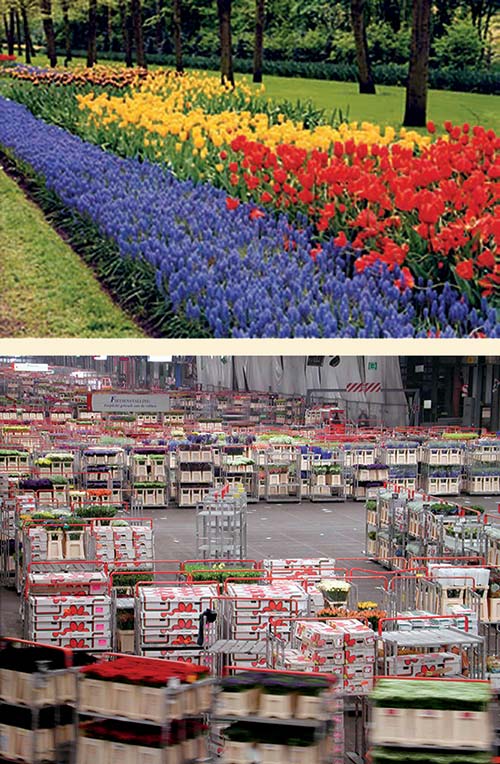
Keukenhof ’s gardens bloom and are open only in spring, while Aalsmeer’s flower auction runs year-round.
“Tulip mania” reached a fever pitch in late 1636, and for the next few months, frantic trading consumed the Dutch. Production of other goods declined as people dropped everything to get rich on the tulip exchange. Soon, instead of buying and selling actual bulbs, people began trading promissory vouchers—by that time, it wasn’t really the flowers everyone was after, but the opportunity to resell them at a higher price. The number of potential buyers seemed endless...until it wasn’t. In February 1637, one of history’s most famous speculative bubbles burst, leaving many tulip investors with empty contracts or bulbs worth only a tiny fraction of what they’d cost. Investors were ruined, and the economic fallout helped contribute to the decline of the Dutch golden age. But the demand for tulips never died out—a love of the flowers had been firmly planted in the Dutch psyche, and they continue to be an integral part of the culture as well as a major export.
Minimize potential loss. Keep expensive gear to a minimum. Bring copies or take photos of important documents to aid in replacement if they’re lost or stolen. Back up devices to the cloud as you travel.
Guard your time and energy. Taking a tram across Amsterdam can be a good value if it saves you an exhausting walk. To avoid long lines, follow my crowd-beating tips, such as buying tickets in advance or sightseeing early or late.
Be flexible. Even if you have a well-planned itinerary, expect changes, strikes, closures, sore feet, bad weather, and so on. Your Plan B could turn out to be even better.
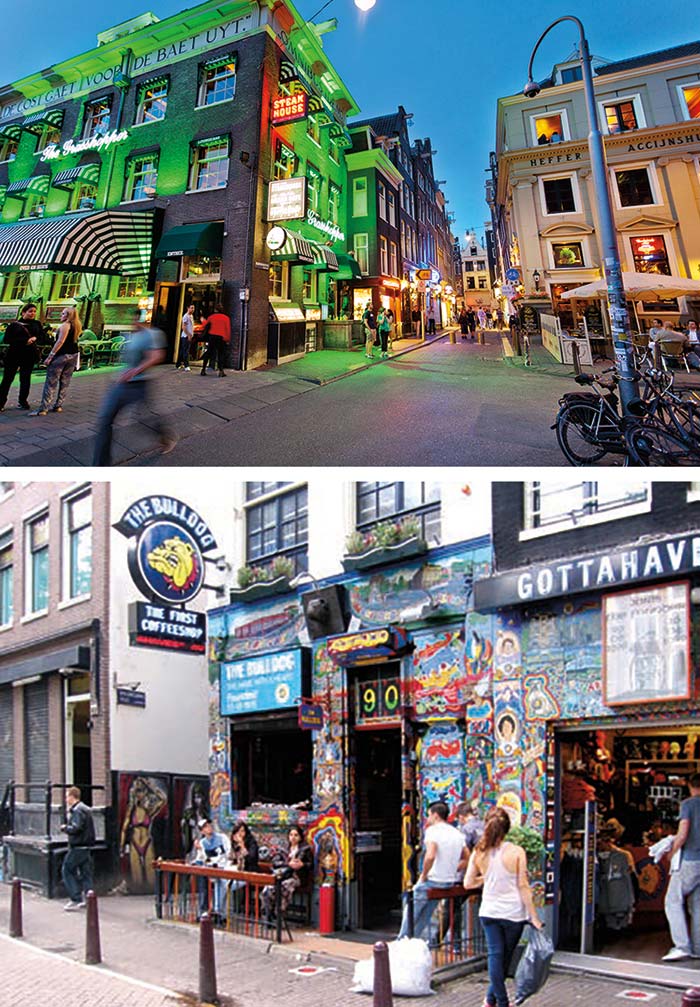
Amsterdam lights up at night. The first-ever Dutch coffeeshop—the Bulldog—has sold marijuana since 1974 and is now the flagship branch of the high-profile chain.
Attempt the language. Nearly all Dutch people speak English—especially young people and those in the tourist trade. Apps such as Google Translate work for on-the-go translation help. But if you memorize and use some Dutch, even just a few pleasantries, you’ll get more smiles and make more friends. The survival phrases near the end of this book are a good starting point.
Connect with the culture. Interacting with locals carbonates your experience. Enjoy the friendliness of the Dutch people. Ask questions; most locals are happy to point you in their idea of the right direction. Set up your own quest for the best herring, coziest pub, tastiest stroopwafel, or the perfect “It’s so Dutch!” sight. When an opportunity pops up, make it a habit to say “yes.”
Your next stop... the Netherlands!