SCANDINAVIA: PAST & PRESENT
PREHISTORIC HUNTERS AND WARRIORS (c. 8000 BC-AD 800)
VIKINGS—PLUNDERERS, TRADERS, AND SETTLERS (c. 800-1050)
MEDIEVAL—CHRISTIANIZING AND COALESCING INTO KINGDOMS (1000-1500)
DENMARK DIPS, SWEDEN RISES—REFORMATION AND RENAISSANCE (1500s)
SWEDEN’S GLORY DAYS AND SLOW FADE (1600-1800)
PATRIOTS, ARTISTS, INDUSTRIALISTS, AND EMIGRANTS (1800s)
INDEPENDENCE, WORLD WARS, RECOVERY, AND PROSPERITY (1900-Present)
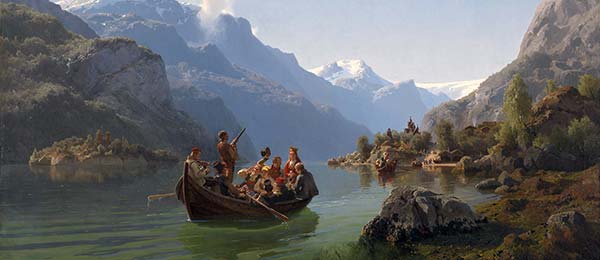
Throughout Scandinavia, you’ll encounter reminders of this region’s long and fascinating history. You’ll see the sleek ships of the pagan Vikings and the stave churches of their eventual Christianization. You’ll visit colorful seafaring harbors and tour the luxurious castles of illustrious kings. Statues honor the great patriots who brought independence. You’ll hear bittersweet stories of Scandinavians who were forced to emigrate, and of those who suffered during World War II. And you’ll experience the richness of Scandinavia today—its wealth, its liberal policies, and its global outlook.
PREHISTORIC HUNTERS AND WARRIORS (c. 8000 BC-AD 800)
Emerging only slowly from the glacial ice sheets, Scandinavia was the last part of Europe to be settled. Stone Age hunters arrived from the south, chasing the region’s plentiful game and fish. They eventually turned to farming (c. 4000 BC), developing tools of bronze (c. 1800 BC) and iron (500 BC). We know these people mainly by their burial mound graves, megalithic stone dolmens, and weapons decorated with their pagan gods.
This distinct, isolated Scandinavian culture continued to thrive even after the rest of Europe turned Roman, Latin, and Christian. As the population boomed, Scandinavians looked to expand.
Sights
• Glacier-carved fjords (on the Norway in a Nutshell route), rustic archipelagos (Southeast Sweden), and immense glaciers (Norway’s Nigardsbreen)
• The Historical Museum and Norwegian Folk Museum in Oslo and the Nordic Museum in Stockholm highlight the nomadic culture of the Sami (Lapps)—descendants of Scandinavia’s early inhabitants
• Gamla Uppsala (near Stockholm) is where mighty chieftains were buried beneath mounds along with their worldly possessions
• See other burial mounds at Öland (Sweden) and stone dolmens on Ærø island (Denmark)
• “Grauballe Man”—whose corpse was preserved in a peat bog—now resides at the Moesgård Museum (Aarhus, Denmark)
• See Stone Age tools, Bronze Age lur horns, and the Iron Age Gundestrup Cauldron at Copenhagen’s fine National Museum
VIKINGS—PLUNDERERS, TRADERS, AND SETTLERS (c. 800-1050)
Scandinavia’s entrance onto the European stage was swift, dramatic, and unforgettable. In 793, a fleet of Scandinavian pirates landed at an English monastery, where they slaughtered monks, burned buildings, and plundered sacred objects. Word spread like wildfire of crazed barbarians who seemed to come out of nowhere, pillaging with extreme prejudice, then moving on: the Vikings.
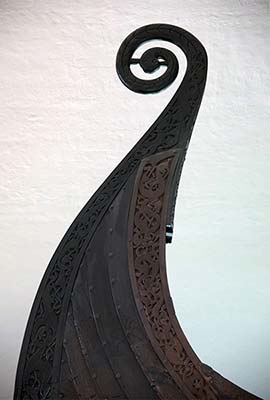
For the next 200 years, hardy Viking sailors roamed the coasts of Europe. They traveled in sleek, narrow, open-topped ships, rigged with square sails and powered by dozens of men at the oars. The ships could land right on the beach, where warriors would spring out, ready for battle. So-called berserkers fought with a seemingly superhuman frenzy, scaring the leotards off their enemies and giving us our English word “berserk.”
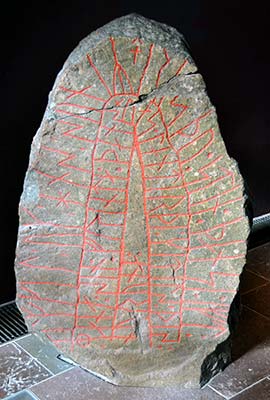
While the rest of Europe had adopted Christianity, these Vikings worshipped pagan warrior gods, such as Odin (who gave us our word for Wednesday) and hammer-wielding Thor (Thursday). And like their prehistoric ancestors, the Vikings also buried their dead beneath mounds and erected huge stones inscribed with mysterious writing called runes.
Despite their reputation as ruthless pirates, many Vikings were also peaceful traders and bold explorers. Norwegian Vikings tended to venture westward—to Iceland, Greenland, and (under Leif Eriksson) even to the shores of North America (c. 1000). The Vikings from Sweden generally sailed east to the Baltic states. Danish Vikings went southward, conquering France’s Normandy and England (even taking London, around 1013). As time passed, the fierce Vikings settled down, married the locals, and turned to farming. They had spread Scandinavian culture abroad while bringing Scandinavia into the European fold.
Sights
• Impressive Viking ships at the Museum of the Viking Age (Oslo) or the Viking Ship Museum (Roskilde, Denmark)
• Rune stones at Jelling (Denmark) and Sigtuna (Sweden)
• Viking weapons at many museums across Scandinavia: coats of mail, shields, swords, axes, bows, and helmets (by the way, Viking helmets did not have horns, as is popularly thought)
MEDIEVAL—CHRISTIANIZING AND COALESCING INTO KINGDOMS (1000-1500)
By the early 1000s, Scandinavian society was changing fast: unifying, Christianizing, and creating the framework for the nations we know today.
As Christianity crept north from Europe, the last pagans were donning their ceremonial garb to worship the sun one final time. Their ship-building skills were now used to construct Christian wooden stave churches, complete with dragon heads to ward off evil spirits.
In the late 10th century, the scattered Nordic peoples were coalescing into three distinct kingdoms: In Sweden, King Olaf pacified and Christianized the land. In Norway, it was the saintly King Olav II. King Harald Bluetooth created such a strong network of connectivity that Denmark became the region’s rising power.
With peace, towns began to form: Oslo (around 1050), Copenhagen (1167), and Stockholm (1252). Under the banner of Christianity, Swedish crusaders conquered Finland while Denmark took Estonia. They flew flags featuring crosses—similar to today’s national flags.
But the medieval era’s greatest force was not Denmark, Sweden, or Norway. It was the German businessmen known as the Hanse. They created a free-trade zone across the Baltic (the Hanseatic League, c. 1250-1750) that controlled the lucrative sea trade. Under the Hanse, Scandinavia’s port towns became rich trading local cod, amber, and furs. The League gave Scandinavia a more unified culture and a connection to the rest of Europe. And the German language became the common denominator in Scandinavia’s developing tongues.
Only Denmark was strong enough to rival the Hanse monopoly. In 1363, the Danish Queen Margrethe I married the Norwegian King Håkon VI, making Denmark the ruler of Norway (as it would remain for 450 years). Denmark also dominated less-unified Sweden. As the Middle Ages waned and the Hanse declined, Denmark was enjoying its glory days.
Sights
• Bluetooth’s famous rune stone at Jelling (Denmark) represents the founding of Christian Denmark
• Stave churches were built across the land, and can still be visited in Borgund (near Flåm), Hopperstad and Urnes (on the Sognefjord), and Lom (Jotunheimen Mountains)
• Soon these wooden churches would be replaced with skyscraping stone or brick cathedrals (at Uppsala, Aarhus, and Stockholm)
• The glory days of the Hanseatic League shine brightest in one of its greatest ports, Bergen: Håkon’s (banqueting) Hall, St. Mary’s Church, Hanseatic Museum, Bryggens Museum, and the fascinating Bryggen Walking Tour
• Tallinn’s atmospheric Old Town echoes the (later) Hanseatic era
• Stout royal tombs at Denmark’s historic Roskilde attests to the country’s medieval dominance, as does the stout Kronborg Castle (“Hamlet”), nearby
• In a general sense, the Middle Ages are still visible today in Scandinavia’s old villages, castles, harbors, and traditions
DENMARK DIPS, SWEDEN RISES—REFORMATION AND RENAISSANCE (1500s)
By 1500, Denmark was still Scandinavia’s biggest power, but Sweden was rising fast.
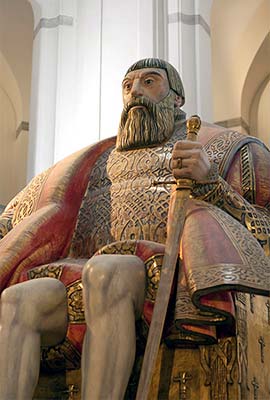
In 1520, Denmark invaded Sweden to suppress the upstart Swedes, massacring 80 rebellious nobles in the city’s main square (the Stockholm Bloodbath). Enraged, the Swedes rallied behind Gustav Vasa and drove the Danes out. Vasa—the father of modern Sweden—was crowned king of Sweden on June 6, 1523. Modern Sweden was born, and June 6 is now Sweden’s flag day.
Castles were fortified residences for medieval nobles. Castles come in all shapes and sizes, but knowing a few general terms will help you understand them.
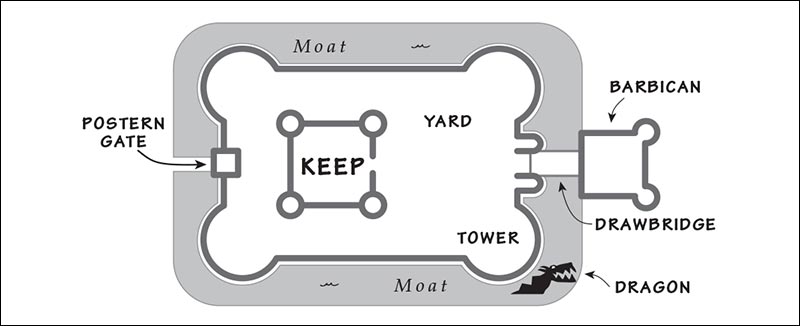
Barbican: Fortifed gatehouse, sometimes a standalone building located outside the main walls
Crenellation: Gap-toothed pattern of stones atop the parapet Drawbridge: Bridge that could be raised or lowered using counterweights or a chain and winch
Great Hall: Largest room in the castle, serving as throne room, conference center, and dining hall
Hoardings (or Gallery or Brattice): Wooden huts built onto the upper parts of the stone walls; served as watchtowers, living quarters, and fighting platforms
Keep (or Donjon): High, strong stone tower in the center of the complex; the lord’s home and refuge of last resort
Loopholes (or Embrasures): Narrow wall slits through which soldiers could shoot arrows
Machicolation: Stone ledge jutting out from the wall, with holes through which soldiers could drop rocks or boiling oil onto wall-scaling enemies below
Moat: Ditch encircling the wall, sometimes filled with water
Parapet: Outer railing of the wall walk
Portcullis: Iron grille that could be lowered across the entrance
Postern Gate: Small, unfortified side or rear entrance; in wartime, became a sally port used to launch surprise attacks or as an escape route
Towers: Square or round structures with crenellated tops or conical roofs serving as lookouts, chapels, living quarters, or the dungeon
Turret: Small lookout tower rising from the top of the wall
Wall Walk (or Allure): Pathway atop the wall where guards could patrol and where soldiers stood to fire at the enemy
Yard (or Bailey): Open courtyard inside the castle walls
Gustav Vasa transformed Sweden into a modern nation-state. He centralized the government, imported Renaissance culture from the Continent, and turned the country Protestant. In fact, during this age of the Reformation, all of Scandinavia quickly became Lutheran, having been primed for it by the German influence of the Hanse.
As Sweden beefed up its military, Denmark was in decline...though slowly, and in elegant fashion. Their Renaissance king—the one-eyed, high-living Christian IV—was busy spending centuries’ worth of acquired wealth building lavish castles and giving Copenhagen and Oslo a Renaissance makeover. Meanwhile, Denmark’s constant wars with rival nations were sapping the country. It was now Sweden’s time to shine.
Sights
• Kalmar Castle (Southeast Sweden) is a symbol of Sweden’s rise to prominence—built in medieval times, then expanded and slathered in glorious Renaissance fashion by Gustav Vasa
• Vasa’s tomb is in Uppsala Cathedral (Sweden)
• Remnants of the Reformation can be seen throughout Scandinavia: statues of reformers, Copenhagen’s Reformation Memorial, and the revamped interiors of churches such as Aarhus Cathedral
SWEDEN’S GLORY DAYS AND SLOW FADE (1600-1800)
In the 1600s, Sweden emerged as Scandinavia’s true superpower. King Gustavus Adolphus (1594-1632), the “Lion of the North,” was soon devouring large chunks of land across the Baltic and onto the Continent.
Sweden’s supreme moment came when Gustavus’ great-grandson Karl X Gustav invaded Denmark (1657). In one of history’s most daring maneuvers, he led Swedish armies across Denmark’s frozen seas to take Copenhagen. The astonished Danes signed the humiliating Treaty of Roskilde, which gave Sweden a third of Danish territory. Denmark would never again be a major European power, while Sweden ruled an empire that stretched from Finland to Estonia, Latvia, and parts of Poland, Russia, and Germany.
But by the 1700s, Sweden’s continual wars were draining the nation, even as nations like England and France were on the rise. Sweden’s empire slowly shrank, and Scandinavia retreated again into relative isolation. Scandinavia’s monarchs coasted on their wealth, building chandeliered palaces, modeling themselves after the trend-setting King Louis XIV and his palace at Versailles. Meanwhile, in far-off France, a Revolution was about to explode, and the fallout would soon rock the world.
Sights
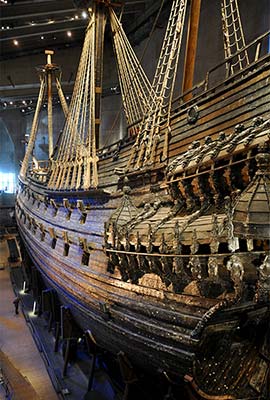
• Sweden’s mighty empire is perhaps best symbolized by two huge (if ill-fated) ships from the era: The Vasa (at the Vasa Museum in Stockholm) sank ignominiously in Stockholm harbor on its maiden voyage; another ship, the Kronan, is in the Kalmar County Museum
• Stockholm’s atmospheric Gamla Stan (Old Town) and Royal Armory
• Scandinavia’s luxurious Versailles-like palaces: Sweden’s Royal Palace and Drottningholm Palace, and Denmark’s Rosenborg Castle and Frederiksborg Castle
PATRIOTS, ARTISTS, INDUSTRIALISTS, AND EMIGRANTS (1800s)
The French Revolution (1789) and the Napoleonic wars that followed completely reshuffled the Scandinavian deck. It awakened a desire for democracy that would culminate in the modern nation-states we know today.
Denmark, having backed the loser Napoleon, was forced to cede Norway to Sweden (1814). Meanwhile, Sweden lost Finland to Russia (1809). The wars also gave Sweden a new king—a French soldier without one drop of noble blood. But Jean-Baptiste Bernadotte would go on to be wildly popular, and he founded the royal dynasty of today’s monarchs of Sweden, Norway, and Denmark. In Norway, idealistic patriots proudly drafted a democratic constitution. Though that constitution would take another century to be adopted, the date of May 17, 1814 has become the country’s Fourth of July.
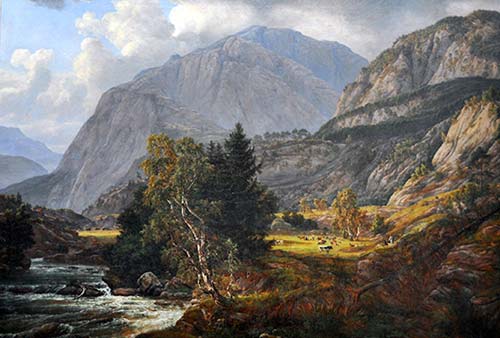
Culturally, the rise in national pride sparked a golden age across Scandinavia. People embraced their traditional roots. Painters captured the rugged beauty of the landscape and the simple dignity of the Scandinavian people. Edvard Grieg conveyed the majesty of nature in music. Hans Christian Andersen’s stories (The Emperor’s New Clothes, The Little Mermaid) gained a Europe-wide reputation. Across Scandinavia, cities got grand makeovers in an enlightened style that echoed ancient Greece: Neoclassical.
Around this time, another revolution was brewing—the Industrial Revolution. It changed the economy, bringing trains and factories, while traditional sea-trade and farming declined. While some got rich, millions of others were forced to emigrate to America for a new start. Scandinavia was changing with the march of democracy, labor unions, and constitutional monarchies. The 20th century would quicken that pace.
Sights
• Excellent open-air folk museums preserve pre-Industrial Revolution Scandinavian lifestyles: Sweden’s Skansen (in Stockholm), Norway’s Norwegian Folk Museum (Oslo) and Maihaugen (Lillehammer), Denmark’s Den Gamle By (Aarhus), the Estonian Open-Air Museum (Tallinn), and others
• Denmark’s Ærøskøbing and Norway’s Stavanger and Solvorn still have 19th-century village charm, while Copenhagen’s Tivoli Gardens are an example of 19th-century gentility
• Colonnaded Neoclassical buildings adorn across many cities, especially Helsinki’s Lutheran Cathedral
• Bertel Thorvaldsen’s Neoclassical statues at Copenhagen’s Cathedral of Our Lady and Thorvaldsen’s Museum
• The golden age of Scandinavian painting, including artists like Dahl and Munch, is on display at Oslo’s National Museum and Munch Museum, Bergen’s KODE, and others
• Hans Christian Andersen sights: Copenhagen’s Little Mermaid statue and the Hans Christian Andersen House (in his hometown of Odense)
• Edvard Grieg’s home and museum near Bergen
• Swedish emigration story at Växjö’s House of Emigrants
• Russian influence in Finland and Estonia: Helsinki’s Uspenski Orthodox Cathedral and Tallinn’s Alexander Nevsky Cathedral
• Sweden’s Glass Country, which has revived the 19th-century glassblowing tradition
INDEPENDENCE, WORLD WARS, RECOVERY, AND PROSPERITY (1900-Present)
With rising prosperity and technical prowess, Scandinavia entered the 20th century full of pride. In 1905—after years of Danish and Swedish rule—Norway finally became independent. Finland and Estonia—after periods of Swedish and Russian rule—also won their independence. And hardy Norwegian polar explorers like Fridtjof Nansen and Roald Amundsen were boldly going where no man had gone before. Even when World War I broke out, Scandinavia barely missed a beat, as the region remained neutral.
But in World War II, it was impossible for Scandinavia to escape unscathed. In 1940, Nazi Germany quickly overran Denmark and Norway. Though both capitulated, many citizens fought back in underground resistance movements. Sweden, officially neutral, was a safe haven for persecuted Jews and refugees. Meanwhile, Finland and Estonia had to fend off not only German invaders but also their Soviet “liberators.” Relatively speaking, though, Scandinavia suffered less damage than elsewhere in Europe.
After the war, as Europe was split between the communist East and the democratic West, Scandinavia found itself caught in the middle. Estonia and Finland wound up in the Soviet sphere. Norway and Denmark stood with the West, joining NATO. Sweden stayed neutral and forged a “middle way” between Western-style capitalism and Soviet socialism.
By the 1960s, Scandinavia was regaining its prosperity, fueled partly by a wave of immigrant workers and the discovery of North Sea oil. There was an economic reset away from sea-trade and toward higher tech. Run-down cities were revived with pedestrian streets and refurbished waterfronts. Sleek modern buildings by pioneering architects defined the landscape. Rather than tear down old buildings, city planners transformed them into attractive people-friendly neighborhoods. Energetic Scandinavians welcomed the world to their Olympic Games (1994 Winter Games in Lillehammer, Norway) while exporting the peppy pop songs of Sweden’s ABBA. And when the USSR fell (1991), Finland and Estonia soon joined the Western fold.
As the 21st century turned, Scandinavia only accelerated its prosperous mix of free-market capitalism and enlightened socialism. The Scandinavians made their mark with telecommunications (Nokia from Finland), health care (Novo Nordisk in Denmark), and goods for the home (Sweden’s Ikea and Electrolux, and Denmark’s Lego).
After centuries of tumultuous history, Scandinavia has survived, and now stands on the cutting edge of the global economy.
Sights
• Scandinavia’s early 1900’s optimism can be seen in the impressive city halls of Oslo, Stockholm, and Copenhagen, and at Stockholm’s Nobel Prize Museum
• Oslo’s historic vessels from the age of exploration: the Fram and Kon-Tiki
• Modernity buds in a natural setting at Oslo’s Vigeland Sculpture Park and amid urban development at its Opera House
• Resistance museums in Oslo and Copenhagen recount WWII history
• Some of the world’s best modern architecture is the soaring work of Finland’s Eliel Saarinen and Alvar Aalto (Temppeliaukio Church)
• Copenhagen’s pleasant Strøget—one of Europe’s first fully pedestrianized streets (1962)
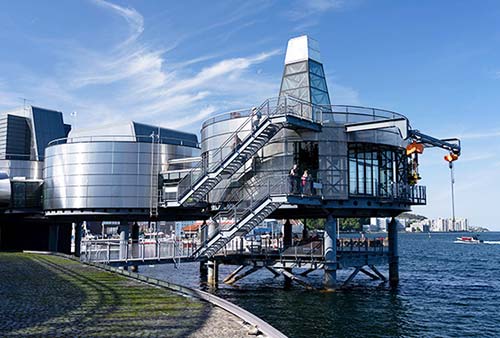
• The Norwegian Petroleum Museum, in Stavanger, details how the discovery of North Sea oil transformed Norway
• Copenhagen’s hippie enclave Christiania, where 1960s counterculture lives on, man
• Denmark’s Legoland and Stockholm’s ABBA museum show Scandinavia’s trademark quirkiness
• Bold modern art across Scandinavia: Aarhus’ ARoS museum, the Louisiana Art Museum near Copenhagen, Stockholm’s Museum of Modern Art, Tallinn’s Kumu Art Museum, Helsinki’s Design Museum, and many more
SCANDINAVIA TODAY
Scandinavia today is prosperous, progressive, peaceful, modern, “green,” and eminently livable.
Citizens have come to take for granted cradle-to-grave security—health care, education, unemployment benefits, and welfare—all financed with high taxes. High taxes mean there’s less of a gap between rich and poor, resulting in a less class-oriented society. Scandinavians are proud of this. If they seem a bit smug, you can’t fault them: Statistics verify that they live longer, healthier, happier lives. In social policies, Scandinavia has often led the way in liberal attitudes toward sexuality, drug use, and LGBTQ rights.
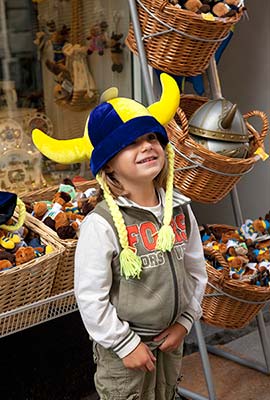
Recent immigration has brought diversity to this traditionally homogeneous society (white, Christian, and democratic). But as is often the case, the rapid influx of immigrants has not been without controversy. Many immigrants speak only their native language, some are uneducated, and most struggle to find jobs. Some Scandinavians are reluctant to extend universal benefits to them, and some politicians have proposed limiting immigration or forcing migrants to better integrate into the mainstream. It’s clear that the collectivist spirit of the Nordic model is being tested.
Today, Finland, Sweden, Denmark, and Estonia are all members of the European Union. Norway has stayed outside, though it enjoys many of the same benefits. While Finland and Estonia have embraced the euro, Norway, Sweden, and Denmark have kept their own currencies.
Perhaps the most distinctive aspect of Scandinavia today is not its modernity, but its traditions. Despite being on the cutting edge of technology, Scandinavians have a day-to-day lifestyle that harkens back to Viking times. They love the outdoors. They pride themselves on their rugged good health. They frequent hot saunas and take shocking cold plunges. They make time away from business to kick back and share good food and drinks with friends and family. They embrace that relaxed attitude of “coziness” (hygge or mysa)—of living in the moment.
As the Scandinavian people forge further into the 21st century, they’re adamant about preserving their homespun culture, while taking their place on the world stage.