STOCKHOLM
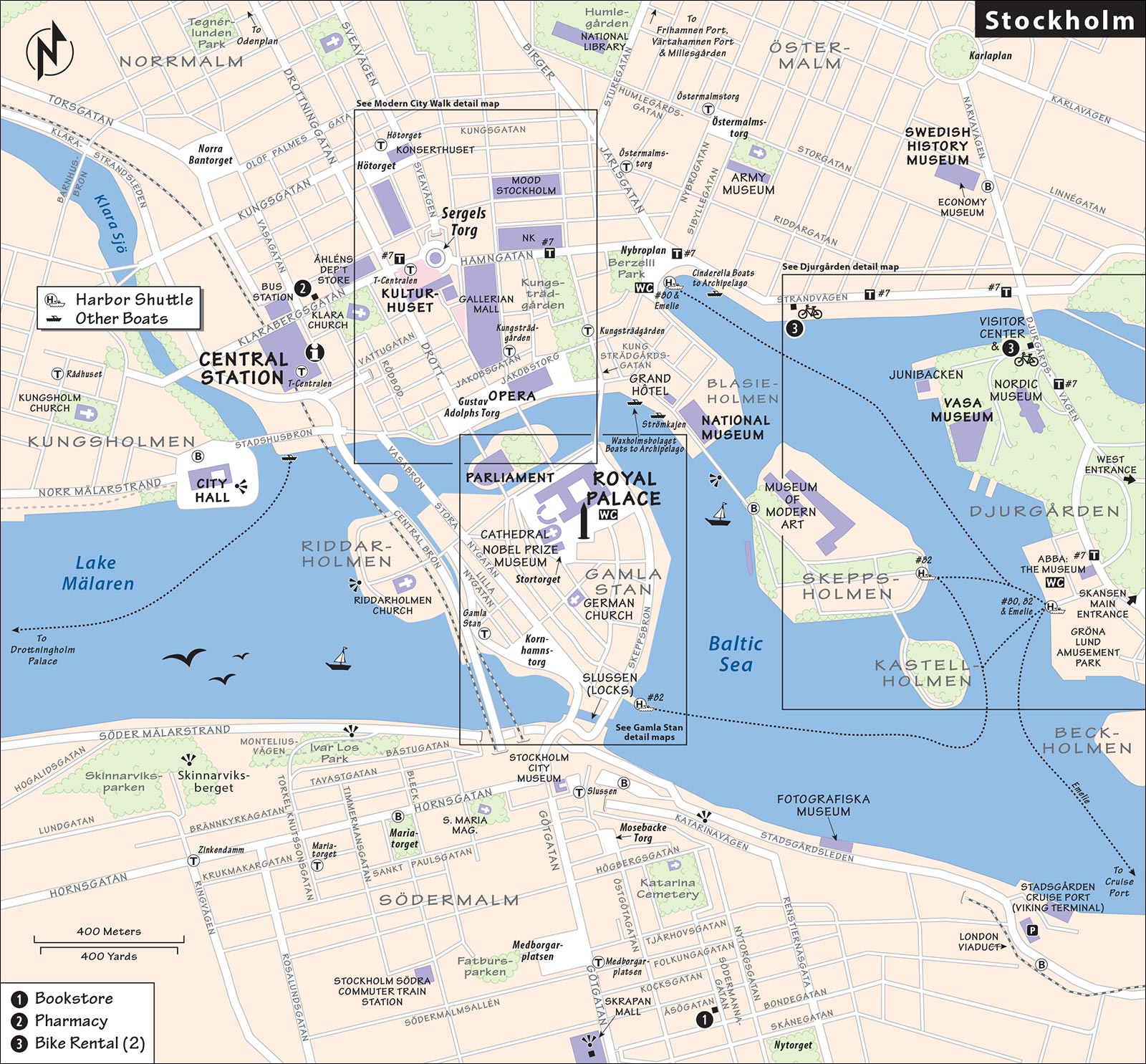
Map: Stockholm: City of Islands
Nightlife and Entertainment in Stockholm
Map: Gamla Stan Hotels & Restaurants
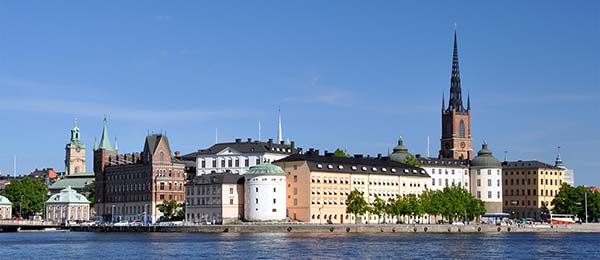
If I had to call one European city home, it might be Stockholm. One-third water, one-third parks, one-third city, on the sea, surrounded by woods, bubbling with energy and history, Sweden’s stunning capital is green, clean, and underrated.
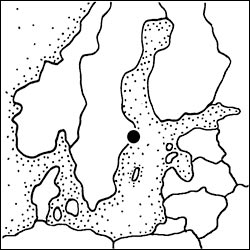
The city is built on a string of islands connected by bridges. Its location midway along the Baltic Sea, behind the natural fortification of its archipelago, made it a fine port, vital to the economy and security of the Swedish peninsula. Stockholm became a political center when Gustav Vasa established the monarchy in 1523. A century later, the expansionist King Gustavus Adolphus made it an influential European capital. The Industrial Revolution brought factories and a flood of farmers from the countryside. In the 20th century, the fuming smokestacks were replaced with steel-and-glass Modernist buildings housing high-tech workers and an expanding service sector.
Today, with more than two million people (a fifth of the Swedish population), Stockholm is Sweden’s largest city, as well as its cultural, educational, and media center. It’s also the country’s most ethnically diverse city. Despite its size, Stockholm is committed to limiting its environmental footprint. Development is strictly monitored, and cars must pay a toll to enter the city. The city feels wealthy, sometimes snobby, and a bit sure of itself. Stockholm rivals Oslo in expense, and beats it in pretense.
For the visitor, Stockholm offers both old and new. Crawl through Europe’s best-preserved old warship and relax on a scenic harbor boat tour. Browse the cobbles and antique shops of the lantern-lit Old Town. Take a trip back in time at Skansen, Europe’s first and best open-air folk museum. Marvel at Stockholm’s glittering City Hall, slick shopping malls, and art museums. Explore the funky vibrancy of the design-forward Södermalm district.
While progressive and sleek, Stockholm respects its heritage. In summer, military bands parade daily through the heart of town to the Royal Palace, announcing the changing of the guard and turning even the most dignified tourist into a scampering kid.

With extra time, consider one or more side trips, including the nearby royal residence, Drottningholm Palace; the cute town of Sigtuna; or the university town of Uppsala, with its grand cathedral, Linnaeus Garden and Museum, and Iron Age mounds (see the Near Stockholm chapter). Stockholm is also an ideal home base for cruising to island destinations in the city’s archipelago (see Stockholm’s Archipelago chapter).
PLANNING YOUR TIME
For most visitors, Stockholm is worth at least two days. For the busiest and best plan, I’d suggest this:
Day 1
| 9:00 | See the Vasa warship (opens at 10:00 off-season). |
| 11:00 | Tour the Nordic Museum. |
| 13:00 | Tour the Skansen open-air museum and grab lunch there. |
| 18:00 | Follow my self-guided Modern City Walk from Kungsträdgården. |
| 19:30 | Dine at one of my recommended restaurants, or take a harbor dinner cruise. |
Day 2
| 10:00 | Ride the hop-on, hop-off city bus tour, join a harbor boat tour, take the City Hall tour and climb its tower, or visit the Swedish History Museum. |
| 12:15 | Catch the changing of the guard at the palace (13:15 on Sun). |
| 13:00 | Have lunch on Stortorget. |
| 14:00 | Tour the Royal Armory and follow my self-guided Gamla Stan Walk. (Also consider the Nobel Prize Museum and/or Royal Palace sights.) |
| 18:30 | Explore Södermalm for dinner—it’s just across the locks from Gamla Stan. |
Day 3
With more time, do the sights suggested in days 1 and 2 in a more relaxed way or take a side trip. You could cruise through the scenic island archipelago, visit the royal palace at Drottningholm, or ride the train to charming Sigtuna or Uppsala (see next two chapters).
Orientation to Stockholm
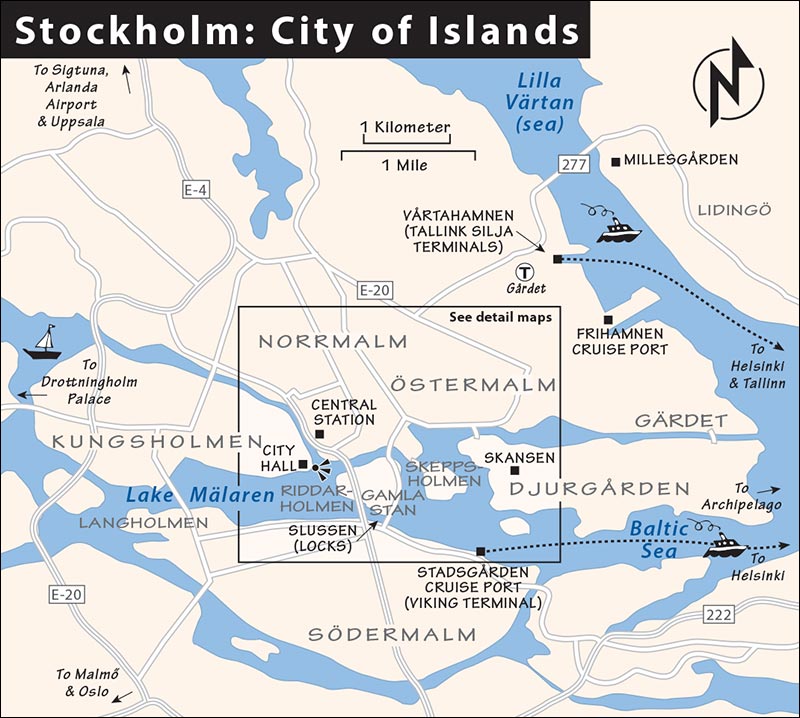
Greater Stockholm’s two million residents live on 14 islands woven together by 54 bridges. Visitors need only concern themselves with these districts, most of which are islands:
Norrmalm is downtown, with hotels and shopping areas, and the combined train and bus station. Östermalm, to the east, is more residential.
Kungsholmen, the mostly suburban island across from Norrmalm, is home to City Hall and inviting lakefront eateries.
Gamla Stan is the Old Town island of winding, lantern-lit streets, antique shops, and classy cafés clustered around the Royal Palace. The adjacent Riddarholmen is similarly atmospheric, but much sleepier. The locks between Lake Mälaren (to the west) and the Baltic Sea (to the east) are at a junction called Slussen, just south of Gamla Stan on the way to Södermalm.
Skeppsholmen is the small, central, traffic-free park/island with the Museum of Modern Art and two fine youth hostels.
Djurgården is the park-island—Stockholm’s wonderful green playground, with many of the city’s top sights.
Södermalm, just south of the other districts, is sometimes called “Stockholm’s Brooklyn”—it’s young and creative. Apart from fine views and some good eateries, this residential island may be of less interest to those on a quick visit.
TOURIST INFORMATION
What tourist office? Stockholm’s tourist information office is now just a website: VisitStockholm.com. In the main hall of the train station (and elsewhere around town) you’ll see the green i logo of Stockholm Info. Run by a for-profit agency, they sell tickets, hand out maps, have piles of brochures, and may be able to answer basic questions.
Go City Pass: This pass covers entry to multiple Stockholm sights (including the Vasa Museum and the Nobel Prize Museum) as well as unlimited City Sightseeing hop-on, hop-off bus/boat tours, and boat tours to Drottningholm Palace and Sigtuna. Download the Go City app, choose the number of days you want (from 744 SEK/1 day to 1,544 SEK/5 days), and then show your phone at each sight. It can save money on a serious sightseeing blitz; do the math to see if it makes sense for your itinerary (www.gocity.com/stockholm).
ARRIVAL IN STOCKHOLM
For details on arriving in Stockholm by plane or boat, as well as info on taking the ferry to Tallinn or Helsinki, see “Stockholm Connections” at the end of this chapter.
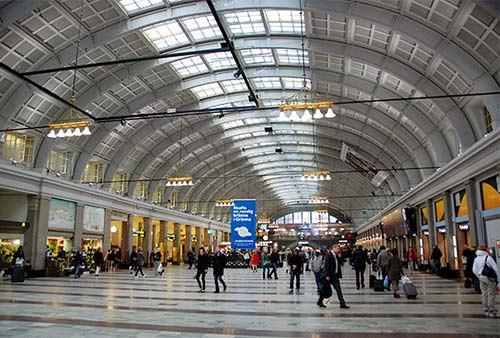
By Train or Bus: Stockholm’s adjacent stations for trains (Centralstation) and buses (Cityterminalen), at the southwestern edge of Norrmalm, are a hive of services (including an unofficial Stockholm Info “TI”), eateries, shops, a late-hours Co-op grocery store, and exchange desks. From the train station, the bus station is up the escalators from the main hall and through a glassy atrium (lined with sales desks for bus companies and cruise lines). Underground is the T-Centralen subway (T-bana) station—probably the easiest way to reach your hotel. Taxi stands are outside and Uber drivers hover at the ready.
By Plane: The fastest way to connect the city and its airport is via the Arlanda Express shuttle train; for details, see “Stockholm Connections—By Plane” at the end of this chapter.
By Car: Only a Swedish meatball would drive a car in Stockholm. Park it in one of the park-and-ride lots that ring the city and use public transit instead (see lot map at www.visitstockholm.com). To minimize the risk of theft and vandalism, pay extra for the most secure parking garage.
HELPFUL HINTS
Book Ahead: Buying tickets in advance is smart for the ABBA Museum and the Vasa Museum. It’s also a good idea to make reservations in advance for finer restaurants.
Museum Admission: Entry to many of Stockholm’s fine state-owned museums swings from free (when left-leaning parties control the reins of government) to fee (when center-right parties are in charge). The prices in this edition reflect the business-over-culture priorities of Sweden’s current conservative parliament.
Theft Alert: Even in Stockholm, when there are crowds, there are pickpockets (such as at the Royal Palace during the changing of the guard or at the Vasa Museum). Thieves are clever (they don’t dress up like thieves) and they target tourists. Be on guard.
Bookstore: The aptly named English Bookshop sells a variety of reading materials (including Swedish-interest books) in English (Mon-Fri 10:30-18:30, Sat until 17:00, Sun 12:00-17:00, in the Södermalm district at Södermannagatan 22—for location, see the “Stockholm” map earlier, +46 8 790 5510).
Pharmacy: The C. W. Scheele 24-hour pharmacy is near the train station at Klarabergsgatan 64 (+46 77 145 0450; for location, see the “Stockholm” map earlier).
GETTING AROUND STOCKHOLM
By Public Transit
Stockholm’s fine but pricey public transport network (signed as SL) includes subway (Tunnelbana, called “T-bana”) and bus systems, and a single handy tram (#7) from the commercial center to the sights at Djurgården. The city is spread out, so most visitors will use public transport at some point. The subway is easy to figure out, but some sights are better served by bus. A detailed system map is available online at www.sl.se.
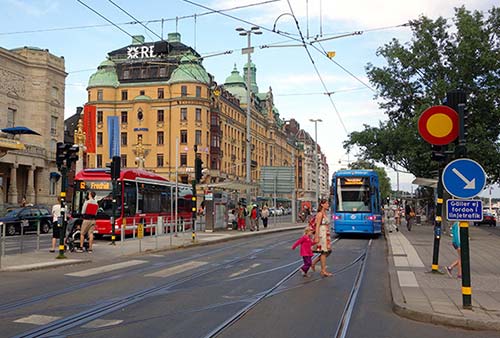
Tickets: A single ride for subway, tram, or bus costs 39 SEK (up to 75 minutes, including transfers); a 24-hour pass is 165 SEK, while a 72-hour pass is 330 SEK.
The most efficient way to buy tickets is to download the SL app on your phone (search “SL-Stockholm” in app stores) and pay with your credit card. On the T-bana, open the app and hold your phone to the turnstile scanner to go through. On the bus, scan at the entrance door. For the tram, show your phone to the ticket inspector. You can also pay for a single ride by tapping your contactless credit card at turnstiles or bus/tram scanners.
Drivers do not sell tickets, and most T-bana stations don’t have ticket machines. In a pinch, you can usually buy and load money onto an SL card at Pressbyrån convenience stores found in most T-bana stations; you then tap the card at the entry scanner. All stores selling SL cards are marked with a blue SL flag.
By Harbor Shuttle Ferry
In summer, city ferries let you make a fun, practical, and scenic shortcut across the harbor to Djurgården Island. Boat #82 leaves from the southeast end of Gamla Stan, stops near the Museum of Modern Art on Skeppsholmen, then docks near the Gröna Lund amusement park on Djurgården; boat #80 departs from Nybroplan for Djurgården (both boats 39 SEK, covered by public-transit passes, 3-4/hour May-late Sept, 10-minute trip, www.sl.se). The private ferry Emelie also makes the journey from Nybroplan to Djurgården before continuing on to the Stadsgaden cruise quay (70 SEK, buy ticket onboard—credit cards only and SL app not valid, hourly, April-Sept roughly Mon-Fri 7:50-18:20, Sat-Sun 9:50-17:20, www.ressel.se). While buses and trams run between the same points more frequently, the ferry is more scenic and can be faster. The hop-on, hop-off boat tour also connects many of these stops (see “Tours in Stockholm,” below).
By Taxi or Uber
As taxis are unregulated here, Stockholm is plagued by rip-off cabbies (especially those waiting at touristy places like the Vasa Museum or in Gamla Stan). And even honest cabs are very expensive. Locals trust “Taxi Stockholm 150000” cabs, which have their phone number (08 150 000) printed on the door.
Uber, on the other hand, is super-fast and charges much less than the typical taxi fare (a short city ride is a 100 SEK minimum). The app works in Stockholm just as it does in the US, and I generally got rides within two minutes. Rather than Uber, locals prefer an app called Bolt.
Tours in Stockholm
Strömma Dominates: The sightseeing company Strömma has a lock on most city tours, whether by bus, by boat, or on foot. You can pay for tours online, or simply as you board (+46 8 1200 4000, www.stromma.com).
BY BUS
Hop-On, Hop-Off Bus Tour
Three hop-on, hop-off buses make a 1.5-hour circuit of the city, orienting riders with a recorded commentary and linking all the essential places from Skansen to City Hall; when cruises are in town, they also stop at both cruise ports (Stadsgården and Frihamnen). Hop-On Hop-Off’s green buses and City Sightseeing’s red buses both cooperate with Strömma (350 SEK/24 hours, ticket covers both buses; May-Sept 2-3/hour daily 10:00-17:00, fewer off-season, none mid-Jan-mid-Feb). Red Sightseeing Buses offers a similar hop-on, hop-off itinerary in open-top buses for the same price (2-5/hour, www.redsightseeing.com). All offer free Wi-Fi. Stockholm has no basic 90-minute city highlights bus tour because that’s what you’ll get at a better price by just taking a hop-on, hop-off tour for its entire route. Rather than HOHO-ing, just enjoy the ride and narration.
BY BOAT
▲City Boat Tours
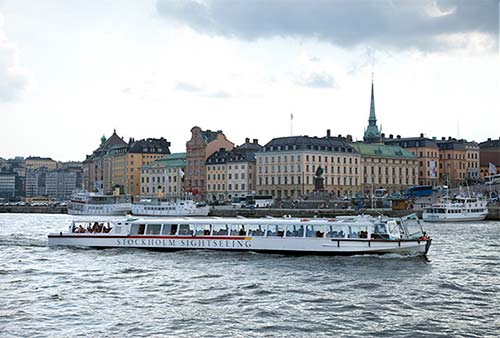
For a good floating look at Stockholm and a pleasant break, consider a sightseeing cruise. These boat tours are pleasant at the end of the day, when the light is warm and the sights and museums are closed. The handiest are the Strömma/Stockholm Sightseeing boats, which leave from Strömkajen, in front of the Grand Hôtel, and stop at Nybroplan five minutes later. The Royal Canal Tour is short and informative (248 SEK, 50 minutes, departs at :30 past each hour May-Sept 11:30-16:30, less frequent off-season, none Jan-March). The nearly two-hour Under the Bridges Tour goes through two locks and under 15 bridges (320 SEK, departures on the hour May-mid-Sept).
Hop-On, Hop-Off Boat Tour
Stockholm is a city surrounded by water, making this boat option enjoyable and practical. Strömma and Red Sightseeing offer the same small loop, stopping at key spots such as Djurgården (Skansen and Vasa Museum), Gamla Stan (near Slussen and again near Royal Palace), the Stadsgården cruise quay (with Viking Line terminal and cruise ports), and Nybroplan. Use the boat as transport from Point A to Point B, or make the whole one-hour loop and enjoy the recorded commentary (around 250 SEK/24 hours, June-mid-Sept, 2-3/hour, pick up map for schedule and locations of boat stops, www.stromma.com or www.redsightseeing.com).
ON FOOT
Local Guides
Stockholm has a hard-working and talented pool of licensed guides who all charge about 800 SEK/hour, generally with a two- or three-hour minimum. Many offer a half-day rate of about 2,000 SEK for up to three hours. I’ve enjoyed working with these guides: Håkan Frändén (+46 70 531 3379, hakan.franden@hotmail.com), Marita Bergman (+46 73 511 9154, bergman57.mb@gmail.com), and Sofia Lindh (+46 70 562 5533, lafirmadisofia@gmail.com). You can also hire a private guide through the Association of Qualified Tourist Guides of Stockholm (www.guidestockholm.com).
Town Walks
Tip-based so-called “free tours” have driven standard walking tours out of business. Several companies offer various two-hour walks around town daily in season. Guides, generally not licensed and not necessarily Swedes, memorize a script and expect a good solid tip at the end. For an overview of the “free tour” fray, Google “free tours Stockholm.”
BY BIKE
While Stockholm has yet to figure out a winning grab-and-go bike system (like Oslo’s), it is a great city to tour on two wheels. Here are a few good rental options:
Gamla Stan Cykel, two blocks east of the Gamla Stan T-bana station, rents bikes year-round; reserve ahead online or by phone in summer (Mon-Fri 10:00-18:00, Sat 11:00-16:00, closed Sun; Lilla Nygatan 10—for location, see the “Gamla Stan Walk” map later, +46 8 411 1670, www.gamlastanscykel.se).
Rent-a-Bike not only does what its name says, but also offers guided biking tours (book tours a week in advance). It’s centrally located on the waterfront at Strandvägen (May-Sept daily 10:00-18:00, Strandvägen Kajplats 18—see the “Stockholm” map earlier, +46 8 660 7959, www.rentabike.se).
You can also rent bikes (and boats) at the Djurgården Visitor Center, just over the Djurgårdsbron bridge near the Vasa Museum. It’s ideally situated as a springboard for a pleasant bike ride around the parklike Djurgården island—use their free and excellent bike map/guide. For details on the visitor center, see here.
Walks in Stockholm
8 German Church (Tyska Kyrkan)
10 Järntorget
3 Urban Shopping Zone (Hamngatan)
9 Hötorget
This section includes two self-guided walks to introduce you to Stockholm, both old (Gamla Stan) and new (the modern city).
GAMLA STAN WALK
Gamla Stan, Stockholm’s historic island Old Town, is charming, photogenic, and full of antique shops, street lanterns, painted ceilings, and tourists. Until the 1600s, all of Stockholm fit in Gamla Stan. Stockholm traded with other northern ports such as Amsterdam, Lübeck, and Tallinn. German culture influenced art, building styles, and even the language, turning Old Norse into modern Swedish. With its narrow alleys and stairways, Gamla Stan mixes poorly with cars and modern economies. Today, it’s been given over to the Royal Palace and to the tourists, who throng Gamla Stan’s main drag, Västerlånggatan, seemingly unaware that most of Stockholm’s best attractions are elsewhere. While you could just happily wander, this quick walk—worth ▲▲—gives meaning to Stockholm’s Old Town.
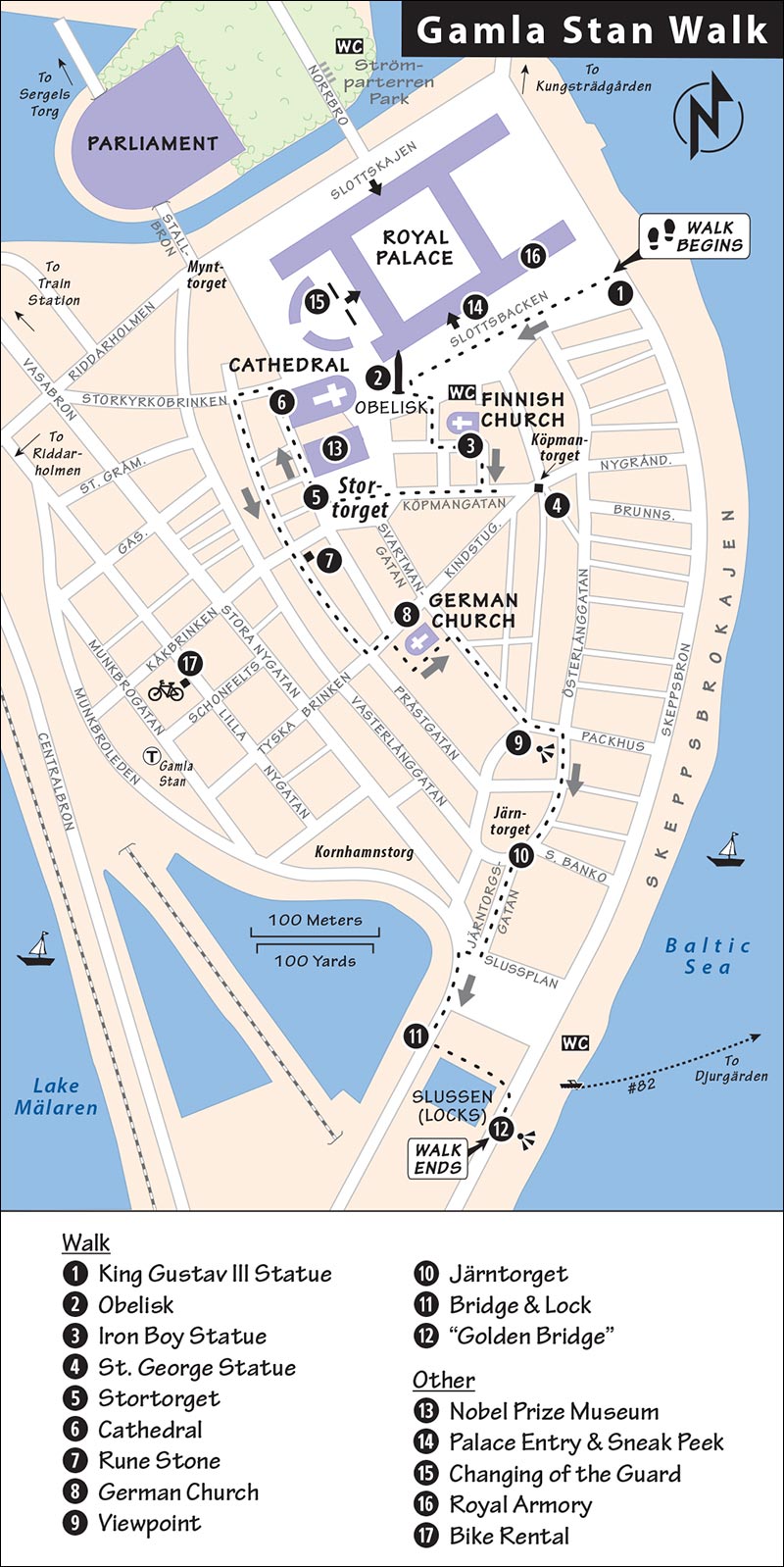
• Our walk begins along the harborfront. Start at the base of Slottsbacken (the Palace Hill esplanade) leading up to the...
Royal Palace
Along the water, check out the 1 statue of King Gustav III gazing at the palace, which was built in the 1700s on the site of Stockholm’s first castle (for more about the palace, see “Sights in Stockholm,” later). Gustav transformed Stockholm from a dowdy Scandinavian port into a sophisticated European capital, modeled on French culture. Gustav loved the arts, and he founded the Royal Dramatic Theater and the Royal Opera in Stockholm. Ironically, he was assassinated by a discontented nobleman, who shot Gustav in the back at a masquerade ball at the Royal Opera House in 1792 (inspiring Verdi’s opera Un Ballo in Maschera).
Walk up the broad, cobbled boulevard alongside the palace to the crest of the hill. Stop, look back, and scan the harbor. The grand building across the water is the National Museum. Beyond that, in the distance, is the fine row of buildings on Strandvägen street. Until the 1850s, this area was home to peasant shacks, but as Stockholm entered its grand stage, it was cleaned up and replaced by fine apartments, including some of the city’s smartest addresses. That’s the home of embassy row. A blocky gray TV tower stands tall in the distance. Turn to the palace facade on your left (finished in 1754, replacing one that burned in 1697). The niches are filled with Swedish bigwigs (literally) from the mid-18th century.
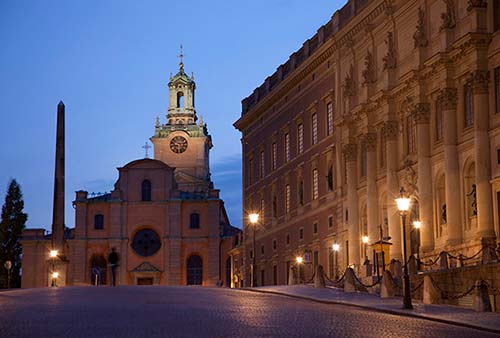
The equestrian statue is of King Charles XIV John (r. 1818-44), the first of the Bernadottes who rule to this day. To his immediate left is the grand entry to the Royal Palace and passage to the courtyard where the changing of the guard takes place. Step inside the passage for a quick peek. Flanking you under the grand dome is the dynamic duo of old-regime power: on the right the royal chapel (free, royally Baroque, and worth a look) and on the left the Hall of State (you can step inside to the turnstile to see its 1650 throne, flanked by statues of important kings, under the “Swedish summer sky” ceiling painted in 2010 for the crown princess’s wedding).
• Head back outside and continue up Slottsbacken.
Royal Palace to Köpmangatan
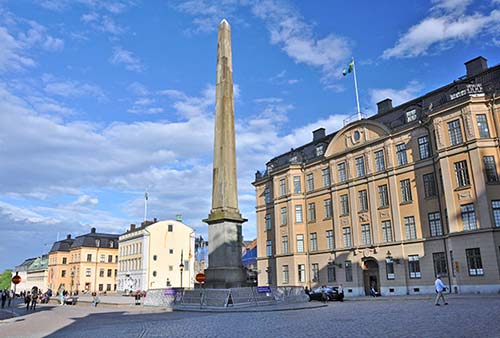
As you crest the hill, you’re facing the 2 obelisk that honors Stockholm’s merchant class for its support in a 1788 war against Russia.
Behind the obelisk stands Storkyrkan, Stockholm’s Gothic cathedral (which we’ll visit later on this walk). From this angle you can see its Baroque facade, which was added to better match the newer palace. Opposite the palace is the Finnish church (Finska Kyrkan, the deep orange building), which originated as the royal tennis hall. When the Protestant Reformation hit in 1527, church services could at last be said in the people’s languages rather than Latin. Suddenly, each merchant community needed its own church. Finns worshipped here, the Germans built their own church (coming up on this walk), and the Swedes got the cathedral.
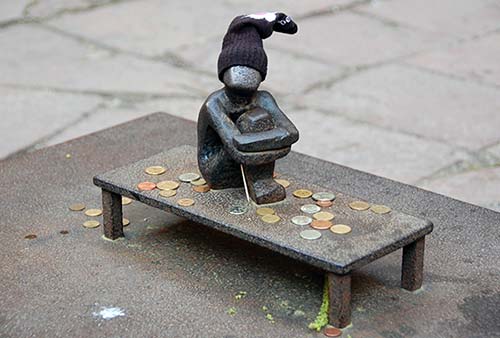
Stroll up the lane to the right of the Finnish church into the shady churchyard, where you’ll find the fist-sized 3 Iron Boy, the tiniest public statue (out of about 600) in Stockholm. Swedish grannies knit caps for him in the winter. Local legend says the statue honors the orphans who had to transfer cargo from sea ships to lake ships before Stockholm’s locks were built. Some people rub his head for good luck (which the orphans didn’t have). Others, perhaps needy when it comes to this gift, rub his head for wisdom. The artist says it’s simply a portrait of himself as a child, sitting on his bed and gazing at the moon. (Local dogs just think it’s purpose-built as a great little spot to take a pee.)
• Exit through either of the churchyard gates, turn left onto Trädgårdsgatan, then bear right with the lane to reach...
Köpmangatan
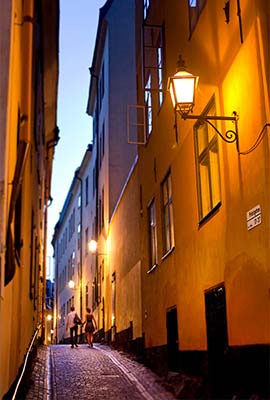
Take a moment to explore this street from one end to the other. With its cobbles and traditional pastel facades, this is a quintessential Gamla Stan lane—and one of the oldest in town. The mellow yellow houses are predominantly from the 18th century; the reddish facades are mostly 17th century. Once merchants’ homes, today these are popular with antique dealers and refined specialty shops. Back when there was comfort living within a city’s walls, Gamla Stan streets like this were densely populated.
Head left to Köpmantorget square, highlighted by the breathtaking 4 statue of St. George slaying the dragon, with a maiden representing Stockholm (about 10 steps to the right) looking on with thanks and admiration. Shops around here are noted for their Swedish handicrafts.
• Return uphill on the same lane to old Stockholm’s main square...
5 Stortorget
Colorful old buildings topped with gables line this square—Stockholm’s oldest. In 1400, this was the heart of medieval Stockholm (pop. 6,000). Here at the town well, many tangled lanes intersected, making it the natural center for trading. Today Stortorget is home to lots of tourists—including a steady storm of cruise groups following their guides’ paddle on four-hour blitz tours of the city (typically 250 ships call here between June and September). The square also hosts concerts, occasional demonstrators, and a Christmas market in winter.
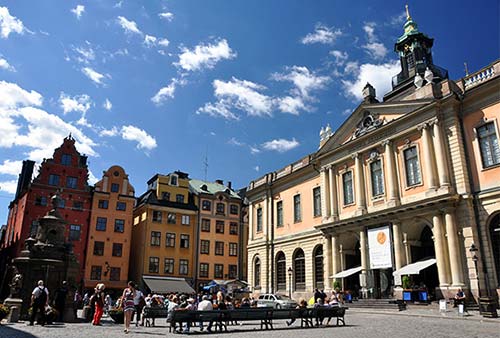
The grand building on the right is the old stock exchange, now home to the noble Nobel Prize Museum (described later under “Sights in Stockholm”). On the immediate left, offering the cheapest and best lunch around, is the recommended Grillska Huset. If you peek into the adjacent bakery, you’ll get a fine look at the richly decorated ceilings characteristic of Gamla Stan in the 17th century—the exotic flowers and animals implied that the people who lived or worked here were worldly. You’ll also spy some tempting marzipan cakes (a local favorite) and kanelbullar (cinnamon buns). There’s a cheap sandwich counter in the back and lots of picnic benches in the square.
The town well is still a popular meeting point. This square long held the town’s pillory. Scan the fine old facades. The site of the Stockholm Bloodbath of 1520, this square has a notorious history. During a Danish power grab, many of Stockholm’s movers and shakers who had challenged Danish rule—Swedish aristocracy, leading merchants, and priests—were rounded up, brought here, and beheaded. Rivers of blood were said to have flowed through the streets. Legend holds that the 80 or so gray stones in the fine red facade across the square symbolize the victims. (One victim’s son escaped, went into hiding, and resurfaced to lead a Swedish revolt against the Danish rulers. Three years later, the Swedes elected that rebel, Gustav Vasa, as their first king. He went on to usher in a great period in the country’s history—the Swedish Renaissance.)
• At the far end of the square (under the finest gables), turn right and follow Trångsund toward the...
6 Cathedral (Storkyrkan)
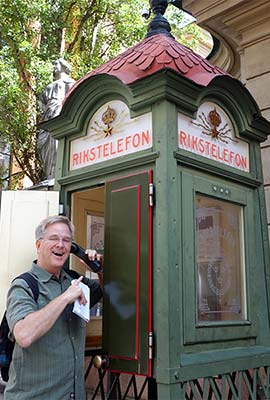
Just before the painted stonework church, you’ll see my personal phone booth (Rikstelefon) and the gate to the churchyard—guarded by statues of Caution and Hope. This church is Stockholm’s oldest, from the 14th century.
Cost and Hours: 85 SEK, daily 9:00-18:00; see signs for special events (the church is busy with tours and services in summer).
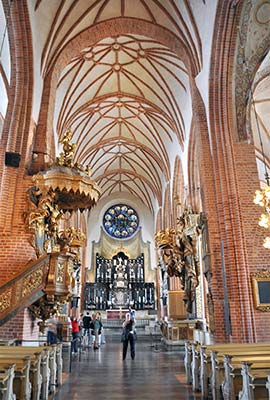
Visiting the Cathedral: When buying your ticket, pick up the free, worthwhile English-language flier. Exploring the historic cathedral’s interior (which has plenty of English descriptions posted), you’ll find many styles, ranging from medieval to modern. The front of the nave is paved with centuries-old tombstones. The tombstone of the Swedish reformer Olaus Petri is appropriately simple and appropriately located—directly under the finely carved and gilded pulpit on the left side of the nave. A witness to the Stockholm Bloodbath, Petri was nearly executed himself. He went on to befriend Gustav Vasa and guide him in Lutheranizing Sweden (and turning this cathedral from Catholic to Protestant).
Opposite the pulpit, find the bronze plaque in the pillar. It recalls the 1925 Swedish-led ecumenical meeting of Christian leaders that encouraged all churches to renew their efforts on behalf of peace and justice, especially given the horrific toll of World War I.
Next, the best seats in the house: the carved wood royal boxes under gilded canopies, dating from 1684. This has been a royal wedding church throughout the ages. It was here, in June 2010, that Crown Princess Victoria, heir to the throne, married Daniel Westling (her personal trainer) with much pomp and ceremony.
The fine 17th-century altar is made of silver and ebony. Above it, the silver Christ stands like a conquering general evoking the 1650s, an era of Swedish military might.
Left of the altar is a wondrous 1489 statue, carved from oak and elk horn, of St. George slaying the dragon (we saw a copy of it outside a few minutes ago). To some, this symbolizes the Swedes overcoming the evil Danes (commemorating a military victory in 1471). In a broader sense, it’s an inspiration to take up the struggle against even non-Danish evil. Regardless, it must be the gnarliest dragon’s head in all of Europe.
Return to the back of the church to find the exit. Before leaving, to the left of the door, notice the painting that depicts Stockholm in the early 1500s, showing a walled city filling today’s Gamla Stan. It’s a 1630 copy of the 1535 original. This church, with its black spire, dominated the town back then. The strange sun and sky predicted big changes in Sweden—and as a matter of fact, that’s what happened. Gustav Vasa brought on huge reforms in religion and beyond. (A handy and free WC is on the right, up two steps.) On the back wall notice an unbroken list of pastors stretching back to 1524 (and finally, in 1990, a woman).
Heading outside, you’ll emerge into the kid-friendly churchyard, which was once the cemetery.
• With your back to the church’s front door, go right. At the next corner, turn left (on Storkyrkobrinken), then left again on...
Prästgatan
Enjoy a quiet wander up this peaceful 15th-century “Priests’ Lane.” While this lane is sleepy, you’ll notice Västerlånggatan, the touristy main drag that parallels it one block over. (While we’ll skip it now, you can walk back up it from the end point of this walk.) As you stroll Prästgatan, look for bits of its past: hoists poking out horizontally from gables (merchants used these with pulleys to lift goods into their attics), tie bolts (iron bars necessary to bind the timber beams of tall buildings together), small coal or wood hatches (for fuel delivery back in the good old days), and flaming gold phoenixes under red-crown medallions (telling firefighters which houses paid insurance and could be saved in case of fire—for example, #46). Like other Scandinavian cities, Stockholm was plagued by fire until it was finally decreed that only stone, stucco, and brick construction (like you see here) would be allowed in the town center.
Swedes are usually ranked among the world’s top coffee drinkers The Swedish coffee break—or fika—is a ritual. Fika is to Sweden what teatime is to Britain. The typical fika is a morning or afternoon break in the workday, but can happen any time, any day. It’s the perfect opportunity (and excuse) for tourists to take a break as well.
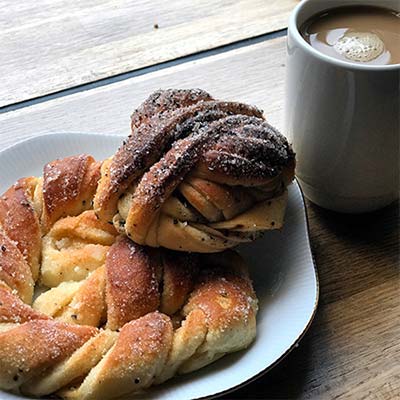
Fika fare is coffee with a snack—something sweet or savory. Your best bet is a kanelbulle, a Swedish cinnamon bun, although many prefer kardemummabulle (with cardamom). These can be found nearly everywhere coffee is sold, including just about any café or konditori (bakery) in Stockholm. A coffee and a cinnamon bun in a café will cost you about 60 SEK. (Most cafés will give you a coffee refill for free.) But at Pressbyrån, the Swedish convenience stores found all over town, you can satisfy your fika fix for 40 SEK by getting a coffee and bun to go. Grab a park bench or waterside perch, relax, and enjoy.
After a few blocks (at Kåkbrinken), a cannon barrel on the corner (look down) guards a Viking-age 7 rune stone. In case you can’t read the old Nordic script, it says: “Torsten and Frogun erected this stone in memory of their son.”
• Continue one block farther down Prästgatan to Tyska Brinken and turn left. Look up to see the powerful brick steeple of the...
8 German Church (Tyska Kyrkan)
The church’s carillon has played four times a day since 1666. Think of the days when German merchants worked here. Today, Germans come to Sweden not to run the economy, but to enjoy its pristine nature (which is progressively harder to find in their own crowded homeland). Sweden formally became a Lutheran country even before the northern part of Germany—making this the very first German Lutheran church (Mon-Sat 10:30-16:30, Sun 14:30-16:30).
• Wander through the churchyard and out the back. Exit right onto Svartmangatan and follow it to the right, ending at an iron railing overlooking Österlånggatan.
9 Viewpoint
From this perch, survey the street below to the left and right. Notice how it curves. This marks the old shoreline. Notice how the lane (to the right) leads to the water. In medieval times, piers stretched out like fingers into the harbor. Gradually, as land was reclaimed and developed, these piers were extended, becoming lanes leading to piers ever farther away.
• Walk right to Österlånggatan, and continue on to...
10 Järntorget
A customs square in medieval times, this was the home of Sweden’s first bank back in 1680 (the yellow building with the bars on the windows). The Co-op Nära supermarket on this square offers picnic fixings. From here, Västerlånggatan—the touristy eating, shopping, and commercial pedestrian mall of Gamla Stan—leads back across the island. You’ll be there in a minute, but first let’s finish this walk.
• Continue from the square (opposite where you entered) down Järntorgsgatan; you’ll emerge at a busy intersection and bridge. It may be a bit of a mess because of an enormous redevelopment project that will eventually turn this area into a green people-zone.
11 Bridge Overlooking Slussen
This area is called Slussen, named for the locks between the salt water of the Baltic Sea (to your left) and the fresh water of huge Lake Mälaren (to your right). Stockholm exists because this is where Lake Mälaren meets the sea. Traders would sail their goods from far inland to this point, where they’d meet merchants who would ship the goods south to Europe. In the 13th century, the new kingdom of Sweden needed revenue and began levying duty taxes on all the iron, copper, and furs shipped through here.
From here, you may notice a current in the water, indicating that the weir has been lowered and water is spilling from Lake Mälaren (about two feet above sea level) into the sea. Today, the locks are nicknamed “the divorce lock” because this is where captains and first mates learn to communicate under pressure and in the public eye.
• Continue to the left, cross over to the water, and then walk right, halfway up the...
12 “Golden Bridge”
Enjoy the view from this bridge (made in China and shipped here). Scan the view from right to left.
Opposite Gamla Stan is the Södermalm neighborhood—youthful, artsy, and casual. Moored in the harbor are cruise ships, which bring thousands of visitors into town each day during high season. Many of these boats are bound for Finland and other Baltic ports. The towering white syringe is the Gröna Lund amusement park’s free-fall ride. Around that park, on the island called Djurgården, are three of Stockholm’s top sights: Skansen, the Nordic Museum, and the Vasa Museum. Farther left is the three-masted Af Chapman sailing ship, which has been moored here and serving as a youth hostel for 60 years. Next, in the near foreground, is the ferry that zips from here to Gröna Lund and those big attractions on Djurgården.
• Our walk is finished, but feel free to linger longer in Gamla Stan—day or night, it’s a lively place. You can backtrack along Västerlånggatan, the main commercial drag, visit one of Gamla Stan’s sights (described later, under “Sights in Stockholm”), or hop on the ferry to Djurgården for more sightseeing.
Another option is to walk 15 minutes to Kungsträdgården, the starting point of my self-guided Modern City Walk (see next).
MODERN CITY WALK
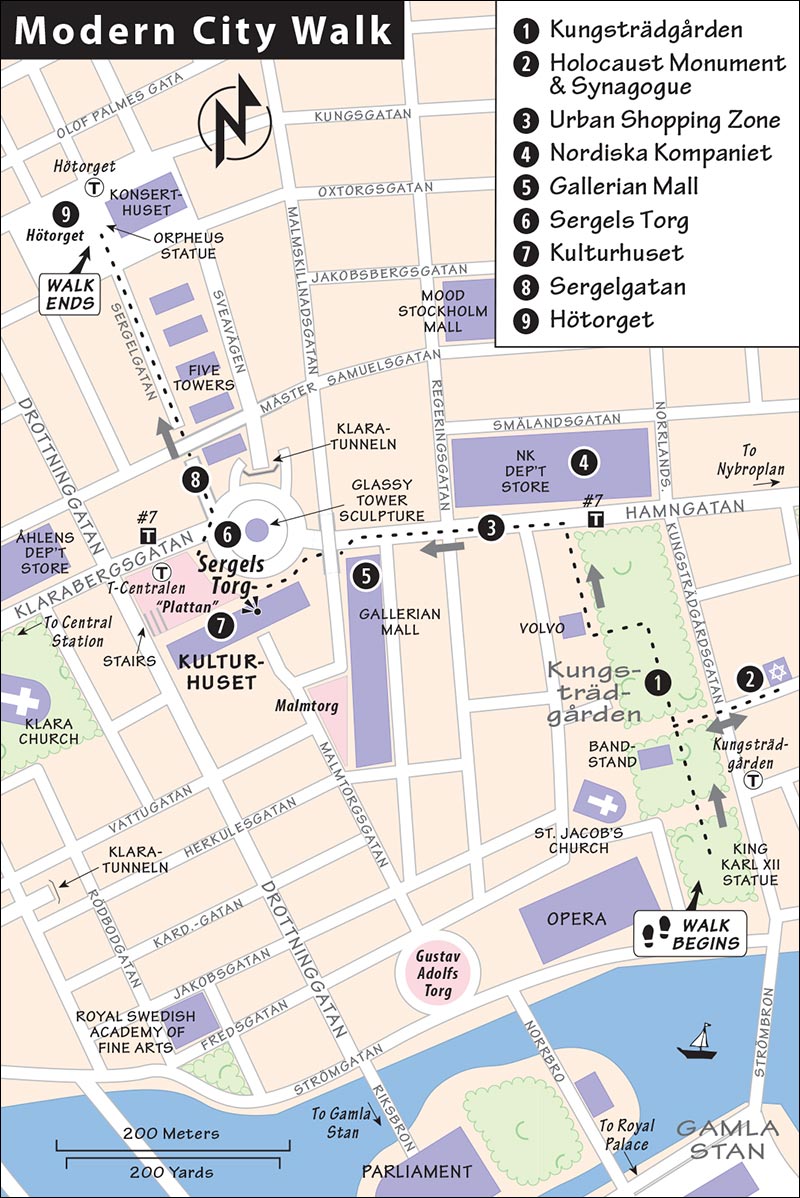
On this walk, we’ll use the park called Kungsträdgården as a springboard to explore the modern center of Stockholm—a commercial zone that puts the focus not on old kings and mementos of superpower days, but on shopping.
• Find the statue of King Karl XII, facing the waterfront at the harbor end of the park.
1 Kungsträdgården
Centuries ago, this “King’s Garden” was the private kitchen garden of the king, where he grew his cabbage salad. Today, this downtown people-watching center, worth ▲, is considered Stockholm’s living room, symbolizing the Swedes’ freedom-loving spirit. While the name implies that the garden is a private royal domain, the giant clump of elm trees just behind the statue is a reminder that it’s the people who rule now. In the 1970s, demonstrators chained themselves to these trees to stop the building of an underground train station here. They prevailed, and today, locals enjoy the peaceful, breezy ambience of a teahouse instead.
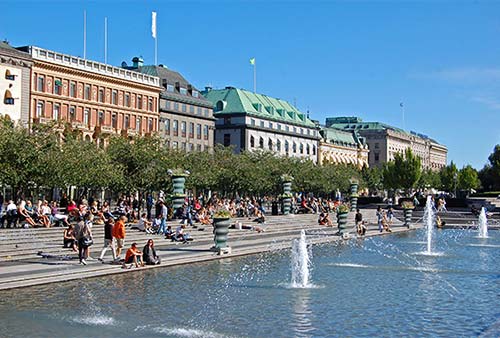
Kungsträdgården—surrounded by the harborfront and tour boats, the Royal Opera House, and shopping opportunities—is the place to feel Stockholm’s pulse (but always ask first: “Kan jag kanna på din puls?”).
The garden also plays host to huge parties. Students are treated to a cultural festival the week before school starts. The Taste of Stockholm festival runs for a week in early June, when restaurateurs show off and bands entertain all day. Beer flows liberally—a rare public spectacle in Sweden.
Farther on, watch for the Astroturf zone with “latte dads” and their kids (paid parental leave includes dads in Sweden), and enjoy a summer concert at the bandstand. There’s always something going on. The fountain is flanked by a delightful trellis of cherry trees given to the Swedish king by the Japanese emperor. A welcoming Volvo showroom near the top-left side of the square shows off the latest in Swedish car design. And, high in the sky at the far end, is a handy reference point—the revolving clock on the NK department store.
• Midway up the square you may opt for a side trip to a...
2 Holocaust Monument
Leave the square to the right, a half-block down Wahrendorffsgatan street. Behind stout black security bollards is Stockholm’s most central synagogue. In the courtyard a wall is etched with the names of Swedish victims of the Nazis. Farther down the street, train tracks—symbolizing the journey to death in concentration camps—lead to a memorial honoring the Schindler-like heroism of Swedish diplomat Raoul Wallenberg. A stone orb faces a dozen thought-provoking, abstract coffin-like markers near the beautiful harbor.
• Retrace your steps back to Kungsträdgården. Stroll through the garden, past the fountain and the Volvo store, and up to Hamngatan street. From here, we turn left and walk the length of the NK department store as we wade through Stockholm’s...
3 Urban Shopping Zone (Hamngatan)
In just a couple of blocks, we’ll pass some major landmarks of Swedish consumerism. Across the street, notice the giant gold NK marking the 4 Nordiska Kompaniet department store (locals joke that the NK stands for “no kronor left”). It’s located in an elegant early-20th-century building that dominates the top end of Kungsträdgården. If it feels like an old-time American department store, that’s because its architect was inspired by grand stores he’d seen in the US (circa 1910).
Another block down, on the left (across from #26), is the sleeker, more modern 5 Gallerian mall. Step inside and chat with the people at the welcoming info desk for all the latest (very friendly). Among this two-story world of shops, you’ll find a Clas Ohlson hardware and electronics shop (most Stockholmers have a cabin that’s always in need of a little DIY repair). Lagerhaus is a favorite for Swedish home design. The Akademibokhandeln bookstore is fun to browse. Ikea is at the back end. And along with an elegant-for-a-mall food court, there are plenty of affordable little lunch bars and classy cafés for your fika (Swedish coffee-and-bun break). You may notice that American influence (frozen yogurt and other trendy food chains) is challenging the notion of the traditional fika.
• High-end shoppers should consider heading into the streets behind NK, with exclusive designer boutiques and the chichi Mood Stockholm mall (see “Shopping in Stockholm,” later). Otherwise, just beyond the Gallerian mall, you’ll emerge into Sergels Torg. (Note that the handy tram #7 goes from here directly to Skansen and other important sights on Djurgården.)
6 Sergels Torg
This square, worth ▲, dominates the heart of modern Stockholm with its stark 1960s-era modern architecture. The glassy tower in the middle of the fountain plaza may be ugly in daylight, but it glows at night, symbolic of Sweden’s haunting northern lights (and, with more color, for gay pride, Ukrainian solidarity, or whatever is timely).
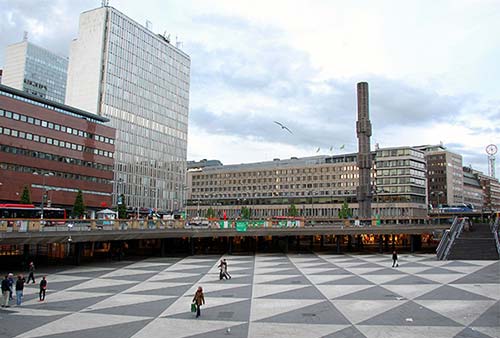
The hulking, low-slung, glassy building overlooking the square is the 7 Kulturhuset. Stockholm’s “culture center,” this lively public space hosts libraries, theater, a kids’ zone, chessboards, fun shops, a fine-art cinema, art exhibits, and a music venue (+46 8 5062 0200, http://kulturhusetstadsteatern.se).
Take the elevator to the top of the Kulturhuset and ride the escalator down, exploring each level en route. On the rooftop, the recommended Cafeteria Panorama has cheap meals with terrific city views. On the ground floor is a free exhibit on the European Union (to help the populace, including new immigrants, better understand their world).
Back at ground level outside, stand in front of the Kulturhuset (across from the fountain) and survey the expansive sunken square nicknamed “Plattan” (the platter). Everything around you dates from the 1960s and 1970s, when this formerly run-down area was reinvented as an urban “space of the future.” In the 1970s, with no nearby residences, the desolate Plattan became the domain of junkies. Now the city is actively revitalizing it, and the Plattan is a people-friendly heart of the commercial town.
Stockholmsrummet (outside, lower level, in the underpass, Sergelgången 31) showcases how the city is developing with a big 1:1000 model under its glass floor. Nearby are major boutiques and department stores, including, across the way, H&M and the massive Åhléns.
• Head in the opposite direction from Kulturhuset to the street that leads past the five uniform white towers you see beyond the fountain. This is...
8 Sergelgatan: Walk up this thriving pedestrian and commercial street, enjoying the public art and people-watching. The five office towers, so modern in the 1960s, are now struggling as societies no longer fill office space with nine-to-five workers five days a week.
On the right, at the start of the pedestrianized drag, the Avicii Experience (dedicated to the late megastar Tim “Avicii” Bergling) is a reminder of how, ever since ABBA became a bigger business than Volvo, the Swedish pop music industry has been an important part of the local economy (Sergelgatan 2, https://aviciiexperience.com). Spotify is Swedish. (As most Swedish music is sung in English to reach a bigger audience, you may not realize it’s Swedish.)
Midway along, the gun-tied-in-a-knot statue is a reminder of how Sweden is famously neutral and into nonviolence. Sweden has been in no war since 1814 and, unlike so many great cities, it’s never had to rebuild after a bombardment. It stayed out of both World War I and World War II, and it chose not to join NATO (up until Putin’s war with Ukraine forced it to reconsider). Swedes have a hard time getting their brains around the routine gun violence the US endures.
Designtorget, a fun shop at the top of the street on right (#20), near the T-bana stop, is great for whimsical and clever Swedish design.
• Sergelgatan ends at a wonderful market square...
9 Hötorget
“Hötorget” means “Hay Market,” but today its stalls feed people rather than horses. The adjacent indoor market, Hötorgshallen, is fun and fragrant. This hall dates from 1914 when, for hygienic reasons, the city forbade selling fish and meat outdoors (market described later, under “Eating in Stockholm”). The square also hosts a Sunday morning flea market in summer. Carl Milles’ statue of Orpheus Emerging from the Underworld (with seven sad Muses) stands in front of the Konserthuset, the city concert hall (which hosts the annual Nobel Prize award ceremony). The concert house, from 1926, is Swedish Art Deco (a.k.a. “Swedish Grace”). The lobby (open through much of the summer) still evokes Stockholm’s Roaring Twenties. If the door’s open, peek in for a look. They host free exhibitions and concerts by local music students in summer (5/day, 20 minutes each). Popping into the Hötorget T-bana station provides a fun glimpse at local urban design. Stockholm’s subway system was inaugurated in the 1950s, and many stations are modern art installations in themselves.
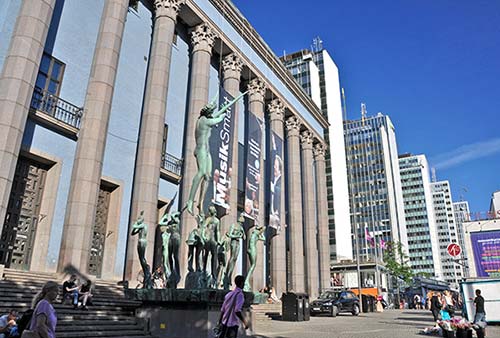
• Our walk ends here. For more shopping and an enjoyable pedestrian boulevard leading back into the Old Town, cut down a block to Drottninggatan and turn left. This busy drag leads straight out of the commercial district, passes the parliament, then becomes the main street of Gamla Stan.
Sights in Stockholm
Royal Palace Complex (Kungliga Slottet)
▲▲Military Parade and Changing of the Guard
▲▲Royal Armory (Livrustkammaren)
On Kungsholmen, West of Norrmalm
On Blasieholmen and Skeppsholmen
▲National Museum (Nationalmuseum)
Museum of Modern Art (Moderna Museet)
▲▲Swedish History Museum (Historiska Museet)
Economy Museum - Royal Coin Cabinet (Ekonomiska Museet - Kungliga Myntkabinettet)
▲▲▲Skansen
▲Nordic Museum (Nordiska Museet)
▲Fotografiska (Photography Museum)
Stockholm City Museum (Stadsmuseet)
GAMLA STAN (OLD TOWN)
The best of this island is covered in my self-guided Gamla Stan Walk, earlier. But here are a few ways to extend your time in the Old Town.
On Stortorget Square
▲Nobel Prize Museum
Opened in 2001 for the 100-year anniversary of the Nobel Prize, this wonderful little museum tells the story of the world’s most prestigious prize. High-tech and eloquent, it fills the grand old stock exchange building that dominates Gamla Stan’s main square, Stortorget. Plans are in the works to relocate this museum in the near future.
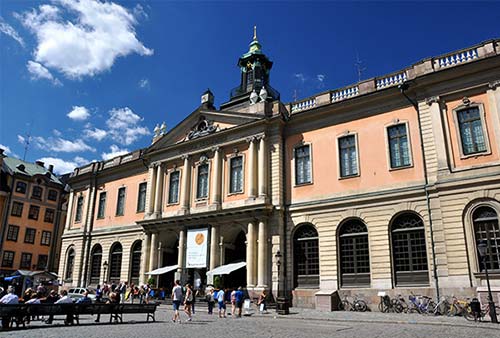
Cost and Hours: 140 SEK; Sat-Thu 10:00-19:00, Fri until 21:00, closed Mon in off-season; free downloadable audioguide on website, free 40-minute orientation tours in English—about hourly, check website for times, +46 8 5348 1800, https://nobelprizemuseum.org [URL inactive].
Background: Stockholm-born Alfred Nobel was a great inventor, with more than 300 patents. His most famous invention: dynamite. Living in the late 1800s, Nobel was a man of his age. It was a time of great optimism, wild ideas, and grand projects. His dynamite enabled entire nations to blast their way into the modern age with canals, railroads, and tunnels. It made warfare much more destructive. And it also made Alfred Nobel a very wealthy man. Wanting to leave a legacy that celebrated and supported people with great ideas, Alfred used his fortune to fund the Nobel Prize. Every year since 1901, laureates have been honored in the fields of physics, chemistry, medicine, literature, economic sciences, and peacemaking.
Visiting the Museum: Inside, portraits of all 1,000-plus prizewinners hang from the ceiling—shuffling around the room like shirts at the dry cleaner’s (miss your favorite, and they will come around again in six hours).
Behind the ticket desk are monitors that represent the six Nobel Prize categories, each honoring the most recent laureate in that category. Between those monitors (running down the middle), touchscreens organized by decade invite you to learn more about the laureates. An adjacent theater on the right tells the story of various winners.
To the right of the ticket desk, find “The Gallery,” with a surprisingly captivating collection of items that various laureates have cited as important to their creative process, from scientific equipment to inspirational knickknacks (like Malala Yousafzai’s scarf). The randomness of the items offers a fascinating and humanizing insight into the great minds of our time. And beyond that are rooms dedicated to the life of Alfred Nobel.
The Viennese-style Bistro Nobel is the place to get creative with your coffee...and sample the famous Nobel ice cream. All Nobel laureates who visit the museum are asked to sign the bottom of a chair in the café. Turn yours over and see who warmed your chair. And don’t miss the lockable hangers, to protect your fancy, furry winter coat. The Swedish Academy, which awards the Nobel Prize for literature each year, is upstairs.
Royal Palace Complex (Kungliga Slottet)
Although the royal family beds down at Drottningholm (see next chapter), this complex in Gamla Stan is still the official royal residence. The palace, designed in Italian Baroque style, was completed in 1754 after a fire wiped out the previous palace—a much more characteristic medieval/Renaissance complex. This blocky Baroque replacement, which houses various museums, is big and (frankly) pretty dull. For help locating different areas of the complex, see the “Gamla Stan Walk” map, earlier.
Planning Your Time: Visiting the several sights in and near the palace could fill a day, but Stockholm has far better attractions elsewhere. Prioritize.
For a quick visit, see the changing of the guard, tour the Royal Armory, and skip the rest. Information booths in the semicircular courtyard (at the top, where the guard changes) and just inside the east entry give out a list of the day’s guided tours and an explanatory brochure/map that marks the entrances to the different sights. The main entrance to the Royal Palace (including the apartments, chapel, and treasury) faces the long, angled square and obelisk.
The Royal Palace ticket includes four museums. Of these, the Royal Apartments are not much as far as palace rooms go but still worthwhile; the Royal Treasury is worth a look; the Museum of Three Crowns gets you down into the medieval cellars to learn about the more interesting earlier castle; and Gustav III’s Museum of Antiquities is skippable. The chapel is nice enough (and it’s free to enter).
Tours: In peak season, the main Royal Palace generally offers a full slate of English tours covering some of the sights for a small extra fee. If you’re paying the hefty price for a ticket, consider adding on a tour—otherwise, you’ll struggle to appreciate the place. Some tours are infrequent, so be sure to confirm times when you purchase your admission (for more on tours, see the individual listings below).
▲▲Military Parade and Changing of the Guard
Starting from the Army Museum (two blocks from Nybroplan at Riddargatan 13), Stockholm’s daily military parade marches over Norrbro bridge, in front of the parliament building, and up to the Royal Palace’s outer semicircular courtyard (at the top of the palace), where the band plays and the guard changes. Smaller contingents of guards spiral in from other parts of the palace complex, eventually convening in the same place.
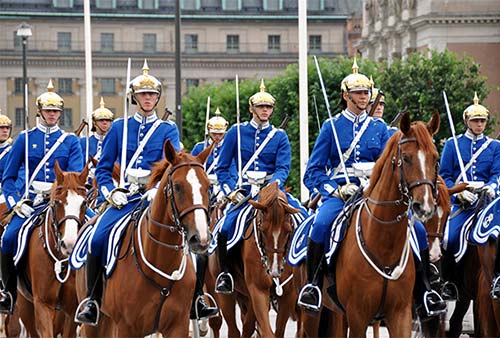
The performance is fresh and spirited because these young soldiers—from every branch of the service and from all over Sweden—are visiting Stockholm just like you, and it’s a chance for them to show their stuff in the big city. Pick your place at the palace courtyard, where the band arrives at about 12:15 (13:15 on Sun). Arrive early to snare a good perch for the ceremony. Generally, after the barking and goose-stepping formalities, the band plays an impressive 30-minute marching-band concert. Find details at www.forsvarsmakten.se (click on “Activities”).
Marching Band and Parade Timing: Departs from Army Museum late April-Aug Mon-Sat at 11:45, Sun at 12:45; Sept-Oct Wed and Sat at 11:45, Sun at 12:45; off-season departs from Mynttorget Wed and Sat at 12:09, Sun at 13:09. Royal appointments can disrupt the schedule; confirm times online. In summer, you might also catch the mounted guards (they don’t appear on a regular schedule).
▲▲Royal Armory (Livrustkammaren)
The oldest museum in Sweden is both more and less than an armory. Rather than dusty piles of swords and muskets, it focuses on royal clothing: impressive ceremonial armor (never used in battle) and other fashion through the ages (including a room of kidswear and even royal toys), plus a fine collection of coaches. It’s an engaging slice of royal life. Everything is displayed under sturdy brick vaults, beautifully lit, and well described in English and by a good audioguide.
Cost and Hours: 150 SEK; daily 10:00-17:00, Sept-April Tue-Sun 11:00-17:00, closed Mon; audioguide-20 SEK, information sheets in English available in most rooms, ask about guided tours in English, entrance at bottom of Slottsbacken at base of palace, +46 8 402 3030, www.livrustkammaren.se.
Visiting the Museum: Begin with the seven ground-floor rooms, in which the collection is beautifully and chronologically displayed. Here’s what you’ll find:
Room 1: This space is dedicated to 16th-century royals.
Room 2: Almost a shrine for Swedish visitors, this room contains the clothes Gustavus Adolphus wore—and even the horse he was riding—when he was killed in the Thirty Years’ War.
Room 3: Exquisite workmanship on ceremonial armor is a fine example of weaponry as an art form. Royal suits and gowns through the ages are also displayed.
Room 4: The 1766 wedding dress of Queen Sofia is designed to cleverly show off its fabulously rich fabric (the dress seems even wider when compared to her 20-inch corseted waist).
Rooms 5 and 6: In displays dedicated to the 1800s, the Bernadotte era, and the constitutional monarchs, you’ll see more-modern royal fashion and gain a peek at how the royal kids were dressed and entertained. It’s fun to imagine little princes romping around their 600-room home with these toys. A century ago, one prince treasured his boxcar and loved playing cowboys and Indians.
Room 7: This room features a short video about the collection.
The easy-to-miss mezzanine level (overlooking these main rooms; take the stairs at the end of the main hall) is typically filled with good temporary exhibits.
Backtrack to the entrance and find the stairs down to the basement, filled with lavish royal coaches. The highlight (last coach on the right) is a plush coronation coach made in France in about 1700 and shipped to Stockholm, ready to be assembled Ikea-style. It last rolled a king to his big day—with its eight fine horses and what was then the latest in suspension gear—in 1860. At the end of the hall, you’ll see the preferred mode of travel for winter: an open sleigh, which made great time over frozen lakes and rivers (as opposed to the normally muddy and rutted roads).
▲Royal Palace
The Royal Palace consists of a chapel (free) and four museums. Compared to many grand European palaces, it’s underwhelming and can be flooded with cruise-excursion groups.
Cost and Hours: The 190-SEK combo-ticket covering all four museums is sold at each museum entrance and in advance online; daily 10:00-17:00; guided tours of apartments—30 SEK, generally 2/day, check tour times online; +46 8 402 6130, www.kungligaslotten.se.
Orientation: You can buy tickets at the entrances or the gift shop. There can be lines; if you already have your ticket you can bypass the line. I’ve listed the museums in order of sightseeing worthiness. But if you want to see them all with minimal backtracking, follow this plan: Begin at the entrance on Slottsbacken. Head up to the chapel for a peek, then descend to the treasury. Tour the Royal Apartments, exiting at the far side of the building—where you can head straight into the Museum of Three Crowns. Exiting there, you’ll find the final sight (Museum of Antiquities) to your right.
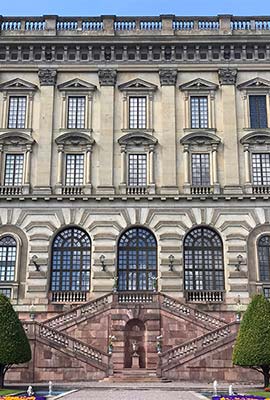
Royal Apartments: The stately palace exterior encloses 608 rooms (one more than Britain’s Buckingham Palace) of glittering 18th-century Baroque and Rococo decor. Guided 45-minute tours in English run year-round a couple of times a day. Clearly the palace of Scandinavia’s superpower, it’s steeped in royal history.
You’ll enter via the grand main hall, the Hall of State (cheapskates can get a free look at this first room before reaching the ticket checkpoint), then walk the long halls through four sections. On the main level are the Hall of State (with an exhibit of fancy state awards) and the lavish Bernadotte Apartments (some fine Rococo interiors and portraits of the Bernadotte dynasty); upstairs you’ll find the State Apartments (with rooms dating to the 1690s—darker halls, faded tapestries, and a wannabe hall of mirrors) and the Guest Apartments (with less lavish quarters, where visiting heads of state still crash).
Royal Treasury (Skattkammaren): Refreshingly compact compared to the sprawling apartments, the treasury gives you a good, up-close look at Sweden’s crown jewels. It’s particularly worthwhile with an English guided tour or the included audioguide (which covers basically the same information).
Climbing down into the super-secure vault, you’ll see 12 cases filled with fancy crowns, scepters, jeweled robes, the silver baptismal font of Karl XI, and plenty of glittering gold. The first room holds the crowns of princes and princesses, while the second shows off the more serious regalia of kings and queens. For more than a century, these crowns have gone unworn: The last Swedish coronation was Oskar II’s in 1873; in 1907 his son and successor—out of deference for the constitution (and living in a Europe that was deep in the throes of modernism)—declined to wear the crown, so he was “enthroned” rather than “coronated.” The crowns still belong to the monarchs and are present in the room on special occasions—but they are symbols rather than accessories.
Museum of Three Crowns (Museum Tre Kronor): This museum shows off bits of the palace from before a devastating 1697 fire. The models, illustrations, and artifacts are displayed in vaulted medieval cellars that are far more evocative than the run-of-the-mill interior of today’s palace. But while the stroll through the cellars is atmospheric, it’s basically just more old stuff, interesting only to real history buffs.
Royal Chapel (free): If you don’t want to spring for a ticket, but would like a little taste of palace opulence, climb the stairs inside the main entrance for a peek into the chapel. It’s standard-issue royal Baroque: colorful ceiling painting, bubbly altars, and a giant organ.
Gustav III’s Museum of Antiquities (Gustav III’s Antikmuseum): In the 1700s, Gustav III traveled through Italy and brought home an impressive gallery of classical Roman statues. These are displayed exactly as they were in the 1790s. This was a huge deal for those who had never been out of Sweden.
More Gamla Stan Sights
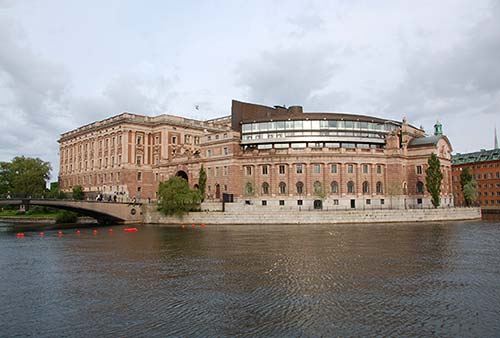
Sweden’s parliament complex dominates the Gamla Stan islet of Helgeandsholmen (just north of the Royal Palace). Also at the edge of Gamla Stan is the stately island of Riddarholmen.
Parliament (Riksdag)
For a firsthand look at Sweden’s government, tour the parliament buildings. Guides enjoy a chance to teach a little Swedish poli-sci along the standard tour of the building and its art. It’s also possible to watch the parliament in session.
Cost and Hours: Free one-hour English tours run late June-mid-Aug, usually 4/day Mon-Fri at 12:00, 13:00, 14:00, and 15:00 (when parliament is not in session; arrive early for security, no prebooking). The rest of the year tours run 1/day Sat-Sun only; you’re also welcome to join Swedish citizens in the viewing gallery (free); enter at Riksgatan 3a, call +46 8 786 4862 from 9:00 to 11:00 to confirm tour times, www.riksdagen.se.
Riddarholmen
Literally the “Knights Isle,” Riddarholmen is the quiet and stately far side of Gamla Stan, with a historic church, private palaces, and a famous view. The knights referred to in its name were the nobles who built their palaces on this little island to be near the Royal Palace, just across the way. The island, cut off from the rest of Gamla Stan by a noisy highway, is pretty lifeless (nobody actually lives here), with impersonal government agencies filling its old mansions. Still, a visit is worthwhile for a peek at its church and to enjoy the famous view of City Hall and Lake Mälaren from its far end.
On the main square stands a statue of Birger Jarl (considered the man who founded Stockholm in 1252). Surrounding the square are 17th-century private palaces of old noble families (now government buildings).
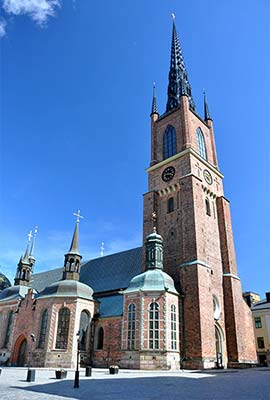
Riddarholmen Church: Towering high above the main square is the spire of the Riddarholmen Church. Established in the 13th century as a Franciscan church, this has been the burial place of nearly every Swedish royal since the early 1600s. The walls of this Swedish Westminster Abbey are festooned with fancy coats of arms of fancy families, and the floors are paved with the tombs of people rich enough to be buried here. The chapel on the right holds the tomb of Gustavus Adolphus (of Vasa fame), who died in 1632. From the altar stairs lead into the crypt filled with royals from Sweden’s golden age—the late 1600s and early 1700s. Posted English reader boards explain it all (60 SEK, daily 10:00-17:00, closed Oct-May).
Lakeside View Terrace: An inviting lakeside terrace at the far end of the island is where people (and photographers) gather for Riddarholmen’s iconic Stockholm view. Lake Mälaren was originally a salty inlet, but locks sealed it off, making it freshwater (and the city’s water source today). The lake is a playground for ducks and kayakers alike. Near the statue of local folk singer Evert Taube is a ladder into the water if you feel like a quick dip. On the right is a classic view of City Hall. Facing that, on the left, is a big industrial-age brewery. Romantic steamers sail from near City Hall to Drottningholm Palace and other lakeside points.
DOWNTOWN STOCKHOLM
I’ve organized these sights and activities in the urban core by island and/or neighborhood.
On Kungsholmen, West of Norrmalm
▲▲City Hall (Stadshuset)
The Stadshuset is an impressive mix of 8 million red bricks, 19 million chips of gilt mosaic, and lots of Stockholm pride. While churches dominate cities in southern Europe, in Scandinavian capitals, City Halls seem to be the most impressive buildings, celebrating humanism and the ideal of people working together in community. Built in 1923, this is still a functioning City Hall. The members of the city council—101 men and women representing the roughly million citizens of Stockholm—are hobby legislators with regular day jobs. That’s why they meet in the evening about weekly. One of Europe’s finest public buildings and the site of the annual Nobel Prize banquet, it’s a favorite spot for weddings. On a typical Saturday they’ll have about 70 of them: “long” is three minutes, “short” is 30 seconds. (But it takes six months to get a divorce.) City Hall is particularly enjoyable and worthwhile for its entertaining and required 50-minute tour.
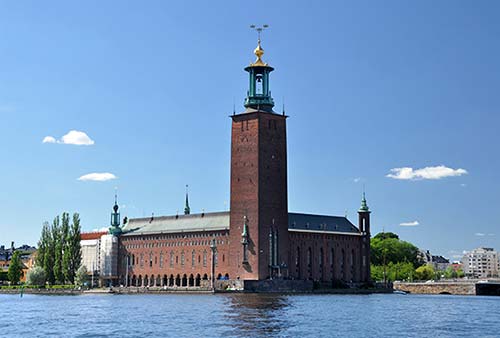
Cost and Hours: 140 SEK; English tours offered daily, generally June-Aug every half hour from 9:30 to 16:00, hourly off-season; schedule can change due to special events—call to confirm; 300 yards behind the central train station—about a 15-minute walk from either the station or Gamla Stan, bus #3, cafeteria open to public at lunch Mon-Fri; +46 8 5082 9058, https://stadshuset.stockholm. While you cannot book in advance, you can call to confirm that tours are going and that there are spots available.
Visiting City Hall: You can only visit on a guided tour. On it you’ll see the building’s sumptuous National Romantic-style interior (similar to Britain’s Arts and Crafts style), celebrating Swedish architecture and craftwork, and created almost entirely with Swedish materials.
Tour highlights are four fine rooms: the so-called Blue Hall (the Italian piazza-inspired, brick-lined inner courtyard that was originally intended to be painted blue—hence the name—where the 1,300-plate Nobel banquet takes place); the City Council Chamber (with a gorgeously painted wood-beamed ceiling that resembles a Viking longhouse—or maybe an overturned Viking boat); the Gallery of the Prince (lined with frescoes executed by Prince Eugene of Sweden); and the glittering, gilded, Neo-Byzantine-style (and aptly named) Golden Hall, where the Nobel recipients cut a rug after the banquet.
In this over-the-top Blue Hall, a glimmering mosaic Queen of Lake Mälaren oversees the proceedings with a welcoming but watchful eye, as East (see Istanbul’s Hagia Sophia and the elephant, on the right) and West (notice the Eiffel Tower, Statue of Liberty, and skyscrapers with the American flag, on the left) meet here in Stockholm. Above the door across the hall (floating above the medieval city castle) is Sweden’s patron saint, Erik, who seems to have lost his head (due to some sloppy mosaic planning).
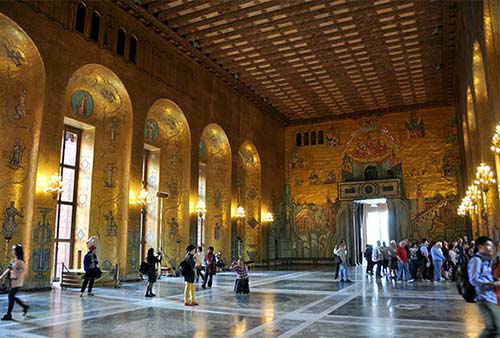
On the tour, you’ll find out exactly how many centimeters each Nobel banquet attendee gets at the table, why the building’s plans were altered at the last minute to make the tower exactly one meter taller, where the prince got the inspiration for his scenic frescoes, and how the Swedes reacted when they first saw that Golden Hall (hint: they weren’t pleased).
▲City Hall Tower
This 348-foot-tall tower rewards those who make the climb with the classic Stockholm view: The old church spires on the atmospheric islands of Gamla Stan pose together, with the rest of the green and watery city spread-eagle around them.
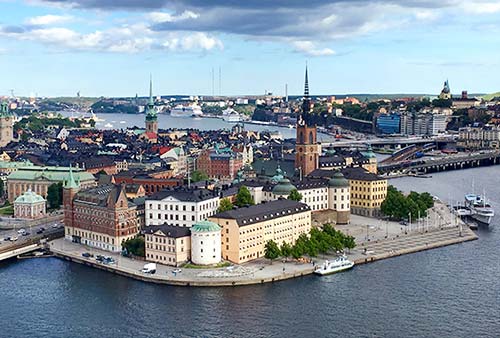
Cost and Hours: 90 SEK, daily 9:15-16:00, closed Oct-April.
Crowd-Beating Tips: Only 30 people at a time are allowed up into the tower every 45 minutes (with not a guide but a security escort). To ascend, you’ll need a timed-entry ticket, available only in person at the tower ticket office on the same day. It can be a long wait for the next available time, and tickets can sell out by midafternoon. (Mornings are less crowded.) If you’re touring City Hall, head to the tower ticket window first to check time-slot availability; ideally an entry time will coincide with the end of your tour.
Visiting the Tower: A total of 365 steps lead to the top of the tower, but you can ride an elevator partway up—leaving you only 159 easy steps to the top.
First you’ll climb up through the brick structure, emerging at an atmospheric hall filled with models of busts and statues that adorn City Hall and a huge, 25-foot-tall statue of St. Erik. The patron saint of Stockholm, Erik was supposed to be hoisted by cranes up through the middle of the tower to stand at its top. But plans changed, big Erik is forever parked halfway up the structure, and the tower’s top is open for visitors to gather and enjoy the view.
From Erik, you’ll twist gradually up ramps and a few steps at a time through the narrow, labyrinthine brick halls with peek-a-boo views of the city. Finally, you’ll emerge into the wooden section of the tower, where a spiral staircase brings you up to the roof terrace. Enjoy the view from there, but also take some time to look around at the building’s features. Smaller statues of Erik, Klara, Maria Magdalena, and Nikolaus, all patron saints, face their respective parishes. Look up: You’re in the company of the tower’s nine bells.
On Blasieholmen and Skeppsholmen
The peninsula of Blasieholmen pokes out from downtown Stockholm and is tethered to the island of Skeppsholmen by a narrow bridge (with great views and adorned with glittering golden crowns). While not connected to the city by T-bana or tram, you can reach this area on bus #65 or the harbor shuttle ferry. Skeppsholmen offers a peaceful break from the bustling city, with glorious views of Gamla Stan on one side and Djurgården on the other.
▲National Museum (Nationalmuseum)
The National Museum’s collections got their start through generations of royal collecting. Soon after Gustav Vasa was declared king in 1523, he began assembling an art collection and creating state rooms in which to display the symbols of wealth and power that legitimized the new Swedish dynasty. Subsequent royals continued amassing artworks and founded the museum in 1792. The present Renaissance-style building on the Blasieholmen peninsula opened in 1866 as Sweden’s national gallery. Today the museum showcases a wide range of fine arts from circa 1500 to 1900, encompassing decorative arts, design, and portraiture from the Middle Ages up to the present—everything from paintings and porcelain to furniture and statuary.
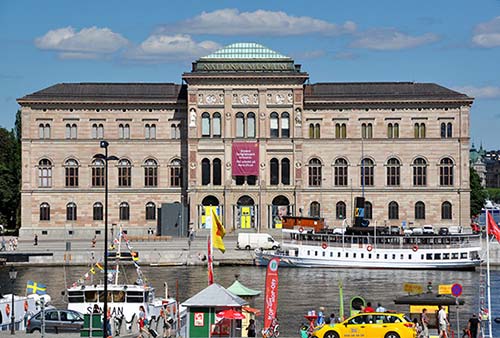
Cost and Hours: 150 SEK; Tue-Sun 10:00-17:00, closed Mon; off-season Wed-Sun 11:00-17:00, Thu until 20:00, closed Mon-Tue; good free app, audioguide-20 SEK, café and restaurant, Södra Blasieholmshamnen, T-bana: Kungsträdgarden, +46 8 5195 4310, www.nationalmuseum.se.
Visiting the Museum: Start at the top floor and work your way around chronologically. In the 1500s room, study the portraits of members of the Vasa dynasty: These were kings with Renaissance ideals who dreamed of bringing prestigious European culture to Sweden. One way they did so was via plunder—some treasures in the collection were stolen when the Swedes sacked Prague in 1648 (such as the weird fish-and-fowl-faced portrait of a jurist by the Italian painter Arcimboldo).
For a bird’s-eye perspective on this wonderful urban mix of water, parks, concrete, and people, consider these viewpoints.
City Hall Tower: Top of the tower comes with the classic city view (see listing earlier).
Trendy Roof Garden Cocktail Bars: All over the city center you’ll find rooftop bars with great views. Many are in hotels or at the top of department stores. It’s an ever-changing scene—if you see one that looks promising, simply walk into the lobby and ride the elevator. They are generally free and you’re usually welcome to check them out (and, of course, buy a drink if you’re so inclined). Two appealing options are Tak and Sus, adjacent downtown restaurant-bars (above the Gallerian Mall) that share the same elevator. Tak is a genteel place, with pricey Asian fusion cuisine (closed Sun, Brunkebergstorg 2, +46 8 587 220 80, www.tak.se). Sus (short for Stockholm under Stjårnorna, “Stockholm under the Stars”) is more lively and youthful, with light bites and occasional DJ events (closed Mon, Brunkebergstorg 2, www.sthlmunderstjarnorna.com). For locations, see the “Stockholm Restaurants” map on here.
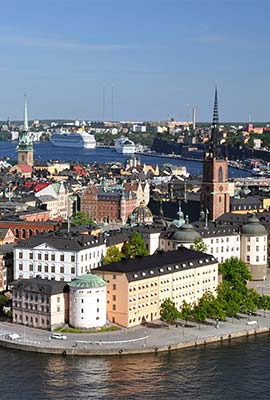
Himlen: Rising above Södermalm’s main drag, the Skrapan skyscraper has a free elevator to the $$$$ Himlen restaurant, on the 25th floor. While they’re hoping you’ll order a meal or a pricey cocktail in the lounge, it’s generally fine to take a discreet peek at the 360-degree views—just march in the door, ride the elevator up to 25, and climb a flight of stairs (closed Sun, Götgatan 78—for location, see the “Stockholm Restaurants” map on here, +46 8 660 6068, www.restauranghimlen.se).
From Sea Level: I find Stockholm most beautiful not from rooftops but from sea level. Make a point to enjoy the views from the promenades that line the harborfront, from the ferries that shuttle people back and forth, and from the various sightseeing and dinner cruises that are designed to show off the cityscape.
Continue into the 1600s, and you’re surrounded by the Dutch golden age. Among various canvases by Dutch masters, look for works by Rembrandt and Rubens. Also here you’ll find the Bielke state bed from 1680. Brought from France by Nils Bielke, Sweden’s ambassador to Louis XIV, it’s lavishly draped with silk embroidery.
In the 1700s, works by Swedish painters start to trickle into the collection, mixed in with French Rococo landscapes. French influence peaks in the early 1800s, when the new royal dynasty is founded by one of Napoleon’s marshals. The new king brings the Empire style into Sweden: One gold-hued room features a pompous array of furniture and formal, Neoclassical paintings. By the end of the 19th century, though, Swedish artists are gaining confidence, creating impressive, Romantic views of Sweden’s landscapes and history.
Exemplifying this burst of creativity is Stockholm-born Carl Larsson (1853-1919), who became very popular as the Swedish Norman Rockwell, chronicling the everyday family life of his own wife and brood of kids. His two vast, 900-square-foot murals celebrate Swedish history and are worth a close look—they’re in the main stair hall. The Entry of King Gustav Vasa into Stockholm shows Vasa astride a white horse. After escaping the Stockholm Bloodbath and leading Sweden’s revolt, he drove out the Danes and was elected Sweden’s first king (1523). Here he marches his victorious troops across a drawbridge, as Stockholm’s burghers bow and welcome him home. In The Midwinter Sacrifice, it’s solstice eve; horns blare and priests stand at the ready as Domalde, a mythological Norse king, strips bare and offers up his life to the gods so that spring will return and bring food to his starving people. The mural has been dubbed “Sweden’s most controversial painting.” To Larsson’s dismay, it was initially rejected in 1915 by the museum for misrepresenting details of the mythic event. It was only hung here in its intended location in 1997.
By the 20th century, Swedish design really takes off. Several exhibits trace this development, with gracefully engraved glass from the 1920s, works from the Stockholm Exhibition of 1930, industrial design of the 1940s, the Scandinavian design movement of the 1950s, plastic chairs from the 1960s, modern furniture from the 1980s, and the Swedish new simplicity from the 1990s.
Museum of Modern Art (Moderna Museet)
This bright, cheery gallery on Skeppsholmen island is as far out as can be. For serious art lovers, it warrants ▲▲. Exhibits change, drawing from the impressive permanent collection, which includes Modernist all-stars such as Picasso, Braque, Dalí, Matisse, Munch, Kokoschka, and Dix; lots of goofy Dada art (including a copy of Duchamp’s urinal); Pollock, Twombly, Bacon, Warhol, and other Postmodernists; and plenty of excellent contemporary stuff as well. Swedish artists of the 20th and 21st centuries are also featured, including the notable female artist Hilma af Klint, whose experiments with abstraction predate by many years those of the men typically identified as abstract pioneers.
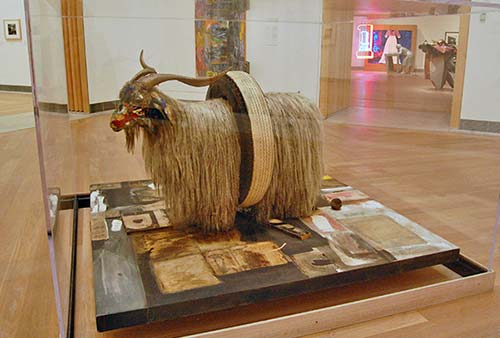
The museum’s fine collection of modern and contemporary sculpture is installed on the leafy grounds of Skeppsholmen island—perfect for a stroll even when the museum is closed. The building also houses the Architecture and Design Center, with changing exhibits (www.arkdes.se).
Cost and Hours: 150 SEK; Tue-Sun 11:00-18:00, closed Mon; download the excellent, free audioguide to enhance your visit, fine bookstore, good shop, harborview café; T-bana: Kungsträdgården plus 10-minute walk, or take bus #65; +46 8 5202 3500, www.modernamuseet.se.
Östermalm
What this ritzy residential area lacks in museums or sights, it makes up for in posh style. Explore its stately streets, dine in its destination restaurants, and be sure to explore the delightful, upscale Saluhall food market right on Östermalmstorg (see “Eating in Stockholm,” later). Östermalm’s harborfront is hemmed in by the pleasant park called Nybroplan; from here, ferries sail to various parts of the city and beyond (this is the jumping-off point for cruises into Stockholm’s archipelago). If connecting to the sights in Djurgården, consider exploring Östermalm by foot.
▲▲Swedish History Museum (Historiska Museet)
The displays and artifacts in this excellent museum cover all of Swedish history, but the highlights are its fascinating Viking exhibit (arguably the best anywhere) and impressive Gold Room. Also worth a look are sections on Scandinavian prehistory, medieval church art, and a display about the Danish invasion of 1361—the battle of Gotland—in which 1,800 ill-equipped Swedish farmers lost their lives. The Economy Museum - Royal Coin Cabinet, a separate museum, is in the same building (see next listing).
Cost and Hours: 150 SEK; Tue-Sun 10:00-17:00, Sept-May 11:00-17:00; open Wed until 20:00 and closed Mon year-round; audioguide-20 SEK, a few blocks north of the Djurgården bridge at Narvavägen 13, bus #67 stops out front, +46 8 5195 5620, www.historiska.se. Kids’ “Viking for a Day” activities are available in an inner courtyard until 16:00 in summer.
Visiting the Museum: Pick up a map at the desk and notice the chronological floorplan: ground floor—ancient and Vikings; upstairs—the rest of the story; and downstairs—the vault with all the gold.
Viking World: From the cafeteria, start by trekking through Swedish prehistory and history. The ancient rooms are worth a look. Then you hit Viking World, billed as the world’s largest Viking exhibition at over 10,000 square feet. This fascinating exhibit probes the many stories and myths about these people. Were they peaceful traders and farmers—or brutal robbers and pillagers? With Yggdrasil—the enormous tree in Viking mythology—as the exhibit’s centerpiece, visitors can explore Viking society, travel, trade, and spirituality through original artifacts and interactive environments.
Upstairs: Climbing the stairs to the upper level, check out the monitor that traces the size of Sweden through the ages. Then you follow a literal timeline on the floor: 500 years of Catholic Sweden, 500 years of Protestant Sweden, a sweep of history richly illustrated with artifacts, interesting displays, and fine descriptions in English. Don’t miss the bit on immigration in the late 1800s (when a huge percentage of Sweden’s impoverished farmers left for the US). And kids of any age can go crazy in the dress-up corner (at 1754 in the timeline), where ladies strap on a corset and pad that bum, and guys become bigwigs.
Gold Room (Basement): In this literal vault blasted out of rock, start by watching the short intro video as you enter (on the right). Then ogle two concentric circles of dazzling displays—with more than a hundred pounds of finely worked gold from ancient and medieval Sweden. You’ll see spiral hair ornaments from 1500 BC; gold collars worn by fifth-century aristocrats; hoards of coins from Roman and Arab empires; once-buried treasure troves of jewelry and votive objects; and medieval jewel-encrusted reliquaries. Treasures in the inner circle—so exquisite they are displayed with magnifying glasses—date from the fifth century AD, long before magnifying glasses existed.
Economy Museum - Royal Coin Cabinet (Ekonomiska Museet - Kungliga Myntkabinettet)
Located within the Swedish History Museum building, this separate museum is much more than your typical royal coin collection: It’s the best money museum I’ve seen in Europe. It reopened in 2024 after an extensive renovation, so the exhibits may not precisely match what I describe here.
Cost and Hours: Free, may be fee for special exhibits, same hours as Swedish History Museum, +46 8 5195 5620, www.ekonomiskamuseet.se.
Visiting the Museum: The museum explores how money changes society and human life, including in our contemporary world. Begin with a chronological sweep through the history of money, starting with the first-ever coin (look for the tiny, easy-to-miss golden pellet labeled det första myntet, dating from 625 BC). The gang’s all here: the ancient Greek drachma, the Roman denarius, Charlemagne’s denier, Florence’s florin, ducats, pesos...and the German thaler, from which our dollar got its name. Banknotes finally arrived on the scene in 1661.
You’ll also learn about Swedish economic history, including an interesting exhibit on “plate money”—from a time when, rather than bags of small coins, merchants carried around 40-pound slabs of copper (try to lift one). Many displays are interactive—giving you a chance to investigate what kind of job you might have had if you lived in the 1800s. Rounding out the exhibits are ceremonial medals, including an actual Nobel Prize, and the small royal coin collection.
Waterside Walk
Enjoy Stockholm’s ever-expanding shoreline promenades. Tracing the downtown shoreline while dodging in-line skaters and ice-cream trolleys (rather than cars and buses), you can walk from Slussen across Gamla Stan, all the way to the good ship Vasa in Djurgården. For a good stroll with lots of beautiful views both near and far, consider starting at the Royal Opera House, following the waterfront to and then around Skeppsholmen island, then along Strandvägen street past old boats and fancy facades, finishing up at the Djurgården bridge. As you walk, keep in mind that there’s free fishing in central Stockholm, and the harbor waters are restocked every spring with thousands of fish. Locals tell of one lucky lad who pulled in an 80-pound salmon. The waterside lanes are extremely bike-friendly here and throughout Stockholm.
DJURGÅRDEN
Four hundred years ago, Djurgården (“Animal Garden”) was the king’s hunting ground. You’ll see the royal gate to the island immediately to the left after the bridge that connects it to the mainland. Now this entire lush island is Stockholm’s fun center, protected as a national park. It still has a smattering of animal life among its biking paths, picnicking families, art galleries, various amusements, and museums, which are some of the best (and worst) in Scandinavia.
Orientation: Of the three great sights on the island, the Vasa and Nordic museums are neighbors, and Skansen is a 10-minute walk away (or hop on any bus or tram—they come every couple of minutes). Several lesser or special-interest attractions (from the ABBA museum to an amusement park) are also nearby.
The Djurgården Visitor Center is the first thing you’ll see as you cross the bridge onto the island. Just upstairs from the recommended Djurgårdsbron Restaurant, you’ll find a small kiosk with free maps, island bike routes, brochures, and information about the day’s events, plus bike rentals (daily in summer 9:00-19:00, off-season until 17:00, +46 8 667 7701).
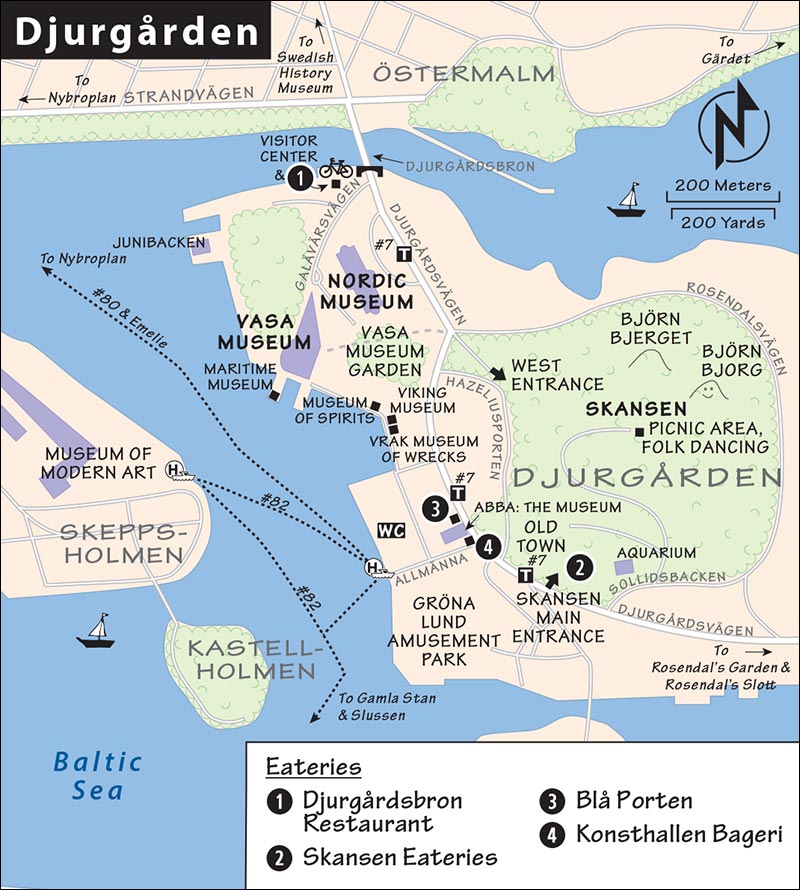
Getting There: Take tram #7 from Sergels Torg (the stop is right under the highway overpass) or Nybroplan (in front of the gilded theater building) and get off at one of these stops: Nordic Museum (use also for Vasa Museum), Liljevalc Gröna Lund (for ABBA museum), or Skansen. In summer, you can take a city ferry from the southeast end of Gamla Stan or from Nybroplan (see “Getting Around Stockholm,” earlier). Walkers enjoy the harborside Strandvägen promenade, which leads from Nybroplan to the island (described under “Waterside Walk,” earlier).
▲▲▲Skansen
Founded in 1891, Skansen was the first in what became a Europe-wide movement to preserve traditional architecture in open-air museums. It’s a huge park gathering more than 150 historic buildings (homes, churches, shops, and schoolhouses) transplanted from all corners of Sweden. Other languages have borrowed the Swedish term “Skansen” (which originally meant “the Fort”) to describe an “open-air museum.” Today, tourists enjoy exploring this Swedish-culture-on-a-lazy-Susan, seeing folk crafts in action and wonderfully furnished old interiors.
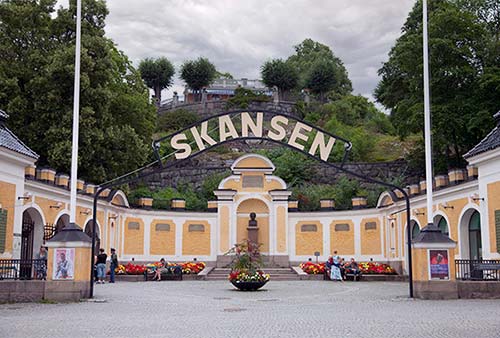
Skansen is great for kids: They can ride a life-size wooden Dala horse, stare down a hedgehog, and visit Lill-Skansen, a petting zoo with a mini-train and pony rides.
Cost and Hours: 245 SEK, kids-70 SEK, less off-season; park opens daily at 10:00, closes at 22:00 late June-Aug and progressively earlier the rest of the year; historical buildings generally open 11:00-17:00, late June-Aug some until 19:00, most closed in winter. Check their excellent online calendar for what’s happening during your visit (www.skansen.se) or call +46 8 442 8000.
Music: Skansen does great music in summer. There’s fiddling, folk dancing, and public dancing to live bands on Friday and Saturday nights. Confirm performance times before you go.
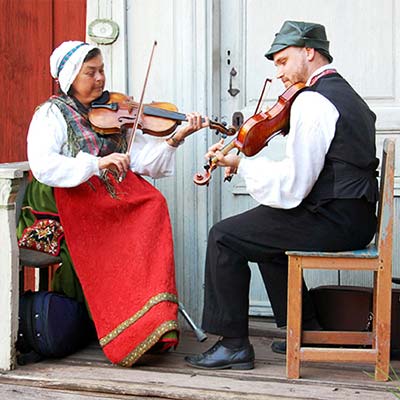
Visiting Skansen: Skansen isn’t designed as a one-way loop; it’s a sprawling network of lanes and buildings, yours to explore. There are succinct descriptive panels on most buildings, but for the full story, invest in the museum guidebook (sold at the info booth just after the entrance). While you’re at the info booth, check the live crafts schedule (the scale model displayed at the entrance will give you an idea of the park’s size and help you plan your visit). Guides throughout the park are happy to answer questions—but only if you ask them. Be chatty. The old houses come alive when you take the initiative to get information.
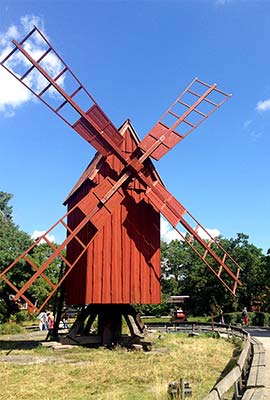
From the entrance, go up the stairs and bear left to find the escalator, and ride it up to the “Town Quarter” (Stadskvarteren), where shoemakers, potters, and glassblowers are busy doing their traditional thing in a re-created Old World Stockholm. Continuing deeper into the park—past the bakery, spice shop/grocery, hardware store, and a cute little courtyard café—you’ll reach the central square, Bollnästorget (signed as “Central Skansen” but labeled on English maps as “Market Street”), with handy food stands. The rest of Sweden spreads out from here. Northern Swedish culture and architecture is in the north (top of park map), and southern Sweden’s in the south (bottom of map). Various homesteads—each clustered protectively around an inner courtyard—are scattered around the complex.
Poke around. Follow signs—or your instincts. It’s worth stepping into the old, red-wood Seglora Church (just past Bollnästorget), which aches with atmosphere under painted beams. The park has two small zoos. Lill-Skansen is a children’s petting zoo. Beyond the big brick spa tower and carnival rides sprawls the Scandinavian Animals section, with bears, moose (“elk”), seals, reindeer (near the Sami camp), and other animals.
Eating at Skansen: The park has eating options to suit every budget. The most memorable—and affordable—meals are at the small food court on the main square, Bollnästorget, where kiosks dish up “Sami slow food” (smoked reindeer), waffles, hot dogs, and more. There are lots of picnic benches—Skansen encourages picnicking. (A small grocery store is just outside, tucked away across the street and a bit to the left of the main entrance.)
For a sit-down meal, the old-time $$$ Stora Gungan Krog, right at the top of the escalator in the craftsmen’s quarter, is a cozy inn (indoor or outdoor lunches—meat, fish, or veggie—with a salad-and-cracker bar). Another snug spot is $$ Gubbhyllan, on the ground floor and fine porch of an old house (at base of escalator, just past main entrance). Or consider one of three restaurants that share a less-atmospheric modern building facing the grandstand (just up the hill inside the main entrance), all with nice views over the city: the simple $$$ Skansen Terrassen cafeteria; $$$ Tre Byttor Taverne, with 18th-century pub ambience; and, upstairs, the fussy $$$$ Solliden restaurant, with a dated blue-and-white dining hall facing a wall of windows; the main reason to eat here is the big smorgasbord lunch.
For other eating options around Skansen, see here of the “Eating in Stockholm” section.
Aquarium: The “aquarium”—featuring lemurs, meerkats, baboons, Gila monsters, giant anacondas, rattlesnakes, geckos, crocodiles, colorful tree frogs, and small sharks...but almost no fish—is located within Skansen, but is not covered by your Skansen ticket (160 SEK, July-Aug daily 10:00-18:00, closes earlier rest of year, +46 8 666 1000, www.skansen-akvariet.se).
▲▲▲Vasa Museum (Vasamuseet)
Stockholm turned a titanic flop into one of Europe’s great sightseeing attractions. The glamorous but unseaworthy warship Vasa—top-heavy with an extra cannon deck—sank 40 minutes into her 1628 maiden voyage when a breeze caught the sails and blew her over. After 333 years at the bottom of Stockholm’s harbor, she rose again from the deep with the help of marine archaeologists. Rediscovered in 1956 and raised in 1961, this Edsel of the sea is today the best-preserved ship of its age anywhere—housed since 1990 in a brilliant museum. The masts perched atop the roof—best seen from a distance—show the actual height of the ship.
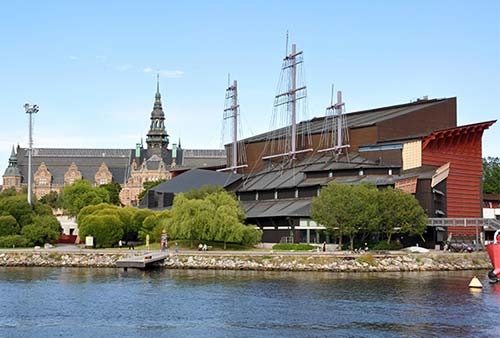
Cost and Hours: 190 SEK, 310 SEK combo-ticket includes VRAK - Museum of Wrecks (see listing later), credit cards only, ticket includes film and tour; daily 8:30-18:00, Sept-May Thu-Tue 10:00-17:00, Wed until 20:00; good café; on the waterfront at Galärvarvsvägen 14 immediately behind Nordic Museum—facing the museum, walk around to the right, 10-minute walk from Skansen, tram #7 from downtown; +46 8 5195 5810, www.vasamuseet.se.
Crowd-Beating Tips: The museum ticket booths can have very long lines, but they generally move quickly. To save some time, buy tickets in advance online or use the ticket machines in the lobby. For generally lighter crowds, get here either right when it opens, or after about 16:00 (but note that the last tour starts at 16:30).
Tours: The free 25-minute tour is worthwhile. Because guides are given license to cover whatever they like, no two tours are the same—if you’re fascinated by the place, consider taking two different tours to pick up new details. In summer, English tours run on the hour and half-hour (last tour at 16:30); off-season (Sept-May) tours go less frequently. Check at the info desk for the next tour. Tours assemble under the prow of the ship. Alternatively, you can access the audioguide by logging onto the museum’s Wi-Fi (www.vasamuseet.se/audioguide).
Film: The excellent 17-minute film digitally re-creates Vasa-era Stockholm (and the colorfully painted ship itself), dramatizes its sinking, and documents the modern-day excavation and preservation of the vessel. It generally runs three times per hour; virtually all showings are either in English or with English subtitles.
Visiting the Museum: For a thorough visit, plan on spending at least two hours—watch the film, take a guided tour, and linger over the exhibits. After buying your ticket, head inside. Sort out your film and tour options at the information desk to your right. The entire exhibit is very family-friendly.
Upon entry, you’re prow-to-prow with the great ship. The Vasa, while not quite the biggest ship in the world when launched in 1628, had the most firepower, with two fearsome decks of cannons. The 500 carved wooden statues draping the ship—once painted in bright colors—are all symbolic of the king’s power. The 10-foot lion on the magnificent prow is a reminder that Europe considered the Swedish King Gustavus Adolphus the “Lion from the North.” With this great ship, Sweden was preparing to establish its empire and become more engaged in European power politics. Specifically, the Swedes (who already controlled much of today’s Finland and Estonia) wanted to push south to dominate the whole of the Baltic Sea, in order to challenge their powerful rival, Poland.

Designed by a Dutch shipbuilder, the Vasa had 64 guns of the same size and type (a rarity on mix-and-match warships of the age), allowing maximum efficiency in reloading—since there was no need to keep track of different ammunition. Unfortunately, the king’s unbending demands to build the ship high (172 feet tall) but skinny made it extremely unstable; no amount of ballast could weigh the ship down enough to prevent it from tipping.
Now explore the exhibits, which are situated on six levels around the grand hall, circling the ship itself. All displays are well described in English. You’ll learn about the ship’s rules (bread can’t be older than eight years), why it sank (stale bread?), how it’s preserved (the ship, not the bread), and so on. It’s enjoyable to simply do slow laps around the magnificent vessel at different levels. The ship itself is empty inside. Now painstakingly restored, 98 percent of the Vasa’s wood is original (modern bits are the brighter and smoother planks).
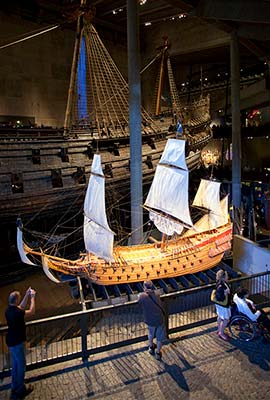
On level 4 (the entrance level), right next to the ship, you’ll see a 1:10 scale model of the Vasa in its prime—vividly painted and fully rigged with sails. Farther along, models show how the Vasa was salvaged, and a 10-minute multimedia show explains why the Vasa sank (alternating between English and Swedish showings). Heading behind the ship, you’ll enjoy a great view of the sculpture-slathered stern of the Vasa. The facing wall features full-size replicas of the carvings, demonstrating how the ship was originally colorfully painted.
Several engaging displays are on level 5. “Life On Board” lets you walk through the gun deck and study cutaway models of the hive of activity that hummed below decks (handy, since you can’t enter the actual ship). Artifacts—including fragments of clothing actually worn by the sailors—were salvaged along with the ship. “Battle!” is a small exhibit of cannons and an explanation of naval warfare.
Level 6 features “The Sailing Ship,” with models demonstrating how the Vasa and similar vessels actually sailed. You’ll see the (very scant) remains of some of the Vasa’s actual riggings and sails. Level 7 gives you even higher views over the ship.
Don’t miss level 2—at the bottom (ride the handy industrial-size elevator)—with some of the most interesting exhibits. “The Ship” explains how this massive and majestic vessel was built using wood from Swedish forests. Tucked under the ship’s prow is a laboratory where today’s scientists continue with their preservation efforts. The “Objects” exhibit shows off actual items found in the shipwreck, while “Face to Face” introduces you to some of those who perished when the Vasa sunk—with faces that were re-created from skeletal remains. Nearby, you’ll see some of the skeletons found in the shipwreck. Those remains have been extensively analyzed, revealing remarkable details about the ages, diets, and general health of the victims.
As you exit, you’ll pass a hall of (generally excellent) temporary exhibits. And outside, behind the museum, is the small and inviting Vasa Museum Garden, a traditional 17th-century herb garden for medicine and spicing up food on the ship (always open and free).
▲Nordic Museum (Nordiska Museet)
Built to look like a Danish Renaissance palace, this museum offers a fascinating peek at 500 years of traditional Swedish lifestyles. The exhibits insightfully place everyday items into their social/historical context in ways that help you really grasp various chapters of Sweden’s past. It’s arguably more informative than Skansen. Take time to let the excellent, included audioguide enliven the exhibits. (Note that the exhibition layouts are in flux. By the time you make it here, some things may have moved from where I describe them.)
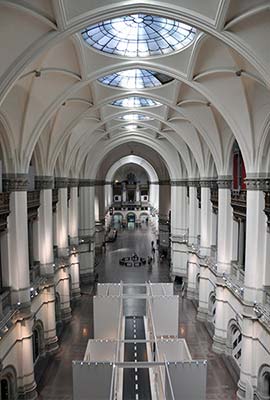
Cost and Hours: 150 SEK; daily 10:00-17:00, Wed until 20:00 in Sept-May; Djurgårdsvägen 6, at Djurgårdsbron, tram #7 from downtown, +46 8 5195 4770, www.nordiskamuseet.se.
Kids’ Exhibits: The museum is extremely kid-friendly. Highlights include the “Play House,” where (for 60 SEK) kids can enter into the world of a child in the late 1800s, and the “Time Vault,” a high-tech and interactive historical experience for kids (150 SEK).
Visiting the Museum: Entering the museum’s main hall, you’ll be face-to-face with Carl Milles’ huge painted-wood statue of Gustav Vasa, father of modern Sweden. Most of this floor is usually devoted to temporary exhibits.
Highlights of the permanent collection are on the top two floors. Head up the stairs, or take the elevator just to the left of Gustav. Begin on floor 4 and work your way down.
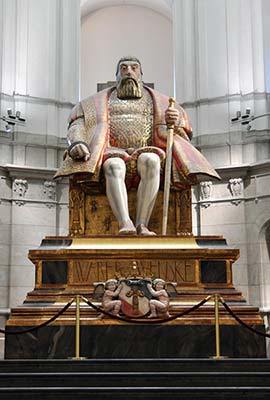
Floor 4: The main exhibit, “People of the Nordic Countries,” traces history and folkways from the 16th to the 21st century, and is themed by the season. Exhibits on traditions describe each old-time celebration of the Swedish year—from Christmas to Midsummer. The “Folk Art” section shows off colorfully painted furniture and wood carvings, vibrant traditional costumes, and rustic Bible-story illustrations that adorned the walls of peasants’ homes. The “Sápmi” exhibit tells the fascinating and often overlooked story of the indigenous Sami people (formerly called “Lapps”), who lived in the northern reaches of Norway, Sweden, Finland, and Russia centuries before Europeans created those modern nations. On display are shoes, ceremonial knives, colorful hats and clothing, and other features of Sami culture. You’ll learn how their nomadic lifestyle—following their herds of grazing reindeer—allowed them to survive so far north, and how the Sami (who today number around 30,000) have had an impact on greater Swedish society.
Floor 3: On this floor you’ll find several smaller exhibits. The most interesting is “Table Settings,” with carefully set tables from the last few centuries, representing customs and traditions around various types of food and drink gatherings—from an elegant tea party to a rowdy pub. As you travel through the parade of furniture—from dark, heavily draped historical rooms to modern living rooms, and from rustic countryside cottages to aristocratic state bedrooms—you’ll learn the subtle meaning behind everyday furniture. For example, the advent of television didn’t just change entertainment—it gave people a reason to gather each evening in the living room, which, in turn, became a more used (and less formal) part of people’s homes. You’ll learn about the Swedish designers who, in the 1930s, eschewed stiff-backed traditional chairs in favor of sleek perches that merged ergonomics and looks—giving birth to functionalism. Also on display: 300 years of Swedish attire (including a fun video showing how complicated and time-consuming it was for a woman to dress in the 18th century); jewelry and textile exhibits; a dollhouse and toy collection; and a photo exhibition pulled from the museum’s archive.
Ground Floor: While the temporary exhibits here are often highlights, one permanent display is the 1940s apartment. As if at a home show, you’ll snoop around enjoying a fascinating look at the leap Swedes made after World War II from very simple apartments with little privacy or plumbing to quite modern apartments with uniform, relatively spacious, very smartly designed modern living quarters.
▲ABBA: The Museum
The Swedish pop group ABBA was, for a time, a bigger business than Volvo. Since bursting on the scene in 1974 by winning the Eurovision Song Contest with “Waterloo,” and serenading Sweden’s newly minted queen with “Dancing Queen” in 1976, they’ve sold more than 380 million records, and the musical based on their many hits, Mamma Mia!, has been enjoyed by 50 million people. It was only a matter of time before Stockholm opened an ABBA museum, which is conveniently located just across the street from Skansen and next to Gröna Lund amusement park. Like everything ABBA, it is aggressively for-profit and slickly promoted, with the steepest ticket price in town. True to its subject, it’s bombastic, glitzy, and highly interactive. If you like ABBA, it’s lots of fun; if you love ABBA, it’s ▲▲▲ nirvana. As they say, “You’ll walk in...dance out.”
Cost and Hours: 290 SEK—credit cards only, 695 SEK family ticket covers two adults and up to two kids; daily 10:00-20:00, closes earlier off-season; Djurgårdsvägen 68, tram #7 from downtown, +46 8 1213 2860, www.abbathemuseum.com.
Advance Reservations: Only 75 people are let in every 15 minutes with timed-entry tickets. The museum strongly encourages getting tickets with an entry time in advance from their website. It can be crowded on summer weekends, in which case you may have to wait for a later time.
Tours: ABBA aficionados happily fork over 20 SEK extra for the intimate audioguide, in which Agnetha, Benny, Björn, and Anni-Frid share their memories, in their own words.
Visiting the Museum: The museum is high-tech, with plenty of actual ABBA artifacts, re-creations of rooms where the group did its composing and recording (including their famous “Polar Studio” and their rustic archipelago cottage), a room full of gold and platinum records, plenty of high-waisted sequined pantsuits, and lots of high-energy video screens. And it’s busy with interactive stations—digitally dress up, have fun with selfies, and be virtually on stage as a “fifth member” of Sweden’s greatest gift to pop music.
Waterfront Sights
While the tram zips sightseers between the Vasa Museum and Skansen, it’s a short, enjoyable, and very scenic walk along the waterfront—a delight on a nice day. You’ll see food stands, boats bobbing in the harbor, and sunbathing Swedes.
You’ll also pass a strip of sights from the Vasa to the ABBA museum. With a built-in crowd already coming for the major attractions, it seems every old boat house, smelling easy money, has been turned into a little museum or eatery. Listed here in the order you’ll reach them (along a five-minute stroll from the Djurgårdsbron bridge):
Junibacken is a fairy-tale house based on the writings of Astrid Lindgren, who created Pippi Longstocking. While oriented toward Swedish kids, American children may enjoy it, too (www.junibacken.se).
Maritime Museum (Sjöhistoriska), on the pier directly in front of the Vasa Museum, is where historic ships are moored—typically big icebreakers from the Arctic, and sometimes military boats (www.sjohistoriska.se).
Museum of Spirits considers the role of alcohol—and specifically, flavored vodkas—in Swedish society, and how the government worked to control its consumption. You’ll smell different types of flavored liquors, ace a virtual pub quiz, recline (or nap) in the boozy drunk-simulator room, and step into a garishly lit, buzzing room that simulates a hangover (www.spritmuseum.se).
The Viking Museum should not be called a museum. It has no Viking artifacts, but it’s perfectly located to cash in on tourists’ fascination with those Nordic marauders. Your admission gets you a hokey low-tech 10-minute ride and an exhibit that uses interactive displays to present Vikings more as colonizers and traders than looters and warriors (www.vikingaliv.se). It would be a shame to see this and not the Viking World exhibit in the nearby Swedish History Museum (a 15-minute walk away, see listing earlier), which is arguably the best of its kind anywhere.
VRAK - Museum of Wrecks, a sister of the Vasa Museum, is all about shipwrecks. It’s actually a serious museum, interesting for those into marine archaeology and maritime history (combo-ticket available with Vasa Museum, www.vrak.se).
Other Djurgården Sights
Gröna Lund Amusement Park
Stockholm’s venerable and lowbrow Tivoli-type amusement park still packs in the local families and teens on cheap dates. It’s also a busy venue for local pop concerts.
Cost and Hours: 350 to 600 SEK to enter (cost varies by time and demand). You can’t just walk in and browse around—entering the fun park requires buying a wrist band that gives you unlimited access to all rides and concerts. Open daily late April-late Sept 12:00-23:00, closed off-season, www.gronalund.com.
▲Biking the Garden Island
Djurgården is the most natural place in Stockholm to enjoy a bike ride. There’s a bike-rental place just over the bridge as you enter the island (at the Djurgården Visitor Center; see beginning of Djurgården section, earlier), and a world of parklike paths and lanes with harbor vistas to enjoy.
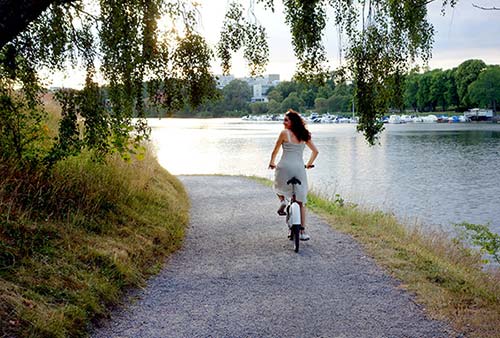
Ask for a free map and route tips when you rent your bike. Figure about an hour to pedal around Djurgården’s waterfront perimeter; it’s mostly flat, but with some short, steeper stretches that take you up and over the middle of the island. Those who venture beyond the Skansen park find themselves nearly all alone in the lush and evocative environs.
At the summit of the island you’ll come upon Rosendal’s Garden, with a bakery and café. You can sit in the greenhouse or in the delightful orchard or flower garden, where locals come to pick a bouquet and pay by the weight. (The garden is fertilized by the horse pies from adjacent Skansen.) Just beyond is Rosendals Slott, the cute mini-palace of Karl Johans XIV, founder of the Bernadotte dynasty. This palace, in the so-called Karl Johans style (“Empire style”), went together in prefabricated sections in the 1820s. The story is told on a board in front, and a nine-ton porphyry vase graces the backyard.
A garden café at the eastern tip of the island offers a scenic break midway through your pedal. For a longer ride, you can cross the canal to the Ladugårdsgärdet peninsula (“Gärdet” for short), a swanky, wooded residential district just to the north.
SÖDERMALM
Just south of Gamla Stan, the Södermalm district is the real-life antidote to the upscale areas where most visitors spend their time. While it has few tourist sights (aside from the Fotografiska and Stockholm City museums), Södermalm offers fine views and fun places to eat (for recommendations and more on this area, see “Södermalm Streets and Eats,” on here). Towering over Södermalm’s main road is the Skrapan building, with the Himlen view terrace on its 25th floor (see “Stockholm’s Best Views” sidebar, here).
▲Fotografiska (Photography Museum)
This museum, in a renovated 1906 industrial building right on the Stadsgården embankment, is fun and appealing, and it keeps late hours. The focus is on contemporary and international photography, exhibited in well-curated, thematic displays that change several times a year. It’s a complete destination, with a top-floor café giving drop-dead views over the city (open until 21:00 in summer), a people-watching terrace café on the embankment, and a browse-worthy store.
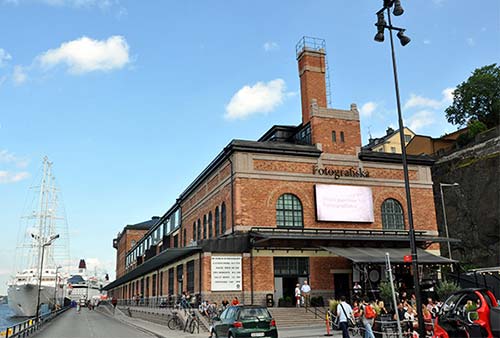
Cost and Hours: 210 SEK—credit cards only, daily 10:00-23:00, at Stadsgårdshamnen 22, 15-minute walk from Slussen, hop-on, hop-off boats stop here, +46 8 5090 0500, www.fotografiska.eu.
Stockholm City Museum (Stadsmuseet)
Located in a 17th-century palace, this museum’s clever exhibits may not be a major thrill, but it’s a good place for history buffs to explore Stockholm’s evolution over 500 years, from tiny northern trading town to urban Scandinavian metropolis.
Cost and Hours: Free; Tue and Thu 11:00-20:00, Wed and Fri-Sun 11:00-17:00, closed Mon; Ryssgården, T-bana: Slussen—use Södermalmstorg exit, +46 8 5083 1620, www.stadsmuseet.stockholm.se.
ON THE OUTSKIRTS
The home and garden of Carl Milles, Sweden’s greatest sculptor, is less than an hour from the city center. For sights farther outside Stockholm (all reachable by public transportation), see the next chapter.
▲Millesgården
The villa and garden of Carl Milles is a veritable forest of statues by Sweden’s greatest sculptor. Millesgården is dramatically situated on a bluff overlooking the harbor in Stockholm’s upper-class suburb of Lidingö. While the art is engaging and enjoyable, even the curators have little to say about it from an interpretive point of view—so your visit is basically without guidance. But in Milles’ house, which dates from the 1920s, you can see his north-lit studio and get a sense of his creative genius.
Carl Milles spent much of his career teaching at the Cranbrook Academy of Art in Michigan. But he’s buried here at his villa, where he lived and worked for 20 years, lovingly designing this sculpture garden for the public. Milles wanted his art to be displayed on pedestals...to be seen “as if silhouettes against the sky.” His subjects—often Greek mythological figures such as Pegasus or Poseidon—stand out as if the sky were a blank paper. Yet unlike silhouettes, Milles’ images can be enjoyed from many angles. And Milles liked to enliven his sculptures by incorporating water features into his figures. Hand of God, perhaps his most famous work, gives insight into Milles’ belief that when the artist created, he was—in a way—divinely inspired.
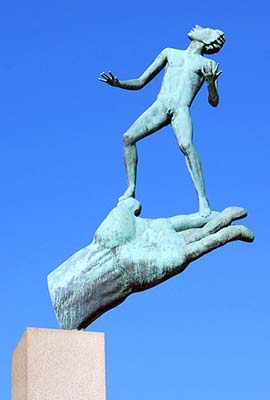
Cost and Hours: 170 SEK, Tue-Sun 11:00-17:00, closed Mon, English booklet explains the art, free audioguide app, restaurant and café, +46 8 446 7594, www.millesgarden.se.
Getting There: Catch the T-bana to Ropsten, then take bus #201, 202, 204, 206, 211, 212, or 221 to Torsviks Torg, then follow signs—about a five-minute walk (allow about 45 minutes total each way).
Shopping in Stockholm
Stockholm’s smaller stores are generally open weekdays 10:00-18:00, Saturdays until 17:00, and Sundays 11:00-16:00. Some of the bigger stores (such as NK, H&M, and Åhléns) are open later on Saturdays and Sundays.
Chain Stores
These chains have multiple branches around town; the most convenient are marked on the “Stockholm Hotels” map on here.
Designtorget, dedicated to contemporary Swedish design, provides a showcase for the unique, clever, and often whimsical works of local designers (Sergelgatan 20 just before Hötorget, other branches are around town and at the airport, www.designtorget.se).
Systembolaget is Sweden’s state-run liquor store chain. A sample of each bottle of wine or liquor sits in a display case, with accompanying descriptions and suggested menu pairings. Look for the item number and order at the counter. Branches include one in Hötorget underneath the movie theater complex; just north of Kungsträdgården at Norrlandsgatan 3; and just up from Östermalmstorg at Nybrogatan 47 (closed Sun, www.systembolaget.se).
Gudrun Sjödén is named for its fashion-designer founder, whose life’s work has been creating cheery, functional clothing for Swedish women. Some might sniff at her sensible but colorful designs (some inspired by her summer garden), but they’re free-spirited in a Pippi Longstocking sort of way. You’ll love it or hate it—all around town (at Regeringsgatan 30, Götgatan 44, and Stora Nygatan 33, www.gudrunsjoden.com [URL inactive]).
Hamngatan
The main shopping zone between Kungsträdgården and Sergels Torg (described in my “Modern City Walk,” earlier) has plenty of huge department stores. At the top of Kungsträdgården, Nordiska Kompaniet (NK) is elegant and stately; the Swedish design (downstairs) and kitchenware sections are particularly impressive. The classy Gallerian mall is across the street from NK and stretches seductively nearly to Sergels Torg. The Åhléns store, kitty-corner across Sergels Torg, is less expensive than NK and has an enticing cafeteria on its rooftop and a vast supermarket in the basement. Tucked behind Åhléns is Kartbutiken, a handy map-and-guidebook shop that covers all of Sweden, Scandinavia, and beyond (Mäster Samuelsgatan 54, www.kartbutiken.se).
Mood Stockholm
The city’s most exclusive mall is a downtown block filled with big-name Swedish and international designers, plus a pricey food court and restaurants. The upscale decor and mellow music give it a Beverly Hills vibe (Mon-Fri 10:00-20:00, Sat until 18:00, Sun 11:00-17:00, Regeringsgatan 48). The mall anchors a ritzy, pedestrianized shopping zone; for more exclusive shops, browse the nearby streets Jakobsbergsgatan and Biblioteksgatan.
Södermalm
When Swedes want the latest items by local designers, they skip the downtown malls and head for funky Södermalm. Götgatan, the main drag that leads from Slussen up to this neighborhood, is a particularly good choice, with shop after shop of mostly Swedish designers. Boutiques along here—some of them one-offs, others belonging to Swedish chains—include Weekday (known for denim), Filippa K (high-end attire), and Tiogruppen (colorful bags and fabrics). More intrepid shoppers will want to explore the area south of Folkungagatan—“SoFo,” where scores of fun stores feature new and vintage clothing, housewares, and jewelry in the streets surrounding Nytorget.
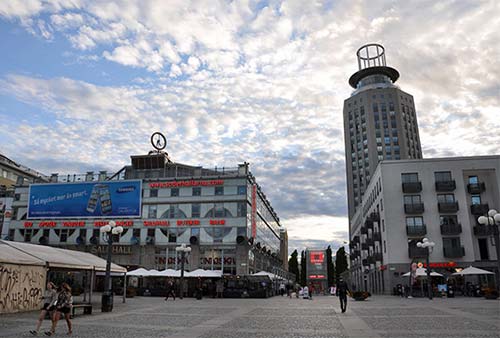
Nybrogatan
This short and pleasant traffic-free street, which connects Östermalmstorg with the Nybroplan waterfront, is lined with small branches of interesting design shops, including Nordiska Galleriet (eye-catching modern furniture, at #11). It also has shoe and handbag stores, and an enticing cheese shop and bakery.
Nightlife and Entertainment in Stockholm
Opera, Ballet, and Classical Music
The Royal Swedish Opera House has been the local venue for opera and ballet since 1773. You can catch a performance here from fall through spring. Popular lunch concerts, featuring musicians and singers from the Royal Swedish Opera, take place several times a week in the impressive Golden Foyer—reserve ahead for lunch and concert online, where you can find schedules and tickets for all events (at Gustav Adolfs Torg, +46 8 791 4400, www.operan.se).
The Royal Swedish Philharmonic Orchestra and other ensembles—from chamber music to world music—give concerts at the Konserthuset (Concert Hall). Check the venue website for what’s on (at Hötorget, +46 8 566 7788, www.konserthuset.se).
In the summer, much of Stockholm’s performing arts scene moves to the city parks, where venues host shows high-brow, low-brow, and everything in between (www.kulturhusetstadsteatern.se/parkteatern).
Bars and Music in Gamla Stan
The street called Stora Nygatan has multiple bars offering live music several nights a week. This is a good place to stroll in the evening with your ears peeled, and pop in somewhere if you like what you hear. Several pubs feature Irish traditional music sessions or bluegrass; they tend to share musicians, who sometimes gather at one of these pubs for impromptu jam sessions (ask around). While it may seem odd to listen to Irish or bluegrass music in Stockholm, these venues are extremely popular with locals. For locations of the following places, see the “Gamla Stan Hotels & Restaurants” map on here.
Of the many options along Stora Nygatan, these places are usually lively (all open daily: Wirströms Pub (live blues bands play in crowded cellar Mon-Wed from 21:00, no cover, Stora Nygatan 13, www.wirstromspub.se); O’Connells Irish Pub (a lively expat sports bar with music—usually bluegrass and traditional Irish, usually Wed-Sat from 21:00, Stora Nygatan 21, www.oconnells.se); and The Liffey, a classic Irish pub with high energy, a fun vibe, lots of pub grub, and live music (music Wed-Sun from 21:30—usually Irish and pop covers, and karaoke Fri, Stora Nygatan 40, www.theliffey.se).
Stampen is fun-loving and saloon-like, and maybe the most reliable place for live jazz and blues in town. Check out the old instruments and antiques hanging from the ceiling. There’s live music Tue-Sun (closed Mon, Stora Gråmunkegränd 7, +46 8 205 793, www.stampen.se).
Geronimo’s FGT, adjacent to Stampen, is more of a nightclub/concert venue that’s in love with the American Southwest—food, booze, music, and fun with tacos in a wannabe dive bar under medieval arches (closed Sun-Mon, enter at Stora Nygatan 5).
Södermalm Scene
This neighborhood is loaded with happening bars and music venues, often attracting more locals and fewer tourists than Gamla Stan, though it’s more spread out. Here are a few good bets. For locations of these places, see the “Stockholm Restaurants” map on here.
Hip Music and Theater: The oldest active theater in Sweden, nowadays Södra Teatern is a cool cultural center with seven different stages and a couple of bars. Besides local and international bands, you’ll find festivals, performance art, and late-night DJs—there’s usually something fun going on (at Mosebacke Torg, T-bana: Slussen, www.sodrateatern.com).
Beer Garden with a View: $$ Mosebacke, part of the Södra Teatern complex (see above), is a gravelly beer garden with a grand harbor view. Open only on warm summer evenings, this place prides itself on its beer rather than its basic grub (small burger-joint menu, order at the bar). It’s a good place to mix with a relaxed young crowd. As each of the beer kiosks has its own specialties, survey all of them before making your choice (open daily until late in season and good weather; look for the triumphal arch at Mosebacke Torg 3, +46 8 5560 9890).
Trendy “Craft Beer” Pub: $$$ Akkurat has a staggering variety of microbrews—both Swedish and international (on tap and bottled)—as well as whisky. It’s great if you wish you were in England with a bunch of Swedes (short pub-grub menu, daily until late, Hornsgatan 18, +46 8 644 0015).
Icebar Stockholm
If you want to put on a heavy coat and gloves and drink a fancy vodka in a modern-day igloo, consider the fun though touristy Icebar Stockholm. Everything—the bar, glasses, and even the tip jar—is made of ice—shipped down from Sweden’s far north. For 240 SEK you get your choice of alcoholic drink and about 45 minutes to enjoy the scene. If you go too early, it can be really dead. At busy times, crowds of people are let in every 45 minutes. That means there’s a long line for drinks, and the place goes from being very crowded to almost empty as people gradually melt away. While there are now ice bars all over Europe, this was the second one to open (after the Ice Hotel in Lapland). And it really is pretty cool...a steady 23°F (additional drinks 135 SEK, reservations smart; daily until late; in the Nordic C Hotel adjacent to the main train station’s Arlanda Express platform at Vasaplan 4—for location, see the “Stockholm Restaurants” map on here, +46 8 5056 3140, www.icebarstockholm.se).
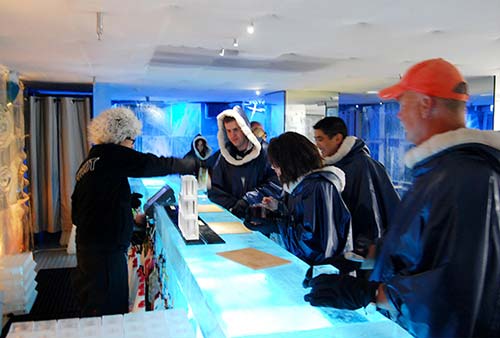
Swedish Massage, Spa, and Sauna
To treat yourself to a Swedish spa experience—maybe with an authentic “Swedish massage”—head for the elegant circa-1900 CentralBadet Spa. It’s along downtown’s main strolling street, Drottninggatan, tucked back inside a tranquil and inviting garden courtyard. Admission includes entry to an extensive gym, “bubblepool,” sauna, steam room, “herbal/crystal sauna,” and an elegant Art Nouveau pool. Most areas are mixed-gender, with men and women together, but some areas are reserved for women. If you won’t make it to Finland, enjoy a sauna here. Bring your towel into the sauna—not for modesty, but for hygiene (to separate your body from the bench). The steam room is mixed; bring two towels (one for modesty and the other to sit on). The pool is more for floating than for jumping and splashing. The leafy courtyard restaurant is a relaxing place to enjoy affordable, healthy, and light meals (450 SEK, 650 SEK on Sat-Sun, includes towels and robe; Mon-Fri 7:00-20:00, Sat-Sun 9:00-18:00; ages 18 and up, Drottninggatan 88, 10 minutes up from Sergels Torg, +46 8 5452 1300, make reservations at www.centralbadet.se).
Sleeping in Stockholm
Stockholm’s hotels aren’t cheap, but standards are generally high, and there are a few unusual options, such as staying in an old prison. Most of my listings have helpful English-speaking staff, pleasant family rooms, and a bit more personality than average.
NEAR THE TRAIN STATION
$$$$ Freys Hotel is a Scan-mod, four-star place, with 127 compact, smartly designed rooms. It’s well situated for train travelers, located on a dead-end pedestrian street across from the central station. While big, it works hard to be friendly and welcoming. Its breakfast room becomes a cool and candlelit bar in the evening, popular for its Belgian microbrews (Bryggargatan 12, +46 8 5062 1300, www.freyshotels.com, freys@freyshotels.com).
$$ Queen’s Hotel enjoys a very central location at the quieter top end of Stockholm’s main pedestrian shopping street (about a 10-minute walk from the train station, or 25 minutes from Gamla Stan). The 59 rooms are well worn, but they’re generally spacious and have big windows—and they’re reasonably priced. Rooms facing the courtyard are quieter (RS%—if booking online enter rate code “RICKS,” elevator, Drottninggatan 71A, +46 8 249 460, www.queenshotel.se, info@queenshotel.se).
$$ Hotel with Urban Deli’s weird name comes from being attached to a popular (and recommended) restaurant/grocery store on bustling Sveavägen. This hipster hangout is appropriately happening and funky—check out the rooftop terrace and cheeky carpets. The 106 rooms are quiet, stylish models of compact efficiency. The catch? They’re in the basement and have no windows. If that doesn’t bother you, then this is a good midrange choice right downtown (elevator, Sveavägen 44, +46 8 303 050, www.urbandeli.se/hotellet, hotel@urbandeli.se).
¢ City Backpackers, with 140 beds a quarter-mile from the station, is youthful but professional, and your best bet for a central hostel (sheets extra, breakfast extra, pay laundry, tours, sauna; Upplandsgatan 2A, +46 8 206 920, www.citybackpackers.se, info@citybackpackers.se).
¢-$$ Generator Stockholm, a big and lively hostel, has 244 Scan-basic rooms. The mix of dorms and private rooms all have private bathrooms. Close to the central station, it has a bar/café and restaurant on-site but no kitchen facilities (breakfast extra, family-friendly, elevator, bikes and skateboards for rent for the cool kids, pay laundry; at Torsgatan 10, +46 8 5053 2370, www.generatorhostels.com, ask.stockholm@staygenerator.com).
ÖSTERMALM
These options in Norrmalm and Östermalm are in stately, elegant neighborhoods of five- and six-story turn-of-the-century apartment buildings. All are within easy reach of downtown sights and close to T-bana, tram, or bus stops. Östermalm is an appealing part of town but without many hotels—it’s also worth checking Airbnb for apartment rentals here.
$$$$ Hotel Wellington, two blocks off Östermalmstorg, is in a charming part of town and convenient to the harbor and Djurgården. It’s modern and bright, with hardwood floors, 60 rooms, and a friendly welcome. While pricey, it’s a cut above in comfort, and its great amenities—such as a generous buffet breakfast, free coffee all day, and free buffet dinner—add up to a good value (RS%, free sauna, lobby bar, garden terrace, T-bana: Östermalmstorg, exit to Storgatan and walk past big church to Storgatan 6; +46 8 667 0910, www.wellington.se, cc.wellington@strawberry.se).
$$$$ The Sparrow is an artsy boutique hotel in a genteel older building located where Norrmalm meets Östermalm. The breakfast, attached wine bar, and 87 colorful rooms all aim for “French inspiration,” and there is indeed un petit peu of Parisian style, along with Swedish class. Some of the rooms have little balconies (elevator, gym, Birger Jarlsgatan 24, +46 8 1221 7300, www.thesparrow.se, reservations@thesparrow.se).
$$$$ Villa Dagmar, right next to Östermalm’s Saluhall market, is a swank splurge with a Mediterranean feel. Standard rooms aren’t exactly palatial, but the lovely glassy courtyard is inviting for a drink (elevator, spa, gym, Nybrogatan 25, +46 8 1221 3550, www.hotelvilladagmar.com, info@hotelvilladagmar.com).
$$$ Story Hotel Riddargatan is a vibrant boutique hotel with a creative vibe. Conveniently located near a trendy dining zone between Östermalmstorg and the Nybroplan waterfront, it has 83 rooms above a sprawling, cleverly decorated, affordable restaurant (elevator, Riddargatan 6, +46 8 5450 3940, www.storyhotels.com, info@storyhotelriddargatan.com).
$$ Hotel Riddargatan is well located on the edge of Östermalm—near the restaurants and shops on Nybrogatan and just two blocks from Nybroplan and the harbor. The 78 rooms, while smallish, are nicely Scan-modern and perfectly functional. This is a hopping neighborhood: Ask for a quiet room when you book (elevator—but you’ll climb a few steps to reception, bar/lounge, Riddargatan 14, +46 8 5557 3000, www.profilhotels.se, hotelriddargatan@profilhotels.se).
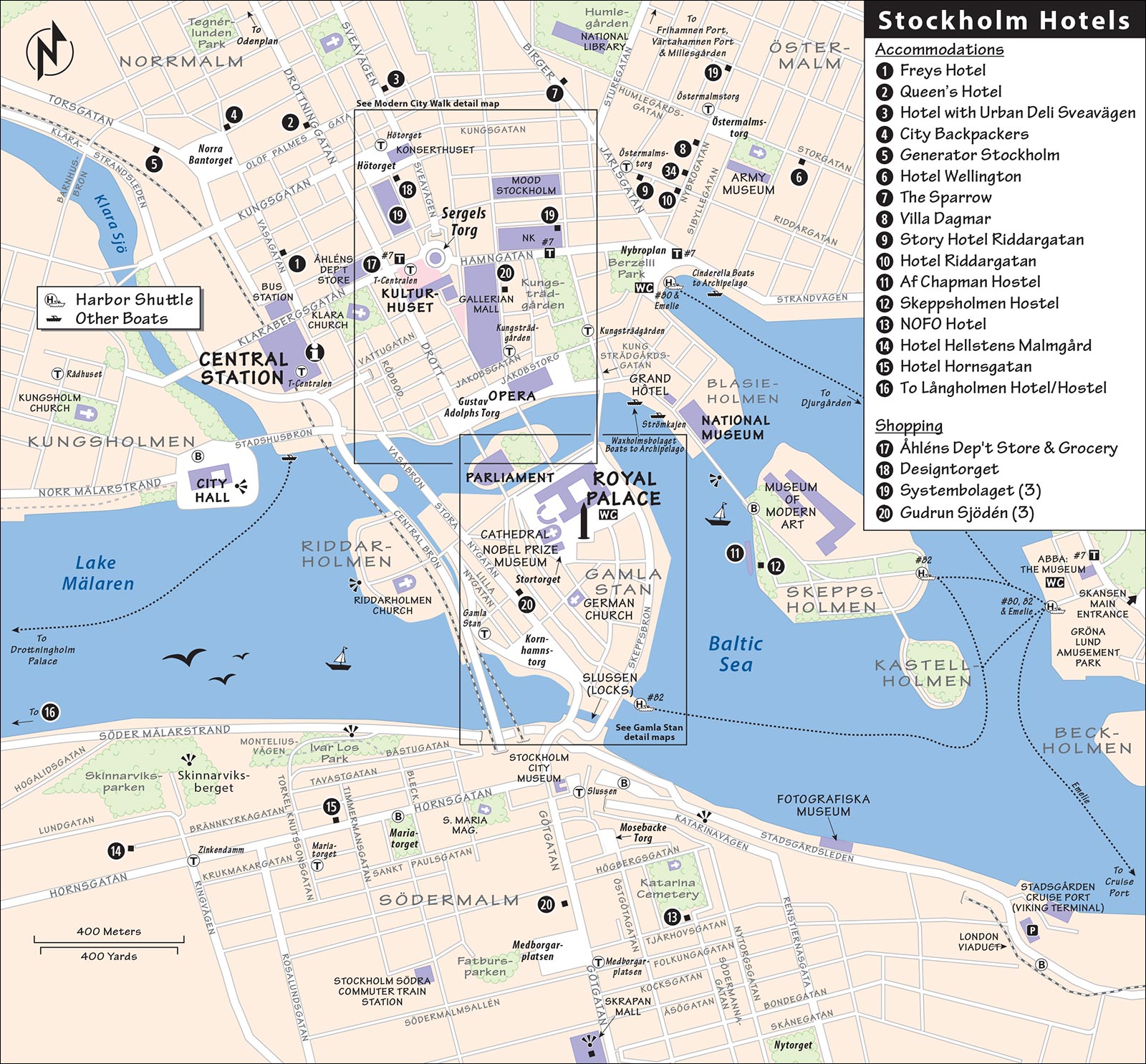
GAMLA STAN
These options are in the midst of sightseeing, and a short bus or taxi ride from the train station. For locations, see the “Gamla Stan Hotels & Restaurants” map.
$$$ Lady Hamilton Hotel, classic and romantic, is shoehorned into Gamla Stan on a quiet street a block below the cathedral and Royal Palace. The centuries-old building has 34 small but plush and colorfully decorated rooms. Each is named for a Swedish flower and is filled with antiques (elevator, Storkyrkobrinken 5, +46 8 5064 0100, www.ladyhamiltonhotel.se, info@ladyhamiltonhotel.se).
$$$ Hotel Sven Vintappare, located on a narrow alley named after “his majesty’s wine tapper,” is a charming boutique hotel in a creaky old building from 1607. The seven rooms have preserved historic details like roof beams and antique porcelain stoves—this place really feels like stepping into yesteryear (lots of steep stairs and no elevator, Sven Vintappares Gränd 3, +46 8 224 140, www.hotelsvenvintappare.se, info@hotelsvenvintappare.se).
¢-$ Castanea Old Town Hostel is a homey place spread across two petite buildings from the 1800s. The bunk rooms are bright and clean, the private rooms small and cozy. The vibe here is friendly, helpful, and sedate—this is not a party hostel (shared kitchen, pay laundry, Kindstugatan 1, +46 8 223 551, www.castaneahostel.com, info@castaneahostel.com).
SKEPPSHOLMEN
This relaxing island—while surrounded by Stockholm—feels a world apart, both in terms of its peacefulness and its somewhat less-convenient transportation connections (you’ll rely on bus #65, the harbor shuttle ferry, or your feet—it’s about a 20-minute walk from the train station). For locations, see the “Stockholm Hotels” map earlier.
¢-$ Af Chapman Hostel, a permanently moored 100-year-old schooner, is Europe’s most famous youth hostel and has provided a berth for the backpacking crowd for years. Renovated from keel to stern, the old salt offers 120 bunks in two-, four-, and six-bed rooms, along with a few very nautical private rooms. Reception is at the Skeppsholmen Hostel (next, same contact info).
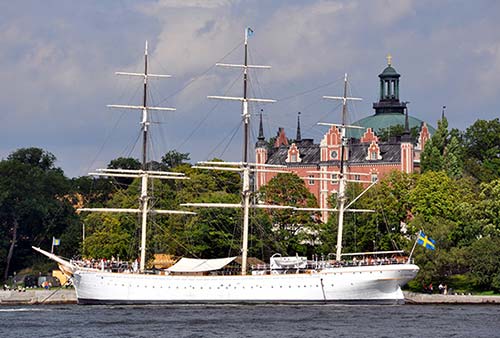
¢-$ Skeppsholmen Hostel is just ashore from the Af Chapman and under the same management (private rooms, breakfast extra, 24-hour reception, +46 8 463 2266, chapman@stfturist.se).
IN OR NEAR SÖDERMALM
Södermalm is residential and hip, with Stockholm’s best café and bar scene. You’ll need to take the bus or T-bana to get here from the train station, making it less than convenient for those with limited time. For locations, see the “Stockholm Hotels” map earlier.
$$$$ NOFO Hotel is a cool, stylish place located in a 17th-century building that faces a big courtyard in the heart of Södermalm. The 109 rooms are creatively decorated according to themes: Choose between Rome, Brooklyn, London, and Scan-modern (T-bana: Medborgarplatsen or bus #53 from train station to Tjärhovsplan, then a 5-minute walk to Tjärhovsgatan 11; +46 8 5031 1200, www.nofohotel.se, info@nofo.se).
$$$ Hotel Hellstens Malmgård is an eclectic collage of 50 timeworn rooms crammed with antiques in a circa-1770 mansion. No two rooms are alike, but all have modern baths and quirky touches such as porcelain stoves or four-poster beds. Unwind in its secluded cobblestone courtyard, and you may forget what century it is. From the center it’s a bit of a schlep, but it’s historic (elevator, T-bana: Zinkensdamm, then a 5-minute walk to Brännkyrkagatan 110; +46 8 4650 5800, www.hellstensmalmgard.se, hotel@hellstensmalmgard.se).
$$ Hotel Hornsgatan is a tidy, welcoming B&B upstairs in an old townhouse facing a busy but elegant-feeling boulevard. Nine of the 22 small rooms have private baths; the others share five modern bathrooms. A few rooms have shared access to a kitchen. Thoughtfully run by Clara, this is a good value for the location (elevator, reception staffed until 22:00—make arrangements if arriving late, Hornsgatan 66B, T-bana: Mariatorget plus a short walk, 15-minute walk from Slussen/Gamla Stan, +46 8 658 2901, www.hotelhornsgatan.se, info@hotelhornsgatan.se).
¢-$$$$ Långholmen Hotel/Hostel is on Långholmen, a small island off Södermalm that was transformed in the 1980s from Stockholm’s main prison into a lovely park. The cramped but efficient rooms are converted cells in the old prison building. You can choose between hostel-style and hotel-standard rooms at many price levels. This place has a lot of character, though it’s a ways out of the center (sheets and breakfast extra in hostel; hotel rooms include breakfast; family rooms, laundry service, kitchen, cafeteria, free parking, swimming beach and jogging paths nearby; T-bana: Hornstull, walk 10 minutes down and cross small bridge to Långholmen island, then follow hotel signs 5 minutes farther to Långholmsmuren 20; +46 8 720 8500, www.langholmen.com, info@langholmen.com).
Eating in Stockholm
As long as the dollar remains strong against the Swedish kronor, you can eat well in Stockholm for a reasonable price. Plates can be split, water is free, and tips and taxes are included. Like anywhere, you’ve got the entire range, from perfectly good $5 grocery-store dinners in a park or your hotel room, to $10 light meals from convenience stores and bakeries, to $20 low-end restaurant meals, to great splurges for $50 to $100. I’m impressed by the relatively small difference in price between an entree in a mediocre restaurant and one in a well-chosen Michelin-rated place. I’m more inclined to picnic for lunch and spring for a finer place for dinner.
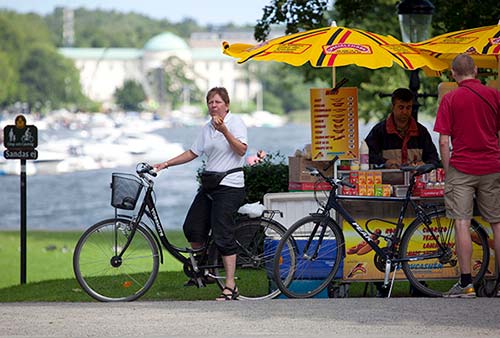
You won’t find many strictly vegetarian or vegan restaurants, because most restaurants take meat-free cuisine seriously and include good vegetarian and vegan options along with meat and fish on their menus.
You can often dine cheaper at lunch than at dinner, as many places have lunch specials (generally Mon-Fri only). Most museums have good-quality cafés, cafeterias, or restaurants, often with lunch specials and fine views. Convenience stores stock surprisingly fresh takeaway food. As anywhere, department stores and malls are eager to feed shoppers and can be a good, efficient choice. Department stores often have supermarkets in the basement. Co-op is a grocery store chain with a handy location in the central train station.
If on a super tight budget, you can stock up on groceries (hotels generally have small refrigerators). Picnics are a great budget option—especially for dinner, when restaurant prices are highest. There are plenty of parklike, harborside spots to give your cheap picnic some class.
I’ve also listed a few splurges—destination restaurants that offer a good sample of both classic and modern Swedish cooking. July is vacation month, when many restaurants close or have limited offerings. Swedes enjoy eating outside even if it’s chilly, and restaurants are quick to provide a blanket. The local Starbucks is Espresso House. If you want a culturally appropriate gut bomb, stop by a local hot dog stand.
GAMLA STAN
Gamla Stan, ground zero for characteristic Old Town dining, is on every tourist’s hit list, but I’d still eat here at least once. Touristy places line Västerlånggatan. You’ll find more romantic spots hiding on side lanes—I’ve listed my favorites (for locations, see the “Gamla Stan Hotels & Restaurants” map, later). Most restaurants in Gamla Stan serve a weekday lunch special. Here are my budget bets followed by more memorable dining experiences:
Casual Eateries
$$ Grillska Huset is a cheap and handy cafeteria grandly situated right on the old square and very practical for your Gamla Stan lunch. Sit in your choice of three zones: indoors, tables on the square, or a secret and tranquil garden up the stairs and out back. The self-serve cafeteria counter has a short menu of fine daily specials and simpler dishes (soup, sandwiches, salads). Order at the bar (Tue-Sat 10:00-20:00, Sun-Mon until 19:00, Stortorget 3, +46 8 6842 3364). They also have a fine little bakery (brödbutik) with tempting cakes and pastries (Mon-Fri 7:30-18:00, closed Sat-Sun).
$$ Vapiano Pasta Pizza Bar is a high-energy, family-friendly eatery. Add flavor by picking a leaf of basil or rosemary from the potted plant on your table (daily until late, next to entrance to Gamla Stan T-bana station, Munkbrogatan 8, +46 8 222 940).
Picnic Supplies in Gamla Stan: There are two small and handy grocery stores here (both open long hours daily): Co-op Nära (strategically located on Järntorget, at the Slussen end of Gamla Stan) and Munkbrohallen (downstairs in the Gamla Stan T-bana station).
Fine Dining in Gamla Stan
If counting on a nice dinner here you should always make a reservation. For music and drinks after, there are a handful of bars and jazz clubs that are lots of fun in this neighborhood (see here).
$$$ Restaurang Tradition has a modern Swedish vibe with a small menu specializing in fancy versions of traditional comfort food—especially their meatballs. The open kitchen injects good energy. Reservations are smart for a table, but they have no-reservations seating at the bar and at a big shared table—offering a great chance to connect with locals (daily, Österlånggatan 1, +46 8 203 525, www.restaurangtradition.se).
$$$ Bistro under Kastanjen is a charming place tucked away on a charming square under a chestnut tree, away from the Gamla Stan tourist crowds. The friendly team serves traditional Swedish dishes—they’re proud of their meatballs (long hours daily, Kindstugatan 1, +46 8 215 004, https://underkastanjen.se).
$$$$ Pastis Restaurant is almost like a movie set: Parisian conviviality, tight seating, and a smart clientele enjoying the traditional French menu. While they have outside tables on a charming lane, the seating is most memorable inside. If they’re full, you can eat at the bar. For a lighter meal, share a cheese or charcuterie board with a glass of wine (Mon-Thu dinner only, Fri-Sun lunch and dinner, Köpmangatan 1, +46 8 202 018, www.pastis.se).
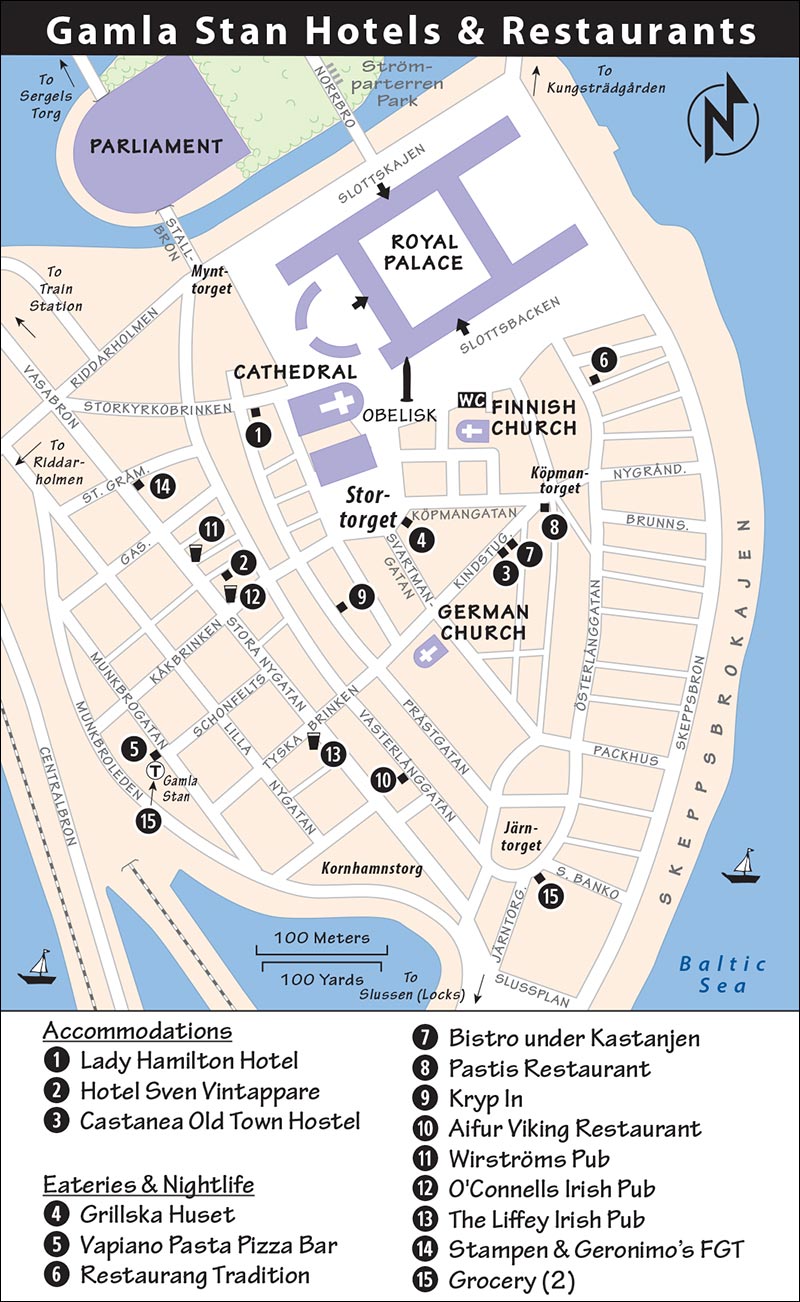
$$$$ Kryp In, a small, cozy restaurant tucked into a peaceful lane, has a stylish hardwood and candlelit interior, sidewalk seating, and an open kitchen. They serve modern Swedish cuisine with a 560-SEK three-course dinner (Mon-Fri dinner only, Sat-Sun lunch and dinner, a block off Stortorget at Prästgatan 17, +46 8 208 841, www.restaurangkrypin.se).
$$$ Aifur Viking Restaurant is a pillage-and-plunder party with shared tables (whether you like it or not), roving musicians playing the greatest hits of the 13th century, and food from the year 1000 BP (before potatoes). In fact, the inviting and entertaining menu (imagine...Vinlandpie) is limited to ingredients available to the Vikings. (Kiwi...avocado...tomato...what’s that?) New arrivals are heralded with the blast of a horn, introduced, and seated (dinner only, closed Sun, Västerlånggatan 68b, +46 8 201 055, http://aifur.se).
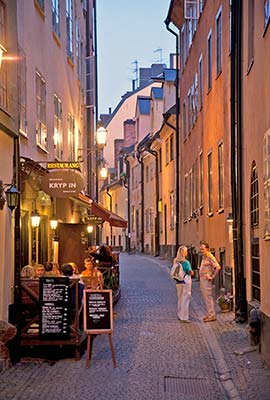
DINING ON THE WATER
For water-view dining, consider the following options, along with Djurgårdsbron Restaurant (listed later, under the “Djurgården” section). For locations, see the “Stockholm Restaurants” map, later.
In Östermalm: $$$$ Glashuset Restaurant and Bar—on the waterfront just below Östermalm, one of the fanciest neighborhoods in town—cooks up international dishes with local ingredients. It’s pricey and has a yacht club vibe, clientele, and waitstaff, but there’s a convivial and fun atmosphere. The location overlooks the harbor, with lots of greenery and cozy corners. Family-style sharing is encouraged (daily, Kajplats 18, +46 8 666 0202, www.glashuset.com).
On Lake Mälaren: Especially on a balmy summer’s eve, $$$ Mälarpaviljongen is a dreamy spot with hundreds of locals enjoying a perfect lakefront scene, as twinkling glasses of rosé shine like convivial lanterns. The menu is a celebration of Swedish dishes traditional and modern. From City Hall, walk 15 minutes along Lake Mälaren (a treat in itself) to find a hundred casual outdoor tables floating on pontoons and scattered among the trees on shore. When it’s cool, they have heaters and blankets (open daily in good weather April-Sept, easy lakeside walk or T-bana to Fridhemsplan plus a 5-minute walk to Nörr Mälarstrand 64; no reservations, but with 700 seats it’s not a problem; +46 8 650 8701, https://ny.malarpaviljongen.se).
Dinner Cruises on the Baltic and Lake Mälaren: The dominant sightseeing company Strömma sells a variety of lunch and dinner cruises that allow you to enjoy the delightful waterways of Stockholm and the archipelago while you eat. Options range from shorter dinner cruises to Drottningholm Palace (2.5 hours round-trip) to longer ones to the outer archipelago (up to 5 hours) to smorgasbord cruises around Lake Mälaren. Some dinner cruises are also guided tours, and all come with great views. Prices are great if you consider the value of an included scenic and relaxing boat ride. For details and booking (and other options, including a shrimp cruise and a jazz cruise), check www.stromma.com.
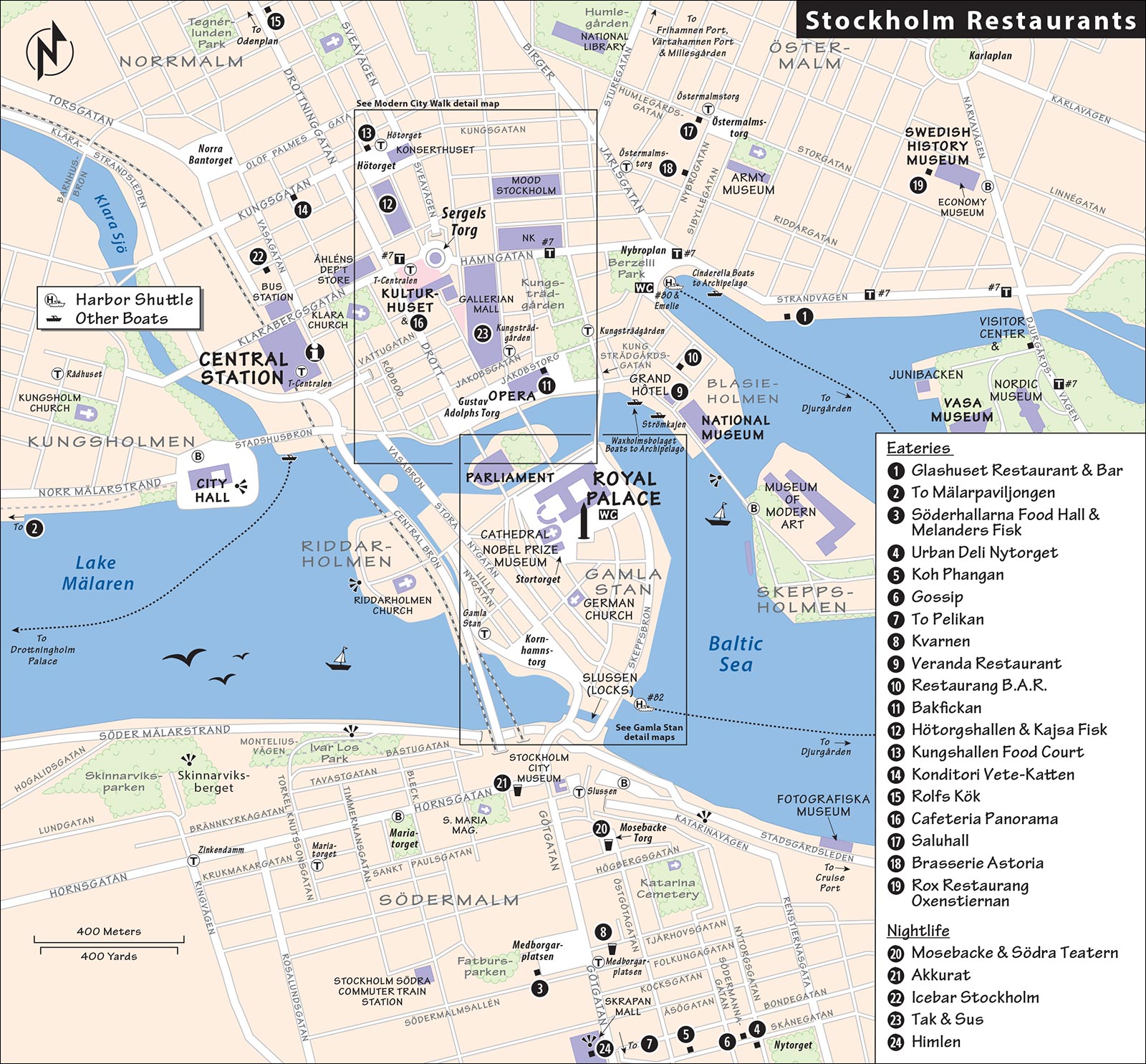
If you don’t think you’ll like Swedish food, be sure to splurge at a good-quality place before you pass final judgment. Though potatoes and heavy sauces are prevalent, Sweden’s meat and fish dishes can be quite tasty.
Every region of Sweden serves different specialties, but you’ll always find svenska köttbullar on the menu (Swedish meatballs made from beef and pork in a creamy sauce). This Swedish favorite is topped with lingonberry jam, which is served with many meat dishes across Scandinavia. Potatoes make for hearty kroppkakor dumplings filled with onions and minced meat. The northern variation, pitepalt, is filled with pork. Southern Sweden takes credit for pytt i panna, a medley of meat and diced potatoes that’s fried and served with an egg yolk on top. And it seems every meal here includes a side of boiled, small new potatoes.
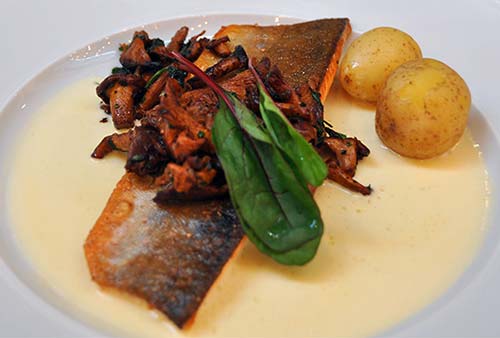
Like its Nordic neighbors, Sweden’s extensive coastline produces some of the best seafood in the world. A light, tasty appetizer is gravlax, a dill-cured salmon on brown bread or crackers. You’ll also likely encounter Toast Skagen, a spread made from shrimp, dill, mayonnaise, and Dijon mustard, eaten on buttered toast.
For a main course, the most popular seafood dish is crayfish. Though eaten only by the aristocracy in the 16th century, these shellfish have since become a nationwide delicacy; they’re cooked in brine with dill and eaten cold as a finger food. Traditional crayfish parties take place outdoors on summer evenings, particularly in August. Friends and family gather around to indulge in this specialty with rye bread and a strong cheese. The Swedes also love Baltic herring; try stekt strömming, a specialty of the east coast, which is herring fried with butter and parsley. As usual, it’s served with potatoes and lingonberry jam. Adventurous diners can have their herring pickled or fermented—or order more unusual dishes like reindeer.
Be sure to try Sweden’s most popular pastry, kanelbulle. It resembles a cinnamon roll, but it’s made with cardamom and topped with pearl sugar. Enjoy one during fika, the daily Swedish coffee break so institutionalized that many locals use the term as a verb (see the “Fika” sidebar, earlier).
As for beer, the Swedes classify theirs by alcohol content. The higher the number, the higher the alcohol content—and the price. Klass 1 is light beer—very low-alcohol. Klass 2 is stronger, but still mild. And Klass 3 has the most body, the most alcohol, and the highest price.
DJURGÅRDEN
If you’re visiting Skansen and the Vasa Museum and are ready for a bite, you’ve got lots of options. (For the location of these restaurants, see the “Djurgården” map, earlier.)
Waterfront Dining: $$-$$$ Djurgårdsbron Restaurant, just over the Djurgårdsbron bridge, is beautifully situated, greedily soaking up the afternoon sun that fills a woody terrace stretching along the harbor. In summer, this is a fine place for a meal or just a drink before or after your sightseeing. They have affordable lunch specials (weekdays only); after 14:00, you’ll pay a bit more (order at the bar, long hours daily, closed off-season, +46 8 661 4488).
At Skansen: This open-air museum has several highly regarded places, which I’ve listed in the Skansen sight description (here).
Other Options: $$ Blå Porten is a local favorite for its breezy garden-like ambience and good value. Tables fill an arcade and a courtyard around a peaceful fountain. Join the cafeteria line and take what you like or order from the more serious menu (daily 11:00-20:00, near the ABBA museum at Djurgårdsvägen 64, +46 8 663 8759, https://blaporten.com). For a simpler bite, a little bakery around the corner, Konsthallen Bageri, serves quality sandwiches and light lunches (daily, Allmänna Grand 2).
SÖDERMALM STREETS AND EATS
This quickly gentrifying district, just south of Gamla Stan (steeply uphill from Slussen), has some of Stockholm’s most enticing food options—especially for beer lovers. It’s a bit less swanky and more affordable than some of the city’s more touristy neighborhoods. Even if you don’t dine in Södermalm, it’s worth a stroll here just for the window-shopping fun. The most interesting areas to explore are along Götgatan and the zone south of Folkungagatan street—nicknamed “SoFo.” For locations, see the “Stockholm Restaurants” map, earlier.
Götgatan and Medborgarplatsen
The neighborhood’s liveliest street is Götgatan, which leads from Slussen steeply up into the heart of Södermalm. Here, mixed among the boutiques, you’ll find tempting cafés and eateries.
Medborgarplatsen, a.k.a. “Citizens’ Square,” with a new minaret on the horizon next to the church steeple, feels like a community center...a neighborhood hangout...a carbonated Stockholm. Busy with outdoor restaurant and café tables and fronted by a big food hall (and easily reached by T-bana: Medborgarplatsen), it’s a great scene with lots of options and almost no tourists. For Swedish fast food you’ll find local hot dog stands on the square, and just across the street is the Swedish answer to McDonald’s—Max burgers.
Söderhallarna Food Hall has a butcher, cheesemongers, and a variety of eateries (Mon-Sat 10:00-18:00, closed Sun, Medborgarplatsen 3). It’s also home to $$ Melanders Fisk, a local favorite for fish, offering table service inside or takeaway from their deli counter. In good weather you can enjoy your meal outside on the square. Skagenröra, shrimp with mayo on toast or filling a baked potato, is the signature dish (food served Mon-Sat 11:00-20:00, closed Sun, +46 8 644 4040).
Skånegatan and Nytorget
A bit farther south, these cross streets are home to fun and appealing restaurants—especially international cuisine. Skånegatan blocks traffic in the summer to make space for its streeteries. There’s a fun-loving and creative buzz here. My favorites:
$$$ Urban Deli Nytorget is half fancy artisanal delicatessen—and half white-subway-tile-trendy eatery, with indoor and outdoor tables filled with Stockholmers eating well and contributing to the jazzy, hip, smart vibe. They do seafood, meat, “snacks” (tapas to be shared), and lots of cocktails Reservations are available for inside tables but not the bar or outside tables. If it’s full, you can grab a place at the long, inviting bar and eat there. Or shop in their upscale deli (lots of creative boxed meals and salads to go) and picnic in the park across the street (long hours daily, at the far end of Skånegatan at Nytorget 4, +46 8 4255 0030, https://urbandeli.se). Another branch is near Hörtorget (see listing later).
$$$ Koh Phangan, with an almost laughably over-the-top island atmosphere that belies its surprisingly good Thai food, has been a hit for many years. (Thailand is to Swedes what Mexico is to many Americans—the sunny “south of the border” playground.) The ambience? Mix a shipwreck, Bob Marley, and a Christmas tree and you’ve got it. It’s dark but family-friendly. Half of the tables are kept unreserved for drop-ins; they take phone reservations from 10:00 to 16:00, or try booking through their website (Mon-Fri dinner only, Sat-Sat lunch and dinner, Skånegatan 57, +46 8 642 5040, https://kohphangan.se).
$$ Gossip is a mellow, unpretentious hole-in-the-wall serving tasty Bangladeshi street food (daily, Skånegatan 71, +46 8 640 6901).
Beer and Meatballs in Södermalm
Södermalm cultivates the most interesting beer scene in this beer-crazy city. And these two places have been hard at it for about a century—they’re classic Swedish beer halls, different but equally traditional, serving hearty Swedish grub in big, high-ceilinged, orange-tiled spaces with rustic wooden tables.
$$$$ Pelikan creates the perfect 1904 ambience for its much-loved meatballs and classic Swedish menu. The venerable beer hall just feels authentic, with hard-surface acoustics amplifying the white noise of happy eaters under soft Art Nouveau features (Mon-Thu dinner only, Fri-Sun lunch and dinner, Blekingegatan 40, +46 8 5560 9090, www.pelikan.se).
$$$ Kvarnen (“The Mill”), dating from 1908, is another atmospheric old-school beer hall. Pick a classic Swedish dish from their fun and easy menu (daily, Tjärhovsgatan 4, +46 8 643 0380, www.kvarnen.com).
NORRMALM
At or near the Grand Hôtel
$$$$ Royal Smörgåsbord at the Veranda Restaurant: To stuff yourself with all the traditional Swedish specialties (a dozen kinds of herring, salmon, reindeer, meatballs, lingonberries, and shrimp, followed by a fine table of cheeses and desserts) with a super harbor view, consider splurging at the Grand Hôtel’s dressy Veranda Restaurant. While very touristy, this is considered the finest smorgasbord in town. The Grand Hôtel, where royal guests and Nobel Prize winners stay, faces the harbor across from the palace. Their English flier gives a good explanation of the proper way to enjoy this grand buffet—but I’d rather let the helpful waitstaff explain the ritual. Reservations are often necessary (675 SEK for lunch or dinner, drinks extra; open Mon-Fri for dinner, Sat-Sun lunch and dinner; no shorts after 18:00, Södra Blasieholmshamnen 8, +46 8 679 3586, www.grandhotel.se).
$$$$ Restaurang B.A.R. has a noisy, fun energy, with diners surveying meat and fish at the ice-filled counter, talking things over with the chef, and then choosing a slab or filet. Prices are on the board, and everything’s grilled (dinner only, closed Sun-Mon, behind the Grand Hôtel at Blasieholmsgatan 4A, +46 8 611 5335, www.restaurangbar.se). They also have a nice (short and lower-priced) takeaway menu.
At the Royal Opera House
$$$ Bakfickan is the affordable little “hip pocket” restaurant run by Operakällaren, one of Stockholm’s most exclusive restaurants. Specializing in traditional Swedish quality cooking at reasonable prices, it’s ideal for someone eating out alone, or for anyone wanting an early dinner. Sit inside—at tiny private side tables or at the big counter with the locals—or, in good weather, grab a table on the sidewalk, facing a cheery red church (closed Sun, on the inland side of Royal Opera House, +46 8 676 5809, www.operakallarensbakficka.se).
At or near Hötorget
Hötorget (“Hay Market”), a vibrant outdoor produce market two blocks from Sergels Torg, is a fun place to picnic-shop. The outdoor market closes at 18:00, and many merchants put their unsold produce on the push list (earlier closing and more desperate merchants on Sat).
Hötorgshallen, next to Hötorget (in the basement under the modern cinema complex), is a colorful indoor food market with an old-fashioned bustle, plenty of exotic and ethnic edibles, and—in the tradition of food markets all over Europe—some great little eateries (generally Mon-Fri 10:00-18:00, Sat until 16:00, closed Sun). My favorite is $$ Kajsa Fisk, hiding behind the fish stalls. They serve delicious fish soup to little Olivers who can hardly believe they’re getting...more. For 135 SEK, you get a big bowl of hearty soup, a simple salad, bread and crackers—plus one soup refill. Their stekt strömming (traditional fried herring and potato dish) is a favorite (Hötorgshallen 3, +46 8 207 262). There’s a great kebab and falafel place a few stalls away.
Kungshallen, a big indoor food court across the square from Hötorget, has less character but offers a dozen basic eateries. What it lacks in ambience it makes up for in variety, quick service, and generally lower prices. The main floor has sit-down places (like $$ Pyttirian, a Scandinavian bistro if you’re needy for meatballs), while the basement is a shopping-mall-style array of fast-food counters. Choose from Japanese, burgers, Asian, pizza, Greek, and more (Mon-Sat 10:00-21:00, Sun until 20:00).
$$ Urban Deli Sveavägen, sibling to Urban Deli Nytorget (see earlier), has a gourmet deli good for takeaway and a restaurant with a focus on modern Swedish cuisine. Good food and good prices have earned it a great reputation (daily, a block or so from Kungshallen at Sveavägen 44, downstairs from the recommended Hotel with Urban Deli—for location see the “Stockholm Hotels” map on here, +46 8 4255 0020, https://urbandeli.se).
$ Konditori Vete-Katten is a classic café/bakery with traditional pastries and light meals (open-faced sandwiches). You’ll dine or sip your coffee in a 1930s ambience and be served by maids with bonnets (Mon-Fri 7:30-20:00, Sat-Sun 9:00-19:00, Kungsgatan 55, at corner with Klara Norra Kyrkogata, +46 8 208 405, https://vetekatten.se).
On or near Drottninggatan
The pleasant, pedestrianized shopping street called Drottninggatan, which runs from the train station area up into Stockholm’s suburbs, is a fine place to find a forgettable meal but with memorable people-watching. Several interchangeable eateries with sidewalk tables line the street (and don’t miss the delightful, leafy park courtyard of Centralbadet, at #88, with several outdoor cafés). None merits a special detour, except the next listing.
$$$$ Rolfs Kök, a vibrant neighborhood favorite, is worth the pleasant five-minute stroll up from the end of Drottninggatan. The long bar up front fades into an open kitchen hemmed in with happy diners at counters, and tight tables fill the rest of the space, spilling out onto the sidewalk. Trendy, casual, and inviting, this bistro features international fare with a focus on Swedish classics and a good wine list. Reservations are smart (dinner only, closed Mon, Tegnérgatan 41, +46 8 101 696, www.rolfskok.se).
Near Sergels Torg
Kulturhuset: Handy for a simple meal with great city views, $$ Cafeteria Panorama offers cheap eats and inside and outside roof-terrace seating with jaw-dropping vistas (135-SEK lunch specials, Mon-Fri 11:00-19:00, Sat-Sun until 18:00, +46 8 211 035).
The many modern shopping malls and department stores around Sergels Torg all have appealing, if pricey, eateries catering to the needs of hungry local shoppers. Åhléns department store has a supermarket in the basement (daily until 21:00) and a popular restaurant on top with great views and 80-110-SEK daily lunch specials (Mon-Fri 11:00-19:30, Sat until 18:30, Sun until 17:30).
ÖSTERMALM
$$$ Saluhall, on Östermalmstorg, is a great indoor market dating from 1888 but completely refurbished in 2019. You’ll find top-quality artisanal producers and a variety of sit-down and takeout eateries. While it’s nowhere near “cheap,” it’s one of the most pleasant market halls I’ve seen, oozing with upscale yet traditional Swedish class. Inside you’ll find pastries and coffee, delis, juice and smoothie bars, salads and wraps, classic Scandinavian open-faced sandwiches, meats and cheeses, quality chocolates and ice cream, and Lisa Elmqvist, a local institution for good seafood. This is your chance to pull up a stool at a lunch counter next to well-heeled Swedes (market stalls open Mon-Fri 9:30-19:00, Sat until 17:00, closed Sun; most restaurants open into the evening).
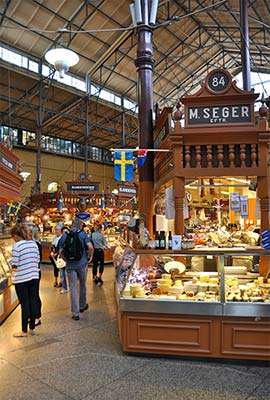
$$$$ Brasserie Astoria, right on the Nybrogatan pedestrian drag, has transformed an old movie theater into an artsy dining room with walls lined with wine bottles. The creative cuisine combines Swedish ingredients with French techniques and occasional Asian flavors. It all adds up to a pricey but memorable meal (daily until late, Nybrogatan 15, +46 8 208 581, www.brasserieastoria.com).
$$$ Rox Restaurang Oxenstiernan delivers high-quality cooking at a reasonable price. The short menu emphasizes locally sourced and sustainable products, with some traditional dishes plus a few international inspirations. It’s charmingly located in an inviting, barn-like space in the courtyard of an 18th-century manor, not far from the Swedish History Museum (closed Sun-Mon, Storgatan 35B, +46 8 665 4087, www.restaurangoxenstiernan.com).
Stockholm Connections
BY BUS
Flixbus operates most of the long-distance buses, which can be cheaper than trains (+46 8 5051 3750, www.flixbus.se); Vy Bus4You also has lots of routes (www.bus4you.se). Some bus companies offer discounts with advance purchase.
From Stockholm by Bus to: Copenhagen (about 3/day, 9 hours, longer for overnight trips), Oslo (5-6/day, 7.5 hours), Kalmar (4/day, fewer on weekends, 6 hours).
BY TRAIN
For Swedish train timetables and prices, consult www.sj.se or use self-service ticket kiosks in stations. Remember that trains on Sweden’s high-speed routes require reservations.
For general information on train travel in Sweden and Scandinavia, see the “Transportation” section of the Practicalities chapter.
From Stockholm by Train to: Uppsala (3-4/hour, 40 minutes; also possible on slower suburban pendeltåg—2/hour, 55 minutes, covered by local transit pass plus small supplement), Växjö (about hourly, 3.5-4.5 hours, change in Alvesta), Kalmar (about hourly, 4.5-5 hours, transfer in Alvesta; slower but scenic train with transfer in Linköping), Copenhagen (almost hourly, 5-6 hours on high-speed train, some with a transfer at Lund or Hässleholm; overnight train requires a change in Malmö or Lund; all trains stop at Copenhagen airport before terminating at the central train station).
By Train to Oslo: The speedy X2000 train zips from Stockholm to Oslo in about 5.5 hours, runs several times daily, and requires reservations (first class often comes with a hot meal, fruit bowl, and unlimited coffee). You can also take a slower train (6-7 hours) with a change in Göteborg.
BY BOAT
Sailing Between Stockholm and Helsinki or Tallinn
Overnight ferries connect Stockholm with Helsinki and with Tallinn (both trips take about 17 hours). In Stockholm, ports are scattered throughout the city, and terminal buildings are well organized, with cafés, lockers, and TI desks. Boats open 1.5 hours before departure, and you must be checked in 20 minutes before departure. Long-term parking at the terminal is available; ask for details when you reserve your ticket. For more on schedules, fares, and amenities for boats between Stockholm and Helsinki, see here; for more on the Stockholm-Tallinn ferries, see here.
Viking Line, with overnight boats to Helsinki, has its own terminal along the Stadsgården embankment in Södermalm. To get there, it’s easiest to ride Viking Line’s shuttle bus from the train/bus station right to the terminal (€6.50, departs according to boat schedule, search “Stockholm bus” at www.sales.vikingline.com). You can also ride public bus #53 (from the train station or Gamla Stan to the Londonviadukten stop, then walk 5 minutes to the terminal). A taxi from the train station is around 230 SEK.
Tallink Silja boats (which run to both Helsinki and Tallinn) leave from the Värtahamnen port, about three miles northeast of the city center. It’s simplest to catch the Tallink Silja shuttle bus from the train/bus station (75 SEK, departs according to boat schedule, www.batbussarna.se). You can also take public transportation: Ride the T-bana to the Gärdet station, then walk 10 minutes to the harbor, or take bus #76 from downtown (leaves from several downtown locations, including Kungsträdgården; direction: Ropsten, get off at Värtahamnen Färjeterminal stop). Figure about 350 SEK for a taxi from Gamla Stan, the train station, or other downtown areas.
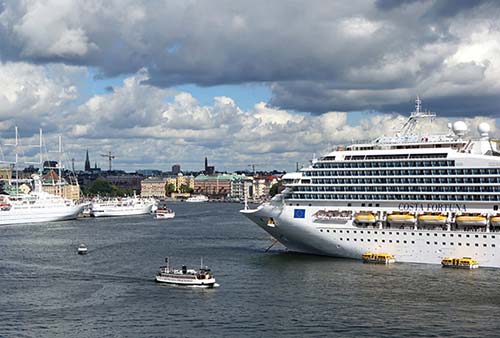
For Stockholm public transit information, see here or visit www.sl.se.
Sailing to Other Destinations
Boats sail from Stockholm to Turku (daily/nightly boats, 11-12 hours). For connections to the islands of Vaxholm, Grinda, and Sandhamn, see the Stockholm’s Archipelago chapter.
Visiting Stockholm by Cruise Ship
Stockholm has two cruise ports. The more central Stadsgården in Södermalm (described earlier) accommodates mainly ships that are just passing through; Frihamnen, three miles northeast of the city center, is used primarily by ships beginning or ending a cruise in Stockholm. For port information, see www.portsofstockholm.com.
BY PLANE
Arlanda Airport
Stockholm’s Arlanda Airport is 28 miles north of town (code: ARN, www.arlanda.se).
Getting Between the Airport and Downtown: The Arlanda Express train is the fastest way to zip nonstop between the airport and the central train station at 125 mph (320 SEK one-way, 600 SEK round-trip, free for kids under 17 with adult, covered by rail pass, 4/hour, 18 minutes, +46 771 720 200, www.arlandaexpress.com). Buy your ticket online or from a ticket machine, not on board. It’s worth checking the website for advance-purchase discounts and two-for-one weekend specials.
Airport shuttle buses (Flygbussarna) run between the airport and Stockholm’s train/bus stations (129 SEK, 4-5/hour, 50 minutes, may take longer at rush hour; buy tickets online—cheapest, from station kiosks, or from 7-Eleven and Pressbyrån convenience stores at the airport, www.flygbussarna.se).
Taxis between the airport and the city center take 30-40 minutes (750 SEK, but look for price posted on side of cab). Establish the price first. Most taxis prefer credit cards. Uber may be cheaper.
The cheapest airport connection is to take bus #583 from the airport to Märsta, then switch to the pendeltåg #41 (suburban train, 2-3/hour), which goes to Stockholm’s central train station (39 SEK, good for 1.25 hours including transfer, 1 hour total journey time).
Skavsta Airport
Some discount airlines use Skavsta Airport, about 60 miles south of Stockholm (code: NYO, www.skavsta.se). Flygbussarna shuttle buses connect to the city (219 SEK, check schedule online, 1.5 hours—but allow extra time for traffic, www.flygbussarna.se).