JUTLAND
Jylland
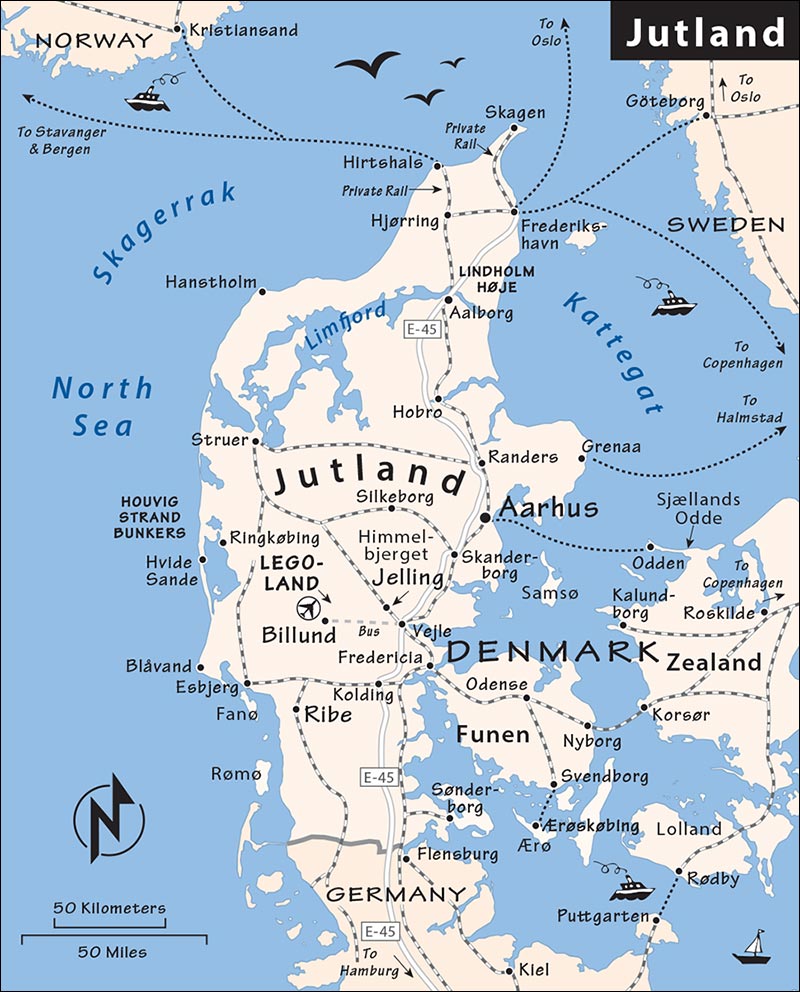
Jutland (Jylland—pronounced “YEW-lan”—in Danish) is the part of Denmark that juts up from Germany. It’s a land of windswept sandy beaches, inviting lakes, Lego toys, moated manor houses, and fortified old towns. In Aarhus, the lively and student-filled capital of Jutland, you can ogle the artwork in one of Denmark’s best art museums, experience centuries-old Danish town life in its open-air folk museum, and meet a boggy prehistoric man. After you wander the pedestrian street, settle in for a drink along the canalside people zone. This is a particularly family-friendly region. Make a pilgrimage to the most famous land in all of Jutland: the pint-sized kids’ paradise, Legoland. The nearby village of Jelling is worth a quick stop to see the ancient rune stones known as “Denmark’s birth certificate.”
PLANNING YOUR TIME
Aarhus makes a natural stop for drivers connecting to Norway by ferry (from Hirtshals to Kristiansand, or Frederikshavn to Oslo). Trains also link Aarhus to Hirtshals, as well as to points south, such as Odense and Copenhagen. Allow one day and an overnight to enjoy this busy port town.
Families will likely want a whole day at Legoland (near the town of Billund), while historians might consider a brief detour to Jelling, just 10 minutes off the main Billund-Vejle road. Both are best by car but doable by public transit.
Aarhus
Aarhus (OAR-hoos, sometimes spelled Århus), Denmark’s second-largest city, has a population of 285,000 and calls itself the “World’s Smallest Big City.” I’d argue it’s more like the world’s biggest little town: easy to handle and easy to like. Aarhus is Jutland’s capital and cultural hub. Its Viking founders settled here—where a river hit the sea—in the eighth century, calling their town Aros. Today, modern Aarhus bustles with an important university, an inviting café-lined canal, a bursting-with-life pedestrian zone (the Strøget), a collection of top-notch museums (modern art, open-air folk, and prehistory/ethnography), and an adorable Latin Quarter filled with people living very, very well. Aarhus, a pleasant three-hour train ride from Copenhagen, is well worth a stop.
Orientation to Aarhus
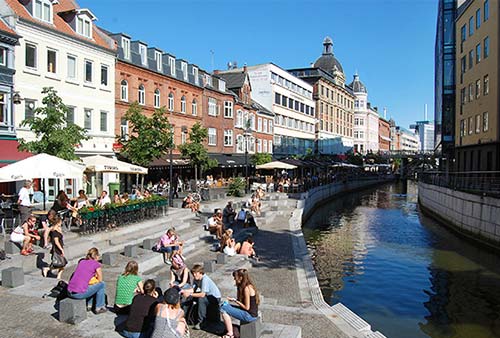
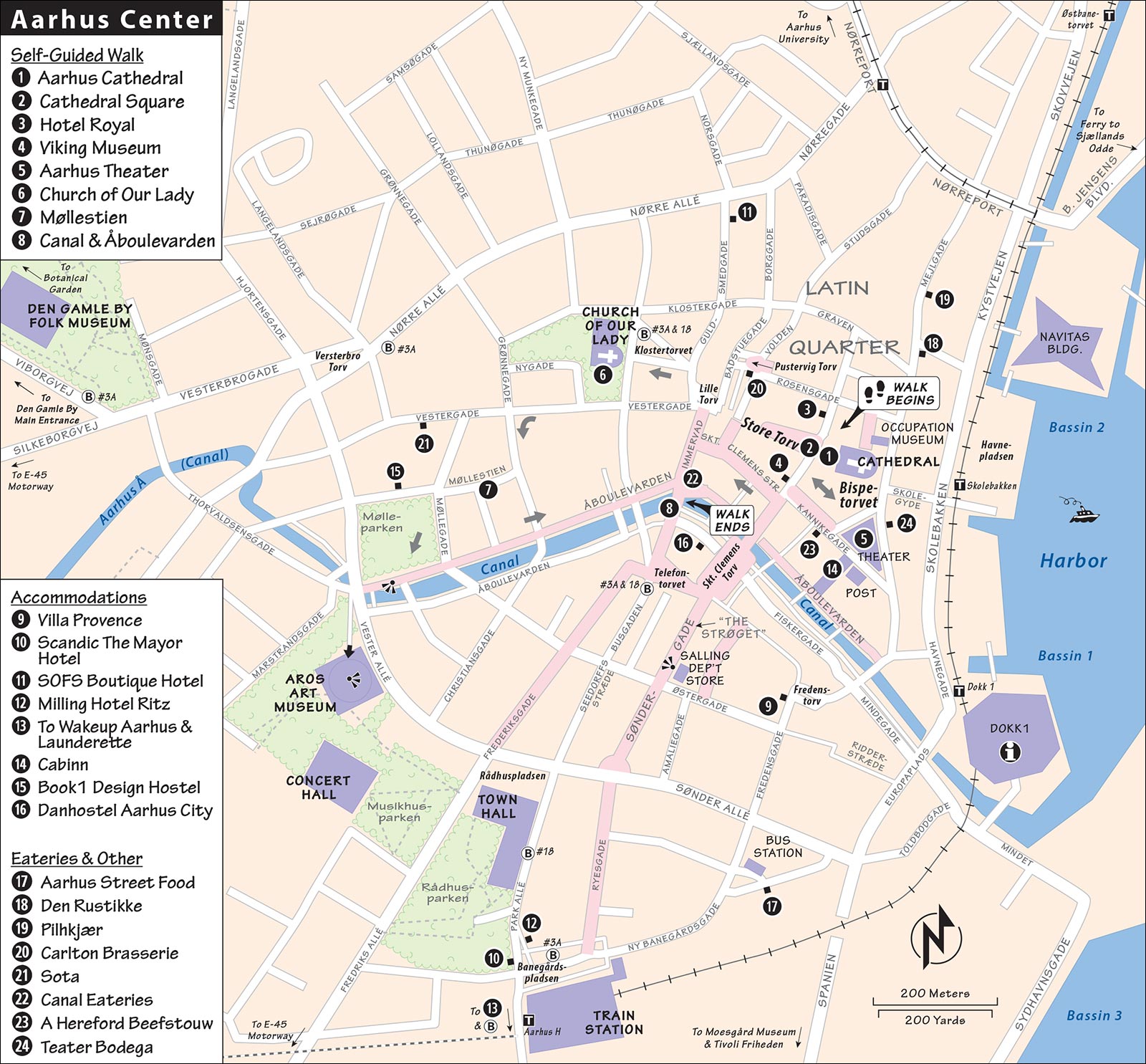
Aarhus lines up along a tranquil canal that runs through the middle of town down to the harbor. Canalside Åboulevarden street is lined with charming shops and eateries. The cathedral and lively Latin Quarter are directly north of the canal, while the train station is about five blocks to the south. Stretching between the cathedral and the station is a series of linked pedestrianized shopping streets called the Strøget. The main museums are scattered far and wide: The ARoS art museum is at the western edge of downtown, the Den Gamle By open-air folk museum is a bit farther to the northwest, and the Moesgård Museum (prehistory and ethnography) is in the countryside far to the south.
TOURIST INFORMATION
The Aarhus TI in Dokk1, a library/cultural center at the Aarhus harbor, has transit and city maps (generally Mon-Thu 10:00-19:00, Fri until 17:00, Sat-Sun until 16:00, +45 87 31 50 10, www.visitaarhus.com). In summer you’ll also find a mobile TI on Cathedral Square.
ARRIVAL IN AARHUS
By Train: At Aarhus’ user-friendly train station, all tracks feed into a concourse with ticket offices (billetsalg; open Mon-Fri 8:00-17:30, Sat-Sun 10:00-16:45). A side entrance (marked Bruun’s Galleri) takes you directly into a shopping mall; the other entrance (under the clock) leads into the blocky main terminal hall, with pay lockers, fast food, and ticket machines. Near the main doors, screens show departure times for upcoming city and regional buses.
To get into town, it’s a pleasant 10-minute walk: Exit straight ahead, cross the street, and proceed up the wide, traffic-free shopping street (Ryesgade), which takes you directly to the canal, cathedral, and start of my Aarhus Walk.
The Letbanen light-rail/tram links the train station to the TI (stop: Dokk1) and cathedral (stop: Skolebakken) in minutes but runs only twice an hour; see “Getting Around Aarhus,” next.
By Car or Cruise Ship: See “Aarhus Connections,” later.
GETTING AROUND AARHUS
On Foot: The sights mentioned in my self-guided walk and the ARoS art museum are all within a 15-minute walk; the Den Gamle By open-air folk museum is a few minutes farther, but still walkable (or can be reached by bus—see next).
By Bus: The Moesgård Museum and Tivoli Friheden amusement park are best reached by bus #18. It leaves from in front of the blocky Town Hall, about two blocks from the train station on Park Allé. Bus #3A to the Den Gamle By open-air folk museum leaves from a stop across the street from the train station and makes a few other stops in the city center.
Buy bus tickets from the Midttrafik app or website (not sold onboard). A 22-DKK, 2-zone ticket covers any of my recommended sights and is good for 2 hours (one-day and multiday tickets also available). To find your bus stop, look for the handy diagram at the start of the Strøget or use the route planner on the Rejseplanen app or at www.midttrafik.dk [URL inactive].
By Tram: The Letbanen light-rail/tram serves the train station and redeveloped harbor area—where the Skolebakken stop drops you close to the cathedral and the start of my walk (2/hour, uses same ticket as bus—see above). The tram is otherwise of little use to tourists.
By Taxi: Taxis are easy to flag down but pricey (40 DKK drop fee).
HELPFUL HINTS
Sightseeing Tip: If you plan to visit both the Occupation Museum and Den Gamle By, see the Occupation Museum first: A ticket to either museum gets you a 50 percent discount for the other within seven days, but Den Gamle By is more expensive.
Festival: The 10-day Aarhus Festival takes place in late summer and fills the city’s streets and venues with music, dance, food, and kids’ activities (Aug-Sept, www.aarhusfestuge.dk).
Laundry: An unstaffed, coin-op launderette (mønt-vask) is four short blocks south of the train station, on the square in front of St. Paul’s Church (daily 7:30-21:00, M. P. Bruunsgade 64).
Aarhus Walk
This quick little self-guided walk acquaints you with the historic center. You’ll begin at the cathedral, check out the modest sights in its vicinity, wander the cute Latin Quarter, take a stroll down the “most beautiful street” in Aarhus, and end at the canal (to trace this route, see the “Aarhus Center” map). After touring the impressive cathedral, the rest of the walk should take about an hour. The three big museums (modern art, prehistory, and open-air folk) are covered later, under “Sights in Aarhus.”
• Start by touring Aarhus Cathedral.
1 Aarhus Cathedral (Domkirke)
While Scandinavia’s biggest church (330 feet long and tall and worth ▲▲) is typically stark-white inside, it also comes with some vivid decorations dating from before the Reformation.
Cost and Hours: Free entry; Mon and Wed-Sat 9:30-16:00, Oct-April 10:00-15:00; Tue from 10:30 year-round; closed Sun except for services at 10:00 and 17:00; www.aarhusdomkirke.dk.
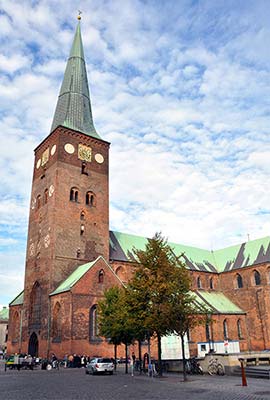
Visiting the Cathedral: The cathedral was finished in 1520 in all its Catholic glory. Imagine it with 55 side chapels, each dedicated to a different saint and wallpapered with colorful frescoes. Bad timing. Just 16 years later, in 1536, the Reformation hit this region and Protestants cleaned out the church—side altars gone, paintings whitewashed over—and added a pulpit in the middle of the nave so parishioners could hear the sermon. The front pews were even turned away from the altar to face the pulpit (a problem for weddings today).
Ironically, that Lutheran whitewash protected the fine 16th-century Catholic art. When it was peeled back in the 1920s, the frescoes were found perfectly preserved. In 1998, the surrounding whitewash was redone, making the old original paintings, which have never been restored, pop. Noble tombs that once lined the floor (worn smooth by years of traffic) now decorate the walls. The fancy text-filled wall medallions are epitaphs, originally paired with tombs. Ships hang from the ceilings of many Danish churches (you’ll find a fine example in the left transept)—in this nation of seafarers, there were invariably women praying for the safe return of their sailors.
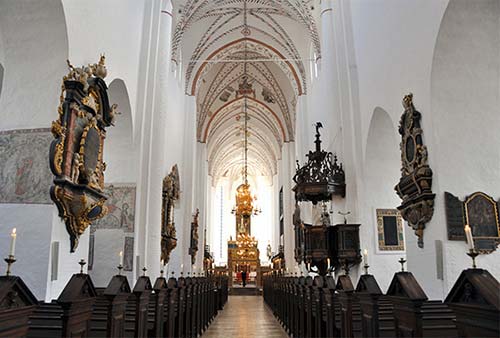
Step into the enclosed choir area at the front of the church. The main altarpiece, dating from 1479, features the 12 apostles flanking St. Clement (the patron saint of Aarhus and sailors—his symbol is the anchor), St. Anne, and John the Baptist. On top, Jesus is crowning Mary in heaven.
Head down the stairs to the apse area behind the altar. Find the model of the altarpiece, which demonstrates how the polyptych (many-paneled altarpiece) you just saw can be flipped to different scenes throughout the church year.
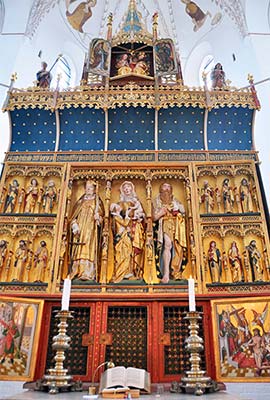
Also in this area, look for the fresco in the aisle (right of altar, facing windows) that shows a three-part universe: heaven, earth (at Mass), and—under the thick black line—purgatory...an ugly land with angels and devils fighting over souls. The kid on the gallows illustrates how the medieval Church threatened even little children with ugly damnation. Notice the angels trying desperately to save the damned. Just a little more money to the Church and...I...think...we...can...pull...Grandpa...OUT.
An earlier Romanesque church—just as huge—once stood on this spot. As you exit, notice the tiny, pointy-topped window in the back-right. It survives with its circa-1320 fresco from that earlier church. Even back then—when the city had a population of 1,000—the church seated 1,200. Imagine the entire community (and their dogs) assembled here to pray and worship their way through the darkness and uncertainty of medieval life.
• On your way out, pause at the cathedral door to survey the main square.
2 Cathedral Square (Domkirkeplads)
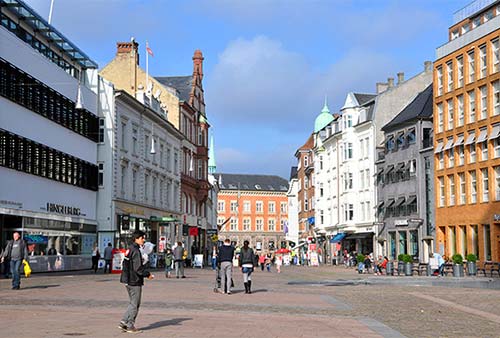
The long, triangular square is roughly the shape of the original Viking town from AD 770. Aarhus is the Viking word for “mouth of river.” The Aarhus River (now contained in the canal) flows to your left to the beach, which—before modern land reclamation—was just behind the church. The green spire peeking over the buildings dead ahead is the Church of Our Lady (which we’ll visit later on this walk). Fifty yards to the right, nubile caryatids by local artist Hans Krull decorate the entry to the 3 Hotel Royal and town casino. (Krull’s wildly decorated bar is just beyond, down the stairs at the corner.) Also nearby (around the corner from the cathedral) is the fine Occupation Museum 1940-1945, about the Danish resistance during World War II (described later, under “Sights in Aarhus”).
• Fifty yards to the left of the church (as you face the square), look for signs pointing the way to the tiny...
4 Viking Museum (Vikingemuseet)
When the site for a bank building was excavated in 1960, remains of Viking Aarhus were uncovered. Today you can take the stairs down to the little museum showing a surviving bit of the town’s original boardwalk in situ (where it was found), Viking artifacts, and a murder victim (missing his head)—all well described in English (30 DKK, open Mon-Fri 10:15-18:00, Sat-Sun until 17:00, www.vikingmuseet.dk [URL inactive]).
• Leaving the museum, walk straight ahead along the substantial length of the cathedral (brides have plenty of time to reconsider things during their procession) to the fancy building opposite.
5 Aarhus Theater (Aarhus Teater)
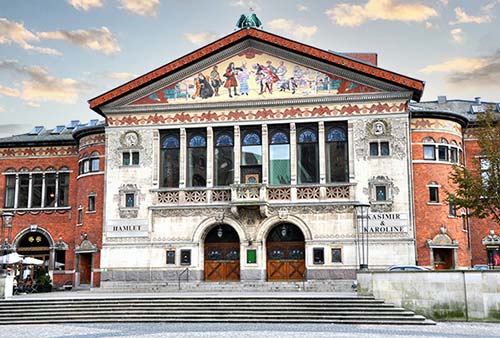
This ornate facade, with its flowery stained glass, is Danish Art Nouveau from around 1900. Under the tiny balcony is the town seal, featuring towers, the river, St. Clement with his anchor, and St. Paul with his sword. High above, on the roofline, crouches the devil. The local bishop made a stink when this “house of sin” was built facing the cathedral. The theater builders had the last say, finishing their structure with this smart-aleck devil triumphing (a hit with the secular, modern locals).
• Return to the square in front of the cathedral.
Latin Quarter
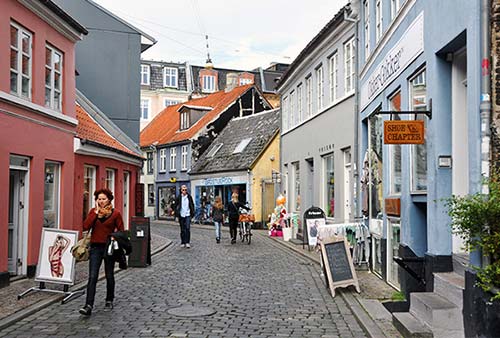
The higgledy-piggledy old town encompasses the six or eight square blocks in front of the cathedral and to the right. Latin was never spoken here—the area was named in the 1960s after the cute, boutique-ish, and similarly touristy zone in Paris. Though Aarhus’ canal strip is a newer trendy spot, the Latin Quarter is still great for shopping, cafés, and strolling. Explore these streets: Volden (named for the rampart), Graven (moat), and Badstuegade (“Bath Street”). In the days when fires routinely decimated towns, bathhouses—with their open fires necessary to heat the water—were located outside the walls. Back in the 15th century, finer people bathed monthly, while everyday riff-raff took their “Christmas bath” once a year.
• At the far end of the square, side-trip away from the cathedral to the green spire of the...
6 Church of Our Lady (Vor Frue Kirke)
The smart brick building you see today is in the Dutch Renaissance style from the early 16th century, but this local “Notre-Dame” is the oldest church in town (free; Mon-Fri 10:00-16:00, Sat until 14:00, closed Sun; www.aarhusvorfrue.dk). After Christianity came to Viking Denmark in 965, a tiny wooden church was built here. Step down into the crypt of today’s church (below the main altar). This evocative arcaded space (c. 1060) was originally an 11th-century stone rebuild of the first church (and only discovered in 1955). Four rune stones were also discovered on this site.
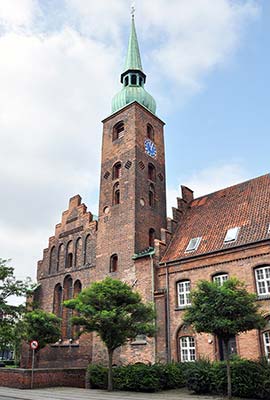
Back upstairs, find the graphic crucifix, with its tangled thieves flanking Christ, which was carved and painted by a Lübeck artist in 1530. As at Aarhus Cathedral, the church’s whitewashed walls are covered with fine epitaph medallions with family portraits. Step through the low door behind the rear pew (on the right with your back to the altar) into the peaceful cloister. With the Reformation, this became a hospital. Today, it’s a retirement home for lucky seniors.
• Walk west on Vestergade to the next street, Grønnegade. Turn left, then take the next right onto...
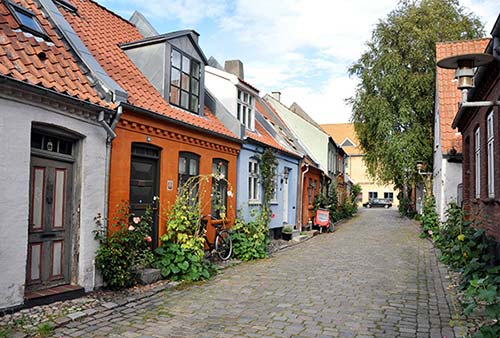
7 Møllestien
Locals call this quiet little cobbled lane the “most beautiful street” in Aarhus. The small, pastel cottages—draped in climbing roses and hollyhock in summer—date from the 18th century. Notice the small mirrors on one of the windows. Known as “street spies,” they allow people inside to inconspicuously watch what’s going on outside.
• At the end of the lane, veer left through the park (good place to picnic) toward the canal. The big, boxy building ahead of you with the rainbow ring on top is the ARoS art museum—consider visiting it now, or backtrack here when the walk is over.
When you reach the canal, turn left and walk about four blocks along Åboulevarden toward the cathedral spire until you reach the concrete pedestrian bridge.
8 Canal and Åboulevarden
You’re standing on the site of the original Viking bridge. The open sea was dead ahead. A protective harbor was behind you. When the town was attacked, the bridge on this spot was raised, ships were tucked safely away, and townsmen stood here to defend their fleet. Given the choice, they’d let the town burn and save their ships.
In the 1930s, the Aarhus River was covered over to make a new road—an event marked by much celebration. In the 1980s, locals reconsidered, deciding that the road cut a boring, people-mean swath through the center of their town. They removed the road, artfully canalized the river, and created a new people zone called Åboulevarden—the town’s place to see and be seen. This strip of modern restaurants ensures the street stays as lively as possible even after the short summer.
• Your walk is over. Retreating back up the canal takes you to the ARoS art museum, then to the Den Gamle By open-air folk museum. Following the canal ahead takes you past the best of the Åboulevarden canal zone that leads all the way to the harbor.
Crossing the canal bridge and going straight (with a one-block jog left through Telefontorvet) gets you to Skt. Clemens Torv and the Strøget pedestrian area, which leads past the rooftop-view Salling department store to the train station (where you can catch a bus—either at the station or the Town Hall nearby—to Tivoli Friheden amusement park, the Den Gamle By open-air folk museum, or the Moesgård Museum).
Sights in Aarhus
I’ve organized these sights by distance from the center, starting with the Occupation Museum (near the cathedral) and ending with the suburban Moesgård Museum.
▲Occupation Museum 1940-1945 (Besættelsesmuseet)
Nazi occupiers used Aarhus’ police station as their Gestapo headquarters during the last years of World War II. Today, in the former prison section of the building, the Occupation Museum tells the story of the resistance and what it was like to live here under Nazi rule.
Immersed in 1940s Aarhus with sights, sounds, and music, visitors encounter digital installations such as an intimidating German interrogator. They also each receive an ID card (out of 20 possible characters) that enables them to follow that person’s life through the war, as they grappled with moral dilemmas. All audio installations are available in English; a booklet provides text translations.
Cost and Hours: 75 DKK, 50 percent discount with Den Gemle By ticket within 7 days; Wed-Fri 13:00-17:00, Sat-Sun from 11:00, closed Mon-Tue; facing the cathedral, it’s around to the left at Mathilde Fibigers Have 2; +45 86 18 42 77, www.besaettelsesmuseet.dk.
Salling Department Store Rooftop
Take the elevator to the store’s top floor, where a modern rooftop oasis with a 360-degree view over the city awaits. You’ll find locals and tourists alike enjoying views, food, and beverages around numerous terraces, and (for the daring) a Skywalk platform that cantilevers over the street. Venture out to the end where a glass window in the floor lets you view tiny pedestrians 80 feet below.
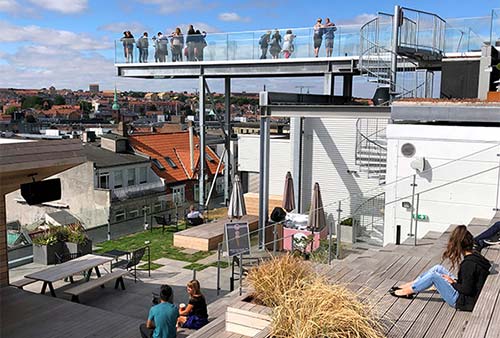
Cost and Hours: Free, Mon-Sat 10:00-20:00, Sun until 18:00, Søndergade 27, +45 87 78 60 00, www.salling.dk.
▲▲ARoS Art Museum (ARoS Kunstmuseum)
ARoS is a must-see, both for the building’s architecture and for its fun, accessible presentation of cutting-edge art. Square and unassuming from the outside, the bright white interior—with its spiral staircase winding up the museum’s eight floors—is surprising. The building’s vast atrium is free to enter if you just want to take a peek (or visit the gift shop or café). But you’ll need a ticket to see the permanent collections described later as well as an impressive range of temporary exhibits.
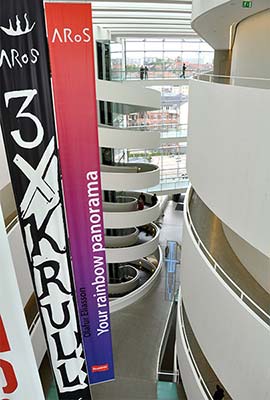
Cost and Hours: 175 DKK; daily 10:00-21:00, Sat-Sun until 17:00; Sept-May closed Mon; ARoS Allé 2, +45 61 90 49 00, www.aros.dk.
Cuisine Art: The $$ café at the entrance serves light meals, while the $$$ wine-and-food hall on the eighth floor features regional specialties from local producers.
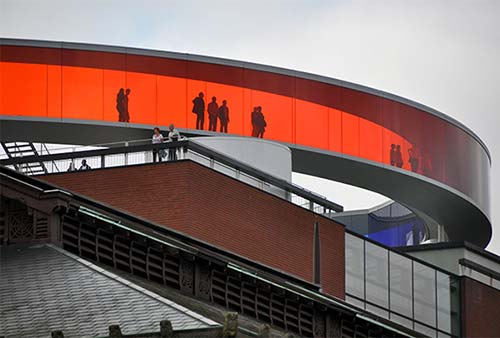
Visiting the Museum: After entering at the fourth-floor lobby, buy your ticket, pick up a museum floor plan, ride the elevator all the way to the top floor (floor 8), and then climb up the stairs (or ride a different elevator) to the rooftop. Here you can experience the museum’s iconic Your Rainbow Panorama, a 150-yard-long, 52-yard-diameter circular glass walkway in every hue of the color spectrum (by Icelandic artist Olafur Eliasson). You’ll stroll through the floor-to-ceiling piece while enjoying rainbow-colored, 360-degree views over the entire city. (It’s “your” panorama because you are experiencing the colors.)
Head down to floor 8 to view the manageable selection of works from the museum’s permanent collection. Here, paintings from the Danish golden age through the Danish Modernist era are arranged according to the broad themes of nature, religion, philosophy, and science. You’ll see pastoral scenes of the Danish countryside, seascapes, religious subjects, aristocratic portraits, squiggly abstractions, and expressionist landscapes.
Navigate to floor 6 to find one of the museum’s prized pieces: the squatting sculpture called Boy (by Australian artist Ron Mueck)—15 feet high, yet astonishingly realistic, from the wrinkly skin on his elbows to the stitching on his shorts.

Continue down the spiral staircase, past various temporary exhibits. On floors 5 and 1, take a spin through the temporary art and multimedia installations.
Continue down to the lowest level (0). The rooms here are designated for art installations—immersive works of space, light, video, and sound that plunge the viewer into the imaginations of a roster of international artists (including Tony Oursler, Elmgreen & Dragset, and James Turrell).
By the time you visit, a new underground gallery—more than 10,000 square feet—may also be ready to visit. The space was purpose-built for The Dome, a Skyspace, a work by James Turrell illuminated by changing colors. Art Square is an oval-shaped outdoor mound atop the subterranean gallery.
▲▲Den Gamle By (The Old Town)
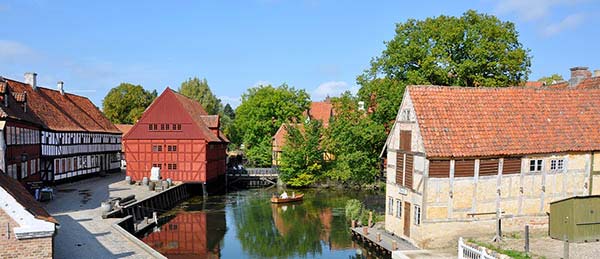
This open-air museum chronicles both the history of Danish market towns and the history of Aarhus, with preserved buildings, interiors, and goods from the past 400 years. With the fine Botanical Garden next door (described later), you could easily spend half a day here.
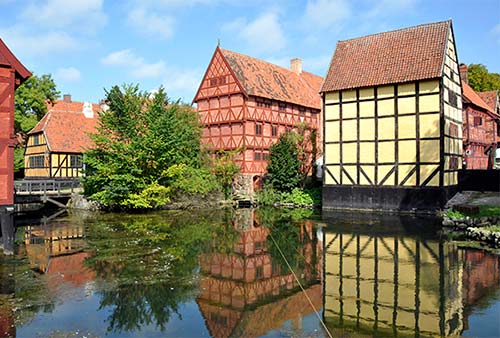
Cost and Hours: 190 DKK, 50 percent discount with Occupation Museum ticket within 7 days; daily 10:00-17:00, Jan-March until 16:00; +45 86 12 31 88, www.dengamleby.dk.
Getting There: Stroll 20 minutes up the canal from downtown, or catch a bus from near the train station: Bus #3A departs directly across the street from the station.
Eating: Outdoor and indoor tables are scattered around the grounds, making this a perfect place to enjoy a picnic lunch. The cheery indoor/outdoor $$ Gæstgivergården is an inviting cafeteria serving affordable light meals (open year-round). In peak season, additional $ options include pølse and snack stands, a bakery, a café next to the ticket kiosk, and a pizza shop and café in the 1970s neighborhood.
Visiting the Museum: At the ticket desk, pick up the free map of the grounds; you can also navigate using the directional signposts throughout the park. Plaques describe each building, but the available guide-booklet (small fee) is a worthwhile investment. Look for handvaerk signs to find craft demonstrations such as beekeeping, masonry, and blacksmithing.
The grounds reward an adventurous spirit. They’re designed to be explored, so go ahead and open doors and poke into seemingly abandoned courtyards—you may find a chatty docent inside describing the artifacts, answering questions, or working at a craft. Follow sounds and smells to discover a whole world beyond the main streets.
This museum is a trip back in time, starting with practically the present—2014. There’s a Danske Bank, a 7-Eleven...and your first clue that you’re in the past: a Blockbuster (the chain closed its last outlet in Denmark in 2014). Take an immediate left past the Blockbuster to visit the sleek and modern Rainbow home and see a video of the two moms and their three kids discussing their family life. At the end of Havnegade Street, pop into the Bent J jazz bar (which operated in Aarhus from 1973-2008).
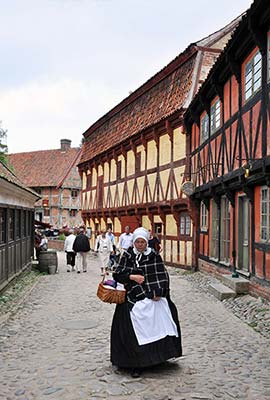
Turn left to enter the 1974 neighborhood, which also looks contemporary—until you notice the photography shop and travel agent. On the left, enter the Fortaello building for the “Aarhus Story,” a full museum in itself with captivating exhibits covering the city’s history from its beginnings as a Viking town, to its “Bishops Town” period dominated by the Catholic Church, through industrialization with factories and railways, to the city today. The exhibit exits into the Udstillinger building, where you’ll find the Danish Poster Museum, the Gallery of Decorative Arts (porcelain, clocks, and silverware), and the Jewelry Box (20th-century silver jewelry). Back out on the street, explore the Legetøj toy museum, re-created apartments, a radio and TV repair shop, a hairdresser, a gynecology clinic, a plumber, and a bakery.
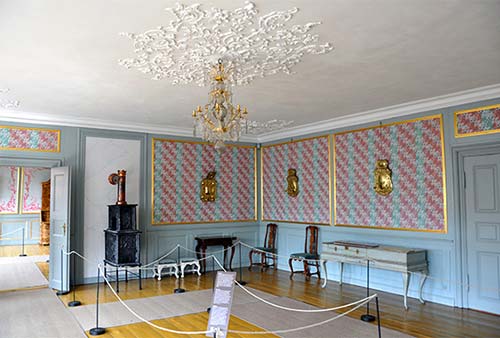
Pass through the 1927 neighborhood, with its car dealership, ironmonger, and bookshop, into the 1864 neighborhood and large main square, the Torvet. The building on the left side of the square, the Mayor’s House (from 1597), contains a museum upstairs that features home interiors from 1600 to 1850, including many with fancifully painted walls. At the top of the square is the Mintmaster’s Mansion, the residence of a Copenhagen noble (from 1683). Enter around back to tour the boldly colorful, 18th-century Baroque rooms. Under the heavy timbers of the attic is an exhibit about the history of this restored building. Continue through to the festival grounds at the end of the park (with old-timey games and swing boats), where you can exit into the Botanical Garden (described next).
Botanical Garden
Take a surprisingly hilly stroll through one of Aarhus’ largest green spaces and enjoy Danish flora and a tranquil ambiance. Snacks are available in the greenhouse (free, Mon-Fri 9:00-17:00, Sat-Sun from 10:00, adjacent to Den Gamle By—see “Getting There,” earlier, https://sciencemuseerne.dk).
▲▲Moesgård Museum
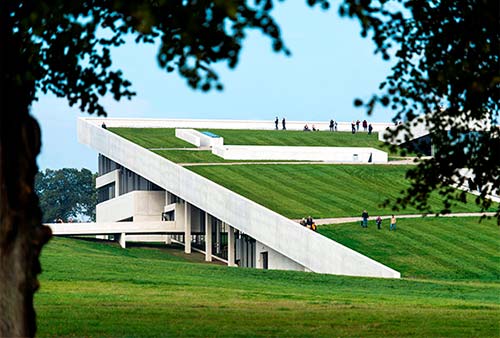
This museum, dedicated to prehistory and ethnography, is housed in a state-of-the-art venue south of Aarhus in the suburb of Højbjerg. The building juts dramatically from a hill, with grass growing on a sloping roof that visitors can walk on.
Cost and Hours: 180 DKK; buy ticket online to avoid ticket queue; open Tue-Sun 10:00-17:00, Wed and Sat until 21:00, closed Mon; longer hours possible during peak periods, café, +45 87 39 40 40, www.moesgaardmuseum.dk.
Tours: The museum offers guided one-hour highlights tours at 14:00 (150 DKK; must book in advance at website).
Getting There: The museum is located outside Aarhus at Moesgård Allé 15 in Højbjerg, in a lush, wooded park sprawling down to the sea. It’s a pricey taxi trip or an easy, cheap bus ride: Bus #18 leaves Aarhus from directly in front of the Town Hall on Park Allé (around the corner from the train station; 2/hour, ride 30 minutes to end of line, covered by zone 2 bus ticket). Once at the museum, check what time the return bus departs (posted at the bus stop, or use the Rejseplanen app).
Visiting the Museum: Divided into three main periods—the Bronze Age (1800 to 500 BC), Iron Age (500 BC to AD 800), and Viking Age (AD 700 to 1050), the prehistory section features lots of real artifacts (primitive tools and pottery, plenty of spearheads and arrowheads), all well described in English, along with an impressive collection of rune stones.
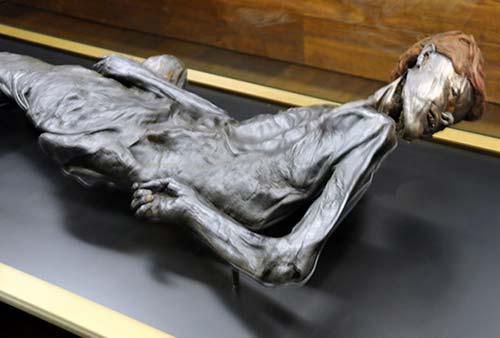
The highlight is the well-preserved body of an Iron Age man. Believing that the gods dwelled in the bogs, prehistoric people threw offerings (such as spearheads) into the thick peat. The peat did a remarkable job of preserving these artifacts, many of which are now on display in the museum. The prehistoric people also sacrificed humans to the bog gods—resulting in the incredibly intact Grauballe Man, the world’s best-preserved “bog-corpse.” Reclining in his stately glass tomb, the more than 2,000-year-old bog man looks like a fellow half his age. He still has his skin, nails, hair, and even the slit in his throat he got at the sacrificial banquet (back in 300 BC). Spend some time with this visitor from the past. The story of his discovery (in a Jutland peat bog in 1952) and conservation is also interesting.
The Grounds: The museum sits on the pleasant grounds of the Moesgård Manor; while the manor itself is closed to the public, its grounds are fun to explore. Behind the museum, a two-mile-long circular trail stretches down to a fine beach. This “Prehistoric Trackway” runs past a few model Viking buildings, including a 12th-century stave church.
Tivoli Friheden Amusement Park (Tivoli Friheden Forlystelsespark)
The local Tivoli, about a mile south of the Aarhus train station, offers great fun for the entire family.
Cost and Hours: 175 DKK for entry only, add 120 DKK to include rides; July-early Aug 11:30-20:00, longer hours in late July, weekends only and shorter hours most of June and late Aug-Dec with some closures, closed Jan-April except for special events; bus #18 from Park Allé near Town Hall, +45 86 14 73 00, www.friheden.dk [URL inactive].
Sleeping in Aarhus
Aarhus has a good variety of lodgings, from charming, personality-filled hotels to backpacker-friendly hostel bunks.
$$$$ Villa Provence, a petit taste of France in the center of Aarhus, makes a very cozy and convenient home base. Its 39 fun-yet-tasteful rooms, decorated with antique furniture and old French movie posters, surround a quiet courtyard. The pub across the street can get noisy on weekends, so ask for a room facing away from the street (pay parking, honesty bar, 10-minute walk from station, near Åboulevarden at the end of Fredensgade, Fredens Torv 12, +45 86 18 24 00, www.villaprovence.dk, hotel@villaprovence.dk).
$$$ Scandic The Mayor Hotel rents 162 sleek, well-furnished, business-class rooms 100 yards from the station (elevator, laundry service, gym, pay parking, loaner bikes, Banegårdspladsen 14, +45 87 32 01 00, www.scandichotels.com, themayor@scandichotels.com).
$$$ SOFS Boutique Hotel is a small and welcoming hotel with 26 rooms of various sizes, a delightful stay-awhile garden, and a focus on organic products. A steep staircase takes you to the best rooms; the cheaper rooms (five rooms sharing two bathrooms) are in a ground-floor annex behind the garden (RS% with 2-night stay, bike rental, in quiet Latin Quarter at Guldsmedgade 40, +45 86 13 45 50, https://sofshotel.dk, reception@sofshotel.dk).
$$$ Milling Hotel Ritz, across the street from the station, is not at all ritzy, but offers 67 bright rooms in an old-school building and sets out afternoon snacks for its guests (elevator, Banegårdspladsen 12, +45 86 13 44 44, www.millinghotels.dk, ritz@millinghotels.dk).
$ Wakeup Aarhus, with 315 modern, compact, air-conditioned rooms, is an excellent budget option (breakfast extra, family rooms, elevator, pay parking, rental bikes, M. P. Bruuns Gade 27, +45 44 80 00 00, www.wakeupcopenhagen.com, bruunsgade@wakeupaarhus.dk).
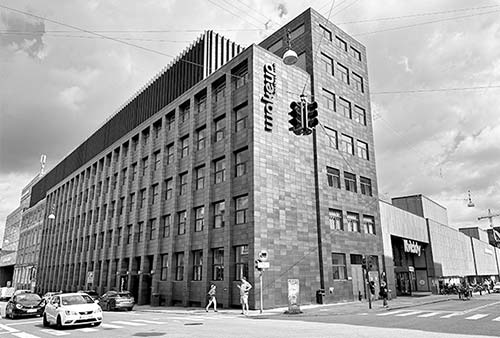
$ Cabinn, overlooking the atmospheric Åboulevarden and canal, is extremely practical. Its 401 rooms are minimalist yet comfy, and service is no-nonsense (family rooms, breakfast extra, elevator, pay parking—request when booking, rooms overlook boisterous canal or quieter courtyard, at Kannikegade 14, +45 86 75 70 00, www.cabinn.dk, aarhus@cabinn.dk).
¢ Danhostel Aarhus City, an official HI hostel with 320 beds in the center, is a no-frills option with views (private and family rooms available, rooftop café, limited pay parking, bike rental, Fiskergade 10, +45 86 10 10 20, https://danhostelaarhuscity.dk, info@danhostelcity.dk).
Eating in Aarhus
Affluent Aarhus has plenty of great little restaurants. Most of my listings are in the old town, within a few minutes’ stroll from the cathedral; Aarhus Street Food is about a 10-minute walk from Cathedral Square.
NEAR THE TRAIN STATION
Aarhus Street Food is a veritable world of international cuisine with about 30 food stands, indoor and outdoor seating, and a chance to share a table with locals. Come for the Turkish, Greek, Korean, Indian, or even Danish food, or stop by for cocktails or coffee and join the scene (daily 11:30-21:00, Ny Banegårdsgade 46—across from the bus station, https://aarhusstreetfood.com).
IN AND NEAR THE LATIN QUARTER
The streets of the Latin Quarter are teeming with hardworking and popular eateries. The street called Mejlgade, along the eastern edge of downtown, has a smattering of youthful, trendy restaurants that are just far enough off the tourist trail to feel local. Look for a variety of fixed-price, three-course dinners—some affordable, others a splurge.
$$$$ Den Rustikke is a French-style brasserie offering mostly French dishes (including affordable fixed-price meals), either in the rollicking interior or outside under a cozy colonnade (daily until 21:30, Mejlgade 20, +45 86 12 00 95, www.denrustikke.dk).
$$$$ Pilhkjær is a bit more expensive and sedate, filling a cellar with elegantly casual atmosphere. The menu, which changes daily, focuses on fish, along with meat and vegetarian offerings. It’s available only as a full-course meal—there’s no à la carte option (Tue-Sat 17:30-22:30 or later, closed Sun-Mon; at the end of a long courtyard at Mejlgade 28, +45 86 18 23 30, www.pihlkjaer-restaurant.dk).
$$$ Carlton Brasserie, facing a pretty square, is a solid bet for French meat or seafood dishes in classy (verging on stuffy) surroundings. The restaurant has tables on the square, with more formal seating in back (daily, closed Sun for dinner, Rosensgade 23, +45 86 20 21 22, www.carlton.dk).
A few short blocks farther from the action (past the Church of Our Lady), $$$$ Sota is a local favorite for sushi, to eat in or take away. This sleek, split-level, Tokyo-Scandinavian hybrid is in a half-timbered old house (Mon-Thu 16:00-22:00, Fri-Sat 12:00-23:00, closed Sun, reservations recommended, Vestergade 48, +45 86 47 47 88, www.sotasushibar.dk).
ALONG THE CANAL
The Åboulevarden canal zone is lined with trendy eateries—all overpriced unless you value making the scene with the locals (and all open daily until late). They have indoor and canalside seating with heaters and blankets, so diners can eat outdoors even when it’s cold.
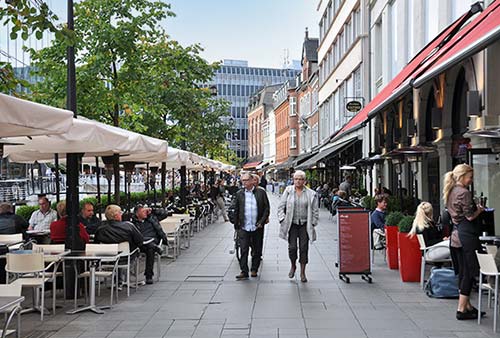
Before settling in, cruise the entire strip, giving special consideration to near the main bridge: $$ Cross Café (with red awnings) and $$ Ziggy, both of which are popular for salads, sandwiches, burgers, and drinks; and $$$ Grappa, a classy Italian place with pastas and pizzas, as well as pricier plates. Several places along here serve basic breakfast buffets.
NEAR THE CATHEDRAL
These places, while a bit past their prime and touristy, are convenient and central.
$$$$ A Hereford Beefstouw, in the St. Clement’s Brewery building facing the cathedral, is a bright, convivial, fun-loving, and woody land of happy eaters and drinkers. Choose from a hearty menu and eat amid shiny copper beer vats. If you’re dropping by for a brew, they have enticing beer snacks and spicy little ølpølse sausages (hearty dinners with steak, lamb, chicken, and vegetarian options; daily 17:30-23:00, Kannikegade 10, +45 86 13 53 25, www.beefstouw.com).
$$$ Teater Bodega is the venerable best bet for traditional Danish—where local men go for “food their wives won’t cook.” While a bit old-fashioned, it’s a sentimental favorite for old-timers. Facing the theater and cathedral, it’s dressy and plastered with theater photographs (open-face sandwiches at lunch only, open daily, Skolegade 7, +45 86 12 19 17, http://teaterbodega.dk).
Aarhus Connections
BY PUBLIC TRANSPORTATION
From Aarhus by Train to: Odense (2/hour, 1.5 hours), Copenhagen (2/hour, 3 hours), Ærøskøbing (6-7/day, transfer to ferry in Svendborg, allow 5 hours total), Billund/Legoland (3/hour; 45-minute train to Vejle, then transfer to bus—described later), Hamburg, Germany (2 direct/day, more with transfers, 5 hours).
You can take the train from Aarhus to Hirtshals, where you can catch the ferry to Norway on the Color Line (www.colorline.com) or Fjordline (www.fjordline.com [URL inactive]). Trains depart Aarhus hourly and take about 2.5 hours (to meet the Color Line ferry, transfer at Hjørring and continue to Hirtshals Havn; note that rail passes don’t cover the Hjørring-Hirtshals train, but do give a 50 percent discount; buy your ticket in Hjørring or on board). Or take the same northbound train but change at Aalborg to reach Frederikshavn (2.5 hours) to catch the overnight DFDS ferry to Oslo (www.dfds.com) or 3.5-hour Stena ferry to Göteborg, Sweden (www.stenaline.nl). Reservations are smart for all ferries.
ROUTE TIPS FOR DRIVERS
Aarhus to Hirtshals or Fredrikshavn: It’s about a two-hour drive to either ferry port. From Aarhus, head north on E-45 to Aalborg, then follow E-39 for Hirtshals or continue north on E-45 for Fredrikshavn.
Aarhus to Legoland and Jelling: From Aarhus, it’s 60 miles to Billund/Legoland (go south on Skanderborg Road and get on E-45; follow signs to Vejle, Kolding). For Jelling, take the Vejle N exit and follow signs to Vejle, then veer right on the ring road (following signs to Skovgade), then follow highway 442 north. For Legoland, take the Vejle S exit for Billund (after Vejle N—it’s the first exit after the dramatic Vejlefjord bridge).
Aarhus (or Legoland) to Ærø: Figure about 2.5 hours (or 2 hours from Legoland/Billund) to Svendborg and the ferry to Ærø—if you don’t sightsee along the way. After heading south on E-45, take E-20 over the bridge to the island of Funen (Fyn in Danish); from Odense, take the highway south to Svendborg and the ferry dock. Cars need reservations but walk-on passengers usually don’t. If you plan to bike (not drive) around Ærø, park your car in Svendborg (at the long-term lot two blocks from the dock or at the far end of the harbor near the Bendixens fish shop). For ferry details, see here.
Legoland
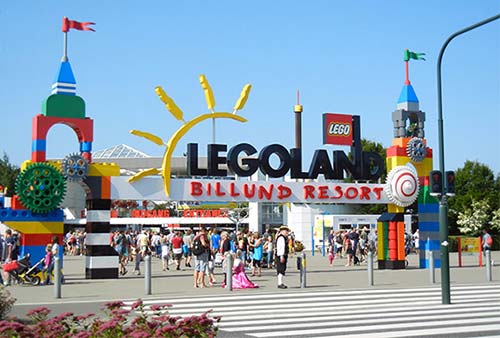
Legoland is Scandinavia’s top kids’ sight. This huge park is a happy combination of more than 50 rides, seasonal live shows, meet-and-greets with Minifig characters, and 75 million Lego bricks creatively arranged into icons such as the Parthenon, Neuschwanstein Castle, and the Statue of Liberty. If you’ve already been to another Legoland, this is more of the same—but if you’re in the neighborhood, a visit to this Legoland mothership will be a hit with kids ages two through the pre-teens.
GETTING THERE
Legoland, located in the town of Billund, is easiest to visit by car (see “Route Tips for Drivers,” earlier), but doable by public transportation. The nearest train station to Billund is Vejle. Trains arrive at Vejle from Copenhagen (2/hour, 2.5 hours), Odense (2/hour, 1 hour), and Aarhus (3/hour, 45 minutes). At Vejle, catch bus #43 to travel the remaining 25 miles to Billund (45 minutes). For train and bus details, see the Rejseplanen app or www.rejseplanen.dk.
ORIENTATION TO LEGOLAND
Cost: 499 DKK for ages 3 and up, free for kids 2 and under. Advance tickets, often available at a discount, are sold online at www.legoland.dk and at many Danish locations (some stores, hotels, and TIs). If a one-day visit is not enough, multiday and combo-tickets are available (check their website for current offers). Some local hotels offer package deals with tickets.
Hours: Generally April-Oct daily 10:00-18:00, later on weekends and for much of July-Aug; closed Tue-Thu in Sept-mid-Oct and much of Nov-March. Activities close an hour before the park. Confirm exact hours before heading out.
Information: +45 79 50 17 17, www.legoland.dk.
Crowd-Beating Tips: Legoland is crowded during the Danish summer school vacation from early July through mid-August, particularly Tuesdays and Wednesdays (weekends are the least crowded days in high season). You’ll encounter fewer tour groups later in the day. To skip the ticket line, purchase tickets online in advance.
Time-Saving Tips: To plan your day, check attraction waiting times inside the park, see show times, and get an interactive map, download the Legoland app. You can also pay extra to book times for the most popular rides (via the app or website—search for “Reserve & Ride”).
Eating: Surprisingly, the park’s restaurants don’t serve Leg-o-lamb, but there are plenty of other food choices.
VISITING LEGOLAND
From their humble beginnings in the workshop of a local carpenter who named his wooden toys after the Danish phrase leg godt (“play well”) to the ubiquitous plastic interlocking building bricks, Legos are beloved around the world. The franchise has expanded to international Lego theme parks—but this is the original, opened in 1968.
Denmark’s Legoland is divided into ten themed areas, such as Polar Land, Pirate Land, and Knight’s Kingdom. You can see it all in a day, but you’ll be exhausted.
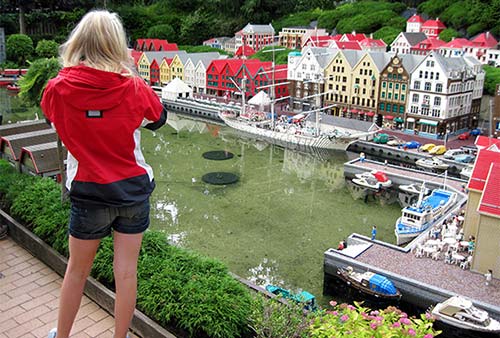
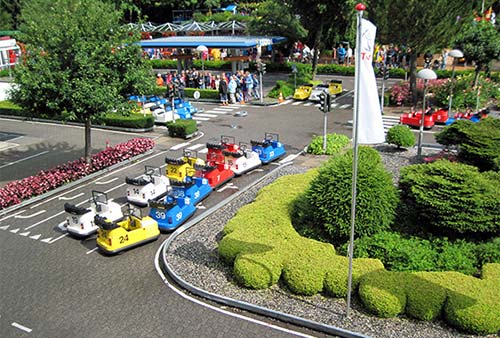
Anyone who has ever picked up a Lego brick will marvel at Miniland (near the entrance), where landscaped gardens are filled with carefully constructed Lego landscapes and cityscapes, including models of world icons such as Dutch windmills, German castles, and the Norwegian harbor of Bergen. Children joyfully watch as tiny Lego boats ply the waters and Lego trains chug merrily along the tracks. Nearby, kids can go on mellow rides in child-size cars, trains, and boats. A highlight of Miniland is the traffic school, where drivers ages 6-13 learn the rules of the road and get a souvenir license (it’s popular—make a reservation upon arrival; extra fee required).
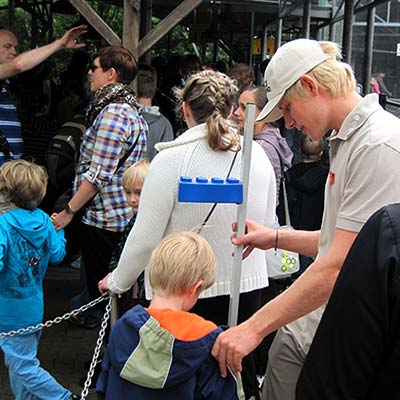
While the park’s rides aren’t thrilling by Disneyland standards, most kids will find something to enjoy, especially the younger set (height restrictions strictly enforced—check online or in the app). The Fire Brigade ride in Adventure Land invites family participation as you team up to put out a (fake) fire. The Temple is an Indiana Jones-esque Egyptian-themed treasure hunt/shoot-’em-up, and the Dragon roller coaster takes you in and around a medieval castle. Note that on several rides (including the Vikings River Splash), you’ll definitely get wet. Special walk-in, human-size dryers help you warm up and dry off.
The park also features plenty of construction activities for all ages: guests can build and race boats or their own Lego Ferrari, construct and display monsters, and participate in guided workshops.
SLEEPING NEAR LEGOLAND
Nearby hotels include $$$$ Hotel Legoland, $$$$ Legoland Holiday Village (www.legoland.dk for all Legoland hotels), and $$ Hotel Svanen (www.hotelsvanen.dk). For a B&B just outside of Billund, try $ Gregersminde (www.gregersminde.dk).
Jelling
On your way to or from Legoland, consider a short side trip to the tiny village of Jelling (YELL-ing), a place of immense importance in Danish history. Stop here at the Kongernes Jelling Museum to see the two rune stones that are often called “Denmark’s birth certificate”—the first written record of Denmark’s status as a nation-state. Just across the street is an excellent (and free) museum that orients you to the area’s history. Next to the stones is a 900-year-old church that’s flanked by two enormous, man-made burial mounds.
Two hours is ample for a visit. If pressed for time, an hour is enough to see the stones and take a quick look at the museum. If you’re here around lunchtime, Jelling is a great spot for a picnic. There are several central eateries and a café and WC inside the museum, and another WC in the parking lot near the North Mound.
Getting There: Drivers can easily find Jelling, just 10 minutes off the main Vejle-Billund road (see “Route Tips for Drivers” under “Aarhus Connections”). Train travelers coming from Copenhagen or Aarhus must change in Vejle, which is connected to Jelling by hourly trains (direction: Herning) and bus #211.
KONGERNES JELLING MUSEUM
Experience Center
Denmark’s current monarchy traces its lineage back 1,300 years to Jelling. This museum explores the history of Denmark’s Viking kings, juxtaposing mythology and Viking stories with high-tech displays. Get a bird’s-eye view of the monument area from the rooftop terrace before exploring there; pick up the pamphlet/map at the museum or view the PDF at their website (free; daily 10:00-17:00; Oct-April Tue-Sun 10:00-16:00, closed Mon; picnic area, café serves lunch in high season, otherwise drinks and pastry only; +45 41 20 63 31, http://natmus.dk/kongernes-jelling).
Monument Area
Across the street from the Experience Center is one of the first stone churches, surrounded by monuments built by the ancient Danish kings.
Church: The church, which dates from around 1100, is decorated with restored frescoes. A zigzag motif is repeated in the modern windows and the inlaid floor. The metal “Z” in the floor marks the grave of King Gorm the Old (a.k.a. Gorm the Sleepy), who ruled Denmark for 40 years in the ninth century. Note the ship model hanging from the ceiling, a holdover from a pre-Christian tradition seeking a safe journey for ship and crew.
Rune Stones: Just south of the church, protected by a modern bronze-and-glass structure, are the two ancient rune stones.
The smaller stone was erected by King Gorm. You probably don’t read runic so I’ll translate: “King Gorm made this monument in memory of Thyra, his wife, Denmark’s salvation.” These are the oldest recorded words of a Danish king, and the first time that the name Denmark is used to describe a country and not just the region.
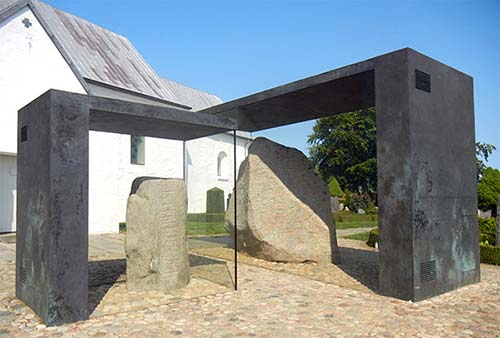
The larger stone was erected by Gorm’s son, Harald Bluetooth, to honor his parents, commemorate the conquering of Denmark and Norway, and mark the conversion of the Danes to Christianity. (Today’s Bluetooth wireless technology takes its name from Harald, who created the decidedly nonwireless connection between the Danish and Norwegian peoples.)
Harald was a shrewd politician who had practical reasons for being baptized. He knew that if he declared Denmark to be a Christian land, he could save it from possible attack by the predatory German bishops to the south. The inscription reads: “King Harald ordered this monument made in memory of Gorm, his father, and in memory of Thyra, his mother; that Harald who won for himself all of Denmark and Norway and made the Danes Christian.”
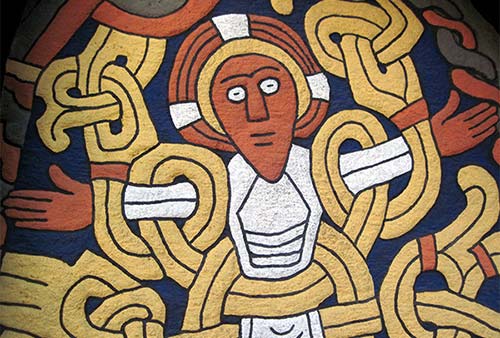
This large stone has three sides. One side reveals an image of Jesus and a cross, while one has a serpent wrapped around a lion. This is important imagery that speaks to the transition from Nordic paganism to Christianity. These designs carved into the rock were once brightly painted.
North Mound: The large mound just behind the church was a burial chamber. According to tradition, Gorm was buried inside this mound, with his queen Thyra interred in the smaller mound to the south. But excavations turned up no royal remains in either mound. (In the 1970s, what is believed to be Gorm’s body was discovered below the church.) Scan the horizon and mentally remove the trees. Imagine the commanding view this site had in the past. Look north to stones that trace the outline of a ship. Below you lies a more modern graveyard with typically Danish well-manicured plots.
More Jutland Sights
NORTHEAST OF BILLUND
Himmelbjerget and Silkeborg
If you’re connecting the Billund and Jelling area with Aarhus, consider this slower but more scenic route north through the idyllic Danish Lake District. (With less time, return to Vejle and take the E-45 motorway.)
Himmelbjerget, best seen by car, lies in the middle of Jutland near the town of Silkeborg. Both are about an hour northeast of Billund (22 miles west of Aarhus). Silkeborg is accessible by train from Aarhus with a change in Skanderborg.
Denmark’s landscape is vertically challenged when compared to its mountainous neighbors Norway and Sweden. If you have a hankering to ascend to one of the country’s highest points, consider a visit to the 482-foot-tall Himmelbjerget, which translates loftily as “The Heaven Mountain.” That may be overstating it, but by Danish standards the view’s not bad. A short trail at the top leads to an 80-foot-tall brick tower. Climb the tower for a commanding view. Clouds roll by above a patchwork of green and gold fields while boats ply the blue waters of the lake below. You may see the vintage paddle steamers make the hour-long trip between Himmelbjerget and Silkeborg in season (the dock is accessed by a short hike from the tower down to the lake).
Silkeborg, in the center of the Danish Lake District, has an excellent freshwater aquarium/playground/wildlife park called AQUA that’s worth a visit, especially if you’re traveling with kids (www.visitaqua.dk). Also in Silkeborg, modern-art lovers will enjoy the Museum Jorn Silkeborg, featuring colorful abstract works by Asger Jorn—a prominent member of the avant-garde COBRA movement—plus other Danish and foreign art (www.museumjorn.dk).
SOUTHWEST OF BILLUND
▲Ribe
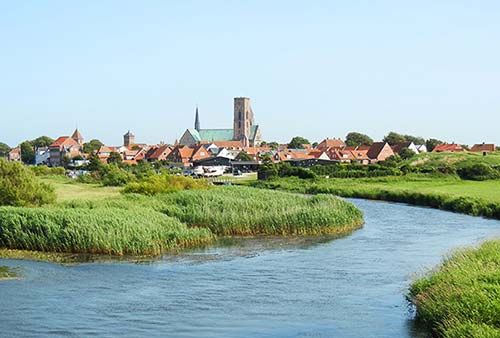
A Viking port 1,000 years ago, Ribe, located about 30 miles southwest of Billund, is the oldest, and possibly the loveliest, town in Denmark. It’s an entertaining mix of cobbled lanes and leaning medieval houses, with a fine cathedral boasting modern paintings under Romanesque arches. Tourist information is available at www.vadehavskysten.dk. $ Weis Stue, a smoky, low-ceilinged, atmospheric inn across from the church, rents primitive rooms with a shared bath and serves good meals (no breakfast, +45 75 42 07 00, www.weis-stue.dk). Take the free Night Watchman tour (daily May-Oct at 20:00, also at 22:00 in summer, www.vadehavskysten.dk).
WEST OF BILLUND
North Sea Coast
If beautiful beaches and WWII-era bunkers sound appealing, consider this side trip, worth ▲▲ on a nice day. Just an hour or so west from Legoland is a land of rolling dunes, wide sandy beaches, and big waves. It’s often windy, and the water can be brisk, but the Danes who flock here in the summer don’t mind. You can make a strategic strike to Blåvand and back in half a day but allow a whole day to fully experience the coast. Bring your swimsuit!
Blåvand (BLOW-van) is a popular beach destination a little over an hour west of Billund (take highway 30, then highway 475 to Varde, then follow highway 471). Turn left at Oksby on Tane Hedevej to reach the Tirpitz Museum. This striking structure, designed by Danish “starchitect” Bjarke Ingels, is built into the dunes and connected by tunnel to a German bunker. The bunker was part of Hitler’s Atlantic Wall that stretched from Norway down to Spain. Look for the exhibit on amber (the “gold of the north” that washes up on local beaches) and learn about life in the Ice Age (http://vardemuseerne.dk/museum/tirpitz). To reach the wide beach, backtrack through Oksby and follow Fyrvej to the lighthouse.
Just 20 minutes north is the low-key beach town of Vejers Strand, where the main drag dead-ends at the beach. $$$ Klithjem Badehotel provides nice rooms just steps from the sea (www.klithjembadehotel.dk).
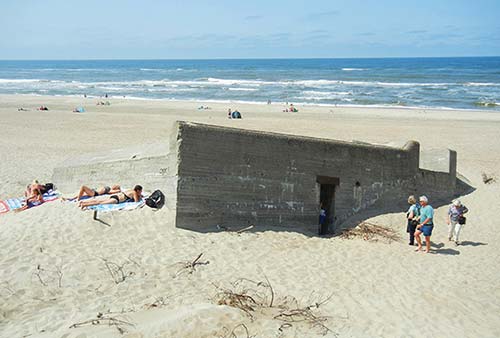
The dunes along the coast hide many other bunkers. Along with Blåvand, you’ll find an easy-to-access observation post and troop bunker at Hvide Sande, a harbor town an hour north that straddles the entrance to a wide bay. After crossing the bridge, park in the lot on the right where you’ll find a TI, plus some shops and restaurants. Cross the road and climb the Troldbjerg Hill, heading toward a large mast and a flagpole to find the sights. More evocative and isolated are the bunkers 20 minutes farther north at Houvig Strand. Along the way you’ll pass dozens of summer houses, many with thatched roofs and Danish flags flapping in the breeze. Turn left at the Houvig Strand sign, and park in the lot, where a path leads through the dunes to the beach. One bunker is just in front of you and several others lie a 10-minute walk to the right. Be careful exploring these tilting concrete structures up close, as shifting sands covering rusty metal rebar can make them treacherous. From Houvig Strand it’s a 1.5-hour drive back to Billund via Ringkøping.