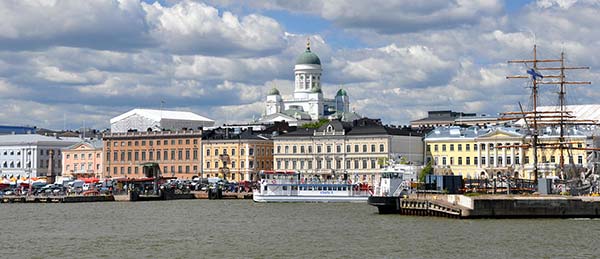
HELSINKI
Map: Helsinki Hotels & Restaurants
TRENDY EATERIES IN AND NEAR THE DESIGN DISTRICT
The Finnish capital feels like an outpost of the Nordic and European worlds—it’s both the northernmost capital of the EU and the youngest, with no medieval sights. This quirky metropolis lacks the cutesy cobbles of Copenhagen, the dramatic setting of Stockholm, or the futuristic vibe of Oslo, yet Helsinki holds its own among Nordic capitals with its appealing Finnish personality. It’s a spruce-and-stone wonderland of stunning 19th- to 21st-century architecture, with a bustling harborfront market, lively main boulevard, fine museums, sophisticated design pedigree, and dueling cathedrals (Lutheran and Eastern Orthodox). Visitors find an east-meets-west mélange of cultures...and a welcoming Finnish spirit that ties it all together.
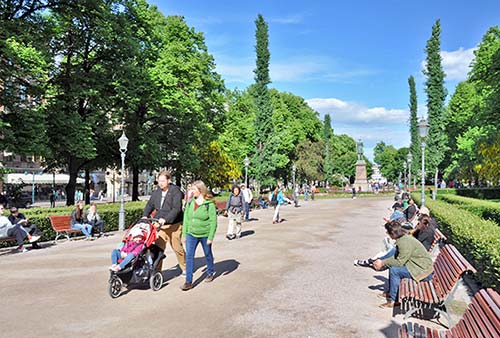
Gusting winds swirl crying seagulls against a blue sky scattered with cotton-ball clouds. Rock bands and folk-dancing troupes enliven the Esplanade from the stage in front of Café Kappeli, sunny days lure coffee sippers onto the sidewalks, and fun-loving festivals fill the summer (when the sky still glimmers at midnight). And in this country famed for design, window-shopping the Design District can turn browsers into buyers of home decor, clever kitchen gadgets, handmade jewelry, and unique clothes with a Finnish accent.
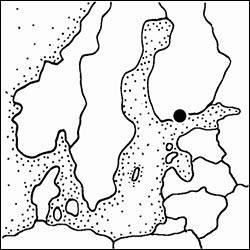
While budget flights affordably connect Helsinki to the Scandinavian capitals (and beyond), for many travelers, the next best thing to being in Helsinki is getting there on Europe’s most enjoyable overnight boat. The trip from Stockholm starts with dramatic archipelago scenery, a setting sun, and a royal smorgasbord dinner. Dance until you drop and soak in the sauna until you drip. Budget travel rarely feels this hedonistic. Seventeen hours after you depart, it’s “Hello Helsinki.” (See “Helsinki Connections” at the end of this chapter for details.)
PLANNING YOUR TIME
Helsinki is worth at least two nights and a full day. To do the city justice, a two-day visit is ideal.
For a quick one-day stop, start with the 1.5-hour hop-on, hop-off bus tour (see “Tours in Helsinki,” later). Then follow my self-guided Helsinki City Walk through the compact city center from the harbor—enjoying the ruddy harborfront market, strolling the Esplanade boulevard, and ending at the city’s proud new Oodi Library. The city’s three most-visited churches (Lutheran Cathedral, Uspenski Cathedral, and Temppeliaukio “Church in the Rock”) are all worth a peek.
With more time, investigate Helsinki’s iconic architecture, explore the Design District, dive into Finnish culture in the open-air folk museum, or take a walk in Kaivopuisto Park. If the weather’s good, head for Suomenlinna, the island fortress built in the 18th century to protect what was then the Swedish kingdom. If the weather is bad, go for a sauna. Either way, make time to enjoy a cup of coffee at the landmark Café Kappeli.
While most people day-trip from Helsinki to Tallinn, you could do the reverse for a single day in Helsinki (the cities are just two hours apart by ferry; for details, see “Helsinki Connections” near the end of this chapter).
Orientation to Helsinki
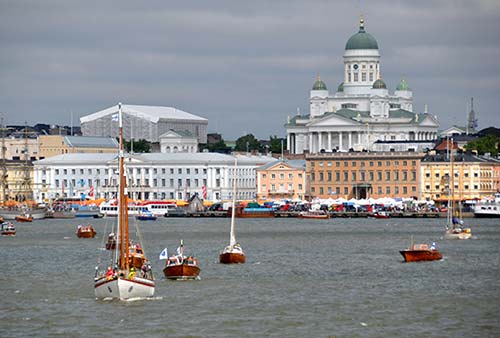
Helsinki (pop. 664,000) has a compact core. The city’s natural gateway is South Harbor, where passenger boats and cruise ships dock. At the top of the harbor is Market Square (Kauppatori), an outdoor food and souvenir bazaar. Nearby are two towering, can’t-miss-them landmarks: the white Lutheran Cathedral and the red-brick Uspenski Cathedral.
Helsinki’s grand pedestrian boulevard, the Esplanade, begins right at Market Square, heads up past Café Kappeli, and ends after a few blocks in the central shopping district. At the top end of the Esplanade, the broad, traffic-filled Mannerheimintie avenue veers north through town past the train and bus stations on its way to many of Helsinki’s museums and architectural landmarks. For a do-it-yourself orientation along this route, follow my Helsinki City Walk and Iconic Architecture Stroll, later. And for a good drive-by introduction to some sights and outlying neighborhoods that most tourists miss, hop on a tram (see my Helsinki Tram Tour, later).
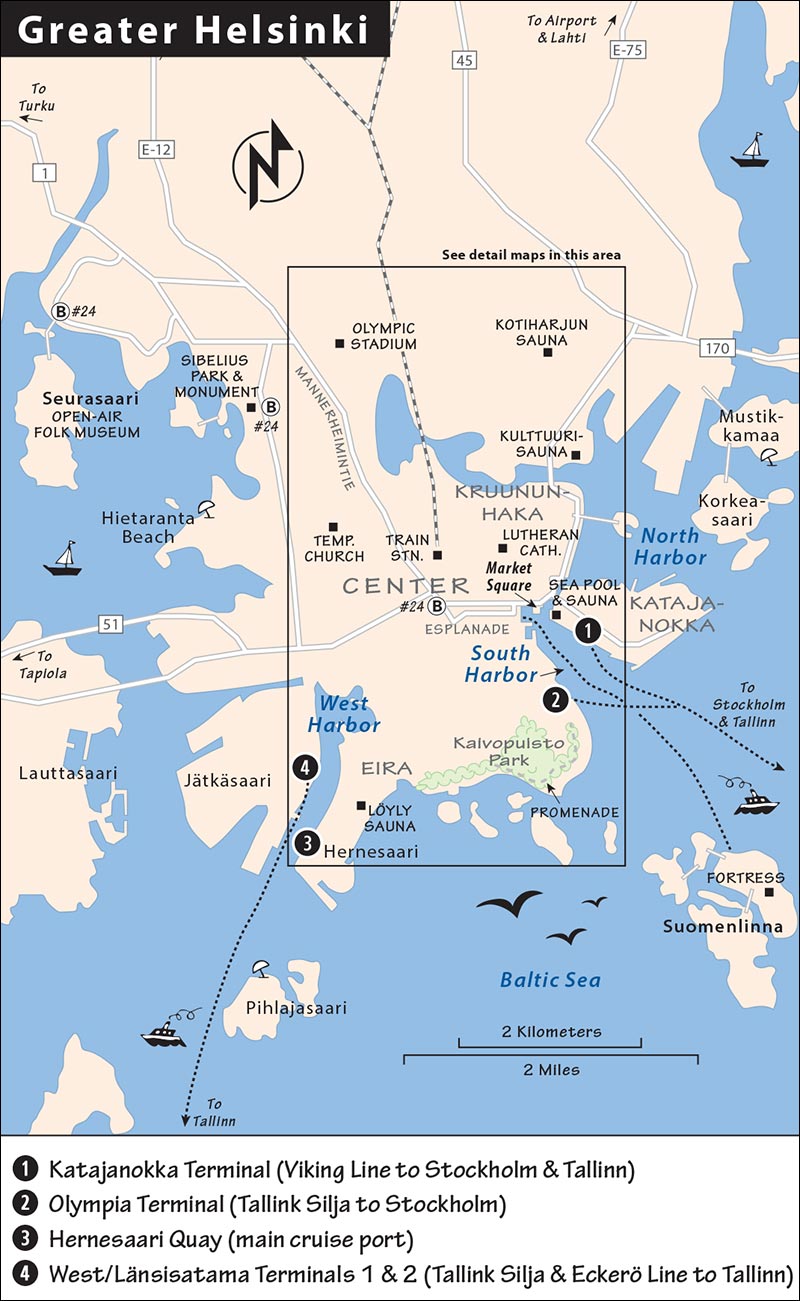
Linguistic Orientation: Finnish is completely different from the Scandinavian languages of Norwegian, Danish, and Swedish. That can make navigating a bit tricky. Place names ending in -katu are streets, -tie is “road” or “way,” and -tori or -aukio means “square.” Finland’s bilingual status means that most street names, tram stops, and map labels appear in both Finnish and Swedish. The two names often don’t resemble each other (for example, South Harbor is Eteläsatama in Finnish and Södra Hamnen in Swedish; the train station is Rautatieasema in Finnish, Järnvägsstationen in Swedish). The Swedish names can be a little easier to interpret than the Finnish ones. Plus, most Finns speak excellent English.
TOURIST INFORMATION
The friendly TI, located on Senate Square, offers great service and excellent handouts including public transit information, a design shops map, and a detailed pamphlet on the Suomenlinna Fortress (Mon-Sat 9:00-17:30, Sun until 16:00, shorter weekend hours off-season, Aleksanterinkatu 24—at the corner with Sofiankatu street, +358 9 3101 3300, www.myhelsinki.fi). Check their handy “events today” board, or see the events calendar online to see what’s on. In summer, you may find pop-up tourist kiosks around town.
Strömma/Sightseeing Helsinki: This private service operates sightseeing tours by bus and boat, and staffs a small, summer-only sightseeing kiosk by the harbor at their cruise departure point (Mon-Sat 10:30-14:30, sometimes until 17:30, or matched to tour departure times, +358 9 2288 1600, www.stromma.fi). They also sell ferry tickets and the Helsinki Card.
Helsinki Card: If you plan to visit a lot of museums in Helsinki, this card can be a good deal. The card covers nearly 30 museums, fortresses, and other major sights (including some seasonal local cruises); free use of buses, trams, and the HSL ferry to Suomenlinna; and 24-hour access to a hop-on, hop-off bus (€54/24 hours, multiday passes available). It’s sold at most downtown hotels, the Strömma sightseeing departure point, the Stockmann Service Point on the eighth floor of that department store, and online (www.helsinkicard.com)—but note that the digital version does not include public transport.
ARRIVAL IN HELSINKI
By Boat: For details on arriving in Helsinki by boat, see “Helsinki Connections” at the end of this chapter.
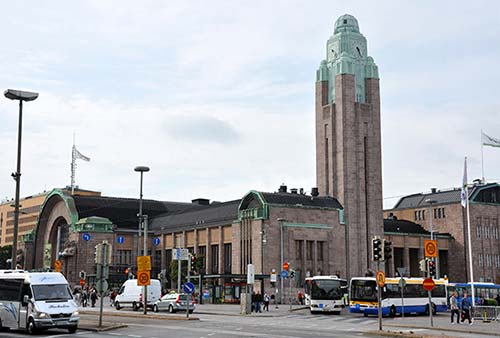
By Train and Bus: The central train station, an architectural landmark, is near the top of the Esplanade, a 15-minute walk from Market Square. Local buses leave from both sides of the building, trams stop out front, and the Metro runs underneath. The long-distance bus station is two blocks (or one tram stop) away, at the Kamppi shopping mall on the other side of Mannerheimintie; the ticket office and machines are on the ground floor, with bus platforms below.
By Plane: For information on Helsinki’s airport, see “Helsinki Connections” at the end of this chapter.
HELPFUL HINTS
Time: Finland and Estonia are one hour ahead of Sweden and the rest of Scandinavia.
Money: ATMs are labeled Otto, and they’re uncommon in Finland, where cash is rarely used. Your credit card will work for most purchases.
Pharmacies: A convenient pharmacy (apteekki) is Erottajan, on the basement level of Stockmann department store (similar hours as store, Mannerheimintie 1, +358 9 622 9930). For longer hours, try Yliopiston Apteekki at Mannerheimintie 5.
Laundry: On the seventh floor of the Stockmann department store, Sol has reasonably priced drop-off/pickup service (similar hours as store, Aleksanterinkatu 52, +358 40 779 7222).
Bike Rental: To use Helsinki’s city bike system you need a European phone number. Instead, try Bicyclean Helsinki, a shop in Katajanokka. Norberto and his crew will set you up with a bike, helmet, and lock as well as answer your Helsinki biking questions (usually 10:00-18:00 Mon-Fri, until 16:00 Sat, closed Sun, Luotsikatu 14, + 358 44 2915 331, http://bicycleanhelsinki.com).
Best View: The Torni Tower Ateljée Bar offers a free panorama view. Ride the elevator from the lobby of the venerable Art Deco Torni Hotel (built in 1931) to the 12th floor and climb the tight spiral sobriety-testing staircase to the lofty cocktail bar (daily from 14:00, Yrjönkatu 26—for location, see the “Helsinki Hotels & Restaurants” map, later).
GETTING AROUND HELSINKI
By Public Transportation
Helsinki is compact, but public transportation can be useful for certain trips. Helsinki’s buses and trams are easy—you just need the public-transit route map (available at the TI) and/or the HSL app (www.hsl.fi). The handy ferry from Market Square to Suomenlinna Fortress is part of the system. (The single Metro line is not useful for most visitors.)
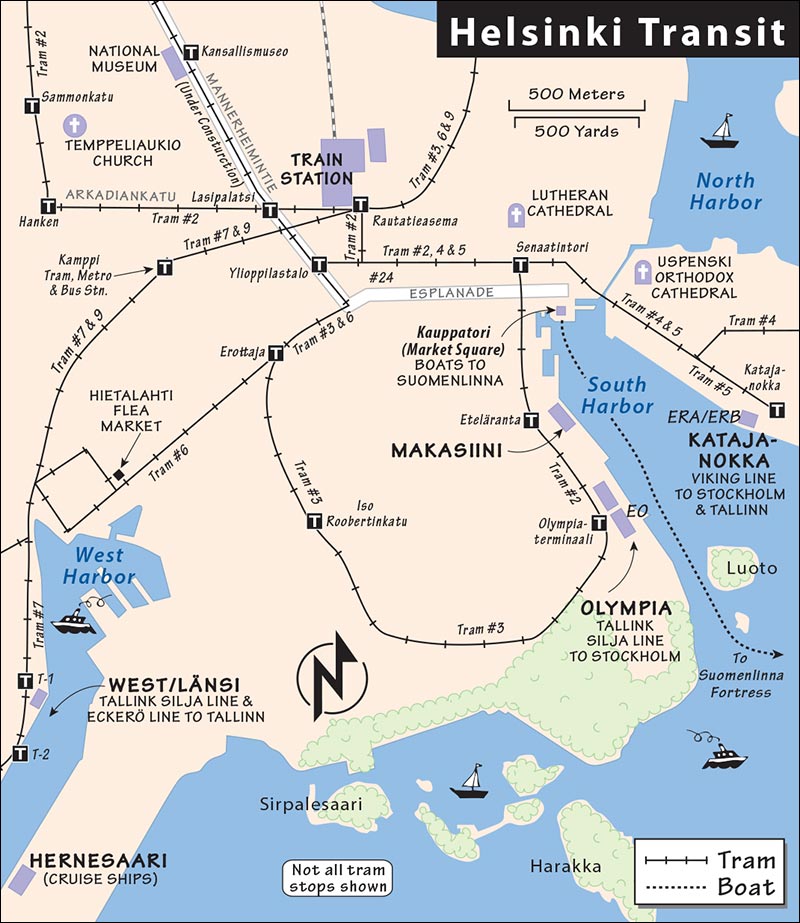
Tickets: Single tickets (€2.95) are good for 80 minutes of bus or tram travel (buy on the HSL app or at ticket machines at some bus and tram stops; contactless card payment expected by late 2024 or 2025). A day ticket (€9/24 hours) buys you unlimited travel (multiday version available). Day tickets can be bought via the HSL app, at ubiquitous yellow-and-blue R-Kiosks convenience stores (€0.90 service charge), the train station, Metro stations, and at a handful of stops including ticket machines for the Suomenlinna ferry on Market Square. These tickets and cards are only valid within the city of Helsinki (zones A and B), not the suburbs; for example, you’ll pay separately for trains to the airport, which require zones A, B, and C. The traditional version of the Helsinki Card also covers public transportation; see “Helpful Hints,” earlier.
By Taxi or Uber
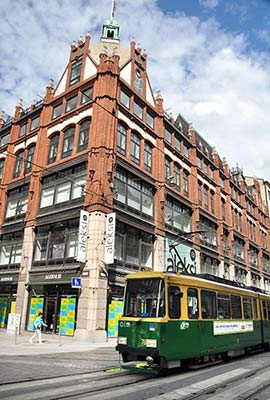
Taxis are not plentiful in Helsinki, but Uber works great for short trips and is usually cheaper (generally around €7 for a simple ride in town). If you want a taxi, it’s best to have your hotel order one for you.
Tours in Helsinki
The big company Strömma (also called Sightseeing Helsinki) has a near monopoly on city tours, whether by bus, boat, or foot. For a fun, cheap tour, use my self-guided “Helsinki Tram Tour” (described later) to pass by many of the town’s major sights in an hour.
Hop-On, Hop-Off Bus Tours
City Sightseeing Helsinki (operated by Strömma) has a summertime 1.5-hour loop with 19 stops that connects downtown Helsinki, several outlying sights—including the Sibelius Monument and Olympic Stadium—as well as the Olympia cruise terminal (on cruise-ship days, the bus generally stops at Hernesaari quay—confirm in advance). Buses run every 20-40 minutes (€34, €48 combo-ticket also includes harbor tour—see below, all tickets good 24 hours, May-Sept daily 10:00-16:00, www.stromma.fi). In winter they run a handy two-hour Helsinki Panorama tour that covers all the important sights from the Olympic Stadium to Embassy Row. You stay on the bus except for a 10-minute stop or two (€34, free with Helsinki Card, daily Oct-April at 11:00, second Sat departure at 13:30). A different company, Sightseeing City Tour (also red buses), offers a similar hop-on, hop-off route for similar prices, with fewer departures (www.citytour.fi).
Harbor Tours
Two boat companies, Helsinki Sightseeing/Strömma and Royal Line, compete for your attention along Market Square, offering snoozy cruises around the harbor and its islands roughly hourly from 10:00 to 18:00 in summer (typically 1.5 hours for €24-28; www.stromma.fi, https://royalline.fi). The narration is slow-moving—often recorded and in as many as four languages. I’d call it an expensive nap. Taking the public ferry out to Suomenlinna and back gets you onto the water for much less money (see the “Suomenlinna Fortress” listing later in this chapter for details).
SpåraKoff Pub Tram
In summer, this antique red tram makes a 45-minute loop through the city while its passengers get looped on the beer for sale on board (€12 to ride, €6/beer, May-Sept Mon-Sat 14:00-20:00, no trams Sun, leaves at the top of the hour from the Mikonkatu stop—in front of the Fennia building, across from train-station tower—search for SpåraKoff at https://www.raflaamo.fi).
Local Guides
Christina Snellman is a good licensed guide (€60/hour, +358 50 527 4741, chrisder@pp.inet.fi). Maria Hanninen is also a good, high-energy, licensed guide (€70/hour, 3-hour minimum, if booked she has colleagues, hanninen.maria@gmail.com, +358 50 352 6975). George Ekström enjoys being your friend in Helsinki, introducing Finland with a human touch on intimate walks that are more than just the big hits (€30/hour, 2-hour minimum, for up to 6 people). He also does a shared tour (€45, 3.5 hours, 4 miles of walking, +358 46 637 4430, georgekstrom@gmail.com). You can also book licensed guides directly through their local association (€180/3 hours, helsinkiguides.fi). Archtour offers local guides who are working architects and specialize in Helsinki’s architecture (+358 41 313 4029, www.archtours.com).
Walks in Helsinki
2 Senate Square (Senaatintori)
4 Iittala, Arabia, and Aarikka
6 Artek, Marimekko, and Stockmann
8 Central Train Station (Rautatieasema)
Kiasma Museum of Contemporary Art (Nykytaiteen Museo Kiasma)
Helsinki Music Center (Musiikkitalo)
Alvar Aalto’s Finlandia Hall (Finlandia-Talo)
▲National Museum of Finland (Kansallismuseo)
HELSINKI CITY WALK
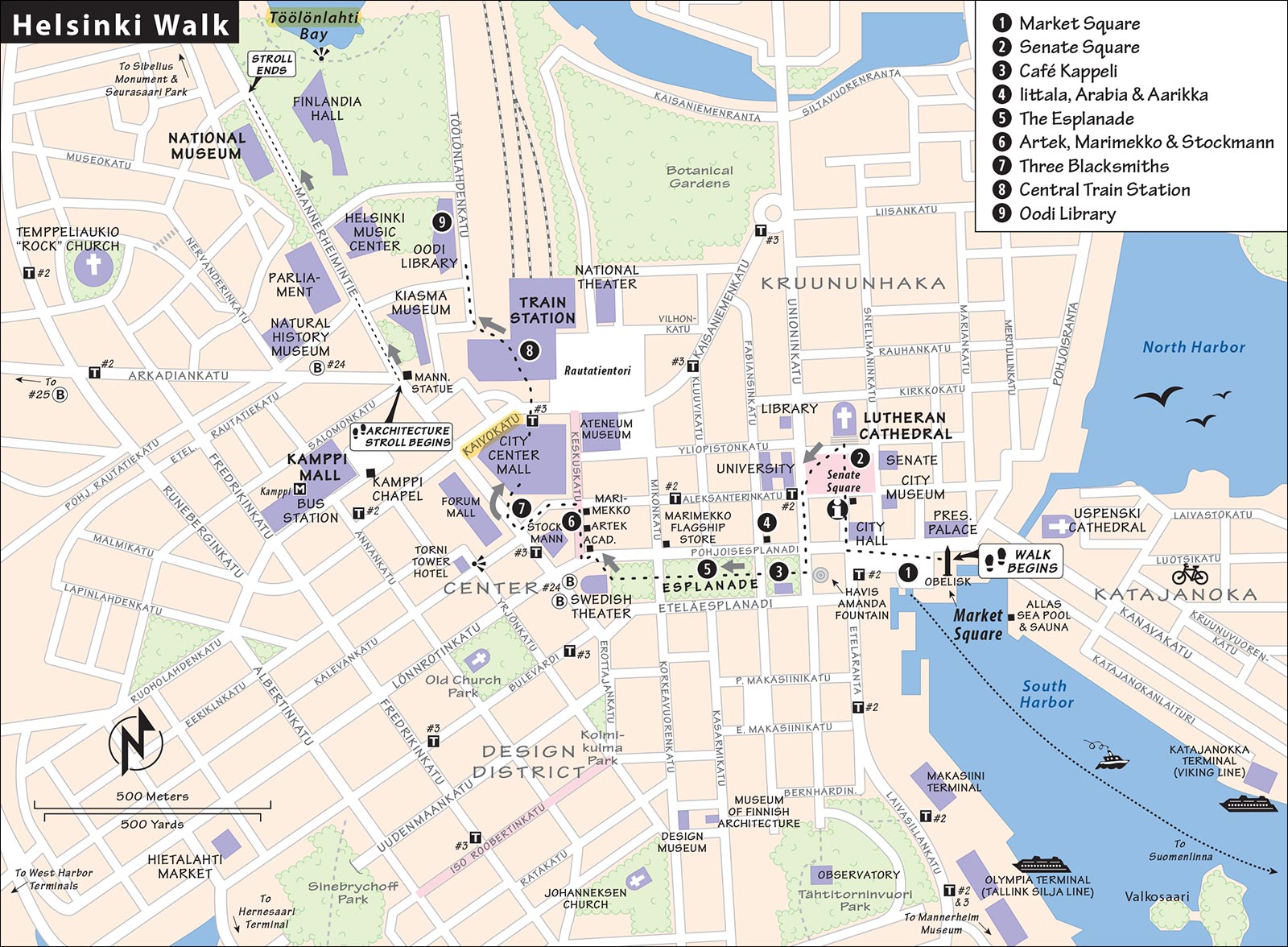
This self-guided walk—worth ▲▲▲—offers a convenient spine for your Helsinki sightseeing, starting at Market Square and ending just beyond the train station at the Oodi Library. With more time, you can continue from there to visit more of the city’s cultural landmarks, finishing at the Temppeliaukio Church with an optional bus trip to two additional sights (see my Iconic Architecture Stroll, later). If you’d rather ride than walk, my Helsinki Tram Tour, later, covers some of the same terrain as this walk.
• Start at the obelisk in the center of the harborfront market.
1 Market Square (Kauppatori)
This obelisk, with its double-headed eagle of imperial Russia, is the Czarina’s Stone. It was the first public monument in Helsinki, designed by Carl Ludvig Engel and erected in 1835 to celebrate the first visit by a Russian empress (when Czarina Alexandra and Czar Nicholas I came to town). Stand here for a clockwise spin-tour:
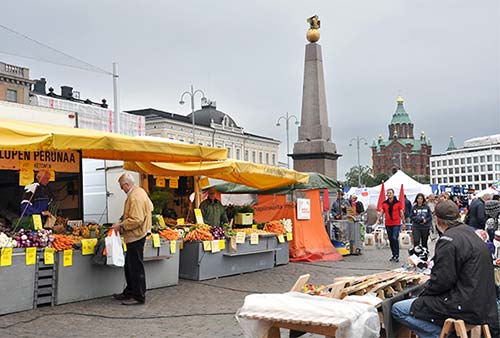
Begin by facing the harbor. The big, red Viking ship and white Silja ship are floating hotels for those making the 40-hour Stockholm-Helsinki round-trip. Farther back, a giant Ferris wheel spins over the harbor (SkyWheel Helsinki, www.skywheel.fi). Now pan to the right. The brick-and-tan building along the harborfront is the Old Market Hall, with some enticing, more upscale options than the basic grub at the outdoor market (for a rundown on both options, see “Eating in Helsinki,” later). Between here and there, a number of harbor cruise boats vie for your business.
Farther to the right, linden trees mark the beginning of Helsinki’s grand promenade, the Esplanade. Hiding in the leaves is the venerable iron-and-glass Café Kappeli. To the right of the Esplanade, a string of Neoclassical buildings lines the harbor. The blue-and-white City Hall—designed by Engel in 1833—was the town’s first luxury hotel. The Lutheran Cathedral is hidden from view behind this building. Next, after the short peach-colored building, is the Swedish Embassy (flying the blue-and-yellow Swedish flag and designed to look like Stockholm’s Royal Palace). Then comes the Supreme Court and, tucked back in the far corner, Finland’s Presidential Palace. Finally, standing proud (and reminding Helsinki of the Russian behemoth to its east) is the Uspenski Cathedral.
Explore the colorful outdoor market—part souvenirs and crafts, part fruit and veggies, part fish and snacks. The produce is fresh and tasty with lots of generous samples. Orange tents sell food, while white tents sell souvenirs.
• Done exploring? Walk to the corner of Market Square at City Hall and turn right up Sofiankatu street, with its old cobbles leading to modern cobbles.
Part way up Sofiankatu, at the City Hall entrance on the right (at #1A), notice the historic street sign in Russian along with Swedish and Finnish—you know it dates to before independence from Russia in 1917. Inside, the workers’ cafeteria welcomes the public for lunch (Mon-Fri, €14 including coffee and dessert). There’s a free WC across the street.
• Near the end of the block, you’ll pop out right in the middle of...
2 Senate Square (Senaatintori)
This was once a simple town square with a church and City Hall—but its original buildings were burned in 1808. Later, after Finland became a grand duchy of the Russian Empire, the czar sent in architect Carl Ludvig Engel (a German who had lived and worked in St. Petersburg) to give the place some Neo-class. The result: the finest Neoclassical square in Europe. Engel represents the paradox of Helsinki: The city as we know it was built by Russia, but with an imported European architect, in a very intentionally European style. So, Helsinki is—in a sense—both entirely Russian...and not Russian in the slightest.
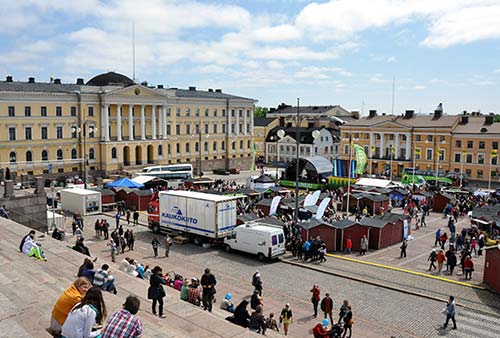
The statue in the center of the square honors Russian Czar Alexander II. The czar who freed the serfs (and was assassinated) was well liked by the Finns. That’s because he gave Finland more autonomy in 1863 and didn’t push the Russification of Finland.
The huge staircase leading up to the Lutheran Cathedral is a popular meeting (and tanning) spot in Helsinki. Head up those stairs and survey Senate Square from the top. Scan the square from left to right. First, 90 degrees to your left is the yellow Senate building (now the prime minister’s office). The small, blue-gray stone building with the slanted mansard roof in the far-left corner, from 1757, is one of just a few pre-Russian-conquest buildings surviving in Helsinki (it’s now the home of the Helsinki City Museum). Café Engel (opposite the cathedral at Aleksanterinkatu 26) is a fine place for a light lunch or cake and coffee. The café’s winter lighting seems especially designed to boost the spirits of daylight-deprived northerners. (This latitude has just six hours of daylight in the dead of winter.)
Facing the Senate directly across the square is its twin, the University of Helsinki’s main building (36,000 students). Symbolically (and physically), the university and government buildings are connected via the cathedral, and both use it as a starting point for grand ceremonies.
Tucked alongside the cathedral, a line of once-grand Russian administration buildings now house the National Library of Finland. In czarist times, the National Library received a copy of every book printed in Imperial Russia. With all the chaos Russia suffered throughout the 20th century, a good percentage of its Slavic texts were destroyed. But Helsinki, which enjoyed relative stability, claims to have the finest collection of Slavic books in the world. This purpose-built Neoclassical building, its facade lined with Corinthian columns, is one of Engel’s finest and worth a look.
If you’d like to visit the cathedral interior, now’s your chance; the entrance is around the left side as you face the towering dome (for details, see “More Sights in Helsinki,” later).
• When you’re ready, head back down the stairs and angle right through the square, continuing straight down Unioninkatu.
Along Unioninkatu, do a little window-shopping; this is the first of many streets we’ll see lined with made-in-Finland shops. In addition to jewelers and clothes boutiques, look for the Schröder sporting goods store (on the left, at #23), which shows off its famous selection of popular Finnish-made Rapala fishing lures—ideal for the fisher folk on your gift list. At #30 you’ll see one of the more than hundred Art Nouveau facades that grace the city.
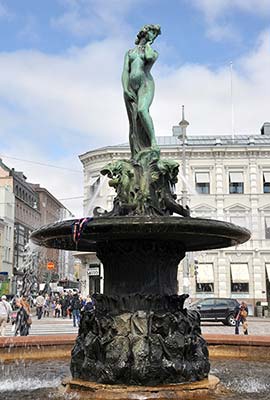
At the end of this street, cross over to reach the fountain and female statue called Havis Amanda. Designed by Ville Vallgren and unveiled here in 1908, the statue has become the symbol of Helsinki, the city known as the “Daughter of the Baltic.” Graduating students decorate her with a school cap every May. The voluptuous figure, modeled after the artist’s Parisian mistress, was a bit too racy for the conservative town, and Vallgren had trouble getting paid. But as artists often do, Vallgren had the last laugh: The city budget office across the street sees only her backside.
• Now turn toward the Esplanade’s grassy median, with the delightful...
3 Café Kappeli
Dip into this old-fashioned, gazebo-like oasis of coffee, pastry, and relaxation and enjoy the Old World atmosphere. In the 19th century, this was a popular hangout for local intellectuals and artists. Today the café offers romantic tourists waiting for their ship a great cup-of-coffee memory. The bandstand in front hosts nearly daily music and dance performances in summer. (You can pick up what you like at the self-serve counter and sit anywhere. Locals love the salmon, soup-and-bread lunch specials, and free seconds.)
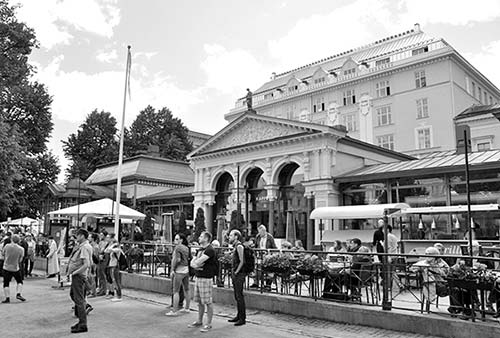
• Shoppers will note that directly across from Kappeli are several beloved Finnish design shops...
4 Iittala, Arabia, and Aarikka
Design like you’ll see on display in Iittala and Arabia is big for Finns: practical for everyday use, affordable, with a simple Nordic aesthetic. Arabia has been recognized as a mark of quality and unpretentious class since 1873. Their ceramic pieces are considered lifelong investments in everyday luxury, and their warm colors are beloved in the land of long dark winters. Iittala is its sister brand, with classic Finnish glassware. A block away, Aarikka specializes in clothing, jewelry, and home goods. We’ll pass other famous design shops soon; for details, see “Shopping in Helsinki,” later.
• Between the café and shops stretches...
5 The Esplanade (Esplanaden)
Helsinki’s top shopping boulevard comes with a park in the middle. Called the Esplanade, it leads to a street called Bulevardi. The grandiose names, while fitting today, would have been purely aspirational in rustic little 1830s Helsinki (whose population was only about 10,000).
The Esplanade was laid out in 1826 by Engel under Russian rule. The czars were Francophiles, so they made the Esplanade feel a bit like the Champs-Elysées. It was (with a good imagination) a little bit of Paris in the north. Today, the park is the green heart of the city. As you stroll, admire the mature linden trees and imagine this elegant promenade in the old days. The Esplanade connects the old city of the late 1700s—the established power center—with the new parts of town, where impressive stone houses in a neo-Renaissance style would be built by the late 1800s.
Notice the ornately decorated Hotel Kämp (on the right at #29). This city landmark is typical of the elegant hotels, shops, and restaurants that began springing up in the late 19th century as the Esplanade became a place to be seen. Today, the street’s exclusive air is maintained by enterprises such as Galleria Kämp (entrance at #31), a high-end fashion mall with big-name Finnish and international stores, and the Strindberg Café, one of many tony spots along the Esplanade for a drink.
At the very top of the Esplanade, the park dead-ends at the Swedish Theater. Built under Russian rule to cater to Swedish residents of a Finnish city, this building encapsulates Helsinki’s complex cultural mix. (The theater’s recommended Teatterin deli is a handy spot for a meal out in the park.)
Across from the theater, at #39, is the huge Academic Bookstore (Akateeminen Kirjakauppa), designed by Modernist architect Alvar Aalto, with an extensive map and travel section, periodicals, English books, and the Café Aalto (with ageless Aalto furniture) on the back mezzanine level.
• At the end of the Esplanade, turn right, and you’ll reach the pedestrianized Keskuskatu street with several landmarks of Finnish shopping and design...
6 Artek, Marimekko, and Stockmann
Around the corner and down the street from the Academic Bookstore is Artek, founded in 1935 by Alvar Aalto to showcase his practical, modern designs for furniture and housewares. And at the far corner is perhaps Finland’s most famous export: Marimekko, the fabric designer whose bold and colorful patterns adorn everything from purses to shower curtains (more Marimekko branches are within a block of here). The other side of the street is dominated by Stockmann, the biggest, best, and oldest department store in town (with a sprawling supermarket in the basement).
• At the corner of Keskuskatu and Aleksanterinkatu, in front of Marimekko, walk left and see a landmark statue, the...
7 Three Blacksmiths
While there’s no universally accepted meaning for this statue (from 1932), most say it celebrates human labor and cooperation and shows the solid character of the Finnish people. On the base, note the surviving shrapnel damage from World War II. Russia used that war as an opportunity to invade Finland—which it had lost just 20 years prior—to try to reclaim their buffer zone. In a two-part war (the Winter War from 1939 to 1940, then the Continuation War from 1941 to 1944), Finland held fast and emerged with its freedom—and relatively little damage.
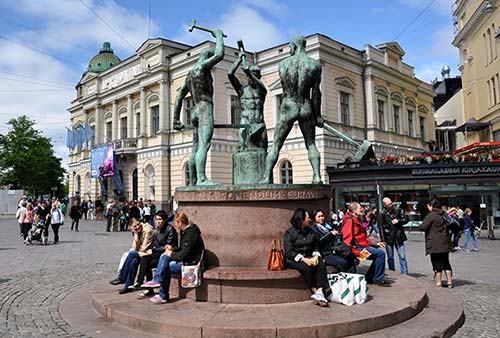
Stockmann’s entrance on Aleksanterinkatu, facing the Three Blacksmiths, is one of the city’s most popular meeting points. Everyone in Finland knows exactly what it means when you say: “Let’s meet under the clock.” Across the street from the clock, the Old Student Hall is decorated with legendary Finnish heroes.
• For a shortcut to our next stop, from the statue go about 100 feet downhill. On the left, duck through the passage (marked City-Käytävä) directly across the street from Stockmann’s clock. This will take you through a bustling commercial zone. You’ll enter—and continue straight through—the City Center shopping mall. Emerging on the far side, you’re face-to-face with four granite giants guarding the...
8 Central Train Station (Rautatieasema)
This Helsinki landmark was designed by Eliel Saarinen (see the “Two Men Who Remade Helsinki” sidebar). The big, stern figures on the facade, carrying illuminated globes, seem to have stepped right out of a Nordic myth.
With your back to the train station, look to the left; diagonally across the square is the Ateneum, Finland’s national gallery of art. It faces the Finnish National Theater (not visible from here)—founded to promote Finnish-speaking theater in the years Finland was dominated by Swedish speakers.
Duck into the main hall of the train station. Peek into the Olivia Restaurant inside (on the left) to catch the building’s early 20th-century architectural razzle-dazzle.
Then, step out to the train platform. Before Russia invaded Ukraine (ending service for now), you could ride the rails from here to St. Petersburg in less than four hours, then go overnight to Moscow and all the way to Hong Kong with just two changes.
• Leave the station out the back (to the left as you face the tracks). Cross the huge square kitty-corner and go between two large glass buildings to the new library. It’s the swooping glass and wood building a block ahead.
9 Oodi Library
Helsinki’s central library (worth ▲▲)—Oodi is pronounced “awdi,” which means “ode”—opened in 2018 to celebrate the 101st birthday of Finland’s independence. Facing the parliament and other institutions of art, culture, and democracy, its facade is covered with planks of Finnish spruce. A third of the space is dedicated to books and the rest is a creative collection of anything the community might need or appreciate (free, daily 8:00-21:00).
Loitering is encouraged, so browse around to explore a library of the future with a passion for practical offerings. You’ll see intense chess games, a sleeping zone, sewing stations, soundproof recording studios, game rooms, and free meeting spaces for clubs and nonprofit organizations. You can use the 3-D printer, borrow games or sports gear (even skis), and use the WC. Oh, and you can check out books! Don’t miss Vera—the robot who helps with restocking books.
Appreciate the grand, central spiral staircase decorated with words that describe the kinds of people welcome in the library: the henpecked, chubby folk, babies, victims of war, fundamentalists, prudes, tourists…essentially everybody.
Finish your walk at the view terrace on the top floor. Spreading before you are many of the most iconic buildings in the city. From left to right, you can see the curvy Kiasma Museum of Contemporary Art, the parliament house (from 1931), the green glass Helsinki Music Center, the National Museum (with its green tower), Alvar Aalto’s white Finlandia Hall, and, in the distance, the 1952 Olympic Stadium (with its tall skinny white tower).
• We’ve covered the highlights of the town center. Several important buildings near the library await your exploration on the next walk, the...
ICONIC ARCHITECTURE STROLL
The following sights can be laced together as a short walk following the boulevard called Mannerheimintie, which serves as a showcase for much of Helsinki’s signature architecture. To begin, use the “Helsinki Walk” map to locate the first stop (labeled “Mann. Statue”). From there, you’ll find the other sights via an easy stroll up Mannerheimintie.
Carl Gustaf Mannerheim Statue
This statue—in front of the Kiasma Museum—depicts Finnish war hero Carl Gustaf Mannerheim, who led anti-Communist forces in the newly independent Finland’s 1918 Civil War. Later, during the Winter War of 1939-1940, Mannerheim and his fellow Finns put up stiff resistance to a massive Soviet invasion. While the Baltic States across the Gulf of Finland were quickly “liberated” from the Nazis by the Red Army, dooming them to decades under the Soviet system, the Finns managed to refuse this “assistance.” Mannerheim became Finland’s first postwar president, and the busy Mannerheimintie street is named after him. Thanks to his efforts (and those of countless others), Finland was allowed to chart its own democratic, capitalist course after the war. (Even so, Finland remained officially neutral through the Cold War, providing both East and West a political buffer zone.)
Kiasma Museum of Contemporary Art (Nykytaiteen Museo Kiasma)
Finland’s museum of contemporary art, designed by American architect Steven Holl, hosts changing exhibitions of international art (there’s no permanent collection). Ask at the TI or check online to find out what’s showing.
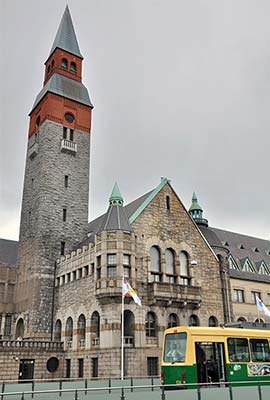
At the turn of the 20th century, architect Eliel Saarinen burst on the scene by pioneering the Finnish National Romantic style. Inspired by peasant and medieval architectural traditions, his work was fundamental in creating a distinct—and modern—Finnish identity. The château-esque National Museum of Finland, designed by Saarinen and his two partners after winning a 1902 architectural competition, was his first major success. Two years later, Saarinen won the contract to construct the Helsinki train station (completed in 1919). Its design marks a transition into the Art Nouveau style of the early 1900s. The landmark station—characterized by massive male sculptures flanking its entrance, ornate glass and metalwork, and a soaring clock tower—welcomes a multitude of travelers each day.
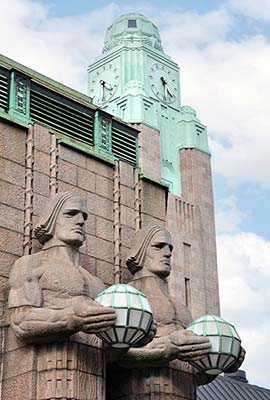
In the early 1920s, Saarinen and his family emigrated to the US where his son, Eero, would become the architect of such iconic projects as the Gateway Arch in St. Louis and the main terminal at Dulles International Airport near Washington, DC.
Alvar Aalto was a celebrated Finnish architect and designer working in the Modernist tradition; his buildings used abstract forms and innovative materials without sacrificing functionality. Finlandia Hall in Helsinki is undoubtedly Aalto’s most famous structure, but that’s just the beginning. A Finnish Frank Lloyd Wright, Aalto concerned himself with nearly every aspect of design, from furniture to light fixtures.
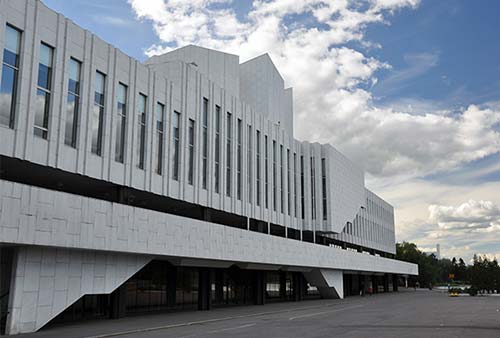
Perhaps most notable of these creations was his sinuous Savoy Vase, a masterpiece of simplicity and sophistication that is emblematic of the Aalto style. His designs became so popular that in 1935 he and his wife opened Artek, a company that manufactures and sells his furniture, lamps, and textiles to this day.
Cost and Hours: €20; Tue-Fri 10:00-20:30, Sat until 18:00, Sun until 17:00, closed Mon; Mannerheiminaukio 2, near train station, +358 294 500 501, www.kiasma.fi.
Helsinki Music Center (Musiikkitalo)
Completed in 2011, this structure is even bigger than it looks: two-thirds of it is underground, and the entire complex houses six separate venues. It’s decorated, inside and out, with bold art (such as the gigantic pike, a fish on tiptoes, that stands in the middle of the park evoking deep Finnish mythology among locals).
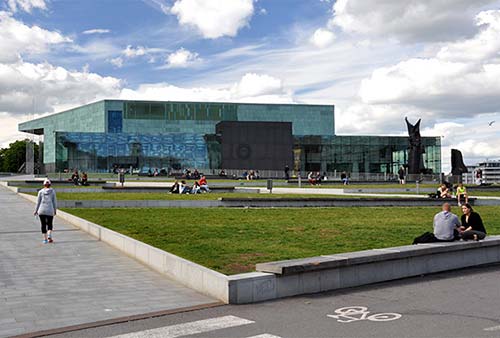
As you approach the bottom of the building, step into the atrium and look up to ogle the shimmering silver sculpture. While you’re there, consider stopping by the ticket desk (on the lower floor) to ask about performances while you’re in town (the season is Sept-May). The interior features a lot of pine and birch accents, which warm up the space and improve the acoustics. It didn’t take long for the Music Center to become an integral part of the city’s cultural life; in the first season of performances, some 400,000 people attended events here.
Cost and Hours: Building open Mon-Fri 8:00-22:00, Sat-Sun 10:00-20:00; English tours offered most days in summer for €15, check website for schedule; immediately in front of the Oodi Library at Mannerheimintie 13A, +358 20 707 0421, www.musiikkitalo.fi.
Alvar Aalto’s Finlandia Hall (Finlandia-Talo)
Next up, this big, white building can be a bit difficult for casual observers to appreciate. To get the best view of it, walk through the long parking lot all the way to the far end, and look back. The building—designed by Aalto, inside and out, and perhaps the most important work of Finnish architecture—opened in 1971 and immediately became a national icon. Using geometric shapes and sweeping lines, Aalto created a striking concert hall seating up to 1,700 guests. He inclined the roofline to try to maximize the hall’s acoustics, imitating the echo chamber of an old-fashioned church tower. As a major renovation wraps up, you may find some services in an adjacent Little Finlandia building.
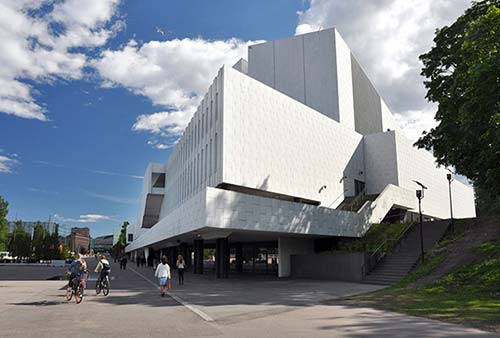
Cost and Hours: €16 for a tour, call ahead or visit website to check times; hall info point open Mon-Fri 9:00-19:00, closed Sat-Sun; Mannerheimintie 13e, +358 9 40241, www.finlandiatalo.fi.
Nearby: Turn from Finlandia Hall to face shimmering Töölönlahti Bay—not a lake, but an inlet of the Baltic Sea—ringed by a popular walking and jogging track. From here, you can see more Helsinki landmarks: across the lake and a bit to the left, the white tower marks the Olympic Stadium that hosted the world in 1952. And to the right are the rides of Helsinki’s old-time amusement park, Linnanmäki.
▲National Museum of Finland (Kansallismuseo)
Across the street from Finlandia Hall (and closed until 2027 for a major renovation), this grand building was designed in the early 1900s by three of Finland’s greatest architects—including Eliel Saarinen. Museum exhibits trace the cultural history of the Finns from prehistory to the present day. Highlights include Finland’s largest permanent archaeological collection, the 1420 altarpiece dedicated to St. Birgitta (patron saint of Sweden—which owned Finland at the time), and a reconstructed early 1800s “smoke cabin” (sauna). Check for updates at www.kansallismuseo.fi.
More Sights Nearby
About a 10-minute walk behind the National Museum is the beautiful Church in the Rock, Temppeliaukio. Once inside, have a seat and enjoy the music. To continue on to the Sibelius Monument, located in a lovely park setting, take bus #25 (direction: Pajamäki; walk two blocks down Arkadiankatu street to find the bus stop on Mechelininkatu). The same ticket is good for your return trip (within 80 minutes); or you can ride bus #24 from the Sibelius Monument to the end of the line for the bridge to Seurasaari Island and Finland’s open-air folk museum. From there, bus #24 returns to the Kamppi bus station. All three of these sights are explained in more detail under “More Sights in Helsinki,” later.
Helsinki Tram Tour
Of Helsinki’s many trams, two convenient routes, #2 and #3, seem made-to-order for a tourist’s joyride. Follow the ▲▲ route outlined below (but confirm locally, as Helsinki has been revising some routes).
If you buy a single ticket, it’s good for 80 minutes—just long enough for the entire circuit outlined below (trams run every 10 minutes). To hop on and off, it’s best to use a day ticket (for ticketing, see “Getting Around Helsinki,” earlier) or a Helsinki Card.
While you can hop on anywhere, it’s most convenient to start your tour at Market Square.
1 Market Square: Stand at the tram stop between the fountain and the market and wait for one of the frequent #2 trams. Confirm that the front of the tram reads Ilmala, not Olympiaterminaali (tram stop: Kauppatori).
2 Senate Square: From Market Square, you’ll first pass the finest Neoclassical square in northern Europe. Notice the gleaming white Lutheran Cathedral, a statue of Alexander II—Finland’s favorite czar—and many of the oldest buildings in town. Then you’ll head up the long Aleksanterinkatu street, historically Helsinki’s Fifth Avenue-type main shopping drag (tram stop: Aleksanterinkatu).
3 Train Station: From Aleksanterinkatu, the tram will veer in front of the central train station, one of Helsinki’s defining Art Nouveau structures. Designed by the great Finnish architect Eliel Saarinen and clad in Finnish granite, the station has two pairs of lantern carriers guarding its main entrance. This is Finland’s busiest building, with throngs of commuting Finns and tourists. Two stops later is the Kamppi shopping center, with over 150 restaurants, shops, cafes, and plenty of culture nearby: More than half of Helsinki’s music venue capacity is in this neighborhood (tram stops: Rautatieasema, Kamppi).
4 School of Economics and Trendy Apartments: Note the yellow brick buildings and facade of the School of Economics (on your left—tram stop: Hanken). The Temppeliaukio Church (a.k.a. “Church in the Rock”), while not visible here, is just a block uphill from the Hanken stop. After a few more stops, you’ll enter a neighborhood with lots of desirable 1920s-era Art Deco-style apartments. Young couples start out here, move to the suburbs when they have their kids, and return as empty nesters.
5 Finnish National Opera House: Built in 1993, the National Opera House is the white, sterile, shower-tile building on the right (tram stop: Ooppera). If you’re interested, the next stop (Töölön halli) is a short walk from the Sibelius Monument and its pretty park (detour along a street called Sibeliuksenkatu). Otherwise, stay onboard for a few more stops.
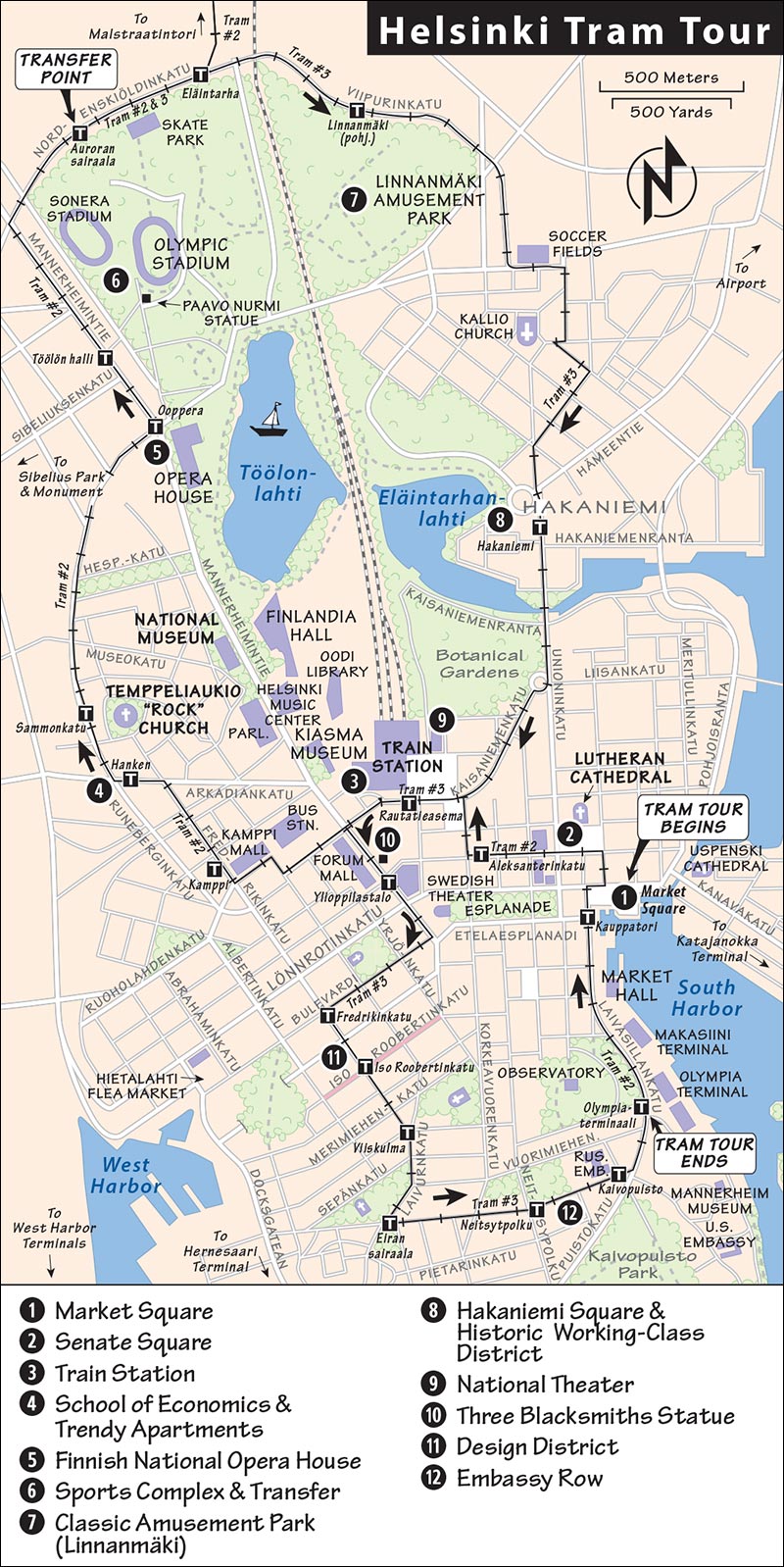
6 Sports Complex and Transfer: The white building with the skinny tower (in the distance on the right) marks the Olympic Stadium, used for the 1952 summer games. (Finland’s most famous Olympian was long-distance runner Paavo Nurmi, the “Flying Finn,” who won nine gold medals early in the 20th century.) At the Auroran sairaala stop, hop off and transfer to tram #3 (direction: Olympiaterminaali—a monitor will show how long until the next tram arrives). You may see skateboarders enjoying a park of their own (on the right).
7 Classic Amusement Park: Look for roller coasters in the distance on your right as you approach Linnanmäki. Helsinki’s low-end, Tivoli-like amusement park is by far the most-visited sight in town (on the right, free admission to park, pay for rides, open daily until late, tram stop: Linnanmäki (pohj.), www.linnanmaki.fi). Coaster nuts enjoy its classics from the 1950s.
8 Historic Working-Class District: Next you’ll enter an old working-class neighborhood, Kallio. Once on the outskirts of the city, today it is part of the inner core and home to students, young adults, and artists. Kallio is the most densely populated neighborhood in Finland, with studios and one-bedroom apartments making up 90 percent of all residences.
Its soccer fields (on your left) are frozen into ice rinks for hockey in the winter. You’ll pass the striking granite Kallio Church (Art Nouveau, on your right) and Hakaniemi Square, with a big indoor/outdoor market (on your left).
Optional stop at Hakaniemi Square: This plaza hosts a small open-air farmers market and an old brick market hall (Kauppahalli, closed Sun). The market hall is impressive with lots of food on the ground floor and crafts upstairs. To continue your tram tour, get back on tram #3—direction Olympiaterminaali.
While you await your tram, here’s some local economics to chew on: The average annual wage is about $45,000 and most couples both work—taking advantage of subsidized childcare—earning a total family income of about $90,000. After paying about 30 percent in taxes they end up with $60,000 a year to live on.
Tram #3 soon crosses a saltwater inlet on a short bridge nicknamed the “long bridge” because it once separated the wealthy and working-class districts of Helsinki. You’ll soon pass Helsinki’s Botanical Gardens (on the right).
9 National Theater: Coming up is the town center, where you’ll reach a big square. Fronting it (on the right) is Finland’s granite National Theater, in Art Nouveau style, with a statue honoring Aleksis Kivi, the father of Finnish literature. On the left is the Ateneum, Finland’s national art gallery. Next, you’ll make another pass by the striking central train station.
10 Three Blacksmiths Statue: After turning left on big, busy Mannerheimintie, you’ll pass the most famous statue in town, the Three Blacksmiths (on your left), which honors hard work and cooperation. Towering above the smiths is the Stockmann department store. Then (at the Ylioppilastalo stop), the round, white Swedish Theater (left) marks the top of the town’s graceful Esplanade park, which leads back down to the harbor (where you began this tour). From here, you’ll loop through the colorful and artsy Design District.
11 Design District—Funky and Artsy Shops: On the right, the cemetery of the church (which dates from 1827) became a park. It’s called the Plague Park, recalling a circa-1700 epidemic that killed more than half the city’s population. Coming up (over the next several stops), funky small boutiques, cafés, and fun shops line the streets (stops: Fredrikinkatu, Iso Roobertinkatu, and Viiskulma).
12 Embassy Row and the End of the Line: After the Art Deco brick church (in a park on your right), the tram makes a hard left (at the Eiran sairaala stop) and enters a district with Art Nouveau buildings. Look down streets on the right, leading to the Baltic Sea, for decorative facades and turrets.
After the Neitsytpolku stop, spy the Russian Embassy (a blocky, fortified complex through the trees on the left), still sporting its hammer and sickle; it was built to look like London’s Buckingham Palace. Across the street is the Roman Catholic church, and beyond that (on the right), a street marked “no entry” leads to the fortified US Embassy (out of sight). Not far from the US Embassy is the well-presented museum of war hero and president Carl Mannerheim (see “More Sights in Helsinki,” later).
As the tram returns to the harbor, you’ll likely see the huge Tallink Silja ship that leaves each evening for Stockholm. Its terminal (Olympiaterminaali; also the name of the tram stop) was built to accommodate the flood of visitors to Helsinki for the 1952 Olympics.
Our tram ride ends here. You can stay on the tram (it becomes tram #2 here—but you don’t need to transfer) and ride two stops to get back to Market Square. Or walk 15 minutes back to Market Square. Along the way, you’ll pass the cute brick Old Market Hall with great little eateries.
More Sights in Helsinki
▲▲Uspenski Cathedral (Uspenskin Katedraali)
▲▲Lutheran Cathedral (Tuomiokirkkoseurakunta)
Helsinki City Museum (Helsingin Kaupunginmuseo)
▲Kamppi Chapel (Kampin Kappeli)
Finnish Museum of Natural History (LUOMUS)
▲Sibelius Monument (Sibelius-Monumentti)
▲Mannerheim Museum (Mannerheim-Museo)
▲▲Suomenlinna Fortress (Suomenlinnan Merilinnoitus)
▲▲Seurasaari Open-Air Folk Museum (Seurasaaren Ulkomuseo)
Unless otherwise noted, for locations see the “Helsinki Walk” map, earlier.
NEAR THE SOUTH HARBOR
▲▲Uspenski Cathedral (Uspenskin Katedraali)
This house of worship was built in the Katajanokka district for the Russian military in 1868, at a time when Finland belonged to Russia (Uspenski is Russian for the Assumption of Mary). It hovers above Market Square and faces the Lutheran Cathedral, just as Russian culture faces Europe.
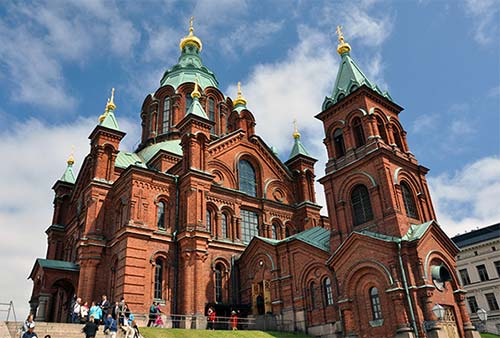
Cost and Hours: Free; Tue-Fri 9:30-16:00, Sat 10:00-15:00, Sun 12:00-15:00, closed Mon, longer hours in summer; Pormestarinrinne 1 (about a 10-minute walk beyond the harborfront Market Square).
Visiting the Cathedral: Before heading inside, view the exterior. The uppermost onion dome represents the sacred heart of Jesus, while the 12 smaller domes represent his apostles.
The rich imagery of the cathedral’s interior is a stark contrast to the sober Lutheran Cathedral. While commonly called the Russian church, the cathedral is actually Eastern Orthodox, answering to the patriarch in Istanbul. Today, the cathedral is the seat of the archdiocese of Helsinki, to which much of eastern Finland belongs.
The cathedral’s Orthodox Mass is beautiful, with a standing congregation, candles, incense, icons in action, priests behind the iconostasis, and timeless vocal music. The iconostasis was built with the church (1860s) and is realist in style. Much of the other art is older and was brought in from Russia. In the front left corner (just right of the granite column), find the tiny icon in a big frame featuring the Madonna and Child, surrounded by rings and jewelry (under glass), given in thanks for prayers answered. Across from this icon, a white marble table holds memorial candles and a tin chalice of wheat seeds, representing new life—the hope of resurrection—for the departed.
ON SENATE SQUARE
▲▲Lutheran Cathedral (Tuomiokirkkoseurakunta)
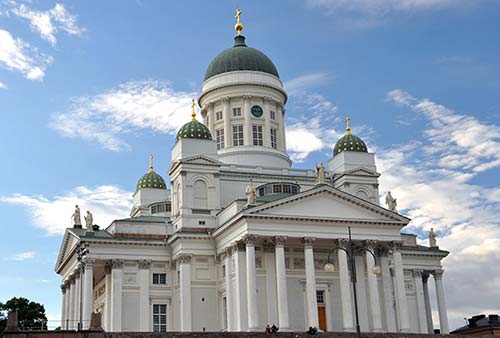
With its prominent green dome, gleaming white facade, and the 12 apostles overlooking the city and harbor, this church is the masterpiece of Carl Ludvig Engel, whose architecture shaped Helsinki in the early 19th century.
Cost and Hours: €8 June-Aug, free rest of the year; daily 9:00-18:00, until 21:00 in summer, no visits during church services or special events; www.helsinkicathedral.fi. In summer, free organ concerts are held weekly (generally Wed and Fri at 12:00, check website to confirm schedule).
Visiting the Cathedral: Enter the building around the left side. Finished in 1852, the interior is pure architectural truth. Open a pew gate and sit, surrounded by the “saints” of Protestantism, to savor Neoclassical nirvana. Physically, this church is perfectly Protestant—austere and unadorned—with the emphasis on preaching (prominent pulpit) and music (huge organ). Statuary is limited to the local Reformation big shots: Martin Luther, Philipp Melanchthon (Luther’s sidekick), and the leading Finnish reformer, Mikael Agricola. A follower of Luther at Wittenberg, Agricola brought the Reformation to Finland. He also translated the New Testament of the Bible into Finnish and is considered the father of the modern Finnish language. Agricola’s Bible is to Finland what the Luther Bible is to Germany and the King James Bible is to the English-speaking world. The altar painting, which may seem a bit out of touch with the rest of the church, was a gift from the Russian czar.
Helsinki City Museum (Helsingin Kaupunginmuseo)
This interesting museum, just off Senate Square in one of the city’s oldest buildings (dating from 1757), gives an accessible overview of the city’s history and culture.
Cost and Hours: Free, Mon-Fri 11:00-19:00, Sat-Sun until 17:00, Aleksanterinkatu 16, small gift shop, www.helsinkicitymuseum.fi.
Visiting the Museum: On the ground floor, visitors take a trip through time, viewing the many ways the city has changed over the years (professional photographers and Helsinki citizens contributed the images used for this “time machine”). A white-board animation cleverly condenses about 350 years of the city’s history into four minutes (from 1550 and Swedish rule, through the decades of Russian domination, to Finland’s declaration of independence in 1917). Exhibits on the second floor take you to a typical Helsinki home in the 1950s and a local bar from the 1970s, complete with vintage soundtracks. Kids can go to school in an old-fashioned classroom, try on costumes, or jump into a horse-drawn carriage.
Finland’s vaporized fountain of youth is the sauna—the Nordic answer to Spanx and facelifts.
A Finnish sauna is a wood-paneled room with wooden benches and a blistering hot wood-fired stove topped with rocks. At a traditional Finnish sauna, you undress entirely before going in. Lay your towel on the bench and sit or lie on it. Ladle water from the bucket onto the rocks to make steam. Choose a higher bench for more heat. Let yourself work up a sweat, then, just before bursting, go outside to the shower for a Niagara of liquid ice. Suddenly your shower stall becomes a Cape Canaveral launch pad, as your body scatters to every corner of the universe. A moment later you’re back together and can re-enter the steam room. Repeat as necessary. The famous birch branches are always available for slapping your skin. Finns claim this enhances circulation while emitting a refreshing birch aroma that opens your sinuses. For more on the history of saunas, see Sauna.fi.
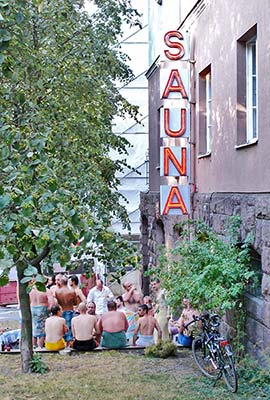
Because many Finns have saunas in their homes or cabins, public saunas aren’t as popular as they once were. Your hotel may have one. Some saunas are semipublic (separate men’s and women’s hours), while others are for private use (booked time slot). Some do not require you to be naked. Here are a few public saunas (for locations, see the “Greater Helsinki” map, earlier):
Kotiharjun Sauna: This good, traditional sauna has a local crowd. After stripping and steaming, cooling off is nothing fancy—just a bank of cold showers. For an extra fee, a woman in a fish-cleaner’s apron will give you a wonderful full-body scrub with Brillo pad-like mitts (€15). Regulars relax with beers on the sidewalk just outside (€15, towel rental, Tue-Sun 14:00-21:30, closed Mon, last entry at 20:00; men—ground floor, women—upstairs, private sauna available; 200 yards from Sörnäinen Metro stop, Harjutorinkatu 1, +358 9 753 1535, www.kotiharjunsauna.fi).
Kulttuurisauna: Sitting in a little park along the Baltic, Kulttuurisauna gives visitors a chance to take a dip in the sea. Designed and operated by a husband-and-wife, Finnish-Japanese, artist-and-architect team, it’s both modern and traditional. This is a savusauna (smoke sauna, without a chimney)—and, while the room is ventilated before bathers arrive, the smoky atmosphere lingers (€17, prebooking required and valid for 90 minutes, bring your own towel, all nude and gender-segregated, Wed-Sun 16:00-21:00, closed Mon-Tue, last entry at 19:50, just north of downtown at Hakaniemenranta 17, nearest tram/bus stop is Hakaniemi—a 10-minute walk away, www.kulttuurisauna.fi).
Löyly: Situated on the Hernesaari peninsula, sophisticated Löyly features a sauna and a restaurant that’s open to the sea. The modern building is covered in wood slats—from inside the sauna it’s like looking out through Venetian blinds. There are separate dressing rooms and showers for men and women, but the saunas are communal—everyone wears a bathing suit. It’s possible to swim in the sea and in winter, there’s a hole in the ice for hardy swimmers. The attached café/restaurant spills out onto a big view veranda and up to a rooftop terrace (€23/2 hours—includes towel, seat cover, soap, and shampoo; sauna generally open Mon 16:00-22:00, Tue-Fri 13:00-22:00 or 23:00, Sat 9:00-11:00 & 13:00-23:00, Sun 11:00-21:00; $$ restaurant open daily from 11:00; Hernesaarenranta 4, tram #6 stops at Eiranranta around the corner; +358 9 6128 6550, www.loylyhelsinki.fi). It’s smart to book ahead online.
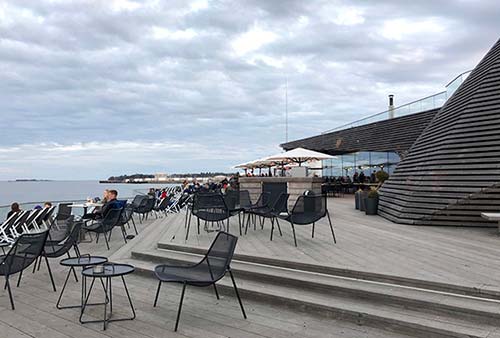
Allas: This place sits in the middle of the South Harbor action, at the edge of Market Square, with saunas that lead to a huge floating deck with three outdoor pools (fresh and sea water). Inside, there are five saunas: male, female, and mixed (€18-22; Mon-Fri 6:30-21:00, Sat from 8:00, Sun from 9:00, last entry 40 minutes before closing; towel and swimsuit rentals; café and bistro, Katajanokanlaituri 2a, www.allasseapool.fi).
There’s a lot to study and explore here, and it’s a great place for kids or on a rainy day. Most visitors won’t need to linger, but everyone leaves with a better understanding of why residents choose to call Helsinki home.
WEST OF THE ESPLANADE
These sights are scattered in the zone west of the Esplanade.
▲Ateneum
The Ateneum, Finland’s national art gallery, has the country’s oldest and largest art collection. Come here to see Finnish artists (mid-18th to 20th century) and a smattering of big-name international works including paintings by Cézanne, Chagall, Gauguin, and Van Gogh. The museum also hosts good special exhibits of Finnish and international art.
Cost and Hours: €20; Tue-Fri 10:00-20:30, Sat-Sun until 17:00, closed Mon; worthwhile guided tours offered first Sun of month, near train station at Kaivokatu 2, +358 294 500 401, www.ateneum.fi.
Visiting the Museum: The permanent collection is spread over two floors. While the second floor is mostly Finnish Romantic-era art (19th century), the first floor is organized thematically with Finnish paintings mixed in with those from countries to the south. Thoughtful descriptions help us to think about big issues and how they relate to Finland, compared to Europe in general. Themes such as Art and Power, the Age of Nature, Images of People, and Modern Urban Life are considered.
▲Kamppi Chapel (Kampin Kappeli)
Sitting unassumingly on the busy, commercial plaza in front of the Kamppi shopping mall/bus-station complex, this restful space was opened by the city of Helsinki to give residents and visitors a place of serenity. The wooden structure, clad in spruce and with an oval footprint, encloses a 38-foot-tall, windowless cylinder of silence. Inside, indirect light seeps in around the edges of the ceiling, bathing the clean, curved, alder-wood paneling in warmth and tranquility. Does it resemble Noah’s Ark? The inside of an egg? The architects intentionally left it vague—and open to each visitor’s interpretation. Although it’s a church, there are no services; it’s open to anyone needing a reflective pause. Locals drop by between their shopping chores to sit in a pew and ponder their deity, wrestle with tough issues, or just take a break. In this peaceful spot, secular modern architecture and meditative spirituality converge beautifully. Sadly, they charge an entry fee to moderate crowds in tourist season.
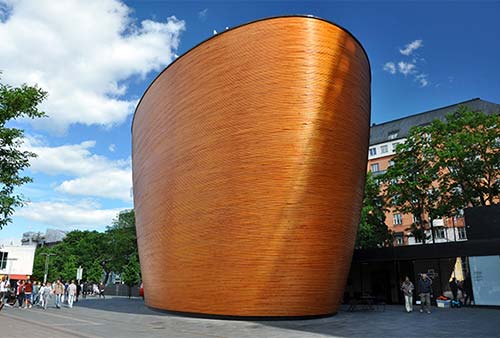
Cost and Hours: €5 June-mid-Sept, free rest of year; Mon-Fri 10:00-17:00, closed Sat-Sun; Simonkatu 7, enter through adjacent low-profile black building.
Finnish Museum of Natural History (LUOMUS)
Run by the University of Helsinki, this museum has the largest natural-history collection in Finland, with display cabinets crammed with pressed plants, dried fungi, taxidermied animals, and much more. Its wide-ranging exhibits emphasize the biodiversity of Finland and the world (most with English descriptions).
Cost and Hours: €18; Tue-Fri 10:00-17:00, Sat until 18:00, Sun 11:00-17:00; closed Mon; up the street behind the Parliament at Pohjoinen Rautatiekatu 13, www.luomus.fi.
▲▲Temppeliaukio Church
A modern example of great church architecture, this “Church in the Rock” was blasted out of solid granite. Architect-brothers Timo and Tuomo Suomalainen won a competition to design the church, which they built within about a year’s time in the late 1960s. Barren of decor except for a couple of simple crosses, the church is capped with a copper-and-skylight dome; it’s normally filled with live or recorded music and awestruck visitors. Grab a pew. Gawk upward at a 13-mile-long coil of copper ribbon. Look at the bull’s-eye and ponder God. Forget your camera. Just sit in the middle, ignore the crowds, and pray for peace. (Under your feet is an air-raid shelter that can accommodate 6,000 people.)
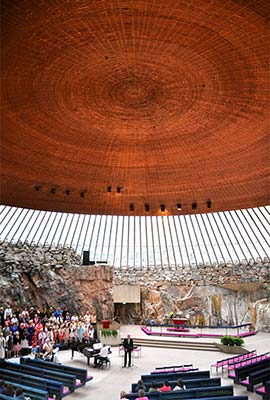
The church has excellent acoustics and is a popular concert venue; check at the TI for upcoming programs.
Cost and Hours: €8; generally Mon-Sat 10:00-19:00, Sun 12:00-18:00, closes one hour earlier Oct-May—but because of frequent events and church services, it’s good to confirm open times by listening to the recorded message at +358 9 2340 5940; Lutherinkatu 3, +358 9 2340 6320, http://temppeliaukionkirkko.fi.
Getting There: The church is at the top of a gentle hill in a residential neighborhood, about a 15-minute walk north of the bus station or a 10-minute walk from the National Museum (or take tram #2 to the Hanken or Sammonkatu stop).
▲Sibelius Monument (Sibelius-Monumentti)
Six hundred stainless-steel pipes called “Love of Music”—built on solid rock, as is so much of Finland—shimmer in a park to honor Finland’s greatest composer, Jean Sibelius. It’s a forest of pipe-organ pipes in a forest of trees. The artist, Eila Hiltunen, was forced to add a bust of the composer’s face to silence critics of her otherwise abstract work. City bus tours stop here for 10 minutes—long enough.
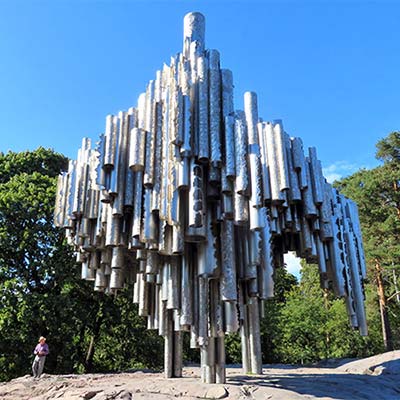
Getting There: The monument is a few blocks from the tram stop Töölön halli (tram #2) and near bus line #24, which also serves the Seurasaari Open-Air Folk Museum (described later). See the “Greater Helsinki” map, earlier, for general location.
DESIGN DISTRICT
Exploring Helsinki’s Design District is a sightseeing highlight for many visitors. A good starting point is the Design Museum, which sits just a few blocks southwest of the Esplanade. For more on the district, see “Shopping in Helsinki,” later.
▲Design Museum
Design is integral to contemporary Finnish culture, and this fine museum—with a small but insightful permanent collection and well-presented temporary exhibits—offers a good overview (all in English). Worth ▲▲▲ to those who came to Finland just for the design, it features interesting and clever installations that will appeal to just about anybody.
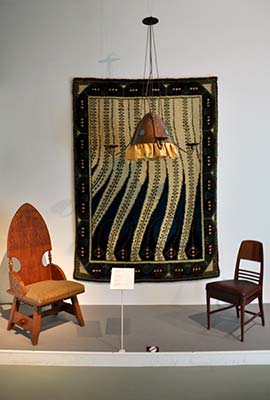
Cost and Hours: €15, €20 combo-ticket with Museum of Finnish Architecture; daily 11:00-18:00; Sept-May Wed-Sun 11:00-18:00, Tue until 20:00, closed Mon; excellent (if pricey) gift shop, Korkeavuorenkatu 23, www.designmuseum.fi.
Visiting the Museum: From the ticket desk on the ground floor, turn into the permanent exhibit, called Utopia Now: The Story of Finnish Design. The first gallery considers the process of design—the steps from inspiration to production—and presents iconic objects of Finnish design from the 1950s (glass bowls by Alvar Aalto) as well as more recent innovations (generations of Nokia phones).
The “Icons of Design” gallery introduces viewers to the life stories of leading Finnish designers and the functional objects they’ve created (Aalto’s iconic wooden stool, for example—a staple in classrooms around the world). The “Warehouse” collects items from different periods of the museum’s collections, with a focus on “better things for everyday life,” with everything from brightly colored but practical jerry cans for transporting fuel to a government-issued maternity box (a starter kit for new mothers, including clothes and sheets).
Digital applications throughout the galleries make your visit participatory: You can test how to control a Scorpion harvester (a staple of the Finnish forest industry), or you can animate a Marimekko pattern of your choosing on a wall-sized screen. A virtual headset lets you time travel to Finland’s pavilion at the 1900 Paris World’s Fair.
Upstairs and downstairs, you’ll also find typically excellent temporary exhibits that allow individual Finnish designers to take center stage.
Nearby: The Design Museum mounts some joint exhibits with the Museum of Finnish Architecture (Arkkitehtuurimuseo). Its permanent exhibit covers the decades from 1900 until 1970 (at Kasarmikatu 24, around the block from the Design Museum, www.mfa.fi).
KAIVOPUISTO
Located on the sea, Kaivopuisto is both a well-loved park and a well-to-do neighborhood with appealing old villas.
▲Mannerheim Museum (Mannerheim-Museo)
This unimposing museum near the US Embassy in Kaivopuisto (which may be closed for renovations when you visit) was the home of Finland’s dynamic statesman, Carl Gustaf Mannerheim. His life embodies the story of Finland’s march toward national consciousness; for history buffs, the museum is ▲▲. Mannerheim had a hand in everything from Finland’s founding as an independent nation in 1917 to his country’s defense during World War II.
The house is beautifully preserved and left just as it was during his lifetime. Excellent guided tours, included with your ticket and required for entry, ably present Mannerheim’s complex life and the historic events in which he was a transformative figure.
Cost and Hours: €14, Fri-Sun 11:00-16:00, hourly tours—last one at 15:00. Try arriving before the top of the hour to improve your odds of making a tour, or reserve online; +358 635 443, www.mannerheim-museo.fi.
Getting There: From the train station, take tram #3 to the Kaivopuisto stop and walk five minutes to the museum (for location, see the “Helsinki Tram Tour” map, earlier). Note that the museum is on the route of the Peninsula Promenade walk described in the next section.
OUTER HELSINKI
A weeklong car trip through the Finnish lakes and forests to Mikkeli and Savonlinna would be relaxing, but you can enjoy Finland’s green trees and blue-water scenery without leaving Helsinki. Here are three great ways to get out and walk on a sunny summer day. If you have time, do at least one of them during your stay. See the “Greater Helsinki” map, earlier, for general locations.
▲▲Suomenlinna Fortress (Suomenlinnan Merilinnoitus)
The island guarding Helsinki’s harbor served as a strategic fortress for three countries: Finland, Sweden, and Russia. It’s now a popular park, with delightful paths, fine views, a visitors center, and a worthwhile museum. On a sunny day, it’s a wonderful place to stroll among old fortifications with recreating Finns. The free Suomenlinna pamphlet (stocked at the Helsinki TI and on the island) covers the essential sights. The island has one good museum (the Suomenlinna Museum, described later) and several skippable ones, including a toy museum and several military museums (many open summer only).
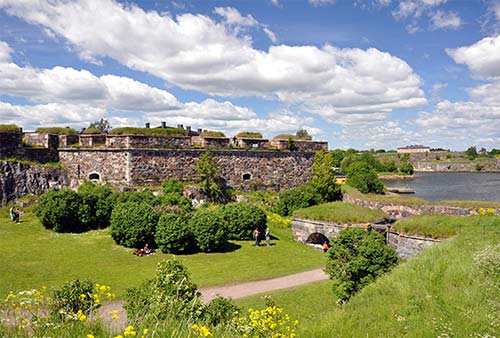
Getting There: Catch a ferry to Suomenlinna from Market Square. Walk past the high-priced excursion boats to the public HSL ferry (€2.95 one-way, covered by day ticket and Helsinki Card, 15-minute trip, 2-3/hour in May-Aug—generally at :00, :20, and :40 past the hour, but check schedule to confirm; Sept-April every 40-60 minutes). If your goal is the Suomenlinna Centre and the museum, the FRS “water bus” gets you closer than the public ferry (€9.20 round-trip, up to 2/hour, May-Sept only, departs from Market Square, +358 10 202 3780, www.frs-finland.fi/suomenlinna-lonna).
Visitor Information: The visitors center at the Jetty Barracks, at the ferry landing, is open year-round (daily 10:00-18:00, Oct-April until 16:00, +358 29 533 8410, www.suomenlinna.fi). Pick up the free island map/pamphlet here and ask what is happening that day—the knowledgeable staff can help organize your visit smartly. A helpful mobile map and guide can be found at https://guide.suomenlinna.fi.
Tours: The one-hour English-language island tour departs from the Suomenlinna Centre (€13, free with Helsinki Card; generally 2/day in summer, 1/day Fri-Sat only in May and Sept, check online for off-season tours). The tour is fine if you’re a military history buff, but it kind of misses the point of what’s now essentially a giant playground for all ages.
Eating: Several cafés operate in summer, and a grocery store near the ferry terminal makes it easy to rustle up fixings for a scenic picnic on the island.
Background: The fortress was built by the Swedes with French financial support in the mid-1700s to counter Russia’s rise to power. (Russian Czar Peter the Great had built his new capital, St. Petersburg, on the Baltic and was eyeing the West.) Named Sveaborg (“Fortress of Sweden”), the fortress was Sweden’s military pride and joy. With five miles of walls and hundreds of cannons, it was the second strongest fort of its kind in Europe after Gibraltar. Helsinki, a small community of 1,500 people before 1750, soon became a boomtown supporting this grand enterprise.
The fort, built by more than 10,000 workers, was a huge investment and stimulated lots of innovation. In the 1760s, it had the world’s biggest and most modern dry dock. It served as a key naval base during a brief Russo-Swedish war from 1788 to 1790. But in 1808, the Russians took the “invincible” fort without a fight—by siege—as a huge and cheap military gift.
Today, Suomenlinna has 800 permanent residents, is home to Finland’s Naval Academy, and is most appreciated by locals for its fine scenic strolls. The island is large—actually, it’s six islands connected by bridges—and you and your imagination get free run of the fortifications and dungeon-like chambers.
Visiting Suomenlinna: Start your stroll of the island at the Jetty Barracks near the public ferry landing. A suggested visitors’ route, marked with blue signs, runs from north to south across the island and will take you to all the key sights. You’ll wander on cobbles past dilapidated shiplap cottages that evoke a more robust time for this once-strategic, now-leisurely island.
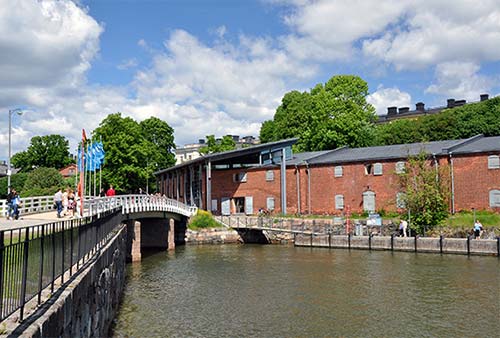
A five-minute walk from the ferry brings you to the Suomenlinna Centre, which houses the worthwhile Suomenlinna Museum. Inside the (free) lobby, you’ll find an information desk, gift shop, café, and giant model of all six islands that make up Suomenlinna—handy for orientation. The exhibits themselves are well presented but dryly explained: fragments of old walls, cannons, period clothing, model ships, and so on; the upstairs focuses on the site’s transition from a fortress to a park. The main attraction is the fascinating 25-minute film that presents the island’s complete history (€8 for museum and film, 2 showings/hour, daily 9:30—18:00, Oct-April 10:30-17:00).
From the Suomenlinna Centre, cross the bridge—noticing the giant, rusted seaplane hall on the right. On the far side of the hall, peer into the gigantic dry dock.
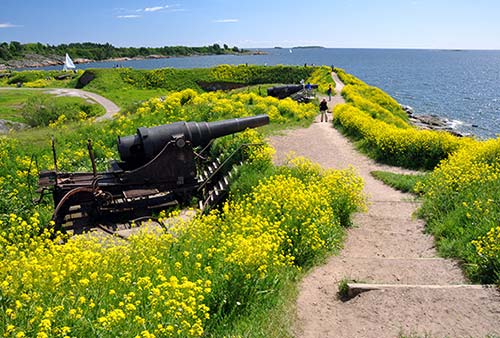
Back on the main trail, climb five minutes uphill to the right into Piper Park (Piperin Puisto). Hike up past its elegant 19th-century café (with rocky view tables) and continue up and over the ramparts to a swimming area. From here, follow the waterline—and the ramparts—to the south. You’ll walk above bunkers burrowed underground, like gigantic molehills (or maybe Hobbit houses). Periodic ladders let you scramble down onto the rocks. Imposing cannons, now used as playsets and photo-op props for kids, are still aimed ominously at the Gulf of Finland—in case, I imagine, of an invasion by sea...or if they just get fed up with all of those cruise ships. Reaching the southern tip of the island, called King’s Gate, peek out through the cannon holes. Then make your walk a loop by circling back to the Suomenlinna Centre and, beyond that, the ferry dock for the ride home.
Peninsula Promenade
For a breezy, salty seaside walk with island views, consider this promenade around the Kaivopuisto Park peninsula south of the center. Allow 1.5 hours at a leisurely pace. From Market Square, wander past the brick Old Market Hall and Tallink Silja terminal and follow the shoreline pedestrian path. The first island you’ll pass, Valkosaari, hosts the NJK yacht club, the largest and one of the oldest in Finland. The next island, Luoto, is home to the posh Saaristo restaurant (with shuttle boat service). During a typical winter, the bay freezes (18 inches of ice is strong enough to allow cars to drive to the islands—in the past there was even a public bus route that extended to an island during winter). The fortress island of Suomenlinna is in the distance. The hill you’re circling (on the right) is a swanky neighborhood and home to several embassies and the recommended Mannerheim Museum (may be closed for renovations when you visit); ahead, the classic Ursula Café, with its fine harbor views, is good for a coffee break (at Ehrenströmintie 3).
Around the corner, the next island, Uunisaari, is a fun destination in summer, when a little ferry connects the mainland with its sandy beach—perfect for a picnic. The island’s unique plant life (much studied by local students) is believed to have hitched a ride to Finland from Siberia on the boots of Russian soldiers.
The odd-looking pier nearby is a station for washing rugs (those are not picnic tables). Saltwater brightens the rag rugs traditionally made by local grandmas. While American men put on aprons and do the barbecue, Finnish men wash the carpets. After the scrub, the rugs are sent through big mechanical wringers and hung on nearby racks to dry in the wind. The posted map shows 11 such stations scattered around Helsinki. Buy an ice cream at the nearby stand and watch the action (best in the morning).
In the distance looms Helsinki’s big West Harbor, hosting hundreds of cruise ships a year. From here you can follow Neitsytpolku and Huvilakato streets back to the town center, keeping an eye out for fun Art Nouveau buildings.
▲▲Seurasaari Open-Air Folk Museum (Seurasaaren Ulkomuseo)
Located on a lovely island on the edge of town, this collection contains 100 historic buildings from every corner of Finland. It’s wonderfully furnished and gives visitors an opportunity to sample the far reaches of Finland without leaving the capital city—you can see the highlights here in about an hour (if you’re not taking a tour, get the map or the helpful guidebook). But it’s easy to stretch out your visit with a picnic or light lunch; snacks and cakes are available in the Antti farmstead at the center of the park. Off-season, when the buildings are closed, the place is empty and not worth the trouble.
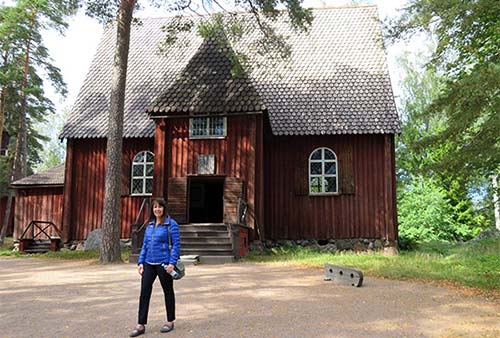
Cost and Hours: Free park entry, €10 to enter buildings; June-Aug daily 11:00-17:00, shorter hours May and Sept, buildings closed Oct-April; +358 295 336 912, www.seurasaari.fi.
Tours: One-hour English tours are free with entry ticket, offered mid-June-Aug generally at 15:00 (confirm time on website).
Getting There: To reach the museum, ride bus #24 (from the Kamppi bus terminal platform 47, 2/hour, 25 minutes) to the last stop at Seurasaari (note departure times for your return) and walk across the quaint footbridge.
NEAR HELSINKI
Porvoo, the second-oldest town in Finland, has wooden architecture that dates from the Swedish colonial period. This coastal town can be reached from Helsinki by bus (one hour) or by summertime excursion boat from Market Square (3.5 hours; https://msjlruneberg.fi. Taking the boat one way and the bus the other brings more flexibility and time in Porvoo. Check out the Brunberg chocolate shop (Välikatu 4).
Turku, the historic capital of Finland, is a two-hour bus or train ride from Helsinki. Overall, Turku has fewer worthwhile sights than Helsinki, and there is little reason to make a special trip. It does have a handicraft museum in a cluster of wooden houses (the only part of town to survive a devastating fire in the early 1800s), an old castle (the largest surviving medieval building in Finland), a fine Gothic cathedral (this was the first part of Finland to be Christianized, in the 12th century), and a market square. Viking and Tallink Silja boats sail from Turku to Stockholm every morning and evening, passing through the especially scenic Turku archipelago (see “Helsinki Connections,” later, for details).
Naantali, a cute, commercial, well-preserved medieval town with a quaint harbor, is an easy 20-minute bus ride from Turku.
Shopping in Helsinki
Helsinki may be the top design shopping town in the Nordic countries. Even in this region of creative design culture, Helsinki is a trendsetter; many Finnish designers are household names worldwide. The easiest place to get a taste of Finnish design is in the shops along the Esplanade, but with a little more time, it’s worth delving into the nearby Design District.
Business Hours: Most shops are open daily (generally 10:00 or 11:00 until 17:00 or 18:00), with shorter hours on Saturday and Sunday. Shops on the Esplanade tend to stay open later.
THE ESPLANADE AND NEARBY
Helsinki’s elegant main drag, the Esplanade, is a coffee-sipper’s and window-shopper’s delight. Practically every big name in Finnish design has a flagship store along or near this people-pleasing strip. Here are some worth dipping into:
Marimekko, the Finnish fashion company, was founded in the early 1950s but really took off on the international stage in the 1960s, especially after Jackie Kennedy bought seven Marimekko dresses (and wore one of them on the cover of Sports Illustrated). You’ll find the company’s colorful patterned scarves, clothes, purses, and fabrics in locations throughout central Helsinki. Their flagship store, with home decor and fashion, is just off the Esplanade (at Pohjoisesplanadi 33); other central locations include across from Stockmann department store (Aleksanterinkatu 50), and inside the Kamppi and Forum shopping centers (www.marimekko.com).
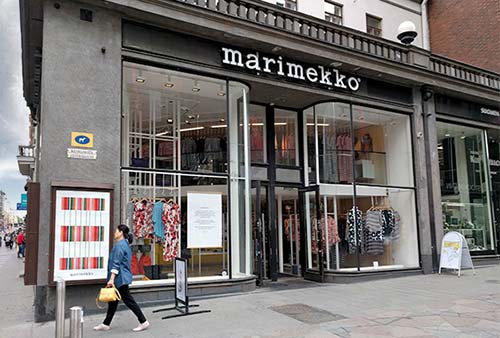
These shops are strung along the north side of the Esplanade (and included in my Helsinki City Walk): Aarikka (#27, closed Sun, www.aarikka.com) has affordable and casual handmade jewelry, tableware, and home decor, much of it made from colorful spheres of wood. Iittala (#23, daily, www.iittala.com) is the flagship store of a longtime Finnish glassmaker, featuring Alvar Aalto’s signature wavy-mouthed vases, which haven’t gone out of fashion since 1936; Oiva Toikka’s iconic “dew drop”-patterned chalices and pedestal bowls from 1964; and an array of functional tableware and glassware. Arabia, Iittala’s sister store at the same location, is beloved for its fine ceramics.
The Esplanade is capped by the enormous, eight-floor Stockmann department store. While big malls have eclipsed the grand stores like this, Stockmann has long been arguably Nordic Europe’s most impressive department store (daily, great basement supermarket, Aleksanterinkatu 52B, www.stockmann.fi). Bookworms enjoy the massive Academic Bookstore just downhill from Stockmann (#39, daily). Artek, Alvar Aalto’s flagship store (across from Stockmann at Keskuskatu 1B, closed Sun, www.artek.fi), offers fine furniture and lighting by the leading Finnish design concern.
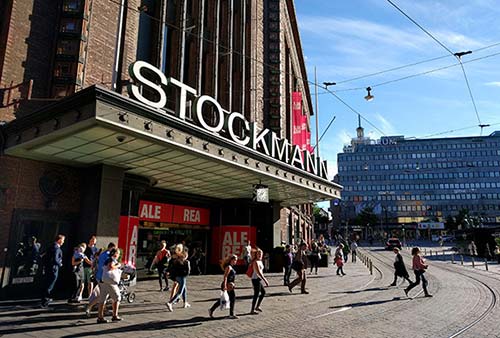
Fans of Tove Jansson’s Moomin children’s stories will enjoy the Moomin Shop, on the second floor of the Forum shopping mall at Mannerheimintie 20, across the busy tram-lined street from Stockmann (daily).
DESIGN DISTRICT
Helsinki’s Design District is a several-block cluster of streets filled with design and antique shops, boutiques highlighting local fashion designers, and trendy restaurants. Explore this engaging zone to feel the creativity and uniqueness of Finnish design and urban culture. For a handy orientation to the options in this ever-changing area, visit DesignDistrict.fi (with themed walking maps) or pick up the handy Design District brochure from the TI.
While the Design District sprawls roughly southwest of the Esplanade nearly to the waterfront, the following zones are most worthy of exploration.
Near Kolmikulma Park: Just a block south of the Esplanade’s top end (down Erottajankatu), the park called Kolmikulma (Diana Park, with its spear-throwing statue centerpiece) is a handy epicenter of Design District liveliness. Check out the following streets and shops in this area. Uudenmaankatu street (west from the park) has lots of good shops. Momono has well-selected examples of modern and vintage Finnish design (Yrjönkatu 1). Formverk features fun home decor and kitchenware (Roobertinkatu 12). Places to eat include the recommended Café Bar No. 9 and pedestrianized Iso Roobertinkatu, with lots of cheap eateries.
Fredrikinkatu, which crosses Uudenmaankatu two blocks west of the park, is one of the most engaging streets in town. Besides clothing stores, you’ll find the following: C. Hagelstam Antique Books (#35, quaint and beautiful shop with vintage prints and books), Chez Marius (#26, fun kitchen gadgets and cooking gear), and Casuarina (#30, rustic, reclaimed aesthetic home decor). If you need a treat while savoring Finnish design, pop into the chocolatier Xocolab (#41, crafted onsite, unique and beautiful bars and truffles).
Near the Design Museum: The Design Museum anchors an appealing area of boutiques—and itself has a good shop with a wide range of Finnish design products (often related to current exhibits). A block south of the museum, on Korkeavuorenkatu, you’ll find vintage shops, kitchenware, antiques, pop-up stores, clothing boutiques, hair salons, and cafés. Keep an eye out for Pore Helsinki (at #3), with casual fashion and accessories, and Fasaani (a.k.a. Helsinki Secondhand, at #5), with affordable pre-owned home-decor items just like those in galleries around town—furniture, dishes, glassware, and more (closed Sun, Korkeavuorenkatu 5, www.fasaani.fi).
OTHER SHOPPING OPTIONS
Market Square: This harborfront square is packed not only with fishmongers and producers, but also with stands selling Finnish souvenirs and more refined crafts (roughly Mon-Fri 6:30-17:00, an hour later in summer, Sat until 16:00, market is most active 9:00-15:00, only tourist stalls open Sun 10:00-17:00).
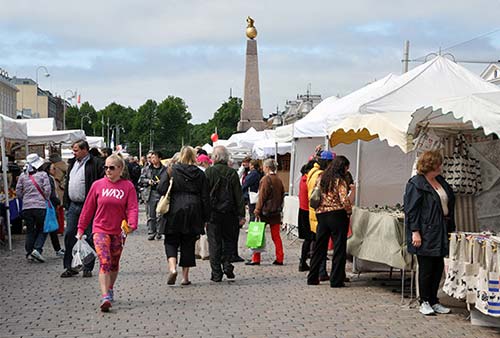
Modern Shopping Malls: For less glamorous shopping needs, the Kamppi mall above and around the bus station is good. The Forum shopping center at Mannerheimintie 20 is filled with Euro fashion brands.
Flea Market: If you brake for garage sales, the outdoor Hietalahti Market is a 15-minute walk from the harbor or a short ride on tram #6 from Mannerheimintie or the train station to the Hietalahdentori stop (June-Aug Sat-Sun 10:00-15:00, weather permitting). The adjacent red-brick indoor Hietalahti Market Hall houses food stands. You may also enjoy UFF, a secondhand and vintage chain with locations around Helsinki.
Sleeping in Helsinki
I’ve listed a wide range of accommodations in Helsinki, from fancy, well-located big hotels, to modest but cozy smaller hotels, to some unusually comfortable hostels. (And remember that some of the cheapest beds in Helsinki are on the overnight boats to Stockholm.) The hotels listed here have air-con and an elevator unless otherwise noted—and several have a sauna. Helsinki’s peak season is May to September.
HOTELS
$$$$ Hotel Haven, with 136 elegantly appointed, comfortable rooms and a lobby that artfully mingles class and rustic comfort, owns a convenient location with good access to the harbor and the Esplanade. “Superior” rooms face the back, with some street noise; quieter “prime superior” rooms face the harbor (but with no views). It’s worth a splurge, particularly if you can snare a deal (Unioninkatu 17, +358 9 681 930, www.hotelhaven.fi, sales@hotelhaven.fi).
$$$$ Hotel St. George, extravagant and perfectly located where the Esplanade and Design District meet, is in a historic building once occupied by the 19th-century Finnish Literature Society. This spacious hotel has 153 well-appointed and larger-than-average rooms, some with views and balconies. Bountiful amenities and comfortable spaces include a gym, sauna, spa, bar, restaurant, and bakery (Yrjönkatu 13, +358 9 4246 0011, www.stgeorgehelsinki.com, sales@stgeorgehelsinki.com).
$$$ Hotel Lilla Roberts, with 130 stylish rooms ranging from studios to suites, has a secluded courtyard and patio, friendly staff, and a prime location between the Esplanade and Olympia cruise terminal. Its sophisticated yet timeless interior harkens back to the building’s 1909 construction—in a past life, it was Helsinki’s police department (Pieni Roobertinkatu 1, +358 9 689 9880, www.lillaroberts.com, sales@lillaroberts.fi).
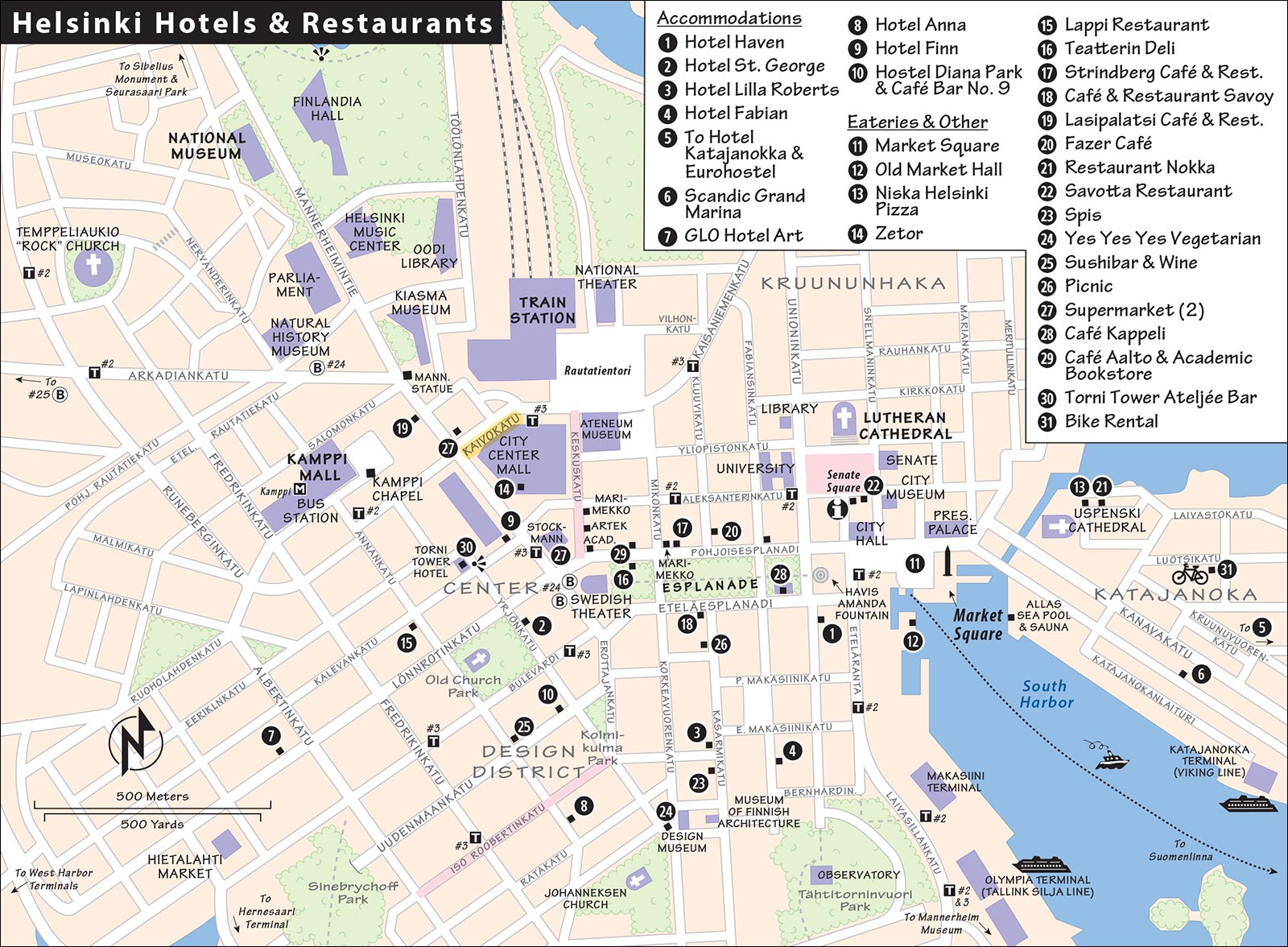
$$$ Hotel Fabian, a sister property of Hotels Haven and Lilla Roberts, has 58 spacious and comfortable rooms with a black-and-white color scheme, cozy and nicely decorated public spaces, and a relaxing outdoor courtyard (bike rental, a few blocks from the Esplanade at Fabianinkatu 7, +358 9 6128 2000, www.hotelfabian.com, sales@hotelfabian.fi).
$$$ Hotel Katajanokka occupies a former prison building, built in 1888, but you wouldn’t know it from the chic design of this appealing four-star hotel with 106 quiet rooms. The windows no longer have bars (thanks to the local fire code), and walls have been removed so that two or three cells make a room. Check out the two original cells in the restaurant (no air-con, gym, sauna, near Vyökatu stop of tram #4 near Katajanokka terminal, Merikasarminkatu 1A, +358 29 320 0620, www.hotelkatajanokka.fi, reception@hotelkatajanokka.fi).
$$$ Scandic Grand Marina is a huge 470-room, impersonal four-star hotel filling a big, brick warehouse building near the Katajanokka terminal (sauna, Katajanokanlaituri 7, +358 30 030 8404, www.scandichotels.com/grandmarina, grandmarina@scandichotels.com).
$$$ GLO Hotel Art has a fine location convenient to the Design District, with 171 modern rooms behind a striking Art Nouveau facade that makes it feel like a stony medieval château has landed in the middle of Helsinki (sauna, Lönnrotinkatu 29, +358 10 3444 100, www.glohotels.fi, art@glohotels.fi).
$$ Hotel Anna is plain, conscientiously run, and feels a bit tired. Its well-worn 64 rooms are in the heart of the Design District. For more air in the rooms, ask at the desk for a key to open the larger windows (RS%, no air-con, family rooms available, sauna, 4 blocks south of the top of the Esplanade—take tram #3 from train station to Iso Roobertinkatu, Annankatu 1, +358 9 616 621, www.hotelanna.fi, info@hotelanna.fi).
$$ Hotel Finn is slightly less expensive and wonderfully central. Its 35 tidy rooms are stowed quietly on the sixth floor of an office building near the top of the Esplanade. It’s short on amenities: tiny bathrooms, no breakfast (though a nearby bakery offers a buffet spread), and no real lobby or common space—but the location and service are just right (Kalevankatu 3B, +358 9 684 4360, www.hotellifinn.fi, info@hotelfinn.com).
HOSTELS
Helsinki’s hostels are unusually comfortable, and all ages are welcome with or without a hostel membership.
¢ Eurohostel is 400 yards from the Katajanokka terminal and a 10-minute walk from Market Square. More like a budget hotel than a hostel, this modern place has a restaurant and good budget-travel information (private and family rooms available, free morning sauna, evening sauna-€7.50, Vyökatu stop for tram #4 is around the corner, Linnankatu 9, +358 9 622 0470, www.eurohostel.eu/fi [URL inactive], eurohostel@eurohostel.fi).
¢ Hostel Diana Park is a small, friendly, centrally located hostel on the third floor of a 19th-century apartment building in the heart of the Design District. Stay here if you’re looking to meet fellow travelers in the common room and don’t mind lugging your bags up the stairs (private room available, no elevator, Uudenmaankatu 9, +358 50 338 5434, www.dianapark.fi, info@dianapark.fi).
Eating in Helsinki
In hopes of helping struggling restaurants get through post-pandemic tough times, the Finnish government gives Finnish companies a tax break if they distribute lunch coupons (worth €13) to their employees. That’s why so many downtown Helsinki restaurants offer weekday lunch specials that cost exactly the value of the coupon.
July is vacation month for locals, so many restaurants are closed and others run on shorter hours with shorter menus. Especially in summer, if you want to be sure to get a table, reserve in advance. For locations see the “Helsinki Hotels and Restaurants” map, earlier.
FUN HARBORFRONT EATERIES
Stalls on Market Square: Helsinki’s delightful and vibrant market square is magnetic any time of day...but especially at lunchtime. This really is a fun, memorable, quick-and-easy lunch option. A half-dozen orange tents (erected to shield diners from dive-bombing gulls) serve moose meatballs, smoked reindeer, and creamy salmon soup Mon-Fri until 18:00, Sat until 16:00, and Sun until 17:00. Although service is on paper plates, it’s not unusual for the Finnish president to stop by here with visiting dignitaries. At the far end are my favorites—several salmon grills (€13 for a good meal). While these places provide picnic tables, you can also have your food foil-wrapped to go and grab benches right on the water down near the Uspenski Cathedral.
Old Market Hall (Vanha Kauppahalli): Just beyond the harborside market is a cute, red-brick, indoor market hall. Its petite interior has been beautifully renovated with rich woodwork (Mon-Sat 8:00-18:00, Sun 10:00-17:00). Today, along with produce stalls, it’s a hit for its fun, gourmet eateries. You’ll find enticing coffee shops with tempting pastries; grilled, smoked, or pickled fish options; a handy chance to sample reindeer meat; and an array of international eateries, from Middle Eastern and Lebanese meals to Vietnamese banh mi sandwiches. In the back of the hall, Eriksson’s is a hit for its salmon soup and open-faced sandwiches.
For a Market Hall that’s less touristy, hop off your DIY Helsinki tram tour (see route, earlier) at Hakaniemi Square, where you’ll find an old brick market hall called Hakaniemi Kauppahalli, with a thrillingly appetizing festival of eating options (Mon-Sat 8:00-18:00, closed Sun, www.hakaniemenkauppahalli.fi).
$$ Niska Helsinki Pizza is a good spot for a “Nordic pizza” in the town center with a harbor view. They have a fresh vibe inside and out and serve creative pies with ingredients from the Åland Islands (closed Mon, just under the Uspenski Cathedral at Kanavaranta 3, +358 41 319 8337).
FINNISH-THEMED DINING
$$$ Zetor, a self-proclaimed “110 percent Finnish” restaurant, mercilessly lampoons Finnish rural culture and cuisine (while celebrating it deep down). Immersed in this Finnish-Western atmosphere, you can sit (for example) next to a cow-crossing sign at a tractor-turned-into-a-table. Main courses include reindeer, smoked perch pies, pyttipanna (similar to hash), and less exotic fare like meatballs. A bit touristy and tacky, this quirky place can be lots of fun (especially with a family). The dance floor gets going after 22:00 (daily until late, 200 yards north of Stockmann department store, at Mannerheimintie 3, +358 10 766 4450).
$$$$ Lappi Restaurant is a fine place for tasty Lapp (Sami) cuisine, ideal if you’re dreaming of smoked fish, roasted elk, or reindeer shank. The snug, woody atmosphere will have you thinking you’ve traveled north and lashed your reindeer to the hitchin’ post (Mon-Sat for dinner, closed Sun and July, Annankatu 22, +358 9 645 550, www.lappires.com).
ESPLANADE EATERIES
The Esplanade is lined with streetside cafés (some with much pricier restaurants upstairs). By day, you’ll find fine sidewalk tables for lunch salads and light meals. In the evening, settle into a plush sofa for cocktails.
$$ Teatterin Deli is attached to the landmark Swedish Theater. Order a sandwich or salad from the deli counter (facing the Academic Bookstore) to eat in or take away (daily, at the top of the Esplanade, Pohjoisesplanadi 2, +358 9 6128 5000).
$$ Strindberg Café serves sandwiches, salads, and light bites for those who’d like an elegant Finnish answer to the Champs-Elysées people-watching experience. Or you’re welcome to just nurse a drink (daily long hours, Pohjoisesplanadi 33, +358 9 6128 6900).
$$$ Café Savoy, another elegant café associated with a top-end restaurant, has an open kitchen, a French vibe, and a dressy clientele (Eteläesplanadi 14, +358 9 6128 5301).
$$ Lasipalatsi Café, a Helsinki landmark, offers a self-service buffet (€13 lunch menu available Mon-Fri); there are always inexpensive sandwiches and cakes to enjoy, with terrace seating on the square out back (closed Sun, between the train and bus station at Mannerheimintie 22).
$$ Fazer Café is a nostalgic local favorite with 1930s elegance, popular for its soup buffet, salad bar, baked potatoes—and chocolate (€15 lunch special Mon-Fri 11:00-15:00, long hours daily, closes earlier Sun, Kluuvikatu 3, +358 40 590 2434).
DRESSY SPLURGE DINNERS
$$$$ Savoy Restaurant, where locals go for special occasions, is expensive, formal but friendly, and drenched in Alvar Aalto design. Everything in this eighth-floor view restaurant, from the chairs and lampshades to the doors, is 1937 original. The food is Continental with a Finnish touch. (The Grand Menu is worth €160—if you have it.) While the glassed-in terrace offers a great rooftop view, the elegant interior is where you’ll experience a classic Finnish atmosphere. Reservations are advised for meals, but come up anytime for a drink, either inside or out on the tight terrace (Mon-Sat 11:30-15:00 & 18:00-24:00, closed Sun, Eteläesplanadi 14, +358 9 6128 5300, www.savoyhelsinki.fi).
$$$ Strindberg Restaurant, oozing romantic atmosphere and class with formal service, serves French/Scandinavian dishes with fish, meat, pasta, and vegetarian options. Reserve ahead to get a window seat overlooking the Esplanade (closed Sun; near the corner of the Esplanade and Mikonkatu at Pohjoisesplanadi 33, +358 9 6128 6900).
$$$ Lasipalatsi Restaurant, upstairs, is a Helsinki classic, with a timeless atmosphere and bird’s-eye city views (closed Sat-Sun, across from the old post office building at Mannerheimintie 22, +358 9 612 6700).
$$$$ Restaurant Nokka is my favorite among a strip of high energy harborfront restaurants below the Orthodox cathedral. Its creative, modern cuisine earns it a Michelin rating, with a popular €90 four-course meal. The nautical elegance comes with open-kitchen energy and romantic seating inside and out (closed Sun, Kanavaranta 7F, +358 9 6128 5600, www.nokkahelsinki.fi).
$$$ Savotta Restaurant is a touristy favorite offering a homey, birchbark charm with a very traditional Finish menu. If you’re in the mood for game and a taste of Finland, with all the classic local ingredients, this is it. While it faces the Lutheran Cathedral on Senate Square, I’d eat inside (lunch specials, Aleksanterinkatu 22, +358 9 7425 5588, https://ravintolasavotta.fi/en/etusivu-english).
TRENDY EATERIES IN AND NEAR THE DESIGN DISTRICT
Several creative eateries cluster in the Design District, a short stroll southwest of the Esplanade.
$$$$ Spis is your best Helsinki bet for splurging on Finnish New Nordic cuisine. The dining room is small and rustic chic with peeling plaster and six tables. Everything’s understated with no pretense and no à la carte—just two set tasting menus. Spring for the bigger €90 eight-course chef’s menu. There is just one seating (arrive between 18:00 and 19:00) as owner Jani and chef Pauli want plenty of opportunity to pamper you as a VIP guest. Reserve well in advance (closed Sun-Mon, Kasarmikatu 26, +358 45 305 1211, www.spis.fi).
$$ Yes Yes Yes Vegetarian restaurant is mod and cheery, with a pastel garden vibe and an open kitchen. While it’s smart to book a table, they take no reservations for the long inviting bar. This is quality vegetarian cuisine without a hint of hippie. The plates (some vegan) are designed to share and their €56 tasting menu is popular (dinner only, closed Sun, Iso Roobertinkatu 1, +358 9 6128 5130).
$$ Café Bar No. 9 is a neighborhood pub with grub (pasta, burgers, wok dishes, soup, and salads) that attracts a loyal local following with its authentic, easy-going atmosphere (daily, Uudenmaankatu 9, +358 9 621 4059).
$$ Sushibar and Wine offers quality sushi (extremely popular in urban Finland) at several locations downtown including Uudenmaankatu 15 in the Design District. The atmosphere is modern and welcoming, and their lunch specials are particularly well priced (daily, www.sushibarwine.com).
SUMMER ISLAND EATING
The nearby islands dotting Helsinki’s harbor make a beautiful setting for summertime dining. Ferries run to the islands from the beginning of May until late September. These are especially popular on weekends and at summer’s end, during the crayfish season—the culinary high point of the year for Finns. In style, the restaurants run the gamut from trendy and nautical to white-tablecloth elegance—and nearly all offer outdoor seating. To get a sense of your options, look at “island restaurants” at VisitHelsinki.fi. Suomenlinna is the most well-rounded destination, with several eateries and a small grocery. Other culinary island retreats include Lonna and Vallisaari. Both are served by the private ferry company FRS (www.frs-finland.fi). And, of course, you can always get simpler café food or bring a picnic.
PICNICS AND TAKEAWAY
The Finnish Supermarket
Big Helsinki department stores (like Stockmann’s) often have a huge modern supermarket in their basement. So, if you need to eat cheap and healthy, it’s easy—and supermarkets are fun to explore (bring your own bag or be ready to buy one). Grocery stores generally have the ever-harder-to-find ATM—although you likely won’t need cash for most purchases. Here’s what you’ll find:
Look for fish and shrimp paste in toothpaste-type tubes. Ruis means rye, Finland’s favorite bread; you’ll also see thin crisp crackers and flatbread—all very Nordic and practical for hotel room dining. Meats and cheese sliced for ease and economy come in handy 150-gram cartons (simple to store in your hotel fridge). Many stores have a deli counter with cooked meat, vegetable dishes, and salads that are perfect for a quick, cheap, hot meal to go. Just tell the attendant what you want.
Only alcohol up to 5.5 percent is sold outside the state liquor stores. So, supermarkets sell basic beer and the local gin fizz called lonkero—a “long drink” designed to be barely legal. You’ll also see drinkable yogurt and cold lattes. Tap water is so good that the only reason to buy bottled water is to get a refillable plastic bottle.
Fazer is the big name for Finnish chocolate. And locals love their licorice, sold in many varieties: salted, with chocolate, and as the strangely popular and salty treat called Salmiakki. When Finns are overseas, they miss their Fazer chocolate, rye bread, and Salmiakki.
More To-Go Choices
Another takeaway option is $ Picnic, a casual chain offering fresh, made-to-go sandwiches, salads, and pastries. There’s one just south of the midsection of the Esplanade (at Kasarmikatu 42), but you’ll see them all around town, including in the Forum and Kamppi shopping centers (www.picnic.fi). Robert’s Coffee is a highly regarded Starbucks-like chain in Helsinki for a quick sandwich or hot drink. Gateau, a Stockholm-based artisan bakery chain, displays a mixture of lovingly baked breads, pastries, and a few to-go drinks and sandwiches in a Finnish-French patisserie fusion. Ask for Finnish specialties like korvapuusti, a tasty cinnamon bun (www.gateau.fi). Fazer Café, mentioned earlier, prepares delectable cakes, pastries, chocolate, sandwiches, and more at several locations scattered around downtown. Its original 1891 location at Kluuvikatu 3 has the best ambience.
Helsinki Connections
BY BUS OR TRAIN
From Helsinki, it’s easy to get to Turku (hourly, 2 hours by either bus or the more comfortable train). For train info, visit vr.fi; for buses, consult www.matkahuolto.fi.
BY PLANE
Helsinki Airport (Helsinki-Vantaa) is about 10 miles north of the city (code: HEL, www.helsinki-vantaa.fi). Local trains I and P run from the airport to the central rail station in about 30 minutes (€4.10, access tracks from the corridor between terminals 1 and 2; buy ticket from machines on platform—credit card only). City buses are less practical. Taksi Helsinki has a good, fixed rate to destinations around the central train station (€35—confirm rate with driver, more expensive to other downtown destinations and from downtown to the airport, +358 100 0700, www.taksihelsinki.fi). Uber, about €30 from the airport, can be a cheaper ride to hotels not near the train station.
BY BOAT
Helsinki’s Ferry Terminals
Helsinki has multiple ports. Closest to the city center are the South Harbor (Eteläsatama) docks. In this area, travelers are most likely to use the Olympia terminal (Tallink Silja boats to Stockholm) and the Katajanokka terminal (Viking Line boats to Stockholm and Tallinn). Trams stop near all the South Harbor terminals (tram #5 near Katajanokka, trams #2 and #3 from Olympia).
Farther from the center is West Harbor (Länsisatama), with two terminals serving Tallink Silja and Eckerö Line boats to Tallinn. From there, you can reach downtown Helsinki and the central train station on trams #7 or #9 or by taxi (about €15-20). Terminal buildings are well organized, with cafés and other amenities. Boats open one hour before they sail, and you must be checked in 20 minutes before departure. Parking is available at terminals (but space is limited); ask for details when you reserve your ticket.
For terminal locations, see the “Greater Helsinki” map at the beginning of this chapter.
Sailing Overnight Between Stockholm and Helsinki
Both Viking Line and Tallink Silja connect the capitals of Sweden and Finland. Cruises take about 18 hours. Each line offers state-of-the-art, 2,700-bed ships with luxurious smorgasbord meals, reasonable cabins, plenty of entertainment (discos, saunas, gambling), and enough duty-free shopping to sink a ship.
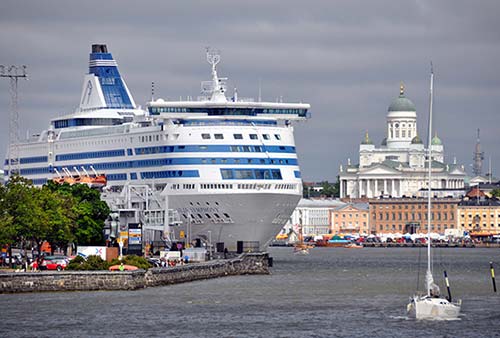
The boats are filled with about 45 percent Finns, 45 percent Swedes, and 10 percent cruisers from other countries. The average passenger spends as much on booze and tax-free items as on boat fare (that’s why ticket prices are so reasonable—to encourage locals to spend money onboard). To maintain their tax-free status, the boats make a midnight stop in the Åland Islands—a self-governing, Swedish-speaking province of Finland that’s exempt from the EU’s value-added tax.
Of the two lines, Viking Line has the reputation as the party boat. Tallink Silja is considered more elegant. But both lines have their share of noisy passengers making duty-free booze runs.
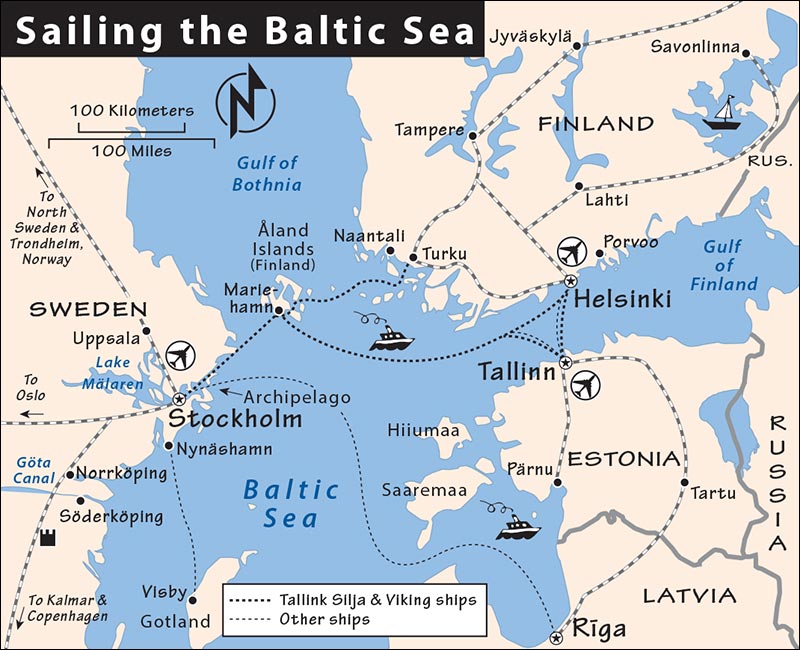
Buying Tickets
Viking Line (www.sales.vikingline.com/find-trip) sails between Stockholm and Helsinki every other day, while Tallink Silja (www.tallinksilja.com) sails nightly. Boats leave (from either port) between 16:30 and 17:30 and arrive the next morning around 10:00.
Cost: Fares vary based on season, day of the week, and cabin class. Mid-June to mid-August is the most expensive (and crowded), as are Friday nights. In summer, one-way tickets start at about €88 and go up from there. Travelers with rail passes that cover Sweden or Finland get discounts on both lines (cabins extra). There can be discounts for early booking, seniors, and families.
Itinerary Options: Round-trip fares (across and back on successive nights, giving you access to your cabin throughout the day) generally cost less than two one-way fares. The drawback is that you’ll have only a few hours on land. But you may be able to get the round-trip fare on nonsuccessive nights if you book a hotel through the cruise line for the intervening night(s). If it fits your schedule, this can be a good deal.
Reservations: For summer or weekend sailings, reserve well in advance online. Viking Line’s customer service line is Finnish based (+358 9 123 574). Tallink Silja has offices in Helsinki (Tyynenmerenkatu 9, +358 9 18041) and in Stockholm (Södra Hamnvägen 50A, Swedish +46 8 666 3330). Any travel agent in the region can also sell you a ticket (with a small booking fee).
Tips Onboard
Meals: While ships have cheap, fast cafeterias as well as classy, romantic restaurants, they are famous for their smorgasbord dinners (usually around €40-50; breakfast smorgasbord €15-20). Dinner is self-serve in two sittings, one at about 17:00, the other around 20:00. (In summer, it’s best to reserve a table with your ferry booking; I prefer to have dinner at the first sitting—shortly after departure—and be on deck for sunset.) If you board without a smorgasbord reservation, go to the restaurant and make one—window seats are highly sought after and can come with a surcharge. Note that you are not allowed to bring your own meals on board Viking ships.
Time Change: Finland is one hour ahead of Sweden. Morning schedules are Finnish time, and vice versa when you return.
Sailing to Other Destinations
Tallinn: The Estonian capital can be spliced into your itinerary as a side trip from Helsinki (or vice-versa), or as a triangle trip (Stockholm-Helsinki-Tallinn-Stockholm, must be booked as three one-ways). Tallink Silja and Eckerö Line boats to Tallinn leave from Helsinki’s West Harbor while Viking Line boats use the more central Katajanokka terminal (see “Helsinki’s Ferry Terminals,” earlier). For more details on boat fares and schedules, see “Tallinn Connections—By Boat” on here.
Turku: Both Viking Line and Tallink Silja also sail from Stockholm to Turku in Finland, a shorter crossing (11-12 hours, departing daily at about 7:00-9:00 and 19:30-21:00). Turku, a “mini-Helsinki” with more medieval charm but less urban bustle, is two hours from Helsinki by bus or train. The cheaper boat fare saves you enough to pay for the train trip from Turku to Helsinki.
Visiting Helsinki by Cruise Ship
Cruise traffic to Helsinki is concentrated at the Hernesaari piers of the West Harbor (Länsistama); some cruise ships use the South Harbor (Eteläsatama) quays. For more details on the ports, see the Port of Helsinki website (www.portofhelsinki.fi/en/www.portofhelsinki.fi [URL inactive]).