SOUTHEAST SWEDEN
Kalmar• Öland Island • Växjö • Glass Country
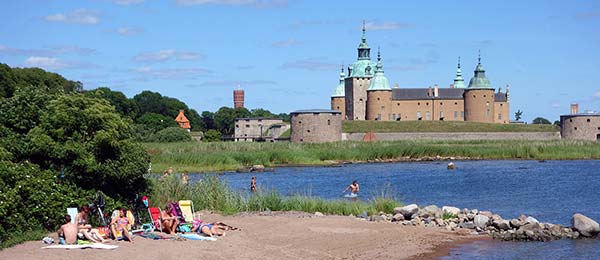
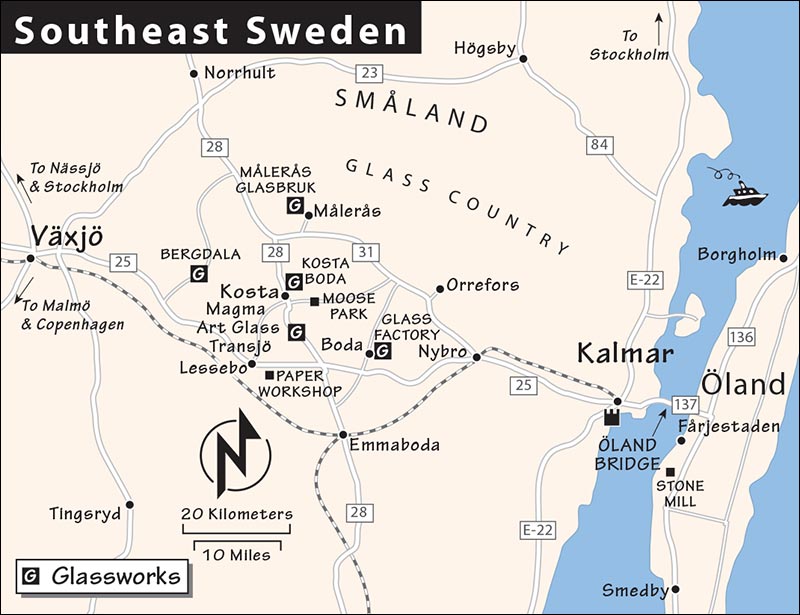
The southeastern province of Småland, with dense forests and pristine lakes, is a welcome contrast to big-city Stockholm. Coastal Kalmar has a rare Old World ambience and the most magnificent medieval castle in Scandinavia. From Kalmar, hop a ferry to the beachy island of Öland, popular for its miles of bike trails, hiking paths, and sandy shores. Nestling inland is the little metropolis of Växjö, with a trio of interesting museums, including the House of Emigrants, which tells the story of Scandinavian migration to America. Lying between Kalmar and Växjö is Glass Country, a 70-mile stretch of forest sparkling with glassworks that welcome guests to tour and shop.
PLANNING YOUR TIME
Although I’m not the biggest fan of the Swedish countryside (blame my Norwegian heritage), a visit to Kalmar and Växjö provides a good dose of small-town Sweden. (I find Lund and Malmö—both popular side-trips from Copenhagen—relatively dull, and a boat trip along the much-loved Göta Canal too sleepy.) Seaside Kalmar is a natural home base for a Småland visit and a good place to break up the trip between Copenhagen and Stockholm.
This two-day plan assumes you’re following my recommended three-week itinerary (see here), which has you arriving in Kalmar in the evening. For those traveling here directly from Copenhagen or Stockholm with a midday arrival, you can adjust the first day to your interests.
Day 1: In the morning, tour Kalmar Castle, getting there via my Back-Streets Walk. After lunch, laze at the town beach or explore pastoral Öland Island.
Day 2: Browse the people-friendly streets of Kalmar’s town center, dropping in at the Kalmar County Museum. Depart Kalmar for Stockholm, stopping en route in Växjö (same train line; leave luggage at Växjö train station). To have enough time to visit Växjö’s glass museum and House of Emigrants, leave Kalmar by midday.
With a Car: To see even more of the region, rent a car in Kalmar on day 2 to tour the Glass Country and have more time in Växjö (sightsee there before dropping off your rental car and catching your onward train to Stockholm).
Kalmar
Kalmar feels like it used to be of strategic importance. In its heyday—back when the Sweden/Denmark border was just a few miles to the south—they called Kalmar Castle the “Key to Sweden.” But today Denmark is distant, and Kalmar is a bustling small city of 64,000 (with 9,000 students in its university and maritime academy). Kalmar’s salty old center, classic castle, and busy waterfront give it a wistful sailor’s charm.
Kalmar is the place where the treaty establishing the 1397 Kalmar Union was signed. This “three crowns” treaty united Norway, Sweden, and Denmark against their common enemy: German Hanseatic traders. It created a huge kingdom, dominated by Denmark, that lasted a bit more than a hundred years. But when the Swede Gustav Vasa came to power in 1523, Kalmar was rescued from the Danes, the union was dissolved...and even the European Union hasn’t been able to reunify the Scandinavian Peninsula since.
Kalmar town was originally next to the castle in what’s now called the Old Town (Gamla Stan). But that location put the townsfolk directly in the line of attack whenever the castle was besieged. So, after a fire decimated the town in 1647, the city fathers relocated Kalmar to the adjacent island of Kvarnholmen, encircling it with defensive earthworks and bastions, parts of which still survive.
The charming Old Town, Kvarnholmen town center, castle, and nearby vacation island of Öland are all enjoyable to explore, making Kalmar an appealing stop. Its boom-or-bust tourist season is busiest from mid-June through mid-August.
Orientation to Kalmar
Kalmar is easily walkable and fun by bike. The mostly pedestrianized Kvarnholmen core is walled and laid out in a grid street plan. The Old Town district is between Kvarnholmen and Kalmar Castle, which occupies a little island of its own (a 10-minute walk from Kvarnholmen). The train station and TI sit on the edge of Kvarnholmen.
Kalmar spreads out over several more island-neighborhoods, but most visitors stick to the main town center, Old Town, and castle. If your time is limited, your top priorities should be a town walk, the castle, and the public beach just beyond the castle.
TOURIST INFORMATION
The TI is in the big, modern building next to the marina (Mon-Fri 9:00-18:00, Sat-Sun 10:00-15:00, shorter hours off-season; Ölandskajen 9, +46 10 357 0500, www.kalmar.com). Ask about live music and entertainment; for example, there are often free concerts on the Larmtorget town square on summer evenings.
HELPFUL HINTS
Bike Rental: Many hotels have loaner or rental bikes for guests, or try Kalmar Cykeluthyrning (across the street from the TI, handy one-way rentals with locations throughout southern Sweden; Mon-Fri 9:00-18:00, Sat until 14:00, closed Sun, +46 10 151 9340, reserve ahead at www.rentbike.se).
Car Rental: Major firms Europcar, Sixt, Avis, and Hertz have a presence in Kalmar. In small-town Sweden, rental companies may not have a central bricks-and-mortar location but instead offer “meet and greet” service, whereby a staff person hands over the car to you—usually at the train station. If you want a one-way rental (between Kalmar and Växjö, for example), set it up in advance.
ARRIVAL IN KALMAR
By Train or Bus: Arriving at the combined train and bus station couldn’t be easier (ticket machines by the tracks, train ticket office open Mon-Fri 7:45-17:15, closed Sat-Sun; lockers available). As you walk out the front door, the town center (Kvarnholmen) is dead ahead; the TI is 100 yards to your right, across the busy street on the harbor; and Kalmar Castle and the Old Town are behind you.
By Car: To park, most of the lots and streets closest to the center have a three-hour limit from 9:00 to 18:00. The lot on the harbor side of the train station (the opposite side of the tracks from the Old Town) lets you park for longer.
Kvarnholmen Town Center Walk
This ▲ walk takes you from Larmtorget, down through the center of town on the main drag and through the main square, to the waterfront.
• Start in Larmtorget, the lively, restaurant- and café-lined square a few steps uphill from the train station.
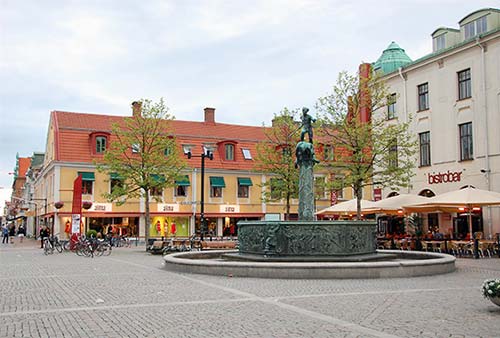
Larmtorget: This is the most inviting square in town for an outdoor meal or a drink. It’s also the nightlife center of town and the site of free summer concerts (check schedule at the TI or with your hotel). The many cafés bordering the square are a reminder that this is a college town, with lots of students; and a tourist town, with lots of vacationing Swedes. The bronze fountain that dominates one side of the square depicts David standing triumphantly over the slain Goliath—a thinly veiled allusion to King Gustav Vasa, who defeated the Danes (the fountain’s reliefs depict his arrival in Kalmar in 1520).
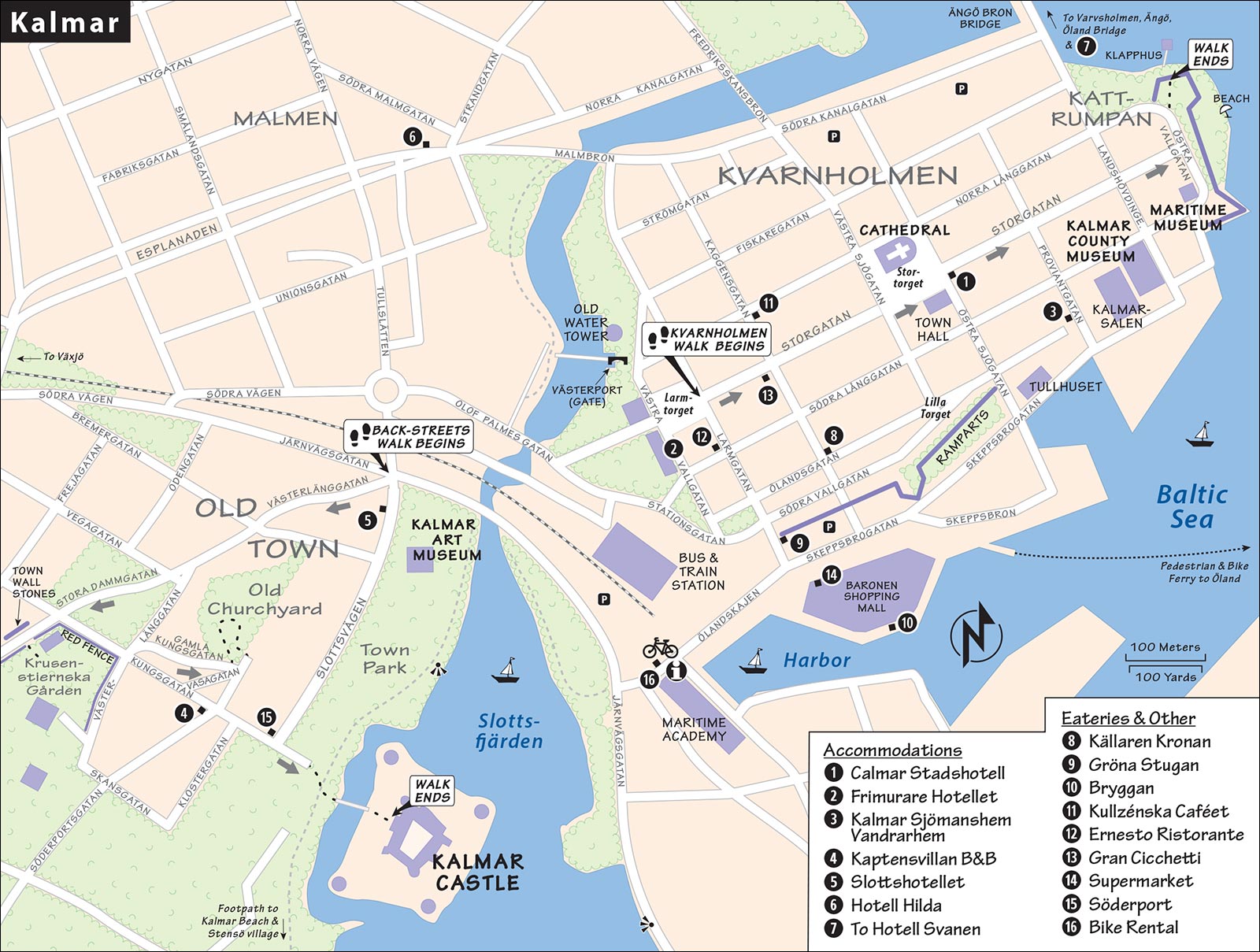
The area just to the north, up Larmgatan, is a charming old quarter with the historic Västerport gate and a restored old water tower. The tower, dating from 1900, was turned into a modern apartment building, winning an award for the architect who successfully maintained the tower’s historic profile.
• Start strolling down the main pedestrian shopping street, Storgatan (with Ben & Jerry’s on the corner).
Storgatan and Stortorget: Kvarnholmen is a planned town, laid out on a regular grid plan after the 1647 fire consumed the Old Town. While a 1960s push to “modernize” stripped away much of the Old World character, surviving historic buildings and the mostly pedestrianized streets make Kvarnholmen a delight to stroll.
The first major cross-street, Kaggensgatan, leads (to the right, past a fine row of 17th-century stone houses) down to the harbor; a block to the left, on the right (at Kaggensgatan 26), is the landmark and recommended Kullzénska Caféet, whose owners refused to let this charming 18th-century merchant’s house be torn down to make way for “progress.” (It remains a genteel setting for fika.)
Continue window-shopping your way down Storgatan. On the right just after #20, admire the building marked 1667, with the cannonballs decorating the doorway. This was the home of a war profiteer—a lucrative business in this military-minded town (now an inviting gift shop with local products, teas, chocolates, and cheese).
Storgatan leads to the town’s main square, Stortorget. Built in the 17th century in a grand style befitting a European power, the “big square” tries a little too hard to show off—today it feels too big and too quiet (locals prefer hanging out on the cozier Larmtorget).
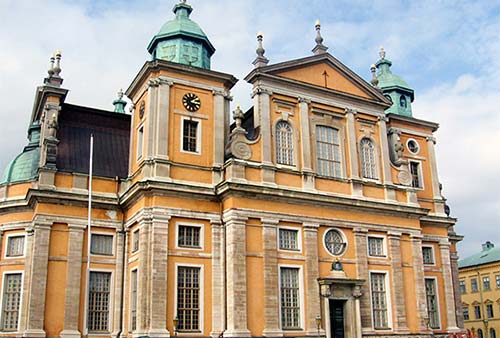
The cathedral (domkyrkan) dominating the square is the biggest and (some say) finest Baroque church in Sweden. Its interior, which contains an imposing 17th-century pulpit and bells from the earlier town cathedral, has been elegantly restored to its original glory. Its architect was inspired by the great Renaissance churches of Rome. The interior is all very high-church (for such a Lutheran country), with a fine Baroque altar, carved tombstones used for flooring, and homogeneous white walls (free, daily until 18:00, shorter hours off-season, free noon “Lunch Music” organ concerts daily in summer—check the program on the board left of the entrance). Facing the cathedral is the decorated facade of the Town Hall (rådhuset).
From here, go straight through the square and continue strolling down Storgatan. Notice the fine old houses, both grand and petite, all lovingly cared for.
• At the end of town, you’ll reach the...
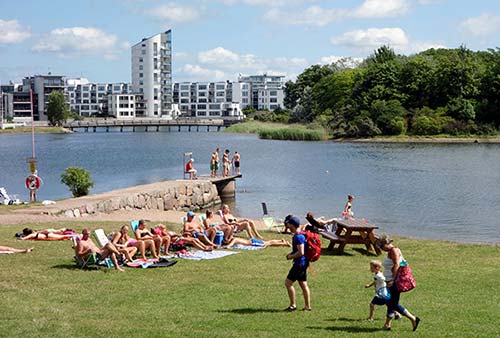
Waterfront: The area beyond Östra Vallgatan (the old eastern wall of the city) has a pleasant park and small swimming beach. You may notice dads out with their babies (called “latte dads”); most Scandinavians get over a year of paid leave for the mom and dad to split as they like.
Head across the street and down the stairs toward the playground (to the left) to find, on a little pier in the water, the last remaining klapphus—laundry building—in Kalmar (and Scandinavia). In the mid-1800s, four of these small, wooden structures with floating floors stood here at the seaside. Washers would stand in barrels inset around the central laundry pool for a better working position. Today the klapphus is still occasionally used for washing rugs and carpets. The Baltic seawater is considered good for carpet health.
Across the water is the island neighborhood of Varvsholmen, which once housed an eyesore shipyard but has been converted into a modern residential development. To the left of Varvsholmen is the sleepy island neighborhood of Ängö, traditionally home to sailors and fishermen, and now one of Kalmar’s most desirable places to live. You can catch a glimpse of the Öland Bridge behind them both.
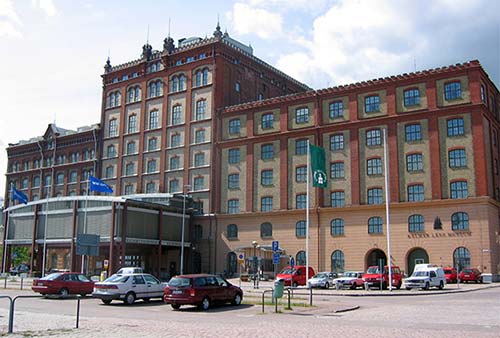
Your walk is finished. Hooking around to the right, you first reach the former city bathhouse (in a 1909 Art Nouveau building), which faces the tiny Kalmar Maritime Museum (described later). A block beyond that, the waterfront is dominated by giant red-brick buildings—steam mills once used to grind flour. Today this complex houses the interesting Kalmar County Museum, described later.
Sights in Kalmar
THE OLD TOWN AND CASTLE
Kalmar’s castle is on a small island opposite a park and the Old Town. For a guided stroll through the Old Town’s back streets on your way to the castle, see here. Beyond the castle you’ll find a pleasant beach.
▲▲Kalmar Castle (Kalmar Slott)
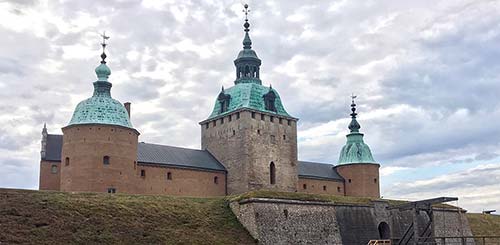
This moated castle is one of Scandinavia’s best medieval experiences. The imposing exterior, anchored by stout watchtowers and cuddled by a lush park, houses a Renaissance palace interior. Built in the 12th century, the castle was enlarged and further fortified by the great King Gustav Vasa (r. 1523-1560) and lived in by two of his sons, Erik XIV and Johan III. In the 1570s, Johan III redecorated the castle in the trendy Renaissance style, giving it its present shape. Kalmar Castle remained a royal hub until 1658, when the Swedish frontier shifted south and the castle lost its strategic importance. Kalmar Castle was neglected, then used as a prison, distillery, and granary. Finally, in the mid-19th century, a newfound respect for history led to the castle’s renovation. Today, it’s a vibrant sight giggling with kids’ activities, parklike ramparts, and well-described historic rooms.
Cost and Hours: 185 SEK; late June-mid-Sept Tue-Thu 10:00-20:00, Fri-Mon until 18:00, off-season daily 10:00-16:00, Nov-Dec Sat-Sun only; café and restaurant, +46 480 102 82, www.kalmarslott.se. An interesting way to reach the castle is via my Back-Streets Walk route, described later.
Tours: You can choose from two itineraries (check website for current schedule). But given the good English descriptions in every room and the helpful docents hanging around, I’d skip the tour.
Visiting the Castle: There’s no designated route for visitors, so consider following my tour below.
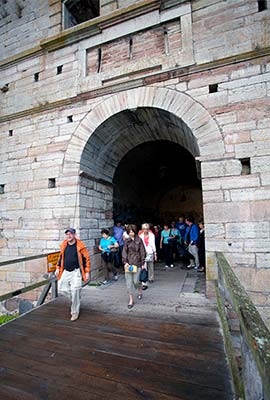
Approaching the castle, you’ll cross a wooden drawbridge. Peering into the grassy, filled-in moat, look for sunbathers, who enjoy soaking up rays while the ramparts protect them from cool winds. To play “king of the castle,” scramble along these outer ramparts.
Continue on into the central courtyard, where you’ll find the canopied Dolphin Well, a fine work of Renaissance craftsmanship.
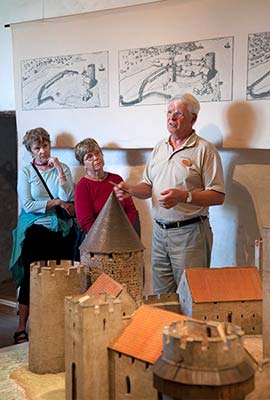
Access to most of the rooms is from the main courtyard, but we’ll use the entrance just to the right of the gift shop (unceremoniously labeled Toalett). Once inside, turn right to find the Governor’s Quarters, with a model of the early medieval castle. Notice the bulky shape of the towers before they were capped by fancy Renaissance cupolas and how the town once huddled in the shadow of the castle.
In the adjoining Dungeon, you can peer down into the pit where unfortunate prisoners were held. The room was later converted into a kitchen (notice the big fireplace), and the pit became a handy place to dump food waste.
Now go through the labyrinth of rooms to the right that show daily life at the castle: a reconstruction of the castle kitchen, an excellent set of models showing the evolution of the building from medieval castle to Renaissance palace, and an impressive copy of Erik XIV’s 1561 coronation robe (there’s also a complete rundown of the Vasa kings). In the next room are similarly resplendent reproductions of royal gowns.
Now backtrack to where we entered, and climb the Queen’s Staircase up steps made of Catholic gravestones. While this simply might have been an economical way to recycle building materials, some speculate that it was a symbolic move in support of King Gustav Vasa’s Reformation, after the king broke with the pope in a Henry VIII-style power struggle.
At the top of the stairs, go left through the wooden door into the Queen’s Bedroom. The ornate 1625 Danish bed (captured from the Danes after a battle) is the only surviving original piece of furniture in the castle. Notice the faces decorating the bed; they’ve had their noses chopped off, as superstitious castle-dwellers believed that potentially troublesome spirits settled in the nose. This bed could easily be disassembled (“like an Ikea bed,” as my guide put it) and moved from place to place—handy for medieval kings and queens, who were forever traveling throughout their realm. Smaller servants’ quarters adjoin this room.
Proceed into the Checkered Hall. Examine the intricately inlaid wall panels, which make use of 17 different types of wood—each a slightly different hue. Appreciate the faded Renaissance frescoes throughout the palace.
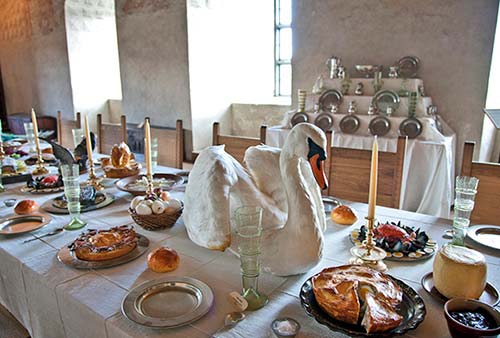
Continue into the dining room (a.k.a. Gray Hall) for the frescoes of Samson and Delilah high on the wall. The table is set for an Easter feast (based on a detailed account by a German visitor to one particular Easter meal held here). For this holiday event, the whole family was in town—including Gustav Vasa’s two sons, Erik XIV and Johan III. Erik’s wife, Katarzyna Jagiellonka, was a Polish Catholic; for her, Easter meant an end to Lenten abstinences. Notice the diverse savories on the table, including fish patties with egg, elaborate pies, and chopped pike in the shape of pears. The giant birds are for decoration, not for eating. Logically, forks (which resembled the devil’s pitchfork) were not used—just spoons, knives, and hands.
The door in the far corner with the faded sun above it leads to the King’s Chamber. Notice the elaborate lock on the door, installed by King Erik XIV because of constant squabbles about succession. The hunting scenes inside have been restored a bit too colorfully, but the picture of Hercules over the left window is original—likely painted by Erik himself. Examine more of the inlaid panels. To see the king’s toilet, peek into the little room to the left of the fireplace, with a fine castle illustration embedded in its hidden door (if closed, ask a museum docent to open it). Also in here was a secret escape hatch the king could use in case of trouble. Perhaps King Erik XIV was right to be so paranoid; he eventually died under mysterious circumstances, perhaps poisoned by his brother Johan III, who succeeded him as king.
Backtrack through the dining room and continue into the Golden Hall, with its gorgeously carved (and painstakingly restored) gilded ceiling. The entire ceiling is suspended from the true ceiling by chains. If you visually trace the lines of the ceiling, the room seems crooked—but it’s actually an optical illusion to disguise the fact that it’s not perfectly square. Ponder the portraits of the royal family: Gustav Vasa, one of his wives, sons Erik XIV and Johan III, and Johan’s son Sigismund. Imagine the reality-show-level dysfunction that carbonated the social scene here back then.
Peek into Agda’s Chamber, the bedroom of Erik’s consort. The replica furniture re-creates how it looked when the king’s kept woman lived here. Later, the same room was used for a different type of captivity: as a prison cell for female inmates.
Cut across to the top of the King’s Staircase (also made of gravestones like the Queen’s Staircase, and topped by a pair of lions). The big door leads to the grand Green Hall, once used for banquets and now for concerts.
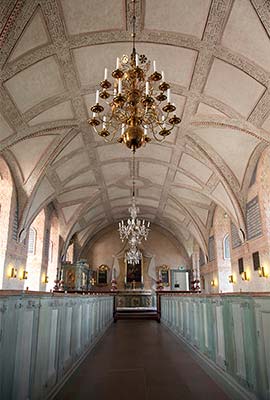
At the end of this hall, the church is one of Sweden’s most popular wedding venues (up to four ceremonies each Saturday). As reflected by the language of the posted Bible quotations, the sexes sat separately: men, on the warmer right side, were more literate and could read Latin; women, on the cooler left side, read Swedish. The fancy pews at the front were reserved for the king and queen.
Going through the door to the right of the altar, you’ll enter a stairwell above which hangs a model ship, donated by a thankful sailor who survived a storm. In the next room is Anita, a taxidermic horse who served with the Swedish military (until 1937).
The rest of the castle complex includes a few other rooms worth poking your head into, including the vast Burnt Hall, where in summer you’ll likely find an interesting special art exhibit.
Old Town
The cute, garden-filled residential zone that locals call Gamla Stan fills the parklike space between the castle and the modern town center. Destroyed by fire in 1647, the medieval village that once stood here was replaced in the 18th century by the summer homes of Kalmar’s elites. This toy village of colorfully painted wooden homes, tidy yards, and perfect picket fences is worth a look.
▲Back-Streets Walk to the Castle
Consider a slight detour strolling through the Old Town on your way to the castle (see the “Kalmar” map for the route). Begin where the pleasant, tree-shaded Slottsvägen boulevard intersects with little Västerlånggatan, the cobbled street angling to the right.
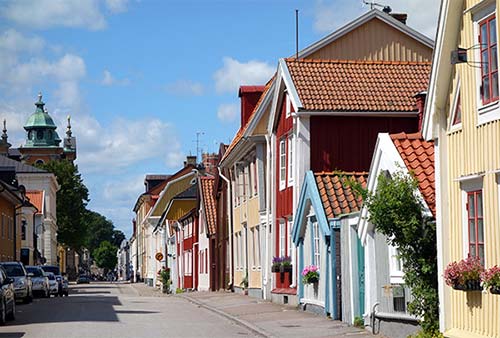
Västerlånggatan: Wandering down this quaint lane, enjoy the time-passed cottages as you peek over fences into private gardens. You’ll pass behind the grand mansion (now the recommended Slottshotellet) that belonged to the prestigious Jeansson family, who donated the parkland near the castle to the town.
Continue on through the second intersection, following the path through the middle of the grassy park. As you cross the road on the far side of the park, you’ll pass two lines of stones, a small surviving remnant of Kalmar’s town wall (on the right).
Krusenstiernska Gården: On the left is the entrance to this relaxed, kid-friendly garden—visitors are welcome to enter any time the gates are open. Poke inside to discover a well-preserved 19th-century garden whose charming plantings cluster around a well. The organic fruits and berries grown here are sold as jams, marmalades, and chutneys in the on-site café (along with cakes and coffee). On summer evenings, the garden is a venue for top Swedish comedy acts, which pack the place.
From the garden, backtrack to the street and follow the red fence to the right. Where the fence ends, jog left and squeeze between the yellow and red houses.
Gamla Kungsgatan and the Old Churchyard: Immerse yourself in this Swedish village world of charming cottages and flower-filled window boxes. At the bottom of the lane, on the left, watch for the Old Churchyard (Gamla Kyrkogården), dating from the 13th century and scattered with headstones. It’s virtually all that remains of the original Old Town. Look for the monument topped by a statue of a man carrying a boy (St. Christopher, patron of traders and seafarers). Circling this slab, you’ll see the floor plan of the original cathedral, an image looking down the cathedral’s nave, and a rendering of the town before it was destroyed. The cathedral tower—which had partially survived the 1647 fire—was torn down in 1678 by the Swedes themselves, who wanted to ensure that their enemies (the Danes) couldn’t use the tower to launch an attack on the castle.
About 50 yards farther into the yard, the stone slab on the pedestal (marked Kalmarunionen 600 ar) commemorates the 600th anniversary of the 1397 Kalmar Union, which united the Nordic states. On June 14, 1997, the contemporary leaders of those same nations—Sweden, Norway, Denmark, Finland, and Iceland—came here to honor that union. You can see their signatures etched in the stone.
Exit the churchyard the way you came in, turn right on the paved street, and take the first left (down Kungsgatan) to the main boulevard. You’ll be facing the town park and the castle; on your left is the appealing, recommended Söderport café (with an inviting terrace and economical lunch).
Town Park (Stadsparken): Unfurling along the waterfront between the castle and the city, this beautifully landscaped garden is Kalmar’s playground and a delight to explore. With the character of a classic English park, alternately rugged and refined, it’s home to many exotic plants. Locals brag that their region enjoys a milder climate than most of Sweden, and some plants here grow nowhere else in the country. The city’s modern art museum stands in an appropriately modern building in the center of the park.
▲Kalmar Beach (Kalmarsundsbadet)
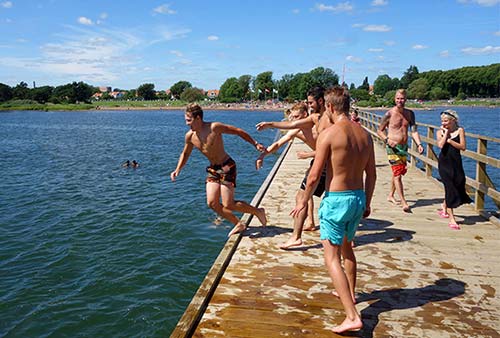
Kalmar’s best beach is at the edge of the Old Town, just beyond the castle. On a hot summer day, this is a festive and happy slice of Swedish life—well worth a stroll even if you’re not “going to the beach.” With snack stands, showers, sand castles, wheelchair beach access, and views of the castle and the island of Öland, the beach has put Kalmar on the fun-in-the-sun map. It’s quite popular with RVers and the yachting crowd. And if you enjoy people-watching, it’s a combination Swedish beauty pageant and tattoo show. For some extra views and kid-leaping action, be sure to walk to the end of the long pier.
To explore more of the seafront, walk 15 minutes south of the beach to the charming little community of Stensö, with its own pocket-size harbor, restaurants, and charming fishing cottages.
KVARNHOLMEN TOWN CENTER
Get your bearings in downtown Kalmar with my Kvarnholmen Town Center Walk, earlier, which cuts straight through the length of the town. Then dig into its museums.
▲▲Kalmar County Museum (Kalmar Läns Museum)
This museum is worth a visit for its excellent exhibit on the royal ship Kronan, a 17th-century warship that capsized and sank to the bottom of the Baltic just off the island of Öland (where its hull still rests). The many salvaged artifacts preserved in the museum, well described in English, give visitors an unusually complete and intimate look at life at sea.
Cost and Hours: 170 SEK, daily 10:00-17:00, online audioguide, kid-friendly café on floor 4, Skeppsbrogatan 51, +46 480 451 300, www.kalmarlansmuseum.se.
Visiting the Museum: While the museum has plenty of exhibits, your visit will focus mostly on the third floor with the Kronan shipwreck artifacts.
Beyond the entry, the first floor has temporary exhibits and shows off the cannons recovered from the Kronan wreckage. In those days, cannons were so valuable they were prized the way a Rolls Royce would be today, so each one has its own story (described in English). In the years following the ship’s sinking, these cannons were the only artifacts considered worth recovering.
From the first floor, I’d skip the temporary exhibits on Floor 2 and head directly to Floor 3, which displays salvage from the Kronan. Twice the size of Stockholm’s famous warship Vasa, Kalmar’s warship was a floating palace and the most heavily armed vessel in the world. But it exploded and sank about three miles beyond the island of Öland in 1676. An introductory video shows the dramatic event: The Kronan’s admiral misjudged conditions and harnessed too much wind, causing the vessel to tip and its gun ports to fill with water. As the ship began to list, a fallen lantern ignited explosives in the hold, and...BLAM! The ship went right down. Its Danish and Dutch foes—who hadn’t fired a shot—happily watched it sink into the deep. Of the 850 people on board, only about 40 were rescued. The wreck’s whereabouts were forgotten until 1980, when it was rediscovered by amateur marine archaeologist Anders Franzén, the same man who found the Vasa in Stockholm’s harbor in 1961.
Head into the exhibit, where you’ll view a model of the shipwreck site. You’ll see a cross-section of the mighty vessel and a recovered carving of the potbellied Swedish king (one of many such carvings that decorated the ship). The small theater plays a 15-minute film about the ship.
The replica of the middle gun deck leads to the exhibit’s most interesting section about everyday life on board. The 850 sailors who manned the ship (about the population of a midsized town of that age) represented all walks of life, “all in the same boat.” Engaging illustrations, eyewitness accounts, and actual salvage items bring the story to life. You’ll see guns, musical instruments, a medicine chest, dishes, and clothing—the everyday items of the common people who worked and perished on the ship. A treasure chest contains coins from all around the known world at the time, each one carefully identified.
The final exhibit (with another short film) reminds us that the Kronan still rests on the sea floor, awaiting funding to be raised to the surface. You’ll see a replica of the diving bell used in 1680 to retrieve the cannons and the modern diving bell from very early explorations of the site. Today a dedicated crew—including, at times, Sweden’s King Carl XVI Gustav—continues to dive to recover bits and pieces.
For extra credit, head up to Floor 4 for its exhibit on Jenny Nyström, an early-1900s Kalmar artist who gained fame for her cute Christmas illustrations featuring elves and pixies. You’ll see some of her children’s books and textbooks as well as some artistic portraits with a touch of Art Nouveau flair. Ponder Nyström’s status as a proto-feminist icon: She was one of the first female artists to support her family by selling her paintings.
Kalmar Maritime Museum (Kalmar Sjöfartsmuseum)
This humble, dusty little exhibit sits a long block beyond the Kalmar County Museum. It’s a jumble of photos of vessels, model boats, charts, and other seafaring bric-a-brac that traces the nautical story of Kalmar up to modern times. The collection is displayed in four rooms of a former apartment, shuffled between beautiful porcelain stoves left behind by a previous owner (these were display models for his stove business). While displays are explained by an English booklet (that you can borrow or buy), volunteers are eager to show you around.
Cost and Hours: 50 SEK, mid-June-Aug daily 12:00-16:00, off-season Sun only, Södra Långgatan 81, +46 480 15875, www.kalmarsjofartsmuseum.se.
Sleeping in Kalmar
Kalmar has no standout hotel—my first choice would be the Kaptensvillan B&B. Or consider an Airbnb—there are a few that are full of character.
KVARNHOLMEN TOWN CENTER
$$$ Calmar Stadshotell, in a 1907 historic shell right on Kalmar’s main square, tries to be fancy. The 135 rooms are bright though generic and spread over older and newer wings (elevator, Stortorget 14, +46 480 496 900, www.profilhotels.se, calmarstadshotell@profilhotels.se).
$$ Frimurare Hotellet, in a grand old building overlooking Larmtorget square, is just steps from the train station. Warmly run, the place has old-school personality, with wide-plank hardwood floors and chandeliers. The 35 rooms provide modern comfort amid period decor. Because it’s squeezed between a café-packed square and a park popular for concerts, it can come with some noise (elevator, free sauna, a few loaner bikes free for Rick Steves readers, 50 yards from the train station at Larmtorget 2, +46 480 15239, www.frimurarehotellet.se, info@frimurarehotellet.se).
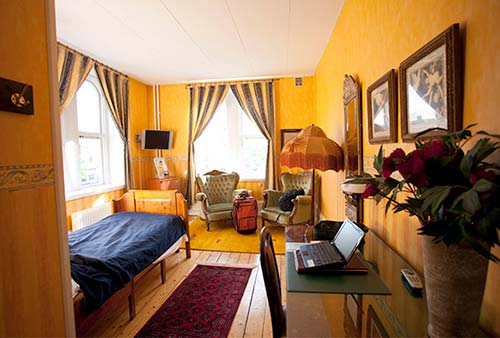
¢ Kalmar Sjömanshem Vandrarhem, a charming green house built in 1910 for sailors and now used for student housing, opens to travelers in the summer (mid-June to mid-Aug). While its 13 rooms are very simple and bathrooms are down the hall, it has an inviting TV lounge, handy guest kitchen, and a peaceful garden behind a white picket fence facing the harbor (family rooms, sheets and towels extra, no breakfast, plenty of nearby pay parking, Ölandsgatan 45, +46 480 10810, www.kalmarsjomanshem.se, info@kalmarsjomanshem.se).
OUTSIDE THE TOWN CENTER
$$ Kaptensvillan B&B fills a stately villa originally built for a sea captain. The four comfy, classy rooms look out on a peaceful garden, and the castle is a short walk away. Warmly run by Marika and her daughter Kristina, this place ticks all the boxes for location, value, and personal touch (parking, loaner bikes, Söderportsgatan 7, +46 70 527 4411, kaptensvillan@me.com).
$$ Slottshotellet (“Castle Hotel”) enjoys an appealing location in the atmospheric Old Town, across a leafy boulevard from Kalmar’s town park and just up the street from the castle. It’s the nicely upgraded but still homey former mansion of a local big shot. The 71 rooms—some in the mansion, others sprinkled throughout nearby buildings—range from pricey to more modest (Slottsvägen 7, +46 480 88260, www.slottshotellet.se, info@slottshotellet.se).
$$ Hotell Hilda has 12 fine, unfussy rooms in an updated old house, located in a modern residential zone just over the canal from the town center (elevator, limited free parking—reserve a spot when you book, Esplanaden 33, +46 480 16950, www.hotellhilda.se, info@hotellhilda.se). The ground-floor Kallskänken café, which doubles as the reception, serves good salads and sandwiches (daily).
¢-$$ Hotell Svanen, a 20-minute walk or short bus or taxi ride from the center, is in the Ängö neighborhood. It has a mix of nicer hotel rooms with private bath, cheaper rooms with shower down the hall, and hostel beds. Services include laundry and kitchen facilities, TV room, sauna, and rental bikes and canoes. While it’s a bit institutional, you can’t argue with the value (family rooms, sheets extra in hostel rooms, breakfast extra, elevator, Rappegatan 1—ask for directions before you arrive, +46 480 25560, www.hotellsvanen.se, info@hotellsvanen.se).
Eating in Kalmar
Kalmar has a surprising number of good dining options for a small town.
KVARNHOLMEN TOWN CENTER
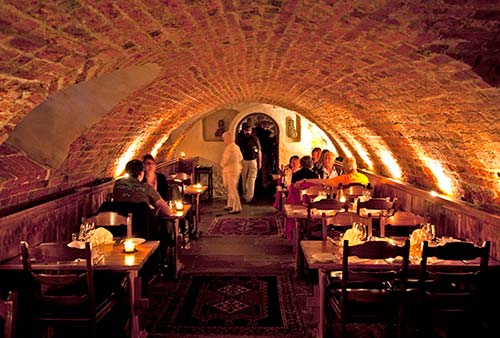
$$$$ Källaren Kronan is a candlelit cellar restaurant with romantic tables under low stone arches. They serve old-time Swedish dishes, including elk, as well as modern cuisine (Tue-Fri dinner only, Sat lunch and dinner, closed Sun-Mon, Ölandsgatan 7, +46 480 411 400).
$$$$ Gröna Stugan (“The Green Cottage”) has a great location just off the harbor. Enjoy the varied menu (burgers, short ribs, grilled fish) on their patio deck or in the light and bright dining room. Reservations are smart (Mon-Fri lunch and dinner, Sat dinner only, closed Sun, Larmgatan 1, +46 480 15858, www.gronastuganikalmar.se).
$$$ Bryggan sits inside the Baronen shopping mall, but it’s poised over the harbor with view tables inside and deck seating over the water. They serve typical bistro fare, including burgers and fish-and-chips (Mon-Fri 10:00-19:00, Sat until 17:00, Sun 12:00-16:00, can close early in bad weather, Skeppsbrogatan 12, +46 480 363 626).
$$ Kullzénska Caféet, a cozy, antique-filled eatery in a historic 18th-century house, is great for a fika break. They serve sandwiches and homemade pastries, but locals adore the always-fresh berry cobblers (with vanilla sauce or ice cream). While it has street seating, the dining rooms upstairs are what it’s all about (Mon-Fri 10:00-18:30, Sat until 17:00, Sun 12:00-16:30, on the second floor at Kaggensgatan 26, at the corner of Norra Långgatan, +46 480 28882).
$$$$ Ernesto Ristorante is driven by Ernesto, who came here from Naples 30 years ago. This local favorite for pasta and pizza has a high-energy feel with good indoor and outdoor seating (most menu items available for takeout, great selection of Italian wines, daily, dinner only, Södra Långgatan 5, +46 480 24100, www.ernestokalmar.se). His empire also includes $$$ Gran Cicchetti, a café with lighter options, including good lunch specials (closed Sun, Storgatan 12, +46 480 10020).
Supermarket: The Co-op has everything you need for a good picnic, including a salad bar (daily, in the Baronen shopping mall at the harbor, on Skeppsbrogatan).
NEAR THE CASTLE
The castle lawn cries out for a picnic. Or you can grab a bite in the café inside the castle itself. Otherwise, consider:
$$$$ Söderport, just across the street from the castle, is usually bustling; the dining room is pleasantly spacious but the outdoor patio has castle views (Mon-Tue dinner only, Wed-Sun lunch and dinner, Slottsvägen 1, +46 480 12501). There’s live music Wed-Sat evenings.
Kalmar Connections
From Kalmar by Train to: Växjö (hourly, 70 minutes), Copenhagen and its airport (about hourly, 3.5-4 hours, most direct, some with transfer), Stockholm (about hourly, 4.5-5 hours, transfer in Alvesta; slower but more scenic coastal route via Linköping).
By Bus to Stockholm: The bus to Stockholm is much cheaper but slower than the train (4/day, fewer on weekends, 6 hours).
Öland Island
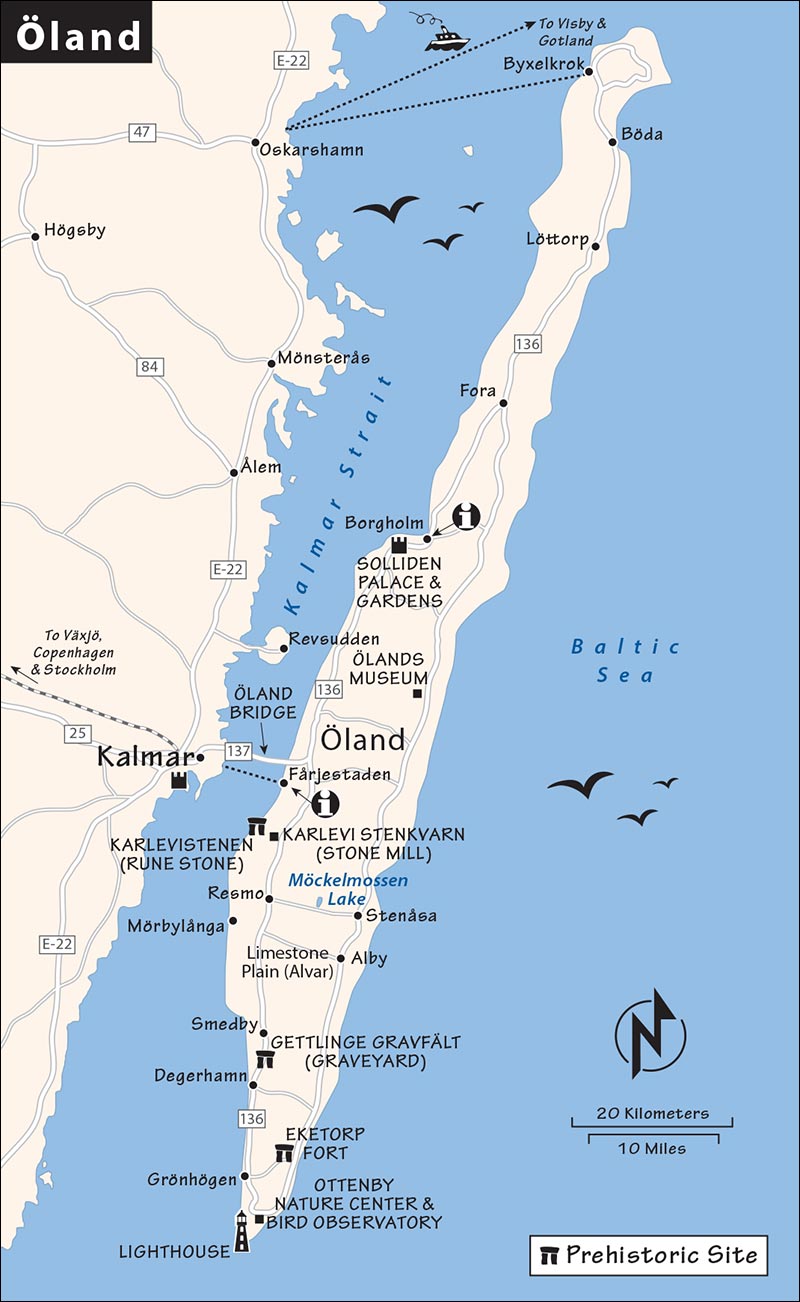
Long and skinny Öland Island is a relaxed destination known for its quaint windmills, prehistoric sights, vast limestone plain, roadside produce stands on the honor system, miles of bike paths, and Swede-filled beaches. With only about 25,000 permanent residents, this castaway island attracts some 2.5 million visitors annually. It’s a top vacation destination for Swedes—even the king and queen have their summer home here. Because of its relatively low rents, better weather, and easy bridge access to the mainland, Öland is also a popular bedroom community for Kalmar. If you’ve got good weather and some time to spare—and if the place isn’t choked with summer crowds—Öland is a fine destination, especially if you don’t rush it.
Dubbed the “Island of Sun and Wind,” Öland enjoys a steady sea breeze and an even warmer climate than already mild Kalmar (remember, “warm” is relative in Sweden). And, because receding glaciers scraped off its top layer of soil, it has a completely different landscape than the pine-and-lake feel of mainland Sweden. The southern half of the island is an alvar, a chalky limestone plain that’s broad and flat, with just a thin veneer of soil. Other island zones, with rich soil and lush vegetation, make Öland feel almost more Midwestern US than Baltic (Öland is one of Sweden’s premier agricultural zones). Visitors are pleasantly surprised by the island’s colorful spring wildflowers and bright sunshine, which works its magic on both holidaymakers and artists.
Centuries ago, the entire island was the king’s private hunting ground. Because local famers were not allowed to fell trees (and there are fewer here than on the mainland), they made their simple houses from limestone. The island’s 34 limestone churches, which were also used for defense, have few windows. Limestone walls demarcate property and contained grazing livestock.
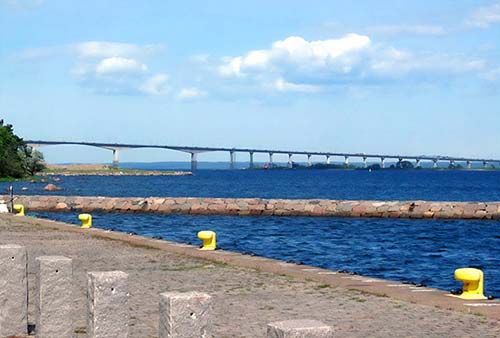
When built in 1972, the Öland Bridge from Kalmar to the island was Europe’s longest (3.7 miles). The channel between Kalmar and Öland is filled with underwater rocks, making passage here extremely treacherous—but ideal for the Vikings’ flat-bottomed boats. (In fact, “Kalmar” comes from the phrase “stones in water.”) Today, a catamaran ferry transports commuters, bicyclists, and hikers between Kalmar and the island.
GETTING THERE
By Car: The island is a breeze if you have a car and at least four hours to explore. Drivers simply head north from Kalmar a few minutes on highway 137 to the Öland Bridge. Once across, highway 136 is the island’s main north-south artery.
By Ferry: A ferry runs between Kalmar and Färjestaden harbor on the island (ferry runs about hourly in summer, less frequent in spring and fall, buy 70-SEK ticket onboard, 30-minute crossing, www.ressel.se). If you want to cycle on Öland (a great way to see the island), pick up a rental bike in Kalmar and take it across on the ferry (note that bikes are not allowed on the Öland Bridge). You can also pick up a bike on the island (see below).
By Bus: Buses regularly connect Kalmar with the town of Borgholm (68 SEK, at least hourly in summer, 45 minutes) and, with less frequency, to other Öland destinations (check www.klt.se [URL inactive]).
Orientation to Öland
Öland is 90 miles long but only 8 miles wide. It has no spectacular sights; the pleasure of this place is cruising around the countryside on a fine day and checking out some of the easygoing attractions. Because the bridge and the ferry deposit visitors roughly at the island’s midpoint, you’ll have to decide between heading north (more developed and resorty, with visitor services) or south (more remote and scenic). I’ve outlined a few basic ideas for each area, but these are just the beginning—visit the TI or check out their website to see what else appeals to you.
Tourist Information: A good first stop just after crossing the bridge is Öland’s mid-island TI in Färjestaden—follow signs off the bridge for turistbyrä (Träffpunkt Öland 102, +46 485 88800, www.oland.se; there’s also a branch on the main street in Borgholm). Friendly staff can help you plan a reasonable agenda to match up with your available time.
Bike Rental: Ölands Cykeluthyrning, with several locations on Öland Island (including in Färjestaden and Borgholm), is a good resource for planning an island spin (daily 9:00-19:00 in summer, +46 70 667 6280, www.olandscykeluthyrning.se).
Sights in Öland
CENTRAL/NORTH ÖLAND
For a quick visit to the island, stick with the strip of Öland just north of the bridge. As you drive north along highway 136, keep an eye out for some of Öland’s characteristic, old-fashioned windmills. Occasional stone churches dot the landscape (including the one in Räpplinge—just off the main road—where the royals worship when in town). However, to really appreciate the rustic, rural atmosphere, you need to get off the highway and onto the backroads. Consider making a loop that takes in Solliden Palace and the Ölands Museum.
Borgholm
The island’s main town is Borgholm (BOY-holm), about a 30-minute drive north of the bridge. Borgholm has a smattering of buildings preserved from the early 1800s as well as turn-of-the-century wooden villas, erected in the early 1900s when the town became a popular seaside resort. Notice that many of these have a humble shack in the garden: Locals would move into these cottages so they could rent the main villas to vacationing Stockholmers in the summer and make a killing. The traffic-free main drag, Storgatan, is lined with tacky tourist shops and ice-cream parlors (Ölandsglass, at #10, is tops). There’s also a TI right in the center of town.
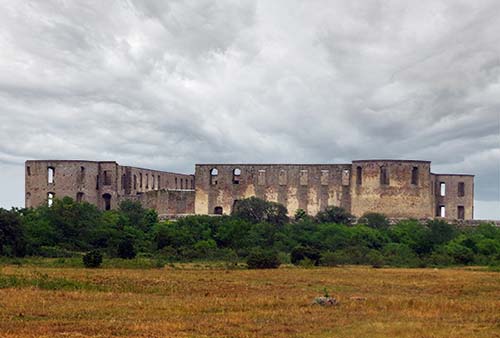
A pair of interesting sights sits on the hill just above Borgholm (to reach them, you can either drive or hike—get details at TI). Borgholm Castle (Borgholms Slott), which looks like Kalmar Castle with its top blown off, broods on the bluff above town, as if to remind visitors of the island’s onetime strategic function. Its hard-fought history has left it the empty shell you see today—impressive, but not worth the entry fee (120 SEK, daily 10:00-16:00, until 18:00 in summer, closed off-season, www.borgholmsslott.se).
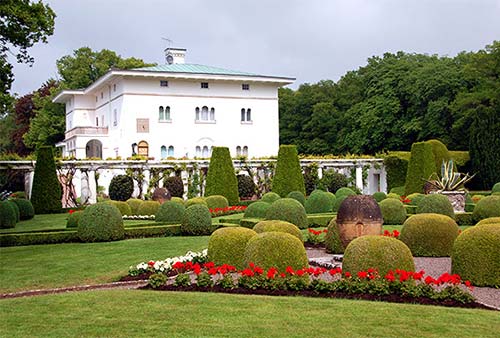
From near the castle, you can hike down to the current royal summer residence, Solliden Palace (Sollidens Slott). It was built in 1906 in an Italianate style after physicians to Queen Victoria suggested the mild Öland climate might ease her ill health. The palace interior is off-limits, but its sprawling, gorgeously landscaped garden is open to us commoners. Divided into Italian (geometrical and regimented), English (wild), and Dutch (flowers) sections, the Solliden garden complex is well worth a wander (120 SEK, daily 11:00-16:00, until 18:00 in summer, closed off-season, pleasant café, +46 485 15356, www.sollidensslott.se).
Ölands Museum
Nestled in the blink-and-you’ll-miss-it village of Himmelsberga, on the west side of the island, this museum is a kind of mini-Skansen. The weatherworn, red-painted buildings line both sides of the road—what’s known in these parts as a “double linear village.” Several old farmhouses, ranging in age from the end of the 18th to the beginning of the 20th century, are preserved along with antique carriages, sleighs, and various agricultural implements. Though low-key, this place will charm those who want to learn more about the island’s rural lifestyles.
Cost and Hours: 100 SEK, daily 10:00-17:00, shorter hours off-season, +46 733 146 703, www.olandsmuseum.com.
SOUTH ÖLAND
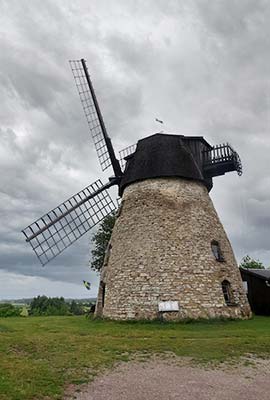
Following this 65-mile round-trip drive south of the bridge gives you a good dose of the island’s more remote, windy charm. Start by heading south on highway 136 toward the town of Karlevi. Along the way, you’ll notice a beautifully preserved stone mill to your right, the Karlevi Stenkvarn. While its weathervane shows the year 1791, no one is really sure how old it is (it’s a Dutch-type mill that was common in the 19th century). Island farmers milled flour here until the mid-1950s.
• After the Karlevi Stenkvarn, take the first road straight and down in the direction of the sea. At the intersection with a busier road, turn right. You’ll soon see a sign for the Karlevistenen, down a little lane to the left.
Karlevistenen: This is one of Sweden’s most historic rune stones. Standing in the middle of a field, this granite boulder—the only stone of its kind still in its original location—is inscribed with a poem that’s the oldest surviving example of the “skaldic” verse form. The poem memorializes someone named Sibbi Góði, “the man whom the greatest virtues accompanied” (as the poem has it). He was most likely a chieftain from Öland, and he died in battle in Denmark. The stone itself comes from around the year 1000, when this area was transitioning from the old Norse religion to Christianity—there’s even a reference to Jesus on the stone’s back side.
• Drive back to the main road and continue south.
Limestone Plain (Alvar): As you drive, you have a few choices for checking out the limestone plain that covers a fifth of the island. You wouldn’t know it to look at it, but this area of scrubby grass and bedrock limestone is a rare ecological environment that’s treasured for its biodiversity. To get a closer look, either take the turnoff toward Stenåsa (heading east) or drive a little farther to turn toward the settlement of Alby (you can also turn this into a loop drive). This open, agricultural landscape (quite unlike the forested mainland) was first farmed during the Stone Age, and still shows evidence of how the land was divided among farmers in medieval days. Möckelmossen, the lake on the plain, attracts all kinds of waterbirds and in winter is a favorite ice-skating site.
• Return to the main road and keep heading south. Off the road, just south of Smedby is...
Gettlinge Gravfält: This wonderfully situated, boat-shaped, Iron Age graveyard has a beautiful view over the plain. It’s littered with monoliths and overseen by a couple of creaky old windmills.
• Continue south. When you approach Grönhögen, look for signs on the left for...
Eketorp Fort (Eketorps Borg): This reconstructed fifth-century stone fort is, as Iron Age forts go, fairly interesting. Several evocative huts and buildings are designed in what archaeologists conjecture was the style back then, and the huge rock fort is surrounded by grazing sheep and cows—you might even see a few runty Linderöd pigs, a native breed that was common in Sweden 1,500 years ago (100 SEK, daily 10:00-17:00 in summer, reduced admission and hours in spring and fall, closed off-season, online audioguide, +46 485 662 000, www.eketorpsborg.se).
• You can push on even farther to the southern tip of the island, home to Sweden’s tallest lighthouse and the...
Ottenby Nature Center and Bird Observatory: The nature center features exhibits on the nature and culture of the island (www.naturumottenby.se). The observatory is where ornithologists monitor migratory birds that pass through this major flyway (guided tours available, see www.ottenby.se).
Växjö
A pleasant, sleepy town of almost 85,000, Växjö (locals say VEK-hwuh; Stockholmers pronounce it VEK-shuh) is in the center of Småland. An important trading town for centuries, its name loosely means “where the road meets the lake.” Coming in by train or car, you’d think it might mean “buried in a vast forest.” Today an enjoyable three-mile path encircles its lake, and a farmers market enlivens the otherwise quiet main square on Wednesday and Saturday mornings.
Not too big and not too small, Växjö is a cozy, quintessential Swedish town with hardly a tourist in sight. It does have a trio of worthwhile attractions: the earnest House of Emigrants, chronicling the plight of Swedes who fled to North America; the Smålands Museum, offering a convenient look at the region’s famous glassware; and the cathedral, decorated with fine modern glass sculptures. In planning a visit, keep in mind that the House of Emigrants and the Smålands Museum are closed Monday.
In 1996, Växjö set itself the goal of becoming a fossil-fuel-free city by the year 2050. Now a single biomass power plant provides nearly all the community’s heat and hot water, half of its energy comes from renewable sources, and carbon dioxide emissions are down considerably. Växjö earned the title “Greenest City in Europe” when it received the EU’s first award for sustainable development in 2007.
Orientation to Växjö
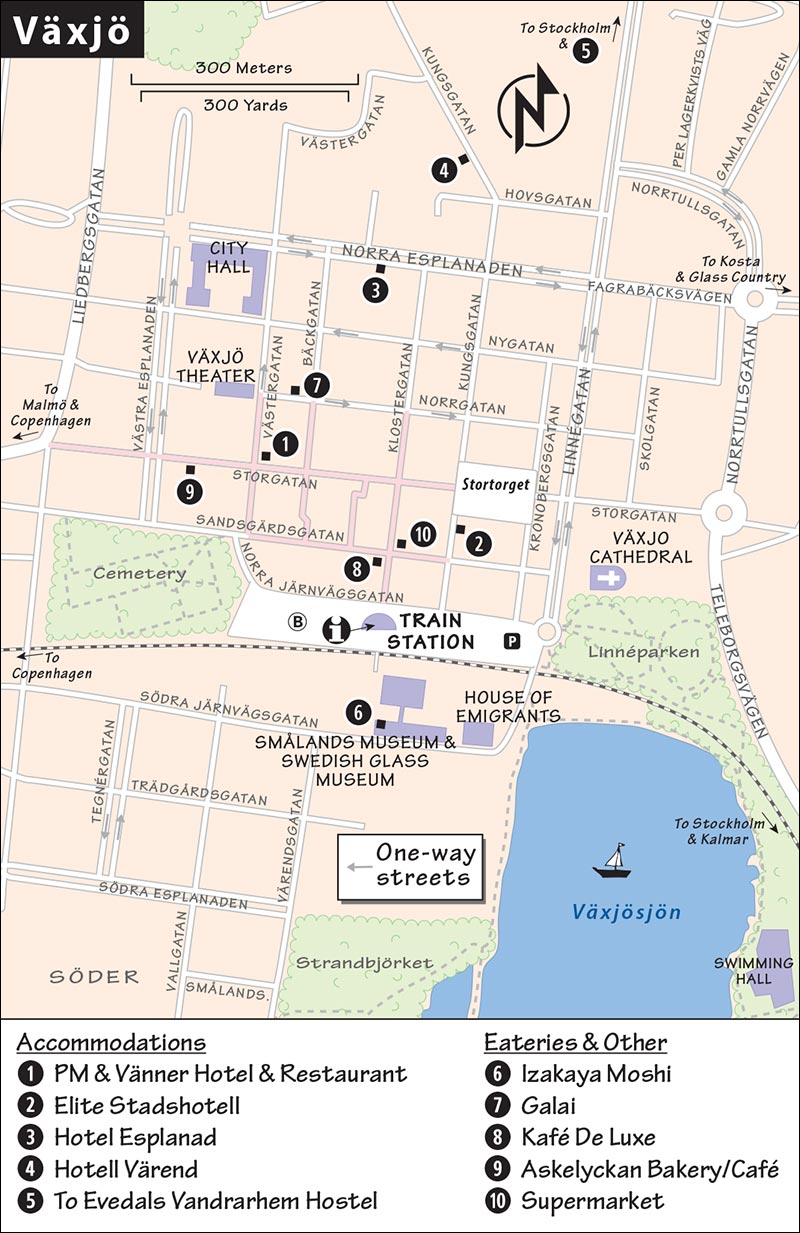
Växjö’s town center is compact and pedestrian-friendly; the train station, main square, cathedral, and two important museums are all within two blocks of each other. Everything described here is little more than a 15-minute walk apart. Tourists are so rare that a polite English-speaking visitor will find locals generous, warm, and helpful.
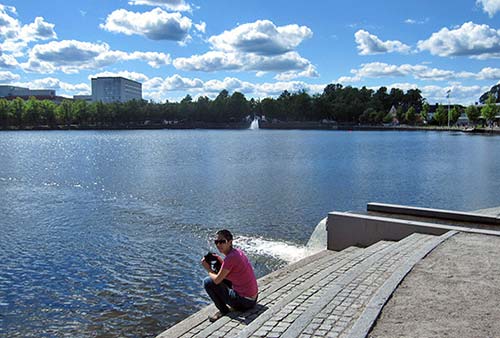
Växjö’s main attractions, clustering around the north end of its pleasant lake and the surrounding park, can be seen in three to four hours. For a delightful stopover, I’d do this loop from the station: Cross the tracks on the overpass to tour the glass and history museums. Then explore the lovely lake area, which is encircled by a path and next to a pretty park and the cathedral. A block in front of the cathedral is the town square, Stortorget; from there stretches the main shopping street, Storgatan. Browse this orderly street before heading back to the station.
Arrival in Växjö: Växjö’s modern train station faces the heart of town; walk a few steps straight ahead, and you’ll be in the pedestrian shopping zone. Luggage lockers are in the main hall. Drivers will find several parking lots near the station.
Tourist Information: The TI is one floor up in the train station, inside the Växjö Kommun offices (Mon-Fri 7:30-16:30, closed Sat-Sun, shorter hours off-season; pick up Glass Country map and brochures here, +46 470 410 00, www.upplev.vaxjo.se).
Sights in Växjö
Smålands Museum/Swedish Glass Museum (Sveriges Glasmuseum)
These two museums share one building and one ticket (which also covers the House of Emigrants). The humble exhibits of the Smålands Museum celebrate the region’s Viking-era prehistory, peasant farming past, and more recent cultural history.
The more instructive Swedish Glass Museum traces six centuries of Swedish glass production, from royal cups to simple bottles and from fine crystal to contemporary art glass. Who knew that the person who designed the original Coca-Cola bottle in 1915 was a Swede? This is the single best place to learn more about the glass heritage of this area whether or not you’re headed deeper into Glass Country to explore workshops.
Cost and Hours: 150-SEK combo-ticket includes House of Emigrants; June-Aug Tue-Sun 10:00-17:00, closed Mon, shorter hours off-season; online audioguide, café, Södra Järnvägsgatan 2, +46 470 704 200, www.kulturparkensmaland.se.
▲House of Emigrants (Utvandrarnas Hus)
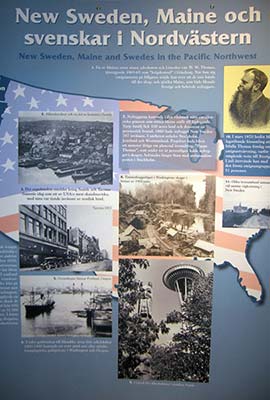
If you have Swedish roots, this tidy museum is exciting. Even if you don’t, it’s an interesting stop for anyone with immigrant ancestors. The well-presented, inspiring “Dream of America” exhibit captures the experiences of the more than one million Swedes who sought refuge in North America in the late 19th and early 20th centuries.
Cost and Hours: 150-SEK combo-ticket includes Småland Museum and Swedish Glass Museum; June-Aug Tue-Sun 10:00-17:00, closed Mon, shorter hours off-season; online audioguide, 50 yards down the hill behind the glass museum, Vilhelm Mobergs Gata 4, +46 470 704 200, www.kulturparkensmaland.se.
Visiting the Museum: The “Dream of America” exhibit touches on all aspects of the emigrant experience. The intro movie gives an overview: As economic woes wracked Sweden from the 1850s to the 1920s, the country was caught up in an American fever. Nearly 1.3 million mostly poor Swedes endured long voyages and culture shock to seek prosperity and freedom in the American promised land. So many left the country that Swedish authorities were forced to rethink their social policies and to institute reforms.
In part, Swedes were compelled to emigrate because of the potato—a staple food in 19th-century Sweden. With dependable (or so everyone thought) nourishment, a peacetime king, and mandatory smallpox vaccinations, the mortality rate had been dropping even among ordinary Swedes. With good (or at least better) times, families got bigger. When crops failed (especially from catastrophic freezes in 1867 and drought in 1868), it wasn’t possible to feed those extra mouths, and many Swedes were forced to leave.
Swedes formed enclaves on farms and prairies across North America, from New York to Texas, and from Maine to Seattle. Displays trace immigrant lifestyles, religion, treatment in the press, women’s experiences, the Swedish cultural societies that preserved Old World traditions, and more. Personal letters from emigrants to family back in Sweden give a poignant perspective on what it was like to adapt to a new culture—including, in another exhibit, “food memories” of the goodies not so available in America.
Look for the display about the Titanic: After Americans, Swedes were the largest group to perish on that ill-fated vessel. On view are a few items that went to the bottom of the Atlantic with one of the Swedish passengers.
Interactive screens let you delve deeper into some topics; for example, you can learn all the towns in the US that once had “snus streets” (Swedish neighborhoods). Details like intelligence tests administered to new arrivals at Ellis Island are reminders of the suspicion immigrants were under.
One long wall pays homage to Americans with Swedish roots, including Charles Lindbergh, Buzz Aldrin (the second man on the moon), and the Muppets’ Swedish Chef (bork bork bork).
The Moberg Room celebrates local writer Vilhelm Moberg (1898-1973), who put the Swedish immigrant experience on the map with his four-novel series The Emigrants. (These books—and two Max von Sydow/Liv Ullmann films based on them, The Emigrants and The New Land—are essential pretrip reading and viewing for Swedish-Americans.) Here you’ll see a replica of Moberg’s “writer’s hut,” his actual desk, and some original manuscripts.
Research/Genealogy Department: The museum has a well-established research department that can help you trace your Swedish ancestry. Visitors are welcome to use databases independently for free (reserve in advance via email) or book a time to get the assistance of a staff member (about 200 SEK/2 hours, open Mon-Fri 10:00-16:00, shorter hours off-season; they’ll also answer specific genealogy questions via email—each inquiry about 400 SEK: emigrationsforskning@kulturparkensmaland.se).
Växjö Town Park (Växjö Stadspark)
Directly downhill from the House of Emigrants, you’ll reach the big lake called Växjösjön. This is a fine place to relax with a picnic or go for a stroll. The town park features a pleasant three-mile path around the lake that takes you from manicured flower gardens through forested areas. The top part of the lake borders the inviting Linnéparken next to the cathedral (both described next).
A 10-minute walk around the top of the lake from the House of Emigrants is the town’s modern swimming hall (simhall, 100-SEK base price includes sauna, extra fee to rent a towel or locker; call or check online for open-swim hours, +46 10 183 9865, www.actic.se/hitta-gym/gym-i-vaxjo/vaxjo-simhall).
Växjö Cathedral (Växjö Domkyrka)
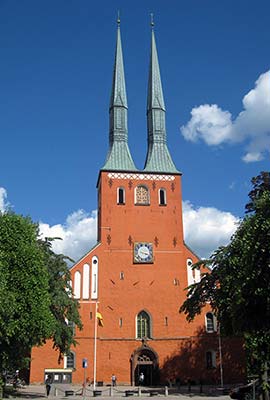
Växjö’s striking red-orange brick church, with its distinctive double-needle steeple, features fine sacred art—in glass, of course. Its austere, bright-white interior is enlivened by gorgeous, colorful, and highly symbolic glass sculptures.
Cost and Hours: Free, daily 9:00-18:00, music on Sun and Thu in summer—check the church’s information board.
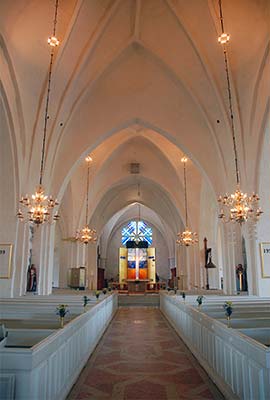
Visiting the Cathedral: Near the entrance, pick up the brochure offering a detailed and evangelical self-guided tour. In the left side aisle, the Tree of Life and Knowledge is a fantastically detailed candelabra. On one side, find Adam and Eve reaching for a very tempting apple with the clever snake egging them on from below. On the other side, Jesus and Mary welcome the faithful with arms outstretched. In similar opposition, the snake’s tempting apple is suspended across from a bunch of grapes (symbolizing the wine of the Eucharist).
At the front of the church, the modern stone altar stands before a glass-decorated triptych, itself a subtle interplay of light and dark. Explore the other pieces of glass art around the church, and take in its trio of pipe organs.
Linnaeus Park (Linnéparken)
This peaceful park beside the cathedral is dedicated to the great Swedish botanist Carl von Linné (a.k.a. Carolus Linnaeus). It has an arboretum, lots of well-categorized perennials, a cactus garden, and a children’s playground.
▲Storgatan
Strolling Växjö’s main pedestrian shopping boulevard is a relaxing way to cap your visit. From the main square, Storgatan stretches several blocks west. Walk the entire length of the street to observe small-town Sweden without any tourists. Imagine growing up or raising a family here in this friendly but traditional, pleasant but predictable community. A fine destination is the popular Askelyckan bakery and café, at #25 (see listing under “Eating in Växjö,” later).
Sleeping in Växjö
If you’re parking a car in Växjö, be sure to use the pay-and-display meters. Parking is free overnight from 18:00 until 9:00 the next morning.
$$$ PM & Vänner Hotel, with 74 stylish rooms and a recommended eatery, has a restful in-the-know vibe. Extras include free loaner bikes, a gym, and a pool, which shares the rooftop with an appealing bar/terrace (elevator, sauna, pay parking, centrally located at Västergatan 10, +46 470 759 700, www.pmhotel.se, reservations@pmhotel.se).
$ Elite Stadshotell is a big, modern, business-class hotel with all the comforts in its 163 rooms. It’s conveniently set on the town’s main square and close to everything (loaner bikes, about a block from the train station at Kungsgatan 6, +46 470 13400, www.elite.se, info.vaxjo@elite.se).
$ Hotel Esplanad offers 26 comfortable, fresh rooms. Since it’s on a busy road, ask for a room at the rear (free parking, N. Esplanaden #21A, +46 470 22580, www.hotelesplanad.com, info@hotelesplanad.com).
¢ Hotell Värend is friendly, comfortable, and inexpensive. It has 39 simple but serviceable rooms at the edge of a residential neighborhood six blocks from the train station (elevator, free parking, a block beyond N. Esplanaden at Kungsgatan 27, +46 470 776 700 or +46 76 769 0700, www.hotellvarend.se, info@hotellvarend.se).
¢ Växjö’s fine Evedals Vandrarhem Hostel (an old hotel) is on a lake three miles north of town. Though it’s a bit of a schlep to get here, the location is lovely (breakfast extra, sheets extra, confirm reception hours and directions before you arrive, +46 470 63034, www.evedalscamping.com, info@evedalscamping.com).
Eating in Växjö
The restaurant scene is picking up in sleepy Växjö, with a few memorable spots in the center. If you’re looking to save money, try one of central Växjö’s many Asian restaurants or kebab-and-pizza shops.
$$$$ PM & Vänner is a trendy eatery where a younger crowd stands in line to see and be seen. They have good international cuisine with Swedish flair, a mod black-and-white interior, and nice outdoor tables on the pedestrian mall. Their menu changes to feature seasonal and local ingredients (Wed-Sat dinner only, closed Sun-Tue, Storgatan 22 at corner of Västergatan, +46 470 759 710).
$$$$ Izakaya Moshi serves flavorful Japanese-style small plates (sushi, dumplings, salads, grilled fish, and meats) in an airy and light space. Choose from the long communal table, a cozy booth, or terrace seating when weather allows. Reservations are smart (closed Sun-Mon, immediately adjacent to the Smålands Museum at Södra Järnvägsgatan 2, +46 470 786 830, www.izakayamoshi.se).
$$$$ Galai occupies a glassy pavilion close to the old theater. Choose between the flashy bar or dining room, or take advantage of the nice patio when the sun’s shining. The menu leans international, with a particular strength in seafood and steaks, though it offers some good plates for sharing, too (closed Sun-Mon, Teatertorget, +46 470 524 144, www.restauranggalai.se).
$$$ Kafé De Luxe, about a block from the station, is a hip and funky hangout with live music many nights. They serve lunches and dinners daily—from burgers to tarte flambée—in a cozy Old World interior or under a happy tent outside (daily until late, Sandgärdsgatan 19, +46 470 740 409).
$ Askelyckan Bakery/Café, with an inviting terrace under a tree by a fountain on the city’s main commercial drag, is a delightful place for a drink, dessert, or light lunch on a sunny day (cakes, pastries, salads and sandwiches at lunch, Mon-Fri 8:00-18:00, Sat 9:00-16:30, Sun 11:00-16:00, Storgatan 25, +46 470 12311).
Groceries: Visit the ICA supermarket at the corner of Sandgärdsgatan and Klostergatan, one block from the train station (long hours daily).
Växjö Connections
From Växjö by Bus to: Kosta (2-4/day, 1 hour, bus #218 from Växjö bus station; for schedules see www.lanstrafikenkron.se).
By Train to: Copenhagen (hourly, 3 hours), Stockholm (about hourly, 3.5-4.5 hours, change in Alvesta), Kalmar (hourly, 70 minutes).
Glass Country
Filling the remote-feeling woods between Växjö and Kalmar with busy glassmaking workshops, Sweden’s famous Glasriket (“Kingdom of Crystal”) is worth ▲▲ for those with a car. There’s something deeply pleasing about a visit to a glassworks (glasbruk). Even at the bigger places—and especially at the smaller ones—you’ll feel genuine artistic energy at work as skilled craftspeople persuade glowing globs of molten glass to take shape.
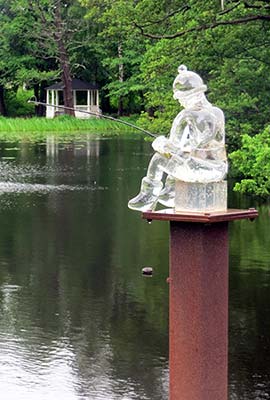
The rich natural environment of this area, with inviting forests and lakes all around, has been fundamental to the glassworks (they needed a lot of wood to keep those fires going) and the region’s other product, paper (small papermaking mills relied on plentiful water to wash cotton fiber to create paper pulp).
Visiting a glassworks is usually free. At most places, it’s possible to walk through the hot shop (hytta), observe glassblowers in action, and feel the heat from glowing furnaces. Most glassworks also have a shop/gallery displaying and selling pieces produced on-site.
The glassworks listed here are a representative mix of the dozen or so you can visit in Glass Country, ranging from charming artistic workshops to big corporate factories. On the corporate side, Kosta Boda dominates; its flagship complex is the biggest of all the glassworks, and they offer guided tours. But there are many smaller, independent producers where you can get a more intimate view of the process.
Besides the tradition of hand-crafted glass, the region sustains the only surviving hand papermaking workshop in all of Scandinavia, in the town of Lessebo. It’s an interesting place to visit, if it’s open (check ahead).
For a complete change of pace, check out the local moose population (you can visit them at the Moose and Farm Animal Park just outside Kosta).
PLANNING YOUR TIME
The glassworks are best reached with a car. Travelers without a car can get a taste of Glass Country at Växjö’s Swedish Glass Museum or by taking a bus from Växjö to Kosta to visit the Kosta Boda complex (see “Växjö Connections,” earlier). Alternatively, you may be able to hire a local guide to take you on a tour of the region—guides are listed at www.glasriketguiderna.se/english.
With a car, this region is a joy—it’s small (Kalmar to Växjö is 70 miles), with light traffic and endless forest-and-lake scenery punctuated by numerous glassworks. Most are clustered in the center of the region, and while it would take the better part of a day to visit them all, distances are short and roads are good. Still, it’s smart to be selective. On a tight schedule, I’d visit the Glass Factory and Magma Art Glass Transjö, plus possibly Kosta Boda or Målerås if you want to see the bigger operations, skipping the rest. The Lessebo paper mill is well worth a visit, but opening times may be limited—check locally before planning a visit.
Planning Tips: Pick up a map of the region and the Glasriket/Kingdom of Crystal magazine from the TI in Växjö or Kalmar. The region’s official website (www.glasriket.se) describes the many glassworks that welcome the public.
Note that many workshops take a lunch break sometime between 11:00 and 12:00, and stop work entirely after about 15:00 or 15:30. Most glassworks are open daily in July and August—but some glassblowers take the summer off. Check ahead to be sure the shop you want to visit will be open and glassblowers will be on view. Hours are always subject to change at the smaller places, but they welcome a phone call to confirm open times.
Gas up before you head out; there are few services in Glass Country.
GLASS COUNTRY DRIVING ROUTE
Drivers coming from Kalmar can follow the plan outlined here (if you are approaching Glass Country from Copenhagen, this route can be easily reversed): Head west on highway 25, following signs for Växjö; turn right off this road for your first stop, the village of Boda and Glass Factory museum (glasmuseum). From Boda, head north; at the T-intersection (highway 31), go left to reach Målerås (just off the main road). When you’ve finished there, continue west on highway 31 for the turnoff south to Kosta Boda (highway 28). Heading south another 10 minutes along the same road, you’ll reach Magma Art Glass Transjö, the best of the smaller, artsy glassworks, and then highway 25, which leads west to Växjö. Along the way, you can visit the Lessebo paper workshop or Bergdala glassworks (watch for signs).
Sights in Glass Country
GLASSWORKS
These are listed in the order you’ll reach them traveling from Kalmar to Växjö.
▲Glass Factory
When glass producers fell on hard times in the 1980s and 1990s, many shops either folded or consolidated. The glass workshop in the little village of Boda was one such casualty, but the municipality came together to buy its glass archive, an amazing record of artistic achievement. It’s now on display in the well-presented Glass Factory museum, located in the former glass production workshop, which is worth a peek particularly if you aren’t visiting the Glass Museum in Växjö. There’s also a modern hot shop with regular demonstrations, and a gallery with work by a variety of contemporary glass artists.
Cost and Hours: 80 SEK; Mon-Fri 10:00-17:00, Sat-Sun from 11:00; off-season Sat-Sun only 11:00-16:00; in Boda at Storgotan 5, well-signed just off highway 25, +46 471 249 360, www.theglassfactory.se [URL inactive].
▲Målerås Glasbruk
Several artists came together to create this impressively professional complex, which feels midway between the corporate slickness of Kosta Boda and the scrappy charm of Magma Art Glass Transjö.
The complex includes a gallery, a shop with both functional and artsy pieces, and a restaurant open for lunch and hyttsill dinners. Adjacent is a different shop with a fun array of handicrafts from local artists—everything from ceramics to knitting. If you really want to dive into the action, they also offer glassblowing courses.
Cost and Hours: Free; shop open Mon-Fri 10:00-18:00, Sat-Sun until 16:00, shorter hours off-season; hot shop open daily 11:00-15:00, guided tours at 11:00, 13:00, and 15:00; well-signed just north of highway 31, +46 481 314 01, www.maleras.se.
Orranäs Glasbruk
The town of Orrefors once had a major glassworks with its own proud history, but glass is no longer commercially produced there. The once sought-after Orrefors art glass is now just a stepchild of Kosta Boda and mostly machine-made abroad. With its glassworks shuttered in 2012, Orrefors became a ghost town.
Concerned locals made a plan to blow life back into the town and its glass heritage. They started with an open-air hot shop operating in a park near the old shop, reintroducing art-glass production to the town in 2017 and sold under the name Orranäs Bruk. But a fire burned the hot shop to the ground in mid-2023. Supporters promise to rebuild quickly; for the latest, see OrranasGlasbruk.se.
Meanwhile, the town’s dazzling glass museum continues to display its historic art pieces, from early 20th-century examples with Art Nouveau flair through works from the 1940s (www.orreforsmuseum.se).
▲▲Magma Art Glass Transjö
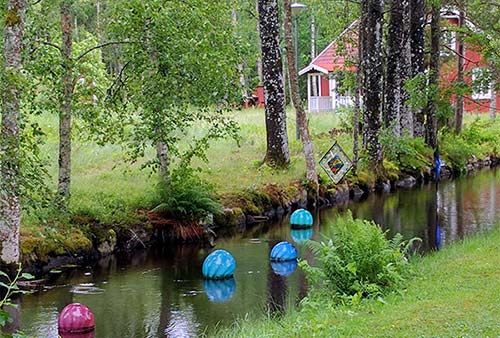
Set up in an old converted farm 10 minutes south of Kosta, this tiny, friendly glassworks creates high-quality fine-art pieces. From the main shop, a canal-like stream (enlivened with colorful glass art baubles) leads back to the hopping hot shop. Started by a pair of highly regarded glass workers, they have now handed the operation over to their former apprentices, impressive artists in their own right. Here you can feel the art oozing out of the ovens; even if you don’t visit the hot shop, the setting is charming.
In the mid-16th century, King Gustav Vasa decided he wanted more fine glass to decorate his palace, so he invited German glassmakers to train his subjects, and the trend took off. It’s no surprise that glassmaking caught on here in Sweden. The resources needed for glass are abundant: vast forests to fire the ovens, and lakes with an endless supply of sand. By the difficult 19th century—when a sixth of Sweden’s population emigrated to North America—the iron mills had closed, leaving behind unemployed workers who were highly skilled at working with materials at high temperatures. Glassmaking was their salvation, and by the early 1900s, this region had more than 100 glassworks.
While glassmaking was important throughout Sweden, it was in the dense forest between Växjö and Kalmar that it took hold most strongly and lasted the longest. When other materials (like paper cartons) became cheaper than glass, the industry was hit hard. It dried up in other parts of Sweden, but here in Glass Country, workers refocused their efforts, shifting from everyday items to high-quality pieces that command top kronor. An Ikea wine glass made in China costs 10 SEK, while a handmade Swedish one might cost 150 SEK—but consumers interested in quality are willing to pay that premium.
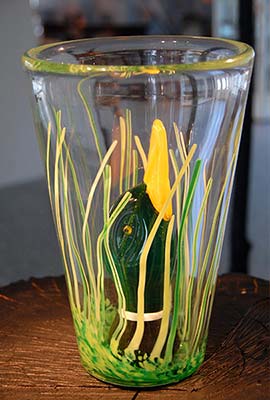
The glassmaking process is fascinating—and hasn’t changed much over the centuries. If you visit a hot shop, you’ll see both everyday tableware and art pieces being created. “Mass-produced” pieces, such as wine glasses, are created by small teams of glassblowers who use an assembly-line system to produce a uniform product. Art-glass pieces, however, are never the same. The region has a passel of big-name designers, each with their own aesthetic.
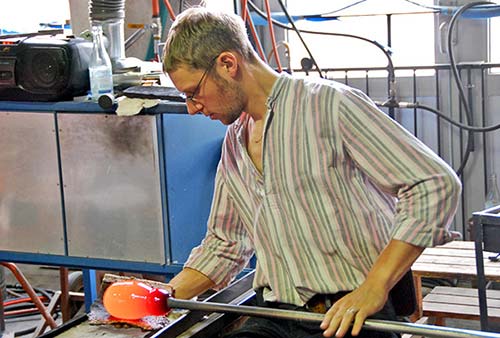
Either way, the process is the same. First, a worker places the glassblowing rod into the furnace (notice the foot pedals used to open and close the doors) and grabs a blob of molten glass. Glassblowers have to move quickly—before the glass hardens too much—but deliberately, to avoid shattering the medium or burning their colleagues. After rolling the glass out to its desired shape on a heat-resistant table, they blow into the end of the rod to open a space inside. If creating a mass-produced item, they generally stick it into a mold to ensure the correct dimensions. If making a wineglass with a stem and foot, separate pieces of glass are stretched out to the appropriate shape and attached.
For this entire process, the glass is at about 2,100 degrees Fahrenheit. If it gets too hot, glassblowers cool it down with water or air; if the glass needs to be reheated, they use a blowtorch or poke it back into the furnace. Finally, the area where the glass was attached to the rod is cut with an industrial diamond, broken off, and ground and polished smooth. The finished piece is set in a special oven to cool gradually.
At the workday’s end, the raw materials for the next day’s glass are dumped into giant, custom-made clay pots and placed in the ovens. Overnight, these will gradually melt down to the molten medium the glassblowers will need the next morning.
Only the best pieces are deemed “first quality” (1:A Sortering)—you’ll pay a premium for these flawless items. Some items, deemed “second quality” (2:A Sortering), have minor imperfections that bring the price down substantially. When shopping, pay close attention to these labels; if you don’t need your glass perfect, you can save by looking for second quality.
The gift shop out front sells a fine selection of one-of-a-kind glass art and limited-run items made on-site. The shop keeps routine hours, but if you find it closed, dial the phone numbers posted on the door and someone will let you in.
Cost and Hours: Free, shop usually open early June-mid-Sept daily 9:00-17:00; hot shop hours irregular, smart to call or email ahead; +46 478 505 62 or +46 725 598 155, www.magmaartglass.com, info@magmaartglass.com. To find it, look for Magma Art Glass signs just south of Kosta.
▲▲Kosta Boda
The village of Kosta boasts the oldest of the glasbruks, dating back to 1742. Today, the Kosta Boda campus includes a modern outlet mall, a factory store, a fancy new art hotel...and, of course, the glassworks. It’s a one-stop-shop glass theme park.
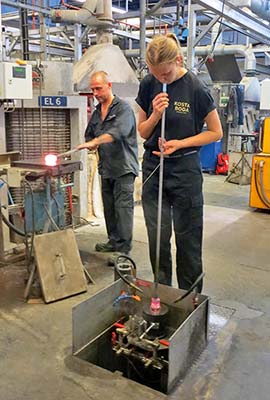
The highlight here is watching the glassworks in action. Visitors are welcomed to the hot-shop floor, where a team of glassblowers rotates through a carefully choreographed routine: grabbing a glob of molten glass on the blow pipe, rolling it on a steel table into a general shape, then turning and blowing the piece into its final form. You can visit the glassworks and its gallery on your own, but it’s worth calling or emailing ahead to reserve a spot on a 30-minute English tour.
In the art gallery, high-end pieces are exhibited and often for sale. This is also where you buy tickets for the tour or the hot shop. The nearby Kosta Glascenter arranges “experiences” that let you blow your own drinking glass (www.kostaglascenter.se).
Cost and Hours: 70 SEK, hot shop generally open Mon-Thu 10:00-16:00 (lunch break 10:45-11:30), Fri until 12:30, Sat-Sun 11:00-16:00; gallery open daily 10:00-17:00, www.kostaboda.se.
Tours: 140 SEK, hourly 10:00-15:00, best to arrange ahead by phone or email (+46 478 34529, info@kostaboda.se).
Shopping: In the Kosta factory outlet shop, crystal “seconds” (with tiny bubbles or sets that don’t quite match) and discontinued pieces are sold at good prices. This is duty-free shopping, and they’ll happily mail your purchases home. Don’t confuse this with the big outlet mall across the street.
Sleeping and Eating: The $ cafeteria inside the outlet mall features thrifty lunch specials. Nearby is the pricey $$$$ Kosta Boda Art Hotel, designed to impress. Everything’s decorated to the hilt with (of course) artistic glass, created in the hot shop across the street. With Växjö and Kalmar so close, there’s little reason to sleep here (+46 478 34830, www.kostabodaarthotel.se). But if you have a few extra minutes, peek into this over-the-top, world-of-glass complex, which includes a snazzy “glass bar” and a restaurant.
▲Bergdala Glassworks (Bergdalahyttan)
The small, independent Bergdala glassworks, in a village of the same name, has an enjoyably low-key, creative hot shop. Its well-stocked shop is full of its affordable trademark blue-rimmed glassware, and the engaging “museum” around back shows off a different sampling of local artists every year.
Cost and Hours: Free, gallery/shop open daily mid-May-mid-Aug 10:00-16:00, shorter hours off-season; glassblowing Mon-Fri 7:30-15:30 (lunch break 11:00-12:00); off highway #25 near Hovmantorp, +46 478 31650, www.bergdalahyttan.se.
OTHER ATTRACTIONS
▲Lessebo Paper Workshop (Handpappersbruket)
Tucked just outside the gates of Lessebo’s industrial-scale paper mill is a smaller stone building that’s home to an artisan workshop where paper is made by hand. A visit here offers a rare opportunity to witness a centuries-old craft up close and personal. Ownership of the workshop is in flux, however, so check locally before making a special trip.
The Lessebo workshop is a study in the way things used to be. They use strictly traditional methods: the newest piece of machinery is from the 1920s. Cotton fibers are soaked until they become pulp, packed into a frame, pressed, dried, glazed, and hand-torn into the perfect size and shape.
This paper has long been coveted throughout Sweden for special purposes: top-of-the-line stationery (for wedding invitations), impossible-to-forge embossed document paper (for certificates or important examinations), and long-lasting archival use (the cotton fibers ensure the paper will stay pristine for decades).
You can visit the gift shop on your own (watercolor paper, stationery, and cards), but to see papermaking in action, you’ll need to join a tour.
Cost and Hours: Call or email ahead to confirm tour times before showing up; gift shop and café open daily year-round; look for Handpappersbruk sign on highway 25, Storgatan 79, +46 478 47600, market@lessebopaper.com.
Grönåsen Moose and Farm Animal Park (Grönåsen Älg- & Lantdjurspark)
This offbeat attraction, just outside Kosta, demonstrates the love-hate relationship Swedes feel toward their moose population. A third of a million of these giant, majestic beasts live in Sweden. They’re popular with hunters but unpopular with drivers. At this attraction, you’ll walk through the moose-happy gift shop before taking a mile-long stroll around the perimeter of a pen holding live moose. Periodic museum exhibits—life-size dioramas with stuffed moose (including one plastered to the hood of a car)—round out the attraction. You can even buy moose sausage to grill on-site. Sure, it’s a hokey roadside stop, and will hardly be a hit with animal-rights activists, but for many the park is an enjoyable stop.
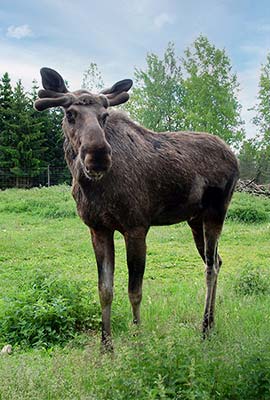
Cost and Hours: 135 SEK, July-Aug daily 10:00-18:00, shorter hours off-season, closed Nov-May, just outside Kosta on the road to Orrefors, +46 478 50770, www.gronasen.se.
Eating in Glass Country
You’ll find a few simple eateries scattered around the area, with the most choices concentrated around the big Kosta Boda complex, where the cafeteria in the outlet mall is the perfect place for fast and cheap, Ikea-style Swedish grub. Målerås Glasbruk also has a restaurant.
If you’d like to linger over a more serious dinner, consider joining one of the special hyttsill dinners offered at various glass workshops. Traditionally, a hot shop’s fires made it a popular place to convene after hours on frigid winter nights. People would huddle around the ovens and be entertained by wandering minstrel-type entertainers called luffar. The food was nothing special (hyttsill literally means “hot-shop herring,” usually served with crispy pork, potatoes, and other stick-to-your-ribs fare), but it was a nice opportunity for a convivial rural community to get together. Today modern glassworks carry on the tradition, inviting tourists on several nights through the summer. They usually have live music and glassblowers working while you dine (figure around 500 SEK per person; for more information, see www.glasriket.se).