NORWAY
Norge
Norway is stacked with superlatives—it’s the most mountainous, most scenic, and most prosperous of all the Scandinavian countries. On a sunny day, Norway exudes an “I could live here” appeal like no place else.
Norway is also a land of rich harvests—timber, oil, and fish. In fact, Norway’s wealth of resources is a major reason why Norwegians have voted “nei” to membership in the European Union. They don’t want to be forced to share fishing rights with EU countries.
The country’s relatively recent independence (in 1905, from Sweden) makes Norwegians noticeably patriotic and proud of their traditions and history—but they also look optimistically to the future.
Norway’s Viking past (c. AD 800-1050) can still be seen today in the country’s 28 remaining stave churches—with their decorative nods to Viking ship prows—and the artifacts housed in Oslo’s Museum of the Viking Age. The Vikings, who also lived in present-day Denmark and Sweden, were great traders, shipbuilders, and explorers. However, they are probably best known for their infamous invasions, which terrorized much of Europe. The sight of their dragon-prowed ships on the horizon struck fear into the hearts of people from Ireland to the Black Sea.
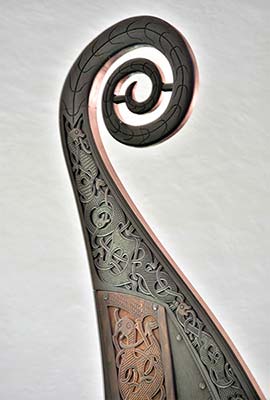
Named for the Norse word vik, which means “bay” or “inlet,” the Vikings sailed their sleek, seaworthy ships on extensive voyages, laden with amber and furs for trading—and weapons for fighting. They traveled up the Seine and deep into Russia, through the Mediterranean east to Constantinople, and across the Atlantic to Greenland and even “Vinland” (Canada). They touched the soil of the Americas centuries before Columbus, causing proud Scandinavian immigrants in the US to display bumper stickers that boast, “Columbus used a Viking map!”
History and Hollywood have painted a picture of the Vikings as fierce barbarians, an image reinforced by the colorful names of leaders like Sven Forkbeard, Erik Bloodaxe, and Harald Bluetooth. Unless you’re handy with an ax, these don’t sound like the kind of men with whom you want to hoist a tankard of mead. They kept slaves and were all-around cruel (though there is no evidence that they forced their subjects to eat lutefisk).
But the Vikings also had a gentle side. Many were farmers, fishermen, and craftsmen who created delicate works with wood and metal. Faced with a growing population constrained by a lack of arable land, they traveled south not just to pillage and plunder, but in search of greener pastures. Sometimes they stayed and colonized, as in northeast England, which was called the “Danelaw,” or in northwest France, which became known as Normandy (“Land of the North-men”).
The Vikings worshipped many gods and had a rich tradition of mythology. Epic sagas were verbally passed down through generations or written in angular runic writing. The sagas told the heroic tales of the gods, who lived in Valhalla, the Viking heaven, presided over by Odin, the god of both wisdom and war. Like the Egyptians, the Vikings believed in life after death, and chieftains were often buried in their ships within burial mounds, along with prized possessions such as jewelry, cooking pots, food, and Hagar the Horrible cartoons.
Official Name: Kongeriket Norge—“The Kingdom of Norway”—or simply Norge (Norway).
Size: At 148,700 square miles, Norway is slightly larger than Montana, and has a population of 5.4 million people (about 35 per square mile)
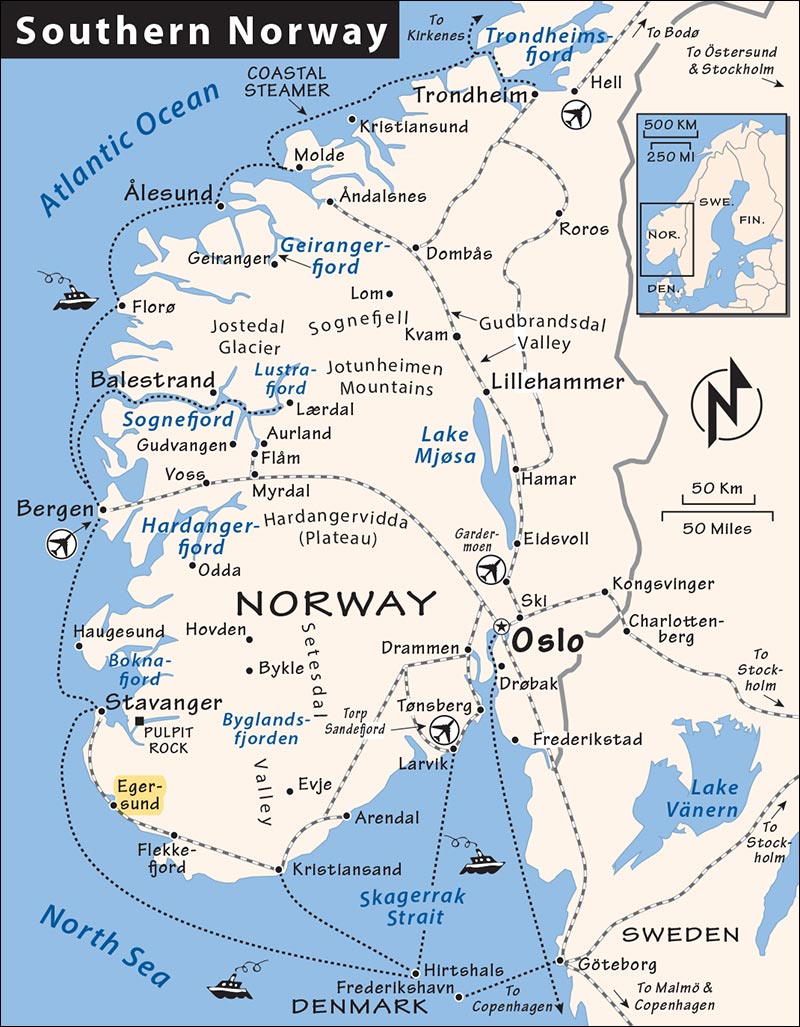
Geography: Sharing the Scandinavian Peninsula with Sweden, Norway also has short northern borders with Finland and Russia. Its 51,575-mile coastline extends from the Barents Sea in the Arctic Ocean to the Norwegian Sea and North Sea in the North Atlantic. Shaped by glaciers, Norway has a rugged landscape of mountains, plateaus, and deep fjords. In the part of Norway that extends north of the Arctic Circle, the sun never sets at the height of summer, and never rises in the depth of winter.
Latitude and Longitude: 62°N and 10°E, similar latitude to Canada’s Northwest Territories.
Biggest Cities: Norway’s capital city, Oslo, has a population of 710,000; more than 1 million live in its metropolitan area. Bergen, Norway’s second-largest city, has a population of about 284,000.
Economy: The Norwegian economy grows around 1.5-2 percent each year, contributing to a healthy $587 billion gross domestic product and a per capita GDP of $80,800. Its primary exports are oil and gas—Norway produces less than 5 percent of the world’s oil but exports 95 percent of it; the country is on the top-ten list of natural gas producers in the world. Oil and gas make Norway one of the world’s richest countries. The two commodities account for more than 50 percent of the Norwegian economy. By law, the country must save a portion of its oil revenue; the fund is currently worth almost $1.5 trillion.
Government: As the leader of Norway’s parliamentary constitutional monarchy, King Harald V has largely ceremonial powers. Norway’s legislative body is the Stortinget (Parliament), with 169 members elected for four-year terms.
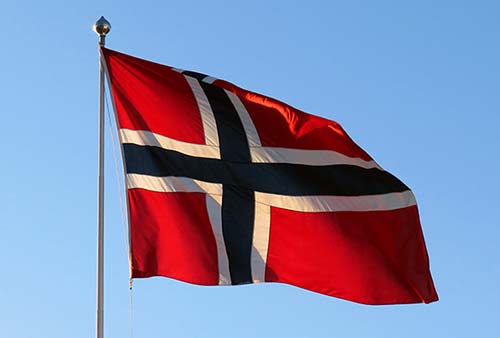
Flag: Red with a blue Scandinavian cross outlined in white.
The Average Norwegian is 41 years old, has 1.7 children, will live to be 82, and enjoys a good coffee buzz, drinking nearly four cups a day.
One thing that does not appear in the earliest Viking sagas: dragons. Considering that the dragon adorned Viking ships and churches, it’s surprising that the mythical beast didn’t show up here until about the 12th century. This suggests that, as they traveled far and wide, these early Norwegians collected ideas from the people they encountered, and incorporated them into their culture. (In other parts of Europe, including Britain, dragons were long-established in local lore.)
Similar to the Greeks and Etruscans before them, the Vikings never organized on a large national scale and eventually faded away due to bigger, better-organized enemies and the powerful influence of Christianity. By 1150, the Vikings had become Christianized and assimilated into European society. But their memory lives on in Norway.
Beginning in the 14th century, Norway came under Danish rule for more than 400 years, until the Danes took the wrong side in the Napoleonic Wars. The Treaty of Kiel forced Denmark to cede Norway to Sweden in 1814. Sweden’s rule of Norway lasted until 1905, when Norway voted to dissolve the union. Like many European countries, Norway was invaded by Germany during World War II. April 9, 1940, marked the start of five years of Nazi occupation, during which a strong resistance movement developed.
Each year on May 17, Norwegians celebrate their idealistic 1814 constitution with fervor and plenty of flag-waving. Men and women wear folk costumes (bunads), each specific to a region of Norway. Parades are held throughout the country. The parade in Oslo marches past the Royal Palace, where the royal family waves to the populace from their balcony. While they hold almost zero political power (Norway’s parliament is chaired by a prime minister), the royal family is still highly revered and respected.
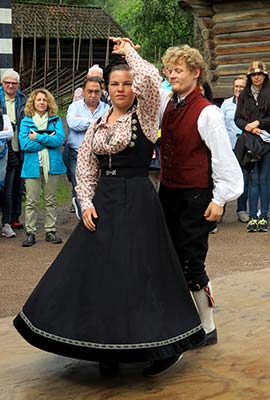
High taxes contribute to Norway’s high standard of living. Norwegians receive cradle-to-grave social care: university education, health care, yearlong parental leave, an annual five weeks of vacation, and state-funded pensions.
Things in Norway simply work well: slick roads, remarkably engineered bridges and tunnels, and frequent ferries—just drive on, have the toll automatically deducted from your credit card, and relax in the on-board café. From a robust network of electric-car charging stations to universal health care—Norway is doing it right. As a traveler I appreciate Norway’s example of a well-coordinated, compassionate society that works together to improve quality of life.
Norwegians historically were mainly of Nordic and Germanic heritage, with a small population of indigenous Sami people in the north. But according to recent studies, one in five Norwegian residents today was born outside of Norway, and one in ten comes from a non-European background. The growing immigrant population is primarily from Sweden, Poland, Lithuania, Pakistan, and Somalia, with a recent wave of immigrants from Syria and Ukraine. (There has been some pushback: The anti-immigration Progress Party is supported by a small percentage of the population.) Although church attendance is way down, the vast majority of Norwegian Christians consider themselves Lutheran.
Visitors enjoy the agreeable demeanor of the Norwegian people—friendly but not overbearing, organized but not uptight, and with a lust for adventure befitting their gorgeous landscape. Known for their ability to suffer any misfortune with an accepting (if a bit pessimistic) attitude, Norwegians are easy to get along with.
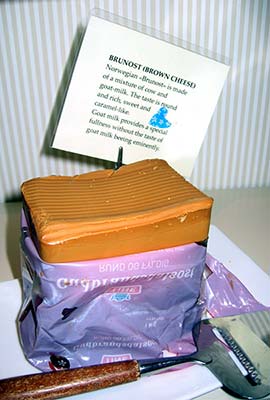
Less than 7 percent of the country’s land is arable, resulting in numerous small farms. The government recognizes the value of farming, especially in the remote reaches of the country, and provides rich subsidies to sustain this way of life. Norwegians are proud of their rich folk traditions—from handmade sweaters and folk costumes to the small farms that produce a sweet brown cheese called geitost.
One farm-fresh product you must try here is ekte geitost, 100 percent pure goat cheese (pictured). Sold in shrink-wrapped cubes, this cheese is made with milk that’s boiled enough to caramelize it—giving it a distinct light-brown color and sweet flavor. To some, it looks like a decade’s accumulation of earwax. I think it’s delicious. Norwegians often eat it on rustic bread with a little butter and jam. Remember, ekte means all-goat—really strong. The more popular and easier-to-eat version—a more typical color and without the sweetness—is made from a blend of cow and goat milk.
With countless fjords, lakes (vatn), and waterfalls (fosser), Norway is known for its pristine water. Norwegian-bottled artisanal water has an international reputation for its crisp, clean taste. Although the designer Voss water—the H2O of choice for Hollywood celebrities—comes with a high price tag, the blue-collar Olden is equally tasty. (Or just fill up your bottle with tap water, which is just as good and much cheaper.)
Native Norwegians speak a collection of mutually understandable dialects. During the centuries of Danish rule, people in Norway’s cities and upper classes adopted a Danish-influenced style of speech and writing (called Dano-Norwegian), while rural language remained closer to Old Norse. After independence, Dano-Norwegian was renamed bokmål (book language), and the rural dialects were formalized as nynorsk (New Norwegian), as part of a nationalistic drive for a more purely Norwegian language. Despite later efforts to combine the two forms, bokmål remains the most common, especially in urban areas, books, newspapers, and government agencies. (You may even see Norwegian television programming that’s produced in one of these languages and subtitled in the other.) Some Sami- and Finnish-speaking minorities are found in the far north.
Most Norwegians also speak English, but a few words in Norwegian will serve you well. If you visit a Norwegian home, be sure to leave your shoes at the door; indoors is usually meant for stocking-feet only. At the end of a meal, it’s polite to say “Takk for maten” (tahk for MAH-ten); “Thanks for the food”). Norwegians rarely feel their guests have eaten enough, so be prepared to say “Nei, takk” (nay tahk; “No, thanks”). You can always try “Jeg er mett” (yay ehr met; “I am full”), but be careful not to say “Jeg er full”—“I am drunk.” See the end of this chapter for more Norwegian survival phrases.
For the traveler, Norway’s biggest appeal is its nature, and taking at least one boat trip on a fjord is a “must” Norwegian experience. With more time, the fjords offer abundant ways to spend it memorably, from floating saunas, to dramatic hikes with eye-popping viewpoints, to high-speed RIB (rigid inflatable boat) tours that zip you up close to tumbling waterfalls. One term you see a lot here is “soft adventure”—meaning an exciting activity accessible even to those with moderate fitness, and not requiring special skills or gear.
Norway’s mountains are equally thrilling. Between any two points, it seems, you have a choice between two drives: A speedier, more direct route through valleys and tunnels, enjoying excellent scenery...or the truly scenic higher-altitude route, twisting above those valleys on spilled-spaghetti roads to cantilevered viewpoints with dramatic panorama views. Norway has invested heavily in making these scenic byways accessible to all. A key word is -fjell (“mountain”)—any road or pass with this tacked on to its name promises thrilling vistas. Some scenic byways charge a toll, typically paid by credit card as you enter, and usually well worth the price.
Cruise ships are a huge part of tourism in today’s Norway. Every day in summer, thousands of passengers are injected into port towns. In larger cities like Oslo, Bergen, or Stavanger, the impact is felt mainly in the congested port areas. But in tiny fjord villages like Flåm and Geiranger—with 200 inhabitants apiece—this influx can increase the local population by tenfold or more. Check local cruise arrival schedules in advance to anticipate the busiest (or quietest) days and times. If you’d like to enjoy fjordside beauty without the crowds, Balestrand and Solvorn (both covered in the “More on the Sognefjord” chapter) are mercifully absent from cruise-line itineraries.
Traveling in Norway, it seems the Norwegians have it all figured out. Enjoy it, and let yourself be inspired.
Norwegian Survival Phrases
Norwegian can be pronounced quite differently from region to region. These phrases and phonetics match the mainstream Oslo dialect, but you’ll notice variations. Vowels can be tricky: å sounds like “awe,” æ sounds like a bright “ah” (as in “apple”), and u sounds like the German ü (purse your lips and say “u”). To pronounce the letter ø, purse your lips together and say “uh.” Certain vowels at the ends of words (such as d and t) are sometimes barely pronounced (or not at all). In some dialects, the letters sk are pronounced “sh.” In the phonetics, ī sounds like the long i in “light,” and bolded syllables are stressed.
| Hello. (formal) | God dag. goo dahg |
| Hi. / Bye. (informal) | Hei. / Ha det. hī / hah deh |
| Yes. / No. | Ja. / Nei. yah / nī |
| Please. | Vær så snill. vayr saw sneel |
| Thank you (very much). | (Tusen) takk. (tew-sehn) tahk |
| You’re welcome. | Vær så god. vayr saw goo |
| Can I help you? | Kan jeg hjelpe deg? kahn yī yehl-peh dī |
| Excuse me. | Unnskyld. ewn-shuld |
| (Very) good. | (Veldig) fint. (vehl-dee) feent |
| Goodbye. | Ha det bra. hah deh brah |
| zero / one / two | null / en / to newl / ayn / toh |
| three / four | tre / fire treh / fee-reh |
| five / six | fem / seks fehm / sehks |
| seven / eight | syv / åtte seev / awe-teh |
| nine / ten | ni / ti nee / tee |
| hundred | hundre hewn-dreh |
| thousand | tusen tew-sehn |
| How much? | Hvor mye? voor mee-yeh |
| local currency: (Norwegian) crown | (Norske) kroner (norsh-keh) kroh-nehr |
| Where is...? | Hvor er...? voor ehr |
| ...the toilet | ...toalettet toh-ah-leh-teh |
| men | menn / herrer mehn / hehr-rehr |
| women | damer dah-mehr |
| water / coffee | vann / kaffe vahn / kah-feh |
| beer / wine | øl / vin uhl / veen |
| Cheers! | Skål! skawl |
| The bill, please. | Regningen, takk. rī-ning-ehn tahk |