FINLAND
Suomi
Finland is a fun, fascinating, overlooked corner of Europe, with a small population filling a sprawling, rocky, forested land that shares a long border with Russia. The Finns have often been overshadowed by their powerful neighbors, the Swedes and the Russians. And yet, they’ve persevered magnificently, with good humor, a zest for architecture and design, a deep love of saunas, and an understandable pride in things that are uniquely Finnish.
Technically Finland is Nordic, rather than Scandinavian. The Scandinavian countries—Denmark, Sweden, and Norway—are constitutional monarchies with closely related languages. Add Iceland and Finland—republics that are former Danish or Swedish colonies—and you have the Nordic countries.
For much of their history, the Finns embraced a simple agrarian and fishing lifestyle. They built not cities, but villages—easy pickings for their more ambitious neighbors. From medieval times to 1809, Finland was part of Sweden; today it still has a sizeable Swedish-speaking minority, bilingual street signs, and close cultural ties to Sweden.
In 1809, Sweden lost Finland to Russia. Under the next century of relatively benign Russian rule, the Grand Duchy of Finland began to industrialize, and Helsinki grew into a fine and elegant city. Still, at the beginning of the 1900s, the rest of Finland was mostly dirt-poor and agricultural, and its people were eagerly emigrating to northern Minnesota. (Read Toivo Pekkanen’s My Childhood to learn about the life of a Finnish peasant in the early 1900s.)
Finland and the Baltic states (Estonia, Latvia, and Lithuania) won their independence from Russia in 1917; this was followed by brief but vicious civil wars against domestic pro-Russian factions. After this period, Finland enjoyed two decades of prosperity...until the secret Nazi-Soviet pact of August 1939 assigned it to the Soviet sphere of influence. When the Red Army invaded, white-camouflaged Finnish ski troops fought back, winning the Winter War (1939-1940). They then held off the Soviets in what’s called the Continuation War from 1941 until 1944, when the exhausted and outgunned Finns finally agreed to a ceasefire.
After World War II, Finland was made to suffer for having allied itself for a time with Nazi Germany and for having fought against one of the Allied Powers. As reparations, the Finns ceded Karelia (eastern Finland) and part of Lapland to the USSR, accepted a Soviet naval base on Finnish territory, and paid huge sums to the Soviet government.
In the ensuing Cold War era, Finland maintained a position of friendly neutrality toward its powerful neighbor to the east. Still, Finland’s bold, trendsetting modern design and architecture blossomed, and it built up successful timber, paper, and electronics industries. All through the Cold War, Finland teetered between the West and the Soviet Union, trying to be part of Western Europe’s strong economy while making nice with the Soviets.
The 1991 collapse of the Soviet Union freed Finland from Moscow’s menace but took with it 20 percent of Finland’s trade. After a few years of adjustment, Finland bounced back strongly, joining the European Union and adopting the euro currency. In earlier years, Finns would move to Sweden (where they are still the biggest immigrant group), looking for better jobs. But now Finland is among the most technologically advanced countries in Europe (it’s the headquarters of the giant telecommunications company Nokia), and its talented young people are more likely to seek their fortunes at home.
Official Name: Republic of Finland.
Size: At 130,558 square miles, Finland is about the size of Washington state and Oregon combined. It’s home to 5.5 million people (42 per square mile).
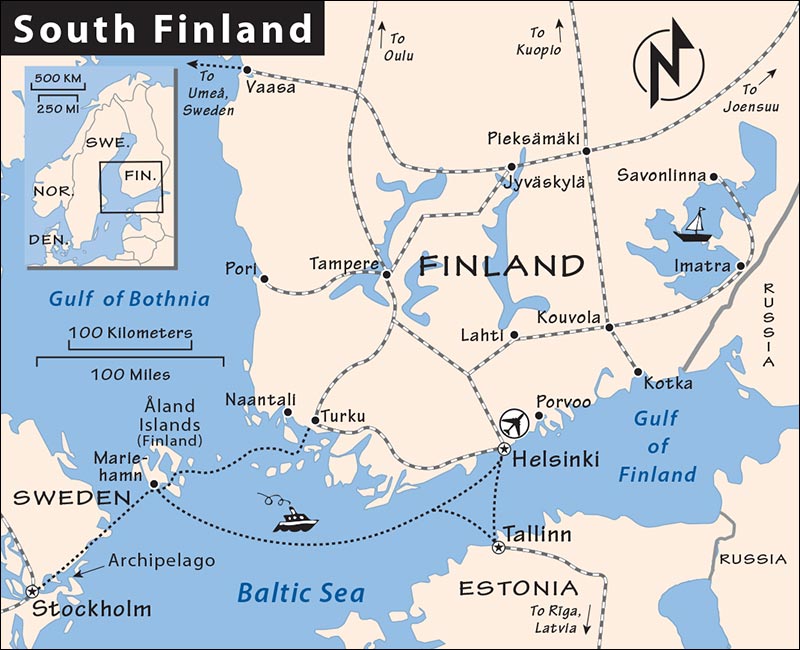
Geography: Finland is bordered by Russia to the east, Sweden and Norway to the north, the Baltic Sea to the west, and Estonia (across the Gulf of Finland) to the south. Much of Finland is flat and covered with forests, with the Lapland region extending north of the Arctic Circle. Finland is home to 187,800 lakes and 179,500 islands.
Latitude and Longitude: 64°N and 26°E, similar latitude to Nome, Alaska.
Biggest City: The capital city, Helsinki, has a population of 664,000; 1.5 million people—more than one in four Finns—live in the Helsinki urban area.
Economy: Finland’s gross domestic product is $297 billion and its per-capita GDP is $53,655. Manufacturing, timber, engineering, electronics, and telecommunications are its chief industries.
Government: Finland is a parliamentary republic. It has both a president, responsible for foreign policy, and a prime minister, who, along with the 200-member Parliament (Eduskunta), is responsible for domestic legislation. Members of Parliament sit for four-year terms.
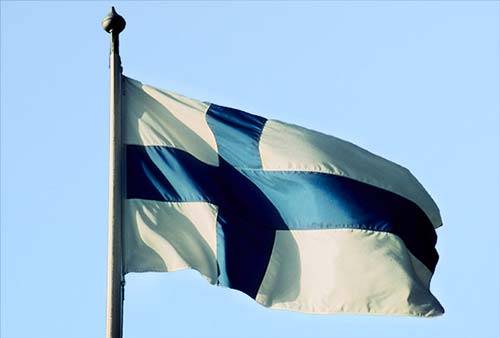
Flag: White with a blue Scandinavian cross, representing winter snow and lakes.
The Average Finn is 43 years old, has 1.75 children, will live to be 81, and drinks a lot of kahvi—Finland leads the world in per-capita coffee consumption nearly every year.
Ninety percent of Finland’s population is of Finnish descent. Other ethnicities include Swedish (5 percent), Russian, Estonian, Roma, and Sami. The country is about 67 percent Lutheran, 1 percent Orthodox, 1 percent other Christian, and 31 percent unaffiliated.
When it comes to gender equality, Finland is a pioneer. In 1906, Finnish women were the first in Europe to vote. The country named its first female president in 2000 and its first female prime minister in 2003, and nearly half of its parliament is composed of women.
Finland is officially bilingual; while 87 percent of residents speak Finnish, about 5 percent speak Swedish as a first language (and small minorities speak Sami and Russian). You’ll notice that Helsinki is called Helsingfors in Swedish. Helsinki’s street signs list places in both Finnish and Swedish. Nearly every educated young person speaks effortless English—the language barrier is just a speed bump.
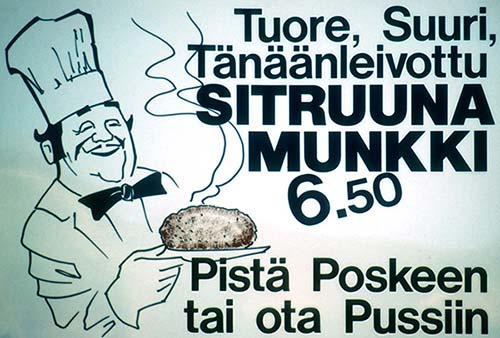
Finnish is a difficult-to-learn language, and its only relatives in Europe are Estonian (close) and Hungarian (distant). The only essential word needed for a quick visit is kiitos (KEE-tohs)—that’s “thank you,” and locals love to hear it. Hei (hey) means “hi” and hei hei (hey hey) means “goodbye.” Kippis (KIHP-pihs) is what you say before you down a shot of Finnish vodka or cloudberry liqueur (lakka). For more, see the Finnish survival phrases on the next page.
Finnish Survival Phrases
In Finnish, the emphasis always goes on the first syllable. Double vowels (e.g., ää or ii) sound similar to single vowels, but are held a bit longer. The letter y sounds like the German ü (purse your lips and say “oh”). In the phonetics, ī sounds like the long i in “light,” and bolded syllables are stressed.
| Good morning. (formal) | Hyvää huomenta. hew-vaah hwoh-mehn-tah |
| Good day. (formal) | Hyvää päivää. hew-vaah pī-vaah |
| Good evening. (formal) | Hyvää iltaa. hew-vaah eel-taah |
| Hi. / Bye. (informal) | Hei. / Hei hei. hey / hey hey |
| Do you speak English? | Puhutko englantia? poo-hoot-koh ehn-glahn-tee-yah |
| Yes. / No. | Kyllä. / Ei. kewl-lah / ay |
| Please. | Ole hyvä. oh-leh hew-vah |
| Thank you (very much). | Kiitos (paljon). kee-tohs (pahl-yohn) |
| You’re welcome. | Kiitos. / Ei kestä. kee-tohs / ay kehs-tah |
| Can I help you? | Voinko auttaa? voin-koh owt-taah |
| Excuse me. | Anteeksi. ahn-tehk-see |
| (Very) good. | (Oikein) hyvä. (oy-kayn) hew-vah |
| Goodbye. | Näkemiin. nah-keh-meen |
| zero / one / two | nolla / yksi / kaksi noh-lah / ewk-see / kahk-see |
| three / four | kolme / neljä kohl-meh / nehl-yah |
| five / six | viisi / kuusi vee-see / koo-see |
| seven / eight | seitsemän / kahdeksan sayt-seh-mahn / kah-dehk-sahn |
| nine / ten | yhdeksän / kymmenen ew-dehk-sahn / kewm-meh-nehn |
| hundred | sata sah-tah |
| thousand | tuhat too-haht |
| How much? | Paljonko? pahl-yohn-koh |
| local currency: euro | euro ay-oo-roh |
| Where is...? | Missä on...? mee-sah ohn |
| ...the toilet | ...WC vay-say |
| men | miehet mee-ay-heht |
| women | naiset nī-seht |
| water / coffee | vesi / kahvi veh-see / kah-vee |
| beer / wine | olut / viini oh-luht / vee-nee |
| Cheers! | Kippis! kip-pis |
| The bill, please. | Lasku, kiitos. lahs-koo kee-tohs |