APPENDIX
Holidays and Festivals
This list includes selected festivals, plus national holidays observed throughout Scandinavia. Many sights close on national holidays—keep this in mind when planning your itinerary. Before planning a trip around a festival, verify the dates with the festival website, city and national tourist offices, or my “Upcoming Holidays and Festivals” pages at RickSteves.com/europe.
| Jan 1 | New Year’s Day |
| Jan 6 | Epiphany, Sweden and Finland |
| Feb 24 | Independence Day, Estonia |
| March/April | Easter Sunday-Monday: April 20-21, 2025; April 5-6, 2026 |
| April 30 | Walpurgis Night, Sweden and Finland (bonfires) |
| May 1 | Labor Day (parades) |
| May 15 | St. Hallvard’s Day, Oslo |
| May 17 | Constitution Day, Norway (parades) |
| Late May-early June | Bergen International Festival, Norway (performing arts; www.fib.no) |
| May/June | Ascension Day: May 29, 2025; May 14, 2026 |
| May/June | Pentecost and Whitmonday: June 8-9, 2025; May 24-25, 2026 |
| May-June | Medieval Festival, Oslo (www.oslomiddelalderfestival.org) |
| June 5 | Constitution Day, Denmark |
| June 6 | National Day, Sweden (parades) |
| Early June | Old Town Days, Tallinn (music, parades; http://vanalinnapaevad.ee) |
| Early June | Archipelago Boat Day, Stockholm (steamboat parade, (www.skargardstrafikanten.se) |
| Early June | Taste of Stockholm (www.smakapastockholm.se) |
| Mid-June | Bergenfest, Norway (music festival; www.bergenfest.no) |
| June 23 | Victory Day, Estonia |
| June 23 | St. John’s Eve, Norway and Denmark (midsummer festival) |
| Late June | Midsummer Eve and Day (celebrations, bonfires) |
| Late June-early July | Roskilde Festival, Denmark (music, art, www.roskilde-festival.dk) |
| July | Copenhagen Jazz Festival (www.jazz.dk) |
| Late July | Gladmat Food Festival, Stavanger, Norway (www.gladmat.no) |
| Late July-mid-Aug | Grieg in Bergen Festival, Norway (concert series; www.grieginbergen.com) |
| Mid-Aug | Chamber Music Festival, Oslo (www.oslokammermusikkfestival.no) |
| Mid-Aug | Jazz Festival, Oslo (www.oslojazz.no) |
| Mid-late Aug | Helsinki Festival (music, dance, film, theater; www.helsinkifestival.fi) |
| August 20 | Day of Restoration of Independence, Estonia |
| Late Aug-Sept | Aarhus Festival, Denmark (music, dance, theater; www.aarhusfestuge.dk) |
| Mid-Sept | Ultima Contemporary Music Festival, Oslo (www.ultima.no) |
| Mid-Oct | Stockholm Jazz Festival (http://stockholmjazz.se) |
| Mid-Nov-early Jan | Christmas Fair, Copenhagen (Tivoli Gardens) |
| Dec 6 | Independence Day, Finland |
| Dec 10 | Nobel Prize Award Ceremony, Oslo and Stockholm |
| Dec 13 | St. Lucia Day in Sweden, Norway, and parts of Finland (festival of lights) |
| Dec 24-25 | Christmas Eve and Day |
| Dec 26 | Boxing Day |
| Dec 31 | New Year’s Eve |
Books and Films
To learn more about Scandinavia past and present, check out a few of these books and films.
General Scandinavia
A History of Scandinavia: Norway, Sweden, Denmark, Finland, and Iceland (T. K. Derry, 2000). This comprehensive tome weaves together the history and common heritage of these five countries.
Children of Ash and Elm: A History of the Vikings (Neil Price, 2020). Drawing on extensive archaeological and textual evidence, this is an engaging guide to the Viking world.
Scandinavia Since 1500 (Byron J. Nordstrom, 2000). Nordstrom presents a readable account of the region’s history.
Scandinavian Folk and Fairy Tales (Claire Booss, 1988). This collection of Scandinavian folklore includes illustrations by local artists.
Denmark
Books
Conquered, Not Defeated (Peter Tveskov, 2003). Tveskov combines historical fact with childhood memories of Denmark under German occupation in World War II.
The Fairy Tale of My Life (Hans Christian Andersen, 1975). Andersen’s autobiography chronicles everything from his impoverished childhood to encounters with other literary greats.
The Fairy Tales of Hans Christian Andersen (H. C. Andersen, 2013). The writer’s most famous tales—from The Little Mermaid to The Princess and the Pea—are collected in this anthology.
Hans Christian Andersen: A New Life (Jens Andersen, 2003). The author reveals new dimensions to the man behind many famous childhood stories.
Music and Silence (Rose Tremain, 1999). Tremain captures Denmark in the 17th century through the eyes of a lute player at court.
Smilla’s Sense of Snow (Peter Høeg, 1992). In this thriller set in snowy Copenhagen, Smilla looks into the murder of her six-year-old neighbor (later adapted as a 1997 movie starring Julia Ormond).
We, the Drowned (Carsten Jensen, 2010). This novel covers the wars and adventures of the seafaring men of Marstal, a port town on the island of Ærø—and the angst of the families they leave behind.
Winter’s Tale (Isak Dinesen, 1942). Best known for her memoir Out of Africa, Isak Dinesen (a.k.a. Karen Blixen) set most of these short stories in her homeland of Denmark.
Film and Television
Babette’s Feast (1987). This Oscar winner for Best Foreign Language Film, about a Frenchwoman taking refuge in rural 19th-century Denmark, is the original foodie movie (based on the novel by Isak Dinesen).
Borgen (2010-2022). In this dramatic political TV series, principal character Birgitte Nyborg juggles her ambitions as the first female prime minister of Denmark with her responsibilities as a wife and mother.
The Bridge (Danish: Broen; Swedish: Bron; 2011-2018). This crime drama, a coproduction of Swedish and Danish TV, follows the cases and personal lives of a brilliant but obsessive-compulsive Swedish detective and her empathetic Danish collaborator.
Italian for Beginners (2000). Thirtysomethings learn Italian in hopes of finding romance in a small Danish town.
Pelle the Conqueror (1988). A Swedish father and son emigrate to Denmark in the 19th century and work to build a new life in this film based on the 1976 book by Martin Andersen Nexø (1989 Best Foreign Language Film).
Estonia
Books
The Czar’s Madman (Jaan Kross, 1992). Accused of insanity, a nobleman from the Livonian region of Estonia is subsequently monitored and scrutinized by his family.
Purge (Sofi Oksanen, 2010). Oskanen explores the Soviet occupation of Estonia and postwar suffering in this powerful novel about two women who reconcile their violent pasts.
Treading Air (Jaan Kross, 1998). This novel follows the life of protagonist Ullo Paerand, from the 1920s through the Soviet occupation of Estonia.
Truth and Justice (Anton Hansen Tammsaare, 1926). In one of the cornerstones of Estonian literature, Tammsaare draws from his own life to describe Estonia’s evolution into an independent state.
Film
Autumn Ball (2007). Based on the novel by Mati Unt, this film explores the isolation of six disparate people living in a Soviet-era apartment complex.
The Singing Revolution (2006). This documentary follows the evolution of Estonian music as a form of peaceful protest and symbol of patriotism.
Spring (1969). Set in a small-town boarding school, this coming-of-age story is an Estonian classic.
Finland
Books
Burnt-Out Town of Miracles (Roy Jacobsen, 2005). In this fictionalized account of the 1939 Winter War, a besieged Finnish town repels invading Russians with cunning and grit.
Kalevala (Elias Lönnrot, 1835). Regarded as Finland’s national epic, Kalevala is a compilation of Karelian and Finnish oral folklore and poetry.
My Childhood (Toivo Pekkanen, 1966). Toivo Pekkanen chronicles his family’s working-class life in early-20th-century Finland.
Seven Brothers (Aleksis Kivi, 1870). In this Finnish classic, young brothers must learn to work hard and become productive members of society.
The Unknown Soldier (Väinö Linna, 1957). This iconic Finnish book candidly captures native soldiers’ responses to World War II.
Film
The Man Without a Past (2002). In this Academy Award-nominated film, a man is beaten up shortly after arriving in Helsinki, loses his memory, and must start his life anew.
Mother of Mine (2005). A young Finnish boy is evacuated to Sweden during World War II.
Road North (2012). An estranged father and son reunite for a road trip to northern Finland.
Uuno Turhapuro (1973-2006). Many Finnish politicians and celebrities make appearances throughout these 19 classic Finnish comedies about good-for-nothing Uuno, who disrupts and undermines his father-in-law in outlandish situations.
Norway
Books
Beatles (Lars Saabye Christensen, 1984). Four Beatles fans grow up in Oslo in the ’60s and ’70s.
A Doll’s House (Henrik Ibsen, 1879). Ibsen’s classic play questions marriage norms and the role of women in a 19th-century man’s world.
Growth of the Soil (Knut Hamsun, 1917). This epic tale of a man living in backcountry Norway helped Hamsun win the Nobel Prize in Literature in 1920.
The Ice Palace (Tarjei Vesaas, 1993). Two young girls become unlikely friends—until a tragic disappearance shatters one of their lives.
Into the Ice: The History of Norway and the Polar Regions (Einar-Arne Drivenes and Harald Day Jolle, 2006). This comprehensive overview details expeditions, research, and the history of the polar region from the 19th century to the present.
Kon-Tiki (Thor Heyerdahl, 1948). Heyerdahl chronicles his historic 1947 journey from Peru to Polynesia on a balsa-wood raft. Norwegian filmmakers have catalogued his exploits in two films called Kon-Tiki: an Academy-Award-winning documentary (1950) and a blockbuster historical drama that was nominated for an Oscar for Best Foreign Language Film (2012).
Kristin Lavransdatter (Sigrid Undset, 1920-1923). This trilogy (also a 1995 movie) focuses on the life of a Norwegian woman in the 14th century.
My Struggle (Karl Ove Knausgaard, 2012). This six-part autobiography of a father and writer from Oslo is hugely popular in Norway and has gained worldwide recognition.
Out Stealing Horses (Per Petterson, 2005). A widower in remote Norway meets a neighbor who stirs up memories of a pivotal day in 1948.
The Winter Fortress (Neal Bascomb, 2016). Bascomb uses letters, diaries, and once-secret documents to flesh out the story of the WWII Norwegian commandos who destroyed the heavy water plant at Vemork, striking a blow to the Nazi atomic bomb program.
Film and Television
The Heavy Water War (2015). This six-part miniseries recounts the sabotage of the heavy water plant at Vemork, part of Hitler’s atomic bomb program, and touches on morality and collaboration in wartime.
Insomnia (1997). The midnight sun plays a role in this Norwegian thriller about a police detective investigating a small-town murder.
The Kautokeino Rebellion (2008). Based on the true events of 1852, the Sami people of Norway revolt against their exploitation by Norwegian authorities.
The King’s Choice (2016). During the German invasion of April 1940, King Haakon and the royal family escape from Oslo and refuse to surrender to the pursuing Nazis.
Lilyhammer (2012-2014). This dark and humorous Netflix series follows a Sopranos-style New York mobster who, under the witness protection program, relocates to Lillehammer and adjusts to Norwegian society the only way he knows how.
Max Manus (2008). Based on real events in the life of WWII resistance fighter Max Manus, this film recounts the exploits of Manus and his comrades in Oslo during the Nazi occupation of Norway.
Nobel (2016). In this eight-part thriller, a Norwegian soldier returns home from Afghanistan only to be entwined in a web of political intrigue and murder surrounding the Nobel Peace Prize.
Occupied (2015-2019). A twisty-turny political thriller in which Norway, after discovering a clean source of energy and shutting down oil production in the North Sea, is occupied by Russia with backing from the EU (Netflix).
Troll (2022) When a giant troll is awakened in the mountains and leaves a trail of destruction, a plucky archaeologist must stop it before it smashes Oslo.
Trollhunter (2010). Trolls wreak havoc in modern-day Norway in this fun fantasy/thriller that explains the real purpose of those power lines in the Norwegian mountains.
Vikings (2013-2020). This History Channel series centers on the adventures of mythological Vikings Ragnar and Lagertha Lothbrok and their sons.
The Wave (2015) When a mountainside collapses into the Geirangerfjord, a massive tsunami bears down on the town of Geiranger and its fleeing residents.
The Worst Person in the World (2021) This Academy Award-nominated romantic comedy-drama traces a young woman’s struggles with love and career in today’s Oslo.
Sweden
Books
Faceless Killers (Henning Mankell, 1990). This is the first of a string of popular mysteries featuring inspector Kurt Wallander.
The Girl with the Dragon Tattoo (Stieg Larsson, 2005). The first book in Larsson’s Millennium trilogy, about a punky computer hacker and a disgraced journalist, put Swedish crime fiction on the map. The Swedish and Hollywood film versions of these books are as compelling as the novels.
Hanna’s Daughters (Marianne Fredriksson, 1994). This moving novel follows the lives of three remarkable Swedish women from the 1870s through World War II.
A History of the Swedish People (Vilhelm Moberg, 2005). Written by a novelist, this popular history of Sweden is both revealing and entertaining.
In the Heat of the Moment (Viveca Sten, 2018). This who-done-it and the others in the popular 10-book Sandhamn Murders series unfold on the tiny Swedish archipelago island of Sandhamn.
A Man Called Ove (Fredrik Backman, 2012). This dark comedy centers on a cranky widower whose life is devoid of joy—until some lively neighbors move into his neighborhood (also an Oscar-nominated motion picture).
Pippi Longstocking (Astrid Lindgren, 1945). Kids of all ages love reading about the adventures of the strong-willed and unconventional nine-year-old living in Sweden.
The Red Room (August Strindberg, 1879). This biting satire on Stockholm society made Strindberg a literary giant.
The Wonderful Adventures of Nils (Selma Lagerlöf, 1906). In this fantastical children’s novel (winner of the Nobel Prize for Literature), Nils loves nothing more than eating, sleeping, and tormenting animals—at least until he is shrunken down to their size.
Film and Television
As It Is in Heaven (2004). A famous conductor returns to his village in Sweden, where he finds love and the key to happiness.
Dalecarlians (2005). After living in Stockholm, Mia returns home to her small village and must adjust to the life she left behind.
The Emigrants (1971). A Swedish family faces a rough transition as they move from Sweden to Minnesota in this film starring Max von Sydow and Liv Ullmann (based on the novels by Vilhelm Moberg). The sequel The New Land (1972) continues the family’s journey.
My Life as a Dog (1985). This bittersweet tale from director Lasse Hallström focuses on a young boy in 1950s Sweden.
The Seventh Seal (1957). In this Ingmar Bergman film (set in Sweden during the Black Death), a knight questions the meaning of life. Other masterpieces from the Oscar-winning Swedish director include Smiles of a Summer Night (1955), a turn-of-the-century frolic, and Fanny & Alexander (1983), about two children overcoming their father’s death.
Together (2000). This satirical view of socialist values is set in a 1970s Stockholm commune.
Wallander (2005-2013). Based on the characters in Henning Mankell’s Kurt Wallander detective novels, this Swedish crime series is a study in the Scandinavian temperament and culture.
Welcome to Sweden (2014-2015). In this NBC comedy series starring Greg Poehler (who co-produced the show with his sister Amy), an American accountant follows his girlfriend back to her home in Stockholm, where he embarks on crazy adventures with her quirky family.
Conversions and Climate
Numbers and Stumblers
• Europeans write a few of their numbers differently than we do. 1 =  , 4 =
, 4 =  , 7 =
, 7 =  .
.
• In Europe, dates appear as day/month, so Christmas is 25/12.
• Commas are decimal points and decimals commas. A dollar and a half is $1,50, one thousand is 1.000, and there are 5.280 feet in a mile.
• When counting with fingers, start with your thumb. If you hold up your first finger to request one item, you’ll probably get two.
• Scandinavians number their weeks. Instead of saying, “Spring break is the third week in March,” they’d say, “Spring break is week 12.”
• On escalators and moving sidewalks, Europeans keep the left “lane” open for passing. Keep to the right.
Metric Conversions
A kilogram equals 1,000 grams (about 2.2 pounds). One hundred grams (a common unit at markets) is about a quarter-pound. One liter is about a quart, or almost four to a gallon.
A kilometer is six-tenths of a mile. To convert kilometers to miles, cut the kilometers in half and add back 10 percent of the original (120 km: 60 + 12 = 72 miles). One meter is 39 inches—just over a yard.
| 1 foot = 0.3 meter | 1 square yard = 0.8 square meter |
| 1 yard = 0.9 meter | 1 square mile = 2.6 square kilometers |
| 1 mile = 1.6 kilometers | 1 ounce = 28 grams |
| 1 centimeter = 0.4 inch | 1 quart = 0.95 liter |
| 1 meter = 39.4 inches | 1 kilogram = 2.2 pounds |
| 1 kilometer = 0.62 mile | 32°F = 0°C |
Clothing Sizes
When shopping for clothing, use these US-to-European comparisons as general guidelines (but note that no conversion is perfect).
Women: For pants and dresses, add 30 in Scandinavia (US 10 = Scandinavian 40). For blouses and sweaters, add 8 for most of Europe (US 32 = European 40). For shoes, add 30-31 (US 7 = European 37/38).
Men: For shirts, multiply by 2 and add about 8 (US 15 = European 38). For jackets and suits, add 10. For shoes, add 32-34.
Children: Clothing is sized by height—in centimeters (2.5 cm = 1 inch), so a US size 8 roughly equates to 132-140. For shoes up to size 13, add 16-18, and for sizes 1 and up, add 30-32.
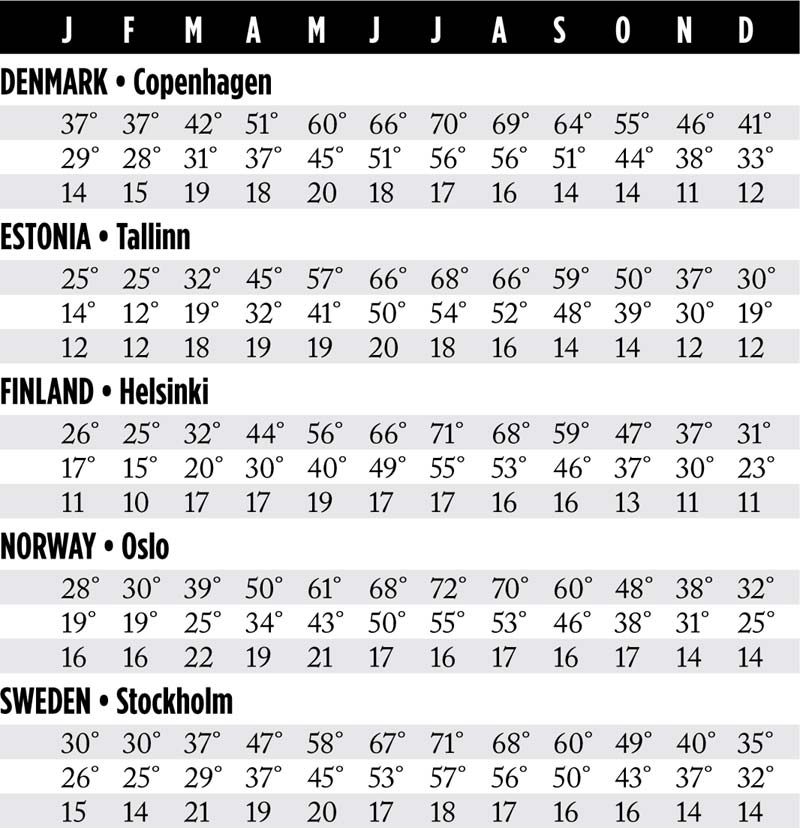
Scandinavia’s Climate
First line, average daily high; second line, average daily low; third line, average days without rain. For more detailed weather statistics for destinations in this book (as well as the rest of the world), check Wunderground.com.
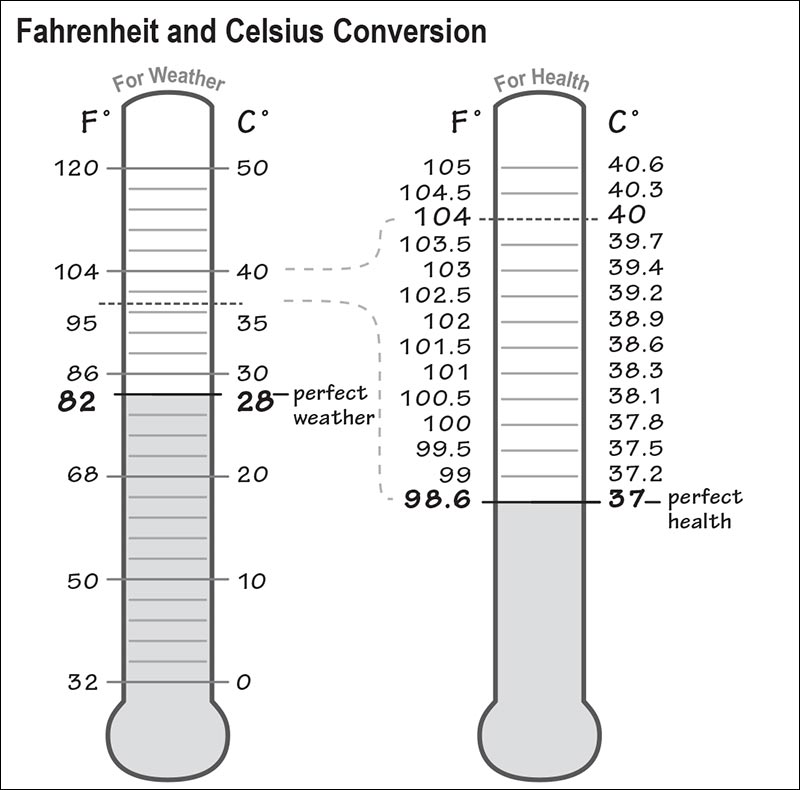
Europe takes its temperature using the Celsius scale, while we opt for Fahrenheit. For a rough conversion from Celsius to Fahrenheit, double the number and add 30. For weather, remember that 28°C is 82°F—perfect. For health, 37°C is just right. At a launderette, 30°C is cold, 40°C is warm (usually the default setting), 60°C is hot, and 95°C is boiling. Your air-conditioner should be set at about 20°C.
Whether you’re traveling for five days or five weeks, you won’t need more than this. Pack light to enjoy the sweet freedom of true mobility.
 5 shirts: long- & short-sleeve
2 pairs pants (or skirts/capris)
1 pair shorts
5 pairs underwear & socks
1 pair walking shoes
Sweater or warm layer
Rainproof jacket with hood
Tie, scarf, belt, and/or hat
Swimsuit
Sleepwear/loungewear
Debit card(s)
Credit card(s)
Hard cash (US $100-200)
Money belt
Passport
Other required ID: Vaccine card, entry visa, etc.
Driver’s license, student ID, hostel card, etc.
Tickets & confirmations: flights, hotels, trains, rail pass, car rental, sight entries
Photocopies of important documents
Insurance details
Guidebooks & maps
Mobile phone
Camera & related gear
Tablet/ebook reader/laptop
Headphones/earbuds
Chargers & batteries
Phone car charger & mount (or GPS device)
Plug adapters
Basics: soap, shampoo, toothbrush, toothpaste, floss, deodorant, sunscreen, brush/comb, etc.
Medicines & vitamins
First-aid kit
Glasses/contacts/sunglasses
Face masks & hand sanitizer
Sewing kit
Packet of tissues (for WC)
Earplugs
Day pack
Sealable plastic baggies
Laundry supplies: soap, laundry bag, clothesline, spot remover
Small umbrella
Travel alarm/watch
Notepad & pen
Journal
Second pair of shoes (flip-flops, sandals, tennis shoes, boots)
Travel hairdryer
Picnic supplies
Disinfecting wipes
Water bottle
Fold-up tote bag
Small flashlight
Mini binoculars
Small towel or washcloth
Inflatable pillow/neck rest
Tiny lock
Address list (to mail postcards)
Extra passport photos