CENTRAL DENMARK
Ærø • Odense
The sleepy isle of Ærø is the cuddle after the climax. It’s the perfect time-passed world in which to wind down, enjoy the seagulls, and take a day off. Wander the unadulterated cobbled lanes of Denmark’s best-preserved 18th-century town. Get Ærø-dynamic and pedal a rented bike into the essence of Denmark. Settle into a world of sailors, who, after the invention of steam-driven boat propellers, decided that building ships in bottles was more their style.
Between Ærø and Copenhagen, drop by bustling Odense, home of Hans Christian Andersen. Its Hans Christian Andersen House is excellent, and with more time, you can also enjoy its other museums (town history, trains, folk) and stroll the car-free streets of its downtown.
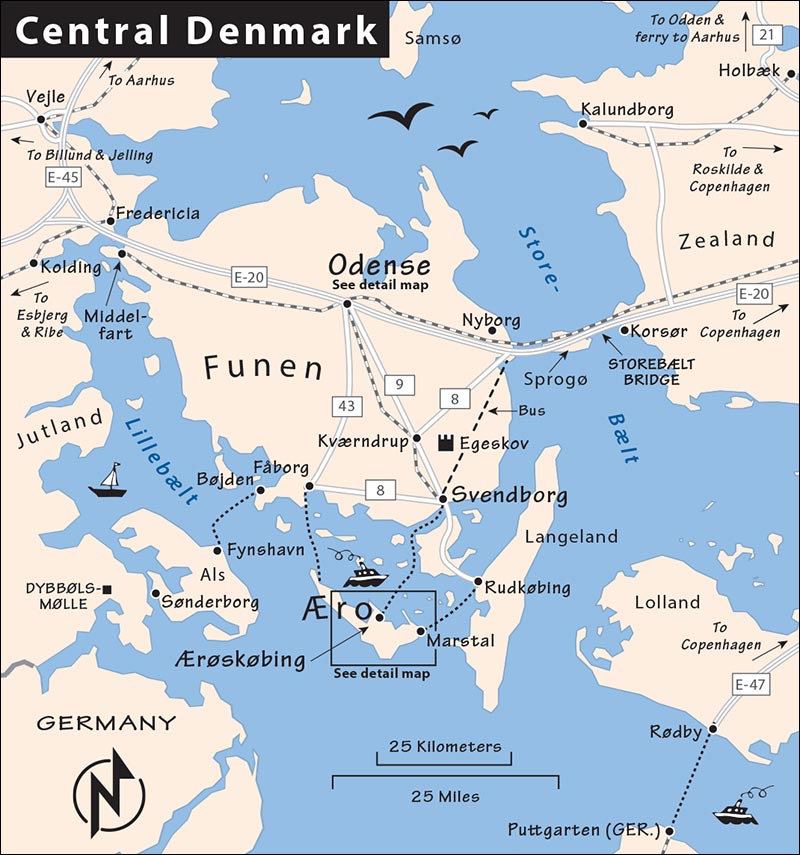
There’s no direct ferry between Ærø and Copenhagen; it’s a 2.5-hour train ride from Copenhagen to Svendborg with a transfer in Odense, then a 1.25-hour ferry crossing to Ærøskøbing (see here for details).
PLANNING YOUR TIME
Allow four hours for the train-and-ferry journey between Copenhagen and Ærø (not counting a possible stopover in Odense). All trains stop in Roskilde (with its Viking Ship Museum—see previous chapter) and Odense (see the end of this chapter). On a quick trip, you can leave Copenhagen in the morning and do justice to both towns en route to Ærø. (With just one day, Odense and Roskilde together make a long but doable day trip from Copenhagen.)
While out of the way, Ærø is worth the journey. Once there, you’ll want two nights and a day to properly enjoy it.
Ærø
This small (22 by 6 miles) island on the south edge of Denmark is as salty and sleepy as can be. A typical tombstone reads: “Here lies Christian Hansen at anchor with his wife. He’ll not weigh until he stands before God.” It’s the kind of island where baskets of strawberries sit in front of houses—for sale on the honor system.
Ærø statistics: 6,000 residents, 320,000 visitors and 100,000 boaters annually, 350 deer, four pastors and seven churches, no crosswalks, and three police officers. The three big industries are farming (wheat and dairy), shipping, and tourism—in that order. The town of Marstal, with a long maritime history, is home to a maritime school and several shipping companies. But jobs are scarce, the population is slowly dropping, and family farms are consolidating into larger units.
Ærø, home to several windmills and one of Northern Europe’s largest solar power plants, is going “green.” They hope to become completely wind- and solar-powered. Currently, over half the island’s heat and electricity is provided by renewable sources, and most of its produce is organically grown. New technology is expected to bring Ærø closer to its goal within the next few years.
GETTING AROUND ÆRØ
On a short visit, you won’t need to leave the village of Ærøskøbing, except for a countryside bike ride, if you like—everything is within walking or pedaling distance. But if you have more time or want to explore the rest of the island, you can take advantage of Ærø’s bus network. Buses leave from a stop just above the ferry dock (leaving the ferry, walk up about a block and look right). Ærø’s main bus outfit, Jesper Bus, is free (daily, runs hourly about 9:00-21:00; fewer Sat-Sun, www.jesperbus.dk). There are two different lines—one going to Marstal at the east end of the island, and the other to Søby in the west (look for the town name on the front of the bus). The main reason to take the bus is to visit Marstal’s maritime museum on a rainy day.
Ærøskøbing
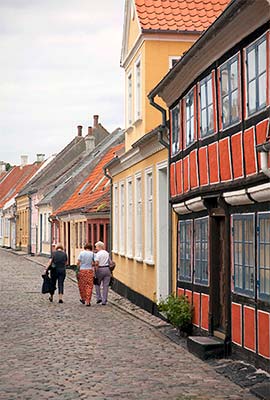
Ærøskøbing is Ærø’s village in a bottle. It’s small enough to be cute, but just big enough to feel real. The government, recognizing the value of this amazingly preserved little town, prohibits modern building in the center. It’s the only town in Denmark protected in this way. Drop into the 1680s, when Ærøskøbing was the wealthy home port of a hundred windjammers. The many Danes and Germans who come here for the tranquility—washing up the cobbled main drag in waves with the landing of each boat—call it the fairy-tale town. The Danish word for “cozy,” hyggelig, describes Ærøskøbing perfectly.
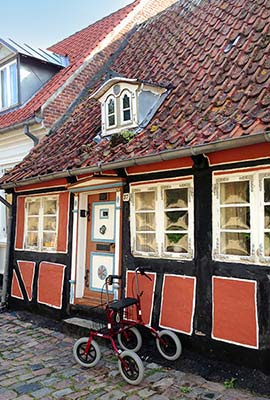
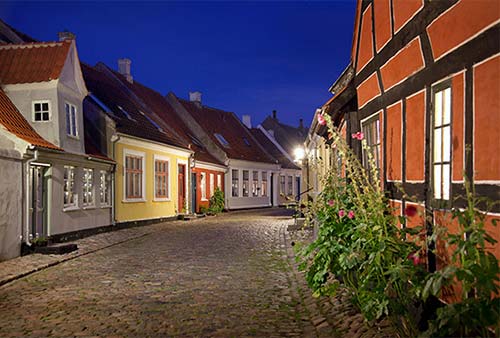
Ærøskøbing is simply a pleasant place to wander. Stubby little porthole-type houses, with their birth dates displayed in proud decorative rebar, lean on each other like drunk, sleeping sailors. Wander under flickering old-time lamps. Snoop around town. It’s OK. Peek into living rooms (if people want privacy, they shut their drapes). Notice the many “snooping mirrors” on the houses—antique locals are following your every move. The harbor caters to holiday yachts, and on midnight low tides you can almost hear the crabs playing cards.
The town economy, once rich with the windjammer trade, hit the rocks in modern times. Kids 15 to 18 years old attend boarding school in Svendborg or Nyborg; many don’t return. Nearly half of Ærø’s population is over age 60. And although young couples on the island are having more babies, it’s not enough to prevent a net population decline. Ærø has begun offering temporary housing to people willing to try out island life; so far about two-thirds have become permanent residents.
PLANNING YOUR TIME
You’ll regret not setting aside a minimum of two nights for your Ærøskøbing visit. In a busy day you can “do” everything you like—except relax. If ever a place was right for recreating, this is it. I’d arrive in time for an evening stroll and dinner (and, when it’s running, the Night Watchman’s tour). The next morning, do the island bike tour, returning by midafternoon. You can see the town’s three museums in less than two hours (but note that they all close early—see “Sights in Ærøskøbing,” later), then browse the rest of your daylight away. Your second evening is filled with options: Stroll out to the summer huts for sunset, watch classic sailing ships come in to moor for the evening (mostly Dutch and German boats crewed by vacationers), watch a movie in the pint-size town cinema, play a round of minigolf by the campground, or hit the pub.
Note that the town can be quite dead during the off-season (basically Sept-May), but local business owners are making efforts to enliven the shorter days of fall and winter. Though several shops and restaurants close during the off-season, restaurant owners try to keep some dining establishments open on a rotating basis, so there should always be a place to get a meal.
Orientation to Ærøskøbing
Ærøskøbing is tiny. Everything’s just a few cobbles from the ferry landing.
TOURIST INFORMATION
The TI, which faces the ferry landing, has all the services you’d expect from a larger town’s TI (Mon-Fri 10:00-14:00, closed Sat-Sun; +45 62 52 13 00, www.visitaeroe.dk). Pick up the good Ærø Guide (also available on the ferry and around town), or download the Visit Ærø app.
HELPFUL HINTS
Festival: Every year in early August, Ærø hosts a four-day jazz festival (www.aeroejazzfestival.dk).
Money: The town’s only ATM is at the blue building by the ferry dock, facing the TI.
Laundry: You’ll find limited self-service, coin-op laundry facilities at Ærøskøbing’s marinas, on either side of the ferry dock (bring your own soap).
Bike Rental: Pilebækkens Cykler rents bikes, including a handful of e-bikes, year-round at the gas station at the top of town. Manager Janne hands out free cykel maps so you can’t get lost (Mon-Fri 9:30-16:00, Sat-Sun until 13:00; in the gas station at Pilebækken 7—from Torvet Square, go through arched door at Søndergade end of square, past the garden to the next road; +45 62 52 11 10). Andelen Guesthouse rents good bikes, too (Søndergade 28A, see “Sleeping in Ærøskøbing,” later). Most people on Ærø don’t bother locking their bikes—if your rental doesn’t have a lock, don’t fret.
Ferries: See “Ærøskøbing Connections” on here.
Shopping: The town is speckled with cute little shops. Local artisans show their creations in a warehouse facing the ferry landing (daily in summer, closed Sat-Sun off-season).
Ærøskøbing Walk
This self-guided stroll, rated ▲▲▲, is ideal when the sun is low, the shadows long, and the colors rich. Start at the harbor.
Harbor: First, loiter around the harbor, where German and Dutch pleasure boaters come into port each evening. Because Ærø is only nine miles across the water from Germany, the island is popular with Germans who regularly return to this peaceful retreat on their grand old sailboats.
• From the harbor and TI, walk up the main street a block and go left on...
Smedegade: This is the poorest street in town, with the most architectural and higgledy-piggledy charm. Have a close look at the “street spies” on the houses—clever mirrors that let residents inside keep an eye on what’s going on outside. The ship-in-a-bottle Bottle Peter Museum is on the right (described later, under “Sights in Ærøskøbing”). Notice the gutters—some protect only the doorway. Locals find the rounded modern drainpipes less appealing than the old-school ones with hard angles. Appreciate the finely carved old doors. Each is proudly unique—try to find two the same. Number 37 (on the left, after Arnfeldt Hotel), from the 18th century, is Ærøskøbing’s cutest house. Its tiny dormer is from some old ship’s poop deck. The plants above the door have a traditional purpose—to keep this part of the house damp and slow to burn in case of fire.
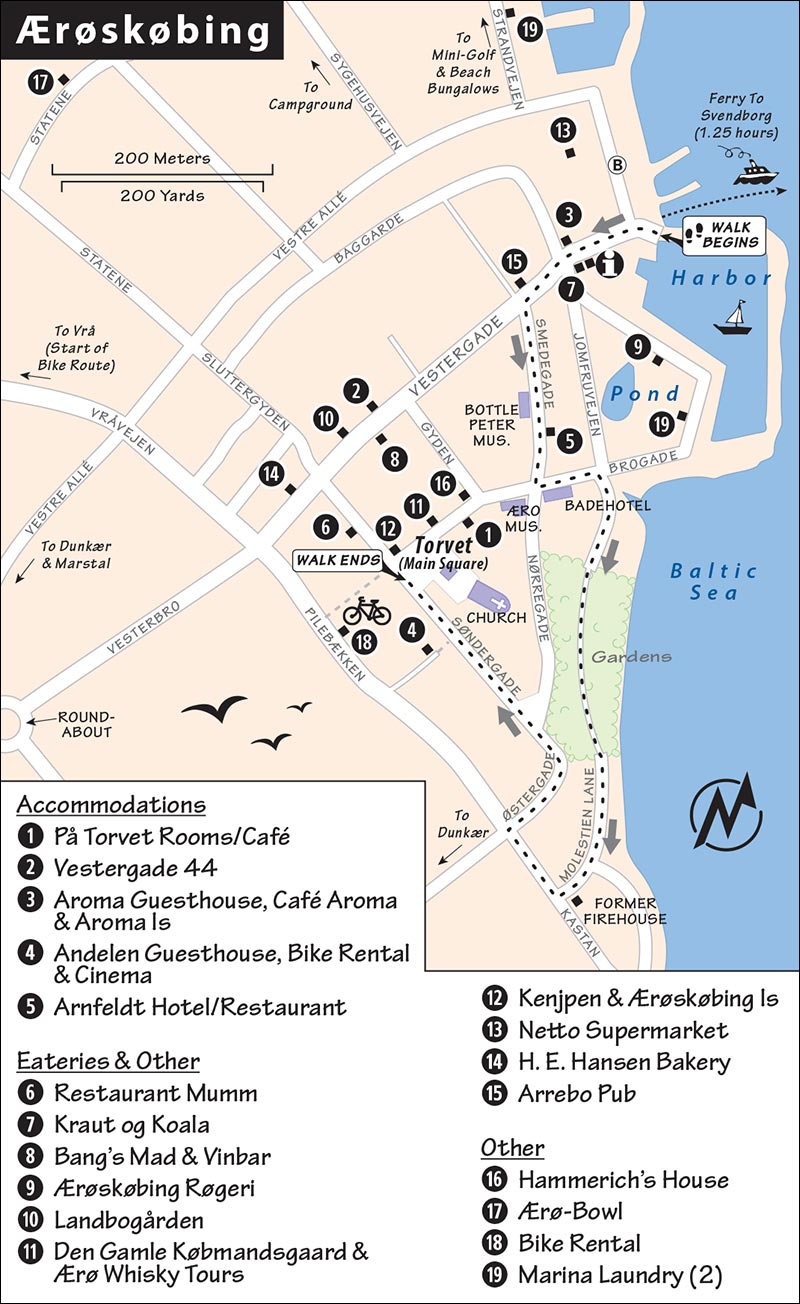
Smedegade ends at the Badehotel Harmonien. This building served as a folk high school (folkehøjskole) from 1978 until 2011, when it closed because of low enrollment. Nevertheless, folk high schools—residential schools with no grades—are still alive and well elsewhere in Denmark. Inspired by the Danish philosopher Nikolaj Gruntvig—who wanted people to be able to say, “I am good at being me”—these schools offer people of any age the benefit of government-subsidized cultural education (music, art, theater, sports, and so on).
• Jog left, then turn right after the hotel, and stroll along the peaceful, harborside...
Molestien Lane: This gravel path is lined with gardens, a quiet beach, a few enjoy-the-view benches, and a row of small-is-beautiful houses—beginning with humble and progressing to captain’s class. These fine buildings are a reminder that through the centuries, independent-minded Ærøskøbing has been the last town in Germany, the first town in Denmark...and always into trade—legal and illegal. (The smuggling spirit survives in residents’ blood even today. When someone returns from a trip, friends eagerly ask, “And what did you bring back?”) Each garden is cleverly and lovingly designed. The harborfront path, nicknamed “Virgin’s Lane,” was where teens could court within view of their parents.
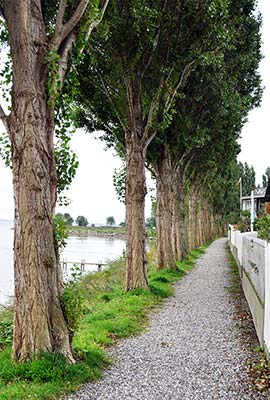
The dreamy-looking island immediately across the way is a nature preserve and a resting spot for birds making their long journey from the north to the Mediterranean. It’s also used as a grazing area for sheep. Rainbows often end on this island—where plague victims were once buried. In the winter, when the water freezes (about once a decade), locals slip and slide over for a visit. The white building you can see at the end of the town’s pier was the cooking house, where visiting sailors (who tried to avoid working with open flame on flammable ships) could do their baking.
At the end of the lane stands the former firehouse (with the tall brick tower, now a private residence). Twenty yards before the firehouse, a trail cuts left about 100 yards along the shore to a place the town provides for fishermen to launch and store their boats and tidy up their nets. Ponder the beauty of a society with such a keen sense of civic responsibility that fishing permits entrust you “to catch only what you need.” You’re welcome to pick berries where you like...but “no more than what would fit in your hat.”
• Walk past the firehouse, turn right, and walk a block toward town. At the first intersection, take a right onto...
Østergade: This was Ærøskøbing’s east gate. In the days of German control, all island trade was legal only within the town. All who passed this point would pay various duties and taxes at a tollbooth that once stood here.
As you walk past the traditional houses, peer into living rooms. Catch snatches of Danish life. (After the bend, you can see right through the windows to the sea.) In windows throughout town, you’ll see pairs of matching dog figurines. These Staffordshire dogs (and knockoffs), popular in Victorian times, were placed facing inward when sailors were at home, and outward when they were away (and supposedly also let village men know which ladies were lonely).
The wood on these old houses prefers organic coverings to modern paint. Tar painted on beams as a preservative blisters in the sun. An old-fashioned paint of chalk, lime, and clay lets old houses breathe and feel more alive. (It gets darker with the rain and leaves a little color on your fingers.) Modern chemical paint has much less personality.
The little square (actually a triangle) was the old goose market. Ærøskøbing—born in the 13th century, burned in the 17th, and rebuilt in the 18th—claims (believably) to be the best-preserved town from that era in Denmark. The original plan, with 12 streets laid out by its founder, survives.
• Leaving the square, stay left on...
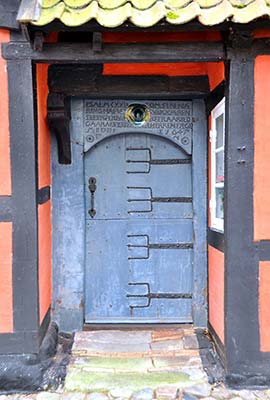
Søndergade: Look for wrought-iron girders on the walls, added to hold together bulging houses. (On the first corner, at #55, notice the nuts that could be tightened like a corset to keep the house from sagging.) Ærøskøbing’s oldest houses (check out the dates)—the only ones that survived a fire during a war with Sweden—are #36 and #32. At #32, the hatch upstairs was where masts and sails were stored for the winter. These houses also have some of the finest doors in town (and in Ærøskøbing, that’s saying something). The red on #32’s door is the original paint job—ox blood, which, when combined with the tannin in the wood, really lasts. The courtyard behind #18 was a parking lot in pre-car days. Farmers, in town for their shopping chores, would leave their horses here. Even today, the wide-open fields are just beyond.
• Wander down to Ærøskøbing’s main square.
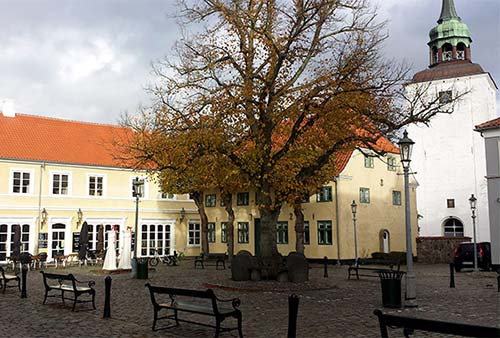
Torvet Square: Notice the two hand pumps, which still work. Until 1951, townspeople came here for their water. The linden tree is the town symbol. The rocks around it celebrate the reunion of a big chunk of southern Denmark (including this island), which was ruled by Germany from 1864 to 1920. See the town seal featuring a linden tree, over the door of the old City Hall (now the library, with computer stations in former prison cells). Read the Danish on the wall: “With law shall man a country build.”
• Our walk is over. To return to the main street, Vestergade, continue straight (popping into recommended Restaurant Mumm, one of the best places in town, to make a reservation for dinner). You’ll emerge at Vestergade and—just when you need it—the town bakery (to the left). But, if you’re ready to launch right into a bike ride, instead go through the arched door to the right of City Hall to reach one of the town’s bike-rental places (listed earlier, under “Helpful Hints”).
Sights in Ærøskøbing
MUSEUMS
Ærøskøbing’s three tiny museums cluster within a few doors of each other just off Torvet Square. They’re quirky and fun—and even more fun when you engage with staff who can provide intriguing details.
Ærø Museum (Ærøskøbing Bymuseum)
This museum provides a light, easy-to-enjoy overview of Ærø, with lots of artifacts, most with good English explanations, filling two floors of a former governor’s mansion. The top floor covers the island’s history, from seafaring to farming. You’ll see household objects (such as pottery, kitchenware, and tools), traditional Danish clothing, and a wall full of hand-planes belonging to a master joiner—one of the many skills that citizens perfected in Ærøskøbing’s boom days, when ship owners, skippers, and traders enjoyed prosperity. A fun diorama shows an aerial view of Ærøskøbing in 1862—notice the big gardens behind nearly every house. (This museum carries on the tradition with its own garden out back—be sure to explore it before you leave.)
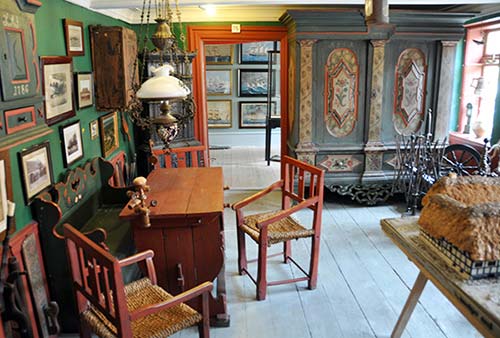
The ground level focuses on modern-day Ærøskøbing, with exhibits on its rise as a tourist destination after World War II, island traditions (such as going house to house in costume on Epiphany), and the struggles to keeping young people on the island (a maritime school in Marstal and a grant for transport, room, and board has helped attract youth to Ærø).
Cost and Hours: 50 DKK; July-Aug Mon-Fri 10:00-16:00, Sat-Sun 11:00-15:00; Sept-June Mon-Sat 11:00-15:00, closed Sun; Brogade 3, +45 62 52 29 50, www.arremus.dk.
▲Bottle Peter Museum (Flaske-Peters Samling)
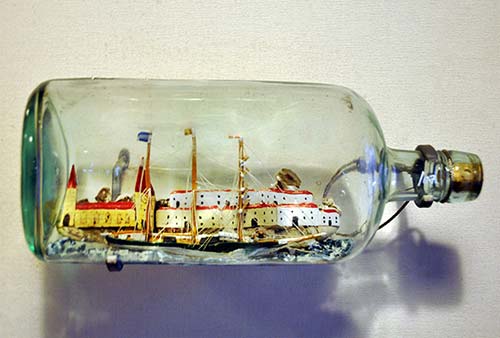
This fascinating house has 750 different bottled ships. Old Peter Jacobsen, who made his first bottle at 16 and his last at 85, created some 1,700 ships-in-bottles in his lifetime. He bragged that he drank the contents of each bottle...except those containing milk. This museum opened in 1943, when the mayor of Ærøskøbing offered Peter and his wife a humble home in exchange for the right to display his works. Bottle Peter died in 1960 (and is most likely buried in a glass bottle), leaving a lifetime of elaborate little creations for visitors to squint and marvel at.
Cost and Hours: 50 DKK; May-Oct Mon-Sat 11:00-15:00, closed Sun, April Mon-Fri 11:00-15:00, closed Sat-Sun; off-season call for appointment; Smedegade 22, +45 81 55 59 72, www.flaskepeter.dk.
Visiting the Museum: In three buildings surrounding a cobbled courtyard, you’ll see rack after rack of painstaking models in bottles and cigar boxes. Some are “right-handed” and some are “left-handed” (referring to the direction the bottle faced, and therefore which hand the model maker relied on to execute the fine details)—Bottle Peter could do it all.
In the entrance building, panels in English summarize Peter’s life (including his mischievous wit, which caused his friends great anxiety when he had an audience with the king). A video shows the artist at work, and nearby you can see some of his tools. One of Peter’s favorites was the “diver-bottle”—an extra-wide bottle with two separate ship models inside. One is a shipwreck on the “ocean floor” at the bottom of the bottle, and above that, a second model floats on the “surface.”
The building across the courtyard displays Peter’s “American collection,” which he sold to a Danish-American collector so he could retire, along with the headstone he designed for his own grave: a cross embedded with seven ships-in-bottles, representing the seven seas he explored as a seaman in his youth.
Hammerich’s House (Hammerichs Hus)
A sculptor and son of a Danish Parliament member, Gunnar Hammerich loved Ærøskøbing and had a passion for collecting preindustrial, handcrafted materials. Hammerich visited Ærø in 1915 and was so enamored that he bought a half-timbered house and eventually two neighboring homes here, which he joined into the building that houses this museum. It is chock-full of his quirky hoard of salvaged antiques—tiles, doors, cabinets—juxtaposed with other materials. His living room chairs were collected from all around the island; the tiles behind the stove are from eight different Ærø houses.
Not surprisingly given his love for old things, Hammerich actively worked to preserve Ærøskøbing’s buildings, streetlamps, and aesthetic—realizing that its cobbles and half-timbered homes would help tourism and the island’s economic survival. The good English flyer and chatty museum attendant help bring to life what you might otherwise dismiss as centuries-old junk.
Cost and Hours: 40 DKK; July-Aug daily 11:00-14:00 with guided tours typically Wed at 11:00, June and Sept-Oct Mon-Sat 11:00-14:00, closed Sun; otherwise ask at the Ærø Museum for access, closed off-season; Gyden 22, +45 62 52 29 50, www.arremus.dk.
ÆRØ ISLAND BIKE RIDE (OR CAR TOUR)
This 15-mile trip shows you the best of this windmill-covered island’s charms. The highest point on the island is only 180 feet above sea level, but the wind can be strong and the hills seem long and surprisingly steep.
As a bike ride, it’s good exercise, though it may be more exhausting than fun if you’ve done only light, recreational cycling at home. Consider paying more for an e-bike (or seven gears instead of five) for a less strenuous ride. Rent your bike in town (see “Helpful Hints,” earlier). While my map and instructions work, a local cycle map is helpful (buy one at the TI). Bring along plenty of water, as there are few opportunities to fill up (your first good chance is at the WC at the Bregninge church; there are no real shops until downtown Bregninge). If you conk out en route, the free Jesper buses (see “Getting Around,” earlier) can accommodate up to three bikes (but not e-bikes).
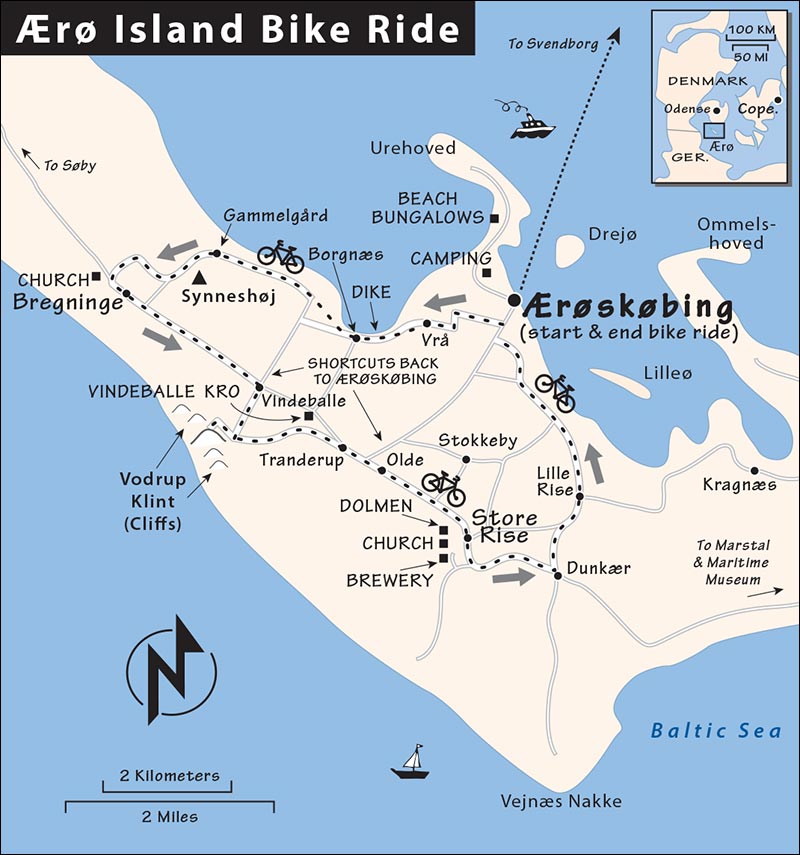
• Leave Ærøskøbing to the west on the road to Vrå (Vråvejen, national road #N-8). From downtown, pedal up the main street (Vestergade) and turn right on Vråvejen; from the bike-rental place on Pilebækken, just turn right and pedal straight ahead—it turns into Vråvejen.
Leaving Ærøskøbing: You’ll see the first of many U-shaped farmhouses, typical of Denmark. The three sides block the wind and store cows, hay, and people. Gård (farm) shows up in many local surnames.
At Øsemarksvej, bike along the coast in the protection of the dike built in 1856 to make the once-salty swampland to your left farmable. While the weak soil is good for hay and little else, they get the most out of it. Each winter, certain grazing areas flood with seawater. (Some locals claim this makes their cows produce fatter milk and meat.) As you roll along the dike, the land on your left is about eight feet below sea level. The little white pump house—alone in the field—is busy each spring and summer.
• At the T-junction, go right (over the dike) toward...
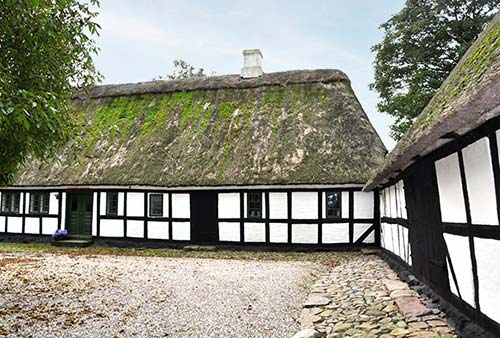
Borgnæs: About 50 yards down, the big thatched-roof house dates from 1728 and is a private home (the left half formerly served as a stable). But most of Borgnæs is a cluster of modern summer houses. Despite huge demand, a weak economy, and an aging population, development like this is no longer allowed.
• Keep to the right (passing lots of wheat fields); at the next T-junction, turn right, following signs for Ø. Bregningemark (don’t turn off for Vindeballe). After a secluded beach, head inland (direction: Ø. Bregninge). Pass the island’s only water mill, and climb uphill over the island’s 2,700-inch-high summit toward Bregninge. The tallest point on Ærø is called Synneshøj (probably means “Seems High” and it sure does—if you’re even a bit out of shape, you’ll feel every one of those inches).
Gammelgård: Take a right turn marked only by a bike route #8 sign. The road deteriorates (turns to gravel—and can be slushy if there’s been heavy rain, so be careful). You’ll wind scenically and sometimes steeply through “Ærø’s Alps,” past classic thatched-roofed “old farms” (hence the name of the lane—Gammelgård).
• At the modern road, turn left (leaving bike route #8) and pedal to the big village church. Before turning left to roll through Bregninge, visit the church.
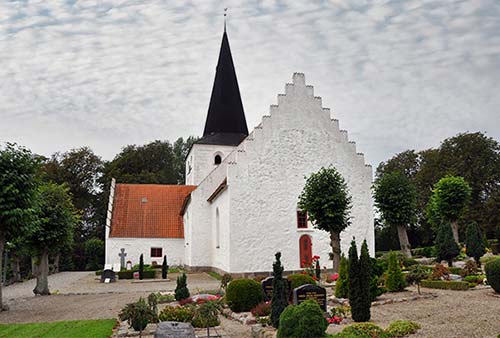
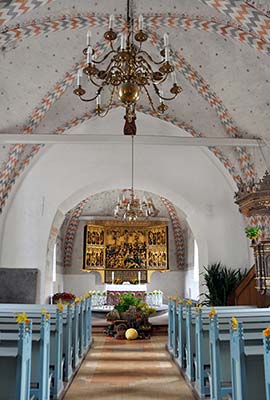
Bregninge Church: The interior of the 12th-century Bregninge church is still painted in the Gothic style. Find the painter’s self-portrait (behind the pulpit, right of front pew). Tradition says that if the painter wasn’t happy with his pay, he’d paint a fool’s head in the church (above third pew on left). Note how the fool’s mouth—the hole for a rope tied to the bell—has been worn wider and wider by centuries of ringing. (During services, the ringing bell would call those who were ill and too contagious to be allowed into the church to come for communion—distributed through the square hatches flanking the altar.)
The altarpiece—gold leaf on carved oak—is from 1528, six years before the Reformation came to Denmark. The cranium carved into the bottom indicates it’s a genuine masterpiece by Claus Berg (from Lübeck, Germany). This Crucifixion scene is such a commotion, it seems to cause Christ’s robe to billow up. The soldiers who traditionally gambled for Christ’s robe have traded their dice for knives. Even the three wise men (lower right; each perhaps a Danish king) made it to this Crucifixion. Notice the escaping souls of the two thieves—the one who converted on the cross being carried happily to heaven, and the other, with its grim-winged escort, heading straight to hell. The scene at lower left—a disciple with a bare-breasted, dark-skinned woman feeding her child—symbolizes the Great Commission: “Go ye to all the world.” Since this is a Catholic altarpiece, a roll call of saints lines the wings. During the restoration, the identity of the two women on the lower right was unknown, so the lettering—even in Latin—is clearly gibberish. Take a moment to study the 16th-century art on the ceiling (for example, the crucified feet ascending, leaving only footprints on earth). In the narthex, a list of pastors goes back to 1505. The current pastor (Agnes) is the first woman on the list.
• Now’s the time for a bathroom break (public WC in the churchyard). Then roll downhill through...
Bregninge: As you bike through what is supposedly Denmark’s “second-longest village,” you’ll pass many more U-shaped gårds. Notice how the town is in a gully. Imagine pirates trolling along the coast, looking for church spires marking unfortified villages. Ærø’s 16 villages are all invisible from the sea—their church spires carefully designed not to be viewable from sea level.
• About a mile down the main road is Vindeballe. Just before the main part of the village (soon after you pass the official Vindeballe sign and the din fart sign—which tells you “your speed”), take the Vodrup Klint turnoff to the right.
Vodrup Klint: A road leads downhill (with a well-signed jog to the right) to dead-end at a rugged bluff called Vodrup Klint (WC, picnic benches). If I were a pagan, I’d worship here for the sea, the wind, and the chilling view. Notice how the land steps in sloppy slabs down to the sea. When saturated with water, the slabs of clay that make up the land here get slick, and entire chunks can slide.
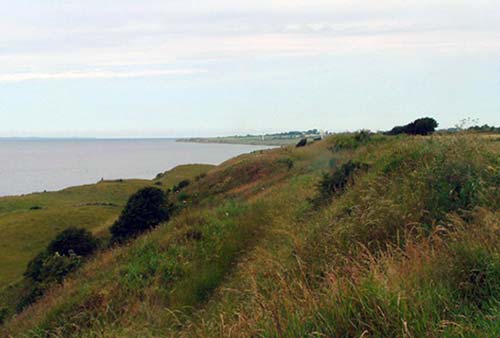
Hike down to the foamy beach (where you can pick up some flint, chalk, and wild thyme). While the wind at the top could drag a kite-flyer, the beach below can be ideal for sunbathing. Because Ærø is warmer and drier than the rest of Denmark, this island is home to plants and animals found nowhere else in the country. This southern exposure is the warmest area. Germany is dead ahead.
• Back on your bike, backtrack 200 yards and follow the signs to Tranderup. On the way, you’ll pass a lovely pond famous for its bell frogs and happy little duck houses. Stay on the paved road, bearing left onto Holmevej.
Popping out on the main road, Tranderupvej, you can backtrack (left) about 300 yards to get to the traditional $$$ Vindeballe Kro—a handy inn for a stop if you’re hungry or thirsty (lunch served Thu-Sat July-mid-Aug 12:00-14:00, dinners served Mon-Sat year-round 18:00-20:00, +45 62 52 16 13, www.vindeballe-kro.dk [URL inactive]).
If you’re tired or if the weather is turning bad, you can shortcut from here back to Ærøskøbing: Go down the lane across the street from the Vindeballe Kro, and you’ll zip quickly downhill across the island to the dike just east of Borgnæs; turn right and retrace your steps back into town.
But there’s much more to see. To continue our pedal, head on into...
Tranderup: Still following signs for Tranderup, stay on Tranderupgade parallel to the big road through town. You’ll pass a lovely farm and a potato stand. At the main road, turn right. At the Ærøskøbing turnoff (another chance to bail out and head home), side-trip 100 yards left to the big stone (commemorating the return of the island to Denmark from Germany in 1750) and a grand island panorama. Claus Clausen’s rock (in the picnic area, next to WC) is a memorial to an extremely obscure pioneer who was born in Ærø, emigrated to America, and played a role in shaping the early history of Scandinavian Lutheranism in the US.
• Return to the big road (continuing in direction: Marstal), pass through Olde, pedal past FAF (the local wheat farmers’ co-op facility), and head toward Store Rise (STOH-reh REE-zuh), the next church spire in the distance. Think of medieval travelers using spires as navigational aids.
Store Rise Prehistoric Tomb, Church, and Brewery: Thirty yards after the Stokkeby turnoff, follow the rough, tree-lined path on the right to the Langdysse (Long Dolmen) Tingstedet, just behind the church spire. This is a 6,000-year-old dolmen, an early Neolithic burial place. Though Ærø once had more than 200 of these prehistoric tombs, only 13 survive. The site is a raised mound the shape and length (about 100 feet) of a Viking ship, and archaeologists have found evidence that indicates a Viking ship may indeed have been burned and buried here.
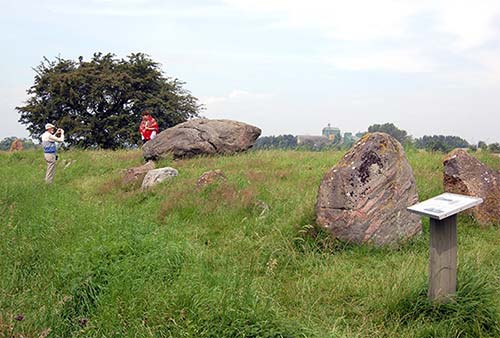
Ting means assembly spot. Imagine a thousand years ago: Viking chiefs representing the island’s various communities gathering here around their ancestors’ tombs. For 6,000 years, this has been a holy spot. The stones were considered to be fertility aids: For centuries, locals in need of virility chipped off bits and took them home (the nicks in the rock nearest the information post are mine).
Tuck away your chip and carry on down the lane to the Store Rise church. Inside you’ll find little ships hanging in the nave, a fine 12th-century altarpiece, a stick with an offering bag and a ting-a-ling bell to wake those nodding off (right of altar), double seats (so worshippers can flip to face the pulpit during sermons), and Martin Luther in the stern keeping his Protestant hand on the rudder. The list in the church allows today’s pastors to trace their pastoral lineage back to Doctor Luther himself. The churchyard is circular—a reminder of how churchyards provided a last refuge for humble communities under attack. Can you find anyone buried in the graveyard whose name doesn’t end in “-sen”?
Next follow the smell of hops (or the Ærø Bryggeri signs) to Ærø’s brewery. Located in a historic building 400 yards beyond the Store Rise church, it welcomes visitors to its café and shop. Ærø traditional brews are available in pilsner (including the popular walnut pilsner), light ale, dark ale, a typical dark Irish-style stout, and seasonal varieties (café—daily July-Aug 12:00-17:00, closed Sept-June; shop generally open longer hours and off-season—check website; +45 62 52 11 32, https://aeroebryggeri.dk).
• From here, climb back to the main road and continue (direction: Marstal) on your way back home to Ærøskøbing. The three 330-foot-high modern windmills on your right are communally owned and, as they are a nonpolluting source of energy, state-subsidized. At Dunkær (3 miles from Ærøskøbing), take the small road, signed Lille Rise, past the topless windmill. Except for the Lille Rise, it’s all downhill from here, as you coast past great sea views back home to Ærøskøbing.
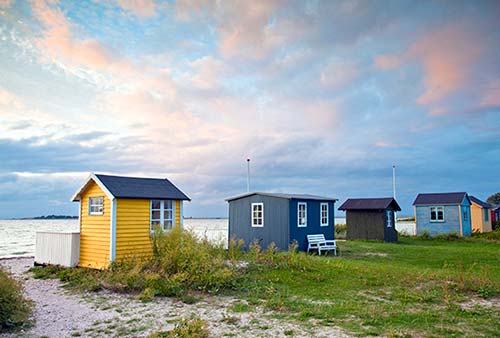
Beach Bungalows: Still rolling? Bike past the campground along the Urehoved beach (strand in Danish) for a look at the coziest little beach huts you’ll never see back in the “big is beautiful” US. This is Europe, where small is beautiful, and the concept of sustainability is neither new nor subversive. (For more details, see “Beach Bungalow Sunset Stroll,” later.)
RAINY-DAY OPTIONS
Ærø is disappointing but not unworkable in bad weather. In addition to the museums listed earlier, you could check out the evening options under “Nightlife in Ærøskøbing” (below), many of which are good in bad weather. Or hop on the free bus to Marstal to visit its maritime museum.
Whisky Tour
Ærø Whisky makes whisky from local organic barley in a tiny distillery in a former laundry house right on the main square, in the courtyard of Den Gamle Købmandsgaard. CEO Christian gives good tours in English (daily at 14:00, Torvet 5, +45 51 96 80 61, www.aeroewhisky.com).
Marstal Maritime Museum (Marstal Søfartsmuseum)
To learn more about the island’s seafaring history, visit this fine museum in the dreary town of Marstal. You’ll see plenty of model ships, nautical paintings (including several scenes by acclaimed painter Carl Rasmussen), an original ship’s galley, a re-created wheelhouse (with steering and navigation equipment), a collection of exotic goods brought back from faraway lands, and a children’s area with a climbable mast. Designed by and for sailors, the museum presents a warts-and-all view of the hardships of the seafaring life, rather than romanticizing it.
Cost and Hours: 85 DKK; June-Aug daily 9:00-17:00; mid-April-May and Sept-Oct daily 10:00-16:00; Nov-mid-April Mon-Sat 11:00-15:00, closed Sun; Prinsensgade 1, +45 62 53 23 31, www.marmus.dk.
Getting There: Ride the free Jesper Bus (described on here) all the way to the harbor in Marstal, where you’ll find the museum. It’s about a 20-minute trip.
Nightlife in Ærøskøbing
These activities are best done in the evening, after a day of biking around the island.
▲▲Beach Bungalow Sunset Stroll
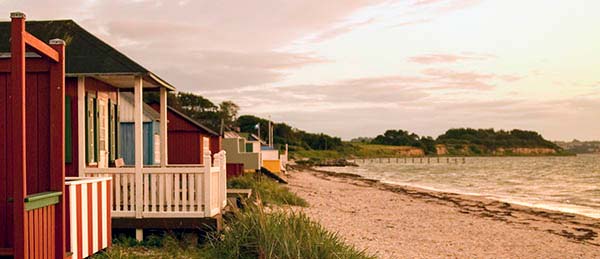
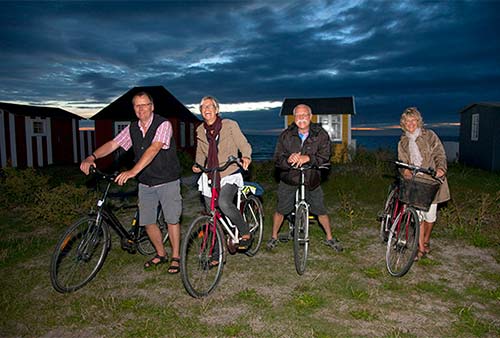
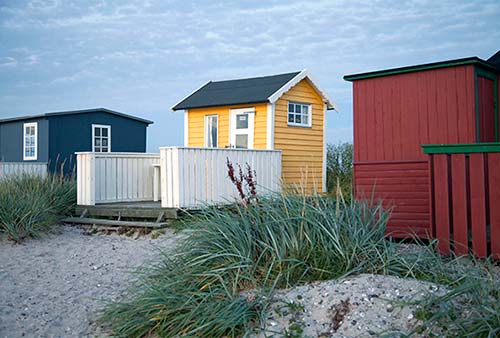
At sunset, stroll to Ærøskøbing’s sand beach. Facing the ferry dock, go left, following the harbor. As you leave town, you’ll pass the Netto supermarket (convenient for picking up snacks, beer, or wine), a minigolf course, snack bar, and a children’s playground. In the rosy distance, past a field of grass and wildflowers, is Vestre Strandvejen—a row of tiny, Monopoly-like huts facing the sunset. These beach escapes are privately owned on land rented from the town (no overnight use, WCs at each end). Each is different, but all are stained with merry memories of locals enjoying themselves Danish-style. Bring a beverage or picnic. It’s perfectly acceptable—and very Danish—to borrow a porch for your sunset sit. From here, it’s a fine walk out to the end of Urehoved (as this spit of land is called).
Town Walk with the Night Watchman
Every Sunday night from late June through mid-August, the night watchman leads visitors on a 1.25-hour stroll through town. It’s a fine time to be outside meeting other travelers (50 DKK, cash or MobilePay only, starts at 21:00 June-July and at 20:00 in Aug at Torvet Square—call, text, or message via WhatsApp to reserve, +45 40 46 66 75, www.aeroetours.dk).
Cinema
The cute little 45-seat Andelen Theater (in the Andelen Guesthouse—a former granary) plays movies in their original language at 19:30 (80 DKK, Danish subtitles, closed Mon and in July—when it hosts a jazz festival). It’s run in a heartwarming community-service kind of way (near Torvet Square at Søndergade 28A, +45 62 52 17 11).
Bowling
Ærø-Bowl is a six-lane alley in a modern athletic club at the edge of town (arcade games, kids on dates; irregular hours, call to check, Statene 42A, +45 62 52 23 06).
Pub
Arrebo Pub bills itself as “probably the best bar in town.” Maybe that’s because it’s the only one in town. In any case, it attracts a young crowd and occasionally has live music (open Mon-Sat from 15:00, closed Sun, at the bottom of Vestergade, near ferry dock).
Sleeping in Ærøskøbing
The accommodations scene here is boom or bust. Summer weekends and all of July are packed (book long in advance). It’s absolutely dead in the winter. These places are all an easy stroll from the ferry landing. The beautiful old buildings in town are protected (meaning owners are restricted from making many changes). Floors slope, the narrow stairs are worn, and bathrooms are typically small, down the hall, or shared—but rooms burst with authenticity and character. Airbnb and other rental services can be a good option if my listings are full.
IN ÆRØSKØBING
$$$ På Torvet (“On the Square”) is a top-end hotel/café/wine shop that brings a lively spirit to the town square. Owners Gunnar and Lili rent seven beautiful double rooms and four apartments, each uniquely decorated, and several with a kitchen (Torvet 7, +45 28 72 46 50, www.paatorvet.dk, booking@paatorvet.dk). The recommended café serves meals with seating inside and out on Torvet Square. They also sell wine and specialty foods, and the grand piano in the dining area is ready for you to tickle its ivories.
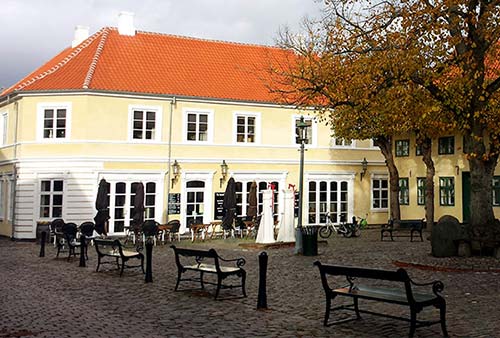
$$$ Vestergade 44, efficiently run by Mette, is a stately building in the town center where Gunnar Hammerich lived from 1943 to 1976 (see the “Hammerich’s House” listing on here). Built in 1784 by a sea captain, this creaky, 11-room place is elegantly decorated with classic furnishings and fresh flowers and boasts a large back garden oasis. Though most rooms don’t have en suite bathrooms, each party has a dedicated bathroom. The suite comes with use of a beach bungalow on Vestre Strandvejen. Reserve well in advance (fancy breakfast, two-night minimum, Vestergade 44, +45 21 51 93 98, www.vestergade44.com [URL inactive], contact@vestergade44.com).
$$$ Arnfeldt Hotel was once a 19th-century captain’s home. Owned by Manja and Ariel, this cozy hotel offers six clean and tidy rooms, three with shared baths (on-site restaurant with guest chefs serves dinner Thu-Sun; Smedegade 33, +45 53 60 40 23, www.arnfeldthotel.dk, mail@arnfeldthotel.dk).
$$ Andelen Guesthouse, run by Englishman Adam, brims with a funky nautical vibe. An old granary co-op that’s been converted into a hotel, its five guest rooms share two big modern bathrooms. There’s also a two-level family suite with a private bath, plus a nice courtyard for everyone (cash only, no breakfast—but you can eat nearby at På Torvet Café, honesty bar, free entry to downstairs movie theater, nice rental bikes, pay laundry, Søndergade 28A, +45 61 26 75 11, www.andelenguesthouse.com, info@andelenguesthouse.com).
$$ Aroma Guesthouse, above the recommended Café Aroma, offers a double room and a Tintin-themed studio with a kitchen (no breakfast, shared bathroom, laundry facilities, roof terrace, on Vestergade, just up the street from the ferry dock, open mid-April-Aug, closed off-season, +45 62 52 40 02, www.cafe-aroma.dk, info@cafe-aroma.dk).
OUTSIDE ÆRØSKØBING
For locations, see the “Ærø Island Bike Ride” map, earlier.
$$ Vindeballe Kro, about three miles from Ærøskøbing, is a traditional inn in Vindeballe at the island’s central crossroads. Marie and Rasmus rent 10 straightforward, well-kept rooms (free parking; +45 62 52 16 13, www.vindeballe-kro.dk [URL inactive], vindeballekro@outlook.dk). They also have a restaurant (described earlier, under “Ærø Island Bike Ride”).
¢ Ærø Campground is set on a fine beach a few minutes’ walk out of town. This three-star campground offers a lodge with a fireplace, campsites, and 27 cabins (open all year; facing the water, follow waterfront to the left; +45 51 51 81 15, https://en.aeroecamp.dk, aeroecamping@gmail.com).
Eating in Ærøskøbing
Ærøskøbing has a handful of charming and hardworking little eateries. Business is so light that chefs and owners come and go constantly, making it tough to predict the best value for the coming year. I’d spend 20 minutes enjoying the warm evening light and do a strolling survey before making a choice. Note that almost everything closes by 21:00—don’t wait too late to eat (if you’ll be taking a later ferry from Svendborg to Ærø, either eat before your boat trip or call ahead to reserve a place...otherwise you’re out of luck). During the winter, some of my recommended restaurants take turns staying open.
$$$$ Restaurant Mumm is where visiting yachters go for fresh fish and creative vegetarian and vegan dishes. Portions are huge, and on balmy days the garden terrace out back is a hit. Reservations are recommended (closed Mon, see website for off-season hours, near Torvet Square at Søndergade 12, +45 62 52 12 12, restaurant.mumm.dk).
$$$$ Kraut og Koala, in an unpretentious brick building at the harbor, is named for its Berlin-born chef, Mario, and Australian mixologist/server, Jaraya. Their culinary heritages meld into sophisticated, sublime fixed-price dinners (with or without drink pairings), prepared primarily with local ingredients (Thu-Mon from 18:00, closed Tue-Wed, Havn 4, +45 30 47 51 61, www.krautogkoala.com).
$$$ Bang’s Mad & Vinbar creates a variety of tapas boards: cheese, charcuterie, vegetarian, or a chef’s selection—each makes a delicious and satisfying meal. There’s cozy indoor seating as well as a garden courtyard (dinner Wed-Mon, closed Tue, fixed-price dinner and entrées also available, Vestergade 39, +45 44 16 33 20, www.bangsvinbar.dk).
$$$$ Arnfeldt Restaurant offers gourmet meals using local ingredients. After working in Paris, chef Ariel and co-owner Manja focus on sustainability and community, with six-course fixed-price dinners served family style in an inviting dining room and garden. A guest-chef residency program and food based on seasonality means the menu is always changing (reservations required, Smedegade 33, +45 53 60 40 23, www.arnfeldthotel.dk).
$$ På Torvet Café, right on Torvet Square, offers smørrebrød, burgers, and salads, with hearty portions that are stylishly presented. Dine in the cozy café or out on the square (closed Sun, +45 30 34 46 50).
$$ Café Aroma, a reasonably priced Danish café that feels like a rustic old diner, has a big front porch filled with tables and serves good entrées, salads, and burgers. Order at the bar (daily 11:00-21:00 except Sept-Oct closed Tue-Wed, closed off-season, on Vestergade just up from the ferry dock, +45 62 52 40 02). They also run a delicious ice-cream shop.
$ Ærøskøbing Røgeri serves wonderful smoked-fish meals on paper plates. With picnic tables facing the harbor, it’s great for a light meal. Eat there or find a pleasant picnic site at the beach or at the park behind the fish house. A smoked-fish dinner with potato salad, bread, and a couple of cold Carlsbergs or Ærø brews are a well-earned reward after a long bike ride (daily 10:00-21:00, April-June and mid-Aug-mid-Oct 11:00-19:00, closed mid-Oct-March, Havnen 15, +45 62 52 40 07).
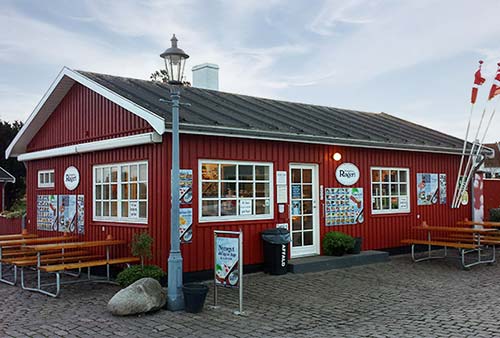
$$ Landbogården, a diner and occasional music/event space, is run by artists Jacob and Gertrud, who pride themselves on serving “honest and special” dishes using local ingredients (meat, fish, international dishes, Tue-Sun 18:00-21:00, closed Mon and off-season, near the top of Vestergade at #54, +45 29 71 23 48, www.landbogaarden.dk).
SNACKS, PICNICS, AND DESSERT
Here are some places for lighter fare.
Local Specialties: At Den Gamle Købmandsgaard (“The Old Merchants’ Court”) on Torvet Square you’ll find a market offering a tasteful selection of mostly locally sourced and produced foods, including meat, sausage, salami, bread, fruit, honey, jam, licorice, chocolate, beer, cigars, and whiskey—which is distilled on-site (ask about tours and tastings). Grab a seat in their café for lunch or cake (daily 10:00-17:30, Torvet 5, +45 91 25 59 70).
Sandwiches and Drinks: At Kenjpen, enjoy a grilled sandwich or beverage at a table on the main square (daily until 17:00, Torvet 1).
Grocery: The Netto supermarket has picnic fixings and drinks, including chilled beer and wine—handy for walks to the little huts on the beach at sunset (daily 7:00-22:00, kitty-corner from ferry dock).
Bakery: Ærøskøbing’s old-school H. E. Hansen bakery sells fresh bread and delicious pastries, plus drinks (Tue-Fri 7:00-17:00, Sat-Sun until 14:00, closed Mon, top of Vestergade).
Ice Cream: The ice-cream shop at Café Aroma, Aroma Is, serves good, flavorful ice cream—try gooseberry beer (made from Ærø stout—way better than it sounds), or the local favorite, the Ærø Special—walnut ice cream with maple syrup (long hours daily, closed Sept-mid-April, just up from the ferry dock).
Ærøskøbing Is, on the main square, offers homemade ice cream made with organic milk, along with soft-serve, sorbets, affogato, and an array of toppings (daily until 17:00, Torvet 1).
Ærøskøbing Connections
ÆRØ-SVENDBORG FERRY
The ferry ride between Svendborg, with connections to Copenhagen, and Ærøskøbing, on the island of Ærø, is a relaxing 1.25-hour crossing. You can leave the island via any of the three different Ærø ferry routes. Both vehicles and foot passengers must have tickets before boarding.
Schedule: Ferries depart daily in summer (roughly 10/day in each direction). Call or look online for the schedule (office open Mon-Fri 8:00-15:30, Sat-Sun 9:00-15:00, +45 62 52 40 00, www.aeroe-ferry.dk, info@aeroe-ferry.dk).
Foot Passengers: Foot/bike passengers can buy tickets at machines at the Svendborg and Ærøskøbing docks, but especially in July and August, booking a spot up to an hour ahead is suggested (112 DKK round-trip/person, ferry not covered by or discounted with rail pass, significant off-season discounts, additional fees per ticket for fuel offsets and credit card use).
Drivers: Drivers should reserve online a month in advance, especially on weekends and in summer (230 DKK round-trip/car—not including driver/passengers). Drivers need to provide a license-plate number—if you don’t know it at the time you reserve, use a phone number temporarily and replace it with the license info up to one hour before boarding (see ferry website for details).
If you won’t use your car in Ærø, park it in Svendborg (big, safe lot two blocks in from ferry landing, or at the far end of the harbor near the Bendixens fish shop). On Ærø, parking is free.
Trains Connecting with Ærø-Svendborg Ferry
The train from Odense dead-ends at the Svendborg harbor (2/hour Mon-Sat, hourly on Sun, 45 minutes; don’t get off at Svendborg Vest Station—wait until you get to the end of the line, called simply “Svendborg”).
Arriving in Svendborg: It takes about 10 minutes to walk from the station to the dock (5 minutes if you walk briskly). Don’t dawdle—the boat leaves stubbornly on time, even if trains are running late. I recommend taking a train from Odense that arrives about 30 minutes before your ferry departure to give yourself time to absorb delays and find your way.
To get from the Svendborg train station to the dock, turn left after exiting the train, following the sidewalk between the tracks and the station, then take a left (across the tracks) at the first street, Brogade. Head a block downhill to the harbor, make a right, and the ferry dock is ahead, across from Hotel Ærø. There are several carry-out restaurants along Brogade, and a few hotels overlooking the ferry line have restaurants.
Departing from Svendborg: All Svendborg trains go to Odense (where you can connect to Copenhagen or Aarhus). A train tends to leave shortly after the ferry arrives (a tight connection—it’s a good idea to buy your train ticket in advance instead of making a mad rush to use the one ticket machine at the station). To reach the train from the Svendborg ferry dock, pass Hotel Ærø and continue a block along the waiting lane for the ferry, turn left and go up Brogade one block, then take a right and follow the sidewalk between the tracks and the train station. Look for a train signed Odense waiting on the single track.
Odense
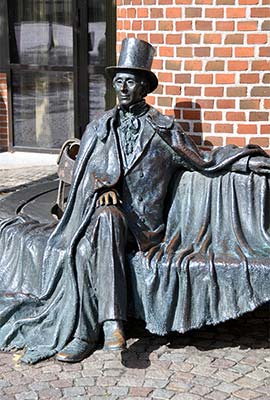
Founded in AD 988 and named after Odin (the Nordic Zeus), Odense is the main city of the big island of Funen (Fyn in Danish; pronounced “Fewn”) and the birthplace of storyteller Hans Christian Andersen (whom the Danes call simply H. C., pronounced “hoe see”). Although the author was born here in poverty and left at the tender age of 14 to pursue a career in the theater scene of Copenhagen, H. C. is Odense’s favorite son—you’ll find his name and image all over town. He once said, “Perhaps Odense will one day become famous because of me.” Today, Odense (OHD-en-seh) is one of Denmark’s most popular tourist destinations.
Orientation to Odense
As Denmark’s third-largest city, with 179,000 people, Odense is big and industrial. But its old center, tidy and neatly urbanized, retains some pockets of the fairy-tale charm it had in the days of H. C. Everything is within easy walking distance, except for the open-air folk museum.
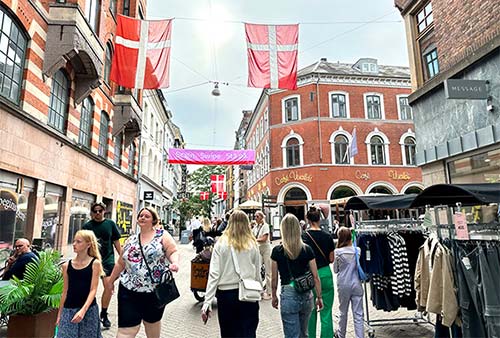
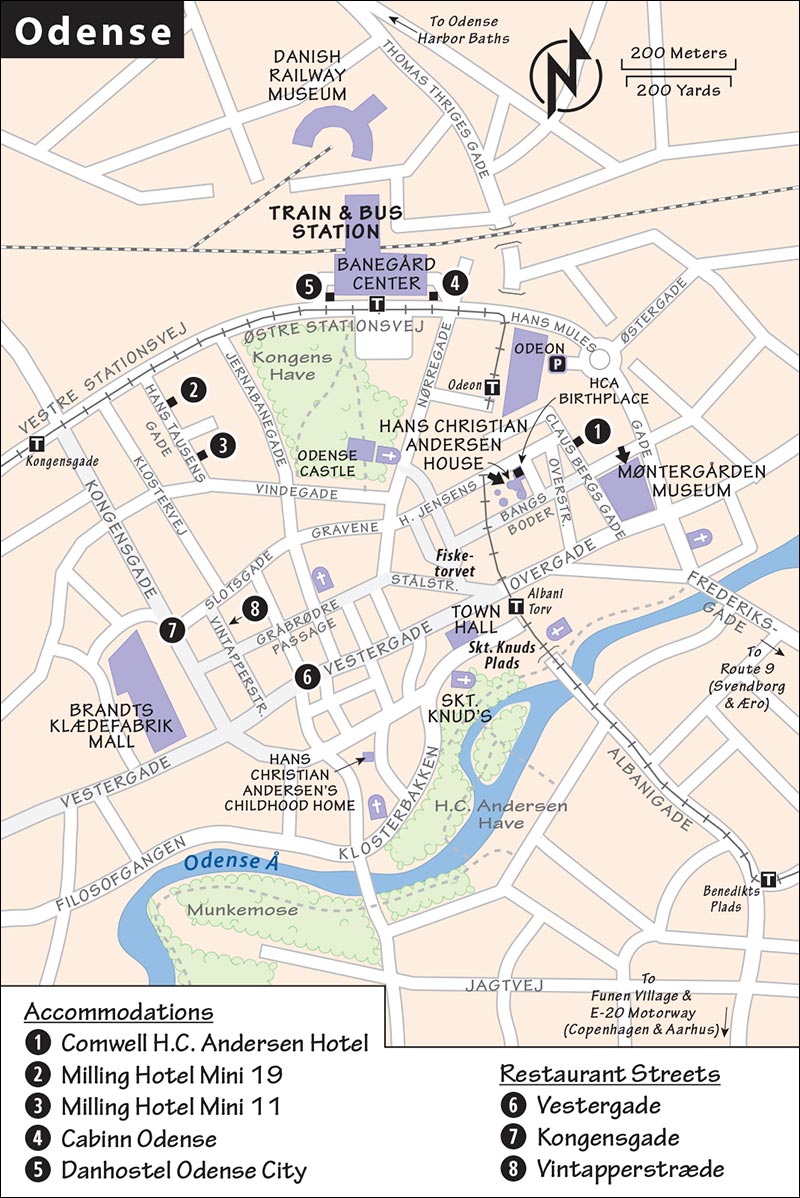
The train station sits at the north end of the town center. A few blocks south runs the main pedestrian shopping boulevard, Vestergade. Near the eastern end of this drag, and a couple of blocks up, is a tight tangle of atmospheric old lanes, where you’ll find the Hans Christian Andersen House and Møntergården, Odense’s urban history museum.
TOURIST INFORMATION
There’s no TI office but there’s a good tourist website (www.visitodense.com, otb@visitodense.com). If you’re staying overnight your hotel will likely have brochures and the excellent, free Odense guide.
ARRIVAL IN ODENSE
The train and bus stations are located in the Bånegard Center, a large shopping complex. For a quick visit, check your luggage at the train station (pay lockers in corridor next to DSB Resjebureau office), pick up a free town map inside the ticket office, jot down the time your train departs, and hit the town (follow signs to Odense Centrum).
HELPFUL HINTS
Book Ahead: To guarantee your desired entry time at Hans Christian Andersen House, buy tickets online several days in advance—a week ahead in high season.
Walking Tour: Download the Useeum app to follow a 1.25-mile, 40-minute walking tour (marked with big red footprints on city sidewalks) and read about 13 spots connected to Hans Christian Andersen (in the app, choose “H. C. Andersens Hus,” then “Hans Christian Andersen’s Odense”).
Festival: A weeklong Hans Christian Andersen festival, with art, theater, dance, and music, is held annually in late August (www.hcafestivals.com).
Sights in Odense
▲▲▲Hans Christian Andersen House (HC Andersen Hus)
Even with its heavy slice of whimsy and artistic flair, you’ll learn plenty about Hans Christian Andersen—warts and all—in this museum. The experience incorporates myriad biographical artifacts as well as artistic installations based on Andersen’s fairy tales and the humble house where the writer was born. A location-based audioguide is integral to the exhibit, so timed-entry tickets are used to avoid bottlenecks at the audio points. Tickets include admission to the kids’ area called Ville Vau; adults are not admitted to this section without children.
Cost and Hours: 165 DKK, free for kids under 18; book online a week in advance in high season—and a few days ahead otherwise; ticket includes access to H. C. Andersen’s Childhood Home—described next; main exhibit—daily 10:00-17:00; July-Aug until 18:00, Nov-March Tue-Sun 10:00-16:00, closed Mon; Ville Vau—Mon-Fri 13:00-16:00 or 17:00, Sat-Sun from 10:00, July-Aug daily 9:00-18:00; good café, +45 65 51 46 01, www.hcandersenshus.dk.
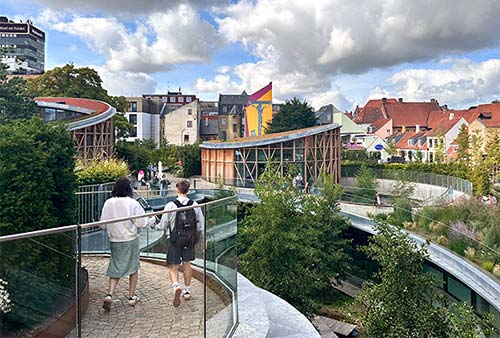
Visiting the Museum: Five cylindrical wood-and-glass buildings, surrounded by beautiful garden paths that blend into the surrounding cityscape, hint at the organic, curvy route within the museum. As visitors move through the exhibit, the English-language audioguide, masterfully written by Daniel Handler (aka Lemony Snicket, best known for his comically dark Series of Unfortunate Events children’s books), educates and entertains.
Infusing a fairy-tale feel into the display of thousands of Hans Christian artifacts—from his iconic top hat to a wastebasket full of crumpled papers—these objects tell the story of Andersen’s life through wonderful voice acting. From his wanderlust (with travel souvenirs and objects—including a rope he traveled with so he could escape a building in case of fire) to his love life (with notes to both men and women), the collection offers insight into Andersen’s personality. His paper cut-out illustrations and drawings and quotations from his brilliant prose illuminate his creativity and genius.
Following the biography section are installations by different artists, inspired by 12 of Andersen’s best-known fairy tales. Some are interactive, some stunningly beautiful, and all are intriguing. Visitors then move into Andersen’s tiny birthplace (now empty)—which at the time of his birth, in 1805, was occupied by five families. Next comes the octagonal Memorial Hall, originally built in 1930, with frescoes illustrating The Fairy Tale of My Life, one of three autobiographies penned by Andersen.
Ville Vau, the area strictly for kids 2-12 and their parents, has an art studio and dress-up area.
H. C. Andersen’s Childhood Home (H. C. Andersens Barndomshjem)
Unlike H. C.’s empty birthplace, his humble, yellow, half-timbered childhood home—where he lived from age 2-14—has three furnished rooms.
Cost and Hours: Free with H. C. Andersen House ticket for same-day visit, otherwise 75 DKK; July-Aug daily 10:00-17:00, Sept-June Tue-Sun 11:00-16:00, closed Mon; a 10-minute walk from H. C. Andersen House at Munkemøllestræde 3; +45 65 51 46 01, www.hcandersenshus.dk.
▲Møntergården (Museum of Odense and Funen)
This well-presented museum covers the history of Odense, filling several medieval buildings with thousands of artifacts ranging from hoards of coins to an 11th-century skeleton of a bishop of Odense, found in 2015 during the excavation of St. Alban’s Square. You’ll time-travel from prehistoric times through to 1660, when the king stripped the town of its independent status. The main exhibit, “Life of the City,” fills a stately 17th-century red house (Falk Gøyes Gård) with a good exhibit about Odense in medieval and Renaissance times, covering historical events as well as glimpses of everyday life—complete with sometimes-creepy sound effects like a woman humming or fire crackling.
Wedged along the side of this building is a surviving medieval lane; at the far end are four minuscule houses that the city used to house widows and orphaned students who couldn’t afford to provide for themselves. It’s fascinating to squeeze into these humble interiors and imagine that people lived in these almshouses through 1955 (open only in summer, but at other times you can ask at the ticket desk to have them unlocked).
Cost and Hours: 100 DKK, 50 percent discount with H. C. Andersen House ticket within 8 days of visit; July-Aug daily 10:00-17:00, Sept-May Tue-Sun 10:00-16:00, closed Mon; Møntestræde 1, +45 65 51 46 01, www.montergarden.dk.
▲Danish Railway Museum (Danmarks Jernbanemuseum)
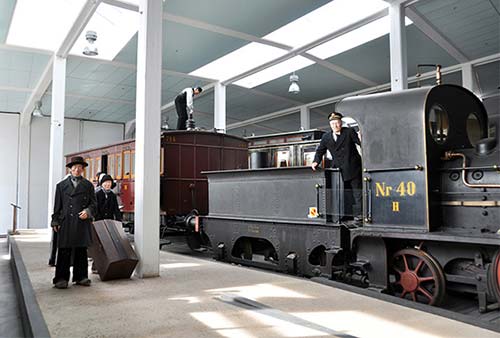
Conveniently (and appropriately) located directly behind the train station, this is an ideal place to kill time while waiting for a train—and is worth a look for anyone who enjoys seeing old locomotives and train cars. Here at Denmark’s biggest (and only official) rail museum, the huge roundhouse is filled with classic trains, while upstairs you’ll walk past long display cases of model trains and enjoy good views down onto the trains. The information is in English, picnicking is encouraged, and there are lots of children’s activities.
The author of such classic fairy tales as The Ugly Duckling was an ugly duckling himself—a misfit who blossomed. Hans Christian Andersen (called H. C., pronounced “hoe see” by the Danes) was born to a poor shoemaker in Odense. As a child he was gangly and high-strung, and he avoided school because the kids laughed at him. Instead, he spent his time in a fantasy world of books and plays. He loved playing with a marionette theater made by his father, sparking a lifelong love affair with the theater. In 1819, at the age of 14, he moved to Copenhagen to pursue an acting career and worked as a boy soprano for the Royal Theater. When his voice changed, the director encouraged him to return to school. He dutifully attended—a teenager among boys—and eventually went on to the university. As rejections piled up for his acting aspirations, Andersen began to shift his theatrical ambitions to playwriting.
After graduation, Andersen won a two-year scholarship to travel around Europe, the first of many trips he’d make and write about. His experiences abroad were highly formative, providing inspiration for many of his tales. Still in his 20s, he published an obviously autobiographical novel, The Improvisatore, about a poor young man who comes into his own while traveling in Italy. The novel launched his writing career, and soon he was hobnobbing with the international crowd—Charles Dickens, Victor Hugo, Franz Liszt, Richard Wagner, Henrik Ibsen, and Edvard Grieg.
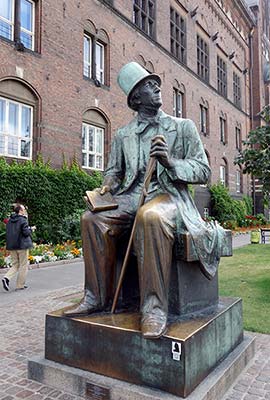
Though he wrote novels, plays, and travel literature, it was his fairy tales, including The Ugly Duckling, The Emperor’s New Clothes, The Princess and the Pea, The Little Mermaid, The Snow Queen, and The Red Shoes, that made him famous in Denmark and abroad as the “Danish Charles Dickens.” Some stories are based on earlier folk tales, and others came straight from his inventive mind, all written in an informal, conversational style that was considered unusual and even surprising at the time.
Andersen’s compelling tales appeal to children and adults alike. They’re full of magic and touch on strong, universal emotions—the pain of being different, the joy of self-discovery, and the struggle to fit in. The ugly duckling, for example, is teased by his fellow ducks before he finally discovers his true identity as a beautiful swan. In The Emperor’s New Clothes, a boy is derided by everyone for speaking the simple, self-evident truth that the emperor is fooling himself. (For commentary on Andersen’s famous story The Little Mermaid—and what it might tell us about his life—see here.)
Despite his many famous friends, Andersen remained a lonely soul who never married. He journaled about unrequited love affairs with several women, including the famous opera star of the day, Jenny Lind, the “Swedish Nightingale.” Without a family of his own, he became very close with the children of his friends—and, through his fairy tales, with a vast extended family of kids around the world. By the time of his death, the poor shoemaker’s son was wealthy, cultured, and had been knighted. His rise through traditional class barriers mirrors the social progress of the 19th century.
Cost and Hours: 120 DKK, more during special exhibits; late June-July daily 9:00-17:00; otherwise Mon-Fri 10:00-16:00, Sat-Sun from 9:00; Dannebrogsgade 24—just exit behind the station near track 7/8 and cross the street; +45 66 13 66 30, www.jernbanemuseet.dk.
▲Funen Village Open-Air Museum (Den Fynske Landsby)
The sleepy gathering of 26 old buildings located about two miles out of town preserves the 17th- to 19th-century culture of this region. During the summer, you’ll meet people dressed in period costumes who recount what life was like in 19th-century Funen as they perform their daily chores. Dozens of farm animals also bring to life the sounds—and smells—of the era. Families can enjoy tales of Hans Christian Andersen performed on an outdoor stage (mid-July-early-Aug). Explanations in the buildings are sparse, so buy the guidebook to help make your visit meaningful.
Cost and Hours: 145 DKK, 50 percent discount with H. C. Andersen House ticket within 8 days of visit, free for kids under 18; July-Aug daily 10:00-18:00 except closes at 17:00 last half of Aug; April-June and Sept-late Oct Tue-Sun 10:00-16:00 or 17:00, closed Mon; closed late Oct-March; bus #110 or #111 from Odense Station (direction: Nr. Broby), or take train to Fruens Bøge and walk 15 minutes; +45 65 51 46 01, www.denfynskelandsby.dk.
Sleeping in Odense
Demand (and prices) are higher in Odense on weekdays and in winter; in summer and on weekends, you can often get a better deal.
$$$ Comwell H. C. Andersen Hotel is comfortable and impersonal, with 157 rooms near the H. C. Andersen museum (good breakfast, elevator, fitness room, pool table, pay parking, Claus Bergs Gade 7, +45 70 27 42 74, www.comwell.com, booking@comwell.com).
$$ Milling Hotel Mini 19 has 35 tidy, basic, stylish little rooms along its tiny halls. It’s located on a quiet side street just a few minutes from the train station and features extra soundproofing (breakfast extra, family rooms, elevator, limited pay parking, Hans Tausensgade 19, +45 66 12 14 27, www.millinghotels.dk, mini19@millinghotels.dk). They also run $ Milling Hotel Mini 11, just down the street at Hans Tausensgade 11, with industrial simplicity.
$ Cabinn Odense brings its no-frills minimalist economy to town, with 200 simple, comfy, and modern rooms (breakfast extra, family rooms, elevator, pay parking for small cars only, next to the station at Østre Stationsvej 7, +45 63 14 57 00, www.cabinn.com, odense@cabinn.com). For more about this chain, see here.
Hostel: ¢ Danhostel Odense City is a huge, efficient hostel towering above the train station (private rooms available, elevator, Østre Stationsvej 31, +45 63 11 04 25, http://odensedanhostel.dk, odensecity@danhostel.dk).
Eating in Odense
Odense’s main pedestrian shopping streets, Vestergade and Kongensgade, offer the best atmosphere and most options for lunch and dinner.
Vintapperstræde is an alleyway full of restaurants just off Vestergade (look for the ornamental entryway). Choose from Danish, Mexican, Italian, and more. Study the menus posted outside each restaurant to decide, then grab a table inside or join the locals at an outdoor table.
Odense Connections
From Odense by Train to: Copenhagen (3/hour, 1.5 hours, some go directly to the airport), Aarhus (2/hour, 1.5 hours), Billund/Legoland (2/hour, 1-hour train to Vejle, then transfer to bus—see here; allow 2 hours total), Svendborg/Ærø ferry (2/hour Mon-Sat, hourly Sun, 45 minutes, to Svendborg dock; Ærø ferry—roughly 10/day, 1.25 hours), Roskilde (2/hour, 1.25 hours).