TALLINN
Map: Tallinn Hotels & Restaurants
FINE ESTONIAN CUISINE IN THE OLD TOWN
AT BALTI JAAM AND TELLISKIVI CREATIVE CITY
BUDGET EATERIES, BREAKFAST, CAFÉS, AND SWEETS
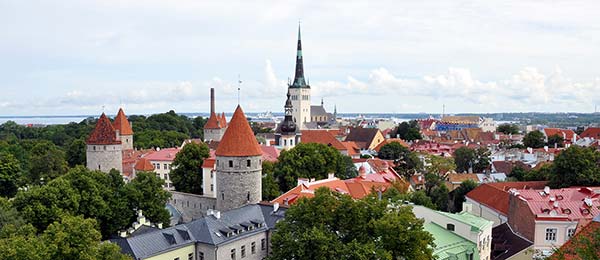
Tallinn is a rewarding detour for those who want to spice up their Scandinavian travels with a Baltic twist. Among Nordic medieval cities, there’s none nearly as well preserved as Tallinn. Its mostly intact city wall includes 26 watchtowers, each topped by a pointy red roof. Baroque and choral music ring out from its old Lutheran churches. I’d guess that Tallinn (with about 450,000 people) has more restaurants, cafés, and surprises per capita and square inch than any city in this book—and the fun is comparatively cheap.
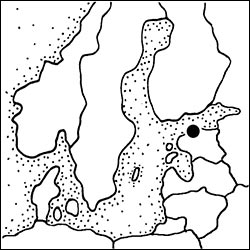
While Tallinn’s Nordic Lutheran culture and language connect it with Scandinavia, two centuries of czarist Russian rule and 45 years as part of the Soviet Union left behind some Russian touches. Yet overlying all of that is the vibrancy of a nation that won its freedom just a generation ago. Estonian pride is in the air.
As a member of the merchant coalition known as the Hanseatic League, the city of Tallinn was a medieval stronghold of the Baltic trading world. Little Estonia was passed between larger powers—Germany, Denmark, Poland, and Russia—for much of its history. In the 19th and early 20th centuries, Tallinn industrialized and expanded beyond its Old Town walls. Architects put in broad streets of public buildings, low Scandinavian-style apartment buildings, and single-family wooden houses. Estonia briefly won its independence in 1920, but that ended in World War II, and after 1945, Soviet planners ringed the city with stands of now-crumbling concrete high-rises where many of Tallinn’s Russian immigrants settled.
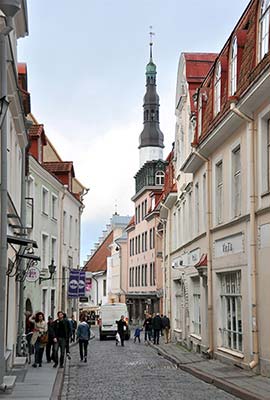
Since independence from the Soviet Union in 1991, Tallinn has westernized at an astounding rate. The Old Town has been scrubbed into a pristine Old World theme park—a fascinating package of pleasing towers, ramparts, facades, churches, shops, and people-watching. Nearby, the old industrial Rotermann Quarter is an enticing mix of architectural experimentation and careful preservation.
And for a bohemian/hipster reincarnation of an old Soviet industrial warehouse zone, combined with perhaps the most delightful market in Nordic Europe, wander (with an appetite) through the Balti Jaam Market and into the Telliskivi Creative City.
Given its compact scale, Tallinn can easily be appreciated on a day trip from Helsinki. But the city rewards those who spend the night. More time gives you the chance to explore some of the more colorful slices of life outside the Old Town walls.
PLANNING YOUR TIME
For anyone touring Scandinavia or the Baltic, Tallinn is certainly worth a day. Many people find it works best as a full-day side trip from Helsinki. (Or vice versa...you’ll save enough money on hotel costs to pay for the ferry crossings.) Another option is to overnight in both Helsinki and Tallinn—as a triangular detour from Stockholm. Cruise ships have discovered Tallinn, and its cobbles can be mobbed at midday. You can also connect to all the Baltic capitals efficiently with quick direct flights.
Day-Trippers: Hit the ground running by following my self-guided walk right from the port. Enjoy a nice lunch in the Old Town. Then spend the afternoon shopping and browsing, or choose one of the outlying sights: Balti Jaam Market for the vibrant food scene and the neighboring Telliskivi Creative City for galleries, shops, and trendy restaurants; Rotermann Quarter for new and old architecture; Estonian Open-Air Museum for folk culture; or Kumu Art Museum for Estonian art and a walk in nearby Kadriorg Park. Bring a jacket—Tallinn can be chilly or windy even on sunny summer days. And, given that locals call treading their cobbled streets “a free foot massage,” sturdy shoes are smart, too.
With More Time: For the best orientation to the city, start your visit with my self-guided walk. But because Tallinn can be inundated midday with day-trippers, you may want to save your Old Town exploration for early or late, and visit outlying sights when the center is most crowded. Check concert schedules if you’ll be around for the evening.
Orientation to Tallinn
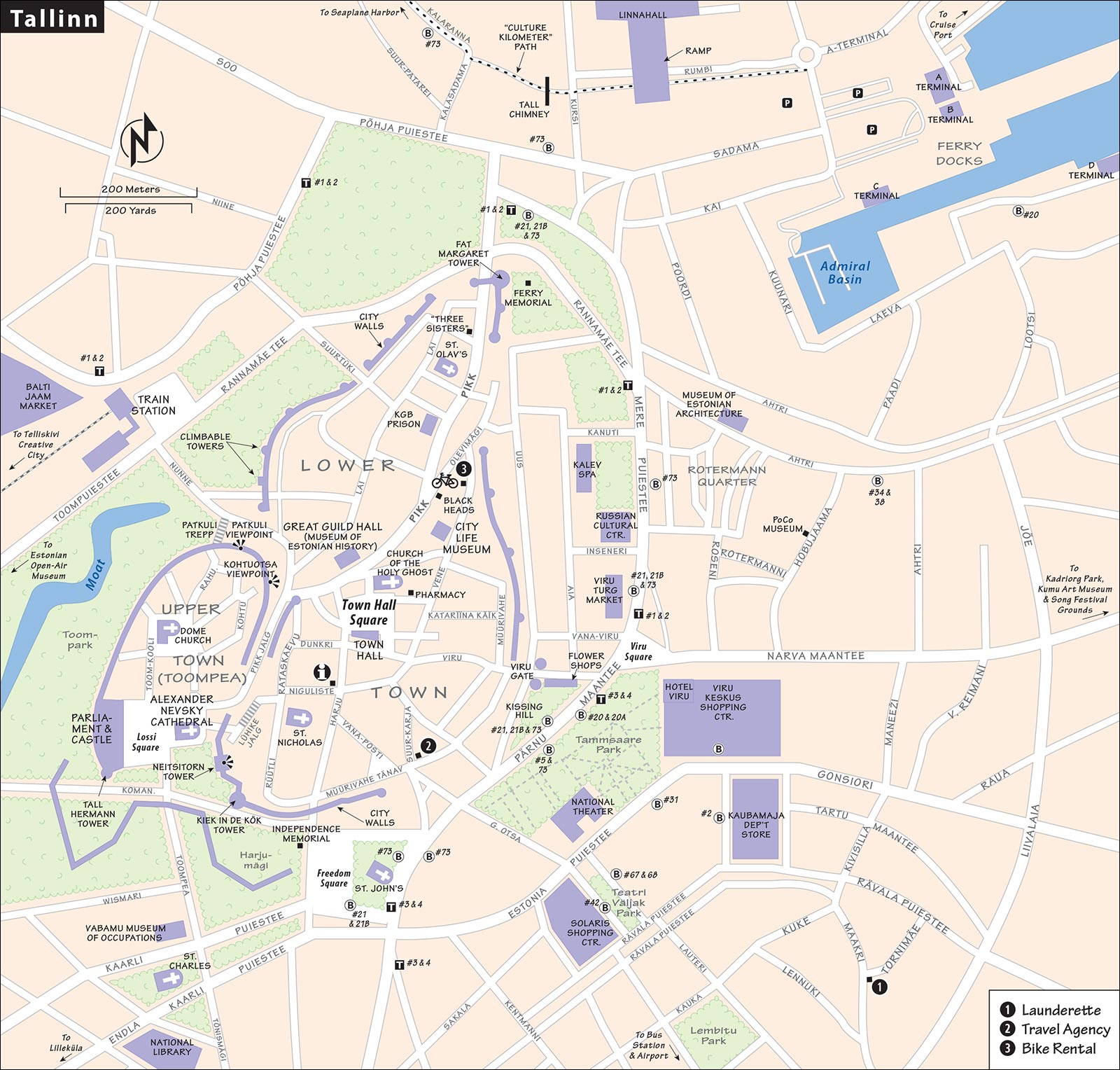
Tallinn’s walled Old Town is an easy 15-minute walk from the ferry and cruise terminals, where most visitors arrive. The Old Town is divided into two parts (historically, two separate towns): the upper town (Toompea, which can be seen in an hour and is relatively lifeless) and the lower town (with Town Hall Square and much more). A remarkably intact medieval wall surrounds the two towns, which are themselves separated by another wall.
Town Hall Square (Raekoja Plats) marks the heart of the medieval lower town. The main TI is nearby, as are many sights and eateries. The area around the Viru Keskus mall and Hotel Viru, just east of the Old Town, is useful for everyday shopping (bookstores and supermarkets), practical services (laundry), and public transport.
TOURIST INFORMATION
The hardworking and helpful TI, just a block off Town Hall Square, is where you can pick up a city map, the Tallinn Card, and info about city tours and Estonian destinations beyond Tallinn (daily 9:00-18:00 in summer, shorter hours off-season; Niguliste 2, +372 645 7777, www.visittallinn.ee).
Tallinn Card: This card—sold around town but easiest to buy online—covers public transit and essentially all museums and sights (€34/24 hours, €51/48 hours, €62/72 hours, www.tallinncard.ee).
ARRIVAL IN TALLINN
By Boat: Tallinn has three passenger/car-ferry terminals (A/B and D), and a dedicated cruise terminal. The side-by-side A/B terminals are the closest to the Old Town; the cruise terminal is just to the north; D terminal (serving Tallink ferries) is an additional 10-minute walk to the east (and the farthest from Old Town). Each terminal offers baggage storage. Be sure to confirm which terminal your return boat will use.
From the ferry landings it’s a 15-minute walk to town—just follow signs to the city center and set your sights on the tallest spire in the distance (or follow my self-guided walk).
If you have bags, it’s best to grab a taxi or use Uber—otherwise your rolling suitcase will take a pounding on the Old Town’s cobbled streets. The taxi fare to anywhere in or near the Old Town should be no more than €10; confirm the price before getting in (for more on using taxis in Tallinn, see “Getting Around Tallinn,” later).
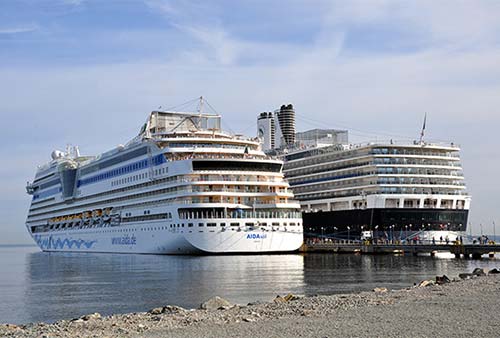
Public bus #20/20A leaves from outside the D terminal and runs to the Viru stop just southeast of the Old Town, near the Viru Keskus mall (3-4/hour). A tram line running near terminals A/B zips to the Old Town quick and easy. For ticket-buying details, see “Getting Around Tallinn,” later.
By Plane or Cruise Ship: For information on arriving in Tallinn by plane or cruise ship, see “Tallinn Connections” at the end of this chapter.
By Train and Bus: While Tallinn has a sleepy and cute little train station (called Balti Jaam), few tourists will need to use it. The station, a five-minute walk across a busy road from the Old Town, is adjacent to the colorful Balti Jaam Market.
Tallinn’s long-distance bus station (autobussijaam) is midway between downtown and the airport, and served by bus #2 and trams #2 and #4.
HELPFUL HINTS
Money: Estonia uses the euro. While cash is still used, many rely solely on credit cards.
Time: Estonia is one hour ahead of continental Europe, which means it’s generally seven/ten hours ahead of the East/West Coasts of the US.
Laundry: Pesumaja Sol offers self- or full-service; it’s just beyond the Viru Keskus mall and Kaubamaja department store (just walkable from the Old Town, or take tram #2 or #4 to the Paberi stop, a few blocks away; Mon-Fri 8:00-20:00, Sat-Sun 10:00-16:00, Maakri 23, +372 661 2075).
Travel Agency: Estravel, at the corner of Suur-Karja and Müürivähe, is handy and sells boat tickets for no extra fee (Mon-Fri 9:00-17:30, closed Sat-Sun, Suur-Karja 15, +372 626 6266, www.estravel.ee).
Bike Rental: Head for hard-working little City Bike, at the north end of the Old Town (€13/6 hours, €16/24 hours; electric bikes available; helmets and locks included; daily 10:00-19:00 in summer, Vene 33, +372 511 1819, www.citybike.ee). They also do bike tours (see “Tours in Tallinn,” later).
Parking: The Port of Tallinn operates several parking lots by the ferry terminals. Old Town parking is very expensive; try parking in the lot underneath Freedom Square (Vabaduse väljak), at the southern edge of the Old Town, a short walk from the TI and Town Hall Square.
GETTING AROUND TALLINN
By Public Transportation
The Old Town and surrounding areas are easy to explore on foot, but public transit is useful for reaching outlying sights (such as Kadriorg Park/Kumu Art Museum, or the Estonian Open-Air Museum). Tallinn has buses, trams, and trolley buses—note that they may reuse the same numbers (bus #2, tram #2, and trolley bus #2) but are totally different routes. Construction of a new tram line may cause some disruption to regular routes during your visit; check locally.
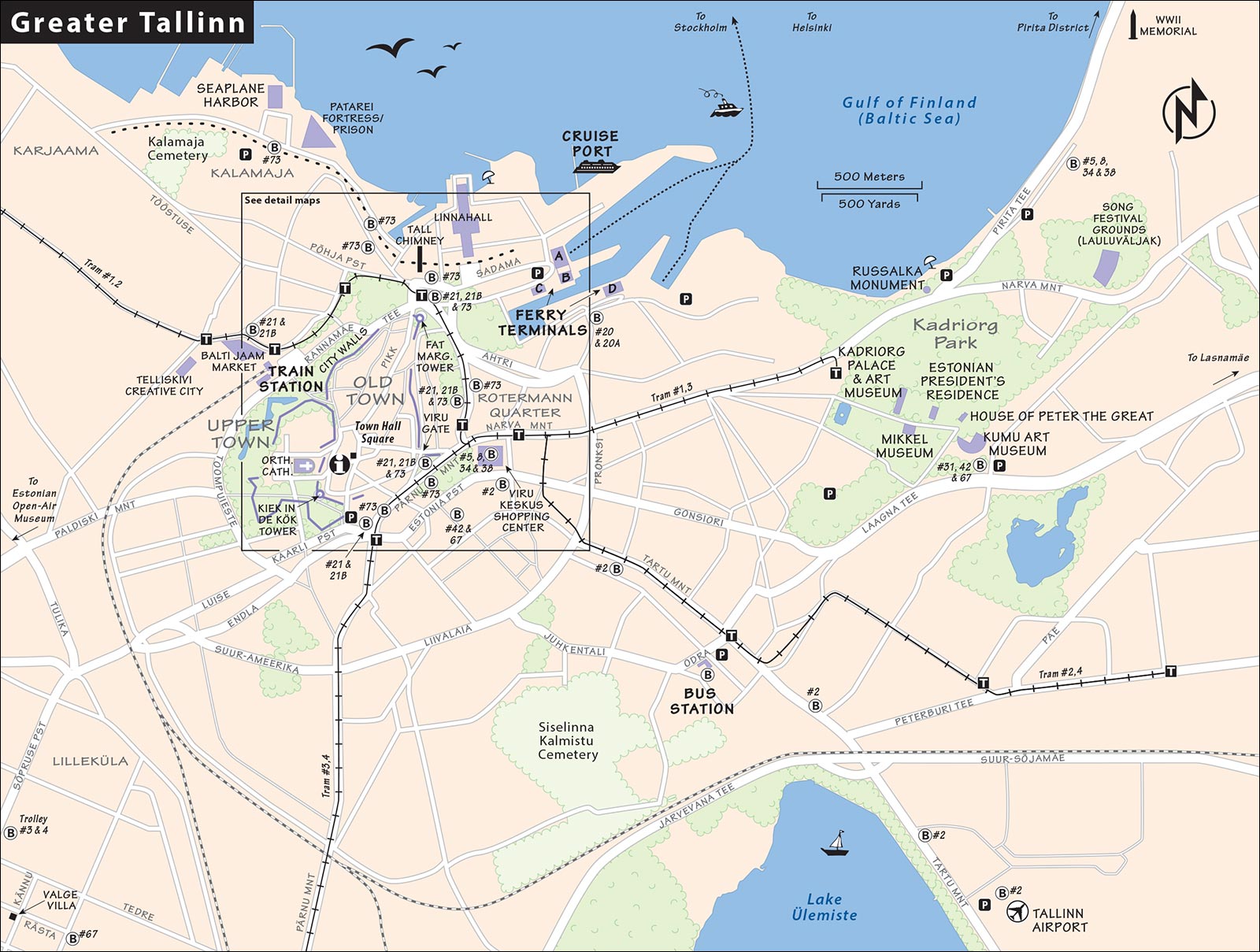
Maps and schedules are posted at stops; transit maps are available at the TI or at Transport.Tallinn.ee. For an overview of transit stops useful to visitors, see the “Greater Tallinn” map, earlier. As you approach a station, you’ll see and hear the name of the impending stop, then the name of the following stop—don’t hop off one stop too early.
Tickets: You can buy a single ticket from the ticket machine by the driver’s door for €2 (contactless cards only) or a QR ticket for use on your phone (€2 for any ride up to 1 hour, can purchase up to 10 rides per ticket, shareable with other riders, purchase at Tallinn.Pilet.ee [URL inactive] or with the mobile app Pilet.ee [URL inactive]). For longer stays, consider a Ühiskaart smartcard (€2, buy at any yellow-and-blue R-Kiosk convenience store, found all over town), then load it up with credit—€2/ride; also available as day tickets—€5.50/24 hours, €9/72 hours).
By Taxi or Uber
Taxis in Tallinn are handy, but because rates are not uniform, always confirm a ballpark fare and whether it is per ride or per person before getting in (be firm if necessary). Cabbies are required to use the meter and give you a meter-printed receipt.
It’s best to order taxis by phone (or ask a local to call for you) or to use an app. Tallink Takso is reputable with fair fares (+372 640 8921); Forus Takso is also a good option (+372 612 0000).
If you must catch a taxi off the street, go to a busy taxi stand (like the one outside Hotel Viru) where lots of cabs are lined up. Before you get in, take a close look at the yellow price list on the rear passenger-side door; the base fare should be no more than €5.50 and the per-kilometer charge no more than €1.10. If it’s not, keep looking.
Uber works in Tallinn like it does in the US and is usually cheaper than a taxi. Locals prefer Uber’s competitor, the Tallinn-based Bolt.
Tours in Tallinn
Local Guides
Miina Puusepp is a licensed guide who knows what is interesting (€30/hour, +372 551 7028, miinapaul@gmail.com). Margit Raud is another good licensed guide (€35/hour for guided walks tailored to your interests, 2-hour minimum, +372 506 1108, tigramuus@gmail.com). Mati Rumessen, passionate and highly opinionated about his country and its political struggles, is good for connecting Tallinn’s many sights away from the center (€40/hour walking, €50/hour by car, 2-hour minimum, up to 4 people, other tour options available, +372 509 4661 or WhatsApp +372 508 0137, www.tourservice.ee, visitestonia@gmail.com).
Nordic Experience Tours, managed by Eva-Maria Egipt-Peenmaa, offers an extensive program of fairly priced private tours led by excellent licensed guides. While based in Tallinn, they offer tours (on foot or by van) of the great cities throughout the Baltics and Scandinavia. For details, see NordicExperience.com.
Tallinn Traveller Tours are run by well-informed locals and show you the real city. Check their website to confirm details for their ever-changing lineup and to reserve (or call +372 5837 4800, www.traveller.ee). They typically offer a two-hour Old Town Walking Tour (€20), a ghost walk, and a food tour, as well as bike tours and minibus excursions into the Estonian countryside. All tours start from the main TI. Their 5-hour Best of Tallinn Tour, by minibus and on foot (€55, 8 people maximum) is designed for cruise ship visitors and covers it all efficiently.
Hop-On, Hop-Off Bus Tours
CitySightseeing Tallinn runs two routes, one circling the city center and Old Town (50 minutes), and another of Pirita and historic suburbs (75 minutes), including the Song Festival Grounds and Kadriorg Park. Both run 2-3 times daily (more often when cruise ships are in port) from in front of the Russian Cultural Center at Mere Puiestee 5 (€25 when purchased online and valid for 24 hours on either route, www.citysightseeing.ee). But frankly, the buses go so infrequently that it’s not really workable as a hop-on, hop-off tour of the sights.
City Bike Tours
City Bike offers a roughly three-hour, nine-mile Welcome to Tallinn bike tour that takes you outside the city walls to Tallinn’s more distant sights: Kadriorg Park, Song Festival Grounds, the beach at Pirita, and more (€25, every other day or by demand at 11:00 in peak season, departs from their office at Vene 33 in the Old Town, 2-12 people/tour, helmets included). They can also arrange multiday, self-guided bike tours around Estonia (+372 511 1819, www.citybike.ee).
Tallinn Walk
1 Fat Margaret Tower (Paks Margareeta)
3 Brotherhood of the Black Heads
4 Great Guild Hall (Suurgildi Hoone)
5 Church of the Holy Ghost (Pühavaimu Kirik)
6 Town Hall Square (Raekoja Plats)
8 St. Nicholas Church (Niguliste Kirik)
10 Alexander Nevsky Cathedral (Aleksander Nevski Katedraal)
11 Toompea Castle (Toompea Loss)
12 Tall Hermann Tower (Pikk Hermann)
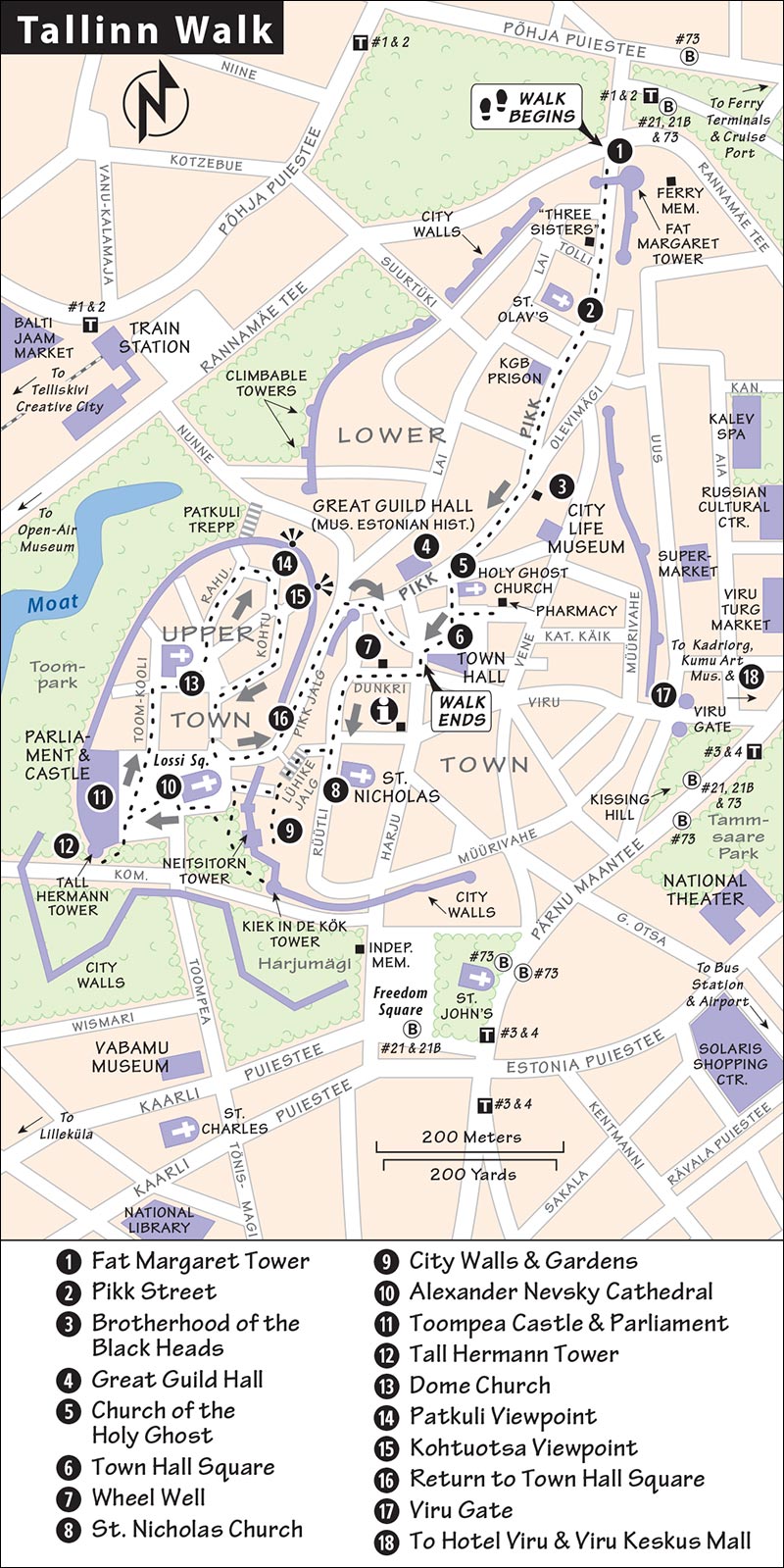
This self-guided walk, worth ▲▲▲, explores the lower and upper towns of Tallinn. The city once consisted of two feuding medieval towns separated by a wall. Toompea—the upper town on a hill—was the seat of government for Estonia. The lower town was an autonomous Hanseatic trading center filled with German, Danish, and Swedish merchants who hired Estonians to do their menial labor. Many of the Old Town’s buildings are truly old, dating from the boom times of the 15th and 16th centuries. Decrepit before the 1991 fall of the Soviet Union, the Old Town has been entirely revitalized.
Two steep, narrow streets—the “Long Leg” and the “Short Leg”—connect the upper and the lower towns. This walk goes up the short leg and down the long leg. Allow about two hours for the entire walk (not counting time to enter museums along the way).
LOWER TOWN
1 Fat Margaret Tower (Paks Margareeta)
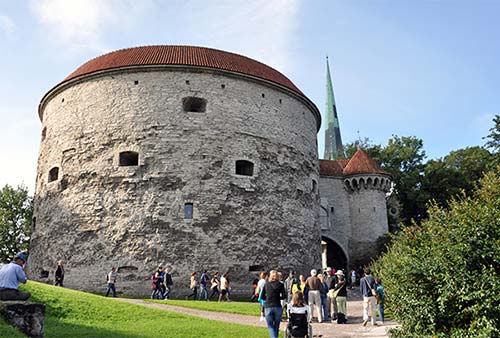
This tower guarded the entry gate of the town in medieval times (the sea once came much closer than it does today). Besides being a defensive outpost, the tower was made big just to intimidate anyone coming to town from the harbor. The plaque above the gate dates from the 16th century, during Hanseatic times, when Sweden took Estonia from the German Teutonic Knights. The origin of the tower’s name is a bit of a mystery. My favorite story is that it was named for its thick walls, which were necessary to defend against the military technology of the 16th century—cannon balls.
• Once through the gate, head up Tallinn’s main drag...
2 Pikk Street
Literally “Long Street,” the medieval merchants’ main drag leads from the harbor up into town. It’s lined with interesting and historic buildings. Many were warehouses, complete with cranes on the gables. Strolling here, you’ll feel the economic power of those early German trading days.
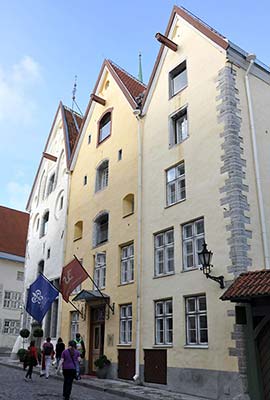
One short block up the street on the right, the buildings nicknamed “Three Sisters” are textbook examples of a merchant home/warehouse/office from the 15th-century Hanseatic golden age. The elaborately carved door near the uphill corner evokes the wealth of Tallinn’s merchant class—such detailed decoration would have come with a high price tag. While the local saying is “Tallinn was built on salt,” the Old Town was essentially built with Hanseatic money—profits from salt as well as furs, fish, weapons, and spices.
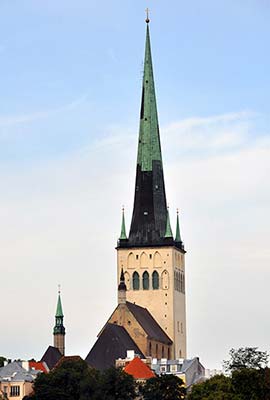
Your next stop, after another, longer block, is marked by its green pointy spire. The Gothic St. Olav’s Church (Oleviste Kirik, a Baptist church today) is notable for what was once the tallest spire in the land. That high spire helped approaching ships set their course and was also an effective lightning rod. Unfortunately, lightning strikes caused the church to burn to the ground three times. If the name doesn’t tip you off that this was once a Lutheran church, then the stark, whitewashed interior will. The empty niches above the nave and elsewhere are a reminder that, until the Reformation came to town, this was once a highly ornamented Catholic church. Climbing 234 stairs up the tower (actually to the landing about halfway up) rewards you with a great view. You can enter both the church and the tower around the back side (church—free, daily 10:00-18:00; tower—€5, open April-Oct only).
While tourists see only a peaceful scene today, older locals strolling this street are reminded of dark times under Moscow’s rule. The KGB used the tower at St. Olav’s Church to block Finnish TV signals. The once-handsome building at Pikk #59 (the second house after the church, on the right) was, before 1991, part of the local KGB headquarters. You can view some of the former headquarters by visiting the KGB Prison Cells exhibit (described later, under “Sights in Tallinn”). “Creative” interrogation methods were used here. Locals knew well that the road of suffering started here, as Tallinn’s troublemakers were sent to Siberian gulags. The ministry building was called the “tallest” building in town (because “when you’re in the basement, you can already see Siberia”). Notice the bricked-up windows at street level and the commemorative plaque (in Estonian).
• If you see a rush of tourists with their luggage washing up the street—a Helsinki ferry has just landed. Continue walking up Pikk. Look out for a naked woman hugging a wolf (on the pub named Hell Hunt, which means “gentle wolf”). The fork in the lane is marked by a tiny Russian Orthodox stone chapel. Then, on the left at #26, is the extremely ornate doorway of the...
3 Brotherhood of the Black Heads
Built in 1440, this house was used as a German merchants’ club for nearly 500 years (until Hitler invited Estonian Germans back to their historical fatherland in the 1930s). Before the 19th century, many Estonians lived as serfs on the rural estates of the German nobles who dominated the economy. In Tallinn, the German big shots were part of the Great Guild (which we’ll see farther up the street), while the German little shots had to make do with the Brotherhood of the Black Heads. This guild, or business fraternity, was limited to single German men. In Hanseatic towns, when a fire or battle had to be fought, bachelors were deployed first, because they had no family. Because single men were considered unattached to the community, they had no opportunity for power in the Hanseatic social structure. When a Black Head member married a local woman, he automatically gained a vested interest in the town’s economy and well-being. He could then join the Great Guild, and with that status, a promising economic and political future often opened up.
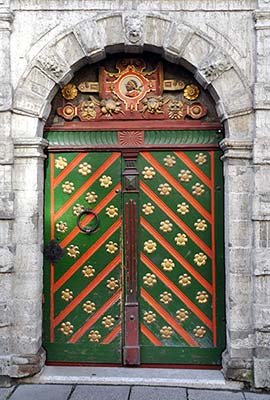
Today the hall is a concert venue (and, while you can pop in to get a peek—and use the WC—it’s basically an empty shell). Its namesake “black head” is that of St. Maurice, an early Christian soldier-martyr, beheaded in the third century AD for his refusal to honor the Roman gods. Reliefs decorating the building recall Tallinn’s Hanseatic glory days.
Keep going along Pikk street. The Estonian Handicraft House at #22 has delightful Estonian knitwear and crafts. Architecture fans enjoy several fanciful facades along here, including the boldly Art Nouveau #18. Across the street you may notice police protection and a colorful collection of Ukrainian flags and posters protesting a brutal and unjust war, pinned to barricades in front of the Russian Embassy.
On the left, at #16, the famous and recommended Maiasmokk (“Sweet Tooth”) coffee shop, in business since 1864, remains a fine spot for a coffee-and-pastry break. In its pastry shop you can often see a baker painting the traditional marzipan.
• Just ahead, pause at the big yellow building on the right (at #17).
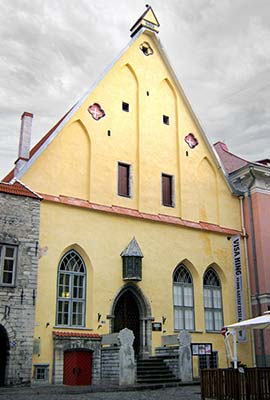
4 Great Guild Hall (Suurgildi Hoone)
With its wide (and therefore highly taxed) front, the Great Guild Hall was the epitome of wealth. Remember, this was the home of the most prestigious of Tallinn’s Hanseatic-era guilds. Today it houses the worthwhile Museum of Estonian History, offering a concise and engaging survey of this country’s story (for details, see “Sights in Tallinn,” later).
• Across Pikk street from the Great Guild Hall is the...
5 Church of the Holy Ghost (Pühavaimu Kirik)
Sporting an outdoor clock from 1633, this pretty medieval church is worth a visit. The plaque on the wall just behind the ticket desk is in Estonian and Russian, but not English; this dates from before 1991, when things were designed for “inner tourism”—within the USSR. The church retains its 14th-century layout inside, where creaky wooden floors lead to a lovingly crafted wooden balcony and a pulpit painted with the “poor man’s Bible” (scenes to inspire the illiterate). Sometimes flying from the back pillar, the old flag of Tallinn—the same as today’s red-and-white Danish flag—recalls 13th-century Danish rule. (The name “Tallinn” means “Danish Town.”) The Danes sold Tallinn to the German Teutonic Knights, who lost it to the Swedes, who lost it to the Russians. The windows are mostly from the 1990s.
Cost and Hours: €2; Mon-Fri 10:00-18:00, Sat from 11:00, closes earlier in winter, closed most of Sun to non-worshippers; English-language Lutheran services Sun at 13:00, free concerts Mon at 20:00; Pühavaimu 2, +372 646 4430, www.puhavaimu.ee.
• From here, it’s a three-minute walk to the Tallinn City Life Museum—down the street to the left as you face the church (described later, under “Sights in Tallinn”). You can detour there now, or to continue this walk, follow the tiny lane along the right side the church. This is Saiakang lane (meaning “White Bread”—bread, cakes, and pies were long sold here), which leads to...
6 Town Hall Square (Raekoja Plats)
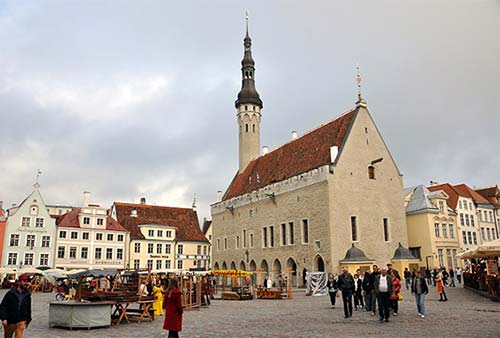
A marketplace through the centuries, with a cancan of fine old buildings, the Town Hall Square is the focal point of the Old Town. This was the center of the autonomous lower town, a merchant city of Hanseatic traders. In medieval times here, criminals were chained to pillories for public humiliation, and knights showed off in chivalrous tournaments; today it’s full of Scandinavians sipping beer.
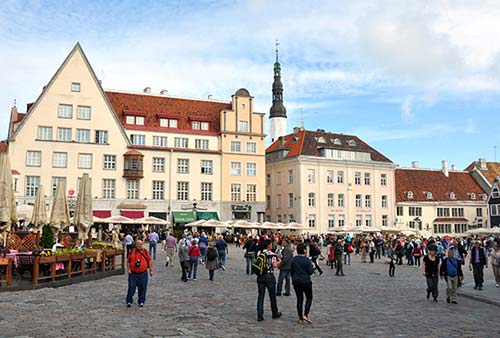
At the passageway where you’ve entered the square, hook left, go 20 yards, and climb the steps into the Raeapteek pharmacy, dating from 1422 and claiming to be Europe’s oldest (Mon-Sat 10:00-18:00, closed Sun). With an interior that goes back to medieval times, the still-operating pharmacy welcomes visitors with painted ceiling beams, English descriptions, and long-expired aspirin. Past the functioning counter is a room of display cases with historical exhibits.
The 15th-century Town Hall (Raekoda) dominates the square; it’s open to visitors in summer, and climbing its tower earns you a commanding view (for details, see “Sights in Tallinn,” later). Town Hall Square is ringed by inviting but touristy eateries. The TI is a block away.
• Facing the Town Hall, head right up Dunkri street—lined with several more eateries—one long block to the 7 wheel well, named for the “high-tech” pulley wheel, a marvel that made fetching water easier.
Turn left on Rataskaevu street (which soon becomes Rüütli) and walk two short blocks to...
8 St. Nicholas Church (Niguliste Kirik)
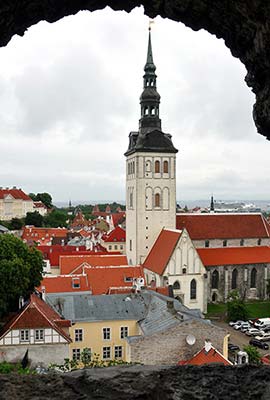
This 13th-century Gothic church-turned-art-museum served the German merchants and knights who lived in this neighborhood 500 years ago. On March 9, 1944, while Tallinn was in German hands, Soviet forces bombed the city, and the church and surrounding area—once a charming district, dense with medieval buildings—were burned out; only the church was rebuilt. Today it’s a starkly beautiful soaring Gothic space filled with fine medieval art. A striking glass elevator beams visitors effortlessly up the bell tower for a fine view.
Cost and Hours: €12; Tue-Sun 10:00-18:00, closed Mon year-round; organ or choir concerts Sat-Sun at 16:00 (free with ticket).
Visiting the Church: The church’s interior houses a fine collection of mostly Gothic-era religious art.
Enter the church through the modern cellar, with photos of the WWII destruction of the building (including its toppled steeple). Then make your way into the vast, open church interior. Front and center is the collection’s highlight: a retable (framed altarpiece) from 1481 by Herman Rode—an exquisite example of the northern Germanic late-Gothic style. Along with scenes from the life of St. Nicholas and an array of other saints, the altarpiece shows the skyline of Lübeck, Germany (Rode’s hometown, and—like Tallinn—a Hanseatic trading city). The intricate symbolism is explained by a nearby touchscreen. Also look for another work by a Lübeck master, Bernt Notke’s Danse Macabre (Dance of Death). Once nearly 100 feet long, the surviving fragment shows sinister skeletons approaching people from all walks of life. This common medieval theme reminds the viewer that life is fleeting, and no matter who we are, we’ll all wind up in the same place.
• From the church, if you were to turn left and walk downhill on Rüütli street, you’d soon pass near Freedom Square (providing a taste of modern Tallinn; described later, under “Sights in Tallinn”). But for now, let’s continue our walk into the upper town.
UPPER TOWN (TOOMPEA)
• At the corner opposite the church, climb uphill along the steep, cobbled, Lühike Jalg (“Short Leg Lane”), home to several quality craft shops. At the top of the lane, pause at the arched gateway at #9. Notice the stone tower steps leading to the arched passage and a big oak door. This is one of two gates through the wall separating the upper and lower towns. This passage is still the ritual meeting point of the mayor and prime minister whenever there is an important agreement between town and country.
Now continue straight (not climbing the stepped passage on the right) through the main gateway and climb up until you emerge into a beautiful view terrace in front of the city walls.
9 City Walls and Gardens
This view terrace is known as the Danish King’s Garden for the ruler who gave the land to the lower town in 1311. Tallinn is famous among Danes as the birthplace of their flag. According to legend, the Danes were losing a battle here, when suddenly, a white cross fell from heaven and landed in a pool of blood. The Danes were inspired and went on to win, and to this day, their flag is a white cross on a red background.
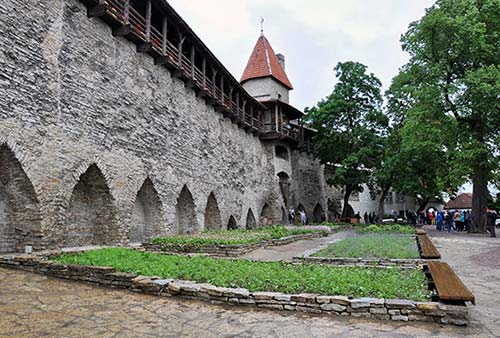
Once you pass through the opening in the wall (to the right after you pass through the main gate), you’ve officially crossed from the lower to upper town. The imposing city wall once had 46 towers, of which 26 still stand. If interested, you can climb some of the towers and ramparts (see below; note that we’ll be reaching other dramatic viewpoints—overlooking different parts of town—later on this walk).
For a genuine tower climb, visit the stout, round Kiek in de Kök tower, with extremely tight, twisty, steep stone staircases inside (€8 combo-ticket also covers nearby Neitsitorn tower, both open daily except closed Mon off-season). The fun-to-say name “Kiek in de Kök” is Low German for “Peek in the Kitchen”—so-called because the tower was situated to allow guards to literally peek into townspeople’s homes. While there are not many real artifacts, you’ll see cannons, mannequins, model ships, videos, and models of the castle to give you a taste of Tallinn’s medieval heyday.
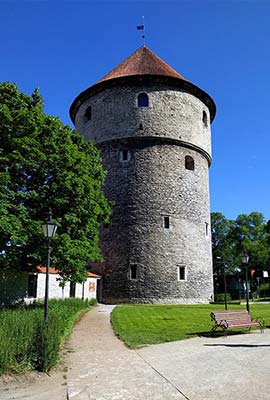
• From the Kiek in de Kök tower, steer toward the big, onion-domed church poking up above the trees; circle around to the far side (facing the pink palace) to find the entrance. (You’ll pass great rampart and tower views and perhaps a chance to enjoy a little archery.)
10 Alexander Nevsky Cathedral (Aleksander Nevski Katedraal)
This Russian Orthodox cathedral—worth ▲▲—is a gorgeous building. But ever since the day it was built (in 1900), it has been a jab in the eye for Estonians. The church went up near the end of the two centuries when Estonia was part of the Russian Empire. And, as throughout Europe in the late 19th century, oppressed ethnic groups like the Estonians were caught up in national revival movements—celebrating their own culture, language, and history rather than that of their Russian overlords. So, the Russians flexed their cultural muscle by building this church in this location, facing the traditional Estonian seat of power, and over the supposed grave of a legendary Estonian hero, Kalevipoeg. They also tore down a statue of Martin Luther to make room.
Cost and Hours: Free, daily 8:00-18:00, Sat until 19:00, OK to visit discreetly during services (daily at 8:30 and 17:00); gift shop.
Visiting the Church: The church has been exquisitely renovated inside and out. Step inside for a sample of Russian Orthodoxy; you may hear priests singing the liturgy in a side chapel. Typical of Russian Orthodox churches, it has glittering icons (the highest concentration fills the big iconostasis screen that shields the altar from the congregation), no pews (worshippers stand throughout the service), and air that’s heavy with incense. All of these features combine to create a mystical, otherworldly worship experience. Notice the many candles, each representing a prayer; if there’s a request or a thank-you in your heart, you’re welcome to buy one at the desk by the door. Exploring this space, keep in mind that about 40 percent of Tallinn’s population is ethnic Russian.
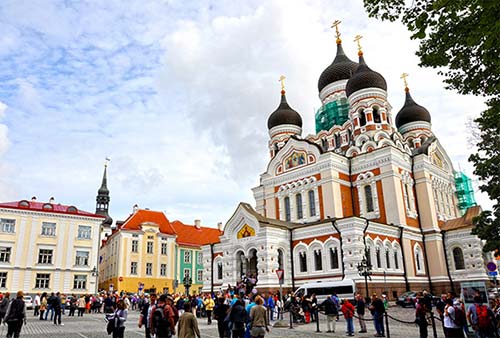
• Across the street is the...
11 Toompea Castle (Toompea Loss)
The pink palace is an 18th-century Russian addition onto the medieval Toompea Castle. Today, it’s the Estonian Parliament (Riigigoku) building, flying the Estonian flag—the flag of both the first (1918-1940) and second (1991-present) Estonian republics. Notice the Estonian seal: three lions for three great battles in Estonian history, and oak leaves for strength and stubbornness. Consider the beauty of how this little country—with just under a million ethnic Estonians—can survive with such a proud and rich heritage in this rough and tumble world. Ancient pagan Estonians, who believed spirits lived in oak trees, would walk through forests of oak to toughen up. To this day, Estonian cemeteries are in forests. Keeping some of their pagan sensibilities, they believe the spirits of the departed live on in the trees.
• Facing the palace, go left through the gate into the park to see the...
12 Tall Hermann Tower (Pikk Hermann)
This tallest tower of the castle wall is a powerful symbol for Estonians. For 50 years, while Estonian flags were hidden in cellars, the Soviet flag flew from Tall Hermann. As the USSR was unraveling, Estonians defiantly replaced the red Soviet flag here with their own blue, black, and white flag.
• Backtrack to the square in front of the palace, passing the Russian church on your right. Climb Toom-Kooli street to the...
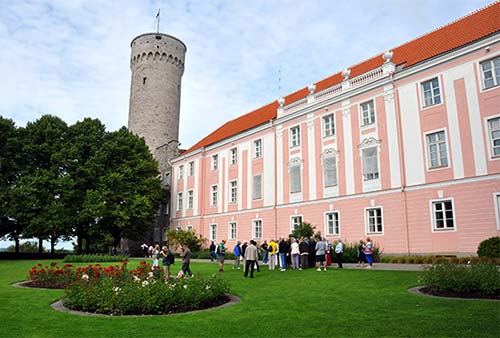
13 Dome Church (Toomkirik)
Estonia is ostensibly Lutheran, but few Tallinners go to church. A recent Gallup Poll showed Estonia to be the least religious country in the European Union—only 14 percent of respondents identified religion as an important part of their daily lives. Most churches double as concert venues or museums, but this one is still used for worship. Officially St. Mary’s Church—but popularly called the Dome Church—it’s a perfect example of simple Northern European Gothic, built in the 13th century during Danish rule, then rebuilt after a 1684 fire. Once the church of Tallinn’s wealthy German-speaking aristocracy, it’s littered with more than a hundred coats of arms, carved by local masters as memorials to the deceased and inscribed with German tributes to men who used to be important. The earliest dates from the 1600s, the latest from around 1900.
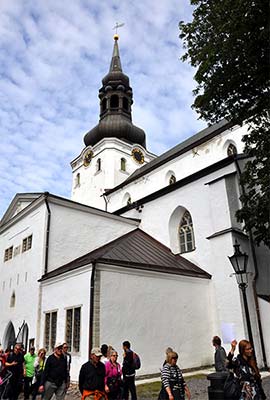
Cost and Hours: €2, €5 for 140-step Baroque tower climb, daily 10:00-17:00, organ recitals Sat at 12:00, www.toomkirik.ee.
• Leaving the church, turn left and hook around the back of the building. Head down cobbled Rahukohtu lane (to the right of the yellow house with a peaked roof).
Rahukohtu Lane
Notice the tranquility of this quarter: There’s almost no regular commerce here; just government, diplomats, and tourists. Strolling the street, you’ll spot embassy signs—government offices and embassies have moved into these buildings and spruced up the neighborhood. The prime minister’s residence is on the left in the Neoclassical Stenbock House (explained by plaque on the right). Left of the gate, a memorial plaque honors nearly a hundred Estonian leaders—presidents, prime ministers, and other politicians who died in the 1940s—guilty of Estonian patriotism and victims of the USSR.
• Continue straight under the arch and belly up to the grand...
14 Patkuli Viewpoint
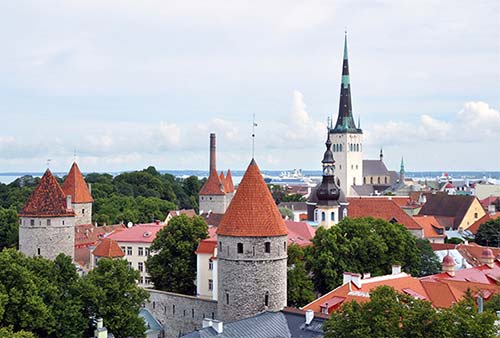
Survey the scene. On the far left, the Neoclassical facade of the executive branch of Estonia’s government overlooks a grand view. Below you, a bit of the old moat remains. Out on the water, ferries shuttle to and from Helsinki (just 50 miles away). Beyond the lower town’s medieval wall you’ll see the green spire of St. Olav’s Church, once 98 feet taller and, locals claim, the world’s tallest tower in 1492. Far in the distance is the 1,000-foot-tall TV tower, the site of a standoff between Soviet paratroopers and Estonian patriots in 1991 (see here).
During Soviet domination, Finnish TV was even more important, as it gave Estonians their only look at Western lifestyles. Imagine: In the 1980s, many locals had never seen a banana or a pineapple—except on TV. People still talk of the day that Finland broadcast the soft-porn movie Emmanuelle. A historic migration of Estonians purportedly flocked from the countryside to Tallinn to get within rabbit-ear’s distance of Helsinki and see all that flesh onscreen. The refurbished TV tower is now open to visitors.
Before leaving the viewpoint, find the big city map. Take a moment to retrace your steps. (From the next viewpoint, your tour is essentially done. Trace where you’ll go from there.)
• Go back through the arch, turn left down the narrow lane, turn right (onto Toom-Rüütli), take the first left, and pass through the trees to the...
15 Kohtuotsa Viewpoint
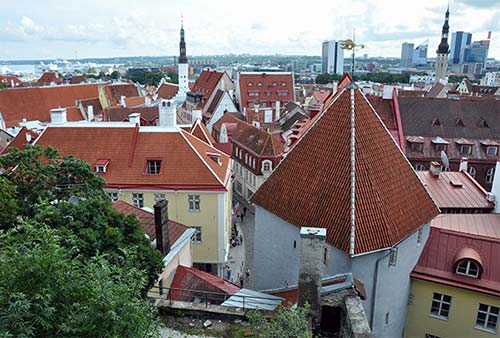
Scan the view from left to right. On the far left is St. Olav’s Church, then the busy cruise port and the skinny white spire of the Church of the Holy Ghost. The narrow gray spire farther to the right is the 16th-century Town Hall tower. On the far right is the tower of St. Nicholas Church. Below you, trace Pikk street, Tallinn’s historic main drag, which winds through the Old Town, leading from Toompea Castle down the hill (from right to left), through the gate tower, past the Church of the Holy Ghost, behind St. Olav’s, and out to the harbor. Less picturesque is the clutter of Soviet-era apartment blocks breaking the distant horizon, but these days they’re being crowded out by modern high-rises. The nearest skyscraper (white) is Hotel Viru, in Soviet times the biggest hotel in the Baltics. Underneath the hotel is the modern Viru Keskus, a huge shopping mall and local transit center. To the left of Hotel Viru, between it and the ferry terminals, is the Rotermann Quarter, a former industrial area that’s been revamped into a trendy new commercial zone. As you enjoy this view, look at the distant cityscape and remember that tourists generally focus on the old historic core of any city. Ninety percent of Tallinn rarely sees a tourist.
16 Return to Town Hall Square
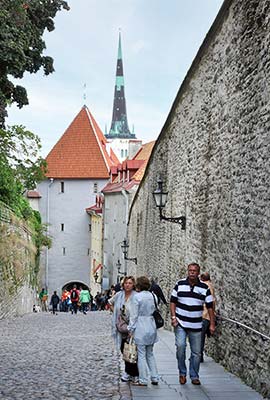
Here is the most direct and interesting way to descend to the lower town: From the viewpoint, go left down Kohtu, past the Finnish Embassy (on your left). It’s all downhill from here. At the onion domes, turn left again and follow the old wall down Pikk Jalg (“Long Leg Lane”) into the lower town. Go under the tower, then straight on Pikk street. After two doors turn right on Voorimehe, which leads into Town Hall Square.
• Your tour is essentially over. From the square, you could find your way to Viru street and walk between the medieval towers—17 Viru Gate—that mark the end of old Tallinn. Outside the gate, above the flower stalls on the right, is a small park on a piece of old bastion known as the Kissing Hill (visit after dark and you’ll find out why). Across the busy boulevard is the Rotermann Quarter (stretching to the left) and dead-ahead is the iconic communist-era 18 Hotel Viru, with a great (and free) view bar on its 23rd floor, and the huge, modern Viru Keskus mall.
Sights in Tallinn
▲Museum of Estonian History (Eesti Ajaloomuuseum)
▲Tallinn City Life Museum (Tallinna Linnamuuseum)
Freedom Square (Vabaduse Väljak)
▲▲Vabamu Museum of Occupations and Freedom (Okupatsioonide ja Vabaduse Muuseum Vabamu)
KGB Prison Cells (KGB Vangikongid)
▲Rotermann Quarter (Rotermanni Kvartal)
▲▲Kumu Art Museum (Kumu Kunstimuuseum)
▲▲Seaplane Harbor (Lennusadam)
▲Estonian Open-Air Museum (Eesti Vabaõhumuuseum)
Lahemaa National Park (Lahemaa Rahvuspark)
IN OR NEAR THE OLD TOWN
I’ve covered many of Tallinn’s significant Old Town sights in my Tallinn Walk, above. Otherwise, central Tallinn has many small museums, most suitable only for those with a special interest. Following are the ones I’d visit first.
▲Museum of Estonian History (Eesti Ajaloomuuseum)
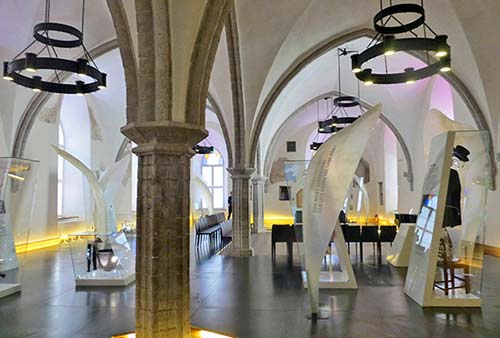
The Great Guild Hall on Pikk street houses a history museum with modern, well-presented exhibits. The museum’s “Estonia 101” approach—combining actual artifacts (from prehistory to today) and high-tech exhibits—is geared toward educating first-time visitors about this obscure but likeable little country.
Cost and Hours: €12, May-Sept Tue-Sun 10:00-18:00, closed Mon, Oct-April closed Mon-Tue, +372 696 8690, www.ajaloomuuseum.ee.
Visiting the Museum: The main display is the “Spirit of Survival” exhibit. It condenses 11,000 years of Estonian history with relative ease, while focusing on what it means to be an Estonian (Where did Estonians come from? What are their traditions?). It also outlines the important historical events that have shaped the Estonian cultural psyche (German crusaders, Danish domination, Reformation, multiple wars with Sweden, Russian occupation—to name a few). Steep steps lead down into the cellar, with an armory, items owned by historical figures, and an exhibit about the Great Guild Hall itself.
Town Hall (Raekoda) and Tower
Tallinn’s Town Hall opened in 1404 as a place for the city’s burgomasters to meet. Now open to tourists as a museum in summer, it has exhibits on the town’s administration and history, along with an interesting bit on the story of limestone. The tower rewards those who climb its 155 steps with a wonderful city view.
Cost and Hours: Museum—€5, entrance through cellar, July-Aug daily 11:00-18:00, Sept-mid-Oct Sat-Sun only 11:00-16:00, generally closed rest of the year; tower—€4, same hours as museum except open month of June too; +372 645 7900, www.tallinn.ee/raekoda.
▲Tallinn City Life Museum (Tallinna Linnamuuseum)
This humble but worthwhile museum, filling a 14th-century townhouse, features Tallinn history from 1200 to the 1950s. It’s an excellent introduction to Tallinn’s past. Major updates to the museum are expected over the next few years.
Cost and Hours: €6, includes audioguide, daily 11:00-18:00, shorter hours and closed Mon off-season, Vene 17, at corner of Pühavaimu, +372 615 5184, www.linnamuuseum.ee.
Visiting the Museum: Begin your visit on the first floor, passing through a general exhibit on the city’s history that’s centered on a model of circa-1825 Tallinn—looking much like it does today. On the second floor, the focus is on Tallinn’s medieval past with an emphasis on its trading days. The Hanseatic League maintained a monopoly in the North Baltic, safeguarding the economic interests of its 100 town-members—of which Tallinn and its Black Heads Guild were major players. (For more on the Hanseatic League, see the sidebar on here.) You’ll see exact replicas of their trading ships, made and donated to the church in gratitude after particularly safe and rewarding journeys, and a treasury room filled with precious objects of their merchant wealth. Another display draws attention to the roles Tallinn’s townspeople played in support of the merchants and shippers (stonemason, blacksmith, cooper, shoemaker, etc.).
The top floor is devoted to temporary exhibits.
Freedom Square (Vabaduse Väljak)
Once a USSR-era parking lot at the southern tip of the Old Town, this fine public zone has been revamped by moving the cars underground. It’s now a spacious plaza that invites locals to linger. Designed to host special events, it feels miles away from the cutesy cobbles just a few steps away. But it’s an easy opportunity to glimpse a contrast to the tourists’ Tallinn.
The towering cross monument facing the square (marked Eesti Vabadussõda 1918-1920) honors the Estonian War of Independence. Shortly after the Bolshevik Revolution set a new course for Russia, the Estonians took advantage of the post-WWI reshuffling of Europe to rise up and create—for the first time ever—an independent Estonian state. The “cross of liberty” on top of the pillar represents a military decoration from that war (and every war since). The cross is made of crystal and seemingly fragile—like freedom itself (take good care of it, or lose it). The hill behind the cross has more monuments and fragments of past fortifications. The city gathers here in front of a big screen to watch important soccer games and the Eurovision Song Contest finale.
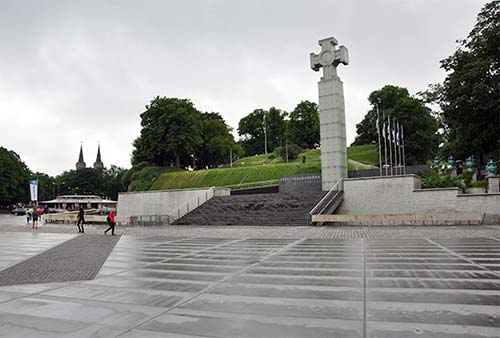
If you’re interested in learning more about Estonia’s difficult history, it’s an easy five-minute walk from this square to the next sight.
▲▲Vabamu Museum of Occupations and Freedom (Okupatsioonide ja Vabaduse Muuseum Vabamu)
This museum tells the hard history of Estonia’s occupations—first by the Soviets (for one year), then by the Nazis (for three years), and then again by the USSR (for nearly 50 years)—as well as periods of resistance, freedom, and recovery. The permanent collection, “Freedom Without Borders,” focuses on life under the Soviet regime, the difficulty of existing in an occupied society, stories of Estonians living in exile, and finally, the movement toward independence and freedom, with special attention to Estonia’s unique Singing Revolution (see also the sidebar on here). The included multimedia guide lets visitors explore topics at their own pace (the full tour takes 90 minutes).
Cost and Hours: €13, includes multimedia guide, €18 combo-ticket includes KGB Prison Cells (see next); Tue-Sun 10:00-18:00, closed Mon; Oct-April Wed-Sun 11:00-18:00, closed Mon-Tue; Toompea 8, at corner of Kaarli Puiestee, +372 668 0250, www.vabamu.ee.
KGB Prison Cells (KGB Vangikongid)
Formerly a government building during the Republic of Estonia’s first period of independence (1918-1939), this complex was the headquarters of the KGB secret police for nearly a half-century. Former prison cells and interrogation rooms house a small exhibit with short videos telling stories of its victims.
Cost and Hours: €8, €18 combo-ticket with Vabamu Museum, same hours and contact info as Vabamu Museum; near St. Olav’s Church—a 15-minute walk from Vabamu Museum at Pagari 1, look for exhibit entrance on Pikk street.
▲Hotel Viru
The first hotel in then-communist Estonia to allow Western travelers, Hotel Viru was built in 1972 and was Tallinn’s first skyscraper. During the Soviet period it was the biggest hotel in the Baltics and was infamous as a dingy slumbermill infested with spies, players, and prostitutes. Locals joke that Hotel Viru was built from a Soviet wonder material called “micro-concrete” (60 percent concrete, 40 percent microphones). Wandering around the ground floor, with its low ceilings and little bits of preserved history, you sense a nostalgia for communism.
The hotel’s 23rd floor was once the KGB’s secret domain. Now it hosts a summertime rooftop bar with amazing views (from behind the big letters of the Hotel Viru sign). Ride the elevator to the 22nd floor, then enjoy historic photos and info boards in the staircase as you climb another floor to the bar. Sipping a drink here is a fine way to enjoy perhaps the best view in town.
▲Rotermann Quarter (Rotermanni Kvartal)
Sprawling between Hotel Viru and the port, just east of the Old Town, this 19th-century industrial zone has been redeveloped into modern shopping, work, and living spaces. Characteristic old brick shells are being topped with visually striking glass-and-steel additions. For those interested in the gentrification of an aging city, it’s worth a quick stroll to see the old-meets-new Nordic architecture.
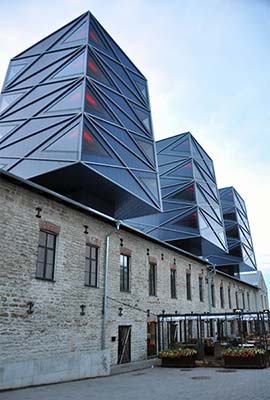
In recent years the area’s former grain elevators and salt-storage warehouses have been creatively repurposed as restaurants, cafés, boutiques, and offices. To take a look around, start at Hotel Viru, cross busy Narva Maantee, and walk down Roseni street (at #7 you’ll find the hard-to-resist Kalev chocolate shop) to the central plaza. Feel the vibe of this designed community, with its futuristic neighborhood, playground, hip condos, and traffic-free peacefulness.
Rotermann Museums: Two museums here seem to be a good fit for the quarter: The Museum of Estonian Architecture (Eesti Arhitektuurimuuseum), within former salt-storage buildings, is appreciated by fans of 20th-century architecture (€8, Tue-Sun 11:00-18:00, closed Mon, Ahtri 2, www.arhitektuurimuuseum.ee); and the Pop and Contemporary Art Museum (PoCo), featuring artworks by Warhol, Banksy, Koons, and Haring as well as underground art from the Soviet Union (€18, daily 10:00-20:00, Rotermanni 2, https://poco.art).
NEAR THE TRAIN STATION
To complement all the Old World charm of the medieval quarter, pay a visit to the Balti Jaam Market and Telliskivi Creative City for an invigorating encounter with contemporary Tallinn. This new, fun-loving district is bustling with creativity and is symbolic of Estonia’s zest for freedom and embrace of life. The Balti Jaam Market, named for the sleepy train station adjacent, is just a 15-minute walk from Town Hall Square; the Telliskivi Creative City stretches for a few blocks starting immediately out the market’s back door. (Worthwhile guided tours of both the market and Telliskivi vie for your business online.)
The Balti Jaam train station was built 150 years ago to connect Estonia with Russia. The industrial zone next to it was designed to keep the trains in working order. With the fall of the USSR in 1991, the area became a wasteland. But soon a redevelopment vision strove to give the “industrial bones a creative new pulse.” Telliskivi was the result, and the fruits of that vision are yours to enjoy today.
▲▲Balti Jaam Market
In recent years this market has morphed from a frumpy gathering of farmers selling cabbage, cheese, berries, and honey to a fun and vibrant festival of all things edible, and much more. You’ll stroll through stalls of more than a hundred merchants on three floors: the ground floor is food, upstairs is Estonian design, crafts, and antiques, and the basement is a modern supermarket. Your main focus will be the ground floor, with a hall for fish and meat, a lane for produce, and over 20 creative eateries. The design is fun and very Nordic-inspired. Countries of origin are labeled (Eesti means Estonia). You’ll be tempted by little filled pancakes, fresh-baked pastries, gourmet breads, and smoked moose, elk, and horse.
The market has a mission: to promote a healthy and balanced diet, to value authentic local produce, and to respect and promote the fine art of cooking. And you’ll feel, smell, and taste that mission as you browse. It’s a great scene, fragrant with dill, berries, onions, and mushrooms, and oh-so-clean (Mon-Sat 9:00-19:00, Sun until 17:00, most lively early in the day).
▲▲Telliskivi Creative City
Stepping out of the Balti Jaam Market’s back door, you enter Tallinn’s new creative hotspot: Telliskivi, a former Soviet-era industrial zone that’s now a fertile foundation for imaginative start-ups, artsy theaters, vibrant bars, and cultural happenings. Street art and murals give it a colorful edge and exude a joy of life. Once-abandoned factory warehouses now house an alternative world of bohemian cafés, hipster galleries, and welcoming shops. The district is a foodie’s delight: My two favorite places to eat are the fun-loving F-hoone Restaurant and a New Nordic splurge, the Fotografiska Restaurant (see “Eating in Tallinn,” later). Telliskivi is not for everyone, but if you’re interested in a quirky way of balancing the cobbles and medieval spires of the Old Town with the youthful culture of today’s Estonia, you’ll find it here.
Poke around the “city,” which is anchored by the Balti Jaam Market on one side and the contemporary Fotografiska photography museum on the other. (Addresses are not much help in Telliskivi; I’ve given building numbers here.) Just outside the market’s back door is a picnic-friendly square. Around the corner look for the Hektor Container Hotel (where the rooms are actually in shipping containers inside an old train-repair depot; at Telliskivi 62). Farther along there’s the Peatus restaurant and bar (also Telliskivi 62), a happening gathering spot built into old train cars. Telliskivi is all about creativity and that includes making wine (Nudist Winery, at Telliskivi 60M, a wine bar evangelical about its sparkling rhubarb wine), brewing craft beers (you’ll come across several tap rooms), and distilling (Junimperium, a gin distillery/bar also at Telliskivi 60M, a tasty reminder that juniper grows well in Estonia). And the La Muu Ice Cream Shop (Telliskivi 60A/5) serves what many locals consider Estonia’s best ice cream.
Fotografiska Tallinn
Located in the Telliskivi Creative City, this museum of photography, art, and culture can be overwhelming to those not into contemporary art. But it’s mission—to share modern images with the intent to inspire new perspectives—is fun to grapple with. And capping off the museum (literally) is one of Tallinn’s top dining spots, the Fotografiska Restaurant (see “Eating in Tallinn,” later).
Cost and Hours: €17; Mon-Fri 9:00-20:00, Sat from 10:00, Sun 10:00-18:00, Telliskivi 60A, www.fotografiska.com/tallinn.
OUTSIDE THE CORE
You can locate the following sights on the “Greater Tallinn” map, near the beginning of this chapter.
▲Kadriorg Park
This expansive seaside park, home to a summer royal residence and the Kumu Art Museum, is a 10-minute tram ride or a 25-minute walk from Hotel Viru. After Russia took over Tallinn in 1710, Peter the Great built the cute, pint-sized Kadriorg Palace and named it in honor of his wife, Czarina Catherine (the palace’s name means “Catherine’s Valley”). Stately, peaceful, and crisscrossed by leafy paths, the park has a rose garden, duck-filled pond, playground and benches, and old czarist guardhouses harkening back to the days of Russian rule. It’s a delightful place for a stroll or a picnic, with info boards posted wherever there’s something of historic importance.
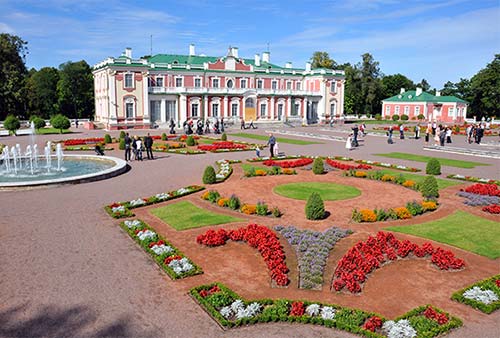
Getting There: Ride tram #1 or #3 (from Viru to the Kadriorg stop, and walk 200 yards straight ahead and up Weizenbergi, the park’s main avenue. Kadriorg Palace is on the left; behind it, visit the formal garden. Across from the palace is the Mikkel Museum, and at the end of the avenue are a small house dedicated to Peter the Great and the Kumu Art Museum, the park’s most important sight. A taxi or Uber from Hotel Viru to this area should cost around €10.
Visiting Kadriorg Park: The palace’s manicured gardens (free to enter) are a pure delight; on weekends, you’ll likely see a steady parade of brides and grooms here, posing for wedding pictures. The summer palace itself, finished in 1725, is a fine example of northern European Baroque. Built by Peter the Great for the Russian czars—but never much appreciated by them—it’s now home to the Kadriorg Art Museum (Kadrioru Kunstimuuseum), with modest Russian and Western European galleries (€9; Tue-Sun 10:00-18:00, Wed until 20:00, closed Mon; elegant little café, Weizenbergi 37, +372 606 6400, http://kadriorumuuseum.ekm.ee).
Across the road from the gardens, in the former kitchen building of the palace, is the Mikkel Museum, with a fine little collection of Meissen porcelain (€7, same hours as Kadriorg Art Museum, http://mikkelimuuseum.ekm.ee).
The fenced-off expanse directly behind the garden is where you’ll spot the local White House (although it’s pink)—the office of Estonia’s president. Walk around to the far side to find its main entrance, with the blue and gold seal of Estonia above the door, flagpoles flying both the Estonian and the EU flags, and stone-faced guards (go ahead...wave).
A five-minute walk beyond the presidential palace takes you to the tiny House of Peter the Great museum (on the left) and the Kumu Art Museum, described later. For a longer walk from here, the rugged park rolls down toward the sea.
The oldest (and first) museum in Tallinn, the House of Peter the Great (Peeter I Maja) opened in 1806. This is the residence where Peter the Great and Catherine stayed when visiting during the construction of Kadriorg Palace (Peter didn’t live to see it completed). Five small rooms of exhibits and a video in the basement (English on request) show Peter’s interest in the Baltic Sea and the Russian military’s interest in Tallinn (€5, Wed-Sun 11:00-18:00, closed Mon-Tue, www.linnamuuseum.ee/peeter-1-maja).
▲▲Kumu Art Museum (Kumu Kunstimuuseum)
This main branch of the Art Museum of Estonia brings the nation’s best art together in a striking modern building designed by Finnish architect Pekka Vapaavuori. While you won’t see any big-name art, the lovely collection is accessible, well-presented, and engaging, with a particularly thought-provoking section on art from the Soviet period. The museum is well worth the trip for art lovers, or for anyone intrigued by the unique spirit of this tiny nation.
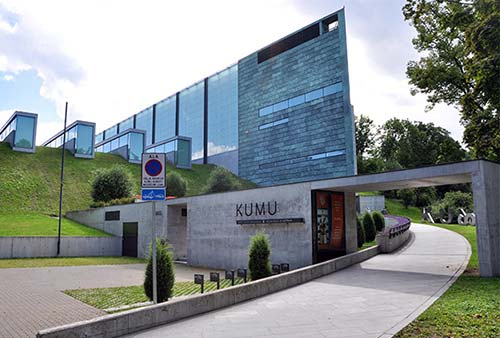
Cost and Hours: €12; Tue-Sun 10:00-18:00, Thu until 20:00, closed Mon; trendy café, +372 602 6000, http://kumu.ekm.ee.
Getting There: To reach the museum, follow the instructions for Kadriorg Park, earlier; Kumu is at the far end of the park. To get from the Old Town to Kumu directly (without walking through the park), take bus #31, #42, or #67 (4-5/hour); they leave from the Estonia stop, next to the Solaris shopping mall and Teatri Väljak Park (just southeast of the Old Town). Get off at the Kumu stop, then walk up the stairs and across the bridge.
Visiting the Museum: Just off the ticket lobby (on the second floor), the great hall has temporary exhibits; the permanent collection, on the third and fourth floors, is Kumu’s main draw. Printed descriptions throughout the galleries bring the collection to life. The maze-like layout on each floor presents the art chronologically. Hike the grand ramp to the third floor and circle the rooms there. Then ride the elevator to the fourth floor.
The third floor displays classics of Estonian art from the early 1700s until the end of World War II. It starts with idyllic 18th-century portraits of local aristocrats of the Biedermeier era, a time when harmonious family life and clearly defined gender roles took precedence over all else. The exhibit then moves through 19th-century movements, including Romanticism (represented by some nice views of Tallinn, scenes of Estonian nature, and idealized images of Estonian peasant women in folk costumes). Estonian artists were slow to adopt the art trends of the early 20th century, but in time Modernist styles took hold: Pointillism (linger over the lyrical landscapes of Konrad Mägi and the recently rediscovered works of Herbert Lukk), Cubism, and Expressionism. In the 1930s, the Pallas School provided a more traditional, back-to-nature response to the wilder artistic movements of the time. With the dawn of World War II, a period soon followed by two Soviet and one German occupation, Estonian artists faced extremely difficult and dramatic circumstances. The final canvases on this floor, from the war years, convey an unmistakable melancholy and grim intensity. In the corner, one very high-ceilinged room has a wall lined with dozens of expressive busts by sculptor Villu Jaanisoo.
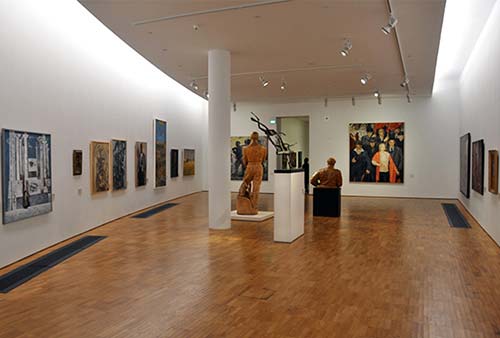
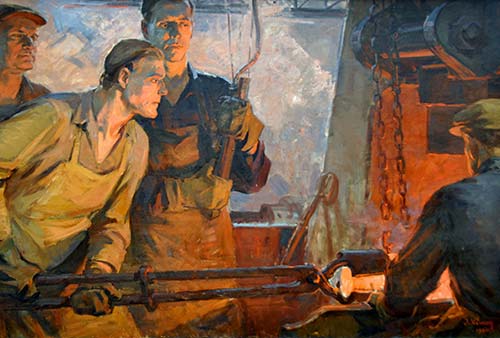
The fourth-floor exhibit, “Conflicts and Adaptations,” is a fascinating survey of Estonian art from the Soviet era (1940-1991). Soviet officials understood art purely as a means to convey the ideology of the Communist Party. Estonian art, the Soviets insisted, should actively promote the communist struggle, and in the strict canon now called Socialist Realism. Art’s primary objective was to glorify labor and the state’s role in distributing its fruits.
Despite these restrictions, Estonian art in this half-century took a wide range of approaches, from syrupy images of Soviet leadership, to stern portraits of Stalin, to glorifying canvases of miners, protesters, speechifiers, metalworkers, and tractor drivers. Though some Estonian artists flirted with social commentary and the avant-garde, a few ended up in Siberia as a result. But with the condemnation of Stalinism in 1956, artists began to attempt bolder compositions and more contemporary forms of expression. Nonetheless, the propaganda function of art continued to take precedence over personal artistic statements throughout the Soviet era.
The rest of the museum is devoted to temporary exhibits, with contemporary art on the fifth floor (where there’s a nice view back to the Old Town from the far gallery). Don’t forget to admire the architecture of the building, which is partly dug into the limestone hill—the facade is limestone, too (for the big picture, look for the model of the building, near the ticket desk).
▲▲Seaplane Harbor (Lennusadam)
One of Tallinn’s most ambitious sights, this maritime museum fills a gigantic old hangar along the waterfront north of downtown with everything from traditional wooden fishing boats to a submarine—all symbolic of the Estonian connection to the Baltic Sea. It has loads of hands-on activities for kids and thrills anyone interested in the sea. Don’t neglect the temporary exhibits, which can be top-notch and fascinating.
Cost and Hours: €15; daily 10:00-19:00, Oct-April Tue-Sun 10:00-18:00, closed Mon; Vesilennuki 6, +372 620 0550, www.seaplaneharbour.com.
Getting There: It’s on the waterfront about a mile northwest of the Old Town. It’s a long but pleasant walk via the Culture Kilometer (Kultuurikilomeeter) seaside path that runs from the bunker-like Linnahall building (near the cruise terminals; see the “Tallinn” map for path location). Bus #73 stops outside the museum (Lennusadam stop); you can catch it from various stops near the Old Town, including near the Viru Keskus mall and in front of Linnahall. A one-way taxi from the town center should run about €8.
Visiting the Museum: The cavernous old seaplane hangar cleverly displays exhibits on three levels. The ground floor features items from below the sea (such as a salvaged 16th-century shipwreck; catwalks halfway up connect exhibits dealing with the sea surface (the impressive boat collection—from buoys to iceboats to the massive Lembit sub); and seaplanes are suspended overhead. The star of the show is the 195-foot-long Lembit submarine from 1937: Estonian-commissioned and British-built, this vessel saw fighting in World War II and later spent several decades in the service of the USSR’s Red Fleet. You can climb down below decks to see how the sailors lived, peek through the periscope, and even stare down the torpedo tubes. A cool café on the top level (above the entrance) overlooks the entire huge space.
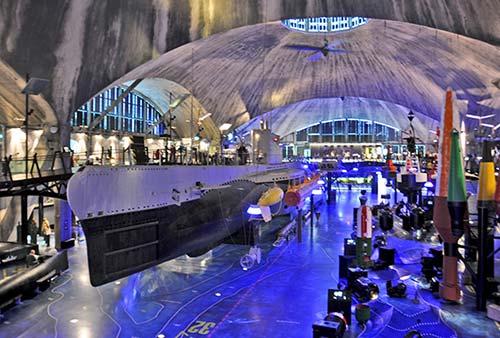
Outside, filling the old harbor, is the museum’s collection of historic ships, from old-fashioned tall ships to modern-day military boats. The highlight is the steam-powered icebreaker Suur Tõll, from 1914. Sometimes you can pay to go out on a brief trip on one of the sailboats (ask at the museum ticket desk).
▲Pirita Neighborhood
Several mildly interesting sights cluster in the Pirita neighborhood, a 15-minute drive northeast of the city. If you have access to a car or have time to lace things together with public transportation, this can be a fun way to escape the city and see some different facets of Estonia.
When you are a tiny nation lodged between two giants like Russia and Germany, simply surviving is a challenge. Having already endured 200 years of czarist Russian rule and the turmoil of World War I, little Estonia found itself annexed to the Soviet Union by the end of World War II. Their native culture was swept away: Russian replaced Estonian as the language in schools, and Russians moved in, displacing Estonians. Moscow wouldn’t even allow locals to wave their own flag.
But Estonians were determined to maintain their cultural identity. They had no weapons, but they created their own power by banding together and singing. Song has long been a cherished Estonian form of expression. As long ago as 1869 (during another era of Russian subjugation), Estonians gathered in massive choirs to sing and to celebrate their cultural uniqueness.
Finally, as the USSR began to crumble, the Estonians mobilized, using song to demand independence. In 1988, they gathered—300,000 strong, a third of the population—at the Song Festival Grounds outside Tallinn. The next year, the people of Latvia, Lithuania, and Estonia held hands to make the “Baltic Chain,” a human chain that stretched 360 miles from Tallinn to Vilnius in Lithuania.
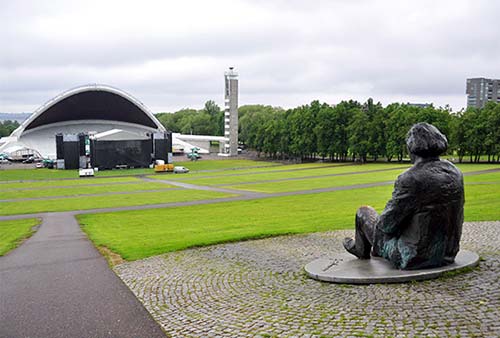
This so-called Singing Revolution, peaceful and nonviolent, persisted for several years, and in the end, Estonians gained their freedom. It was a remarkable achievement: One million singing Estonians succeeded against their Russian occupiers.
Even now the singing continues: Every five years, the Song Festival Grounds (built in 1959 and resembling an oversized Hollywood Bowl) welcomes 25,000 singers and 100,000 spectators. Singers don traditional outfits and march to the festival site from Tallinn’s Freedom Square. Overlooking the grounds is a statue of Gustav Ernesaks, who directed the Estonian National Male Choir through the darkest times of Soviet rule. He was a power behind the drive for independence—and lived to see it happen. Behind his statue, a few steps uphill, enjoy the well-described photo exhibit that illustrates powerfully the spirit of this place that’s so important to Estonians. You can visit the grounds even in nonfestival years, though there’s not much to see (free, open long hours; take a City Bike tour, or go by bus to the Lauluväljak stop and enter through the nearby Sea (Mere) gate; https://lauluvaljak.ee/et).
Today the site hosts concerts and is a national historical monument. Watch the documentary film The Singing Revolution (www.singingrevolution.com) to draw inspiration from Estonia’s valiant struggle for freedom.
Getting There: Drivers can take the waterfront Pirita Tee highway north (passing behind the Song Festival Grounds) to Pirita, then turn right to cut through the forest to the TV tower. Buses #34 and #38 follow this same route and link all the places listed here. The hop-on, hop-off bus also does a circuit that covers these sights.
Visiting Pirita: Coming from central Tallinn on Pirita Tee, you’ll pass three starkly different memorials. First, as you skirt behind Kadriorg Park, watch on the left for the Russalka Monument (Russalka Mälestusmärk). An angel on a pedestal commemorates the 1893 sinking of the Russian warship Russalka (“Mermaid”).
Farther along—after passing the Song Festival Grounds—look on the right for the towering World War II Memorial (Maarjamäe Memoriaal)—a 115-foot-tall obelisk erected to honor those who died defending the Soviet Union, and now the centerpiece of Estonia’s war memorial. And just beyond it, also on the right, is the Victims of Communism Memorial (Eesti Kommunismiohvrite Memoriaal), a wall engraved with 22,000 names to commemorate all those who perished under Soviet occupation.
Just after crossing the Pirita River and the little marina (with the yachting center built for the 1980 Olympics), watch on the right for the ruins of St. Bridget’s Convent (Pirita Klooster; bus stop: Pirita). This early 15th-century convent, which housed both monks and nuns (in separate quarters, of course), was destroyed in 1577 by Ivan the Terrible. Its stones were quarried to build Baltic manor houses, but today you can pay a small fee to tour the evocative Gothic ruins (www.piritaklooster.ee).
Down along the water from here, Pirita Beach is one of the most popular in Tallinn. On a sunny summer day, Estonians are out enjoying sand, sun, and the Baltic Sea.
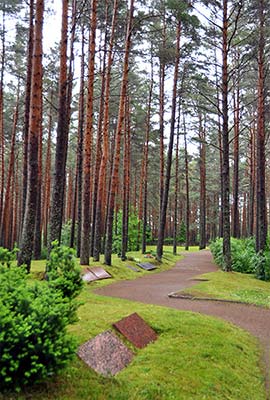
At the first traffic light after the convent ruins, turn right on Kloostrimetsa Tee, which cuts through a forest—and through the Forest Cemetery (Metsakalmistu), offering a poignant look at unique Estonian burial customs (bus stop: Metsakalmistu, then continue about 200 yards down the road, following Teletorn signs to the gate). Traditionally, Estonians bury the departed not in fields or parks, but in forests—thanks to a deeply rooted belief that their spirit will live on in the trees. This particular cemetery is one of Estonia’s best known, and is the eternal resting place both of commoners and VIPs—athletes, chess champions, musicians, writers, and politicians. Exploring here, find the Hill of Celebrities (Kuulsuste Küngas). Among the illustrious Estonians buried here is Konstantin Päts (1847-1956), the first president of independent Estonia, who later died in a Siberian mental institution. After freedom, his remains were located and moved here. Lydia Koidula (1843-1886, marked by a red stone) was Estonia’s premier 19th-century poet and wrote the first play in Estonian.
Just past the Forest Cemetery, the TV tower (bus stop: Teletorn)—with its antenna topping 1,000 feet tall—was built for the 1980 Moscow Olympics (the sailing regatta took place in Tallinn). You can ride up to the 550-foot-high observation deck for sweeping views over Estonia (and, on a clear day, all the way to Finland) (www.teletorn.ee).
In front of the tower, you’ll see a monument to the brave Estonians who faced off against a potential Soviet counterattack. On August 19, 1991, a coup by generals in Moscow created confusion and panic across the USSR. The next day, on August 20—still celebrated today as a national holiday—Estonia signed its Declaration of Independence. On August 21, Russian forces moved to overtake this national broadcast tower and cut off Estonian communications. But two policemen and some radio operators prevented them from entering the tower’s control station by jamming the door and threatening to engage the fire-exhaust system. Eventually a ragtag gang of Estonian civilians showed up to defend the tower and stare down the troops. By late afternoon, order had been restored in Moscow, and the Russian troops were told to stand down. Estonia had its tower—and a few weeks later, Russia recognized this little country’s right to exist.
▲Estonian Open-Air Museum (Eesti Vabaõhumuuseum)
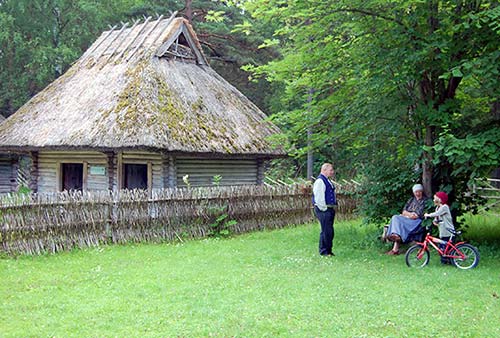
Influenced by their ties with Nordic countries, Estonians are enthusiastic advocates of open-air museums. For this one, they salvaged farm buildings, windmills, and an old church from rural areas and transported them to a parklike setting a few miles west of the Old Town. The goal: to both save and share their heritage. Attendants are posted in many houses, but to really visualize what life was like, download the free NUMU app before you visit (or rent an audioguide from ticket office). The park’s Kolu Tavern serves traditional dishes. You can rent a bike for a breezy roll to quiet, faraway spaces in the park.
In its attempt to bring Estonia into the Soviet fold, Moscow moved tens of thousands of Russian workers into Tallinn, using the promise of new apartments as an incentive. Generations later, Tallinn still has a huge Russian minority (about 40 percent of the city’s population) and three huge, charmless suburbs of ugly, Soviet-built apartments: Mustamäe, Õismäe, and Lasnamäe.
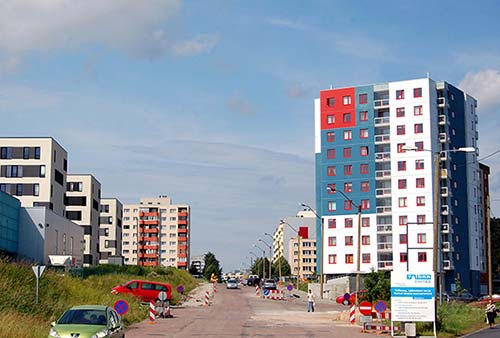
Today, about one of every two Tallinners lives in one of these Brezhnev-era suburbs of massive, cookie-cutter apartment blocks (many now privatized). And though these concrete structures are Soviet vintage, the electricity, plumbing, and fixtures are generally right up-to-date. About 80 percent of the residents who live in Lasnamäe are Russian-speaking. Some parts are poor, rough, and edgy, with blue lights in the public toilets so that junkies can’t see their veins. Other sections are nicer, and by day, you can visit here without fear. You’ll see carefully dressed young women, track-suited men, grass that needs mowing, cracked paving stones, grandmothers pushing strollers, and lots of new, boxy shops; a new Russian Orthodox cathedral (built with the support of Tallinn’s mayor to curry favor with ethnic-Russian voters); and some modern city-owned apartment buildings.
Forging Russians and Estonians into a single society, with the Estonian language dominant, was an optimistic goal after the fall of the Soviet Union. Ethnic Russians grumbled, but knew they probably had a brighter economic future in Estonia than in Russia. With a new generation of children learning both languages in school, and most residents enjoying reasonable prosperity, peaceful ethnic coexistence (like between Swedes and Finns in Helsinki) may be achievable.
For a quick look at life in Lasnamäe, hop on bus #42, #46, or #67 (4-5/hour); they leave from the Estonia stop, next to the Solaris shopping mall. Get off at the Kotka Kauplus stop and walk around, or ride to the end of the line and return on the same bus for a tour out your window.
Cost and Hours: €12, park open daily 10:00-20:00, historic buildings until 18:00; off-season: €10, park open Tue-Sun 10:00-19:00 but many buildings closed; +372 654 9101, www.evm.ee.
Getting There: Take bus #21 or #21B from various stops near the Old Town (including near Viru Keskus mall, Balti Jaam Market, or Freedom Square) to the Rocca al Mare stop. Because buses back to Tallinn run infrequently, check the departure schedule as soon as you arrive, or ask staff how to find the Zoo stop, with more frequent service, a 15-minute walk away.
Lahemaa National Park (Lahemaa Rahvuspark)
This vast, flat, forested coastal preserve on the Gulf of Finland is a one-hour drive east of Tallinn. While it is a popular tour destination and the nature is pristine, the park’s charms are modest. Highlights include the thick forest (including cemeteries, because Estonians bury their dead in the woods), bog walks, rich berry and mushroom picking, rebuilt manor homes, and peaceful fishing villages surrounded by the evocative ruins of Soviet occupation. Tallinn Traveller Tours organizes day trips to the national park (see listing on here). For hiking and cycling trail descriptions, check online (www.kaitsealad.ee) or stop at the park’s visitor center when you arrive (open daily in summer, Mon-Fri off-season, +372 329 5555, www.loodusegakoos.ee).
Shopping in Tallinn
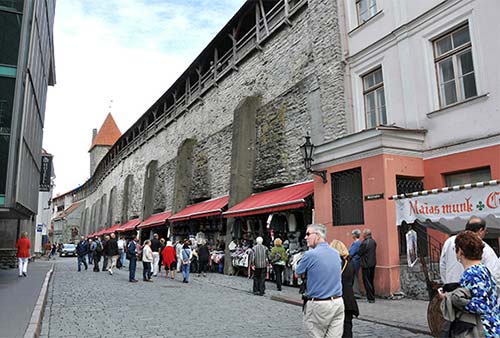
With so many day-trippers inundating Tallinn, the Old Town is full of trinkets, but it is possible to find better-quality souvenirs. Wooden goods, like butter knives and juniper-wood trivets, are a good value. Marvel at the variety of booze on sale in Tallinn’s liquor stores, popular with visiting Finns. Tucked into the Old Town are many craft and artisan shops where prices are lower than in other Nordic countries. Note that while you’ll see amber, it is not uniquely Estonian (the “Baltic diamond” is more Lithuanian), and the fun and colorful nesting matryoshka dolls are not Estonian either (they’re Russian…but sell well with cruise-ship crowds).
Knitware and Handicrafts
Explore the picturesque Katariina Käik, a small alley between Müürivahe and Vene streets with handicraft, glassblowing, weaving, and pottery shops selling nice souvenirs (daily 10:00-18:00, located near the Viru Gate).
While Tallinn’s much-loved Sweater Wall didn’t survive the pandemic, there are plenty of places selling fine Estonian handicrafts. They focus on all kinds of knitted and felted clothing: colorful sweaters, scarves, hats, socks, and mittens. Quality local linen is also widely sold. In the Old Town, you’ll find good selections at the Estonian Handicraft House (Pikk 22) and Kaarmanni Käsitöö (Vanaturu Kael 8). For more on Estonian crafts, see VisitTallinn.ee.
Books and Art
The cheery Navitrolla Gallerii is filled with work by the well-known Estonian artist who goes just by the name Navitrolla. His whimsical, animal-themed prints are vaguely reminiscent of Where the Wild Things Are (Lühike Jalg 1, +372 569 27594, www.navitrolla.ee).
The Rahva Raamat bookstore in the Viru Keskus mall (floors 3-4) has English-language literature on the main floor and a huge wall of travel books upstairs.
Markets
Balti Jaam Market, behind the train station, is trendy and bustling with energy (described on here). You’ll find vendors selling everything from fresh produce and street food to children’s clothes and local crafts (Mon-Sat 9:00-19:00, Sun until 17:00, better early).
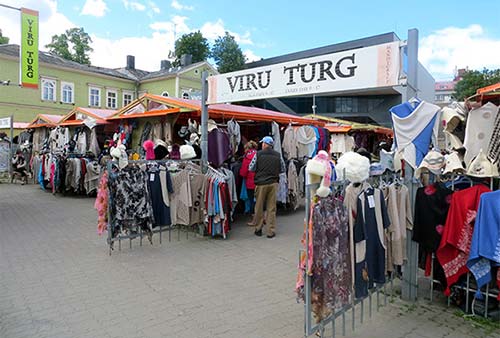
For something more touristic, the Viru Turg outdoor market, a block outside the Old Town’s Viru Gate, has a lively, tourist-oriented collection of stalls selling mostly clothing and textiles (daily, north of Viru street at Mere Puiestee 1). The flower market is nearby on Viru street, old Tallinn’s busiest and most touristy shopping street.
Entertainment in Tallinn
Music
Tallinn has a dense schedule of classical music performances, especially during the annual Old Town Days, generally at the beginning of June. See VisitTallinn.ee for an events calendar.
Choral singing became a symbol of the struggle for Estonian independence after the first Estonian Song Festival in 1869 (still held every five years). Even outside of festival times, you’ll find many performances in Tallinn’s churches and concert halls, advertised on posters around town or at the TI. Get tickets online, at the door, or through the Piletilevi booth in the Viru Keskus mall (Mon-Sat 10:00-21:00, Sun until 19:00, www.piletilevi.ee). Watch for performances by Hortus Musicus, one of Estonia’s finest classical ensembles, or concerts featuring the work of Arvo Pärt, Veljo Tormis, or Erkki-Sven Tüür, who are among Estonia’s best modern choral composers and arrangers.
For the sloppiest of musical entertainment, drop by a karaoke bar (Helsinki Karaoke is just one of several on Viru street) and watch the Finns, lubricated by cheap booze, let loose.
Swimming and Fitness
The indoor water park, fitness center, 50-meter pool, and hotel at the Kalev Spa have long attracted Finns who travel here on fitness packages. It’s centrally located, outside the Viru Gate between the Old Town and the modern shopping zone; check the website for updated hours and pricing (swimsuit rental available, Aia 18, +372 649 3370, www.kalevspa.ee).
Sleeping in Tallinn
Real hotel options are surprisingly sparse and expensive in the Old Town. You’ll have more options and pay less if you’re willing to stay a short walk or bus ride away, especially during the peak summer season. These places don’t have elevators or air-conditioning unless noted.
IN AND NEAR THE OLD TOWN
$$$$ Cru Hotel, a small boutique in a 600-year-old merchant’s home, has 15 unique rooms right off the main square. Most rooms are on the second or third floor (atmospheric restaurant, Viru 8, +372 611 7600, www.cruhotel.eu, cruhotel@cruhotel.eu).
$$$$ Merchants House Hotel, aptly named, provides 30 simple but tasteful rooms in a renovated 16th-century building just west of the main square. A summer courtyard, indoor lounge, and free sauna provide some relaxation (some rooms have air-con, Dunkri 4, +372 697 7500, www.merchantshousehotel.com, sales@merchantshousehotel.com).
$$$$ Nunne Boutique Hotel, built around the Old Town wall, is a splurge with 74 refurbished rooms. Amenities include a spa with three saunas and a restaurant. Some rooms incorporate the town wall on one side (air-con, elevator, smart location between Town Hall Square and the trendy Telliskivi district, Nunne 14, +372 677 6777, www.nunne.ee, info@nunne.ee).
$$$ My City Hotel fills a handsome 1950s building on the south edge of the Old Town with 68 nicely appointed rooms and a classy lobby lounge. Along with the Sõprus cinema across the street, it’s done in the Stalinist Classical style—Soviet stars and sheaves of wheat still adorn the facade (air-con, elevator, pay sauna, quietest rooms face the courtyard, Vana-Posti 11, +372 622 0900, www.mycityhotel.ee, info@mycityhotel.ee or booking@mycityhotel.ee).
$$$ Hestia Hotel Barons consists of 65 spacious rooms in the heart of the Old Town. The main building with historic rooms is served by one of Estonia’s oldest elevators, while a side building boasts a more modern design (bar, main building may be quieter, air-con, Suur-Karja 7, +372 616 5700, www.hestiahotels.com/barons, info.barons@hestiahotels.com).
$$ Rija Old Town Hotel is built into the wall at the tip of the Old Town, near Fat Margaret Tower and not far from the ferry terminals (41 comfortable rooms, standard doubles might be quietest as most face the Old Town, elevator, Lai 49, +372 614 1300, www.rijahotels.com, info.oldtownhotel@rijahotels.com).
$$ Hotel Bern, tucked at the edge of the Old Town, is a solid choice with 53 businesslike rooms in a newish brick building (family rooms, air-con, elevator, Aia 10, +372 5647 6005, www.hotelbern.ee, info@hotelbern.ee).
$$ St. Barbara Hotel, an affordable choice right outside the Old Town, fills a former hospital from 1904 just beyond the ring road from Freedom Square. This old building is filled with 53 modern, fairly simple rooms and an atmospheric beer cellar that gives the place a Germanic vibe (elevator, Roosikrantsi 2A—about a 10-minute walk from Town Hall Square, just take the pedestrian underpass from Freedom Square under the busy road, +372 640 0040, https://stbarbara.ee).
$$ Villa Hortensia rents six simple, creaky-floored rooms with kitchenettes above a sophisticated little café in a courtyard close to Town Hall Square. Named after the home of a group of down-and-outs in a famous Estonian novel, the hotel is creatively run by jewelry designer Jaan Pärn. It’s a decent, inexpensive choice if you don’t mind the ramshackle feeling and the fact that the rooms aren’t serviced every day. Jaan’s jewelry shop, up the stairs in the courtyard, serves as the reception (no breakfast, 50 yards from the corner of Vene and Viru streets at Vene 6, look for Masters’ Courtyard sign, +372 504 6113, www.hoov.ee, jaan.parn@gmail.com).
AWAY FROM THE OLD TOWN
Near the Train Station: $$ Go Hotel Shnelli, a big, high-rise hotel adjacent to the sleepy little train station (a 5-minute walk from the Old Town in a neighborhood that feels slightly seedy at night), rents 137 Ikea-mod rooms. It fronts a noisy street, so request a quiet room in the back—these overlook the tracks, but no trains run at night (connecting family rooms, apartment, you can save a few euros if you skip breakfast, elevator, Toompuiestee 37, +372 631 0100, www.gohotels.ee, hotel@go.ee).
In Telliskivi: $$$$ Bob W Apartments, near the trendy Telliskivi district and Balti Jaam Market, are modern Nordic-style studio and one-bedroom spaces complete with private kitchen and laundry facilities. Free local gym access and discounted breakfast at nearby cafés are included. There is no front desk and access is via door code (elevator, 3-D apartment tour on their website, 20-minute walk to the Old Town, Telliskivi 49, +372 668 0366, www.bobw.co).
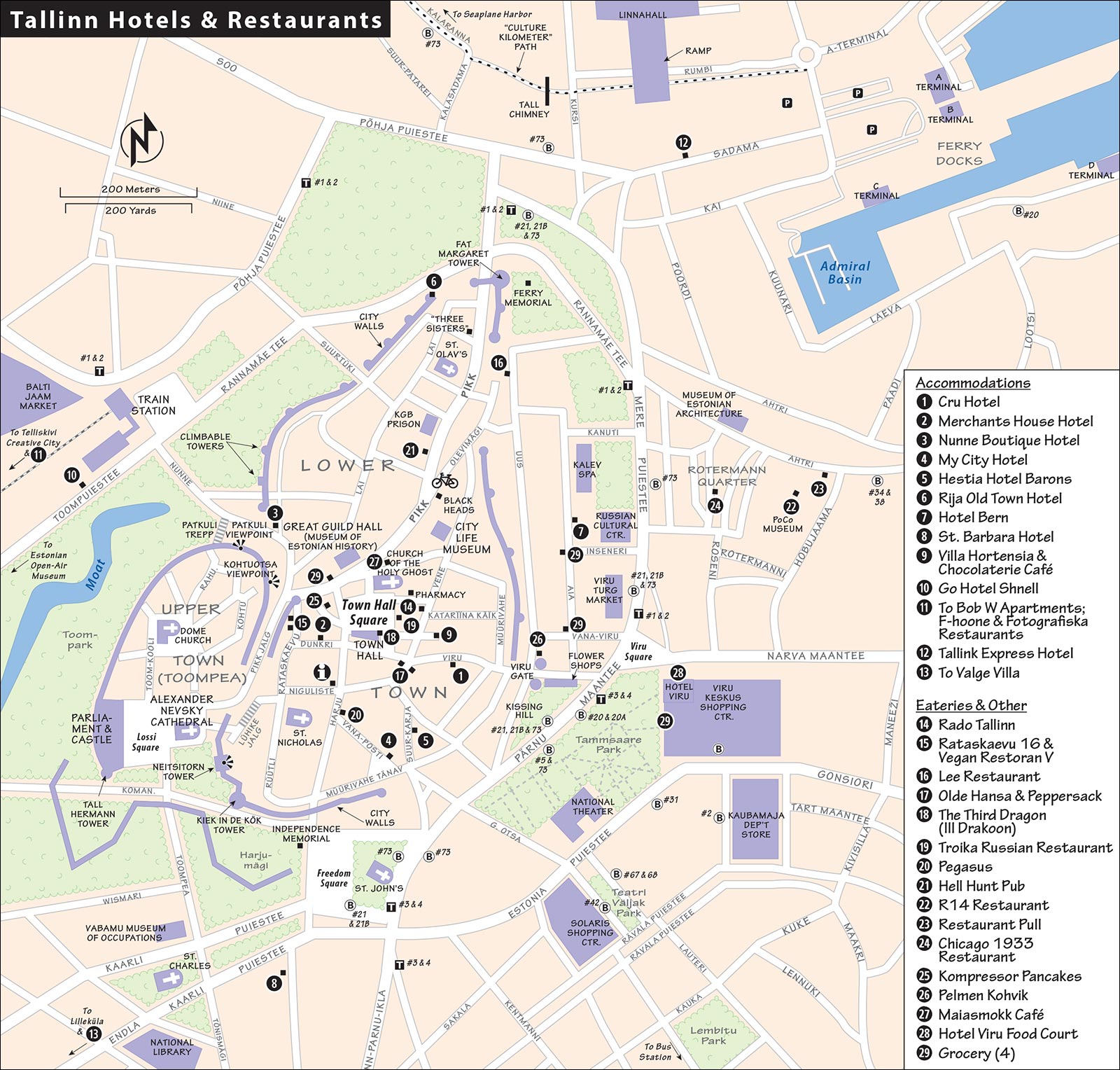
Near the Port: Given how compact Tallinn is, there’s little reason to sleep near the ferry terminals—other than low prices. But if you’re in a pinch: $$ Tallink Express Hotel is a few steps from the A/B terminals and a short walk from the Old Town. It’s a modern, cheery Motel 6-type place with decent prices and 166 comfortable, cookie-cutter rooms. The rooms can be stuffy in hot weather, as windows don’t open very far and there’s no air-con (family rooms, elevator, Sadama 9, +372 667 8700, www.tallinkhotels.com, expresshotel@tallink.ee).
In Lilleküla, Outside the Center: Lilleküla is a quiet, green, and peaceful residential area southwest of the core with single-family houses, small Soviet-era apartment blocks, and barking dogs. For a clearer understanding of Estonian life, stay here. You’ll save money without sacrificing comfort. The downside: It’s a 15-minute bus ride into the center.
$ Valge Villa (“White Villa”) is a homey guesthouse set in a great garden. Run by Anne and Andres Vahtra and their family, who do everything right, they offer 10 spacious, wood-paneled, well-furnished rooms (family rooms, free parking, rental bikes, pay laundry; take bus #67 to Räägu stop, or trolley bus #3 or #4 to Tedre stop; Kännu 26/2, between Rästa and Räägu streets—for location, see the “Greater Tallinn” map near the beginning of this chapter, +372 654 2302, www.white-villa.com, villa@white-villa.com). I’d take a taxi here to check in (about €15 from the ferry dock), and figure out the public-transit options later.
Eating in Tallinn
Tallinn’s Old Town has a wide selection of mostly tourist-oriented eateries. For a better value (and better food), roam at least a block or two off the main drags. Some restaurants have good-value lunch specials on weekdays (look for the words päeva praad). A White Guide sticker on a restaurant door is something like an Estonian Michelin rating.
It’s easy to find authentic Estonian food—a hearty mix of meat, potatoes, root vegetables, mushrooms, dill, garlic, bread, and soup. Pea soup is a specialty. Restaurants take pride in their delicious rye bread (leib), and you usually get a few slices as a complementary side dish. A typical pub snack is Estonian garlic bread (küüslauguleivad)—deep-fried strips of dark rye bread smothered in garlic and served with a dipping sauce. Estonia’s Saku beer is good, cheap, and on tap at most eateries. I like the nutty, full-bodied Saku Tume, the strong, dark, local lager.
FINE ESTONIAN CUISINE IN THE OLD TOWN
These places, tucked deep in the Old Town, are small and romantic, offering creative menus and good value, nicely presented dishes. Reservations for dinner are smart.
$$$ Rado Tallinn, a labor of love by chef Rado and Triinu, who serves, is modern, creative, authentic, and homey. Starters are made to be shared and the small, seasonal menu scrawled on the blackboard changes daily (closed Sun, Vene 7, +372 5858 8995, https://radorestoran.ee).
$$$ Rataskaevu 16, named simply for its address, is popular for its excellent food, friendly service, and rustic medieval interior. The intriguing and inviting menu is creative with a Nordic focus (daily, family and vegetarian friendly, good wines by glass, Rataskaevu 16, +372 642 4025, www.rataskaevu16.ee).
$$$$ Lee Restaurant is where Baltic meets Japanese in a romantic setting. Dine either in their modern Estonian interior or on random tables scattered under trees in the garden. The chef’s fun with foraging and fermentation, freshwater fish, and pan-Asian flavors earned him a Michelin rating. The “Lee Experience,” a €67 six-course tasting menu, is a hit, and their small, inviting à la carte menu always includes vegan and vegetarian plates (closed Sun-Mon, Uus 31, +372 5304 3562, www.leeresto.ee).
ON AND NEAR TOWN HALL SQUARE
Tallinn’s central square is a whirlpool of tacky tourism, where restaurant touts (some dressed as medieval wenches or giant matryoshka dolls) accost passersby to lure them in for a drink or meal. Even so, some of these restaurants do have good food. And, if you’re coming from other Nordic countries, you’ll find prices are good.
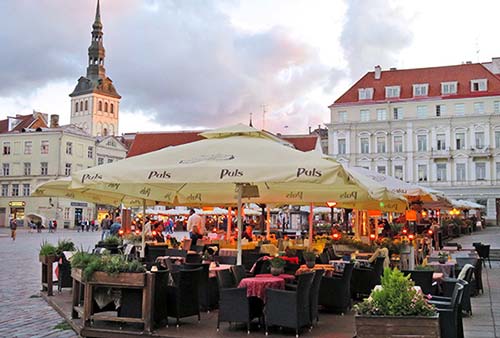
$$$ Olde Hansa, filling three creaky old floors and outdoor tables with tourists, candle wax, and scurrying medieval servers, makes a serious attempt to re-create medieval food (from before the arrival of the potato and tomato from the New World). They specialize in “meats from the forest” (bear, elk, deer), the fun-loving waitstaff role plays (ask for a tomato and they’ll say “what’s that?”), and the food is dang good (daily, musicians circulate Tue-Sun after 18:00, just a belch below Town Hall Square at Vana Turg 1, reserve in advance, +372 627 9020, www.oldehansa.ee).
$$$ Peppersack, across the street, is medieval-themed but less theatric and less expensive than Olde Hansa. Its menu features hearty and meaty dishes and stresses Baltic ingredients (daily, family-friendly, Vana Turg 6, +372 646 6998).
$$ The Third Dragon (III Drakoon), under the Town Hall tower and facing the square, is an always-dark, candlelit medieval den, with no menu (it’s on their website) and a rude landlady (“sharp tongue, warm heart”). The elk soup is always on along with meat pies, sausage, heavy bread, grapes, beer, wine, and vodka. To get anything, you’ll need to deal with the rude wench. And to enjoy it, you’ll need a sense of humor. You’ll leave with a full belly and thankful you aren’t living a thousand years ago (daily, Raekoja Plats 1, +372 627 9020, www.kolmasdraakon.ee).
$$$ Troika Russian Restaurant, with a waitstaff in costume serving bliny (pancakes), pelmeni (dumplings), and characteristic main dishes, is my favorite spot to dine on Town Hall Square. Sit out on the square (reserve for dinner); in the more casual, Russian-village-themed tavern; or under a fine vault in the atmospheric cellar. Evenings often come with a balalaika player (daily, Raekoja Plats 15, +372 627 6245, www.troika.ee). Vodka flights let you try five different homemade infusions.
$$$ Pegasus is new Nordic with a dash of USSR, and it’s the perfect antidote to the kitsch on Town Hall Square. Built by the Soviets after this city block was bombed in 1944, the building opened in 1962 as the House of Writers. Bohemian, literary types eat here for the ’60s vibe (especially upstairs). The Nordic-inspired menu features flavorful soups, risottos, fish, salads, and fresh rye bread (daily, on the downhill side of St. Nicholas Church at Harju 1, +372 662 3013).
$$ Vegan Restoran V opened in 2014 as the first vegan restaurant in Estonia. With a menu that is religiously vegan, this place is as small as a lentil, as peaceful as tofu, and as cozy as sprouts, with medieval beams adding to the atmosphere (€15 plates, hearty salads, wine and beer, daily, Rataskaevu 12, +372 626 9087, www.vegenrestoran.ee [URL inactive], reserve by phone).
$$ Hell Hunt Pub (“The Gentle Wolf”) was the first Western-style pub to open after 1991, and its tasty food and house microbrews on tap are still attracting expats and locals. You can make a meal from the bar snacks plus a salad, or dive deeper into their pub-grub menu. Choose a table in its convivial, rustic-sports bar interior, in the quiet lounge in back, or on the garden terrace under the linden trees across the street (daily, Pikk 39, +372 681 8333).
AT BALTI JAAM AND TELLISKIVI CREATIVE CITY
A 15-minute walk from Town Hall Square takes you to the vibrant Balti Jaam Market, a festival of more than 20 wonderful little eateries; wander and take your pick (see description on here). Just beyond Balti Jaam is the Telliskivi Creative City, awarehouse district turned into a trendy, hipster quarter of galleries and an array of fun eateries worth exploring. Here are two Telliskivi restaurants—one fun and simple, the other gourmet and elegant—to consider:
$$ F-hoone Restaurant, filling a spacious old warehouse, is the neighborhood hangout—a fun, inexpensive, come-as-you-are place for hipsters, kids, dogs, and tourists. Opened in 2010, it was the first restaurant in this now hip industrial quarter. The menu is international with good vegetarian options and a great drinks list (daily, Telliskivi 60a, +372 5322 6855, www.fhoone.ee).
$$$$ Fotografiska Restaurant puts the top floor of the Fotografiska Tallinn museum, with grand views from its terrace seating, to very good use. This memorable splurge is as stylish as can be and borderline pretentious. With gourmet Nordic cuisine that embraces nature with a passion and nimbly exploits the short seasons, it’s good enough to win a Michelin Green star. The chef features his favorites with the €64 four-course chef’s meal (Wed-Sat 18:00-23:00, closed Sun-Tue, Telliskivi 60a, +372 5745 0922, www.fotografiska.com/tallinn/en/sook-jook/87).
ROTERMANN QUARTER
The Rotermann Quarter, another trendy scene with old industrial buildings now reenvisioned as a sleek and slick modern zone (described on here), has an enticing assortment of creative restaurants. Just across the busy road from Tallinn’s Old Town, it’s well worth exploring for a jolt of cutting-edge architecture, hipster edginess, and Estonia’s new affluence...an antidote to the central area’s ye olde charm. Consider the following choices, or simply explore this fast-changing scene.
$$$ R14 Restaurant is very Rotermann-ish: industrial chic (in a former power plant), trendy with a smart clientele, soaring ceilings, and an open kitchen. It’s Michelin rated, with an elegant vibe and a passion for wines and wine pairing. The menu features near-gourmet dishes, creative Mediterranean flavors, and fine wines by the glass (daily, Rotermanni 14, +372 5855 8120).
$$$ Restaurant Pull, a hit for its enticingly presented meat plates and charcoal-grilled steak, fills a stone-walled, concrete-pillared industrial space and boasts a Michelin rating (closed Sun, Rotermanni 2, +372 5382 5000, www.pull.ee).
$$$ Chicago 1933 Restaurant is a popular place for cocktails, dancing, and a fun burgers-to-pasta menu. Dine outside on Rotermann’s main square (Roseni) or inside, with its 1930s cocktail-bar vibe. There’s live music (with some big local names) nearly nightly (daily, lunch specials daily, must be over 21 after 19:00, Roseni 8, +372 627 1266).
BUDGET EATERIES, BREAKFAST, CAFÉS, AND SWEETS
$ Kompressor Pancakes, a big, retro, open-feeling beer hall, is a hit for its cheap, huge, and filling pancakes. Order at the bar, sorting through the big selection—savory and sweet. Salmon with smoked cheese, raspberries, and sweet condensed milk is a popular choice and an example of the creativity that makes their menu fun (daily, Rataskaevu 3, +372 646 4210).
$ Pelmen Kohvik, an Estonian dumpling joint, is cheap, fast, and old fashioned. For locals it’s delightfully retro and rich with memories from communist times, from lots of sour cream and dill to tubes of good old hot mustard (called sinep, which locals love to point out spells ‘penis’ backwards). It’s just off Viru, across the street from MacDonalds (daily, Vana-Viru 4).
$ Maiasmokk Café (“Sweet Tooth”) and pastry shop, founded in 1864, is the grande dame of Tallinn cafés—ideal for breakfast, a sweet snack, or drink. Even through the Soviet days, this was the place for a good pastry or a glass of herby Tallinn schnapps (Vana Tallinn). The place has a gangly layout: a café with a self-service counter, a small restaurant upstairs, a shop, and outside seating. At the café, point to what you want from the selection of classic local pastries and sandwiches, and sit down inside or at outdoor tables around the corner (the outdoor seating comes with table service, but you can enjoy your self-service meal there if you ask). Upstairs is a pricier full-menu restaurant that feels like a cushy 19th-century living room (food served 12:00-19:00 only) and a marzipan shop with a little museum (café daily from 9:00, Pikk 16, across from church with old clock, +372 646 4079, www.kohvikmaiasmokke.ee [URL inactive]).
$$ Chocolaterie Café has scrumptious fresh pralines, sandwiches, and coffee or hot chocolate in a courtyard filled with craft shops. The vintage vibe is a mix of 1930s and “feelin’ groovy.” While they serve light meals, most come just for a drink or something sweet (daily 8:30-late, Vene 6, +372 641 8061).
SUPERMARKETS AND FAST FOOD
For picnic supplies a block off Town Hall Square, try the Rimi minimart (daily 8:00-22:00, Pikk 11). For better prices and a much wider selection, two big, handy supermarkets are a block or two from Viru Gate: Prisma (a Finnish chain with both Estonian and Finnish products, open 24/7, at the corner of Aia and Vana-Viru) and the Rimi supermarket (daily 8:00-23:00, at Aia 7). Hotel Viru’s food court is a good fallback when all else fails. Filling much of the ground floor of the hotel, it offers a huge variety of inexpensive, pretty good quality, fast-food eateries (daily, across the busy road from the Old Town’s Viru Gate). A gateway from the food court leads to the modern Viru Keskus mall with a big upscale supermarket in the basement (open until 22:00).
Tallinn Connections
BY BUS OR TRAIN
The bus is usually the best way to travel by land from Tallinn (for domestic bus schedules, see www.tpilet.ee). The largest international operator, with the most departures, is Lux Express (+372 680 0909, www.luxexpress.eu); there’s also Ecolines (+371 672 14512, www.ecolines.net) and Hansabuss (+372 627 9080, www.hansabuss.ee). The bus station (autobussijaam) is at Lastekodu 46, a short taxi ride from the Old Town, or a few stops on trams #2 or #4 to the Autobussijaam stop. Reserving online is recommended.
Domestic trains are operated by Elron (www.elron.ee).
From Tallinn to: Rīga (12 buses/day, 4.5 hours, no train option; consider Tallinn Traveller Tours’ “sightseeing shuttle” between these cities—a full-day, 12-hour journey with sightseeing stops en route; www.traveller.ee), Vilnius (5 buses/day, plus 3/day overnight, 8-10 hours).
BY BOAT
Sailing Overnight Between Stockholm and Tallinn
Tallink Silja’s overnight cruise ships between Stockholm and Tallinn leave each city every other day in late afternoon or early evening and arrive in the other city midmorning (about 17 hours later). Ferry fares vary widely by the day and season; the highest rates are typically for Friday and Saturday nights and in summer from July to mid-August. Options range from four-person, gender-segregated dorm rooms to private cabins. The smorgasbord dinner and buffet breakfast cost extra (book these meals and reserve a table when buying your ticket). Book online (www.tallinksilja.com).
In Tallinn, Tallink Silja ships use the D terminal (see “Arrival in Tallinn,” earlier). In Stockholm, boats leave from the Värtahamnen harbor (for details, see here).
Speeding Between Helsinki and Tallinn
Three companies run ferries linking Helsinki and Tallinn in about two hours. Prices tend to be similar among the different operators—around €20-55 one-way; same-day round-trip tickets cost barely more (and sometimes less) than one-way fares (evening departures from Helsinki and morning departures from Tallinn tend to be cheaper; student and senior discounts available). Advance reservations aren’t essential, but usually save a little money, ensure your choice of departure, and provide peace of mind. Since price differences between operators tend to be negligible, base your choice on the most convenient departure times and ferry terminal locations. Make sure you know which terminal your boat leaves from and how to get to it (for descriptions of Helsinki’s terminals, see here; for Tallinn’s, see “Arrival in Tallinn,” earlier). Some final departures have the option (for around €100) of letting you book a bed or stateroom and sleep on the boat until the next morning.
Unless you’re bringing a car, Viking Line is usually the most convenient, as in both cities it uses docks that are easy to reach by foot or public transport (Helsinki’s Katajanokka terminal and Tallinn’s A terminal). Viking offers a more traditional experience on a big ferry with restaurants and shops (2-3/day, 1 overnight, daytime crossing about 2.5 hours, www.vikingline.com).
Tallink Silja connects Helsinki’s West Harbor (terminal 1 or 2) and Tallinn’s D terminal (farthest from the Old Town, but still walkable); Tallink Silja’s ferries are frequent and fast (6-7/day, 2-hour crossing for most departures, some longer sailings, www.tallinksilja.com).
Eckerö Line connects Helsinki’s West Harbor (terminal 2) and Tallinn’s A terminal with fewer sailings (3/day, 2.5-hour crossing, www.eckeroline.com).
Slower boats have smorgasbord buffets. The slower the boat, the more likely it is to be filled with “four-legged Finns” crazy about cheap booze, slot machines, and karaoke.
BY CRUISE SHIP
Tallinn’s cruise port is just northeast of the Old Town. Most ships dock at dedicated piers on the northern edge of the harbor (labeled Kruiislaevad on maps and signs); overflow ships can dock at nearby berths generally used for ferries to Stockholm and Helsinki (terminals A-D). Wherever you dock, it’s an easy walk (or taxi ride) to the Old Town. For port information, see www.ts.ee.
BY PLANE
The Tallinn airport (Tallinna Lennujaam), three miles southeast of downtown, has a small info desk (code: TLL, www.tallinn-airport.ee). To reach the Old Town, take a taxi or Uber (generally €15, confirm price first with the driver). Another option is public bus #2 (3-4/hour; the Kaubamaja or Estonia stops are near the Old Town). A tram line could connect the airport to the Old Town and ferry terminals A/B by the time you visit.