STOCKHOLM’S ARCHIPELAGO
Vaxholm • Grinda • Sandhamn
Sights and Activities in Vaxholm
Sleeping and Eating in Vaxholm
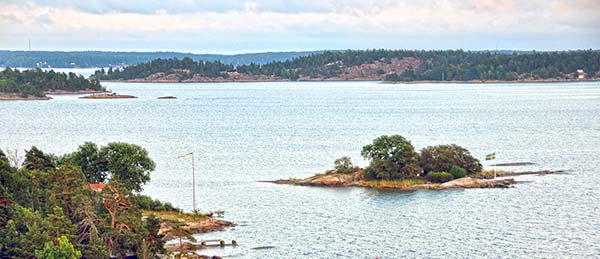
Some of Europe’s most scenic islands stretch 80 miles out into the Baltic Sea from Stockholm. If you’re cruising to or from Finland, you’ll get a good look at this island beauty. If you have more time and want to immerse yourself in all that simple Swedish nature, consider spending a day or two island-hopping.
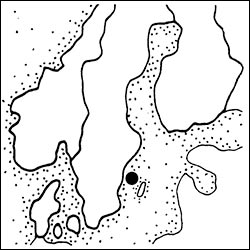
The Swedish word for “island” is simply ö, but the local name for this area is Skärgården—literally, “garden of skerries,” which are unforested rocks sticking up from the sea. That stone is granite, carved out and deposited by glaciers. The archipelago closer to Stockholm is rockier, with bigger islands and more trees. Farther out (such as at Sandhamn), the glaciers lingered longer, slowly grinding the granite into sand and creating smaller islands.
Locals claim there are more than 30,000 of these islands, and as land here is rising slowly, more pop out every year. Some 150 are inhabited year-round, and about 100 have ferry service. There’s an unwritten law of public access in the archipelago: Technically you’re allowed to pitch your tent anywhere for up to two nights, provided the owner of the property can’t see you from their house. It’s polite to ask first and essential to act responsibly.
With thousands of islands to choose from, every Swede seems to have a favorite. This chapter covers three very different island destinations that offer an overview of the archipelago. Vaxholm, the gateway to the archipelago, comes with an imposing fortress, a charming fishermen’s harbor, and the easiest connections to Stockholm. Rustic Grinda feels like—and used to be—a Swedish summer camp, with good hiking options. And swanky Sandhamn thrills the sailboat set, with a lively yacht harbor, a scenic setting at the far edge of the archipelago, and (true to its name) sandy beaches.
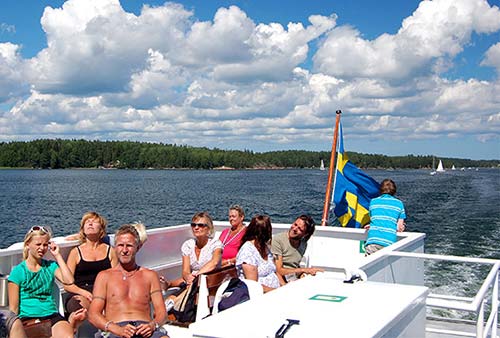
The best way to experience the magic of the archipelago is simply to stretch out comfortably on the top deck of your ferry. The journey truly is the destination. Enjoy the charm of lovingly painted cottages as you glide by, sitting in the sun on a sleek lounge chair positioned to catch just the right view, with the steady rhythm of the ferries lacing this world together, and people savoring quality time with each other and nature.
PLANNING YOUR TIME
On a Tour: For the best quick look, consider one of the many half- or full-day package boat trips from downtown Stockholm to the archipelago. Strömma runs several options, including the three-hour Archipelago Tour (3-4/day, 1-2/day off-season, 365 SEK), or the all-day Thousand Island Cruise (departs daily in summer at 9:30, 1,860 SEK, includes lunch and dinner; +46 8 1200 4000, www.stromma.com).
On Your Own: For more flexibility and a better dose of the local vacation scene, do it on your own. Any one of the islands in this chapter is doable as a single-day side trip from Stockholm. And, because all boats to and from Stockholm pass through Vaxholm, it’s easy to tack it on to your itinerary. For general information about the archipelago, see StockholmArchipelago.se.
For a very busy all-day itinerary that takes in the two most enjoyable island destinations (Grinda and Sandhamn), consider this plan: Catch an early boat from Stockholm to Grinda, take a quick walk around the island, then sail to Sandhamn. In Sandhamn, have lunch and enjoy the town, then take a boat back to Stockholm. For an urban mix of towns, consider a Stockholm-Vaxholm-Sandhamn-Stockholm itinerary instead.
Overnighting on an island really lets you get away from it all and enjoy the island ambience. I’ve listed a few accommodations, but note that midrange options are few; most tend to be either pricey and top-end or very rustic (rented cottages with minimal plumbing). There’s no luggage storage at the ferry docks, so it’s not convenient to stop off and explore an island while traveling between overnight destinations.
Don’t struggle too hard with the “which island?” decision. The main goal is to get well beyond Vaxholm to experience more striking scenery. I’d sail an hour or two past Vaxholm, take a short break on an island, then stop in Vaxholm on the way home. The real joy is the view from your ferry.
GETTING AROUND THE ARCHIPELAGO
A few archipelago destinations (including Vaxholm) are accessible overland, thanks to modern bridges. For other islands, you’ll take a boat from downtown Stockholm: Waxholmsbolaget runs the regular public ferry service throughout the entire archipelago; Cinderella Båtarna, part of the Strömma sightseeing company, travels to just the most popular islands. Note that tickets and passes for the Waxholmsbolaget ferries are not valid on Cinderella boats (and vice versa).
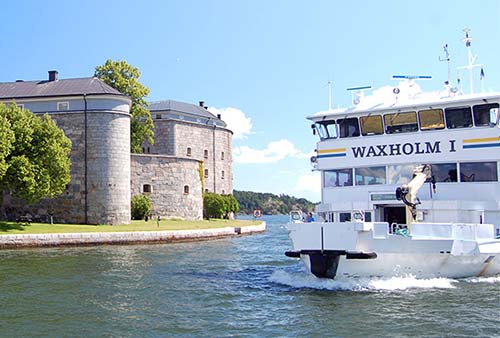
Check both companies’ websites for their schedules when planning your itinerary; some sailings make many more stops than others, and you might have to mix and match to make your itinerary work. Note that peak season for departures is summer (mid-June-mid-Aug); the number of boats declines off-season. In summer, it’s smart to get to the quay early (30 minutes or so in advance).
By Public Ferry (Waxholmsbolaget)
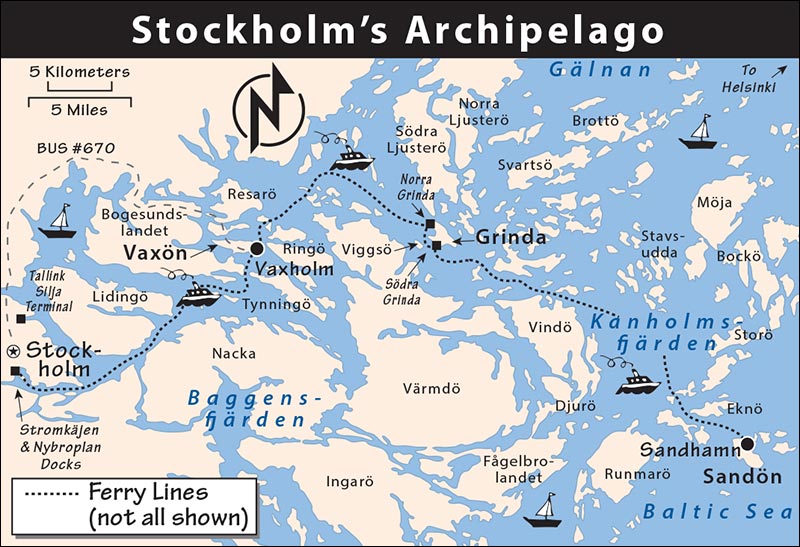
The ferries, some of them classic steamboats, depart Stockholm from the Stromkäjen quay in front of the Grand Hôtel (+46 8 600 1000, www.waxholmsbolaget.se; if you need help with schedules or ticketing, call or ask at their customer service office on Strömkajen quay). Boats run to Vaxholm (at least hourly, 1 hour, 97 SEK), Grinda (nearly hourly, 2 hours, 116 SEK), and Sandhamn (1-2/day, 5 hours, 270 SEK).
Tickets: Waxholmsbolaget tickets are sold on board, at the customer service center (SL card or credit card only), or via the SL app. If you use the app, you scan a QR code on board to get your printed ticket.
If you’re staying in the archipelago for a few days, consider the five-day, all-inclusive travel card (545 SEK, plus a 20-SEK fee for SL card—described on here). Buy the card at the Waxholmsbolaget office.
On Board: When you board, tell a crew member which island you’re going to. Boats don’t dock at all of the smaller islands unless passengers have requested a stop. You’ll need to show your ticket to disembark. Some boats have luggage-storage areas (ask when you board). Check the onboard monitor to see the position of your boat as it motors through the islands.
By Cinderella Boats (Strömma)
These tourist-oriented ships are generally pricier, faster, and more modern than the quainter public ferries (boats leave from near Stockholm’s Nybroplan, along Strandvägen, +46 8 1200 4000, www.stromma.com/en-se/stockholm/cinderella-boats). Cinderella boats visit fewer islands, but they sail frequently (4/day Mon-Thu, 5/day Fri-Sun) from Stockholm to Vaxholm (50 minutes, 165 SEK) and Grinda (1.5 hours, 210 SEK). After Grinda, the line splits, with one route going to Sandhamn (from Stockholm: 2/day Mon-Thu, 1/day Fri-Sun, 2.5 hours, 230 SEK).
Tickets: Tickets are sold onboard, but these boats can get crowded in summer; book ahead online for the sailing you want. Otherwise, visit the Strömma ticket office in Stockholm at Södra Blasieholmshamnen 11 (near the Grand Hôtel and the Waxholmsbolaget office).
Boat Tips
For the best seat, with less sun and nicer views, I’d go POSH: Port Out, Starboard Home (on the left side leaving Stockholm, on the right side coming back).
Most boats sell food on board—usually simple snack-bar fare—but a few offer elegant sea-view dinners at fancy restaurants. If your boat has a top-deck restaurant and you want to combine your cruise with dinner, make a reservation as soon as you board or try calling ahead to reserve a table for a specific cruise (for Waxholmsbolaget, call +46 8 600 1000; for Cinderella, call +46 8 1200 4000).
HELPFUL HINTS
Tourist Information: Vaxholm’s TI has a free map of the archipelago, which gives a great overview to the area (for locations and hours, see here).
Opening Times: Any opening hours I list in this chapter are reliable only for peak season (mid-June-mid-Aug). During the rest of the tourist year, hours are flexible and completely weather-dependent; more services tend to be open on weekends than weekdays. Outside the short summer season, many places close down entirely.
Signal for Stop: At the boat landings or jetties on small islands, you’ll notice a small signal tower (a semaphore) that lets a passing boat know you want to be picked up. Pull the cord to spin the white disc and make it visible to the ship. Be sure to put it back before boarding the boat. At night, you signal with light, like the one on your phone.
Local Drink: A popular drink here is punsch, a sweet and spicy liqueur. Stately old buildings sometimes have punsch-verandas, little glassed-in upstairs porches where people traditionally would imbibe and chat.
Vaxholm
The self-proclaimed gateway to the archipelago, Vaxholm is more developed and less charming than the other islands. Connected by bridge to Stockholm, it’s practically a suburb, and not the place to commune with Swedish nature. But it also has an illustrious history as the anchor of Stockholm’s naval defense network, and it couldn’t be easier to reach (frequent buses and boats from Stockholm). While Vaxholm isn’t the rustic archipelago you might be looking for, you’re almost certain to pass through here at some point on your trip. If you have some extra time, hop off the boat for a visit.
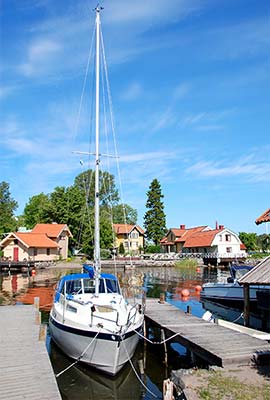
Getting There: Boats constantly shuttle between Stockholm’s waterfront and Vaxholm (see “Getting Around the Archipelago,” earlier). Bus #670 runs regularly from the Tekniska Högskolan T-bana stop in northern Stockholm to the center of Vaxholm (4/hour Mon-Fri, 3/hour Sat-Sun, 40 minutes, 39 SEK one-way, buy ticket with SL app or credit card). Unless you’re on a tight budget, I’d take the boat for the scenery.
Orientation to Vaxholm
Vaxholm, with about 5,000 people, is on the island of Vaxön, connected to the mainland (and Stockholm) by a series of bridges. Everything of interest is within a five-minute walk of the boat dock.
Tourist Information: Vaxholm’s good TI is well stocked with brochures about Vaxholm itself, Stockholm, and the archipelago, and can help you with boat schedules (daily 10:00-17:00, shorter hours off-season; in the Town Hall building on Rådhustorget, +46 8 5413 1480, www.vaxholm.se).
Arrival in Vaxholm: Ferries stop at Vaxholm’s south harbor (Söderhamnen). The bus from Stockholm arrives and departs at the bus stop called Västerhamnsplan, a few minutes’ walk from the boats. To get your bearings, follow my Vaxholm Walk. The departure board is near the ticket office (nästa avgang means “next departure”). For more help, confirm your plans at the ticket office.
Vaxholm Walk
This 30-minute loop begins at the boat dock and takes you to the most characteristic corners of Vaxholm.
Waterfront: Dominating Vaxholm’s waterfront is the big Art Nouveau Waxholms Hotell, dating from the early 20th century. Across the strait to the right is Vaxholm’s stout fortress, a reminder of this town’s strategic importance over the centuries.
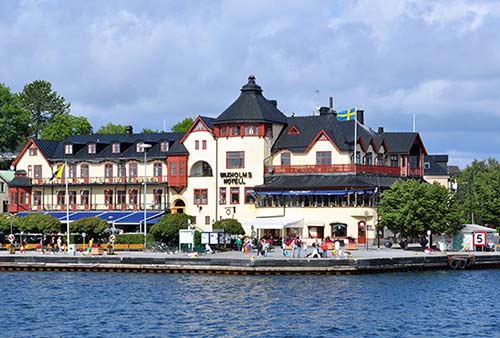
With your back to the water, turn left and walk with the hotel on your right. Notice the Waxholmsbolaget office building, with large screens showing boat schedules. After the hamburger-and-hot-dog stand, you’ll reach a roundabout. Just beyond, a wooden walkway follows the seafront to the town’s private boat harbor (Västerhamnen, “west harbor”), where you can count sailboats. A little past the walkway is the stop for bus #670, connecting Vaxholm to Stockholm.
Continue straight up Vaxholm’s appealing, shop-lined main street, Hamngatan. After one long block, at the Co-op grocery store, turn right up Rådhusgatan to reach the town’s main square. You’ll pass a bike-rental place on your right, then the TI inside the big, yellow Town Hall building on your left. Continue kitty-corner across the square (toward the granite slope) and head downhill on a street leading to the...
Fishermen’s Quarter: Norrhamnen (“north harbor”) is ringed by homes formerly occupied by fishermen. Walk out to the dock and survey the charming wooden cottages. In the mid-19th century, Stockholmers considered Vaxholm’s herring, called strömming, top quality. Caught fresh here, the herring could be rowed into the city in just eight hours and eaten immediately; herring caught farther out had to be preserved in salt and lost its flavor.
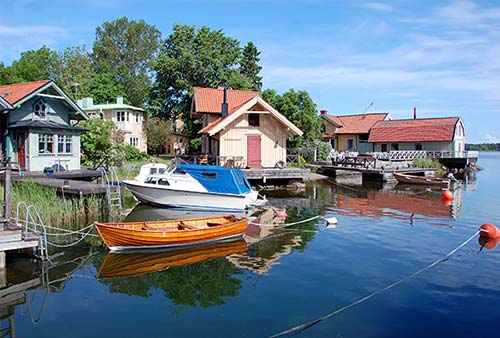
As you look out to sea, you’ll see a pale green building protruding on the left. This is the charming Hembygdsgården homestead museum (described below), with a pleasant indoor-outdoor café. It’s worth heading to this little point (even if the museum is closed, as it often is): As you face the water, go left about one block, then turn right down the gravel lane called Trädgårdsgatan (also marked for Hembygdsgården).
Continuing down Trädgårdsgatan lane, you’ll run right into the Hembygdsgården homestead. The big house features an endearing museum showing the simple, traditional fisherman’s lifestyle (pop in if it’s open; free but donation requested). Next door is a fine recommended café serving sweets and light meals with idyllic outdoor seating (both in front of and behind the museum—take wind direction into consideration as you choose your perch). This is the best spot in town for coffee or lunch. From here, look to the right across the inlet at the tiny beach (where we’re heading next).
Backtrack to the harbor, then continue straight uphill on Fiskaregatan road, and take the first left up the tiny gravel lane marked Vallgatan. This part of the walk takes you back in time, as you wander among old-fashioned wooden homes. At the end of the lane, head left. When you reach the water, go right along a path leading to a thriving little beach, where you can commune with Swedes at play in good weather.
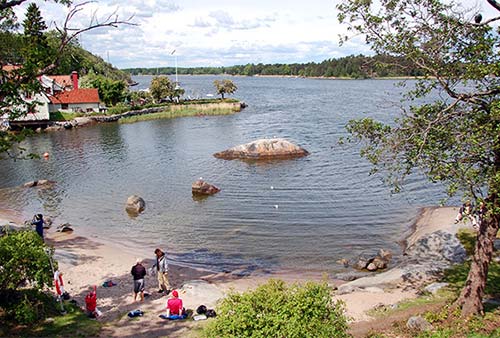
When you’re done relaxing, take the wooden stairs up to the top of the rock and Battery Park (Batteripark)—where giant artillery helped Vaxholm flex its defensive muscles in the late 19th century. As you crest the rock and enjoy the sea views, notice (on your right) the surviving semicircular tracks from those old artillery guns. With a range of six miles, the muzzle blast from these powerful cannons could shatter glass in nearby houses. Before testing them, they’d play a bugle call to warn locals.
To head back to civilization, turn right before the embedded bunker (crossing more gun tracks and passing more fortifications on your left). As you leave the park, take a left at the fork, and the road will take you down to the embankment—just around the corner from where the boat docks (our starting point). From along this stretch of embankment, you can catch a boat across the water to Vaxholm Fortress.
Sights and Activities in Vaxholm
Vaxholm Fortress and Museum (Vaxholms Kastell/Vaxholms Fästnings Museum)
Vaxholm’s only real attraction is the fortification just across the strait. While the town feels sleepy today, for centuries it was a crucial link in Sweden’s nautical defense because it presided over the most convenient passage between Stockholm and the outer archipelago (and, beyond that, the Baltic Sea, Finland, and Russia). The name “Vaxholm” means “Island of the Signal Fire,” emphasizing the burg’s strategic importance. In 1548, King Gustav Vasa decided to pin his chances on this location, ordering the construction of a fortress here and literally filling in other waterways, effectively making this the only way into or out of Stockholm...which it remained for 450 years. A village sprang up across the waterway to supply the fortress, and Vaxholm was born. The town’s defenses successfully held off at least two major invasions (Christian IV of Denmark in 1612, and Peter the Great of Russia in 1719). Vaxholm’s might gave Sweden’s kings the peace of mind they needed to expand their capital to outlying islands—which means that the pint-size powerhouse of Vaxholm is largely to thank for Stockholm’s island-hopping cityscape.
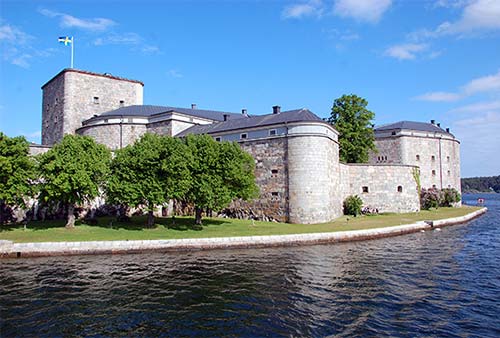
Cost and Hours: Fortress-free; museum-100 SEK, late-June-mid-Aug daily 11:00-17:00, weekends only in shoulder season, closed Sept-mid-May, +46 8 1200 4870, www.vaxholmsfastning.se.
Getting There: A ferry shuttles visitors back and forth from Vaxholm (100 SEK round-trip, every 20 minutes when museum is open, catch the boat just around the corner and toward the fortress from where the big ferries put in). Once on the island, stroll up into the castle’s inner courtyard; the museum entrance is to the left.
Visiting the Fortress and Museum: The current, “new” fortress dates from the mid-19th century, when an older castle was torn down and replaced with this imposing granite behemoth. During the 30 years it took to complete the fortress, the tools of warfare changed. Both defensively and offensively, the new fortress was obsolete before it was even completed. The thick walls were no match for shells (rather than cannonballs), and the high hatches used for attacking tall sailing vessels were useless against new, low-lying, Monitor-style attack boats.
The museum is presented chronologically on two floors (starting upstairs). The modern exhibit traces the military history of this fortress and of Sweden in general. It uses lots of models and mannequins, along with actual weaponry and artifacts, to tell the story right up to the 21st century. There’s no English posted, but you can pick up good English translations at the ticket desk. However, unless you’re really interested in military history, I’d skip the museum and just amble around the island.
Biking on Rindö
If your time means you’re sticking close to Vaxholm, you can still experience the get-away-from-it-all feeling of some of the more distant islands by renting a bike and taking the free ferry over to the nearby island of Rindö, which has lots of trails to explore. Vaxholm Cykeluthyrning can outfit you with wheels and advice (Mon-Fri 11:00-18:00, Sat-Sun until 16:00, across the street from the TI, www.vaxholmcykeluthyrning.se).
Sleeping and Eating in Vaxholm
Since Vaxholm is so close to Stockholm, there’s little reason to sleep here. But in a pinch, Waxholms is the only convenient hotel option.
Sleeping: $$$$ Waxholms Hotell’s stately Art Nouveau facade dominates the town’s waterfront. The interior has a classy, old-fashioned feel, but the 42 rooms are overpriced and somewhat worn (loud music some nights in summer—ask what’s on and request a quiet room if necessary, Hamngatan 2, +46 8 5413 0150, www.waxholmshotell.se, info@waxholmshotell.se). The hotel has a grill restaurant outside in summer and a fancy dining room inside.
Eating: Vaxholm’s most tempting eatery, $$ Hembygdsgården (“Homestead Garden”) Café serves “summer lunches” (salads and sandwiches) and homemade sweets, with delightful outdoor seating around the Hembygdsgården homestead museum in the characteristic fishermen’s quarter (daily May-mid-Sept, closed off-season, +46 8 5413 1980).
$$ Boulangerie Waxholm is the perfect place for a fika break, but it also serves sandwiches, salads, and hot dishes. From the south harbor (Söderhamnen), walk to the roundabout and turn left; you’ll find it at the end of the block (daily 8:00-18:00, +46 8 5413 1872, www.boulangerie.se).
Grinda
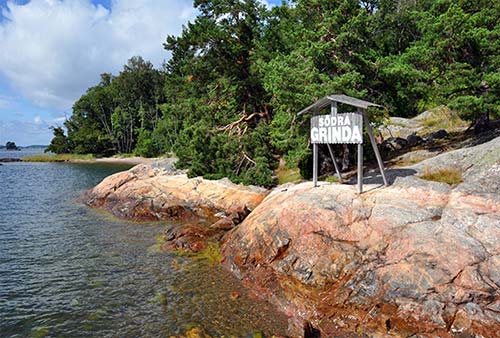
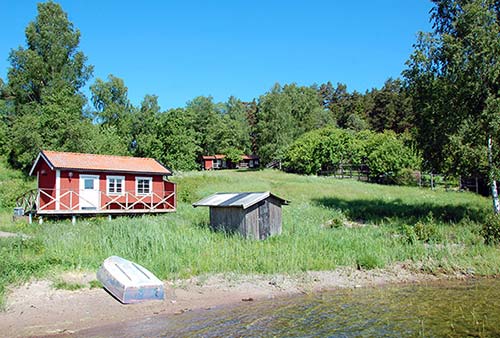
The rustic, traffic-free isle of Grinda—half retreat, half old-fashioned resort—combines back-to-nature archipelago remoteness with easy proximity to Stockholm. The forested island is an idyllic slice of Swedish nature, with walking paths, beaches, trees, and slabs of glacier-carved granite sloping into the sea. Since Grinda is a nature preserve (owned by the Stockholm Archipelago Foundation), only a few families actually live here, and there’s no real town. But in the summer, Grinda becomes a magnet for day-tripping urbanites, which can make it quite crowded. It also holds nostalgia for many Stockholmers, who fondly recall when this was a summer camp island. In a way, with red-and-white cottages bunny-hopping up its gentle hills and a stately old inn anchoring its center, it retains that vibe today.
Orientation to Grinda
Grinda is small and easy to manage. It’s a little wider than a mile in each direction; you can walk from end to end in a half-hour. Its main settlement—the historic Wärdshus building (a busy hub of tourist activities including a restaurant, bar, and conference facilities), hotel, and related amenities—sits mid-island, up the hill from its guest harbor, where private yachts and sailboats put in. A hostel and rental cabins spill over the south end of the island; a campground is a few steps away from the dock at the north end.
Major points of interest are well signposted in Swedish: Södra Bryggan (south dock), Norra Bryggan (north dock), Värdshus (hotel at the heart of the island), Gästhamn (guest harbor); Affär (general store); stuga/stugby (cottage/s); Grindastigen (nature trail); and Tältplats (campground).
Tourist Information: The red cottage marked Expedition/Lilla Längan greets arriving visitors just up the hill from the Södra Grinda ferry dock. The staff answers questions, and the cottage serves as a small shop, a place to rent kayaks or saunas, and a reception desk for the island’s cottages and hostel (generally open daily in season; Wärdshus general info +46 8 5424 9491, www.grinda.se).
Arrival in Grinda: Public ferries use two docks at opposite ends of the island. Most sailings use Södra Grinda to the south (nearest the hostel and cottages), while a few use Norra Grinda to the north (closer to the campground). From either of these, it’s about a 10- to 15-minute walk to the action.
Sights in Grinda
Grinda is made to order for strolling through the woods, taking a dip, picnicking, and communing with Swedish nature. Watch the boats bob in the harbor and work on your Baltic tan. You can simply stick to the gravel trails connecting the island’s buildings, or for more nature, take the pleasant, slightly rugged Grindastigen trail, which loops from the Wärdshus to the southeast end of the island and back in less than an hour (signposted from near the Wärdshus).
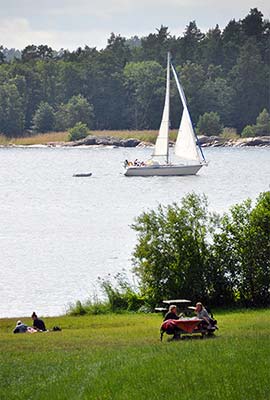
You can rent a kayak or the private little sauna hut bobbing near the shore (inquire at the Lanthandel general store near the Wärdshus). There’s no bike rental here—and the island is a bit too small to keep a serious biker busy—but you could bring one on the boat from Stockholm.
As you stroll, you might spot a few haggard-looking tents through the trees. The right to pitch a tent here was established by the Swedish government during World War II, to give the downtrodden a cheap place to sleep. Those permissions are still valid, inherited, bought, and sold, which means that Grinda has a thriving community of tent-dwelling locals who camp here all summer long (April-Oct). Once each summer they have a progressive tent-crawl bender before heading to the Wärdshus to blow a week’s food budget on a fancy meal.
The island just across from the Södra Grinda dock (to the right) is Viggsö, where the members of ABBA have summer cottages and wrote many of their biggest hits.
Sleeping in Grinda
Your options are, in increasing order of rustic charm: hotel, hostel, and cottages. You can reserve any of these through the Wärdshus (+46 8 5424 9491, www.grinda.se, info@grinda.se).
Grinda is busiest in the summer, when tourists fill its hotel; in spring and fall, it mostly hosts conferences. If sleeping at the hostel or cottages, arrange arrival details in advance. The hostel and cottages charge extra for bed linens. If you have a tent, you can pitch it at the basic campsite near the north jetty for a small fee.
$$$$ Grinda Hotel rents 30 rooms (each named for a local bird or fish) in four buildings just above the Wärdshus. These are modern, comfortable, and made for relaxing, intentionally lacking distractions such as TVs or phones (if dining at the restaurant, the “Wärdshus package” will save you a few kronor).
$ The 27 cottages—most near the Södra Grinda ferry dock—offer a rustic retreat (kitchenettes but no running water, shared bathroom facilities outside). From mid-June to mid-August, a one-week minimum may be required.
¢ Grinda Hostel (Vandrarhem) is the place to sleep if you wish you’d gone to Swedish summer camp as a kid. The 44 bunks are in simple two- and four-bed cottages, surrounding a pair of firepits. There’s no shared kitchen, but a small pebbly beach and a basic sauna are nearby.
Eating in Grinda
All your options (aside from bringing your own picnic from Stockholm) are run by the hotel, with choices in each price range.
$$$$ Grinda Wärdshus, the inn at the center of the complex, serves fine traditional Swedish meals and contemporary international dishes. Portions are small but delicious. Eat in the woody dining room or on the terrace out front (daily; weekends only—and some Fri—in off-season).
$$$ Grindas Framficka (“Grinda’s Front Pocket,” also signed Bageri) is a pleasant bistro that serves up basic but tasty food (seafood, salads, and pizza) alongside the guest harbor. Order at the counter then choose a table, or wait to be seated for a more formal atmosphere (daily, otherwise sporadically open in good weather—especially weekends—in off-season).
The general store and café (Lanthandel) just below the Wärdshus is the place to rustle up some picnic fixings. You’ll also find coffee, ice cream, and kayak rentals (daily, Fri-Sun only in shoulder season).
Sandhamn
Out on the distant fringe of the archipelago—the last stop before Finland—sits the proud village of Sandhamn (on the island of Sandön). Literally “Sand Harbor,” this is where the glacier got hung up and kept on churning away, grinding stone into sand. The town has a long history as an important and posh place. In 1897, the Royal Swedish Sailing Society built its clubhouse here, putting Sandhamn on the map as the yachting center of the Baltic—Sweden’s answer to Nantucket. It remains an extremely popular stop for boaters—from wealthy yachties to sailboat racers—as well as visitors simply seeking a break from the big city.
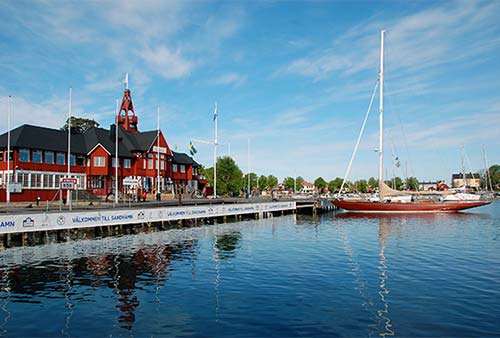
The island of Sandön feels stranded on the edge of the archipelago, rather than immersed in it. Sandhamn is on its sheltered side. Though it’s far from Stockholm, Sandhamn is very popular. During the peak of summer (mid-June through late August), it can get crowded. There will be lines for the ferry, and you might need to call ahead for restaurant reservations. But even during these times, the old town is relatively peaceful and pleasant. Shoulder season is delightful in good weather, though weekends can be busy.
Orientation to Sandhamn
You’ll find two halves to Sandhamn: In the shadow of that still-standing iconic yacht clubhouse is a ritzy resort zone with big-money nautical types. But just a few steps away, around the harbor, is an idyllic time-warp old town of colorfully painted shiplap cottages tucked between tranquil pine groves. While most tourists come here for the resort, the quieter part of Sandhamn holds the real appeal. The town is busiest in the afternoon, then gets much quieter once the day-trippers leave.
Sandhamn has no TI, but this website offers lots of information: DestinationSandhamn.se.
Sandhamn Walk
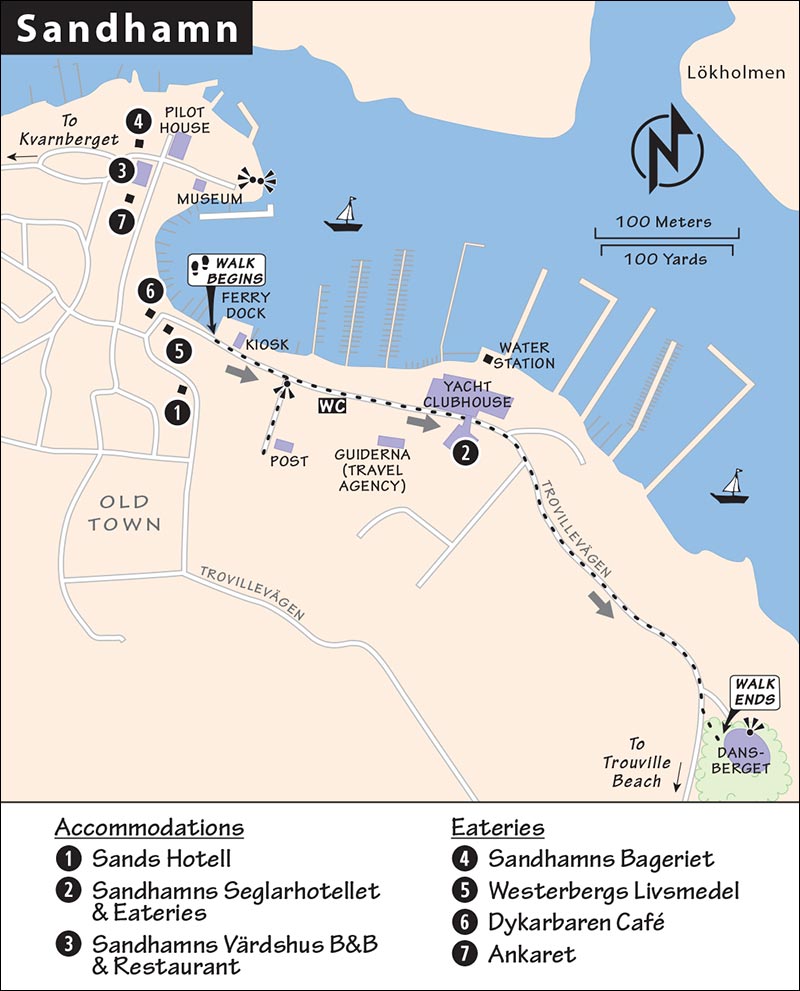
To get your bearings from the ferry dock, take this self-guided walk. Begin by facing out to sea and taking this spin tour.
As you look out to the little point to the left of the dock, notice the big yellow building. In the 18th century, this was built as the pilot house. Because the archipelago is so treacherous to navigate—with its tens of thousands of islands and skerries, not to mention untold numbers of hidden underwater rocks—locals don’t trust outsiders to bring their boats here. So, passing ships unfamiliar with these waters were required to pick up a local captain (or “pilot”) to take them safely all the way to Stockholm. The tradition continues today. The orange boats marked pilot, moored below the house, ferry loaner captains to oncoming ships. And, since this is the point of entry into Sweden, foreign ships can also be processed by customs here.
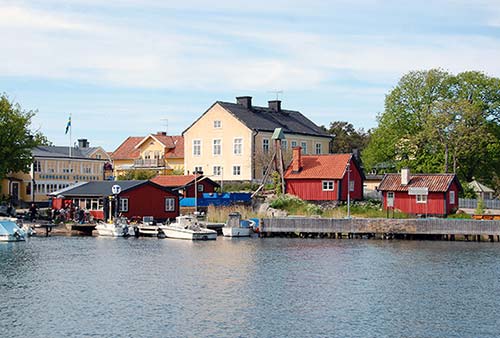
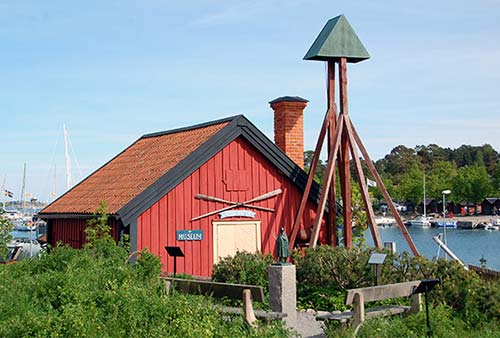
The little red shed just in front of the pilot house is home to a humble town museum featuring exhibits on Sandhamn’s history and some seafaring tales (open sporadically in summer).
Just left from the shed, look for the yellow building with the blue letters spelling Sandhamns Värdshus. This traditional inn, built in the late 17th century, housed sailors while they waited here to set out to sea. During that time, Stockholm had few exports, so ships that brought and unloaded cargo there came to Sandhamn to load up their holds with its abundant sand as ballast. Today the inn still serves good food (see “Eating in Sandhamn,” later).
Stretching to the left of the inn along the waterfront are the quaint storefronts of most of Sandhamn’s eateries (those that aren’t affiliated with the big hotel)—bakery, deli, and grocery store, all of them humble but just right for a simple bite or picnic shopping. Local merchants enjoy a pleasantly symbiotic relationship. Rather than try to compete with each other, they attempt to complement what the next shop sells—each one finding just the right niche.
The area stretching behind these storefronts is Sandhamn’s old town—a maze of wooden cottages that’s an absolute delight to explore. Only 50 of Sandhamn’s homes (of around 450) are occupied by year-rounders. The rest are summer cottages of wealthy Stockholmers, or bunkhouses for seasonal workers in the tourist industry. Most locals live at the farthest-flung (and therefore least desirable) locations. Imagine the impact of 100,000 annual visitors on this little town.
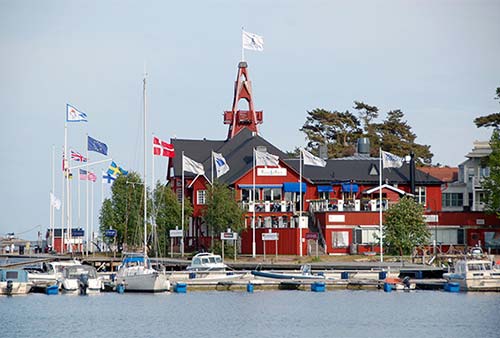
Near where the jetty meets the island, you’ll find the town’s bulletin board, where locals post classified ads. At the base of the dock is Sandhamns Kiosk, a newsstand selling local and international publications (as well as candy and mjukglass—soft-serve ice cream). A bit farther to the left, the giant red building with the turret on top is the yacht clubhouse that put Sandhamn on the map, and still entertains fun seekers today with a hotel, several restaurants, spa, outdoor pool, and more. You’ll see its proud SSS-plus-crown logo (standing for Svenska Segelsällskapet—Swedish Sailing Society) all over town. In the 1970s, the building was owned by a notorious mobster who made meth in the basement, then smuggled it out beneath the dock to sailboats moored in the harbor.
Along the waterfront between the ferry dock and the yacht clubhouse you’ll probably see signs reminding visitors to be careful with their use of water. Due to Sandhamn’s low groundwater level, and the enormous increase in visitors during summer months, local authorities impose water rationing part of the year. To provide more water, a filtration system was installed that purifies water direct from the Baltic Sea. Those signs also remind us to keep the Baltic as clean as possible.
Spinning a bit farther to the left, back to where you started, survey the island across the strait (Lökholmen). Just above the trees, look for the copper dome of an observatory that was built by this island’s eccentric German oil-magnate owner in the early 20th century. He also built a small castle (not quite visible from here) for his kids to play in.
Enough spinning. Now it’s time to stretch your legs and head for a fine viewpoint. Walk left along the main drag, toward the yacht clubhouse.
After about 50 yards, a sign on the right points up a narrow lane to Posten. This unassuming gravel path is actually one of Sandhamn’s most important streets, with the post office, police department (which handles only paperwork—real crimes are deferred to the Stockholm PD), and doctor (who visits town every second Wednesday). While Sandhamn feels remote, it’s served—like other archipelago communities—by a crack emergency-response network that can dispatch a medical boat or, in extreme cases, a helicopter. With top-notch hospitals in Stockholm just a 10-minute chopper ride away, locals figure that if you have an emergency here, you might make it to the ER faster than via an ambulance navigating congested city streets. At the end of this lane, notice the giant hill of the town’s namesake sand.
Continuing along the main tree-lined harborfront strip, you can’t miss the signs directing yachters to the toalett (toilet) and sopor (garbage dump). On the right is the barn for the volunteer fire department (Brandstation). With all the wooden buildings in town, fire is a concern—one reason why Sandhamn restricts camping (and campfires). Just after the barn you’ll pass the Sandhamns Guiderna office, a travel agency where you can rent bikes and kayaks, or (if you book in advance) set up a fishing trip (+46 8 640 8040, www.sandhamn.se).
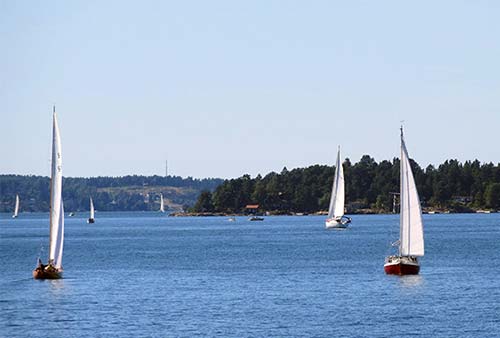
Go beneath the skyway connecting the big red hotel to its modern annex. Then veer right and head uphill, following the Badstranden Trouville sign. Keep going until you come to an expanse of fairly flat rock. This is nicknamed Dansberget (“Dancing Rock”) because it once hosted community dances with a live orchestra. Walk out to enjoy fine views of the Baltic Sea—from here, boaters can set sail for Finland and Estonia. Looking out to the horizon, notice the lighthouse towers poking up from the sea, used to guide ships to this gateway to the archipelago. The finish line for big boat races stretches across this gap (from the little house on the point to your left). In summer, this already busy town gets even more jammed with visitors, thanks to the frequent sailing races that end here. The biggest annual competition is the Götlandrunt, a round-trip from here to the island of Götland.
Our walk is finished. You can head back into town. Or continue another 15 minutes to Trouville beach (see next).
Sights in Sandhamn
Beaches (Stränder)
True to its name, Sandön (“Sandy Island”) has some of the archipelago’s rare sandy beaches. The closest, and local favorite, is the no-name beach tucked in a cove just behind the old town (walk through the community from the main boat dock, then follow the cove around to the little sandy stretch).
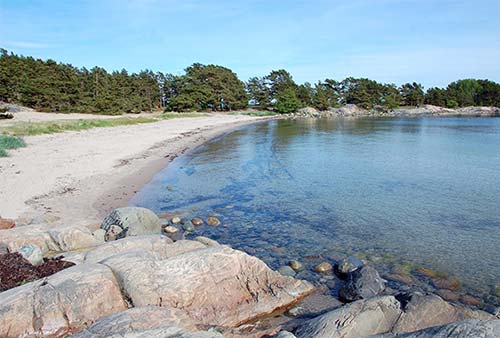
The most popular—and crowded in summer—is Trouville beach, at the opposite end of the island from Sandhamn (about a 20-minute walk). To find it, walk behind the big red hotel and take the right, uphill fork (marked with the low-profile Badstranden Trouville sign) to the “Dancing Rock,” then proceed along the road. Take a left at the fork past the tennis courts, then walk about 10 minutes through a pine forest (sometimes filled with lingonberries and blueberries), until you reach a little settlement of red cottages. Take a right at the fork (look up for the Stranden sign), and then, soon after, follow the middle fork (along the plank walks) right to the beach zone: two swathes of sand marked off by rocks, stretching toward Finland.
Kvarnberget
Just inside the old town you’ll find this little hilltop with a beautiful view of the sea. From the Sandhamns Värdshus B&B, take the path leading to the left and follow it straight past the old wooden houses until you see the hill. You can simply walk up the hill to enjoy the view, or pack a picnic (beware of seagulls hovering overhead, eager to steal your lunch).
Sleeping in Sandhamn
Sandhamn has a pair of very expensive top-end hotels, a basic but comfortable B&B, and a few Airbnbs. If you’re sleeping on Sandhamn, the B&B is the best choice.
$$$$ Sands Hotell is a stylish splurge sitting proudly at the top of town. While oriented mostly to conferences and private parties, its 19 upscale rooms also welcome commoners in the summer (elevator, spa, +46 8 5715 3020, www.sandshotell.se, info@sandshotell.se).
$$$ Sandhamns Seglarhotellet rents 83 nautical-themed rooms in a modern annex behind the old yacht club building (where you’ll find the reception). The rooms are fine, but the prices are sky-high, and you sometimes get loud music from the disco inside the clubhouse—request a quieter back room. They also rent some apartments (gym, pool, and sauna area, +46 8 5745 0400, www.sandhamn.com, reception@sandhamn.com).
$$ Sandhamns Värdshus B&B rents five rustic but tasteful, classically Swedish rooms in an old mission house buried deep in the colorful old town. To melt into Sandhamn and get away from the yachties, sleep here (mostly twins, all rooms share WC and shower, tiny cottage with its own bathroom for same price, includes breakfast, reception is at the restaurant—see next, +46 8 5715 3051, www.sandhamns-vardshus.se, info@sandhamns-vardshus.se). The rooms are above a reception hall, but after 22:00, quiet time kicks in.
Eating in Sandhamn
IN THE OLD TOWN
Sandhamn’s most appealing eateries are along the old town side of the harbor (for locations, see the “Sandhamn” map, earlier).
$$$$ Sandhamns Värdshus, right on the water, is the town’s best eatery. They serve traditional Swedish food plus some veggie options in three separate dining zones (which mostly share the same menu, but each also has its own specials): out on an inviting deck overlooking the water; upstairs in a salty dining room with views; or downstairs in a simple pub (daily, lunch specials, +46 8 5715 3051, www.sandhamns-vardshus.se).
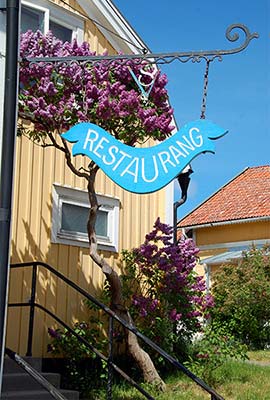
To grab a bite or assemble a picnic, browse through these smaller eateries: Just around the corner (uphill from the harbor and behind the Värdshus), $ Sandhamns Bageriet is a popular morning/lunch venue serving coffee, sweet rolls, and sandwiches (daily in summer, Sat-Sun only in late-Aug-Sept). Westerbergs Livsmedel grocery store has basic supplies (daily 9:00-18:00). $$ Dykarbaren Café serves lunches and dinners with indoor and outdoor seating (daily mid-June-mid-Aug, Fri-Sun only in shoulder season, closed off-season; +46 8 5715 3554). $ Ankaret does takeaway sandwiches, wraps, salads, and ice cream.
AMONG THE YACHTIES
Sandhamn Seglarhotell has several pleasant eateries: a pricey $$$$ restaurant with fine sea views, plus a comfy wine bar and casual outdoor terrace (+46 8 574 504 00, www.sandhamn.com).