NEAR STOCKHOLM
Drottningholm Palace• Sigtuna • Uppsala
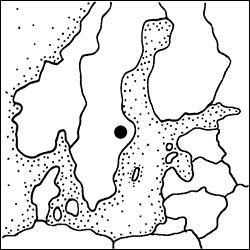
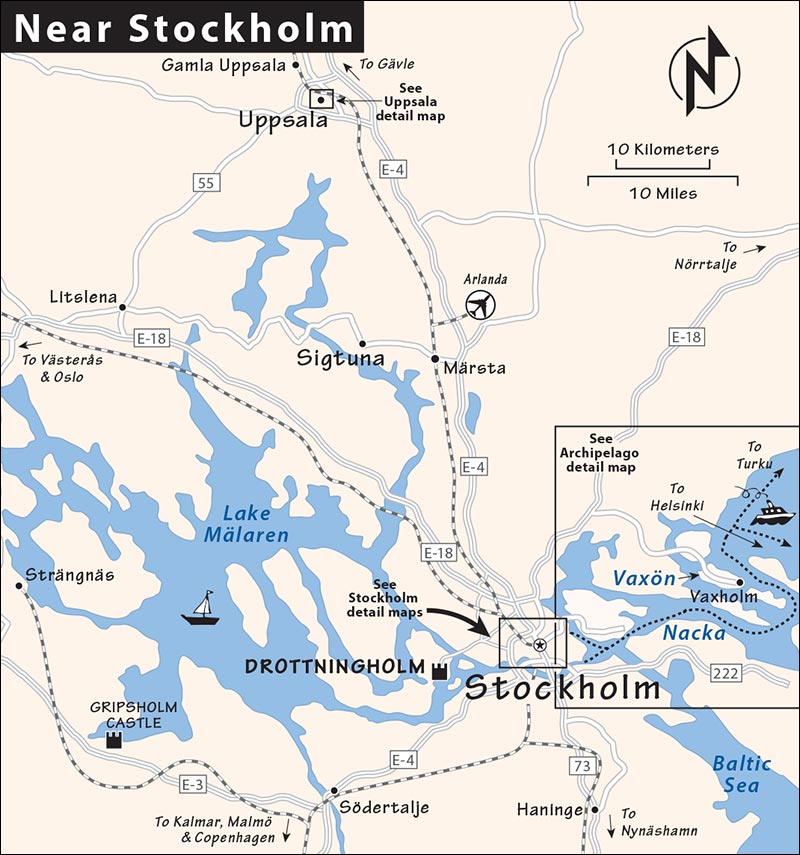
At Stockholm’s doorstep are a variety of fine side-trip options—all within an hour of the capital. Drottningholm Palace, on the city’s outskirts, was the summer residence—and most opulent castle—of the Swedish royal family, and has a uniquely well-preserved Baroque theater to boot. The adorable town of Sigtuna is a cutesy escape from the big city, studded with history and rune stones. Uppsala is Sweden’s answer to Oxford, offering stately university facilities and museums, the home and garden of scientist Carl Linnaeus, as well as a grand cathedral and the enigmatic burial mounds of Gamla Uppsala on the outskirts of town. Note that another side-trip option is to visit a few of the islands in Stockholm’s archipelago (described in the next chapter).
Drottningholm Palace
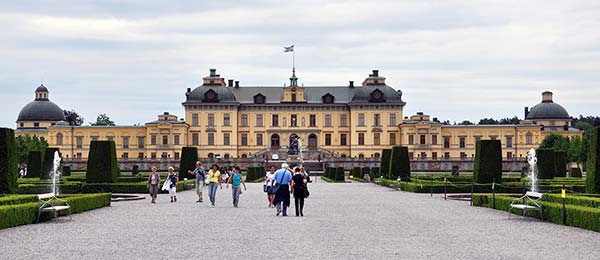
The queen’s 17th-century summer castle and current royal residence has been called “Sweden’s Versailles.” While that’s a bit of a stretch, taken as a whole the Drottningholm Palace complex is worth ▲▲. It’s enjoyable to explore the place where the Swedish royals bunk and to stroll their expansive gardens. Even more worthwhile is touring the Baroque-era theater on the grounds (itself rated ▲▲), which preserves 18th-century stage sets and rare special-effects machinery. If you’ve seen plenty of palaces, skip the interior but enjoy the grounds and theater tour. You can likely squeeze everything in with half a day here, or linger for an entire day.
GETTING THERE
Drottningholm is an easy boat or subway-plus-bus ride from downtown Stockholm. Consider approaching by water (as the royals traditionally did) and then returning by bus and subway (as a commoner). If your heart is set on touring the palace interior, check the website before you go: It can close unexpectedly for various events.
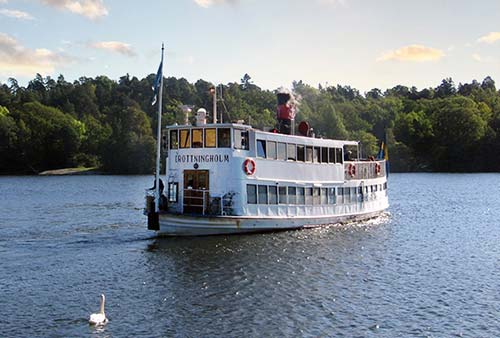
Boats depart regularly from the Klara Malarstrand pier just across from City Hall for the relaxing hour-long trip (215 SEK one-way, 315 SEK round-trip, on the hour daily, fewer departures Sept-April, +46 8 1200 4000, www.stromma.com). The pier is a five-minute walk from the central train station (on Vasagatan, walk toward the water, staying to the right and crossing a plaza under the freeway to reach the pier). It’s worth reserving a spot in advance on weekends, or if your day plan requires a particular departure.
It’s faster (30-45 minutes total) to take public transit: Ride the T-bana about 20 minutes to Brommaplan, where you can catch any #300-series bus for the five-minute ride to Drottningholm (as you leave the Brommaplan station, check monitors to see which bus is leaving next—usually from platform A, E, or F).
BACKGROUND
“Drottningholm” means “Queen’s Island.” When the original castle mysteriously burned down in 1661 immediately after a visit from Queen Hedvig Eleonora, she (quite conveniently) had already commissioned plans for a bigger, better palace.
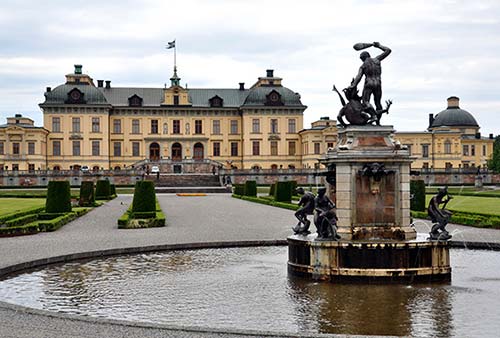
Built over 40 years—with various rooms redecorated by centuries of later monarchs—Drottningholm has the air of overcompensating for an inferiority complex. While rarely absolute rulers, Sweden’s royals long struggled with stubborn parliaments. Perhaps this made the propaganda value of the palace decor even more important. Touring the palace, you’ll see art that makes the point that Sweden’s royalty is divine and belongs with the gods. Portraits and prominently displayed gifts from fellow monarchs attempt to legitimize the royal family by connecting the Swedish blue bloods with Roman emperors, medieval kings, and Europe’s great royal families. Portraits you’ll see (such as of France’s Louis XVI) are reminders that Sweden’s royalty was related to or tightly networked with other European dynasties.
Of course, today’s monarchs are figureheads ruled by a constitution. The royal family makes a point to be as accessible and as “normal” as royalty can be. King Carl XVI Gustaf (b. 1946)—whose main job is handing out Nobel Prizes once a year—is a car nut who talks openly about his dyslexia. He was the first Swedish king not to be crowned “by the grace of God.” At his 1976 wedding to the popular Queen Silvia, ABBA serenaded his bride with “Dancing Queen.” Their daughter Crown Princess Victoria is heir to the throne (she studied political science at Yale, interned with Sweden’s European Union delegation, and married her personal trainer, Daniel Westling, in 2010). The king and queen still live in one wing of Drottningholm.
SIGHTS AT DROTTNINGHOLM
Drottningholm Palace (Drottningholms Slott)
While not the finest palace interior in Europe (or even in Scandinavia), Drottningholm offers a chance to stroll through a place where a monarch still lives. You’ll see two floors of lavish rooms, where Sweden’s royalty did their best to live in the style of Europe’s divine monarchs.
Cost and Hours: Palace-150 SEK, Chinese Pavilion-120 SEK, combo-ticket-220 SEK; Gardens-free; open May-Sept daily 10:00-17:00, April until 16:00, rest of year open weekends only 10:00-16:00, closed last two weeks of Dec; +46 8 402 6100, www.kungligaslotten.se.
Tours: You can explore the palace by using the audioguide, but there’s also a guided tour in English (daily at 11:30 in summer, weekends only in Sept-May). Alternatively, you could buy the inexpensive palace guidebook.
Services: The gift shop/café at the entrance to the grounds (near the boat dock and bus stop) acts as a visitors center; Drottningholm’s only WCs are in the adjacent building.
Visiting Drottningholm Palace: Ascend the grand staircase (decorated with faux marble and relief-illusion paintings) and buy your ticket. Entering the staterooms on the first floor, admire the craftsmanship of the walls, with gold leaf shimmering on expertly tooled leather. You’ll pass through a guardroom and one of several drawing rooms, then hook right to see Karl X Gustaf’s Gallery, lined with big paintings of battles. The prescribed visiting path takes you through another drawing room before you come to Hedvig Eleonora’s State Bed Chambers.
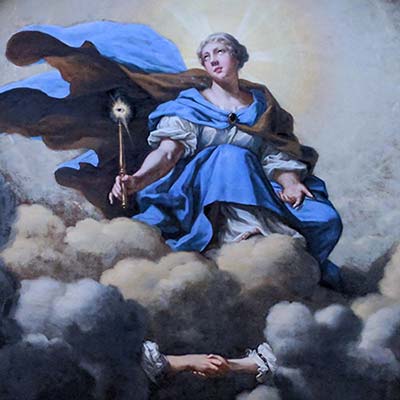
The richly colored Baroque decor here, with gold embellishments, is representative of what the entire interior once looked like. Hedvig Eleonora was a “dowager queen,” meaning that she was the widow of a king—her husband, King Karl X, died at age 24, after they had been married just six years. Looking around the room, you’ll see symbols of this tragic separation. For example, in the ceiling painting, Hedvig Eleonora rides a cloud, with hands joined below her, suggesting that she will be reunited with her beloved in heaven.
This room was also the residence of a later monarch, theater-loving Gustav III. That’s why it looks like (and was) more of a theater than a place for sleeping. In the style of the French monarchs, this is where the ceremonial tucking-in and dressing of the king would take place.
After the bed chamber, you’ll come to the Green Cabinet, with a bunch of portraits staring at you from the walls. Notice these royals’ very consistent characteristics: pale skin with red cheeks, high forehead with gray hair (suggesting wisdom), and big eyes (windows to the soul). You’ll also see the grand library, which once held some 7,000 books. One of the scientists who helped Queen Lovisa Ulrika manage all her tomes was the great botanist Carl Linnaeus, whom you’ll learn about if you go to Uppsala. The small adjoining room is filled by a large model of a temple in Pompeii; Gustav III—who ordered this built—was fascinated by archaeology, and still today, there’s a museum of antiquities named for him at the Royal Palace in Stockholm.
On the second floor, as you enter the first room, notice the faux doors, painted on the walls to create symmetry, and the hidden doors for servants (who would scurry—unseen and unheard—through the walls to attend to the royal family). In the Chinese Drawing Room you’ll see a gift from the then-king’s cousin, Russian monarch Catherine the Great: a (made-in-Russia) faux “Chinese” stove. This dates from a time when exotic imports from China (tea, silk, ivory, Kung Pao chicken) were exciting and new. (Around the same time, in the mid-18th century, the royals built the Chinese Pavilion on Drottningholm’s grounds.) The Gobelins tapestries in this room were also a gift, from France’s King Louis XVI. In the next room, the darker Oskar Hall, are more tapestries—these a gift from England’s King Charles I. (Sensing a trend?) You’ll pass through Karl XI’s Gallery, overlooking the grand staircase, with more battle paintings (because you can never have too many); this space is still used for royal functions. Saving the grandest for last, you’ll come to the largest room on this floor, the Hall of State. The site of royal weddings and receptions, this room boasts life-size paintings of very important Swedes in golden frames and a bombastically painted ceiling.
Drottningholm Palace Park
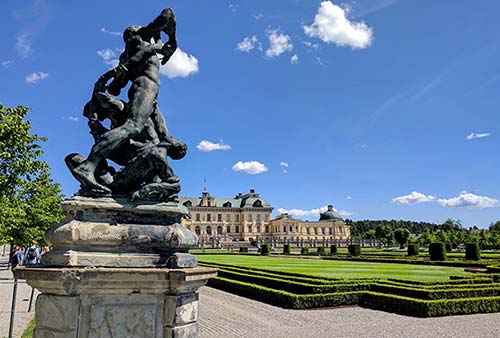
Like so many European “summer palaces,” the Drottningholm grounds are graced with sprawling gardens—a pretty (and free) place to stroll on a fine day. Directly behind the palace is the strictly geometrical Baroque Garden, with angular hedges, tidy rows of trees, fountains, and outdoor “rooms” at the far end. It adjoins the more naturalistic English Garden, which Gustav III was determined to have after seeing one of the landscape gardens belonging to his cousin Catherine the Great. (It was Gustav, too, who speckled the grounds with marble statues.) At the far end of the grounds is the Chinese Pavilion, containing a fine Rococo interior with chinoiserie (separate admission).
Drottningholm Court Theater (Drottningholms Slottsteater)
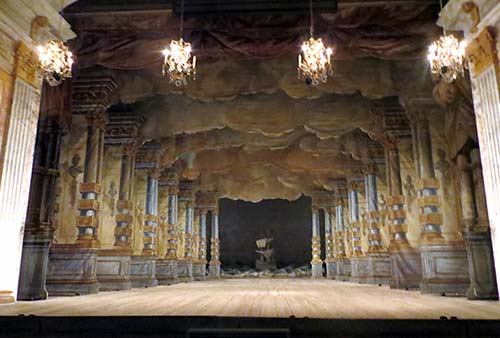
This 18th-century theater has miraculously survived the ages—complete with its instruments, Baroque stage sets, and hand-operated sound-effects machines for wind, thunder, and clouds. The required guided tour is short (30 minutes), entertaining, and informative—I found it more enjoyable than the palace tour.
Cost and Hours: 110 SEK for 30-minute guided tour—buy tickets online or in the theater shop next door; June-Sept English tours usually daily at 11:00, 12:00, 14:00, and 15:00; limited tours possible on weekends off-season; no tours Jan-March; +46 8 556 931 00, www.dtm.se.
Performances: Check the theater’s website for the rare opportunity to see perfectly authentic operas (about 25 performances each summer). Tickets for this popular time-travel musical and theatrical experience go on sale a few months in advance and often sell out (300-2,000 SEK).
Background: This is one of a handful of intact Baroque theaters around Europe. A Swedish king built it in the 1760s to pacify his Prussian wife, who was appalled by the provincialism of Sweden’s performing arts. Their son, King Gustav III, loved the theater (some say more than he loved ruling Sweden): Besides ordering Stockholm’s Royal Opera to be built, he also wrote, directed, and acted in several theatrical presentations (including the first-ever production in Swedish instead of French, the usual court language). He even died in a theater, assassinated at a masquerade ball in the very opera house he had built. When he died, so too did this flourishing of culture: The theater became a warehouse for storing royal bric-a-brac. The stage stayed dark until the mid-1940s, when opera and plays were once again performed here.
Visiting the Theater: On the tour, you’ll see the bedrooms where famous actors and conductors would sleep while performing here, then enter the theater itself, lit only with (now simulated) candles. You’ll see the extremely deep stage (with scenery peeking in from the edges), the royal boxes where the king and queen entered, and doors and curtains that were painted onto walls to achieve perfect symmetry.
It’s fascinating to think that pulleys, trap doors, and contraptions that float actors in from the sky aren’t so different from devices employed on stages today. Because the mechanisms are fragile, they aren’t demonstrated on the tour, but you can watch a video demonstration in the theater shop next door.
Sigtuna
Sigtuna, the oldest town in Sweden (established in the 970s), may be the country’s cutest town as well. Worth ▲, it sits sugary sweet on Lake Mälaren, about 30 miles inland from Stockholm (reachable by train/bus or sightseeing boat). A visit here affords a relaxed look at an open-air folk museum of a town, with ruined churches, ancient rune stones, and a lane of 18th-century buildings—all with English info posts. It also offers plenty of shopping and eating options in a parklike lakeside setting. If you’re looking for stereotypical Sweden and a break from the big city, Sigtuna is a fun side trip.
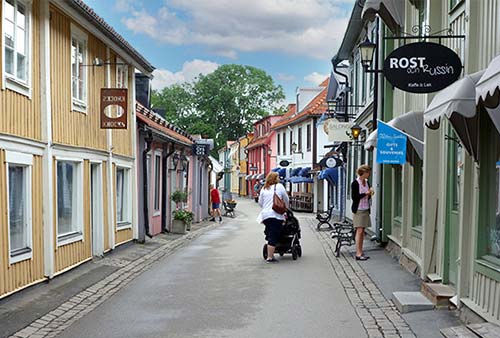
Getting There: By public transport from Stockholm, it’s a one-hour trip. Take the pendeltåg suburban train from Stockholm to Märsta and then change to bus #570, #575, or #579. Sigtuna is within Stockholm’s transit network, so tickets you buy on the SL app will get you there. Guided sightseeing cruises run to Sigtuna late June to mid-August (455 SEK round-trip; boats depart Thu-Sun at 10:00 from Stockholm’s Klara Mälarstrand dock and take 2 hours; boats head back to Stockholm at 16:30, giving you about 4 hours in Sigtuna; www.stromma.com). If traveling by car to Uppsala or Oslo, Sigtuna is a short detour.
Tourist Information: The helpful TI is on the main street and eager to equip you with a town map (Mon-Fri 8:00-16:00, Sat-Sun 11:00-15:00, Storagatan 33, +46 8 5948 0650, www.destinationsigtuna.se).
Sights in Sigtuna
Main Street: Storagatan
Sigtuna’s main street provides the town’s spine. Along it, besides the TI, you’ll find the tiny Town Hall from 1744, with a nicely preserved interior (free, daily 12:00-16:00 in summer). At the end of the street you’ll come to the Sigtuna history museum, with exhibits based on area archaeological finds from the Viking and Middle ages. Pick up their free rune walk map or download it from www.sigtuna.se—search for “Secret of the Runes” (60 SEK, daily 12:00-16:00, closed Mon in Sept-June, Storagatan 55). As you stroll the street, read the historical signs posted along the way and poke into shops and cafés. The most charming place for lunch, a snack, or a drink is Tant Bruns Kaffestuga (“Auntie Brown’s” Café”), tucked away just around the corner from the TI in a super-characteristic 17th-century home with a cozy garden.
Churches
Before the Reformation came along, Sigtuna was an important political and religious center, and the site of the country’s archbishopric. Along with powerful monastic communities, the town had seven churches. When the Reformation hit, that was the end of the monasteries, and there was a need for only one church—the Gothic Mariakyrkan. It survived, and the rest fell into ruins. Mariakyrkan, or Mary’s Church, built by the Dominicans in the 13th century, is decorated with pre-Reformation murals and is worth a look.
The stony remains of St. Olaf’s Church stand in the Mary’s Church cemetery. This 12th-century ruin is evocative, with stout vaults and towering walls that served the community as a place of last refuge when under attack.
Rune Stones
Sigtuna is dotted with a dozen rune stones. Literally “word stones,” these memorial stones are carved with messages in an Iron Age runic language. Sigtuna has more of these than any other Swedish town. Those here generally have a cross, indicating that they are from the Christian era (11th century). Each is described in English. I like Anund’s stone, which says, “Anund had this stone erected in memory of himself in his lifetime.” His rune carver showed a glimpse of personality and that perhaps Anund had no friends. (It worked. Now he’s in an American guidebook, and 10 centuries later, he’s still remembered.)
Uppsala
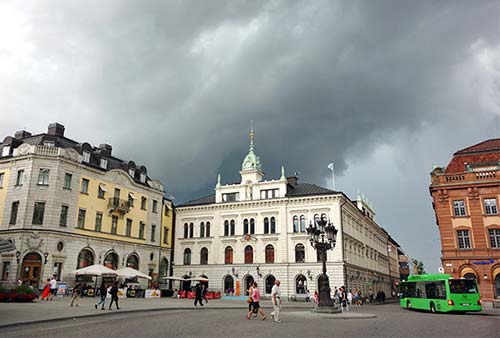
Uppsala, Sweden’s fourth-largest city, is a rather small town with a big history. A few blocks in front of its train station, an inviting commercial center bustles around the main square and along a scenic riverfront. Towering across the river are its historic cathedral and a venerable university. For visitors, the university features a rare 17th-century anatomical theater, an exhibit of its prestigious academic accomplishments, and a library with literary treasures on display. Uppsala is home to the father of modern botany, Carl Linnaeus, whose garden and house—now a museum—make for a fascinating visit. And just outside town stands Gamla Uppsala, the site of a series of majestic burial mounds where Sweden buried its royalty back in the sixth century. While Gamla Uppsala is a short bus ride away, everything else is within delightful walking distance. If you’re not traveling anywhere else in Sweden other than Stockholm, Uppsala (less than an hour away) makes a pleasant day trip. While buzzing during the school year, this university town is sleepy during summer vacations.
GETTING THERE
Take the train from Stockholm’s central station (3-4/hour, 40 minutes, around 110 SEK; also possible on slower suburban pendeltåg—2/hour, 55 minutes, covered by local transit pass plus small supplement that you have to buy at a ticket window). Since the Uppsala station has lockers and is in the same direction from Stockholm as the airport, you could combine a quick visit here with an early arrival or late departure. Ambitious sightseers can do a full day trip that combines Sigtuna and Uppsala: Take the train and bus to Sigtuna, then bus back to the Märsta train station to catch one of the frequent trains to Uppsala.
Orientation to Uppsala
TOURIST INFORMATION
You’ll find helpful basic TIs (InfoPoint kiosks) scattered around town (see website for locations and hours). The most practical location is at the UL Center inside the train station (Mon-Fri 7:00-19:00, Sat 9:00-17:00, closed Sun). All locations have maps; fans of Linnaeus may want to pick up one of several fliers following his trail through town (+46 18 727 0000, www.destinationuppsala.se).
ARRIVAL IN UPPSALA
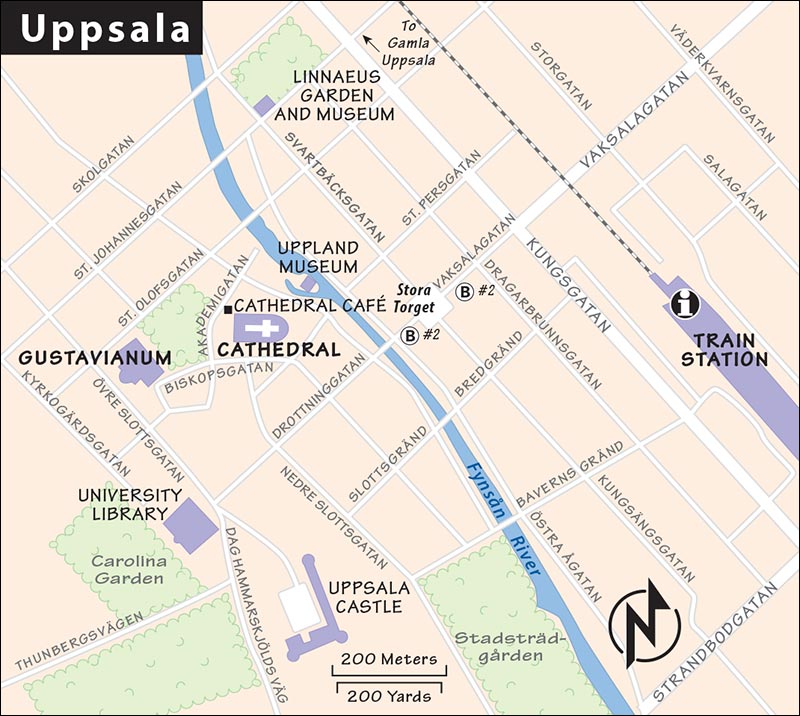
From the train station (pay lockers, TI), cross the busy street and walk two blocks to Kungsängsgatan, turn right, and walk to the main square, Stora Torget. The spires of the cathedral mark two of the top three sights (the cathedral itself and the adjacent university buildings). The Linnaeus Garden and Museum is a few blocks up the river.
Sights in Uppsala
▲▲Uppsala Cathedral (Uppsala Domkyrkan)
One of Scandinavia’s largest, most historic cathedrals feels as vital as it does impressive. While the building was completed in 1435, the spires and interior decorations are from the late 19th century. The cathedral—with a fine Gothic interior, the relics of St. Erik, memories of countless Swedish coronations, and the tomb of King Gustav Vasa—is well worth a visit.
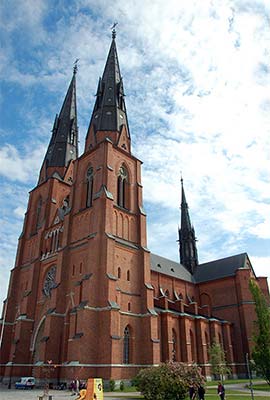
Cost and Hours: Free, daily 8:00-18:00; free guided English tours a couple of times per day in summer (Mon-Sat at 10:00 and 15:00, Sun at 12:30 and 14:15), or pick up brochure in gift shop; +46 18 430 3630, www.uppsaladomkyrka.se.
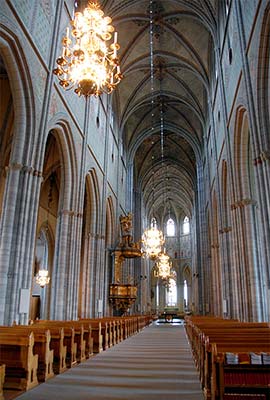
Visiting the Cathedral: Grab a seat in a pew and take in the graceful Gothic lines of the longest nave in Scandinavia (130 yards). The gorgeously carved, gold-slathered Baroque pulpit is a reminder of the Protestant (post-Reformation) focus on preaching the word of God in the people’s language. Look high above in the choir area to enjoy fine murals, restored in the 1970s. For ages, pilgrims have come here to see the relics of St. Erik. All around you are important side chapels, tombs, and memorials.
Near the entrance (second side chapel on the left) is the tomb and memorial to scientist Carl Linnaeus, the father of modern botany, who spent his career at the university here (for more on him, see the Linnaeus Garden and Museum listing, later).
In the chapel at the far east end of the church is the tomb of King Gustav Vasa and his family. This chapel was originally dedicated to the Virgin Mary. But Gustav Vasa brought the Reformation to Sweden in 1527 and usurped this prized space for his own tomb. In good Swedish style, the decision was affirmed by a vote in parliament, and bam—the country was Lutheran. (A few years later, England’s King Henry VIII tried a similar religious revolution—and had a much tougher time.) Notice that in the tomb sculpture, Gustav is shown flanked by two wives—his first wife died after suffering a fall; his second wife bore him 10 children. High above are murals of Gustav’s illustrious life.
Speaking of Mary, notice the lifelike modern statue of a common, rather than regal, Protestant Mary outside the chapel looking in. In keeping with the Protestant spirit here, Mary is shown not as an exalted queen, but as an everywoman, saddened by the loss of her child and seeking solace—or answers—in the church.
Cathedral Treasury: By the gift shop, you can pay to ride the elevator up to the treasury collection. Here (with the help of a loaner flashlight and English translations), you’ll find medieval textiles (tapestries and vestments), swords and crowns found in Gustav’s grave, and the Nobel Peace Prize won by Nathan Söderblom, an early-20th-century archbishop here (60 SEK, Mon-Sat 10:00-16:00, Sun from 12:30).
Eating: The handy, reasonable $$ Cathedral Café (a few steps to the right as you exit the cathedral) has a small menu—but your money supports the city’s mission of helping the local homeless population (lunch specials, daily 10:00-17:00). Or, survey the many eateries on or near the main square or along the river below the cathedral.
UNIVERSITY AND NEARBY
Scandinavia’s first university was founded in Uppsala in 1477. Two famous grads are Carl Linnaeus (the famous botanist) and Anders Celsius (the scientist who developed the temperature scale that bears his name). The campus is scattered around the cathedral part of town, and two university buildings are particularly interesting and welcoming to visitors: the Gustavianum and the library.
▲▲Gustavianum
Facing the cathedral is the university’s oldest surviving building, with a bulbous dome that doubles as a sundial (notice the gold numbers). Today it houses a well-presented museum that features an anatomical theater, a cabinet filled with miniature curiosities, and Celsius’ thermometer. The collection is curiously engaging for the glimpse it gives into the mindset of 17th-century Europe.
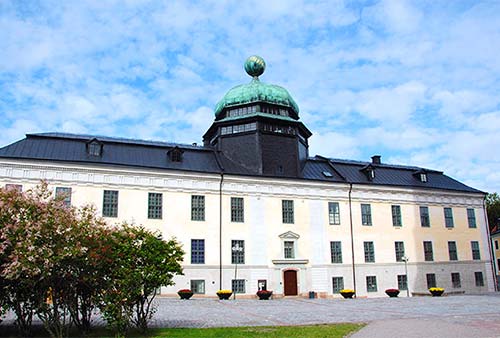
Cost and Hours: 50 SEK, generally Tue-Sun 10:00-16:00, Sept-May from 11:00, closed Mon year-round, Akademigatan 3, +46 18 471 7571, www.gustavianum.uu.se.
Visiting the Gustavianum: Note that the Gustavianum will likely be reopen after major renovations by the time you visit, so there may be changes from what’s described here.
The finely crafted Viking artifacts were discovered at Valsgärde, a prehistoric site near Uppsala used for burials for more than 700 years. Archaeologists have uncovered 15 boat graves here (dating from AD 600-1050—roughly one per generation), providing insight on the Viking Age.
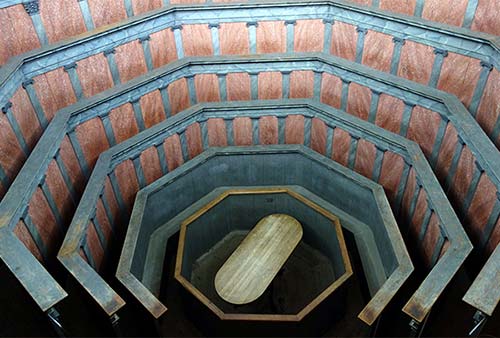
The anatomical theater’s only show was human dissection. In the mid-1600s, as the enlightened ideas of the Renaissance swept far into the north of Europe, scholars began to consider dissection of the human body the ultimate scientific education. Corpses of hanged criminals were carefully sliced and diced here, under a dome in an almost temple-like atmosphere, demonstrating the lofty heights to which science had risen in society. Imagine 200 students standing tall all around, leaning in to view the teacher’s scalpel.
Many artifacts illustrate the fascinating history of the university. The Physics Chamber features a collection of instruments from the 18th and 19th centuries that were used by university teachers. The Augsburg Art Cabinet takes center stage here with a dizzying array of nearly 1,000 minuscule works of art and other tidbits held in an ornately decorated oak cabinet.
Built in the 1620s for a bigwig who wanted to impress his friends, the cabinet once held the items now shown in the display cases surrounding it. Find the interactive video screen, where you can take a virtual tour of the collection. Just beyond the cabinet is a thermometer that once belonged to Celsius (in his handwriting, notice how 0 and 100 were originally flip-flopped, with water boiling at 0 degrees Celsius rather than 100).
The university’s classical antiquities collection from the Mediterranean includes ancient Greek and Roman artifacts and Egyptian sarcophagi, which were used to bring classical culture and art to students unable to travel abroad.
▲University Library (Universitetsbiblioteket)
Uppsala University’s library, housed in a 19th-century building called the Carolina Rediviva, is a block uphill from the cathedral and Gustavianum. Off the entry hall (to the left) is a small but exquisite exhibit of treasured old books. Well-displayed and well-described in English, the carefully selected collection is surprisingly captivating.
Cost and Hours: Free, daily 12:00-16:00, Dag Hammarskjölds väg 1, +46 18 471 3900, www.ub.uu.se.
Visiting the Library: Display cases hold treasures like Mozart scores in the composer’s hand, margin notes by Copernicus in a 13th-century astronomy book, and a 1555 map of Mexico City.
The most valuable item is the Silver Bible, a translation from Greek of the four Gospels into the now-extinct Gothic language. Written in Ravenna in the sixth century, Sweden’s single most precious book is so named for its silver-ink writing on purple-colored calfskin vellum. Booty from a 1648 Swedish victory in Prague, it ended up at Uppsala University in 1669.
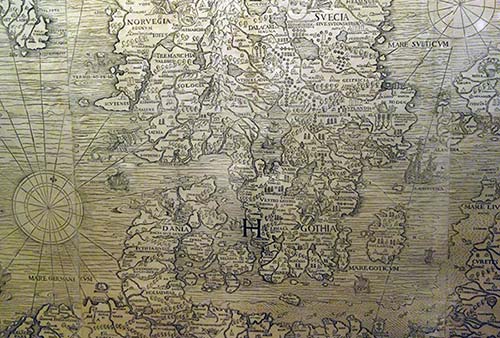
Another rarity is the Carta Marina, the first more-or-less accurate map of Scandinavia, printed in Venice in 1539 from nine woodblocks. Compare this 16th-century understanding of the region with your own travels.
▲Linnaeus Garden and Museum (Linnéträdgården)
Carl Linnaeus, famous for creating the formal system for naming plant and animal species, spent his career in Uppsala as a professor. This home, office, greenhouse, and garden is the ultimate Linnaeus sight, providing a vivid look at this scientist and his work.
Cost and Hours: 100 SEK for museum and garden, includes audioguide; museum open June-Aug daily 11:00-17:00, closed Mon in May and Sept and all of Oct-April; garden open until 20:00; daily 45-minute English tours at 11:30 and 14:30; after 17:00, when the museum closes, the garden becomes a free public space—enter on Svartbäcksgatan at #27; +46 18 471 2838, www.linnaeus.uu.se.
Visiting the Garden and Museum: When you buy your ticket, pick up the included audioguide or the thorough pamphlet that describes the objects on display.
While Linnaeus (whose noble name was Carl von Linné) was professor of medicine and botany at the University of Uppsala, he lived and studied here. From 1743 until 1778, he ran this botanical garden and lived on site to study the plant action—day and night, year-round—of about 3,000 species. When he moved in, the university’s department of medicine and botany moved in as well.
It was in this garden (the first in Sweden, originally set up in 1655) that Linnaeus developed a way to classify the plant kingdom. Wandering the garden where the most famous of all botanists did his work, you can pop into the orangery, built so temperate plants could survive the Nordic winters.
The museum, in Linnaeus’ home (which he shared with his wife and seven children), is filled with the family’s personal possessions and his professional gear. You’ll see his insect cabinet, herb cabinet, desk, botany tools, and notes.
More Sights near the University
Two free museums are within walking distance of the cathedral. The Uppland Museum (Upplandsmuseet), a regional history museum with prehistoric bits and folk-art scraps, is on the river by the waterfall (Tue-Sun 11:00-17:00, closed Mon, +46 18 169 100, www.upplandmuseet.se [URL inactive]). Uphill from the university library is the 16th-century Uppsala Castle, which houses an art museum (daily 11:00-17:00, +46 18 727 2482, www.konstmuseum.uppsala.se).
ON THE OUTSKIRTS
▲Gamla Uppsala
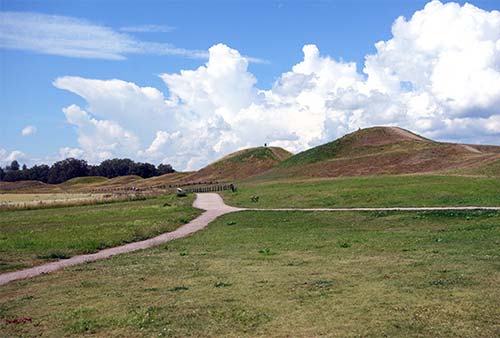
This pleasant, scenic site on the outskirts of town gives historians goose bumps. Gamla Uppsala—literally, “Old Uppsala”—includes nine large royal burial mounds circled by a walking path. Fifteen hundred years ago, when the Baltic Sea was higher and it was easy to sail all the way to Uppsala, the pagan Swedish kings had their capital here. Old Uppsala is where the Swedish kingdoms came together and a nation coalesced.
Cost and Hours: The mounds are free and always open. The museum is 150 SEK and open daily 11:00-17:00 (shorter hours in Sept-March and closed Tue and Thu in winter). In summer your museum admission includes a 40-minute guided English tour of the museum and mounds (generally July-Aug daily at 12:00 and 15:30, +46 18 239 312, www.upplandsmuseet.se/gamla-uppsala-museum). The church is free and open daily 9:00-17:00, Sept-March until 16:00 (tiny church museum across the lane is free and open Sat-Sun only).
Getting There: A direct city bus stops right at the site. From Uppsala, take bus #2 (marked Gamla Uppsala) from stops on either Drottninggatan or Vaksalagatan (near Stora Torget); ride to the last stop—Kungshögarna (42 SEK if bought on board—credit cards only, otherwise buy ticket at Pressbyrån kiosk on the square; 2-4/hour, 15-minute trip). All the Gamla Uppsala sights are within 200 yards of each other, making it an easy visit. You can also walk, which takes about an hour from Stora Torget, but I’d do it on the way back because you can follow the cathedral’s spires a good part of the way—the Uppsala TI also has a “Gamla Uppsala Trail” map.
Eating: Gamla Uppsala is great for picnics, or you can drop by the rustic and half-timbered $$ Odinsborg café, which serves sandwiches, mead, and daily specials (daily 10:00-17:00, +46 18 323 525).
Visiting Gamla Uppsala: The highlight here is seeing the mounds, and imagining those shadowy saga-days when they were built. There’s also a small, overpriced museum, and a 12th-century church.
The Mounds: The focus of ritual and religious activities from the 6th through 13th century, the mounds are made meaningful with the help of English info boards posted around.
Imagine the scene over a thousand years ago, when the democratic tradition of this country helped bring the many small Swedish kingdoms together into one nation. A ting was a political assembly where people dealt with the issues of the day. Communities would gather here at the rock that marked their place, and then the leader, standing atop the flat mound (nearest today’s café), would address the crowd as if in a natural amphitheater. It was here that Sweden became Christianized a thousand years ago.
In 2019, archaeologists unearthed two Viking-age boats underneath some modern houses in Gamla Uppsala. One of the boats included the remains of a man, horse, and dog, as well as a sword, spear, shield, and ornate comb. The find is considered especially remarkable because neither the boats nor remains had been cremated, as was the traditional practice—possibly reflecting the arrival of Christianity in the region.
Museum: Gamla Uppsala’s museum gives a decent overview of early Swedish history and displays items found in the mounds. It’s instructive, with plenty of excavated artifacts, but not a must.
Church: Likely standing upon a pagan holy site, the church dates from the 12th century and was the residence of the first Swedish archbishop. An 11th-century rune stone is embedded in the external wall. In the entryway, an iron-clad oak trunk with seven locks on it served as the church treasury back in the 12th century. In the nave, a few Catholic frescoes, whitewashed over in the 16th century with the Reformation, have been restored.