SWEDEN
Sverige
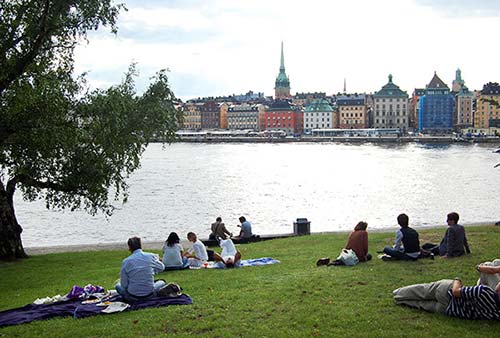
Scandinavia’s heartland, Sweden is far bigger than Denmark and far flatter than Norway. This family-friendly land is home to Ikea, Volvo, ABBA, and long summer vacations at red-painted, white-trimmed summer cottages. Its capital, Stockholm, is Scandinavia’s grandest city.
Sweden is committed to its peoples’ safety and security, and proud of its success in creating a society with one of the lowest poverty rates in the world. Yet Sweden has thrown in its lot with the European Union, and locals debate whether to open their economy even further.
Sweden used to be a Lutheran state, with the Church of Sweden as its official religion. But in the year 2000, the church and state officially separated, and Sweden no longer has a state church. Although the culture is nominally Lutheran, few people attend services regularly. While church is handy for Christmas, Easter, marriages, and burials, most Swedes are more likely to find religion in nature, such as hiking in the vast forests or fishing in one of the thousands of lakes or rivers.
Sweden is almost 80 percent wilderness, and modern legislation incorporates an ancient right of public access called allemansrätten, which guarantees that anyone can move freely through Sweden’s natural scenery without asking landowners for permission, as long as they behave responsibly. In summer, Swedes take advantage of the long days and warm evenings for festivals such as Midsummer (in late June) and crayfish parties (kräftskiva) in August and September. Many Swedes have a summer cottage—or know someone who does—where they spend countless hours swimming, soaking up the sun, and devouring boxes of juicy strawberries.

While Denmark and Norway look westward to Britain and the Atlantic, Sweden has always faced east, across the Baltic Sea. As Vikings, Norwegians went west to Iceland, Greenland, and America; Danes headed south to England, France, and the Mediterranean; and Swedes went east into Russia. (The word “Russia” has Viking roots.) In the early Middle Ages, Swedes founded the Russian cities of Nizhny Novgorod and Kiev, and even served as royal guards in Constantinople (modern-day Istanbul). During the later Middle Ages, German settlers and traders strongly influenced Sweden’s culture and language. By the 17th century, Sweden was a major European power, with one of the largest naval fleets in Europe and an empire extending around the Baltic, including Finland, Estonia, Latvia, and parts of Poland, Russia, and Germany. But by the early 19th century, Sweden’s war-weary empire had shrunk. The country’s current borders date from 1809.
During a massive wave of emigration from the 1860s to World War II, about a quarter of Sweden’s people left for the Promised Land—America. Many emigrants were farmers from the southern region of Småland. The House of Emigrants museum in Växjö tells their story (see the Southeast Sweden chapter), as do the movies The Emigrants and The New Land, based on the books of Vilhelm Moberg.
Official Name: Konungariket Sverige—the Kingdom of Sweden—or simply Sweden.
Size: At 174,000 square miles, Sweden is a little bigger than California, with 10.5 million people (about 60 per square mile).
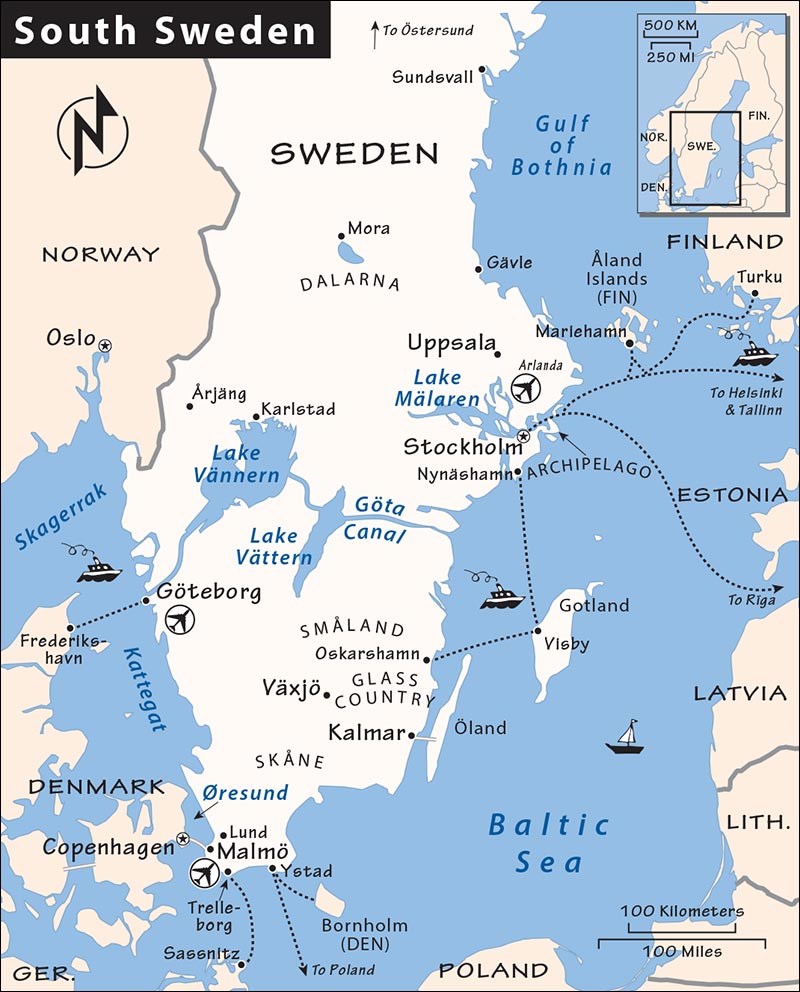
Geography: A chain of mountains divides Sweden from Norway on the Scandinavian Peninsula. Sweden’s mostly forested landscape is flanked to the east by the Baltic Sea, which contributes to the temperate climate. Sweden also encompasses several islands, of which Gotland and Öland are the largest.
Latitude and Longitude: 62°N and 15°E, similar latitude to Canada’s Northwest Territories.
Biggest City: Sweden’s capital city, Stockholm, has a population of 984,000, with more than two million in the metropolitan area. Göteborg (585,000) and Malmö (357,000) are the next-largest cities.
Economy: Sweden has a $597 billion gross domestic product and a per capita GDP of $55,200—similar to Germany’s. Manufacturing, telecommunications, automobiles, and processed foods rank among its top industries, along with timber, hydropower, and iron ore. The Swedish economy is one of the strongest in Europe, helped by its competitive high-tech businesses—and by the government’s generally conservative fiscal policies. Some 71 percent of Swedish workers belong to a labor union.
Government: King Carl XVI Gustav is the ceremonial head of Sweden’s constitutional monarchy. The 349-member Swedish Parliament (Riksdag) is elected every four years and led by a prime minister, who appoints cabinet members.
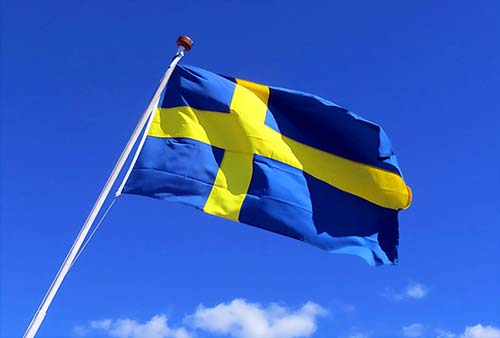
Flag: The Swedish flag is blue with a yellow Scandinavian cross. The colors are derived from the Swedish coat of arms, with yellow symbolizing the generosity of the people and blue representing vigilance, truth, loyalty, perseverance, and justice.
The Average Swede is 41 years old, has 1.87 children, and will live to be 82.
The 20th century was good to Sweden. While other European countries were embroiled in two world wars, neutral Sweden grew stronger, finding equilibrium between the extremes of communism and the free market. In the postwar years, Sweden adopted its famous “middle way,” an economic model that balanced the needs of the democratic state and the private business sector.
The Swedish model worked very well for a while, providing a booming economy and robust social services for all. But the flip side of those ambitious programs is one of the highest tax levels in the world. After a recession hit in the early 1990s, some started to criticize the middle way as unworkable. But Sweden’s economy improved in the late 1990s and early 2000s, buoyed by a strong lineup of successful multinational companies. Volvo (now Chinese-owned but Sweden-based), Scania (trucks and machinery), Ikea, H&M, and Ericsson led the way in manufacturing, design, and technology.
The global economic downturn of 2008-2009 had its impact on Sweden’s export-driven economy: Unemployment ticked upward (although it remains enviably low compared to other countries), its famously generous welfare systems felt the pressure, and its Saab car manufacturer filed for bankruptcy protection. But Sweden has rebounded since the crisis, and the country’s fortunes have outpaced those of the European Union—Sweden’s main export market.
Historically Sweden has had an open-door policy when it comes to accepting immigrants. Beginning in the 1960s, Sweden (like Denmark and Norway) accepted many immigrants and refugees from southeastern Europe, the Middle East, and elsewhere. This praiseworthy humanitarian policy dramatically—and sometimes painfully—diversified a formerly homogenous country. But in 2015 and 2016, with refugees flooding in from Syria, Swedish social services were tested as never before. Migration laws were tightened in 2015. Today, only two percent of Swedish immigrants are from Syria, and it has not been as welcoming to Ukrainian refugees as other European nations. Sweden is also home to about 30,000 indigenous Sami people.
In Sweden, the dominant language is Swedish, but most residents speak English as well. Even though communication is rarely an issue, a few Swedish words are helpful and appreciated. “Hi” is “Hej” (hey). “Thank you” is “Tack” (tack), which can also double for “please.” For a longer list of Swedish survival phrases, see the next page.
Swedish Survival Phrases
Swedish pronunciation (especially the vowel sounds) can be tricky for Americans, and there’s quite a bit of variation across the country; listen closely to locals and imitate, or ask for help. The most difficult Swedish sound is sj, which sounds roughly like a guttural “hw” (made in your throat); however, like many sounds, this is pronounced differently across regions—for example, Stockholmers might say it more like “shw.”
| Hello. (formal) | Goddag. goh-dahg |
| Hi. / Bye. (informal) | Hej. / Hej då. hey / hey doh |
| Yes. / No. | Ja. / Nej. yaw / nay |
| Please. | Snälla. / Tack.* snehl-lah / tack |
| Thank you (very much). | Tack (så mycket). tack (soh mee-keh) |
| You’re welcome. | Ingen orsak. eeng-ehn oor-sahk |
| Can I help you? | Kan jag hjälpa dig? kahn yaw yehl-pah day |
| Excuse me. | Ursäkta. oor-sehk-tah |
| (Very) good. | (Mycket) bra. (mee-keh) brah |
| Goodbye. | Adjö. ah-yew |
| zero / one / two | noll / en / två nohl / ehn / tvoh |
| three / four | tre / fyra tree / fee-rah |
| five / six | fem / sex fehm / sehks |
| seven / eight | sju / åtta hwoo / oh-tah |
| nine / ten | nio / tio nee-oh / tee-oh |
| hundred | hundra hoon-drah |
| thousand | tusen too-sehn |
| How much? | Hur mycket? hewr mee-keh |
| local currency: (Swedish) kronor | (Svenska) kronor (sven-skeh) kroh-nor |
| Where is...? | Var finns...? var feens |
| ...the toilet | ...toaletten toh-ah-leh-tehn |
| men | män men |
| women | kvinnor kvee-nor |
| water / coffee | vatten / kaffe vah-tehn / kah-feh |
| beer / wine | öl / vin url / veen |
| Cheers! | Skål! skohl |
| The bill, please. | Notan, tack. noh-tahn tack |
*Swedish has various ways to say “please,” depending on the context. The simplest is snälla, but Swedes sometimes use the word tack (thank you) the way we use “please.”