STAVANGER
Stavanger • Lysefjord & Pulpit Rock
Day Trips to Lysefjord and Pulpit Rock
DINING ALONG THE HARBOR WITH A VIEW
GLOBAL AND MODERN FOOD ON PEDERSGATA
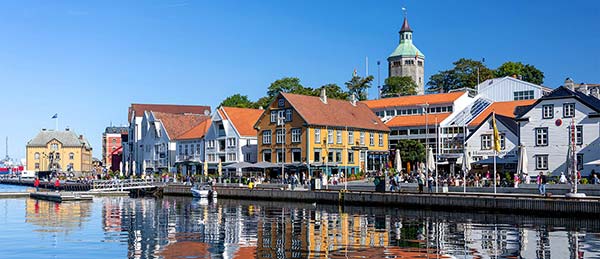
This waterfront city of about 145,000 (Norway’s third-biggest) feels more cosmopolitan than most Norwegian cities, thanks in part to its oil industry—which brings multinational workers (and investment) into the city. Nearly one in four residents comes from outside Norway. Stavanger is urban, yet surprisingly charming in places. Its streets are lined with unpretentious shiplap cottages that echo its perennial ties to the sea.
For many visitors, Stavanger functions primarily as a launch pad for side-tripping to the famous, iconic Pulpit Rock—an eerily flat-topped plateau thrusting 2,000 feet above the Lysefjord, with an eagle’s-eye view. But the city itself is also well worth a wander. You can see everything in just a few hours: Delve into the oil industry at the surprisingly interesting Norwegian Petroleum Museum. Stroll the pretty lanes of Gamle Stavanger (the historic shiplap quarter), with insightful museums that tell the story of this hardworking port town. Admire its historic cathedral, and appreciate its diverse and creative food scene. Stavanger, with easy access for big ships right in the heart of town, is also a popular cruise port.
PLANNING YOUR TIME
If you’re here for the famous Pulpit Rock hike, it takes most of a day, requiring at least one overnight. Any remaining time in Stavanger can be used wandering the historic districts on either side of the harbor.
If you have a full day here (or are here on a cruise), Stavanger can fill it. Begin with my self-guided walk around the harbor area. Then visit the cathedral and any other museums that appeal to you (the IDDIS, covering the printing and canning industries, and Norwegian Petroleum museums are best).
Orientation to Stavanger
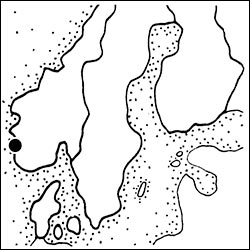
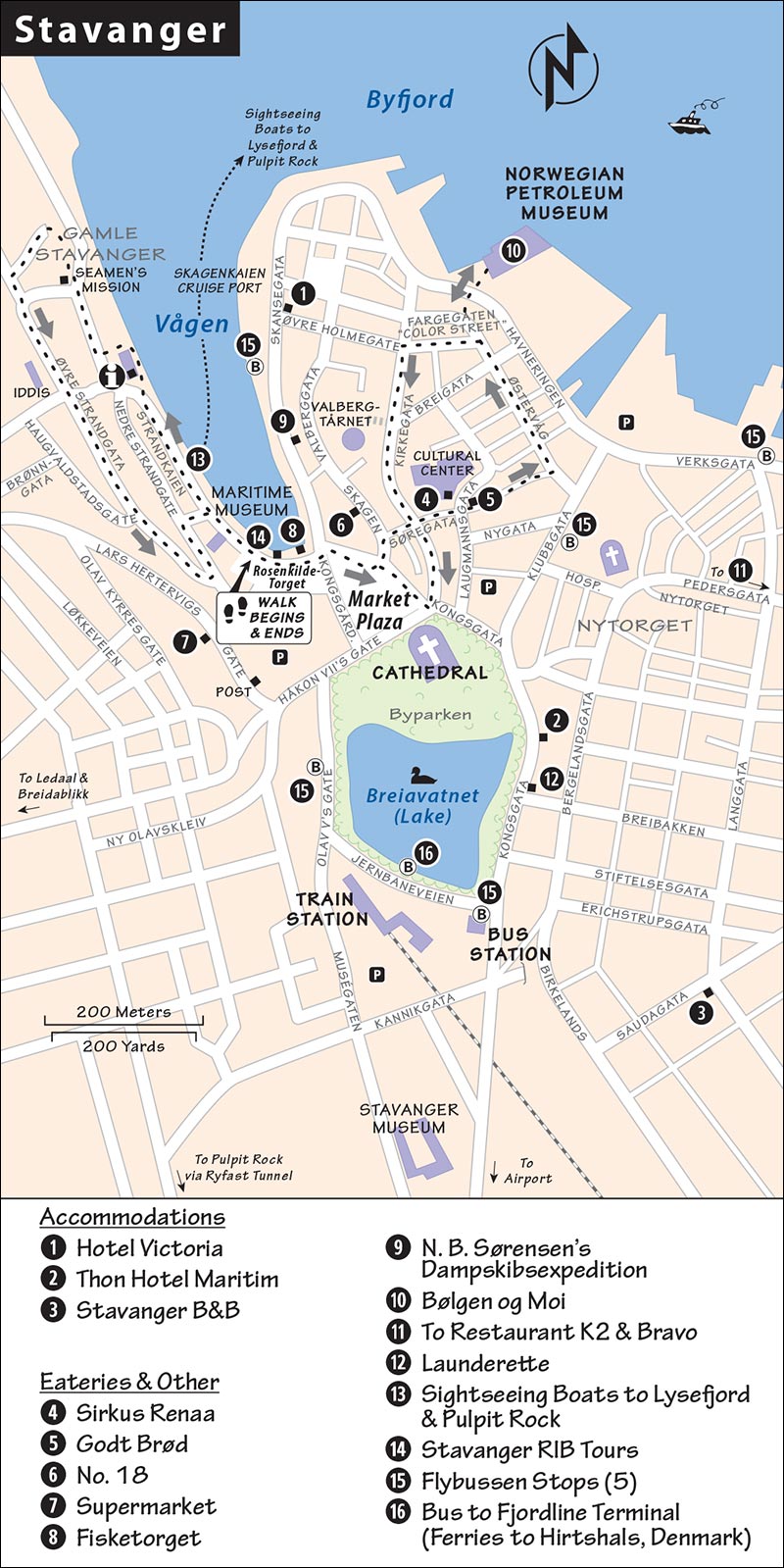
Stavanger is most interesting around its harbor, where you’ll find good museums, lots of shops and restaurants (particularly around the market plaza and the sailor’s quarter), and a small indoor fish market. Just uphill is the cathedral, and beyond that, a pleasant, park-ringed artificial lake called Breiavatnet—bordered by Kongsgaten on the east and Olav V’s Gate on the west. The train and bus stations (and the main branch of the Museum Stavanger) are on the far side of the lake, a pleasant 10-minute stroll from the harbor.
TOURIST INFORMATION
The helpful TI, along the harbor facing the main cruise berth, offers advice on day trips, including reaching Pulpit Rock and other scenic hikes (June-Aug daily 8:00-18:00; Sept-May Mon-Fri 9:00-16:00, Sat until 14:00, closed Sun; Strandkaien 61, +47 51 85 92 00, www.regionstavanger.com).
ARRIVAL IN STAVANGER
Stavanger’s train and bus stations are a 10-minute walk around Lake Breiavatnet to the inner harbor and cathedral. Cruise liners dock right at the Vågen harbor in the very center of town. Some tie up on the west side of the harbor (called Strandkaien) next to the TI, and others put in along the east side (called Skagenkaien)—but both are a very short and easy walk to the central market plaza.
Stavanger’s Sola Airport is about nine miles outside the city (code: SVG, +47 67 03 10 00, www.avinor.no). The Flybussen airport bus efficiently and affordably connects to various points in the city center, including the bus station (www.flybussen.no).
HELPFUL HINTS
Festivals: Known as Norway’s festival city, Stavanger hosts several lively events, including jazz in May (www.maijazz.no), Scandinavia’s biggest food festival in July (www.gladmat.no), and chamber music in August (www.kammermusikkfestivalen.no).
Laundry: Renseriet, facing the lake between the train station and harbor, is handy for same-day drop-off service (no self-service, Mon-Fri 8:30-16:30, Thu until 19:00, Sat 9:00-15:00, closed Sun, Kongsgata 40, +47 51 89 56 53).
Stavanger Walk
For an introduction to Stavanger, follow this self-guided walk in three parts: the harbor itself (with the landmark cathedral nearby); the western side of the harbor (Gamle/Old Stavanger); and the eastern side of the harbor (the sailor’s quarter en route to the Petroleum Museum). Doing this entire loop might take about an hour, not counting sightseeing stops.
• Begin by getting oriented at...
STAVANGER’S HARBOR
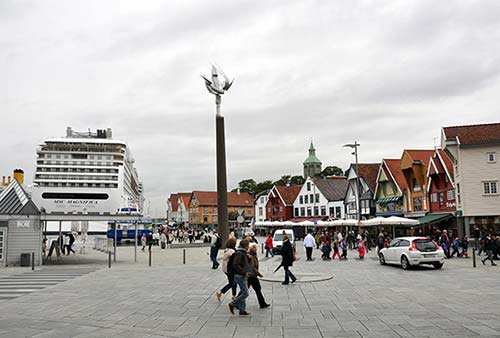
To get your bearings, find a place to sit or stand at the innermost part of the harbor (vågen). There are handy benches immediately below the pillar with the modern, silvery sculpture on top. That statue, designed to honor local sailors who have been lost at sea, evokes the hull and sails of a ship struggling against strong winds. Locals think it resembles something else, and have nicknamed it “The Shrimp.”
Looking straight out toward the harbor, during the summer season you’re likely to see a giant cruise ship or possibly two (berths are on both sides of the harbor). This is only the most recent wave of commerce that has helped Stavanger thrive: fish canning, shipping, shipbuilding, and the present-day petroleum industry. This very harbor likely gave Stavanger its name (stafr-, meaning “branch,” and -agnr, meaning “inlet”).
The west (left) embankment, called Strandkaien, runs in front of Gamle (“Old”) Stavanger, a traditional and very atmospheric residential quarter, with quaint shiplap cottages. Up on the hill is one of many canneries—which processed and tinned locally caught fish—that helped Stavanger thrive a century ago (now an excellent museum, called IDDIS). The east (right) embankment, called Skagenkaien, runs in front of a colorful sailor’s quarter (under the stony Valberg Tower).
Beyond the end of the harbor—if you can see past the cruise ships—is the mouth of Stavanger’s bay. Look for signs of heavy industry, hinting at another source of local wealth: oil drilling. After North Sea oil was discovered in 1969, Stavanger was designated to be the main onshore center of this new and incredibly lucrative industry—giving it the nickname Oljebyen (“Oil City”).
To get oriented, do a little spin-tour around the harbor. On your left, the modern structure with the steeply angled glass roof is the fish market (Fisketorget)—both a recommended restaurant bearing that name, and an actual fish market (enter on the side facing the harbor to see big glass cases of today’s catch). Immediately in front of this building, inflatable boats (a.k.a. RIB or Zodiac boats), loaded with tourists in neon-yellow coveralls, depart for high-speed tours around the nearby Lysefjord.
Spin farther left, with the harbor behind you. You’re looking up the gently uphill market plaza (officially called Kongsgårdbakken). Traditionally this was more of a farmer’s market, but these days, most of the stalls target cruise passengers with Norwegian clichés: reindeer pelts, cheaply made sweaters, little troll figurines, and wood-carved odds and ends.
At the top of the plaza stands a top-hatted statue of Alexander Kielland (1849-1906), a beloved Norwegian author born here. While it may feel like a blue-collar, sleeves-rolled-up city, Stavanger is also known as a major university, printing, and publishing center.
At the top of the market plaza, you can see the peaked stone roof of Stavanger’s beautiful cathedral (domkirke). Recently it has been covered up and closed to the public in preparation for its 900th birthday in 2025; if it has reopened, make sure to pay a visit. While Stavanger feels modern and vibrant today, it goes way back—it’s considered one of Norway’s oldest cities.
Behind the cathedral—not visible from here—is another part of town worth exploring: a beautiful small lake called Breiavatnet, with fountains, ducks and swans, a gazebo along the shoreline, and green parks and wide trails that invite a stroll on a nice day. At the far end of the lake (about a 10-minute walk from here) is Stavanger’s train and bus station. While this is a big city, the central zone is delightfully compact and pleasant to explore on foot.
Keep panning to the left, past some extremely colorful harborfront buildings that today house pubs and cafés. The somewhat bawdy vibe along here is consistent with Stavanger’s sailor past; this has always been like “Norway’s Amsterdam,” a city of international arrivals and anything-goes sailors, which has given it an artistic spirit. You’ll find more funky hole-in-the-wall galleries, exuberant street art, and immigrant-run shops and restaurants here than in most other parts of the country.
There’s some fun public art scattered around the harbor. For example, directly in front of you, notice plaques with footprints of Nobel laureates. At the far end of the embankment, you can see the venerable Hotel Victoria—dating from 1900, this historic Neo-Renaissance building was recently renovated.
• Now that we’ve spun our way around the harbor, let’s explore. First, we’ll take a loop around the left (west) side of the harbor and up through Old Stavanger, with stops at two museums. Then, we’ll walk through the right (east) side of the harbor, via some enjoyable streets and squares, on the way to the final big sight worth seeing in the city: the Petroleum Museum.
LEFT/WEST SIDE: STRANDKAIEN
Head along the harbor with the water on your right-hand side. If there’s a cruise ship in town, it’ll probably be docked straight ahead. After about 100 yards, you’ll pass the Maritime Museum on the left, filling a historic warehouse; we’ll circle back here at the end of the walk, if you’d like to save a visit until then (though it may be closed for renovation until summer 2026).
Just beyond, you’ll reach several little sheds along the embankment where you can book boat excursions to the Lysefjord. While these are popular with cruise passengers who may never set foot elsewhere in Norway, this country has several more appealing fjords to see—hopefully some of those are on your itinerary. The biggest boats that do this trip recently upgraded to hybrid models—they’re mostly electric, but have diesel engines for the more precise work of docking. This added about a half-hour to the (formerly) three-hour tour, but locals feel good about lessening their carbon footprint. While Stavanger—and Norway—have been made fabulously wealthy because of oil, they are insistently “green” (guilty conscience, perhaps?).
Keep on going. About 200 yards ahead, right where the cruise ships dock, the giant yellow building houses the helpful TI. Circle around behind this building and carry on another 150 yards along Nedre Strandgate, enjoying the old-time facades on your left. Cross the street inland when you spot the Seamen’s Mission (at #76)—a little haven for crew members who work on cruise ships. They’re usually away from their families for many months at a time, working seven days a week nonstop. You may see them gathering on the cobbles outside, taking advantage of the free Wi-Fi and coffee.
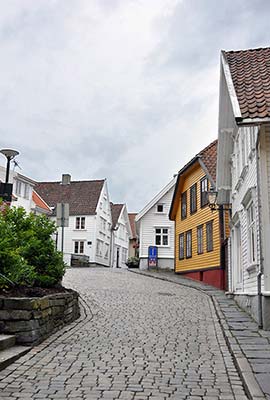
Take the narrow, cobbled path up the ramp just beyond the Seamen’s Mission (in front of the slate-blue house at #78). This takes you up into Gamle (“Old”) Stavanger—the residential old town we’ll be looping through to get back to the harbor. After a short walk up the sidewalk, you’ll pop out at a little terrace with white benches, a Norwegian flag, and a statue of a vice-admiral who appears to be training his cannons at the invading cruise ships.
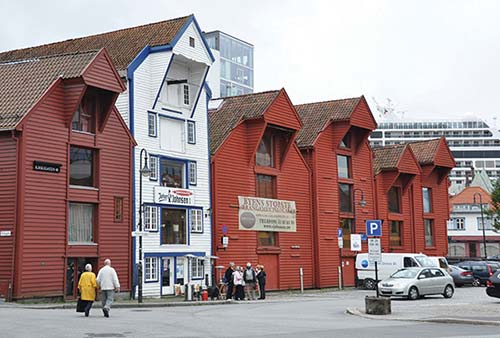
Just past this, turn left to head steeply up Blindensolstrædet. You disappear into Old Stavanger, leaving the cruise ships—and the modern world—behind. Enjoy this cobbled stroll between whitewashed shiplap homes, lovingly decorated with colorful flowers. On your way up to the top of this quarter, enjoy poking down side streets, little terraces, and gardens. This compact district has 173 traditional wooden homes (I counted), most dating from the first half of the 19th century. While it’s easy to romanticize this place today, don’t forget that this was essentially a working-class community; these houses are “cute” because they were so humble. In fact, this area was almost demolished after World War II to make way for new development. But a local architect named Einar Hedén led an initiative to protect Old Stavanger.
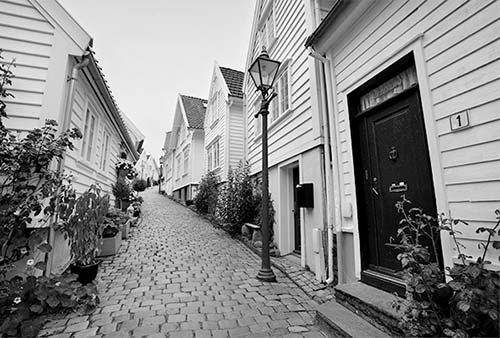
At the top of the hill, turn left on Øvre Strandgate—literally “Upper Embankment Street.” Follow this main street of Old Stavanger several blocks. You’ll pass a playground on the right, and small parks and big views downhill to your left.
Soon you’ll reach a very different-looking stone house with the Frk. Krag Kafé and a turret on the corner—which sticks out like a sore thumb in this otherwise uniform neighborhood. Directly across the street (uphill), notice the house marked No. 90, and above that, chimneys of a former cannery. These are both parts of the best museum in town, called IDDIS—which combines exhibits on two historic industries (printing and canning), and gives you the chance to walk around inside a perfectly preserved, fully furnished house like all the ones you’ve been strolling past. A ticket to this also covers the Maritime Museum. (For details, see “Sights in Stavanger,” later.)
Continue straight through a particularly striking stretch of Øvre Strandgate, including some posh boutiques. You’ll wind up in a small, grassy, tree-shaded park. The statue of a kindly man with a cart and two ponies honors Lars H. Lende—also the park’s namesake—who devoted his life to mentoring Stavanger’s youth, including taking them on pony cart rides. (Notice the message on his cart: Alt for barna!—“Everything for the children!”) A second statue shows some of Lende’s favorite items for entertaining kids: a top hat, parrot, saxophone, and monkey. The Meny supermarket here is handy for a picnic.
From the park, use a combination of stairs and ramps to make your way back down to sea level. Find your way back out to the harborfront embankment, where you’ll emerge near the Maritime Museum once again.
• From here, turn right and walk to where we first got oriented to the harbor, then continue through to the other side of town.
RIGHT/EAST SIDE: SKAGENKAIEN
It’s time to delve into the more lived-in-feeling quarter on the right (east) side of the harbor, uphill from Skagenkaien. This is a thriving neighborhood with lots of shops and restaurants for both locals and tourists. We’ll take a route that connects some of the many picturesque squares and streets, on the way to the Norwegian Petroleum Museum—the only major sight in town these walks haven’t covered yet. (Even if you don’t want to tour the museum, the walk is still worthwhile, and includes a different route back.)
Turn your back to the harbor, walk up into the market plaza, and take the first left—behind the Burger King. (The building was established in 1883, but it has been the Home of the Whopper for only part of that time.) You’ll head up this cobbled street for one block, where you come to a fork. The left, downhill fork leads along the back of the harbor, past some tacky tourist dives. We’ll take the more interesting route to the right.
Follow this lane, called Søregata, toward the McDonald’s. You’ll emerge into a delightful square with a big tree in its center, called Arneageren. On the left side, the square is dominated by the modern Sølvberget cultural center/library/cinema/café—a gathering point for the community. The Sirkus Renaa shop on the cultural center’s ground floor, and the Godt Brød sandwich shop kitty-corner, have pleasant outdoor seating for a light lunch. Sirkus Renaa, serving sandwiches, pizzas, and pastries, is a budget outpost of Re-Naa, which was the first Norwegian restaurant outside of Oslo to earn one Michelin star, and first restaurant anywhere in Norway to earn two stars. Cosmopolitan Stavanger, home to an esteemed culinary institute, is a foodie town.
Enjoy the bustle of this square. When you’re ready, stand with the McDonald’s at your back, facing the tree and cultural center, and turn 90 degrees to the right. Walk down the skinny lane, still called Søregata, as it winds downhill past some appealing shops and eateries. Notice that equally charming lanes branch off every which way. If you have time, make a point to explore this area later.
You’ll dead-end at wider Østervåg. Turn left and follow this shopping street. After three short blocks, at Steinkargata, you’ll bump into a statue of the old-time watchman (vekter), with his long, spiky pole. He used to also hold a lantern, but that was broken off—so now, he clutches only its handle.
A block farther along, look left up Salvågergata, where Andy Warhol faces Michelangelo’s David from across the street. We’re getting into a part of town where Stavanger’s appetite for creative and lively street art is on display.
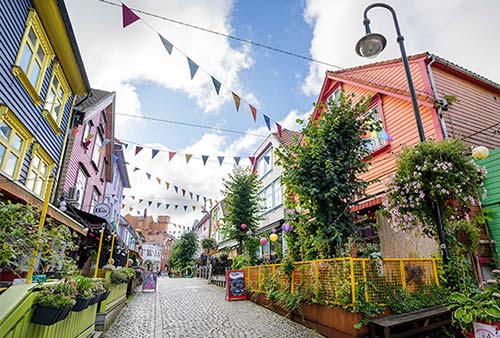
For the best example, continue straight across Breigata (the first street with cars we’ve seen on this entire walk), then pause at the next cross street on the left: officially Øvre Holmegata, but better known as Fargegaten, “Color Street.” In 2005, this formerly drab street was enlivened by a local hairdresser, Tom Kjørsvik; Scottish-born artist Craig Flannagan came up with the color schemes. Before painting all these houses, they had to get permission from the city council. Norwegian society can seem conformist and straight-laced. But Norwegians understand that a functioning and healthy society must also have space for creativity. This beautiful street, painted every color of the rainbow (and then some), feels like a celebration of every walk of life. Go for a brief stroll all the way to the end of this short street, then back again, to appreciate the celebration-of-life spirit. It’s also jammed with a wide variety of bars and cafés—take your pick.
Returning to Østervåg, carry on the way you were going (toward the water). Straight ahead just another block or so, bear right to reach a busy cross street—and, on the other side, you can’t miss the big Norwegian Petroleum Museum. This worthwhile exhibit is described later, under “Sights in Stavanger.”
Returning to the Harbor: Here’s a different route from the Petroleum Museum back to the main harbor, to make your return a loop: Head back across the street to Østervåg and backtrack one block, then turn right up “Color Street.” Walk to the end of that vivid lane, then turn left onto Kirkegata. This leads essentially straight back to the market plaza where we began (the “Kirke” in the name refers to the cathedral).
After about a block, on the right, steps lead up to a worthwhile detour: the tall, round, stone tower called Valbergtårnet. Built in the mid-19th century, this tower was not for defense; it’s a fire lookout to protect a town built almost entirely of wood. The terrace around it (with old cannons, as if protecting Stavanger from the hordes of cruise-ship passengers) has views over the harbor.
Continuing the rest of the way along Kirkegata, you’ll run into Domkirkeplassen, facing the cathedral. If you haven’t visited there yet, now’s a great time (described next). You could turn left and curl around the far side of the cathedral to see the lovely pond in the middle of urban Stavanger, Breiavatnet; the main branch of the Stavanger Museum, with a children’s museum, natural history, and cultural history, is about 15 minutes from here, beyond the train station.
Or you can turn right, cross Market Plaza, and in about 30 seconds, you’ll be right back where we started at the harbor.
Sights in Stavanger
▲Stavanger Cathedral (Stavanger Domkirke)
Stavanger’s top church—which overlooks the town center on a small ridge—has a harmonious interior and a few intriguing details worth lingering over. The interior is being restored for the church’s 900th birthday in 2025; if you visit before then, you may find it closed.
Cost and Hours: May charge a small fee, likely open daily 11:00-16:00, +47 51 84 04 00, www.stavangerdomkirke.no.
Visiting the Church: If it has reopened, step inside. The cathedral, dedicated to St. Swithun (his relic, an arm, was popular with pilgrims), was originally built in 1125 in a Norman style, with basket-handle Romanesque arches. After a fire badly damaged the church in the 13th century, a new chancel was added in the pointy-arched Gothic style. You can’t miss where the architecture changes about three-quarters of the way up the aisle. On the left, behind the baptismal font, notice the ivy-lined railing on the stone staircase; this pattern is part of the city’s coat of arms. And nearby, appreciate the colorful, richly detailed “gristle Baroque”-style pulpit (from 1658). Notice that the whole thing is resting on Samson’s stoic shoulders—even as he faces down a lion.
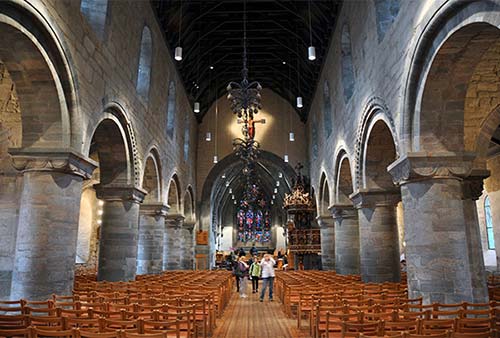
Stroll the church, perusing its several fine “epitaphs” (tomb markers), which are paintings in ornately decorated frames. Go on a scavenger hunt for two unique features; both are on the second columns from the back of the church. On the right, at the top facing away from the nave, notice the stone carvings of Norse mythological figures: Odin on the left, and a wolf-like beast on the right. Although the medieval Norwegians were Christians, they weren’t ready to entirely abandon all of their pagan traditions. On the opposite column, circle around the base and look at ankle level, facing away from the altar. Here you see a grotesque sculpture that looks like a fish head with human hands. Notice that its head has been worn down. One interpretation is that early worshippers would ritualistically put their foot on top of it, as if to push the evil back to the underworld. Mysteriously, both of these features are one-offs—you won’t find anything like them on any other column in the church.
Museum Stavanger (MUST)
Stavanger’s many museum collections are scattered across several branches around town, collectively called MUST for short. All are covered by a single 140-NOK ticket and have similar, sometimes slightly differing hours (in summer, the major branches are open daily 10:00-16:00, with shorter hours and closed Mon off-season; the lesser branches are open only briefly in the summer, from mid-June to mid-Aug; for details see www.museumstavanger.no). Here are some options, listed in order of worthiness:
IDDIS: The best of the branches—worth ▲ and perched in a slick modern facility (opened in 2021) directly uphill from the TI, in Old Stavanger—is three museums in one (Øvre Strandgate 88A). The Printing Museum covers the history of the written word, from early printing presses and lithography, to the newspaper industry, to resistance propaganda against the Nazi occupation, and even an endearing exhibit about a beloved political cartoonist from Stavanger, Henry Imsland. It finishes with a look at vintage packaging from tinned foods produced here...which segues into the next section, the Canning Museum. Filling a former factory (which produced canned sardines and kippers from 1910 to 1960), it engagingly outlines the process the hundred or so employees used to crank out their product. You’ll see lots of original equipment, and even get to try your hand at packing rubbery faux-sardines into a little tin. Don’t miss the door outside, which leads to perhaps the best exhibit of all: a vintage house called No. 90, where you can walk through two floors of bedrooms, living rooms, and kitchens to see how people once lived inside those pretty shiplap cottages you’re snapping photos of all day. The museum also has a fine café. And on the first Sunday of the month, they smoke brisling (herring) the old-fashioned way.
Maritime Museum (Sjøfartsmuseum): Filling a giant warehouse right along the harbor, this museum is slated to close for a thorough renovation, likely until summer 2026. When open, it has modern exhibits downstairs, and upstairs, several carefully preserved local offices and rooms from Stavanger’s shipping heyday, including the ship-owner’s office and the sail loft (Nedre Strandgate 17).
Stavanger Museum: The main branch is less conveniently located, behind the train station, about a 15-minute walk from the harbor around the Breiavatnet lake (use the underpasses near the station, then head up to Muségate 16). Specific exhibits tend to change, but the main floor is the Norwegian Children’s Museum; the second floor, and also the basement, hold a natural history exhibit focusing on taxidermied animals; and the top floor covers cultural history (closed Mon).
More Branches: Other parts—open only in summer—include Ledaal, a royal residence and manor house (Eiganesveien 45) and Breidablikk, a wooden villa from the late 1800s (Eiganesveien 40A). There’s also an art museum a short bus ride or long walk west of the center (Henrik Ibsens Gate 55, www.stavangerkunstmuseum.no).
▲Norwegian Petroleum Museum (Norsk Oljemuseum)
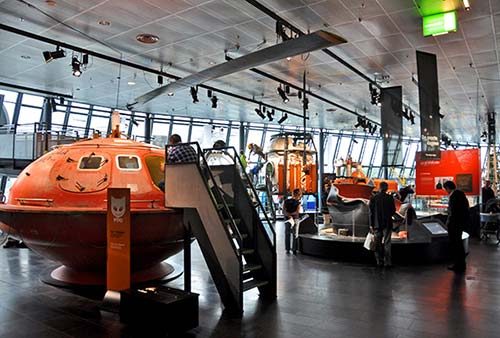
This entertaining, informative museum—dedicated to the discovery of oil in Norway’s North Sea in 1969 and the industry built up around it—offers an unapologetic look at the country’s biggest moneymaker. With half of Western Europe’s oil reserves, the formerly poor agricultural nation of Norway has become the Arabia of the North and a world-class player, producing 1.6 million barrels a day. This is essentially a good hands-on science museum, designed partly for kids, with a very specific agenda. While well done—and worth ▲▲ for engineers and kids—the subject matter can be challenging for a casual visitor.
Cost and Hours: 150 NOK; June-Aug daily 10:00-19:00; Sept-May Mon-Sat 10:00-16:00, Sun until 18:00; +47 51 93 93 00, www.norskolje.museum.no. The museum’s recommended Bølgen og Moi restaurant has an inviting terrace over the water.
Visiting the Museum: The museum’s architecture was designed to echo the foundations of the oil industry—bedrock (the stone building), slate and chalk deposits in the sea (slate floor of the main hall), and the rigs (cylindrical platforms). While the museum has its share of pro-oil propaganda, it also has good exhibits on the climate impact caused by drilling and burning oil.
The main exhibit describes how oil was formed, how it’s found and produced, and what it’s used for. You’ll see models of oil rigs, actual drill bits, see-through cylinders that you can rotate to investigate different types of crude, diving bells and rescue pods, and much more—all well explained in English. Interactive exhibits cover everything from the history of the earth (4.5 billion years displayed on a large overhead globe, showing how our planet has changed—stay for the blast that killed the dinosaurs) to day-to-day life on an offshore platform. One sober exhibit explains the Kielland rig disaster in 1980, which killed 123 people and spurred reforms in the industry. Kids enjoy climbing on the model drilling platform, trying out the emergency escape chute at the platform outside, and playing with many other hands-on exhibits.
In the big circular structure at the center of the main floor, a movie called Oljeunge (Oil Kid) stars a fictional character who was born in 1969—the year Norway discovered oil—and shows how that discovery changed Norwegian society over the last 50 years (16 minutes, runs 3/hour).
You can use walkways to follow a one-way route through the circular towers attached to the outside of the museum. Here you’ll find exhibits about the giant helicopters that connect oil platforms to the outside world, and “Going Subsea,” an exhibit offering a virtual dive deep to the bottom of an oil platform.
Day Trips to Lysefjord and Pulpit Rock
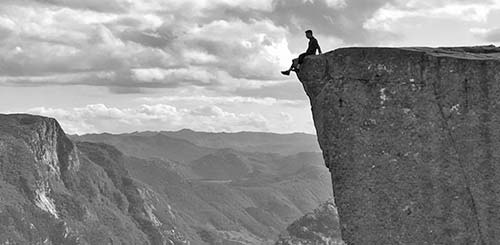
The nearby Lysefjord is an easy day trip. Those with more time (and strong legs) can hike to the top of 2,000-foot-high Pulpit Rock—which, for some, is reason enough to come to Stavanger.
Lysefjord Boat Tours
A boat tour here is memorable: you’ll see towering mountains, waterfalls, rustic farms, and, if you’re lucky, colonies of seals. While it’s far from the most impressive of Norway’s many fjords, it’s worth seeing if it’s the only fjord you have access to.
Rødne Fjord Cruise offers 3.5-hour round-trip excursions from Stavanger to Lysefjord (including a view of Pulpit Rock—but no stops). Conveniently, boats depart from the main Vågen harbor in the heart of town (west side of the harbor, along Strandkaien; 725 NOK; May-Sept daily at 10:00 and 15:00, also at 12:00 July-Aug; April and Oct daily at 11:00; less frequent in winter; +47 51 89 52 70, www.rodne.no). They also offer a combined boat tour and Pulpit Rock trip (see below).
A different company, Norled, runs similar trips (690 NOK, July-Sept daily at 12:15, extra departures on busy days, www.norled.no).
For a high-speed option, consider Stavanger RIB tours, which uses inflatable Zodiac-style boats and departs from the bottom of the harbor in front of the fish market (1,290 NOK, 3/day in summer, 2 hours, www.stavangerrib.no).
Pulpit Rock (Preikestolen)
Ascending to this dramatic 270-square-foot natural platform gives you a fantastic view of the fjord and surrounding mountains. Hiking up to the top of Pulpit Rock is a popular outing that will take the better part of a day; plan on 45 minutes travel time each way, about four hours of hiking (two hours up, two hours down), and time to linger at the top for photos. The rock has its own website with helpful advice (https://preikestolen365.com).
Getting There
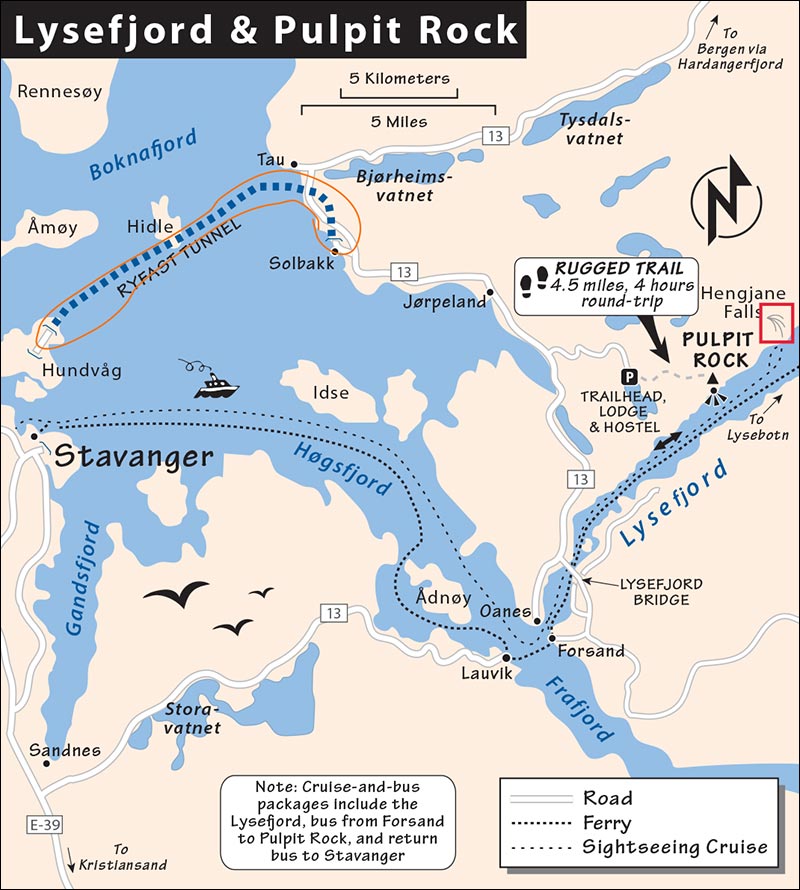
By Car: From Stavanger, it’s about a 45-minute drive via the nine-mile Ryfast Tunnel, which burrows under the sea at Stavanger and emerges near Solbakk on the other side (160-NOK toll). From there, turn onto highway 13 and follow signs to Preikestolen. In summer, you’ll pay a hefty fee to park at the trailhead.
By Bus Tour: The trailhead is easily reached in summer with a bus tour. Trips generally go daily from hotels in Stavanger (about 450 NOK round-trip; daily June-Aug; weekends only March-May and Sept-Oct; none Nov-Feb; first departure is about 10:00, be clear on return times from the trailhead). Various companies operate this trip; ask at the TI or try Pulpit Rock Tours (+47 51 59 90 60, www.pulpitrock.no).
By Cruise-and-Bus Combo: This option begins with a scenic Lysefjord cruise (2.5 hours) and drops you at Forsand, where you’ll catch a bus to the Pulpit Rock trailhead. From there you can do the four-hour round-trip hike; afterwards, you’ll catch a bus back to Stavanger. This handy trip is operated by Rødne Fjord Cruise (1,150 NOK, May-Sept daily at 10:00, see contact info under “Lysefjord Boat Tours,” earlier).
With a Guided Hike: Outdoorlife Norway offers guided tours for individuals or small groups. They’ll pick you up at your hotel and even provide hiking poles. Check out their Preikestolen Off the Beaten Track Hike (1,590 NOK, May-Sept) or Preikestolen Sunrise Hike (1,390 NOK, April-Oct, +47 51 88 03 88, mobile +47 97 65 87 04, www.outdoorlifenorway.com [URL inactive]).
Hiking to Pulpit Rock
At just over 4.5 miles round-trip, with an elevation gain of about 1,100 feet, this hike takes four hours total—longer if the trail is very crowded. The hike is fairly strenuous and includes scrambling over sometimes tricky, rocky terrain. Bring snacks and plenty of water, pack extra clothes as the weather is changeable, and wear sturdy hiking shoes or boots. Start early or you’ll be sharing the trail with dogs on long leashes, toddlers navigating boulders, and the unprepared Bermuda-shorts crowd in flip-flops.
The trail starts by the big sign at the entrance to the main parking lot. From there the path climbs steadily through forest at first and eventually into open, rocky terrain. Along the way, you can thank Nepali Sherpas—who were hired to improve sections of the route—for their fine stonework on the trail.
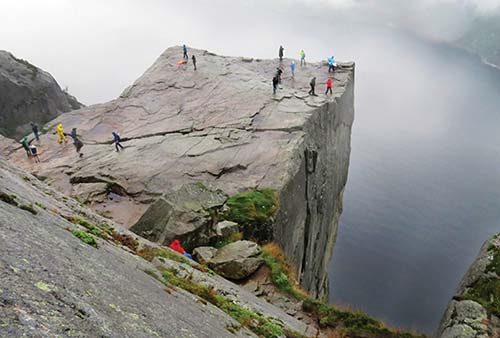
The farther and higher you go, the rockier and more spectacular the scenery becomes. Whenever the trail disappears onto bare rock, look for the red T’s painted on stones or posts marking the route. As you near Pulpit Rock, the path tiptoes along the cliff’s edge with airy views out to the Lysefjord that can only be topped by those from the rock itself.
Before you head back, scramble up the mountainside behind the rock for that iconic, tourist-brochure scene of the people-speckled Pulpit Rock soaring out over the fjord 2,000 feet below.
Sleeping at the Pulpit Rock Trailhead
The Pulpit Rock trail is usually very crowded during the middle of the day, even in bad weather. Early risers might prefer spending the night at the trailhead to get an early start the next morning. If you don’t have a car, you can get here from Stavanger by using one of the tour options listed above.
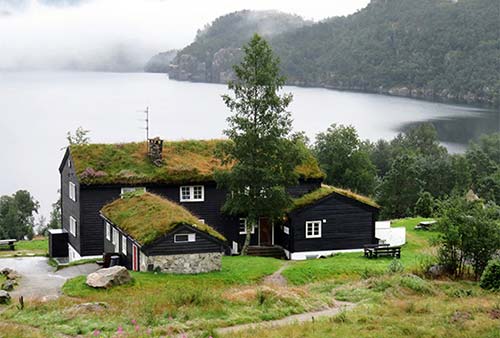
$$$ Preikestolen Base Camp is a modern building with 27 bright, simple, functional rooms and a pricey restaurant with a lovely lake view (includes breakfast, free parking). Below the Fjellstue and closer to the lake, the rustic, grass-roofed $ Preikestolhytta hostel has 16 rooms that sleep 2-4 and bathrooms down the hall (+47 51 74 20 74, www.preikestolenbasecamp.com, booking@preikestolenbasecamp.com).
Sleeping in Stavanger
$$$ Hotel Victoria feels classy and Old World, with 107 business-class rooms over a stately, high-ceilinged lobby facing the Skagenkaien embankment right on the harbor. The building itself—dating from 1900 and recently restored—is one of Stavanger’s finest (elevator, restaurant, gym, Skansegata 1, +47 51 86 70 00, www.hotel-victoria.no, post@hotel-victoria.no).
$$ Thon Hotel Maritim, with 140 rooms, is two blocks from the train station facing the artificial Breiavatnet lake. While a bit dated, it’s predictable, professional, and conveniently located for walking around the city (elevator, Kongsgaten 32, +47 51 85 05 00, www.thonhotels.no/maritim, maritim@olavthon.no).
¢ Stavanger B&B is Stavanger’s best budget option. This large red house among a sea of white houses has tidy, tiny rooms. The lodgings are basic, verging on institutional—not cozy or doily—but they’re affordable and friendly. The shared toilet is down the hall; 14 rooms have their own showers, while eight share showers down the hall (breakfast extra, 10-minute uphill walk behind train station in residential neighborhood, Vikedalsgate 1A, +47 45 41 31 60, www.stavangerbedandbreakfast.no, post@sbb.no).
Eating in Stavanger
CASUAL LUNCHES
$$ Sirkus Renaa is inside Stavanger’s cultural center on the pretty, leafy Arneageren square. A budget-priced outpost of one of the city’s most esteemed restaurants, it has a delectable array of pastries, sandwiches, and pizza, either in the glassed-in dining room or out on the square (daily, Sølvberggata 2, mobile +47 94 00 93 48). $$ Godt Brød, on the same square, has good sandwiches and pastries, with arguably even better outdoor seating (daily for lunch only, Søregata 4, +47 51 89 38 01).
$$ No. 18, in a lovely, leaning wooden building dating to the 1700s, serves baked goods, waffles, and traditional open-face sandwiches at reasonable prices in a cozy, rustic-elegant setting (Mon-Sat for lunch, closed Sun, in the blue-and-white building a block off the harborfront at Skagen 18, +47 51 89 51 71).
Supermarket: Meny is a large supermarket with a good selection and a fine deli for super picnic shopping (closed Sun, in Straen Senteret shopping mall, just above the western harbor embankment facing Lars Lende Park at Lars Hertervigs Gate 6).
DINING ALONG THE HARBOR WITH A VIEW
The harborside street of Skansegata is lined with lively restaurants and pubs, and most pubs serve food.
$$$$ Fisketorget shares a glassy, modern, harborfront building with the fish market—so you know it’s fresh. It feels classy but not pretentious; it’s popular with both locals and visitors (closed Sun, Strandkaien 37, +47 51 52 73 50, www.fisketorget-stavanger.no).
N. B. Sørensen’s Dampskibsexpedition has two sections: a main-floor pub, called $$$ Mat & Vin (“Food and Wine,” with outdoor seating on the embankment, Mon-Sat for dinner, Thu-Sat also lunch, closed Sun); and a fine-dining $$$$ restaurant on the upper floor (dinner Thu-Sat, closed Sun-Wed; Skagenkaien 26, +47 51 84 38 20, www.herlige-stavanger.no). The restaurant is named after an 1800s company that shipped from this building, among other things, Norwegians heading to the US. Passengers and cargo waited on the first floor, and the manager’s office was upstairs. The place is filled with emigrant-era memorabilia.
$$$$ Bølgen og Moi, the restaurant at the Petroleum Museum, has views over the city’s modern waterfront, as opposed to the old harbor area; it feels fresh and modern, and is handy for sightseers (good lunch specials, lunch daily, dinner Tue-Sat—reservations recommended; Kjeringholmen 748, +47 51 93 93 51, www.bolgenogmoi.no).
GLOBAL AND MODERN FOOD ON PEDERSGATA
From Nytorget, an elongated square marked by a bright-red church just above the cathedral area, the workaday street called Pedersgata runs east. To break out of ye olde Stavanger, go for a stroll here and survey a wonderful range of eateries: sushi, Pakistani, Ethiopian, Korean, and much more. Options range from $ hole-in-the-wall-basic to $$$$ high-end. At the far end of Pedersgata are two of the city’s trendiest options, both of which focus on finely crafted dishes featuring local and seasonal ingredients: $$$$ Restaurant K2, a bit more refined and “fine-dining” (dinner Wed-Sat, closed Sun-Tue, book ahead, Pedersgata 69, +47 97 95 61 20, www.restaurantk2.no) and $$$$ Bravo, a bit more rustic, with Italian influences (dinner Wed-Sat, lunch on Sat, closed Sun-Tue, Pedersgata 71, +47 92 07 03 37, www.restaurant-bravo.no).
Stavanger Connections
From Stavanger by Train to: Kristiansand (5/day, 3 hours), Oslo (5/day, 8 hours, overnight possible).
By Bus to Bergen: Kystbussen operates buses between Stavanger and Bergen (hourly, 5.5 hours, +47 52 70 35 26, http://kystbussen.no).
By Boat to Denmark: Fjordline ferries sail overnight from Stavanger to Hirtshals, Denmark (12 hours, www.fjordline.com [URL inactive]).