MORE ON THE SOGNEFJORD
Balestrand • Lustrafjord • Solvorn • Scenic Drives
More Sights on and near the Lustrafjord
Scenic Drives from the Sognefjord
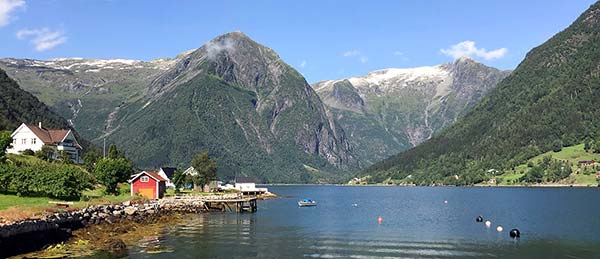
Norway’s world of fjords is decorated with medieval stave churches, fishing boats, cascading waterfalls, dramatic glaciers, and brightly painted shiplap villages. Travelers in a hurry zip through the fjords on the Norway in a Nutshell route (see previous chapter). Their heads spin from all the scenery, and most wish they had more time on the Sognefjord. If you can linger in fjord country—and you should—then this chapter is for you.
This region is important to the people of Norway. After four centuries under Danish rule, the soul of the country was nearly lost. With partial independence and its own constitution in the early 1800s, Norway experienced a resurgence of national pride. Urban Norwegians headed for the fjord country here in the west. Norway’s first Romantic painters and writers were drawn to Balestrand, inspired by the unusual light and dramatic views of mountains plunging into the fjords. The Sognefjord, with its many branches, is featured in more Romantic paintings than any other fjord.
First, choose a fjordside village to snuggle into; top choices are Balestrand and Solvorn, on different sides of the Nutshell action. On a quick trip, these two areas are redundant—choose one and settle in. If you have more time and adore the fjords, you won’t get bored visiting both.
Balestrand is a bit bigger (while still a small town), anchored by a classy grand hotel and featuring a fun local arts and cider scene. It’s also a handy jumping-off spot for adventures great and small, including a day trip up the Fjærlandsfjord to gaze at a receding tongue of the Jostedal Glacier, or across the Sognefjord to the medieval-feeling Hopperstad Stave Church.
Farther east is Solvorn, a tiny village on the Lustrafjord—a tranquil and picturesque branch of the Sognefjord offering drivers an appealing concentration of visit-worthy sights. On the Lustrafjord, you’ll enjoy enchanting hamlets with pristine fjord views, historic churches (including Norway’s oldest stave church at Urnes and the humble Dale Church in the village of Luster), and an opportunity to touch and even hike on a glacier (the Nigard).
For travelers, one nice feature of these corners of the Sognefjord is the lack of giant cruise ships, which give these towns a pass. This keeps places like Balestrand and especially Solvorn feeling tucked-away and beyond the worst of the crowds. Sitting out on the fjord at day’s end, you’ll toast to the sight of a giant cruise ship slowly trundling past—without stopping—as it departs hectic Flåm.
PLANNING YOUR TIME
If you can spare a day or two off the Norway in a Nutshell route, spend it here. With one night in this area, you’ll blitz the sights on the way between destinations; with two or more nights, you can slow your pace (and your pulse) to enjoy the fjord scenery and plenty of day-trip possibilities.
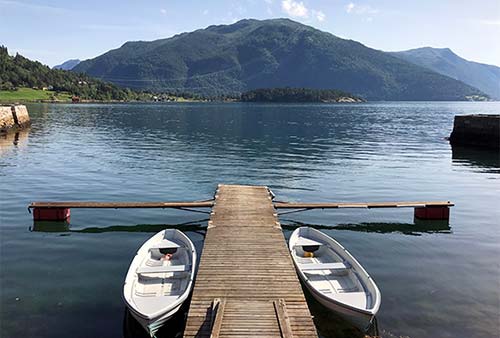
Balestrand is the handiest home base, especially if you’re relying on public transportation (it’s well connected by express boat both to the Nutshell scene and to Bergen). If you have a car, consider staying in the heart of the Lustrafjord region, in sweet little Solvorn (easy ferry connection to the Urnes Stave Church and a reasonable drive to the Nigard Glacier). As fjord home bases go, Balestrand and Solvorn are both better and far more charming—but less convenient—than Flåm or Aurland on the Nutshell route.
SOGNEFJORD TIPS
With so much to see scattered across a wide area, this region can be challenging to organize. Understanding your ferry options is a good first step (see the sidebar). Following are a few important notes to help you have a smoother travel experience in the Sognefjord region.
No Sognefjord TIs: Sadly, once you’re in the Sognefjord region you’ll be mostly on your own as far as tourist information; you won’t find real TIs anywhere. The Sognefjord region’s website is helpful: www.sognefjord.no. In smaller towns, “TIs” are usually just a stack of free brochures and maps and a touchscreen for accessing the website. In larger towns, visitor information duties have been assumed by for-profit agencies selling local excursions; staff may be willing to answer questions, but they often steer you toward a “solution” that profits the organization they work for. The people who run local accommodations are often your best help.
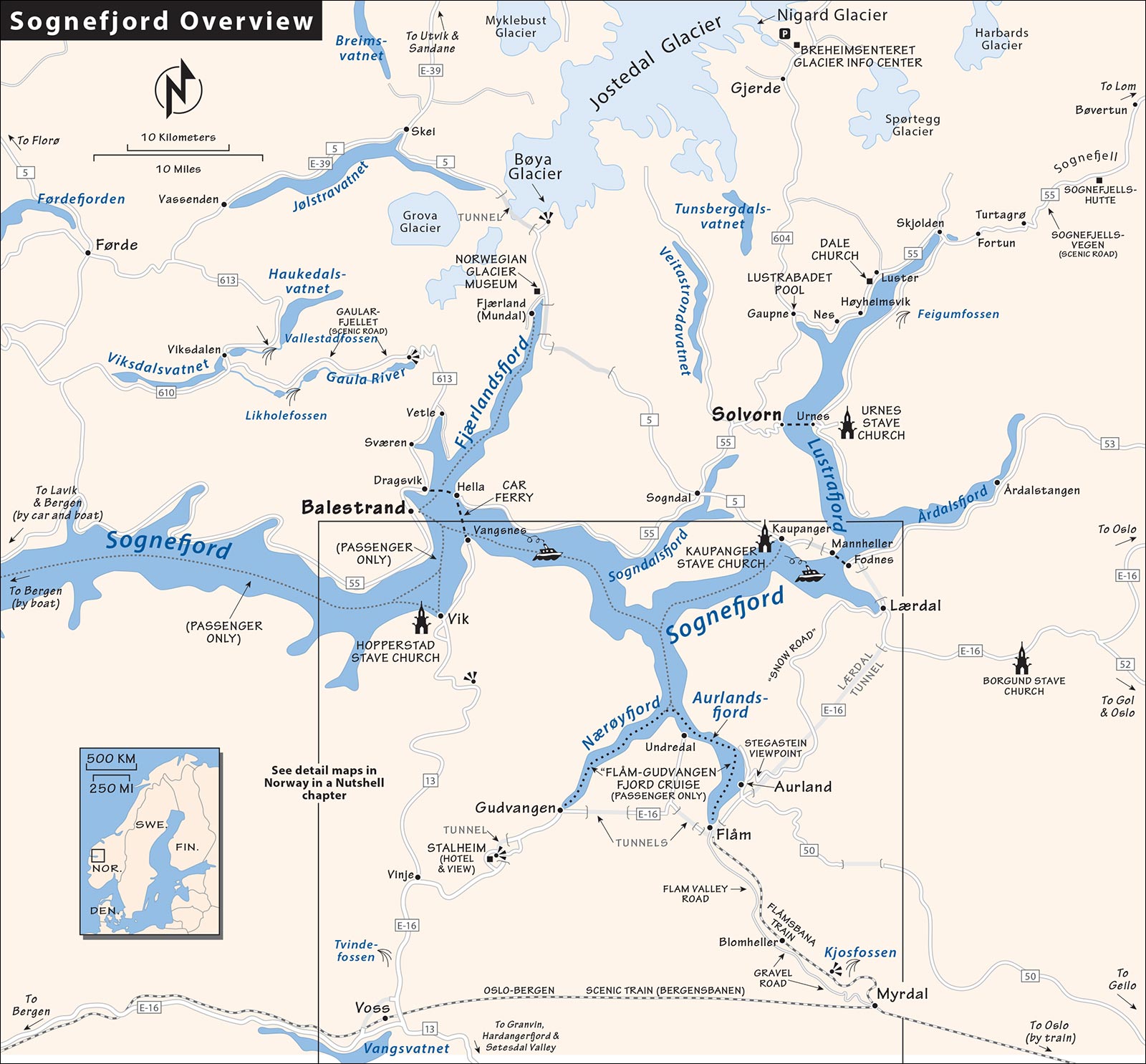
Stave Churches: Seeing a stave church in the wild merits a detour and is a ▲▲▲ Norwegian experience. You have three good choices in this area: Borgund, arguably the best of them all, is a 45-minute drive or bus ride from the Nutshell zone (see the previous chapter); Hopperstad, nearly as good, is across the fjord from Balestrand, at the top of Vik (reachable by express catamaran plus a walk); Urnes is smaller but has perhaps the most interesting decorations (a quick ferry ride across the fjord from Solvorn).
Scenic Drives: Drivers find it’s worth the extra miles to take a high-altitude drive—both within this area and connecting to other destinations. From Balestrand, the Gaularfjellet road connects scenically to the Jostedal Glacier area. If you’re going between the Lærdal area (Borgund Stave Church) and the Nutshell zone, consider the Aurlandsfjellet “Snow Road.” The drive between the Nutshell area and Vik is also scenic. Connecting the Lustrafjord with Lom and the Jotunheimen Mountains, you’ll cross over perhaps the most scenic of all: the Sognefjellsvegen (see the next chapter).
Glacier Visits: There are two opportunities to get a good look at tongues of the giant Jostedal Glacier that caps the mountains on the Sognefjord’s north side: the Bøyabreen branch is accessible from Balestrand and the Nigardbreen branch from the Lustrafjord area. Both are described later in this chapter.
Balestrand
The pleasant fjord town of Balestrand (pop. 1,300) has a long history of hosting tourists, thanks to its landmark Kviknes Hotel. But it also feels real and lived-in, making Balestrand a nice mix of cuteness and convenience. The town is near, but not too near, the Nutshell bustle across the fjord—and yet it’s an easy express-boat trip away. In short, consider Balestrand a worthwhile detour from the typical fjord visit—allowing you to dig deeper into the Sognefjord, just like the glaciers did during the last ice age.
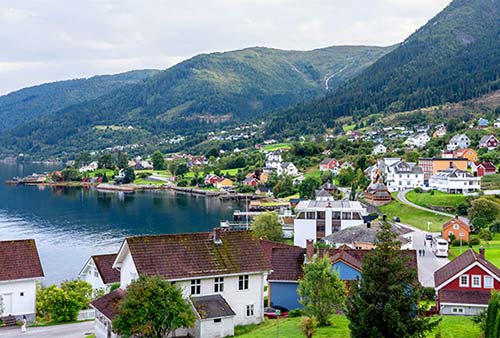
Balestrand became accessible to the wider world in 1858, when an activist minister (from the church you see across the fjord from town) brought in the first steamer service. That put Balestrand on the Grand Tour map of the Romantic Age. Even the German Kaiser chose to summer here. Today, people from around the world come here to feel the grandeur of the fjord country and connect with the essence of Norway.
Balestrand’s key advantage is its easy express-boat connection to Bergen, offering an alternative route to the fjord from the typical Nutshell train-bus combo. Consider zipping here on the Bergen boat, then continuing on via the Nutshell route (or vice-versa).
PLANNING YOUR TIME
One night is enough to get a taste of Balestrand. With two nights, you can relax and consider some day trips and activities: Cruise up the nearby Fjærlandsfjord for a peek at a distant tongue of the ever-less-mighty Jostedal Glacier or head across the Sognefjord to the beautiful Hopperstad Stave Church in Vik (if using public transit, note the express-boat early departure—typically about 7:50 and not possible on Sun). Other excursions (such as the Fjærlandsfjord and Jostedal Glacier and RIB tours on the fjord) cluster around midday.
Balestrand also has outdoor activities for everyone, from dreamy fjordside strolls and strenuous mountain hikes to wildly scenic bike rides. Its family-run, traditional-yet-trendy cidery (Ciderhuset) offers a shop, tastings, lunchtime and afternoon tours, and dinner amid orchards. Or splurge on the memorable smorgasbord-style koldtbord dinner in the Kviknes Hotel dining room, then sip coffee from its balcony as you watch the sun set (or not) over the fjord.
Balestrand pretty much shuts down from mid-September through mid-May—when most of the activities, sights, hotels, and restaurants listed here are likely closed.
Orientation to Balestrand
Most travelers arrive in Balestrand on the express boat from Bergen or Flåm. The tidy harbor area has two grocery stores, a few shops and restaurants, some creaky old houses, the high-tech Museum of Travel and Tourism, and a small aquarium devoted to marine life found in the fjord. The historic wooden Kviknes Hotel and its concrete modern annex dominate Balestrand’s waterfront.
Even during tourist season, Balestrand is quiet. How quiet? The police station closes on weekends. And it’s tiny—from the harbor to the old Viking burial mounds at the far end of the town center is a 10-minute stroll.
TOURIST INFORMATION
While Balestrand (like other Sognefjord communities) lacks a dedicated TI, the Balestrand Adventure office facing the harbor—a consortium of local companies selling tickets for their own excursions—acts as the town visitor information point. They hand out brochures (including a map of the town and another with nearby hikes) and may be able to answer basic questions. They also rent e-bikes and can help you book car rentals, kayak rentals, and taxi transfers (likely open June-Aug daily 9:00-16:00, much shorter hours in May and Sept, likely closed off-season; regional tourist information—www.sognefjord.no; local activities—www.balestrandadventure.no).
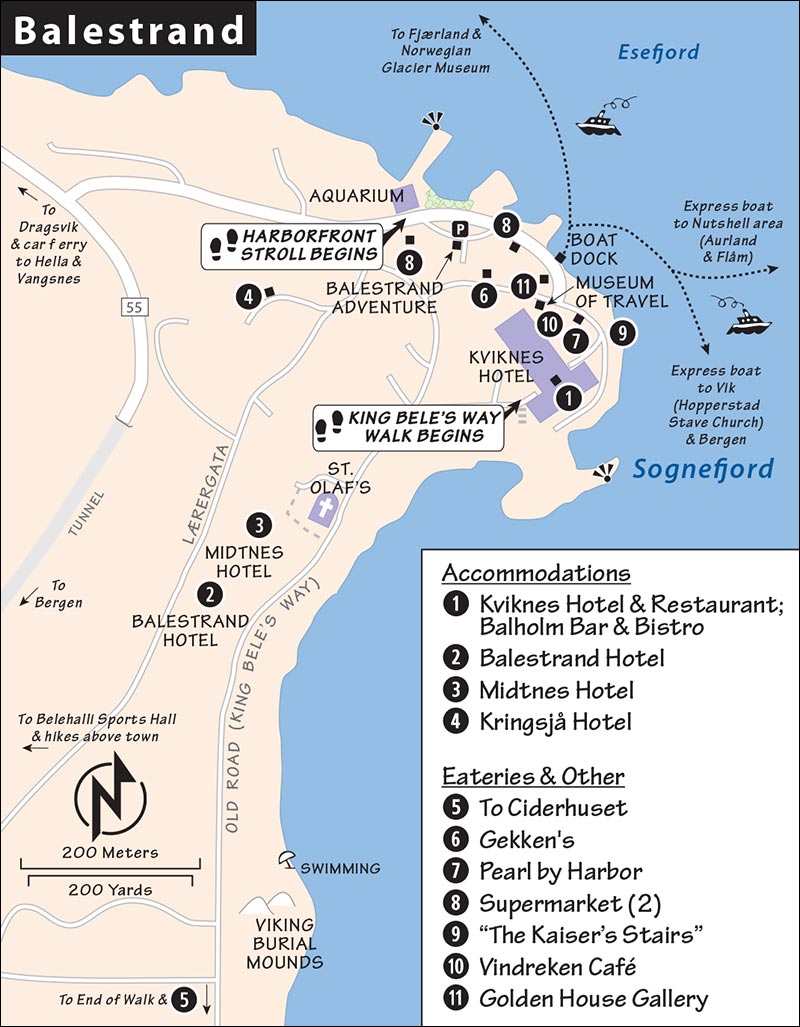
Balestrand Walk
There’s not much in the way of “sightseeing” in Balestrand; this is a place to simply wander and enjoy. This walk is designed to help you do just that, getting your bearings in two parts: first, a stroll along the harborfront to grand views in front of the Hotel Kviknes; and then, if you like, a walk along the main drag, King Bele’s Way, to connect some interesting landmarks (including the picturesque faux-stave church, some Viking mounds, and—a bit farther out of town—the Ciderhuset cidery). Each part is quick; if you do them both, it’ll take barely an hour.
HARBORFRONT STROLL
We’ll stroll the length of the tiny harbor, starting at the modest aquarium and little marina and ending at the big, old Kviknes Hotel.
Sognefjord Aquarium: This offers a look at marine life in the Sognefjord and wood carvings depicting traditional everyday life in the fjordside village of Munken, though it’s a bit dated and dreary. Tickets include a one-hour canoe or rowboat rental from the dock outside (100 NOK, irregular hours but typically open long hours daily in summer).
• From the aquarium, walk along the tidy marina to the little waterfront...
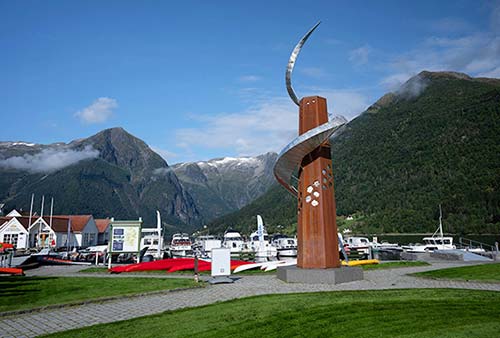
Park: Locals enjoy the modern sculpture that combines a rusted pillar and a silvery twist, even if nobody can seem to explain its symbolism. (“It’s a lighthouse for tourists” is the best I could get.) Nearby are kayak rentals and the departure point for high-speed inflatable (RIB) boat tours on the fjord. The Balestrand Adventure office across the parking lot has details on these and other adventures. Handy WCs are in the small white shed along the road.
• Keep going with the water on your left. Across the street, in the unsightly modern strip mall, is the Joker supermarket and a community bulletin board with the schedule for the summer cinema (the little theater, 800 yards away, runs films nightly).
Next is a big yellow house with a glass bulb on top, the...
Golden House (Det Gylne Hus): Originally built as a general store in 1928, today it’s an art gallery showcasing the works of local watercolorist and historian Bjørg Bjøberg and her husband, Arthur Adamson. Bjørg’s watercolors celebrate the beauty of Norway, and Arthur’s paintings celebrate the beauty of women. If it’s open, step in and check out their works (closed Sun, www.detgylnehus.no).
• Continuing past the Golden House, look right to see the hulking, concrete, modern home of the...
Norwegian Museum of Travel and Tourism (Norsk Reiselivsmuseum): Poke around the free exhibits on the main floor to see if you’d like to pay admission for the well-presented exhibits upstairs, which celebrate the heritage of tourism in this beautiful country. Also upstairs, overlooking the harbor, is a fine café serving coffee, pastries, and often sandwiches (no ticket required). For more on the museum, see “Sights in Balestrand,” later.
• Just beyond the museum, on the left, look for the boat landing where the big Bergen-Sognefjord express catamaran ties up. And on the right, you’ll see a row of four...
Colorful Old Houses: Three of these are actually part of the museum; the first one can be entered only from inside the museum, upstairs, but the last two are free to explore if the doors are open (see details in the museum listing).
The cute, light-yellow house tucked between them—marked Peters Plass (at #8)—is a former watchmaker’s shop from 1983, which used to stand at the harborfront until the Joker supermarket bullied it out of the way in 1988. This little house was considered historic enough to be airlifted 100 yards to this new spot, and today hosts the recommended Pearl by Harbor café.
The last of these old houses—the rust-colored building with a Balestrand sign up top—was the waiting room for the 19th-century steamer that first brought tourism to town. On the benches in front, you may see modern-day Grand Tourists with their wheelie bags and rucksacks, still waiting for the boat to take them to Bergen...but these days, it’s an express catamaran rather than a plodding steamer.
• Walk about 50 yards farther along. Pause at the tall stone...
Steamship Monument: This pillar was erected to celebrate the North Bergen Steamship Company. Its boats first connected Balestrand to the rest of the world in 1858. In front of the monument, some nondescript concrete steps lead into the water. These are “The Kaiser’s Stairs,” built for the German emperor Kaiser Wilhelm II, who made his first summer visit (complete with navy convoy) in 1899 and kept returning until the outbreak of World War I.
• The monument stands in front of one of the largest old wooden buildings in Norway, the...
Kviknes Hotel: Built in the 1870s, the original part of the hotel is still infused with the beauty of the Victorian Age of travel. (Its blocky modern annex, extending behind it as if hiding from the cameras, has more of a “1960s brutalist” aesthetic.) We’ll circle around to the gorgeous front yard of the hotel in a moment. But first, it’s worth going inside to be transported back to a more genteel age of travel, 150 years in the past.
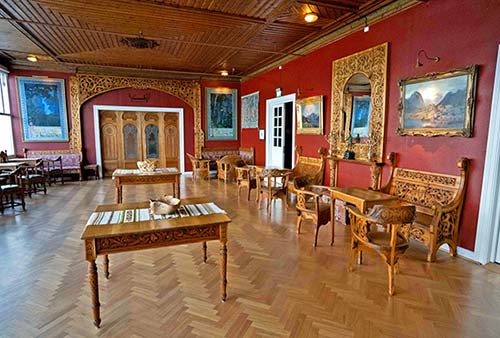
To enter, backtrack a few steps and hike up the driveway that leads from the monument to the hotel’s modern lobby. Go inside and turn left. You’ll find yourself in the plush old lounge, a virtual painting gallery of Romantic Age tourism. All the pieces are by artists from this area, celebrating the natural wonder of the fjord country—part of the trend that helped 19th-century Norway reconnect with its heritage. Straight ahead from the lounge is the exquisite Høyvik Hall, lovingly handcrafted by local furnituremaker Ivar Høyvik (1881-1961), who incorporated lots of Viking dragons into his works (you’ll find them hiding out in the armrests of many chairs). Explore the other elegant public rooms of the old hotel; if you’d like to come back and linger, consider making a reservation and choosing a table for a smorgasbord dinner tonight (see “Eating in Balestrand,” later).
• Go back outside the way you came in, head down the ramp, turn right, pass the steamship monument, and circle around to the front of the hotel to find the...
Pier: Walk to the end of the pier that extends out into the fjord and look back for the classic view of Kviknes Hotel and Balestrand. Bask in these views; looking back toward the aquarium, you enjoy a fine panorama of the dramatic Esefjella mountains.
Where the pier connects to the park are some rocks and trees. While attached to the mainland today, this was once an island in the fjord, which helped give the town its name: “Balestrand” means the strand or promenade in front of an island.
• Now follow the path that curls around the headland between the “island” and the fjord. You’ll emerge onto a swimming platform offering a...
Panoramic View: Look at Balestrand’s town center, with its many pretty wooden houses in red and yellow. Visually trace the shoreline from right to left. The boxy white building near you is the former Town Hall. Just beyond, the rocky shoreline is picturesquely punctuated with rickety wooden docks and boat sheds. Up above rises the brown-and-yellow “Neo-stave”-style St. Olaf’s Church. To the left, the inviting lawn with the sauna perched on the waterline belongs to Hotel Balestrand (just above). Panning farther left, you’ll see a protected swimming cove that marks the far end of this little bay. Just beyond that (directly above the red-and-gray modern boat sheds), you can make out the perfectly round, green Viking-age burial mounds. From those mounds, the main drag (called King Bele’s Way) continues through a bucolic countryside with more pretty homes, green lawns, apple orchards, and fjord splendor.
• The second part of this walk, below, essentially follows the same route your eyeballs just took.
KING BELE’S WAY WALK
For a delightful walk (or bike ride) along the fjord’s edge, start at the Kviknes Hotel and head west out of town up the “old road” (Kong Beles Veg a.k.a. King Bele’s Way) for about a mile. This walk—along what was once the main road from the harbor—passes Balestrand’s gorgeous little church and some Viking mounds and takes in loads of stunning scenery on its way out of town, with a detour inland to the recommended Ciderhuset cidery. (If you have a Ciderhuset cidery reservation, allow 30 minutes to get there following this walk.)
• From the front lawn of the Kviknes Hotel, face the hotel and take the path on its left side (near the charging stations for electric cars), finding the staircase up to street level. Turn left and follow the modern road for a couple of blocks. On your left, you’ll pass the big, white former Town Hall.
At the fork, bear right to head uphill for a closer look at the beautiful...
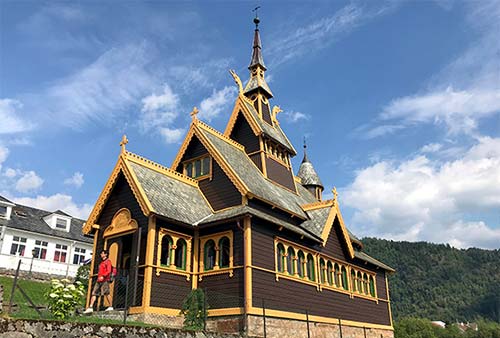
St. Olaf’s Church: This distinctive wooden church was built in 1897. Construction was started by Margaret Sophia Kvikne, the wife of Knut Kvikne (of the Kviknes Hotel family; her portrait is in the rear of the nave), but she died in 1894, before the church was finished. This devout Englishwoman wanted a church in Balestrand where English services were held...and to this day, bells ring to announce services by British clergy. (In summer, they have Mass in English every Sunday morning, plus three evening services each week at 21:00—see the schedule by the front door.) Saint Olaf, who brought Christianity to Norway in the 11th century, was the country’s patron saint in Catholic times. The church was built in a “Neo-stave” style, with lots of light from its windows illuminating its almost entirely wooden interior: tall wooden pillars (like medieval staves); X-shaped crosses of St. Andrew; and other features that beautifully merge the 12th and 19th centuries. Over the main altar is a painting inspired by the famous Risen Christ statue in Copenhagen’s Cathedral of Our Lady. Here, Christ is flanked by fields of daisies (called “priests’ collars” in Norwegian) and peace lilies. Locals enjoy the idea that Disney artists for the film Frozen were inspired by this church.
• From the church’s front door, head straight down the gravel path to rejoin the main road. The beautiful fjordside lawn belongs to the...
Balestrand Hotel: This unassuming hotel, on your right, has a lively, inviting bar in its lobby—and a fascinating story to tell. For years, it was lovingly run by Unni Marie Kvikne, part of the family that has run the grand Kviknes Hotel for generations. During the Covid-19 pandemic, she sold it to her nephew, Per, who is a massive Norwegian rap star (under the name Kjartan Lauritzen). Per renovated the hotel to be hip and youthful—a process that was documented, warts and all, on a Norwegian reality show called 6899 ’Til I Die (a reference to Balestrand’s postal code). Several townspeople, including virtually the entire Kvikne family, were “characters” on the show. These days, the hotel is being thoughtfully managed by Per’s sister, Sandra, who keeps things professional...in a fun and casual way (notice the inflatable pool toys on the roof).
• Keep going along the main drag. A bit farther along, watch on your left for a lovely, carefully engineered little swimming cove—a protected area that’s inviting for local kids (and adults) to take a dip. After passing a school (on your right), on your left you’ll come upon two...
Viking-Age Burial Mounds: According to an Icelandic saga, the second mound (marked by a ponderous statue) is the gravesite of the Viking King Bele—the namesake of the road we’re on now. If you’d like to share his view over the fjord, you can hike up and take a seat on the bench. The statue was a gift from German emperor Wilhelm II, who was so enthralled by a romantic retelling of the saga that he traveled to Balestrand every year.
• From here, it feels like you’re leaving the main part of Balestrand and heading into the countryside. In this next stretch, you’ll pass numerous...
Late-1800s “Villas”: At the time, this Swiss style was popular with some locals, who hoped to introduce a dose of Romanticism into Norwegian architecture. Look for the dragons’ heads (copied from Viking Age stave churches) decorating many gables. Also check out the wooden shelters for the mailboxes; in a tongue-in-cheek spin, some give the elevation (m.o.h. stands for “meters over havet”—the sea).
• Enjoy this rural walk. About 200 yards after the Viking mounds, you’ll reach a cross-street leading up into the hills called Sjøtunsvegen. If you turn right up this street, you’ll find a couple of worthwhile shops. First, just up the street and on the left, is...
Sogneprodukt: This shop sells handicrafts made by people with physical and mental disabilities. A local home for the disabled was closed in the 1980s, but many of its former residents stayed in Balestrand because the government gave them pensions and houses in town. Shopping here supports that good cause (Mon-Fri 9:00-15:00, closed Sat-Sun and off-season, Sjøtunsvegen 4, www.sogneprodukt.no).
• Continue about five more minutes up Sjøtunsvegen, then follow signs to the left through the trees to reach...
Ciderhuset: This family-run business produces alcoholic ciders and nonalcoholic fruit juices, and operates a great restaurant with tours and tastings. Ideally you’ve booked ahead, but if you’re just dropping in, you’re welcome to enjoy a stroll through the orchard and browse their shop (see listing later, under “Sights in Balestrand”).
• Back down on the main road (or if you opted not to detour up Sjøtunsvegen), continue on King Bele’s Way. You’ll pass the big Balholm fruit-juice production facility (owned by the Ciderhuset family), and just beyond are some of Balestrand’s most impressive old Swiss-style villas. Stroll as far as you like before wandering back the way you came.
Sights in Balestrand
In addition to the following sights, Balestrand is a home base for some excellent side trips. The best are Hopperstad Stave Church (worth ▲▲), across the fjord; and Fjærland, where you can see a tongue of the Jostedal Glacier and visit the good Norwegian Glacier Museum (worth ▲). For details on these, see the “Near Balestrand” section, later.
▲Norwegian Museum of Travel and Tourism (Norsk Reiselivsmuseum)
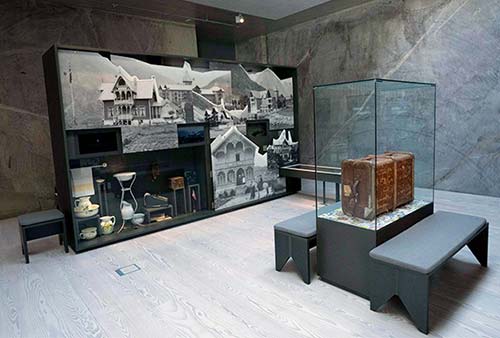
This impressively slick and modern museum, opened in 2016, is the place for Norse-talgic travelers to relive happy memories of past vacations. It’s loaded with artifacts from 150 years of tourism in Norway. And while the subject matter may be a little obscure to a casual visitor, the exhibits are earnest and engaging—making this a good bad-weather activity.
Cost and Hours: 110 NOK, June-Aug Tue-Sun 11:00-16:30, generally closed Mon, shorter hours off-season, Holmen 12, +47 47 45 30 53, www.misf.no.
Visiting the Museum: A few free exhibits on the street level give you a taste of what’s inside. For the full exhibit, head upstairs, where you can buy tickets at the café (good coffee and cakes, fine view over harbor), then head through several large halls showcasing Norwegian tourism across the ages.
From grand hotels (like the Kviknes) to creaky pensions, and sod-roofed huts to campgrounds, the museum celebrates all aspects of touring Norway. You’ll learn how tourism was first developed here with the aim of putting Norwegians in touch with the beauty of their own homeland, and how, later, the fjords became a popular stop of the “Grand Tour” of European travel. Touchscreens display vintage images and first-person accounts of happy travelers. You’ll see lots of artifacts, from steamer trunks and place settings from grand hotels to tourist brochures and camping gear, plus an entire wall of old postcards. Norwegian souvenirs range from trolls to folk-design dishes to comfy wool sweaters to “Norge” keychains.
Beyond the main exhibit, the museum has several other parts. In the auditorium, you can choose from among five films. Through a door near the café, you can enter the upper floor of the old red house next door, with an intriguing exhibit on the Europe-wide “art villages” movement of the 19th century (Balestrand was one of them). And down on the harborfront—accessible without a museum ticket—two old buildings house additional museum exhibits: The brown house with green-and-white trim (called “Bom Bom,” c. 1915-1917) considers the use of cultural heritage as souvenirs, and the long rust-colored house with the Balestrand sign has an exhibit about “Life on the Quay,” tracing the long history of people coming to Balestrand by sea.
▲▲Ciderhuset—Cider Tastings, Tours, and Meals
This wonderful countryside experience—a long and pleasant walk or short drive from the heart of town—is based at the orchard run by the Eitungjerde family (Gard and Tuba). They produce a variety of alcoholic ciders, plus a wide range of fruit juices—using apples, of course, but also berries, rhubarb, pears, and other local produce. Their shop, tucked idyllically between neat rows of apple trees with views over the Sognefjord, is a fine place to learn about their production, have a drink, and buy a bottle or two. They offer regularly scheduled tours and tastings, allowing Gerd to poetically describe his family’s passion for cider-making on a stroll through the orchard. And they run a restaurant, where Tuba infuses local cuisine with flavors from her Turkish heritage. For any of these, book well ahead. (For more on Norway’s trendy new cider scene, see here.)
Cost and Hours: Shop—Open mid-May-mid-Sept Mon-Sat 12:00-18:00, closed Sun and off-season. Tour and tasting—2/day, one-hour tour followed by a guided tasting of five ciders, 12:30 tour includes a full meal (775 NOK), 16:00 tour includes snacks (555 NOK). For dinner options, see “Eating in Balestrand,” later. It’s essential to prebook tours/tastings and dining on their website (Sjøtunsvegen 32, +47 95 90 21 90, www.ciderhuset.no).
Getting There: It’s about a one-mile walk from the harborfront along King Bele’s Way to Sjøtunsvegen (slightly uphill at the end, allow 30 minutes at a leisurely pace—see the second half of my self-guided walk). It’s also possible by bike or car.
As you explore Norway’s many stunning fjords, it’s easy to forget why they’re here: They were carved by mighty glaciers millions of years ago. And even today, if you train your gaze skyward, it’s not unusual to spot a fringe of glacier on top of a mountain towering over the fjords.
The Sognefjord has two accessible opportunities to get relatively up close with a glacier, at the Nigardsbreen or the Bøyabreen (breen means “the glacier” in Norwegian). Both are tongues of the huge Jostedal Glacier (Jostedalsbreen), the biggest glacier in continental Europe, and about a 30- to 40-minute detour from the main highway 55, which runs along the north shore of the Sognefjord and the west shore of the Lustrafjord. Neither will be thrilling if you’ve been to Iceland or New Zealand—where glacier encounters can be more hands-on—but if this is your first or only opportunity to see a glacier, either may be worth the trip.
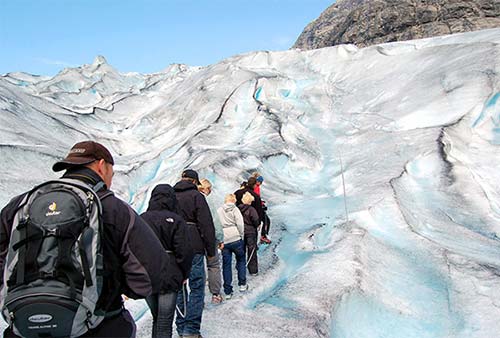
Nigardsbreen, a 40-minute drive from the Lustrafjord town of Gaupne, fills a low valley and lets you get close enough to touch the glacier or (with a guided tour) even walk on it. It’s a handy stop from Solvorn, or if you’re taking highway 55 from the Jotunheimen Mountains to the Lustrafjord, but it’s hard to reach by public transportation. Plan on about an hour’s walk from the nearest parking lot to the glacier itself, or 30 minutes if you ride the boat across the lagoon. The exhibit at Nigardsbreen is fine but dated. For details see here.
Bøyabreen (near the town of Fjærland) is much higher up, which makes it easier to see and more dramatic from afar. However, this also means you won’t get up close: This is a “view from a distance” experience. This glacier has the superior museum, with a stirring movie, good exhibits, and a rooftop deck with views up glacier-capped valleys. From Balestrand, it’s an easy half-day package tour from Balestrand, or a long but scenic drive over the Gaularfjellet road. For drivers based in Sogndal on the Lustrafjord, it’s a 30-minute detour. For details see here.
Jostedal and its tongues—like most glaciers on our planet—are receding faster and faster due to human-accelerated climate change. The amount of visible glacier has shrunk even over the last few years, and glacier excursions are becoming more sad than majestic. If nothing else, seeing a Norwegian glacier is a poignant reminder of the immediacy of the climate crisis gripping our planet.
Activities in Balestrand
High-Speed Boat Tours
Balestrand Fjord Adventures specializes in high-speed inflatable boat tours on the Sognefjord. As with other RIB trips, passengers wear full-body weather suits as they zip across the water. Choose between a two-hour tour to the Finnabotn, a less-visited waterway across the Sognefjord (1,290 NOK, daily 10:00) or a 1.5-hour tour of the waters around Balestrand (980 NOK, daily at 13:00, sometimes also at 15:00). Book ahead (+47 47 85 53 23, www.balestrandfjordadventures.no, tours depart from the small park in the middle of the harborfront).
Biking
Balestrand Adventure rents e-bikes and enjoys suggesting local rides (see contact info earlier, under “Tourist Information”). You can cycle around town or circle the scenic Esefjord (north of town, en route to the ferry landing at Dragsvik—about 6 miles each way). From there, you can pedal right on to the ferry across to Vangsnes and carry on to the Hopperstad Stave Church in Vik. Alternatively, for a shorter ride, head west up the Sognefjord along the scenic King Bele’s Way (following the route outlined in Part 2 of my town walk, earlier, and going beyond it as far as you like).
Hiking
A variety of hikes—ranging from easy nature strolls to ambitious ascents—are within easy reach of Balestrand. Signage can be lacking; before heading out, get advice and maps at the Balestrand Adventure office (described earlier, under “Tourist Information”). Their website (www.balestrandadventure.no) outlines even more ambitious hikes.
From Balestrand: Both of the following hikes begin near the Belehalli sports hall above town. To get there, make your way up to Lærergata, the road that runs above the Balestrand and Midtnes hotels. Follow this south, taking a sharp right turn on Kreklingevegen, which switchbacks up to the sports hall. Once there, look for Nature Trails signs to get started.
The Kreklingen nature trail winds up through the woods above town, earning you great views over Balestrand and the fjord. The first stretch is marked with information plaques. The full ascent requires about 800 feet of elevation gain and can take up to four hours round-trip, but you can go just as far up as you like. First, follow yellow signs to Granlia; from there, follow Sandstølen signs for a shorter route or Skåsheim signs for a longer route.
The steeper, more ambitious Buråsi/Raudmelen trail hosts Balestrand’s annual uphill mountain running race, Balestrand Opp (www.balestrandopp.com). From the Belehalli sports hall, find the red trail to Raudmelen and begin the ascent. You can go as far up as you like: Orrabenken (1,214 feet), Buråsi (1,886 feet), or all the way up the stone steps to Raudmelen (3,189 feet). If you get winded, imagine this: During the annual race each September, runners make it from Kviknes Hotel to Raudmelen in less than 40 minutes.
For Drivers: Another possibility is driving up the Gaularfjellet scenic road (described later) to reach the 13-mile-long Fossestien nature trail, which follows the Gaula River as it connects a series of lakes and waterfalls (with less time, you can do just part of the trail).
Sleeping in Balestrand
$$$$ Kviknes Hotel is the classy grande dame of Balestrand, dominating the town and packed with tour groups. The historic hotel—and five generations of the Kvikne family—have welcomed tourists to Balestrand since the late 19th century. The hotel has two parts: a concrete wing built in the 1960s, with 165 updated and comfortable rooms and great views in both directions; and the picturesque wooden section, with 25 older, classic rooms but no elevator. All rooms have balconies. The elegant Old World public spaces in the original section feel like a museum to the glory days of Grand Tour travel, with romantic paintings and delightful hand-carved details—beautiful enough to explore even if you’re not staying here (and described earlier, on my town walk). These plush public spaces, and the delightful fjordside lawn and bench-lined pier out front, make you want to sit there and sip tea all afternoon (family rooms, closed Oct-April, +47 57 69 42 00, www.kviknes.com, booking@kviknes.no). Part of the Kviknes ritual is gorging on the koldtbord buffet dinner—open to nonguests, and a nice way to soak in the hotel’s old-time elegance without splurging on an overnight (see “Eating in Balestrand,” later).
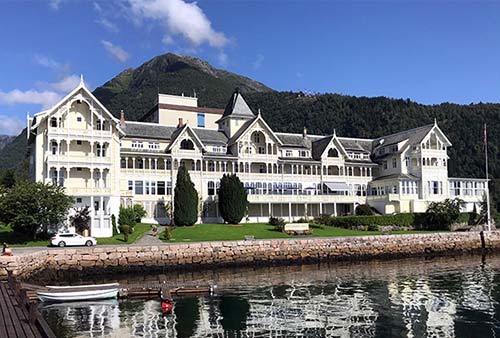
$$ Balestrand Hotel, smaller and a few blocks away overlooking the fjord, is managed by Sandra Kvikne and her gregarious team. Putting a younger spin on local accommodations, the hotel serves as a local arts hub, with a selection of changing paintings on the walls, brightly colorful public spaces, a bar at the reception desk, and generous outdoor seating. Its 30 rooms are simple but cheery, tidy, and well-appointed. It’s worth paying a bit more for a fjord-view balcony, though there may be some bar noise until about 23:00. While not rowdy, this place can be lively, with people enjoying drinks out front late into the evening, plus occasional live music (elevator, hotel open mid-April-Sept, bar open year-round, 5-minute walk from dock, just past St. Olaf’s Church at Kong Beles Veg 41, +47 57 69 11 38, www.balestrand.com, info@balestrand.com).
$$ Midtnes Hotel, a couple of doors down from Balestrand Hotel (right next to St. Olaf’s Church), is a suitable midrange alternative for those seeking a bit more tradition and quiet. This old-school place feels dated, with cinderblock hallways and 30 faded but affordable rooms; you can pay more for a fjord-facing balcony. It also has some fine public spaces, including a terrace out front and a private lawn and swimming dock on the fjord across the street (elevator, Kong Beles Veg 33, +47 57 69 42 40, www.midtnes.no [URL inactive], post@midtnes.no, Jon).
$ Kringsjå Hotel, a camp school for sixth-graders most of the year, rents 20 hotel rooms to travelers from mid-June to mid-August. All the rooms have private bathrooms and most have view balconies (family rooms, game room, +47 57 69 13 03, hotel@kringsja.no, Magnar).
Eating in Balestrand
Balestrand has two excellent high-end options: a memorable smorgasbord dinner in an opulent grand hotel; and a casual, fun, and lively Turkish-Norwegian fusion lunch or dinner among apple trees at a cidery. Both are worth the splurge, for the experience as much as the food. Beyond those two, most other choices are functional and forgettable. Be aware that Balestrand’s restaurants seem to come and go each season. Get the latest from locals (or online), and don’t be surprised if you find changes to these listings.
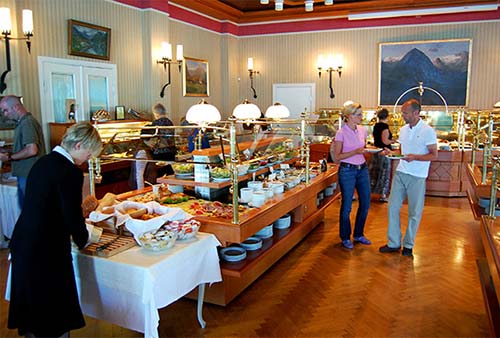
$$$$ Kviknes Hotel offers a splendid, spendy koldtbord buffet dinner in a massive yet stately old dining room. For a memorable fjordside smorgasbord experience, it doesn’t get any better than this. Don’t rush. Consider taking a preview tour—surveying the reindeer meat, lingonberries, and fjord-caught seafood—before you dive in, so you can budget your stomach space. Get a new plate with each course and save room for dessert. Each dish is labeled in English (about 800 NOK/person, daily 18:30-21:00, closed Oct-April). In the same dining room, they also offer a four-course, locally sourced dinner for around 900 NOK. After dinner, head into the rich lounge to pick up your cup of coffee or tea (included), which you’ll sip sitting on classy old-fashioned furniture while basking in fjord views.
$$$$ Ciderhuset, a recommended family-run orchard and cidery a short drive or longish walk outside of town, also serves delicious meals. Tuba brings Turkish accents to Norwegian food, creating delicious dishes that go beautifully with the cider. It’s a modern facility in a lovely rural setting overlooking apple orchards and the fjord. During the peak of summer, they offer dinner with cider pairings at two seatings (685 NOK, Mon-Sat at 17:00 or 19:30). Or book the 12:30 tour and tasting, which includes lunch (775 NOK). For any meal, it’s essential to prebook on their website (see the listing under “Sights in Balestrand” for details; closed Sun and off-season, Sjøtunsvegen 32, +47 95 90 21 90, www.ciderhuset.no).
$$ Gekken’s is an informal summer restaurant serving good-value meat, fish, and vegetarian dishes, along with burgers, fish-and-chips, and other fried fare. Sit in the simply decorated interior or out on the shaded little terrace. Geir Arne “Gekken” Bale can trace his family’s roots back 400 years in Balestrand. He has filled his walls with fascinating historic photos and paintings, making his dining hall an art gallery of sorts (daily, closed Sept-April, a block above the harbor—look for the bright-yellow house, +47 57 69 14 14).
$$ Pearl by Harbor, inside the historic Peters Plass building facing the boat dock, has a short menu of crowd-pleasing international dishes, plus some Ukrainian specialties (from the owners’ homeland). It’s a tight, cozy old house with seating on two floors and some outdoor tables overlooking the harbor action. In the front window, you can watch the chefs busy in their tiny kitchen (daily, closed off-season, Holmen 8, +47 40 17 74 83).
$$ Balholm Bar and Bistro, inside the Kviknes Hotel (near the reception desk), has a short menu of good food, including a popular burger made with local beef, in a generic hotel-lobby ambience (inside the hotel’s modern entrance, daily for lunch and dinner, closed off-season).
$ Vindreken Café, upstairs inside the Norwegian Museum of Travel and Tourism and named for the mountain above town, has a certain charm—with a good selection of cakes and coffees, plus sandwiches, all with a nice view over the harbor (open same hours as museum—see listing under “Sights in Balestrand,” earlier).
Picnic: The delightful waterfront park next to the aquarium has benches and million-dollar fjord views. The Co-op/Prix and Joker supermarkets at the harbor are handy and well stocked; the Co-op/Prix is bigger, has a wider selection, and is open longer hours and on Sundays.
The made-for-tourists express boat (hurtigbåt) makes it a snap to connect Bergen with Balestrand and other Sognefjord towns (for foot passengers only—no cars). In summer, the boat links Bergen, Vik, Balestrand, Aurland, and Flåm. You can also use this boat to connect towns on the Sognefjord, such as zipping from quiet Balestrand to busy Flåm, in the heart of the Nutshell action. In summer it’s important to prebook at www.norled.no (select “Expressboat”; when sorting through schedules, look for “Sogn and Fjordane”—the region this boat covers; discounts for students and seniors; can also reserve at +47 51 86 87 00). If space is available you may be able to buy tickets at the boat, but I wouldn’t risk it during the busy summer months.
The following schedules were accurate as of press time—use them to get a general idea but confirm locally.
Between Bergen and Balestrand: The express boat trip between Bergen and Balestrand takes four hours (835 NOK). Here’s the summer schedule (April-Oct): Departs Bergen at 8:00 and 16:30—or 14:15 on Sat; departs Balestrand daily at 7:50—or 11:27 on Sun—and 16:50. In summer, the 8:00 boat from Bergen continues to Flåm on the Sognefjord (arriving at 13:40), and the afternoon boat continues to Sogndal on the Lustrafjord (arriving Sun-Fri at 21:20, Sat at 19:00). Off-season (Nov-March), the connection still runs as far as Balestrand (check online for schedules).
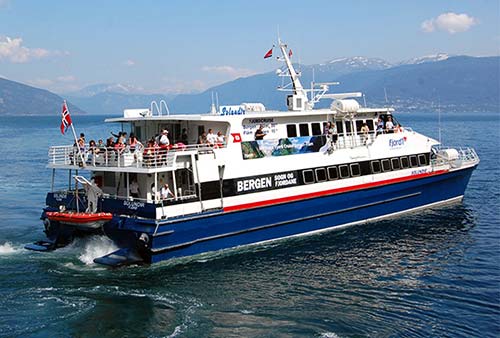
Between Flåm and Balestrand: Going by boat between Balestrand and Flåm with the Norled ferry takes about 1.5 hours (335 NOK, departs Balestrand daily at 11:58, arrives in Flåm at 13:40; departs Flåm April-Oct daily at 15:30, stops at Aurland, arrives in Balestrand at 16:50; no express boats between Flåm and Balestrand Nov-March).
From Oslo to Balestrand via the Nutshell: This variation on the standard Norway in a Nutshell route is called “Sognefjord in a Nutshell” (Oslo-Myrdal-Flåm-Balestrand-Bergen). From Oslo, take an early train to Flåm (no later than the 8:25 train as part of the Norway in a Nutshell route), then catch the 15:30 express boat to Balestrand and spend the night. The next day, continue on the express boat to Bergen or return to the Nutshell route by taking the express boat to Flåm and transferring to the next boat to Gudvangen.
Balestrand Connections
Because Balestrand is separated from the Lustrafjord by the long Fjærlandsfjord, most Balestrand connections involve a boat trip.
BY BOAT
Express Passenger Boat: The easiest way to reach Balestrand is on the handy express boat, which connects to Bergen, Vik (near Hopperstad Stave Church), Aurland, and Flåm (see sidebar for details). Note that you can also use this boat to join the Nutshell trip in Flåm. From here, continue on the Nutshell boat down the Nærøyfjord to Gudvangen, where you’ll join the crowd onward to Voss, then Bergen. As you’re making schedule and sightseeing decisions, consider that the Balestrand-Flåm boat skips the Nærøyfjord, the most dramatic arm of the Sognefjord.
Car Ferry: Balestrand’s main car-ferry dock is at the village of Dragsvik, a six-mile, 15-minute drive around the adorable little Eselfjord. From Dragsvik, a car ferry makes the short crossing east to Hella (a 30-minute drive from Sogndal and the Lustrafjord), then crosses the Sognefjord south to Vangsnes (a 20-minute drive to Hopperstad Stave Church and onward to Bergen). The ferry operates an unusual triangular route between these three points, which sometimes requires an intermediate stop between where you get on and where you’re getting off. Listen carefully for announcements: Even if you’re continuing to the next stop, you may have to drive off at the intermediate stop, do a loop-de-loop at the dock, then reenter the ferry pointed in the correct direction. This sounds strange, but as with all things in Norway...it works. Through the summer, the ferry runs 2-3/hour (closer to 1-2/hour off-season).
Note that you can also drive through Sogndal to catch the Kaupanger-Gudvangen or Mannheller-Fodnes ferries (described under “Lustrafjord Connections,” near the end of this chapter).
BY BUS
A local bus links Balestrand to Sogndal (4/day Mon-Fri, 3/day Sat-Sun, 2 hours, includes ride on Dragsvik-Hella ferry).
Near Balestrand
These two side-trips are best if you’ve got the better part of a day in Balestrand. Otherwise, try to visit them en route to other destinations. For example, with a car, you can see Hopperstad Stave Church on the drive between Balestrand and Bergen (or Flåm).
▲▲Hopperstad Stave Church (Hopperstad Stavkyrkje)
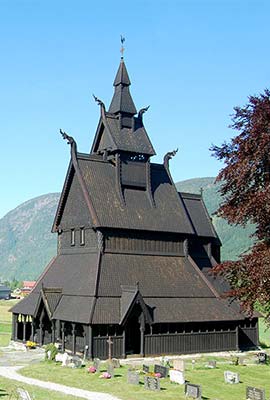
The most accessible stave church in the area—and perhaps the most scenically situated in all of Norway—is located just a 20-minute express-boat ride across the Sognefjord from Balestrand, in the town of Vik. Hopperstad Stave Church boasts a breathtaking exterior, with several tiers of dragon heads overlooking rolling fields between fjord cliffs. The interior is notable for its emptiness. Instead of being crammed full of later additions, the church is blissfully uncluttered, as it was when it was built in the mid-12th century. Compared to the famous Borgund Stave Church on the opposite side of the Nutshell action, with its slick, modern exhibit, Hopperstad feels remote and undiscovered...more like you’re in on a local secret. (For more on stave churches, see here.)
Cost and Hours: 90 NOK, daily 10:00-17:00, closed Oct-mid-May, good 50-NOK color booklet in English, +47 57 69 52 70, www.stavechurch.com/hopperstad.
Tours: Attendants are happy to tell you more about the church and answer any questions, and can give you a free tour, provided they’re not too busy. Take advantage of their generous chattiness to have a medieval moment at Hopperstad.
Getting There: From Balestrand, pedestrians can ride the express passenger boat to Vik, then walk to the church. To get to the church and back in one day, take the 7:50 departure from Balestrand, then return on the 11:35 departure from Vik, arriving back in Balestrand at 11:58—just in time to join a 12:00 glacier excursion (described next). Note that this plan leaves you with nearly two hours to kill in Vik before the church opens...ample time to wander the village and walk up to the church, and isn’t possible on Sundays (when the boat departs later). Be sure to double-check times at Norled.no, under “Expressboat.” The church is a 20-minute walk up the valley from Vik’s harbor: From the boat landing, walk up the main street from the harbor about 200 yards (past a grocery store and a hotel). Take a right at the sign for Hopperstad Stavkyrkje, walk 10 minutes, and you’ll see the church perched on a small hill in the distance.
Another option is to rent an e-bike in Balestrand, then ride it onto your choice of car ferry to get to Vik (these run more frequently than the express boat; rent bike and sort out schedules at the Balestrand Adventure office).
Since cars can’t go on the express boat, drivers must go around the small Esefjord to the town of Dragsvik, then catch the ferry across the Sognefjord to Vangsnes (a 20-minute drive from Vik and the church).
If you’re staying in Flåm on the Nutshell route (or are traveling between Flåm and Balestrand overland), you can drive to Gudvangen, then continue 1.5 hours up and over the mountains to Vik. After seeing the church, hop on the ferry to Vangsnes, which continues on to Hella, then to Dragsvik near Balestrand.
Visiting the Church: Originally built around 1140 and retaining most of its original wood, Hopperstad was thoroughly restored and taken back to basics in the 1880s by architect Peter Blix. He sought to create the ideal version of a stave church, and some critics felt he went too far—making Hopperstad look a little too perfect, especially in contrast to the more higgledy-piggledy (and authentic) appearance of Borgund. While it feels slightly artificial, I appreciate how purely Hopperstad evokes its medieval origins. Judge for yourself.
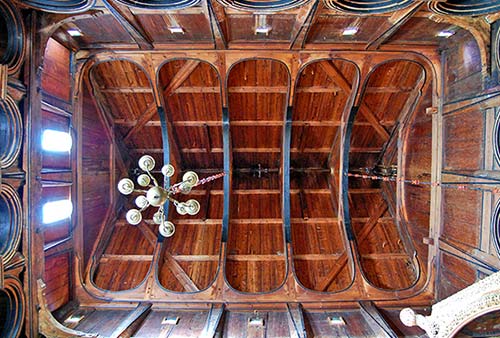
Step inside. Unlike the famous stave church at Urnes (described later), which has an interior that has been rejiggered by centuries of engineers and filled with altars and pews, the restored Hopperstad church looks closer to the way it did when it was built.
Because Hopperstad’s interior lacks the typical adornments, you can really grasp the fundamentally vertical nature of stave church architecture, leading your gaze to the heavens. Follow that impulse and look up to appreciate the Viking-ship rafters. Imagine the comfort this ceiling brought the church’s original parishioners, whose seafaring ancestors had once sought refuge under overturned boats. For a unique angle on this graceful structure, lay your camera on the floor and shoot the ceiling.
Below those rafters, you’ll see the small porthole-like windows, round arches, X-shaped crosses of St. Andrew, and taller round arches typical of stave churches.
The church has only a few added features, including the beautifully painted canopy that once covered a side altar (probably dating from around 1300), and a tombstone from 1738. There are also a few colorful illustrations and some very scant medieval “graffiti” carvings and runic inscriptions. The intact chancel screen—the only one surviving in Norway—separates the altar area from the congregation. As with the iconostasis (panel of icons) in today’s Orthodox faith, this screen separated priests from their congregation during services.
▲Fjærland and Jostedal’s Bøya Glacier
The well-presented Norwegian Glacier Museum in Fjærland is set opposite the Bøya Glacier (Bøyabreen), a receding tongue of the Jostedal. The museum offers informative exhibits, a rooftop vista of valleys capped by white fringes of glaciers, and a film with a thundering soundtrack designed to get your adrenaline pumping about these majestic chunks of ice. From the museum you can drive a few miles to a café/viewpoint for a distant view of the Bøya. Marvel at how far the glacier has retreated—10 years ago, the visit was even more dramatic.
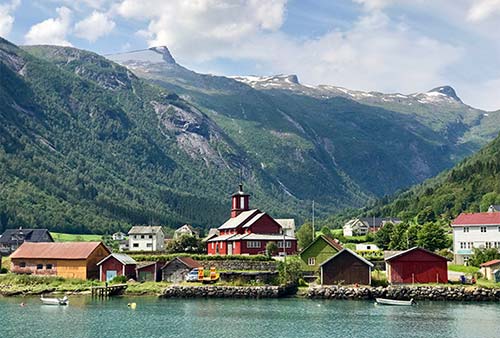
Getting There: From Balestrand, you can cruise up the Fjærlandsfjord or drive over the mountains.
With a Cruise-and-Glacier Tour from Balestrand: Fjord Tours offers a 4.5-hour excursion each day around noon that combines a dreamy Fjærlandsfjord cruise with a visit to the Norwegian Glacier Museum and a look at the glacier itself. Many visitors enjoy the boat ride—no stops, no narration, just a scenic glide with the gulls—even more than the glacier. Bring a picnic, as there’s almost no food sold onboard, and some bread to toss to the gulls (they do acrobatics to catch whatever you loft into the air). After the boat ride, you’ll be met at the ferry dock (labeled Mundal) by a bus and your guide, who reads a script about the glacier as you drive 15 minutes up the valley to the glacier museum; then you’ll be taken up to the Brævasshytta viewpoint for a better look at the glacier. Finally, you’ll be bussed back to the fjord for your return boat to Balestrand. It’s best to reserve ahead (1,190 NOK, summer only, www.fjordtours.com).
By Car: It takes much longer to get to the glacier by car (figure about two hours’ driving from Balestrand): Drive around the bay to Dragsvik, take the short ferry hop to Hella, then follow highway 55 along the Sognefjord to Sogndal, where you’ll turn up road 5 to the museum and glacier viewpoint. For a very scenic alternative, adding about an hour of driving, head up and over several mountains from Balestrand (see my Scenic Drive over Gaularfjellet to the Jostedal Glacier, later). For those driving along the north shore of the Lustrafjord (on the highway 55), it’s just a simple 30-minute (each way) detour from Sogndal.
Norwegian Glacier Museum (Norsk Bremuseum)
This modern museum looks like an artsy concrete bunker in the middle of a pretty meadow. From the rooftop (free access), you enjoy an ideal vantage point to observe several U-shaped glacial valleys, capped by the Bøyabreen tongue of the Jostedal Glacier. Entering the museum, begin your visit with the genuinely exciting 15-minute film, which combines dramatic drone footage and artful cinematography on a wraparound screen. The exhibits are concise and well presented: You’ll learn how glaciers were formed, check out a 3-D model of how the sprawling Jostedal Glacier sits upon much of Norway’s fjordland, experiment with your own hunk of glacier, weigh evidence of the woolly mammoth’s existence in Norway, learn about the effect of climate change on the fjords, and walk through a simulated ice cave. You can pose with a polar bear and, out front, a giant mammoth (160 NOK, daily June-Aug 9:00-19:00, April-May and Sept-Oct 10:00-16:00, closed Nov-March, café, +47 57 69 32 88, www.bre.museum.no).
Glacier Viewpoint (Brævasshytta)
From the museum, it’s about five more miles up a lonely road to the Brævasshytta—a mountain restaurant near a small lagoon (with public parking areas and WCs nearby). From here, you can look up, up, up to the tip of the Bøyabreen glacial tongue lapping down from the cliffs high above. You can walk down to the lakefront for a better look at the opposite bank, where ice has tumbled off the glacier. The $$ Brævasshytta restaurant itself, with big glass windows and an outdoor terrace offering perfect views up at the glacier, proudly serves traditional dishes, from meatballs to local trout to a venison burger (open daily mid-May-mid-Sept).
▲Scenic Drive over Gaularfjellet to the Jostedal Glacier
If driving from Balestrand to the Jostedal Glacier at the Fjærlandsfjord, consider the scenic route over Gaularfjellet on highway 613, which takes about three hours. While challenging to drive—with lots of twists, turns, mountain passes, and narrow roads along the sides of fjords and lakes—your reward is grand scenery. Gaularfjellet is designated as a national scenic route but is far less discovered than most; you’ll feel like you’re in on a secret.
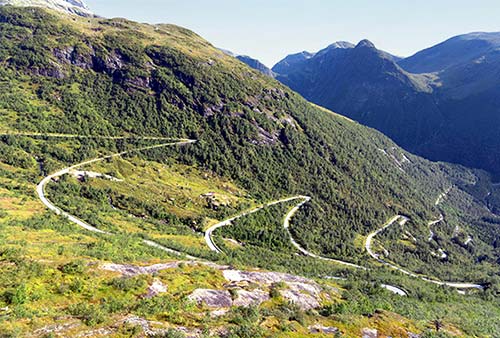
From Balestrand to the Jostedal Glacier: Leaving Balestrand, curl around the cozy little Esefjord to the far point at Dragsvik, where the ferry crosses to Hella. Instead of turning right to join the ferry line, carry on straight, following signs for Highway 613 to Gaularfjellet.
On this road, you’ll curl around two more little branches of the fjord—Sværafjord, then Vetlefjord—enjoying the serenity of these charming villages, with red-and-yellow homes and boat sheds above the serene waters.
At Veltefjord, the road begins to twist high up into the mountains. As you round the first of several switchbacks, look up and straight ahead to see the modern Gaularfjellet viewpoint. After spiraling up to it, get out of your car, step out onto the suspended platform, and look down on the spilled-spaghetti road you just traversed.
From here, the road cuts through a gorgeous mountain valley with rugged scenery; the churning Gaula River (the road’s namesake) with rocky waterfalls; and cabins so pretty, they seem placed there by a landscape painter. Be alert: Free-range cows may be in the road.
Curling between the trees, watch on the left for the well-marked turnoff for the waterfall named Likholefossen. Park and follow the gravel path a few minutes to a modern metal bridge over a particularly striking set of waterfalls, with a turgid mountain river plunging under your feet. This trail is part of the 13-mile-long Fossestien Nature Trail, which roughly parallels the river and the road you’re driving today, passing 14 waterfalls and seven lakes.
Carry on to the end of this stunning mountain valley, then curl down into a more wooded valley. At Setenes, catch a glimpse of a bouncy suspension bridge on your left. Scenic waterfalls link tranquil lakes for the next stretch as you drop farther into the valley. Watch for the right turn (toward Førde) to stay on road 613. Winding around the bend, you’ll reach the village of Viksdalen—with a rare grocery store (gas pumps and WCs available).
Driving out of Viksdalen, you begin to twist up again into the mountains, passing the extremely broad and powerful Vallestadfossen waterfall on the right, then driving along the big lake called Haukedalsvatnet.
Coming down from yet another mountain pass, you’ll turn right after the office park for the busier road E-39/5 toward Sogndal. After going through an industrial area with lots of services (the towns of Langhaugane and Vassenden), you’ll drive along the extremely long and skinny lake called Jølstravatnet. In clear weather, you can look across to some rugged mountains and get your first glimpses of glacier ice up high.
At the top corner of the lake is the town of Skei. At the town’s main roundabout, keep straight to carry on along road 5 (toward Sogndal), where a five-mile tunnel leads to the far tip of the lake. Popping out briefly, look up the sides of the swooping, U-shaped valley you’re driving through—then plunge directly into another long (four-mile) tunnel.
Emerging from the second tunnel, watch on the left for the turnoff to the Jostedal glacier viewpoint (Brævasshytta). Drive up the road to the café for a distant view of the Bøyabreen glacial tongue. From here, you can carry on another five miles to the Norwegian Glacier Museum in the town of Fjærland. (See listings earlier in this section.)
From the Jostedal Glacier Onward: From Fjærland it’s another 30 minutes to Sogndal (most of the route is through two long tunnels, with a very brief glimpse of the Fjærlandsfjord between them). In Sogndal, you can turn right to head back to Balestrand (via the Hella-Dragsvik ferry, about one hour total). Or carry on elsewhere: The ferry docks at Kaupanger (to Gudvangen) and Mannheller (to Fodnes, then a drive to Lærdal) are just a 15-minute drive from Sogndal, and beautiful Solvorn is just a 20-minute drive over the hills.
The Lustrafjord
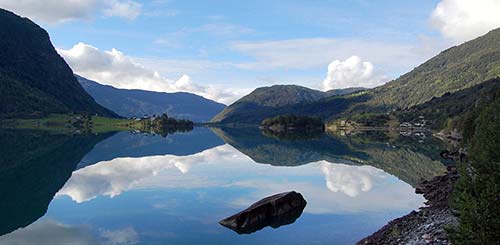
This arm of the Sognefjord, stretching far to the north toward the Sognefjellsvegen mountain road up to the Jotunheimen Mountains, is rugged country—only 2 percent of the land is fit to build on or farm. The Lustrafjord is ringed with tiny villages where farmers sell cherries, giant raspberries, fruit juices, and hard cider. A few interesting attractions lie along the Lustrafjord: the Dale Church at Luster; the impressive Nigard Glacier (a 40-minute drive up a valley); the postcard-pretty village of Solvorn; and, across the fjord, Norway’s oldest stave church at Urnes. While tricky to explore by public transportation, this beautiful region is easy by car—but still feels appealingly remote.
PLANNING YOUR TIME
If you’re sleeping here, you can squeeze in all of this area’s major sights—Jostedal Glacier, Dale Church, Solvorn, and Urnes Stave Church—in a single busy day by car. If you’re just passing through, Dale Church and Solvorn are easy, but the other two involve major detours—choose one or skip them both.
Driving Times: Connecting the dots along the Lustrafjord can take longer than you might think. These estimated times are conservative, and don’t include photo stops. Approaching from Lom in the Jotunheimen Mountains, figure about 1.5 hours via Sognefjellsvegen to the start of the Lustrafjord at Skjolden, then another 30 minutes to Gaupne (with an optional glacier detour: 2 hours to see it from afar, 3-4 hours to get up close, even longer to hike on it). From Gaupne, figure 20 minutes to Solvorn or 30 minutes to Sogndal. Seeing Urnes Stave Church from Solvorn also takes some time. The ferry crossing is brief, but it departs only once per hour, and it’s about a 20-minute walk from the Urnes boat dock uphill to the church; budget about two hours round-trip from Solvorn for a very quick visit, or three hours if you want to linger. For details on all the onward options from Sogndal, this region’s hub, see the end of the “More Sights on and near the Lustrafjord” section.
Solvorn
Idyllic ▲▲ Solvorn, tucked down a twisty road about 10 miles from the Lustrafjord’s main town of Sogndal, is a sleepy Victorian village of about 200 souls and arguably the best little village on the Sognefjord. It’s tidy and quaint, well away from the bustle of the Nutshell action; while it lacks the handy boat connections of Flåm, Aurland, or Balestrand, that’s part of its charm. Colorful wooden boat sheds line its waterfront, and a miniature ferry crosses the fjord regularly to Urnes and its famous stave church.
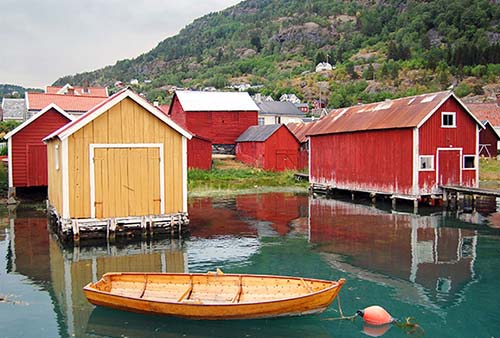
While tiny and entirely devoid of big-league “sights,” Solvorn is a mellow and curiously enchanting place to kill some time waiting for the ferry...or just munching a picnic while looking across the fjord. A contemplative stroll or photo shoot through the village’s gravelly back lanes or along its shoreline is a joy. Solvorn also has a few nice accommodations, ranging from a fancy fjordside splurge hotel to a well-run hostel.
GETTING THERE
Solvorn is a steep five-minute drive down a switchback road from the main highway 55. The main road into town leads right to the Urnes ferry and dead-ends at a handy parking lot (free, 3-hour posted limit) and the Walaker Hotel. By bus, you can connect through Sogndal (5/day, fewer Sat-Sun, 30 minutes).
Orientation to Solvorn
Solvorn has no TI and few services—just one midsize hotel, a boat dock, and lots of historic shiplap homes. You can rent bikes and buy basic groceries (plus fresh juices) at the Eplet hostel, while the Villa Solvorn handles kayak rentals. You can get your bearings with a turn of the head from the boat dock.
Solvorn Spin-Tour
Get to know this huggable hamlet with a spin-tour from the boat landing. At the concrete lot where cars line up for the ferry, notice the red shed with public WCs. Circle around to the dock on the water side of the shed, sit down on one of the benches, and look around.
Straight ahead, across the fjord, the settlement of Urnes fills a green shelf just above the waterline. The ferry from Solvern’s dock putters over to Urnes hourly—handy for those looking to visit Norway’s oldest stave church (described later).
These days, this little ferry is the only real action in town. But historically, Solvorn was an important transportation hub for Haflso, a bustling community surrounding a giant lake, just inland, that you passed before turning off the main road. The first real road between here and there was built in 1860, around the same time they built this quay and began regular steamboat service to Bergen. (The road you came in on is a “newer” version, dating from 1893.) This harbor was an outlet not only for goods (timber, dairy products, animal hides), but also for people. During the great emigrations of the 19th century, locals who left Norway’s fjords forever last set foot on this pier before heading to Bergen, then on to the New World.
Speaking of which, spot any cruise ships? Thankfully...probably not. Most big ships go only as far as Flåm (which is pretty much due south, across the fjord). And that’s how locals like it. If you’re going to other small towns in Norway that are on cruise-line itineraries, savor the contrast. It’s not just cruise ships that skip Solvorn; when highway 55 was built inland—bypassing Solvorn—the village’s former status as a thriving trade center diminished greatly. But, as is often the case with an economic downturn, that’s precisely what has kept Solvorn so small, tranquil, and well preserved.
Now turn to the right. Along the pebbly beach, pretty red and yellow boat sheds stand on pilings, extending out into the water. While you see these all over the Norwegian fjords, Solvorn has a particularly colorful abundance of them. At the far end of the row of sheds is the unpainted Kvitabui—literally “white shack,” because it was originally painted white (unlike the reds and yellows that predominate). This sometimes hosts a summertime pop-up eatery and art gallery (for the latest, see www.kvitabui.no).
The old town center of Solvorn, including its one and only café, huddles uphill from this waterfront. A century and a half ago, this was a bustling commercial district, with shops, administrative offices, a post office, a telegraph office, a bakery, and so on. Also tucked among these buildings are sheds that were originally used to dry locally grown tobacco; you can still see the gaps between slats meant to facilitate drying.
You came to Solvorn on the (paved) main street. But notice that there’s a whole other network of gravel lanes that weave between these buildings. With extra time here, make a point to follow these pathways to get lost in a shiplap world of rustic sheds and white cottages. Locals take pride in decorating doorways and windows, and there are lots of beautiful gardens. Many of the homes have info plaques (in Norwegian) that tell that building’s story.
Tucked behind the red shed you’re sitting in front of, notice the fisherfolk statue (erected in 2022)—a reminder of the time when Solvorn was a successful fishing base. It was said there were so many fishing boats bobbing in this bay, you could walk across it without touching water. Many of those boats were the traditional klinker (or clinker) style, like the one in the statue: a long, skinny, wooden, open boat that could be used for fishing or piled with cargo.
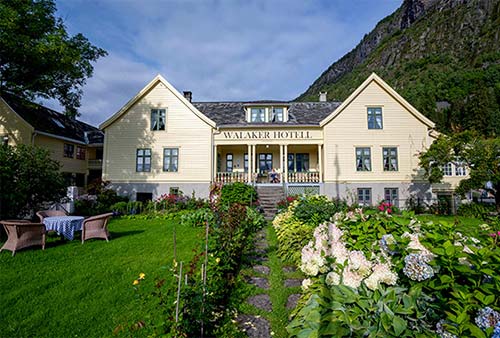
Now continue spinning right, looking inland. You’ll first see the long, white, modern annex and the two yellow original buildings of the Walaker Hotel. Dating from 1690, this is the oldest still-operating hotel in Norway—and it’s been in the same family for the entire time. While the hotel and its grounds are closed to nonguests, you can peek over the fence into the delightful gardens.
Above the hotel, stone cliffs rise steeply toward the sky. These offer natural protection for this little town, keeping growing conditions mild and favorable.
Continuing to spin back toward the water, notice the fjordfront path that leads in front of the hotel garden’s white-picket fence and toward the rocky shoreline beyond. Here you’ll see a row of more modern boat sheds, as well as a pier with a modern swimming and diving platform. If you have 15 minutes to spare, it’s well worth following this path as far as you like—it leads along the water, behind the modern sheds, over a rocky headland with great views, to the final row of sheds at the tip of the point. (For a more serious walk, the billboard near the start of the walkway, next to the red shed, outlines several area hikes.)
Behind that final stretch of sheds are some small, tidy apple orchards. With its short growing season, the Lustrafjord has a limited range of produce that thrives. But berries, apples, and pears do very well. In fact, the Eplet hostel—about a five-minute walk up the hill, behind Hotel Walaker—produces a wonderful variety of fruit juices and has a little shop where you can stock up.
Our spin-tour of Solvorn is complete. You’ve seen all there is to do. Now go for a stroll in either—or both—directions along the waterfront and enjoy getting lost in one of Norway’s most pristine fjordside communities.
Sights near Solvorn
While there’s not much to see in Solvorn, one of Norway’s most engaging stave churches is a quick ferry ride across the fjord. Several more sights that are a handy day-trip from Solvorn (or easy to see on the way into or out of the village) and described later, under “More Sights on and near the Lustrafjord”: the charming, historic Dale Church, worth ▲; a nearby swimming-pool complex; and a ▲▲ visit to the Jostedal Glacier.
▲▲Urnes Stave Church
The hamlet of Urnes (sometimes spelled “Ornes”) has Norway’s oldest surviving stave church, dating from 1129. While not easy to reach (it’s across the Lustrafjord), it’s worth the scenic ferry ride. The exterior is smaller and simpler than those of most stave churches, but its interior—modified in fits and starts over the centuries—is uniquely eclectic. The church recently received funding to build a new visitors center nearby, which will enhance the experience. For more on stave churches, see here.
Cost and Hours: 130 NOK, includes 20-minute English tour (generally departs at :10 and :40 past the hour to coincide with ferry arrival); open May-Sept daily 10:30-17:45, last tour at 16:40, closed off-season, +47 41 39 48 21, www.stavechurch.com/urnes.
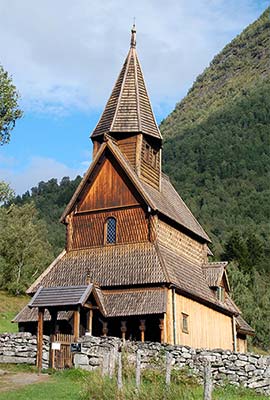
Getting There: Urnes is perched on the east bank of the Lustrafjord (across the fjord from highway 55 and Solvorn). Ferries generally depart Solvorn at the top of the hour and Urnes at 30 minutes past the hour (45 NOK one-way passenger fare, 121 NOK one-way for car and driver, no round-trip discount, 15-minute ride, +47 91 72 17 19, www.lustrabaatane.no). You can drive or walk onto the boat—but since you can’t drive all the way up to the church, you might as well leave your car in Solvorn and walk on. (Parking is free in Solvorn, at the lot by the pier, but the limit is 3 hours—register your license plate at the parking meter next to the small red shed with the public WCs.) Once across, it’s about a five-minute uphill walk to the main road and parking lot (where drivers must leave their cars; parking lot at the church only for visitors with disabilities). From there, it’s a steep 15-minute walk up a switchback road to the church (follow signs for Urnes).
To give your Lustrafjord excursion an added dimension, you could take a bike on the ferry to Urnes (free passage, rentable from Eplet hostel in Solvorn, where you can park your car for free). From the stave church, you can then bike the super-scenic fjordside road nine miles—with almost no traffic—to the big Feigumfossen waterfall and back.
Planning Your Time: Don’t dawdle on your way up to the church, as the tour is scheduled to depart about 25 minutes after the ferry arrives (giving most visitors just enough time to make it up the hill to the church). The first boat of the day departs Solvorn at 10:00 and the last boat at 16:50; the last boat back to Solvorn departs Urnes at 18:00. Confirm these times locally, especially the “last boat” times, and keep an eye on your watch to avoid getting stranded in Urnes.
Eating: A little café/restaurant is at the farm called Urnes Gard, across from the church (same hours as church but open only in peak of summer, homemade apple cakes, +47 57 68 39 44).
Visiting the Church: Buy your ticket in the white house across from the church and go there directly so you don’t miss the tour (visit the little museum here after you see the church).
Here are some elements to look for on the tour, or on your own if you miss it. Many changes were made to the exterior to modernize the church after the Reformation (the colonnaded gallery was replaced, the bell tower was added, and modern square windows were cut into the walls). Go around the left side of the church, toward the cemetery. This is the third church on this spot, but the carved doorway embedded in the wall here was inherited from the second church. Notice the two mysterious beasts—a warm-blooded predator (standing) and a cold-blooded dragon—weaving and twisting around each other. Yet, as they bite each other on the neck, it’s impossible to tell which one is “winning”...perhaps symbolizing the everlasting struggle of human existence. The door you see in the middle, however, has a very different message: the harmony of symmetrical figure-eights, an appropriately calming theme for those entering the church.
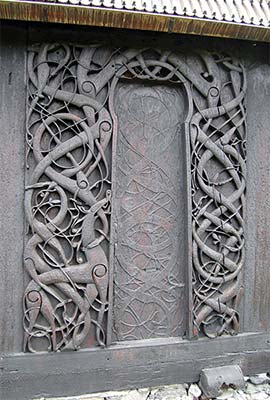
Now go around to the real entry door (with a wrought-iron lock and handle probably dating from the first church) and head inside. While it feels ancient and creaky, a lot of what you see in here is actually “new” compared to the 12th-century core of the church. The exquisitely carved, voluptuous, column-topping capitals are remarkably well-preserved originals. The interior was initially stark (no pews) and dark—lit not by windows (which were added much later), but by candles laid on the floor in the shape of a cross. Looking straight ahead, you see a cross with Mary on the left (where the women stood) and John the Baptist on the right (with the men). When they finally added seating, they kept things segregated: Notice the pews carved with hearts for women, crowns for men.
When a 17th-century wealthy family wanted to build a special pew for themselves, they simply sawed off some of the pinecone-topped columns to make way for it. When the church began to lean, it was reinforced with the clumsy, off-center X-shaped supports. Churchgoers learned their lesson and never cut anything again.
The ceiling, added in the late 17th century, prevents visitors from enjoying the Viking-ship roof beams. But all these additions have stories to tell. Experts can read various cultural influences into the church decorations, including Irish (some of the carvings) and Romanesque (the rounded arches).
Sleeping in and near Solvorn
IN SOLVORN
While the Walaker Hotel is wonderful, it’s a splurge. Your other choices are much simpler: a hostel or a fine guesthouse with shared bathrooms.
$$$$ Walaker Hotel, a former inn and coach station, has been run by the Walaker family since 1690 (that’s a lot of pressure on ninth-generation owner Ole Henrik). The hotel, set right on the Lustrafjord (with a garden perfect for relaxing and, if necessary, convalescing), is open May through September. In the main house, the halls and living rooms are filled with tradition. Notice the patriotic hymns on the piano. The 22 rooms are divided into two types: nicely appointed standard rooms in the modern annex; and renovated “historic” rooms, still creaky but updated with modern conveniences, in the main house or the Tingstova house next door. The new Villa Walaker wing adds four luxurious apartments just behind the main hotel (+47 57 68 20 80, www.walaker.com, hotel@walaker.com). They serve top-quality four-course dinners, elegantly executed by well-trained international chefs, in the lovely old dining room and glassed-in veranda (1,150 NOK plus drinks, nightly at 19:30, savor your dessert with fjordside setting on the balcony). There’s an impressive gallery of Norwegian art in a restored, historic farmhouse out back (free for guests; Ole Henrik leads one-hour tours of the collection, peppered with some family history, nightly after dinner).
$$ Villa Solvorn corners the midrange in this town, with six rooms that share two bathrooms in a beautiful traditional home a short walk up from the water. The simple rooms are comfortable and fresh, and the shared lounge and lawn are inviting (open mid-May-mid-Sept, Solvornvegen 310, +47 99 29 66 72, www.villasolvorn.com, villasolvorn@gmail.com). Soft-spoken owner Oskar rents kayaks to guests and nonguests.
$ Eplet Bed & Apple is my kind of hostel: innovative and friendly. It’s creatively run by Trond and Agnethe, whose entrepreneurial spirit and positive attitude attract enjoyable guests. They rent 23 beds in eight rooms (including five private double rooms)—all with views, some with decks, and all sharing one WC and two showers. If you’re flexible and easygoing, this place could be worth considering even if you don’t normally sleep at hostels (open mid-April-Sept only, no breakfast, no elevator, pay laundry, kitchen, +47 41 64 94 69, www.eplet.no, post@eplet.no). It’s about 300 yards uphill from the boat dock—look for the white house with a giant red apple painted on it. It’s surrounded by an apple orchard and berry farm (they make and sell tasty juices). The hostel also sells a small selection of groceries and rents bikes to both guests and nonguests.
NEAR SOLVORN, ON THE LUSTRAFJORD
These options are less than a 30-minute drive outside of Solvorn, facing the Lustrafjord along highway 55 between Solvorn and the end of the fjord in Skjolden. While they lack the village charm of Solvorn itself, they’re in fjordside communities that are pleasant and scenic in their own right, and they’re closer to the Dale Church and Jostedal Glacier.
$$ Nes Gard Farmhouse B&B is a great choice in a beautiful location, perched overlooking a village church and the fjord beyond. Anders Månum and his crew rent 20 homey rooms in multiple buildings, from traditional rooms in the grand 19th-century farmhouse to the “glass house”—a glass cube on the hill above. Everyone has breakfast in the updated barn, with a dark and cozy wine bar in the cellar, and guests can pay extra for an excellent three-course dinner in the traditional dining room (family apartment, +47 95 23 26 94, www.nesgard.no, post@nesgard.no).
$ Viki Fjord Camping has 13 fjordside huts—many directly on the water, with views and balconies—located directly across from the Feigumfossen waterfall (no breakfast, sheets extra, +47 99 53 97 30, www.vikicamping.no, post@vikicamping.no, Svein).
¢ Luster Fjordhytter, in the village of Høyheimsvik (near Nes), is a fun concept: 13 peak-roofed huts over storage buildings perched directly on the water, looking out over a particularly pretty stretch of the Lustrafjord. The huts are simple—with wood paneling, kitchenettes, bunk lofts, and bathrooms—but the price is reasonable and views are exceptional (+47 48 00 83 74, stairs, www.luster-fjordhytter.com). They also run the Luster Fjord Spa, a sauna and hot tub overlooking the fjord, handy for a cold plunge, which can be booked at an extra charge (even if you’re not staying here).
Eating in Solvorn
There are only three places to eat in town. $$$$ Walaker Hotel has an elaborate four-course dinner that’s intended primarily for guests but can also be booked ahead by nonguests. $ Eplet Bed & Apple has a shop with a wonderful selection of their own juices, plus a very small assortment of groceries for those desperate to assemble a picnic. Otherwise, the only option is the village $ café—with a big outdoor terrace—that’s just a few steps above the boat dock, next to Walaker Hotel. This has changed hands frequently in recent years (most recently, it was called Bryggehuset Nafas), but regardless of who’s running it, they typically have light, simple lunches and dinners most days through the summer season.
Near Solvorn: For more options, you can drive about 10 minutes to the lakeside community of Hafslo or 20 minutes to Sogndal (a much larger town with lots of choices and services; see “Sogndal” on here for suggestions).
Lustrafjord Connections
FROM SOGNDAL BY BUS
Buses go to Lom over the Sognefjellsvegen scenic road (2/day late June-Aug only, road closed off-season, 3.5 hours, likely 1/day off-season, goes around the pass, 5 hours, change in Skei), Solvorn (5/day, fewer Sat-Sun, 30 minutes), Balestrand (4/day Mon-Fri, 3/day Sat-Sun, 2 hours, includes ride on Hella-Dragsvik ferry), Nigard Glacier (Glacier Bus runs daily in high season—see listing, later). Most buses run less (or not at all) on weekends—check the latest at Entur.no.
BY BOAT
Car ferry reservations are generally not possible or necessary except for the boat to Gudvangen (confirm schedules at https://entur.no). From near Sogndal, various boats fan out to towns around the Sognefjord. Most leave from two towns at the southern end of the Lustrafjord: Kaupanger (a 15-minute drive from Sogndal) and Mannheller (a 5-minute drive beyond Kaupanger, 20 minutes from Sogndal).
From Kaupanger: Old-school car ferries operated by Lustrabaatane go from Kaupanger all the way down the gorgeous Nærøyfjord to Gudvangen, on the Norway in a Nutshell route (where you catch the bus to Voss). Taking this leisurely boat allows you to see the best part of the Nutshell fjord scenery (the Nærøyfjord) but misses the other half of that cruise (Aurlandsfjord). Reserve ahead (2/day in each direction, about 2.5 hours, 431 NOK for car and passengers, check schedule and book at www.fjordtours.com, more info at www.lustrabaatane.com, +47 57 63 14 00). With extra time in Kaupanger, the small stave church on the hillside just before the boat dock merits a look (interior closed to the public).
From Mannheller: Ferries frequently make the slick, speedy 15-minute crossing to Fodnes (62 NOK for car and driver, 3/hour, no reservations possible). From Fodnes, drive through the five-mile-long tunnel to Lærdal and the main E-16 highway (near Borgund Stave Church, the long tunnel to Aurland, and the scenic overland “Snow Road” to the Stegastein fjord viewpoint—all described in the previous chapter).
To Balestrand: To reach Balestrand from the Lustrafjord, you’ll take a short ferry trip (Hella-Dragsvik). For information on car ferries to and from Balestrand, see “Balestrand Connections,” earlier.
More Sights on and near the Lustrafjord
In addition to Solvorn and Urnes Stave Church (described earlier), several other worthwhile sights line up along or just off the Lustrafjord. I’ve listed them in order from north to south, with driving instructions for those arriving here by car along highway 55 over the Sognefjellsvegen scenic road from Lom and the Jotunheimen Mountains (for details on that drive, see the next chapter).
Lustrafjord Drive
• Descending from Sognefjell, you’ll hit the fjord at the village of Skjolden (tourist info kiosk in big Fjordstova community center). Follow highway 55 along the west bank of the fjord about 7 miles (10 minutes) to the town of Luster. Here, it’s an easy and satisfying stop right along the side of the road to see...
▲Dale Church (Dale Kyrkje)
The namesake village of Luster, on the west bank of the Lustrafjord, boasts a unique 13th-century Gothic church. In a land of wooden stave churches, this stone church, with its richly decorated interior, is worth a quick stop as you pass through town.
Cost and Hours: Free entry but donation requested, daily 10:00-20:00 but often closed for services and off-season, good English booklet, just off the main road—look for red steeple, fresh goodies at Lustrabui bakery across the street.
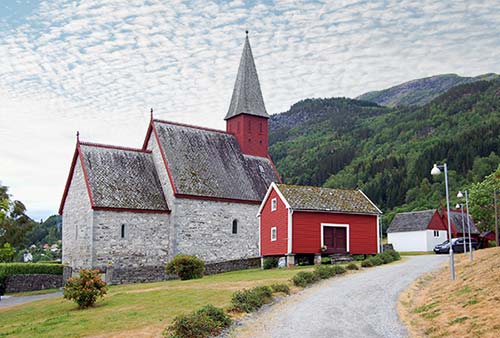
Visiting the Church: The soapstone core of the church dates from about 1250, but the wooden bell tower and entry porch were likely built around 1600. You’ll enter into this wooden section, with colorfully painted walls. Looking straight ahead, you can still see the detailed stone arch over the entryway to the core of the original church.
Stepping into this old section, on the left you’ll see a tall, elevated platform with seating, surrounded by a wooden grill. Nicknamed a “birdcage” for the feathery fashions worn by the ladies of the time, this high-profile pew—three steps higher than the pulpit—was built in the late 17th century by a wealthy parishioner. The beautifully painted pulpit, decorated with faded images of the four evangelists, dates from the 13th century. In the chancel (altar area), restorers have uncovered frescoes from three different time periods: the 14th, 16th, and 17th centuries. Most of the ones you see here were likely created around the year 1500. The crucifix high over the pews, carved around 1200, predates the church, as does the humble old bench to the left of the altar (with lots of runic carvings)—making them more than eight centuries old.
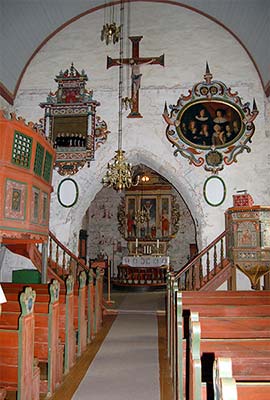
• Beyond Luster, you’ll pass through the charming fjordside hamlets of Høyheimsvik and Nes, with some recommended accommodations (see “Sleeping in and near Solvorn,” earlier). Along here, you’ll also have views across the fjord of the towering Feigumfossen waterfall. Drops and dribbles come from miles around for this 650-foot tumble.
Soon highway 55 veers along an inlet to the humdrum town of Gaupne. Here you have two more sightseeing options. The first is just by the roadside—you’ll see it on the right as you drive through.
Lustrabadet Swimming Pool
If you’re staying in the area and want to unwind after a busy day of sightseeing and glacier hiking, this modern swimming-pool complex is just off the main road in Gaupne. It has a wide variety of hot and cool pools for kids and adults.
Cost and Hours: 180 NOK, cheaper online; open Mon-Tue and Thu 15:00-20:30, Wed and Fri from 12:00, Sat-Sun 11:00-17:00; Rådhusvegen 7B in Gaupne, +47 57 68 56 80, www.lustrabadet.no.
• Gaupne is also where you’d turn off to get an up-close view of a glacier. Before you do, read this section carefully and realize it’s a serious time commitment: Allow 40 minutes to drive to the glacier viewpoint, then 30 minutes to an hour each way to hike or boat out to the glacier itself.
▲▲Jostedal’s Nigard Glacier
The Nigard Glacier (Nigardsbreen) is the most accessible branch of mainland Europe’s largest glacier, the Jostedalsbreen. Hiking to or on the Nigard offers Norway’s best easy opportunity for a hands-on glacier experience. After driving up Jostedal Valley from the fjord, you can appreciate the glacier from afar (at an information center and viewpoint); ride a boat and hike up for a closer look; or invest even more time in a guided walk on top of the glacier itself. It’s worth the trip to stand face-to-face with the majesty of nature (even if you don’t do a guided hike). But if glaciers don’t give you tingles and you’re feeling pressed, skip it.
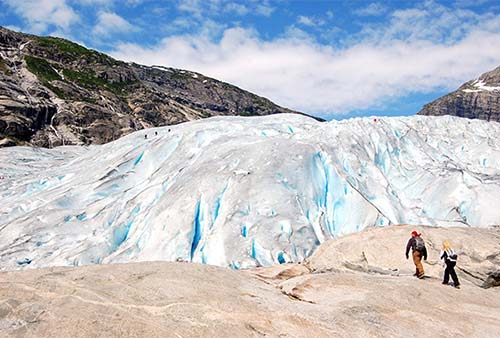
Getting There: It’s straightforward for drivers. When the main highway 55 along the Lustrafjord reaches Gaupne, turn onto highway 604, which you’ll follow for 25 miles (about 40 minutes) up the Jostedal Valley to the Breheimsenteret Glacier Information Center. Access to the glacier itself is down the toll road past the information center.
From late June through late August, a Glacier Bus makes it easier for nondrivers to reach the glacier. You’ll depart in the morning from Sogndal, change buses in Gaupne, stop at the information center, then proceed (on a later bus, if you like) to the meeting point for glacier hikes. In the afternoon, it reverses the route, returning to Sogndal around dinnertime (check latest schedules at www.bfl.no).
Breheimsenteret Glacier Information Center and Toll Road Hike
The architecturally striking information center services both Breheimen and Jostedalsbreen national parks. Drop by to confirm your glacier plans; you can also book excursions here. The center features a relaxing 15-minute film with highlights of the region, along with interactive glacier-related exhibits that explain these giant, slow-moving rivers of ice. The center also has a restaurant and gift shop (information center-free, exhibits and film-95 NOK; May-Sept daily 10:00-17:00, until 18:00 or even 20:00 in peak of summer, closed Oct-April; +47 57 68 32 50, www.jostedal.com).
The best quick visit is to walk to, but not on, the glacier. From the information center, the 90-NOK Brevegen toll road continues two miles to a lake facing the actual tongue of the glacier. In the 1940s, the glacier reached all the way to today’s parking lot. (It’s named for the ninth farm—ni gard—where it finally stopped, after crushing eight farms higher up the valley.) From the lot, you can hike all the way to the edge of today’s glacier (about an hour each way); or, to cut that time in half, take a special boat to a spot closer to the glacier (50 NOK one-way, 75 NOK round-trip, 10-minute boat trip, departs regularly in summer).
The walk is uneven but well marked—follow the red T’s and take your time. You’ll hike on stone polished smooth by the glacier and scramble over and around boulders big and small that were deposited by it. The path takes you right up to the face of the Nigardsbreen. Respect the glacier. It’s a powerful river of ice, and fatal accidents do happen. If you want to walk on the glacier, see below.
Hikes on the Glacier
Don’t attempt to walk on the glacier by yourself. Various local companies offer guided walks that include 1-2 hours on the ice (prices and itineraries vary—figure 800 NOK for a basic hike). Get details at the Breheimsenteret’s website (www.jostedal.com); one popular option is Jostedalen Breførarlag (www.bfl.no).
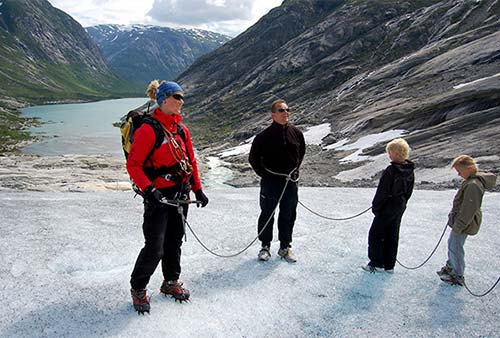
One hour roped up with your group gives you the essential experience. You’ll find yourself marveling at how well your crampons work on the 5,000-year-old-ice. Even if it’s hot, wear long pants, a jacket, and your sturdiest shoes. (Think ahead. It’s awkward to empty your bladder after you’re roped up.)
Longer, more challenging, and much more expensive hikes get you higher views, more exercise, and real crampons. If you’re adventurous, ask about even longer hikes and glacier kayaking. While it’s legal to go on the glacier on your own, it’s dangerous and not advisable.
• After Gaupne, the road enters a tunnel and cuts inland, emerging at a long, fjord-like lake at the town of Hafslo. Just beyond is the turnoff (on the left) for Solvorn, with the ferry across to Urnes and its stave church (for more on Solvorn, see earlier in this chapter).
After the Solvorn turnoff, highway 55 continues scenically about 15 minutes around the Hafslovatn lake, then along the dreamy little Barnesfjord, to the main town of the Sognefjord...
Sogndal
Bustling Sogndal (pop. 4,000)—officially called Sogndalsfjøra—is a hub of activity, transportation, and services for the Lustrafjord and beyond. If you need to stock up on anything, this is the place. Pretty from afar—with its graceful, arched bridge spanning the narrow channel to the lakelike Barnesfjord—it’s a bit gritty and unappealing up close. But it’s convenient and user-friendly.
Down on the waterfront, the delightful $$ Dampskipskaien café is a great place to grab a coffee or a meal or get information—since it also doubles as the town’s tourist information point. (There’s a self-service computer screen tucked amid the bookshelves, free maps and other handouts, and café staff can answer basic questions.) With cozy and hip indoor seating, and outdoor tables right on the Lustrafjord, it’s worth a stop (Mon-Sat for lunch and dinner, Sun for lunch only, Bryggjegota 6, +47 97 76 88 62).
• You have several options for driving onward from Sogndal: Turn off for the Kaupanger and Mannheller ferries across the Sognefjord (about 15-20 minutes to the docks); Turn off on highway 5 to reach the Fjærlandsfjord, Norwegian Glacier Museum, and Bøyabreen glacier overlook (about 30 minutes; described on here); or continue on highway 55 to Hella and the boat across to either Dragsvik (near Balestrand) or Vangsnes (across the Sognefjord, near Vik and Hopperstad Stave Church)—allow about one hour, or a bit more, to reach either of those places, depending on ferry timings.
Scenic Drives from the Sognefjord
Mobile phone service (and GPS) are good in Norway, but if you’ll be doing a lot of driving, it’s smart to also carry a good local map. The 1:335,000-scale Sør-Norge nord map by Cappelens Kart is excellent (available at local bookstores). If you are following this book’s recommended three-week itinerary, use these directions to connect the Lustrafjord to Bergen.
▲▲Lustrafjord to the Nutshell Area
The drive to the Nutshell zone (the towns of Aurland and Flåm—see previous chapter) takes you either through the world’s longest car tunnel or over an incredible mountain pass. If you aren’t going as far as Lom and Jotunheimen, consider taking the high road, as the scenery here rivals the famous Sognefjellsvegen.
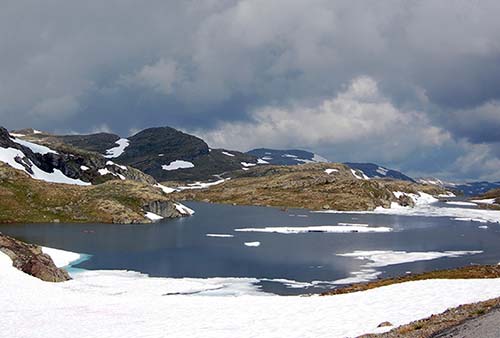
From Sogndal, drive 20 minutes to the Mannheller-Fodnes ferry (described earlier, under “Lustrafjord Connections”), float across the Sognefjord, then drive from Fodnes to Lærdal. From Lærdal, consider a brief and worthwhile detour to Borgund Stave Church before heading to Aurland (this adds about 20 minutes of driving each way).
Then you have two options to Aurland: the speedy route on E-16 through the 15-mile-long Lærdal Tunnel…or the Aurlandsfjellet “Snow Road” over the pass. For the scenic route, from the Mannheller-Fodnes ferry, take the first road to the right (to Erdal), then leave E-68 at Erdal (just west of Lærdal). After traversing the white-knuckle “Snow Road,” as you begin the descent to Aurland, you’ll reach the sideways-7-shaped Stegastein viewpoint—well worth a stop. If time and weather allow, I prefer the ”Snow Road.” All of these are described on here.
▲Lustrafjord to Bergen, via Nærøyfjord and Gudvangen
Car ferries take tourists between Kaupanger and the Nutshell town of Gudvangen through an arm and elbow of the Sognefjord, including the staggering Nærøyfjord (for details on the ferry, see “Lustrafjord Connections,” earlier). From Gudvangen, it’s a 90-mile drive to Bergen via Voss (figure about one hour to Voss, then about an hour and a half into Bergen). This follows essentially the same route as the Norway in a Nutshell (Gudvangen-Voss bus, Voss-Bergen train) route. For additional commentary on the journey, see here.
Get off the ferry in Gudvangen and drive up the Nærøy valley past a river. You’ll see the two giant falls and then go uphill through a tunnel. If you’d like a scenic break, look for a sign marked Stalheim after the tunnel and turn right to reach the touristy Stalheim Hotel to enjoy the fabulous view down the valley.
Returning to E-16 and continuing along your way, you’ll enter a mellower beauty, past lakes and farms, toward Voss. Just before you reach Voss itself, watch the right side of the road for Tvindefossen, a terraced waterfall with a handy campground/WC/kiosk picnic area that’s worth a stop. Highway E-16 takes you through Voss and into Bergen. If you plan to visit Edvard Grieg’s Home and the nearby Fantoft Stave Church, now is the ideal time, since you’ll be driving near them—and they’re a headache to reach from downtown (both are described in the Bergen chapter).
▲▲Balestrand to Bergen, via Vik
If you’re based in Balestrand and driving to Bergen, you have two options: Take the Dragsvik-Hella ferry, drive an hour to Kaupanger (via Sogndal), and drive the route described earlier in this section; or take the following slower, twistier, more remote, and more scenic route, with a stop at the beautiful Hopperstad Stave Church. This route is slightly longer, with more time on mountain roads and less time on the boat. Take the Hella-Vangsnes ferry, then figure 15 minutes from Vangsnes to Vik, then about 1.5 hours to Voss, then another 1.5 hours into Bergen.
From Vangsnes, head into Vik on the main highway 13. In Vik, follow signs from the main road to Hopperstad Stave Church (described earlier in this chapter). Then backtrack to highway 13 and follow it south, to Voss. You’ll soon begin a series of switchbacks that wind you up and out of the valley. The best views are from the Storesvingen Fjellstove restaurant (on the left; likely closed, but the parking lot is open).
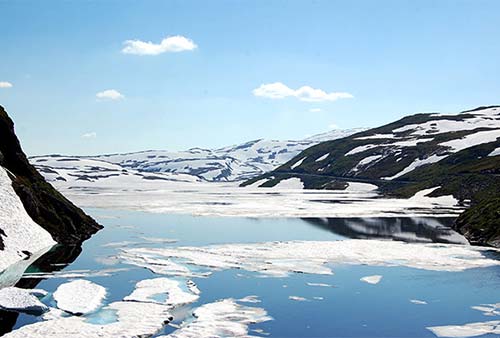
Soon after, you’ll crest the ridge, go through a tunnel, and find yourself on top of the world, in a desolate and harshly scenic landscape of scrubby mountaintops, snowbanks, lakes, and no trees, scattered with vacation cabins. After cruising atop the plateau for a while, the road twists its way down (next to a waterfall) into a very steep valley, which it meanders through the rest of the way to Voss. This is an hour-long, middle-of-nowhere journey, with few road signs—you might feel lost, but keep driving toward Voss. When highway 13 dead-ends into E-16, turn right (toward Voss and Bergen) and reenter civilization. From here, the route follows the same roads as in the Lustrafjord-Bergen drive described earlier (including the Tvindefossen waterfall).