NORWAY IN A NUTSHELL
A Scenic Journey to the Sognefjord
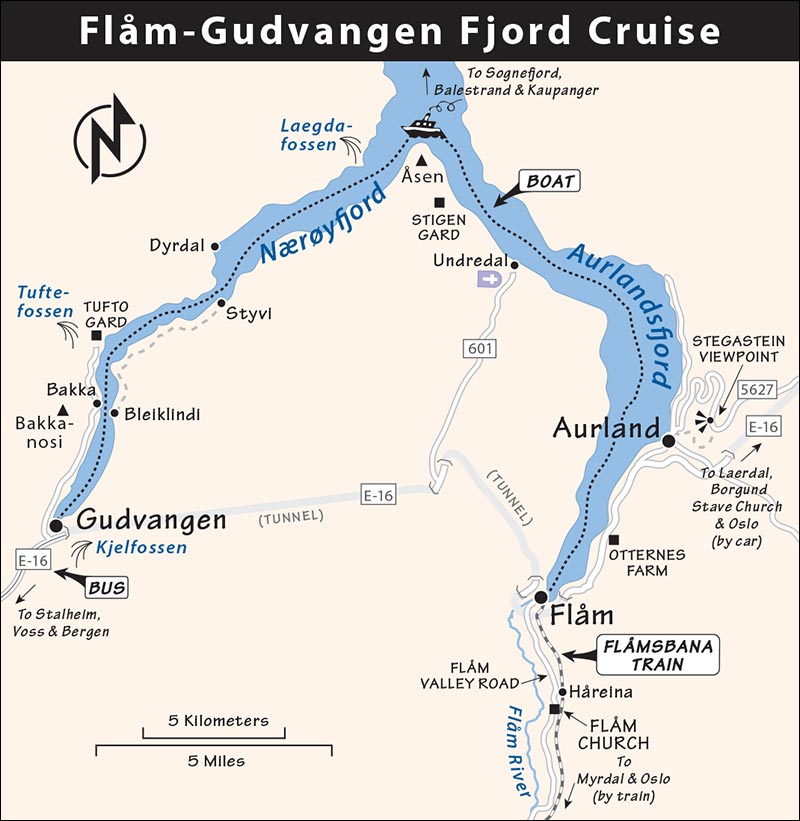
Map: Flåm-Gudvangen Fjord Cruise
Sights and Activities near Flåm
While urban Oslo and Bergen are big draws for tourists, Norway is first and foremost a place of unforgettable natural beauty. There’s a certain mystique about the “land of the midnight sun,” but you’ll get the most scenic travel thrills per mile, minute, and dollar by going west from Oslo rather than north.
Norway’s greatest claims to scenic fame are her deep, lush fjords. Three million years ago, an ice age made this land as inhabitable as the center of Greenland is today. As the glaciers advanced and cut their way to the sea, they gouged out long grooves—today’s fjords. The entire west coast is slashed by these stunning inlets, and the Sognefjord—Norway’s longest (120 miles) and deepest (1 mile)—is tops. The seductive Sognefjord has tiny but tough ferries, towering canyons, and isolated farms and villages marinated in the mist of countless waterfalls.
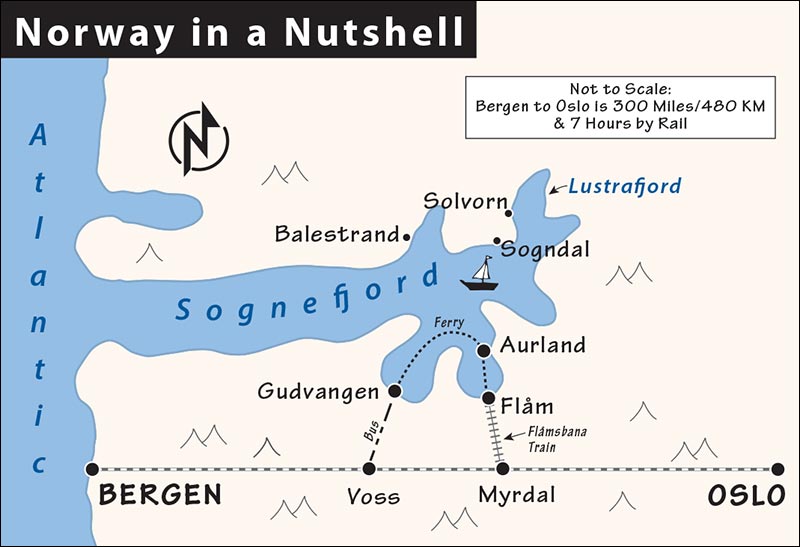
A series of well-organized and spectacular bus, train, and ferry connections—appropriately nicknamed “Norway in a Nutshell”—lays Norway’s beautiful fjord country before you on a scenic platter. With the Nutshell, you’ll delve into two offshoots of the Sognefjord, which make an upside-down “U” route: the Aurlandsfjord and the Nærøyfjord. You’ll link the ferry ride to the rest of Norway with two trains and a bus: The main train is an express route that takes you through stark and icy scenery above the tree line. To link the express train to the ferry, you’ll catch the Flåmsbana train one way (passing waterfalls and forests) and a bus the other way (offering fjord views and more waterfalls). At the start of the fjord, you’ll go through the town of Flåm (a transit hub), board your boat, and float past the workaday town of Aurland and the hamlet of Undredal (by taking the Nutshell trip segments at your own pace, you can visit the latter two fjord towns on your own). All connections are designed for tourists, explained in English, well-coordinated, and easy.
The Nutshell route is hugely popular. Summer comes with a crush of crowds, dampening some of the area’s magic. Unfortunately, many tourists are overcome by Nutshell tunnel vision and spend so much energy scurrying between boats, trains, and buses that they forget to simply enjoy the fjords.
Relax! You’re on vacation.
PLANNING YOUR TIME
Even the blitz tourist needs at least a day for the Norway in a Nutshell trip. You can either do the Nutshell in one busy day, or you can settle in for a night (or longer).
With One Day: If one day is all you have, it’s a satisfying one. The Nutshell in a day works best as a one-way trip from Oslo to Bergen (or vice versa), though it can also be done as a loop day trip from Bergen. (It’s not possible as a day trip from Oslo.)
With an Overnight: It’s worth spending the night (likely in Flåm or Aurland) to break up the scenic journey and enjoy some time in the area when it’s quieter—before and after the day-trippers and cruise-ship passengers flood the fjords.
With More Time: The Sognefjord can fill as much time as you’re willing to give it. The next chapter covers several fjordside destinations that are an easy boat ride or scenic drive away from the Nutshell spine. The potential combinations are endless; the most tempting places for an overnight are Balestrand (handily connected to the Nutshell by express boats) and dreamy Solvorn (more remote and better for drivers).
With a Car: Drivers can improve on the Nutshell by taking a northern route: From Oslo, drive through the Gudbrandsdal Valley, go over the Jotunheimen Mountains, then drive along the Lustrafjord to Kaupanger; from there, you can experience the best stretch of Nutshell scenery (the Nærøyfjord) on a car ferry ending in Gudvangen, then drive the remainder of the route to Bergen. (Most of these sights, and the ferry connections, are covered in the next two chapters.) For more suggestions, see the “Beyond the Nutshell” sidebar, later.
Weather Tips: This region enjoys mild weather for its latitude, thanks to the warm Gulf Stream. (When it rains in Bergen, it just drizzles here.) But if the weather is bad, don’t fret. I’ve often arrived to gloomy weather, only to enjoy sporadic splashes of brilliant sunshine all day—and all evening. (In June and July, it’s light out until 11 p.m.)
Orientation to the Nutshell
The most exciting single-day trip you could make from Oslo or Bergen is this train/boat/bus/train jaunt through fjord country. Booking offices throughout the region sell tickets for various segments of the trip and hand out souvenir-worthy brochures with photos, descriptions, and exact times.
Sognefjord Travel Tips: For more advice on traveling in this region—including why you’ll find no real TIs on the Sognefjord, only ticket agencies—read the “Sognefjord Tips” on here.
Route Overview
Here’s the gist: From Oslo or Bergen, take a train halfway across the mountainous spine of Norway, make your way down to the Sognefjord for a boat cruise, then climb back up out of the fjord to rejoin the main train line. Each of these steps is explained in the self-guided “Nutshell Tour” in this chapter.
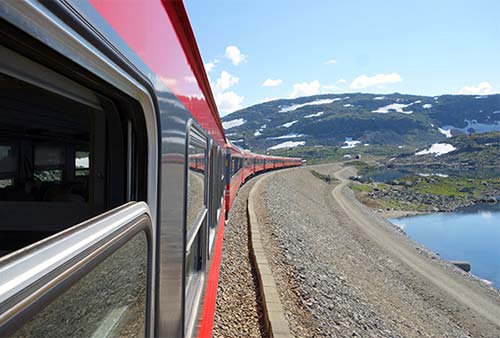
Doing the Nutshell one-way between Oslo and Bergen (or vice versa) is most satisfying—you’ll see the whole shebang, and it’s extremely efficient if you’re connecting the two cities anyway. It’s also possible to do most of the route in a round-trip loop from Bergen. (In recent years, it hasn’t been possible to do the Nutshell as a day trip from Oslo, but this option could return.)
When to Go
The Nutshell trip is possible all year. In summer (June-Aug), the connections are most convenient, the weather is most likely to be good...and the route is at its most crowded. Outside of this time, sights close and schedules become more challenging. Some say the Nutshell is most beautiful in winter, though schedules are severely reduced.
Buying Tickets
The easiest way to purchase Nutshell tickets is to buy a package from Fjord Tours—it will save you time and the trouble of planning your itinerary. The downside is that you’re locked into their schedule and the package price can be more expensive than buying individual tickets.
Booking on your own, you have more flexibility—you choose how much time you spend in Flåm and what time you arrive in Bergen or Oslo. The trade-off is that you must plan your own itinerary and buy tickets for each leg of your journey—that’s five separate tickets for a one-way trip between Oslo and Bergen.
If you have a rail pass, or if you’re a student or a senior (68 or older), you’ll save money by booking the Nutshell on your own.
Whether you’re doing a package or buying tickets on your own, in summer book well in advance—ideally several weeks ahead. In high season (June-Aug), various legs of this route (especially the train to and from Oslo, the Flåmsbana train from Myrdal to Flåm, and the handiest fjord cruise departures) can sell out.
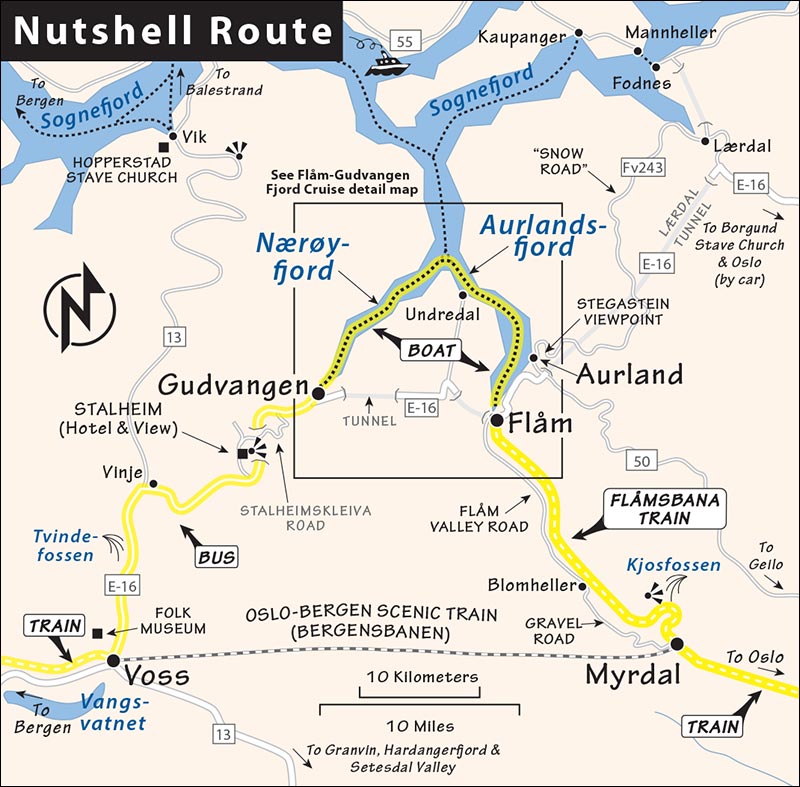
Package Deals
Fjord Tours sells the branded “Norway in a Nutshell” package. You can easily book it online, or in person at major train stations (+47 55 55 76 60, www.fjordtours.com, booking@fjordtours.com). With these packages, all your departures are fixed.
Here are prices (as of press time) for the Nutshell:
• One-way from Bergen or Oslo-2,650 NOK
• Round-trip from Bergen via Myrdal-2,085 NOK
• Round-trip from Flåm-1,585 NOK
Fjord Tours also sells variations on their base “Norway in a Nutshell” plan; for the latest options, see their website.
On Your Own
Specifics on buying tickets for each leg of the Nutshell route are explained later, under the individual listings. In general, you can buy train tickets (including the Flåmsbana) at train stations in Oslo or Bergen or online at Vy.no. For the best deal, look for “nonflexible” tickets (not changeable or refundable, and with no seat reservation). Most Flåm-Gudvangen ferries, including “The Fjords” catamarans on the official Nutshell itinerary, are operated by Norway’s Best (www.norwaysbest.com); others are run by Lustrabaatane (cheaper prices, schedules at www.lustrabaatane.no). You don’t need to buy tickets in advance for the Gudvangen-Voss bus; there’s always room, and you can pay the driver with your credit card. If you’re a student or senior, always ask about discounts.
Rail Pass Discounts: If you have any rail pass that includes Norway, the Oslo-Bergen train is covered (plus a 50-NOK reservation fee for second class; free for first-class passholders); you also get a 30 percent discount on the Flåmsbana train. Rail-pass holders pay full fare for the fjord cruise and the Gudvangen-Voss bus. Your total one-way cost between Oslo and Bergen: about 780 NOK with a first-class pass, 830 NOK with a second-class pass.
Nutshell Itineraries
Transportation along the Nutshell route is carefully coordinated. If any segment of your journey is delayed, the transportation for the next segment will wait for you (because virtually everyone on board is catching the same connection).
Oslo-Bergen
You must take one of two morning departures (6:25 or 8:25) to do the entire trip from Oslo to Bergen in a day. I recommend the earlier departure to enjoy more time in Flåm (2 hours vs. 45 minutes) and generally fewer crowds. This itinerary shows typical times for summer travel; confirm exact times before your trip (www.vy.no for trains, https://en-tur.no for buses, www.norwaysbest.com or www.lustrabaatane.no for ferries):
• Train from Oslo to Myrdal: 6:25-11:18
• Flåmsbana train from Myrdal to Flåm: 11:47-12:56
• Free time in Flåm: 13:00-15:00
• Ferry from Flåm (Flåm kai) to Gudvangen (Gudvangen ferje-kai): 15:00-17:00
• Bus from Gudvangen to Voss: 17:25-18:55
• Train from Voss to Bergen: 19:13-20:40
If you leave Oslo on the later train, you’ll arrive in Bergen at the same time but have essentially no free time in Flåm.
Other Options
Here are other one-day options for doing the Nutshell in the summer. Confirm specific times before your trip.
Bergen-Oslo: Train departs Bergen-8:29, arrives Voss-9:43; bus departs Voss-10:10, arrives Gudvangen-11:30; boat departs Gudvangen-12:00, arrives Flåm-14:00; Flåmsbana train departs Flåm-16:00, arrives Myrdal-16:55; train departs Myrdal-17:40, arrives Oslo-22:27.
Day-Trip Loop from Bergen: Train departs Bergen-8:29, arrives Voss-9:43; bus departs Voss-10:10, arrives Gudvangen-11:30; boat departs Gudvangen-12:00, arrives Flåm-14:00; Flåmsbana train departs Flåm-17:20, arrives Myrdal-18:15; train departs Myrdal-18:48, arrives Bergen-21:17.
Travel Tips
Luggage: Transporting luggage on the Nutshell is no big deal, as the connections require almost no walking: At Myrdal, you just cross the platform; in Flåm, you walk 50 yards from the train to the dock; in Gudvangen, the bus meets the ferry at the dock; in Voss, the bus drops you at the train station. If you want to check your bag during your free time in Flåm, use the red baggage-check cabin at the head of the train track, across from the boat dock.
An alternative to carrying your luggage is Porterservice AS. They pick up your luggage at your hotel, transport it via train between Oslo and Bergen, and drop it off at your next hotel by 21:00 (400 NOK/piece, +47 90 61 00 09, www.porterservice.no).
Eating: Most options along the route aren’t great—on the Nutshell, I’d consider food as a source of nutrition and forget about fine dining. You can buy some food on the Oslo-Bergen train and the fjord cruises (hot dogs, burgers, and pizza). Depending on the timing of your layovers, Myrdal, Voss, or Flåm are your best lunch-stop options (the Myrdal and Flåm train stations have decent cafeterias, and other eateries are near the Flåm and Voss stations)—although you won’t have a lot of time if you’re making the journey all in one day. Your best bet may be to pack a picnic and munch en route. If catching an early train in Oslo, the station has a handy Joker grocery store open at 5:00 (Sun from 6:00).
Cruise-Ship Passengers: Tiny Flåm—in the heart of Nutshell country—is also a popular destination for huge cruise ships. Cruise lines push their own version of the Norway in a Nutshell loop, or you can buy a package through Fjords Tours online in advance for a much cheaper price.
Nutshell Tour
If you only have one day for this region, it’ll be a thrilling one—worth ▲▲▲. The following self-guided segments of the Nutshell route are narrated from Oslo to Bergen. If you’re going the other way, hold the book upside down.
▲▲Oslo-Bergen Train: Oslo to Myrdal
The Oslo-Bergen route—called “Bergensbanen” by Norwegians—is simply the most spectacular train ride in northern Europe. (You’ll take just part of it, if you’re doing the Nutshell route: Oslo to Myrdal, and Voss to Bergen.) The complete railway, an amazing engineering feat completed in 1909, is 300 miles long; peaks at 4,266 feet, which, at this Alaskan latitude, is far above the tree line; goes under 18 miles of snow sheds; trundles over 300 bridges; and passes through 200 tunnels in just under seven hours. To celebrate the Bergensbanen centennial in 2009, Norwegian TV mounted cameras on the outside of the train and broadcast the entire trip—and more than a million Norwegians tuned in (search for “Bergensbanen” on YouTube, and you can watch it, too).
Cost and Reservations: A “flexible” ticket (changeable but not refundable, with a seat reservation) costs 700 NOK from Oslo to Myrdal, 300 NOK from Voss to Bergen, and about 850 NOK from Oslo all the way to Bergen (which would skip the fjord part of the Nutshell). You’ll pay about 30 percent more for a “fully flexible” (refundable) ticket, and about 10-15 percent less for a “nonflexible” ticket (nonchangeable, nonrefundable, no seat reservation). The cheaper fares sell out sooner, and in peak season, trains can fill up entirely—it’s smart to book several weeks ahead. You can book tickets online at Vy.no. (See “On Your Own,” earlier, for rail pass discounts.) If you have difficulty paying for your ticket with a US credit card online, use PayPal or call +47 61 05 19 10—press 9 for English, and you’ll be given a web link where you can finish your transaction.
Schedule: The train runs three to five times per day, including two morning departures (overnight possible except Sat). The segment from Oslo to Myrdal takes about five hours; from Voss to Bergen is about 75 minutes.
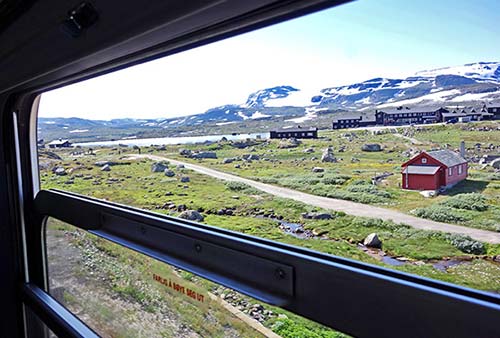
Oslo to Myrdal Route Narration: The scenery crescendos as you climb over Norway’s mountainous spine. After a mild three hours of deep woods and lakes, you’re into the barren, windswept heaths and glaciers. Here’s what you’ll see traveling westward from Oslo: Leaving the city, you pass through a six-mile-long tunnel and stop in Drammen, Norway’s fifth-largest town. The scenery stays low-key and woodsy up Hallingdal Valley until you reach Geilo, a popular ski resort. Then you enter a land of big views and tough little cabins. Finse, at about 4,000 feet, is the highest stop on the line. At several towns, the conductor may announce how many minutes the train will be stopped there. This gives you a few fun moments to get out, stretch, take a photograph, and look around.
Before Myrdal, you enter the longest high-mountain stretch of railway in Europe. Much of the line is protected by snow tunnels. The scenery gets more dramatic as you approach Myrdal (MEER-doll). Just before Myrdal, look to the right and down into the Flåm Valley, where the Flåmsbana branch line winds its way down to the fjord. Nutshell travelers get off at Myrdal.
▲▲Myrdal-Flåm Train (Flåmsbana)
The little 12-mile spur line leaves the Oslo-Bergen line at Myrdal (2,800 feet), which is nothing but a scenic high-altitude train junction with a decent cafeteria. Video screens onboard and sporadic English commentary on the loudspeakers explain points of interest, but there’s not much to say—it’s all about the scenery. If you’re choosing seats, you’ll enjoy slightly more scenery if you sit on the left going down.
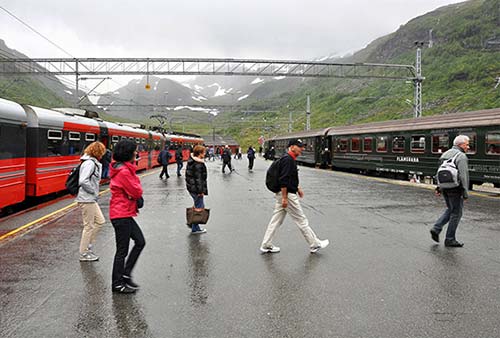
Cost and Reservations: 470 NOK one-way, 680 NOK round-trip, 30 percent discount with rail pass, prices lower off-season (Oct-April). You can book tickets at NorwaysBest.com; if you’re connecting to another train, you can buy tickets at Vy.no. Tickets are also sold at the Flåm Welcome Center.
The Flåmsbana is popular—especially for departures that tie in to the Nutshell itinerary, or that work well for cruise passengers looking to get some altitude. Especially if you’re following the traditional Nutshell route, with the usual timings, you should assume this leg could sell out far in advance; it’s wise to book your Flåmsbana ticket weeks or even months in advance. That said, if you wind up in Flåm or Myrdal without a ticket in hand, it may be possible to squeeze onto the train—ask at the ticket desks.
Schedule: The train departs in each direction nearly hourly.
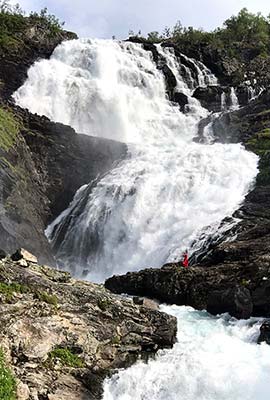
Myrdal to Flåm Route Narration: From Myrdal, the Flåmsbana train winds down to Flåm (sea level) through 20 tunnels (more than three miles’ worth) in 55 thrilling minutes. It’s party time on board, and the engineer even stops the train for photos at the best waterfall, Kjosfossen. According to a Norwegian legend, Huldra (a temptress) lives behind these falls and tries to lure men to the rocks with her singing. Look out for her...and keep a wary eye on your travel partner. This rail line is an even more impressive feat of engineering when you realize it’s not a cogwheel train—it’s held to the tracks only by steel wheels, though it does have five braking systems.
▲▲▲Flåm-Gudvangen Fjord Cruise
The Flåmsbana train deposits you at Flåm, a scenic, functional transit hub at the far end of the Aurlandsfjord. If you’re doing the Nutshell route nonstop, follow the crowds and hop on a sightseeing boat that’ll take you to Gudvangen. If you’re lingering in Flåm, turn to here for recommendations.
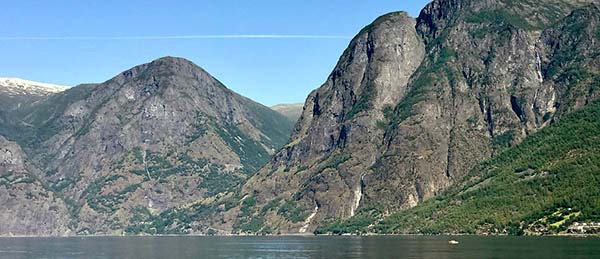
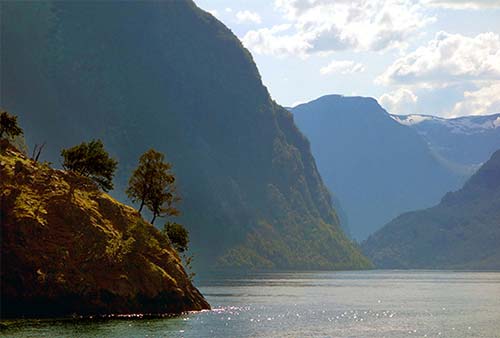
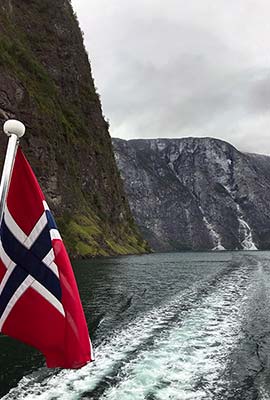
The Flåm-Gudvangen trip is breathtaking in any weather. The first stretch, up the Aurlandsfjord, is plenty scenic. And then it gets even better. For the last hour, as you sail down the Nærøyfjord, camera-clicking tourists scurry around struggling to get a photo that will catch the magic. Waterfalls turn the black cliffs into bridal veils, so close you feel you can nearly reach out and touch them. On a sunny day, the ride is one of those fine times—like when you’re high on the tip of an Alp—when a warm camaraderie spontaneously combusts between the strangers who’ve come together for the experience.
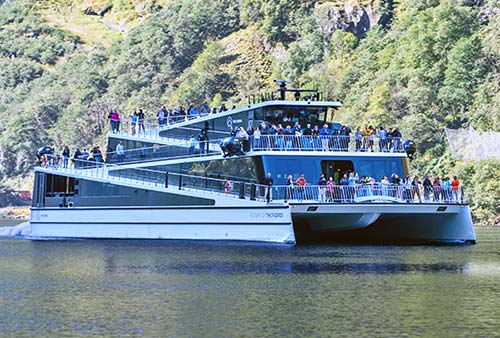
Cruise Options: There are two boat companies to choose from, and they’re strikingly different. The dominant operation (used by branded “Norway in a Nutshell” trips) is Norway’s Best, whose futuristic electric boats—marked simply “The Fjords”—are a sight in themselves: catamarans with a clever and unique zigzag railing from the bottom of the boat to the top, offering lots of outdoor viewpoints (as well as indoor ones). They look like a miniature version of Oslo’s Opera House, floating around the fjords. These boats are more expensive but impressive (4/day May-Sept, 2/day off-season, www.norwaysbest.com).
At the opposite end are the classic, old-school boats run by Lustrabaatane; these are smaller, with fewer amenities, and run less often—but they’re also cheaper and favored by nostalgic romantics (2/day year-round, www.lustrabaatane.com). Both take about two hours one-way between Flåm and Gudvangen, with minimal English narration. The Norway’s Best boat can stop at Aurland, Undredal, Dyrdal, and Styvi, which is handy if you want to hop off and on along the way—though you’ll need to buy separate tickets for each leg of your trip, and it’ll end up costing you more (be sure to notify the ticket seller where you want to get off, to make certain they’ll stop).
Cost and Reservations: For the Flåm-Gudvangen route, Norway’s Best charges 585 NOK one-way, 880 NOK round-trip (less Nov-April); Lustrabaatane charges 450 NOK one-way, 800 NOK round-trip. Reservations are smart, and may be necessary on busy days in summer; ideally, book ahead online. Even if you’re being spontaneous, you’ll still want to book as soon as you figure out which boat you want. If buying in person, note that the Flåm Welcome Center is a ticket seller for Norway’s Best and therefore doesn’t provide information or tickets for Lustrabaatane—if you prefer the old boats, check the schedules on your own and buy your tickets at the dock or on the boat.
Schedule: Specific departure times vary, but generally boats leave Flåm starting at 8:00, with a last departure at 19:00. Just be sure you’ll reach Gudvangen in time to catch a bus to Voss that allows you to connect to the Bergen train. (If you are doing the Nutshell in the other direction, from Bergen toward Oslo, the first boat from Gudvangen is generally at 9:00 or 9:30, with a last departure at 16:30.)
Flåm-Gudvangen Route Narration
Departing Flåm, you’ll head into the lovely Aurlandsfjord—one of two fjords, joined in a wishbone shape, that you’ll traverse on this journey. Each fjord is about 11 miles long, making the total trip about 22 miles.
Aurlandsfjord
Looking back on Flåm as you depart, it’s clear that it’s not really a town—just a giant transportation hub built on a flat chunk of land created using fill material dug out from nearby road tunnels. Notice the green knoll with apple trees just above the big, white hotel—fertile land thanks to glacial runoff. An actual village called Flåm gave its name to this junction, but it’s up the valley and out of view. Something else you can’t see: Below you is an Estonian cargo ship, the SS Begonia, sunk here during World War II. Today it’s a popular destination for scuba divers.
Just out of Flåm, watch on the right for the Otternes cluster farm—a hodgepodge of buildings huddled on a little shelf. Farmers worked this land from the 1500s to the 1990s. These days the four farmsteads are abandoned...other than goats who perch on rocks overlooking some of the most spectacular fjord views in Norway. On the rocky hill opposite Otternes are the scant remains of a graveyard; on the fjords, it’s customary for people to be buried facing the place they came from. (For more on Otternes, see here.)
The process that created the majestic Sognefjord began during an ice age about three million years ago. A glacier up to 6,500 feet thick slid downhill at an inch an hour, following a former river valley on its way to the sea. Rocks embedded in the glacier gouged out a steep, U-shaped valley, displacing enough rock material to form a mountain 13 miles high. As the climate warmed up, the ice age came to an end. The melting glaciers retreated and the sea level rose nearly 300 feet, flooding the valley now known as the Sognefjord. Today the fjord is more than a mile deep, flanked by 3,000-foot mountains—for a total relief of 9,300 feet. Waterfalls spill down the cliffs, fed by melting snow. In places, powdery sediment tinges the fjords a cloudy green, the distinct color of glacier melt.
Why are there fjords on the west coast of Norway, but not, say, on the east coast of Sweden? The creation of a fjord requires a setting of coastal mountains, a good source of moisture, and a climate cold enough for glaciers to form and advance. Due to the earth’s rotation, the prevailing winds in higher latitudes blow from west to east, so chances of glaciation are ideal where there is an ocean to the west of land with coastal mountains. When the winds blow eastward over the water, they pick up a lot of moisture, then bump up against the coastal mountain range, and dump their moisture in the form of snow—which feeds the glaciers that carve valleys down to the sea.
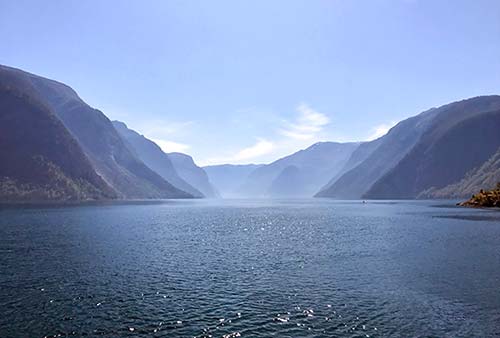
You can find fjords along the northwest coast of Europe—including western Norway and Sweden, Denmark’s Faroe Islands, and Scotland’s Shetland Islands; Iceland and Greenland; the northwest coast of North America (from Puget Sound in Washington state north to Alaska); the southwest coast of South America (Chile); the west coast of New Zealand’s South Island; and on the continent of Antarctica.
Beyond Otternes, at the base of the point just before the next town, you may see some bubbling and turbulence in the water. This is the output of a hydroelectric dam deep in the mountains. Built in the 1970s, this dam generates enough clean electricity annually to power a large city.
Next, the town of Aurland comes into view (on the right). This is the namesake of the fjord you’re on, the biggest town by far on the fjord, and the county seat of sorts for the surrounding municipality. It has a historic white church just up from the boat dock, a pleasant café overlooking the bridge, a few accommodations in the town center, and some picturesque farms scattered in the hills above. (For more on Aurland, see here).
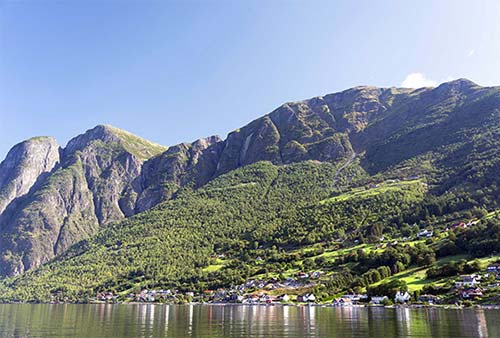
Look high, high up to the top of the cliff above Aurland, and you may be able to spot the pointy viewpoint—poking out from the trees—called Stegastein. This modern promontory affords breathtaking views over the fjord...and an equally breathtaking drive up its twisty, single-lane road. For details, see here.
Cruising farther along, notice the power cables strung over the fjord. Then, along the left bank, you’ll see the faint remains of a road, and even the subtle indentation of a would-be tunnel. This planned fjordside road to the next town was abandoned mid-construction.
Next up, on the left, is the charming village of Undredal. It’s known for its historic stave church—very small and painted white, with a red steeple, unlike the black-tarred stave churches you’ll find elsewhere. Undredal is also known for its goats, who produce high-quality cheese sold in local shops. If you have time, it’s worth hopping off here (or returning later by car) to poke around the lovely waterfront. Undredal has one more claim to fame: Disney artists traveled around Norway to gain inspiration for the movie Frozen—and they liked the village so much, they used it as a very rough basis for the kingdom of Arendelle in the film...with the addition of a big waterfall and a glacier-topped mountain in the background. (For more on Undredal, see here).
Just beyond Undredal, watch about two-thirds of the way up the cliffs on your left for a farmhouse settlement called Stigen Gard—literally, “Ladder Farm.” This guesthouse can be reached only via a very long, steep hike up from the dock below. Scan the hillside to see if any guests are on their way to check in, following the trail like ants climbing up an anthill. (If you’re tempted to really earn a good night’s sleep, check out https://stigengard.no.)
Farther along, also on the left, a multistage waterfall tumbles from high above. On the rocks at the base of the falls, try to spot some hardy goats, who are left here by farmers during the summer to graze. They tend to gather near the feeding station just above the shoreline.
We’re close to the junction of the two fjords—about to pull a U-turn to the left and head up the Nærøyfjord. This intersection is marked by a particularly tall, pointy peak. Facing that peak, the folds of the mountain on your right as you make the turn resemble a giant hand. Usually I resist corny legends...but on this trip I’ll make an exception: Supposedly, these fjords were dug by a gigantic troll seeking to separate the land of the trolls from the land of humans. After gouging out the waterways you’re enjoying today, he took a nap, but slept a little too soundly—the sunrise turned him to stone. Those rock formations are his giant hand, and the pointy pinnacle just across is his chisel.
Now your boat rounds the bend and heads into our second fjord.
Nærøyfjord
This is considered the world’s narrowest fjord: as slim as 820 feet wide. And yet, the name does not (as many travelers assume) mean “narrow fjord.” Rather, it refers to the Norse mythological figure Njörðr (or Njor), god of the oceans and of seafarers. In the Viking age, sailors would pray to Njörðr for a successful voyage.
Enjoy the many waterfalls as you make your way down the Nærøyfjord. On the right, boats often make a short photo op stop near the base of the Laegdafossen waterfall. Further along on your right, a tidy village sits at the bottom of a massive, swooping, U-shaped glacial valley. This is Dyrdal, popular in summer with vacation homes...but the wintertime population is just one lonely soul. (However, local gossip has it that he recently found a girlfriend.) The name means “Animal Valley,” for the good hunting grounds in the wooded uplands behind the village.
After Dyrdal, the fjord narrows considerably—it starts to feel like the cliffs are closing in. On the left side is a dock for Styvi, a middle-of-nowhere ferry landing for people who’d like to camp with serene fjord tranquility and views of literally dozens of waterfalls. From Styvi, a 3.5-mile trail connects to another middle-of-nowhere location deeper in the fjord, Bleiklindi. This trail was built in the 17th century as an official postal route: Mail was taken across the fjord from Bakka (which we’ll see soon), then carried along the trail to remote Styvi. Postal carriers continued using this route when the fjord froze over even after steamboats arrived in 1858. Today it’s a popular hike.
As the boat twists and turns, you’ll see a small settlement on the right called Tufto Gard (with the Tuftefossen waterfall plunging behind it). This is the end of the road from Gudvangen—anything along the Nærøyfjord beyond this, including the village of Dyrdal we saw earlier, can be reached only by boat.
Soon after Tufto Gard, sitting on a little point, is the village of Bakka. The church here was built around 1850, when locals grew tired of having to make the long journey to Undredal anytime they wanted to worship. On most of the fjord, the water is about as deep as the mountains above it are high. But Bakka is the exception—due to all the rock and grit that has tumbled down here over the ages, this is the shallowest part of the fjord, at only about 40 feet.
High above Bakka is the mountain called Bakkanosi—the tallest on the Nærøyfjord (4,586 feet) and popular for BASE-jumping events. Also high in these mountains is Rimstigen, the endpoint of a mountain-biking race each year that climbs nearly 2,400 feet straight up from the fjord. At other times, this is also a popular hiking trail for those not intimidated by elevation gain.
Soon you approach Gudvangen—the terminus of the boat. High above on the left, you’ll see the dramatic Kjelfossen—on the top-20 list of highest free-flying waterfalls in the world (more than 2,300 feet in total). On the right as the boat approaches the dock, watch for piles of anorthosite—a valuable mineral quarried in nearby hills and shipped out from here, on the order of 500,000 tons each year. And you thought tourists were the only precious commodity being loaded up in Gudvangen...
Your fjord cruise is over. Time to head to the bus.
▲Gudvangen-Voss Bus
Nutshellers get off the boat at Gudvangen and take the 25-mile bus ride to Voss: You’ll see the bus stops immediately ahead as you disembark.
Gudvangen must have been a place of spiritual importance to the Vikings, because its name means “gods gathering place”—a place to pray. But today Gudvangen offers little more than a boat dock and a giant tourist kiosk. If you find yourself with extra time, you can browse through the grass-roofed souvenir stores and walk onto a wooden footbridge. On the far side of the bridge, then up by the road, you can enter Viking Valley—a re-created Viking age village. It’s as expensive as it is touristy (ranking high on both counts), but it’s not a terrible place to kill some time, especially for kids. You’ll stroll through cheaply reconstructed “Viking” buildings and interact with costumed guides, who give you the chance to throw an ax or shoot a bow and arrow (daily 10:00-18:00, shorter hours off-season, www.vikingvalley.no).
Cost: 130 NOK, pay on board with credit card, no rail pass discounts. Reservations are not necessary.
Schedule: Buses meet each ferry, or will show up usually within an hour. (Confirm this in advance if you plan to take the last boat of the day—the ferry crew can call ahead to make sure the bus waits for you.) While some buses—designed for commuters rather than sightseers—take the direct route to Voss, buses tied to the Nutshell schedule often take a scenic side trip to Stalheim Hotel.
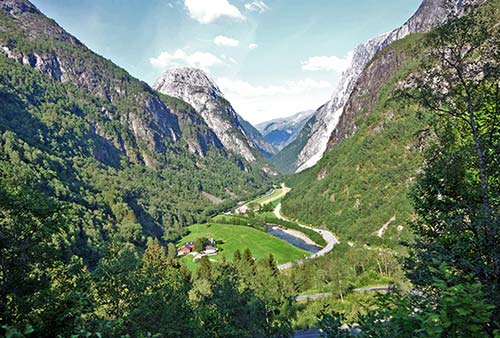
Gudvangen to Voss Route Narration: First the bus takes you up the Nærøydalen Valley and through a couple of long tunnels. If you’re on a scenic Nutshell bus, you’ll likely take a turnoff for the landmark Stalheim Hotel, with a spectacular view back into fjord country. Though the hotel dates from 1885, there’s been an inn here since about 1700, where the royal post would change horses. The hotel is geared for tour groups (genuine trolls sew the pewter buttons on the sweaters), but the priceless view from the backyard is free. Drivers can also detour here for the view and peruse the hotel’s living room to survey the art showing this perch in the 19th century.
Looking down from the hotel viewpoint, you may see another, much twistier old road called Stalheimskleiva, with a corkscrew series of switchbacks flanked by a pair of dramatic waterfalls. With its 18 percent grade, it was once the steepest road in Norway. It closed in 2020 due to a landslide, and experts believe it can’t safely be repaired. It’s likely to remain closed forever.
From here, the bus continues straight on the main road through pastoral countryside to Voss. You’ll pass a huge lake, then follow a crystal-clear, surging river. Just before Voss, look to the right for the wide Tvindefossen waterfall, tumbling down its terraced cliff. Drivers will find the grassy meadow and flat rocks at its base ideal for letting the mist fog their glasses and enjoying a drink or snack (be discreet, as “picnics are forbidden”).
Voss
The Nutshell bus from Gudvangen drops you at the Voss train station, which is on the Oslo-Bergen (Bergensbanen) train line. There may be a bit of a wait for your train. Once you’re clear on your departure time, you could poke around town.
Visiting Voss: A plain town of 6,700 inhabitants in a lovely lake-and-mountain setting, Voss (a.k.a Vossevangen) lacks the striking fjordside scenery of Flåm, Aurland, or Undredal and is basically a home base for summer or winter sports (Norway’s Winter Olympics teams often practice here). Voss surrounds its fine, 13th-century church with workaday streets—busy with both local shops and souvenir stores—stretching in several directions. Fans of American football may want to see the humble monument to player and coach Knute Rockne, who was born in Voss in 1888; look for the metal memorial plaque on a rock near the train station.
Voss’ helpful TI is on the ground floor of the Gondola building, next to the train station (Evangervegen 3, +47 40 61 77 00, www.visitvoss.no).
Drivers should zip right through Voss, but two miles outside town, you can stop at the Mølstertunet Folk Museum, which has 16 buildings showing off farm life in the 17th and 18th centuries (90 NOK; daily 10:00-17:00, shorter hours and closed Sat Sept-May, Mølstervegen 143, +47 47 47 97 94, https://vossfolkemuseum.no).
▲Voss-Bergen Train
For the least exciting segment of the trip—but still pleasantly scenic—you’re back on the train as it chugs 60 miles along the valley between the midsize town of Voss and Bergen. For the best scenery, sit on the right side of the train if coming from Oslo, or the left side if coming from Bergen. Between Voss and Dale, you’ll pass several scenic lakes; near Bergen, you’ll go along the Veafjord.
Cost: 300 NOK for flexible ticket, fully covered by rail passes that include Norway. Reservations aren’t necessary for this leg.
Schedule: In addition to the long-distance Oslo-Bergen Bergensbanen trains (3-5/day), this line is also served by more frequent commuter trains (about hourly, 75 minutes). For train info, see Vy.no.
Returning to Oslo: If taking the train from Voss directly back to Oslo on a two-day (or longer) Nutshell loop trip, be aware that the last departure is typically around 18:00 (other than a night train, which leaves after midnight); when planning your day, ensure that you’ll get to Voss in time for your return trip.
Flåm
Flåm (pronounced “flome”)—where the ferry and Flåmsbana train meet at the head of the Aurlandsfjord—is more a transit junction than an actual community. (The “real” Flåm, which 99 percent of visitors never visit, is a humble village a few miles up the valley; you’ll pass it on the Flåmsbana.) But this Nutshell hub enjoys a striking setting with easy transportation connections, making it a decent, if expensive, home base for exploring the fjords.
Orientation to Flåm
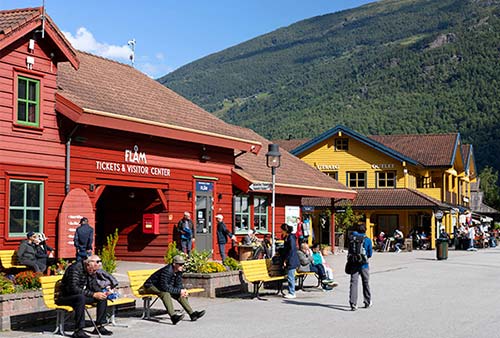
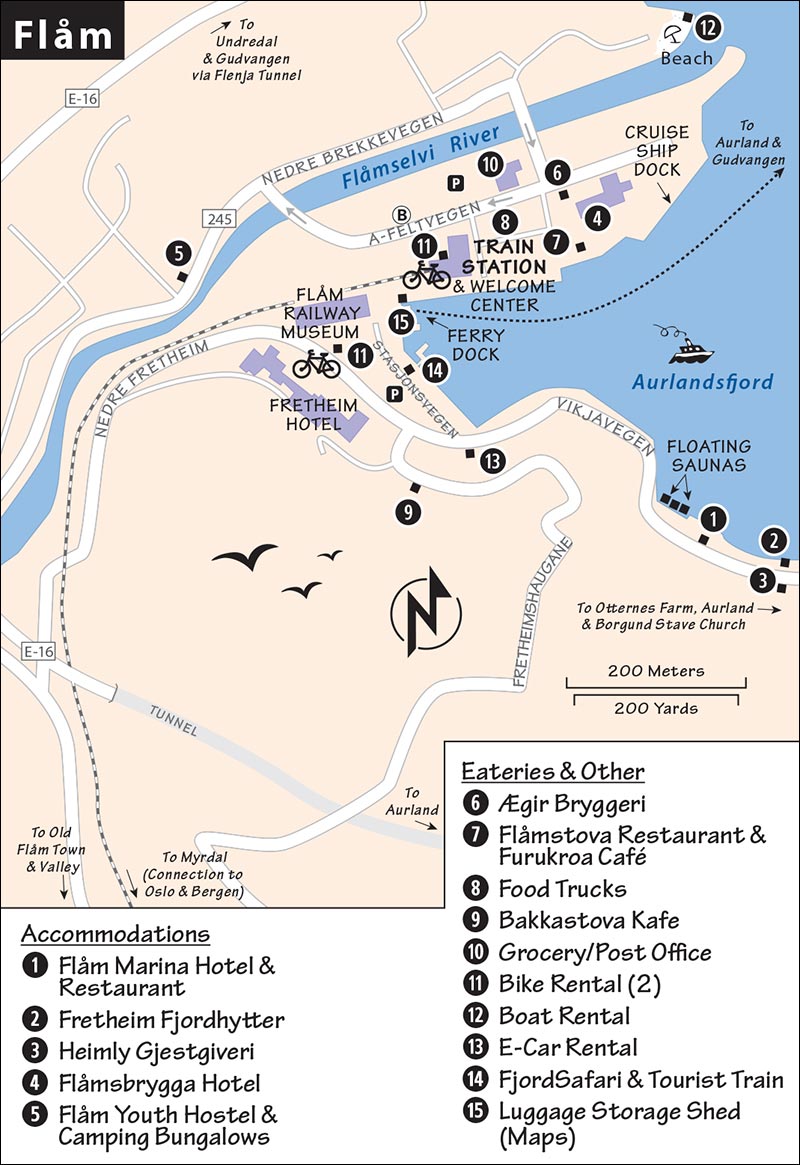
Most of Flåm’s services are in a modern cluster of buildings filling a flat, broad spit of land in front of the train station. The giant, red Flåm Welcome Center—directly ahead from the tracks—is devoted mainly to ticket offices and shops, but you’ll also find free WCs and an ATM. Frustratingly, there is no TI in Flåm—which is flooded with tourists in need of advice—but on very busy cruise days, you may see a desk in the lobby of the Welcome Center with someone handing out maps and answering questions. The Welcome Center has a row of ticket desks selling a variety of excursions offered by a single company (Norway’s Best), including Flåmsbana train tickets, ferry tickets on “The Fjords” boats, and shuttle buses to Gudvangen or the Stegastein viewpoint, amid others. To book something, get in line and survey the overhead screens, which helpfully list upcoming options, times, and availability (ticket office typically open daily in summer 7:45-18:45, off-season 9:00-17:00). Keep in mind that any activities not sold by Norway’s Best—for example, the older, simpler Lustrabaatane fjord cruises—are all but ignored here.
Other services huddle around the head of the railroad tracks. The little red shed (on the right, with the tracks to your back) is left-luggage storage (variable hours; if nobody’s there, ring the bell). On the water side of the shed are giant maps of Flåm and suggested hikes into the nearby countryside.
An array of shops and services sprawl along the giant pier beyond the Welcome Center: souvenir superstores, a pod of food trucks, a few indoor eateries (cafeteria, sit-down restaurant, great brewpub), the Co-op grocery store (with a basic pharmacy and a post office inside), a hotel, and—at the far end of the pier—the cruise dock.
Ferries come and go from the right side of this giant pier. To the right of the pier, along the bottom of the bay, is the starting point for FjordSafari RIB tours and a tourist train that does a 45-minute trip up the valley and back (2/day, no stops).
Continuing past the FjordSafari boats with the water on your left, you’ll walk along a pretty lawn and soon find your way to a boardwalk that curls around the far end of the bay, past “floating saunas” that bob in the fjord, about 10 minutes to the Flåm Marina hotel and restaurant—a great place to escape the crowds and chaos of the main area.
Monopoly Warning: Be aware that most of Flåm’s hotels, restaurants, shops, boats, and so on are owned by Norway’s Best (which also runs the Welcome Center). At the tip of pier is the sprawling Flåmsbrygga complex, with a big hotel and three eateries of its own. It’s hard to find a business in this town that doesn’t belong to one of those two operations, which means limited competition...and high prices.
HELPFUL HINTS
Cruise Schedules: Flåm is busy with Nutshell travelers all season long (roughly early May-late Sept); even on an off-peak day, you may find long lines in the Welcome Center and at eateries. On the (frequent) days when a cruise ship dumps thousands more people into Flåm, it can be uncomfortably crowded. It’s wise to check whether a ship will be in town when you are, and plan accordingly (schedules at www.flamport.no; click on “Ship Arrivals”).
Flåm Railway Museum (Flåmsbana Museet): If you have time to kill while awaiting your train, it’s worth poking into this surprisingly extensive, endearing, and free museum—filling the long, yellow former train station building alongside the tracks. Exhibits explain in English the history of the Flåmsbana train that connects Flåm to the main line up above. You’ll find artifacts, re-creations of historic interiors (such as a humble schoolhouse), and an old train car. It’s the only real museum in town (free, daily 9:00-18:00, until 20:00 in summer).
Bike Rental: Of the two options near the train station, the better choice is Flåm Bike Rental, on the far side of the long, yellow building alongside the tracks. There’s also a self-service, app-operated rent-a-bike rack to the left of the Welcome Center door (near the entrance to the Mall of Norway; see www.fjordsplorer.no).
Boat Rental: With your own boat, you can get close to the walls of the fjord and fully appreciate the immensity of this landscape. For small inflatable boats, try Flåm Boat Rental (figure about 1,700 NOK/2 hours for up to 5 people, +47 92 45 86 45, https://flamboatrental.com). Njord Seakayak Adventures does kayak tours; they’re reluctant to rent out kayaks—especially single ones, which are less stable—unless you’re experienced (+47 91 32 66 28, https://seakayaknorway.com). Both are located at the beach, around the left side of the fjord as you face the water.
E-Car Rental: Another way to get out of town is to rent a pricey, miniature, two-person electric car (which feels like an electric moped pretending it’s an automobile). Riding one person in front of the other—like a bobsled—you can drive yourself to points of interest around Flåm while listening to audioguide commentary (1,500 NOK/2 hours—enough to get to Stegastein viewpoint and back, book ahead if cruise ships are in town; more substantial four-person e-cars available; Nedre Fretheim 15, www.emobflam.no).
Floating Saunas: You’ll find a couple of these trendy attractions in the harbor a short walk from the main tourist pier. It’s literally a sauna floating on the fjord—handy for a cold plunge as needed. Saunas are available for both private and shared sessions (book ahead, Dock 10/11, www.fjordsauna.com). They also run a similar sauna in Aurland (info on website).
Sights and Activities near Flåm
The main reason people come to Flåm is to leave it for other parts of the fjord. Here are some of your options. Because Aurland and Flåm are close together (10 minutes away by car or bus, or 20 minutes by boat), I’ve also listed attractions near Aurland.
▲▲▲Cruising the Nærøyfjord
The most scenic fjord I’ve seen anywhere in Norway is about an hour from Flåm (basically the last half of the Flåm-Gudvangen trip). If you’ve driven to Flåm, didn’t book a Nutshell tour, or are staying overnight, here are several ways to cruise it. For guided commentary along this route, see here.
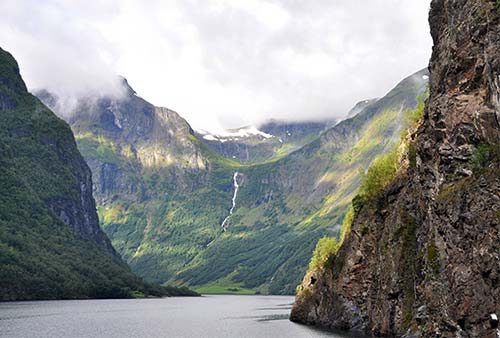
Ferry Cruise (and Shuttle Bus): You can take a round-trip cruise from Flåm to Gudvangen and back—up the Aurlandsfjord, then down the stunning Nærøyfjord. For details on the two dominant companies—Norway’s Best/The Fjords (www.norwaysbest.com) and Lustrabaatane (www.lustrabaatane.com)—see “Flåm-Gudvangen Fjord Cruise,” earlier. While the simplest thing might be to just book a round-trip ferry through Norway’s Best (880 NOK, 2 hours each way plus time in Gudvangen between boats), with a little homework you can also mix-and-match the two companies’ boats.
Or, for a speedier return to Flåm, ride the boat one-way to Gudvangen, then return on a quick shuttle bus (130 NOK, 7/day, 20 minutes, run by Norway’s Best).
High-Speed FjordSafari to Nærøyfjord: FjordSafari takes small groups out onto the fjord in small, open Zodiac-type boats with an English-speaking guide. Participants wear full-body flotation suits, life jackets, warm hats, gloves, and spacey goggles (making everyone on the boat look like crash-test dummies). As the boat rockets across the water, you’ll be thankful for the gear, no matter what the weather. This is a particularly good place to try a RIB (rigid inflatable boat) trip: The water deep in the fjord tends to be quite calm, and the tour really helps you get up close to the impressive nature. Their standard FjordSafari tour zips you through the Aurlandsfjord and gets a look at the Nærøyfjord, all in 90 minutes (850 NOK)—but I’d pay a bit more for the extended version, which adds 45 minutes and goes all the way to Gudvangen, at the end of the Nærøyfjord (1,010 NOK). The “Taste” tour, at three hours total, adds a stop in charming Undredal, where you can sample the local goat cheese (1,175 NOK). While most cruises begin and end in Flåm, they also have a few from Aurland. Check the specific schedule and book on their website (+47 99 09 08 60, www.fjordsafari.com).
▲Flåm Valley Bike Ride or Hike
For perhaps the best single-day land activity from Flåm, take the Flåmsbana train to Myrdal, then hike or mountain-bike along the road (half gravel, half paved) back down to Flåm (2-3 hours by bike, gorgeous waterfalls, great mountain scenery, and a cute church in Håreina with an evocative graveyard, but no fjord views).
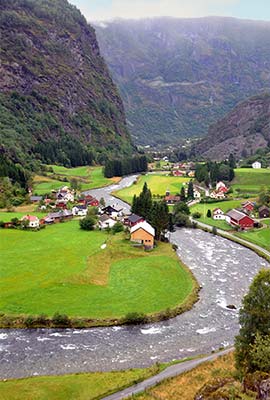
Walkers can hike the best two hours from Myrdal to Blomheller, and catch the train from there into the valley. Or, without riding the train, you can simply walk up the valley 2.5 miles to the church and a little farther to a waterfall. Whenever you get tired hiking up or down the valley, you can hop on the next train. Ask at the Flåm Welcome Center for a helpful map with this and other hiking options (ranging from easy to strenuous), or look for the same map posted on the red luggage-storage shed by the train tracks. Wear good shoes and remember to carry water and an extra layer, even in mild weather.
▲Otternes Cluster Farm (Otternes Bygdetun)
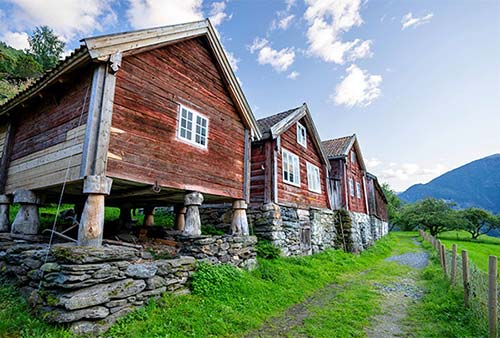
This humble but magical cluster of four centuries-old farms is about three miles from Flåm (easy for drivers; a decent walk or bike ride otherwise). It’s a ghost village perched high on a ridge, up a twisty gravel road midway between Flåm and Aurland. These traditional time-warp houses and barns date from the time before emigration decimated the workforce, coinage replaced barter, and industrial-strength margarine became more popular than butter—leaving farmers to eke out a living relying only on their goats and the cheese they produced. Until 1919, the only road between Aurland and Flåm passed through this huddle of 27 buildings, high above the fjord. First settled in 1522, it was inhabited by farmers until the 1990s. Today, locals are debating whether and how to run it as a sort of open-air museum (ask around for the latest). But in the meantime, it’s open 24/7 for curious visitors to explore, wander, and enjoy the serene views. From a little knob at the far end of the farm village, you have a great view across the fjord to Flåm. Otternes gets a fair number of visitors when a big cruise ship is in town. But if you come early or late, you might share the place with just a few hardy goats balancing on rocks over the fjord.
More Sights near Flåm
At the end of this chapter, I’ve described some sights that are a bit farther from Flåm. The wonderful Borgund Stave Church (one of Norway’s best) is about a 45-minute drive away; you can get there via the improbably long Lærdal Tunnel or by taking the Aurlandsfjellet “Snow Road.” The spectacular Stegastein Viewpoint, a twisty drive directly above Aurland, is part of that “snow road” but can also be seen as a side trip. While these work better for drivers, those overnighting in the area can also get to the church and the viewpoint by bus from Flåm or Aurland.
Sleeping in Flåm
I prefer to sleep in the marina area, a pleasant 10-minute walk along the waterfront from the hubbub: Just head around the little harbor, with the water on your left. It’s more enjoyable to follow the level, waterfront dock than to hike up the main road. But I’ve also listed some other options, including a big, modern hotel right in the heart of the tourist zone and an endearing campground/hostel in a quiet, rural-feeling zone just up the river from the main pier. Except for the hostel, accommodations in Flåm are expensive.
$$$$ Flåm Marina, perched right on the fjord, offers waterfront-view balconies in all 12 units above its restaurant at the guest harbor. They have double rooms and apartments with kitchenettes, which work well for families. Some units feel older, while others are nicely updated (Vikjavegen 4, +47 57 63 35 55, www.flammarina.no, booking@flammarina.no).
$$$$ Fretheim Fjordhytter is four delightful red boat sheds right on the water at the corner of Flåm’s harbor, plus a “tiny house.” While expensive, this feels like a classic Norwegian experience; it even includes the use of an outboard motor boat (Vikjavegen 8, +47 91 72 79 69, www.fretheimhytter.com, f-fjord@online.no, Sue and Anders Fretheim).
$$$$ Heimly Gjestgiveri (“Guesthouse”; formerly Heimly Pensjonat) is run by the local tour conglomerate, Norway’s Best—which means it’s professional and efficient, but also soulless and pricey. While its 22 rooms are tight and straightforward, it’s enjoyable to sit on the porch with new friends and watch the clouds roll down the fjord. Prices include breakfast and a three-course dinner (family rooms, doubles are mostly twins, closed late Sept-early May, Vikjavegen 15, +47 94 02 23 12, www.norwaysbest.com).
On the Main Tourist Pier: $$$$ Flåmsbrygga Hotel is hard to beat for modern big-hotel comfort with faux-rustic Viking accents right at the tip of Flåm’s busy tourist pier. Most of the 41 rooms come with private decks; ones in back face the river, while front-facing rooms wake up to cruise ships docking. A few rooms (including some cheaper non-view options) are above the adjacent restaurant—be clear on your options when booking (family rooms, elevator to most rooms, A-Feltvegen 25, +47 57 63 20 50, www.flamsbrygga.no, mail@flamsbrygga.no).
Budget Sleeps Along the River: $ Flåm Youth Hostel and Camping Bungalows, voted Scandinavia’s most beautiful campground (with campsites tucked in an apple grove), is well run by the friendly Håland family, who rent the cheapest beds in the area. They have 26 private hostel rooms in various sizes (no dorms), as well as 15 cabins. There’s a shared kitchen, and a pizza wagon usually sets up on the front lawn for convivial summer evenings (family rooms, laundry, +47 94 03 26 81, www.flaam-camping.no, camping@flaam-camping.no). It’s a five-minute walk toward the valley from the train station: Cross the bridge and turn left up the main road; then look for the hostel on the right.
Eating in Flåm
Flåm has no high cuisine or “foodie finds” worth seeking out—just practical, tourist-pleasing, and overpriced food. But you’ll encounter a few unique local ingredients, such as goat cheese from Undredal and kid goat meat from a nearby farm. Most eateries are clustered near the train station complex. Hours can be unpredictable, flexing with the season, and places tend to close pretty early (especially in shoulder season)—don’t wait too long for dinner.
$$$$ Ægir Bryggeri, a brewpub filling a fun, heavily themed, reconstructed Viking longhouse, has some of the best food in town—and consequently tends to fill up early. The main floor and outdoor areas are for beer only; if you want a meal upstairs, arrive early...or put your name in and kill an hour or so drinking beer. It’s worth the wait, with a short menu of tasty, well-executed modern pub grub (no reservations except for hotel guests, daily for lunch and dinner, next to Flåmsbrygga Hotel at the tip of the main pier, www.flamsbrygga.no). The brewery is part of a complex of restaurants; across the way, a giant building houses two more eateries: the sit-down $$$$ Flåmstova Restaurant (breakfast and lunch buffet, sit-down dinner service) and the more affordable $$ Furukroa Café (sandwiches, fast-food meals, and pizzas; daily for lunch and early dinner).
In summer, an appealing array of $$ food trucks fills the area behind the Flåm Welcome Center, with picnic tables all around. Survey your choices: burgers, hot dogs, pizza, and gyros, plus more interesting options such as fish-and-chips or a kid goat burger (daily for lunch in high season).
$$ Bakkastova Kafe feels cozier and tucked away, even though it’s owned by the local tour conglomerate. Housed in a traditional Norwegian red cabin just above the Fretheim Hotel, with a view terrace, it serves sandwiches, salads, and desserts. They have real meals at lunch, but after midafternoon, it’s just drinks and desserts (daily).
$$$ Flåm Marina’s restaurant comes with an appealing 10-minute walk around the harbor from the tourist zone. In a glassed-in dining terrace overlooking the fjord, you can dig into burgers, pizzas, and other dishes (daily for lunch and dinner in summer, dinner only off-season, Vikjavegen 4, +47 57 63 35 55, www.flammarina.no).
Aurland
A few miles north of Flåm, Aurland (pop. 820) is more of a real town and less of a tourist depot. (Officially, it’s named Aurlandsvangen—the main town of Aurland municipality—but locals just call it Aurland.) While Aurland is more practical than exciting—lacking the charm of Balestrand, Solvorn, or even Undredal (described next)—it’s a solid, easygoing fjordside home base, a bit removed from the tourist-hub chaos you find in Flåm. And thanks to its location, along the main road and boat lines from Flåm, it’s relatively handy for those using public transportation. For fjord cruising options in this area, see “Cruising the Nærøyfjord,” earlier.
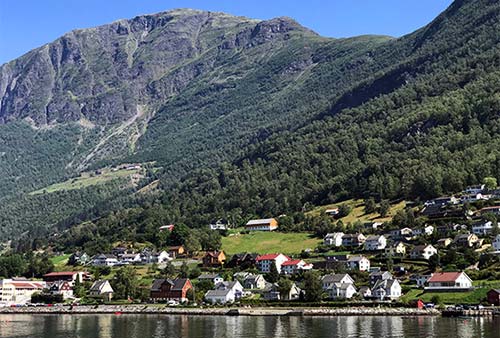
Getting There: Aurland is an easy 10-minute drive or bus trip from Flåm. If you want to stay overnight in Aurland, note that every train (except the late-night one) arriving in Flåm connects with a bus or boat to Aurland. The Norway’s Best ferry on the Flåm-Gudvangen route doesn’t always stop at Aurland, but they will if you ask—making it possible to continue the Nutshell route from Aurland without backtracking to Flåm. The Bergen-Balestrand-Flåm express boat also stops in Aurland (for details, see the “Express Boat Between Bergen, Balestrand, and the Sognefjord” sidebar in the next chapter).
Orientation to Aurland
From Aurland’s boat dock area, walk along the pleasant boardwalk with the water on your left, passing the floating Fjordsauna and starting point for FjordSafari high-speed boat tours (for details on these, see the Flåm section, earlier). When you reach the modern development along the water, watch for the gravel trail that leads up on your right, and take it to the main road (passing an old red barn on your right).
You’ll pop out in the very heart of town. On your right is the Spar supermarket and—just beyond that, at the bridge—the recommended Marianne Bakeri and Café. To your left is the Vangsgården Guest House, then Hotel Aurlandsfjord. Straight ahead is the town’s beautiful old white church (800 years old and worth a peek for its stony, serene, whitewashed interior). Across the street from the church, to the right, is the Town Hall. In peak season, you may find a small office inside with a tourist info touchscreen and some free brochures. (Like Flåm, Aurland has no real TI.) The bus stop, with buses to and from Flåm, is along the left side of the Town Hall building (near some free WCs).
For attractions near Aurland, see “Sights and Activities near Flåm,” earlier. And drivers shouldn’t miss the dramatic Stegastein viewpoint, directly overhead and described later in this chapter.
Sleeping in Aurland
$$$$ Hotel Aurlandsfjord is the town’s big, modern hotel option, run by the local tourism conglomerate (Norway’s Best). That means it has predictable comfort, handsome decor with splashes of style, and high prices in its 30 business-class rooms, many of which come with beautiful fjord-view balconies (+47 94 86 21 00, www.norwaysbest.com, hotelaurlandsfjord@norwaysbest.com).
$$$$ Vangsgården Guest House is a complex of historic buildings dominating the old center of Aurland, all run from the same reception desk. The main building is a simple, old guesthouse offering 17 basic rooms and a fine old-timey living room. Lining the waterfront are their six adorable wood cabins, each with a balcony, kitchen, bathroom, bedroom, and sleeping loft (+47 57 63 35 80, www.vangsgaarden.no, booking@vangsgaarden.no, open year-round, Astrid).
NEAR AURLAND
$$ Skahjem Gard, deep in the countryside (and away from the tourist chaos), is a farm with a former sheep barn that’s been converted into seven units—a combination of rooms and apartments with kitchenettes (good for families). Run by Inge and Ragnhild (and their young family), who enjoy dispensing travel tips to their guests, this is a rare budget option in this very expensive corner of Norway (breakfast packet and premade dinner available with advance notice, open May-Sept, two miles up the valley—road #50, follow Hol signs, +47 46 66 48 48, https://skahjemgard.no, info@skahjemgard.no).
$ Winjum Huts, about a half-mile uphill from Aurland’s dock, rents 14 very basic cabins on a peaceful perch overlooking the majestic fjord. The washhouse/kitchen is where you’ll find the toilets and showers (bedding and towels extra). It’s cheap, rough around the edges, low-service...and very scenic. On the road up to the Stegastein viewpoint, the huts are after the first hairpin curve (+47 41 47 47 51, book on Booking.com).
Eating in Aurland
$ Marianne Bakeri and Café is a delightful little bakery/café serving the best-value lunches in Aurland—pastries, sandwiches, and quiches. It’s a block from the main square, at the bridge over the river. Sit inside or on its riverside terrace (daily until 16:00 or 17:00, +47 90 51 29 78).
$$$ Vangsgården Gastropub, owned by the guesthouse mentioned earlier, dishes up bar food—burgers, pizza, deer stew, salmon, and so on—in the center of town (nightly for dinner).
$$$$ Hotel Aurlandsfjord has a modern dining room that serves as the town’s only real splurge option (nightly for dinner, +47 57 63 35 05, www.aurland-fjordhotel.com [URL inactive]).
For cheap eats on dockside benches, gather a picnic at the Spar supermarket (closed Sun).
Undredal
This almost impossibly remote community is home to about 70 people and 350 goats. Most of the town’s former population (300 people) emigrated to the US between 1850 and 1925. Undredal was accessible only by boat until 1988, when the road from Flåm opened. This sleepy town is known for two things: its tiny stave church and its goat cheese. And its waterfront is intensely charming—I’ll never forget the picnic I had on the ferry wharf. While appealing, Undredal is quiet (some say better from the boat), and difficult to reach without a car.
There’s no TI, but the Undredal Bryggje Café, a big eatery along the water, is a jack-of-all-trades. In addition to serving food and offering cheese tastings, they rent kayaks and run the stave church tours (daily, +47 95 03 98 81, www.visitundredal.no).
Getting There: It’s a 15-minute drive from Flåm: Head toward Gudvangen, and be ready to turn off to the right in the brief gap between long tunnels. You’ll twist down a winding road along a river with waterfalls (and, likely, goats). Watch for the turnoff on the left to the stave church, or just head straight down to the waterfront, with a small row of free parking spaces. By boat, you’ll sail past Undredal on the Flåm-Gudvangen ferry (you can request a stop or a pickup when buying your ticket).
Visiting Undredal: Undredal has Norway’s smallest still-used stave church, seating 40 people for services every fourth Sunday. The original church was built in 1147 (look for the four original stave pillars inside). It was later expanded, pews added, and the interior painted in the 16th century in a way that resembles the traditional Norwegian rosemaling style (which came later). The church is likely open only with a 30-minute tour (typically 2/day), but may have longer hours on busy days; see the schedule posted by the door, or ask at the Undredal Bryggje Café at the waterfront.
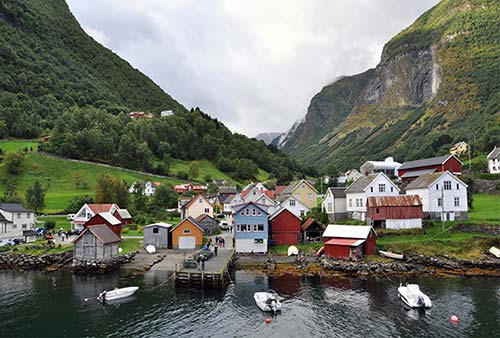
Undredal’s farms exist to produce cheese. The beloved local cheese comes in two versions: brown and white. The brown version is unaged and slightly sweet, while the white version has been aged and is mild and a bit salty. You can buy chunks of each type—and, if they’re not too busy, get a lesson in your options—at the Undredalsbui grocery store at the harbor (Mon-Fri 9:00-17:00, Sat until 15:00, Sun 12:00-16:00, shorter hours and closed Sun off-season). The Undredal Bryggje Café has a cheese platter on their menu and does a guided tasting most evenings.
More Sights near the Nutshell
While not directly on the Aurlandsfjord or the Nærøyfjord, two excellent sights—the Stegastein viewpoint and Borgund Stave Church—are close enough to make a tempting day trip from Flåm or Aurland. Or you could fit them in on the journey between various Sognefjord destinations covered in the next chapter (for example, if connecting to the Lustrafjord via the Fodnes-Manheller ferry, the stave church is a manageable detour). To locate these sights, see the “Nutshell Route” map near the beginning of this chapter.
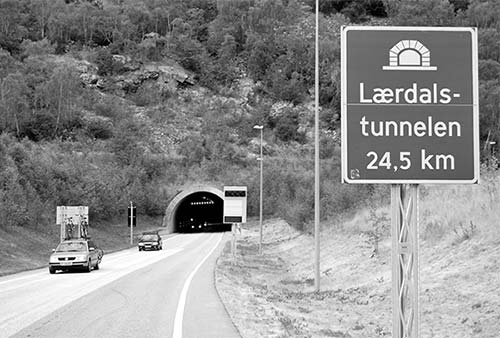
Getting Around: The Lærdal Tunnel—the world’s longest road-vehicle tunnel, stretching 15 miles between Aurland and Lærdal—makes the stave church an easy 45-minute drive from Aurland or Flåm. The tunnel, part of the E-16 highway, is free and impressively nonchalant—it’s signed as if it were just another of Norway’s countless tunnels. But driving it is a bizarre experience: A few miles in, as you find yourself trying not to be hypnotized by the monotony, it suddenly dawns on you what it means to be driving under a mountain for 15 miles. To keep people awake, three rest chambers, each illuminated by a differently colored light, break up the drive visually. Stop and get out—if no cars are coming, test the acoustics.
The downside to the tunnel is that it misses some great scenery—in fact, it runs directly beneath the scenic Aurlandsfjellet “Snow Road.” Though it will add about an hour to your driving time, consider going to the stave church one way and returning the other: Drive through the tunnel to Lærdal and then come back via the “Snow Road,” with the Stegastein viewpoint as a finale, before dropping back into Aurland.
Without a car, you can take a public bus to the Borgund Stave Church (also via Lærdal Tunnel), and you can pay for a round-trip minibus excursion to the Stegastein Viewpoint (through Norway’s Best).
▲▲Stegastein Viewpoint and Aurlandsfjellet “Snow Road”
With a car, clear weather, and a little nerve, consider twisting up the mountain behind Aurland on route 243 to a magnificent view over the Aurlandsfjord. A viewpoint called Stegastein—which looks like a giant, wooden, sideways number 7—provides a platform from which you can enjoy stunning views across the fjord and straight down to Aurland. Many visitors only go as far as Stegastein, with its sweeping views. But hardy drivers can carry on all the way across Norway’s rooftop on the summer-only Aurlandsfjellet “Snow Road.” Fit hikers might consider the trail from Aurland to the viewpoint.
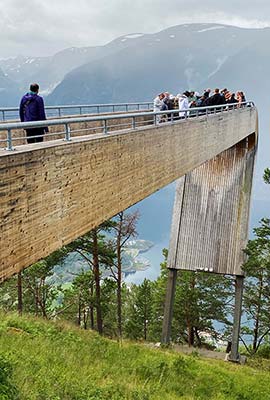
Stegastein Viewpoint: From the town center of Aurland, drivers can twist up the 12 hairpins to Stegastein (and beyond). It’s a very narrow, white-knuckle road with steep drop-offs and unforgiving guardrails—essentially a one-lane road that accommodates two directions of traffic with the help of strategically placed pullouts (each marked with a blue-and-white M). Confident drivers who meet zero traffic can be at the top in 20 minutes. But at busy times, it can easily take twice that long and lots of stress as you encounter other cars and buses...each time, someone has to back up to let the other squeeze past. And then you have to do it all again on the way down. Locals advise avoiding this trip entirely from about 11:00 until 16:00, especially when cruise ships are in town. It’s best to go early or late, maybe even for sunset. At about the halfway mark, there’s a smaller viewpoint marked Ås, with a slightly different angle on the scenery.
If you lack a car, you can ride an electric minibus from Flåm up to the viewpoint and back again (380 NOK, 1.5-hour ride, about 10/day in summer, get details and book at the Flåm Welcome Center or www.fjordtours.com).
Aurland-Stegastein Hike: If the weather is dry, hardy hikers can consider the challenging, scenic two-hour trek up to Stegastein. You’ll gain more than 2,000 feet over two miles on the fairly steep trail. Conditions range from gentle and forested to rugged and rocky, making sturdy shoes a must. While super-fit hikers might opt to go both directions (it will take a little less than two hours to hike back down), another strategy is to arrange for a taxi or the electric minibus (mentioned above) to take you one direction.
The trail begins just north of town—ask locally for the best place to access it. Follow the signs and red blazes through the woods and over some stiles, and in a half-hour you’ll reach Dagsturhytta, an unstaffed mountain hut with a picnic-perfect deck, perched high above the fjord. From here the trail really begins to climb. About an hour or so from the hut, look up to see the Stegastein platform looming above you. You’re almost there! The trail ends on the road just above the viewpoint. Stroll down the road, noticing the WC on your left, a scenic potty that has been voted one of the world’s best. For the grand finale, walk out to the end of the platform and drink in the fjord vistas, feeling the satisfaction of having earned your view.
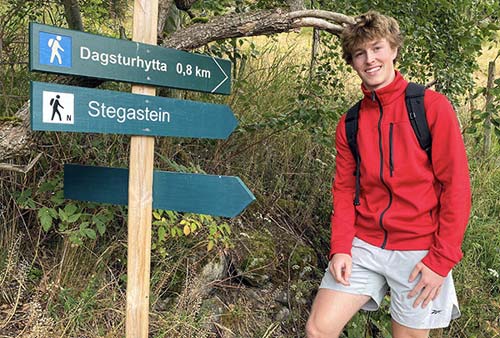
Note that there is no water or WC (not even at the hut) on the trail. Avoid this hike in wet weather, as some spots may be slippery—especially on the descent.
Aurlandsfjellet “Snow Road”: Immediately beyond the viewpoint, you leave the fjord views and enter the beautifully desolate mountaintop world of the Aurlandsfjellet. This road, while well maintained, is open only from June until mid-October. Even in good weather, parts of the road can feel like an adventure, especially when meeting oncoming vehicles on the tiny, exposed hairpin turns. It’s a breathtaking one-hour, 30-mile drive that winds over the Aurland pass, cresting at over 4,000 feet. You’ll enjoy vast and terrifying views of lakes, snowfields, and remote mountain huts and farmsteads on what feels like the top of Norway. When this narrow ribbon of a road finally hits civilization on the other side, you’re a mile from the Lærdal tunnel entrance and about 30 minutes from the Borgund Stave Church.
▲▲Borgund Stave Church (Borgund Stavkyrkje)
About 16 miles east of Lærdal (and 13 miles from the Lærdal Tunnel), in the village of Borgund, is Norway’s most-visited and perhaps best-preserved stave church, dating from around 1180. The interior is clean and uncluttered—transporting you back to the unadorned early days of stave churches (with the exception of a few later additions). The exterior, with its many levels, frilly roofline, gargoyle-like dragon heads, and mountain-valley setting, is breathtaking. The church also comes with one of this country’s best stave-church history museums, which beautifully explains these icons of medieval Norway.
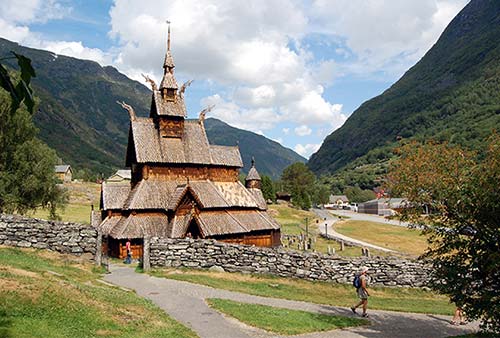
Cost and Hours: 110 NOK; mid-April-mid-Oct daily 9:30-17:30, closed off-season; +47 57 66 81 09, www.stavechurch.com.
Getting There: It’s about a 30-minute drive east of Lærdal, on E-16 (the road to Oslo; if coming from Aurland or Flåm, and the weather’s gorgeous, consider taking the scenic but much slower Aurlandsfjellet “Snow Road” via the Stegastein viewpoint, described earlier). You can also get here by bus (on the main Bergen-Lillehammer route), but the connection isn’t ideal: It passes through Flåm and Aurland around midday (direction: Lillehammer) and drops you off at the church with just one hour for a quick visit (don’t linger in the museum—make sure to leave ample time for the church itself; about a one-hour bus trip each way, daily May-Sept, tell driver you want to get off at the church, confirm schedules at https://entur.no). In past years, Norway’s Best has also run shuttle buses from Flåm to the church and back (check www.norwaysbest.com).
 Self-Guided Tour: You’ll buy your ticket at the visitors center, which has a museum, WCs, a shop, and a café.
• Begin with the...
Museum: This offers a concise, well-described overview of Norway’s stave churches. You’ll learn about the history of these churches; construction methods and equipment; decline of the architectural form following the Black Death of the 1300s; and, finally, efforts (beginning in the late 19th century) to preserve the few remaining stave churches. You’ll see models of various elements of stave churches, plus a few original artifacts from the Borgund church—including a dragon’s head from the roof (itself a replacement, from 1738) that was replaced in 2011, some roof tiles, and ecclesiastical items, including a baptismal font, incense holder, and Eucharist chalice, plus a candlestick holder shaped like a Viking boat.
• Now head outside, cross the road, walk along the graveyard, go through the gate, and stand just above the church to appreciate its design and setting. Docents posted in and near the church can answer questions and tell you more—don’t hesitate to ask. Before entering, appreciate the dramatic...
Exterior and Architectural Features: While built entirely of wood (the only stone is the foundation, and the only metal was in the door handles), it took some inspiration from stone churches that were also being built during the 12th century—for example, the round apse on the right. This classic stave church is decisively vertical—pointing like an arrow up to the heavens. It’s tiered like a Japanese pagoda, and the roofline is decorated with delicate tracery, stout crosses, and dragons at the corners—a holdover from Viking ships, intended to frighten away evil spirits. Some 15,000 shingles cascade down the various roofs; about half of them have been replaced since the church was originally built.
How could a wooden structure survive for so long? It’s built on a stone foundation (to prevent any wood from touching the ground) and slathered in protective tar—extracted from charred wood, liberally applied, then coated with powdered charcoal for extra protection from fire, the elements, and animals. The tar must be reapplied every five or six years, and is still produced entirely naturally. On very hot days, it actually melts and slowly runs down the angled roof (you may notice black, icicle-like drippings hanging from some of the eaves). If you breathe deeply, you can actually smell it. Mmmmmm....piney.
Norway’s most distinctive architecture is the stave church. These medieval houses of worship—tall, skinny, wooden pagodas with dragon’s-head gargoyles—are distinctly Norwegian and palpably historic, transporting you right back to Viking days.
Stave churches are the finest architecture to come out of medieval Norway. Wood was plentiful and cheap, and locals were expert woodworkers (from all that boat building). From the early 12th century until the plague arrived in 1349, as many as 1,000 stave churches were built in Norway. After the Black Death, when Norway’s population dropped, many churches fell into disuse or burned down. By the 19th century, only a few dozen stave churches remained. Fortunately, Norway realized their importance and protected them. Virtually all of Norway’s surviving stave churches have been rebuilt or renovated, with painstaking attention to the original details.
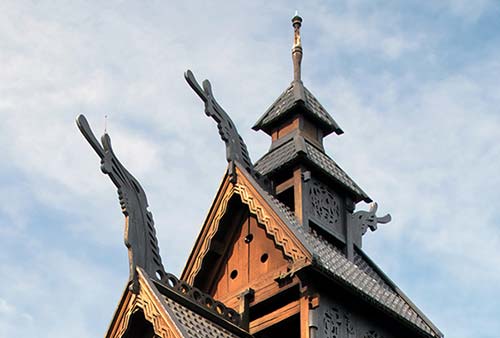
A distinguishing feature of the “stave” design is its frame of tall, stout pillars called staves (Norwegian stav, or “staff”). The churches sit on stone foundations, to keep the wooden structure off the damp ground (to prevent rot). Most stave churches were made of specially grown pine, carefully prepared before being felled. As the trees grew, the tips and most of the branches were cut off, leaving the trunks just barely alive to stand in the woods for about a decade. This allowed the sap to penetrate the wood and lock in the resin, strengthening the wood while keeping it elastic. Once built, a stave church was slathered with black tar—extracted from charred wood, applied with a pig’s-hair brush, and then coated with crushed powder from charcoal—to protect it from the elements and from damage by animals, including insects.
Stave churches are notable for their resilience and flexibility. Just as old houses creak and settle over the years, these wooden churches flex to withstand fierce winds and the march of time. When the wind shifts with the seasons, stave churches groan and moan for a couple of weeks before settling back in.
Even after the Vikings stopped raiding, they ornamented the exteriors of their churches with dragons (reminiscent of the prows of their ships) to ward off evil spirits. Inside, a church’s structure makes you feel like you’re in an overturned ship’s hull. Stave churches are dark, with almost no windows (aside from a few small “portholes” high up). Typical decorations include carved X-shaped crossbeams, symbolizing the cross used to crucify St. Andrew. Round, Romanesque arches near the tops of the staves were made from the “knees” of a tree, where the roots bend to meet the trunk. But the churches also show Gothic influence: Like the buttressed stone cathedrals of the Continent, stave churches are extremely vertical; the beams inside and the roofline outside lead the eye up, up, up to the heavens.
Most surviving stave churches were renovated during the Reformation (16th and 17th centuries), when they acquired more horizontal elements, such as pews, balconies, pulpits, altars, and other decorations to draw attention to the front of the church. In some (Lom and Urnes), the additions make the church feel almost cluttered. But the most authentic (including Borgund) feel more purely medieval. These time-machine churches take visitors back to early Christian days: no pews (worshippers stood through the service), no pulpit, and a barrier between the congregation and the priest, to symbolically separate the physical world from the spiritual one. Incense filled the church, and the priest and congregation chanted the service back and forth to each other, creating an atmosphere that likely made worshippers feel close to God.
Of Norway’s 28 remaining stave churches, the easiest to see are those that have been moved to open-air museums in Oslo and Lillehammer. But if you get the chance, it’s best to appreciate a stave church in its original fjords-and-rolling-hills setting. My two favorites are near Sognefjord: Borgund and Hopperstad. They are each delightfully situated and evocative as can be. Borgund (in this chapter) stands in a pristine wooded valley, while Hopperstad (see here) is perched above a fjord. Borgund, perhaps the best stave church overall, also comes with a good stave church museum.
Other noteworthy stave churches include one in Lom, in the Jotunheimen Mountains (one of Norway’s biggest and quite impressive; see here). The Urnes church, across the Lustrafjord from Solvorn, is technically the oldest of them all—but it’s been thoroughly renovated (still worth a visit for its exquisite carvings and the fun ferry crossing to reach it; see here). The reconstructed Fantoft stave church just outside Bergen lacks the original’s magic. The stave church in Undredal advertises itself as the smallest—but it’s also the dullest. There’s also a stave church (not open to the public) in Kaupanger, just uphill from the ferry dock; and one in Røldal, on the way south to the Setesdal Valley (see here). For more on Norway’s stave churches, visit StaveChurch.com.
The bell tower across from the church dates from “only” 1260. The top is original, while the base—which had rotted—was replaced more recently.
• Now walk closer, entering the stone churchyard. The porch that surrounds the church was added later, perhaps a century after the church was built, mainly to provide additional structural support. Let’s head inside.
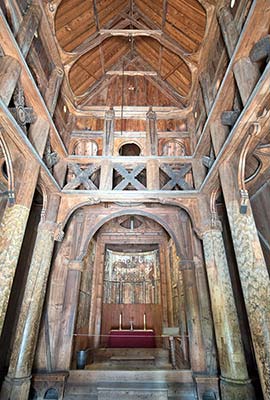
Interior: Give your eyes a minute to adjust to the very low light coming only from the original, small, circular windows up high. The space is largely unadorned and feels smaller inside than it looks from the outside, because many of the exterior features are overbuilt for structural support. The gigantic wooden pillars that run the entire height of the church are those namesake “staves.”
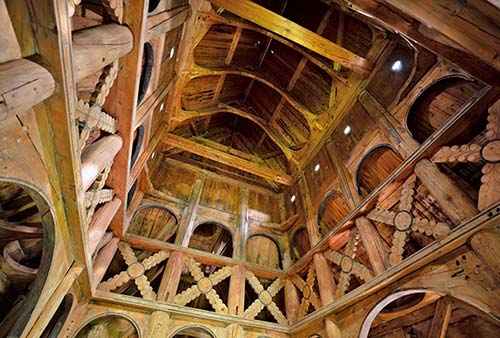
Let your eyes move up—as intended—through the vertical space. The very top of the structure feels like an overturned boat—a reminder that Viking boat makers were also church builders. Below that are round arches and little round windows; then X-shaped crosses of St. Andrew; then, at ground level, much taller arches. Appreciate how a stave church is a mingling of cultures. In this early Christian space, there are elements of Christianity, pagan Norse theology, and Celtic art. And architecturally, it melds Romanesque (round arches) and Gothic (vertical structure).
Turn your attention to the altar area. This is where you’ll find most of the later modifications to the church (which is otherwise strikingly authentic to its original construction). During the earliest days of the church, the congregation would stand (men on one side, women on the other) while the priest led the Mass in Latin with his back turned to them. With the Reformation (1537), many things changed: The priest not only faced the congregation but stood in the pulpit to address them—with sermons (in their own language) so long, the congregation had to sit. In this altar area—surrounding a humble stone table—the painting, the tabernacle on the left (which held the elements for Holy Communion), and the pulpit are all later additions.
The oldest and most authentic item in the church is the stone baptismal font. In medieval times, priests conducting baptisms would go outside to shoo evil spirits away from an infant before bringing it inside the church for the ritual. (If infants died before being baptized, they couldn’t be buried in the churchyard, so parents would put their bodies in little coffins and hide them under the church’s floorboards to get them as close as possible to God.)
• Take one more look around, then head back outside for another view of the church exterior. Few places can transport you back to medieval Europe like a stave church...especially one as well preserved as Borgund.