BYGDØY NEIGHBORHOOD
This thought-provoking and exciting cluster of sights, worth ▲▲, is on a parklike peninsula just across the harbor from downtown Oslo. It provides a busy and rewarding half-day (at a minimum) of sightseeing.
Here, within a short walk, are six major sights (listed in order of importance): the Norwegian Folk Museum, an open-air museum with traditional wooden buildings from all corners of the country, a stave church, and a collection of 20th-century urban buildings; the under-construction Museum of the Viking Age, showing off the best-preserved Viking ships in existence (opening in 2027; the Fram Museum, showcasing the modern Viking spirit with the Fram, the ship of Arctic-exploration fame, and the Gjøa, the first ship to sail through the Northwest Passage; the Kon-Tiki Museum, starring the Kon-Tiki and the Ra II, in which Norwegian explorer Thor Heyerdahl proved that early civilizations could have crossed the oceans; the Norwegian Maritime Museum, interesting mostly to old salts; and the Norwegian Holocaust Center, memorializing the Holocaust in Norway.
Getting to Bygdøy: Sailing from downtown to Bygdøy is fun, fast, and gets you in a seafaring mood. Ride the Bygdøy ferry—marked Public Ferry Bygdøy Museums—from pier 3 in front of City Hall (64 NOK one-way, buy ticket online or at the ticket desk, 75 NOK on board, 99 NOK round-trip; covered by Oslo Pass—but not by individual transit tickets; 3/hour, 10-15 minutes; June-Aug daily 9:10-17:50, fewer sailings spring and fall, no boats off-season, https://nyc.no/bygdoyfergen). Boats generally leave from downtown at :10, :30, and :50 past each hour. In summer, avoid the nearby (much more expensive) tour boats.
For a less memorable approach, you can take bus #30 (from the train station or the National Theater, direction: Bygdøy; 20-minute trip).
Returning to Oslo: Note that after 18:00, boat departures back to downtown are sparse, but the #30 bus runs until late. If returning by ferry, get to the dock a little early—otherwise the boat might be full, and you’ll have to wait for the next sailing.
Getting Around Bygdøy: The Norwegian Folk and Viking Age museums are a 10-minute walk from the ferry’s first stop (Dronningen). The other boating museums (Fram, Kon-Tiki, and Maritime) are at the second ferry stop, in an area called Bygdøynes. The Holocaust Center is off Fredriksborgveien, about halfway between these two museum clusters. All Bygdøy sights are within a pleasant (when sunny) 15-minute walk of each other. The walk gives you a picturesque taste of suburban Oslo.
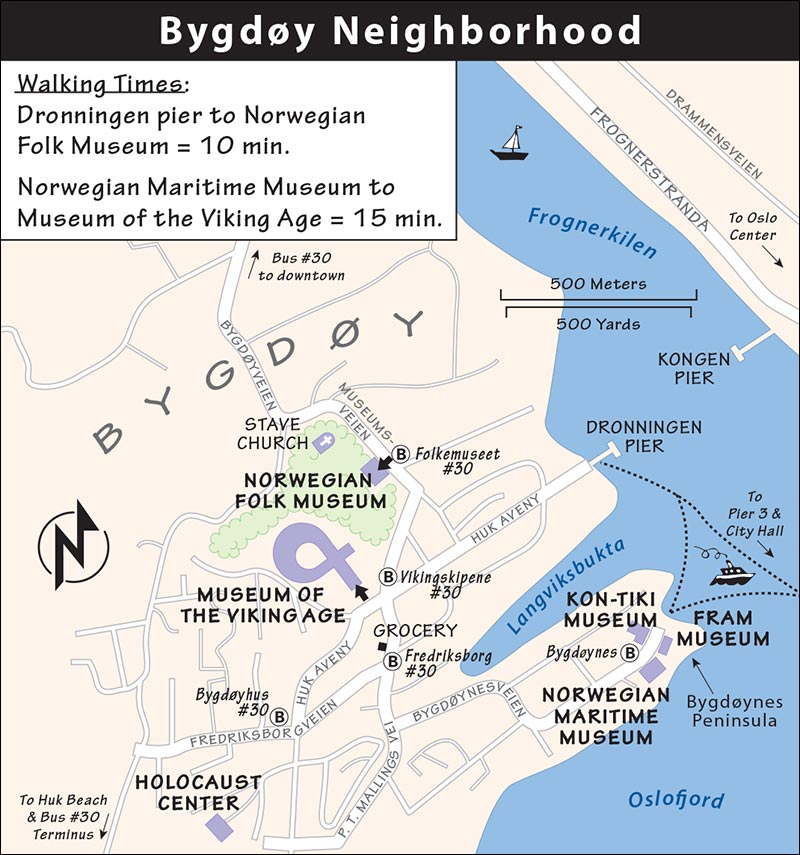
City bus #30 connects the sights four times hourly in this order: Norwegian Folk Museum, Museum of the Viking Age (when open), Kon-Tiki Museum, Norwegian Holocaust Center. (For the Holocaust Center, you’ll use the Bygdøyhus stop a long block away; tell the bus driver you want the stop for the “HL-Senteret.”) The bus turns around at its final stop (Huk), then passes the sights in reverse order on its way back to the city center.
Planning Your Day: If the weather’s good, hit the folk museum first (before it gets too hot). If it’s ugly out, begin with the mostly indoor boat museums at Bygdøynes. The marginally interesting Holocaust Center is a bit of a detour, and skippable if you’re short on time. The Bygdøynes museums offers a discounted combo-ticket if you buy tickets for two or all three at the same time; decide before you buy your first ticket and save a few bucks.
Eating at Bygdøy: Each museum area has $ food options. At the boat museum cluster (Bygdøynes), you’ll find the Framheim Café inside the Fram Museum; a little café window with hot dogs and ice cream outside the Kon-Tiki Museum; and two more-substantial eateries at the Norwegian Maritime Museum: the indoor Kafe Fjord with sandwiches and soup, and the outdoor Fjordterrassen Café, with hot dogs and deep-fried fish and veggie burgers, and tables overlooking the harbor (open May-Aug). The Norwegian Folk Museum houses the decent Kafe Arkadia at its entrance, but picnics are also encouraged. The small Matkroken grocery store close to the Museum of the Viking Age has picnic essentials (bus stop: Fredriksborg). The Holocaust Center has a small café upstairs (closed Mon).
Beach at Bygdøy: A popular beach is located at Huk, on the southwest tip of the peninsula.
▲▲Norwegian Folk Museum (Norsk Folkemuseum)
Brought from all corners of Norway, 150 buildings have been reassembled here on 35 acres. While Stockholm’s Skansen was the first museum of this kind to open to the public, this collection is a bit older, started in 1881 as the king’s private collection (and the inspiration for Skansen). The folk museum is most lively (and worth ▲▲▲) June through mid-August, when buildings are open and staffed with attendants in period clothing (who’ll happily answer your questions). You’ll also see artisans working at traditional crafts and barnyard animals roaming about. In the off-season, the indoor museum is fine, but the park is just a pleasant place to stroll past lots of locked-up log cabins. Be prepared for an uphill walk to reach the Gol stave church.
Cost and Hours: 180 NOK; daily 10:00-17:00—grounds open until 20:00; Oct-April park open Tue-Sun 11:00-16:00, but most historical buildings closed; Museumsveien 10, bus #30 stops immediately in front, +47 22 12 37 00, www.norskfolkemuseum.no.
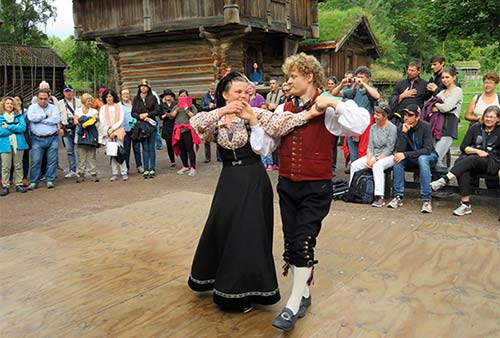
Tours and Activities: Upon arrival, pick up the site map and review the list of the day’s events, concerts, and guided tours (on a screen near the ticket desk). In summer, there are usually two guided tours in English per day; the Telemark Farm hosts a small daily fiddle-and-folk-dance show; and a folk music-and-dance show is held each Sunday. If you don’t take a tour, invest in a guidebook and ask questions of the informative attendants stationed in buildings throughout the park.
Visiting the Museum: Think of the visit in three parts: the park sprinkled with old buildings, the re-created old town, and the folk-art museum and other indoor historical exhibits. As you enter, you’ll cut through the courtyard with the museum to reach the open-air sections.
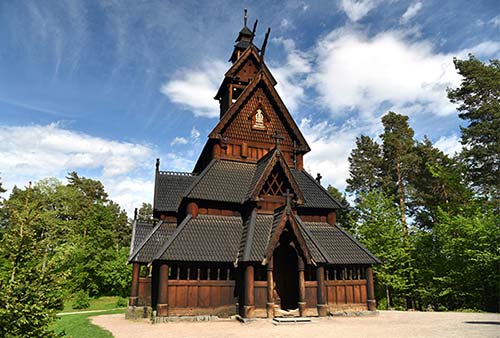
The park is loaded with mostly log-built, sod-roofed cabins from various parts of Norway (arranged roughly geographically). Be sure to go inside the buildings. The evocative Gol stave church, at the top of a hill at the park’s edge, is worth the climb. Built in 1212 in Hallingdal and painstakingly reconstructed here, it has a classic design and, inside, beautiful yet primitive wood paintings on the apse walls (c. 1452). If you won’t make it to a stave church elsewhere on your trip, this is a must. (For more on stave churches, see here.)
Back near the entrance building, the old town has a variety of homes and shops that focus on urban lifestyles. It’s worth exploring the tenement building, where you’ll see intimate, fully furnished apartments from various generations and lifestyles—1905, 1930, 1950, 1979, and even a Norwegian-Pakistani apartment.
In the museum on the courtyard where you entered, the ground floor beautifully presents woody, colorfully painted, and exactingly carved folk art; traditional Norwegian knitting; and weapons. Upstairs are exquisite-in-a-peasant-kind-of-way folk costumes. I’d skip the sleepy collection of Norwegian church art (in an adjoining building). But don’t miss the best Sami culture exhibit I’ve seen in Scandinavia (across the courtyard in the green building, behind the toy exhibit). In the same building find the museum’s newest exhibit, tracing the evolution of Norway’s culture and identity from 1600 to 1914.
▲▲Museum of the Viking Age (Vikingtidsmuseet)
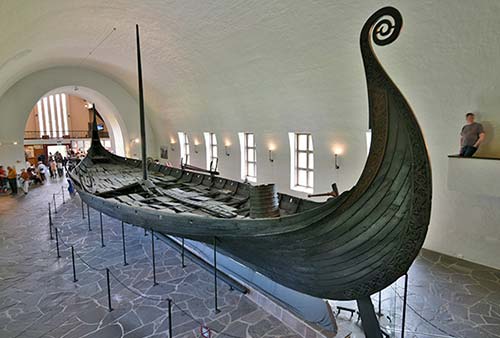
Formerly the Viking Ship Museum, this impressive collection of Viking artifacts (including majestic, well-preserved Viking ships dating from the 9th and 10th centuries) is closed while undergoing a multiyear expansion. It’s scheduled to reopen on the same site in 2027 with triple the space and a new name: the Museum of the Viking Age. In the meantime, a few of the museum’s artifacts are temporarily scattered around Oslo; in particular, the Historical Museum has a good Viking exhibit. For updates on the museum reconstruction, see www.vikingtidsmuseet.no.
▲▲▲Fram Museum (Frammuseet)
Under its distinctive A-frame roof, this museum holds the 125-foot, steam- and sail-powered ship that took modern-day Vikings Roald Amundsen and Fridtjof Nansen deep into the Arctic and Antarctic, farther north and south than any vessel had gone before. In an adjacent A-frame is Amundsen’s Gjøa, the first ship to sail through the Northwest Passage. Together, the exhibit spins a fascinating tale of adventure, scientific exploration, and human determination...all at subzero temperatures.
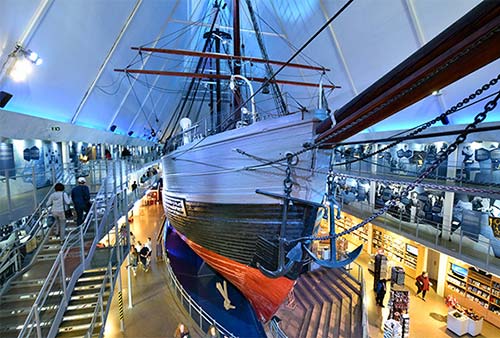
Cost and Hours: 140 NOK, combo-ticket possible—see next; daily May-Aug 9:30-18:00, Sept-April 10:00-17:00; Bygdøynesveien 36, +47 23 28 29 50, www.frammuseum.no.
Combo-Tickets: Two combo-ticket options cover the Fram, Kon-Tiki, and Norwegian Maritime museums. One ticket covers two museums of your choice (250 NOK); the other covers all three (380 NOK).
Visiting the Museum: Stepping into the museum, you’re immediately bow-to-bow with the 128-foot Fram. There are two parts to your visit: The Fram, which you’re looking at, and to the left through a tunnel, the smaller Gjøa. I’d see the Gjøa first, because it’s a better lead-up to the main event, and because it features a short film that’s a fine introduction to the entire museum.
Crossing through the tunnel to the Gjøa, you’ll learn about the search for the Northwest Passage (that long-sought-after trade route through the Arctic from the Atlantic to the Pacific). Exhibits tell the story of how Roald Amundsen and a crew of six used this motor- and sail-powered ship to successfully navigate the Northwest Passage (1903-1906). Exhibits describe their ordeal as well as other Arctic adventures, such as Amundsen’s 1925 flight to 88 degrees north (they had to build a runway out of ice to take off and return home); and his 1926 airship (zeppelin) expedition from Oslo over the North Pole to Alaska. This section also features a 100-seat cinema showing an excellent 15-minute film about the exploration of the earth’s polar regions (shows every 15 minutes).
Now return to the Fram and peruse the exhibits—actual artifacts and profiles of the brave explorers and their crew. The upper floor focuses on Nansen’s voyages to the North Pole on the Fram, including an early kayak, a full-size stuffed polar bear, and a model of the ship. Here you can cross a gangway to explore the Fram’s claustrophobic but fascinating interior. A simulated Northern Lights show, best viewed from the Fram’s main deck, is presented every 20 minutes.
Exhibits on the middle floor focus on Admundsen, who picked up where Nansen left off and explored the South Pole. You’ll see an actual dogsled Admundsen’s team used and a small model of the motorized sled from the rival Scott expedition. Also featured are a tent like the one Amundsen used, reconstructed shelves from his Arctic kitchen, models of the Fram, and a “polar simulator” plunging visitors into a 15° Fahrenheit environment.
▲▲Kon-Tiki Museum (Kon-Tiki Museet)
Next to the Fram is a museum housing the Kon-Tiki and the Ra II, the ships built by the larger-than-life anthropologist, seafarer, and adventurer Thor Heyerdahl (1914-2002). Heyerdahl and his crew used these ships—constructed entirely without modern technology—to undertake tropical voyages many had thought impossible. Both ships are well displayed and described in English. This museum—more lighthearted than the other boat-focused exhibits—puts you in a castaway mood.
Cost and Hours: 140 NOK, combo-ticket possible—see Fram Museum listing, daily June-Aug 9:30-18:00, Sept-April 10:00-17:00, May 10:00-18:00, Bygdøynesveien 36, +47 23 08 67 67, www.kon-tiki.no.
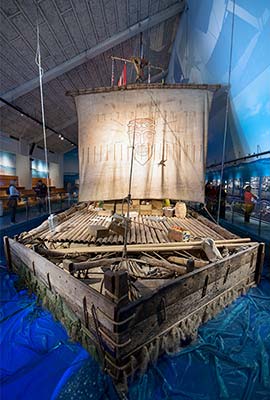
Background: Thor Heyerdahl believed that early South Americans could have crossed the Pacific to settle Polynesia. To prove his point, in 1947 Heyerdahl and five crewmates constructed the Kon-Tiki raft from balsa wood, using only premodern tools and techniques, and adorned its sail with a giant image of the sun god Kon-Tiki. They set sail from Peru on the tiny craft, surviving for 101 days on fish, coconuts, and sweet potatoes (native to Peru). About 5,000 miles later, they arrived in Polynesia. (While Heyerdahl proved that early South Americans could have made this trip, anthropologists doubt they did.) The Kon-Tiki story became a best-selling book and award-winning documentary (and helped spawn the “Tiki” culture craze in the US). Funded by the Kon-Tiki success, Heyerdahl went on to explore Easter Island (1955) and then turned his attention to another voyage—this time across the Atlantic. In 1970, Heyerdahl’s Ra II made a similar 4,000-mile journey from Morocco to Barbados—on a vessel made of reeds—to prove that Africans could have populated the Americas.
Visiting the Museum: You’ll see both the Kon-Tiki and the Ra II and learn about Heyerdahl’s other adventures (including Easter Island and the Ra I, which sank partway into its journey). Everything is well-described in English and very kid-friendly. In the basement, you’ll see the bottom of the Kon-Tiki vessel with a life-size model of a whale shark (the largest fish on earth) and other marine life that the crew observed at sea. Nearby, a small theater continuously plays a 10-minute documentary about the voyage; every day at 12:00, they show the full-length (67-minute), Oscar-winning 1950 documentary film Kon-Tiki.
▲Norwegian Maritime Museum (Norsk Maritimt Museum)
This museum provides insight into Norway’s maritime heritage with a special focus on Oslo. Through exhibits covering coastal culture, traditional boats, Viking ship construction, and archaeology, you’ll gain a deeper understanding of this country’s maritime culture and seafaring past.
Cost and Hours: 140 NOK, combo-ticket possible—see Fram Museum listing; daily 10:00-17:00, Oct-March Tue-Sun 11:00-16:00, closed Mon; two cafés—one with city views; Bygdøynesveien 37, +47 22 12 37 00, www.marmuseum.no.
Visiting the Museum: The museum spans two buildings. Starting in the main building, you’ll learn about the Viking age and boat building. The highlight is a small boat from the Gokstad Viking ship discovery. Until the new Museum of the Viking Age opens, this is your best chance in Oslo to see a real Viking boat. Other exhibits include “At Sea,” which takes a personal look at seafarers’ lives from the Viking days to the present. If you appreciate maritime art, the museum’s painting collection will float your boat. But unless you’re a salty sea dog, I’d skip those and head across to the Boat Hall (Båthallen) building. Here you’ll see a collection of traditional boats that capture the challenges and hardships of 19th-century coastal Norway. One floor up are artifacts recently recovered from the many shipwrecks in Oslo’s old harbor illustrating international shipping, trade, and communications from the 15th to the 17th centuries.
Norwegian Holocaust Center (HL-Senteret)
Located in the stately former home of Nazi collaborator Vidkun Quisling—whose name is synonymous with “complicit in atrocities”—this museum and study center offers a high-tech look at the racist ideologies that fueled the Holocaust. It’s designed primarily for Norwegians, but you can borrow a tablet with English translations of the exhibits. The ground floor displays historical documents about the rise of anti-Semitism and personal effects from Holocaust victims. The exhibits continue downstairs, where the names of 760 Norwegian Jews killed by the Nazis are listed in a bright, white room. Out front, the Innocent Questions glass-and-neon sculpture shows an old-fashioned punch card, reminding viewers of how the Norwegian puppet government collected seemingly innocuous information before deporting its Jews.
Cost and Hours: 120 NOK; daily 10:00-18:00, mid-Sept-mid-May until 16:00; Huk Aveny 56—take bus #30 to the Bygdøyhus stop and follow brown HL-Senteret signs, +47 22 84 21 00, www.hlsenteret.no.
GRÜNERLØKKA AND GRØNLAND DISTRICTS
Oslo’s Grünerløkka district, bisected by the Akers River, is lively, and workaday Grønland is emerging as a fun spot. You can connect it all together by following my self-guided Akers River and Grünerløkka Walk (described below).
Akers River
The source of the Akers River (and Oslo’s drinking water) is the pristine Lake Maridal, situated at the edge of the Nordmarka wilderness. The idyllic recreation scenes along Lake Maridal are a favorite for nature-loving Norwegians.
Though only about five miles long, the Akers River powered Oslo’s early industry: flour mills in the 1300s, sawmills in the 1500s, and Norway’s Industrial Revolution in the 1800s. Today the river valley becomes a park as it winds past decent-size waterfalls and red-brick factories that now house cafés and apartments. The bottom of the river—bordered by the high-rise Radisson Blu Plaza Hotel and the “Little Pakistan” neighborhood of Grønland—has its share of rough edges, reflecting a new urban reality in Oslo.
▲Grünerløkka
The Grünerløkka district, built in the latter half of the 1800s to house the legions of workers employed at factories powered by the Akers River, has reinvented itself as a vibrant neighborhood for shopping, street life, and food. Old-style buildings have found new life as restaurants, bars, and coffeehouses. Vintage shops rub elbows with indie boutiques. Grünerløkka lies just east of the Akers River, offering welcoming green spaces and urban park life.
Getting There: Grünerløkka can be reached from the center of town by a short ride on tram #11, #12, or #18, or by following the walk described next.
▲Akers River and Grünerløkka Walk
This hike up the Akers River, finishing in stylish Grünerløkka, gives a peek at the real (and more diverse) Oslo beyond the touristy central zone. Once housing poor workers, the Grünerløkka neighborhood now attracts Norwegian hipsters and foodie tourists. Allow about 1.5 hours at a brisk pace, including a fair bit of up and down.
Norway likes to think of itself as a quiet, peaceful nation on the edge of Europe—after all, its legislators award the Nobel Peace Prize. So, the events of July 22, 2011 had a profound effect on the country’s psyche. On that day, an anti-immigration fanatic named Anders Behring Breivik set off a car bomb in Oslo, killing eight. He then traveled to a summer camp where he hunted down, shot, and killed 69 young people and counselors.
Until Breivik’s attack, Norway had largely escaped 21st-century terrorism. Arrested after the shootings, Breivik was described by police as obsessed with what he saw as the “threat” of multiculturalism and immigration to Norwegian values. More than 15 percent of the population is not ethnic Norwegian, and a quarter of Oslo’s residents are immigrants.
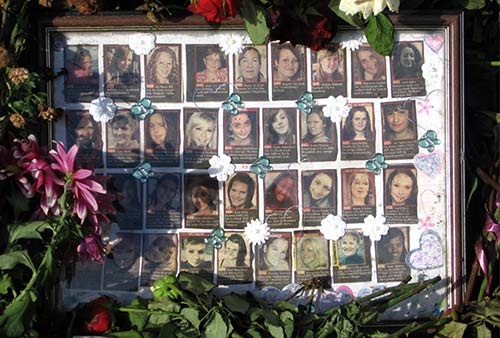
Horrified by Breivik’s actions, after the attack many Oslo natives went out of their way to make their “New Norwegian” neighbors feel welcome.
Norway seems determined not to let the actions of one man poison its peaceful soul. Calls for police to start carrying weapons or to reinstate the death penalty were quickly rejected. “Breivik wanted to change Norway,” an Oslo resident told me. “We’re determined to keep Norway the way it was.”
While there are a few sights along this walk, they’re all skippable—making this a fun experience on a sunny evening after the museums have closed, when Oslo’s young people are out enjoying their riverside park. (Several excellent dining opportunities are along or near this walk.) The walk also works as a bike ride—and there are plenty of Oslo City Bike racks along the way (for details on the city bike program, see here).
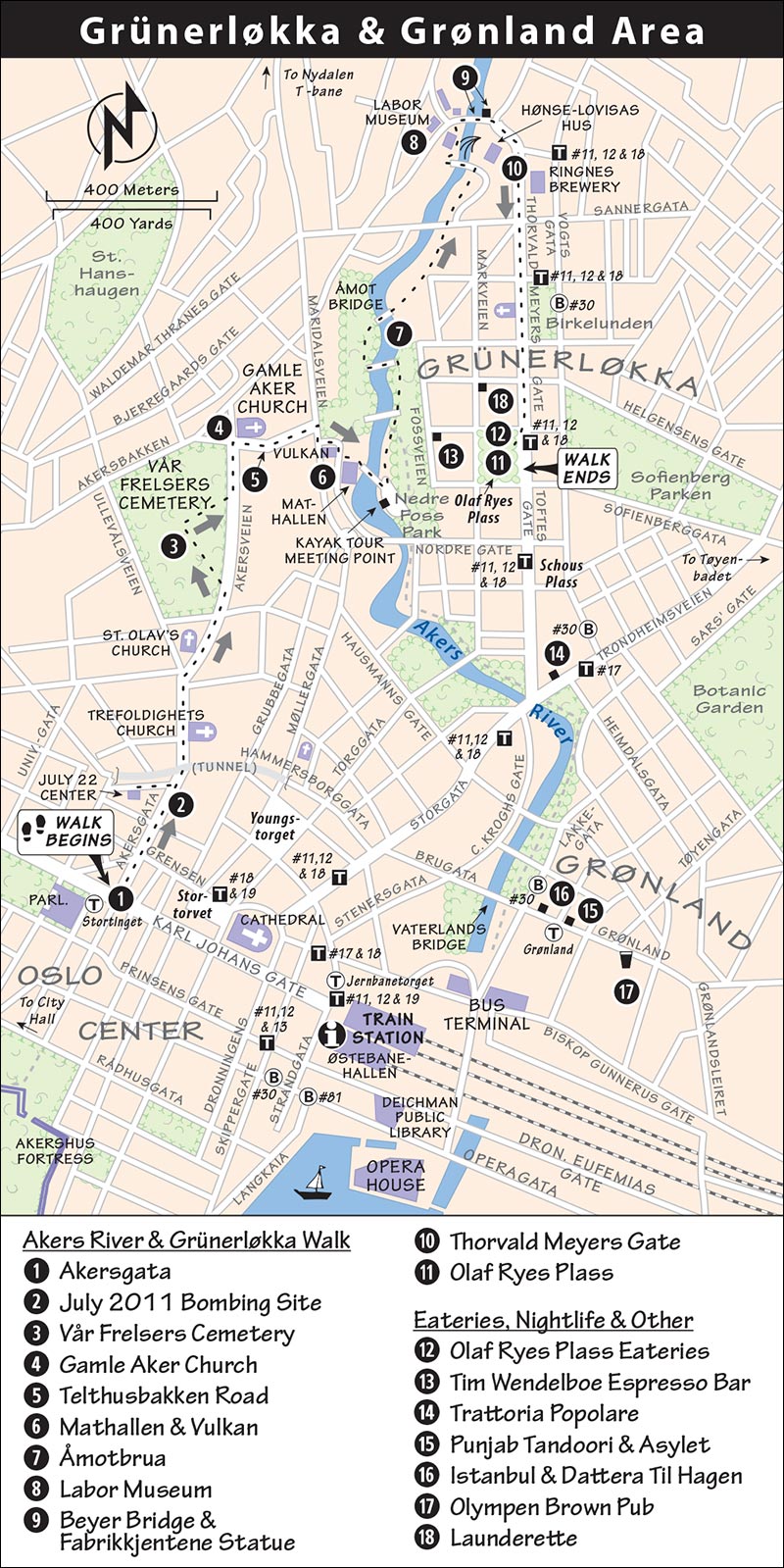
 Self-Guided Walk: We’ll begin by leaving Karl Johans Gate near where it crests (alongside the Parliament building, by the Stortinget T-bane stop), and head north up 1 Akersgata—Oslo’s “Fleet Street,” historically lined with major newspaper companies. After two blocks, cross Apotekergata, where you’ll find two bronze barriers blocking traffic.
• The upcoming square to your right is the…
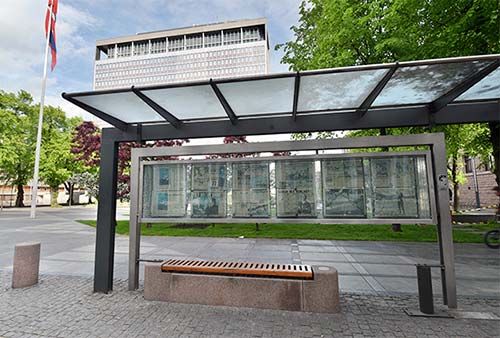
2 Site of the July 22, 2011 bombing: A domestic terrorist killed eight people here in an event that shocked usually peaceful Norway (see the sidebar). Along the street, notice the row of newspaper headlines under shattered glass. These were displayed in a newspaper office’s window just down Akersgata, and have been preserved here—symbolizing how, for Oslo residents, time stood still on that fateful Friday morning.
Continuing straight past this somber site, a block down Teatergata to the left you can find a small visitors center marked 22. juli-senteret, with photos and information about the terror event.
• Back on Akersgata, pass the massive brick Trefoldighets Church, then angle to the right and uphill onto the street called Akersveien, walking along the side of the pointy-steepled St. Olav’s Church. Hiking up this quiet street, you’ll pass some traditional wooden houses. This is what much of “Christiania” (as Oslo was then called) looked like in the early 20th century. After World War II, most of this classic architecture was torn down in favor of modern construction.
After passing a square with a big pool, watch on the left for the entrance gate to the...
3 Vår Frelsers (Our Savior’s) Cemetery: Stop at the big metal map just inside the gate to chart your course through the cemetery: You’ll go through the light-green Æreslunden section—with the biggest plots and VIP graves (including Munch, Ibsen, Bjørnson, and other painters featured in the National Museum)—then veer right to return to Akersveien, using the exit at the far end (#13).
Once oriented, from the metal map, head into the cemetery and bear right into the elevated, walled area. The tall, green, kiosk-like canopied grave belongs to Henrik Wergeland (1808-1845), Norway’s national poet who helped to create its May 17th celebrations (including the children’s parade). Wergeland is beloved not only for his poetry, but as a champion of civil rights: He spent his life fighting a clause in the Norwegian constitution that denied the rights of citizenship to Jews. A few years after his death, it was removed.
Go uphill on the path to the right of Wergeland, into the uppermost part of the cemetery. Bear left with the path, circling the little hill downhill to the left until you reach the grave of the great Expressionist painter, Edvard Munch (1863-1944).
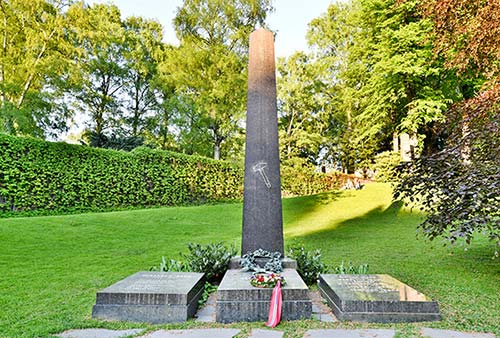
At Munch’s 10 o’clock, walk under the drooping tree and fifty or so yards further to the tall, obelisk-topped tomb of Henrik Ibsen (1828-1906), the great Norwegian playwright. Notice the hammer engraved in his tomb, an allusion to an Ibsen poem that spoke of a man chipping away inside a cave. This represents the determination of Ibsen the artist—who would walk the streets of Oslo, lost in thought, painstakingly crafting his next masterpiece in his mind.
• Facing Ibsen’s grave, turn left and walk toward the yellow house, exiting through the nearby gate. Once outside, turn left and walk 100 yards up Akersveien to the Romanesque...
4 Gamle Aker Church: From the 1100s, this is the oldest building in Oslo. The church, which fell into ruins and has been impressively rebuilt, is rarely open and is pretty bare inside except for a pulpit and baptismal font from the 1700s.
On the little terrace just below the church, notice the stone marker indicating 639 kilometers to Nidaros Cathedral in Trondheim—the burial place of the great Norwegian king/saint, Olav II who ruled a thousand years ago. Olav was instrumental in Christianizing Norway, and his tomb in Trondheim was the focus of Norway’s main medieval pilgrimage route. Walking half the length of Norway by foot offered forgiveness of sins. Like the Camino de Santiago in northern Spain, this pilgrimage route—long forgotten—is again in vogue, not only for spiritual reasons, but for anyone who simply wants a long walk with time to think. If you’re up for a slightly longer walk than this one, the modern pilgrimage office is in the pink, half-timbered building across the street.
• From the church, backtrack 20 yards, head left at the red hydrant, and go downhill on the steep road called...
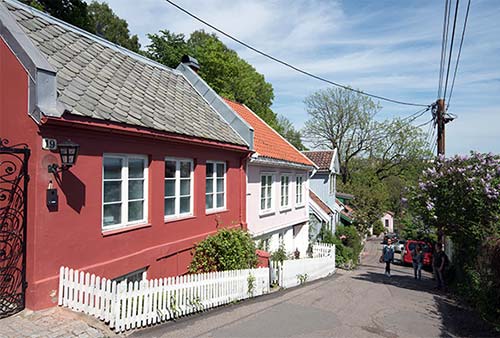
5 Telthusbakken: This delightful lane is lined with colorful old wooden houses, built here outside the city limits by people too poor to meet the fire-safety building codes that outlawed wooden buildings within the city proper. Take a peek through the fence at the little neighborhood garden patches on the right. The huge, gray former grain silos in the distance are now student housing.
• At the bottom of Telthusbakken, you’ll reach busy Maridalsveien street. Cross it and head down to the right about 40 yards, then turn left down the driveway next to the modern Vulkan shopping center. Follow the driveway just in front of Vulkan as it curls around and behind the building to the...
6 Mathallen: This industrial age brick workshop turned recommended food circus offers a dozen or so stalls selling a fun variety of cuisine, and lots of outdoor tables filling an inviting plaza. (If lost, ask anyone for “Mathallen”.) For details on eating here, see the listing under “Eating in Oslo,” later.
• Turn left at Mathallen and cross the ravine on the pedestrian bridge (just follow the sound of the waterfall). You’ll pop out into a peaceful little square, part of...
Nedre Foss Park: This riverside park is fun to explore. Turn left just before the playground and walk along the river (with the silo housing on your right). At the waterfall, look down on your left to see fish ladders (explained in info boards) which allow salmon and sea trout to make their way upstream to spawn. If it’s late fall, look for salmon swimming in the river. Farther along, enjoy a little stretch of boardwalk that’s cantilevered to stick out over a waterfall.
The lively Grünerløkka district is just to your right. But if you have 20 minutes and a little energy, we’ll detour upstream first, zig-zagging across a few bridges, then hook back down.
Continuing along the river, you’ll pass (but not cross) a log bridge on your left, then a few rusty lur horns on your right, before you come to yet another bridge—this one loaded down with “love locks.” Cross this bridge, turn right, and continue following the riverside path uphill.
• Just above the next waterfall, cross...
7 Åmotbrua (Åmot Bridge): This big white springy suspension footbridge dates back to 1852 (and was moved here in 1958). Keep hiking uphill along the river.
• At the base of the next big waterfall, cross over again to the towering brick buildings, hiking up the stairs to the little cobbled plaza, home to the…
8 Labor Museum (Arbeidermuseet): This museum, in the small light-gray building between the two brick factories, is worth a look for its old photos that humanize the life of Olso’s textile workers (free; Wed-Sun 11:00-16:00 summer only). The brick buildings in front are the city’s two biggest former textile factories. Once upon a time you could tell what color the fabric was being dyed each day by the color of water in the river. (If biking, you could stay on this side of the river and climb to the next bridge.)
• Above the falls, cross over...
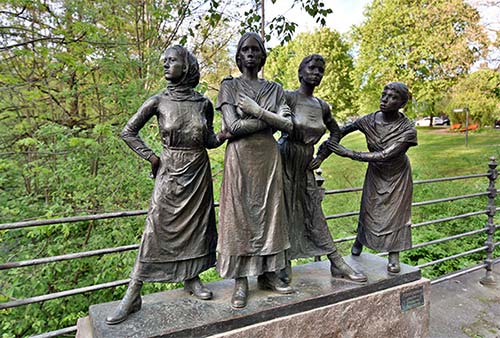
9 Beyer Bridge: In the middle of the bridge is Fabrikkjentene, a statue of four women laborers. The women in the statue are pondering the textile factory where they and 700 others toiled long and hard. This gorge was once lined with the water mills that powered Oslo through its 19th-century Industrial Age boom.
The tiny red house just across and below the bridge—the Hønse-Lovisas Hus cultural center—makes a good rest-stop (daily 11:00-17:00, coffee and waffles).
• As the road bends south, continue past the red house to the red-brick Ringnes Brewery, following...
10 Thorvald Meyers Gate: This street heads straight downhill directly into the heart of Grünerløkka. First, you’ll go through a few blocks of modern, tidy apartment buildings. Then you’ll pass a park (Birkelunden) with a tram stop and a gazebo. The next stretch of Thorvald Meyers Gate is lined with inviting bars and cafés with outdoor seating. And a few short blocks farther is Grünerløkka’s main square, 11 Olaf Ryes Plass—a lively place (with several recommended restaurantrs) to grab a meal or drink and end our walk. Trams take you from here back to the center.
• To continue exploring, you could keep walking downhill straight past Olaf Ryes Plass until you reach a T-intersection with a busy road (Trondheimsveien). From there you could catch tram #17 back to the center, or drop down to the riverside path and follow it downstream to Vaterlands Bridge in the Grønland district. From the bridge the train station is a five-minute walk down Stenersgata.
Grønland
The T-bane’s Grønland stop deposits you in the center of an old working-class neighborhood of Industrial Age Oslo (if you look down side streets, you’ll see fine 19th-century facades). While a bit shabby, Grønland is emerging as a trendy place for eating out and after-dark fun. Locals know you’ll get double the food and lots more beer for the kroner here. If you’d enjoy a whiff of Istanbul, make a point to wander through the underground commercial zone at the Grønland station (easy to visit even if you’re not riding the T-bane).
SOUTHEAST OF DOWNTOWN
▲Ekeberg Sculpture Park (Ekebergparken)
In 2013, this piece of wilderness—on a forested hill over town, with grand city views—was transformed from a long-neglected public green space into a modern sculpture park. Real estate tycoon and art collector Christian Ringnes (grandson of Norwegian brewery tycoons) paid for the project and wanted his creation to be an homage to women. To that end, the park is filled with modern and contemporary sculptures ranging from the ample nudes of Rodin, Renoir, and Botero to the evocative abstractions of Bourgeois, Turrell, and Holzer.
Getting There: The park, always open and free, is a 10-minute tram ride southeast of the center (at the train station, catch tram #18 from platform E, or #19 from platform C; take either one in the direction of Ljabru). Ride just a few stops to Ekebergparken, right at the park’s entrance. Bus #81 also runs to the park from the city center.
Background: This location (literally “Oak Hill”) is historic: There’s evidence that Stone Age people lived here 7,000 years ago; a spot in this park is said to be where Edvard Munch was inspired to paint The Scream (the viewpoint is marked Utsiktspunkt Skrik on maps), and in World War II, it held a Nazi military cemetery. Today the people of Oslo are embracing this lovely 63-acre mix of forest and contemporary art.
Visiting the Park: A visit here involves lots of climbing on trails through the trees. While some people come for the statues (35 in all, but with plans to expand to 80), others simply enjoy a walk in nature...and most agree that the views of Oslo’s harbor scene (the Opera House, Munch Museum, and Barcode Project) may be the highlight. From the tram stop, hike up to the little cluster of buildings (including the visitors center, where you can pick up a map and join a 1.5-hour guided walk in English—see schedule at www.ekebergparken.com). In this area, you can see the first of the sculptures. For views and more art, keep heading up the hill to the restaurant...and beyond. Maps, suggesting various walking routes, are posted throughout the park.
Nearby: The faint ruins of medieval Oslo (free, always open) are between the harbor and Ekeberg Park. You can get a peek of them as you rumble past on the tram. History buffs can spend a few minutes wandering a park with a few scant foundations of the 11th-century town—back when it was 3,000 people huddled around a big stone cathedral, seat of the Norwegian bishop. The arcade of a 13th-century Dominican monastery still stands (office of today’s Lutheran bishop). To get there, hop off at the Oslo Hospital tram stop; the ruins are across Ekebergveien street from the tram stop.
NORTHWEST OF THE CITY
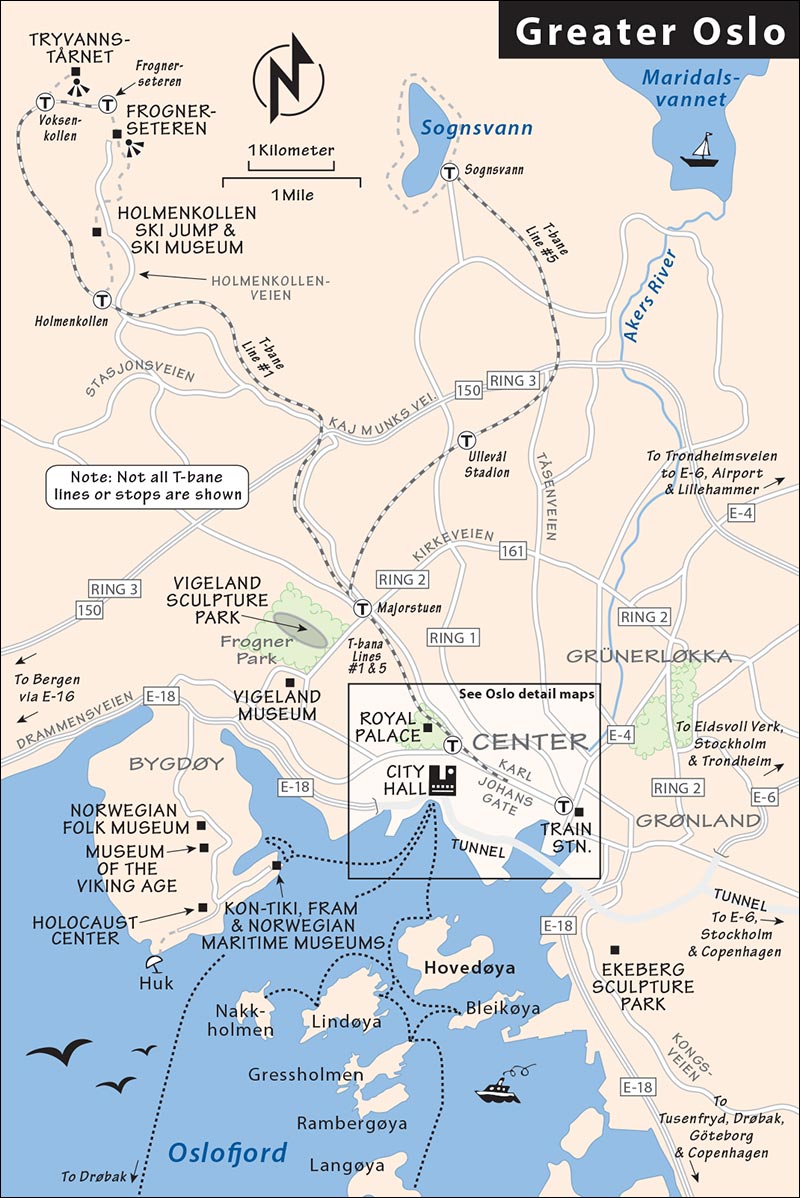
Oslo is surrounded by a vast forest dotted with idyllic little lakes, huts, joggers, bikers, and sun-worshippers. To sightsee farther afield in this woodsy area, consider these options. For locations, see the “Greater Oslo” map.
▲Holmenkollen Ski Jump and Ski Museum
The site of one of the world’s oldest ski jumps (from 1892), Holmenkollen has hosted many championships, including the 1952 Winter Olympics. To win the privilege of hosting the 2011 World Ski Jump Championship, Oslo built a bigger jump to match modern ones built elsewhere—futuristic, cantilevered, and Olympic-standard. For skiers and winter-sports fans, a visit here is worth ▲▲.
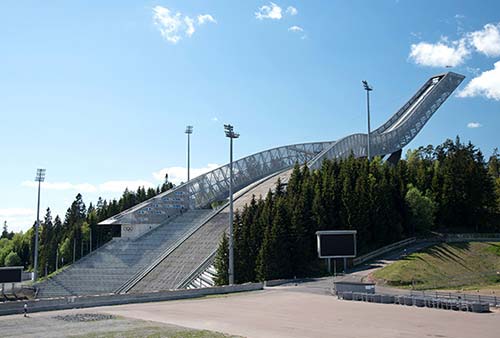
Cost and Hours: 160-NOK ticket includes museum and viewing platform at top of jump; zip line-690 NOK, ski simulator-110 NOK; daily 9:00-20:00, May and Sept 10:00-17:00, Oct-April until 16:00; +47 22 92 32 64, www.skiforeningen.no/holmenkollen.
Getting There: T-bane line #1 gets you out of the city, through the hills, forests, and mansions that surround Oslo, and to the jump (4/hour, 25 minutes, direction: Frognerseteren). From the Holmenkollen station, you’ll hike steeply up the road 15 minutes to the ski jump. (Getting back down is more like 10 minutes. Note T-bane departure times before you leave.) For more details—including a slightly longer, but more scenic, approach—see “Forest Stroll Near the Ski Jump,” later.
Visiting Holmenkollen: You’ll enter the complex directly under the ramp. First, you’ll tour the ski museum, which traces the evolution of the sport, from 4,000-year-old rock paintings to crude 1,500-year-old wooden sticks to the slick and quickly evolving skis of modern times, including a fun exhibit showing the royal family on skis. You’ll see gear from Roald Amundsen’s famous trek to the South Pole, including the stuffed remains of Obersten (“The Colonel”), one of his sled dogs. Exhibits show off lots and lots of historic skis, gear, and video clips of great moments in skiing. Kids love the downhill ski-breeze simulator...basically a superpowered fan that blasts you in the face with fierce wind.
Near the end of the museum exhibits, look for the sign up to the ski jump. The tilted elevator takes you up to the top (on a sunny day, you may have to wait your turn for the elevator). Stand right at the starting gate, just like an athlete, and get a feel for this daredevil sport. The jump empties into a 30,000-seat amphitheater. Climb the stairs up to the rooftop deck; when it’s clear, you’ll see one of the best possible views of Oslo. While the view is exciting from the top, even more thrilling is the zip line ride that sends daredevils screaming (literally) down over the jump to the landing area at the very bottom in 30 heart-stopping seconds.
As you ponder the jump, consider how modern athletes continually push the boundaries of their sport. The first champion here in 1892 jumped 21 meters (nearly 69 feet). In 1930 it took a 50-meter jump to win. In 1962 it was 80 meters, and in 1980 the champ cracked 100 meters. And, most recently, a jump of 140 meters (459 feet) took first place.
To cap your Holmenkollen experience, you can step into the simulator (or should I say stimulator?) and fly down the ski jump and ski in a virtual downhill race. My legs were exhausted after the five-minute terror. It’s located at the lower level of the complex, near the entry of the ski museum. Outside, have fun watching a candid video of those shrieking inside.
Frognerseteren
Continuing past Holmenkollen on T-bane line #1 to the end of the line at Frognerseteren brings you to the starting point of an easy downhill through the Norwegian forest, with a woodsy coffee or meal break in the middle. At Frognerseteren you can also find mountain biking and (in winter) tobogganing (see “Activities in Oslo,” later).
Forest Stroll Near the Ski Jump: From the Frognerseteren stop, follow signs five minutes downhill on the gravel path to the recommended Frognerseteren Hovedrestaurant, a fine traditional eatery with a sod roof, reindeer meat on the griddle, an affordable cafeteria, and a city view over more sod rooftops (see listing under “Eating in Oslo,” later).
From the restaurant, head down to the little sod-roofed village and look for the Holmenkollen 1.6 sign to the right. Follow the wide, reddish gravel path through the woods (don’t be distracted by the many side-paths, which are for mountain bikers—speaking of which, keep an eye out for bicycles zipping across your path). After about 20 minutes, you’ll come to a paved roller-ski course (use the gravel path alongside), then pass between the wooden Holmenkollen village church and the top of a different ski jump (Midtstubakken). Soon you’ll see the glassy swoop of Holmenkollen on your right; the entrance to the jump is at the base of the ramp.
On your way back to the Holmenkollen T-bane stop, you’ll pass the recommended Holmenkollen Restaurant, with a similar view, but without Frognerseteren’s pewter-and-antlers folk theme—or pretense.
NEAR OSLO
These sights are a bit farther from the city, in opposite directions. Eidsvoll Manor is about 45 minutes north of Oslo, while the fjord town of Drøbak is about an hour south.
▲Eidsvoll Manor
During the Napoleonic period, control of Norway changed from Denmark to Sweden. This ruffled the patriotic feathers of Norway’s Thomas Jeffersons and Ben Franklins, and on May 17, 1814, Norway’s constitution was written and signed in this stately mansion (in the town of Eidsvoll Verk, north of Oslo). While Sweden still ruled, the constitution gave Norway more autonomy. To mark the 2014 bicentennial of Norway’s constitution, the manor building was restored to how it looked in 1814. A visitors center in the nearby Wergeland House uses 21st-century tech to tell the history of Norway’s march to independence (the union with Sweden was dissolved in 1905). Your ticket also includes an English tour, offered daily at 12:30.
Cost and Hours: 140 NOK; daily 10:00-16:00; Sept-April Tue-Fri 11:00-15:00, Sat-Sun until 16:00; +47 63 92 22 10, www.eidsvoll1814.no.
Getting There: By public transportation, take the train to the Eidsvoll Verk station (2/hour, 30 minutes). From there, ride bus #430 three stops (direction: Eidsvoll Station, 5 minutes, included with train ticket) or plan on a 20-minute walk. If you’re driving from Oslo to Lillehammer and the Gudbrandsdal Valley, the manor is right on the way and worth a stop. It’s a 45-minute drive from Oslo: Take road E-6 toward Trondheim, then turn right at the Eidsvolls Bygningen sign. Parking is free.
Drøbak
This delightful fjord town is just an hour from Oslo by bus (61 NOK, ticket covers two zones, 2/hour, bus #500 from behind the train station) or ferry from Aker Brygge (118 NOK one-way, ticket covers four zones, 2/day weekends only spring and fall, also 1/day weekdays mid-June-mid-Aug, take ferry #B21, 1.25 hours, no ferry off-season, check at pier 1 or ask at Oslo TI). Consider taking the boat trip down, exploring the town, having dinner, and taking the bus back. Drøbak TI: +47 48 10 89 92, www.visitdrobak.no.
For holiday cheer year-round, stop into Tregaarden’s Julehus Christmas shop, right off Drøbak’s main square (closed Christmas-Feb, +47 64 93 41 78, www.julehus.no). Then wander out past the church and cemetery on the north side of town to a pleasant park. Looking out into the fjord, you can see the old Oscarsborg Fortress, where Norwegian troops fired cannons and torpedoes to sink Hitler’s warship, Blücher. The attack bought enough time for Norway’s king and parliament to escape capture and eventually set up a government-in-exile in London during the Nazi occupation of Norway (1940-1945). Nearby, a monument is dedicated to the commander of the fortress, and one of Blücher’s anchors rests aground (the other is at Aker Brygge in Oslo). A summer ferry shuttles visitors from the town harbor.
Eating in Drøbak: With outdoor seating, $$$$ Restaurant Skipperstuen is a pricey but good option for dinner overlooking the fjord and all the Oslo-bound boat traffic (Mon-Sat 12:00-22:00, Sun until 20:00; off-season closed Mon-Tue; Havnebakken 11, +47 64 93 07 03, www.skipperstuen.no).
Activities in Oslo
Oslofjord Island Beaches
On a hot day, the busy ferry scene at Oslo’s harborfront lures locals out to the cool, green islands across the harbor where they can take a dip in the fjord, enjoy a little beach time, or simply stroll and enjoy views of the city. (You can reach several of Oslofjord’s islands on my self-guided ferry tour, earlier in this chapter.) Hovedøya island (five minutes from town by ferry) has a nice beach and interesting abbey ruins. Little Gressholmen has good swimming, a rustic café, and easy wandering to a pair of connected islands. Farther out is Langøyene (“the Long Islands”), once two islands that are now connected. Out here is another popular beach, and a big space for ballgames.
Getting to the Islands: From Aker Brygge, catch ferry #B1 or #B2 to Hovedøya or Gressholmen. Langøyene is only served by #B2 (both routes are covered by public transit tickets and Oslo Pass). For schedules and fare info, check Ruter.no.
Huk Beach
At the tip of the Bygdøy peninsula, Huk beach is a popular spot for sunbathing. Take bus #30 (from near the National Theater or from other Bygdøy sights) to the Huk stop. Once there, to your left is a clothed beach (and to the right is a nude beach).
Swimming
Oslo is dotted with swimming spots along its downtown harbor. On the east side of the harbor, there’s a small beach and dock at the end of the Sørenga neighborhood (past the Munch Museum, near the ruins of medieval Oslo). For families with small kids, head to the beach just next to the Opera House. On the other (west) side of the city, at the tip of Tjuvholmen is a small floating dock with a diving board, packed with locals on warm days.
Tøyenbadet, a modern indoor/outdoor pool complex with a 330-foot-long waterslide, also has a gym and sauna (northeast of downtown at Helgengate 90, +47 23 30 44 70). Oslo’s free botanical gardens are nearby.
One of the easiest escapes beyond the city center is simply to grab a beach towel and ride T-bane line #5 to its last stop, Sognsvann, and join the lakeside scene of Norwegians at play. A pleasant trail leads around the lake. This is also a great area for mountain biking (see “Mountain Biking,” later).
Floating Saunas
The latest rage in Oslo is floating saunas. Locals relax in the hot and steamy boxes before taking a plunge in the fjord, followed by a little sunbathing. You’ll see these mini spas—open year-round—moored like boats all along the harborfront. To enjoy the experience, book a 90-minute timeslot online in advance. While some spas are small and simple, others are a woody wonderland of saunas, sunbathing perches, and ladders into the water. This is a great way to interact with locals in an informal setting (generally 200 NOK, drop-ins welcome if there’s space, bring your own swimsuit and two towels—one to sit on and one to dry yourself off, cold showers on-site, outside drinks allowed, see websites below for details).
My favorite floating sauna is at Sukkerbiten (the Sugar Cube), with nine different saunas, the original floating sauna, and the flagship spa of the Oslo Sauna Association (just beyond the Munch museum at Nylandsveien 28, more across from the Opera House along Langkaia, www.oslobadstuforening.no). Another option is KOK, which offers motorized sauna-boats, allowing you to soak and cruise the Oslofjord simultaneously (at Langkaia and Aker Brygge, www.koknorge.no). Farther along Langkaia is SALT, with large public saunas and smaller private saunas for rent. Note that at SALT you cannot jump into the fjord, but they have large cold-plunge tubs and access to a bar (Langkaia 1, www.salted.no).
Kayaking on the Akers River
Several outfits run kayak tours on the Akers River. For details, see “Tours in Oslo,” earlier in this chapter.
Toboggan Run
In wintertime, hop on T-bane line #1 and ride to the end of the line to Frognerseteren. From here, a short, snowy downhill walk takes you to the Oslo Sledding Association’s clubhouse, which rents sleds and equipment. You’ll gear up and join locals young and old as they sled down the 1.2-mile-long Korketrekkeren (corkscrew) slope. The ride takes about 8-10 minutes and ends at the Midtstuen T-bane stop, from where you can ride back to Frognerseteren and repeat (130 NOK/day, in winter Mon-Fri 10:00-21:00, Sat from 9:00, Sun until 18:00, check online in advance for snow conditions—usually best in the morning, akeforeningenoslo@gmail.com, www.akeforeningen.no).
Mountain Biking
Mountain biking possibilities are endless (as you’ll discover if you go exploring without a good map). Consider taking your bike on the T-bane (free outside of rush hour, 16 NOK at other times) to the end of line #1 to Frognerseteren to gain the most altitude. Then follow the gravel roads (mostly downhill but with some climbs) past several dreamy lakes to Sognsvann, at the end of T-bane line #5. Farther east, from Maridalsvannet, a bike path follows the Akers River all the way back into town. Get biking details at the TI.
Amusement Park
The giant Tusenfryd amusement complex, just outside of town, offers a world of family fun. It’s like a Norwegian Disneyland and Viking Knott’s Berry Farm, with more than 50 rides, plenty of entertainment, and restaurants (closed off-season, take regional bus #500 from behind Oslo’s train station, +47 64 97 66 99, www.tusenfryd.no).
Shopping in Oslo
Shops in Oslo are generally open 10:00-18:00 or 19:00. Many close early on Saturday and all day Sunday. Shopping centers have similar hours without the Saturday early closure. Here are a few favorite shopping suggestions (note all of these are closed on Sunday). For locations, see the “Oslo Center Hotels” map, later.
Norway Designs, just off Karl Johans Gate, shows off the country’s sleek, contemporary designs in clothing, kitchenware, glass, textiles, jewelry—and high prices (Lille Grensen 7, T-bane: Stortinget, +47 23 11 45 10).
Paleet is a mall in the heart of Oslo, with 30 shops on three levels and a food court in the basement (Karl Johans Gate 37, +47 23 08 08 11).
Dale of Norway, considered Norway’s biggest and best maker of traditional and contemporary sweaters, offers its complete collection at their concept store in downtown Oslo (Karl Johans Gate 45, +47 97 48 12 07).
Heimen Husfliden has a superb selection of authentic Norwegian-made sweaters, bunads (national costumes), yarn, traditional jewelry, and colorful Norwegian folk crafts (top quality at high prices, within Hotell Bondeheimen at Arbeidergata 1, +47 23 21 42 00).
GlasMagasinet is one of Oslo’s oldest and fanciest department stores (top-end, good souvenir shop, near the cathedral at Stortorvet 9, +47 22 82 23 00). In the basement of the GlasMagasinet is another branch of Heimen Husfliden (listed earlier, +47 22 42 10 75).
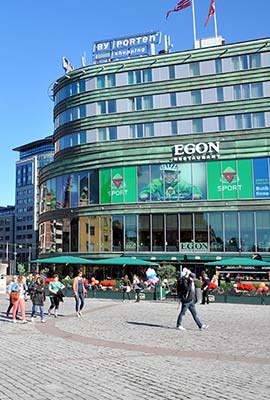
Byporten, the big, splashy mall adjoining the central train station, is filled with youthful and hip shops, specialty stores, and eateries (Jernbanetorget 6, +47 23 36 21 60).
Bogstadveien is a street that’s considered to have the city’s trendiest boutiques and chic, high-quality shops. (It stretches from behind the Royal Palace to Majorstuen near Vigeland Sculpture Park.)
Oslo’s Flea Market makes Saturday morning a happy day for those who brake for garage sales (at Vestkanttorvet, March-Nov only, two blocks east of Frogner Park at the corner of Professor Dahl’s Gate and Neubergsgate).
Oslo Flaggfabrikk sells quality flags of all shapes and sizes, including the long, pennant-shaped vimpel, seen fluttering from flagpoles all over Norway (Stortingsgata 30, +47 22 40 50 60).
Vinmonopolet stores are the only places where you can buy wine and spirits in Norway. (Beer with alcohol content up to 4.7 percent is sold in grocery stores, but stronger beer is limited to Vinmonopolet shops.) In Oslo the most convenient location is at the central train station. Other locations are at Rosenkrantz Gate 11 and inside the Paleet mall (Karl Johans Gate 37).
Entertainment in Oslo
Opera and Ballet Performances
The Norwegian National Opera and Ballet presents a top-notch program of classical and contemporary performances Aug-June at the gleaming-white Opera House on the harborfront at Bjørvika. For tickets, visit the box office Mon-Sat 11:00-16:00, Sun 12:00-16:00, call + 47 21 42 21 21, or go to Operaen.no/en. Guided tours in English are offered daily in summer (see here).
Classical Music
Founded in 1919, the renowned Oslo Philharmonic Orchestra offers a rich program of classical music (including guest performers) at the Oslo Concert Hall (Aug-May, Munkedamsveien 14). For ticket information call +47 23 11 60 60 or visit Ofo.no/en.
Live Theater
The National Theater, Norway’s largest theater company, stages an eclectic program Aug-mid-June at the stately National Theater (along Karl Johans Gate near the Royal Palace) and at other venues around town. Guided tours of the main theater are offered in English several days a week during summer (for info, tickets, and tours, visit http://www.nationaltheatret.no).
Movies
The domed Colosseum Kino in Majorstuen, with 1,500 seats, is a fun place to catch a big-time spectacle. Originally built in 1928, this now high-tech, four-screen theater shows first-run films in their original language (Fridtjof Nansens Vei 6, a short walk west from Majorstuen T-bane station, www.oslokino.no).
Live Music
Oslo has a handful of good places with live music (for locations, see the “Oslo Center Restaurants” map, later). The Dubliner is an Irish pub that hosts live traditional sessions every Tuesday and Saturday (open daily until late, Rådhusgata 28, www.dubliner.no). Herr Nilsen Jazz Club, two blocks off Karl Johans Gate, is a local favorite for lively performances and an enthusiastic crowd. Arrive an hour early to get a seat (daily until late, C.J. Hambros Plass 5, www.herrnilsen.no). Queens Pub is a casual sports bar with free live music (of varying quality) nightly starting at 22:30 (daily until late, close to the train station at Brugata 14, www.queenspuboslo.no). John Dee and Rockefeller Music Hall are larger venues right next to one another. Both host regular concerts by Norwegian and international artists (book tickets online in advance, Mariboes Gate 1, www.rockefeller.no).
Festivals
Oslo hosts several annual music festivals, many of them in late summer. The largest is Øyafestivalen, with a wide range of artists (early Aug, www.oyafestivalen.no). By:Larm is one of Oslo’s most important music festivals, featuring up-and-coming artists (mid-Sept, www.bylarm.no). Kirkemusikkfestivalen, Oslo’s international Church Music Festival, happens twice a year and offers a lineup including Gregorian performances, Baroque pieces, and jazz and contemporary folk music (mid-March and early-Sept, www.kirkemusikkfestivalen.no). Melafestivalen is a multicultural festival and one of the largest of its kind in Europe. This celebration of music, food, dance, and crafts takes place on Rådhusplassen (late Aug, www.mela.no). The Oslo Jazz Festival spans several venues (late Aug, www.oslojazz.no). The OverOslo music festival takes place northeast of the city in a scenic outdoor space overlooking the city (mid-June, www.overoslo.no).
Sleeping in Oslo
Oslo’s hotel rates are particularly susceptible to supply-and-demand fluctuation. You may find deals on weekends and during some parts of the summer, but even then, conventions or special meetings can cause hotel prices to double overnight.
Beyond standard hotels, Oslo is a good city for rooms in private homes and apartments offered through services such as Airbnb or www.bbnorway.com. When selecting a room, consider that sleeping downtown puts you close to the sights, but may come with noise (many loud nightclubs are in the center). The upscale area behind the Royal Palace (Frogner and Majorstuen neighborhoods) gives you a posh address. And for proximity to a trendy dining scene, look in the part of Grünerløkka near the river.
NEAR THE TRAIN STATION AND KARL JOHANS GATE
These accommodations are within a 15-minute walk of the train station. While some streets near the station can feel a bit sketchy, these hotels are secure and comfortable. Parking in a central garage will run you about 250-300 NOK per day.
Thon Hotels
This chain of business-class hotels (found in big cities throughout Norway) offers little character, but provides maximum comfort per krone in big, modern, conveniently located buildings. Each hotel has a cheery staff and lobby, tight but well-designed rooms, Wi-Fi, free coffee in the lobby, and a big buffet breakfast. All are nonsmoking and have elevators and central air-conditioning.
Thon’s $$$$ City Hotels are a cut above their $$$ Budget Hotels and are generally more expensive. In Budget hotels, all rooms lack phones and minifridges.
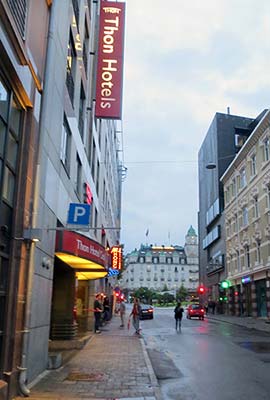
Book by phone or online (central booking +47 21 49 69 00, www.thonhotels.no). For the best prices, check the price calendar on the Thon website. Of the more than a dozen Thon Hotels in Oslo, I find the following most convenient:
Thon City Hotel Rosenkrantz Oslo offers 151 comfortable and stylish rooms two blocks off Karl Johans Gate. Its eighth-floor lounge offers views of the Royal Palace park, and in the evening, the breakfast room turns into an Italian restaurant. Above-and-beyond service makes this a worthwhile splurge (Rosenkrantz Gate 1, +47 23 31 55 00, www.thonhotels.no/rosenkrantzoslo, rosenkrantzoslo@olavthon.no).
Thon City Hotel Terminus is similar but just a five-minute walk from the train station (Steners Gate 10, +47 22 05 60 00, www.thonhotels.no/terminus, terminus@olavthon.no).
Thon City Hotel Cecil, ideally located near the Parliament building a block below Karl Johans Gate, has 110 efficient, comfortable rooms, some with a view of the Parliament building. Breakfast is served in a tall, light-filled atrium (Stortingsgata 8, +47 23 31 48 00, www.thonhotels.no/cecil, cecil@olavthon.no).
Thon City Hotel Spectrum has 187 rooms just behind Oslo Spektrum concert arena. It’s on a pedestrianized street, next door to a handy grocery store. Rooms facing the street can be noisy on weekends (Brugata 7; leave station out north entrance toward bus terminal, go across footbridge and down the stairs on the left, pass by tall glass Radisson Blu Plaza Hotel and walk to the other side of the park; +47 23 36 27 00, www.thonhotels.no/spectrum, spectrum@olavthon.no).
Thon Budget Hotel Astoria, with 178 rooms, has the least charm of my recommended Thon Hotels, but it’s well-located and perfectly serviceable (2 blocks in front of station, 50 yards off Karl Johans Gate, Dronningens Gate 21, +47 24 14 55 50, www.thonhotels.no/astoria, astoria@olavthon.no).
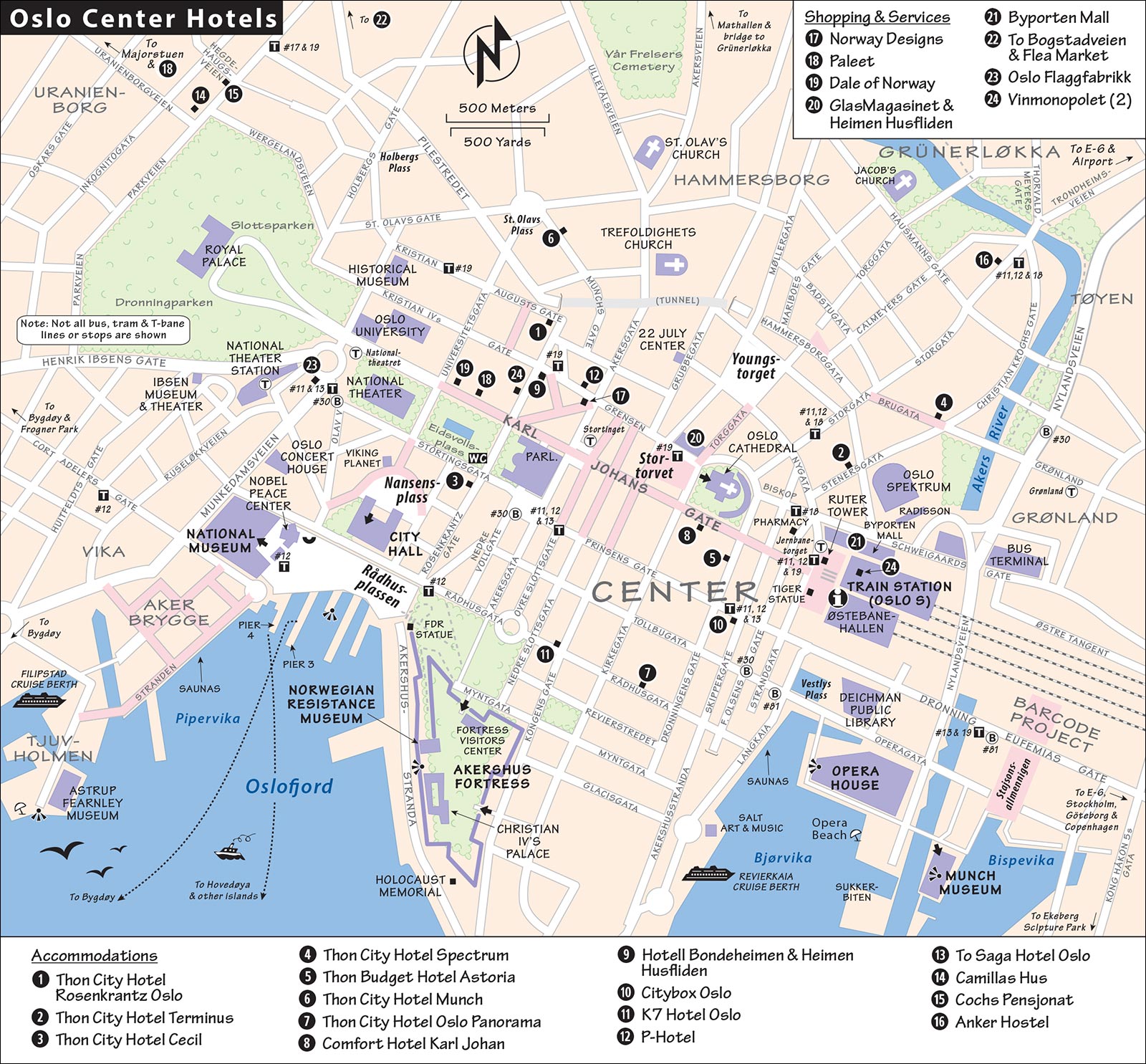
Thon City Hotel Munch has 180 rooms in a location that’s quiet but still relatively central, a few blocks from the Historical Museum. Some rooms have hardwood floors, others have carpets. Because it recently transitioned from “Budget” to “City” class, its prices are a bit lower and a good value (Munchs Gate 5, +47 23 21 96 00, www.thonhotels.no/munch, munch@olavthon.no).
Thon City Hotel Oslo Panorama was a 15-story attempt at a downtown condominium building (the condos didn’t work, so now it’s a 118-room hotel). While higher rooms are more expensive, even those reserving a cheap room often get bumped up. If you request anything higher than the fourth floor, you’ll likely enjoy a bigger room, perhaps with a tiny balcony and/or a kitchenette (just off Dronningens Gate at Rådhusgata 7, about 6 blocks from the train station, +47 23 31 08 00, www.thonhotels.no/oslopanorama [URL inactive], oslopanorama@olavthon.no).
More Hotels near the Train Station
$$$ Comfort Hotel Karl Johan fills a mod building with 181 tight rooms, across from the cathedral near the train-station end of Karl Johans Gate. It feels new, with sleek, somewhat minimalist decor and a trendy lobby that tries a little too hard to be hip and funky. Light sleepers should request a quiet room (elevator, Karl Johans Gate 12, +47 23 01 03 52, www.strawberry.no, co.karljohan@strawberry.no).
$$ Hotell Bondeheimen (“Farmer’s Home”) is a historic hotel run by the farmers’ youth league, Bondeungdomslaget. It once housed the children of rural farmers attending school in Oslo. Its 145 rooms have all the comforts of a modern hotel (elevator, Rosenkrantz Gate 8, +47 23 21 41 00, www.bondeheimen.com, bookingoffice@bondeheimen.com). This almost-100-year-old building is also home to the recommended Kaffistova cafeteria (see “Eating in Oslo”) and a branch of the Heimen Husfliden shop (see “Shopping in Oslo”).
$ Citybox Oslo has 217 simple, basic rooms at a good price in a nondescript urban zone a short walk from the train station. While services are minimal (self check-in), the public areas are inviting (breakfast extra, Prinsens Gate 6, +47 21 42 04 80, www.cityboxhotels.com, oslo@cityboxhotels.com).
$ K7 Hotel Oslo is a hybrid hotel two blocks from Akershus Fortress with both private rooms and dorms. Their double rooms are well-priced and basic, and amenities include a guest kitchen, laundry room, and TV lounge (breakfast extra, Kongens Gate 7, +47 23 10 08 00, www.k7hotel.com, hello@k7hotel.com).
$ P-Hotel rents 93 cheaply designed, well-worn but affordable rooms. It’s a lesser value than the polished Thon hotels but may have rooms when others are full (or charging higher rates). Avoid late-night street noise by requesting a room high up or in the back (some sixth-floor rooms have balconies, breakfast extra, Grensen 19, T-bane: Stortinget, +47 23 31 80 00, www.p-hotels.com, oslo@p-hotels.no).
BETWEEN THE ROYAL PALACE AND FROGNER PARK
This pleasant, refined-feeling residential neighborhood is a long walk or a short tram ride from downtown, tucked in the west end of town between the Royal Palace and Frogner Park. The busy main drag of this area is Hegdehaugsveien, lined with tram tracks, shops, and restaurants and cafés. The pensions listed here are affordable but are plagued by street and tram noise—try requesting a quiet room. Saga Hotel is quieter and more upscale.
$$$ Saga Hotel Oslo feels elegant, with a trendy lobby and gold-trim furnishings. The 47 rooms are comfortable, and the location—in a posh residential area—is appealing (Eilert Sundts Gate 39, +47 22 55 44 90, www.sagahotels.no, post.oslo@sagahotels.no).
$$$ Camillas Hus is where Norwegian writer and feminist Camilla Collett lived in the late 1800s. Located just behind the Royal Palace, it feels upscale, and the seven rooms are spacious and comfortably decorated. To get here, see the directions for Cochs Pensjonat, next (free parking, Parkveien 31, +47 94 85 60 15, www.camillashus.no, info@camillashus.no).
$ Cochs Pensjonat is cheap and cozy, with 90 dated, simple rooms, many with kitchenettes (cheaper rooms with shared bath, discounted breakfast at nearby cafés, elevator; T-bane: Nationaltheatret, exit to Parkveien, and 10-minute walk through park; or more-convenient tram #19 to Wellhavens Gate; Parkveien 25, +47 23 33 24 00, www.cochspensjonat.no, booking@cochs.no, Skram family).
HOSTELS
¢ Anker Hostel, a huge student dorm open to travelers of any age, rents 220 rooms, including 34 of Oslo’s best cheap doubles (in addition to bunks in dorm rooms). Though it has the ambience of a bomb shelter, each room is spacious, simple, clean, and has a small kitchen (elevator, breakfast extra, pay parking; tram #11, #12, or #18, tram stop: Nybrua; or 15-minute walk from station; Storgata 55, +47 22 99 72 00, www.ankerhostel.no, bookinghostel@anker.oslo.no).
¢ Haraldsheim Youth Hostel (IYHF), a huge, modern hostel open all year, comes with a grand view, 315 beds—most of them in four-bed rooms...and a long commute (2.5 miles out of town). They also offer private rooms (sheets extra; from Oslo’s central train station catch bus #31 or tram #17 to Sinsenkrysset, or T-bane lines #4 or #5 to Sinsen, then hike 5 minutes uphill to Haraldsheimveien 4; +47 22 22 29 65, www.haraldsheim.no, oslo.haraldsheim@hihostels.no). Eurailers can train to the hostel with their rail pass (2/hour, to Grefsen and walk 10 minutes).
SLEEPING ON A TRAIN OR BOAT
Norway’s trains and ferries offer ways to travel while sleeping. The 7.5-hour night train between Bergen and Oslo leaves at about 23:00 in each direction (nightly except Sat). An overnight ferry is another clever way to avoid a night in a hotel and to travel while you sleep, saving a day in your itinerary (see “Oslo Connections,” later).
Eating in Oslo
Dining out in Oslo is not cheap, but there are ways to eat well for a reasonable price. I find that a mediocre meal can be overpriced, but a fine meal can be surprisingly affordable. In other words, if you’re eating in a restaurant at all, you may as well splurge for higher quality. I’d picnic or eat at a café or bakery for lunch and spring for a memorable dinner in a serious restaurant. (Remember that tax and tip are included in menu prices, you can share dishes, and water is free with a smile.)
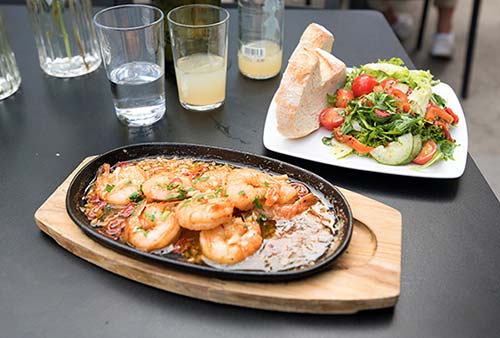
A few tips: Middag refers to dinner, and reservations are smart for any upscale restaurant (seats at the bar and outside may be available for drop-ins). Waiters are well paid, and a 5-10 percent tip at a restaurant (if you enjoyed the food and service) goes a long way.
Groceries are inexpensive in supermarkets (often filling the basement level of departments stores). Smaller grocery stores are commonplace and typically open long hours daily. You’ll find picnic-ready salads, sandwiches, and yogurt/granola tubs with collapsible spoons. Or grab some Wasa crackers and meat, shrimp, or cheese spread in a tube; these are cheap and pack well.
BUDGET EATERIES
Oslo is awash with little budget eateries (modern, international, fast food, pizza, department-store cafeterias, and so on). Keep an eye out for these four chains (each with a branch on or near Karl Johans Gate):
Deli de Luca, a cheery convenience store chain that’s notorious for having a store on every key corner in Oslo (including a long block off Karl Johans Gate at Universitesgata 20), is a step up from the similarly ubiquitous 7-Elevens and Narvesens. Most are open 24/7, selling sandwiches, pastries, sushi, and to-go boxes of warm pasta or Asian noodle dishes. You can fill your belly here for about 80 NOK. Some outlets have seating on the street or upstairs. They’re known for their cheap breakfast and good coffee.
United Bakeries are also a good value for its 80-NOK sandwiches, salads, light weekday lunches, and fresh pastries (seating inside and out, open daily). A handy branch is on Karl Johan Gate next to the Paleet mall.
Kaffebrenneriet Coffee is a good local chain serving quality coffee drinks and affordable sandwiches, salads, and pastries. Convenient locations include in the park along Karl Johans Gate at #24, closer to the cathedral and train station at Karl Johans Gate 7, and next to City Hall at Hieronymus Heyerdahls Gate 1 (some locations closed Sun).
Baker Hansen is Norway’s oldest bakery chain (in operation since 1861), offering freshly made salads, sandwiches, pastries, yogurts and muesli. They’re also known for their gluten-free options. They have both indoor and outdoor seating at these locations: Haakon VIIs Gate 5 (close to National Theater station), Rådhusgata 21 (across from Akershus Fortress), and Kirkegata 15—near Karl Johans Gate (most locations closed Sun).
KARL JOHANS GATE STRIP
The most Norwegian of boulevards is lined with chain eateries and sports bars where you can get ribs, burgers, and pizza. But the area also has two grand, old cafés and two traditional cafeterias worth a meal—or at least a peek.
$$$$ Grand Café is perhaps the most venerable place in town, with genteel decor. They have a seasonal menu, with high-end Nordic, French, and international dishes (daily, reservations smart, Karl Johans Gate 31, +47 98 18 20 00, www.grandcafeoslo.no). For more on this historic watering hole, see my self-guided Oslo Walk, earlier in this chapter.
$$$$ Theatercaféen, since 1900 the place for Norway’s illuminati to see and be seen (note the celebrity portraits adorning the walls), is a swanky splurge steeped in Art Nouveau elegance (daily, reservations smart, in Hotel Continental at Stortingsgata 24, across from National Theater, +47 22 82 40 50, www.theatercafeen.no).
$$$ Kaffistova, a block off the main drag, is where my thrifty Norwegian grandparents always took me. And it remains almost unchanged since the 1970s. This alcohol-free cafeteria still serves simple, hearty, and typically Norwegian meals (including big portions of Norwegian meatballs and fresh Norwegian waffles) for a good price (daily, Rosenkrantz Gate 8, +47 23 21 41 00).
$$ Halvorsens Conditori, tucked behind the Parliament building on Wessels Plass, has an 1881 vibe and patrons almost that old. It’s grannies’ favorite for its simple old-time elegance, open-face sandwiches, and fancy pastries (closed Sat-Sun, Prinsens Gate 26, +47 40 04 58 78).
$$$$ Elias Restaurant feels cozy and friendly despite being in the city center (just two blocks from Karl Johans Gate). It’s a good place for traditional Norwegian dishes with a small, nondescript dining room and a focus on quality food (lunch specials, open daily, Kristian Augusts Gate 14, +47 22 20 22 21).
$$ Nordvegan Vegan Restaurant is a hit with local vegans, fresh, mod, and with a good salad bar (daily, a block off Karl Johans Gate at Kristian IV Gate 15, +47 96 91 11 67).
NEAR AKERSHUS FORTRESS
$$$$ Café Skansen is a delightful spot for a quality meal—especially in good weather, when its leafy, beer garden-like terrace fills with a convivial, mostly local crowd. Or huddle in the old-time interior and dig into a classic Norwegian dish. They serve more affordable lunches and salads until 16:00 (daily, Rådhusgata 32, +47 24 20 13 11, www.cafeskansen.no).
$$$$ Engebret Café is a classic old restaurant in a 17th-century building in the Christiania area of town below the fortress. Since 1857, it’s been serving old-fashioned Norse food (reindeer is always on the menu) in a classic old Norwegian setting. In good weather, you can sit out on the delightful square with a gurgling fountain (closed Sun and most of July, Bankplassen 1, +47 22 82 25 25, www.engebret-cafe.no).
$$ Spor av Nord is a gentle little family-run, candle-lit café with time-warp furniture and traditional coziness. Their menu centers around Møsbrømlefse (a lefse flatbread from northern Norway), their reindeer casserole is a hit, and they offer a breakfast buffet until 11:00 (daily, Tollbugata 7B, +47 97 34 40 10).
ON THE HARBOR PROMENADE
$$$$ Solsiden (“Sunny Side”), filling a glassed-in former warehouse on the embankment just under the fortress, is a local favorite for a harborfront splurge. You’ll dig into fish and seafood meals in an open, unpretentious, nautical-themed, blue-and-white interior that doesn’t distract from the cooking. For fine seafood, it’s a better value than the Aker Brygge scene across the harbor. Reserve ahead and ask for a table with a view (May-mid-Sept Mon-Sat for dinner only, peak season dinner seatings at 16:30 and 20:00, closed Sun, Akershusstranda 13, +47 22 33 36 30, www.solsiden.no).
$$$ Skur 33, filling the end of a pier (dock 33) under the fortress, serves Italian classics like pizza, pasta, and seafood (the seafood pasta and grilled fish are favorites). The ambience is Nordic-elegant, with romantic tables in a repurposed sailor’s warehouse. They don’t take reservations at their long bar or outside where tables come with a fine city and harbor view (closed Mon, reservations smart, at dock 33, Akershusstranda 11, +47 23 35 70 60, https://skur33.no).
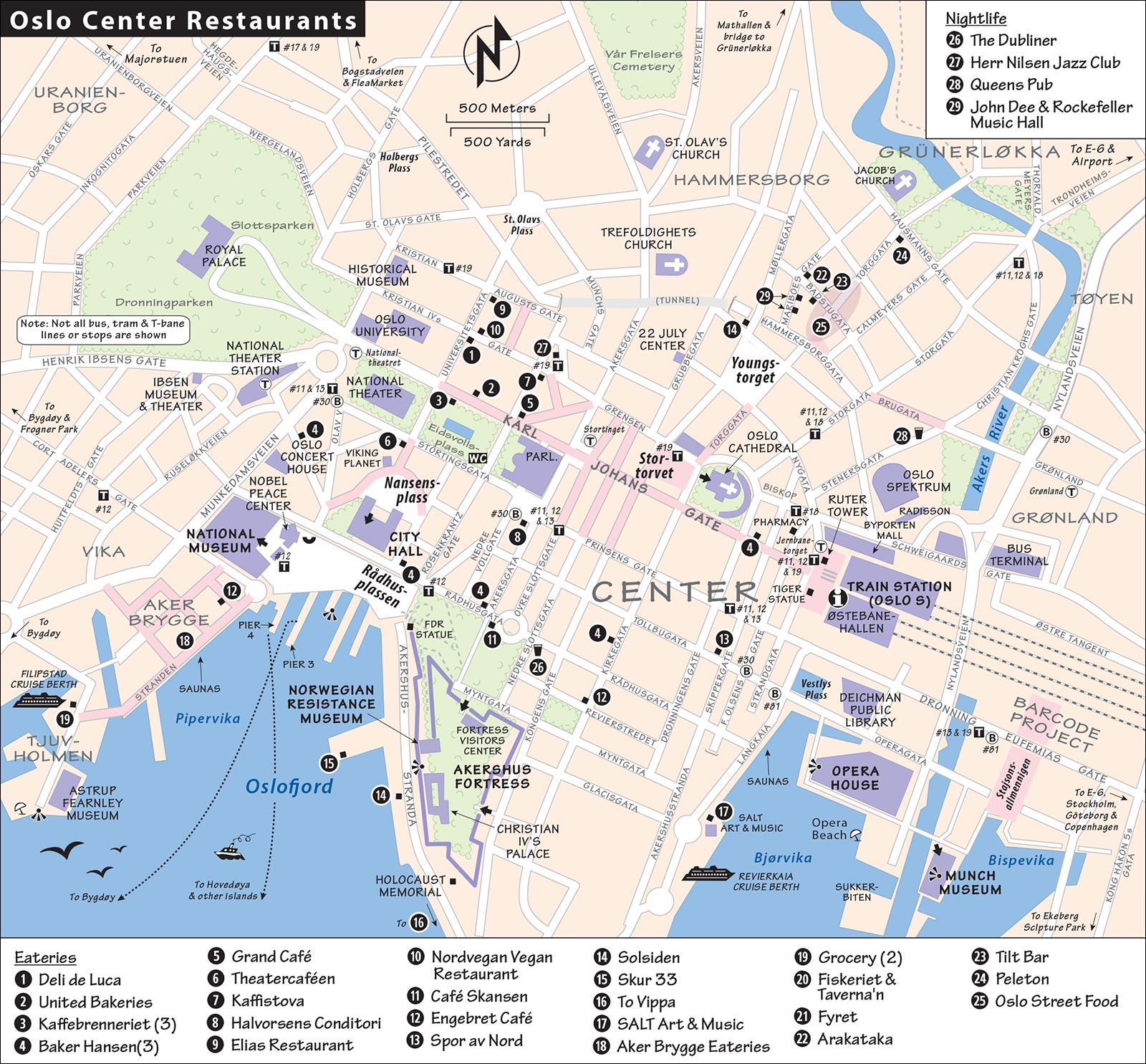
$$ Vippa is a collection of about ten food vendors filling an industrial warehouse—each serving international street food (such as Polish and Syrian food, among others). You can eat for around 200 NOK at any of these spots, and grab a drink from the container serving a wonderland of local beers and cocktails. Sit at rickety tables inside or enjoy sunset on the harbor at outdoor tables (closed Mon, live music many evenings, Akershusstranda 25—for location see the “Oslo Harbor Promenade Bike Tour” map on here).
SALT Art and Music, which calls itself a nomadic art project, is where young Norwegians loosen up. It’s a shipwreck of street food eateries and bars with an anarchistic hippy vibe (like Copenhagen’s Christiania). You’ll find saunas, sunbathing, and several stages for live music. A mishmash of old furniture is strewn under A-frames inspired by cod-drying racks from the north (Langkaia 1, www.salted.no).
HARBORSIDE DINING IN AKER BRYGGE
Aker Brygge, near City Hall, is popular for its inviting cafés and restaurants with outdoor tables that make for a memorable waterfront meal. Consider both the brick-and-mortar places (some with second-floor view seating) and the various floating options. Nearly all are open for lunch and dinner.
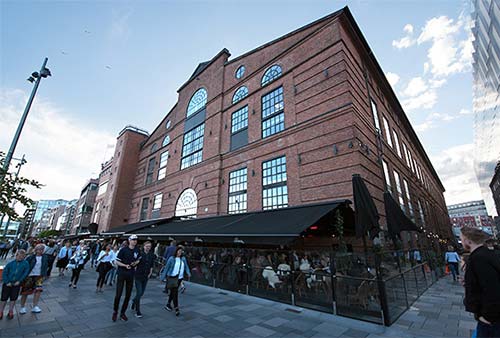
$$$$ Lekter’n Lounge offers the best harbor view (rather than views of strolling people). This trendy bar has a floating dining area open only when the weather is warm. It serves hamburgers, fish-and-chips, salads, mussels, and shrimp buckets (all outdoors, Stranden 3, +47 21 52 32 31). If you go just for drinks, the sofas make you feel right at home, and a DJ adds to the ambience.
$$$$ Rorbua (“Fisherman’s Cabin”) is a lively-yet-cozy eatery tucked back a bit from the waterfront in this otherwise modern stretch of restaurants. The specialty is food from Norway’s north, such as whale, cod, and reindeer. Inside, it’s extremely woody with a rustic charm and candlelit picnic tables surrounded by harpoons and old black-and-white photos (daily, reservations smart, Stranden 71, +47 22 83 64 84, www.rorbua.as).
$$$$ Lofoten Fiskerestaurant serves fish amid a dressy yacht-club atmosphere at the end of the strip. While it’s beyond the people-watching action, it’s comfortable even in cold and blustery weather because of its heated atrium. Reservations are a must, especially for a harborside window table (daily, Stranden 75, +47 22 83 08 08, www.lofoten-fiskerestaurant.no).
Aker Brygge Budget Tips: If you’re on a budget, try a hot dog from a pølse stand on the promenade or get a picnic from a nearby grocery store and grab a bench along the boardwalk. The Co-op Mega grocery store—in the middle of the mall a few steps behind all the fancy restaurants—has salads, warm takeaway dishes (sold by weight), and more (turn inland about midway down the boardwalk, Mon-Sat 8:00-22:00, Sun 9:00-20:00). Farther down is a Joker mini-grocery, just over the bridge and to the right on Lille Stranden in Tjuvholmen (Mon-Sat 8:00-22:00, Sun from 11:00).
YOUNGSTORGET AND TORGGATA
Central Oslo’s most happening dining zone percolates just a 10-minute stroll north of Karl Johans Gate, on and around the otherwise nondescript urban square called Youngstorget. This aptly named square feels fresh and trendy—with the towering, red-brick headquarters of the Arbeiderpartiet (Labor Party) on the lower end. Facing those headquarters, the peach-colored, crenellated building (a former police station) was once the headquarters for the notorious Nazi security detail during its occupation of Norway. The building’s former stables, in the arcades just below, are now filled with bars and eateries. The street called Torggata, which stretches from the square another six blocks, is a hive of hip and sloppy restaurants.
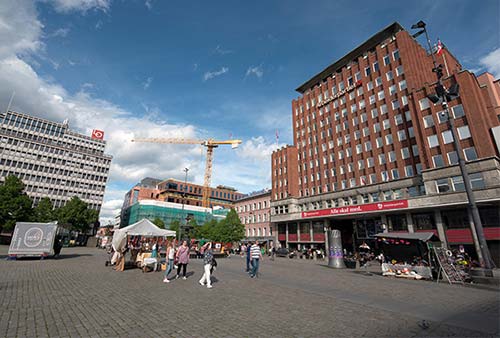
$$$ Fiskeriet started as a small fish counter (which is still open) before expanding into a full-blown restaurant. It has a concise but tempting menu of simple fish-focused entrees, including fish gratin (a classic Norwegian dish), award-winning fish soup, and fish-and-chips. Choose between a high-energy tiled interior or a table out on the square (daily, reservations smart, Youngstorget 2b, +47 22 42 45 40, www.fiskeriet.com).
$$ Fyret is a salty little sailors’ bar with an unforgettable 19th-century vibe. It’s a classic spot for a smørbrød (open-face sandwich) and a beer or akevitt (the local fire water). While tiny tables in the arcade overlook the square, I love its museum-like interior. Take advantage of their great selection of akevitt (no English menu, closed Sun, Youngstorget 6, +47 22 20 51 82).
$$$ Taverna’n is an industrial-strength eatery with a big, rustic and trendy interior and outdoor dining right on the square. Come for the fun atmosphere and a menu of pastas, fish, grilled meats, and pizza (lunch buffet Mon-Fri 11:00-13:00, closed Sun, evening reservations smart, Youngstorget 1, +47 40 01 74 37, https://tavernan.no).
Torggata Street, the street running north from Youngstorget, is six blocks of mostly cheap, international fast-food joints. Stroll the length of the street to absorb the youthful energy, people-watch, and see what’s happening. There’s a huge array of options for eating, drinking, and having fun. These three places are along the way: $$$ Arakataka, a stylish and expensive place serving refined Nordic dishes (closed Sun, reservations smart, a short block up Badstugata at Miriboes Gate 7b, +47 94 16 53 91, www.arakataka.no); $$ Tilt Bar, a pinball, foosball, and shuffleboard dive bar with a bouncer, lively young crowd, and lots of craft beer (daily, Badstugata 6); and $$ Peloton, an inviting “bicycle café” serving good pizza and a long list of craft beers (daily, at the end of Torggata at #35, +47 40 94 07 83).
Oslo Street Food (Torggata’s Bad Food Hall): Bad here means “bath.” Before this became Oslo’s largest food hall, it was a public bath house. Crammed with shared tables and a literal world of food stalls, it’s noisy, sticky, dark, and thumping with music. The belly of this frenetic food circus was the swimming pool, and you’ll actually eat in the drained pool surrounded by the original tiles. A disco ball adds rays of light as if you were underwater on a sunny day (daily, Torggata 16).
NEAR FROGNER PARK
This option is handy after a visit to the Vigeland Sculpture Park within sprawling Frogner Park. For location see the “Frogner Park” map on here.
$$$$ Lofotstua Restaurant feels transplanted from the far northern islands it’s named for. Kjell Jenssen and his son, Jan Hugo, proudly serve up fish Lofoten-style. Evangelical about fish, they’ll patiently explain to you the fine differences between all the local varieties, with the help of a photo-illustrated chart. They serve only the freshest catch, perfectly—if simply—prepared. And if you want meat, they’ve got it: whale or seal (closed Sat-Sun and all of July, reservations smart, 5-minute walk from Frogner Park’s main gate, tram #12 stop: Frogner Stadion, in Majorstuen at Kirkeveien 40, +47 22 46 93 96, https://lofotstua-as.business.site). This place is packed daily in winter for their famous lutefisk.
TRENDY DINING IN GRÜNERLØKKA
This fast-emerging zone on the bank of the Akers River (and covered on my Akers River and Grünerløkka Walk), has plenty of creative and fun restaurants. In the appealing Akers River valley, several old brick industrial buildings and adjoining new construction house a busy hive of eateries that’s an easy walk or tram ride from downtown (it’s a 5-minute walk from the tram stop at Olaf Ryes Plass, described later). For locations, see the “Grünerløkka and Grønland Area” map on here.
Mathallen Oslo—once a 19th-century factory—is the anchor of this area. Now spiffed up, it’s morphed into a riverside market with a mix of produce stalls and enticing international eateries sharing food-circus-type seating in the middle. This is not the place for traditional Norwegian fare. Instead, you’ll find tapas, Italian, sushi, tacos and tequila, pizza, Asian street food, gourmet ice cream, and so on. Most places have meals for 200-250 NOK. Upstairs, a few quiet tables hide out (daily, Vulkan 5, www.mathallenoslo.no). $$$ Galopin is a French wine bar with tasty light meals and cheeses. $$$ Atelier Asian Tapas dishes up fancy small plates. The Cupcake & Pie Co. serves sweet and savory pies. $$$ Vulkanfisk, with indoor and outdoor seating, has a tempting menu of fish and seafood dishes: mussels, fish-and-chips, fish soup, whale burgers, etc. (daily).
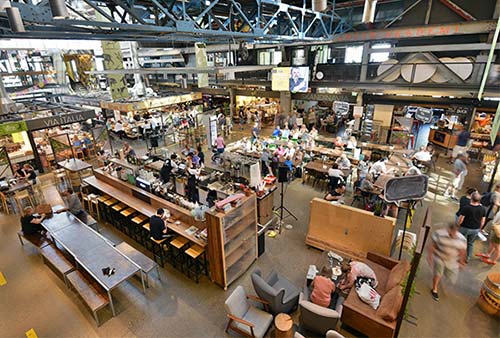
Olaf Ryes Plass
Grünerløkka’s main square is lined with inviting eateries and has a relaxed, bohemian-chic vibe. To get here, hop on tram #11, #12, or #18. The top of the square has several pubs selling beer-centric food to a beer-centric crowd. Before choosing, wander around and survey your options: Parkteatret (a classic bar), Eldhuset (barbecue), Skaal (convivial with sophisticated small plates designed to be shared), the charming little Grünerhaven café kiosk in the park itself (open-face sandwiches, salads), and perhaps the most appealing choice, $$$ Villa Paradiso: Youthful, family-friendly, and popular for its Neapolitan pizzas, it has a rustic interior and a popular terrace overlooking the square and people scene (daily, Olaf Ryes Plass 8, +47 22 35 40 60). $ Harald’s Vaffel, a half-block down from the square, is known for its freshly made old fashioned waffles. Their big hit is the “superclassic” (daily, Olaf Ryes Plass 3).
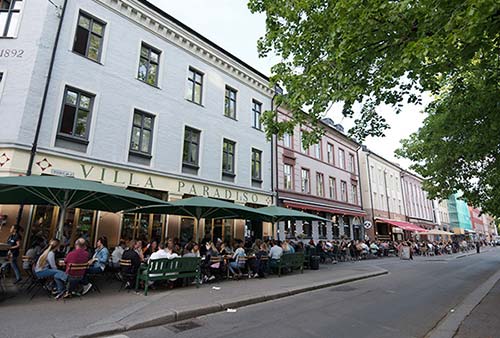
$ Tim Wendelboe Espresso Bar, named for its celebrity-barista owner, is perhaps Oslo’s favorite coffee shop. If you’re a coffee pilgrim wanting to caffeinate in style...do it here (daily, a block west of Villa Paradiso at Grüners Gate 1).
From here, it’s fun to stroll south on lively Thorvald Meyers Gate back toward downtown, passing a few cheap international eateries (Miss Gin Vietnamese street food, Bislett kebab house, and Trattoria Popolare, with affordable pastas—and no pizza—and sprawling outdoor seating on a busy bend in the road, perfectly situated to catch the sun’s final rays).
CHEAP AND SPICY IN GRØNLAND
Eventually the Akers River flows under the train station and into the fjord. Just before it hits the station, the river crosses the street called Grønland, which leads through a lively, edgy, and fun-loving immigrant neighborhood (T-bane: Grønland). This area is refreshingly diverse compared to the rest of the city, and whether you eat here or not, Grønland is entertaining to explore. For locations, see the “Grünerløkka and Grønland Area” map on here.
$$ Punjab Tandoori is friendly and serves hearty Indian meals that are fast, cheap, and tasty (lamb and chicken curry, tandoori specials). Order at the counter, then consider eating outside, with a view of the street scene (daily, Grønland 24, +47 22 17 20 86).
$$ Istanbul Restaurant is clean and simple, with a decorative interior, outdoor seating, cheap kebabs, and affordable plates of Turkish food (daily, Grønland 14, +47 23 40 90 22).
$$$ Asylet is more expensive and feels like it was here long before Norway ever saw a Pakistani. This big, traditional eatery—like a Norwegian beer garden—has a rustic, cozy interior (once upon a time an orphanage) and a cobbled backyard filled with picnic tables (burgers, hearty dinner salads, classic traditional plates, daily, Grønland 28, +47 22 17 09 39).
$$$ Dattera Til Hagen feels like a college party. It’s a lively scene filling a courtyard with graffiti, picnic tables, and benches under strings of colored twinkle lights. Locals like it for the tapas, pizza, salads, cocktails, and Norwegian microbrews on tap (daily from 14:00, Grønland 10, +47 22 17 18 61). Dattera is also a cultural center—on weekends after 22:00, it becomes a nightclub with comedy and music (event schedule at www.dattera.no).
$$$$ Olympen Brown Pub is a dressy dining hall that’s a blast from the past. You’ll eat in a spacious, woody saloon with big, dark furniture, faded paintings of circa-1920 Oslo lining the walls, and huge chandeliers. It’s good for solo travelers, because sharing the long dinner tables is standard practice, and you’re not likely to eat alone. They serve hearty, pricey Norwegian cuisine and offer a huge selection of beers (daily, Grønlandsleiret 15, +47 24 10 19 99).
NEAR THE SKI JUMP, HIGH ON THE MOUNTAIN
You can combine a trip into Oslo’s forested hills with lunch or dinner—and a chance to see the famous Holmenkollen Ski Jump up close. For locations see the “Greater Oslo” map, earlier.
Frognerseteren Hovedrestaurant, nestled high above Oslo (and 1,387 feet above sea level), is a classy, sod-roofed old restaurant. Its packed-when-it’s-sunny terrace, offering a commanding view of the city, is a popular stop for its famous apple cake and coffee. The $$ self-service café is affordable for hearty plates of classic Norwegian dishes, with indoor and outdoor seating (daily). The elegant view $$$$ restaurant is quite expensive and more formal, with reindeer specials on the menu and antler chandeliers overhead. Ideally, reserve ahead for evening dining (daily, +47 22 92 40 40, www.frognerseteren.no).
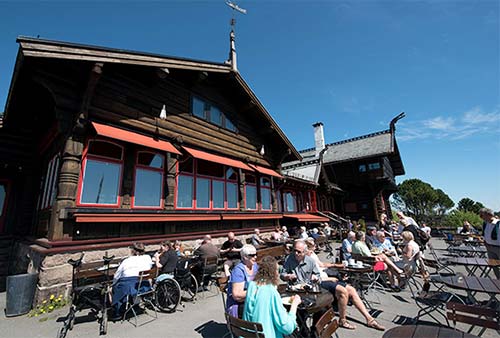
$$$$ Holmenkollen Restaurant, below the ski jump and a five-minute hike above the Holmenkollen T-bane stop, is a practical alternative to Frognerseteren. Woody yet modern, it’s slightly cheaper and also has a grand Oslofjord view, but without the folk charm and affordable self-service option. I’d eat here only if you need a solid meal near the ski jump and aren’t heading up to Frognerseteren (Tue-Sat 13:00-19:00, Sun until 18:00, closed Mon, Holmenkollveien 119, +47 22 13 92 00, www.holmenkollenrestaurant.no).
Oslo Connections
BY TRAIN, BUS, OR CAR
Train services in Norway are run by Vy (Oslo area and regional trains to Bergen and up north to Trondheim), Go Ahead Nordic (south of Oslo and west towards Stavanger via Kristiansand), and SJ Nord (local trains around Trondheim; Rauma Line to Åndalsnes and Nordlandsbanen up north). For train information, call +47 61 05 19 10 (press 9 for English; for international trains, press 3) or visit Vy.no or Entur.no. For general information about train travel in Scandinavia, see the “Transportation” section of the Practicalities chapter.
From Oslo by Train to Stockholm: A speedy train zips from downtown to downtown in about 5.5 hours, runs several times daily, and requires reservations. Ongoing construction on this line may interrupt service. You can also take a slower train (6-7 hours) with a change in Göteborg.
By Train to Bergen: Oslo and Bergen are linked by a spectacularly scenic train ride (4/day, 7 hours, overnight possible daily except Sat). Many travelers take it as part of the “Norway in a Nutshell” route, which combines train, ferry, and bus travel in an unforgettably beautiful trip (see the Norway in a Nutshell chapter).
By Train to: Lillehammer (almost hourly, 2 hours), Kristiansand (5/day, 4.5 hours, overnight possible), Stavanger (5/day, 8 hours, overnight possible), Copenhagen (2/day, 8.5 hours, transfer at Göteborg, more with multiple changes).
By Bus to Stockholm: Taking the bus to Stockholm is cheaper but slower than the train (3/day, 8 hours, www.flixbus.se).
By Car to the Jotunheimen Mountains: See “Getting There” on here.
BY PLANE
Oslo Airport
Oslo Lufthavn, also called Gardermoen, is about 30 miles north of the city center and has a helpful 24-hour information center (code: OSL, www.osl.no).
The fastest and cheapest way to get into the city center is by train. Exiting baggage claim, follow signs to the train. Here you’ll see two options: local trains (Vy) take about 25 minutes to downtown (118 NOK, 2-3/hour, cheaper with an Oslo Pass, buy ticket at machines or counter, or pay 40 NOK extra on the train); the private, competing Flytoget Airport Express train is a few minutes faster but costs nearly double (230 NOK, 4/hour, runs roughly 5:00-24:00, www.flytoget.no; swipe your credit card at the gate and choose your destination station). Unless you’re in a big hurry or enjoy paying double, I’d stick with the Vy trains. Note that for either option, trains go to Oslo S (the main train station). Some departures continue through the city, stopping at the National Theater station (closer to most recommended hotels). Unfortunately, this isn’t clearly indicated; to spare yourself a transfer (or save some extra walking), ask whether your train continues to the National Theater.
Flybuss airport buses stop directly outside the arrival hall and make several downtown stops, including the central train station (229 NOK one-way, 3/hour, 40 minutes, +47 67 98 04 80)—but since it costs more than the train and takes twice as long, it’s hard to justify (www.flybussen.no).
Taxis take about 45 minutes to downtown and vary in price depending on the company; figure 800-1100 NOK on weekdays, more on weekends or after hours. A taxi-booking machine at the information center in the arrivals hall lets you comparison-shop prices and order a cab. Tipping is not necessary.
Sandefjord Airport Torp
Ryanair, WizzAir, and other discount airlines use this airport 70 miles south of Oslo (code: TRF, www.torp.no). You can take a bus into downtown Oslo (340 NOK, www.torpekspressen.no). Buses to Sandefjord depart Oslo’s central bus terminal (next to the train station) about three hours before all flight departures.
BY CRUISE SHIP
Oslo has two main cruise ports: Revierkaia, near the Opera House on the east side of the Akershus Fortress peninsula; and Filipstad, a mile west of City Hall. From Revierkaia, it’s a 20-minute walk along the harbor promenade to City Hall; from Filipstad you can take a bus or taxi to the center. A few ships may dock below Akershus Fortress at Søndre Akershuskai or Vippetangkai (these cruise terminals are being phased out). For port information, see www.oslohavn.no.
BY OVERNIGHT BOAT
Consider connecting Oslo and Copenhagen by DFDS cruise ship. The boat leaves daily from Oslo around 15:00 and arrives in Copenhagen about 10:00 the following morning (return sailing from Copenhagen follows the same schedule; about 19 hours each way). The boat leaves Oslo from the tip of the Akershus Fortress peninsula (take bus #60 from the train station to the Vippetangen stop and follow signs to DFDS ticket office at Akershusstranda 31). For more specifics and sample prices, see “By Overnight Boat to Oslo” on here.
You can also take the same DFDS cruise ship overnight from Oslo to Frederikshavn, on Denmark’s Jutland peninsula—a great option for drivers. For the best prices, book in advance online or by email (www.dfds.com, dkinfo@dfds.com).