NEAR COPENHAGEN
Roskilde • Frederiksborg Castle • Louisiana Art Museum • Kronborg Castle
Copenhagen may be Denmark’s star attraction, but several worthwhile sights are within an hour of the city, also on the island of Zealand. Public transportation makes side-tripping here a joy. Visit Roskilde’s great Viking ships and cathedral with the tombs of Danish royalty. Tour Frederiksborg, Denmark’s most spectacular castle, and slide along the cutting edge at the Louisiana Art Museum—a superb collection with a coastal setting as striking as its art. At Helsingør, do the dungeons of Kronborg Castle before heading on to Sweden.
PLANNING YOUR TIME
The area’s essential sights are Roskilde and Frederiksborg Castle. Each destination is an easy half-day commute from Copenhagen—but in different directions (30- or 40-minute train ride, then a 20-minute walk or short bus ride). If you’re really fast and well organized, you could visit both Roskilde and Frederiksborg with public transportation in a day (see “The Zealand Blitz,” later).
If you’re choosing between castles, Frederiksborg is a beautiful showpiece with an opulent interior, while Kronborg—darker and danker—is more typical of the way most castles really were. Both are dramatic from the outside, but Kronborg—overlooking the raging sea channel to Sweden—has a more scenic setting. Castle collectors can hit both in a day (see the two-castle day plan, later).
Consider getting a Copenhagen Card (see here), which covers transportation to all the destinations in this chapter, plus admission to Roskilde Cathedral, the Roskilde Viking Ship Museum, the Roskilde Museum, Frederiksborg Castle, Kronborg Castle, and the Louisiana Art Museum. Each train ride is just long enough for a relaxed picnic.
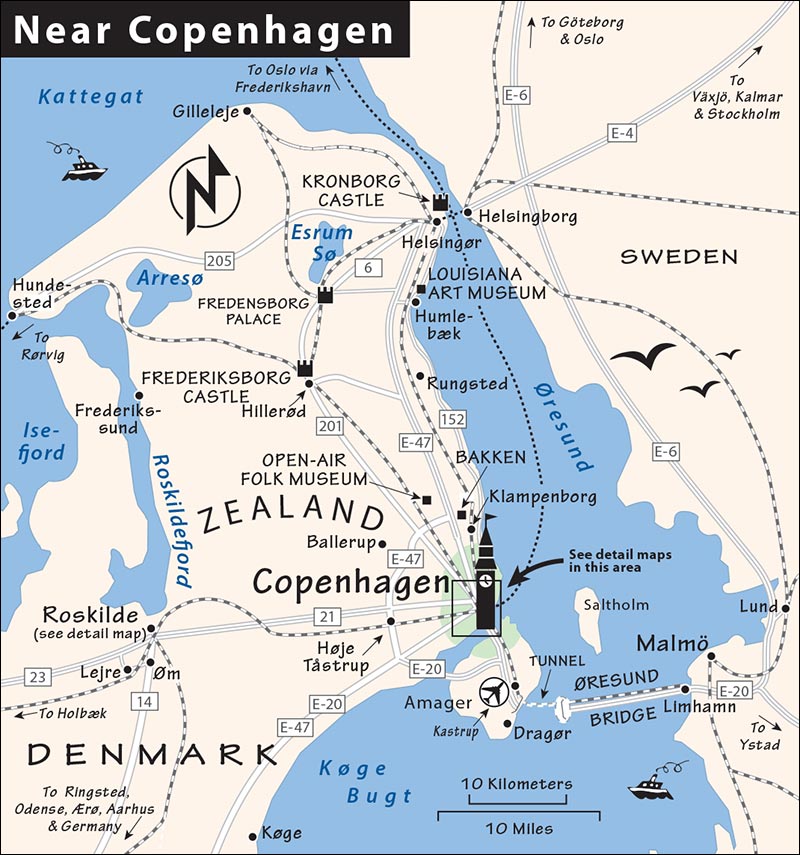
The Zealand Blitz—Frederiksborg Castle, Viking Ship Museum, and Roskilde Cathedral in a Day: If you have limited time and are well organized, you can see the highlights of Zealand in one exciting day. This only works in summer (June-Aug) and Monday through Saturday, when the cathedral is open until 18:00. Here’s the plan (all times are rough—confirm locally before you depart, train connections take about 30-40 minutes, trains depart about every 10 minutes): Leave Copenhagen by train at 9:00, arriving in Hillerød at about 9:40. From there, walk (about 20 minutes) or catch bus #301 or #302 to Frederiksborg Castle, arriving at 10:00, just as it opens. Spend two hours touring the castle, then take the bus back to the train station for the 13:00 train back to Copenhagen (grab a picnic lunch at the station and munch it on the train). From Copenhagen, catch a train to Roskilde just before 14:00, arriving around 14:30. Take a taxi, bus #203, or walk (about 20 minutes) down to the harborfront to the Viking Ship Museum. Spend two hours touring the museum, then walk (about 15 minutes) or taxi back up to the cathedral and spend an hour there before it closes at 18:00. Wander through town back to the station and catch the 18:30 train back to Copenhagen. You’ll be back at your hotel by 19:30. Or consider having dinner in Roskilde after touring the cathedral and take a later train back to Copenhagen.
A Two-Castle Day (plus Louisiana): You can see both Frederiksborg and Kronborg castles, plus the Louisiana Art Museum, in one busy day. (This works best Tue-Fri, when Louisiana is open until 22:00.) Take the train from Copenhagen to Hillerød (leaving about 9:00), then hop on the awaiting bus to Frederiksborg Castle; you’ll hear the 10:00 bells and be the first tourist inside. Linger in the sumptuous interior for a couple of hours, but get back to the station in time for a midday train (about 12:30 or 13:00) to Helsingør, a 15-minute walk from Kronborg Castle. Either munch your picnic lunch on the train, or—if it’s a nice day—save it for the ramparts of Kronborg Castle. If you’re castled out, skip the interior (saving the ticket price, and more time for Louisiana) and simply enjoy the Kronborg grounds and Øresund views before catching a train south toward Copenhagen. Hop off at Humlebæk for Louisiana.
GETTING AROUND
All these sights except Roskilde are served by Copenhagen’s excellent commuter-train (S-tog) system (covered by Copenhagen Card and City Pass Large—see here; Roskilde is on a regional train line (covered by the Copenhagen Card). All trains depart from Copenhagen’s Central Station, but most also stop at other stations that may be closer to your hotel (check schedules to avoid a needless trip to the Central Station).
At the Central Station, S-tog lines do not appear on the overhead schedule screens; simply head to tracks 9-10 to wait for your train (there’s a schedule at the head of those tracks).
Roskilde
Denmark’s roots, both Viking and royal, are on display in Roskilde (ROSS-killa), a pleasant town 18 miles west of Copenhagen. The town was the seat of the bishop and the residence of Danish royalty until 1450, when these shifted to Copenhagen. In its day, Roskilde was the second biggest city in the country. Today the town that introduced Christianity to Denmark in AD 980 is much smaller, except for the week of its famous rock/jazz/folk festival—northern Europe’s largest—when 100,000 fans pack the place and it becomes one of Denmark’s biggest cities again (late June-early July, www.roskilde-festival.dk). Wednesday and Saturday are flower/flea/produce market days (8:00-14:00 on the main square, Stændertorvet).
GETTING THERE
Roskilde is an easy side trip from Copenhagen by train (7/hour, 30 minutes). Trains headed to Ringsted, Nykøbing, or Lindholm may not stop in Roskilde (which is an intermediate stop you won’t see listed on departure boards)—confirm in advance. Returning to Copenhagen, hop on any train in the direction of Østerport or København H.
Orientation to Roskilde
TOURIST INFORMATION
While not an official TI, the “tourist inspiration center” at the Sankt Laurentius tower has maps, can answer questions, and may even offer a taste of local mead (brick stepped tower on the main square; open daily 10:00-16:00, closed mid-Sept-mid-June; Stændertorvet, +45 46 31 65 00, www.visitfjordlandet.dk/roskilde).
ARRIVAL IN ROSKILDE
You’ll find lockers and pay WCs at the train station. Free WCs are next door to the Sankt Laurentius tower.
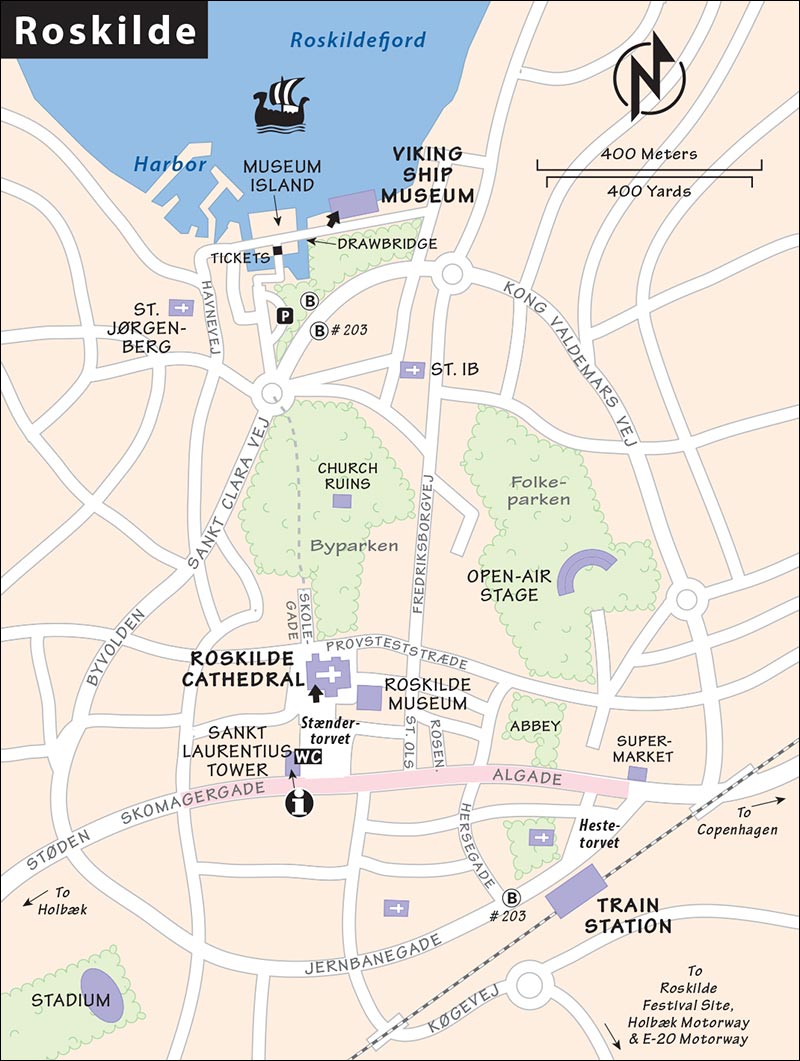
From the train station, consider this walking route: First head to the cathedral, then the little Roskilde Museum, and finally down to the Viking Ship Museum on the harborfront.
Exit straight out from the station, and walk down to the bottom of the square. Turn left (at the Super Brugsen supermarket) on the pedestrianized shopping street, Algade (literally “the street for all”). After walking down this main drag about four blocks, you emerge into the main square, Stændertorvet, with the cathedral. After visiting the cathedral (and/or the nearby Roskilde Museum), head about 10 minutes downhill (through a pleasant park) to the Viking Ship Museum: Facing the cathedral facade, turn left and head down the tree-lined path through the park. When you emerge at the roundabout (avoiding the temptation to eat a “Viking Pizza”), continue straight through it to reach the museum.
If you want to go directly from the station to the Viking Ship Museum, you can ride a bus; see here.
Sights in Roskilde
▲▲Roskilde Cathedral (Roskilde Domkirke)
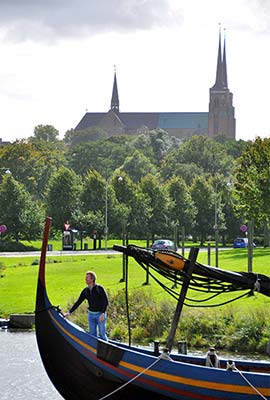
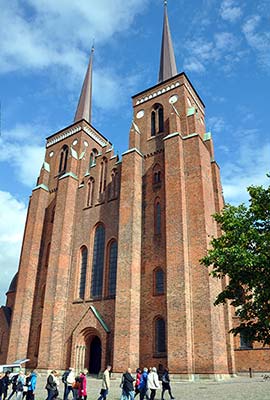
Roskilde’s imposing 12th-century, twin-spired cathedral houses the tombs of nearly all the Danish kings and queens (39 royals in all; pick up the included guidebook as you enter). If you’re a fan of Danish royalty or of evolving architectural styles, it’s thrilling; even if you’re neither, “Denmark’s Westminster Abbey” is still interesting. It’s a stately, modern-looking old church with great marble work, paintings, wood carvings, and an engaged congregation that makes the place feel very alive.
Cost and Hours: 70 DKK, covered by Copenhagen Card; June-Aug Mon-Sat 10:00-18:00; May and Sept Mon-Sat until 17:00; Oct-April Mon-Sat until 16:00; Sun 13:00-16:00 year-round; often closed for funerals and on Sat-Sun afternoons for baptisms and weddings; Domkirkestræde 10, +45 46 35 16 24, www.roskildedomkirke.dk.
 Self-Guided Tour: Begun in the 1170s by Bishop Absalon (and completed in 1280), Roskilde Cathedral was cleared of its side chapels and altars by the Reformation iconoclasts—leaving a blank slate for Danish royals to fill with their tombs. The highlight here is slowly strolling through a half-millennium’s worth of royal chapels, representing a veritable textbook’s worth of architectural styles.
• Before entering, walk around the outside of the cathedral.
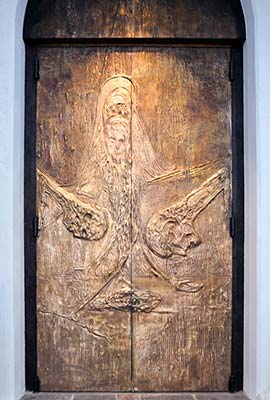
Exterior, King’s Door, and Tomb of Frederik IX: Notice the big bricks, which date from the 12th century, and how the cathedral is built on the highest ground in town. Face the towering west facade. The main King’s Door (installed in 2010), depicting scenes from the ministry of Jesus, is reserved for the use of the royal family. The congregation is allowed to exit through this door only after special services.
Find the freestanding brick chapel to the left. This holds the remains of Denmark’s previous king, Frederik IX (1899-1972), and his wife Ingrid (grandparents of the current king). While all the other monarchs are inside, Frederik—who was an avid sailor in his youth—requested to be buried here, with a view of the harbor.
• Now go around the right side, buy a ticket, and go inside. First, head to the middle of the nave to look at the...
King’s Door, from Inside: The glittering gold, highly stylized relief shows the scene after the Resurrection when Jesus breaks bread in the company of some apostles—who until this point had not recognized him (their mouths hang agape at their realization).
Glockenspiel: In the rear of the church, high on the wall, you can see the little glockenspiel that makes a racket at the top of every hour as George kills the dragon and the centuries-old bellows wail.
• Now we’ll take a clockwise spin through the interior to see the significant royal burial chapels. While this tour is not chronological, neither are the tombs. Continue through the left aisle and into the big chapel housing some of the cathedral’s most recent additions (late 19th through early 20th century).
Glücksburger Chapel: In the corner, the Glücksburger Chapel, with a plain light dome, holds the tomb of Christian IX, nicknamed the “father-in-law of Europe” for how he married his many children into royal families across the Continent. He died in 1906. The three mourning women were sculpted by Edvard Eriksen, who also produced Copenhagen’s famed Little Mermaid statue (notice the middle woman).
St. Birgitta’s Chapel: The next chapel will eventually (“Not soon,” hope the Danes) have a new tenant: It has been restored to house the tomb of Queen Margrethe II (it was intended to hold both Margrethe and her late husband, Henrik, but he chose instead to have his remains at Fredensborg Castle—in protest for never being given the title of king). Margrethe, who abdicated to her son in 2024, teamed up with an artist to design her own tomb (there’s a model on display). Her body will reside in the stepped area at the bottom, upon which stand three columns representing the far-flung Danish holdings: one made of basalt from the Faroe Islands, another of marble from Greenland, and the third of stone from Denmark proper. Topping the columns are elephants (symbols of Danish royalty) and a semitransparent glass tomb, symbolizing the unpredictability of life and how death, like a seed, is a new beginning.
St. Andrew’s Chapel: The next chapel, a modern addition to the church, has a glittering mosaic over the altar. But pre-Reformation frescoes (1511) peek through the Protestant whitewash. Standing in front of this chapel, look across the nave to see the gorgeous 16th-century Baroque organ.
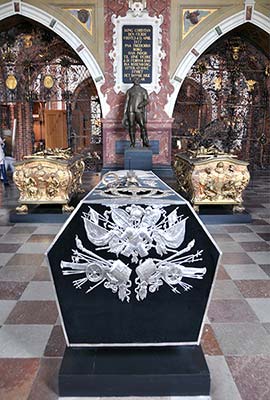
Christian IV Chapel: The next, larger chapel (up the stairs behind the small wooden organ) dates from the era of Christian IV, the larger-than-life 17th-century king who created modern Denmark. Christian also left his mark on Roskilde Cathedral, building the altarpiece, pulpit, distinctive twin towers...and this chapel. Walk around the stately yet humble tombs, marvel at the painting, and consider the huge personality of the greatest king in Danish history. In here you’ll see a fine statue of the king, by Bertel Thorvaldsen; a large 3-D painting with Christian IV wearing his trademark eye patch, after losing his eye in battle; and his rather austere tomb (black with silver trim, surrounded by several others). Great he was...until his many wars impoverished his once-mighty country.
• Head into the nave and climb up the stairs into the choir area.
Nave, Choir, and High Altar: Take in the gorgeous gilded altarpiece and finely carved stalls. The three-winged altarpiece, carved in 1560 in Antwerp, shows scenes from Christ’s last week. The fine carvings above the chairs in the choir feature scenes from the Old Testament on one side and the New Testament on the other.
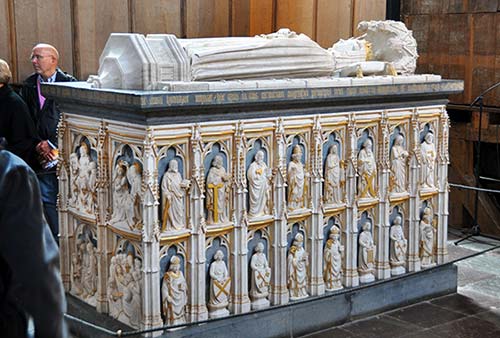
Tomb of Margrethe I: Behind the altar is the ornately decorated tomb of Margrethe I, the Danish queen who added Norway to her holdings by marrying Norwegian King Håkon VI in 1363. Legend holds that buried in a nearby brick pilaster are the supposed remains of Harold (read the Latin: Haraldus) Bluetooth, who ruled more than a millennium ago (r. 958-985 or 986), made Roskilde the capital of his realm, and converted his subjects to Christianity.
• Now explore the apse (the area behind the altar).
Apse: Go down the stairs, walk over the well-worn tombs of 500-year-old aristocrats who had the money to buy prime tomb space, and go through the little door. Circle around the apse, noticing more fine tombs behind Margrethe’s.
• Hooking back around toward the front, dip into the many more chapels you’ll pass, including...
Frederik V’s Chapel: The grand, textbook Neoclassical tomb of Frederik V has white pillars, gold trim, and mourning maidens—representing Norway and Denmark—in ancient Greek gowns. You’ll also pass a room housing elaborate, canopied Baroque tombs. Imagine: Each king or queen commissioned a tomb that suited his or her time—so different, yet all so grand.
Christian I’s Chapel: The next chapel, with the tomb of Christian I, has a stone column marking the heights of visiting monarchs and royalty such as Britain’s King Charles III. The P is for the giant Russian czar Peter the Great—clearly the tallest.
▲Roskilde Museum
This small museum’s exhibits on city history are like a fun capsule collection of Copenhagen’s National Museum—and especially worth seeing if you won’t visit that museum. Most intriguing is the Gerdrup Grave exhibit, a pair of ninth-century skeletons that were found in a double grave just north of Roskilde. The remains were later determined to be a mother and adult son: The woman’s body had been weighted down with large stones and is accompanied by an iron spearhead (an oddity for a female burial); the man’s ankles are crossed and his neck broken in a manner consistent with hanging. What happened is anyone’s guess—the museum presents the facts for visitors to interpret for themselves.
There are also fun exhibits of a Danish school from a century ago, a display of toys, audio stations describing life in the Middle Ages, and temporary exhibits. The enclosed courtyard is a great spot for a contemplative coffee and cardamom roll.
Cost and Hours: 60 DKK, covered by Copenhagen Card; daily 10:00-16:00; Oct-May Tue-Sun 10:00-16:00, closed Mon; a block from the cathedral at Sankt Ols Stræde 3, +45 46 31 65 00, https://roskildemuseum.dk.
▲▲▲Viking Ship Museum (Vikingeskibsmuseet)
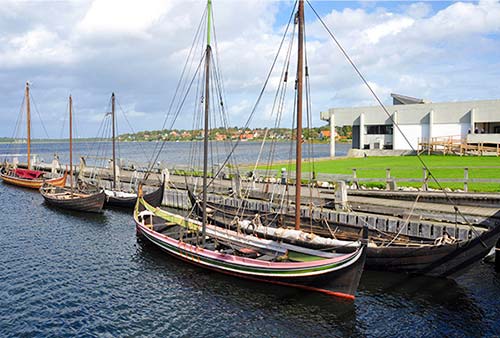
Vík literally means “shallow inlet,” and “Vikings” were the people who lived along those inlets. Roskilde—and this award-winning museum—are strategically located along one such inlet. Centuries before Europe’s age of exploration, Viking sailors navigated their sleek, sturdy ships as far away as the Mediterranean, the Black Sea, the Persian Gulf, and the Americas. This museum displays five different Viking ships, which were discovered in the Roskilde fjord and painstakingly excavated, preserved, and pieced back together beginning in the 1960s. The ships aren’t as intact or as evocative as those in Oslo (see here), but with that museum closed, Roskilde is your best option for seeing ships up close. It does a good job of explaining shipbuilding, with excellent English descriptions. The outdoor area (on “Museum Island”) continues the experience, with a chance to see modern-day Vikings creating replica ships, chat with rope makers, blacksmiths, and wood carvers, and learn more about the excavation.
Cost and Hours: 160 DKK, covered by Copenhagen Card; daily 10:00-17:00, mid-Oct-April until 16:00; +45 46 30 02 00, www.vikingeskibsmuseet.dk.
Tours: Free tours in English typically run twice a day in summer—check boards near the ticket desks for times; none off-season. You can download the free Useeum app to hear about how the museum builds and sails Viking ships.
Boat Ride: For an extra 130 DKK, you can take a fun 50-minute sail around Roskilde’s fjord on a replica Viking vessel (you’ll row, set sail, and row again; frequent departures May-Sept, check website or ask about schedule when you arrive).
Eating: $$ Café Knarr serves salads, sandwiches, and “planks” of Viking tapas with ingredients the Vikings knew.
Getting There: It’s on the harbor at Vindeboder 12. From the train station, take a taxi or catch bus #203 toward Boserup (24 DKK, 2/hour, 7 minutes). Or you can walk: From the cathedral, it’s about 10 minutes downhill. Take the bus back, or ask the museum desk to call a taxi.
Visiting the Museum: A major renovation is planned through at least 2028; the museum will remain open, but there may be changes from what’s described here. At the ticket desk, check the board for the day’s activities and demonstrations. The 15-minute film is a good introduction. The Viking Ship Hall holds the five reconstructed ships; across the drawbridge, Museum Island hosts workshops, replica ships, a café, and more exhibits.
Viking Ship Hall: Here you’ll see the remains of five ships that were deliberately sunk a thousand years ago to block an easy channel into this harbor (leaving open only the most challenging approach—virtually impossible for anyone but a local to navigate). The ships, which are named for the place where they were found (Skuldelev), represent an impressively wide range of Viking shipbuilding technology.
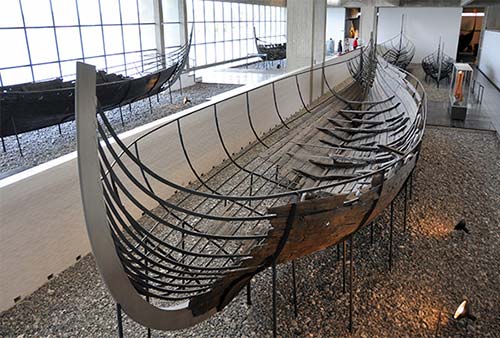
Skuldelev 1 is a big, sail-powered ocean-going trade ship made in Norway. It would have had a crew of six to eight men and room for lots of cargo; it’s like the ship Leif Eriksson took to America 1,000 years ago. Skuldelev 2 is a 100-foot-long, 60-oar longship made in the Viking city of Dublin; loaded with 65-70 battle-hardened warriors, it would have struck fear into the hearts of foes. It’s similar to the ones depicted in the Bayeux Tapestry in Normandy, France. Skuldelev 3 is a modest coastal trader that stayed closer to home (wind-powered with oar backup, similar to #1 in design and made in Denmark). Skuldelev 5 is a smaller longship—capable of carrying about 30 warriors, it’s the little sibling of #2. And Skuldelev 6 is a small fishing vessel—a row/sail hybrid that was used for whaling and hunting seals. (There’s no #4 because they originally thought #2 was two different ships...and the original names stuck.)
Other exhibits show the 25-year process of excavating and preserving the ships, explain a step-by-step attack and defense of the harbor, and give you a chance to climb aboard a couple of replica ships for a fun photo op. You’ll also see displays describing the construction of the Sea Stallion, a replica of the big longship (Skuldelev 2), by modern shipbuilders using ancient techniques. A crew of 65 rowed this ship to Dublin in 2007 and then back to Roskilde in 2008. You can watch a 20-minute film of their odyssey.
Museum Island: Head outside to see replicas of all five ships—and others—bobbing in the harbor. Climb on board the largest, the Sea Stallion, if it’s in port. At the boatyard, watch modern craftspeople re-create millennium-old ships using what the museum calls “experimental archaeology.” Boatbuilders employ new knowledge about materials, tools, and techniques that they’ve learned as they continue to test—and to rebuild the ships. For example, the first reconstruction of Skuldelev 3 was retired in 2016, and a new reconstruction of the same ship was launched in 2022.
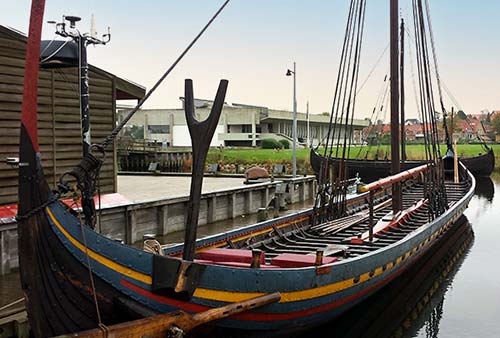
Poke into the various workshops, with exhibits on tools and methods. The little square called Tunet (“Gathering Place”) is ringed by traditional craft shops—rope maker, blacksmith, wood carver—that are sometimes staffed by workers doing demonstrations. In the archaeological workshop, exhibits explain how researchers excavated and preserved the precious timbers of those five ships.
Frederiksborg Castle
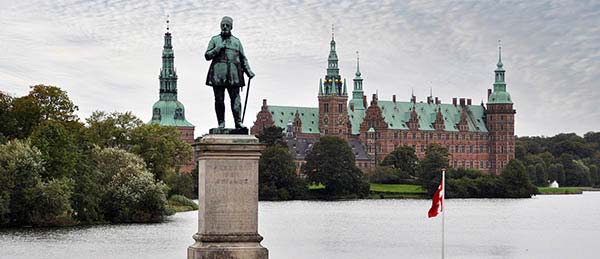
Frederiksborg Castle, rated ▲▲, sits on an island in the middle of a lake in the cute town of Hillerød. This grandest castle in Scandinavia is often called the “Danish Versailles.” Built from 1600 to 1620, Frederiksborg was the castle of Denmark’s King Christian IV. Much of it was reconstructed after an 1859 fire, with the normal Victorian over-the-top flair, by the brewer J. C. Jacobsen and his Carlsberg Foundation.
You’ll still enjoy some of the magnificent spaces of the castle’s heyday: the breathtaking grounds and courtyards, the sumptuous chapel, and the regalia-laden Great Hall. But most of the place was turned into a fine museum in 1878. Today it’s the Museum of National History, taking you on a chronological walk through the story of Denmark from 1500 until now (the third/top floor covers modern times). The countless musty paintings are a fascinating scrapbook of Danish history: It’s a veritable national portrait gallery, with images of great Danes from each historical period of the last half-millennium.
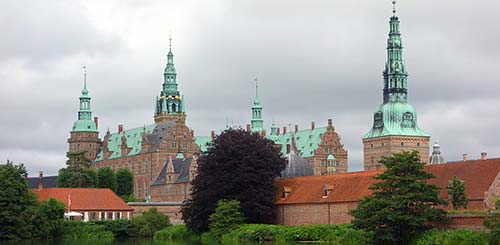
An inviting path leads around the lake, with ever-changing views of the castle. The traffic-free center of Hillerød is also worth a wander.
Tourist Information: Hillerød’s TI, with information on the entire North Zealand region, is in the freestanding white house next to the castle parking lot (to the left as you face the main castle gate, Thu-Sun 12:00-16:00, closed Mon-Wed, Frederiksværksgade 2A, +45 49 21 13 33, www.visitnordsjaelland.com). Because the TI is inside an art gallery, if the TI is “closed” while the gallery is open, you can still slip inside and pick up a town map and brochures.
GETTING THERE
By Train: From Copenhagen, take the S-tog to Hillerød (line A, 6/hour, 40 minutes, bikes go free on S-tog trains).
From the Hillerød station, you can enjoy a pleasant 20-minute walk to the castle, or catch bus #301 (direction: Ullerød) or #302 (direction: Sophienlund). Buses are free with an S-tog ticket or Copenhagen Card. You’ll find buses to the right as you exit the station—ride three stops to the Frederiksborg Slot stop.
If walking, just follow the signs to the castle. Bear left down the busy road (Jernbanegade) until the first big intersection, where you’ll turn right. After a couple of blocks, where the road curves to the left, keep going straight; from here, bear left and downhill to the pleasant square Torvet, with great views of the castle and a café pavilion. At this square, turn left and walk through the pedestrianized shopping zone directly to the castle gate.
Linking to Other Sights: If continuing directly to Helsingør (with Kronborg Castle), hop on the regional train (Lokaltog 930R, departs from track 16 at Hillerød station, Mon-Fri 2/hour, Sat-Sun 1/hour, 30 minutes). From Helsingør, it’s a quick trip on the train to the town of Humlebæk (where you’ll find the Louisiana Art Museum).
ORIENTATION TO FREDERIKSBORG CASTLE
Cost and Hours: 110 DKK, covered by Copenhagen Card; daily 10:00-17:00, Nov-March 11:00-15:00; +45 48 26 04 39, www.dnm.dk.
Tours: Download the Smartify app to access a two-hour, room-by-room guide or a one-hour highlights tour. In summer, staff give a brief English-language introduction daily every half hour (included in admission).
Eating: You can picnic in the castle’s moat park or enjoy the $$-$$$ Spisestedet Leonora at the moat’s edge (smørrebrød, sandwiches, salads, hot dishes, open daily). Or, better, walk into the town center near the bus stop.
SELF-GUIDED TOUR
The castle’s audioguide app is excellent: You can almost follow the one-hour tour in real time for a blitz of the palace’s highlights. Use this self-guided tour to supplement the audioguide.
The Castle Approach
From the entrance of the castle complex, it’s an appropriately regal approach to the king’s residence. You can almost hear the clopping of royal hooves as you walk over the moat and through the first island (which housed the stables and small businesses needed to support a royal residence). Then walk down the winding (and therefore easy-to-defend) lane to the second island, which was home to the domestic and foreign ministries. Finally, cross over the last moat to the main palace, where the king lived.
Fountain of Neptune Courtyard
Survey the castle exterior from the Fountain of Neptune. Christian IV imported Dutch architects to create this “Christian IV style,” which you’ll see all over Copenhagen. The brickwork and sandstone are products of the local clay and sandy soil. The building, with its horizontal lines, triangles, and squares, is generally in Renaissance style, but notice how this is interrupted by a few token Gothic elements on the church’s facade. Some say this homey touch was to let the villagers know the king was “one of them.”
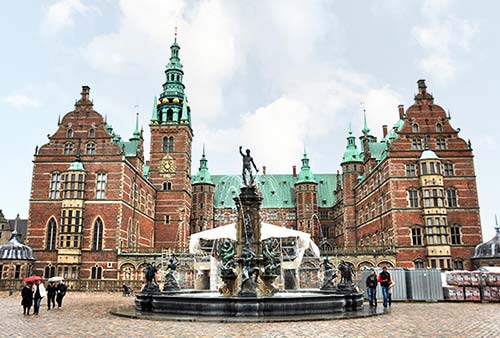
• Step over the last moat, through the ornate gate, and into the castle grounds. Go in the door in the middle of the courtyard to buy your ticket, and put your bag in a locker (mandatory). Pick up a free floor plan; room numbers will help orient you on this tour. You’ll enter the Knights’ Parlor, also called The Rose, a long room decorated as it was during the palace’s peak of power. Go up the stairs on the left side of this hall to the...
Royal Chapel
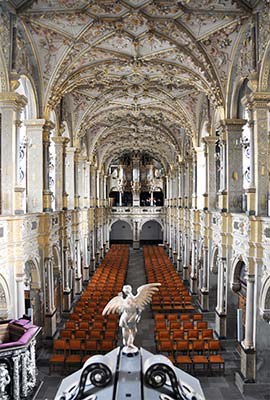
Christian IV wanted to have the grandest royal chapel in Europe. For 200 years the coronation place of Danish kings, this chapel is still used for royal weddings (and is extremely popular for commoner weddings—book long in advance). The chapel, consecrated in 1617, is nearly all original. As you walk around the upper level, notice the graffiti scratched on the windowpanes by the diamond rings of royal kids visiting for the summer back in the 1600s. Most of the coats of arms show off noble lineages—with a few exceptions we’ll soon see. At the far end of the chapel, the wooden organ is from 1610, with its original hand-powered bellows. (Hymns play on the old carillon at the top of each hour.)
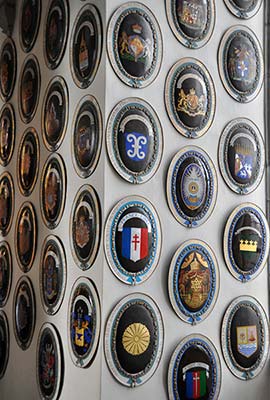
Scan the hundreds of coats of arms lining the walls. These belong to people who have received royal orders from the Danish crown (similar to Britain’s knighthoods). While most are obscure princesses and dukes, a few interesting (and more familiar) names show up just past the organ. In the first window bay after the organ, look for the distinctive red, blue, black, and green shield of South Africa—marking Nelson Mandela’s coat of arms (he was awarded the highly prestigious Order of the Elephant, usually reserved for royalty). Around the side of the same column (facing the chapel interior), find the coats of arms for Dwight D. Eisenhower (with the blue anvil and the motto “Peace through understanding”), Winston Churchill (who already came from a noble line), and Field Marshal Bernard “Monty” Montgomery.
Leaving the chapel, you step into the king’s private oratory, with evocative Neo-Romantic paintings (restored after a fire) from the mid-19th century.
• You’ll emerge from the chapel into the museum collection. But before seeing that, pay a visit to the Audience Room: Go through the door in the left corner, marked Audienssalen, and proceed through the little room to the long passageway (easy to miss).
Audience Room
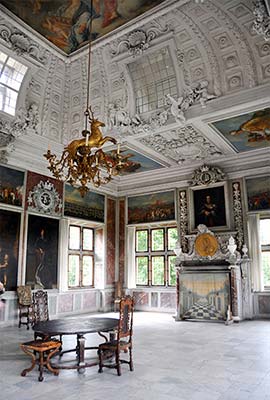
Here, where formal meetings took place, a grand painting shows the king as a Roman emperor firmly in command (with his two sons prominent for extra political stability). This family is flanked by Christian IV (on the left) and Frederik III (on the right). Christian’s military victories line the walls, and the four great continents—Europe, North America, Asia, and Africa—circle the false cupola (notice it’s just an attic). Look for the odd trapdoor in one corner with a plush chair on it. This was where they could majestically lower the king to the exit.
• Now go back to the museum section, and proceed through the numbered rooms.
Museum Collection
Spanning three floors and five centuries, this exhaustive collection juxtaposes portraits, paintings of historical events, furniture, and other objects from the same time period, all combining to paint a picture of a moment in Danish history. While fascinating, the collection is huge, so I’ve selected only the most interesting items to linger over.
First Floor: Proceed to Room 26, which is focused on the Reformation. The case in the middle of the room holds the first Bible translated into Danish (from 1550—access to the word of God was a big part of the Reformation). Over the door to the next room is the image of a monk, Hans Tausen, invited by the king to preach the new thinking of the Reformation...sort of the “Danish Martin Luther.” Also note the effort noble families put into legitimizing themselves with family trees and family seals.
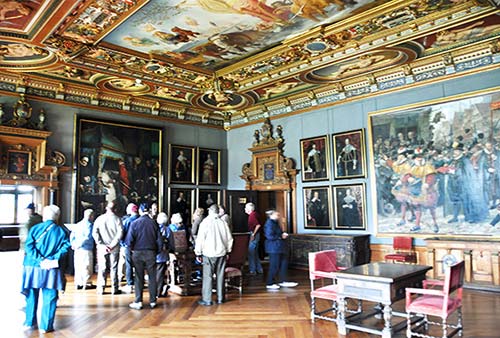
Pass through Rooms 27, 28, and 29, and into Room 30—with paintings telling the story of Christian IV (for more on this dynamic Renaissance king, who built this castle and so much more, see here). Directly across from the door you entered is a painting of the chancellor on his deathbed, handing over the keys to the kingdom to a still-wet-behind-the-ears young Christian IV—the beginning of a long and fruitful career. On the right wall is a painting of Christian’s coronation (the bearded gentleman looking out the window in the upper-left corner is Carlsberg brewer and castle benefactor J. C. Jacobsen—who, some 300 years before his birth, was probably not actually in attendance). Room 31 covers the royal family of Christian IV, while the smaller, darkened corner Room 32 displays the various Danish orders; find the most prestigious, the Order of the Elephant.
• Hook back through Room 30, go outside on the little passage, and climb up the stairs.
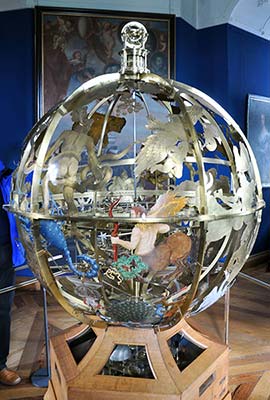
Second Floor: Go to the corner Room 39, which has a fascinating golden globe made in the mid-1600s to illustrate Polish astronomer Nicolaus Copernicus’ bold new heliocentric theory (that the sun, not the earth, was the center of our galaxy). Look past the constellations to see the tiny model of the solar system at the very center, with a brass ball for the sun and little figures holding up symbols for each of the planets. The mechanical gears could animate this model to make the concept more vivid.
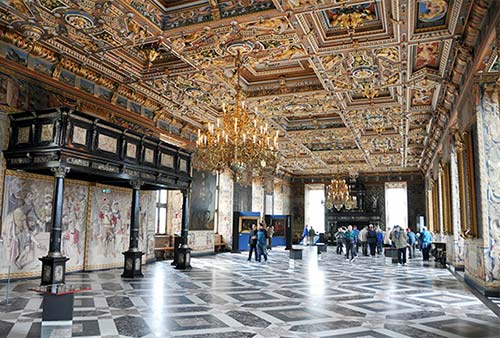
Continue into one of the castle’s most jaw-dropping rooms, the Great Hall (Room 38). The walls are lined with tapestries and royal portraits (including some modern ones, near the door). The remarkable wood-carved ceilings include panels illustrating various industries. The elevated platform on the left was a gallery where musicians could play without getting in the way of the revelry.
Head back out and walk back along the left side of the hall. You can go quickly through the rooms numbered in the 40s and 50s, but pause partway down the long hallway (just past the door marked 49); on the left, find the optical-illusion portrait that shows King Frederik V when viewed from one angle, and his wife when viewed from another. At the far end of this section, Room 57 has a portrait of Hans Christian Andersen. Notice that fashion styles have gotten much more modern...suits and ties instead of tights and powdered wigs. It’s time to head into the modern world.
• Find the modern spiral staircase nearby. Downstairs are late-19th-century exhibits—which are skippable. Instead, head up to the top floor.
Third Floor: This staircase puts you right in the middle of the modern collection. From here, the museum’s focus shifts from history to art. Highlights include:
The Art Critics, showing four past-their-prime, once-rambunctious artists themselves, now happily entrenched in the art institution, leaning back to critique a younger artist’s work.
A room focusing on Denmark’s far-flung protectorate of Greenland, with a porcelain polar bear and portraits of explorers.
A room of distinctive Impressionist/Post-Impressionist paintings, with a Danish spin.
The Ninth of April, 1940, showing the (ultimately unsuccessful) Danish defense against Nazi invaders on that fateful date.
A room focusing on the royal family, with a life-size, photorealistic portrait of the beloved Queen Margrethe II. Facing her is her daughter-in-law, Queen Mary—who, in this portrait at least, bears a striking resemblance to another young European royal.
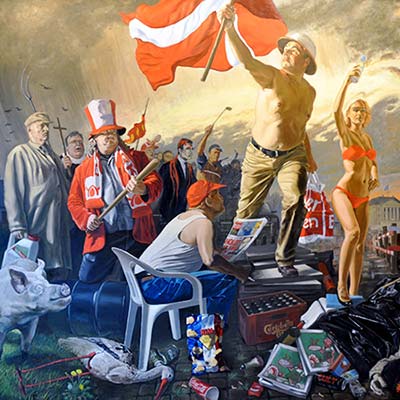
Peter Carlsen’s Denmark 2009—a brilliant parody of Eugène Delacroix’s famous painting Liberty Leading the People (a copy of the inspiration may be nearby). Carlsen has replaced the stirring imagery of the original with some dubious markers of contemporary Danish life: football flags, beer gut, shopping bags, tabloids, bikini babes, even a Christiania flag. It’s a delightfully offbeat (and oh-so-Danish) note to end our visit to this seriously impressive palace.
NEAR THE CASTLE
Hillerød Town
While there’s not much here, the pedestrianized commercial zone is pleasant enough. It’s best visited from the castle. Slotsgade, the main street, leads away from the castle bus stop toward the train station and is lined with a few shops and cafés. If you feel like a little (very little) cruise, a tiny ferry leaves from a pier next to the castle and stops at the castle garden across the lake (40 DKK, covered by Copenhagen Card, 2/hour, 30 minutes).
Louisiana Art Museum
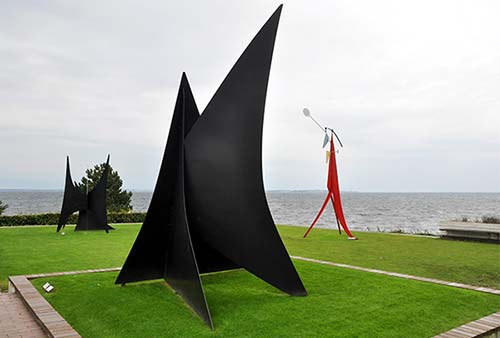
Located in the town of Humlebæk and beautifully sited on Øresund Sound, Louisiana is a holistic place that masterfully mixes art, architecture, and landscape. This was Denmark’s first modern art museum, and its sculpture park is one of Europe’s best.
Getting There: The museum is 18 miles north of Copenhagen. Take the train toward Helsingør, and get off at Humlebæk (3/hour, 30-40 minutes). It’s a pleasant 10-minute, well-signed walk to the museum: Exit the station and immediately go left onto Hejreskor Allé, a residential street; when the road curves right, continue straight along the narrow footpath through the trees. After you exit the trail, the museum is just ahead and across the street (at Gammel Strandvej 13).
If you’re arriving by train from Helsingør, take the pedestrian underpass beneath the tracks, then follow the directions above. Louisiana is also connected to Helsingør by bus #388 (hourly, stops right at museum as well as at Humlebæk).
If you’re coming from Frederiksborg Castle, you have two options: You can catch the Lokaltog train from Hillerød to Snekkersten, then change there to a regional train heading south to Humlebæk (1-2/hour, 30 minutes). Alternatively, you can take the S-tog toward Copenhagen and Køge, get off at Hellerup, then catch a regional train north toward Helsingør to reach Humlebæk (2/hour, 1 hour).
Cost and Hours: 145 DKK, covered by Copenhagen Card; Tue-Fri 11:00-22:00, Sat-Sun until 18:00, closed Mon; +45 49 19 07 19, www.louisiana.dk.
Tours: Use the QR code on the sculpture park map (or visit guide.louisiana.dk) to download the audioguide, which describes a selection of the outdoor sculptures and the history and concept of the museum. English tours run occasionally—check the calendar online or at the ticket desk.
Cuisine Art: The $$ cafeteria, with indoor and outdoor seating, has reasonably priced sandwiches and welcomes picnickers who buy a drink.
Visiting the Museum: Wander from famous Chagalls and Picassos to more obscure art (everything is post-1945). Poets spend days here nourishing their creative souls with new angles, ideas, and perspectives. Even those who don’t think they’re art lovers can get sucked into a thought-provoking exhibit and lose track of time. The museum’s floor plan is a big loop, and the seaward side is underground so as not to block the grand views.
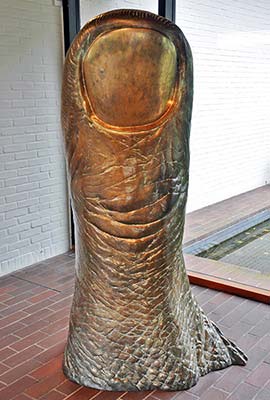
The museum rotates its substantial collection into ever-changing arrangements, augmented with borrowed and special exhibits (check the museum website for the latest). An Andy Warhol Marilyn Monroe you see on one visit may not be there the next, though the collection of works by Swiss sculptor Alberto Giacometti, in a gallery with windows overlooking the lake, is on permanent display. (One favorite item, French sculptor César’s The Big Thumb—which is simply a six-foot-tall bronze thumb—also isn’t going anywhere, since any time they move it, patrons complain.)
Outside, a delightful sculpture garden sprawls through the grounds, downhill toward the sea. The views over the Øresund, one of the busiest passages in the nautical world, are nearly as inspiring as the art. It’s fun to explore the grounds, peppered with sculptures and made accessible by bridges and steps. There are sculptures by Alexander Calder, Jean Dubuffet, Joan Miró, and others.
Taken as a whole, the museum is a joy to explore. What you see from the inside draws you out, and what you see from the outside draws you in. The place can’t be rushed. Linger and enjoy.
Kronborg Castle
Kronborg Castle is located in Helsingør, a pleasant, salty Danish seaside town that’s often confused with its Swedish sister, Helsingborg, just two miles across the channel. Kronborg Castle (also called Elsinore, the Anglicized version of Helsingør) is a ▲ sight famous for its tenuous (but profitable) ties to Shakespeare. Most of the “Hamlet” castle you’ll see today—a darling of every big-bus tour and travelogue—was built long after the historical Hamlet died (more than a thousand years ago), and Shakespeare never saw the place. But this Renaissance castle existed when a troupe of English actors performed here in Shakespeare’s time (Shakespeare may have known them). These days, various Shakespearean companies from around the world perform Hamlet in Kronborg’s courtyard each August. Among the actors who’ve donned tights here in the title role are Laurence Olivier, Christopher Plummer, Kenneth Branagh, and Jude Law.
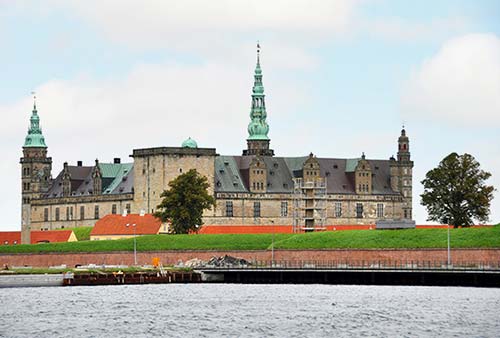
To see or not to see? The castle is most impressive from the outside. The free grounds between the walls and sea are great for picnics, with a close-up view of the strait between Denmark and Sweden. If you’re heading to Sweden, Kalmar Castle (described in the Southeast Sweden chapter) is a better medieval castle. And in Denmark, Frederiksborg (described earlier), which was built as an upgrade to this one, is far more opulent inside. But if Kronborg is handy to your itinerary—or you never met a castle you didn’t like—it’s worth a visit...even if just for a short romp across the ramparts (no ticket required).
Tourist Information: The town of Helsingør has a TI (Mon-Fri 10:00-16:00, until 17:00 in summer, closed Sat-Sun except for short midday hours in summer; The Culture Yard, Allegade 2, +45 49 21 13 33, www.visithelsingor.dk), a medieval center, the ferry to Sweden, and lots of Swedes who come over for the lower-priced alcohol.
GETTING THERE
Helsingør is a 45-minute train ride from Copenhagen (3/hour). Exit the station out the front door: You’ll see the castle dead ahead along the coast (about a 15-minute walk). Between the station and the castle, you’ll pass through a harborfront zone with the town’s cultural center (with the TI and a good café) and the Maritime Museum (described later).
ORIENTATION TO KRONBORG CASTLE
Cost and Hours: 145 DKK June-Aug, 125 DKK Sept-May, 25 percent discount with Maritime Museum ticket, covered by Copenhagen Card; open daily 10:00-17:00; Nov-April Tue-Sun 11:00-16:00, closed Mon; +45 49 21 30 78, www.kronborg.dk.
Tours: Free brief orientation talks in English are offered hourly in summer (check board in courtyard for times); costumed docents in the Royal Apartments can also provide context. Download the Useeum app to your mobile device to access Kronborg’s multimedia guide.
Bag Storage: You’ll find lockers in the cloakroom, just to your right as you enter the courtyard.
BACKGROUND
In the 1420s, Danish King Eric of Pomerania built a fortress here to allow for the collection of “sound dues,” levied on any ship hoping to enter the sound of Øresund. This proved hugely lucrative, eventually providing up to two-thirds of Denmark’s entire income. Frederik II built Kronborg Castle on the site of this fortress, and he and his wife, Queen Sofie, lived and entertained here in the late 1500s. By the time Shakespeare was penning Hamlet, Kronborg was well known for the profitable dues levied there, and for its famously lavish banquets—what better setting for a tale of a royal family unraveling?
A fire in 1629 destroyed almost everything but the chapel. The coffered ceiling under the chapel galleries hints at the exquisite detail that once ornamented the castle’s interior.
VISITING THE CASTLE
Approaching the castle, pretend you’re an old foe of the king, kept away by many layers of earthen ramparts and moats—just when you think you’re actually at the castle, you find there’s another gateway or waterway to pass. Along the path, just before the moat, use the small model of the complex to help get your bearings. On a sunny day, you could have an enjoyable visit to Kronborg just walking around the grounds and playing “king of the castle,” without buying a ticket. Many do.
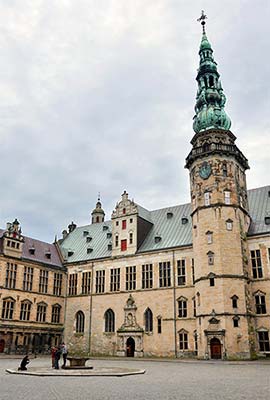
Follow the signs to the ticket desk (or head straight to the courtyard gate if you have a Copenhagen Card or e-ticket). Immediately outside the courtyard, notice the fluted pillars with exquisite carvings at their base, and fine statues of Neptune and Mercury flanking the gate. In the courtyard, check times for the English orientation, and soak in the splendor of the castle’s Renaissance exterior. You can visit the castle areas in any order from the courtyard.
Royal Apartments
In the first few ground-floor rooms, exhibits give a glimpse of the interior’s magnificence from centuries ago. You’ll see a model of the fountain that once graced the courtyard, its basin adorned with bronze figures of gods and sea monsters, with Neptune at the very top. A dollhouse-type model presents a sectional view of Kronborg, showing nearly empty rooms (the king took furnishings and carpets with him as he traveled around the kingdom); another model shows the Baroque vs. Renaissance interior of the king’s chamber.
Continuing into the apartments themselves, you’ll find that the interior is a shadow of its former self. Though the structure was rebuilt by Christian IV after the 1629 fire, its rooms were never returned to their former grandeur. And yet, there are still some fine pieces of furniture and art to see. You’ll pass through the chancellery, with sturdy brown furnishings and quill pens, and the library, with two big globes, before reaching the king’s chamber.
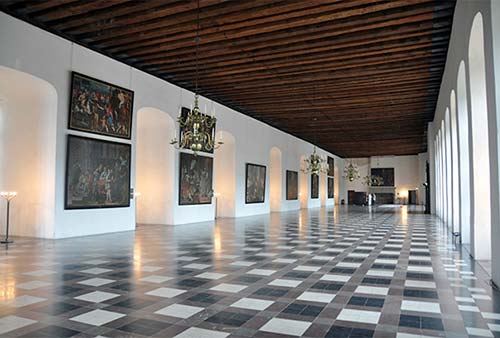
Frederik II ruled Denmark from the king’s chamber in the 1570s. This is where he held meetings, received visitors, and held parties. Frederik was able to view ships on the sound from the bay window.
Next, you’ll see the two small bedrooms—one for the king and one for the queen—before reaching the queen’s chamber. An octagonal room off the main space has views over the water. Stairs lead from the main room to the queen’s gallery, custom-built for Queen Sophie so that she could quickly walk directly to the ballroom or chapel without muddying her shoes. Follow her footsteps into the ballroom, a vast hall of epic proportions lined with a series of huge paintings commissioned by Christian IV (explanation posted near the entry). The ballroom looks nothing like it did in its 1580s glory days: The 1629 fire melted the windows and destroyed the beautiful coffered ceiling. (You’ll see what it looked like when you visit the unharmed chapel later on.) At the far end, a model (with holographic dancers) shows how this space may have looked in its finest days. Beyond the ballroom, the “Little Hall” is decorated with a fine series of tapestries depicting Danish monarchs. Then wind through several more royal halls, chambers, and bedrooms on your way back down into the courtyard.
Casements
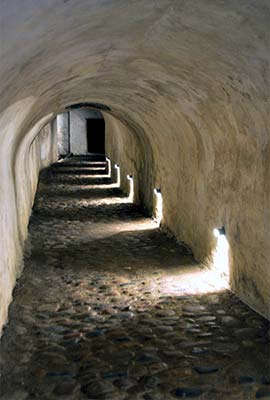
This extensive network of dark, dank cellars is a double-decker substructure that once teemed with activity. While not particularly narrow, the casement passages are dimly lit and goosebump-evoking. The upper level, which you’ll see first, was used as a smithery and guardroom. The lower level was used to store food and to train and barrack soldiers during wartime (an efficient use of so much prime, fortified space). As you explore this labyrinthine, nearly pitch-black zone (just follow the arrows), imagine the miserably claustrophobic conditions the soldiers lived in, waiting to see some action.
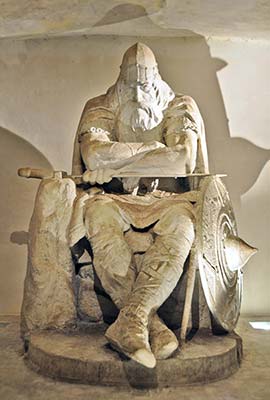
The most famous “resident” of the Kronborg casements was Holger Danske (“Ogier the Dane”), a mythical Viking hero revered by Danish children. The story goes that if the nation is ever in danger, this Danish superman will awaken and restore peace and security to the land (like King Arthur to the English, Barbarossa to the Germans, and Wenceslas to the Czechs). While this legend has been around for many centuries, Holger’s connection to Kronborg was cemented by a Hans Christian Andersen tale, so now everybody just assumes he lives here. In one of the first rooms, you’ll see a famous, giant statue of this sleeping Viking...just waiting for things to get really bad.
Chapel, Tower, and Kitchen
As the only part of the castle to survive the 1629 fire, the chapel has the most ornate interior at Kronborg. You’ll see the original altar, gallery, and pews. The enclosed gallery at the upper left was the private pew of the royal family.
The king’s kitchen was just one of four kitchens at the castle: There was also one for the queen (each had a separate staff to reduce the risk of food poisoning), a frying kitchen, and a kitchen for soldiers and staff.
The tower has 145 steps leading to fine royal views.
NEAR THE CASTLE
Maritime Museum of Denmark (Museet for Søfart)
Fans of nautical history and modern architecture should consider a visit to this museum, built within the old dry docks adjacent to the castle and designed by noted Danish firm BIG (Bjarke Ingels Group). Cutting-edge exhibits journey through Denmark’s rich seafaring tradition, from the days of tall-masted sailing ships to the container-ship revolution, in which Danish shipping company Maersk is a world leader. Topics include life on board, wartime challenges, the globalization of trade, navigation, and life as a sailor (including tattoos!).
Cost and Hours: 135 DKK, covered by Copenhagen Card, 25 percent discount with Kronborg Castle ticket; July-Aug daily 11:00-18:00; Sept-June Tue-Sun 11:00-17:00, closed Mon; café, excellent gift shop, +45 49 21 06 85, www.mfs.dk.