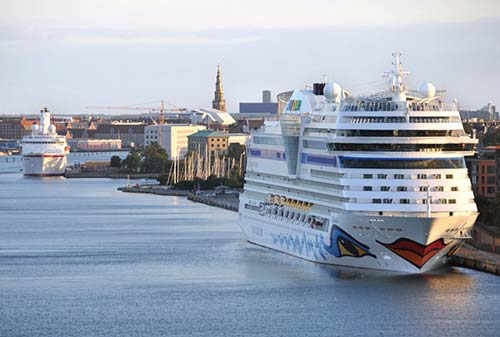
COPENHAGEN
København
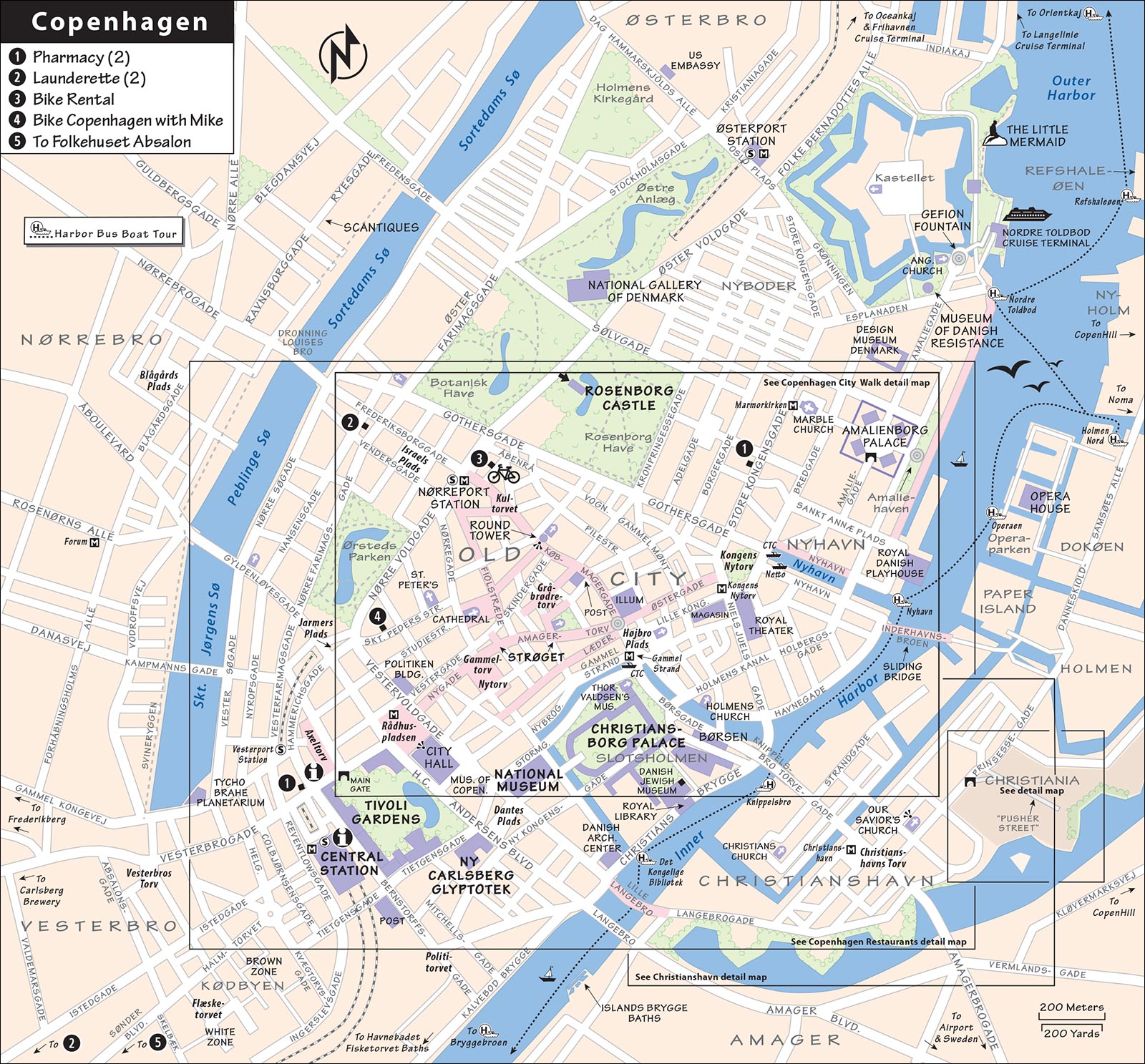
Map: Copenhagen Public Transportation
Copenhagen, Denmark’s capital, is the gateway to Scandinavia. It’s an improbable combination of corny Danish clichés, well-dressed executives having a business lunch amid cutting-edge contemporary architecture, and some of the funkiest counterculture in Europe. And yet, it all just works so tidily together. In wonderful, wonderful Copenhagen, like in so many great European cities, it’s a joy to simply wander and be inspired by the different ways a city can be designed for its people. Rather than parking spots, Copenhagen says, why not have a harbor promenade with built-in trampolines for passers-by to enjoy? (It can be done!)
A busy day cruising the canals, rambling through the palace, and taking an old-town walk will give you your historical bearings. Then, after another day strolling the Strøget (STROY-et, Europe’s first and greatest pedestrian shopping mall), biking the canals, and sampling the Danish good life (including a gooey “Danish” pastry), you’ll feel right at home. Live it up in Scandinavia’s least expensive and most fun-loving capital.
PLANNING YOUR TIME
A first visit deserves a minimum of two days and three nights. Note that many sights are closed on Monday.
Day 1
Catch a 9:30 city walking tour with Richard Karpen. After lunch, catch the relaxing canal-boat tour out to The Little Mermaid and back. Enjoy the rest of the afternoon tracing Denmark’s cultural roots in the National Museum and visiting the Ny Carlsberg Glyptotek art gallery (Impressionists and Danish artists). Spend the evening strolling with Copenhageners as you follow my Copenhagen City Walk.
Day 2
At 10:00, go Neoclassical at Thorvaldsen’s Museum, and tour the royal reception rooms at the adjacent Christiansborg Palace. After a smørrebrød lunch, see Rosenborg Castle, with Denmark’s crown jewels, in the afternoon. Spend the evening at Tivoli Gardens.
More Evening Options
During a busy trip, Christiania—the hippie squatters’ community—with its fun eateries and music vibe, fits best in the evening. Christiania is not for everyone. But it’s worth considering if you’re intrigued by alternative lifestyles. If that’s not your thing, a good option is to take a boat across the harbor to the fun food and culture district called Refshaleøen (see my Copenhagen Harbor Boat Tour).
Orientation to Copenhagen
Copenhagen is huge (with 1.3 million people), but for most visitors, the walkable core is the diagonal axis formed by the train station, Tivoli Gardens, Rådhuspladsen (City Hall Square), and the Strøget pedestrian street, ending at the colorful old Nyhavn sailors’ harbor. Bubbling with street life, colorful pedestrian zones, and most of the city’s sightseeing, the Strøget is fun. But be sure to also get off this main drag and explore. Doing things by bike or on foot, you’ll stumble upon charming bits of Copenhagen that many travelers miss.
Outside the old city center are four areas of interest to tourists:
To the north are Rosenborg Castle and Amalienborg Palace, with The Little Mermaid nearby. Across the harbor from The Little Mermaid is Refshaleøen, a fun food and culture district. South of Refshaleøen, east of the center, are Christianshavn (Copenhagen’s “Little Amsterdam” district) and the alternative enclave of Christiania.
Finally, to the west (behind the train station) is Vesterbro, a young and trendy part of town with lots of cafés, bars, and boutiques; the hip Meatpacking District (Kødbyen); and the Carlsberg brewery (plus the picnic-friendly Frederiksberg Park).
Many of these sights are walkable from the Strøget, but going by bike, Metro, boat, or bus can be more efficient. In good weather, the city is an absolute delight by bike. Nearly anything in the town center is within a 10-minute pedal (faster than taking a taxi).
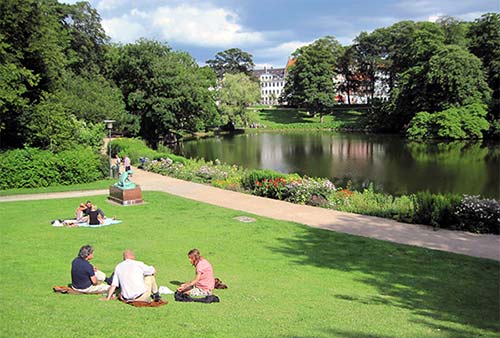
If you study your map carefully, you can read the history of Copenhagen in today’s street plan. København (“Merchants’ Harbor”) was born on the little island of Slotsholmen—today home to Christiansborg Palace—in 1167. What was Copenhagen’s medieval moat is now a string of pleasant lakes and parks, including Tivoli Gardens. You can still make out some of the zigzag pattern of the moats and ramparts in the city’s greenbelt.
Many of these fortifications, and several other landmarks, were built by Denmark’s most memorable king. You need to remember only one character in Copenhagen’s history: Christian IV. Ruling from 1588 to 1648, he was Denmark’s Renaissance king and a royal party animal (see the “King Christian IV” sidebar, later). The personal energy of this “Builder King” sparked a golden age when Copenhagen prospered and many of the city’s grandest buildings were erected. In the 17th century, Christian IV extended the city fortifications to the north, doubling the size of the city, while adding a grid plan of streets and his Rosenborg Castle. This “new town” was the district around the Amalienborg Palace.
In 1850, Copenhagen’s 140,000 residents all lived within this defensive system. Building in the no-man’s-land outside the walls was only allowed with the understanding that in the event of an attack, you’d burn your dwellings to clear the way for a good defense.
Most of the city’s historic buildings still in existence were built within the medieval walls, but conditions became too crowded, and outbreaks of disease forced Copenhagen to spread outside the walls. Ultimately those walls were torn down and replaced with “rampart streets” that define today’s city center: Vestervoldgade (literally, “West Rampart Street”), Nørrevoldgade (“North”), and Østervoldgade (“East”). The fourth side is the harbor and the island of Slotsholmen, where København was born.
TOURIST INFORMATION
Copenhagen’s TI, which bills itself as “Wonderful Copenhagen,” is a blatantly for-profit company providing information only about businesses that pay hefty fees. While staff can answer basic questions, it’s worthwhile mostly for its big racks of brochures and free publications including the Guide to Buses, Train & Metro map, and the tourist newspaper Copenhagen Post. You can pick up a free city map just as easily at many hotels and other places in town (TI open July-Aug Mon-Fri 9:00-18:00, Sat-Sun until 16:00; Sept-June Mon-Fri 9:00-16:00, Sat-Sun 10:00-15:00; Vesterbrogade 4B, just up the street from the main exit of train station—across from the towering Radisson Blu Royal Hotel, good Lagkagehuset bakery in building; second location in Central Station; +45 70 22 24 42, www.visitcopenhagen.com).
Copenhagen Card: This card includes entry to virtually all sights in the city (including expensive Tivoli Gardens and Rosenborg Castle) and all local transportation in all zones of the greater Copenhagen area. It can save busy sightseers some money and the hassle of choosing the right transportation pass. If you plan to visit a lot of sights (especially those with steep entry prices) and will travel to nearby destinations such as Kronborg Castle and Roskilde Cathedral, do the math to see if buying this pass adds up (459 DKK/24 hours, 679 DKK/48 hours, 839 DKK/72 hours, 979 DKK/96 hours, 1,099 DKK/120 hours; sold at the TI, online, and some hotels; www.copenhagencard.com). For a little more money, you can get the HOP version, which includes the Strömma Hop-On, Hop-Off bus tour (see here).
ARRIVAL IN COPENHAGEN
By Train
The main train station, Hovedbanegården (HOETH-bahn-gorn; look for København H on signs and schedules), is called Central Station on English maps and signage. It’s a temple of travel and a hive of travel-related activity (and 24-hour thievery). Kiosks and fast-food eateries cluster in the middle of the main arrivals hall. From the main entrance, the ticket office is at the back of the station (Mon-Fri 7:00-20:00, Sat-Sun 8:00-18:00) and can help you buy tickets or make reservations for an upcoming high-speed train trip (required even of rail-pass holders).
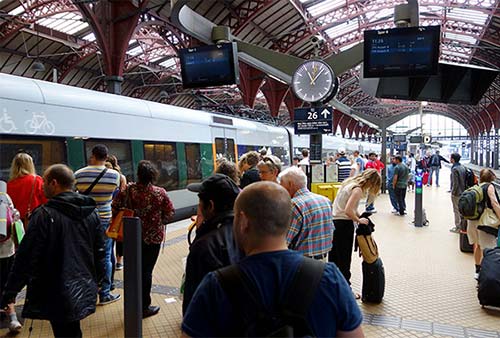
Within the station, you’ll find baggage storage (go down stairs marked Bagagecenter at back of station; lockers and checkroom/garderobe both open long hours daily); pay WCs (credit cards only, right side of station); a branch of the recommended Lagkagehuset bakery (front of station); and lots more. At both the front and the back of the station, you’ll find ATMs.
The tracks at the back of the station (tracks 9-12) are for the suburban train (S-tog). The Metro entry is out back (follow M signs).
Getting into Town: If you want to get right to sightseeing, you’re within easy walking distance of downtown. Just exit the front door, and you’ll run into one of the entrances for Tivoli Gardens; if you go around Tivoli’s left side and up a couple of blocks, you’ll be at Rådhuspladsen, where my Copenhagen City Walk begins.
Hotels are scattered far and wide around town. It’s best to get arrival instructions from your hotelier, but if you’re on your own, here are some tips:
To reach hotels behind the station, slip out the back door—just go down the stairs at the back of the station marked Reventlowsgade.
For hotels near Nørreport, ride the S-tog from the station two stops to Nørreport, or catch the Metro. For hotels near Nyhavn, take the Metro three stops to Kongens Nytorv, within a few minutes’ walk of Nyhavn.
Note: If you’re staying near Nørreport (or near Nyhavn, an easy Metro connection from Nørreport), check the train schedule carefully; many local trains (such as those from the airport and some from Roskilde) continue through Central Station to Nørreport Station, saving you an extra step.
By Plane, Boat, or Cruise Ship
See “Copenhagen Connections” at the end of this chapter.
HELPFUL HINTS
Book Ahead: For Rosenborg Castle, Meet the Danes, the community dinner at Folkehuset Absalon, and any fine-dining restaurants, book in advance to avoid long lines and/or disappointment. To climb the tower at Our Savior’s Church in summer you must make online reservations in advance. If you plan to take the overnight boat to Oslo (or drive onto any ferry), make reservations—especially in summer and on weekends. For the Copenhagen-Oslo overnight ferry, contact DFDS or visit the DSB Rejsebureau at Central Station (see here).
Money: Credit cards are rapidly replacing cash in Denmark.
Blue Monday: As you plan, remember that most sights close on Monday, with these exceptions: Christiansborg Palace (closed Mon Oct-April), City Hall, Rosenborg Castle (closed Mon off-season), Round Tower, Royal Library, Our Savior’s Church, Tivoli Gardens (generally closed late Sept-late March), both Harbor Baths (closed Oct-May), and various tours (canal, bus, walking, and bike). You can explore Christiania, but Monday is its rest day so it’s unusually quiet and some restaurants are closed.
Festivals: The Copenhagen Jazz Festival—10 days in early July—puts the town in a rollicking slide-trombone mood. The Danes are Europe’s jazz enthusiasts, and this music festival fills the town with happiness (www.jazz.dk). There’s also a winter jazz festival in February. The Copenhagen Summer Festival brings chamber music to Charlottenborg Palace every August (www.copenhagensummerfestival.dk).
Pharmacies: Steno Apotek is across from the train station (open 24 hours, Vesterbrogade 6C, +45 33 14 82 66). Kongelig Hof Apotek is at the other end of town, between Nyhavn and Amalienborg Palace (closed Sun, Store Kongensgade 45, +45 33 14 11 68). For locations, see the “Copenhagen” map, earlier.
Laundry: You’ll find a coin-op laundry (møntvask) near Nørreport (50 yards from Ibsens Hotel at Nansensgade 84), and another several blocks west of my train-station-area hotel listings at Flensborggade 20 (both daily 7:00-21:00, see the “Copenhagen” map, earlier, for locations). Vaskel is wash, tørring is dry, and sæbe is soap.
GETTING AROUND COPENHAGEN
By Public Transit
It’s easy to navigate Copenhagen, with its fine Metro, buses, harbor boats, and S-tog (a suburban train system with stops in the city). Pick up the Guide to Buses, Train & Metro map at the TI for an overview of all your public transit options or see DinOffentligeTransport.dk. For a helpful website that covers public transport (nationwide) in English, consult Rejseplanen.dk.
Tickets and Passes: Tickets and City Passes can be purchased with the Copenhagen DOT mobile app or at train and Metro station ticket machines. Bus fares can also be paid with cash onboard.
The same tickets are used throughout the system. A 24-DKK, two-zone ticket gets you an hour’s travel within the city center. Traveling to or from the airport requires a three-zone ticket (30 DKK). To bring a bike onboard a train or bus you’ll need an additional 15-DKK ticket.
If you plan to ride transit exclusively in central Copenhagen, the City Pass Small is a good value—and it covers the trip from the airport (80 DKK/24 hours, 150 DKK/48 hours, 200 DKK/72 hours, covers zones 1-4). If you’ll be traveling to outlying sights too, including Roskilde, Frederiksborg Castle, Louisiana Art Museum, or Kronborg Castle, consider the City Pass Large (160 DKK/24 hours, 300 DKK/48 hours, 400 DKK/72 hours, covers all travel zones).
The Copenhagen Card is some travelers’ best choice for its sheer convenience. It covers all public transportation in the greater Copenhagen area (including to Roskilde, Frederiksborg Castle, Louisiana Art Museum, etc.), canal-boat tours, and admission to nearly all major sights (see “Tourist Information,” earlier).
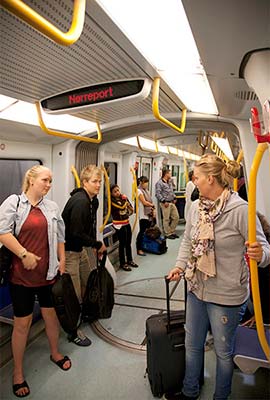
Metro: Copenhagen’s Metro is simple, futuristic, and usually the fastest way to get around. The Metro connects the airport with many stops within the city center: Nørreport (near Rosenborg Castle), Østerport, Marmorkirken (near Amalienborg Palace), Kongens Nytorv (near Nyhavn and the Strøget’s north end), Gammel Strand (near Slotsholmen Island), Rådhuspladsen, Central Station, and Christianshavn. Nearly all recommended hotels are within walking distance of Central Station or one of these stops. For details on the Metro, including route maps, see http://intl.m.dk.
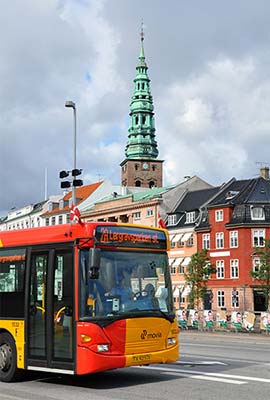
Buses: Buses serve many of the major sights in town every three to ten minutes during the day. Night buses are indicated by N on bus stop signs and run at least every 20 minutes (more frequent Fri-Sat). There’s also a floating Harbor Bus (described on here).
Bus lines that end with “A” (such as #2A) use quiet, eco-friendly, electric buses that are smaller than normal buses, allowing access into the narrower streets of the old town. Among these, #2A is particularly useful, connecting Refshaleøen, Christianshavn, Central Station, Rådhuspladsen in the city center, and then onward to points west.
Other, non-“A” buses, which are bigger and tend to be more direct, can be faster for some trips:
Bus #23 runs a handy route right through the main tourist zone, from Central Station/Tivoli to Østerport station with stops at Rådhuspladsen, Stormbroen (National Museum), Gammel Strand, and Kongens Nytorv (near Nyhavn).
Bus #26 runs from Central Station/Tivoli to Nyhavnbroen (near Nyhavn).
Bus #27 runs from the cruise ports of Oceankaj and Langelinie to the Østerport station, with a stop on Indiakaj, near The Little Mermaid.
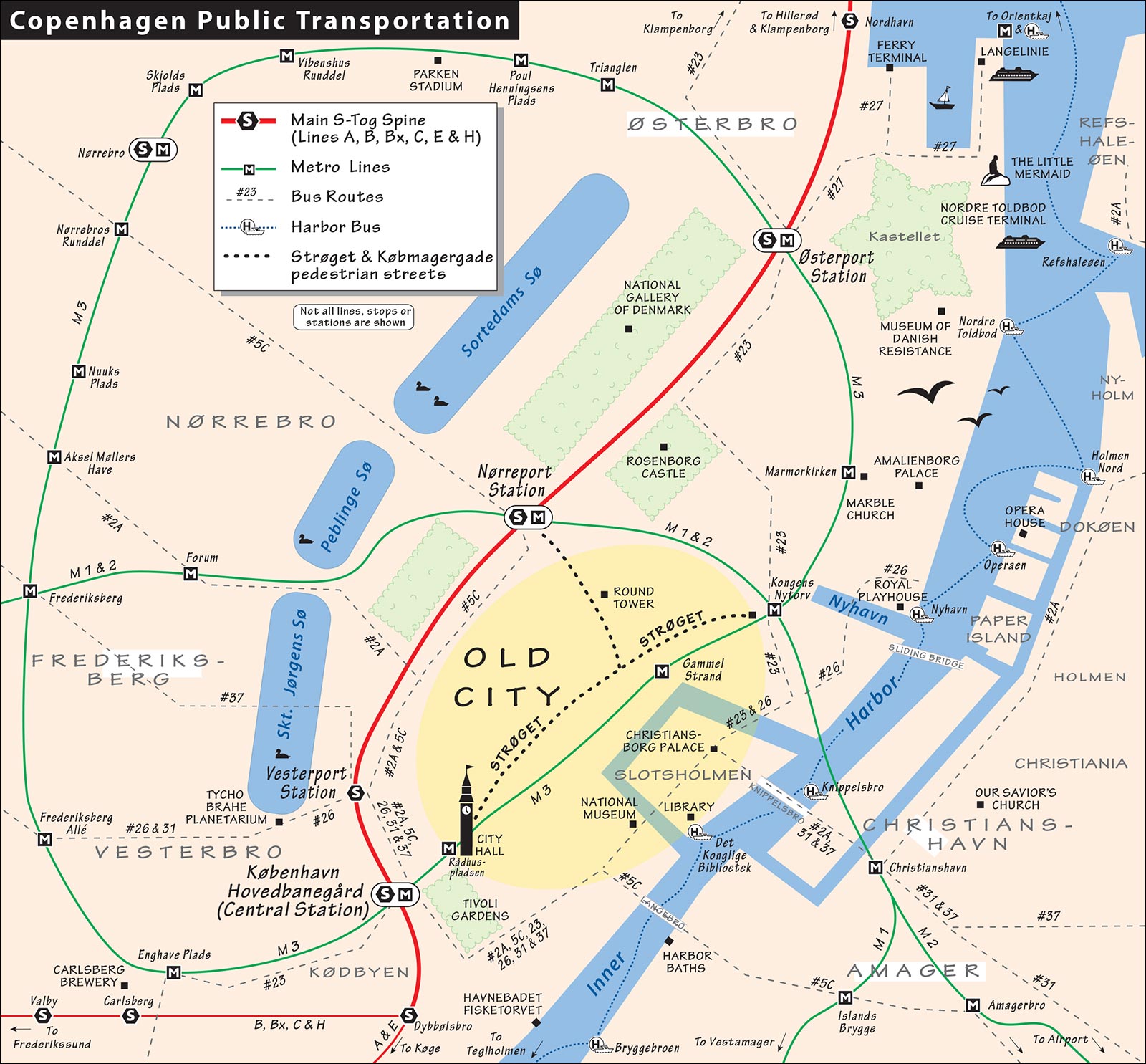
Buses #31 and #37 run from Central Station to Christianshavn.
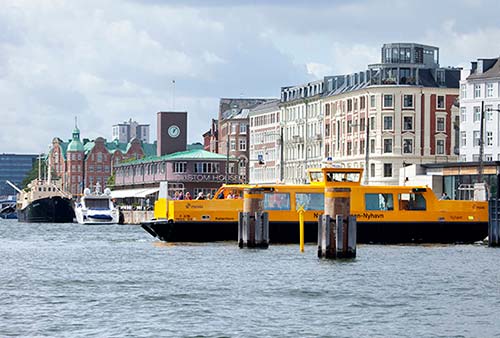
By Boat: The hop-on, hop-off Harbor Bus (Havnebus) boat stops at the Royal Library (near Christiansborg Palace), Christianshavn (near Knippels Bridge), Refshaleøen, Nyhavn, the Opera House, and the Nordre Toldbod cruise-ship pier, which is a short walk from The Little Mermaid. The boat is part of the city bus system (lines #991 and #992) and covered by the tickets described earlier (runs 7:00-19:00). See my “Copenhagen Harbor Boat Tour” on here to take a do-it-yourself harbor cruise or consider a guided cruise (described later, under “Tours in Copenhagen”).
S-tog Train: The S-tog is basically a commuter line that links stations on the main train line through Copenhagen; for those visiting the city, the most important stops are Central Station and Nørreport (where it ties into the Metro system). Note that while rail passes are valid on the S-tog, it’s probably not worth using a travel day. The S-tog is very handy for reaching many of the outlying sights described in the Near Copenhagen chapter.
By Taxi
Taxis are plentiful, easy to call or flag down, and pricey (39-DKK pickup charge and then about 10 DKK/kilometer—higher in evenings and on weekends). For a short ride, four people spend about the same by taxi as by bus. Calling +45 35 35 35 35 will get you a taxi within minutes...with the meter already well on its way. Because of the strong taxi union, Uber does not operate in Copenhagen.
By Bike
Cyclists see more, save time and money, and really feel like locals. With a bike, you have Copenhagen at your command. I’d rather have a bike than a car and driver at my disposal. Virtually every street has a dedicated bike lane (complete with bike signal lights). Warning: Police routinely issue hefty tickets to anyone riding on sidewalks or through pedestrian zones. Note also that bikes can’t be parked just anywhere. Observe others and park your bike among other bikes. The simple built-in lock that binds the back tire is adequate.
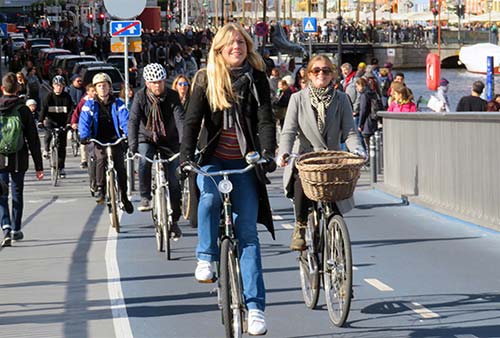
Renting a Bike: Your best bet for renting a bike is often your hotelier: Many rent (or loan) decent bikes at fair rates to guests.
Rosenborg Cykler, near Nørreport Station, rents three-gear bikes and helmets (Mon-Fri 8:30-18:00, Sat 10:00-15:00, closed Sun; Rosenborggade 3K—for location see the “Copenhagen” map, earlier; +45 20 44 55 57, www.rosenborgcykler.dk).
Donkey Republic’s orange bikes, which you’ll see all over the city, are easy to rent with the company’s app (www.donkey.bike).
Tours in Copenhagen
ON FOOT
Copenhagen is an ideal city to get to know by foot. You have several good tour options. For Christiania tours, see the listing on here.
▲▲Hans Christian Andersen Tours by Richard Karpen
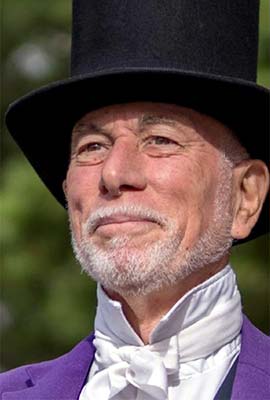
Once upon a time, American Richard Karpen visited Copenhagen and fell in love with the city. Now, dressed as writer Hans Christian Andersen in a 19th-century top hat and long coat, he leads 1.5-hour tours that wander in and out of buildings, courtyards, and back streets of the old town. Along the one-mile route, he gives an entertaining background on the history, culture, and contemporary life of Denmark (150 DKK, cash only, kids under 12 free; departs from outside the TI, near Central Station at Vesterbrogade 4B; mid-May-mid-Sept Mon-Sat at 9:30, none on Sun; no reservations—just show up). Richard departs promptly—if you miss him look for the tour at the next stop at Rådhuspladsen. He also offers private city, Rosenborg Castle, and National History Museum tours (price varies, May-Sept, +45 91 61 95 02, www.copenhagenwalks.com, copenhagenwalks@yahoo.com). For more about Hans Christian Andersen, see here.
▲City Walks by Red Badge Guides
Four local female guides work together to give two-hour English-language city tours. Their walks mix the city’s highlights, back lanes, history, art, and contemporary social issues, and finish at Amalienborg Palace around noon for the changing of the guard (150 DKK, cash only, May-Sept Fri-Sat at 10:00, departs from TI at Vesterbrogade 4B, just show up, +45 20 92 23 87, www.redbadgeguides.dk, redbadgeguides@gmail.com). They also offer private tours year-round upon request (1,825 DKK/2-3 hours, 3,925 DKK/day).
Private Guide
Heidi Klintemøller Hansen, a licensed local guide (and chair of the local guides’ association), enjoys tailoring a tour to your personal interests (1,875 DKK/3 hours, 3,500 DKK/day, +45 51 92 63 03, www.danishinsights.dk, heidi@danishinsights.dk).
▲▲Copenhagen History Tours
Christian Donatzky, a charming Dane with a master’s degree in history, runs walking tours on Saturday mornings in July and August. Those with a serious interest in Danish history will find any of Christian’s tours time well spent (120 DKK, Sat at 10:00, 1.5 hours, small groups of 5-15 people, departs from statue of Bishop Absalon on Højbro Plads, English only, no reservations necessary—confirm schedule on website and just show up, +45 28 49 44 35, www.historytours.dk/copenhagen, info@historytours.dk). Christian can also be booked for private tours.
BY CANAL BOAT
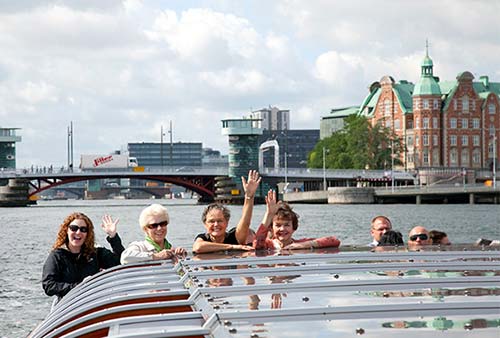
For many, the best way to experience the city’s canals and harbor is by canal boat. Two companies—Netto-Bådene and Canal Tours Copenhagen—offer essentially the same live, one-hour cruise in two or three languages. Both boats leave at least twice an hour, cruise around the palace and Christianshavn area, then proceed into the wide-open harbor. Best on a sunny day, it’s a relaxing way to see The Little Mermaid and munch on a lazy picnic during the slow-moving narration.
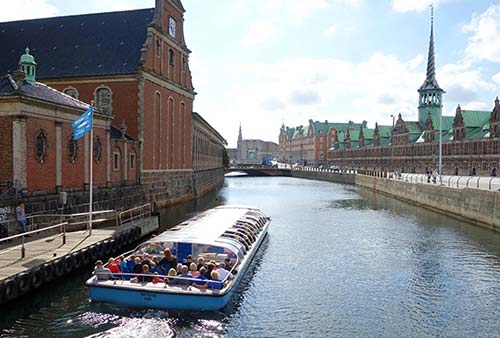
Netto boats depart from Nyhavn (midway down the canal, on the city side). Strömma boats depart from Nyhavn (at the head of the canal) and from near Christiansborg Palace near Gammel Strand at Ved Stranden.
▲Netto-Bådene Cruises
These inexpensive cruises cost about half the price of their rival, Strömma. These inexpensive cruises cost far less than the price of their rival, Strömma. Go with Netto; there’s no reason to pay more than double (50 DKK, all cruises covered by Copenhagen Card; mid-March-mid-Oct daily 10:00-17:00, runs later in summer, shorter hours in winter; sign at dock shows next departure, generally every 30 minutes, dress warmly—boats are open-top until Sept, +45 32 54 41 02, www.havnerundfart.dk).
Strömma Canal Tours
This more expensive option with nicer boats does the same cruise as Netto (109 DKK, Ved Stranden departures covered by Copenhagen Card; combo tickets with hop-on, hop-off bus or Tivoli available; daily March-late Oct 10:00-17:00, runs later in summer, shorter hours in winter, no tours Jan-Feb; generally live guides doing Danish/English tours, 4/hour, boats are sometimes covered if it’s raining, +45 32 96 30 00, www.stromma.dk). Strömma also runs one-hour evening jazz cruises (see “Nightlife in Copenhagen,” later) and other theme cruises.
BY BUS
Hop-On, Hop-Off Bus Tours
Double-decker buses with recorded narration circle the city for a basic 1.5-hour orientation, allowing you to get on and off as you like at over two dozen stops, including Tivoli Gardens, Gammel Strand near Christiansborg Palace, The Little Mermaid, Rosenborg Castle, and Nyhavn sailors’ quarter.
City Sightseeing red buses and green Hop-On, Hop-Off buses are both run by Strömma—the same tickets are valid on both buses (199 DKK/24 hours; 48- and 72-hour versions available, book online or pay driver, covered by HOP Copenhagen Card; May-mid-Sept daily 9:30-18:00, shorter hours off-season, www.stromma.dk). Strömma also offers a 299-DKK ticket that includes a 48-hour hop-on, hop-off bus ticket and a one-hour guided canal boat cruise.
Another operation—called Red Sightseeing—does a similar route (daily until 17:00, shorter hours off-season; 223 DKK/24 hours, www.redsightseeing.com).
BY BIKE
▲Bike Copenhagen with Mike
Mike Sommerville offers three-hour guided bike tours of the city. A Copenhagen native, Mike enjoys showing off his city to visitors, offering historic background and contemporary cultural insights along the way (350 DKK includes bike rental and helmet, price same with or without a bike; RS%—50-DKK discount with this book, maximum 2 discounts per book and must show book at check-in, cash only; April-Sept daily at 10:00, sometimes also at 14:30 in summer; reservations required, participants must be between ages 12-65 and have good urban biking skills). All tours are in English and depart from his bike shop at Sankt Peders Straede 47, in the Latin Quarter (see the “Copenhagen” map, earlier, for location). Mike also offers private tours (www.bikecopenhagenwithmike.dk, bikemikeone@gmail.com).
Copenhagen City Walk
6 Cathedral of Our Lady (Vor Frue Kirke)
Christiansborg Palace and the Birthplace of Copenhagen
Walk Extension: Nyhavn to Amalienborg
21 Amalienborg Palace and Square
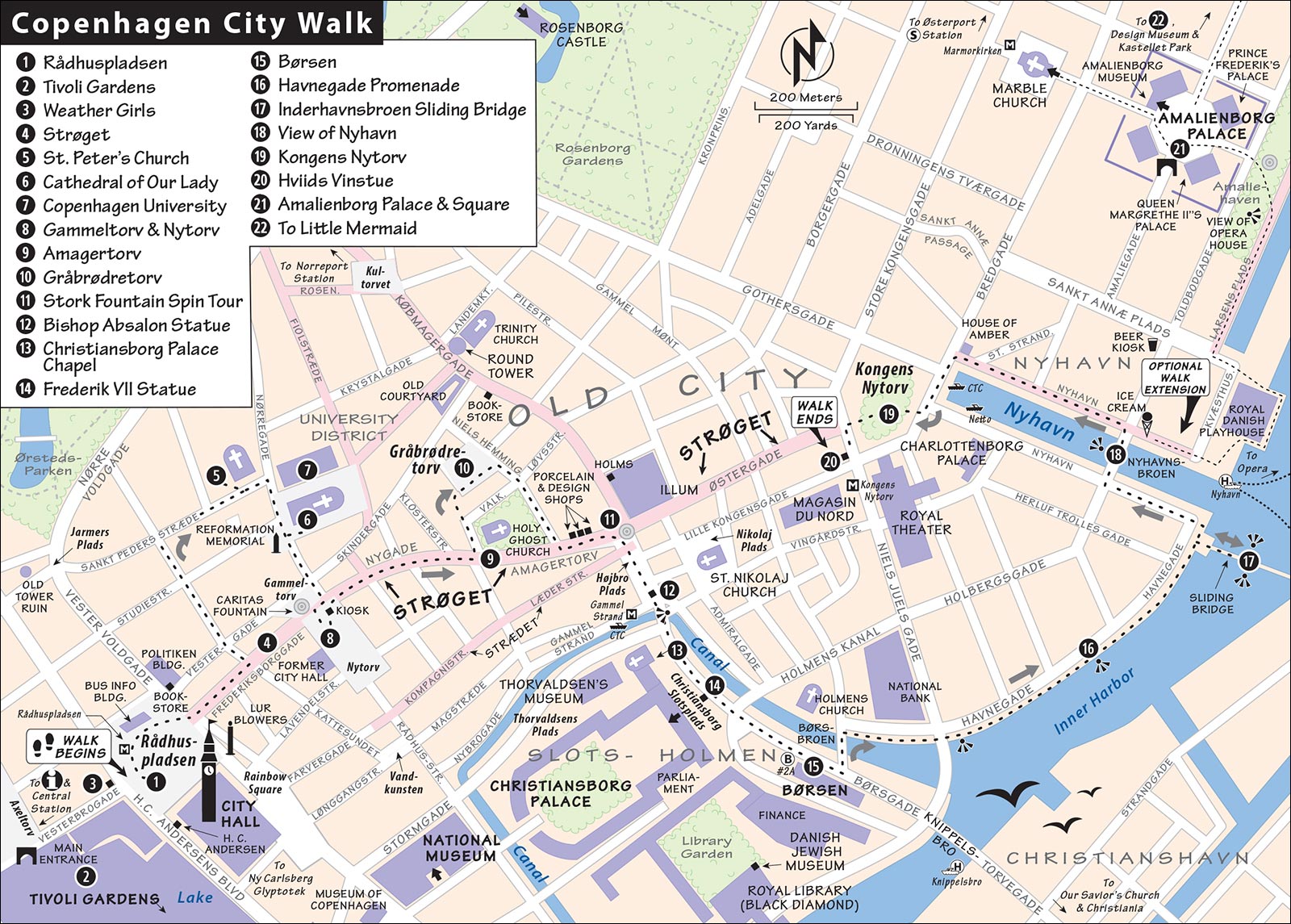
This self-guided walk takes about two hours. It starts at Rådhuspladsen (City Hall Square) and heads along the pedestrian street, the Strøget, through the old city, onto the island of Slotsholmen (home of Christiansborg Palace), along the harbor promenade, and through Nyhavn, the sailors’ quarter with the city’s iconic canal-front houses. The walk officially ends at Kongens Nytorv (“King’s New Square”), though you can detour another 10 minutes to Amalienborg Palace and then another 15 minutes beyond that to The Little Mermaid.
1 Rådhuspladsen
Start from Rådhuspladsen, the bustling heart of Copenhagen, dominated by the tower of the City Hall. For 700 years, Copenhagen was contained within its city walls, and this square was its fortified west end. By the mid-1800s, 140,000 people were packed inside. The overcrowding led to hygiene problems. (A cholera outbreak killed 5,000.) It was clear: The walls needed to come down...and they did. Those formidable town walls survive today only in echoes—a circular series of roads and the remnants of moats, which are now people-friendly city lakes (see the sidebar on here). Today, with its convenient Metro station, Rådhuspladsen is where the city gathers to celebrate.
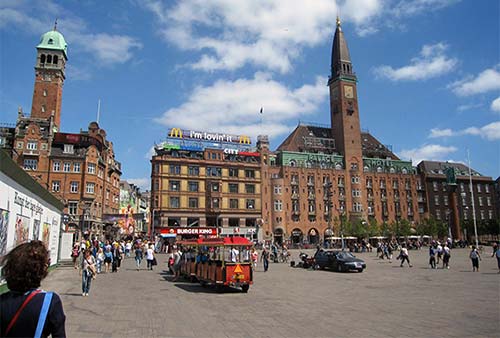
• Stand 50 yards in front of City Hall and turn clockwise for a...
Rådhuspladsen Spin-Tour: The City Hall, or Rådhus, is worth a visit (described on here). Old Hans Christian Andersen sits to the right of City Hall, almost begging to be in another photo (as he used to in real life). Climb onto his well-worn knee. (While up there, you might take off your shirt for a racy photo, as many Danes enjoy doing.)
H. C. is looking at 2 Tivoli Gardens (across the street), which he loved and which inspired him. Tivoli Gardens was founded in 1843, when magazine publisher Georg Carstensen convinced the king to let him build a pleasure garden outside the walls of crowded Copenhagen. The king quickly agreed, knowing that happy people care less about fighting for democracy. Tivoli became Europe’s first great public amusement park. When the train lines came, the station was placed just beyond Tivoli.
The big, glassy building with the DI sign is filled with the offices of Danish Industry—a collection of Danish companies whose logos you can see in the windows.
The big, broad boulevard is Vesterbrogade (“Western Way”), which led to the western gate of the medieval city (behind you, where the pedestrian boulevard begins). Here, in the traffic hub of this huge city, you’ll notice...not many cars. Throughout Copenhagen, you’ll see how the mayor’s mantra, “We will build a city not for cars but for people”—along with tax-and-regulation policies that encourage small electric cars and use of public transit and bikes—is shaping the city.
Down Vesterbrogade towers the Radisson Blu Royal Hotel (with its SAS sign), once Copenhagen’s only skyscraper. When it was built in 1960, Copenhageners took one look and decided—that’s enough of a skyline. Notice there are no other buildings taller than the five-story limit in the old center.
The golden 3 weather girls (on the corner, high above Vesterbrogade) indicate the weather: on a bike (fair weather) or with an umbrella (foul). These two have been called the only women in Copenhagen you can trust, but for years they’ve been stuck in the almost-sunny mode...with the bike just peeking out. You’ll notice that the red temperature dots max out at 28˚ Celsius (that’s 82˚ Fahrenheit...a good memory aid: transpose 28 to get 82).
Farther to the right, the next street (once the local Fleet Street, with the big newspapers) still has the offices for Politiken (one of Denmark’s leading newspapers) and the best bookstore in town, Politikens Boghal.
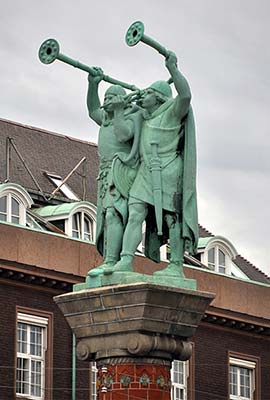
As you spin farther right, three fast-food joints stand at the entry to the Strøget, Copenhagen’s grand pedestrian boulevard—where we’re heading next. Just beyond that and the Art Deco-style Palace Hotel (with a tower to serve as a sister to the City Hall) is the Lur Blowers sculpture, which honors the earliest warrior Danes. The lur is a curvy, trombone-sounding horn perhaps used to call soldiers to battle or to accompany pagan religious processions. The earliest bronze lurs date as far back as 3,500 years ago. Later, the Vikings used a wood version of the lur. The ancient originals, which still play, are displayed in the National Museum.
Down the street, on the left side of City Hall, the Rainbow Square (Regnbuepladsen) marked by a pride flag is a reminder that in 1989 Denmark was the first country in the world to give legal rights to same-sex partnerships and has long been a leader in gay rights.
• Now head down the pedestrian boulevard (pickpocket alert).
4 The Strøget
The American trio of Burger King, 7-Eleven, and KFC marks the start of this touristy pedestrian street. Finished in 1962, Copenhagen’s experimental, tremendously successful, and much-copied pedestrian shopping mall is a string of lively (and individually named) streets and squares that bunny-hop through the old town from City Hall to the Nyhavn quarter, a 20-minute stroll away. Though the Strøget has become hamburgerized, historic bits and attractive pieces of old Copenhagen are just off this commercial can-can.
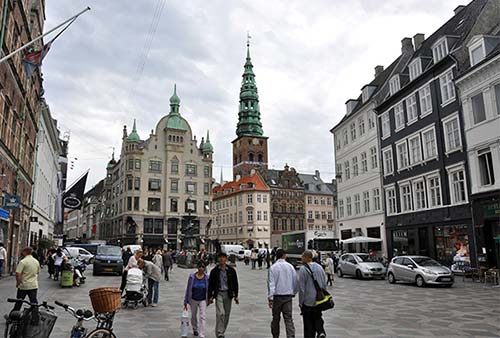
As you wander, remember that the commercial success of a historic street like the Strøget drives up the land value, which generally trashes the charm and tears down the old buildings. Look above the modern window displays and street-level advertising to discover bits of 19th-century character that still survive. This end of the Strøget is young and cheap, while the far end has the high-end designer shops.
Along the way, wonderfully quiet and laid-back areas are just a block or two away on either side. (Many visitors never venture off Strøget, and many locals never venture onto it.) After one block (at Kattesundet), make a side trip three blocks left, straight into Copenhagen’s colorful university district (Latin Quarter). Notice, just 100 yards off Strøget, the totally different vibe. Formerly the old brothel neighborhood, later the heart of Copenhagen’s hippie community in the 1960s, today this student area is SoHo chic. Enjoy the colorful string of artsy shops, vintage-clothing joints, and cafés.
Because the old town was densely populated and built of wood, very little survived its many fires. After half-timbered and thatched buildings kept burning down, the city finally mandated that new construction be made of stone. But because stone was so expensive, many people built half-timbered structures, then disguised their facades with stucco, which made them look like stone. Keep an eye out for exposed half-timbered structures in courtyards and from the back sides.
At Sankt Peders Stræde, turn right and walk to the end of the street. Notice the old guild signs (a baker, a key maker, and so on) identifying the original businesses here. Look for large mansions that once circled expansive courtyards. As the city’s population grew, the city walls constricted Copenhagen’s physical size. The courtyards were gradually filled with higgledy-piggledy secondary buildings. Today throughout the old center, you can step off a busy pedestrian mall and back in time in these characteristic, time-warp courtyards. Replace the parked car with a tired horse and the bikes with a line of outhouses, and you’re in 19th-century Copenhagen. If you see an open courtyard door, you’re welcome to discreetly wander in and look around.
You’ll also pass funky shops and the big brick 5 St. Peter’s Church (Sankt Petri Kirke)—the old German merchant community’s church, which still holds services in German. Its fine 17th-century brick funerary chapel (filling a ground-floor building out back due to the boggy nature of the soil) is filled with fancy German tombs (church and burial chapels typically open to visitors Thu-Sat 11:00-15:00).
• When Sankt Peders Stræde intersects with Nørregade, look right to find the big, Neoclassical...
6 Cathedral of Our Lady (Vor Frue Kirke)
The obelisk-like Reformation Memorial across the street from the cathedral celebrates Denmark’s break from the Roman Catholic Church to become Lutheran in 1536. Walk around and study the reliefs of great Danish reformers protesting from their pulpits. The relief facing the church shows King Christian III presiding over the pivotal town council meeting when they decided to break away from Rome. As a young man, Prince Christian had traveled to Germany, where he was influenced by Martin Luther. He returned to take the Danish throne by force, despite Catholic opposition. Realizing the advantages of being the head of his own state church, Christian dissolved the monasteries, confiscated church property, and established the state Lutheran Church. King Christian was crowned inside this cathedral. Because of the reforms of 1536, there’s no Mary in the Cathedral of Our Lady. The other reliefs show the popular religious uprising, with Danes taking control of the word of God by translating the Bible from Latin into their own language.
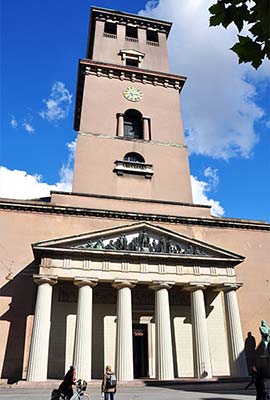
Like much of this part of town, the church burned down in the 1807 British bombardment of the city during the Napoleonic Wars. Rebuilt in the Neoclassical style, the cathedral’s facade looks like a Greek temple. (Two blocks to the right, in the distance, notice more Neoclassicism—the law courts.) You can see why golden age Copenhagen (early 1800s) fancied itself a Nordic Athens. Old Testament figures (King David and Moses) flank the cathedral’s entryway. Above, John the Baptist stands where you’d expect to see Greek gods. He invites you in...into the New Testament.
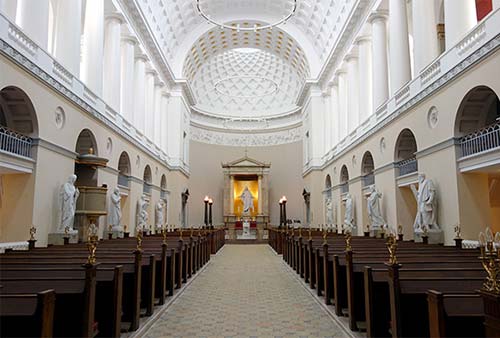
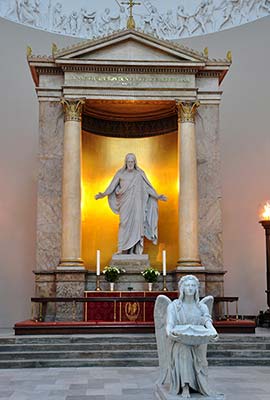
The interior is a world of Neoclassical serenity (free, open Mon-Sat 8:00-17:00, Sun 12:00-16:30). It feels like a pagan temple that now houses Christianity. The nave is lined by the 12 apostles, clad in classical robes—masterpieces by the great Danish sculptor Bertel Thorvaldsen (see here). Each strikes a meditative pose, carrying his identifying symbol: Peter with keys, Andrew with the X-shaped cross of his execution, Matthew and John writing their books, and so on. They lead to a statue of the Risen Christ (see photo), standing where the statue of Zeus would have been: inside a temple-like niche, flanked by columns and topped with a pediment. Rather than wearing a royal robe, Jesus wears his burial shroud, opens his arms wide, and says, “Come to me.” (Members of the LDS church will recognize this statue—a replica stands in the visitors center at Salt Lake City’s Temple Square.) The marvelous acoustics are demonstrated in free organ concerts Saturdays in July and August at noon (schedule at entry). Notice how, in good Protestant style, the front half of the pews are “reversible,” allowing the congregation to flip around and face the pulpit (in the middle of the church) to better hear the sermon.
• Head back outside. If you face the church’s facade and look to the left (across the square called Frue Plads), you’ll see...
7 Copenhagen University
Now home to nearly 40,000 students, this university was founded by the king in the 15th century to stop the Danish brain drain to Paris. Today tuition is free. Locals say it’s easy to get in, but given the wonderful student lifestyle, very hard to get out.
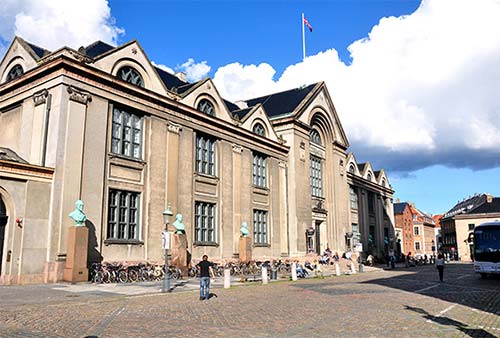
Outside, busts honor great minds from the faculty, including (at the far end) Niels Bohr, a professor who won the 1922 Nobel Prize for theoretical physics. He evaded the clutches of the Nazi science labs by fleeing to America in 1943, where he helped develop the atomic bomb.
• Rejoin the Strøget (one block downhill from the Reformation Memorial to the black-and-gold fountain) at the twin squares called...
8 Gammeltorv and Nytorv
This was the old town center. In Gammeltorv (“Old Square”), the Fountain of Charity (Caritas) is named for the figure of Charity on top. It has provided drinking water to locals since the early 1600s. Featuring a pregnant woman squirting water from her breasts next to a boy urinating, this was just too much for people of the Victorian Age. They corked both figures and raised the statue to what they hoped would be out of view. (Today, the water flows freely.)
The exotic-looking kiosk was one of the city’s first community telephone centers from the days before phones were privately owned. Look at the reliefs ringing its top: an airplane with bird wings (c. 1900) and (two panels to the right, flanking a fortress) two women talking on a newfangled telephonic device.
While Gammeltorv was a place of happiness and merriment, Nytorv (“New Square”) was a place of severity and judgment. Step up onto the small raised area 20 yards in front of the old, ancient-Greek-style former City Hall and courthouse. Do a 360. The square is Neoclassical (built mostly after the 1807 British bombardment). Read the old Danish on the City Hall facade: “With Law Shall Man Build the Land.” Look down at the pavement and read the plaque: “Here stood the town’s Kag (whipping post) until 1780.”
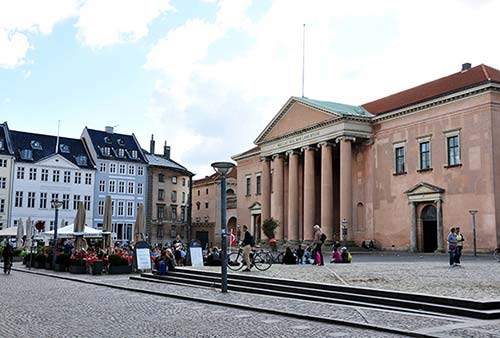
• Now walk down the next stretch of the Strøget—called Nygade—to reach...
9 Amagertorv
This is prime real estate for talented street entertainers. Walk past the flagship Lego store (on right) to the stately brick Holy Ghost Church (Helligåndskirken). The fine spire is typical of old Danish churches. Under the stepped gable was a medieval hospital run by monks (one of the oldest buildings in town, dating from the 12th century). Today the hospital is an antiques hall. In summer the pleasant courtyard is shared by a group of charities selling light bites and coffee. The green hotdog stand, Hanegal, sells what’s considered the best pølse in town, breaking the gut-bomb mold with organic sausages and innovative sides (handy churchyard nearby to sit and munch).
• Walk behind the church, down Valkendorfsgade—the street just before the church—and through a passage under the reddish-colored building at #32 (if locked, loop back and go down Klosterstræde) to find...
10 Gråbrødretorv
Surrounded by fine old buildings, this leafy and beer-stained “Grey Friars’ Square”—a monastic square until the Reformation made it a people’s square—is a popular place for an outdoor meal or drink in the summer. At the end of the square, the street called Niels Hemmingsens Gade runs past a neighborhood known for its design shops back to the Strøget.
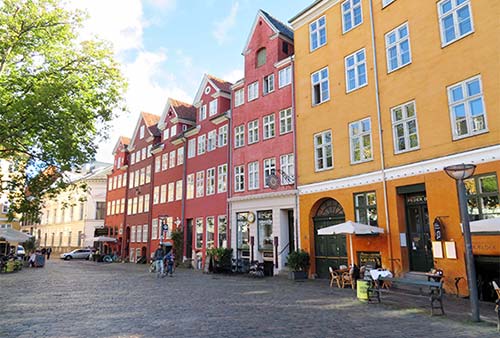
• Once back on busy Strøget, turn left and continue down Amagertorv, with its fine inlaid Italian granite stonework, to the square with the Art Nouveau “stork” fountain (Storkespringvandet).
11 “Stork” Fountain Spin Tour
Two entries to underground, Victorian-era WCs are in front of the fountain (free, staffed, and delightful). Stand between the twin stairwells for a 360-degree counterclockwise spin tour. The street ahead, a bit to the left, is Østergade (the fanciest shopping street in town). North of Amagertorv, a broad pedestrian mall called Købmagergade leads past a fine modern bakery (Holm’s) to Christian IV’s Round Tower. Farther around are three shopping institutions: Georg Jensen (luxury Danish design), Royal Copenhagen (with three floors of porcelain), and Illums Bolighus (department store offering modern Danish design—see “Shopping,” later). Finally, a block downhill toward the canal—running parallel to the Strøget—starts Strædet, which is a “second Strøget” featuring cafés and antique shops. If you need a Victorian toilet break, just head downstairs.
• Looking downhill from the fountain, about halfway to the imposing palace in the distance, you’ll see a great man on a horse. Walk here to view this statue of Copenhagen’s founder, 12 Bishop Absalon, shown in his Warrior Absalon getup.
From the bishop, continue across a bridge toward the palace and the next statue—a king on a horse. As you cross the bridge, look right to see the City Hall tower, where this walk started. (Strömma’s sightseeing cruises depart from near here—see here.)
Christiansborg Palace and the Birthplace of Copenhagen
You’re stepping onto the island of Slotsholmen (“Castle Island”), the easy-to-defend birthplace of Copenhagen in the 12th century. It’s dominated by the royal palace complex. Christiansborg Palace (with its “three crowns” spire)—the former residence of kings—is now the parliament building.
Ahead of you, the Neoclassical Lutheran church with the low dome is the 13 Christiansborg Palace Chapel, site of 350 years of royal weddings and funerals (free, open daily 10:00-18:00 in July, otherwise open only Sun until 17:00, closed Mon-Sat).
Walk to the green copper equestrian statue. 14 Frederik VII was crowned in 1848, just months before signing Denmark’s first constitution on June 5, 1849. (Constitution Day is celebrated with typical Danish understatement—stores are closed and workers get the day off.) Frederik, who then ruled as a constitutional monarch, stands in front of Christiansborg Palace, which Denmark’s royal family now shares with its people’s assembly (for info on visiting the palace, see here). This palace, the seat of Danish government today, is considered the birthplace of Copenhagen. It stands upon the ruins of Absalon’s 12th-century castle (literally under your feet). The round stones between the statue and the street were put in for security after the 2011 terrorist attacks in Norway. While Danes strive to keep government accessible, security measures like this are today’s reality.
This is Denmark’s power island, with the Folketinget (Danish parliament), Supreme Court, Ministry of Finance (to the left), and the Børsen—the historic stock exchange (farther to the left, with the fanciful dragon-tail spire).
• Walk toward the old stock exchange.
15 Børsen (Stock Exchange)
The eye-catching red-brick stock exchange (not open to tourists) was inspired by the Dutch Renaissance, like much of 17th-century Copenhagen. Built to promote the mercantile ambitions of Denmark in the 1600s, it was the “World Trade Center” of Scandinavia. The facade reads, “For the profitable use of buyer and seller.” The dragon-tail spire with three crowns represents the Danish aspiration to rule a united Scandinavia—or at least be its commercial capital.
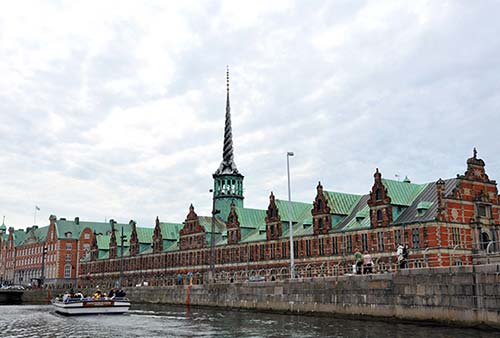
Notice Copenhagen’s distinctive green copper spires all around you. Beyond the old stock exchange lies the island of Christianshavn, with its own distinct spire. It tops Our Savior’s Church and features an external spiral staircase winding to the top for a commanding view. While political power resided here on Slotsholmen, commercial power was in the merchant’s district, Christianshavn (neighborhood and church described later, under “Sights in Copenhagen”). The Børsen symbolically connected Christianshavn with the rest of the city, in an age when trade was a very big deal.
• Before you reach the end of the stock exchange building, turn left at the crosswalk with the signal. (Note that bus #2A goes from here to Our Savior’s Church and Christiania; see the “Copenhagen Public Transportation” map, earlier.) Cross over the canal and turn right to walk along the harborfront promenade, enjoying views of Christianshavn across the water.
16 Havnegade Promenade
The Havnegade promenade to Nyhavn is a delightful people zone with trampolines (stop for a bounce), an ice-cream-licking ambience, and harborview benches (a good place to stop, look across the water, and ponder the trendy apartments and old warehouses turned into modern-office blocks). From here, stroll several more blocks toward the 17 Inderhavnsbroen sliding bridge for pedestrians and bikes. This “kissing bridge” (it’s called that because the two sliding, or retractable, sections “kiss” when they come together) links the town center with Christianshavn and makes the modern Opera House (ahead on the right, across the water) more accessible to downtown.
Walk 30 meters out on the bridge and stand above the yellow window. It’s a slow-motion ride when the center of the bridge slides open for big ships to pass (notice the cables and track). This bridge connects the previously remote, distant end of Christianshavn with the city center. The impetus was to connect the new Royal Danish Opera House, whose wealthy funder helped pay for the bridge (opened in 2016). Just across the bridge is a thriving street-food court and market and beyond that is the hippie town of Christiania and Our Savior’s Church (with the striking spiral steeple). Take a moment to appreciate an urbanscape designed not for cars but for bikes and pedestrians.
Across the way, at the end of the canal, stands the glassy Royal Danish Theatre’s Playhouse. While this walk finishes on Kongens Nytorv, the square at the head of the canal, you could extend it by continuing north along the harbor from the Playhouse (see the “Walk Extension,” later).
• Now, leave the bridge the way you came and walk straight to the canal lined with old sailboats. Walk to the center of the bridge over the canal and look toward the center for a nice...
18 View of Nyhavn
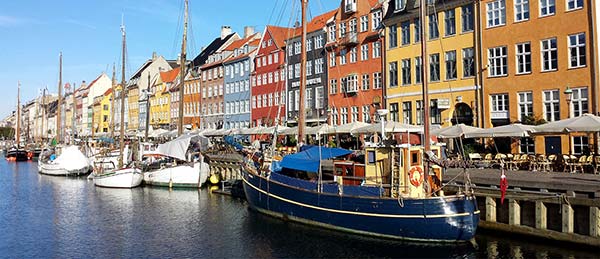
Established in the 1670s along with Kongens Nytorv, Nyhavn (“New Harbor”) is a recently gentrified sailors’ quarter. (Hong Kong is the last of the nasty bars from the rough old days.) The canal is filled with glamorous old sailboats of all sizes. Historic sloops are welcome to moor here in Copenhagen’s ever-changing boat museum. Hans Christian Andersen lived and wrote his first stories here (in the red double-gabled building at #20). With its upscale cafés, jazz clubs, and tattoo shops (pop into Tattoo Ole at #17—fun photos, very traditional), Nyhavn is a wonderful place to hang out.
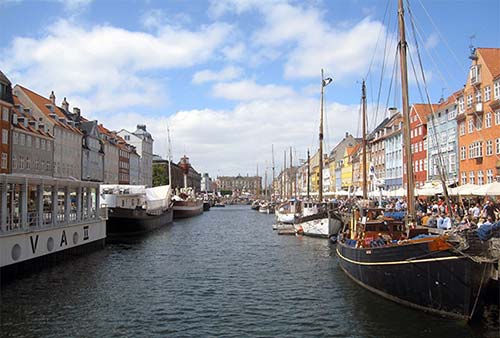
Historically, young locals who couldn’t afford the trendy bars on this canal would buy a beer (for a quarter of the price) at a nearby minimarket and enjoy a canalside perch. (I’m told the tourists have driven the truly local crowd over the sliding bridge, to the distant Krøyers Plads embankment.) To get a 25-DKK beer, cross the bridge and continue a long block down Toldbodgade to Sankt Annæ Plads, where you’ll find a classic corner minimarket—Den Gamle Købmand—with 100 local craft beers cooled and ready to go (open daily until 23:00). Then take your beer back to the canal and find a spot to sip. A note about all the public beer-drinking here: There’s no more beer consumption here than in the US; it’s just out in public.
If you crave ice cream instead, facing the canal you’ll find Vaffelbageren, a popular place with freshly made waffle cones.
• Beer sipped or ice cream slurped, make your way to the head of the canal, where you’ll find a minuscule amber museum (free), above the House of Amber (see “Shopping in Copenhagen,” later). Just beyond the end of the canal sprawls the huge and the stately...
19 Kongens Nytorv
The “King’s New Square” is home to the Royal Theater, French embassy, and venerable Hotel d’Angleterre, where VIPs and pop stars stay. Long a messy construction site, it’s now a tidy park that sits atop a major Metro station. In past winters, this square was a popular ice-skating rink.
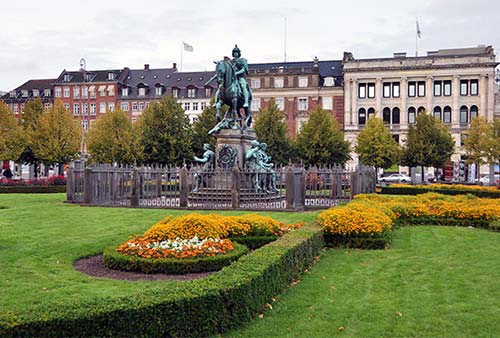
In the mid-1600s the city expanded, pushing its wall farther east. The equestrian statue in the middle of the square celebrates Christian V, who made this square the city’s geographical and cultural center. In 1676, King Christian rode off to reconquer the southern tip of Sweden and reclaim Denmark’s dominance. He returned empty-handed and broke. Denmark became a second-rate power, but Copenhagen prospered.
Across the street, towering above the Metro station, is Magasin du Nord, the grandest old department store in town (with practical eating options in its basement and top floor).
• Just beyond the Metro station, at #19, under a bar, wander into...
20 Hviids Vinstue
The town’s oldest wine cellar (from 1723) has a characteristic dark and woody interior and fascinating old Copenhagen photos. It’s a colorful spot for an open-face sandwich and a beer (three sandwiches and a beer for 90 DKK at lunchtime, sandwiches only as long as they last, daily 10:00-14:00). Their wintertime gløgg (hot spiced wine) is legendary.
• You’ve reached the end of this walk. But if you’d like to extend it by heading out to Amalienborg Palace and The Little Mermaid, retrace your steps to the far side of Nyhavn canal.
Walk Extension: Nyhavn to Amalienborg
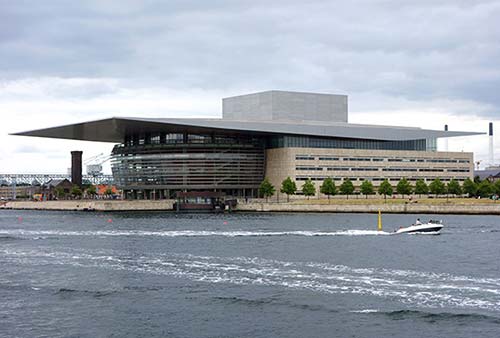
Stroll along the canal to the Royal Danish Theatre’s Playhouse and head left along the harborfront to a large plaza dotted with outdoor cafés and benches and views across the harbor. Then follow a delightful waterfront promenade to the modern fountain of Amaliehaven Park, immediately across the harbor from Copenhagen’s slick Opera House. The striking Opera House is bigger than it looks—of its 14 floors, five are below sea level. Completed in 2005 by Danish architect Henning Larsen, it was a $400 million gift to the nation from an oil-shipping magnate.
• A block inland (behind the fountain) is the orderly...
21 Amalienborg Palace and Square
Queen Margrethe II, who abdicated the throne in 2024, lives in the mansion to your immediate left as you enter the square from the harborside. The mansion across the street (on the right as you enter) is where her son, King Frederik X, lives with his wife Queen Mary—an Australian businesswoman—and their four children. (If the flag’s flying, the king is home.) The royal guesthouse palace is on the far left. And the palace on the far right is the Amalienborg Museum, which offers an intimate look at royal living (described on here).
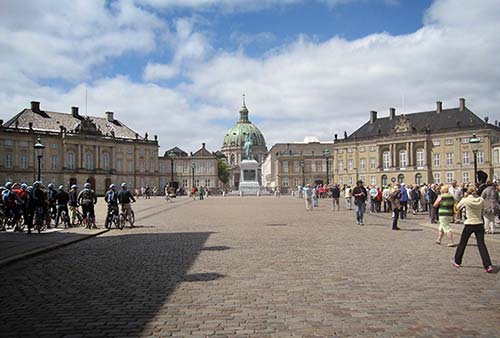
Though the guards change daily at noon, they do it with royal fanfare only when the king is in residence (see here for details). The royal guard often has a police escort when it marches through town on special occasions—leading locals to joke that theirs is “the only army in the world that needs police protection.”
The equestrian statue of Frederik V is a reminder that this square was the centerpiece of a planned town he envisioned in 1750. It was named for him—Frederikstaden. During the 18th century, Denmark’s population grew and the country thrived (as trade flourished and its neutrality kept it out of the costly wars impoverishing much of Europe). Frederikstaden, with its strong architectural harmony, was designed as a luxury neighborhood for the city’s business elite. Nobility and other big shots moved in, but the king came here only after his other palace burned down in a 1794 fire.
Just inland, the striking Frederikskirke—better known as the Marble Church—was designed to fit this ritzy new quarter. If it’s open, step inside to bask in its vast, serene, Pantheon-esque atmosphere (free, Mon-Thu and Sat 10:00-17:00, Fri and Sun from 12:30; dome climb-50 DKK, daily at 13:00 except during services, concerts, or bad weather).
• If you’re done, you can hop on the Metro (by the Marble Church, at the handy Marmorkirken stop) or return to the palace square and follow Amaliegade, which leads two blocks north to...
Kastellet Park
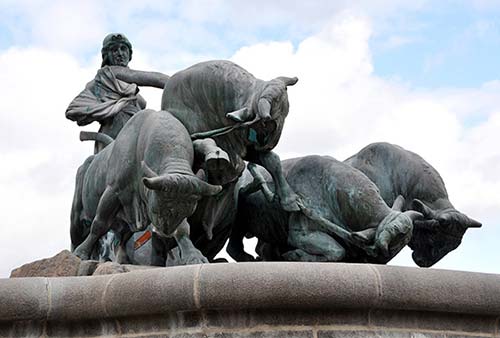
In this park, you’ll find some worthwhile sightseeing (see the “Copenhagen” map on here). The 1908 Gefion Fountain illustrates the myth of the goddess who was given one night to carve a hunk out of Sweden to make into Denmark’s main island, Sjælland (or “Zealand” in English), which you’re on. Gefion transformed her four sons into oxen to do the job, and the chunk she removed from Sweden is supposedly Vänern, Sweden’s largest lake. If you look at a map showing Sweden and Denmark, the island and the lake are, in fact, roughly the same shape. Next to the fountain is an Anglican church built of flint.
• Climb up the stairs by the fountain and continue along the top of the rampart about five minutes to reach the harborfront site of the overrated, overfondled, and overphotographed symbol of Copenhagen, Den Lille Havfrue, or...
22 The Little Mermaid
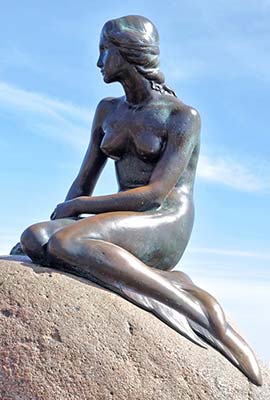
The Little Mermaid statue was a gift to the city of Copenhagen in 1909 from brewing magnate Carl Jacobsen (whose art collection forms the basis of the Ny Carlsberg Glyptotek). Inspired by a ballet performance of Andersen’s story, Jacobsen hired the young sculptor Edvard Eriksen to immortalize the mermaid as a statue. Eriksen used his wife Eline as the model. The statue sat unappreciated for 40 years until Danny Kaye sang “Wonderful Copenhagen” in the 1952 movie Hans Christian Andersen, and the tourist board decided to use the mermaid as a marketing symbol for the city. For the non-Disneyfied Little Mermaid story—and insights into Hans Christian Andersen—see the sidebar.
• This is the end of our extended wonderful, wonderful Copenhagen City Walk. From here you can get back downtown on foot, by taxi, or on bus #27 (catch it along Indiakaj, a two-minute walk north).
Copenhagen Harbor Boat Tour
For a do-it-yourself harbor cruise, ride Harbor Bus (Havnebus) boat #991/#992 and admire some of Copenhagen’s most stunning architecture—making it a point to have a meal at Refshaleøen. Hop on and off and explore any of the sights along the route, as long as your ticket is still valid (see here for ticket details). A round-trip without disembarking lasts 2.5 hours. Boats come about every 30 minutes until 18:00 (Sat-Sun until 19:40). To trace the harbor boat route, see the “Copenhagen” map, earlier.
Planning Tips: If you plan to visit CopenHill, it’s easiest by bike from Refshaleøen (each boat can take up to 8 bikes). You can also easily get to and from Refshaleøen via bus #2A, by bike (15 minutes from the city center), or from any of the harbor boat stops.
“Far out in the ocean, where the water is as blue as a cornflower, as clear as crystal, and very, very deep...” there lived a young mermaid. So begins one of Danish author Hans Christian Andersen’s best-known stories.
It goes like this: One day, a young mermaid spies a passing ship and falls in love with a handsome prince. The ship is wrecked in a storm, and she saves the prince’s life. To be with the prince, the mermaid asks a sea witch to give her human legs. In exchange, she agrees to give up her voice and the chance of ever returning to the sea. And, the witch tells her, if the prince doesn’t marry her, she will immediately die heartbroken and without an immortal soul. The mermaid agrees, and her fish tail becomes a pair of beautiful but painful legs. She woos the prince—who loves her in return—but he eventually marries another. Heartbroken, the mermaid prepares to die. She’s given one last chance to save herself: She must kill the prince on his wedding night. She sneaks into the bedchamber with a knife...but can’t bear to kill the man she loves. The mermaid throws herself into the sea to die. Suddenly, she’s miraculously carried up by the mermaids of the air, who give her an immortal soul as a reward for her long-suffering love.
The tale of unrequited love mirrors Andersen’s own sad love life. He had two major crushes—one of them for the famous opera singer Jenny Lind—but he was turned down both times, and he never married. He had plenty of interest in sex but likely died a virgin. He had close relationships with women but stayed single, had time to travel and write, and maintained a childlike wonder about the world to his dying days.
To learn more about Andersen, you can visit his namesake museum in Odense, or read the sidebar on here.
Orientkaj
Start by riding the Metro line 4 to the end of the line, Orientkaj. Exit the Metro, cross the street, and hop on harbor boat #991.
• Ride one stop to...
Refshaleøen
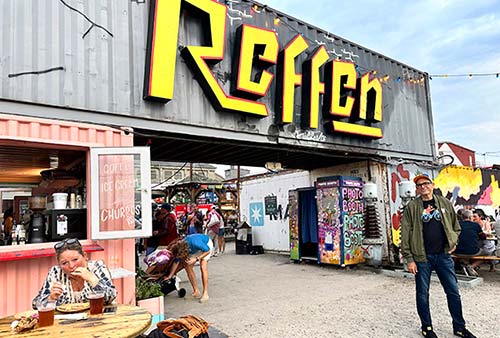
On a peninsula northeast of Christianshavn is Refshaleøen, one of Copenhagen’s most vibrant and still-evolving areas—with a global food market called Reffen, a brewery, edgy street art, a contemporary art center, a nightclub, and more. Plan to arrive for dinner, when the scene and food market are the liveliest, or visit earlier for a more mellow vibe and to visit the art gallery.
This industrial area was the home of Denmark’s largest shipyard but was largely abandoned in the mid-1990s when operator Burmeister & Wain folded. These days, a vibe of sustainability and eco-friendliness has taken over. The former workshops and warehouses host galleries, cafés, and shops, and big open areas accommodate concerts and events such as CopenHell, Denmark’s largest rock-and-metal festival.
A map posted near the boat dock points out key sights to explore (or use the mapping app on your phone). To get straight to Reffen, bear left from the boat dock and cross the rust-colored bridge. Otherwise, follow the path straight ahead and keep an eye out for the other attractions:
Reffen Street Food: Shipping containers host myriad food stalls serving dishes from around the globe—Kurdish, Filipino, Pakistani, and many more—along with various wine and cocktail stalls, with lots of picnic-type seating scattered among the options. Mikkeller Brewery supplies more than a dozen beers on tap (Reffen open April-Sept Sun-Thu 11:30-20:30, Fri-Sat until 21:30, bars open daily 11:00-21:30, closed Oct-March; +45 33 93 07 60, https://reffen.dk).
Lille Bakery: Head here for organic breads and breakfast and lunch options that vary according to what’s in season (closed Mon-Tue, www.lillegrocery.com).
La Banchina: From this tiny blue building, you can purchase organic coffee, pastries, wine, and farm-to-table nibbles. There’s also a sauna and swimming area with a floating pier for sunning (weather-dependent, generally 8:00-22:00 in summer, until 16:00 in winter; sauna—800 DKK, book online in advance, www.labanchina.dk/sauna).
Copenhagen Contemporary: In a former welding workshop, this modern art center hosts large-scale installations (120 DKK, Wed-Sun 11:00-18:00, Thu until 21:00, closed Mon-Tue, https://copenhagencontemporary.org).
CopenHill: This innovative artificial ski slope/sports facility is wrapped around a waste-to-energy incinerator plant that annually turns 530 tons of waste into electricity and central heating for Copenhageners. The ski hill has three stages—the lower two are beginner level, accessed by a magic carpet (human conveyor belt), and the top one is intermediate, accessed by a T-bar. Nonskiers can visit the 280-foot summit restaurant and fitness center (skiing-150 DKK/hour plus equipment rental, free to hike, 5 minutes from Refshaleøen by bike, www.copenhill.dk).
• When you’re ready to leave, hop on harbor boat #992. As you sail toward the next stop, take in the view of CopenHill on the opposite shore.
Nordre Toldbod
This area is home to the headquarters of Maersk, Denmark’s giant shipping company. But most people come here to see The Little Mermaid statue. You can also visit the Museum of Danish Resistance, and between the two, walk through the 17th-century defense complex, Kastellet. For more on this area, see the end of my Copenhagen City Walk, earlier.
Holmen Nord
The harbor boat may stop here (or it may be closed due to shipping activity).
Operaen
This is the stop for Copenhagen’s Royal Danish Opera House, with its metal grid front and an enormous flat roof that extends beyond the building. With 24-carat gold leaf adorning the ceiling of its main auditorium and five stages connected to its main stage to easily move sets in and out, it’s said to be one of the most expensive opera houses ever built. Despite the glitz, the building has been compared to an alien spaceship—and the architect himself called it his greatest failure, claiming it looked like a giant toaster.
Nyhavn
Across from the Opera House at the harbor-bus stop, the copper-clad Royal Danish Theatre’s Playhouse building (Skuespilhuset) was built in 2007 with sustainability in mind. It uses seawater for cooling and repurposes excess heat. Roughly 40 percent of the building projects over the water, with a wide promenade for strolling. The pyramid-shaped buildings across the water on Paper Island are among Copenhagen’s most expensive, with phenomenal views of the city.
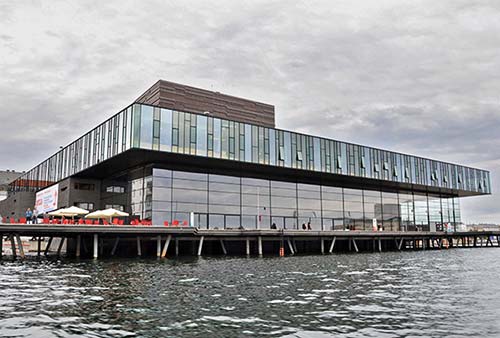
Knippelsbro
Hop out here for Christiania and Our Savior’s Church (see here).
Det Konelige Bibliotek
The giant, glittery black building is the Royal Library, known as the Black Diamond. The blocky, blue building, known as BLOX, was built in 2018 and hosts the Danish Architecture Center. This is also the closest stop for the National Museum and Christiansborg Palace.
• If you’re enjoying the ride, you can keep riding the boat for a few more stops, past the Harbor Baths and Islands Brygge and, and stay on to come back in the other direction. Otherwise, this is a good place to disembark and explore the city by land.
Sights in Copenhagen
▲Museum of Copenhagen (Københavns Museum)
▲▲▲National Museum (Nationalmuseet)
▲National Museum’s Victorian Apartment (Klunkehjemmet)
▲▲Christiansborg Palace (Christiansborg Slot)
▲▲Thorvaldsen’s Museum (Thorvaldsens Museum)
Royal Library (Kongelige Bibliotek)
Danish Jewish Museum (Dansk Jødisk Museum)
▲Amalienborg Museum (Amalienborgmuseet)
Amalienborg Palace Changing of the Guard
▲Museum of Danish Resistance (Frihedsmuseet)
▲▲▲Rosenborg Castle (Rosenborg Slot) and Treasury
▲National Gallery of Denmark (Statens Museum for Kunst)
▲Our Savior’s Church (Vor Frelsers Kirke)
▲▲▲Christiania
Open-Air Folk Museum (Frilandsmuseet)
Bakken Amusement Park (Bakken Forlystelsespark)
NEAR THE TRAIN STATION
Copenhagen’s great Central Station, the Hovedbanegården, is an interesting mesh of Scandinavian culture and transportation efficiency. From the train station, delightful sights fan out into the old city. The following attractions are listed roughly in order from the train station to Slotsholmen Island.
▲▲▲Tivoli Gardens
Copenhagen’s grand amusement park—opened in 1843—is 20 acres, 110,000 lanterns, and countless ice-cream cones of fun. You pay one admission price and find yourself lost in a wonderland of rides, restaurants, games, marching bands, roulette wheels, and funny mirrors. A roller coaster screams through the middle of a tranquil Asian food court, and the Small World-inspired Den Flyvende Kuffert ride floats through Hans Christian Andersen fairy tales. It’s a children’s fantasyland midday, but it becomes more adult-oriented later on. With or without kids, this place is a true magic kingdom. Tivoli doesn’t try to be Disney. It’s wonderfully and happily Danish. (Many locals appreciate the lovingly tended gardens.) I find it worth the admission just to see Danes—young and old—at play.
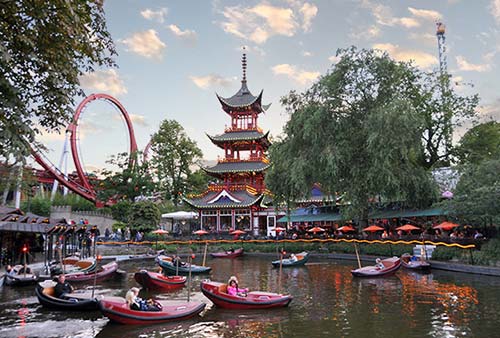
As you stroll the grounds, imagine the place in the mid-1800s, when it was new. Built on the site of the old town fortifications (today’s lake was part of the old moat), Tivoli was an attempt to introduce provincial Danes to the world (for example, with the Asian Pavilion) and to bring people of all classes together.
Cost: 155 DKK, 70 DKK for kids under 8, free for kids under 3; rides are extra. Ride tickets are 50-90 DKK per ride (cheaper with various multiride passes). To leave and come back later, you’ll need to exit through the food hall (facing the train station) and get a re-entry stamp.
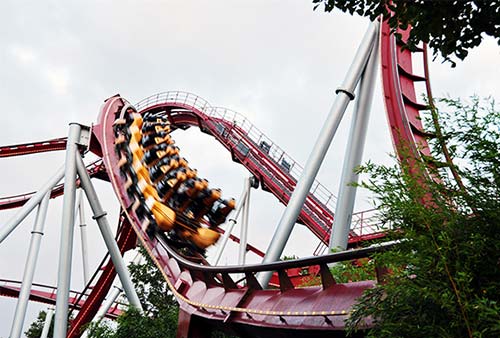
Hours: April-mid-Sept Mon-Thu 11:00-22:00 or 23:00, Fri-Sat until 24:00. In winter, Tivoli opens daily 11:00-22:00 from mid-Oct to early Nov for Halloween, and from mid-Nov to New Year’s Day for a Christmas market with gløgg (hot spiced wine) and ice-skating on Tivoli Lake. Dress warmly for chilly evenings any time of year. There are lockers by the main entrance, the Glyptotek exit, and under the roller coaster.
Information: +45 33 15 10 01, www.tivoli.dk.
Getting There: Tivoli is across Bernstoffsgade from the train station. If you’re catching a late train, this is the place to spend your last Copenhagen hours.
Entertainment at Tivoli: Events are listed on the website, Tivoli app, or just inside the main entrance in the park. Take a moment to plan your entertainment for the evening. Most events are between 15:00 and 23:00; the 19:30 concert in the concert hall or in the smaller Glass Hall can be as little as 150 DKK or more than 1,000 DKK, depending on the performer (box office +45 33 15 10 01). If the Tivoli Symphony is playing, it’s worth the ticket price. The ticket box office is outside, just to the left of the main entrance (daily 10:00-20:00; concert tickets include Tivoli admission).
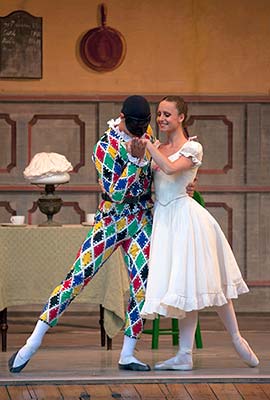
Free concerts, pantomime theater, ballet, acrobats, puppets, and other shows pop up all over the park, and a well-organized visitor can enjoy an exciting evening of entertainment without spending a single krone beyond the entry fee. Friday evenings feature a rock or pop show at 22:00 (usually free, often with big-name Danish performers). People gather around the lake nightly 45 minutes before closing time for the “Tivoli Illuminations.” Fireworks blast each summer Saturday just before closing. The park is particularly romantic at dusk, when the lights go on.
Eating at Tivoli: For many, dining is part of their Tivoli experience. No one gets a bargain, but a meal here can be part of the fun. There are more than 60 restaurants, ranging from hotdog stands to fine dining.
$$$ and $$$$ Finer Dining: A tradition for locals, Grøften feels like a Danish beer garden, with moderate prices and a very Danish menu (fish and open-face sandwiches). Kilden Restaurant is pricier, with fancier cuisine, a woody interior, and charming garden tables. And for more upscale dining, consider the Nimb restaurants, in the big Taj Mahal-like pavilion near the entrance facing the train station: Nimb Brasserie serves rustic French classics and Fru Nimb offers a large selection of tasty open-face sandwiches in a garden setting.
$$ and $$$ Simpler Dining: In a fun beer garden with lakeside ambience, Søcaféen serves traditional open-face sandwiches and main courses. Mazzoli’s Caffé & Trattoria, in a circular building near the lake, serves classic Italian fare and pizza. Gasoline Burger is a local favorite for old-school burgers. Wagamama, the pan-Asian slurp-a-thon from the UK, serves healthy noodle dishes (at the far back side of the park, also possible to enter from outside). For cheaper fare, look for a pølse (sausage) stand or bring in a picnic.
I like the Tivoli Food Hall, which serves both Tivoli and the train station (you can enter without a ticket) with 15 self-service places dishing up an array of local and international foods (daily 11:00-22:00, eat at their communal terrace or stools inside).
Sweets: Cakenhagen serves classic Danish cakes and pastries that you can wash down with a cup of tea—or champagne. For a pop of sugar, look for Lakrids by Bülow, and try the licorice soft-serve ice cream topped with licorice sauce.
▲City Hall (Rådhus)
This city landmark, between the train station/Tivoli and the Strøget, is free and open to the public (and has a public WC). You can wander throughout the building and into the peaceful garden out back. It also offers guided tours and trips up its 345-foot-tall tower.
Cost and Hours: Free to enter building, Mon-Fri 9:00-16:00, Sat 9:30-13:00 (when weddings are often going on), closed Sun. Guided English-language tours—65 DKK, 45 minutes, gets you into more private, official rooms; Mon-Fri at 13:00, Sat at 10:00. Tower—45 DKK, 300 steps for the best aerial view of Copenhagen, escorted climbs Mon-Fri at 11:00 and 14:00, Sat at 12:00, closed Sun, +45 33 66 33 66, www.kk.dk/brug-byen/raadhuset.
Visiting City Hall: It’s draped, inside and out, in Danish symbolism. Standing over the door is the city’s founder, Bishop Absalon (c. 1128-1201)—bishop, soldier, and foreign-policy wonk. He was King Valdemar I’s right-hand man. In Copenhagen, he drove out pirates and built a fort to guard the harbor, turning a miserable fishing village into a humming Baltic seaport. The polar bears climbing on the rooftop symbolize the giant Danish territory of Greenland. Six night watchmen flank the city’s gold-and-green seal under the Danish flag.
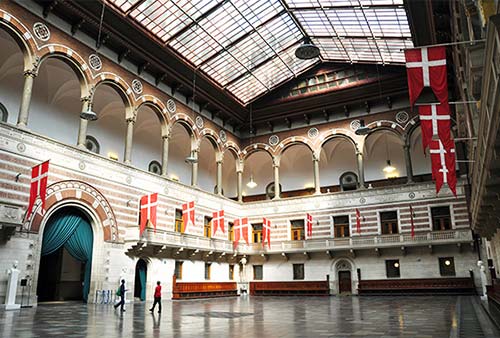
Enjoy the Danish ideal of an open society by popping inside. The info desk (on the left as you enter) has racks of tourist information (city maps and other brochures), fun local souvenirs, and wedding flowers for rent. The building and its huge tower were inspired by the City Hall in Siena, Italy (with the necessary bad-weather addition of a glass roof over the inner courtyard). Enormous functions fill this grand hall (the iron grate in the center of the floor is an elevator for bringing up 1,200 chairs), while the marble busts of four illustrious local boys—fairy-tale writer Hans Christian Andersen, sculptor Bertel Thorvaldsen, physicist Niels Bohr, and the building’s architect, Martin Nyrop—look on. Underneath the floor are national archives dating back to 1275, popular with Danes researching their family roots.
As you leave, pop into the amazing clock opposite the info desk. Jens Olsen’s World Clock, built from 1943 to 1955, was the mother of all astronomical clocks in precision and function. And it came with something new: tracking the exact time across the world’s time zones. One of its gears does a complete rotation only every 25,753 years.
▲▲Ny Carlsberg Glyptotek
This impressive art gallery is an example of what beer money can do. Brewer Carl Jacobsen was an avid collector and patron of the arts. (He donated The Little Mermaid statue to the city.) His museum, named after his popular brewery, focuses on artifacts from the ancient world and Danish and French art from the 19th century. The next time you sip a Carlsberg beer, drink a toast to Carl Jacobsen and his marvelous and beautifully displayed collection. Skål!
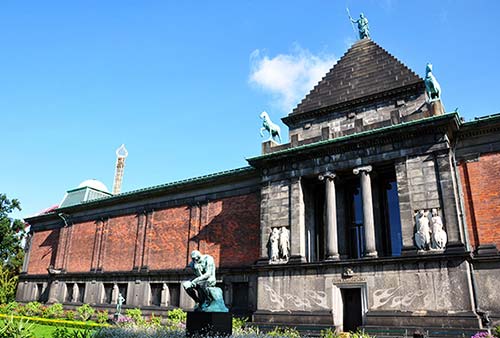
Cost and Hours: 125 DKK; open Tue-Sun 10:00-17:00, Thu until 21:00, closed Mon; behind Tivoli at Dantes Plads 7, +45 33 41 81 41, www.glyptoteket.com. It has a classy $$$ cafeteria under palms, as well as a rooftop terrace with snacks, drinks, and city views. Pick up a floor plan as you enter to help navigate the confusing layout.
Visiting the Museum: Start in the soothing winter garden in the courtyard with marble gods under the palm leaves and a glass dome. The museum’s designers, figuring Danes would be more interested in a lush garden than in classical art, used this wonderful space as leafy bait to cleverly introduce locals to a few Greek and Roman statues. (It works for tourists, too.)
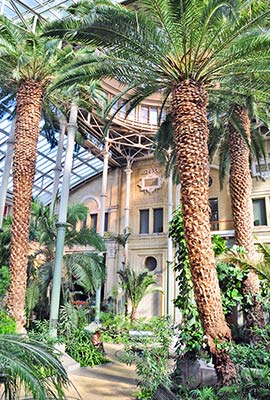
Ground-floor rooms branching out from the courtyard cover the ancient world and feature the art of Egypt (mummy coffins, sarcophagi, and a 5,000-year-old hippo), Greece (red-and-black painted vases, statues), the Etruscan world (said to be the best collection outside Italy), and Rome (grittily realistic statues and portrait busts).
Behind the garden café is a delightful collection of French and Danish sculpture from 1800-1920. Carl Jacobsen enthusiastically bought these pieces for what he saw as an expressiveness and virtuosity not achieved since antiquity.
Then, climb the stairs in the main building. One flight up are Danish paintings; the top floor features French paintings.
The collection of Danish Golden Age paintings (19th century) focuses on nature and the landscape, international influences, the artist and model, and historical themes. These peaceful images give no hint that the country was recovering from the Napoleonic Wars and national bankruptcy. Artists helped prop up Denmark’s self-image by looking to the more distant past. Mother Denmark, a monumental painting (1851) by Elisabeth Jerichau-Baumann, is an intensely romanticized view of national identity, with a confident female warrior clutching a Danish flag in one hand and a Viking sword in the other. Johan Thomas Lundbye’s Zealand Landscape (1840), in a similar vein, embraces Denmark’s past in a panoramic view that sweeps from ancient burial mounds to a medieval castle.
In the French collection (1800-1925) on the top floor, you’ll find canvases by French masters from Corot, Courbet, and Manet, to Gauguin, Monet, and Renoir. You’ll see a very early Picasso, a Van Gogh from his first days in Paris, and some unusual and not often seen Gauguin wood carvings on Tahitian themes.
Outside, one of the original Thinker sculptures by Rodin (wondering how to scale the Tivoli fence?) is in the museum’s backyard.
▲Museum of Copenhagen (Københavns Museum)
This museum offers an entertaining and creative telling of the story of Copenhagen, from its origins (including Viking age artifacts) to contemporary culture and today’s planning challenges. The ground floor hosts temporary exhibits, while the first and second floors hold the permanent collection, broken into time periods and themes: A Capital Arises (12000 BC-1660), Fortified City (1660-1850), Modern City (1850-1950), and Debating the City (1950-present), where you’ll see the Danish determination to create a “livable and sustainable city.” The building itself, which cared for the local homeless a century ago and is evidence of the Danish social heart, is described in an exhibit on the second floor. In the Copenhagen Panorama exhibit, a huge city model traces Copenhagen’s growth, illuminating landmarks when you push corresponding buttons.
Cost and Hours: 95-DKK combo-ticket with Thorvaldsen’s Museum, good once per museum for 48 hours, Wed free; daily 9:00-18:00, Thu until 21:00; café, kitty-corner to the National Museum at Stormgade 18, +45 21 76 43 66, https://cphmuseum.kk.dk/en. On weekends your ticket grants you access to their nearby archaeology workshop, where you can work with archaeologists to clean and examine finds from city excavations (Sat-Sun 12:00-16:00).
▲▲▲National Museum (Nationalmuseet)
Focus on this museum’s excellent and curiously enjoyable Danish collection, which traces this civilization from its ancient beginnings. Its prehistoric collection is the best of its kind in Scandinavia. Exhibits are laid out chronologically and are eloquently described in English.
Cost and Hours: 120 DKK; daily 10:00-18:00, Oct-May Tue-Sun 10:00-17:00, closed Mon; free lockers, enter at Ny Vestergade 10, +45 41 20 68 50, www.natmus.dk. The $$ café overlooking the entry hall serves coffee, pastries, and lunch.
Tours: Guide Richard Karpen leads private tours of the museum (price depends on number of participants, May-Sept, +45 91 61 95 02, www.copenhagenwalks.com, copenhagenwalks@yahoo.com). The museum offers free one-hour tours in English on weekends from mid-August through October (reservations required). Or download the museum’s free app to follow a one-hour tour that tells 10 stories centered on a museum object.
Visiting the Museum: Pick up the museum map as you enter, and head for the Danish history exhibit. It fills three floors, from the bottom up: prehistory, the Middle Ages and Renaissance, and modern times (1660-2000).
Danish Prehistory: Start before history did, in the Danish prehistory exhibit (on the right side of the main entrance hall). Follow the room numbers in order, working counterclockwise around the courtyard and through the millennia.
In the Stone Age section, you’ll see primitive tools and still-clothed skeletons of Scandinavia’s reindeer hunters. The oak coffins were originally covered by burial mounds (called “barrows”). People put valuable items into coffins with the dead—for example, a folding chair, which, back then, was a real status symbol. In the farming section, ogle the ceremonial axes and amber necklaces.
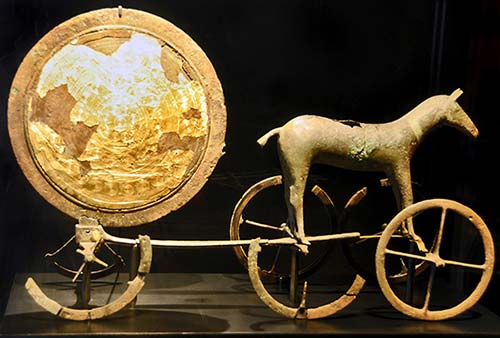
The Bronze Age galleries feature many swords crafted from the new metal. The small bronze “Chariot of the Sun”—depicting a horse pulling the sun across the sky—likely had religious significance for early Scandinavians (whose descendants continue to celebrate the solstice with fervor). In the same room are those iconic horned helmets. Contrary to popular belief (and countless tourist shops), these helmets were not worn by the Vikings but by their predecessors—for ceremonial purposes, centuries earlier. In the next room are huge cases filled with still-playable lur horns (see here). Another room shows off a collection of well-translated rune stones proclaiming heroic deeds.
This leads to the Iron Age and an object that’s neither Iron nor Danish: the 2,000-year-old Gundestrup Cauldron of art-textbook fame. This 20-pound, soup-kitchen-size bowl made of silver was found in a Danish bog, but its symbolism suggests it was originally from either Thrace (in northeast Greece) or Celtic Ireland. On the sides, hunters slay bulls, and gods cavort with stags, horses, dogs, and dragons. It’s both mysterious and fascinating.
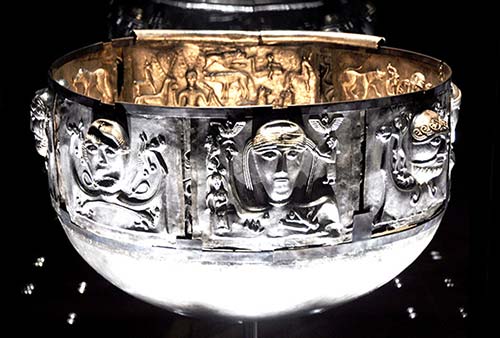
Prehistoric Danes were fascinated by bogs. To make iron, you need ore—and Denmark’s many bogs provided that critical material in abundance, leading people to believe that the gods dwelled there. These Danes appeased the gods by sacrificing valuable items (and even people) into bogs. Fortunately for modern archaeologists, bogs happen to be an ideal environment for preserving fragile objects. One bog alone—the Nydam bog—has yielded thousands of items, including three whole ships.
No longer bogged down in prehistory, the people of Scandinavia came into contact with Roman civilization. At about this time, the Viking culture rose; you’ll see the remains of an old warship. The Vikings, so feared in most of Europe, are still thought of fondly here in their homeland. You’ll notice the descriptions straining to defend them: Sure, they’d pillage, rape, and plunder. But they also founded thriving, wealthy, and cultured trade towns. Love the Vikings or hate them, it’s impossible to deny their massive reach—Norse Vikings even carved runes into the walls of the Hagia Sophia church (in today’s Istanbul).
Middle Ages and Renaissance: Next, go upstairs and follow signs to Middle Ages and Renaissance. Use your map to navigate to Room 101 to start this section. You’ll walk through the Middle Ages, where you’ll find lots of bits and pieces of old churches, such as golden altars and aquamaniles, pitchers used for ritual hand-washing. The Dagmar Cross, with colorful enamel paintings, is the prototype for a popular form of crucifix worn by many Danes (Room 102, three-winged glass display case). Another cross in this case (the Roskilde Cross, studded with gemstones) was found inside the wooden head of Christ displayed high on the opposite wall. There are also exhibits on tools and trade, weapons, drinking horns, and fine, wood-carved winged altarpieces. Carry on to find a captivating room on the Norse settlers of Greenland, material on the Reformation, and an exhibit on everyday town life in the 16th and 17th centuries. The provocative Voices of the Colonies gallery weighs the consequences of Denmark’s colonial legacy.
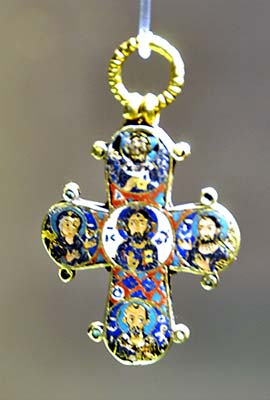
Modern Times: The next floor is my favorite part of the museum, and it’s well worth going room by room from 201 to 237 (use your map). The thoughtfully displayed and described collection takes you through the last few centuries, with historic toys and a slice-of-Danish-life gallery (1660-2000), where you’ll see everything from rifles and old bras to early jukeboxes. You’ll learn that the Danish golden age (which dominates most art museums in Denmark) captured the everyday pastoral beauty of the countryside, celebrated Denmark’s smallness and peace-loving nature, and mixed in some Nordic mythology. With industrialization came the labor movement and trade unions. After delving into the World Wars, baby boomers, and the creation of the postwar welfare state, you’ll come to the “Depressed Decade” of the 1980s, when Denmark suffered high unemployment.
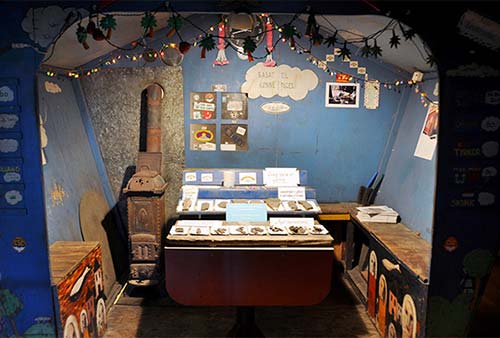
The Rest of the Museum: If you’re eager for more, your map shows that there’s plenty left to see: exhibits on the history of this building (the Prince’s Palace), a large ethnology collection, antiquities, coins and medallions, temporary exhibits, and a good children’s museum.
▲National Museum’s Victorian Apartment (Klunkehjemmet)
Just around the corner from the National Museum is an incredibly preserved Victorian apartment. The wealthy Christensen family managed to keep its plush living quarters a 19th-century time capsule until the granddaughters passed away in 1963. Since then, it’s been part of the National Museum, with all but two of its rooms looking just as they did in the late Victorian days.
Cost and Hours: 120 DKK, required one-hour tours leave from the National Museum reception desk (in English June-July Sat-Sun at 12:30; in Danish year-round Sat-Sun at 11:00, 12:00, and 14:00, printed English description available for Danish tours, +45 41 20 60 66).
ON SLOTSHOLMEN ISLAND
This island, where Copenhagen began in the 12th century, is a short walk from the train station and Tivoli, just across the bridge from the National Museum. It’s dominated by Christiansborg Palace and several other royal and governmental buildings. Note that my Copenhagen City Walk (earlier) cuts right through Slotsholmen and covers other landmarks on the island (see here).
▲▲Christiansborg Palace (Christiansborg Slot)
A complex of government buildings stands on the ruins of Copenhagen’s original 12th-century fortress: the parliament, Supreme Court, prime minister’s office, royal reception rooms, royal library, several museums, and royal stables. Although the current palace dates only from 1928, and the royal family moved out 200 years ago, this building—the sixth to stand here in 800 years—is rich with tradition and is still the place where King Frederik X impresses visiting dignitaries.
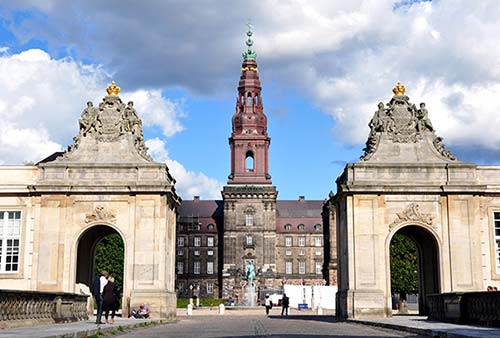
Four palace sights (the reception rooms, old castle ruins, stables, and kitchen) are open to the public, giving us commoners a glimpse of the royal life.
Cost and Hours: Reception rooms-105 DKK; castle ruins, stables, and kitchen-65 DKK each or 175-DKK combo-ticket for all four. Most sights are open daily 10:00-17:00 (except Oct-April, when they’re closed on Mon; may also close for royal events); stables and carriage museum open 13:30-16:00—longer hours possible in July-Aug; palace chapel open daily 10:00-18:00 in July; otherwise open Sun until 17:00, closed Mon-Sat; +45 33 92 64 92, www.christiansborg.dk.
Tours: The information-packed, hour-long English tours of the reception rooms are excellent (included with ticket, April-Sept daily at 15:00); also Great Hall tours at 13:00. Or download the free Useeum audioguide app.
Visiting the Palace: From the equestrian statue in front, go through the wooden door; the entrance to the ruins is in the corridor on the right, and the door to the reception rooms is out in the next courtyard, also on the right.
Royal Reception Rooms: While these don’t rank among Europe’s best palace rooms, they’re worth a look. As you wander the 22 rooms in a one-way route (wearing protective shoe covers), you’ll gain a good feel for Danish history, royalty, and politics and help polish the floor. Here are a few highlights:
Climb the King’s Staircase, visit the royal library, and enter the grand Great Hall, lined with boldly colorful (almost gaudy) tapestries (borrow the English guide to decipher the images). This dazzling set of 17 modern tapestries—Danish-designed but Gobelin-made in Paris—was given to Queen Margrethe on her 60th birthday in 2000. The tapestries celebrate 1,000 years of Danish history, from the Viking age to current times...and into the future. The Velvet Room is where royals privately greet VIP guests before big functions.
In the corner room on the left, don’t miss the family portrait of King Christian IX, which illustrates why he’s called the “father-in-law of Europe”—his children eventually became, or married into, royalty in Denmark, Russia, Greece, Britain, France, Germany, and Norway. The Tower Room holds tapestries woven in Aarhus in the 1920s—much more subdued than those in the Great Hall—illustrating scenes from Danish folk ballads.
In the Throne Room you’ll see the balcony where new monarchs are proclaimed (most recently King Frederik X in 2024). And at the end, in the Hall of Giants (where you take off your booties among heroic figures supporting the building), you’ll see a striking painting of Queen Margrethe from 2010 on her 70th birthday. The three playful lions, made of Norwegian silver, once guarded the throne and symbolize absolute power—long gone since 1849, when Denmark embraced the notion of a constitutional monarch.
Castle Ruins: An exhibit in the scant remains of the first fortress built by Bishop Absalon, the 12th-century founder of Copenhagen, lies under the palace. A long passage connects to another set of ruins, from the 14th-century Copenhagen Castle. There’s precious little to see, but it is, um, old and well described. A video covers more recent palace history.
Royal Stables and Carriages Museum: This facility is home to the horses that pull the royal carriage on festive days, as well as a collection of historic carriages. While they’re down from 250 horses to about a dozen, the royal stables are part of a strong tradition and, as the little video shows, will live on.
Royal Kitchen: After seeing lots of shiny copper pots and pans, you’ll get a behind-the-scenes look at a royal dinner party in the Great Hall in 2014 via a video with English subtitles.
▲▲Thorvaldsen’s Museum (Thorvaldsens Museum)
This museum tells the story and shows the monumental work of the great Danish Neoclassical sculptor Bertel Thorvaldsen (see sidebar). Considered the Italian Canova’s equal among Neoclassical sculptors, Thorvaldsen spent 40 years in Rome. He was lured home to Copenhagen with the promise of a fine museum to showcase his sculptures, which opened in the revolutionary year of 1848 as Denmark’s first public art gallery. Of the 500 or so sculptures Thorvaldsen completed in his life—including 90 major statues—this museum has most of them, in one form or another (the plaster model used to make the original or a copy done in marble or bronze).
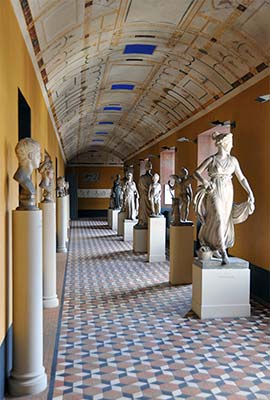
Cost and Hours: 95-DKK combo-ticket with Museum of Copenhagen—good once per museum for 48 hours, free on Wed; open Tue-Sun 10:00-17:00, closed Mon; located in Neoclassical building with colorful walls next to Christiansborg Palace, +45 21 68 75 68, www.thorvaldsensmuseum.dk.
Visiting the Museum: After buying your ticket, scan the QR code at the entrance to the Grand Hall for a statue-by-statue narration of the museum’s key works.
The ground floor displays Thorvaldsen’s statues. Start in the Great Hall, which was the original entryway of the museum. It’s filled with replicas of some of the artist’s biggest and grandest statues—national heroes who still stand in the prominent squares of their major cities (Munich, Warsaw, the Vatican, and others). Two great equestrian statues stare each other down from across the hall; while they both take the classic, self-assured pose of looking one way while pointing another, one of them (Jozef Poniatowski) is modeled after the ancient Roman general Marcus Aurelius, while the other (Bavaria’s Maximilian I) wears modern garb.
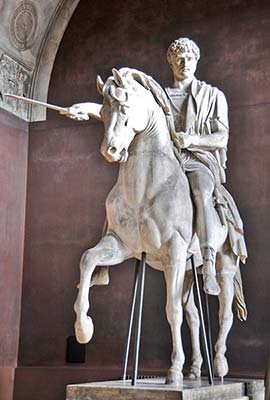
Then take a spin through the smaller rooms that ring the central courtyard. Each of these is dominated by one big work—mostly classical subjects drawn from mythology. At the far end of the building stand the plaster models for the iconic Risen Christ and the 12 apostles (the final marble versions stand in the Cathedral of Our Lady—see here). Peek into the central courtyard to see the planter-box tomb of Thorvaldsen himself (he died in 1844). Continue into the next row of rooms: In the far corner room look for Thorvaldsen’s (very flattering) self-portrait, leaning buffly against a partially finished sculpture.
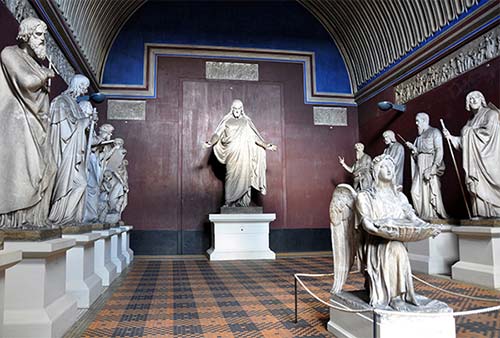
While Thorvaldsen’s much-adored sculpture is on the ground floors, the upstairs and the basement have a smattering of other smaller exhibits, including a collection of plaster casts (mostly ancient Roman statues that inspired Thorvaldsen), the artist’s personal possessions, and the private collection of paintings from which he drew inspiration.
Bertel Thorvaldsen was born, raised, educated, and buried in Copenhagen, but his most productive years were spent in Rome. There he soaked up the prevailing style of the time: Neoclassical. He studied ancient Greek and Roman statues, copying their balance, grace, and impassive beauty. The simple-but-noble style suited the patriotism of the era, and Thorvaldsen got rich off it. Public squares throughout Europe are dotted with his works, celebrating local rulers, patriots, and historical figures looking like Greek heroes or Roman conquerors.
In 1819, at the height of his fame and power, Thorvaldsen returned to Copenhagen. He was asked to decorate the most important parts of the recently bombed, newly rebuilt Cathedral of Our Lady: the main altar and nave. His Risen Christ on the altar (along with the 12 apostles lining the nave) became his most famous and reproduced work—without even realizing it, most people imagine the caring features of Thorvaldsen’s Christ when picturing what Jesus looked like.
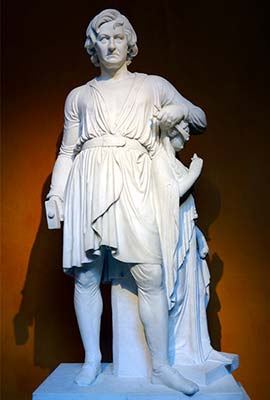
The prolific Thorvaldsen depicted a range of subjects. His grand statues of historical figures (Copernicus in Warsaw, Maximilian I in Munich) were intended for public squares. Portrait busts of his contemporaries were usually done in the style of Roman emperors. Thorvaldsen carved the Lion Monument, depicting a weeping lion, into a cliff in Luzern, Switzerland. He did religious statues, like the Risen Christ. Thorvaldsen’s most accessible works are from Greek mythology—The Three Graces, naked Jason with the Golden Fleece, or Ganymede crouching down to feed the eagle Jupiter.
Though many of his statues are of gleaming white marble, Thorvaldsen was not a chiseler of stone. Like Rodin and Canova, Thorvaldsen left the grunt work to others. He fashioned a life-size model in plaster, which could then be reproduced in marble or bronze by his assistants. Multiple copies were often made, even in his lifetime.
Thorvaldsen epitomized the Neoclassical style. His statues assume perfectly balanced poses—maybe even a bit stiff, say critics. They don’t flail their arms dramatically or emote passionately. As you look into their faces, they seem lost in thought, as though contemplating deep spiritual truths.
In Copenhagen, catch Thorvaldsen’s Risen Christ at the Cathedral of Our Lady, his portrait bust at City Hall, and the full range of his long career at Thorvaldsen’s Museum.
Royal Library (Kongelige Bibliotek)
Copenhagen’s Royal Library, dubbed the “Black Diamond” (Sorte Diamant), is a striking, modern building made of shiny black granite, leaning over the harbor at the edge of the palace complex. From the inviting lounge chairs on the Inner Harbor, you can ponder this stretch of harborfront, which serves as a showcase for architects. Inside, wander through the old and new sections, catch the fine view from the “G” level, read a magazine, and enjoy a classy—and pricey—lunch.
Cost and Hours: Free, special exhibits generally 75 DKK; summer Mon-Fri 9:00-19:00, Sat until 18:00; otherwise Mon-Fri 8:00-21:00, Sat 9:00-19:00; reading room hours vary, closed Sun year-round; +45 33 47 47 47, www.kb.dk. The library’s harborfront is a wonderful place to sip a drink.
Danish Jewish Museum (Dansk Jødisk Museum)
This small museum, with few actual artifacts, tells the story and struggles of the Jewish community in Denmark over 400 years. It’s a reminder that despite Nazi occupation in 1943, nearly 7,000 Danish Jews were ferried across the waves by fishermen to safety in neutral Sweden. Thanks to this heroic exodus, only 500 went to concentration camps and less than 100 died. It’s a quiet and thought-provoking exhibit exploring the trauma of that community through the ages through the eyes of a Jewish person.
Cost and Hours: 100 DKK; summer Tue-Sun 10:00-17:00, closed Mon; Sept-May from 11:00 and closed Mon-Tue; behind Royal Library at Proviantpassagen 6—enter from the courtyard behind the red-brick, ivy-covered building, +45 33 11 22 18, www.jewmus.dk.
NEAR THE STRØGET
Round Tower (Rundetaarn)
Built in 1642 by Christian IV, the tower connects a church, library, and observatory (the oldest functioning observatory in Europe) with a ramp that spirals up to a fine view of Copenhagen (though the view from atop Our Savior’s Church is better). Notice the tower’s mix of red and yellow bricks; the colors are meant to convey that this is a royal structure.
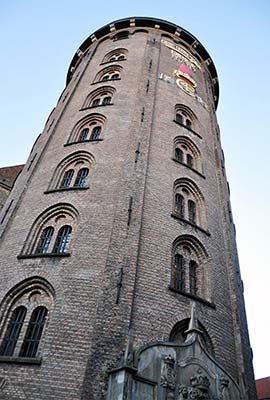
Cost and Hours: 40 DKK, nothing to see inside but the ramp and the view; tower—daily 10:00-20:00, Oct-March until 18:00; www.rundetaarn.dk; just off the Strøget on Købmagergade.
Nearby: Near the Round Tower, on Skindergade, is an always-open old courtyard that offers a rare peek at the half-timbered architecture of the city long ago. For location, see the “Copenhagen City Walk” map, earlier.
AMALIENBORG PALACE AND NEARBY
For more information on this palace and nearby attractions, including the famous Little Mermaid statue, see the end of my Copenhagen City Walk, earlier.
▲Amalienborg Museum (Amalienborgmuseet)
While King Frederik X lives quite privately in one of the four mansions that make up the palace complex, another mansion is open to the public. It displays the private studies of the last four kings of the House of Glucksborg, who ruled from 1863 to 1972 (the immediate predecessors of Frederik’s mother, Margrethe, who was queen for 52 years). While it’s a short visit—you’ll see six to eight rooms on each of two floors—it affords an intimate and unique peek into Denmark’s royal family.
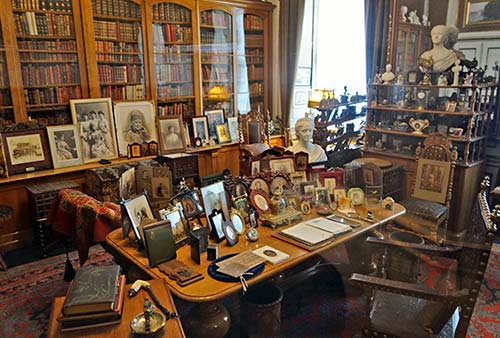
Cost and Hours: 120 DKK, 200-DKK combo-ticket includes Rosenborg Palace; daily 10:00-17:00, until 16:00 and closed Mon off-season; with your back to the harbor, entrance is at the far end of the square on the right; +45 33 15 32 86, www.dkks.dk.
Visiting the Palace: On the first floor, get an intimate peek at several private studies. Each feels particularly lived-in—with cluttered pipe collections and bookcases jammed with family pictures—because they were. It’s easy to imagine these blue-blooded folks just hanging out here, even today. The earliest study, Frederik VIII’s (c. 1869), feels older and more “royal”—with Renaissance gilded walls, heavy drapes, and a polar bear rug.
Don’t miss the Fabergé Chamber, a dazzling reminder from czarist Russia that the Danish royal family was very well connected. A small chart room shows the thousand-year lineage of the royal family—the oldest in Europe—from Gorm the Old (958 in Viking times) to today.
On the second floor, you’ll see the Gothic library designed for dowager Queen Caroline Amalie, the cheery gala hall (the palace’s largest room)—with reliefs by Bertel Thorvaldsen just below the ceiling—and a hall gleaming with large gilt-bronze table decorations.
Amalienborg Palace Changing of the Guard
This noontime event is boring in the summer, when the king is not in residence—the guards just change places. (This goes on for quite a long time—no need to rush here at the stroke of noon, or to crowd in during the first few minutes; you’ll have plenty of good photo ops.) If the king’s in town (indicated by a flag flying above his home), the changing of the guard is accompanied by a military band.
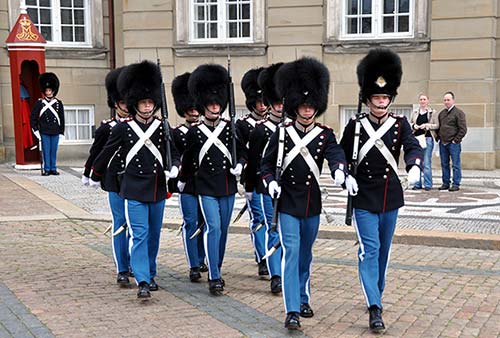
▲Museum of Danish Resistance (Frihedsmuseet)
On April 9, 1940, Hitler’s Nazis violated a peace treaty and invaded Denmark, overrunning the tiny nation in mere hours. This museum tells what happened next: the compelling story of Denmark’s heroic Nazi-resistance struggle (1940-1945). You’ll go underground and enter the occupation years in Denmark, learning how it affected the Danish population and how the resistance movement began. First-hand accounts from five characters detail the difficult choices and dilemmas they faced. Interactive exhibits let you print illegal magazines, tap phone conversations, and decode German messages. The artifacts and video clips are interesting, but while I’ve never met a Nazi resistance museum I didn’t like, this one (which replaced a wonderful earlier iteration, which burned in a fire) tries too hard to creatively tell a story at the expense of actually teaching and showing artifacts.
Cost and Hours: 110 DKK; daily 10:00-17:00, Sept-April closed Mon, last entrance 1.5 hours before closing, café; on Churchillparken between Amalienborg Palace and The Little Mermaid, at Esplanaden 13; 10-minute walk from Østerport S-tog or Metro stations, or take Harbor Bus boat #991 or #992 to Nordre Toldbod; +45 41 20 60 80, https://en.natmus.dk.
Design Museum Denmark
Housed in the Rococo building of Denmark’s first public hospital, this museum hosts rotating themed exhibits of Danish and international industrial design, including textiles, furniture, household items, and artwork. The collection encompasses historical, contemporary, and future-focused design.
Cost and Hours: 130 DKK; Tue-Sun 10:00-18:00, Thu until 20:00, closed Mon, last entry 45 minutes before closing; café with garden seating, a 5-minute walk from the Museum of Danish Resistance at Bredgade 68, +45 33 18 5656, www.designmuseum.dk.
ROSENBORG CASTLE AND NEARBY
▲▲▲Rosenborg Castle (Rosenborg Slot) and Treasury
This finely furnished Dutch Renaissance-style castle was built by King Christian IV in the early 1600s as a summer residence. Rosenborg was his favorite castle and where he chose to die. Open to the public since 1838, it houses the Danish crown jewels and 500 years of royal knickknacks. While the old palace interior is a bit dark and not as immediately impressive as many of Europe’s later Baroque masterpieces, it has a certain lived-in charm. It oozes the personality of the fascinating Christian IV and has one of the finest treasury collections in Europe.
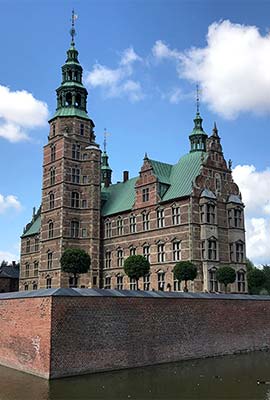
Cost and Hours: 130 DKK, 200-DKK combo-ticket includes Amalienborg Museum; open daily 10:00-17:00; Nov-March Tue-Sun 10:00-16:00, closed Mon; mandatory lockers; Metro or S-tog: Nørreport, then 5-minute walk on Østervoldgade, +45 33 15 32 86, www.dkks.dk.
Reservations Recommended: Book your timed-entry ticket online in advance to avoid the often long ticket line (even with a Copenhagen Card).
Tours: For a private tour, hire guide Richard Karpen (May-Sept, www.copenhagenwalks.com). Or take the following self-guided tour that I’ve woven together with Richard’s help from the highlights of his walk. You can also connect to the palace’s free Wi-Fi to follow a step-by-step tour of the palace highlights using your mobile device.
 Self-Guided Tour: Buy your ticket (or show your pass) to get your entry time, check your bag, and join the line. You must start in the castle and tour the treasury after that. You’ll tour the ground floor room by room, then climb to the third floor for the big throne room. After a quick sweep of the middle floor, finish in the basement vault (enter from outside) for the jewels.
• Begin the tour on the palace’s ground floor (turn right as you enter), in the Winter Room.
Ground Floor: Here in the wood-paneled Winter Room, all eyes were on King Christian IV. Today, your eyes should be on him, too. Take a close look at his marble bust by the fireplace. Check this guy out—fashionable braid, hard drinker, hard lover, energetic statesman, and warrior king. Christian IV was dynamism in the flesh, wearing a toga: a true Renaissance guy. During his reign, Copenhagen doubled in size. You’re surrounded by Dutch paintings (the Dutch had a huge influence on 17th-century Denmark). In the case, the golden astronomical clock—with musical works and moving figures—did everything you can imagine. Flanking the fireplace (opposite where you entered), beneath the windows, look for the panels in the tile floor that could be removed to let the music performed by the band in the basement waft in. (Who wants the actual musicians in the dining room?) The audio holes were also used to call servants.
King Christian IV (1577-1648) inherited Denmark at the peak of its power, lived his life with the exuberance of the age, and went to his grave with his country in decline. Christian’s legacy is obvious to every tourist—Rosenborg Castle, Frederiksborg Palace, the Round Tower, Christianshavn, and on and on. Look for his logo adorning many buildings: the letter “C” with a “4” inside it and a crown on top. Thanks to his place in history and his passionate personality, Danes today regard Christian IV as one of their greatest monarchs.
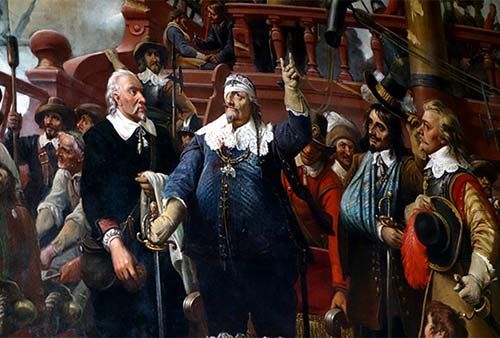
During his 50-year reign, Christian IV reformed the government, rebuilt the army, established a trading post in India, and tried to expand Denmark’s territory. He took Kalmar from Sweden and captured strategic points in northern Germany. The king was a large man who also lived large. A skilled horseman and avid hunter, he could drink his companions under the table. He spoke several languages and gained a reputation for being outgoing and humorous. His lavish banquets were legendary, and his romantic affairs were numerous.
But Christian’s appetite for war proved destructive. In 1626, Denmark again attacked northern Germany, but was beaten back. In late 1643, Sweden launched a sneak attack, and despite Christian’s personal bravery (he lost an eye), the war went badly. By the end of his life, Christian was tired and bitter, and Denmark was drained.
The heroics of Christian and his sailors live on in the Danish national anthem, “King Christian Stood by the Lofty Mast.”
The study (or “writing closet,” nearest where you entered) was small (and easy to heat). Kings did a lot of corresponding. We know a lot about Christian because 3,000 of his handwritten letters survive. The painting on the right wall shows Christian at age eight. Three years later, his father died, and little Christian technically ascended the throne, though Denmark was actually ruled by a regency until Christian was 19. A portrait of his mother hangs above the boy, and opposite the door is a portrait of Christian in his prime—having just conquered Sweden—standing alongside the dazzling coronation crown you’ll see later.
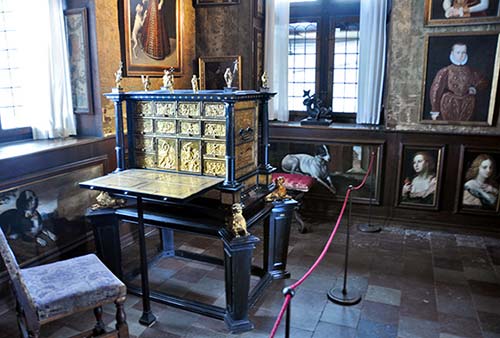
Going back through the Winter Room, head for the door to Christian’s bedroom. Before entering, notice the little peephole in the door (used by the king to spy on those in this room—well camouflaged by the painting, and more easily seen from the other side), and the big cabinet doors for Christian’s clothes and accessories, flanking the bedroom door (notice the hinges and keyholes). Heading into the bedroom, you’ll see paintings showing the king as an old man...and as a dead man. (Christian died in this room.)
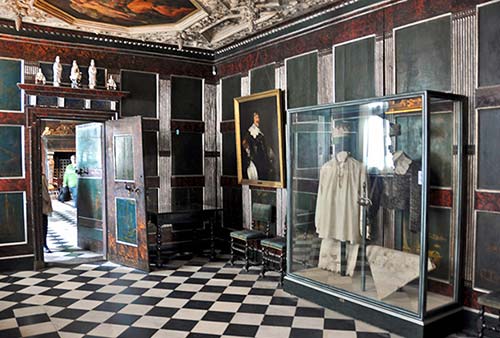
In the case are the clothes Christian wore at his finest hour. During a naval battle against Sweden (1644), Christian stood directing the action when an explosion ripped across the deck, sending him sprawling and riddling him with shrapnel. Unfazed, the 67-year-old monarch bounced right back up and kept going, inspiring his men to carry on the fight. Christian’s stubborn determination during this battle is commemorated in Denmark’s national anthem. Shrapnel put out Christian’s eye. No problem: The warrior king with a knack for heroic publicity stunts had the shrapnel bits removed from his eye and forehead and made into earrings as a gift for his mistress. The earrings hang in the case with his blood-stained clothes (easy to miss, right side). Christian lived to be 70 and fathered 25 children (with two wives and three mistresses). Before moving on, you can peek into Christian’s private bathroom—elegantly tiled with Delft porcelain.
Proceed into the Dark Room. Here you’ll see wax casts of royal figures. This was the way famous and important people were portrayed back then.
The Marble Room, or Queen’s Bedroom, has a particularly impressive inlaid marble floor. Imagine the royal bed under the emblems of Norway (right), Denmark (center), and Sweden (left) and with symbols of her realm in the ceiling.
The end room is called the Queen’s Reception Room. Notice the ceiling painting, with an orchestra looking down on you as they play.
The long stone passage leading to the staircase exhibits an intriguing painting showing the crowds at the coronation of Christian’s son, Frederik III. A sunbeam blesses the king as he’s anointed an absolute, divinely ordained monarch (1660). This painting marks that event—study it closely for slice-of-life details. Next, across from the stairs, near the ticket taker, a sprawling family tree makes it perfectly clear that Christian IV comes from good stock. Notice the tree is labeled in German—the second language of the realm but the first language of the royal family.
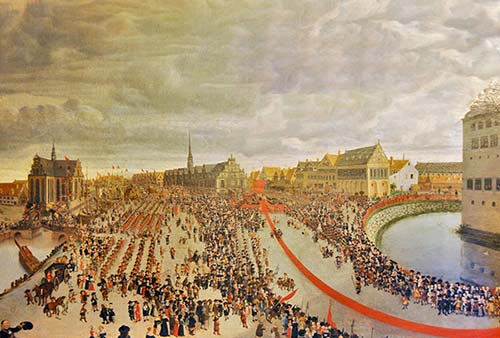
• The queen had a hand-pulled elevator, but you’ll need to hike up two flights of stairs to the top floor...the throne room.
Throne Room (Third Floor): The Long Hall—considered one of the best-preserved Baroque rooms in Europe—was great for banquets. The stucco ceiling and the tapestries trumpet the accomplishments of Denmark’s great kings. The four corners of the stucco ceiling feature the four continents known at the time. (America—at the far-right end of the hall as you enter—was still considered pretty untamed; notice the decapitated head of a European with the arrow sticking out of it.) In the center of the ceiling, of course, is the proud seal of the Danish Royal Family. The tapestries, designed for this room, are from the late 1600s. Effective propaganda, they show the Danes defeating their Swedish rivals on land and at sea.
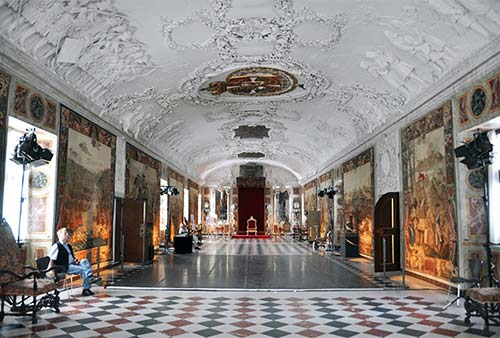
Find the two thrones side by side. The king’s throne—still more propaganda for two centuries of “absolute” monarchs—was made of “unicorn horn” (actually narwhal tusk from Greenland). Believed to bring protection from evil and poison, the horn was the most precious material in its day. The queen’s throne is of hammered silver. The 150-pound lions are 300 years old.
• Heading back down, pause at the middle floor, which is worth a look.
Middle Floor: Circling counterclockwise, you’ll see more fine clocks, fancy furniture, and royal portraits. The queen enjoyed her royal lathe (with candleholders for lighting and pedals to spin it hidden away below; in the Christian VI Room). The small mirror room (opposite where you entered, up the stairs from the main hall) was where the king played Peeping Tom—using mirrors on the floor to see what was under those hoop skirts. In hidden cupboards, he had both a fold-out bed and a handy escape staircase.
• Back outside, turn right and find the stairs leading down to the...
Royal Danish Treasury (Castle Basement): The palace was a royal residence for a century and has been the royal vault right up until today. As you enter, first head to the right, into the wine cellar, with thousand-liter barrels and some fine treasury items. The first room has a vast army of tiny golden soldiers and a wall lined with fancy rifles.
A glass case shows off two 1861 Colt revolvers (the first such guns ever seen in Europe). These were sent by Abraham Lincoln to the Danish king as a gift of thanks for advancing democracy in Europe by agreeing (in 1849) to accept a constitutional democracy.
Heading into the next room, you’ll see fine items of amber (petrified tree resin, 30-50 million years old) and ivory. Study the large box made of amber (in a freestanding case, just to the right as you enter)—the tiny figures show a healthy interest in sex.
Now head back past the ticket taker and into the main part of the treasury, where you can browse through exquisite royal knickknacks.
The diamond- and pearl-studded saddles were Christian IV’s—the first for his coronation, the second for his son’s wedding. When his kingdom was nearly bankrupt, Christian had these constructed lavishly—complete with solid-gold spurs—to impress visiting dignitaries and bolster Denmark’s credit rating.
The next case displays tankards. Danes were always big drinkers, and to drink in the top style, a king had narwhal steins (#4030). Note the fancy Greenland Inuit on the lid (#4023). The case is filled with exquisitely carved ivory. On the other side of that case, what’s with the mooning snuffbox (#4063)? Also, check out the amorous whistle (#4064).
Drop by the case on the wall in the back-left of the room: The 17th century was the age of brooches. Many of these are made of freshwater pearls. In the middle square panel, find two items: top-center, the fancy combination toothpick and ear spoon. Below that, a tiny golden ring: A queen was caught having an affair after 22 years of royal marriage. Her king gave her a special present: a golden ring—showing the hand of his promiscuous queen shaking hands with a penis.
Step downstairs, away from all this silliness. Passing through the serious vault door, you come face-to-face with a big, jeweled sword. The tall, two-handed, 16th-century coronation sword was drawn by the new king, who cut crosses in the air in four directions, symbolically promising to defend the realm from all attacks. The cases surrounding the sword contain everyday items used by the king (all solid gold, of course). What looks like a trophy case of gold records is actually a collection of dinner plates with amber centers (#5032).
Go down the steps. In the center case is Christian IV’s coronation crown (from 1596, seven pounds of gold and precious stones, #5124), which some consider to be the finest Renaissance crown in Europe. Its six tallest gables radiate symbolism. Find the symbols of justice (sword and scales), fortitude (a woman on a lion with a sword), and charity (a nursing woman—meaning the king will love God and his people as a mother loves her child). The pelican, which (according to medieval legend) pecks its own flesh to feed its young, symbolizes God sacrificing his son, just as the king would make great sacrifices for his people. Climb the footstool to look inside—it’s as exquisite as the outside. The shields of various Danish provinces remind the king that he’s surrounded by his realms.
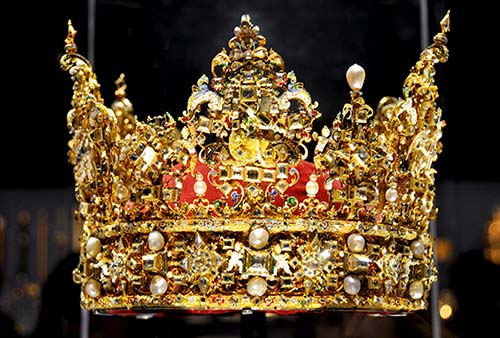
Circling the cases along the wall (right to left), notice the fine enameled lady’s goblet with traits of a good woman spelled out in Latin (#5128), and above that, an exquisite prayer book (with handwritten favorite prayers, #5134). In the fifth window, the big solid-gold baptismal basin (#5262) hangs above tiny oval silver boxes that contained the royal children’s umbilical cords (handy for protection later in life, #5272); two cases over are royal writing sets with wax, seals, pens, and ink (#5320).
Go down a few more steps into the lowest level of the treasury and last room. The two crowns in the center cases are more modern (from 1670), lighter, and more practical—just gold and diamonds without all the symbolism. The king’s crown is only four pounds, the queen’s a mere two.
The cases along the walls show off the crown jewels. These were made in 1840 of diamonds, emeralds, rubies, and pearls from earlier royal jewelry. The saber (#5540) shows emblems of the realm’s 19 provinces. The sumptuous pendant features a 19-carat diamond cut (like its neighbors) in the 58-facet “brilliant” style for maximum reflection (far-left case, #5560). Imagine these on the dance floor. The dark painting shows the anointing of King Christian V at the Frederiksborg Castle Chapel in 1671. The crown jewels are still worn by the monarch on special occasions several times a year.
▲Rosenborg Gardens
Rosenborg Castle is surrounded by the royal pleasure gardens and, on sunny days, a minefield of sunbathing Danish beauties and picnickers. When the royal family is in residence, there’s a daily changing-of-the-guard miniparade from the Royal Guard’s barracks adjoining Rosenborg Castle (at 11:30) to Amalienborg Palace (at 12:00). The Queen’s Rose Garden (across the moat from the palace) is a royal place for a picnic. The fine statue of Hans Christian Andersen in the park (far-left corner)—erected while he was still alive (and approved by him)—is meant to symbolize how his stories had a message even for adults (gardens open daily 7:00-dusk).
▲National Gallery of Denmark (Statens Museum for Kunst)
This museum fills a stately building with Danish and European paintings from the 14th century through today. It’s particularly worthwhile for the chance to be immersed in great art by the Danes, and to see its good collection of French Modernists, all well described in English.
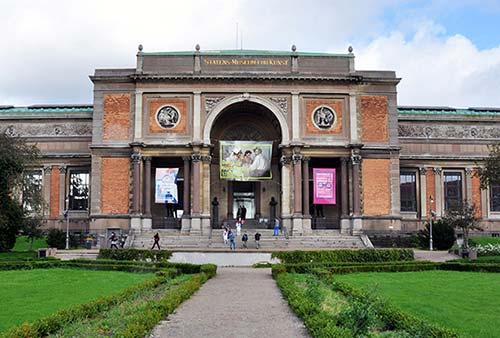
Cost and Hours: 120 DKK; Tue-Sun 10:00-18:00, Wed until 20:00, closed Mon; Sølvgade 48, +45 33 74 84 94, www.smk.dk.
Visiting the Museum: The ground floor holds temporary exhibits; the second floor has collections of Danish and Nordic artists from 1750 to 1900 and European art from 1300 to 1800; and the Danish and International Art after 1900 is spread between the second and third floors.
Head first to the Danish and Nordic artists section, and pick up the excellent floor plan that suggests a twisting route through the collection. Take the time to read the descriptions in each room, which put the paintings into historical context. In addition to Romantic works by prominent non-Danish artists (such as the Norwegian J. C. Dahl and the German Caspar David Friedrich), this is a chance to learn about some very talented Danish painters not well known outside their native land. Make a point to meet the “Skagen Painters,” including Anna Ancher, Michael Ancher, Peder Severin Krøyer, and others (find them in the section called “The Modern Breakthrough I-II”). This group, with echoes of the French Impressionists, gathered in the fishing village of Skagen on the northern tip of Denmark, surrounded by the sea and strong light, and painted heroic folk-fishermen themes in the late 1800s. Also worth seeking out are the canvases of Laurits Andersen Ring, who portrayed traditional peasant scenes with modern style; and Jens Ferdinand Willumsen, who pioneered “Vitalism” (celebrating man in nature). Other exhibits are cleverly organized by theme, such as gender or the body.
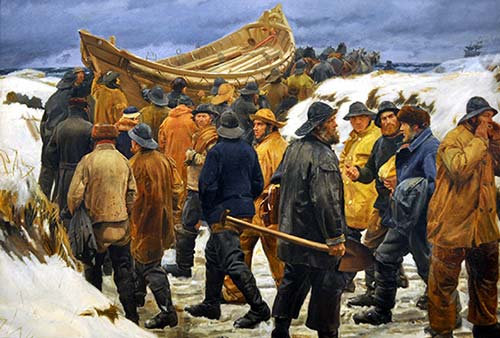
In the 20th-century section, the collection of early French Modernism is particularly impressive (with works by Matisse, Picasso, Braque, and more). This is complemented with works by Danish artists, who, inspired by the French avant-garde, introduced new, radical forms and colors to Scandinavian art.
CHRISTIANSHAVN
Across the harbor from the old town, Christianshavn—the former merchant’s district—is one of Copenhagen’s most delightful neighborhoods to explore. It offers pleasant canalside walks and trendy restaurants, along with two things to see: Our Savior’s Church (with its fanciful tower) and Christiania, a colorful alternative-living community. Before visiting, make sure to read the background on Christianshavn, which helps explain what you’ll see (see sidebar).
Your first look at the island will likely be its main square. Christianshavns Torv has a Metro stop, an early Copenhagen phone kiosk (from 1896), a fine bakery across the street (Lagkagehuset), and three statues celebrating Greenland. A Danish protectorate since 1721, Greenland, with 56,000 people, is represented by two members in the Danish parliament. The square has long been a hangout for Greenlanders, who appreciate the cheap beer and long hours of the big supermarket fronting the square. For Christianshavn eating recommendations, see here.
▲Our Savior’s Church (Vor Frelsers Kirke)
This large Baroque church gleams inside and out. Its bright interior (from 1696) is shaped like a giant cube. The magnificent pipe organ is supported by elephants (a royal symbol of the prestigious Order of the Elephant). Looking up to the ceiling, notice elephants also sculpted into the stucco of the dome, and a little one hanging from the main chandelier. Best of all, you can climb the unique spiral spire (with an outdoor staircase winding up to its top—398 stairs in all) for great views of the city and of the Christiania commune below.
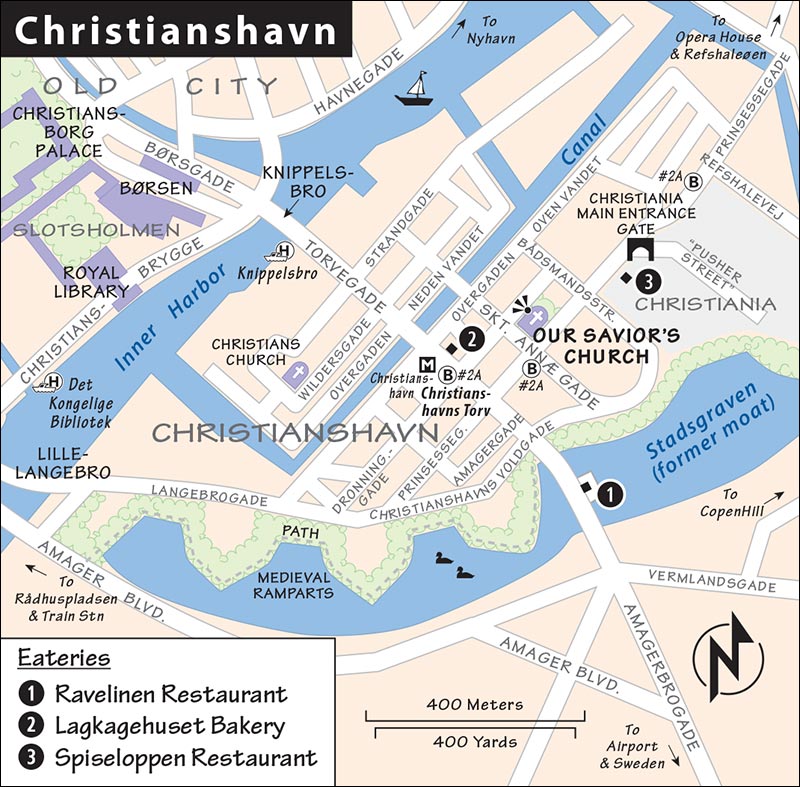
Cost and Hours: Church interior—free, Mon-Sat 11:00-15:30, closed Sun except for worship; church tower—70 DKK, daily 9:00-20:00 (last entry 19:30), closed in Jan and in bad weather; WC at base of tower; Sankt Annægade 29, +45 41 66 63 57, www.vorfrelserskirke.dk.
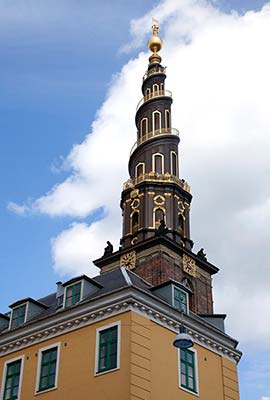
Tower Reservations: In summer and Fri-Mon year-round, it’s mandatory to book your tower entry online in advance.
Spin-Tour from the Top of Our Savior’s Church: Climb up until you run out of stairs. As you wind back down, look for these landmarks:
The modern windmills are a reminder that Denmark generates over half of its power from wind. Below the windmills is a great aerial view of the Christiania commune. Beyond the windmills, across Øresund (the strait that separates Denmark and Sweden), stands a shuttered Swedish nuclear power plant. The lone skyscraper in the distance—the first and tallest skyscraper in Scandinavia—is in Malmö, Sweden. The Øresund Bridge made Malmö an easy 35-minute bus or train ride from Copenhagen (it’s become a bedroom community, with much cheaper apartments making the commute worthwhile).
Farther to the right, the big red-roof zone is Amager Island. Five hundred years as the city’s dumping grounds earned Amager the nickname “Crap Island.” Circling on, you come to the towering Radisson Blu Royal Hotel. The area beyond it is slated to become a forest of skyscrapers—the center of Europe’s biomedical industry.
Downtown Copenhagen is decorated with several striking towers and spires. The tower capped by the golden ball is a ride in Tivoli Gardens. Next is City Hall’s pointy brick tower. The biggest building, with the three-crown tower, is Christiansborg Palace. The Børsen (old stock exchange) is just beyond, with its unique dragon-tail tower. Behind that is Nyhavn. Just across from that and the Royal Danish Theatre’s Playhouse is the dramatic Opera House (with the flat roof and big, grassy front yard).
▲▲▲Christiania
In 1971, the original 700 Christianians established squatters’ rights in an abandoned military barracks just a 15-minute walk from the Danish parliament building. Two generations later, this “free city” still stands—an ultra-human mishmash of idealists, hippies, potheads, nonmaterialists, and happy children (800 people, 200 cats, 200 dogs, 2 parrots, and 17 horses). There are even a handful of Willie Nelson-type seniors among the 180 remaining here from the original takeover. And an amazing thing has happened: The place has become the second-most-visited sight among tourists in Copenhagen, behind Tivoli Gardens. Move over, Little Mermaid.
“Pusher Street” (named for the sale of soft drugs here) is Christiania’s main drag. Get beyond this touristy side of Christiania, and you’ll find a fascinating, ramshackle world of moats and earthen ramparts, alternative housing, cozy tea houses, carpenter shops, hippie villas, children’s playgrounds, peaceful lanes, and people who believe that “to be normal is to be in a straitjacket.” A local slogan claims, “Kun døde fisk flyder med strømmen” (“Only dead fish swim with the current”).
Hours and Tours: Christiania is open all the time but quiet (and some restaurants closed) on Mondays, which is its rest day (though “resting” from what, I’m not sure). Guided tours led by residents leave from near the main entrance—look for the Rundviser sign (60 DKK, cash only, July-Aug daily at 15:00; Sat-Sun only the rest of the year, just show up, 1-1.5 hours, in English and Danish, private tours also available, info at www.rundvisergruppen.dk). You’re welcome to snap photos, except on Pusher Street (but ask residents before you photograph them).
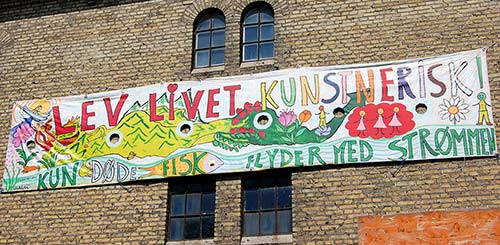
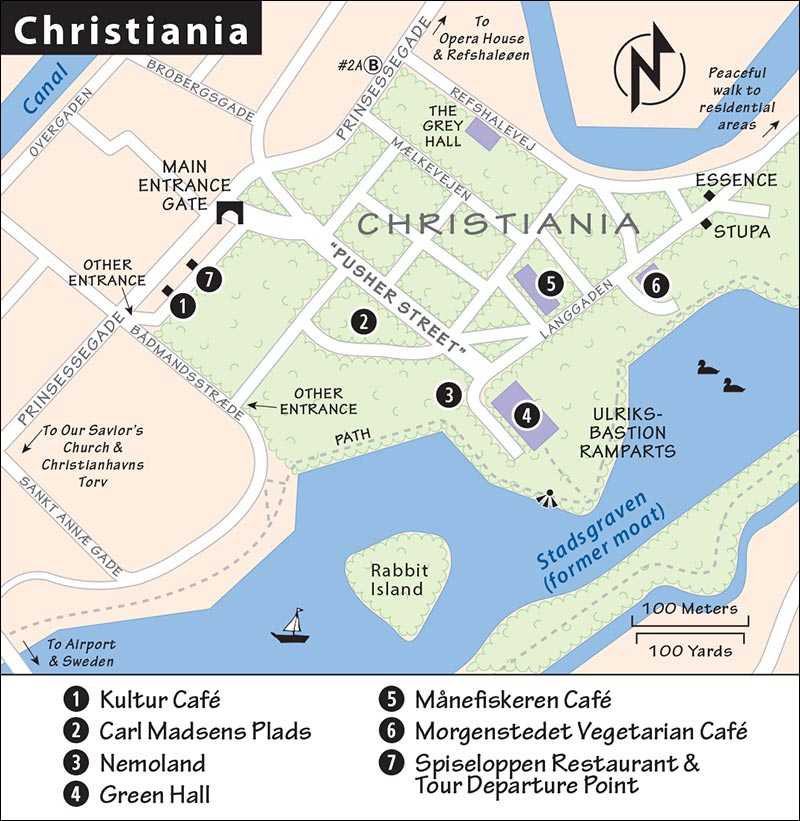
The Community: Christiania is broken into 14 administrative neighborhoods on a former military base. Most of the land, once owned by Denmark’s Ministry of Defense, has been purchased by the Christiania community; the rest of it is leased from the state (see the sidebar). Locals build their homes but don’t own them—individuals can’t buy or sell property. When someone moves out, the community decides who will be invited in to replace that person. A third of the adult population works on the outside, a third works on the inside, and a third doesn’t work much at all.
There are nine rules: no cars, no hard drugs, no guns, no explosives, and so on. The Christiania flag is red and yellow because when the original hippies took over, they found a lot of red and yellow paint onsite. The three yellow dots in the flag are from the three i’s in “Christiania” (or, some claim, the o’s in “Love, Love, Love”).
There’s little industry within the commune; Christiania Cykler, which builds fine bikes, is an exception (www.pedersen-bike.dk). And there’s a women-run smithy with a workshop and a sales table (near the Månefiskeren café). A phone chain provides a system of communal security (they have had bad experiences calling the police). Each September 26, the day the first squatters took over the barracks in 1971, Christiania has a big birthday bash.
Tourists are entirely welcome here, because they’ve become a major part of the economy. Visitors react in very different ways to the place. Some see dogs, dirt, and dazed people. Others see a haven of peace, freedom, and no taboos. It’s true that this free city isn’t always pretty. But watching parents here raise their children with Christiania values makes me a believer in this social experiment. My take: Giving alternative-type people a place to be alternative is a kind of alternative beauty that deserves a place.
Christiania Documentary: For insight into Christiania, watch the one-hour 2011 documentary Christiania: 40 Years of Occupation. This film, produced by Seattle production company Bus No. 8, does a wonderful job of chronicling the history of Europe’s oldest still-existing squatters’ community. Today, this community continues going strong after 50 years—but it hasn’t been easy. See www.busno8.com for details.
Visiting Christiania: The main entrance is down Prinsessegade, behind the Our Savior’s Church spiral tower. Passing under the gate, you’ll find a practical lane and the Kultur Café, which has a helpful info desk and hosts cultural events and talks (open daily 11:00-20:00; soup, sandwich, salad—all homemade; WC); the fanciest restaurant in the community (Spiseloppen); and the place at which guided tours meet and depart. The main street leading into the heart of the community is “Pusher Street”—notorious as an open-air market for marijuana and a target of police raids. It has an ugly, no-photos vibe, and the “merchants” are generally not members of the community...just here to sell weed.
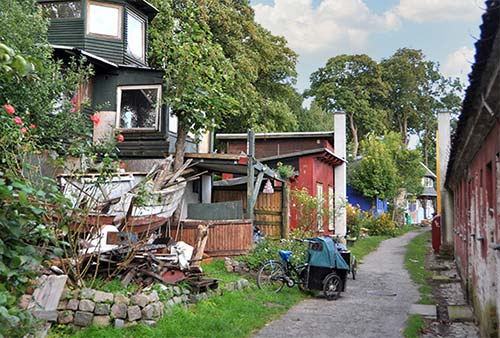
The first square—a kind of market square (souvenirs and marijuana-related stuff)—is named Carl Madsens Plads, honoring the lawyer who took the squatters’ case to the Danish supreme court in 1976 and won. Beyond that is Nemoland (a food circus, on the right). A huge warehouse called the Green Hall (Den Grønne Hal) is a recycling center and hardware store (where people get most of their building materials). If you go up the stairs between Nemoland and the Green Hall, you’ll reach the ramparts that overlook the canal. As you wander, be careful to distinguish between real Christianians and Christiania’s motley guests—drunks (mostly from other countries) who hang out here in the summer for the freedom. Part of the original charter guaranteed that the community would stay open to the public.
Ever since several hundred squatters took over an unused military camp in 1971, Christiania has been a political hot potato. No one in the Danish establishment wanted it. And no one had the nerve to mash it.
Part of Christiania’s history has been ongoing government attempts to shut the place down. At first, city officials looked the other way because back then, no one cared about the land. But skyrocketing Christianshavn land values brought pressure to open Christiania to market forces. By the 1980s, the surrounding neighborhood had become gentrified, and both the city and developers were eyeing the land on which Christiania’s hippies were squatting. When Denmark’s conservative government took over in 2001, they vowed to “normalize” Christiania, with police regularly conducting raids on pot sellers.
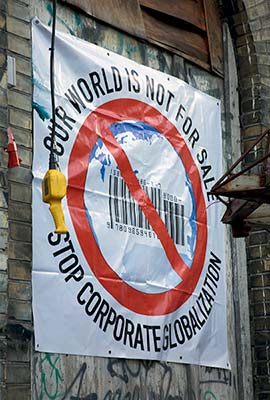
Things were looking grim for the Christianians until 2012, when the Danish government offered to sell most of the land to residents at below the market rate, and offered guaranteed loans. In exchange, Christianians had to upgrade and maintain water, sewage, and electrical services, and preserve rights of way and “rural” areas. Accepting the offer, Christianians formed a foundation—Freetown Christiania—to purchase and control the property. The parts of Christiania that were not sold are leased to residents and are still owned by the state.
It’s “government by meetings,” which, over time, leads some to be less engaged. For many Christianians, it’s an ironic, capitalistic twist that they now own property, albeit collectively. They even sell symbolic Christiania “shares” to help pay for the land. And, every adult over age 18 now owes a monthly rent that goes toward paying off the loans and to support services. This is the greatest degree of security Christiania has ever experienced in its 50 years of existence. But mistrust of the establishment is by no means dead.
Beyond the Green Hall is the Morgenstedet vegetarian restaurant (the best place for a simple, friendly meal; see “Eating in Christiania,” later). Past here, you’ll find yourself lost in the totally untouristy, truly local residential parts of Christiania, where kids play in the street and the old folks sit out on the front stoop—as in any other neighborhood. Just as St. Mark’s Square isn’t the “real Venice,” the hippie-druggie scene on Pusher Street isn’t the “real Christiania”—you can’t say you’ve experienced Christiania until you’ve strolled these back streets.
A walk or bike ride through Christiania is a great way to see how this community lives. When you leave, look up at the sign above the gate that welcomed you. It says, “You are entering the EU.”
Smoking Marijuana: Pusher Street was once lined with stalls selling marijuana, joints, and hash. Residents intentionally destroyed the stalls in 2004 to reduce the risk of Christiania being disbanded by the government. Today, you may see tables set up with people (mostly immigrants from outside the community) plying their product (with others down the street serving as “lookouts” for police who occasionally sweep the area), and you’ll likely hear whispered offers of “hash” during your visit. During my last visit, there was a small, pungent stretch of Pusher Street, dubbed the “Green Light District,” where pot was being openly sold (signs acknowledged that this activity was still illegal and announced three rules: have fun, no photos, and no running—“because it makes people nervous”). However, purchasing and smoking may buy you more time in Denmark than you’d planned—possession of marijuana remains illegal.
About Hard Drugs: For the first few years, junkies were tolerated. But that led to violence and polluted the mellow ambience residents envisioned. In 1979, the junkies were expelled—an epic confrontation in the community’s folk history now—and since then the symbol of a fist breaking a syringe is as prevalent as the leafy marijuana icon. Hard drugs are emphatically forbidden in Christiania.
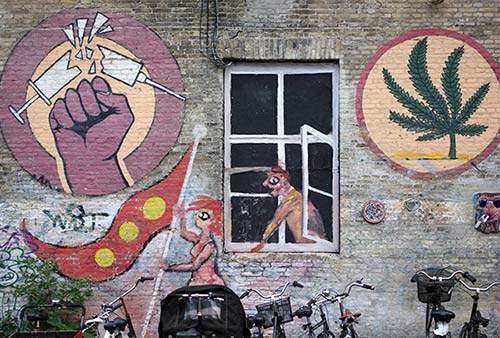
Eating in Christiania: The people of Christiania appreciate good food and count on tourism as a big part of their economy. Consequently, there are plenty of decent eateries. Most of the restaurants are open from lunchtime until late and are closed on Monday. Kultur Café, near the entry, offers a simple menu of homemade sandwiches, soups, and salads (daily 11:00-20:00). Pusher Street has a few grungy but tasty falafel stands, as well as a popular burger bar. $ Nemoland is the hangout zone—a fun collection of stands peddling Thai food, burgers, shawarma, and other fast hippie food with great, tented outdoor seating. Its stay-a-while atmosphere comes with backgammon, foosball, bakery goods, and fine views from the ramparts. $$ Månefiskeren (“Moonfisher Bar”) looks like a modern-day Brueghel painting, with billiards, chess, snacks, and drinks. $$ Morgenstedet (“Morning Place”) is a good, cheap vegetarian café with a mellow, woody interior and a rustic patio outside (left after Pusher Street, closed Mon). $$$$ Spiseloppen is the classy restaurant in the community (dinner only, described on here). While there are public concerts at the open-air Nemoland stage (Sun at 18:00 and 20:00), for a music club experience, consider Musik Loppen (which has live music almost nightly, under the Spiseloppen restaurant).
GREATER COPENHAGEN
Harbor Baths
Swimming in the middle of a large city is a uniquely Scandinavian experience. The two most centrally located baths are Havnebadet Fisketorvet, next to the Fisketorvet Mall behind Kødbyen, and Islands Brygge, just south of the Langebro bridge and Christianshavn.
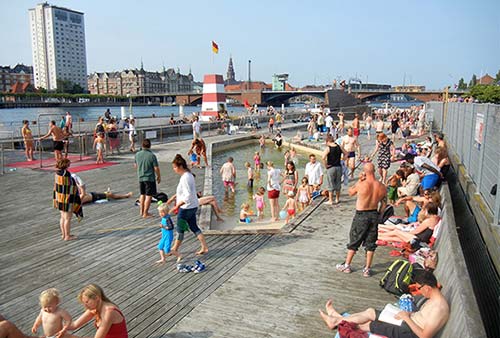
The baths are open to all to enjoy a refreshing saltwater dip. How refreshing? Water temperatures peak at 65 degrees in August, which should be no problem for those with Viking blood. Though the baths are located in former industrial areas, the water is monitored, and when the quality dips below acceptable levels—which can happen fairly often—the baths are closed.
Cost and Hours: Free, open long hours June-Sept (lifeguards on duty June-Aug 10:00-18:00), Havnebadet Fisketorvet and Islands Brygge, +45 33 66 33 70, http://svoemkbh.kk.dk/havnebade.
Getting There: Both are south of Langebro bridge. From the bridge, Havnebadet Fisketorvet is a 20-minute walk down Kalvebod Brygge, and Islands Brygge is just over the bridge, stretching immediately south from there.
Visiting the Baths: The Havnebadet Fisketorvet is actually a huge, semi-submerged barge containing three pools: one for children, another for diving (from one-, two-, and three-meter-high boards), and an Olympic-size swimming pool. Here you’ll be hemmed in on three sides by glassy modern office buildings and the Fisketorvet Mall.
The much busier Islands Brygge facility consists of five pools (two suitable for kids) and a prow-shaped diving platform offering three- and five-meter leaps into the water. The shore is one big, cobbled promenade backed by a grassy area that’s great for sunbathing, barbecues, and people-watching.
Carlsberg Brewery
About 1.5 miles west of Rådhuspladsen, Carlsberg welcomes you to the historic brewer’s house, where this brand got its start in 1847. Officially named “Home of Carlsberg,” the exhibit includes a visit with the brewer horses, a bottle collection, a restaurant, and, of course, beer. Guided tours of the old brewery cellars (about 40 minutes) and beer tastings (about 30 minutes, includes taste of 3 beers) are both always in English and cost extra.
Cost and Hours: 160-210 DKK (cheaper prices off-season and weekdays); guided tours-100 DKK; beer tasting-120 DKK; daily 10:00-20:00, Oct-March until 18:00; S-Tog: Carlsberg, Metro M-3 to Enghave Plads, or bus #23 to Gamle Carlsberg Vej 11; www.visitcarlsberg.dk, info@homeofcarlsberg.com.
Nearby: The manicured gardens of the sprawling Frederiksberg Park (Frederiksberg Have) and adjacent Southern Field (Søndermarken) make a lovely setting for a picnic.
Open-Air Folk Museum (Frilandsmuseet)
This park, located north of Copenhagen in the suburb of Lyngby, is filled with traditional Danish architecture and folk culture, farm animals, and gardens. Bring a picnic, buy a sandwich from the takeout kiosk, or dine at the on-site restaurant.
Cost and Hours: 120 DKK in summer, 110 DKK off-season; generally Tue-Sun 10:00-16:00, Nov-Dec Sat-Sun only, closed off-season and Mon year-round; S-tog: Sorgenfri and 10-minute walk to Kongevejen 100 in Lyngby (see the “Near Copenhagen” map in the next chapter); +45 41 20 64 55, http://natmus.dk.
Bakken Amusement Park (Bakken Forlystelsespark)
Danes gather at Copenhagen’s other great amusement park, Bakken—which dates to 1583 and claims to be the world’s oldest. It’s situated in the Dyrehaven forest about a 10-minute drive north of the city.
Cost and Hours: Free entry, 299 DKK for all-ride pass; late June-mid-Aug daily 12:00-24:00, shorter hours in spring and fall, closed mid-Sept-March except open weekend in late-Nov-late-Dec; S-tog: Klampenborg, then walk 10 minutes through the woods (see the “Near Copenhagen” map in the next chapter); +45 39 63 35 44, www.bakken.dk.
Dragør Town
If you don’t have time to get to the idyllic island of Ærø (see the Central Denmark chapter), consider the eight-mile trip south of Copenhagen to the cobblestoned fishing village of Dragør, near the airport (bus #250S from Nørreport or bus #35 from the Copenhagen airport). For information, see www.visit-dragoer.dk.
Shopping in Copenhagen
Shops are generally open Monday through Friday from 10:00 to 19:00 and Saturday from 9:00 to 16:00 (some shops close Sun). While big department stores dominate the scene, many locals favor smaller artisan shops and boutiques.
Uniquely Danish souvenirs include intricate paper cuttings with idyllic motifs of swans, flowers, or Christmas themes; mobiles with everything from bicycles to Viking ships (look for the quality Flensted brand); and the colorful artwork of Danish artist Bo Bendixen (posters, postcards, T-shirts, and more). Jewelry lovers look for amber, known as the “gold of the North.” Globs of this petrified sap wash up on the shores of all the Baltic countries.
WHERE TO SHOP
Consider the following stores, markets, and neighborhoods:
For a street’s worth of shops selling “Scantiques,” wander down Ravnsborggade from Nørrebrogade.
Copenhagen’s colorful flea markets (loppemarkeder) are small and surprisingly cheap. Visit the market at Israels Plads, near Nørreport Station, for used clothes, home goods, and bric-a-brac (March-Oct, Sat 11:00-16:00, https://kbhloppetorv.dk). Just outside the Thorvaldsens Museum, the Thorvaldsens Plads market focuses on antiques and collectibles (May-Oct Fri 8:00-17:00, Sat-Sun 9:00-16:00).
The city’s top department stores (Illum at Østergade 52, and Magasin du Nord at Kongens Nytorv 13) offer a good, if expensive, look at today’s Denmark. Both are on the Strøget and have eateries on their top floors (Illum’s are better). Politikens Boghal on Rådhuspladsen and Arnold Busck near the Round Tower at Købmagergade 49 have a good selection of maps and English travel guides.
The section of the Strøget called Amagertorv is a highlight for shoppers. The Royal Copenhagen store here sells porcelain on three floors. The first floor up features figurines and collectibles. The second floor has a second-quality department for discounts, proving that “even the best painter can miss a stroke.” Next door, Illums Bolighus shows off three floors of modern Danish design. And flanking Royal Copenhagen’s right side is Georg Jensen, with elegant Danish jewelry and home goods.
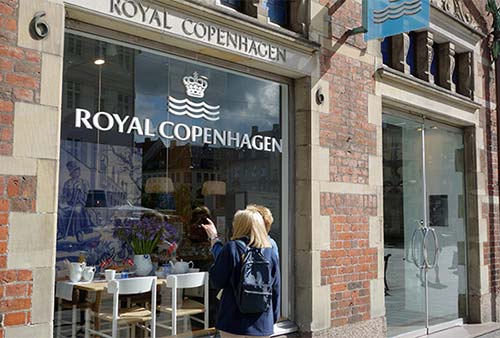
At the top of Nyhavn, the House of Amber has a shop and a free, tiny, two-room museum with about 50 examples of prehistoric insects trapped in the amber under magnifying glasses. You’ll also see remarkable items made of amber, from necklaces and chests to Viking ships and chess sets (Kongens Nytorv 2, www.houseofamber.com). If you’re visiting Rosenborg Castle, you’ll see the ultimate examples of amber craftsmanship in its treasury.
Nightlife in Copenhagen
For the latest event and live music listings, check at the TI and visit Copenhagen Post (http://cphpost.dk). Copenhagen hosts several music festivals each year (see “Helpful Hints,” earlier).
Nightlife Neighborhoods: Up-and-coming destinations for bars and nightlife include Refshaleøen, with its Reffen street food market (across the harbor from The Little Mermaid) and the Meatpacking District (Kødbyn, behind Central Station), which I’ve listed for its restaurants (see here). On warm evenings, Nyhavn canal becomes a virtual nightclub, with packs of yacht clubbers hanging out in harborside cafés and pubs, sipping beers. You can get cheap beer to-go a block off Nyhavn, on Sankt Annæ Plads.
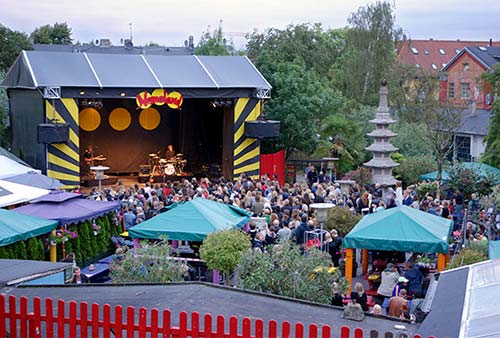
Christiania always seems to have something musical going on after dark for the anarchists. Tivoli has evening entertainment daily from mid-April through late September for those who miss Lawrence Welk (see here).
Music Venues: Alice is a good bet for live jazz (two stages, closed Mon, Nørre Allé 7, +45 31 54 58 75, schedule at www.jazzhouse.dk). For blues, try the Mojo Blues Bar (nightly 20:00-late, Løngangsstræde 21c, +45 33 11 64 53, schedule in Danish at www.mojo.dk). For locations, see the “Copenhagen Restaurants” map, later.
Jazz Cruises: Strömma offers one-hour jazz cruises along the canals of Copenhagen. You can bring a picnic dinner and drinks on board and enjoy a lively night on the water surrounded by Danes (190 DKK, June-mid-Sept Thu and Sun at 19:00, no tours mid-Sept-May, departs near Gammel Strand at Ved Stranden 26, +45 32 96 30 00, www.stromma.dk). Book online or call to reserve on summer evenings; otherwise try arriving 30 minutes in advance.
Classical Concerts, Ballet, and Opera: Copenhagen’s Royal Danish Orchestra (with roots dating to 1448) and Royal Danish Ballet (founded in 1748) are among the oldest in the world. Along with the Royal Danish Opera, there’s a calendar full of events for arts aficionados (check at TI or website for details; box offices at Royal Danish Opera House, Royal Danish Theatre’s Playhouse, and The Old Stage are open from 2 hours prior to performances, box office +45 33 69 69 69; https://kglteater.dk).
Sleeping in Copenhagen
I’ve listed a few big business-class hotels, the best budget hotels in the center, and a few backpacker dorm options.
HOTELS IN CENTRAL COPENHAGEN
All of these big and modern hotels have elevators and nonsmoking rooms. Except Hotel Danmark, they all charge extra for breakfast.
Near Nørreport
$$$ Ibsens Hotel, a stylish 118-room hotel with helpful staff, located in a charming neighborhood and a short walk from the old center, has lots of thoughtful touches and a fabulous breakfast (smaller rooms can be very tight—consider splurging on a larger room, rental bikes, pay parking, Vendersgade 23—to find Vendersgade after surfacing from the Nørreport Metro, head for the five-story brown building with the green copper dome, +45 33 13 19 13, www.arthurhotels.dk/ibsens-hotel, ibsens@arthurhotels.dk).
Near Rådhuspladsen
$$$ Hotel Danmark, part of the boutique Brøchner chain, rents 87 rooms in two buildings, one adorned with shiny green tiles, and one classic white that dates to 1792. The sleek design extends to the rooms, with leather-headboard beds and serene color palettes. A rooftop terrace with sweeping views hosts daily free wine and nightcap hours (family rooms available, rental bikes, fitness kit, Vester Voldgade 89, +45 33 11 48 06, www.brochner-hotels.com/hotel-danmark, info@hotel-danmark.dk).
$$$ Motel One Copenhagen, though part of a German chain, adopted Danish style for this Copenhagen outpost. This hygge gem rents 200 rooms of varying sizes, some with fine views and window seats, all handsomely furnished with Danish-designed furniture and within earshot of church bells (limited pay parking, rental bikes, Løngangstraede 27, +45 70 27 56 27, www.motel-one.com, copenhagen@motel-one.com).
Near Nyhavn
$$$$ 71 Nyhavn has 130 rustic but very classy rooms in a pair of beautifully restored, early-19th-century brick warehouses located at the far end of the colorful Nyhavn canal. With a professional, polite staff, lots of old brick and heavy timbers, and plenty of style, it’s a worthwhile splurge (some rates include breakfast, air-con, limited pay parking, rental bikes, laundry service, next to the Playhouse at Nyhavn 71, +45 33 43 62 00, www.71nyhavnhotel.dk, 71nyhavnhotel@arp-hansen.dk).
$$$$ Copenhagen Strand, occupying a warehouse building from 1869, has 174 slick business-class rooms, some with fine harbor views (family rooms, pay parking, Havnegade 37, +45 33 48 99 00, www.copenhagenstrand.com, copenhagenstrand@arp-hansen.dk).
$$ Hotel Bethel, run by a Lutheran association, is a calm and comfortable former seamen’s hotel facing the boisterous Nyhavn canal and offering 50 clean, simple rooms surrounding a small outdoor courtyard, and has a lounge for working or relaxing. Book long in advance (cheaper rooms with shared bath, family room, elevator, facing bridge over the canal at Nyhavn 22, +45 33 13 03 70, www.hotel-bethel.dk, info@hotel-bethel.dk).
Behind the Train Station
The area behind the train station mingles elegant old buildings, trendy nightspots, and pockets of modern sleaze. The main drag running away from the station, Istedgade, was long Copenhagen’s red-light district, but this area is increasingly gentrifying and feels safe (in spite of the few remaining harmless sex shops). These hotels are also extremely handy to the Meatpacking District restaurant zone.
$$$$ Axel Guldsmeden Hotel and $$ 66 Guldsmeden, operated by the Guldsmeden (“Dragonfly”) company, have more character than most—a restful spa-like ambience decorated with imported Balinese furniture, four-poster beds, and an emphasis on sustainability and organic materials. Both have courtyards and rent bikes (Axel: 212 rooms, family suites, request a quieter back room overlooking the pleasant garden, restful spa area with sauna and hot tub-395 DKK/person per stay, a block behind the train station at Colbjørnsensgade 14, +45 33 31 32 66, axelbooking@guldsmedenhotels.com; 66 Guldsmeden: slightly cheaper than Axel, 74 rooms, pay parking, Vesterbrogade 66, +45 33 22 15 00, 66@guldsmedenhotels.com). They share a website: http://guldsmedenhotels.com.
$$ Good Morning City Copenhagen Star rents 134 rooms with simple décor and is just a block from the station (family rooms, happy hour, nice courtyard, bike rental, Colbjørnsensgade 13, +45 27 79 38 60, www.copenhagenstar.dk, copenhagenstar@gmorninghotels.dk).
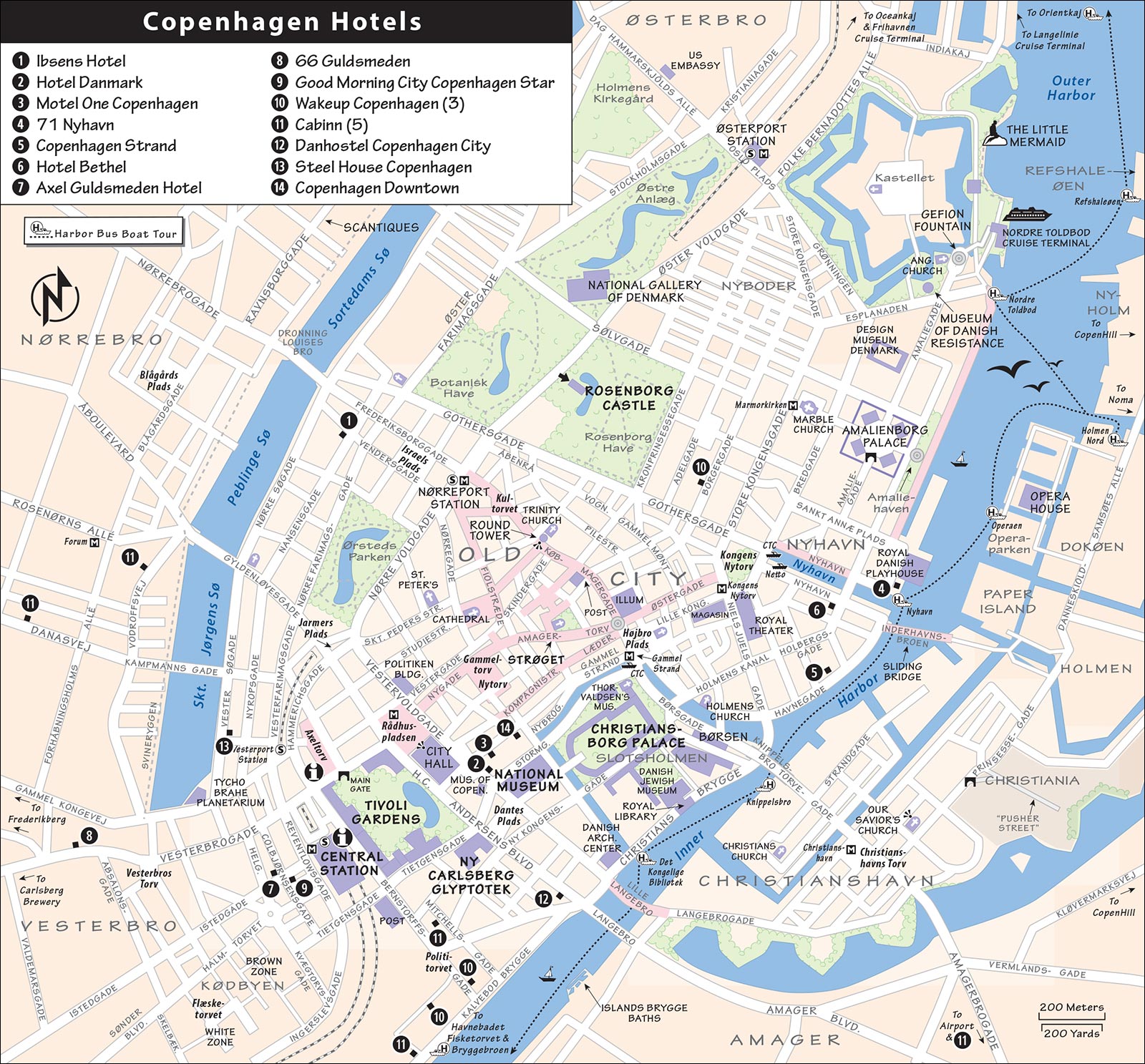
BUDGET HOTELS
$$ Wakeup Copenhagen runs three big, well-designed, minimalist budget hotels (similar to but a notch more upscale than Cabinn, described next). Economy rooms are the cheapest; flexible reservations, rooms with views, and larger rooms are more expensive. All branches have air-conditioning, expansive public spaces, and offer family rooms and bike rentals (+45 44 80 00 00, www.wakeupcopenhagen.com).
The branch near Rosenborg Castle has 510 rooms and an outdoor courtyard (Borgergade 9, borgergade@wakeupcopenhagen.dk). The biggest, near Central Station and Tivoli, has 585 rooms and breakfast with a view from the 10th floor (Bernstorffsgade 35, bernstorffsgade@wakeupcopenhagen.dk). The third, renting 510 rooms in a desolate no-man’s-land behind the station, is about a 15-minute walk from the station or Tivoli (Carsten Niebuhrs Gade 11, carstenniebuhrsgade@wakeupcopenhagen.dk).
$ Cabinn is a radical innovation and a great value, with several locations in Copenhagen (as well as Odense, Aarhus, and elsewhere): identical, tiny but comfy, cruise-ship-type staterooms, all bright, molded, and shiny, with TV, coffeepot, shower, and toilet. Some rooms have a single bed that can expand into a twin-bedded room with one or two fold-down bunks on the walls. It’s tough to argue with this kind of efficiency (family rooms available, easy pay parking, www.cabinn.com). The best of the bunch is Cabinn City, with 352 rooms and a great central location (a short walk south of the main train station and Tivoli at Mitchellsgade 14, +45 33 46 16 16, city@cabinn.com). Two more, nearly identical Cabinns are a 15-minute walk northwest of the station: Cabinn Express (86 rooms, Danasvej 32, +45 33 21 04 00, express@cabinn.com) and Cabinn Scandinavia (201 rooms, family rooms, Vodroffsvej 55, +45 35 36 11 11, scandinavia@cabinn.com). The largest and newest is Cabinn Copenhagen, a 15-minute walk southwest of the station, between the train tracks and the harbor (1,200 rooms, family rooms, small apartments, at Arni Magnussons Gade 1, +45 33 29 1900, copenhagen@cabinn.com). Cabinn Metro, near the Ørestad Metro station, is the farthest out (708 rooms, family rooms, on the airport side of town at Arne Jakobsens Allé 2, +45 32 46 57 00, metro@cabinn.com).
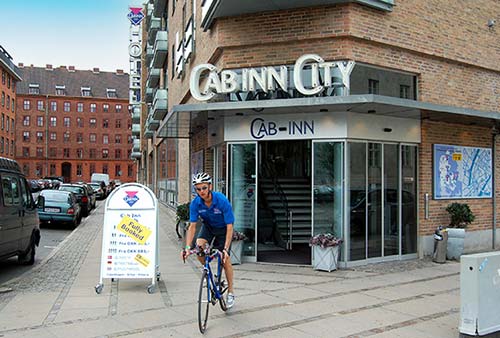
HOSTELS
¢ Danhostel Copenhagen City, an official HI hostel, occupies a huge harborside, 16-story skyscraper a 10-minute walk from the train station. Some rooms on higher floors have panoramic views over the city—book in advance. This is your best bet for a clean, basic, and inexpensive room with private baths in the city center (private rooms and family rooms available, rental bikes, H. C. Andersens Boulevard 50, +45 33 11 85 85, www.danhostelcopenhagencity.dk, rec@cphhostel.dk).
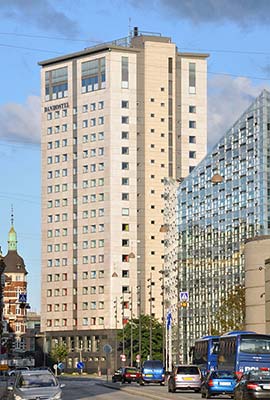
¢ Steel House Copenhagen, an eight-minute walk from Central Station, is a lively hostel with small rooms but lots of spaces for relaxing, working, and hanging out. It’s got everything from a small gym and tiny pool to a game arcade (private rooms and family rooms available, air-con, rental bikes, pay parking, Herholdsgade 6, +45 33 17 71 10, www.steelhousecopenhagen.com, reservations@steelhousecopenhagen.com).
¢ Copenhagen Downtown, more homey feeling than the other hostels I list, is beautifully located on a pleasant street right in the city center, a few steps from Slotsholmen Island and two blocks from the Strøget. Its 83 colorful rooms come with a fun hangout bar, which doubles as the reception (private rooms and family rooms available, bike rental, Vandkunsten 5, +45 70 23 21 10, www.copenhagendowntown.com, info@copenhagendowntown.com).
Eating in Copenhagen
A big part of the fun of being in Copenhagen is eating in Copenhagen. I’ve listed a range of recommendations—from take-away, open-face sandwiches, and the best hotdogs in town, to fine dining, both traditional and trendy-mod.
While Copenhagen’s renowned Noma Restaurant—rated by some “the best in the world,” and with more Michelin stars than entire countries—is great, you need to book long in advance and take out a bank loan to pay for your meal (and soon-to-be-closed). But Noma has had what’s called the “Noma effect” on dining across Scandinavia...stoking a movement called “New Nordic cuisine.”
New Nordic cuisine is a kind of Danish design applied to high cuisine and fine dining through a literal “food manifesto” for Noma-wannabes to follow: be creative, nothing is sacred; like the “slow food” movement that started in Italy, local sourcing and eating with the seasons is almost a religion. These days, this Nordic sensibility shows itself from hotel breakfasts to gourmet hotdog stands and in creative little gourmet eateries across the land.
For more advice on eating in Copenhagen, including ordering, tipping, and Danish cuisine and beverages, see the “Eating” section of the Practicalities chapter.
CHEAP MEALS
For a quick lunch, try a smørrebrød, a pølse, or a picnic. Finish it off with a pastry.
Smørrebrød
Denmark’s 300-year-old tradition of open-face sandwiches survives. Find a smørrebrød takeout shop and choose one or two sandwiches that look good (about 50 DKK each). They’ll come wrapped and ready for a park bench. Add a cold drink, and you have a fine, quick, and very Danish lunch. Tradition calls for three sandwich courses: herring first, then meat, then cheese, but that’s probably enough food for two. For purists, these sandwiches are for lunch only, but tourist demand is making them available at dinner, too.
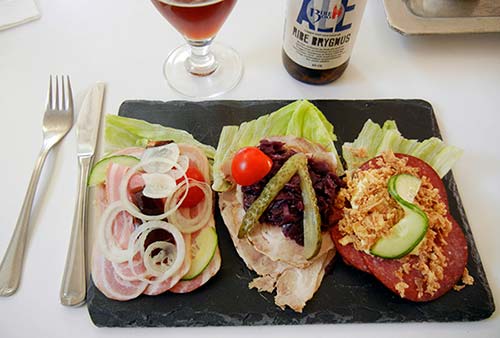
Between Copenhagen University and Rosenborg Castle
Two favorite smørrebrød places are particularly handy when connecting your sightseeing between the downtown Strøget core and Rosenborg Castle.
$$$ Restaurant Schønnemann, with a menu of only smørrebrød, is the foodies’ choice—it frequently wins awards for “Best Lunch in Copenhagen.” It’s a cozy cellar restaurant with small tables—according to the history on the menu, people “gather here in intense togetherness.” The sand on the floor evokes a bygone era when passing traders would leave their horses out on the square while they lunched here. You’ll need to reserve a table and you’ll pay a premium for their smørrebrød (two lunch seatings daily: 11:30-14:00 & 14:15-17:00, no dinner, Hauser Plads 16, +45 33 12 07 85, reserve online, www.restaurantschonnemann.dk).
$$ Café Halvvejen is a fiercely local place serving traditional lunches and open-face sandwiches in a woody and smoke-stained café, lined with portraits of Danish royalty. It’s a strangely authentic cauldron of old Dansk where elegant glasses of the local firewater glitter on the rustic tables (food served Mon-Sat 12:00-15:00, closed Sun, Krystalgade 11, +45 33 11 91 12, smart to reserve with a phone call in the morning). In the evening, it becomes a hip and smoky student hangout, with no food served.
North of Rosenborg Castle
$ Slagteren ved Kultorvet sells inexpensive sandwiches to go for about 25 DKK until they sell out (generally by 14:00). Choose from ham, beef, or pork (Mon-Fri 9:30-17:30, closed Sat and Sun; Classensgade 50B).
Near Christiansborg Palace
These eateries are good choices when sightseeing on Slotsholmen (near the palace).
$$ Kanal Caféen, on Frederiksholms Kanal across from Christiansborg Palace, serves lunch only and is a nice place for a traditional open-face sandwich. Inside, you’ll rub elbows with locals in what feels like the cozy confines of a low-ceilinged old sailing ship; outside you can dine right above the canal and watch the tour boats go by (Mon-Fri 11:30-17:00, Sat until 15:00, closed Sun, Frederiksholms Kanal 18, +45 33 11 57 70).
$$ Café Diamanten serves open-face sandwiches, warm dishes, and salads—and pours microbrews from the tap. Take a seat inside the comfy café or under the parasols out front, with a view across the square to Thorvaldsen’s Museum (Mon-Fri 9:30-19:30, Sat-Sun 10:00-18:30, Gammel Strand 50, +45 33 93 55 45).
$$$ Cock’s & Cows Burgers is a trendy burger-and-cocktail bar with a happy, young vibe on an elegant street. Eat inside the brick-walled restaurant or outside facing the canal (trendy burgers, daily for lunch and dinner, Gammel Strand 34, +45 69 15 79 01).
Near Gammeltorv/Nytorv
$$ Café Nytorv has a nautical theme inside and pleasant outdoor seating on Nytorv. They offer a great deal on a smørrebrød sampler for 330 DKK—perfect for two people to share (if you smile, friendly Charlotte will serve it for dinner even though it’s only on the lunch menu). This “Copenhagen City Plate” gives you a selection of the traditional sandwiches and extra bread on request (long hours daily, Nytorv 15, +45 33 11 77 06).
$$ Kronborg Dansk Restaurant is worth ducking into for fine-quality smørrebrød in a wood-beamed, almost dressy nautical setting (meat and fish sandwiches plus herring specialties, Sun-Wed 11:00-17:00, Thu-Sat until 22:00, Brolæggerstræde 12, +45 33 13 07 08).
$$ Café Sorgenfri (across the street) offers a more local experience in a dark, woody spot just off the Strøget—give the herring open-face sandwich a try (daily for lunch only, Brolæggerstræde 8, +45 33 11 58 80).
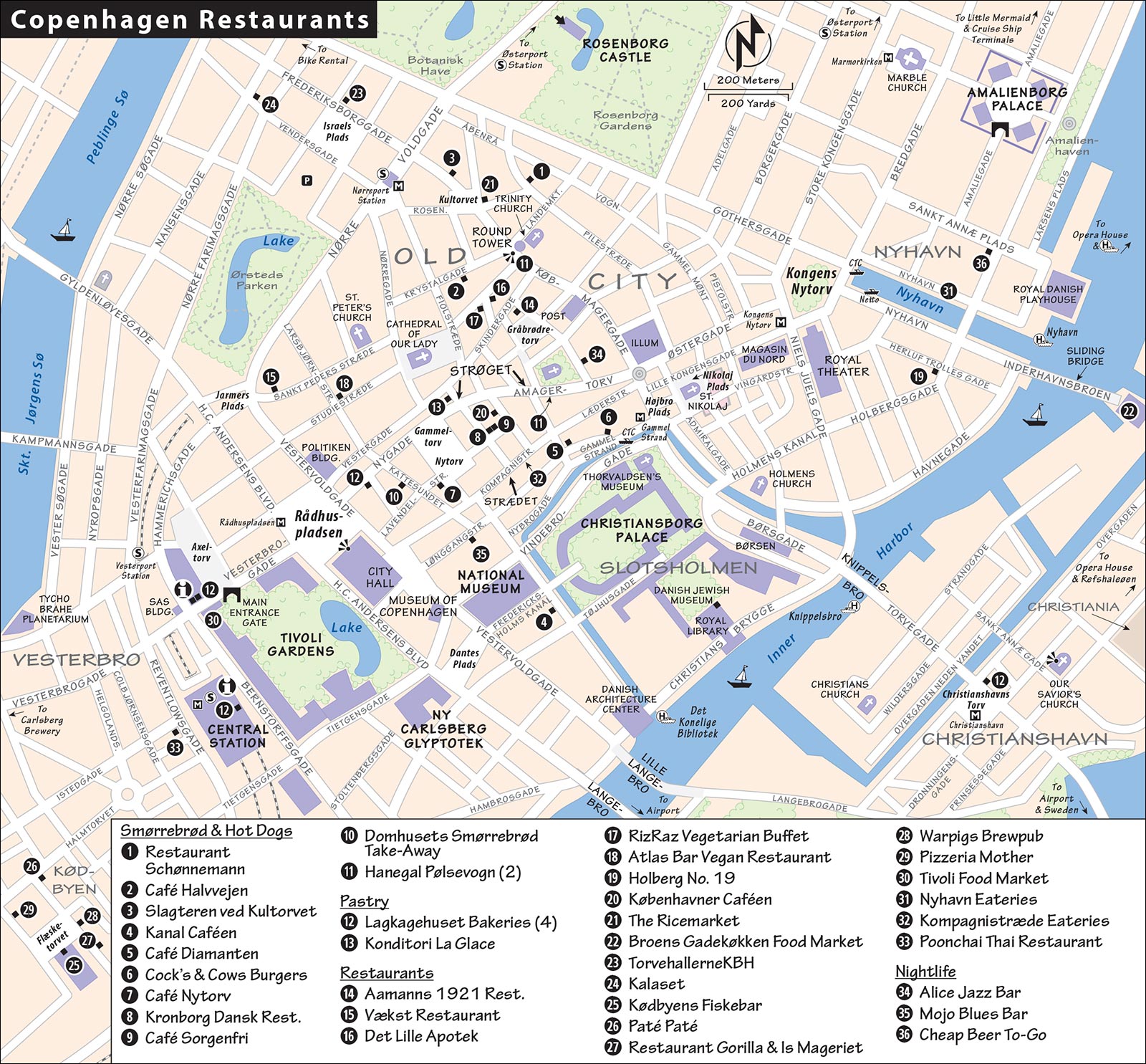
$ Domhusets Smørrebrød Take-Away sells classic smørrebrød to go for half what you’ll pay to eat in (Mon-Fri for breakfast and lunch, closed Sat-Sun, off the City Hall end of the Strøget at Kattesundet 18, +45 33 15 98 98). You can sit memorably on Nytorv, a block away.
The Pølse
The famous Danish hot dog, sold in pølsevogne (sausage wagons) throughout the country, is another typically Danish institution. Study the photo menu for variations. These are fast, cheap, tasty, and, like their American cousins, almost worthless nutritionally. Even so, what the locals call the “dead man’s finger” is the dog Danish kids love to bite.
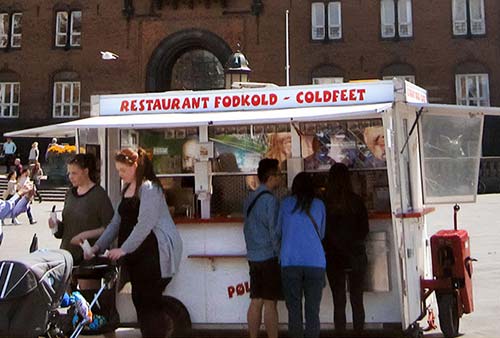
There’s more to getting a pølse than simply ordering a “hot dog” (which in Copenhagen simply means a sausage with a bun on the side, generally the worst bread possible). The best is a ristet (or grilled) hot dog med det hele (with the works). Employ these other handy phrases: rød (red, the basic boiled weenie), medister (spicy, better quality), knæk (short, stubby, tastier than rød), brød (a bun, usually smaller than the sausage), svøb (“swaddled” in bacon), and Fransk (French style, buried in a long skinny hole in the bun with sauce). Sennep is mustard and ristet løg are crispy fried onions. Wash everything down with a sodavand (soda pop).
By hanging around a pølsevogn, you can study this institution. While there used to be 700 such hotdog stands dotting the city, now there are less than 100, but the tradition survives. Denmark’s “cold feet cafés” are a form of social care: People who have difficulty finding jobs are licensed to run these wiener-mobiles. As they gain seniority, they are promoted to work at more central locations. Danes like to gather at a pølsevogn for munchies and pølsesnak—the local slang for empty chatter (literally, “sausage talk”). Traditionally, after getting drunk, guys stop here for a hot dog and chocolate milk on the way home—that’s why the stands stay open until the wee hours. (It’s also popular to hire a pølsevogn at weddings.)
New Nordic Hotdogs? Two stands from the same company (both handy to your sightseeing) are considered the healthiest in town. Rather than serving up gut bombs, they use organic ingredients with creative sides and embrace the “New Nordic” ethic. Hanegal Pølsevogn stands are located at the Round Tower and at the Holy Ghost Church on Strøget (daily for lunch only, closed Sun).
Picnics
Throughout Copenhagen, small delis (viktualiehandler) sell fresh bread, tasty pastries, juice, milk, cheese, and yogurt (drinkable, in tall liter boxes). Supermarkets are far cheaper than convenience minimarkets, and it’s easy to stock up for an extended stay and save some serious money (especially on highly taxed alcohol). And, of course, there’s the ever-present 7-Eleven chain, with branches seemingly on every corner; while you’ll pay more here, there’s a reason they’re called “convenience” stores—and they also serve pastries and hot dogs. Young carousers buy their beer to go here and head for a canalside perch or park rather than go broke in a bar.
Pastry
The golden pretzel sign hanging over a shop door or windows is the Danes’ age-old symbol for a bakery. Danish pastries, called wienerbrød (“Vienna bread”) in Denmark, are named for the Viennese bakers who brought the art of pastry-making to Denmark, where the Danes say they perfected it. The local cinnamon roll is called a kanelsnegl (cinnamon snail).
My favorite bakeries are Lagkagehuset, a locally owned chain with locations around town, including the original location on Torvegade (just across from the Metro station in Christianshavn), at Central Station, inside the Vesterbrogade TI, and along the Strøget at Frederiksborggade 21). Plenty of similar good-quality bakeries are handy to my recommended hotels and sights. For a genteel bit of high-class 1870s Copenhagen, you can pay a lot for a coffee and a fresh Danish at Konditori La Glace (just off the Strøget at Skoubogade 3).
RESTAURANTS
I’ve listed restaurants in four areas: the downtown core, the funky Christianshavn neighborhood across the harbor, near Nørreport, and in the trendy Meatpacking District behind Central Station. Assume you’ll need reservations for dinner at the nicer of these listings.
Fine Dining
In addition to these two, don’t miss the three expensive and unforgettable restaurant spurges listed in the Meatpacking District, later.
$$$$ Aamanns 1921 Restaurant is a modern Danish place with a Noma-inspired chef and menu that earned a Michelin rating. And with their smart clientele, embrace of Danish ingredients, and open kitchen, there’s an energy in the place that stokes your appetite. They offer a three-course 500-DKK meal (Tue-Sat for dinner, closed Sun-Mon, Niels Hemmingsens Gade 19, +45 20 80 52 04, www.aamanns.dk).
You have a good chance of meeting Copenhageners at the food markets with communal tables around town (Reffen, Broens Gadekøkken, and TorvehallerneKBH)—but these two organizations are an even better way to make Danish connections.
Folkehuset Absalon: Fun, delicious, and dirt-cheap family-style dinners are served every night at 18:00 in this community center, a former church building in Vesterbro—or al fresco at picnic tables in nice weather. Guests work together with their assigned table-mates to distribute place settings, bring food from the kitchen, and bus the dishes. There’s a good chance you’ll be the only non-local at your table, and your dining companions are happy to share tips for seeing their city. The everyone’s-welcome center also serves inexpensive breakfast and lunch and hosts yoga, trivia, ping-pong, and more (center open daily 7:30-late, dinners 50 DKK Sun-Wed, 100 DKK Thu-Sat, reserve online at least a few days in advance to guarantee a spot for dinner, weekly menu posted every Mon morning, Sønder Boulevard 73, https://absaloncph.dk).
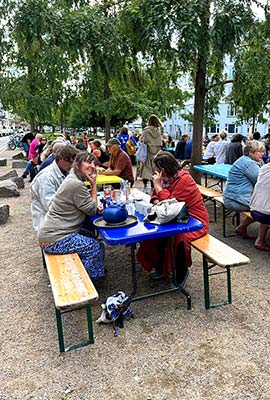
Meet the Danes: For an opportunity to meet locals in their homes, consider having dinner with a Danish family. You get a homey three-course meal with lots of conversation, generally from 18:30-22:00. From the website, select a date, your age range, and number of people, and you’ll be matched with potential hosts (682 DKK/person, www.meetthedanes.com).
$$$$ Vækst Restaurant is another “new Nordic cuisine” winner. The menu is small and accessible and always includes a good vegetarian option. The waitstaff is helpful and the clientele smart. With a spacious, woody, minimalist interior around a green trellis, everything comes together like an edible symphony (only inside dining, three-course 400-DKK menu, Sankt Peders Stræde 34, +45 38 41 27 27, www.cofoco.dk).
Downtown Core
$$$$ Det Lille Apotek (“The Little Pharmacy”) is a candlelit place with seating spread among its four themed “parlours.” It’s been popular with locals for 200 years, and today it’s a hit with tourists, serving open-face sandwiches at lunchtime and traditional dinners in the evening (daily 11:30-21:00, just off the Strøget, between Frue Church and Round Tower at Store Kannikestræde 15, +45 33 12 56 06, http://detlilleapotek.dk).
$$ RizRaz Vegetarian Buffet, across from Det Lille Apotek, is popular with students in this university district. While you can order meat dishes a la carte, this place is famed for its vegetarian buffet counter—an all-you-can-eat Middle Eastern/Mediterranean lunch for 145 DKK (daily 11:30-15:00) and a bigger dinner buffet for 185 DKK (15:00-23:00). Sadly, they charge for tap water (Store Kannikestræde 19, +45 42 32 68 32).
$$ Atlas Bar Vegan Restaurant is a neighborhood favorite in Copenhagen’s Latin Quarter that takes food that has nothing to do with animals seriously. Vegan only, it’s homey, local, and inviting inside and with rickety tables outside on the sidewalk (open 12:00-21:00, closed Sun, Larsbjørnsstraede 18, tel. +45.33 15 03 52, www.atlasbar.dk). They have a more romantic and upmarket vegan place upstairs (Urten—herb, 350-DKK set three-course dinners, Tue-Sat 17:30-21:00).
$$ Holberg No. 19, a humble Mediterranean-style café with classic ambience, no real kitchen, and a very simple menu, sits just a block off the tourist crush of the Nyhavn canal (and has no water view). With a loose and friendly vibe, it offers far more personality and lower prices than the tourist traps along Nyhavn (reasonably priced salads and sandwiches—some with an international twist, quiche, selection of wines and beers, order at the bar, a few sidewalk tables, Mon-Sat 8:00-22:00, Sun 10:00-20:00, Holbergsgade 19).
$$$ Københavner Caféen, cozy and old-fashioned, feels like a ship captain’s dining room. The staff is enthusiastically traditional, serving local dishes and elegant open-face sandwiches for a good value. Lunch specials (139-169 DKK) are served until 17:00, when the more expensive dinner menu kicks in (daily, kitchen closes at 22:00, at Badstuestræde 10, +45 33 32 80 81).
$$$ The Ricemarket, buried in a modern cellar between the Strøget and Rosenborg Castle, is family-friendly, with absolutely no pretense. They are just there to serve good, mostly Thai food at a good price. It’s a casual place and offers a flavorful Asian break from Danish food (9-dish family-style meal—345 DKK minimum for two, daily 12:00-22:00, Hausergade 38 near Kultorvet, +45 35 35 75 30). They also do take-away.
$$ Broens Gadekøkken food market, just over the sliding bridge from Nyhavn, is a commotion of street food carts, with outdoor communal picnic tables allowing hungry friends to choose different eateries and still eat together. You’ll find burgers, poke, seafood, pasta, crepes, Greek, smørrebrød, and more (daily 11:30-21:30, Strandgade 95, +45 33 93 07 60, https://broensgadekoekken.dk).
Illum and Magasin du Nord department stores both host handy eateries. At Illum, pick up take-away from the food court basement, take a break at the teahouse on the fourth floor, or try one of the elegant rooftop restaurants (Østergade 52). Magasin du Nord has a few eateries on its fifth floor and a great grocery, deli, and wine bar in the basement (Kongens Nytorv 13).
Christianshavn
This neighborhood is so cool, it’s worth combining an evening wander with dinner. It’s a 10-minute walk across the bridge from the old center, or a 3-minute ride on the Metro. Choose one of my listings (for locations, see the “Christianshavn” map on here), or simply wander the blocks between Christianshavns Torv, the main square, and the Christianshavn Canal—you’ll find a number of lively neighborhood pubs and cafés.
$$$$ Ravelinen Restaurant, on a tiny island on the big road 100 yards south of Christianshavn, serves traditional Danish food to happy local crowds. Dine indoors or on the lovely canalside terrace (which is tented and heated, so it’s comfortable even on blustery evenings). This is like Tivoli without the kitsch and tourists. They offer a koldtbord (“cold table”) meal for 388 DKK at lunch (lunch only on Sun, closed Mon and Jan-March, Torvegade 79, +45 32 96 20 45, http://ravelinen.dk).
$ Lagkagehuset, which was the original location for what is now a popular chain, is everybody’s favorite bakery in Christianshavn. With a big selection of pastries, sandwiches, excellent fresh-baked bread, and award-winning strawberry tarts, it’s a great place for breakfast or picnic fixings (daily 6:00-19:00, Torvegade 45). For other locations closer to the town center, see here under “Pastry.”
Global Cuisine on Christianshavn’s Main Drag: Torvegade is lined with inexpensive international eateries, including Italian, cheap kebabs, Thai, Chinese, and more, all within a few minutes’ walk of the Christianshavn Metro station.
In Christiania: $$$$ Spiseloppen (“The Flea Eats”) is a curiously classy place in Christiania. It serves great 170-DKK vegetarian meals and 220-DKK meaty ones by candlelight. It’s gourmet anarchy—a good fit for Christiania, the free city/squatter town (Tue-Sat 17:00-22:00, kitchen closes at 21:00, closed Sun and Mon, reservations are smart; 3 blocks behind spiral spire of Our Savior’s Church, on top floor of old brick warehouse; turn right just inside Christiania’s main gate, enter the wildly empty warehouse, and climb the graffiti-riddled stairs; +45 32 57 95 58, http://spiseloppen.dk). For location see the “Christiania” map on here, where I’ve also listed some less-expensive Christiania eateries.
Near Nørreport
$$$ TorvehallerneKBH is a mouth-watering food circus filling a pair of modern, glassy market halls right on Israels Plads. Survey both halls and the stalls on the square before settling in. In addition to produce, fish, and meat stalls, it has many inviting food counters where you can sit and eat or grab and go. Look for: Den Grønne Kutter (seafood, oysters, fish & chips), Hellernes Smørrebrød and Rørt Handy Smørrebrød (serious open-face sandwiches), Smag Salads, Grød (which makes porridge appealing), and Mikkeller (for the favorite local craft beer). I can’t think of a more enjoyable place in Copenhagen than this upscale food court to gain an appreciation of the New Nordic food ethic (Mon-Fri 10:00-19:00, Sat-Sun until 18:00, some places open later, some closed Mon; Frederiksborggade 21, +45 70 10 60 70).
$$$ Kalaset, in a funky daylight basement with mismatched furniture, bubbles with a youthful energy and is a local favorite. They serve creative burgers, salads, and vegetarian food (daily specials, outdoor seating available, daily 10:00-late, Vendersgade 16, kitty-corner from the recommended Ibsens Hotel, +45 33 33 00 35).
Meatpacking District (Kødbyen)
Literally “Meat Town,” Kødbyen is an old warehouse zone huddled up against the train tracks a few blocks behind Central Station (which is the nearest Metro stop). Danes raise about 25 million pigs a year, so there’s long been lots of “meatpacking.” Today, the meatpacking action is mostly diners chowing down, and this industrial zone has become a hugely popular restaurant area and trendy club scene. The places I list here are within a few steps of each other.
The curb appeal of this area is zilch (it looks like, well, a meatpacking district), but inside, these happy restaurants are bursting with life, creativity, and flavor (and noise). Each of these places has a sprawling outdoor section and an industrial-chic interior. They are trendy and can fill up, especially on weekend evenings, when it’s smart to reserve ahead.
$$$$ Kødbyens Fiskebar (“Fish Bar”) is one of the first and still the most acclaimed restaurants in the Meatpacking District. Focusing on small, thoughtfully composed plates of modern Nordic seafood, the Fiskebar has a stripped-down white interior with a big fish tank and a long cocktail bar surrounded by smaller tables. Reservations are essential. While the prices are high, so is the quality (daily 11:30-23:00; Flæsketorvet 100, +45 32 15 56 56, http://fiskebaren.dk).
$$$ Paté Paté is a tight, rollicking bistro in a former pâté factory. While a wine bar at heart—with a good selection of wines by the glass—it has a small and accessible menu of creative modern dishes and a cozy atmosphere rare in the Meatpacking District. Ideally, diners choose about three dishes per person and share (Mon-Sat 11:30-late, Sun 16:00-24:00, Slagterboderne 1, +45 39 69 55 57).
$$$ Restaurant Gorilla is a fun, high-energy place with a helpful waitstaff, an open kitchen, a creative modern European cuisine, and a menu designed for sharing dishes. Plus, the cocktails are a hit. It can be noisy if you’re eating inside. Their 10-dish tasting menu for 450 DKK is popular (also 150-200 DKK plates, daily 17:00-24:00, tel. 33 33 83 30, Flaesketorvet 63). Is Mageriet, next door, is a popular ice cream place.
$$ Warpigs Brewpub fills a former slaughterhouse with fun food, a young and harried waitstaff, a trendy rock ambiance, and a happy crowd. Order your food at the bar (BBQ ribs, brisket, mac & cheese, nachos), then line up again to order your drink (20 Mikkeller craft beers on tap). This is the least expensive and fastest of my meat packing recommendations (Flaesketorvet 25, daily 12:00-22:00).
$$$ Pizzeria Mother is named for the way their sourdough must be “fed” and cared for to flourish. You can taste that care in the delicious pizza and its tangy crust. Out front are picnic benches, while the interior curls around the busy pizza oven with chefs working globs of dough (daily 11:00-22:00, a block beyond the other restaurants listed here, at Høkerboderne 9, +45 22 27 58 98, www.mother.dk, reserve in advance). Tommi’s Burger Joint is next door.
Other Central Neighborhoods to Explore
To find a good restaurant, try simply window shopping in one of these inviting districts.
Tivoli has a good selection of “amusement park” eateries and restaurants (see “Tivoli Gardens” listing, here), including the Tivoli Food Market, which is directly across the street from the station and open to those inside or outside the Tivoli turnstiles.
Nyhavn’s harbor canal is lined with a touristy strip of restaurants set alongside its classic sailboats. Here, thriving crowds are served mediocre, overpriced food in a great setting. On any sunny day, if you want steak, fries, and a beer, this can be fun. On Friday and Saturday, the strip becomes the longest bar in the world. If you’re not into that, the sliding bridge leads over the canal and directly to Broens Gadekøkken food market, a festival of street food carts (described earlier, under “Downtown Core”).
Kompagnistræde is home to a changing cast of great little eateries. Running parallel to the Strøget, this street has fewer tourists and lower rent, and encourages places to compete creatively for the patronage of local diners.
Refshaleøen is where you’ll find the city’s biggest street food market (described on here), as well as some outrageously priced venues.
Istedgade and the surrounding streets behind the train station (just above the Meatpacking District) are home to an assortment of inexpensive ethnic restaurants. You will find numerous places serving kebabs, pizza, Chinese, and Thai, including tasty meals at $$ Poonchai Thai Restaurant, across the street from Hotel Nebo at Istedgade 1 (closed Mon, +45 33 22 26 06). This area can be a bit seedy, especially right behind the station, but walk a few blocks away and take your pick of inexpensive eateries frequented by locals.
Copenhagen Connections
BY PLANE
Copenhagen Airport, Kastrup
Copenhagen’s international airport, about five miles south of the city, has baggage check, ATMs, a shopping mall, grocery store, bakery, and more (code: CPH, www.cph.dk [URL inactive]). The two departure terminals are within walking distance of each other (check departures screens for your terminal, SAS uses T3, all other airlines use T2). Arriving flights feed into one big lobby in terminal 3. When you pop out here, taxis are out the door on your right, trains are straight ahead, and shops and eateries fill the atrium above you.
Getting Between the Airport and Downtown
Your options include the Metro, trains, and taxis. (Skip the bus.)
By Metro: The Metro runs directly from the airport to Rådhuspladsen, Kongens Nytorv (near Nyhavn), and Nørreport, making it the best choice for getting into town if you’re staying in any of these areas. Since the Metro line starts at the airport, every train goes your way—yellow M2 line, direction: Vanløse (36-DKK three-zone ticket, 10/hour, 4/hour at night, about 10-15 minutes to downtown). The Metro station is located at the end of terminal 3 (follow M signs). If you’re buying the Copenhagen Card, download the app and buy it here (it takes just a minute) as it covers the ride.
By Train: Convenient trains also connect the airport with downtown (36-DKK three-zone ticket, covered by rail pass, 3/hour, 14 minutes). Buy your ticket from the ground-level ticket booth (look for DSB: Tickets for Train, Metro & Bus signs) before riding the escalator down to the tracks. Track 2 has trains going into the city (track 1 is for trains going east, to Sweden). Trains into town stop at Central Station (signed København H; handy if you’re sleeping at my recommended hotels behind the train station), as well as the Nørreport and Østerport stations. At Nørreport, you can connect to the Metro for Kongens Nytorv (near Nyhavn) and Christianshavn.
By Taxi: With a Metro or train trip being so quick, frequent, and cheap, I see no reason to take a taxi. But if you do, taxis are fast, civil, and charge about 400 DKK for a ride to the town center.
BY TRAIN
DSB (Danske Statsbaner) is Denmark’s national railway (+45 70 13 14 15—for English, press 1 for general information and tickets, press 2 for international trains, www.dsb.dk; travel planner at www.rejseplanen.dk).
When traveling to and from Copenhagen by train, keep in mind that the main station, Hovedbanegården, is located at the western edge of the city center. Look for København H on schedules; it’s called “Central Station” in English on maps. Norreport Station is more centrally located, and many trains also stop there—it’s worth checking schedules carefully to determine your best final stop.
For general information on train travel in Scandinavia, see the “Transportation” section of the Practicalities chapter.
From Copenhagen by Train to: Hillerød/Frederiksborg Castle (4-6/hour, 40 minutes on S-tog), Roskilde (7/hour, 25 minutes), Humlebæk/Louisiana Art Museum (3/hour, 35 minutes), Helsingør (3/hour, 45 minutes), Odense (1-2/hour, 1.5 hours), Ærøskøbing (1-2/hour, 2.5 hours to Svendborg with a transfer in Odense, then 1.25-hour ferry crossing to Ærøskøbing—see here for info on ferry), Billund/Legoland (2/hour, 2.5 hours to Vejle, then bus #43 to Billund—see here, allow 3.5 hours total), Aarhus (hourly, 3.25 hours), Malmö (3-5/hour, 40 minutes), Stockholm (almost hourly, 5-6 hours on high-speed train, some with a transfer at Malmö or Lund, reservation required; overnight service available but requires a change in Hässleholm or Lund), Växjö (hourly, 3 hours), Kalmar (about hourly, 3.5-4 hours, most direct, some with transfer), Oslo (4/day, 8-9 hours, transfer at Göteborg; also overnight boat option, see here), Hamburg (3/day direct, 5 hours, 2 more with transfer, reservation required in summer).
BY BUS
Taking the bus to Stockholm is cheap but time consuming (1/day, 9.5 hours, longer for overnight trips, www.flixbus.se).
BY OVERNIGHT BOAT TO OSLO
DFDS runs daily ferries from Copenhagen (usually at 15:00) that arrive in Oslo about 10:00 the next morning. The 19-hour sailing includes a stop in Frederikshavn—handy for connecting that part of Denmark with Norway, but you can’t ride just between the Danish ports. Boats depart from Oslo on the same schedule for the return to Copenhagen (see here for Oslo departure info).
Cruise Costs: Cabins vary dramatically in price depending on the day and season (most expensive on weekends and late June-mid-Aug; cheapest on weekdays and Oct-April). You can choose from standard or sea-view cabins with two or four beds.
Onboard Services: DFDS Seaways ships offer big buffets for breakfast and dinner, gourmet restaurants—reserve a table when you book your ticket, bars, a kids’ playroom, pool, hot tub, sauna, nightclubs, and tax-free shopping. All shops and restaurants accept credit cards as well as euros, dollars, and Danish, Swedish, and Norwegian currency.
Reservations: Reservations are smart in summer and on weekends. Advance bookings get the best prices. Book online (www.dfds.com), email DFDS’s Copenhagen office (dkinfo@dfds.com), or visit the DSB Rejsebureau at the main train station.
Port Details: The Copenhagen Ferry Terminal (DFDS Terminalen) is at Dampfærgevej 30, a 15-minute walk north of The Little Mermaid. The terminal is open daily 9:00-15:00 (luggage lockers available, coins only).
Shuttle Service: DFDS runs a shuttle between the terminal and downtown. Buy tickets on the DFDS website when booking your cabin—tickets are not sold on the bus.
Getting to the Cruise Terminal: To reach the ferry terminal from the city, catch the shuttle bus marked DFDS Terminal near Nørreport Station at Øster Voldgade 2C or from Central Station. Or take the S-tog from downtown in the direction of Hellerup or Hillerød to the Nordhavn Station. Exit the station, cross under the tracks, and hike toward the water; you’ll see the ship on your right.
Getting Downtown from the Cruise Terminal: Shuttle buses marked either Banegård or Nørreport meet arriving ships from Oslo. The Banegård bus drops you at Banegårdspladsen—in front of the main train station, near Tivoli, recommended hotels, and the start of my “Copenhagen City Walk.” Buses marked Nørreport drop you next to Nørreport Station. From here you can ride the Metro one stop to Kongens Nytorv at Nyhavn (and more recommended hotels).
BY CRUISE SHIP
Most cruise ships use one of two terminals north of downtown—Oceankaj, the farther port; and Langelinie, about a mile closer to downtown. Another, smaller cruise port, Nordre Toldbod, is just south of The Little Mermaid and within easy walking distance (25 minutes) of Nyhavn. For port information, see www.cmport.com. For a wealth of information for cruise-ship passengers, see CruiseCopenhagen.com.