STIRLING & NEARBY
Stirling • Wallace Monument • Bannockburn • Falkirk • Culross • Doune
ALONG AND NEAR CAUSEWAYHEAD ROAD, NORTH OF THE CASTLE
NEAR STIRLING, IN BRIDGE OF ALLAN
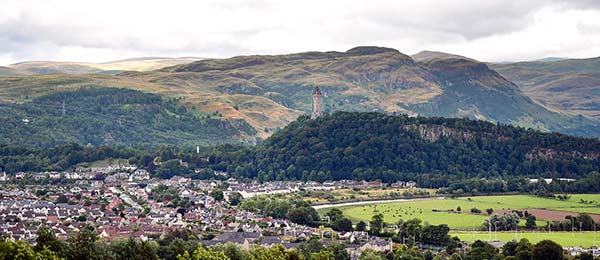
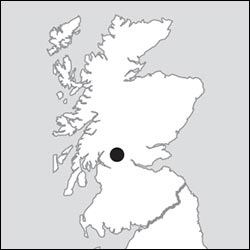
The historic city of Stirling is the crossroads of Scotland. It’s equidistant from Edinburgh and Glasgow (less than an hour from both) and rises above a plain where the Lowlands meet the Highlands—so it’s no surprise that Stirling has hosted many of the biggest names (and biggest battles) of Scottish history. Everyone from Mary, Queen of Scots, to Bonnie Prince Charlie has passed through the gates of its stately, strategic castle.
From the cliff-capping ramparts of Stirling Castle, you can see where each of the three pivotal battles of Scotland’s 13th- and 14th-century Wars of Independence took place: the Battle of Stirling Bridge, where against all odds, the courageous William Wallace defeated the English army; the Battle of Falkirk, where Wallace was toppled by a vengeful English king; and the Battle of Bannockburn, where—in the wake of Wallace’s defeat—Robert the Bruce rallied to kick out the English once and for all (well, at least for a few generations). The Wallace Monument and the Battle of Bannockburn Visitors Centre—on the outskirts of Stirling, in opposite directions—are practically pilgrimage sites for patriotic Scots.
Stirling itself is sleepy, but it’s a good home base for a variety of side trips. In Falkirk, take a spin in a fascinating Ferris wheel for boats, and ogle the gigantic horse heads called the Kelpies. Sitting on the nearby estuary known as the Firth of Forth—on the way to Edinburgh or St. Andrews—is the gorgeously preserved time-warp village of Culross. To the north, fans of Monty Python and Outlander flock to Doune Castle.
PLANNING YOUR TIME
You’ll likely pass near Stirling at least once as you travel through Scotland. If you can’t fit it all in on a pass-through, spend the night. Just as Stirling was ideally situated for monarchs and armies of the past, it’s handy for present-day visitors: It’s much smaller, and arguably even more conveniently located, than Edinburgh or Glasgow, and it has a variety of good accommodations. You’d need a solid three days to see all the big sights within an hour’s drive of Stirling—but most people are (and should be) more selective.
Stirling
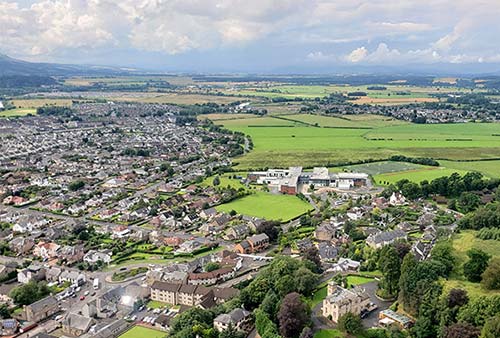
Every Scot knows the city of Stirling (pop. 41,000) deep in their bones. This patriotic heart of Scotland is like Bunker Hill, Gettysburg, and the Alamo, all rolled into one. Stirling perches on a ridge overlooking Scotland’s most history-drenched plain: a flat expanse—cut through by the twisting River Forth and the meandering stream called Bannockburn—that divides the Lowlands from the Highlands. And capping that ridge is Stirling’s formidable castle, the seat of the final kings of Scotland.
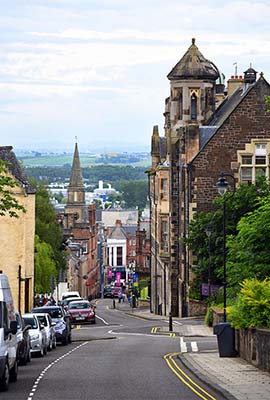
From a traveler’s perspective, Stirling is a pleasant mini-Edinburgh, with a steep spine leading up to that grand castle. It’s busy with tourists by day, but sleepy at night.
Orientation to Stirling
Stirling’s old town is situated along a long, narrow, steep hill. At its base are the train and bus stations and a thriving commercial district; at its apex is the castle. The old town feels like a steeper, shorter, less touristy, and far less characteristic version of Edinburgh’s Royal Mile. While the sights within Stirling nestle together at the top of the town, the Wallace Monument and Battle of Bannockburn Visitors Centre are an easy taxi ride, longer bus ride, or short drive away.
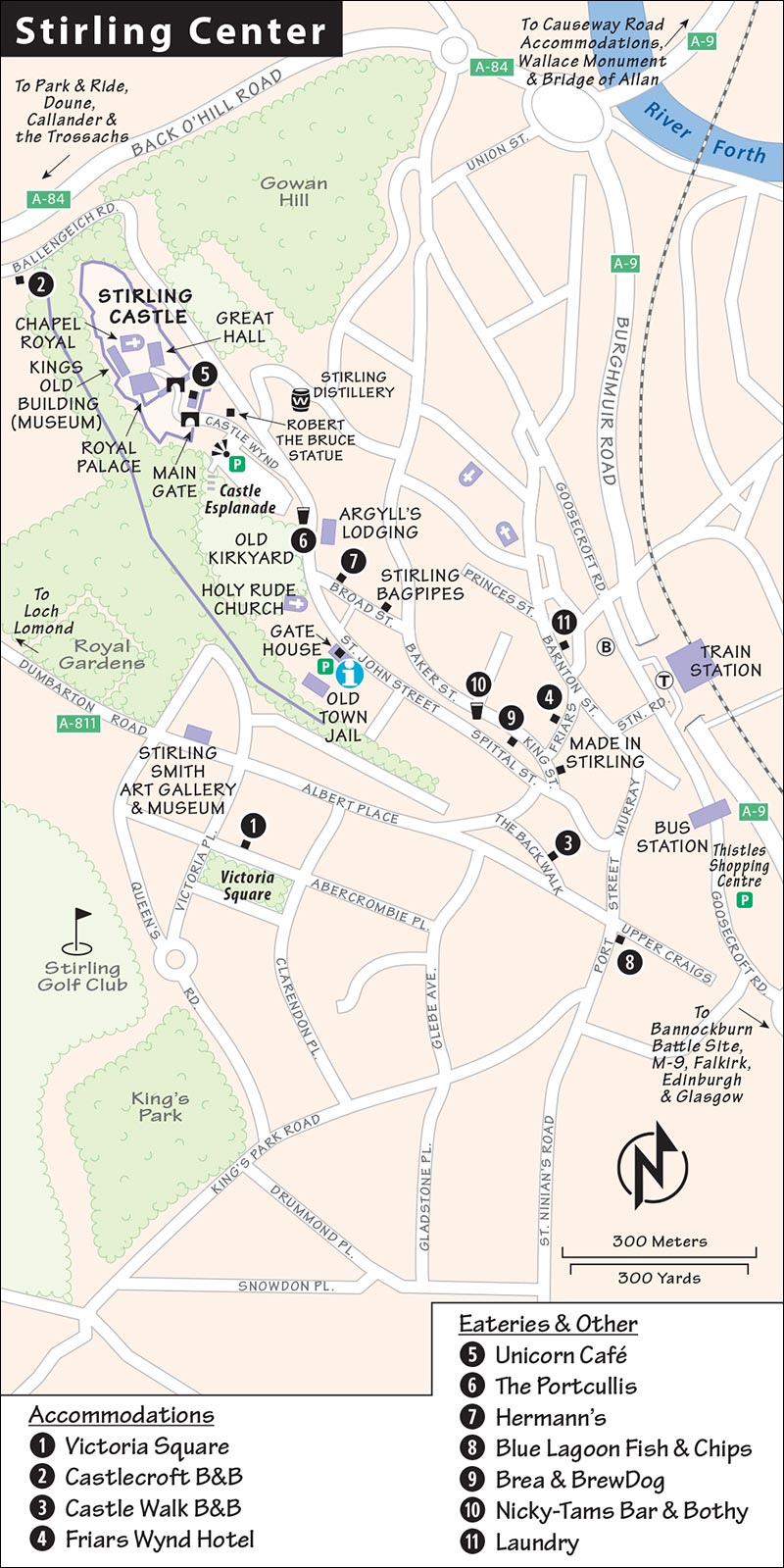
Tourist Information: Stirling funds its own TI, known as the Stirling Gate House. It’s a five-minute walk below the castle, just inside the gates of the Old Town Jail (daily 9:30-17:00, off-season 9:00-16:00, St. John Street, +44 1786 357 620, yourstirling.com). Ask about the Stirling City Pass—which covers Stirling Castle, the Old Town Jail, and the Wallace Monument, among others—at a good savings, especially if you plan to see everything in one day (stirlingcitypass.com). The Gate House also offers baggage storage for a small fee during its regular hours.
Laundry: Fresh & Clean Laundry is a few minutes’ walk from the train and bus stations (drop-off service; Mon-Fri 8:30-17:00, Sat from 9:00, closed Sun; 14 Barnton Street).
ARRIVAL IN STIRLING
By Car: There’s affordable but limited pay parking right at the castle, and a handful of free parking spots between the Gate House and Old Town Jail. A central and handy pay garage is under the Thistles shopping center, near the train station. Or park for free at the Castleview park-and-ride lot on the west side of town and catch the free shuttle (just off the M-9, runs about 7:30-17:30 daily, no service Sun). You’ll find metered parking throughout town, but check signs to avoid permit-only spaces.
By Train: Stirling’s train station is not particularly well set up for day-trippers (with no baggage storage), but the #P-2 bus (£1) regularly makes the trip from Murray Place and Station Road up to the Old Town Jail and the Gate House, where bags can be stored during business hours for a small fee. Taxis wait outside the station and charge about £8 to the castle and about £12 to either Wallace or Bannockburn (in opposite directions). If you’re staying the night, bus #52 links to accommodations north of town (and the Wallace Monument) from bus stalls B and C to the right as you exit the train station (2/hour).
Or you can walk: It’s a pleasant (if uphill) 15-to-20-minute trek from the train station to the castle: Exit straight ahead, jogging a bit left up the short street, and go inside the building with the big Stirling Arcade sign. Walk up the ramp inside this nicely restored old gallery, and follow it as it jogs left, then right, until you pop out just below the circular clock tower. Turn right here to huff the rest of the way up to the castle (take the right at the fork in front of the clock tower—you’ll walk along Baker Street, lined with good eateries, and eventually up the aptly named Broad Street; just past Stirling Bagpipes, a little lane to the left leads to the Gate House and TI).
The bus station is next to the train station; to walk to the town center, just head left along the busy road as you exit. Buses to Bannockburn and the Wallace Monument both leave from the bus station. For schedules and information, visit mcgillsscotlandeast.co.uk. (You’ll also find more specifics under “Getting There” for each sight.)
Sights in Stirling
▲▲▲STIRLING CASTLE
“He who holds Stirling, holds Scotland.” These fateful words have proved, more often than not, to be true. Stirling Castle’s prized position—perched on a volcanic crag overlooking a bridge over the River Forth, the primary passage between the Lowlands and the Highlands—has long been the key to Scotland. This castle was the preferred home of Scottish kings and queens in the Middle Ages; today it’s one of the most historic—and most popular—castles in Scotland.
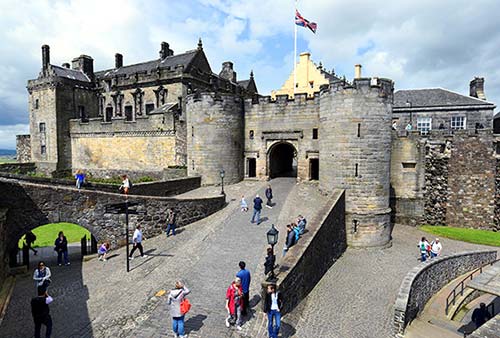
Huge, impressive, and well presented—with a wide variety of thoughtfully designed exhibits that explain both the epic history and the intimate details of daily castle life—it rivals Edinburgh Castle as Scotland’s best. And it comes with spectacular views over a gentle countryside, including many of Scotland’s most important historical sites. There’s a lot to see and do here; give it at least a couple of hours.
Cost and Hours: £20.50, cheaper online, covered by Stirling City Pass; daily 9:30-18:00, Oct-March until 17:00, last entry one hour before closing; audioguide-£3 (download before arrival and bring headphones); Regimental Museum normally closes 45 minutes before castle; good café, +44 1786 450 000, historicenvironmentscotland.scot.
Advance Tickets Recommended: To guarantee admission (and save a little money), it’s wise to purchase tickets a day or two in advance during peak periods (July, Aug, and on weekends).
Tours: The included 50-minute guided tour is entertaining, informative, and helps you get your bearings—both to the castle and to Scottish history (generally every half-hour 10:00-15:00, departs from inside the main gate near the well). Docents posted throughout can tell you more.
Getting There: Stirling Castle caps the summit of a steep old town. Drivers can follow the Stirling Castle signs uphill through town to the esplanade; the pay lot is just outside the castle gate, but space is limited. See “Arrival in Stirling,” earlier, for other parking options.
Without a car, it’s a five-minute uphill hike from the TI, or 15-20 minutes from the train or bus station. A taxi from the train station runs about £8.
Background: The first real castle was built here in the 12th century by King David I. But Stirling Castle’s glory days were in the 16th century, when it became the primary residence of the Stuart (often spelled “Stewart”) monarchs, who turned it into a showpiece of Scotland—and a symbol of one-upmanship against England.
The 16th century was a busy time for royal intrigue here: James IV married the sister of England’s King Henry VIII, thereby knitting together the royal families of Scotland (the Stuarts) and England (the Tudors). Later, James V further expanded the castle. Mary (who became the Queen of Scots) spent her early childhood at the castle before being raised in France. As queen and as a Catholic, she struggled against the rise of Protestantism in her realm. But when Mary’s son, King James VI, was crowned King James I of England, he took his royal court with him away from Stirling to London—never to return.
During the Jacobite rebellions of the 18th century, the British military took over the castle—bulking it up and destroying its delicate beauty. Even after the Scottish threat had subsided, it remained a British garrison, home base of the Argyll and Sutherland regiments. (You’ll notice the castle still flies the Union Jack of the United Kingdom.) Today, Stirling Castle is fully restored and has filled its halls with engaging exhibits to explain its history.
 Self-Guided Tour
Note that the castle occasionally shifts how visitors are routed through some buildings, and to see everything, a certain amount of backtracking is almost inevitable—including on this tour. Begin on the esplanade, just outside the castle entrance, with its grand views.
The Esplanade: The castle’s esplanade, a military parade ground in the 19th century, is a tour-bus parking lot today. As you survey this site, remember that Stirling Castle bore witness to some of the most important moments in Scottish history. To the right as you face the castle, a statue of King Robert the Bruce looks toward the plain called Bannockburn, where he defeated the English army in 1314. Squint off to the horizon on Robert’s left to spot the pointy stone monument capping the hill called Abbey Craig. This is the Wallace Monument, marking the spot where the Scottish warrior William Wallace surveyed the battlefield before his victory in the Battle of Stirling Bridge (1297).
These great Scots helped usher in several centuries of home rule. In 1315, Robert the Bruce’s daughter married into an on-the-rise noble clan called the Stuarts, who had distinguished themselves fighting at Bannockburn. When their son Robert became King Robert II of Scotland in 1371, he kicked off the Stuart dynasty. Over the next few generations, their headquarters—Stirling Castle—flourished. The fortified grand entry showed all who approached that James IV (r. 1488-1513) was a great ruler with a powerful castle.
• Head through the first gate into Guardroom Square, where you can buy a ticket if you don’t have one already, and check tour times. Pick up a map, then continue up through the inner gate.
Gardens: Once through the gate, follow the passage to the left into a delightful grassy courtyard called the Queen Anne Garden. This was the royal family’s playground in the 1600s. Imagine doing a little lawn bowling with the queen here.
In the casemates lining the garden—to your left—is the Castle Exhibition, which provides an entertaining and worthwhile introduction to the castle. You’ll meet each of the people who left their mark here, from the first Stuart kings to William Wallace and Robert the Bruce. You’ll also see the “heads” (digitally reconstructed from mere skulls) of two people whose skeletons were found buried in the castle in the 1990s. An adjacent display explains the archaeological excavation and analysis that led to the conclusion that the man and woman died violently, likely during a castle siege around 1400. Behind you, a model of the entire castle complex is useful for orientation.
As you exit the exhibition, you can pay £1 to peer through the eyeholes in the small silver tower (“the historiscope”) to see the castle’s main gate virtually restored to its original, much larger form.
• Leave the garden the way you came and make a hairpin turn up the ramp (twice) to the top of the...
Battlements: From up here, the castle’s strategic position is evident: Defenders had a 360-degree view of enemy armies approaching from miles away. These battlements were built in 1710, long after the castle’s Stuart glory days, in response to early rebellions by the Jacobites (from the Latin word for “James”). By this time, the successes of William Wallace and Robert the Bruce were a distant memory; and through the 1707 Act of Union, Scotland had become welded to England. Bonnie Prince Charlie—descendant of those original Stuart “King Jameses” who built this castle—later staged a series of uprisings to try to reclaim the throne of Great Britain for the Stuart line, frightening England enough for it to further fortify the castle.
And sure enough, Bonnie Prince Charlie found himself—ironically—laying siege to the fortress that his own ancestors had built: Facing the main gate (with its two round towers below the flagpole), notice the pockmarks from Jacobite cannonballs in 1746.
• Now head back down the top ramp and pass through that main gate, into the...
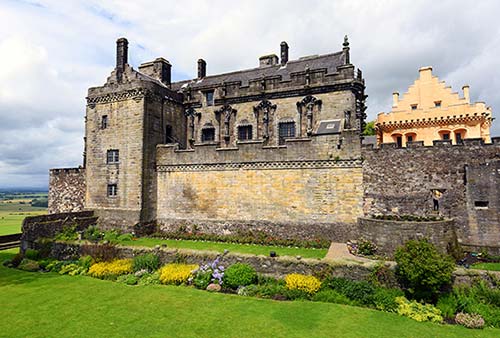
Outer Close: As you enter this courtyard, straight ahead is James IV’s Great Hall. You’ll know it by its standout color, “king’s gold.” To the left is his son James V’s royal palace, lined with finely carved Renaissance statues. In 1540, King James V, inspired by French Renaissance châteaux he’d seen, had the castle covered with about 200 statues and busts to “proclaim the peace, prosperity, and justice of his reign” and to validate his rule. Imagine the impression all these classical gods and goddesses made on visitors. The message: James’ rule was a golden age for Scotland.
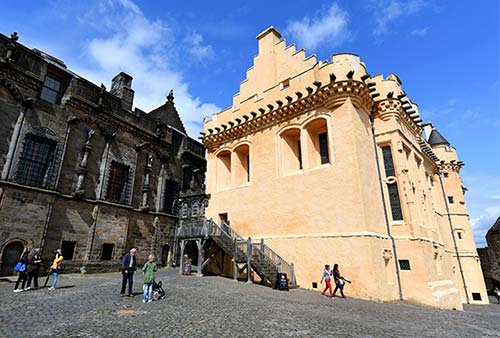
Guided tours of the castle depart from just to your right, near the well. Beyond that is the Grand Battery, with its cannons and rampart views and, underneath that, the Great Kitchens. We’ll see both at the end of this tour.
• Now hike up the ramp between James V’s palace and the Great Hall. You’ll emerge into the...
Inner Close: Standing at the center of Stirling Castle, you’re surrounded by Scottish history. This courtyard was the core of the 12th-century castle. From here, additional buildings were added—each by a different monarch. Facing downhill, you’ll see the Great Hall. To the left is the Chapel Royal—where Mary, Queen of Scots, was crowned in 1543. Opposite that, to the right, is the royal palace (containing the King’s and Queen’s Apartments, which we’ll tour in a moment). Notice the “I5” monogram above the windows, for the king who built it: The I stands for “Iacobus,” Latin for James. And behind you, at the top of the square, is the Regimental Museum devoted to the Argyll and Sutherland Highlanders.
• Let’s head inside the royal palace for a visit to the...
King’s and Queen’s Apartments: You’ll loop through two parallel, mirror-image series of rooms—first the queen’s, then the king’s—colorfully done up as they might have looked in the mid-16th century when James V and his queen, Mary of Guise, lived here. Costumed performers play the role of palace attendants, happy to chat with you about medieval life as you explore.
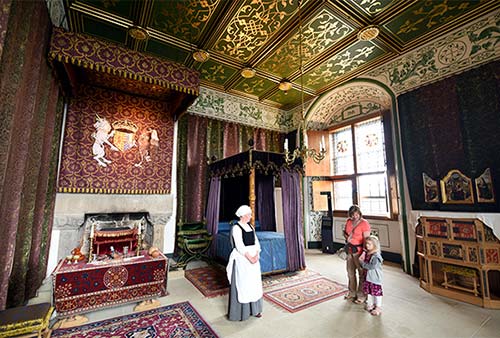
From the Queen’s Outer Hall, proceed to her Inner Hall—where she received guests—and notice the beautiful Hunt of the Unicorn tapestries decorating the walls. These are recent re-creations, made painstakingly from scratch using original 15th-century methods. (You can visit an exhibit about their creation later.)
From here, you’ll enter the Queen’s Bedchamber. Then as now, royals did not sleep in the same room. Ostensibly this was for security—if the two most important people in a kingdom are sleeping next to each other, one successful attack can wipe out the entire lineage. (From a practical standpoint, this arrangement also made unpleasant arranged marriages easier to suffer through.) And so, the next stop is the adjoining King’s Bedchamber, with a four-poster bed supporting a less-than-luxurious rope mattress.
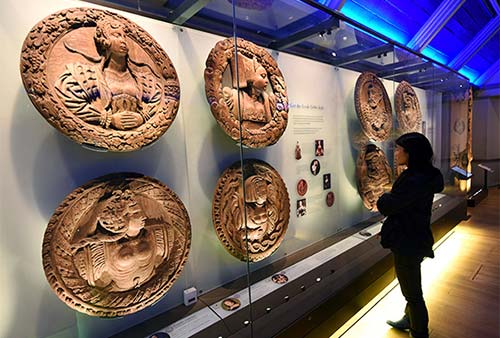
From there, you’ll step into the King’s Inner Hall, where he received guests. Notice the 60 colorfully painted oak medallions on the ceiling, carved with the faces of Scottish and European royalty and images from classical mythology. These are copies; you’ll soon see the originals up close in the Stirling Heads Gallery. And finally comes the King’s Outer Hall.
• From the royal apartments, you’ll end up back where you started, in the top corner of the Inner Close. Directly ahead and to your left, up the stairs, is the...
Stirling Heads Gallery: This is, for me, the castle’s highlight—a chance to see the originals of the elaborately carved and painted portrait medallions that decorated the ceiling of the king’s presence chamber. Each one is thoughtfully displayed and lovingly explained. Notice how researchers carefully studied the originals and made the copies you saw in the Royal Apartments.
You’ll exit the Heads Gallery outside, along the Prince’s Walk, which overlooks the Queen Anne Garden we explored earlier. As you head along here, get a closer look at the grotesque sculptures.
You’ll wind up back down in the Outer Close. For a quick detour, find the door next to the stone staircase you just descended. Head through this door into a tunnel, which is lined with kid-friendly exhibits that re-create everyday life at the castle through the eyes of various professions: painters, musicians, tailors, carvers, and jesters.
About halfway down this dark hallway, turn right into an inner courtyard. This is known as the “lion’s den,” where King James V is believed to have kept a lion. (James VI had three.) But without a big cat, it’s just an empty space.
• Retrace your steps to the Outer Close, and then head back up to the Inner Close, where we’ll visit the rest of the buildings in turn. First, at the far-left end of the gallery with the coffee stand, step into the...
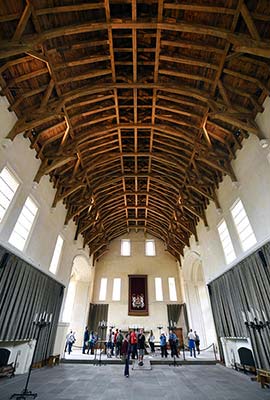
Great Hall: This is the largest banqueting space ever built in Scotland. Dating from 1503, it was a grand setting for the great feasts and pageants of Scotland’s Renaissance kings. One such party, to which all the crowned heads of Europe were invited, reportedly went on for three full days. This was also where kings and queens held court. The impressive hammer-beam roof is a modern reconstruction, modeled on the early 16th-century roof at Edinburgh Castle. It’s made of 400 local oak trees, joined by wooden pegs. If you flipped it over, it would float.
• Exiting back out into the Inner Close, enter (on the right) the...
Chapel Royal: One of the first Protestant churches built in Scotland, the Chapel Royal was constructed in 1594 by James VI for the baptism of his first son, Prince Henry. The faint painted frieze high up survives from Charles I’s coronation visit to Scotland in 1633. Clearly the holiness of the chapel ended in the 1800s when the army moved in.
• Finally, at the top of the Inner Close, step into the...
Argyll and Sutherland Highlanders Regimental Museum: This excellent museum, located in the King’s Old Building, is another highlight (free, argylls.co.uk). With lots of tartans, tassels, and swords, it shows how the fighting spirit of Scotland was absorbed by Britain. The two regiments, established in the 1790s to defend Britain in the Napoleonic age and combined in the 1880s, have served with distinction in British military campaigns for more than two centuries. Their pride shows here in the building that has served as their headquarters since 1881.
As you follow the route through three floors of exhibits, you’ll see uniforms, banners, battlefield action scenes, portraits of military heroes, weaponry, bagpipes, and so on—all engagingly described.
• When you’re ready to move on, consider the following scenic route back to the castle exit.
Rampart Walk to the Grand Battery: The skinny lane between church and museum leads to the secluded Douglas Gardens at the rock’s highest point. Belly up to the ramparts for a commanding view, including the Wallace Monument.
From here you can walk the ramparts downhill (expect short flights of stairs here and there) to the Grand Battery, with its cannon rampart, back at the Outer Close. The Outer Close was the service zone, with a well and the kitchen (below the cannon rampart). To learn more, head down the stone ramp just after the last cannon, curl around to the right, and look for the Great Kitchens sign.
Great Kitchens: The lavish banquets of James VI didn’t happen all by themselves. A six-minute film about medieval cookery and the jobs of the kitchen (a sensitive nose must have been required to be “yeoman of the spice house”) sets the stage before you loop through kitchens that are busy with scurrying mannequins, faux food, sound effects, and insightful descriptions. Surprisingly, a recipe for “steamed golden custard,” printed on a canvas page on display, wouldn’t be entirely out of place today.
• Exiting the kitchens, turn right and carry on downhill through the gate. You’ll come out at the lower ramparts, with more great views.
If you walk all the way to the end of this area, in the final building, you’ll find the...
Tapestry Exhibition (Weaving the Unicorn): Here you’ll learn how the seven Hunt of the Unicorn tapestries in the Queen’s Inner Hall were created. The work took 18 weavers, working in teams, 13 years to complete. (The originals, woven in Holland around the turn of the 16th century, are in a museum in New York City.)
• Your castle visit ends here. For a scenic route down into town, consider a detour through an old churchyard cemetery (described below).
MORE SIGHTS IN STIRLING
Old Kirkyard Stroll
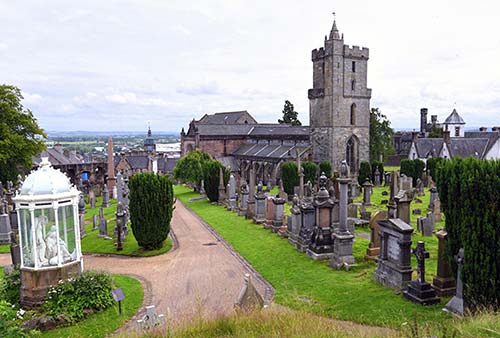
Stirling has a particularly evocative old cemetery in the kirkyard (churchyard) just below the castle. For a soulful stroll, sneak down the stairs where the castle meets the esplanade parking lot (near the statue of the Scotsman fighting in the South African War). From here, you can wander through the tombstones—Celtic crosses, Victorian statues, and faded headstones—from centuries gone by. The rocky crag in the middle of the graveyard is a fine viewpoint. Work your way over to the Holy Rude Church. Gaze at the centuries-old stained glass, as well as a more recent window dedicated to soldiers killed in World War I (£5, daily May-Sept 10:00-18:00). From here, you can reenter the town: The castle parking lot is to the left, and the Gate House (housing the TI) and Old Town Jail are just to the right.
▲Stirling Ghost Walk
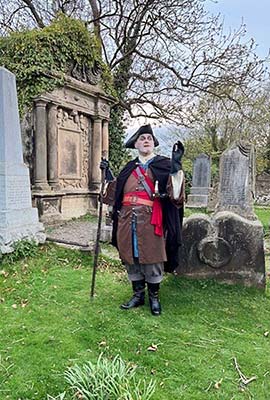
David Kinnaird, a local actor/historian, gives entertaining and informative 1.25-hour “Happy Hangman” ghost walks through the old kirkyard cemetery at night. Portraying an 18th-century town executioner who enjoyed his job just a little too much, Kinnaird regales participants with stories of Stirling’s noble citizens and miscreants alike—and sometimes they were one and the same (£10, for schedule and to book, see stirlingghostwalk.com; walks also offered in conjunction with the Old Town Jail, below, and can be booked on the jail’s website, too).
Old Town Jail
Stirling’s jail was built during the Victorian Age (1847), when the purpose of imprisonment was shifting from punishment to rehabilitation. While there’s little to see today, theatrical 30-minute tours entertain families with a light and funny—yet informative—walk through one section of the jail. After the tour, you’ll be set free to explore some cells and ascend to the top of the tower for a commanding view of the surrounding countryside.
Cost and Hours: £14; tours run every 30 minutes daily from 10:15, no tour at 13:15, last tour at 17:15; in off-season, check online to confirm tour times; free audioguide offers more history, St. John Street, oldtownjail.co.uk.
▲Stirling Bagpipes
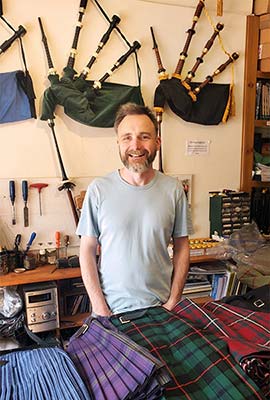
This fun little shop, just a block below the castle on Broad Street, is worth a visit for those curious about bagpipes. Owner Alan refurbishes and repairs old bagpipes here (some dating back to the 17th century) but also makes new ones from scratch in his workshop next door. The pleasantly cluttered shop, which is a bit of a neighborhood hangout, is littered with bagpipe components—chanters, drones, bags, covers, and cords.
Cost and Hours: Free; Mon-Tue and Thu-Sat 10:00-18:00, closed Wed and Sun; 8 Broad Street, +44 1786 448 886, stirlingbagpipes.com.
Mercat Cross and Stirling Shopping
On the wide street in front of the Stirling Bagpipe shop, look for Stirling’s mercat cross (“Market Cross”). A standard feature of any medieval Scottish market town, this was the place where townsfolk would gather for the market, and where royal proclamations were read and executions took place. Today the commercial metabolism of this once-thriving street is low. Locals joke that every 100 years, the shopping bustle moves one block farther down the road. These days, it’s generally squeezed into the modern Thistles shopping mall between the old town and the river. But a 5-to-10-minute walk from the mercat cross is the bigger-than-it-looks Made in Stirling shop, which sells jewelry, pottery, prints, and other wares from local artists (daily 10:00-17:00, 44 King Street, +44 1786 357 550).
Stirling Distillery
Stirling’s very own distillery produces gin in a former blacksmith’s building (“The Old Smiddy”) below the castle. Drop in for a tasting (better to book ahead) or, if they’re not too busy, simply order a dram or a cocktail and browse their wares. If doing a tasting, you can choose between gin and whisky—but gin makes more sense, because their whiskies are from other producers. Consider hiking down here after your castle visit.
Cost and Hours: £30/tasting of 7 gins or 4 whiskies; open daily 11:00-17:00; 9 Lower Castlehill, +44 1786 596 496, stirlingdistillery.com.
Stirling Smith Art Gallery and Museum
Tucked at the edge of the grid-planned, Victorian Age neighborhood just below the castle, this endearing and eclectic museum is a hodgepodge of artifacts from Stirling’s past: an art gallery, a pewter collection, local history exhibits, a steam-powered carriage, the mutton bone shard removed in the world’s first documented tracheotomy (1853), and a 19th-century executioner’s cloak and ax. The museum’s prized piece is what they claim is the world’s oldest surviving soccer ball—a 16th-century stitched-up pig’s bladder that restorers found stuck in the rafters of Stirling Castle. The museum café has views of a garden filled with public art.
Cost and Hours: Free; Wed-Sun 10:00-17:00, closed Mon-Tue; Dumbarton Road, +44 1786 471 917, smithartgalleryandmuseum.co.uk.
Sleeping in Stirling
IN AND NEAR THE TOWN CENTER
You can sleep in the shadow of Stirling Castle, in the town center, or a bit farther out. There’s not much here in the way of luxury (with the exception of Victoria Square)—the lodgings are simple and prices are reasonable. The first two listings are just a short drive or a long walk from the town center and are the most thoughtfully run, appealing places in town. For locations, see the “Stirling Center” map, earlier. Note that most old buildings and B&Bs don’t have elevators or air-conditioning. If stairs are a problem, you may want to request a ground-floor room.
£££ Victoria Square, with 10 plush rooms, is in a posh-feeling, beautiful location facing a big, grassy park: Victoria Square, where Stirling expanded beyond its old walls during the Victorian Age and its modern, grid-planned town sprouted just south of the castle. While prices are high, it’s neat as a pin, and Kari and Phil keep things running smoothly. They also have a nice restaurant, The Orangery, in their elegant sunroom. It’s about a 10-minute walk to the lower part of town, or 20 minutes up to the castle (no kids under 12, minifridges, 12 Victoria Square, +44 1786 473 920, victoriasquare.scot [URL inactive], info@victoriasquare.scot).
££ Castlecroft B&B is well cared for by easygoing Laura, who’s placed art in every room, keeps everything immaculate, enjoys tending her garden, bakes her own bread, and welcomes guests with tea/coffee and shortbread. Just under the castle and overlooking a grassy field with the outlines of the former royal gardens, it’s a 10-minute walk up a scenic countryside path from the town center. Two of the five rooms come with their own patios, and all guests can use the peaceful living room with its spectacular views (Ballengeich Road, +44 755 334 5497, castlecroft-uk.co.uk, castlecroft@gmail.com).
££ Castle Walk B&B, built into the old city walls, has eight rooms with antique touches in a convenient location (breakfast extra, family room, City Walls, Back Walk, +44 7598 029 732, stirlingcastlewalk.co.uk [URL inactive], jackiecameron.uk@gmail.com, Jackie).
££ Friars Wynd Hotel has a selection of rooms and three apartments above a cozy bar on a pleasant pedestrian-only street in the town center (17 Friars Street, +44 1786 447 501, friarswynd.co.uk, friarswyndstirling@gmail.com).
ALONG AND NEAR CAUSEWAYHEAD ROAD, NORTH OF THE CASTLE
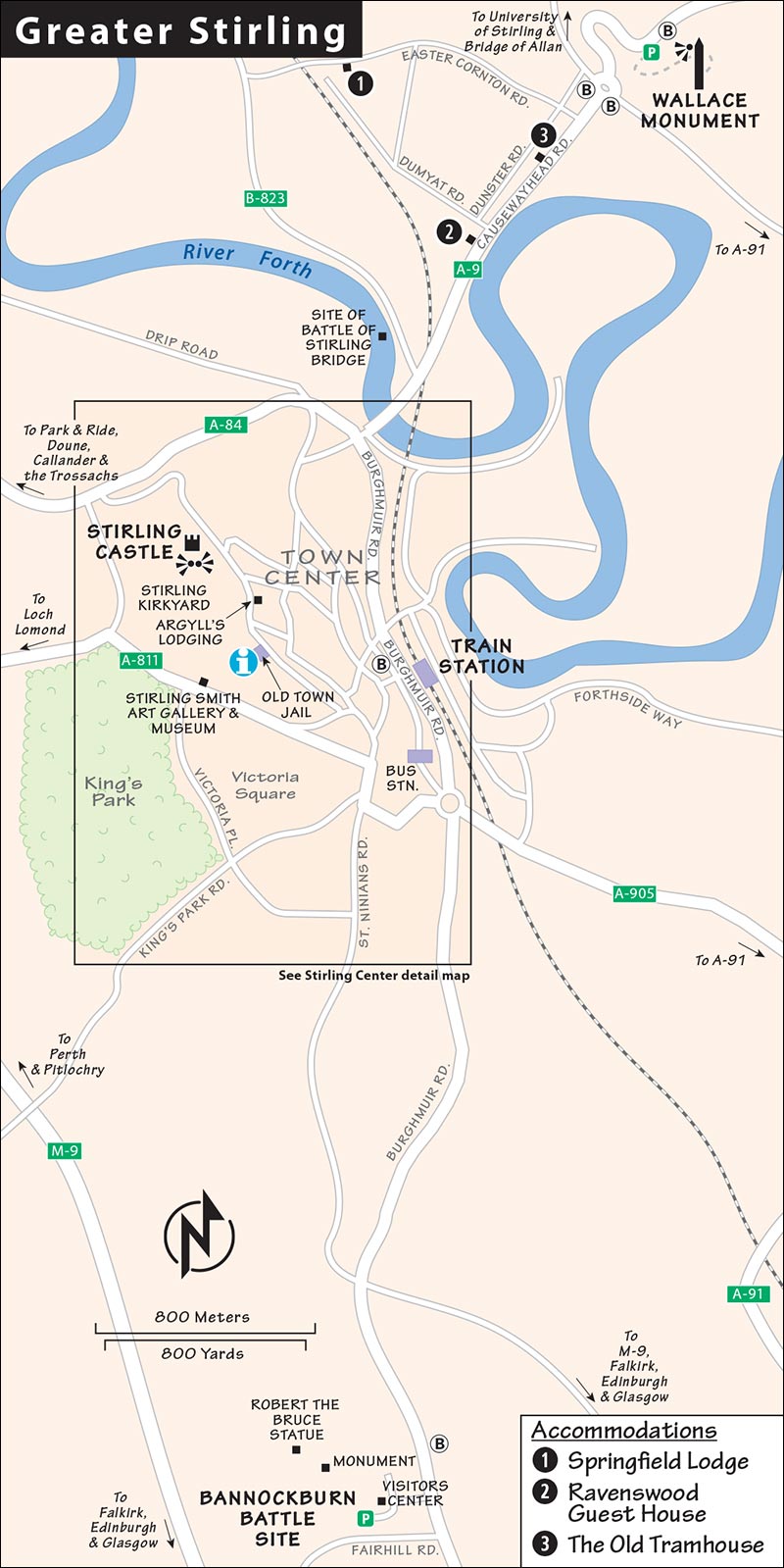
A number of moderately priced B&Bs and short-term rental apartments line Causewayhead Road, a busy thoroughfare that connects Stirling to the Wallace Monument. From here, it’s a long walk into town (or to the Wallace Monument), but the location is handy for drivers (each place has free parking), or you can catch bus #52 to the train or bus station. While this modern residential area lacks charm, it’s convenient—there’s even a Co-op grocery tucked among the B&Bs. For locations, see the “Greater Stirling” map, at the beginning of this chapter.
££ Springfield Lodge sits at the back end of the residential zone that lines up along Causewayhead Road. It’s across the street from farm fields, giving it a countryside feeling (co-owner Kevin knows the area well, because he grew up nearby). The five neat rooms fill a spacious modern house (one triple room, no kids under 8, Easter Cornton Road, +44 1786 474 332, mobile +44 798 656 4340, springfieldlodgebandb.co.uk, springfieldlodgebandb@gmail.com, Kim and Kevin).
££ Ravenswood Guest House, run by cheerful Stuart, has four tight and tidy rooms (2-night minimum, 94 Causewayhead Road, +44 1786 475 291, ravenswoodguesthouse.com, stu941@googlemail.com).
££ The Old Tramhouse is a good choice for families or small groups; they offer two self-catering apartments that sleep up to six people (2-night minimum, full kitchens, 42 Causewayhead Road, +44 1786 449 774, mobile +44 759 054 0604, theoldtramhouse.com, enquiries@theoldtramhouse.com, Alison Cowie).
Eating in Stirling
Stirling isn’t a place for high cuisine; eateries here tend to be satisfying but functional. For locations, see the “Stirling Center” map, earlier.
UP NEAR THE CASTLE
£ Unicorn Café, tucked under the casemates inside the castle, is a decent cafeteria for lunch if touring the grounds (closes 30 minutes before the castle).
££ The Portcullis, just below the castle esplanade, was built as a schoolhouse in the 1780s. It’s a classic pub that aches with history, from its dark, wood-grained bar area to its stony courtyard. The food, like the setting, is old school, with a few surprises. If the restaurant is full, you can eat at the bar (daily, +44 1786 472 290).
£££ Hermann’s, a block below the castle esplanade, is simple, spacious, and homey, with a sunny conservatory out back. It serves a mix of Scottish and Austrian food, including fixed-price meals—perfect when you’ve got a hankering for haggis but your travel partner wants Wiener schnitzel (daily, top of Broad Street, +44 1786 450 632, hermanns.co.uk [URL inactive]).
LOWER DOWN IN THE TOWN
Dumbarton Road, at the bottom of town, has a line of cheap eateries, including £ Blue Lagoon Fish & Chips (daily 11:00-late, at Port Street). Among a group of chain pubs and global eateries (Thai, Italian, Greek, Indian), these three are within about a block of Stirling’s clock tower near King Street in the old town center:
£££ Brea, which means “love” in Gaelic, has a nice Scottish theme, from the menu to the decor to the pop music playing. It’s unpretentious and popular for its modern and tasty takes on Scottish classics like haggis and haddock, which share the menu with the likes of risotto and tagliatelle. Consider treating starters like tapas and eating family-style (daily, 5 Baker Street, +44 1786 446 277).
££ BrewDog, the Aberdeen-based brewery, has a taproom right on the main drag with 20 beers on tap, pizzas, and wings (Fri-Sun from 12:00, Wed-Thu from 16:00, closed Mon-Tue, 7 Baker Street, +44 1786 440 043).
££ Nicky-Tams Bar and Bothy is a fun little hangout with a gritty Irish-pub ambience, providing a great place to chat up a local and enjoy some good, basic pub grub. They serve meals from 12:00 to 20:00 (from 13:00 Sun), then make way for drinking and, often, live music (daily, 29 Baker Street, +44 1786 472 194).
NEAR STIRLING, IN BRIDGE OF ALLAN
Drivers who’d enjoy getting out of town (rather than negotiating Stirling’s narrow, twisty streets to look for parking) can zip about 10 minutes past the Wallace Monument to the neighboring community of Bridge of Allan.
As this is near the University of Stirling and serves a young student population, it has more than its share of interesting shops and good eateries. There’s a branch of the WoodWinters wine and whisky shop (described on here in Edinburgh); a well-regarded microbrewery with a cozy atmosphere, Allanwater Brewhouse—with a smoky, hoppy, malty aroma (serving beer and pizza); and The Allanwater Café, a local favorite for fish-and-chips and homemade ice cream. Several other tempting options are here, too, making Bridge of Allan worth a browse after your Wallace Monument visit or on your way out of town.
Stirling Connections
From Stirling by Train to: Edinburgh (3/hour, 45 minutes), Glasgow (Queen Street, 4/hour, 35 minutes), Pitlochry (nearly hourly direct, 1 hour), Inverness (8/day direct, 3 hours). Train info: +44 345 748 4950, nationalrail.co.uk.
By Bus to: Glasgow (hourly on #M8, 45 minutes—train is better), Edinburgh (hourly on #909, 1.5 hours). Bus info: citylink.co.uk.
Near Stirling
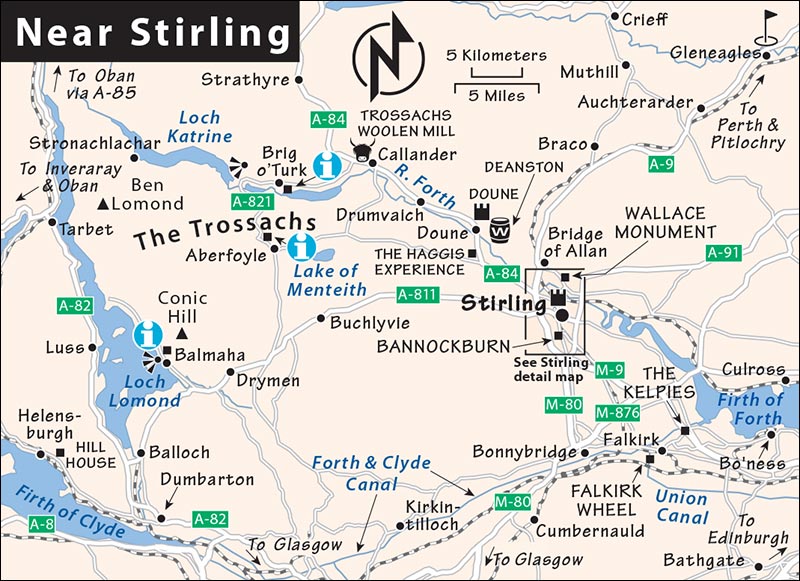
The Wallace Monument and the Battle of Bannockburn Visitors Centre are just outside town. Sights within side-trip distance include the Kelpies horse-head sculptures, the Falkirk Wheel “boat elevator,” the stuck-in-time village of Culross, and Doune Castle. It’s easiest to string these sights together by car, but I’ve provided some public transportation details for those without their own wheels.
JUST OUTSIDE STIRLING
▲Wallace Monument
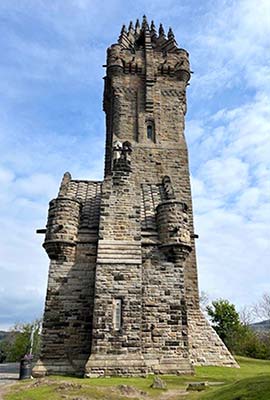
Commemorating the Scottish hero William Wallace, this sandstone tower—built during a wave of Scottish nationalism in the mid-19th century—marks the Abbey Craig hill on the outskirts of Stirling. This is near where, in 1297, Wallace and his ragtag Scottish forces hid out in the forest, waiting for the perfect moment to ambush the English. Thanks to the element of surprise, the Scots won an unlikely victory at the Battle of Stirling Bridge...but England came back to beat the Scots the next year. (For more on Wallace, see here.)
Cost and Hours: £11.65; daily 9:30-17:00, July-Aug until 18:00, shorter hours Nov-March, last entry one hour before closing; +44 1786 472 140, nationalwallacemonument.com.
Getting There: The monument is two miles northeast of Stirling on the A-9, signposted from the city center; drivers will find free parking at the visitors center. Bus #52 goes from the Stirling bus station to the road just below the visitors center, a short walk away (2/hour). (You can also catch this bus across the street from the Stirling train station at stall B or C.) The “Unilink” (UL) double-decker bus, which runs students back and forth to the university—works in a pinch but stops at the roundabout below the monument, near the Co-op supermarket; from there, it’s about a 15-minute hike up to the visitors center. Taxis cost about £12 one-way from Stirling.
Visiting the Monument: First you’ll reach the visitors center, which is essentially a shop and café, with free WCs (there are none at the monument itself) and free parking. From here, you’ll either need to hike (a steep 15 minutes) or hop on the free shuttle bus up to the monument. Consider taking the shuttle bus up and walking the pleasant, wooded trail back down.
Once at the monument, gaze up and think about how this fanciful 19th-century structure was created and designed to evoke (and romanticize) earlier architectural styles—in this case, medieval Scottish castles. The crown-shaped top—reminiscent of St. Giles’ Cathedral on the Royal Mile in Edinburgh—and the dynamic sculpture of William Wallace are patriotic to the max.
Buy your ticket at the base and climb the tight, stone spiral staircases (not for the claustrophobic) a total of 246 steps, stopping at each of the three levels to see museum displays. The first level, the Hall of Arms, tells the story of William Wallace and gives you the chance to ogle Wallace’s five-foot-long broadsword. Second is the Hall of Heroes, adorned with busts of great Scots—suggesting the debt this nation owes to Wallace. A more recent addition showcases Scottish heroines, selected by a public vote. But it’s not all just hero worship: A thoughtful video presentation on the first level explains the battle while considering the role of Wallace in both Scottish and English history, and raises the point that one person’s freedom fighter may be another person’s terrorist. The third level’s exhibits are about the Battle of Stirling Bridge.
Finally, you reach the top, with stunning views over Stirling, its castle, the winding River Forth, and Stirling Bridge—a 500-year-old stone version that replaced the original wooden one. Looking out from the same vantage point as Wallace, imagine how the famous battle played out. If you find yourself picturing the conflict as portrayed in the Braveheart movie (1995)—with berserker Scots, their faces painted blue, running across a broad field to take on the English cavalry—you have the wrong idea. While that portrayal was cinematically powerful, in reality the battle took place on a bridge in a narrow valley.
Battle of Bannockburn Visitors Centre and Monument
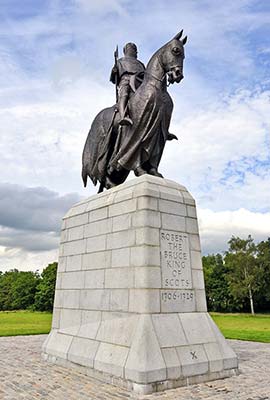
Just south of Stirling, this site commemorates what many Scots view as their nation’s most significant military victory over the invading English: the Battle of Bannockburn, won in two days by a Scottish army led by Robert the Bruce against England’s King Edward II in 1314. The Battle of Bannockburn Experience offers a guided high-tech re-creation of the battle.
Cost and Hours: Memorial—free, always open; visitors center—daily 10:00-17:00; £9 timed tickets for the Battle of Bannockburn Experience must be booked online, starts at the top of each hour, last tour at 15:00; café, free WCs; +44 1786 812 664, nts.org.uk.
Getting There: By car, Bannockburn is two miles south of Stirling on the A-872, off the M-80/M-9. It has free and easy parking and is a simple stop-off on your way into or out of town. Buses #X36 and #56 run to Bannockburn from Stirling’s bus station; disembark at the car-rental stop on Glasgow Road, a two-minute walk from the Bannockburn Visitors Centre. If you want to hit both the Battle of Bannockburn and the Wallace Monument, you’ll need to take separate buses and transfer in Stirling (see the Wallace Monument listing for how to take the bus there).
Background: In simple terms, Robert the Bruce—who was first and foremost a politician—found himself out of political options after years of failed diplomatic attempts to make peace with the strong-arming English. William Wallace’s execution left a vacuum in military leadership, and eventually Robert stepped in, waging a successful guerrilla campaign that came to a head as young Edward’s army marched to Stirling. Although the Scots were greatly outnumbered, their strategy and use of terrain at Bannockburn—with its impossibly twisty stream presenting a natural barrier for the invading army—allowed them to soundly beat the English and drive Edward out of Scotland...for the time being. (For more about Robert the Bruce, see here.)
Visting the Monument: The visitors center offers a one-hour Battle of Bannockburn Experience. First, you’ll watch two short films to get your bearings. Then you’ll stand around a large map, as a guide animatedly tells the story of how the battle played out. Finally, you’ll enter an immersive exhibit about the battle and have some time to explore; while informative, the exhibit has no significant historical artifacts.
Leaving the visitors center, hike out into the field behind. A giant circular structure contains a poignant monument to those lost in the fight. Beyond that, on a plinth, stands an equestrian statue of Robert the Bruce. Information panels illustrate how the Battle of Bannockburn unfolded in this very field.
FALKIRK
Two engaging landmarks sit just outside the town of Falkirk, 12 miles south of Stirling, and offer a welcome change of pace from Scottish countryside kitsch. The Kelpies and the Falkirk Wheel flank Falkirk’s otherwise unexciting town center, about a 5-mile, 20-minute drive apart. Driving between the two is a riddle of roundabouts. Carefully follow the brown signs and you’ll eventually get there.
While driving is by far the easier way to link these two sights, if you’re not pressed for time, it’s possible to get there via a train-bus-walk combo. Plan on at least a half-day, with a travel time of 45-60 minutes from Stirling to either sight (to see both, you’ll backtrack to Falkirk in between). Google Maps and the McGill’s/Midland Bluebird bus website (mcgillsscotlandeast.co.uk) can help you navigate and find the next bus.
▲The Kelpies
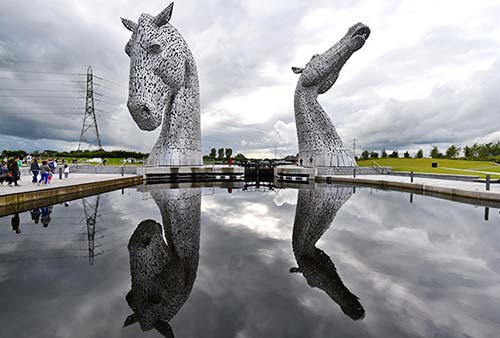
Unveiled in 2014 and standing over a hundred feet tall, these two giant, glittering-steel horse heads quickly became a symbol of this town and region. They may seem whimsical, but they’re rooted in a mix of mythology and real history: Kelpies are magical, waterborne, shape-shifting sprites of Scottish lore, who often took the form of a horse. Historically, horses were used as beasts of burden to power Scotland’s industrial output. These statues stand over old canals where hardworking horses towed heavily laden barges. But if you prefer, you can just forget all that and ogle the dramatic, energy-charged statues (particularly thrilling to Denver Broncos fans) that make for an entertaining photo op.
Cost and Hours: Always open and free to view, pay parking; visitors center open daily 9:00-17:00; £8.50 tours run several times daily 10:00-16:00, check current schedule online; +44 1324 590 600, thehelix.co.uk.
Getting There: The Kelpies are in a park called The Helix, just off the M-9 motorway. Drivers will spot them looming high over the motorway. Exit the M-9 for the A-905 (Falkirk/Grangemouth), then follow Falkirk/A-904 and brown Helix Park & Kelpies signs. If you have time and weather for a stroll, you can park for free farther up the road from the Kelpies and walk to see them in about 10 minutes.
Without a car, from Stirling first go by train to Falkirk’s Grahamston station (£10 open-return ticket, 2/hour, 15 minutes, scotrail.co.uk). Exiting the station, walk to the Park Street stop to meet bus #2, #3, or #4. Tell the driver you’re going to the Kelpies, and you’ll be let off near Falkirk Stadium (a 15-minute ride). From there it’s a 20-minute walk on well-signed pathways through pleasant Helix Park to reach the statues. (Or take a taxi from Grahamston station—about £12 one-way.)
Visiting the Kelpies: The free visitors center has a café, WCs, and an exhibit on how the horse heads were built. You can even join a 25-minute guided tour through the inside of one of the great beasts to see how they’re supported by a sleek steel skeleton: 300 tons of steel apiece, sitting upon a foundation of 1,200 tons of steel-reinforced concrete, and gleaming with 990 steel panels.
Though practical only with a car, it’s striking to see the Kelpies at night. Some visitors make two trips: one during the day to see the exhibit, then back at night to see the sculptures illuminated from within. The parking lot behind the visitors center stays open late for just this purpose (until 22:00 in summer, 20:00 in winter), but the Helix car park is always open.
▲▲Falkirk Wheel
At the opposite end of Falkirk stands this remarkable modern incarnation of Scottish technical know-how. You can watch the beautiful, slow-motion contraption as it spins—like a nautical Ferris wheel—to efficiently shuttle ships between two canals separated by 80 vertical feet.
Cost and Hours: Wheel is free to view, visitors center open daily 9:45-17:30, park open until dusk, shorter hours Nov-mid-March; cruises run about hourly and cost £17.70, check schedule on website and book your seat; scottishcanals.co.uk.
Getting There: Drivers can exit the M-876 motorway for A-883/Falkirk/Denny, then follow brown Falkirk Wheel signs. Parking is free and a short walk from the wheel.
Without a car, from Stirling first go by train to Falkirk’s Grahamston station (see details earlier, under “The Kelpies”). From Falkirk, you can take a taxi to the wheel (about £12 one-way) or ride bus #7 or #8 from St. Andrews Church on Newmarket Street to the Ochiltree Terrace stop (about 30 minutes). From there you’ll walk a few minutes along the pedestrian path over the canal—you can’t miss the wheel.
Background: Scotland was a big player in the Industrial Revolution, thanks partly to its network of shipping canals (including the famous Caledonian Canal—see here). Using dozens of locks to lift barges up across Scotland’s hilly spine, these canals were effective...but slow.
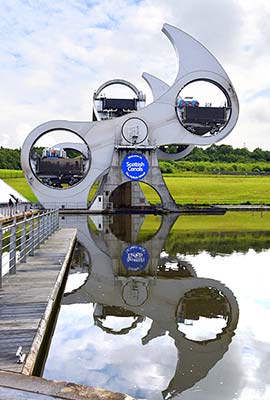
The 115-foot-tall Falkirk Wheel, opened in 2002, is a modern take on this classic engineering challenge: linking the Forth and Clyde Canal below with the aqueduct of the Union Canal, 80 feet above. Rather than raising and lowering the water level through several locks, the wheel simply picks boats up and—ever so slowly—takes them where they need to go, like a giant waterborne elevator. In the 1930s, it took a half-day to ascend or descend through 11 locks; now it takes only five minutes.
The Falkirk Wheel is the critical connection in the Millennium Link project, an ambitious £78 million initiative to restore the long-neglected Forth and Clyde and Union canals connecting Edinburgh and Glasgow. Today this 70-mile-long aquatic connection between Scotland’s leading cities is a leisurely traffic jam of pleasure craft, and canalside communities have been rejuvenated.
Visiting the Wheel: Twice an hour, the wheel springs (silently) to life: Gates rise to seal off each of the water-filled gondolas, and then the entire structure slowly rotates a half-turn to swap the positions of the lower and upper boats—each of which stays comfortably upright. It’s strangely exciting to witness.
The visitors center has a cafeteria (with a fine view of the wheel), a shop, and a short informational display about the wheel (a detailed guidebook is £5). The park around the canal is cluttered with trampolines, laser tag, minigolf, and other family amusements.
Riding the Wheel: Each hour, a barge takes 96 people (listening to a recorded narration explaining everything) into the Falkirk Wheel for the slow and graceful ride. Once at the top, the barge cruises a bit of the canal. The slow-motion experience lasts about an hour.
CULROSS
This time warp of a village, sitting across the Firth of Forth from Edinburgh (about a 30-minute drive from Stirling), is a perfectly preserved artifact from the 17th and 18th centuries and worth ▲. If you’re looking to let your pulse slow, stroll through a steep and sleepy village, and tour a creaky old manor house, Culross is your place.
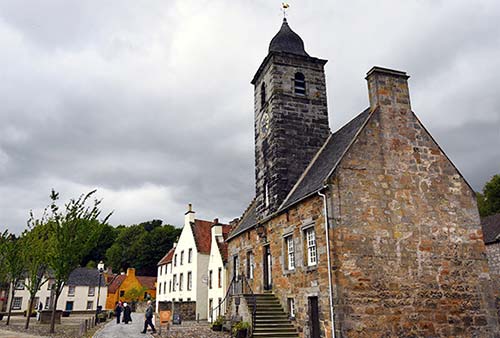
Getting There: While not worth a long detour or bus ride, it’s a workable stop for drivers connecting Edinburgh to either the Stirling area or St. Andrews (free parking lots flank the town center, each a five-minute waterfront stroll away—the western lot has a WC).
Background: The story of Culross (which locals pronounce “KOO-russ”) is the story of Sir George Bruce, who, in the late 16th century, figured out a way to build coal mines beneath the waters of the Firth of Forth. The hardworking town flourished, Bruce built a fine mansion, and the town was granted coveted “royal burgh” status by the king. But several decades later, with Bruce’s death and the flooding of the mines, the town’s fortunes tumbled—halting its development and trapping it as if in amber for centuries. Rescued and rehabilitated by the National Trust for Scotland, today the entire village feels like one big open-air folk museum.
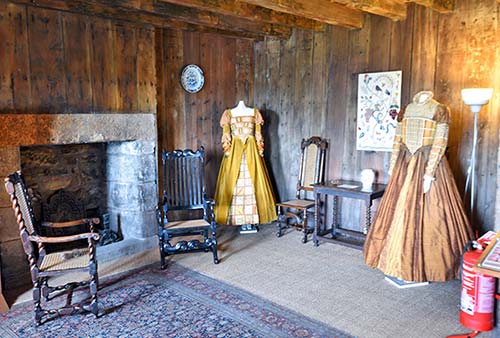
Visiting Culross: The main sightseeing here is the misnamed Culross “Palace,” the big half-timbered home of George Bruce (£13.50; April-Sept daily 10:00-17:00, Oct until 16:00, closed Nov-March, last entry one hour before closing; +44 1383 880 359, nts.org.uk/culross). Buy your ticket at the office under the Town Hall’s clock tower, then head a few doors down to the ochre-colored palace. Following a 10-minute orientation film, you’ll take a self-guided tour through several creaky floors to see how a small town’s big shots lived four centuries ago. Aided by posted explanations, you’ll see the great hall, the “principal stranger’s bedchamber” (guest room for VIPs), George Bruce’s bedroom and strong room (with six-foot-thick stone walls to protect precious—and flammable—financial documents), and the highlight, the painted chamber. The wood slats of its barrel-arched ceiling are painted with whimsical scenes illustrating Scottish virtues and pitfalls. You can also poke around the densely planted, lovingly tended garden out back.
The only other real sight, a steep hike up the cobbled lanes to the top of town, is the partially ruined abbey. While there are far more evocative ruins in Scotland, it’s fun to peer into the stony, mysterious-feeling interior of this church. But the stroll up the town’s cobbled streets past pastel houses, with their carefully tended flower boxes, is even better than the church itself.
DOUNE
The village of Doune (pronounced “doon”) is just a 15-minute drive north of Stirling. While there’s not much to see in town, on its outskirts is a handful of attractions: a castle, a distillery, and a haggis-making experience. In the village of Doune itself, notice the town seal: a pair of crossed pistols. The town is also known for its historic pistol factory. Locals speculate that the first shot of the American Revolution was fired with a Doune pistol.
Getting There: Drivers head to Doune, then follow castle signs on pretty back roads from there. Bus #59 runs hourly from Stirling to Doune and the distillery (just outside Doune) and stops a 10-minute walk from the castle.
Eating and Sleeping in Doune: Drivers content to stay in a quieter corner of the Stirling area may appreciate the pleasant and affordable £ Woodside Hotel, which offers 11 well-appointed rooms, self-catering apartments, and a worthwhile ££ restaurant serving burgers, steaks, haggis, and vegetarian dishes (Stirling Road, +44 1786 643 399, thewoodsidedoune.co.uk).
Doune Castle
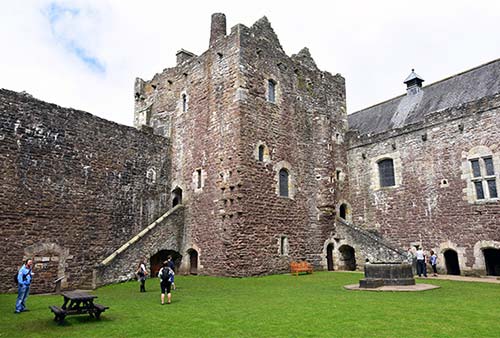
Doune Castle is worth considering for its pop-culture connections: Doune stands in for Castle Leoch in the TV series Outlander and, well before that, parts of Monty Python and the Holy Grail were filmed here. While the castle may underwhelm Outlander fans (only some exterior scenes were shot here), Monty Python fans—and anyone who appreciates British comedy—will be tickled by the included audio-guide, narrated by late Python troupe member Terry Jones (featuring sound clips from the film).
Cost and Hours: £11; daily 9:30-17:30, Oct-March 10:00-16:00, last entry 45 minutes before closing; +44 1786 841 742, historicenvironment.scot.
Visiting the Castle: Buy your ticket and pick up the 45-minute audioguide, which explains that the castle’s most important resident was not Claire Randall or the Knights Who Say “Ni!” but Robert Stewart, the Duke of Albany (1340-1420)—a man so influential he was called the “uncrowned king of Scotland.” You’ll see the cellars, ogle the empty-feeling courtyard, then scramble through the two tall towers and the great hall that connects them. The castle rooms are almost entirely empty, but they’re brought to life by the audioguide. You’ll walk into the kitchen’s ox-sized fireplace to peer up the gigantic chimney, and visit the guest room’s privy to peer down the medieval toilet. You’ll finish your visit at the top of the main tower, with 360-degree views that allow you to fart in just about anyone’s general direction.
Deanston Distillery
This big, attractive red-brick industrial complex (formerly a cotton mill) sits facing the river just outside Doune. Deanston has long been respected for its fruity, slightly spicy (and not peaty) single-malt whisky. The complex operates on hydroelectric power and boasts a slick visitors center with tours. On the 45-minute production tour, you’ll see the equipment used to make the whisky and enjoy two or three samples—those taking the wheel are sent home with “driver drams.” (For more on whisky, see here.) While it’s a bit more corporate-feeling than some of my favorite Scottish distilleries, Deanston is handy to Stirling.
Cost and Hours: £19.50-25; daily 10:00-17:00; 5 tours/day, visit website for times and to book, or just show up; +44 1786 843 010, deanstonmalt.com.
The Haggis Experience
Learn how Scotland’s most famous “hardship food” is made, try a sample, and possibly make it yourself (£48 for 2-hour demo plus two-course lunch or dinner, £75 for 2.5-hour master class and three-course meal, book ahead on website; located in the 200-year-old Kincardine Church, five minutes south of Doune by car, +44 1360 440 066, thehaggisexperience.com, Lee and Seamus).