GLASTONBURY & WELLS
The countryside surrounding Bath holds two particularly fine cathedral towns. Glastonbury (perhaps aka Avalon) is the ancient resting place of King Arthur and home (maybe) to the Holy Grail. It can be covered well in two to three hours: See the abbey, climb the tor, and channel your inner hippie.

Nearby, medieval Wells gathers around its grand cathedral. Wells is simply a cute small town, much smaller and more medieval than Bath, with a uniquely beautiful cathedral that’s best experienced at its evensong service.
GETTING AROUND THE REGION
By Car: Glastonbury and Wells are each about 20-25 miles from Bath and 140 miles from London. Drivers can do a 51-mile loop from Bath to Glastonbury (25 miles) to Wells (6 miles) and back to Bath (20 miles). For the very ambitious, you can extend the trip to a 131-mile loop that includes two places covered in the next chapter: Drive from Bath to Avebury (25 miles) to Stonehenge (30 miles) to Glastonbury (50 miles) to Wells (6 miles) and back to Bath (20 miles). But you’ll need to get an early start—the last entry at Wells Cathedral is 17:30—and you’ll most likely thank yourself for choosing two or three of these destinations, not all of them.
By Bus and Train: The handiest train station is in Bath, served by regular trains from London’s Paddington Station (2/hour, 1.5 hours). Wells and Glastonbury are both easily accessible by bus from Bath. Buses #173 (Mon-Sat) and #174 (daily) go direct from Bath to Wells (1-2/hour, 75 minutes), where you can continue to Glastonbury by catching bus #375 or #376 (Mon-Sat 2/hour, Sun hourly, 20 minutes). To return to Bath, you’ll likely go back through Wells (as direct bus service from Glastonbury to Bath is very limited). A First Bus “West of England” day pass (about £7) is a good deal if you plan on visiting Glastonbury and Wells from your Bath home base (firstbus.co.uk). Download the First Bus app to buy the pass and for cheaper single-ride prices.
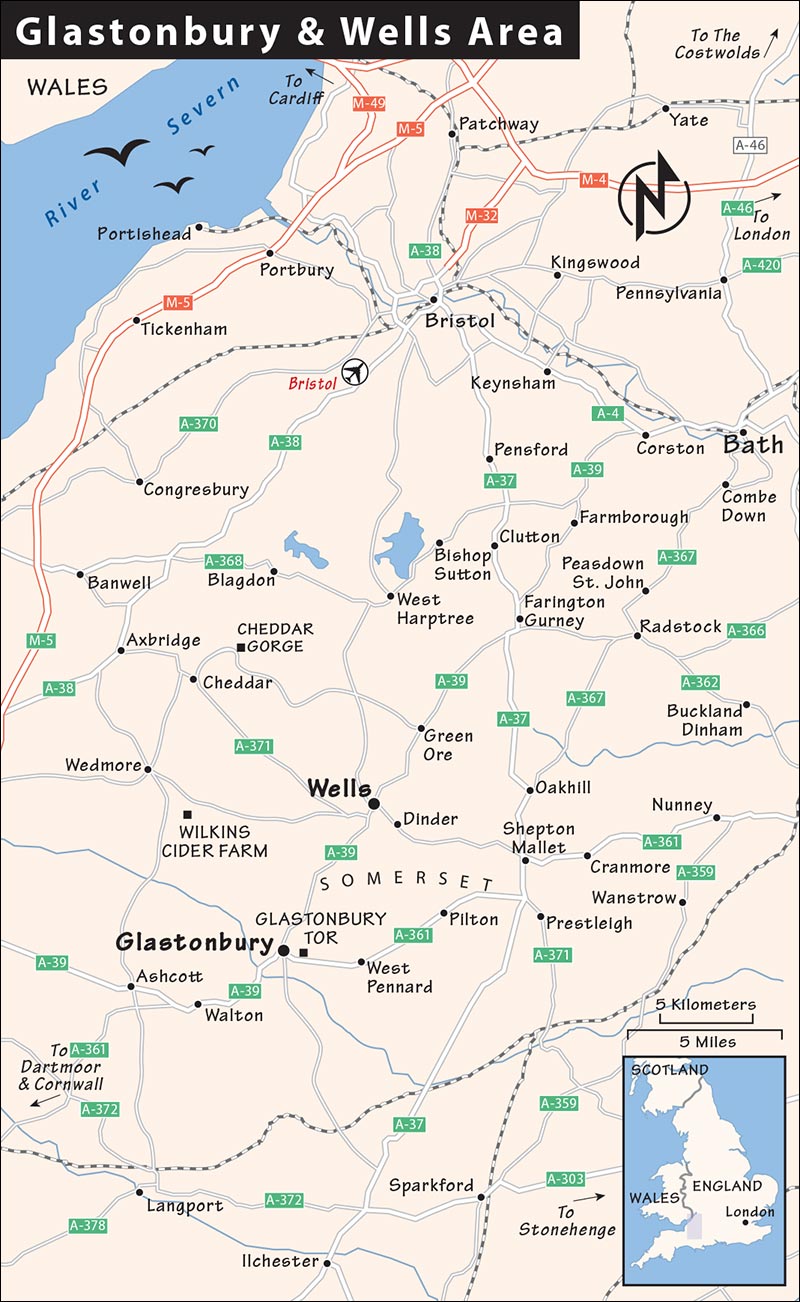
By Bike: A 10-mile path connects Wells and Glastonbury.
Glastonbury
Marked by its hill, or “tor,” and located on England’s most powerful line of prehistoric sites, the town of Glastonbury gurgles with history and mystery.
In AD 37, Joseph of Arimathea—Jesus’ wealthy uncle—reputedly brought vessels containing the blood of Jesus to Glastonbury, and with him, Christianity came to England. (Joseph’s visit is plausible—long before Christ, locals traded lead and tin with merchants from the Levant.)
While this story is “proven” by fourth-century writings and accepted by the Church, the King-Arthur-and-the-Holy-Grail legends it inspired are not. Those medieval tales came when England needed a morale-boosting folk hero for inspiration during a war with France. They pointed to the ancient Celtic sanctuary at Glastonbury as proof enough of the greatness of the fifth-century warlord Arthur. In 1191, after a huge fire, Arthur’s supposed remains (along with those of Queen Guinevere) were dug up from the abbey garden. They were reburied in the abbey choir, and Arthur and Guinevere’s gravesite is a shrine today. Many think the Grail trail ends at the bottom of the Chalice Well, a natural spring at the base of the Glastonbury Tor.
By the 10th century, Glastonbury Abbey was England’s most powerful and wealthy, part of a nationwide network of monasteries that by 1500 owned one-quarter of all English land and had four times the income of the Crown. Then Henry VIII began dissolving the abbeys in 1536. He was particularly harsh on Glastonbury—he not only destroyed the abbey but also hung and quartered the abbot, sending his body on four different national tours...at the same time. This was meant as a warning to other religious clerics, and it worked.
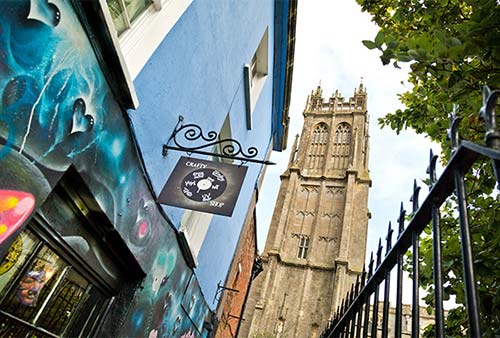
But Glastonbury rebounded. In an 18th-century publicity campaign, thousands signed affidavits stating that they’d been healed by water from the Chalice Well, and once again Glastonbury was on the tourist map. Today, Glastonbury and its tor are a center for “searchers”—too weird for the mainstream Church but just right for those looking for a place to recharge their crystals. Glastonbury is also synonymous with its summer music-and-arts festival, a long-hair-and-mud Woodstock re-creation that’s a rite of passage for young music lovers in Britain (and around the world).
Part of the fun of a visit to Glastonbury is just being in a town where every other shop or eatery is a New Age place. Locals complain that on High Street, you can buy any kind of magic crystal or incense—but not a roll of TP. But, as this counterculture is their town’s bread and butter, they do their best to sit in their pubs and go, “Ommmmm.”
Orientation to Glastonbury
TOURIST INFORMATION
The TI, located in St. Dunstan’s House near the abbey, gives out a free town map and sells several inexpensive booklets about area walks as well as more detailed Ordnance Survey maps (daily 10:00-15:00, 1 Magdalene Street, +44 1458 333 144, glastonburyinformationcentre.co.uk).
ARRIVAL IN GLASTONBURY
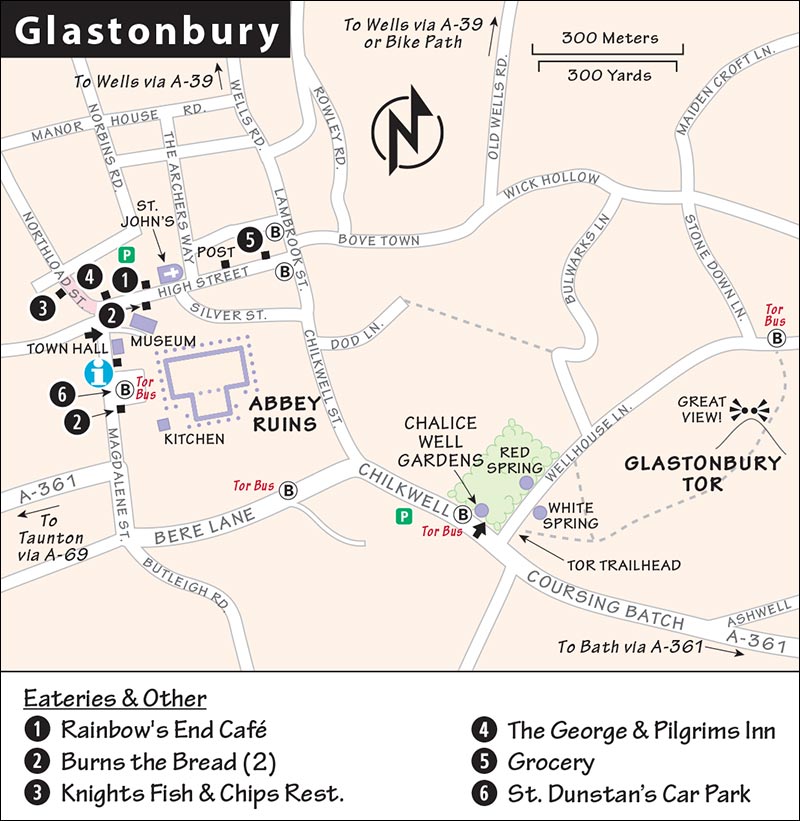
The bus from Bath and Wells drops you off directly in front of the abbey entrance on Magdalene Street. Because the St. Dunstan’s parking lot near the TI often fills up, a better option for drivers is to park at the St. John’s lot at 10 St. John’s Square, a five-minute walk from High Street.
HELPFUL HINTS
- Market Day: The St. Dunstan’s parking lot near the TI hosts a Tuesday market for crafts, knickknacks, and local produce. There’s also a country market Tuesday mornings in the Town Hall.
- Glastonbury Festival: Nearly every summer (generally around the solstice in June), the gigantic Glastonbury Festival—billing itself as the “largest music and performing arts festival in the world”—brings all manner of postmodern flower children to its notoriously muddy “Healing Fields.” More than 200,000 music fans make the trek to see some of the world’s hottest bands. Anticipate increased traffic and crowds (especially on public transit), even though the actual music venue—practically a temporary city of its own—is six miles east of town (glastonburyfestivals.co.uk).
Sights in Glastonbury
I’ve listed these sights in the order you’ll reach them, moving from the town center to the tor.
Glastonbury Town
The tiny town itself is worth a pleasant stroll. The abbey came first, and Glastonbury grew up to serve it. For example, The George & Pilgrims Inn was originally a freestanding structure built in the 15th century to house spiritual sojourners. And St. John’s Church, which dates from the same century, was constructed to give townsfolk a place to worship, as they weren’t allowed in the abbey. The Market Cross at the base of High Street dates from around 1800.
Though Glastonbury is much older, its vibe dates to 1970, when the town hosted its first rock festival. Like Woodstock, it was held on a farm. Unlike Woodstock, the Glastonbury Festival had legs—it’s been held on the same farm almost every year since. You’ll still see many hippie and New Age shops in town.
▲▲Glastonbury Abbey
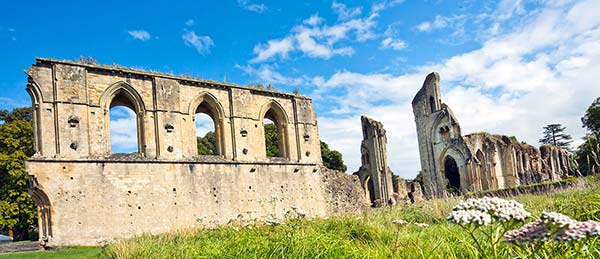
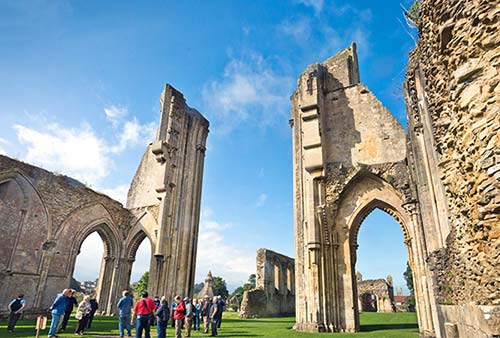
The massive and evocative ruins of the first Christian sanctuary in the British Isles stand mysteriously alive in a lush 36-acre park. Because it comes with a small museum, a dramatic history, and enthusiastic guides dressed in period costumes, this is one of the most engaging to visit of England’s many ruined abbeys.
Cost and Hours: £14; daily 10:00-18:00, March and Oct until 17:00, Nov-Feb until 16:00, last entry 45 minutes before closing; +44 1458 832 267, glastonburyabbey.com.
Getting There: Enter the abbey from Magdalene Street (around the corner from High Street, near the Town Hall and TI).
Tours and Demonstrations: Costumed guides offer free 30-40-minute tours throughout the day. Times vary; check the schedule as you enter. Your ticket allows you to come and go as you like, so you can always leave to explore the town and return later. Check the website before you go for special events (some require preregistration).
Eating: Picnicking is encouraged. Bring something from one of the shops in town (see “Eating in Glastonbury,” later), or buy food at the abbey’s small café (open April-Oct) or snack stand on the grounds.
Background: The space that these ruins occupy has been sacred ground since the druids used it as a pagan holy site. Because of the legendary connection with Joseph of Arimathea, 12th-century Glastonbury was the leading Christian pilgrimage site in all of Britain. The popular abbey grew powerful and very wealthy, employing 1,000 people to serve the needs of the pilgrims.
In 1184, there was a devastating fire in the monastery, and in 1191, the abbot here “discovered”—with the help of a divine dream—the tomb and bodies of King Arthur and Queen Guinevere. Of course, this discovery boosted the pilgrim trade in Glastonbury and the new revenues helped to rebuild the abbey.
Then, in 1539, King Henry VIII ordered the abbey’s destruction. When Glastonbury Abbot Richard Whiting questioned the king’s decision, he was branded a traitor, hung at the top of Glastonbury Tor (after carrying up the plank that would support his noose), and his body cut into four pieces. His head was stuck over the gateway to the former abbey precinct. After this harsh example, the other abbots accepted the king’s dissolution of England’s abbeys, with many returning to monastic centers in France. Glastonbury Abbey fell into ruin and was used as a quarry.
Today, the abbey attracts both the curious and the pious. Tie-dyed, starry-eyed pilgrims seem to float through the grounds, naturally high. Others worship the grave of King Arthur, whose burial site is marked off in the center of the abbey ruins.
 Self-Guided Tour: After buying your ticket, pick up a map and tour the informative museum at the entrance building. A model shows the abbey in its pre-Henry VIII splendor, and exhibits tell the story of a place “grandly constructed to entice the dullest minds to prayer.” Knowledgeable guides are eager to share the site’s story and might even offer an impromptu tour.
Next, head out to explore the green park, dotted with bits of the ruined abbey. You first come face to face with the abbey’s Lady Chapel, the site of the first wattle-and-daub church, possibly dating to the first century. Today, the crypt is dug out and exposed; posted information helps you imagine its 12th-century splendor.
The Lady Chapel became the abbey’s west entry when the church expanded. The abbey was long and skinny, but vast. Measuring 580 feet, it was the longest in Britain (larger than York Minster is today) and Europe’s largest building north of the Alps.
Now, continue uphill and, as you approach the rest of the ruins, look to the left inside what was the north transept for two trapdoors in the ground. Lift them to see surviving fragments of the abbey’s original tiled floor.
As you pass through the ruins, you’ll see the tombstone (formerly in the floor of the church’s choir) marking the spot where the supposed relics of Arthur and Guinevere were interred. Continue through the remains of the ruined complex to the far end of the abbey. From what was the high altar, you can stand and look back downhill at what was the gangly nave. Envision the longest church nave in England.
Continue around the far side of the abbey ruins, feeling free to poke around the park. Imagine all this green space—just a tiny part of the lands owned by the abbey—bustling with the daily business of a powerful monastic community.
As you head back downhill toward the conical building, to the right of that building is a thorn tree. According to legend, when Joseph of Arimathea came here, he climbed nearby Wearyall Hill and stuck his staff into the soil. The staff took root and grew into a remarkable thorn tree that bloomed twice a year. Over the centuries, locals took cuttings of the “Holy Thorn,” and the descendants of the original tree continue to bloom at Easter and Christmas. If the story seems far-fetched to you, don’t tell the royals—a budded branch from a Glastonbury thorn sits proudly on their breakfast table every Christmas morning. (You can even buy a small section of the Holy Thorn in the abbey’s shop.)
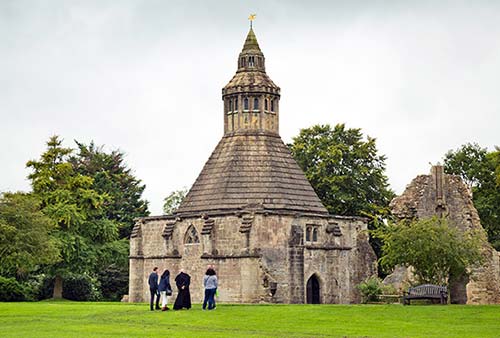
Now take a look inside the conical building, the abbot’s kitchen. All those monks needed to eat. This is the only surviving intact building on the grounds (see photo). Its size, and its simple descriptions about life in the abbey (along with sample recipes), gives you an idea of life in the community.
NEAR GLASTONBURY TOR
The tor is a steep hill at the southeastern edge of town (it’s visible from just about everywhere). The other two sights (the gardens and springs) are on your way to/from the tor.
Getting There: The garden and springs are about a 15-minute walk from the town center, toward the tor. The base of the tor is an additional five minutes. Climbing the tor takes another 15-20 minutes.
If you don’t want to walk to the tor, you have two options: The Tor Bus shuttles visitors from the town center to the base of the tor, stopping at the Chalice Well Gardens en route (£4.50 round-trip, departs from within the St. Dunstan’s parking lot near the TI—not along the street, daily every half-hour 10:00-13:00 & 14:00-17:00, doesn’t run Oct-March). If you have a car, you won’t find much parking nearby, so expect a bit of a hike (try the pay lot at the Draper sheepskin shop, near the Chalice Well on Chilkwell Street). A taxi to the tor trailhead costs about £7 one-way. These take you to the bottom of the tor; to reach the top, you still have to hike.
A good plan is to ride the shuttle bus to the tor, climb to the top, hike down, drop by Chalice Well Gardens, and stroll back into town from there.
Chalice Well Gardens
According to tradition, in AD 37 Joseph of Arimathea brought the chalice said to have been used by Jesus at the Last Supper to Glastonbury. Also known as the Holy Grail, the chalice supposedly ended up at the bottom of a well, which is now the centerpiece of this peaceful and inviting garden. Even if the fabled chalice is not here (another legend says it made the trip to Wales), and the water is red from iron ore and not Jesus’ blood, the tranquil setting attracts pilgrims. If you’re a fan of gardens—or want to say you’ve completed your grail quest—this place is worth a visit.
Past the entrance, follow the well-marked path uphill alongside the gurgling stream, passing an area where you can wade in the supposedly healing waters, and the Lion’s Head fountain, the one place where it’s safe to take a drink (it’s tested often, but they advise taking just a small amount). A few areas along the way are designated for silent reflection (if you’re here at 12:00 or 15:00, a bell invites everyone to pause for one minute to reflect). At the top of the hill is the well itself, marked by its intricate ironwork cover. The stones of the well shaft date from the 12th century and are believed to have come from the church in Glastonbury Abbey (which was destroyed by fire). In the 18th century, pilgrims flocked to Glastonbury for the well’s healing powers. From here you’ll drop back down the hill and circle around to the peaceful Vesica Pool (don’t drink or wade here).
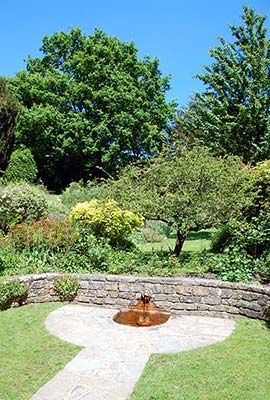
Cost and Hours: £5, daily 10:00-18:00, Nov-March until 16:30, on Chilkwell Street/A-361, +44 1458 831 154, chalicewell.org.uk.
Red and White Spring Waters
If you’d just like to sample the fabled water, two waterspouts are just around the corner from the Chalice Well Gardens entrance (just beyond the trailhead to the tor on the right). The spout on the Chalice Well side comes from the Red Spring; the other spout’s source on the right, in a peaceful and inviting rock garden, is the White Spring. Try both and see which you prefer.
▲Glastonbury Tor
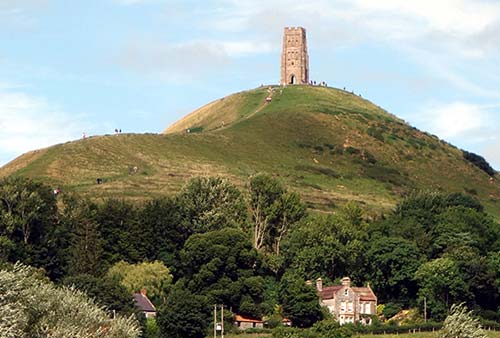
Seen by many as a Mother Goddess symbol, the Glastonbury Tor—a natural plug of sandstone on clay—has an undeniable geological charisma. Climbing the tor is the essential activity on a visit to Glastonbury. A fine Somerset view rewards those who hike to its 520-foot summit.
Climbing the Tor: From just past the Chalice Well, a not-well-marked trail leads to the top of the tor (about 15-20 minutes, if you keep a brisk pace). Alternatively, you could continue up the road past the Red and White Springs to hike up the tor from the other end, but it’s a much steeper and less dramatic approach.
As you climb, survey the surrounding land—a former swamp, inhabited for 12,000 years, which is still below sea level at high tide. Up until the 11th century you could actually sail here. The ribbon-like man-made drainage canals that glisten as they slice through the farmland are the work of engineers—Huguenot refugees who turned the marshy wasteland into something arable.
Looking out, find Glastonbury (at the base of the hill) and Wells (marked by its cathedral) to the right. Above Wells, a TV tower marks the 996-foot high point of the Mendip Hills. It was lead from these hills that attracted the ancient Romans (and, perhaps, Jesus’ uncle Joe) so long ago. Stretching to the left, the Mendip Hills define what was the coastline before those Huguenot engineers arrived.
The tor-top tower is the remnant of a chapel dedicated to St. Michael. Early Christians often employed St. Michael, the warrior angel, to combat pagan gods. When a church was built upon a pagan holy ground like this, it was frequently dedicated to Michael. But apparently those pagan gods fought back: St. Michael’s Church was destroyed by an earthquake in 1275.
Eating in Glastonbury
££ Rainbow’s End is one of several fine, healthy, vegetarian lunch spots featuring hot dishes (including vegan and gluten-free options), soups, salads, herbal teas, yummy homemade sweets, and New Age people-watching. If you’re looking for a midwife or a male-bonding meeting, check their notice board (daily for lunch only, 17 High Street, +44 1458 833 896).
£ Burns the Bread has two convenient locations making hearty pasties (savory meat pies) as well as sandwiches, pastries, and delicious cookies. Ask for a sample of the Torsy Moorsy Cake (a type of fruitcake made with cheddar), or try a gingerbread man made with real ginger. Grab a pasty and picnic with the ghosts of Arthur and Guinevere in the abbey ruins (main location at 14 High Street open Mon-Sat 7:30-17:00, Sun 10:00-16:00, smaller shop in St. Dunstan’s parking lot next to the abbey has shorter hours and is closed Sun, +44 1458 831 532).
£ Knights Fish and Chips Restaurant has been in the same family since 1909 and is the town’s top chippy and a national fish-and-chip award winner (they’re currently training the sixth generation to eventually take over). It’s another fine option for a picnic at the abbey (prices higher for table service, Mon-Sat 12:00-14:00 & 17:00-21:00, closed Sun; 5 Northload Street, +44 1458 831 882, Kevin and Charlotte).
££ The George & Pilgrims Inn, in a 15th-century building that once housed pilgrims, is a wonderfully Old World pub that could be exactly what the doctor ordered if you’re suffering a New Age overdose. The local owners offer up a traditional pub-grub menu (long hours daily, 1 High Street, +44 1458 831 146). They also rent spacious £££ rooms; see georgeandpilgrims.com.
Grocery: Earth Fare Market, near the top of High Street, is a good place to collect some healthy items for a hippie-dippie picnic in the abbey green or at the tor (45 High Street, Mon-Sat 8:30-19:30, Sun 10:00-18:00).
Glastonbury Connections
Local buses are run by First Bus Company (+44 345 646 0707, firstbus.co.uk).
From Glastonbury by Bus to: Wells (2/hour, 20 minutes, bus #375 or #376 headed to Bristol), Bath (nearly hourly, allow 2 hours, take bus to Wells, transfer to bus #173 or #174 to Bath). Buses are sparse on Sundays (generally one bus every other hour). If you’re heading to points west, you’ll likely connect through Taunton (which is a transfer point for westbound buses from Bristol).
Wells
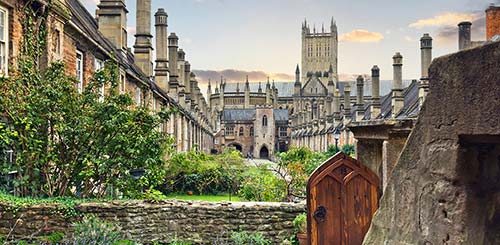
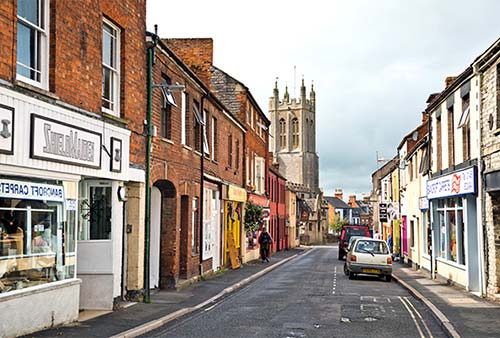
Because this well-preserved little town has a cathedral, it can be called a city. It’s England’s smallest cathedral city (pop. just under 12,000), with one of its most interesting cathedrals and a wonderful evensong service (generally not offered July-Aug). Of all the towns you’ll visit, Wells has the most buildings still operating as originally intended, and you’ll spot a number of wells and springs that helped give the town its name. Markets fill the town square on Wednesday (farmers market) and Saturday (general goods).
Orientation to Wells
TOURIST INFORMATION
The TI is in the Town Hall on Market Square, next to the Bishop’s Palace. Consider picking up their free town map or buying the inexpensive Wells City Trail booklet (Mon-Sat 9:00-15:00, closed Sun, 8 Cathedral Green, +44 1749 673 091, wellssomerset.com [URL inactive]).
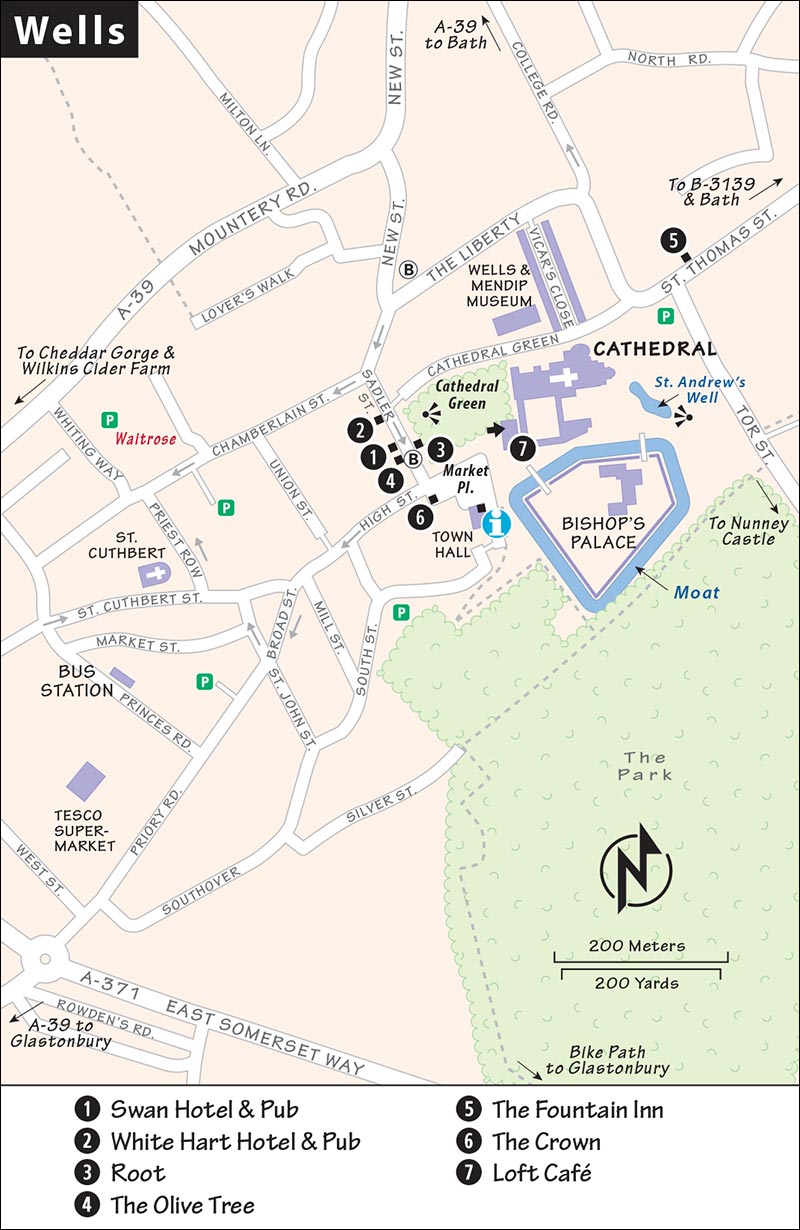
Walking Tour: If you’re here on a Wednesday, consider a town walking tour leaving from The Crown on Market Place (£8, cash only, departs at 11:00 in peak season, 1.5 hours, wellswalkingtours.co.uk; private tours available via guide@wellswalkingtours.co.uk).
ARRIVAL IN WELLS
If you’re coming by bus, you can get off in the city center at the Sadler Street stop, around the corner from the cathedral (tell the driver that’s your stop). Or you can disembark at the big, well-organized bus station/parking lot (staffed Mon-Thu 9:30-14:00, Fri until 12:00), about a five-minute walk from the town center at the south end of town. Find the Wells map at the head of the stalls to get oriented (the big church tower you see is not the cathedral); the signpost at the main pedestrian exit directs you downtown.
Drivers will find limited parking and confusing one-way streets in the city center; it’s simpler to park at the Princes Road lot next to the bus station (enter on Priory Road) and walk five minutes to the cathedral. There’s another lot on Whiting Way at the Waitrose market (long-term parking upstairs; free between 18:00-9:00).
HELPFUL HINTS
- Wells Carnival: Every November, Wells hosts one of the world’s biggest illuminated carnivals, featuring spectacular floats, street performers, and a market fair (wellssomerset.com [URL inactive]).
- Best Views: It’s hard to beat the grand views of the cathedral from the green in front of it...but the reflecting pool tucked inside the Bishop’s Palace grounds tries hard. You can also take the path along the right side of the Bishop’s Palace and find some nice benches on the back side of the moat. There’s also a public footpath nearby for a nice countryside walk up Torwoods Hill.
Sights in Wells
WELLS CATHEDRAL
The city’s highlight is England’s first completely Gothic cathedral, dating from about 1200 and rated ▲▲. Locals claim this church has the largest collection of medieval statuary north of the Alps. It certainly has one of the widest and most elaborate facades I’ve seen, and unique figure-eight “scissor arches” that are unforgettable.
Cost and Hours: £15, £22 combo-ticket with Bishop’s Palace; Mon-Sat 9:00-17:00, Sun 11:00-15:30; for evensong times, see “More Cathedral Sights,” later.
Information: +44 1749 674 483, wellscathedral.org.uk.
Tours: Your admission includes an excellent audioguide for your phone. One-hour tours are also included with your ticket and typically run Mon-Sat on the hour every hour until 15:00, but may vary seasonally and with other events going on in the cathedral. Additional paid tours are available, some of which explore the upper areas and the 17th-century library; see the cathedral website (look for the “Concert & Tour Tickets” link).
Eating: The recommended Loft Café has views of the West Front of the cathedral and the grounds of the Bishop’s Palace.
Background
A church has stood on this location for over 1,000 years. In the eighth century, a Saxon king was riding here with his bishop when he noticed water bubbling up from the ground. Seeing it as a sign from God, he asked the bishop to build a church here, which was finished in the late 10th century, and—despite the village’s modest population of just 500—a new Bishop of Wells was appointed. But in 1066, invading Normans scoffed at this. Feeling that bishops should only be in important towns, the seat was transferred to Bath (to this day, the seat is called the Bishop of Bath and Wells).
About a hundred years later, the Bishop of Bath, who had spent time in Northern France and was impressed with its Gothic architecture, returned to Wells, demolished the existing church, and began construction on a new cathedral. When the church you see today was finished in 1250, Wells’ population had swelled to 950.
Self-Guided Tour
Begin on the large, inviting green in front of the cathedral. In the Middle Ages, the cathedral was enclosed within “The Liberty,” an area free from civil jurisdiction until the 1800s. The Liberty included the green on the west side of the cathedral, which, from the 13th to the 17th century, was a burial place for common folk, including 17th-century plague victims. The green became a cricket pitch, then a field for grazing animals and picnicking people. Today, it’s the perfect spot to marvel at an impressive cathedral.
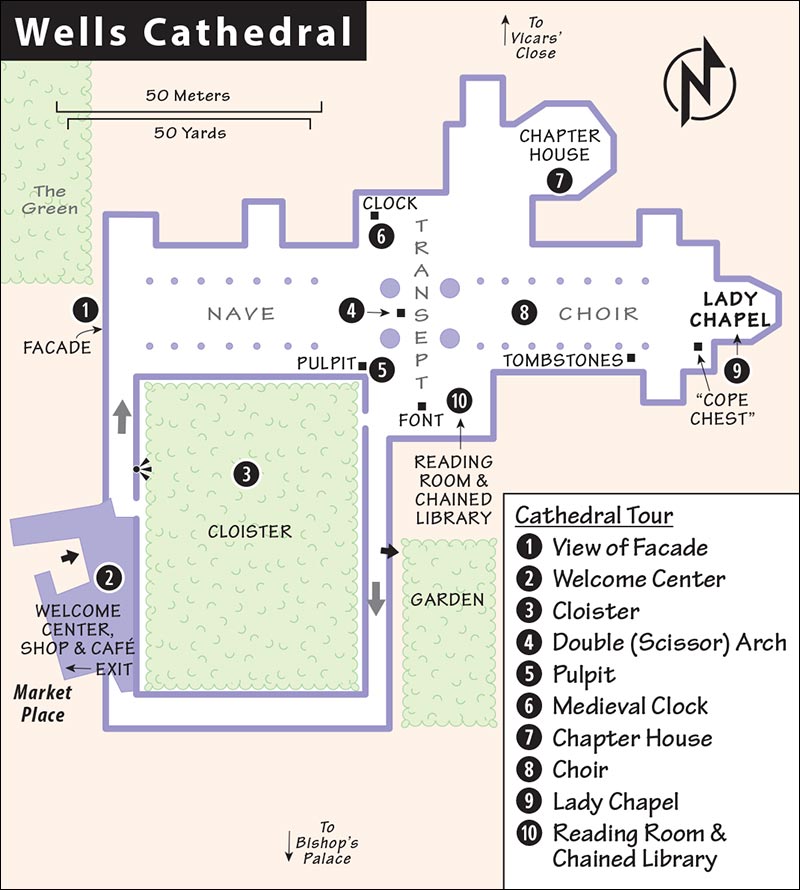
Peer up at the magnificent 1 facade. The west front displays almost 300 original 13th-century carvings of kings and the Last Judgment. The bottom row of niches is empty, too easily reached by Oliver Cromwell’s men, who were hell-bent on destroying “graven images.” Stand back and imagine it as a grand Palm Sunday welcome with a cast of hundreds—all gaily painted back then, choristers singing boldly from holes above the doors and trumpets tooting through the holes up by the 12 apostles.
Now head inside. Visitors enter by going to the right of the facade, through the door under the small spire, into the lobby and welcome center.
At the 2 welcome center, where you’ll be warmly greeted, ask about tours and pick up a map of the cathedral’s highlights.
Then head down the hallway along the 3 cloister, noting the window tracery in the Perpendicular Gothic style and peeking through the windows at the evocative tombstones. Pause to take in the view of the south side of the cathedral.
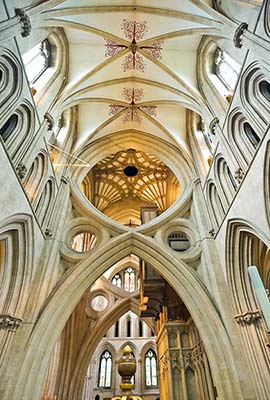
Now enter the cathedral. At your first glance down the nave, you’re immediately struck by the general sense of light and the unique “scissors,” or hourglass-shaped 4 double arch (added in 1338 to transfer weight from the south—where the foundations were sinking under the tower’s weight—to the east, where they were firm).
Until Henry VIII and the Reformation, the interior was opulently painted in golds, reds, and greens. Later it was whitewashed. Then, in the 1840s, the church experienced the Victorian “great scrape,” as locals peeled moldy whitewash off and revealed the bare stone we see today. The floral ceiling painting is based on the original medieval design: A single pattern was discovered under the 17th-century whitewash and repeated throughout.
Small, ornate, 15th-century pavilion-like chapels flank the altar, carved in lacy Gothic for church VIPs. On the right, the 5 pulpit features a post-Reformation, circa-1540 English script—rather than the standard Latin (see where the stonemason ran out of space when carving the inscription—we’ve all been there). Since this was not a monastery church, the Reformation didn’t destroy it as it did the Glastonbury Abbey church.
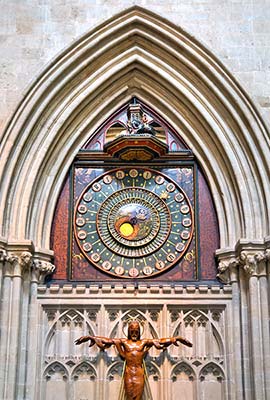
Head behind the altar to the left transept, where you’ll find the 6 medieval clock, which does a silly but much-loved joust on the quarter-hour. If you get to watch the show, notice how—like clockwork—the same rider gets clobbered, as he has for hundreds of years. The clock’s face, which depicts the earth at the center of the universe, dates from 1390. The outer ring shows hours, the middle ring shows minutes, and the inner ring shows the dates of the month and phases of the moon. Above and to the right of the clock is Jack Blandiver, a chap carved out of wood in the 14th century. Beneath the clock, the fine crucifix (1947) was carved out of a yew tree. Also in the north transept is a door with well-worn steps leading up to the 7 Chapter House, a grand space for huddles among church officials. Its sublime “tierceron” vaulting—a forerunner of the fan vaults you can see in later English Gothic style—make this one of the most impressive medieval ceilings in the country.
Now continue down the left aisle. On the right is the entrance to the 8 choir (or “quire,” the central zone where the daily services are sung). Go in and take a close look at the embroidery work on the cushions, which celebrate the hometowns of important local church leaders. Up above the east end of the choir is “Jesse’s Window,” depicting Jesus’ family tree. It’s also called the “Golden Window,” because it’s bathed in sunlight each morning.
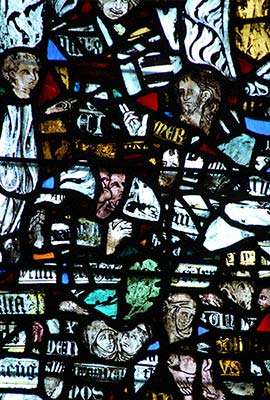
Head back out to the aisle the way you came in and continue to the end of the church. On the outside wall, on the left, is the entry to the undercroft, now a cathedral history exhibit worth a look. In the apse you’ll find the 9 Lady Chapel. Examine the medieval stained-glass windows. Do they look jumbled? In the 17th century, Puritan troops trashed the precious original glass. Much was repaired, but many of the broken panes were like a puzzle that was never solved. That’s why today many of the windows are simply kaleidoscopes of colored glass.
Next to the chapel is the oldest known piece of still-used wooden furniture in England: a “cope chest,” which is used to store the clergy’s garments. It is so large it can’t be moved out through any of the cathedral’s doors. Historians theorize that the chest is older than the existing building, and was originally installed around AD 1120, in the Saxon church that predated the cathedral.
Now head back up the other aisle. As you walk, notice that many of the black tombstones set in the floor have decorative recesses that aren’t filled with brass (as they once were). After the Reformation in the 1530s, the church was short on cash, so they sold the brass lettering to raise money for roof repairs.
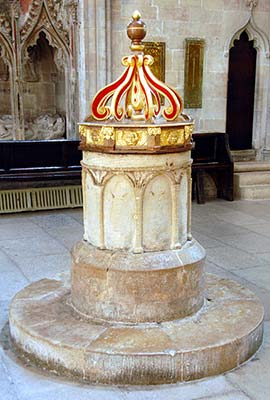
Once you reach the south transept, you’ll find several items of interest. The old Saxon font, made of Bath stone, survives from the previous church (AD 1000) and has been the site of Wells baptisms for more than a thousand years. (Its carved arches were added by Normans in the 12th century, and the cover is from the 17th century.) In the far end of this transept (in the shade of the fancy chapels), a little of the original green and red wall painting, which wasn’t whitewashed, survives.
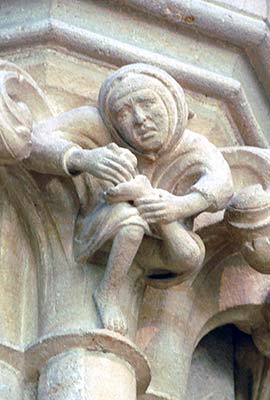
Nearby, notice the carvings in the capitals of the freestanding pillars, with whimsical depictions of medieval life. On the first pillar, notice the man with a toothache and another man with a thorn in his foot. The second pillar tells a story of medieval justice: On the left, we see thieves stealing grapes; on the right, the woodcutter (with an ax) is warning the farmer (with the pitchfork) what’s happening. Circle around to the back of the pillar for the rest of the story: On the left, the farmer chases one of the thieves, grabbing him by the ear. On the right, he clobbers the thief over the head with his pitchfork—so hard the farmer’s hat falls off.
Also in the south transept, you’ll find the entrance to the cathedral 10 Reading Room and Chained Library (viewable only with a guided tour). Housing a few old manuscripts, it offers a peek into a real 16th-century library. At the back of the Reading Room, peer through the doors and notice the irons chaining the books to the shelves—a reflection perhaps of the trust in the clergy at that time.
Finish your visit by circling around the cloister (detouring through the door on the left, if open, to the gardens and views of the back of the church and its flying buttresses), then head past the welcome center, where you’ll come to the shop, café, and exit. Go in peace.
MORE CATHEDRAL SIGHTS
▲▲Cathedral Evensong Service
The cathedral choir takes full advantage of heavenly acoustics with a near-nightly 45-minute evensong service. You’ll sit right in the old “quire” as you listen to a great pipe organ and the world-famous Wells Cathedral choir.
Cost and Hours: Free, Mon-Sat at 17:15, Sun at 15:00, generally no service when school is out July-Aug unless a visiting choir performs, to check call +44 1749 674 483 (not updated online). At 17:05 (Sun at 14:50), the verger ushers visitors to their seats. There’s usually plenty of room.
Returning to Bath After the Evensong: If taking public transit back to Bath after the evensong, check the schedule in advance. The direct bus back to Bath may stop running before you get out; if so, you’ll likely have to connect in Bristol; check schedules at firstbus.co.uk.
Other Cathedral Concerts: The cathedral hosts several evening concerts each month (most £20-30, generally Thu-Sat at 19:00 or 19:30, buy tickets via the link on the cathedral’s website). They also have occasional lunchtime concerts.
Vicars’ Close
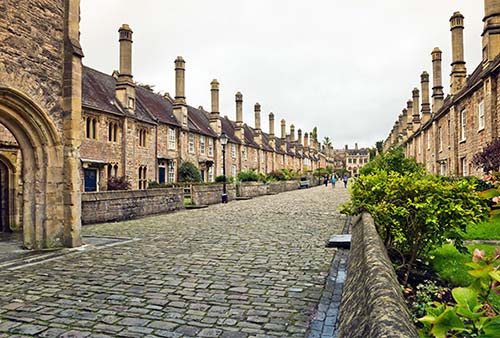
Lined with perfectly pickled 14th-century houses, this block from 1349 is the oldest continuously occupied complete street in Europe (just north of the cathedral—go under the big arch and look left). It was built to house the vicar’s choir, and it still houses church officials and choristers. These dwellings were bachelor pads until the Reformation allowed clerics to marry; they were then redesigned to accommodate families. Notice how the close gets narrower at the top, creating the illusion that it is a longer lane than it is. Note also the elevated passageway connecting these choristers’ quarters with the church.
▲Bishop’s Palace
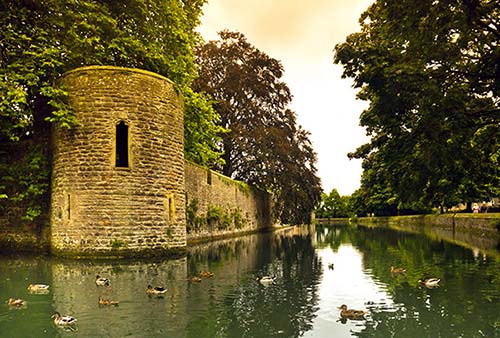
Next to the cathedral stands the moated Bishop’s Palace, built in the 13th century and still in use as the residence of the bishop of Bath and Wells. While the interior of the palace itself is dull, the grounds and gardens surrounding it are the most tranquil and scenic spot in Wells, with wonderful views of the cathedral. It’s just the place for a relaxing walk in the park.
Cost and Hours: £14, £22 combo-ticket with cathedral; daily 9:30-17:30, Nov-March until 16:00, sometimes closed for special events—check website to confirm; café good for croquet-watching; +44 1749 988 111, bishopspalace.org.uk.
Tours: Entrance includes guided tours at set times (usually grounds tours at 12:00 and 15:00, buildings at 11:00 and 14:00; inquire at ticket office). A good handheld audioguide adds a little context for the palace.
Visiting the Palace and Gardens: The palace’s spring-fed moat was built in the 14th century to protect the bishop during squabbles with the borough. Bishops would generously release this potable water into the town during local festivals. Now the moat serves primarily as a pool for mute swans (and squawking gulls). Typically at 13:00, the little bell to the right of the gate is made available for the swans to ring to satisfy a case of the munchies. The bridge was last drawn in 1831. Crossing that bridge, you’ll buy your ticket and enter the grounds (past the old-timers playing a proper game of croquet—several times a week after 13:30). On your right, pass through the evocative ruins of the Great Hall (which was deserted and left to gradually deteriorate), and stroll through the chirpy south lawn. If you’re feeling energetic, hike up to the top of the ramparts that encircle the property.
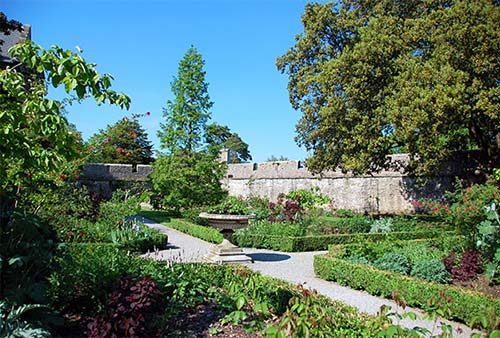
Circling around the far side of the mansion, walk through a door in the rampart wall, cross the wooden bridge, and follow a path to a smaller bridge and the wells (springs) that gave the city its name. Surrounding a reflecting pool with the cathedral towering overhead, these flower-bedecked pathways are idyllic. Nearby are an arboretum, a picnic area, and sweet little pea-patch gardens.
After touring the gardens, the mansion’s interior is a letdown—despite the welcome video and decent audioguide that try to make the dusty old place meaningful (though kids may enjoy playing dress-up in an upstairs room). The highlight is the room upstairs displaying artifacts from bishops over the years, including the coronation cope, worn by the Bishop of Bath and Wells at four coronations, most recently for the coronation of Queen Elizabeth II. Dating back to the 12th century, the Bishop of Bath and Wells (on the monarch’s left) and the Bishop of Durham (on the monarch’s right) have accompanied new monarchs during the ceremony. For King Charles III’s coronation, the Bishop of Durham’s cope was deemed too delicate to be worn, so both copes were kept on the sidelines. Excellent displays explain the history of the copes and show off coronation memorabilia.
Wells & Mendip Museum
This museum, just across the cathedral green, houses displays on the archaeology and geology of the nearby Mendip Hills and Wookey Caves, along with an exhibit on World War I (£6, Tue-Sat 10:00-16:00, closed Sun-Mon, +44 1749 673 477, wellsmuseum.org.uk).
Sleeping and Eating in Wells
Sleeping in Wells: £££ Swan Hotel has comfortable Tudor-style rooms overlooking the cathedral in the main building, and stylishly modernized rooms in the “coach house” annex converted from old stables. Some rooms come with lots of stairs and some with street noise, so request accordingly in advance if either are an issue (nice bar and restaurant, 11 Sadler Street, +44 1749 836 300, swanhotelwells.co.uk, swan.wells@innmail.co.uk).
££ White Hart Hotel has 14 charming rooms, mixing modern touches with classic elements in a creaky old 15th-century building. The friendly staff offer a warm welcome, and their cozy pub has live music some nights and a convivial atmosphere (one ground-floor room, breakfast extra, no parking, 19 Sadler Street, +44 1749 678 642, whitehartwells.com, bookings@whitehartwells.com).
Eating in Wells: Downtown Wells is tiny, but has a good mix of classic pubs and elegant restaurants within a block or two of its market square. You’ll also find a good variety of little delis, bakeries, and takeaway places serving light meals. Note that many restaurants are closed on Monday.
££££ Root is a veggie-lover’s dream. This Michelin-rated spot offers small plates—mostly vegetable-forward (though some meat dishes typically available)—that change frequently with the seasons (reservations smart, closed Sun-Mon, Tue dinner only, 12 Sadler Street, +44 1749 672 887, rootwells.co.uk).
£££ The Olive Tree offers an eclectic mix of dishes—from Italian to Indian to Jamaican—in a colorful and woody spot right off the main square (closed Mon-Tue, Wed and Sun lunch only, +44 1749 673 866, 5 Sadler Street, theolivetreewells.co.uk).
££ The Fountain Inn, on a quiet street 50 yards behind the cathedral, serves good seafood in this landlocked town, with some inventive dishes rooted in the mother-daughter team’s South African heritage (book ahead for dinner; hours vary but typically closed Mon, lunch only Wed and Sun, dinner only Tue and Thu-Fri; St. Thomas Street, +44 1749 672 317, fountaininn.co.uk).
££ The Crown, right on the main square and a must for fans of the cult classic movie Hot Fuzz, serves high-quality pub food at reasonable prices. They also offer two- and three-course fixed-price menus in their dining room, or just enjoy a relaxed bite and a pint on their back patio (long hours daily, Market Place, +44 1749 673 457, crownatwells.co.uk).
£ The Loft Café at Wells Cathedral offers a handy—if not heavenly—lunch (lunch daily, +44 1749 676 543).
Wells Connections
The most convenient train station is in Bath. The bus station in Wells is at a well-organized bus parking lot at the intersection of Priory and Princes roads. Local buses are run by First Bus Company (+44 345 646 0707, firstbus.co.uk), while buses to and from London are run by National Express (+44 8717 818 181, nationalexpress.com).
From Wells by Bus to: Bath (1-2/hour, less frequent on Sun, 75 minutes, some with transfers in Bristol), Glastonbury (3/hour, 20 minutes, take bus #375 or #376), London (hourly with a change in Bristol, 4.5 hours).