AVEBURY, STONEHENGE & SALISBURY
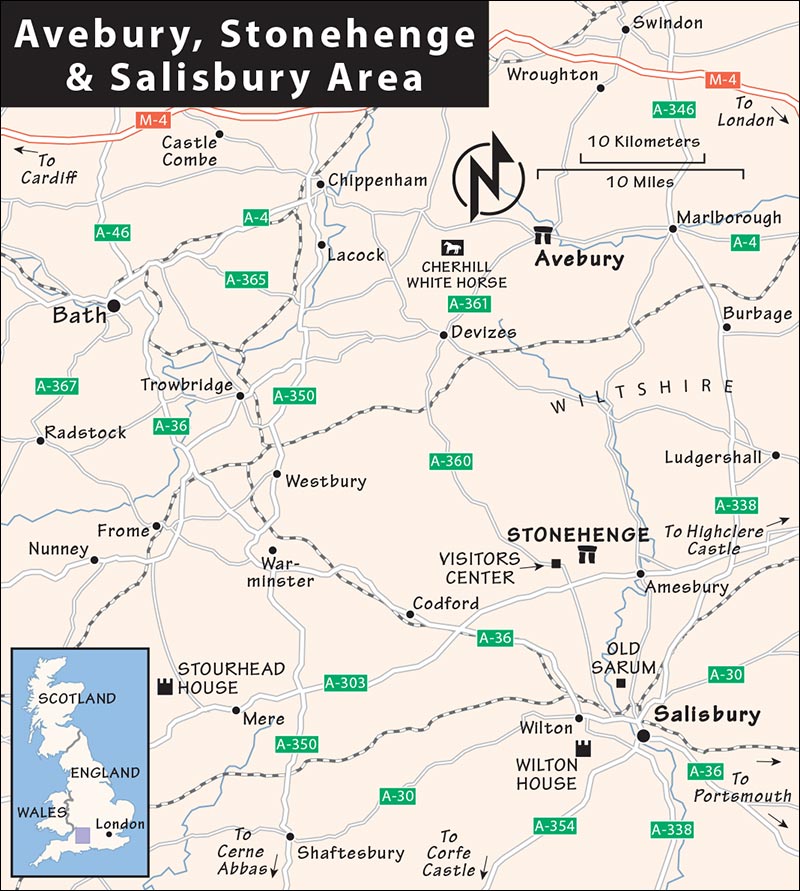
Map: Avebury, Stonehenge & Salisbury Area
Ooooh, mystery, history. England’s southwest countryside holds some of the country’s most goose-pimply prehistoric sites, as well as a particularly fine cathedral town. Get Neolithic at every druid’s favorite stone circles, Avebury and Stonehenge. Then stop by Salisbury for its colorful markets and soaring cathedral.

PLANNING YOUR TIME
Avebury, Stonehenge, and Salisbury make a wonderful day out from Bath. With a car, you can do all three in a day if you’re selective with your sightseeing.
Everybody needs to see Stonehenge, but I’ll tell you now: It looks just like it looks (though the visitors center makes it a well-worthwhile visit). Avebury is the connoisseur’s stone circle: more subtle and welcoming.
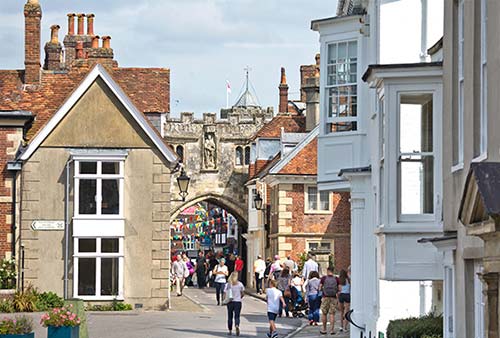
Just an hour from Bath, Salisbury makes a pleasant stop, particularly on a market day (Tue, Sat, every other Wed, plus more), though its cathedral—sporting the tallest spire in England—is striking anytime. Salisbury is also the logical launchpad for visiting nearby Stonehenge (particularly if you lack a car).
GETTING AROUND THE REGION
By Car: Avebury, Stonehenge, and Salisbury are each about 35-40 miles from Bath and 85-90 miles from London. Drivers can do a 104-mile loop from Bath to Avebury (25 miles) to Stonehenge (30 miles) to Salisbury (9 miles) and back to Bath (40 miles). For tips on incorporating Glastonbury and Wells (in a long day-trip blitz, skipping Salisbury), see the previous chapter.
By Bus and Train: The handiest train station is in Bath, with regular service from London’s Paddington Station (2/hour, 1.5 hours). Many buses run between Bath and Avebury, all requiring one or two transfers (hourly, 2 hours, transfer at Devizes). You could also take a train from London’s Paddington Station to Swindon (4/hour, 1 hour), then take bus #49 to Avebury (hourly, 30 minutes). There’s no bus between Avebury and Stonehenge.
A one-hour train trip connects Bath to Salisbury (1-2/hour direct); you can also get there from London’s Waterloo station (2/hour, 1.5 hours). With the best public transportation of all these towns, Salisbury is a good jumping-off point for Stonehenge or Avebury by bus or car. Stonehenge Tour buses run between Salisbury and Stonehenge (see “Getting to Stonehenge,” later). Buses also run from Salisbury to Avebury (see “Salisbury Connections,” later). For fares and schedules, check Traveline South West’s website (travelinesw.com).
By Tour from Bath: From Bath, if you don’t have a car, the most convenient and quickest way to see Avebury and Stonehenge is with a minibus tour. Mad Max is the liveliest of the tours leaving from Bath (see “Tours in and near Bath” on here).
By Tour from London: London Walks leads infrequent day trips to Bath and Avebury (not Stonehenge) by public transit (£133, generally every other Friday May-Oct, departs at 9:00 from Paddington Station; check website to confirm departures and book tickets, walks.com). For Stonehenge tour options from London, see “Getting to Stonehenge,” later.
Avebury
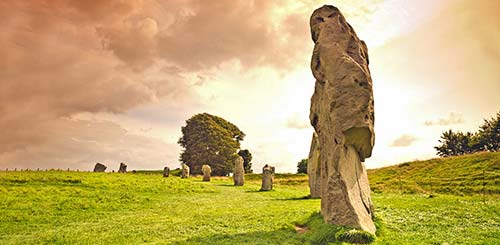
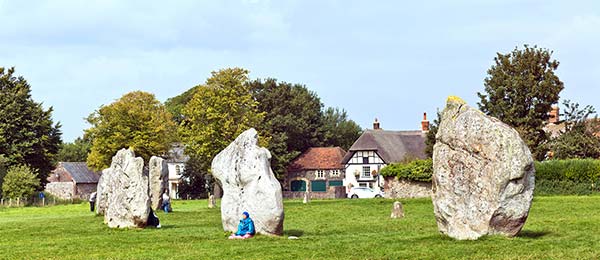
Avebury is a hands-on, open-air museum of prehistory, with a complex of fascinating Neolithic sites all gathered around the great stone henge (circle). Among England’s many stone circles, Avebury is unique for its vast size—a village is tucked into its center, and roads rumble between its stones. Because the surrounding area has only a thin skin of topsoil over chalk, it is naturally treeless (similar to the area around Stonehenge). Perhaps this unique landscape—where the land connects with the big sky—compelled prehistoric societies to build their religious monuments here. Whatever the case, Avebury dates to 2800 BC—six centuries older than Stonehenge. This complex, the St. Peter’s Basilica of Neolithic civilization, makes for a fascinating visit—particularly since you can walk right up and touch the stones. Some visitors enjoy it even more than Stonehenge.
Orientation to Avebury
Avebury is the name of a huge stone circle, as well as the tiny village that sits within it. It’s easy to reach by car, but more difficult by public transportation (see “Getting Around the Region,” earlier).
Tourist Information: There’s no TI, but there’s a National Trust information center in the Old Farmyard (daily 9:00-18:00 in summer, shorter hours off-season, see map for location). For more information on the Avebury sights, see nationaltrust.org.uk.
Parking: There’s no public parking in the village center. Visitors can pay to park in a National Trust lot along the A-4361—a five-minute walk from the village.
Tours: One-hour guided tours of the stones are led by volunteers, subject to availability—ask at the information center (£6, daily 12:00-15:00, generally on the hour, fewer in winter or bad weather).
Sights in Avebury
All of Avebury’s prehistoric sights—which spread over a wide area—are free to visit and always open. The underwhelming museum and mansion charge admission and have limited hours. I’ve linked the sights with directions for drivers who want to make a targeted visit to all that Avebury has to offer.
• From the National Trust parking lot, take the walking path toward the village. After about five minutes, you’ll reach High Street and see the first access point to the big stone circle on your right. (To pass through the gate, slide the handle sideways rather than lifting it.) Take some time exploring the remarkable...
▲▲Avebury Stone Circle
The Neolithic stone circle at Avebury is 1,400 feet wide—that’s 16 times as big as Stonehenge. It’s so vast that it dwarfs the village that grew up in its midst. You’re free to wander among 100 stones, ditches, mounds, and curious patterns from the past.
In the 14th century, in a frenzy of ignorance and religious paranoia, Avebury villagers buried many of these mysterious pagan stones. Their 18th-century descendants hosted social events in which they broke up the remaining stones (toppling, heating up, dousing with cold water, and scavenging broken stones as building blocks). In modern times, the buried stones were dug up and reerected. The short concrete markers show where the missing broken-up stones once stood.
Explore. Touch a chunk of prehistory. While even just a short walk to a few stones is rewarding, you can stroll the entire half-mile around the circle, much of it along an impressive earthwork henge—a 30-foot-high outer bank surrounding a ditch 30 feet deep, making a 60-foot-high rampart. This earthen ring once had stones standing around the perimeter, placed about every 30 feet, and four grand causeway entries. Originally, two smaller circles made of about 200 stones stood within the henge.
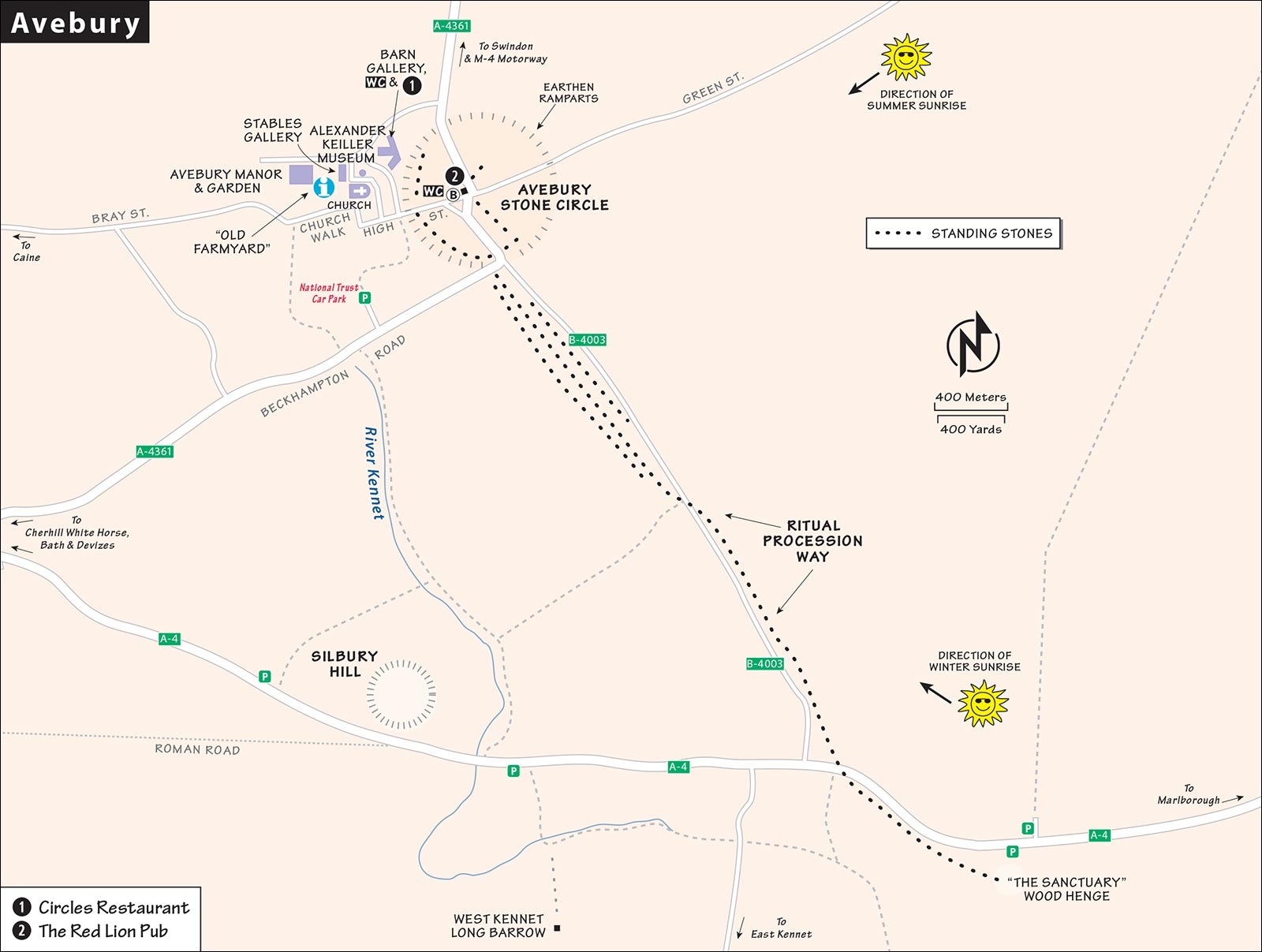
• Head back out through the gate. Across the street (directly opposite the parking-lot trail), follow signs into the Old Farmyard—a little courtyard of rustic buildings near Avebury Manor. Today these house museums, WCs, the National Trust information center (where you can pay by card for your parking ticket), a shop, a recommended café, and the two minor sights described next.
Alexander Keiller Museum
This small museum, named for the archaeologist who led excavations at Avebury in the late 1930s, is housed in two buildings (covered by the same ticket). The 17th-century Barn Gallery illustrates 6,000 years of Avebury history, with kid-friendly interactive exhibits about the landscape and the people who’ve lived here—from the Stone Age to Victorian times. Across the farmyard, the small, old-school Stables Gallery displays artifacts and skeletons from past digs and a re-creation of what Neolithic people may have looked like.
Cost and Hours: £7.20, daily 10:00-16:00, Nov-March from 11:00, +44 1672 539 250, nationaltrust.org.uk.
• Behind the Stables Gallery is the...
Avebury Manor and Garden
A 2024 flood closed this museum; it may not be open when you visit. The 500-year-old estate, home of archaeologist Alexander Keiller, was restored by a team of historians and craftspeople in collaboration with the BBC (for the 2011 documentary The Manor Reborn). Nine rooms were decorated in five period styles showing the progression of design, from a Tudor wedding chapel to a Queen Anne-era bedroom to an early 20th-century billiards room. The grounds were also spruced up with a topiary and a Victorian kitchen garden.
Cost and Hours: Manor and garden-£12, garden only-£5.50; daily 11:00-17:00, garden from 10:00, shorter hours off-season, closed Jan-mid-Feb, last entry one hour before closing, ask about guided tours; buy tickets at Alexander Keiller Museum’s Barn Gallery, +44 1672 539 250, nationaltrust.org.uk.
• The following sights are a long walk or a short drive from the center of Avebury.
From the Avebury village center, take the road southeast toward West Kennet and Marlborough (B-4003, aka West Kennet Avenue). To get there from the National Trust lot, turn left out of the lot and right onto the B-4003. The road is evocatively lined with an “avenue” of stones known as the...
▲Ritual Procession Way
This double line of stones led from Avebury to a long-gone wooden circle dubbed “The Sanctuary.” Most of these stones were reconstructed in modern times. The wood henge at the end, thought to have been 1,000 years older than everything else in the area, was likely the genesis of Avebury and its big stone circle. (You can see the site of the former Sanctuary by turning left onto the A-4; park in the marked pullout on the left and walk across the road, or there’s a smaller pullout on the Sanctuary side. You can also walk along the ritual procession way from Avebury, about 40 minutes. All you’ll see is an empty field with concrete blocks marking where the circle once stood.)
• From the end of the B-4003, turn right to head west on the A-4. A half-mile down, on the left, is a small parking lot where you can stop for a quick walk to the West Kennet Long Barrow (described below). Otherwise, look to the right for the dome-shaped green hill. Just beyond it is a handy parking lot. (Walkers can reach this hill in about 20 minutes from the National Trust parking lot.)
▲Silbury Hill
This pyramid-shaped hill just outside of Avebury is a 130-foot-high, yet-to-be-explained mound of chalk. More than 4,000 years old, the mound is considered the largest man-made object in prehistoric Europe (with the surface area of London’s Trafalgar Square and the height of the Nelson Column). It’s a reminder that we’ve only just scratched the surface of England’s puzzling and ancient religious landscape.
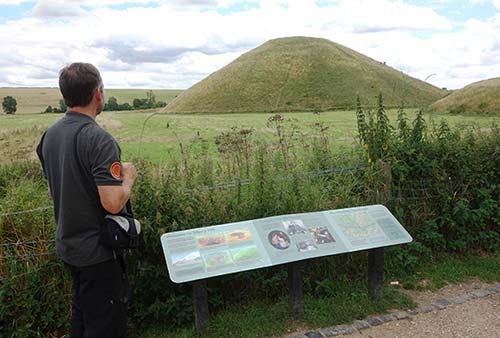
Inspired by a legend that the hill hid a gold statue in its center, locals tunneled through Silbury Hill in 1830, undermining the structure. Work is underway to restore the hill, which remains closed to the public. Archaeologists (who date things like this by carbon-dating snails and other little critters killed in its construction) figure Silbury Hill took only 60 years to build, in about 2200 BC. This makes Silbury Hill the last element built at Avebury and contemporaneous with Stonehenge. Some think it may have been an observation point for all the other bits of the Avebury site. You can still see evidence of a spiral path leading up the hill and a moat at its base.
The Roman road detoured around Silbury Hill. (Roman engineers often used features of the landscape as visual reference points when building roads. Their roads would commonly kink at the crest of hills or other landmarks, where they realigned with a new visual point.) Later, the hill sported a wooden Saxon fort, which likely acted as a lookout for marauding Vikings. And in World War II, the Royal Observer Corps stationed men up here to count and report Nazi bombers on raids.
Nearby: Across the road from Silbury Hill (a 15-minute walk through the fields) is West Kennet Long Barrow. The best-preserved Stone Age chamber tomb in the UK, it stands intact on a ridge and lines up with the rising sun on the summer solstice. You can walk inside the barrow and explore its dark, spooky nooks or sit on its roof and survey the Neolithic landscape around you.
• The final sight is about four miles west of Avebury, along the A-4 toward Calne (and Bath), just before the village of Cherhill. Pull over at the Avebury end of the village and look for the hill-capping obelisk; below it, carved into the hillside, is the...
Cherhill White Horse
Throughout southern England, you’ll see horses (and other objects) like this one carved into the downs (chalk hills). There is one genuinely prehistoric white horse in England (the Uffington White Horse); the Cherhill White Horse is an 18th-century creation. Prehistoric discoveries were all the rage in the 1700s, and it was a fad to make fake ones by cutting into the thin layer of topsoil to expose the chalk beneath. Nowadays, figures like this are cemented and painted white so that the design doesn’t need to be weeded. Above the horse are the remains of an Iron Age hill fort known as Oldbury Castle—described on an information board at the pullout.
Eating in Avebury
£ Circles Restaurant is practical and pleasant, serving healthy lunches, including vegan and gluten-free dishes, and cream teas on most days (daily until 16:30, Nov-March until 16:00, no hot food after 14:30, in the Barn Gallery on the Old Farmyard, +44 1672 539 250).
££ The Red Lion—a classic thatched-roof pub right in the heart of Avebury village—has updated but unpretentious pub grub; a creaky, dart-throwing ambience; a medieval well in its dining room; and ample outdoor seating (daily, High Street, +44 1672 539 266).
Stonehenge
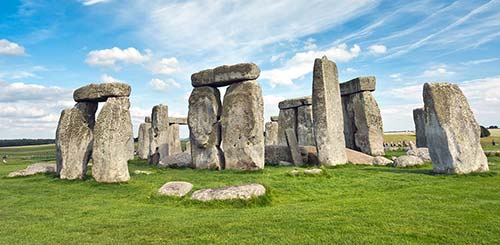
As old as the pyramids, and far older than the Acropolis and the Colosseum, this iconic stone circle amazed medieval Europeans, who figured it was built by a race of giants. And it still impresses visitors today. As one of Europe’s most famous sights, Stonehenge, worth ▲▲▲, does a valiant job of retaining an air of mystery and majesty (partly because cordons, which keep hordes of tourists from trampling all over it, foster the illusion that it stands alone in a field). Although cynics manage to be underwhelmed by Stonehenge, most of its almost one million annual visitors agree that it’s well worth the trip.
GETTING TO STONEHENGE
Stonehenge is about 90 miles southwest of central London. To reach it from London, you can take a bus tour, or do it on your own using public transit (connecting via Salisbury). It’s not worth the hassle or expense to rent a car just for a Stonehenge day trip.
By Bus Tour from London: Several companies offer big-bus day trips to Stonehenge from London, often with stops in Bath, Windsor, Salisbury, and/or Avebury. These generally cost about £65-100 (including Stonehenge admission), last 8-12 hours, and pack a 45-seat bus. Some include hotel pickup, admission fees, and meals: Understand what’s included before you book. The more destinations listed for a tour, the less time you’ll have at any one stop. Well-known companies are Evan Evans (among many Stonehenge packages offered, their bare-bones half-day tour gets you there and back for £75, +44 20 7932 8385, evanevanstours.co.uk) and Golden Tours (£70, +44 20 7233 7030, goldentours.com). International Friends runs pricier but smaller 16-person tours that also include Bath and Windsor or Avebury (£139, +44 1843 609 699, internationalfriends.co.uk).
By Bus Tour from Bath: I prefer Mad Max’s minibus tour and Scarper Tour’s shuttle bus service. For details, see here and here.
On Your Own on Public Transport via Salisbury: From London, you can catch a train to Salisbury, then go by tour bus or taxi to Stonehenge. Trains to Salisbury run from London’s Waterloo Station (around £45 for same-day return, 2/hour, 1.5 hours, +44 3457 484 950, nationalrail.co.uk).
From Salisbury, take The Stonehenge Tour bus to the site. These distinctive double-decker buses leave from the Salisbury train station, stop in Salisbury’s center, then make a circuit to Stonehenge and Old Sarum, with lovely scenery and decent light commentary along the way (£42.50, includes Stonehenge as well as Iron Age ruins at Old Sarum—whether you want it or not, tickets good all day, buy online or at Salisbury TI; daily June-Aug 10:00-16:00, hourly; special schedule and rates on summer solstice, less frequent off-season; 30 minutes from station to Stonehenge, +44 1202 338 420, timetable at thestonehengetour.info).
A taxi from Salisbury to Stonehenge can make sense for groups (about £40-60). Try Online City Cabs (+44 1722 509 090) or Value Cars Taxis (+44 1722 505 050, salisbury-valuecars.co.uk).
By Car: Stonehenge is well signed just off the A-303, about 20 minutes north of Salisbury, an hour southeast of Bath, an hour east of Glastonbury, and an hour south of Avebury.
Barring traffic, Stonehenge is about 70 miles and 1.5 hours west of London Heathrow. From the M-25 ring road, connect with the M-3 toward Southampton, then exit to the A-303 just after North Waltham. Continue west past Andover to Amesbury. In 3.5 miles, turn onto northbound A-360 at the roundabout, following signs to Stonehenge. A mile later, you’ll see the parking lot on your right.
From Salisbury, head north on the A-360 (at the St. Paul’s roundabout, take the second exit, direction: Devizes). Continue for eight miles, crossing the A-303 roundabout. The parking lot and visitors center are one mile farther on the right.
ORIENTATION TO STONEHENGE
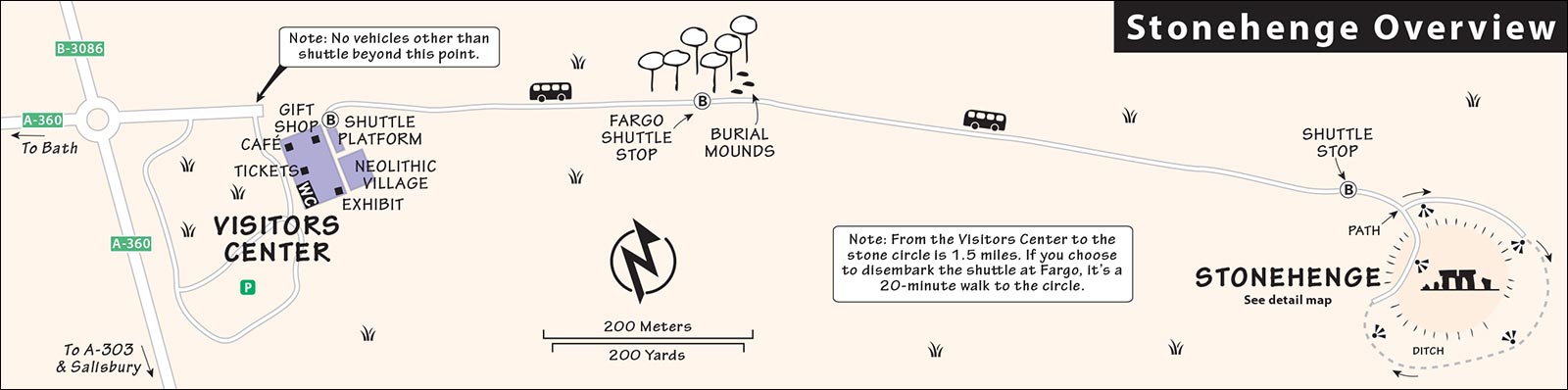
The visitors center, located 1.5 miles west of the circle, is a minimalist steel structure with a subtly curved roofline, evoking the landscape of Salisbury Plain.
- Cost: £27-38 timed-entry ticket, price varies with season and day, much cheaper online; includes shuttle bus ride to and from stone circle; covered by English Heritage Pass (see here).
- Hours: Daily in summer 9:30-19:00, early Sept-late May until 17:00. Note that the last ticket is sold two hours before closing. Expect shorter hours and possible closures June 20-22 due to huge, raucous solstice crowds.
- Information: +44 370 333 1181, english-heritage.org.uk/stonehenge.
- Parking: Pay for parking either with the well-signed app or when you pick up your tickets at the visitors center. You’ll need your license plate number.
- Advance Tickets Recommended: Up to 9,000 visitors are allowed to enter each day. While Stonehenge rarely sells out completely, you can avoid the ticket-buying line—and save money—by reserving at least 24 hours in advance at english-heritage.org.uk. (You’ll pick up your tickets at the ticket office in the visitors center.)
- Crowd-Beating Tips: When you reserve, you’ll be asked to select a 30-minute entry window; once inside, you can stay as long as you like. For a less crowded, more mystical experience, come early or late. Things are pretty quiet before about 10:30 (head out to the stones first, then circle back to the exhibits); at the end of the day, aim to arrive just before the “last ticket” time (two hours before closing).
Stonehenge is most crowded when school’s out: summer weekends (especially holiday weekends) and anytime in August.
- Tours: Download the good, free “Stonehenge Audio Tour” app by English Heritage before your visit (or over Wi-Fi at the visitors center).
- Visiting the Inner Stones: For the true Stonehenge fan, special one-hour access to the stones’ inner circle is available early in the morning (times vary depending on sunrise; the earliest visit is at 5:00 in June and July) or after closing to the general public. Touching the stones is not allowed. Only 30 people are allowed at a time, so reserve well in advance (£70, allows you to revisit the site the same day at no extra charge, +44 370 333 0605). For details, see the English Heritage website (select “Things to See and Do,” then “Stone Circle Experience”).
Length of This Tour: Allow at least two hours to see everything.
- Services: The visitors center has WCs and a large gift shop. Services at the circle itself are limited to emergency WCs. Even in summer, carry a jacket, as there are no trees to act as a windbreak and there’s a reason Salisbury Plain is so green.
- Eating: A large £ café within the visitors center serves simple soups, sandwiches, and salads. You can also bring your own snacks to munch out on the lawn surrounding the stones.
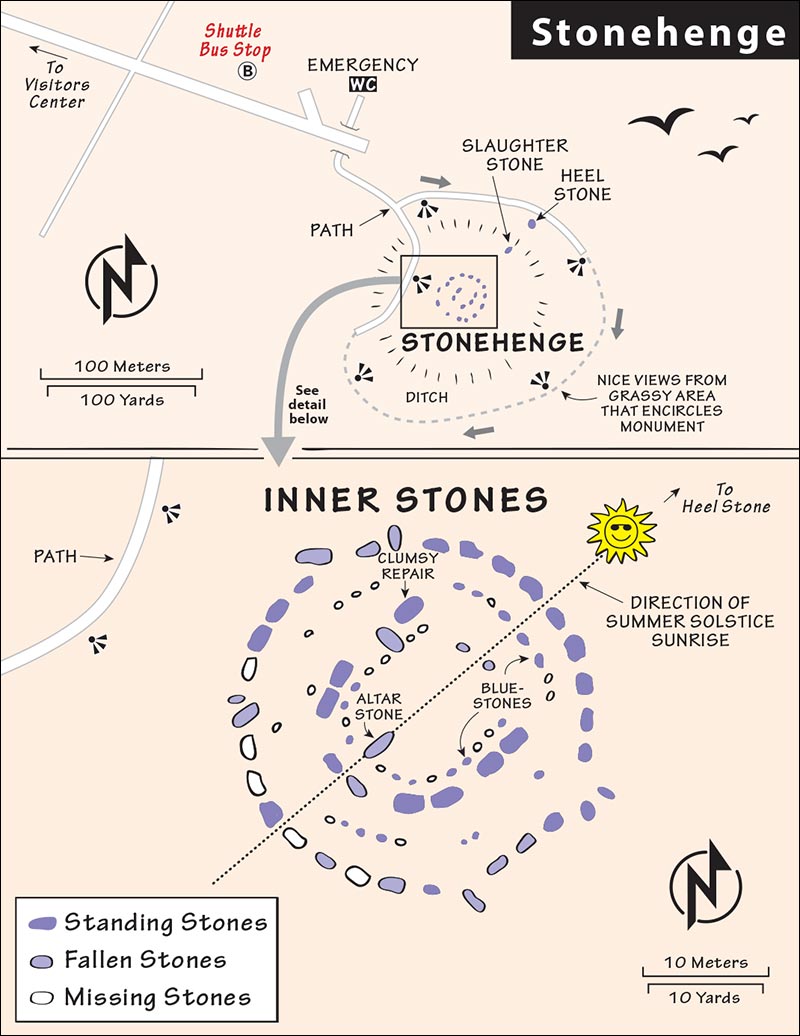
 SELF-GUIDED TOUR
This commentary is designed to supplement the Stonehenge audio tour app (described earlier), which is paired with numbered markers throughout the sight. If you arrive early in the day or don’t see a queue for the buses (the line forms behind the gift shop), do the stones first—before they get crowded—then circle back to the visitors center. Otherwise, start by touring the exhibits, then take a shuttle (or walk) to the stone circle, as I’ve outlined here.
• As you enter the grounds, just to the right of the ticket booth is the...
Permanent Exhibit
This excellent, state-of-the-art exhibit uses an artful combination of multimedia displays and actual artifacts to provide context for the stones.
You’ll begin by standing in the center of a virtual Stonehenge, witnessing its evolution through 5,000 years—including simulated solstice sunrises and sunsets. Take time to watch the helpful three-minute video, which sets the stage for what you’ll soon see.
Then you’ll head into the exhibits, where prehistoric bones, tools, and pottery shards tell the story of the people who built Stonehenge, how they lived, and why they may have built the stone circle. Find the forensic reconstruction of a Neolithic man, based on a skeleton unearthed in the 1860s. Small models illustrate how Stonehenge developed from a simple circle of short, stubby stones to the stout ring we know today, while a timeline situates Stonehenge historically among the likes of the Egyptian pyramids, Ireland’s Newgrange, and Peru’s Machu Picchu.
A large screen shows the entire archaeological area surrounding Stonehenge (which is just one of many mysterious prehistoric landmarks near here). In 2010, within sight of Stonehenge, archaeologists discovered another 5,000-year-old henge, which they believe once encircled a wooden “twin” of the famous circle. Recent excavations revealed that people had been living on the site since around 3000 BC—about five centuries earlier than anyone had realized.
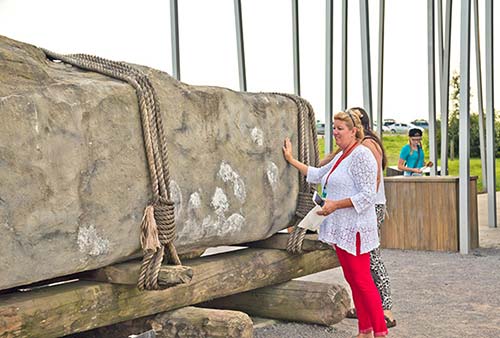
Then step outside and explore a handful of reconstructed Neolithic huts. These are modeled after the traces of a village discovered just northeast of Stonehenge. Step into the thatched-roof huts and take a nap on a primitive “wicker” bed. Docents demonstrate how people used Neolithic tools—made of wood, flint, and antler. You’ll also see a huge, life-size replica of the rolling wooden sledge thought to have been used to slooooowly roll the stones across Salisbury Plain. While you can’t touch the stones at the site itself, you can touch this one.
• Next, head to the stone circle. To get there, you have two options: Take a 6-minute shuttle bus, which departs every 5-10 minutes from just behind the gift shop (there may be a wait); or walk about 1.5 miles (about 30 minutes) through the fields to the site—take the well-signed path behind the ticket booth, then follow your fellow pilgrims (or ask a staff member for directions).
Along the way, you have the option of stopping at Fargo Plantation, where you can see several burial mounds. (If you choose the shuttle bus, tell the attendant when you get on if you want to disembark here.) After wandering through the burial mounds, you’ll need to walk the rest of the way to the stone circle (about 20 minutes).
Stone Circle
As you approach the massive structure, keep left (many will veer right, heading straight for the stones). Find a gap along the knee-high cordon and let the other 21st-century tourists melt away. It’s just you and the druids...
England has hundreds of stone circles, but Stonehenge—which literally means “hanging stones”—is unique. It’s the only one that has horizontal cross-pieces (called lintels) spanning the vertical monoliths, and the only one with stones that have been made smooth and uniform. What you see here is a bit more than half the original structure—the rest was quarried centuries ago for other buildings.
Now walk clockwise around the monument, mentally fleshing out the missing pieces and reerecting the rubble. Knowledgeable guides posted around the site are happy to answer your questions. As you walk, ponder what’s before you.
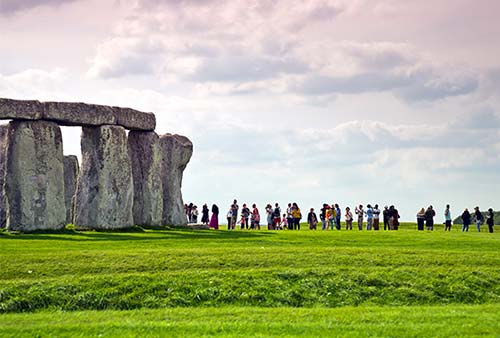
It’s now believed that Stonehenge, which was built in phases between 3000 and 1500 BC, was originally used as a cremation cemetery. But that’s not the end of the story, as the monument was expanded over the millennia. This was a hugely significant location to prehistoric peoples. There are several hundred burial mounds within a three-mile radius of Stonehenge—some likely belonging to kings or chieftains. (You can see a handful from here: Just look for small, grass-covered lumps in the distant landscape.) Some of the human remains are of people from far away, and others show signs of injuries—evidence that Stonehenge may have been used as a place of medicine or healing.
• Pause when you reach the large, vertical stone that sits apart from the circle close to the path.
Whatever its original purpose, Stonehenge still works as a celestial calendar—and this stone, the “heel stone,” is central to that function. As the sun rises on the summer solstice (on or around June 21), the heel stone lines up with the sun and the altar at the center of the stone circle; it does the same for midwinter sunset. (An arrow at your feet helps explain.)
A study of more than 300 similar circles in Britain found that each was designed to calculate the movement of the sun, moon, and stars (including predicting eclipses), helping early societies know when to plant, harvest, and party. Even in modern times, as the summer solstice sun sets in just the right slot at Stonehenge, pagans boogie.
Midway between the heel stone and the circle is a large stone lying in the grass. It once stood upright, one of multiple stones that marked the entrance to the circle—but in the 1800s, Victorians mistook its horizontal state for an altar, assumed sacrifices were made here, and gave it the misleading nickname the “slaughter stone.”
• Continue circling the stones, navigating your way between tourists posing for all sorts of photographs.
Some believe that Stonehenge is built at the precise point where six “ley lines” intersect. Ley lines are theoretical lines of magnetic or spiritual power that crisscross the globe—and belief in their power has gone in and out of fashion over time. They are thought to have been very important to prehistoric peoples but were largely ignored until the early 20th century, when the English writer Alfred Watkins popularized them (to the scorn of serious scientists). More recently, the concept has been embraced by the New Age movement. Without realizing it, you follow these ley lines all the time: Many of England’s modern highways follow prehistoric paths, and most churches are built over prehistoric monuments—placed where ley lines intersect. If you’re a skeptic, ask one of the guides at Stonehenge to explain the mystique of this paranormal tradition.
• Take a moment when you’re on the far side of the circle opposite the heel stone.
From here, you can easily see the two types of stone that Stonehenge’s builders used. The tall, stout monoliths and lintels are sandstone blocks called sarsen stones. Most of the monoliths weigh about 25 tons (the largest is 45 tons), and the lintels are about 7 tons apiece. These sarsen stones were brought from “only” 20 miles away. Scientists have chemically matched the shorter stones in the middle—called bluestones—to outcrops on the south coast of Wales...240 miles away (close if you’re taking a train, but far if you’re packing a megalith). Imagine the logistical puzzle of floating six-ton stones across Wales’ Severn Estuary and up the River Avon, then rolling them on logs about 20 miles to this position. It would be an impressive feat, even in our era of skyscrapers.
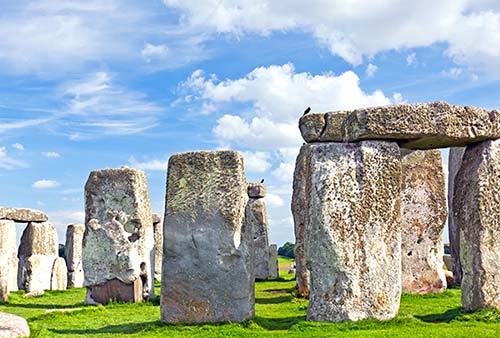
Why didn’t the builders of Stonehenge use what seem like perfectly adequate stones nearby? This, like many other questions about Stonehenge, remains shrouded in mystery. Think again about the ley lines. Ponder the fact that many experts accept none of the explanations of how these giant stones were transported. Then imagine congregations gathering here 5,000 years ago, raising thought levels, creating a powerful life force transmitted along the ley lines. Maybe a particular kind of stone was essential for maximum energy transmission. Maybe the stones were levitated here. Maybe psychics really do create powerful vibes. Maybe not. It’s as unbelievable as electricity used to be.
• Make your way through the next part of the path, which is often crowded because it’s the closest you can get to the stones. Stop before the path starts to angle back toward the buses.
Notice that one stone (facing the shuttle bus stop) is severely blemished at the base. It looks like someone has pulled back the monolith to reveal a concrete skeleton. This was a clumsy repair job to reinforce a stone that was in danger of toppling over. Many of the standing stones are now secured with (hidden) concrete that goes deep, deep into the ground.
For centuries, people were allowed to walk right up to the monoliths—and visitors took all sorts of liberties with them. Some took wedding photos, others rented hammers to chip off souvenirs, and even architect Christopher Wren—who grew up not far from here—chiseled his name into a stone. You’ll notice the back of another stone is missing the same thin layer of protective lichen that covers the others. The lichen—and some of the stone itself—was sandblasted off to remove graffiti. The repairs were intentionally done in a different color, so as not to appear like the original stone...and to remind visitors why Stonehenge is now roped off.
Salisbury
Salisbury (SALLS-bree), an attractive small city set in the middle of the expansive Salisbury Plain, is the natural launchpad for visiting nearby Stonehenge. But it’s also a fine destination in its own right, with a walkable core, a famously soaring cathedral (with England’s tallest spire, largest green, and an original copy of the Magna Carta), and a thriving market—all nestled along the River Avon.
As the city most associated with Stonehenge, it’s no surprise that Salisbury also has a very long history: It was originally settled during the Bronze Age—possibly as early as 600 BC—and later became a Roman town called Sarum (located on a hill above today’s city). When the old settlement outgrew its boundaries, the townspeople relocated to the river valley below.
Today, sightseers flow through Salisbury on their way to Stonehenge. But if you have time to spare, spend some of it exploring this fine town.
Orientation to Salisbury
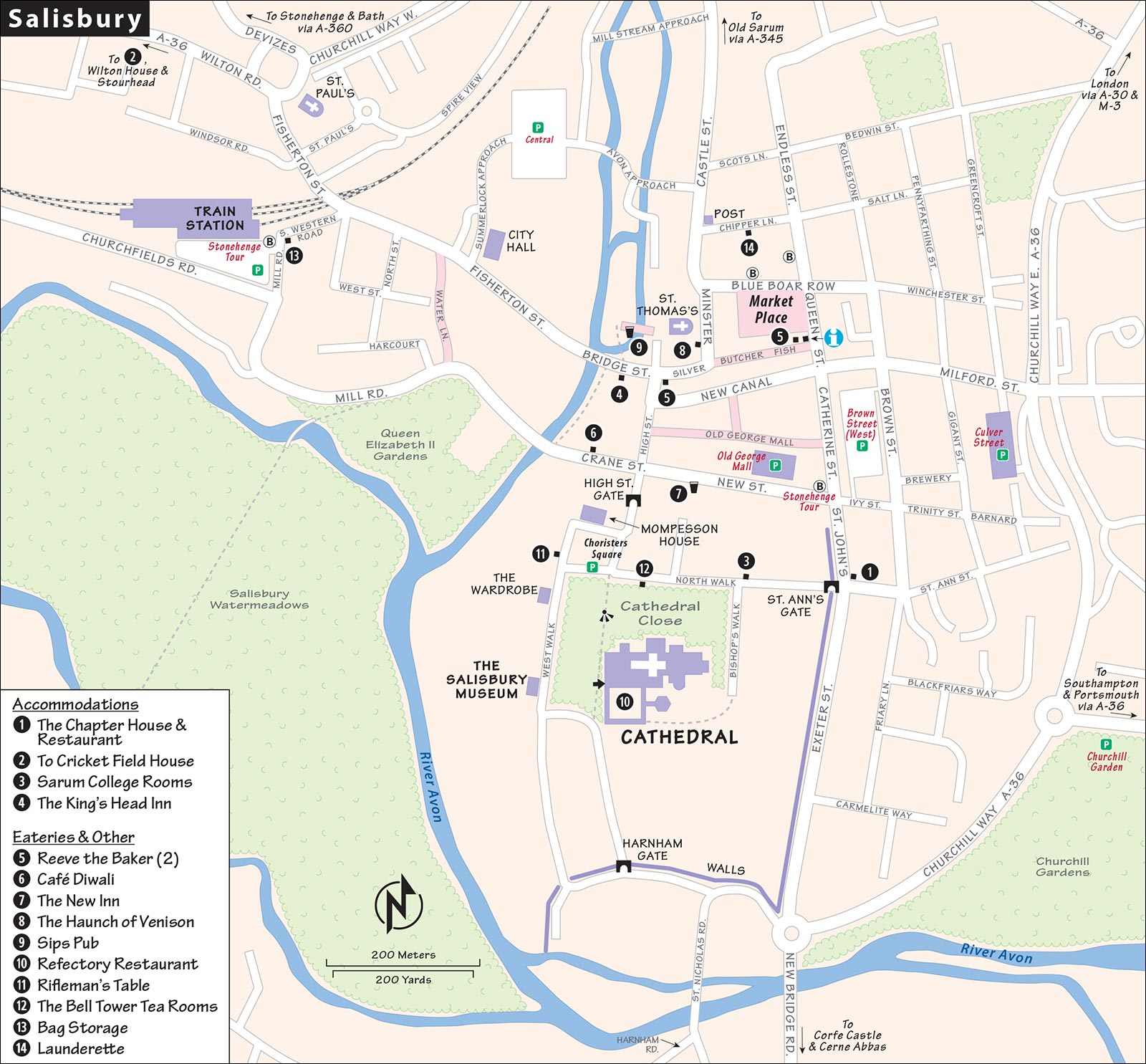
Salisbury (pop. 47,000) stretches along the River Avon in the shadow of its huge landmark cathedral. Everything of interest to tourists clusters around the vast Market Place and, a few short blocks to the south, the cathedral.
TOURIST INFORMATION
The TI is just off Market Place. If you’re headed to Stonehenge, you can buy tickets here (Mon-Fri 9:00-17:00, Sat 10:00-16:00, Sun 10:00-14:00, corner of Fish Row and Queen Street, +44 1722 342 860, visitwiltshire.co.uk [URL inactive]).
Ask the TI about the 1.5-hour city walking tours led by Blue Badge guides (£12, daily at 11:00, Nov-March Sat-Sun only) or the weekly Ghost Walk (£12, May-Oct, generally Fri at 20:00); both depart from the TI. For walking-tour information call +44 7873 212 941 or visit salisburycityguides.co.uk [URL inactive].
ARRIVAL IN SALISBURY
By Train: From the train station, it’s a 10-minute walk into the town center: Exit to the left, then bear right on Fisherton Street, and follow it into town.
By Bus: Buses stop at several points along Market Place (on Blue Boar Row) and around the corner on Endless Street.
By Car: Drivers will find several pay parking lots. Follow the blue P signs (specific parking options, and available spaces, are often noted on signs as you approach). To get as close as possible to the cathedral, look for a space at the corner of High Street and North Walk, just inside the cathedral’s High Street Gate, along Choristers Square. The Old George Mall parking garage, between Market Place and the cathedral, is handy, and the “Central” lot, behind the giant red-brick Sainsbury’s store, is farther out but walkable, with plenty of spaces—even when others are full (enter from Churchill Way West or Castle Street). Overnight, your best bet is the Culver Street garage, located a few blocks east of Market Place (free after 15:00 and all day Sun).
HELPFUL HINTS
- Market Days: Don’t miss Salisbury’s market days (see listing, below).
- Festivals: The Salisbury International Arts Festival normally runs for just over two weeks at the end of May and beginning of June (salisburyfestival.co.uk).
- Baggage Storage: Hettie Bells, a pub just across the road from the train station, will store your bags for the day (£5-10/bag, no overnight storage, 135 South Western Road, +44 1722 702 592).
- Laundry: Washing Well has full-service (weekdays only) and self-service (daily, bring £1 coins, 28 Chipper Lane, detergent available for purchase, +44 1722 421 874).
- Getting to the Stone Circles: You can get to Stonehenge from Salisbury on The Stonehenge Tour bus in summer or (more expensively) by taxi (see “Getting to Stonehenge,” earlier). For buses to Avebury’s stone circle, see “Salisbury Connections,” later.
Sights in Salisbury
ON MARKET PLACE
▲Market Days
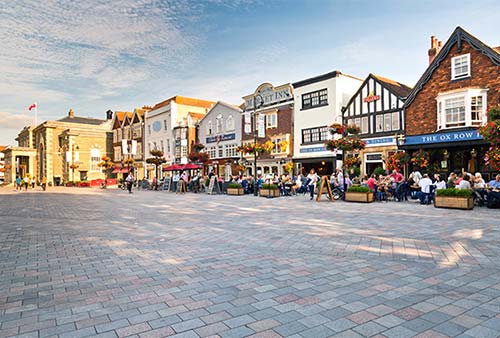
For centuries, Salisbury has been known for its lively markets. And today, the big “Charter Market” still fills the vast Market Place each Tuesday and Saturday. This all-purpose market has everything from butchers, fishmongers, and spices to hardware, clothes, and shoes. A little “food court” of international stands is in the center. While fun to browse, this is decidedly not a tourist-oriented market—but it’s great for the age-old tradition of people-watching. Along the square is a handy row of bars and coffee shops with outdoor tables.
Additional markets sprout up every other Wednesday (farmers), Fridays (special themes), and the occasional “Car Boot Sundays”—fun for garage-sale-style bargain hunting. For the latest, see salisburycitycouncil.gov.uk.
▲St. Thomas’s Church
Filled with church miscellanea, this Gothic space—short and squat, but still airy and light-filled—boasts an unusual feature: a fully restored “Doom Painting” (illustration of the Last Judgment, c. 1475, over the choir). While these are commonplace in Continental churches, England’s were whitewashed and forgotten during the Reformation. But St. Thomas’s—long hidden behind the painted wooden coat of arms of Queen Elizabeth I, which is now displayed over the red door on the right—was uncovered and restored in the late 19th century. Examine the exquisite, Flemish-style details: Angels pull the dead from their graves (on the left) to stand before the judgment of Jesus (at the top), and some unfortunate souls are sent to the jaws of hell (on the right)—past the Prince of Darkness, whose toe crosses the edge of the Gothic arch.
Cost and Hours: Free, Mon-Sat 9:00-17:00, Sun from 12:00, just west of Market Place on St. Thomas’s Square.
ON AND NEAR CATHEDRAL CLOSE
▲▲Salisbury Cathedral
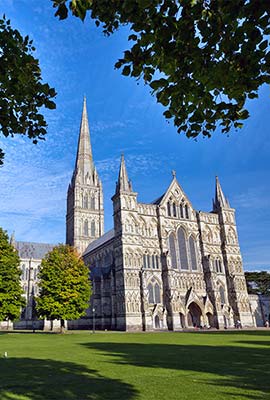
This magnificent cathedral is visible for miles around because of its huge spire (the tallest in England at 404 feet). The surrounding enormous grassy field (called a “close”) makes the Gothic masterpiece look even larger. What’s more impressive is that all this was built 800 years ago in a mere 38 years. When the old hill town of Sarum was moved down to the valley, its cathedral had to be replaced in a hurry. So, in 1220, the townspeople began building, and in 1258 their sparkling-new cathedral was ready for ribbon-cutting. Since the structure was built in just a few decades, its style is uniform, rather than the centuries-long patchwork common in cathedrals of the time. The cathedral also displays a remarkably well-preserved original copy of the Magna Carta (in the Chapter House).
Cost and Hours: £13, cheaper online in advance, Mon-Sat 9:30-17:00, Sun 12:30-16:00, last entry one hour before closing, can be closed for special events. This working cathedral opens early for services: Be respectful if you arrive when one is in session.
Information: +44 1722 555 150, salisburycathedral.org.uk.
Tours: Free one-hour guided tours of the cathedral nave are offered every hour or so, when enough people assemble. The helpful guides also offer short (15-minute) introductory talks on request. Additional themed tours are available throughout the week (see the website).
Tower Tours: Imagine building a cathedral on this scale before the invention of cranes, bulldozers, or modern scaffolding. An excellent tower tour (1.5-2 hours) helps visitors understand how it was done. You’ll climb in between the stone arches and the roof to inspect the vaulting and trussing, see a medieval winch that was used in the construction, and finish with the 332-step climb up the narrow tower for a sweeping view of the Wiltshire countryside. Because only 10 people are allowed on each tour, it’s essential to reserve online a few days ahead—or even longer on summer weekends (£22 if booked online in advance, includes cathedral and Chapter House; schedule varies but generally Mon-Sat hourly 10:15-14:15, Sun at 12:45 and 13:45, fewer tour times Oct-March; no kids under 7; salisburycathedral.org.uk).
Evensong: Salisbury’s daily choral evensong (Mon-Sat at 17:30, Sun at 16:30, about 45 minutes) is just as beautiful as the one in Wells Cathedral. Arrive up to 15 minutes early and enter through the north door. Spectators can sit in the nave or ask to be seated in the wood-carved seats of the choir (if so, plan to stay for the duration—getting up is a disturbance).
Eating: The cathedral has two fine eating options: a glassed-in cafeteria and an outdoor café with prime views (see “Eating in Salisbury,” later).
Visiting the Cathedral: You’ll need to show your ticket twice—here at the entrance, and again to enter the Chapter House (see later). Volunteer guides posted strategically throughout the church stand ready to answer your questions.
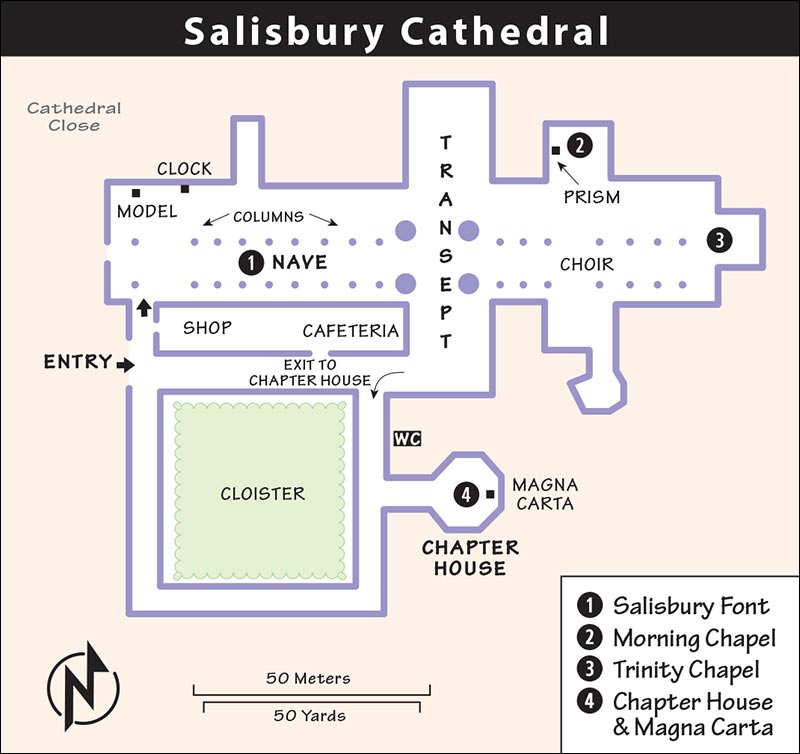
Entering the church, you’ll instantly feel the architectural harmony. Head to the center of the nave and look down toward the altar. Notice how the stone columns march identically down the aisle—like a thick, gray forest of tree trunks. The arches overhead soar to grand heights, helping churchgoers appreciate the vast and amazing heavens. Now imagine the interior surfaces painted in red, blue, green, and gold, as they would have been prior to the whitewashing of the English Reformation.
At the back-left corner of the nave (opposite the entrance), a model shows how this cathedral was built so quickly in the 13th century. Next to it is the “oldest working clock in existence,” dating from the 14th century (the hourly bell has been removed, so as not to interrupt worship services). On the wall by the clock is a bell from the decommissioned ship HMS Salisbury. Look closely inside the bell to see the engraved names of crew members’ children who were baptized on the ship.
Wander down the aisle past monuments, knights’ tombs, and gravestones set into the floor. About halfway down the nave, you’ll see (and hear) the gurgling 1 Salisbury Font—a modern, oxidized-bronze baptismal font dedicated in 2008 to honor the cathedral’s 750th birthday. While it looks like a modern sculpture, it’s also used for baptisms.
When you reach the transept, stand at the foot of the altar and gaze up at the four main columns surrounding you. Notice how they curve slightly on their way up. These posts were supposed to support a more modest bell tower, but when a heavy tower was added 100 years later, the columns bent under the enormous weight, causing the tower to lean sideways. Reinforcements were installed: internal flying buttresses, which you can see angling through openings in the mezzanine; and steel supports (hidden), which ensure the spire remains the tallest in England. However, the tower still tilts about two-and-a-half feet.
Step up to the choir, with its finely carved seats. This area hosts an evensong late each afternoon (well worth attending—see details, earlier).
Head behind the choir to the left and dip into the 2 Morning Chapel. (It may be closed, but you can still peek through the gates.) At the back of this chapel, find the spinning glass prism engraved with images of Salisbury—donated to the church in memory of a soldier who died at the D-Day landing at Normandy.
The oldest part of the church is at the apse (far end), where construction began in 1220: the 3 Trinity Chapel. The giant, modern stained-glass window ponders the theme “prisoners of conscience” in many shades of blue.
Continue circling around the choir until you’re back at the transept. Turn left and exit (you can always reenter the church—just show your ticket), following “Magna Carta” signs around to the medieval 4 Chapter House—so called because it’s where the daily Bible verse, or chapter, was read. (You’ll need to show your ticket again.) These spaces often served as gathering places for conducting church or town business. Enter the little freestanding tent for a look at the best preserved of the four original copies of the Magna Carta. This “Great Charter” is as important to the English as the Constitution is to Americans. Dating from 1215, the Magna Carta settled a dispute between England’s King John and some powerful barons by guaranteeing that the monarch was not above the law. To this day, lawyers and political scientists admire this very early example of “checks and balances”—a major victory in the centuries-long tug-of-war between monarchs and nobles. Notice the smudge marks on the glass case, where historians have bumped their noses squinting at the minuscule script. You can read the English translation printed on the back of the tent.
▲Cathedral Close
The enormous green surrounding the cathedral is the largest in England, and one of the loveliest. It’s cradled in the elbow of the River Avon and ringed by row houses, cottages, and grand mansions. The church owns the houses on the green and rents them to lucky people with holy connections. A former prime minister, Edward Heath, lived on the green, not because of his political influence, but because he was once the church organist.
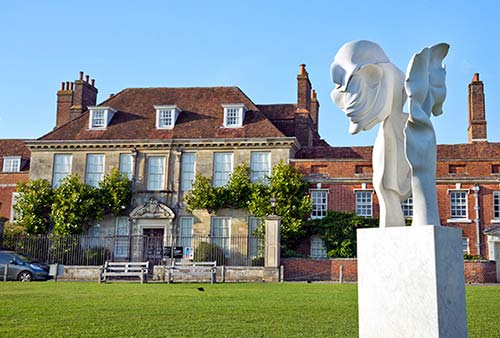
This green space is an excellent place for a romantic picnic or just gazing thoughtfully at the church’s leaning spire. Although you may be tempted to linger until it’s late, don’t—this is still private church property...and the heavy medieval gates of the close shut at about 22:00.
A few houses are open to the public, such as the overpriced Mompesson House, Arundells, and the medieval Wardrobe. The most interesting is...
▲The Salisbury Museum
Occupying the building across from the cathedral entrance, this eclectic collection was heralded by American expat travel writer Bill Bryson as one of England’s best. While that’s a stretch, the artifact-heavy museum does offer a good look at the history of Salisbury and the surrounding area.
Cost and Hours: £10.90, daily 10:00-17:00, 65 The Close, +44 1722 332 151, salisburymuseum.org.uk.
Visiting the Museum: The museum’s highlights occupy two ground-floor galleries. The Wessex Gallery (to the left as you enter) is filled with informative, interactive exhibits covering this area’s rich prehistory—from Neanderthal ax heads to Iron Age cremation urns. Check out the ancient Roman mosaic floor and details on the excavation of Stonehenge, which began as early as 1620—back when it was believed to be Roman rather than druid.
The Salisbury Gallery covers the transition from Old Sarum to New Sarum and the growth of Salisbury as a city. You’ll find fragments from the original Old Sarum Cathedral, WWII memorabilia, and the 12-foot wooden Salisbury Giant, which—along with his mule companion, Hob-Nob—was paraded through the city for special events.
Nearby: Just across the river from the Cathedral Close are the Salisbury Watermeadows. This vast system of man-made channels and ditches was designed to facilitate irrigation in the 17th century. Today, the meadows are laced with peaceful walking paths that offer good views of the cathedral. (From the close, head up High Street to Crane Street, turn left, and walk about 5 minutes until you reach the Queen Elizabeth II Gardens on your left. Head through the gardens; the meadows begin over the footbridge, just across the river.)
Sleeping in Salisbury
Salisbury’s town center has very few accommodations. Noisy roads rumble past most of these places: Light sleepers can try asking for a quieter room in back (or pack earplugs). Drivers should ask about parking when reserving. The town gets particularly crowded during the arts festival (late May through early June). Things can get rowdy on Friday and Saturday nights—particularly in the area known as The Maltings, near St. Thomas’s Church. If you’re in a pinch, there are a couple of Premier Inns a few miles outside town, one to the north on the A-30 and one to the east on the A-36.
££ The Chapter House is a boutique hotel with 17 stylish, modern rooms in a creaky old shell. The rooms are above the trendy restaurant, immediately across from St. Ann’s Gate—the side entrance to the Cathedral Close (9 St. John’s Street, +44 1722 341 277, thechapterhouseuk.com, info@thechapterhouseuk.com).
££ Cricket Field House, a family-run, cozy little compound just outside town on the A-36 toward Wilton, overlooks a cricket pitch and golf course. It has 15 large, comfortable rooms (a few with kitchenettes), its own gorgeous garden, and plenty of parking (Wilton Road, +44 1722 322 595, cricketfieldhouse.co.uk, stay@cricketfieldhouse.co.uk). While this place works best for drivers, it’s a 20-minute walk from the train station or a 5-minute bus ride from the city center.
£ Sarum College is a theological college that rents 40 rooms right on the peaceful Cathedral Close. Much of the year, it houses visitors to the college, but it usually has rooms for tourists too. The well-worn, slightly institutional but clean rooms share hallways with libraries and offices; some rooms share bathrooms. The five attic rooms come with partial cathedral views from their dormer windows (elevator, limited free parking, 19 The Close, +44 1722 424 800, sarumcollegehospitality.co.uk, hospitality@sarum.ac.uk).
£ The King’s Head Inn, part of the Wetherspoon hotel chain, rents 33 modern rooms above a pub. While impersonal, it’s a decent value and conveniently located in a handsome old sandstone building between Market Place and the train station. It’s likely to have room when others are full (breakfast extra, deeply discounted Sun nights, air-con, elevator to some rooms, 1 Bridge Street, +44 1722 438 400, jdwetherspoon.com, kingsheadinn@jdwetherspoon.co.uk).
Eating in Salisbury
There are plenty of atmospheric pubs all over town, and a decent selection of international restaurants. Some places offer early-bird specials before 19:00.
£ Reeve the Baker crafts an array of high-calorie delights and handy pick-me-ups for a fast and affordable breakfast or lunch. Peruse the long cases of pastries and savory treats, and notice the locals waiting patiently at the fresh bread counter in back. This is a chain that has earned its multiple locations (daily until 16:00, +44 1722 320 367). The main branch, on Market Place (at 2 Butcher Row), has seating upstairs and out on the square—both with a nice view of the busy market. A much smaller branch is at the corner of High and Bridge streets at 61 Silver Street (same hours as above but closed Sun).
£££ The Chapter House is a lively and popular restaurant with an enticing menu of British, South African, and international fare—and a love for dry-aged meat (daily, 9 St. John’s Street, +44 1722 341 277).
£££ Café Diwali takes an Indian street-food approach, with delicious, creative dishes served thali style, on big silver platters. Dine in their simple front room, rear garden, or Victorian sunroom (closed Mon, no dinner on Sun, 90 Crane Street, +44 1722 329 700).
££ The New Inn, the local rugby pub, fills an atmospheric 15th-century house rumored to have a tunnel leading directly into the cathedral—perhaps dug while the building housed a brothel? On a sunny day, their back garden is pleasant (daily, 41 New Street, +44 1722 326 662).
£££ The Haunch of Venison fills a creaky medieval building that feels like it might fall over at any second. Food is served in the upstairs restaurant, while drinks are served in tight ground-floor rooms—including the “Horse’s Box” annex, where Eisenhower and Churchill supposedly discussed D-Day (daily, 1 Minster St, +44 1722 411 313).
They don’t serve food, but £ Sips is a tiny pub that specializes in craft beer and indie ambience. It straddles the River Avon and has a few tables overlooking the water (daily, on Maltings Bridge, +44 7871 222 724).
Lunch at the Cathedral: The £ Refectory Restaurant has a full menu and fills a winter garden squeezed between the buttresses and the cloister, with additional seating in the cloister itself (Mon-Sat until 17:00, Sun until 16:00). Just outside the close, £ Rifleman’s Table serves breakfast and lunch specials, homemade cakes, cream tea, and artisan coffee in the wood-beamed dining room and on the pebbled patio (daily until 16:30, 58 The Close, +44 1722 331 124). On a sunny day, it’s hard to imagine a nicer setting for a coffee break than £ The Bell Tower Tea Rooms, with outdoor tables on England’s biggest close, peering up at its tallest cathedral tower (limited menu, order at the counter, daily until 16:00).
Salisbury Connections
From Salisbury by Train to: London’s Waterloo Station (2/hour, 1.5 hours), Bath (hourly, 1 hour). Train info: nationalrail.co.uk.
By Bus to: Bath (hourly, 3 hours, transfer in Devizes or Warminster), Avebury (hourly, 2 hours, transfer in Devizes). Bus info: Local buses are run by Traveline South West (travelinesw.com). Many of Salisbury’s long-distance buses are run by Salisbury Reds (salisburyreds.co.uk).