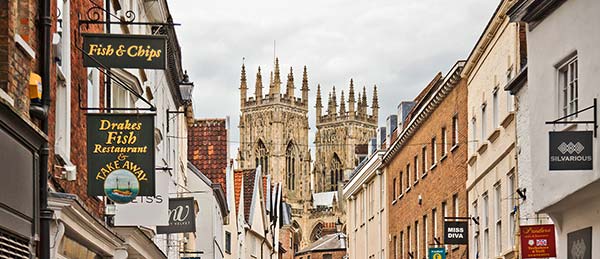
YORK
NEAR BOOTHAM BAR AND RECOMMENDED B&BS
Historic York is loaded with world-class sights. Marvel at the York Minster, England’s finest Gothic church. Ramble The Shambles, York’s wonderfully preserved medieval quarter. Enjoy a walking tour led by an old Yorker. Hop a train at one of the world’s greatest railway museums, travel to the 1800s in the York Castle Museum, dig into the city’s buried past at the Yorkshire Museum, or head back 1,000 years at the Jorvik Viking Centre.
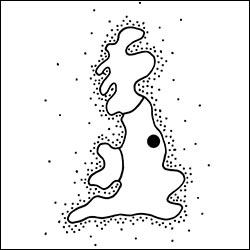
York has a rich history. In AD 71 it was Eboracum, a Roman provincial capital—the northernmost city in the empire. Constantine was proclaimed emperor here in AD 306. In the fifth century, as Rome was toppling, the Roman emperor sent a letter telling England it was on its own, and York—now called Eoforwic—became the capital of the Anglo-Saxon kingdom of Northumbria.
The city’s first church was built in 627, and the town became an early Christian center of learning. The Vikings later took the town, and from the 9th through the 11th century, it was a Danish trading center called Jorvik. The invading and conquering Normans destroyed and then rebuilt the city, fortifying it with a castle and the walls you see today.
Medieval York, with 9,000 inhabitants, grew rich on the wool trade and became England’s second city—the “capital of the north.” Henry VIII used the city’s fine cathedral (the Minster) as the northern seat of his Anglican Church. In today’s Anglican Church, the Archbishop of York is second only to the Archbishop of Canterbury.
In the Industrial Age, York was the railway hub of northern England. When it was built in 1877, York’s train station was the world’s largest, before suffering an aerial bombardment during World War II. (In response to Allied bombing of historic German towns, the Nazis unleashed the “Baedeker raids,” bombing English cities—including York—that were described as the most historic and beautiful in the leading German guidebook of the day.)
Today, York feels like a big, traffic-free amusement park for adults. With its strollable cobbles and half-timbered buildings, grand cathedral and excellent museums, thriving restaurant scene and welcoming locals, York delights.
PLANNING YOUR TIME
After London, York is the best sightseeing city in England. On even a 10-day trip through Britain, it deserves two nights and a day. For the best 36 hours, follow this plan: Arrive early enough to catch the 17:30 evensong service at the Minster (Sun at 16:00), then familiarize yourself with the tangled lanes between the Minster and The Shambles. Enjoy dinner (reserve ahead) at one of the city’s bistros. The next morning, take my self-guided walk, interrupting it midway with a tour of the Minster (or, if it’s busy, circle back later). Finish the walk and grab lunch. To fill your afternoon, choose among the town’s many important sights (such as the York Castle Museum or the Railway Museum). Spend the evening enjoying a ghost walk of your choice and another memorable dinner.
This is a packed day; as you review this chapter, you’ll see that there are easily two days of sightseeing fun in York.
Orientation to York
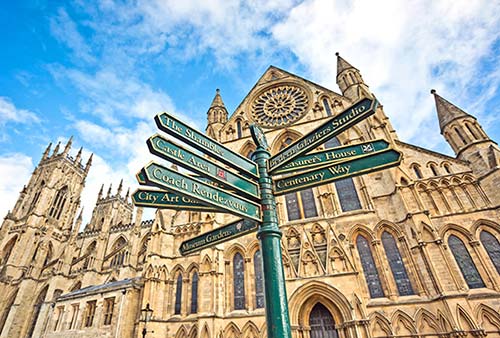
York and its surrounding area are home to roughly 200,000 people; about one in ten is a student. But despite the city’s size, the sightseer’s York is small. Virtually everything is within a few minutes’ walk: sights, train station, TI, and B&Bs. The longest walk a visitor could take (from a B&B off Clifton Road through the old town to the York Castle Museum) is about half an hour. To find your way, use the Minster’s towers as a navigational landmark, or follow strategically placed signposts that point out places of interest.
TOURIST INFORMATION
York’s helpful TI is on St. Sampson’s Square, smack-dab in the middle of the old town (Mon-Sat 9:00-17:00, Sun 10:00-16:00, +44 1904 909 487, 21 Parliament Street, visityork.org, info@visityork.org). Their inexpensive map is a good value, and a variety of well-produced, free Exploring York maps illustrate handy area nature walks.
Visit York Pass: This pass covers most of York’s important sights, the City Sightseeing bus, a riverboat ride (York City Cruise), and a few regional sights. Extremely busy sightseers might wring some value out of this—especially the two- or three-day versions (£64/1 day, £80/2 days, £95/3 days, yorkpass.com).
ARRIVAL IN YORK
By Train: York’s grand old station, a 10-minute walk from town, is big and spread out. Allow plenty of time to find your platform, and follow signs carefully. Day-trippers can pay to store baggage at a warehouse just off Queen Street—as you exit the station, turn right. Staying on the right (track side) of the road, walk three minutes until you see the Left Luggage sign (Mon-Sat 8:00-20:00, Sun from 9:00; shared with Autohorn car rental office). Baggage storage is also available near Bootham Bar—see “Helpful Hints,” later.
Recommended B&Bs are a 5-to-15-minute walk or £8-10 taxi ride from the station (for walking directions, see “Sleeping in York,” later).
To walk downtown from the station, exit straight, passing through the taxi stand, and turn left down Station Road. At the first intersection, cross the street and take the path to the right, keeping the wall on your right. Turn right through the gap in the wall, then make a quick left. Follow the crowd across the river (at Lendal Bridge) and toward the Gothic towers of the Minster.
By Car: Driving and parking in York is maddening. Day-trippers should follow signs to one of several park-and-ride lots ringing the perimeter. Parking is free (though overnight parking is generally not allowed), and cheap shuttle buses link to the center (every 10-15 minutes).
If you’re sleeping here, ask your hotelier for parking advice. (Some places offer permits to park nearby.)
HELPFUL HINTS
- Book Ahead: On busy days—especially in summer and on weekends—there can be long ticket-buying lines for the Minster and Jorvik Viking Centre; to save time, book online. It’s also smart to book ahead for walking tours (especially the Bloody Tour of York) and for any restaurant you’re keen on—very popular spots can fill up even midweek.
- Festivals: Book a room well in advance during festival times and on weekends year-round. The Viking Festival blows its lur horn in mid-February (jorvikvikingfestival.co.uk). The Early Music Festival (medieval minstrels, Renaissance dance, and so on) zings its strings in early July (ncem.co.uk/whats-on/yemf). York calls itself the “Ascot of the North” and fills up on horse-race weekends (once a month May-Oct, yorkracecourse.co.uk); it’s especially busy for the mid-August Ebor Races (when prices go up and the streets fill with drunken revelers). The York Food and Drink Festival takes a bite out of late September (yorkfoodfestival.com). And the St. Nicholas Fair Christmas market jingles its bells from mid-November through Christmas. For a complete list of festivals, see visityork.org/events.
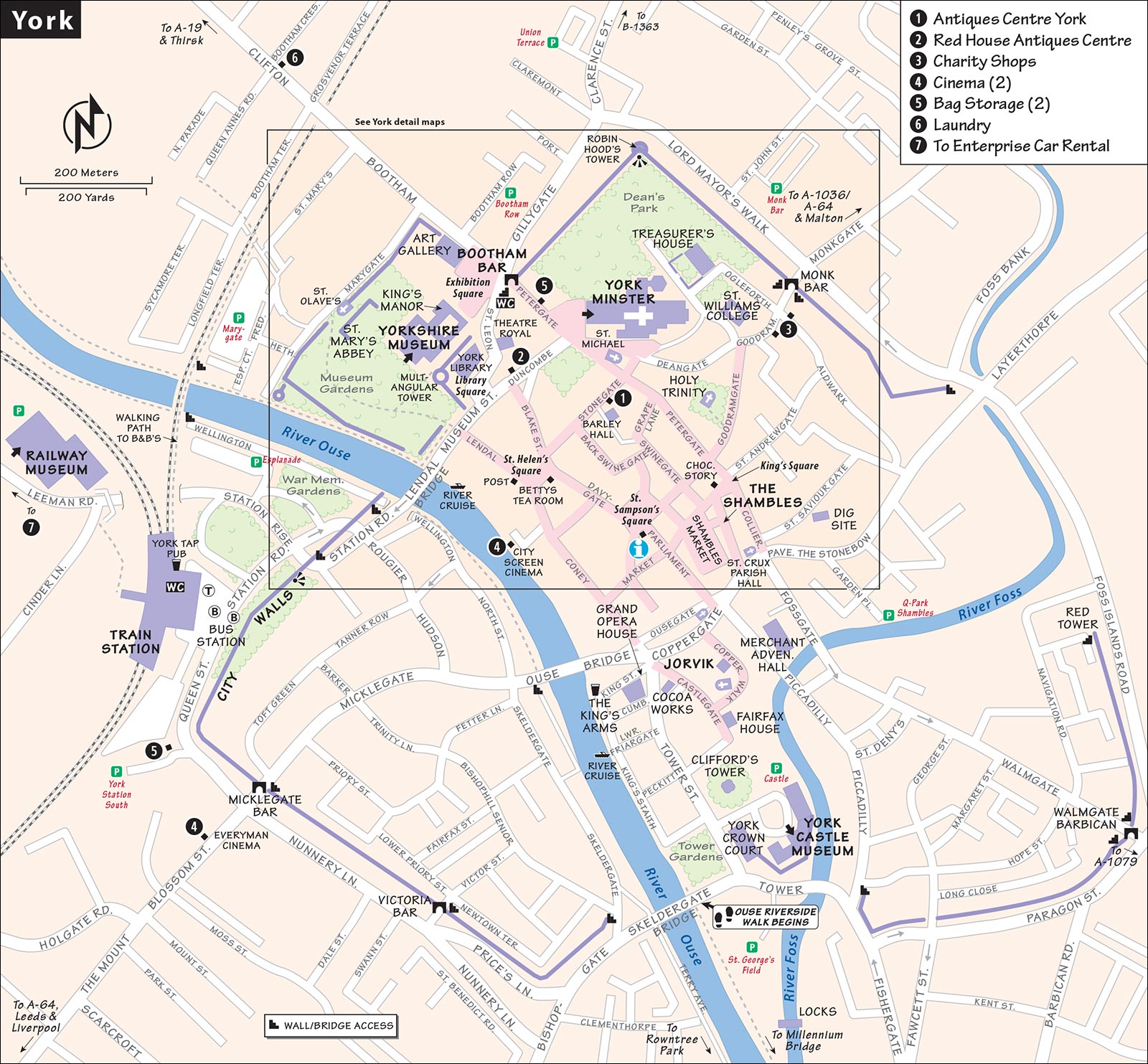
- Baggage Storage: Between Bootham Bar and the Minster, Yorbag Left Luggage has a tiny office at 20 High Petergate and will stash your bags for “bloody cheap” (daily 9:00-18:00, 10-minute walk to train station, +44 7561 852 654). You can also store bags near the train station (see “Arrival in York,” earlier).
- Laundry: Some B&Bs will do laundry for a reasonable charge. Otherwise, try Regency Dry Cleaning (Mon-Tue 9:00-16:00, Wed-Sat until 14:00, closed Sun, in the B&B neighborhood at 75 Bootham, +44 1904 613 311).
- Taxi: From the train station, taxis zip new arrivals to their B&Bs for £8-10 (queue up at the taxi stand). To call a taxi, try +44 1904 656 565 or +44 1904 623 332; cabbies don’t start the meter until you get in. Uber also operates in York. Be aware that taxis can be hard to come by between 13:00 and 15:00 on school days.
- Car Rental: If you’re nearing the end of your trip, consider dropping your car in York instead of London. The money saved by turning it in early (you won’t need it in this walkable town) more than pays for the train ticket that whisks you effortlessly to London. Various companies have offices in York, including Enterprise (Leeman Road, +44 904 658 240).
- Craft Distilleries: York has a burgeoning craft distillery scene, with several small-batch gin, whiskey, and rum producers offering tours and/or tastings. Check online or ask at the TI for the latest lineup.
Tours in York
WALKING TOURS
A walking tour in York is worth ▲▲▲.
Free Walks with Volunteer Guides
Charming locals give energetic, entertaining, and free two-hour walks through York (daily at 10:30 and 13:15, depart from Exhibition Square in front of the art gallery, reservations recommended, +44 1904 949 942, avgyork.co.uk).
York Tour
Led by husband-and-wife team Alfred Hickling and Sarah Jackson, York Tour’s 1.5-hour walks are a bit more intellectually demanding, with a history focus that’s still family-friendly (£20, kids under 16 half-price, online booking required; daily at 10:30 and 14:00, meet at Library Square; private tours—£150/2 hours; +44 7963 791 937, yorktour.com).
Ghost Walks
York lays claim to being the most haunted city in Europe. Each evening, the old center crawls with creepy ghost walks. These walks are generally 1.5 hours long and go rain or shine.
The Bloody Tour of York, led by Mad Alice (an infamous figure in York lore), is an engaging walk with captivating descriptions of the plague, martyred saints, the torture of Guy Fawkes, and other lurid tales (£15, online booking required; Tue and Thu-Sun at 18:00, April-Oct also at 20:00, no tours Mon and Wed, Jan Sat only; meet outside St. Williams College behind the Minster on College Street, thebloodytourofyork.co.uk [URL inactive]).
The Original Ghost Walk, said to be the first of its kind, dates to the 1970s and covers some of the supposedly haunted places in York, where old dukes, Vikings, and Roman soldiers are still seen at night. This walk has more classic spooky storytelling than comedy (£10, cash only, daily at 20:00, 75-90 minutes, meet outside The Kings Arms at Ouse Bridge, theoriginalghostwalkofyork.co.uk).
OTHER TOURS IN YORK
Food Tour
Tours in a Dish, led by Marion Martínez, makes five stops in three hours that can also serve as lunch. The tour visits small eateries offering both savory and sweet cuisine, mostly modern and eclectic, where you meet the artisan (£70/person, up to 10 people, departs Thu-Sat at 11:30 from the Minster, private tours also available, reserve online or by phone, +44 7588 773 647, toursinadish.com).
Hop-on, Hop-off Bus Tours
City Sightseeing (red buses) and Golden Tours York (blue-and-white buses) both send half-enclosed, double-decker, hop-on, hop-off buses in a circle around the mundane perimeter of York, taking tourists past secondary sights that the city walking tours skip. While you can hop on and off all day, York is so compact that these have no real transportation value. (City Sightseeing-£17, Golden Tours-£16, book online or pay driver by card, ticket valid 24 hours, departures every 15-20 minutes, less frequent off-season, entire circuit takes about an hour, yorkcitysightseeing.com or goldentours.com/york). Golden Tours York also offers a £25 combo-ticket with the York City river cruise (see next).
River Cruise
York City Cruise does a lazy, narrated, 45-minute trip along the River Ouse (£15, £25 combo-ticket with Golden Tours York bus; April-Sept daily 10:30-16:00, runs every half-hour, fewer off-season, no cruises Dec-Jan; leaves from Lendal Bridge and from King’s Staith Landing between the Ouse and Skeldergate bridges; +44 207 740 0400, citycruisesyork.com).
Yorkshire Day Trips
Two reliable companies run all-day 16-passenger minibus tours with various routes covering the nearby North York Moors, Yorkshire Dales, and Whitby on the coast. Tours cost £55-60 and are an efficient way to sample this scenic and charming region without a car (Mountain Goat Tours, +44 1539 445 161, mountain-goat.com; and BOB (“Best of Britain”) Holiday’s Day Trips from York, +44 1609 779 933, bobholidays.com).
York Walk
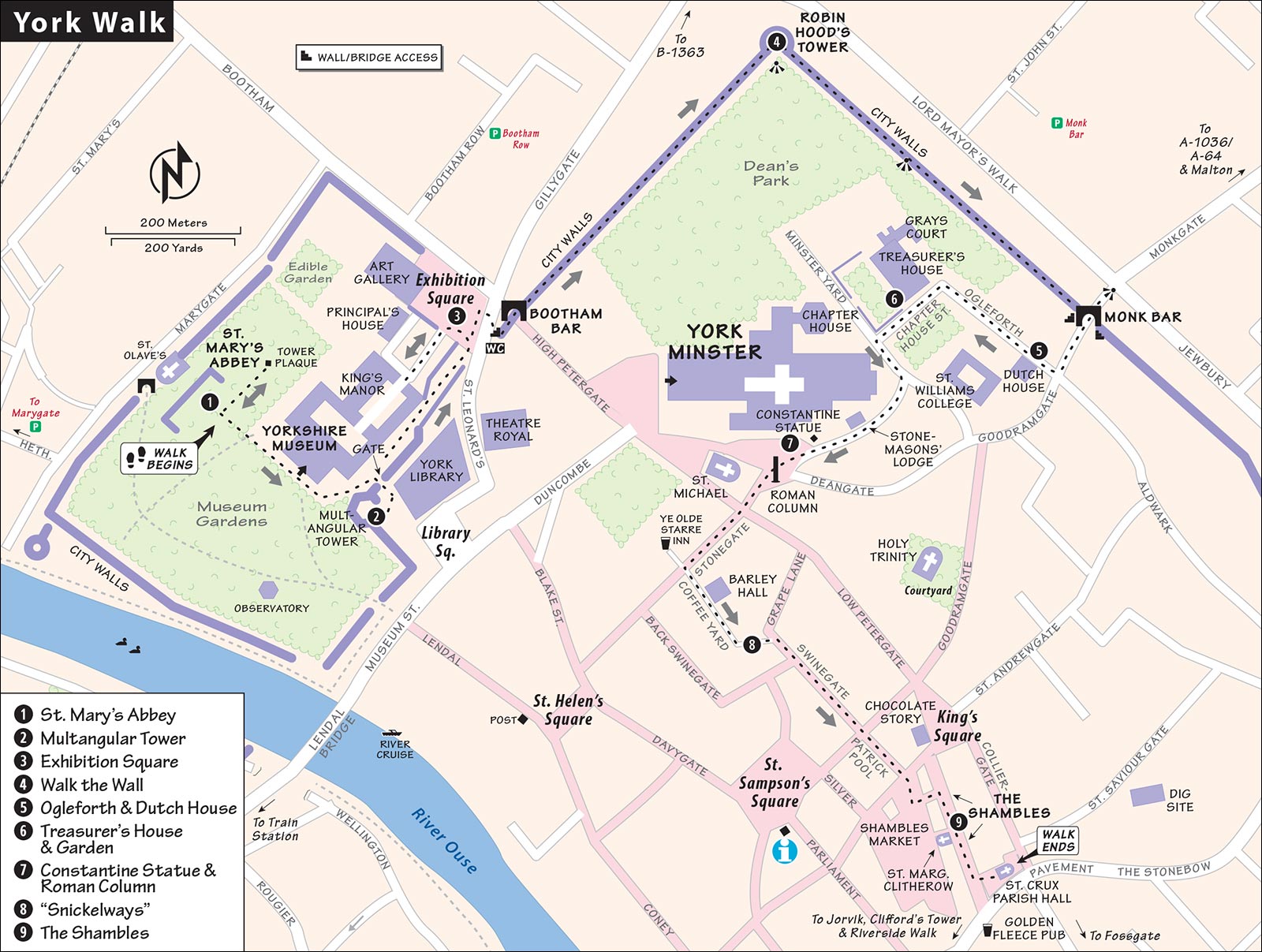
Get a taste of Roman and medieval York on this easy, self-guided stroll. The walk begins in the gardens just in front of the Yorkshire Museum, covers a stretch of the medieval city walls, and then cuts through the middle of the old town. Note that the gardens close at 18:00.
• Start in the Museum Gardens, at the ruins of St. Mary’s Abbey. You can enter the gardens from various points; once inside, make your way to the center of the park—look for the long, tall, partially ruined wall lined with pointy arches (see the “York Walk” map).
1 St. Mary’s Abbey
Of the many destroyed abbeys scattered across England, this one is especially easy to see and enjoy. The original abbey dated from the age of William the Conqueror, whose harsh policies (called the “Harrowing of the North”) consisted of massacres and destruction, including the burning of York’s main church. His son Rufus, who tried to improve relations in the 11th century, established a great church here. The church became an abbey that thrived from the 13th century until the Dissolution of the Monasteries in the 16th century. The Dissolution, which accompanied the Protestant Reformation and break with Rome, was a power play by Henry VIII. The king wanted much more than just a divorce: He wanted the land and riches of the monasteries. Upset with the pope, he demanded that his subjects pay him taxes rather than give the Church tithes.
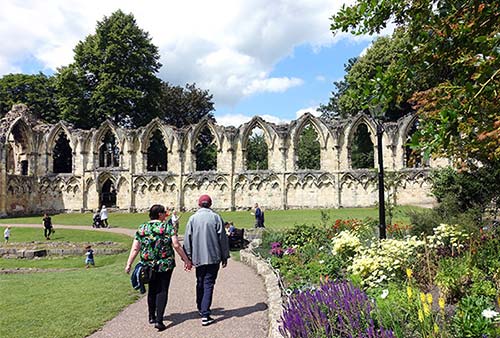
As you gaze at this ruin, imagine magnificent abbeys like this scattered throughout the realm. Henry VIII destroyed most of them, taking the lead from their roofs and leaving the stones to scavenging townsfolk. Scant as they are today, these ruins still evoke a time of immense monastic power. The one surviving wall was the west half of a very long, skinny nave. The tall arch at the right end of the wall marked the start of the transept. In the grass just beyond the arch, find the plaque that reads Crossing beneath central tower, and look up at the air that now fills the space where a huge tower once stood.
With your back to the abbey, the fine Neoclassical building in front of you is the Yorkshire Museum, where you can view carved stonework from the ruined abbey (worth a visit and described later, under “Sights in York”).
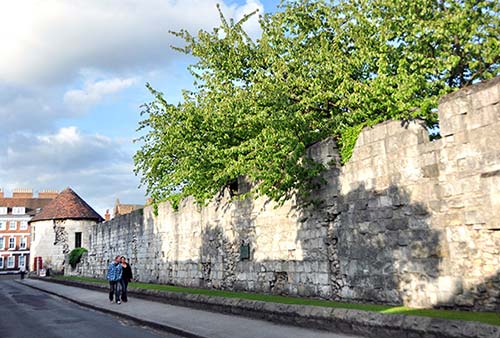
• Walk in front of the Yorkshire Museum building and circle immediately left, down a tree-covered lane. Ahead on your right is a corner of the Roman wall and the Multangular Tower. To visit it, after 30 yards, follow the lane on the right up through a garden, past yew trees (York means “place of the yew trees”), and straight through a small gated arch in the wall. Step through the wall and look right for a peek into the ruined tower.
2 Multangular Tower
This 12-sided tower (c. AD 300) was likely a catapult station built to protect the town from enemy river traffic. The red ribbon of bricks was a Roman trademark—both structural and decorative. The lower stones are Roman, while the upper (and bigger) stones are medieval. After Rome fell, York suffered through two dark centuries. Then, in the ninth century, the Vikings took over. York flourished, but the Vikings built with wood, so very little from that period remains. The Normans came in 1066 and built in stone, generally atop Roman structures (like this wall). The wall that defined the ancient Roman garrison town worked for the Norman town, too. But after the English Civil Wars in the 1600s and Jacobite rebellions in the 1700s (Britain’s last internal conflicts), fortified walls were no longer needed in the country’s interior.
• Now, return to the tree- and fern-lined lane and turn right, walking between the museum and the Roman wall. Continuing straight, the lane goes between the King’s Manor and the town wall. This is a “snickelway”—a small, characteristic York lane or footpath. The snickelway pops out on...
3 Exhibition Square
Before exploring the square, do a quick U-turn to the left, then go through the gate, to see the splendid King’s Manor. With Henry VIII’s Dissolution of the Monasteries, the abbey was destroyed and the abbot’s palace got a new owner. Because the northerners were slow to embrace the king’s reforms, Henry VIII came here to personally enforce the Dissolution. He stayed 17 days in this mansion and brought along 1,000 troops to make his determination clear. Over the door, you can’t miss the colorful coat of arms of Charles I, who stayed here during the English Civil Wars in the 1640s. Today, the building is part of the University of York.
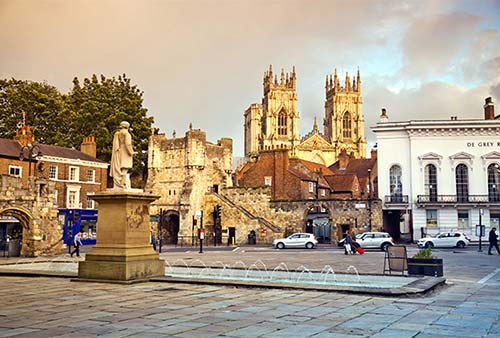
Return to Exhibition Square, the departure point for various walking and bus tours, and overlooked by the venerable York Art Gallery (minor paintings and ceramics, plus temporary exhibits, closed Mon-Tue). The square’s centerpiece is a statue of William Etty (1787-1849). In the Industrial Age, most great cities tore their walls down and laid railway lines right through their hearts. With leadership from Etty, York saved its walls and parked the train station outside the center, thus retaining the York character that so many visitors enjoy today.
From Exhibition Square you can see the towers of the Minster in the distance. Travelers in the Middle Ages could see the Minster from miles away as they approached the city. Across the street is a pay WC and Bootham Bar—one of the fourth-century Roman gates in York’s wall (this one faced Scotland)—with access to the best part of the city walls (free, wall opens at 8:00, generally closes at dusk).
• Climb up the bar. (While there may be a padlock, the entry gate is generally open. Just push.)
4 Walk the Wall
We’ll walk along two sides of York’s impressive wall. First, hike along the top of the wall behind the Minster to the first corner (about 300 yards). York’s 13th-century walls are three miles long. This stretch follows the original Roman wall. Norman kings built up the walls to assert control over northern England. The crenellations (square notches at the top of a medieval wall) once held wooden hatches to provide cover for archers. The wall was extensively renovated in the 19th century. Victorians may have saved the walls, but the fortifications were not “medieval” enough for their taste, so they ornamented them with fanciful extras—adding little touches such as Romantic arrow slits.
At the corner with the benches—Robin Hood’s Tower—you can lean out and see the moat outside. This was originally the Roman ditch that surrounded the fortified garrison town. (Looking at a town map, you can still make out the rectangular footprint of that original occupiers’ green zone.)
• Now carry on toward the next gate.
About two-thirds of the way (over the back garden of the Grays Court Hotel—a tempting spot for a splash of champagne or tea, and open to nonguests), you’ll enjoy a particularly fine view of the Minster, with its truncated main tower and the pointy rooftop of its chapter house.
• Continue to the next gate, Monk Bar, a fine medieval gatehouse.
Descend the narrow staircase at Monk Bar, then U-turn left to step outside the city’s protective wall. Pass the portcullis (last lowered in 1953 for Queen Elizabeth II’s coronation). Take 10 paces and gaze up at the tower. Imagine 10 archers behind the arrow slits. Keep an eye on the 17th-century guards (at the very top), with their stones raised and primed to protect the town.
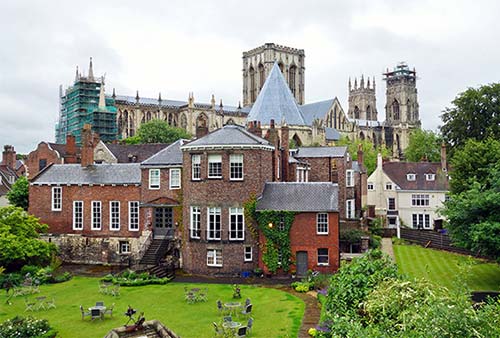
Return through the city wall and continue straight. After a short block, turn right on Ogleforth. (“Ogle” is the Norse word for owl, hence our word “ogle”—to look at something fiercely.)
York’s Old Town
Walking down 5 Ogleforth, ogle the charming little brick house from the 17th century called the Dutch House (on your left). Designed by an apprentice architect showing off for his master, it was the first entirely brick house in town—a sign of opulence. Next, also of brick, is a former brewery with a 19th-century industrial feel.
Farther along, Ogleforth jogs left and becomes Chapter House Street, which leads on to the Minster. On your way you’ll pass the 6 Treasurer’s House on the right. If it’s open, it’s worth a short detour through the home’s tranquil garden (closed Thu-Fri, café). The garden is free to visit (the house itself has an entry fee). To reach the garden, pass through the ornate iron gate into the hallway, then take a sharp left. Find a bench and pause to enjoy this pint-sized walled oasis before exiting left onto the lane called Minster Yard, with the pointed tower of the octagonal Chapter House looming in front of you.
If the garden isn’t open, continue straight to Minster Yard and turn left. (If you detour a few steps to the right, you can peek at the grand house through a big metal gate.)
Follow Minster Yard as you circle around the back side of the Minster, past the stonemasons’ lodge (where craftspeople chisel local limestone for the church, as has been done here since the 13th century), to the statue of Roman emperor Constantine.
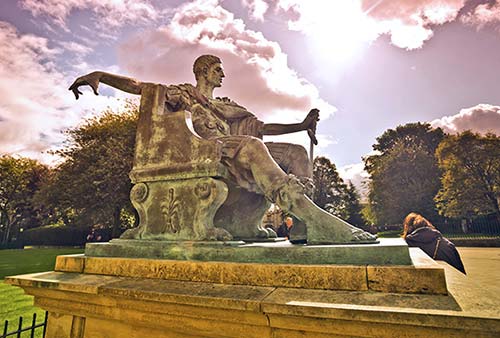
Step up to lounging 7 Constantine (a modern statue, this was unveiled in 1998). Five emperors visited York when it was the Roman city of Eboracum. Constantine was here when his father died. The troops declared him the Roman emperor in AD 306 at this site, and six years later, he went to Rome to claim his throne. In AD 312, Constantine legalized Christianity; and in AD 314, York got its first bishop.
The ancient column across the plaza from Constantine is a reminder that the Minster sits upon the site of the Roman headquarters, or principia. The first-century column, likely part of an early church, was discovered beneath the Minster in 1969 and placed here in 1971, just before the city celebrated the 1,900th anniversary of the founding of Eboracum—aka York.
• If you want to visit the York Minster now, find the entrance on its west side, ahead and around the corner (see description under “Sights in York,” later).
Otherwise, head into the town center. From opposite the Minster’s south transept door (the door by Constantine), take a narrow pedestrian walkway—which becomes Stonegate—into the tangled commercial center of medieval York. Walk down Stonegate, lined with inviting cafés, pubs, and restaurants. Just before the Ye Old Starre Inne banner hanging over the street, turn left down the snickelway called Coffee Yard (marked by a red devil). Enjoy strolling another of York’s...
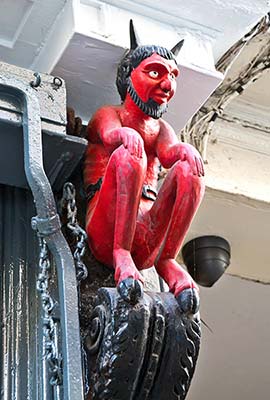
8 “Snickelways”
This is a made-up York word combining “snicket” (a passageway between walls or fences), “ginnel” (a narrow passageway between buildings), and “alleyway” (any narrow passage)—snickelway. York—with its population packed densely inside its protective walls—has about 50 of these public passages. In general, when exploring the city, you should duck into these—both for the adventure and to take a shortcut. While some of York’s history has been bulldozed by modernity, bits of it hide and survive in the snickelways.
Coffee Yard leads past the Barley Hall; after passing its entry courtyard, look through the big window on the left to see its fine old interior. Beyond that, you’ll pop out at the corner of Grape Lane (to the left) and Swinegate (to the right).
Medieval towns named streets for the business done there. Swinegate, a lane of pig farmers, leads to the market. Grape Lane is a polite version of that street’s original crude name, Gropec*nt Lane. If you were here a thousand years ago, you’d find it lined by brothels. Throughout England, streets for sex workers (rife with men groping women) were called by this graphic name.
Keep your hands to yourself and turn right down Swinegate for a few short blocks. Pass the stony building and continue straight up the lane to reach the Shambles Market. Popular for cheap produce and clothing, this market was created in the 1960s with the demolition of a bunch of colorful medieval lanes. Despite suburban malls and online shopping, it’s good to see a bit of York’s old commercial zone with its medieval heritage still thriving after all those centuries. (The food stalls at the far end are good for a fast, cheap, and memorable little lunch.)
• Tiny “Little Shambles” lane, on the left, dead-ends into the most famous lane in York.
9 The Shambles
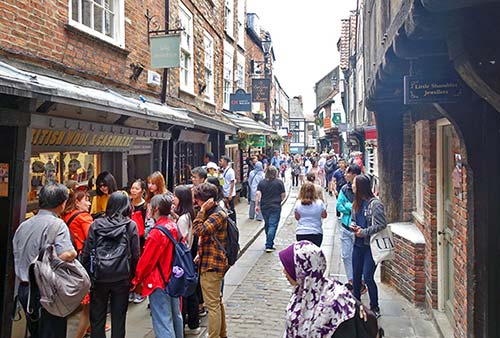
This colorful old street (rated ▲) was once the “street of the butchers.” The name was derived from “shammell”—a butcher’s bench upon which to cut and display meat. In the 16th century, this lane was dripping with red meat. You can still see the hooks—once used to hang rabbit, pheasant, beef, lamb, and pigs’ heads—under the eaves. Fresh slabs were displayed on the fat sills, while people lived above the shops. All the garbage and sewage flushed down the street to a mucky pond at the end—a favorite hangout for the town’s cats and dogs. Tourist shops now fill these fine, half-timbered Tudor buildings. Look above the modern crowds and storefronts to appreciate the classic English architecture. While fires gutted most old English town centers, York’s old town survives intact. (London would have looked like this before its devastating fire in 1666.) The soil here isn’t great for building; notice how the structures have settled in the absence of a solid foundation.
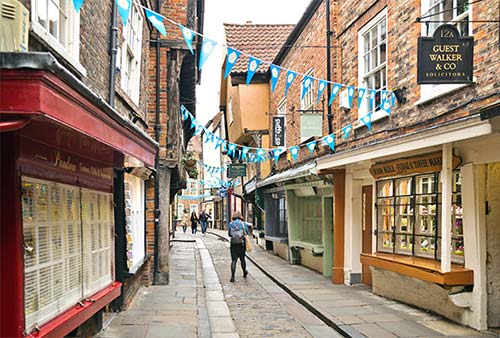
Turn right and slalom down The Shambles. Just past the tiny cheesecake shop at #37 (on the right), pop in to the snickelway and look for very old woodwork. Study the 16th-century carpentry: mortise-and-tenon joints with wooden plugs rather than nails, and the wattle-and-daub construction (timber frames filled in with rubble and plastered over).
Next door (back on The Shambles) is the shrine of St. Margaret Clitherow, a 16th-century Catholic crushed by Protestants under her own door (as was the custom when a city wanted to teach someone a lesson). She was killed for refusing to testify about hiding priests in her home. Step into the tiny shrine for a peaceful moment to ponder Margaret, who in 1970 was sainted for her faith.
The Shambles reminds many of Diagon Alley in the Harry Potter films. While this lane inspired the set design (and the establishment of several “he-who-shall-not-be-named-for-trademark-reasons” shops at the bottom end of the lane), no filming was done here.
At the bottom of The Shambles is the cute, tiny St. Crux Parish Hall, which charities use to raise funds by selling light meals (see “Eating in York,” later). Take time to chat with the volunteers.
With blood and guts from The Shambles’ 20 butchers all draining down the lane, it’s no wonder The Golden Fleece, just below, is considered the most haunted pub in town.
• Your town walk is finished. From here, you’re just a few minutes from plenty of fun: street entertainment and lots of cheap eating options on King’s Square, good restaurants on Fossgate, the York Castle Museum (a few blocks farther downhill), and the starting point for my Ouse Riverside Walk (described later in this chapter).
Sights in York
▲▲▲YORK MINSTER
▲▲▲YORK MINSTER
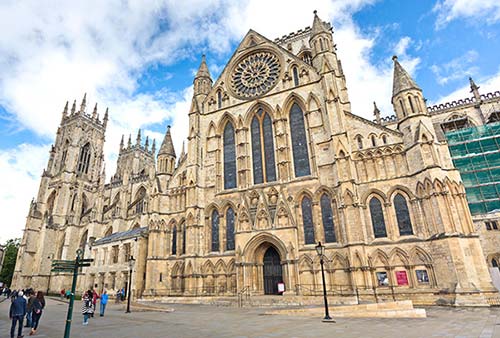
The pride of York, this largest Gothic church north of the Alps (540 feet long, 200 feet tall) brilliantly shows that the High Middle Ages were far from dark. The word “minster” means an important church chartered with a mission to evangelize. As it’s the seat of a bishop, York Minster is also a cathedral. While Henry VIII destroyed England’s great abbeys, this was not part of a monastery (and Henry needed an ecclesiastical center for his Anglican Church in the north)—so it was left standing. It seats 2,000 comfortably; on Christmas and Easter, at least 4,000 worshippers pack the place. Today, more than 250 employees and 500 volunteers work to preserve its heritage and welcome more than a million visitors each year. It costs £30,000 a day to maintain the great church, and they just about break even with the revenue generated by tourism.
Cost: £20, includes guided tour, Undercroft Museum, and crypt; free for kids under 18. Tickets are good for a year, so you can reenter as you like.
Hours: The cathedral is open for sightseeing Mon-Sat 9:30-17:00, Sun 12:45-15:00, last entry one hour before closing. It opens for worship daily at 7:30. Attractions within the church—including the tower climb and special tours—have their own hours, noted below. As this is an operating church, the Minster may close for special events; when planning your day, check the latest on their website; +44 1904 557 217 or +44 8443 930 011, yorkminster.org.
Crowd-Beating Tips: The Minster can be very busy, especially on summer weekends (particularly Sundays, when hours are shorter); during these busy times, booking online is smart. The Minster tends to be busiest soon after opening; it’s quieter later in the day.
Visitor Information: You’ll get a free map with your ticket. For more information, pick up the inexpensive York Minster Essential Guide. Helpful Minster guides stationed throughout are happy to answer your questions (none on Sun).
Tours: Free, guided hour-long tours depart from the ticket desk every hour on the hour (Mon-Sat 10:00-15:00, more often with demand, none on Sun, they go even with just 1-2 people, OK to join a tour in progress). Those with a deeper interest can book ahead online for 1.5-hour “Hidden Minster” tours: Chapter House Roof and Mason’s Loft (£12; Wed and Sat at 11:00) or Crypts of the Early Minster (£6; Tue and Fri at 11:00).
Evensong: To experience the cathedral in musical and spiritual action, attend an evensong (check schedule online; generally Tue-Sat at 17:30, Sun at 16:00, lasts 45-60 minutes; Mon service usually spoken rather than sung, at 17:30; enter at south door). Visiting choirs perform when the Minster’s choir is on summer break (mid-July-Aug). Arrive 15 minutes early and wait just outside the choir in the center of the church. You’ll be ushered in and can sit in one of the big wooden stalls. As evensong is a worship service, attendees enter the church free of charge. Leaving early is a disruption, so plan to stay. For more on evensong, see here.
Church Bells: If you’re a fan of church bells, you can experience ding-dong ecstasy Sunday morning at about 10:00 and during the Tuesday practice session between 19:00 and 22:00 (and sporadically at other times). These performances are especially impressive, as the church holds a full carillon of 35 bells (it’s the only English cathedral to have such a range). Stand in front of the church’s west portal and imagine the gang pulling on a dozen ropes (halfway up the right tower—you can see the ropes through a little window) while a talented carillonneur plays 22 more bells with a keyboard and foot pedals.
Tower Climb: It costs £6 for 30 minutes of exercise (275 steps) and forgettable views. The tower opens at 10:15 (13:15 on Sun), with ascents every 45 minutes (no children under 8, not good for acrophobes, closed in extreme weather). Get your timed-entry ticket upon arrival (or book online same-day) as only 50 visitors are allowed up at once.
 Self-Guided Tour
• Before entering, stand before the great west portal (under the twin towers) and take in the...
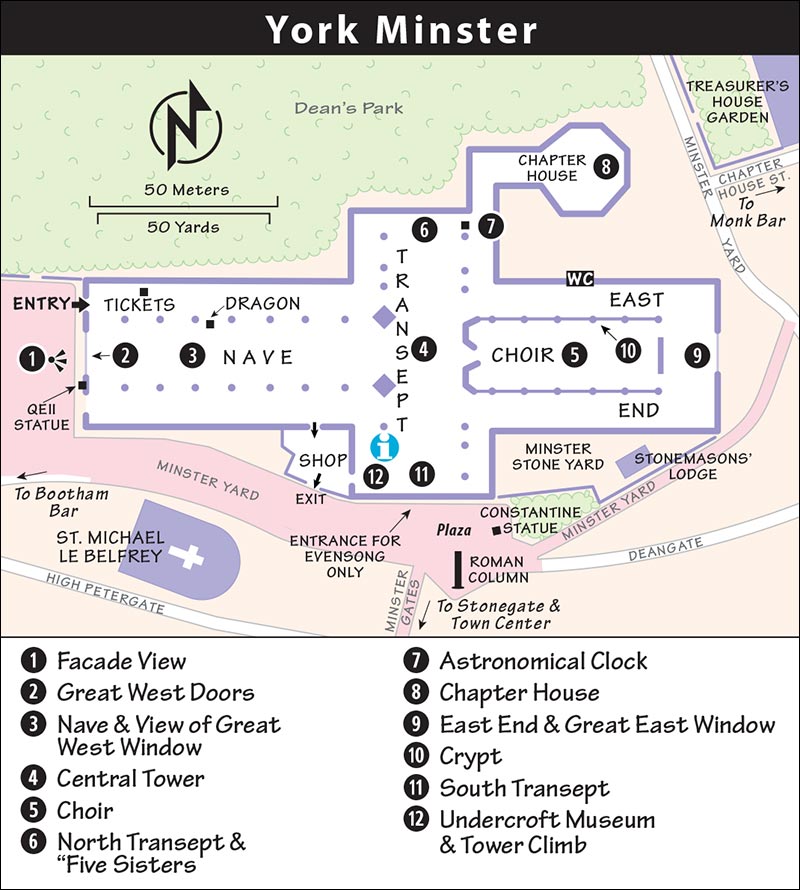
1 Facade View: You’ll notice this facade has lots of empty niches. These were potential “advertising” spaces, built to entice rich donors who would be recognized with a statue, but most were never filled. One exception is in the center, where a bishop stands flanked by two wealthy dukes—one who gave stone (on the left, holding a stone) and another who gave timber (on the right, holding a beam).
To the right of the great west doors, standing clean and pristine in her niche, is Queen Elizabeth II. Carved in 2022 by York Minster stonemason Richard Bossons, this six-and-a-half-foot-tall, 4,000-pound statue was intended to commemorate the queen’s Platinum Jubilee. Unfortunately, the queen died before seeing the statue, which was unveiled here by her son, King Charles III, in November 2022.
• Now enter the church. Notice separate lines for those who booked online, and those who need tickets. Upon entering, decide whether you also want to climb the tower; if so, book an assigned entry time now.
Once inside, turn right, walk to the middle of the nave, and look back at the...
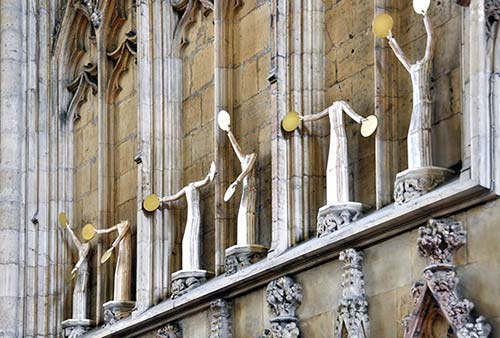
2 Great West Doors: These are used only on special occasions. Flanking the doors is a list of archbishops (and other church officials) that goes unbroken back to the 600s. The statue of Peter with the key and Bible (between the doors) is a reminder that the church is dedicated to St. Peter, and the key to heaven is found through the word of God. While the Minster sits on the remains of a Romanesque church (c. 1100), today’s church was begun in 1220 and took 250 years to complete. Up above, look for the female, headless “semaphore saints” (from 2004), using code to spell out a message with golden discs: “Christ is here.”
• Grab a chair and enjoy the view down the...
3 Nave: Your first impression might be of its spaciousness and brightness. One of the widest Gothic naves in Europe, it was built between 1280 and 1360—the middle period of the Gothic style, called “Decorated Gothic.” Rather than risk a stone roof, builders spanned the space with wood. Colorful shields on the arcades are the coats of arms of nobles who helped tall and formidable Edward I, known as “Longshanks,” fight the Scots in the 13th century.
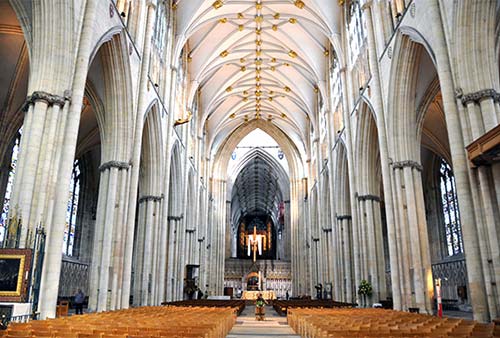
The coats of arms in the clerestory (upper-level) glass represent the nobles who helped Edward I’s son, Edward II, in the same fight. There’s more medieval glass in this building than in the rest of England combined. This precious glass (including the Great East Window) survived World War II—hidden in stately homes throughout Yorkshire.
While originally a Roman Catholic church, this has been a Protestant church for 500 years—ever since the Reformation. Thankfully, rather than destroying the church, the practical Anglicans just purged it of its Roman Catholic iconography. You’ll find no hint of the original pope-celebrating elements that ornamented it before the days of Henry VIII.
• Start to make your way up the nave.
Looking up and to the left, you can’t miss the golden dragon (two-thirds of the way up the wall, affixed to the top of a pillar). While no one is sure of its purpose, it pivots and has a hole through its neck—so it was likely a mechanism designed to raise a lid of a saint’s coffin. Carved out of Scandinavian oak, it’s considered part of an earlier church built during Viking times.
Directly across from the dragon, tucked back under a pointy arch, is a statue likely of St. George—the slayer of dragons and protector against pagan religious malpractice (you’ll need to circle around under the dragon to see it).
Before continuing up the nave, turn back to face the west end and marvel at the Great West Window, especially the stone tracery. While its nickname is the “Heart of Yorkshire,” it represents the sacred heart of Christ, meant to remind people of his love for the world.
• Continue all the way up the nave; you’ll need to loop around the altar platform to reach the very center of the church—under the...
4 Central Tower: Look up. An exhibit in the undercroft explains how gifts and skill saved this 197-foot tower from collapse. Use one of the neck-saving mirrors-on-wheels to take it all in.
• With your back to the church entrance, gaze at the...
5 Choir: Examine the choir screen—the ornate wall of carvings separating the nave from the choir. It’s lined with English kings from William I (the Conqueror) to Henry VI (during whose reign it was carved, in 1461). Numbers indicate the years each reigned. It is literally covered in gold leaf, which sounds impressive, but the gold is very thin...a nugget the size of a sugar cube can be pounded into a foil-like sheet the size of a driveway.
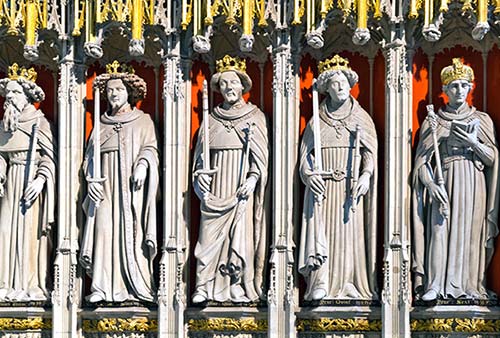
Step into the choir, where a service is held daily. All the carving was redone after an 1829 fire, but its tradition of glorious evensong services (sung by choristers from the Minster School) goes all the way back to the eighth century.
• Exit the choir the way you came in and turn right to enter the...
6 North Transept: In this transept, the grisaille windows—dubbed the “Five Sisters”—are dedicated to British servicewomen who died in war. They were made in 1260, before colored glass was produced in England. Notice that the design has no figures, perhaps inspired by Islamic art seen by Christian Crusaders in the 13th century. The windows were originally much lighter but became darker after countless cracked panes were fixed over the centuries by added leading.
• Walk all the way up to the Five Sisters, then look right to find the...
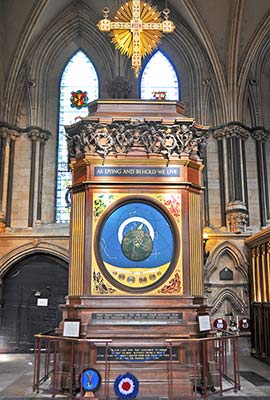
7 Astronomical Clock: This clock, from the 18th century, is held in a gigantic wooden case. It’s dedicated to the heroic Allied aircrews from bases here in northern England who died in World War II; the sign helps you understand the symbolism. The Book of Remembrance below the clock contains 18,000 names.
• Next to the clock, a corridor leads to the Chapter House. Before stepping inside, on the pillar in the middle of the doorway, notice the Virgin Mary holding Baby Jesus while standing on a devilish serpent.
Now step into the Gothic, octagonal...
8 Chapter House: This was the traditional meeting place of the governing body (or chapter) of the Minster. Without an interior support, it’s remarkable (almost frightening) for its breadth. The fanciful carvings decorating the canopies above the stalls date from 1280 (80 percent are originals) and are some of the Minster’s finest. Because this was a meeting hall, and therefore not consecrated, stonemasons could exercise even more creativity in their creations. On the wall directly across from the entrance, notice several heads grimacing in agony or astonishment, with hands clutching open mouths. Better yet, stroll slowly around the entire room and imagine that the tiny sculpted heads are a 14th-century parade—a fun glimpse of medieval society. Grates still send hot air up robes of attendees on cold winter mornings.
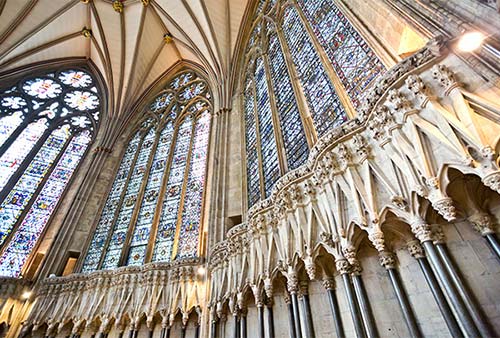
• As you head back the way you came in, pause in the corridor to see a model of the chapter house’s wooden construction. It illustrates the impressive 1285 engineering: The ceiling hangs from a wooden frame.
Back in the main part of the church, turn left before the choir, and continue all the way down the nave (behind the choir) to the...
9 East End and Great East Window: This part of the church is square, lacking a semicircular apse, typical of England’s Perpendicular Gothic style (15th century). Monuments (almost no graves) were once strewn throughout the church, but in the Victorian age, they were gathered into the east end, where you see them today.
The Great East Window, the size of a tennis court, is one of the great treasures of medieval art in Europe. It’s completely original and was recently cleaned and restored, with its stone tracery, leadings, and painted glass (not stained) looking today as it did when finished in 1408.
Imagine being a worshipper here the day it was unveiled—mesmerized by this sweeping story told in more than 300 panels of painted glass climaxing with the Apocalypse. It’s a medieval disaster movie—a blockbuster back in 1408—showing the end of the world in fire and flood and pestilence...vivid scenes from the book of Revelation. Angels trumpet disaster against blood-red skies. And there it is, the fifth panel up on the far-left side...the devil giving power to the Beast of the Apocalypse, a seven-headed, ten-crowned lion, just as it was written in the Bible.
• Retrace your steps partway up the aisle, watching on the left (under the central altar and choir) for stairs leading down into the...
10 Crypt: Here you can view the boundary of the much smaller, but still huge, Norman church from 1100 that stood on this spot (look for the red dots, marking where the Norman church ended, and note how thick the wall was). The aptly named Doomstone, dating from that original Noman church, features howling sinners on their way to hell. Step through the door to find more artifacts: some of the old columns and additional remains from the Roman fortress that once stood here, the tomb of St. William of York (a Roman sarcophagus that was reused), and the modern concrete save-the-church foundations. Beyond that is a ho-hum “Treasures” collection (you’ll find more interesting artifacts—and a deeper dive into the building’s history—in the Undercroft Museum, coming up).
• Head back to the central tower and pass the choir to view the...
11 South Transept: Look up. The modern “bosses” (carved medallions decorating the point where the ribs meet on the ceiling) are a reminder that the roof of this wing of the church was destroyed by fire in 1984, when lightning hit an electricity box.
• Two other sights can be accessed through the south transept: the tower climb (described earlier) and the...
12 Undercroft Museum: Well-described exhibits follow the history of the site from its origins as a Roman fortress to the founding of an Anglo-Saxon/Viking church, the shift to a Norman place of worship, and finally the construction of the Gothic structure that stands today. The museum fills a space that was excavated following the near collapse of the central tower in 1967.
Videos re-create how the fortress and Norman structure would have been laid out, and various artifacts provide an insight into each period. First comes a good Roman foundation: Peek through the see-through floor to view remains of the Roman fort’s basilica (its hall of justice), including patches of Roman frescoes from what was the basilica’s anteroom. Farther along are fragments of the walls and street that once separated the basilica from the adjacent barracks.
Marking the transition from Roman to Anglo-Saxon times, find the Horn of Ulf, the finest Viking treasure in York. This intricately carved elephant’s tusk was presented to the Minster in 1030 by Ulf, a Viking nobleman, as a symbol that he was dedicating his land to God and the Church. Consider the horn’s travels: from Indian elephant, to Islamic carvers in southern Italy, to a Viking lord, to this church.
Next is an exhibit called York Minster Today, featuring a variety of artifacts going back a thousand years, including the coffin lid, ring, chalice, and staff of Archbishop Walter de Gray, who, in the 13th century, started the current church.
A hallway leads to the evocatively lit York Gospels manuscript, a thousand-year-old text containing the four gospels. Made by Anglo-Saxon monks at Canterbury, it’s the only book in the Minster’s collection that dates to prior to the Norman Conquest. It is still used to this day to swear in archbishops.
• This finishes our visit. You’ll exit through the gift shop. Before leaving, take a moment to just be in this amazing building. Then, go in peace.
MORE SIGHTS IN THE CENTER
These sights cluster in the historic core of town, roughly from the Minster and the Museum Gardens to the Shambles.
▲Yorkshire Museum
Located in a lush, picnic-perfect park next to the stately ruins of St. Mary’s Abbey (described in my York Walk, earlier), the Yorkshire Museum is the city’s serious “archaeology of York” museum. You can’t dig a hole in York without hitting some remnant of the city’s long past, and most of what’s found ends up here. While the hordes line up at Jorvik Viking Centre, this museum has no crowds and provides a broader historical context, with more real artifacts.
Cost and Hours: £9.50; Tue-Sun 10:00-17:00, closed Mon; enter from Museum Gardens, +44 1904 687 687, yorkshiremuseum.org.uk.
Visiting the Museum: The museum tends to change exhibits frequently, but here’s a general overview; if you have trouble finding an item, ask.
From the ticket desk, go straight into the central atrium (ringed with columns) to get oriented to the three sections: Roman (to the left), medieval (downstairs), and Jurassic (a kid-friendly, fossil-based natural history wing opposite the Roman stuff).
Turn left, under the History of York sign, to see the Roman collection; you’ll be greeted by an original, early fourth-century Roman statue of the god Mars. In a series of rooms, you’ll see slice-of-life exhibits about the Romans of Eboracum (as York was called then): coins, funerary monuments (including a lounging Etruscan lady), and an excavated skeleton with an artist’s rendering of how the person originally looked. In the next room, you’ll find a likely gladiator, apparently killed by a sword blow to the head (his skull was found just beneath this museum’s WC—look for the plaque in the basement). The large mosaic floor invites you to take off your shoes and walk where Romans once trod.
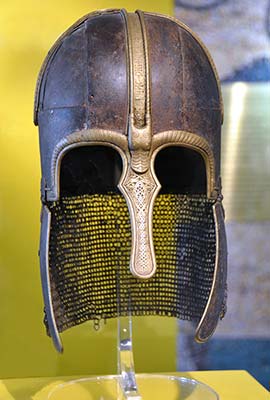
In the basement is the medieval section—including one of the best Viking collections in England. You’ll learn that the Vikings (who conquered most of the Anglo-Saxon lands) wore some pretty decent shoes and actually combed their hair. Look for the eighth-century Anglo-Saxon helmet known as the York Helmet (or the Coppergate Helmet); examine the delicate carving on its brass trim. In the Treasures room, find the exquisitely etched 15th-century pendant called the Middleham Jewel—considered the finest piece of Gothic jewelry in Britain. The noble lady who wore this on a necklace may have hoped it would protect her during childbirth. Both sides are displayed: The back of the pendant, which rested near her heart, shows the Nativity. The front shows the Holy Trinity crowned by a sapphire (believed to have medicinal properties). Here you’ll also find the Bedale Hoard, a variety of gold and silver Viking Age jewelry (discovered only in 2012)—mostly arm and neck rings, some of them quite exquisite. Also keep an eye out for the Cawood Sword, nearly 1,000 years old and considered one of the finest surviving swords from that era, and some of the original statues that once stood at St. Mary’s Abbey.
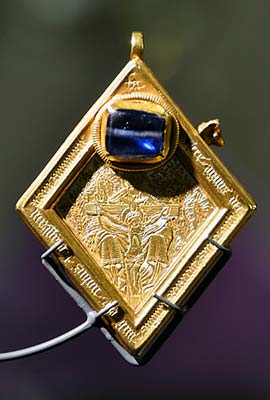
▲Holy Trinity Church
Built in the late Perpendicular Gothic style, this church—easy to miss, tucked back from the street—is both atmospheric and historic. It’s of particular interest to travelers who hold LGBTQ+ matters close to their hearts, as it’s tied to Anne Lister (1791-1840), the first publicly known queer woman in Britain.
Cost and Hours: Free; generally open Wed-Sun 11:00-16:00, closed Mon-Tue; 70 Goodramgate, holytrinityyork.org.
Chocolate Sights
York has a rich history in chocolate. Throughout the 1800s and 1900s, York was home to three major confectionaries—including Rowntree’s, originators of the venerable Kit Kat. Today, you’ll find two different opportunities to learn about York’s chocolate chops.
York Cocoa Works is a small chocolate production facility offering a one-hour tour (£12.50, departs several times daily) and a variety of hands-on experiences (including truffle- and barmaking classes) that provide a deeper understanding of how York’s favorite product is made...and let you sample the results (check schedule and book online, daily 9:30-17:00, near Jorvik Viking Centre at 10 Castlegate, +44 1904 656 731, yorkcocoahouse.co.uk [URL inactive]). They also have a shop and a café selling a variety of hot chocolate drinks.
York’s Chocolate Story, right on King’s Square, is an overpriced one-hour tour that pairs generous samples with the history of York’s confectionary connections—and you’ll have a chance to make your own chocolate lolly (£20, tours run every 30 minutes daily 10:00-17:00, yorkchocolatestory.com).
SOUTH OF THE SHAMBLES
These sights line up (roughly in this order) south of Coppergate, connected to the York Castle Museum by a 10-minute walk.
▲Merchant Adventurers’ Hall
In the Middle Ages, the word “adventurers” referred to investors, and this building was a kind of merchants’ corporate headquarters/early stock exchange. Claiming to be the finest surviving medieval guildhall in Britain (built from 1357 to 1361), the vast half-timbered building with marvelous exposed beams contains interesting displays about life and commerce in the Middle Ages when the economy revolved around guilds. You’ll see three original, large rooms that are still intact: the great hall itself, where meetings took place; the undercroft, which housed a hospital and almshouse; and a chapel. Several smaller rooms are filled with exhibits about guilds in this 14th-century world trade center. Sitting by itself in its own little picnic-friendly park, the classic old building is worth a stop even just to see it from the outside. Remarkably, the hall is still owned by the same Merchant Adventurers society that built it nearly 700 years ago (now a modern charitable organization).
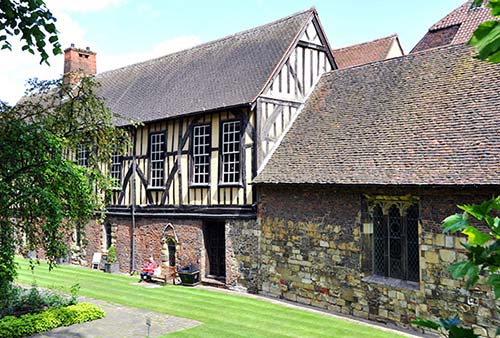
Cost and Hours: £7.50, kids 16 and under free with adult; Sun-Fri 10:00-16:30, Sat until 13:30; free audioguide; inviting café, south of The Shambles between Fossgate and Piccadilly, +44 1904 654 818, merchantshallyork.org.
▲Jorvik Viking Centre
Take the “Pirates of the Caribbean,” sail them northeast and back in time 1,000 years, sprinkle in some real artifacts, and you get Jorvik (YOR-vik). In the late 1970s, more than 40,000 artifacts were dug out of the peat bog right here in downtown York—at the time, the UK’s largest archaeological dig of Viking-era artifacts. When the archaeologists were finished, developers were allowed to build the big Fenwick department store next door, and the dig site was converted into this attraction.
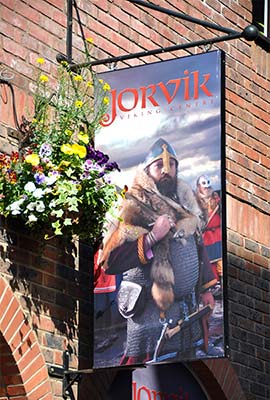
Jorvik blends museum exhibits with a 16-minute ride on theme-park-esque “time capsules” that glide through the re-created Viking street of Coppergate as it may have looked circa the year 975. Animatronic characters and modern-day interpreters bring the scenes to life. Innovative when it first opened, the commercial success of Jorvik inspired copycat rides/museums all over England. If you think of it as Disneyland with a splash of history, Jorvik’s fun. To me, Jorvik is a gimmicky and overpriced venture designed for kids, with too much emphasis on its gift shop. But it’s also undeniably entertaining, and—if you take the time to peruse its exhibits and substantial museum, with a rich trove of Viking artifacts—it can be quite informative.
Cost and Hours: £17.50, book timed-entry ticket online to avoid ticket-buying line; open daily 10:00-18:00, July-Aug from 9:00; last entry one hour before closing, +44 1904 615 505, jorvikvikingcentre.co.uk.
Other Family-Friendly Sights: The same organization that runs Jorvik—York Archaeological Trust (YAT)—manages two other attractions in town. Like Jorvik, these are geared primarily toward kids. While rooted in real history, YAT attractions work hard (some say too hard) to make that history entertaining. If you like their approach and plan to visit all three, consider the Jorvik Pastport combo-ticket (£25, £19 for kids, buy at any participating sight or at yat.digitickets.co.uk).
Barley Hall, tucked deep in the lanes of the old center, is a medieval house restored to replicate a 1483 dwelling. It’s designed to resurrect the Tudor age for visiting school groups—but with no historic artifacts other than its half-timbered wall, it feels soulless (£9.50, daily 10:00-17:00, shorter hours off-season, 2 Coffee Yard off Stonegate, barleyhall.co.uk). Dig is a hands-on archaeological site where young visitors sift through “dirt” (actually shredded tires), dig up reconstructed Roman wall plaster, and take a look at recent archaeological finds. Entry is possible only with a one-hour guided tour (departures every 30 minutes, smart to book ahead; pass waiting time by looking at the exhibits filling the haunted old St. Saviour’s Church). The 16:00 tour each day is designed for adults (£10.50, smart to prebook online as it can fill up—especially with school groups and on weekends, daily 10:00-17:00, Saviourgate, digyork.co.uk).
▲Fairfax House
This well-furnished home provides fine insights into aristocratic life in 18th-century England. One of the first Georgian townhouses in England, its seven rooms are perfectly Neoclassical, and its pleasant docents will gladly explain how the circa-1760 home was built as the dowry for an aristocrat’s daughter. The house is compact and bursting with stunning period furniture (the personal collection of a local chocolate magnate), gorgeously restored woodwork, and some lavish stucco ceilings. Ornately carved philosophers look down on the library, while the goddess of friendship presides over the drawing room.
Cost and Hours: £8.50, Mon-Thu and Sat 11:00-17:00, Sun until 16:00, Fri by guided tour only; £9.50 tours depart at 11:00, 12:00, and 14:00; near Jorvik Viking Centre at 29 Castlegate, +44 1904 655 543, fairfaxhouse.co.uk.
▲▲York Castle Museum
This fascinating social-history museum is a Victorian show home and one of the closest things to a time-travel experience England has to offer. The one-way plan ensures that you’ll see everything, including remakes of rooms from the 17th to the 20th century, a re-creation of a Victorian street, a heartfelt WWI exhibit, and eerie prison cells. While there can be a ticket line on extremely busy days (summer weekends), it moves fast; online booking is possible if you expect huge crowds, but typically not necessary.
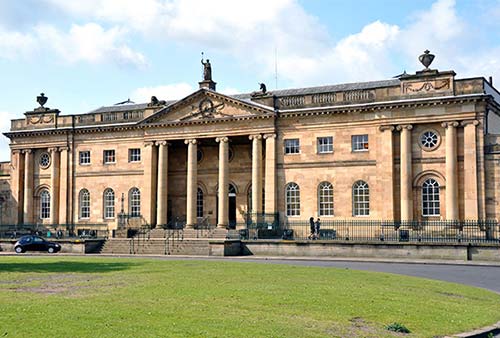
Cost and Hours: £17, Tue-Sun 10:00-17:00, Mon from 11:00 (except in summer when it opens at 10:00), roaming guides happily answer your questions, café at entrance, +44 1904 687 687, yorkcastlemuseum.org.uk. It’s at the bottom of the hop-on, hop-off bus route. The museum can call you a taxi (worthwhile if you’re hurrying to the National Railway Museum across town).
Visiting the Museum: Exhibits are divided between two wings: the North Building (the former women’s prison, to the left as you enter) and the South Building (former debtors’ prison, to the right).
Follow the one-way route, starting in the North Building. You’ll first visit the Period Rooms, illuminating Yorkshire lifestyles during different time periods (1600s-1950s) and among various walks of life, and get a peek down into Kirkgate—where we’ll be strolling soon. The Art of Motion exhibit features clockwork toys (aka “automata”—paying a small fee puts them into motion), while the Fashion Gallery shows off clothing trends over the last 400 years. The Secrets of Dress exhibit considers how different materials were spun and sewn together to create fashion across the ages; each item is marked as having been made with either linen, cotton, silk, wool, or synthetic fibers—and a map of the world encourages you to think about where each one came from. Next you’ll walk past a series of fireplaces and kitchens from the 1600s to the 1980s, and learn about people from different walks of life (child, soldier, farmer, sportsman).
Next, stroll down the museum’s re-created Kirkgate, a street from the Victorian era (1890s), when Britain was at the peak of its power. It features old-time shops and storefronts, including a pharmacist, sweet shop, school, and grocer for the working class, along with roaming live guides in period dress (who might crank up the 1890s mechanical piano, manufactured in York). Around the back is a slum area depicting how the poor lived in those times. Real carriages and recorded sounds of daily life complete the scene.
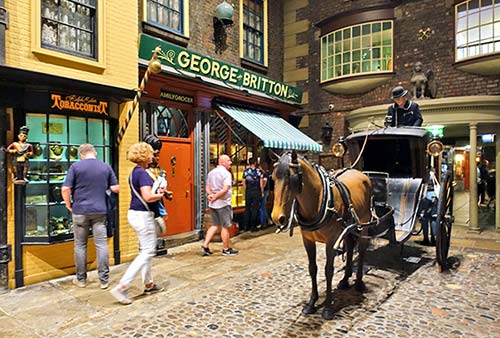
Circle back to the entry and cross over to the South Building. In the WWI exhibit—called 1914: When the World Changed Forever—you can follow the lives of five York citizens as they experience the horrors and triumphs of the war years. A faux train car transports conscripts to war. One room plunges you into the gruesome world of trench warfare, where the average life expectancy was six weeks (and if you fell asleep during sentry duty, you’d be shot). A display about the home front notes that York suffered from zeppelin attacks in which nine died. At the end you’re encouraged to share your thoughts in a room lined with chalkboards.
Exit outside and cross the castle yard. A detour to the left leads to a flour mill (open sporadically); while the building isn’t much, it’s nicely perched along the river, with views back on the castle wall. Otherwise, your tour continues through the door on the right, where you’ll find another reconstructed historical street, this one capturing the spirit of the swinging 1960s—“a time when the cultural changes were massive but the cars and skirts were mini.” Slathered with DayGlo colors, this street scene examines fashion, music, and television (including clips of beloved kids’ shows and period news reports).
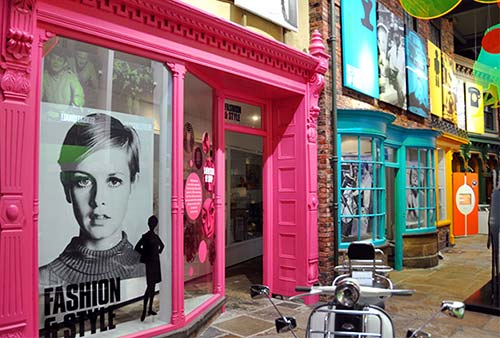
Finally, head into the castle prison, which recounts the experiences of people who were imprisoned here. Videos, eerily projected onto the walls of individual cells, show actors telling tragic stories about the cells’ onetime inhabitants.
BEHIND THE TRAIN STATION
▲▲National Railway Museum
Featuring a vast collection of original locomotives dating back to the early 1800s, this thunderous museum is one of the biggest and best of its kind. Anyone with even moderate enthusiasm for trains could spend hours wandering among the giant rail cars and peering at the thousands of items and illustrations related to train travel. This is train-car heaven.
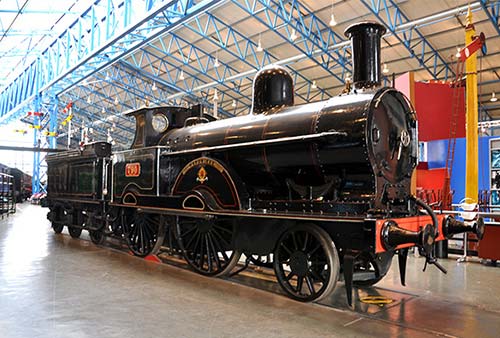
Cost and Hours: Free, daily 10:00-17:00, café, +44 3330 580 058, railwaymuseum.org.uk. Two paid extras can be purchased online or at the museum: the Flying Scotsman virtual reality experience (£7) and the youth-oriented Wonderlab (£10, discount for families).
Getting There: It’s behind the train station (southwest of the town center). From the Minster, it’s about a 20-minute walk: Walk down Museum Street and cross the Lendal Bridge, then turn right and follow the signs. Alternatively, from inside the train station, use the pedestrian walkway to cross the tracks and reach platforms 10 and 11, where you can head down behind the station to find the museum. To skip the walk, a cute little “road train” shuttles you more quickly between the Minster and the Railway Museum (£3.50 one-way, runs daily year-round, leaves museum every 30 minutes 11:00-16:00 at :00 and :30 past each hour; leaves town—from Duncombe Place, 100 yards in front of the Minster—at :15 and :45 past each hour).
OUTSIDE TOWN
▲Ouse Riverside Walk
The New Walk is a mile-long, tree-lined riverside lane created in the 1730s as a promenade for York’s dandy class to stroll, see, and be seen—and it’s a fine place for today’s visitors to walk. This hour-long walk is a delightful way to enjoy a dose of countryside away from York, starting from Skeldergate Bridge. It’s paved, illuminated in the evening, and a popular jogging route any time of day.
Getting There: From York’s center, head to the Ouse Bridge and take the steps down, walking past the recommended Kings Arms pub to the walkway along the river (you’ll also pass a river-cruise departure point on the way to Skeldergate Bridge). From the York Castle Museum or Clifford’s Tower, cross Tower Street and take one of the paths through little Tower Gardens Park (see the “York” map, earlier).
Shopping in York
Antique Malls: Two places within a few blocks of each other are filled with stalls and cases owned by antique dealers from the countryside (all open daily). The malls, a warren of rooms on three floors with cafés buried deep inside, sell the dealers’ bygones on commission. Serious shoppers do better heading for the country, but if you brake for garage sales you’ll love these: The Antiques Centre York (41 Stonegate, theantiquescentreyork.co.uk), and the Red House Antiques Centre (a block from the Minster at Duncombe Place, redhouseantiquesyork.com).
Charity Shops: In York, on Goodramgate (stretching a block or so in from the town wall), you’ll find thrift shops run by the British Heart Foundation, Mind, and Oxfam. Good deals abound on clothing, purses, accessories, children’s toys, books, and all manner of vintage items. If you buy something, you’re getting a bargain and at the same time helping the poor, mentally ill, elderly, or even a pet in need of a vet (stores generally open between 9:00 and 10:00 and close between 16:00 and 17:00, shorter hours on Sun).
Nightlife in York
PUBS
While I’ve listed good eating pubs under “Eating in York,” later, here are a few pubs I’d recommend to give your beer drinking an atmospheric kick. For locations, see the “York Restaurants” map, later.
The Blue Bell is one of my favorites for experiencing old-school York. This tiny, traditional establishment with a time-warp Edwardian interior is the smallest pub in town, with two distinct and inviting little rooms. Swearing and cell phone noise are politely forbidden; switch off your mobile, grab a pint, and perch yourself upon a rickety stool...if it hasn’t already been claimed by a local (no music, east end of town at 53 Fossgate, +44 1904 654 904).
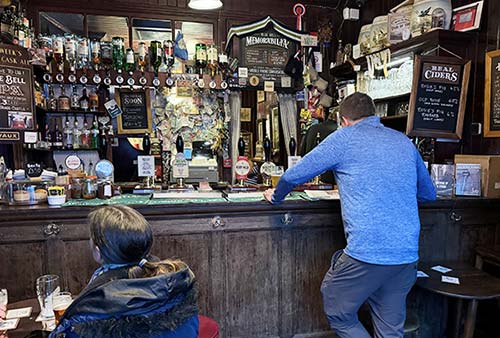
The House of the Trembling Madness is another fine watering hole with a cozy atmosphere; it sits above a “bottle shop” that sells a stunning variety of beers to go (daily, 48 Stonegate). I prefer this cluttered and atmospheric original location to its bigger, more conventional-feeling branch on Lendal Street.
Evil Eye Lounge, a hit with York’s young crowd, is a creaky, funky, hip space famous for its strong cocktails and edgy, psychedelic ambience. There are even beds to lie in while you drink. You can order downstairs at the bar (with a small terrace out back) or head upstairs (42 Stonegate, +44 1904 640 002).
Brew York feels straight out of Brooklyn. This industrial, grungy complex is York’s version of an American-style garage brewery, sprawling through several areas: main floor with giant brewing vats, tiny riverside terrace overlooking a red-brick industrial zone, and spacious upstairs, featuring a more traditional beerhall with Japanese street food (upstairs open daily, downstairs closed Mon-Tue, on Walmgate—tucked back from the road at the end of a long industrial courtyard, brewyork.co.uk).
York Tap, inside the train station, is appreciated by local aficionados of real ales. There are two starkly different seating areas, each one memorable: tables out along the tracks, under the Industrial Age canopy; or inside, with a classic pub vibe—stained glass, leather seats, and a quintessential circular bar ringed with taps (daily).
Riverside Eating and Drinking: On sunny days, several pubs set out riverside tables just below Ouse Bridge, starting with The Kings Arms, which boasts flood marks inside its door and has a more grizzled local crowd than other recommended pubs. For a cheap thrill, grab a pint indoors and sit outside at their rustic picnic tables (3 King’s Staith, +44 1904 659 435). The Star Inn the City, downriver near the Lendal Bridge, also offers a riverside terrace that’s great for a pricey cocktail—or stay for a full meal (see listing under “Eating in York,” later).
ENTERTAINMENT
Theatre
York is proud of its Theatre Royal, a spiffed-up theater sporting an 18th-century facade that offers a full variety of dramas, comedies, and works by Shakespeare. The locals are proud of the state-of-the-art main theater and little 100-seat theater-in-the-round (tickets £15-45, shows usually Tue-Sat at 19:30, tickets easy to get, on St. Leonard’s Place near Bootham Bar, booking +44 1904 623 568, yorktheatreroyal.co.uk).
The Grand Opera House, a thousand-seat venue just south of Coppergate, is the place for bombastic West End-style musicals and other large productions (corner of Clifford and Cumberland, atgtickets.com).
Ghost Tours
You’ll see fliers, signs, and promoters hawking a variety of entertaining after-dark tours. For a rundown on this scene, see “Tours in York,” earlier.
Movies
The centrally located City Screen Cinema plays both art-house and mainstream flicks. They also have an enticing riverside café/bar that serves good food (13 Coney Street). The Art Deco Everyman Cinema is another good option (near the train station on Blossom Street). For locations, see the “York” map near the beginning of this chapter.
Sleeping in York
July through October are the busiest (and usually most expensive) months. B&Bs often charge more for weekends and sometimes turn away one-night bookings, particularly for peak-season Saturdays. (York is worth two nights anyway.) Prices may spike for horse races and Bank Holidays (about 20 nights a season). Remember to book long in advance during festival times (see “Helpful Hints,” earlier) and weekends year-round.
Many of York’s old buildings and B&Bs don’t have elevators or air-conditioning—if either are a priority, confirm when you book.
B&BS AND GUESTHOUSES
These places are all small and mostly family-run. They come with plenty of steep stairs (and no elevators) but little traffic noise. Rooms can be tight; if maneuverability is important, say so when booking. Most can provide permits for street parking.
Bootham Bar
The handiest B&B neighborhood is the quiet residential area just outside the old town wall’s Bootham Bar. All of these are within a 10-minute walk of the Minster, and a 5- to 15-minute walk from the train station.
Getting There: From the train station it’s an easy walk: Head to the north end of the station along track 2 (past the recommended York Tap pub and racks of bicycles) and into the short-stay parking lot. You’ll continue essentially straight along the tracks, over the river, then along a footpath that runs beside a big parking lot. At the end of the parking lot, you reach a fork. For Bootham Terrace, Grosvenor Terrace, or Queen Anne’s Road, continue to the left, under the train tracks, then bear right. For St. Mary’s Street or Marygate, take the short stairway (on the right).
On or near Bootham Terrace
Note that the larger (but still classic British) Hedley House Hotel—listed later, under “Hotels”—is also in this area.
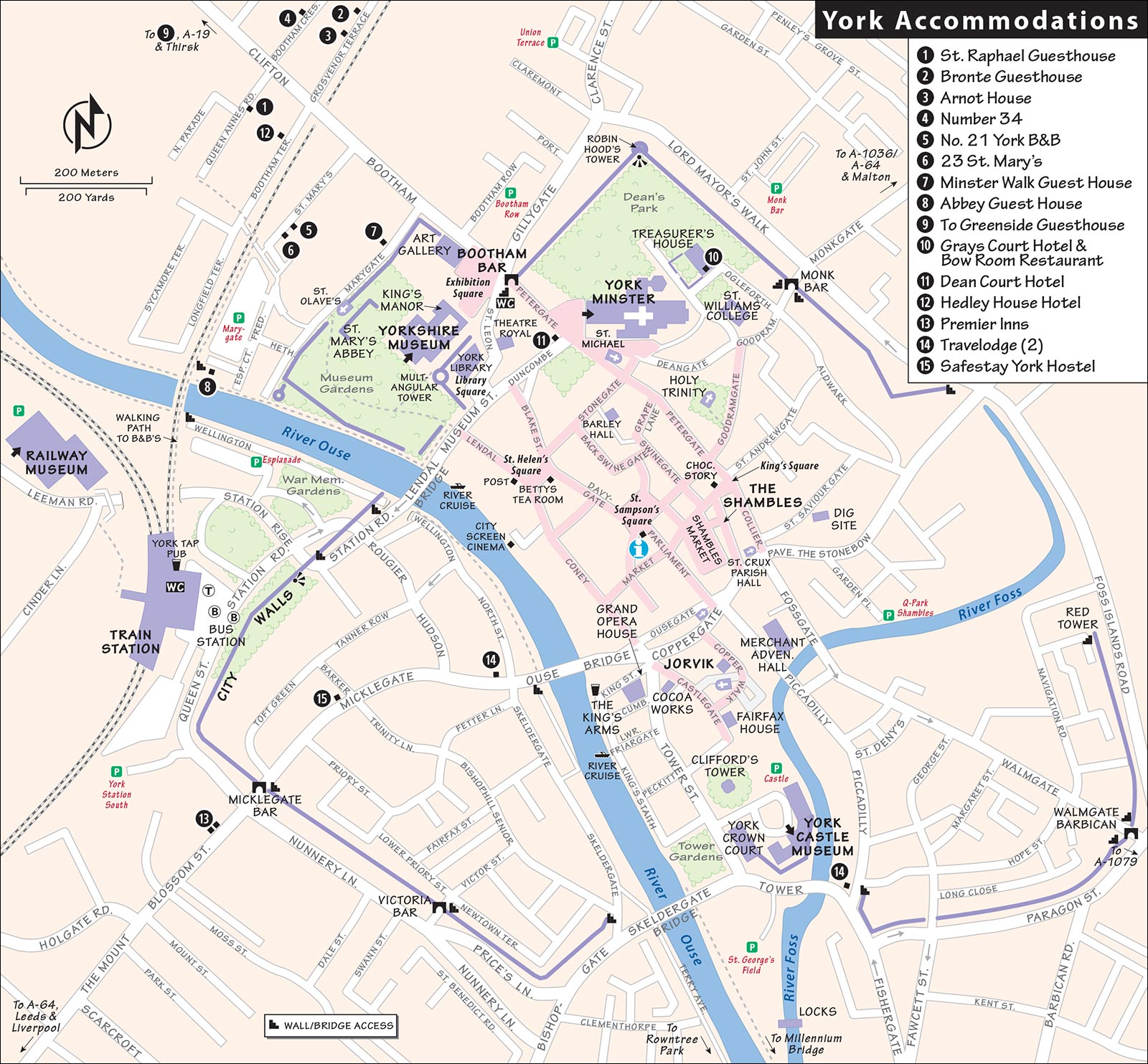
£ St. Raphael Guesthouse, run by Fran and Jamie and their friendly staff, has eight comfy rooms. Each is themed after a York street and lovingly accented with fresh flowers. For more space, ask well in advance for their small apartment with a private entrance and courtyard (RS%, ground-floor room, family rooms, pay laundry service, 44 Queen Anne’s Road, +44 1904 645 028, straphaelguesthouse.co.uk, info@straphaelguesthouse.co.uk).
£ Bronte Guesthouse is a modern B&B renting four airy, bright, uncluttered rooms. Mick and Mandy also have a lovely back garden and a communal fridge stocked with ice, water, and milk (22 Grosvenor Terrace, +44 1904 621 066, bronte-guesthouse.com, enquiries@bronte-guesthouse.com).
£ Arnot House, well managed by hardworking Kim, is old-fashioned, homey, and lushly decorated with Victorian memorabilia in three thoughtfully furnished rooms (2-night minimum preferred, no children, 17 Grosvenor Terrace, +44 1904 641 966, arnothouseyork.co.uk, arnothouse@gmail.com).
£ Number 34, run by Jason, has five simple, light rooms at fair prices (including a ground-floor room, a family room, and a true single). It has a clean, uncluttered feeling, with modern decor (RS%—ask for code, laundry offered, 34 Bootham Crescent, +44 1904 645 818, number34york.co.uk, enquiries@number34york.co.uk).
On or near St. Mary’s Street
££ No. 21 York B&B is a bright and cheery place run with pride by gentle Simon (who enjoys sharing restaurant tips) and his wife Andrea. Their six rooms are clean and colorful, and the extensive breakfast menu features locally sourced ingredients—from fruit and vegetables from The Shambles market to meat from a local butcher (request free parking in advance, 21 St. Mary’s, +44 1904 629 494, no21york.co.uk, stay@no21york.co.uk).
££ 23 St. Mary’s is bigger and lacks the personal touch of other B&Bs listed here, but it has 12 extravagantly decorated and spaciously comfortable rooms, plus a classy lounge and extras like stained-glass windows and an honesty box for drinks and snacks (breakfast extra, family room, lots of stairs, request free parking in advance, 23 St. Mary’s, +44 1904 622 738, 23stmarys.co.uk, stmarys23@hotmail.com, Simon and his staff).
££ Minster Walk Guest House, facing the town wall on Marygate (just around the corner from Bootham Bar), has nine pleasantly decorated room—each with its own theme—filling an old coaching inn. Run in a hands-off way by Sarah, it’s mostly self-service (the included “breakfast hamper” is a continental breakfast you eat in your room). The location is handy and the shared lounge is cozy, with a big fireplace, comfy couches, and lots of games and books for kids (family room, 22 Marygate, +44 1904 652 780, minsterwalk.co.uk, info@minsterwalk.co.uk).
Additional B&Bs Nearby
On the River: ££ Abbey Guest House is a peaceful refuge overlooking the River Ouse, with five cheerful, contemporary-style rooms, three ground-floor studios, and a lovely little garden with a patio and seating area. The location is charming and the riverview rooms will ramp up your romance with York (laundry; 13 Earlsborough Terrace—from the train station, follow the walking path over the river, then find the stairs on the right; +44 1904 627 782, abbeyguesthouseyork.co.uk, info@abbeyguesthouseyork.co.uk, Martyn).
Beyond Bootham: £ Greenside Guesthouse, run by smiling Lynne and Nigel, has eight cheerful, homey rooms with floral decor about a 15-minute walk from town (there’s a lovely route along the river, and buses run about every 10 minutes along Clifton). Lynne loves to share her knowledge of York (cash only—ATM nearby, ground-floor room, family room, some rooms have shared bathroom, free enclosed parking, 124 Clifton Green, +44 1904 623 631, greensideguesthouse.co.uk, greensideguesthouse@outlook.com).
HOTELS
££££ Grays Court Hotel is a historic mansion—the home of treasurers, dukes, and archbishops since 1091—that now rents 12 elegant yet understated rooms. The big draw is the creaky, historic atmosphere and the lavish grounds (Chapter House Street, +44 1904 612 613, grayscourtyork.com). They also have a high-end restaurant, Bow Room, serving an elaborate nine-course tasting menu, plus lighter lunches.
££££ Dean Court Hotel, facing the Minster, is a business-class hotel with lounges, a bar, and 40 comfortable rooms. It’s so central, you’ll regularly hear the Minster’s church bells from your room (family rooms, elevator, restaurant, Duncombe Place, +44 1904 625 082, inncollectiongroup.com/dean-court, info@deancourtyork.com).
££ Hedley House Hotel, well run by a wonderful family, has 33 modern and spacious rooms. The outdoor hot tub is a fine way to end your day, or you can sign up for yoga (family rooms, cozy lobby bar, in-house massage and beauty services, pay parking, 3 Bootham Terrace, +44 1904 637 404, hedleyhouse.com, greg@hedleyhouse.com, Greg and Louise Harrand). They also have three luxury studio apartments—see their website for details.
Budget Chain Hotels: Several affordable, cookie-cutter chains have central locations, including Premier Inn (two branches side by side) and Travelodge (near the York Castle Museum at 90 Piccadilly and on Micklegate).
HOSTEL
¢ Safestay York is a boutique hostel on a rowdy street (especially Fri-Sat). Located in a big old Georgian house, the rooms have great views and private prefab “pod” bathrooms. They also offer fancier, hotel-quality doubles (family rooms, continental breakfast extra, 4 floors, no elevator, air-con, TV lounge, game room, bar, no curfew, 5-minute walk from train station at 88 Micklegate, +44 1904 627 720, safestay.com, reception-yk@safestay.com).
Eating in York
York is a great food city, with a wide range of international options and quality bistros. If you’re in a hurry or on a tight budget, picnic and light-meals-to-go options abound, and it’s easy to find a churchyard, bench, or riverside perch where you can munch. On a sunny day, perhaps the best picnic spots in town are under the evocative 12th-century ruins of St. Mary’s Abbey in the Museum Gardens (near Bootham Bar), in the park surrounding the Minster, or in the yard of little Holy Trinity Church (on Goodramgate).
Most bistros have good-quality, creative vegetarian options and offer economical lunch specials and early dinners (generally order by 18:30). If you’re set on a particular place for dinner, reservations are smart.
NEAR BOOTHAM BAR AND RECOMMENDED B&BS
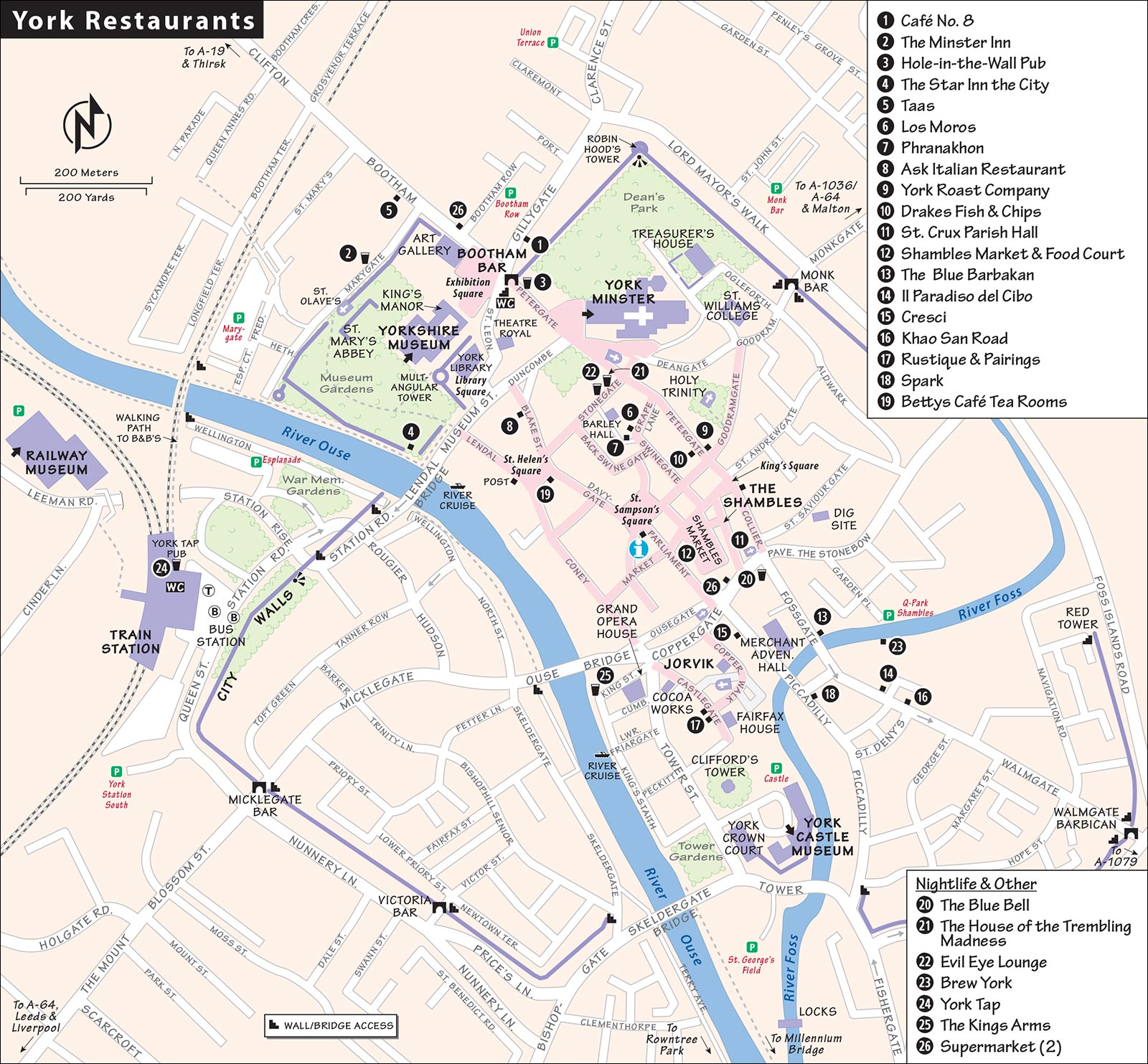
££££ Café No. 8 is a romantic and modern little bistro. Grab one of the tables in front or in the sunroom, or enjoy a shaded little garden out back. Chef Chris Pragnell uses what’s fresh in the market to shape his simple, elegant, and creative modern British menu (Wed dinner only, Thu-Sat lunch and dinner, Sun lunch only, closed Mon-Tue, 8 Gillygate, +44 1904 653 074, cafeno8.co.uk).
££ The Minster Inn, an Edwardian alehouse serving stone-baked pizzas, tapas, and a good selection of cask ales and wines, is a friendly neighborhood hangout. The interior is tidy and inviting; there’s also a tight, mostly covered courtyard and—in good weather—a few tables at the base of the city wall, across the street. As this place is justifiably popular, book ahead for weekend dinners (daily, 24 Marygate, +44 1904 849 240, minsterinn.co.uk).
££ Hole-in-the-Wall Pub is a good choice if you’re looking for a ye olde pub with good, reasonably priced grub. The extensive menu has light bites, burgers, fish-and-chips, meat pies, and veggie dishes—and it’s a fine spot for a traditional Yorkshire pudding (daily, live music Tue and Sun, on High Petergate just inside Bootham Bar, +44 1904 634 468).
££££ The Star Inn the City, filling the former Lendal Engine House along the river, is the urban outpost of an acclaimed village gastropub—with accordingly high prices. But the modern Yorkshire cuisine and the appealing setting justify the cost. The dressy dining hall has class, but on a nice day, the riverside terrace is especially enticing. You can also simply come for a drink on the terrace, then find a more affordable dinner elsewhere (daily, reservations recommended on weekends; end of Museum Street just before the bridge—watch on the right for the opening in the crenellated wall, +44 1904 619 208, starinnthecity.co.uk).
££ Taas, a handy option for affordable Nepalese and Indian fare, is small and charming. It has a homey interior, cheerful service, and a fun-to-peruse menu that offers a “taste of the Himalayas”—including momo dumplings and good grilled dishes (daily for dinner only, 2A Bootham, +44 1904 914 072, taasrestaurant.com).
Groceries: A handy branch of Sainsbury’s Local has provisions for a picnic or a simple cheap dinner (long hours daily, one block in front of Bootham Bar, on Bootham).
CITY CENTER
On or near Stonegate and Swinegate
In the city center, Stonegate (which runs east to west from the Minster) and Swinegate (which runs north to south)—and nearby streets (especially Blake Street and Grape Lane)—have a wide variety of tempting places. While you could just follow your nose, these options are worth considering.
£££ Los Moros is acclaimed for its short but enticing menu of Moroccan and other North African dishes. This brick-and-mortar outpost of a popular (still-open) stall in the nearby Shambles Market feels trendy but accessible, with rustic wooden tables on blue Moroccan tiles (closed Sun-Mon, 15 Grape Lane, +44 1904 636 834, losmorosyork.co.uk).
££ Phranakhon, tucked up a snickleway near the Barley Hall, is a solid choice for tasty Thai, with a “tapas” approach that encourages sharing. Squeezed into a classic old house—with low ceilings, creaky floors, and tight tables—the food is bright and flavorful. It’s ideal for a good-value lunch or an early-bird special (daily, 19 Grape Lane, +44 1904 636 366, phranakhon.co.uk).
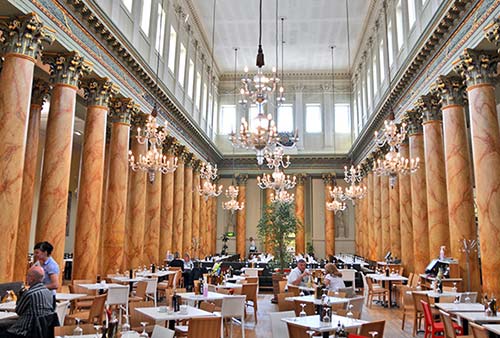
£££ Ask Italian Restaurant, part of the Britain-wide chain, is worth considering only for its spectacular setting: the majestic Neoclassical hall of York’s Grand Assembly Rooms, lined with Corinthian marble columns. Consider stopping by just for a peek into the interior; if staying for a meal, you’ll find a standard, pricey menu of Italian classics with good-value lunch deals (daily, Blake Street, +44 1904 637 254).
Lunch Options Around King’s Square
£ York Roast Company is a local fixture, serving their Yorkshire pudding wrap (a kind of old English burrito) and hearty pork sandwiches with applesauce, stuffing, and “crackling” (roasted bits of fat and skin). If Henry VIII wanted fast food, he’d have eaten here (daily, order at counter then eat upstairs—which closes earlier—or take away, 78 Low Petergate, +44 1904 629 197, second location at 4 Stonegate).
£ Drakes Fish & Chips, across the street from York Roast Company, is a local favorite chippy. While it’s mostly takeout, for a little extra you can sit and eat in their simple backroom dining area (daily, 97 Low Petergate).
£ St. Crux Parish Hall is a medieval church now used by a medley of charities that sell tea, homemade cakes, and light meals that you can eat beneath stained-glass windows and next to church memorials (generally open Tue-Sat for lunch, at bottom of The Shambles at its intersection with Pavement).
Groceries: A Marks & Spencer Food Hall is a block away from Shambles Market on Parliament Street (Mon-Sat 8:00-19:00, Sun 11:00-17:00).
Shambles Market and Food Court
Perhaps the most enticing place to browse for lunch in the old center is this lively food circus, tucked at one end of the Shambles Market stalls. This corral of street-food vendors—all of them £—offers fun, nutritious, and light meals. Sit at the colorful shared picnic tables in the center, or enjoy your meal in a nearby park (daily for lunch, hiding in the market zone between The Shambles and Parliament Street).
EAST END OF TOWN
This neighborhood is across town from my recommended B&Bs, but still central (and a short walk from the York Castle Museum). The bohemian-chic axis of Fossgate/Walmgate is lined with quality restaurants and has an inviting, untouristy energy.
£££ The Blue Barbakan, run by a family from Kraków, offers traditional Polish fare in an inviting little dining room, with floral tablecloths and classic blue pottery. They’re especially passionate about their homemade cakes (closed Tue, 34 Fossgate, +44 1904 672 474, deli-barbakan.co.uk).
£££ Il Paradiso del Cibo, with its good-natured chaos, tight seating, and few tourists, just feels special. Owner Paolo, a Sardinian with attitude, makes fresh pasta and scribbles rotating menu items on a big chalkboard (cash only, daily, 40 Walmgate, +44 1904 611 444, ilparadisodelciboyork.com).
££ Cresci is every local’s top choice for real Neapolitan pizza. Everything is authentic Italian, from the chef, to the pizza oven, to the adorable ceramics handcrafted by the owner’s father. The name—pronounced “kreh-shee”—refers to the rising of dough (daily, 20 Piccadilly, +44 1904 639 395, crescipizzeria.com).
££ Khao San Road hits the spot if you need a Thai fix, with small plates for sharing in a festive interior with a convivial feel (daily, 52 Walmgate, +44 1904 635 599, khaosanroadyork.co.uk).
££££ Rustique is a French bistro with tight tables, walls decorated with simple posters, and an upstairs terrace. While ordering à la carte is pricey, the three-course meal is a great deal (daily, across from Fairfax House at 28 Castlegate, +44 1904 612 744, rustiquerestaurants.co.uk).
£££ Pairings is a stylish wine bar with small bites, an extensive list of drinks, and a patient and helpful waitstaff. Two people can make a meal out of the deli platter, which includes the fun of choosing any three meats or cheeses (daily 12:00-23:00, 28 Castlegate, +44 1904 848 909). For wine lovers, this place can also be a fun stop before or after dinner.
Street Food: £ Spark is a giant pod of pop-up street-food stalls built into colorfully decorated shipping containers (Greek, Brazilian, Sicilian, Japanese, and more, including vegan and veggie options). Sit at picnic tables (with umbrellas and heat lamps) amid potted plants, strings of lights, and whimsical art. Enter on Merchantgate; drinks are upstairs (closed Mon, 17 Piccadilly, sparkyork.org).
TEAROOM
£££ Bettys Café Tea Rooms, on St. Helen’s Square, is a destination for lovers of the tea tradition. Choose between a Yorkshire Cream Tea (tea and scones with clotted Yorkshire cream and strawberry jam) or a full traditional English afternoon tea (tea, delicate sandwiches, scones, and sweets). While you’ll pay a little extra here, the ambience and people-watching are hard to beat. There’s generally a line out front, but it moves quickly (weekdays until 17:30, Sat-Sun until 18:00, shop open daily 9:00-18:00, sometimes also open evenings, +44 1904 659 142, bettys.co.uk, St. Helen’s Square).
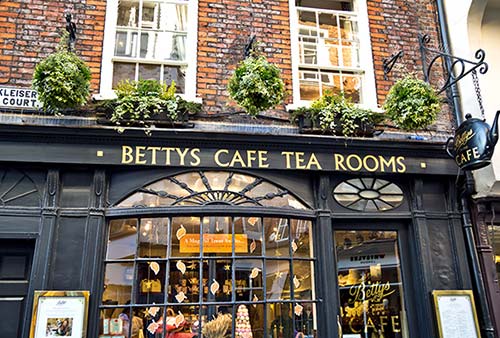
York Connections
From York by Train to: Durham (4/hour, 1 hour), London’s King’s Cross Station (2-3/hour, 2 hours), Bath (hourly with change in Bristol, 4.5 hours, more with additional transfers), Oxford (every 2 hours direct, 3 hours, more with transfers), Cambridge (hourly, 2.5 hours, transfer in Stevenage or Peterborough), Keswick/Lake District (roughly 2/hour, 4 hours, 1-2 transfers; then bus, allow about 5 hours total), Manchester Airport (1/hour, 2 hours), Edinburgh (2/hour, 2.5 hours). Train info: +44 3457 484 950, nationalrail.co.uk.
Connections with London’s Airports: Heathrow (allow 4 hours minimum; from the airport take the Elizabeth line to Farringdon stop, then walk across the street to the Circle line and ride one stop to King’s Cross, where you can catch the train to York; or, slower but simpler, ride the Piccadilly line 23 stops all the way to London King’s Cross), Gatwick (allow 4 hours minimum; from Gatwick South, catch Thameslink train to London’s St. Pancras International Station; from there, walk to neighboring King’s Cross Station and catch the train to York).