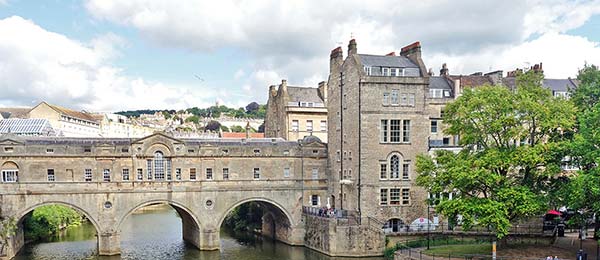
BATH
SIMPLE BREAKFAST AND LUNCH OPTIONS
If ever a city enjoyed looking in the mirror, Bath’s the one. Bath’s narcissism is justified. It has more “government-listed” or protected historic buildings per capita than any other town in England. Built of the creamy warm-tone limestone called “Bath stone,” it beams in its cover-girl complexion.
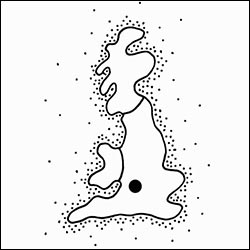
Two hundred years ago, this city of 90,000 was the trendsetting Tinseltown of Britain. An architectural chorus line, it’s a triumph of the Neoclassical style of the Georgian era—named for the four Georges who sat as England’s kings from 1714 to 1830. Proud locals remind visitors that the town is routinely banned from the “Britain in Bloom” urban-beautification contest to give other towns a chance to win.
Bath is just a 1.5-hour train ride from central London—close enough that some Bath-based professionals do the daily commute. And Bath’s soothing hot springs are still around, attracting visitors as they have for thousands of years. Even with its mobs of tourists (2 million per year) and greedy prices, Bath is a joy to visit.
PLANNING YOUR TIME
Bath deserves two nights even on a quick trip. On a three-week England getaway, spend three nights in Bath, with one day for the city and one or two days for side trips to Wells, Glastonbury, or your pick of stone circles.
Day 1
| 9:00 | Tour the Roman Baths |
| 10:30 | Catch the free city walking tour |
| 12:30 | Explore the Guildhall Market and grab a picnic lunch to enjoy in the nearby Parade Gardens or on the open deck of the Tootbus |
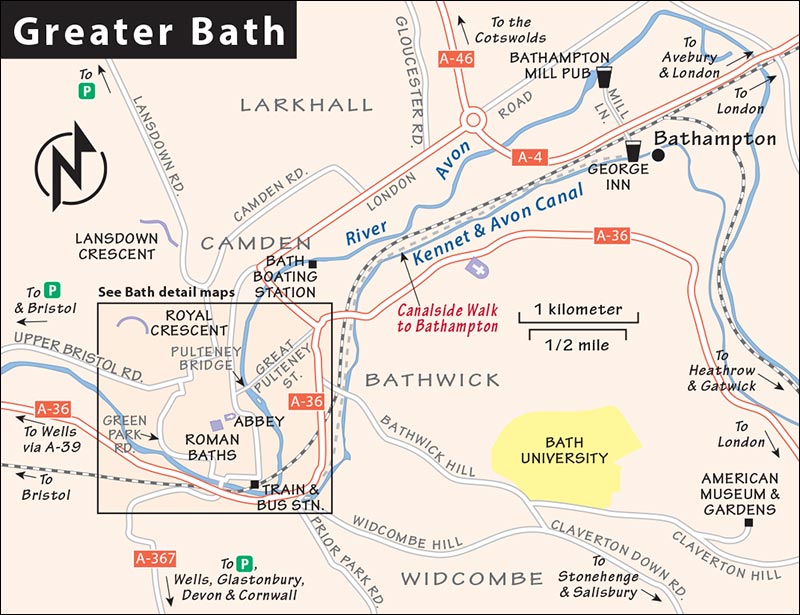
| 14:00 | Visit the abbey, then free time in the shopping center of old Bath |
| 15:30 | Tour the No. 1 Royal Crescent Georgian house or Museum of Bath at Work |
| Evening | Consider seeing a play, go for a soak in the Thermae Bath Spa, or take the evening walking tour (if here on a Tue or Thu and you skipped the morning tour). In summer, consider saving the Roman Baths for the evening. |
Day 2 (and Possibly 3)
Bath is a practical home base for day trips. By car or bus, explore the mystical town of Glastonbury, the cathedral city of Wells, or the stone circles of Stonehenge and Avebury (see the next two chapters). Without a car or to go farther afield, consider a one-day Avebury/Stonehenge/cute towns minibus tour from Bath (Mad Max tours are best; see “Tours in and near Bath,” later).
Continuing from Bath: Consider linking Bath to the Cotswolds via South Wales (see the South Wales chapter).
Starting Your Trip in Bath
It’s ideal to use Bath as your jet-lag recovery pillow (easy access from Heathrow or Gatwick airports), saving London for the end of your trip. If following this approach, your first day might go like this: Upon landing, connect to Bath either by train or by direct bus (for details, see “Bath Connections” on here). If flying here from elsewhere in Europe, you can also consider flying into Bristol’s airport, which has easy bus connections with Bath. While you don’t need or want a car in Bath, those who land early and pick up their cars at the airport can visit Windsor Castle (near Heathrow) on their way to Bath. If you have the evening free in Bath, see “Planning Your Time,” earlier, for ideas.
Orientation to Bath
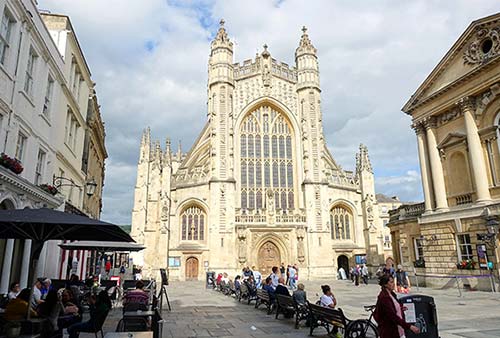
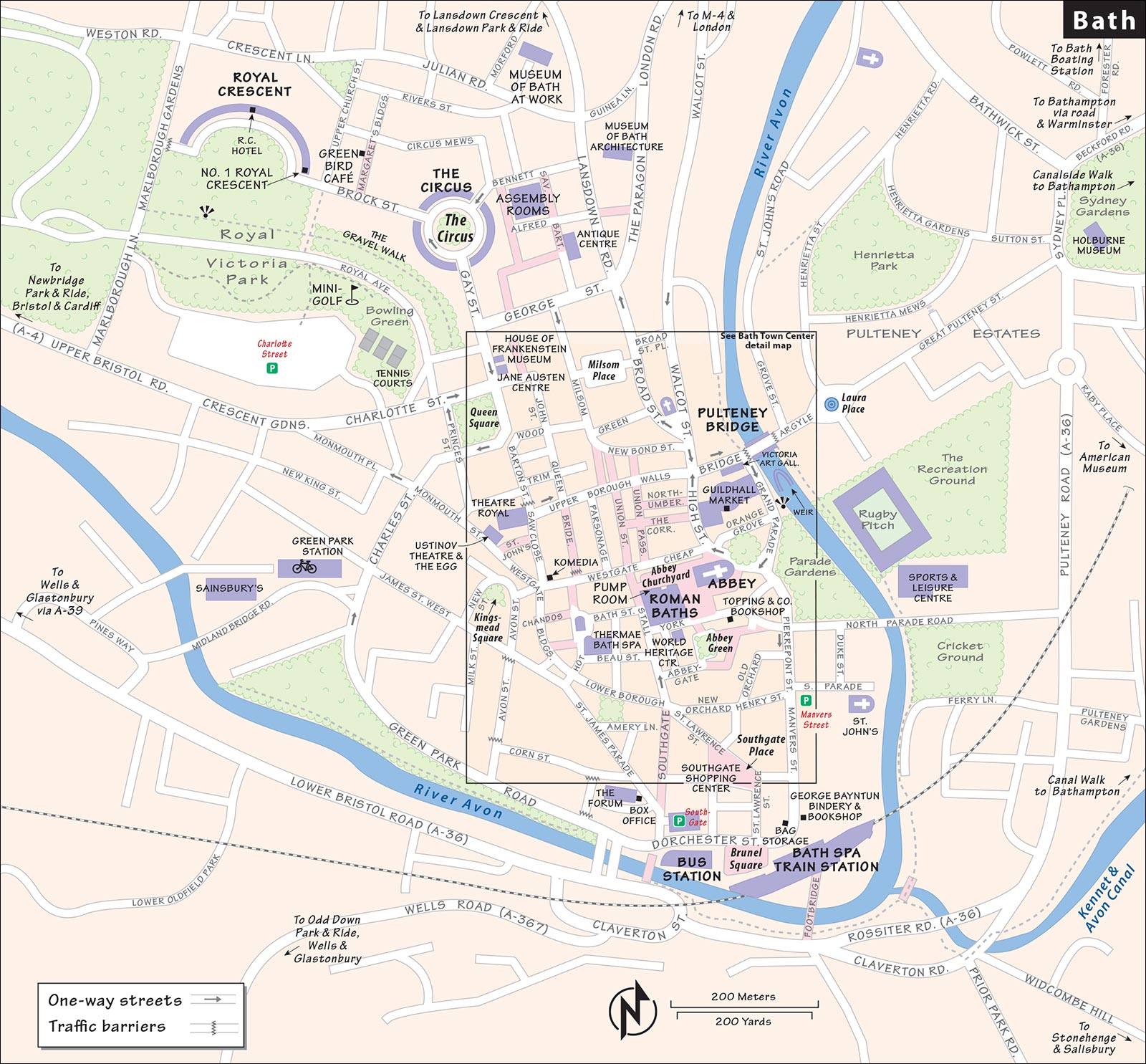
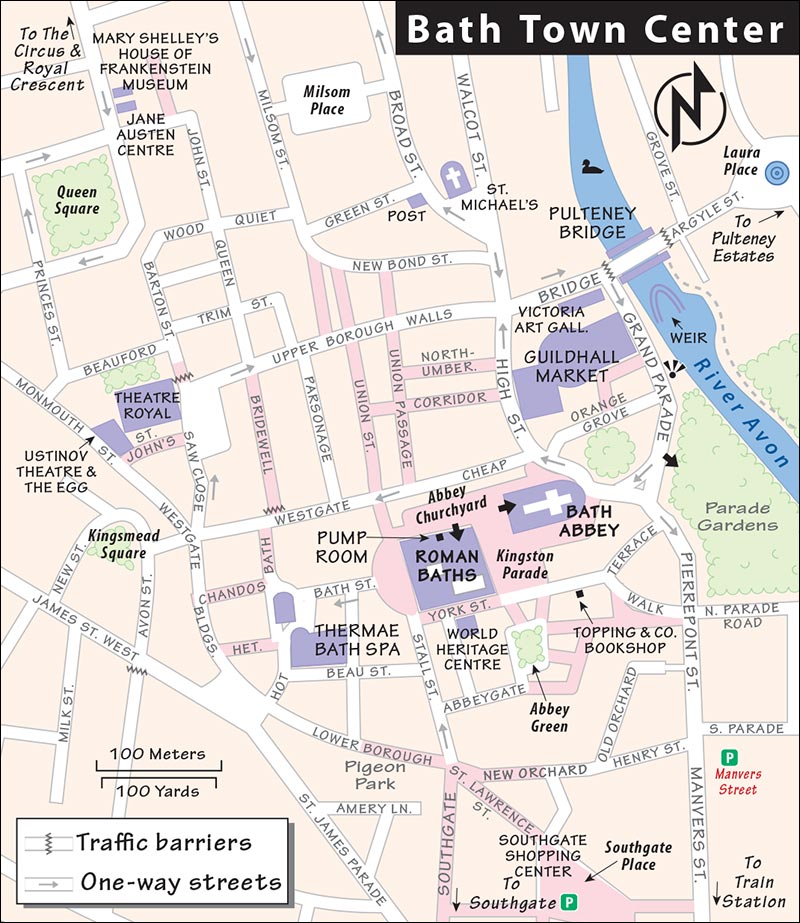
Bath is compact and very walkable. Think of it as three sightseeing neighborhoods. In the center of town is the main cluster of sights: the Roman Baths, Pump Room, and Bath Abbey. A few blocks northeast is another group of sights around Pulteney Bridge. And a 10-minute walk to the northwest are the Georgian-era sights: the Circus, Royal Crescent, and several museums. Bath is hilly. In general, you’ll gain elevation as you head north.
TOURIST INFORMATION
There’s no physical TI in Bath, but you can find plenty of good information on the Visit Bath website (visitbath.co.uk). The Bath Box Office, where you can check for events going on all around town, is located next to the Southgate shopping center. Also drop by the Bath World Heritage Centre to learn more about the different UNESCO sights (see listing later, under “Helpful Hints”).
ARRIVAL IN BATH
The cute little Bath Spa train station, which blends discreetly into town, has a staffed ticket desk and ticket machines. A handy baggage-storage service is a half-block away (see “Helpful Hints,” later). The bus station is immediately west of the train station, along Dorchester Street. Drivers have a few parking options, but the closest lot is at the Southgate shopping center near the train station (for more options, see “Helpful Hints,” later).
Here’s the best 10-minute walking route into the town center for day trippers: Exiting the train station, turn left on Dorchester Street, then turn right up the festive and pedestrianized little street called St. Lawrence. When you reach a dead-end at Southgate Plaza, turn left and follow this shopping lane until you hit Southgate Street. Turn right, going uphill on Southgate as it changes names to Stall Street. At York Street, glance right at a photogenic arch, then keep going another block to a row of columns on the right. Stepping through the columns, you enter Abbey Churchyard—Bath’s historic center—with Bath Abbey, the Roman Baths, and the Pump Room. This is also the meeting point for the free city walking tour.
HELPFUL HINTS
- Getting to Bath and Stonehenge by Tour: Several companies offer guided bus tours from London to Stonehenge, Salisbury, and Bath; you can abandon the tour in Bath, essentially using the tour as one-way transport; see here.
- Festivals and Events: In late May, the city hosts the back-to-back Bath Literature Festival and Bath Music Festival (bathfestivals.org.uk), overlapped by the eclectic Bath Fringe Festival (theater, walks, talks; bathfringe.co.uk). The Jane Austen Festival unfolds genteelly in mid-September (janeausten.co.uk). And for three weeks in December, the squares around the abbey are filled with a Christmas market.
The Bath Box Office sells tickets for festivals and most events (except those at the Theatre Royal) and can tell you exactly “what’s on” tonight (open Mon-Fri 10:00-17:00, closed Sat-Sun, next to the Southgate shopping center in 1A Forum Buildings, +44 1225 463 362, bathboxoffice.org.uk). You can also find out what’s on in Bath on the website Welcome to Bath (welcometobath.co.uk).
- Bath World Heritage Centre: This small exhibition (staffed by helpful volunteers) provides an overview of Bath as a World Heritage Site. You can download the Bath World Heritage app to your phone and scan various displays in the exhibit to create your own walking tour of the city. Afterward, follow the route you made, and use the app’s augmented reality feature to drop Roman soldiers or other characters onto the streets of Bath. It’s fun for kids and adventurous adults (free, daily 10:00-17:00, 10 York Street, +44 1225 477 785, bathworldheritage.org.uk).
- Bookstore: Topping & Company, an inviting bookshop, has frequent author readings, literary walks, free coffee and tea, and tables filled with tidy stacks throughout the three floors (daily 8:30-21:00, near the Bath Abbey on York Street, +44 1225 428 111, toppingbooks.co.uk).
- Baggage Storage: Bath Luggage Storage Centre is a half-block up the street in front of the main train station entrance (carry-on-size bag-£4.50/day, larger bag-£5.50, cheaper if booked online; daily 8:00-20:00, 13 Manvers Street, +44 1225 312 685, bathluggagestorage.com).
- Laundry: The Spruce Goose Launderette is between the Circus and the Royal Crescent, on the pedestrian lane called Margaret’s Buildings (bring coins, self-service, daily 8:00-20:00, last load at 19:00; for location see map on here). Speedy Wash picks up your laundry anywhere in town on weekdays before 9:30 for same-day service (Mon-Fri, most hotels work with them, +44 1225 427 616).
- Bike Rental: You can rent a pricey bike or e-bike at Green Park Bike Station (closed Sun-Mon but pickup these days can be arranged; smart to book in advance; at Green Park Station, +44 1225 920 148, greenparkbikestation.info, owner Tom).
- Car Rental: Ideally, take the train or bus from downtown London to Bath, and rent a car as you leave Bath. Most offices close Saturday afternoon and all day Sunday, which complicates weekend pickups.
Enterprise provides a pickup service for customers to and from their hotels (extra fee for one-way rentals, at Lower Bristol Road outside Bath, +44 1225 443 311, enterprise.com). Europcar also has a location just outside town, about a £15 taxi ride from the center (one-way rentals available, at Brassmill Lane, +44 8713 849 985, europcar.co.uk).
- Parking: For a stress-free, time- and money-saving option, park for free at one of the big park-and-ride lots just outside Bath at Newbridge, Lansdown, or Odd Down, and ride a shuttle bus 10 minutes into town (look for the P&R signs as you approach; shuttles run daily every 15 minutes, fewer on Sun; £3.70 round-trip, £5.50/group round-trip; +44 345 602 0121, firstbus.co.uk/bristol-bath-and-west).
If you drive into town, be aware that short-term lots fill up fast. You’ll find more spots in long-stay lots for about the same cost. The Southgate shopping center lot on the corner of Southgate and Dorchester streets is a five-minute walk from the abbey (open 24/7); the Charlotte Street lot is the biggest and puts you closer to the Royal Crescent. For more info on parking (including park-and-ride service), see the “Maps and Guides” section of visitbath.co.uk.
Tours in and near Bath
IN THE CITY
▲▲▲Free City Walking Tours
Free two-hour tours are led by the Mayor of Bath’s Honorary Guides, volunteers who share their love of Bath with its many visitors (as the city’s mayor first did when he took a group on a guided walk back in the 1930s). These chatty, historical, and gossip-filled walks give you the lay of the land while you learn about the city’s evolution, architecture, and amazing Georgian social scene. How else would you learn that the old “chair ho” call for your sedan chair evolved into today’s “cheerio” farewell? Tours leave from outside the Pump Room in the Abbey Churchyard (free, no tips, year-round Sun-Fri at 10:30 and 14:00, Sat at 10:30 only; additional evening walks May-Sept Tue and Thu at 18:00; arrive 10 minutes early for all tours; bathguides.org.uk).
Private Tours
Mike James is a good Blue Badge Bath guide (£225/half-day, £370/day, mike@mikejames.org). Mike also runs Savouring Bath Food Tour, worth considering for a three-hour movable feast on their classic “Food Heroes” tour (£90, Wed-Fri at 9:45 or 14:00, Sat at 9:45, book online, RS%—10 percent discount with code “ricksteves,” savouringbath.com, hello@savouringbath.com).
Rock n Stroll Tours offers an intimate look at Bath’s often-overlooked role in the 1960s-1980s music scene, from Peter Gabriel to Van Morrison to Tears for Fears. Guides Shaun Smith and John Baker, musicians who played their own part in the scene, lead 1.5-hour tours through some off-the-beaten path parts of town (some hills, wear good shoes; £20, April-Oct, typically Thu-Sun, check website for times; rocknstrolltours.com).
▲▲Tootbus City Bus Tour
Hop-on, hop-off Tootbus tours zip through Bath. Jump on a bus at one of 16 signposted pickup points, climb upstairs, and hear recorded commentary about Bath. Tootbus has two one-hour routes: the City Tour of Bath’s center and the Skyline Tour outside town. Download the app to see real-time bus info and find one near you. For the best sound experience, bring your own earbuds (£24.50 from driver, cheaper online, ticket valid for both routes; City Tour generally runs daily every 15 minutes, in summer 9:45-18:30; Skyline Tour runs daily every 30 minutes, in summer 10:30-17:30; both have shorter hours off season; +44 1225 330 444, tootbus.com).
NEARBY SIGHTS
Bath is a good launchpad for visiting nearby Glastonbury, Wells, Avebury, Stonehenge, and more.
Mad Max Minibus Tours
Operating daily from Bath, Maddy offers thoughtfully organized, informative tours run with entertaining guides and limited to 15 people per group. Book as far ahead as possible in summer. The Stonehenge, Cotswold Villages, and Avebury full-day tour covers 110 miles and visits Stonehenge, the Avebury Stone Circles, photogenic Lacock (LAY-cock), and the southernmost Cotswold village, Castle Combe (£75 plus £23 Stonehenge entry—Mad Max purchases tickets but you must pay guide on day of tour, card or cash; tours depart Tue-Thu and Sat-Sun promptly at 8:25 and return at 17:30). They also run a tour of the Cotswold villages (£85, Mon, Wed, and Fri-Sun at 8:25). All tours depart from downtown Bath near the abbey (outside the Abbey Hotel on North Parade, arrive at least 15 minutes early; RS%—£10 rebate with online purchase of two separate itineraries, request when booking second tour, discount refunded to credit card; ask about discounted private tours for my readers; some winter tours but schedule is reduced; +44 7990 505 970, phone answered daily 8:00-18:00, madmaxtours.co.uk, maddy@madmaxtours.co.uk).
Bath Insider Tours
Bath Insider Tours, run by enthusiastic Daniel, a native Bathonian, offers half-day private tours to Stonehenge (prices depend on time of year but start at £352 for 2, maximum 6 per group, includes admission). Other day trips include Avebury, Wells-Cheddar, and South Cotswolds (daily, +44 7772 038 233, bathinsidertours.co.uk, info@bathinsidertours.co.uk).
Other Tours
Scarper Tours runs four-hour narrated minibus tours to Stonehenge, giving you two hours at the site. They offer plush minibuses, priority-access Stonehenge tickets, and insightful driver commentary along the way (£60 including Stonehenge admission, departs from outside the Abbey Hotel on Terrace Walk; April-Sept daily at 9:00 and 14:00, Jan-March and Oct-Dec at 13:00; scarpertours.com, hello@scarpertours.com).
Celtic Horizons is a car service offering tours from Bath to destinations such as Stonehenge, Avebury, and Wells. They also provide a convenient transfer service (to or from London; Heathrow, Bristol, and other airports; the Cotswolds; and so on), with or without a tour itinerary en route. Allow about £45/hour for a group (comfortable minivans seat up to 8 people) and £195 for Heathrow-Bath transfers (1-3 people; +44 1373 800 500, US +1 855 407 3200, celtichorizons.com, info@celtichorizons.com).
Undiscovered Cotswolds runs private, all-day tours to the Cotswolds from Bath, with stops in Castle Combe, Lacock, Bibury, Burford, Stow-on-the-Wold, Bourton-on-the-Water, and the Slaughters (£599 for up to 8 people, +44 7450 764 393, undiscoveredcotswolds.com, info@undiscoveredcotswolds.com).
Sights in Bath
▲▲▲Roman Baths
ALONG THE RIVER AND PULTENEY ESTATES
IN THE TOWN CENTER
Abbey Churchyard
Ground zero for sightseeing is Abbey Churchyard, a vibrant square surrounded by the Roman Baths, Pump Room, and Bath Abbey. The Parade Gardens, Guildhall Market, Victoria Art Gallery, Pulteney Bridge, and River Avon are beyond the left corner of the abbey, a couple of minutes’ walk away. Behind you, a block down Bath Street, is the Thermae Bath Spa.
Here in Abbey Churchyard, you can see the layers of Bath’s history in a glance. The Roman Baths put the city on Europe’s radar 2,000 years ago. The abbey made it an important medieval destination. The elegant Pump Room captures the city in its 18th-century heyday. And today’s lively street performers show the city hasn’t let up since.
The churchyard is also a showcase for Bath’s distinctive Georgian architecture. The Pump Room’s facade has a faux Greek-temple entrance: Four tall columns support a triangular pediment with an inscription in Greek letters (“The greatest blessing is water”). Below that, the doorway is topped with a characteristic Georgian semicircular fanlight window. Five round windows and a fetching balustrade across the roofline complete the Neoclassical look.
▲▲▲Roman Baths
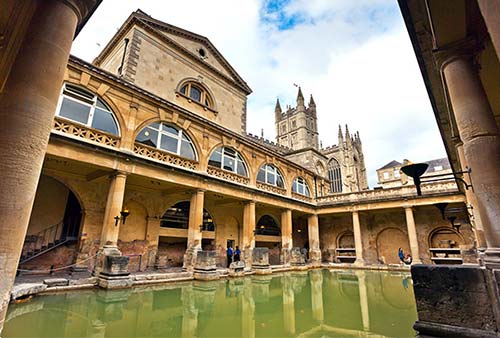
For thousands of years, humans have marveled at the hot water that bubbles out of the earth on this spot. In ancient Roman times, high society enjoyed soaking in the mineral spring and built a large bathhouse around it. From Londinium, Romans traveled so often to Aquae Sulis, as the city was called, to “take a bath” that finally it became known simply as Bath. Today, a fine museum surrounds the ancient bathhouse. With the help of a great audioguide, you’ll wander past Roman artifacts, a temple pediment with an evocative bearded face, a bronze head of the goddess Sulis Minerva, excavated ancient foundations, and the actual mouth of the health-giving spring. At the end, you’ll have a chance to walk around the big, steaming pool itself, where Romans once lounged, splished, splashed, and thanked the gods for the gift of therapeutic hot water.
Cost and Hours: £28 on weekends, £26 on weekdays, cheaper off-season—see website; daily 9:00-18:00, mid-July-Aug Mon-Thu until 20:00 and Fri-Sun until 22:00, last entry one hour before closing; +44 1225 477 784, romanbaths.co.uk.
Combo-Ticket: A combo-ticket with the Pump Room (described next) can save you a few pounds on admission to the baths and a choice of morning brunch or afternoon tea.
Crowd-Beating Tips: Long ticket lines are typical in the summer—buy your ticket online in advance. On any day, try to visit early or late; peak time is between 13:00 and 16:30. If you’re here in mid-July or August, after 19:00 the baths are romantic and gas-lit, and you can listen to music with a bath-side beverage.
Tours: Take advantage of the excellent audioguide, included with admission. A kid-friendly audioguide is also available. One-hour guided tours of the Great Bath are offered a few times daily (£6/person, book in advance).
 Self-Guided Tour: This brief tour follows the baths’ one-way route; for more in-depth commentary, make ample use of the audioguide.
• Begin by walking around the upper terrace, overlooking the swimming-pool-like Great Bath.
Terrace: Lined with statues of VIRs (Very Important Romans), the terrace evokes ancient times but was built in the 1890s. The terrace sits atop the remarkably well-preserved lower story, which was actually built by the Romans: The bases of the columns, the pavement, and the lead-lined pool are all original from the first century AD. Those ancient ruins sat undisturbed for centuries before finally being excavated in the 1870s and turned into this museum. The terrace statues help put a face on the baths’ history: Julius Caesar first set foot in Britain (55 BC). Claudius conquered the Celts in Bath (AD 43) and enclosed the first bathing pool with oak pilings. Hadrian (c. 120) enlarged the complex around it, and Constantine (c. 325) ruled when the baths were at their peak of grandeur. Enjoy the great view from the west end, looking back toward the abbey.
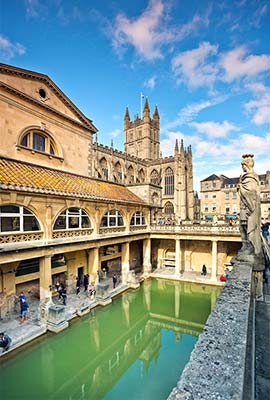
At the end of the terrace, before going downstairs, peer down into the spring (on the left through the window), where little bubbles remind you that each day 257,000 gallons of water emerge from the earth—magically, it must have seemed to Romans—at a constant 115°F. It comes from rainwater that falls on the nearby hills, filters down through layers of limestone two miles deep, gets heated by the earth’s core, then rises back up through cracks to the surface. The water you see now first fell as rain about 10,000 years ago...making the Romans seem relatively recent.
• Now you’ll head downstairs to the...
Museum: Start with its helpful models. The first model (of plexiglass) shows the humble baths that stood here around AD 70. It’s just two buildings, with the spring in between, but it makes clear the complex’s dual purpose: The bathhouse was for soaking in the healing waters, and the temple was for thanking the goddess Sulis Minerva for giving humankind such a wondrous thermal spring.
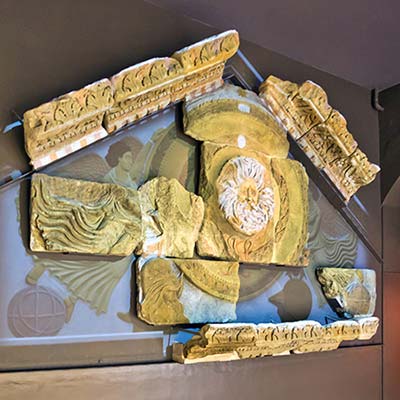
The next model shows the baths at their peak, around AD 325. The tallest building (with a barrel-arch roof) is the Great Bath you see today, with its big swimming pool. The smaller arched roofs alongside were other bathhouse buildings—dressing rooms, saunas, cold plunges, and so on. The red-tile-roofed section was the temple. You can make out the big rectangular temple courtyard enclosing the small temple. Also in the temple courtyard is a small altar where sacrifices were offered. Get a close look at the temple’s colorful pediment (the triangular gable atop its four columns). Now, let’s see that actual pediment, displayed nearby.
The fragments of the temple pediment—carved by indigenous Celtic craftsmen but with Roman themes—represent a remarkable cultural synthesis. Sit and watch for a while as a slide projection fills in historians’ best guesses as to what once occupied the missing bits. The identity of the circular face in the middle puzzles researchers. (God? Santa Claus?) It could be the head of Medusa, the Gorgon monster, after it was slain by Perseus—are those snakes peeking through its hair and beard? And yet, the Gorgon was traditionally depicted as female. Perhaps instead it’s Neptune, the god of the sea—appropriate for this aquatic site.
The next exhibits examine everyday Roman life—living, dying, and worshipping here in Aquae Sulis. You’ll see vases, coins, and a stone head of a big-haired woman with her trendy first-century ’fro. The Beau Street Hoard—more than 17,500 Roman coins dating from 32 BC to AD 274 that were found near the baths—emphasizes just how well visited this area was.
Next up are a couple of rooms dedicated to Roman worship. You’ll see some of the small but extremely heavy stone altars that pilgrims hauled here as an offering to the goddess.
• Next walk through the ruins of the...
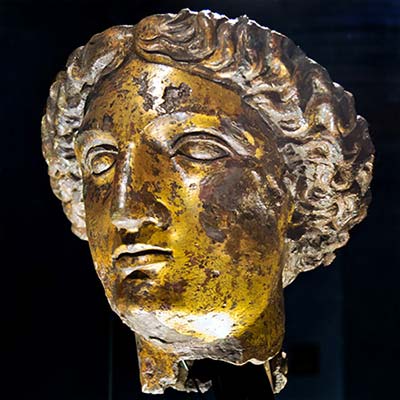
Temple Courtyard: Imagine being a Roman arriving here to worship at the temple, which would have stood at the far end of the room. You’d pause to sacrifice an animal atop the great altar (on the right); note the nicely carved statue of Hercules adorning the altar’s left corner. Then you’d continue on to the temple itself, where you’d come face to face with a gilded-bronze statue of the goddess Sulis Minerva (the surviving head is on display). The statue once wore a helmet (see the tiny holes for the rivets) and stood before a flaming cauldron. The goddess was a powerful multicultural hybrid of the Celtic goddess Sulis (who presided over the Aquae Sulis, or “waters of Sulis,” in prehistoric times) and Minerva (a Roman life-giving mother-goddess), with hints of the Greek warrior-goddess Athena. Downstairs, enjoy a close-up look at the spring overflow, part of the original drainage system built two millennia ago that still carries excess water to the River Avon.
• Now head down a hall (with more exhibits), until you emerge outside in the...
Great Bath: Take a slow lap (by foot) around the perimeter, imagining the frolicking Romans who once immersed themselves in this five-foot-deep pool. (These days, the water has turned greenish because of algae—don’t touch it.) Originally, this pool was housed in a spacious hall with a three-story-tall arched ceiling, and sunlight filtered in through vast windows.
Romans had bathhouses in all major cities and went to the baths almost daily. Besides being a way to keep clean, baths were also fitness clubs. This bath had the added feature of a natural thermal spring, which had sulfurous content that purportedly leeched out impurities, cured arthritis, and restored vigor. The role-playing actors lounging around are happy to talk (in Latin or English).
• Now explore more of the...
Bath Complex: The East Baths are a series of rooms showing how Romans typically bathed (with naked bodies artfully and modestly projected). The large open room as you enter served as a lap pool. You’d then enter the smaller rooms, going from cool to warm to hot—maybe getting a massage at the same time. The hot room (caldarium) was heated by the Romans’ famed hypocaust system: Stubby brick columns (which you can see) supported the floor, allowing the space in between to be filled with hot air to heat the room above.
Cross to the opposite side of the pool and enter the West Baths. On the right as you enter is the big round frigidarium, or “cold plunge” pool, sparkling with coins. On the left, follow the metal boardwalk through the “gym” to find the men’s-only sauna (laconicum), where you proved your manliness by enduring 140°F dry heat.
Back outside, as you turn left you’ll see a giant red-brick chunk of roof span, from when this was a cavernous, covered swimming hall. Continue along and step over a small canal, where hot water still trickles into the main pool. The water emerges from the spring at 115°F—about 10 degrees too hot for most people—but it quickly cools to a perfect hot-tub temperature. In modern times, Britons bathed in this swimming pool up until the 1970s, then opened the Thermae Spa a block away—fed by the same spring. Immediately after crossing the canal, look down to see a length of original lead pipe (remarkably well preserved since ancient times).
When you’re ready to leave, walk up the steps and take another look at the frigidarium, then turn around and walk up the ramp for one last close-up look at the source of this entire complex—the sacred spring.
• After returning your audioguide, pop over to the fountain for a free taste (if available) of the spa water, which purportedly has health benefits (see the minerals listed on the wall). Then pass the WC, head up the stairs, and exit through the gift shop.
▲Pump Room
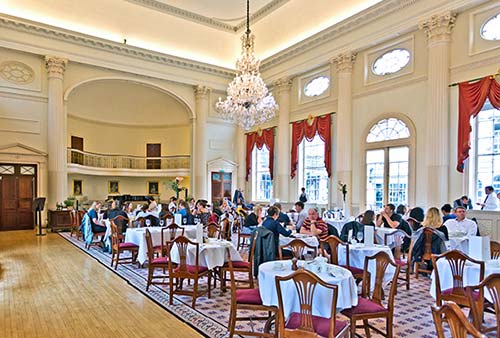
The Pump Room, an elegant Georgian hall just above the Roman Baths, offers visitors their best chance to raise a pinky in Neoclassical grandeur. Above the clock, a statue of Beau Nash—who promoted Bath as an aristocratic playground in the 1700s—sniffles down at you. Come for tea or a light meal (see hours in listing on here), or to try a famous (but forgettable) “Bath bun.” The spa water is served by an appropriately attired waiter, who will tell you the water is pumped up from nearly 100 yards underground and marinated in 43 wonderful minerals. Or for the price of a coffee, drop in anytime space is available to enjoy live music (string trio or piano; times vary) and the atmosphere. Even if you don’t eat here, you’re welcome to enter the foyer for a view of the baths and dining room.
▲▲Bath Abbey
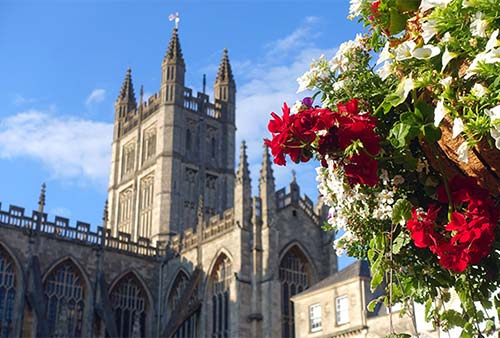
The town of Bath wasn’t much in the Middle Ages, but an important church has stood on this spot since Anglo-Saxon times. King Edgar I was crowned here in 973, when the church was much bigger (before the bishop packed up and moved to Wells—only to return decades later). Dominating the town center, today’s abbey—the last great church built in medieval England—is 500 years old and a fine example of the Late Perpendicular Gothic style, with breezy fan vaulting and enough stained glass to earn it the nickname “Lantern of the West.”
Cost and Hours: £8, includes Discovery Museum in basement; Mon-Fri 10:00-17:30, Sat until 18:00, Sun 13:00-14:30; schedule of concerts, services, and evensong online, +44 1225 422 462, bathabbey.org.
Tours: Free guided tours covering the history of the abbey may run at :15 past each hour, depending on availability (ask when you buy your ticket). There’s also a £3.50 audioguide for your phone.
Evensong: Choral evensong generally takes place three times a week (Tue and Thu at 17:30 and Sun at 15:30, 45 minutes); spoken evening prayers on other days are also a beautiful 20 minutes of worship (17:30).
Tower Climb: You can reach the top of the tower only on a worthwhile 50-minute guided tour (212 steps; £16, Mon-Sat, no tours Sun, generally at the top of each hour, more often during busy times, online booking recommended—arrive 10 minutes before your scheduled time).
Visiting the Abbey: This impressive church encapsulates Bath’s long history in stone. It stands near the mineral springs where, even in pagan times, people came to worship. When Christianity arrived, a monastery was built here (8th century), then a larger church (11th century). The present church was begun in 1499.
No sooner was the church finished than it was stripped of its furnishings by King Henry VIII (1539), who dissolved the monastery and sold off its valuable lead roof and glass windows. (At the same time, the statue of Peter lost its head to mean-spirited iconoclasts; it was re-carved out of Peter’s once supersized beard.)
For the next phase of the abbey’s story, step inside and admire the nave. Queen Elizabeth I began repairing the abbey her father had plundered. In 1608, Bishop James Montague (see his large tomb on the left side of the nave) took over. One rainy day, he saw water dripping down inside the church and vowed to finish the ceiling. Thanks to Montague we have one of the abbey’s most splendid features—the fan vaulting. Symbols from Montague’s coat of arms, three diamonds and eagles, are found throughout the church. Next to the tomb, the stained-glass window depicts coats of arms of other donors who financed the church’s windows. On the wall beneath the window are several gravestones honoring Bath’s notable citizens. More than 600 memorials to the deceased are in the church.
Cross to the opposite side of the nave toward the right transept. Just before entering the transept, find a gravestone on the wall for “Ricardi Nash”—better known as Beau Nash, Bath’s 18th-century master of festivities. In the right transept is the 15-foot-tall stone Waller Memorial. It depicts the renowned English Civil War general Sir William Waller relaxing after liberating Bath from royalists. But the focus here is on his wife Jane, who died young. Now they gaze into each other’s eyes for all eternity.
At the far end of the church (above the altar), the large window shows 52 scenes from Christ’s life—good for weekly sermons for a year. The window to the left of the altar shows King Edgar being crowned. Edgar (in red) sits on a throne clutching the orb and scepter while the Archbishop of Canterbury (in purple) places the crown on his head. Edgar was one of the first monarchs of what we now call England. His coronation in AD 973 established the protocols used by all future English monarchs up to the present—and it all started here in Bath.
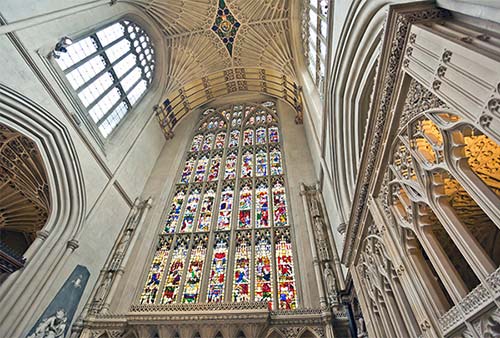
Before leaving the church, stand once again in the nave and appreciate the intricacy of the fan vaulting and brilliance of the windows. The glass, red-iron lamps and the heating grates on the floor are all remnants of the 19th century. (In a sustainable, 21st-century touch, the heat now comes from the baths’ hot runoff water.) Note that a WWII bomb blast destroyed the medieval glass; what you see today is from the 1950s.
Finally, head through the gift shop and downstairs, where the Discovery Museum celebrates the abbey’s history with interactive exhibits and a handful of ancient artifacts.
ALONG THE RIVER AND PULTENEY ESTATES
These pleasant, low-key sights are located along the River Avon behind Bath Abbey. Taken together, they create an enjoyable scene of shops, cafés, galleries, and people-watching.
▲Parade Gardens
Opposite the back side of the abbey, the Parade Gardens is a riverside park with manicured lawns, knockout flowerbeds, a café, and good views of the Pulteney Bridge and the abbey. In season there’s a small fee to enter the park, which was designed by prolific 18th-century architect John Wood the Elder (£2, daily 10:00-18:00, Oct-April free and open until 15:00 hours, the park hosts summer concerts some Sun at 14:00, entrance a block south of Pulteney Bridge).
Guildhall Market
The little old-school shopping mall just north of the Parade Gardens is a frumpy time warp in this affluent town. In the 12th century the king gave Bath the right to have a market, and that market moved here from the abbey in the 18th century. Stand under the central dome and feel the surviving character. Nearby, the historic negotiating table (or “nail”) dates from 1768.
▲Victoria Art Gallery
This small gallery, between the Guildhall Market and Pulteney Bridge, was opened in 1897 to celebrate the 60th anniversary of Queen Victoria’s reign. Today it’s a delightful space with two parts: The ground floor houses temporary exhibits, while the upstairs is filled with paintings from the late 15th century to the present. There’s also a small collection of decorative arts, including 187 porcelain and pottery dog figures.
Cost and Hours: Free, Tue-Sun 10:30-17:00, closed Mon, +44 1225 477 233, victoriagal.org.uk.
Tours: The Bloomberg Connects app has additional information on each work in the collection.
▲Pulteney Bridge
The shop-lined Pulteney Bridge was designed in 1770 by Scottish architect Robert Adam in the same Georgian, or “Palladian,” style that John Wood the Younger was applying to the row of townhouses known as Bath’s Royal Crescent.
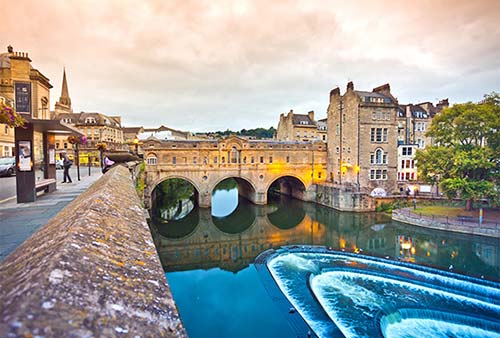
The best view of the bridge is from its downstream side. The most Palladian feature is the center of the bridge, with the outline of a Greek temple seemingly stamped into the stone. The temple’s pediment is “broken”—that is, the triangle’s base is purposely left incomplete. The bridge has grid windows, a few round medallions, and a central window that’s bigger than the others, with an arched top. The view from the upstream side lets you see a few shops jutting out (cantilevered) from the bridge. On the Pulteney Estates side of the bridge, stairs lead down to a riverwalk and great photo ops.
Pulteney Estates
Pulteney Estates, the section of Bath stretching from Pulteney Bridge across the river, was open farmland owned by the Earl of Bath until the 18th century. Frances Pulteney (cousin to the earl) inherited this land in 1762 and started a project to develop it as a grand neighborhood in 1788. But with the French Revolution in 1789, England fell into an economic recession and construction ground to a halt. All that was built was the Pulteney Bridge (a classy way to connect the old town with the new zone across the river) and Great Pulteney Street—intended to be the central axis of this new Georgian Bath.
Looking at Great Pulteney Street and the “Bath” map on here, you can imagine what was planned. Georgian England was all about appearances. The grand, uniform facade was key—everything behind that was higgledy-piggledy (a great metaphor for social life in the 18th century). If Great Pulteney Street looks like a film set to you, it did to the producers of the Bridgerton series on Netflix, too, who used it and other locations in Bath as Regency-era London.
NORTHWEST OF THE TOWN CENTER
If Bath is an architectural cancan, these are its knickers. This area—a 10-minute uphill walk northwest from the town center—was a palatial housing development built during Bath’s golden age of the 1700s. It’s the masterpiece of the visionary father-and-son architects John Wood the Elder and John Wood the Younger. As visitors poured into the city, Bath began running out of suitable accommodations. The Woods bought large tracts of land northwest of downtown and built attractive vacation rentals for the rich and famous. In the process they helped forge the Georgian style of architecture soon found all over Britain.
For locations, see the “Bath” map, near the beginning of this chapter.
Queen Square
This rectangular park surrounded by townhouses was Wood the Elder’s first great real estate development. He ringed the square with symmetrical facades in the classical style pioneered by the influential Italian architect Andrea Palladio. The north (uphill) side has a Greek-temple look to it, made of six columns topped with a triangular pediment. The windows are large, symmetrically placed, and topped with Palladian pediments and arches. The writer Jane Austen lived in the corner apartment to the right of the Francis Hotel (#13). Completing the square’s classical look is a 70-foot-tall obelisk in the middle, generously donated by Beau Nash.
▲▲The Circus
True to its name, this is a circular housing complex. It was Wood the Elder’s next great expansion, consisting of 30 symmetrical townhouses arranged in a perfect circle. The best views are from the middle of the Circus among the grand plane trees, on the capped old well. Imagine the days before indoor plumbing, when servant girls gathered here to fetch water—this was gossip central. If you stand on the well, your clap echoes three times around the circle—try it.
The circle of houses is broken into three segments, so that anyone approaching from the street has a great view of the crescent-shaped facades. Each residence has five stories. You’d enter at street level into the workaday public rooms. The entrances were made large enough that aristocrats could be carried right through the door in their sedan chairs, and women could enter without disturbing their sky-high hairdos. The next floor up (with bigger windows) generally had ballrooms and dining rooms for hosting parties. The floor above that held bedrooms. The top floor (the tiny dormer windows in the roof) housed servant bedrooms, and the basement (below street level) held the kitchen and workrooms. Wood united it all with a symmetrical facade, but the arrangement of the actual rooms behind the facade was left to the owner’s discretion. If you circled around, you’d see that the backs are a jumble, infamous for their “hanging loos” (bathrooms added years later).
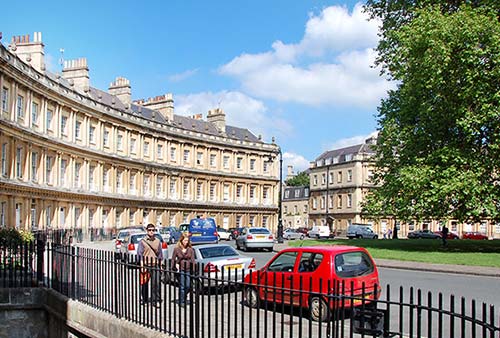
Note the frieze—a continuous band of sculpted reliefs—located just above the ground floor. There are 525 panels, each one unique, depicting everything from dogs to eagles to roses, scrolls, guitars, anchors, leaves, and roosters.
In its mid-1700s heyday, the Circus was home to Britain’s elite. Prime Minister William Pitt the Elder (who oversaw the American colonies’ French and Indian War) lived at #11. Baron Robert Clive (who brought India under British control) vacationed here at #14 (on the sunny side of the Circus). Thomas Gainsborough set up shop at #17 to paint portraits of fashionable lords and ladies to take home as souvenirs.
Created at the height of Wood’s creative powers, the Circus shows off the architect’s mature style. There’s Palladio’s Greco-Roman classicism—Doric columns on the ground floor, Ionic in the middle, and Corinthian on top—like Rome’s Colosseum. For more Georgian effects, Wood added a balustrade and ornamental acorns on the roofline. The circular shape was likely inspired by Stonehenge, representing Britain’s druid roots. And the symbolism in the frieze is distinctly Masonic. By combining the three styles—Roman, Celtic, and Masonic—Wood was creating his personal vision of Bath as the “new Rome.”
▲▲Royal Crescent
This long, graceful arc of buildings evokes the wealth and gentility of Bath’s glory days. The Royal Crescent was the majestic showpiece of John Wood the Younger. He took the Georgian style his father had pioneered and supersized it. The Crescent is a semicircular row of 30 townhouses 500 feet long and 50 feet tall. It’s lined with 114 Ionic columns that span the middle two stories. A ground floor of large blocks and a balustrade across the roofline unites it all. In typical Georgian style, the only deviation from the symmetry is in the very center of the crescent, which has two pairs of columns and a taller arched window. The building’s warm golden color is typical of the city, made of limestone from the surrounding hills, which began forming hundreds of millions of years ago when Bath was covered by an ocean.
Completed in 1774, the Royal Crescent quickly became the trendiest address in Bath. It offered stunning views of a park—a novel idea that gave city dwellers a slice of the country (though now residents just see the trees, not the park). Like his father, Wood the Younger designed only the facade, allowing residents to build whatever home they wanted behind it.
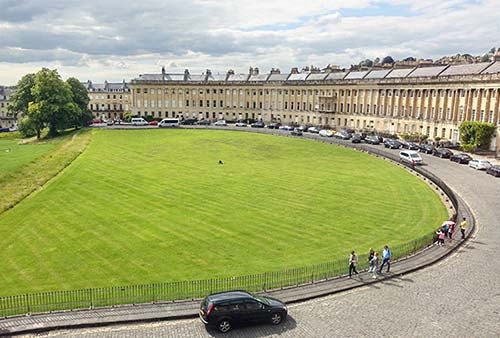
As you cruise the Crescent, strut like an aristocrat. Now imagine you’re poor: Notice the “ha ha fence,” a drop-off in the front yard that acted as a barrier, invisible from the windows, for keeping out sheep and peasants. The refined and stylish Royal Crescent Hotel sits virtually unmarked in the center of the Crescent (delightfully understated, with just two potted shrubs marking the entrance). You’re welcome to (politely) drop in to explore its fine ground-floor public spaces and back garden, where a gracious and traditional tea is served (see here).
▲▲No. 1 Royal Crescent
This former residence at the east end of the Crescent is now a museum, taking visitors behind the classy Georgian facade for a glimpse into the everyday life of wealthy residents during the mid-1700s. At the time, Britain was on the leading edge of global exploration and scientific discovery, and the period artifacts show the wide-ranging interests of the educated rich. Docents may be on hand to share insights, like how high-class women shaved their eyebrows and pasted on carefully trimmed strips of mouse fur in their place.
Cost and Hours: £15, open Tue-Sun 10:00-17:30, closed Mon; last entry one hour before closing, +44 1225 428 126, no1royalcrescent.org.uk.
Visiting the Museum: Audiovisual elements bring life to the rooms, telling the story of a Georgian family and their servants. Be sure to linger in each room long enough for the audio to kick in, with delightful reenactments of Georgian-era conversations.
Start on the ground floor with the Dining Room, where refined 18th-century gentlemen ate with elegant dinnerware, drank, smoked, talked business, and relieved themselves behind the folding screen.
The Parlour was the main room of the house, used for breakfast in the mornings, business affairs in the afternoon, and various other everyday activities throughout the evening. The Chippendale bookcase, with its octagonal woodwork, is typical, as is the (modern-looking but Georgian-era) design of the carpet. The Gentleman’s Retreat—an educated fellow’s man-cave—has various proto-scientific objects, like a globe, telescope, and clock.
Head through the hallway, passing a sedan chair before heading upstairs, where you enter more intimate rooms. In the Lady’s Bedroom, you can picture her ladyship waking from her canopied bed, attended by her maid (who arrived through the hidden door), dressing at her table, and donning her big-hair wig. The Withdrawing Room (later called simply a “drawing” room) is where the ladies would withdraw from the rude company of men to play the harpsichord (badly) and enjoy other “gentler” pursuits. Note the fake door, to maintain the Georgian symmetry of the room. Up another flight is the Gentleman’s Bedroom, with his wig, engravings of old cityscapes, and a great view out the window of the Royal Crescent.
The visit ends (down the servants’ back stairs) in the basement with the Servants’ Hall and Kitchen. The wooden rack hanging from the ceiling kept the bread, herbs, and ham away from the mice. Notice also the “coal chute” adjacent to the kitchen. Remember, the servants lived way up in the attic, worked in the basement, and served the family on the middle floors—lots of upstairs and downstairs. The kind of English class system seen at the Royal Crescent reached its peak in the 1700s. But by the next century, a middle class was on the rise, and the era of harpsichords and linen doilies would soon be consigned to museums.
Assembly Rooms
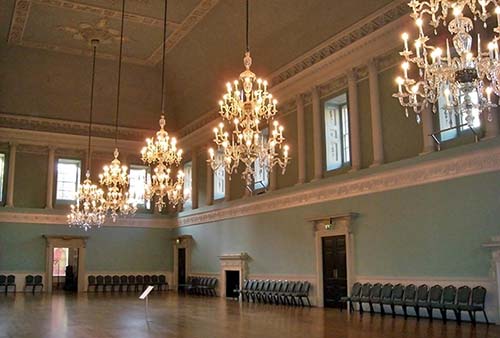
Back when Bath was the liveliest city in Britain, festive partygoers would “assemble” here almost nightly to dance, drink, gamble, and mingle. The building was designed by John Wood the Younger as part of his real estate development. For some 200 years, these lavish rooms have been used as a fashionable venue for parties, wedding receptions, and as the setting for lavish balls on the TV show Bridgerton. The National Trust recently assumed management of the property, and it will remain closed until possibly sometime in 2027 while restoration projects are underway, including to some upper rooms damaged in World War II. A reimagining of the experience is taking place, with the aim to transport visitors back to the social scene of late 18th-century Georgian Bath (nationaltrust.org.uk).
▲Museum of Bath at Work
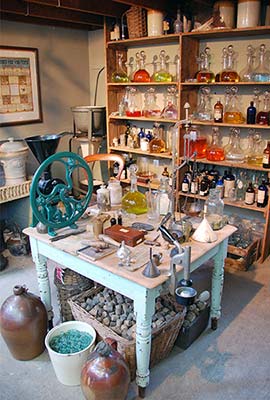
This modest but informative museum northeast of the Royal Crescent explains the industrial history of Bath. If you want to learn about the unglamorous workaday side of the spa town, this is the place. The museum is dedicated to the well-preserved, circa-1900 fizzy-drink business of one Mr. Bowler. It includes a Dickensian office, engineer’s shop, brass foundry, essence room lined with bottled flavorings (see photo), and factory floor. Upstairs are display cases featuring other Bath creations through the years, including a 1914 Horstmann car, wheeled sedan chairs (this is Bath, after all), and versatile plasticine (colorful proto-Play-Doh). On your way out, don’t miss the intriguing exhibits on the ground floor, featuring cabinetmaking, the traditional methods for cutting the local “Bath stone,” a locally produced six-stroke engine, and more.
Cost and Hours: £10; daily 10:30-17:00, Nov and Jan-March weekends only, closed Dec, last entry one hour before closing; free audioguide for your phone; Julian Road, 2 steep blocks up Russell Street from Assembly Rooms, +44 1225 318 348, museumofbath.org.
Jane Austen Centre
Two blocks south of the Circus, this exhibition does a decent job of illuminating the world of Bath’s most famous writer. Jane Austen spent five tumultuous, sometimes troubled years in Bath (c. 1800, during which time her father died), where she bristled at the vapid social scene. You’ll learn about Austen’s life and family history through a short film and docent talk, then head downstairs, where you’re free to try on Regency-era costumes and sniff era-appropriate scents, play parlor games such as spillikins, and pen a note with a quill.
Cost and Hours: £17, family tickets available; best to book a timed-entry online though walk-up tickets are sometimes available; daily 9:45-17:30, July-Aug until 18:00; shorter hours Nov-March, last entry one hour before closing; just northeast of Queen’s Square at 40 Gay Street, +44 1225 443 000, janeausten.co.uk.
OUTER BATH
▲American Museum and Gardens
The UK’s sole museum dedicated to American history has thoughtful exhibits on the history of Native Americans and the Civil War, but the museum’s heart is with the decorative arts and cultural artifacts that reveal how Americans lived from colonial times to the mid-19th century. The 18 completely furnished rooms (from a bare-bones 1600s Massachusetts dining/living room to a Rococo Revival explosion in a New Orleans bedroom) are hosted by eager guides waiting to fill you in on the everyday items that make domestic Yankee history surprisingly interesting. It’s fun to see your own country through British eyes—but on a nice day, the surrounding gardens (including a replica of George Washington’s garden at Mount Vernon) and view of the hills might be the best reasons to visit.
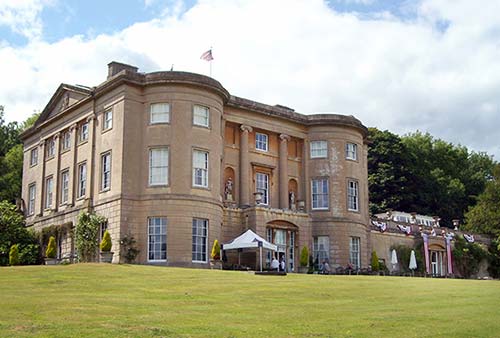
Cost and Hours: Museum and gardens-£16.50, cheaper online; grounds open Tue-Sun 10:00-17:00, museum 10:00-16:00—last entry 15:00; closed Mon and Jan-mid-Feb; download the Bloomberg Connects app for audioguide; at Claverton Manor, café, +44 1225 460 503, americanmuseum.org.
Getting There: The museum is just east of town. From the city center take the #U1 or #U2 bus to The Avenue stop (£3, 15-minute ride, 4/hour, stop is just before Bath University) and follow the tree-lined path (left of stone wall) 10-15 minutes. You could also hop a taxi for about £18. By car, it’s well signed from the A-36 and the city center.
Activities in Bath
▲Thermae Bath Spa
After simmering unused for a quarter-century, Bath’s natural thermal springs once again offer R&R for the masses. The state-of-the-art spa is housed in a complex of three buildings that combine historic structures with new glass-and-steel architecture.
This is the only natural thermal spa in the UK. Consider an evening visit, when—on a chilly day—Bath’s twilight glows through the steam from the rooftop pool.
Start in the large, airy Minerva pool downstairs (you might be surprised that the water isn’t hot—but it’s pleasantly warm). Then head upstairs and do as the Romans did, trying out the different heated rooms, from hot to hotter, two of which also pump out aromatic steam. Then, cool down with a crushed ice exfoliation in a mint-scented room. Don’t miss the night-sky room that will have you questioning your place in the universe.
The grand finale is a dip in the rooftop pool, with grand views of the Bath Abbey.
Cost: The cheapest spa pass is £43 for two hours (£47.50 on weekends; book ahead online) and includes a towel and robe—slippers extra. Check online for special packages. Bring your own swimsuit.
Thermae has all the “pamper thyself” extras (not included): massages, scrubs, and facials. Book treatments in advance by phone (must be combined with two-hour spa visit).
Hours: Daily 9:00-21:30, last entry at 18:30, pools close at 21:00. No kids under 16.
Information: It’s 100 yards from the Roman Baths, on Beau Street (+44 1225 331 234, thermaebathspa.com).
▲▲Canalside Walk to Bathampton
An idyllic towpath leads three miles from Bath along the Kennet and Avon Canal to the sleepy village of Bathampton, making for an unforgettable hour-long walk that gets you totally out of the city. You can do it as a round-trip or one way, in either direction, with a taxi connection; it’s also lovely by bike.
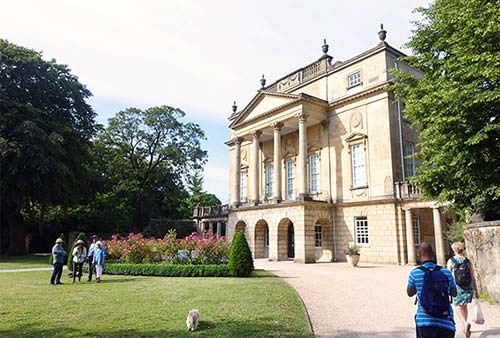
From Pulteney Bridge walk straight down Great Pulteney Street to the Holburne Museum, with its fine modern café facing Sydney Gardens. Continue straight a hundred yards through the gardens, over the train tracks (which put canals, built for Industrial Age cargo transport, out of business shortly after they were opened) to the Kennet and Avon Canal. (When you emerge from the park, either carefully cross the busy street, or walk a half-block up the hill to the crosswalk, then walk back downhill to pick up the trail.)
You can walk the towpath (being thankful you’re not a horse pulling a barge) for about 45 minutes to Bathampton. The canal, while pristine and bucolic, gives you a sense of the Industrial Age. Enjoy the funky decorations and plants on some of the boathouses. When you reach Bathampton, consider the classic George Inn for a nice meal and a beer (reservations smart, +44 1225 425 079, chefandbrewer.com).
From The George you can hike back to Bath, or walk (on the left) along the road for five more minutes to the River Avon. There you’ll find the bigger Bathampton Mill pub, with garden tables overlooking the Avon (+44 1225 469 758, thebathamptonmill.co.uk). From here it’s about a £15 taxi back to Bath.
Boating
The Bath Boating Station, in an old Victorian boathouse, rents rowboats, canoes, and punts (1 hour-£10/person, 2 hours-£15/person; Wed-Sun 10:00-17:30, closed Mon-Tue and Oct-Easter; advance booking recommended; intersection of Forester and Rockcliffe roads, one mile northeast of center, bathboating.co.uk).
Nightlife in Bath
For an up-to-date list of events, check the “What’s On” section of the Welcome to Bath website (welcometobath.co.uk).
Evening at the Baths
In July and August, you can stretch your sightseeing day at the Roman Baths, open nightly until 22:00 (last entry 21:00), when the gas lamps flame and the baths are less crowded and more atmospheric (see here).
▲Theatre Royal Performance
The restored 18th-century, 800-seat Theatre Royal, one of England’s loveliest, offers a busy schedule of London West End-type plays, including many “pre-London” dress-rehearsal runs. The Theatre Royal also oversees performances at two other theaters around the corner from the main box office: the Ustinov Studio (edgier, more obscure titles, many of which are premier runs in the UK) and “The Egg” (for children, young people, and families).
Cost and Hours: £35-65; shows generally start at 19:30 or 20:00, matinees at 14:30, box office open Mon-Sat 10:00-20:00, Sun from 12:00 if there’s a show; book in person, online, or by phone; on Saw Close, +44 1225 448 844, theatreroyal.org.uk.
Ticket Deals: £15.50 nosebleed spots on a bench (“gallery bench”) are sometimes available. If the show is sold out, same-day “standing places” go on sale at 18:00 (12:00 for matinees) for £10. Shows in the Ustinov Theatre go for around £20-40, with no cheap-seat deals.
Pubs
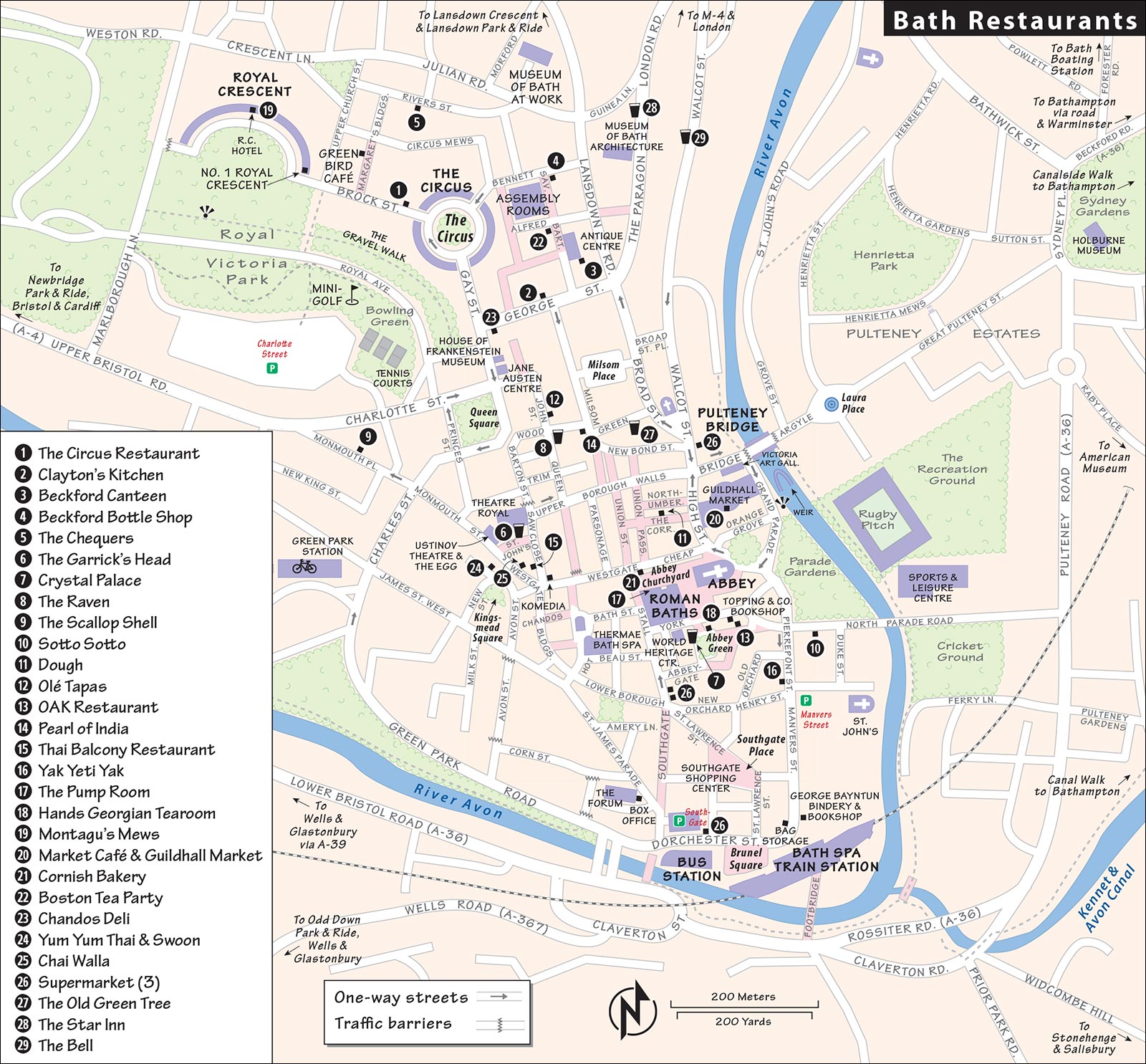
Most pubs in the center are very noisy, catering to a rowdy twentysomething crowd. But on the top end of town, you can still find some classic old places with inviting ambience and live music. See the “Bath Restaurants” map on here for locations.
The Old Green Tree, conveniently right in the town center, is a rare traditional pub offering a warm welcome (daily, locally brewed real ales, no TVs, 12 Green Street, +44 1225 448 259).
The Star Inn is much appreciated by locals for its fine ale and “no machines or music to distract from the chat.” It’s a throwback to the manly pubs of yesteryear—look for the long bench, nicknamed “death row.” Try the Bellringer Ale, made just up the road (long hours daily, no food served, 23 The Vineyards, top of The Paragon/A-4 Roman Road, +44 1225 425 072, abbeyinnsbath.co.uk, Jon). Guests are welcome to play the pub’s piano.
The Bell has a jazzy, pierced-and-tattooed, bohemian feel, but with a mellow older crowd. Some kind of musical activity brews nearly nightly, such as jazz, blues, DJs, and open-mic (Mon-Tue 16:00-23:00, Wed-Sat from 13:00, Sun 12:00-10:30, 103 Walcot Street, +44 1225 460 426, thebellinnbath.co.uk). There’s an inviting garden out back, often with a pizza oven fired up.
Comedy Shows
Komedia Bath hosts nightly shows—including live music, cabaret, and movies—in a restored Edwardian theater. For comedy, grab a ticket for Saturday night’s Krater Comedy Club, with stand-up comedians from around the UK (22 Westgate Street, box office open Tue-Sun 10:00-17:00 or see website for show listings, +44 1225 489 070, komediabath.co.uk).
Sleeping in Bath
Bath is a busy tourist town. Accommodations are expensive and can be about 25 percent more on Fridays and Saturdays. B&Bs favor those lingering longer; it’s worth looking for a weekday, three-nights-in-a-row, or off-season deal. If you’re driving to Bath, stowing your car near the center will cost you. Take advantage of the park-and-ride lots outside of town or ask your hotelier for the best option.
Note that many of my recommended places are in old buildings and don’t have an elevator. If you need a lower-floor room, request one in advance.
NEAR THE ROYAL CRESCENT
These listings are all a 5-to-10-minute walk from the town center and an easy 15-minute walk from the train station. With bags in tow you may want to either catch a taxi or (except for Brocks Guest House) walk to the bus station and hop on bus #4 toward Weston (get off at the Comfortable Place stop—just after the park starts on the right, cross the street and backtrack 100 yards).
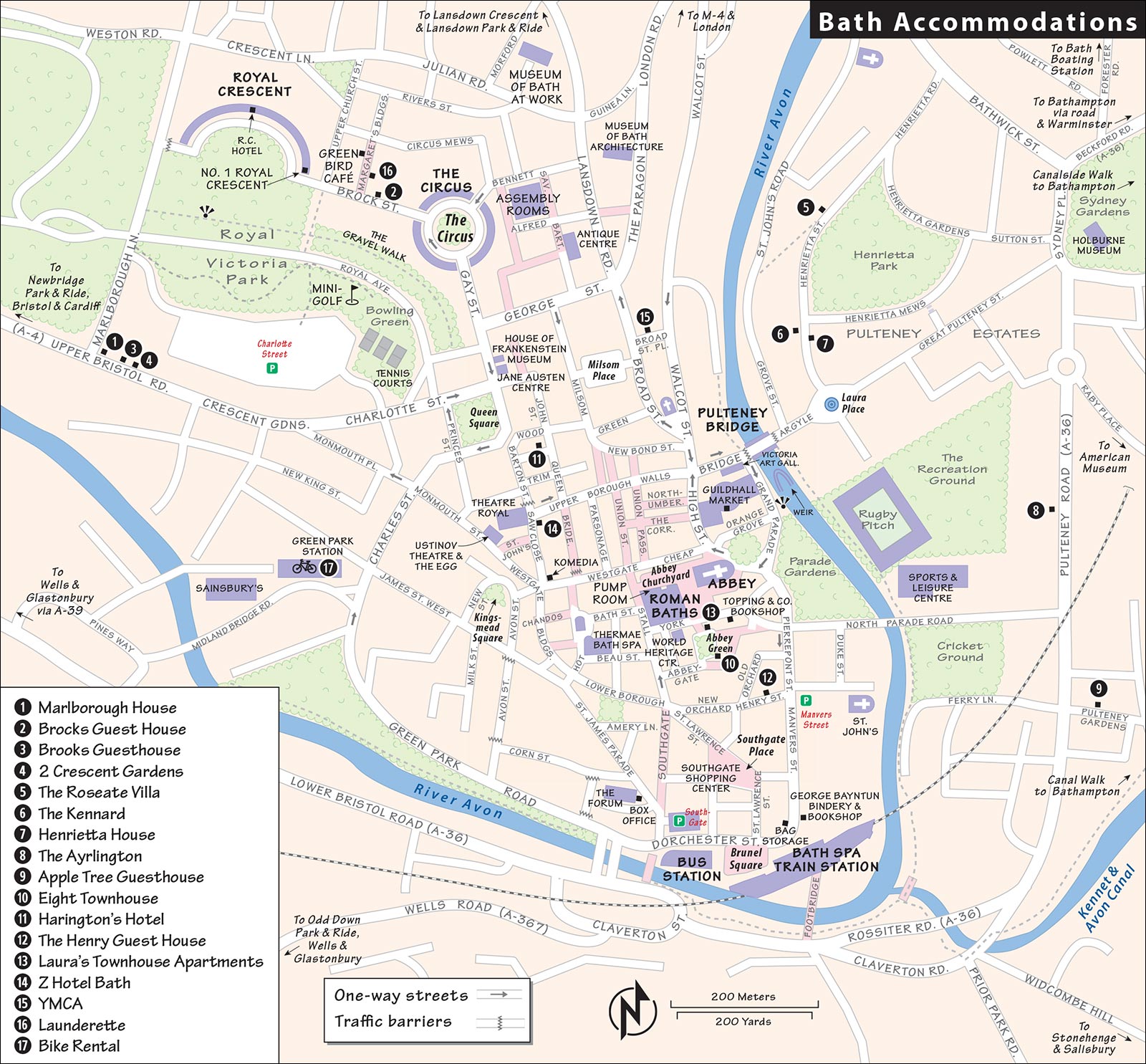
Except for Brocks, these B&Bs all face a busy arterial street (Upper Bristol Road, also known as Crescent Gardens); while the noise is minimal by urban standards and these B&Bs have well-insulated windows, light sleepers should request a rear- or side-facing room.
£££ Marlborough House, exuberantly run by hands-on owner Peter, mixes modern style with antique furnishings and features a welcoming breakfast room with an open kitchen. Each of the six rooms comes with a sip of sherry (RS%, family room, air-con, minifridges, limited free parking, 1 Marlborough Lane, +44 1225 318 175, mobile +44 7960 907 541, marlborough-house.net, marlboroughguesthousebath@gmail.com).
££ Brocks Guest House rents seven rooms in a Georgian townhouse built by John Wood the Younger in 1765. Located between the prestigious Royal Crescent and the courtly Circus, its modern touches amid Georgian elegance would make the great architect proud. Each room has its own Bath-related theme (family room, no breakfast, little top-floor library, 32 Brock Street, +44 1225 338 374, brocksguesthouse.co.uk, brocks@brocksguesthouse.co.uk. Owner Louise also rents nearby self-catering apartments in The Circus).
££ Brooks Guesthouse is the biggest and most polished of the bunch, albeit the least personal, with 22 modern rooms and classy public spaces, including an exceptionally pleasant breakfast room (1 Crescent Gardens, Upper Bristol Road, +44 1225 425 543, brooksguesthouse.com, info@brooksguesthouse.com).
££ 2 Crescent Gardens, owner Giacomo’s former family home, has six attractive though overpriced rooms—some with views—and a bright, open breakfast room and homey living room (RS%, family room, 2-night minimum on weekends, closed Jan, 2 Crescent Gardens, +44 1225 331 186, 2crescentgardens.co.uk, 2crescentgardens@gmail.com, managed by Monika).
EAST OF THE RIVER
These listings are a 5-to-10-minute walk from the city center. From the train station, it’s best to take a taxi, as there are no good bus connections.
££££ The Roseate Villa rents 21 stately yet modern rooms in a freestanding townhouse, with a park on one side and an extensive lawn on the other. In a city that’s so insistently Georgian, it’s fun to stay in a mansion that’s Victorian (family rooms, breakfast extra, pay parking, in quiet residential area on Henrietta Street, +44 1225 466 329, roseatehotels.com/bath/theroseatevilla, reception.trvb@roseatehotels.com).
£££ The Kennard is a short walk from the Pulteney Bridge. Each of the 12 rooms is colorfully and elaborately decorated (peaceful little Georgian garden out back, 11 Henrietta Street, +44 1225 310 472, kennard.co.uk, info@kennard.co.uk).
£££ Henrietta House, operated by the Radisson chain, has 67 rooms located in two separate buildings 90 feet apart. Choose between “boutique” rooms (more modern, with air-con) and “traditional” rooms (larger, with hardwood floors). The name of this place reflects English aristocracy, honoring the daughter of the mansion’s former owners, Lord and Lady Pulteney (family-size suites, breakfast extra, pay parking, check in at 27 Henrietta Street, +44 1225 632 632, radissonhotels.com, info.henriettahouse@radissonindividuals.com).
£££ The Ayrlington, next door to a bowling green, rents 19 spacious rooms, each decorated with panache. Though this well-maintained hotel fronts a busy street, it’s reasonably quiet and tranquil. Rooms in the back have pleasant views of sports greens. For the best value, request a standard top-floor double with a view of Bath (fine garden, pay parking, 24 Pulteney Road, +44 1225 425 495, ayrlington.com, info@ayrlington.com).
££ At Apple Tree Guesthouse, near a shady canal, hostess Ling and her cats rent five comfortable rooms sprinkled with East-meets-West decor (2-night minimum on weekends, 7 Pulteney Gardens, +44 1225 337 642, appletreebath.com, enquiries@appletreebath.com).
IN THE TOWN CENTER
Since Bath is so pleasant and manageable by foot, a downtown location isn’t essential, but these options are close to the baths and abbey.
£££ Eight Townhouse offers eight spacious and fancy rooms off a quiet, traffic-free courtyard just 50 yards from the abbey and the Roman Baths and another 12 rooms around the corner in a second townhouse on Abbey Green. Reception and breakfast are located at the main location (family room, 2-night minimum on weekends, top-floor rooms have air-con, 2 ground-floor rooms work best for those with limited mobility, breakfast extra; reception at 3 North Parade Passage, +44 1225 724 111, eightinbath.co.uk, info@8inbath.co.uk).
£££ Harington’s Hotel rents 13 fresh, colorful rooms on a quiet street. This stylish place feels like a boutique hotel, but with a friendlier, laid-back vibe (pay parking, 8 Queen Street, +44 1225 461 728, haringtonshotel.co.uk, post@haringtonshotel.co.uk, manager Kathryn). Owner Peter rents 11 apartments nearby (2-night minimum on weekends).
££ The Henry Guest House is a simple, vertical place, renting seven clean rooms. It’s friendly, well run, and just a few blocks from the train station (family room, same-day laundry service, 2-night minimum on weekends, 6 Henry Street, +44 1225 424 052, thehenry.com, stay@thehenry.com, Christina).
££ Laura’s Townhouse Apartments rents several flats scattered around the city, all within easy walking distance of Bath’s center. Apartments sleep from two to eight and come stocked with all the necessary amenities. Owner Hilary provides a warm welcome (2-night minimum, +44 7486 060 237, laurastownhouseapartments.co.uk, lta.hilary@gmail.com).
BARGAIN ACCOMMODATIONS
£ Z Hotel Bath (the Brits say “zed”) rents spare, modern rooms just big enough for the bed—your suitcase slides into a nook below. Though space is tight, hotel frills include organic linens. Best of all, it’s right in the center, just across from the Theatre Royal (breakfast extra, cheaper “inside” rooms lack windows, air-con, elevator, 24-hour café, 7 Saw Close, +44 1225 613 160, thezhotels.com/hotels/bath [URL inactive], bath@thezhotels.com).
¢ The YMCA, centrally located on a leafy square, is safe, secure, quiet, and efficiently run with a youthful, dorm vibe (some dorms but more private rooms, some private en suite rooms and family rooms available, continental breakfast weekends only, down a tiny alley off Broad Street on Broad Street Place, +44 1225 325 900, bathymca.co.uk, stay@ymca-bg.org).
Eating in Bath
Bath is bursting with eateries. A picnic dinner in the Royal Crescent Park or down by the river is ideal for aristocratic hoboes. The restaurants I recommend are mostly small and popular—reserve a table for dinner—especially on Friday and Saturday. Most pricey little bistros offer big savings with their two- and three-course lunches and “pretheatre” specials.
UPSCALE ENGLISH
££££ The Circus Restaurant is a relaxing eatery serving well-executed seasonal dishes with European flair. Choose between the modern interior—with seating on the main floor or in the less charming cellar—and a few tables on the peaceful street connecting the Circus and the Royal Crescent (long hours Mon-Sat, closed Sun, 34 Brock Street, +44 1225 466 020, thecircusrestaurant.co.uk [URL inactive]).
££££ Clayton’s Kitchen is where Michelin-star chef Rob Clayton aims to offer affordable British cuisine without pretense. The food is thoughtfully prepared and beautifully presented (closed Mon-Tue, a few outside tables, 15A George Street, +44 1225 724 386, claytonskitchen.com).
££££ Beckford Canteen, on a quiet pedestrian street, presents a contemporary yet nostalgic twist on traditional English dishes like rarebit and pea and mint soup. You’ll dine on the season’s best offerings alongside plenty of locals, and the friendly staff is ready to welcome you (closed Mon-Tue, Sun lunch only, reserve a table in the secret garden, 11 Bartlett Street, +44 1225 338 470, beckfordcanteen.com). One block up, the associated £££ Beckford Bottle Shop serves small British plates in a space that’s equal parts wine bar, wine shop, bistro, and delicious (closed Sun-Mon, 5 Saville Row, beckfordbottleshop.com).
££££ The Chequers is so nice I raised it out of the pub category. It’s pubby gourmet, serving a small menu of creative British and French dishes to enjoy in their handsome bar on the ground floor or, on weekends, the refined upstairs restaurant with open kitchen (daily for dinner, lunch served Sat-Sun only, just above the Royal Crescent at 50 Rivers Street, +44 1225 428 924, chequersbath.net).
PUB GRUB
£££ The Garrick’s Head, an elegantly simple gastropub around the corner from the Theatre Royal, serves traditional English dishes with a few Mediterranean options. There’s a restaurant with table service on one side, a more casual bar on the other, and some tables outside that are great for people-watching—all with the same menu and prices (daily, 7 St. John’s Place, +44 1225 318 368, garricksheadpub.com).
£££ Crystal Palace, a casual and inviting standby a block from the abbey, faces the delightful little Abbey Green. With a focus on food rather than drink, they serve “pub grub with a Continental flair” in three different spaces: a bar, a full-service restaurant, and an airy back patio (daily, 10 Abbey Green, +44 1225 482 666, crystalpalacepub.co.uk).
£££ The Raven attracts a boisterous local crowd (and the owner is well known for having booted out Keir Starmer—before he was prime minister). It emphasizes beer—with an impressive selection of real ales—but serves some delicious savory pies for nourishment, and offers a full English “brekkie” daily. The ground floor has a thick pub vibe, while upstairs feels more like a restaurant (longer hours daily, 6 Queen Street, +44 1225 425 045, theravenofbath.co.uk).
FISH
£££ The Scallop Shell is my top choice for fish in Bath. Hardworking Garry and his family offer grilled seafood along with fish-and-chips. Their £15 lunch special is served weekdays until 14:30. The ground floor is energized by the open kitchen, while upstairs is quieter, with a breezy terrace and smaller menu (daily, no dinner on Sun, 22 Monmouth Place, thescallopshell.co.uk).
ITALIAN AND SPANISH
£££ Sotto Sotto is where Italians in Bath go when they want traditional food. The restaurant sits in a candlelit vaulted cellar once used for storing coal, giving it a rustico-industrial feel. The pasta main courses are well priced, and the high-spirited staff make dining an enjoyable experience (closed Sun-Mon, 10 North Parade, +44 1225 330 236, sottosotto.co.uk).
££ Dough serves the best pizza in town in a fun and casual atmosphere. While they have a location on Kingsmead Square, their spot in “The Corridor” near the abbey is much more atmospheric (daily, 14 The Corridor, +44 1255 443 686).
££ Olé Tapas bounces to a flamenco beat, turning out tasty tapas from their minuscule kitchen. If you’re hungry for a trip to Spain, arrive early or make a reservation, as it’s both tiny and popular (daily, up the stairs at 1 John Street, +44 1225 424 274, oletapas.co.uk).
VEGETARIAN AND ASIAN
££££ OAK Restaurant is owned by renowned cookbook author Richard Buckley. It’s pricey but highly rated (with an impressive £49 five-course tasting menu) and ideal for the well-heeled vegetarian. For something cheaper, they also offer a £20 lunch tasting menu on weekdays. Its tight interior is elegant, with a quiet and understated vibe (daily, most dishes are vegan or can be made vegan, 2 North Parade Passage, +44 1225 446 059, oakrestaurant.co.uk).
££ Pearl of India serves large portions of Indian and Bangladeshi dishes in an impressive, triple-domed Georgian hall (daily, 8A Quiet Street, +44 1225 422 323, pearlofindia.co.uk).
££ Thai Balcony Restaurant has an open, spacious interior that’s so plush, it’ll have you wondering, “Where’s the wedding?” Even better, try to snag a table on their festive namesake wrought-iron balcony, with views over the action on Kingsmead Square. While residents debate which of Bath’s handful of Thai restaurants serves the best food or value, there’s no doubt that Thai Balcony’s fun and elegant atmosphere makes for a memorable and enjoyable dinner (daily, corner of Monmouth Street and Saw Close, 1 Seven Dials, thaibalcony.co.uk, +44 1225 444 450).
££ Yak Yeti Yak is a basic and earnest Nepalese restaurant with both Western and sit-on-the-floor seating. Sera and his wife, Sarah, along with their cheerful, hardworking Nepali team, cook up great traditional food (including plenty of vegetarian plates). It’s a simple, friendly, and honest place (Sat-Sun lunch and dinner, Tue-Fri dinner only, closed Mon; downstairs at 12 Pierrepont Street, +44 1225 442 299, yakyetiyak.co.uk).
EVER-SO-ENGLISH AFTERNOON TEA
A tradition for anyone feeling both English and aristocratic is a formal “afternoon tea”—with a three-tiered trolley piled with delicate finger sandwiches, scones with clotted cream and jam, and cakes, accompanied by a fancy pot of tea. (A “cream tea” is just tea with scones, jam, and clotted cream.) While many places serve afternoon tea, the setting is critical for the experience.
££££ The Pump Room sits above the Roman baths and for over two centuries has been Bath’s iconic Georgian gathering place. The food comes with live music—piano or a string trio (daily 10:00-12:00 for morning coffee or champagne brunch; £45 afternoon tea at 12:00, 14:00, and sometimes 16:00—reserve online and consider special offers, including a combo-ticket with Roman Baths, coffee and pastries sometimes available for walk-ins, +44 1225 444 477, thepumproombath.co.uk).
££ Hands Georgian Tearoom is an understated, family-run place a stone’s throw from the abbey and the baths. With an elegant Georgian interior and traditional dishes, it’s a good option for breakfast, lunch, or an economic afternoon tea in the center of the tourist bustle (daily until 17:30, 1 Abbey Street, +44 1225 463 928, handstearoom.co.uk).
££££ Montagu’s Mews at the Royal Crescent Hotel is my choice on a sunny day as tea is served in an elegant garden—and they allow you to split one order, making the experience more affordable (£49 afternoon tea, daily until 16:00, reserve a few days ahead—a week ahead for Sat-Sun, 16 Royal Crescent, +44 1225 823 333, royalcrescent.co.uk).
SIMPLE BREAKFAST AND LUNCH OPTIONS
You can’t step outside and throw a Bath bun without hitting one of the dozens of bakeries or cafés in this town (they compete hard for the many Airbnb travelers who don’t get that second “B” included).
For an olde tyme market experience, get breakfast at the Market Café. Chandos Deli is a more upscale foodie option. And the Boston Tea Party is understandably packed with enthusiastic breakfasters.
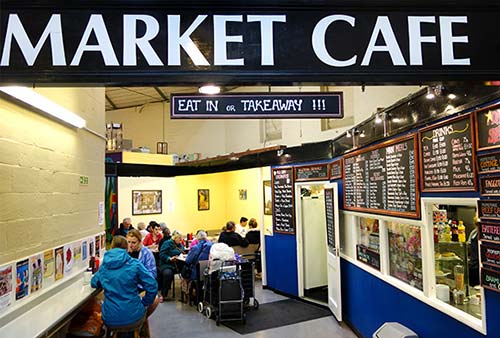
£ Market Café, in the Guildhall Market, is where you can munch cheaply on a homemade meat pie or sip tea while surrounded by old-time locals (traditional English meals including fried breakfasts all day, Mon-Sat until 17:00, closed Sun, a block north of the abbey on High Street, +44 1225 461 593).
£ Cornish Bakery, located conveniently across from the Pump Room and the start of the free city walking tours, is small but packs a punch, with tasty pastries and excellent coffee. Cozy up at one of the few inside tables, or sit outside with a view of the abbey (daily, 7 Abbey Churchyard, +44 1225 329 944).
£ Boston Tea Party is what Starbucks aspires to be—the neighborhood coffeehouse and hangout. Its extensive breakfasts, bakery items, light lunches, and salads are fresh and healthy. They’re popular with vegetarians and famously ethical in their business practices (daily until 16:00, 8 Alfred Street, second location on Kingsmead Square; +44 1225 476 465).
£ Chandos Deli has good coffee, breakfast pastries, and tasty £6-8 sandwiches made on artisan breads—plus baguettes and wine for assembling a gourmet picnic. Upscale yet casual, this place satisfies dedicated foodies who don’t want to pay too much (Mon-Sat until 17:00, Sun until 16:00, 12 George Street).
££ Kingsmead Square is a shady space with a grand tree and inviting benches, surrounded by several international food joints where you can grab a bite and sit outside. Yum Yum Thai is a more casual alternative to the Thai Balcony Restaurant mentioned earlier. They offer a £13 lunch special (daily); Chai Walla serves up satisfying, simple Indian street food (daily, no seating, Niraj); and Swoon has the best gelato in town.
Supermarkets: Waitrose has a café upstairs and racks of inexpensive picnic-type meals to go on the ground level. There are some stools inside and a few tables on the street out front (daily, just west of Pulteney Bridge and across from post office on High Street). Marks & Spencer, near the bottom end of town, has a grocery at the back of its department store and the M&S Café on the top floor (daily, 16 Stall Street). Next door, Tesco Express grocery is open late (daily, 13 Stall Street). Sainsbury’s Local, across the street from the bus station, also has long hours (daily, 2 Dorchester Street).
Bath Connections
Bath’s train station is called Bath Spa (+44 345 748 4959, nationalrail.co.uk). The National Express bus station is just west of the train station (bus info +44 8717 818 181, nationalexpress.com). For all public bus services in southwestern England, see travelinesw.com.
From Bath to London: You can catch a train to London’s Paddington Station (2/hour, 1.5 hours, best deals for travel after 10:00 and when purchased in advance, gwr.com), or save money—but not time—by taking the National Express bus to Victoria Coach Station (direct buses nearly hourly, 3.5 hours, avoid those with layover in Bristol, one-way £8-10 when purchased online several days in advance).
Connecting Bath with London’s Airports: To get to or from Heathrow, it’s fastest and most pleasant to take the train via London; it takes about three hours total (airport to London Paddington-4/hour, Paddington to Bath-2/hour). With a rail pass, it’s also the cheapest option, as the whole trip is covered. Without a rail pass, it’s the most expensive way to go (£65 total for off-peak travel, cheaper bought in advance, price can double for full-fare peak-time ticket; easy change between First Great Western train and Heathrow Express at London’s Paddington Station).
The National Express bus is direct and often much cheaper for those without a rail pass. It’s less frequent but takes about the same amount of time as the train (almost hourly, more with transfer, 2-4 hours, £20-40 one-way depending on time of day, +44 8717 818 181, nationalexpress.com). Another option is the minibus operated by recommended tour company Celtic Horizons (see here).
You can get to or from Gatwick by train with a transfer in Reading (hourly, 2.5 hours, £55-75 one-way depending on time of day, cheaper in advance; avoid transfer in London, where you’ll have to change stations; nationalrail.co.uk).
Connecting Bath and Bristol Airport: Located about 20 miles west of Bath, this airport is closer than Heathrow or Gatwick and has good connections by bus. From Bristol Airport, your most convenient option is the Bristol Air Decker bus #A4 (£17.50, hourly, 1.25 hours, airdecker.com). Otherwise, you can take a taxi (£45) or call Celtic Horizons (see here).
From Bath by Train to: Salisbury (hourly direct, 1 hour), Moreton-in-Marsh (hourly, 2 hours, 1-2 transfers), York (hourly with transfer in Bristol, 4.5 hours, more with additional transfers), Cardiff (hourly, 1.25 hours), points north (from Birmingham, a major transportation hub, trains depart for Blackpool, Scotland, and North Wales; use a train/bus combination to reach Ironbridge Gorge and the Lake District).
For bus connections to Glastonbury and Wells, see the next chapter.