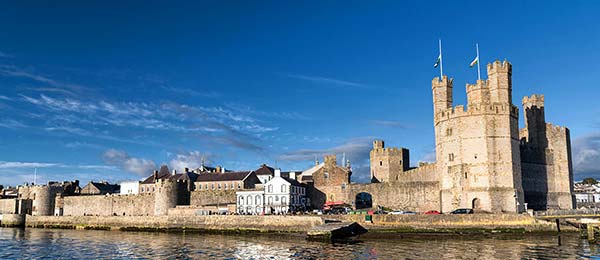
NORTH WALES
Conwy • Near Conwy • Caernarfon • Snowdonia National Park • Northeast Wales
Wales’ top historical, cultural, and natural wonders are found in the north. From towering Mount Snowdon (Yr Wyddfa) to lush forests to desolate moor country, North Wales is a poem written in landscape. For sightseeing thrills and diversity, North Wales is Britain’s most interesting slice of the Celtic crescent. And it’s remarkably compact: In a single day you can lie on a beach, conquer a castle, spelunk in a slate mine, hike on a mountain slope, ogle a grand garden, and settle in for dinner at one of Britain’s most pleasant small towns, Conwy.
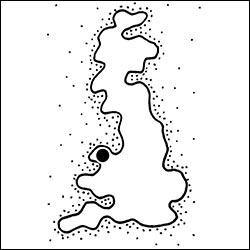
Wales is wonderful, but smart travelers sort through their options carefully. Tourism dominates the local economy, and sales pitches can be aggressive. Be careful not to be waylaid by gimmicky sights and bogus “best of” lists.
When choosing where to sleep, the most logical options are Conwy and Caernarfon—each an old walled town attached to a castle (the two best in Wales). Conwy, the more charming of the two, makes the region’s best home base, with appealing B&Bs and high-quality restaurants, a fun-to-explore townscape within mighty walls, and manageable connections to many nearby sights. Caernarfon is bigger, more blue-collar, and slightly better connected.
At Conwy’s doorstep is the sumptuous Bodnant Garden. And if two castles aren’t enough, you have several more to choose from (I’ve also described Beaumaris, Harlech, and Criccieth).
Close by, Snowdonia National Park plunges you into some of Wales’ top scenery. You can ride a train from Llanberis to the top of Mount Snowdon, learn more about local industry at Llanberis’ National Slate Museum (likely closed for renovations) and the Llechwedd Slate Caverns in the tongue-twisting industrial town of Blaenau Ffestiniog, and explore the huggable villages of Beddgelert and Betws-y-Coed. And on the way back to England are the appealing towns of Llangollen, strikingly set in a gorge; and Ruthin, with a relaxing market-town vibe.
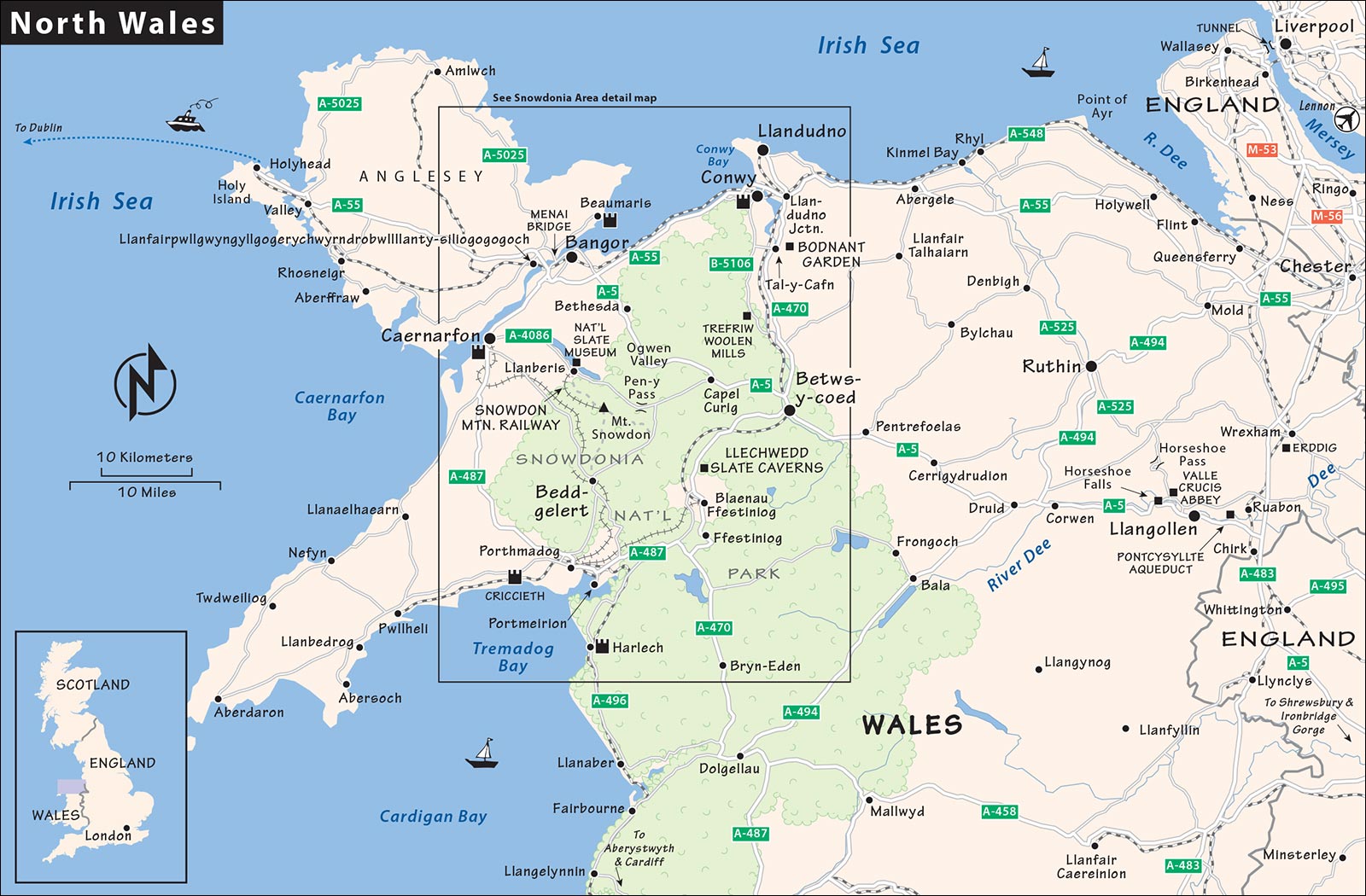
There’s so much variety in this region—and it’s all so close—that there’s no single “best plan” for seeing it all. Peruse this chapter, make a wish list, and weave together a North Wales itinerary that suits your interests.
PLANNING YOUR TIME
The absolute minimum is two nights and a day; if you can spare the time, you won’t regret adding an extra night (or two). With two nights in Conwy, use your arrival and departure days to see the town and its castle, leaving your full day for side-tripping.
By Car: Drivers can try this North Wales itinerary:
| 9:00 | Leave your Conwy home base after breakfast. |
| 9:30 | Visit Bodnant Garden. |
| 11:30 | Have lunch and a wander in Betws-y-Coed. |
| 13:30 | Tour the Llechwedd Slate Caverns. |
| 14:00 | Drive Pen-y-Pass to Caernarfon. |
| 16:00 | Tour Caernarfon Castle. |
| 17:00 | Back to Conwy (45 minutes) for my self-guided walk. |
| 19:00 | Dinner in Conwy. |
By Public Transportation: Conwy is a good home base. Most of the region’s destinations can be reached by bus or train from Conwy or nearby Llandudno Junction, just across the river. With just one day, leave Conwy in the morning for a loop through the Snowdonia sights (possibly including Betws-y-Coed, Beddgelert, or Blaenau Ffestiniog, depending on bus and train schedules—check timetables and plan your route before heading out), then return to Conwy in the evening for my town walk and dinner. To pack more into your limited time, consider hiring a local guide for a private driving tour (see walesbestguides.com).
With a Second Day: Slow down and consider the region’s other sights, such as the train from Llanberis up Mount Snowdon, Beaumaris or Harlech castles, the dreamy Italianate village of Portmeirion, the scenic hike to Cwm Idwal, and the charming towns of Ruthin or Llangollen. With more time and a desire to hike, make the mountain village of Beddgelert your base. If it’s open by the time you visit, make room in your itinerary to visit the National Slate Museum in Llanberis.
GETTING AROUND NORTH WALES
By Public Transportation: North Wales (except Ruthin) is well covered by a combination of buses and trains. That said, you’ll want to get an early start and allow ample time if you plan to visit several destinations. TIs and B&B hosts can help you sort through your options to lace together an exciting day of North Wales sightseeing.
Trains: The main train line, run by Transport for Wales, travels along the north coast from Chester to Holyhead via Llandudno Junction, Conwy, and Bangor, with nearly hourly departures (+44 3457 484 950, tfw.wales).
There are also several intersecting, scenic spur lines (but note that schedules are not conducive to combining the different lines). From Llandudno, the Conwy Valley line goes south to Betws-y-Coed and Blaenau Ffestiniog (see “Conwy Connections,” later). The old-fashioned Welsh Highland Railway steam train (described on here) goes from Caernarfon to Beddgelert, then loops back to the coast and Porthmadog. Porthmadog is a terminus for the Ffestiniog Railway steam train (described on here), which heads into the mountains to Blaenau Ffestiniog, where it meets the Conwy Valley line.
Buses: Public buses (run by various companies) pick up where trains leave off. Get bus timetables online or at any TI. Schedules get sparse late in the afternoon and on Sundays; plan ahead and confirm times carefully. Certain bus lines—dubbed “Sherpa” routes (bus numbers begin with #S)—circle Snowdonia National Park with the needs of hikers in mind (sherparwyddfa.wales).
Arriva has single-day and weekly bus passes covering much of North Wales (£6-20, buy at arrivabus.co.uk/ticket-info, on the Arriva app, or onboard). Or ask any local bus driver about the 1bws Ticket, which offers one-day or one-week access across multiple bus operators in North Wales, including the “Sherpa” buses in Snowdonia (£7/day, £30/week).
By Car: Driving and parking throughout North Wales is easy and allows you to cover more ground. Enterprise is the only company that rents cars in the area (most convenient is in Llandudno Junction; see “Helpful Hints,” later), otherwise the closest place to rent a car is just across the border in Chester.
Conwy
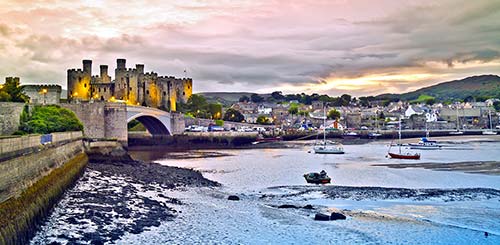
Along with Conwy Castle, this garrison town was built in the 1280s to give Edward I a toehold in Wales. As there were no real cities in 13th-century Wales, this was an English town, planted with settlers for the king’s political purposes. What’s left today are the best medieval walls in Britain, surrounding a humble town crowned by the bleak and barren hulk of a castle that was awesome in its day (and still is). Conwy’s charming High Street leads down to a fishy harbor that permitted Edward to restock his castle safely. Because the modern highway was tunneled under the town, Conwy has a strolling ambience. I find it the perfect size—big enough to have a real vitality, but small enough to be cozy. It’s one of the most purely delightful towns of its size in Britain.
Orientation to Conwy
Conwy is an enjoyably small community of 15,000 people. The walled old town center is compact and manageable. Lancaster Square marks the center, where you’ll find the bus “station” (a blue-and-white bus shelter), the unstaffed train “station” (the tracks down by a sunken parking lot), and the start of the main drag—High Street—and my self-guided walk.
TOURIST INFORMATION
Conwy’s TI is located across from the castle’s parking lot on Rose Hill Street (Mon-Sat 9:30-17:00, Sun 10:00-16:00, +44 1492 577 566, visitconwy.org.uk). Because Conwy’s train and bus “stations” are unstaffed, ask at the TI about train or bus schedules. Don’t confuse the TI with the uninformative Conwy Visitors Centre, a big gift shop near the station.
ARRIVAL IN CONWY
By Bus or Train: Only local trains stop at Conwy’s station; major trains stop at nearby Llandudno Junction (see next). For train info, ask at the TI in town, or see tfw.wales or download the handy TFW app.
For more frequent trains, use Llandudno Junction, visible a mile away beyond the bridges (to get into Conwy from here, catch bus #5, take an £8 taxi, or simply walk a mile if you’ve packed light—it’s quite scenic, especially in good weather). The staffed station can answer questions and help with booking. When booking online or via the app, make sure to select Llandudno Junction, not Llandudno proper, which is a seaside resort farther from Conwy.
By Car: The easiest parking option for day-trippers is the pay lot just behind the castle, facing the TI. There’s a larger lot behind the town wall on this side of town, and there’s good parking along Mount Pleasant road on the opposite side of town.
HELPFUL HINTS
- Festivals: The town has several fun annual events: Pirate Weekend (May/June, visitconwy.org.uk/whats-on); the Classical Musical Festival, with many concerts held in St. Mary’s Church (July, conwyclassicalmusic.co.uk); and the River Festival (July/Aug, conwyriverfestival.org). It hosts two 700-year-old markets: the Seed Fair (March) and the Honey Fair (Sept). Ask the TI or your B&B what might be going on during your visit.
- Laundry: In Llandudno Junction, Junction Laundry Service offers self- and full service. Bus #5 from Conwy stops nearby (closed Sun, 161 Conway Road, +44 1492 592 555).
- Bike Rental: Conwy lacks its own bike-rental outfit, but Beics Betws in Betws-y-Coed can deliver a bike to you for multiday rentals—call ahead or reserve online (+44 1690 710 766, bikewales.co.uk). A popular route is to take the riverside path, starting across the bridge from Conwy, all the way to Llandudno and back.
- Car Rental: The closest place, in Llandudno Junction, is Enterprise, which offers pickup service (closed Sat afternoon and Sun, North Wales Expressway, +44 1492 593 380).
TOURS IN CONWY
On Foot
Conwy Guided Tours’ excellent walks of the town and Conwy Castle are the best deal in town (£10/person, tours year-round including daily May-Sept, check schedule online, +44 7899 168 719, conwyguidedtours.com). It’s run by James Reeve, a former schoolteacher, who has an enthusiasm for bringing the town, its medieval walls, and the castle to life. He and his colleagues can also do private tours (starting from £130, james@conwyguidedtours.com). They also run ghost tours, combining the darker side of Conwy’s history with century-old spooky tales (£5, check schedule on website).
By Bus
City Sightseeing hop-on, hop-off bus tours start in Llandudno, make a few stops in Conwy, then loop back on a different route back to Llandudno. For pure transportation, you’re better off taking local bus #5 to Llandudno, but this is a good leisurely tour (£15/24 hours, city-sightseeing.com/en-us/94/llandudno).
By Boat
Two different harbor cruises depart nearly hourly from the Conwy harborfront (£8/30 minutes, £18/one hour, pay on boat or at the little booth across from the Liverpool Arms; early Feb-Oct daily, departure times depend on tides; +44 7917 343 058, sightseeingcruises.co.uk).
For more excitement, Aquator runs high-speed rigid inflatable boat (RIB) trips from the harbor several times a day, adding a little adrenaline rush to the coastal scenery, with the possibility of puffin and other wildlife sightings (£35/1 hour, £60/2 hours, +44 7308 020 451, aquatour.co.uk).
Conwy Walk
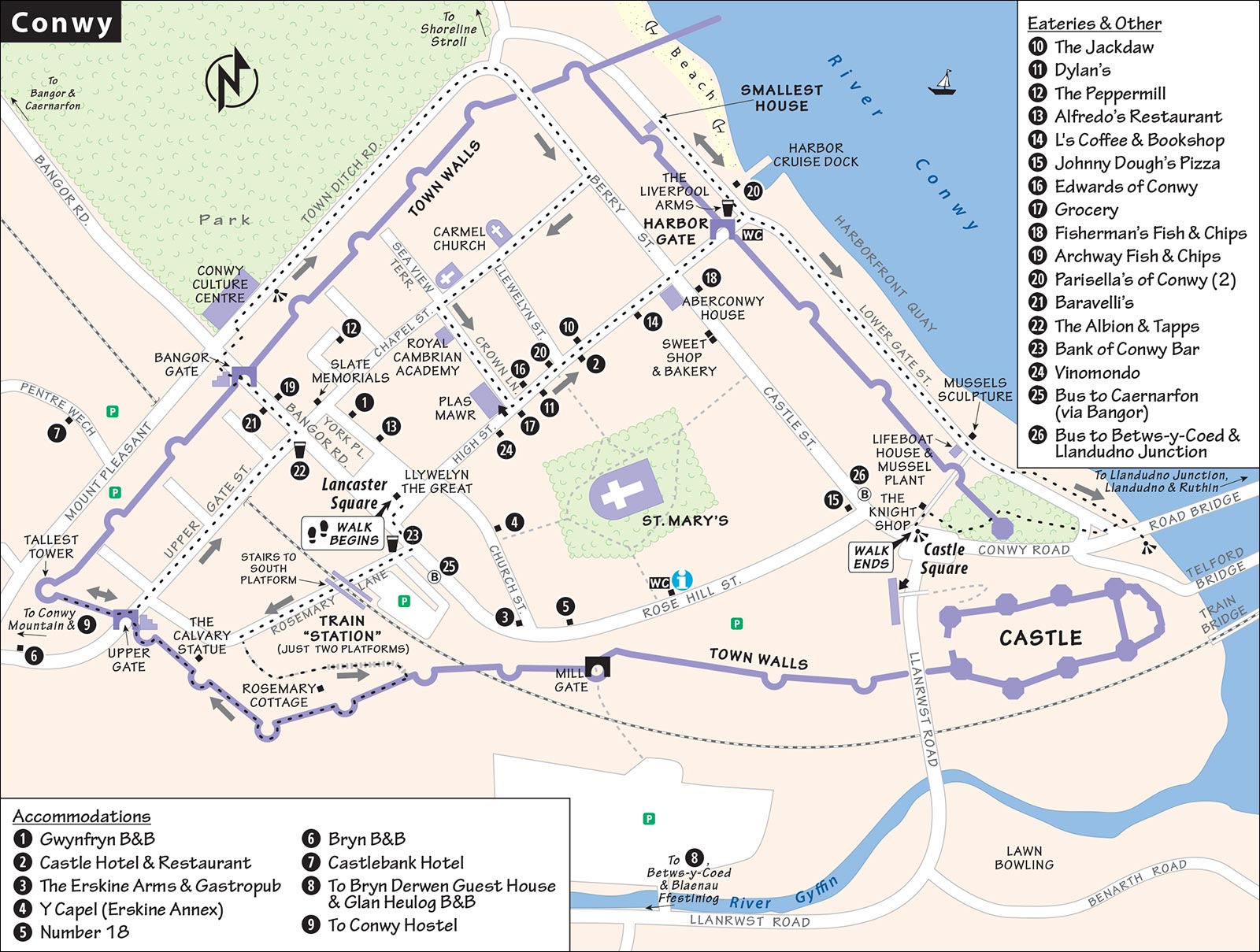
This brief self-guided orientation walk introduces you to essential Conwy in about an hour. The town walls are open late, so you can do this walk any time—evening is fine. For a shorter stroll, skip ahead to the harborfront’s promenade, which is perfect for a peaceful half-mile shoreline walk (start at the Smallest House in Great Britain).
• Start at the top of High Street on the main square.
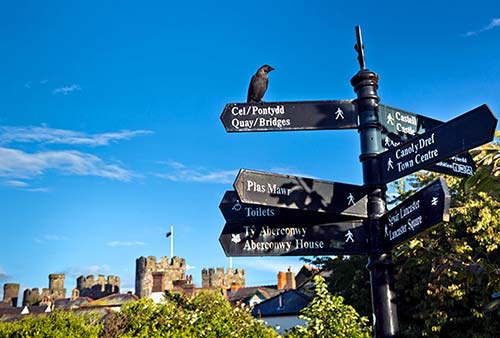
Lancaster Square: The square’s centerpiece is a column honoring the town’s red-cloaked founder, the Welsh prince Llywelyn the Great (Llywelyn ap Iowerth). The statue and fountain were erected in the late 19th century in celebration of the town’s first freshwater reservoir. Note as you walk around town that all the town’s street names are English except one—Llewelyn Street.
Get oriented with a quick spin tour: Looking uphill, you can see Bangor Gate, built by the British engineer Thomas Telford in 1826 to accommodate traffic from his suspension bridge (we’ll go through the gate later, and see the bridge at the end of the tour). Facing the Llywelyn statue, to your right is High Street, with lots of great shops and eateries. To the left is the Bank of Conwy building, now a recommended pub. And turning your back on Llywelyn, find the town’s tiny train station (below street level) and one of two bus stops within the town walls (also where you can catch the hop-on, hop-off bus to Llandudno).
• Cross the street toward the Bank of Conwy pub, going over the railway bridge onto Rosemary Lane. Cross to the walled side of the street and, just before you reach the end of the wall, where a portion is lower, look left toward the train tracks to see a pointed archway built for the train to pass through.
Continue up Rosemary Lane until you see a row of cottages on the right, with an archway in the middle (marked Rose Place Court). Turn left through a smaller archway, following the path until you reach the Rosemary Cottage’s gardens on your right.
Llywelyn’s Hall: Notice the three windows in the medieval wall (the only window seats in the town walls). The grandson of Llywelyn the Great—Llywelyn ap Gruffudd, aka Llywelyn the Last—may have had a royal court here, before King Edward I invaded and the castle and town were constructed. Llywelyn the Last was the only Welsh ruler to be recognized as the Prince of Wales by the English. Unfortunately, while he and his brother made great efforts to keep the English at bay, Edward’s men killed Llywelyn the Great in 1282 and his brother soon after. In 1283, the town fell into English hands.
• Continue along the path as it curves to the left, taking the stairs down, then turn right and walk along the wall. Skip the first tower and head to the last tower right next to the train tracks. Just past the arch, ascend the stairs and walk atop the wall—passing one tower—until you’re back above the Rosemary Cottage gardens.
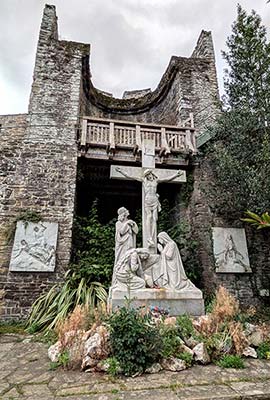
Marble Sculptures: From this scenic spot, with a 19th-century apple orchard to your left and the peaceful gardens to your right, don’t miss the striking marble reliefs set into the wall ahead of you. Spanning a long portion of the city wall is a depiction of 12 stations of the cross, ending with a free-standing sculpture, The Calvary, dramatically set in front of one of the towers (you can get a closer look later in this walk). The series, commissioned by an Italian engineer who lived nearby, was carved from Carrara marble in Milan, Italy from 1916-1932.
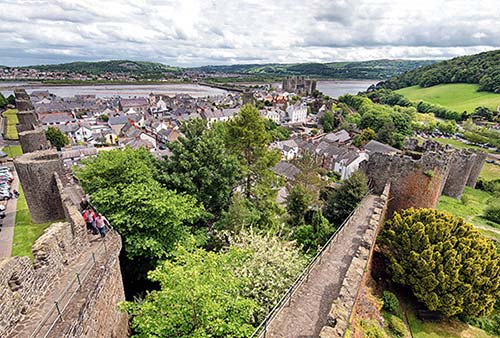
• Keep walking along the wall, turning the corner and gradually heading uphill past two more towers (the second one you come to is the Upper Gate, which we’ll return to). If you’d like to march on to the highest point, hike as far as the watchtower where the north and south walls meet (likely as far as you can go, due to construction on the next section of the wall).
Tallest Tower and Walls: You’re standing atop the most complete set of medieval town walls in Britain, built in conjunction with the castle in 1283. Four years later, they sent a message to London declaring, “Castle habitable, town defensible.” Edward then sent in English settlers. Enjoy the view down to Conwy Castle, at the opposite corner of town (and the end point of this walk). From up here, guards could spot ships approaching by sea. Over your right shoulder is Conwy Mountain, an enjoyable six-mile hike described later in this chapter.
• Head back to the Upper Gate and stand facing the arch over the street below. This was originally the only land-facing gate in the town wall. The street in front of you, Upper Gate Street, was then the town’s busiest but is now relatively quiet. Behind you, peer down the grates once used to drop, well, any old thing one could find onto would-be invaders.
Now, head down the stairs to your right. When you reach the bottom, you could take an immediate right down Rosemary Lane until you hit the church, where you can look right for an up-close view of The Calvary.
We’ll continue into town down Upper Gate Street. After one block, carefully cross Bangor Road onto Chapel Street, pausing at York Place to view the memorials on the wall to your left.
Slate Memorials: This wall of various memorials includes one recalling the 1937 coronation of King George VI (the father of Queen Elizabeth II and grandfather of King Charles III). Another offers a Welsh-language lesson, donated to the town by a citizen who never learned to read and wanted to inspire others to avoid his fate. It lists, in Welsh, the counties (shires, or sir), months (a few are vaguely recognizable), days, numbers, and the Welsh alphabet with its unique letters (ch, dd, ff, ng, ll, ph, and th). Much has changed since this memorial was posted. Today more people speak Welsh, and all local children are taught Welsh in school until age 16.
• Head back to Bangor Road and turn right, leaving town through the Bangor Gate. Before crossing the street, turn around and take in the impressive...
Ramparts: The turrets you see were positioned about every 50 yards, connected by ramparts, and each one had a drawbridge that could be raised to bottle up any breach. To the right of the Bangor Gate at the first turret, notice the cracked wall, caused by train-tunnel construction that accidentally undermined the foundation—effectively taking the same tactic that invading armies would have. The huge crack makes plain why undermining was such a popular technique in medieval warfare. (Unlike the town walls, Conwy Castle was built upon solid rock, so it couldn’t be undermined.)
• Use the crosswalk and turn right on Town Ditch Road, passing the slick, modern Conwy Culture Centre—with a library, café, the Conwy archives, and interactive displays. Head downhill a little and pause to take in the best wide view of...
The Walls: Town Ditch Road is named for the dry moat that was the first line of defense from the highest tower down to the riverbank. As was the case with most walled towns, there was a clear swath of “dead ground” outside the walls, so no one could sneak up. Once England centralized and consolidated its rule, there was no longer a use for all the walls and castles in Britain. Most fell into disrepair—ravaged by time and by scavengers who used them as quarries. During the Napoleonic Wars, English aristocrats were unable to make their Grand Tour of the Continent, so they explored the far reaches of their own land. That’s when ruined castles such as Conwy’s were “discovered” and began to be appreciated for their romantic allure.
• Stroll downhill to the bottom of Town Ditch Road, following the road as it curves right, and reenter the old town through a space cut in the wall by a modern mayor who wanted better access from his land. Berry Street, once called “Burial Street,” was originally a big ditch for mass burials during a 17th-century plague. After one block, turn right and climb up Chapel Street to an austere stone structure.
Carmel Church: This former Presbyterian church is a fine example of stark “statement architecture”—stern, no frills, and typical of churches built in the early 20th century. Even very small Welsh towns built churches for several Christian denominations. (The Welsh have a reputation for nonconformity, even contentiousness—as the saying goes, “Get two Welshmen together, and you’ll have an argument. Get three together, and you’ll have a fight.”) In the 18th and 19th centuries, Welsh Christians who didn’t want to worship in the official, English-style Anglican Church joined “nonconformist” congregations such as Methodists, Congregationalists, Quakers, or Presbyterians. You could say “nonconformist” is to “Anglican” as “Protestant” is to “Catholic.” Religious affiliation is closely tied to politics in Wales, where the Anglican Church, aka “The Church of England,” goes by the more politically appealing “The Church in Wales.” Still, many Welsh say, “The Anglican Church is the Conservative Party at prayer, and the nonconformist churches are the Labour Party at prayer.”
• In a modern building beyond the church (just past Sea View Terrace, across the street on the left) is...
The Royal Cambrian Academy: This art academy, showing off two floors of contemporary Welsh painting, gives a good glimpse into the region and its people through art (free, most paintings are for sale; Tue-Sat 11:00-17:00, closed Sun-Mon and before each new exhibition, shorter hours off-season; on Crown Lane just above Plas Mawr, +44 1492 593 413, rcaconwy.org).
• With the Royal Cambrian Academy on your right, turn left on Crown Lane, eventually passing Plas Mawr. This is the first Welsh house built within the town walls, dating from the time of Elizabeth I (well worth touring—see listing later, under “Sights in Conwy”; entrance is a few steps to the right, up High Street). But we’ll turn left onto...
High Street: Wander downhill, enjoying this slice-of-Welsh-life scene—tearooms, bakery, butcher, newsstand, and old-timers. The colorful flags you may see have no meaning—merchants fly them simply to pump up the town’s medieval feel. Aberconwy House, one of the oldest houses in town, marks the bottom of High Street (it’s the white house with the stone base, on your right). In its garrison-town days, Conwy was filled with half-timbered buildings just like this one. Now, you can head downstairs to the tiny secondhand bookshop. Ask the staff if you can check out the upstairs, with two creaky levels—including the “public living room,” which occasionally hosts events (bookshop open Thu-Sat 10:00-16:00).
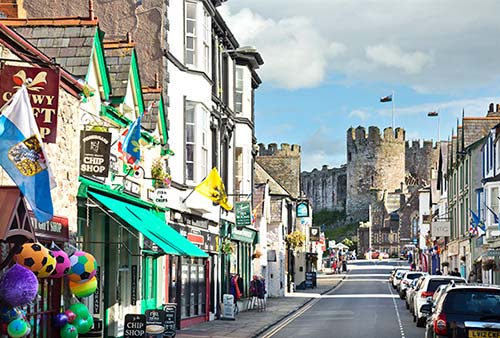
If you need a pick-me-up, 20 yards to the right at 4 Castle Street is the Conwy Sweet Shop—filled with old-fashioned candy—and, next door, the tempting Conwy Bakery.
• Follow High Street through the gate and to the harbor.
Harborfront: The Harbor Gate, one of three original gates in the town walls, leads to the waterfront. The harbor itself dates from the 13th century, when it served Edward’s castle and town. Conwy was once a busy slate port. Slate, barged downstream to here, was loaded onto big three-masted ships and transported to the Continent. Back when much of Europe was roofed with Welsh slate, Conwy was a boomtown. All the mud is new—the modern bridge caused this part of the river to silt up.
The actions of the European Union have had a mixed effect on this waterfront. When Britain was a part of the EU, it helped pay for the promenade, but food-safety laws forced many of Conwy’s fishermen out: Fish exported to the Continent must be transported in refrigerated vehicles, so fishermen had to set up shop a few miles away (since refrigerator trucks can’t fit through the stone gate). Since Brexit, seafood caught locally is now almost entirely sold and eaten locally (except for whelk, a type of sea snail, which is shipped to Asia).
Conwy’s harbor is now a laid-back area that locals treat like a town square. On summer evenings, the action is on the quay (pronounced “key”). The scene is mellow, multigenerational, and perfectly Welsh. It’s a small town, and everyone is here enjoying the local cuisine—“chips,” ice cream, and beer—and savoring that great British pastime: torturing little crabs. (If you want to do more than photograph the action, rent gear from the nearby lifeboat house. Mooch some bacon from others for bait, and join in. It’s catch-and-release.)
The benches and knee-high walls all along here are ideal for a picnic (a recommended fish-and-chips shop is back through the gate). Just be wary of those noisy gulls taking an interest in your food: They’re notorious for swooping in and stealing your lunch while you’re distracted.
Just next to the Harbor Gate is The Liverpool Arms pub, built by a captain who ran a ferry service to Liverpool in the 19th century. Today it remains a salty and characteristic hangout—one of the few thriving pubs in town. In 1900, Conwy had about 40 pubs. Back when this harbor was busy with quarrymen shipping their slate, mussel men carting their catch, and small farmers with their goods, Conwy’s pubs were all thriving. Today, times are tough on the pubs, and this one depends on tourism.
• Facing the harbor in front of The Liverpool Arms, turn left and walk along the promenade.
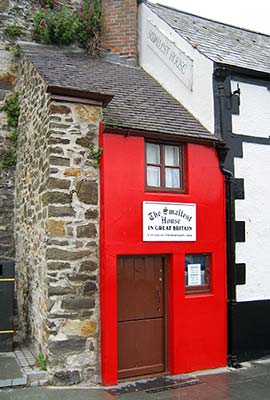
It’s easy to miss the Smallest House in Great Britain. It’s red, 72 inches wide, 122 inches high, and worth £1.50 to pop in and listen to the short audioguide tour. No WC—but it did have a bedpan (daily 10:00-16:00, closed Nov-March, +44 1492 573 965, thesmallesthouse.co.uk).
• Now do an about-face and walk along the promenade in the opposite direction, toward the bridges and castle.
About 100 yards down, on your right, you’ll find a mussel-processing plant. Mussels, historically a big “crop” for Conwy, are processed “in the months with an R.” If there’s a fresh catch, you’ll find a little shop here.
The nearby lifeboat house welcomes visitors. Each coastal town has a house like this one, outfitted with a rescue boat suited to the area—in the shallow waters around Conwy, inflatable boats work best. You’ll see Lifeboats stickers around town, marking homes of people who donate to the valuable cause of the Royal National Lifeboat Institution (RNLI)—Britain’s all-volunteer and totally donation-funded answer to the Coast Guard.
Check out the striking sculpture on the quay—a giant clump of mussels carved from dark-gray limestone.
• Walk past the sculpture and head up the stairs by the huge red-and-white buoy to the big street for a view of the castle and bridges. You can cross the road for a closer look at the...
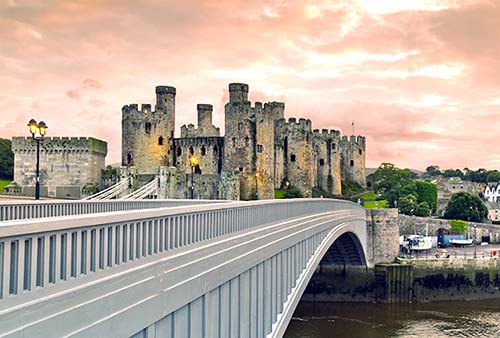
Bridges: Three bridges cross the river, side by side. Beyond the modern 1958 highway bridge is the historic 1826 Telford Suspension Bridge. This was an engineering marvel in its day, part of a big infrastructure project to better connect Ireland with the rest of the realm (and, as a result, have more control over Ireland). In those days, Dublin was the number-two city in all of Britain. These two major landmarks—the castle and 19th-century bridge—are both symbols of English imperialism. Just beyond that is Robert Stephenson’s tube bridge for the train line (built in 1848). These days, 90 percent of traffic passes Conwy underground, unseen and unheard, in a modern tunnel.
• Back on the town side of the big road, follow the sidewalk away from the water, past the ivy and through an arch, to a tiny park around a well. Facing that square is...
The Knight Shop: If you’re in the market for a battle-ax or perhaps some chainmail, pop in here. Even if you’re not, it’s a fun place to browse. The manager is evangelical about mead, an ancient drink made from honey (daily 10:00-17:00, Castle Square, +44 1492 596 142, theknightshop.com).
• Now set your eyes on the...
View of Conwy Castle: Imagine this castle when it was newly built. Its eight mighty drum towers were brightly whitewashed, a statement of power from the English king to the Welsh—who had no cities and little more than bows and arrows to fight with. The castle is built upon solid rock—making it impossible for invaders to tunnel underneath the walls. The English paid dearly for its construction, through heavy taxes. And today, with the Welsh flag proudly flying from its top, the English pay again just to visit. Notice the remains of the castle entry, which was within the town walls. There was once a steep set of stairs (designed so no horse could approach) up to the drawbridge. The castle is by far the town’s top sight (described next).
Sights in Conwy
▲▲Conwy Castle
Positioned on a rock overlooking the sea with eight linebacker towers, this castle has an interesting story to tell. Finished in just four years, it had a water gate that allowed safe entry for English boats in a land of hostile Welsh subjects. This is my favorite of the many castles in North Wales—it’s compact, fun to explore, and has the best views.
Cost and Hours: £12.50; generally daily 9:30-17:00, July-Aug until 18:00, Nov-Feb 10:00-16:00; +44 3000 252 239, cadw.gov.wales [URL inactive].
Visiting the Castle: Because the exhibits inside are paltry, it’s smart to hire a local guide, who can bring what might appear to be just a pile of stones to life (see here).
Entering the main courtyard (underneath the pleasantly named “murder holes”), head to the far end (past the 91-foot-deep, spring-fed well) and go through the Middle Gate to access the main courtyard. Of the four perfectly round towers here, you can climb to the very top of three of them—each one with stunning 360-degree views over the entire area, and a great perspective of Conwy’s unique triangle-shaped town walls. In the base of the Chapel Tower is a scale model of the town as it might have looked around the year 1312.
Around the corner are stairs up to the wall walk. Head up and find a small chapel (with reconstructed stained-glass windows—find the Nokia mobile phone in the lower-left corner, and other “modern” touches—for a sense of when this work was done) and on the opposite side, look for an opening to the king’s “watching chamber” (for observing chapel services by himself...complete with a private toilet). From there, climb another flight of stairs to a room where videos are projected onto the wall. Continue up the last strenuous stairs to the top—definitely worth it for the view.
▲City Walls
Most of the walls, with 22 towers and castle and harbor views, can be walked for free (though the portion along the west side of town will likely be closed for restoration when you visit). Start at Upper Gate (the highest point) or Berry Street (the lowest), or you can do the small section at the castle entrance. (My favorite stretch is described on my Conwy Walk, earlier.) In the evening, most of the walkways stay open, though the section located near the castle closes 30 minutes before the castle does.
▲▲Plas Mawr
A rare house from 1580, built during the reign of Elizabeth I, Plas Mawr was the first Welsh home to be built within Conwy’s walls. (The Tudor family had Welsh roots—and therefore relations between Wales and England warmed.) Billed as “the oldest house in Wales,” it offers a delightful look at 16th-century domestic life, with gorgeous plasterwork throughout. Historically accurate household items bring the rooms to life, as does the refreshing lack of velvet ropes—you’re free to wander as you imagine life in this house. Unlike the austere Welsh castles, here you’ll feel like you’re visiting a home where the owner just stepped out for a minute.
Cost and Hours: £10; daily 9:30-17:00, Oct until 16:00, closed Nov-Feb; last entry 45 minutes before closing, +44 3000 252 239, cadw.gov.wales [URL inactive].
Visiting the House: At the entry, pick up the included audioguide—it’s engagingly narrated by family members who lived here. Docents, who are posted in some rooms, are happy to answer your questions—take advantage of their enthusiasm.
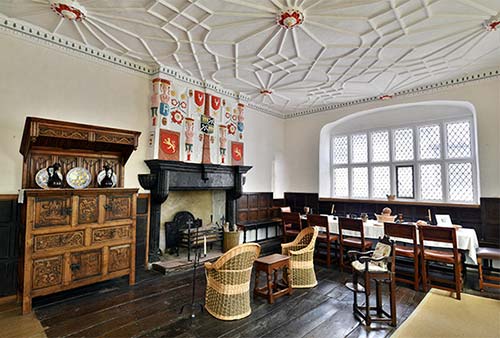
Guests stepping into the house in the 16th century were wowed by the heraldry over the fireplace. This symbol, now repainted in its original bright colors, proclaimed the family’s rich lineage and princely stock. The kitchen came with all the circa-1600 conveniences: hay on the floor to add a little warmth and soak up spills, a hanging bread cage to keep food safe from wandering critters, and a good supply of fresh meat in the pantry. Inside the parlor, an interactive display lets you take a closer virtual look at the different parts of the house. The brewhouse is where the family made their own ale.
Upstairs, the lady of the house’s bedroom doubled as a sitting room—with a finely carved four-poster bed and a foot warmer by the chair. At night, the bedroom’s curtains were drawn to keep in warmth. In the great chamber next door, hearty evening feasting was followed by boisterous gaming, dancing, and music. And fixed above all this extravagant entertainment was...more heraldry, pronouncing those important—if unproven—family connections, and leaving a powerful impact on impressed guests. On the same floor is a well-done exhibit on health and hygiene in medieval Britain—you’ll be grateful you were born a few centuries later.
In the attic, you can see the original roofline, servants’ quarters, and a tiny cat door. Heading back down one level, you can climb the many stairs to the top of the tower for peek-a-boo views (views from the castle and town wall are better).
St. Mary’s Parish Church
Sitting lonely in the town center, Conwy’s church was the centerpiece of a Cistercian abbey that stood here a century before the town or castle. The Cistercians were French monks who built their abbeys in places “far from the haunts of man.” Popular here because they were French—that is, not English—the Cistercians taught locals farming and mussel-gathering techniques. Edward moved the monks 12 miles upstream but kept the church for his town. Volunteers are usually on hand, and love sharing interesting details about the church and its history.
Out in the churchyard, find the tombstone of a survivor of the 1805 Battle of Trafalgar who died in 1860 (two feet left of the north transept). On the other side of the church, a tomb containing seven brothers and sisters is marked “We Are Seven.” It inspired William Wordsworth, who often vacationed here, to write his poem of the same name. The slate tombstones look new even though many are hundreds of years old; slate weathers better than marble.
Cost and Hours: Free; church generally open Tue-Sat 11:00-15:00, closed Sun-Mon—though on Sun you can try visiting before or after the services at 11:00; caruconwy.com.
JUST BEYOND CONWY
Conwy Mountain Hikes
For lovely views across the bay to Llandudno, take a pleasant walk (50 minutes one-way) along the footpath up Conwy Mountain (follow Sychnant Pass Road past the recommended Bryn B&B, look for fields on the right and a sign with a stick figure of a walker).
For an even more satisfying, extended version of this hike, begin at the top of the pass. Drivers should look for the pullout on the left with hiking signs, just past the Pensychnant Conservation Centre. Or, so that you don’t have to backtrack to fetch your car later, take a taxi or bum a ride from a friendly local (such as your B&B host). From the parking lot, it’s about an hour-long walk along a lovely ridgeline with gorgeous 360-degree views. After about 10 minutes, the official Wales Coast Path veers to the right; at this point, bear left and follow the gravel path over the peaks for a higher vantage point. Eventually you’ll rejoin the official path and pop out into the suburbs of Conwy. The hike is easy to moderate, with a bit of steep climbing up and down on loose-gravel trails.
Llandudno
This genteel Victorian beach resort, a few miles away, is much bigger and better known than Conwy. It was built after the advent of railroads, which made the Welsh seacoast easily accessible to the English industrial heartland. In the 1800s, the notion that bathing in seawater was good for your health was trendy and the bracing sea air was just what the doctor ordered. These days, Llandudno remains popular with the English, but you won’t see many other foreigners strolling its long pleasure pier and line of old-time hotels. If the weather is nice, it’s worth checking out if only to see how middle-class Brits like to holiday (you can reach it by public bus #5; City Sightseeing’s hop-on, hop-off bus; or via train on the Conwy Valley Line).
Nightlife in Conwy
No one goes to Conwy for wild nightlife. But you will find some typically Welsh diversions here.
To sample local brews, including some made in Conwy, head to The Albion. Managed by a coalition of four local breweries, The Albion has real ales and a fun communal pub atmosphere (daily, Upper Gate Street, +44 1492 582 484). A stone’s throw away down a little alley is Tapps, in a converted ice cream factory, which offers two dozen local and international beers in a relaxed and bohemian atmosphere (closed Mon-Tue).
Bank of Conwy is a bustling bar that prides itself on its wide selection of craft beers, wine, and creative cocktails, served in the remnants of the old bank’s interior (including the vault downstairs). Sometimes there’s live music, most often on Wednesday nights (daily, Lancaster Square, +44 1492 573 741).
Vinomondo sells local wines (including from nearby Gwinllan Vineyard on the opposite side of the river), which you can sample in their quirky wine garden and upstairs bar room (Mon-Thu and Sun until 18:00, Fri-Sat until late, 19 High Street, +44 1492 573 050).
Near Conwy: For an authentic Welsh experience, catch a performance of the local choir. Some churches in Llandudno hold choir concerts in summer (ask at the Conwy TI). The Maelgwn men’s choir from nearby Llandudno Junction rehearses weekly, and visitors are welcome to watch (free, Mon 19:30-21:00 except Aug, call ahead or check website to confirm, at Capel-y-Rhos, Llannerch Road East, Llandrillo-yn-Rhos, +44 1492 580 272, cormaelgwn.cymru).
Llandudno also has the beach fun you’d expect at a Coney Island-type coastal resort.
Sleeping in Conwy
Conwy still has plenty of classic, welcoming B&Bs and good-value gems. Many of my recommended places have free parking (ask when booking). The closest launderette is in Llandudno Junction, but some B&Bs offer laundry service (it may be more expensive but worth saving a trip across the river).
INSIDE CONWY’S WALLED OLD TOWN
Note that on summer weekends, bar-hoppers and revelers can make the Old Town a bit noisy: Ask for a quieter room or pack earplugs.
£££ Gwynfryn B&B is located dead center in town, a few steps off Lancaster Square. The four rooms in their main house are bright and airy, each with eclectic decor. In the old chapel next door, they’ve converted the vestry into four simple but well-designed and comfortable rooms. For a splurge, the chapel loft has three luxurious rooms with four-poster beds made from chapel pews and claw-foot tubs. The main part of the church, with pews and a big organ looming overhead, is now a striking breakfast room in the morning and excellent restaurant some evenings (no kids in main rooms, self-catering cottage for 4 is ideal for families; restaurant open Thu-Sat for dinner, Sun lunch only, live music some nights—hiddenchapelconwy.co.uk; 4 York Place, on the lane off Lancaster Square, +44 7947 272 821, gwynfrynbandb.co.uk, info@gwynfrynbandb.co.uk, energetic Monica and Colin).
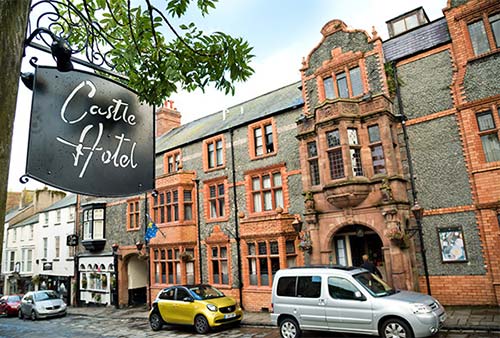
£££ Castle Hotel, along the main drag, rents 30 comfortable rooms where Old World antique furnishings mingle in a 500-year-old building with modern amenities. The recommended restaurant is located inside the hotel (RS%, High Street, +44 1492 582 800, castlewales.co.uk, castle@innmail.co.uk, Joe Lavin).
£££ The Erskine Arms rents 10 clean and elegant rooms above their classy gastropub, as well as 11 bright and airy rooms (two with balconies, family rooms available) across the street in Y Capel, a converted chapel. They take pride in their traditional Welsh touches, from wool blankets to a rotating selection of lamb dishes in their restaurant (parking spots available for Y Capel rooms, limited spots for pub rooms—ask for advice in advance; Rose Hill Street, +44 1492 593 535, erskinearms.co.uk, info@erskinearms.co.uk).
£ Number 18 is a spunky place hiding in plain sight just a half-block from the train station. Each of the four rooms—most with castle views—is wildly decorated in bright colors, loud wallpaper, or playful art. Their spacious lounge, filled with mementos from the owners’ travels, shows off their design backgrounds (breakfast baskets provided in room, laundry service, no on-site parking, no kids, closed Dec-Feb, +44 1492 584 356, boutiquebandbconwy.co.uk, cyfnant1@gmail.com, friendly Melissa and John).
BEYOND THE OLD TOWN
Just Outside the Wall
These options are just a few paces from Conwy’s old town wall.
££ Bryn B&B offers four large, tastefully decorated rooms (and one small one) with castle or mountain views in a big 19th-century house with the city wall literally in the backyard. Owners Anne and Neil run the place with style, providing all the thoughtful touches—a library of regional guides and maps, a glorious garden, award-winning homemade marmalade, and a very warm welcome (ground-floor room available, on-site self-catering cottage ideal for families, private parking, just outside Upper Gate of wall on Sychnant Pass Road, +44 1492 592 449, bryn.org.uk, stay@bryn.org.uk).
£ Castlebank Hotel feels old-time plush, with eight exuberantly decorated rooms (some quite spacious), a small bar, lots of outdoor seating in the garden, and an inviting lounge with a wood-burning fireplace that makes the Welsh winter warmer (family rooms—request in advance, easy free parking, 2-night minimum, closed first 3 weeks in Jan, just outside town wall at Mount Pleasant, +44 1492 593 888, castlebankhotel.co.uk, reservations@castlebankhotel.co.uk, charming Jo and Henrique).
Farther Out
The first two places, both good-value options with free parking, share a building overlooking Llanrwst Road on the way to Betws-y-Coed, about a 10-minute walk from the center. Both require lots of steep stairs just to reach the front door.
££ Bryn Derwen Guest House rents six modern rooms that feel cheery and tidy. Friendly Andrew and Gill serve you breakfast with a view overlooking the garden (no children under 17, +44 1492 596 134, conwybrynderwen.co.uk, info@conwybrynderwen.co.uk).
££ Glan Heulog B&B offers four bright rooms, two offering stunning views overlooking the rolling green hills. Relax in their pleasant, enclosed sun porch (two rooms could accommodate families—ask in advance; discounts for booking on their website—two-night minimum, laundry service, +44 1492 593 845, conwybandb.co.uk, stay@conwy-bedandbreakfast.co.uk; Chris, Jenny, and Becky).
¢ Conwy Hostel, welcoming travelers of any age, has super views from all the rooms and a spacious garden. The airy dining hall and glorious rooftop lounge and deck make you feel like you’re in the majestic midst of Wales (private rooms, breakfast extra, dinner, bar, elevator, free parking, check-in 17:00-22:00, Sychnant Pass Road in Larkhill, +44 345 371 9732, yha.org.uk, conwy@yha.org.uk). It’s a 10-minute uphill walk from the Upper Gate of Conwy’s wall.
Eating in Conwy
RESTAURANTS IN THE WALLED OLD TOWN
For a small town, Conwy has an impressive array of good restaurants. Reserve ahead in summer, especially on Friday or Saturday night, and on Monday and Tuesday when options are limited.
££££ The Jackdaw, which takes its name from the crow-like bird that nests in the town walls (and the nickname for locals who live within the walls), is the place for a truly special North Wales dining experience. Chef Nick Rudge, who trained under a Michelin-starred chef, shows off the finest Welsh ingredients from the land and the sea (you’ll even sit comfortably on a Welsh sheepskin blanket). It’s up a stairway across from the Castle Hotel (look for the little jackdaw sign)—a nondescript door opens up into a wonderous culinary adventure (tasting menu only; daily for dinner—seatings at 19:00 and 19:15 only, also lunch Fri-Sat, reservations required, High Street, +44 thejackdawconwy.co.uk).
£££ The Erskine Arms, at the top of Rose Hill Street, has a modern lodge-like setting with high-quality food, including a few Welsh specialties (any dish with lamb is a hit). Their lively little lower bar is fun for a pre-dinner drink (daily, Rose Hill Street, +44 1492 593 535).
£££ Dylan’s is a classy, modern place on High Street, with a smaller, cozy downstairs space and an even better airy upstairs dining room with great views of the castle and fun nautical design elements. Their food features locally sourced ingredients, and it’s a great place to try the local mussels. You can also assemble a picnic or get some local specialties to take home from their adjacent general store (daily, 11 High Street, +44 1492 702 654, dylansrestaurant.co.uk).
£££ The Peppermill, tucked away on Chapel Street, serves well-executed classics in a warm wood-floor-and-exposed-beam setting. The menu is small but packs a punch, and the friendly staff makes you feel at home (Wed-Sat dinner only, Sun lunch only, closed Mon-Tue, +44 1492 709 243).
£££ Castle Hotel Restaurant, in the recommended Castle Hotel, serves inventive fish and meat dishes using quality ingredients, in addition to some vegetarian and vegan options. The same menu is served in both the dressy restaurant (reservations recommended) and the more casual bar (daily, afternoon tea daily from 14:00-17:00—reserve in advance; High Street, +44 1492 582 800, castlewales.co.uk).
££ Alfredo’s Restaurant, a thriving and family-friendly place right on Lancaster Square, has been serving quality Italian food at reasonable prices for over 60 years (closed Sun, 9 Lancaster Square, +44 1492 592 381).
£ L’s Coffee & Bookshop, dead center on the main drag, is a friendly café serving light bites either in their cozy front room or in the tea garden out back (breakfast served, Tue-Sun until 16:30, closed Mon, 7 High Street, +44 1492 596 661).
£ Johnny Dough’s Pizza is a popular spot for inexpensive wood-fired pizza (closed Mon-Tue, Rose Hill Street, +44 1492 817 111).
TAKEAWAY AND PICNICS
£ Edwards of Conwy, a well-respected butcher right on High Street, has a deli counter serving top-quality and affordably priced meals to go, including hot or cold sandwiches and curries (Mon-Sat until 17:30, closed Sun, 18 High Street, +44 1492 581 111).
The Spar grocery is conveniently located and well stocked (long hours daily, 15 High Street, +44 1492 592 466).
£ Fish-and-Chips: At the bottom of High Street, on the intersecting Castle Street, is Fisherman’s (Mon-Fri until 19:00, Sat-Sun until 19:30, small sit-down area, +44 1492 593 792). Archway Fish & Chips, at the top of town just inside Bangor Gate, is open later and has both a restaurant and takeaway service (daily, 12 Bangor Road, +44 1492 592 458). Consider taking your fish-and-chips down to the harbor (but beware of aggressive seagulls).
Sweets: With some of the best ice cream I’ve enjoyed in Britain, Parisella’s of Conwy offers some unusual flavors. They have locations on High Street and along the harborfront (both typically daily until 21:00 in summer). Near Lancaster Square, Baravelli’s makes top-end chocolates that have earned a national reputation (Tue-Sat until 17:00, closed Sun-Mon, 13 Bangor Road, +44 1492 330 540).
Conwy Connections
There’s no ticket machine on the Conwy platform; book tickets at tfw.wales or on the Transport for Wales (TFW) app. Overhead screens at the station show the next departure. For more frequent trains, go to Llandudno Junction (see “Arrival in Conwy,” earlier). For buses, see traveline.cymru. All connections are less frequent on Sundays.
From Conwy by Bus to: Llandudno Junction (4/hour Mon-Sat, hourly Sun, 10 minutes, bus #5 on Castle Street; continues to Llandudno), Caernarfon (2/hour, 1.5 hours, transfer in Bangor, catch #5 from Conwy outside train station), Betws-y-Coed (4-6/day, 45 minutes, bus #19 on Castle Street).
From Conwy by Train (all nearly hourly) to: Llandudno Junction (5 minutes), Chester (1 hour), Holyhead (1 hour), Llangollen (2 hours; take train to Ruabon, then change to bus #5), London’s Euston Station (3.5 hours, transfer in Chester).
From Llandudno Junction by Train to the Conwy Valley: The scenic little Conwy Valley line runs up the Conwy Valley to Betws-y-Coed and Blaenau Ffestiniog (5/day Mon-Sat, 4/day on Sun, 30 minutes to Betws-y-Coed, 1 hour to Blaenau Ffestiniog; book via tfw.wales or TFW app).
From Llandudno Junction by Train to: Chester (2-3/hour, 1 hour), Birmingham (hourly direct, 2 hours, more with transfers, nationalrail.co.uk), London’s Euston Station (5/day direct, 3 hours, many more with transfers, nationalrail.co.uk).
Near Conwy
SOUTH OF CONWY
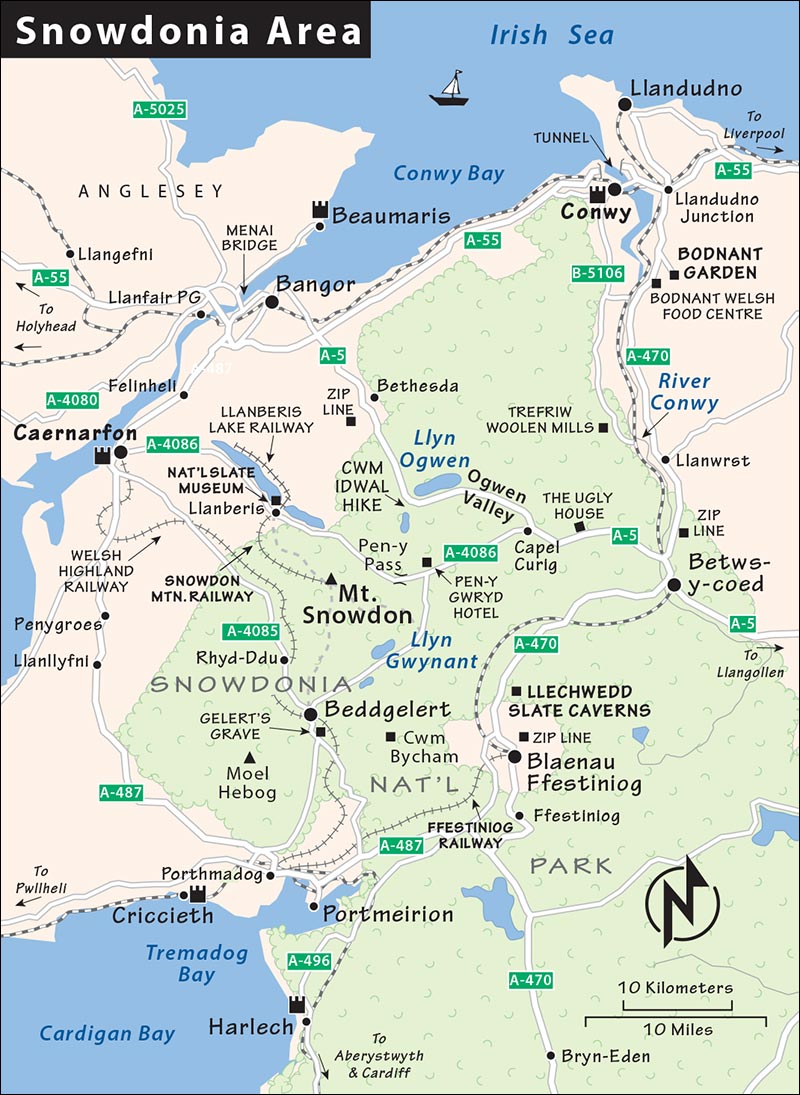
These sights are en route to Betws-y-Coed and Snowdonia National Park. Note that Bodnant Garden is on the east side of the River Conwy, on the A-470, while Trefriw is on the west side, along the B-5106 (see the “Snowdonia Area” map, later).
▲Bodnant Garden
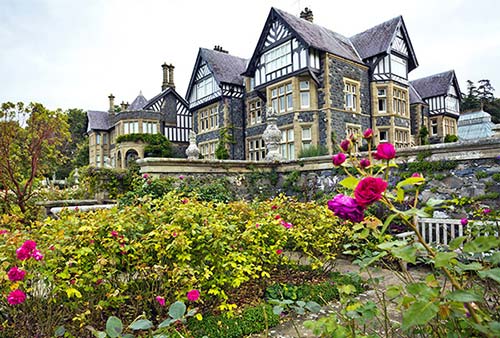
This sumptuous 80-acre display of floral color six miles south of Conwy is one of Britain’s best gardens—it’s worth ▲▲▲ for gardeners and nature lovers. Originally the private garden of the stately Bodnant Hall, this lush landscape was donated by the Aberconway family (who still live in the house) to the National Trust in 1949.
Cost and Hours: £18; daily 9:30-17:00 (Wed until 20:00 in summer), Nov-Feb daily 10:00-16:00; last entry one hour before closing, WCs across from parking lot and inside garden; best in spring, check online to see what’s blooming, guided walks sometimes available—ask when you arrive, +44 1492 650 460, nationaltrust.org.uk/bodnant-garden.
Getting There: To reach the garden by public transportation from Conwy, first go by bus, train, or on foot to Llandudno Junction. From there, then catch bus #25 (6/day, 30 minutes, direction: Eglwysbach, confirm stop with driver).
Eating: The garden has multiple cafés. Next to the car park, the Pavilion Tearoom offers locally produced wine and beer and the opportunity to have home-baked cakes and a cup of tea (daily).
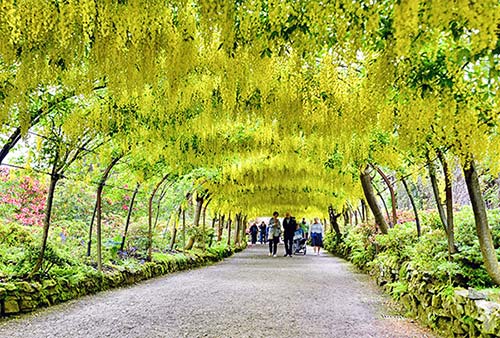
Visiting the Gardens: The map you receive upon entering helps you navigate the sprawling grounds. The highlight for many is the famous Laburnum Arch—a 180-foot-long canopy made of bright-yellow laburnum, hanging like stalactites over the heads of garden lovers who stroll beneath it (just inside the entry, blooms late May through early June).
The garden is also famous for its magnolias, rhododendrons, camellias, and roses—and for the way that the buildings of the estate complement the carefully planned landscaping—all with a backdrop of rolling hills and craggy Welsh mountains. The wild English-style plots seem to spar playfully with the more formal rose gardens along the terrace. Victorian explorers donated rare species to the owners—try to find an American redwood tree and Himalayan poppies. Consider your visit an extravagantly beautiful nature hike and walk all the way to the old mill and waterfall. If you’re going to devote substantial time to any garden in Britain, this one deserves serious consideration.
Nearby: About 1.5 miles south of Bodnant Garden off the A-470, the Bodnant Welsh Food Centre has a farm shop selling mostly food produced in Wales (along with good maps and hiking guides), a restaurant, an underwhelming tearoom, and a cooking school (Mon-Sat 9:30-17:00, Sun 10:00-16:00, +44 1492 651 100, bodnant-welshfood.co.uk).
Trefriw Woolen Mills
At Trefriw (TREV-roo), five miles north of Betws-y-Coed, you can peek into a working woolen mill. It’s surprisingly interesting if the machines are running. And even if they’re not, the cute little shop is fun to browse.
Cost and Hours: Free, shop open Mon-Sat 10:00-17:30, closed Sun, +44 1492 640 462, t-w-m.co.uk.
Getting There: It’s possible to get there by bus #19 from Conwy and Llandudno Junction (4-6/day, 30 minutes, traveline.cymru).
Visiting the Mills: A family-run business (since 1859), the mill turns British wool (and some from New Zealand) into traditional Welsh “tapestry” bedspreads, rugs, and tweeds. Watch the short video about the process, then walk through both levels of the mill. You’ll learn how a matted glob of fleece transforms into a fashionable cap or scarf through the processes of blending, carding, spinning, doubling, hanking, spanking, warping, weaving, and so on (some, but not all, machines are likely running at any one time). It’s impressive that this Rube Goldberg-type process was so ingeniously designed in an age before computers (mostly the 1950s and 1960s)—each machine seems to “know” how to do its rattling, clattering duty with amazing precision.
The whole complex creates its own hydroelectric power; the “turbine house” lets you glance at enormous, fiercely spinning turbines dating from the 1930s and 1940s, powered by streams that flow down the hillside above the mill. You may also be able to watch the weaving looms, with bobbin-loaded shuttles flying to and fro, to see a bedspread being created. Peruse the finished products in the shop.
ISLE OF ANGLESEY
The huge Isle of Anglesey (“Ynys Môn” in Welsh) looms just offshore, about a 30-minute drive west from Conwy (connected by bridge to the mainland), and a short detour from the route to Caernarfon. While Anglesey—and its port-town Holyhead—is known primarily as the jumping-off point for ferries to Dublin (see “North Wales Connections,” at the end of this chapter), from a sightseeing perspective it has one real sight: Beaumaris Castle.
Menai Suspension Bridge
The Isle of Anglesey is connected to the mainland by one of the engineering marvels of its day, the Menai Suspension Bridge. With the Act of Union of 1800, London needed to be better connected to Dublin. And, as the economy of the island of Anglesey was mainly cattle farming (cows had to literally swim the Straits of Menai to get to market), there was a local need for this bridge. Designed by Thomas Telford and finished in 1826, at 580 feet it was the longest bridge of that era. It was built to be 100 feet above sea level at high tide—high enough to let Royal Navy ships sail beneath. When it opened, the bridge cut the travel time from London to Holyhead from 36 to 27 hours. Most drivers today take the modern A-55 highway bridge, but the historic bridge still handles local traffic (on the A-5).
Beaumaris
This charming town originated, like other castle towns, as an English “green zone” in the 13th century, surrounded by Welsh guerrillas. Today, it feels workaday Welsh, with a fine harborfront, a simple pleasure pier (advertising boat trips around the bird sanctuary at Puffin Island), lots of colorful shops and eateries, a mothballed Victorian prison (now a museum), and the remains of an idyllic castle. A fine little picnic-and-playground area is tucked right against the castle wall.
Beaumaris’ small, simple TI is staffed entirely by volunteers, and is stocked with helpful maps and brochures, even if no one’s there to answer questions (hours vary, in the Town Hall on Castle Street, next to the Buckeley Hotel, visitanglesey.co.uk [URL inactive]).
Getting There: If driving, simply follow signs for Holyhead. Immediately after crossing the big bridge onto the island, take the small coastal A-545 highway for 10 lovely minutes into Beaumaris. There’s a vast pay lot at the point just beyond the end of town (and the castle).
▲Beaumaris Castle
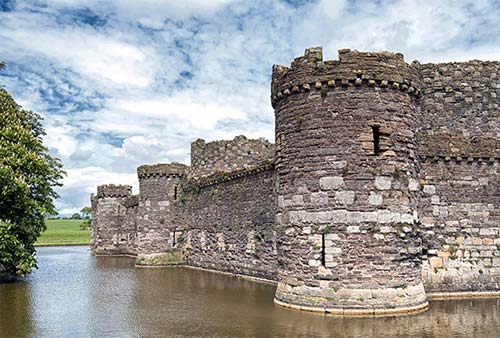
Begun in 1295, Beaumaris was the last link in King Edward’s “Iron Chain” of castles to enclose Gwynedd, the rebellious former kingdom of North Wales. The site has no natural geological constraints like those that encumbered the castle designers at Caernarfon and Conwy, so its wall-within-a-wall design is almost perfectly concentric. If completed, the result would have been one of Britain’s most beautiful castles, and medieval castle engineering at its best—four rings of defense, a moat, and a fortified dock. But problems in Scotland changed the king’s priorities, construction stopped in 1330, and the castle was never finished. Today it looks ruined (and rather squat), but it was never ransacked or destroyed—it’s simply unfinished. The site was overgrown until the last century, but now it’s been uncovered and cleaned up to act as a park, with pristine lawns and a classic moat. Because it’s harder to get here than the big, famous castles in Conwy and Caernarfon, it’s less crowded—making your visit more enjoyable. In the south gatehouse (near where you enter), you can watch a brief film about the castle’s history. The rest is mostly unexplained, with a few small information plaques and several hands-on activities for kids.
Cost and Hours: £10; daily 9:30-17:00, July-Aug until 18:00, Nov-Feb 10:00-16:00; +44 3000 252 239, cadw.gov.wales [URL inactive].
Beaumaris Gaol
The jail opened in 1829 prompted by new laws designed to give prisoners more humane treatment; it remained in use until 1878. Under this “modern” ethic, inmates had their own cells, women prisoners were kept separate and attended by female guards, and prisoners worked to pay for their keep rather than suffer from jailers bilking their families for favors. This new standard of incarceration is the subject of this museum, where you’ll see the prisoners’ quarters, work yard, punishment cells, whipping rack, treadmill, and chapel. Explanations in most rooms give context as you explore the old space. (Ruthin has a similar but more engaging prison exhibit—described later.)
Cost and Hours: £8; daily 10:00-17:00, winter until 16:00, last entry one hour before closing, guided tours sometimes offered—call in advance; to reach the jail, head down the main street from the castle, go right on Steeple Lane, then left on Bunkers Hill; +44 1248 810 921.
Wildlife Cruises
Starida operates a fine Wildlife Cruise from Beaumaris (£19, multiple trips daily Easter-Oct—weather permitting, 75 minutes). You’ll sail to Puffin Island to see puffins (usually from April-late July), cormorants, gray seals, and more. A crew of experienced locals provides helpful commentary. If you have time, opt for the Extended Cruise, combining the Wildlife Cruise with sightseeing along the Menai Strait (£30, 1-2/week mid-July-early Sept, 2.5 hours; +44 1248 810 379, starida.co.uk, book@starida.co.uk). They also offer fishing trips.
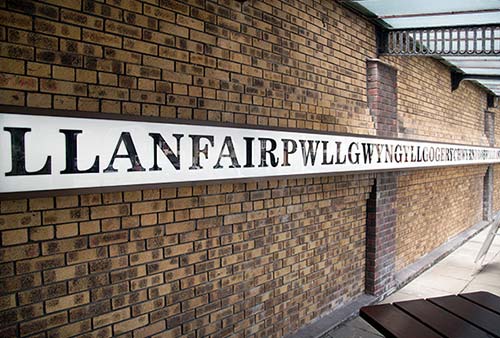
Llanfairpwllgwyngyllgogerychwyrndrobwllllan-tysiliogogogoch
Proud owner of the second-longest place name in the world, this village is called Llanfair Pwllgwyngyll for short. To reach it, take the first exit after crossing the A-55 bridge—it’s well marked. Follow the A-5, which leads past a Volvo dealership with a very long sign, to the train station, a popular place to take photos of the platform sign. The town itself is otherwise wholly unexceptional—but the “long name” gimmick is a huge draw for visitors. Next to the train station is the James Pringle Weavers shop, a souvenir superstore catering to big-bus tours. (You can ask nicely inside if they’ll stamp your passport—or anything, really—with the village name.) It’s tacky, but fun to see such a fuss made over a town name, and it’s an easy detour from Beaumaris.
Caernarfon
The small, salty town of Caernarfon (kah-NAR-von) is famous for its striking castle—the place where the Prince of Wales is “invested” (given his title). Like Conwy, it has an Edward I garrison town marching out from the castle; it still follows the original medieval grid plan laid within its well-preserved ramparts.
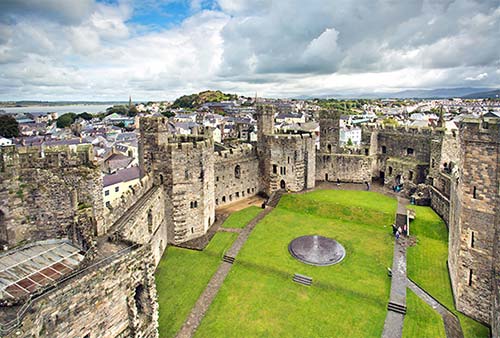
Caernarfon is mostly a 19th-century town. In those days, the most important thing in town wasn’t the castle or the adjacent walled town, but the seafront that sprawled below the castle (now a parking lot). This was once a booming slate port, shipping tidy bundles of the rock from North Wales mining towns to roofs all over Europe.
The statue of local boy David Lloyd George looks over the town square. A member of Parliament from 1890 to 1945, he was the most important politician Wales ever sent to London, and ultimately became Britain’s prime minister during the last years of World War I. Young Lloyd George began his career as a noisy nonconformist Liberal advocating Welsh rights. He ended up an eloquent spokesperson for the nation of Great Britain, convincing his slate-mining constituents that only as part of the Union would their industry boom.
Caernarfon bustles with shops, cafés, and people happy to strike up a conversation. It’s fun to explore—but compared to Conwy, it’s noticeably scruffier (it experienced a heavy economic decline following the collapse of the mining industry). Locals, who seem self-conscious about their rival town, told me, “We’re poor cousins to Conwy.” But the town plods along, seemingly disinterested in sucking up to the tourist crowds. It’s a good place to get a feel for workaday Welsh life. And it’s a good jumping-off point for the Welsh Highland Railway and sights south of Snowdonia (especially for those without a car, as bus service from here is more convenient than Conwy).
Orientation to Caernarfon
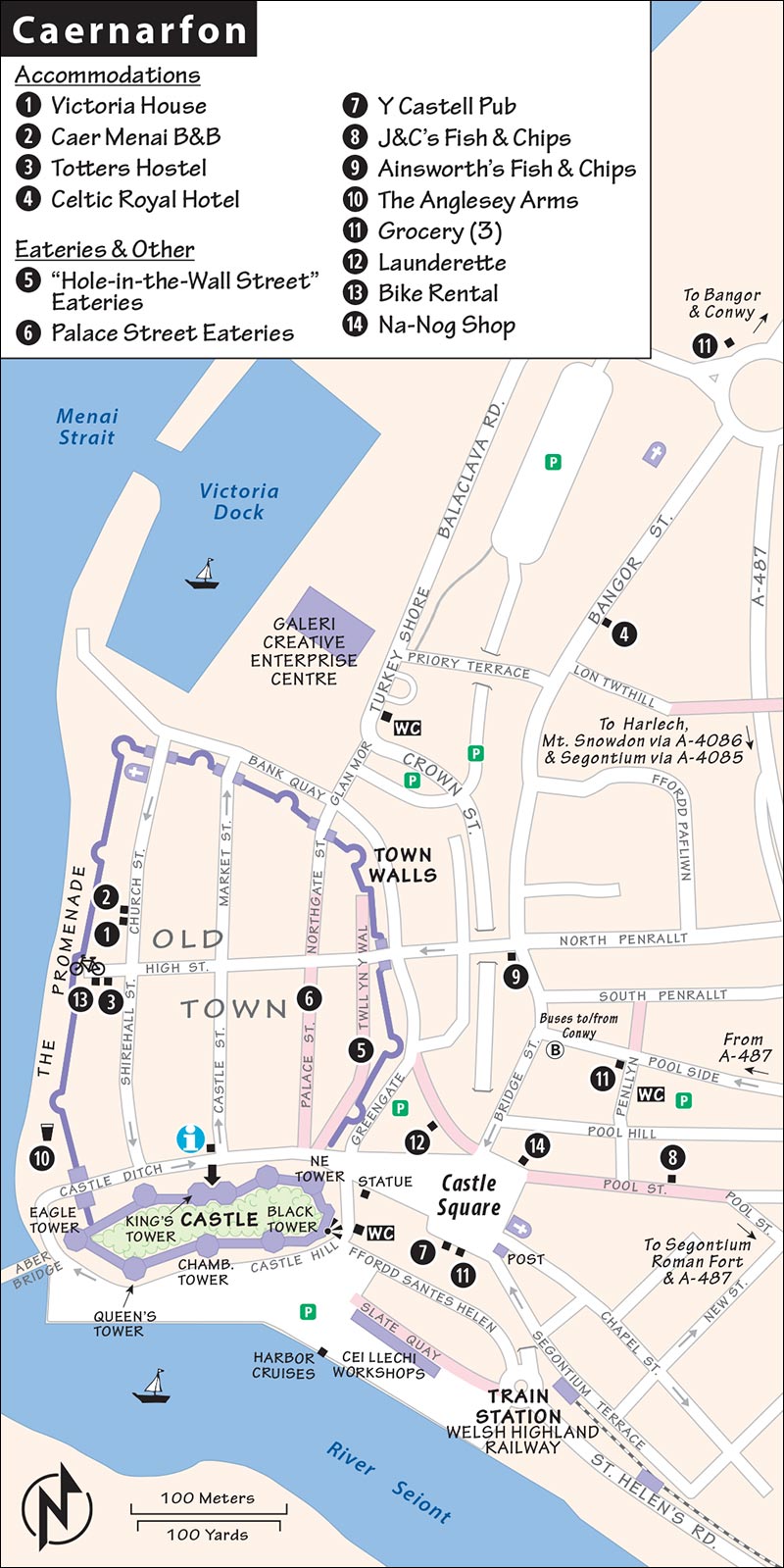
The small walled old town of Caernarfon (pop. 10,000) spreads out from its waterfront castle, its outer flanks fringed with modern sprawl. The castle fronts the main square, called Castle Square (“Y Maes” in Welsh). Public WCs are off the main square, on the road down to the riverfront and parking lot.
ARRIVAL IN CAERNARFON
If you arrive by bus, walk straight ahead up to the corner at Bridge Street, turn left, and walk two short blocks until you hit the main square and the castle. Drivers can park in the big lot along the riverfront quay below the castle; other pay parking lots fill the moat-like area along Greengate Street. If lots in the center are full (or you prefer to park on the outskirts and avoid traffic), there’s a big pay lot below the Morrisons Supermarket, near Victoria Dock.
HELPFUL HINTS
- Tourist Information: A small tourist information office is open a few days a week in summer, across the street from the castle entrance (typically open Thu-Sat 10:00-14:00, +44 1286 672 232, Castle Street).
- Market Day: Caernarfon’s big main square hosts a market of varying size on Saturdays year-round and Mondays in summer (better in summer).
- Laundry: Centrally located Pete’s Launderette hides at the end of Skinner Street, a narrow lane branching off the main square (same-day full service sometimes available, closed Sun, +44 1286 678 395, Pete and Monica).
- Bike Rental: Get good wheels and touring advice at Beics Antur Bikes, at the waterfront end of High Street (closed Sat-Sun, Porth Yr Aur High Street, +44 1286 672 622, beicsantur.cymru). One of their suggested routes is 12 miles down an old train track—now a bike path—through five villages to Bryncir (near Porthmadog) and back (figure 4 hours for the 24-mile round-trip).
- Harbor Cruise: Narrated cruises on the Queen of the Sea run daily in summer (£15; May-Oct 3-6/day—depending on weather, tides, and demand; 45 minutes, castle views, +44 7979 593 483, menaicruises.co.uk).
- Welsh Choir: If you’re spending a Tuesday night here, you can attend the weekly practice of the local men’s choir (Tue at 19:30 in Galeri Creative Enterprise Centre at Victoria Dock, no practice in Aug, arrive by 19:15 in summer—practices can be crowded; just outside the old town walls, +44 1286 675 333, cormeibioncaernarfon.org).
- A Taste of Wales: For a store selling all things Welsh—books, movies, music, and more—check out Na-Nog on the main square (closed Sun, 16 Castle Square, +44 1286 676 946).
- Horseback Riding: To ride a pony or horse, try Snowdonia Riding Stables (must book in advance, 3 miles from Caernarfon, off the road to Beddgelert, bus #S3 from Caernarfon, +44 1286 479 435, snowdoniaridingstables.co.uk).
Sights in Caernarfon
▲▲Caernarfon Castle
Edward I built this mighty castle 700 years ago to establish English rule over North Wales. Rather than being purely defensive, it also had elements of a palace—where Edward and his family could stay on visits to Wales. Modeled after the striped, angular walls of ancient Constantinople, the castle, though impressive, was never finished and never really used. From the inner courtyard, you can see the notched walls ready for more walls—which were never built.
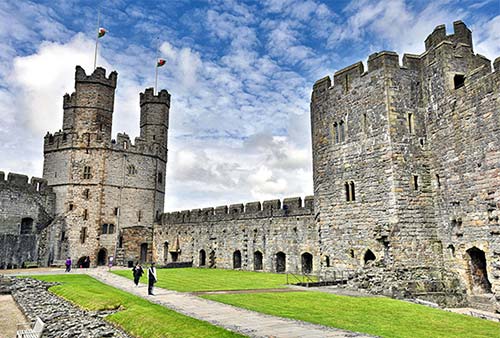
The castle’s fame derives from its physical grandeur and its association with the Prince of Wales. Edward got the angry Welsh to agree that if he presented them with “a prince, born in Wales, who spoke not a word of English,” they would submit to the Crown. In time, Edward had a son born in Wales (here in Caernarfon), who spoke not a word of English, Welsh, or any other language—as an infant. In modern times, as another political maneuver, the Prince of Wales has been “invested” (given his title) here. This “tradition” actually dates only from the 20th century, and only two of the 21 Princes of Wales (King Charles III and King Edward VIII) have taken part.
Cost and Hours: £14.50; daily 9:30-17:00, July-Aug until 18:00; Nov-Feb 10:00-16:00; skip the worthless audioguide; +44 3000 252 239, cadw.gov.wales [URL inactive].
Visiting the Castle: Enter through the King’s Tower (on Castle Ditch Road) and into the courtyard. The castle suggests a clockwise route starting from the Northeast Tower, directly to the left as you emerge from the ticket desk. There, an eight-minute video gives an overview of the castle’s history. The stairs in this tower lead to...not much. Save your legs for some climbing later.
Heading clockwise, detour left onto the Queen’s Gate platform, with good views of the town square and the river, where then-Prince Charles addressed the crowd moments after his royal investiture. Head back out and enter the Black Tower, which has a small exhibit that psychoanalyzes Edward’s decision to build such an important castle here—a decision, some believe, that was rooted in a legend of a Roman emperor who dreamed of marrying a Welsh princess...and then did.
The Chamberlain’s Tower and Queen’s Tower house the mildly interesting Museum of the Royal Welsh Fusiliers—a military branch made up entirely of Welshmen. First, in the Chamberlain’s Tower, you can watch a short video, then check out an impressive room full of military medals. The museum, in the Queen’s Tower, has three floors of firearms and other weapons, uniforms (even some you can try on), and information about various British battles, along with a stuffed “royal goat.” When you reach the bottom level, don’t exit here—instead, retrace your steps back to castle-ground level.
Back in the courtyard, enter the huge Eagle Tower for the “Princes of Wales” exhibit, featuring a chessboard of Welsh and English princes as life-size chess pieces. There’s also a model of the original castle and a video from the investiture of Prince Charles in 1969. The next level’s skimpy exhibit covers the life of Eleanor of Castile, wife of Edward I. Continue up the tower for a great view of the Menai Strait and the Irish Sea, then return back to Eleanor’s level and head out along the ramparts, which eventually lead (with a little weaving and up and down) to the King’s Gate.
This final tower was refurbished with an elevator and a nice viewing platform. There’s also an evocative contemporary sculpture of Edward I’s head...a metaphor for how the Welsh truly feel about the bloodthirsty king, who left behind a lot of mighty castles but not a speck of goodwill. Also notice the patterns in the glass floor, representing what a 13th-century tiled floor might have looked like had there been one here.
Cei Llechi (Slate Quay)
This stretch of repurposed buildings along the harborfront hosts galleries, artisan workshops, and cafés. The main building, the old Harbor Trust Office dating to the mid-19th century, hosts a good little exhibit on how the town’s port and rail line contributed to the slate industry in northwest Wales becoming the largest in the world.
Narrow-Gauge Steam Train
The Welsh Highland Railway steam trains billow scenically through the countryside south from Caernarfon along the original line that served a slate quarry, crossing the flanks of Mount Snowdon en route. While steam-train enthusiasts will want to ride all the way to Porthmadog and back, the trip to Beddgelert hits the best scenery. A round-trip to Beddgelert includes 1.5 hours to check out the town, enough to wander around and grab a quick bite to eat. To spend more time in this cute town (or simply for a faster, cheaper trip back), ride the train one-way and catch bus #S3 back to Caernarfon.
Cost and Hours: All trains run approximately April-Oct. Caernarfon-Beddgelert—£56.50 round-trip, generally Mon, Wed, Fri, Sun, 1.5 hours each way; Caernarfon-Porthmadog—£69.50 round-trip, Tue, Thu, Sat, 2.5 hours each way; Porthmadog-Blaenau Ffestiniog—£49.50 round-trip, 1-2/day, 1.25 hours each way, 45-minute break in Blaenau for round-trip journeys; “gold” upgrade available for all trains, with travel in plush first-class Pullman carriage; +44 1766 516 024, festrail.co.uk.
Buying Tickets: One-way train tickets are about half the cost of round-trip ones and can be purchased the same day at the station (one car is always reserved strictly for one-way passengers, which never fills up). For a round-trip journey, book well in advance. Trains run in different directions on different days, but check online before your trip and plan accordingly (the year’s schedules are typically set in spring).
Segontium Roman Fort
Dating from AD 77, this ruin is the westernmost Roman fort in Britain. It was manned for more than 300 years to keep the Welsh and the coast quiet. Little is left but foundations (the stone was plundered to help build Edward I’s castle at Caernarfon), and any artifacts that are found end up in Cardiff. This is only worth seeing if you have an unusual appetite for the footprints of Roman buildings (free, gate generally unlocked daily 10:00-16:00, 15-minute walk from town, atop a hill on the A-4085—drivers follow signs to Beddgelert).
Sleeping in Caernarfon
These choices line a cozy, sleepy, narrow street just inside the town’s seawall—you can’t get more central.
£ Victoria House rents four airy, fresh, large-for-Britain rooms, including one with a sea view. The pleasant, woody guest lounge is well stocked with a TV, books, and games, and a complimentary drink is offered upon arrival. Stairs from the courtyard lead to the top of the castle wall for a fine view (laundry service, free parking, no kids, 13 Church Street, +44 774 809 8928, victoriahouse.wales, janbaker2014@gmail.com, friendly Jan Baker).
£ Caer Menai B&B (“Fort of the Menai Strait”) rents eight modern, classy-for-the-price rooms (try requesting the one seaview room, free parking, 15 Church Street, +44 1286 672 612, caermenai.co.uk, info@caermenai.co.uk, Neil and Anthony).
¢ Totters Hostel, a hostel in name only, is a homey little place run by Bob and Henryette. All rooms are private, including some in a building across the street (family rooms, includes continental breakfast, inviting living room, 2 High Street, +44 1286 672 963, totters.co.uk but reservations via Booking.com preferred).
Hotels: If you’re looking for a bigger hotel farther out, try the ££ Celtic Royal Hotel, which rents 110 large, comfortable rooms and includes two restaurants (one with live music some nights), as well as a gym, pool, hot tub, and sauna; some top-floor rooms have castle views. Its grand, old-fashioned look comes with modern-day conveniences (on Bangor Street, +44 1286 674 477, celtic-royal.co.uk, reservations@celtic-royal.co.uk). Cheaper options include Caernarfon’s branches of Premier Inn (premierinn.com) or Travelodge (travelodge.co.uk).
Eating in Caernarfon
The streets near Caernarfon’s castle teem with inviting eateries. The lineup seems to change often; rather than recommending specifics, here are some streets worth browsing.
In the Old Town: The trendy “Hole-in-the-Wall Street” (just inside the back wall of town) is lined with several charming cafés and bistros. Palace Street, a block toward the water, also has several choices (including the well-established, extremely atmospheric, but questionably named ££ Black Boy Inn pub).
Near Castle Square: In nice weather, several places on the main square have outside tables from which you can watch the people scene while munching your toasted sandwich. ££ Y Castell, a big and bright pub inside Castle Hotel facing the square, dishes up good food. Across the square, the pedestrianized but grubby Pool Street offers a couple of budget options, including the popular £ J&C’s fish-and-chips joint (#21). A couple of blocks away, £ Ainsworth’s has arguably better fish-and-chips, but the wait can be longer (41 Bridge Street).
Along the Waterfront: The only eating or drinking place along the water, £ The Anglesey Arms is a rough old characteristic pub serving basic grub at picnic benches on the harborfront. It’s lively in the evening with darts and well-lubricated locals (Harbour Front, +44 1286 672 158).
Picnics: For groceries, there’s a small Spar supermarket on the main square, an Iceland supermarket near the bus stop, and a huge Morrisons supermarket a five-minute walk from the city center on Ffordd Y Gogledd Street.
Caernarfon Connections
Caernarfon is a handy hub for buses into Snowdonia National Park (such as to Llanberis, Beddgelert, and Betws-y-Coed). Bus info: +44 1766 771 000, traveline.cymru and sherparwyddfa.wales.
From Caernarfon by Bus to: Conwy (1-3/hour, 1.5 hours, transfer in Bangor), Llanberis (bus #S1, hourly, 25 minutes), Beddgelert (bus #S3, hourly Mon-Sat, every 2 hours Sun, 40 minutes), Betws-y-Coed (bus #S1, hourly, 1.25 hours), Blaenau Ffestiniog (6/day, 1.5 hours, 1 transfer).
The narrow-gauge steam train provides both sightseeing and transport from Caernarfon to Beddgelert (described earlier).
Snowdonia National Park
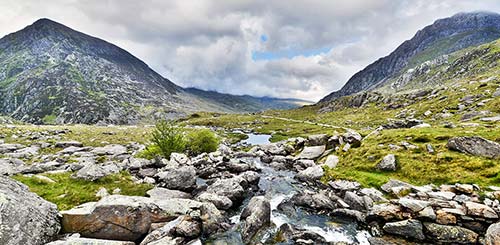
This is Britain’s second-largest national park, and its centerpiece—taller than any other mountain in Wales or England—is Mount Snowdon. (You’ll frequently see Welsh names used to identify the park—Eryri—and the mountain—Yr Wyddfa.) Each year, half a million people ascend one of six different paths to the top of the 3,560-foot mountain. Hikes take from five to seven hours; if you’re fit and the weather’s good, it’s an exciting day. Trail info abounds (local TIs sell maps and guidebooks, including the small book The Ascent of Snowdon, by E. G. Rowland, which describes the routes). Even if you’re not a hiker, the park offers plenty of cute towns and sights—and stunning scenery—to fill up a day. As you explore, notice the slate roofs—the local specialty—then visit the National Slate Museum (may be closed for renovations when you visit) and the Llechwedd Slate Caverns to learn about the up-and-down role the industry played in Welsh life. The towns of Beddgelert and Blaenau Ffestiniog are quintessentially Welsh.
Betws-y-Coed
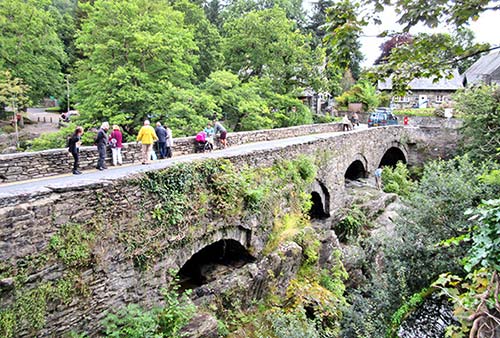
The resort center of Snowdonia National Park, Betws-y-Coed (BET-oos-uh-coyd), bursts with tour buses and souvenir shops. This picturesque town is cuddled by wooded hills, made cozy by generous trees, and situated along a striking waterfall-rippled stretch of the River Conwy. It verges on feeling overly manicured, with uniform checkerboard-stone houses yawning at each other from across a broad central green. There’s little to do here except wander along the waterfalls (don’t miss the old stone bridge—just up the river from the green—with the best waterfall views), have a snack or meal, and go for a walk in the woods.
Trains and buses arrive at the village green; with your back to the station, the TI is hidden in a pleasant stone building across the green. There’s also a short-stay pay parking lot along the green.
Tourist Information: Betws-y-Coed’s good National Park Centre/TI sells a variety of helpful maps for hiking in Snowdonia (daily 9:30-17:00, shorter hours off-season, +44 1690 710 426, snowdonia.gov.wales). They show a free 13-minute video with bird’s-eye views of the park, and you might catch some live summertime entertainment in the TI’s courtyard.
Bike Rental: Beics Betws offers both standard and e-bikes for rides through the forest (no rentals after 14:00, closed Tue, reservation required in fall and winter, on Vicarage Road, +44 1690 710 766; bikewales.co.uk).
Walks: Most of the “hikes” in Betws-y-Coed are along rivers and through woodland—certainly pleasant, but I’d rather save my time and energy for more dramatic mountain hikes. Two easy strolls in town start from Pont y Pair, just over the old stone bridge in the center of town (parking and WCs nearby), including a boardwalk stroll that runs a half-mile along the river (you’ll return the same way). Another easy and enjoyable option is the “two rivers walk,” which begins through the white gate (marked Private Road—Royal Oak Farm) just outside the TI. You’ll follow the Afon Llugwy river up to the confluence with the River Conwy, which you’ll then follow back to St. Michael’s Church and across the suspension bridge into town; most of this walk is through woods, circling the town golf course (allow about 45 minutes round-trip).
Music: St. Mary’s Church, in the middle of town, opens practice for the local men’s chorus, Cantorion Gogledd Cymru, twice a month, except in August (Sun at 14:00, cantoriongogleddcymru.co.uk). On some Sunday evenings in summer the church hosts other choruses (book ahead with the TI).
Nearby: If you drive west out of town on the A-5 (toward Beddgelert or Llanberis), after two miles you’ll pass scenic Swallow Falls, a five-minute walk from the road (limited pay parking), and, in another half-mile, The Ugly House built overnight to take advantage of a 15th-century law that let any quickie building avoid fees and taxes.
Betws-y-Coed Connections: The Conwy Valley train line connects Betws-y-Coed to Llandudno Junction near Conwy (north, 30 minutes) and Blaenau Ffestiniog (south, 30 minutes; 5/day Mon-Sat, fewer Sun in off-season; tfw.wales). Buses connect Betws-y-Coed with Conwy (bus #19, 4-6/day, 45 minutes), Llanberis (bus #S1, hourly, 45 minutes), Beddgelert (5/day, 1.5 hours; bus #S1 to Pen-y-Pass, then transfer to bus #S4 to Beddgelert), and Caernarfon (bus #S1, hourly, 1.25 hours).
▲Ogwen Valley (Dyffryn Ogwen)
Leaving Betws-y-Coed, road A-5 continues toward the village of Capel Curig. Here, most visitors peel off on the A-4086 toward Beddgelert or Llanberis, but I’d continue on A-5 through the just-as-dramatic, less touristed Ogwen Valley—a gorgeous glacial groove filled by the lake called Llyn Ogwen. The surrounding mountains are peppered with stone walls, stray sheep, and lonely farms.
One of my favorite easy-to-moderate Snowdonia hikes—called Cwm Idwal (coom-EED-wal)—begins from the pay lot at the far end of Llyn Ogwen (by a hostel, café, and small but informative visitors center). From the parking lot, follow the flagstone path that leads up to the left of the visitors center. You’ll hike about 15-20 minutes with some uphill sections (on an uneven but well-tended stone path) to the gorgeous mountain lake called Llyn Idwal, hemmed in on three sides—like a natural amphitheater—by sheer cliff walls. From here, you can either head back the way you came, or with more time, circle around the entire lake—you can go either direction but clockwise is best. About halfway around, a spur trail leads up to a closer look at the waterfalls, but only hardy hikers should try this (and it doesn’t connect back to the main path). Plan on about 45 minutes to hike to the lake and back; add another 45 minutes if circling the lake.
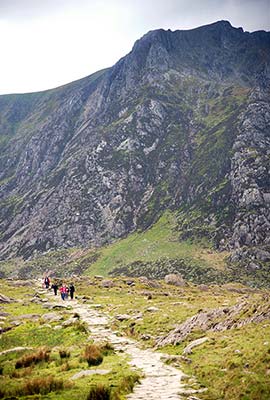
Farther along the A-5, you’ll see mountains of discarded slate before entering the blue-collar town of Bethesda, which—like Blaenau Ffestiniog—owes its existence to a now-defunct slate mine. (Also like Blaenau, there’s a zip line course that sends you soaring over all that slate, zipworld.co.uk.)
Dropping down from Bethesda, you eventually rejoin the A-55, which zips you east to Conwy or west to Caernarfon.
▲▲Beddgelert
This quintessential Snowdon village, 17 miles from Betws-y-Coed, packs a scenic mountain punch without the tourist crowds. Beddgelert (BETH-geh-lert) is a cluster of stone houses lining a babbling brook in the shadow of Mount Snowdon and her sisters. The stony homes, surrounding a stony bridge, seem to rise straight up from the Welsh landscape. (In a sense, they do.) Cute as a hobbit, Beddgelert will have you looking for The Shire around the next bend. Thanks to the fine variety of hikes from its doorstep and its decent bus service, Beddgelert is the ideal stop for those wanting to experience the peace of Snowdonia.
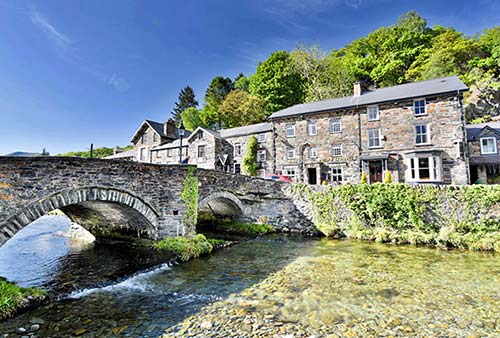
Getting There: The Welsh Highland Railway train serves Beddgelert. This narrow-gauge joyride (12 miles and 1.5 hours to or from Caernarfon) is a popular excursion (for details, see “Sights in Caernarfon,” earlier). You can ride the train one-way and return by bus (see “Beddgelert Connections,” later).
Orientation: The village doesn’t have real “sights,” but it’s a starting place for some great walks—ask locals for tips, or stop at the National Park Centre/TI (on the main road near the bus stop for Caernarfon and just downhill from the West Highland Railway station, daily 9:30-12:30 & 1:00-17:00, +44 1766 890 615, snowdonia.gov.wales). For town info, see beddgelerttourism.com.
Activities: For an easy stretch-your-legs stroll, simply take the path along the river and follow signs to “Gelert’s Grave” (Beddgelert in Welsh). In about 10 minutes, you’ll reach a small grove of trees in a field marking the spot where the 13th-century Prince Llywelyn the Great honored the dog, Gelert, who saved his infant son from a wolf attack. To extend your walk, follow the flat path beside the river until it hits the railway line, then cross the river and take the path back to town along the other side.
For a more serious hike, here are four options: Trek along the cycle path that goes from the center of Beddgelert through the forest to the village of Rhyd-Ddu (4.5 miles), walk down the river and around the hill (3 hours, 6 miles, 900-foot elevation gain, via Cwm Bycham), hike along (or around) the lake Llyn Gwynant and back to Beddgelert (4 miles, ride the bus to the lake), or try the dramatic ridge walks on Moel Hebog (Hawk Hill).
Sleeping in Beddgelert: This little village has few choices. These two are right by the bridge in the heart of town.
££ Saracens Head is an upmarket pub with 11 of the town’s plushest rooms (+44 7572 336 578, saracensheadbeddgelert.co.uk, saracenshead2023@outlook.com).
££ Tanronnen Inn has seven classy rooms above a pub that’s been renovated from its interior medieval timbers to its exterior stone walls (+44 1766 890 347, tanronneninn.com, reception@tanronneninn.com).
Sleeping near Beddgelert: Mountaineers appreciate that Sir Edmund Hillary and Sherpa Tenzing Norgay practiced here before the first successful ascent of Mount Everest. They slept at ££ Pen-y-Gwryd Hotel, at the base of the road leading up to the Pen-y-Pass by Mount Snowdon, and today the bar is strewn with fascinating memorabilia from Hillary’s 1953 climb. The 18 rooms are basic but good enough for the price (old-time-elegant public rooms, some double rooms share museum-piece Victorian tubs and showers, natural pool and sauna for guests, dinners, +44 1286 870 211, pyg.co.uk, visitpyg@yahoo.com).
Eating in Beddgelert: Tucked away in a little corner near the Tanronnen Inn, ££ Caffi Colwyn serves tasty pasties, jacket potatoes, and burgers at good prices in a cozy bistro or in their back garden (daily until 17:00, +44 1766 890 374). £££ Saracens Head has a classy dining room and equally classy pub food (Mon-Sat 17:00-20:00, Sun 12:00-18:00, +44 7572 336 578). ££££ Bistro Hebog is the town’s top-end place for dinner, with locally sourced ingredients and elegantly presented dishes (reservations smart, no lunch except Sun, closed Tue, ybistroynyrhebog.com).
For something sweet, the Glaslyn Ices homemade ice cream shop (up the road from the Tanronnen Inn) has good quality and selection. They also make pizza. To assemble a picnic, Emrys House across the street has good cheeses and other local specialties (daily).
Beddgelert Connections: Beddgelert is connected to Caernarfon by the scenic Welsh Highland Railway (generally April-Oct Mon, Wed, Fri, Sun, 1.5 hours) and handy bus #S3 (hourly Mon-Sat, every 2 hours Sun, 40 minutes). Bus connections to Betws-y-Coed are less convenient (5/day, 1.5 hours, 1 transfer). To reach Conwy, you’ll need to transfer in Caernarfon and/or Bangor (hourly, 2.25 hours total). Buses to Blaenau Ffestiniog involve a transfer in Porthmadog (7/day, 2.5 hours).
Llanberis
Llanberis (THLAN-beh-ris) is a long, skinny, rugged, and functional town that feels like a frontier village. It’s surrounded by dramatic, bald Welsh mountains—several of which are gouged by huge slate quarries. With 2,000 people and just as many tourists on a sunny day, Llanberis is a popular base for Snowdon activities. Most people prefer to take the train from here to the Snowdon summit, but Llanberis is also loaded with hikers, as it’s the launch pad for the longest (4.5 miles) but least strenuous hiking route to the summit. (Routes from the nearby Pen-y-Pass, between here and Beddgelert, are steeper and even more scenic.)
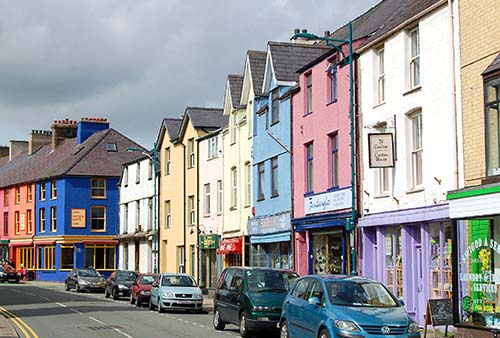
Drivers approaching Llanberis will find pricey pay parking lots throughout town, including one along the lake.
Getting There: Llanberis is easiest to reach from Caernarfon (bus #S1, hourly, 25 minutes,) or Betws-y-Coed (bus #S1 from opposite direction, hourly, 45 minutes); from Conwy, transfer at Caernarfon or Bangor (2/hour, 2 hours). While it’s a quick 30-minute drive from Beddgelert to Llanberis, the bus connection is more complicated, requiring a transfer at Caernarfon or Pen-y-Pass, on the high road around Mount Snowdon (hourly, 1 hour).
If you’re driving over Pen-y-Pass, don’t be alarmed if you see signs indicating a reservation is required; this only applies to those trying to park and hike to Mount Snowdon, as that lot fills up fast. If you do plan to hike, reserve parking in advance (snowdonia.gov.wales/visit/plan-your-visit) or take the Sherpa Wyddfa bus from Llanberis (sherparwyddfa.wales). Note that both of these sites refer to the mountain by its Welsh name, Yr Wyddfa (and likewise they refer to the national park as Eryi).
▲▲Snowdon Mountain Railway
This is the easiest and most popular ascent of Mount Snowdon. You’ll travel five miles from Llanberis to the summit on Britain’s only rack-and-pinion railway (from 1896), climbing a total of 3,500 feet. Along with the views, there’s a mountaintop visitors center and a café. You can take a diesel or steam train: the diesel-powered train with a 70-person car, or the steam train, carrying 34 passengers in a rebuilt Victorian carriage. Either trip takes 2.5 hours (one hour up, one hour down, 30 minutes free time at the summit; you can also choose to hike down, see later).
Don’t confuse this with the Welsh Highland Railway (described earlier, under “Sights in Caernarfon”) or the Llanberis Lake Railway, a different (and far less appealing) Thomas the Tank Engine-type steam train that fascinates kids and runs to the end of Padarn Lake and back.
Cost and Hours: Diesel train—£45 round-trip, £40 early-bird special for 9:00 departure (must book in advance); steam train—£60 round-trip. The diesel train runs from late March through October, but due to ice and snow until late May it usually goes only as far as Clogwyn Station, three-quarters of the way up (and note that in the case of high winds any time of year they may have to stop here, for a reduced fare). The steam train makes the full trip from June through September (weekdays only). The first departure is often at 9:00, and the last trip can be as late as 17:30 in peak season (July-Aug). The schedule flexes with weather and demand; several trips generally run each day, and at the busiest times they go every half-hour. The steam train often doesn’t operate on weekends.
Buying Tickets: Originally designed for Victorian gentry, these days the train is overrun with commoners. Trains fill up fast—especially weekends and any day in July and August—so it’s smart to reserve ahead, basically as soon as you know your travel plans (+44 1286 870 223, snowdonrailway.co.uk). Same-day tickets are sometimes available online or at the ticket office in Llanberis, but it’s a big risk. Show up early: The office opens at 8:30, and on very busy (read: sunny) days, tickets can sell out fast; even if you get one, you may have to wait until afternoon for your scheduled departure time. Those with advance tickets should allow an hour to secure a parking spot and collect your ticket from the Llanberis ticket office at least 45 minutes before boarding.
Getting There: The train departs from Llanberis Station, along the main road at the south end of Llanberis’ town center. The closest parking lots are the pay lot located behind the station (off Victoria Terrace) or the pricier car park across the street from the station (not affiliated with the train). You can also park at one of the other pay lots in town (cheaper, about a 10-minute walk).
Train-and-Hike Combo: A fun option for hikers is to take the train up and hike back down. Since one-way tickets down are not sold in advance and may not be available at the top, I’d advise buying a round-trip ticket even if you plan to hike down (it’s just a couple more pounds) in case the weather turns quickly (as it often does). The 4.5-mile hike down covers 3,200 feet on the Llanberis Path—the easiest of the six main routes—and runs roughly parallel to the train track. You’ll get great views of the trains chugging slowly up and down and sheep grazing nearby. While the trail is manageable for most and easy to follow, in bad weather footing can be slippery. Prepare for all four seasons regardless of the time of year.
▲▲National Slate Museum
Across the lake from Llanberis yawns a giant slate quarry, which was a critical local industry until 1969. Slate from the hillsides above Llanberis was transported to the harbor in Caernarfon, where it was shipped all over the world. Today, the 19th-century industrial workshops have been converted into an excellent museum, where you can learn more about processing slate, though it may be closed for renovations when you visit.
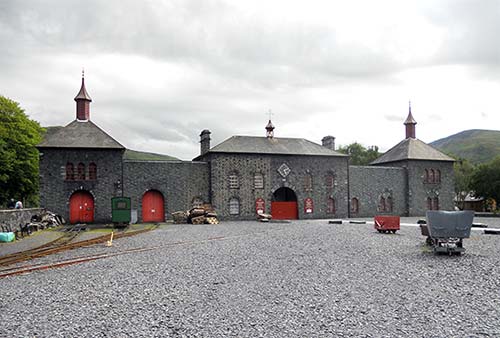
If open, the highlight is the 30-minute slate-splitting demo. This museum is a nice complement to the Llechwedd Slate Caverns in Blaenau Ffestiniog (described below): While that experience focuses on the lifestyles of the people who worked in underground mines (and is of general interest), this museum is primarily about the aboveground workshops (and is particularly thrilling for engineers; +44 3001 112 333, museum.wales/slate).
Blaenau Ffestiniog
High on a mountaintop, Blaenau Ffestiniog (BLEH-nigh FES-tin-yog) is a quintessential Welsh slate-mining town. The town seems to struggle on, oblivious to the tourists who nip in and out. Though it’s tucked amidst a pastoral Welsh landscape, Blaenau Ffestiniog is surrounded by a gunmetal-gray wasteland of “tips,” huge mountain-like piles of excess slate. While not technically inside the national park (thanks to its heavy industry and those giant slate heaps), Blaenau Ffestiniog is surrounded by Snowdonia on all sides, and is a short drive from the idyll of Betws-y-Coed or Beddgelert.
Take a walk. The shops are right out of the 1950s. Long rows of humble “two-up and two-down” houses (four rooms) feel a bit grim. The train station, bus stop, and parking lot all cluster along a one-block stretch in the heart of town. There’s no TI.
Getting There: Blaenau Ffestiniog is conveniently connected by the Conwy Valley train to Betws-y-Coed and Conwy (6/day, 30 minutes to Betws-y-Coed, 1 hour to Conwy via Llandudno Junction). By bus, it’s possible to connect with Beddgelert (7/day, 2.5 hours, transfer in Porthmadog) or Caernarfon (hourly, 1.5 hours, transfer in Porthmadog).
▲▲Llechwedd Slate Caverns
Slate mining played a blockbuster role in Welsh heritage, and this working slate mine on the northern edge of Blaenau Ffestiniog does an excellent job of explaining the mining culture of Victorian Wales. The Welsh mined and split most of the slate roofs of Europe. When done right, a quality Welsh slate roof could last for up to 300 years. But it was hard work: 10 tons of slate were mined for every ton of usable slate extracted. Miners would work 12-hour shifts, six days a week, with one 30-minute break every day. They’d latch themselves to the cliff face at an angle and slowly, one tap at a time, use a long metal rod to chip out four-foot-deep holes to fill with gunpowder. The guided tour will give you a new appreciation for all those slate roofs you’ll see on your travels. Dress warmly—I mean it. You’ll freeze underground without a sweater or jacket. As this is one of the region’s best sights, it’s smart to book in advance.
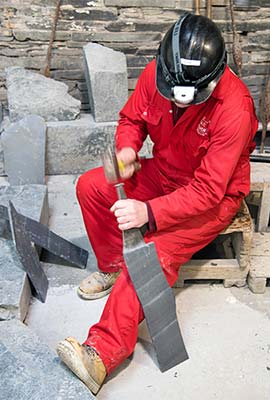
Cost and Hours: £27; daily 9:00-17:30, first tour cheaper and can sell out fast, tours run every 20 minutes, last tour generally at 17:00; off-season 9:00-16:00, tours run hourly, last tour at 15:00; arrive 30 minutes before your tour; cafeteria, pub, +44 1248 601 444, zipworld.co.uk/adventures/deep-mine-tour.
Getting There: The slate mine is about a mile from the town center. Buses leave from the Blaenau Ffestiniog rail station and drop you off near the mine. You can also walk 30 minutes to the mine or take a taxi (about £8, reserve in advance, Nev’s Taxis—+44 1766 762 465 or John’s Taxis—+44 1766 831 781).
Visiting the Mine: The 1.5-hour tour takes you into the mine with a live guide, usually one with a family connection to the mine. After a quick cheesy intro video, your guide offers a short slate-splitting demonstration, then walks you down about 500 feet into the mountain. Along the way are stops in several chambers where the guide tells sobering stories about the harsh realities the workers faced, supplemented with audiovisual dramatizations set in the 1860s and centered around several workers. You can also heft their tools (such as the pointed and weighted rod, called a “jumper”), and learn about the miners’ primitive techniques and their (virtually nonexistent) safety measures. Sadly, despite the reassurances of doctors during that age, inhaling slate dust caused often-fatal cases of silicosis...where the inside of a miner’s lung became coated with tiny chips of slate. The tour concludes with a blast simulation, followed by a moving tribute to the many who lost their lives trying to support their families. A cable railway—Britain’s steepest—takes you back up. The tour requires a half-mile of walking through tunnels and caves with 100-plus stairs and some uneven, and potentially slippery, footing.
▲Ffestiniog Railway
This 13-mile narrow-gauge train line was built in 1836 for small horse-drawn wagons to transport slate from the Ffestiniog mines to the port of Porthmadog. In the 1860s, horses gave way to steam trains. Today, tourists enjoy these tiny titans for a leisurely ride to Porthmadog and back (£50, 5 hours total, includes 1.5 hours in Porthmadog, 3-5/week at 11:40; trains from Porthmadog to Blaenau run more frequently, 3.5 hours total, 50 minutes in Blaenau; festrail.co.uk).
South of Snowdonia National Park
Tucked between Snowdonia and the North Sea is a sweeping, sandy tidal estuary called Tremadog Bay, with a faux Italian town (Portmeirion) and two more castles, Harlech and Criccieth. The sights here—about a half-hour’s drive from Beddgelert, Blaenau Ffestiniog, or Caernarfon—can help round out a busy day exploring North Wales. The area’s main town, Porthmadog, is the start/end point of two of the area’s scenic rail lines (the Ffestiniog Railway and the Welsh Highland Railway). All three are within a 15-minute drive of Porthmadog, in different directions.
▲Harlech Castle
Dramatically sited 14 miles south of Blaenau Ffestiniog, Harlech Castle is compact and fun to explore. When it was built by Edward I in 1283, the sea lapped at the base of the castle wall (you can see the jagged dike since built in the distance, along with an old stone staircase that led down to the former water level, now the train tracks). During the War of the Roses, Queen Margaret of Anjou hid out here for a time, and it was the last castle in Britain to fall (after a nine-month siege) during the English Civil War. Before crossing the bridge to the castle, watch the seven-minute introductory film. At the gatehouse (where you enter the castle), climb to the top of the southwest tower, with panoramic views to the sea. Back down in the central courtyard, you can climb either tower flanking the gatehouse to reach the lower wall-top walkway and hike all the way around. The village of Harlech is cute and worth a wander.
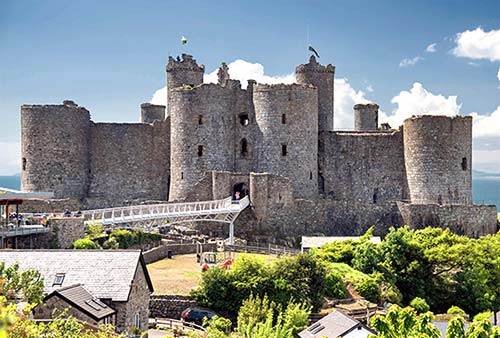
Cost and Hours: £10; daily 9:30-17:00, July-Aug until 18:00; Nov-Feb 10:00-16:00; in the village of Harlech, just above the A-496; pay lot at castle entry, view café, +44 3000 252 239, cadw.gov.wales [URL inactive].
▲Portmeirion
File this under “Britain’s offbeat sights.” Tucked into a balmy microclimate, a short drive from the slag heaps of Blaenau Ffestiniog or the hobbit town of Beddgelert, is a faux-Italian Riviera village modeled after Portofino. This flower-filled fantasy is extravagant: Surrounded by lush Welsh greenery and a windswept mudflat at low tide, Portmeirion is an artistic glob of palazzo arches, fountains, gardens, and promenades filled with restaurants, cafés, souvenir shops, three hotels (including one in a castle), self-catering cottages, and local tourists who always wanted to go to Italy.
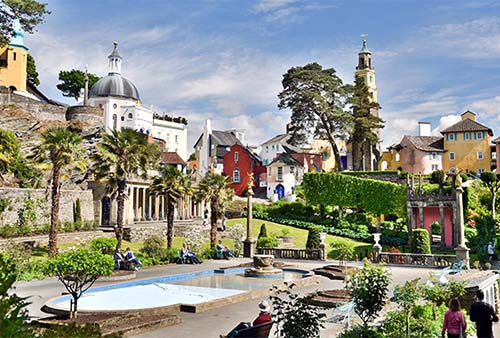
In 1925, Sir Clough Williams-Ellis began building this grand-scale folly—a pastel world of Italianate architecture. Soon this retreat began to attract celebrities seeking both novelty and privacy: H. G. Wells, Noel Coward, Prince Charles, and Beatles manager Brian Epstein were all repeat guests. The 1960s British TV series The Prisoner—which still has a big cult following—was filmed here, adding to the town’s fame.
Buy your ticket at the tollhouse, then you’re free to wander and explore. The free Portmeirion app offers a guided tour of the village. Two trails—the Woodland Walk and the Coastal Walk—provide structure for your meanderings, each taking 30-40 minutes to stroll. If you’d like to completely forget you’re in Wales, grab a gelato or espresso and give in to the scene.
Cost and Hours: £20; daily 9:30-18:30, last entry at 17:00; Nov-March closes at 17:30, last entry at 16:30; +44 1766 770 000, portmeirion.wales.
Criccieth Castle
Perched on a grassy bluff over the pretty seafront town of the same name, Criccieth (KRICK-ith) is the smallest, least historic, and least impressive of the “big five” border castles. Built by the Welsh around 1230, it was later seized, beefed up, and added to the castle ring by the English. The modern visitors center at the base of the hill has a small but well-presented exhibit on the castle’s history...but there’s not much to say. You can hike up and prowl the ruins, with great 360-degree views over Tremadog Bay and deep into Snowdonia. On a nice day, you can see all the way to Harlech Castle. Of the five Edward castles, this is the one where the views from the castle are better than the interior of the castle itself.
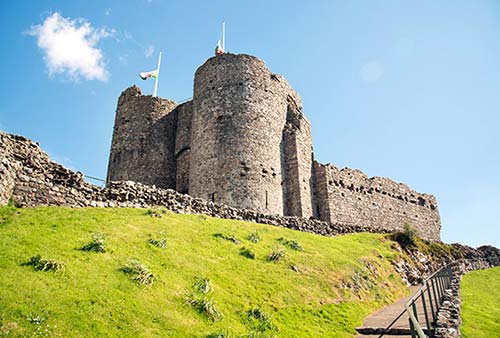
Cost and Hours: £7.90; Thu-Mon 10:00-17:00, closed Tue-Wed; Nov-March Fri-Sun until 16:00, closed Mon-Thu; on the A-497 in the village of Criccieth; a few free street-parking spaces right in front of the ticket office, or park at the pay lot on the waterfront and huff it up the hill, +44 3000 252 239, cadw.gov.wales [URL inactive].
Northeast Wales
If you’re driving between North Wales and England, the Denbighshire towns of Llangollen and Ruthin are worth a stop. Llangollen is more engaging, with a dramatic setting and lots of ways to spend a few minutes or a few hours. Ruthin is appealing simply for its salt-of-the earth character; while it has some good sights and a fine hotel, it’s more of a place to melt into small-town Welsh life. Neither town is particularly well connected by public transportation, so they’re effectively just for drivers. You can squeeze either or both into the drive from North Wales to England, but with more time, spend a night...or two.
While you’re in the Denbighshire area, look for the free, engaging, wryly written “Town Trail” maps, detailing self-guided walks in Llangollen, Ruthin, and other towns (free at TIs).
Llangollen
Llangollen (thlang-GOTH-lehn) is a red-brick riverside town that’s strikingly set in a gorge with a rushing river. It has an impressive history, thanks to its clever canal, a symbol of the Industrial Revolution, and the fascinating manor house called Plas Newydd. It’s also a popular launch pad for hikes, boat trips, and steam-train journeys. The town is famous for its weeklong International Musical Eisteddfod, a very popular festival held every July, with dance competitions and evening concerts (+44 1978 862 001, international-eisteddfod.co.uk). The town feels equal parts blue-collar and touristy.
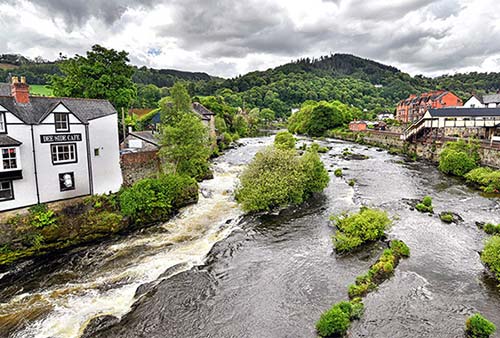
With about 3,000 people, little Llangollen is easy to navigate. It has a big pay parking lot on Market Street (with WCs oddly stocked with area brochures), well signed as you enter town. The town’s helpful TI, also chock-a-block with brochures, is just around the corner on Castle Street (generally Mon-Sat 9:30-16:30, closed Sun, +44 1978 860 828, llangollen.org.uk). It also stocks books, maps, and local arts and crafts.
A couple of blocks north, a bridge scenically crosses the River Dee, with the steam railway station and the canal just beyond. To the south, the aptly named Hill Street climbs steeply up to a residential zone, where you’ll find the town’s best sight, Plas Newydd.
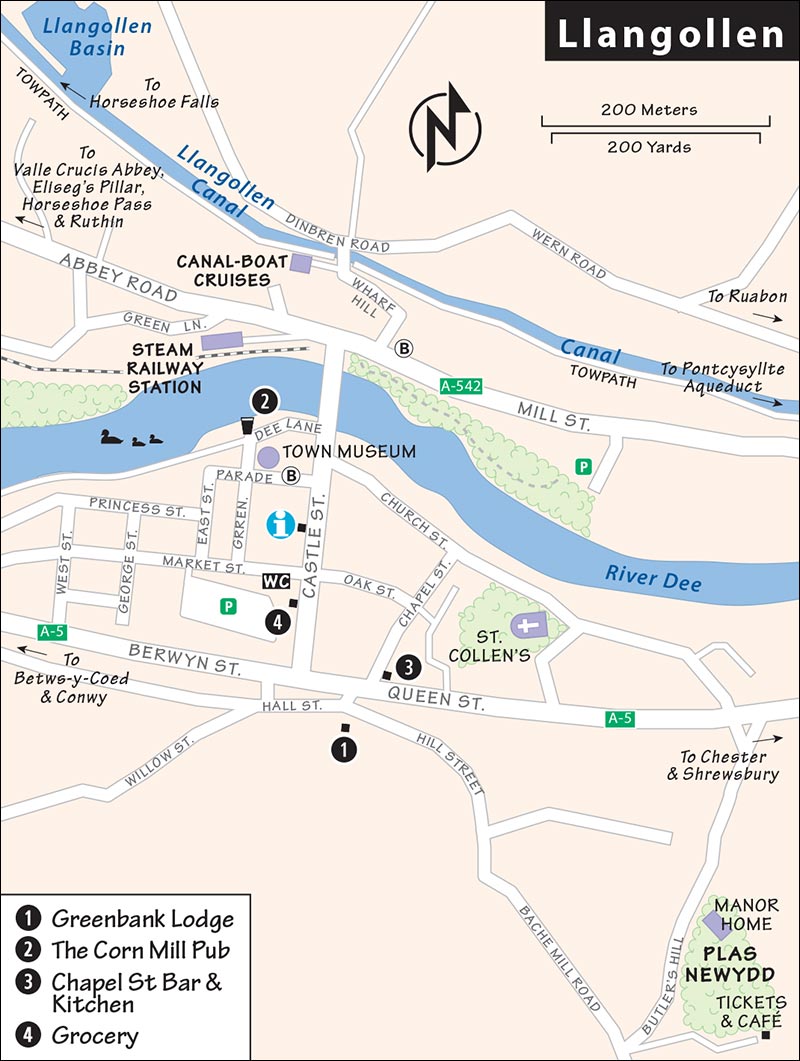
Llangollen Canal
At the turn of the 18th century, famed engineers Thomas Telford and William Jessop built this remarkable industrial canal, with a horse-drawn towpath for hauling cargo running its entire length. (It was originally intended to connect to a network of canals linking all the way to the big port at Liverpool, but the entire run was never completed.) The ingenious design—which begins at the River Dee’s Horseshoe Falls two miles west of town and crosses the towering Pontcysyllte Aqueduct four miles east of town—was engineered to drop less than 20 inches over its entire 11-mile length.
Today it’s a tourist attraction (to find it, cross the bridge from the town center and head up the hill). You can go for an easy, level stroll along its towpath, or take a lazy canal-boat cruise. The classic choice is by horse-drawn boat—either the basic, 45-minute version or the full-blown two-hour version all the way to Horseshoe Falls (+44 1978 860 702, horsedrawnboats.co.uk). A two-hour motorized canal-boat trip goes all the way to—and across—the Pontcysyllte Aqueduct. As the longer tours (both horse-drawn and motorized) can sell out, it’s smart to book ahead.
▲▲Plas Newydd
This is the manor home (pronounced “plass NEW-eth”) of two 18th-century upper-class Irish women who ran off together and lived here as a couple for 50 years. Known as the “Ladies of Llangollen,” Lady Eleanor Butler and Sarah Ponsonby escaped from their families and settled here in 1778, causing a sensation in Georgian society. The rich and famous—inspired by the way the ladies’ relationship epitomized the Romantic Age—beat a path to their door, including the Duke of Wellington, Josiah Wedgwood, William Wordsworth, and Sir Walter Scott. Eleanor and Sarah were avid collectors of fine woodwork, which they incorporated into both the exterior and interior of their “cottage.” These ornate wood carvings cover seemingly every surface of the many cozy rooms you’ll see—living room, library, bedroom, guest room—which also display some of their personal belongings. Out front is the well-tended topiary garden. While there are plenty of old British manor houses to tour, this one is uniquely fascinating. Rent the essential audioguide and take the time to listen to its complete story.
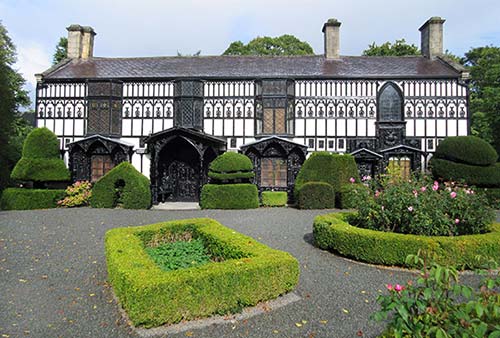
Cost and Hours: House—£13, daily 11:00-17:00, last entry at 16:00; gardens—free, daily 9:30-17:00; house closed Nov-March—but gardens open weekends; tearoom with good lunches, 10-minute walk from TI on Castle Street, limited free parking, +44 1978 862 834, denbighshire.gov.uk.
Other Experiences in Llangollen
You’ll see a steady stream of serious walkers huffing through town. Llangollen is a popular launch pad for both short and long-distance walks in the Welsh countryside. For an easy stroll, wander along the canal’s towpath in either direction (Horseshoe Falls is two miles away). For a more substantial hike, head for Valle Crucis Abbey. (The falls and abbey are both described later.) Another popular choice is the steep trek up to Castell Dinas Brân, the ruined castle capping the bald mountain over the canal side of town (visible from various points in Llangollen). The TI can give advice on any of these hikes, including how to connect the abbey and castle for a longer day hike.
Llangollen has its own little steam-train line, the Llangollen Railway, which putters up and down the Dee Valley to the town of Corwen and back (about 40 minutes each way, mostly runs just weekends March-Oct, check the schedule online in advance, llangollen-railway.co.uk).
The humble, endearingly cluttered town museum fills a circular, bunker-like building between the TI and the river (on Parade Street, free, Mon-Thu and Sat-Sun 10:30-16:00, closed Fri, 1978 862 862, llangollenmuseum.org [URL inactive]). It’s worth ducking in on a rainy day. The centerpiece is a replica of the ninth-century Eliseg’s Pillar (you can see the original on the way up to the Horseshoe Pass—see “Scenic Drive Between Llangollen and Ruthin,” later).
Sleeping and Eating in Llangollen: £ Greenbank Lodge is an excellent boutique option with nine rooms. It’s run by delightful Christopher (who played piano in London’s West End theaters for years) and Gavin (an architect and former mayor of Ruthin), who also run the recommended Manorhaus in Ruthin (no breakfast, two-night minimum, one ground-floor room, one-bedroom self-catering cottage also available, free parking, Hill Street, +44 1824 704 830, greenbanklodge.com, post@greenbanklodge.com).
You’ll find no shortage of options for a quick lunch downtown. Several vendors sell savory pastries, called oggies. A short walk upstream from the bridge, ££ The Corn Mill is a lively and tempting pub in a historic stone building along the water. If the weather’s nice, grab a seat on the deck hanging over the rapids (daily, Dee Lane, +44 1978 869 555). If you’re going to Plas Newydd, they have an inviting café that serves excellent lunches, cakes, and coffee with a comfortable courtyard. If you’re here overnight, ££ Chapel St Bar & Kitchen, just across from Greenbank Lodge, is a good choice for either small plates or a hearty meal, with a cute little bar downstairs, romantic seating upstairs, and some tables outside (closed Mon, +44 1978 257 219, chapelstbarandkitchen.co.uk). Spar on the main drag is good for picnic supplies.
Llangollen Connections: To reach Conwy, you can take bus #5 to Ruabon, where you can transfer to a train (4/day Mon-Sat, hourly Sun; 2 hours total).
Scenic Drive Between Llangollen and Ruthin
It’s a fast (30 minutes), scenic, and satisfying drive between Llangollen and Ruthin on the A-542 over the Horseshoe Pass (1,367 feet). Allow more time if you stop on the way at the following points of interest.
Consider packing a picnic and munching it next to Horseshoe Falls. From Llangollen’s town center, cross the bridge and turn left on Abbey Road (A-542). About two miles out of town, watch for the Horseshoe Falls turnoff on the left. Follow this road a half-mile and park in a pay lot, then walk steeply downhill through a meadow to reach the humble falls (and, nearby, the starting point of the Llangollen Canal).
Back on the main road, about a mile farther along on the right is the turnoff for Valle Crucis Abbey. This lovely Cistercian abbey from 1201 was one of many “dissolved” by King Henry VIII. While not as striking as others—especially the much more famous and evocative Tintern Abbey in South Wales—it’s worth stopping if it’s your best chance to see a ruined abbey (free, generally open daily 10:00-16:00; +44 3000 252 239, cadw.gov.wales [URL inactive]).
A few hundred yards farther along the main road, look right for a green mound topped by Eliseg’s Pillar—a weathered nub of a monument placed here by a Welsh king in the ninth century. From here, over the next few miles you’ll ascend past the tree line, zoom by an old slate mine (with a roadside mountain of unwanted slate fragments), and dodge some roadside sheep to reach the top of the pass, with sweeping views of the countryside. The scenery eventually changes from sheep to cows as you wind your way down to Ruthin.
Ruthin
Ruthin (RITH-in; “Rhuthun” in Welsh) is a low-key market town with charm in its ordinary Welshness. The people are the sights, and admission is free if you start the conversation.
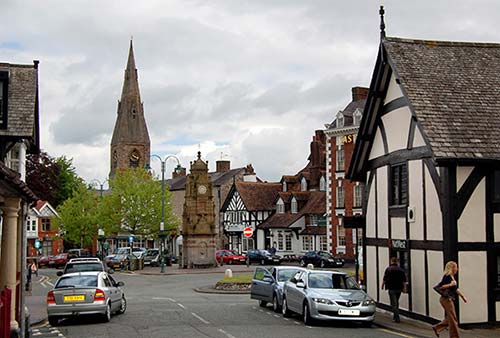
Ruthin (pop. 5,000) is situated atop a gentle hill surrounded by undulating meadows. In this crossroads town, the central roundabout (at the former medieval marketplace, St. Peter’s Square) is a busy pinwheel. The 15th-century courthouse serves as a visitors center and mini-museum with displays on the town’s history. The market square, jail, museum, arts center, bus station, and in-town accommodations are all within five blocks of one another.
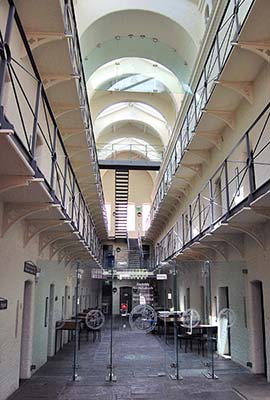
Visiting Ruthin: For a glimpse into crime and punishment in 17th- to early 20th-century Wales, pop in to the Ruthin Gaol, a 100-cell prison on Clwyd Street (worth ▲). Using the excellent audioguide, head down to the cellar to explore the “dark” and condemned cells, give the dreaded hand-crank a whirl, and learn about the men, women, and children who did time here before the prison closed in 1916. Head up into the bright and eerie “panopticon”—a design all British prisons adopted in the late 19th century to allow all prisoners to be watched at the same time (facebook.com/ruthingaol).
On Castle Street, Nantclwyd y Dre, an Elizabethan-era “oldest timbered townhouse in Wales,” is now a museum with a medieval garden. Seven decorated rooms give visitors a peek into the history of the house, which was built in 1435 (facebook.com/nantclwydydre). Just beyond the house, you can wander up through the peaceful grounds of the Ruthin Castle Hotel, with its resident peacocks strutting their stuff.
The state-of-the-art Ruthin Craft Center, at the base of Ruthin’s hill, hosts contemporary art. Inside, you’ll find a series of galleries and studio spaces for British artists, mostly from Wales, as well as artists’ studios. Grab their “Art Trail” map, which leads you on a fun scavenger hunt of artistic and historical elements scattered throughout town, including “spy holes” embedded in walls and buildings containing memories of the town from the eyes of local artists (ruthincraftcentre.org.uk).
For a scenic and interesting one-to-two-hour walk, head to Moel Famau (the “Jubilee Tower,” a 200-year-old war memorial on a peak overlooking stark moorlands). Trailheads are a 10-minute drive east of Ruthin on the A-494. Head to the Coed Moel Famau lot for a more direct hike or, for a longer and less strenuous route, park at the Bwlch Penbarras lot. Trails are well marked.
Sleeping in Ruthin: Filling a Georgian building, Ruthin’s classiest sleeping option is the ££ Manorhaus (nine rooms impeccably appointed with artsy-contemporary decor, and guests enjoy use of the library; breakfast extra, locally sourced dinners available by request some nights; on Well Street, +44 1824 704 830, manorhaus.com, post@manorhaus.com). They also have Film Club nights in their quaint movie theater downstairs.
Eating in Ruthin: For creative lunches and dinners made mostly with fresh local ingredients, consider ££ Small Plates (closed Mon, reserve in advance, 5 Upper Clwyd Street, +44 1824 702 748, small-plates.co.uk). To assemble a top-notch gourmet picnic or for a relaxed sit-down lunch, visit £ Leonardo’s Delicatessen (closed Sat-Sun, just off the main square at 4 Well Street, +44 1824 707 161). For takeaway fish-and-chips, head to £ Finn’s (the local favorite, daily from 16:30, near Ruthin Gaol at the bottom of Clwyd Street, +44 1824 702 518). Just out of town, Griffin Inn is an expansive, modern pub with lunch, dinner, and good outdoor seating (closed Mon-Tue, Llanbedr-Dyffryn-Clwyd, +44 1824 705 542, griffin.wales).
North Wales Connections
Two major transfer points out of (or into) North Wales are Crewe and Chester. Figure out your complete connection at nationalrail.co.uk or tfw.wales (both have good apps for journey planning and ticket buying).
From Crewe by Train to: London’s Euston Station (4/hour direct, 2 hours); Bristol, near Bath (2/hour, 3 hours, 1 transfer); Cardiff (hourly direct, 2.5 hours, more with transfer); Holyhead (5/day direct, 2 hours, more with transfer); Blackpool (hourly, 1.25 hours, transfer in Preston); Keswick in the Lake District (6/day to Penrith, 1.75 hours, more with transfer; then bus to Keswick, 45 minutes); Birmingham (2/hour direct, 1 hour, more with transfer); Glasgow (6/day direct, 3 hours, more with transfer).
From Chester by Train to: London’s Euston Station (hourly, 2 hours direct, more with transfer), Liverpool (4/hour direct, 45 minutes), points in North Wales via Llandudno Junction (2-3/hour direct, 1 hour).
Ferry Connections Between North Wales and Ireland: Two companies make the crossing between Holyhead (in North Wales, beyond Caernarfon) and Dublin: Stena Line (stenaline.co.uk) and Irish Ferries (irishferries.com; both roughly 4/day, 3-4 hours, book online for best fares).